WO2020171089A1 - Procédé de production de matériau actif d'électrode positive pour batteries secondaires au lithium-ion, matériau actif d'électrode positive pour batteries secondaires au lithium-ion, et batterie secondaire au lithium-ion - Google Patents
Procédé de production de matériau actif d'électrode positive pour batteries secondaires au lithium-ion, matériau actif d'électrode positive pour batteries secondaires au lithium-ion, et batterie secondaire au lithium-ion Download PDFInfo
- Publication number
- WO2020171089A1 WO2020171089A1 PCT/JP2020/006361 JP2020006361W WO2020171089A1 WO 2020171089 A1 WO2020171089 A1 WO 2020171089A1 JP 2020006361 W JP2020006361 W JP 2020006361W WO 2020171089 A1 WO2020171089 A1 WO 2020171089A1
- Authority
- WO
- WIPO (PCT)
- Prior art keywords
- lithium
- positive electrode
- active material
- electrode active
- ion secondary
- Prior art date
- Legal status (The legal status is an assumption and is not a legal conclusion. Google has not performed a legal analysis and makes no representation as to the accuracy of the status listed.)
- Ceased
Links
Images
Classifications
-
- H—ELECTRICITY
- H01—ELECTRIC ELEMENTS
- H01M—PROCESSES OR MEANS, e.g. BATTERIES, FOR THE DIRECT CONVERSION OF CHEMICAL ENERGY INTO ELECTRICAL ENERGY
- H01M4/00—Electrodes
- H01M4/02—Electrodes composed of, or comprising, active material
- H01M4/04—Processes of manufacture in general
- H01M4/0471—Processes of manufacture in general involving thermal treatment, e.g. firing, sintering, backing particulate active material, thermal decomposition, pyrolysis
-
- H—ELECTRICITY
- H01—ELECTRIC ELEMENTS
- H01M—PROCESSES OR MEANS, e.g. BATTERIES, FOR THE DIRECT CONVERSION OF CHEMICAL ENERGY INTO ELECTRICAL ENERGY
- H01M4/00—Electrodes
- H01M4/02—Electrodes composed of, or comprising, active material
- H01M4/36—Selection of substances as active materials, active masses, active liquids
- H01M4/48—Selection of substances as active materials, active masses, active liquids of inorganic oxides or hydroxides
- H01M4/52—Selection of substances as active materials, active masses, active liquids of inorganic oxides or hydroxides of nickel, cobalt or iron
- H01M4/525—Selection of substances as active materials, active masses, active liquids of inorganic oxides or hydroxides of nickel, cobalt or iron of mixed oxides or hydroxides containing iron, cobalt or nickel for inserting or intercalating light metals, e.g. LiNiO2, LiCoO2 or LiCoOxFy
-
- H—ELECTRICITY
- H01—ELECTRIC ELEMENTS
- H01M—PROCESSES OR MEANS, e.g. BATTERIES, FOR THE DIRECT CONVERSION OF CHEMICAL ENERGY INTO ELECTRICAL ENERGY
- H01M4/00—Electrodes
- H01M4/02—Electrodes composed of, or comprising, active material
- H01M4/13—Electrodes for accumulators with non-aqueous electrolyte, e.g. for lithium-accumulators; Processes of manufacture thereof
- H01M4/139—Processes of manufacture
- H01M4/1391—Processes of manufacture of electrodes based on mixed oxides or hydroxides, or on mixtures of oxides or hydroxides, e.g. LiCoOx
-
- H—ELECTRICITY
- H01—ELECTRIC ELEMENTS
- H01M—PROCESSES OR MEANS, e.g. BATTERIES, FOR THE DIRECT CONVERSION OF CHEMICAL ENERGY INTO ELECTRICAL ENERGY
- H01M4/00—Electrodes
- H01M4/02—Electrodes composed of, or comprising, active material
- H01M4/36—Selection of substances as active materials, active masses, active liquids
- H01M4/362—Composites
-
- H—ELECTRICITY
- H01—ELECTRIC ELEMENTS
- H01M—PROCESSES OR MEANS, e.g. BATTERIES, FOR THE DIRECT CONVERSION OF CHEMICAL ENERGY INTO ELECTRICAL ENERGY
- H01M4/00—Electrodes
- H01M4/02—Electrodes composed of, or comprising, active material
- H01M4/36—Selection of substances as active materials, active masses, active liquids
- H01M4/48—Selection of substances as active materials, active masses, active liquids of inorganic oxides or hydroxides
- H01M4/483—Selection of substances as active materials, active masses, active liquids of inorganic oxides or hydroxides for non-aqueous cells
-
- H—ELECTRICITY
- H01—ELECTRIC ELEMENTS
- H01M—PROCESSES OR MEANS, e.g. BATTERIES, FOR THE DIRECT CONVERSION OF CHEMICAL ENERGY INTO ELECTRICAL ENERGY
- H01M4/00—Electrodes
- H01M4/02—Electrodes composed of, or comprising, active material
- H01M4/36—Selection of substances as active materials, active masses, active liquids
- H01M4/48—Selection of substances as active materials, active masses, active liquids of inorganic oxides or hydroxides
- H01M4/50—Selection of substances as active materials, active masses, active liquids of inorganic oxides or hydroxides of manganese
- H01M4/505—Selection of substances as active materials, active masses, active liquids of inorganic oxides or hydroxides of manganese of mixed oxides or hydroxides containing manganese for inserting or intercalating light metals, e.g. LiMn2O4 or LiMn2OxFy
-
- H—ELECTRICITY
- H01—ELECTRIC ELEMENTS
- H01M—PROCESSES OR MEANS, e.g. BATTERIES, FOR THE DIRECT CONVERSION OF CHEMICAL ENERGY INTO ELECTRICAL ENERGY
- H01M10/00—Secondary cells; Manufacture thereof
- H01M10/05—Accumulators with non-aqueous electrolyte
- H01M10/052—Li-accumulators
- H01M10/0525—Rocking-chair batteries, i.e. batteries with lithium insertion or intercalation in both electrodes; Lithium-ion batteries
-
- H—ELECTRICITY
- H01—ELECTRIC ELEMENTS
- H01M—PROCESSES OR MEANS, e.g. BATTERIES, FOR THE DIRECT CONVERSION OF CHEMICAL ENERGY INTO ELECTRICAL ENERGY
- H01M4/00—Electrodes
- H01M4/02—Electrodes composed of, or comprising, active material
- H01M2004/026—Electrodes composed of, or comprising, active material characterised by the polarity
- H01M2004/028—Positive electrodes
-
- H—ELECTRICITY
- H01—ELECTRIC ELEMENTS
- H01M—PROCESSES OR MEANS, e.g. BATTERIES, FOR THE DIRECT CONVERSION OF CHEMICAL ENERGY INTO ELECTRICAL ENERGY
- H01M2220/00—Batteries for particular applications
- H01M2220/20—Batteries in motive systems, e.g. vehicle, ship, plane
-
- Y—GENERAL TAGGING OF NEW TECHNOLOGICAL DEVELOPMENTS; GENERAL TAGGING OF CROSS-SECTIONAL TECHNOLOGIES SPANNING OVER SEVERAL SECTIONS OF THE IPC; TECHNICAL SUBJECTS COVERED BY FORMER USPC CROSS-REFERENCE ART COLLECTIONS [XRACs] AND DIGESTS
- Y02—TECHNOLOGIES OR APPLICATIONS FOR MITIGATION OR ADAPTATION AGAINST CLIMATE CHANGE
- Y02E—REDUCTION OF GREENHOUSE GAS [GHG] EMISSIONS, RELATED TO ENERGY GENERATION, TRANSMISSION OR DISTRIBUTION
- Y02E60/00—Enabling technologies; Technologies with a potential or indirect contribution to GHG emissions mitigation
- Y02E60/10—Energy storage using batteries
Definitions
- the present invention relates to a method for producing a positive electrode active material for a lithium ion secondary battery, a positive electrode active material for a lithium ion secondary battery, and a lithium ion secondary battery.
- a lithium-ion secondary battery is a secondary battery that meets these requirements.
- This lithium-ion secondary battery is composed of a negative electrode, a positive electrode, an electrolyte, etc., and a material capable of desorbing and inserting lithium is used for the negative electrode and the active material of the positive electrode.
- lithium-ion secondary batteries are currently being actively researched and developed, but among them, lithium-ion secondary batteries using a layered or spinel type lithium nickel composite oxide as a positive electrode material are Since a high voltage of 4 V class can be obtained, it is being put to practical use as a battery having a high energy density.
- the main cathode materials that have been proposed so far include a lithium cobalt composite oxide (LiCoO 2 ) that is relatively easy to synthesize, a lithium nickel composite oxide (LiNiO 2 ) that uses nickel that is cheaper than cobalt, and lithium.
- a lithium cobalt composite oxide LiCoO 2
- LiNiO 2 lithium nickel composite oxide
- lithium nickel-cobalt-manganese composite oxide
- LiMn 2 O 4 lithium manganese composite oxide using manganese
- lithium nickel composite oxide and lithium nickel cobalt manganese composite oxide have good cycle characteristics, It is attracting attention as a material that can obtain high output with low resistance.
- Patent Document 1 at least one or more elements selected from Mo, W, Nb, Ta, and Re satisfying a predetermined composition formula with respect to the total molar amount of Mn, Ni, and Co in the composition formula.
- a lithium transition metal-based compound powder for a lithium secondary battery positive electrode material which is contained in a proportion of 0.1 mol% or more and 5 mol% or less, has been proposed.
- Production of lithium transition metal-based compound powder for lithium secondary battery positive electrode material which includes a spray drying step of pulverizing and spray-drying a slurry in which these are uniformly dispersed, and a firing step of firing the obtained spray-dried product.
- a method is disclosed.
- Patent Document 1 when used as a positive electrode material for a lithium secondary battery, it is possible to achieve both low cost and high safety as well as high load characteristics and improved powder handling.
- the lithium transition metal-based compound powder is obtained by pulverizing raw materials in a liquid medium and spray-drying a slurry in which these are uniformly dispersed. It is obtained by firing the spray dried product. Therefore, there is a problem that some of the different elements such as Mo, W, Nb, Ta, and Re are replaced with Ni arranged in layers, and the battery characteristics such as battery capacity and cycle characteristics are deteriorated. It was
- Patent Document 2 discloses a positive electrode active material for a non-aqueous electrolyte secondary battery having at least a layered structure lithium transition metal composite oxide, the lithium transition metal composite oxide comprising primary particles and aggregates thereof.
- a positive electrode active material for a secondary battery has been proposed.
- Patent Document 2 as a method for producing the positive electrode active material for a non-aqueous electrolyte secondary battery, a compound of an additive element such as a molybdenum compound, a lithium compound, and cobalt are co-precipitated and then obtained by heat treatment.
- a method of firing and pulverizing a raw material mixture which is a mixture with the compound thus obtained is disclosed.
- Patent Document 2 According to the positive electrode active material for a non-aqueous electrolyte secondary battery disclosed in Patent Document 2, by having a compound having at least one selected from the group consisting of molybdenum, vanadium, tungsten, boron and fluorine on the surface of particles. It is said that the conductivity is improved, and thereby the initial characteristics are improved without impairing the improvement of thermal stability, load characteristics and output characteristics.
- Patent Document 2 it is said that the effect of at least one additive element selected from the group consisting of molybdenum, vanadium, tungsten, boron and fluorine lies in the improvement of initial characteristics, that is, initial discharge capacity and initial efficiency. It did not improve the output characteristics. Further, according to the production method disclosed in Patent Document 2, a raw material which is a mixture of a compound of an additive element such as a molybdenum compound, a lithium compound, and a compound obtained by heat treatment after coprecipitating cobalt or the like. Since the mixture is fired, there is a problem that a part of the additive element is replaced with nickel arranged in layers and the battery characteristics are deteriorated.
- an additive element such as a molybdenum compound, a lithium compound, and a compound obtained by heat treatment after coprecipitating cobalt or the like. Since the mixture is fired, there is a problem that a part of the additive element is replaced with nickel arranged in layers and the battery characteristics are deteriorated.
- Patent Document 3 discloses that a metal containing at least one selected from Ti, Al, Sn, Bi, Cu, Si, Ga, W, Zr, B, and Mo around the positive electrode active material and/or a combination of a plurality of these metals.
- a positive electrode using the resulting intermetallic compound and/or oxide coated is disclosed.
- Patent Document 3 discloses an example in which a positive electrode material and a coating material for coating the positive electrode material are coated using a planetary ball mill.
- Patent Document 3 it is stated that by disposing the above-mentioned substance around the positive electrode active material, it is possible to absorb oxygen gas that causes ignition and explosion to ensure safety, but it does not improve output characteristics. It was
- Patent Document 4 a composite oxide particle having a predetermined composition is deposited with a tungstic acid compound and subjected to heat treatment, and a positive electrode active material having a carbonate ion content of 0.15 wt% or less. The substance is disclosed. Further, in Patent Document 4, a deposition step of depositing a tungstic acid compound on a composite oxide particle containing lithium (Li) and nickel (Ni), and the above-described complex in which the tungstic acid compound is deposited. Disclosed is a method for producing a positive electrode active material, which comprises a heating step of heat-treating oxide particles.
- Patent Document 4 it is possible to suppress gas generation due to decomposition of the non-aqueous electrolyte solution or the like. Alternatively, it is said that gas generation from the positive electrode active material itself can be suppressed. However, it did not improve the output characteristics.
- a lithium nickel composite oxide containing lithium (Li), nickel (Ni), and an element M (M) (provided that the element M is Mn, V, Mg, Mo, Nb, Ti, Co, and Al).
- At least one element selected from a water washing step of washing and filtering with water to form a wash cake, A filling step of filling the dryer with the cleaning cake that is the material to be dried and a tungsten compound that does not contain lithium, A drying step of drying the material to be dried while flowing it with the dryer, In the filling step, there is provided a method for manufacturing a positive electrode active material for a lithium ion secondary battery, which has a time period in which the cleaning cake and the tungsten compound containing no lithium are simultaneously supplied to the dryer.
- a method for producing a positive electrode active material for a lithium-ion secondary battery which can obtain a high capacity and a high output when used for a positive electrode.
- the method for producing a positive electrode active material for a lithium ion secondary battery of the present embodiment (hereinafter, also simply referred to as a “method for producing a positive electrode active material”) can include the following steps.
- a lithium nickel composite oxide containing lithium (Li), nickel (Ni), and an element M (M) (provided that the element M is Mn, V, Mg, Mo, Nb, Ti, Co, and Al). At least one element selected from the above) is washed with water, filtered, and washed to obtain a wash cake.
- a drying process in which the material to be dried is dried while being dried by a dryer. In the filling step, it is preferable that the cleaning cake and the tungsten compound containing no lithium be supplied to the dryer at the same time.
- the inventor of the present invention has earnestly studied the powder characteristics of a lithium nickel composite oxide used as a positive electrode active material and the influence on the positive electrode resistance of a battery.
- the lithium nickel composite oxide was washed with water, a tungsten compound containing no lithium was added to the washed cake, and the positive electrode active material obtained by drying while flowing was used for the positive electrode of a lithium ion secondary battery.
- lithium nickel composite oxide can be added to water to form a slurry, and the lithium nickel composite oxide can be washed (washed with water) by stirring the slurry. After washing with water, it is possible to separate the lithium-nickel composite oxide, which is the washing cake, and the filtrate by filtering.
- the element M can be at least one element selected from Mn, V, Mg, Mo, Nb, Ti, Co, and Al as described above.
- the lithium nickel composite oxide is preferably a compound having a layered structure, that is, a layered compound.
- the lithium nickel composite oxide can be represented by, for example, a general formula Li y Ni 1-x M x O 2+ ⁇ . Since x, y, and the element M have already been described, the description thereof will be omitted here. It is preferable that ⁇ is, for example, ⁇ 0.2 ⁇ 0.2.
- the lithium nickel composite oxide can have a form of powder having, for example, primary particles and secondary particles in which primary particles are aggregated.
- the water used in the washing step is not particularly limited, but, for example, pure water can be used to prevent contamination of impurities.
- water having an electric conductivity of less than 10 ⁇ S/cm is more preferable, and water having an electric conductivity of 1 ⁇ S/cm or less is more preferable, from the viewpoint of preventing deterioration of battery characteristics due to adhesion of impurities to the lithium nickel composite oxide. ..
- lithium hydroxide can be added to the water used to form the slurry in order to prevent the adverse effect on the battery characteristics while lowering the slurry concentration to improve the handleability of the slurry.
- the addition amount is adjusted so that the electric conductivity of the filtrate obtained in the water washing step is 40 mS/cm or more and 80 mS/cm or less. It is preferable.
- the degree of washing of the lithium nickel composite oxide is not particularly limited, but for example, in the washing step, washing conditions such that the electric conductivity of the filtrate obtained after filtration is 40 mS/cm or more and 80 mS/cm or less, that is, It is preferable to select washing conditions.
- the washing conditions here include, for example, the concentration of the slurry obtained by adding the lithium nickel composite oxide to water, the stirring time, the temperature of the slurry, and the like. This is because by washing with water so that the electric conductivity of the filtrate is 40 mS/cm or more, it is possible to prevent the lithium compound from being excessively washed off from the surface of the particles of the lithium nickel composite oxide.
- the lithium compound necessary for the reaction with the tungsten compound containing no lithium is arranged, and in the drying step described below, lithium tungstate is sufficiently formed. This is because it is possible to improve the output characteristics.
- the excess lithium component which is larger than the necessary amount for forming lithium tungstate, is appropriately prepared from the particle surface of the lithium nickel composite oxide. Can be removed to improve the battery characteristics.
- the slurry concentration of the slurry in which the lithium nickel composite oxide is dispersed in water is not particularly limited, but as the slurry concentration is lower, the electric conductivity of the filtrate tends to be smaller, and for example, the slurry concentration is 750 g/L or more. It is preferably 1500 g/L or less.
- the temperature at the time of washing with water that is, the slurry temperature is not particularly limited, but the lower the temperature, the lower the conductivity of the filtrate is likely to be.
- the temperature is preferably 20°C or higher and 30°C or lower.
- the time for washing with water that is, the time for stirring the slurry is not particularly limited, but it is preferably about 5 minutes or more and 60 minutes or less.
- the water washing time is preferably 60 minutes or less.
- the slurry can be filtered as described above to separate the washing cake from the lithium nickel composite oxide and the filtrate.
- a dehydration treatment can also be performed in order to adjust the water content of the washed cake as needed.
- the water content of the wash cake obtained after washing in the water washing step is not particularly limited, but is preferably 3.0% by mass or more and 10.0% by mass or less.
- the dryer can be filled with the wash cake that is the material to be dried and the tungsten compound that does not contain lithium.
- the washed cake and the tungsten compound containing no lithium can be fluidized and dried.
- the dried cake which is the washing cake and the lithium compound containing no lithium, can be supplied and filled in the dryer.
- the cleaning cake and the tungsten compound containing no lithium are supplied to the dryer at different timings (time) so that the times do not overlap with each other, when the drying step is started, both The substances are completely separated. Therefore, in the method for producing the positive electrode active material of the present embodiment, it is preferable that the cleaning cake and the lithium compound-free tungsten compound are simultaneously supplied to the dryer as described above. By supplying in this manner at the same time, the supplied material flows when supplied to the dryer, so that the wash cake and a part of the tungsten compound containing no lithium can be mixed.
- the method of supplying the washing cake and the tungsten compound containing no lithium to the dryer at the same time is not particularly limited, but for example, the washing cake and the tungsten compound containing no lithium, on a pipe connected to the dryer. It is also possible to feed to a drier simultaneously while mixing. Further, for example, a washing cake and a tungsten compound that does not contain lithium are supplied to the dryer from another pipe, and in the dryer, the feed flows, and part of the washing cake and the tungsten compound that does not contain lithium. It can also be configured to mix gently.
- the dryer has a stirring means
- the supplied washing cake and the tungsten compound containing no lithium may be stirred and mixed using the stirring means.
- the tungsten compound containing no lithium supplied to the dryer is dissolved by the water contained in the wash cake, and is left on the surface of the lithium or lithium nickel composite oxide dissolved in water in the filling step and the drying step described later. React with a lithium compound to form lithium tungstate.
- the lithium-free tungsten compound supplied to the dryer can be dissolved in an alkaline liquid in which the lithium compound present on the surface of the lithium nickel composite oxide particles reacts with the water applied during washing.
- a suitable tungsten compound can be preferably used.
- the tungsten compound containing no lithium for example, one or more selected from tungsten oxide (WO 3 ) and tungstic acid (WO 3 .H 2 O) can be preferably used.
- the amount of lithium-free tungsten compound supplied to the dryer is not particularly limited, and can be arbitrarily selected according to the intended composition and the like.
- the ratio of the number of atoms of tungsten contained in the lithium-free tungsten compound supplied to the dryer in the filling step to the total number of atoms of nickel and element M contained in the lithium nickel composite oxide is 0.05 atomic% or more. It is preferably 3.0 atomic% or less.
- the ratio of the number of atoms of tungsten contained in the tungsten compound not containing lithium to the total number of atoms of nickel and the element M contained in the lithium nickel composite oxide is 0.05 atom% or more, A sufficient amount of tungsten can be supplied to the lithium compound arranged on the surface of the primary particles of the lithium nickel composite oxide. Therefore, when the positive electrode active material obtained after the drying step is used for the positive electrode, a particularly high output characteristic improving effect can be obtained.
- the ratio of the number of atoms of tungsten contained in the tungsten compound not containing lithium to the total number of atoms of nickel and the element M contained in the lithium nickel composite oxide is 3.0 atom% or less.
- the specific surface area of the positive electrode active material obtained after the drying step is kept high, the lithium conduction between the lithium nickel composite oxide and the electrolyte is kept high, and when the obtained positive electrode active material is used in a battery, The battery characteristics can be improved. (Drying process) In the drying step, the material to be dried, that is, the wash cake and the lithium compound-free tungsten compound can be dried while being fluidized by the dryer.
- the wash cake and the tungsten compound containing no lithium are uniformly mixed. Then, by subjecting the material to be dried to a heat treatment while flowing, a lithium compound existing on the surface of the primary particles of the lithium nickel composite oxide contained in the wash cake and a tungsten compound containing no lithium can be reacted while being dispersed. it can.
- a lithium compound existing on the surface of the primary particles of the lithium-nickel composite oxide with the tungsten compound containing no lithium while being dispersed, lithium tungstate of the lithium nickel composite oxide on the surface of the primary particles of the lithium nickel composite oxide It is believed that the particles can be formed particularly uniformly.
- the specific means for flowing the dried material is not particularly limited, and is not particularly limited as long as the input dried material flows.
- a dryer in which the main body vibrates a dryer in which a stirring blade is provided inside the main body, and the stirring blade stirs a material to be dried, and a dryer in which the main body rotates can be preferably used, and particularly A dryer in which the main body vibrates (vibration dryer) can be more preferably used.
- the atmosphere in the drying step is not particularly limited, but the atmosphere for drying in the drying step is preferably any one selected from a decarbonated dry air atmosphere, an inert gas atmosphere, and a vacuum atmosphere.
- the decarbonated dry air atmosphere means an atmosphere of air in which carbon dioxide in the air, that is, carbon dioxide, and moisture are reduced.
- the inert gas atmosphere means an atmosphere of one or more kinds of gas selected from rare gas and nitrogen gas.
- the vacuum atmosphere means an atmosphere that is depressurized below atmospheric pressure.
- the drying temperature (heat treatment temperature) in the drying step is not particularly limited, but is preferably 100° C. or higher and 200° C. or lower, for example. This is because by setting the drying temperature to 100° C. or higher, the moisture derived from the wash cake can be sufficiently evaporated, and when the obtained positive electrode active material is used in a lithium ion secondary battery, its battery characteristics are Can be increased. Further, by setting the drying temperature to 200° C. or lower, particles of the lithium nickel composite oxide may form necking via lithium tungstate, or the specific surface area of the lithium nickel composite oxide may be significantly reduced. It can be suppressed more reliably. Therefore, when the obtained positive electrode active material is used in a lithium ion secondary battery, the battery characteristics can be particularly improved, which is preferable.
- the drying time (heat treatment time) in the drying step is not particularly limited, but is preferably 1 hour or more and 15 hours or less in order to sufficiently evaporate water and form lithium tungstate particles.
- a mixture of a wash cake and a tungsten compound that does not contain lithium is dried while flowing to form a primary particle surface of the lithium nickel composite oxide. It is considered that lithium tungstate particles can be formed uniformly. By thus uniformly disposing the lithium tungstate on the surface of the particles of the lithium nickel composite oxide, when the obtained positive electrode active material is used for the positive electrode of the lithium ion secondary battery, While maintaining the charge/discharge capacity and increasing the capacity, the positive electrode resistance (reaction resistance) is particularly reduced to improve the output characteristics and high output can be obtained.
- the positive electrode active material for a lithium ion secondary battery of the present embodiment (hereinafter, also referred to as “positive electrode active material”) can be obtained by the above-described method for producing a positive electrode active material. Therefore, description of some of the matters already described in the method of manufacturing the positive electrode active material described above will be omitted.
- a mixture of a wash cake and a tungsten compound containing no lithium is dried while flowing to obtain lithium tungstate on the surface of the primary particles of the lithium nickel composite oxide. It is considered that the particles can be uniformly formed. Therefore, according to the positive electrode active material of the present embodiment, a high capacity and a high output can be obtained when it is used for the positive electrode of a lithium ion secondary battery.
- the lithium nickel composite oxide can have a layered structure, for example.
- the lithium-nickel composite oxide can be represented by, for example, a general formula Li y Ni 1-x M x O 2+ ⁇ . Since x, y, and the element M have already been described, description thereof will be omitted here. It is preferable that ⁇ is, for example, ⁇ 0.2 ⁇ 0.2.
- the particles of the lithium nickel composite oxide may have primary particles and secondary particles obtained by aggregating the primary particles.
- the lithium tungstate particles may be arranged on the surface of primary particles of the lithium nickel composite oxide, for example.
- the positive electrode active material of this embodiment has the above-mentioned lithium nickel composite oxide as a base material. Therefore, when used as a material for a positive electrode of a lithium ion secondary battery, a high charge/discharge capacity can be obtained. Further, by disposing particles containing lithium tungstate on the surface of the particles of the lithium nickel composite oxide, it is possible to improve the output characteristics while maintaining the charge/discharge capacity.
- the particles of lithium tungstate are formed on the surface of the particles of the lithium nickel composite oxide, but the particles of lithium tungstate have high lithium ion conductivity, and It has the effect of promoting the movement of ions.
- the thick film related to the grain boundary of the particles of the lithium nickel composite oxide is filled, and the ratio Surface area reduction may occur. Therefore, even if the coating has a high lithium ion conductivity, the contact area between the particles of the lithium nickel composite oxide and the electrolyte becomes small, which may lead to a decrease in charge/discharge capacity and an increase in positive electrode resistance. ..
- the lithium tungstate contained in the positive electrode active material of the present embodiment has a particle shape.
- the contact area between the particles of the lithium nickel composite oxide and the electrolyte can be particularly increased, and the lithium ion conduction can be effectively improved. Therefore, when the positive electrode active material is used for the positive electrode of a lithium ion secondary battery, the charge/discharge capacity can be particularly increased and the positive electrode resistance can be reduced.
- the particle diameter is not particularly limited, but is preferably 1 nm or more and 100 nm or less, for example. This is because the lithium ion conductivity of the lithium tungstate can be sufficiently enhanced by setting the particle size of the lithium tungstate to 1 nm or more. Also, by setting the particle size of lithium tungstate to 100 nm or less, it is possible to form a uniform coating on the surface of the particles of the lithium nickel composite oxide, and it is possible to particularly reduce the positive electrode resistance.
- the lithium tungstate is preferably arranged on the surface of the primary particles of the lithium nickel composite oxide. This is because the contact between the lithium nickel composite oxide and the electrolyte occurs on the surface of the primary particles of the lithium nickel composite oxide.
- the primary particle surface of the lithium nickel composite oxide, the primary particle surface exposed on the outer surface of the secondary particles and the vicinity of the surface of the secondary particles through which the electrolyte can penetrate through the outside of the secondary particles, and inside It includes the surface of primary particles exposed in the voids. Further, even the grain boundaries between the primary particles are included if the binding of the primary particles is incomplete and the electrolyte is permeable.
- Lithium nickel composite oxide contact with the electrolyte, not only the outer surface of the secondary particles formed by aggregating the primary particles of the lithium nickel composite oxide, near the surface of the secondary particles, and voids inside, Furthermore, it also occurs at the incomplete grain boundaries. Therefore, it is preferable to dispose lithium tungstate particles also on the surface of the primary particles of the lithium nickel composite oxide to promote the movement of lithium ions. Therefore, by arranging the particles of lithium tungstate on the entire surface of the primary particles of the lithium nickel composite oxide, it becomes possible to further reduce the positive electrode resistance of the lithium nickel composite oxide particles.
- the particles of lithium tungstate do not need to be arranged on the entire surface of the primary particles of the lithium nickel composite oxide, and may be scattered, for example. Even if the particles are scattered, if lithium tungstate particles are formed on the outer surface of the lithium nickel composite oxide particles and on the surface of the primary particles exposed in the voids inside, the effect of reducing the positive electrode resistance can be obtained.
- lithium nickel composite oxide particles can be determined by, for example, observing with a field emission scanning electron microscope, and for the positive electrode active material of the present embodiment, the lithium nickel composite oxide primary particles It has been confirmed that particles of lithium tungstate are formed on the surface.
- lithium tungstate particles are formed nonuniformly among the particles of the lithium nickel composite oxide, the movement of lithium ions between the particles of the lithium nickel composite oxide may become uneven. Therefore, the particles of the specific lithium nickel composite oxide are loaded, and the cycle characteristics are deteriorated and the positive electrode resistance is likely to be increased. Therefore, it is preferable that lithium tungstate particles are uniformly formed between the lithium nickel composite oxide particles.
- lithium tungstate may have a form other than the particle form, such as a thin film form. ..
- the amount of tungsten which is the ratio of the number of atoms of tungsten contained in lithium tungstate to the total number of atoms of nickel and the element M contained in the lithium nickel composite oxide, is 0.05 atom% or more and 3.0 atom% or less. Preferably.
- the positive electrode active material of the present embodiment for example, tungsten is derived from lithium tungstate arranged on the surface of lithium nickel composite oxide particles, and nickel and the element M are derived from the lithium nickel composite oxide. Therefore, the ratio of the number of atoms of tungsten to the sum of the number of atoms of nickel and the element M contained in the positive electrode active material of the present embodiment is 0.05 atom% or more and 3.0 atom% or less as described above. In other words, it is preferable that there is one.
- the amount of tungsten in the positive electrode active material of the present embodiment is 0.05 atom% or more, because the output characteristics can be particularly improved. Further, by setting the amount of tungsten in the positive electrode active material of the present embodiment to be 3.0 atomic% or less, excessive formation of lithium tungstate is suppressed, and the specific surface area of the particles of the positive electrode active material is kept high. can do. Therefore, lithium conduction between the lithium-nickel composite oxide and the electrolyte can be sufficiently promoted, and the charge/discharge capacity can be particularly increased.
- Li/Me which is the ratio of the atomic number sum (Me) of nickel and element M in the positive electrode active material to the atomic number (Li) of lithium, is not particularly limited, but is, for example, 0.95 or more and 1. It is preferably 20 or less.
- the above Li/Me of the positive electrode active material By setting the above Li/Me of the positive electrode active material to 0.95 or more, it is possible to particularly suppress the positive electrode resistance in the lithium ion secondary battery using the positive electrode active material and increase the battery output. Further, by setting the Li/Me to 1.20 or less, it is possible to increase the initial discharge capacity of the lithium ion secondary battery using the positive electrode active material as the material of the positive electrode and also suppress the positive electrode resistance.
- the positive electrode active material of the present embodiment has been described using an example in which lithium tungstate particles are arranged on the surface of lithium nickel composite oxide particles, but the present invention is not limited to this.
- particles of lithium-cobalt-based composite oxide, lithium-manganese-based composite oxide, lithium-nickel-cobalt-manganese-based composite oxide and the like, and the surface of particles of commonly used positive electrode active material for lithium secondary batteries Similar effects can be obtained even when lithium tungstate particles are arranged.
- the lithium-ion secondary battery (hereinafter, also referred to as “secondary battery”) of the present embodiment can have a positive electrode containing the above-described positive electrode active material.
- the secondary battery of the present embodiment includes, for example, a positive electrode, a negative electrode, and a non-aqueous electrolyte, and is composed of the same constituent elements as a general lithium ion secondary battery.
- a positive electrode for example, a positive electrode, a negative electrode, and a non-aqueous electrolyte
- the positive electrode included in the secondary battery of the present embodiment may include the above-described positive electrode active material.
- the positive electrode manufacturing method will be described below.
- the above-mentioned positive electrode active material (powder), a conductive material, and a binder (binder) are mixed to form a positive electrode mixture, and further activated carbon or a solvent for the purpose of adjusting viscosity is added as necessary. Then, this can be kneaded to produce a positive electrode mixture paste.
- the mixing ratio of each material in the positive electrode mixture is a factor that determines the performance of the lithium-ion secondary battery, so it can be adjusted according to the application.
- the mixing ratio of the materials can be the same as that of the positive electrode of a known lithium ion secondary battery.
- the positive electrode active material when the total mass of the solid content of the positive electrode mixture excluding the solvent is 100% by mass, the positive electrode active material is It may be contained in an amount of 60% by mass or more and 95% by mass or less, a conductive material in an amount of 1% by mass or more and 20% by mass or less, and a binder in a ratio of 1% by mass or more and 20% by mass or less.
- the obtained positive electrode mixture paste is applied to, for example, the surface of a current collector made of aluminum foil, dried and the solvent is scattered to prepare a sheet-shaped positive electrode. If necessary, pressure can be applied by a roll press or the like to increase the electrode density.
- the sheet-shaped positive electrode thus obtained can be cut into an appropriate size according to the intended battery and used for the production of the battery.
- the conductive material for example, graphite (natural graphite, artificial graphite, expanded graphite, etc.) or a carbon black-based material such as acetylene black or Ketjenblack (registered trademark) can be used.
- the binder plays a role of binding the active material particles together, and includes, for example, polyvinylidene fluoride (PVDF), polytetrafluoroethylene (PTFE), fluororubber, ethylene propylene diene rubber, styrene butadiene, and cellulosics.
- PVDF polyvinylidene fluoride
- PTFE polytetrafluoroethylene
- fluororubber ethylene propylene diene rubber
- styrene butadiene styrene butadiene
- cellulosics cellulosics.
- One or more kinds selected from resins and polyacrylic acid can be used.
- the positive electrode active material it is possible to disperse the positive electrode active material, the conductive material, etc., and add a solvent that dissolves the binder to the positive electrode mixture.
- a solvent specifically, an organic solvent such as N-methyl-2-pyrrolidone can be used.
- activated carbon may be added to the positive electrode mixture to increase the electric double layer capacity.
- the method for producing the positive electrode is not limited to the above-described examples, and other methods may be used.
- it can be manufactured by press-molding the positive electrode mixture and then drying it in a vacuum atmosphere.
- Negative electrode metallic lithium, lithium alloy, or the like can be used.
- a negative electrode active material capable of absorbing and desorbing lithium ions is mixed with a binder, and a suitable solvent is added to form a paste negative electrode mixture material on the surface of a metal foil current collector such as copper. You may use what was formed by apply
- the negative electrode active material for example, natural graphite, artificial graphite, a fired body of an organic compound such as phenol resin, and a powdery body of a carbon material such as coke can be used.
- a fluorine-containing resin such as PVDF
- a solvent for dispersing these active materials and the binder can be N-methyl-2-pyrrolidone or the like.
- Organic solvents can be used. (Separator) If necessary, a separator may be sandwiched between the positive electrode and the negative electrode.
- the separator is for separating the positive electrode and the negative electrode and holding the electrolyte, and a known material can be used.
- a thin film such as polyethylene or polypropylene, which has a large number of minute holes, may be used. it can.
- a non-aqueous electrolyte for example, a non-aqueous electrolytic solution can be used.
- non-aqueous electrolyte for example, a lithium salt as a supporting salt dissolved in an organic solvent can be used. Further, as the non-aqueous electrolyte solution, an ionic liquid in which a lithium salt is dissolved may be used.
- the ionic liquid is a salt that is composed of cations other than lithium ions and anions and is liquid even at room temperature.
- organic solvent examples include cyclic carbonates such as ethylene carbonate, propylene carbonate, butylene carbonate, and trifluoropropylene carbonate, chain carbonates such as diethyl carbonate, dimethyl carbonate, ethylmethyl carbonate, and dipropyl carbonate, and tetrahydrofuran and 2-
- cyclic carbonates such as ethylene carbonate, propylene carbonate, butylene carbonate, and trifluoropropylene carbonate
- chain carbonates such as diethyl carbonate, dimethyl carbonate, ethylmethyl carbonate, and dipropyl carbonate
- ether compounds such as methyltetrahydrofuran and dimethoxyethane
- sulfur compounds such as ethylmethylsulfone and butanesultone
- phosphorus compounds such as triethyl phosphate and trioctyl phosphate may be used alone, and two or more kinds may be used. It can also
- the non-aqueous electrolyte solution may contain a radical scavenger, a surfactant, a flame retardant, and the like.
- a solid electrolyte may be used as the non-aqueous electrolyte.
- the solid electrolyte has the property of withstanding a high voltage.
- Examples of the solid electrolyte include inorganic solid electrolytes and organic solid electrolytes.
- inorganic solid electrolytes examples include oxide-based solid electrolytes and sulfide-based solid electrolytes.
- the oxide-based solid electrolyte is not particularly limited and, for example, one containing oxygen (O) and having lithium ion conductivity and electronic insulation can be suitably used.
- the oxide-based solid electrolyte include lithium phosphate (Li 3 PO 4 ), Li 3 PO 4 N X , LiBO 2 N X , LiNbO 3 , LiTaO 3 , Li 2 SiO 3 , Li 4 SiO 4 -Li 3 PO 4 , Li 4 SiO 4 —Li 3 VO 4 , Li 2 O—B 2 O 3 —P 2 O 5 , Li 2 O—SiO 2 , Li 2 O—B 2 O 3 —ZnO, Li 1+X Al X Ti 2-X (PO 4 ) 3 (0 ⁇ X ⁇ 1), Li 1+X Al X Ge 2-X (PO 4 ) 3 (0 ⁇ X ⁇ 1), LiTi 2 (PO 4 ) 3 , Li 3X La 2/ 3-X TiO 3 (0 ⁇ X ⁇ 2/3), Li 5 La 3 Ta 2 O
- the sulfide-based solid electrolyte is not particularly limited, and one containing, for example, sulfur (S) and having lithium ion conductivity and electronic insulation can be suitably used.
- the sulfide-based solid electrolyte include Li 2 S-P 2 S 5 , Li 2 S-SiS 2 , LiI-Li 2 S-SiS 2 , LiI-Li 2 SP-S 2 S 5 , LiI-Li 2 S-B 2 S 3 , Li 3 PO 4 -Li 2 S-Si 2 S, Li 3 PO 4 -Li 2 S-SiS 2 , LiPO 4 -Li 2 S-SiS, LiI-Li 2 S-P 2 O 5 , one or more selected from LiI-Li 3 PO 4 -P 2 S 5 and the like can be used.
- inorganic solid electrolyte those other than the above may be used, and for example, Li 3 N, LiI, Li 3 N—LiI—LiOH, or the like may be used.
- the organic solid electrolyte is not particularly limited as long as it is a polymer compound exhibiting ion conductivity, and for example, polyethylene oxide, polypropylene oxide, copolymers thereof, or the like can be used. Further, the organic solid electrolyte may contain a supporting salt (lithium salt). (Shape and configuration of secondary battery)
- the lithium-ion secondary battery of the present embodiment described above can be formed into various shapes such as a cylindrical shape and a laminated shape. Whichever shape is adopted, in the case where the secondary battery of the present embodiment uses a non-aqueous electrolyte solution as the non-aqueous electrolyte, the positive electrode and the negative electrode are laminated as an electrode body through a separator.
- the obtained electrode body is impregnated with a non-aqueous electrolytic solution, and a lead for current collection is provided between the positive electrode current collector and the positive electrode terminal communicating with the outside and between the negative electrode current collector and the negative electrode terminal communicating with the outside. It is possible to have a structure in which the battery case is connected and sealed in the battery case.
- the secondary battery of the present embodiment is not limited to a form using a non-aqueous electrolyte solution as the non-aqueous electrolyte, for example, a secondary battery using a solid non-aqueous electrolyte, that is, all It can also be a solid state battery.
- a solid non-aqueous electrolyte that is, all It can also be a solid state battery.
- the configuration other than the positive electrode active material can be changed as necessary.
- the positive electrode active material described above is used as the material of the positive electrode, it has a high capacity and a high output.
- the lithium ion secondary battery using the above-mentioned positive electrode active material can have a high initial discharge capacity of 200 mAh/g or more, that is, a high capacity, when it is used for the positive electrode of a 2032 type coin battery, for example.
- the positive electrode resistance can be reduced, so the voltage lost in the battery is reduced, and the voltage actually applied to the load side is relatively low. Higher and higher output can be obtained. Further, it can be said that it has high thermal stability and is excellent in safety.
- the secondary battery of the present embodiment can be used for various purposes, but since it can be a high-capacity, high-output secondary battery, for example, a small portable electronic device (notebook that always requires high capacity). Type personal computer, mobile phone terminal, etc.), and is also suitable as a power source for electric vehicles that require high output.
- the secondary battery of the present embodiment is suitable as a power source for an electric vehicle, which is restricted in mounting space, because it can be downsized and the output can be increased.
- the secondary battery of the present embodiment can be used not only as a power source for an electric vehicle that is driven purely by electric energy, but also as a power source for a so-called hybrid vehicle that is used in combination with a combustion engine such as a gasoline engine or a diesel engine. it can.
- batteries were manufactured using the positive electrode active materials in Examples and Comparative Examples and evaluated.
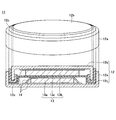
- Battery manufacturing, evaluation For the evaluation of the positive electrode active material, a 2032 type coin battery 11 (hereinafter referred to as a coin type battery) shown in FIG. 1 was used.
- the coin-type battery 11 is composed of a case 12 and an electrode 13 housed in the case 12.
- the case 12 includes a positive electrode can 12a that is hollow and has one end opened, and a negative electrode can 12b that is arranged in the opening of the positive electrode can 12a.
- a negative electrode can 12b that is arranged in the opening of the positive electrode can 12a.
- a space for housing the electrode 13 is formed between the negative electrode can 12b and the positive electrode can 12a.
- the electrode 13 includes a positive electrode 13a, a separator 13c, and a negative electrode 13b, which are stacked in this order.
- the positive electrode 13a contacts the inner surface of the positive electrode can 12a via a current collector 14, and the negative electrode 13b It is housed in the case 12 so as to come into contact with the inner surface of the negative electrode can 12 b via the current collector 14.
- the current collector 14 is also arranged between the positive electrode 13a and the separator 13c.
- the case 12 is provided with a gasket 12c, and the gasket 12c fixes relative movement so that the positive electrode can 12a and the negative electrode can 12b are kept in non-contact with each other.
- the gasket 12c also has a function of hermetically sealing the gap between the positive electrode can 12a and the negative electrode can 12b so as to hermetically and liquid-tightly shield the inside and the outside of the case 12.
- the coin-type battery 11 shown in FIG. 1 was manufactured as follows.
- the positive electrode active material for a lithium ion secondary battery 15 mg of acetylene black, and 7.5 mg of polytetrafluoroethylene resin (PTFE) produced in each of Examples and Comparative Examples were mixed, and a diameter of 11 mm was obtained at a pressure of 100 MPa.
- the positive electrode 13a was manufactured by press molding to a thickness of 100 ⁇ m.
- the produced positive electrode 13a was dried in a vacuum dryer at 120° C. for 12 hours.
- the coin-type battery 11 described above was manufactured in a glove box in an Ar atmosphere with a dew point controlled at -80°C.
- negative electrode 13b metal lithium in the form of a pellet punched into a disk shape having a diameter of 14 mm was used.
- a polyethylene porous film having a thickness of 25 ⁇ m was used for the separator 13c.
- an electrolytic solution a mixed solution (manufactured by Toyama Pharmaceutical Co., Ltd.) of ethylene carbonate (EC) and diethyl carbonate (DEC) using 1M LiClO 4 as a supporting electrolyte was used.
- the initial discharge capacity and positive electrode resistance showing the performance of the manufactured coin type battery 11 were evaluated as follows.
- the initial discharge capacity was left for about 24 hours, and after the open circuit voltage OCV (Open Circuit Voltage) became stable, the current density to the positive electrode was set to 0.1 mA/cm 2 and the cut-off voltage 4
- OCV Open Circuit Voltage
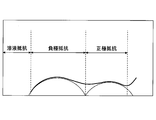
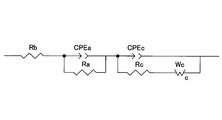
- the positive electrode resistance is shown in FIG. 2A when the coin-type battery 11 is charged at a charging potential of 4.1 V and is measured by an AC impedance method using a frequency response analyzer and a potentiogalvanostat (Solartron, 1255B). A Nyquist plot is obtained.
- this Nyquist plot is expressed as the sum of the characteristic curves showing the solution resistance, the negative electrode resistance and its capacity, and the positive electrode resistance and its capacity, the fitting calculation is performed based on this Nyquist plot using the equivalent circuit shown in FIG. 2B. Then, the value of the positive electrode resistance was calculated.
- each sample of the reagent special grade manufactured by Wako Pure Chemical Industries, Ltd. was used for manufacturing the positive electrode active material and the secondary battery.
- a positive electrode active material and a lithium ion secondary battery were produced and evaluated.
- the base material is represented by Li 1.025 Ni 0.91 Co 0.06 Al 0.03 O 2 obtained by a known technique in which an oxide containing Ni as a main component and lithium hydroxide are mixed and fired.
- a lithium nickel composite oxide that is a layered compound was prepared.
- tungsten oxide (WO 3 ) which is a tungsten compound containing no lithium was charged into the vibration dryer.
- the ratio of the number of atoms of tungsten contained in the tungsten oxide to the total number of atoms of Ni, Co, and Al contained in the lithium nickel composite oxide is 0.15 atom %
- 24 g of tungsten oxide was added at a rate of 2.4 g/min.
- the wash cake which is the material to be dried, and a part of the tungsten oxide were naturally mixed in the vibration dryer.
- Drying process Using a vibration dryer, the temperature of the dryer was set to 190° C. and dried for 10 hours in a vacuum atmosphere while vibrating the material to be dried supplied in the filling step at a frequency of 40 Hz.
- the material to be dried was cooled and taken out.
- a positive electrode active material in which lithium tungstate particles were arranged on the surfaces of primary particles of lithium nickel composite oxide was obtained by crushing with a sieve having an opening of 38 ⁇ m.
- the lithium-nickel composite oxide had primary particles and secondary particles obtained by aggregating the primary particles.
- the content of W, Ni, Co, and Al of the obtained positive electrode active material was analyzed by ICP emission spectroscopy using an ICP emission spectroscopic analyzer (manufactured by Shimadzu Corporation, model: ICPS8100). It was confirmed that the ratio of the number of W atoms to the total number of Ni and element M atoms contained in was 0.15 atom %. The ratio of the number of W atoms to the total number of Ni and element M atoms contained in the obtained positive electrode active material is shown in Table 1 as the amount of tungsten.
- the coin-type battery shown in FIG. 1 described above was manufactured and the battery characteristics were evaluated.
- the evaluation results are shown in Table 1.
- the positive electrode resistance is shown as a relative value with Example 1 being 1.0.
- the initial discharge capacity was 214 mAh/g.
- Example 2 Li-nickel that is a layered compound represented by Li 1.025 Ni 0.88 Co 0.09 Al 0.03 O 2 obtained by a known technique using an oxide containing Ni as a main component and lithium hydroxide A positive electrode active material and a secondary battery were prepared and evaluated in the same manner as in Example 1 except that the powder of the composite oxide particles was used as the base material.
- Example 3 Li-nickel, which is a layered compound represented by Li 1.025 Ni 0.82 Co 0.15 Al 0.03 O 2 obtained by a known technique using an oxide containing Ni as a main component and lithium hydroxide A positive electrode active material and a secondary battery were prepared and evaluated in the same manner as in Example 1 except that the powder of the composite oxide particles was used as the base material.
- Table 1 shows the test conditions and the evaluation results.
- Comparative Example 1 In the filling step, when the cleaning cake and the tungsten oxide (WO 3 ) were supplied to the dryer, the cleaning cake was first supplied, and the tungsten oxide was added after the completion of the supply of the cleaning cake. Similarly, a positive electrode active material was obtained and battery characteristics were evaluated. The evaluation results are shown in Table 1.
- Comparative Example 2 A positive electrode active material was obtained in the same manner as in Example 1 except that the dryer was changed to a stationary dryer (VOS-451SD manufactured by Tokyo Rika Kikai), and the material to be dried was not made to flow in the drying step, and the battery characteristics were evaluated. I went. The evaluation results are shown in Table 1.
- the positive electrode active material of Example 1 has a higher initial discharge capacity and a lower positive electrode resistance as compared with the Comparative Example, and exhibits excellent characteristics that high capacity and high output can be obtained. It can be confirmed that the battery has it.
- Comparative Example 1 in the filling step, the drying is started in the state where the washed cake put into the dryer and the tungsten oxide are completely separated. For this reason, the water was volatilized before the components of the tungsten oxide were sufficiently dispersed, and lithium tungstate was unevenly coated on the surface of the particles of the lithium-nickel composite oxide, so that the battery characteristics were inferior to those of Example 1. It is understood that it became a thing.
Landscapes
- Chemical & Material Sciences (AREA)
- Chemical Kinetics & Catalysis (AREA)
- Electrochemistry (AREA)
- General Chemical & Material Sciences (AREA)
- Inorganic Chemistry (AREA)
- Engineering & Computer Science (AREA)
- Manufacturing & Machinery (AREA)
- Composite Materials (AREA)
- Materials Engineering (AREA)
- Battery Electrode And Active Subsutance (AREA)
- Inorganic Compounds Of Heavy Metals (AREA)
Abstract
La présente invention concerne un procédé de production d'un matériau actif d'électrode positive pour des batteries secondaires au lithium-ion, qui comprend : une étape de lavage à l'eau dans laquelle un oxyde composite de lithium-nickel contenant du lithium (Li), du nickel (Ni) et un élément M (M) (l'Élément M est composé d'au moins un élément qui est choisi parmi Mn, V, Mg, Mo, Nb, Ti, Co et Al) est nettoyé avec de l'eau et filtré, ce qui permet d'obtenir un gâteau nettoyé ; une étape de charge dans laquelle le gâteau nettoyé, qui est un objet à sécher, et un composé de tungstène qui ne contient pas de lithium sont chargés dans un séchoir ; et une étape de séchage dans laquelle l'objet à sécher est séché par le séchoir, tout en étant amené à s'écouler. L'étape de charge a une période de temps où le gâteau nettoyé et le composé de tungstène qui ne contient pas de lithium sont fournis au séchoir en même temps.
Priority Applications (3)
| Application Number | Priority Date | Filing Date | Title |
|---|---|---|---|
| US17/310,688 US12113196B2 (en) | 2019-02-21 | 2020-02-18 | Method of manufacturing positive electrode active material for lithium ion secondary battery, positive electrode active material for lithium ion secondary battery, and lithium ion secondary battery |
| CN202080015218.8A CN113454814B (zh) | 2019-02-21 | 2020-02-18 | 锂离子二次电池用正极活性物质的制造方法、锂离子二次电池用正极活性物质、锂离子二次电池 |
| JP2021502049A JP7457688B2 (ja) | 2019-02-21 | 2020-02-18 | リチウムイオン二次電池用正極活物質の製造方法 |
Applications Claiming Priority (2)
| Application Number | Priority Date | Filing Date | Title |
|---|---|---|---|
| JP2019029866 | 2019-02-21 | ||
| JP2019-029866 | 2019-02-21 |
Publications (1)
| Publication Number | Publication Date |
|---|---|
| WO2020171089A1 true WO2020171089A1 (fr) | 2020-08-27 |
Family
ID=72144916
Family Applications (1)
| Application Number | Title | Priority Date | Filing Date |
|---|---|---|---|
| PCT/JP2020/006361 Ceased WO2020171089A1 (fr) | 2019-02-21 | 2020-02-18 | Procédé de production de matériau actif d'électrode positive pour batteries secondaires au lithium-ion, matériau actif d'électrode positive pour batteries secondaires au lithium-ion, et batterie secondaire au lithium-ion |
Country Status (5)
| Country | Link |
|---|---|
| US (1) | US12113196B2 (fr) |
| JP (1) | JP7457688B2 (fr) |
| CN (1) | CN113454814B (fr) |
| TW (1) | TWI822957B (fr) |
| WO (1) | WO2020171089A1 (fr) |
Families Citing this family (1)
| Publication number | Priority date | Publication date | Assignee | Title |
|---|---|---|---|---|
| KR20240045595A (ko) * | 2022-09-30 | 2024-04-08 | 주식회사 엘지에너지솔루션 | 리튬 이차전지용 양극 활물질의 제조방법 및 이에 의해 제조된 양극 활물질 |
Citations (5)
| Publication number | Priority date | Publication date | Assignee | Title |
|---|---|---|---|---|
| JPH1116566A (ja) * | 1997-06-20 | 1999-01-22 | Hitachi Ltd | 電 池 |
| JP2016183090A (ja) * | 2015-03-25 | 2016-10-20 | 住友金属鉱山株式会社 | タングステン酸リチウムの製造方法、およびタングステン酸リチウムを用いた非水系電解質二次電池用正極活物質の製造方法 |
| JP2017084628A (ja) * | 2015-10-28 | 2017-05-18 | 住友金属鉱山株式会社 | 非水系電解質二次電池用正極活物質とその製造方法、及び非水系電解質二次電池 |
| JP2017117700A (ja) * | 2015-12-25 | 2017-06-29 | 住友金属鉱山株式会社 | 非水系電解質二次電池用正極活物質の製造方法 |
| JP2017117766A (ja) * | 2015-12-25 | 2017-06-29 | 住友金属鉱山株式会社 | 非水系電解質二次電池用正極活物質とその製造方法、及び非水系電解質二次電池 |
Family Cites Families (8)
| Publication number | Priority date | Publication date | Assignee | Title |
|---|---|---|---|---|
| JP2005251716A (ja) | 2004-02-05 | 2005-09-15 | Nichia Chem Ind Ltd | 非水電解質二次電池用正極活物質、非水電解質二次電池用正極合剤および非水電解質二次電池 |
| WO2009031619A1 (fr) | 2007-09-04 | 2009-03-12 | Mitsubishi Chemical Corporation | Composé pulvérulent de type métal de transition-lithium, son procédé de production, produit séché par pulvérisation utilisé comme précurseur de cuisson pour ledit composé, électrode positive pour batterie au lithium rechargeable et batterie au lithium rechargeable utilisant ledit composé |
| JP5359140B2 (ja) | 2008-05-01 | 2013-12-04 | 三菱化学株式会社 | リチウム遷移金属系化合物粉体、その製造方法並びに、それを用いたリチウム二次電池用正極及びリチウム二次電池 |
| JP2010040383A (ja) | 2008-08-06 | 2010-02-18 | Sony Corp | 正極活物質の製造方法および正極活物質 |
| JP6174145B2 (ja) * | 2013-11-22 | 2017-08-02 | 三井金属鉱業株式会社 | スピネル型リチウム金属複合酸化物 |
| JP6090608B2 (ja) * | 2014-11-28 | 2017-03-08 | 住友金属鉱山株式会社 | 非水系電解質二次電池用正極活物質とその製造方法、および該正極活物質を用いた非水系電解質二次電池 |
| JP6210439B2 (ja) * | 2014-12-26 | 2017-10-11 | 住友金属鉱山株式会社 | 非水系電解質二次電池用正極活物質とその製造方法、及び該正極活物質を用いた非水系電解質二次電池 |
| EP3331069B1 (fr) * | 2015-07-30 | 2024-03-06 | Sumitomo Metal Mining Co., Ltd. | Matériau actif d'électrode positive de batterie rechargeable à électrolyte non aqueux, et batterie rechargeable à électrolyte non aqueux |
-
2020
- 2020-02-18 JP JP2021502049A patent/JP7457688B2/ja active Active
- 2020-02-18 WO PCT/JP2020/006361 patent/WO2020171089A1/fr not_active Ceased
- 2020-02-18 CN CN202080015218.8A patent/CN113454814B/zh active Active
- 2020-02-18 US US17/310,688 patent/US12113196B2/en active Active
- 2020-02-20 TW TW109105442A patent/TWI822957B/zh active
Patent Citations (5)
| Publication number | Priority date | Publication date | Assignee | Title |
|---|---|---|---|---|
| JPH1116566A (ja) * | 1997-06-20 | 1999-01-22 | Hitachi Ltd | 電 池 |
| JP2016183090A (ja) * | 2015-03-25 | 2016-10-20 | 住友金属鉱山株式会社 | タングステン酸リチウムの製造方法、およびタングステン酸リチウムを用いた非水系電解質二次電池用正極活物質の製造方法 |
| JP2017084628A (ja) * | 2015-10-28 | 2017-05-18 | 住友金属鉱山株式会社 | 非水系電解質二次電池用正極活物質とその製造方法、及び非水系電解質二次電池 |
| JP2017117700A (ja) * | 2015-12-25 | 2017-06-29 | 住友金属鉱山株式会社 | 非水系電解質二次電池用正極活物質の製造方法 |
| JP2017117766A (ja) * | 2015-12-25 | 2017-06-29 | 住友金属鉱山株式会社 | 非水系電解質二次電池用正極活物質とその製造方法、及び非水系電解質二次電池 |
Also Published As
| Publication number | Publication date |
|---|---|
| US12113196B2 (en) | 2024-10-08 |
| TWI822957B (zh) | 2023-11-21 |
| JP7457688B2 (ja) | 2024-03-28 |
| CN113454814A (zh) | 2021-09-28 |
| TW202044651A (zh) | 2020-12-01 |
| CN113454814B (zh) | 2024-07-12 |
| JPWO2020171089A1 (ja) | 2021-12-16 |
| US20220102696A1 (en) | 2022-03-31 |
Similar Documents
| Publication | Publication Date | Title |
|---|---|---|
| US11108043B2 (en) | Method for producing positive electrode active material for nonaqueous electrolyte secondary battery | |
| KR101395478B1 (ko) | 비수계 전해질 2차 전지용 정극 활물질과 그의 제조 방법, 및 상기 정극 활물질을 이용한 비수계 전해질 2차 전지 | |
| KR20170136601A (ko) | 비수계 전해질 이차 전지용 정극 활물질과 그의 제조 방법, 및 상기 정극 활물질을 이용한 비수계 전해질 이차 전지 | |
| JP7262419B2 (ja) | 非水系電解質二次電池用正極活物質、および非水系電解質二次電池 | |
| US20250145491A1 (en) | Positive electrode active material for lithium ion secondary battery and lithium ion secondary battery | |
| JP2017117766A (ja) | 非水系電解質二次電池用正極活物質とその製造方法、及び非水系電解質二次電池 | |
| JP7027928B2 (ja) | 非水系電解質二次電池用正極活物質、非水系電解質二次電池用正極活物質の製造方法、非水系電解質二次電池 | |
| JP6819859B2 (ja) | 非水系電解質二次電池用正極材料、該正極材料を用いた非水系電解質二次電池、および非水系電解質二次電池用正極材料の製造方法。 | |
| JP6848199B2 (ja) | 非水系電解質二次電池用正極材料、該正極材料を用いた非水系電解質二次電池、および非水系電解質二次電池用正極材料の製造方法。 | |
| JP2018195419A (ja) | 非水系電解質二次電池用正極材料、該正極材料を用いた非水系電解質二次電池、および非水系電解質二次電池用正極材料の製造方法。 | |
| WO2016104305A1 (fr) | Matériau actif d'électrode positive pour une pile rechargeable à électrolyte non aqueux, procédé permettant de fabriquer ledit matériau et pile rechargeable à électrolyte non aqueux dans laquelle ledit matériau est utilisé | |
| JP2017045632A (ja) | 非水系電解質二次電池用正極活物質とその製造方法、および非水系電解質二次電池 | |
| JP7020101B2 (ja) | 非水系電解質二次電池用正極活物質、非水系電解質二次電池用正極活物質の製造方法、非水系電解質二次電池 | |
| JP2022095988A (ja) | 非水系電解質二次電池用正極活物質、および非水系電解質二次電池 | |
| JP7457689B2 (ja) | リチウムイオン二次電池用正極活物質の製造方法 | |
| JP2020129499A (ja) | リチウムイオン二次電池用正極活物質の製造方法、リチウムイオン二次電池用正極活物質、リチウムイオン二次電池 | |
| TWI822957B (zh) | 鋰離子二次電池用正極活性物質之製造方法、鋰離子二次電池用正極活性物質、鋰離子二次電池 | |
| JP7271891B2 (ja) | リチウムイオン二次電池用正極活物質、リチウムイオン二次電池用正極活物質の製造方法 | |
| JP6919175B2 (ja) | 非水系電解質二次電池用正極材料、該正極材料を用いた非水系電解質二次電池、および非水系電解質二次電池用正極材料の製造方法。 |
Legal Events
| Date | Code | Title | Description |
|---|---|---|---|
| 121 | Ep: the epo has been informed by wipo that ep was designated in this application |
Ref document number: 20758820 Country of ref document: EP Kind code of ref document: A1 |
|
| ENP | Entry into the national phase |
Ref document number: 2021502049 Country of ref document: JP Kind code of ref document: A |
|
| NENP | Non-entry into the national phase |
Ref country code: DE |
|
| 122 | Ep: pct application non-entry in european phase |
Ref document number: 20758820 Country of ref document: EP Kind code of ref document: A1 |