WO2020175111A1 - 車載レーダー装置用レドーム - Google Patents
車載レーダー装置用レドーム Download PDFInfo
- Publication number
- WO2020175111A1 WO2020175111A1 PCT/JP2020/004910 JP2020004910W WO2020175111A1 WO 2020175111 A1 WO2020175111 A1 WO 2020175111A1 JP 2020004910 W JP2020004910 W JP 2020004910W WO 2020175111 A1 WO2020175111 A1 WO 2020175111A1
- Authority
- WO
- WIPO (PCT)
- Prior art keywords
- radome
- heater wire
- radar device
- millimeter wave
- vehicle radar
- Prior art date
- Legal status (The legal status is an assumption and is not a legal conclusion. Google has not performed a legal analysis and makes no representation as to the accuracy of the status listed.)
- Ceased
Links
Classifications
-
- B—PERFORMING OPERATIONS; TRANSPORTING
- B60—VEHICLES IN GENERAL
- B60R—VEHICLES, VEHICLE FITTINGS, OR VEHICLE PARTS, NOT OTHERWISE PROVIDED FOR
- B60R13/00—Elements for body-finishing, identifying, or decorating; Arrangements or adaptations for advertising purposes
-
- G—PHYSICS
- G01—MEASURING; TESTING
- G01S—RADIO DIRECTION-FINDING; RADIO NAVIGATION; DETERMINING DISTANCE OR VELOCITY BY USE OF RADIO WAVES; LOCATING OR PRESENCE-DETECTING BY USE OF THE REFLECTION OR RERADIATION OF RADIO WAVES; ANALOGOUS ARRANGEMENTS USING OTHER WAVES
- G01S7/00—Details of systems according to groups G01S13/00, G01S15/00, G01S17/00
- G01S7/02—Details of systems according to groups G01S13/00, G01S15/00, G01S17/00 of systems according to group G01S13/00
- G01S7/03—Details of HF subsystems specially adapted therefor, e.g. common to transmitter and receiver
-
- H—ELECTRICITY
- H01—ELECTRIC ELEMENTS
- H01Q—ANTENNAS, i.e. RADIO AERIALS
- H01Q1/00—Details of, or arrangements associated with, antennas
- H01Q1/27—Adaptation for use in or on movable bodies
- H01Q1/32—Adaptation for use in or on road or rail vehicles
-
- H—ELECTRICITY
- H01—ELECTRIC ELEMENTS
- H01Q—ANTENNAS, i.e. RADIO AERIALS
- H01Q1/00—Details of, or arrangements associated with, antennas
- H01Q1/42—Housings not intimately mechanically associated with radiating elements, e.g. radome
Definitions
- the present invention relates to an on-vehicle radar device radome provided on the front side of an on-vehicle radar device, and more particularly to an on-vehicle radar device radome having a snow melting function.
- a radome for an in-vehicle radar device provided on the front side of the in-vehicle radar device and having a snow melting function
- a millimeter wave transmission is performed on the surface of a base material installed so as to be substantially orthogonal to the millimeter wave irradiation direction of the in-vehicle radar device.
- a radome in which a heater wire is arranged so as to suppress performance deterioration is known (see Patent Documents 1 to 4).
- Patent Document 1 a heating sheet in which a heater wire is provided on a resin sheet is provided between a front transparent member and a rear transparent member, and the heater wire is repeatedly bent in a wave shape to generate a millimeter wave.
- a radome arranged in the transparent region is disclosed (see FIGS. 1 to 3 and paragraphs [0 0 4 0] to [0 0 4 1] of Patent Document 1).
- a heating sheet in which a heater wire is provided on a resin sheet is provided between a front transparent member and a rear transparent member, and the heater wire has an elliptical shape and is arranged outside the millimeter wave transmission region.
- the disclosed radome is disclosed (FIG. 9 and paragraphs [0 0 6 3] to [0 0 6 5] of Patent Document 1, and FIGS. 1 to 3 and paragraphs [0 0 4 0] to [Patent Document 2]. 0 0 4 2]).
- Patent Documents 3 and 4 a heating sheet in which a heater wire is provided on a resin sheet is provided so as to be sandwiched between a front base material and a rear base material, and the heater wire includes a plurality of straight line portions parallel to each other.
- a radome is disclosed which is arranged in the millimeter wave transmitting region in a wave shape formed by the folded portion. Further, in Patent Documents 3 and 4, when the linear part of the heater wire is made parallel to the plane of polarization of the millimeter wave, the plane of polarization makes plane contact with the straight part and the transmission of the millimeter wave is hindered and attenuated.
- the linear portion of the heater wire is arranged in a state of being inclined or orthogonal to the polarization plane of the millimeter wave to suppress the millimeter wave attenuation, and the folded portion of the heater wire is irradiated with the millimeter wave.
- the arrangement is disclosed to suppress millimeter wave attenuation.
- Patent Document 1 Japanese Patent Laid-Open No. 201 7-2 15242
- Patent Document 2 JP 201 7-2 1 5243
- Patent Document 3 Japanese Patent Laid-Open No. 201 8-66705
- Patent Document 4 JP 201 8-66706
- the millimeter wave attenuation is set by adjusting the direction of the millimeter wave polarization plane of the in-vehicle radar device and the direction of the straight line parallel to the heater wire. It needs to be suppressed.
- a radome on which a corrugated heater wire formed of a plurality of parallel straight portions and a folded portion is arranged has a directional dependence on the polarization plane of the millimeter wave of the in-vehicle radar device, although it can be applied to the on-vehicle radar device or the installation structure of the on-vehicle radar device in which the direction of the polarization plane that can suppress attenuation can be applied, In the case of the installation structure, the millimeter wave of the in-vehicle radar device is significantly attenuated, so it is difficult to apply.
- the present invention has been made in view of the above problems, and can secure necessary millimeter-wave transparency, has no direction dependence on the polarization plane of the millimeter-wave of an on-vehicle radar device, and is versatile.
- An in-vehicle laser that excels in snow melting ⁇ 2020/175111 3 boxes (: 171-1?2020/004910
- An object is to provide a radome for a duck device.
- the radome for an on-vehicle radar device of the present invention includes a heater wire wired in the surface direction of an electromagnetic wave transmitting base, and a main part of the heater wire is based on a base point located in the center of the surface of the base body. Further, it is characterized in that the wiring is provided in the millimeter wave transmitting region of the base in such a manner as to spread toward the outer periphery.
- the main part of the heater wire is wired in such a manner that it spreads toward the outer periphery in the millimeter wave transmission region of the base with reference to the base point located at the center of the surface of the base. Regardless of which direction the polarization plane is set, the surface contact of the millimeter wave polarization plane with the heater wire can be suppressed as much as possible, and the necessary millimeter wave transmission of the on-vehicle radar device can be secured.
- the polarization plane of the millimeter wave of the in-vehicle radar device can be secured. It is possible to increase versatility by eliminating the direction dependence and diversifying the installation structure of applicable in-vehicle radar devices or in-vehicle radar devices. In addition, since the flexibility of the applicable in-vehicle radar device or the installation structure of the in-vehicle radar device is increased, the degree of freedom in design and manufacturing process can be increased, and the millimeter wave polarization plane and heater wire can be increased.
- the manufacturing efficiency can be improved and the yield can be improved. Also, by arranging the main part of the heater wire so that it spreads toward the outer periphery in the millimeter wave transmission region of the base with reference to the base point located in the center of the base surface, it is possible to improve the adhesion of snow on the outer surface of the radome. It is possible to melt snow.
- the radome for an on-vehicle radar device of the present invention is characterized in that the heater wire is wired so as to have two or more folding points inside the millimeter wave transparent region.
- the heater wire inside the millimeter wave transmission region so as to have two or more folding points, the directions of the currents flowing in the heater wire before and after the folding portion are antiparallel to each other, Reverse the electromagnetic waves emitted from the heater wire ⁇ 2020/175111 4 boxes (:171? 2020 /004910
- the radome for an on-vehicle radar device of the present invention is characterized in that the directions of the currents flowing through the heater wires that are arranged adjacent to each other are antiparallel to each other. According to this, by arranging the heater wires so that the directions of the currents flowing in the adjacent heater wires are anti-parallel to each other, the electromagnetic waves radiated from the adjacent heater wires have the opposite phase, and the electromagnetic radiation from the heater wires is emitted. Can be canceled out, and more excellent millimeter wave transmission performance can be obtained. In particular, by making the directions of the currents flowing in the heater wires that are adjacent to each other anti-parallel to each other, it is possible to achieve extremely excellent millimeter wave transmission performance as a whole.
- the radome for an on-vehicle radar device of the present invention is characterized in that a surface occupation rate of the heater wire in the millimeter wave transmissive region is more than 10% and 15% or less. According to this, it is possible to more surely eliminate the directional dependence of the in-vehicle radar device on the polarization plane of the millimeter wave, and it is possible to reliably obtain the heater performance required for the radome for the in-vehicle radar device.
- the main part of the heater wire is concentrically elliptical or concentric with a predetermined interval in the radial direction with reference to a base point located in the center of the surface of the base body. It is characterized by being wired.
- the main part of the heater wire in a radial direction at a predetermined interval in a concentric oval shape or a concentric circle shape, a good balance of snow melting is achieved over the entire millimeter wave transmission region of the radome. It can be carried out.
- the entire millimeter wave transmission region can be melted in a well-balanced manner, the millimeter wave transmission performance can be stabilized in the entire millimeter wave transmission region, and excellent millimeter wave transmission performance can be obtained.
- the main part of the heater wire is radially arranged at predetermined intervals in the circumferential direction with reference to a base point located at the center of the surface of the base body. It is characterized by
- the radome for an on-vehicle radar device of the present invention is characterized in that the heater wire is provided on a front surface side of the base body, and a transparent film positioned outside the heater wire is fixed to the base body. ..
- the heater wire on the front surface side of the base body, the heat transfer efficiency to the outer surface of the radome can be improved, and the snow adhering to the outer surface of the radome can be more surely melted. Furthermore, by reliably melting snow on the outer surface of the radome, it is possible to more reliably obtain good millimeter-wave transparency with no direction dependence.
- the transparent film on the outside of the heater wire can improve the weather resistance, corrosion resistance, and scratch resistance of the heater wire and radome.
- the radome for an on-vehicle radar device of the present invention is characterized in that the heater wire is formed of a transparent material.
- the radome for an on-vehicle radar device of the present invention is characterized in that the heater wire is provided on the back side of the base body and is arranged on the rear side of the mark symbol portion.
- the radome for an on-vehicle radar device of the present invention it is possible to secure necessary millimeter-wave transparency, and there is no direction dependence on the polarization plane of the on-vehicle radar device for the millimeter wave, which is excellent in versatility. , Can perform good snow melting. ⁇ 2020/175111 6 boxes (:171? 2020/004910 Brief explanation of the drawing)
- FIG. 1 A front view of a radome for an on-vehicle radar device according to a first embodiment of the present invention.
- FIG.2 Eighteenth enlarged sectional view of Fig.1.
- FIG. 3 An enlarged cross-sectional view of Mitsumi Izumi from Fig. 1.
- FIG. 4 Enlarged view of part ⁇ in Fig. 2.
- FIG. 6 A partially enlarged view of a radome for a vehicle-mounted radar device according to a first modified example of the first embodiment, which corresponds to FIG. 5.
- FIG. 7 A partially enlarged view of a radome for an on-vehicle radar device according to a second modified example of the first embodiment, which corresponds to FIG. 4.
- FIG. 8 A partially enlarged view of a radome for a vehicle-mounted radar device according to a second modification of the first embodiment, which corresponds to FIG. 5.
- FIG. 9 A front view of a radome for an on-vehicle radar device according to a second embodiment of the present invention.
- FIG. 10 (3) is a schematic diagram of the measuring device of the experimental example which measured the relationship between the surface occupancy of the heater wire and the angle of the heater wire with respect to the plane of polarization of the millimeter wave and the millimeter wave transmittance, and () is the experimental example.
- FIG. 11 Graph of an experimental example showing the relationship between the surface occupancy of the heater wire, the angle of the heater wire with respect to the plane of polarization of the millimeter wave, and the millimeter wave transmittance.
- a radome 1 for an on-vehicle radar device includes an electromagnetic wave transmitting base 2 and a heat sink line 3 wired in the plane direction of the base 2.
- the heater wire 3 is provided on the front surface side of the substrate 2.
- the substrate 2 of the illustrated example has an elliptical shape in a front view, and the heater wire 3 is wired along the elliptical surface.
- 1 in FIG. 1 is a mark symbol portion which is a symbol portion such as a letter of a mark such as an emblem, and in the illustrated example, it is a character-like mark symbol portion 10.
- the substrate 2 is composed of a transparent front substrate 21 and a rear substrate 22, and the front substrate 21 ⁇ 2020/175111 ⁇ (: 17 2020/004910
- the rear base material 22 and the rear base material 22 are insulative and electromagnetic wave permeable.
- the electromagnetic wave It is preferable from the viewpoint of improving the transmission performance.
- the difference in the refractive index between the front base material 21 and the rear base material 2 2 should be within the range of 0 to 10%. And good.
- the refractive index n is the real part of relative permittivity £ and the part of relative permittivity imaginary part £.
- the dielectric loss tangent (lost tangent) tan 5 defined as Equation 2 from the ratio of the imaginary part and the real part at the applied frequency be less than 0.1.
- the size of the real part of the relative permittivity is preferably 3 or less.
- the front base material 21 and the rear base material 22 it is possible to use an appropriate material within the scope of the present invention, such as a synthetic resin, glass, or ceramics, but it is preferable to use an insulating material. It is recommended to use a synthetic resin.
- the transparent front base material 21 is preferably a colorless material or a colored material having a visible light transmittance of 50% or more in order to ensure good visibility.
- the material when the front base material 21 is made of an insulating transparent synthetic resin is appropriately selected as long as it is applicable, for example, acrylic resin such as polymethylmethacrylate (! ⁇ /1 1 ⁇ /1 8). ⁇ 2020/175111 8 boxes (: 171-1?2020/004910
- Resin Polycarbonate ( ⁇ ), Acrylonitrile-Butadiene Styrene Copolymer (Hachimi 3), Polyethylene terephthalate (Mitsune), Polyethylene (Mitsumi), Polypropylene (), Acrylonitrile-Styrene Copolymer (83) , Polystyrene (3), cycloolefin polymer (0 9) and the like may be used alone or in combination of two or more, and may contain an additive.
- the material when the rear base material 22 is made of an insulating synthetic resin is suitable as long as it is applicable, for example, an acrylic resin such as polymethylmethacrylate (1 ⁇ /1 1 ⁇ /1 8).
- Juki Polycarbonate ( ⁇ ), Acrylonitrile-Butadiene-Styrene Copolymer (Hachimi 3), Acrylonitrile-Styrene-Acrylate Copolymer (838), Acrylonitrile-Ethylenepropyl Rubber-Styrene Copolymer (Hachimi 3) ) Or the like can be used alone or in combination of two or more, and an additive may be contained.
- a concave portion 2 1 is provided at a position corresponding to the mark symbol portion 1 0.
- a convex portion 2 22 is formed on the surface 2 21 of the rear base material 2 2 at a position corresponding to the mark symbol portion 10, and the front base material 2 1 and the rear base material 2 2 are The concave portion 2 1 2 and the convex portion 2 2 2 formed at corresponding positions are stacked so that they fit together.
- the electromagnetic wave permeable metal layer 23 is provided on the entire surface of the rear base material 2 2 on the surface 2 2 1 of the convex portion 2 2 2 and the flat portion 2 2 3 around the convex portion 2 2 2 in close contact.
- the electromagnetic wave permeable metal layer 23 is composed of a discontinuous metal layer that is electromagnetic wave permeable and has a metallic luster, and has glitter and integral visibility, and the surface 2 2 1 of the rear base material 2 2 It is formed by electroless plating, vapor deposition, or a grasshopper.
- the electromagnetic wave transmitting metal layer 23 is a discontinuous metal layer having a glittering and integral visibility, for example, nickel or nickel alloy, chromium or chromium alloy, cobalt or cobalt alloy, tin or tin alloy, It may be composed of copper or a copper alloy, silver or a silver alloy, palladium or a palladium alloy, platinum or a platinum alloy, rhodium or a rhodium alloy, gold or a gold alloy, or the like. ⁇ 2020/175111 9 boxes (:171? 2020 /004910
- the electromagnetic wave permeable metal layer 23 is not limited to a discontinuous metal layer that is electromagnetic wave permeable and has an integrated visibility with metallic luster, and may have an appropriate electromagnetic wave transparency within the scope of the present invention. It is possible to use a metal layer, for example, a semiconductor layer such as silicon or germanium formed by vapor deposition or skutter, or a metal having a visible light reflectance of 50% or more (for example, gold, silver, copper, It is possible to form an alloy layer with a bright metal such as aluminum, platinum, palladium, iron, nickel, chromium).
- a metal layer for example, a semiconductor layer such as silicon or germanium formed by vapor deposition or skutter, or a metal having a visible light reflectance of 50% or more (for example, gold, silver, copper, It is possible to form an alloy layer with a bright metal such as aluminum, platinum, palladium, iron, nickel, chromium).
- an underlayer for forming a modified surface that facilitates the formation of the electroless plating layer is necessary. It is also possible to provide an underlying layer such as a transparent underlying layer accordingly.
- the electromagnetic wave permeable metal layer is formed on the flat surface portion 2 23 around the convex portion 2 22 of the rear substrate 22.
- the colored layer 2 4 is provided in a region corresponding to the portion 2 1 3.
- the colored layer 24 has electromagnetic wave transparency, and is formed by being fixed to the surface of the electromagnetic wave transparent metal layer 23 by printing, painting using a paint mask or the like.
- the front substrate 21 is a substrate after the electromagnetic wave permeable metal layer 23 and the colored layer 24 are formed.
- the adhesion of the front base material 2 1 can be achieved by, for example, applying an adhesive between the back surface 2 1 1 of the front base material 21 and the electromagnetic wave permeable metal layer 2 3 and the colored layer 2 4 formed on the rear base material 2 2.
- the colored layer 2 is formed on the flat surface portion 2 1 3 around the recess 2 1 2 of the back surface 2 1 1 of the front base material 2 1 by printing or painting using a paint mask. 4 is fixed and formed, and the electromagnetic wave permeable metal layer 23 formed on the rear base material 2 2 is adhered to the colored layer 24 on the front base material 21 and the concave portion 2 1 2 on the front base material 21. It is also preferable that the composition is fixed by adhesion through an adhesive layer of the agent. ⁇ 2020/175111 10 boxes (:171? 2020 /004910
- the heater wire 3 is provided on the front surface 2 1 4 side of the front base material 21 corresponding to the front surface side of the base body 2 and is wired along the front surface 2 1 4 of the front base material 21. ..
- the heater wire 3 can be a transparent conductive film such as an I-chome film, nichrome wire, iron chrome, copper, silver, carbon fiber, or other suitable conductive material that can be applied. It is formed on the surface 2 14 of the base material 2 1 4 by printing, vapor deposition, slaughter, plating, wire bonding, etc. and wired.
- the heater wire 3 is preferably formed of a transparent material such as a transparent conductive film from the viewpoint of improving the visibility of the mark symbol portion 10 etc.
- the heater wire 3 is wired such that the main part thereof spreads toward the outer periphery in the millimeter wave transmission region of the base 2 with reference to the base point ⁇ located at the center of the surface of the base 2.
- the concentric elliptical wiring is provided with a predetermined interval in the radial direction based on the base point ⁇ 3 located at the center of the surface of the base body 2. It is also preferable that the heater wire 3 is wired in a concentric pattern with a base point located at the center of the surface of the base body 2 (a predetermined distance in the radial direction from the reference point 3).
- the heater wire 3 is more preferably set so that the surface occupancy rate in the millimeter wave transmission region 8 is more than 10% and 15% or less.
- a transparent film 4 is fixedly attached to the substrate 2.
- the transparent film 4 in the illustrated example has an adhesive layer 5 formed by an adhesive on the front surface 2 1 4 of the front base material 21 and the transparent film 4 is fixed via the transparent adhesive layer 5 to form the adhesive layer 5 Is provided so that the portion where the heater wire 3 on the surface 2 14 of the front substrate 21 is not wired is filled.
- the transparent film 4 and the transparent adhesive layer 5 can be formed of an appropriate material having insulation properties and electromagnetic wave transparency.
- the material of the transparent film 4 is, for example, Polycarbonate ( ⁇ ), Polyethylene terephthalate (Ming), Polyethylene naphthalate (Min! ⁇ 1), Polyethylene (Min), Polypropylene (). ⁇ 2020/175111 1 1 ⁇ (: 171-1?2020/004910
- the material of the adhesive layer 5 can be, for example, methyl acrylate, ethyl acrylate, butyl acrylate, methyl methacrylate, ethyl methacrylate, or the like.
- a connector 6 1 and a cable 6 2 in which both ends of the heater wire 3 are electrically connected and mechanically fixed are arranged. Electric power is supplied to the heater wire 3 via 6 2 and the connector 6 1, so that the heater wire 3 generates heat.
- the heater wire 3 of the first embodiment is formed so as to extend in series, and the heater wires 3, 3
- the on-vehicle radar device radome 1 is arranged in front of the on-vehicle radar device 100 and attached to the vehicle.
- the radome 1 for an on-vehicle radar device in the illustrated example is an emblem-shaped radome
- the radome for an on-vehicle radar device of the present invention can be configured by an appropriate vehicle-mounted component such as a bumper.
- the main part of the heater wire 3 is located at the base point located in the center of the surface of the base body 2 (on the basis of 3 as the outer periphery in the millimeter wave transmission region of the base body 2).
- the in-vehicle radar device 100 can eliminate the direction dependence on the plane of polarization of the millimeter wave and can be applied to the in-vehicle radar device 100 or in-vehicle radar device.
- the yield can be improved. Also, by wiring the main part of the heater wire 3 at the base point located at the center of the surface of the base body 2 (with reference to 3 and expanding in the millimeter wave transmission region of the base body 2 toward the outer circumference, the outer surface of the radome 1 is Good snow melting of the adhered snow can be performed.
- the heater wire 3 By arranging the heater wire 3 so that it has two or more turns at the inside of the millimeter wave transmission region, the directions of the currents flowing in the heater line 3 before and after the turn part are antiparallel to each other. Then, the electromagnetic wave radiated from the heater wire 3 has an opposite phase, and the electromagnetic radiation from the heater wire 3 can be canceled out, so that more excellent millimeter wave transmission performance can be obtained. In particular, by making the directions of the currents flowing in the heater wires 3 that are adjacent to each other antiparallel to each other, extremely excellent millimeter wave transmission performance can be exhibited throughout the whole.
- the Heiyuu Line 3 when installing the Heiyuu Line 3 so that the surface occupancy ratio in the millimeter wave transmission region is more than 10% and 15% or less, it should be used for the millimeter wave polarization plane of the in-vehicle radar device 100.
- the direction dependency can be more surely eliminated, and the heater performance required for the radome 1 for an on-vehicle radar device can be surely obtained.
- the heater wire 3 on the front surface side of the base body 2
- heat transfer efficiency to the outer surface of the radome 1 can be enhanced, and snow adhering to the outer surface of the radome 1 can be more surely melted.
- the transparent film 4 on the outside of the heater wire 3 can enhance the weather resistance, corrosion resistance, and scratch resistance of the heater wire 3 and the redome 1.
- the mark symbol portion 10 such as an emblem provided behind the heater wire 3 is irrespective of the width of the heater wire 3. ⁇ 2020/175111 13 ⁇ (: 171-1?2020/004910
- radome 1 for a vehicle-mounted radar device As shown in Fig. 6, concave grooves 2 15 are formed on the front surface 2 1 4 of base 2 on the surface 2 1 4 in a shape corresponding to the manner in which heater wire 3 is wired. ing. In the part corresponding to the main part of the heater wire 3,
- a concave groove 2 15 is formed in the millimeter wave transmitting region 8 of the base 2 so as to expand toward the outer periphery.
- a base point located at the center of the surface of the base 2 (a predetermined interval is set in the radial direction with reference to 3).
- Concave ellipses or concentric circles are formed as grooves (see Fig. 1).
- the entire heater wire 3 is arranged so as to be engaged with the recessed groove 2 15 to be housed, and the main part of the heater wire 3 housed in the recessed groove 2 15 is
- the wiring is arranged so that it extends toward the outer circumference in the millimeter wave transmission region of the substrate 20! with reference to the base point ⁇ 3 located at the center.
- the main part of the heat sink line 3 housed in the concave groove 2 15 of this example is a base point located at the center of the surface of the base body 20! (Concentric oval shape with a predetermined radial interval based on 3). Alternatively, they are wired concentrically.
- the transparent film 4 covers the heater wire 3 housed in the concave groove 2 15 so as to cover the front substrate 2 1
- the transparent film 4 is provided on the front surface 2 1 4 side, and is pressure-bonded to the front base material 2 1.
- the other configuration of the on-vehicle radar device radome 1 is the same as that of the on-vehicle radar device radome 1 of the first embodiment.
- the radome 1 for an on-vehicle radar device of the first modified example of the first embodiment it is possible to eliminate the step of applying the adhesive that constitutes the adhesive layer 5, and to improve the efficiency of the manufacturing process, Manufacturing cost can be reduced by not using the agent. Further, corresponding effects can be obtained from the configuration corresponding to the radome 1 for an on-vehicle radar device of the first embodiment.
- the vehicle radar device for radome 1 ⁇ as shown in FIGS. 7 and 8, the heater wire 3 n is provided on the back side of the front substrate 2 1 and Ru consists rear substrate 2 2 which substrate 2 of transparent It is also located behind the mark symbol part 10.
- the heater wire 3 n is provided on the rear surface 2 2 4 n side of the rear base material 22 corresponding to the rear surface side of the base body 2 and is wired along the rear surface 2 2 4 n of the rear base material 2 2.
- the heater wire 3 n can be a suitable conductive wire such as a transparent conductive film such as an I-chome film, nichrome wire, iron chrome wire, carbon fiber, etc. 2 is formed on the back surface 2 2 4 n by printing or the like and wired.
- the main line of the heating line 3 n is laid out in such a manner that the main part thereof spreads toward the outer circumference in the millimeter wave transmission region of the base 2 with reference to the base point located at the center of the surface of the base 2. Therefore, in this example, the heater wire 3 n is a base point located at the center of the surface of the base 2 (concentric oval or concentric circles are arranged at predetermined intervals in the radial direction with reference to 3 (see FIG. 1).
- a back material 7 n is arranged at a position on the rear side of the heater wire 3 n, and is fixedly provided to the base body 2.
- the back material 7 n is insulative and electromagnetic wave permeable, and is formed in the same shape as the rear base material 22.
- the backing material 7 n if the front base material 21 and the rear base material 22 are matched with each other in the refractive index defined based on the complex dielectric constant, or if the refractive indexes are substantially the same or close to each other, It is preferable from the viewpoint of improving the electromagnetic wave transmission performance, and for example, it is preferable that the rear substrate 22 is made of the same material.
- the adhesive layer 5 is provided so that the portion of the back surface 2 2 4 n of the rear base material 22 2 where the heater wire 3 n is not filled is filled with the adhesive layer 5 and is bonded by an adhesive.
- the backing material 7 n and the rear substrate 22 are adhered by the layer 5 n.
- the adhesive layer 5 n can be made of an appropriate material that is insulative and has electromagnetic wave transparency, and is preferably made of the same material as the adhesive layer 5 of the first embodiment, for example.
- the heating line 3 n can be formed on the surface 71 n of the backing material 7 n by printing or the like and can be wired.
- the heater wire 3 n 2020/175111 15 ⁇ (: 171-1?2020/004910
- the other configurations of the on-vehicle radar device radome 1 n are the same as the on-vehicle radar device radome 1 of the first embodiment.
- An in-vehicle radar device for radome 1 n of the second modification of the first embodiment regardless of the line width and transparency of the heater wire 3, from outside against the mark symbol unit 1 0 and around emblem such as The visibility can be prevented from being hindered by the heater wire 3 n, and good visibility from the outside with respect to the mark symbol portion 10 such as an emblem and its surroundings can be secured.
- corresponding effects can be obtained from the configuration corresponding to the radome 1 for an on-vehicle radar device of the first embodiment.
- Automotive radar system for radome 3 of the second embodiment as shown in FIG. 9, the main portion of the heater line 3 3, millimeter wave substrate 2 with respect to the base point (3 located at the surface center of the substrate 2 Transmission area
- the wiring is such that it extends toward the outer circumference, and is arranged in a radial pattern with a predetermined interval in the circumferential direction with reference to a base point ⁇ 3 located at the center of the surface of the substrate 2.
- Heater wire 3 3 Is a shape in which a plurality of substantially fan-shaped elements are arranged in the circumferential direction with respect to the base point (3.
- the heater wire 33 is arranged so that it has two or more folding points inside the millimeter wave transmission region 8.
- the heater wires 3 3 are wired so that the directions of the currents flowing in the heater wires 3 3 that are wired next to each other are anti-parallel to each other. It is more preferable to set the surface occupancy rate in the above-mentioned manner to be more than 10% and not more than 15%.
- the other configurations are the same as those of the vehicle-mounted radar device redom 1 of the first embodiment.
- Figure 10 (3) schematically shows the millimeter wave transmitter 8 3, receiver 8 4 and evaluation device 8 5 in this system.
- the electromagnetic waves transmitted are 7 6.
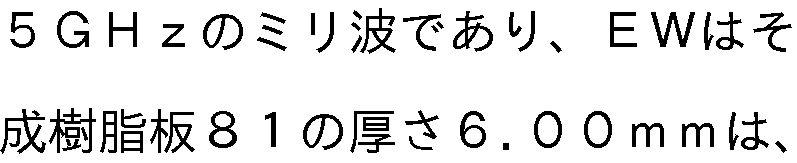
- Fig. 10 Is the direction of millimeter wave propagation. Here This corresponds to exactly 5 times the half wavelength of the synthetic resin plate 8 1 at 7 6.5 ⁇ 1 to 12.
- ⁇ Is the millimeter wave transmission region, is the plane of polarization of the millimeter wave (polarization direction), and ⁇ is the angle formed by the plane of polarization of the millimeter wave and the linear heater line 82.
- the heater resin 8 2 in the millimeter wave transmission region ⁇ has a surface occupancy of 5%, 10%, 15%, 20%, 25% for each of the synthetic resin plates 81.
- the millimeter wave transmittance was measured by irradiating the millimeter wave from the side of the evening line 82 and changing the angle ⁇ of the heating line 82 with respect to the plane of polarization of the millimeter wave by 15 degrees.
- the heater wire 82 is not energized during each measurement. This measurement result is shown in Fig. 11.
- a synthetic resin plate corresponding to the base of a radome for an on-vehicle radar device.
- the permissible value of transmission attenuation can be satisfied regardless of the angle of the heater wire 81 with respect to the polarization plane of the millimeter wave. That is, when the surface occupancy of the heater wire 82 is set to 15% or less, the direction dependency of the angle ⁇ with respect to the millimeter wave transmittance is eliminated or significantly suppressed. From the viewpoint of achieving both heater performance and transmission performance of the radome for vehicle-mounted radar equipment, it is desirable that the surface occupancy of the heater wire 8 2 in the millimeter wave transmission region 8′ is more than 10% and 15% or less. ..
- the invention disclosed in the present specification is specified by changing each partial content thereof to other content disclosed in the specification, within an applicable range, in addition to the respective inventions and embodiments listed as the invention. , Or the contents identified by adding other contents of the present disclosure to these contents, or the partial contents thereof are deleted by the extent that a partial effect can be obtained, and the contents are identified as a superordinate concept. Including things.
- the invention disclosed in the present specification includes the following modifications and added contents.
- the main part of the heater wire is wired in such a manner that it extends toward the outer periphery in the millimeter wave transmission region of the base with reference to the base point located in the center of the surface of the base.
- the main parts of the heating lines 3 and 3 n of the first embodiment are wired in a concentric oval shape or a concentric circle shape with a predetermined interval in the radial direction based on the base point (3).
- configuration are also encompassed other configurations main parts of the heater clear distinction 3 3 of the second embodiment are wired radially at predetermined intervals in the circumferential direction with respect to the origin 0.
- the present invention can be used for a radome for an on-vehicle radar device.
- Millimeter wave transmission region Millimeter wave polarization plane (polarization direction), Angle formed by millimeter wave polarization plane and linear heater line
Landscapes
- Engineering & Computer Science (AREA)
- Mechanical Engineering (AREA)
- Computer Networks & Wireless Communication (AREA)
- Physics & Mathematics (AREA)
- General Physics & Mathematics (AREA)
- Radar, Positioning & Navigation (AREA)
- Remote Sensing (AREA)
- Radar Systems Or Details Thereof (AREA)
- Details Of Aerials (AREA)
Abstract
電磁波透過性の基体2の面方向に配線されるヒーター線3を備え、ヒーター線3の主要部が、基体2の面中央に位置する基点Cを基準にして基体2のミリ波透過領域Rに外周に向かって拡がる様態で配線されている車載レーダー装置用レドーム1であり、隣り合って配線されているヒーター線3に流れる電流の方向は互いに反平行に設定すると好適である。必要なミリ波の透過性を確保することができ、車載レーダー装置のミリ波の偏波面に対する方向依存性が無く、汎用性に優れると共に、良好な融雪を行うことができる車載レーダー装置用レドームを提供する。
Description
\¥02020/175111 1 卩(:17 2020/004910
明 細 書
発明の名称 : 車載レーダー装置用レドーム
技術分野
[0001] 本発明は、 車載レーダー装置の前側に設けられる車載レーダー装置用レド —ムに係り、 特に融雪機能を有する車載レーダー装置用レドームに関する。 背景技術
[0002] 車載レーダー装置の前側に設けられ、 融雪機能を有する車載レーダー装置 用レドームとして、 車載レーダー装置のミリ波照射方向と略直交するように 設置される基材の表面に、 ミリ波の透過性能低下を抑制するようにヒーター 線が配置されるレドームが知られている (特許文献 1〜 4参照) 。
[0003] 特許文献 1 には、 樹脂シートにヒーター線が設けられている加熱シートが 前透明部材と後透明部材の間に設けられ、 ヒーター線が波形状に繰り返し屈 曲された状態でミリ波透過領域に配置されるレドームが開示されている (特 許文献 1の図 1〜図 3及び段落 [0 0 4 0] 〜 [0 0 4 1] 参照) 。 また、 特許文献 1、 2には、 樹脂シートにヒーター線が設けられている加熱シート が前透明部材と後透明部材の間に設けられ、 ヒーター線が楕円形状でミリ波 透過領域の外側に配置されるレドームが開示されている (特許文献 1の図 9 及び段落 [0 0 6 3] 〜 [0 0 6 5] 、 特許文献 2の図 1〜図 3及び段落 [ 0 0 4 0] 〜 [0 0 4 2] 参照) 。
[0004] 特許文献 3、 4には、 樹脂シートにヒーター線が設けられている加熱シー 卜が前基材と後基材に挟み込むように設けられ、 ヒーター線が互いに平行な 複数の直線部と折返部で形成される波形状でミリ波透過領域に配置されるレ ドームが開示されている。 更に、 特許文献 3、 4には、 ヒーター線の直線部 をミリ波の偏波面に対して平行にすると、 偏波面が直線部に面接触してミリ 波の透過が妨げられて減衰することから、 ヒーター線の直線部をミリ波の偏 波面に対して傾斜した状態或いは直交した状態で配置して、 ミリ波減衰を抑 制することが開示され、 又、 ヒーター線の折返部をミリ波照射領域の外側に
\¥02020/175111 2 卩(:17 2020/004910
配置して、 ミリ波減衰を抑制することが開示されている。
先行技術文献
特許文献
[0005] 特許文献 1 :特開 201 7 -2 1 5242号公報
特許文献 2 :特開 201 7 -2 1 5243号公報
特許文献 3 :特開 201 8-66705号公報
特許文献 4 :特開 201 8-66706号公報
発明の概要
発明が解決しようとする課題
[0006] ところで、 特許文献 1、 3、 4のように、 レドームのミリ波透過領域に互 いに平行な複数の直線部と折返部で形成される波形状のヒーター線を配置す る場合、 車載レーダーの必要なミリ波の透過性を確保するために、 車載レー ダー装置のミリ波の偏波面の方向とヒーター線の平行な直線部の方向を調整 して設置し、 ミリ波の減衰を抑制する必要がある。
[0007] 即ち、 平行な複数の直線部と折返部で形成される波形状のヒーター線が配 置されるレドームは、 車載レーダー装置のミリ波の偏波面に対する方向依存 性を有し、 ミリ波減衰抑制可能な偏波面の方向が適合する車載レーダー装置 或いは車載レーダー装置の設置構造には適用可能であるものの、 ミリ波減衰 抑制可能な偏波面の方向が適合しない車載レーダー装置或いは車載レーダー 装置の設置構造の場合には車載レーダー装置のミリ波が大幅に減衰してしま うため、 適用することは困難である。 そのため、 必要なミリ波の透過性を確 保することができ、 車載レーダー装置のミリ波の偏波面に対する方向依存性 が無くすことができると共に、 良好な融雪を行うことができる車載レーダー 装置用レドームが求められている。
[0008] 本発明は上記課題に鑑み提案するものであって、 必要なミリ波の透過性を 確保することができ、 車載レーダー装置のミリ波の偏波面に対する方向依存 性が無く、 汎用性に優れると共に、 良好な融雪を行うことができる車載レー
〇 2020/175111 3 卩(:171? 2020 /004910
ダー装置用レドームを提供することを目的とする。
課題を解決するための手段
[0009] 本発明の車載レーダー装置用レドームは、 電磁波透過性の基体の面方向に 配線されるヒーター線を備え、 前記ヒーター線の主要部が、 前記基体の面中 央に位置する基点を基準にして前記基体のミリ波透過領域に外周に向かって 拡がる様態で配線されていることを特徴とする。
これによれば、 ヒーター線の主要部を基体の面中央に位置する基点を基準 にして基体のミリ波透過領域に外周に向かって拡がる様態で配線することに より、 車載レーダー装置のミリ波の偏波面がいずれの方向で設定されても、 ミリ波偏波面のヒーター線への面接触を極力抑制し、 車載レーダー装置の必 要なミリ波の透過性を確保することができる。 また、 車載レーダー装置のミ リ波の偏波面がいずれの方向で設定されても、 車載レーダー装置の必要なミ リ波の透過性を確保できることから、 車載レーダー装置のミリ波の偏波面に 対する方向依存性を無く し、 適用可能な車載レーダー装置或いは車載レーダ —装置の設置構造を多様化し、 汎用性を高めることができる。 また、 適用可 能な車載レーダー装置或いは車載レーダー装置の設置構造の自由度が高くな ることから、 設計の自由度、 製造工程の自由度を高めることができると共に 、 ミリ波偏波面とヒーター線の面接触を回避するための作業や作業精度が不 要となることから、 製造効率を高めることができ、 歩留まりを向上すること ができる。 また、 ヒーター線の主要部を基体の面中央に位置する基点を基準 にして基体のミリ波透過領域に外周に向かって拡がる様態で配線することに より、 レドームの外表面に付着した雪の良好な融雪を行うことができる。
[0010] 本発明の車載レーダー装置用レドームは、 前記ヒーター線が前記ミリ波透 過領域の内側で 2力所以上の折返しを有するように配線されていることを特 徴とする。
これによれば、 ヒーター線をミリ波透過領域の内側で 2力所以上の折返し を有するように配線することにより、 折返し部分の前後のヒーター線に流れ る電流の方向を互いに反平行にして、 ヒーター線から放射される電磁波を逆
〇 2020/175111 4 卩(:171? 2020 /004910
位相とし、 ヒーター線からの電磁放射を打ち消すことができ、 より優れたミ リ波透過性能を得ることができる。
[001 1 ] 本発明の車載レーダー装置用レドームは、 隣り合って配線されている前記 ヒーター線に流れる電流の方向が互いに反平行であることを特徴とする。 これによれば、 隣り合うヒーター線に流れる電流の方向が互いに反平行と なるようにヒーター線を配置することで、 隣り合うヒーター線から放射され る電磁波を逆位相とし、 ヒーター線からの電磁放射を打ち消すことができ、 より優れたミリ波透過性能を得ることができる。 特に、 隣り合って配線され ている各々のヒーター線に流れる電流の方向を互いに反平行にすることで、 全体に亙って非常に優れたミリ波透過性能を発揮することができる。
[0012] 本発明の車載レーダー装置用レドームは、 前記ヒーター線の前記ミリ波透 過領域における面占有率が 1 〇%超1 5 %以下であることを特徴とする。 これによれば、 車載レーダー装置のミリ波の偏波面に対する方向依存性を より確実に無くすことができると共に、 車載レーダー装置用レドームに要求 されるヒーター性能を確実に得ることができる。
[0013] 本発明の車載レーダー装置用レドームは、 前記ヒーター線の主要部が、 前 記基体の面中央に位置する基点を基準にして径方向に所定間隔を開けて同心 楕円状若しくは同心円状に配線されていることを特徴とする。
これによれば、 ヒーター線の主要部を径方向に所定間隔を開けて同心楕円 状若しくは同心円状に配線することにより、 レドームのミリ波透過領域の全 体に亙ってバランスよく良好な融雪を行うことができる。 また、 ミリ波透過 領域の全体をバランスよく融雪できることから、 ミリ波透過領域の全体でミ リ波の透過性能を安定させ、 優れたミリ波透過性能を得ることができる。
[0014] 本発明の車載レーダー装置用レドームは、 前記ヒーター線の主要部が、 前 記基体の面中央に位置する基点を基準にして周方向に所定間隔を開けて放射 状に配線されていることを特徴とする。
これによれば、 ヒーター線の主要部を周方向に所定間隔を開けて放射状に 配線することにより、 レドームのミリ波透過領域の全体に亙ってバランスよ
〇 2020/175111 5 卩(:171? 2020 /004910
く良好な融雪を行うことができる。 また、 ミリ波透過領域の全体をバランス よく融雪できることから、 ミリ波透過領域の全体でミリ波の透過性能を安定 させ、 優れたミリ波透過性能を得ることができる。
[0015] 本発明の車載レーダー装置用レドームは、 前記ヒーター線が前記基体の表 面側に設けられ、 前記ヒーター線の外側に位置する透明フィルムが前記基体 に固着されていることを特徴とする。
これによれば、 ヒーター線を基体の表面側に設けることにより、 レドーム の外表面への伝熱効率を高め、 レドームの外表面に付着した雪をより確実に 融雪することができる。 更に、 レドームの外表面の雪の確実な融雪により、 方向依存性の無い良好なミリ波の透過性をより確実に得ることができる。 ま た、 ヒーター線の外側の透明フィルムにより、 ヒーター線やレドームの耐候 性、 耐食性、 耐傷性を高めることができる。
[0016] 本発明の車載レーダー装置用レドームは、 前記ヒーター線が透明材で形成 されていることを特徴とする。
これによれば、 ヒーター線を透明材とすることにより、 ヒーター線の線幅 に拘わらず、 ヒーター線の背後に設けられるエンブレム等のマーク記号部や その周囲に対する外側からの良好な視認性を確保することができる。
[0017] 本発明の車載レーダー装置用レドームは、 前記ヒーター線が、 前記基体 の背面側に設けられていると共に、 マーク記号部の後側に配置されているこ とを特徴とする。
これによれば、 ヒーター線の線幅や透明度に拘わらず、 エンブレム等のマ —ク記号部やその周囲に対する外側からの視認性がヒーター線で妨げられる ことを防止することができ、 エンブレム等のマーク記号部やその周囲に対す る外側からの良好な視認性を確保することができる。
発明の効果
[0018] 本発明の車載レーダー装置用レドームによれば、 必要なミリ波の透過性を 確保することができ、 車載レーダー装置のミリ波の偏波面に対する方向依存 性が無く、 汎用性に優れると共に、 良好な融雪を行うことができる。
〇 2020/175111 6 卩(:171? 2020 /004910 図面の簡単な説明
[0019] [図 1]本発明による第 1実施形態の車載レーダー装置用レドームの正面図。
[図 2]図 1の八一八拡大断面図。
[図 3]図 1の巳一巳拡大断面図。
[図 4]図 2の◦部拡大図。
[図 5]図 3の 0部拡大図。
[図 6]第 1実施形態の第 1変形例の車載レーダー装置用レドームにおける図 5 に相当する部分拡大図。
[図 7]第 1実施形態の第 2変形例の車載レーダー装置用レドームにおける図 4 に相当する部分拡大図。
[図 8]第 1実施形態の第 2変形例の車載レーダー装置用レドームにおける図 5 に相当する部分拡大図。
[図 9]本発明による第 2実施形態の車載レーダー装置用レドームの正面図。
[図 10] ( 3 ) はヒーター線の面占有率とミリ波偏光面に対するヒーター線の 角度とミリ波透過率の関係を測定した実験例の測定装置の模式図、 (匕) は 実験例で用いたヒーター線が配線された合成樹脂板の模式図。
[図 1 1]ヒーター線の面占有率とミリ波偏光面に対するヒーター線の角度とミ リ波透過率の関係を示す実験例のグラフ。
発明を実施するための形態
[0020] 〔第 1実施形態の車載レーダー装置用レドーム〕
本発明による第 1実施形態の車載レーダー装置用レドーム 1は、 図 1〜図 5に示すように、 電磁波透過性の基体 2と、 基体 2の面方向に配線されるヒ —夕一線 3を備え、 ヒーター線 3が基体 2の表面側に設けられている。 図示 例の基体 2は、 正面視で楕円形になっており、 ヒーター線 3は楕円形の面に 沿うようにして配線されている。 図 1中の 1 0はエンブレム等のマークの文 字等の記号の部分であるマーク記号部であり、 図示例では文字状のマーク記 号部 1 0になっている。
[0021] 基体 2は、 透明の前基材 2 1 と、 後基材 2 2とから構成され、 前基材 2 1
〇 2020/175111 卩(:17 2020 /004910
と後基材 2 2は絶縁性で電磁波透過性を有する。 前基材 2 1 と、 後基材 2 2 には、 複素誘電率に基づき定義される屈折率〇が相互に整合する、 又は、 屈 折率 nが略同一或いは近接するものを用いると電磁波の透過性能向上の観点 から好適である。 前基材 2 1 と後基材 2 2の近接する屈折率の数値範囲とし ては、 前基材 2 1 と後基材 2 2の屈折率の相違が〇〜 1 0 %の範囲内とする と良好である。
[0022] ここでの屈折率 nは比誘電率実数部 £ と比誘電率虚数部 £
 から数式 1 として定義される量である。 透過性の観点から適用周波数における虚数部と 実数部の比から数式 2として定義される誘電正接 (ロスタンジェント) tan 5 の大きさは〇. 1以下とすると好適である。 また比誘電率実部の大きさは 3 以下とすると好適である。 誘電正接と非誘電率実部の大きさをこれらの数値 以下とすることにより、 レドームに必要とされる反射率と内部損失の低減を 確実にすることが可能となる。
[0023] [数 1 ]

[0024] [数 2]

[0025] 前基材 2 1 と、 後基材 2 2は、 合成樹脂、 ガラス、 セラミックス等の本発 明の趣旨の範囲内で適宜の材料を用いることが可能であるが、 好適には絶縁 性の合成樹脂とするとよい。 透明の前基材 2 1は、 良好な視認性を確保する ため可視光線透過率 5 0 %以上の無色材料又は有色材料とすることが好まし い。
[0026] 前基材 2 1 を絶縁性の透明合成樹脂とする場合の材料は、 適用可能な範囲 で適宜であり、 例えばポリメチルメタクリレート ( !\/1 1\/1八) 等のアクリル
〇 2020/175111 8 卩(:171? 2020 /004910
系樹脂、 ポリカーボネート ( 〇) 、 アクリロニトリルーブタジエンースチ レン共重合体 (八巳3) 、 ポリエチレンテレフタレート ( 巳丁) 、 ポリエ チレン ( 巳) 、 ポリプロピレン ( ) 、 アクリロニトリルースチレン共 重合体 (八 3) 、 ポリスチレン ( 3) 、 シクロオレフインポリマー (〇〇 9) 等の 1種を単独でまたは 2種以上を組み合わせて用いることができ、 又 、 添加剤を含有させてもよい。
[0027] 後基材 2 2を絶縁性の合成樹脂とする場合の材料は、 適用可能な範囲で適 宜であり、 例えばポリメチルメタクリレート ( 1\/1 1\/1八) 等のアクリル系樹 月旨、 ポリカーボネート ( 〇) 、 アクリロニトリルーブタジエンースチレン 共重合体 (八巳3) 、 アクリロニトリルースチレンーアクリレート共重合 ( 八 3八) 、 アクリロニトリルーエチレンプロピルラバーースチレン共重合体 (八巳 3) 等の 1種を単独でまたは 2種以上を組み合わせて用いることがで き、 又、 添加剤を含有させてもよい。
[0028] 前基材 2 1の背面 2 1 1 にはマーク記号部 1 0に対応する位置に凹部 2 1
2が形成され、 後基材 2 2の表面 2 2 1 にはマーク記号部 1 0に対応する位 置に凸部 2 2 2が形成され、 前基材 2 1 と後基材 2 2は、 対応する位置に形 成されている凹部 2 1 2と凸部 2 2 2を嵌合するようにして積層配置されて いる。 後基材 2 2の表面 2 2 1の凸部 2 2 2と凸部 2 2 2の周囲の平面部 2 2 3には、 全面に亙って電磁波透過性金属層 2 3が密着して設けられている
[0029] 電磁波透過性金属層 2 3は、 電磁波透過性で金属光沢を有する不連続金属 層で構成され、 光輝性で一体的な視認性を有し、 後基材 2 2の表面 2 2 1 に 無電解めっき、 蒸着又はスバッタ等で形成されている。 電磁波透過性金属層 2 3を光輝性で一体的な視認性を有する不連続金属層とする場合、 例えば二 ッケル若しくはニッケル合金、 クロム若しくはクロム合金、 コバルト若しく はコバルト合金、 錫若しくは錫合金、 銅若しくは銅合金、 銀若しくは銀合金 、 パラジウム若しくはパラジウム合金、 白金若しくは白金合金、 ロジウム若 しくはロジウム合金、 金若しくは金合金等から構成することが可能である。
〇 2020/175111 9 卩(:171? 2020 /004910
[0030] 尚、 電磁波透過性金属層 2 3は、 電磁波透過性で金属光沢と一体的な視認 性を有する不連続金属層以外にも、 本発明の趣旨の範囲内で適宜の電磁波透 過性金属層とすることが可能であり、 例えば蒸着又はスバッタ等で形成され たシリコンやゲルマニウム等の半導体層、 或いはこの半導体と可視光反射率 が 5 0 %以上の金属 (例えば金、 銀、 銅、 アルミニウム、 白金、 パラジウム 、 鉄、 ニッケル、 クロム) 等の光輝金属との合金層等とすることが可能であ る。 また、 後基材 2 2の表面 2 2 1 と電磁波透過性金属層 2 3との間には、 例えば無電解めっき層を形成しやすくする改質表面を形成するための下地層 など、 必要に応じて透明下地層等の下地層を設けることも可能である。
[0031 ] 後基材 2 2の凸部 2 2 2の周囲の平面部 2 2 3には、 電磁波透過性金属層
2 3の表面側に積層されて加飾層である有色層 2 4が密着して設けられてお り、 換言すれば前基材 2 1の背面 2 1 1の凹部 2 1 2の周囲の平面部 2 1 3 に対応する領域に有色層 2 4が設けられている。 有色層 2 4は、 電磁波透過 性を有し、 印刷、 又は塗装マスクを用いた塗装等により、 電磁波透過性金属 層 2 3の表面に固着して形成されている。
[0032] 前基材 2 1は、 電磁波透過性金属層 2 3と有色層 2 4が形成された後基材
2 2の前側に固着して設けられる。 前基材 2 1の固着は、 例えば前基材 2 1 の背面 2 1 1 と、 後基材 2 2に形成された電磁波透過性金属層 2 3及び有色 層 2 4との間に接着剤の接着層を介して接着する構成、 或いは電磁波透過性 金属層 2 3と有色層 2 4が形成された後基材 2 2の前側に射出成形で前基材 2 1 となる溶融樹脂を流し込み、 前基材 2 1の背面 2 1 1 を後基材 2 2に形 成された電磁波透過性金属層 2 3及び有色層 2 4に融着する構成等とするこ とが可能である。
[0033] また、 上記構成に代え、 前基材 2 1の背面 2 1 1の凹部 2 1 2の周囲の平 面部 2 1 3に、 印刷、 又は塗装マスクを用いた塗装等により、 有色層 2 4を 固着して形成し、 後基材 2 2に形成された電磁波透過性金属層 2 3と、 前基 材 2 1の有色層 2 4及び前基材 2 1の凹部 2 1 2を、 接着剤の接着層を介し て接着等で固着する構成としても良好である。
〇 2020/175111 10 卩(:171? 2020 /004910
[0034] ヒーター線 3は、 基体 2の表面側に相当する前基材 2 1の表面 2 1 4側に 設けられ、 前基材 2 1の表面 2 1 4に沿うようにして配線されている。 ヒー 夕一線 3は、 例えば I 丁〇膜のような透明導電膜、 ニクロム線、 鉄クロム、 銅、 銀、 力ーボン繊維等の適用可能な適宜の導電性材料とすることが可能で あり、 前基材 2 1の表面 2 1 4に印刷、 蒸着、 スバッタ、 めっき、 ワイヤー ボンディング等で形成されて配線される。 ヒーター線 3は、 マーク記号部 1 〇等の視認性向上の観点からは、 透明導電膜のような透明材で形成すると好 適である。
[0035] 更に、 ヒーター線 3は、 その主要部が、 基体 2の面中央に位置する基点〇 を基準にして基体 2のミリ波透過領域 に外周に向かって拡がる様態で配線 されており、 第 1実施形態のヒーター線 3では、 基体 2の面中央に位置する 基点<3を基準にして径方向に所定間隔を開けて同心楕円状に配線されている 。 ヒーター線 3は、 基体 2の面中央に位置する基点(3を基準にして径方向に 所定間隔を開けて同心円状に配線しても好適である。 また、 ヒーター線 3は 、 ミリ波透過領域 の内側で 2力所以上の折返しを有するように配線されて おり、 更に、 隣り合って配線されているヒーター線 3に流れる電流の方向が 互いに反平行となるように設定されている。 また、 ヒーター線 3は、 ミリ波 透過領域 8における面占有率が 1 〇%超1 5 %以下となるように設定すると より好適である。
[0036] ヒーター線 3の外側に相当する前側の位置には、 透明フィルム 4が基体 2 に固着して設けられている。 図示例の透明フィルム 4は、 前基材 2 1の表面 2 1 4に接着剤による接着層 5が形成され、 透明な接着層 5を介して透明フ ィルム 4が固着されており、 接着層 5は前基材 2 1の表面 2 1 4のヒーター 線 3が配線されていない部分に充填されるようにして設けられている。 透明 フィルム 4と透明な接着層 5は、 絶縁性で電磁波透過性を有する適用可能な 適宜の材料で形成することができる。 透明フィルム 4の材料は、 例えばポリ 力ーボネート ( 〇) 、 ポリエチレンテレフタレー ( 巳丁) 、 ポリエチレ ンナフタレート ( 巳 !\1)、 ポリエチレン ( 巳) 、 ポリプロピレン ( )
〇 2020/175111 1 1 卩(:171? 2020 /004910
等とすることが可能である。 また、 接着層 5の材料は、 例えばアクリル酸メ チル、 アクリル酸エチル、 アクリル酸プチル、 メタクリル酸メチル、 メタク リル酸エチル等とすることが可能である。
[0037] また、 車載レーダー装置用レドーム 1の下部には、 ヒーター線 3の両端が 電気的に接続され且つ機械的に固定されているコネクタ 6 1 とケーブル 6 2 が配設されており、 ケーブル 6 2及びコネクタ 6 1 を介してヒーター線 3に 電力が供給され、 ヒーター線 3が発熱するようになっている。 第 1実施形態 のヒーター線 3は一連で延びて形成されており、 後述の変形例のヒーター線 3、 3 |-|、 3 も同様である。
[0038] そして、 車載レーダー装置用レドーム 1は、 車載レーダー装置 1 0 0の前 方に配置されて車両に取り付けられる。 尚、 図示例の車載レーダー装置用レ ドーム 1はエンブレム形状のレドームとしたが、 本発明の車載レーダー装置 用レドームは、 バンパー等の適宜の車両実装部品で構成することが可能であ る。
[0039] 第 1実施形態の車載レーダー装置用レドーム 1 によれば、 ヒーター線 3の 主要部を基体 2の面中央に位置する基点(3を基準にして基体 2のミリ波透過 領域 に外周に向かって拡がる様態で配線することにより、 車載レーダー装 置 1 0 0のミリ波の偏波面がいずれの方向で設定されても、 ミリ波偏波面の ヒーター線 3への面接触を極力抑制し、 車載レーダー装置 1 0 0の必要なミ リ波の透過性を確保することができる。 また、 車載レーダー装置 1 0 0のミ リ波の偏波面がいずれの方向で設定されても、 車載レーダー装置 1 0 0の必 要なミリ波の透過性を確保できることから、 車載レーダー装置 1 0 0のミリ 波の偏波面に対する方向依存性を無く し、 適用可能な車載レーダー装置 1 〇 0或いは車載レーダー装置 1 0 0の設置構造を多様化し、 汎用性を高めるこ とができる。 また、 適用可能な車載レーダー装置 1 0 0或いは車載レーダー 装置 1 0 0の設置構造の自由度が高くなることから、 設計の自由度、 製造エ 程の自由度を高めることができると共に、 ミリ波偏波面とヒーター線 3の面 接触を回避するための作業や作業精度が不要となることから、 製造効率を高
〇 2020/175111 12 卩(:171? 2020 /004910
めることができ、 歩留まりを向上することができる。 また、 ヒーター線 3の 主要部を基体 2の面中央に位置する基点(3を基準にして基体 2のミリ波透過 領域 に外周に向かって拡がる様態で配線することにより、 レドーム 1の外 表面に付着した雪の良好な融雪を行うことができる。
[0040] また、 ヒーター線 3を、 ミリ波透過領域 の内側で 2力所以上の折返しを 有するように配線することにより、 折返し部分の前後のヒーター線 3に流れ る電流の方向を互いに反平行にして、 ヒーター線 3から放射される電磁波を 逆位相とし、 ヒーター線 3からの電磁放射を打ち消すことができ、 より優れ たミリ波透過性能を得ることができる。 特に、 隣り合って配線されている各 々のヒーター線 3に流れる電流の方向を互いに反平行とすることにより、 全 体に亙って非常に優れたミリ波透過性能を発揮することができる。 また、 ヒ —夕一線 3を、 ミリ波透過領域 における面占有率が 1 0 %超 1 5 %以下と なるように設ける場合には、 車載レーダー装置 1 〇〇のミリ波の偏波面に対 する方向依存性をより確実に無くすことができると共に、 車載レーダー装置 用レドーム 1 に要求されるヒーター性能を確実に得ることができる。
[0041 ] 更に、 ヒーター線 3の主要部を径方向に所定間隔を開けて同心楕円状若し くは同心円状に配線することにより、 レドーム 1のミリ波透過領域 の全体 に亙ってバランスよく良好な融雪を行うことができる。 また、 ミリ波透過領 域 の全体をバランスよく融雪できることから、 ミリ波透過領域 の全体で ミリ波の透過性能を安定させ、 優れたミリ波透過性能を得ることができる。
[0042] また、 ヒーター線 3を基体 2の表面側に設けることにより、 レドーム 1の 外表面への伝熱効率を高め、 レドーム 1の外表面に付着した雪をより確実に 融雪することができる。 更に、 レドーム 1の外表面の雪の確実な融雪により 、 方向依存性の無い良好なミリ波の透過性をより確実に得ることができる。 また、 ヒーター線 3の外側の透明フィルム 4により、 ヒーター線 3やレドー ム 1の耐候性、 耐食性、 耐傷性を高めることができる。
[0043] また、 ヒーター線 3を透明材とする場合には、 ヒーター線 3の線幅に拘わ らず、 ヒーター線 3の背後に設けられるエンブレム等のマーク記号部 1 0や
〇 2020/175111 13 卩(:171? 2020 /004910
その周囲に対する外側からの良好な視認性を確保することができる。
[0044] 〔第 1実施形態の第 1変形例の車載レーダー装置用レドーム〕
次に、 第 1実施形態の第 1変形例の車載レーダー装置用レドーム 1 につ いて説明する。 車載レーダー装置用レドーム 1 では、 図 6に示すように、 基体 2 の前基材 2 1 の表面 2 1 4 にヒーター線 3の配線される態様に 対応する形状で凹溝 2 1 5 が形成されている。 ヒーター線 3の主要部に対 応する部分では、

のミリ波透過領域 8に外周に向かって拡がる様態で凹溝 2 1 5 が形成され ており、 本例では基体 2 の面中央に位置する基点(3を基準にして径方向に 所定間隔を開けて同心楕円状若しくは同心円状に凹溝 2 1 5〇!が形成されて いる (図 1参照) 。
[0045] ヒーター線 3の全体は凹溝 2 1 5 に係合して収納されるように配設され ており、 凹溝 2 1 5 に収納されたヒーター線 3の主要部は、

中央に位置する基点 <3を基準にして基体 2〇!のミリ波透過領域 に外周に向 かって拡がる様態で配線されている。 本例の凹溝 2 1 5 に収納されたヒー 夕一線 3の主要部は、 基体 2〇!の面中央に位置する基点(3を基準にして径方 向に所定間隔を開けて同心楕円状若しくは同心円状に配線されている。
[0046] 透明フィルム 4は、 凹溝 2 1 5 に収納されたヒーター線 3を覆うように して前基材 2 1
 の表面 2 1 4 側に設けられ、 透明フィルム 4は前基材 2 1 に圧着されている。 車載レーダー装置用レドーム 1 の他の構成は第 1 実施形態の車載レーダー装置用レドーム 1 と同様である。
[0047] 第 1実施形態の第 1変形例の車載レーダー装置用レドーム 1 によれば、 接着層 5を構成する接着剤の塗布工程を無く し、 製造工程を効率化すること ができると共に、 接着剤の不使用により製造コストを低減することができる 。 また、 第 1実施形態の車載レーダー装置用レドーム 1 と対応する構成から 対応する効果を得ることができる。
[0048] 〔第 1実施形態の第 2変形例の車載レーダー装置用レドーム〕
次に、 第 1実施形態の第 2変形例の車載レーダー装置用レドーム 1 nにつ
〇 2020/175111 14 卩(:171? 2020 /004910
いて説明する。 車載レーダー装置用レドーム 1 门では、 図 7及び図 8に示す ように、 ヒーター線 3 nが、 透明の前基材 2 1 と後基材 2 2とから構成され る基体 2の背面側に設けられていると共に、 マーク記号部 1 0の後側に配置 されている。
[0049] ヒーター線 3 nは、 基体 2の背面側に相当する後基材 2 2の背面 2 2 4 n 側に設けられ、 後基材 2 2の背面 2 2 4 nに沿うようにして配線されている 。 ヒーター線 3 nは、 例えば I 丁〇膜のような透明導電膜、 ニクロム線、 鉄 クロム線、 力ーボン繊維等の適用可能な適宜の発熱線とすることが可能であ り、 後基材 2 2の背面 2 2 4 nに印刷等で形成されて配線される。 更に、 ヒ —夕一線 3 nは、 その主要部が、 基体 2の面中央に位置する基点(3を基準に して基体 2のミリ波透過領域 に外周に向かって拡がる様態で配線されてお り、 本例ではヒーター線 3 n基体 2の面中央に位置する基点(3を基準にして 径方向に所定間隔を開けて同心楕円状若しくは同心円状に配線されている ( 図 1参照) 。
[0050] ヒーター線 3 nの後側の位置には、 背面材 7 nが配設され、 基体 2に固着 して設けられている。 背面材 7 nは、 絶縁性で電磁波透過性を有し、 後基材 2 2と同一形状等で形成されている。 背面材 7 nは、 前基材 2 1及び後基材 2 2と、 複素誘電率に基づき定義される屈折率が相互に整合する、 又は、 屈 折率が略同一或いは近接するものを用いると電磁波の透過性能向上の観点か ら好適であり、 例えば後基材 2 2と同一材料で形成すると好適である。
[0051 ] 本例では、 後基材 2 2の背面 2 2 4 nのヒーター線 3 nが配線されていな い部分に充填されるようにして接着層 5 設けられており、 接着剤による接 着層 5 nによって背面材 7 nと後基材 2 2が接着されている。 接着層 5 nは 、 絶縁性で電磁波透過性を有する適用可能な適宜の材料で形成することがで き、 例えば第 1実施形態の接着層 5と同一材料で形成するとよい。 尚、 ヒー 夕一線 3 nは、 背面材 7 nの表面 7 1 nに印刷等で形成して配線することも 可能である。
[0052] また、 車載レーダー装置用レドーム 1 门の下部には、 ヒーター線 3 nの両
〇 2020/175111 15 卩(:171? 2020 /004910
端が電気的に接続され且つ機械的に固定されているコネクタ 6 1
 とケープ ル 6 2 nが配設されており、 ケーブル 6 2 n及びコネクタ 6 1 门を介してヒ —夕一線 3 nに電力が供給され、 ヒーター線 3 nが発熱するようになってい る。 車載レーダー装置用レドーム 1 nの他の構成は第 1実施形態の車載レー ダー装置用レドーム 1 と同様である。
[0053] 第 1実施形態の第 2変形例の車載レーダー装置用レドーム 1 nによれば、 ヒーター線 3 の線幅や透明度に拘わらず、 エンブレム等のマーク記号部 1 0やその周囲に対する外側からの視認性がヒーター線 3 nで妨げられること を防止することができ、 エンブレム等のマーク記号部 1 0やその周囲に対す る外側からの良好な視認性を確保することができる。 また、 第 1実施形態の 車載レーダー装置用レドーム 1 と対応する構成から対応する効果を得ること ができる。
[0054] 〔第 2実施形態の車載レーダー装置用レドーム〕
次に、 第 2実施形態の車載レーダー装置用レドーム 1 3について説明する 。 第 2実施形態の車載レーダー装置用レドーム 1 3は、 図 9に示すように、 ヒーター線 3 3の主要部が、 基体 2の面中央に位置する基点(3を基準にして 基体 2のミリ波透過領域 こ外周に向かって拡がる様態で配線され、 基体 2 の面中央に位置する基点<3を基準にして周方向に所定間隔を開けて放射状に 配線されている構成である。 ヒーター線 3 3は複数の略扇形が基点(3を基準 にして周方向に配置された様態を構成する。 また、 ヒーター線 3 3は、 ミリ 波透過領域 8の内側で 2力所以上の折返しを有するように配線されており、 更に、 隣り合って配線されているヒーター線 3 3に流れる電流の方向が互い に反平行となるように設定されている。 また、 ヒーター線 3 3は、 ミリ波透 過領域 における面占有率が 1 〇%超1 5 %以下となるように設定するとよ り好適である。 その他の構成は、 第 1実施形態の車載レーダー装置用レドー ム 1 と同様である。
[0055] 第 2実施形態の車載レーダー装置用レドーム 1 3によれば、 ヒーター線 3
3の主要部を周方向に所定間隔を開けて放射状に配線することにより、 レド
〇 2020/175111 16 卩(:171? 2020 /004910
—ム 1 3のミリ波透過領域 の全体に亙ってバランスよく良好な融雪を行う ことができる。 また、 ミリ波透過領域 の全体をバランスよく融雪できるこ とから、 ミリ波透過領域 [¾の全体でミリ波の透過性能を安定させ、 優れたミ リ波透過性能を得ることができる。 また、 第 1実施形態の車載レーダー装置 用レドーム 1 と対応する構成から対応する効果を得ることができる。
[0056] 〔ヒーター線の面占有率と電磁波透過率と角度依存性に関する実験例〕 本発明の車載レーダー装置用レドームの基体に相当する合成樹脂板として 、 図 1 0に示す、 比誘電率 2 . 6 6、 誘電正接〇. 0 1 を有する八巳 3 (ア クリロニトリルーエチレンプロピルラバ—スチレン共重合体) で厚さ 6
 に形成された合成樹脂板 8 1 を用い、 この合成樹脂板 8 1 に面抵抗 0 . 2 □の直線状のヒーター線 8 2を配線し、 電磁波透過率と電磁波の偏波面 の角度依存性に関する実験を行った。
[0057] 実験の測定は、 丫(:011/1製レーダーアライメントシステム ((^ ) 型式 311/1 5 8
9 9を用いて実施した。 図 1 0 (3) にこのシステムにおけるミリ波発信部 8 3、 受信部 8 4、 評価装置 8 5を模式的に示す。 送信する電磁波は 7 6 .
のミリ波の伝搬方向である。 ここでの合
 7 6 . 5◦ 1~1 2における合成樹脂板 8 1 の半波長の丁度 5倍に相当する。 また、 図 1 0 (匕) における
 はミリ波 透過領域、 はミリ波の偏光面 (偏光方向) 、 《はミリ波の偏光面 と直線 状のヒーター線 8 2とで形成される角度である。
[0058] そして、 ミリ波透過領域 ^ 内のヒーター線 8 2の面占有率を 5 %、 1 0 %、 1 5 %、 2 0 %、 2 5 %とした合成樹脂板 8 1のそれぞれについてヒー 夕一線 8 2側からミリ波を照射すると共に、 ミリ波の偏光面 に対するヒー 夕一線 8 2の角度《を 1 5度ずつ変化させ、 ミリ波の透過率の測定を行った 。 各測定時にヒーター線 8 2に電流は流していない。 この測定結果を図 1 1 に^^す。
[0059] 図 1 1 により、 車載レーダー装置用レドームの基体に相当する合成樹脂板
8 1の透過減衰の許容値をマイナス 2 巳とした場合、 ヒーター線 8 2の面
〇 2020/175111 17 卩(:171? 2020 /004910
占有率が 1 5 %以下では、 ミリ波の偏光面 に対するヒーター線 8 1の角度 «がいかなる角度であっても透過減衰の許容値を満足できることが分かる。 即ち、 ヒーター線 8 2の面占有率を 1 5 %以下とすると、 ミリ波の透過率に 対して角度《の方向依存性が無くなる或いは格段に抑制される。 そして、 車 載レーダー装置用レドームのヒーター性能と透過性能を両立する観点からは 、 ミリ波透過領域 8’ におけるヒーター線 8 2の面占有率は 1 0 %超 1 5 % 以下とすることが望ましい。
[0060] 〔本明細書開示発明の包含範囲〕
本明細書開示の発明は、 発明として列記した各発明、 各実施形態の他に、 適用可能な範囲で、 これらの部分的な内容を本明細書開示の他の内容に変更 して特定したもの、 或いはこれらの内容に本明細書開示の他の内容を付加し て特定したもの、 或いはこれらの部分的な内容を部分的な作用効果が得られ る限度で削除して上位概念化して特定したものを包含する。 そして、 本明細 書開示の発明には下記変形例や追記した内容も含まれる。
[0061 ] 例えば本発明の車載レーダー装置用レドームには、 ヒーター線の主要部が 基体の面中央に位置する基点を基準にして基体のミリ波透過領域に外周に向 かって拡がる様態で配線されている適宜の構成が含まれ、 第 1実施形態のヒ —夕一線 3、 3 nの主要部が基点(3を基準にして径方向に所定間隔を開けて 同心楕円状若しくは同心円状に配線されている構成、 第 2実施形態のヒータ 一線 3 3の主要部が基点 0を基準にして周方向に所定間隔を開けて放射状に 配線されている構成以外も包含される。
産業上の利用可能性
[0062] 本発明は、 車載レーダー装置用レドームに利用することができる。
符号の説明
[0063] 1、 1 111、 1 |-|、 1 3 車載レーダー装置用レドーム 2、 〇! 基体 2

4、 2 1 4〇^__表面 2 1 5〇^__凹溝 2 2 後基材 2 2 1 表面 2 2 2 凸部 2 2 3 平面部 2 2 4 ^背面 2 3 電磁波透過性金属層
\¥02020/175111 18 卩(:17 2020/004910
24 有色層 3、 3门、 38 ヒーター線 4 透明フィルム 5、 5门 接着層 6 1、 6 1 "コネクタ 62、 62门 ケーブル 7门 背面 材 7 1 表面 1 〇 マーク記号部 1 00 車載レーダー装置 0 基点
 ミリ波透過領域 81 合成樹脂板 82 ヒーター線 83 ミリ波発信部 84 受信部 85 評価装置

’ ミリ波透過領域、 ミリ波の偏光面 (偏光方向) 、 ミリ波の偏光 面と直線状のヒーター線とで形成される角度
Claims
[請求項 1 ] 電磁波透過性の基体の面方向に配線されるヒーター線を備え、 前記ヒーター線の主要部が、 前記基体の面中央に位置する基点を基 準にして前記基体のミリ波透過領域に外周に向かって拡がる様態で配 線されていることを特徴とする車載レーダー装置用レドーム。
[請求項 2] 前記ヒーター線が前記ミリ波透過領域の内側で 2力所以上の折返し を有するように配線されていることを特徴とする請求項 1記載の車載 レーダー装置用レドーム。
[請求項 3] 隣り合って配線されている前記ヒーター線に流れる電流の方向が互 いに反平行であることを特徴とする請求項 1又は 2記載の車載レーダ —装置用レドーム。
[請求項 4] 前記ヒーター線の前記ミリ波透過領域における面占有率が 1 〇%超
1 5 %以下であることを特徴とする請求項 1〜 3の何れかに記載の車 載レーダー装置用レドーム。
[請求項 5] 前記ヒーター線の主要部が、 前記基体の面中央に位置する基点を基 準にして径方向に所定間隔を開けて同心楕円状若しくは同心円状に配 線されていることを特徴とする請求項 1〜 4の何れかに記載の車載レ _ダ_装置用レドーム。
[請求項 6] 前記ヒーター線の主要部が、 前記基体の面中央に位置する基点を基 準にして周方向に所定間隔を開けて放射状に配線されていることを特 徴とする請求項 1〜 4の何れかに記載の車載レーダー装置用レドーム
[請求項 7] 前記ヒーター線が前記基体の表面側に設けられ、
前記ヒーター線の外側に位置する透明フィルムが前記基体に固着さ れていることを特徴とする請求項 1〜 6の何れかに記載の車載レーダ —装置用レドーム。
[請求項 8] 前記ヒーター線が透明材で形成されていることを特徴とする請求項
7記載の車載レーダー装置用レドーム。
\¥02020/175111 20 卩(:17 2020/004910
[請求項 9] 前記ヒーター線が、 前記基体の背面側に設けられていると共に、 マ
—ク記号部の後側に配置されていることを特徴とする請求項 1〜 6の 何れかに記載の車載レーダー装置用レドー厶。
Applications Claiming Priority (2)
| Application Number | Priority Date | Filing Date | Title |
|---|---|---|---|
| JP2019-036140 | 2019-02-28 | ||
| JP2019036140A JP7313106B2 (ja) | 2019-02-28 | 2019-02-28 | 車載レーダー装置用レドーム |
Publications (1)
| Publication Number | Publication Date |
|---|---|
| WO2020175111A1 true WO2020175111A1 (ja) | 2020-09-03 |
Family
ID=72239444
Family Applications (1)
| Application Number | Title | Priority Date | Filing Date |
|---|---|---|---|
| PCT/JP2020/004910 Ceased WO2020175111A1 (ja) | 2019-02-28 | 2020-02-07 | 車載レーダー装置用レドーム |
Country Status (2)
| Country | Link |
|---|---|
| JP (1) | JP7313106B2 (ja) |
| WO (1) | WO2020175111A1 (ja) |
Families Citing this family (6)
| Publication number | Priority date | Publication date | Assignee | Title |
|---|---|---|---|---|
| JP7243681B2 (ja) * | 2020-05-26 | 2023-03-22 | 豊田合成株式会社 | 車両用外装品 |
| KR102409039B1 (ko) * | 2020-12-17 | 2022-06-15 | 인탑스 주식회사 | 도금공법을 이용한 전자회로가 적용된 차량용 발열 및 발광 레이돔 장치 |
| JP2023000703A (ja) * | 2021-06-18 | 2023-01-04 | 豊田合成株式会社 | 電磁波透過カバー用ヒータ |
| JP7158818B1 (ja) | 2021-09-13 | 2022-10-24 | 三恵技研工業株式会社 | 車載レーダー装置用レドーム及びその製造方法 |
| JP7619230B2 (ja) * | 2021-10-14 | 2025-01-22 | 豊田合成株式会社 | 車両用外装品 |
| JP7411050B1 (ja) * | 2022-11-04 | 2024-01-10 | 三恵技研工業株式会社 | レドーム |
Citations (7)
| Publication number | Priority date | Publication date | Assignee | Title |
|---|---|---|---|---|
| JPS60119107U (ja) * | 1984-01-19 | 1985-08-12 | 株式会社 柏原機械製作所 | パラボラ反射面構造 |
| JPS61175010U (ja) * | 1985-04-22 | 1986-10-31 | ||
| JPH0946112A (ja) * | 1995-07-27 | 1997-02-14 | Maspro Denkoh Corp | パラボラアンテナ |
| JPH1056309A (ja) * | 1996-08-09 | 1998-02-24 | Hino Motors Ltd | 車載用レーダ装置 |
| US20130181859A1 (en) * | 2010-07-28 | 2013-07-18 | Christian Waldschmidt | Radome for radar sensor in a motor vehicle, and corresponding radar sensor |
| WO2018074118A1 (ja) * | 2016-10-21 | 2018-04-26 | 豊田合成 株式会社 | 車両用装飾部品及びその製造方法 |
| WO2019035296A1 (ja) * | 2017-08-16 | 2019-02-21 | 豊田合成株式会社 | 電波透過カバー |
Family Cites Families (2)
| Publication number | Priority date | Publication date | Assignee | Title |
|---|---|---|---|---|
| JP3419675B2 (ja) * | 1998-02-10 | 2003-06-23 | 三菱電機株式会社 | 車載用電波レーダ装置 |
| JP6216708B2 (ja) | 2014-12-26 | 2017-10-18 | 株式会社ファルテック | レーダカバーの製造方法及びレーダカバー |
-
2019
- 2019-02-28 JP JP2019036140A patent/JP7313106B2/ja active Active
-
2020
- 2020-02-07 WO PCT/JP2020/004910 patent/WO2020175111A1/ja not_active Ceased
Patent Citations (7)
| Publication number | Priority date | Publication date | Assignee | Title |
|---|---|---|---|---|
| JPS60119107U (ja) * | 1984-01-19 | 1985-08-12 | 株式会社 柏原機械製作所 | パラボラ反射面構造 |
| JPS61175010U (ja) * | 1985-04-22 | 1986-10-31 | ||
| JPH0946112A (ja) * | 1995-07-27 | 1997-02-14 | Maspro Denkoh Corp | パラボラアンテナ |
| JPH1056309A (ja) * | 1996-08-09 | 1998-02-24 | Hino Motors Ltd | 車載用レーダ装置 |
| US20130181859A1 (en) * | 2010-07-28 | 2013-07-18 | Christian Waldschmidt | Radome for radar sensor in a motor vehicle, and corresponding radar sensor |
| WO2018074118A1 (ja) * | 2016-10-21 | 2018-04-26 | 豊田合成 株式会社 | 車両用装飾部品及びその製造方法 |
| WO2019035296A1 (ja) * | 2017-08-16 | 2019-02-21 | 豊田合成株式会社 | 電波透過カバー |
Also Published As
| Publication number | Publication date |
|---|---|
| JP2020139860A (ja) | 2020-09-03 |
| JP7313106B2 (ja) | 2023-07-24 |
Similar Documents
| Publication | Publication Date | Title |
|---|---|---|
| US12032093B2 (en) | Radome for on-board radar device | |
| JP7313106B2 (ja) | 車載レーダー装置用レドーム | |
| JP7261648B2 (ja) | 車載レーダー装置用レドームの製造方法 | |
| JP7755762B2 (ja) | 車載レーダー装置用レドーム及び車載レーダー構造 | |
| JP7418906B2 (ja) | 車載レーダー装置用レドームの製造方法 | |
| JP6652031B2 (ja) | 車両用装飾部品及びその製造方法 | |
| KR102160944B1 (ko) | 차량 주행 제어용 센서 커버 및 그 제조방법 | |
| JP6658313B2 (ja) | 車両用装飾部品 | |
| JP2017215242A (ja) | 車両用装飾部品 | |
| WO2018074118A1 (ja) | 車両用装飾部品及びその製造方法 | |
| JP2021169993A5 (ja) | ||
| JP7618410B2 (ja) | 車載レーダー装置用レドーム構造及びその製造方法 | |
| JP7544715B2 (ja) | アンテナ用のカバーおよびこのようなカバーを製造する方法 | |
| US20020171579A1 (en) | Vehicle radar concealment device bearing a pattern, and method for making such a device | |
| JP7431014B2 (ja) | 車載レーダー装置用レドーム | |
| WO2021200590A1 (ja) | 防曇発熱体 | |
| WO2021220859A1 (ja) | ヒータシート及び車載センサカバー | |
| JP7759165B2 (ja) | 車載レーダー装置用レドーム及びその製造方法 | |
| JP7840616B2 (ja) | 融雪レドーム | |
| JP2025150775A (ja) | 融雪レドーム | |
| JP2025150774A (ja) | 車載レーダー装置用レドーム及びその製造方法 | |
| WO2026083727A1 (ja) | 導線接続構造及びその製造方法 | |
| JP2014158065A (ja) | 車載用アンテナ |
Legal Events
| Date | Code | Title | Description |
|---|---|---|---|
| 121 | Ep: the epo has been informed by wipo that ep was designated in this application |
Ref document number: 20762572 Country of ref document: EP Kind code of ref document: A1 |
|
| NENP | Non-entry into the national phase |
Ref country code: DE |
|
| 122 | Ep: pct application non-entry in european phase |
Ref document number: 20762572 Country of ref document: EP Kind code of ref document: A1 |