WO2020189480A1 - Cible de pulvérisation cathodique en oxyde de tungstène - Google Patents
Cible de pulvérisation cathodique en oxyde de tungstène Download PDFInfo
- Publication number
- WO2020189480A1 WO2020189480A1 PCT/JP2020/010729 JP2020010729W WO2020189480A1 WO 2020189480 A1 WO2020189480 A1 WO 2020189480A1 JP 2020010729 W JP2020010729 W JP 2020010729W WO 2020189480 A1 WO2020189480 A1 WO 2020189480A1
- Authority
- WO
- WIPO (PCT)
- Prior art keywords
- sputtering
- plane
- tungsten oxide
- diffraction intensity
- sputtering target
- Prior art date
- Legal status (The legal status is an assumption and is not a legal conclusion. Google has not performed a legal analysis and makes no representation as to the accuracy of the status listed.)
- Ceased
Links
Images

Classifications
-
- C—CHEMISTRY; METALLURGY
- C23—COATING METALLIC MATERIAL; COATING MATERIAL WITH METALLIC MATERIAL; CHEMICAL SURFACE TREATMENT; DIFFUSION TREATMENT OF METALLIC MATERIAL; COATING BY VACUUM EVAPORATION, BY SPUTTERING, BY ION IMPLANTATION OR BY CHEMICAL VAPOUR DEPOSITION, IN GENERAL; INHIBITING CORROSION OF METALLIC MATERIAL OR INCRUSTATION IN GENERAL
- C23C—COATING METALLIC MATERIAL; COATING MATERIAL WITH METALLIC MATERIAL; SURFACE TREATMENT OF METALLIC MATERIAL BY DIFFUSION INTO THE SURFACE, BY CHEMICAL CONVERSION OR SUBSTITUTION; COATING BY VACUUM EVAPORATION, BY SPUTTERING, BY ION IMPLANTATION OR BY CHEMICAL VAPOUR DEPOSITION, IN GENERAL
- C23C14/00—Coating by vacuum evaporation, by sputtering or by ion implantation of the coating forming material
- C23C14/22—Coating by vacuum evaporation, by sputtering or by ion implantation of the coating forming material characterised by the process of coating
- C23C14/34—Sputtering
- C23C14/3407—Cathode assembly for sputtering apparatus, e.g. Target
- C23C14/3414—Metallurgical or chemical aspects of target preparation, e.g. casting, powder metallurgy
-
- C—CHEMISTRY; METALLURGY
- C23—COATING METALLIC MATERIAL; COATING MATERIAL WITH METALLIC MATERIAL; CHEMICAL SURFACE TREATMENT; DIFFUSION TREATMENT OF METALLIC MATERIAL; COATING BY VACUUM EVAPORATION, BY SPUTTERING, BY ION IMPLANTATION OR BY CHEMICAL VAPOUR DEPOSITION, IN GENERAL; INHIBITING CORROSION OF METALLIC MATERIAL OR INCRUSTATION IN GENERAL
- C23C—COATING METALLIC MATERIAL; COATING MATERIAL WITH METALLIC MATERIAL; SURFACE TREATMENT OF METALLIC MATERIAL BY DIFFUSION INTO THE SURFACE, BY CHEMICAL CONVERSION OR SUBSTITUTION; COATING BY VACUUM EVAPORATION, BY SPUTTERING, BY ION IMPLANTATION OR BY CHEMICAL VAPOUR DEPOSITION, IN GENERAL
- C23C14/00—Coating by vacuum evaporation, by sputtering or by ion implantation of the coating forming material
- C23C14/22—Coating by vacuum evaporation, by sputtering or by ion implantation of the coating forming material characterised by the process of coating
- C23C14/34—Sputtering
- C23C14/3407—Cathode assembly for sputtering apparatus, e.g. Target
-
- C—CHEMISTRY; METALLURGY
- C01—INORGANIC CHEMISTRY
- C01G—COMPOUNDS CONTAINING METALS NOT COVERED BY SUBCLASSES C01D OR C01F
- C01G41/00—Compounds of tungsten
- C01G41/02—Oxides; Hydroxides
-
- C—CHEMISTRY; METALLURGY
- C04—CEMENTS; CONCRETE; ARTIFICIAL STONE; CERAMICS; REFRACTORIES
- C04B—LIME, MAGNESIA; SLAG; CEMENTS; COMPOSITIONS THEREOF, e.g. MORTARS, CONCRETE OR LIKE BUILDING MATERIALS; ARTIFICIAL STONE; CERAMICS; REFRACTORIES; TREATMENT OF NATURAL STONE
- C04B35/00—Shaped ceramic products characterised by their composition; Ceramics compositions; Processing powders of inorganic compounds preparatory to the manufacturing of ceramic products
- C04B35/01—Shaped ceramic products characterised by their composition; Ceramics compositions; Processing powders of inorganic compounds preparatory to the manufacturing of ceramic products based on oxide ceramics
- C04B35/495—Shaped ceramic products characterised by their composition; Ceramics compositions; Processing powders of inorganic compounds preparatory to the manufacturing of ceramic products based on oxide ceramics based on vanadium, niobium, tantalum, molybdenum or tungsten oxides or solid solutions thereof with other oxides, e.g. vanadates, niobates, tantalates, molybdates or tungstates
-
- C—CHEMISTRY; METALLURGY
- C04—CEMENTS; CONCRETE; ARTIFICIAL STONE; CERAMICS; REFRACTORIES
- C04B—LIME, MAGNESIA; SLAG; CEMENTS; COMPOSITIONS THEREOF, e.g. MORTARS, CONCRETE OR LIKE BUILDING MATERIALS; ARTIFICIAL STONE; CERAMICS; REFRACTORIES; TREATMENT OF NATURAL STONE
- C04B35/00—Shaped ceramic products characterised by their composition; Ceramics compositions; Processing powders of inorganic compounds preparatory to the manufacturing of ceramic products
- C04B35/622—Forming processes; Processing powders of inorganic compounds preparatory to the manufacturing of ceramic products
- C04B35/626—Preparing or treating the powders individually or as batches ; preparing or treating macroscopic reinforcing agents for ceramic products, e.g. fibres; mechanical aspects section B
- C04B35/62605—Treating the starting powders individually or as mixtures
- C04B35/62645—Thermal treatment of powders or mixtures thereof other than sintering
- C04B35/6265—Thermal treatment of powders or mixtures thereof other than sintering involving reduction or oxidation
-
- C—CHEMISTRY; METALLURGY
- C04—CEMENTS; CONCRETE; ARTIFICIAL STONE; CERAMICS; REFRACTORIES
- C04B—LIME, MAGNESIA; SLAG; CEMENTS; COMPOSITIONS THEREOF, e.g. MORTARS, CONCRETE OR LIKE BUILDING MATERIALS; ARTIFICIAL STONE; CERAMICS; REFRACTORIES; TREATMENT OF NATURAL STONE
- C04B35/00—Shaped ceramic products characterised by their composition; Ceramics compositions; Processing powders of inorganic compounds preparatory to the manufacturing of ceramic products
- C04B35/622—Forming processes; Processing powders of inorganic compounds preparatory to the manufacturing of ceramic products
- C04B35/64—Burning or sintering processes
- C04B35/645—Pressure sintering
-
- C—CHEMISTRY; METALLURGY
- C04—CEMENTS; CONCRETE; ARTIFICIAL STONE; CERAMICS; REFRACTORIES
- C04B—LIME, MAGNESIA; SLAG; CEMENTS; COMPOSITIONS THEREOF, e.g. MORTARS, CONCRETE OR LIKE BUILDING MATERIALS; ARTIFICIAL STONE; CERAMICS; REFRACTORIES; TREATMENT OF NATURAL STONE
- C04B35/00—Shaped ceramic products characterised by their composition; Ceramics compositions; Processing powders of inorganic compounds preparatory to the manufacturing of ceramic products
- C04B35/622—Forming processes; Processing powders of inorganic compounds preparatory to the manufacturing of ceramic products
- C04B35/64—Burning or sintering processes
- C04B35/645—Pressure sintering
- C04B35/6455—Hot isostatic pressing
-
- C—CHEMISTRY; METALLURGY
- C23—COATING METALLIC MATERIAL; COATING MATERIAL WITH METALLIC MATERIAL; CHEMICAL SURFACE TREATMENT; DIFFUSION TREATMENT OF METALLIC MATERIAL; COATING BY VACUUM EVAPORATION, BY SPUTTERING, BY ION IMPLANTATION OR BY CHEMICAL VAPOUR DEPOSITION, IN GENERAL; INHIBITING CORROSION OF METALLIC MATERIAL OR INCRUSTATION IN GENERAL
- C23C—COATING METALLIC MATERIAL; COATING MATERIAL WITH METALLIC MATERIAL; SURFACE TREATMENT OF METALLIC MATERIAL BY DIFFUSION INTO THE SURFACE, BY CHEMICAL CONVERSION OR SUBSTITUTION; COATING BY VACUUM EVAPORATION, BY SPUTTERING, BY ION IMPLANTATION OR BY CHEMICAL VAPOUR DEPOSITION, IN GENERAL
- C23C14/00—Coating by vacuum evaporation, by sputtering or by ion implantation of the coating forming material
- C23C14/06—Coating by vacuum evaporation, by sputtering or by ion implantation of the coating forming material characterised by the coating material
- C23C14/08—Oxides
- C23C14/083—Oxides of refractory metals or yttrium
-
- C—CHEMISTRY; METALLURGY
- C01—INORGANIC CHEMISTRY
- C01P—INDEXING SCHEME RELATING TO STRUCTURAL AND PHYSICAL ASPECTS OF SOLID INORGANIC COMPOUNDS
- C01P2002/00—Crystal-structural characteristics
- C01P2002/50—Solid solutions
- C01P2002/52—Solid solutions containing elements as dopants
-
- C—CHEMISTRY; METALLURGY
- C01—INORGANIC CHEMISTRY
- C01P—INDEXING SCHEME RELATING TO STRUCTURAL AND PHYSICAL ASPECTS OF SOLID INORGANIC COMPOUNDS
- C01P2002/00—Crystal-structural characteristics
- C01P2002/70—Crystal-structural characteristics defined by measured X-ray, neutron or electron diffraction data
- C01P2002/72—Crystal-structural characteristics defined by measured X-ray, neutron or electron diffraction data by d-values or two theta-values, e.g. as X-ray diagram
-
- C—CHEMISTRY; METALLURGY
- C01—INORGANIC CHEMISTRY
- C01P—INDEXING SCHEME RELATING TO STRUCTURAL AND PHYSICAL ASPECTS OF SOLID INORGANIC COMPOUNDS
- C01P2002/00—Crystal-structural characteristics
- C01P2002/70—Crystal-structural characteristics defined by measured X-ray, neutron or electron diffraction data
- C01P2002/74—Crystal-structural characteristics defined by measured X-ray, neutron or electron diffraction data by peak-intensities or a ratio thereof only
-
- C—CHEMISTRY; METALLURGY
- C01—INORGANIC CHEMISTRY
- C01P—INDEXING SCHEME RELATING TO STRUCTURAL AND PHYSICAL ASPECTS OF SOLID INORGANIC COMPOUNDS
- C01P2006/00—Physical properties of inorganic compounds
- C01P2006/80—Compositional purity
-
- C—CHEMISTRY; METALLURGY
- C04—CEMENTS; CONCRETE; ARTIFICIAL STONE; CERAMICS; REFRACTORIES
- C04B—LIME, MAGNESIA; SLAG; CEMENTS; COMPOSITIONS THEREOF, e.g. MORTARS, CONCRETE OR LIKE BUILDING MATERIALS; ARTIFICIAL STONE; CERAMICS; REFRACTORIES; TREATMENT OF NATURAL STONE
- C04B2235/00—Aspects relating to ceramic starting mixtures or sintered ceramic products
- C04B2235/02—Composition of constituents of the starting material or of secondary phases of the final product
- C04B2235/30—Constituents and secondary phases not being of a fibrous nature
- C04B2235/32—Metal oxides, mixed metal oxides, or oxide-forming salts thereof, e.g. carbonates, nitrates, (oxy)hydroxides, chlorides
- C04B2235/3217—Aluminum oxide or oxide forming salts thereof, e.g. bauxite, alpha-alumina
-
- C—CHEMISTRY; METALLURGY
- C04—CEMENTS; CONCRETE; ARTIFICIAL STONE; CERAMICS; REFRACTORIES
- C04B—LIME, MAGNESIA; SLAG; CEMENTS; COMPOSITIONS THEREOF, e.g. MORTARS, CONCRETE OR LIKE BUILDING MATERIALS; ARTIFICIAL STONE; CERAMICS; REFRACTORIES; TREATMENT OF NATURAL STONE
- C04B2235/00—Aspects relating to ceramic starting mixtures or sintered ceramic products
- C04B2235/02—Composition of constituents of the starting material or of secondary phases of the final product
- C04B2235/30—Constituents and secondary phases not being of a fibrous nature
- C04B2235/32—Metal oxides, mixed metal oxides, or oxide-forming salts thereof, e.g. carbonates, nitrates, (oxy)hydroxides, chlorides
- C04B2235/3224—Rare earth oxide or oxide forming salts thereof, e.g. scandium oxide
- C04B2235/3225—Yttrium oxide or oxide-forming salts thereof
-
- C—CHEMISTRY; METALLURGY
- C04—CEMENTS; CONCRETE; ARTIFICIAL STONE; CERAMICS; REFRACTORIES
- C04B—LIME, MAGNESIA; SLAG; CEMENTS; COMPOSITIONS THEREOF, e.g. MORTARS, CONCRETE OR LIKE BUILDING MATERIALS; ARTIFICIAL STONE; CERAMICS; REFRACTORIES; TREATMENT OF NATURAL STONE
- C04B2235/00—Aspects relating to ceramic starting mixtures or sintered ceramic products
- C04B2235/02—Composition of constituents of the starting material or of secondary phases of the final product
- C04B2235/30—Constituents and secondary phases not being of a fibrous nature
- C04B2235/32—Metal oxides, mixed metal oxides, or oxide-forming salts thereof, e.g. carbonates, nitrates, (oxy)hydroxides, chlorides
- C04B2235/3231—Refractory metal oxides, their mixed metal oxides, or oxide-forming salts thereof
- C04B2235/3232—Titanium oxides or titanates, e.g. rutile or anatase
-
- C—CHEMISTRY; METALLURGY
- C04—CEMENTS; CONCRETE; ARTIFICIAL STONE; CERAMICS; REFRACTORIES
- C04B—LIME, MAGNESIA; SLAG; CEMENTS; COMPOSITIONS THEREOF, e.g. MORTARS, CONCRETE OR LIKE BUILDING MATERIALS; ARTIFICIAL STONE; CERAMICS; REFRACTORIES; TREATMENT OF NATURAL STONE
- C04B2235/00—Aspects relating to ceramic starting mixtures or sintered ceramic products
- C04B2235/02—Composition of constituents of the starting material or of secondary phases of the final product
- C04B2235/30—Constituents and secondary phases not being of a fibrous nature
- C04B2235/32—Metal oxides, mixed metal oxides, or oxide-forming salts thereof, e.g. carbonates, nitrates, (oxy)hydroxides, chlorides
- C04B2235/3231—Refractory metal oxides, their mixed metal oxides, or oxide-forming salts thereof
- C04B2235/3244—Zirconium oxides, zirconates, hafnium oxides, hafnates, or oxide-forming salts thereof
-
- C—CHEMISTRY; METALLURGY
- C04—CEMENTS; CONCRETE; ARTIFICIAL STONE; CERAMICS; REFRACTORIES
- C04B—LIME, MAGNESIA; SLAG; CEMENTS; COMPOSITIONS THEREOF, e.g. MORTARS, CONCRETE OR LIKE BUILDING MATERIALS; ARTIFICIAL STONE; CERAMICS; REFRACTORIES; TREATMENT OF NATURAL STONE
- C04B2235/00—Aspects relating to ceramic starting mixtures or sintered ceramic products
- C04B2235/02—Composition of constituents of the starting material or of secondary phases of the final product
- C04B2235/30—Constituents and secondary phases not being of a fibrous nature
- C04B2235/32—Metal oxides, mixed metal oxides, or oxide-forming salts thereof, e.g. carbonates, nitrates, (oxy)hydroxides, chlorides
- C04B2235/3231—Refractory metal oxides, their mixed metal oxides, or oxide-forming salts thereof
- C04B2235/3251—Niobium oxides, niobates, tantalum oxides, tantalates, or oxide-forming salts thereof
-
- C—CHEMISTRY; METALLURGY
- C04—CEMENTS; CONCRETE; ARTIFICIAL STONE; CERAMICS; REFRACTORIES
- C04B—LIME, MAGNESIA; SLAG; CEMENTS; COMPOSITIONS THEREOF, e.g. MORTARS, CONCRETE OR LIKE BUILDING MATERIALS; ARTIFICIAL STONE; CERAMICS; REFRACTORIES; TREATMENT OF NATURAL STONE
- C04B2235/00—Aspects relating to ceramic starting mixtures or sintered ceramic products
- C04B2235/02—Composition of constituents of the starting material or of secondary phases of the final product
- C04B2235/30—Constituents and secondary phases not being of a fibrous nature
- C04B2235/32—Metal oxides, mixed metal oxides, or oxide-forming salts thereof, e.g. carbonates, nitrates, (oxy)hydroxides, chlorides
- C04B2235/3231—Refractory metal oxides, their mixed metal oxides, or oxide-forming salts thereof
- C04B2235/3258—Tungsten oxides, tungstates, or oxide-forming salts thereof
-
- C—CHEMISTRY; METALLURGY
- C04—CEMENTS; CONCRETE; ARTIFICIAL STONE; CERAMICS; REFRACTORIES
- C04B—LIME, MAGNESIA; SLAG; CEMENTS; COMPOSITIONS THEREOF, e.g. MORTARS, CONCRETE OR LIKE BUILDING MATERIALS; ARTIFICIAL STONE; CERAMICS; REFRACTORIES; TREATMENT OF NATURAL STONE
- C04B2235/00—Aspects relating to ceramic starting mixtures or sintered ceramic products
- C04B2235/02—Composition of constituents of the starting material or of secondary phases of the final product
- C04B2235/30—Constituents and secondary phases not being of a fibrous nature
- C04B2235/34—Non-metal oxides, non-metal mixed oxides, or salts thereof that form the non-metal oxides upon heating, e.g. carbonates, nitrates, (oxy)hydroxides, chlorides
- C04B2235/3418—Silicon oxide, silicic acids or oxide forming salts thereof, e.g. silica sol, fused silica, silica fume, cristobalite, quartz or flint
-
- C—CHEMISTRY; METALLURGY
- C04—CEMENTS; CONCRETE; ARTIFICIAL STONE; CERAMICS; REFRACTORIES
- C04B—LIME, MAGNESIA; SLAG; CEMENTS; COMPOSITIONS THEREOF, e.g. MORTARS, CONCRETE OR LIKE BUILDING MATERIALS; ARTIFICIAL STONE; CERAMICS; REFRACTORIES; TREATMENT OF NATURAL STONE
- C04B2235/00—Aspects relating to ceramic starting mixtures or sintered ceramic products
- C04B2235/02—Composition of constituents of the starting material or of secondary phases of the final product
- C04B2235/50—Constituents or additives of the starting mixture chosen for their shape or used because of their shape or their physical appearance
- C04B2235/54—Particle size related information
- C04B2235/5418—Particle size related information expressed by the size of the particles or aggregates thereof
- C04B2235/5436—Particle size related information expressed by the size of the particles or aggregates thereof micrometer sized, i.e. from 1 to 100 micron
-
- C—CHEMISTRY; METALLURGY
- C04—CEMENTS; CONCRETE; ARTIFICIAL STONE; CERAMICS; REFRACTORIES
- C04B—LIME, MAGNESIA; SLAG; CEMENTS; COMPOSITIONS THEREOF, e.g. MORTARS, CONCRETE OR LIKE BUILDING MATERIALS; ARTIFICIAL STONE; CERAMICS; REFRACTORIES; TREATMENT OF NATURAL STONE
- C04B2235/00—Aspects relating to ceramic starting mixtures or sintered ceramic products
- C04B2235/02—Composition of constituents of the starting material or of secondary phases of the final product
- C04B2235/50—Constituents or additives of the starting mixture chosen for their shape or used because of their shape or their physical appearance
- C04B2235/54—Particle size related information
- C04B2235/5418—Particle size related information expressed by the size of the particles or aggregates thereof
- C04B2235/5445—Particle size related information expressed by the size of the particles or aggregates thereof submicron sized, i.e. from 0,1 to 1 micron
-
- C—CHEMISTRY; METALLURGY
- C04—CEMENTS; CONCRETE; ARTIFICIAL STONE; CERAMICS; REFRACTORIES
- C04B—LIME, MAGNESIA; SLAG; CEMENTS; COMPOSITIONS THEREOF, e.g. MORTARS, CONCRETE OR LIKE BUILDING MATERIALS; ARTIFICIAL STONE; CERAMICS; REFRACTORIES; TREATMENT OF NATURAL STONE
- C04B2235/00—Aspects relating to ceramic starting mixtures or sintered ceramic products
- C04B2235/65—Aspects relating to heat treatments of ceramic bodies such as green ceramics or pre-sintered ceramics, e.g. burning, sintering or melting processes
- C04B2235/656—Aspects relating to heat treatments of ceramic bodies such as green ceramics or pre-sintered ceramics, e.g. burning, sintering or melting processes characterised by specific heating conditions during heat treatment
- C04B2235/6562—Heating rate
-
- C—CHEMISTRY; METALLURGY
- C04—CEMENTS; CONCRETE; ARTIFICIAL STONE; CERAMICS; REFRACTORIES
- C04B—LIME, MAGNESIA; SLAG; CEMENTS; COMPOSITIONS THEREOF, e.g. MORTARS, CONCRETE OR LIKE BUILDING MATERIALS; ARTIFICIAL STONE; CERAMICS; REFRACTORIES; TREATMENT OF NATURAL STONE
- C04B2235/00—Aspects relating to ceramic starting mixtures or sintered ceramic products
- C04B2235/65—Aspects relating to heat treatments of ceramic bodies such as green ceramics or pre-sintered ceramics, e.g. burning, sintering or melting processes
- C04B2235/66—Specific sintering techniques, e.g. centrifugal sintering
- C04B2235/661—Multi-step sintering
-
- C—CHEMISTRY; METALLURGY
- C04—CEMENTS; CONCRETE; ARTIFICIAL STONE; CERAMICS; REFRACTORIES
- C04B—LIME, MAGNESIA; SLAG; CEMENTS; COMPOSITIONS THEREOF, e.g. MORTARS, CONCRETE OR LIKE BUILDING MATERIALS; ARTIFICIAL STONE; CERAMICS; REFRACTORIES; TREATMENT OF NATURAL STONE
- C04B2235/00—Aspects relating to ceramic starting mixtures or sintered ceramic products
- C04B2235/65—Aspects relating to heat treatments of ceramic bodies such as green ceramics or pre-sintered ceramics, e.g. burning, sintering or melting processes
- C04B2235/66—Specific sintering techniques, e.g. centrifugal sintering
- C04B2235/668—Pressureless sintering
-
- C—CHEMISTRY; METALLURGY
- C04—CEMENTS; CONCRETE; ARTIFICIAL STONE; CERAMICS; REFRACTORIES
- C04B—LIME, MAGNESIA; SLAG; CEMENTS; COMPOSITIONS THEREOF, e.g. MORTARS, CONCRETE OR LIKE BUILDING MATERIALS; ARTIFICIAL STONE; CERAMICS; REFRACTORIES; TREATMENT OF NATURAL STONE
- C04B2235/00—Aspects relating to ceramic starting mixtures or sintered ceramic products
- C04B2235/70—Aspects relating to sintered or melt-casted ceramic products
- C04B2235/74—Physical characteristics
- C04B2235/77—Density
-
- C—CHEMISTRY; METALLURGY
- C04—CEMENTS; CONCRETE; ARTIFICIAL STONE; CERAMICS; REFRACTORIES
- C04B—LIME, MAGNESIA; SLAG; CEMENTS; COMPOSITIONS THEREOF, e.g. MORTARS, CONCRETE OR LIKE BUILDING MATERIALS; ARTIFICIAL STONE; CERAMICS; REFRACTORIES; TREATMENT OF NATURAL STONE
- C04B2235/00—Aspects relating to ceramic starting mixtures or sintered ceramic products
- C04B2235/70—Aspects relating to sintered or melt-casted ceramic products
- C04B2235/74—Physical characteristics
- C04B2235/79—Non-stoichiometric products, e.g. perovskites (ABO3) with an A/B-ratio other than 1
-
- C—CHEMISTRY; METALLURGY
- C04—CEMENTS; CONCRETE; ARTIFICIAL STONE; CERAMICS; REFRACTORIES
- C04B—LIME, MAGNESIA; SLAG; CEMENTS; COMPOSITIONS THEREOF, e.g. MORTARS, CONCRETE OR LIKE BUILDING MATERIALS; ARTIFICIAL STONE; CERAMICS; REFRACTORIES; TREATMENT OF NATURAL STONE
- C04B2235/00—Aspects relating to ceramic starting mixtures or sintered ceramic products
- C04B2235/70—Aspects relating to sintered or melt-casted ceramic products
- C04B2235/80—Phases present in the sintered or melt-cast ceramic products other than the main phase
-
- C—CHEMISTRY; METALLURGY
- C04—CEMENTS; CONCRETE; ARTIFICIAL STONE; CERAMICS; REFRACTORIES
- C04B—LIME, MAGNESIA; SLAG; CEMENTS; COMPOSITIONS THEREOF, e.g. MORTARS, CONCRETE OR LIKE BUILDING MATERIALS; ARTIFICIAL STONE; CERAMICS; REFRACTORIES; TREATMENT OF NATURAL STONE
- C04B2235/00—Aspects relating to ceramic starting mixtures or sintered ceramic products
- C04B2235/70—Aspects relating to sintered or melt-casted ceramic products
- C04B2235/96—Properties of ceramic products, e.g. mechanical properties such as strength, toughness, wear resistance
-
- C—CHEMISTRY; METALLURGY
- C04—CEMENTS; CONCRETE; ARTIFICIAL STONE; CERAMICS; REFRACTORIES
- C04B—LIME, MAGNESIA; SLAG; CEMENTS; COMPOSITIONS THEREOF, e.g. MORTARS, CONCRETE OR LIKE BUILDING MATERIALS; ARTIFICIAL STONE; CERAMICS; REFRACTORIES; TREATMENT OF NATURAL STONE
- C04B2235/00—Aspects relating to ceramic starting mixtures or sintered ceramic products
- C04B2235/70—Aspects relating to sintered or melt-casted ceramic products
- C04B2235/96—Properties of ceramic products, e.g. mechanical properties such as strength, toughness, wear resistance
- C04B2235/9669—Resistance against chemicals, e.g. against molten glass or molten salts
- C04B2235/9692—Acid, alkali or halogen resistance
Definitions
- the present invention relates to a tungsten oxide sputtering target used when forming a tungsten oxide film.
- the present application claims priority over Japanese Patent Application No. 2019-048885 filed in Japan on March 15, 2019, and Japanese Patent Application No. 2020-0392557 filed in Japan on March 6, 2020. Is used here.
- the above-mentioned tungsten oxide film is used in various fields such as an electrochromic display element and a light-shielding member.
- Patent Document 1 the use of the tungsten oxide film (WO X film) is disclosed as anode of the organic EL element.
- the above-mentioned tungsten oxide film is formed by a sputtering method using a sputtering target.
- Patent Documents 2 and 3 As a sputtering target for forming a tungsten oxide film, for example, as shown in Patent Documents 2 and 3, a tungsten oxide sputtering target made of a sintered body obtained by sintering tungsten oxide powder is provided.
- Patent Document 2 discloses a tungsten oxide sputtering target to which manganese or a manganese compound is added as a sintering aid in order to improve the density of the sintered body.
- Patent Document 3 in order to enable DC sputtering, WO 2 and tungsten oxide powder containing at least one of W 18 O 49 and WO 3 are used and sintered in vacuum to form WO 2 phase.
- a tungsten oxide sputtering target made of a sintered body having a structure consisting of two or more phases with W 18 O 49 phase is disclosed.
- a tungsten oxide sputtering target may be subjected to a sputtering film formation by applying a higher electric power than before.
- the tungsten oxide sputtering target made of a sintered body cracks may occur on the sputtered surface when sputtering is performed under high power conditions. Further, even if cracking does not occur in the initial stage of sputtering, if the sputtering progresses and the depth of the erosion portion becomes deeper, cracking tends to occur when a high power is applied.
- the present invention has been made in view of the above-mentioned circumstances, and it is possible to suppress the occurrence of cracks even when sputtering is performed under high power conditions, and to stably perform sputtering film formation for a long period of time. It is an object of the present invention to provide a possible tungsten oxide sputtering target.
- the present invention has been made based on the above findings, and the tungsten oxide sputtering target of the present invention has a peak of W 18 O 49 by X-ray diffraction analysis on a sputtered surface and a cross section orthogonal to the sputtered surface.
- the ratio of the diffraction intensity IS (103) on the (103) plane of W 18 O 49 to the diffraction intensity IS (010) on the (010) plane on the sputtered surface is IS (103) / IS.
- the ratio I C of W 18 of O 49 (103) plane diffraction intensity I C (103) and (010) diffraction intensity I C (010) of surface in the cross section ( 103) / IC (010) is 0.38 or less
- the area ratio of the W 18 O 49 phase on the plane parallel to the sputtering surface is 37% or more.
- the tungsten oxide sputtering target in this arrangement the X-ray diffraction analysis in a cross section perpendicular to the sputtering surface and the sputtering surface, with the peak of the W 18 O 49 is confirmed, the in a plane parallel to the sputtering surface W 18 Since the area ratio of the O 49 phase is 37% or more, conductivity can be ensured and DC sputtering can be stably performed. In addition, the strength of the tungsten oxide sputtering target can be ensured.
- the diffraction intensity of the (103) plane of W 18 O 49 in the sputter surface I S (103) and (010) plane of the diffraction intensity I S (010) ratio of I S (103) / I S (010) is 0.57 or more
- the ratio I C of W 18 of O 49 (103) plane diffraction intensity I C (103) and (010) diffraction intensity I C (010) of the surface in a cross section perpendicular to the sputtering surface (103) / IC (010) is 0.38 or less
- the (103) plane of W 18 O 49 is strongly oriented on the sputter plane, so that cracks occur even when a high power is applied. It can be suppressed. Further, even when sputtering progresses and an erosion portion is formed, the crystal orientation on the sputtering surface is maintained, and the occurrence of cracks can be suppressed even when a high power is applied.
- the tungsten oxide sputtering target of the present invention preferably has a composition of WO X (2.1 ⁇ X ⁇ 2.9).
- the composition is WO X (2.1 ⁇ X ⁇ 2.9)
- the presence of a large number of WO 2 and WO 3 phases is suppressed, and W 18 O having excellent conductivity is suppressed.
- a sufficient amount of 49 phases can be secured, and DC sputtering can be carried out more stably.
- the strength of the tungsten oxide sputtering target can be sufficiently ensured.
- the tungsten oxide sputtering target of the present invention contains an oxide of any one or more of Nb, Ta, Ti, Zr, Y, Al and Si, and the additive metal is used as a metal component.
- M mass%
- W mass%
- M / (W + M) is in the range of 0.1 or more and 0.67 or less. preferable.
- the oxide of any one or more of Nb, Ta, Ti, Zr, Y, Al, and Si of the additive metal is contained, the total content of the additive metal is M (atomic%), and tungsten is used.
- M / (W + M) is 0.1 or more, so that it is possible to improve the alkali resistance of the formed oxide film. Further, since M / (W + M) is 0.67 or less, it is possible to suppress the occurrence of abnormal discharge due to the oxide of the added metal.
- tungsten oxide sputtering target capable of suppressing the occurrence of cracks and stably performing sputtering deposition for a long period of time even when sputtering is performed under high power conditions. it can.
- the area ratio of the O 49 phase is 37% or more.
- the results of X-ray diffraction measurement diffraction intensity of (103) plane of W 18 O 49 in the sputter surface I S (103) ( 010) plane of the diffraction intensity I S (010) ratio of I S (103) / I S (010) is 0.57 or more.
- the ratio I C (103) / I C of the diffraction intensity of the diffraction intensity of the (103) plane of W 18 O 49 in a cross section perpendicular to the sputtering surface I C (103) (010) plane I C (010) (010) is 0.38 or less.
- the composition of WO X (2.1 ⁇ X ⁇ 2.9) is preferable.
- the tungsten oxide sputtering target according to the present embodiment contains an oxide of any one or more of the additive metals of Nb, Ta, Ti, Zr, Y, Al and Si, and is used as a metal component as described above.
- M atomic%
- W atomic%
- M / (W + M) is in the range of 0.1 or more and 0.67 or less. Is preferable.
- the ratio of the diffraction intensity IS (103) of the (103) plane of W 18 O 49 to the diffraction intensity IS (010) of the (010) plane on the sputter surface is IS (103) /.
- IS (010) is set to 0.57 or more.
- Diffraction intensity of (103) plane of W 18 O 49 in the sputter surface I S (103) and the ratio of the (010) plane of the diffraction intensity I S (010) I S ( 103) / I S (010) is 1 It is preferably .2 or more, and more preferably 2.02 or more.
- the upper limit of IS (103) / IS (010) is not particularly limited, but is preferably 2.56 or less.
- the ratio I C of the diffraction intensity of the diffraction intensity of the (103) plane of W 18 O 49 in a cross section perpendicular to the sputtering surface I C (103) (010) plane I C (010) (103) / IC (010) is set to 0.38 or less.
- Ratio of diffraction intensity IC (103) of the (103) plane of W 18 O 49 to the diffraction intensity IC (010) of the (010) plane in the cross section orthogonal to the sputtered surface IC (103) / IC (010 ) ) Is preferably 0.30 or less, and more preferably 0.18 or less.
- the lower limit of IC (103) / IC (010) is not particularly limited, but is preferably 0.13 or more.
- the W 18 O 49 phase has high conductivity. Therefore, by securing the area ratio of the W 18 O 49 phase, the conductivity is improved and a tungsten oxide film is stably formed by DC sputtering. It becomes possible. Therefore, in the present embodiment, the area ratio of the W 18 O 49 phase on the surface parallel to the sputtering surface is set to 37% or more.
- the area ratio of the W 18 O 49 phase on the plane parallel to the sputtered plane can be calculated from the EPMA-analyzed image of the observation plane of the observation sample.
- the area ratio of the W 18 O 49 phase may be 37% or more with respect to the entire surface parallel to the sputtered surface.
- the area ratio of the W 18 O 49 phase on the surface parallel to the sputtered surface is preferably 55% or more, and more preferably 85% or more.
- the upper limit of the area ratio of the W 18 O 49 phase on the plane parallel to the sputtered surface is not particularly limited, but is preferably 94% or less.
- composition Since various phases such as WO 2 phase, WO 3 phase, and W 18 O 49 phase are mixed in tungsten oxide, the ratio of tungsten to oxygen is defined as WO X.
- WO X the ratio of tungsten to oxygen
- the ratio of tungsten to oxygen is defined as WO X.
- X By setting X to 2.1 or more, the ratio of the WO 2 phase can be suppressed, and the W 18 O 49 phase having excellent conductivity can be sufficiently secured.
- X by setting X to 2.1 or more and 2.9 or less, the W 18 O 49 phase becomes the main phase (matrix), and the conductivity of the sputtering target can be ensured.
- the lower limit of X is preferably 2.4 or more. Further, the upper limit of X is preferably 2.82 or less.
- alkali is used as the resist stripping solution when patterning by the etching method.
- an oxide of any one or more of Nb, Ta, Ti, Zr, Y, Al, Si is added to tungsten oxide, it is possible to improve the alkali resistance of tungsten oxide. ..
- the oxide content of the above-mentioned additive metal becomes too large, an abnormal discharge may occur during sputtering due to the oxide of the additive metal. Therefore, in the present embodiment, when the oxide of any one or more of Nb, Ta, Ti, Zr, Y, Al, and Si is contained, the total amount of the added metal is contained as the metal component.
- M / (W + M) is specified to be in the range of 0.1 or more and 0.67 or less.
- the lower limit of M / (W + M) is preferably 0.15 or more, and more preferably 0.2 or more.
- the upper limit of M / (W + M) is preferably 0.5 or less, and more preferably 0.4 or less.
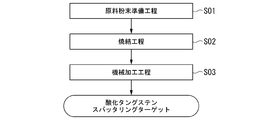
- a method for manufacturing the tungsten oxide sputtering target according to the present embodiment will be described with reference to FIG.
- a raw material powder preparation step S01, a sintering step S02 for sintering the raw material powder, and the obtained sintered body are machined.
- the machining process S03 is provided.
- WO material powder preparation step S01 By reducing the WO 3 powder, a WO X powder containing the WO 2 powder and the W 18 O 49 powder is obtained.
- This WO X powder may contain WO 3 powder. Purity of WO X powder is equal to or greater than 99.9mass%.
- the X of the WO X powder is controlled by adjusting the conditions of the reduction treatment. As the reduction treatment, for example, WO 3 powder is heated in a hydrogen atmosphere for a predetermined time at a predetermined temperature to reduce hydrogen. In this hydrogen reduction, the reduction proceeds in the order of WO 3 to WO 2.9 , WO 2.72 , WO 2 , and W.
- a powder composed of WO 3 , WO 2.9 , WO 2.72 , WO 2 , and W is appropriately added to the powder subjected to the reduction treatment as described above. It is also possible to mix.
- the sampled WO X is weighed, then heat-treated at 800 ° C. for 1 hour in the air, and the weight is measured after the heat treatment. Then, it is confirmed by X-ray diffraction analysis that all of them are WO 3, and the W amount is calculated by the following formula. Then, the ratio of oxygen is calculated as X from the obtained amount of W.
- WO X powder obtained By mixing WO X powder obtained, to obtain a raw material powder.
- a mixing method for example, a dry ball mill using zirconia balls can be used.
- the mixing method is not limited, and a mixer, a blender, specifically, Henschel, rocking, a recon, or the like can be applied.
- the average particle size of the raw material powder is preferably in the range of 1 ⁇ m or more and 30 ⁇ m or less.
- various oxide powder is mixed with WO X powder described above.
- a mixing method for example, a dry ball mill using zirconia balls can be used.
- the mixing method is not limited, and a mixer, a blender, specifically, Henschel, rocking, a recon, or the like can be applied.
- oxide powder of additive metal so as not to inhibit the sintering of WO X powder particles, it is preferred that the particle size is larger than WO X powder.
- (Sintering step S02) the above-mentioned raw material powder is sintered by pressurizing and heating to obtain a sintered body.
- sintering was performed in vacuum using a hot press device.
- the sintering temperature in the sintering step S02 is within the range of 850 ° C. or higher and 1400 ° C. or lower, the holding time at the sintering temperature is within the range of 1 hour or longer and 4 hours or lower, and the pressurizing pressure is within the range of 10 MPa or higher and 35 MPa or lower. did.
- the crystal orientation in the sintered body is controlled by controlling the temperature as follows in the sintering step S02. First, before starting the temperature rise, the pressure is applied with the above-mentioned pressurizing pressure, and the temperature is raised at a temperature rise rate within the range of 5 ° C./min or more and 20 ° C./min or less. Then, it is held at an intermediate temperature in the range of 586 ° C. or higher and 750 ° C. or lower within the range of 1 hour or more and 2 hours or less. After that, sintering is performed by raising the temperature to the above-mentioned sintering temperature and holding the temperature.
- the (103) plane of W 18 O 49 is strongly oriented on the pressurizing surface (plane orthogonal to the pressurizing direction), and W 18 O on the plane orthogonal to the pressurizing surface (plane along the pressurizing direction).
- the (010) plane of 49 will be strongly oriented.
- the lower limit of the above-mentioned intermediate temperature is preferably 600 ° C. or higher, and the upper limit of the intermediate temperature is preferably 700 ° C. or lower.
- the obtained sintered body is machined to have a predetermined size. At this time, machining is performed so that the pressurized surface becomes a sputtered surface. As a result, the tungsten oxide sputtering target of the present embodiment is manufactured.
- the peak of W 18 O 49 is confirmed by the X-ray diffraction analysis on the sputtered surface and the cross section orthogonal to the sputtered surface, and the peak is confirmed. Since the area ratio of the W 18 O 49 phase on the surface parallel to the sputtering surface is 37% or more, conductivity can be ensured and DC sputtering can be stably performed. In addition, the strength of the tungsten oxide sputtering target can be ensured.
- the ratio of the tungsten oxide sputtering target which is the present embodiment, the diffraction intensity of the (103) plane of W 18 O 49 in the sputter surface I S (103) and (010) diffraction intensity of the plane I S (010) Is (103) / IS (010) is 0.57 or more, and the diffraction intensities of the (103) plane of W 18 O 49 in the cross section orthogonal to the sputtered plane are the diffraction intensities of the IC (103) and (010) planes.
- the ratio IC (103) / IC (010) to the diffraction intensity IC (010) is 0.38 or less, and the (103) plane of W 18 O 49 is strongly oriented on the sputtering surface.
- the occurrence of cracks can be suppressed even when a high power is applied. Further, even when sputtering progresses and an erosion portion is formed, the crystal orientation on the sputtering surface is maintained, and the occurrence of cracks can be suppressed even when a high power is applied.
- the tungsten oxide sputtering target of the present embodiment when the composition is WO X (2.1 ⁇ X ⁇ 2.9), it is suppressed that a large number of WO 2 phases and WO 3 phases are present. Therefore, the W 18 O 49 phase can be sufficiently secured, and DC sputtering can be performed more stably. In addition, the strength of the tungsten oxide sputtering target can be sufficiently ensured.
- the tungsten oxide sputtering target of the present embodiment contains an oxide of any one or more of Nb, Ta, Ti, Zr, Y, Al, and Si, and contains the total amount of the added metals.
- the amount is M (atomic%) and the tungsten content is W (atomic%), and M / (W + M) is 0.1 or more and 0.67 or less, a film is formed. It is possible to improve the alkali resistance of the oxide film and suppress the occurrence of abnormal discharge due to the oxide of the added metal.
- WO X powder was produced by hydrogen-reducing the above-mentioned WO 3 powder. In this embodiment, by adjusting the degree of reduction, to prepare a WO X powder of different values of x.
- the average particle size of the raw material powder was 2.4 ⁇ m.
- Nb 2 O 5 powder (purity: 99.9 mass%, particle size D50: 4.6 ⁇ m), Ta 2 O 5 powder (purity: 99.9 mass%, particle size D50:): 3.5 ⁇ m), TiO 2 powder (purity: 99.9 mass%, particle size D50: 2.6 ⁇ m), ZrO 2 powder (purity: 99.9 mass%, particle size D50: 11 ⁇ m), Y 2 O 3 powder (purity) : 99.9 mass%, particle size D50: 2.3 ⁇ m), Al 2 O 3 powder (purity: 99.9 mass%, particle size D50: 0.2 ⁇ m), SiO 2 powder (purity: 99.9 mass%, particle size) D50: 1.9 .mu.m) was prepared, according to the formulation shown in tables 1 and 2 was mixed with WO X powder.
- a sintering step was carried out under the apparatus (method) and conditions shown in Tables 1 and 2, to obtain a sintered body.
- Tables 1 and 2 “HP” indicates hot pressing in a vacuum atmosphere
- HIP indicates a hot isostatic pressing method
- air firing indicates uniaxial molding in an atmospheric atmosphere.
- sintering was carried out under the sintering conditions A to D shown below.
- the temperature was raised at a temperature rising rate of 10 ° C./min under the pressure of the pressures shown in Tables 1 and 2, and the temperature was maintained at 600 ° C. (intermediate temperature) for 1 hour. Then, the temperature was raised to the sintering temperature shown in Tables 1 and 2 at a heating rate of 10 ° C./min, and the temperature was maintained at the sintering temperature for 2 hours. After that, the pressure was released and the mixture was allowed to cool. Under the sintering condition B, the temperature was raised at a heating rate of 10 ° C./min under the pressure of the pressurizing pressures shown in Tables 1 and 2, and the temperature was maintained at 700 ° C. (intermediate temperature) for 1 hour.
- the temperature was raised to the sintering temperature shown in Tables 1 and 2 at a heating rate of 10 ° C./min, and the temperature was maintained at the sintering temperature for 2 hours. After that, the pressure was released and the mixture was allowed to cool.
- the temperature was raised to the sintering temperature without holding at the intermediate temperature, and the temperature was held at the sintering temperature for 2 hours. After that, the pressure was released and the mixture was allowed to cool.
- the temperature was raised at a heating rate of 10 ° C./min under the pressure of the pressurizing pressures shown in Tables 1 and 2, and the temperature was maintained at 800 ° C. for 1 hour. Then, the temperature was raised to the sintering temperature shown in Tables 1 and 2 at a heating rate of 10 ° C./min, and the temperature was maintained at the sintering temperature for 2 hours. After that, the pressure was released and the mixture was allowed to cool.
- HIP a metal can filled with raw material powder and vacuum-sealed is placed in a pressure vessel of a hot isostatic pressing device that carries out a hot isostatic pressing method, and is shown in Tables 1 and 2. It was held at pressure and sintering temperature for 2 hours to perform sintering.
- air firing a mold was filled with raw material powder and compression molded by uniaxial molding to obtain a molded product. This molded product was charged into an air furnace and held at the sintering temperatures shown in Tables 1 and 2 for 20 hours to perform sintering.
- the obtained sintered body was machined to produce a disk-shaped tungsten oxide sputtering target having a diameter of 152.4 mm and a thickness of 6 mm.
- machining was performed so that the pressurized surface became a sputtered surface.
- the obtained tungsten oxide sputtering target was evaluated for the following items.
- an element distribution image showing the composition distribution of the elements was observed using EPMA (field emission type electron probe microanalyzer).
- EPMA field emission type electron probe microanalyzer
- a photograph (magnification: 500 times) of an observation field of view of 0.005 mm 2 was taken.
- Quantitative analysis was performed using standard samples of W and O at any 5 points in the region where W was detected in the obtained elemental mapping image of W, and the average value of the measured values of the degree of oxidation of W is shown in the table. described in the column of the value of 1, 2 WO X.
- Example 13-21 of the present invention in which the oxide of the additive metal was added, the obtained fragments of the tungsten oxide sputtering target to which the oxide of the additive metal was added were ground in a Menou mortar, and the powder was dissolved with an acid or an alkali. After that, the content of the added metal was measured by an ICP emission analyzer.
- Tube Cu Tube voltage: 40kV Tube current: 50mA Scanning range (2 ⁇ ): 5 ° to 80 ° Slit size: divergence (DS) 2/3 degree, scattering (SS) 2/3 degree, light receiving (RS) 0.8 mm Measurement step width: 0.02 degrees at 2 ⁇ Scan speed: 2 degrees per minute Sample table rotation speed: 30 rpm
- the surface index of the obtained X-ray diffraction peak was confirmed using a PDF card number: 1-084-1516 (W 18 O 49 ). Then, the ratio of the diffraction intensity IS (103) of the (103) plane of W 18 O 49 to the diffraction intensity IS (010) of the (010) plane on the sputtered surface is IS (103) / IS (010) . and, the ratio I C (103) / I C of the diffraction intensity of the diffraction intensity of the (103) plane of W 18 O 49 in a cross section perpendicular to the sputtering surface I C (103) (010) plane I C (010) (010) was calculated. The evaluation results are shown in Tables 3 and 4.
- the area ratio of the W 18 O 49 phase can be measured by the following procedures (a) to (e).
- (A) The generated phase on the observation surface of the observation sample is confirmed by X-ray diffraction analysis under the above conditions.
- (B) The phase analyzed as W 18 O 49 phase in (a) is identified in the observation field by elemental analysis of EPMA.
- (C) Five photographs of the observation field of view are taken by EPMA with a COMPO image (60 ⁇ m ⁇ 80 ⁇ m) at a magnification of 500 times.
- D The W 18 O 49 phase identified in (b) is extracted by commercially available image analysis software, and the captured image is converted into a monochrome image and binarized. As image analysis software, for example, WinLoof Ver.
- Comparative Example 1 sintering was performed under sintering condition C by hot pressing (HP), but the diffraction intensity ratio of W 18 O 49 in the cross section orthogonal to the sputtering surface was IC (103) / IC (010). Was outside the scope of the present invention. Then, in the sputtering test, cracking was confirmed at 800 W in the initial stage and at 600 W in the middle stage where the sputtering progressed. In Comparative Example 2, sintering was carried out by the hot isostatic pressing method (HIP), but the diffraction intensity ratio of W 18 O 49 in the cross section orthogonal to the sputtered surface IC (103) / IC (010). Was outside the scope of the present invention.
- HIP hot isostatic pressing method
- Comparative Example 4 sintering was carried out under sintering condition C by hot pressing (HP), but the diffraction intensity ratio of W 18 O 49 in the cross section orthogonal to the sputtering surface was IC (103) / IC (010). Was outside the scope of the present invention. Then, in the sputtering test, cracking was confirmed at 600 W in the initial stage and at 500 W in the middle stage where the sputtering progressed. In Comparative Example 5, sintering was carried out under the sintering condition C by hot pressing (HP), but the diffraction intensity ratio of W 18 O 49 on the sputtered surface was IS (103) / IS (010) , and spatter.
- the diffraction intensity ratio IC (103) / IC (010) of W 18 O 49 in the cross section orthogonal to the plane is out of the scope of the present invention. Then, in the sputtering test, cracks were confirmed at 900 W in the initial stage, but cracks were confirmed at 500 W in the middle stage when sputtering proceeded.
- Comparative Example 9 sintering was carried out by the hot isostatic pressing method (HIP), but the diffraction intensity ratio of W 18 O 49 in the cross section orthogonal to the sputtered surface IC (103) / IC (010). was outside the scope of the present invention. Then, in the sputtering test, cracking was confirmed at 700 W in the middle period when sputtering proceeded. In Comparative Example 10, 70 mol% of TiO 2 was contained, the area ratio of the W 18 O 49 phase on the surface parallel to the sputtering surface was as low as 27%, and abnormal discharge occurred frequently during DC sputtering and the discharge was stopped. , Can not perform sputtering.
- HIP hot isostatic pressing method
- Example 1-10 and 12 of the present invention as a result of sintering under the sintering condition A by hot pressing (HP), the diffraction intensity ratio IS (103) of W 18 O 49 on the sputtered surface was obtained. / IS (010) and the diffraction intensity ratio IC (103) / IC (010) of W 18 O 49 in the cross section orthogonal to the sputter plane are within the scope of the present invention, and the area of the W 18 O 49 phase. The rate was also within the scope of the present invention. In Examples 1-4 and 6-12 of the present invention, no crack was confirmed even when the output was increased to 1000 W in both the early and middle stages of the sputtering test. Further, in Example 5 of the present invention, cracking was confirmed at 900 W in both the early and middle stages of the sputtering test, but it was sufficiently usable.
- Example 11 of the present invention as a result of sintering under the sintering condition B by hot pressing (HP), the diffraction intensity ratio of W 18 O 49 on the sputtered surface is IS (103) / IS (010) .
- the diffraction intensity ratio IC (103) / IC (010) of W 18 O 49 in the cross section orthogonal to the sputtered surface is within the range of the present invention, and the area ratio of the W 18 O 49 phase is also within the range of the present invention. It became. No cracks were confirmed even when the output was increased to 1000 W in both the early and middle stages of the sputtering test.
- Example 13-21 of the present invention the oxide of the added metal was added, but the diffraction intensity ratio of W 18 O 49 on the sputtered surface was IS (103) / IS (010) , and it was orthogonal to the sputtered surface.
- the diffraction intensity ratio IC (103) / IC (010) of W 18 O 49 in the cross section was within the range of the present invention, and the area ratio of the W 18 O 49 phase was also within the range of the present invention.
- no crack was confirmed even when the output was increased to 1000 W in both the early and middle stages of the sputtering test.
- Example 15 of the present invention cracking was confirmed at 900 W in both the early and middle stages of the sputtering test, but it was sufficiently usable.
- the alkali resistance was greatly improved as compared with Example 1-12 of the present invention in which the oxide of the added metal was not added.
- a tungsten oxide sputtering target capable of suppressing the occurrence of cracks and stably performing sputtering deposition even when sputtering is performed under high power conditions can be obtained. It was confirmed that it could be provided.
- tungsten oxide sputtering target capable of suppressing the occurrence of cracks and stably performing sputtering deposition for a long period of time even when sputtering is performed under high power conditions. it can.
Landscapes
- Chemical & Material Sciences (AREA)
- Engineering & Computer Science (AREA)
- Organic Chemistry (AREA)
- Materials Engineering (AREA)
- Ceramic Engineering (AREA)
- Manufacturing & Machinery (AREA)
- Inorganic Chemistry (AREA)
- Chemical Kinetics & Catalysis (AREA)
- Mechanical Engineering (AREA)
- Metallurgy (AREA)
- Structural Engineering (AREA)
- Physics & Mathematics (AREA)
- Thermal Sciences (AREA)
- Physical Vapour Deposition (AREA)
Abstract
La présente invention est caractérisée en ce qu'un pic W18O49 est confirmé par analyse de diffraction de rayons X dans une surface de pulvérisation cathodique et une section transversale orthogonale à la surface de pulvérisation cathodique, le rapport IS(103)/IS(010) de l'intensité de diffraction IS(103) du plan (103) à l'intensité de diffraction IS(010) du plan (010) de W18O49 dans la surface de pulvérisation cathodique est supérieur ou égal à 0,57, le rapport IC(103)/IC(010) de l'intensité de diffraction IC(103) du plan (103) à l'intensité de diffraction IC(010) du plan (010) de W18O49 dans la section transversale est inférieur ou égal à 0,38 et le rapport de surface d'une phase de W18O49 dans la surface parallèle à la surface de pulvérisation cathodique est supérieur ou égal à 37 %.
Priority Applications (4)
| Application Number | Priority Date | Filing Date | Title |
|---|---|---|---|
| CN202080013496.XA CN113423859A (zh) | 2019-03-15 | 2020-03-12 | 氧化钨溅射靶 |
| EP20773930.1A EP3940108A4 (fr) | 2019-03-15 | 2020-03-12 | Cible de pulvérisation cathodique en oxyde de tungstène |
| US17/312,087 US20220025510A1 (en) | 2019-03-15 | 2020-03-12 | Tungsten oxide sputtering target |
| KR1020217020166A KR20210139211A (ko) | 2019-03-15 | 2020-03-12 | 산화텅스텐 스퍼터링 타깃 |
Applications Claiming Priority (4)
| Application Number | Priority Date | Filing Date | Title |
|---|---|---|---|
| JP2019048885 | 2019-03-15 | ||
| JP2019-048885 | 2019-03-15 | ||
| JP2020-039257 | 2020-03-06 | ||
| JP2020039257A JP2020153015A (ja) | 2019-03-15 | 2020-03-06 | 酸化タングステンスパッタリングターゲット |
Publications (1)
| Publication Number | Publication Date |
|---|---|
| WO2020189480A1 true WO2020189480A1 (fr) | 2020-09-24 |
Family
ID=72519322
Family Applications (1)
| Application Number | Title | Priority Date | Filing Date |
|---|---|---|---|
| PCT/JP2020/010729 Ceased WO2020189480A1 (fr) | 2019-03-15 | 2020-03-12 | Cible de pulvérisation cathodique en oxyde de tungstène |
Country Status (3)
| Country | Link |
|---|---|
| US (1) | US20220025510A1 (fr) |
| EP (1) | EP3940108A4 (fr) |
| WO (1) | WO2020189480A1 (fr) |
Cited By (1)
| Publication number | Priority date | Publication date | Assignee | Title |
|---|---|---|---|---|
| BE1029172B1 (nl) * | 2021-03-04 | 2022-10-03 | Soleras Advanced Coatings Bv | Keramisch suboxidisch wolfraam sputterdoel |
Families Citing this family (2)
| Publication number | Priority date | Publication date | Assignee | Title |
|---|---|---|---|---|
| US20220042166A1 (en) * | 2019-03-15 | 2022-02-10 | Mitsubishi Materials Corporation | Tungsten oxide sputtering target |
| CN117660881A (zh) * | 2023-12-05 | 2024-03-08 | 中国科学院宁波材料技术与工程研究所 | 一种具有中性着色的电致变色薄膜及其制备方法与应用 |
Citations (7)
| Publication number | Priority date | Publication date | Assignee | Title |
|---|---|---|---|---|
| JPH0167459U (fr) | 1987-10-23 | 1989-04-28 | ||
| JPH03150357A (ja) * | 1989-11-06 | 1991-06-26 | Nippon Tungsten Co Ltd | ターゲットとその製造方法 |
| JPH10259054A (ja) | 1997-03-14 | 1998-09-29 | Kojundo Chem Lab Co Ltd | タングステン系酸化物焼結体とその製造方法及び 焼結用粉末組成物 |
| JP2011195442A (ja) * | 2004-08-31 | 2011-10-06 | Sumitomo Metal Mining Co Ltd | 透明導電膜およびその製造方法、並びに透明導電物品 |
| JP2013076163A (ja) | 2011-09-15 | 2013-04-25 | Mitsubishi Materials Corp | スパッタリングターゲットおよびその製造方法 |
| JP2019048885A (ja) | 2014-02-28 | 2019-03-28 | ニンバス ラクシュミ, インコーポレイテッド | Tyk2阻害剤およびその使用 |
| JP2020039257A (ja) | 2018-09-06 | 2020-03-19 | 株式会社 伊藤園 | 青汁飲料用の沈殿防止剤 |
Family Cites Families (1)
| Publication number | Priority date | Publication date | Assignee | Title |
|---|---|---|---|---|
| US4225216A (en) * | 1979-02-21 | 1980-09-30 | Bell Telephone Laboratories, Incorporated | Tungsten niobate electrochromic device |
-
2020
- 2020-03-12 WO PCT/JP2020/010729 patent/WO2020189480A1/fr not_active Ceased
- 2020-03-12 US US17/312,087 patent/US20220025510A1/en not_active Abandoned
- 2020-03-12 EP EP20773930.1A patent/EP3940108A4/fr not_active Withdrawn
Patent Citations (7)
| Publication number | Priority date | Publication date | Assignee | Title |
|---|---|---|---|---|
| JPH0167459U (fr) | 1987-10-23 | 1989-04-28 | ||
| JPH03150357A (ja) * | 1989-11-06 | 1991-06-26 | Nippon Tungsten Co Ltd | ターゲットとその製造方法 |
| JPH10259054A (ja) | 1997-03-14 | 1998-09-29 | Kojundo Chem Lab Co Ltd | タングステン系酸化物焼結体とその製造方法及び 焼結用粉末組成物 |
| JP2011195442A (ja) * | 2004-08-31 | 2011-10-06 | Sumitomo Metal Mining Co Ltd | 透明導電膜およびその製造方法、並びに透明導電物品 |
| JP2013076163A (ja) | 2011-09-15 | 2013-04-25 | Mitsubishi Materials Corp | スパッタリングターゲットおよびその製造方法 |
| JP2019048885A (ja) | 2014-02-28 | 2019-03-28 | ニンバス ラクシュミ, インコーポレイテッド | Tyk2阻害剤およびその使用 |
| JP2020039257A (ja) | 2018-09-06 | 2020-03-19 | 株式会社 伊藤園 | 青汁飲料用の沈殿防止剤 |
Non-Patent Citations (1)
| Title |
|---|
| See also references of EP3940108A4 |
Cited By (2)
| Publication number | Priority date | Publication date | Assignee | Title |
|---|---|---|---|---|
| BE1029172B1 (nl) * | 2021-03-04 | 2022-10-03 | Soleras Advanced Coatings Bv | Keramisch suboxidisch wolfraam sputterdoel |
| US12359304B2 (en) | 2021-03-04 | 2025-07-15 | Soleras Advanced Coatings Bv | Tungsten suboxide ceramic target |
Also Published As
| Publication number | Publication date |
|---|---|
| EP3940108A4 (fr) | 2022-11-16 |
| US20220025510A1 (en) | 2022-01-27 |
| EP3940108A1 (fr) | 2022-01-19 |
Similar Documents
| Publication | Publication Date | Title |
|---|---|---|
| TW200902475A (en) | Yttrium oxide-containing material, component of semiconductor manufacturing equipment, and method of producing yttrium oxide-containing material | |
| US20220025510A1 (en) | Tungsten oxide sputtering target | |
| EP1201622A2 (fr) | Materiau ayant une basse résistivité de volume, corps fritté en nitrure d'aluminium et article pour la fabrication de semiconducteurs | |
| Wang et al. | Pushing the grain size limit of pressureless-sintered alumina nanocrystalline ceramics by non-oxidizing atmospheres | |
| TWI583813B (zh) | Sintered body sputtering target | |
| KR101268870B1 (ko) | 내플라즈마 특성을 갖는 희토류 산화물-알루미나계 세라믹 및 그 제조방법 | |
| EP3560904B1 (fr) | Corps fritté d'aln orienté et son procédé de production | |
| Choi et al. | Intergranular glassy phase free SiC ceramics retains strength at 1500° C | |
| WO2023090249A1 (fr) | Matériau de cible de pulvérisation et cible de pulvérisation | |
| JP2023075924A (ja) | スパッタリングターゲット材およびスパッタリングターゲット | |
| EP4582583A1 (fr) | Matériau cible de pulvérisation et procédé de production d'un matériau cible de pulvérisation | |
| JP2020153015A (ja) | 酸化タングステンスパッタリングターゲット | |
| WO2020189428A1 (fr) | Cible de pulvérisation d'oxyde de tungstène | |
| JP2020153014A (ja) | 酸化タングステンスパッタリングターゲット | |
| US20240391836A1 (en) | Uv-activated red ceramic bodies comprising yag for use in semiconductor processing chambers | |
| Gurnani et al. | Revealing a correlation between microstructure, stoichiometry, coherency strains and mechanical behavior of bulk polycrystalline oxide-based age hardened/toughened ceramic alloys | |
| JP7850543B2 (ja) | スパッタリングターゲット材およびスパッタリングターゲット | |
| JP7813121B2 (ja) | スパッタリングターゲット材およびスパッタリングターゲット | |
| JP7818383B2 (ja) | スパッタリングターゲット材およびスパッタリングターゲット | |
| TWI864883B (zh) | 用於燒結實質上不含未反應的氧化釔及富含釔相之大直徑yag層之程序 | |
| JP7850544B2 (ja) | スパッタリングターゲット材およびスパッタリングターゲット | |
| WO2025127130A1 (fr) | Corps fritté en nitrure de silicium et carte de circuit imprimé en nitrure de silicium | |
| JP4443187B2 (ja) | アルミナ磁器及びその製造方法 | |
| JP2025102426A (ja) | プラズマエッチング装置用部材に好適な成膜材料 | |
| GUŞĂ et al. | The influence of Sb2O3 proportion on the ZnO grains growth during sintering |
Legal Events
| Date | Code | Title | Description |
|---|---|---|---|
| 121 | Ep: the epo has been informed by wipo that ep was designated in this application |
Ref document number: 20773930 Country of ref document: EP Kind code of ref document: A1 |
|
| NENP | Non-entry into the national phase |
Ref country code: DE |
|
| WWE | Wipo information: entry into national phase |
Ref document number: 2020773930 Country of ref document: EP |