WO2020196749A1 - エイコサペンタエン酸アルキルエステル含有組成物の製造方法 - Google Patents
エイコサペンタエン酸アルキルエステル含有組成物の製造方法 Download PDFInfo
- Publication number
- WO2020196749A1 WO2020196749A1 PCT/JP2020/013656 JP2020013656W WO2020196749A1 WO 2020196749 A1 WO2020196749 A1 WO 2020196749A1 JP 2020013656 W JP2020013656 W JP 2020013656W WO 2020196749 A1 WO2020196749 A1 WO 2020196749A1
- Authority
- WO
- WIPO (PCT)
- Prior art keywords
- raw material
- silver salt
- alkyl ester
- material oil
- mass
- Prior art date
- Legal status (The legal status is an assumption and is not a legal conclusion. Google has not performed a legal analysis and makes no representation as to the accuracy of the status listed.)
- Ceased
Links
Classifications
-
- C—CHEMISTRY; METALLURGY
- C11—ANIMAL OR VEGETABLE OILS, FATS, FATTY SUBSTANCES OR WAXES; FATTY ACIDS THEREFROM; DETERGENTS; CANDLES
- C11C—FATTY ACIDS FROM FATS, OILS OR WAXES; CANDLES; FATS, OILS OR FATTY ACIDS BY CHEMICAL MODIFICATION OF FATS, OILS, OR FATTY ACIDS OBTAINED THEREFROM
- C11C1/00—Preparation of fatty acids from fats, fatty oils, or waxes; Refining the fatty acids
- C11C1/02—Preparation of fatty acids from fats, fatty oils, or waxes; Refining the fatty acids from fats or fatty oils
-
- C—CHEMISTRY; METALLURGY
- C11—ANIMAL OR VEGETABLE OILS, FATS, FATTY SUBSTANCES OR WAXES; FATTY ACIDS THEREFROM; DETERGENTS; CANDLES
- C11B—PRODUCING, e.g. BY PRESSING RAW MATERIALS OR BY EXTRACTION FROM WASTE MATERIALS, REFINING OR PRESERVING FATS, FATTY SUBSTANCES, e.g. LANOLIN, FATTY OILS OR WAXES; ESSENTIAL OILS; PERFUMES
- C11B7/00—Separation of mixtures of fats or fatty oils into their constituents, e.g. saturated oils from unsaturated oils
-
- C—CHEMISTRY; METALLURGY
- C11—ANIMAL OR VEGETABLE OILS, FATS, FATTY SUBSTANCES OR WAXES; FATTY ACIDS THEREFROM; DETERGENTS; CANDLES
- C11C—FATTY ACIDS FROM FATS, OILS OR WAXES; CANDLES; FATS, OILS OR FATTY ACIDS BY CHEMICAL MODIFICATION OF FATS, OILS, OR FATTY ACIDS OBTAINED THEREFROM
- C11C1/00—Preparation of fatty acids from fats, fatty oils, or waxes; Refining the fatty acids
- C11C1/007—Preparation of fatty acids from fats, fatty oils, or waxes; Refining the fatty acids using organic solvents
-
- A—HUMAN NECESSITIES
- A23—FOODS OR FOODSTUFFS; TREATMENT THEREOF, NOT COVERED BY OTHER CLASSES
- A23L—FOODS, FOODSTUFFS OR NON-ALCOHOLIC BEVERAGES, NOT OTHERWISE PROVIDED FOR; PREPARATION OR TREATMENT THEREOF
- A23L33/00—Modifying nutritive qualities of foods; Dietetic products; Preparation or treatment thereof
- A23L33/10—Modifying nutritive qualities of foods; Dietetic products; Preparation or treatment thereof using additives
- A23L33/115—Fatty acids or derivatives thereof; Fats or oils
Definitions
- the present invention relates to a method for producing an eicosapentaenoic acid alkyl ester-containing composition.
- Eicosapentaenoic acid which is a kind of polyunsaturated fatty acid (PUFA)
- PUFA polyunsaturated fatty acid
- EPAs used as raw materials for pharmaceuticals and foods are required to have as little impurities as possible and high purity.
- PUFAs such as EPA have a plurality of double bonds, it is not easy to obtain them by chemical synthesis.
- Most of the industrially used EPAs are produced by extracting or refining from marine organism-derived raw materials rich in EPA, such as fish oil.
- the biological fat and oil raw material is a mixture of various fatty acids having different carbon numbers, number and positions of double bonds, and stereoisomer composition ratio
- the target EPA content is not necessarily high. Absent.
- EPA purified from marine organism-derived raw materials emits a strong fishy odor when it contains impurities even in a small amount, and therefore causes discomfort when ingested unless the odor is suppressed by encapsulation in capsules or addition of a masking agent. Therefore, conventionally, it has been required to selectively purify EPA from biological fat and oil raw materials.
- PUFAs there are cis and trans isomers in PUFA.
- Most PUFAs in a living body are cis-forms, but they may be converted from cis-forms to trans-forms by heating or the like at the stage of purification from biological raw materials. Therefore, conventionally, PUFAs having a thermal history industrially purified from biological raw materials contain a certain amount of trans isomers.
- trans fatty acids have been reported to increase health risks, especially LDL cholesterol levels, and increase the risk of cardiovascular disease. In EPA used as a raw material for pharmaceuticals and foods, it is required to reduce the content of trans fatty acids as much as possible.
- Patent Documents 1 to 4 an aqueous solution containing a silver salt is mixed with a raw material containing PUFA such as EPA to form a complex of PUFA and silver salt, and then an aqueous layer containing the complex is extracted with an organic solvent.
- Patent Document 1 dissociation of complex by heating (Patent Document 2), permeation into liquid film (Patent Document 3), or dilution, or addition of complex dissociation agent or silver ion reducing agent (Patent Document 4). This describes a method for obtaining the PUFA, an ester thereof, and the like.
- Patent Document 5 a mixed solution of a raw material containing PUFA such as EPA and / or DHA and an aqueous solution containing a silver salt is brought into contact with an organic solvent while maintaining a specific temperature, and then the aqueous phase is recovered, and then the aqueous phase is recovered. It is described that EPA and / or DHA can be selectively purified by recovering the organic solvent phase after adding the organic solvent to the aqueous phase.
- PUFAs other than EPA also form a complex with silver salt when treated with an aqueous solution containing silver salt, so that EPA cannot be selectively purified. difficult.
- Patent Document 6 a raw material containing PUFA such as EPA and / or DHA is mixed with an aqueous solution containing a silver salt, an organic solvent is added to the obtained aqueous phase, and the obtained organic solvent phase is vacuum distilled. To produce a composition containing EPA with a high concentration and a low trans-form content.
- Patent Document 7 a raw material containing PUFA such as EPA and / or DHA is subjected to vacuum precision distillation treatment, and the content of EPA or its lower alcohol ester is 50% by weight or more, and PUFA other than EPA or its lower alcohol is described.
- a distillate having an ester content of 10% by weight or less was collected, and then the distillate was mixed with an aqueous solution of silver nitrate to remove impurity components in the upper layer, mixed with an organic solvent, and organic from the obtained organic solvent phase.
- a method for purifying a high-purity EPA or a lower alcohol ester thereof by removing the solvent is described.
- the present inventors have a fat and oil raw material having a specific fatty acid composition in the raw material oil to be treated with an aqueous solution containing silver salt. It has been found that a composition containing EPA with high concentration and high purity can be obtained by using.
- the present invention provides: [1] A method for producing an eicosapentaenoic acid alkyl ester-containing composition, wherein the following (1) to (5): (1) Preparing a raw material oil containing 50 to 92% by mass of eicosapentaenoic acid alkyl ester in all fatty acids, and the mass ratio of docosahexaenoic acid alkyl ester to eicosapentaenoic acid alkyl ester contained in the raw material oil is 3.
- the ratio of trans isomers in the eicosapentaenoic acid alkyl ester contained in the raw material oil is 3% by mass or less and is 2% by mass or less; (2) Contacting the raw material oil with an aqueous solution containing a silver salt; (3) To recover the aqueous solution containing the silver salt in contact with the raw material oil; The eicosapentaenoic acid alkyl ester is obtained by contacting the organic solvent with the aqueous solution containing the recovered silver salt; and (5) recovering the organic solvent contacted with the aqueous solution containing the silver salt.
- the total content of the arachidonic acid alkyl ester and the eicosatetraenoic acid alkyl ester in the raw material oil is 26% by mass or less with respect to 100% by mass of the eicosapentaenoic acid alkyl ester, [1] to The method according to any one of [3].
- [5] (3') The raw material oil after the aqueous solution containing the silver salt was recovered in the above (3) was brought into contact with the newly prepared aqueous solution containing the silver salt, and then brought into contact with the raw material oil.
- the present invention provides a method for producing an EPA alkyl ester-containing composition.
- the method of the present invention is: (1) preparing a raw material oil containing an EPA alkyl ester; (2) bringing the raw material oil into contact with an aqueous solution containing a silver salt; (3) with the raw material oil. Recovering the aqueous solution containing the contacted silver salt; (4) contacting the recovered aqueous solution containing the silver salt with an organic solvent; and (5) contacting the aqueous solution containing the silver salt. Includes recovery of the organic solvent.
- the raw material oil used in the method for producing an EPA alkyl ester-containing composition of the present invention is an oil / fat composition containing mainly EPA in the contained fatty acids.
- the feedstock can be prepared from biologically derived fats and oils containing EPA.
- the biological fats and oils include marine animals such as fish, plankton-derived fats and oils, and microorganism-derived fats and oils such as algae.
- fish-derived fats and oils such as sardines, mackerel, and tuna, and algae-derived fats and oils. Is a preferable example.
- These biological fats and oils mainly contain fatty acids in the form of triglycerides in which three molecules of fatty acids are bound to one molecule of glycerin. It may also contain diglycerides, monoglycerides and free fatty acids, albeit in small amounts.
- Examples of the method for preparing the above-mentioned EPA-containing organism-derived raw material oil include a method of heating and squeezing the EPA-containing organism to extract the fat and oil, and further urea treatment, chromatogram treatment, and distillation of the squeezed fat and oil. Examples thereof include a method of separating oils and fats through treatment, supercritical treatment, and the like.
- PUFA in the raw material oil is alkyl esterified.
- the target EPA can be efficiently separated from other PUFAs other than EPA in the production method of the present invention.
- the alkyl group constituting the alkyl ester of the PUFA include a linear or branched alkyl group having 1 to 6 carbon atoms, preferably a methyl group or an ethyl group, and more preferably an ethyl group. ..
- the alkyl ester of PUFA can be produced by subjecting a fat or oil containing PUFA and an alcohol having a desired alkyl group to an esterification reaction by a known method.
- an alkyl ester of PUFA can be obtained by reacting a PUFA triglyceride contained in an oil or fat with a lower alcohol in the presence of a catalyst or an enzyme to form an alkyl ester.
- the content of the EPA alkyl ester in the raw material oil is 50 to 92% by mass, preferably 50 to 85% by mass, more preferably 50 to 75% by mass, and further preferably 60 to 85% by mass in the total fatty acids of the raw material oil. %, More preferably 70 to 85% by mass, still more preferably 75 to 85% by mass.
- the content of the EPA alkyl ester in the raw material oil may be 92% by mass or less. , 85% by mass or less is more preferable.
- the raw material oil mainly contains EPA, but may also contain PUFAs other than EPA.
- the other PUFA include docosahexaenoic acid (DHA), arachidonic acid (AA), and eicosatetraenoic acid (ETA).
- DHA docosahexaenoic acid
- AA arachidonic acid
- ETA eicosatetraenoic acid
- the content of the alkyl ester of PUFA other than EPA, such as DHA, AA, and ETA, in the raw material oil is low. More specifically, the mass ratio of the DHA alkyl ester to the EPA alkyl ester in the raw material oil may be 3.3% by mass or less with respect to 100% by mass of the EPA alkyl ester, but is preferably 2.7% by mass.
- the content of DHA alkyl ester in the raw material oil is 2% by mass or less, more preferably 1.5% by mass or less, based on the total fatty acids of the raw material oil.
- the ratio of the total content of the AA alkyl ester and the ETA alkyl ester to the content of the EPA alkyl ester in the raw material oil is 26% by mass or less, more preferably 26% by mass or less, based on 100% by mass of the EPA alkyl ester. It is 15% by mass or less, more preferably 11% by mass or less.
- the above-mentioned raw material oil containing a high amount of EPA is obtained by heating and squeezing an organism containing the above-mentioned EPA, for example, a marine animal such as a fish, and then treating the obtained product containing fats and oils with urea treatment or chromatogram treatment. It can be prepared by further separating fats and oils by distillation treatment, supercritical treatment or the like.
- the raw material oil used in the present invention is a raw material oil prepared by using a method including heat treatment such as distillation.
- the heat treatment in the raw material oil preparation process as described above may generate an unfavorable trans isomer in the obtained raw material oil.
- the method of the present invention is useful for removing trans isomers produced in the process of preparing such feedstocks.
- the feedstock oil used in the method of the present invention may contain a trans isomer of an EPA alkyl ester.
- the ratio of trans isomers in the EPA alkyl ester contained in the feedstock oil is 2% by mass or less, more preferably 1.5% by mass or less, still more preferably 1.0% by mass or less.
- the ratio of trans isomers in EPA containing a high concentration of EPA (96% by mass or more in the total fatty acid content) is used. Is less than that of the raw material oil, and a composition having an amount of 1.5% by mass or less can be efficiently obtained.
- the raw material oil used in the production method of the present invention includes commercially available fats and oils as long as the content of the EPA alkyl ester, the content of other PUFA alkyl esters, and the content of trans isomers are within the above ranges. You may use it. From the viewpoint of cost and stabilization of the target yield of EPA, it is preferable to use commercially available fish oil-derived fats and oils in which the type and amount of PUFA contained are standardized.
- the raw material oil used in the production method of the present invention preferably has a low oxidation index.
- the lipid oxidation index can be expressed by a peroxide value (POV), an acid value (AV), or the like.
- POV peroxide value
- AV acid value
- the raw material oil used in the present invention has a POV (mEq / kg) of preferably 10 or less, more preferably 5 or less, or an AV (mg / g) of preferably 0.3 or less, more preferably 0. .2 or less.
- the raw material oil has a POV of 10 or less and an AV of 0.3 or less, and more preferably a POV of 5 or less and an AV of 0.2 or less.
- POV can be measured by the iodine titration method (ISO 3960: 2007) or the like.
- AV can be measured by the potassium hydroxide titration method (ISO 660: 2009) or the like.
- the mass of each constituent fatty acid in all fatty acids in fats and oils can be measured by gas chromatography (for example, the method described in Reference Example 1 described later).
- the above-mentioned raw material oil is preferably applied in the form of a liquid.
- the raw material oil is in the form of a liquid at the reaction temperature in each step, it can be directly applied to each step of the method of the present invention.
- the raw material oil can be appropriately dissolved or diluted in an organic solvent or other oil and applied.
- organic solvent an organic solvent separable from water is used in order to carry out the following steps (2) to (3), for example, ethyl acetate, chloroform, carbon tetrachloride, diethyl ether, hexane, cyclohexane and the like. Can be mentioned.
- a raw material oil containing an EPA alkyl ester and other PUFA alkyl ester in a specific amount described above is prepared.
- the raw material oil having such a composition is a raw material oil having a thermal history prepared by using a method including heat treatment as described above.
- steps (2) and (3) are performed on the raw material oil prepared in (1): (2) Contacting the raw material oil with an aqueous solution containing a silver salt (hereinafter, also referred to as a silver salt solution); (3) To recover the silver salt solution in contact with the raw material oil.
- a silver salt solution hereinafter, also referred to as a silver salt solution
- the steps (2) and (3) utilize the fact that the solubility of the PUFA alkyl ester containing EPA in the extraction solvent changes due to the formation of a complex of silver salts at the carbon-carbon double bond portion of PUFA. Then, it is a step of separating the EPA alkyl ester from the raw material oil.
- the step can be performed according to, for example, the methods described in Patent Documents 1 to 6 and the like.
- the silver salt is not particularly limited as long as it can form a complex with the unsaturated bond of PUFA, and examples thereof include silver nitrate, silver perchlorate, silver tetrafluoride, and silver acetate. Of these, silver nitrate is preferable.
- the solvent for the silver salt solution include water or a mixed medium of water and a compound having a hydroxyl group such as glycerin or ethylene glycol, and water is preferably used.
- the silver salt concentration in the silver salt solution may be 0.1 mol / L or more, but is preferably about 1 to 20 mol / L.
- the molar ratio of PUFA to silver salt in the raw material oil is preferably about 1: 100 to 100: 1, preferably about 1: 5 to 1: 1.
- the number of moles of PUFA in the feedstock oil can be calculated by dividing the total mass of PUFAs in the feedstock oil by the average molecular weight of PUFAs.
- the average molecular weight of PUFAs can be calculated from the molecular weight of each PUFA and the composition ratio in the raw material oil.
- the total mass and composition ratio of PUFA in the feedstock oil can be calculated using gas chromatography (for example, under the conditions described in Reference Example 1 described later).
- the means for bringing the raw material oil into contact with the silver salt solution is not particularly limited.
- the raw material oil and the silver salt solution may be charged into the reaction tank and brought into contact with each other in the reaction tank, or the raw material oil and the silver salt solution mixed in advance may be charged into the reaction tank. They may be brought into contact with each other in the reaction vessel.
- the raw material oil and the silver salt solution may be brought into contact with each other by passing droplets of the silver salt solution through the raw material oil filled in the reaction vessel according to the method described in WO2017 / 191821.
- the temperature of the silver salt solution at the time of contact with the raw material oil is preferably about 80 ° C. or lower and 5 ° C. or higher. It is better, more preferably 5 to 30 ° C, still more preferably 15 to 30 ° C.
- a method for maintaining the reaction temperature in the above range a method of heating or cooling the raw material oil and / or the silver salt solution to the above range and then bringing them into contact with each other, the raw material oil and the silver salt solution are used. Examples thereof include a method of maintaining the temperature of the reaction vessel for contact in the above range, and a combination of these methods.
- the contact time between the raw material oil and the silver salt solution is preferably 5 minutes to 4 hours, more preferably 10 minutes to 2 hours.
- PUFA-silver complex in the present specification
- the formed complex is transferred to an aqueous layer, that is, a silver salt solution.
- the liquid containing the PUFA-silver complex can be obtained by recovering the silver salt solution in contact with the raw material oil.
- the contact between the raw material oil and the silver salt solution in the above (2) and (3) and the recovery of the silver salt solution after the contact may be carried out by a batch method or a continuous method.
- a silver salt solution is added to a raw material oil containing an EPA alkyl ester, the raw material oil and the silver salt solution are brought into contact with each other with stirring, and then the mixed solution is allowed to stand to separate the aqueous layer. This should be collected.
- the continuous method for example, when the droplets of the silver salt solution are passed through the raw material oil filled in the reaction tank, the silver salt solution is continuously charged into the reaction tank, while the silver salt solution after passing is continuously passed. It may be collected in the or accumulated and collected.
- a flow path type stirrer is used as the reaction tank.
- the raw material oil and the silver salt solution may be charged from one port of the stirrer, transferred to the other port while stirring, and sent out to the separation tank, and the aqueous layer may be separated and recovered in the separation tank.
- the production method of the present invention follows the above (3) and follows the following steps: (3')
- the raw material oil after the silver salt solution is recovered in the (3) is brought into contact with a new silver salt solution, and then the silver salt solution contacted with the raw material oil is recovered. Including further.
- the feedstock oil separated from the silver salt solution in (3) may still contain uncomplexed EPA. Therefore, by contacting the separated raw material oil with a new silver salt solution, the PUFA remaining in the raw material oil can be converted into a PUFA-silver complex, so that the recovery rate of EPA (the amount of EPA in the raw material oil) can be converted. (Ratio of the amount of recovered EPA to) is improved.
- the new silver salt solution to be brought into contact with the raw material oil a newly prepared silver salt solution may be used, or the silver salt from which PUFA has been recovered in the step (5) described later may be used.
- the solution may be washed if necessary and then reused.
- the conditions (temperature, etc.) at the time of contact between the raw material oil and the silver salt solution can be appropriately set within the range of the conditions described in (2) above.
- the step (3') may be repeated twice or more. In that case, the raw material oil separated from the silver salt solution in the first (3') is subjected to the second (3'), and this is repeated as necessary.
- the raw material oil used in (3') preferably contains EPA alkyl ester in an amount of 5% by mass or more in all fatty acids.
- the number of times (3') can be appropriately determined according to the content of the EPA alkyl ester in the feedstock oil.
- the silver salt solution recovered in (3') is combined with the separately recovered silver salt solution containing the PUFA-silver complex, and the PUFA alkyl ester extraction steps described later ((4) and (5) below). ), Or it can be used alone in the extraction step.
- the silver salt solution containing the PUFA-silver complex recovered above is used in the PUFA alkyl ester extraction steps ((4) and (5) below). If necessary, the silver salt solution containing the recovered PUFA-silver complex may be washed with an organic solvent before being used in the extraction step. In the washing, the recovered silver salt solution may be brought into contact with an organic solvent, preferably stirred, and then the aqueous layer may be separated and recovered.
- the organic solvent used for the cleaning may be any organic solvent that can be used for dissolving the above-mentioned raw material oil.
- the cleaning conditions (temperature, etc.) can be appropriately set within the range of the conditions described in (2) above.
- an organic solvent is added to the silver salt solution containing the PUFA-silver complex recovered in (3) above, and the EPA alkyl ester in the solution is extracted into the organic solvent.
- Examples of the organic solvent used in (4) above include solvents such as hexane, ether, ethyl acetate, butyl acetate, chloroform, cyclohexane, benzene, toluene, and xylene, which are highly soluble in PUFA and separable from water. Be done. Of these, hexane or cyclohexane is preferable.
- the volume ratio of the silver salt solution and the organic solvent is preferably 100: 3 to 300, more preferably 100: 3 to 200.
- the means for bringing the organic solvent into contact with the silver salt solution is not particularly limited.
- the silver salt solution recovered from the reaction vessel is transferred to an extraction tank for contact between the silver salt solution and the organic solvent, where it comes into contact with the organic solvent.
- Contact between the organic solvent and the silver salt solution transfers the PUFA alkyl ester in the silver salt solution to the organic solvent.
- the organic solvent containing the target EPA alkyl ester can be obtained by recovering the organic solvent in contact with the silver salt solution.
- the temperature of the silver salt solution at the time of contact with the organic solvent is the reaction temperature in (2) above, that is, the PUFA-silver complex.
- the temperature should be higher than the production temperature. More preferably, the reaction temperature in (2) above, that is, a temperature higher than the formation temperature of the complex by 20 ° C. or more.
- the reaction temperature in step (4) is preferably 30 to 80 ° C, more preferably 50 to 70 ° C.
- Examples of the method for maintaining the reaction temperature in the above range include a method in which a silver salt solution and / or an organic solvent is heated in the above range and then brought into contact with each other, and a method in which the temperature of the extraction tank is maintained in the above range. And a combination of these methods.
- the contact time between the organic solvent and the silver salt solution is preferably 5 minutes to 4 hours, more preferably 10 minutes to 2 hours, still more preferably 30 minutes to 2 hours.
- the contact between the organic solvent and the silver salt solution in the above (4) and (5) and the recovery of the organic solvent after the contact may be carried out by a batch method or a continuous method.
- a silver salt solution is added to an organic solvent, the organic solvent and the silver salt solution are brought into contact with each other with stirring, and then the mixed solution is allowed to stand to separate the organic solvent layer and then recovered.
- a flow path type stirrer is used as the extraction tank.
- the organic solvent and the silver salt solution may be charged from one port of the stirrer, transferred to the other port while stirring, and sent out to the separation tank, and the organic solvent layer may be separated and recovered in the separation tank.
- the silver salt solution separated from the organic solvent in the above step may be brought into contact with the organic solvent again.
- the silver salt solution separated from the organic solvent in the above step is added to the organic solvent together with the additional silver salt solution recovered in (3) above, which was separately performed as needed.
- the organic solvent used here the one recovered in the above step may be reused, or a new organic solvent may be used in part or in whole.
- the conditions (temperature, etc.) at the time of contact may be the same as in (4) above. This operation may be repeated further. Since the PUFA alkyl ester is further extracted by the recontacting of the organic solvent with the silver salt solution, more of the desired EPA alkyl ester can be recovered.
- the residual silver ions may be further removed by passing the recovered organic solvent through an adsorbent such as silica gel, activated carbon, or silicon dioxide.
- an adsorbent such as silica gel, activated carbon, or silicon dioxide.
- the silver salt solution separated from the organic solvent in the above step may be brought into contact with the raw material oil again.
- the raw material oil used here was separated from the silver salt solution in the above step as long as the content of the EPA alkyl ester, the content of other PUFA alkyl esters, and the content of the trans isomer were within the above ranges. Those may be reused, or new feedstock may be used in part or in whole.
- the conditions (temperature, etc.) at the time of the contact may be the same as in (2) above. This operation may be repeated further.
- a silver salt solution containing a large amount of PUFA-silver complex can be recovered by recontacting the raw material oil with the silver salt solution.
- Hypoxic conditions include, for example, making the system of the method of the present invention (for example, a reaction tank, an extraction tank, a separation tank, their connecting paths, etc.) a closed system that is shielded from the outside air, and keeping the inside of the system in a nitrogen atmosphere. , It can be achieved by filling the inside of the system with a liquid (raw material oil, silver salt solution, or organic solvent).
- the system is a closed system that is shielded from the outside air, and this is filled with a raw material oil or a silver salt solution.
- the hypoxic condition in the present specification means a condition having an oxygen concentration of less than 0.4%, more preferably 0.1% or less.
- the method of the present invention is carried out under light shielding. By performing the method of the present invention under low oxygen conditions and shading, the pH of the silver salt solution is lowered, the oxidation of fats and oils in the raw material oil, the silver salt solution and the organic solvent is suppressed, and the silver salt solution is deteriorated and purified. It is possible to prevent deterioration of the PUFA-containing composition.
- the organic solvent recovered in (5) above contains an EPA alkyl ester separated from the raw material oil. Therefore, the recovered organic solvent can be obtained as an EPA alkyl ester-containing composition. Further, if necessary, the recovered organic solvent may be purified by concentration, chromatography, distillation or the like to prepare a composition containing a higher concentration of EPA alkyl ester. The organic solvent after separating the EPA alkyl ester by purification can be reused for the extraction of the EPA alkyl ester in (4) above.
- the EPA alkyl ester-containing composition obtained by the production method of the present invention contains 96% by mass or more of the EPA alkyl ester in the total fatty acids contained therein, and the ratio of the trans isomer in the EPA alkyl ester is It is 1.5% by mass or less, preferably 1% by mass or less. Further, according to the production method of the present invention, it is possible to achieve an EPA recovery rate of 90% or more, preferably 95% or more. Therefore, according to the production method of the present invention, a composition containing a high-purity EPA having a trans isomer ratio of 1.5% by mass or less at a high concentration of 96% by mass or more can be produced with a high yield. ..
- EPA-E eicosapentaenoic acid ethyl ester
- DHA-E docosahexaenoic acid ethyl ester
- AA-E arachidonic acid ethyl ester
- ETA-E eicosatetraenoic acid ethyl ester. ..
- EPA-E recovery rate (mass (%) of EPA-E in product x amount of product) / (mass of EPA-E in raw material oil (%) x raw material mass) x 100
- Example 1 30 g of the raw material oil 1 was thoroughly stirred and mixed with 14 mL of cyclohexane to dissolve it. 41 g of the obtained solution and 150 g of a silver salt solution (50 mass% silver nitrate aqueous solution) were added to the flask, and the mixture was stirred under a nitrogen atmosphere (oxygen concentration 0.4%) at 20 ° C. for 20 minutes at a speed of 300 rpm. The stirred liquid was allowed to stand at 20 ° C. for 15 minutes, and the separated organic layer and aqueous layer (silver salt solution containing PUFA-silver complex) were recovered.
- a silver salt solution 50 mass% silver nitrate aqueous solution
- the two obtained aqueous layers were mixed, 280 mL of cyclohexane was added, and the mixture was stirred at a speed of 300 rpm for 20 minutes under the condition of 60 ° C. to extract the PUFA ethyl ester in the aqueous layer into cyclohexane.
- the liquid after stirring was allowed to stand, and the separated organic layer was recovered and then concentrated to obtain a PUFA ethyl ester-containing composition.
- Example 2 A PUFA ethyl ester-containing composition was obtained in the same procedure as in Example 1 except that the raw material oil 2 was used.
- Example 3 30 g of the raw material oil 3 was dissolved by stirring and mixing well with 35 mL of cyclohexane. 57 g of the obtained solution and 380 g of a silver salt solution (50 mass% silver nitrate aqueous solution) were added to a flask, and the mixture was stirred under a nitrogen atmosphere (oxygen concentration 0.4%) at 20 ° C. for 20 minutes at a speed of 300 rpm. The stirred liquid was allowed to stand at 20 ° C. for 15 minutes. The separated aqueous layer was collected, 15 mL of cyclohexane was added thereto, and the mixture was stirred at 20 ° C.
- a silver salt solution 50 mass% silver nitrate aqueous solution
- PUFA- aqueous layer
- a silver salt solution containing a silver complex was recovered.
- the obtained aqueous layer was heated to 60 ° C., 350 mL of cyclohexane was added, and the mixture was stirred under the condition of 60 ° C. for 20 minutes at a speed of 300 rpm to extract the PUFA ethyl ester in the aqueous layer into cyclohexane.
- the liquid after stirring was allowed to stand, and the separated organic layer was recovered and then concentrated to obtain a PUFA ethyl ester-containing composition.
- Example 4 A PUFA ethyl ester-containing composition was obtained in the same procedure as in Example 1 except that the raw material oil 4 was used.
- Example 5 30 g of the raw material oil 11 was well stirred and mixed with 14 mL of cyclohexane to dissolve it. 41 g of the obtained solution and 120 g of a silver salt solution (50 mass% silver nitrate aqueous solution) were added to the flask, and the mixture was stirred under a nitrogen atmosphere (oxygen concentration 0.4%) at 20 ° C. for 20 minutes at a speed of 300 rpm. The stirred liquid was allowed to stand at 20 ° C. for 15 minutes, and the separated organic layer and aqueous layer (silver salt solution containing PUFA-silver complex) were recovered.
- a silver salt solution 50 mass% silver nitrate aqueous solution
- the two obtained aqueous layers were mixed, 450 mL of cyclohexane was added, and the mixture was stirred at a speed of 300 rpm for 20 minutes under the condition of 60 ° C. to extract the PUFA ethyl ester in the aqueous layer into cyclohexane.
- the liquid after stirring was allowed to stand, and the separated organic layer was recovered and then concentrated to obtain a PUFA ethyl ester-containing composition.
- Example 6 A PUFA ethyl ester-containing composition was obtained in the same procedure as in Example 5 except that the raw material oil 12 was used.
- Example 7 A PUFA ethyl ester-containing composition was obtained in the same procedure as in Example 1 except that the raw material oil 13 was used.
- PUFA- aqueous layer
- a silver salt solution containing a silver complex was recovered.
- the obtained aqueous layer was heated to 60 ° C., 350 mL of cyclohexane was added, and the mixture was stirred under the condition of 60 ° C. for 20 minutes at a speed of 300 rpm to extract the PUFA ethyl ester in the aqueous layer into cyclohexane.
- the liquid after stirring was allowed to stand, and the separated organic layer was recovered and then concentrated to obtain a PUFA ethyl ester-containing composition.
- Test 1 The fatty acid composition of the compositions obtained in Examples 1 to 7 and Comparative Examples 1 to 6 was measured by the procedure of Reference Example 1. The results are shown in Table 2. As shown in Table 2, when the content of EPA-E in the raw material oil is high and the DHA-E / EPA-E ratio and the amount of EPA-E trans isomers are both low, EPA-E is added to the total fatty acids. A composition containing 96% by mass or more and having a trans isomer ratio in EPA-E of 1.5% by mass or less could be obtained. If the amount of EPA-E in the feedstock oil was too low, a product with a sufficiently high amount of EPA-E could not be obtained. Further, when the DHA-E / EPA-E ratio or the amount of EPA-E trans isomers increased, the EPA-E recovery rate tended to decrease.
Landscapes
- Chemical & Material Sciences (AREA)
- Life Sciences & Earth Sciences (AREA)
- Wood Science & Technology (AREA)
- Organic Chemistry (AREA)
- Engineering & Computer Science (AREA)
- Chemical Kinetics & Catalysis (AREA)
- Oil, Petroleum & Natural Gas (AREA)
- General Chemical & Material Sciences (AREA)
- Microbiology (AREA)
- Fats And Perfumes (AREA)
- Organic Low-Molecular-Weight Compounds And Preparation Thereof (AREA)
- Coloring Foods And Improving Nutritive Qualities (AREA)
- Acyclic And Carbocyclic Compounds In Medicinal Compositions (AREA)
Abstract
Description
〔1〕エイコサペンタエン酸アルキルエステル含有組成物の製造方法であって、下記(1)~(5):
(1)エイコサペンタエン酸アルキルエステルを全脂肪酸中に50~92質量%含有する原料油を準備すること、該原料油に含有されるエイコサペンタエン酸アルキルエステルに対するドコサヘキサエン酸アルキルエステルの質量比は3.3質量%以下であり、かつ該原料油に含有されるエイコサペンタエン酸アルキルエステル中のトランス異性体の比率は2質量%以下である;
(2)該原料油と、銀塩を含む水性溶液とを接触させること;
(3)該原料油と接触させた銀塩を含む水性溶液を回収すること;
(4)回収した銀塩を含む水性溶液と、有機溶媒とを接触させること;及び
(5)該銀塩を含む水性溶液と接触させた有機溶媒を回収することにより、エイコサペンタエン酸アルキルエステルを全脂肪酸中に96質量%以上含有し、且つ該エイコサペンタエン酸アルキルエステル中のトランス異性体の比率が1.5質量%以下であるエイコサペンタエン酸アルキルエステル含有組成物を製造すること、
を含む、方法。
〔2〕前記原料油中のエイコサペンタエン酸アルキルエステルの含有量が全脂肪酸中60~85質量%である、〔1〕記載の方法。
〔3〕前記原料油中におけるドコサヘキサエン酸アルキルエステルの含有量が全脂肪酸中2質量%以下である、〔1〕又は〔2〕記載の方法。
〔4〕前記原料油中における、アラキドン酸アルキルエステルとエイコサテトラエン酸アルキルエステルとの合計含有量が、エイコサペンタエン酸アルキルエステル100質量%に対して26質量%以下である、〔1〕~〔3〕のいずれか1項記載の方法。
〔5〕(3’)前記(3)において銀塩を含む水性溶液が回収された後の原料油を、新たに調製した銀塩を含む水性溶液と接触させ、次いで該原料油と接触させた銀塩を含む水性溶液を回収することをさらに含む、〔1〕~〔4〕のいずれか1項記載の方法。
〔6〕前記(4)が、前記(3)及び(3’)で回収した銀塩を含む水性溶液と有機溶媒とを接触させることを含む、〔5〕記載の方法。
〔7〕前記原料油と接触するときの前記銀塩を含む水性溶液の温度が5~30℃である、〔1〕~〔6〕のいずれか1項記載の方法。
〔8〕前記有機溶媒と接触するときの前記銀塩を含む水性溶液の温度が30~80℃である、〔1〕~〔7〕のいずれか1項記載の方法。
(2)該原料油と、銀塩を含む水性溶液(以下、銀塩溶液ともいう)とを接触させること;
(3)該原料油と接触させた銀塩溶液を回収すること。
(3’)該(3)において銀塩溶液が回収された後の原料油を、新たな銀塩溶液と接触させ、次いで該原料油と接触させた銀塩溶液を回収すること、
をさらに含む。該(3)で銀塩溶液から分離された原料油には、錯体化されなかったEPAがなお含まれていることがある。そのため、分離した原料油を、新たな銀塩溶液と接触させることで、該原料油中に残存するPUFAをPUFA-銀錯体に変換することができるので、EPAの回収率(原料油中EPA量に対する回収したEPA量の割合)が向上する。該(3’)において、該原料油と接触させる新たな銀塩溶液としては、新たに調製した銀塩溶液を用いてもよく、又は後述の(5)の工程でPUFAを回収された銀塩溶液を、必要に応じて洗浄した後、再使用してもよい。原料油と銀塩溶液との接触の際の条件(温度等)は、上記(2)について記載した条件の範囲内で適宜設定可能である。該(3’)の工程は、2回以上繰り返してもよい。その場合、1回目の該(3’)で銀塩溶液から分離された原料油を、2回目の該(3’)に供し、必要に応じてこれを繰り返す。該(3’)で用いる原料油は、EPAアルキルエステルを全脂肪酸中に5質量%以上含有していることが好ましい。原料油中のEPAアルキルエステル含有量に応じて、該(3’)の回数を適宜決定することができる。該(3’)で回収された銀塩溶液は、別途回収されたPUFA-銀錯体を含む銀塩溶液と合一して、後述するPUFAアルキルエステルの抽出工程(下記(4)及び(5))に供することもでき、又はそれ単独で該抽出工程に供することもできる。
(4)回収した銀塩溶液と、有機溶媒とを接触させること;
(5)該銀塩溶液と接触させた有機溶媒を回収すること。
測定試料12.5mgをn-ヘキサン1mLに希釈し、ガスクロマトグラフィー分析装置(Type 7890 GC;Agilent Technologies製)を用いて、以下の条件にて全脂肪酸中における各脂肪酸の含有比を分析した。結果は、クロマトグラムの面積から換算した質量%として表した。
<注入口条件>
注入口温度:250℃、スプリット比:10
<カラム条件>
カラム:J&W社製DB-WAX 0.25mm×30m
カラム温度:210℃
He流量:1.0 mL/min、He圧力:20 PSI
<検出条件>
H2流量:40 mL/min、Air流量:450 mL/min
He流量:1.00 mL/min、DET温度:260℃
EPA-E回収率(%)=(生成物中におけるEPA-Eの質量(%)×生成物質量)/(原料油中におけるEPA-Eの質量(%)×原料質量)×100
蒸留精製によって表1に示す脂肪酸組成を有する原料油1~13を準備した。
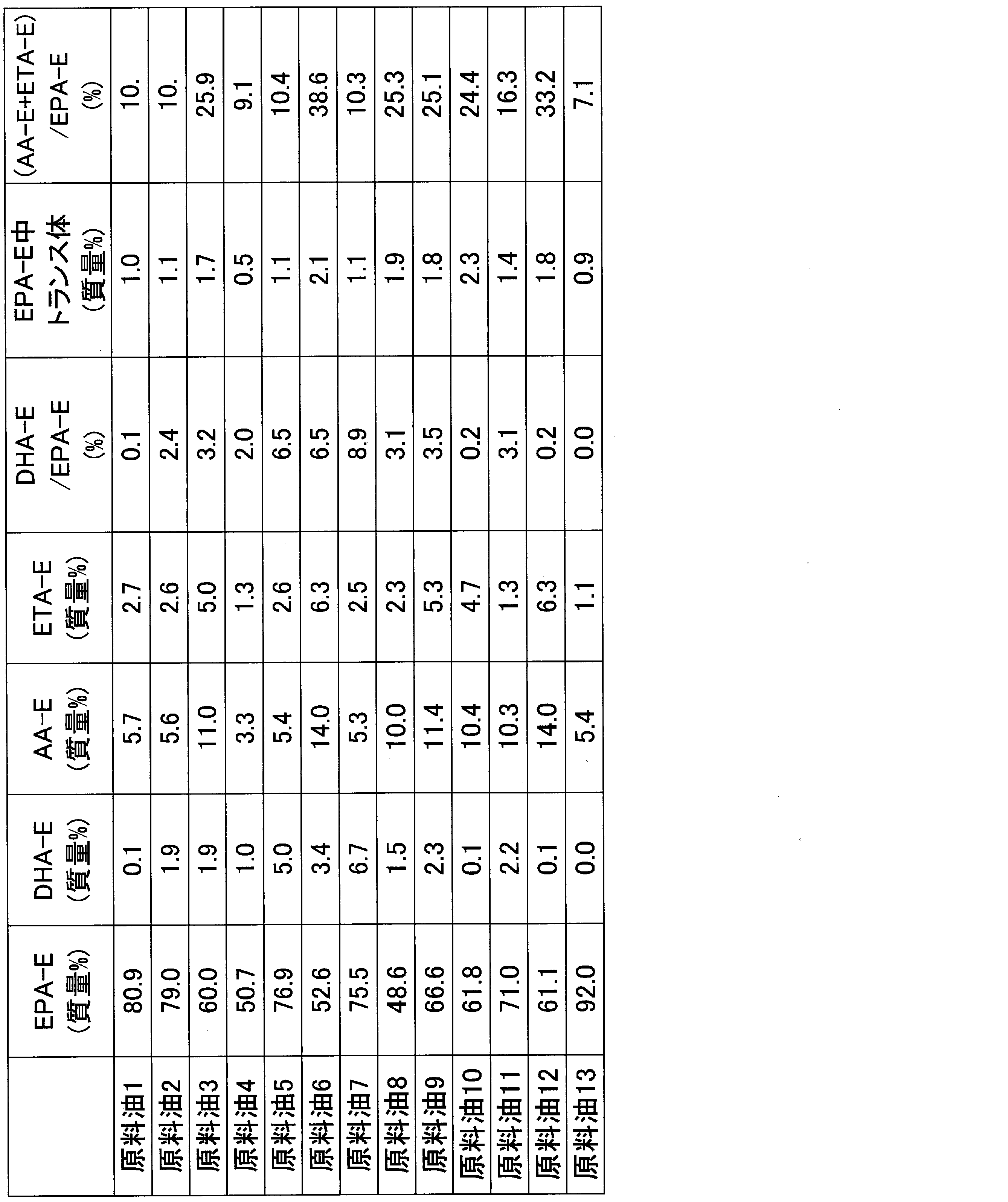
30gの原料油1をシクロヘキサン14mLとよく攪拌混合して溶解させた。得られた溶液41gと銀塩溶液(50質量%硝酸銀水溶液)150gをフラスコに加え、窒素雰囲気(酸素濃度0.4%)下、20℃で20分間、300rpmの速度にて攪拌した。攪拌後の液体を15分間、20℃で静置し、分離した有機層と水層(PUFA-銀錯体を含む銀塩溶液)をそれぞれ回収した。回収した有機層に新たに調製した銀塩溶液150gを加え、窒素雰囲気(酸素濃度0.4%)下、20℃で20分間、300rpmの速度にて攪拌し、攪拌後の液体を15分間、20℃で静置した。分離した水層を回収し、これにシクロヘキサン15mLを加え、20℃で20分間、300rpmの速度で撹拌し、撹拌後の液体を15分間、20℃で静置し、分離した水層(PUFA-銀錯体を含む銀塩溶液)を回収した。得られた2つの水層を混合し、シクロヘキサン280mLを加え、60℃の条件下で20分間、300rpmの速度にて攪拌して、水層中のPUFAエチルエステルをシクロヘキサン中に抽出した。攪拌後の液体を静置し、分離した有機層を回収した後、濃縮してPUFAエチルエステル含有組成物を得た。
原料油2を使用した以外は、実施例1と同様の手順でPUFAエチルエステル含有組成物を得た。
30gの原料油3をシクロヘキサン35mLとよく攪拌混合して溶解させた。得られた溶液57gと銀塩溶液(50質量%硝酸銀水溶液)380gとをフラスコに加え、窒素雰囲気(酸素濃度0.4%)下、20℃で20分間、300rpmの速度にて攪拌した。攪拌後の液体を15分間、20℃で静置した。分離した水層を回収し、これにシクロヘキサン15mLを加え、20℃で20分間、300rpmの速度で撹拌し、撹拌後の液体を15分間、20℃で静置し、分離した水層(PUFA-銀錯体を含む銀塩溶液)を回収した。得られた水層を60℃に加温し、シクロヘキサン350mLを加え、60℃の条件下で20分間、300rpmの速度にて攪拌して、水層中のPUFAエチルエステルをシクロヘキサン中に抽出した。攪拌後の液体を静置し、分離した有機層を回収した後、濃縮してPUFAエチルエステル含有組成物を得た。
原料油4を使用した以外は、実施例1と同様の手順でPUFAエチルエステル含有組成物を得た。
30gの原料油11をシクロヘキサン14mLとよく攪拌混合して溶解させた。得られた溶液41gと銀塩溶液(50質量%硝酸銀水溶液)120gをフラスコに加え、窒素雰囲気(酸素濃度0.4%)下、20℃で20分間、300rpmの速度にて攪拌した。攪拌後の液体を15分間、20℃で静置し、分離した有機層と水層(PUFA-銀錯体を含む銀塩溶液)をそれぞれ回収した。回収した有機層に新たに調製した銀塩溶液120gを加え、窒素雰囲気(酸素濃度0.4%)下、20℃で20分間、300rpmの速度にて攪拌し、攪拌後の液体を15分間、20℃で静置した。分離した水層を回収し、これにシクロヘキサン60mLを加え、20℃で20分間、300rpmの速度で撹拌し、撹拌後の液体を15分間、20℃で静置し、分離した水層(PUFA-銀錯体を含む銀塩溶液)を回収した。得られた2つの水層を混合し、シクロヘキサン450mLを加え、60℃の条件下で20分間、300rpmの速度にて攪拌して、水層中のPUFAエチルエステルをシクロヘキサン中に抽出した。攪拌後の液体を静置し、分離した有機層を回収した後、濃縮してPUFAエチルエステル含有組成物を得た。
原料油12を使用した以外は、実施例5と同様の手順でPUFAエチルエステル含有組成物を得た。
(実施例7)
原料油13を使用した以外は、実施例1と同様の手順でPUFAエチルエステル含有組成物を得た。
原料油5を使用した以外は、実施例1と同様の手順でPUFAエチルエステル含有組成物を得た。
原料油6を使用した以外は、実施例3と同様の手順でPUFAエチルエステル含有組成物を得た。
原料油7を使用した以外は、実施例1と同様の手順でPUFAエチルエステル含有組成物を得た。
30gの原料油8をシクロヘキサン70mLとよく攪拌混合して溶解させた。得られた溶液84gと銀塩溶液(50質量%硝酸銀水溶液)380gとをフラスコに加え、窒素雰囲気(酸素濃度0.4%)下、20℃で20分間、300rpmの速度にて攪拌した。攪拌後の液体を15分間、20℃で静置した。分離した水層を回収し、これにシクロヘキサン38mLを加え、20℃で20分間、300rpmの速度で撹拌し、撹拌後の液体を15分間、20℃で静置し、分離した水層(PUFA-銀錯体を含む銀塩溶液)を回収した。得られた水層を60℃に加温し、シクロヘキサン350mLを加え、60℃の条件下で20分間、300rpmの速度にて攪拌して、水層中のPUFAエチルエステルをシクロヘキサン中に抽出した。攪拌後の液体を静置し、分離した有機層を回収した後、濃縮してPUFAエチルエステル含有組成物を得た。
原料油9~10を使用した以外は、比較例4と同様の手順でPUFAエチルエステル含有組成物を得た。
実施例1~7及び比較例1~6で得られた組成物の脂肪酸組成を参考例1の手順で測定した。結果を表2に示す。表2に示すとおり、原料油におけるEPA-Eの含有量が高く、かつDHA-E/EPA-E比、及びEPA-Eトランス異性体量がいずれも低い場合、全脂肪酸中にEPA-Eを96質量%以上含有し、かつEPA-E中のトランス異性体の比率が1.5質量%以下である組成物を得ることができた。原料油中のEPA-E量が低すぎると、EPA-E量が充分に高い生成物を得られなかった。またDHA-E/EPA-E比又はEPA-Eトランス異性体量が高くなると、EPA-E回収率が低下する傾向があった。

Claims (8)
- エイコサペンタエン酸アルキルエステル含有組成物の製造方法であって、下記(1)~(5):
(1)エイコサペンタエン酸アルキルエステルを全脂肪酸中に50~92質量%含有する原料油を準備すること、該原料油に含有されるエイコサペンタエン酸アルキルエステルに対するドコサヘキサエン酸アルキルエステルの質量比は3.3質量%以下であり、かつ該原料油に含有されるエイコサペンタエン酸アルキルエステル中のトランス異性体の比率は2質量%以下である;
(2)該原料油と、銀塩を含む水性溶液とを接触させること;
(3)該原料油と接触させた銀塩を含む水性溶液を回収すること;
(4)回収した銀塩を含む水性溶液と、有機溶媒とを接触させること;及び
(5)該銀塩を含む水性溶液と接触させた有機溶媒を回収することにより、エイコサペンタエン酸アルキルエステルを全脂肪酸中に96質量%以上含有し、且つ該エイコサペンタエン酸アルキルエステル中のトランス異性体の比率が1.5質量%以下であるエイコサペンタエン酸アルキルエステル含有組成物を製造すること、
を含む、方法。 - 前記原料油中のエイコサペンタエン酸アルキルエステルの含有量が全脂肪酸中60~85質量%である、請求項1記載の方法。
- 前記原料油中におけるドコサヘキサエン酸アルキルエステルの含有量が全脂肪酸中2質量%以下である、請求項1又は2記載の方法。
- 前記原料油中における、アラキドン酸アルキルエステルとエイコサテトラエン酸アルキルエステルとの合計含有量が、エイコサペンタエン酸アルキルエステル100質量%に対して26質量%以下である、請求項1~3のいずれか1項記載の方法。
- (3’)前記(3)において銀塩を含む水性溶液が回収された後の原料油を、新たに調製した銀塩を含む水性溶液と接触させ、次いで該原料油と接触させた銀塩を含む水性溶液を回収することをさらに含む、請求項1~4のいずれか1項記載の方法。
- 前記(4)が、前記(3)及び(3’)で回収した銀塩を含む水性溶液と有機溶媒とを接触させることを含む、請求項5記載の方法。
- 前記原料油と接触するときの前記銀塩を含む水性溶液の温度が5~30℃である、請求項1~6のいずれか1項記載の方法。
- 前記有機溶媒と接触するときの前記銀塩を含む水性溶液の温度が30~80℃である、請求項1~7のいずれか1項記載の方法。
Priority Applications (4)
| Application Number | Priority Date | Filing Date | Title |
|---|---|---|---|
| EP20778593.2A EP3950909A4 (en) | 2019-03-26 | 2020-03-26 | COMPOSITION CONTAINING EICOSAPENTAIC ACID-ALKYLESTER AND PROCESS FOR THE PREPARATION THEREOF |
| JP2021509585A JP7528054B2 (ja) | 2019-03-26 | 2020-03-26 | エイコサペンタエン酸アルキルエステル含有組成物の製造方法 |
| CN202080023919.6A CN113574154B (zh) | 2019-03-26 | 2020-03-26 | 含二十碳五烯酸烷基酯的组合物的制造方法 |
| US17/442,399 US11767491B2 (en) | 2019-03-26 | 2020-03-26 | Eicosapentaenoic acid alkyl ester-containing composition and method for producing same |
Applications Claiming Priority (2)
| Application Number | Priority Date | Filing Date | Title |
|---|---|---|---|
| JP2019-057754 | 2019-03-26 | ||
| JP2019057754 | 2019-03-26 |
Publications (1)
| Publication Number | Publication Date |
|---|---|
| WO2020196749A1 true WO2020196749A1 (ja) | 2020-10-01 |
Family
ID=72611500
Family Applications (1)
| Application Number | Title | Priority Date | Filing Date |
|---|---|---|---|
| PCT/JP2020/013656 Ceased WO2020196749A1 (ja) | 2019-03-26 | 2020-03-26 | エイコサペンタエン酸アルキルエステル含有組成物の製造方法 |
Country Status (5)
| Country | Link |
|---|---|
| US (1) | US11767491B2 (ja) |
| EP (1) | EP3950909A4 (ja) |
| JP (1) | JP7528054B2 (ja) |
| CN (1) | CN113574154B (ja) |
| WO (1) | WO2020196749A1 (ja) |
Families Citing this family (1)
| Publication number | Priority date | Publication date | Assignee | Title |
|---|---|---|---|---|
| KR20210108948A (ko) * | 2018-12-26 | 2021-09-03 | 닛신 파마 가부시키가이샤 | 에이코사펜타엔산 알킬에스테르 함유 조성물 및 그 제조 방법 |
Citations (13)
| Publication number | Priority date | Publication date | Assignee | Title |
|---|---|---|---|---|
| JPS6234908B2 (ja) | 1981-05-08 | 1987-07-29 | Brose Verwaltung | |
| JPS631954B2 (ja) | 1980-01-23 | 1988-01-14 | Biseibutsu Kagaku Kenkyukai | |
| JPH07242895A (ja) | 1993-03-16 | 1995-09-19 | Ikeda Shiyotsuken Kk | 高純度エイコサペンタエン酸又はその低級アルコールエステルの分離精製法 |
| JPH1095744A (ja) * | 1996-09-20 | 1998-04-14 | Nof Corp | 高度不飽和脂肪酸又はそのアルキルエステルの製造方法 |
| JP2786748B2 (ja) | 1991-01-28 | 1998-08-13 | ハリマ化成株式会社 | 高度不飽和脂肪酸類の精製方法 |
| JP2895258B2 (ja) | 1990-04-24 | 1999-05-24 | ハリマ化成株式会社 | 高度不飽和脂肪酸類の選択的取得方法 |
| JP2935555B2 (ja) | 1990-10-19 | 1999-08-16 | ハリマ化成株式会社 | 高度不飽和脂肪酸の分離精製法 |
| JP2001240893A (ja) * | 1999-12-20 | 2001-09-04 | Q P Corp | エイコサペンタエン酸又はその誘導体の精製方法 |
| WO2014054435A1 (ja) | 2012-10-01 | 2014-04-10 | 日清ファルマ株式会社 | 高度不飽和脂肪酸アルキルエステル含有組成物の製造方法 |
| JP2015063653A (ja) * | 2013-08-30 | 2015-04-09 | 備前化成株式会社 | 高純度オメガ3系脂肪酸エチルエステルの生産方法 |
| JP2015091940A (ja) * | 2013-09-30 | 2015-05-14 | 日清ファルマ株式会社 | エイコサペンタエン酸及び/又はドコサヘキサエン酸含有組成物の製造方法 |
| WO2016043251A1 (ja) * | 2014-09-17 | 2016-03-24 | 日本水産株式会社 | エイコサペンタエン酸アルキルエステルを含有する組成物及びその製造方法 |
| WO2017191821A1 (ja) | 2016-05-02 | 2017-11-09 | 日清ファルマ株式会社 | 高度不飽和脂肪酸含有組成物の製造方法 |
Family Cites Families (5)
| Publication number | Priority date | Publication date | Assignee | Title |
|---|---|---|---|---|
| JP3001954B2 (ja) | 1990-10-24 | 2000-01-24 | 財団法人相模中央化学研究所 | 高度不飽和脂肪酸の取得方法 |
| CA2040925C (en) | 1990-04-24 | 2000-01-25 | Yoshihisa Misawa | Method of purifying polyunsaturated aliphatic compounds |
| CA2311974A1 (en) | 1999-06-28 | 2000-12-28 | Nisshin Flour Milling Co., Ltd. | Processes of selectively separating and purifying eicosapentaenoic and docosahexaenoic acids or their esters |
| EP2619298B1 (en) * | 2010-09-24 | 2018-09-12 | Pronova BioPharma Norge AS | Process for concentrating omega-3 fatty acids |
| US10899994B2 (en) * | 2017-06-14 | 2021-01-26 | Nisshin Pharma Inc. | Method for producing polyunsaturated fatty acid-containing composition |
-
2020
- 2020-03-26 JP JP2021509585A patent/JP7528054B2/ja active Active
- 2020-03-26 EP EP20778593.2A patent/EP3950909A4/en active Pending
- 2020-03-26 US US17/442,399 patent/US11767491B2/en active Active
- 2020-03-26 CN CN202080023919.6A patent/CN113574154B/zh active Active
- 2020-03-26 WO PCT/JP2020/013656 patent/WO2020196749A1/ja not_active Ceased
Patent Citations (13)
| Publication number | Priority date | Publication date | Assignee | Title |
|---|---|---|---|---|
| JPS631954B2 (ja) | 1980-01-23 | 1988-01-14 | Biseibutsu Kagaku Kenkyukai | |
| JPS6234908B2 (ja) | 1981-05-08 | 1987-07-29 | Brose Verwaltung | |
| JP2895258B2 (ja) | 1990-04-24 | 1999-05-24 | ハリマ化成株式会社 | 高度不飽和脂肪酸類の選択的取得方法 |
| JP2935555B2 (ja) | 1990-10-19 | 1999-08-16 | ハリマ化成株式会社 | 高度不飽和脂肪酸の分離精製法 |
| JP2786748B2 (ja) | 1991-01-28 | 1998-08-13 | ハリマ化成株式会社 | 高度不飽和脂肪酸類の精製方法 |
| JPH07242895A (ja) | 1993-03-16 | 1995-09-19 | Ikeda Shiyotsuken Kk | 高純度エイコサペンタエン酸又はその低級アルコールエステルの分離精製法 |
| JPH1095744A (ja) * | 1996-09-20 | 1998-04-14 | Nof Corp | 高度不飽和脂肪酸又はそのアルキルエステルの製造方法 |
| JP2001240893A (ja) * | 1999-12-20 | 2001-09-04 | Q P Corp | エイコサペンタエン酸又はその誘導体の精製方法 |
| WO2014054435A1 (ja) | 2012-10-01 | 2014-04-10 | 日清ファルマ株式会社 | 高度不飽和脂肪酸アルキルエステル含有組成物の製造方法 |
| JP2015063653A (ja) * | 2013-08-30 | 2015-04-09 | 備前化成株式会社 | 高純度オメガ3系脂肪酸エチルエステルの生産方法 |
| JP2015091940A (ja) * | 2013-09-30 | 2015-05-14 | 日清ファルマ株式会社 | エイコサペンタエン酸及び/又はドコサヘキサエン酸含有組成物の製造方法 |
| WO2016043251A1 (ja) * | 2014-09-17 | 2016-03-24 | 日本水産株式会社 | エイコサペンタエン酸アルキルエステルを含有する組成物及びその製造方法 |
| WO2017191821A1 (ja) | 2016-05-02 | 2017-11-09 | 日清ファルマ株式会社 | 高度不飽和脂肪酸含有組成物の製造方法 |
Non-Patent Citations (1)
| Title |
|---|
| See also references of EP3950909A4 |
Also Published As
| Publication number | Publication date |
|---|---|
| US11767491B2 (en) | 2023-09-26 |
| JPWO2020196749A1 (ja) | 2020-10-01 |
| EP3950909A4 (en) | 2022-12-14 |
| CN113574154B (zh) | 2025-05-16 |
| EP3950909A1 (en) | 2022-02-09 |
| CN113574154A (zh) | 2021-10-29 |
| JP7528054B2 (ja) | 2024-08-05 |
| US20220169949A1 (en) | 2022-06-02 |
Similar Documents
| Publication | Publication Date | Title |
|---|---|---|
| JP6684932B2 (ja) | 高度不飽和脂肪酸アルキルエステル含有組成物の製造方法 | |
| CN103281910B (zh) | ω-3的浓缩物 | |
| DK2330177T3 (en) | PROCEDURE FOR GETTING HIGHLY UNSaturated Fatty Acid Derivatives | |
| JPS649977B2 (ja) | ||
| JP6518022B1 (ja) | 高度不飽和脂肪酸含有組成物の製造方法 | |
| WO2017191821A1 (ja) | 高度不飽和脂肪酸含有組成物の製造方法 | |
| JP6234908B2 (ja) | エイコサペンタエン酸及び/又はドコサヘキサエン酸含有組成物の製造方法 | |
| JP7528054B2 (ja) | エイコサペンタエン酸アルキルエステル含有組成物の製造方法 | |
| JP6464144B2 (ja) | ステアリドン酸の精製方法 | |
| JPWO2020138282A1 (ja) | エイコサペンタエン酸アルキルエステル含有組成物及びその製造方法 | |
| KR20140003437A (ko) | 다중불포화 지방산을 금속 수소화물로 안정화시키는 방법 |
Legal Events
| Date | Code | Title | Description |
|---|---|---|---|
| 121 | Ep: the epo has been informed by wipo that ep was designated in this application |
Ref document number: 20778593 Country of ref document: EP Kind code of ref document: A1 |
|
| ENP | Entry into the national phase |
Ref document number: 2021509585 Country of ref document: JP Kind code of ref document: A |
|
| NENP | Non-entry into the national phase |
Ref country code: DE |
|
| ENP | Entry into the national phase |
Ref document number: 2020778593 Country of ref document: EP Effective date: 20211026 |
|
| WWG | Wipo information: grant in national office |
Ref document number: 202080023919.6 Country of ref document: CN |