WO2020196800A1 - Corps moulé de résine renforcé par des fibres organiques, et procédé de fabrication de celui-ci - Google Patents
Corps moulé de résine renforcé par des fibres organiques, et procédé de fabrication de celui-ci Download PDFInfo
- Publication number
- WO2020196800A1 WO2020196800A1 PCT/JP2020/013855 JP2020013855W WO2020196800A1 WO 2020196800 A1 WO2020196800 A1 WO 2020196800A1 JP 2020013855 W JP2020013855 W JP 2020013855W WO 2020196800 A1 WO2020196800 A1 WO 2020196800A1
- Authority
- WO
- WIPO (PCT)
- Prior art keywords
- resin
- molded product
- resin molded
- orientation
- polypropylene
- Prior art date
- Legal status (The legal status is an assumption and is not a legal conclusion. Google has not performed a legal analysis and makes no representation as to the accuracy of the status listed.)
- Ceased
Links
Images

Classifications
-
- C—CHEMISTRY; METALLURGY
- C08—ORGANIC MACROMOLECULAR COMPOUNDS; THEIR PREPARATION OR CHEMICAL WORKING-UP; COMPOSITIONS BASED THEREON
- C08J—WORKING-UP; GENERAL PROCESSES OF COMPOUNDING; AFTER-TREATMENT NOT COVERED BY SUBCLASSES C08B, C08C, C08F, C08G or C08H
- C08J5/00—Manufacture of articles or shaped materials containing macromolecular substances
- C08J5/04—Reinforcing macromolecular compounds with loose or coherent fibrous material
- C08J5/045—Reinforcing macromolecular compounds with loose or coherent fibrous material with vegetable or animal fibrous material
-
- B—PERFORMING OPERATIONS; TRANSPORTING
- B29—WORKING OF PLASTICS; WORKING OF SUBSTANCES IN A PLASTIC STATE IN GENERAL
- B29B—PREPARATION OR PRETREATMENT OF THE MATERIAL TO BE SHAPED; MAKING GRANULES OR PREFORMS; RECOVERY OF PLASTICS OR OTHER CONSTITUENTS OF WASTE MATERIAL CONTAINING PLASTICS
- B29B7/00—Mixing; Kneading
- B29B7/002—Methods
-
- B—PERFORMING OPERATIONS; TRANSPORTING
- B29—WORKING OF PLASTICS; WORKING OF SUBSTANCES IN A PLASTIC STATE IN GENERAL
- B29B—PREPARATION OR PRETREATMENT OF THE MATERIAL TO BE SHAPED; MAKING GRANULES OR PREFORMS; RECOVERY OF PLASTICS OR OTHER CONSTITUENTS OF WASTE MATERIAL CONTAINING PLASTICS
- B29B7/00—Mixing; Kneading
- B29B7/02—Mixing; Kneading non-continuous, with mechanical mixing or kneading devices, i.e. batch type
- B29B7/22—Component parts, details or accessories; Auxiliary operations
- B29B7/28—Component parts, details or accessories; Auxiliary operations for measuring, controlling or regulating, e.g. viscosity control
- B29B7/286—Component parts, details or accessories; Auxiliary operations for measuring, controlling or regulating, e.g. viscosity control measuring properties of the mixture, e.g. temperature, density
-
- B—PERFORMING OPERATIONS; TRANSPORTING
- B29—WORKING OF PLASTICS; WORKING OF SUBSTANCES IN A PLASTIC STATE IN GENERAL
- B29B—PREPARATION OR PRETREATMENT OF THE MATERIAL TO BE SHAPED; MAKING GRANULES OR PREFORMS; RECOVERY OF PLASTICS OR OTHER CONSTITUENTS OF WASTE MATERIAL CONTAINING PLASTICS
- B29B7/00—Mixing; Kneading
- B29B7/30—Mixing; Kneading continuous, with mechanical mixing or kneading devices
- B29B7/58—Component parts, details or accessories; Auxiliary operations
- B29B7/72—Measuring, controlling or regulating
- B29B7/726—Measuring properties of mixture, e.g. temperature or density
-
- B—PERFORMING OPERATIONS; TRANSPORTING
- B29—WORKING OF PLASTICS; WORKING OF SUBSTANCES IN A PLASTIC STATE IN GENERAL
- B29B—PREPARATION OR PRETREATMENT OF THE MATERIAL TO BE SHAPED; MAKING GRANULES OR PREFORMS; RECOVERY OF PLASTICS OR OTHER CONSTITUENTS OF WASTE MATERIAL CONTAINING PLASTICS
- B29B7/00—Mixing; Kneading
- B29B7/80—Component parts, details or accessories; Auxiliary operations
- B29B7/82—Heating or cooling
-
- B—PERFORMING OPERATIONS; TRANSPORTING
- B29—WORKING OF PLASTICS; WORKING OF SUBSTANCES IN A PLASTIC STATE IN GENERAL
- B29B—PREPARATION OR PRETREATMENT OF THE MATERIAL TO BE SHAPED; MAKING GRANULES OR PREFORMS; RECOVERY OF PLASTICS OR OTHER CONSTITUENTS OF WASTE MATERIAL CONTAINING PLASTICS
- B29B7/00—Mixing; Kneading
- B29B7/80—Component parts, details or accessories; Auxiliary operations
- B29B7/88—Adding charges, i.e. additives
- B29B7/90—Fillers or reinforcements, e.g. fibres
-
- C—CHEMISTRY; METALLURGY
- C08—ORGANIC MACROMOLECULAR COMPOUNDS; THEIR PREPARATION OR CHEMICAL WORKING-UP; COMPOSITIONS BASED THEREON
- C08K—Use of inorganic or non-macromolecular organic substances as compounding ingredients
- C08K7/00—Use of ingredients characterised by shape
- C08K7/02—Fibres or whiskers
-
- C—CHEMISTRY; METALLURGY
- C08—ORGANIC MACROMOLECULAR COMPOUNDS; THEIR PREPARATION OR CHEMICAL WORKING-UP; COMPOSITIONS BASED THEREON
- C08L—COMPOSITIONS OF MACROMOLECULAR COMPOUNDS
- C08L23/00—Compositions of homopolymers or copolymers of unsaturated aliphatic hydrocarbons having only one carbon-to-carbon double bond; Compositions of derivatives of such polymers
- C08L23/02—Compositions of homopolymers or copolymers of unsaturated aliphatic hydrocarbons having only one carbon-to-carbon double bond; Compositions of derivatives of such polymers not modified by chemical after-treatment
- C08L23/10—Homopolymers or copolymers of propene
-
- B—PERFORMING OPERATIONS; TRANSPORTING
- B29—WORKING OF PLASTICS; WORKING OF SUBSTANCES IN A PLASTIC STATE IN GENERAL
- B29B—PREPARATION OR PRETREATMENT OF THE MATERIAL TO BE SHAPED; MAKING GRANULES OR PREFORMS; RECOVERY OF PLASTICS OR OTHER CONSTITUENTS OF WASTE MATERIAL CONTAINING PLASTICS
- B29B7/00—Mixing; Kneading
- B29B7/02—Mixing; Kneading non-continuous, with mechanical mixing or kneading devices, i.e. batch type
- B29B7/06—Mixing; Kneading non-continuous, with mechanical mixing or kneading devices, i.e. batch type with movable mixing or kneading devices
- B29B7/10—Mixing; Kneading non-continuous, with mechanical mixing or kneading devices, i.e. batch type with movable mixing or kneading devices rotary
- B29B7/18—Mixing; Kneading non-continuous, with mechanical mixing or kneading devices, i.e. batch type with movable mixing or kneading devices rotary with more than one shaft
- B29B7/183—Mixing; Kneading non-continuous, with mechanical mixing or kneading devices, i.e. batch type with movable mixing or kneading devices rotary with more than one shaft having a casing closely surrounding the rotors, e.g. of Banbury type
-
- B—PERFORMING OPERATIONS; TRANSPORTING
- B29—WORKING OF PLASTICS; WORKING OF SUBSTANCES IN A PLASTIC STATE IN GENERAL
- B29B—PREPARATION OR PRETREATMENT OF THE MATERIAL TO BE SHAPED; MAKING GRANULES OR PREFORMS; RECOVERY OF PLASTICS OR OTHER CONSTITUENTS OF WASTE MATERIAL CONTAINING PLASTICS
- B29B7/00—Mixing; Kneading
- B29B7/30—Mixing; Kneading continuous, with mechanical mixing or kneading devices
- B29B7/34—Mixing; Kneading continuous, with mechanical mixing or kneading devices with movable mixing or kneading devices
- B29B7/38—Mixing; Kneading continuous, with mechanical mixing or kneading devices with movable mixing or kneading devices rotary
- B29B7/40—Mixing; Kneading continuous, with mechanical mixing or kneading devices with movable mixing or kneading devices rotary with single shaft
- B29B7/42—Mixing; Kneading continuous, with mechanical mixing or kneading devices with movable mixing or kneading devices rotary with single shaft with screw or helix
-
- B—PERFORMING OPERATIONS; TRANSPORTING
- B29—WORKING OF PLASTICS; WORKING OF SUBSTANCES IN A PLASTIC STATE IN GENERAL
- B29B—PREPARATION OR PRETREATMENT OF THE MATERIAL TO BE SHAPED; MAKING GRANULES OR PREFORMS; RECOVERY OF PLASTICS OR OTHER CONSTITUENTS OF WASTE MATERIAL CONTAINING PLASTICS
- B29B7/00—Mixing; Kneading
- B29B7/30—Mixing; Kneading continuous, with mechanical mixing or kneading devices
- B29B7/34—Mixing; Kneading continuous, with mechanical mixing or kneading devices with movable mixing or kneading devices
- B29B7/38—Mixing; Kneading continuous, with mechanical mixing or kneading devices with movable mixing or kneading devices rotary
- B29B7/46—Mixing; Kneading continuous, with mechanical mixing or kneading devices with movable mixing or kneading devices rotary with more than one shaft
-
- B—PERFORMING OPERATIONS; TRANSPORTING
- B29—WORKING OF PLASTICS; WORKING OF SUBSTANCES IN A PLASTIC STATE IN GENERAL
- B29K—INDEXING SCHEME ASSOCIATED WITH SUBCLASSES B29B, B29C OR B29D, RELATING TO MOULDING MATERIALS OR TO MATERIALS FOR MOULDS, REINFORCEMENTS, FILLERS OR PREFORMED PARTS, e.g. INSERTS
- B29K2023/00—Use of polyalkenes or derivatives thereof as moulding material
- B29K2023/10—Polymers of propylene
- B29K2023/12—PP, i.e. polypropylene
-
- B—PERFORMING OPERATIONS; TRANSPORTING
- B29—WORKING OF PLASTICS; WORKING OF SUBSTANCES IN A PLASTIC STATE IN GENERAL
- B29K—INDEXING SCHEME ASSOCIATED WITH SUBCLASSES B29B, B29C OR B29D, RELATING TO MOULDING MATERIALS OR TO MATERIALS FOR MOULDS, REINFORCEMENTS, FILLERS OR PREFORMED PARTS, e.g. INSERTS
- B29K2201/00—Use of cellulose, modified cellulose or cellulose derivatives, e.g. viscose, as reinforcement
-
- C—CHEMISTRY; METALLURGY
- C08—ORGANIC MACROMOLECULAR COMPOUNDS; THEIR PREPARATION OR CHEMICAL WORKING-UP; COMPOSITIONS BASED THEREON
- C08J—WORKING-UP; GENERAL PROCESSES OF COMPOUNDING; AFTER-TREATMENT NOT COVERED BY SUBCLASSES C08B, C08C, C08F, C08G or C08H
- C08J2323/00—Characterised by the use of homopolymers or copolymers of unsaturated aliphatic hydrocarbons having only one carbon-to-carbon double bond; Derivatives of such polymers
- C08J2323/02—Characterised by the use of homopolymers or copolymers of unsaturated aliphatic hydrocarbons having only one carbon-to-carbon double bond; Derivatives of such polymers not modified by chemical after treatment
- C08J2323/10—Homopolymers or copolymers of propene
- C08J2323/12—Polypropene
-
- C—CHEMISTRY; METALLURGY
- C08—ORGANIC MACROMOLECULAR COMPOUNDS; THEIR PREPARATION OR CHEMICAL WORKING-UP; COMPOSITIONS BASED THEREON
- C08L—COMPOSITIONS OF MACROMOLECULAR COMPOUNDS
- C08L2205/00—Polymer mixtures characterised by other features
- C08L2205/14—Polymer mixtures characterised by other features containing polymeric additives characterised by shape
- C08L2205/16—Fibres; Fibrils
Definitions
- the present invention relates to an organic fiber reinforced resin molded product and a method for producing the same.
- a fiber reinforced resin in which reinforcing fibers such as glass fiber and organic fiber are blended with the resin is known in order to enhance the mechanical properties of the resin.
- the organic fiber include cellulose fibers such as kraft pulp fiber, wood flour, and jute fiber. It is known that when organic fibers are used as a reinforcing material, the obtained fiber-reinforced resin is lighter and has a higher specific strength (mechanical strength divided by density) than when reinforced with glass fiber. There is.
- Patent Document 1 discloses a composite resin composition containing a polypropylene resin and a plant fiber having an organic solvent extract component amount of 1% by weight or less.
- An object of the present invention is to provide an organic fiber reinforced resin molded product having excellent specific strength and less likely to cause deterioration of mechanical properties even in a high temperature environment.
- the elastic modulus retention ratio E 100 / E 25 is 0.38 or more, one of [1] to [6]
- the organic fiber reinforced resin molded product of the present invention exhibits excellent specific strength and is less likely to cause deterioration of mechanical properties even in a high temperature environment.
- the diffraction peak observed at the position where the scattering vector s is 2.10 nm -1 is a diffraction peak derived from the ⁇ crystal (130) plane of polypropylene. It is a one-dimensional diffraction pattern of the wide-angle X-ray diffraction measurement of the cellulose fiber reinforced polypropylene resin molded article of Example 1.
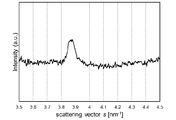
- the diffraction peak observed at the position where the scattering vector s is 3.87 nm -1 is the diffraction peak derived from the (004) plane of the cellulose fiber.
- the organic fiber reinforced resin molded product of the present invention (hereinafter, also simply referred to as “resin molded product”) contains a resin and cellulose fibers, and the density of the resin molded product is 0.65 g / cm 3 or less. This resin molded product has excellent specific strength and is unlikely to have a decrease in elastic modulus even in a high temperature environment.
- the resin preferably contains a thermoplastic resin, and contains a polyolefin resin (a resin obtained by polymerizing or copolymerizing an ethylenically unsaturated compound. Details will be described later, for example, a polyethylene resin, a polypropylene resin, etc.). It is more preferable to contain a polypropylene resin. Details of the resin that can be used in the present invention will be described later. It is preferable that at least a part of the resin forms a crystal structure in the resin molded product.
- a polyolefin resin a resin obtained by polymerizing or copolymerizing an ethylenically unsaturated compound. Details will be described later, for example, a polyethylene resin, a polypropylene resin, etc.). It is more preferable to contain a polypropylene resin. Details of the resin that can be used in the present invention will be described later. It is preferable that at least a part of the resin forms a crystal structure in the resin molded product.
- the resin molded body when a polypropylene resin is contained as the resin, it is preferable that at least a part of the polypropylene resin has a crystal structure, and it is preferable to have ⁇ -type crystals (hereinafter, also referred to as ⁇ crystals).
- the cellulose fibers are preferably oriented. Further, it is preferable that the resin is also oriented in the resin molded body. The degree of orientation of the cellulose fibers and the degree of orientation of the resin will be described later.
- the resin molded body is preferably a resin molded body stretched in one direction. The stretching method will be described later.
- the constituent components of the resin molded product of the present invention will be described.
- the cellulose fiber used in the present invention is a fibrous cellulose.
- the cellulose fibers contained in the resin molded product of the present invention may be one type or two or more types.
- the origin of the cellulose fibers is not particularly limited, and for example, wood, bamboo, hemp, jute, kenaf, crop waste (for example, straw such as wheat and rice, stems such as corn and cotton, sugar cane), cloth, recycled pulp.
- wood-derived cellulose fiber is particularly preferable.
- the cellulose fiber is not particularly limited, and a cellulose fiber obtained by any production method can be used. Examples thereof include mechanical treatment in which crushing treatment is performed by physical force, chemical treatment such as kraft pulp method, sulfide pulp method, and alkaline pulp method, and cellulose fibers obtained by a combination of these treatments.
- chemical treatment lignin, hemicellulose and the like can be removed from plant raw materials such as wood by using chemicals such as caustic soda, and almost pure cellulose fibers can be taken out.
- Cellulose fibers obtained in this way are also referred to as pulp fibers.
- a cellulose fiber prepared by a chemical treatment is preferable, and a cellulose fiber prepared by a kraft pulp method is more preferable from the viewpoint of improving mechanical properties such as specific strength and elastic modulus in a high temperature environment. ..
- a cellulose fiber prepared by a kraft pulp method is more preferable from the viewpoint of improving mechanical properties such as specific strength and elastic modulus in a high temperature environment. ..
- polypropylene resin is used as the resin
- lignin and the like do not remain in the cellulose fiber, which contributes to the improvement of the mechanical properties of the resin molded product. It is considered that this is partly because the interaction between the polypropylene resin and the cellulose fiber at the interface is not inhibited by lignin.
- the diameter of the cellulose fiber used in the present invention is preferably 1 to 30 ⁇ m, more preferably 1 to 25 ⁇ m, still more preferably 5 to 20 ⁇ m.
- the length (fiber length) is preferably 10 to 2200 ⁇ m, more preferably 50 to 1000 ⁇ m.
- the diameter of the cellulose fibers contained in the resin molded product of the present invention can be measured by a scanning electron microscope (SEM) or a fiber analyzer.
- the fiber length of the cellulose fiber can also be measured by SEM observation.
- a residue obtained by eluting the resin (for example, polypropylene resin) in the resin molded body of the present invention with hot xylene is placed on a stage and subjected to treatment such as vapor deposition.
- the fiber length can be measured by observing with SEM.
- the aspect ratio (fiber length L / fiber diameter D) of the cellulose fibers is preferably 5 to 100, more preferably 10 to 50.
- the content of the cellulose fibers in the resin molded body of the present invention is preferably 1 to 40 parts by mass, particularly preferably 5 to 30 parts by mass, based on 100 parts by mass of the total amount of the resin and the cellulose fibers. ..
- the resin used in the present invention is preferably a thermoplastic resin.
- the thermoplastic resin include polyolefin resin, polyvinyl chloride resin, acrylonitrile-butadiene-styrene copolymer resin (ABS resin), acrylonitrile-styrene copolymer resin (AS resin), polyethylene terephthalate resin, and polybutylene terephthalate resin. , Polyplastic resin, polyamide resin and the like.
- the thermoplastic resin may contain a modified resin as well as an unmodified resin. For example, it is also preferable to contain a resin modified with an unsaturated carboxylic acid or a derivative thereof (acid-modified resin).
- the polyolefin resin is not particularly limited as long as it is a resin made of a polymer obtained by polymerizing or copolymerizing a compound having an ethylenically unsaturated bond (usually an alkene).
- Examples of the polyolefin resin include polyethylene resin, polypropylene resin, ethylene- ⁇ -olefin copolymer resin, and polyolefin copolymer resin having an acid copolymer component or an acid ester copolymer component.
- the thermoplastic resin preferably contains a polyolefin resin, and more preferably a polyolefin resin.
- the thermoplastic resin preferably contains a polypropylene resin, and more preferably a polypropylene resin.
- the polypropylene resin may be an unmodified product or a modified product, and preferably contains an unmodified polypropylene resin.
- the polypropylene resin preferably contains an acid-modified polypropylene resin together with the unmodified polypropylene resin.
- the content of the resin in the resin molded body of the present invention is preferably 40 to 95 parts by mass based on 100 parts by mass of the total amount of the resin and the cellulose fibers, and particularly when the resin contains a polypropylene resin, the resin content is 100 parts by mass.
- the polypropylene resin is preferably contained in an amount of 50 to 100% by mass, more preferably 60 to 90% by mass.
- a resin molded product using polypropylene resin as the resin may be referred to as a cellulose fiber reinforced polypropylene resin molded product.
- the polypropylene resin is not particularly limited, and for example, any of homopolypropylene, polypropylene block copolymer, and polypropylene random copolymer can be used.
- polypropylene of polypropylene resin propylene homopolymer, propylene-ethylene random copolymer, propylene- ⁇ -olefin random copolymer, propylene-ethylene- ⁇ -olefin copolymer, propylene block copolymer (propylene single weight).
- These polypropylenes may be used alone or in combination of two or more.
- the ⁇ -olefin used in the polypropylene resin is preferably 1-butene, 1-pentene, 1-hexene, 4-methyl-1-pentene, 1-octene, 1-decene, and 1-butene, 1-hexene, 1-decene. Octene is more preferred.
- propylene- ⁇ -olefin random copolymer examples include a propylene-1-butene random copolymer, a propylene-1-hexene random copolymer, and a propylene-1-octene random copolymer.
- propylene-ethylene- ⁇ -olefin copolymer examples include a propylene-ethylene-1-butene copolymer, a propylene-ethylene-1-hexene copolymer, and a propylene-ethylene-1-octene copolymer. Be done.
- propylene block copolymer examples include (propylene)-(propylene-ethylene) copolymer, (propylene)-(propylene-ethylene-1-butene) copolymer, and (propylene)-(propylene-ethylene-1).
- homopolypropylene, propylene-ethylene-1-octene copolymer, and polypropylene block copolymer are preferable from the viewpoint of tensile strength and impact resistance.
- the fluidity of the polypropylene resin is not limited, and a polypropylene resin having appropriate fluidity can be used in consideration of the wall thickness, volume, etc. of the molded product.
- One type of polypropylene resin may be used alone, or two or more types may be mixed and used.
- the content of the polypropylene resin in the resin molded body of the present invention is preferably 60 to 99 parts by mass, more preferably 70 to 95 parts by mass, out of 100 parts by mass of the total amount of the polypropylene resin and the cellulose fibers. , 75 to 85 parts by mass is particularly preferable.
- a part of the polypropylene resin contained in the resin molded product of the present invention is an acid-modified polypropylene resin (hereinafter, also referred to as "acid-modified polypropylene resin").
- an effect of improving the adhesiveness between the polypropylene resin not acid-modified by the acid-modified polypropylene resin and the cellulose fiber can be obtained, and further, cellulose can be obtained. It is considered that the degree of orientation of the fibers can be effectively increased, and as a result, mechanical properties such as elasticity can be effectively enhanced even in a high temperature environment.
- Examples of the acid-modified polypropylene resin include those obtained by modifying the above-mentioned polypropylene resin with an unsaturated carboxylic acid or a derivative thereof.
- Examples of the unsaturated carboxylic acid include maleic acid, fumaric acid, itaconic acid, acrylic acid, and methacrylic acid
- examples of the unsaturated carboxylic acid derivative include maleic anhydride, itaconic anhydride, and methyl acrylate.
- the acid-modified polypropylene resin preferably contains maleic acid-modified polypropylene and / or maleic anhydride-modified polypropylene.
- the content of the acid-modified polypropylene resin in the resin molded product of the present invention is a polypropylene resin (total of polypropylene resin not acid-modified and acid-modified polypropylene resin). And, out of 100 parts by mass of the total amount of the cellulose fibers, it is preferably 0.3 to 20 parts by mass, preferably 1 to 15 parts by mass, and more preferably 3 to 7 parts by mass.
- the resin molded product of the present invention can be led to, for example, mechanical properties showing a high elastic modulus at a high temperature.
- the resin molded product of the present invention may be composed of the above-mentioned resin and cellulose fibers, and rubber, elastomer and the like may be used in combination.
- elastomers such as hydrogenated styrene elastomer, styrene-ethylene-butadiene-styrene copolymer (SEBS), styrene-ethylenebutylene-olefin crystal block copolymer (SEBC), and ethylene- ⁇ olefin copolymer are additionally blended.
- SEBS styrene-ethylene-butadiene-styrene copolymer
- SEBC styrene-ethylenebutylene-olefin crystal block copolymer
- ethylene- ⁇ olefin copolymer are additionally blended.
- the physical properties of the resin molded product may be modified.
- antioxidants such as aids, foaming agents, lubricants such as paraffin wax, surface treatment agents, crystal nucleating agents, mold release agents, hydrolysis inhibitors, antiblocking agents, antistatic agents, antifogging agents, flame retardants , Ion trapping agent, flame retardant, flame retardant aid and other additives can be appropriately contained.
- crystal structure of resin and its orientation In the resin molded product, it is preferable that at least a part of the resin forms a crystal structure. When the resin molded product contains a plurality of types of resins, it is preferable that any one of the plurality of resins forms a crystal structure. Further, the crystal structure of the resin is preferably oriented. When the resin molded product contains a plurality of types of resins, it is sufficient that the crystal structure of any of the plurality of resins is oriented. The degree of orientation (crystal orientation) of the crystal structure of the resin is preferably more than 0.50 and 1.00 or less.
- the degree of crystal orientation of the resin By setting the degree of crystal orientation of the resin within the above range, the specific strength can be further increased, and the mechanical properties such as elastic modulus can be further enhanced even in a high temperature environment.
- the crystal structure of the resin In the resin molded product of the present invention, for example, by stretching in a predetermined temperature range as described later, the crystal structure of the resin is likely to be oriented in the stretching direction, and the resin molded product exhibits a high degree of crystal orientation. Is thought to be possible.
- the orientation of the resin is low, the degree of orientation is usually 0.50 or less, and the machine has specific strength, elastic modulus in a high temperature environment, etc. There are restrictions on improving the characteristics.
- the crystal orientation of the resin is more preferably 0.60 to 0.98, and further preferably 0.90 to 0.98.
- the crystal structure of the resin and its degree of orientation can be confirmed by X-ray diffraction measurement.
- the preferred crystal orientation and the measuring method thereof when the resin is a polypropylene resin will be described below.
- Polypropylene crystal structure It is known that polypropylene mainly adopts a crystal structure called ⁇ crystal.
- the ⁇ crystal is a monoclinic crystal.
- respectively diffraction peaks at scattering vector s is 1.61 ⁇ 0.1 nm -1 and 1.92 ⁇ 0.1 nm -1 is observed Will be done. That is, in a preferred embodiment of the resin molded product of the present invention, at least a part of polypropylene has a crystal structure, and at least a part of the polypropylene is ⁇ crystal.
- the crystal structure other than the ⁇ crystal in the crystal structure of polypropylene is not particularly limited, but ⁇ crystal is preferable.
- ⁇ crystal- X-ray diffraction measurement can be used to confirm the presence of ⁇ -crystals. It is preferable to use wide-angle X-ray diffraction measurement. In the case of a general stretch-molded product, a strength distribution may occur in the azimuth direction derived from the resin orientation. Therefore, it may not be possible to accurately capture the intensity distribution derived from the orientation with a one-dimensional scintillation counter, so it is preferable to use a two-dimensional detector as the detector. It is preferable that the X-ray source is CuK ⁇ ray and the shape is a pinhole.
- the X-ray beam diameter is preferably 5 ⁇ m to 1500 ⁇ m, more preferably 7 ⁇ m to 1000 ⁇ m. If the beam diameter is larger than 1500 ⁇ m, sufficient position resolution cannot be obtained and may not be suitable for detailed analysis. If the beam diameter is less than 5 ⁇ m, the beam diameter is small and the irradiation intensity is not sufficient and the measurement time is very long. It becomes long and the measurement efficiency may deteriorate. Specifically, it can be carried out by the method described in the examples. The presence of polypropylene ⁇ -crystals can also be confirmed as follows.
- the diffraction angles 2 ⁇ are 14.3 ⁇ 0.2 °, 17 Diffraction peaks are observed at positions of .1 ⁇ 0.2 ° and 34.6 ⁇ 0.2 °, respectively.
- the diffraction peaks at the positions where the diffraction angles 2 ⁇ are 14.3 ⁇ 0.2 ° and 17.1 ⁇ 0.2 ° are the diffraction peaks derived from the (040) plane of the ⁇ -type crystal of polypropylene, these diffraction peaks When any of them is observed, it can be determined that ⁇ crystals are formed.
- the degree of orientation of the polypropylene resin crystal (a component having a diffraction peak at a position where the scattering vector s is 1.92 ⁇ 0.1 nm -1 ) is preferably 0.60 or more.
- the degree of orientation of the polypropylene crystals is preferably 0.60 or more.
- mechanical properties such as specific strength and elastic modulus in a high temperature environment can be further enhanced.
- the polypropylene crystals can be easily oriented in the stretching direction, and the resin molded product can exhibit a high degree of crystal orientation. it is conceivable that.
- the degree of orientation of the polypropylene crystals is more preferably 0.60 to 1.00, still more preferably 0.65. It is about 0.97, and particularly preferably 0.90 to 0.95.
- the degree of crystal orientation of the polypropylene resin is derived from the (040) plane of polypropylene (scattering vector 1.92 ⁇ 0.) Based on the two-dimensional diffraction image of X-rays obtained based on the above method for confirming polypropylene ⁇ crystals. It can be obtained by analyzing the profile of the diffraction intensity in the azimuth angle direction (diffraction is measured at 1 nm -1 ). Examples of the analysis method include a method of analyzing using the half-value width of the diffraction peak in the azimuth direction, and a method of obtaining using an orientation function.
- a sample may be cut out and devised so that a good diffraction image can be obtained. More specifically, for the purpose of adjusting the absorption of X-rays by the sample, cutting out from the sample at an arbitrary place and adjusting the thickness to about 0.2 to 1 mm can be mentioned.
- the X-ray diffraction pattern derived from the (040) plane of the ⁇ -type crystal of the polypropylene crystal described above is used.
- the polypropylene crystal two-dimensional diffraction pattern described above is converted into one-dimensional data of azimuth VS intensity.
- the polypropylene ⁇ -type crystal is made one-dimensional within a range of ⁇ 0.5 ° centered on the diffraction 17.1 ° of the polypropylene ⁇ -type crystal (040) plane.
- one-dimensionalization is performed in the range of ⁇ 0.5 ° centered on 16.1 °, and polypropylene ⁇ -type crystal. It can also be subtracted from the one-dimensional diffraction intensity of.
- the degree of orientation is determined based on the azimuth diffraction intensity data of the corrected polypropylene ⁇ -type crystal, and the degree of orientation is determined by the half-value width method, which is calculated using the full width at half maximum, or the orientation function method, which uses the orientation function. Either of the above may be used.
- the noise of the data obtained by peak separation of the diffraction intensity in the azimuth direction is reduced in order to obtain the orientation function or half width, and the analysis is performed using the function obtained by peak separation. Good.
- the above-mentioned work such as strength correction may be performed.
- the Gaussian function or the Lorentz function is preferable as the function used for peak separation and fitting, and the Lorentz function is more preferable.
- Cellulose which is a cellulose fiber, is known to have various crystal structures such as type I and type II. Natural cellulose has an I ⁇ - type (triclinic) and I ⁇ - type (monoclinic) crystal structure, and plant-derived cellulose generally contains a large amount of I ⁇ - type crystals.
- the resin molded product of the present invention has a diffraction peak at a position where the scattering vector s is 3.86 ⁇ 0.1 nm -1 in wide-angle X-ray diffraction measurement. This diffraction peak is derived from the (004) plane of the I ⁇ type crystal of cellulose.
- the cellulose of the cellulose fiber has a crystal structure, and at least a part of it is an I ⁇ type crystal.
- the crystal structure other than the I ⁇ type crystal in the crystal structure of cellulose is not particularly limited.
- the cellulose fiber may be referred to as "a component having a diffraction peak at a position where the scattering vector s is 3.86 ⁇ 0.1 nm -1 ". It can be confirmed from various methods that it contains cellulose fibers. For example, it can be confirmed by observing the diffraction peak derived from the cellulose crystal in the cellulose fiber using X-rays.
- a diffraction peak derived from the (004) plane of the I ⁇ - type crystal of cellulose can be observed near °).
- it is necessary to rotate the sample by ⁇ and inject X-rays. That is, when CuK ⁇ ray is used, the sample stage is rotated by ⁇ 17.3 °.
- the diffraction peak derived from the cellulose crystal As the diffraction peak derived from the cellulose crystal, other diffraction peaks can be observed inside the (004) plane, but when polypropylene resin is contained in the resin component, the diffraction peak and the diffraction position derived from polypropylene are observed. It may be fogged and cannot be judged as a clear diffraction peak. Therefore, in the present specification, the presence or absence of cellulose fibers is determined by using the diffraction peak of the (004) plane of the I ⁇ type crystal of cellulose.
- the degree of orientation of the cellulose fibers (components having a diffraction peak at a position where the scattering vector s is 3.86 ⁇ 0.1 nm -1 ) is preferably 0.40 or more.
- the degree of orientation of the cellulose fibers is preferably 0.40 or more.
- mechanical properties such as specific strength and elastic modulus in a high temperature environment can be further enhanced.
- the specific strength, elastic modulus in a high temperature environment, etc. are as follows. It is considered that the mechanical properties of the plastic can be further improved.
- such a resin molded body has a diffraction peak derived from an ⁇ -type crystal of polypropylene and a diffraction peak derived from an I ⁇ - type crystal of cellulose, and both the degree of crystal orientation of polypropylene resin and the degree of crystal orientation of this cellulose fiber are both. It has been enhanced. Therefore, it is considered that the effect of improving the interaction between the cellulose fibers and the interaction between the polypropylene resin and the cellulose fibers at the interface can be obtained, and the mechanical properties such as tensile strength can be effectively enhanced. Moreover, since the resin molded product of the present invention has a low density, excellent specific strength can be obtained.
- the degree of crystal orientation of the polypropylene resin can be effectively increased, and the orientation of the I ⁇ - type crystals of the cellulose fibers can be effectively increased.
- the degree of orientation of the cellulose fibers can also be sufficiently increased.
- the orientation of the cellulose fibers is low, the degree of orientation is usually less than 0.40, and the specific strength, elastic modulus in a high temperature environment, etc. There are restrictions on improving mechanical properties.
- the degree of orientation of the cellulose fibers is usually less than 0.40, and the machine has specific strength, elastic modulus in a high temperature environment, etc. There are restrictions on improving the characteristics. Considering the improvement of the mechanical properties in the direction along the arrangement (direction of orientation) of the cellulose fibers, the degree of orientation of the cellulose fibers is more preferably 0.40 to 1.00, still more preferably 0.50 to 0.50 to 1.00. It is 0.95.
- the orientation of the diffraction intensity derived from the (004) plane of cellulose is based on the two-dimensional diffraction image of X-rays obtained based on the above-mentioned method for confirming that the cellulose fibers are contained. It can be obtained by analyzing the profile in the angular direction. Examples of the analysis method include a method of analyzing using the half-value width of the diffraction peak in the azimuth direction, and a method of obtaining using an orientation function.
- a sample may be cut out and devised so that a good diffraction image can be obtained. More specifically, for the purpose of adjusting the absorption of X-rays by the sample, the sample is cut out at an arbitrary place and the thickness is adjusted to about 0.2 to 1 mm.
- the X-ray diffraction pattern derived from the (004) plane of the above-mentioned cellulose I ⁇ type crystal of the cellulose fiber is used.
- the two-dimensional diffraction pattern of the (004) plane of the cellulose I ⁇ - type crystal of the cellulose fiber is made one-dimensional into the data of the azimuth VS intensity.
- the two-dimensional data is made one-dimensional within a range of ⁇ 0.5 ° centered on 34.6 ° of the (004) plane of the cellulose I ⁇ - type crystal of the cellulose fiber.
- the degree of orientation is determined based on the data of the azimuth diffraction intensity of the I ⁇ - type crystal of cellulose of the corrected cellulose fiber, and the degree of orientation is determined by the half-value width method calculated using the half-value width or the orientation function. Either of the orientation function methods using is used.
- the noise of the data obtained by peak separation of the diffraction intensity in the azimuth direction is reduced in order to obtain the orientation function or half width, and the analysis is performed using the function obtained by peak separation. Good.
- the above-mentioned work such as strength correction may be performed.
- the Gaussian function or the Lorentz function is preferable as the function used for peak separation and fitting, and the Lorentz function is more preferable.
- the specific strength of the resin molded product of the present invention with the tensile strength as an index depends on the type and content of the resin and cellulose fibers used and cannot be uniquely set, but is 0.08 MJ / kg or more. It is preferable, 0.16 MJ / kg or more is more preferable, and 0.17 MJ / kg or more is further preferable.
- the specific strength is calculated from the tensile strength [MPa] and the density [g / cm 3 ] measured by the method described later by the following formula.
- Specific strength [MJ / kg] (tensile strength [MPa] / density [g / cm 3 ]) / 10 3
- the upper limit of the specific strength is not particularly limited, but 0.50 MJ / kg or less is practical. When the specific strength of the resin molded product of the present invention is within the above range, it is lightweight and can exhibit high tensile strength, and can be suitably used, for example, as a material for transportation equipment described later.
- the tensile strength of the resin molded product of the present invention depends on the type and content of the resin and cellulose fibers used and cannot be uniquely set, but is preferably 50 MPa or more and 1000 MPa or less, and 70 MPa or more and 1000 MPa or less. More preferably.
- the tensile strength can be measured according to JIS K7161 by the method and conditions described in Examples. Further, when the sample is small, the sample width and the gripping interval length can be appropriately adjusted.
- the tensile strength of the fiber-reinforced resin molded product usually varies depending on the measurement direction. Therefore, in the present invention, the above-mentioned tensile strength and specific strength mean a measured value of the tensile strength in the direction in which the resin molded body exhibits the maximum tensile strength and a specific strength using the measured value.
- the density of the resin molded product of the present invention is 0.65 g / cm 3 or less.
- the above density can be measured according to the method A (underwater substitution method) of JIS K7112 by the method and conditions described in Examples.
- the resin molded product of the present invention can exhibit high tensile strength due to the high degree of orientation of the resin and / or cellulose fibers as described above. As a result, it is considered that excellent specific strength can be exhibited.
- the density of the resin molded product is preferably 0.60 g / cm 3 or less.
- the lower limit of the density is not particularly limited, but 0.20 g / cm 3 or more is practical, 0.40 g / cm 3 or more is preferable, and 0.55 g / cm 3 or more is more preferable.
- the coefficient of linear expansion of the resin molded product at 60 ° C. or higher and 100 ° C. or lower depends on the type and content of the resin and cellulose fibers used and cannot be uniquely set. It is preferably 0 ppm / K (Kelvin) or more and less than 10 ppm / K, and more preferably 0 ppm / K or more and less than 5 ppm / K.
- the resin molded product exhibiting the coefficient of linear expansion is preferable in that the change in dimensions in one direction in the high temperature region is suppressed.
- the coefficient of linear expansion means the coefficient of linear expansion of the average, which can be measured by thermomechanical analysis (TMA), and specifically, can be measured by the method described in Examples.
- TMA thermomechanical analysis
- the coefficient of linear expansion of the resin molded product usually has a different value depending on the measurement direction. Therefore, in the present invention, the above-mentioned coefficient of linear expansion means a measured value of the coefficient of linear expansion in the direction in which the resin molded product exhibits the minimum coefficient of linear expansion.
- the direction showing the minimum coefficient of linear expansion usually coincides with the orientation direction or the stretching direction of the cellulose fibers.
- the dynamic viscoelasticity measurement can be performed according to JIS K7244 by the method and conditions described in the examples.
- the lower limit of the elastic modulus maintenance rate is preferably 0.38 or more, more preferably 0.40 or more, and further preferably 0.45 or more.
- the upper limit of the elastic modulus maintenance rate is preferably 0.90 or less, more preferably 0.80 or less, and even more preferably 0.70 or less.
- it can be appropriately deformed by heating, and it is possible to suppress the occurrence of cracks during secondary processing such as when the resin molded product of the present invention is heat-molded, which is sufficient. Can show good workability.
- the degree of orientation of the cellulose wire fiber and the degree of crystal orientation of the resin it is preferable to increase the degree of orientation of the cellulose wire fiber and the degree of crystal orientation of the resin so that they are within the above ranges.
- the density may be 0.40 g / cm 3 or more
- the degree of orientation of the cellulose fibers may be 0.40 or more
- the degree of crystal orientation of the resin may be 0.65 or more and 1.00 or less.
- a resin molded product satisfying these conditions exhibits a high elastic modulus maintenance rate of 0.38 or more while increasing the specific strength to 0.08 MJ / kg or more.
- the coefficient of linear expansion can be as low as 0 ppm / K or more and less than 10 ppm / K.
- the method for producing a resin molded product of the present invention preferably includes at least a step of stretching an intermediate molded product obtained from a melt-kneaded product of resin and cellulose fibers in a predetermined temperature range.
- the intermediate molded product refers to a molded product obtained by forming the melt-kneaded product into a rod shape, a fibrous shape, a film shape (sheet shape), or the like.
- a sheet obtained from a melt-kneaded product is preferable (hereinafter, also simply referred to as "sheet"). The conditions for melt-kneading to obtain this intermediate molded product will be described later.
- the temperature range for stretching is a temperature range of the temperature equal to or higher than the crystal relaxation temperature of the resin and lower than the melting point. That is, in a preferred embodiment of the method for producing a resin molded product, an intermediate molded product obtained from a melt-kneaded product of a resin and a cellulose fiber is held at a temperature equal to or higher than the crystal relaxation temperature of the resin and lower than the melting point, and stretched at least uniaxially. It is a manufacturing method having a process.
- the crystal relaxation temperature of the resin can be obtained from the curve (vertical axis: Tan ⁇ , horizontal axis: temperature) obtained by performing the dynamic viscoelasticity measurement. Specifically, in the above curve, the temperature at which the shoulder-shaped peak of Tan ⁇ rises at a temperature exceeding the glass transition temperature is defined as the crystal relaxation temperature.
- the temperature range for performing the above stretching is preferably [melting point ⁇ 50 ° C.] or more and below the melting point, more preferably [melting point ⁇ 30 ° C.] or more and below the melting point, further preferably [melting point ⁇ 20 ° C.] or more and below the melting point, and [melting point ⁇ It is more preferably 15 ° C. or higher and lower than the melting point, and particularly preferably [15 ° C.] or higher and lower than the melting point.
- the cellulose fiber By the above stretching step, peeling occurs at the interface between the cellulose fiber and the resin, and by further stretching, pores are formed, and a porous resin molded product can be obtained. That is, in addition to the function of the cellulose fiber in the resin molded product of the present invention as a reinforcing fiber in the resin molded product, the cellulose fiber also has a function of making the resin molded product of the present invention a porous body and forming a predetermined low-density resin molded product. Be prepared. In addition, along with the above stretching, resin crystals (for example, when polypropylene resin is used as the resin, ⁇ -type crystals of polypropylene resin) and I ⁇ - type crystals of cellulose fibers are highly efficiently oriented along the stretching direction.
- resin crystals for example, when polypropylene resin is used as the resin, ⁇ -type crystals of polypropylene resin
- I ⁇ - type crystals of cellulose fibers are highly efficiently oriented along the stretching direction.
- the effect of improving the interaction between the oriented cellulose fibers and the resin is combined and sufficiently acts, and not only the improvement of the specific strength but also the elastic modulus in a high temperature environment and the like are exhibited.
- Mechanical characteristics can also be sufficiently improved.
- the coefficient of linear expansion of the obtained resin molded product can be significantly reduced, and the dimensional stability is also excellent.
- a composite material formed by combining a fiber-shaped filler and a resin has desired physical properties such as a starting point of destruction of the stretched resin when the fiber-shaped filler is stretched at a high draw ratio in the uniaxial direction. It was difficult to achieve the appearance.
- the stretching temperature in the stretching step is preferably a temperature equal to or higher than the crystal relaxation temperature of the resin and lower than the melting point. As described above, it is desirable that the stretching temperature in the stretching step has an upper limit of the melting point of the resin. Therefore, when a polypropylene resin is used as the resin, the upper limit of the stretching temperature is preferably 170 ° C. or lower, more preferably 165 ° C. or lower, and even more preferably 162 ° C. or lower. By setting the stretching temperature to be equal to or lower than the above-mentioned preferable upper limit value, stretching can be performed without melting the resin crystals themselves.
- the stretching temperature is set to the lower limit of the crystal relaxation temperature of the resin.
- the lower limit of the stretching temperature is preferably 50 ° C. or higher, more preferably 80 ° C. or higher, further preferably 100 ° C. or higher, further preferably 130 ° C. or higher, and more preferably 140 ° C. or higher. More preferably, 150 ° C. or higher is further preferable, and 155 ° C. or higher is particularly preferable.
- the stretching temperature By setting the stretching temperature to the above-mentioned preferable lower limit value or more, a desired stretching ratio can be achieved, and a resin molded product having excellent tensile strength, elastic modulus in a high temperature environment, etc. and a low linear expansion coefficient can be obtained. it can.
- the resin is stretched at a temperature lower than the crystal relaxation temperature (for example, less than 50 ° C. in the case of polypropylene resin), the resin may be brittlely fractured.
- the stretching temperature is preferably 100 ° C. or higher and 165 ° C. or lower, more preferably 100 ° C.
- the stretching speed can be appropriately set according to the types of resin and cellulose fibers, the shape of the intermediate molded product, the stretching temperature, and the like. For example, when a polypropylene resin is used as the resin and the sheet is formed, the stretching speed can be 0.4 to 200 mm / min.
- the apparatus used for the stretching is not particularly limited as long as the intermediate molded body can be stretched, and for example, a stretching machine or a tensile tester can be used. Further, from the viewpoint of stretching at the above stretching temperature, it is preferable to use a centrifuge or a tensile tester equipped with a constant temperature bath. Stretching at the stretching temperature includes, for example, installing the intermediate molded product in a centrifuge or a tensile tester equipped with a constant temperature bath, preheating in the constant temperature bath, and then stretching at a desired stretching temperature. Be done. The stretching ratio due to the stretching can be adjusted as appropriate. For example, the intermediate molded product before stretching may be stretched up to 5 to 20 times, preferably 6 to 20 times, and more preferably 11 to 15 times.
- the draw ratio means the arithmetic mean of the draw ratio calculated by the method described in detail in Examples.
- the stretching may be multiaxial stretching or uniaxial stretching as long as a predetermined degree of orientation of the cellulose fibers and / or degree of crystal orientation of the resin can be achieved. Uniaxial stretching is preferable from the viewpoint of suppressing the averaging of orientation due to stretching in different directions and increasing the degree of orientation of the cellulose fibers and / or the degree of crystal orientation of the resin.
- the resin molded product of the present invention can be obtained by stretching the intermediate molded product and then cooling it to room temperature (about 25 ° C.).
- the cooling conditions are not particularly limited, and any method such as air cooling or air cooling may be used. For example, cooling at 1 to 500 ° C./min can be mentioned.
- the method for preparing the intermediate molded product used in the method for producing the resin molded product of the present invention is not particularly limited.
- a method including a step of forming a melt-kneaded product of a resin and a cellulose fiber into a desired shape can be mentioned.
- the melt-kneaded product can be prepared by a usual method without particular limitation as long as the melt-kneading step of the resin and the cellulose fiber is included.
- the melt-kneading temperature in the melt-kneading step is not particularly limited as long as it is at least the melting point of the resin.
- 160 to 230 ° C. is preferable, and 170 to 210 ° C. is more preferable. ..
- the upper limit of the melt-kneading temperature is more preferably 250 ° C. or lower, more preferably 230 ° C. or lower, still more preferably 200 ° C.
- melt-kneading step and the above-mentioned stretching step are performed at a high temperature, in addition to the resin and cellulose fibers, additives such as antioxidants are added for the purpose of suppressing thermal deterioration and oxidative deterioration, and melt-kneading is performed. You may.
- the melt-kneading time is not particularly limited and can be set as appropriate.
- the apparatus used for the melt-kneading is not particularly limited as long as it can be melt-kneaded at a temperature equal to or higher than the melting point of the resin, and examples thereof include a blender, a kneader, a mixing roll, a Banbury mixer, and a single-screw or twin-screw extruder. A twin-screw extruder is preferred. From the viewpoint of handleability in the subsequent molding step, it is preferable that the obtained melt-kneaded product is processed into pellets (hereinafter, the obtained pellets are also simply referred to as "pellets").
- the conditions for pellet processing are not particularly limited, and the pellets can be processed according to a conventional method.
- each component may be dry-blended (premixed).
- the dry blend is not particularly limited and can be carried out according to a conventional method.
- the method of molding the melt-kneaded product to obtain the intermediate molded product is not particularly limited, and examples thereof include a method of melt-compress molding the pellets and a method of injection molding the melt-kneaded product. Of these, the method of melt compression molding the pellets is preferable.
- the melt compression temperature is not particularly limited as long as it is at least the melting point of the resin, and when a polypropylene resin is used as the resin, it is preferably 160 to 230 ° C, more preferably 170 to 210 ° C.
- the upper limit of the melt compression temperature is more preferably 250 ° C. or lower, more preferably 230 ° C. or lower, still more preferably 200 ° C.
- the apparatus used for the melt compression molding is not particularly limited, and examples thereof include a press machine. Alternatively, seating using an extruder for sheet forming or the like may be used.
- the shape of the sheet is not particularly limited, but it can be processed into a dumbbell shape, for example. Further, the width, length, thickness and the like, which are easy to stretch as described above, can be appropriately adjusted.
- the thickness of the sheet is preferably 2 mm or less, more preferably 1 mm or less.
- the resin molded product of the present invention can be suitably used as a material for the following products, parts and / or members, which are required to have excellent specific strength and elastic modulus in a high temperature environment.
- transportation equipment autonomouss, motorcycles, trains, aircraft, etc.
- structural members of robot arms robot parts for amusement
- artificial limb members home appliances
- OA equipment housings information processing equipment
- mobile terminals building materials
- films for houses films for houses.
- Drainage equipment toiletry product materials, various tanks, containers, sheets, packaging materials, toys, and sporting goods.
- Vehicle materials can be mentioned as materials for transportation equipment.
- Vehicle materials include, for example, trims such as dashboard trim, door trim, pillar trim, meter panel, meter housing, glove box, package tray, roof head lining, console, instrument panel, arm rest, seat, seat back, trunk.
- Interior parts such as lids, truncrid drawers, door inner panels, pillars, spare tire covers, door knobs, light housings, back trays, bumpers, bonnets, spoilers, radiator grilles, fenders, fender liners, rocker panels, side steps, doors.
- Exterior parts such as outer panels, side doors, back doors, roofs, roof carriers, wheel cap covers, door mirror covers, and undercovers, as well as battery cases, engine covers, fuel tanks, fuel filler boxes, air intake ducts, and air.
- Cleaner housing air conditioner housing, coolant reserve tank, radiator reserve tank, window washer tank, intake manifold, rotating members such as fan and pulley, parts such as wire harness protector, junction box or connector, front end module, front Examples thereof include integrally molded parts such as end panels.
- polypropylene resin for convenience, and is distinguished from the acid-modified polypropylene resin.
- ARBOCEL B400 Product name, manufactured by RETTENMAIER, caustic soda-treated product Aspect ratio (L / D): 45 (Polypropylene resin)
- Prime Polypro J106MG Product name, manufactured by Prime Polymer Co., Ltd. Crystal relaxation temperature: 70 ° C, melting point 165 ° C (Acid-modified polypropylene resin)
- Rmissde MG250P Product name, maleic anhydride-modified polypropylene, manufactured by Riken Vitamin Co., Ltd.
- Rrotede MG400P Product name, maleic anhydride-modified polypropylene, manufactured by Riken Vitamin Co., Ltd.
- Example 1 To 80 parts by mass of polypropylene resin, 20 parts by mass of cellulose fibers were added, dry blended, and then subjected to a 15 mm twin-screw extruder (manufactured by Technobel Co., Ltd.). After melt-kneading, the resin discharged from the extrusion die was cooled with water and then processed into pellets using a strand cutter.
- a 15 mm twin-screw extruder manufactured by Technobel Co., Ltd.
- the pellets obtained above were sufficiently dried and then subjected to a press machine (trade name: MP-WCH, manufactured by Toyo Seiki Seisakusho Co., Ltd.) set at 190 ° C., preheating time: 5 minutes, pressurizing time: 5 minutes, Under the condition of pressure: 20 MPa, a polypropylene resin sheet of 120 mm ⁇ 120 mm ⁇ 1 mm (hereinafter referred to as “press sheet”) was obtained as an intermediate molded product.
- a press machine trade name: MP-WCH, manufactured by Toyo Seiki Seisakusho Co., Ltd.
- the above press sheet was punched using a JIS No. 1 dumbbell-shaped test piece punching blade (JIS K6251 compliant standard) to prepare a dumbbell test piece.
- JIS K6251 compliant standard JIS K6251 compliant standard
- an autograph precision universal testing machine manufactured by Shimadzu Corporation
- a constant temperature bath (trade name: TCR2A-200T + 125-XSP manufactured by Shimadzu Corporation) set at 160 ° C.
- the stretch ratio between each reference point before and after was calculated.
- the "stretching ratio" in Table 1 below means the arithmetic mean of the stretching ratio between each reference point on the test piece. This draw ratio is obtained by taking into consideration the variation in the draw ratio depending on the position in the test piece, and determining the draw ratio of the entire test piece.
- Example 2 Example 1 except that the blending amount of the polypropylene resin of Example 1 was changed from 80 parts by mass to 75 parts by mass, 5 parts by mass of Riqueade MG250P was further blended, and the test piece was stretched at the stretching ratio shown in Table 1. In the same manner as above, a porous cellulose fiber reinforced polypropylene resin molded product having a thickness of 0.4 to 0.6 mm was obtained.
- Example 3 Example 1 except that the blending amount of the polypropylene resin of Example 1 was changed from 80 parts by mass to 75 parts by mass, 5 parts by mass of Riqueade MG400P was further blended, and the test piece was stretched at the stretching ratio shown in Table 1. In the same manner as above, a porous cellulose fiber reinforced polypropylene resin molded product having a thickness of 0.4 to 0.6 mm was obtained.
- Example 4 Example 1 except that the blending amount of the polypropylene resin of Example 1 was changed from 80 parts by mass to 77 parts by mass, 3 parts by mass of Riqueade MG400P was further blended, and the test piece was stretched at the stretching ratio shown in Table 1. In the same manner as above, a porous cellulose fiber reinforced polypropylene resin molded product having a thickness of 0.4 to 0.6 mm was obtained.
- Example 5 In Example 1, the temperature of the constant temperature bath was set to 100 ° C., and the test piece was stretched at the stretching ratio shown in Table 1, except that the test piece was stretched in the same manner as in Example 1 and having a thickness of 0.5 to 0.7 mm and being porous. Cellulose fiber reinforced polypropylene resin molded article was obtained.
- Reference example 2 The press sheet before stretching in Reference Example 1 was obtained as a polypropylene resin molded product of Reference Example 2.
- a dumbbell test piece obtained by punching this resin molded product with a JIS No. 1 dumbbell was used.
- Example 1 The press sheet before stretching in Example 1 was obtained as a cellulose fiber reinforced polypropylene resin molded product of Comparative Example 1.
- a dumbbell test piece obtained by punching this resin molded product with a JIS No. 1 dumbbell was used.
- Example 2 The press sheet before stretching in Example 2 was obtained as a cellulose fiber reinforced polypropylene resin molded product of Comparative Example 2.
- a dumbbell test piece obtained by punching this resin molded product with a JIS No. 1 dumbbell was used.
- Example 3 Pellets obtained by melt-kneading with a twin-screw extruder in Example 1 are injected into an injection molding machine (Robot Shot ⁇ -S30iA (trade name), manufactured by FANUC Corporation) at an injection resin temperature of 190 ° C. and a mold temperature of 40 ° C. Molding was performed to obtain a cellulose fiber reinforced polypropylene resin molded body in the shape of a JIS No. 5 dumbbell.
- Robot Shot ⁇ -S30iA trade name
- the tensile strength of each of the obtained resin molded products was measured using an autograph precision universal testing machine (manufactured by Shimadzu Corporation). As for the tensile conditions, the tensile speed was 50 mm / min, the measurement temperature was 25 ° C., and the gripping length was 40 mm.
- the stretched resin molded bodies Examples 1 to 5 and Reference Example 1
- the tensile strength in the stretching direction showing the maximum tensile strength was measured.
- Reference Example 2 and Comparative Examples 1 and 2 did not show a directional tensile strength, so the tensile strength of the resin molded body in the length direction was measured.
- the resin molded bodies that were not stretched for Comparative Example 3, the tensile strength in the flow direction during injection molding, which showed the maximum tensile strength, was measured.
- the linear expansion coefficient of the obtained resin molded product was measured using a thermomechanical analyzer TMA (manufactured by METTLER TOLEDO Co., Ltd.). The inside of the apparatus was made into a nitrogen atmosphere, and the rate of temperature rise / fall was set to 10 ° C./min.
- the temperature pattern is a pattern in which the temperature is lowered from 25 ° C. to -60 ° C., then raised to 100 ° C., then lowered to -60 ° C., and further raised to 160 ° C., and the second temperature rise process.
- the TMA curve was obtained in.
- the obtained two-dimensional diffraction image was subjected to integral averaging processing in the range of scattering vector s of 0 to 2.91 nm -1 in the azimuth direction of 0 to 360 ° to obtain one-dimensional data.
- curve fitting is performed using the Gaussian function, and the diffraction component derived from polypropylene crystal and the diffraction component derived from amorphous The components were separated.
- the diffraction peak of the ⁇ crystal (110) plane of polypropylene has a scattering vector s of 1.61 ⁇ 0.1 nm -1
- the diffraction peak of the (040) plane has a scattering vector s of 1.92 ⁇ 0.1 nm -1 . This is because it appears.
- Each resin molded product used for the measurement was appropriately cut out or the like as needed.
- diffraction peaks were confirmed at positions where the scattering vectors s were 1.61 ⁇ 0.1 nm -1 and 1.92 ⁇ 0.1 nm -1 , respectively.
- the scattering vectors s are 1.61 ⁇ 0.1 nm -1 and 1.92 ⁇ 0.1 nm ⁇ . Diffraction peaks were confirmed at position 1 .
- the degree of orientation was determined using the data in the range of 0 to 90 ° in the azimuth direction of the two-dimensional diffraction image derived from the polypropylene ⁇ crystal obtained by the above-mentioned method for confirming the polypropylene ⁇ crystal.
- the orientation function in the azimuth direction was used to determine the degree of orientation.
- the degree of orientation was determined as the average value of the results of measurement at any three points of the test piece cut out from each resin molded product with a thickness adjusted to 0.2 to 1 mm.
- the obtained two-dimensional diffraction image was subjected to integral averaging processing in the range of scattering vector s of 1.13 to 4.44 nm -1 in the azimuth direction of 0 to 90 ° to obtain one-dimensional data.
- curve fitting is performed using the Gaussian function to obtain the diffraction component derived from polypropylene crystal and the diffraction component derived from cellulose fiber.
- the diffraction peak derived from the (004) plane of the cellulose fiber usually appears at the position of 3.86 ⁇ 0.1 nm -1 of the scattering vector s.
- a diffraction peak was confirmed at a position where the scattering vector s was 3.86 ⁇ 0.1 nm -1 .
- a diffraction peak was confirmed at a position where the scattering vector s was 3.86 ⁇ 0.1 nm -1 .
- no diffraction peak was observed at the position where the scattering vector s was 3.86 ⁇ 0.1 nm -1 .
- the degree of orientation was determined using the data in the range of 0 to 90 ° in the azimuth direction of the two-dimensional diffraction image derived from the cellulose fibers obtained by the above-mentioned method for confirming the presence of cellulose fibers.
- the orientation function in the azimuth direction was used to determine the degree of orientation.
- the correction was performed using the data of 33.6 ° ⁇ 0.5 ° and 35.6 ° ⁇ 0.5 ° close to the diffraction peak position of cellulose as the diffraction baseline.
- the degree of orientation was determined as the average value of the results of measurement at any three points of the test piece cut out after adjusting the thickness to 0.5 to 1.5 mm from the test piece.
- a test piece for measuring elastic modulus having a width of about 2 mm, a thickness of about 0.5 mm, and a length of 40 mm was cut out from the obtained resin molded product in the stretching direction and subjected to a dynamic viscoelasticity test.
- the dynamic viscoelasticity test was carried out according to JIS K7244, using RSA-G2 (trade name, manufactured by TA Instruments) as a measuring device, according to the following conditions.
- the cellulose fiber-reinforced polypropylene resin molded articles of Comparative Examples 1 to 3 all have a density of 1.03 g / cm 3 , and do not satisfy the provisions of the present invention.
- the cellulose fiber-reinforced polypropylene resin molded products of Comparative Examples 1 and 2 were inferior in terms of specific strength and elastic modulus retention rate.
- the scattering vectors s are 1.61 ⁇ 0.1 nm -1 , 1.92 ⁇ 0.1 nm -1, and 3.86 ⁇ 0.1 nm.
- the cellulose fiber-reinforced polypropylene resin molded products of Examples 1 to 5 were excellent in specific strength and elastic modulus maintenance rate. Furthermore, the coefficient of linear expansion was also suppressed to less than 10 ppm / K. Among them, the cellulose fiber-reinforced polypropylene resin molded products of Examples 1 to 4 showing a high degree of orientation of cellulose crystals having a diffraction peak at the position of 3.86 ⁇ 0.1 nm -1 as 0.50 or more have a specific strength.
- the strength was as high as 0.16 MJ / kg or more, the specific strength was excellent, and the elastic modulus maintenance rate was as high as 0.40 or more, and it was excellent in suppressing the deterioration of mechanical properties in a high temperature environment.
- the specific strength and elastic modulus maintenance rate of the cellulose fiber-reinforced polypropylene resin molded products of Examples 1 to 4 are higher and superior to those of the polypropylene resin molded products of Reference Examples 1 and 2 that do not contain cellulose fibers. It was.
Landscapes
- Engineering & Computer Science (AREA)
- Chemical & Material Sciences (AREA)
- Mechanical Engineering (AREA)
- Health & Medical Sciences (AREA)
- Chemical Kinetics & Catalysis (AREA)
- Medicinal Chemistry (AREA)
- Polymers & Plastics (AREA)
- Organic Chemistry (AREA)
- Manufacturing & Machinery (AREA)
- Materials Engineering (AREA)
- Compositions Of Macromolecular Compounds (AREA)
- Reinforced Plastic Materials (AREA)
Abstract
L'invention concerne un corps moulé de résine renforcé par des fibres organiques qui comprend une résine et des fibres de cellulose, et qui présente une densité inférieure ou égale à 0,65g/cm3. L'invention concerne également un procédé de fabrication de ce corps moulé de résine.
Priority Applications (4)
| Application Number | Priority Date | Filing Date | Title |
|---|---|---|---|
| JP2021509619A JP7502268B2 (ja) | 2019-03-27 | 2020-03-26 | 有機繊維強化樹脂成形体及びその製造方法 |
| CN202080005586.4A CN112805327B (zh) | 2019-03-27 | 2020-03-26 | 有机纤维增强树脂成型体及其制造方法 |
| EP20777872.1A EP3950823A4 (fr) | 2019-03-27 | 2020-03-26 | Corps moulé de résine renforcé par des fibres organiques, et procédé de fabrication de celui-ci |
| US17/483,971 US12325780B2 (en) | 2019-03-27 | 2021-09-24 | Organic fiber-reinforced resin formed body and method for producing the same |
Applications Claiming Priority (2)
| Application Number | Priority Date | Filing Date | Title |
|---|---|---|---|
| JP2019060606 | 2019-03-27 | ||
| JP2019-060606 | 2019-03-27 |
Related Child Applications (1)
| Application Number | Title | Priority Date | Filing Date |
|---|---|---|---|
| US17/483,971 Continuation US12325780B2 (en) | 2019-03-27 | 2021-09-24 | Organic fiber-reinforced resin formed body and method for producing the same |
Publications (1)
| Publication Number | Publication Date |
|---|---|
| WO2020196800A1 true WO2020196800A1 (fr) | 2020-10-01 |
Family
ID=72611082
Family Applications (1)
| Application Number | Title | Priority Date | Filing Date |
|---|---|---|---|
| PCT/JP2020/013855 Ceased WO2020196800A1 (fr) | 2019-03-27 | 2020-03-26 | Corps moulé de résine renforcé par des fibres organiques, et procédé de fabrication de celui-ci |
Country Status (5)
| Country | Link |
|---|---|
| US (1) | US12325780B2 (fr) |
| EP (1) | EP3950823A4 (fr) |
| JP (1) | JP7502268B2 (fr) |
| CN (1) | CN112805327B (fr) |
| WO (1) | WO2020196800A1 (fr) |
Families Citing this family (1)
| Publication number | Priority date | Publication date | Assignee | Title |
|---|---|---|---|---|
| JP7470674B2 (ja) * | 2019-03-27 | 2024-04-18 | 古河電気工業株式会社 | セルロース繊維強化ポリプロピレン樹脂成形体及びその製造方法 |
Citations (6)
| Publication number | Priority date | Publication date | Assignee | Title |
|---|---|---|---|---|
| JP2007056176A (ja) * | 2005-08-26 | 2007-03-08 | Daicel Polymer Ltd | 繊維強化発泡性樹脂組成物およびその発泡成形体 |
| JP2011208015A (ja) * | 2010-03-30 | 2011-10-20 | Konica Minolta Holdings Inc | 繊維複合材料 |
| JP2013245343A (ja) * | 2012-05-29 | 2013-12-09 | Polymer Associates Kk | セルロース繊維含有熱可塑性樹脂組成物及び該組成物による成形体 |
| WO2014196551A1 (fr) * | 2013-06-04 | 2014-12-11 | 株式会社日本製鋼所 | Procédé de production de film polyoléfinique étiré microporeux contenant une charge de nanofibres de cellulose, film composite microporeux contenant des nanofibres de cellulose et séparateur pour batterie secondaire non aqueuse |
| JP5762674B2 (ja) | 2009-07-15 | 2015-08-12 | 出光ライオンコンポジット株式会社 | 複合樹脂組成物 |
| WO2016136881A1 (fr) * | 2015-02-26 | 2016-09-01 | 株式会社日本製鋼所 | Procédé permettant la fabrication de film microporeux et film microporeux |
Family Cites Families (6)
| Publication number | Priority date | Publication date | Assignee | Title |
|---|---|---|---|---|
| KR101243091B1 (ko) * | 2004-04-22 | 2013-03-13 | 도레이 카부시키가이샤 | 미공성 폴리프로필렌 필름 및 그 제조방법 |
| JP5938299B2 (ja) | 2011-10-05 | 2016-06-22 | ダイセルポリマー株式会社 | 繊維強化樹脂組成物 |
| JP5967589B2 (ja) * | 2011-12-28 | 2016-08-10 | 東レバッテリーセパレータフィルム株式会社 | ポリオレフィン微多孔膜及びその製造方法 |
| JP5910390B2 (ja) * | 2012-07-25 | 2016-04-27 | コニカミノルタ株式会社 | セルロースナノファイバーフィルムおよびその製造方法 |
| US11497837B2 (en) * | 2015-01-14 | 2022-11-15 | Innovative Plastics And Molding, Inc. | Molded parts with thermoplastic cellulose biopolymer compositions having oriented fibers for medical devices and implants |
| TR201907732T4 (tr) | 2015-02-26 | 2019-06-21 | Kaneka Corp | Poli̇olefi̇n reçi̇ne köpük parti̇külleri̇ ve bunlarin üreti̇m yöntemi̇ |
-
2020
- 2020-03-26 CN CN202080005586.4A patent/CN112805327B/zh active Active
- 2020-03-26 WO PCT/JP2020/013855 patent/WO2020196800A1/fr not_active Ceased
- 2020-03-26 JP JP2021509619A patent/JP7502268B2/ja active Active
- 2020-03-26 EP EP20777872.1A patent/EP3950823A4/fr active Pending
-
2021
- 2021-09-24 US US17/483,971 patent/US12325780B2/en active Active
Patent Citations (6)
| Publication number | Priority date | Publication date | Assignee | Title |
|---|---|---|---|---|
| JP2007056176A (ja) * | 2005-08-26 | 2007-03-08 | Daicel Polymer Ltd | 繊維強化発泡性樹脂組成物およびその発泡成形体 |
| JP5762674B2 (ja) | 2009-07-15 | 2015-08-12 | 出光ライオンコンポジット株式会社 | 複合樹脂組成物 |
| JP2011208015A (ja) * | 2010-03-30 | 2011-10-20 | Konica Minolta Holdings Inc | 繊維複合材料 |
| JP2013245343A (ja) * | 2012-05-29 | 2013-12-09 | Polymer Associates Kk | セルロース繊維含有熱可塑性樹脂組成物及び該組成物による成形体 |
| WO2014196551A1 (fr) * | 2013-06-04 | 2014-12-11 | 株式会社日本製鋼所 | Procédé de production de film polyoléfinique étiré microporeux contenant une charge de nanofibres de cellulose, film composite microporeux contenant des nanofibres de cellulose et séparateur pour batterie secondaire non aqueuse |
| WO2016136881A1 (fr) * | 2015-02-26 | 2016-09-01 | 株式会社日本製鋼所 | Procédé permettant la fabrication de film microporeux et film microporeux |
Non-Patent Citations (1)
| Title |
|---|
| See also references of EP3950823A4 |
Also Published As
| Publication number | Publication date |
|---|---|
| EP3950823A4 (fr) | 2022-12-07 |
| JPWO2020196800A1 (fr) | 2020-10-01 |
| CN112805327B (zh) | 2024-02-23 |
| JP7502268B2 (ja) | 2024-06-18 |
| US12325780B2 (en) | 2025-06-10 |
| CN112805327A (zh) | 2021-05-14 |
| EP3950823A1 (fr) | 2022-02-09 |
| US20220025133A1 (en) | 2022-01-27 |
Similar Documents
| Publication | Publication Date | Title |
|---|---|---|
| US11485837B2 (en) | Polyolefin resin composite material and method of producing the same | |
| KR101874918B1 (ko) | 저비중 폴리프로필렌 수지 조성물 및 이를 이용한 자동차 내장재용 성형품 | |
| CN110312759B (zh) | 热塑性组合物 | |
| US11891498B2 (en) | Molded article provided with a resin part | |
| EP2455421A1 (fr) | Composition complexe de résine | |
| US12195614B2 (en) | Cellulose fiber-reinforced polypropylene resin formed body and method for producing the same | |
| CN120118434A (zh) | 内部汽车零件 | |
| US11905399B2 (en) | Resin formed body and resin composition | |
| EP3538562B1 (fr) | Compositions de polypropylène contenant des charges de fibres de verre | |
| CN110325579B (zh) | 汽车零件 | |
| US12325780B2 (en) | Organic fiber-reinforced resin formed body and method for producing the same | |
| JP7748875B2 (ja) | セルロース繊維強化樹脂成形体及びその製造方法 | |
| KR20160057528A (ko) | 폴리올레핀계 탄성체 조성물 | |
| KR101783084B1 (ko) | 저 비중, 저 선팽창 폴리프로필렌 수지 조성물, 및 성형품 | |
| KR102463207B1 (ko) | 폴리프로필렌 수지 조성물 및 이로부터 제조된 성형품 | |
| JP7097521B1 (ja) | セルロース繊維強化熱可塑性樹脂成形体及びその製造方法 | |
| JP7269259B2 (ja) | 樹脂成形体及び樹脂組成物 | |
| JP2019081860A (ja) | バンパー | |
| KR20240127986A (ko) | 셀룰로스 섬유 강화 수지 복합체, 셀룰로스 섬유 강화 수지 복합체의 제조 방법, 및 셀룰로스 섬유 강화 수지 성형체 | |
| WO2022149508A1 (fr) | Corps moulé en résine thermoplastique renforcée par des fibres de cellulose et son procédé de production | |
| JP2019081859A (ja) | ドアトリム |
Legal Events
| Date | Code | Title | Description |
|---|---|---|---|
| 121 | Ep: the epo has been informed by wipo that ep was designated in this application |
Ref document number: 20777872 Country of ref document: EP Kind code of ref document: A1 |
|
| ENP | Entry into the national phase |
Ref document number: 2021509619 Country of ref document: JP Kind code of ref document: A |
|
| NENP | Non-entry into the national phase |
Ref country code: DE |
|
| ENP | Entry into the national phase |
Ref document number: 2020777872 Country of ref document: EP Effective date: 20211027 |