WO2020196844A1 - 耐熱性細菌組成物 - Google Patents
耐熱性細菌組成物 Download PDFInfo
- Publication number
- WO2020196844A1 WO2020196844A1 PCT/JP2020/014078 JP2020014078W WO2020196844A1 WO 2020196844 A1 WO2020196844 A1 WO 2020196844A1 JP 2020014078 W JP2020014078 W JP 2020014078W WO 2020196844 A1 WO2020196844 A1 WO 2020196844A1
- Authority
- WO
- WIPO (PCT)
- Prior art keywords
- bacteria
- emulsifier
- less
- oil
- bacterium
- Prior art date
- Legal status (The legal status is an assumption and is not a legal conclusion. Google has not performed a legal analysis and makes no representation as to the accuracy of the status listed.)
- Ceased
Links
Classifications
-
- C—CHEMISTRY; METALLURGY
- C12—BIOCHEMISTRY; BEER; SPIRITS; WINE; VINEGAR; MICROBIOLOGY; ENZYMOLOGY; MUTATION OR GENETIC ENGINEERING
- C12N—MICROORGANISMS OR ENZYMES; COMPOSITIONS THEREOF; PROPAGATING, PRESERVING, OR MAINTAINING MICROORGANISMS; MUTATION OR GENETIC ENGINEERING; CULTURE MEDIA
- C12N1/00—Microorganisms; Compositions thereof; Processes of propagating, maintaining or preserving microorganisms or compositions thereof; Processes of preparing or isolating a composition containing a microorganism; Culture media therefor
- C12N1/04—Preserving or maintaining viable microorganisms
-
- A—HUMAN NECESSITIES
- A23—FOODS OR FOODSTUFFS; TREATMENT THEREOF, NOT COVERED BY OTHER CLASSES
- A23C—DAIRY PRODUCTS, e.g. MILK, BUTTER OR CHEESE; MILK OR CHEESE SUBSTITUTES; PREPARATION THEREOF
- A23C9/00—Milk preparations; Milk powder or milk powder preparations
- A23C9/16—Agglomerating or granulating milk powder; Making instant milk powder; Products obtained thereby
-
- A—HUMAN NECESSITIES
- A23—FOODS OR FOODSTUFFS; TREATMENT THEREOF, NOT COVERED BY OTHER CLASSES
- A23L—FOODS, FOODSTUFFS OR NON-ALCOHOLIC BEVERAGES, NOT OTHERWISE PROVIDED FOR; PREPARATION OR TREATMENT THEREOF
- A23L29/00—Foods or foodstuffs containing additives; Preparation or treatment thereof
- A23L29/10—Foods or foodstuffs containing additives; Preparation or treatment thereof containing emulsifiers
-
- A—HUMAN NECESSITIES
- A23—FOODS OR FOODSTUFFS; TREATMENT THEREOF, NOT COVERED BY OTHER CLASSES
- A23L—FOODS, FOODSTUFFS OR NON-ALCOHOLIC BEVERAGES, NOT OTHERWISE PROVIDED FOR; PREPARATION OR TREATMENT THEREOF
- A23L33/00—Modifying nutritive qualities of foods; Dietetic products; Preparation or treatment thereof
- A23L33/10—Modifying nutritive qualities of foods; Dietetic products; Preparation or treatment thereof using additives
- A23L33/115—Fatty acids or derivatives thereof; Fats or oils
-
- A—HUMAN NECESSITIES
- A23—FOODS OR FOODSTUFFS; TREATMENT THEREOF, NOT COVERED BY OTHER CLASSES
- A23L—FOODS, FOODSTUFFS OR NON-ALCOHOLIC BEVERAGES, NOT OTHERWISE PROVIDED FOR; PREPARATION OR TREATMENT THEREOF
- A23L33/00—Modifying nutritive qualities of foods; Dietetic products; Preparation or treatment thereof
- A23L33/10—Modifying nutritive qualities of foods; Dietetic products; Preparation or treatment thereof using additives
- A23L33/135—Bacteria or derivatives thereof, e.g. probiotics
-
- A—HUMAN NECESSITIES
- A23—FOODS OR FOODSTUFFS; TREATMENT THEREOF, NOT COVERED BY OTHER CLASSES
- A23L—FOODS, FOODSTUFFS OR NON-ALCOHOLIC BEVERAGES, NOT OTHERWISE PROVIDED FOR; PREPARATION OR TREATMENT THEREOF
- A23L33/00—Modifying nutritive qualities of foods; Dietetic products; Preparation or treatment thereof
- A23L33/40—Complete food formulations for specific consumer groups or specific purposes, e.g. infant formula
-
- C—CHEMISTRY; METALLURGY
- C12—BIOCHEMISTRY; BEER; SPIRITS; WINE; VINEGAR; MICROBIOLOGY; ENZYMOLOGY; MUTATION OR GENETIC ENGINEERING
- C12N—MICROORGANISMS OR ENZYMES; COMPOSITIONS THEREOF; PROPAGATING, PRESERVING, OR MAINTAINING MICROORGANISMS; MUTATION OR GENETIC ENGINEERING; CULTURE MEDIA
- C12N1/00—Microorganisms; Compositions thereof; Processes of propagating, maintaining or preserving microorganisms or compositions thereof; Processes of preparing or isolating a composition containing a microorganism; Culture media therefor
- C12N1/20—Bacteria; Culture media therefor
-
- A—HUMAN NECESSITIES
- A23—FOODS OR FOODSTUFFS; TREATMENT THEREOF, NOT COVERED BY OTHER CLASSES
- A23C—DAIRY PRODUCTS, e.g. MILK, BUTTER OR CHEESE; MILK OR CHEESE SUBSTITUTES; PREPARATION THEREOF
- A23C2220/00—Biochemical treatment
- A23C2220/20—Treatment with microorganisms
- A23C2220/204—Use of bacteria which are encapsulated, entrapped or immobilised; Fermentation with these bacteria
-
- A—HUMAN NECESSITIES
- A23—FOODS OR FOODSTUFFS; TREATMENT THEREOF, NOT COVERED BY OTHER CLASSES
- A23V—INDEXING SCHEME RELATING TO FOODS, FOODSTUFFS OR NON-ALCOHOLIC BEVERAGES AND LACTIC OR PROPIONIC ACID BACTERIA USED IN FOODSTUFFS OR FOOD PREPARATION
- A23V2002/00—Food compositions, function of food ingredients or processes for food or foodstuffs
-
- A—HUMAN NECESSITIES
- A23—FOODS OR FOODSTUFFS; TREATMENT THEREOF, NOT COVERED BY OTHER CLASSES
- A23V—INDEXING SCHEME RELATING TO FOODS, FOODSTUFFS OR NON-ALCOHOLIC BEVERAGES AND LACTIC OR PROPIONIC ACID BACTERIA USED IN FOODSTUFFS OR FOOD PREPARATION
- A23V2400/00—Lactic or propionic acid bacteria
- A23V2400/51—Bifidobacterium
- A23V2400/519—Breve
-
- A—HUMAN NECESSITIES
- A23—FOODS OR FOODSTUFFS; TREATMENT THEREOF, NOT COVERED BY OTHER CLASSES
- A23V—INDEXING SCHEME RELATING TO FOODS, FOODSTUFFS OR NON-ALCOHOLIC BEVERAGES AND LACTIC OR PROPIONIC ACID BACTERIA USED IN FOODSTUFFS OR FOOD PREPARATION
- A23V2400/00—Lactic or propionic acid bacteria
- A23V2400/51—Bifidobacterium
- A23V2400/533—Longum
Definitions
- the present invention relates to a composition containing a bacterium having improved heat resistance and a method for producing the same.
- Patent Document 1 milk protein
- Patent Document 2 coagulant
- Patent Document 3 hydrophobic substance that is non-fluid at room temperature
- Patent Document 3 hydrophobic substance that is non-fluid at room temperature
- Bacteria are coated or coated with components such as an agent (Patent Document 4), a protein-based edible gelling agent (Patent Document 5), a protein (Non-Patent Document 1), and a low melting point fat (LMF) (Non-Patent Document 2).
- Encapsulation techniques are known.
- Patent Documents 6 to 7 a technique for coating or granulating bacteria using a glycerin fatty acid ester is known (Patent Documents 6 to 7). However, Patent Documents 6 to 7 do not describe the heat resistance of bacteria.
- An object of the present invention is to provide a technique for improving the heat resistance of bacteria.
- the present inventors have found that the heat resistance of bacteria is improved by mixing bacteria such as Bifidobacterium spp. With fats and oils and emulsifiers, and have completed the present invention.
- One aspect of the present invention is a method for producing a composition containing bacteria.
- the step A is a method in which the step A is carried out at a temperature equal to or higher than the melting point of the fat or oil.
- the step A it is preferable that the step A is started before or after the start of the step B.
- the steps A and B are started at the same time.
- the fat and oil has a melting point of 50 ° C. or lower.
- the fat and oil has a melting point of 35 ° C. or higher. In the method, it is preferable that the fat and oil is palm kernel extremely hydrogenated oil. In the method, it is preferable that the step A is carried out at a temperature of 50 ° C. or lower. In the method, it is preferable that the step A is carried out at a temperature of 40 ° C. or higher. In the method, it is preferable that the emulsifier is lecithin or a polyglycerin fatty acid ester. In the method, it is preferable that the step B is carried out at a temperature of 50 ° C. or lower. In the method, it is preferable that the step B is carried out at a temperature of 40 ° C.
- the method preferably has a mixed amount of the fats and oils of 1.5 to 4.5 g per 50 g of dry bacterial cell weight of the bacterium.
- the emulsifier is a polyglycerin fatty acid ester and the mixed amount of the emulsifier is 8 to 17 g per 50 g of the dry cell weight of the bacterium.
- the emulsifier is lecithin and the mixed amount of the emulsifier is 1 to 20 g per 50 g of the dry cell weight of the bacterium.
- the bacterium is a bacterium belonging to the genus Bifidobacterium.
- the bacterium is Bifidobacterium longum or Bifidobacterium breve. In the method, it is preferable that the bacterium is Bifidobacterium Longum BB536 (NITE BP-02621) or Bifidobacterium Breve M-16V (NITE BP-02622).
- One aspect of the present invention is a method for improving the heat resistance of bacteria. The following steps A and B: (A) Step of mixing bacteria with fats and oils; (B) Including the step of mixing bacteria with an emulsifier.
- the step A is a method in which the step A is carried out at a temperature equal to or higher than the melting point of the fat or oil.
- One aspect of the present invention is a composition containing bacteria, fats and oils, and an emulsifier.
- the composition preferably has the bacterium coated with the fat and oil and the emulsifier.
- One aspect of the present invention is the composition produced by the method or milk powder containing the composition. It is preferable that the milk powder is a milk powder prepared for childcare.
- Method of the present invention is a method including the following steps A and B: (A) Step of mixing bacteria with fats and oils; (B) A step of mixing bacteria with an emulsifier.
- the heat resistance of bacteria can be improved.
- the effect of improving the heat resistance of bacteria can be obtained.
- This effect is also called “heat resistance improving effect”. That is, the method of the present invention may be, for example, a method for improving the heat resistance of bacteria.
- a composition containing bacteria may be obtained.
- a composition containing bacteria is also referred to as a "bacterial composition”. That is, the method of the present invention may be, for example, a method for producing a bacterial composition.
- the bacterium contained in the bacterium composition may be a bacterium having improved heat resistance. That is, the bacterial composition may be a composition containing bacteria having improved heat resistance.
- a composition containing bacteria with improved heat resistance is also referred to as a "heat-resistant bacterial composition”.
- one aspect of the bacterial composition may be the composition of the present invention described later.
- “Improvement of heat resistance” means that the heat resistance of bacteria after performing steps A and B is higher than that of bacteria before performing steps A and B.
- Examples of the improvement in heat resistance include an improvement in the survival rate when the bacteria are heated.
- Examples of the heating temperature include 70 ° C.
- the heating time is 1 minute. That is, specific examples of heating include heating at 70 ° C. for 1 minute.
- the survival rate when the bacteria are heated at 70 ° C. for 1 minute can be measured as, for example, the survival rate 1 minute after the bacteria are dispersed in hot water at 70 ° C.
- the survival rate when the bacterium is heated at 70 ° C. for 1 minute can be measured, for example, under the conditions described in Examples.
- the survival rate when the bacteria are heated is calculated as the ratio of the viable cell count after heating to the viable cell count before heating (specifically, at the start of heating).
- the viable cell count can be measured, for example, as a colony forming unit (cfu).
- the term "heating of bacteria” may mean heating of the bacterial composition in the case of bacteria contained in the bacterial composition.
- Survival rate when the bacteria after performing steps A and B are heated at 70 ° C. for 1 minute is, for example, 10 times or more, 100 times or more, 1000 times or more, 10000 times or more, or more than the survival rate when the bacteria before the steps A and B are heated at 70 ° C. for 1 minute. It may be 100,000 times or more.
- Survival rate when the bacteria after performing steps A and B are heated at 70 ° C. for 1 minute (specifically, bacteria when the bacterial composition obtained by the method of the present invention is heated at 70 ° C. for 1 minute. Survival rate) may be, for example, 1% or more, 3% or more, 5% or more, or 10% or more.
- Bacteria, fats and oils, and emulsifiers are collectively called "active ingredients".
- active ingredients Bacteria, fats and oils, and emulsifiers are collectively called "active ingredients".
- active ingredients Bacteria, fats and oils, and emulsifiers.
- only the active ingredient may or may not be used. That is, in the method of the present invention, other ingredients may be used in addition to the active ingredient.
- the components used in the method of the present invention ie, the active ingredient and optionally other components
- raw materials are also collectively referred to as "raw materials".
- step A other components may be used in addition to bacteria and fats and oils.
- the “raw material” may collectively refer to bacteria, fats and oils, and optionally other components in step A.
- step B other components may be used in addition to the bacteria and the emulsifier.
- the “raw material” may collectively refer to bacteria, emulsifiers, and optionally other components in step B.
- Bacteria are not particularly limited. As the bacterium, one kind of bacterium may be used, or two or more kinds of bacteria may be used in combination. Bacteria include bacteria that can be used as probiotics. Specific examples of the bacterium include lactic acid bacteria. Examples of the lactic acid bacterium include a bacterium belonging to the genus Bifidobacterium, a bacterium belonging to the genus Lactobacillus, a bacterium belonging to the genus Lactococcus, and a bacterium belonging to the genus Streptococcus.
- Bifidobacterium genus bacteria include Bifidobacterium longum, Bifidobacterium breve, Bifidobacterium bifidum, and Bifidobacterium addressntis (Bifidobacterium addressntis).
- Bifidobacterium adolescentis Bifidobacterium angulatum, Bifidobacterium dentium, Bifidobacterium pseudocatenulatum, Bifidobacterium animalis ), Bifidobacterium pseudolongum, Bifidobacterium thermophilum, and the like.
- Bifidobacterium genus bacteria include, in particular, Bifidobacterium longum and Bifidobacterium breve.
- Bifidobacterium genus bacteria include, more particularly, Bifidobacterium longum.
- Bifidobacterium longum includes Bifidobacterium longum subspecies longum (B. longum subsp. Longum) and Bifidobacterium longum subspecies infantis (B. longum subsp. Infantis). , Bifidobacterium longum subspecies swiss (B. longum subsp. Suis), etc., strains classified into any subspecies of Bifidobacterium longum are also included.
- Bifidobacterium animalis also includes strains classified into any subspecies of Bifidobacterium animalis, such as Bifidobacterium animalis subspecies lactis (B. animalis subsp. Lactis). To.
- Bifidobacterium pseudolongum includes Bifidobacterium pseudolongum subsp. Globosum and Bifidobacterium pseudolongum subspecies pseudolongum (B. pseudolongum subspecies globosum). Includes strains classified into any subspecies of bifidobacteria and pseudolongum, such as. Pseudolongum subsp. Pseudolongum).
- Bifidobacterium longum specifically, BB536 (NITE BP-02621), ATCC 15697, ATCC 15707, ATCC 25962, ATCC 15702, ATCC 27533, M-63 (NITE BP-02623), BG7, DSM 24736 , SBT 2928, NCC 490 (CNCM I-2170), NCC 2705 (CNCM I-2618).
- Bifidobacterium longum is particularly BB536.
- the bifidobacteria longum one strain may be used, or two or more strains may be used.
- Bifidobacterium breve specifically, M-16V (NITE BP-02622), MCC1274 (FERM BP-11175), ATCC 15700, B632 (DSM 24706), Bb99 (DSM 13692), ATCC 15698, DSM 24732, UCC2003, YIT4010, YIT4064, BBG-001, BR-03, C50, R0070 can be mentioned.
- Bifidobacterium breve is particularly M-16V.
- one strain may be used, or two or more strains may be used.
- Bifidobacterium Longum BB536 was issued on January 26, 2018 by the National Institute of Technology and Evaluation Patent Microorganisms Depositary Center (Room 122, 2-5-8 Kazusakamatari, Kisarazu City, Chiba Prefecture, Japan 292-0818). ), The deposit number is NITE BP-02621, and an international deposit is made based on the Budapest Treaty.
- Bifidobacterium Bifidum examples include ATCC 29521, OLB6378, and BF-1.
- Specific examples of the Bifidobacterium addressntis include ATCC 15703.
- Specific examples of Bifidobacterium dentium include DSM20436.
- Specific examples of Bifidobacterium animalis include DSM10140, Bb-12, DN-173010, GCL2505, and CNCM I-3446.
- Specific examples of the Bifidobacterium pseudolong gum include JCM 5820 and ATCC 25526.
- Specific examples of the Bifidobacterium thermophyllum include ATCC 25525.
- Lactobacillus paracasei Lactobacillus casei, Lactobacillus plantarum, Lactobacillus gasseri, Lactobacillus gasseri, Lactobacillus gasseri, Lactobacillus plantarum, Lactobacillus gasseri, Lactobacillus gasseri acidophilus), Lactobacillus delbrueckii. Lactobacillus delbrueckii subsp. Bulgaricus, Lactobacillus delbrueckii subsp. Subsp. Lactobacillus delbrueckii subsp. Lactobacillus delbrueckii subsp. Lactobacillus delbrueckii subsp. Lactobacillus delbrueckii subsp. Lactobacillus delbrueckii subsp. Lactobacillus delbrueckii subsp. Strains classified into any subspecies of Lactobacillus delbrueckii, such as Lacto
- Lactococcus lactis examples include Lactococcus lactis. Lactococcus lactis subsp. Lactoccus lactis subsp. Lactoccus lactis subsp. Lactococcus lactis subsp. Cremoris, Lactococcus lactis subsp. Cremoris, Lactococcus lactis subsp. Cremoris, Lactococcus lactis subsp. Strains classified into any subspecies of Lactococcus lactis, such as (Lactococcus lactis subsp. Hordniae), are also included.
- Streptococcus bacterium examples include Streptococcus thermophilus.
- strains include, for example, American Type Culture Collection (ATCC, Address: 10801 University Boulevard Manassas, VA20110, United States of America), Belgian Coordinated Collections of Microorganisms (BCCM, Address: Rue de la Science). ), German Collection of Microorganisms and Cell Cultures (DSMZ, Address: Inhoffenstr.7B, D38124 Braunschweig, Germany), Japan Collection of Microorganisms (JCM, Postal Code: 305-0074, Address: 3-Takanodai, Ibaraki, Japan 1-1) Japan Collection of Microorganisms, Bioresource Research Center, Institute of Physical and Chemical Research) or the depositary institution where each strain was deposited.
- ATCC American Type Culture Collection
- BCCM Belgian Coordinated Collections of Microorganisms
- DSMZ German Collection of Microorganisms and Cell Cultures
- JCM Postal Code: 305-0074, Address: 3-Takanodai, Ibaraki, Japan 1-1) Japan
- strain specified by the above-exemplified strain name is not limited to the strain itself that has been deposited or registered with a predetermined institution under the strain name (hereinafter, also referred to as "deposited strain” for convenience of explanation).
- deposited strain for convenience of explanation.
- Substantially equivalent strains also referred to as “derivative strains” or “derivative strains” are also included. That is, for example, "Bifidobacterium longum BB536" is not limited to the strain itself deposited at the depository institution with the deposit number of BB536, and includes strains substantially equivalent thereto.
- a strain substantially equivalent to the above-mentioned deposit strain belongs to the same species as the above-mentioned deposit strain, and the base sequence of the 16SrRNA gene thereof is relative to the base sequence of the 16SrRNA gene of the above-mentioned deposit strain.
- a strain substantially equivalent to the above-mentioned deposit strain may be, for example, a derivative strain having the deposit strain as a parent strain. Derivative strains include strains bred from deposited strains and strains naturally occurring from deposited strains.
- Examples of the breeding method include modification by a genetic engineering method and modification by mutation treatment.
- Mutation treatment includes X-ray irradiation, ultraviolet irradiation, and N-methyl-N'-nitro-N-nitrosoguanidine (MNNG), ethylmethanesulfonate (EMS), and methylmethanesulfonate (MMS). ) And other treatments with a mutagen.
- MNNG N-methyl-N'-nitro-N-nitrosoguanidine
- EMS ethylmethanesulfonate
- MMS methylmethanesulfonate
- Other treatments with a mutagen include strains naturally occurring during the use of the deposited stock. Examples of such a strain include a mutant strain naturally generated by culturing a deposited strain (for example, subculture).
- the derivative strain may be constructed by one modification or by two or more modifications.
- bacterium a commercially available product may be used, or a bacterium obtained by appropriately manufacturing may be used.
- commercially available products of the genus Bifidobacterium include Bifidobacterium Longum Subspecies Longham BB536 and Bifidobacterium Breve M-16V manufactured by Morinaga Milk Industry Co., Ltd.
- bacterial cells can be easily obtained by culturing the bacteria.
- the culture method is not particularly limited as long as the bacteria can grow.
- culturing method for example, a method usually used for culturing bacteria such as Bifidobacterium spp. Can be used as it is or after being appropriately modified.
- the culture temperature may be, for example, 25 to 50 ° C, preferably 35 to 42 ° C.
- the culture can be preferably carried out under anaerobic conditions, for example, while aerating an anaerobic gas such as carbon dioxide.
- the culture can also be carried out under microaerobic conditions such as liquid static culture. Culturing can be carried out, for example, until the bacteria have grown to the desired degree.
- the medium used for culturing is not particularly limited as long as the bacteria can grow.
- a medium usually used for culturing bacteria such as Bifidobacterium can be used as it is or after being appropriately modified.
- the medium may contain, for example, a carbon source, a nitrogen source, an inorganic salt, an organic component, a milk component, or a combination thereof.
- a carbon source for example, sugars such as galactose, glucose, fructose, mannose, cellobiose, maltose, lactose, sucrose, trehalose, starch, starch hydrolysate, and waste sugar honey can be used depending on the assimilation property.
- ammonium salts such as ammonia, ammonium sulfate, ammonium chloride and ammonium nitrate and nitrates
- inorganic salt for example, sodium chloride, potassium chloride, potassium phosphate, magnesium sulfate, calcium chloride, calcium nitrate, manganese chloride, ferrous sulfate and the like
- organic component for example, peptone, soybean flour, defatted soybean meal, meat extract, yeast extract and the like can be used.
- milk component for example, milk protein or the like can be used. Milk proteins include casein, whey, and their degradation products.
- a medium usually used for culturing bacteria such as Bifidobacterium spp.
- a fortified Clostridia medium Reinforced Clostridia medium
- an MRS medium deMan, Rogosa, and Sharpe medium
- an mMRS medium MMRS medium
- Modified MRS medium TOSP medium
- TOSPMup medium TOSpropionatemupirocinmedium
- a bacterial cell or a fraction containing the bacterium can be used without particular limitation. That is, as the bacterium, for example, the culture obtained by culturing may be used as it is, the culture may be diluted or concentrated and used, or the cells recovered from the culture may be used. In addition, various additional operations such as heating, spray drying, and freeze drying can be performed after culturing as long as the effect of improving heat resistance is not impaired. The additional operation preferably has a high survival rate of bacterial cells. That is, specific examples of the bacterial cells or the fraction containing them include bacterial cultures, bacterial cells recovered from the cultures, and processed products such as dilutions, concentrates, and dried products thereof. Be done.
- the bacterial cells shall be used in a form containing live bacterial cells.
- the bacterial cells may be, for example, those consisting of live bacterial cells or a mixture of live bacterial cells and dead bacterial cells.
- freeze-dried bacterial powder As the bacterium. That is, examples of bacteria (specifically, bacterial cells or fractions containing them) include freeze-dried bacterial powders. Further, it is preferable to disperse the bacteria in a dispersion medium together with a protective agent or the like before freeze-drying. Specifically, the bacterial cells can be collected from the culture solution, washed to obtain wet bacterial cells, and then the wet bacterial cells are dispersed in water to prepare a bacterial cell dispersion.
- a protective agent or the like is added to the cell dispersion, and the mixture is uniformly mixed, and then freeze-dried by a conventional method to obtain a freeze-dried bacterial powder.
- the protective agent amino acids such as aspartic acid, arginine, glutamic acid, proline, lysine, leucine, and methionine, and known protective agents such as glycerin, sucrose, and ascorbic acid can be used.
- the lyophilized bacterial powder can be used as it is or mixed with other food materials.
- the lyophilized bacterial powder is preferably used as it is.
- the fats and oils are not particularly limited as long as they can obtain the effect of improving heat resistance when used in combination with an emulsifier.
- the fats and oils one kind of fats and oils may be used, or two or more kinds of fats and oils may be used in combination.
- the fats and oils commercially available products may be used, or those obtained by appropriately manufacturing may be used.
- fats and oils examples include animal-derived fats and oils (animal fats and oils), plant-derived fats and oils (vegetable fats and oils), and hydrogenated oils thereof.
- animal fats and oils include chicken fat, lard, beef tallow, sheep oil, whale oil, fish oil, egg oil, and butter.
- fish oil examples include tuna oil, bonito oil, sardine oil, mackerel oil, salmon oil, and cod oil.
- Vegetable oils and fats include rapeseed oil, rice oil, red flower oil, sunflower oil, olive oil, peanut oil, palm oil, palm kernel oil, palm oil, soybean oil, corn oil, cottonseed oil, sesame oil, grape seed oil, and sesame oil. Be done.
- Examples of the hydrogenated oil include partially hydrogenated oil and extremely hydrogenated oil. Specific examples of the hydrogenated oil include partially hydrogenated oils of the above-exemplified vegetable oils and fats and extremely hardened oils of the above-exemplified vegetable oils and fats. Examples of the hydrogenated oil include a hydrogenated oil of palm kernel oil. Examples of the hydrogenated oil include an extremely hydrogenated palm kernel oil (palm kernel extremely hydrogenated oil). Examples of commercially available palm kernel extremely hardened oil include K-40 (manufactured by Taiyo Yushi Co., Ltd.).
- Examples of fats and oils include those having a melting point in a specific range.
- the fat and oil for example, among the fats and oils exemplified above, those having a melting point in a specific range may be selected.
- the melting point of the palm kernel extremely hydrogenated oil can be around 40 ° C.
- the melting point of fats and oils may be, for example, 20 ° C. or higher, 25 ° C. or higher, 30 ° C. or higher, 35 ° C. or higher, 40 ° C. or higher, 45 ° C. or higher, or 50 ° C. or higher, 55 ° C. or lower, 50 ° C. or lower, 45.
- the melting point of the fat or oil may be, for example, 20 to 55 ° C, 25 to 50 ° C, 30 to 50 ° C, 35 to 50 ° C, or 40 to 50 ° C.
- the melting points of fats and oils are, for example, 20 to 25 ° C, 25 to 30 ° C, 30 to 35 ° C, 35 to 40 ° C, 40 to 45 ° C, 45 to 50 ° C, or 50 to 55 ° C. May be good.
- the melting point of fats and oils may be 35 ° C. or higher, 50 ° C. or lower, or 35 to 50 ° C.
- the emulsifier is not particularly limited as long as it can obtain the effect of improving heat resistance when used in combination with fats and oils.
- the emulsifier one type of emulsifier may be used, or two or more types of emulsifiers may be used in combination.
- As the emulsifier a commercially available product may be used, or an emulsifier obtained by appropriately producing it may be used.
- Examples of the emulsifier include glycerin fatty acid ester, sucrose fatty acid ester, propylene glycol fatty acid ester, lecithin, and saponin.
- Examples of the glycerin fatty acid ester include monoglycerin fatty acid ester and polyglycerin fatty acid ester.
- Examples of the glycerin fatty acid ester include polyglycerin fatty acid ester.
- Examples of the emulsifier include polyglycerin fatty acid ester and lecithin. Examples of the emulsifier include lecithin, more particularly.
- Polyglycerin fatty acid ester is a general term for compounds having a structure in which a fatty acid is ester-bonded to a hydroxyl group of polyglycerin.
- Molecular structure of polyglycerin fatty acid ester (for example, degree of polymerization of polyglycerin, polymerization form of polyglycerin (linear, cyclic, branched), type of constituent fatty acid, esterification rate, esterification position, etc.) Is not particularly limited as long as the effect of improving heat resistance can be obtained by using it in combination with fats and oils.
- the constituent fatty acids include fatty acids having 8 to 24 carbon atoms.
- the constituent fatty acid may be a saturated fatty acid or an unsaturated fatty acid.
- fatty acid having 8 to 24 carbon atoms examples include caprylic acid, lauric acid, myristic acid, palmitic acid, stearic acid, oleic acid, behenic acid, and erucic acid.
- the constituent fatty acid one type of fatty acid may be used, or two or more types of fatty acids may be used in combination.
- one molecule of polyglycerin may be ester-bonded with two or more fatty acids.
- the degree of polymerization (average degree of polymerization) of polyglycerin may be, for example, 2 or more, 3 or more, 4 or more, 5 or more, 6 or more, 7 or more, or 8 or more, and 20 or less, 15 or less, 12 or less, It may be 10 or less, 8 or less, or 5 or less, and may be a range of consistent combinations thereof.
- the degree of polymerization (average degree of polymerization) of polyglycerin is preferably, for example, 2 to 20, 3 to 15, 3 to 12, or 3 to 5.
- the degree of polymerization (average degree of polymerization) of polyglycerin shall be calculated based on the hydroxyl value of polyglycerin.
- the hydroxyl value of polyglycerin shall be measured in accordance with Japanese Industrial Standard JIS K 0070: 1992.
- the HLB (hydrophile-lipophile balance) value of polyglycerin may be, for example, 1 or more, 2 or more, 3 or more, or 4 or more, and is 20 or less, 15 or less, 10 or less, 8 or less, or 5 or less. It may be a range of consistent combinations thereof. Specifically, the HLB value of polyglycerin is preferably, for example, 1 to 15, 1 to 10, 2 to 8, or 2 to 5. The HLB value shall be calculated by the Atlas method.
- the description of the molecular structure of the polyglycerin fatty acid ester (for example, the type of constituent fatty acid, etc.) can be applied mutatis mutandis to other fatty acid esters.
- Poem RJ-38 is a polyglycerin fatty acid ester having C18 (65%) and C16 (34%) constituent fatty acids.
- Lecithin is a general term for materials containing phospholipids. Lecithin may contain a phospholipid as a main component. Examples of lecithin include plant lecithin, egg yolk lecithin, and derivatives thereof. Examples of plant lecithin include soybean lecithin, oilseed lecithin, and sunflower lecithin. Derivatives include fractionated lecithin, enzymatically treated lecithin, and enzymatically degraded lecithin. Examples of lecithin include soybean lecithin.
- the HLB value of lecithin may be, for example, 1 or more, 2 or more, 3 or more, or 4 or more, 20 or less, 15 or less, 10 or less, 8 or less, or 5 or less, and their contradictions. It may be a range of combinations that do not. Specifically, the HLB value of lecithin is preferably, for example, 1 to 15, 1 to 10, 2 to 8, or 2 to 5.
- saponin is a general term for sapogenin glycosides.
- saponins include saponins of various plants. Specific examples of the saponin include soybean saponin, tea seed saponin, and soybean saponin.
- acceptable ones can be used depending on the usage mode of the bacterial composition.
- Other ingredients include those that can be taken orally.
- Ingestible ingredients include ingredients used in foods and drinks or pharmaceuticals.
- Step A is a step of mixing bacteria with fats and oils.
- Step B is a step of mixing the bacteria with the emulsifier. Bacteria are subjected to both steps A and B (ie, both mixed with fats and oils and mixed with emulsifiers).
- Steps A and B may be carried out at the same time or individually. Steps A and B may be performed individually, in particular.
- the order in which steps A and B are carried out is not particularly limited. That is, the step B may be carried out after the execution of the step A, or the step A may be carried out after the execution of the step B. In particular, step B may be carried out after the step A is carried out.
- “Steps A and B are performed simultaneously” means that the other of steps A and B is started before the completion of either of steps A and B.
- “Steps A and B are carried out at the same time” means that steps A and B are started at the same time, or steps A and B are started while one of steps A and B is being carried out. Included.
- steps A and B are carried out simultaneously may mean that steps A and B are carried out simultaneously for a part or all of the period. If steps A and B are performed simultaneously, steps A and B may be completed simultaneously or individually. “Steps A and B are performed individually” means that after the completion of either step A or B, the other of steps A and B is started. "Under implementation of a process” means the period from the start to the completion of the process. “Completion of the process” means a state in which the process is sufficiently carried out, and specifically, may mean a state in which the process is carried out for a predetermined time. Examples of the "predetermined time” for executing each step include the execution time of each step described later.
- steps A and B may be started at the same time or individually. Steps A and B may, in particular, be initiated individually. That is, after the start of either step A or B, the other of steps A and B may be started. Specifically, the other of steps A and B may be started during or after the implementation or completion of one of steps A and B.
- the order in which steps A and B are started is not particularly limited. That is, the step B may be started after the start of the step A, or the step A may be started after the start of the step B. In particular, step B may be started after the start of step A. More particularly, step B may be started after the completion of step A.
- bacteria may be coated with fats and oils.
- step B for example, the bacteria may be coated with an emulsifier.
- bacteria may be coated with fats and oils and emulsifiers.
- steps A and B specifically, for example, bacteria may be coated with a mixture of fats and oils and an emulsifier.
- steps A and B specifically, for example, bacteria may be coated with fats and oils, and further coated with an emulsifier.
- step B when step B is initiated after step A, the bacteria may be coated with fats and oils and further with an emulsifier.
- bacteria may be coated with an emulsifier and further coated with oil or fat.
- the bacteria when step A is initiated after step B, the bacteria may be coated with an emulsifier and further coated with fats and oils. That is, "bacteria are coated with fats and oils and emulsifiers” means that bacteria are coated with fats and oils and emulsifiers regardless of the mixed state of fats and oils and emulsifiers and the order of coating with fats and oils and emulsifiers, unless otherwise specified. You can do it.
- Bacteria are coated with fats and oils is not limited to cases where bacteria are coated with fats and oils alone, but also includes cases where bacteria are coated with a mixture of fats and oils and other components. For example, when performing step A, if other components coexist in addition to the bacteria and fats and oils, the bacteria may be coated with a mixture of the fats and oils and other components.
- Bacteria are coated with an emulsifier is not limited to the case where the bacteria are coated with the emulsifier alone, but also the case where the bacteria are coated with a mixture of the emulsifier and other components.
- the bacteria when performing step B, if the bacteria and the emulsifier are coexisting with other ingredients, the bacteria may be coated with a mixture of the emulsifier and the other ingredients.
- the "bacteria” provided in step B may be read as bacteria after the start of step A.
- the bacteria after the start of step A may be, for example, a mixture of bacteria and fats and oils.
- the bacterium after the start of step A may be, for example, a bacterium coated with fat or oil.
- the "bacteria” provided in the step A may be read as the bacteria after the start of the step B.
- the bacterium after the start of step B may be, for example, a mixture of the bacterium and an emulsifier.
- the bacterium after the start of step B may be, for example, an emulsifier-coated bacterium.
- the raw materials may all be used in any form such as liquid, paste, and powder.
- fats and oils may be used in step A, especially in the form of a liquid.
- the liquid fat or oil may be inherently liquid or may be processed (for example, heated) so as to be liquid. That is, the fats and oils may be used in the step A after being heated to a temperature equal to or higher than the melting point in advance.
- fats and oils may be added to the fats and oils, and bacteria may be added to the fats and oils.
- the addition means can be appropriately set according to various conditions such as the shape of the raw material.
- the component to be added when the component to be added is liquid, the component may be dropped or sprayed. Specifically, for example, when the fat or oil is liquid, the fat or oil may be dropped or sprayed on the bacteria.
- the other ingredients may or may not be premixed with, for example, bacteria and / or fats and oils.
- the raw materials may all be used in any form such as liquids, pastes, powders and the like.
- the emulsifier may be used in step B, especially in the form of a liquid.
- the liquid emulsifier may be originally in a liquid state, or may be processed (for example, heated) so as to be in a liquid state. That is, the emulsifier may be used in step B after being preheated to a temperature equal to or higher than the melting point, for example.
- an emulsifier may be added to the bacterium, or the bacterium may be added to the emulsifier.
- the addition means can be appropriately set according to various conditions such as the shape of the raw material.
- the component to be added is liquid
- the component may be dropped or sprayed.
- the emulsifier may be dropped or sprayed onto the bacteria.
- the other ingredients may or may not be premixed with, for example, bacteria and / or emulsifiers.
- the fats and oils and the emulsifier may be used individually or as a mixture, for example.
- the means for mixing the raw materials is not particularly limited.
- Examples of the means for mixing the raw materials include stirring mixing and inversion mixing.
- Examples of the means for mixing the raw materials include stirring and mixing.
- Mixing of raw materials can be carried out, for example, in a suitable container.
- a container in which raw materials are mixed is also referred to as a "mixing container".
- Steps A and B may or may not be performed in the same mixing vessel. Both steps A and B may be carried out, for example, in a batch manner or in a continuous manner.
- Mixing of raw materials can be carried out using, for example, a mixing device.
- the mixing device may include, for example, a mixing container. Further, the mixing device may include, for example, a stirring blade.
- the stirring blade may be called an agitator, a chopper, or the like.
- the mixing device may have, for example, a temperature control function.
- Examples of the mixing device include a stirring granulator.
- a high-speed stirring type mixing granulator (NMG series, etc .; manufactured by Nara Machinery Co., Ltd.), a new speed kneader (NSK series, etc.; manufactured by Okada Seiko), a balance gran (BG series, etc .; Freund Turbo) (Manufactured by), Flexomix (FXD-250, etc .; manufactured by Hosokawa Micron), Vertical Granulator (manufactured by Paulek).
- the amount ratio of the raw materials used in the method of the present invention is not particularly limited as long as the effect of improving heat resistance can be obtained.
- the amount ratio of the raw material used in the method of the present invention can be appropriately set according to various conditions such as the type of raw material, the shape (dosage form) of the bacterial composition, and the use of the bacterial composition.
- the amount of fats and oils used may be, for example, 1.2 g or more, 1.5 g or more, 2 g or more, 2.5 g or more, 3 g or more, or 3.5 g or more per 50 g of dried bacterial cell weight. It may be 8.8 g or less, 4.5 g or less, 4 g or less, 3.5 g or less, 3 g or less, or 2.5 g or less, and may be in a range of consistent combinations thereof.
- the amount of fats and oils used may be, for example, 1.2 to 4.8 g, preferably 1.5 to 4.5 g, and more preferably 2 to 4 g per 50 g of dried bacterial cell weight. Good.
- the amount of fats and oils used may be set based on the viable count of bacteria.
- the above-mentioned "per 50 g of dry bacterial cell weight” may be read as, for example, “per 4 ⁇ 10 12 cfu of live bacteria”.
- the amount of the emulsifier used is, for example, 1 g or more, 1.5 g or more, 2 g or more, 3 g or more, 4 g or more, 5 g or more, 6 g or more, 7 g or more, 8 g or more, 9 g or more, or It may be 10 g or less, 20 g or less, 17 g or less, 15 g or less, 14 g or less, 13 g or less, 12 g or less, 11 g or less, 10 g or less, 9 g or less, 8 g or less, and a range of consistent combinations thereof. It may be.
- the amount of the emulsifier used may be, for example, 1 to 20 g, 1.5 to 17 g, or 2 to 15 g, and 8 to 17 g, 9 to 16 g, per 50 g of the dry cell weight of the bacterium. Alternatively, it may be 10 to 15 g.
- the amount of the emulsifier used may be 1 to 20 g, preferably 1.5 to 17 g, and more preferably 2 to 15 g per 50 g of dry bacterial cell weight, particularly when the emulsifier is lecithin.
- the amount of the emulsifier used may be 8 to 17 g, preferably 9 to 16 g, and more preferably 10 to 15 g per 50 g of dry bacterial cell weight, particularly when the emulsifier is a polyglycerin fatty acid ester. Further, the amount of the emulsifier used may be half the amount of the above-exemplified amount in terms of the weight of phospholipid per 50 g of dried bacterial cells, especially when the emulsifier is lecithin. Good. Further, the amount of the emulsifier used may be set based on the viable count of bacteria. In that case, the above-mentioned "per 50 g of dry bacterial cell weight" may be read as, for example, "per 4 ⁇ 10 12 cfu of live bacteria".
- the total amount of the active ingredient used is, for example, 1% or more, 3% or more, 5% or more, 10% or more, 20% or more, 30% or more, 40% or more, 50% as a weight ratio to the total amount of the raw material used.
- it may be 90% or less, 80% or less, 70% or less, 60% or less, or 50% or less, and may be a range of consistent combinations thereof.
- the total amount of the active ingredient used is, as a weight ratio to the total amount of the raw material used, specifically, for example, 1 to 100%, 10 to 100%, 30 to 100%, 50 to 100%, 70 to 100%. It may be 90 to 100%, 95 to 100%, or 99 to 100%.
- the implementation time of step A is not particularly limited as long as the effect of improving heat resistance can be obtained.
- the implementation time of step A can be appropriately set according to various conditions such as the type of raw material, the shape (dosage form) of the bacterial composition, and the use of the bacterial composition.
- the implementation time of step A is, for example, 30 seconds or more, 45 seconds or more, 1 minute or more, 1.5 minutes or more, 2 minutes or more, 2.5 minutes or more, 3 minutes or more, 3.5 minutes or more, or 4 minutes. It may be more than 15 minutes or less, 10 minutes or less, 7 minutes or less, 5 minutes or less, 4.5 minutes or less, 4 minutes or less, 3.5 minutes or less, 3 minutes or less, or 2.5 minutes or less. It may be, or it may be a range of consistent combinations thereof.
- the execution time of the step A may be, for example, 30 seconds to 15 minutes, preferably 45 seconds to 10 minutes, and more preferably 1 minute to 7 minutes.
- the implementation time of step B is not particularly limited as long as the effect of improving heat resistance can be obtained.
- the execution time of step B can be appropriately set according to various conditions such as the type of raw material, the shape (dosage form) of the bacterial composition, and the use of the bacterial composition.
- the implementation time of step B is, for example, 30 seconds or more, 1 minute or more, 2 minutes or more, 3 minutes or more, 5 minutes or more, 7 minutes or more, 10 minutes or more, 15 minutes or more, 20 minutes or more, 25 minutes or more, or It may be 30 minutes or more, 180 minutes or less, 150 minutes or less, 120 minutes or less, 100 minutes or less, 90 minutes or less, 80 minutes or less, 70 minutes or less, 60 minutes or less, 50 minutes or less, 45 minutes or less, 40 minutes.
- the execution time of the step B may be, for example, 30 seconds to 30 minutes, 1 minute to 20 minutes, or 2 minutes to 15 minutes, 30 seconds to 180 minutes, 1 minute to 120 minutes, and the like. Alternatively, it may be 2 to 90 minutes.
- the implementation time of step B may be 30 seconds to 40 minutes, preferably 1 minute to 30 minutes, and more preferably 2 minutes to 20 minutes, particularly when the emulsifier is a polyglycerin fatty acid ester.
- the implementation time of step B may be 30 seconds to 180 minutes, preferably 1 minute to 120 minutes, and more preferably 2 minutes to 90 minutes, particularly when the emulsifier is lecithin.
- the step B When the step B is started after the step A, for example, the step B may be started after the step A is started and before the execution time of the step A as illustrated above elapses. Step B may be started after the implementation time of A has elapsed. For example, the time from the start of the step A to the start of the step B may be set to the execution time of the step A as illustrated above.
- the step A When the step A is started after the step B, for example, the step A may be started after the step B is started and before the execution time of the step B as illustrated above elapses. Step A may be started after the lapse of the implementation time of B. For example, the time from the start of the step B to the start of the step A may be set to the execution time of the step B as illustrated above.
- the total implementation time of steps A and B may be set so that, for example, the implementation time as illustrated above can be secured for both processes.
- the “total execution time of steps A and B” means the time from the start of the process A or B, whichever starts earlier, to the completion of the process A or B, whichever is later completed.
- start of step A or B whichever starts earlier means start of both steps when both steps start at the same time.
- completion of the later of steps A and B, whichever is completed means completion of both steps when both steps are completed at the same time.
- the total execution time of steps A and B is, for example, the longer of the implementation time of step A as illustrated above and the implementation time of step B as exemplified above. You may set it.
- steps A and B may or may not be the same. At least during the period in which steps A and B are carried out at the same time, the conditions for carrying out steps A and B are the same.
- step A may or may not be constant during the entire period in which step A is performed.
- step B may or may not be constant during the entire period in which step B is implemented.
- Step A is carried out at a temperature equal to or higher than the melting point of the fat or oil. That is, the temperature of the step A (that is, the temperature at which the step A is carried out) is a temperature equal to or higher than the melting point of the fat or oil.
- the temperature of the step A is not particularly limited as long as it is equal to or higher than the melting point of the fat and oil and the heat resistance improving effect can be obtained.
- the temperature of step A can be appropriately set according to various conditions such as the type of raw material, the shape (dosage form) of the bacterial composition, and the use of the bacterial composition.
- the temperature in step A may be, for example, 1 ° C. or higher, 2 ° C. or higher, 3 ° C. or higher, 4 ° C.
- the temperature of step A may be, for example, 20 ° C or higher, 25 ° C or higher, 30 ° C or higher, 35 ° C or higher, 40 ° C or higher, 45 ° C or higher, or 50 ° C or higher, 55 ° C or lower, 50 ° C or lower, It may be 45 ° C. or lower, 40 ° C. or lower, 35 ° C. or lower, 30 ° C. or lower, or 25 ° C. or lower, and may be in a range of consistent combinations thereof.
- the temperature of step A may be, for example, 20 to 55 ° C, 25 to 50 ° C, 30 to 50 ° C, 35 to 50 ° C, or 40 to 50 ° C.
- the temperature of step A is, for example, 20 to 25 ° C, 25 to 30 ° C, 30 to 35 ° C, 35 to 40 ° C, 40 to 45 ° C, 45 to 50 ° C, or 50 to 55 ° C. You may.
- the temperature of step A may be particularly 40 ° C. or higher, 50 ° C. or lower, or 40 to 50 ° C.
- the temperature may normally be within the temperature range as exemplified above during the entire period of step A, but may be temporarily outside the range.
- the temperature of the step A is in a certain range is not limited to the case where the temperature is within the range during the entire period of the step A, and also includes the case where the temperature is temporarily out of the range.
- the temperature may be temporarily lowered below the melting point of the fat or oil.
- the length of the "temporary” for the step A is not particularly limited as long as the heat resistance improving effect can be obtained.
- “Temporary” for step A means, for example, a period of 20% or less, 15% or less, 10% or less, 5% or less, 3% or less, or 1% or less of the entire period of step A. You can do it.
- the temperature of the step A is set so that the bacteria survive to a desired degree when the step A is carried out.
- the survival rate of bacteria when the step A is carried out may be, for example, 50% or more, 70% or more, 90% or more, or 95% or more.
- the survival rate of bacteria when step A is carried out is the number of viable bacteria before the step A (specifically, at the start of step A) after the step A is carried out (specifically, in step A). It is calculated as the ratio of the viable cell count (at the time of completion).
- the temperature of step B (that is, the temperature at which step B is carried out) is not particularly limited as long as the heat resistance improving effect can be obtained.
- the temperature of step B can be appropriately set according to various conditions such as the type of raw material, the shape (dosage form) of the bacterial composition, and the use of the bacterial composition.
- Step B may be carried out, for example, at a temperature equal to or higher than the melting point of the emulsifier. That is, the temperature in step B may be, for example, a temperature equal to or higher than the melting point of the emulsifier.
- the temperature in step B may be, for example, 1 ° C. or higher, 2 ° C. or higher, 3 ° C. or higher, 4 ° C. or higher, or 5 ° C.
- the temperature of step B may be, for example, 20 ° C or higher, 25 ° C or higher, 30 ° C or higher, 35 ° C or higher, 40 ° C or higher, 45 ° C or higher, or 50 ° C or higher, 55 ° C or lower, 50 ° C or lower, It may be 45 ° C. or lower, 40 ° C. or lower, 35 ° C. or lower, 30 ° C. or lower, or 25 ° C. or lower, and may be in a range of consistent combinations thereof.
- the temperature of step B may be, for example, 20 to 55 ° C, 25 to 50 ° C, 30 to 50 ° C, 35 to 50 ° C, or 40 to 50 ° C.
- the temperature of step B is, for example, 20 to 25 ° C, 25 to 30 ° C, 30 to 35 ° C, 35 to 40 ° C, 40 to 45 ° C, 45 to 50 ° C, or 50 to 55 ° C. You may.
- the temperature of step B may be particularly 40 ° C. or higher, 50 ° C. or lower, or 40 to 50 ° C.
- the temperature may normally be within the temperature range as illustrated above for the entire period of step B, but may be temporarily outside the range.
- the temperature of step B is within a certain range” is not limited to the case where the temperature is within the range during the entire period of step B, and also includes the case where the temperature is temporarily outside the range.
- the length of the "temporary” for the step B is not particularly limited as long as the heat resistance improving effect can be obtained.
- “Temporary” for step B means, for example, a period of 20% or less, 15% or less, 10% or less, 5% or less, 3% or less, or 1% or less of the entire period of step B. You can do it.
- the temperature of step B is set so that the bacteria survive to a desired degree when step B is carried out.
- the survival rate of bacteria when the step B is carried out may be, for example, 50% or more, 70% or more, 90% or more, or 95% or more.
- the survival rate of bacteria when step B is carried out is the number of viable bacteria before the step B (specifically, at the start of step B) after the step B is carried out (specifically, in step B). It is calculated as the ratio of the viable cell count (at the time of completion).
- the temperature control method (for example, the temperature raising method) is not particularly limited.
- the temperature can be controlled (for example, raised) by heating the mixing vessel.
- the means for heating the mixing container is not particularly limited as long as the inside of the mixing container can be heated (specifically, the raw material inside the mixing container can be heated).
- the heating means may be incorporated in the mixing container, for example, or may be provided outside the mixing container.
- a heating jacket can be mentioned. That is, for example, by covering the mixing container with a heating jacket and heating the jacket, the inside of the mixing container can be heated from the outside.
- the mixing speed in step A is not particularly limited as long as the effect of improving heat resistance can be obtained.
- the mixing rate in step A can be appropriately set according to various conditions such as the type of raw material, the shape (dosage form) of the bacterial composition, the use of the bacterial composition, and the type of mixing device used.
- the mixing speed in step A may be, for example, 100 rpm or more, 300 rpm or more, 500 rpm or more, 1000 rpm or more, 1500 rpm or more, 2000 rpm or more, or 2500 rpm or more, as the rotation speed of the stirring blade, 5000 rpm or less, 4000 rpm or less, 3000 rpm.
- the mixing speed in the step A may be, for example, 500 to 5000 rpm, preferably 1000 to 4000 rpm, and more preferably 2000 to 3000 rpm as the rotation speed of the stirring blade.
- the mixing speed in step A is, for example, 1 m / s or more, 3 m / s or more, 5 m / s or more, 10 m / s or more, 15 m / s or more as the peripheral speed of the stirring blade (that is, the rotation speed of the tip of the stirring blade).
- the mixing speed in the step A is, for example, 3 to 50 m / s, preferably 5 to 40 m / s, more preferably 10 to 10 to the peripheral speed of the stirring blade (that is, the rotation speed of the tip of the stirring blade). It may be 30 m / s.
- the mixing rate may normally be within the range of the mixing rate as illustrated above during the entire period of step A, but may be temporarily outside the range. That is, "the mixing speed in step A is within a certain range” is not limited to the case where the mixing speed is within the range during the entire period of step A, and the mixing speed may be temporarily out of the range. Include.
- step A mixing of raw materials may be temporarily stopped. That is, in step A, the mixing of the raw materials may be performed continuously or intermittently.
- the length of the "temporary" for the step A is not particularly limited as long as the heat resistance improving effect can be obtained.
- “Temporary” for step A means, for example, a period of 20% or less, 15% or less, 10% or less, 5% or less, 3% or less, or 1% or less of the entire period of step A. You can do it.
- the mixing speed in step B is not particularly limited as long as the heat resistance improving effect can be obtained.
- the mixing rate in step B can be appropriately set according to various conditions such as the type of raw material, the shape (dosage form) of the bacterial composition, the use of the bacterial composition, and the type of the mixing device used.
- the mixing speed in step B may be, for example, 100 rpm or more, 300 rpm or more, 500 rpm or more, 1000 rpm or more, 1500 rpm or more, 2000 rpm or more, or 2500 rpm or more as the rotation speed of the stirring blade, 5000 rpm or less, 4000 rpm or less, 3000 rpm.
- the mixing speed in the step B may be, for example, 500 to 5000 rpm, preferably 1000 to 4000 rpm, and more preferably 2000 to 3000 rpm as the rotation speed of the stirring blade.
- the mixing speed in step B is, for example, 1 m / s or more, 3 m / s or more, 5 m / s or more, 10 m / s or more, 15 m / s or more as the peripheral speed of the stirring blade (that is, the rotation speed of the tip of the stirring blade).
- the mixing speed in step B is, for example, 3 to 50 m / s, preferably 5 to 40 m / s, more preferably 10 to 10 to the peripheral speed of the stirring blade (that is, the rotation speed of the tip of the stirring blade). It may be 30 m / s.
- the mixing rate may normally be within the range of the mixing rate as illustrated above during the entire period of step B, but may be temporarily outside the range. That is, "the mixing rate in step B is within a certain range” is not limited to the case where the mixing rate is within the range during the entire period of step B, and the mixing rate may be temporarily out of the range. Include.
- step B mixing of raw materials may be temporarily stopped. That is, in step B, the mixing of the raw materials may be performed continuously or intermittently.
- the length of the "temporary" for the step B is not particularly limited as long as the heat resistance improving effect can be obtained.
- “Temporary” for step B means, for example, a period of 20% or less, 15% or less, 10% or less, 5% or less, 3% or less, or 1% or less of the entire period of step B. You can do it.
- the heat resistance of bacteria can be improved.
- the bacterium having improved heat resistance may be obtained, for example, as a bacterium composition (specifically, a heat-resistant bacterium composition).
- the bacterial composition may be obtained, for example, as a paste-like composition.
- the bacterial composition may be used as it is or after being appropriately processed.
- the bacterial composition may be processed into any shape and used, for example.
- the use of the bacterial composition is not particularly limited.
- the bacterial composition may be used, for example, by adding it to foods and drinks. That is, the bacterial composition may be, for example, a composition for adding food or drink (that is, a composition used by adding to food or drink).
- the present invention also provides foods and drinks containing a bacterial composition.
- Food and drink are not particularly limited. Examples of food and drink include dairy products.
- the dairy product may be a product produced from milk as a raw material. Examples of dairy products include milk powder. Examples of milk powder include whole milk powder, skim milk powder, adjusted milk powder, whey powder, and creaming powder. Specific examples of foods and drinks such as milk powder include those for babies and those for infants. Examples of foods and drinks such as milk powder include those for babies.
- milk powder specific examples thereof include milk powder prepared for infants and milk powder prepared for childcare such as follow-up milk.
- infants means a child less than one year old.
- infant means a child from the first year of life to elementary school.
- the content of the bacterial composition in food and drink is not particularly limited.
- the content of the bacterial composition in foods and drinks is, for example, 0.01% (w / w) or more, 0.1% (w / w) or more, 0.5% (w / w) or more, and 1% (w). / W) or more, 5% (w / w) or more, or 10% (w / w) or more, 50% (w / w) or less, 30% (w / w) or less, 20% ( It may be w / w) or less, 10% (w / w) or less, or 5% (w / w) or less, and may be a range of consistent combinations thereof.
- the content of the bacterial composition in foods and drinks is, for example, 0.01% (w / w) to 50% (w / w) and 0.1% (w / w) to 50% (w). / W), 0.1 (w / w) to 10 (w / w)%, or 0.5 (w / w) to 5 (w / w)%.
- the content of the bacterial composition in foods and drinks is, for example, 1 ⁇ 10 4 cfu / g or more, 1 ⁇ 10 5 cfu / g or more, and 1 ⁇ 10 6 cfu / g or more in terms of the bacterial content.
- the content of the bacterial composition in foods and drinks is, for example, 1 ⁇ 10 5 to 1 ⁇ 10 12 cfu / g, preferably 1 ⁇ 10 6 to 1 ⁇ 10 in terms of the content of bacteria. It may be 11 cfu / g, more preferably 1 ⁇ 10 7 to 1 ⁇ 10 10 cfu / g.
- composition of the present invention is a composition containing bacteria, fats and oils, and an emulsifier. Bacteria, fats and oils, and emulsifiers are also collectively referred to as "active ingredients”.
- composition of the present invention may or may not consist of an active ingredient. That is, the composition of the present invention may contain other ingredients in addition to the active ingredient.
- the description of the raw material in the method of the present invention can be applied mutatis mutandis.
- the bacterium contained in the composition of the present invention may be a bacterium having improved heat resistance as compared with the case where it is not contained in the composition of the present invention. That is, the composition of the present invention may be a heat-resistant bacterial composition (composition containing bacteria having improved heat resistance).
- the effect of improving the heat resistance of bacteria obtained by being contained in the composition of the present invention is also referred to as "heat resistance improving effect".
- the description of the heat resistance improving effect in the method of the present invention can be applied mutatis mutandis. That is, the bacteria before the implementation of steps A and B in the method of the present invention may be read as bacteria in a state not contained in the composition of the present invention. In addition, the bacteria after performing steps A and B in the method of the present invention may be read as the bacteria in the state contained in the composition of the present invention.
- the amount and amount ratio of the components contained in the composition of the present invention are not particularly limited as long as the effect of improving heat resistance can be obtained.
- the description of the amount of the raw material used in the method of the present invention can be applied mutatis mutandis. That is, the amount ratio of the raw materials used in the method of the present invention may be read as the amount ratio of the components contained in the composition of the present invention.
- the weight ratio of the total amount of the active ingredient used to the total amount of the raw material used in the method of the present invention may be read as the total content of the active ingredient in the composition of the present invention.
- the content of each active ingredient in the composition of the present invention is in the range calculated from the total content of the active ingredient in the composition of the present invention and the amount ratio of the components contained in the composition of the present invention. Good.
- the bacterial content in the composition of the present invention is, for example, 1 ⁇ 10 4 cfu / g or more, 1 ⁇ 10 5 cfu / g or more, 1 ⁇ 10 6 cfu / g or more, or 1 ⁇ 10 7 cfu / g. It may be 1 ⁇ 10 13 cfu / g or less, 1 ⁇ 10 12 cfu / g or less, or 1 ⁇ 10 11 cfu / g or less, and may be in the range of a combination thereof. Good.
- the content of bacteria in the composition of the present invention is, for example, 1 ⁇ 10 4 to 1 ⁇ 10 13 cfu / g, preferably 1 ⁇ 10 6 to 1 ⁇ 10 12 cfu / g, more preferably. It may be 1 ⁇ 10 7 to 1 ⁇ 10 11 cfu / g.
- the bacterium may be coated with, for example, an oil and an emulsifier.
- the bacterium may be specifically coated with, for example, a mixture of a fat and an emulsifier.
- the bacterium may be specifically coated with, for example, an oil or fat, and further coated with an emulsifier.
- the bacterium may be specifically coated with, for example, an emulsifier and further coated with an oil or fat.
- the shape of the composition of the present invention is not particularly limited.
- the composition of the present invention may be in the form of powder or paste, for example.
- composition of the present invention is not particularly limited.
- the description of the use of the bacterial composition obtained by the method of the present invention can be applied mutatis mutandis. That is, the composition of the present invention may be used by adding it to foods and drinks such as milk powder.
- the method for producing the composition of the present invention is not particularly limited.
- the composition of the present invention can be produced, for example, by the method of the present invention described above. That is, one aspect of the composition of the present invention may be a bacterial composition produced by the method of the present invention.
- Example 1 the effect of improving the heat resistance of bacteria by the combined use of fats and oils and an emulsifier was evaluated.
- Bifidobacterium longum BB536 NITE BP-02621; hereinafter, also referred to as “BB536”
- BB536 Bifidobacterium longum
- K-40 palm kernel extremely hydrogenated oil
- emulsifier polyglycerin fatty acid ester
- Poem RJ-38 is a polyglycerin fatty acid ester having C18 (65%) and C16 (34%) constituent fatty acids.
- BB536 was cultured, and the obtained cells were freeze-dried to obtain dried cells.
- the stirring is carried out in two steps, the raw material of the first layer is added and the stirring is carried out under the condition of the first layer, and then the raw material of the second layer is further added under the condition of the second layer. Stirring was performed.
- the palm kernel extremely hardened oil was previously heated and dissolved, and then added dropwise to the cells.
- the polyglycerin fatty acid ester was added to the cells as a powder.
- the product was dispersed in hot water at 70 ° C. at a concentration of 1.0% by weight, and the survival rate of BB536 after 1 minute was measured and used as an index of heat resistance of BB536.
- the experimental conditions are the same in the following examples.
- Example 2 In this example, the effect of improving the heat resistance of bacteria by the combined use of fat and oil and the emulsifier was evaluated when the emulsifier was used in various addition amounts.
- the bacteria, fats and oils and emulsifiers used are the same as in Example 1.
- Example 3 In this example, when other emulsifiers were used, the effect of improving the heat resistance of bacteria by the combined use of fats and oils and emulsifiers was evaluated.
- the bacteria and fats and oils used are the same as in Example 1.
- lecithin (Yelkin TS; manufactured by ADM Japan Co., Ltd.) was used.
- Yelkin TS is a liquid soy lecithin.
- Example 4 In this example, when other bacteria were used, the effect of improving the heat resistance of the bacteria by the combined use of fats and oils and an emulsifier was evaluated.
- the fats and oils and emulsifiers used are the same as in Example 3.
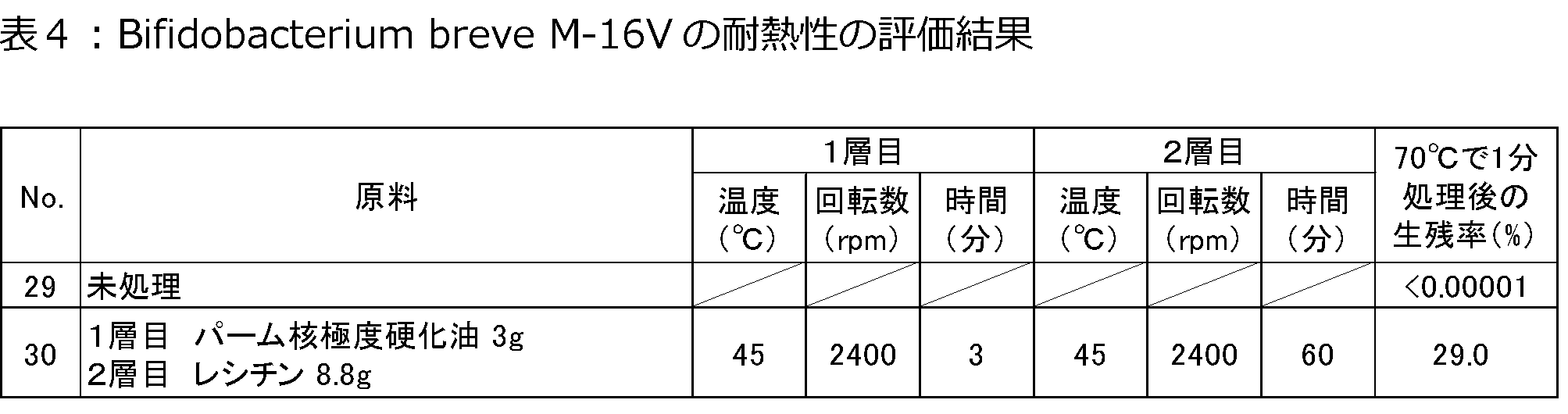
- Bifidobacterium breve M-16V NITE BP-02622; hereinafter, also referred to as “M-16V” was used.
- M-16V was cultured and the cells were freeze-dried to obtain dried cells. Using 50 g of dried bacterial cells of M-16V, stirring was carried out under the raw materials and stirring conditions shown in Table 4, and the heat resistance of the bacteria was evaluated.
- the heat resistance of bacteria can be improved.
Landscapes
- Life Sciences & Earth Sciences (AREA)
- Chemical & Material Sciences (AREA)
- Health & Medical Sciences (AREA)
- Engineering & Computer Science (AREA)
- Food Science & Technology (AREA)
- Polymers & Plastics (AREA)
- Nutrition Science (AREA)
- Mycology (AREA)
- Organic Chemistry (AREA)
- Biotechnology (AREA)
- Bioinformatics & Cheminformatics (AREA)
- Genetics & Genomics (AREA)
- Wood Science & Technology (AREA)
- Zoology (AREA)
- Virology (AREA)
- Medicinal Chemistry (AREA)
- General Health & Medical Sciences (AREA)
- Biochemistry (AREA)
- General Engineering & Computer Science (AREA)
- Microbiology (AREA)
- Biomedical Technology (AREA)
- Tropical Medicine & Parasitology (AREA)
- Pediatric Medicine (AREA)
- Oil, Petroleum & Natural Gas (AREA)
- Coloring Foods And Improving Nutritive Qualities (AREA)
- Micro-Organisms Or Cultivation Processes Thereof (AREA)
- Medicines Containing Material From Animals Or Micro-Organisms (AREA)
- General Preparation And Processing Of Foods (AREA)
Abstract
Description
本発明の一態様は、細菌を含有する組成物の製造方法であって、
下記工程AおよびB:
(A)細菌を油脂と混合する工程;
(B)細菌を乳化剤と混合する工程
を含み、
前記工程Aが、前記油脂の融点以上の温度で実施される、方法である。
前記方法は、前記工程Aが、前記工程Bの開始前または開始後に開始されることを好ましい態様としている。
前記方法は、前記工程AおよびBが、同時に開始されることを好ましい態様としている。
前記方法は、前記油脂が、融点が50℃以下の油脂であることを好ましい態様としている。
前記方法は、前記油脂が、融点が35℃以上の油脂であることを好ましい態様としている。
前記方法は、前記油脂が、パーム核極度硬化油であることを好ましい態様としている。
前記方法は、前記工程Aが、50℃以下の温度で実施されることを好ましい態様としている。
前記方法は、前記工程Aが、40℃以上の温度で実施されることを好ましい態様としている。
前記方法は、前記乳化剤が、レシチンまたはポリグリセリン脂肪酸エステルであることを好ましい態様としている。
前記方法は、前記工程Bが、50℃以下の温度で実施されることを好ましい態様としている。
前記方法は、前記工程Bが、40℃以上の温度で実施されることを好ましい態様としている。
前記方法は、前記油脂の混合量が、前記細菌の乾燥菌体重量50g当たり、1.5~4.5gであることを好ましい態様としている。
前記方法は、前記乳化剤が、ポリグリセリン脂肪酸エステルであり、前記乳化剤の混合量が、前記細菌の乾燥菌体重量50g当たり、8~17gであることを好ましい態様としている。
前記方法は、前記乳化剤が、レシチンであり、前記乳化剤の混合量が、前記細菌の乾燥菌体重量50g当たり、1~20gであることを好ましい態様としている。
前記方法は、前記細菌が、ビフィドバクテリウム属細菌であることを好ましい態様としている。
前記方法は、前記細菌が、ビフィドバクテリウム・ロンガム(Bifidobacterium longum)またはビフィドバクテリウム・ブレーベ(Bifidobacterium breve)であることを好ましい態様としている。
前記方法は、前記細菌が、ビフィドバクテリウム・ロンガムBB536(NITE BP-02621)またはビフィドバクテリウム・ブレーベM-16V(NITE BP-02622)であることを好ましい態様としている。
本発明の一態様は、細菌の耐熱性を向上させる方法であって、
下記工程AおよびB:
(A)細菌を油脂と混合する工程;
(B)細菌を乳化剤と混合する工程
を含み、
前記工程Aが、前記油脂の融点以上の温度で実施される、方法である。
本発明の一態様は、細菌、油脂、および乳化剤を含有する、組成物である。
前記組成物は、前記細菌が、前記油脂および前記乳化剤でコーティングされていることを好ましい態様としている。
本発明の一態様は、前記方法で製造された組成物または前記組成物を含有する粉乳である。
前記粉乳は、育児用調製粉乳であることを好ましい態様としている。
本発明の方法は、下記工程AおよびBを含む方法である:
(A)細菌を油脂と混合する工程;
(B)細菌を乳化剤と混合する工程。
細菌は特に制限されない。細菌としては、1種の細菌を用いてもよく、2種またはそれ以上の細菌を組み合わせて用いてもよい。細菌としては、プロバイオティクスとして用いられ得る細菌が挙げられる。細菌として、具体的には、乳酸菌が挙げられる。乳酸菌としては、ビフィドバクテリウム(Bifidobacterium)属細菌、ラクトバチルス(Lactobacillus)属細菌、ラクトコッカス(Lactococcus)属細菌、ストレプトコッカス(Streptococcus)属細菌が挙げられる。
油脂は、乳化剤との併用により耐熱性向上効果が得られるものであれば、特に制限されない。油脂としては、1種の油脂を用いてもよく、2種またはそれ以上の油脂を組み合わせて用いてもよい。油脂としては、市販品を用いてもよく、適宜製造して取得したものを用いてもよい。
乳化剤は、油脂との併用により耐熱性向上効果が得られるものであれば、特に制限されない。乳化剤としては、1種の乳化剤を用いてもよく、2種またはそれ以上の乳化剤を組み合わせて用いてもよい。乳化剤としては、市販品を用いてもよく、適宜製造して取得したものを用いてもよい。
他の成分は、耐熱性向上効果を損なわない限り、特に制限されない。他の成分としては、1種の成分を用いてもよく、2種またはそれ以上の成分を組み合わせて用いてもよい。
工程Aは、細菌を油脂と混合する工程である。工程Bは、細菌を乳化剤と混合する工程である。細菌は、工程AおよびBの両方(すなわち、油脂との混合と乳化剤との混合の両方)に供される。
本発明の組成物は、細菌、油脂、および乳化剤を含有する組成物である。細菌、油脂、および乳化剤を総称して「有効成分」ともいう。
本実施例では、油脂および乳化剤の併用による細菌の耐熱性向上効果を評価した。細菌としては、Bifidobacterium longum BB536(NITE BP-02621;以下、「BB536」ともいう)を用いた。油脂としては、パーム核極度硬化油(K-40;太陽油脂社製)を用いた。乳化剤としては、ポリグリセリン脂肪酸エステル(ポエムRJ-38;理研ビタミン社製)を用いた。ポエムRJ-38は、C18(65%)およびC16(34%)の構成脂肪酸を有するポリグリセリン脂肪酸エステルである。

本実施例では、乳化剤を種々の添加量で用いた際の、油脂および乳化剤の併用による細菌の耐熱性向上効果を評価した。用いた細菌、油脂、および乳化剤は実施例1と同一である。

本実施例では、他の乳化剤を用いた際の、油脂および乳化剤の併用による細菌の耐熱性向上効果を評価した。用いた細菌および油脂は実施例1と同一である。乳化剤としては、レシチン(Yelkin TS;エー・ディー・エム・ジャパン社製)を用いた。Yelkin TSは、液体状の大豆レシチンである。
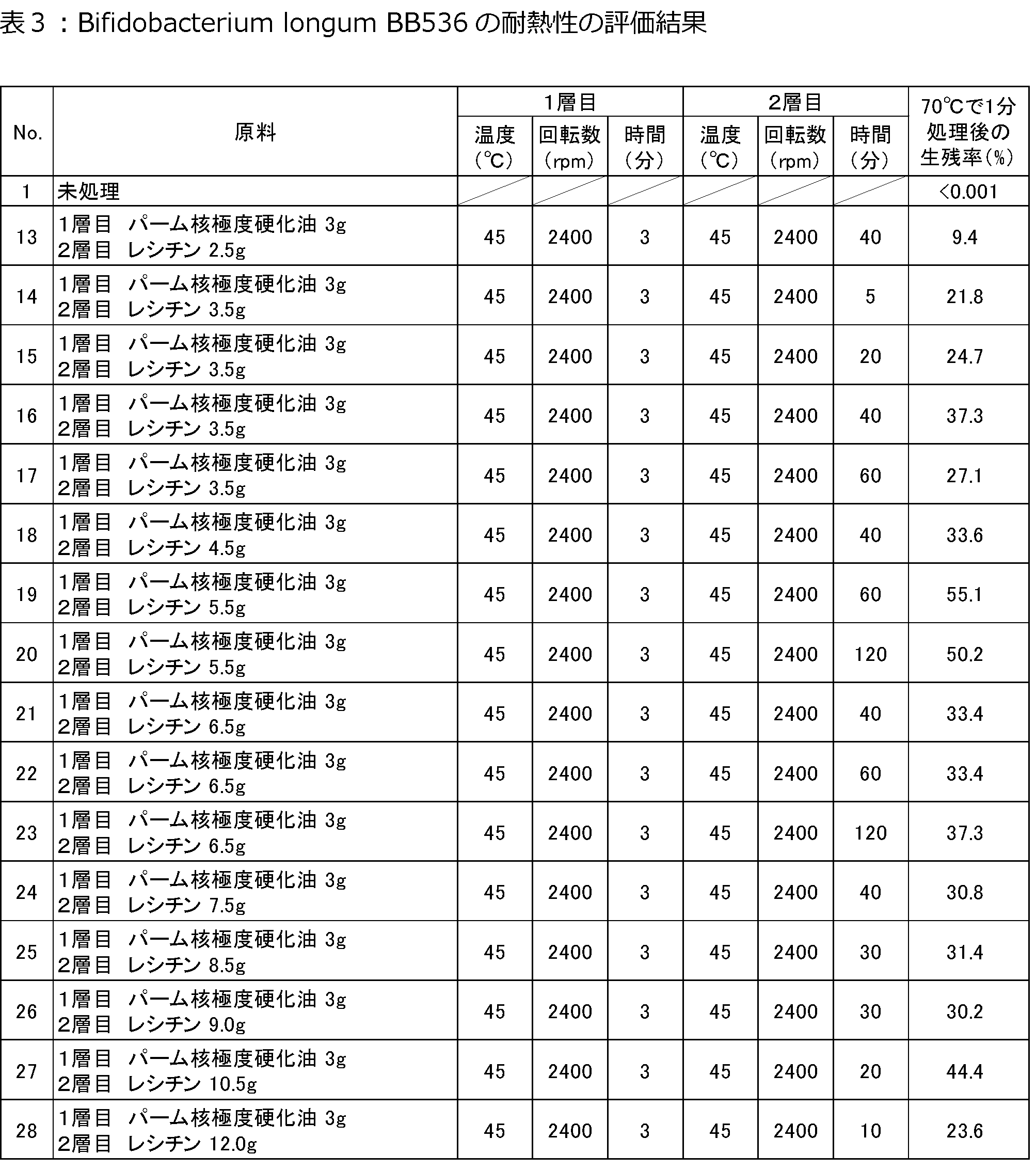
本実施例では、他の細菌を用いた際の、油脂および乳化剤の併用による細菌の耐熱性向上効果を評価した。用いた油脂および乳化剤は実施例3と同一である。細菌としては、Bifidobacterium breve M-16V(NITE BP-02622;以下、「M-16V」ともいう)を用いた。
BB536の培養物を凍結乾燥して得た菌末50 gをバランスグランLBG-1L(撹拌羽根の回転直径=0.136 m;フロイント・ターボ社製)に入れ、2400 rpmで撹拌しながら、あらかじめ加熱溶解しておいた液体状のナタネ極度硬化油脂3gを添加し、45℃、回転数2400rpmの条件で3分間撹拌する。次いで、液体状のレシチン5gを添加した後、45℃、回転数2400rpmの条件でさらに3分間撹拌して、耐熱性の高い細菌を含有する組成物を得る。
BB536の培養物を凍結乾燥して得た菌末50 gをバランスグランLBG-1L(撹拌羽根の回転直径=0.136 m;フロイント・ターボ社製)に入れ、2400 rpmで撹拌しながら、あらかじめ加熱溶解しておいた液体状のパーム極度硬化油脂3gを添加し、45℃、回転数2400rpmの条件で3分間撹拌する。次いで、モノグリセリン脂肪酸エステル10gを添加した後、45℃、回転数2400rpmの条件でさらに5分間撹拌して、耐熱性の高い細菌を含有する組成物を得る。
M-16Vの培養物を凍結乾燥して得た菌末50 gをバランスグランLBG-1L(撹拌羽根の回転直径=0.136 m;フロイント・ターボ社製)に入れ、2400 rpmで撹拌しながら、あらかじめ加熱溶解しておいた液体状のパーム核極度硬化油脂3gを添加し、45℃、回転数2400rpmの条件で3分間撹拌する。次いで、ショ糖脂肪酸エステル10gを添加した後、45℃、回転数2400rpmの条件でさらに5分間撹拌して、耐熱性の高い細菌を含有する組成物を得る。
Claims (22)
- 細菌を含有する組成物の製造方法であって、
下記工程AおよびB:
(A)細菌を油脂と混合する工程;
(B)細菌を乳化剤と混合する工程
を含み、
前記工程Aが、前記油脂の融点以上の温度で実施される、方法。 - 前記工程Aが、前記工程Bの開始前または開始後に開始される、請求項1に記載の方法。
- 前記工程AおよびBが、同時に開始される、請求項1に記載の方法。
- 前記油脂が、融点が50℃以下の油脂である、請求項1~3のいずれか1項に記載の方法。
- 前記油脂が、融点が35℃以上の油脂である、請求項1~4のいずれか1項に記載の方法。
- 前記油脂が、パーム核極度硬化油である、請求項1~5のいずれか1項に記載の方法。
- 前記工程Aが、50℃以下の温度で実施される、請求項1~6のいずれか1項に記載の方法。
- 前記工程Aが、40℃以上の温度で実施される、請求項1~7のいずれか1項に記載の方法。
- 前記乳化剤が、レシチンまたはポリグリセリン脂肪酸エステルである、請求項1~8のいずれか1項に記載の方法。
- 前記工程Bが、50℃以下の温度で実施される、請求項1~9のいずれか1項に記載の方法。
- 前記工程Bが、40℃以上の温度で実施される、請求項1~10のいずれか1項に記載の方法。
- 前記油脂の混合量が、前記細菌の乾燥菌体重量50g当たり、1.5~4.5gである、請求項1~11のいずれか1項に記載の方法。
- 前記乳化剤が、ポリグリセリン脂肪酸エステルであり、
前記乳化剤の混合量が、前記細菌の乾燥菌体重量50g当たり、8~17gである、請求項1~12のいずれか1項に記載の方法。 - 前記乳化剤が、レシチンであり、
前記乳化剤の混合量が、前記細菌の乾燥菌体重量50g当たり、1~20gである、請求項1~12のいずれか1項に記載の方法。 - 前記細菌が、ビフィドバクテリウム属細菌である、請求項1~14のいずれか1項に記載の方法。
- 前記細菌が、ビフィドバクテリウム・ロンガム(Bifidobacterium longum)またはビフィドバクテリウム・ブレーベ(Bifidobacterium breve)である、請求項1~15のいずれか1項に記載の方法。
- 前記細菌が、ビフィドバクテリウム・ロンガムBB536(NITE BP-02621)またはビフィドバクテリウム・ブレーベM-16V(NITE BP-02622)である、請求項1~16のいずれか1項に記載の方法。
- 細菌の耐熱性を向上させる方法であって、
下記工程AおよびB:
(A)細菌を油脂と混合する工程;
(B)細菌を乳化剤と混合する工程
を含み、
前記工程Aが、前記油脂の融点以上の温度で実施される、方法。 - 細菌、油脂、および乳化剤を含有する、組成物。
- 前記細菌が、前記油脂および前記乳化剤でコーティングされている、請求項19に記載の組成物。
- 請求項1~17のいずれか1項に記載の方法で製造された組成物または請求項19もしくは20に記載の組成物を含有する粉乳。
- 育児用調製粉乳である、請求項21に記載の粉乳。
Priority Applications (5)
| Application Number | Priority Date | Filing Date | Title |
|---|---|---|---|
| EP20778830.8A EP3949742A4 (en) | 2019-03-28 | 2020-03-27 | HEAT-RESISTANT BACTERIAL COMPOSITION |
| JP2021509644A JPWO2020196844A1 (ja) | 2019-03-28 | 2020-03-27 | |
| US17/441,813 US20220195376A1 (en) | 2019-03-28 | 2020-03-27 | Heat-Resistant Bacterium Composition |
| CN202080023510.4A CN113677212A (zh) | 2019-03-28 | 2020-03-27 | 耐热性细菌组合物 |
| AU2020246725A AU2020246725A1 (en) | 2019-03-28 | 2020-03-27 | Heat-resistant bacterium composition |
Applications Claiming Priority (2)
| Application Number | Priority Date | Filing Date | Title |
|---|---|---|---|
| JP2019-063902 | 2019-03-28 | ||
| JP2019063902 | 2019-03-28 |
Publications (1)
| Publication Number | Publication Date |
|---|---|
| WO2020196844A1 true WO2020196844A1 (ja) | 2020-10-01 |
Family
ID=72611644
Family Applications (1)
| Application Number | Title | Priority Date | Filing Date |
|---|---|---|---|
| PCT/JP2020/014078 Ceased WO2020196844A1 (ja) | 2019-03-28 | 2020-03-27 | 耐熱性細菌組成物 |
Country Status (6)
| Country | Link |
|---|---|
| US (1) | US20220195376A1 (ja) |
| EP (1) | EP3949742A4 (ja) |
| JP (1) | JPWO2020196844A1 (ja) |
| CN (1) | CN113677212A (ja) |
| AU (1) | AU2020246725A1 (ja) |
| WO (1) | WO2020196844A1 (ja) |
Citations (17)
| Publication number | Priority date | Publication date | Assignee | Title |
|---|---|---|---|---|
| JPS5841527B2 (ja) | 1977-10-28 | 1983-09-13 | 富士通株式会社 | デ−タ・バッフア領域管理処理方式 |
| JPS60221078A (ja) * | 1984-04-18 | 1985-11-05 | Morinaga Milk Ind Co Ltd | 有用微生物粉末の粒状製品およびその製造法 |
| JPH02200639A (ja) | 1989-01-31 | 1990-08-08 | Shinfusou Seiyaku Kk | 脂質被覆細菌製剤 |
| JPH0739351A (ja) * | 1993-07-29 | 1995-02-10 | Riken Vitamin Co Ltd | 固形油脂食品 |
| JPH08214875A (ja) * | 1995-02-13 | 1996-08-27 | Mizusawa Ind Chem Ltd | 有用菌の培養方法 |
| JP2596418B2 (ja) | 1986-09-01 | 1997-04-02 | 昭和電工株式会社 | 有用微生物含有粒剤およびその製造方法 |
| JPH10191950A (ja) | 1997-01-13 | 1998-07-28 | Riken Vitamin Co Ltd | 耐熱性マイクロカプセルの製造法 |
| JP3102990B2 (ja) | 1993-07-08 | 2000-10-23 | 森下仁丹株式会社 | カプセルの製造方法およびそれから得られたカプセル |
| JP2004344146A (ja) | 2003-05-20 | 2004-12-09 | Takayuki Hirano | 耐熱性を有する微生物封入物および製造方法 |
| JP3698455B2 (ja) | 1995-04-12 | 2005-09-21 | 株式会社キティー | 物質の被覆方法及び被覆材 |
| US20100055083A1 (en) * | 2006-10-18 | 2010-03-04 | Ray Edward Kowalski | Encapsulation of heat and moisture sensitive substances |
| JP2011103823A (ja) * | 2009-11-18 | 2011-06-02 | Suntory Holdings Ltd | 乳酸菌包含マイクロカプセルの製造方法 |
| US20120282104A1 (en) * | 2011-05-06 | 2012-11-08 | Snecma | Turbine engine fan disk |
| JP2013510560A (ja) * | 2009-11-13 | 2013-03-28 | ユニストロー パテント ホールディングス リミテッド | プロバイオティック組成物、並びにプロバイオティック組成物を投与する方法及び器具 |
| JP2014065669A (ja) * | 2012-09-25 | 2014-04-17 | Nihon Kenko Zoshin Shien Kiko | 乳幼児用アレルギー疾患予防剤 |
| JP2017102182A (ja) * | 2015-11-30 | 2017-06-08 | 富士フイルム株式会社 | 撮像レンズおよび撮像装置 |
| JP2018019628A (ja) * | 2016-08-02 | 2018-02-08 | ミヨシ油脂株式会社 | 加熱殺菌飲料用粉末油脂とそれを用いた加熱殺菌飲料 |
Family Cites Families (8)
| Publication number | Priority date | Publication date | Assignee | Title |
|---|---|---|---|---|
| JPH06133735A (ja) * | 1992-10-23 | 1994-05-17 | Kanebo Ltd | 腸溶性乳酸菌造粒物 |
| JP4121306B2 (ja) * | 2002-05-17 | 2008-07-23 | 太陽化学株式会社 | 生菌剤 |
| JP2005185181A (ja) * | 2003-12-25 | 2005-07-14 | Taiyo Kagaku Co Ltd | 生菌剤 |
| JP4751143B2 (ja) * | 2005-08-29 | 2011-08-17 | 太陽化学株式会社 | 生菌剤 |
| KR101355003B1 (ko) * | 2010-11-02 | 2014-01-24 | 정명준 | 다중 코팅층을 갖는 유산균 및 이의 제조방법 |
| MX2016007006A (es) * | 2013-12-06 | 2016-09-07 | Mjn Us Holdings Llc | Estabilizacion probiotica. |
| JP2015172040A (ja) * | 2014-02-19 | 2015-10-01 | 森下仁丹株式会社 | 放射性物質回収剤 |
| WO2017095968A1 (en) * | 2015-11-30 | 2017-06-08 | Imagilin Technology Llc | Compositions comprising probiotics and methods of use thereof |
-
2020
- 2020-03-27 JP JP2021509644A patent/JPWO2020196844A1/ja not_active Withdrawn
- 2020-03-27 WO PCT/JP2020/014078 patent/WO2020196844A1/ja not_active Ceased
- 2020-03-27 US US17/441,813 patent/US20220195376A1/en not_active Abandoned
- 2020-03-27 CN CN202080023510.4A patent/CN113677212A/zh active Pending
- 2020-03-27 AU AU2020246725A patent/AU2020246725A1/en not_active Abandoned
- 2020-03-27 EP EP20778830.8A patent/EP3949742A4/en not_active Withdrawn
Patent Citations (17)
| Publication number | Priority date | Publication date | Assignee | Title |
|---|---|---|---|---|
| JPS5841527B2 (ja) | 1977-10-28 | 1983-09-13 | 富士通株式会社 | デ−タ・バッフア領域管理処理方式 |
| JPS60221078A (ja) * | 1984-04-18 | 1985-11-05 | Morinaga Milk Ind Co Ltd | 有用微生物粉末の粒状製品およびその製造法 |
| JP2596418B2 (ja) | 1986-09-01 | 1997-04-02 | 昭和電工株式会社 | 有用微生物含有粒剤およびその製造方法 |
| JPH02200639A (ja) | 1989-01-31 | 1990-08-08 | Shinfusou Seiyaku Kk | 脂質被覆細菌製剤 |
| JP3102990B2 (ja) | 1993-07-08 | 2000-10-23 | 森下仁丹株式会社 | カプセルの製造方法およびそれから得られたカプセル |
| JPH0739351A (ja) * | 1993-07-29 | 1995-02-10 | Riken Vitamin Co Ltd | 固形油脂食品 |
| JPH08214875A (ja) * | 1995-02-13 | 1996-08-27 | Mizusawa Ind Chem Ltd | 有用菌の培養方法 |
| JP3698455B2 (ja) | 1995-04-12 | 2005-09-21 | 株式会社キティー | 物質の被覆方法及び被覆材 |
| JPH10191950A (ja) | 1997-01-13 | 1998-07-28 | Riken Vitamin Co Ltd | 耐熱性マイクロカプセルの製造法 |
| JP2004344146A (ja) | 2003-05-20 | 2004-12-09 | Takayuki Hirano | 耐熱性を有する微生物封入物および製造方法 |
| US20100055083A1 (en) * | 2006-10-18 | 2010-03-04 | Ray Edward Kowalski | Encapsulation of heat and moisture sensitive substances |
| JP2013510560A (ja) * | 2009-11-13 | 2013-03-28 | ユニストロー パテント ホールディングス リミテッド | プロバイオティック組成物、並びにプロバイオティック組成物を投与する方法及び器具 |
| JP2011103823A (ja) * | 2009-11-18 | 2011-06-02 | Suntory Holdings Ltd | 乳酸菌包含マイクロカプセルの製造方法 |
| US20120282104A1 (en) * | 2011-05-06 | 2012-11-08 | Snecma | Turbine engine fan disk |
| JP2014065669A (ja) * | 2012-09-25 | 2014-04-17 | Nihon Kenko Zoshin Shien Kiko | 乳幼児用アレルギー疾患予防剤 |
| JP2017102182A (ja) * | 2015-11-30 | 2017-06-08 | 富士フイルム株式会社 | 撮像レンズおよび撮像装置 |
| JP2018019628A (ja) * | 2016-08-02 | 2018-02-08 | ミヨシ油脂株式会社 | 加熱殺菌飲料用粉末油脂とそれを用いた加熱殺菌飲料 |
Non-Patent Citations (4)
| Title |
|---|
| ABE, FUMIAKI ET AL.: "Stability of bifidobacteria in powdered formula", INTERNATIONAL JOURNAL OF FOOD SCIENCE AND TECHNOLOGY, vol. 44, 2009, pages 718 - 724, XP055535855, DOI: 10.1111/j.1365-2621.2008.01881.x * |
| FOOD HYDROCOLLOIDS, vol. 51, 2015, pages 459 - 467 |
| JOURNAL OF FOOD SCIENCE, vol. 9, 2017, pages 2134 - 2141 |
| See also references of EP3949742A4 |
Also Published As
| Publication number | Publication date |
|---|---|
| EP3949742A1 (en) | 2022-02-09 |
| JPWO2020196844A1 (ja) | 2020-10-01 |
| EP3949742A4 (en) | 2022-12-07 |
| US20220195376A1 (en) | 2022-06-23 |
| AU2020246725A1 (en) | 2021-11-11 |
| CN113677212A (zh) | 2021-11-19 |
Similar Documents
| Publication | Publication Date | Title |
|---|---|---|
| AU2024266804B2 (en) | Composition suitable for protecting microorganisms | |
| Elsanhoty et al. | Detoxification of aflatoxin M1 in yoghurt using probiotics and lactic acid bacteria | |
| Teijeiro et al. | Suitability of kefir powder production using spray drying | |
| JP5314421B2 (ja) | 免疫調節活性の高い乳酸菌の培養法 | |
| JP5583114B2 (ja) | 凍結乾燥粉末状菌体及びその製造方法 | |
| MX2012009799A (es) | Metodo para construir una nueva bacteria perteneciente al genero bifidobacterium. | |
| JPWO2008099544A1 (ja) | 新規乳酸菌 | |
| WO2009072867A1 (en) | Improved storage stability of micro-organisms | |
| WO2018038004A1 (ja) | ラクトバチルス・プランタラムの培養物の製造方法 | |
| Teanpaisan et al. | Survival rates of human-derived probiotic Lactobacillus paracasei SD1 in milk powder using spray drying | |
| CN119110844A (zh) | 高储存稳定性的微囊化微生物培养物制剂 | |
| EP3949742A1 (en) | Heat-resistant bacterium composition | |
| Hwang et al. | Biomass production of Lactobacillus plantarum LP02 isolated from infant feces with potential cholesterollowering ability | |
| JP6330237B2 (ja) | ラクトバチルス属乳酸菌培養用食品グレード培地、ラクトバチルス属乳酸菌の培養方法及びラクトバチルス属乳酸菌培養物の製造方法 | |
| TWI662902B (zh) | 使用包含有三株乳酸菌菌株的混合物來改善水產養殖池的溶氧量 | |
| JP7468788B2 (ja) | シェワネラ属細菌、及びその使用 | |
| Amiri et al. | Production of bacteriocin in batch fermentation of dairy effluents by Lactobacillus acidophilus LA5 and Bifidobacterium animalis subsp. lactis BB12 | |
| Samuel et al. | Isolation and identification of antagonistic Lactobacillus spp. isolated from dairy products against selected pathogens | |
| JP7575424B2 (ja) | 組成物及び製造方法 | |
| JP2021164435A (ja) | ビフィズス菌増殖促進剤 | |
| Denkova et al. | Biochemical and technological properties of Lactobacillus plantarum X2 from naturally fermented sourdough | |
| Zheng et al. | The effect of eight thermal protectants on the survival rate and the viable counts of Lactobacillus casei after heat treatment in fermented goat milk. | |
| JPWO2019193841A1 (ja) | 高生残性微生物乾燥菌体の製造方法 | |
| RU2795965C1 (ru) | Способ производства капсулированной формы пробиотической пищевой добавки | |
| Jawan et al. | Influence of media composition and prebiotic-based protectants on the growth and storage stability of probiotic Lactobacillus pentosus A6 |
Legal Events
| Date | Code | Title | Description |
|---|---|---|---|
| 121 | Ep: the epo has been informed by wipo that ep was designated in this application |
Ref document number: 20778830 Country of ref document: EP Kind code of ref document: A1 |
|
| ENP | Entry into the national phase |
Ref document number: 2021509644 Country of ref document: JP Kind code of ref document: A |
|
| NENP | Non-entry into the national phase |
Ref country code: DE |
|
| ENP | Entry into the national phase |
Ref document number: 2020778830 Country of ref document: EP Effective date: 20211028 |
|
| ENP | Entry into the national phase |
Ref document number: 2020246725 Country of ref document: AU Date of ref document: 20200327 Kind code of ref document: A |