WO2020217813A1 - ウレタン樹脂組成物、発泡ウレタンシート、及び、合成皮革 - Google Patents
ウレタン樹脂組成物、発泡ウレタンシート、及び、合成皮革 Download PDFInfo
- Publication number
- WO2020217813A1 WO2020217813A1 PCT/JP2020/012895 JP2020012895W WO2020217813A1 WO 2020217813 A1 WO2020217813 A1 WO 2020217813A1 JP 2020012895 W JP2020012895 W JP 2020012895W WO 2020217813 A1 WO2020217813 A1 WO 2020217813A1
- Authority
- WO
- WIPO (PCT)
- Prior art keywords
- urethane resin
- mass
- parts
- urethane
- resin composition
- Prior art date
- Legal status (The legal status is an assumption and is not a legal conclusion. Google has not performed a legal analysis and makes no representation as to the accuracy of the status listed.)
- Ceased
Links
Classifications
-
- C—CHEMISTRY; METALLURGY
- C08—ORGANIC MACROMOLECULAR COMPOUNDS; THEIR PREPARATION OR CHEMICAL WORKING-UP; COMPOSITIONS BASED THEREON
- C08G—MACROMOLECULAR COMPOUNDS OBTAINED OTHERWISE THAN BY REACTIONS ONLY INVOLVING UNSATURATED CARBON-TO-CARBON BONDS
- C08G18/00—Polymeric products of isocyanates or isothiocyanates
- C08G18/06—Polymeric products of isocyanates or isothiocyanates with compounds having active hydrogen
- C08G18/08—Processes
- C08G18/0804—Manufacture of polymers containing ionic or ionogenic groups
- C08G18/0819—Manufacture of polymers containing ionic or ionogenic groups containing anionic or anionogenic groups
- C08G18/0823—Manufacture of polymers containing ionic or ionogenic groups containing anionic or anionogenic groups containing carboxylate salt groups or groups forming them
-
- D—TEXTILES; PAPER
- D06—TREATMENT OF TEXTILES OR THE LIKE; LAUNDERING; FLEXIBLE MATERIALS NOT OTHERWISE PROVIDED FOR
- D06N—WALL, FLOOR, OR LIKE COVERING MATERIALS, e.g. LINOLEUM, OILCLOTH, ARTIFICIAL LEATHER, ROOFING FELT, CONSISTING OF A FIBROUS WEB COATED WITH A LAYER OF MACROMOLECULAR MATERIAL; FLEXIBLE SHEET MATERIAL NOT OTHERWISE PROVIDED FOR
- D06N3/00—Artificial leather, oilcloth or other material obtained by covering fibrous webs with macromolecular material, e.g. resins, rubber or derivatives thereof
- D06N3/12—Artificial leather, oilcloth or other material obtained by covering fibrous webs with macromolecular material, e.g. resins, rubber or derivatives thereof with macromolecular compounds obtained otherwise than by reactions only involving carbon-to-carbon unsaturated bonds, e.g. gelatine proteins
- D06N3/14—Artificial leather, oilcloth or other material obtained by covering fibrous webs with macromolecular material, e.g. resins, rubber or derivatives thereof with macromolecular compounds obtained otherwise than by reactions only involving carbon-to-carbon unsaturated bonds, e.g. gelatine proteins with polyurethanes
-
- C—CHEMISTRY; METALLURGY
- C08—ORGANIC MACROMOLECULAR COMPOUNDS; THEIR PREPARATION OR CHEMICAL WORKING-UP; COMPOSITIONS BASED THEREON
- C08G—MACROMOLECULAR COMPOUNDS OBTAINED OTHERWISE THAN BY REACTIONS ONLY INVOLVING UNSATURATED CARBON-TO-CARBON BONDS
- C08G18/00—Polymeric products of isocyanates or isothiocyanates
- C08G18/06—Polymeric products of isocyanates or isothiocyanates with compounds having active hydrogen
- C08G18/70—Polymeric products of isocyanates or isothiocyanates with compounds having active hydrogen characterised by the isocyanates or isothiocyanates used
- C08G18/72—Polyisocyanates or polyisothiocyanates
- C08G18/74—Polyisocyanates or polyisothiocyanates cyclic
- C08G18/76—Polyisocyanates or polyisothiocyanates cyclic aromatic
- C08G18/7657—Polyisocyanates or polyisothiocyanates cyclic aromatic containing two or more aromatic rings
- C08G18/7692—Polyisocyanates or polyisothiocyanates cyclic aromatic containing two or more aromatic rings containing at least one isocyanate or isothiocyanate group linked to an aromatic ring by means of an aliphatic group
-
- C—CHEMISTRY; METALLURGY
- C08—ORGANIC MACROMOLECULAR COMPOUNDS; THEIR PREPARATION OR CHEMICAL WORKING-UP; COMPOSITIONS BASED THEREON
- C08G—MACROMOLECULAR COMPOUNDS OBTAINED OTHERWISE THAN BY REACTIONS ONLY INVOLVING UNSATURATED CARBON-TO-CARBON BONDS
- C08G18/00—Polymeric products of isocyanates or isothiocyanates
- C08G18/06—Polymeric products of isocyanates or isothiocyanates with compounds having active hydrogen
- C08G18/08—Processes
-
- C—CHEMISTRY; METALLURGY
- C08—ORGANIC MACROMOLECULAR COMPOUNDS; THEIR PREPARATION OR CHEMICAL WORKING-UP; COMPOSITIONS BASED THEREON
- C08G—MACROMOLECULAR COMPOUNDS OBTAINED OTHERWISE THAN BY REACTIONS ONLY INVOLVING UNSATURATED CARBON-TO-CARBON BONDS
- C08G18/00—Polymeric products of isocyanates or isothiocyanates
- C08G18/06—Polymeric products of isocyanates or isothiocyanates with compounds having active hydrogen
- C08G18/08—Processes
- C08G18/0838—Manufacture of polymers in the presence of non-reactive compounds
- C08G18/0842—Manufacture of polymers in the presence of non-reactive compounds in the presence of liquid diluents
- C08G18/0861—Manufacture of polymers in the presence of non-reactive compounds in the presence of liquid diluents in the presence of a dispersing phase for the polymers or a phase dispersed in the polymers
- C08G18/0866—Manufacture of polymers in the presence of non-reactive compounds in the presence of liquid diluents in the presence of a dispersing phase for the polymers or a phase dispersed in the polymers the dispersing or dispersed phase being an aqueous medium
-
- C—CHEMISTRY; METALLURGY
- C08—ORGANIC MACROMOLECULAR COMPOUNDS; THEIR PREPARATION OR CHEMICAL WORKING-UP; COMPOSITIONS BASED THEREON
- C08G—MACROMOLECULAR COMPOUNDS OBTAINED OTHERWISE THAN BY REACTIONS ONLY INVOLVING UNSATURATED CARBON-TO-CARBON BONDS
- C08G18/00—Polymeric products of isocyanates or isothiocyanates
- C08G18/06—Polymeric products of isocyanates or isothiocyanates with compounds having active hydrogen
- C08G18/08—Processes
- C08G18/16—Catalysts
- C08G18/22—Catalysts containing metal compounds
- C08G18/24—Catalysts containing metal compounds of tin
- C08G18/244—Catalysts containing metal compounds of tin tin salts of carboxylic acids
-
- C—CHEMISTRY; METALLURGY
- C08—ORGANIC MACROMOLECULAR COMPOUNDS; THEIR PREPARATION OR CHEMICAL WORKING-UP; COMPOSITIONS BASED THEREON
- C08G—MACROMOLECULAR COMPOUNDS OBTAINED OTHERWISE THAN BY REACTIONS ONLY INVOLVING UNSATURATED CARBON-TO-CARBON BONDS
- C08G18/00—Polymeric products of isocyanates or isothiocyanates
- C08G18/06—Polymeric products of isocyanates or isothiocyanates with compounds having active hydrogen
- C08G18/28—Polymeric products of isocyanates or isothiocyanates with compounds having active hydrogen characterised by the compounds used containing active hydrogen
- C08G18/30—Low-molecular-weight compounds
- C08G18/32—Polyhydroxy compounds; Polyamines; Hydroxyamines
- C08G18/3203—Polyhydroxy compounds
- C08G18/3206—Polyhydroxy compounds aliphatic
-
- C—CHEMISTRY; METALLURGY
- C08—ORGANIC MACROMOLECULAR COMPOUNDS; THEIR PREPARATION OR CHEMICAL WORKING-UP; COMPOSITIONS BASED THEREON
- C08G—MACROMOLECULAR COMPOUNDS OBTAINED OTHERWISE THAN BY REACTIONS ONLY INVOLVING UNSATURATED CARBON-TO-CARBON BONDS
- C08G18/00—Polymeric products of isocyanates or isothiocyanates
- C08G18/06—Polymeric products of isocyanates or isothiocyanates with compounds having active hydrogen
- C08G18/28—Polymeric products of isocyanates or isothiocyanates with compounds having active hydrogen characterised by the compounds used containing active hydrogen
- C08G18/30—Low-molecular-weight compounds
- C08G18/34—Carboxylic acids; Esters thereof with monohydroxyl compounds
- C08G18/348—Hydroxycarboxylic acids
-
- C—CHEMISTRY; METALLURGY
- C08—ORGANIC MACROMOLECULAR COMPOUNDS; THEIR PREPARATION OR CHEMICAL WORKING-UP; COMPOSITIONS BASED THEREON
- C08G—MACROMOLECULAR COMPOUNDS OBTAINED OTHERWISE THAN BY REACTIONS ONLY INVOLVING UNSATURATED CARBON-TO-CARBON BONDS
- C08G18/00—Polymeric products of isocyanates or isothiocyanates
- C08G18/06—Polymeric products of isocyanates or isothiocyanates with compounds having active hydrogen
- C08G18/28—Polymeric products of isocyanates or isothiocyanates with compounds having active hydrogen characterised by the compounds used containing active hydrogen
- C08G18/40—High-molecular-weight compounds
- C08G18/4009—Two or more macromolecular compounds not provided for in one single group of groups C08G18/42 - C08G18/64
- C08G18/4018—Mixtures of compounds of group C08G18/42 with compounds of group C08G18/48
-
- C—CHEMISTRY; METALLURGY
- C08—ORGANIC MACROMOLECULAR COMPOUNDS; THEIR PREPARATION OR CHEMICAL WORKING-UP; COMPOSITIONS BASED THEREON
- C08G—MACROMOLECULAR COMPOUNDS OBTAINED OTHERWISE THAN BY REACTIONS ONLY INVOLVING UNSATURATED CARBON-TO-CARBON BONDS
- C08G18/00—Polymeric products of isocyanates or isothiocyanates
- C08G18/06—Polymeric products of isocyanates or isothiocyanates with compounds having active hydrogen
- C08G18/28—Polymeric products of isocyanates or isothiocyanates with compounds having active hydrogen characterised by the compounds used containing active hydrogen
- C08G18/40—High-molecular-weight compounds
- C08G18/42—Polycondensates having carboxylic or carbonic ester groups in the main chain
- C08G18/44—Polycarbonates
-
- C—CHEMISTRY; METALLURGY
- C08—ORGANIC MACROMOLECULAR COMPOUNDS; THEIR PREPARATION OR CHEMICAL WORKING-UP; COMPOSITIONS BASED THEREON
- C08G—MACROMOLECULAR COMPOUNDS OBTAINED OTHERWISE THAN BY REACTIONS ONLY INVOLVING UNSATURATED CARBON-TO-CARBON BONDS
- C08G18/00—Polymeric products of isocyanates or isothiocyanates
- C08G18/06—Polymeric products of isocyanates or isothiocyanates with compounds having active hydrogen
- C08G18/28—Polymeric products of isocyanates or isothiocyanates with compounds having active hydrogen characterised by the compounds used containing active hydrogen
- C08G18/40—High-molecular-weight compounds
- C08G18/48—Polyethers
-
- C—CHEMISTRY; METALLURGY
- C08—ORGANIC MACROMOLECULAR COMPOUNDS; THEIR PREPARATION OR CHEMICAL WORKING-UP; COMPOSITIONS BASED THEREON
- C08G—MACROMOLECULAR COMPOUNDS OBTAINED OTHERWISE THAN BY REACTIONS ONLY INVOLVING UNSATURATED CARBON-TO-CARBON BONDS
- C08G18/00—Polymeric products of isocyanates or isothiocyanates
- C08G18/06—Polymeric products of isocyanates or isothiocyanates with compounds having active hydrogen
- C08G18/28—Polymeric products of isocyanates or isothiocyanates with compounds having active hydrogen characterised by the compounds used containing active hydrogen
- C08G18/40—High-molecular-weight compounds
- C08G18/48—Polyethers
- C08G18/4854—Polyethers containing oxyalkylene groups having four carbon atoms in the alkylene group
-
- C—CHEMISTRY; METALLURGY
- C08—ORGANIC MACROMOLECULAR COMPOUNDS; THEIR PREPARATION OR CHEMICAL WORKING-UP; COMPOSITIONS BASED THEREON
- C08G—MACROMOLECULAR COMPOUNDS OBTAINED OTHERWISE THAN BY REACTIONS ONLY INVOLVING UNSATURATED CARBON-TO-CARBON BONDS
- C08G18/00—Polymeric products of isocyanates or isothiocyanates
- C08G18/06—Polymeric products of isocyanates or isothiocyanates with compounds having active hydrogen
- C08G18/28—Polymeric products of isocyanates or isothiocyanates with compounds having active hydrogen characterised by the compounds used containing active hydrogen
- C08G18/65—Low-molecular-weight compounds having active hydrogen with high-molecular-weight compounds having active hydrogen
- C08G18/66—Compounds of groups C08G18/42, C08G18/48, or C08G18/52
- C08G18/6633—Compounds of group C08G18/42
- C08G18/6637—Compounds of group C08G18/42 with compounds of group C08G18/32 or polyamines of C08G18/38
- C08G18/664—Compounds of group C08G18/42 with compounds of group C08G18/32 or polyamines of C08G18/38 with compounds of group C08G18/3203
-
- C—CHEMISTRY; METALLURGY
- C08—ORGANIC MACROMOLECULAR COMPOUNDS; THEIR PREPARATION OR CHEMICAL WORKING-UP; COMPOSITIONS BASED THEREON
- C08G—MACROMOLECULAR COMPOUNDS OBTAINED OTHERWISE THAN BY REACTIONS ONLY INVOLVING UNSATURATED CARBON-TO-CARBON BONDS
- C08G18/00—Polymeric products of isocyanates or isothiocyanates
- C08G18/06—Polymeric products of isocyanates or isothiocyanates with compounds having active hydrogen
- C08G18/28—Polymeric products of isocyanates or isothiocyanates with compounds having active hydrogen characterised by the compounds used containing active hydrogen
- C08G18/65—Low-molecular-weight compounds having active hydrogen with high-molecular-weight compounds having active hydrogen
- C08G18/66—Compounds of groups C08G18/42, C08G18/48, or C08G18/52
- C08G18/6633—Compounds of group C08G18/42
- C08G18/6659—Compounds of group C08G18/42 with compounds of group C08G18/34
-
- C—CHEMISTRY; METALLURGY
- C08—ORGANIC MACROMOLECULAR COMPOUNDS; THEIR PREPARATION OR CHEMICAL WORKING-UP; COMPOSITIONS BASED THEREON
- C08G—MACROMOLECULAR COMPOUNDS OBTAINED OTHERWISE THAN BY REACTIONS ONLY INVOLVING UNSATURATED CARBON-TO-CARBON BONDS
- C08G18/00—Polymeric products of isocyanates or isothiocyanates
- C08G18/06—Polymeric products of isocyanates or isothiocyanates with compounds having active hydrogen
- C08G18/28—Polymeric products of isocyanates or isothiocyanates with compounds having active hydrogen characterised by the compounds used containing active hydrogen
- C08G18/65—Low-molecular-weight compounds having active hydrogen with high-molecular-weight compounds having active hydrogen
- C08G18/66—Compounds of groups C08G18/42, C08G18/48, or C08G18/52
- C08G18/6666—Compounds of group C08G18/48 or C08G18/52
- C08G18/667—Compounds of group C08G18/48 or C08G18/52 with compounds of group C08G18/32 or polyamines of C08G18/38
- C08G18/6674—Compounds of group C08G18/48 or C08G18/52 with compounds of group C08G18/32 or polyamines of C08G18/38 with compounds of group C08G18/3203
-
- C—CHEMISTRY; METALLURGY
- C08—ORGANIC MACROMOLECULAR COMPOUNDS; THEIR PREPARATION OR CHEMICAL WORKING-UP; COMPOSITIONS BASED THEREON
- C08G—MACROMOLECULAR COMPOUNDS OBTAINED OTHERWISE THAN BY REACTIONS ONLY INVOLVING UNSATURATED CARBON-TO-CARBON BONDS
- C08G18/00—Polymeric products of isocyanates or isothiocyanates
- C08G18/06—Polymeric products of isocyanates or isothiocyanates with compounds having active hydrogen
- C08G18/28—Polymeric products of isocyanates or isothiocyanates with compounds having active hydrogen characterised by the compounds used containing active hydrogen
- C08G18/65—Low-molecular-weight compounds having active hydrogen with high-molecular-weight compounds having active hydrogen
- C08G18/66—Compounds of groups C08G18/42, C08G18/48, or C08G18/52
- C08G18/6666—Compounds of group C08G18/48 or C08G18/52
- C08G18/6692—Compounds of group C08G18/48 or C08G18/52 with compounds of group C08G18/34
-
- C—CHEMISTRY; METALLURGY
- C08—ORGANIC MACROMOLECULAR COMPOUNDS; THEIR PREPARATION OR CHEMICAL WORKING-UP; COMPOSITIONS BASED THEREON
- C08G—MACROMOLECULAR COMPOUNDS OBTAINED OTHERWISE THAN BY REACTIONS ONLY INVOLVING UNSATURATED CARBON-TO-CARBON BONDS
- C08G18/00—Polymeric products of isocyanates or isothiocyanates
- C08G18/06—Polymeric products of isocyanates or isothiocyanates with compounds having active hydrogen
- C08G18/70—Polymeric products of isocyanates or isothiocyanates with compounds having active hydrogen characterised by the isocyanates or isothiocyanates used
- C08G18/72—Polyisocyanates or polyisothiocyanates
- C08G18/74—Polyisocyanates or polyisothiocyanates cyclic
- C08G18/76—Polyisocyanates or polyisothiocyanates cyclic aromatic
- C08G18/7657—Polyisocyanates or polyisothiocyanates cyclic aromatic containing two or more aromatic rings
- C08G18/7664—Polyisocyanates or polyisothiocyanates cyclic aromatic containing two or more aromatic rings containing alkylene polyphenyl groups
- C08G18/7671—Polyisocyanates or polyisothiocyanates cyclic aromatic containing two or more aromatic rings containing alkylene polyphenyl groups containing only one alkylene bisphenyl group
-
- C—CHEMISTRY; METALLURGY
- C08—ORGANIC MACROMOLECULAR COMPOUNDS; THEIR PREPARATION OR CHEMICAL WORKING-UP; COMPOSITIONS BASED THEREON
- C08J—WORKING-UP; GENERAL PROCESSES OF COMPOUNDING; AFTER-TREATMENT NOT COVERED BY SUBCLASSES C08B, C08C, C08F, C08G or C08H
- C08J9/00—Working-up of macromolecular substances to porous or cellular articles or materials; After-treatment thereof
- C08J9/30—Working-up of macromolecular substances to porous or cellular articles or materials; After-treatment thereof by mixing gases into liquid compositions or plastisols, e.g. frothing with air
-
- C—CHEMISTRY; METALLURGY
- C08—ORGANIC MACROMOLECULAR COMPOUNDS; THEIR PREPARATION OR CHEMICAL WORKING-UP; COMPOSITIONS BASED THEREON
- C08K—Use of inorganic or non-macromolecular organic substances as compounding ingredients
- C08K5/00—Use of organic ingredients
- C08K5/04—Oxygen-containing compounds
- C08K5/09—Carboxylic acids; Metal salts thereof; Anhydrides thereof
-
- C—CHEMISTRY; METALLURGY
- C08—ORGANIC MACROMOLECULAR COMPOUNDS; THEIR PREPARATION OR CHEMICAL WORKING-UP; COMPOSITIONS BASED THEREON
- C08L—COMPOSITIONS OF MACROMOLECULAR COMPOUNDS
- C08L75/00—Compositions of polyureas or polyurethanes; Compositions of derivatives of such polymers
- C08L75/04—Polyurethanes
- C08L75/06—Polyurethanes from polyesters
-
- C—CHEMISTRY; METALLURGY
- C08—ORGANIC MACROMOLECULAR COMPOUNDS; THEIR PREPARATION OR CHEMICAL WORKING-UP; COMPOSITIONS BASED THEREON
- C08L—COMPOSITIONS OF MACROMOLECULAR COMPOUNDS
- C08L75/00—Compositions of polyureas or polyurethanes; Compositions of derivatives of such polymers
- C08L75/04—Polyurethanes
- C08L75/08—Polyurethanes from polyethers
-
- D—TEXTILES; PAPER
- D06—TREATMENT OF TEXTILES OR THE LIKE; LAUNDERING; FLEXIBLE MATERIALS NOT OTHERWISE PROVIDED FOR
- D06N—WALL, FLOOR, OR LIKE COVERING MATERIALS, e.g. LINOLEUM, OILCLOTH, ARTIFICIAL LEATHER, ROOFING FELT, CONSISTING OF A FIBROUS WEB COATED WITH A LAYER OF MACROMOLECULAR MATERIAL; FLEXIBLE SHEET MATERIAL NOT OTHERWISE PROVIDED FOR
- D06N3/00—Artificial leather, oilcloth or other material obtained by covering fibrous webs with macromolecular material, e.g. resins, rubber or derivatives thereof
- D06N3/0002—Artificial leather, oilcloth or other material obtained by covering fibrous webs with macromolecular material, e.g. resins, rubber or derivatives thereof characterised by the substrate
- D06N3/0011—Artificial leather, oilcloth or other material obtained by covering fibrous webs with macromolecular material, e.g. resins, rubber or derivatives thereof characterised by the substrate using non-woven fabrics
-
- D—TEXTILES; PAPER
- D06—TREATMENT OF TEXTILES OR THE LIKE; LAUNDERING; FLEXIBLE MATERIALS NOT OTHERWISE PROVIDED FOR
- D06N—WALL, FLOOR, OR LIKE COVERING MATERIALS, e.g. LINOLEUM, OILCLOTH, ARTIFICIAL LEATHER, ROOFING FELT, CONSISTING OF A FIBROUS WEB COATED WITH A LAYER OF MACROMOLECULAR MATERIAL; FLEXIBLE SHEET MATERIAL NOT OTHERWISE PROVIDED FOR
- D06N3/00—Artificial leather, oilcloth or other material obtained by covering fibrous webs with macromolecular material, e.g. resins, rubber or derivatives thereof
- D06N3/0043—Artificial leather, oilcloth or other material obtained by covering fibrous webs with macromolecular material, e.g. resins, rubber or derivatives thereof characterised by their foraminous structure; Characteristics of the foamed layer or of cellular layers
- D06N3/0045—Artificial leather, oilcloth or other material obtained by covering fibrous webs with macromolecular material, e.g. resins, rubber or derivatives thereof characterised by their foraminous structure; Characteristics of the foamed layer or of cellular layers obtained by applying a ready-made foam layer; obtained by compressing, crinkling or crushing a foam layer, e.g. Kaschierverfahren für Schaumschicht
-
- D—TEXTILES; PAPER
- D06—TREATMENT OF TEXTILES OR THE LIKE; LAUNDERING; FLEXIBLE MATERIALS NOT OTHERWISE PROVIDED FOR
- D06N—WALL, FLOOR, OR LIKE COVERING MATERIALS, e.g. LINOLEUM, OILCLOTH, ARTIFICIAL LEATHER, ROOFING FELT, CONSISTING OF A FIBROUS WEB COATED WITH A LAYER OF MACROMOLECULAR MATERIAL; FLEXIBLE SHEET MATERIAL NOT OTHERWISE PROVIDED FOR
- D06N3/00—Artificial leather, oilcloth or other material obtained by covering fibrous webs with macromolecular material, e.g. resins, rubber or derivatives thereof
- D06N3/0086—Artificial leather, oilcloth or other material obtained by covering fibrous webs with macromolecular material, e.g. resins, rubber or derivatives thereof characterised by the application technique
- D06N3/0095—Artificial leather, oilcloth or other material obtained by covering fibrous webs with macromolecular material, e.g. resins, rubber or derivatives thereof characterised by the application technique by inversion technique; by transfer processes
-
- D—TEXTILES; PAPER
- D06—TREATMENT OF TEXTILES OR THE LIKE; LAUNDERING; FLEXIBLE MATERIALS NOT OTHERWISE PROVIDED FOR
- D06N—WALL, FLOOR, OR LIKE COVERING MATERIALS, e.g. LINOLEUM, OILCLOTH, ARTIFICIAL LEATHER, ROOFING FELT, CONSISTING OF A FIBROUS WEB COATED WITH A LAYER OF MACROMOLECULAR MATERIAL; FLEXIBLE SHEET MATERIAL NOT OTHERWISE PROVIDED FOR
- D06N3/00—Artificial leather, oilcloth or other material obtained by covering fibrous webs with macromolecular material, e.g. resins, rubber or derivatives thereof
- D06N3/12—Artificial leather, oilcloth or other material obtained by covering fibrous webs with macromolecular material, e.g. resins, rubber or derivatives thereof with macromolecular compounds obtained otherwise than by reactions only involving carbon-to-carbon unsaturated bonds, e.g. gelatine proteins
- D06N3/14—Artificial leather, oilcloth or other material obtained by covering fibrous webs with macromolecular material, e.g. resins, rubber or derivatives thereof with macromolecular compounds obtained otherwise than by reactions only involving carbon-to-carbon unsaturated bonds, e.g. gelatine proteins with polyurethanes
- D06N3/146—Artificial leather, oilcloth or other material obtained by covering fibrous webs with macromolecular material, e.g. resins, rubber or derivatives thereof with macromolecular compounds obtained otherwise than by reactions only involving carbon-to-carbon unsaturated bonds, e.g. gelatine proteins with polyurethanes characterised by the macromolecular diols used
-
- C—CHEMISTRY; METALLURGY
- C08—ORGANIC MACROMOLECULAR COMPOUNDS; THEIR PREPARATION OR CHEMICAL WORKING-UP; COMPOSITIONS BASED THEREON
- C08G—MACROMOLECULAR COMPOUNDS OBTAINED OTHERWISE THAN BY REACTIONS ONLY INVOLVING UNSATURATED CARBON-TO-CARBON BONDS
- C08G2101/00—Manufacture of cellular products
-
- C—CHEMISTRY; METALLURGY
- C08—ORGANIC MACROMOLECULAR COMPOUNDS; THEIR PREPARATION OR CHEMICAL WORKING-UP; COMPOSITIONS BASED THEREON
- C08G—MACROMOLECULAR COMPOUNDS OBTAINED OTHERWISE THAN BY REACTIONS ONLY INVOLVING UNSATURATED CARBON-TO-CARBON BONDS
- C08G2110/00—Foam properties
- C08G2110/0008—Foam properties flexible
-
- C—CHEMISTRY; METALLURGY
- C08—ORGANIC MACROMOLECULAR COMPOUNDS; THEIR PREPARATION OR CHEMICAL WORKING-UP; COMPOSITIONS BASED THEREON
- C08G—MACROMOLECULAR COMPOUNDS OBTAINED OTHERWISE THAN BY REACTIONS ONLY INVOLVING UNSATURATED CARBON-TO-CARBON BONDS
- C08G2110/00—Foam properties
- C08G2110/0041—Foam properties having specified density
- C08G2110/0066—≥ 150kg/m3
-
- C—CHEMISTRY; METALLURGY
- C08—ORGANIC MACROMOLECULAR COMPOUNDS; THEIR PREPARATION OR CHEMICAL WORKING-UP; COMPOSITIONS BASED THEREON
- C08G—MACROMOLECULAR COMPOUNDS OBTAINED OTHERWISE THAN BY REACTIONS ONLY INVOLVING UNSATURATED CARBON-TO-CARBON BONDS
- C08G2150/00—Compositions for coatings
- C08G2150/60—Compositions for foaming; Foamed or intumescent coatings
-
- C—CHEMISTRY; METALLURGY
- C08—ORGANIC MACROMOLECULAR COMPOUNDS; THEIR PREPARATION OR CHEMICAL WORKING-UP; COMPOSITIONS BASED THEREON
- C08J—WORKING-UP; GENERAL PROCESSES OF COMPOUNDING; AFTER-TREATMENT NOT COVERED BY SUBCLASSES C08B, C08C, C08F, C08G or C08H
- C08J2201/00—Foams characterised by the foaming process
- C08J2201/02—Foams characterised by the foaming process characterised by mechanical pre- or post-treatments
- C08J2201/026—Crosslinking before of after foaming
-
- C—CHEMISTRY; METALLURGY
- C08—ORGANIC MACROMOLECULAR COMPOUNDS; THEIR PREPARATION OR CHEMICAL WORKING-UP; COMPOSITIONS BASED THEREON
- C08J—WORKING-UP; GENERAL PROCESSES OF COMPOUNDING; AFTER-TREATMENT NOT COVERED BY SUBCLASSES C08B, C08C, C08F, C08G or C08H
- C08J2375/00—Characterised by the use of polyureas or polyurethanes; Derivatives of such polymers
- C08J2375/04—Polyurethanes
- C08J2375/08—Polyurethanes from polyethers
-
- C—CHEMISTRY; METALLURGY
- C08—ORGANIC MACROMOLECULAR COMPOUNDS; THEIR PREPARATION OR CHEMICAL WORKING-UP; COMPOSITIONS BASED THEREON
- C08J—WORKING-UP; GENERAL PROCESSES OF COMPOUNDING; AFTER-TREATMENT NOT COVERED BY SUBCLASSES C08B, C08C, C08F, C08G or C08H
- C08J2475/00—Characterised by the use of polyureas or polyurethanes; Derivatives of such polymers
- C08J2475/04—Polyurethanes
- C08J2475/08—Polyurethanes from polyethers
-
- D—TEXTILES; PAPER
- D06—TREATMENT OF TEXTILES OR THE LIKE; LAUNDERING; FLEXIBLE MATERIALS NOT OTHERWISE PROVIDED FOR
- D06N—WALL, FLOOR, OR LIKE COVERING MATERIALS, e.g. LINOLEUM, OILCLOTH, ARTIFICIAL LEATHER, ROOFING FELT, CONSISTING OF A FIBROUS WEB COATED WITH A LAYER OF MACROMOLECULAR MATERIAL; FLEXIBLE SHEET MATERIAL NOT OTHERWISE PROVIDED FOR
- D06N2209/00—Properties of the materials
- D06N2209/14—Properties of the materials having chemical properties
- D06N2209/143—Inert, i.e. inert to chemical degradation, corrosion resistant
Definitions
- the present invention relates to a urethane resin composition, a urethane foam sheet, and synthetic leather.
- Polyurethane resin has been used in various applications such as coating agents and adhesives because it has excellent mechanical strength and flexibility.
- solvent-based urethane resins containing dimethylformamide (DMF) have been widely used, but legal regulations for DMF are becoming stricter year by year, making them weaker solvents, water-based, solvent-free, etc. There is an urgent need to develop environment-friendly products.
- DMF dimethylformamide
- An object to be solved by the present invention is to provide a urethane resin composition having excellent texture, olein acid resistance, and low temperature flexibility by using a urethane resin composition containing water.
- the present invention is a urethane resin composition containing a urethane resin (A), water (B), and a surfactant (C) having no aromatic ring and having a hydrophobic portion having 10 or more carbon atoms.
- the present invention is to provide a urethane resin composition having a carbonate structure (X) and an oxyalkylene structure (Y) derived from the urethane resin (A).
- the present invention also provides a urethane foam sheet formed of a urethane resin composition and having a density of 200 to 1,000 kg / m 3 .
- the present invention is a synthetic leather having at least a base material (i) and a polyurethane layer (ii), and the polyurethane layer (ii) is formed of the urethane foam sheet. It is intended to provide synthetic leather characterized by.
- the urethane resin composition of the present invention uses a urethane resin composition containing water and is excellent in texture, olein acid resistance, and low temperature flexibility.
- the urethane resin composition of the present invention contains a urethane resin (A), water (B), and a surfactant (C) having no aromatic ring and having a hydrophobic portion having 10 or more carbon atoms. , Which is derived from the urethane resin (A) and has a carbonate structure (X) and an oxyalkylene structure (Y).
- the urethane resin (A) can be dispersed in water (B) described later, and is, for example, a urethane resin having a hydrophilic group such as an anionic group, a cationic group, or a nonionic group; forced with an emulsifier.
- a urethane resin or the like dispersed in water (B) can be used.
- These urethane resins (A) may be used alone or in combination of two or more. Among these, from the viewpoint of production stability, it is preferable to use a urethane resin having a hydrophilic group, and a urethane resin having an anionic group is more preferable.
- Examples of the method for obtaining the urethane resin having an anionic group include a method using as a raw material one or more compounds selected from the group consisting of a glycol compound having a carboxyl group and a compound having a sulfonyl group.
- glycol compound having a carboxyl group examples include 2,2-dimethylolpropionic acid, 2,2-dimethylolbutanoic acid, 2,2-dimethylolbutyric acid, 2,2-dimethylolpropionic acid, and 2,2-.
- Valeric acid and the like can be used. These compounds may be used alone or in combination of two or more.
- Examples of the compound having a sulfonyl group include 3,4-diaminobutanesulfonic acid, 3,6-diamino-2-toluenesulfonic acid, 2,6-diaminobenzenesulfonic acid, and N- (2-aminoethyl)-.
- 2-Aminoethyl sulfonic acid and the like can be used. These compounds may be used alone or in combination of two or more.
- the amount used is 0 in the total mass of the raw materials of the urethane resin (A) from the viewpoint of obtaining even more excellent water dispersion stability. It is preferably in the range of .1 to 4.8% by mass, more preferably in the range of 0.5 to 4% by mass, and even more preferably in the range of 1 to 3% by mass.
- the carboxyl group and the sulfonyl group may be partially or completely neutralized with a basic compound in the urethane resin composition.
- a basic compound for example, organic amines such as ammonia, triethylamine, pyridine, and morpholin; alkanolamines such as monoethanolamine and dimethylethanolamine; and metal base compounds containing sodium, potassium, lithium, calcium and the like are used. Can be done.
- Examples of the method for obtaining the urethane resin having a cationic group include a method using one or more compounds having an amino group as a raw material.
- Examples of the compound having an amino group include compounds having primary and secondary amino groups such as triethylenetetramine and diethylenetriamine; N-alkyldialkanolamines such as N-methyldiethanolamine and N-ethyldiethanolamine, and N-methyl.
- Compounds having a tertiary amino group such as N-alkyldiaminoalkylamine such as diaminoethylamine and N-ethyldiaminoethylamine can be used. These compounds may be used alone or in combination of two or more.
- the urethane resin composition of the present invention can obtain excellent olein acid resistance and low temperature flexibility by having a carbonate structure (X) and an oxyalkylene structure (Y) derived from the urethane resin (A). it can.
- the carbonate structure (X) and the oxyalkylene structure (Y) may be supplied from one type of urethane resin (A) or may be supplied separately from two or more types of urethane resins (A). Good.
- the carbonate structure (X) [O-CO- O] is derived from the later-described polycarbonate polyol (a2-1), the oxyalkylene structure (Y) [O-CH 2 -CH 2] is , which is derived from the polyether polyol (a2-2) described later.
- the mass ratio [X / Y] of the carbonate structure (X) and the oxyalkylene structure (Y) maintains an excellent texture, and olein acidity resistance and low temperature flexibility can be achieved at a high level.
- the range is preferably 90 to 90/10, and more preferably 10/90 to 60/40.
- the mass ratio [X / Y] is 10/90 to 90 when the carbonate structure (X) and the oxyalkylene structure (Y) are supplied from one type of urethane resin (A).
- the range is preferably in the range of / 10, and more preferably in the range of 10/90 to 60/40.
- the mass ratio [X / Y] is 10 / when the carbonate structure (X) and the oxyalkylene structure (Y) are separately supplied from two or more types of urethane resins (A).
- the range is preferably 90 to 90/10, and more preferably 10/90 to 60/40.
- the carbonate structure (X) and the oxyalkylene structure (Y) indicate the total supplied from two or more types of urethane resins (A).
- the carbonate structure (X) and the oxyalkylene structure (Y) are preferably supplied from one type of urethane resin (A) from the viewpoint of obtaining even more excellent low-temperature flexibility.
- urethane resin (A) for example, a polyisocyanate (a1), a polyol (a2), and a reaction product of a raw material used for producing the above-mentioned urethane resin having a hydrophilic group are used. Can be done.
- polyisocyanate (a1) examples include aromatic polyisocyanates such as phenylenediocyanate, toluene diisocyanate, diphenylmethane diisocyanate, xylylene diisocyanate, naphthalenediocyanate, polymethylene polyphenyl polyisocyanate, and carbodiimidated diphenylmethane polyisocyanate;
- aromatic polyisocyanates such as phenylenediocyanate, toluene diisocyanate, diphenylmethane diisocyanate, xylylene diisocyanate, naphthalenediocyanate, polymethylene polyphenyl polyisocyanate, and carbodiimidated diphenylmethane polyisocyanate
- An aliphatic or alicyclic polyisocyanate such as lysine diisocyanate, cyclohexane diisocyanate, isophorone diisocyanate, di
- the amount of the polyisocyanate (a1) used is in the range of 5 to 40% by mass based on the total mass of the raw materials of the urethane resin (A) from the viewpoint of production stability and mechanical properties of the obtained film. It is preferably in the range of 10 to 30% by mass, more preferably.
- polystyrene resin As the polyol (a2), a polycarbonate polyol (a2-1) and a polyether polyol (a2-2) are indispensable materials.
- polyester polyol, polyacrylic polyol, polybutadiene polyol and the like can be used. These polyols may be used alone or in combination of two or more.
- polycarbonate polyol (a2-1) for example, a reaction product of a carbonic acid ester and / or phosgene and a compound having two or more hydroxyl groups can be used.
- carbonic acid ester for example, dimethyl carbonate, diethyl carbonate, diphenyl carbonate, ethylene carbonate, propylene carbonate and the like can be used. These compounds may be used alone or in combination of two or more.
- Examples of the compound having two or more hydroxyl groups include ethylene glycol, propylene glycol, 1,3-propanediol, 1,4-butanediol, 1,3-butanediol, 1,2-butanediol, and 2-methyl.
- polyether polyol (a2-2) a polyoxyalkylene polyol; one or more compounds having two or more active hydrogen atoms are used as an initiator, and a cyclic ether such as an alkylene oxide is ring-opened polymerized. You can use the one that has been made.
- polyoxyalkylene polyol examples include polyoxyethylene glycol, polyoxypropylene glycol, polyoxytetramethylene glycol, polyoxyethylene polyoxypropylene glycol, polyoxyethylene polyoxytetramethylene glycol, and polyoxypropylene polyoxytetramethylene. Glycol or the like can be used. Among these, polyoxypropylene glycol and / or polyoxytetramethylene glycol is preferable, and polyoxytetramethylene glycol is more preferable, from the viewpoint of obtaining even more excellent low-temperature flexibility.
- the number of carbon atoms of the cyclic ether is preferably 2 to 10, more preferably 2 to 6, and even more preferably 2 to 4.
- the hydrogen atom contained in the cyclic ether may be substituted with a halogen atom.
- the cyclic ether one kind or two or more kinds can be used, for example, ethylene oxide, propylene oxide, 1,2-butylene oxide, 2,3-butylene oxide, styrene oxide, epichlorohydrin, tetrahydrofuran, alkyl. Tetrahydrofuran or the like can be used.
- one kind or two or more kinds can be used, for example, ethylene glycol, diethylene glycol, propylene glycol, trimethylene glycol, 1,3-butanediol, 1,4-butanediol, 1,6-.
- Compounds having two active hydrogen atoms such as hexanediol, neopentyl glycol, water; glycerin, diglycerin, trimethylolethane, trimethylolpropane, hexanetriol, monoethanolamine, diethanolamine, triethanolamine, ethylenediamine, pentaerythritol,
- Compounds having three or more active hydrogen atoms such as saccharides can be used.
- polyether polyol (a2-2) it is sufficient that it contains an oxyalkylene structure (Y), and a polyether polyester polyol having an ester bond introduced may be used.
- the number average molecular weight of the polyol (a2) is preferably in the range of 500 to 8,000, more preferably in the range of 800 to 4,000, from the viewpoint of the mechanical strength of the obtained film.
- the number average molecular weight of the polyol (a2) indicates a value measured by a gel permeation column chromatography (GPC) method.
- a chain extender (a2') having a number average molecular weight of 50 to 450 may be used in combination with the polyol (a2), if necessary.
- Examples of the chain extender (a2') include ethylene glycol, diamine recall, triethylene glycol, propylene glycol, dipropylene glycol, 1,3-propanediol, 1,3-butanediol, and 1,4-butanediol.
- the amount of the urethane resin (A) used is such that the flow start temperature of the obtained urethane resin (A) can be easily adjusted and even more excellent tensile strength can be obtained. It is preferably in the range of 0.5 to 10% by mass, more preferably in the range of 1 to 5% by mass, and further preferably in the range of 1.5 to 4% by mass, based on the total mass of the raw materials. ..
- Examples of the method for producing the urethane resin (A) include the polyol (a2), a raw material used for producing the urethane resin having a hydrophilic group, the chain extender (a2'), and the polyisocyanate (the polyisocyanate).
- An example is a method in which a1) is collectively prepared and reacted. These reactions may be carried out, for example, at 50 to 100 ° C. for 3 to 10 hours.
- the molar ratio [isocyanate group / (hydroxyl group and amino group)] of the total of the hydroxyl groups and amino groups of') to the isocyanate group of the polyisocyanate (a1) is in the range of 0.8 to 1.2. It is preferably in the range of 0.9 to 1.1, and more preferably.
- the urethane resin (A) When producing the urethane resin (A), it is preferable to inactivate the isocyanate groups remaining in the urethane resin (A). When inactivating the isocyanate group, it is preferable to use an alcohol having one hydroxyl group such as methanol. The amount of the alcohol used is preferably in the range of 0.001 to 10 parts by mass with respect to 100 parts by mass of the urethane resin (A).
- an organic solvent when producing the urethane resin (A), an organic solvent may be used.
- the organic solvent include ketone compounds such as acetone and methyl ethyl ketone; ether compounds such as tetrahydrofuran and dioxane; acetate compounds such as ethyl acetate and butyl acetate; nitrile compounds such as acetonitrile; dimethylformamide and N-methylpyrrolidone.
- An amide compound or the like can be used.
- These organic solvents may be used alone or in combination of two or more. The organic solvent is preferably removed by a distillation method or the like when the final urethane resin composition is obtained.
- the flow start temperature of the urethane resin (A) is such that the bubbles generated in the foaming step described later are stably held (particularly in the drying step), and the density of the urethane foam sheet is stably set in a preferable range. From the point of view, it is preferably 80 ° C. or higher, and more preferably 80 to 220 ° C.
- the type of the polyol (a2) which is the raw material of the urethane resin (A) described later, the amount of the chain extender (a2') used, and the poly Examples thereof include a method of adjusting depending on the type of isocyanate (a1).
- Examples of the method for adjusting the flow start temperature to a high level include using a highly crystalline polyol such as a polycarbonate polyol as the polyol (a2), increasing the amount of the chain extender (a2') used, and polyisocyanate.
- Examples of (a1) include the use of highly crystalline polyisocyanate such as dicyclohexylmethane diisocyanate and 4,4′-diphenylmethane diisocyanate. Further, as a method for adjusting the flow start temperature to a low level, for example, a polyol having low crystallinity such as polyoxypropylene glycol is used as the polyol (a2), and the amount of the chain extender (a2') used is reduced. In addition, as the polyisocyanate (a1), a polyisocyanate having low crystallinity such as isophorone diisocyanate or toluene diisocyanate may be used. Therefore, the flow start temperature of the urethane resin (A) can be adjusted by appropriately selecting these methods. The method for measuring the flow start temperature of the urethane resin (A) will be described in Examples described later.
- urethane resin having an anionic group When a urethane resin having an anionic group is used as the urethane resin (A), the flow start temperature can be easily adjusted, and even more excellent foam retention and texture can be obtained.
- water (B) for example, ion-exchanged water, distilled water, or the like can be used. These waters may be used alone or in combination of two or more.
- the mass ratio [(A) / (B)] of the urethane resin (A) to the water (B) is in the range of 10/80 to 70/30 from the viewpoint of water dispersion stability and workability. It is preferably in the range of 20/80 to 60/40, and more preferably.
- the surfactant (C) is a hydrophobic portion having no aromatic ring and having 10 or more carbon atoms in order to prevent bubbles generated by foaming from disappearing (foam retention) and obtain an excellent texture. It is indispensable to use the one having.
- surfactant (C) for example, a surfactant represented by the following general formula (1); fatty acid salt, succinate, sulfosuccinate, octadecylsulfosuccinate, sulfosuccinate and the like can be used. it can. These surfactants may be used alone or in combination of two or more.
- R represents an alkyl group having a linear or branched structure having 10 to 20 carbon atoms
- X represents Na, K, NH 4 , morpholine, ethanolamine, or triethanolamine.
- the surfactant (C) since it has even more excellent foam retention, it is preferable to use the surfactant represented by the general formula (1), and the number of carbon atoms is high. It is more preferable to use one showing a linear alkyl group of 13 to 19, and a stearate is further preferable.
- the range is preferably in the range of parts, and more preferably in the range of 0.1 to 5 parts by mass.
- the urethane resin composition contains the urethane resin (A), water (B), and a surfactant (C) as essential components, but may contain other additives if necessary.
- additives for example, a cross-linking agent, a neutralizing agent, a thickener, a urethanization catalyst, a filler, a pigment, a dye, a flame retardant, a leveling agent, an anti-blocking agent and the like can be used. These additives may be used alone or in combination of two or more.
- the cross-linking agent is used for the purpose of improving the mechanical strength of the urethane foam sheet, and for example, a polyisocyanate cross-linking agent, an epoxy cross-linking agent, a melamine cross-linking agent, an oxazoline cross-linking agent, or the like can be used. These cross-linking agents may be used alone or in combination of two or more.
- the range of to 50 parts by mass is more preferable, the range of 0.5 to 30 parts by mass is further preferable, and the range of 1 to 10 parts by mass is particularly preferable.
- the urethane foam sheet is produced by foaming the urethane resin composition to obtain a foaming liquid, applying the foaming liquid to a base material, drying the foam, and obtaining a preferable density.
- Examples of the method of foaming the urethane resin composition to obtain a foaming liquid include manual stirring and a method of using a mixer such as a mechanical mixer.
- a mixer for example, a method of stirring at 500 to 3,000 rpm for 10 seconds to 3 minutes can be mentioned.
- the volume is preferably 1.3 to 7 times, and 1.2 to 2 times the volume before and after foaming. Is more preferable, and the volume is further preferably 1.3 to 1.7 times.
- Examples of the method of applying the obtained foaming liquid to a base material such as a paper pattern include a method of using a roll coater, a knife coater, a comma coater, an applicator and the like.
- Examples of the method for drying the coating material include a method of drying at a temperature of 60 to 130 ° C. for 30 seconds to 10 minutes.
- the thickness of the urethane foam sheet obtained by the above method is, for example, 5 to 200 ⁇ m.
- the density of the urethane foam sheet is preferably 200 to 1,000 kg / m 3 , more preferably 300 to 900 kg / m 3 , and 400 to 400 to m 3 , from the viewpoint of obtaining a more preferable texture and tensile strength. A range of 800 kg / m 3 is even more preferred.
- the density of the urethane foam sheet indicates a value calculated by dividing the mass of the urethane foam sheet by the volume.
- the synthetic leather of the present invention is a synthetic leather having at least a base material (i) and a polyurethane layer (ii), and the polyurethane layer (ii) is formed of the urethane foam sheet.
- (X) A method in which the urethane resin composition is foamed to obtain a foaming liquid, the foaming liquid is applied onto a paper pattern, dried, and bonded to the base material (i).
- (Y) A method in which the urethane resin composition is foamed to obtain a foaming liquid, the foaming liquid is applied onto a skin layer prepared on a paper pattern, dried, and bonded to the base material (i).
- (Z) The urethane resin composition is foamed to obtain a foaming liquid, and the foaming liquid is applied onto the base material (i), dried, and if necessary, on a release paper. Examples thereof include a method of laminating the produced epidermis layer (iii).
- Examples of the base material (i) include polyester fiber, polyethylene fiber, nylon fiber, acrylic fiber, polyurethane fiber, acetate fiber, rayon fiber, polylactic acid fiber, cotton, linen, silk, wool, glass fiber, and carbon fiber.
- Fiber base materials such as non-woven fabrics, woven fabrics, and knitted fibers made of these blended fibers; the non-woven fabric impregnated with a resin such as polyurethane resin; the non-woven fabric further provided with a porous layer; thermoplastic urethane (TPU) And the like can be used.
- the polyurethane layer (ii) is formed of the foamed sheet, and its density is 300 to 900 kg / kg because it is possible to obtain a synthetic leather having both an even better texture and peeling strength.
- the range of m 3 is preferable, and the range of 400 to 800 kg / m 3 is more preferable.
- the density of the polyurethane layer (ii) is a value obtained by subtracting the weight of the base material (i) per 10 cm square from the weight of synthetic leather per 10 cm square, and dividing by the thickness of the polyurethane layer (ii). Is shown.
- the density of the polyurethane layer (ii) can be adjusted by adjusting the degree of foaming of the urethane resin composition.
- the skin layer (iii) can be formed by a known method using a known material, and for example, a solvent-based urethane resin, an aqueous urethane resin, a silicone resin, a polypropylene resin, a polyester resin, or the like can be used.
- a solvent-based urethane resin an aqueous urethane resin, a silicone resin, a polypropylene resin, a polyester resin, or the like
- a polycarbonate urethane resin it is preferable to use a polycarbonate urethane resin.
- an aqueous polycarbonate urethane resin in order to reduce DMF in an environmentally friendly manner, it is more preferable to use an aqueous polycarbonate urethane resin.
- a surface treatment layer (iv) may be provided on the epidermis layer (iii) for the purpose of improving scratch resistance and the like.
- the surface treatment layer (iv) can be formed of a known material by a known method.
- the synthetic leather of the present invention by using the urethane foam sheet having excellent texture and tensile strength as described above, embossing having excellent peel strength and excellent design can be uniformly produced on the surface thereof. Is.
- a release paper having a design such as an uneven pattern is placed on the polyurethane layer (ii) of synthetic leather and heated by a preheated roll or the like.
- Method of pressing A method of heat pressing using a roll coater having a design such as an uneven pattern can be mentioned.
- the roll can be heated, for example, at 50-200 ° C.
- a methyl ethyl ketone solution of urethane resin After mixing 70 parts by mass of polyoxyethylene distyrene phenyl ether (Hydrophile-Polyurethane Emulsion (hereinafter abbreviated as "HLB"); 14) 70 parts by mass and 13 parts by mass of triethylamine in this urethane resin solution, ion-exchanged water 800 An emulsified solution in which the urethane resin (A-1) was dispersed in water was obtained by inversion emulsification by adding a mass part. Next, methyl ethyl ketone was distilled off from the emulsion to obtain a urethane resin composition containing 50% by mass of the urethane resin (A-1).
- HLB polyoxyethylene distyrene phenyl ether
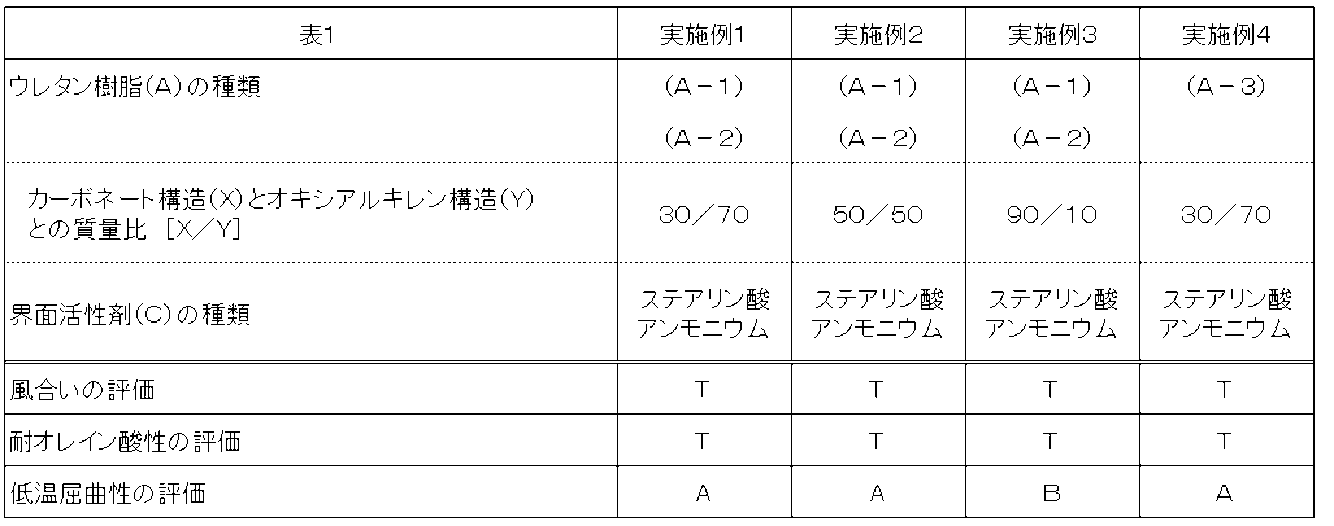
- Example 1 A thickener ("Borchi” manufactured by Borchers Co., Ltd. was added to 30 parts by mass of the urethane resin (A-1) composition obtained in Synthesis Example 1 and 70 parts by mass of the urethane resin (A-2) composition obtained in Synthesis Example 2. Add 2 parts by mass of Gel ALA), 0.5 parts by mass of ammonium stearate, and 4 parts by mass of a cross-linking agent (“Epocross WS-700” manufactured by Nippon Catalyst Co., Ltd.), and use a mechanical mixer at 2,000 rpm for 1 minute. The mixture was stirred and foamed to obtain a foaming liquid having a volume 1.5 times larger. This was applied to a paper pattern and dried at 80 ° C. for 3 minutes and then at 120 ° C. for 2 minutes to produce a urethane foam sheet.
- Gel ALA Gel ALA
- ammonium stearate 0.5 parts by mass of ammonium stearate
- a cross-linking agent (“Ep
- Example 2 Urethane foamed in the same manner as in Example 1 except that the blending amount of the urethane resin (A-1) was changed to 50 parts by mass and the blending amount of the urethane resin (A-2) was changed to 50 parts by mass in Example 1. I got a sheet.
- Example 3 Urethane foamed in the same manner as in Example 1 except that the blending amount of the urethane resin (A-1) was changed to 80 parts by mass and the blending amount of the urethane resin (A-2) was changed to 20 parts by mass in Example 1. I got a sheet.
- Example 4 To 100 parts by mass of the urethane resin (A-3) composition obtained in Synthesis Example 3, 2 parts by mass of a thickener (“Borchi Gel ALA” manufactured by Borchers), 0.5 parts by mass of ammonium stearate, and a cross-linking agent ( "Epocross WS-700” manufactured by Nippon Catalyst Co., Ltd.) 4 parts by mass was added, and the mixture was stirred at 2,000 rpm for 1 minute using a mechanical mixer to foam to obtain a foaming solution having a volume 1.5 times larger. It was. This was applied to a paper pattern and dried at 80 ° C. for 3 minutes and then at 120 ° C. for 2 minutes to produce a urethane foam sheet.
- a thickener (“Borchi Gel ALA” manufactured by Borchers)
- ammonium stearate 0.5 parts by mass of ammonium stearate
- a cross-linking agent "Epocross WS-700” manufactured by Nippon Cat
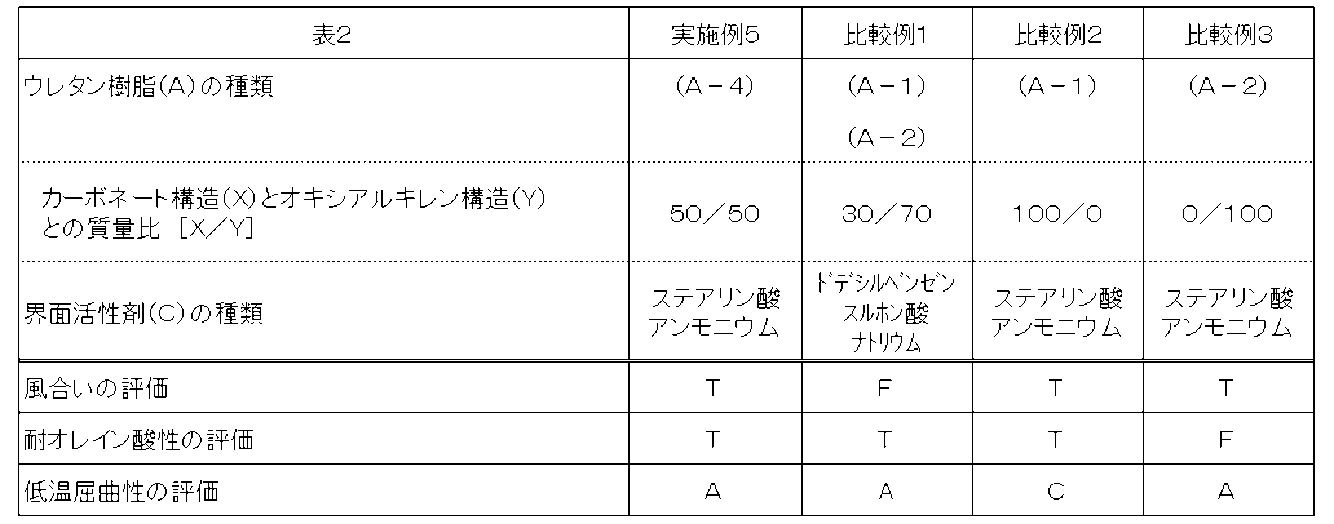
- Example 5 To 100 parts by mass of the urethane resin (A-4) composition obtained in Synthesis Example 4, 2 parts by mass of a thickener (“Borchi Gel ALA” manufactured by Borchers), 0.5 parts by mass of ammonium stearate, and a cross-linking agent ( "Epocross WS-700” manufactured by Nippon Catalyst Co., Ltd.) 4 parts by mass was added, and the mixture was stirred at 2,000 rpm for 1 minute using a mechanical mixer to foam to obtain a foaming solution having a volume 1.5 times larger. It was. This was applied to a paper pattern and dried at 80 ° C. for 3 minutes and then at 120 ° C. for 2 minutes to produce a urethane foam sheet.
- a thickener (“Borchi Gel ALA” manufactured by Borchers)
- ammonium stearate 0.5 parts by mass of ammonium stearate
- a cross-linking agent "Epocross WS-700” manufactured by Nippon Cat
- Measuring device High-speed GPC device ("HLC-8220GPC” manufactured by Tosoh Corporation) Column: The following columns manufactured by Tosoh Corporation were connected in series and used. "TSKgel G5000” (7.8 mm I.D. x 30 cm) x 1 "TSKgel G4000" (7.8 mm I.D.
- Synthetic leather was obtained by laminating the urethane foam sheets obtained in Examples and Comparative Examples to a non-woven fabric.
- a test piece was obtained by cutting the obtained synthetic leather into a width of 50 mm and a length of 50 mm. This test piece was immersed in oleic acid at 80 ° C. for 24 hours and then taken out, and the oleic acid adhering to the surface was lightly wiped off with a paper cloth. The changes in appearance before and after immersion in oleic acid were visually observed and evaluated as follows. "T”: No change in appearance.
- F Synthetic leather is swollen and / or deformed.
- Synthetic leather was obtained by laminating the urethane foam sheets obtained in Examples and Comparative Examples to a non-woven fabric.
- the obtained synthetic leather is subjected to a flexibility test (-30 ° C, 100 times / minute) with a flexometer (“low temperature flexiometer” manufactured by Yasuda Seiki Co., Ltd.), and the number of times until the surface of the synthetic leather becomes irritated.
- a flexometer low temperature flexiometer manufactured by Yasuda Seiki Co., Ltd.
- the urethane resin composition of the present invention has excellent texture, olein acid resistance, and low temperature flexibility.
- Comparative Example 1 was an embodiment in which sodium dodecylbenzenesulfonate having an aromatic ring was used instead of the surfactant (C), but the foam retention was poor and the texture was hard and poor.
- Comparative Example 2 was an embodiment in which a urethane resin composition containing no oxyalkylene structure (Y) was used, but the low temperature flexibility was poor.
- Comparative Example 3 was an embodiment using a urethane resin composition containing no carbonate structure (X), but had poor olein resistance.
Landscapes
- Chemical & Material Sciences (AREA)
- Chemical Kinetics & Catalysis (AREA)
- Health & Medical Sciences (AREA)
- Medicinal Chemistry (AREA)
- Polymers & Plastics (AREA)
- Organic Chemistry (AREA)
- Engineering & Computer Science (AREA)
- Textile Engineering (AREA)
- Dispersion Chemistry (AREA)
- Manufacturing & Machinery (AREA)
- Materials Engineering (AREA)
- Polyurethanes Or Polyureas (AREA)
- Synthetic Leather, Interior Materials Or Flexible Sheet Materials (AREA)
- Processes Of Treating Macromolecular Substances (AREA)
- Manufacture Of Porous Articles, And Recovery And Treatment Of Waste Products (AREA)
- Compositions Of Macromolecular Compounds (AREA)
Abstract
Description

(X)前記ウレタン樹脂組成物を起泡させ起泡液を得、この起泡液を離型紙上に塗布し、乾燥させ、前記基材(i)と貼り合わせる方法、
(Y)前記ウレタン樹脂組成物を起泡させ起泡液を得、この起泡液を、離型紙上に作製した表皮層上に塗布し、乾燥させ、前記基材(i)と貼り合わせる方法、
(Z)前記ウレタン樹脂組成物を起泡させ起泡液を得、この起泡液を前記基材(i)上に塗布し、乾燥させ、必要に応じて、その上に、離型紙上に作製した表皮層(iii)を貼り合わせる方法などが挙げられる。
メチルエチルケトン3,281質量部及びオクチル酸第一錫0.1質量部の存在下、ポリカーボネートポリオール(1,6-ヘキサンジオールを原料とするもの、数平均分子量;2,000)1,000質量部と、2,2-ジメチロールプロピオン酸17質量部と、エチレングリコール47質量部と、ジフェニルメタンジイソシアネート344質量部とを溶液粘度が20,000mPa・sに達するまで70℃で反応させた後、メタノール3質量部を加えて反応を停止させてウレタン樹脂のメチルエチルケトン溶液を得た。このウレタン樹脂溶液にポリオキシエチレンジスチレン化フェニルエーテル(Hydrophile-Lipophile Balance(以下、「HLB」と略記する);14)70質量部と、トリエチルアミン13質量部を混合させた後に、イオン交換水800質量部を加えて転相乳化させることで前記ウレタン樹脂(A-1)が水に分散した乳化液を得た。
次いで、前記乳化液からメチルエチルケトンを留去することによって、ウレタン樹脂(A-1)50質量%を含むウレタン樹脂組成物を得た。
メチルエチルケトン3,281質量部及びオクチル酸第一錫0.1質量部の存在下、ポリオキシテトラメチレングリコール(数平均分子量;2,000)1,000質量部と、2,2-ジメチロールプロピオン酸17質量部と、エチレングリコール47質量部と、MDIを344質量部とを溶液粘度が20,000mPa・sに達するまで70℃で反応させた後、メタノール3質量部を加えて反応を停止させてウレタン樹脂のメチルエチルケトン溶液を得た。このウレタン樹脂溶液にポリオキシエチレンジスチレン化フェニルエーテル(HLB;14)70質量部と、トリエチルアミン13質量部を混合させた後に、イオン交換水800質量部を加えて転相乳化させることで前記ウレタン樹脂(A-2)が水に分散した乳化液を得た。
次いで、前記乳化液からメチルエチルケトンを留去することによって、ウレタン樹脂(A-2)50質量%を含むウレタン樹脂組成物を得た。
メチルエチルケトン3,281質量部及びオクチル酸第一錫0.1質量部の存在下、ポリカーボネートポリオール(1,6-ヘキサンジオールを原料とするもの、数平均分子量;2,000)300質量部と、ポリオキシテトラメチレングリコール(数平均分子量;2,000)700質量部と、2,2-ジメチロールプロピオン酸17質量部と、エチレングリコール47質量部と、MDIを344質量部とを溶液粘度が20,000mPa・sに達するまで70℃で反応させた後、メタノール3質量部を加えて反応を停止させてウレタン樹脂のメチルエチルケトン溶液を得た。このウレタン樹脂溶液にポリオキシエチレンジスチレン化フェニルエーテル(HLB;14)70質量部と、トリエチルアミン13質量部を混合させた後に、イオン交換水800質量部を加えて転相乳化させることで前記ウレタン樹脂(A-3)が水に分散した乳化液を得た。
次いで、前記乳化液からメチルエチルケトンを留去することによって、ウレタン樹脂(A-3)50質量%を含むウレタン樹脂組成物を得た。
メチルエチルケトン3,281質量部及びオクチル酸第一錫0.1質量部の存在下、ポリカーボネートポリオール(1,6-ヘキサンジオールを原料とするもの、数平均分子量;2,000)500質量部と、ポリオキシテトラメチレングリコール(数平均分子量;2,000)500質量部と、2,2-ジメチロールプロピオン酸17質量部と、エチレングリコール47質量部と、MDIを344質量部とを溶液粘度が20,000mPa・sに達するまで70℃で反応させた後、メタノール3質量部を加えて反応を停止させてウレタン樹脂のメチルエチルケトン溶液を得た。このウレタン樹脂溶液にポリオキシエチレンジスチレン化フェニルエーテル(HLB;14)70質量部と、トリエチルアミン13質量部を混合させた後に、イオン交換水800質量部を加えて転相乳化させることで前記ウレタン樹脂(A-4)が水に分散した乳化液を得た。
次いで、前記乳化液からメチルエチルケトンを留去することによって、ウレタン樹脂(A-4)50質量%を含むウレタン樹脂組成物を得た。
合成例1で得られたウレタン樹脂(A-1)組成物30質量部及び合成例2で得られたウレタン樹脂(A-2)組成物70質量部に、増粘剤(Borchers社製「Borchi Gel ALA」)2質量部、ステアリン酸アンモニウム0.5質量部、架橋剤(日本触媒株式会社製「エポクロスWS-700」)4質量部を加え、メカニカルミキサーを使用して2,000rpmで1分間撹拌し、起泡させ、1.5倍の体積にした起泡液を得た。
これを離型紙に塗布し、80℃で3分間、さらに120℃で2分間乾燥させることで、発泡ウレタンシートを製造した。
実施例1において、ウレタン樹脂(A-1)の配合量を50質量部、ウレタン樹脂(A-2)の配合量を50質量部に変更した以外は、実施例1と同様にして、発泡ウレタンシートを得た。
実施例1において、ウレタン樹脂(A-1)の配合量を80質量部、ウレタン樹脂(A-2)の配合量を20質量部に変更した以外は、実施例1と同様にして、発泡ウレタンシートを得た。
合成例3で得られたウレタン樹脂(A-3)組成物100質量部に、増粘剤(Borchers社製「Borchi Gel ALA」)2質量部、ステアリン酸アンモニウム0.5質量部、架橋剤(日本触媒株式会社製「エポクロスWS-700」)4質量部を加え、メカニカルミキサーを使用して2,000rpmで1分間撹拌し、起泡させ、1.5倍の体積にした起泡液を得た。
これを離型紙に塗布し、80℃で3分間、さらに120℃で2分間乾燥させることで、発泡ウレタンシートを製造した。
合成例4で得られたウレタン樹脂(A-4)組成物100質量部に、増粘剤(Borchers社製「Borchi Gel ALA」)2質量部、ステアリン酸アンモニウム0.5質量部、架橋剤(日本触媒株式会社製「エポクロスWS-700」)4質量部を加え、メカニカルミキサーを使用して2,000rpmで1分間撹拌し、起泡させ、1.5倍の体積にした起泡液を得た。
これを離型紙に塗布し、80℃で3分間、さらに120℃で2分間乾燥させることで、発泡ウレタンシートを製造した。
合成例1で得られたウレタン樹脂(A-1)組成物30質量部及び合成例2で得られたウレタン樹脂(A-2)組成物70質量部に、増粘剤(Borchers社製「Borchi Gel ALA」)2質量部、ドデシルベンゼンスルホン酸ナトリウム1.5質量部、架橋剤(日本触媒株式会社製「エポクロスWS-700」)4質量部を加え、メカニカルミキサーを使用して2,000rpmで1分間撹拌し、起泡させ、1.5倍の体積にした起泡液を得た。
これを離型紙に塗布し、80℃で3分間、さらに120℃で2分間乾燥させることで、シートを製造した。
合成例1で得られたウレタン樹脂(A-1)組成物100質量部に、増粘剤(Borchers社製「Borchi Gel ALA」)2質量部、ステアリン酸アンモニウム0.5質量部、架橋剤(日本触媒株式会社製「エポクロスWS-700」)4質量部を加え、メカニカルミキサーを使用して2,000rpmで1分間撹拌し、起泡させ、1.5倍の体積にした起泡液を得た。
これを離型紙に塗布し、80℃で3分間、さらに120℃で2分間乾燥させることで、発泡ウレタンシートを製造した。
合成例2で得られたウレタン樹脂(A-2)組成物100質量部に、増粘剤(Borchers社製「Borchi Gel ALA」)2質量部、ステアリン酸アンモニウム0.5質量部、架橋剤(日本触媒株式会社製「エポクロスWS-700」)4質量部を加え、メカニカルミキサーを使用して2,000rpmで1分間撹拌し、起泡させ、1.5倍の体積にした起泡液を得た。
これを離型紙に塗布し、80℃で3分間、さらに120℃で2分間乾燥させることで、発泡ウレタンシートを製造した。
合成例で用いたポリオール等の数平均分子量は、ゲル・パーミエーション・カラムクロマトグラフィー(GPC)法により、下記の条件で測定した。
カラム:東ソー株式会社製の下記のカラムを直列に接続して使用した。
「TSKgel G5000」(7.8mmI.D.×30cm)×1本
「TSKgel G4000」(7.8mmI.D.×30cm)×1本
「TSKgel G3000」(7.8mmI.D.×30cm)×1本
「TSKgel G2000」(7.8mmI.D.×30cm)×1本
検出器:RI(示差屈折計)
カラム温度:40℃
溶離液:テトラヒドロフラン(THF)
流速:1.0mL/分
注入量:100μL(試料濃度0.4質量%のテトラヒドロフラン溶液)
標準試料:下記の標準ポリスチレンを用いて検量線を作成した。
東ソー株式会社製「TSKgel 標準ポリスチレン A-500」
東ソー株式会社製「TSKgel 標準ポリスチレン A-1000」
東ソー株式会社製「TSKgel 標準ポリスチレン A-2500」
東ソー株式会社製「TSKgel 標準ポリスチレン A-5000」
東ソー株式会社製「TSKgel 標準ポリスチレン F-1」
東ソー株式会社製「TSKgel 標準ポリスチレン F-2」
東ソー株式会社製「TSKgel 標準ポリスチレン F-4」
東ソー株式会社製「TSKgel 標準ポリスチレン F-10」
東ソー株式会社製「TSKgel 標準ポリスチレン F-20」
東ソー株式会社製「TSKgel 標準ポリスチレン F-40」
東ソー株式会社製「TSKgel 標準ポリスチレン F-80」
東ソー株式会社製「TSKgel 標準ポリスチレン F-128」
東ソー株式会社製「TSKgel 標準ポリスチレン F-288」
東ソー株式会社製「TSKgel 標準ポリスチレン F-550」
合成例で得られたウレタン樹脂組成物を離型紙に塗布し(塗布厚さ150μm)、熱風乾燥機にて70℃、4分間、次いで120℃で2分間乾燥することで乾燥物を得た。この乾燥物を、株式会社島津製作所製フローテスター「CFT-500A」(口径1mm、長さ1mmのダイスを使用、荷重98N、昇温速度3℃/分)を使用して、流動開始温度を測定した。
得られた発泡ウレタンシートを手で触り、以下のように評価した。
「A」:柔軟性に富む。
「B」:やや柔軟性がある。
「C」:柔軟性が劣る。
「D」:硬い。
実施例及び比較例で得られた発泡ウレタンシートを、不織布に貼り合わせることで合成皮革を得た。得られた合成皮革を幅50mm、長さ50mmに裁断したものを試験片とした。この試験片を80℃でオレイン酸に24時間浸漬した後取り出し、表面に付着したオレイン酸を紙ウエスで軽く拭き取った。オレイン酸浸漬前後の外観変化を目視観察し、以下のように評価した。
「T」:外観変化なし。
「F」:合成皮革が膨張、及び/又は、変形している。
実施例及び比較例で得られた発泡ウレタンシートを、不織布に貼り合わせることで合成皮革を得た。得られた合成皮革をフレキソメーター(株式会社安田精機製「低温フレキシオメーター」)で屈曲性試験(-30℃、100回/毎分)を行い、合成皮革の表面に我が生じるまでの回数を測定し、以下のように評価した。
「A」:15,000回以上
「B」:10,000回以上15,000回未満
「C」:10,000回未満
Claims (6)
- ウレタン樹脂(A)、水(B)、及び、芳香環を有さず、かつ炭素原子数が10以上の疎水部を有する界面活性剤(C)を含有するウレタン樹脂組成物であり、前記ウレタン樹脂組成物が、ウレタン樹脂(A)に由来する、カーボネート構造(X)とオキシアルキレン構造(Y)とを有することを特徴とするウレタン樹脂組成物。
- 前記カーボネート構造(X)と前記オキシアルキレン構造(Y)との質量比[X/Y]が、10/90~90/10の範囲である請求項1記載のウレタン樹脂組成物。
- 前記界面活性剤(C)が、ステアリン酸塩である請求項1又は2記載のウレタン樹脂組成物。
- 前記ウレタン樹脂(A)が、アニオン性基を有するものである請求項1~3のいずれか1項記載のウレタン樹脂組成物。
- 請求項1~4のいずれか1項記載のウレタン樹脂組成物により形成された、密度が200~1,000kg/m3であることを特徴とする発泡ウレタンシート。
- 少なくとも、基材(i)、及び、ポリウレタン層(ii)を有する合成皮革であって、
前記ポリウレタン層(ii)が、請求項5記載の発泡ウレタンシートにより形成されているものであることを特徴とする合成皮革。
Priority Applications (5)
| Application Number | Priority Date | Filing Date | Title |
|---|---|---|---|
| CN202080029291.0A CN113767195B (zh) | 2019-04-23 | 2020-03-24 | 氨基甲酸酯树脂组合物、发泡氨基甲酸酯片以及合成皮革 |
| KR1020217030256A KR102691615B1 (ko) | 2019-04-23 | 2020-03-24 | 우레탄 수지 조성물, 발포 우레탄 시트, 및, 합성 피혁 |
| JP2020545196A JP6904485B2 (ja) | 2019-04-23 | 2020-03-24 | ウレタン樹脂組成物、発泡ウレタンシート、及び、合成皮革 |
| EP20795948.7A EP3936659A4 (en) | 2019-04-23 | 2020-03-24 | URETHANE RESIN COMPOSITION, FOAMED URETHANE FILM AND SYNTHETIC LEATHER |
| US17/602,405 US12630666B2 (en) | 2019-04-23 | 2020-03-24 | Urethane resin composition, foamed urethane sheet, and synthetic leather |
Applications Claiming Priority (2)
| Application Number | Priority Date | Filing Date | Title |
|---|---|---|---|
| JP2019-081872 | 2019-04-23 | ||
| JP2019081872 | 2019-04-23 |
Publications (1)
| Publication Number | Publication Date |
|---|---|
| WO2020217813A1 true WO2020217813A1 (ja) | 2020-10-29 |
Family
ID=72942475
Family Applications (1)
| Application Number | Title | Priority Date | Filing Date |
|---|---|---|---|
| PCT/JP2020/012895 Ceased WO2020217813A1 (ja) | 2019-04-23 | 2020-03-24 | ウレタン樹脂組成物、発泡ウレタンシート、及び、合成皮革 |
Country Status (6)
| Country | Link |
|---|---|
| EP (1) | EP3936659A4 (ja) |
| JP (1) | JP6904485B2 (ja) |
| KR (1) | KR102691615B1 (ja) |
| CN (1) | CN113767195B (ja) |
| TW (1) | TWI884947B (ja) |
| WO (1) | WO2020217813A1 (ja) |
Cited By (3)
| Publication number | Priority date | Publication date | Assignee | Title |
|---|---|---|---|---|
| WO2024158024A1 (ja) * | 2023-01-26 | 2024-08-02 | Dic株式会社 | 組成物及び手袋 |
| WO2025126848A1 (ja) * | 2023-12-12 | 2025-06-19 | Dic株式会社 | 積層体の製造方法、及び合成皮革の製造方法 |
| WO2025126847A1 (ja) * | 2023-12-12 | 2025-06-19 | Dic株式会社 | 積層体の製造方法、及び合成皮革の製造方法 |
Citations (6)
| Publication number | Priority date | Publication date | Assignee | Title |
|---|---|---|---|---|
| JP2000345026A (ja) * | 1999-06-08 | 2000-12-12 | Kuraray Co Ltd | 感熱ゲル化性ポリウレタン系エマルジョン |
| JP2004143641A (ja) * | 2002-10-28 | 2004-05-20 | Sanyo Chem Ind Ltd | 皮革様シート材料 |
| JP2005239841A (ja) * | 2004-02-25 | 2005-09-08 | Sanyo Chem Ind Ltd | 水系ポリウレタン樹脂エマルション |
| WO2012017724A1 (ja) * | 2010-08-06 | 2012-02-09 | Dic株式会社 | ウレタン樹脂組成物、コーティング剤、皮革様シートの表皮層形成用ウレタン樹脂組成物、並びに積層体及び皮革様シート |
| WO2016140025A1 (ja) * | 2015-03-03 | 2016-09-09 | Dic株式会社 | 皮革様シートの製造方法 |
| JP2019112564A (ja) * | 2017-12-25 | 2019-07-11 | 日華化学株式会社 | 発泡体形成用組成物、発泡体、発泡体の製造方法及び皮革用材 |
Family Cites Families (5)
| Publication number | Priority date | Publication date | Assignee | Title |
|---|---|---|---|---|
| JP4605012B2 (ja) * | 2003-07-24 | 2011-01-05 | 旭硝子株式会社 | ポリウレタン樹脂およびその製造方法 |
| JP4866091B2 (ja) | 2006-01-17 | 2012-02-01 | ユニチカトレーディング株式会社 | ポリウレタン微多孔膜を備えた高発泡布帛及びその製造方法 |
| DE102006016638A1 (de) * | 2006-04-08 | 2007-10-11 | Bayer Materialscience Ag | Mikroporöse Beschichtung auf Basis von Polyurethan-Polyharnstoff |
| DE102006043589A1 (de) * | 2006-09-16 | 2008-03-27 | Bayer Materialscience Ag | Alkylpolyglycoside als Stabilisatoren für PUR-Schäume |
| DE102007048080A1 (de) * | 2007-10-05 | 2009-04-09 | Bayer Materialscience Ag | Biomedizinische Schaumartikel |
-
2020
- 2020-03-24 WO PCT/JP2020/012895 patent/WO2020217813A1/ja not_active Ceased
- 2020-03-24 JP JP2020545196A patent/JP6904485B2/ja active Active
- 2020-03-24 KR KR1020217030256A patent/KR102691615B1/ko active Active
- 2020-03-24 EP EP20795948.7A patent/EP3936659A4/en active Pending
- 2020-03-24 CN CN202080029291.0A patent/CN113767195B/zh active Active
- 2020-04-14 TW TW109112466A patent/TWI884947B/zh active
Patent Citations (6)
| Publication number | Priority date | Publication date | Assignee | Title |
|---|---|---|---|---|
| JP2000345026A (ja) * | 1999-06-08 | 2000-12-12 | Kuraray Co Ltd | 感熱ゲル化性ポリウレタン系エマルジョン |
| JP2004143641A (ja) * | 2002-10-28 | 2004-05-20 | Sanyo Chem Ind Ltd | 皮革様シート材料 |
| JP2005239841A (ja) * | 2004-02-25 | 2005-09-08 | Sanyo Chem Ind Ltd | 水系ポリウレタン樹脂エマルション |
| WO2012017724A1 (ja) * | 2010-08-06 | 2012-02-09 | Dic株式会社 | ウレタン樹脂組成物、コーティング剤、皮革様シートの表皮層形成用ウレタン樹脂組成物、並びに積層体及び皮革様シート |
| WO2016140025A1 (ja) * | 2015-03-03 | 2016-09-09 | Dic株式会社 | 皮革様シートの製造方法 |
| JP2019112564A (ja) * | 2017-12-25 | 2019-07-11 | 日華化学株式会社 | 発泡体形成用組成物、発泡体、発泡体の製造方法及び皮革用材 |
Non-Patent Citations (1)
| Title |
|---|
| See also references of EP3936659A4 * |
Cited By (3)
| Publication number | Priority date | Publication date | Assignee | Title |
|---|---|---|---|---|
| WO2024158024A1 (ja) * | 2023-01-26 | 2024-08-02 | Dic株式会社 | 組成物及び手袋 |
| WO2025126848A1 (ja) * | 2023-12-12 | 2025-06-19 | Dic株式会社 | 積層体の製造方法、及び合成皮革の製造方法 |
| WO2025126847A1 (ja) * | 2023-12-12 | 2025-06-19 | Dic株式会社 | 積層体の製造方法、及び合成皮革の製造方法 |
Also Published As
| Publication number | Publication date |
|---|---|
| KR20210129162A (ko) | 2021-10-27 |
| TW202104327A (zh) | 2021-02-01 |
| EP3936659A4 (en) | 2022-07-06 |
| EP3936659A1 (en) | 2022-01-12 |
| US20220220250A1 (en) | 2022-07-14 |
| CN113767195A (zh) | 2021-12-07 |
| JP6904485B2 (ja) | 2021-07-14 |
| JPWO2020217813A1 (ja) | 2021-05-06 |
| TWI884947B (zh) | 2025-06-01 |
| KR102691615B1 (ko) | 2024-08-05 |
| CN113767195B (zh) | 2024-03-15 |
Similar Documents
| Publication | Publication Date | Title |
|---|---|---|
| TWI782129B (zh) | 發泡胺基甲酸酯薄片、及合成皮革 | |
| JP6904485B2 (ja) | ウレタン樹脂組成物、発泡ウレタンシート、及び、合成皮革 | |
| JP6904486B2 (ja) | ウレタン樹脂組成物、及び、積層体 | |
| JP6836736B2 (ja) | 合成皮革 | |
| TWI878369B (zh) | 胺基甲酸酯樹脂水分散體、合成皮革及合成皮革的製造方法 | |
| KR102834137B1 (ko) | 섬유 기재, 및, 인공 피혁 | |
| JP6769570B2 (ja) | ウレタン樹脂組成物、及び、積層体 | |
| CN118613542A (zh) | 氨基甲酸酯树脂组合物及层叠体 | |
| US12630666B2 (en) | Urethane resin composition, foamed urethane sheet, and synthetic leather | |
| JP7568136B2 (ja) | ウレタン樹脂組成物、及び、積層体 | |
| JP7505651B2 (ja) | ウレタン樹脂組成物、及び、積層体 | |
| WO2025126848A1 (ja) | 積層体の製造方法、及び合成皮革の製造方法 |
Legal Events
| Date | Code | Title | Description |
|---|---|---|---|
| ENP | Entry into the national phase |
Ref document number: 2020545196 Country of ref document: JP Kind code of ref document: A |
|
| 121 | Ep: the epo has been informed by wipo that ep was designated in this application |
Ref document number: 20795948 Country of ref document: EP Kind code of ref document: A1 |
|
| ENP | Entry into the national phase |
Ref document number: 20217030256 Country of ref document: KR Kind code of ref document: A |
|
| NENP | Non-entry into the national phase |
Ref country code: DE |
|
| ENP | Entry into the national phase |
Ref document number: 2020795948 Country of ref document: EP Effective date: 20211005 |