WO2020217829A1 - Composition de résine de propylène et corps moulé - Google Patents
Composition de résine de propylène et corps moulé Download PDFInfo
- Publication number
- WO2020217829A1 WO2020217829A1 PCT/JP2020/013266 JP2020013266W WO2020217829A1 WO 2020217829 A1 WO2020217829 A1 WO 2020217829A1 JP 2020013266 W JP2020013266 W JP 2020013266W WO 2020217829 A1 WO2020217829 A1 WO 2020217829A1
- Authority
- WO
- WIPO (PCT)
- Prior art keywords
- propylene
- weight
- component
- ethylene
- resin composition
- Prior art date
- Legal status (The legal status is an assumption and is not a legal conclusion. Google has not performed a legal analysis and makes no representation as to the accuracy of the status listed.)
- Ceased
Links
Images
Classifications
-
- C—CHEMISTRY; METALLURGY
- C08—ORGANIC MACROMOLECULAR COMPOUNDS; THEIR PREPARATION OR CHEMICAL WORKING-UP; COMPOSITIONS BASED THEREON
- C08L—COMPOSITIONS OF MACROMOLECULAR COMPOUNDS
- C08L23/00—Compositions of homopolymers or copolymers of unsaturated aliphatic hydrocarbons having only one carbon-to-carbon double bond; Compositions of derivatives of such polymers
- C08L23/02—Compositions of homopolymers or copolymers of unsaturated aliphatic hydrocarbons having only one carbon-to-carbon double bond; Compositions of derivatives of such polymers not modified by chemical after-treatment
- C08L23/16—Ethylene-propylene or ethylene-propylene-diene copolymers
-
- C—CHEMISTRY; METALLURGY
- C08—ORGANIC MACROMOLECULAR COMPOUNDS; THEIR PREPARATION OR CHEMICAL WORKING-UP; COMPOSITIONS BASED THEREON
- C08L—COMPOSITIONS OF MACROMOLECULAR COMPOUNDS
- C08L23/00—Compositions of homopolymers or copolymers of unsaturated aliphatic hydrocarbons having only one carbon-to-carbon double bond; Compositions of derivatives of such polymers
- C08L23/02—Compositions of homopolymers or copolymers of unsaturated aliphatic hydrocarbons having only one carbon-to-carbon double bond; Compositions of derivatives of such polymers not modified by chemical after-treatment
- C08L23/10—Homopolymers or copolymers of propene
- C08L23/14—Copolymers of propene
-
- C—CHEMISTRY; METALLURGY
- C08—ORGANIC MACROMOLECULAR COMPOUNDS; THEIR PREPARATION OR CHEMICAL WORKING-UP; COMPOSITIONS BASED THEREON
- C08L—COMPOSITIONS OF MACROMOLECULAR COMPOUNDS
- C08L23/00—Compositions of homopolymers or copolymers of unsaturated aliphatic hydrocarbons having only one carbon-to-carbon double bond; Compositions of derivatives of such polymers
- C08L23/02—Compositions of homopolymers or copolymers of unsaturated aliphatic hydrocarbons having only one carbon-to-carbon double bond; Compositions of derivatives of such polymers not modified by chemical after-treatment
- C08L23/04—Homopolymers or copolymers of ethene
- C08L23/08—Copolymers of ethene
- C08L23/0807—Copolymers of ethene with unsaturated hydrocarbons only containing four or more carbon atoms
- C08L23/0815—Copolymers of ethene with unsaturated hydrocarbons only containing four or more carbon atoms with aliphatic 1-olefins containing one carbon-to-carbon double bond
-
- C—CHEMISTRY; METALLURGY
- C08—ORGANIC MACROMOLECULAR COMPOUNDS; THEIR PREPARATION OR CHEMICAL WORKING-UP; COMPOSITIONS BASED THEREON
- C08L—COMPOSITIONS OF MACROMOLECULAR COMPOUNDS
- C08L23/00—Compositions of homopolymers or copolymers of unsaturated aliphatic hydrocarbons having only one carbon-to-carbon double bond; Compositions of derivatives of such polymers
- C08L23/02—Compositions of homopolymers or copolymers of unsaturated aliphatic hydrocarbons having only one carbon-to-carbon double bond; Compositions of derivatives of such polymers not modified by chemical after-treatment
- C08L23/10—Homopolymers or copolymers of propene
- C08L23/12—Polypropene
-
- C—CHEMISTRY; METALLURGY
- C08—ORGANIC MACROMOLECULAR COMPOUNDS; THEIR PREPARATION OR CHEMICAL WORKING-UP; COMPOSITIONS BASED THEREON
- C08L—COMPOSITIONS OF MACROMOLECULAR COMPOUNDS
- C08L53/00—Compositions of block copolymers containing at least one sequence of a polymer obtained by reactions only involving carbon-to-carbon unsaturated bonds; Compositions of derivatives of such polymers
-
- C—CHEMISTRY; METALLURGY
- C08—ORGANIC MACROMOLECULAR COMPOUNDS; THEIR PREPARATION OR CHEMICAL WORKING-UP; COMPOSITIONS BASED THEREON
- C08L—COMPOSITIONS OF MACROMOLECULAR COMPOUNDS
- C08L2203/00—Applications
- C08L2203/30—Applications used for thermoforming
-
- C—CHEMISTRY; METALLURGY
- C08—ORGANIC MACROMOLECULAR COMPOUNDS; THEIR PREPARATION OR CHEMICAL WORKING-UP; COMPOSITIONS BASED THEREON
- C08L—COMPOSITIONS OF MACROMOLECULAR COMPOUNDS
- C08L2205/00—Polymer mixtures characterised by other features
- C08L2205/02—Polymer mixtures characterised by other features containing two or more polymers of the same C08L -group
- C08L2205/025—Polymer mixtures characterised by other features containing two or more polymers of the same C08L -group containing two or more polymers of the same hierarchy C08L, and differing only in parameters such as density, comonomer content, molecular weight, structure
-
- C—CHEMISTRY; METALLURGY
- C08—ORGANIC MACROMOLECULAR COMPOUNDS; THEIR PREPARATION OR CHEMICAL WORKING-UP; COMPOSITIONS BASED THEREON
- C08L—COMPOSITIONS OF MACROMOLECULAR COMPOUNDS
- C08L2205/00—Polymer mixtures characterised by other features
- C08L2205/03—Polymer mixtures characterised by other features containing three or more polymers in a blend
- C08L2205/035—Polymer mixtures characterised by other features containing three or more polymers in a blend containing four or more polymers in a blend
-
- C—CHEMISTRY; METALLURGY
- C08—ORGANIC MACROMOLECULAR COMPOUNDS; THEIR PREPARATION OR CHEMICAL WORKING-UP; COMPOSITIONS BASED THEREON
- C08L—COMPOSITIONS OF MACROMOLECULAR COMPOUNDS
- C08L2207/00—Properties characterising the ingredient of the composition
- C08L2207/02—Heterophasic composition
Definitions
- the present invention relates to a propylene resin composition and a molded product.
- Patent Document 1 describes crystalline polypropylene, long-chain branched propylene-based polymer, thermoplastic elastomer, and inorganic filler.
- a polypropylene resin composition containing the above is described.
- an object of the present invention is to provide a propylene resin composition capable of producing a molded product having excellent dimensional stability. It is also an object of the present invention to provide a molded product having excellent dimensional stability.
- the present invention relates to, but is not limited to: [Invention 1] (A) 30 to 65 parts by weight of propylene polymer; (B) 10 to 40 parts by weight of ethylene- ⁇ -olefin random copolymer; A propylene resin composition containing (C) 10 to 40 parts by weight of a filler; and (D) 0.1 to 10 parts by weight of an ethylene- ⁇ -olefin block copolymer.
- the total content of components A to D is 100 parts by weight.
- the xylene-soluble component of component D at 20 ° C. is 70% by weight or less.
- the density of component D is 0.865 to 0.867 g / cm 3 .
- Propylene resin composition is 0.865 to 0.867 g / cm 3 .
- a propylene resin composition capable of producing a dimensional stability-specifically, a molded product having a small coefficient of linear expansion. According to the present invention, it is also possible to provide a molded product having excellent dimensional stability.
- propylene resin composition means a composition containing a propylene-based polymer. It will be explained in detail later. In the present specification, the term “propylene-based polymer” will be described in detail later.
- ⁇ -olefin means an aliphatic unsaturated hydrocarbon having a carbon-carbon unsaturated double bond at the ⁇ -position.
- ethylene- ⁇ -olefin random copolymer means a monomer unit derived from ethylene and C4 or more (meaning 4 or more carbon atoms. The same applies to other similar expressions.
- heteropolymer containing a monomer unit derived from ⁇ -olefin (alkene) and substantially free of a monomer unit derived from propylene.
- heteroophasic propylene polymerization material refers to polymer I containing 80% by weight or more of monomer units derived from propylene (provided that the total weight of the polymer I is 100% by weight).
- Polymer II containing a monomer unit derived from at least one ⁇ -olefin selected from the group consisting of ethylene and ⁇ -olefins of C4 to 12 and a monomer unit derived from propylene. Means a mixture containing.
- xylene insoluble component (also referred to as” CXIS component ”)
- CXIS component a component insoluble in p-xylene contained in the polymer and a solid substance obtained by the following method: A method in which about 2 g of a polymer is dissolved in boiling p-xylene for 2 hours to obtain a solution, and then the solution is cooled to 20 ° C. to precipitate a solid substance.
- xylene-soluble component also referred to as” CXS component )
- the term "filler” will be described in detail later.
- ethylene- ⁇ -olefin block copolymer is a block copolymer containing a monomer unit derived from ethylene and a monomer unit derived from ⁇ -olefin of C4 or higher. It means that the monomer unit derived from propylene is substantially not contained. It will be explained in detail later.
- R R L + k * ( R U -R L) (wherein, k is a variable ranging from 1 percent to 100 percent of a 1 percent increment, i.e., k is 1 percent, 2 percent, 3 percent 4, 5 percent, ..., 50 percent, 51 percent, 52 percent, ..., 95 percent, 96 percent, 97 percent, 98 percent, 99 percent, or 100 percent).
- k is a variable ranging from 1 percent to 100 percent of a 1 percent increment, i.e., k is 1 percent, 2 percent, 3 percent 4, 5 percent, ..., 50 percent, 51 percent, 52 percent, ..., 95 percent, 96 percent, 97 percent, 98 percent, 99 percent, or 100 percent.
- any numerical range defined by the two R numbers described above is also specifically disclosed.
- the "propylene resin composition (hereinafter, also simply referred to as a resin composition)" is a propylene-based polymer (A), an ethylene- ⁇ -olefin random copolymer (B), or a filler ( C) and ethylene- ⁇ -olefin block copolymer (D) are contained, and the total contents of the components A to D are 100 parts by weight, and the components A to D are 30 to 65 parts by weight, respectively. Included are 10-40 parts by weight, 10-40 parts by weight, and 0.1-10 parts by weight.
- a molded product having excellent dimensional stability can be produced.
- a molded product can be produced by a simple method such as injection molding generally used in the production of molded products for automobiles.
- component A Each component represented by “propylene polymer (A)” or the like is also simply referred to as “component A” or the like.
- Propylene polymer (A) is a polymer having 50% by weight or more of a monomer unit derived from propylene. However, the absolute value is larger than 0.35 of the difference between the die swell ratio of component A, at a shear rate 6080Sec -1 and the die swell ratio at a shear rate of 61sec -1.
- the component A include a propylene homopolymer, a random copolymer of propylene and a monomer other than propylene, and a heterophasic propylene polymerization material.
- the propylene resin composition of the present invention may contain only one type of component A, or may contain two or more types of component A. From the viewpoint of rigidity and impact resistance of the molded product, the component A preferably contains at least one selected from the group consisting of a propylene homopolymer and a heterophagic propylene polymerized material.
- the maximum viscosity number ([ ⁇ ]) of the propylene homopolymer is determined from the viewpoint of fluidity at the time of melting of the resin composition and toughness of the molded product. It is preferably 0.10 to 2.00 dL / g, more preferably 0.50 to 1.50 dL / g, and even more preferably 0.70 to 1.40 dL / g.
- the ultimate viscosity number (unit: dL / g) is a value measured at a temperature of 135 ° C. using tetralin as a solvent by the following method.
- the molecular weight distribution (Mw / Mn) of the propylene homopolymer is preferably 3.0 or more, and more preferably 4.0 or more.
- the molecular weight distribution of component A may be 30.0 or less, and may be 25.0 or less.
- the molecular weight distribution of the component A is preferably 3.0 to 30.0, more preferably 4.0 to 25.0.
- the molecular weight distribution is calculated by using the weight average molecular weight (Mw) and the number average molecular weight (Mn) measured by gel permeation chromatography (GPC) under the following conditions. It refers to the ratio (Mw / Mn) of the weight average molecular weight (Mw) to Mn).
- the propylene homopolymer can be produced, for example, by polymerizing propylene using a polymerization catalyst.
- the polymerization catalyst examples include a Ziegler-type catalyst; a Ziegler-Natta-type catalyst; a catalyst composed of a compound of a transition metal of Group 4 of the periodic table having a cyclopentadienyl ring and an alkylaluminoxane; a period having a cyclopentadienyl ring.
- examples thereof include a catalyst in which a transition metal compound of Group 4 of the periodic table having a pentadienyl ring, a compound forming an ionic complex, an organic aluminum compound, etc.) is supported and modified.
- Examples of the polymerization catalyst include JP-A-61-218606, JP-A-5-194685, JP-A-7-216017, JP-A-9-316147, and JP-A-10-212319.
- the catalyst described in Kai 2004-182981 and the like may be used.
- a polymer obtained by prepolymerizing propylene in the presence of the above-mentioned polymerization catalyst can also be used as a polymerization catalyst.
- Examples of the polymerization method include bulk polymerization, solution polymerization, and vapor phase polymerization.
- bulk polymerization refers to a method of polymerizing using a liquid olefin as a medium at a polymerization temperature
- solution polymerization refers to a method of carrying out polymerization in an inert hydrocarbon solvent such as propane, butane, isobutane, pentane, hexane, heptane, and octane.
- the gas phase polymerization refers to a method of polymerizing a gaseous monomer in the medium using a gaseous monomer as a medium.
- Examples of the polymerization method include a batch type, a continuous type, and a combination thereof.
- the polymerization method may be a multi-stage method in which a plurality of polymerization reaction tanks are connected in series.
- a continuous gas phase polymerization method or a bulk-gas phase polymerization method in which a bulk polymerization method and a gas phase polymerization method are continuously performed is preferable.
- polymerization temperature may be appropriately determined according to the molecular structure of the target polymer.
- the polymer is dried at a temperature equal to or lower than the temperature at which the polymer melts, if necessary, in order to remove residual solvent contained in the polymer, ultra-low molecular weight oligomers produced as a by-product during production, and the like. You may. Examples of the drying method include the methods described in JP-A-55-75410, Japanese Patent No. 2565753, and the like.
- Random copolymer of propylene and a monomer other than propylene is a monomer unit derived from propylene and a single amount derived from a monomer other than propylene. It contains a body unit.
- the random copolymer preferably contains 0.01 to 20% by weight of a monomer unit derived from a monomer other than propylene, based on the weight of the random copolymer.
- Examples of monomers other than propylene include ethylene and C4-12 ⁇ -olefins. Among them, at least one selected from the group consisting of ethylene and ⁇ -olefins of C4 to 10 is preferable, and at least one selected from the group consisting of ethylene, 1-butene, 1-hexene and 1-octene is more preferable, and ethylene is more preferable. And at least one selected from the group consisting of 1-butene is more preferred.
- Examples of the random copolymer include a propylene-ethylene random copolymer, a propylene-1-butene random copolymer, a propylene-1-hexene random copolymer, a propylene-1-octene random copolymer, and a propylene-.
- Examples thereof include ethylene-1-butene random copolymers, propylene-ethylene-1-hexene random copolymers and propylene-ethylene-1-octene random copolymers.
- the ultimate viscosity number ([ ⁇ ]) of the random copolymer is determined from the viewpoint of fluidity at the time of melting of the resin composition. It is preferably 0.10 to 2.00 dL / g, more preferably 0.50 to 1.50 dL / g, and even more preferably 0.70 to 1.40 dL / g.
- the molecular weight distribution (Mw / Mn) of the random polymer is preferably 3.0 or more, and more preferably 4.0 or more.
- the molecular weight distribution of the random polymer may be 30.0 or less, and may be 25.0 or less.
- the molecular weight distribution of the random polymer is preferably 3.0 to 30.0, more preferably 4.0 to 25.0.
- the random copolymer can be produced, for example, by polymerizing propylene and a monomer other than propylene according to the polymerization catalyst, polymerization method, and polymerization method that can be used in the production of the propylene homopolymer.
- Heterophasic propylene polymerization material The heterophasic propylene polymerization material can be produced, for example, by carrying out a first polymerization step for forming the polymer I and a second polymerization step for forming the polymer II. .. Examples of the polymerization catalyst, the polymerization method and the polymerization method adopted in these polymerization steps are the same as described above.
- the total weight of the polymer I and the polymer II contained in the heterophasic propylene polymerized material is 100% by weight, assuming that the total weight of the heterophasic propylene polymerized material is 100% by weight. Good.
- the polymer I contains 80% by weight or more of the monomer unit derived from propylene.
- the polymer I may be, for example, a propylene homopolymer, or may contain a monomer unit derived from a monomer other than propylene.
- the content thereof is, for example, 0.01% by weight or more and less than 20% by weight based on the total weight of the polymer I. There may be.
- Examples of monomers other than propylene include ethylene and ⁇ -olefins of C4 or higher. Among them, at least one selected from the group consisting of ethylene and ⁇ -olefins of C4 to 10 is preferable, and at least one selected from the group consisting of ethylene, 1-butene, 1-hexene and 1-octene is more preferable, and ethylene is more preferable. And at least one selected from the group consisting of 1-butene is more preferred.
- Examples of the copolymer containing a monomer unit derived from a monomer other than propylene include a propylene-ethylene copolymer, a propylene-1-butene copolymer, a propylene-1-hexene copolymer, and a propylene-. Examples thereof include 1-octene copolymer, propylene-ethylene-1-butene copolymer, propylene-ethylene-1-hexene copolymer and propylene-ethylene-1-octene copolymer.
- the polymer I is preferably a propylene homopolymer, a propylene-ethylene copolymer, a propylene-1-butene copolymer, or a propylene-ethylene-1-butene copolymer, preferably propylene.
- a homopolymer is more preferable.
- the content of the polymer I is preferably 50 to 99% by weight, more preferably 60 to 95% by weight, based on the total weight of the heterophasic propylene polymerized material.
- the polymer II contains a monomer unit derived from at least one ⁇ -olefin selected from the group consisting of ethylene and ⁇ -olefins of C4 to 12 and a monomer unit derived from propylene.
- the polymer II contains 30% by weight or more of a monomer unit derived from at least one ⁇ -olefin selected from the group consisting of ethylene and ⁇ -olefins of C4 to 12, and is derived from propylene. Contains monomeric units.
- the content of the monomer unit derived from at least one ⁇ -olefin selected from the group consisting of ethylene and ⁇ -olefins of C4 to 12 may be 30 to 70% by weight, and 35. It may be up to 60% by weight.
- At least one ⁇ -olefin selected from the group consisting of ethylene and ⁇ -olefins of C4 to 12 is preferably at least one selected from the group consisting of ethylene and ⁇ -olefins of C4 to 10.
- At least one selected from the group consisting of ethylene, 1-butene, 1-hexene, 1-octene and 1-decene is more preferred, and at least one selected from the group consisting of ethylene and 1-butene is even more preferred.
- Examples of the polymer II include a propylene-ethylene copolymer, a propylene-ethylene-1-butene copolymer, a propylene-ethylene-1-hexene copolymer, a propylene-ethylene-1-octene copolymer, and a propylene-.
- Examples thereof include ethylene-1-decene copolymers, propylene-1-butene copolymers, propylene-1-hexene copolymers, propylene-1-octene copolymers and propylene-1-decene copolymers.
- a propylene-ethylene copolymer, a propylene-1-butene copolymer and a propylene-ethylene-1-butene copolymer are preferable, and a propylene-ethylene copolymer is more preferable.
- the content of the polymer II is preferably 1 to 50% by weight, more preferably 5 to 40% by weight, based on the total weight of the heterophasic propylene polymerized material.
- the content of the xylene insoluble component (CXIS component) in the heterophasic propylene polymerized material is preferably 50 to 99% by weight, preferably 60 to 95% by weight, based on the total weight of the heterophasic propylene polymerized material. More preferably.
- the content of the xylene-soluble component (CXS component) in the heterophasic propylene polymerized material is preferably 1 to 50% by weight, preferably 5 to 40% by weight, based on the total weight of the heterophasic propylene polymerized material. Is more preferable.
- the CXIS component in the heterophasic propylene polymerization material is mainly composed of the polymer I
- the CXS component in the heterophasic propylene polymerization material is mainly composed of the polymer II.
- heterophasic propylene polymerization material examples include (propylene)-(propylene-ethylene) polymerization material, (propylene)-(propylene-ethylene-1-butene) polymerization material, and (propylene)-(propylene-ethylene-1-.
- (propylene)-(propylene-ethylene) polymerization material means "heterophasic propylene polymerization in which the polymer I is a propylene homopolymer and the polymer II is a propylene-ethylene copolymer". Means "material”. The same is true for other similar expressions.
- the heterophasic propylene polymerization material includes (propylene)-(propylene-ethylene) polymerization material, (propylene)-(propylene-ethylene-1-butene) polymerization material, and (propylene-ethylene)-(propylene-ethylene) polymerization material.
- (Propropylene-ethylene)-(propylene-ethylene-1-butene) polymerization material or (propylene-1-butene)-(propylene-1-butene) polymerization material is preferable, and (propylene)-(propylene-ethylene) polymerization.
- the material is more preferred.
- the ultimate viscosity number ([ ⁇ ] I) of the polymer I is preferably 0.10 to 2.00 dL / g, more preferably 0.50 to 1.50 dL / g, and 0.70 to 0.70 to 1.50 dL / g. More preferably, it is 1.40 dL / g.
- the limit viscosity number ([ ⁇ ] II) of the polymer II is preferably 1.00 to 10.00 dL / g, more preferably 2.00 to 10.00 dL / g, and 2.00 to 2.00 dL / g. It is more preferably 9.00 dL / g.
- the ratio ([ ⁇ ] II / [ ⁇ ] I) of the limit viscosity number ([ ⁇ ] II) of the polymer II to the limit viscosity number ([ ⁇ ] I) of the polymer I is 1 to 20. Is preferable, and 1 to 10 is more preferable.
- a method for measuring the ultimate viscosity number ([ ⁇ ] I) of the polymer I for example, a method of extracting the polymer I formed from the reactor forming the polymer I and measuring the ultimate viscosity number of the polymer. Can be mentioned.
- the limit viscosity number ([ ⁇ ] II) of the polymer II is, for example, the limit viscosity number ([ ⁇ ] Total) of the heterophasic propylene polymerization material, the limit viscosity number ([ ⁇ ] I) of the polymer I, and the polymer. It can be calculated by the following formula (6) using the contents of II and polymer I.
- [ ⁇ ] II ([ ⁇ ] Total- [ ⁇ ] I ⁇ XI) / XII ... (6) [ ⁇ ] Total: Extreme viscosity number (dL / g) of heterophasic propylene polymerized material [ ⁇ ] I: Extreme viscosity number of polymer I (dL / g) XI: Ratio of the weight of the polymer I to the total weight of the heterophasic propylene polymerized material (weight of the polymer I / weight of the heterophasic propylene polymerized material) XII: Ratio of the weight of the polymer II to the total weight of the heterophasic propylene polymerized material (weight of the polymer II / weight of the heterophasic propylene polymerized material)
- XI and XII can be obtained from the mass balance at the time of polymerization.
- XII may be calculated by measuring the heat of fusion of the polymer I and the heat of fusion of the heterophasic propylene polymerized material by using the following formula.
- XII 1- ( ⁇ Hf) T / ( ⁇ Hf) P ( ⁇ Hf) T: Heat of fusion of heterophasic propylene polymerized material (J / g) ( ⁇ Hf) P: Heat of fusion of polymer I (J / g)
- the ultimate viscosity number ([ ⁇ ] CXIS) of the CXIS component is preferably 0.10 to 2.00 dL / g, more preferably 0.50 to 1.50 dL / g, and 0.70 to 1 More preferably, it is .40 dL / g.
- the limit viscosity number ([ ⁇ ] CXS) of the CXS component is preferably 1.00 to 10.00 dL / g, more preferably 2.00 to 10.00 dL / g, and 2.00 to 9 It is more preferably .00 dL / g.
- the ratio ([ ⁇ ] CXS / [ ⁇ ] CXIS) of the limit viscosity number ([ ⁇ ] CXS) of the CXS component to the limit viscosity number ([ ⁇ ] CXIS) of the CXIS component is preferably 1 to 20. It is more preferably to 10.
- the molecular weight distribution (Mw (I) / Mn (I)) of the polymer I is preferably 3.0 or more, and more preferably 4.0 or more.
- the molecular weight distribution (Mw (CXIS) / Mn (CXIS)) of the CXIS component is preferably 3.0 or more, and more preferably 4.0 or more.
- the isotactic pentad fraction (also referred to as mmmm fraction) of the component A is preferably 0.950 or more, preferably 0.970 or more, from the viewpoint of rigidity and dimensional stability of the molded product made of the resin composition. Is more preferable.
- the isotactic pentad fraction of component A may be, for example, 1.000 or less.
- Isotactic pentad fraction means isotactic fraction in pentad units. That is, the isotactic pentad fraction indicates the content ratio of a structure in which five monomer units derived from propylene are continuously meso-bonded when viewed in pentad units.
- the target component is a copolymer, it means a value measured for the chain of monomer units derived from propylene.
- the isotactic pentad fraction refers to a value measured in a 13 C-NMR spectrum. Specifically, the ratio of the area of the mmmm peak to the area of the total absorption peak of the methyl carbon region obtained by the 13 C-NMR spectrum is defined as the isotactic pentad fraction.
- the method for measuring the isotactic pentad fraction based on the 13 C-NMR spectrum is described in, for example, A.I. It is described in Macromolecules, 6,925 (1973) by Zambelli et al. However, the attribution of the absorption peak obtained by the 13 C-spectrum shall be based on the description of Macromolecules, 8, 687 (1975).
- the melt flow rate of the component A at a temperature of 230 ° C. and a load of 2.16 kgf is preferably 5 g / 10 minutes or more, and preferably 10 to 300 g / 10 minutes, from the viewpoint of molding processability of the resin composition. More preferred.
- the melt flow rate refers to a value measured in accordance with JIS K7210. Further, the melt flow rate may be hereinafter referred to as MFR.
- the measurement temperature of the MFR of the component (A), the component (B), the component (E) and the propylene resin composition is 230 ° C.
- the measurement temperature of the MFR of the component (D) is 190 ° C.
- Ethylene- ⁇ -olefin random copolymer (B) In the component B, assuming that the total weight of the component B is 100% by weight, the content of the monomer unit derived from ethylene contained in the component B and the content of the monomer unit derived from the ⁇ -olefin of C4 or higher The total of may be 100% by weight.
- Examples of the C4 or higher ⁇ -olefin include C4 to 12 ⁇ -olefins.
- Examples of C4-12 ⁇ -olefins include 1-butene, 1-pentene, 1-hexene, 4-methyl-1-pentene, 1-octene and 1-decene. Of these, 1-butene, 1-hexene, and 1-octene are preferable.
- the ⁇ -olefin may be an ⁇ -olefin having a cyclic structure such as vinylcyclopropane or vinylcyclobutane.
- component B examples include ethylene-1-butene copolymer, ethylene-1-hexene copolymer, ethylene-1-octene copolymer, ethylene-1-decene copolymer, and ethylene- (3-methyl-).
- component B examples include 1-butene) copolymers and copolymers of ethylene and ⁇ -olefin having a cyclic structure.
- the content of the monomer unit derived from the ⁇ -olefin of C4 or higher is preferably 1 to 49% by weight, preferably 5 to 49% by weight, based on the total weight of the component B. Is more preferable, and it is further preferable that the content is 24 to 49% by weight.
- the melt flow rate of component B at a temperature of 230 ° C. and a load of 2.16 kgf is preferably 0.1 to 80 g / 10 minutes.
- the density of the component B is preferably 0.85 to 0.89 g / cm 3 , more preferably 0.85 to 0.88 g / cm 3 , and 0, from the viewpoint of impact resistance of the molded product. It is more preferably .85 to 0.87 g / cm 3 .
- Component B can be produced by polymerizing ethylene and an ⁇ -olefin of C4 or higher using a polymerization catalyst.
- polymerization catalyst examples include a homogeneous catalyst typified by a metallocene catalyst and a Ziegler-Natta type catalyst.
- Examples of the homogeneous catalyst include a catalyst composed of a compound of a transition metal of Group 4 of the periodic table having a cyclopentadienyl ring and an alkylaluminoxane; a compound of a transition metal of Group 4 of the periodic table having a cyclopentadienyl ring.
- a catalyst composed of a compound and an organic aluminum compound that react with the transition metal compound to form an ionic complex and a periodic table having a catalyst component (cyclopentadienyl ring) in inorganic particles (silica, clay mineral, etc.). Examples thereof include catalysts modified by supporting a group 4 transition metal compound, a compound forming an ionic complex, an organic aluminum compound, etc.).
- Examples of the Ziegler-Natta type catalyst include a catalyst in which a titanium-containing solid transition metal component and an organometallic component are combined.
- component B a commercially available product may be used.
- examples of commercially available component B include Engage (registered trademark) manufactured by Dow Chemical Japan Co., Ltd., Toughmer (registered trademark) manufactured by Mitsui Chemicals, Inc., Neozex (registered trademark) manufactured by Prime Polymer Co., Ltd., and Ultozex (registered trademark).
- Engage registered trademark
- Toughmer registered trademark
- Neozex registered trademark
- Ultozex registered trademark
- Excellen FX registered trademark
- Sumikasen registered trademark
- Esplen SPO registered trademark
- the propylene resin composition of the present invention further contains a filler (C).
- component C examples include an inorganic filler and an organic filler.
- the propylene resin composition of the present invention may contain only one type of component C, or may contain two or more types of component C.
- Inorganic fillers include glass, silicate minerals, alumina, silica, silicon dioxide, titanium oxide, iron oxide, aluminum oxide, magnesium oxide, antimony oxide, barium ferrite, strontium ferrite, beryllium oxide, magnesium hydroxide, Examples thereof include aluminum hydroxide, basic magnesium carbonate, calcium carbonate, magnesium carbonate, carbonate minerals, calcium sulfate, magnesium sulfate, basic magnesium sulfate, calcium sulfite, carbon black and cadmium sulfide.
- organic filler examples include polyester, aromatic polyamide, cellulose and vinylon.
- the shape of the filler may be plate-like, needle-like, or fibrous.
- an inorganic filler is preferable, and talc, which is a plate-like silicate mineral, is more preferable from the viewpoint of rigidity, impact resistance and dimensional stability of the molded product.
- the average particle size D50 [L] of the component C is preferably 20.0 ⁇ m or less, and more preferably 15.0 ⁇ m or less, from the viewpoint of rigidity, impact resistance and dimensional stability of the molded product.
- the average particle size D50 [L] of the component C may be 2.0 ⁇ m or more, and may be 4.0 ⁇ m or more.
- the average particle size D50 [L] of the component C is preferably 2.0 to 20.0 ⁇ m, more preferably 4.0 to 15.0 ⁇ m. In one aspect, the average particle size D50 [L] of the component C may be 7.0 to 15.0 ⁇ m.
- the average particle size D50 [S] of the component C is preferably 5.0 ⁇ m or less, more preferably 3.0 ⁇ m or less, from the viewpoint of rigidity, impact resistance and dimensional stability of the molded product.
- the average particle size D50 [S] of the component C may be 0.5 ⁇ m or more, or 1.0 ⁇ m or more.
- the average particle size D50 [S] of the component C is preferably 0.5 to 5.0 ⁇ m, more preferably 1.0 to 3.0 ⁇ m. In one aspect, the average particle size D50 [S] of the component C may be 2.0 to 5.0 ⁇ m.
- the ratio (D50 [L] / D50 [S]) of the average particle size D50 [L] of the component C to the average particle size D50 [S] is 1.5 from the viewpoint of the rigidity of the molded body and the dimensional stability. It may be more than or equal to 2.5 or more. D50 [L] / D50 [S] may be 10 or less, or 8 or less. D50 [L] / D50 [S] may be 1.5 to 10, 1.5 to 8, 2.5 to 10, and 2.5 to 8. There may be. In one aspect, D50 [L] / D50 [S] may be 3.0-8.
- the “average particle size D50 [L]” is determined based on the volume-based particle size distribution measurement data measured by the laser diffraction method according to the method specified in JIS R1629, and the particle size is determined. In the distribution measurement data, it means the particle size (particle size equivalent to 50%) when the cumulative number of particles from the side with the smaller particle size reaches 50%.
- the particle size defined in this way is generally referred to as “50% equivalent particle size” and is represented by "D50".
- the “average particle size D50 [S]” is determined based on the volume-based particle size distribution measurement data measured by the centrifugal sedimentation method according to the method specified in JIS R1619.
- the particle size distribution measurement data means the particle size (particle size equivalent to 50%) when the cumulative number of particles from the side with the smaller particle size reaches 50%.
- Ethylene- ⁇ -olefin block copolymer (D) contains 70% by weight or less of the xylene-soluble component (provided that the total amount of the component D is 100% by weight) and has a density of 0.865 to 0.867 g / cm 3. -Olefin block copolymer.
- the xylene-soluble component of the ethylene- ⁇ -olefin random copolymer is 90% by weight or more. Therefore, "ethylene- ⁇ -olefin copolymer having a xylene-soluble component of 70% by weight or less" is referred to as "ethylene. It can be regarded as a "- ⁇ -olefin block copolymer".
- Ethylene- ⁇ -olefin block copolymers are block copolymers in which semicrystalline segments (also referred to as “hard segments”) and amorphous segments (also referred to as “soft segments”) are covalently bonded. By changing the ratio of ⁇ -olefin to ethylene in the segment, the semicrystalline segment and the amorphous segment can be made separately.
- Component D is produced using a catalytic system utilizing a chain shuttling agent that moves the growth chain between two separate catalysts with different monomer selectivity in a single polymerization reactor.
- Ingredient D is a trademark of INFUSE and is available from The Dow Chemical Company, Midland, Michigan.
- Component D has two or more chemically distinct regions or segments (also called “blocks”) linked in a linear, suspended, or grafted manner.
- the ethylene- ⁇ -olefin block copolymer may be a multi-block copolymer.
- the term "multi-block copolymer” is used for a polymer containing two or more chemically distinct regions or segments (also called “blocks”) that are linearly attached, ie, a polymerized ethylenic functional group. It is a polymer that contains chemically distinct units that are end-to-end bonded, neither mold nor grafted.
- the block is the amount or type of comonomer incorporated therein, density, crystallinity, size of crystallite believed to be due to the polymer of such composition, type of tactics (isotactic or syndiotactic). ) Or degree, positionality or irregularity, amount of branching, including long or superbranched, homogeneity, or some other chemical or physical property.
- the multi-block copolymer can be an ethylene / ⁇ -olefin multi-block copolymer, and has a molecular fraction that elutes between about 40 ° C. and about 130 ° C. when (a) separated by the heated elution fractionation method (TREF).
- ethylene multiblock interpolymers typically have at least one of the following properties: (i) molecular weight distribution greater than 1.3, (ii) density less than 0.90 g / cc, (iii) ASTM.
- Multiblock copolymers are disclosed in US Patent Application No. 11 / 376,835, filed March 15, 2006, the entire contents of which are incorporated herein by reference.
- Propylene / ⁇ -olefin multiblock copolymers are disclosed in US Patent Application No. 11 / 686,444, filed March 15, 2007, the entire contents of which are incorporated herein by reference.
- block copolymers usually do not have a third type of block containing different comonomer (s).
- each of the hard and soft segments has a monomer or comonomer that is substantially randomly distributed within the block. That is, neither the hard segment nor the soft segment contains two or more subsegments (or subblocks) of separate compositions that have a composition that is substantially different from the rest of the block, such as chip segments.
- Multi-block polymers typically contain varying amounts of hard and soft segments.
- Hard segment means a block of polymerization units in which ethylene is present in an amount of greater than about 95% by weight, preferably greater than about 98% by weight, based on the weight of the polymer. That is, the content of comonomer (content of monomer other than ethylene) in the hard segment is less than about 5% by weight, preferably less than about 2% by weight, based on the weight of the polymer.
- the hard segment is composed of all or substantially all ethylene.
- the soft segment has a comonomer content (content of a monomer other than ethylene) of more than about 5% by weight, preferably more than about 8% by weight, more than about 10% by weight, or more than about 15% by weight based on the weight of the polymer. Means a block of polymerization units.
- the comonomer content in the soft segment is greater than about 20% by weight, greater than about 25% by weight, greater than about 30% by weight, greater than about 35% by weight, greater than about 40% by weight, greater than about 45% by weight.
- component D comprises a soft segment of an ethylene- ⁇ -olefin random copolymer.
- the soft segment is about 1% by weight to about 99% by weight, preferably about 5% by weight to about 95% by weight, about 10% by weight, based on the total weight of the block copolymer. ⁇ 90% by weight, about 15% by weight to about 85% by weight, about 20% by weight to about 80% by weight, about 25% by weight to about 75% by weight, about 30% by weight to about 70% by weight, about 35% by weight. In many cases, it can be present in the block copolymer in an amount of up to about 65% by weight, from about 40% to about 60% by weight, or from about 45% to about 55% by weight.
- Hard segments can also exist in a similar range. Soft segment weight% and hard segment weight% can be calculated based on data obtained from DSC or NMR.
- crystalline when used, means a polymer having a primary transition or crystal melting point (Tm) as determined by differential scanning calorimetry (DSC) or similar techniques. This term may be used interchangeably with the term “semi-crystalline”.
- amorphous means a polymer that lacks a crystalline melting point as determined by differential scanning calorimetry (DSC) or similar techniques.
- the density of component D is 0.865 to 0.867 g / cm 3 , preferably 0.866 to 0.867 g / cm 3 .
- the melt flow rate of component D at a temperature of 190 ° C. and a load of 2.16 kgf is 0.5 to 10 g / 10 minutes, preferably 1 to 8 g / 10 minutes.
- the MFR of component D is preferably 0.5 g / 10 minutes or more from the viewpoint of moldability (fluidity) of the resin composition, and 10 g / 10 from the viewpoint of dimensional stability of the obtained molded product and hinge resistance of the weld portion. Minutes or less is preferable.
- Weld is a molten resin when the molten resin composition flows into the mold cavity from two gates and the molten resins merge with each other, or when the molten resins branched in the mold cavity merge with each other. It is a linear mark generated between resins without being in close contact with each other. If the molten resins do not adhere well to each other, the hinge resistance of the weld portion deteriorates, and the welds tend to crack.
- Propylene-based polymer (E) having property I Component E is a monomer unit derived from propylene a polymer having more than 50 wt%, the absolute value of the difference between the die swell ratio at a shear rate 6080Sec -1 and the die swell ratio at a shear rate of 61sec -1 is It is a polymer having a ratio of 0.35 or less (Characteristic I).
- the propylene resin composition of the present invention preferably contains component E from the viewpoint of dimensional stability or hinge resistance of the weld portion. Generally, when the propylene-based polymer has a long-chain branch, the propylene-based polymer has the property I.
- Long-chain branching refers to a branching structure with a molecular chain in which the number of carbon atoms in the main chain is several tens or more. It is distinguished from short-chain branches with several carbon atoms formed by copolymerizing with ⁇ -olefins such as 1-butene.
- the component E includes a long-chain branched propylene polymer (E1), a long-chain branched propylene-ethylene block copolymer (E2) composed of a propylene polymer portion and an ethylene / propylene random copolymer portion, and a long-chain branched propylene-.
- Examples thereof include at least one long-chain branched propylene-based polymer selected from the group consisting of ethylene random copolymers (E3).
- Characteristic I Component E the absolute value of the difference between the die swell ratio at a shear rate 6080Sec -1 and the die swell ratio at a shear rate of 61sec -1 is 0.35 or less, preferably 0.2 or less, more preferably 0 It is less than or equal to 1.
- the diameter of the strand at a point 12 mm downward in the vertical direction from the outlet of the capillary is measured by a laser.
- the molten sample is extruded at a test temperature of 220 ° C. and a shear rate of 6080 sec -1 (piston pushing speed of 500 mm / min), and the diewell ratio at a shear rate of 6080 sec -1 is determined.
- the absolute value ⁇ of the difference in the dicewell ratio is expressed by the following formula.
- Delta
- the die-well ratio of the component E at a shear rate of 61 sec -1 is preferably 1.7 or more, more preferably 1.9 or more.
- component E has at least one of the following properties II-III.
- Characteristic II Melt flow rate (MFR) (230 ° C., 2.16 kg load) is 0.1 to 10 g / 10 minutes.
- Characteristic III Crystallization time at 135 ° C. is 150 sec or less.
- the MFR (230 ° C., 2.16 kg load) of the component E is 0.1 to 10 g / 10 minutes, preferably 0.1 to 9 g / 10 minutes, and more preferably 1 to 9 g / 10 minutes. From the viewpoint of fluidity (moldability) of the resin composition, the MFR of the component E is preferably 0.1 g / 10 minutes or more. On the other hand, from the viewpoint of stringiness prevention property and physical property balance (impact strength), the MFR of the component E is preferably 10 g / 10 minutes or less.
- the MFR value of component E is measured by the method described in JIS K7210 (measurement temperature: 230 ° C., load: 2.16 kg).
- the crystallization time of component E at 135 ° C. is 150 sec or less, preferably 145 sec or less, and more preferably 140 sec or less. By increasing the number of long-chain branches of the propylene-based polymer, the crystallization time can be shortened.
- Crystallization rate (crystallization time, T1 / 2, unit: seconds) The measurement was performed using a differential scanning calorimeter (DSC VII type manufactured by PerkinElmer). As the measurement conditions, 10 mg of the sample was placed in advance in a nitrogen atmosphere and isothermal crystallization was performed for 10 minutes under the condition of a crystallization temperature of 135 ° C., and the half width of the peak of the obtained endothermic curve was measured as the crystallization time. The shorter the crystallization time, the faster the crystallization rate.
- HMS-PP high melt strength polypropylene
- PP polypropylene
- the content of component A is based on 100 parts by weight of the total content of components A to D from the viewpoint of dimensional stability (coefficient of linear expansion) of the molded product. It may be 30 to 65 parts by weight, 40 to 65 parts by weight, or 40 to 60 parts by weight.
- the content of the component B is 10 to 40 with respect to 100 parts by weight of the total content of the components A to D from the viewpoint of the dimensional stability (linear expansion coefficient) of the molded body. It is a part by weight, may be 10 to 30 parts by weight, and may be 10 to 25 parts by weight.
- the content of component C is 10 to 40 with respect to 100 parts by weight of the total content of components A to D from the viewpoint of dimensional stability (coefficient of linear expansion) of the molded product. It is a part by weight, may be 10 to 35 parts by weight, and may be 15 to 25 parts by weight. In one aspect, the content of component C may be 25 to 35 parts by weight, and 30 to 35 parts by weight, based on 100 parts by weight of the total content of components A to D from the viewpoint of elastic modulus. You may.
- the content of component D is based on 100 parts by weight of the total content of components A to D from the viewpoint of dimensional stability (linear expansion coefficient) and hinge resistance of the molded product. , 0.1 to 10 parts by weight, may be 1 to 10 parts by weight, and may be 2 to 8 parts by weight.
- the content of component E is determined from the viewpoint of the balance between hinge resistance, moldability (fluidity) and dimensional stability (linear expansion coefficient). It is preferably 5 parts by weight or less with respect to 100 parts by weight of the total content of the resin, which may be 0.1 to 5 parts by weight, 0.5 to 4 parts by weight, or 1 to 3 parts by weight. It may be a department.
- the total content of the components A to D or the total content of the components A to E is 50% by weight or more.
- the propylene resin composition of the present invention can be obtained by melt-kneading each raw material component.
- the temperature at the time of melt-kneading may be 180 ° C. or higher, 180 to 300 ° C., or 180 to 250 ° C.
- a Banbury mixer For melt kneading, a Banbury mixer, single-screw extruder, twin-screw co-rotation extruder, etc. can be used.
- each raw material component is not particularly limited.
- components A to D (or components A to E) may be kneaded all at once, or a kneaded product obtained after kneading some of the components A to D (or components A to E).
- other ingredients may be kneaded.
- the shape of the propylene resin composition is not particularly limited, but the propylene resin composition may be in the form of, for example, a strand, a sheet, a flat plate, or a pellet.
- the pellet-shaped resin composition can be produced, for example, by forming a strand-shaped resin composition and then cutting the strand-shaped resin composition into an appropriate length.
- the shape of the resin composition before molding into the molded product is in the form of pellets having a length of about 1 to 50 mm. It is preferable to have.
- the propylene resin composition of the present invention may contain components other than the above.
- examples of such components include neutralizing agents, antioxidants, ultraviolet absorbers, nucleating agents, lubricants, antistatic agents, antiblocking agents, processing aids, organic peroxides, and colorants (inorganic pigments). , Organic pigments, pigment dispersants, etc.), foaming agents, foaming nucleating agents, plasticizers, flame retardants, cross-linking agents, cross-linking aids, high brightness agents, antibacterial agents and light diffusing agents.
- nucleating agent examples include lithium benzoate, sodium benzoate, aluminum benzoate, 4-carboxylic acid metal salts such as butyl benzoic acid aluminum salt and sodium adipate; sodium bis (4-tertiary butylphenyl) phosphate, and the above.
- Acidic phosphate metal salts other than the compounds represented by the general formula (1); polyvalent alcohol derivatives such as dibenzylidene sorbitol, bis (methylbenzylidene) sorbitol, and bis (dimethylbenzylidene) sorbitol can be mentioned.
- carboxylic acid metal salt and bis (dimethylbenzylidene) sorbitol are preferable from the viewpoint of dimensional stability.
- the propylene resin composition of the present invention may contain only one of these components, or may contain two or more of these components.
- the content of the nucleating agent is 0.01 to 100 parts by weight based on the total content of components A to D from the viewpoint of dimensional stability. It may be 1.0 part by weight, 0.05 to 0.5 part by weight, or 0.1 to 0.5 part by weight.
- the melt flow rate (temperature 230 ° C., load 2.16 kgf) of the propylene resin composition of the present invention is preferably 15 to 70 g / 10 minutes, and 25 to 65 g / 10 minutes. It may be minutes, and may be 35 to 60 g / 10 minutes.
- the MFR of the propylene resin composition is preferably 15 g / 10 minutes or more.
- the MFR of the propylene resin composition is preferably 70 g / 10 minutes or less.
- the melt flow rate (temperature 230 ° C., load 2.16 kgf) of the propylene resin composition of the present invention is preferably 15 to 50 g / 10 minutes, preferably 15 to 35 g / min, from the viewpoint of dimensional stability. It may be 10 minutes, and may be 15 to 30 g / 10 minutes.
- the density of the propylene resin composition of the present invention is preferably 1.1 g / cm 3 or less, more preferably 1.08 g / cm 3 or less, and even more preferably 1.06 g / cm 3 or less.
- the density of the propylene resin composition of the present invention from the viewpoint of dimensional stability, preferably 1.08 ⁇ 1.2g / cm 3, more preferably 1.1 ⁇ 1.18g / cm 3.
- the density of the propylene resin composition of the present invention is measured by the underwater substitution method which is the method A described in JIS K7112.
- the flexural modulus of the propylene resin composition of the present invention was measured according to the method specified in JIS K7171. Using a test piece having a thickness of 4.0 mm, which was molded by the method of manufacturing the injection molded product (1), the span length is 64 mm, the load speed is 2.0 mm / min, and the measurement temperature is 23 ° C. Measured at.
- the propylene resin composition of the present invention can be used as a material for molding to form a molded product.
- the propylene resin composition of the present invention is preferably used as a material for injection molding.
- an example of an injection molded product manufactured by using the propylene resin composition of the present invention as a material for injection molding will be described.
- the molded article of the present invention comprises the propylene resin composition of the present invention.
- the molded product of the present invention has excellent dimensional stability.
- the molded body is preferably an injection molded body.
- the injection molded product according to the present invention has excellent hinge resistance because the weld portion is not easily cracked.
- the injection molded product can be manufactured by an injection molding method.
- the injection molding method include a general injection molding method, an injection foam molding method, a supercritical injection foam molding method, an ultrafast injection molding method, an injection compression molding method, a gas assisted injection molding method, a sandwich molding method, and a sandwich foaming method.
- Examples include a molding method and an insert / outsert molding method.
- the shape of the injection molded product is not particularly limited.
- the injection molded product of the present invention can be preferably used, for example, for automobile materials, home electric appliances, and containers, and is particularly suitable for automobile interior and exterior applications.
- automobile interior / exterior parts include door trims, pillars, instrument panels and bumpers.
- Component A Propylene polymer
- the following propylene-based polymers BCPP1, BCPP2, BCPP3, BCPP4, HOMOPP1, HOMOPP2 were prepared as the component A.
- BCPP1 (Propene)-(Propene-Ethylene) Polymerization Material "C7100-50NA" manufactured by Braskem MFR (measured at a temperature of 230 ° C. and a 2.16 kgf load): 52 g / 10 minutes
- Extreme viscosity number ([ ⁇ ] CXIS) 0.95 dL / g, ([ ⁇ ] CXS) 1.61 dL / g
- CXIS component amount 74.3% by weight
- CXIS component Mw / Mn 4.4 CXS component amount: 25.7% by weight
- Ethylene content in propylene-ethylene random copolymer 48.9% by weight
- BCPP2 (propylene)-(propylene-ethylene) polymerization material It was produced by a vapor phase polymerization method in the presence of a polymerization catalyst obtained by the method described in Example 1 of JP-A-2004-182981.
- MFR (measured at temperature 230 ° C., 2.16 kgf load): 129 g / 10 minutes
- Extreme viscosity number ([ ⁇ ] CXIS): 1.02 dL / g, ([ ⁇ ] CXS) 3.96 dL / g
- CXIS component amount 93.6% by weight CXIS component
- Mw / Mn 6.3
- CXS component amount 6.4% by weight
- Ethylene content in propylene-ethylene random copolymer 39.0% by weight Diewell ratio at shear rate of 6080 sec -1 : 1.80 Die-well ratio at shear rate of 61 sec -1 : 0.94 Difference in diewell
- BCPP3 (propylene)-(propylene-ethylene) polymerization material It was produced by a vapor phase polymerization method in the presence of a polymerization catalyst obtained by the method described in Example 1 of JP-A-2004-182981. MFR (measured at a temperature of 230 ° C.
- BCPP4 (propylene)-(propylene-ethylene) polymerization material It was produced by a vapor phase polymerization method in the presence of a polymerization catalyst obtained by the method described in Example 1 of JP-A-2004-182981. MFR (measured at a temperature of 230 ° C.
- HOMOPP1 Propylene homopolymer It was produced by a vapor phase polymerization method in the presence of a polymerization catalyst obtained by the method described in Example 1 of JP-A-2004-182981.
- MFR measured at a temperature of 230 ° C. and a load of 2.16 kgf
- HOMOPP2 Propylene homopolymer It was produced by a vapor phase polymerization method in the presence of a polymerization catalyst obtained by the method described in Example 1 of JP-A-2004-182981.
- MFR measured at a temperature of 230 ° C. and a load of 2.16 kgf
- Mw / Mn 7.0 Die-well ratio at shear rate of 6080 sec -1 : 2.22 Die-well ratio at shear rate of 61 sec -1 : 1.12 Difference in diewell ratio: 1.10
- ethylene content in the propylene-ethylene random copolymer is the ethylene content in the polymer II (the content of the monomer unit derived from ethylene based on the total weight of the polymer II). ) Is shown.
- the MFR, the limit viscosity number and the isotactic pentad fraction were measured according to the above-mentioned method, and the contents of the CXIS component and the CXS component, the ethylene content in the polymer II and the molecular weight distribution were calculated by the following methods.
- CXIS component and the CXS component in the heterophasic propylene polymerized material were calculated by the following formulas using the numerical values a and b. Further, the solid matter remaining on the filter paper was vacuum dried to obtain a CXIS component. The obtained CXIS component was used for evaluation of the molecular weight distribution.
- Ethylene content in polymer II was determined from 13 C-NMR spectra measured under the following conditions based on the report by Kakugo et al. (Macromolecules, 15, 1150-1152 (1982)). ..
- the 13 C-NMR spectrum was measured under the following conditions using a sample in which about 200 mg of a heterophasic propylene polymerized material was uniformly dissolved in 3 mL of orthodichlorobenzene in a test tube having a diameter of 10 mm. Measurement temperature: 135 ° C Pulse repetition time: 10 seconds Pulse width: 45 ° Accumulation number: 2500 times
- the weight average molecular weight (Mw (A)) and number average molecular weight (Mn (A)) of the propylene homopolymer were measured by GPC, and the ratio of Mw to Mn (Mw /). It was obtained by calculating Mn).
- the weight average molecular weight (Mw (A)) and the number average molecular weight (Mn (A)) of the CXIS component obtained by the above operation were measured by GPC, and the ratio of Mw to Mn (Mw) was measured. / Mn) was calculated.
- the measurement conditions for GPC are as described above.
- Component B Ethylene- ⁇ -olefin random copolymer
- EBR and EOR1 ethylene- ⁇ -olefin random copolymers
- the contents of MFR, CXIS component and CXS component were measured according to the method described above.
- EBR Ethylene-1-butene random copolymer "ENR7467” manufactured by Dow Chemical Co., Ltd.
- Density 0.862 g / cm 3 MFR (measured at a temperature of 230 ° C. and a 2.16 kgf load): 2.5 g / 10 minutes
- CXIS component amount 0.0% by weight
- CXS component amount 100.0% by weight
- EOR1 Ethylene-1-octene random copolymer "EG8842” manufactured by Dow Chemical Co., Ltd. Density: 0.857 g / cm 3 MFR (measured at a temperature of 230 ° C. and a load of 2.16 kgf): 2.7 g / 10 minutes CXIS component amount: 1.4% by weight CXS component amount: 98.6% by weight
- Component C Filler The following fillers (TALC1 and 2) were prepared as the filler component C.
- TALC1 "Jetfine 3CA” made by Talc Imerys Average particle size D50 [L] (laser diffraction method, particle size equivalent to 50%): 4.39 ⁇ m Average particle size D50 [S] (centrifugal sedimentation method, particle size equivalent to 50%): 1.73 ⁇ m
- TALC2 "HAR T84" made by Talc Imerys Average particle size D50 [L] (laser diffraction method, 50% equivalent particle size): 12.60 ⁇ m Average particle size D50 [S] (centrifugal sedimentation method, particle size equivalent to 50%): 3.47 ⁇ m
- the average particle size D50 [L] of talc is determined by using a Microtrack particle size analyzer MT-3300EXII manufactured by Nikkiso Co., Ltd. and dispersing the particles under the following conditions according to the method specified in JIS R1629. It was measured.
- Particle dispersion treatment Dispersion medium ethanol Equipment: homogenizer Output: 40W Processing time: 10 minutes
- D50 [S] was measured using a centrifugal sedimentation type particle size distribution measuring device SA-CP3 manufactured by Shimadzu Corporation after dispersing the particles under the following conditions according to the method specified in JIS R1619.
- Particle dispersion treatment Dispersion medium Ethanol Equipment: Hyundai Electronics Co., Ltd. W-113MkII Output: 110W 24kHz Processing time: 10 minutes
- Component D Ethylene- ⁇ -olefin block copolymer
- OBC1 ethylene- ⁇ -olefin block copolymer
- the contents of MFR, CXIS component and CXS component were measured according to the method described above.
- OBC1 Ethylene 1-octene-block copolymer "INFUSE D9507” manufactured by Dow Chemical Co., Ltd. Density: 0.866 g / cm 3 MFR (measured at a temperature of 190 ° C. and a 2.16 kgf load): 5 g / 10 minutes CXIS component amount: 40.3% by weight CXS component amount: 59.7% by weight
- OBC2 Ethylene 1-octene-block copolymer "INFUSE D9100" manufactured by Dow Chemical Co., Ltd. Density: 0.877 g / cm 3 MFR (measured at a temperature of 190 ° C. and a load of 2.16 kgf): 1 g / 10 minutes CXIS component amount: 82.8% by weight CXS component amount: 17.2% by weight
- Component E Propylene-based polymer having characteristic I
- HMS1 propylene-based polymer
- the MFR and molecular weight distribution were measured according to the method described above.
- the absolute value of the difference between the crystallization time and the dicewell ratio was measured by the following method.
- HMS1 Propylene homopolymer Borealis "WB140HMS" MFR (measured at a temperature of 230 ° C. and a load of 2.16 kgf): 1.8 g / 10 minutes Mw / Mn: 4.7 Die-well ratio at shear rate of 6080 sec -1 : 2.22 Die well ratio at shear rate 61 sec -1 : 2.18 Absolute value of difference in dicewell ratio: 0.04 Crystallization time: 132 sec
- HMS2 Propylene homopolymer "MFX8" manufactured by Japan Polypropylene Corporation MFR (measured at a temperature of 230 ° C. and a load of 2.16 kgf): 1.0 g / 10 minutes Mw / Mn: 4.1 Die-well ratio at shear rate of 6080 sec -1 : 2.15 Die-well ratio at shear rate of 61 sec -1 : 2.24 Absolute value of difference in dicewell ratio: 0.09 Crystallization time: 639 sec
- HMS3 Propylene homopolymer "MFX3" manufactured by Japan Polypropylene Corporation MFR (measured at a temperature of 230 ° C. and a load of 2.16 kgf): 8.9 g / 10 minutes Mw / Mn: 3.4 Die-well ratio at shear rate of 6080 sec -1 : 2.10 Die-well ratio at shear rate of 61 sec -1 : 1.93 Absolute value of difference in dicewell ratio: 0.17 Crystallization time: 848 sec
- HMS4 (propylene)-(propylene-ethylene) polymerization material "EX8000" manufactured by Japan Polypropylene Corporation MFR (measured at a temperature of 230 ° C. and a 2.16 kgf load): 1.3 g / 10 minutes Mw / Mn: 6.8 CXIS component amount: 94.5% by weight CXS component amount: 5.5% by weight Die-well ratio at shear rate of 6080 sec -1 : 2.15 Die-well ratio at a shear rate of 61 sec -1 : 1.97 Difference in diewell ratio: 0.18 Crystallization time: 481 sec
- Crystallization time (T1 / 2, unit: seconds) The measurement was performed using a differential scanning calorimeter (DSC VII type manufactured by PerkinElmer). As the measurement conditions, 10 mg of the test piece was placed in advance in a nitrogen atmosphere and isothermal crystallization was performed for 10 minutes under the condition of a crystallization temperature of 135 ° C., and the half width of the peak of the obtained endothermic curve was measured as the crystallization time.
- the molten composition was extruded from the outlet of the capillary at a speed of 61 sec -1 (piston pushing speed 5 mm / min) and a shear rate of 6080 sec -1 (piston pushing speed 500 mm / min) to prepare a strand.
- the diameter of the strand at a point 12 mm downward in the vertical direction from the outlet of the capillary was measured by a laser.
- the die-well ratio at each shear rate is expressed by the following formula.
- ⁇
- Examples 9 and 10 of the present invention are a nucleating agent, 1,2-cyclohexanedicarboxylic acid calcium salt (content 66% by weight) (Hyperform HPN-20E manufactured by Milliken Japan Co., Ltd.). Is contained in an amount of 0.2 parts by weight based on 100 parts by weight of the propylene resin composition.
- Propylene-based polymers BCPP1, BCPP2, BCPP3, BCPP4, HOMOPP1, HOMOPP2
- EBR ethylene- ⁇ -olefin random copolymers
- fillers TALC1, TALC2
- OBC1 OBC2 ethylene- ⁇ -Ethylene block copolymers
- HMS1, HMS2, HMS3, HMS4 propylene-based polymers having property I
- the obtained resin composition was injection molded under the following conditions within the range described in JIS K7152 to produce an injection molded product for density evaluation.
- the resin composition melted by the injection molding machine was supplied from the gate into the mold cavity by the injection molding machine.
- Injection molding machine M70 manufactured by Meiki Co., Ltd. (mold clamping force 70 tons, cylinder diameter 32 mm)
- Mold cavity shape ISO mold type A Cylinder temperature: 197 ° C Mold temperature: 38 ° C Injection speed: 20 mm / sec Cooling time: 8 seconds
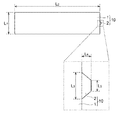
- the obtained resin composition was injection molded under the following conditions to produce an injection molded product for evaluation shown in FIG.
- the resin composition melted by the injection molding machine was supplied from the gate into the mold cavity by the injection molding machine.
- Injection molding machine SE180D manufactured by Sumitomo Heavy Industries, Ltd. (mold clamping force 180 tons, cylinder diameter 50 mm) Mold cavity shape: 100 mm (width) x 400 mm (length) x 3 mm (thickness)
- Gate 1 fan gate in the center of the side surface of 100 mm
- Cylinder temperature 220 ° C Mold temperature: 50 ° C
- Injection speed 23 mm / sec Cooling time: 30 seconds
- FIG. 1 is a schematic view of an injection molded product for evaluation.
- the injection molded body 10 shown in FIG. 1 includes a first resin portion 1 corresponding to the mold shape and a second resin portion 2 corresponding to the gate shape.
- the first resin portion 1 is a plate-shaped resin portion having a width L1 of 100 mm, a length L2 of 400 mm, and a thickness (not shown) of 3 mm. Further, in the injection molded products formed in this example and the comparative example, the lengths L3, L4 and L5 and the thickness (not shown) of each side of the second resin portion 2 are 15 mm, 5 mm, 4 mm and 2 mm, respectively. Met.
- the main body portion of the injection molded product is the first resin portion 1 (hereinafter, the portion corresponding to the “first resin portion 1” is also referred to as the “injection molded product”).
- the dimensional stability was evaluated by measuring the coefficient of linear expansion using the obtained injection molded product.
- the coefficient of linear expansion was measured by the following method using a thermomechanical analyzer (TMA / SS6100 manufactured by SII Nanotechnology Inc.).
- a 5 ⁇ 10 ⁇ 3 (mm) test piece was cut out from the central portion in the longitudinal direction of the injection molded product.
- the test piece was set in the above apparatus and heated from ⁇ 20 ° C. to 130 ° C. at a heating rate of 5 ° C./min to remove residual strain during molding.
- the MD direction rein flow direction
- the test piece was set again and the dimension at 23 ° C. was measured accurately. The temperature was raised from ⁇ 20 ° C. to 80 ° C.
- Table 1 shows the average value (MDTD average linear expansion coefficient) of the linear expansion coefficient in the MD direction and the linear expansion coefficient in the TD direction.
- the obtained resin composition was injection molded under the following conditions to produce an injection molded body for evaluation shown in FIG.
- the resin composition melted by the injection molding machine was supplied from the two gates into the mold cavity by the injection molding machine.
- Injection molding machine SE130DU manufactured by Sumitomo Heavy Industries, Ltd. (mold clamping force 130 tons, cylinder diameter 40 mm) Mold cavity shape: 90 mm (width) x 150 mm (length) x 3 mm (thickness) Gate: 2 gates at the center of both sides of 90 mm Cylinder temperature: 220 ° C Mold temperature: 50 ° C Injection speed: 30 mm / sec Cooling time: 30 seconds
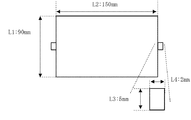
- FIG. 2 is a schematic view of an injection molded body for evaluating the hinge resistance of the weld portion.
- the injection molded body 10 shown in FIG. 2 has a first resin portion 1 corresponding to the mold shape and a third resin portion 3 corresponding to the gate shape on the opposite side as well as the second resin portion 2 corresponding to the gate shape.
- the first resin portion 1 is a plate-shaped resin portion having a width L1 of 90 mm, a length L2 of 150 mm, and a thickness (not shown) of 3 mm.
- the lengths L3 and L4 and the thickness (not shown) of each side of the second resin portion 2 were 5 mm, 2 mm and 3 mm, respectively.
- the length of each side of the third resin portion 3 is the same as that of the second resin portion 2.
- the main body portion of the injection molded product is the first resin portion 1 (hereinafter, the portion corresponding to the “first resin portion 1” is also referred to as the “injection molded product”).
- the molded product according to the example has a low MDTD average coefficient of linear expansion and is excellent in dimensional stability. That is, it was confirmed that the propylene resin composition of the present invention can produce a molded product having excellent dimensional stability, and that the molded product of the present invention has excellent dimensional stability. Further, it can be seen that the molded product according to the embodiment has a large number of times until the weld portion breaks during the bending test, and is excellent in the hinge resistance of the weld portion.
Landscapes
- Chemical & Material Sciences (AREA)
- Health & Medical Sciences (AREA)
- Chemical Kinetics & Catalysis (AREA)
- Medicinal Chemistry (AREA)
- Polymers & Plastics (AREA)
- Organic Chemistry (AREA)
- Compositions Of Macromolecular Compounds (AREA)
Abstract
L'invention concerne une composition de résine de propylène contenant : (A) de 30 à 65 parts massiques d'un polymère à base de propylène ; (B) de 10 à 40 parts massiques d'un copolymère aléatoire d'éthylène-α-oléfine ; (C) de 10 à 40 parts massiques d'une charge ; et (D) de 0,1 à 10 parts massiques d'un copolymère séquencé d'éthylène-α-oléfine. La teneur totale des composants A-D est de 100 parts massiques, le composant D contient au maximum 70 % parts massiques d'un composant soluble dans le xylène à 20 °C, et la densité du composant D est de 0,865-0,867 g/cm3.
Priority Applications (4)
| Application Number | Priority Date | Filing Date | Title |
|---|---|---|---|
| EP20795950.3A EP3960812A4 (fr) | 2019-04-24 | 2020-03-25 | Composition de résine de propylène et corps moulé |
| JP2020555091A JP7410049B2 (ja) | 2019-04-24 | 2020-03-25 | プロピレン樹脂組成物及び成形体 |
| CN202080030902.3A CN113767145B (zh) | 2019-04-24 | 2020-03-25 | 丙烯树脂组合物以及成型体 |
| US17/605,314 US20220186012A1 (en) | 2019-04-24 | 2020-03-25 | Propylene resin composition and molded body |
Applications Claiming Priority (2)
| Application Number | Priority Date | Filing Date | Title |
|---|---|---|---|
| JP2019083127 | 2019-04-24 | ||
| JP2019-083127 | 2019-04-24 |
Publications (1)
| Publication Number | Publication Date |
|---|---|
| WO2020217829A1 true WO2020217829A1 (fr) | 2020-10-29 |
Family
ID=72942002
Family Applications (1)
| Application Number | Title | Priority Date | Filing Date |
|---|---|---|---|
| PCT/JP2020/013266 Ceased WO2020217829A1 (fr) | 2019-04-24 | 2020-03-25 | Composition de résine de propylène et corps moulé |
Country Status (5)
| Country | Link |
|---|---|
| US (1) | US20220186012A1 (fr) |
| EP (1) | EP3960812A4 (fr) |
| JP (1) | JP7410049B2 (fr) |
| CN (1) | CN113767145B (fr) |
| WO (1) | WO2020217829A1 (fr) |
Cited By (4)
| Publication number | Priority date | Publication date | Assignee | Title |
|---|---|---|---|---|
| JP2023150350A (ja) * | 2022-03-31 | 2023-10-16 | 株式会社プライムポリマー | ポリプロピレン系樹脂組成物および成形体 |
| JP7518269B1 (ja) | 2023-10-23 | 2024-07-17 | 住友化学株式会社 | プロピレン樹脂組成物及び成形体 |
| WO2024166852A1 (fr) | 2023-02-07 | 2024-08-15 | 住友化学株式会社 | Composition de résine de propylène, et corps moulé |
| JP2025108344A (ja) * | 2024-01-10 | 2025-07-23 | 住友化学株式会社 | リサイクル樹脂の製造方法 |
Families Citing this family (3)
| Publication number | Priority date | Publication date | Assignee | Title |
|---|---|---|---|---|
| EP3710521A4 (fr) * | 2017-11-13 | 2021-08-04 | Council of Scientific and Industrial Research | Impression 3d de polymères sans gauchissement |
| JP7197784B2 (ja) * | 2018-01-30 | 2022-12-28 | キョーラク株式会社 | 構造体の製造方法 |
| WO2026012954A1 (fr) * | 2024-07-09 | 2026-01-15 | Sabic Global Technologies B.V. | Composition de polypropylène |
Citations (15)
| Publication number | Priority date | Publication date | Assignee | Title |
|---|---|---|---|---|
| JPS5575410A (en) | 1978-11-30 | 1980-06-06 | Sumitomo Chem Co Ltd | Drying method and apparatus for polyolefin |
| JPS61218606A (ja) | 1985-03-25 | 1986-09-29 | Sumitomo Chem Co Ltd | α−オレフイン重合体の製造法 |
| JPH05194685A (ja) | 1991-09-27 | 1993-08-03 | Sumitomo Chem Co Ltd | エチレン−プロピレンブロック共重合体 |
| JPH07216017A (ja) | 1993-12-08 | 1995-08-15 | Sumitomo Chem Co Ltd | α−オレフィン重合用触媒ならびにα−オレフィン重合体の製造方法 |
| JP2565753B2 (ja) | 1988-09-19 | 1996-12-18 | 住友化学工業株式会社 | ポリプロピレン成形品 |
| JPH09316147A (ja) | 1996-06-03 | 1997-12-09 | Sumitomo Chem Co Ltd | プロピレン/エチレン−α−オレフィン系ブロック共重合体及びその製造方法 |
| JPH10212319A (ja) | 1996-08-23 | 1998-08-11 | Sumitomo Chem Co Ltd | α−オレフィン重合用触媒ならびにα−オレフィン重合体の製造方法 |
| EP0879830A1 (fr) | 1997-05-20 | 1998-11-25 | PCD Polymere AG | Polypropylène modifié ayant une mise en oeuvre améliorée |
| JP2004182981A (ja) | 2002-11-19 | 2004-07-02 | Sumitomo Chem Co Ltd | プロピレンブロック共重合体製造用固体触媒成分、プロピレンブロック共重合体製造用触媒、およびプロピレンブロック共重合体の製造方法 |
| EP1892264A1 (fr) | 2006-08-25 | 2008-02-27 | Borealis Technology Oy | Substrat couche par extrusion |
| JP2009132893A (ja) * | 2007-10-31 | 2009-06-18 | Sumitomo Chemical Co Ltd | ポリプロピレン系樹脂組成物およびその製造方法、ならびに、発泡成形体 |
| JP2011500946A (ja) * | 2007-10-22 | 2011-01-06 | ダウ グローバル テクノロジーズ インコーポレイティド | 物品を成形するためのポリマー組成物及び方法 |
| JP2011088955A (ja) | 2009-10-20 | 2011-05-06 | Japan Polypropylene Corp | 結晶性ポリプロピレン樹脂組成物 |
| JP2015086529A (ja) * | 2013-10-29 | 2015-05-07 | アイシン精機株式会社 | 車両用ドアのポップアップ機構 |
| WO2017213126A1 (fr) * | 2016-06-07 | 2017-12-14 | 住友化学株式会社 | Composition de résine de propylène et article moulé par injection correspondant |
Family Cites Families (8)
| Publication number | Priority date | Publication date | Assignee | Title |
|---|---|---|---|---|
| US8273826B2 (en) * | 2006-03-15 | 2012-09-25 | Dow Global Technologies Llc | Impact modification of thermoplastics with ethylene/α-olefin interpolymers |
| JP4736435B2 (ja) | 2005-01-14 | 2011-07-27 | 住友化学株式会社 | ポリプロピレン系樹脂組成物 |
| CN101495563B (zh) * | 2006-06-05 | 2011-12-14 | 住友化学株式会社 | 聚丙烯树脂组合物及由其制备的汽车用注塑制品 |
| WO2014046139A1 (fr) | 2012-09-19 | 2014-03-27 | 三菱化学株式会社 | Couvercle de logement de coussin gonflable |
| JP2015086259A (ja) * | 2013-10-29 | 2015-05-07 | 株式会社プライムポリマー | プロピレン系樹脂組成物 |
| CN105385043B (zh) | 2015-12-22 | 2018-10-09 | 上海金发科技发展有限公司 | 一种汽车保险杠用聚丙烯复合物及其制备方法 |
| JP6790946B2 (ja) * | 2017-03-21 | 2020-11-25 | 日本ポリプロ株式会社 | ポリプロピレン繊維 |
| JP7061003B2 (ja) | 2017-04-14 | 2022-04-27 | 住友化学株式会社 | プロピレン樹脂組成物及び射出成形体 |
-
2020
- 2020-03-25 EP EP20795950.3A patent/EP3960812A4/fr not_active Withdrawn
- 2020-03-25 JP JP2020555091A patent/JP7410049B2/ja active Active
- 2020-03-25 WO PCT/JP2020/013266 patent/WO2020217829A1/fr not_active Ceased
- 2020-03-25 CN CN202080030902.3A patent/CN113767145B/zh not_active Expired - Fee Related
- 2020-03-25 US US17/605,314 patent/US20220186012A1/en not_active Abandoned
Patent Citations (16)
| Publication number | Priority date | Publication date | Assignee | Title |
|---|---|---|---|---|
| JPS5575410A (en) | 1978-11-30 | 1980-06-06 | Sumitomo Chem Co Ltd | Drying method and apparatus for polyolefin |
| JPS61218606A (ja) | 1985-03-25 | 1986-09-29 | Sumitomo Chem Co Ltd | α−オレフイン重合体の製造法 |
| JP2565753B2 (ja) | 1988-09-19 | 1996-12-18 | 住友化学工業株式会社 | ポリプロピレン成形品 |
| JPH05194685A (ja) | 1991-09-27 | 1993-08-03 | Sumitomo Chem Co Ltd | エチレン−プロピレンブロック共重合体 |
| JPH07216017A (ja) | 1993-12-08 | 1995-08-15 | Sumitomo Chem Co Ltd | α−オレフィン重合用触媒ならびにα−オレフィン重合体の製造方法 |
| JPH09316147A (ja) | 1996-06-03 | 1997-12-09 | Sumitomo Chem Co Ltd | プロピレン/エチレン−α−オレフィン系ブロック共重合体及びその製造方法 |
| JPH10212319A (ja) | 1996-08-23 | 1998-08-11 | Sumitomo Chem Co Ltd | α−オレフィン重合用触媒ならびにα−オレフィン重合体の製造方法 |
| EP0879830A1 (fr) | 1997-05-20 | 1998-11-25 | PCD Polymere AG | Polypropylène modifié ayant une mise en oeuvre améliorée |
| JP2004182981A (ja) | 2002-11-19 | 2004-07-02 | Sumitomo Chem Co Ltd | プロピレンブロック共重合体製造用固体触媒成分、プロピレンブロック共重合体製造用触媒、およびプロピレンブロック共重合体の製造方法 |
| EP1892264A1 (fr) | 2006-08-25 | 2008-02-27 | Borealis Technology Oy | Substrat couche par extrusion |
| JP2011500946A (ja) * | 2007-10-22 | 2011-01-06 | ダウ グローバル テクノロジーズ インコーポレイティド | 物品を成形するためのポリマー組成物及び方法 |
| JP2011500945A (ja) * | 2007-10-22 | 2011-01-06 | ダウ グローバル テクノロジーズ インコーポレイティド | 物品を成形するためのポリマー組成物及び方法 |
| JP2009132893A (ja) * | 2007-10-31 | 2009-06-18 | Sumitomo Chemical Co Ltd | ポリプロピレン系樹脂組成物およびその製造方法、ならびに、発泡成形体 |
| JP2011088955A (ja) | 2009-10-20 | 2011-05-06 | Japan Polypropylene Corp | 結晶性ポリプロピレン樹脂組成物 |
| JP2015086529A (ja) * | 2013-10-29 | 2015-05-07 | アイシン精機株式会社 | 車両用ドアのポップアップ機構 |
| WO2017213126A1 (fr) * | 2016-06-07 | 2017-12-14 | 住友化学株式会社 | Composition de résine de propylène et article moulé par injection correspondant |
Non-Patent Citations (4)
| Title |
|---|
| A. ZAMBELLI ET AL., MACROMOLECULES, vol. 6, 1973, pages 925 |
| KAKUGO ET AL., MACROMOLECULES, vol. 15, 1982, pages 1150 - 1152 |
| MACROMOLECULES, vol. 8, 1975, pages 687 |
| See also references of EP3960812A4 |
Cited By (9)
| Publication number | Priority date | Publication date | Assignee | Title |
|---|---|---|---|---|
| JP2023150350A (ja) * | 2022-03-31 | 2023-10-16 | 株式会社プライムポリマー | ポリプロピレン系樹脂組成物および成形体 |
| JP7814222B2 (ja) | 2022-03-31 | 2026-02-16 | 株式会社プライムポリマー | ポリプロピレン系樹脂組成物および成形体 |
| WO2024166852A1 (fr) | 2023-02-07 | 2024-08-15 | 住友化学株式会社 | Composition de résine de propylène, et corps moulé |
| JP7540105B1 (ja) | 2023-02-07 | 2024-08-26 | 住友化学株式会社 | プロピレン樹脂組成物及び成形体 |
| JP2024119750A (ja) * | 2023-02-07 | 2024-09-03 | 住友化学株式会社 | プロピレン樹脂組成物及び成形体 |
| JP7518269B1 (ja) | 2023-10-23 | 2024-07-17 | 住友化学株式会社 | プロピレン樹脂組成物及び成形体 |
| WO2025089128A1 (fr) * | 2023-10-23 | 2025-05-01 | 住友化学株式会社 | Composition de résine de propylène, et corps moulé |
| JP2025071726A (ja) * | 2023-10-23 | 2025-05-08 | 住友化学株式会社 | プロピレン樹脂組成物及び成形体 |
| JP2025108344A (ja) * | 2024-01-10 | 2025-07-23 | 住友化学株式会社 | リサイクル樹脂の製造方法 |
Also Published As
| Publication number | Publication date |
|---|---|
| EP3960812A4 (fr) | 2023-01-18 |
| CN113767145A (zh) | 2021-12-07 |
| US20220186012A1 (en) | 2022-06-16 |
| CN113767145B (zh) | 2023-10-27 |
| JP7410049B2 (ja) | 2024-01-09 |
| JPWO2020217829A1 (fr) | 2020-10-29 |
| EP3960812A1 (fr) | 2022-03-02 |
Similar Documents
| Publication | Publication Date | Title |
|---|---|---|
| JP7410049B2 (ja) | プロピレン樹脂組成物及び成形体 | |
| CN101379127B (zh) | 聚丙烯组合物 | |
| JP6948977B2 (ja) | プロピレン樹脂組成物及び射出成形体 | |
| WO2016005301A1 (fr) | Compositions de polypropylène à charge minérale destinées à être expansées | |
| EP2553016A1 (fr) | Composition de polyoléfine hétérophasique | |
| CA3000906C (fr) | Composition de tpo a ecoulement eleve presentant un excellent equilibre des proprietes mecaniques pour interieur d'automobiles | |
| JP7061003B2 (ja) | プロピレン樹脂組成物及び射出成形体 | |
| CA3004383A1 (fr) | Composition de tpo a ecoulement eleve presentant un excellent impact a temperature basse | |
| KR101185710B1 (ko) | 투명성 및 내충격 특성이 우수한 폴리프로필렌 수지 조성물 | |
| CN108350239A (zh) | 多相聚丙烯组合物 | |
| JP7023164B2 (ja) | プロピレン樹脂組成物及び成形体 | |
| JP2012229303A (ja) | プロピレン系樹脂組成物及びその射出成形体 | |
| CA3003227C (fr) | Composition de tpo a haute fluidite presentant un allongement en traction excellent a la rupture et une faible adhesivite de poudre | |
| KR20160039406A (ko) | 고충격 고강성 폴리프로필렌 수지 조성물, 이의 제조방법 및 이로 제조된 성형품 | |
| JP6826595B2 (ja) | プロピレン系樹脂組成物及びその射出成形体 | |
| JP2024033381A (ja) | マスターバッチ組成物 | |
| JP7752229B2 (ja) | プロピレン樹脂組成物、成形体、および、成形体の製造方法 | |
| WO2026008753A1 (fr) | Composition de polypropylène | |
| US20230220136A1 (en) | Polyolefin Compositions and Articles Thereof | |
| WO2025120035A1 (fr) | Composition de polypropylène à résistance aux chocs améliorée | |
| CN119081289A (zh) | 具有高刚性和高韧性且轻量化的聚烯烃组合物 | |
| KR20140125257A (ko) | 폴리프로필렌 수지 및 이를 포함하는 수지 조성물 |
Legal Events
| Date | Code | Title | Description |
|---|---|---|---|
| ENP | Entry into the national phase |
Ref document number: 2020555091 Country of ref document: JP Kind code of ref document: A |
|
| 121 | Ep: the epo has been informed by wipo that ep was designated in this application |
Ref document number: 20795950 Country of ref document: EP Kind code of ref document: A1 |
|
| NENP | Non-entry into the national phase |
Ref country code: DE |
|
| ENP | Entry into the national phase |
Ref document number: 2020795950 Country of ref document: EP Effective date: 20211124 |