WO2020218574A1 - ポリオレフィン樹脂組成物及びその製造方法 - Google Patents
ポリオレフィン樹脂組成物及びその製造方法 Download PDFInfo
- Publication number
- WO2020218574A1 WO2020218574A1 PCT/JP2020/017828 JP2020017828W WO2020218574A1 WO 2020218574 A1 WO2020218574 A1 WO 2020218574A1 JP 2020017828 W JP2020017828 W JP 2020017828W WO 2020218574 A1 WO2020218574 A1 WO 2020218574A1
- Authority
- WO
- WIPO (PCT)
- Prior art keywords
- group
- polyolefin resin
- compound
- resin composition
- hydrogen
- Prior art date
- Legal status (The legal status is an assumption and is not a legal conclusion. Google has not performed a legal analysis and makes no representation as to the accuracy of the status listed.)
- Ceased
Links
Classifications
-
- C—CHEMISTRY; METALLURGY
- C08—ORGANIC MACROMOLECULAR COMPOUNDS; THEIR PREPARATION OR CHEMICAL WORKING-UP; COMPOSITIONS BASED THEREON
- C08K—Use of inorganic or non-macromolecular organic substances as compounding ingredients
- C08K5/00—Use of organic ingredients
- C08K5/04—Oxygen-containing compounds
- C08K5/10—Esters; Ether-esters
- C08K5/101—Esters; Ether-esters of monocarboxylic acids
-
- C—CHEMISTRY; METALLURGY
- C07—ORGANIC CHEMISTRY
- C07C—ACYCLIC OR CARBOCYCLIC COMPOUNDS
- C07C323/00—Thiols, sulfides, hydropolysulfides or polysulfides substituted by halogen, oxygen or nitrogen atoms, or by sulfur atoms not being part of thio groups
- C07C323/10—Thiols, sulfides, hydropolysulfides or polysulfides substituted by halogen, oxygen or nitrogen atoms, or by sulfur atoms not being part of thio groups containing thio groups and singly-bound oxygen atoms bound to the same carbon skeleton
- C07C323/18—Thiols, sulfides, hydropolysulfides or polysulfides substituted by halogen, oxygen or nitrogen atoms, or by sulfur atoms not being part of thio groups containing thio groups and singly-bound oxygen atoms bound to the same carbon skeleton having the sulfur atom of at least one of the thio groups bound to a carbon atom of a six-membered aromatic ring of the carbon skeleton
- C07C323/20—Thiols, sulfides, hydropolysulfides or polysulfides substituted by halogen, oxygen or nitrogen atoms, or by sulfur atoms not being part of thio groups containing thio groups and singly-bound oxygen atoms bound to the same carbon skeleton having the sulfur atom of at least one of the thio groups bound to a carbon atom of a six-membered aromatic ring of the carbon skeleton with singly-bound oxygen atoms bound to carbon atoms of the same non-condensed six-membered aromatic ring
-
- C—CHEMISTRY; METALLURGY
- C07—ORGANIC CHEMISTRY
- C07C—ACYCLIC OR CARBOCYCLIC COMPOUNDS
- C07C69/00—Esters of carboxylic acids; Esters of carbonic or haloformic acids
- C07C69/52—Esters of acyclic unsaturated carboxylic acids having the esterified carboxyl group bound to an acyclic carbon atom
- C07C69/533—Monocarboxylic acid esters having only one carbon-to-carbon double bond
- C07C69/54—Acrylic acid esters; Methacrylic acid esters
-
- C—CHEMISTRY; METALLURGY
- C08—ORGANIC MACROMOLECULAR COMPOUNDS; THEIR PREPARATION OR CHEMICAL WORKING-UP; COMPOSITIONS BASED THEREON
- C08F—MACROMOLECULAR COMPOUNDS OBTAINED BY REACTIONS ONLY INVOLVING CARBON-TO-CARBON UNSATURATED BONDS
- C08F255/00—Macromolecular compounds obtained by polymerising monomers on to polymers of hydrocarbons as defined in group C08F10/00
- C08F255/02—Macromolecular compounds obtained by polymerising monomers on to polymers of hydrocarbons as defined in group C08F10/00 on to polymers of olefins having two or three carbon atoms
-
- C—CHEMISTRY; METALLURGY
- C08—ORGANIC MACROMOLECULAR COMPOUNDS; THEIR PREPARATION OR CHEMICAL WORKING-UP; COMPOSITIONS BASED THEREON
- C08J—WORKING-UP; GENERAL PROCESSES OF COMPOUNDING; AFTER-TREATMENT NOT COVERED BY SUBCLASSES C08B, C08C, C08F, C08G or C08H
- C08J3/00—Processes of treating or compounding macromolecular substances
- C08J3/20—Compounding polymers with additives, e.g. colouring
- C08J3/22—Compounding polymers with additives, e.g. colouring using masterbatch techniques
-
- C—CHEMISTRY; METALLURGY
- C08—ORGANIC MACROMOLECULAR COMPOUNDS; THEIR PREPARATION OR CHEMICAL WORKING-UP; COMPOSITIONS BASED THEREON
- C08K—Use of inorganic or non-macromolecular organic substances as compounding ingredients
- C08K5/00—Use of organic ingredients
- C08K5/04—Oxygen-containing compounds
- C08K5/10—Esters; Ether-esters
- C08K5/101—Esters; Ether-esters of monocarboxylic acids
- C08K5/105—Esters; Ether-esters of monocarboxylic acids with phenols
-
- C—CHEMISTRY; METALLURGY
- C08—ORGANIC MACROMOLECULAR COMPOUNDS; THEIR PREPARATION OR CHEMICAL WORKING-UP; COMPOSITIONS BASED THEREON
- C08K—Use of inorganic or non-macromolecular organic substances as compounding ingredients
- C08K5/00—Use of organic ingredients
- C08K5/04—Oxygen-containing compounds
- C08K5/14—Peroxides
-
- C—CHEMISTRY; METALLURGY
- C08—ORGANIC MACROMOLECULAR COMPOUNDS; THEIR PREPARATION OR CHEMICAL WORKING-UP; COMPOSITIONS BASED THEREON
- C08K—Use of inorganic or non-macromolecular organic substances as compounding ingredients
- C08K5/00—Use of organic ingredients
- C08K5/36—Sulfur-, selenium-, or tellurium-containing compounds
- C08K5/37—Thiols
- C08K5/372—Sulfides, e.g. R-(S)x-R'
-
- C—CHEMISTRY; METALLURGY
- C08—ORGANIC MACROMOLECULAR COMPOUNDS; THEIR PREPARATION OR CHEMICAL WORKING-UP; COMPOSITIONS BASED THEREON
- C08L—COMPOSITIONS OF MACROMOLECULAR COMPOUNDS
- C08L23/00—Compositions of homopolymers or copolymers of unsaturated aliphatic hydrocarbons having only one carbon-to-carbon double bond; Compositions of derivatives of such polymers
- C08L23/02—Compositions of homopolymers or copolymers of unsaturated aliphatic hydrocarbons having only one carbon-to-carbon double bond; Compositions of derivatives of such polymers not modified by chemical after-treatment
- C08L23/10—Homopolymers or copolymers of propene
- C08L23/12—Polypropene
-
- C—CHEMISTRY; METALLURGY
- C08—ORGANIC MACROMOLECULAR COMPOUNDS; THEIR PREPARATION OR CHEMICAL WORKING-UP; COMPOSITIONS BASED THEREON
- C08J—WORKING-UP; GENERAL PROCESSES OF COMPOUNDING; AFTER-TREATMENT NOT COVERED BY SUBCLASSES C08B, C08C, C08F, C08G or C08H
- C08J2323/00—Characterised by the use of homopolymers or copolymers of unsaturated aliphatic hydrocarbons having only one carbon-to-carbon double bond; Derivatives of such polymers
- C08J2323/02—Characterised by the use of homopolymers or copolymers of unsaturated aliphatic hydrocarbons having only one carbon-to-carbon double bond; Derivatives of such polymers not modified by chemical after treatment
- C08J2323/10—Homopolymers or copolymers of propene
- C08J2323/12—Polypropene
-
- C—CHEMISTRY; METALLURGY
- C08—ORGANIC MACROMOLECULAR COMPOUNDS; THEIR PREPARATION OR CHEMICAL WORKING-UP; COMPOSITIONS BASED THEREON
- C08J—WORKING-UP; GENERAL PROCESSES OF COMPOUNDING; AFTER-TREATMENT NOT COVERED BY SUBCLASSES C08B, C08C, C08F, C08G or C08H
- C08J2423/00—Characterised by the use of homopolymers or copolymers of unsaturated aliphatic hydrocarbons having only one carbon-to-carbon double bond; Derivatives of such polymers
- C08J2423/02—Characterised by the use of homopolymers or copolymers of unsaturated aliphatic hydrocarbons having only one carbon-to-carbon double bond; Derivatives of such polymers not modified by chemical after treatment
- C08J2423/16—Ethene-propene or ethene-propene-diene copolymers
Definitions
- the present invention relates to a polyolefin resin composition and a method for producing the same.
- Polyolefin resin is used as a material for various industrial parts such as interior and exterior parts such as bumpers, instrumental panels, door trims and pillars in automobile applications, and parts such as vacuum cleaners and televisions in home appliances. While these parts are required to have rigidity and impact resistance, the parts used for these parts are also required to be lighter due to the increasing demand for weight reduction of automobiles and home appliances in recent years. Has been done.
- a method of thinning the parts can be considered, but the impact resistance may decrease due to the thinning. Further, when molding a thin-walled part, it is necessary to improve the fluidity of the polyolefin resin constituting the part, but the impact resistance is also lowered by improving the fluidity of the resin. I have something to do.
- Patent Document 1 describes a specific propylene polymer and a resin composition containing a copolymer of ethylene and propylene or ⁇ -olefin having 4 to 20 carbon atoms.
- Patent Document 2 describes a thermoplastic polymer composition containing a thermoplastic polymer and a specific compatibilizer.
- the polyolefin resin composition is used without coloring or in some cases colored according to the properties required for parts and the like, but in any case, it is derived from the polyolefin resin composition before coloring. It is desirable that the tint (for example, yellowness) is reduced.
- an object of the present invention is to provide a resin composition in which the coloration derived from the polyolefin resin composition itself is reduced and the impact resistance and fluidity are excellent.
- the present inventors have focused on the types and amounts of the components contained in the resin composition and conducted diligent studies. As a result, they have found that the above-mentioned problems can be solved by the polyolefin resin composition containing a specific component, and have completed the present invention.
- the present invention includes the following preferred embodiments.
- [1] (A) 100 parts by mass of polyolefin resin, (B) A compound having at least 0.01 to 5 parts by mass of one (meth) acrylate group and one hydrogen-bonding group or one (meth) acrylate group, and (C) 0.
- Y represents a single bond, a sulfide bond, or a linear or branched alkylene group having 1 to 9 carbon atoms.
- R 2 and R 5 independently represent a hydrogen atom or a linear or branched alkyl group having 1 to 9 carbon atoms, and R 3 and R 4 independently represent 1 to 9 carbon atoms, respectively.
- X 1 and X 2 represent a linear or branched alkyl group having 1 to 9 carbon atoms
- a compound having at least one (meth) acrylate group and one hydrogen-bonding group or one (meth) acrylate group includes one (meth) acrylate group and at least one.
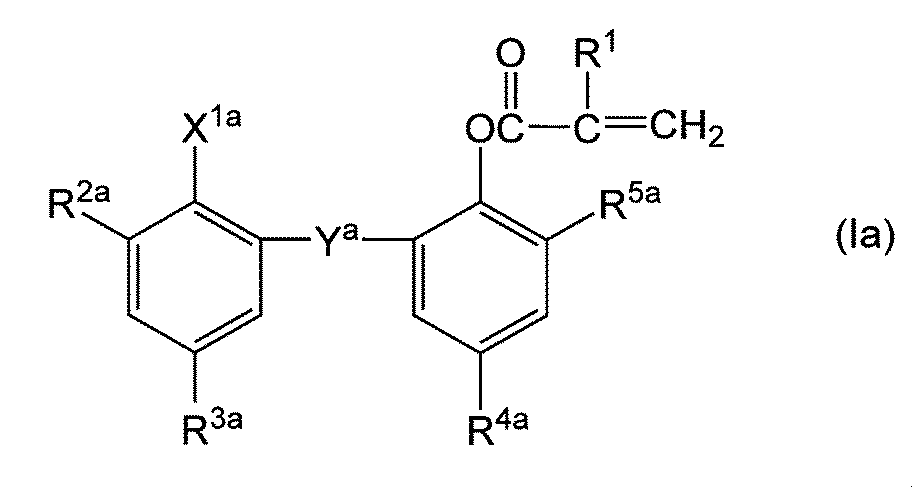
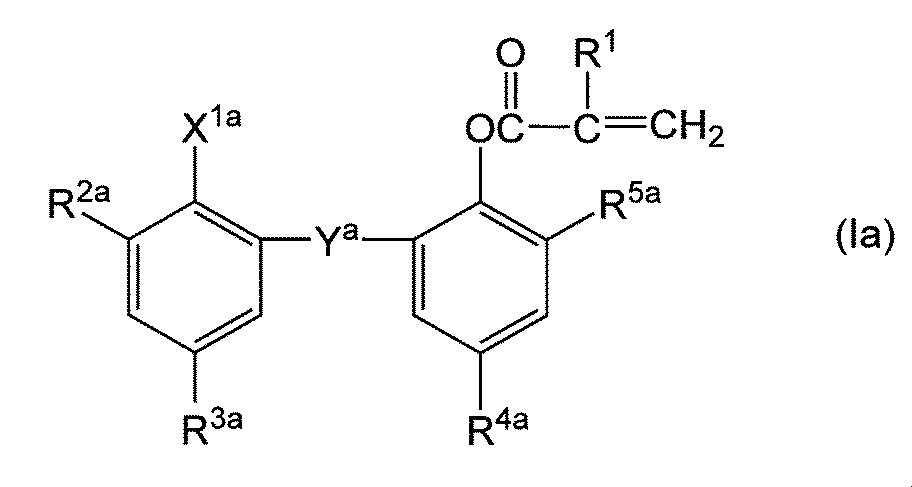
- (B) The compound having one (meth) acrylate group and at least one hydrogen-bonding group is represented by the formula (Ia): [In formula (Ia), X 1a represents a hydrogen-bonding group and represents Y a represents a single bond or a linear or branched alkylene group having 1-9 carbon atoms, R 1 represents a hydrogen atom or a methyl group R2a to R5a each independently represent a linear or branched alkyl group having 1 to 9 carbon atoms]
- the polyolefin resin composition according to the above [5] which is represented by.
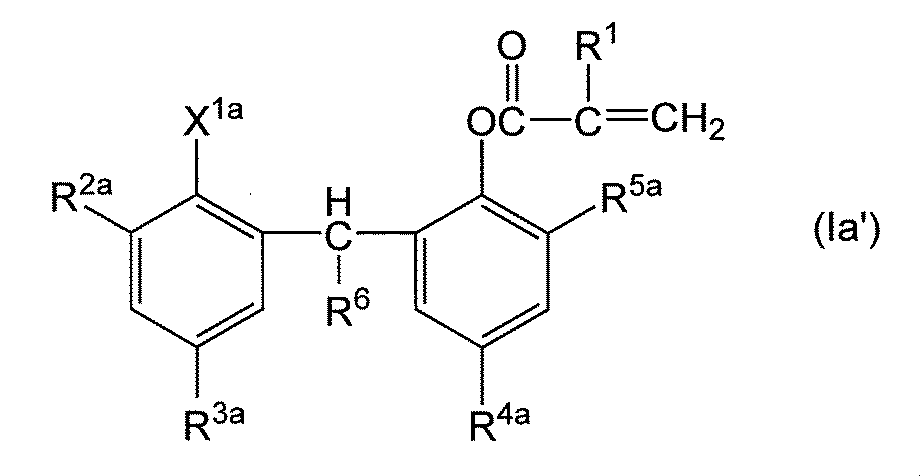
- Equation (I) is the equation (Ia'): Wherein (Ia '), X 1a, R 1 and R 2a ⁇ R 5a are each as defined for X 1a, R 1 and R 2a ⁇ R 5a in formula (Ia), R 6 is Represents a hydrogen atom or a methyl group]
- the hydrogen-bonding group is selected from the group consisting of a hydroxyl group, an amino group, a thiol group, a carboxyl group, a sulfonic acid group, and a phosphoric acid group, according to any one of the above [1] to [7].
- X 1a represents a hydroxyl group
- R 1 represents a hydrogen atom
- R 2a to R 5a represent a 1,1-dimethylpropyl group
- R 6 represents a methyl group.
- X 1a represents a hydroxyl group
- R 1 and R 6 represent a hydrogen atom
- R 2a and R 5a represent a t-butyl group
- R 3a and R 4a represent a methyl group.
- the organic peroxide (C) is selected from the group consisting of an alkyl peroxide compound, a diacyl peroxide compound, a peroxide ester compound and a carbonate carbonate compound, and is any one of the above [1] to [11].
- At least a step of mixing a compound having at least a binding group or one (meth) acrylate group and (C) an organic peroxide by melt-kneading a mixture obtained by dry mixing in advance is included.
- (C) organic peroxide
- Step (1) of dry-mixing the oxides to obtain a mixture and the step (2) of melt-kneading the mixture obtained in the step (1) to obtain a polyolefin resin composition are included, or Step (1a) to obtain a first dry mixture by dry-mixing a part of (A) polyolefin resin and (C) organic peroxide, and melt-knead the dry mixture obtained in step (1a) to obtain the first premix.
- Step (1a) to obtain a first dry mixture by dry-mixing a part of (A) polyolefin resin and (C) organic peroxide, and melt-knead the dry mixture obtained in step (1a) to obtain the first premix.
- (2a) the first premix obtained in step (2a), (B) one (meth) acrylate group, and at least one hydrogen-binding group or one (meth) acrylate group.
- the compound having at least the above and another part of (C) the organic peroxide are dry-mixed to obtain a second dry mixture, and the dry mixture obtained in step (1b) is melt-kneaded.
- a masterbatch containing at least the compound and at least one resin selected from the group consisting of polyolefin-based resins and ethylene-based copolymers. Production method.
- [21] Selected from the group consisting of a compound having at least one (meth) acrylate group and one hydrogen-binding group or one (meth) acrylate group, and a polyolefin-based resin and an ethylene-based copolymer.
- a compound having at least one (meth) acrylate group and one hydrogen-binding group or one (meth) acrylate group is added to 100 parts by mass of a polyolefin resin and an ethylene copolymer.
- the master batch according to the above [21] which comprises 10 to 50 parts by mass.
- the present invention also includes the following aspects in a preferred embodiment.
- [1'] (A) 100 parts by mass of polyolefin resin, (B) 0.01 to 5 parts by mass of a compound having one (meth) acrylate group and at least one hydrogen-bonding group, and (C) 0.01 to 5 parts by mass of an organic peroxide.
- Equation (I) is the equation (Ia'): Wherein (Ia '), X 1a, R 1 and R 2a ⁇ R 5a are each as defined for X 1a, R 1 and R 2a ⁇ R 5a in formula (Ia), R 6 is Represents a hydrogen atom or a methyl group]
- the hydrogen-bonding group is selected from the group consisting of a hydroxyl group, an amino group, a thiol group, a carboxyl group, a sulfonic acid group, and a phosphoric acid group, according to the above [1'] to [3'].
- X 1a represents a hydroxyl group
- R 1 represents a hydrogen atom
- R 2a to R 5a represent a 1,1-dimethylpropyl group
- R 6 represents a methyl group.
- X 1a represents a hydroxyl group
- R 1 and R 6 represent a hydrogen atom
- R 2a and R 5a represent a t-butyl group
- R 3a and R 4a represent methyl.
- the polyolefin resin composition according to the above [3'] which represents a group.
- the organic peroxide is selected from the group consisting of an alkyl peroxide compound, a diacyl peroxide compound, a peroxide ester compound and a carbonate carbonate compound, as described above [1'] to [6'].
- Step (1) for obtaining and the step (2) for obtaining a polyolefin resin composition by melt-kneading the mixture obtained in step (1) are included, or Step (1a) to obtain a first dry mixture by dry-mixing a part of (A) polyolefin resin and (C) organic peroxide, and melt-knead the dry mixture obtained in step (1a) to obtain the first premix.
- step (2a) the first premix obtained in step (2a), (B) a compound having one (meth) acrylate group and at least one hydrogen-binding group, and (C) an organic peroxide.
- a polyolefin resin composition having excellent impact resistance and fluidity, in which the color derived from the polyolefin resin composition itself is reduced.
- the polyolefin resin composition of the present invention comprises (A) 100 parts by mass of polyolefin resin, (B) 0.01 to 5 parts by mass of one (meth) acrylate group, and one hydrogen-bonding group or one. It contains at least a compound having at least one (meth) acrylate group and (C) 0.01 to 5 parts by mass of an organic peroxide.
- the polyolefin resin composition of the present invention contains a polyolefin resin as a main component, and contains 0.01 to 5 parts by mass of (B) one (meth) acrylate group with respect to 100 parts by mass of the polyolefin resin.
- a compound having at least one hydrogen-binding group or one (meth) acrylate group Containing a compound having at least one hydrogen-binding group or one (meth) acrylate group, and 0.01 to 5 parts by mass of (C) organic peroxide with respect to 100 parts by mass of the polyolefin resin.
- a compound having at least one (meth) acrylate group and one hydrogen-bonding group or one (meth) acrylate group is also referred to as "compound (B)".
- the polyolefin resin composition of the present invention comprises (A) 100 parts by mass of polyolefin resin, (B) 0.01 to 5 parts by mass of one (meth) acrylate group and at least one. It contains at least 0.01 to 5 parts by mass of a compound having hydrogen-bonding groups and (C) an organic peroxide.
- the polyolefin resin composition of the present invention contains a polyolefin resin as a main component, and has 0.01 to 5 parts by mass of (B) one (meth) acrylate group and at least 100 parts by mass of the polyolefin resin.
- compound (Ba) a compound having one hydrogen-binding group and 0.01 to 5 parts by mass of (C) organic peroxide with respect to 100 parts by mass of the polyolefin resin.
- compound (Ba) a compound having one (meth) acrylate group and at least one hydrogen-bonding group.
- compound (B) also applies to other compounds (Ba) and the like.
- the reason why the color tint derived from the polyolefin resin composition itself is reduced and the impact resistance and fluidity are improved is not clear, but it may be due to the following mechanism. Conceivable.
- the present invention is not limited to the following mechanism.
- the polyolefin resin composition contains an organic peroxide, it is considered that the organic peroxide has an effect of decomposing the polyolefin resin and improving the fluidity of the resin.
- the compound (B) contained in the polyolefin resin composition has one (meth) acrylate group and one hydrogen-binding group or one (meth) acrylate group, so that the compound (B) is organically charged.
- a compound that reacts with an oxide, and the (meth) acrylate group or hydrogen-binding group of compound (B) moderately reacts and / or interacts with a polyolefin resin, and also interacts with another polyolefin resin ( B) interacts with the (meth) acrylate group or hydrogen-binding group.
- a propylene-based resin and an ethylene-based copolymer in the polyolefin resin are compatible with each other, and the propylene-based resin and the ethylene-based copolymer are finely dispersed to improve the impact resistance of the polyolefin resin composition. It is considered to have an effect.
- compound (B) when compound (B) is a compound (Ba) having one (meth) acrylate group and at least one hydrogen-binding group, the compound (Ba) has one (meth) acrylate group and at least one (meth) acrylate group.
- the compound (Ba) By having one hydrogen-binding group, it reacts with an organic peroxide, and the (meth) acrylate group of the compound (Ba) appropriately reacts and / or interacts with the polyolefin resin, and further, the compound ( The hydrogen-binding group of Ba) can be combined with, for example, a propylene-based resin and an ethylene-based copolymer in the polyolefin resin by hydrogen-bonding with the hydrogen-binding group of another compound (Ba) interacting with the polyolefin resin.
- the propylene-based resin and the ethylene-based copolymer are finely dispersed to improve the impact resistance of the polyolefin resin composition.
- the molded product obtained from the polyolefin resin composition of the present invention containing the specific compound (B) and the organic peroxide was surprisingly low in yellowness.
- the content of compound (B) is 0.01 to 5 parts by mass with respect to 100 parts by mass of (A) polyolefin resin.
- the content of the compound (B) is less than 0.01 parts by mass, it is considered that the microdispersion of the polyolefin resin is not sufficiently performed, and the impact resistance of the obtained molded product cannot be sufficiently enhanced.
- the content of the compound (B) exceeds 5 parts by mass, the hue tends to deteriorate. Further, it is not preferable from an economical point of view that the content of the compound (B) is too large.
- the content of the compound (B) is preferably 0.03 to 4 parts by mass with respect to 100 parts by mass of the polyolefin resin (A). It is more preferably 0.04 to 3 parts by mass, further preferably 0.05 to 2 parts by mass, and even more preferably 0.1 to 0.3 parts by mass.
- the compound (B) can react with the polyolefin resin (A) or the like under heating conditions such as melt kneading when producing the polyolefin resin composition of the present invention.
- the content of the compound (B) in the polyolefin resin composition of the present invention includes the amount of the unreacted compound (B) existing as the compound (B) in the polyolefin resin composition, the polyolefin resin and the like. Also include the amount of compound (B) that reacts and has a different structure. Therefore, the content of the compound (B) in the polyolefin resin composition of the present invention may be the amount (charged amount) of the compound (B) added when the polyolefin resin composition is produced.
- the content of the unreacted compound (B) that remains in the polyolefin resin composition as the compound (B) varies depending on the production conditions of the polyolefin resin composition, but was added when the polyolefin resin composition was produced.
- the amount is preferably 1 to 100%, more preferably 1 to 95%, still more preferably 1 to 90%, still more preferably about 2 to 90% with respect to the amount (charged amount) of the compound (B). Therefore, the content of the unreacted compound (B) in the polyolefin resin composition is preferably 0.0001 to 5 parts by mass, more preferably 0.0001 to 4. by mass, based on 100 parts by mass of the (A) polyolefin resin.
- the content of the unreacted compound (B) in the polyolefin resin composition may be measured by, for example, Soxhlet extraction of the polyolefin resin pellet with a solvent such as chloroform, using the solvent as a measurement sample, and liquid chromatography.
- the content of (C) organic peroxide is 0.01 to 5 parts by mass with respect to 100 parts by mass of (A) polyolefin resin.
- the content of the organic peroxide is less than 0.01 parts by mass, the fluidity and impact resistance of the polyolefin resin composition cannot be sufficiently enhanced.
- the content of the organic peroxide exceeds 5 parts by mass, the impact resistance of the obtained molded product becomes low.
- the content of the organic peroxide is preferably 0.03 to 3 parts by mass, more preferably 0, with respect to 100 parts by mass of the (A) polyolefin resin.
- the organic peroxide (C) can also react with the polyolefin resin (A) and the like under heating conditions such as in melt kneading when producing the polyolephon resin composition of the present invention. Therefore, the content of the organic peroxide (C) in the polyolefin resin composition of the present invention includes the unreacted organic peroxide (C) that exists as it is in the polyolefin resin composition. ) And the amount of the organic peroxide (C) that reacts with the polyolefin resin or the like and has a different structure. Therefore, the content of the organic peroxide (C) in the polyolefin resin composition of the present invention may be the amount (charged amount) of the organic peroxide (C) added when the polyolefin resin composition is produced.
- the content of the unreacted organic peroxide (C) present in the polyolefin resin composition as it is as the organic peroxide (C) varies depending on the production conditions of the polyolefin resin composition, but the polyolefin resin composition may be used.
- the amount of the organic peroxide (C) added during production is preferably 0.1 to 10%, more preferably 0.1 to 5%, still more preferably about 1 to 3% with respect to the amount (charged amount). Become. Therefore, the content of the unreacted organic peroxide (C) in the polyolefin resin composition is preferably 0.00001 to 0.5 parts by mass, more preferably 0, with respect to 100 parts by mass of the (A) polyolefin resin.
- the content of the unreacted organic peroxide (C) in the polyolefin resin composition may be measured by, for example, Soxhlet extraction of the polyolefin resin pellet with a solvent such as chloroform, using the solvent as a measurement sample, and liquid chromatography. ..
- the content of the polyolefin resin contained in the polyolefin resin composition of the present invention is preferably 60 to 99.9% by mass, more preferably 70 to 99.9% by mass, still more preferably, based on the total amount of the polyolefin resin composition. Is 75 to 99.0% by mass.
- the molar ratio of compound (B): organic peroxide (C) is preferably 1:10 to 10: 1, more preferably 5: 1 from the viewpoint of improving impact resistance. It is ⁇ 1: 1, more preferably 3: 1 to 1.2: 1.
- the molar ratio of the compound (B) to the organic peroxide is within the above range, the yellowness is likely to be lowered, and the fluidity and impact resistance of the polyolefin resin composition are likely to be compatible.
- the molar amount of the compound (B) contained in the polyolefin resin composition is preferably larger than the molar amount of the organic peroxide (C).
- the molar ratio of compound (B): organic peroxide (C) is preferably 10: 1 to 1.01: 1, more preferably 5: 1 to 1.1: 1, and even more preferably 3. 1 to 1.2: 1.
- the polyolefin resin composition of the present invention comprises 0.01 to 5 parts by mass of (B) one (meth) acrylate group and one hydrogen-bonding group or one (1) (1) to 100 parts by mass of the polyolefin resin. It contains a compound having at least a meta) acrylate group.
- the compound (B) is not particularly limited as long as it has the above functional groups, and the polyolefin resin composition of the present invention may contain one kind of compound (B) or two or more kinds of compounds (B). You may.
- a (meth) acrylate group represents an acrylate group or a methacrylate group.
- the hydrogen-binding group is not particularly limited as long as it is a group capable of hydrogen-bonding, and for example, a hydroxyl group, an amino group (primary and secondary amino groups), a thiol group, a carboxyl group, and a sulfone. Examples thereof include an acid group, a phosphoric acid group, an amide group and a carbamate group.
- the hydrogen-bonding group is preferably a hydroxyl group, an amino group, or a thiol group from the viewpoint of easily reducing the yellowness and easily achieving both fluidity and impact resistance.
- a carboxyl group, a sulfonic acid group and a phosphoric acid group more preferably a hydroxyl group and an amino group, and further preferably a hydroxyl group.
- the number of the hydrogen-bonding groups of the compound (B) may be at least one, but the color (yellowness) derived from the polyolefin resin composition itself. From the viewpoint of easily reducing the amount of hydrogen, and improving impact resistance and fluidity, the number is preferably 1 to 3, more preferably 1 or 2, and even more preferably 1.
- the number of (meth) acrylate groups of the compound (B) may be at least two.
- the number is preferably 2 to 3, more preferably 2. .. Therefore, from the same viewpoint, the compound (B) preferably has one (meth) acrylate group and one hydrogen-bonding group, or has two (meth) acrylate groups.
- the compound having (B) one (meth) acrylate group and at least one hydrogen-bonding group or one (meth) acrylate group is of formula (I) :.
- X 3 and X 4 each independently represent a hydrogen atom.
- it represents a linear or branched alkyl group having 1 to 9 carbon atoms
- X 1 and X 2 are independently hydrogen atoms or linear or branched alkyl groups having 1 to 9 carbon atoms, respectively.
- Y represents a single bond, a sulfide bond, or a linear or branched alkylene group having 1 to 9 carbon atoms.
- R 2 and R 5 independently represent a hydrogen atom or a linear or branched alkyl group having 1 to 9 carbon atoms, and R 3 and R 4 independently represent 1 to 9 carbon atoms, respectively.
- the polyolefin resin composition contains the compound (B) represented by the above formula (I), it is easy to reduce the coloration derived from the polyolefin resin composition itself, and the impact resistance and flow of the resin composition It is preferable because it is easy to improve the property.
- the polyolefin resin composition of the present invention may contain one kind of compound represented by the formula (I), or may contain two or more kinds of compounds represented by the formula (I). Good.
- hydrogen-binding groups are as described above, preferably selected from the group consisting of hydroxyl groups, amino groups, thiol groups, carboxyl groups, sulfonic acid groups and phosphoric acid groups, more preferably hydroxyl groups and It is selected from the group consisting of amino groups, more preferably hydroxyl groups.
- Examples of linear or branched alkyl groups having 1 to 9 carbon atoms include groups described later with respect to R 2a to R 5a in the formula (Ia).
- R 1 represents a hydrogen atom or a methyl group
- R 2 and R 5 each independently represent a hydrogen atom or a linear or branched alkyl group having 1 to 9 carbon atoms
- R 3 and R 4 each independently represent a linear or branched alkyl group having 1 to 9 carbon atoms. Examples of linear or branched alkyl groups having 1 to 9 carbon atoms include groups described later with respect to R 2a to R 5a in the formula (Ia).
- Y represents a single bond, a sulfide bond, or a linear or branched alkylene group having 1 to 9 carbon atoms.
- straight-chain or branched alkylene group having 1-9 carbon atoms include groups described below with respect to Y a in formula (Ia).
- compound (B) is of formula (I-1) :.
- Y is a single bond or a straight chain having 1 to 9 carbon atoms.
- R 1 represents a hydrogen atom or a methyl group
- R 2 to R 5 independently form a linear or branched alkyl group having 1 to 9 carbon atoms.
- It is a compound represented by.
- Preferred represents a hydrogen-binding group, more preferably a hydroxyl group, an amino group, a thiol group, a carboxyl group, a sulfonic acid group or a phosphoric acid group, still more preferably a hydroxyl group or an amino group, and even more preferably a hydroxyl group.
- Y may preferably have an alkyl group having 1 to 8 carbon atoms as a side chain from the viewpoint of easily achieving both fluidity and impact resistance of the polyolefin resin composition. It represents a methylene group, more preferably an alkyl group having 1 to 3 carbon atoms as a side chain, and even more preferably a methyl methylene group or a methylene group.
- R 2 to R 5 independently represent linear or branched alkyl groups having 1 to 9 carbon atoms, and the fluidity and impact resistance of the polyolefin resin composition. From the viewpoint of easily achieving both properties, each group is independently and preferably selected from the group consisting of a methyl group, a tert-butyl group and a 1,1-dimethylpropyl group.
- compound (B) is a compound having one (meth) acrylate group and at least one hydrogen bonding group, more preferably of the formula (Ia) :.
- X 1a represents a hydrogen-bonding group and represents Y a represents a single bond or a linear or branched alkylene group having 1-9 carbon atoms
- R 1 represents a hydrogen atom or a methyl group
- R2a to R5a each independently represent a linear or branched alkyl group having 1 to 9 carbon atoms
- the polyolefin resin composition of the present invention may contain one kind of compound represented by the formula (Ia), or may contain two or more kinds of compounds represented by the formula (Ia). Good.
- X 1a in the formula (Ia) represents a hydrogen-bonding group, and examples of the hydrogen-bonding group include the groups described above. From the viewpoint of easily achieving both fluidity and impact resistance, X 1a preferably contains a hydroxyl group, an amino group, a thiol group, a carboxyl group, a sulfonic acid group or a phosphoric acid group, and more preferably a hydroxyl group or an amino group. More preferably, it is a hydroxyl group.
- Y a in formula (Ia) represents a single bond or a linear or branched alkylene group having 1-9 carbon atoms.
- the carbon number of the linear or branched alkylene group having 1 to 9 carbon atoms is preferably 1 to 6 and more preferably from the viewpoint of easily reducing the yellowness and easily achieving both fluidity and impact resistance.
- Examples of the linear or branched alkylene group having 1 to 9 carbon atoms include a methylene group, an ethylene group, an n-propylene group, an isopropylene group, an n-butylene group, a sec-butylene group and an n-pentylene group.
- Y a in formula (Ia) from the viewpoint of easy to achieve both fluidity and impact resistance of the polyolefin resin composition, preferably methylene group which may have an alkyl group having 1 to 8 carbon atoms as a side chain, More preferably, it represents a methylene group which may have an alkyl group having 1 to 3 carbon atoms as a side chain, and particularly preferably a methyl methylene group or a methylene group.
- R 1 in the formula (Ia) represents a hydrogen atom or a methyl group, and from the viewpoint of improving impact resistance, R 1 in the formula (Ia) represents a hydrogen atom.
- R 2a to R 5a in the formula (Ia) each independently represent a linear or branched alkyl group having 1 to 9 carbon atoms.
- the carbon number of the linear or branched alkyl group having 1 to 9 carbon atoms is preferably 1 to 6, more preferably 1 to 6 from the viewpoint of easily achieving both fluidity and impact resistance of the polyolefin resin composition. It is 5.
- Examples of linear or branched alkyl groups having 1 to 9 carbon atoms include methyl group, ethyl group, n-propyl group, isopropyl group, n-butyl group, sec-butyl group, tert-butyl group and n.
- R 2a to R 5a in the formula (Ia) are independently, preferably methyl group, tert-butyl group and 1,1-dimethyl, respectively, from the viewpoint of easily achieving both fluidity and impact resistance of the polyolefin resin composition.
- the formula (Ia) is the formula (Ia'): [In the formula (Ia'), X 1a and R 1 and R 2a to R 5a are as defined for X 1a , R 1 and R 2a to R 5a in the formula (Ia), respectively, and R 6 is Represents a hydrogen atom or a methyl group] It is represented by.
- the polyolefin resin composition of the present invention may contain one kind of compound represented by the formula (Ia'), or may contain two or more kinds of compounds represented by the formula (Ia'). You may.
- Formula (Ia ') in the X 1a, R 1 and R 2a ⁇ R 5a are each as defined for X 1a, R 1 and R 2a ⁇ R 5a in formula (Ia), formula (Ia)
- the above description regarding X 1a , R 1 and R 2a to R 5a in the formula (Ia') also applies to X 1a , R 1 and R 2a to R 5a in the formula (Ia').
- X 1a in the formula (Ia') is preferably a hydroxyl group or an amino group, and more preferably a hydroxyl group.
- R 2a to R 5a in the formula (Ia') are groups independently selected from the group consisting of a methyl group, a tert-butyl group and a 1,1-dimethylpropyl group, respectively.
- the compound represented by the formula (Ia') tends to reduce the coloration derived from the polyolefin resin composition itself, and tends to improve the fluidity and impact resistance of the polyolefin resin composition.
- X 1a represents a hydroxyl group
- R 1 represents a hydrogen atom
- R 2a to R 5a represent a 1,1-dimethylpropyl group
- R 6 represents a methyl group. It is a compound.
- Such a compound is a compound commercially available from Sumitomo Chemical Co., Ltd., for example, as a simulator GS.
- the compound represented by the formula (Ia') tends to reduce the coloration derived from the polyolefin resin composition itself, and improves the fluidity and impact resistance of the polyolefin resin composition.
- X 1a represents a hydroxyl group
- R 1 and R 6 represent a hydrogen atom
- R 2a and R 5a represent a t-butyl group
- R 3a and R 4a represent a compound representing a methyl group.
- Such a compound is a compound commercially available from Sumitomo Chemical Co., Ltd., for example, as a simulator GM.
- the compound represented by the formula (I-1) easily reduces the coloration derived from the polyolefin resin composition itself, and improves the fluidity and impact resistance of the polyolefin resin composition.
- the compound represented by the above formula (Ic) can be used as an additive for a resin such as a polyolefin resin to prevent discoloration of the resin and improve the impact resistance and fluidity of the resin composition. It is a compound. Therefore, the compound is an effective compound as a resin additive, preferably a polyolefin resin additive, more preferably a discoloration inhibitor of the resin, an impact resistance improving agent, a fluidity improving agent, and the like.
- the present invention also provides a compound represented by the above formula (Ic).
- the compound represented by the formula (Ic) can be produced, for example, by the method described in Examples.
- the compound (B) represented by the formula (I) has a linear or branched form in which X 1 and X 2 in the formula (I) have 1 to 9 carbon atoms.
- a group is represented, Y represents a sulfide bond, R 1 represents a hydrogen atom or a methyl group, R 2 and R 5 represent a hydrogen atom, and R 3 and R 4 each independently have 1 to 9 carbon atoms.
- Preferred represents a hydrogen-binding group, more preferably a hydroxyl group, an amino group, a thiol group, a carboxyl group, a sulfonic acid group or a phosphoric acid group, still more preferably a hydroxyl group or an amino group, and even more preferably a hydroxyl group.
- X 1 and X 2 represent linear or branched alkyl groups having 1 to 9 carbon atoms independently of each other, and the fluidity and impact resistance of the polyolefin resin composition. From the viewpoint of easily achieving both properties, each independently represents a group selected from the group consisting of a methyl group, a tert-butyl group and a 1,1-dimethylpropyl group, and more preferably a methyl group.
- R 3 and R 4 represent linear or branched alkyl groups having 1 to 9 carbon atoms independently of each other, and the fluidity and impact resistance of the polyolefin resin composition. From the viewpoint of easily achieving both properties, each independently represents a group selected from the group consisting of a methyl group, a tert-butyl group and a 1,1-dimethylpropyl group, and more preferably a tert-butyl group.
- the compound represented by the formula (I-2) easily reduces the coloration derived from the polyolefin resin composition itself, and improves the fluidity and impact resistance of the polyolefin resin composition.
- X 1 and X 2 in the formula (I-2) represent a methyl group
- CR 1 CH 2.
- R 1 represents a hydrogen atom
- R 3 and R 4 are compounds representing a methyl group.
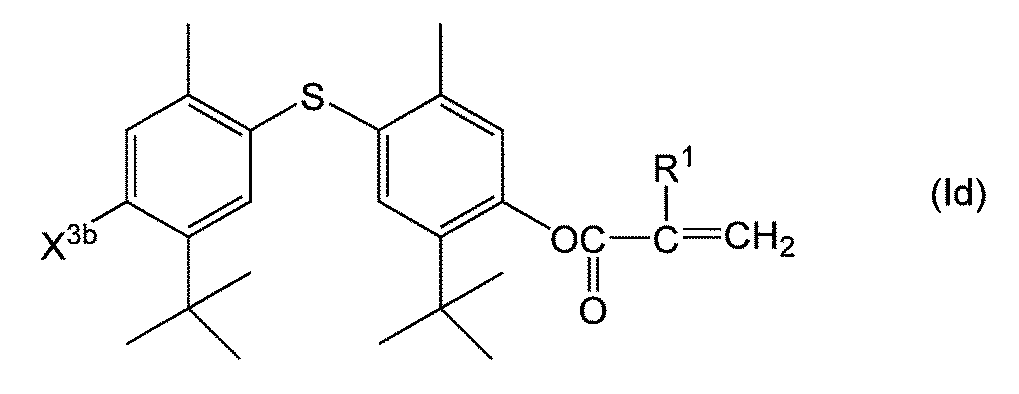
- the compound represented by the above formula (Id) can be used as an additive for a resin such as a polyolefin resin to prevent discoloration of the resin and improve the impact resistance and fluidity of the resin composition. It is a compound. Therefore, the compound is an effective compound as a resin additive, preferably a polyolefin resin additive, more preferably a discoloration inhibitor of the resin, an impact resistance improving agent, a fluidity improving agent, and the like.
- the present invention also provides a compound represented by the above formula (Id).
- the compound represented by the formula (Id) can be produced, for example, by the method described in Examples.
- the polyolefin resin composition of the present invention contains 0.01 to 5 parts by mass of (C) organic peroxide with respect to 100 parts by mass of the polyolefin resin.
- the organic peroxide is considered to have an action of decomposing the polyolefin resin by, for example, cutting the polyolefin resin chain under high temperature conditions to improve the fluidity of the polyolefin resin. Further, it is considered that the organic peroxide has an action of improving the microdispersion action of the compound (B) on the olefin resin by causing some reaction with the compound (B).
- the organic peroxide include an alkyl peroxide compound, a diacyl peroxide compound, a peroxide ester compound, and a carbonate carbonate compound.
- alkyl peroxide compound examples include dicumyl peroxide, di-tert-butyl peroxide, di-tert-butyl cumyl peroxide, and 2,5-dimethyl-2,5-di (tert-butylperoxy) hexane.
- diacyl peroxide compound examples include benzoyl peroxide, lauroyl peroxide, decanoyl peroxide and the like.
- peroxide ester compound examples include 1,1,3,3-tetramethylbutylperoxyneodecanoate, ⁇ -cumylperoxyneodecanoate, tert-butylperoxyneodecanoate, and tert-butyl.
- peroxide compound examples include di-3-methoxybutyl peroxy dicarbonate, di (2-ethylhexyl) peroxy dicarbonate, diisopropyl peroxy carbonate, tert-butyl peroxyisopropyl carbonate, and di (4-tert-). Butylcyclohexyl) peroxydicarbonate, disetylperoxydicarbonate, dimyristylperoxydicarbonate and the like can be mentioned.
- the organic peroxide is preferably an alkyl peroxide compound, more preferably, from the viewpoint of easily reducing the color derived from the benzene resin composition itself and easily improving the impact resistance and fluidity of the benzene resin composition.
- the polyolefin resin contained in the polyolefin resin composition of the present invention is selected from the group consisting of ethylene homopolymers, homopolymers of ⁇ -olefins having 3 or more carbon atoms, ethylene and ⁇ -olefins having 3 or more carbon atoms. Examples thereof include copolymers of two or more kinds of monomers, and polymers of these with other monomers other than ethylene or ⁇ -olefin.
- the polyolefin resin one kind of polyolefin resin may be contained, or two or more kinds of polyolefin resins may be contained.
- the polyolefin resin contained in the polyolefin resin composition of the present invention preferably contains a propylene-based resin.
- the propylene-based resin is a resin selected from the group consisting of a propylene homopolymer and a propylene-based copolymer.
- the propylene homopolymer is a homopolymer of propylene
- the propylene-based copolymer is a copolymer of propylene and ethylene and / or ⁇ -olefin having 4 or more carbon atoms.
- the polyolefin resin contained in the polyolefin resin composition may contain one kind of propylene-based resin, or may contain two or more kinds of propylene-based resins.
- the propylene resin is a homopolymer of propylene and / or a copolymer of propylene and ethylene and / or an ⁇ -olefin having 4 or more carbon atoms.
- the ⁇ -olefin having 4 or more carbon atoms include ⁇ -olefins having 4 to 10 carbon atoms, and more preferably ⁇ -olefins having 4 to 8 carbon atoms.
- Examples of ⁇ -olefins having 4 or more carbon atoms are preferably 1-butene, 1-pentene, 1-hexene, 4-methyl-1-pentene, 1-octene and 1-decene, and more preferably 1-decene.
- the propylene-based copolymer is preferably a copolymer of one or more of these ⁇ -olefins and propylene.
- the propylene-based resin contains a monomer unit derived from ethylene, the amount of the monomer unit derived from ethylene is less than 20 mass based on the total amount of the propylene-based resin.
- the intrinsic viscosity of the propylene resin is preferably 0.1 to 5 dl / g, more preferably 0.3 to 4 dl / g, still more preferably, from the viewpoint of the rigidity of the molded product. Is 0.5 to 3 dl / g.
- the method for measuring the intrinsic viscosity is as described in Examples.
- the polyolefin resin contained in the polyolefin resin composition further contains an ethylene-based copolymer in addition to the propylene-based resin.
- the ethylene-based copolymer is a copolymer of ethylene and an ⁇ -olefin having 3 or more carbon atoms. Examples of the ⁇ -olefin having 3 or more carbon atoms include ⁇ -olefins having 3 to 10 carbon atoms, and more preferably ⁇ -olefins having 3 to 8 carbon atoms.
- Examples of ⁇ -olefins having 3 or more carbon atoms are preferably propylene, 1-butene, 1-pentene, 1-hexene, 4-methyl-1-pentene, 1-octene and 1-decene, and more. Preferred examples include propylene, 1-butene, 1-hexene and 1-octene.
- the ethylene-based copolymer is preferably a copolymer of ethylene and one or more of these ⁇ -olefins. However, when the ethylene-based copolymer contains a monomer unit derived from propylene, the amount of the monomer unit derived from ethylene in the copolymer is 20 based on the total amount of the ethylene-based copolymer. It is mass% or more.
- the content of the ethylene-derived monomer unit in the ethylene-based copolymer is preferably 20% by mass or more, more preferably 20% by mass or more, based on the total amount of the ethylene-based copolymer from the viewpoint of impact resistance of the molded product. It is 20 to 99.5% by mass, more preferably 25 to 99% by mass, and particularly preferably 28 to 90% by mass.
- the content of the monomer unit derived from ⁇ -olefin having 3 or more carbon atoms in the ethylene-based copolymer is the monomer unit derived from ethylene and carbon contained in the copolymer from the viewpoint of economy. Based on the total amount of monomeric units derived from ⁇ -olefins having a number of 3 or more, preferably 80% by mass or less, more preferably 0.5 to 80% by mass, still more preferably 1 to 75% by mass, in particular. It is preferably 10 to 72% by mass.
- the content of the propylene-based resin has good impact resistance and rigidity.
- the amount is preferably 50% by mass or more, more preferably 55% by mass or more, still more preferably 60, based on the total amount of the propylene-based resin and the ethylene-based copolymer contained in the polyolefin resin composition. It is mass% or more.
- the content of the ethylene-based copolymer is based on the total amount of the propylene-based resin and the ethylene-based copolymer contained in the polyolefin resin composition from the viewpoint of easily achieving impact resistance and rigidity in a good balance. It is preferably 50% by mass or less, more preferably 45% by mass or less, and further preferably 40% by mass or less.
- the polyolefin resin contained in the polyolefin resin composition contains two or more kinds of ethylene-based copolymers, the total amount of the ethylene-based copolymers may be within the above range.
- the polyolefin resin contained in the polyolefin resin composition contains at least a propylene resin and an ethylene copolymer
- the polyolefin resin is a propylene resin and an ethylene copolymer produced separately.
- the impact is produced by polymerizing a homopolymer of propylene using a polymerization catalyst, and then continuously, for example, coexisting with ethylene gas to polymerize an ethylene-propylene copolymer. It may contain a resin, which is also called a copolymer.
- the impact copolymer is a resin also called an ethylene-propylene block copolymer.
- impact copolymers examples include polymers described in JP-A-2004-182981.
- the polyolefin resin may be produced by further adding an ethylene-based copolymer to the resin also referred to as the impact copolymer.
- the separately produced resins are mixed, they may be mixed by melt-kneading.
- the polyolefin resin composition may contain an inorganic filler in order to improve the mechanical properties of the obtained molded product.
- the inorganic filler include calcium carbonate, calcium hydroxide, calcium oxide, barium sulfate, mica, crystalline calcium silicate, talc, fibrous magnesium oxysulfate and the like.
- the inorganic filler is preferably talc or fibrous magnesium oxysulfate, more preferably talc. These may be used alone or in combination of two or more.
- an inorganic filler When an inorganic filler is used, its content is preferably 1 to 25 parts by mass with respect to 100 parts by mass of the polyolefin resin from the viewpoint of easily increasing the rigidity and impact strength of the obtained molded product.
- Additives that may be added to the polyolefin resin composition include, for example, neutralizing agents, antioxidants, processing stabilizers, ultraviolet absorbers, hindered amine light stabilizers, nucleating agents, clearing nucleating agents, lubricants, and processing.
- Auxiliary agents, metal soaps, colorants (pigments such as carbon black and titanium oxide), foaming agents, antibacterial agents, plastics, flame retardants, cross-linking agents, cross-linking aids, high brightness agents and the like can be mentioned. These may be used alone or in combination of two or more.
- its content is preferably 1 to 25 parts by mass with respect to 100 parts by mass of the polyolefin resin from the viewpoint of easily increasing the rigidity and impact strength of the obtained molded product.
- the YI of the polyolefin resin composition of the present invention is preferably 20 or less, more preferably 15 or less, still more preferably 12 or less, still more, from the viewpoint of easily improving the quality of the molded product obtained from the resin composition of the present invention. It is preferably 10 or less, particularly preferably 8 or less, and most preferably 6 or less.
- the YI of the polyolefin resin composition may be measured using, for example, a color difference meter using a sheet obtained by press-molding the resin composition as a measurement sample, and can be measured by, for example, the method described in Examples.
- the polyolefin resin composition of the present invention comprises (A) a polyolefin resin, (B) a compound having at least one (meth) acrylate group and one hydrogen-binding group or one (meth) acrylate group, and , (C)
- the organic peroxide can be produced by a production method including at least a step of mixing the organic peroxides with each other by melt-kneading the mixture obtained by dry-mixing in advance.
- the present invention also provides a method for producing the polyolefin resin composition.
- the mixture obtained by pre-dry mixing the (A) polyolefin resin, compound (B) and organic peroxide (C) is melted.
- the production method of the present invention which includes at least a step of mixing with each other by kneading, the fluidity and impact resistance of the polyolefin resin can be improved.
- melting and kneading a mixture obtained by previously drying and kneading the (A) polyolefin resin, the compound (B) and the organic peroxide (C) means that the (A) polyolefin resin and compound All of (B) and the organic peroxide (C) may be dry-mixed and then melt-kneaded, or at least one of the (A) polyolefin resin, compound (B) and / or organic peroxide (C). After the parts are dry-mixed and melt-kneaded, the obtained mixture and the remaining part may be dry-mixed again and then melt-kneaded.
- the polyolefin resin composition of the present invention uses a masterbatch in which the compound (B) is previously mixed with a resin and / or a masterbatch in which the organic peroxide (C) is previously mixed with a resin. It may be produced by mixing a masterbatch and (A) polyolefin resin. When these master batches are used, the polyolefin resin composition of the present invention may be obtained by side-feeding and mixing these master batches while melt-kneading the (A) polyolefin resin using an extruder. Good.
- the present invention includes at least a masterbatch containing the compound (B) and the resin, preferably at least one resin selected from the group consisting of the compound (B) and the polyolefin-based resin and the ethylene-based copolymer.
- the compound (B) is mixed with 100 mass of a resin (preferably at least one resin selected from the group consisting of a polyolefin resin and an ethylene copolymer, more preferably an ethylene copolymer). With respect to parts, it preferably contains 10 to 50 parts by mass, more preferably 20 to 48 parts by mass, and even more preferably 25 to 46 parts by mass.
- Examples of the polyolefin-based resin and ethylene-based copolymer contained in the master batch include the resins described above as the polyolefin-based resin and ethylene-based copolymer contained in the polyolefin resin composition of the present invention.
- the masterbatch of the present invention may contain one kind of resin, or may contain two or more kinds of resins in combination.
- the masterbatch of the present invention may further contain an organic peroxide.
- the amount of the organic peroxide is 100 parts by mass of the resin (preferably at least one resin selected from the group consisting of the polyolefin resin and the ethylene copolymer, more preferably the ethylene copolymer). On the other hand, it is preferably 5 to 25 parts by mass, more preferably 5 to 20 parts by mass, and further preferably 5 to 15 parts by mass.
- the method for producing the masterbatch of the present invention is not particularly limited, but the compound (B) and the resin are separated from the melting point of the compound (B) from the viewpoint of easily suppressing the decomposition of the compound (B) by heating or the like. It is preferable to use a method of kneading at a low temperature. From this point of view, in the masterbatch, the compound (B) and the resin are mixed with an organic peroxide and other additives, preferably 150 ° C. or lower, more preferably 120 ° C. or lower, still more preferably 100 ° C. It is preferably produced by kneading at the following temperatures.
- the resin contained in the masterbatch is preferably a polyolefin-based resin and an ethylene-based copolymer. It is at least one resin selected from the group consisting of coalesces, and more preferably an ethylene-based copolymer.
- Specific examples of the method for producing the polyolefin resin composition of the present invention include, for example.
- Production method I (A) Polyolefin resin, compound (B), and (C) organic peroxide are dry-mixed to obtain a mixture, and the mixture obtained in step (1) is melt-kneaded.
- the production method including the step (2) for obtaining the polyolefin resin composition of the present invention, or Production Method II: A step (1a) of dry-mixing (A) a polyolefin resin and a part of (C) an organic peroxide to obtain a first dry mixture, and a melt-kneading of the dry mixture obtained in step (1a).
- Step (2a) to obtain the first premix, the first premix obtained in step (2a), compound (B), and another part of (C) organic peroxide are dry-mixed and second.
- Examples thereof include a step of obtaining a dry mixture (1b) and a step of melt-kneading the dry mixture obtained in the step (1b) to obtain the polyolefin resin composition of the present invention (2b).
- the polyolefin resin contained in the polyolefin resin composition contains at least a propylene resin and an ethylene-based copolymer (in particular, the content of the ethylene-based resin is the propylene-based resin and the ethylene-based common weight contained in the polyolefin resin composition.
- the content of the ethylene-based resin is the propylene-based resin and the ethylene-based common weight contained in the polyolefin resin composition.
- (A) polyolefin resin Is preferably melt-kneaded with the (A) polyolefin resin and (C) organic peroxide before being melt-kneaded with the compound (B).
- the mixture obtained after melt-kneading (A) the polyolefin resin and (C) a part of the organic peroxide is obtained.
- the organic peroxide By adding the organic peroxide in at least two portions, the organic peroxide efficiently decomposes the polyolefin resin, and it is easy to improve the fluidity of the resin, and the reaction between the compound (B) and the polyolefin resin. It is considered that the organic peroxide also contributes to and / or the interaction, the fine dispersibility of the polyolefin resin is improved, and the impact resistance of the polyolefin resin composition is easily improved.
- the polyolefin resin composition further contains other resins, inorganic fillers, additives and the like, in the production method I, these may be mixed in the above step (1) or mixed in the step (2). May be good. Further, in the above-mentioned production method II, mixing may be performed in any step.
- steps (1b) and (2b) of Production Method II the mixture (first premixture) obtained in steps (1a) and (2a) and another part of the compound (B) and (C) organic peroxide. And mix.
- the first premix may be once taken out as pellets.
- a polyolefin resin preferably a propylene resin and an ethylene resin
- a polyolefin resin composition in which the copolymer) is uniformly dispersed can be obtained.
- (B) one (meth) acrylate group and one hydrogen-binding group or one (meth) acrylate group in the steps (1) and (1b) are combined.
- a master containing at least the compound and a resin preferably at least one resin selected from the group consisting of polyolefin-based resins and ethylene-based copolymers, more preferably ethylene-based copolymers
- a resin preferably at least one resin selected from the group consisting of polyolefin-based resins and ethylene-based copolymers, more preferably ethylene-based copolymers
- the powder may be put in a bag and turned by hand to mix, or a Henschel mixer, sand mill, edge runner, Taninaka crusher, etc. can be used.
- a Banbury mixer, a single-screw extruder, a twin-screw extruder, or the like can be used for melt-kneading, and two or more extruders can be used in combination. From the viewpoint of easily increasing productivity, it is preferable to use a twin-screw extruder for melt-kneading.
- the temperature at the time of melt-kneading (for example, the set temperature of the extruder) is 150 ° C.
- a molded product can be produced by molding the polyolefin resin composition of the present invention by a known molding method.
- the molding method include an injection molding method, a press molding method, a vacuum molding method, a vacuum press molding method, a pressure molding method, a foam molding method, an extrusion molding method, and the like.
- a press-molded article, a vacuum-molded article, a vacuum press-molded article, a pneumatic molded article, a foam-molded article, an extrusion-molded article, and the like can be obtained.
- a preferred molding method is an injection molding method, which can be applied to various molded products and is versatile.
- injection molding method examples include general injection molding method, injection foam molding method, supercritical injection foam molding method, ultrahigh speed injection molding method, injection compression molding method, injection press molding method, gas assisted injection molding method, and sandwich. Examples thereof include a molding method, a sandwich foam molding method, and an insert / outsert molding method.
- the use of the molded product obtained by molding the polyolefin resin composition of the present invention by the above molding method is not particularly limited, but preferably automobile interior parts such as bumpers, door trims, pillars, and instrumental panels. , Consoles, rocker panels, armrests, door panels, spare tire covers, etc.
- the intrinsic viscosity (unit: dl / g) is a value measured at a temperature of 135 ° C. using tetralin as a solvent by the following method.
- the reduced viscosity is measured at three points of concentrations of 0.1 g / dl, 0.2 g / dl and 0.5 g / dl using an Ubbelohde viscometer.
- the ultimate viscosity is calculated by the calculation method described on page 491 of "Polymer Solution, Polymer Experiment 11" (published by Kyoritsu Publishing Co., Ltd. in 1982), that is, the reduced viscosity is plotted against the concentration and the concentration is extrapolated to zero. Obtained by the extrapolation method.
- melt indexer model L246-3537, manufactured by Techno Seven Co., Ltd.
- the melt flow rate (sometimes referred to herein as MFR) was measured. It can be said that the higher the value of the melt flow rate, the better the fluidity and the workability.
- Izod impact strength (Izod, unit: kJ / m 2 )
- the pellets of the polyolefin resin composition obtained in Examples and Comparative Examples were injection-molded using an IS100 type injection molding machine manufactured by Toshiba Machine Co., Ltd. under the conditions of a molding temperature of 220 ° C. and a mold cooling temperature of 50 ° C.
- a V notch (A type) having the dimensions described in IS-K-7110 was inserted into the test piece.
- the prepared test piece was allowed to stand at 23 ° C. for 1 hour or more to adjust the state, and then an Izod impact test was performed using a digital impact tester manufactured by Toyo Seiki Co., Ltd. to measure the Izod impact strength.
- the pellets of the polyolefin resin composition obtained in Examples and Comparative Examples are pressed using a press machine (“PEW-5040” manufactured by Kansai Roll Co., Ltd.) at a temperature of 220 ° C. to achieve a thickness. A 1 mm sheet was obtained.
- the yellow index (yellowness, YI) of the obtained sheet was measured using a color difference meter (“CM-3500d” manufactured by Konica Minolta Japan Co., Ltd.). The smaller the YI, the more the discoloration is suppressed.
- Production Example 1 Production of Polyolefin Resin (A-1)
- a polymerization catalyst is produced according to the method described in Example 1 of JP-A-2004-182981, and the polymerization catalyst is used by a liquid phase-gas phase polymerization method.
- a polyolefin resin (A-1) containing 79 parts by mass of a propylene homopolymer component as a propylene-based resin and 21 parts by mass of an ethylene-propylene random copolymer component as an ethylene-based copolymer was produced.
- the melt flow rate (230 ° C., 2.16 kg load) of the obtained polyolefin resin was 25 g / 10 minutes.
- the intrinsic viscosity of the propylene homopolymer component (P part, propylene resin pp1) contained in the polyolefin resin (A-1) was 1.1 dl / g.
- the inherent viscosity of the ethylene-propylene random copolymer component (EP part, ethylene-based copolymer ep1) is 2.8 dl / g, and the ethylene-derived monomer contained in the ethylene-based copolymer ep1.
- the content of the unit was 33% by mass based on the total amount of the ethylene-based copolymer.
- Production Example 2 Production of Polyolefin Resin (A-2)
- a polymerization catalyst is produced according to the method described in Example 1 of JP-A-2004-182981, and the polymerization catalyst is used by a liquid phase-gas phase polymerization method.
- a polyolefin resin (A-2) containing 89 parts by mass of a propylene homopolymer component as a propylene-based resin and 11 parts by mass of an ethylene-propylene random copolymer component as an ethylene-based copolymer was produced.
- the melt flow rate (230 ° C., 2.16 kg load) of the obtained polyolefin resin was 98 g / 10 minutes.
- the intrinsic viscosity of the propylene homopolymer component (P part, propylene resin pp2) contained in the polyolefin resin (A-2) was 0.79 dl / g. Further, the intrinsic viscosity of the ethylene-propylene random copolymer component (EP part, ethylene-based copolymer ep2) is 7.0 dl / g, and the monomer derived from ethylene contained in the ethylene-based copolymer ep2. The content of the unit was 32% by mass based on the total amount of the ethylene-based copolymer.
- Production Example 3 Production of Master Batch Containing Organic Peroxide (C-1) Organic Peroxide (C-1) (2,5-dimethyl-2,5-di (t-butylperoxy) hexane) 10 mass 90 parts by mass of a propylene homopolymer was impregnated at room temperature to produce a polypropylene powder containing 10% by mass of an organic peroxide (C-1).
- Example 1 100 parts by mass of the polyolefin resin (A-1) obtained in Production Example 1, 1 part by mass of the masterbatch obtained in Production Example 3 (containing 0.1 parts by mass of organic peroxide (C-1)), And, after weighing 0.14 parts by mass of the simulator GM manufactured by Sumitomo Chemical Co., Ltd. as compound (B-1) and mixing it uniformly, the mixture was mixed with a twin-screw extruder having a diameter of 30 mm (Nakatani Machinery Co., Ltd.).
- the raw material is charged from the raw material inlet on the most upstream side of the NAS30 extruder (manufactured by NAS30), melt-kneaded under the conditions of a cylinder temperature of 220 ° C., a discharge rate of 2.4 kg / hour, and a screw rotation speed of 70 rpm to uniformly disperse the raw material and polyolefin. Pellets of the resin composition were obtained.
- Examples 2-4, Comparative Examples 1 and 2 Polyolefin resin in the same manner as in Example 1 except that the content of the organic peroxide (C-1), the content of the compound (B-1) and the organic peroxide were changed as shown in Table 1. Pellets of the composition were obtained.
- Examples 5 and 6 instead of compound (B-1), Sumitomo Chemical Co., Ltd.'s Sumilyzer GS was used as compound (B-2), except that the content of compound (B-2) was changed as shown in Table 1. Obtained pellets of the polyolefin resin composition in the same manner as in Example 1.
- Comparative Example 3 Fulvene was used as the compound (B-3) instead of the compound (B-1), and the content of the compound (B-3) was changed as shown in Table 1 in the same manner as in Example 1. , Polyolefin resin composition pellets were obtained.
- Example 7 77 parts by mass of the polyolefin resin (A-2) obtained in Production Example 2, ethylene-butene-1 copolymer (eb1, "Excellen FX555” manufactured by Sumitomo Chemical Co., Ltd., containing a monomer unit derived from ethylene Amount: 76% by mass, content of monomer unit derived from butene-1: 24% by mass) 23 parts by mass, and a master batch containing an organic peroxide (C-2) are organically peroxidized.
- ethylene-butene-1 copolymer eb1, "Excellen FX555” manufactured by Sumitomo Chemical Co., Ltd., containing a monomer unit derived from ethylene Amount: 76% by mass, content of monomer unit derived from butene-1: 24% by mass
- C-2 organic peroxide
- the mixture After measuring the amount of the substance (C-2) so that the amount shown in Table 1 is uniformly mixed, the mixture is charged from the raw material inlet on the most upstream side of the twin-screw kneader TEX44 ⁇ II manufactured by Japan Steel Works. , The cylinder temperature was 230 ° C., the discharge rate was 50 kg / hour, and the screw rotation speed was 200 rpm. The raw materials were uniformly dispersed to obtain pellets of the resin composition precursor (first preliminary mixture). A master batch containing 1.64 parts by mass of the compound (B-1) and the organic peroxide (C-1) obtained in Production Example 3 with respect to 100 parts by mass of the pellets thus obtained.
- the amount of the organic peroxide (C-1) becomes the amount shown in Table 1, and after uniformly mixing in advance, the mixture is used as a raw material on the most upstream side of the twin-screw kneader TEX44 ⁇ II manufactured by Japan Steel Works. It was charged from the charging port and melt-kneaded under the conditions of a cylinder temperature of 230 ° C., a discharge rate of 50 kg / hour, and a screw rotation speed of 200 rpm to uniformly disperse the raw materials to obtain pellets of the polyolefin resin composition.
- Comparative Example 4 Pellets of the polyolefin resin composition were obtained in the same manner as in Example 7 except that the organic peroxide (C-1) and the compound (B-1) were not added.
- the melt flow rate, izod impact strength and yellow index were measured according to the above method.
- the results obtained are shown in Table 1 together with the composition of each resin composition.
- the polyolefin resin (A-1) contains 79 parts by mass of the propylene homopolymer component and 21 parts by mass of the ethylene-propylene random copolymer component
- the polyolefin resin (A-2) contains 21 parts by mass. As described above, it contains 89 parts by mass of the propylene homopolymer component and 11 parts by mass of the ethylene-propylene random copolymer component.
- B-3 in Table 1 is fulvene and is not a compound corresponding to the compound (B) in the present invention.
- the resin compositions of Comparative Examples 2 and 4 containing an organic peroxide but not containing the compound (B) (particularly the compound (Ba)) had high fluidity but low impact resistance. Further, in the case of the resin composition of Comparative Example 3 containing fulvene (B-3) which does not correspond to the compound (B) of the present invention (particularly the compound (Ba)), the YI of the molded product was high.
- the precipitated solid was filtered, the filtrate was washed 3 times with 800 ml of hexane, and vacuum dried to obtain 146 g of the target 1,1-bis (2-hydroxy-3,5-dimethylphenyl) ethane, yield 57. %, Purity 99%.
- the obtained 1,1-bis (2-hydroxy-3,5-dimethylphenyl) ethane was 145 g (0.537 mol)
- xylene was 146 g
- triethylamine was 116 g
- acrylic acid was 38.4 g (0.533 mmol).
- the toluene phase was washed in the order of 450 ml of saline solution, 438 g of 4.8% sodium carbonate aqueous solution, and 450 ml of saline solution. Then, after drying with anhydrous sodium sulfate, the solvent was distilled off under reduced pressure. The obtained residue was purified by column chromatography to obtain 64.6 g of the compound represented by the following formula (B-7), a yield of 37%, and a purity of 96%.
- the filter product at the time of Celite filtration is extracted with chloroform, dried over sodium sulfate, concentrated, mixed with the solid obtained from the filtrate at the time of Celite filtration, washed again with methanol, dried, and the following formula ( The compound represented by B-8) was obtained in 76.6 g with a yield of 93%.
- Examples 8-13 The polyolefin resin composition is the same as in Example 1 except that the compound (B-1) is changed to the compounds (B-4) to (B-9) obtained as described above as shown in Table 1. Pellets were obtained. Then, the melt flow rate, Izod impact strength and yellow index were measured using pellets. The obtained results are shown in Table 2 together with the composition of each resin composition.
- Example 14 Production of masterbatch Sumitomo Chemical Co., Ltd., Sumitomo Chemical Co., Ltd., GM27 mass as compound (B-1) in 73 parts by mass of ENGAGE8842, which can be obtained from the Ethylene 1-octene copolymer (The Dow Chemical Company). The parts were dry-blended and impregnated with 4 parts by mass of organic peroxide (C-1) (2,5-dimethyl-2,5-di (t-butylperoxy) hexane), and the mixture was mixed with a diameter of 30 mm.
- C-1 organic peroxide
Landscapes
- Chemical & Material Sciences (AREA)
- Organic Chemistry (AREA)
- Health & Medical Sciences (AREA)
- Chemical Kinetics & Catalysis (AREA)
- Medicinal Chemistry (AREA)
- Polymers & Plastics (AREA)
- Compositions Of Macromolecular Compounds (AREA)
- Processes Of Treating Macromolecular Substances (AREA)
- Organic Low-Molecular-Weight Compounds And Preparation Thereof (AREA)
Abstract
Description
〔1〕(A)100質量部のポリオレフィン樹脂、
(B)0.01~5質量部の、1個の(メタ)アクリレート基と、1個の水素結合性基又は1個の(メタ)アクリレート基とを少なくとも有する化合物、及び
(C)0.01~5質量部の有機過酸化物
を少なくとも含有する、ポリオレフィン樹脂組成物。
〔2〕(B)1個の(メタ)アクリレート基と、1個の水素結合性基又は1個の(メタ)アクリレート基とを少なくとも有する化合物は、式(I):

X1及びX2は、それぞれ独立に、水素結合性基又は-OC(=O)CR1=CH2で表される基を表し、かつ、X3及びX4は、それぞれ独立に、水素原子又は炭素数1~9の直鎖状もしくは分枝状のアルキル基を表すか、又は、X1及びX2は、それぞれ独立に、水素原子又は炭素数1~9の直鎖状もしくは分枝状のアルキル基を表し、かつ、X3及びX4は、それぞれ独立に、水素結合性基又は-OC(=O)CR1=CH2で表される基を表し、但し、X1~X4の少なくとも1つは-OC(=O)CR1=CH2で表される基を表し、R1は水素原子又はメチル基を表し、
Yは、単結合、スルフィド結合、又は炭素数1~9の直鎖状又は分枝状のアルキレン基を表し、
R2及びR5は、それぞれ独立に、水素原子又は炭素数1~9の直鎖状もしくは分枝状のアルキル基を表し、R3及びR4は、それぞれ独立に、炭素数1~9の直鎖状又は分枝状のアルキル基を表す]
で表される、前記〔1〕に記載のポリオレフィン樹脂組成物。
〔3〕式(I)中、X1は水素結合性基又は-OC(=O)CR1=CH2で表される基を表し、X2は-OC(=O)CR1=CH2で表される基を表し、X3及びX4は水素原子を表し、Yは、単結合又は炭素数1~9の直鎖状又は分枝状のアルキレン基を表し、R1は水素原子又はメチル基を表し、R2~R5は、それぞれ独立に、炭素数1~9の直鎖状又は分枝状のアルキル基を表す、前記〔2〕に記載のポリオレフィン樹脂組成物。
〔4〕式(I)中、X1及びX2は炭素数1~9の直鎖状もしくは分枝状のアルキル基を表し、X3は水素結合性基又は-OC(=O)CR1=CH2で表される基を表し、X4は-OC(=O)CR1=CH2で表される基を表し、Yは、スルフィド結合を表し、R1は水素原子又はメチル基を表し、R2及びR5は水素原子を表し、R3及びR4は、それぞれ独立に、炭素数1~9の直鎖状又は分枝状のアルキル基を表す、前記〔2〕に記載のポリオレフィン樹脂組成物。
〔5〕(B)1個の(メタ)アクリレート基と、1個の水素結合性基又は1個の(メタ)アクリレート基とを少なくとも有する化合物は、1個の(メタ)アクリレート基及び少なくとも1個の水素結合性基を有する化合物である、前記〔1〕に記載のポリオレフィン樹脂組成物。
〔6〕(B)1個の(メタ)アクリレート基及び少なくとも1個の水素結合性基を有する化合物は、式(Ia):
X1aは水素結合性基を表し、
Yaは、単結合又は炭素数1~9の直鎖状又は分枝状のアルキレン基を表し、
R1は水素原子又はメチル基を表し、
R2a~R5aは、それぞれ独立に、炭素数1~9の直鎖状又は分枝状のアルキル基を表す]
で表される、前記〔5〕に記載のポリオレフィン樹脂組成物。
〔7〕式(I)は、式(Ia’):

で表される、前記〔6〕に記載のポリオレフィン樹脂組成物。
〔8〕水素結合性基は、ヒドロキシル基、アミノ基、チオール基、カルボキシル基、スルホン酸基、及び、リン酸基からなる群から選択される、前記〔1〕~〔7〕のいずれかに記載のポリオレフィン樹脂組成物。
〔9〕式(Ia’)中、X1aはヒドロキシル基を表し、R1は水素原子を表し、R2a~R5aは1,1-ジメチルプロピル基を表し、R6はメチル基を表す、前記〔7〕に記載のポリオレフィン樹脂組成物。
〔10〕式(Ia’)中、X1aはヒドロキシル基を表し、R1及びR6は水素原子を表し、R2a及びR5aはt-ブチル基を表し、R3a及びR4aはメチル基を表す、前記〔7〕に記載のポリオレフィン樹脂組成物。
〔11〕式(I)は、式(1d):
で表される、前記〔2〕に記載のポリオレフィン樹脂組成物。
〔12〕(C)有機過酸化物は、過酸化アルキル化合物、過酸化ジアシル化合物、過酸化エステル化合物及び過酸化カーボネート化合物からなる群から選択される、前記〔1〕~〔11〕のいずれかに記載のポリオレフィン樹脂組成物。
〔13〕(B)1個の(メタ)アクリレート基と、1個の水素結合性基又は1個の(メタ)アクリレート基とを少なくとも有する化合物:(C)有機過酸化物の質量比は1:10~10:1である、前記〔1〕~〔12〕のいずれかに記載のポリオレフィン樹脂組成物。
〔14〕(A)ポリオレフィン樹脂はプロピレン系樹脂を含む、前記〔1〕~〔13〕のいずれかに記載のポリオレフィン樹脂組成物。
〔15〕プロピレン系樹脂は、プロピレンに由来する単量体単位を該プロピレン系樹脂の総量に基づいて80質量%以上含有する、前記〔14〕に記載のポリオレフィン樹脂組成物。
〔16〕(A)ポリオレフィン樹脂は、エチレン系共重合体をさらに含む、前記〔14〕又は〔15〕に記載のポリオレフィン樹脂組成物。
〔17〕エチレン系共重合体は、エチレンに由来する単量体単位を該エチレン系共重合体の総量に基づいて20質量%以上含有する、前記〔16〕に記載のポリオレフィン樹脂組成物。
〔18〕前記〔1〕~〔17〕のいずれかに記載のポリオレフィン樹脂組成物の製造方法であって、(A)ポリオレフィン樹脂、(B)1個の(メタ)アクリレート基と1個の水素結合性基又は1個の(メタ)アクリレート基とを少なくとも有する化合物、並びに、(C)有機過酸化物を、予め乾式混合して得た混合物を溶融混練することにより互いに混合する工程を少なくとも含む、製造方法。
〔19〕(A)ポリオレフィン樹脂、(B)1個の(メタ)アクリレート基と1個の水素結合性基又は1個の(メタ)アクリレート基とを少なくとも有する化合物、並びに、(C)有機過酸化物を乾式混合して混合物を得る工程(1)、及び、工程(1)で得た混合物を溶融混練してポリオレフィン樹脂組成物を得る工程(2)を含むか、又は、
(A)ポリオレフィン樹脂と(C)有機過酸化物の一部を乾式混合して第1乾式混合物を得る工程(1a)、工程(1a)で得た乾式混合物を溶融混練して第1予備混合物を得る工程(2a)、工程(2a)で得た第1予備混合物と、(B)1個の(メタ)アクリレート基と及び少なくとも1個の水素結合性基又は1個の(メタ)アクリレート基とを少なくとも有する化合物と、(C)有機過酸化物の別の一部とを乾式混合して第2乾式混合物を得る工程(1b)、工程(1b)で得た乾式混合物を溶融混練して、ポリオレフィン樹脂組成物を得る工程(2b)を含む、前記〔18〕に記載の製造方法。
〔20〕前記工程(1)及び工程(1b)における、(B)1個の(メタ)アクリレート基と1個の水素結合性基又は1個の(メタ)アクリレート基とを少なくとも有する化合物の混合は、該化合物と、ポリオレフィン系樹脂及びエチレン系共重合体からなる群から選択される少なくとも1種の樹脂とを少なくとも含むマスターバッチを用いて行われる、前記〔18〕又は〔19〕に記載の製造方法。
〔21〕1個の(メタ)アクリレート基と1個の水素結合性基又は1個の(メタ)アクリレート基とを少なくとも有する化合物、及び、ポリオレフィン系樹脂及びエチレン系共重合体からなる群から選択される少なくとも1種の樹脂を含む、マスターバッチ。
〔22〕1個の(メタ)アクリレート基と1個の水素結合性基又は1個の(メタ)アクリレート基とを少なくとも有する化合物を、ポリオレフィン系樹脂及びエチレン系共重合体100質量部に対して10~50質量部含む、前記〔21〕に記載のマスターバッチ。
〔23〕有機過酸化物をさらに含む、前記〔20〕又は〔21〕に記載のマスターバッチ。
〔24〕式(Ic):

で表される化合物。
〔25〕式(Id):

で表される化合物。
〔1’〕(A)100質量部のポリオレフィン樹脂、
(B)0.01~5質量部の、1個の(メタ)アクリレート基及び少なくとも1個の水素結合性基を有する化合物、及び
(C)0.01~5質量部の有機過酸化物
を少なくとも含有する、ポリオレフィン樹脂組成物。
〔2’〕(B)1個の(メタ)アクリレート基及び少なくとも1個の水素結合性基を有する化合物は、式(Ia):
X1aは水素結合性基を表し、
Yaは、単結合又は炭素数1~9の直鎖状又は分枝状のアルキレン基を表し、
R1は水素原子又はメチル基を表し、
R2a~R5aは、それぞれ独立に、炭素数1~9の直鎖状又は分枝状のアルキル基を表す]
で表される、前記〔1’〕に記載のポリオレフィン樹脂組成物。
〔3’〕式(I)は、式(Ia’):
で表される、前記〔2’〕に記載のポリオレフィン樹脂組成物。
〔4’〕水素結合性基は、ヒドロキシル基、アミノ基、チオール基、カルボキシル基、スルホン酸基、及び、リン酸基からなる群から選択される、前記〔1’〕~〔3’〕のいずれかに記載のポリオレフィン樹脂組成物。
〔5’〕式(Ia’)中、X1aはヒドロキシル基を表し、R1は水素原子を表し、R2a~R5aは1,1-ジメチルプロピル基を表し、R6はメチル基を表す、前記〔3’〕に記載のポリオレフィン樹脂組成物。
〔6’〕式(Ia’)中、X1aはヒドロキシル基を表し、R1及びR6は水素原子を表し、R2a及びR5aはt-ブチル基を表し、R3a及びR4aはメチル基を表す、前記〔3’〕に記載のポリオレフィン樹脂組成物。
〔7’〕(C)有機過酸化物は、過酸化アルキル化合物、過酸化ジアシル化合物、過酸化エステル化合物及び過酸化カーボネート化合物からなる群から選択される、前記〔1’〕~〔6’〕のいずれかに記載のポリオレフィン樹脂組成物。
〔8’〕(B)1個の(メタ)アクリレート基及び少なくとも1個の水素結合性基を有する化合物:(C)有機過酸化物の質量比は1:10~10:1である、前記〔1’〕~〔7’〕のいずれかに記載のポリオレフィン樹脂組成物。
〔9’〕(A)ポリオレフィン樹脂はプロピレン系樹脂を含む、前記〔1’〕~〔8’〕のいずれかに記載のポリオレフィン樹脂組成物。
〔10’〕プロピレン系樹脂は、プロピレンに由来する単量体単位を該プロピレン系樹脂の総量に基づいて80質量%以上含有する、前記〔9’〕に記載のポリオレフィン樹脂組成物。
〔11’〕(A)ポリオレフィン樹脂は、エチレン系共重合体をさらに含む、前記〔9’〕又は〔10’〕に記載のポリオレフィン樹脂組成物。
〔12’〕エチレン系共重合体は、エチレンに由来する単量体単位を該エチレン系共重合体の総量に基づいて20質量%以上含有する、前記〔11’〕に記載のポリオレフィン樹脂組成物。
〔13’〕前記〔1’〕~〔12’〕のいずれかに記載のポリオレフィン樹脂組成物の製造方法であって、(A)ポリオレフィン樹脂、(B)1個の(メタ)アクリレート基及び少なくとも1個の水素結合性基を有する化合物、並びに、(C)有機過酸化物を、予め乾式混合して得た混合物を溶融混練することにより互いに混合する工程を少なくとも含む、製造方法。
〔14’〕(A)ポリオレフィン樹脂、(B)1個の(メタ)アクリレート基及び少なくとも1個の水素結合性基を有する化合物、並びに、(C)有機過酸化物を乾式混合して混合物を得る工程(1)、及び、工程(1)で得た混合物を溶融混練してポリオレフィン樹脂組成物を得る工程(2)を含むか、又は、
(A)ポリオレフィン樹脂と(C)有機過酸化物の一部を乾式混合して第1乾式混合物を得る工程(1a)、工程(1a)で得た乾式混合物を溶融混練して第1予備混合物を得る工程(2a)、工程(2a)で得た第1予備混合物と、(B)1個の(メタ)アクリレート基及び少なくとも1個の水素結合性基を有する化合物と、(C)有機過酸化物の別の一部とを乾式混合して第2乾式混合物を得る工程(1b)、工程(1b)で得た乾式混合物を溶融混練して、ポリオレフィン樹脂組成物を得る工程(2b)を含む、前記〔13’〕に記載の製造方法。
本発明のポリオレフィン樹脂組成物は、(A)100質量部のポリオレフィン樹脂、(B)0.01~5質量部の、1個の(メタ)アクリレート基と、1個の水素結合性基又は1個の(メタ)アクリレート基とを少なくとも有する化合物、及び、(C)0.01~5質量部の有機過酸化物を少なくとも含有する。本発明のポリオレフィン樹脂組成物は、上記のようにポリオレフィン樹脂を主成分とし、該ポリオレフィン樹脂100質量部に対して0.01~5質量部の(B)1個の(メタ)アクリレート基と、1個の水素結合性基又は1個の(メタ)アクリレート基とを少なくとも有する化合物、及び、該ポリオレフィン樹脂100質量部に対して0.01~5質量部の(C)有機過酸化物を含有する。なお、本明細書において、1個の(メタ)アクリレート基と、1個の水素結合性基又は1個の(メタ)アクリレート基とを少なくとも有する化合物を、「化合物(B)」とも称する。
本発明のポリオレフィン樹脂組成物は、ポリオレフィン樹脂100質量部に対して0.01~5質量部の(B)1個の(メタ)アクリレート基と、1個の水素結合性基又は1個の(メタ)アクリレート基とを少なくとも有する化合物を含有する。化合物(B)は、上記官能基を有する限り特に限定されず、本発明のポリオレフィン樹脂組成物は1種類の化合物(B)を含有してもよいし、2種類以上の化合物(B)を含有してもよい。なお、本明細書において(メタ)アクリレート基は、アクリレート基又はメタクリレート基を表す。また、本明細書において水素結合性基は、水素結合可能な基であれば特に限定されず、例えばヒドロキシル基、アミノ基(第1級及び第2級アミノ基)、チオール基、カルボキシル基、スルホン酸基、リン酸基、アミド基、カルバメート基等が挙げられる。化合物(B)が水素結合性基を有する場合、黄色度を低下させやすく、流動性と耐衝撃性を両立させやすい観点からは、水素結合性基は、好ましくはヒドロキシル基、アミノ基、チオール基、カルボキシル基、スルホン酸基及びリン酸基からなる群から選択され、より好ましくはヒドロキシル基及びアミノ基からなる群から選択され、さらに好ましくはヒドロキシル基である。

X1及びX2は、それぞれ独立に、水素結合性基又は-OC(=O)CR1=CH2で表される基を表し、かつ、X3及びX4は、それぞれ独立に、水素原子又は炭素数1~9の直鎖状もしくは分枝状のアルキル基を表すか、又は、X1及びX2は、それぞれ独立に、水素原子又は炭素数1~9の直鎖状もしくは分枝状のアルキル基を表し、かつ、X3及びX4は、それぞれ独立に、水素結合性基又は-OC(=O)CR1=CH2で表される基を表し、但し、X1~X4の少なくとも1つは-OC(=O)CR1=CH2で表される基を表し、R1は水素原子又はメチル基を表し、
Yは、単結合、スルフィド結合、又は炭素数1~9の直鎖状又は分枝状のアルキレン基を表し、
R2及びR5は、それぞれ独立に、水素原子又は炭素数1~9の直鎖状もしくは分枝状のアルキル基を表し、R3及びR4は、それぞれ独立に、炭素数1~9の直鎖状又は分枝状のアルキル基を表す]
で表される。ポリオレフィン樹脂組成物が上記の式(I)で表される化合物(B)を含有する場合、ポリオレフィン樹脂組成物自体に由来する色みを低減しやすく、かつ、樹脂組成物の耐衝撃性及び流動性を向上させやすいため好ましい。この態様において、本発明のポリオレフィン樹脂組成物は式(I)で表される1種類の化合物を含有してもよいし、式(I)で表される2種類以上の化合物を含有してもよい。

で表される化合物である。
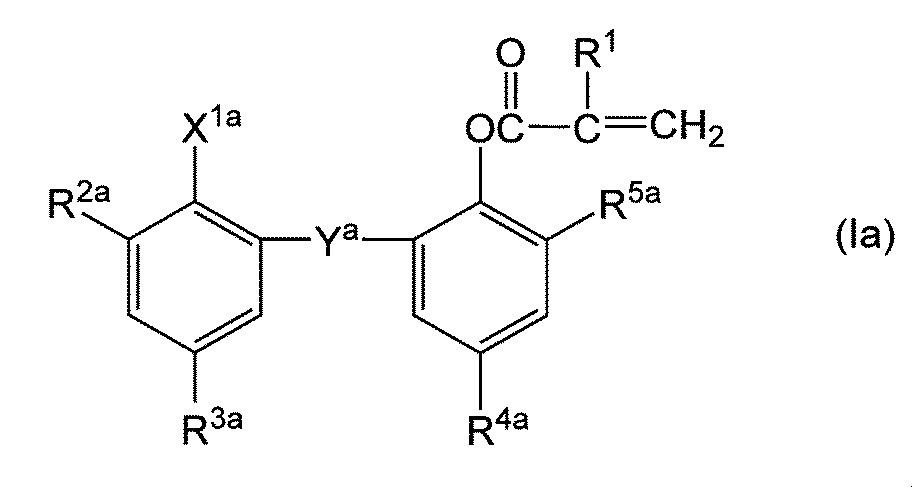
X1aは水素結合性基を表し、
Yaは、単結合又は炭素数1~9の直鎖状又は分枝状のアルキレン基を表し、
R1は水素原子又はメチル基を表し、
R2a~R5aは、それぞれ独立に、炭素数1~9の直鎖状又は分枝状のアルキル基を表す]
で表される化合物である。この態様において、本発明のポリオレフィン樹脂組成物は式(Ia)で表される1種類の化合物を含有してもよいし、式(Ia)で表される2種類以上の化合物を含有してもよい。
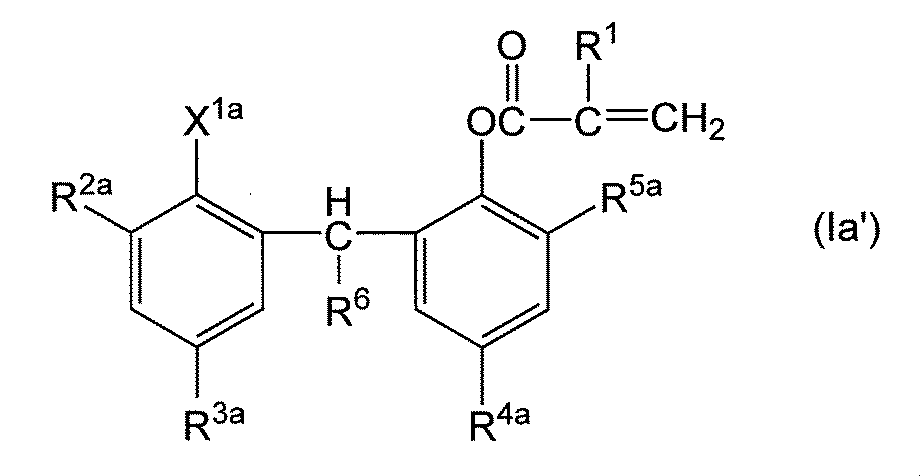
で表される。この態様において、本発明のポリオレフィン樹脂組成物は式(Ia’)で表される1種類の化合物を含有してもよいし、式(Ia’)で表される2種類以上の化合物を含有してもよい。

で表される化合物である。
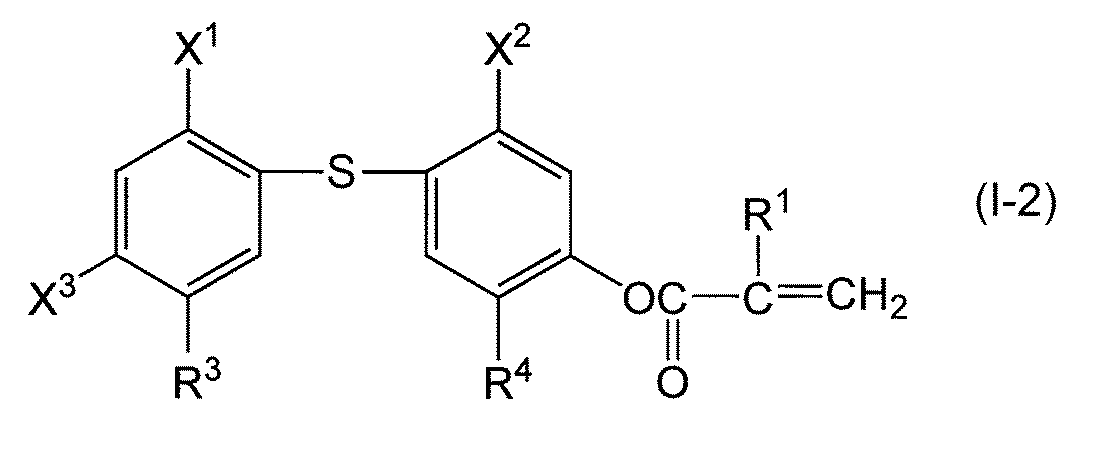
で表される化合物である。

で表される化合物である。
本発明のポリオレフィン樹脂組成物は、ポリオレフィン樹脂100質量部に対して0.01~5質量部の(C)有機過酸化物を含有する。本発明において、有機過酸化物は、例えば高温条件下でポリオレフィン樹脂鎖を切断することによりポリオレフィン樹脂を分解して、ポリオレフィン樹脂の流動性を向上させる作用を有すると考えられる。また、有機過酸化物が化合物(B)と何らかの反応を生じることにより、化合物(B)のオレフィン樹脂に対する微分散化作用を向上させる作用を有すると考えられる。有機過酸化物としては、例えば、過酸化アルキル化合物、過酸化ジアシル化合物、過酸化エステル化合物、及び、過酸化カーボネート化合物等が挙げられる。
本発明のポリオレフィン樹脂組成物に含まれるポリオレフィン樹脂としては、エチレン単独重合体、炭素数3以上のα-オレフィンの単独重合体、エチレン及び炭素数3以上のα-オレフィンからなる群から選択される2種以上のモノマーの共重合体、並びに、これらと、エチレン又はαオレフィン以外の他のモノマーとの共重合体が挙げられる。ポリオレフィン樹脂として、1種類のポリオレフィン樹脂を含有してもよいし、2種類以上のポリオレフィン樹脂を含有してもよい。
(フィラー)
ポリオレフィン樹脂組成物は、得られる成形体の機械物性を向上させるために、無機フィラーを含有してもよい。無機フィラーとしては、例えば、炭酸カルシウム、水酸化カルシウム、酸化カルシウム、硫酸バリウム、マイカ、結晶性ケイ酸カルシウム、タルク、繊維状マグネシウムオキシサルフェート等が挙げられる。無機フィラーは、好ましくはタルク又は繊維状マグネシウムオキシサルフェート、より好ましくはタルクである。これらは単独で用いてよく、2種以上を併用してもよい。無機フィラーを使用する場合、その含有量は、得られる成形体の剛性と衝撃強度を高めやすい観点から、ポリオレフィン樹脂100質量部に対して、好ましくは1~25質量部である。
ポリオレフィン樹脂組成物に添加してよい添加剤としては、例えば、中和剤、酸化防止剤、加工安定剤、紫外線吸収剤、ヒンダードアミン系光安定剤、造核剤、透明化核剤、滑剤、加工助剤、金属石鹸、着色剤(カーボンブラック、酸化チタンなどの顔料)、発泡剤、抗菌剤、可塑剤、難燃剤、架橋剤、架橋助剤、高輝度化剤等が挙げられる。これらは単独で用いてよく、2種以上を併用してもよい。上記の添加剤を使用する場合、その含有量は、得られる成形体の剛性と衝撃強度を高めやすい観点から、ポリオレフィン樹脂100質量部に対して、好ましくは1~25質量部である。
本発明のポリオレフィン樹脂組成物は、(A)ポリオレフィン樹脂、(B)1個の(メタ)アクリレート基と1個の水素結合性基又は1個の(メタ)アクリレート基とを少なくとも有する化合物、並びに、(C)有機過酸化物を、予め乾式混合して得た混合物を溶融混練することにより互いに混合する工程を少なくとも含む製造方法により製造することができる。本発明は、当該ポリオレフィン樹脂組成物の製造方法も提供する。ポリオレフィン樹脂がどのような状態で微分散化されているかは明らかではないが、(A)ポリオレフィン樹脂、化合物(B)及び有機過酸化物(C)を、予め乾式混合して得た混合物を溶融混練することにより互いに混合する工程を少なくとも含む本発明の製造方法によれば、ポリオレフィン樹脂の流動性と耐衝撃性とを向上させることができる。なお、本発明の製造方法において、(A)ポリオレフィン樹脂、化合物(B)及び有機過酸化物(C)を、予め乾式混合して得た混合物を溶融混練するとは、(A)ポリオレフィン樹脂、化合物(B)及び有機過酸化物(C)の全てを乾式混合した後、溶融混練してもよいし、(A)ポリオレフィン樹脂、化合物(B)及び/又は有機過酸化物(C)の少なくとも一部を乾式混合し、溶融混練した後、得られた混合物と残りの一部とを再度乾式混合してから、溶融混練してもよい。
製造方法I:(A)ポリオレフィン樹脂、化合物(B)、並びに、(C)有機過酸化物を乾式混合して混合物を得る工程(1)、及び、工程(1)で得た混合物を溶融混練して、本発明のポリオレフィン樹脂組成物を得る工程(2)を含む製造方法、又は、
製造方法II:(A)ポリオレフィン樹脂と(C)有機過酸化物の一部を乾式混合して第1乾式混合物を得る工程(1a)、工程(1a)で得た乾式混合物を溶融混練して第1予備混合物を得る工程(2a)、工程(2a)で得た第1予備混合物と、化合物(B)と、(C)有機過酸化物の別の一部とを乾式混合して第2乾式混合物を得る工程(1b)、工程(1b)で得た乾式混合物を溶融混練して、本発明のポリオレフィン樹脂組成物を得る工程(2b)を含む製造方法が挙げられる。
本発明のポリオレフィン樹脂組成物を公知の成形方法により成形することにより、成形体を製造することができる。成形方法としては、射出成形法、プレス成形法、真空成形法、真空プレス成形法、圧空成形法、発泡成形法、押出成形法等が挙げられ、これらの成形方法によって、それぞれ、射出成形体、プレス成形体、真空成形体、真空プレス成形体、圧空成形体、発泡成形体、押出成形体等を得ることができる。好ましい成形方法は、多様な成型品に対応でき、汎用性の観点から、射出成形法である。射出成形法としては、例えば、一般的な射出成形法、射出発泡成形法、超臨界射出発泡成形法、超高速射出成形法、射出圧縮成形法、射出プレス成形法、ガスアシスト射出成形法、サンドイッチ成形法、サンドイッチ発泡成形法、インサート・アウトサート成形法等が挙げられる。
極限粘度(単位:dl/g)は、以下の方法によって、テトラリンを溶媒として用いて、温度135℃で測定される値である。
ウベローデ型粘度計を用いて濃度0.1g/dl、0.2g/dl及び0.5g/dlの3点について還元粘度を測定する。極限粘度は、「高分子溶液、高分子実験学11」(1982年共立出版株式会社刊)第491頁に記載された計算方法、すなわち還元粘度を濃度に対しプロットし、濃度をゼロに外挿する外挿法によって求められる。
実施例及び比較例で得たポリオレフィン樹脂組成物のペレットについて、メルトインデクサ(型式L246-3537、株式会社テクノ・セブン製)を用いて、温度230℃、荷重2.16kgでのメルトフローレート(本明細書において、MFRと記載する場合もある)を測定した。なお、メルトフローレートの数値が高いほど、流動性に優れ、加工性に優れるといえる。
実施例及び比較例で得たポリオレフィン樹脂組成物のペレットを、東芝機械(株)製、IS100型射出成型機を用いて、成形温度220℃、金型冷却温度50℃の条件で射出成型し、幅12.7mm、長さ63.5mm、厚み3.2mmのアイゾッド衝撃試験片を成型後、IS-K-7110に記載の寸法のVノッチ(Aタイプ)を入れ、試験片とした。作製した試験片を、23℃で1時間以上静置して状態調節後に、東洋精機社製デジタル衝撃試験機を用いてアイゾッド衝撃試験を行い、アイゾッド衝撃強さを測定した。
実施例及び比較例で得たポリオレフィン樹脂組成物のペレットを、プレス機(関西ロール(株)社製「PEW-5040」)を用いて、温度220℃の条件でプレスし、厚さ1mmのシートを得た。得られたシートのイエローインデックス(黄色度、YI)を、色差計(コニカミノルタジャパン(株)製「CM-3500d」)を用いて測定した。なお、YIが小さいほど、変色が抑制されていることを示す。
特開2004-182981号公報の実施例1に記載の方法に従い、重合触媒を製造し、該重合触媒を用いて液相-気相重合法により、プロピレン系樹脂としてプロピレン単独重合体成分79質量部と、エチレン系共重合体としてエチレン-プロピレンランダム共重合体成分21質量部とを含有するポリオレフィン樹脂(A-1)を製造した。得られたポリオレフィン樹脂のメルトフローレート(230℃、2.16kg荷重)は、25g/10分であった。ポリオレフィン樹脂(A-1)に含まれる、プロピレン単独重合体成分(P部、プロピレン系樹脂pp1)の固有粘度は、1.1dl/gであった。また、エチレン-プロピレンランダム共重合体成分(EP部、エチレン系共重合体ep1)の固有粘度は、2.8dl/gであり、エチレン系共重合体ep1に含まれるエチレンに由来する単量体単位の含有量はエチレン系共重合体の総量に基づいて33質量%であった。
特開2004-182981号公報の実施例1に記載の方法に従い、重合触媒を製造し、該重合触媒を用いて液相-気相重合法により、プロピレン系樹脂としてプロピレン単独重合体成分89質量部と、エチレン系共重合体としてエチレン-プロピレンランダム共重合体成分11質量部とを含有するポリオレフィン樹脂(A-2)を製造した。得られたポリオレフィン樹脂のメルトフローレート(230℃、2.16kg荷重)は、98g/10分であった。ポリオレフィン樹脂(A-2)に含まれる、プロピレン単独重合体成分(P部、プロピレン系樹脂pp2)の固有粘度は、0.79dl/gであった。また、エチレン-プロピレンランダム共重合体成分(EP部、エチレン系共重合体ep2)の固有粘度は、7.0dl/gであり、エチレン系共重合体ep2に含まれるエチレンに由来する単量体単位の含有量はエチレン系共重合体の総量に基づいて32質量%であった。
有機過酸化物(C-1)(2,5-ジメチル-2,5-ジ(t-ブチルパーオキシ)ヘキサン)10質量部を、プロピレンホモポリマー90質量部に、室温で含浸し、有機過酸化物(C-1)を10質量%含有するポリプロピレンパウダーを製造した。
有機過酸化物(C-2)を8質量%含有するマスターバッチを使用した。
製造例1で得たポリオレフィン樹脂(A-1)を100質量部、製造例3で得たマスターバッチを1質量部(有機過酸化物(C-1)を0.1質量部含有する)、及び、化合物(B-1)として住友化学(株)製、スミライザーGM0.14質量部を計量し、均一に混合した後、該混合物を、30mm径の二軸押出成形機(ナカタニ機械(株)製、NAS30型押出機)の最上流側の原料投入口から投入し、シリンダー温度220℃、吐出量2.4kg/時間、スクリュ回転数70rpmの条件で溶融混練し、原料を均一分散させ、ポリオレフィン樹脂組成物のペレットを得た。
有機過酸化物(C-1)の含有量、化合物(B-1)及び有機過酸化物の含有量を表1に記載のとおりに変更したこと以外は実施例1と同様にして、ポリオレフィン樹脂組成物のペレットを得た。
化合物(B-1)に代えて、化合物(B-2)として住友化学(株)製、スミライザーGSを用い、化合物(B-2)の含有量を表1に記載のとおりに変更したこと以外は実施例1と同様にして、ポリオレフィン樹脂組成物のペレットを得た。
化合物(B-1)に代えて、化合物(B-3)としてフルベンを用い、化合物(B-3)の含有量を表1に記載のとおりに変更したこと以外は実施例1と同様にして、ポリオレフィン樹脂組成物のペレットを得た。
製造例2で得たポリオレフィン樹脂(A-2)を77質量部、エチレン-ブテン-1共重合体(eb1、住友化学(株)製「Excellen FX555」、エチレンに由来する単量体単位の含有量:76質量%、ブテン-1に由来する単量体単位の含有量:24質量%)を23質量部、及び、有機過酸化物(C-2)を含有するマスターバッチを、有機過酸化物(C-2)の量が表1に示す量となる量を計量し均一に混合した後、該混合物を、日本製鋼所製二軸混練機TEX44αIIの最上流側の原料投入口から投入し、シリンダー温度230℃、吐出量50kg/時間、スクリュ回転数200rpmの条件で溶融混練し、原料を均一分散させ、樹脂組成物前駆体(第1予備混合物)のペレットを得た。このようにして得たペレット100質量部に対し、化合物(B-1)を1.64質量部、及び、製造例3で得た有機過酸化物(C-1)を含有するマスターバッチを、有機過酸化物(C-1)の量が表1に示す量となる量を計量し、予め均一に混合した後、該混合物を、日本製鋼所製二軸混練機TEX44αIIの最上流側の原料投入口から投入し、シリンダー温度230℃、吐出量50kg/時間、スクリュ回転数200rpmの条件で溶融混練し、原料を均一分散させ、ポリオレフィン樹脂組成物のペレットを得た。
有機過酸化物(C-1)及び化合物(B-1)を添加しなかったこと以外は実施例7と同様にして、ポリオレフィン樹脂組成物のペレットを得た。
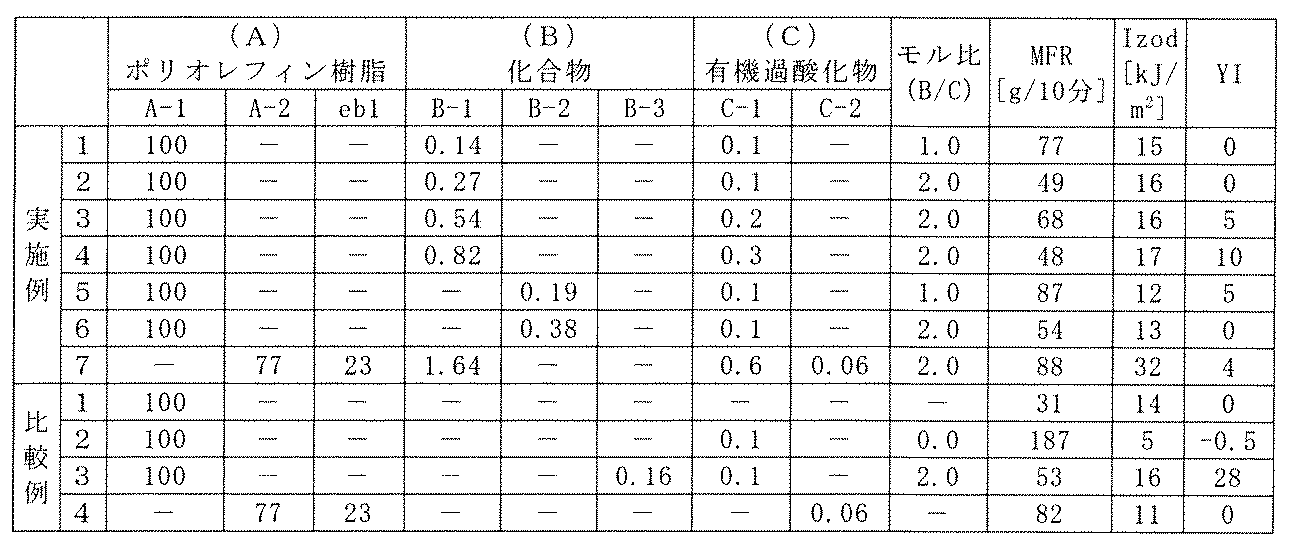
2、4-ジメチルフェノールを100g(0.82モル)、トリオキサンを12.9g(0.14モル)、キシレン48.0g、水89.8gおよび98%硫酸3.0gを四つ口フラスコに仕込んだのち、120℃まで昇温し、還流状態で16時間保持した。その後、水相を分液除去した後、析出物をろ過し、ヘキサンでろ物を洗浄した。その後、析出物を300mlのトルエンで溶解した後、トルエン層を水100mlで3回分液洗浄を行い、トルエン層を濃縮及び乾燥し、6,6’-メチレンビス(2,4-ジメチルフェノール)を43g、収率41%、純度97%で得た。
得られた6,6‘-メチレンビス(2,4-ジメチルフェノール)を42.9g、キシレンを43.2g、トリエチルアミンを43.2g、アクリル酸を12.0gを四つ口フラスコに仕込み、75℃まで昇温した後、塩化ホスホリル19.0gを2時間かけて滴下し、その後30分間加熱保持した。その後、水130gで3回分液洗浄行った後、キシレン相を濃縮乾固した粗生成物を、シリカゲルカラムで精製を行い、次の式(B-4)で表される化合物を6.7g、収率13%、純度98%で得た。

1H-NMR(CDCl3、400MHz):δ2.12、2.17、2.21、2.24(s、12H、Me)、δ3.69(s、2H、Ar-CH 2 -Ar)、δ6.05(dd,J=10.4、1.2Hz、1H、CH=CH 2 )、δ6.66(dd、J=17.2、1.2Hz、1H、CH=CH 2 )、δ6.37(dd、J=17.4、10.4Hz、1H、CH=CH2)、δ6.74、6.79、6.84、6.91(s、4H、Ar)
MS(ESI) m/z(rel intensity)309.5([M-H-], 100)
2、4-ジターシャリーブチルフェノールを30g(0.15モル)、トリオキサンを2.3g(0.025モル)、キシレン14.4g、水26.4gおよび98%硫酸1.0gを四つ口フラスコに仕込んだのち、120℃まで昇温し、還流状態で12時間保持した。その後、水相を分液除去した後、キシレン相を飽和食塩水100mlで3回洗浄した。その後、濃縮乾固したものをヘキサン60gで加熱溶解させ、再結晶を行い、析出物をろ過及び乾燥し、6,6’-メチレンビス(2,4-ジターシャリーブチルフェノール)を20g、収率57%、純度99.7%で得た。
得られた6,6’-メチレンビス(2,4-ジターシャリーブチルフェノール)を19.7g、キシレンを20.0g、トリエチルアミンを20.0g、アクリル酸3.3gを四つ口フラスコに仕込み、75℃まで昇温した後、塩化ホスホリル8.8gを1.5時間かけて滴下し、その後1時間加熱保持した。その後、水45gで3回分液洗浄行った後、キシレン相を濃縮乾固した粗生成物を、シリカゲルカラムで精製を行い、次の式(B-5)で表される化合物を8.9g、収率40%、純度98%で得た。
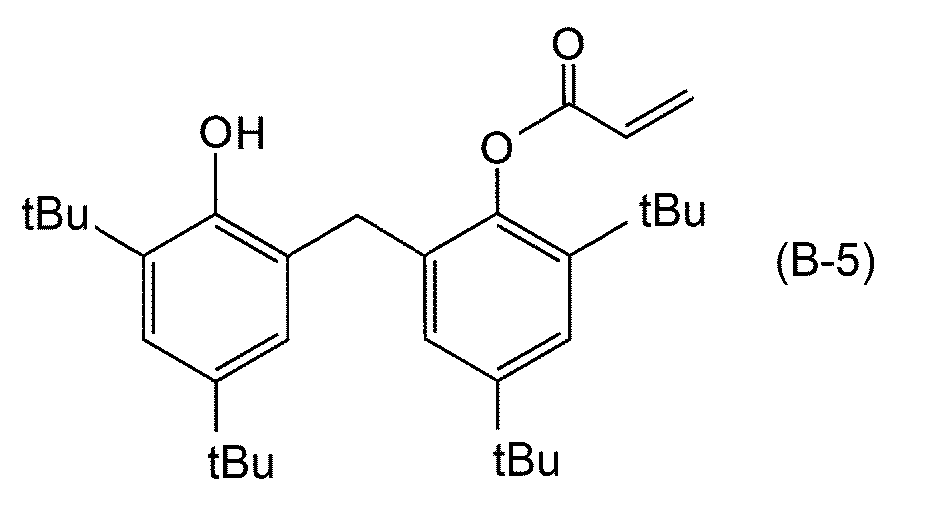
1H-NMR(CDCl3、400MHz):δ1.15、1.30、1.36、1.37(s、36H、t-Bu)、δ3.70(d、J=3.9Hz、2H、Ar-CH 2 -Ar)、δ5.15(d、J=0.5Hz、1H、OH)、δ6.09(dd,J=10.5、1.2Hz、1H、CH=CH 2 )、δ6.67(dd、J=17.3、1.2Hz、1H、CH=CH 2 )、δ6.41(dd、J=17.2、10.4Hz、1H、CH=CH2)、δ6.76、6.98、7.23、7.30(d、J=2.5、2.4、2.4、2.2Hz、4H、Ar)
MS(ESI) m/z(rel intensity)477.5([M-H-], 100)
2-ターシャリーブチル-p-クレゾールを306g(1.86モル)、キシレンを169ml、ぺレックスNBL(花王株式会社製)を6.12gおよび2.3%硫酸313gを四つ口フラスコに仕込み、50℃まで昇温した。その後、パラアルデヒドを43.9g(326ミリモル)を2時間かけて滴下した。滴下後、95℃まで昇温し、加熱還流状態で5時間保温を行った。その後、60℃まで放冷した後、パラアルデヒドを0.544g(4.03ミリモル)を追加し、その後再度95℃まで昇温し、還流状態で15時間保温した。その後、0℃まで冷却し、析出物をろ過し、水洗し、粗生成物を得た。粗生成物をヘキサン350mlで加熱溶解させ、撹拌させながら0℃まで冷却し、析出物を少量のヘキサンで洗浄し、6,6’-メチレンビス(2-ターシャリーブチル-4メチルフェノール)を133g、純度99%で得た。
得られた6,6’-メチレンビス(2-ターシャリーブチル-4メチルフェノール)を66.5g(188ミリモル)、キシレンを66.5g、トリエチルアミンを39.9g(394ミリモル)、アクリル酸を13.5g(187ミリモル)を四つ口フラスコに仕込み、55℃まで昇温した後、塩化ホスホリル17.9g(117ミリモル)を1時間かけて滴下した。その後、室温まで放冷した後、水を添加して反応をクエンチした後、析出した結晶をろ過及び水洗し、粗生成物を得た。粗生成物をメタノールで洗浄し、乾燥を行い、次の式(B-6)で表される化合物を65.1g、収率85%、純度99%で得た。
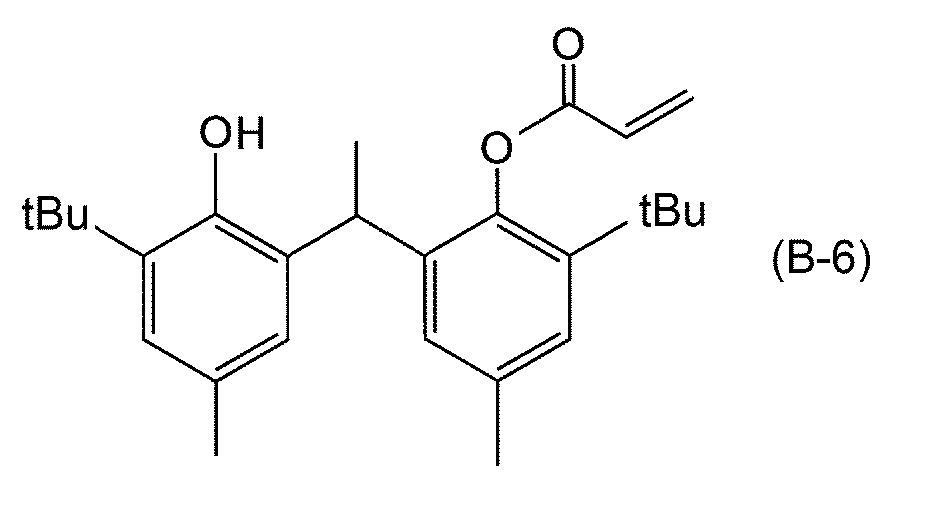
1H-NMR(CDCl3、400MHz):δ1.35、1.36(s、18H、t-Bu)、δ1.46(d、J=7.1Hz、3H、Ar-CH(-CH 3 )-Ar)、δ2.15、2.35(s、6H、Ar-CH 3 )、δ3.85(q、J=6.8Hz、1H、Ar-CH(-CH3)-Ar)、δ6.16、6.78(d,J=1.0Hz、2H、CH=CH 2 )、δ6.45(dd、J=6.1、4.4Hz、1H、CH=CH2)、δ6.4-7.1(s、4H、Ar)
MS(ESI) m/z(rel intensity)407.5([M-H]-、100)
2,4-ジメチルフェノールを230g(1.88モル)、キシレンを110g(1.20モル)、パラアルデヒドを44.8g(0.339モル)、水を230g、98%硫酸を7.3g(0.074モル)およびぺレックスNBL(花王株式会社製)2.54gを四つ口フラスコに仕込み、120℃まで昇温した。その後、還流状態で20時間保温した後、パラアルデヒドを10.9g(0.082モル)追加し、再度加熱還流を8時間継続した。追加で還流状態を8時間保持した後の総還流保温時間28時間後に、パラアルデヒド4.35g(0.033モル)を再度追加し、更に13時間還流保温を継続した。その後、キシレンを151g追加し、70℃に調温した後、撹拌しながら室温まで放冷した。その後析出物をろ過し、ろ物を水500mlで3回洗浄した後、乾燥した。パラアルデヒドを43.9g(326ミリモル)を2時間かけて滴下した。滴下後、95℃まで昇温し、加熱還流状態で5時間保温を行った。その後、60℃まで放冷した後、パラアルデヒドを0.544g(4.03ミリモル)を追加し、その後再度95℃まで昇温し、還流状態で15時間保温した。その後、キシレンを151g追加し、室温まで冷却した。析出物をろ過し、ろ物を水500mlで3回洗浄した。得られたろ物を真空乾燥後、トルエン789gに加熱溶解させ、内温60℃に調温した状態で、ヘキサン641gを加え、室温まで撹拌放冷した。析出した固体をろ過し、ろ物をヘキサン800mlで3回洗浄し、真空乾燥して目的物である1,1-ビス(2-ヒドロキシ-3,5-ジメチルフェニル)エタンを146g、収率57%、純度99%で得た。
得られた1,1-ビス(2-ヒドロキシ-3,5-ジメチルフェニル)エタンを145g(0.537モル)、キシレンを146g、トリエチルアミンを116g、アクリル酸を38.4g(0.533ミリモル)を四つ口フラスコに仕込み、63℃まで昇温した後、塩化ホスホリル50.9g(0.322モル)を1時間15分かけて滴下した。この時の内温は75~78℃であった。その後、72℃で1時間加熱保温した後、60℃まで室温まで放冷した後、水440mlとトルエン500mlを加えた。更にトルエン750mlと少量の食塩水を添加した後、分液を実施した。その後トルエン相を食塩水450ml、4.8%炭酸ナトリウム水溶液438g、食塩水450mlの順で洗浄を行った。その後、無水硫酸ナトリウムで乾燥を行った後、減圧下で溶媒留去を行った。得られた残渣をカラムクロマトグラフィーで精製し、次の式(B-7)で表される化合物を64.6g、収率37%、純度96%で得た。

1H-NMR(CDCl3、400MHz):δ1.50(d、J=7.4Hz、3H、Ar-CH(-CH 3 )-Ar)、δ2.12、2.16、2.19、2.30(s、12H、Ar-CH 3 )、δ4.04(s、1H、Ar-CH(-CH3)-Ar)、δ6.08、6.69(d,J=10.8、17.1Hz,2H,CH=CH 2 )、δ6.40(dd、J=25.6、10.4Hz、1H、CH=CH2)、δ6.6-7.0(s、4H、Ar)
MS(ESI) m/z(rel intensity)323.5([M-H]-、100)
2,4-ジターシャリーブチルフェノールを102g(0.49モル)、キシレンを56ml、パラアルデヒドを11.8g(0.089モル)、水を102ml、98%硫酸を1.9g(0.074モル)およびぺレックスNBL(花王株式会社製)1.0gを四つ口フラスコに仕込み、92℃まで昇温した。その後、5時間保温した後、パラアルデヒドを5.9g(0.044モル)追加し、加熱撹拌を一終夜継続した。キシレンを56ml追加した後、50℃まで放冷した後、種晶を加え、更に25℃まで放冷した。析出した固体を水および少量のヘキサンで洗浄及び乾燥し、目的物である1,1-ビス(2-ヒドロキシ-3,5-ジターシャリーブチルフェニル)エタンを64.9g得た。同様の操作を2度実施した。
得られた1,1-ビス(2-ヒドロキシ-3,5-ジターシャリーブチルフェニル)エタンを73.4g(0.167モル)、キシレンを86ml、トリエチルアミンを49.7g(0.356mol)、アクリル酸を11.9g(0.166モル)を四つ口フラスコに仕込み、80℃まで昇温した後、塩化ホスホリル9.7ml(0.104モル)を50分かけて滴下した。反応完結後、内温が45℃まで放冷した後、水を150ml滴下し、トルエンにて抽出を行った。セライトろ過後、ろ液を水洗し、乾燥し、濃縮した。得られた固体をメタノールで洗浄した。セライトろ過時のろ上物をクロロホルムで抽出、硫酸ナトリウムで乾燥した後、濃縮し、セライトろ過時のろ液より得られた固体と混合した後、再度メタノールで洗浄、乾燥し、次の式(B-8)で表される化合物を76.6g、収率93%で得た。

1H-NMR(CDCl3、400MHz):δ1.08、1.35、1.36、1.37(s、36H、t-Bu)、δ1.51(d、J=7.1Hz、3H、Ar-CH(-CH 3 )-Ar)、δ3.91(q、J=13.9、6.9Hz、1H、Ar-CH(-CH3)-Ar)、δ6.13,6.16(dd,J=10.5、1.0Hz,1H,CH=CH 2 )、δ6.48(dd、J=17.4、10.5Hz、1H、CH=CH2)、δ6.76(dd,J=17.2、0.9Hz,1H、CH=CH 2 )、δ6.5-7.3(s、4H、Ar)
MS(ESI) m/z(rel intensity)491.5([M-H]-、100)
4,4-チオビス(2-ターシャリーブチル-5-メチルフェノール)(住友化学社製、WX-R)を50.0g(0.14モル)、脱水トルエンを100g、トリエチルアミンを141g(1.4モル)を四つ口フラスコに仕込み、室温で撹拌溶解させた。その後、アクリロリルクロライド 51.5g(0.56モル)を8時間かけて滴下した。反応終了後、水でトルエン相を水洗・分液を3回行い、トルエン相を濃縮・乾燥した。得られた濃縮物をシリカゲルカラムで精製し、目的物である次の式(B-9)で表される化合物を12.2g、収率20%、純度99%で得た。
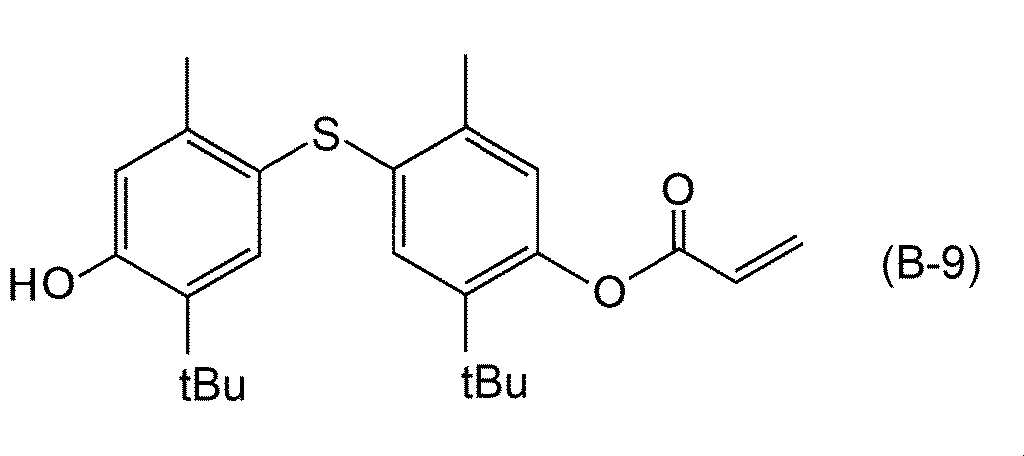
1H-NMR(CDCl3、400MHz):δ1.14、1.35(s、18H、t-Bu)、δ2.27、2.33(d、J=0.5Hz、6H、Me)、δ4.93(s、1H、OH)、δ6.03(dd,J=10.5、1.2Hz、1H、CH=CH 2 )、δ6.34(dd、J=17.3、10.3Hz、1H、CH=CH2)、δ6.60(dd、J=17.4、1.2Hz、1H、CH=CH 2 )、δ6.6-7.3(s、4H、Ar)
化合物(B-1)を表1に記載のとおり上記のようにして得た化合物(B-4)~(B-9)に変更したこと以外は実施例1と同様にして、ポリオレフィン樹脂組成物のペレットを得た。その後、ペレットを用いてメルトフローレート、アイゾッド衝撃強さ及びイエローインデックスを測定した。得られた結果を、各樹脂組成物の組成と共に表2に示す。

エチレン・1-オクテン共重合体(The Dow Chemical Company から入手可能である、ENGAGE8842)73質量部に化合物(B-1)として住友化学(株)製、スミライザーGM27質量部をドライブレンドし、有機過酸化物(C-1)(2,5-ジメチル-2,5-ジ(t-ブチルパーオキシ)ヘキサン)4質量部を含浸させ、該混合物を、30mm径の二軸押出成形機(ナカタニ機械(株)製、NAS30型押出機)の最上流側の原料投入口から投入し、シリンダー温度70℃、で押出し、マスターバッチを得た。
製造例1で得たポリオレフィン樹脂(A-1)98質量部にステアリン酸カルシウム0.05部、Irganox1010、0.05部、Irgafos168、0.1部を混合し、有機過酸化物(C-1)を10質量%含有するポリプロピレンパウダー1.8質量部および実施例14で得たマスターバッチを3.1質量部添加し、ドライブレンド後、30mm径の二軸押出成形機(ナカタニ機械(株)製、NAS30型押出機)の最上流側の原料投入口から投入し、シリンダー温度220℃、吐出量2.4kg/時間、スクリュ回転数70rpmの条件で溶融混練し、原料を均一分散させ、ポリオレフィン樹脂組成物のペレットを得た。樹脂組成物のペレットを用いて、上記の方法に従い、メルトフローレート、射出成形品を用いてアイゾッド衝撃強さ及びイエローインデックスを測定した。得られた結果を表3に示す。

Claims (25)
- (A)100質量部のポリオレフィン樹脂、
(B)0.01~5質量部の、1個の(メタ)アクリレート基と、1個の水素結合性基又は1個の(メタ)アクリレート基とを少なくとも有する化合物、及び
(C)0.01~5質量部の有機過酸化物
を少なくとも含有する、ポリオレフィン樹脂組成物。 - (B)1個の(メタ)アクリレート基と、1個の水素結合性基又は1個の(メタ)アクリレート基とを少なくとも有する化合物は、式(I):

X1及びX2は、それぞれ独立に、水素結合性基又は-OC(=O)CR1=CH2で表される基を表し、かつ、X3及びX4は、それぞれ独立に、水素原子又は炭素数1~9の直鎖状もしくは分枝状のアルキル基を表すか、又は、X1及びX2は、それぞれ独立に、水素原子又は炭素数1~9の直鎖状もしくは分枝状のアルキル基を表し、かつ、X3及びX4は、それぞれ独立に、水素結合性基又は-OC(=O)CR1=CH2で表される基を表し、但し、X1~X4の少なくとも1つは-OC(=O)CR1=CH2で表される基を表し、R1は水素原子又はメチル基を表し、
Yは、単結合、スルフィド結合、又は炭素数1~9の直鎖状又は分枝状のアルキレン基を表し、
R2及びR5は、それぞれ独立に、水素原子又は炭素数1~9の直鎖状もしくは分枝状のアルキル基を表し、R3及びR4は、それぞれ独立に、炭素数1~9の直鎖状又は分枝状のアルキル基を表す]
で表される、請求項1に記載のポリオレフィン樹脂組成物。 - 式(I)中、X1は水素結合性基又は-OC(=O)CR1=CH2で表される基を表し、X2は-OC(=O)CR1=CH2で表される基を表し、X3及びX4は水素原子を表し、Yは、単結合又は炭素数1~9の直鎖状又は分枝状のアルキレン基を表し、R1は水素原子又はメチル基を表し、R2~R5は、それぞれ独立に、炭素数1~9の直鎖状又は分枝状のアルキル基を表す、請求項2に記載のポリオレフィン樹脂組成物。
- 式(I)中、X1及びX2は炭素数1~9の直鎖状もしくは分枝状のアルキル基を表し、X3は水素結合性基又は-OC(=O)CR1=CH2で表される基を表し、X4は-OC(=O)CR1=CH2で表される基を表し、Yは、スルフィド結合を表し、R1は水素原子又はメチル基を表し、R2及びR5は水素原子を表し、R3及びR4は、それぞれ独立に、炭素数1~9の直鎖状又は分枝状のアルキル基を表す、請求項2に記載のポリオレフィン樹脂組成物。
- (B)1個の(メタ)アクリレート基と、1個の水素結合性基又は1個の(メタ)アクリレート基とを少なくとも有する化合物は、1個の(メタ)アクリレート基及び少なくとも1個の水素結合性基を有する化合物である、請求項1に記載のポリオレフィン樹脂組成物。
- (B)1個の(メタ)アクリレート基及び少なくとも1個の水素結合性基を有する化合物は、式(Ia):
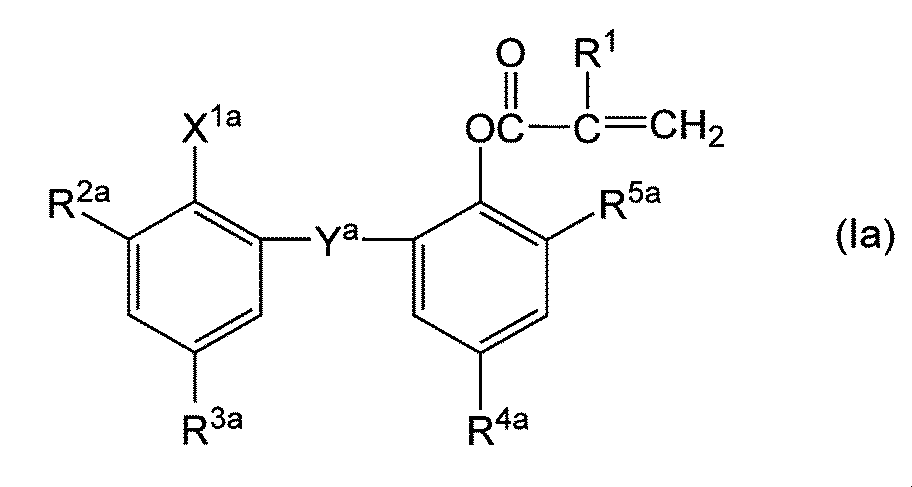
X1aは水素結合性基を表し、
Yaは、単結合又は炭素数1~9の直鎖状又は分枝状のアルキレン基を表し、
R1は水素原子又はメチル基を表し、
R2a~R5aは、それぞれ独立に、炭素数1~9の直鎖状又は分枝状のアルキル基を表す]
で表される、請求項5に記載のポリオレフィン樹脂組成物。 - 式(I)は、式(Ia’):
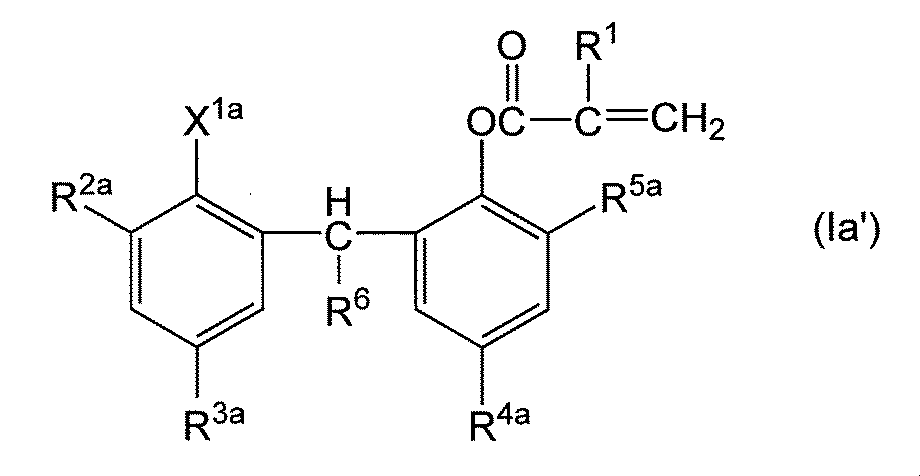
で表される、請求項6に記載のポリオレフィン樹脂組成物。 - 水素結合性基は、ヒドロキシル基、アミノ基、チオール基、カルボキシル基、スルホン酸基、及び、リン酸基からなる群から選択される、請求項1~7のいずれかに記載のポリオレフィン樹脂組成物。
- 式(Ia’)中、X1aはヒドロキシル基を表し、R1は水素原子を表し、R2a~R5aは1,1-ジメチルプロピル基を表し、R6はメチル基を表す、請求項7に記載のポリオレフィン樹脂組成物。
- 式(Ia’)中、X1aはヒドロキシル基を表し、R1及びR6は水素原子を表し、R2a及びR5aはt-ブチル基を表し、R3a及びR4aはメチル基を表す、請求項7に記載のポリオレフィン樹脂組成物。
- 式(I)は、式(1d):
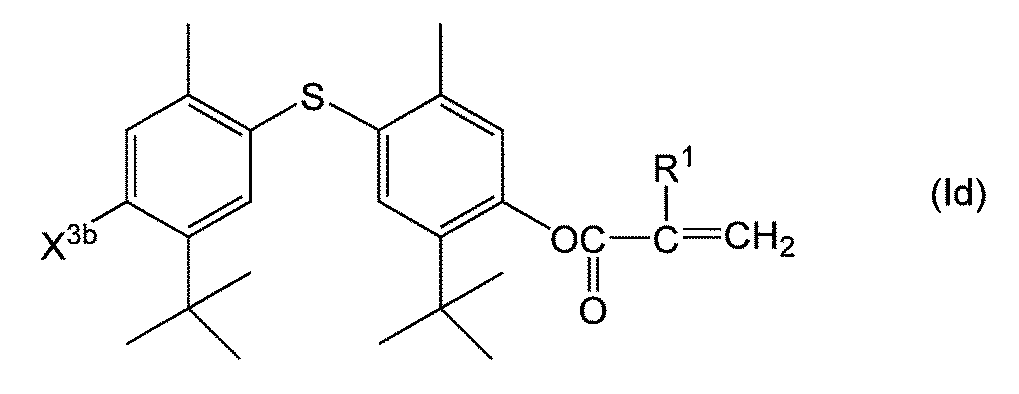
で表される、請求項2に記載のポリオレフィン樹脂組成物。 - (C)有機過酸化物は、過酸化アルキル化合物、過酸化ジアシル化合物、過酸化エステル化合物及び過酸化カーボネート化合物からなる群から選択される、請求項1~11のいずれかに記載のポリオレフィン樹脂組成物。
- (B)1個の(メタ)アクリレート基と、1個の水素結合性基又は1個の(メタ)アクリレート基とを少なくとも有する化合物:(C)有機過酸化物の質量比は1:10~10:1である、請求項1~12のいずれかに記載のポリオレフィン樹脂組成物。
- (A)ポリオレフィン樹脂はプロピレン系樹脂を含む、請求項1~13のいずれかに記載のポリオレフィン樹脂組成物。
- プロピレン系樹脂は、プロピレンに由来する単量体単位を該プロピレン系樹脂の総量に基づいて80質量%以上含有する、請求項14に記載のポリオレフィン樹脂組成物。
- (A)ポリオレフィン樹脂は、エチレン系共重合体をさらに含む、請求項14又は15に記載のポリオレフィン樹脂組成物。
- エチレン系共重合体は、エチレンに由来する単量体単位を該エチレン系共重合体の総量に基づいて20質量%以上含有する、請求項16に記載のポリオレフィン樹脂組成物。
- 請求項1~17のいずれかに記載のポリオレフィン樹脂組成物の製造方法であって、(A)ポリオレフィン樹脂、(B)1個の(メタ)アクリレート基と1個の水素結合性基又は1個の(メタ)アクリレート基とを少なくとも有する化合物、並びに、(C)有機過酸化物を、予め乾式混合して得た混合物を溶融混練することにより互いに混合する工程を少なくとも含む、製造方法。
- (A)ポリオレフィン樹脂、(B)1個の(メタ)アクリレート基と1個の水素結合性基又は1個の(メタ)アクリレート基とを少なくとも有する化合物、並びに、(C)有機過酸化物を乾式混合して混合物を得る工程(1)、及び、工程(1)で得た混合物を溶融混練してポリオレフィン樹脂組成物を得る工程(2)を含むか、又は、
(A)ポリオレフィン樹脂と(C)有機過酸化物の一部を乾式混合して第1乾式混合物を得る工程(1a)、工程(1a)で得た乾式混合物を溶融混練して第1予備混合物を得る工程(2a)、工程(2a)で得た第1予備混合物と、(B)1個の(メタ)アクリレート基と及び少なくとも1個の水素結合性基又は1個の(メタ)アクリレート基とを少なくとも有する化合物と、(C)有機過酸化物の別の一部とを乾式混合して第2乾式混合物を得る工程(1b)、工程(1b)で得た乾式混合物を溶融混練して、ポリオレフィン樹脂組成物を得る工程(2b)を含む、請求項18に記載の製造方法。 - 前記工程(1)及び工程(1b)における、(B)1個の(メタ)アクリレート基と1個の水素結合性基又は1個の(メタ)アクリレート基とを少なくとも有する化合物の混合は、該化合物と、ポリオレフィン系樹脂及びエチレン系共重合体からなる群から選択される少なくとも1種の樹脂とを少なくとも含むマスターバッチを用いて行われる、請求項18又は19に記載の製造方法。
- 1個の(メタ)アクリレート基と1個の水素結合性基又は1個の(メタ)アクリレート基とを少なくとも有する化合物、及び、ポリオレフィン系樹脂及びエチレン系共重合体からなる群から選択される少なくとも1種の樹脂を含む、マスターバッチ。
- 1個の(メタ)アクリレート基と1個の水素結合性基又は1個の(メタ)アクリレート基とを少なくとも有する化合物を、ポリオレフィン系樹脂及びエチレン系共重合体100質量部に対して10~50質量部含む、請求項21に記載のマスターバッチ。
- 有機過酸化物をさらに含む、請求項20又は21に記載のマスターバッチ。
- 式(Ic):
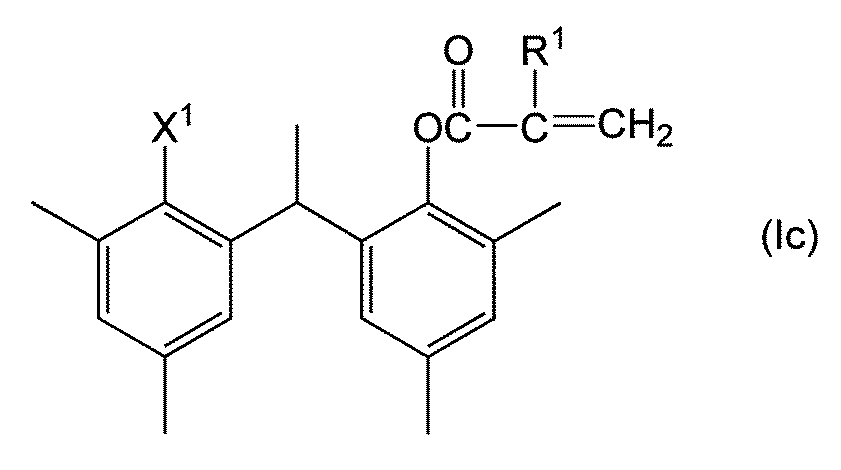
で表される化合物。 - 式(Id):
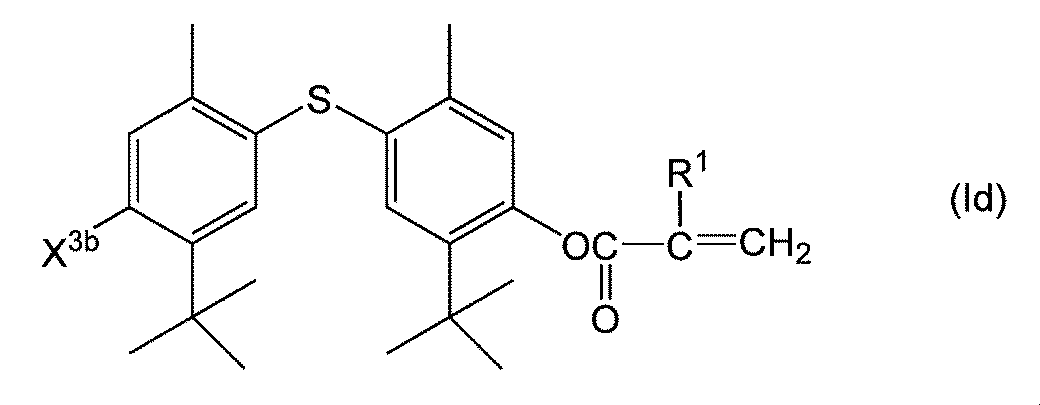
で表される化合物。
Priority Applications (4)
| Application Number | Priority Date | Filing Date | Title |
|---|---|---|---|
| US17/604,179 US20220195142A1 (en) | 2019-04-25 | 2020-04-24 | Polyolefin resin composition and production method thereof |
| EP20795102.1A EP3960802A4 (en) | 2019-04-25 | 2020-04-24 | POLYOLEFIN RESIN COMPOSITION AND PROCESS OF PRODUCTION |
| CN202080030884.9A CN113728041A (zh) | 2019-04-25 | 2020-04-24 | 聚烯烃树脂组合物及其制造方法 |
| JP2021516301A JP7504873B2 (ja) | 2019-04-25 | 2020-04-24 | ポリオレフィン樹脂組成物及びその製造方法 |
Applications Claiming Priority (2)
| Application Number | Priority Date | Filing Date | Title |
|---|---|---|---|
| JP2019084196 | 2019-04-25 | ||
| JP2019-084196 | 2019-04-25 |
Publications (1)
| Publication Number | Publication Date |
|---|---|
| WO2020218574A1 true WO2020218574A1 (ja) | 2020-10-29 |
Family
ID=72942084
Family Applications (1)
| Application Number | Title | Priority Date | Filing Date |
|---|---|---|---|
| PCT/JP2020/017828 Ceased WO2020218574A1 (ja) | 2019-04-25 | 2020-04-24 | ポリオレフィン樹脂組成物及びその製造方法 |
Country Status (5)
| Country | Link |
|---|---|
| US (1) | US20220195142A1 (ja) |
| EP (1) | EP3960802A4 (ja) |
| JP (1) | JP7504873B2 (ja) |
| CN (1) | CN113728041A (ja) |
| WO (1) | WO2020218574A1 (ja) |
Families Citing this family (2)
| Publication number | Priority date | Publication date | Assignee | Title |
|---|---|---|---|---|
| KR102277614B1 (ko) * | 2017-03-29 | 2021-07-15 | 미쓰이 가가쿠 가부시키가이샤 | 전지용 적층체 |
| CN114106567B (zh) * | 2021-12-29 | 2022-11-15 | 绵阳惠利电子材料有限公司 | 一种双组份加成型有机硅聚硅氧烷组合物及其制备方法 |
Citations (11)
| Publication number | Priority date | Publication date | Assignee | Title |
|---|---|---|---|---|
| JPH02258803A (ja) * | 1989-03-31 | 1990-10-19 | Kayaku Nuurii Kk | 有機過酸化物組成物及びそれを用いる変性プラスチックの製造方法 |
| JPH03207788A (ja) * | 1989-10-06 | 1991-09-11 | Ciba Geigy Ag | 安定化有機材料 |
| JPH08315638A (ja) * | 1995-05-22 | 1996-11-29 | Hitachi Cable Ltd | 電気絶縁組成物および電線・ケーブル |
| JP2004182981A (ja) | 2002-11-19 | 2004-07-02 | Sumitomo Chem Co Ltd | プロピレンブロック共重合体製造用固体触媒成分、プロピレンブロック共重合体製造用触媒、およびプロピレンブロック共重合体の製造方法 |
| JP2006225416A (ja) * | 2005-02-15 | 2006-08-31 | Sumitomo Chemical Co Ltd | 熱可塑性エラストマー組成物の製造方法 |
| JP2009520092A (ja) * | 2005-12-20 | 2009-05-21 | シュティヒティング ダッチ ポリマー インスティテュート | 硫黄含有助剤を用いたコポリマーの架橋方法 |
| JP2013079375A (ja) | 2011-09-22 | 2013-05-02 | Sumitomo Chemical Co Ltd | 樹脂組成物、及び、その製造方法とそれを用いた成形体 |
| JP2013209633A (ja) * | 2012-02-29 | 2013-10-10 | Sanyo Chem Ind Ltd | ポリオレフィン樹脂用改質剤 |
| JP2016011413A (ja) * | 2014-06-02 | 2016-01-21 | 三洋化成工業株式会社 | ポリオレフィン樹脂用改質剤 |
| CN106280046A (zh) * | 2015-05-29 | 2017-01-04 | 广东奔迪新材料科技有限公司 | 预发泡epo珠粒、其制备方法及设备 |
| JP2018505284A (ja) | 2015-02-10 | 2018-02-22 | ミリケン・アンド・カンパニーMilliken & Company | 熱可塑性ポリマー組成物 |
Family Cites Families (13)
| Publication number | Priority date | Publication date | Assignee | Title |
|---|---|---|---|---|
| JPH10237241A (ja) * | 1997-02-27 | 1998-09-08 | Mitsui Chem Inc | ポリ4−メチルペンテン樹脂成形品 |
| JP2003084390A (ja) * | 2001-09-11 | 2003-03-19 | Konica Corp | 銀色調を改良した光熱写真画像形成材料 |
| JP2004115570A (ja) * | 2002-09-24 | 2004-04-15 | Sumitomo Chem Co Ltd | ポリプロピレン系樹脂組成物 |
| JP2008137938A (ja) * | 2006-12-01 | 2008-06-19 | Toagosei Co Ltd | チオビスフェノール骨格を有する(メタ)アクリレートの製造方法 |
| US8669030B2 (en) * | 2006-12-11 | 2014-03-11 | Ricoh Company, Limited | Electrophotographic photoreceptor, and image forming method and apparatus using the same |
| US7513703B2 (en) | 2006-12-11 | 2009-04-07 | Canon Kabushiki Kaisha | Magnetic actuator and light quantity adjusting device |
| KR102048431B1 (ko) * | 2012-05-24 | 2019-11-25 | 가부시키가이샤 아데카 | 안정제 조성물, 수지 조성물, 및 이것을 사용한 성형품 |
| CN104086718A (zh) * | 2014-07-02 | 2014-10-08 | 安徽宁国尚鼎橡塑制品有限公司 | 一种汽车油封用橡胶材料 |
| JP5700166B1 (ja) * | 2014-08-01 | 2015-04-15 | 東洋インキScホールディングス株式会社 | 接着剤組成物、積層体、蓄電デバイス用包装材、蓄電デバイス用容器および蓄電デバイス |
| JP6401579B2 (ja) * | 2014-11-11 | 2018-10-10 | 住友化学株式会社 | 化合物、樹脂、レジスト組成物及びレジストパターンの製造方法 |
| WO2016085535A1 (en) * | 2014-11-26 | 2016-06-02 | Milliken & Company | Modified heterophasic polyolefin composition |
| WO2017170591A1 (ja) * | 2016-03-28 | 2017-10-05 | Psジャパン株式会社 | スチレン系共重合体およびその製造方法、押出発泡シートおよびその成形品 |
| WO2018123150A1 (ja) * | 2016-12-28 | 2018-07-05 | 旭化成株式会社 | セルロース含有樹脂組成物及びセルロース製剤 |
-
2020
- 2020-04-24 CN CN202080030884.9A patent/CN113728041A/zh active Pending
- 2020-04-24 US US17/604,179 patent/US20220195142A1/en not_active Abandoned
- 2020-04-24 EP EP20795102.1A patent/EP3960802A4/en not_active Withdrawn
- 2020-04-24 WO PCT/JP2020/017828 patent/WO2020218574A1/ja not_active Ceased
- 2020-04-24 JP JP2021516301A patent/JP7504873B2/ja active Active
Patent Citations (11)
| Publication number | Priority date | Publication date | Assignee | Title |
|---|---|---|---|---|
| JPH02258803A (ja) * | 1989-03-31 | 1990-10-19 | Kayaku Nuurii Kk | 有機過酸化物組成物及びそれを用いる変性プラスチックの製造方法 |
| JPH03207788A (ja) * | 1989-10-06 | 1991-09-11 | Ciba Geigy Ag | 安定化有機材料 |
| JPH08315638A (ja) * | 1995-05-22 | 1996-11-29 | Hitachi Cable Ltd | 電気絶縁組成物および電線・ケーブル |
| JP2004182981A (ja) | 2002-11-19 | 2004-07-02 | Sumitomo Chem Co Ltd | プロピレンブロック共重合体製造用固体触媒成分、プロピレンブロック共重合体製造用触媒、およびプロピレンブロック共重合体の製造方法 |
| JP2006225416A (ja) * | 2005-02-15 | 2006-08-31 | Sumitomo Chemical Co Ltd | 熱可塑性エラストマー組成物の製造方法 |
| JP2009520092A (ja) * | 2005-12-20 | 2009-05-21 | シュティヒティング ダッチ ポリマー インスティテュート | 硫黄含有助剤を用いたコポリマーの架橋方法 |
| JP2013079375A (ja) | 2011-09-22 | 2013-05-02 | Sumitomo Chemical Co Ltd | 樹脂組成物、及び、その製造方法とそれを用いた成形体 |
| JP2013209633A (ja) * | 2012-02-29 | 2013-10-10 | Sanyo Chem Ind Ltd | ポリオレフィン樹脂用改質剤 |
| JP2016011413A (ja) * | 2014-06-02 | 2016-01-21 | 三洋化成工業株式会社 | ポリオレフィン樹脂用改質剤 |
| JP2018505284A (ja) | 2015-02-10 | 2018-02-22 | ミリケン・アンド・カンパニーMilliken & Company | 熱可塑性ポリマー組成物 |
| CN106280046A (zh) * | 2015-05-29 | 2017-01-04 | 广东奔迪新材料科技有限公司 | 预发泡epo珠粒、其制备方法及设备 |
Non-Patent Citations (1)
| Title |
|---|
| See also references of EP3960802A4 |
Also Published As
| Publication number | Publication date |
|---|---|
| JPWO2020218574A1 (ja) | 2020-10-29 |
| EP3960802A1 (en) | 2022-03-02 |
| EP3960802A4 (en) | 2023-01-18 |
| CN113728041A (zh) | 2021-11-30 |
| US20220195142A1 (en) | 2022-06-23 |
| JP7504873B2 (ja) | 2024-06-24 |
Similar Documents
| Publication | Publication Date | Title |
|---|---|---|
| JP5651918B2 (ja) | ポリプロピレン系樹脂組成物及び成形体 | |
| CN101903464B (zh) | 聚丙烯类树脂组合物及由其制成的成型体 | |
| JP4736435B2 (ja) | ポリプロピレン系樹脂組成物 | |
| US20090253849A1 (en) | Polypropylene resin composition and injection molded item for automobile therefrom | |
| JP2010150417A (ja) | ポリプロピレン系樹脂組成物及び成形体 | |
| JP2009091567A (ja) | 光安定化ポリプロピレン | |
| JP2006193643A (ja) | ポリプロピレン系樹脂組成物 | |
| JP2008013757A (ja) | ポリプロピレン系樹脂組成物およびそれからなる自動車用射出成形体 | |
| JP2792205B2 (ja) | 熱可塑性樹脂組成物 | |
| JP7504873B2 (ja) | ポリオレフィン樹脂組成物及びその製造方法 | |
| WO2013141398A1 (ja) | ポリプロピレン樹脂組成物及び成形体 | |
| JPH11228760A (ja) | ポリプロピレン系樹脂フイルム又はシート | |
| JPH11315177A (ja) | ポリプロピレン樹脂組成物及びそれを用いたフイルム又はシート | |
| JP5228294B2 (ja) | ポリプロピレン系樹脂組成物 | |
| KR20160039406A (ko) | 고충격 고강성 폴리프로필렌 수지 조성물, 이의 제조방법 및 이로 제조된 성형품 | |
| CN101374902B (zh) | 聚烯烃树脂组合物、由其形成的成形品以及聚烯烃树脂组合物的制造方法 | |
| JP6229384B2 (ja) | ポリプロピレン系樹脂組成物およびそれからなる成形体 | |
| JP2008019346A (ja) | ポリプロピレン系樹脂組成物 | |
| JP2607099B2 (ja) | 高剛性エチレン−プロピレンブロック共重合体組成物 | |
| JP4495387B2 (ja) | ポリオレフィン系樹脂組成物 | |
| JPH083009B2 (ja) | 高剛性プロピレン単独重合体組成物 | |
| JP7737870B2 (ja) | 車両用ワイヤーハーネスのコネクター | |
| JPS63146953A (ja) | プロピレン樹脂組成物 | |
| JP2562915B2 (ja) | 高剛性高溶融粘弾性エチレン−プロピレンブロック共重合体組成物 | |
| JP4034150B2 (ja) | 変性ポリオレフィン組成物 |
Legal Events
| Date | Code | Title | Description |
|---|---|---|---|
| 121 | Ep: the epo has been informed by wipo that ep was designated in this application |
Ref document number: 20795102 Country of ref document: EP Kind code of ref document: A1 |
|
| ENP | Entry into the national phase |
Ref document number: 2021516301 Country of ref document: JP Kind code of ref document: A |
|
| NENP | Non-entry into the national phase |
Ref country code: DE |
|
| ENP | Entry into the national phase |
Ref document number: 2020795102 Country of ref document: EP Effective date: 20211125 |
|
| WWW | Wipo information: withdrawn in national office |
Ref document number: 2020795102 Country of ref document: EP |