WO2020256045A1 - Cristal de 4,4'-bis(2-propène-1-yloxy)-1,1'-biphényle à substitution hexaméthyle/à substitution diméthyle - Google Patents
Cristal de 4,4'-bis(2-propène-1-yloxy)-1,1'-biphényle à substitution hexaméthyle/à substitution diméthyle Download PDFInfo
- Publication number
- WO2020256045A1 WO2020256045A1 PCT/JP2020/023893 JP2020023893W WO2020256045A1 WO 2020256045 A1 WO2020256045 A1 WO 2020256045A1 JP 2020023893 W JP2020023893 W JP 2020023893W WO 2020256045 A1 WO2020256045 A1 WO 2020256045A1
- Authority
- WO
- WIPO (PCT)
- Prior art keywords
- compound
- crystal
- temperature
- crystals
- yloxy
- Prior art date
- Legal status (The legal status is an assumption and is not a legal conclusion. Google has not performed a legal analysis and makes no representation as to the accuracy of the status listed.)
- Ceased
Links
Images



Classifications
-
- C—CHEMISTRY; METALLURGY
- C07—ORGANIC CHEMISTRY
- C07C—ACYCLIC OR CARBOCYCLIC COMPOUNDS
- C07C43/00—Ethers; Compounds having groups, groups or groups
- C07C43/02—Ethers
- C07C43/20—Ethers having an ether-oxygen atom bound to a carbon atom of a six-membered aromatic ring
- C07C43/215—Ethers having an ether-oxygen atom bound to a carbon atom of a six-membered aromatic ring having unsaturation outside the six-membered aromatic rings
-
- C—CHEMISTRY; METALLURGY
- C08—ORGANIC MACROMOLECULAR COMPOUNDS; THEIR PREPARATION OR CHEMICAL WORKING-UP; COMPOSITIONS BASED THEREON
- C08F—MACROMOLECULAR COMPOUNDS OBTAINED BY REACTIONS ONLY INVOLVING CARBON-TO-CARBON UNSATURATED BONDS
- C08F16/00—Homopolymers and copolymers of compounds having one or more unsaturated aliphatic radicals, each having only one carbon-to-carbon double bond, and at least one being terminated by an alcohol, ether, aldehydo, ketonic, acetal or ketal radical
- C08F16/12—Homopolymers and copolymers of compounds having one or more unsaturated aliphatic radicals, each having only one carbon-to-carbon double bond, and at least one being terminated by an alcohol, ether, aldehydo, ketonic, acetal or ketal radical by an ether radical
- C08F16/32—Monomers containing two or more unsaturated aliphatic radicals
-
- H—ELECTRICITY
- H05—ELECTRIC TECHNIQUES NOT OTHERWISE PROVIDED FOR
- H05K—PRINTED CIRCUITS; CASINGS OR CONSTRUCTIONAL DETAILS OF ELECTRIC APPARATUS; MANUFACTURE OF ASSEMBLAGES OF ELECTRICAL COMPONENTS
- H05K1/00—Printed circuits
- H05K1/02—Details
- H05K1/03—Use of materials for the substrate
Definitions
- the present invention relates to hexamethyl-substituted / dimethyl-substituted 4,4'-bis (2-propene-1-yloxy) -1,1'-biphenyl crystals.
- a cross-linking agent having an allyl group is widely used.
- Triallyl isocyanurate which is a general-purpose curing agent for modified polyphenylene oxide, has a problem that it is a liquid at room temperature (25 ° C.), easily volatilizes with a solvent at the prepreg formation stage, and has low heat resistance.
- Patent Documents 1 and 2 below describe diallyl ether compounds such as biphenol, 4,4'-dihydroxy-3,3', 5,5'-tetramethylbiphenyl as allyl ether compounds having a biphenol skeleton.
- the present invention has been made against the background of the above-mentioned circumstances, and is a crystal at room temperature (25 ° C.), has better heat resistance and storage stability, and is volatile in the prepreg molding process.
- An object of the present invention is to provide new allyl ethers having a suppressed biphenol skeleton.
- Compound A 2,2', 3,3', 5,5'-hexamethyl-4,4'-bis (2-propene-1-yloxy) -1,1', which is one of allyl ethers having a biphenol skeleton.
- Compound B 3,3'-dimethyl-4,4'-bis (2-propene-1-yloxy) -1,1'-biphenyl
- the present invention is as follows. 1.
- a crystal of a compound represented by the following formula (1) (In the formula, R represents a hydrogen atom or a methyl group. However, all four Rs are the same.) 2.
- the compound represented by the formula (1) is 2,2', 3,3', 5,5'-hexamethyl-4,4'-bis (2-propene-1-yloxy) -1,1'-biphenyl. Is 1.
- 3. The endothermic peak top temperature by differential scanning calorimetry is in the range of 70 to 75 ° C.
- the compound represented by the formula (1) is 3,3'-dimethyl-4,4'-bis (2-propene-1-yloxy) -1,1'-biphenyl.
- the crystal according to. 5. 3.
- the endothermic peak top temperature by differential scanning calorimetry is in the range of 110 to 115 ° C.
- Crystals of "Compound A"(2,2',3,3',5,5'-hexamethyl-4,4'-bis (2-propen-1-yloxy) -1,1'-biphenyl) of the present invention The body or "Compound B"(3,3'-dimethyl-4,4'-bis (2-propen-1-yloxy) -1,1'-biphenyl) is "Compound X" (3) having a similar chemical structure. , 3', 5,5'-Tetramethyl-4,4'-bis (2-propen-1-yloxy) -1,1'-biphenyl) has better crystallinity, so crystallization The operation and filtration operation can be easily performed, and the handling is excellent.
- the endothermic peak top temperature by differential scanning calorimetry is as high as 72 ° C for "Compound X", 73 ° C for the crystal of "Compound A” of the present invention, and 112 ° C for "Compound B".
- the crystal of the present invention can reduce blocking and melt-fixing during transportation and storage in summer. Further, since the crystal of the present invention has a higher 5% weight loss temperature of the compound itself as compared with the conventional general-purpose curing agent triallyl isocyanurate, it has an excellent effect that volatility in the prepreg molding step is suppressed. Demonstrate. Therefore, from the above points, the crystal of the present invention is very useful in industrial use.
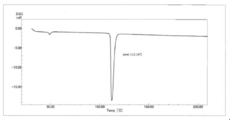
- FIG. It is a chart figure which shows the differential scanning calorimetry data of the crystal body of "Compound A” obtained in Example 1.
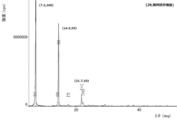
- FIG. It is a chart figure which shows the powder X-ray diffraction analysis measurement data of the crystal body of "Compound A” obtained in Example 1.
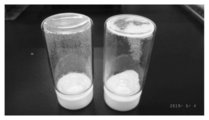
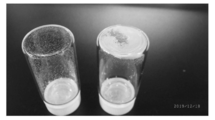
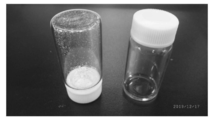
- FIG. It is a photograph which shows the state of "Compound A” (left side) and “Compound X” (right side) before the start of the test of "confirmation test 1 of storage stability at high temperature and handleability of crystal body” in Example. ..
- FIG. It is a chart figure which shows the powder X-ray diffraction analysis measurement data of the crystal body of "Compound B” obtained in Example 2.
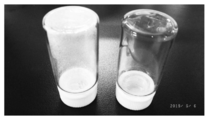
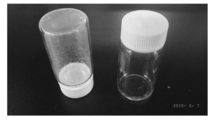
- FIG. It is a photograph which shows the state of "Compound B” (left side) and “Compound X” (right side) before the start of the test of "confirmation test 2 of storage stability under high temperature and handleability of crystal body” in Example. ..
- the "Compound A"(2,2',3,3',5,5'-hexamethyl-4,4'-bis (2-propene-1-yloxy) -1,1'-biphenyl) of the present invention is used. It is a compound represented by the following chemical formula.
- the "Compound B"(3,3'-dimethyl-4,4'-bis (2-propene-1-yloxy) -1,1'-biphenyl) of the present invention is a compound represented by the following chemical formula.
- the method for producing "Compound A” and “Compound B” of the present invention is not particularly limited, but for example, as shown by the following reaction formula, known 4,4'-dihydroxy-2,2', 3 , 3', 5,5'-hexamethylbiphenyl (hereinafter referred to as "Compound a”) and 4,4'-dihydroxy-3,3'-dimethylbiphenyl (hereinafter referred to as "Compound b").
- Examples thereof include a production method for obtaining a diether compound by reacting with allyl halide such as allyl chloride.
- reaction temperature in the above production method is preferably in the range of 20 to 120 ° C., more preferably in the range of 40 to 80 ° C., and even more preferably in the range of 60 to 70 ° C.
- the reaction pressure is usually carried out under normal pressure, but may be carried out under pressurization or reduced pressure.
- "Compound a" or “Compound b” is phenoxided with a base to enhance nucleophilicity, and the reaction is carried out.
- the base is not particularly limited, but is an alkali metal carbonate such as lithium carbonate, sodium carbonate and potassium carbonate, alkali metal hydrogen carbonate such as sodium hydrogen carbonate and potassium hydrogen carbonate, lithium hydroxide, sodium hydroxide and potassium hydroxide.
- alkali metal hydroxides such as, organic bases such as triethylamine and pyridine can be preferably used. Of these, sodium carbonate and potassium carbonate are preferable.
- the amount of this base used is preferably 1 to 5 equivalents, more preferably 1 to 3 equivalents, still more preferably 1 to 2 equivalents, relative to one hydroxyl group of "Compound a" or "Compound b".
- a catalyst may be used for the purpose of accelerating the reaction.
- the catalyst examples include alkali metal bromide salts such as sodium bromide and potassium bromide, alkali metal iodide salts such as sodium iodide and potassium iodide, and ammonium halide salts such as ammonium bromide and ammonium iodide. ..
- the amount of the catalyst used is preferably 0.05 to 3 equivalents, more preferably 0.1 to 1 equivalents, and 0.2 to 0.5 equivalents, relative to one hydroxyl group of "Compound a" or "Compound b". Is even more preferable.
- reaction solvent In the above production method, the reaction solvent may not be used, but it is preferably used for the reason of improving operability and reaction speed during industrial production.
- the reaction solvent is not particularly limited as long as it is not distilled out from the reaction vessel at the above reaction temperature and is inactive in the reaction.
- ketones such as acetone, methyl ethyl ketone, methyl isobutyl ketone and cyclohexanone, tetrahydrofuran, 1,4- Examples thereof include ethers such as dioxane, 1,3-dioxane and diethoxyethane, and aprotic polar solvents such as acetonitrile, dimethyl sulfoxide, dimethylformamide and N-methylpyrrolidone. Each of these organic solvents may be used alone, or two or more of them may be used in combination as appropriate to adjust the polarity. Of these, N-methylpyrrolidone and acetonitrile are preferable.
- the end point of the reaction can be confirmed by liquid chromatography or gas chromatography analysis. It is preferable that the end point of the reaction is the time when the unreacted "Compound a” or “Compound b" disappears and the increase of the target product "Compound A” or “Compound B” is no longer observed.
- the reaction time varies depending on the reaction conditions such as the reaction temperature, but is usually completed in about 1 to 30 hours.
- Compound A or “Compound B” can be obtained by performing post-treatment operations such as separation by column chromatography.
- post-treatment operations such as separation by column chromatography.
- purification by distillation, recrystallization or column chromatography may be carried out according to a conventional method.
- the crystal of the present invention can be obtained by crystallizing the crude product obtained by the above production method.
- the "Compound A” or “Compound B” used in the crystallization step is a crude crystal obtained by treating the reaction solution, a crystal obtained by recrystallizing the crude crystal, or a solution containing "Compound A” or “Compound B". Examples thereof include a residual solution obtained by distilling off the solvent. It may be amorphous.
- Examples of the solvent that can be used for crystallization include aromatic hydrocarbons such as toluene, xylene and benzene, aliphatic hydrocarbons such as hexane, heptane and cyclohexane, ketones such as acetone, methyl ethyl ketone and methyl isobutyl ketone, and methanol. , Alcohols such as ethanol and propanol, esters such as ethyl acetate and butyl acetate, ethers such as tetrahydrofuran and diethyl ether, nitriles such as acetonitrile, amides such as N-methylpyrrolidone, water and the like.
- aromatic hydrocarbons such as toluene, xylene and benzene
- aliphatic hydrocarbons such as hexane, heptane and cyclohexane
- ketones such as acetone, methyl e
- the solvent to be mixed with may be used as an aqueous solution. Further, these crystallization solvents may be used alone or in combination of two or more. Above all, as the solvent used for crystallization, the combined use of acetonitrile and water and the combined use of methyl isobutyl ketone and methanol are preferable.
- the amount of the crystallization solvent used is largely related to the solubility of "Compound A” or "Compound B" in each solvent, but is preferably about 0.5 to 10 times by weight with respect to the target product.
- two or more kinds of solvents are mixed and used, they can be appropriately adjusted in consideration of the solubility. For example, two kinds of solvents are mixed in a ratio of 1:10 to 10: 1, preferably 1: 5.
- the temperature at which the crystals are precipitated is preferably 20 to 50 ° C, more preferably 20 to 25 ° C.
- the final cooling temperature is preferably 0 to 20 ° C, more preferably 10 to 20 ° C.
- the operation in the crystallization step uses the above crystallization solvent, for example, cooling crystallization or poor solvent addition crystallization (solubility in a solution in which "Compound A” or “Compound B” is dissolved in a good solvent. It can be carried out by crystallization) in which a poor solvent is added to lower the temperature. Above all, it is preferable to carry out by crystallization with poor solvent addition. Poor solvent addition The method of adding the poor solvent in the case of crystallization can be appropriately adjusted according to the precipitation of crystals, but the required amount of the poor solvent may be added continuously or collectively. You may. By drying the crystals obtained by crystallization, the solvent used in crystallization can be removed.
- This drying can be carried out on the crystals obtained by crystallization at preferably 40 to 70 ° C. under reduced pressure, more preferably 40 to 50 ° C. under reduced pressure. Drying may be carried out under normal pressure or reduced pressure, but when carried out industrially, it is more efficient to carry out under reduced pressure because the solvent used in crystallization can be removed.
- the crystal of "Compound A” of the present invention preferably has an endothermic peak top temperature in the range of 70 to 75 ° C. by differential scanning calorimetry. Among them, a crystal having an endothermic peak top temperature in the range of 71 to 74.5 ° C. is preferable, and a crystal having a heat absorption peak top temperature in the range of 71 to 74 ° C. is more preferable.
- the crystal of "Compound B” of the present invention preferably has an endothermic peak top temperature in the range of 110 to 115 ° C. by differential scanning calorimetry. Among them, a crystal having an endothermic peak top temperature in the range of 111 to 114 ° C.
- Each crystal of the present invention usually has a purity in the range of 95-100%. The purity is preferably in the range of 97 to 100%, more preferably in the range of 98 to 100%.
- the present invention can easily carry out the crystallization operation and the filtration operation, and exhibits the effect of being excellent in handleability.
- the endothermic peak top temperature of the differential scanning calorific value analysis is 52 ° C for "Compound X", 73 ° C for the crystal of "Compound A” of the present invention, and 112 ° C for the crystal of "Compound B".
- the crystal of the present invention can reduce blocking and melt sticking during transportation and storage in summer.
- the crystal of the present invention has a higher 5% weight loss temperature of the compound itself than the conventional general-purpose curing agent triallyl isocyanurate, it has an excellent effect of suppressing volatility in the prepreg molding process. Demonstrate. Therefore, from the above points, it is very useful in industrial use.
- DSC Differential scanning calorimetry
- the crystals were precisely weighed in an aluminum pan, and measured using a differential scanning calorimetry device (manufactured by Shimadzu Corporation: DSC-60) under the following operating conditions using aluminum oxide as a control. (Operating conditions) Heating rate: 10 ° C / min Measurement temperature range: 30-300 ° C Measurement atmosphere: open, nitrogen 50 mL / min Sample amount: 2-3 mg 2. 2.
- Purity analyzer Prominence UFLC (Liquid Chromatography) manufactured by Shimadzu Corporation Pump: LC-20AD Column oven: CTO-20A Detector: SPD-20A Column: HALO C18 (inner diameter 3 mm, length 75 mm) Oven temperature: 50 ° C Flow rate: 0.7 mL / min Mobile phase: (A) 0.2% by volume acetic acid aqueous solution, (B) methanol gradient condition: (A)% by volume (time from the start of analysis) 50% (0min) ⁇ 100% (7.5min) ⁇ 100% (15min) Sample injection volume: 10 ⁇ L Detection wavelength: 280 nm 3. 3.
- Powder X-ray diffraction (XRD) 0.1 g of the crystal was filled in the sample filling portion of the glass test plate, and the measurement was performed using the following device and the following conditions.
- the 5% weight loss temperature of the obtained crystal of "Compound A” was measured and found to be 242 ° C.
- Table 1 shows the main peaks of XRD (those having a relative intensity of more than 5%).
- the characteristic 2 ⁇ (deg) of “Compound A” obtained in Example 1 is 5.8, 11.6, 15.7, 17.4, 18.3, 19.6. , 21.7, 24.3, 26.6.
- FIG. 2 shows a chart (partially enlarged view) showing the powder X-ray diffraction analysis measurement data.
- the 5% weight loss temperature of the obtained crystal of "Compound B” was measured and found to be 234 ° C.
- Table 2 shows the main peaks of XRD (those having a relative intensity of more than 4%).
- the characteristic 2 ⁇ (deg) of “Compound B” obtained in Example 1 was 7.2, 14.5, and 21.7.
- FIG. 8 shows a chart (partially enlarged view) showing the powder X-ray diffraction analysis measurement data.
Landscapes
- Chemical & Material Sciences (AREA)
- Organic Chemistry (AREA)
- Engineering & Computer Science (AREA)
- Microelectronics & Electronic Packaging (AREA)
- Health & Medical Sciences (AREA)
- Chemical Kinetics & Catalysis (AREA)
- Medicinal Chemistry (AREA)
- Polymers & Plastics (AREA)
- Organic Low-Molecular-Weight Compounds And Preparation Thereof (AREA)
- Liquid Crystal Substances (AREA)
Abstract
La présente invention aborde le problème de la fourniture d'un nouvel éther arylique qui a un squelette biphénol, l'éther arylique étant cristallin à température ambiante (25 °C), a une tolérance à la chaleur et une stabilité de conservation supérieures, et démontre une volatilité supprimée pendant une étape de moulage de préimprégné. La solution selon l'invention concerne un cristal du composé représenté par la formule (1). (Dans la formule, R représente un atome d'hydrogène ou un groupe méthyle, les quatre R sont tous les mêmes.)
Applications Claiming Priority (4)
| Application Number | Priority Date | Filing Date | Title |
|---|---|---|---|
| JP2019-114197 | 2019-06-20 | ||
| JP2019114197 | 2019-06-20 | ||
| JP2019237031 | 2019-12-26 | ||
| JP2019-237031 | 2019-12-26 |
Publications (1)
| Publication Number | Publication Date |
|---|---|
| WO2020256045A1 true WO2020256045A1 (fr) | 2020-12-24 |
Family
ID=74040834
Family Applications (1)
| Application Number | Title | Priority Date | Filing Date |
|---|---|---|---|
| PCT/JP2020/023893 Ceased WO2020256045A1 (fr) | 2019-06-20 | 2020-06-18 | Cristal de 4,4'-bis(2-propène-1-yloxy)-1,1'-biphényle à substitution hexaméthyle/à substitution diméthyle |
Country Status (2)
| Country | Link |
|---|---|
| TW (1) | TW202110779A (fr) |
| WO (1) | WO2020256045A1 (fr) |
Cited By (1)
| Publication number | Priority date | Publication date | Assignee | Title |
|---|---|---|---|---|
| WO2023026845A1 (fr) * | 2021-08-23 | 2023-03-02 | 本州化学工業株式会社 | Composition de résine durcissable, vernis, préimprégné et produit durci |
Citations (7)
| Publication number | Priority date | Publication date | Assignee | Title |
|---|---|---|---|---|
| WO2010073960A1 (fr) * | 2008-12-26 | 2010-07-01 | 昭和電工株式会社 | Procédé de production d'un composé époxy |
| WO2010084823A1 (fr) * | 2009-01-22 | 2010-07-29 | チッソ株式会社 | Composition de cristaux liquides et élément d'affichage à cristaux liquides |
| JP2014034580A (ja) * | 2012-08-07 | 2014-02-24 | Ajinomoto Co Inc | 樹脂組成物 |
| JP2014169428A (ja) * | 2013-02-05 | 2014-09-18 | Nippon Kayaku Co Ltd | アリルエーテル樹脂およびその製造方法 |
| US20190194408A1 (en) * | 2017-12-25 | 2019-06-27 | Industrial Technology Research Institute | Thermally conductive resin, resin composition, prepreg, and copper clad laminate |
| US20190194383A1 (en) * | 2017-12-25 | 2019-06-27 | Iteq Corporation | Resin composition, prepreg, and copper clad laminate |
| CN110938357A (zh) * | 2019-10-29 | 2020-03-31 | 联茂(无锡)电子科技有限公司 | 多层结构以及基板的制造方法 |
-
2020
- 2020-06-18 WO PCT/JP2020/023893 patent/WO2020256045A1/fr not_active Ceased
- 2020-06-19 TW TW109120810A patent/TW202110779A/zh unknown
Patent Citations (7)
| Publication number | Priority date | Publication date | Assignee | Title |
|---|---|---|---|---|
| WO2010073960A1 (fr) * | 2008-12-26 | 2010-07-01 | 昭和電工株式会社 | Procédé de production d'un composé époxy |
| WO2010084823A1 (fr) * | 2009-01-22 | 2010-07-29 | チッソ株式会社 | Composition de cristaux liquides et élément d'affichage à cristaux liquides |
| JP2014034580A (ja) * | 2012-08-07 | 2014-02-24 | Ajinomoto Co Inc | 樹脂組成物 |
| JP2014169428A (ja) * | 2013-02-05 | 2014-09-18 | Nippon Kayaku Co Ltd | アリルエーテル樹脂およびその製造方法 |
| US20190194408A1 (en) * | 2017-12-25 | 2019-06-27 | Industrial Technology Research Institute | Thermally conductive resin, resin composition, prepreg, and copper clad laminate |
| US20190194383A1 (en) * | 2017-12-25 | 2019-06-27 | Iteq Corporation | Resin composition, prepreg, and copper clad laminate |
| CN110938357A (zh) * | 2019-10-29 | 2020-03-31 | 联茂(无锡)电子科技有限公司 | 多层结构以及基板的制造方法 |
Cited By (2)
| Publication number | Priority date | Publication date | Assignee | Title |
|---|---|---|---|---|
| WO2023026845A1 (fr) * | 2021-08-23 | 2023-03-02 | 本州化学工業株式会社 | Composition de résine durcissable, vernis, préimprégné et produit durci |
| KR20240044418A (ko) | 2021-08-23 | 2024-04-04 | 혼슈우 카가쿠고교 가부시키가이샤 | 경화성 수지 조성물, 바니시, 프리프레그, 경화물 |
Also Published As
| Publication number | Publication date |
|---|---|
| TW202110779A (zh) | 2021-03-16 |
Similar Documents
| Publication | Publication Date | Title |
|---|---|---|
| KR102866982B1 (ko) | 2,2'-비스(카르복시메톡시)-1,1'-비나프틸의 결정체 | |
| WO2021015083A1 (fr) | Cristal de 2, 2'-bis(éthoxycarbonylméthoxy)-1, 1'-binaphtyle | |
| KR102702691B1 (ko) | 2,2'-비스(카르복시메톡시)-1,1'-비나프틸의 결정체 | |
| JP7516701B2 (ja) | ビナフチルカルボン酸類の製造方法 | |
| US11091461B2 (en) | Method for producing crystal of uracil compound | |
| KR20240158905A (ko) | 비페난트렌 화합물 또는 그의 알칼리 금속염 | |
| JP7535367B1 (ja) | ビナフチル骨格を有するジエステル化合物の結晶及びその製造方法 | |
| TW202110779A (zh) | 六甲基取代/二甲基取代4,4’-雙(2-丙烯-1-基氧基)-1,1’-聯苯的結晶體 | |
| JP2006188449A (ja) | 環式ジスルホン酸エステルの製造方法 | |
| JP7027541B2 (ja) | ジシクロヘキサンジカルボン酸ジエステルの製造方法およびジシクロヘキサンジカルボン酸の製造方法 | |
| JP7315386B2 (ja) | ビナフタレン骨格を有する化合物およびその結晶多形体、ならびにその製造方法 | |
| JP7658721B2 (ja) | 9,9-ビス(6-ヒドロキシ-2-ナフチル)フルオレンの結晶多形およびその製造方法 | |
| CN120077023A (zh) | 联萘羧酸的制造方法 | |
| KR20240161124A (ko) | 신규한 1,3―비스(1―메틸―1―페닐에틸)벤젠 화합물 | |
| CN118103358A (zh) | 结晶性组合物、苯并噁嗪化合物的结晶、苯并噁嗪化合物的制造方法、新型化合物 | |
| WO2022138178A1 (fr) | Cristal de 1,1,1-tris(4-hydroxy-3,5-diméthylphényl)éthane et son procédé de production | |
| JP4799892B2 (ja) | シクロヘキサン誘導体およびその製造方法 | |
| KR102236738B1 (ko) | 1,1-비스(4-(2-히드록시에톡시)페닐)-3,3,5-트리메틸시클로헥산의 결정체 및 그의 제조방법 | |
| JP2020075866A (ja) | フルオレン骨格を有するビスフェノール化合物 | |
| JP4390193B2 (ja) | エポキシ樹脂の製造法 | |
| JP7798472B2 (ja) | 9,9-ビス(4-ヒドロキシフェニル)-2,3-ベンゾフルオレンの結晶体 | |
| WO2024237153A1 (fr) | Composé bis[1-méthyl-1-(4-hydroxyalcoxy-3-alkylphényl) éthyl]benzène et son procédé de production, et cristal et son procédé de production | |
| WO2023112604A1 (fr) | Cristal d'isosorbide-bis(anhydride trimellitate) et son procédé de production | |
| JP4507398B2 (ja) | 3−ハロメチルオキセタン化合物の合成方法 | |
| TWI631104B (zh) | 2-胺基菸鹼酸苄酯衍生物之製造方法 |
Legal Events
| Date | Code | Title | Description |
|---|---|---|---|
| 121 | Ep: the epo has been informed by wipo that ep was designated in this application |
Ref document number: 20825881 Country of ref document: EP Kind code of ref document: A1 |
|
| NENP | Non-entry into the national phase |
Ref country code: DE |
|
| 122 | Ep: pct application non-entry in european phase |
Ref document number: 20825881 Country of ref document: EP Kind code of ref document: A1 |
|
| NENP | Non-entry into the national phase |
Ref country code: JP |