WO2021024962A1 - Matériau optique - Google Patents
Matériau optique Download PDFInfo
- Publication number
- WO2021024962A1 WO2021024962A1 PCT/JP2020/029564 JP2020029564W WO2021024962A1 WO 2021024962 A1 WO2021024962 A1 WO 2021024962A1 JP 2020029564 W JP2020029564 W JP 2020029564W WO 2021024962 A1 WO2021024962 A1 WO 2021024962A1
- Authority
- WO
- WIPO (PCT)
- Prior art keywords
- transmittance
- optical material
- wavelength
- minimum value
- organic dye
- Prior art date
- Legal status (The legal status is an assumption and is not a legal conclusion. Google has not performed a legal analysis and makes no representation as to the accuracy of the status listed.)
- Ceased
Links
Images
Classifications
-
- G—PHYSICS
- G02—OPTICS
- G02B—OPTICAL ELEMENTS, SYSTEMS OR APPARATUS
- G02B5/00—Optical elements other than lenses
- G02B5/20—Filters
- G02B5/22—Absorbing filters
-
- C—CHEMISTRY; METALLURGY
- C08—ORGANIC MACROMOLECULAR COMPOUNDS; THEIR PREPARATION OR CHEMICAL WORKING-UP; COMPOSITIONS BASED THEREON
- C08G—MACROMOLECULAR COMPOUNDS OBTAINED OTHERWISE THAN BY REACTIONS ONLY INVOLVING UNSATURATED CARBON-TO-CARBON BONDS
- C08G18/00—Polymeric products of isocyanates or isothiocyanates
- C08G18/06—Polymeric products of isocyanates or isothiocyanates with compounds having active hydrogen
- C08G18/28—Polymeric products of isocyanates or isothiocyanates with compounds having active hydrogen characterised by the compounds used containing active hydrogen
- C08G18/30—Low-molecular-weight compounds
- C08G18/38—Low-molecular-weight compounds having heteroatoms other than oxygen
- C08G18/3855—Low-molecular-weight compounds having heteroatoms other than oxygen having sulfur
- C08G18/3876—Low-molecular-weight compounds having heteroatoms other than oxygen having sulfur containing mercapto groups
-
- C—CHEMISTRY; METALLURGY
- C08—ORGANIC MACROMOLECULAR COMPOUNDS; THEIR PREPARATION OR CHEMICAL WORKING-UP; COMPOSITIONS BASED THEREON
- C08K—Use of inorganic or non-macromolecular organic substances as compounding ingredients
- C08K5/00—Use of organic ingredients
- C08K5/0091—Complexes with metal-heteroatom-bonds
-
- C—CHEMISTRY; METALLURGY
- C08—ORGANIC MACROMOLECULAR COMPOUNDS; THEIR PREPARATION OR CHEMICAL WORKING-UP; COMPOSITIONS BASED THEREON
- C08K—Use of inorganic or non-macromolecular organic substances as compounding ingredients
- C08K5/00—Use of organic ingredients
- C08K5/16—Nitrogen-containing compounds
- C08K5/34—Heterocyclic compounds having nitrogen in the ring
- C08K5/3412—Heterocyclic compounds having nitrogen in the ring having one nitrogen atom in the ring
- C08K5/3415—Five-membered rings
-
- C—CHEMISTRY; METALLURGY
- C08—ORGANIC MACROMOLECULAR COMPOUNDS; THEIR PREPARATION OR CHEMICAL WORKING-UP; COMPOSITIONS BASED THEREON
- C08L—COMPOSITIONS OF MACROMOLECULAR COMPOUNDS
- C08L101/00—Compositions of unspecified macromolecular compounds
-
- C—CHEMISTRY; METALLURGY
- C09—DYES; PAINTS; POLISHES; NATURAL RESINS; ADHESIVES; COMPOSITIONS NOT OTHERWISE PROVIDED FOR; APPLICATIONS OF MATERIALS NOT OTHERWISE PROVIDED FOR
- C09B—ORGANIC DYES OR CLOSELY-RELATED COMPOUNDS FOR PRODUCING DYES, e.g. PIGMENTS; MORDANTS; LAKES
- C09B47/00—Porphines; Azaporphines
-
- C—CHEMISTRY; METALLURGY
- C09—DYES; PAINTS; POLISHES; NATURAL RESINS; ADHESIVES; COMPOSITIONS NOT OTHERWISE PROVIDED FOR; APPLICATIONS OF MATERIALS NOT OTHERWISE PROVIDED FOR
- C09B—ORGANIC DYES OR CLOSELY-RELATED COMPOUNDS FOR PRODUCING DYES, e.g. PIGMENTS; MORDANTS; LAKES
- C09B47/00—Porphines; Azaporphines
- C09B47/04—Phthalocyanines abbreviation: Pc
- C09B47/045—Special non-pigmentary uses, e.g. catalyst, photosensitisers of phthalocyanine dyes or pigments
-
- G—PHYSICS
- G02—OPTICS
- G02B—OPTICAL ELEMENTS, SYSTEMS OR APPARATUS
- G02B5/00—Optical elements other than lenses
- G02B5/20—Filters
- G02B5/208—Filters for use with infrared or ultraviolet radiation, e.g. for separating visible light from infrared and/or ultraviolet radiation
-
- G—PHYSICS
- G02—OPTICS
- G02C—SPECTACLES; SUNGLASSES OR GOGGLES INSOFAR AS THEY HAVE THE SAME FEATURES AS SPECTACLES; CONTACT LENSES
- G02C7/00—Optical parts
- G02C7/02—Lenses; Lens systems ; Methods of designing lenses
- G02C7/04—Contact lenses for the eyes
-
- G—PHYSICS
- G02—OPTICS
- G02C—SPECTACLES; SUNGLASSES OR GOGGLES INSOFAR AS THEY HAVE THE SAME FEATURES AS SPECTACLES; CONTACT LENSES
- G02C7/00—Optical parts
- G02C7/10—Filters, e.g. for facilitating adaptation of the eyes to the dark; Sunglasses
Definitions
- This disclosure relates to optical materials.
- Patent Document 1 includes polythiourethane and 5 to 100 ppm of two or more organic dyes selected from porphyrin compounds represented by the following formula A, and a transmittance curve measured at a thickness of 2 mm is obtained. Optical materials that meet specific properties are described.
- Patent Document 1 Patent No. 6216383
- the light emitted by the display of a digital device causes eye strain and the like, and is considered to be unfavorable light for the human body.
- the present inventors considered that it is important to shield light that is unfavorable to the human body.
- an optical material such as sunglasses, it is assumed that the visibility to the surroundings is also lowered.
- disadvantages such as hindrances in daily life and driving a car will occur.
- an optical material it is required to solve the above-mentioned problems while maintaining a good color.
- the optical material described in Patent Document 1 does not consider the color and visibility of the optical material.
- the problem to be solved by one embodiment of the present disclosure is an optical material having excellent visibility, hue in the CIE1976 (L *, a *, b *) color space, and excellent shielding property against light of 445 nm to 485 nm. Is to provide.
- the means for solving the above problems include the following aspects. ⁇ 1>
- the transmittance curve measured with a thickness of 2 mm satisfies the following (1) to (3), and a * is -4 or more as the hue in the CIE1976 (L *, a *, b *) color space.
- An optical material having 1 or less and b * of -1 or more and 11 or less.
- the transmittance curve has a maximum transmittance T1 at a wavelength of 400 nm to 445 nm, and the maximum value T1 is 65% or more.
- the transmittance curve has a minimum transmittance T2 at a wavelength of 445 nm to 485 m, and the minimum value T2 is 60% or more and 90% or less.
- the minimum value of the transmittance at a wavelength of 650 nm to 800 nm is 75% or more, and the average value of the transmittance at a wavelength of 650 nm to 800 nm is 80% or more.
- the optical material according to ⁇ 1> which has a yellowness of -2 or more and 13 or less.
- the optical material according to ⁇ 1> or ⁇ 2> which has a visual transmittance of 75% or more.
- X 1 to X 8 independently represent a hydrogen atom or a halogen atom. However, at least one of X 1 to X 8 is a halogen atom.
- R 1 to R 4 independently represent a hydrogen atom or a linear or branched alkyl group
- M is a two hydrogen atom, a divalent metal atom, or a trivalent substituted metal atom. Represents a tetravalent substituted metal atom, a metal hydroxide atom, or a metal oxide atom.
- the organic dye contains an organic dye a which is a porphyrin-based compound represented by the formula A and an organic dye b which is a porphyrin-based compound represented by the formula A.
- the organic dye a In the absorption spectrum measured at an optical path length of 10 mm using a chloroform solution having a concentration of 0.01 g / L, the organic dye a has an absorption peak at 445 nm to 455 nm, and the organic dye b absorbs at 460 nm to 470 nm.
- ⁇ 8> The optical material according to ⁇ 7>, wherein the ratio of the content of the organic dye b to the content of the organic dye a is 0.5 to 2.
- ⁇ 9> The optical material according to any one of ⁇ 1> to ⁇ 8>, wherein the transmittance curve has the minimum value T2 at a wavelength of 455 nm to 465 nm.
- the transmittance curve has a minimum transmittance T4 at a wavelength of 540 nm to 620 nm, and the minimum value T4 is 65% or more.
- the optical material according to any one of ⁇ 1> to ⁇ 9> to be satisfied.
- the transmittance curve has a minimum transmittance T4 at a wavelength of 540 nm to 620 nm, and the minimum value T4 is 65% or more. Described in any one of ⁇ 1> to ⁇ 10>, wherein the maximum value T1, the minimum value T4, and the minimum value T2 satisfy the maximum value T1> the minimum value T4> the minimum value T2.
- the transmittance curve has a maximum transmittance T5 at a wavelength of 485 nm to 540 nm, and the maximum value T5 is 70% or more. The optical material according to any one of ⁇ 1> to ⁇ 11> to be satisfied.
- the transmittance curve has a minimum transmittance T4 at a wavelength of 540 nm to 620 nm, and the minimum value T4 is 65% or more.
- the transmittance curve satisfies that the transmittance has a maximum value T5 at a wavelength of 485 nm to 540 nm and the maximum value T5 is 70% or more, and the maximum value T5, said.
- the optical material according to any one of ⁇ 1> to ⁇ 12>, wherein the minimum value T4 and the minimum value T2 satisfy the maximum value T5> the minimum value T4> the minimum value T2.
- an optical material having excellent visibility and hue in the CIE1976 (L *, a *, b *) color space, and excellent shielding property against light of 445 nm to 485 nm. Can be done.
- "-" indicating a numerical range is used to mean that numerical values described before and after the numerical range are included as a lower limit value and an upper limit value.
- the upper limit value or the lower limit value described in one numerical range may be replaced with the upper limit value or the lower limit value of another numerical range described stepwise.
- the upper limit value or the lower limit value of the numerical range may be replaced with the value shown in the examples.
- the compound which is not specified as substituted or unsubstituted may have an arbitrary substituent as long as the effect in the present disclosure is not impaired.
- the amount of each component of the composition means the total amount of the plurality of substances present in the composition when a plurality of substances corresponding to each component are present in the layer, unless otherwise specified.
- the combination of preferred embodiments is a more preferred embodiment.
- the optical material of the present disclosure satisfies the following (1) to (3) in the transmittance curve when measured at a thickness of 2 mm, and has a * as a hue in the CIE1976 (L *, a *, b *) color space. Is -4 or more and 1 or less, and b * is -1 or more and 11 or less.
- the transmittance curve has a maximum transmittance T1 at a wavelength of 400 nm to 445 nm, and the maximum value T1 is 65% or more.
- the transmittance curve has a minimum transmittance T2 at a wavelength of 445 nm to 485 m, and the minimum value T2 is 60% or more and 90% or less.
- the minimum value of the transmittance at a wavelength of 650 nm to 800 nm is 75% or more, and the average value of the transmittance at a wavelength of 650 nm to 800 nm is 80% or more.
- the minimum value T2 of the above (2) is 90% or less in the transmittance curve, and the maximum value T1 and the minimum value T2 described in the above (1) and the above (2) are specific.
- the value is equal to or higher than the value and the transmittance at a wavelength of 650 nm to 800 nm satisfies the above (3), visibility and CIE1976 (L *, a *, b *) can be obtained while satisfactorily blocking light having a wavelength of 445 nm to 485 m.
- An optical material having excellent hue in the color space can be obtained.
- the optical material of the present disclosure has a wavelength. It is considered that having a minimum transmittance T2 in the range of 445 nm to 485 m and having the minimum value T2 of 60% or more and 90% or less contributes to suppression of eye strain and the like.
- the transmittance curve in the present disclosure satisfies the above (1) to (3). As a result, it is excellent in visibility and shielding property against light of 445 nm to 485 nm.
- the maximum value T1 is preferably 70% or more, and the maximum value T1 is more preferably 80% or more.
- the upper limit of the maximum value T1 is not particularly limited, but for example, the maximum value T1 may be 95% or less, or 90% or less.
- the minimum value T2 is preferably 65% or more, and the minimum value T2 is more preferably 70% or more. Further, from the viewpoint of excellent shielding property against light of 445 nm to 485 nm, the minimum value T2 is preferably 80% or less, and more preferably 75% or less.
- the optical material of the present disclosure preferably has the minimum value T2 at a wavelength of 450 nm to 475 m, and more preferably has the minimum value T2 at a wavelength of 455 nm to 465 nm.
- eyeglasses having an optical material having a low transmittance of blue component light in the wavelength range of (2) above, such as the optical material of the present disclosure have the effect of preventing and reducing eye strain of the user.
- the minimum value of the transmittance at a wavelength of 650 nm to 800 nm is more preferably 80% or more. Further, the minimum value of the transmittance at a wavelength of 650 nm to 800 nm may be 90% or less, or 85% or less. In the above (3), the average value of the transmittance at a wavelength of 650 nm to 800 nm is preferably 85% or more. Further, the average value of the transmittance at a wavelength of 650 nm to 800 nm may be 99% or less.
- the "transmittance at a wavelength of 650 nm to 800 nm” is preferably “transmittance at a wavelength of 700 nm to 800 nm”. That is, in the above (3), it is preferable that the minimum value of the transmittance at a wavelength of 700 nm to 800 nm is 75% or more, and the average value of the transmittance at a wavelength of 700 nm to 800 nm is 80% or more.
- the preferable ranges for the minimum value of the transmittance at the wavelength of 700 nm to 800 nm and the average value of the transmittance at the wavelength of 700 nm to 800 nm are the above-mentioned minimum value of the transmittance at the wavelength of 700 nm to 800 nm and the wavelength of 700 nm to 800 nm. It is the same as the preferable range of the average value of the transmittance in.
- the optical material of the present disclosure is further described in the transmittance curve.
- the transmittance curve has a minimum transmittance T4 at a wavelength of 540 nm to 620 nm, and the minimum value T4 is 65% or more.
- the optical material of the present disclosure is superior in visibility and hue in the CIE1976 (L *, a *, b *) color space while better blocking light having a wavelength of 445 nm to 485 m.
- An optical material can be obtained.
- the optical material of the present disclosure can obtain an effect of reducing glare and an effect of improving color contrast by satisfying the above (4).
- the transmittance curve has a maximum transmittance T5 at a wavelength of 485 nm to 540 nm, and the maximum value T5 is 70% or more.
- the optical material of the present disclosure is superior in visibility and hue in the CIE1976 (L *, a *, b *) color space while better blocking light having a wavelength of 445 nm to 485 m when the above (5) is satisfied.
- An optical material can be obtained.
- the optical material of the present disclosure further satisfies both the following (4) and (5) in the transmittance curve. That is, the optical material of the present disclosure satisfies the following (1) to (5) in the transmittance curve (hereinafter, also simply referred to as transmittance polarity) when measured at a thickness of 2 mm, and CIE1976 (L *, a). *, B *) As the hue in the color space, it is preferable that a * is -4 or more and 1 or less, and b * is -1 or more and 11 or less.
- the transmittance curve has a maximum transmittance T1 at a wavelength of 400 nm to 445 nm, and the maximum value T1 is 65% or more.
- the transmittance curve has a minimum transmittance T2 at a wavelength of 445 nm to 485 m, and the minimum value T2 is 60% or more and 90% or less.
- the minimum value of the transmittance at a wavelength of 650 nm to 800 nm is 75% or more, and the average value of the transmittance at a wavelength of 650 nm to 800 nm is 80% or more.
- the transmittance curve has a minimum transmittance T4 at a wavelength of 540 nm to 620 nm, and the minimum value T4 is 65% or more.
- the transmittance curve has a maximum transmittance T5 at a wavelength of 485 nm to 540 nm, and the maximum value T5 is 70% or more.
- the optical material of the present disclosure further has the minimum value T4 and the maximum value T5 described in the above (4) and the above (5).
- T4 and the maximum value T5 described in the above (4) and the above (5).
- the eyewear is provided with an optical material in which the minimum value of the transmittance in the wavelength range of (4) is higher than the minimum value of the transmittance in the wavelength range of (2). It is considered that the effect of preventing and reducing eye strain can be obtained by using the above, without significantly impairing the brightness and visibility.
- the rod has a sensitivity peak at a wavelength of 500 nm
- the M cone has a sensitivity peak at a wavelength of 530 nm.
- rods have the property of acting mainly in the dark
- cones have the property of acting mainly in the light. Therefore, by using an eyewear or the like provided with an optical material having a transmittance in the wavelength region of (5) above higher than the transmittance in the wavelength region of (2) above, such as the optical material in the preferred embodiment of the present disclosure. It is considered that the effect of preventing and reducing eye strain can be obtained without significantly impairing the brightness and visibility.
- the transmittance in the wavelength range of the above (1) to (5) it has an effect of preventing and reducing eye strain and the like, and further provides a lens having a hue natural to the user in appearance. Can be done.
- the maximum value T5 is preferably 75% or more, and the maximum value T5 is more preferably 80% or more.
- the upper limit of the maximum value T5 is not particularly limited, but for example, the maximum value T5 may be 95% or less, or 90% or less.
- the minimum value T4 is preferably 70% or more.
- the upper limit of the minimum value T4 is not particularly limited, but for example, the minimum value T4 may be 80% or less, or 75% or less.
- the optical material of the present disclosure is further defined in the transmittance curve from the viewpoint of excellent visibility and shielding property against light of 445 nm to 485 nm.
- the transmittance curve has a minimum transmittance T4 at a wavelength of 540 nm to 620 nm, satisfies that the minimum value T4 is 65% or more, and has the maximum value T1 and the minimum value. It is preferable that T4 and the minimum value T2 satisfy the maximum value T1> the minimum value T4> the minimum value T2.
- the optical material of the present disclosure is further defined in the transmittance curve from the viewpoint of excellent visibility and shielding property against light of 445 nm to 485 nm.
- the transmittance curve has a minimum transmittance T4 at a wavelength of 540 nm to 620 nm, and the minimum value T4 is 65% or more, and (5) the transmittance curve has a wavelength. It has a maximum transmittance T5 in the range of 485 nm to 540 nm, satisfies that the maximum value T5 is 70% or more, and the maximum value T5, the minimum value T4, and the minimum value T2 are the maximum values. It is preferable that the value T5> the minimum value T4> the minimum value T2 is satisfied.
- the maximum value T5 and the maximum value T1 satisfy the maximum value T5> the maximum value T1 from the viewpoint of excellent visibility and shielding property against light of 445 nm to 485 nm.
- the transmittance curve in the present disclosure is measured using a spectrophotometer (for example, Shimadzu spectrophotometer UV-1600 manufactured by Shimadzu Corporation) and a 2 mm thick planar lens.
- a spectrophotometer for example, Shimadzu spectrophotometer UV-1600 manufactured by Shimadzu Corporation
- a 2 mm thick planar lens for example, Shimadzu spectrophotometer UV-1600 manufactured by Shimadzu Corporation
- the optical material of the present disclosure has a * of -4 or more and 1 or less and b * of -1 or more and 11 or less as hues in the CIE1976 (L *, a *, b *) color space.
- the color of the optical material can be kept good. That is, the optical material of the present disclosure can be suitably used for light-shielding eyeglasses such as sunglasses.
- a * is -2 or more and 1 or less as the hue in the CIE1976 (L *, a *, b *) color space.
- b * is preferably 0 or more and 8 or less, and more preferably 0 or more and 5.5 or less.
- the hue in the CIE1976 (L *, a *, b *) color space is measured using a spectrophotometer (for example, CM-5 manufactured by Konica Minolta).
- an embodiment including an organic dye and a resin material is preferable.
- a * is -4 or more and 1 or less as the hue in the CIE1976 (L *, a *, b *) color space, and b *.
- An optical material having a value of -1 or more and 11 or less can be obtained.
- the organic dye in the present disclosure is an optical whose transmittance curve satisfies the above (1) to (3), and a * and b * in the CIE1976 (L *, a *, b *) color space are within the above range.
- the material is not particularly limited as long as it can be obtained, and an organic dye having an absorption peak in the range of 445 nm to 485 nm is preferable.
- Examples of the organic dye in the present disclosure include porphyrin compounds and the like. Among the above, it is easy to satisfy the above (1) to (3) related to the transmittance curve and to set a * and b * in the CIE1976 (L *, a *, b *) color space within the above range. From this point of view, a porphyrin-based compound is preferable, and the porphyrin-based compound preferably contains at least one selected from the porphyrin-based compounds represented by the following formula A. That is, the optical material of the present disclosure preferably contains an organic dye containing at least one selected from the porphyrin compounds represented by the following formula A, and a resin material.
- X 1 to X 8 independently represent a hydrogen atom or a halogen atom. However, at least one of X 1 to X 8 is a halogen atom.
- R 1 to R 4 independently represent a hydrogen atom or a linear or branched alkyl group
- M is a two hydrogen atom, a divalent metal atom, or a trivalent substituted metal atom. Represents a tetravalent substituted metal atom, a metal hydroxide atom, or a metal oxide atom.
- halogen atom examples include a fluorine atom, a chlorine atom, a bromine atom and an iodine atom, and a fluorine atom, a chlorine atom or a bromine atom is preferable, and a fluorine atom or a bromine atom is more preferable.
- R 1 to R 4 are independently hydrogen atoms or linear or branched alkyl groups having 1 to 8 carbon atoms.
- M Cu, Zn, Fe, Co, Ni, Pt, Pd, Mn, Mg, Mn (OH), Mn (OH) 2 , VO, or TiO is preferable, and Ni, Pd or VO is more preferable.
- R 1 to R 4 are linear or branched alkyl groups
- the linear or branched alkyl groups include methyl group, ethyl group, n-propyl group, isopropyl group, n-butyl group, isobutyl group and tert.
- n-pentyl group isopentyl group, neopentyl group, tert-pentyl group, 1,2-dimethylpropyl group, 1-methylbutyl group, 2-methylbutyl group, n-hexyl group, 2-methylpentyl group, 4 -Methylpentyl group, 4-methyl-2-pentyl group, 1,2-dimethylbutyl group, 2,3-dimethylbutyl group, 2-ethylbutyl group, n-heptyl group, 3-methylhexyl group, 5-methylhexyl Groups, 2,4-dimethylpentyl group, n-octyl group, tert-octyl group, 2-ethylhexyl group, 2-propylpentyl group, 2,5-dimethylhexyl group and the like can be mentioned.
- n-octyl group is more preferable.
- the porphyrin-based compound used in the optical material of the present disclosure can be produced by referring to a method known per se. For example, it can be produced by the method described in OctabromototraphenylporphyrinandItsMetalDrivatives (Inorgan. Chem. 991, 30, 239-245).
- the compounds represented by the formula A are, for example, compounds represented by the general formulas (B-1) to (B-4) and general formulas (C-1) to (C-4).
- the compound represented is subjected to dehydration condensation reaction and oxidation (eg, 2,3-dichloro-5,6-dicyano-1,4) with an acid catalyst (eg, propionic acid, boron trifluoride ethyl ether complex, trifluoroacetic acid).
- an acid catalyst eg, propionic acid, boron trifluoride ethyl ether complex, trifluoroacetic acid.
- -Benzoquinone which can be synthesized by a so-called Rosamunt reaction, and further produced by reacting a metal or a metal salt (for example, an acetylacetone complex or a metal acetate) in a suitable solvent, if desired.
- the porphyrin-based compound represented by the formula A actually represents one or a mixture of two or more isomers.
- one structural formula represented by the formula A is described.
- the organic dye is represented by the organic dye a which is a porphyrin compound represented by the formula A and the organic dye a represented by the formula A.
- the organic dye a In the absorption spectrum when the organic dye b, which is a porphyrin-based compound, is contained and measured with a chloroform solution having a concentration of 0.01 g / L at an optical path length of 10 mm, the organic dye a has an absorption peak at 445 nm to 455 nm. It is preferable that the organic dye b has an absorption peak at 460 nm to 470 nm.
- the ratio of the content of the organic dye b to the content of the organic dye a is preferably 0.5 to 2, preferably 0.7 to 1.5. More preferably, it is more preferably 0.8 to 1.2.
- the porphyrin-based compound a mixture consisting of one or more isomers can be used. Further, if desired, each isomer can be separated from the above mixture, one kind of compound among the isomers can be used, and a plurality of isomers having an arbitrary ratio can be used in combination.
- the porphyrin-based compound according to the present disclosure includes not only crystals but also amorphous compounds.
- the optical material of the present disclosure has an absorption peak in the wavelength range of 445 nm to 485 nm in an absorption spectrum measured at an optical path length of 10 mm in a concentration of 0.01 g / L chloroform solution, and the half width of the absorption peak is 10 nm or more and less than 50 nm. It is preferable to contain at least one compound.
- the full width at half maximum means the full width at half maximum, and the straight line parallel to the horizontal axis drawn by 1/2 of the absorption coefficient value ( ⁇ g) at the absorption maximum wavelength in the absorption spectrum and the above absorption peak. It is represented by the distance (nm) between the two intersections formed by.
- the optical material of the present disclosure preferably has an organic dye content of 1 ppm to 6 ppm.
- the optical material of the present disclosure can achieve both good visibility and shielding property against light of 445 nm to 485 nm even when the content of the organic dye is a relatively small amount of 1 ppm to 6 ppm. Since the content of the organic dye is relatively small, the optical material as a whole can contain a large amount of components other than the organic dye, and it is easy to achieve the above (1) to (3) in the transmittance curve. Become. In addition, the relatively small content of the organic dye contributes to maintaining good hue in the CIE1976 (L *, a *, b *) color space.
- the content of the organic dye is more preferably 1 ppm to 5 ppm, further preferably 1 ppm to 4 ppm, and particularly preferably 2 ppm to 4 ppm.
- ppm means mass-based ppm.
- the resin material in the present disclosure will be described.
- a resin material such as a commercially available product may be used, or a resin material obtained from a resin monomer may be used.
- the resin material can be used without particular limitation, but a transparent resin is preferable.
- the resin material and the resin monomer for obtaining the resin material will be described below.
- the resin material examples include polyurethane, polythiourethane, polysulfide, polycarbonate, poly (meth) acrylate, polyolefin, cyclic polyolefin, polyallyl, polyurethane urea, polyene-polythiol polymer, ring-opened metasessis polymer, polyester, epoxy resin and the like.
- At least one selected from polyurethane, polythiourethane, polysulfide, polycarbonate, poly (meth) acrylate and polyolefin can be preferably used, with polythiourethane, polysulfide, poly (meth) acrylate, polyallyl or polycarbonate being used. It can be preferably used, and polythiourethane can be more preferably used.
- These materials are highly transparent materials and can be suitably used for optical material applications. In addition, these materials may be a single material or a composite material of these.
- Polyurethane is obtained from a polyisocyanate compound and a polyol compound, which are resin monomers.
- Polythiourethane is composed of a structural unit derived from a polyisocyanate compound and a structural unit derived from a polythiol compound.
- the composition for an optical material can contain a resin monomer constituting these resins.
- polyisocyanate compound examples include 1,6-hexamethylene diisocyanate, 1,5-pentamethylene diisocyanate, 2,2,4-trimethylhexane diisocyanate, 2,4,4-trimethylhexamethylene diisocyanate, and lysine diisocyanatomethyl ester.
- Lysine triisocyanate m-xylylene diisocyanate, ⁇ , ⁇ , ⁇ ', ⁇ '-tetramethylxylylene diisocyanate, bis (isocyanatomethyl) naphthalin, mesitylylene triisocyanate, bis (isocyanatomethyl) sulfide, bis ( Isocyanatoethyl) sulfide, bis (isocyanatomethyl) disulfide, bis (isocyanatoethyl) disulfide, bis (isocyanatomethylthio) methane, bis (isocyanatoethylthio) methane, bis (isocyanatoethylthio) methane, bis (isocyanatoethylthio) ethane, bis (isocyanatoethylthio) Isocyanatomethylthio) aliphatic polyisocyanate compounds such as ethane; isophor
- the polyol compound is one or more aliphatic or alicyclic alcohols, specifically, linear or branched aliphatic alcohols, alicyclic alcohols, these alcohols and ethylene oxide, propylene oxide, ⁇ -.
- examples include alcohols to which caprolactone is added, and at least one selected from these can be used.
- ethylene glycol As linear or branched aliphatic alcohols, ethylene glycol, diethylene glycol, triethylene glycol, propylene glycol, dipropylene glycol, tripropylene glycol, 1,3-propanediol, 2,2-dimethyl-1,3- Propanediol, 2,2-diethyl-1,3-propanediol, 1,2-butanediol, 1,3-butanediol, 1,4-butanediol, 3-methyl-1,3-butanjiol, 1 , 2-Pentanediol, 1,3-Pentanediol, 1,5-Pentanediol, 2,4-Pentanediol, 2-Methyl-2,4-Pentanediol, 3-Methyl-1,5-Pentanediol, 1, , 6-Hexanediol, 2,5-hexanediol, gly
- Examples of the alicyclic alcohol include 1,2-cyclopentanediol, 1,3-cyclopentanediol, 3-methyl-1,2-cyclopentanediol, 1,2-cyclohexanediol, 1,3-cyclohexanediol, and 1, , 4-Cyclohexanediol, 4,4'-bicyclohexanol, 1,4-cyclohexanedimethanol and the like, and at least one selected from these can be used.
- a compound obtained by adding these alcohols to ethylene oxide, propylene oxide, and ⁇ -caprolactone may be used.
- ethylene oxide adduct of glycerol, ethylene oxide adduct of trimethritol propane, ethylene oxide adduct of pentaerythritol, propylene oxide adduct of glycerol, propylene oxide adduct of trimethylolpropane, propylene oxide adduct of pentaerythritol examples thereof include caprolactone-modified glycerol, caprolactone-modified trimethylolpropane, and caprolactone-modified pentaerythritol, and at least one selected from these can be used.
- polythiol compounds examples include methanedithiol, 1,2-ethanedithiol, 1,2,3-propanetrithiol, 1,2-cyclohexanedithiol, bis (2-mercaptoethyl) ether, tetrakis (mercaptomethyl) methane, and diethylene glycol bis.
- Aromatic polythiol compounds 2-methylamino-4,6-dithio Ru-sim-triazine, 3,4-thiophenidithiol, bismuthiol, 2,5-bis (mercaptomethyl) -1,4-dithiane, 4,6-bis (mercaptomethylthio) -1,3-dithiane, 2-( Heterocyclic polythiol compounds such as 2,2-bis (mercaptomethylthio) ethyl) -1,3-dithietane can be mentioned, and at least one selected from these can be used.
- Polysulfide can be obtained by a method of ring-opening polymerization of a polyepithio compound or a polythietan compound which is a resin monomer.
- the composition for an optical material can contain a resin monomer constituting these resins.
- the polyepithio compound can be used without particular limitation, and for example, the compound described in Japanese Patent No. 6216383 can be used.
- the polythietane compound a metal-containing thietane compound or a non-metal thietane compound can be used. Specifically, for example, those described in Japanese Patent No. 6216383 can be used.
- Polycarbonate can be obtained by reacting alcohol with phosgene, reacting alcohol with chlorohomet, or transesterifying a carbonic acid diester compound, but a generally available commercially available polycarbonate resin is used. It is also possible. As a commercially available product, the Panlite series manufactured by Teijin Chemicals Ltd. can be used. Polycarbonate can be included as a resin material in the composition for optical materials of the present disclosure.
- the poly (meth) acrylate can be used without particular limitation, and for example, the one described in Japanese Patent No. 6216383 can be used.
- the polyolefin can be used without particular limitation, and for example, the specific examples described in Japanese Patent No. 6216383, the polymerization reaction of cyclic polyolefins and olefins, and the method for producing polyolefins can be used.
- Polyallyl is produced by polymerizing at least one allyl group-containing monomer selected from allyl group-containing monomers in the presence of a known radical-generating polymerization catalyst.
- allyl group-containing monomer allyl diglycol carbonate and diallyl phthalate are generally commercially available, and these can be preferably used.
- Polyurethane urea is a reaction product of a polyurethane prepolymer and a diamine curing agent, and is a trademark TRIVEX of PPG Industries, Inc. A typical example is the one sold by. Polyurethane polyurea is a highly transparent material and can be preferably used.
- the polyene-polythiol polymer is an addition polymerization composed of a polyene compound having two or more ethylenic functional groups in one molecule and a polythiol compound having two or more thiol groups in one molecule, and high by ethylene chain polymerization. It is a molecular product.
- polyene compound in the polyene-polythiol polymer for example, those described in Japanese Patent No. 6216383 can be used.
- the ring-opening metathesis polymer is a polymer obtained by ring-opening polymerization of cyclic olefins using a catalyst.
- cyclic olefins that can be subjected to ring-opening polymerization, for example, those described in Japanese Patent No. 6216383 can be used.
- Polyester is condensed and polymerized in the presence of a Lewis acid catalyst typified by an antimony or germanium compound, or a known polyester production catalyst such as an organic acid or an inorganic acid.
- a Lewis acid catalyst typified by an antimony or germanium compound
- a known polyester production catalyst such as an organic acid or an inorganic acid.
- one or more selected from polyvalent carboxylic acids containing dicarboxylic acids and ester-forming derivatives thereof and one or more selected from polyhydric alcohols containing glycol, or hydroxy It refers to one consisting of a carboxylic acid and an ester-forming derivative thereof, or one consisting of a cyclic ester.
- dicarboxylic acid and glycol for example, those described in Japanese Patent No. 6216383 can be used.
- polyester for example, those described in Japanese Patent No. 6216383 can be used.
- the epoxy resin is a resin obtained by ring-opening polymerization of an epoxy compound, and as the epoxy compound, for example, the one described in Japanese Patent No. 6216383 can be used.
- the optical material of the present disclosure may contain an additive as an ingredient other than the above.
- the additive include a polymerization catalyst, an internal mold release agent, a dye, a bluing agent, and an ultraviolet absorber.
- a polymerization catalyst when obtaining polyurethane and polythiourethane, a polymerization catalyst may or may not be used.
- the internal mold release agent include acidic phosphoric acid esters.
- the acidic phosphoric acid ester include a phosphoric acid monoester and a phosphoric acid diester, which can be used alone or in combination of two or more.
- the bluing agent examples include those having an absorption band in the orange to yellow wavelength region of the visible light region and having a function of adjusting the hue of an optical material made of a resin material. More specifically, the bluing agent contains a substance showing a blue to purple color.
- UV absorber 2,2'-dihydroxy-4-methoxybenzophenone, 2-hydroxy-4-acryloyloxybenzophenone, 2-hydroxy-4-acryloyloxy-5-tert-butylbenzophenone, 2-hydroxy-4- Benphenone-based UV absorbers such as acryloyloxy-2', 4'-dichlorobenzophenone, 2- [4-[(2-hydroxy-3-dodecyloxypropyl) oxy] -2-hydroxyphenyl] 4,6-bis ( 2,4-Dimethylphenyl) -1,3,5-triazine, 2- [4- (2-hydroxy-3-tridecyloxypropyl) oxy] -2-hydroxyphenyl] -4,6-bis (2, 4 Dimethylphenyl) -1,3,5-triazine, 2-[4-[(2-hydroxy-3- (2'-ethyl) hexyl) oxy] -2-hydroxyphenyl] -4,6-bis (2) , 4-Di
- a commercially available product may be used as the ultraviolet absorber.
- Examples of the commercially available product include Tinuvin 326 (manufactured by BASF Japan Ltd.) and Viosorb 583 (manufactured by Kyodo Yakuhin Co., Ltd.).
- the optical material of the present disclosure preferably has a yellowness of -2 or more and 13 or less. Thereby, for example, when the optical material of the present disclosure is used as a lens, high quality can be imparted to the lens.
- the degree of yellowness may be referred to as YI (YellowIndex).
- the optical material of the present disclosure preferably has a yellowness of -1 or more and 8.5 or less. YI is measured using a spectrophotometer (for example, CM-5 manufactured by Konica Minolta) with a 2 mm thick planor lens.
- the optical material of the present disclosure preferably has a visual transmittance of 75% or more. As a result, good visibility can be obtained when it is practically necessary to ensure visibility through an optical material (for example, when the optical material of the present disclosure is used as a spectacle lens).
- the visual transmittance is measured with a 2 mm thick Plano lens using a spectrophotometer (for example, CM-5 manufactured by Konica Minolta).
- the optical material can be produced, for example, by using the composition for an optical material described below.
- the composition for an optical material can contain the above-mentioned components, for example, the above-mentioned resin material or the above-mentioned resin monomer, and the above-mentioned organic dye.
- the content of the organic dye is preferably 0.0001 to 0.0006 parts by mass, more preferably 0.0001 to 0.0005 parts by mass, and 0.0002 with respect to 100 parts by mass of the total of the resin material or the resin monomer. To 0.0004 parts by mass is more preferable.
- an optical material satisfying (1) to (3) in the above transmittance curve can be preferably obtained.
- the organic dye the above-mentioned ones can be used.
- a resin modifier or the like may be contained.
- a composition for an optical material can be obtained by mixing the above components by a predetermined method.
- the mixing order and mixing method of each component in the composition are not particularly limited as long as each component can be mixed uniformly, and a known method can be used.
- a known method for example, there is a method of preparing a master batch containing a predetermined amount of additives, dispersing the master batch in a solvent, and dissolving the master batch.
- a polyurethane resin there is a method in which an additive is dispersed in a polyisocyanate compound and dissolved to prepare a masterbatch.
- a method of mixing and polymerizing a composition for an optical material containing an organic dye and a resin material monomer, or curing a composition for an optical material containing an organic dye and a resin material can be done by the method.
- the optical material of the present disclosure can be used in the form of a molded product containing an organic dye and a resin material. Further, the molded product may be a molded product obtained by molding the composition for optical materials of the present disclosure.
- Typical examples of the optical material of the present disclosure include an optical material composed of a base material, an optical material composed of a base material and a film layer, an optical material composed of a base material and a coating layer, and a base material and a film layer.
- An optical material composed of a coating layer can be mentioned.
- Examples of the base material include a lens base material.
- the optical material of the present disclosure includes an optical material composed of a base material, an optical material in which a film layer is laminated on at least one surface of the base material, and a coating layer laminated on at least one surface of the base material.
- examples thereof include an optical material obtained by laminating a film layer and a coating layer on at least one surface of a base material, an optical material obtained by sandwiching a film layer between two base materials, and the like.
- the coating layer examples include a primer layer, a hard coat layer, an antireflection layer, an antifogging coat layer, an antifouling layer, and a water repellent layer.
- Each of these coating layers can be used alone, or a plurality of coating layers can be used in multiple layers. When the coating layers are applied to both surfaces, the same coating layer may be applied to each surface, or different coating layers may be applied.
- the amount of the organic dye contained in the optical material is not particularly limited as long as it satisfies the characteristics of the transmittance curve, but when one or more of the porphyrin compounds are used, it is 1 ppm from the viewpoint of the above effect. It is preferably from 6 ppm, more preferably from 1 ppm to 4 ppm, still more preferably from 2 ppm to 4 ppm.
- a molded product (lens base material or optical film) is prepared using a composition for an optical material that does not contain an organic dye, and then the molded product is mixed with a dispersion obtained by dispersing the organic dye in water or a solvent. Is soaked to impregnate the molded body with an organic dye and dried. An optical material can be prepared using the molded product thus obtained.
- the optical material can be impregnated with the porphyrin-based compound represented by the formula A.
- a plastic spectacle lens including a lens base material and, if necessary, a film layer and a coating layer to be laminated can be immersed in a dispersion liquid containing an organic dye to impregnate the organic dye.
- the impregnation amount of the organic dye can be controlled to a desired impregnation amount by the concentration of the organic dye in the dispersion liquid, the temperature of the dispersion liquid, and the immersion time of the resin material composition. The higher the concentration, the higher the temperature, and the longer the immersion time, the higher the impregnation amount. If it is desired to precisely control the impregnation amount, the immersion is repeated a plurality of times under the condition that the impregnation amount is small. Further, a coating material containing an organic dye (composition for an optical material) can be used to form an organic dye-containing coating layer on an optical material such as a plastic lens.
- An optical material having such a configuration can be suitably used as a plastic spectacle lens.
- the present disclosure is not limited to the above-described embodiment, and various aspects can be taken as long as the effects of the present invention are not impaired.
- an optical material can be obtained without using "a composition for an optical material containing a porphyrin-based compound represented by the above formula A".
- composition for optical materials can be used except that the porphyrin-based compound represented by the formula A is not contained, and the same configuration can be adopted.
- the applications of the optical materials of the present disclosure include Plastic spectacle lenses, goggles, spectacle lenses for vision correction, lenses for imaging devices, frennel lenses for liquid crystal projectors, lenticular lenses, contact lenses and other plastic lenses; Encapsulant for light emitting diode (LED); Optical waveguide; Optical lens; Optical adhesive used for joining optical waveguides, etc .; Antireflection film used for optical lens, etc .; Liquid crystal display device member (board, light guide plate, film, sheet) Transparent coating used for (etc.); Windshield used for car front glass, motorcycle helmet, etc .; Transparent substrate; Film to be attached to the cover of lighting equipment, the irradiation surface of lighting equipment, etc.; And so on. Since the optical material of the present disclosure can contain an ultraviolet absorber, a plastic lens is preferable among the above.
- plastic lens examples include the following configurations.
- a plastic lens comprising a lens substrate composed of a composition for an optical material;
- a plastic lens provided with a film or coating layer made of a composition for an optical material;
- these plastic lenses can be preferably used.
- the specific modes and manufacturing methods described in Japanese Patent No. 6216383 can be used.
- a plastic lens there is an embodiment including a lens base material containing the above-mentioned resin material and the above-mentioned organic dye, and a coating layer arranged on one side or both sides of the lens base material.
- the coating layer include a primer layer, a hard coat layer, an antireflection layer, an antifogging coat layer, an antifouling layer, and a water repellent layer.
- Each of these coating layers can be used alone, or a plurality of coating layers can be used in multiple layers. When the coating layers are applied to both surfaces, the same coating layer may be applied to each surface, or different coating layers may be applied.
- Each of these coating layers is an organic dye used in the present disclosure, an infrared absorber for the purpose of protecting the eyes from infrared rays, a light stabilizer or an antioxidant for the purpose of improving the weather resistance of the lens, and an object for enhancing the fashionability of the lens.
- dyes and pigments, photochromic dyes and photochromic pigments, antistatic agents, and other known additives for enhancing the performance of lenses may be used in combination.
- various leveling agents for the purpose of improving coatability may be used.
- the primer layer is usually formed between the hard coat layer and the lens, which will be described later.
- the primer layer is a coating layer for the purpose of improving the adhesion between the hard coat layer formed on the primer and the lens, and it is also possible to improve the impact resistance in some cases.
- Any material can be used for the primer layer as long as it has high adhesion to the obtained lens, but usually, a primer containing urethane resin, epoxy resin, polyester resin, melamine resin, and polyvinyl acetal as main components. Compositions and the like are used.
- the primer composition may use an appropriate solvent that does not affect the lens for the purpose of adjusting the viscosity of the composition. Of course, it may be used without a solvent.
- the primer layer can be formed by either a coating method or a dry method.
- the coating method the primer layer is formed by applying the primer composition to the lens by a known coating method such as spin coating or dip coating and then solidifying the lens.
- the dry method it is formed by a known dry method such as a CVD method or a vacuum vapor deposition method.
- the surface of the lens may be subjected to pretreatment such as alkali treatment, plasma treatment, and ultraviolet treatment, if necessary, for the purpose of improving adhesion.
- the hard coat layer is a coating layer for the purpose of imparting functions such as scratch resistance, abrasion resistance, moisture resistance, temperature water resistance, heat resistance, and weather resistance to the lens surface.
- the hard coat layer is generally composed of a curable organic silicon compound and an element selected from the element group of Si, Al, Sn, Sb, Ta, Ce, La, Fe, Zn, W, Zr, In and Ti.
- a hard coat composition containing one or more fine oxide particles and / or one or more fine particles composed of a composite oxide of two or more elements selected from these element groups is used.
- the hard coat composition includes at least amines, amino acids, metal acetylacetonate complexes, organic acid metal salts, perchloric acids, perchloric acid salts, acids, metal chlorides and polyfunctional epoxy compounds. It is preferable to include any of them.
- a suitable solvent that does not affect the lens may be used for the hard coat composition, or a solvent-free solvent may be used.
- the hard coat layer is usually formed by applying a hard coat composition by a known coating method such as spin coating or dip coating and then curing.
- a known coating method such as spin coating or dip coating and then curing.
- the curing method include heat curing and a curing method by irradiation with energy rays such as ultraviolet rays and visible light.
- the refractive index of the hard coat layer is preferably in the range of ⁇ 0.1 in the difference in refractive index from the lens.
- the antireflection layer is usually formed on the hard coat layer as needed.
- the antireflection layer includes an inorganic type and an organic type.
- an inorganic oxide such as SiO 2 or TiO 2 is used, and a vacuum deposition method, a sputtering method, an ion plating method, an ion beam assist method, or a CVD method is used. It is formed by a dry method such as.
- an organic system it is formed by a wet process using a composition containing an organosilicon compound and silica-based fine particles having internal cavities.
- the antireflection layer has a single layer and a plurality of layers, and when used as a single layer, the refractive index is preferably at least 0.1 or more lower than the refractive index of the hard coat layer.
- a multilayer antireflection film is preferable, and in that case, a low refractive index film and a high refractive index film are alternately laminated.
- the difference in refractive index between the low refractive index film and the high refractive index film is preferably 0.1 or more.
- Examples of the high-refractive index film include films of ZnO, TiO 2 , CeO 2 , Sb2O 5 , SnO 2 , ZrO 2 , Ta 2 O 5, and the like, and examples of the low-refractive index film include SiO 2 film.
- An antifogging layer, an antifouling layer, and a water repellent layer may be formed on the antireflection layer, if necessary.
- the method for forming the antifogging layer, the antifouling layer, and the water repellent layer is not particularly limited as long as it does not adversely affect the antireflection function, and the treatment method, treatment material, and the like are not particularly limited. Methods, antifouling treatment methods, water repellent treatment methods, materials can be used.
- a method of covering the surface with a surfactant for example, a method of adding a hydrophilic film to the surface to make it water-absorbent, and a method of covering the surface with fine irregularities to improve water absorption.
- a method of making water absorption by utilizing photocatalytic activity a method of applying a super-water repellent treatment to prevent the adhesion of water droplets, and the like.
- a method of forming a water repellent treatment layer by vapor deposition or sputtering of a fluorine-containing silane compound or the like, or a method of dissolving a fluorine-containing silane compound in a solvent and then coating the water repellent treatment layer a method of forming a water repellent treatment layer by vapor deposition or sputtering of a fluorine-containing silane compound or the like, or a method of dissolving a fluorine-containing silane compound in a solvent and then coating the water repellent treatment layer. And so on.
- the absorption spectrum of this (3-b) compound was measured using a Shimadzu spectrophotometer UV-1600 (manufactured by Shimadzu Corporation) at a concentration of 0.01 g / L chloroform solution at an optical path length of 10 mm, and was absorbed to 463 nm. There was a peak. The half width of the absorption peak was 28 nm.
- Example 1 0.035 parts by mass of dibutyltin (II) dichloride, 0.1 parts by mass of internal mold release agent for MR manufactured by Mitsui Chemicals, 1.5 parts by mass of UV absorber Biosorb 583 (manufactured by Kyodo Yakuhin Co., Ltd.), 2, 50.6 parts by mass of a mixture of 5-bis (isocyanatomethyl) bicyclo- [2.2.1] -heptane and 2,6-bis (isocyanatomethyl) bicyclo- [2.2.1] -heptane.
- porphyrin compound As the porphyrin compound, 0.0004 parts by mass of the above (3-b) / (4-b) compound (4 ppm as the concentration with respect to the entire mixed solution), and 15 ppm of Last Blue 8514 (manufactured by Arimoto Chemical Industry Co., Ltd.). Then, 3 ppm of Compound Red 8320 (manufactured by Arimoto Chemical Industry Co., Ltd.) was charged to prepare a mixed solution. After stirring the above mixed solution at 25 ° C.
- Example 2 (Example 2) Implemented except that 1.5 parts by mass of UV absorber Biosorb 583 (manufactured by Kyodo Yakuhin Co., Ltd.) was changed to 0.95 parts by mass of UV absorber Tinuvin 326 (manufactured by BASF Japan Ltd.) and the amount of Last Red 8320 added was changed to 5 ppm.
- a flat lens was obtained in the same manner as in Example 1.
- Example 3 Except that the amount of the above (3-b) / (4-b) compounds added was changed to 0.0001 parts by mass (1 ppm as the concentration with respect to the entire mixed solution) without adding the Last Blue 8514 and the Last Red 8320. , A flat lens was obtained in the same manner as in Example 1.
- Example 4 Except that the amount of the above (3-b) / (4-b) compounds added was changed to 0.0003 parts by mass (3 ppm as the concentration with respect to the entire mixed solution) without adding the Last Blue 8514 and the Last Red 8320. , A flat lens was obtained in the same manner as in Example 1.
- Example 5 Except that the amount of the above (3-b) / (4-b) compounds added was changed to 0.0005 parts by mass (5 ppm as the concentration with respect to the entire mixed solution) without adding the Last Blue 8514 and the Last Red 8320. , A flat lens was obtained in the same manner as in Example 1.
- Example 6 In a flask equipped with a stirrer, 0.008 parts by mass of dimethyltin dichloride (trade name: Nestin P, manufactured by Honjo Chemical Co., Ltd.) as a polymerization catalyst, and Zelek-UN (manufactured by Stepan) as a release agent; acidic phosphorus Acid ester) by 0.1 parts by mass, ultraviolet absorber Tinuvin 326 (manufactured by BASF Japan Co., Ltd.) by 0.5 parts by mass, polyisocyanate compound m-xylylene diisocyanate (XDI) by 50.6 parts by mass, 4, 8-Dimercaptomethyl-1,11-Dimercapto-3,6,9-Trithiandecane, 4,7-Dimercaptomethyl-1,11-Dimercapto-3,6,9-Trithiandecane, and 5,7 -Dimercaptomethyl-1,11-Dimercapto-3,6,9-A polythiol composition containing trithi
- a mixed solution was prepared by charging 0001 parts by mass (1 ppm as the concentration with respect to the entire mixed solution), 6 ppm of Last Blue 8514 (manufactured by Arimoto Chemical Industry Co., Ltd.), and 3 ppm of Last Red 8320 (manufactured by Arimoto Chemical Industry Co., Ltd.). did. Using the above mixed solution, a flat lens was obtained by the same method as in Example 1.
- Example 7 A flat lens was obtained in the same manner as in Example 6 except that the contents of the compound (4-b), Last Blue 8514, and Last Red 8320 were changed to the contents shown in Table 1 in the mixed solution. ..
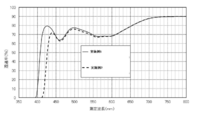
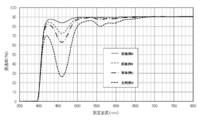
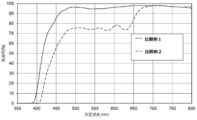
- Examples 3 to 5 and Comparative Example 3 are shown in FIG. 2, and Comparative Example 1 and Comparative Example 2 are shown in FIG. 3, respectively.
- Tables 2 to 10 show the measurement wavelengths and transmittances of Examples 1 to 5 and Comparative Example 3. Further, with respect to the flat plate lenses of Example 1 and Example 2, the visual transmittance and the transmittance at a wavelength of 460 nm were measured when the hard multi-coating treatment was performed by the following method. The results are shown in Table 1.
- the hard multi-coating treatment the flat plate lenses of Examples 1 and 2 were etched, and then a hard multi-coating liquid for a refractive index of 1.60 was applied with a dip. Then, the hard multi-coating solution was cured by heating. Then, a multi-layer antireflection layer was formed by a vacuum vapor deposition method using several kinds of inorganic oxides.
- Examples 1 to 5 were excellent in visibility and hue, and were excellent in shielding light from 445 nm to 485 nm.
- Comparative Example 1 and Comparative Example 2 did not have a maximum transmittance at a wavelength of 400 nm to 445 nm.
- the transmittance at a wavelength of 400 nm to 445 nm was high, and the shielding property was inferior.
- the hue in the CIE1976 (L *, a *, b *) color space was not good, and the YI value was large.
- Comparative Example 3 was inferior in visual transmittance because the transmittance at a wavelength of 400 nm to 445 nm was low.
Landscapes
- Chemical & Material Sciences (AREA)
- Health & Medical Sciences (AREA)
- Physics & Mathematics (AREA)
- Organic Chemistry (AREA)
- Ophthalmology & Optometry (AREA)
- Chemical Kinetics & Catalysis (AREA)
- Optics & Photonics (AREA)
- General Physics & Mathematics (AREA)
- Medicinal Chemistry (AREA)
- Polymers & Plastics (AREA)
- General Health & Medical Sciences (AREA)
- Toxicology (AREA)
- Optical Filters (AREA)
- Eyeglasses (AREA)
- Compositions Of Macromolecular Compounds (AREA)
Abstract
Priority Applications (5)
| Application Number | Priority Date | Filing Date | Title |
|---|---|---|---|
| JP2021537297A JP7233542B2 (ja) | 2019-08-06 | 2020-07-31 | 光学材料 |
| KR1020227003380A KR102703416B1 (ko) | 2019-08-06 | 2020-07-31 | 광학 재료 |
| EP20849424.5A EP4011983A4 (fr) | 2019-08-06 | 2020-07-31 | Matériau optique |
| US17/629,831 US20220252771A1 (en) | 2019-08-06 | 2020-07-31 | Optical material |
| CN202080053398.9A CN114144456A (zh) | 2019-08-06 | 2020-07-31 | 光学材料 |
Applications Claiming Priority (2)
| Application Number | Priority Date | Filing Date | Title |
|---|---|---|---|
| JP2019-144875 | 2019-08-06 | ||
| JP2019144875 | 2019-08-06 |
Publications (1)
| Publication Number | Publication Date |
|---|---|
| WO2021024962A1 true WO2021024962A1 (fr) | 2021-02-11 |
Family
ID=74503829
Family Applications (1)
| Application Number | Title | Priority Date | Filing Date |
|---|---|---|---|
| PCT/JP2020/029564 Ceased WO2021024962A1 (fr) | 2019-08-06 | 2020-07-31 | Matériau optique |
Country Status (6)
| Country | Link |
|---|---|
| US (1) | US20220252771A1 (fr) |
| EP (1) | EP4011983A4 (fr) |
| JP (1) | JP7233542B2 (fr) |
| KR (1) | KR102703416B1 (fr) |
| CN (1) | CN114144456A (fr) |
| WO (1) | WO2021024962A1 (fr) |
Cited By (3)
| Publication number | Priority date | Publication date | Assignee | Title |
|---|---|---|---|---|
| WO2022209915A1 (fr) * | 2021-03-31 | 2022-10-06 | 三井化学株式会社 | Élément optique, lentille de lunettes, procédé de régulation de nerf autonome et procédé d'évaluation pour élément optique |
| WO2023229048A1 (fr) * | 2022-05-27 | 2023-11-30 | 三井化学株式会社 | Matériau optique et verre de lunettes |
| WO2025164551A1 (fr) * | 2024-01-31 | 2025-08-07 | 三井化学株式会社 | Matériau optique, lentille en plastique, lunettes et procédé d'amélioration du sommeil |
Families Citing this family (1)
| Publication number | Priority date | Publication date | Assignee | Title |
|---|---|---|---|---|
| CN119285886A (zh) * | 2019-03-29 | 2025-01-10 | 三井化学株式会社 | 光学材料的制造方法、光学材料用聚合性组合物 |
Citations (8)
| Publication number | Priority date | Publication date | Assignee | Title |
|---|---|---|---|---|
| JPS6216383B2 (fr) | 1980-01-28 | 1987-04-13 | Furukawa Electric Co Ltd | |
| WO2014119042A1 (fr) * | 2013-02-04 | 2014-08-07 | 積水化成品工業株式会社 | Particules de résine et leur utilisation |
| JP2017515822A (ja) * | 2014-05-05 | 2017-06-15 | フロンティア サイエンティフィック インコーポレイテッドFrontier Scientific,Inc. | 選択的ブルーライトフィルターされた光学レンズ用の光安定性および熱安定性の染料化合物 |
| WO2018062385A1 (fr) * | 2016-09-30 | 2018-04-05 | 三井化学株式会社 | Lentille photochromique et composition polymérisable |
| CN109912607A (zh) * | 2018-12-11 | 2019-06-21 | 南华大学 | 一类卟啉-白杨素复合物及其抗肿瘤活性 |
| JP2019144875A (ja) | 2018-02-21 | 2019-08-29 | 東芝テック株式会社 | レシートプリンタ |
| JP2020094214A (ja) * | 2018-12-13 | 2020-06-18 | 三星エスディアイ株式会社Samsung SDI Co., Ltd. | 化合物、当該化合物を含む感光性樹脂組成物、感光性樹脂膜、およびカラーフィルタ、ならびに当該化合物を含む粘着剤組成物、粘着フィルムおよび偏光板 |
| JP2020132596A (ja) * | 2019-02-22 | 2020-08-31 | 国立大学法人広島大学 | ポルフィリン錯体 |
Family Cites Families (4)
| Publication number | Priority date | Publication date | Assignee | Title |
|---|---|---|---|---|
| JPS6216383U (fr) | 1985-07-17 | 1987-01-31 | ||
| KR101874722B1 (ko) * | 2013-09-10 | 2018-07-04 | 미쯔이가가꾸가부시끼가이샤 | 광학 재료 및 그 용도 |
| KR101849862B1 (ko) * | 2013-09-10 | 2018-05-31 | 미쯔이가가꾸가부시끼가이샤 | 광학 재료 및 그 용도 |
| JP2016210665A (ja) * | 2015-05-13 | 2016-12-15 | 旭硝子株式会社 | ガラス板 |
-
2020
- 2020-07-31 EP EP20849424.5A patent/EP4011983A4/fr active Pending
- 2020-07-31 US US17/629,831 patent/US20220252771A1/en active Pending
- 2020-07-31 WO PCT/JP2020/029564 patent/WO2021024962A1/fr not_active Ceased
- 2020-07-31 JP JP2021537297A patent/JP7233542B2/ja active Active
- 2020-07-31 CN CN202080053398.9A patent/CN114144456A/zh active Pending
- 2020-07-31 KR KR1020227003380A patent/KR102703416B1/ko active Active
Patent Citations (8)
| Publication number | Priority date | Publication date | Assignee | Title |
|---|---|---|---|---|
| JPS6216383B2 (fr) | 1980-01-28 | 1987-04-13 | Furukawa Electric Co Ltd | |
| WO2014119042A1 (fr) * | 2013-02-04 | 2014-08-07 | 積水化成品工業株式会社 | Particules de résine et leur utilisation |
| JP2017515822A (ja) * | 2014-05-05 | 2017-06-15 | フロンティア サイエンティフィック インコーポレイテッドFrontier Scientific,Inc. | 選択的ブルーライトフィルターされた光学レンズ用の光安定性および熱安定性の染料化合物 |
| WO2018062385A1 (fr) * | 2016-09-30 | 2018-04-05 | 三井化学株式会社 | Lentille photochromique et composition polymérisable |
| JP2019144875A (ja) | 2018-02-21 | 2019-08-29 | 東芝テック株式会社 | レシートプリンタ |
| CN109912607A (zh) * | 2018-12-11 | 2019-06-21 | 南华大学 | 一类卟啉-白杨素复合物及其抗肿瘤活性 |
| JP2020094214A (ja) * | 2018-12-13 | 2020-06-18 | 三星エスディアイ株式会社Samsung SDI Co., Ltd. | 化合物、当該化合物を含む感光性樹脂組成物、感光性樹脂膜、およびカラーフィルタ、ならびに当該化合物を含む粘着剤組成物、粘着フィルムおよび偏光板 |
| JP2020132596A (ja) * | 2019-02-22 | 2020-08-31 | 国立大学法人広島大学 | ポルフィリン錯体 |
Non-Patent Citations (2)
| Title |
|---|
| "Octabromotetraphenylporphyrin and Its Metal Derivatives", INORG. CHEM., vol. 30, 1991, pages 239 - 245 |
| See also references of EP4011983A4 |
Cited By (5)
| Publication number | Priority date | Publication date | Assignee | Title |
|---|---|---|---|---|
| WO2022209915A1 (fr) * | 2021-03-31 | 2022-10-06 | 三井化学株式会社 | Élément optique, lentille de lunettes, procédé de régulation de nerf autonome et procédé d'évaluation pour élément optique |
| JPWO2022209915A1 (fr) * | 2021-03-31 | 2022-10-06 | ||
| WO2023229048A1 (fr) * | 2022-05-27 | 2023-11-30 | 三井化学株式会社 | Matériau optique et verre de lunettes |
| JPWO2023229048A1 (fr) * | 2022-05-27 | 2023-11-30 | ||
| WO2025164551A1 (fr) * | 2024-01-31 | 2025-08-07 | 三井化学株式会社 | Matériau optique, lentille en plastique, lunettes et procédé d'amélioration du sommeil |
Also Published As
| Publication number | Publication date |
|---|---|
| CN114144456A (zh) | 2022-03-04 |
| EP4011983A1 (fr) | 2022-06-15 |
| JP7233542B2 (ja) | 2023-03-06 |
| EP4011983A4 (fr) | 2023-10-18 |
| KR102703416B1 (ko) | 2024-09-04 |
| US20220252771A1 (en) | 2022-08-11 |
| KR20220028068A (ko) | 2022-03-08 |
| JPWO2021024962A1 (fr) | 2021-02-11 |
Similar Documents
| Publication | Publication Date | Title |
|---|---|---|
| KR101849862B1 (ko) | 광학 재료 및 그 용도 | |
| US9857503B2 (en) | Optical material and use thereof | |
| US9933635B2 (en) | Optical material, composition for optical material, and use thereof | |
| JP5646790B2 (ja) | 重合性組成物、光学材料およびその製造方法 | |
| JP6475848B2 (ja) | 光学材料用重合性組成物の製造方法および光学材料の製造方法 | |
| JP7233542B2 (ja) | 光学材料 | |
| KR102323294B1 (ko) | 포토크로믹 렌즈 및 중합성 조성물 | |
| JP7535595B2 (ja) | 光学材料、レンズ及びアイウェア | |
| CN108026241A (zh) | 成型体和光学材料用聚合性组合物 | |
| US20240176164A1 (en) | Optical element, eyeglass lens, autonomic nerve regulation method, and evaluation method for optical element | |
| WO2023229048A1 (fr) | Matériau optique et verre de lunettes | |
| JP2025097772A (ja) | 光学材料、レンズ、メガネレンズの使用方法及び光学材料の製造方法 |
Legal Events
| Date | Code | Title | Description |
|---|---|---|---|
| 121 | Ep: the epo has been informed by wipo that ep was designated in this application |
Ref document number: 20849424 Country of ref document: EP Kind code of ref document: A1 |
|
| ENP | Entry into the national phase |
Ref document number: 2021537297 Country of ref document: JP Kind code of ref document: A |
|
| ENP | Entry into the national phase |
Ref document number: 20227003380 Country of ref document: KR Kind code of ref document: A |
|
| NENP | Non-entry into the national phase |
Ref country code: DE |
|
| ENP | Entry into the national phase |
Ref document number: 2020849424 Country of ref document: EP Effective date: 20220307 |