WO2021052499A1 - 稠合吡啶酮类化合物及其制备方法和应用 - Google Patents
稠合吡啶酮类化合物及其制备方法和应用 Download PDFInfo
- Publication number
- WO2021052499A1 WO2021052499A1 PCT/CN2020/116510 CN2020116510W WO2021052499A1 WO 2021052499 A1 WO2021052499 A1 WO 2021052499A1 CN 2020116510 W CN2020116510 W CN 2020116510W WO 2021052499 A1 WO2021052499 A1 WO 2021052499A1
- Authority
- WO
- WIPO (PCT)
- Prior art keywords
- compound
- alkyl
- membered heterocycloalkyl
- cycloalkyl
- group
- Prior art date
- Legal status (The legal status is an assumption and is not a legal conclusion. Google has not performed a legal analysis and makes no representation as to the accuracy of the status listed.)
- Ceased
Links
- 0 CC*C1N(CCCC(C)I)CCNC1 Chemical compound CC*C1N(CCCC(C)I)CCNC1 0.000 description 9
- SYPULGZNIOOMOR-UHFFFAOYSA-N CC(C)c(cccc1)c1N(C(C)=O)c(nc(c(F)c1)OC)c1C(OC)=O Chemical compound CC(C)c(cccc1)c1N(C(C)=O)c(nc(c(F)c1)OC)c1C(OC)=O SYPULGZNIOOMOR-UHFFFAOYSA-N 0.000 description 1
- VXPOAPWLMVAUCK-UHFFFAOYSA-N CC(C)c(nccc1C)c1N Chemical compound CC(C)c(nccc1C)c1N VXPOAPWLMVAUCK-UHFFFAOYSA-N 0.000 description 1
- QLCLQLOQKMRVFR-AUUYWEPGSA-N CC(C)c(nccc1[F]c(c2c(cc3F)C(N4[C@@H]5CN[C@H](C)C4)=C4N(C)C5=O)c3-c(c(F)ccc3)c3O)c1N2C4=O Chemical compound CC(C)c(nccc1[F]c(c2c(cc3F)C(N4[C@@H]5CN[C@H](C)C4)=C4N(C)C5=O)c3-c(c(F)ccc3)c3O)c1N2C4=O QLCLQLOQKMRVFR-AUUYWEPGSA-N 0.000 description 1
- CZFOQVLGFCBKBF-UHFFFAOYSA-N CC(C)c(nccc1[F]c2c(c(Cl)c3)-c(c(F)ccc4)c4OC)c1N(C(C)=O)c2c3C(OC)=O Chemical compound CC(C)c(nccc1[F]c2c(c(Cl)c3)-c(c(F)ccc4)c4OC)c1N(C(C)=O)c2c3C(OC)=O CZFOQVLGFCBKBF-UHFFFAOYSA-N 0.000 description 1
- OEFOXPBFOIPJAE-UHFFFAOYSA-N CC(C)c(nccc1[F]c2c(c(Cl)c3)-c(c(F)ccc4)c4OC)c1N(C(C1)=O)c2c3C1=O Chemical compound CC(C)c(nccc1[F]c2c(c(Cl)c3)-c(c(F)ccc4)c4OC)c1N(C(C1)=O)c2c3C1=O OEFOXPBFOIPJAE-UHFFFAOYSA-N 0.000 description 1
- LBGGPOBFYVKFEC-UHFFFAOYSA-N CC(C)c(nccc1[F]c2c(c(F)c3)-c(c(F)ccc4)c4OC)c1Nc2c3C(OC)=O Chemical compound CC(C)c(nccc1[F]c2c(c(F)c3)-c(c(F)ccc4)c4OC)c1Nc2c3C(OC)=O LBGGPOBFYVKFEC-UHFFFAOYSA-N 0.000 description 1
- ABYUWZOTPIPRHZ-UHFFFAOYSA-N CC(C)c(nccc1[F]c2c3c(C(Cl)=C4[N+]([O-])=O)cc(F)c2-c(c(F)ccc2)c2OC)c1N3C4=O Chemical compound CC(C)c(nccc1[F]c2c3c(C(Cl)=C4[N+]([O-])=O)cc(F)c2-c(c(F)ccc2)c2OC)c1N3C4=O ABYUWZOTPIPRHZ-UHFFFAOYSA-N 0.000 description 1
- YEAQRRIICOBFAN-RBUKOAKNSA-N CC(C)c(nccc1[F]c2c3c(C(N(C[C@H]4C)[C@@H](C)CN4C(OC(C)(C)C)=O)=C4[N+]([O-])=O)cc(Cl)c2-c(c(F)ccc2)c2OC)c1N3C4=O Chemical compound CC(C)c(nccc1[F]c2c3c(C(N(C[C@H]4C)[C@@H](C)CN4C(OC(C)(C)C)=O)=C4[N+]([O-])=O)cc(Cl)c2-c(c(F)ccc2)c2OC)c1N3C4=O YEAQRRIICOBFAN-RBUKOAKNSA-N 0.000 description 1
- LQDMKPWXBDXGIA-KBMIEXCESA-N CC(C)c(nccc1[F]c2c3c(C(N(C[C@H]4C)[C@@H]5CN4C(OC(C)(C)C)=O)=C4N(C)C5=O)cc(F)c2-c(c(C)ccc2F)c2C#N)c1N3C4=O Chemical compound CC(C)c(nccc1[F]c2c3c(C(N(C[C@H]4C)[C@@H]5CN4C(OC(C)(C)C)=O)=C4N(C)C5=O)cc(F)c2-c(c(C)ccc2F)c2C#N)c1N3C4=O LQDMKPWXBDXGIA-KBMIEXCESA-N 0.000 description 1
- DDHQHHMFWDIUSS-VGOFRKELSA-N CC(C)c(nccc1[F]c2c3c(C(N(C[C@H]4C)[C@@H]5CN4C(OC(C)(C)C)=O)=C4NC5=O)cc(Cl)c2-c(c(F)ccc2)c2OC)c1N3C4=O Chemical compound CC(C)c(nccc1[F]c2c3c(C(N(C[C@H]4C)[C@@H]5CN4C(OC(C)(C)C)=O)=C4NC5=O)cc(Cl)c2-c(c(F)ccc2)c2OC)c1N3C4=O DDHQHHMFWDIUSS-VGOFRKELSA-N 0.000 description 1
- CGDZQWZOKFSSAY-IRCUZVAFSA-N CC(C)c(nccc1[F]c2c3c(C(N4[C@@H]5CNC(C)C4)=C4N(C6CN(C)C6)C5=O)cc(F)c2-c(c(F)ccc2)c2OC)c1N3C4=O Chemical compound CC(C)c(nccc1[F]c2c3c(C(N4[C@@H]5CNC(C)C4)=C4N(C6CN(C)C6)C5=O)cc(F)c2-c(c(F)ccc2)c2OC)c1N3C4=O CGDZQWZOKFSSAY-IRCUZVAFSA-N 0.000 description 1
- QJVKOGILECRNKZ-FZKQIMNGSA-N CC(C)c(nccc1[F]c2c3c(C(N4[C@@H]5CN[C@H](C)C4)=C4NC5=O)cc(F)c2-c(c(F)ccc2)c2O)c1N3C4=O Chemical compound CC(C)c(nccc1[F]c2c3c(C(N4[C@@H]5CN[C@H](C)C4)=C4NC5=O)cc(F)c2-c(c(F)ccc2)c2O)c1N3C4=O QJVKOGILECRNKZ-FZKQIMNGSA-N 0.000 description 1
- SPOAFGHFOZZHSX-RTBURBONSA-N CC(C)c(nccc1[F]c2c3c(C4=C5OC[C@@H](C6)N4C[C@@H](C)N6C(OC(C)(C)C)=O)cc(F)c2-c(c(F)ccc2)c2OC)c1N3C5=O Chemical compound CC(C)c(nccc1[F]c2c3c(C4=C5OC[C@@H](C6)N4C[C@@H](C)N6C(OC(C)(C)C)=O)cc(F)c2-c(c(F)ccc2)c2OC)c1N3C5=O SPOAFGHFOZZHSX-RTBURBONSA-N 0.000 description 1
- VTWDAEOWMIWPPU-HUUCEWRRSA-N CC(C)c(nccc1[F]c2c3c(C4=C5OC[C@@H]6N4C[C@@H](C)NC6)cc(F)c2-c(c(F)ccc2)c2O)c1N3C5=O Chemical compound CC(C)c(nccc1[F]c2c3c(C4=C5OC[C@@H]6N4C[C@@H](C)NC6)cc(F)c2-c(c(F)ccc2)c2O)c1N3C5=O VTWDAEOWMIWPPU-HUUCEWRRSA-N 0.000 description 1
- LOLNJOFGOCPTOA-NHCUHLMSSA-N CC(C)c(ncnc1C(C)C)c1N(c(c(C(N(C[C@H]1C)[C@@H](CO)CN1C(OC(C)(C)C)=O)=C1[N+]([O-])=O)cc(F)c2-c(c(F)ccc3)c3OC)c2F)C1=O Chemical compound CC(C)c(ncnc1C(C)C)c1N(c(c(C(N(C[C@H]1C)[C@@H](CO)CN1C(OC(C)(C)C)=O)=C1[N+]([O-])=O)cc(F)c2-c(c(F)ccc3)c3OC)c2F)C1=O LOLNJOFGOCPTOA-NHCUHLMSSA-N 0.000 description 1
- ZLHQYNQMOSAZJC-NHCUHLMSSA-N CC(C)c(ncnc1C(C)C)c1N(c(c(C1=C2OC[C@@H](C3)N1C[C@@H](C)N3C(OC(C)(C)C)=O)cc(F)c1-c(c(F)ccc3)c3OC)c1F)C2=O Chemical compound CC(C)c(ncnc1C(C)C)c1N(c(c(C1=C2OC[C@@H](C3)N1C[C@@H](C)N3C(OC(C)(C)C)=O)cc(F)c1-c(c(F)ccc3)c3OC)c1F)C2=O ZLHQYNQMOSAZJC-NHCUHLMSSA-N 0.000 description 1
- REHYJXVOQUNUIK-AUSIDOKSSA-N CC(C)c(ncnc1C(C)C)c1N(c(c(F)c(c(F)c1)-c(c(F)ccc2)c2OC)c1C(N(C[C@H]1C)[C@@H]2CN1C(OC(C)(C)C)=O)=C1NC2=O)C1=O Chemical compound CC(C)c(ncnc1C(C)C)c1N(c(c(F)c(c(F)c1)-c(c(F)ccc2)c2OC)c1C(N(C[C@H]1C)[C@@H]2CN1C(OC(C)(C)C)=O)=C1NC2=O)C1=O REHYJXVOQUNUIK-AUSIDOKSSA-N 0.000 description 1
- PIGIKHMWRUQKBT-CXAGYDPISA-N CC(C)c(ncnc1[F]c2c3c(C(N4[C@@H]5CN[C@H](C)C4)=C4N(C)C5=O)cc(Cl)c2-c(c(F)ccc2)c2O)c1N3C4=O Chemical compound CC(C)c(ncnc1[F]c2c3c(C(N4[C@@H]5CN[C@H](C)C4)=C4N(C)C5=O)cc(Cl)c2-c(c(F)ccc2)c2O)c1N3C4=O PIGIKHMWRUQKBT-CXAGYDPISA-N 0.000 description 1
- ZGJFCIKDZINBMH-RDTXWAMCSA-N CC(C)c(ncnc1[F]c2c3c(C(N4[C@@H]5CN[C@H](C)C4)=C4N(C)C5=O)cc(Cl)c2-c(c(F)ccc2)c2OC)c1N3C4=O Chemical compound CC(C)c(ncnc1[F]c2c3c(C(N4[C@@H]5CN[C@H](C)C4)=C4N(C)C5=O)cc(Cl)c2-c(c(F)ccc2)c2OC)c1N3C4=O ZGJFCIKDZINBMH-RDTXWAMCSA-N 0.000 description 1
- VKXPHTCSXQVVRM-UHFFFAOYSA-N CC(C)c1c2N(C(C(C(c3cc(F)c4-c(c(F)ccc5)c5OC)=O)[N+]([O-])=O)=O)c3c4[F]c2ccn1 Chemical compound CC(C)c1c2N(C(C(C(c3cc(F)c4-c(c(F)ccc5)c5OC)=O)[N+]([O-])=O)=O)c3c4[F]c2ccn1 VKXPHTCSXQVVRM-UHFFFAOYSA-N 0.000 description 1
- YSIQYWVXIOTWDW-UHFFFAOYSA-N CC(C)c1c2N(C(C(C(c3cc(F)c4Cl)=O)[N+]([O-])=O)=O)c3c4[F]c2ccn1 Chemical compound CC(C)c1c2N(C(C(C(c3cc(F)c4Cl)=O)[N+]([O-])=O)=O)c3c4[F]c2ccn1 YSIQYWVXIOTWDW-UHFFFAOYSA-N 0.000 description 1
- HTINBJSDPDQSMH-UHFFFAOYSA-N CC(C)c1c2N(C(CC(c3cc(F)c4Cl)=O)=O)c3c4[F]c2ccn1 Chemical compound CC(C)c1c2N(C(CC(c3cc(F)c4Cl)=O)=O)c3c4[F]c2ccn1 HTINBJSDPDQSMH-UHFFFAOYSA-N 0.000 description 1
- KTQZOPBDKJSGPN-NHCUHLMSSA-N CC(C)c1ccccc1N(c(nc(c(F)c1)-c2c(cn[nH]3)c3ccc2C)c1C1=C2OC[C@@H](C3)N1C[C@@H](C)N3C(C=C)=O)C2=O Chemical compound CC(C)c1ccccc1N(c(nc(c(F)c1)-c2c(cn[nH]3)c3ccc2C)c1C1=C2OC[C@@H](C3)N1C[C@@H](C)N3C(C=C)=O)C2=O KTQZOPBDKJSGPN-NHCUHLMSSA-N 0.000 description 1
- OSPZCYVZOPEDTA-RTBURBONSA-N CC(C)c1nccc([F]c2c3c(C4=C5OC[C@@H](C6)N4C[C@@H](C)N6C(OC(C)(C)C)=O)cc(Cl)c2-c(c(F)ccc2)c2OC)c1N3C5=O Chemical compound CC(C)c1nccc([F]c2c3c(C4=C5OC[C@@H](C6)N4C[C@@H](C)N6C(OC(C)(C)C)=O)cc(Cl)c2-c(c(F)ccc2)c2OC)c1N3C5=O OSPZCYVZOPEDTA-RTBURBONSA-N 0.000 description 1
- XRUFCLCRXBXMBN-SCYGFANYSA-N CC(C)c1ncnc(C(C)[F]c2c3c(C(N(C[C@@H](C)N(C4)C(OC(C)(C)C)=O)[C@H]4C(OC)=O)=C4[N+]([O-])=O)cc(F)c2-c(c(F)ccc2)c2OC)c1N3C4=O Chemical compound CC(C)c1ncnc(C(C)[F]c2c3c(C(N(C[C@@H](C)N(C4)C(OC(C)(C)C)=O)[C@H]4C(OC)=O)=C4[N+]([O-])=O)cc(F)c2-c(c(F)ccc2)c2OC)c1N3C4=O XRUFCLCRXBXMBN-SCYGFANYSA-N 0.000 description 1
- VBSPSAYTRLYJRY-UHFFFAOYSA-N CC(C)c1ncnc(C)c1N Chemical compound CC(C)c1ncnc(C)c1N VBSPSAYTRLYJRY-UHFFFAOYSA-N 0.000 description 1
- GCPDMIIYTBVACS-UHFFFAOYSA-N CC(N(C)c(c(C(OC)=O)cc(Cl)c1-c(c(F)ccc2)c2OC)c1F)=O Chemical compound CC(N(C)c(c(C(OC)=O)cc(Cl)c1-c(c(F)ccc2)c2OC)c1F)=O GCPDMIIYTBVACS-UHFFFAOYSA-N 0.000 description 1
- ROSROIOYMBPWLA-UHFFFAOYSA-N CC(c(ncnc1C)c1N)=C Chemical compound CC(c(ncnc1C)c1N)=C ROSROIOYMBPWLA-UHFFFAOYSA-N 0.000 description 1
- ARGXIZAHGBMSOU-UHFFFAOYSA-N CC(c1c2cccc1)[O]=C(C1)N2c(nc(c(F)c2)OC)c2C1=O Chemical compound CC(c1c2cccc1)[O]=C(C1)N2c(nc(c(F)c2)OC)c2C1=O ARGXIZAHGBMSOU-UHFFFAOYSA-N 0.000 description 1
- MBTUFQDWAWTIOB-UHFFFAOYSA-N CC(c1ccccc11)[O]=C2N1c(nc(c(F)c1)O)c1C(O)=C2[N+]([O-])=O Chemical compound CC(c1ccccc11)[O]=C2N1c(nc(c(F)c1)O)c1C(O)=C2[N+]([O-])=O MBTUFQDWAWTIOB-UHFFFAOYSA-N 0.000 description 1
- ZYRPWNWAROLANU-UHFFFAOYSA-N CC(c1ccccc11)[O]=C2N1c(nc(c(F)c1)OC)c1C(O)=C2[N+]([O-])=O Chemical compound CC(c1ccccc11)[O]=C2N1c(nc(c(F)c1)OC)c1C(O)=C2[N+]([O-])=O ZYRPWNWAROLANU-UHFFFAOYSA-N 0.000 description 1
- DORBWHGJOKODMC-UHFFFAOYSA-N CC(c1nccc(C)c11)[O]=C(C2)N1c(nc(c(Cl)c1)OC)c1C2=O Chemical compound CC(c1nccc(C)c11)[O]=C(C2)N1c(nc(c(Cl)c1)OC)c1C2=O DORBWHGJOKODMC-UHFFFAOYSA-N 0.000 description 1
- DLMAKZQDDDNTLI-UHFFFAOYSA-N CC(c1nccc(C)c11)[O]=C(C2[N+]([O-])=O)N1c(nc(c(Cl)c1)OC)c1C2=O Chemical compound CC(c1nccc(C)c11)[O]=C(C2[N+]([O-])=O)N1c(nc(c(Cl)c1)OC)c1C2=O DLMAKZQDDDNTLI-UHFFFAOYSA-N 0.000 description 1
- BBOUNOWCFNTWLD-UHFFFAOYSA-N CC1(C)OB(c(c(OCOC)ccc2)c2F)OC1(C)C Chemical compound CC1(C)OB(c(c(OCOC)ccc2)c2F)OC1(C)C BBOUNOWCFNTWLD-UHFFFAOYSA-N 0.000 description 1
- VKIAUQCTSKVDSG-UHFFFAOYSA-N CCCCN(CC1)CCC1N(C)C Chemical compound CCCCN(CC1)CCC1N(C)C VKIAUQCTSKVDSG-UHFFFAOYSA-N 0.000 description 1
- UAWIEGPNGDWBBI-NTKDMRAZSA-N CCN1C(C(N2c(c3cc(F)c4-c(c(F)ccc5)c5OC)c4[F]c4ccnc(C(C)C)c24)=O)=C3N(C[C@@H](C)N(C2)C(OC(C)(C)C)=O)[C@H]2C1=O Chemical compound CCN1C(C(N2c(c3cc(F)c4-c(c(F)ccc5)c5OC)c4[F]c4ccnc(C(C)C)c24)=O)=C3N(C[C@@H](C)N(C2)C(OC(C)(C)C)=O)[C@H]2C1=O UAWIEGPNGDWBBI-NTKDMRAZSA-N 0.000 description 1
- WGUZKLFHGAMCCO-UHFFFAOYSA-N CCc1ccnc(C(C)C)c1N Chemical compound CCc1ccnc(C(C)C)c1N WGUZKLFHGAMCCO-UHFFFAOYSA-N 0.000 description 1
- LPXAFIFTVIHSLY-UHFFFAOYSA-N CCc1ccnc(C(C)C)c1Nc(c(F)c(c(Cl)c1)-c(c(F)ccc2)c2OC)c1C(OC)=O Chemical compound CCc1ccnc(C(C)C)c1Nc(c(F)c(c(Cl)c1)-c(c(F)ccc2)c2OC)c1C(OC)=O LPXAFIFTVIHSLY-UHFFFAOYSA-N 0.000 description 1
- MZSTZOFZADCNCX-UHFFFAOYSA-N CN(C(C1[N+]([O-])=O)=O)c(nc(c(Cl)c2)O)c2C1=O Chemical compound CN(C(C1[N+]([O-])=O)=O)c(nc(c(Cl)c2)O)c2C1=O MZSTZOFZADCNCX-UHFFFAOYSA-N 0.000 description 1
- YWJKYMFNGCCDFT-UHFFFAOYSA-N CN(C(C1[N+]([O-])=O)=O)c(nc(c(Cl)c2)OC)c2C1=O Chemical compound CN(C(C1[N+]([O-])=O)=O)c(nc(c(Cl)c2)OC)c2C1=O YWJKYMFNGCCDFT-UHFFFAOYSA-N 0.000 description 1
- RROKXLURNNZUIR-UHFFFAOYSA-N CN(C(C=C(c1cc(Cl)c2-c(c(OC)ccc3)c3F)O)=O)c1c2F Chemical compound CN(C(C=C(c1cc(Cl)c2-c(c(OC)ccc3)c3F)O)=O)c1c2F RROKXLURNNZUIR-UHFFFAOYSA-N 0.000 description 1
- ZXEQVHDPCGPJSJ-LURJTMIESA-N CN1[C@H](CCl)CCC1 Chemical compound CN1[C@H](CCl)CCC1 ZXEQVHDPCGPJSJ-LURJTMIESA-N 0.000 description 1
- VCOJPHPOVDIRJK-LURJTMIESA-N CN1[C@H](CO)CCC1 Chemical compound CN1[C@H](CO)CCC1 VCOJPHPOVDIRJK-LURJTMIESA-N 0.000 description 1
- ZJHOSKARDQKJCC-UHFFFAOYSA-N COC(c1cc(Cl)c(-c(c(OC)ccc2)c2F)c(F)c1I)=O Chemical compound COC(c1cc(Cl)c(-c(c(OC)ccc2)c2F)c(F)c1I)=O ZJHOSKARDQKJCC-UHFFFAOYSA-N 0.000 description 1
- KZZKVKDKHMUAAV-UHFFFAOYSA-N COC(c1cc(F)c(-c(c(F)ccc2)c2OC)c(F)c1I)=O Chemical compound COC(c1cc(F)c(-c(c(F)ccc2)c2OC)c(F)c1I)=O KZZKVKDKHMUAAV-UHFFFAOYSA-N 0.000 description 1
- VUZHINQEMOOOQI-WUCPZUCCSA-N C[C@@H](C(C)Br)C(O)=O Chemical compound C[C@@H](C(C)Br)C(O)=O VUZHINQEMOOOQI-WUCPZUCCSA-N 0.000 description 1
- PTGMUBSOHPUDTJ-ZBOFDPRTSA-N C[C@H](C1)NC[C@H]2N1C(c1cc(F)c(-c3c(cn[nH]4)c4ccc3C)nc1C)=C(C1=[O]C(C)c3cc(C4CC4)ccc3N1)OC2 Chemical compound C[C@H](C1)NC[C@H]2N1C(c1cc(F)c(-c3c(cn[nH]4)c4ccc3C)nc1C)=C(C1=[O]C(C)c3cc(C4CC4)ccc3N1)OC2 PTGMUBSOHPUDTJ-ZBOFDPRTSA-N 0.000 description 1
- QHWQNNGVTQCZDA-HUUCEWRRSA-N C[C@H](CN([C@@H](CO)C1)C(c2cc(Cl)c(-c(c(F)ccc3)c3OC)c(F)c2N(C)C2=O)=C2[N+]([O-])=O)N1C(OC(C)(C)C)=O Chemical compound C[C@H](CN([C@@H](CO)C1)C(c2cc(Cl)c(-c(c(F)ccc3)c3OC)c(F)c2N(C)C2=O)=C2[N+]([O-])=O)N1C(OC(C)(C)C)=O QHWQNNGVTQCZDA-HUUCEWRRSA-N 0.000 description 1
- JQGKJPBKFBYUGR-IMBCPYESSA-N C[C@H](CN([C@@H](CO)C1)C(c2cc(F)c(-c(c(c(cc3)ccn4)c4[O]4C)c3F)nc2N2C3=[O]C(C)c5c2c4ccn5)=C3[N+]([O-])=O)N1C(OC(C)(C)C)=O Chemical compound C[C@H](CN([C@@H](CO)C1)C(c2cc(F)c(-c(c(c(cc3)ccn4)c4[O]4C)c3F)nc2N2C3=[O]C(C)c5c2c4ccn5)=C3[N+]([O-])=O)N1C(OC(C)(C)C)=O JQGKJPBKFBYUGR-IMBCPYESSA-N 0.000 description 1
- JNDPMNSWUFKRKP-NEBWYHTOSA-N C[C@H](CN([C@@H](CO)C1)C(c2cc(F)c(C)nc2N2C3=[O]C(C)c4c2c(C)ccn4)=C3[N+]([O-])=O)N1C(OC(C)(C)C)=O Chemical compound C[C@H](CN([C@@H](CO)C1)C(c2cc(F)c(C)nc2N2C3=[O]C(C)c4c2c(C)ccn4)=C3[N+]([O-])=O)N1C(OC(C)(C)C)=O JNDPMNSWUFKRKP-NEBWYHTOSA-N 0.000 description 1
- BWPOSPZYLFAXJC-HZSTXLHUSA-N C[C@H](CN([C@@H]1C2)C(c(cc(c(-c(c(F)ccc3)c3OC)c3F)F)c3N3C4=[O]C(C)c5c3c(C)ccn5)=C4N(C3CN(C)C3)C1=O)N2C(C=C)=O Chemical compound C[C@H](CN([C@@H]1C2)C(c(cc(c(-c(c(F)ccc3)c3OC)c3F)F)c3N3C4=[O]C(C)c5c3c(C)ccn5)=C4N(C3CN(C)C3)C1=O)N2C(C=C)=O BWPOSPZYLFAXJC-HZSTXLHUSA-N 0.000 description 1
- AKJNHLZKLKFXGZ-XARDSYGASA-N C[C@H](CN([C@@H]1C2)C(c(cc3Cl)c(N4C5=[O]C(C)c6c4c(C)ccn6)nc3-c(c(F)ccc3)c3OCOC)=C5N(C)C1=O)N2C(OC(C)(C)C)=O Chemical compound C[C@H](CN([C@@H]1C2)C(c(cc3Cl)c(N4C5=[O]C(C)c6c4c(C)ccn6)nc3-c(c(F)ccc3)c3OCOC)=C5N(C)C1=O)N2C(OC(C)(C)C)=O AKJNHLZKLKFXGZ-XARDSYGASA-N 0.000 description 1
- XQCBRATVHPFRMC-SCYGFANYSA-N C[C@H](CN([C@@H]1C2)C(c(cc3Cl)c(N4C5=[O]C(C)c6c4c(C)ccn6)nc3-c(c(F)ccc3)c3OCOC)=C5NC1=O)N2C(OC(C)(C)C)=O Chemical compound C[C@H](CN([C@@H]1C2)C(c(cc3Cl)c(N4C5=[O]C(C)c6c4c(C)ccn6)nc3-c(c(F)ccc3)c3OCOC)=C5NC1=O)N2C(OC(C)(C)C)=O XQCBRATVHPFRMC-SCYGFANYSA-N 0.000 description 1
- NUXDBFWJPWQPQI-LROQTYINSA-N C[C@H](CN([C@@H]1C2)C(c3cc(C)c(-c(c(F)ccc4)c4O)c(F)c3N3C4=[O]C(C)c5c3c(C)ccn5)=C4N(C)C1=O)N2C(C=C)=O Chemical compound C[C@H](CN([C@@H]1C2)C(c3cc(C)c(-c(c(F)ccc4)c4O)c(F)c3N3C4=[O]C(C)c5c3c(C)ccn5)=C4N(C)C1=O)N2C(C=C)=O NUXDBFWJPWQPQI-LROQTYINSA-N 0.000 description 1
- WMDANDKBQNHYDQ-SEWODZQXSA-N C[C@H](CN([C@@H]1C2)C(c3cc(Cl)c(-c(c(F)ccc4)c4OC)c(F)c3N3C4=[O]C(C)c5c3c(C)ccn5)=C4N(CCN(C)C)C1=O)N2C(OC(C)(C)C)=O Chemical compound C[C@H](CN([C@@H]1C2)C(c3cc(Cl)c(-c(c(F)ccc4)c4OC)c(F)c3N3C4=[O]C(C)c5c3c(C)ccn5)=C4N(CCN(C)C)C1=O)N2C(OC(C)(C)C)=O WMDANDKBQNHYDQ-SEWODZQXSA-N 0.000 description 1
- DXJGCGSCKARKNE-OSDSZRHNSA-N C[C@H](CN([C@@H]1C2)C(c3cc(F)c(-c(c(F)ccc4)c4O)c(F)c3N3C4=[O]C(C)c5c3c(C)ccn5)=C4NC1=O)N2C(C=C)=O Chemical compound C[C@H](CN([C@@H]1C2)C(c3cc(F)c(-c(c(F)ccc4)c4O)c(F)c3N3C4=[O]C(C)c5c3c(C)ccn5)=C4NC1=O)N2C(C=C)=O DXJGCGSCKARKNE-OSDSZRHNSA-N 0.000 description 1
- LTUPISLKOSJRPZ-TUOGLVOQSA-N C[C@H](CN1C(c(c(N2C3=[O]C(C)c4c2cccc4)n2)cc(F)c2Cl)=C3NC[C@H]1C1)N1C(OC(C)(C)C)=O Chemical compound C[C@H](CN1C(c(c(N2C3=[O]C(C)c4c2cccc4)n2)cc(F)c2Cl)=C3NC[C@H]1C1)N1C(OC(C)(C)C)=O LTUPISLKOSJRPZ-TUOGLVOQSA-N 0.000 description 1
- KZFHZLPRKCWLNI-HUUCEWRRSA-N C[C@H](CN1C(c2cc(Cl)c(-c(c(F)ccc3)c3OC)c(F)c2N(C)C2=O)=C2OC[C@H]1C1)N1C(OC(C)(C)C)=O Chemical compound C[C@H](CN1C(c2cc(Cl)c(-c(c(F)ccc3)c3OC)c(F)c2N(C)C2=O)=C2OC[C@H]1C1)N1C(OC(C)(C)C)=O KZFHZLPRKCWLNI-HUUCEWRRSA-N 0.000 description 1
- XRCOIFXEGKWHHW-TYVLQRECSA-N C[C@H](CN1C(c2cc(F)c(-c(c(F)ccc3)c3OCOC)nc2N2C3=[O]C(C)c4c2cccc4)=C3NC[C@H]1C1)N1C(OC(C)(C)C)=O Chemical compound C[C@H](CN1C(c2cc(F)c(-c(c(F)ccc3)c3OCOC)nc2N2C3=[O]C(C)c4c2cccc4)=C3NC[C@H]1C1)N1C(OC(C)(C)C)=O XRCOIFXEGKWHHW-TYVLQRECSA-N 0.000 description 1
- XHTPTWDIXMZSOT-YSSMNDQQSA-N C[C@H](CN1C(c2cc(F)c(-c3c(cn[nH]4)c4ccc3C)nc2N2C3=[O]C(C)c4c2cccc4)=C3OC[C@H]1C1)N1C(C=C)=O Chemical compound C[C@H](CN1C(c2cc(F)c(-c3c(cn[nH]4)c4ccc3C)nc2N2C3=[O]C(C)c4c2cccc4)=C3OC[C@H]1C1)N1C(C=C)=O XHTPTWDIXMZSOT-YSSMNDQQSA-N 0.000 description 1
- GVZVXBNHVMAAAK-UHFFFAOYSA-N O=C(c(c(N1)c2F)ccc2Br)C1=O Chemical compound O=C(c(c(N1)c2F)ccc2Br)C1=O GVZVXBNHVMAAAK-UHFFFAOYSA-N 0.000 description 1
Images


Classifications
-
- C—CHEMISTRY; METALLURGY
- C07—ORGANIC CHEMISTRY
- C07D—HETEROCYCLIC COMPOUNDS
- C07D498/00—Heterocyclic compounds containing in the condensed system at least one hetero ring having nitrogen and oxygen atoms as the only ring hetero atoms
- C07D498/22—Heterocyclic compounds containing in the condensed system at least one hetero ring having nitrogen and oxygen atoms as the only ring hetero atoms in which the condensed system contains four or more hetero rings
-
- A—HUMAN NECESSITIES
- A61—MEDICAL OR VETERINARY SCIENCE; HYGIENE
- A61K—PREPARATIONS FOR MEDICAL, DENTAL OR TOILETRY PURPOSES
- A61K31/00—Medicinal preparations containing organic active ingredients
- A61K31/33—Heterocyclic compounds
- A61K31/395—Heterocyclic compounds having nitrogen as a ring hetero atom, e.g. guanethidine or rifamycins
- A61K31/495—Heterocyclic compounds having nitrogen as a ring hetero atom, e.g. guanethidine or rifamycins having six-membered rings with two or more nitrogen atoms as the only ring heteroatoms, e.g. piperazine or tetrazines
- A61K31/4985—Pyrazines or piperazines ortho- or peri-condensed with heterocyclic ring systems
-
- A—HUMAN NECESSITIES
- A61—MEDICAL OR VETERINARY SCIENCE; HYGIENE
- A61K—PREPARATIONS FOR MEDICAL, DENTAL OR TOILETRY PURPOSES
- A61K31/00—Medicinal preparations containing organic active ingredients
- A61K31/33—Heterocyclic compounds
- A61K31/395—Heterocyclic compounds having nitrogen as a ring hetero atom, e.g. guanethidine or rifamycins
- A61K31/535—Heterocyclic compounds having nitrogen as a ring hetero atom, e.g. guanethidine or rifamycins having six-membered rings with at least one nitrogen and one oxygen as the ring hetero atoms, e.g. 1,2-oxazines
- A61K31/5375—1,4-Oxazines, e.g. morpholine
- A61K31/5383—1,4-Oxazines, e.g. morpholine ortho- or peri-condensed with heterocyclic ring systems
-
- A—HUMAN NECESSITIES
- A61—MEDICAL OR VETERINARY SCIENCE; HYGIENE
- A61K—PREPARATIONS FOR MEDICAL, DENTAL OR TOILETRY PURPOSES
- A61K31/00—Medicinal preparations containing organic active ingredients
- A61K31/33—Heterocyclic compounds
- A61K31/395—Heterocyclic compounds having nitrogen as a ring hetero atom, e.g. guanethidine or rifamycins
- A61K31/54—Heterocyclic compounds having nitrogen as a ring hetero atom, e.g. guanethidine or rifamycins having six-membered rings with at least one nitrogen and one sulfur as the ring hetero atoms, e.g. sulthiame
- A61K31/542—Heterocyclic compounds having nitrogen as a ring hetero atom, e.g. guanethidine or rifamycins having six-membered rings with at least one nitrogen and one sulfur as the ring hetero atoms, e.g. sulthiame ortho- or peri-condensed with heterocyclic ring systems
-
- A—HUMAN NECESSITIES
- A61—MEDICAL OR VETERINARY SCIENCE; HYGIENE
- A61K—PREPARATIONS FOR MEDICAL, DENTAL OR TOILETRY PURPOSES
- A61K31/00—Medicinal preparations containing organic active ingredients
- A61K31/33—Heterocyclic compounds
- A61K31/395—Heterocyclic compounds having nitrogen as a ring hetero atom, e.g. guanethidine or rifamycins
- A61K31/55—Heterocyclic compounds having nitrogen as a ring hetero atom, e.g. guanethidine or rifamycins having seven-membered rings, e.g. azelastine, pentylenetetrazole
- A61K31/553—Heterocyclic compounds having nitrogen as a ring hetero atom, e.g. guanethidine or rifamycins having seven-membered rings, e.g. azelastine, pentylenetetrazole having at least one nitrogen and one oxygen as ring hetero atoms, e.g. loxapine, staurosporine
-
- A—HUMAN NECESSITIES
- A61—MEDICAL OR VETERINARY SCIENCE; HYGIENE
- A61P—SPECIFIC THERAPEUTIC ACTIVITY OF CHEMICAL COMPOUNDS OR MEDICINAL PREPARATIONS
- A61P1/00—Drugs for disorders of the alimentary tract or the digestive system
-
- A—HUMAN NECESSITIES
- A61—MEDICAL OR VETERINARY SCIENCE; HYGIENE
- A61P—SPECIFIC THERAPEUTIC ACTIVITY OF CHEMICAL COMPOUNDS OR MEDICINAL PREPARATIONS
- A61P1/00—Drugs for disorders of the alimentary tract or the digestive system
- A61P1/18—Drugs for disorders of the alimentary tract or the digestive system for pancreatic disorders, e.g. pancreatic enzymes
-
- A—HUMAN NECESSITIES
- A61—MEDICAL OR VETERINARY SCIENCE; HYGIENE
- A61P—SPECIFIC THERAPEUTIC ACTIVITY OF CHEMICAL COMPOUNDS OR MEDICINAL PREPARATIONS
- A61P11/00—Drugs for disorders of the respiratory system
-
- A—HUMAN NECESSITIES
- A61—MEDICAL OR VETERINARY SCIENCE; HYGIENE
- A61P—SPECIFIC THERAPEUTIC ACTIVITY OF CHEMICAL COMPOUNDS OR MEDICINAL PREPARATIONS
- A61P35/00—Antineoplastic agents
-
- C—CHEMISTRY; METALLURGY
- C07—ORGANIC CHEMISTRY
- C07D—HETEROCYCLIC COMPOUNDS
- C07D471/00—Heterocyclic compounds containing nitrogen atoms as the only ring hetero atoms in the condensed system, at least one ring being a six-membered ring with one nitrogen atom, not provided for by groups C07D451/00 - C07D463/00
- C07D471/12—Heterocyclic compounds containing nitrogen atoms as the only ring hetero atoms in the condensed system, at least one ring being a six-membered ring with one nitrogen atom, not provided for by groups C07D451/00 - C07D463/00 in which the condensed system contains three hetero rings
- C07D471/14—Ortho-condensed systems
-
- C—CHEMISTRY; METALLURGY
- C07—ORGANIC CHEMISTRY
- C07D—HETEROCYCLIC COMPOUNDS
- C07D471/00—Heterocyclic compounds containing nitrogen atoms as the only ring hetero atoms in the condensed system, at least one ring being a six-membered ring with one nitrogen atom, not provided for by groups C07D451/00 - C07D463/00
- C07D471/22—Heterocyclic compounds containing nitrogen atoms as the only ring hetero atoms in the condensed system, at least one ring being a six-membered ring with one nitrogen atom, not provided for by groups C07D451/00 - C07D463/00 in which the condensed systems contains four or more hetero rings
-
- C—CHEMISTRY; METALLURGY
- C07—ORGANIC CHEMISTRY
- C07D—HETEROCYCLIC COMPOUNDS
- C07D491/00—Heterocyclic compounds containing in the condensed ring system both one or more rings having oxygen atoms as the only ring hetero atoms and one or more rings having nitrogen atoms as the only ring hetero atoms, not provided for by groups C07D451/00 - C07D459/00, C07D463/00, C07D477/00 or C07D489/00
- C07D491/12—Heterocyclic compounds containing in the condensed ring system both one or more rings having oxygen atoms as the only ring hetero atoms and one or more rings having nitrogen atoms as the only ring hetero atoms, not provided for by groups C07D451/00 - C07D459/00, C07D463/00, C07D477/00 or C07D489/00 in which the condensed system contains three hetero rings
- C07D491/14—Ortho-condensed systems
- C07D491/147—Ortho-condensed systems the condensed system containing one ring with oxygen as ring hetero atom and two rings with nitrogen as ring hetero atom
-
- C—CHEMISTRY; METALLURGY
- C07—ORGANIC CHEMISTRY
- C07D—HETEROCYCLIC COMPOUNDS
- C07D498/00—Heterocyclic compounds containing in the condensed system at least one hetero ring having nitrogen and oxygen atoms as the only ring hetero atoms
- C07D498/12—Heterocyclic compounds containing in the condensed system at least one hetero ring having nitrogen and oxygen atoms as the only ring hetero atoms in which the condensed system contains three hetero rings
- C07D498/14—Ortho-condensed systems
-
- C—CHEMISTRY; METALLURGY
- C07—ORGANIC CHEMISTRY
- C07D—HETEROCYCLIC COMPOUNDS
- C07D513/00—Heterocyclic compounds containing in the condensed system at least one hetero ring having nitrogen and sulfur atoms as the only ring hetero atoms, not provided for in groups C07D463/00, C07D477/00 or C07D499/00 - C07D507/00
- C07D513/22—Heterocyclic compounds containing in the condensed system at least one hetero ring having nitrogen and sulfur atoms as the only ring hetero atoms, not provided for in groups C07D463/00, C07D477/00 or C07D499/00 - C07D507/00 in which the condensed system contains four or more hetero rings
Definitions
- the present invention relates to a compound represented by formula (I-B), its optical isomers and pharmacologically acceptable salts thereof, and the application of the compound as a KRAS inhibitor.
- Cancer has been the top ten cause of death in China for 31 consecutive years. Among them, lung cancer is one of the tumors with the highest incidence. Non-small cell lung cancer accounts for more than 80%. At the same time, the incidence of lung cancer is high and there are many types of mutations. In order to enrich the company's R&D pipeline and focus on unmet medical needs, the development of innovative drugs for cancer treatment is very necessary for the company's long-term development, and has important economic and social significance.
- RAS gene mutations About 30% of cancer patients have RAS gene mutations.
- scientists have discovered more than 20 years ago that the RAS gene is a key gene for cancers including lung cancer, colorectal cancer and pancreatic cancer.
- pancreatic cancer In the United States, the three cancers with the highest mortality rates (pancreatic cancer, colorectal cancer, and lung cancer) also happen to be the three cancers with the most common RAS mutations, accounting for 95%, 52%, and 31% of the three cancer patients, respectively.
- KRAS mutations account for the absolute majority, while NRAS mutations are more common in melanoma and acute myeloid leukemia, and HRAS mutations are more common in bladder cancer and head and neck cancer.
- KRAS The mutation rate of KRAS gene in Asian population is 10-15%.
- KRAS is mutated in many cancers and is one of the main oncogenes.
- KRAS mutant tumor is the most potentially targeted molecular subtype of non-small cell lung cancer (NSCLC), and its mutation rate is about 15%-25% in non-small cell lung cancer (NSCLC).
- NSCLC non-small cell lung cancer
- KRAS mutations mainly occur at codons 12 and 13. The most common codon variation accounts for about 39% of KRAS mutant NSCLCs, which is the KRAS-G12C mutation.
- KRAS small molecule drugs Including 10 KRAS GTPase inhibitors, 4 KRAS gene inhibitors, 2 KRAS GTPase modulators and 2 KRAS gene modulators; currently one drug of this type is under clinical research.
- the first KRAS inhibitor Antogen developed by a Taiwanese company has entered the Phase II clinical trial of the US FDA, and AstraZeneca's inhibitor, Smetinib, which targets the MEK downstream pathway of KRAS, is also undergoing phase II clinical trials.
- KRAS mutation is the most important tumor driver gene.
- the present invention proposes the compound represented by formula (I-B), its optical isomers and their pharmacologically acceptable salts,
- R 1 and R 2 are each independently selected from H, halogen and C 1-6 alkyl, and the C 1-6 alkyl is optionally substituted with 1, 2 or 3 R;
- R 3 is selected from H, halogen, OH, NH 2 , CN, C 1-6 alkyl, C 1-6 heteroalkyl, 3-6 membered heterocycloalkyl, C 3-6 cycloalkyl, 3-6 Membered heterocycloalkyl-O- and C 3-6 cycloalkyl-O-, the C 1-6 alkyl group, C 1-6 heteroalkyl group, 3-6 membered heterocycloalkyl group, C 3-6 Cycloalkyl, 3-6 membered heterocycloalkyl-O- or C 3-6 cycloalkyl-O- is optionally substituted with 1, 2 or 3 R;
- R 4 is each independently selected from H, halogen, OH, NH 2 , CN, C 1-6 alkyl, C 1-6 heteroalkyl, C 3-6 cycloalkyl, 3-6 membered heterocycloalkyl, Phenyl, 5- to 10-membered heteroaryl, phenyl and 5- to 6-membered heterocycloalkyl and 5- to 6-membered heteroaryl and 5- to 6-membered heterocycloalkyl, the C 1-6 alkyl group, C 1-6 heteroalkyl, C 3-6 cycloalkyl, 3-6 membered heterocycloalkyl, phenyl, 5 to 10-membered heteroaryl, phenyl and 5 to 6-membered heterocycloalkyl or 5 to 6
- the membered heteroaryl and 5- to 6-membered heterocycloalkyl are optionally substituted with 1, 2 or 3 R;
- R 5 is selected from H, C 1-6 alkyl, C 3-6 cycloalkyl, 5-6 membered heterocycloalkyl-C 1-3 alkyl-, 3-8 membered heterocycloalkyl, phenyl, Naphthyl, 5 to 10 membered heteroaryl, phenyl and 5 to 6 membered heterocycloalkyl and 5 to 6 membered heteroaryl and 5 to 6 membered heterocycloalkyl, the C 1-6 alkyl group, C 3-6 cycloalkyl, 5 to 6 membered heterocycloalkyl-C 1-3 alkyl-, 3 to 8 membered heterocycloalkyl, phenyl, naphthyl, 5 to 10 membered heteroaryl, phenyl and 5- to 6-membered heterocycloalkyl or 5- to 6-membered heteroaryl and 5- to 6-membered heterocycloalkyl are optionally substituted with 1, 2 or 3 R;
- T 1 and T 2 are independently selected from N and -C(R 8 )-;
- R 8 is selected from H, halogen, OH, NH 2 , CN, C 1-6 alkyl, C 1-6 heteroalkyl, C 3-6 cycloalkyl and 3-6 membered heterocycloalkyl, said C 1-6 alkyl, C 1-6 heteroalkyl, C 3-6 cycloalkyl or 3-6 membered heterocycloalkyl are optionally substituted with 1, 2 or 3 R;
- R 9 is selected from H, halogen, OH, NH 2 , CN, C 1-6 alkyl and C 1-6 heteroalkyl, the C 1-6 alkyl or C 1-6 heteroalkyl is optionally selected by 1 , 2 or 3 R substitutions;
- R 10 is selected from H, halogen, CN, C 1-6 alkyl, C 1-6 alkoxy and C 1-6 alkylamino, the C 1-6 alkyl, C 1-6 alkoxy or C 1-6 alkylamino is optionally substituted with 1, 2 or 3 R;
- R is independently selected from H, halogen, OH, NH 2 , CN, C 1-6 alkyl, C 1-6 heterocycloalkane, C 3-6 cycloalkyl, 5-6 membered heterocycloalkyl, C 3-6 cycloalkyl-O- and 5-6 membered heterocycloalkane Group -O-, the C 1-6 alkyl, C 1-6 heterocycloalkane, C 3-6 cycloalkyl, 5-6 membered heterocycloalkyl, C 3-6 cycloalkyl-O- or The 5- to 6-membered heterocycloalkyl-O- is optionally substituted with 1, 2 or 3 R';
- R' is selected from F, Cl, Br, I, OH, NH 2 and CH 3 ;
- Ring A is independently selected from C 6-10 aryl, 5 to 10 membered heteroaryl, phenyl and 5 to 6 membered heterocycloalkyl, 5 to 6 membered heteroaryl and 5 to 6 membered heterocycloalkyl;
- n is selected from 0, 1, 2, 3 or 4;
- n is selected from 0, 1, 2, 3 or 4;
- D 1 is selected from O;
- Y is selected from N, CH or C
- the present invention also proposes the compound represented by formula (I-A), its optical isomers and pharmacologically acceptable salts thereof,
- R 1 and R 2 are each independently selected from H, halogen and C 1-6 alkyl, and the C 1-6 alkyl is optionally substituted with 1, 2 or 3 R;
- R 3 is selected from H, halogen, OH, NH 2 , CN, C 1-6 alkyl, C 1-6 heteroalkyl, 3-6 membered heterocycloalkyl, C 3-6 cycloalkyl, 3-6 Membered heterocycloalkyl-O- and C 3-6 cycloalkyl-O-, the C 1-6 alkyl group, C 1-6 heteroalkyl group, 3-6 membered heterocycloalkyl group, C 3-6 Cycloalkyl, 3-6 membered heterocycloalkyl-O- or C 3-6 cycloalkyl-O- is optionally substituted with 1, 2 or 3 R;
- R 4 is each independently selected from H, halogen, OH, NH 2 , CN, C 1-6 alkyl, C 1-6 heteroalkyl, C 3-6 cycloalkyl, 3-6 membered heterocycloalkyl, Phenyl, 5- to 10-membered heteroaryl, phenyl and 5- to 6-membered heterocycloalkyl and 5- to 6-membered heteroaryl and 5- to 6-membered heterocycloalkyl, the C 1-6 alkyl group, C 1-6 heteroalkyl, C 3-6 cycloalkyl, 3-6 membered heterocycloalkyl, phenyl, 5 to 10-membered heteroaryl, phenyl and 5 to 6-membered heterocycloalkyl or 5 to 6
- the membered heteroaryl and 5- to 6-membered heterocycloalkyl are optionally substituted with 1, 2 or 3 R;
- R 5 is selected from H, C 1-6 alkyl, C 3-6 cycloalkyl, 5-6 membered heterocycloalkyl-C 1-3 alkyl-, 3-8 membered heterocycloalkyl, phenyl, Naphthyl, 5 to 10 membered heteroaryl, phenyl and 5 to 6 membered heterocycloalkyl and 5 to 6 membered heteroaryl and 5 to 6 membered heterocycloalkyl, the C 1-6 alkyl group, C 3-6 cycloalkyl, 5 to 6 membered heterocycloalkyl-C 1-3 alkyl-, 3 to 8 membered heterocycloalkyl, phenyl, naphthyl, 5 to 10 membered heteroaryl, phenyl and 5- to 6-membered heterocycloalkyl or 5- to 6-membered heteroaryl and 5- to 6-membered heterocycloalkyl are optionally substituted with 1, 2 or 3 R;
- T 1 and T 2 are independently selected from N and -C(R 8 )-;
- R 8 is selected from H, halogen, OH, NH 2 , CN, C 1-6 alkyl, C 1-6 heteroalkyl, C 3-6 cycloalkyl and 3-6 membered heterocycloalkyl, said C 1-6 alkyl, C 1-6 heteroalkyl, C 3-6 cycloalkyl or 3-6 membered heterocycloalkyl are optionally substituted with 1, 2 or 3 R;
- R is independently selected from H, halogen, OH, NH 2 , CN, C 1-6 alkyl, C 1-6 heterocycloalkane, C 3-6 cycloalkyl, 5-6 membered heterocycloalkyl, C 3-6 cycloalkyl-O- and 5-6 membered heterocycloalkane Group -O-, the C 1-6 alkyl, C 1-6 heterocycloalkane, C 3-6 cycloalkyl, 5-6 membered heterocycloalkyl, C 3-6 cycloalkyl-O- or The 5- to 6-membered heterocycloalkyl-O- is optionally substituted with 1, 2 or 3 R';
- R' is selected from F, Cl, Br, I, OH, NH 2 and CH 3 ;
- Ring A is independently selected from C 6-10 aryl, 5 to 10 membered heteroaryl, phenyl and 5 to 6 membered heterocycloalkyl, 5 to 6 membered heteroaryl and 5 to 6 membered heterocycloalkyl;
- n is selected from 0, 1, 2, 3 or 4;
- the above-mentioned compound, its optical isomer and its pharmacologically acceptable salt are selected from
- the above-mentioned R is independently selected from H, halogen, OH, NH 2 , CN, C 1-3 alkyl, C 1-3 alkoxy, C 1-3 alkylthio, C 1-3 alkylamino, C 3-6 cycloalkyl, 5-6 membered heterocycloalkyl, C 3- 6 -cycloalkyl-O- and -5 to 6-membered heterocycloalkyl-O-, the C 1-3 alkyl group, C 1-3 alkoxy group, C 1-3 alkylthio group, C 1-3 Alkylamino, C 3-6 cycloalkyl, 5 to 6 membered heterocycloalkyl, C 3-6 cycloalkyl-O- or 5 to 6 membered heterocycloalkyl-O- may be selected by 1, 2 or 3
- Each R' is substituted, and other variables are as defined in the present invention.
- the above-mentioned R is independently selected from H, F, Cl, Br, I, OH, NH 2 , CN, Me, CH 2 CH 3 , Other variables are as defined in the present invention.
- R 1 and R 2 are independently selected from H, F, Me, CF 3 , Other variables are as defined in the present invention.
- the above-mentioned R 3 is selected from H, halogen, OH, NH 2 , CN, C 1-3 alkyl, C 1-3 alkoxy, C 1-3 alkylamino, C 1-3 alkane Thio, 3 to 6 membered heterocycloalkyl, C 3-6 cycloalkyl, 3 to 6 membered heterocycloalkyl-O- and C 3-6 cycloalkyl-O-, the C 1-3 alkane Group, C 1-3 alkoxy, C 1-3 alkylamino, C 1-3 alkylthio, 3-6 membered heterocycloalkyl, C 3-6 cycloalkyl, 3-6 membered heterocycloalkyl -O- or C 3-6 cycloalkyl-O- is optionally substituted with 1, 2 or 3 R, and other variables are as defined in the present invention.
- R 3 is selected from H, F, Cl, Br, I, OH, NH 2 , CN, Me, CF 3 , Other variables are as defined in the present invention.
- the above-mentioned R 4 is independently selected from H, halogen, OH, NH 2 , CN, C 1-3 alkyl, C 1-3 alkoxy, C 1-3 alkylamino, C 1 -3 Alkylthio, C 3-6 cycloalkyl, 3-6 membered heterocycloalkyl, phenyl, pyridyl, pyrimidinyl, thienyl, thiazolyl, isothiazolyl, oxazolyl, isoxazolyl , Imidazolyl, pyrazolyl, 1,2,3-triazolyl, 1,2,4-triazolyl, benzofuranyl, benzothienyl and indolyl, the C 1-3 alkyl , C 1-3 alkoxy, C 1-3 alkylamino, C 1-3 alkylthio, C 3-6 cycloalkyl, 3-6 membered heterocycloalkyl, phenyl, pyridyl
- R 4 is selected from H, F, Cl, Br, I, OH, NH 2 , CN, Me, CF 3 , Other variables are as defined in the present invention.
- the above-mentioned ring A is selected from phenyl, naphthyl, pyridyl, pyrimidinyl, pyridazinyl, pyrazinyl, thienyl, thiazolyl, isothiazolyl, oxazolyl, isoxazolyl , Imidazolyl, pyrazolyl, 1,2,3-triazolyl, 1,2,4-triazolyl, benzofuranyl, benzothienyl, indolyl, indazolyl, benzimidazolyl , 1H-benzo[d]imidazolyl, benzopyrazolyl, purinyl, quinolinyl, isoquinolinyl, isoquinolin-1(2H)-onyl, isoindolin-1-onyl , Benzo[d]oxazole-2(H)-keto, benzo[d]oxazole-2(H)-keto,
- the above-mentioned R 5 is selected from H, C 1-3 alkyl, cyclopropyl, cyclobutyl, cyclopentyl, cyclohexyl, tetrahydrofuranyl, pyrrolidinyl, tetrahydro-2H-pyran Group, piperidinyl, piperazinyl, 5- to 6-membered heterocycloalkyl-C 1-3 alkyl-, phenyl, naphthyl, pyridyl, pyrimidinyl, pyridazinyl, pyrazinyl, thienyl, Thiazolyl, isothiazolyl, oxazolyl, isoxazolyl, imidazolyl, pyrazolyl, 1,2,3-triazolyl, 1,2,4-triazolyl, benzofuranyl, benzo Thienyl, indolyl, benzimidazolyl, benzo
- R 5 is selected from H, Me, Other variables are as defined in the present invention.
- R 7 is independently selected from H, F, Cl, Br, I, OH, NH 2 , CN, Me, CF 3 , Other variables are as defined in the present invention.
- R 6 is independently selected from H, CN, Me, CF 3 , Other variables are as defined in the present invention.
- Other variables are as defined in the present invention.
- the above-mentioned R 8 is selected from H, halogen, OH, NH 2 , CN, C 1-3 alkyl, C 1-3 alkoxy, C 1-3 alkylamino, and C 1-3 alkane.
- a thio group, the C 1-3 alkyl group, C 1-3 alkoxy group, C 1-3 alkylamino group or C 1-3 alkylthio group is optionally substituted by 1, 2 or 3 R, and other variables are as described herein. Defined by the invention.
- R 8 is selected from H, F, Cl, Br, I, OH, NH 2 , CN, Me, CF 3 , Other variables are as defined in the present invention.
- the present invention also proposes compounds of the following formula, its optical isomers and their pharmacologically acceptable salts,
- the present invention also provides a pharmaceutical composition, which contains the aforementioned compound, its optical isomers and pharmacologically acceptable salts, and a Or multiple pharmaceutically acceptable carriers, diluents or excipients.
- the present invention also proposes that the aforementioned compounds, their optical isomers, and their pharmacologically acceptable salts or the aforementioned pharmaceutical compositions can be used for the prevention and/or treatment of KRAS- The use of G12C-related diseases in medicine.
- the above-mentioned KRAS-G12C related diseases are selected from non-small cell lung cancer, colon cancer and pancreatic cancer.
- pharmaceutically acceptable refers to those compounds, materials, compositions and/or dosage forms that are within the scope of reliable medical judgment and are suitable for use in contact with human and animal tissues. , Without excessive toxicity, irritation, allergic reactions or other problems or complications, commensurate with a reasonable benefit/risk ratio.
- pharmaceutically acceptable salt refers to a salt of the compound of the present invention, which is prepared from the compound with specific substituents discovered in the present invention and a relatively non-toxic acid or base.
- a base addition salt can be obtained by contacting the neutral form of the compound with a sufficient amount of base in a pure solution or a suitable inert solvent.
- Pharmaceutically acceptable base addition salts include sodium, potassium, calcium, ammonium, organic amine or magnesium salt or similar salts.
- the acid addition salt can be obtained by contacting the neutral form of the compound with a sufficient amount of acid in a pure solution or a suitable inert solvent.
- Examples of pharmaceutically acceptable acid addition salts include inorganic acid salts including, for example, hydrochloric acid, hydrobromic acid, nitric acid, carbonic acid, hydrogen carbonate, phosphoric acid, monohydrogen phosphate, dihydrogen phosphate, sulfuric acid, Hydrogen sulfate, hydroiodic acid, phosphorous acid, etc.; and organic acid salts, the organic acid includes, for example, acetic acid, propionic acid, isobutyric acid, maleic acid, malonic acid, benzoic acid, succinic acid, suberic acid, Similar acids such as fumaric acid, lactic acid, mandelic acid, phthalic acid, benzenesulfonic acid, p-toluenesulfonic acid, citric acid, tartaric acid and methanesulfonic acid; also include salts of amino acids (such as arginine, etc.) , And salts of organic acids such as glucuronic acid. Certain specific compounds of the present invention contain basic and
- the pharmaceutically acceptable salt of the present invention can be synthesized from the parent compound containing acid or base by conventional chemical methods. In general, such salts are prepared by reacting these compounds in free acid or base form with a stoichiometric amount of appropriate base or acid in water or organic solvent or a mixture of both.
- a dash (“-") that is not between two letters or symbols indicates the point of attachment of the substituent.
- C 1-6 alkylcarbonyl- refers to a C 1-6 alkyl group attached to the rest of the molecule through a carbonyl group.
- the attachment point of the substituent is obvious to those skilled in the art, for example, the halogen substituent, "-" may be omitted.
- the compounds of the present invention may exist in specific geometric or stereoisomeric or optical isomer forms.
- the present invention contemplates all such compounds, including cis and trans isomers, (-)- and (+)-enantiomers, (R)- and (S)-enantiomers, diastereomers Isomers, (D)-isomers, (L)-isomers, and their racemic mixtures and other mixtures, such as enantiomers or diastereomer-enriched mixtures, all of these mixtures belong to this Within the scope of the invention.
- Additional asymmetric carbon atoms may be present in substituents such as alkyl groups. All these isomers and their mixtures are included in the scope of the present invention.
- enantiomer or “optical isomer” refers to stereoisomers that are mirror images of each other.
- cis-trans isomer or “geometric isomer” is caused by the inability to freely rotate the double bond or the single bond of the ring-forming carbon atom.
- diastereomer refers to a stereoisomer in which the molecule has two or more chiral centers and the relationship between the molecules is non-mirror mirror image.
- wedge-shaped solid line keys and wedge-shaped dashed key Represents the absolute configuration of a three-dimensional center.
- the compound of the present invention may be specific.
- tautomer or “tautomeric form” means that at room temperature, the isomers of different functional groups are in dynamic equilibrium and can be transformed into each other quickly. If tautomers are possible (such as in solution), the chemical equilibrium of tautomers can be reached.
- proton tautomer also called prototropic tautomer
- proton migration such as keto-enol isomerization and imine-ene Amine isomerization.
- Valence isomers include some recombination of bonding electrons to carry out mutual transformation.
- keto-enol tautomerization is the tautomerization between two tautomers of pentane-2,4-dione and 4-hydroxypent-3-en-2-one.
- the compound of the present invention may contain unnatural proportions of atomic isotopes on one or more of the atoms constituting the compound.
- compounds can be labeled with radioisotopes, such as tritium ( 3 H), iodine-125 ( 125 I), or C-14 ( 14 C).
- deuterium can be substituted for hydrogen to form deuterated drugs.
- the bond formed by deuterium and carbon is stronger than the bond formed by ordinary hydrogen and carbon.
- deuterated drugs can reduce toxic side effects and increase drug stability. , Enhance the efficacy, prolong the biological half-life of drugs and other advantages.
- the racemic mixture can be used in its own form or resolved into individual isomers for use. Through resolution, a stereochemically pure compound or a mixture enriched in one or more isomers can be obtained. Methods for separating isomers are well known (see Allinger N.L. and Eliel E.L., "Topics in Stereochemistry", Vol. 6, Wiley Interscience, 1971), including physical methods such as chromatography using chiral adsorbents. Individual isomers in chiral form can be prepared from chiral precursors.
- a chiral acid for example, single enantiomers of 10-camphorsulfonic acid, camphor acid, ⁇ -bromocamphoric acid, tartaric acid, diacetyl tartaric acid, malic acid, pyrrolidone-5-carboxylic acid, etc.
- a diastereomeric salt is formed and the mixture is chemically separated to obtain a single isomer.
- the salt is fractionally crystallized, and then one or two of the resolved bases are freed, and this process is optionally repeated, thereby Obtain one or two isomers that do not substantially contain another isomer, that is, the optical purity by weight is, for example, at least 91%, 92%, 93%, 94%, 95%, 96%, 97%, 98%, 99% or 99.5% of the desired stereoisomer.
- the racemate can be covalently attached to a chiral compound (auxiliary) to obtain diastereomers.
- substituted means that any one or more hydrogen atoms on a specific atom are replaced by substituents, and may include deuterium and hydrogen variants, as long as the valence of the specific atom is normal and the substituted compound is stable of.
- oxygen it means that two hydrogen atoms are replaced. Oxygen substitution does not occur on aromatic groups.
- optionally substituted means that it can be substituted or unsubstituted. Unless otherwise specified, the type and number of substituents can be arbitrary on the basis that they can be chemically realized.
- any variable such as R
- its definition in each case is independent.
- the group can optionally be substituted with up to two Rs, and R has independent options in each case.
- combinations of substituents and/or variants thereof are only permitted if such combinations result in stable compounds.
- substituents When the listed substituents do not indicate which atom is connected to the substituted group, such substituents can be bonded via any atom.
- a pyridyl group can pass through any one of the pyridine ring as a substituent. The carbon atom is attached to the substituted group.
- linking group L is at this time It can be formed by connecting benzene ring and cyclohexane in the same direction as the reading order from left to right It is also possible to connect the benzene ring and cyclohexane in the opposite direction to the reading order from left to right. Combinations of the linking groups, substituents, and/or variants thereof are only permitted if such combinations result in stable compounds.
- the number of atoms in a ring is generally defined as the number of ring members.
- “5-7 membered ring” refers to a “ring” in which 5-7 atoms are arranged around.
- C 1-6 alkyl is used to indicate a linear or branched saturated hydrocarbon group composed of 1 to 6 carbon atoms.
- the C 1-6 alkyl group includes C 1-5 , C 1-4 , C 1-3 , C 1-2 , C 2-6 , C 2-4 , C 6 and C 5 alkyl groups, etc.; it may Is monovalent (such as methyl), divalent (such as methylene) or multivalent (such as methine).
- C 1-6 alkyl examples include but are not limited to methyl (Me), ethyl (Et), propyl (including n-propyl and isopropyl), butyl (including n-butyl, isobutyl) , S-butyl and t-butyl), pentyl (including n-pentyl, isopentyl and neopentyl), hexyl, etc.
- C 1-3 alkyl is used to indicate a linear or branched saturated hydrocarbon group composed of 1 to 3 carbon atoms.
- the C 1-3 alkyl group includes C 1-2 and C 2-3 alkyl groups, etc.; it can be monovalent (such as methyl), divalent (such as methylene) or multivalent (such as methine) .
- Examples of C 1-3 alkyl include, but are not limited to, methyl (Me), ethyl (Et), propyl (including n-propyl and isopropyl), and the like.
- heteroalkyl by itself or in combination with another term means a stable linear or branched alkyl group or a combination thereof composed of a certain number of carbon atoms and at least one heteroatom or heteroatom group.
- the heteroatoms are selected from B, O, N, and S, wherein nitrogen and sulfur atoms are optionally oxidized, and nitrogen heteroatoms are optionally quaternized.
- the heteroalkyl group is C 1-6 heteroalkyl; in other embodiments, the heteroalkyl group is C 1-3 heteroalkyl.
- heteroatom or heteroatom group can be located in any internal position of the heteroalkyl group, including the connection position of the alkyl group to the rest of the molecule, but the terms “alkoxy”, “alkylamino” and “alkylthio” (or thioalkane (Oxy) belongs to the customary expression and refers to those alkyl groups that are connected to the rest of the molecule through an oxygen atom, an amino group, or a sulfur atom, respectively.
- Up to two heteroatoms can
- C 1-6 alkoxy refers to those alkyl groups containing 1 to 6 carbon atoms that are attached to the rest of the molecule through an oxygen atom.
- the C 1-6 alkoxy group includes C 1-4 , C 1-3 , C 1-2 , C 2-6 , C 2-4 , C 6 , C 5 , C 4 and C 3 alkoxy, etc. .
- C 1- 6 alkoxy groups include, but are not limited to, methoxy, ethoxy, propoxy (including n-propoxy and isopropoxy), butoxy (including n- butoxy, isobutoxy Oxy, s-butoxy and t-butoxy), pentoxy (including n-pentoxy, isopentoxy and neopentoxy), hexyloxy and the like.
- C 1-3 alkoxy refers to those alkyl groups containing 1 to 3 carbon atoms that are attached to the rest of the molecule through an oxygen atom.
- the C 1-3 alkoxy group includes C 1-2 , C 2-3 , C 3 and C 2 alkoxy groups and the like.
- Examples of C 1-3 alkoxy include, but are not limited to, methoxy, ethoxy, propoxy (including n-propoxy and isopropoxy) and the like.
- C 1-6 alkylamino refers to those alkyl groups containing 1 to 6 carbon atoms attached to the rest of the molecule through an amino group.
- the C 1-6 alkylamino group includes C 1-4 , C 1-3 , C 1-2 , C 2-6 , C 2-4 , C 6 , C 5 , C 4 , C 3 and C 2 alkylamino group Wait.
- C 1-6 alkylamino examples include, but are not limited to, -NHCH 3 , -N(CH 3 ) 2 , -NHCH 2 CH 3 , -N(CH 3 )CH 2 CH 3 , -N(CH 2 CH 3 )( CH 2 CH 3 ), -NHCH 2 CH 2 CH 3 , -NHCH 2 (CH 3 ) 2 , -NHCH 2 CH 2 CH 2 CH 3 and so on.
- C 1-3 alkylamino refers to those alkyl groups containing 1 to 3 carbon atoms attached to the rest of the molecule through an amino group.
- the C 1-3 alkylamino group includes C 1-2 , C 3 and C 2 alkylamino groups and the like.
- Examples of C 1-3 alkylamino groups include, but are not limited to, -NHCH 3 , -N(CH 3 ) 2 , -NHCH 2 CH 3 , -N(CH 3 )CH 2 CH 3 , -NHCH 2 CH 2 CH 3 ,- NHCH 2 (CH 3 ) 2 and so on.
- C 1-6 alkylthio refers to those alkyl groups containing 1 to 6 carbon atoms that are attached to the rest of the molecule through a sulfur atom.
- the C 1-6 alkylthio group includes C 1-4 , C 1-3 , C 1-2 , C 2-6 , C 2-4 , C 6 , C 5 , C 4 , C 3 and C 2 alkane Sulfur-based and so on.
- Example C 1- 6 alkylthio include, but are not limited to, -SCH 3, -SCH 2 CH 3, -SCH 2 CH 2 CH 3, -SCH 2 (CH 3) 2 and the like.
- C 1-3 alkylthio refers to those alkyl groups containing 1 to 3 carbon atoms that are attached to the rest of the molecule through a sulfur atom.
- the C 1-3 alkylthio group includes C 1-3 , C 1-2 and C 3 alkylthio groups and the like. Examples of C 1-3 alkylthio include but are not limited to -SCH 3 , -SCH 2 CH 3 , -SCH 2 CH 2 CH 3 , -SCH 2 (CH 3 ) 2 etc.
- C 3-6 cycloalkyl means a saturated cyclic hydrocarbon group composed of 3 to 6 carbon atoms, which is a monocyclic and bicyclic ring system, and the C 3-6 cycloalkyl includes C 3-5 , C 4-5 and C 5-6 cycloalkyl, etc.; it can be monovalent, divalent or multivalent.
- Examples of C 3-6 cycloalkyl groups include, but are not limited to, cyclopropyl, cyclobutyl, cyclopentyl, cyclohexyl, and the like.
- the term "3-8 membered heterocycloalkyl" by itself or in combination with other terms means a saturated cyclic group consisting of 3 to 8 ring atoms, with 1, 2, 3 or 4 ring atoms.
- heteroatoms independently selected from O, S and N, and the rest are carbon atoms, wherein nitrogen atoms are optionally quaternized, and nitrogen and sulfur heteroatoms can be optionally oxidized (ie, NO and S(O) p , p Is 1 or 2). It includes monocyclic, bicyclic and tricyclic ring systems, where the bicyclic ring system includes spiro, fused, and bridged rings.
- a heteroatom may occupy the connection position of the heterocycloalkyl group with the rest of the molecule.
- the 3-8 membered heterocycloalkyl group includes 3-6 membered, 3-5 membered, 4-6 membered, 5-6 membered, 4-membered, 5-membered, and 6-membered heterocycloalkyl group.
- 3-8 membered heterocycloalkyl examples include, but are not limited to, azetidinyl, oxetanyl, thietanyl, pyrrolidinyl, pyrazolidinyl, imidazolidinyl, tetrahydrothienyl ( Including tetrahydrothiophen-2-yl and tetrahydrothiophen-3-yl, etc.), tetrahydrofuranyl (including tetrahydrofuran-2-yl, etc.), tetrahydropyranyl, piperidinyl (including 1-piperidinyl, 2- Piperidinyl and 3-piperidinyl, etc.), piperazinyl (including 1-piperazinyl and 2-piperazinyl, etc.), morpholinyl (including 3-morpholinyl and 4-morpholinyl, etc.), Dioxanyl, dithiazinyl, isoxazolidinyl, isothiazolidin
- 3-6 membered heterocycloalkyl by itself or in combination with other terms means a saturated cyclic group consisting of 3 to 6 ring atoms, with 1, 2, 3 or 4 ring atoms.
- heteroatoms independently selected from O, S and N, and the rest are carbon atoms, wherein nitrogen atoms are optionally quaternized, and nitrogen and sulfur heteroatoms can be optionally oxidized (ie, NO and S(O) p , p Is 1 or 2). It includes monocyclic and bicyclic ring systems, where the bicyclic ring system includes spiro, fused, and bridged rings.
- a heteroatom may occupy the connection position of the heterocycloalkyl group with the rest of the molecule.
- the 3-6 membered heterocycloalkyl group includes 4-6 membered, 5-6 membered, 4-membered, 5-membered and 6-membered heterocycloalkyl group.
- Examples of 3-6 membered heterocycloalkyl groups include, but are not limited to, azetidinyl, oxetanyl, thietanyl, pyrrolidinyl, pyrazolidinyl, imidazolidinyl, tetrahydrothienyl ( Including tetrahydrothiophen-2-yl and tetrahydrothiophen-3-yl, etc.), tetrahydrofuranyl (including tetrahydrofuran-2-yl, etc.), tetrahydropyranyl, piperidinyl (including 1-piperidinyl, 2- Piperidinyl and 3-piperidinyl, etc.), piperazinyl (including 1-piperazinyl and 2-piperazinyl, etc.), morpholinyl (including 3-morpholinyl and 4-morpholinyl, etc.), Dioxanyl, dithiazinyl, isoxazolidinyl, isothiazo
- C 6-10 aromatic ring and “C 6-10 aryl” can be used interchangeably in the present invention.
- C 6-10 aromatic ring or “C 6-10 aryl” means that A cyclic hydrocarbon group with a conjugated ⁇ -electron system composed of 6 to 10 carbon atoms, which can be a monocyclic, fused bicyclic or fused tricyclic system, in which each ring is aromatic. It may be monovalent, divalent or multivalent, and C 6-10 aryl groups include C 6-9 , C 9 , C 10 and C 6 aryl groups and the like. Examples of C 6-10 aryl groups include, but are not limited to, phenyl, naphthyl (including 1-naphthyl, 2-naphthyl, etc.).
- 5-10 membered heteroaryl ring and “5-10 membered heteroaryl group” can be used interchangeably in the present invention.
- the term “5-10 membered heteroaryl group” means a ring consisting of 5 to 10 rings.
- the nitrogen and sulfur heteroatoms may optionally be oxidized (ie NO and S(O) p , p is 1 or 2).
- the 5-10 membered heteroaryl group can be attached to the rest of the molecule through a heteroatom or a carbon atom.
- the 5-10 membered heteroaryl groups include 5-8 membered, 5-7 membered, 5-6 membered, 5 membered and 6 membered heteroaryl groups and the like.
- Examples of the 5-10 membered heteroaryl include but are not limited to pyrrolyl (including N-pyrrolyl, 2-pyrrolyl, 3-pyrrolyl, etc.), pyrazolyl (including 2-pyrazolyl and 3-pyrrolyl, etc.) Azolyl, etc.), imidazolyl (including N-imidazolyl, 2-imidazolyl, 4-imidazolyl and 5-imidazolyl, etc.), oxazolyl (including 2-oxazolyl, 4-oxazolyl and 5- Oxazolyl, etc.), triazolyl (1H-1,2,3-triazolyl, 2H-1,2,3-triazolyl, 1H-1,2,4-triazolyl and 4H-1, 2,4-triazolyl, etc.), tetrazolyl, isoxazolyl (3-isoxazolyl, 4-isoxazolyl and 5-isoxazolyl, etc.), thiazolyl (including 2-thiazoly
- 5-6 membered heteroaryl ring and “5-6 membered heteroaryl group” can be used interchangeably in the present invention.
- the term “5-6 membered heteroaryl group” means a ring consisting of 5 to 6 ring atoms. It is composed of a monocyclic group with a conjugated ⁇ -electron system, in which 1, 2, 3 or 4 ring atoms are heteroatoms independently selected from O, S and N, and the rest are carbon atoms. Where the nitrogen atom is optionally quaternized, the nitrogen and sulfur heteroatoms may optionally be oxidized (ie NO and S(O) p , p is 1 or 2).
- the 5-6 membered heteroaryl group can be attached to the rest of the molecule through a heteroatom or a carbon atom.
- the 5-6 membered heteroaryl group includes 5-membered and 6-membered heteroaryl groups.
- Examples of the 5-6 membered heteroaryl include, but are not limited to, pyrrolyl (including N-pyrrolyl, 2-pyrrolyl, 3-pyrrolyl, etc.), pyrazolyl (including 2-pyrazolyl and 3-pyrrolyl, etc.) Azolyl, etc.), imidazolyl (including N-imidazolyl, 2-imidazolyl, 4-imidazolyl and 5-imidazolyl, etc.), oxazolyl (including 2-oxazolyl, 4-oxazolyl and 5- Oxazolyl, etc.), triazolyl (1H-1,2,3-triazolyl, 2H-1,2,3-triazolyl, 1H-1,2,4-triazolyl and 4H-1, 2,
- benzo 5- to 6-membered heterocycloalkyl means a bi-cyclic structure formed by the combination of a phenyl group, a heterocyclic ring and a 5- to 6-membered heterocycloalkyl group, and the substituent may be through a benzene ring or The 5- to 6-membered heterocycloalkyl ring is connected to other structures.
- Examples of the benzo 5- to 6-membered heterocycloalkyl include but are not limited to Wait.
- 5- to 6-membered heteroaryl and 5- to 6-membered heterocycloalkyl means a diplex formed by the combination of a 5- to 6-membered heteroaryl group and a heterocyclic ring and a 5- to 6-membered heterocycloalkyl group. Ring structure, the substituent can be connected to other structures through a 5- to 6-membered heteroaryl group or a 5- to 6-membered heterocycloalkyl ring. Examples of the benzo 5- to 6-membered heterocycloalkyl include but are not limited to Wait.
- C n-n+m or C n -C n+m includes any specific case of n to n+m carbons, for example, C 1-12 includes C 1 , C 2 , C 3 , C 4 , C 5 , C 6 , C 7 , C 8 , C 9 , C 10 , C 11 , and C 12 , including any range from n to n+m, for example, C 1-12 includes C 1-3 , C 1-6 , C 1-9 , C 3-6 , C 3-9 , C 3-12 , C 6-9 , C 6-12 , and C 9-12, etc.; similarly, from n to n +m member means that the number of atoms in the ring is from n to n+m, for example, 3-12 membered ring includes 3-membered ring, 4-membered ring, 5-membered ring, 6-membered ring, 7-membered ring, 8-membered ring, 9-membered
- treatment refers to the administration of one or more drug substances, particularly the compound of formula (I) described herein and/or a pharmaceutically acceptable compound thereof, to an individual suffering from a disease or having symptoms of the disease Salt is used to cure, alleviate, alleviate, change, cure, ameliorate, improve or affect the disease or the symptoms of the disease.
- prevention refers to the administration of one or more drug substances, especially the compound of formula (I) and/or a pharmaceutically acceptable salt thereof as described herein, to an individual with a constitution susceptible to the disease, To prevent individuals from suffering from the disease.
- the terms “treating”, “contacting” and “reacting” refer to the addition or mixing of two or more reagents under appropriate conditions to produce the indicated and/or desired product. It should be understood that the reaction to produce the indicated and/or desired product may not necessarily come directly from the combination of the two reagents initially added, that is, one or more intermediates may be present in the mixture. The body ultimately leads to the formation of the indicated and/or desired product.
- the term "effective amount” as used herein refers to an amount generally sufficient to produce a beneficial effect on an individual.
- Conventional methods such as modeling, dose escalation studies, or clinical trials
- conventional influencing factors such as the method of administration, the pharmacokinetics of the compound, the severity and course of the disease, the individual's medical history, the individual's health, the individual The degree of response to the drug, etc.
- the compounds of the present invention can be prepared by a variety of synthetic methods well known to those skilled in the art, including the specific embodiments listed below, the embodiments formed by combining them with other chemical synthesis methods, and those well known to those skilled in the art Equivalent alternatives, preferred implementations include but are not limited to the embodiments of the present invention.
- CDCl 3 stands for deuterated chloroform
- CD 3 OD stands for deuterated methanol
- DMSO-d 6 stands for deuterated dimethyl sulfoxide
- TBS stands for tert-butyldimethylsilyl.
- Fig. 1 is a graph showing the relationship between the number of days inoculated with NCI-H358 cells and the change in body weight after administration of the compound 29B of the example according to the present invention.
- Figure 2 is a graph showing the relationship between the number of days of NCI-H358 cell inoculation and tumor volume after administration of Example Compound 29B according to an embodiment of the present invention.
- the raw material 1-1 (2.00 g, 9.57 mmol) was dissolved in thionyl chloride (10 mL), and the mixture was heated to 80° C. to react for 16 h. The system was concentrated to obtain a crude product. The crude product was dissolved in dioxane (10mL). At 0°C, a mixed solution of dioxane (5mL) and ethanol (5mL) was added dropwise to it. After the addition, the system was in Stir at room temperature (20°C) for 1 h. After dissolving the system with ethyl acetate (20 mL), washing with saturated potassium carbonate solution, standing to separate the layers, the organic phase was dried over anhydrous sodium sulfate and concentrated to obtain compound 1-2 as a yellow oil.
- the reaction solution was washed with water (5 mL), extracted with dichloromethane (3 mL), the organic phase was dried over anhydrous sodium sulfate, filtered, and the filtrate was concentrated to obtain a crude product.
- the crude product was purified by high-efficiency preparative liquid phase (separation conditions: chromatographic column Welch Ultimate XB-C18 10*250mm, 5 ⁇ m, water phase 0.15TFA, organic phase acetonitrile, gradient 52%-70%, time 12min) to obtain compound 1A and compound 1B.
- Chromatographic column Waters Xselect CSH C18 3.5 ⁇ m, 100*4.6mm; column temperature: 60°C; mobile phase: water (0.01% trifluoroacetic acid solution)-acetonitrile (0.01% trifluoroacetic acid solution); acetonitrile: 5 %-95% 7min, 95% 8min; flow rate: 1.2mL/min. Retention time 6.175min
- Chromatographic column Waters Xselect CSH C18 3.5 ⁇ m, 100*4.6mm; column temperature: 60°C; mobile phase: water (0.01% trifluoroacetic acid solution)-acetonitrile (0.01% trifluoroacetic acid solution); acetonitrile: 5 %-95% 7min, 95% 8min; flow rate: 1.2mL/min. Retention time 6.327min.
- the system was warmed to room temperature, the reaction was quenched with water, extracted with ethyl acetate (10 mL), the organic phases were combined, the organic phases were dried over anhydrous sodium sulfate, filtered, and the filtrate was concentrated to obtain a crude product.
- Step 6 Preparation of product 2A and product 2B
- Chromatographic column Waters Xbridge C18 3.5 ⁇ m, 100*4.6mm; column temperature: 40°C; mobile phase: water (10mM ammonium bicarbonate aqueous solution)-acetonitrile; acetonitrile: 5%-95% 7min, 95% 8min; Flow rate: 1.2 mL/min. Retention time 5.743min.
- Chromatographic column Waters Xbridge C18 3.5 ⁇ m, 100*4.6mm; column temperature: 40°C; mobile phase: water (10mM ammonium bicarbonate aqueous solution)-acetonitrile; acetonitrile: 5%-95% 7min, 95% 8min; Flow rate: 1.2 mL/min. Retention time 5.879min.
- the raw material chloral hydrate (19.08g, 115.38mmol, 15.03mL) and sodium sulfate (122.92g, 865.37mmol) were dissolved in water (360mL), the system was heated to 35°C, and the raw material 3-1 (20g, 96.15mmol) in water (120mL), hydrochloric acid (12M, 10.82mL) and hydroxylamine hydrochloride (21.38g, 307.69mmol). After the addition, the system was heated to 90°C for 16h. Gray precipitation appeared in the system. The system was cooled to room temperature and filtered to obtain a filter cake. The filter cake was washed with water and dried in vacuum to obtain compound 3-2, which was used directly in the next reaction without further purification.
- compound 3-2 35 g, 125.43 mmol was added to concentrated sulfuric acid (368.00 g, 3.75 mol, 200 mL). After the addition, the system was heated to 90°C and stirred for 3h. The system was cooled to room temperature, poured into ice water, a black precipitate separated out, filtered to obtain a filter cake, and the filter cake was dried to obtain crude product A. The filtrate was extracted with ethyl acetate (500 mL x 2), the organic phases were combined, washed with saturated brine (500 mL), the organic phase was dried over anhydrous sodium sulfate, filtered, and the filtrate was concentrated to obtain crude product B. The crude product A and B were combined to obtain compound 3-3, which was directly used in the next reaction without further purification.
- the compound 3-5 (2.3g, 8.65mmol), compound 1-13 (2.20g, 12.97mmol), methanesulfonic acid (2-dicyclohexylphosphino-2', 6'-diisopropoxy-1 ,1'-biphenyl)(2-amino-1,1'-biphenyl-2-yl)palladium(II) (723mg, 864.53 ⁇ mol), 2-dicyclohexylphosphorus-2',6'-di Isopropoxy-1,1'-biphenyl (403mg, 864.53 ⁇ mol) and potassium carbonate (3.58g, 25.94mmol) were dissolved in a mixed solution of dioxane (25mL) and water (5mL).
- compound 3-8 (1.26g, 2.83mmol) was dissolved in N,N-dimethylformamide (15mL), and sodium hydride (454mg, 11.35mmol, purity 60%) was added in batches . After the addition, acetyl chloride (888.59mg, 11.32mmol, 807.81 ⁇ L) was added dropwise to it. After the addition, under a nitrogen atmosphere, the system was heated to 100°C for 8 hours.
- the pH of the system was adjusted to neutral with 1N hydrochloric acid, extracted with ethyl acetate (10 mL x 2), the organic phase was dried over anhydrous sodium sulfate, filtered, and the filtrate was concentrated to obtain a crude product.
- the crude product is purified by high-efficiency preparative liquid phase (Separation conditions: Column: Phenomenex Gemini-NX 80*30mm*3 ⁇ m; mobile phase: [water (10mM ammonium bicarbonate solution)-acetonitrile]; acetonitrile%: 41%-51% 9.5min ) To obtain compounds 3A and 3B.
- Diastereomer compound 3A was purified by SFC (Separation conditions: Column: DAICEL CHIRALCEL OJ-H (250mm*30mm, 5 ⁇ m); mobile phase: [0.1% ammonia solution-ethanol]; ethanol%: 30%-30 %; Flow rate: 60mL/min). After concentration, compound 3A-1 and compound 3A-2 were obtained.
- Chromatographic column Xbridge C18, 5 ⁇ m, 2.1*50mm; column temperature: 50°C; mobile phase: water (0.02% ammonia solution)-acetonitrile; acetonitrile: 10%-80% 6min, 80% 2min; flow rate: 0.8 mL/min.
- Chromatographic column Xbridge C18, 5 ⁇ m, 2.1*50mm; column temperature: 50°C; mobile phase: water (0.02% ammonia solution)-acetonitrile; acetonitrile: 10%-80% 6min, 80% 2min; flow rate: 0.8 mL/min.
- Diastereomer compound 3B was purified by SFC (Separation conditions: Column: DAICEL CHIRALCEL OJ-H (250mm*30mm, 5 ⁇ m); mobile phase: [0.1% ammonia solution-ethanol]; ethanol%: 30%-30 %; Flow rate: 60mL/min). After concentration, compound 3B-1 and compound 3B-2 were obtained.
- Chromatographic column Xbridge C18, 5 ⁇ m, 2.1*50mm; column temperature: 50°C; mobile phase: water (0.02% ammonia solution)-acetonitrile; acetonitrile: 10%-80% 6min, 80% 2min; flow rate: 0.8 mL/min.
- Chromatographic column Xbridge C18, 5 ⁇ m, 2.1*50mm; column temperature: 50°C; mobile phase: water (0.02% ammonia solution)-acetonitrile; acetonitrile: 10%-80% 6min, 80% 2min; flow rate: 0.8 mL/min.
- compound 4-2 (30.8 g, 117.99 mmol) was added to concentrated sulfuric acid (460.00 g, 4.60 mol, 250 mL, purity 98%). After the addition, the system was heated to 90°C and stirred for 3h. The system was cooled to room temperature, poured into ice water, a yellow precipitate separated out, filtered to obtain a filter cake, and the filter cake was dried to obtain a yellow solid 4-3, which was directly used in the next reaction without further purification.
- the compound 4-6 (6g, 21.24mmol), compound 4-7 (10g, 43.10mmol), three (dibenzylideneacetone) two palladium (840mg, 1.46mmol), 2-dicyclohexylphosphorus-2,4 ,6-Triisopropylbiphenyl (2.03g, 4.25mmol), and potassium carbonate (7.34g, 53.10mmol) were dissolved in a mixed solution of dioxane (100mL) and water (20mL). Under a nitrogen atmosphere, the system was heated to 100°C and stirred for 16 hours. After the system was concentrated, it was separated and extracted with ethyl acetate (50mL x 2) and water (80mL).
- the organic phase was dried over anhydrous sodium sulfate, filtered, and the filtrate was concentrated to obtain a crude product.
- the pH of the system was adjusted to neutral with 1N hydrochloric acid, extracted with ethyl acetate (10 mL x 2), the organic phase was dried over anhydrous sodium sulfate, filtered, and the filtrate was concentrated to obtain a crude product.
- the crude product is purified by high-efficiency preparative liquid phase (Separation conditions: Column: Phenomenex Gemini-NX 80*30mm*3 ⁇ m; Mobile phase: [water (10mM ammonium bicarbonate solution)-acetonitrile]; Acetonitrile%: 43%-73% 9.5min ) To obtain compounds 4A and 4B.
- Chromatographic column YMC-Pack ODS-A 150*4.6mm, 5 ⁇ m; Column temperature: 40°C; Mobile phase: water (0.0688% trifluoroacetic acid solution)-acetonitrile (0.0625% trifluoroacetic acid solution); acetonitrile: 10%-80% for 10 min, 80% for 5 min; flow rate: 1.5 mL/min.
- Chromatographic column YMC-Pack ODS-A 150*4.6mm, 5 ⁇ m; Column temperature: 40°C; Mobile phase: water (0.0688% trifluoroacetic acid solution)-acetonitrile (0.0625% trifluoroacetic acid solution); acetonitrile: 10%-80% for 10 min, 80% for 5 min; flow rate: 1.5 mL/min.
- the crude product is purified by high-efficiency preparative liquid phase (Separation conditions: chromatographic column Welch Xtimate C18 10*250mm, 5 ⁇ m; column temperature 25°C; mobile phase: water (10mM/L ammonium bicarbonate aqueous solution)-acetonitrile; acetonitrile 32%-47% 16min ; Flow rate 8mL/min) to obtain compound 5A and compound 5B.
- Chromatographic column Waters Xbridge C18 3.5 ⁇ m, 100*4.6mm; column temperature: 40°C; mobile phase: water (10mM ammonium bicarbonate aqueous solution)-acetonitrile; acetonitrile: 5%-95% 7min, 95% 8min; Flow rate: 1.2 mL/min.
- Chromatographic column Waters Xbridge C18 3.5 ⁇ m, 100*4.6mm; column temperature: 40°C; mobile phase: water (10mM ammonium bicarbonate aqueous solution)-acetonitrile; acetonitrile: 5%-95% 7min, 95% 8min; Flow rate: 1.2 mL/min.
- the reaction solution was washed with water (5 mL), extracted with dichloromethane (3 mL), the organic phase was dried over anhydrous sodium sulfate, filtered, and the filtrate was concentrated to obtain a crude product.
- the crude product is purified by high-efficiency preparative liquid phase (Separation conditions: Column Welch Xtimate C18 10*250mm, 5 ⁇ m; column temperature 25°C; mobile phase: water (10mM ammonium bicarbonate aqueous solution)-acetonitrile; acetonitrile 28%-50% 19min; flow rate 8mL/min) to obtain compound 6A and compound 6B.
- Chromatographic column Waters Xbridge C18 3.5 ⁇ m, 100*4.6mm; column temperature: 40°C; mobile phase: water (10mM ammonium bicarbonate aqueous solution)-acetonitrile; acetonitrile: 5%-95% 7min, 95% 8min; Flow rate: 1.2 mL/min.
- Chromatographic column Waters Xbridge C18 3.5 ⁇ m, 100*4.6mm; column temperature: 40°C; mobile phase: water (10mM ammonium bicarbonate aqueous solution)-acetonitrile; acetonitrile: 5%-95% 7min, 95% 8min; Flow rate: 1.2 mL/min.
- the crude product was dissolved in a mixed solvent of tetrahydrofuran (5 mL) and water (10 mL), lithium hydroxide (40 mg) was added thereto, and after the addition, the system was stirred at room temperature (20° C.) for 30 min.
- the system was extracted with ethyl acetate (50mL), the organic phase was dried over anhydrous sodium sulfate, filtered, and the filtrate was concentrated to obtain a crude product.
- the crude product was purified by high-performance preparative liquid phase (Separation condition: chromatographic column Phenomenex Gemini-NX 80*30mm*3 ⁇ m, Mobile phase: water (10mM ammonium bicarbonate aqueous solution)-acetonitrile; acetonitrile 51%-81% 9.5min; flow rate 30mL/min) to obtain compound 7.
- Diastereomer compound 7 was purified by SFC (Separation conditions: Column: DAICEL CHIRALCEL OD (250mm*30mm, 10 ⁇ m); mobile phase: [0.1% ammonia solution-ethanol]; ethanol%: 40%-40%; Flow rate: 70mL/min). After concentration, compound 7A and compound 7B were obtained.
- chromatographic column Ultimate C18 3.0*50mm, 3 ⁇ m; column temperature: 40°C; mobile phase: water (0.0688% trifluoroacetic acid aqueous solution)-acetonitrile (0.0625% trifluoroacetic acid solution); acetonitrile: 10%-80% 6min, 80% for 2min; flow rate: 1.2mL/min.
- Chromatographic column Chiralcel OD-3 3 ⁇ m, 100*4.6mm; column temperature: 35°C; mobile phase: CO 2 -ethanol (0.05% DEA); ethanol: 5%-40% 4min, 40% 2.5min, 5% 1.5min; Flow rate: 2.8mL/min.
- chromatographic column Ultimate C18 3.0*50mm, 3 ⁇ m; column temperature: 40°C; mobile phase: water (0.0688% trifluoroacetic acid aqueous solution)-acetonitrile (0.0625% trifluoroacetic acid solution); acetonitrile: 10%-80% 6min, 80% for 2min; flow rate: 1.2mL/min.
- Chromatographic column Chiralcel OD-3 3 ⁇ m, 100*4.6mm; column temperature: 35°C; mobile phase: CO 2 -ethanol (0.05% DEA); ethanol: 5%-40% 4min, 40% 2.5min, 5% 1.5min; Flow rate: 2.8mL/min.
- the raw material 8-1 (10g, 52.351mmol) was dissolved in thionyl chloride (30mL), and the system was heated to 85°C for 16h. The system was concentrated, and the residue was dissolved in 1,4 dioxane (30 mL). At 0°C, the solution was slowly added to stirring methanol, and the system was heated to 70°C for 2h. The system was concentrated to obtain compound 8-2.
- compound 8-5 (6.3g, 7.82mmol) was dissolved in N,N-dimethylformamide (30mL), at 0°C, sodium hydride (2.17g , 54.15mmol), after the addition, the system was reacted at 0°C for 30min, and acetyl chloride (3.85mL, 54.15mmol) was added dropwise to it. Water (30 mL) and a saturated aqueous solution of potassium carbonate were sequentially added to the system, and the system was reacted at room temperature (20° C.) for 3 hours.
- the pH of the system was adjusted to neutral with 1N hydrochloric acid, extracted with ethyl acetate (10 mL x 2), the organic phase was dried over anhydrous sodium sulfate, filtered, and the filtrate was concentrated to obtain a crude product.
- the crude product is purified by high-performance preparative liquid phase (Separation conditions: Column: Agilent 10 Prep-C8 250 ⁇ 21.2mm; column temperature: 25°C; mobile phase: water (0.1% FA)-acetonitrile; mobile phase acetonitrile ratio 30%-50 %In 16min; flow rate 30mL/min, compound 8 is obtained.
- Chromatographic column Waters X-bridge C18, 4.6*100mm, 3.5 ⁇ m; mobile phase: [water (10Mm ammonium bicarbonate aqueous solution)-acetonitrile]; acetonitrile: 5%-95% 7min; flow rate: 1.2mL/min .
- the pH of the system was adjusted to neutral with 1N hydrochloric acid, extracted with ethyl acetate (10 mL x 2), the organic phase was dried over anhydrous sodium sulfate, filtered, and the filtrate was concentrated to obtain a crude product.
- the crude product is purified by high-performance preparative liquid phase (Separation conditions: Column: Agilent 10 Prep-C8 250 ⁇ 21.2mm; Mobile phase: [Water (0.1% FA)-Acetonitrile]; Acetonitrile%: 30%-50% 9min, flow rate 30mL /min) to obtain compound 9.
- Chromatographic column Waters XSelect CSH C18, 4.6*100mm, 3.5 ⁇ m; mobile phase: [water (0.01% trifluoroacetic acid)-acetonitrile (0.01% trifluoroacetic acid)]; acetonitrile: 5%-95% 7min; Flow rate: 1.2 mL/min.
- the crude product is purified by high-performance preparative liquid phase (Separation conditions: Column: Welch Ultimate XB-C18 10 ⁇ 250mm 5 ⁇ m; Mobile phase: [Water (0.1% FA)-Acetonitrile]; Acetonitrile%: 50%-60% 10min, 60% 20min; flow rate 8mL/min). After concentration, compound 10A and compound 10B are obtained.
- Chromatographic column Waters X-bridge C18, 4.6*100mm, 3.5 ⁇ m; mobile phase: water (10mM ammonium bicarbonate solution)-acetonitrile; acetonitrile: 5%-95% 7min; flow rate: 1.2mL/min.
- Chromatographic column Waters X-bridge C18, 4.6*100mm, 3.5 ⁇ m; mobile phase: water (10mM ammonium bicarbonate solution)-acetonitrile; acetonitrile: 5%-95% 7min; flow rate: 1.2mL/min.
- the crude product is purified by high-performance preparative liquid phase (Separation conditions: Column: Welch Ultimate XB-C18 10 ⁇ 250mm 5 ⁇ m; Mobile phase: [Water (0.1% FA)-Acetonitrile]; Acetonitrile%: 50%-60% 10min, 60% 20 min; flow rate 8 mL/min) to obtain compound 11A and compound 11B.
- Chromatographic column Waters X-bridge C18, 4.6*100mm, 3.5 ⁇ m; mobile phase: [water (10Mm ammonium bicarbonate aqueous solution)-acetonitrile]; acetonitrile: 5%-95% 7min; flow rate: 1.2mL/min .
- Chromatographic column Waters X-bridge C18, 4.6*100mm, 3.5 ⁇ m; mobile phase: [water (10Mm ammonium bicarbonate aqueous solution)-acetonitrile]; acetonitrile: 5%-95% 7min; flow rate: 1.2mL/min .
- the crude product is purified by high-efficiency preparative liquid phase (Separation conditions: column: Agilent 10 Prep-C8 250 ⁇ 21.2mm; column temperature: 25°C; mobile phase: water (0.1% FA)-acetonitrile; mobile phase acetonitrile ratio 40%-52 %In 12min, 52%-52% 16min; flow rate 30mL/min) to obtain compound 12A and compound 12B.
- Chromatographic column Waters X-bridge C18, 4.6*100mm, 3.5 ⁇ m; mobile phase: [water (10Mm ammonium bicarbonate aqueous solution)-acetonitrile]; acetonitrile: 5%-95% 7min; flow rate: 1.2mL/min .
- Chromatographic column Waters X-bridge C18, 4.6*100mm, 3.5 ⁇ m; mobile phase: [water (10Mm ammonium bicarbonate aqueous solution)-acetonitrile]; acetonitrile: 5%-95% 7min; flow rate: 1.2mL/min .
- the crude product is purified by high-efficiency preparative liquid phase (chromatographic column: Agilent 10 Prep-C8 250 ⁇ 21.2mm; column temperature: 25°C; mobile phase: water (0.1% FA)-acetonitrile; mobile phase acetonitrile ratio 25%-40% in 9min , 40%-45% in 12min; flow rate 30mL/min) to obtain compound 13A and compound 13B.
- chromatographic column Agilent 10 Prep-C8 250 ⁇ 21.2mm; column temperature: 25°C; mobile phase: water (0.1% FA)-acetonitrile; mobile phase acetonitrile ratio 25%-40% in 9min , 40%-45% in 12min; flow rate 30mL/min
- Chromatographic column Waters X-bridge C18, 4.6*100mm, 3.5 ⁇ m; mobile phase: [water (10Mm ammonium bicarbonate aqueous solution)-acetonitrile]; acetonitrile: 5%-95% 7min; flow rate: 1.2mL/min .
- Chromatographic column Waters X-bridge C18, 4.6*100mm, 3.5 ⁇ m; mobile phase: [water (10Mm ammonium bicarbonate aqueous solution)-acetonitrile]; acetonitrile: 5%-95% 7min; flow rate: 1.2mL/min .
- the crude product is purified by high-performance preparative liquid phase (separation conditions: chromatographic column: 5 ⁇ m F5 LC Column 150 x 21.2 mm; column temperature: 25° C.; mobile phase: water (0.1% FA)-acetonitrile; acetonitrile: 20%-35% in 10 min; flow rate 30 mL/min) to obtain compound 14.
- the crude product is purified by high-efficiency preparative liquid phase (separation condition: chromatographic column 5 ⁇ m F5 LC Column 150 x 21.2mm; column temperature: 25°C; mobile phase: water (0.1% FA)-acetonitrile; acetonitrile: 15%-35% in 10min, 35%-35% in 16min; flow rate 30mL/min) to obtain the compound 15.
- high-efficiency preparative liquid phase separation condition: chromatographic column 5 ⁇ m F5 LC Column 150 x 21.2mm; column temperature: 25°C; mobile phase: water (0.1% FA)-acetonitrile; acetonitrile: 15%-35% in 10min, 35%-35% in 16min; flow rate 30mL/min
- Chromatographic column Waters Xbridge C18 3.5 ⁇ m, 100*4.6mm; column temperature: 40°C; mobile phase: water (10mM ammonium bicarbonate aqueous solution)-acetonitrile; acetonitrile: 5%-95% 7min, 95% 8min; Flow rate: 1.2 mL/min.
- reaction solution was diluted with water (10mL), extracted with ethyl acetate (20mL x 2), combined the organic phases, dried over anhydrous sodium sulfate, filtered, the filtrate was concentrated under reduced pressure, and the crude product was separated by high performance liquid phase separation (Separation conditions: Column: Phenomenex Gemini-NX 80*30mm*3 ⁇ m; mobile phase: [water (10mM ammonium bicarbonate)-acetonitrile]; acetonitrile%: 36%-66%, 9.5min). Obtain compound 16A (peak 1) and compound 16B (peak B).
- Chromatographic column Xbridge Shield RP-18, 5 ⁇ m, 2.1*50mm; column temperature: 50°C; mobile phase: [water (0.02% ammonia solution)-acetonitrile]; acetonitrile: 10%-80% 6min, 80% 2min; Flow rate: 0.8mL/min.
- Chromatographic column Xbridge Shield RP-18, 5 ⁇ m, 2.1*50mm; column temperature: 50°C; mobile phase: [water (0.02% ammonia solution)-acetonitrile]; acetonitrile: 10%-80% 6min, 80% 2min; Flow rate: 0.8mL/min.
- the diastereomer compound 16A was purified by SFC (Separation conditions: column: DAICEL CHIRALPAK AD-H (250mm*30mm, 5 ⁇ m); mobile phase: [CO 2 -isopropanol (0.1% ammonia)]; isopropyl Alcohol %: 35%). After concentration, compound 16A-1 and compound 16A-2 were obtained.
- Chromatographic column Column: Chiralpak AD-3 50 x 4.6mm ID, 3 ⁇ m; column temperature: 35°C; mobile phase: CO 2 -isopropanol (0.05% DEA); isopropanol: 5%-40% 2min, 40% 1.2min, 5% 0.8min; flow rate: 4mL/min.
- Chromatographic column Column: Chiralpak AD-3 50 x 4.6mm ID, 3 ⁇ m; column temperature: 35°C; mobile phase: CO 2 -isopropanol (0.05% DEA); isopropanol: 5%-40% 2min, 40% 1.2min, 5% 0.8min; flow rate: 4mL/min.
- the diastereomer compound 16B was purified by SFC (Separation conditions: column: DAICEL CHIRALPAK AD-H (250mm*30mm, 5 ⁇ m); mobile phase: [CO 2 -isopropanol (0.1% ammonia)]; isopropyl Alcohol %: 35%). After concentration, compound 16B-1 and compound 16B-2 were obtained.
- Chromatographic column Column: Chiralpak AD-3 50 x 4.6mm ID, 3 ⁇ m; column temperature: 35°C; mobile phase: CO 2 -isopropanol (0.05% DEA); isopropanol: 5%-40% 2min, 40% 1.2min, 5% 0.8min; flow rate: 4mL/min.
- Chromatographic column Column: Chiralpak AD-3 50 x 4.6mm ID, 3 ⁇ m; column temperature: 35°C; mobile phase: CO 2 -isopropanol (0.05% DEA); isopropanol: 5%-40% 2min, 40% 1.2min, 5% 0.8min; flow rate: 4mL/min.
- Dissolve compound 17-7 (300mg, 1.0mmol), pinacol biborate (500mg, 2.0mmol), potassium acetate (300mg, 3.0mmol) and ditricyclohexylphosphorus palladium dichloride (74mg, 0.1mmol)
- a mixed solvent of N,N-dimethylacetamide (10mL) and water (1mL) Under a nitrogen atmosphere, the system was heated to 155°C and stirred for 2 hours.
- the crude product is purified by high-performance preparative liquid phase (Separation conditions: chromatographic column Agilent 10 Prep-C8 250 ⁇ 21.2mm; column temperature: 25°C; mobile phase: water (0.1% FA)-acetonitrile; acetonitrile: 20%-40% in 12min ; Flow rate 30 mL/min) to obtain compound 17.
- Chromatographic column Waters X-bridge C18, 4.6*100mm, 3.5 ⁇ m; mobile phase: [water (10mM ammonium bicarbonate aqueous solution)-acetonitrile]; acetonitrile: 5%-95% for 7min; flow rate: 1.2mL/min .
- compound 4-8 (8.6g, 26.24mmol) was dissolved in acetonitrile (40mL), and cuprous iodide (5.05g, 26.51mmol), potassium iodide (8.84g, 53.27mmol) and Tert-butyl nitrite (5.66g, 54.85mmol, 6.52mL), the reaction was heated to 80°C and stirred for 2h.
- compound 18-4 500 mg, 1.06 mmol was dissolved in acetic acid (10 mL), concentrated nitric acid (1.23 g, 19.51 mmol, 878.20 ⁇ L) was added, and the reaction was heated to 80° C. and stirred for 2 h.
- the reaction solution was concentrated under reduced pressure to remove most of the acetic acid, cooled to 0°C, water (50 mL) was added, filtered, and the filter cake was vacuum dried to obtain crude product 18-5, which was directly used in the next reaction without further purification.
- reaction solution was diluted with water (10mL), extracted with ethyl acetate (10mL x 2), the organic phases were combined, dried over anhydrous sodium sulfate, filtered, the filtrate was concentrated under reduced pressure, and the crude product was purified by high-performance preparative liquid phase separation and purification (Separation conditions: Column :Phenomenex Gemini-NX 80*30mm*3 ⁇ m; mobile phase: [water (10mM ammonium bicarbonate solution)-acetonitrile]; acetonitrile%: 50%-80%, 9min), get:
- HPLC analysis conditions Column: Xbridge Shield RP-18, 5 ⁇ m, 2.1*50mm; mobile phase: [water (0.02% ammonia solution v/v)-acetonitrile]; acetonitrile%: 10%-80%, column temperature: 50 °C.
- Step 17 Isolation of compounds 18A-1 and 18A-2
- Compound 18A was separated and purified by SFC (Separation conditions: column: REGIS(s,s)WHELK-O1 (250mm*30mm, 5 ⁇ m); mobile phase: [supercritical carbon dioxide-ethanol]; ethanol%: 50%-50%) , Get:
- HPLC analysis conditions Column: WELCH Ultimate LP-C18 150*4.6mm, 5 ⁇ m; Mobile phase: [water (0.06875% trifluoroacetic acid solution v/v)-acetonitrile (0.0625% trifluoroacetic acid solution v/v)]; Acetonitrile%: 10%-80%, column temperature: 40°C.
- Step 18 Isolation of compounds 18B-1 and 18B-2
- Compound 18B was separated and purified by SFC (Separation conditions: column: REGIS(s,s)WHELK-O1 (250mm*30mm, 5 ⁇ m); mobile phase: [supercritical carbon dioxide-ethanol]; ethanol%: 50%-50%) , Get:
- HPLC analysis conditions Column: WELCH Ultimate LP-C18 150*4.6mm, 5 ⁇ m; Mobile phase: [water (0.06875% trifluoroacetic acid solution v/v)-acetonitrile (0.0625% trifluoroacetic acid solution v/v)]; Acetonitrile%: 10%-80%, column temperature: 40°C.
- compound 19-1 (9.5g, 57.93mmol), compound 19-2 (29.20g, 173.79mmol), 1,1-bis(diphenylphosphine)ferrocene dichloride Palladium (3.39g, 4.63mmol) and potassium carbonate (24.02g, 173.79mmol) were dissolved in 1,4-dioxane (150mL) and water (30mL). Under nitrogen atmosphere, the system was heated to 100°C and stirred for 12h .
Landscapes
- Chemical & Material Sciences (AREA)
- Organic Chemistry (AREA)
- Health & Medical Sciences (AREA)
- General Health & Medical Sciences (AREA)
- Veterinary Medicine (AREA)
- Medicinal Chemistry (AREA)
- Public Health (AREA)
- Pharmacology & Pharmacy (AREA)
- Life Sciences & Earth Sciences (AREA)
- Animal Behavior & Ethology (AREA)
- Chemical Kinetics & Catalysis (AREA)
- Nuclear Medicine, Radiotherapy & Molecular Imaging (AREA)
- General Chemical & Material Sciences (AREA)
- Epidemiology (AREA)
- Engineering & Computer Science (AREA)
- Bioinformatics & Cheminformatics (AREA)
- Pulmonology (AREA)
- Pharmaceuticals Containing Other Organic And Inorganic Compounds (AREA)
- Nitrogen Condensed Heterocyclic Rings (AREA)
- Nitrogen And Oxygen Or Sulfur-Condensed Heterocyclic Ring Systems (AREA)
- Heterocyclic Carbon Compounds Containing A Hetero Ring Having Oxygen Or Sulfur (AREA)
Abstract
Description


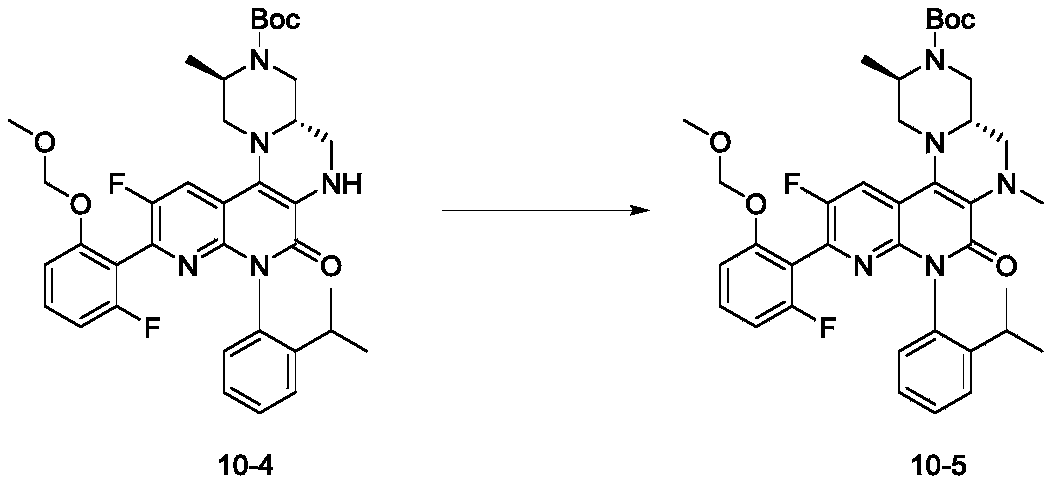


| 化合物编号 | p-ERK IC50(NCI H358,μM) |
| ARS-1620 | 0.325 |
| 化合物1A | 0.173 |
| 化合物1B | 8.511 |
| 化合物2A | 0.066 |
| 化合物2B | 8.511 |
| 化合物3A | 0.474 |
| 化合物3B | 0.008 |
| 化合物3A-1 | 3.014 |
| 化合物3A-2 | 5.240 |
| 化合物3B-1 | 0.026 |
| 化合物3B-2 | 0.006 |
| 化合物4A | 0.159 |
| 化合物5A | 0.061 |
| 化合物5B | 0.128 |
| 化合物6A | 0.065 |
| 化合物6B | 0.691 |
| 化合物7B | 0.098 |
| 化合物8 | 0.024 |
| 化合物9 | 1.96 |
| 化合物10A | 0.063 |
| 化合物11A | 1.117 |
| 化合物12A | 0.604 |
| 化合物13A | 0.040 |
| 化合物13B | 5.671 |
| 化合物16A | 0.017 |
| 化合物16A-1 | 0.011 |
| 化合物16A-2 | 0.084 |
| 化合物16B | 1.252 |
| 化合物16B-1 | 0.648 |
| 化合物17 | 0.275 |
| 化合物18A | 0.005 |
| 化合物18A-1 | 0.004 |
| 化合物18A-2 | 0.013 |
| 化合物18B | 0.151 |
| 化合物18B-1 | 0.036 |
| 化合物18B-2 | 0.102 |
| 化合物19A | 0.008 |
| 化合物19B | 0.936 |
| 化合物20A | 0.004 |
| 化合物20B | 0.264 |
| 化合物21A | 0.013 |
| 化合物21A-1 | 0.104 |
| 化合物21A-2 | 0.015 |
| 化合物21B | 0.306 |
| 化合物21B-1 | 2.238 |
| 化合物22A | 0.016 |
| 化合物22A-1 | 0.060 |
| 化合物22A-2 | 0.054 |
| 化合物22B | 0.548 |
| 化合物22B-1 | 0.213 |
| 化合物23A-1 | 0.111 |
| 化合物23A-2 | 0.003 |
| 化合物23B-1 | 0.150 |
| 化合物23B-2 | 0.749 |
| 化合物24A | 3.817 |
| 化合物24B | 0.075 |
| 化合物24C | 0.012 |
| 化合物24D | 0.246 |
| 化合物25A | 0.014 |
| 化合物25B | 0.245 |
| 化合物26A | 0.203 |
| 化合物26B | 0.019 |
| 化合物26C | 0.002 |
| 化合物26D | 0.068 |
| 化合物27A | 0.087 |
| 化合物27C | 0.004 |
| 化合物27D | 0.124 |
| 化合物28A | 0.006 |
| 化合物28C | 6.909 |
| 化合物29A | 0.124 |
| 化合物29B | 0.009 |
| 化合物30A | 0.170 |
| 化合物30B | 0.017 |
| 化合物31A | 2.156 |
| 化合物31B | 0.062 |
| 化合物32A | 0.274 |
| 化合物32B | 0.010 |
| 化合物32C | 0.151 |
| 化合物32D | 1.362 |
| 化合物33A-1 | 0.717 |
| 化合物33A-2 | 0.023 |
| 化合物33B-2 | 0.333 |
| 化合物34A | 0.503 |
| 化合物35A | 0.068 |
| 化合物35A-1 | 0.313 |
| 化合物35A-2 | 0.052 |
| 化合物36A-1 | 0.016 |
| 化合物36A-2 | 0.240 |
| 化合物37A | 0.070 |
| 化合物38B | 0.064 |
| 化合物38A-1 | 0.242 |
| 化合物38A-2 | 0.035 |
| 化合物38B-1 | 1.127 |
| 化合物39A | 0.798 |
| 化合物39A-1 | 1.641 |
| 化合物39A-2 | 0.789 |
| 化合物40A | 0.052 |
| 化合物40A-1 | 0.042 |
| 化合物40A-2 | 0.142 |
| 化合物41A | 0.942 |
| 化合物42A | 0.009 |
| 化合物42B | 0.182 |
| 化合物43 | 1.921 |
| 化合物44A | 0.580 |
| 化合物45A | 1.539 |
| 化合物46A | 2.047 |
| 化合物46B | 0.037 |
| 化合物47A | 1.565 |
| 化合物47B | 0.150 |
| 化合物48A-1 | 0.294 |
| 化合物48B-1 | 0.662 |
| 化合物48B-2 | 0.024 |
| 化合物49A | 0.004 |
| 化合物49A-1 | 0.005 |
| 化合物49A-2 | 0.249 |
| 化合物49B | 1.164 |
| 化合物50 | 0.041 |
| 化合物50B | 0.121 |
| 化合物50C | 0.630 |
| 化合物50D | 0.014 |
| 化合物51A | 1.277 |
| 化合物53A-1 | 0.003 |
| 化合物53A-2 | 0.011 |
| 化合物54A-1 | 0.641 |
| 化合物54A-2 | 0.844 |
| 化合物54B-1 | 0.012 |
| 化合物54B-2 | 0.004 |
| 化合物56A | 0.183 |
| 化合物56B | 0.011 |
| 化合物编号 | GI 50(NCI-H358,μM) | GI 50(MIA-Paca2,μM) |
| ARS-1620 | 0.51 | 1.21 |
| 化合物2A | 0.143 | 1.024 |
| 化合物3B | 0.008 | 0.039 |
| 化合物3B-1 | 0.027 | 0.166 |
| 化合物3B-2 | 0.005 | 0.031 |
| 化合物4A | 0.523 | 2.405 |
| 化合物5A | 0.089 | 0.252 |
| 化合物5B | 0.210 | 3.132 |
| 化合物6A | 0.041 | 0.230 |
| 化合物7B | 0.148 | 0.328 |
| 化合物8 | 0.022 | 0.037 |
| 化合物10A | 0.184 | 0.496 |
| 化合物13A | 0.059 | 0.265 |
| 化合物16A | 0.020 | 0.211 |
| 化合物16A-1 | 0.012 | 0.055 |
| 化合物16A-2 | 0.074 | 0.146 |
| 化合物18A | 0.006 | 0.013 |
| 化合物18A-1 | 0.002 | 0.010 |
| 化合物18A-2 | 0.012 | 0.024 |
| 化合物18B | 0.138 | 0.468 |
| 化合物18B-1 | 0.021 | 0.066 |
| 化合物18B-2 | 0.149 | 0.172 |
| 化合物19A | 0.008 | 0.014 |
| 化合物20A | 0.004 | 0.010 |
| 化合物20B | 0.413 | 1.595 |
| 化合物21A-1 | 0.091 | 0.156 |
| 化合物21A-2 | 0.010 | 0.034 |
| 化合物22A | 0.010 | 0.024 |
| 化合物22A-1 | 0.028 | 0.085 |
| 化合物22A-2 | 0.042 | 0.119 |
| 化合物23A-1 | 0.104 | 0.281 |
| 化合物23A-2 | 0.003 | 0.014 |
| 化合物24B | 0.068 | 0.112 |
| 化合物24C | 0.011 | 0.023 |
| 化合物24D | 0.232 | 0.407 |
| 化合物25A | 0.010 | 0.029 |
| 化合物26A | 0.152 | 0.724 |
| 化合物26B | 0.022 | 0.028 |
| 化合物26C | 0.002 | 0.001 |
| 化合物26D | 0.082 | 0.079 |
| 化合物27A | 0.147 | 0.152 |
| 化合物27C | 0.005 | 0.003 |
| 化合物27D | 0.085 | 0.117 |
| 化合物28A | 0.007 | 0.009 |
| 化合物29A | 0.044 | 0.067 |
| 化合物29B | 0.007 | 0.004 |
| 化合物30A | 0.208 | 0.231 |
| 化合物30B | 0.012 | 0.013 |
| 化合物31B | 0.090 | 0.299 |
| 化合物32A | 0.442 | 0.604 |
| 化合物32B | 0.022 | 0.021 |
| 化合物32C | 0.258 | 1.523 |
| 化合物33A-2 | 0.018 | 0.062 |
| 化合物35A | 0.053 | 2.141 |
| 化合物35A-1 | 0.163 | 2.599 |
| 化合物35A-2 | 0.046 | 0.511 |
| 化合物36A-1 | 0.032 | 0.235 |
| 化合物37A | 0.066 | 0.392 |
| 化合物38B | 0.077 | 0.535 |
| 化合物38A-2 | 0.063 | 0.201 |
| 化合物39A-2 | 0.512 | 1.649 |
| 化合物40A | 0.062 | 0.056 |
| 化合物40A-1 | 0.043 | 0.221 |
| 化合物40A-2 | 0.112 | 0.483 |
| 化合物41A | 0.530 | 2.235 |
| 化合物42A | 0.009 | 0.228 |
| 化合物42B | 0.214 | 0.510 |
| 化合物44A | 0.424 | 1.566 |
| 化合物46B | 0.049 | 0.168 |
| 化合物47B | 0.106 | 0.332 |
| 化合物48B-2 | 0.015 | 0.020 |
| 化合物49A | 0.004 | 0.009 |
| 化合物49A-1 | 0.003 | 0.007 |
| 化合物50 | 0.062 | 0.094 |
| 化合物50B | 0.093 | 0.112 |
| 化合物50D | 0.011 | 0.073 |
| 化合物53A-1 | 0.002 | 0.004 |
| 化合物53A-2 | 0.007 | 0.010 |
| 化合物54B-1 | 0.007 | 0.006 |
| 化合物54B-2 | 0.002 | 0.003 |
| 化合物56A | 0.223 | 0.448 |
| 化合物56B | 0.012 | 0.025 |


| 化合物 | T 1/2(hr) | C max(ng/mL) | AUC inf(ng*hr/mL) | F(%) |
| AMG 510 | 0.57 | 177.00 | 155.14 | 17.61 |
| 化合物3B-2 | 3.96 | 746.67 | 1984.18 | 17.01 |
| 化合物29B | 1.06 | 108.72 | 421.20 | 22.87 |
| 化合物27C | 1.78 | 133.67 | 526.88 | 20.30 |
Claims (27)
- 式(Ⅰ-B)所示化合物、其光学异构体及其药效上可接受的盐,
 其中,R 1、R 2分别独立地选自H、卤素和C 1-6烷基,所述C 1-6烷基任选被1、2或3个R取代;R 3选自H、卤素、OH、NH 2、CN、C 1-6烷基、C 1-6杂烷基、3~6元杂环烷基、C 3-6环烷基、3~6元杂环烷基-O-和C 3-6环烷基-O-,所述C 1-6烷基、C 1-6杂烷基、3~6元杂环烷基、C 3-6环烷基、3~6元杂环烷基-O-或C 3-6环烷基-O-任选被1、2或3个R取代;R 4分别独立地选自H、卤素、OH、NH 2、CN、C 1-6烷基、C 1-6杂烷基、C 3-6环烷基、3~6元杂环烷基、苯基、5~10元杂芳基、苯基并5~6元杂环烷基和5~6元杂芳基并5~6元杂环烷基,所述C 1-6烷基、C 1- 6杂烷基、C 3-6环烷基、3~6元杂环烷基、苯基、5~10元杂芳基、苯基并5~6元杂环烷基或5~6元杂芳基并5~6元杂环烷基任选被1、2或3个R取代;R 5选自H、C 1-6烷基、C 3-6环烷基、5~6元杂环烷基-C 1-3烷基-、3~8元杂环烷基、苯基、萘基、5~10元杂芳基、苯基并5~6元杂环烷基和5~6元杂芳基并5~6元杂环烷基,所述C 1-6烷基、C 3-6环烷基、5~6元杂环烷基-C 1-3烷基-、3~8元杂环烷基、苯基、萘基、5~10元杂芳基、苯基并5~6元杂环烷基或5~6元杂芳基并5~6元杂环烷基任选被1、2或3个R取代;L 1选自-C(=O)-、-S(=O)-和-S(=O) 2-;R 6选自H、CN、C 1-6烷基、C 1-6烷基-S(=O) 2-、3~6元杂环烷基、-C 1-6烷基-3~6元杂环烷基和C 3-6环烷基-C(=O)-,所述C 1-6烷基、C 1-6烷基-S(=O) 2-、3~6元杂环烷基、-C 1-6烷基-3~6元杂环烷基或C 3-6环烷基-C(=O)-任选被1、2或3个R取代;R 7分别独立地选自H、卤素、OH、NH 2、CN、-C(=O)-OH、C 1-6烷基-O-C(=O)--、-C(=O)-NH 2、C 1-6烷基、C 1-6杂烷基和-C 1-6烷基-3~6元杂环烷基,所述C 1-6烷基、C 1-6杂烷基、C 1-6烷基-O-C(=O)-或-C 1-6烷基-3~6元杂环烷基任选被1、2或3个R取代;T 1、T 2分别独立地选自N和-C(R 8)-;R 8选自H、卤素、OH、NH 2、CN、C 1-6烷基、C 1-6杂烷基、C 3-6环烷基和3~6元杂环烷基,所述C 1-6烷基、C 1-6杂烷基、C 3-6环烷基或3~6元杂环烷基任选被1、2或3个R取代;R 9选自H、卤素、OH、NH 2、CN、C 1-6烷基和C 1-6杂烷基,所述C 1-6烷基或C 1-6杂烷基任选被1、2或3个R取代;R 10选自H、卤素、CN、C 1-6烷基、C 1-6烷氧基和C 1-6烷氨基,所述C 1-6烷基、C 1-6烷氧基或C 1-6烷氨基任选被1、2或3个R取代;R分别独立地选自H、卤素、OH、NH 2、CN、C 1-6烷基、C 1- 6杂环烷、C 3-6环烷基、5~6元杂环烷基、C 3-6环烷基-O-和5~6元杂环烷基-O-,所述C 1-6烷基、C 1-6杂环烷、C 3-6环烷基、5~6元杂环烷基、C 3-6环烷基-O-或5~6元杂环烷基-O-任选被1、2或3个R’取代;
 R’选自F、Cl、Br、I、OH、NH 2和CH 3;环A独立地选自C 6-10芳基、5~10元杂芳基、苯基并5~6元杂环烷基和5~6元杂芳基并5~6元杂环烷基;n选自0、1、2、3或4;m选自0、1、2、3或4;D 1选自O;Y选自N、CH或C;为
 且当
且当 为
为 时,R 2、R 10不存在;
 为
为
 当中
当中 为
为 时,X 1、X 2分别独立地选自-N=、-C(R 7)=和-C(R 7) 2-C(R 7)=;
 当中
当中 为
为 时,X 1、X 2分别独立地选自单键、-O-、-S-、S(=O)、S(=O) 2、-N(R 6)-、-C(=O)-、-C(R 7) 2-和-C(R 7) 2-C(R 7) 2-;
 且,Y不能同时连接两个当Y与R 9之间的键为
 时,R 9不存在;
 上述3~6元杂环烷基、5~6元杂芳基、5~6元杂环烷基、5~10元杂芳基或C 1-6杂环烷基包含1、2或3个独立选自-O-、-NH-、-S-、-C(=O)-、-C(=O)O-、-S(=O)-、-S(=O) 2-和N的杂原子或杂原子团。
 - 式(Ⅰ-A)所示化合物、其光学异构体及其药效上可接受的盐,
 其中,R 1、R 2分别独立地选自H、卤素和C 1-6烷基,所述C 1-6烷基任选被1、2或3个R取代;R 3选自H、卤素、OH、NH 2、CN、C 1-6烷基、C 1-6杂烷基、3~6元杂环烷基、C 3-6环烷基、3~6元杂环烷基-O-和C 3-6环烷基-O-,所述C 1-6烷基、C 1-6杂烷基、3~6元杂环烷基、C 3-6环烷基、3~6元杂环烷基-O-或C 3-6环烷基-O-任选被1、2或3个R取代;R 4分别独立地选自H、卤素、OH、NH 2、CN、C 1-6烷基、C 1-6杂烷基、C 3-6环烷基、3~6元杂环烷基、苯基、5~10元杂芳基、苯基并5~6元杂环烷基和5~6元杂芳基并5~6元杂环烷基,所述C 1-6烷基、C 1- 6杂烷基、C 3-6环烷基、3~6元杂环烷基、苯基、5~10元杂芳基、苯基并5~6元杂环烷基或5~6元杂芳基并5~6元杂环烷基任选被1、2或3个R取代;R 5选自H、C 1-6烷基、C 3-6环烷基、5~6元杂环烷基-C 1-3烷基-、3~8元杂环烷基、苯基、萘基、5~10元杂芳基、苯基并5~6元杂环烷基和5~6元杂芳基并5~6元杂环烷基,所述C 1-6烷基、C 3-6环烷基、5~6元杂环烷基-C 1-3烷基-、3~8元杂环烷基、苯基、萘基、5~10元杂芳基、苯基并5~6元杂环烷基或5~6元杂芳基并5~6元杂环烷基任选被1、2或3个R取代;L 1选自-C(=O)-、-S(=O)-和-S(=O) 2-;R 6选自H、CN、C 1-6烷基、C 1-6烷基-S(=O) 2-、3~6元杂环烷基、-C 1-6烷基-3~6元杂环烷基和C 3-6环烷基-C(=O)-,所述C 1-6烷基、C 1-6烷基-S(=O) 2-、3~6元杂环烷基、-C 1-6烷基-3~6元杂环烷基或C 3-6环烷 基-C(=O)-任选被1、2或3个R取代;R 7分别独立地选自H、卤素、OH、NH 2、CN、-C(=O)OH、C 1-6烷基-O-C(=O)-、-C(=O)-NH 2、C 1-6烷基、C 1-6杂烷基和-C 1-6烷基-3~6元杂环烷基,所述C 1-6烷基、C 1-6杂烷基、C 1-6烷基-O-C(=O)-或-C 1-6烷基-3~6元杂环烷基任选被1、2或3个R取代;T 1、T 2分别独立地选自N和-C(R 8)-;R 8选自H、卤素、OH、NH 2、CN、C 1-6烷基、C 1-6杂烷基、C 3-6环烷基和3~6元杂环烷基,所述C 1-6烷基、C 1-6杂烷基、C 3-6环烷基或3~6元杂环烷基任选被1、2或3个R取代;R分别独立地选自H、卤素、OH、NH 2、CN、C 1-6烷基、C 1-6杂环烷、C 3-6环烷基、5~6元杂环烷基、C 3-6环烷基-O-和5~6元杂环烷基-O-,所述C 1-6烷基、C 1-6杂环烷、C 3-6环烷基、5~6元杂环烷基、C 3-6环烷基-O-或5~6元杂环烷基-O-任选被1、2或3个R’取代;
 R’选自F、Cl、Br、I、OH、NH 2和CH 3;环A独立地选自C 6-10芳基、5~10元杂芳基、苯基并5~6元杂环烷基和5~6元杂芳基并5~6元杂环烷基;n选自0、1、2、3或4;为
 且当
且当 为
为 时,R 2不存在;
 为
为
 当中
当中 为
为 时,X 1、X 2分别独立地选自-N=、-C(R 7)=和-C(R 7) 2-C(R 7)=;
 当中
当中 为
为 时,X 1、X 2分别独立地选自单键、-O-、-S-、S(=O)、S(=O) 2、-N(R 6)-、-C(=O)-、-C(R 7) 2-和-C(R 7) 2-C(R 7) 2-;
 上述3~6元杂环烷基、5~6元杂芳基、5~6元杂环烷基、5~10元杂芳基或C 1-6杂环烷基包含1、2或3个独立选自-O-、-NH-、-S-、-C(=O)-、-C(=O)O-、-S(=O)-、-S(=O) 2-和N的杂原子或杂原子团。
 - 根据权利要求1或2所述化合物、其光学异构体及其药效上可接受的盐,其选自
 其中,X 1、X 2分别独立地选自单键、-O-、-S-、S(=O)、S(=O) 2、-N(R 6)-、-C(=O)-、-C(R 7) 2-和-C(R 7) 2-C(R 7) 2-,R 1、R 2、R 3、R 4、R 5、L 1、R 6、R 7、T 1、T 2、环A和n如权利要求1或2所定义。
 - 根据权利要求3所述化合物、其光学异构体及其药效上可接受的盐,其中,R分别独立地选自H、卤素、OH、NH 2、CN、C 1-3烷基、C 1-3烷氧基、C 1-3烷硫基、C 1-3烷氨基、C 3-6环烷基、5~6元杂环烷基、C 3-6环烷基-O-和-5~6元杂环烷基-O-,所述C 1-3烷基、C 1-3烷氧基、C 1-3烷硫基、C 1-3烷氨基、C 3-6环烷基、5~6元杂环烷基、C 3-6环烷基-O-或5~6元杂环烷基-O-任选被1、2或3个R’取代。

- 根据权利要求4所述化合物、其光学异构体及其药效上可接受的盐,其中,R分别独立地选自H、F、Cl、Br、I、OH、NH 2、CN、Me、CH 2CH 3、


- 根据权利要求1或2所述化合物、其光学异构体及其药效上可接受的盐,其中,R 1、R 2分别独立地选自H、F、Me、CF 3、

- 根据权利要求6所述化合物、其光学异构体及其药效上可接受的盐,其中,结构单元选自


- 根据权利要求1或2所述化合物、其光学异构体及其药效上可接受的盐,其中,R 3选自H、卤素、OH、NH 2、CN、C 1-3烷基、C 1-3烷氧基、C 1-3烷氨基、C 1-3烷硫基、3~6元杂环烷基、C 3-6环烷基、3~6元杂环烷基-O-和C 3-6环烷基-O-,所述C 1-3烷基、C 1-3烷氧基、C 1-3烷氨基、C 1-3烷硫基、3~6元杂环烷基、C 3-6环烷基、3~6元杂环烷基-O-或C 3-6环烷基-O-任选被1、2或3个R取代。
- 根据权利要求8所述化合物、其光学异构体及其药效上可接受的盐,其中,R 3选自H、F、Cl、Br、I、OH、NH 2、CN、Me、CF 3、

- 根据权利要求1或2所述化合物、其光学异构体及其药效上可接受的盐,其中,R 4分别独立地选自H、卤素、OH、NH 2、CN、C 1-3烷基、C 1-3烷氧基、C 1-3烷氨基、C 1-3烷硫基、C 3-6环烷基、3~6元杂环烷基、苯基、吡啶基、嘧啶基、噻吩基、噻唑基、异噻唑基、噁唑基、异噁唑基、咪唑基、吡唑基、1,2,3-三唑基、1,2,4-三唑基、苯并呋喃基、苯并噻吩基和吲哚基,所述C 1-3烷基、C 1-3烷氧基、C 1-3烷氨基、C 1-3烷硫基、C 3-6环烷基、3~6元杂环烷基、苯基、吡啶基、嘧啶基、噻吩基、噻唑基、异噻唑基、噁唑基、异噁唑基、咪唑基、吡唑基、1,2,3-三唑基、1,2,4-三唑基、苯并呋喃基、苯并噻吩基或吲哚基任选被1、2或3个R取代。
- 根据权利要求10所述化合物、其光学异构体及其药效上可接受的盐,其中,R 4选自H、F、Cl、Br、I、OH、NH 2、CN、Me、CF 3、

- 根据权利要求1或2所述化合物、其光学异构体及其药效上可接受的盐,其中,环A选自苯基、萘基、吡啶基、嘧啶基、哒嗪基、吡嗪基、噻吩基、噻唑基、异噻唑基、噁唑基、异噁唑基、咪唑基、吡唑基、1,2,3-三唑基、1,2,4-三唑基、苯并呋喃基、苯并噻吩基、吲哚基、吲唑基、苯并咪唑基、1H-苯并[d]咪唑基、苯并吡唑基、嘌呤基、喹啉基、异喹啉基、异喹啉-1(2H)-酮基、异吲哚啉-1-酮基、苯并[d]恶唑-2(H)-酮基、苯并[d]恶唑-2(3H)-酮基、H-苯并[d][1,2,3]三唑基、1H-吡唑并[3,4-b]吡啶基、苯并[d]噻唑基和1,3-二氢-2H-苯并[d]咪唑-2-酮基,所述苯基、萘基、吡啶基、嘧啶基、哒嗪基、吡嗪基、噻吩基、噻唑基、异噻唑基、噁唑基、异噁唑基、咪唑基、吡唑基、1,2,3-三唑基、1,2,4-三唑基、苯并呋喃基、苯并噻吩基、吲哚基、吲唑基、苯并咪唑基、1H-苯并[d]咪唑基、苯并吡唑基、嘌呤基、喹啉基、异喹啉基、异喹啉-1(2H)-酮基、异吲哚啉-1-酮基、苯并[d]恶唑-2(H)-酮基、苯并[d]恶唑-2(3H)-酮基、H-苯并[d][1,2,3]三唑基、1H-吡唑并[3,4-b]吡啶基、苯并[d]噻唑基或1,3-二氢-2H-苯并[d]咪唑-2-酮基任选被1、2或3个R取代。
- 根据权利要求12所述化合物、其光学异构体及其药效上可接受的盐,其中,结构单元选自


- 根据权利要求1或2所述化合物、其光学异构体及其药效上可接受的盐,其中,R 5选自H、C 1-3烷基、环丙基、环丁基、环戊基、环己基、四氢呋喃基、吡咯烷基、四氢-2H-吡喃基、哌啶基、哌嗪基、5~6元杂环烷基-C 1-3烷基-、苯基、萘基、吡啶基、嘧啶基、哒嗪基、吡嗪基、噻吩基、噻唑基、异噻唑基、噁唑基、异噁唑基、咪唑基、吡唑基、1,2,3-三唑基、1,2,4-三唑基、苯并呋喃基、苯并噻吩基、吲哚基、苯并咪唑基、苯并吡唑基、嘌呤基、喹啉基、异喹啉基、异喹啉-1(2H)-酮基、异吲哚啉-1-酮基、苯并[d]恶唑-2(H)-酮基和1,3-二氢-2H-苯并[d]咪唑-2-酮基,所述C 1-3烷基、环丙基、环丁基、环戊基、环己基、四氢呋喃基、吡咯烷基、四氢-2H-吡喃基、哌啶基、哌嗪基、5~6元杂环烷基-C 1-3烷基-、苯基、萘基、吡啶基、嘧啶基、哒嗪基、吡嗪基、噻吩基、噻唑基、异噻唑基、噁唑基、异噁唑基、咪唑基、吡唑基、1,2,3-三唑基、1,2,4-三唑基、苯并呋喃基、苯并噻吩基、吲哚基、苯并咪唑基、苯并吡唑基、嘌呤基、喹啉基、异喹啉基、异喹啉-1(2H)-酮基、异吲哚啉-1-酮基、苯并[d]恶唑-2(H)-酮基或1,3-二氢-2H-苯并[d]咪唑-2-酮基任选被1、2或3个R取代。
- 根据权利要求14所述化合物、其光学异构体及其药效上可接受的盐,其中,R 5选自H、Me、


- 根据权利要求1或2所述化合物、其光学异构体及其药效上可接受的盐,其中,R 7分别独立地选自H、卤素、OH、NH 2、CN、C 1-3烷基、C 1-3烷基-O-C(=O)-、-C(=O)-NH 2、C 1-3烷氧基、C 1-3烷氨基、C 1- 3烷硫基和-C 1-3烷基-3~6元杂环烷基,所述C 1-3烷基、C 1-3烷基-O-C(=O)-、-C(=O)-NH 2、C 1-3烷氧基、 C 1-3烷氨基、C 1-3烷硫基或-C 1-3烷基-3~6元杂环烷基任选被1、2或3个R取代。
- 根据权利要求16所述化合物、其光学异构体及其药效上可接受的盐,其中,R 7分别独立地选自H、F、Cl、Br、I、OH、NH 2、CN、Me、CF 3、


- 根据权利要求1或2所述化合物、其光学异构体及其药效上可接受的盐,其中,R 6分别独立地选自H、CN、C 1-3烷基、C 1-3烷基-S(=O) 2-、3~6元杂环烷基、-C 1-3烷基-3~6元杂环烷基和C 3-6环烷基-C(=O)-,所述C 1-3烷基、C 1-3烷基-S(=O) 2-、3~6元杂环烷基、-C 1-3烷基3~6元杂环烷基或C 3-6环烷基-C(=O)-任选被1、2或3个R取代。
- 根据权利要求18所述化合物、其光学异构体及其药效上可接受的盐,其中,R 6分别独立地选自H、

- 根据权利要求18所述化合物、其光学异构体及其药效上可接受的盐,其中,X 1、X 2分别独立地选自单键、CH 2、CH 2CH 2、C(=O)、O、S、NH、N(CH 3)、S(=O)、S(=O) 2、


- 根据权利要求1或2所述化合物、其光学异构体及其药效上可接受的盐,其中,R 8选自H、卤素、OH、NH 2、CN、C 1-3烷基、C 1-3烷氧基、C 1-3烷氨基和C 1-3烷硫基,所述C 1-3烷基、C 1-3烷氧基、C 1-3烷氨基或C 1-3烷硫基任选被1、2或3个R取代。
- 根据权利要求21所述化合物、其光学异构体及其药效上可接受的盐,其中,R 8选自H、F、Cl、Br、I、OH、NH 2、CN、Me、CF 3、

- 根据权利要求1所述化合物、其光学异构体及其药效上可接受的盐,其中,结构单元选自


- 下式化合物、其光学异构体及其药效上可接受的盐,


- 一种药物组合物,所述的药物组合物含有如权利要求1~24任意一项所述化合物、其光学异构体及其药效上可接受的盐,以及一种或多种药学上可接受的载体、稀释剂或赋形剂。
- 根据权利要求1~24任意一项所述化合物、其光学异构体及其药效上可接受的盐或根据权利要求25所述的药物组合物在制备预防和/或治疗用作KRAS-G12C相关疾病的药物中的用途。
- 根据权利要求26所述的用途,其中所述的KRAS-G12C相关疾病选自非小细胞肺癌,结肠癌和胰腺癌。
Priority Applications (16)
| Application Number | Priority Date | Filing Date | Title |
|---|---|---|---|
| CA3155066A CA3155066A1 (en) | 2019-09-20 | 2020-09-21 | Fused pyridone compound, and preparation method therefor and use thereof |
| MX2022003401A MX2022003401A (es) | 2019-09-20 | 2020-09-21 | Compuesto de piridona fusionada y metodo de preparacion del mismo y uso del mismo. |
| JP2022517446A JP7642619B2 (ja) | 2019-09-20 | 2020-09-21 | 縮合ピリドン化合物、ならびにその調製方法および使用 |
| CN202411842482.5A CN119591618A (zh) | 2019-09-20 | 2020-09-21 | 稠合吡啶酮类化合物及其制备方法和应用 |
| CN202080078771.6A CN114728968B (zh) | 2019-09-20 | 2020-09-21 | 稠合吡啶酮类化合物及其制备方法和应用 |
| US17/761,983 US20220389029A1 (en) | 2019-09-20 | 2020-09-21 | Fused pyridone compound, and preparation method therefor and use thereof |
| CN202410656034.XA CN118619971A (zh) | 2019-09-20 | 2020-09-21 | 稠合吡啶酮类化合物及其制备方法和应用 |
| PH1/2022/550681A PH12022550681A1 (en) | 2019-09-20 | 2020-09-21 | Fused pyridone compound, and preparation method therefor and use thereof |
| AU2020350745A AU2020350745B2 (en) | 2019-09-20 | 2020-09-21 | Fused pyridone compound, and preparation method therefor and use thereof |
| CN202411842480.6A CN119462689A (zh) | 2019-09-20 | 2020-09-21 | 稠合吡啶酮类化合物及其制备方法和应用 |
| CN202310905052.2A CN116947885B (zh) | 2019-09-20 | 2020-09-21 | 稠合吡啶酮类化合物及其制备方法和应用 |
| EP20865331.1A EP4043464A4 (en) | 2019-09-20 | 2020-09-21 | CONDENSED PYRIDONE COMPOUND, PROCESS FOR PRODUCTION THEREOF AND USE THEREOF |
| KR1020227013103A KR20220086573A (ko) | 2019-09-20 | 2020-09-21 | 융합된 피리돈 화합물, 및 이의 제조 방법 및 이의 용도 |
| BR112022005193A BR112022005193A2 (pt) | 2019-09-20 | 2020-09-21 | Composto de piridona fundido, método de preparação do mesmo e uso do mesmo |
| IL291467A IL291467B1 (en) | 2019-09-20 | 2022-03-17 | Compressed pyridone compound, method for its preparation and use |
| CONC2022/0004686A CO2022004686A2 (es) | 2019-09-20 | 2022-04-12 | Compuesto de piridona fusionada y método de preparación del mismo y uso del mismo |
Applications Claiming Priority (18)
| Application Number | Priority Date | Filing Date | Title |
|---|---|---|---|
| CN201910892032 | 2019-09-20 | ||
| CN201910892032.X | 2019-09-20 | ||
| CN201911129688.2 | 2019-11-18 | ||
| CN201911129688 | 2019-11-18 | ||
| CN201911157939.8 | 2019-11-22 | ||
| CN201911157939 | 2019-11-22 | ||
| CN202010054188.3 | 2020-01-17 | ||
| CN202010054188 | 2020-01-17 | ||
| CN202010102546.3 | 2020-02-19 | ||
| CN202010102546 | 2020-02-19 | ||
| CN202010230303 | 2020-03-27 | ||
| CN202010230303.8 | 2020-03-27 | ||
| CN202010306926 | 2020-04-17 | ||
| CN202010306926.9 | 2020-04-17 | ||
| CN202010367694 | 2020-04-30 | ||
| CN202010367694.8 | 2020-04-30 | ||
| CN202010967317.8 | 2020-09-15 | ||
| CN202010967317 | 2020-09-15 |
Publications (1)
| Publication Number | Publication Date |
|---|---|
| WO2021052499A1 true WO2021052499A1 (zh) | 2021-03-25 |
Family
ID=74883935
Family Applications (1)
| Application Number | Title | Priority Date | Filing Date |
|---|---|---|---|
| PCT/CN2020/116510 Ceased WO2021052499A1 (zh) | 2019-09-20 | 2020-09-21 | 稠合吡啶酮类化合物及其制备方法和应用 |
Country Status (15)
| Country | Link |
|---|---|
| US (1) | US20220389029A1 (zh) |
| EP (1) | EP4043464A4 (zh) |
| JP (1) | JP7642619B2 (zh) |
| KR (1) | KR20220086573A (zh) |
| CN (5) | CN118619971A (zh) |
| AU (1) | AU2020350745B2 (zh) |
| BR (1) | BR112022005193A2 (zh) |
| CA (1) | CA3155066A1 (zh) |
| CL (1) | CL2022000666A1 (zh) |
| CO (1) | CO2022004686A2 (zh) |
| IL (1) | IL291467B1 (zh) |
| MX (1) | MX2022003401A (zh) |
| PH (1) | PH12022550681A1 (zh) |
| TW (1) | TWI761961B (zh) |
| WO (1) | WO2021052499A1 (zh) |
Cited By (42)
| Publication number | Priority date | Publication date | Assignee | Title |
|---|---|---|---|---|
| WO2021197499A1 (zh) * | 2020-04-03 | 2021-10-07 | 南京明德新药研发有限公司 | 八氢吡嗪并二氮杂萘啶二酮类化生物 |
| CN113853373A (zh) * | 2019-10-30 | 2021-12-28 | 劲方医药科技(上海)有限公司 | 取代的杂环并环类化合物,其制法与医药上的用途 |
| WO2022037630A1 (zh) * | 2020-08-21 | 2022-02-24 | 浙江海正药业股份有限公司 | 四环类衍生物、其制备方法及其医药上的用途 |
| WO2022143995A1 (zh) * | 2020-12-31 | 2022-07-07 | 正大天晴药业集团股份有限公司 | 四环类化合物及其医药用途 |
| US11453683B1 (en) | 2019-08-29 | 2022-09-27 | Mirati Therapeutics, Inc. | KRas G12D inhibitors |
| WO2022199669A1 (zh) * | 2021-03-25 | 2022-09-29 | 上海济煜医药科技有限公司 | 稠合吡啶酮类化合物盐型、晶型及其应用 |
| WO2022198904A1 (zh) * | 2021-03-26 | 2022-09-29 | 浙江海正药业股份有限公司 | 一种kras抑制剂关键中间体及其制备方法 |
| WO2022199170A1 (zh) * | 2021-03-26 | 2022-09-29 | 浙江海正药业股份有限公司 | 四环类衍生物、其制备方法和其医药上的用途 |
| WO2022206723A1 (zh) * | 2021-03-30 | 2022-10-06 | 浙江海正药业股份有限公司 | 杂环类衍生物、其制备方法及其医药上的用途 |
| WO2022223037A1 (zh) * | 2021-04-22 | 2022-10-27 | 劲方医药科技(上海)有限公司 | Kras抑制剂的盐或多晶型物 |
| US11548888B2 (en) | 2019-01-10 | 2023-01-10 | Mirati Therapeutics, Inc. | KRas G12C inhibitors |
| WO2023001141A1 (en) * | 2021-07-23 | 2023-01-26 | Shanghai Zion Pharma Co. Limited | Kras g12d inhibitors and uses thereof |
| WO2023030517A1 (en) * | 2021-09-06 | 2023-03-09 | Suzhou Zanrong Pharma Limited | Kras g12c inhibitors and uses thereof |
| CN116327956A (zh) * | 2022-04-01 | 2023-06-27 | 劲方医药科技(上海)有限公司 | 药物组合物、其用途及癌症的治疗方法 |
| WO2023116895A1 (zh) * | 2021-12-24 | 2023-06-29 | 劲方医药科技(上海)有限公司 | Kras抑制剂的多晶型物及其制备方法和用途 |
| US11697657B2 (en) | 2019-10-28 | 2023-07-11 | Merck Sharp & Dohme Llc | Small molecule inhibitors of KRAS G12C mutant |
| US11702418B2 (en) | 2019-12-20 | 2023-07-18 | Mirati Therapeutics, Inc. | SOS1 inhibitors |
| US11890285B2 (en) | 2019-09-24 | 2024-02-06 | Mirati Therapeutics, Inc. | Combination therapies |
| US11932633B2 (en) | 2018-05-07 | 2024-03-19 | Mirati Therapeutics, Inc. | KRas G12C inhibitors |
| WO2024081674A1 (en) | 2022-10-11 | 2024-04-18 | Aadi Bioscience, Inc. | Combination therapies for the treatment of cancer |
| US12065430B2 (en) | 2018-10-26 | 2024-08-20 | Taiho Pharmaceutical Co., Ltd. | Indazole compound or salt thereof |
| US12122787B2 (en) | 2019-09-20 | 2024-10-22 | Shanghai Jemincare Pharmaceuticals Co., Ltd | Fused pyridone compound, and preparation method therefor and use thereof |
| WO2025016436A1 (zh) * | 2023-07-19 | 2025-01-23 | 上海济煜医药科技有限公司 | Kras抑制剂的制备方法、其中间体和其中间体的制备方法 |
| US12208099B2 (en) | 2018-09-10 | 2025-01-28 | Mirati Therapeutics, Inc. | Combination therapies |
| WO2025036442A1 (zh) * | 2023-08-15 | 2025-02-20 | 劲方医药科技(上海)股份有限公司 | 吡嗪并萘啶二酮类化合物的制备方法及其中间体 |
| WO2025067459A2 (en) | 2023-09-29 | 2025-04-03 | D3 Bio (Wuxi) Co., Ltd. | Therapies for the treatment of cancer |
| US12280113B2 (en) | 2020-09-15 | 2025-04-22 | Revolution Medicines, Inc. | Ras inhibitors |
| US12281113B2 (en) | 2020-09-11 | 2025-04-22 | Mirati Therapeutics, Inc. | Crystalline forms of a KRas G12C inhibitor |
| US12336995B2 (en) | 2018-09-10 | 2025-06-24 | Mirati Therapeutics, Inc. | Combination therapies |
| US12377101B2 (en) | 2018-12-05 | 2025-08-05 | Mirati Therapeutics, Inc. | Combination therapies |
| US12384750B2 (en) | 2019-11-04 | 2025-08-12 | Revolution Medicines, Inc. | Ras inhibitors |
| US12398154B2 (en) | 2020-12-15 | 2025-08-26 | Mirati Therapeutics, Inc. | Azaquinazoline pan-KRas inhibitors |
| US12421253B2 (en) | 2020-12-16 | 2025-09-23 | Mirati Therapeutics, Inc. | Tetrahydropyridopyrimidine pan-KRas inhibitors |
| US12466840B2 (en) | 2023-10-20 | 2025-11-11 | Merck Sharp & Dohme Llc | Small molecule inhibitors of KRAS proteins |
| US12479834B2 (en) | 2019-11-29 | 2025-11-25 | Taiho Pharmaceutical Co., Ltd. | Phenol compound or salt thereof |
| US12485122B2 (en) | 2018-09-10 | 2025-12-02 | Mirati Therapeutics, Inc. | Combination of palbociclib and adagrasib for lung cancer |
| WO2025256521A1 (zh) * | 2024-06-11 | 2025-12-18 | 上海济煜医药科技有限公司 | 作为kras抑制剂的稠合吡啶酮类化合物的制备方法、中间体及其制备方法 |
| US12522605B2 (en) | 2019-05-13 | 2026-01-13 | Relay Therapeutics, Inc. | FGFR inhibitors and methods of use thereof |
| US12527795B2 (en) | 2018-09-10 | 2026-01-20 | Mirati Therapeutics, Inc. | Compositions of adagrasib and mTOR inhibitors and methods of treatment therewith |
| US12600722B2 (en) | 2022-07-18 | 2026-04-14 | Incyte Corporation | Tetracyclic compounds as DGK inhibitors |
| US12600723B2 (en) | 2022-07-18 | 2026-04-14 | Incyte Corporation | Tetracyclic compounds as DGK inhibitors |
| TWI924056B (zh) | 2023-07-19 | 2026-05-01 | 大陸商上海濟煜醫藥科技股份有限公司 | Kras抑制劑的製備方法、其中間體和其中間體的製備方法 |
Families Citing this family (1)
| Publication number | Priority date | Publication date | Assignee | Title |
|---|---|---|---|---|
| TW202233625A (zh) | 2020-11-18 | 2022-09-01 | 美商傳達治療有限公司 | Fgfr抑制劑及其製造及使用方法 |
Citations (9)
| Publication number | Priority date | Publication date | Assignee | Title |
|---|---|---|---|---|
| WO2016168540A1 (en) * | 2015-04-15 | 2016-10-20 | Araxes Pharma Llc | Fused-tricyclic inhibitors of kras and methods of use thereof |
| CN106488910A (zh) * | 2013-10-10 | 2017-03-08 | 亚瑞克西斯制药公司 | Kras g12c的抑制剂 |
| WO2017100546A1 (en) * | 2015-12-09 | 2017-06-15 | Araxes Pharma Llc | Methods for preparation of quinazoline derivatives |
| CN107849022A (zh) * | 2015-04-10 | 2018-03-27 | 亚瑞克西斯制药公司 | 取代的喹唑啉化合物和其使用方法 |
| WO2018142365A1 (en) * | 2017-02-03 | 2018-08-09 | The University Of North Carolina At Chapel Hill | Inhibitors of microbial beta-glucuronidase enzymes and uses thereof |
| WO2018206539A1 (en) * | 2017-05-11 | 2018-11-15 | Astrazeneca Ab | Heteroaryl compounds that inhibit g12c mutant ras proteins |
| WO2018217651A1 (en) | 2017-05-22 | 2018-11-29 | Amgen Inc. | Kras g12c inhibitors and methods of using the same |
| US20190177338A1 (en) * | 2017-12-08 | 2019-06-13 | Astrazeneca Ab | Chemical compounds |
| WO2019141250A1 (zh) * | 2018-01-19 | 2019-07-25 | 南京明德新药研发股份有限公司 | 作为krasg12c突变蛋白抑制剂的吡啶酮并嘧啶类衍生物 |
Family Cites Families (8)
| Publication number | Priority date | Publication date | Assignee | Title |
|---|---|---|---|---|
| JO3556B1 (ar) * | 2014-09-18 | 2020-07-05 | Araxes Pharma Llc | علاجات مدمجة لمعالجة السرطان |
| RU2722149C1 (ru) * | 2015-09-14 | 2020-05-27 | Пфайзер Инк. | Новые производные имидазо[4,5-c] хинолинов и имидазо[4,5-c][1,5] нафтиридинов в качестве ингибиторов LRRK2 |
| KR20180081596A (ko) * | 2015-11-16 | 2018-07-16 | 아락세스 파마 엘엘씨 | 치환된 헤테로사이클릭 그룹을 포함하는 2-치환된 퀴나졸린 화합물 및 이의 사용 방법 |
| CA3098574A1 (en) * | 2018-05-04 | 2019-11-07 | Amgen Inc. | Kras g12c inhibitors and methods of using the same |
| EP3919483A4 (en) * | 2019-01-29 | 2022-02-09 | Brightgene Bio-medical Technology Co., Ltd. | HETEROCYCLIC BENZOPYRIDONE COMPOUND AND USE THEREOF |
| CN113396147B (zh) * | 2019-05-31 | 2024-06-18 | 上海翰森生物医药科技有限公司 | 芳香杂环类衍生物调节剂、其制备方法和应用 |
| CN112300194B (zh) * | 2019-07-30 | 2022-01-14 | 上海凌达生物医药有限公司 | 一类稠环吡啶酮类化合物、制备方法和用途 |
| JP7601869B2 (ja) * | 2019-10-30 | 2024-12-17 | ▲勁▼方医▲薬▼科技(上海)有限公司 | 置換された複素環-環系化合物、その調製方法及び医薬への応用 |
-
2020
- 2020-09-21 WO PCT/CN2020/116510 patent/WO2021052499A1/zh not_active Ceased
- 2020-09-21 US US17/761,983 patent/US20220389029A1/en active Pending
- 2020-09-21 CA CA3155066A patent/CA3155066A1/en active Pending
- 2020-09-21 MX MX2022003401A patent/MX2022003401A/es unknown
- 2020-09-21 CN CN202410656034.XA patent/CN118619971A/zh active Pending
- 2020-09-21 CN CN202310905052.2A patent/CN116947885B/zh active Active
- 2020-09-21 AU AU2020350745A patent/AU2020350745B2/en active Active
- 2020-09-21 PH PH1/2022/550681A patent/PH12022550681A1/en unknown
- 2020-09-21 KR KR1020227013103A patent/KR20220086573A/ko active Pending
- 2020-09-21 JP JP2022517446A patent/JP7642619B2/ja active Active
- 2020-09-21 CN CN202411842480.6A patent/CN119462689A/zh active Pending
- 2020-09-21 CN CN202411842482.5A patent/CN119591618A/zh active Pending
- 2020-09-21 TW TW109132517A patent/TWI761961B/zh active
- 2020-09-21 CN CN202080078771.6A patent/CN114728968B/zh active Active
- 2020-09-21 EP EP20865331.1A patent/EP4043464A4/en active Pending
- 2020-09-21 BR BR112022005193A patent/BR112022005193A2/pt unknown
-
2022
- 2022-03-17 IL IL291467A patent/IL291467B1/en unknown
- 2022-03-18 CL CL2022000666A patent/CL2022000666A1/es unknown
- 2022-04-12 CO CONC2022/0004686A patent/CO2022004686A2/es unknown
Patent Citations (9)
| Publication number | Priority date | Publication date | Assignee | Title |
|---|---|---|---|---|
| CN106488910A (zh) * | 2013-10-10 | 2017-03-08 | 亚瑞克西斯制药公司 | Kras g12c的抑制剂 |
| CN107849022A (zh) * | 2015-04-10 | 2018-03-27 | 亚瑞克西斯制药公司 | 取代的喹唑啉化合物和其使用方法 |
| WO2016168540A1 (en) * | 2015-04-15 | 2016-10-20 | Araxes Pharma Llc | Fused-tricyclic inhibitors of kras and methods of use thereof |
| WO2017100546A1 (en) * | 2015-12-09 | 2017-06-15 | Araxes Pharma Llc | Methods for preparation of quinazoline derivatives |
| WO2018142365A1 (en) * | 2017-02-03 | 2018-08-09 | The University Of North Carolina At Chapel Hill | Inhibitors of microbial beta-glucuronidase enzymes and uses thereof |
| WO2018206539A1 (en) * | 2017-05-11 | 2018-11-15 | Astrazeneca Ab | Heteroaryl compounds that inhibit g12c mutant ras proteins |
| WO2018217651A1 (en) | 2017-05-22 | 2018-11-29 | Amgen Inc. | Kras g12c inhibitors and methods of using the same |
| US20190177338A1 (en) * | 2017-12-08 | 2019-06-13 | Astrazeneca Ab | Chemical compounds |
| WO2019141250A1 (zh) * | 2018-01-19 | 2019-07-25 | 南京明德新药研发股份有限公司 | 作为krasg12c突变蛋白抑制剂的吡啶酮并嘧啶类衍生物 |
Non-Patent Citations (5)
| Title |
|---|
| ARLINGER N.L.ELIEL E.L.: "Topics in Stereochemistry", vol. 6, 1971, WILEY INTERSCIENCE |
| BETHANY HALFORD: "Amgen unveils its KRas covalent inhibitor AMG 510", CHEMICAL & ENGINEERING NEWS, vol. 97, no. 14, 8 April 2019 (2019-04-08), pages 4 - 4, XP055694388, DOI: 10.1021/cen-09714-scicon1 |
| ELIEL, E.WILEN, S.: "Stereochemistry of Organic Compounds", 1994, JOHN WILEY & SONS, INC. |
| MCGRAW-HILL: "Dictionary of Chemical Ter is", 1984, MCGRAW-HILL BOOK COMPANY |
| See also references of EP4043464A4 |
Cited By (67)
| Publication number | Priority date | Publication date | Assignee | Title |
|---|---|---|---|---|
| US11932633B2 (en) | 2018-05-07 | 2024-03-19 | Mirati Therapeutics, Inc. | KRas G12C inhibitors |
| US12527795B2 (en) | 2018-09-10 | 2026-01-20 | Mirati Therapeutics, Inc. | Compositions of adagrasib and mTOR inhibitors and methods of treatment therewith |
| US12485122B2 (en) | 2018-09-10 | 2025-12-02 | Mirati Therapeutics, Inc. | Combination of palbociclib and adagrasib for lung cancer |
| US12336995B2 (en) | 2018-09-10 | 2025-06-24 | Mirati Therapeutics, Inc. | Combination therapies |
| US12208099B2 (en) | 2018-09-10 | 2025-01-28 | Mirati Therapeutics, Inc. | Combination therapies |
| US12065430B2 (en) | 2018-10-26 | 2024-08-20 | Taiho Pharmaceutical Co., Ltd. | Indazole compound or salt thereof |
| US12377101B2 (en) | 2018-12-05 | 2025-08-05 | Mirati Therapeutics, Inc. | Combination therapies |
| US11548888B2 (en) | 2019-01-10 | 2023-01-10 | Mirati Therapeutics, Inc. | KRas G12C inhibitors |
| US12522605B2 (en) | 2019-05-13 | 2026-01-13 | Relay Therapeutics, Inc. | FGFR inhibitors and methods of use thereof |
| US11453683B1 (en) | 2019-08-29 | 2022-09-27 | Mirati Therapeutics, Inc. | KRas G12D inhibitors |
| US11964989B2 (en) | 2019-08-29 | 2024-04-23 | Mirati Therapeutics, Inc. | KRas G12D inhibitors |
| US12122787B2 (en) | 2019-09-20 | 2024-10-22 | Shanghai Jemincare Pharmaceuticals Co., Ltd | Fused pyridone compound, and preparation method therefor and use thereof |
| US11890285B2 (en) | 2019-09-24 | 2024-02-06 | Mirati Therapeutics, Inc. | Combination therapies |
| US12291538B2 (en) | 2019-10-28 | 2025-05-06 | Merck Sharp & Dohme Llc | Small molecule inhibitors of KRAS G12C mutant |
| US12297208B2 (en) | 2019-10-28 | 2025-05-13 | Merck Sharp & Dohme Llc | Small molecule inhibitors of KRAS G12C mutant |
| US11697657B2 (en) | 2019-10-28 | 2023-07-11 | Merck Sharp & Dohme Llc | Small molecule inhibitors of KRAS G12C mutant |
| JP7830406B2 (ja) | 2019-10-30 | 2026-03-16 | ▲勁▼方医▲薬▼科技(上海)有限公司 | 置換された複素環-環系化合物、その調製方法及び医薬への応用 |
| JP7601869B2 (ja) | 2019-10-30 | 2024-12-17 | ▲勁▼方医▲薬▼科技(上海)有限公司 | 置換された複素環-環系化合物、その調製方法及び医薬への応用 |
| CN113853373A (zh) * | 2019-10-30 | 2021-12-28 | 劲方医药科技(上海)有限公司 | 取代的杂环并环类化合物,其制法与医药上的用途 |
| CN115057872A (zh) * | 2019-10-30 | 2022-09-16 | 劲方医药科技(上海)有限公司 | 取代的杂环并环类化合物,其制法与医药上的用途 |
| JP7830406B6 (ja) | 2019-10-30 | 2026-04-06 | 勁方医薬科技(上海)股▲フン▼有限公司 | 置換された複素環-環系化合物、その調製方法及び医薬への応用 |
| US12054497B2 (en) | 2019-10-30 | 2024-08-06 | Genfleet Therapeutics (Shanghai)Inc. | Substituted heterocyclic fused cyclic compound, preparation method therefor and pharmaceutical use thereof |
| JP2023175993A (ja) * | 2019-10-30 | 2023-12-12 | ▲勁▼方医▲薬▼科技(上海)有限公司 | 置換された複素環-環系化合物、その調製方法及び医薬への応用 |
| AU2020374844B2 (en) * | 2019-10-30 | 2024-01-25 | Genfleet Therapeutics (Shanghai) Inc. | Substituted heterocyclic fused cyclic compound, preparation method therefor and pharmaceutical use thereof |
| JP2023502891A (ja) * | 2019-10-30 | 2023-01-26 | ▲勁▼方医▲薬▼科技(上海)有限公司 | 置換された複素環-環系化合物、その調製方法及び医薬への応用 |
| US12384750B2 (en) | 2019-11-04 | 2025-08-12 | Revolution Medicines, Inc. | Ras inhibitors |
| US12479834B2 (en) | 2019-11-29 | 2025-11-25 | Taiho Pharmaceutical Co., Ltd. | Phenol compound or salt thereof |
| US12304915B2 (en) | 2019-12-20 | 2025-05-20 | Mirati Therapeutics, Inc. | SOS1 inhibitors |
| US11702418B2 (en) | 2019-12-20 | 2023-07-18 | Mirati Therapeutics, Inc. | SOS1 inhibitors |
| AU2021248363B2 (en) * | 2020-04-03 | 2024-02-15 | Medshine Discovery Inc. | Octahydropyrazinodiazanaphthyridine dione compounds |
| WO2021197499A1 (zh) * | 2020-04-03 | 2021-10-07 | 南京明德新药研发有限公司 | 八氢吡嗪并二氮杂萘啶二酮类化生物 |
| CN116406363B (zh) * | 2020-08-21 | 2025-06-20 | 浙江海正药业股份有限公司 | 四环类衍生物、其制备方法及其医药上的用途 |
| JP7654776B2 (ja) | 2020-08-21 | 2025-04-01 | 浙江海正薬業股▲ふん▼有限公司 | 四環系誘導体、その製造方法及びその医薬用途 |
| JP2023539188A (ja) * | 2020-08-21 | 2023-09-13 | 浙江海正薬業股▲ふん▼有限公司 | 四環系誘導体、その製造方法及びその医薬用途 |
| CN116406363A (zh) * | 2020-08-21 | 2023-07-07 | 浙江海正药业股份有限公司 | 四环类衍生物、其制备方法及其医药上的用途 |
| WO2022037630A1 (zh) * | 2020-08-21 | 2022-02-24 | 浙江海正药业股份有限公司 | 四环类衍生物、其制备方法及其医药上的用途 |
| US12286431B2 (en) | 2020-09-11 | 2025-04-29 | Mirati Therapeutics, Inc. | Crystalline forms of a KRas G12C inhibitor |
| US12281113B2 (en) | 2020-09-11 | 2025-04-22 | Mirati Therapeutics, Inc. | Crystalline forms of a KRas G12C inhibitor |
| US12403196B2 (en) | 2020-09-15 | 2025-09-02 | Revolution Medicines, Inc. | Ras inhibitors |
| US12280113B2 (en) | 2020-09-15 | 2025-04-22 | Revolution Medicines, Inc. | Ras inhibitors |
| US12465643B2 (en) | 2020-09-15 | 2025-11-11 | Revolution Medicines, Inc. | Ras inhibitors |
| US12409225B2 (en) | 2020-09-15 | 2025-09-09 | Revolution Medicines, Inc. | Ras inhibitors |
| US12398154B2 (en) | 2020-12-15 | 2025-08-26 | Mirati Therapeutics, Inc. | Azaquinazoline pan-KRas inhibitors |
| US12421253B2 (en) | 2020-12-16 | 2025-09-23 | Mirati Therapeutics, Inc. | Tetrahydropyridopyrimidine pan-KRas inhibitors |
| WO2022143995A1 (zh) * | 2020-12-31 | 2022-07-07 | 正大天晴药业集团股份有限公司 | 四环类化合物及其医药用途 |
| WO2022199669A1 (zh) * | 2021-03-25 | 2022-09-29 | 上海济煜医药科技有限公司 | 稠合吡啶酮类化合物盐型、晶型及其应用 |
| CN116113416A (zh) * | 2021-03-26 | 2023-05-12 | 浙江海正药业股份有限公司 | 四环类衍生物、其制备方法和其医药上的用途 |
| WO2022198904A1 (zh) * | 2021-03-26 | 2022-09-29 | 浙江海正药业股份有限公司 | 一种kras抑制剂关键中间体及其制备方法 |
| CN116113416B (zh) * | 2021-03-26 | 2024-11-22 | 浙江海正药业股份有限公司 | 四环类衍生物、其制备方法和其医药上的用途 |
| WO2022199170A1 (zh) * | 2021-03-26 | 2022-09-29 | 浙江海正药业股份有限公司 | 四环类衍生物、其制备方法和其医药上的用途 |
| CN116848111A (zh) * | 2021-03-26 | 2023-10-03 | 浙江海正药业股份有限公司 | 一种kras抑制剂关键中间体及其制备方法 |
| WO2022206723A1 (zh) * | 2021-03-30 | 2022-10-06 | 浙江海正药业股份有限公司 | 杂环类衍生物、其制备方法及其医药上的用途 |
| WO2022223037A1 (zh) * | 2021-04-22 | 2022-10-27 | 劲方医药科技(上海)有限公司 | Kras抑制剂的盐或多晶型物 |
| WO2023001141A1 (en) * | 2021-07-23 | 2023-01-26 | Shanghai Zion Pharma Co. Limited | Kras g12d inhibitors and uses thereof |
| WO2023030517A1 (en) * | 2021-09-06 | 2023-03-09 | Suzhou Zanrong Pharma Limited | Kras g12c inhibitors and uses thereof |
| WO2023116895A1 (zh) * | 2021-12-24 | 2023-06-29 | 劲方医药科技(上海)有限公司 | Kras抑制剂的多晶型物及其制备方法和用途 |
| WO2023186075A1 (zh) * | 2022-04-01 | 2023-10-05 | 劲方医药科技(上海)有限公司 | 药物组合物、其用途及癌症的治疗方法 |
| CN116327956A (zh) * | 2022-04-01 | 2023-06-27 | 劲方医药科技(上海)有限公司 | 药物组合物、其用途及癌症的治疗方法 |
| US12600723B2 (en) | 2022-07-18 | 2026-04-14 | Incyte Corporation | Tetracyclic compounds as DGK inhibitors |
| US12600722B2 (en) | 2022-07-18 | 2026-04-14 | Incyte Corporation | Tetracyclic compounds as DGK inhibitors |
| WO2024081674A1 (en) | 2022-10-11 | 2024-04-18 | Aadi Bioscience, Inc. | Combination therapies for the treatment of cancer |
| WO2025016436A1 (zh) * | 2023-07-19 | 2025-01-23 | 上海济煜医药科技有限公司 | Kras抑制剂的制备方法、其中间体和其中间体的制备方法 |
| TWI924056B (zh) | 2023-07-19 | 2026-05-01 | 大陸商上海濟煜醫藥科技股份有限公司 | Kras抑制劑的製備方法、其中間體和其中間體的製備方法 |
| WO2025036442A1 (zh) * | 2023-08-15 | 2025-02-20 | 劲方医药科技(上海)股份有限公司 | 吡嗪并萘啶二酮类化合物的制备方法及其中间体 |
| WO2025067459A2 (en) | 2023-09-29 | 2025-04-03 | D3 Bio (Wuxi) Co., Ltd. | Therapies for the treatment of cancer |
| US12466840B2 (en) | 2023-10-20 | 2025-11-11 | Merck Sharp & Dohme Llc | Small molecule inhibitors of KRAS proteins |
| WO2025256521A1 (zh) * | 2024-06-11 | 2025-12-18 | 上海济煜医药科技有限公司 | 作为kras抑制剂的稠合吡啶酮类化合物的制备方法、中间体及其制备方法 |
Also Published As
| Publication number | Publication date |
|---|---|
| BR112022005193A2 (pt) | 2022-08-16 |
| AU2020350745A1 (en) | 2022-04-07 |
| CN119462689A (zh) | 2025-02-18 |
| CA3155066A1 (en) | 2021-03-25 |
| CN118619971A (zh) | 2024-09-10 |
| EP4043464A4 (en) | 2023-10-04 |
| MX2022003401A (es) | 2022-07-13 |
| CO2022004686A2 (es) | 2022-07-08 |
| TWI761961B (zh) | 2022-04-21 |
| CN116947885A (zh) | 2023-10-27 |
| JP2022549171A (ja) | 2022-11-24 |
| PH12022550681A1 (en) | 2023-04-24 |
| CL2022000666A1 (es) | 2022-10-14 |
| US20220389029A1 (en) | 2022-12-08 |
| IL291467A (en) | 2022-05-01 |
| IL291467B1 (en) | 2026-03-01 |
| KR20220086573A (ko) | 2022-06-23 |
| AU2020350745B2 (en) | 2026-03-26 |
| EP4043464A1 (en) | 2022-08-17 |
| TW202126654A (zh) | 2021-07-16 |
| CN114728968B (zh) | 2024-11-15 |
| CN119591618A (zh) | 2025-03-11 |
| CN116947885B (zh) | 2026-01-23 |
| CN114728968A (zh) | 2022-07-08 |
| JP7642619B2 (ja) | 2025-03-10 |
Similar Documents
| Publication | Publication Date | Title |
|---|---|---|
| WO2021052499A1 (zh) | 稠合吡啶酮类化合物及其制备方法和应用 | |
| CN111484477B (zh) | 一种苯并吡啶酮杂环化合物及其用途 | |
| TWI810182B (zh) | 作為抗病毒劑之稠合吲唑吡啶酮化合物 | |
| WO2021023154A1 (zh) | 四并环类化合物及其制备方法和应用 | |
| WO2024088408A1 (zh) | 一种含氮杂环化合物、其药学上可接受的盐及其制备方法与应用 | |
| TW202229300A (zh) | 囊腫纖維化跨膜傳導調節蛋白之調節劑 | |
| CN109195965A (zh) | Wdr5蛋白质-蛋白质结合的抑制剂 | |
| CN109111451B (zh) | 二氢嘧啶类化合物及其在药物中的应用 | |
| CN114456159A (zh) | 氮取代杂环噻吩类化合物及其用途 | |
| CN115667226A (zh) | 作为egfr抑制剂的三环化合物 | |
| CN113272302A (zh) | 抗生素化合物、其制造方法、包含其的药物组合物及其用途 | |
| KR20230164702A (ko) | 이중 고리계 화합물의 제조 방법 및 항균제로서의 용도 | |
| KR20220053637A (ko) | 치환된 우레아 다이하이드로오로테이트 탈수소효소 억제제 | |
| CN105732659B (zh) | 硝基咪唑类化合物及其制备方法和在制药中的用途 | |
| US12122787B2 (en) | Fused pyridone compound, and preparation method therefor and use thereof | |
| TW202128649A (zh) | 作為m4促效劑之2—氮雜螺[3.4]辛烷衍生物 | |
| TW202509026A (zh) | 聯芳基化合物、製備方法及其藥用用途 | |
| TW202128703A (zh) | 作為m4 促效劑之2-氮雜螺[3.4]辛烷衍生物 | |
| HK40068840B (zh) | 稠合吡啶酮类化合物及其制备方法和应用 | |
| WO2019085996A1 (zh) | 作为mTORC1/2双激酶抑制剂的吡啶并嘧啶类化合物 | |
| HK40068840A (zh) | 稠合吡啶酮类化合物及其制备方法和应用 | |
| JP2018519354A (ja) | ヒト免疫不全ウイルス複製の阻害剤としてのピリジン−3−イル酢酸誘導体 | |
| EA051763B1 (ru) | Конденсированное пиридоновое соединение, способ его получения и его применение | |
| JP7843780B2 (ja) | 癌の処置に使用するための2,8-ジヒドロピラゾロ[3,4-b]インドール誘導体 | |
| JP2021517570A (ja) | イミダゾピロロン化合物及びその使用 |
Legal Events
| Date | Code | Title | Description |
|---|---|---|---|
| 121 | Ep: the epo has been informed by wipo that ep was designated in this application |
Ref document number: 20865331 Country of ref document: EP Kind code of ref document: A1 |
|
| ENP | Entry into the national phase |
Ref document number: 2022517446 Country of ref document: JP Kind code of ref document: A |
|
| ENP | Entry into the national phase |
Ref document number: 3155066 Country of ref document: CA |
|
| NENP | Non-entry into the national phase |
Ref country code: DE |
|
| REG | Reference to national code |
Ref country code: BR Ref legal event code: B01A Ref document number: 112022005193 Country of ref document: BR |
|
| ENP | Entry into the national phase |
Ref document number: 2020350745 Country of ref document: AU Date of ref document: 20200921 Kind code of ref document: A |
|
| WWE | Wipo information: entry into national phase |
Ref document number: NC2022/0004686 Country of ref document: CO |
|
| ENP | Entry into the national phase |
Ref document number: 2020865331 Country of ref document: EP Effective date: 20220420 |
|
| REG | Reference to national code |
Ref country code: BR Ref legal event code: B01E Ref document number: 112022005193 Country of ref document: BR Free format text: APRESENTE O RELATORIO DESCRITIVO. |
|
| WWP | Wipo information: published in national office |
Ref document number: NC2022/0004686 Country of ref document: CO |
|
| ENP | Entry into the national phase |
Ref document number: 112022005193 Country of ref document: BR Kind code of ref document: A2 Effective date: 20220321 |
|
| WWG | Wipo information: grant in national office |
Ref document number: 202217017542 Country of ref document: IN |