WO2021111973A1 - Papier barrière, contenant et élément de couvercle contenant ledit papier barrière, et procédé de production de papier barrière - Google Patents
Papier barrière, contenant et élément de couvercle contenant ledit papier barrière, et procédé de production de papier barrière Download PDFInfo
- Publication number
- WO2021111973A1 WO2021111973A1 PCT/JP2020/043996 JP2020043996W WO2021111973A1 WO 2021111973 A1 WO2021111973 A1 WO 2021111973A1 JP 2020043996 W JP2020043996 W JP 2020043996W WO 2021111973 A1 WO2021111973 A1 WO 2021111973A1
- Authority
- WO
- WIPO (PCT)
- Prior art keywords
- layer
- paper
- vapor deposition
- barrier paper
- barrier
- Prior art date
- Legal status (The legal status is an assumption and is not a legal conclusion. Google has not performed a legal analysis and makes no representation as to the accuracy of the status listed.)
- Ceased
Links
Images

Classifications
-
- D—TEXTILES; PAPER
- D21—PAPER-MAKING; PRODUCTION OF CELLULOSE
- D21H—PULP COMPOSITIONS; PREPARATION THEREOF NOT COVERED BY SUBCLASSES D21C OR D21D; IMPREGNATING OR COATING OF PAPER; TREATMENT OF FINISHED PAPER NOT COVERED BY CLASS B31 OR SUBCLASS D21G; PAPER NOT OTHERWISE PROVIDED FOR
- D21H19/00—Coated paper; Coating material
- D21H19/80—Paper comprising more than one coating
- D21H19/82—Paper comprising more than one coating superposed
- D21H19/824—Paper comprising more than one coating superposed two superposed coatings, both being non-pigmented
-
- D—TEXTILES; PAPER
- D21—PAPER-MAKING; PRODUCTION OF CELLULOSE
- D21H—PULP COMPOSITIONS; PREPARATION THEREOF NOT COVERED BY SUBCLASSES D21C OR D21D; IMPREGNATING OR COATING OF PAPER; TREATMENT OF FINISHED PAPER NOT COVERED BY CLASS B31 OR SUBCLASS D21G; PAPER NOT OTHERWISE PROVIDED FOR
- D21H19/00—Coated paper; Coating material
- D21H19/80—Paper comprising more than one coating
- D21H19/82—Paper comprising more than one coating superposed
-
- D—TEXTILES; PAPER
- D21—PAPER-MAKING; PRODUCTION OF CELLULOSE
- D21H—PULP COMPOSITIONS; PREPARATION THEREOF NOT COVERED BY SUBCLASSES D21C OR D21D; IMPREGNATING OR COATING OF PAPER; TREATMENT OF FINISHED PAPER NOT COVERED BY CLASS B31 OR SUBCLASS D21G; PAPER NOT OTHERWISE PROVIDED FOR
- D21H19/00—Coated paper; Coating material
- D21H19/02—Metal coatings
- D21H19/08—Metal coatings applied as vapour, e.g. in vacuum
-
- D—TEXTILES; PAPER
- D21—PAPER-MAKING; PRODUCTION OF CELLULOSE
- D21H—PULP COMPOSITIONS; PREPARATION THEREOF NOT COVERED BY SUBCLASSES D21C OR D21D; IMPREGNATING OR COATING OF PAPER; TREATMENT OF FINISHED PAPER NOT COVERED BY CLASS B31 OR SUBCLASS D21G; PAPER NOT OTHERWISE PROVIDED FOR
- D21H19/00—Coated paper; Coating material
- D21H19/80—Paper comprising more than one coating
- D21H19/82—Paper comprising more than one coating superposed
- D21H19/828—Paper comprising more than one coating superposed two superposed coatings, the first applied being non-pigmented and the second applied being pigmented
-
- D—TEXTILES; PAPER
- D21—PAPER-MAKING; PRODUCTION OF CELLULOSE
- D21H—PULP COMPOSITIONS; PREPARATION THEREOF NOT COVERED BY SUBCLASSES D21C OR D21D; IMPREGNATING OR COATING OF PAPER; TREATMENT OF FINISHED PAPER NOT COVERED BY CLASS B31 OR SUBCLASS D21G; PAPER NOT OTHERWISE PROVIDED FOR
- D21H25/00—After-treatment of paper not provided for in groups D21H17/00 - D21H23/00
- D21H25/005—Mechanical treatment
-
- D—TEXTILES; PAPER
- D21—PAPER-MAKING; PRODUCTION OF CELLULOSE
- D21H—PULP COMPOSITIONS; PREPARATION THEREOF NOT COVERED BY SUBCLASSES D21C OR D21D; IMPREGNATING OR COATING OF PAPER; TREATMENT OF FINISHED PAPER NOT COVERED BY CLASS B31 OR SUBCLASS D21G; PAPER NOT OTHERWISE PROVIDED FOR
- D21H27/00—Special paper not otherwise provided for, e.g. made by multi-step processes
- D21H27/10—Packing paper
-
- D—TEXTILES; PAPER
- D21—PAPER-MAKING; PRODUCTION OF CELLULOSE
- D21H—PULP COMPOSITIONS; PREPARATION THEREOF NOT COVERED BY SUBCLASSES D21C OR D21D; IMPREGNATING OR COATING OF PAPER; TREATMENT OF FINISHED PAPER NOT COVERED BY CLASS B31 OR SUBCLASS D21G; PAPER NOT OTHERWISE PROVIDED FOR
- D21H27/00—Special paper not otherwise provided for, e.g. made by multi-step processes
- D21H27/14—Paper having stable form or dimension; Curl-resistant paper
-
- D—TEXTILES; PAPER
- D21—PAPER-MAKING; PRODUCTION OF CELLULOSE
- D21H—PULP COMPOSITIONS; PREPARATION THEREOF NOT COVERED BY SUBCLASSES D21C OR D21D; IMPREGNATING OR COATING OF PAPER; TREATMENT OF FINISHED PAPER NOT COVERED BY CLASS B31 OR SUBCLASS D21G; PAPER NOT OTHERWISE PROVIDED FOR
- D21H27/00—Special paper not otherwise provided for, e.g. made by multi-step processes
- D21H27/30—Multi-ply
- D21H27/32—Multi-ply with materials applied between the sheets
- D21H27/34—Continuous materials, e.g. filaments, sheets, nets
Definitions
- the present invention relates to a barrier paper, a container and a lid material containing the barrier paper, and a method for producing the barrier paper.
- a packaging method for suppressing deterioration of the quality of the contents of foods, medical care, chemical products, cosmetics, etc. due to moisture and oxygen a method of using a packaging material having a high gas barrier property, and a method of using a packaging material having a high gas barrier property, and using nitrogen gas or the like for the contents
- a method of replacing gas with an active gas, a method of including an oxygen scavenger in which reduced iron powder or the like is packaged, and the like are implemented.
- the above-mentioned methods have problems such as insufficient performance, increased packaging cost, increased dust, performance only in a moist environment, and accidental ingestion. Has been done.
- the gas barrier property is insufficient only with the paper material.
- a method for improving the gas barrier property of the paper material a method of coating the surface of the paper material with a resin and a method of laminating a resin film having a metal foil or an inorganic thin-film deposition layer on the paper material can be considered.
- the above-mentioned method has problems that the recyclability and biodegradability are lowered, the incinerator is damaged at the time of incineration due to the resin component, and a large amount of incinerator residue due to the metal leaf is generated.
- Patent Document 1 discloses a laminate in which a gas barrier thin film layer by plasma polymerization is laminated on a base material made of paper or pulp mold having a sealing layer made of a polycondensate of a polysaccharide and a silicon compound on the surface. Has been done. However, in the laminated body of Patent Document 1, it is necessary to increase the thickness of the sealing layer to about several tens of ⁇ m, and the coating forming method of the sealing layer is limited. Further, the laminate of Patent Document 1 requires a base material made of paper or pulp mold to be put into a plasma polymerization apparatus for forming a gas barrier thin film layer.
- the laminate of Patent Document 1 is a thin film having a stable gas barrier property, in which the pressure inside the plasma polymerization apparatus is easily hindered by the paper powder or pulp powder generated from the base material to a pressure suitable for plasma polymerization. It was difficult to form a layer. Further, it has been difficult to obtain a high level of gas barrier property in the laminate of Patent Document 1.
- An object of the present invention is to provide a barrier paper having excellent gas barrier properties with respect to a barrier paper containing a paper base material layer.
- the present invention provides the following [1] to [15].
- [1] A barrier paper having a paper base material layer, an adhesive layer, and an inorganic vapor-deposited layer in this order, and the adhesive layer and the inorganic-deposited layer are in contact with each other.
- Ra1 arithmetic mean roughness of the surface of the inorganic thin-film layer opposite to the paper substrate layer
- ⁇ Ra1 0.030 ⁇ m or less.
- barrier paper Any of [1] to [5] having one or more layers selected from a release layer, a protective layer, a heat seal layer, and a sealant layer on the side opposite to the adhesive layer of the inorganic vapor deposition layer. Described barrier paper.
- the barrier paper according to any one of [1] to [6] which has a printing layer on the side opposite to the adhesive layer of the paper base material layer.
- the interlayer adhesion strength between the adhesive layer and the inorganic vapor-deposited layer is one of categories 0, 1 and 2 in the cross-cut test of JIS K5600-5-6, [1] to [ 11] The barrier paper according to any one of.
- a method for producing a barrier paper which comprises the following steps 1 and 2.
- Step 1 A step of forming a barrier paper intermediate by laminating an inorganic vapor deposition layer donor having an inorganic vapor deposition layer on a support having releasability and a paper base material layer via an adhesive layer.
- the inorganic vapor deposition layer donor is arranged so that the surface on the side having the inorganic vapor deposition layer faces the paper base material layer side with the support having the releasability as a reference.
- Step 2 A step of peeling the support having releasability from the barrier paper intermediate obtained in step 1 to obtain the following barrier paper.
- (Barrier paper) A barrier paper having a paper base material layer, an adhesive layer, and an inorganic thin-film deposition layer in this order, and the adhesive layer and the inorganic thin-film deposition layer are in contact with each other.
- the barrier paper of the present invention can improve the gas barrier property of the barrier paper containing the paper base material layer. Further, the container or lid material of the present invention can improve the gas barrier property. Further, the method for producing a barrier paper of the present invention can easily produce a barrier paper having excellent gas barrier properties.
- the barrier paper of the present embodiment has a paper base material layer, an adhesive layer, and an inorganic vapor deposition layer in this order, and the adhesive layer and the inorganic vapor deposition layer are in contact with each other.
- the numerical range of "AA to BB” means the numerical range of "AA or more and BB or less”.
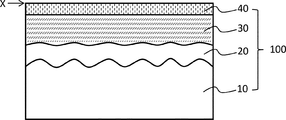
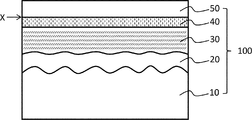
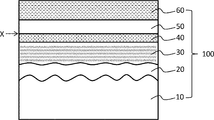
- FIGS. 1 to 3 are schematic cross-sectional views showing an embodiment of the barrier paper 100 of the present invention.
- the barrier paper 100 of FIGS. 1 to 3 has a paper base material layer 10, an adhesive layer 30, and an inorganic vapor deposition layer 40 in this order, and the adhesive layer 30 and the inorganic vapor deposition layer 40 are in contact with each other.
- the barrier paper 100 of FIGS. 1 to 3 has a sealing layer 20 between the paper base material layer 10 and the adhesive layer 30.
- the barrier paper 100 of FIG. 2 has a release layer 50 on the opposite side of the inorganic vapor deposition layer 40 from the adhesive layer 30.
- the barrier paper 100 of FIGS. 1 to 4 "the surface of the inorganic vapor deposition layer 40 opposite to the paper substrate layer 10" indicates the surface "X" in the drawing. That is, in the barrier paper 100 of FIGS. 1 to 4, Ra1, ⁇ Ra1 and Rku1 mean Ra1, ⁇ Ra1 and Rku1 of the X surface.
- the following (1) to (8) show an example of the laminated structure of the barrier paper of the present embodiment.
- the adhesive layer and the inorganic vapor deposition layer are in contact with each other and laminated.
- (1) A laminated structure having a paper base material layer, an adhesive layer, and an inorganic thin-film deposition layer in this order.
- (2) A laminated structure having a paper base material layer, an adhesive layer, an inorganic vapor deposition layer, and a release layer in this order.
- a laminated structure having a paper base material layer, an adhesive layer, and an inorganic vapor deposition layer in this order, and further having a heat seal layer or a sealant layer on the side opposite to the adhesive layer of the inorganic vapor deposition layer.
- a laminated structure having a paper base material layer, an adhesive layer, an inorganic vapor deposition layer, and a release layer in this order, and further having a heat seal layer or a sealant layer on the opposite side of the release layer from the inorganic vapor deposition layer.
- a laminated structure having a paper base material layer, an adhesive layer, an inorganic vapor deposition layer, and a protective layer in this order, and further having a heat seal layer or a sealant layer on the opposite side of the protective layer from the inorganic vapor deposition layer.
- a laminated structure having a paper base material layer, an adhesive layer, an inorganic vapor deposition layer, a protective layer, and a release layer in this order, and further having a heat seal layer or a sealant layer on the opposite side of the release layer from the inorganic vapor deposition layer. ..
- the paper base material layer, the adhesive layer, and the inorganic vapor-deposited layer are provided in this order, and heat is further applied to the side of the paper base material layer opposite to the adhesive layer and the side of the inorganic vapor-deposited layer opposite to the adhesive layer.
- the barrier paper of the present embodiment is not limited to the laminated structure of FIGS. 1 to 3 and the laminated structure of (1) to (8) above.
- the barrier paper of the present embodiment may have other layers such as a printing layer, a functional layer, a reinforcing layer, and a second adhesive layer as long as the effects of the present invention are not impaired.
- the other layers are arranged "between the paper base layer and the adhesive layer", "the side opposite to the adhesive layer of the paper base layer", and “the side opposite to the adhesive layer of the inorganic vapor deposition layer". ".
- the orientation of the barrier paper when using the barrier paper of this embodiment is not particularly limited.
- the orientation of the barrier paper is not limited, but it is preferable to use the barrier paper so that the inorganic vapor deposition layer side is the inner layer side with reference to the adhesive layer.
- the inside of the packaging material means the content side.
- ⁇ Paper base layer> As the paper base material constituting the paper base material layer, a general-purpose paper base material can be used. Examples of the paper base material include strong size bleached or unbleached paper base material, pure white roll paper, kraft paper, paperboard, coated paper, cast coated paper, milk base paper, processed base paper, high-quality paper, and fine paper. Examples thereof include coating printing paper, coating printing paper, resin coated paper, peeling base paper, and double-sided coating peeling base paper.
- the paper base material layer may be composed of one layer, or may be composed of multiple layers including two or more same or different paper base materials.
- the two or more paper substrates can be laminated by a general-purpose laminating means such as an adhesive.
- the basis weight and thickness of the paper substrate layer are not particularly limited.
- the basis weight of the paper substrate layer is preferably 30 g / m 2 or more and 600 g / m 2 or less, and more preferably 50 g / m 2 or more and 450 g / m 2 or less.
- the thickness of the paper base material layer is preferably 5 ⁇ m or more and 200 ⁇ m or less, more preferably 30 ⁇ m or more and 100 ⁇ m or less, and further preferably 40 ⁇ m or more and 80 ⁇ m or less.
- the raw material pulp for the paper substrate layer is preferably a mixture of softwood pulp (N material) and hardwood pulp (L material).
- the mixing ratio of the hardwood pulp (L material) is preferably 50% by mass or more and 90% by mass or less.
- the paper base material is preferably neutral paper, and more preferably neutral paper sized using an alkyl ketene dimer as a sizing agent.
- the paper substrate layer may contain additives such as lubricants, cross-linking agents, antioxidants, ultraviolet absorbers, light stabilizers, fillers, reinforcing agents, antistatic agents, pigments, etc., if necessary. ..
- additives such as lubricants, cross-linking agents, antioxidants, ultraviolet absorbers, light stabilizers, fillers, reinforcing agents, antistatic agents, pigments, etc., if necessary. ..
- physical surface treatment such as corona discharge treatment, ozone treatment, plasma treatment, glow discharge treatment, sandblast treatment, and chemistry. It is also possible to perform a chemical surface treatment such as an oxidation treatment using a chemical in advance.
- the ratio of the thickness of the paper substrate layer to the total thickness of the barrier paper is preferably 60% or more and less than 100%, more preferably 63% or more and 90% or less, and more preferably 65% or more and 80% or less.
- the ratio is preferably 60% or more and less than 100%, more preferably 63% or more and 90% or less, and more preferably 65% or more and 80% or less.
- the barrier paper of the present embodiment has an adhesive layer between the paper base material layer and the inorganic vapor deposition layer. Further, the adhesive layer needs to be laminated in contact with the inorganic thin-film deposition layer. When the adhesive layer and the inorganic vapor-deposited layer are in contact with each other and laminated, when a crack occurs on the adhesive layer side of the inorganic vapor-deposited layer, the adhesive layer repairs the crack and maintains the barrier property of the barrier paper. It can be done easily. Further, by having an adhesive layer between the paper base material layer and the inorganic vapor deposition layer, it is possible to easily make the surface shapes of Ra1, ⁇ Ra1, Rku1 and the like within the range described later.
- the adhesive layer is provided on substantially the entire surface of one side of the paper base material layer. “Approximately the entire surface” means 95% or more of the area on one side of the paper substrate layer, preferably 97% or more, more preferably 99% or more, and most preferably 100%.
- the adhesives constituting the adhesive layer include moisture-curable adhesives, anaerobic curable adhesives, dry-curable adhesives, UV-curable adhesives, heat-sensitive adhesives (for example, hot melt adhesives), and pressure-sensitive adhesives.
- Adhesives sin-called adhesives
- the above-mentioned adhesive may be a general-purpose adhesive or a specific adhesive.
- General-purpose adhesives include two-component curable urethane adhesives, polyester polyurethane adhesives, polyether polyurethane adhesives, acrylic adhesives, polyester adhesives, polyamide adhesives, and polyvinyl acetate adhesives. , Epoxy adhesives, rubber adhesives and the like.
- Examples of general-purpose adhesives include resins such as polyolefin resins, acid-modified polyolefin resins, polyvinyl acetate resins, poly (meth) acrylic resins, and polyvinyl chloride resins. These adhesives can be used alone or in combination of two or more.
- the specific adhesive is preferably an adhesive that protects the inorganic vapor deposition layer.
- the adhesive that protects the inorganic thin-film deposition layer is an adhesive that makes it easier to maintain the gas barrier property of the barrier paper by protecting the inorganic thin-film deposition layer that exhibits gas barrier properties. For example, when a bending load is applied to the barrier paper, the crack generation of the inorganic thin-film deposition layer is suppressed, and even when minute cracks start to occur in the inorganic thin-film deposition layer after the bending load, the action of suppressing the deterioration of the gas barrier property is suppressed. It is an adhesive that can be exerted. More detailed embodiments of the adhesive that protects the inorganic vapor deposition layer will be described later.
- the glass transition temperature of the adhesive layer is preferably ⁇ 30 ° C. or higher and 80 ° C. or lower, more preferably 0 ° C. or higher and 70 ° C. or lower, and further preferably 25 ° C. or higher and 70 ° C. or lower.
- the residual solvent in the adhesive layer is small.
- the residual solvent in the adhesive layer is preferably 6 mg / m 2 or less.
- the amount of residual solvent is most preferably 0 mg / m 2 , but practically it is preferably 6 mg / m 2 or less.
- the barrier paper does not contain a solvent-containing layer other than the adhesive layer, it can be detected as the solvent content of the adhesive layer by measuring the solvent content of the entire barrier paper.
- the thickness of the adhesive layer is preferably 1 ⁇ m or more and 20 ⁇ m or less, and more preferably 2 ⁇ m or more and 10 ⁇ m or less.
- the thickness of the adhesive layer is preferably 1 ⁇ m or more and 20 ⁇ m or less, and more preferably 2 ⁇ m or more and 10 ⁇ m or less.
- the thickness of the adhesive layer is preferably 1.5 ⁇ m or more and 20 ⁇ m or less.
- the thickness is 1.5 ⁇ m or more, the inorganic vapor-deposited layer can be easily protected, and when the thickness is 20 ⁇ m or less, the rigidity of the adhesive layer itself becomes too strong and the protective effect of the inorganic-deposited layer is lowered. Can be suppressed.
- the thickness of the adhesive layer can be calculated by, for example, the following methods (x1) to (x4).
- the thickness of the layers other than the adhesive layer can also be calculated by the same method as (x1) to (x4) below (however, in the following (x2) to (x4), the "adhesive layer” is the layer for which the thickness is calculated (x4). For example, it shall be read as "paper substrate layer, sealing layer, etc.)".
- Sample 1 is prepared by cutting the barrier paper in the direction perpendicular to the paper surface.
- (X2) A cross-sectional photograph 1 of an arbitrary portion in the width direction of the sample 1 is taken. Based on the cross-sectional photograph 1, the thickness of the adhesive layer is measured at 15 points at 1 ⁇ m intervals.
- the standard deviation of the thickness of the adhesive layer is preferably 0.80 ⁇ m or less, more preferably 0.60 ⁇ m or less, and even more preferably 0.55 ⁇ m or less.
- the barrier property can be improved more easily.
- the adhesive layer is in contact with the inorganic vapor deposition layer. Therefore, when the volume of the adhesive layer changes with time and stress is generated, the stress is directly transmitted to the adhesive layer.
- the thickness of the adhesive layer varies widely, the stress varies depending on the location, so that local defects may occur in the inorganic vapor-deposited layer.
- the barrier paper of the present embodiment has a paper base material layer having high moisture permeability, and the volume of the adhesive layer is likely to change due to moisture.
- the structure in which the standard deviation of the thickness of the adhesive layer is 0.80 ⁇ m or less is considered to be an advantageous structure for improving the barrier property.
- the standard deviation of the thickness of the adhesive layer is set to a predetermined value or more, the adhesion between the adhesive layer and the paper base material layer or the adhesive layer and the sealing layer can be improved by the anchoring action. Further, the adhesiveness of the entire barrier paper can be easily improved. Therefore, the standard deviation of the thickness of the adhesive layer is preferably 0.20 ⁇ m or more, more preferably 0.30 ⁇ m or more, and further preferably 0.35 ⁇ m or more.
- standard deviation means “standard deviation 1 ⁇ ” unless otherwise specified.
- the lower limit of the standard deviation of the thickness of the adhesive layer is not particularly limited, but is preferably 0.10 ⁇ m or more, and more preferably 0.20 ⁇ m or more.
- the standard deviation of the thickness of the adhesive layer means the standard deviation (standard deviation 1 ⁇ ) calculated from the thicknesses of the 75 points (x1) to (x4) above.
- the coefficient of variation of the thickness of the adhesive layer is preferably 0.17 or less, and more preferably 0.15 or less. By setting the coefficient of variation of the adhesive layer within the above range, the effect of the standard deviation of the adhesive layer can be more easily exhibited.
- the coefficient of variation of the thickness of the adhesive layer is not particularly limited, but is preferably 0.02 or more, and more preferably 0.05 or more.
- the coefficient of variation is a dimensionless value obtained by dividing the standard deviation by the average value.
- the adhesive layer contains additives such as antioxidants, UV absorbers, light stabilizers, antistatic agents, antiblocking agents, flame retardants, cross-linking agents, and colorants as long as the effects of the present invention are not impaired. Can include.
- a urethane-based resin composition is preferable as the adhesive that protects the inorganic thin-film deposition layer.
- the urethane-based resin composition preferably contains a specific polyol having two or more hydroxyl groups in one molecule and a specific isocyanate compound having two or more isocyanate groups in one molecule.
- the adhesive that protects the inorganic vapor deposition layer may further contain a phosphoric acid compound. Further, the adhesive that protects the inorganic vapor deposition layer may contain an inorganic compound.
- polyol having two or more hydroxyl groups in one molecule has two or more hydroxyl groups in one molecule, and the main skeleton is a polyester structure part, a polyester polyurethane structure part, a polyether structure part, an isocyanul ring structure part, and a poly.
- the polyol preferably has a polyester structure and / or a polyester polyurethane structure as the main skeleton, and more preferably has a polyester structure and / or a polyester polyurethane structure and an isocyanul ring structure.
- the hydroxyl group is preferably an alcoholic hydroxyl group, but may contain a phenolic hydroxyl group.
- the polyester structure can be obtained, for example, by polycondensing a polyvalent carboxylic acid and a polyhydric alcohol by a known and commonly used method, but the synthesis method is not limited to this.
- the polyester structural portion contains a polyester structural portion formed of an o-aromatic dicarboxylic acid and an aliphatic diol.
- the polyvalent carboxylic acid-derived structural portion in the polyester structural portion or the polyester polyurethane structural portion preferably contains 70% by mass or more and 100% by mass or less of the o-aromatic dicarboxylic acid-derived structural portion.
- the o-aromatic dicarboxylic acid refers to an o-aromatic dicarboxylic acid and a derivative thereof, and examples of the derivative include anhydrides and esters.
- the polyunsaturated carboxylic acids refer to polyunsaturated carboxylic acids and derivatives such as anhydrides and esters thereof, and examples thereof include aliphatic polyunsaturated carboxylic acids and aromatic polyunsaturated carboxylic acids.
- examples of the aliphatic polyvalent carboxylic acid include succinic acid, adipic acid, azelaic acid, sebacic acid, dodecanedicarboxylic acid, 1,4-cyclohexanedicarboxylic acid and the like.
- aromatic polyvalent carboxylic acids examples include o-phthalic acid, terephthalic acid, isophthalic acid, pyromellitic acid, trimellitic acid, 1,2-naphthalenedicarboxylic acid, 1,8-naphthalenedicarboxylic acid, and 2,3-naphthalenedicarboxylic acid.
- o-aromatic dicarboxylic acids examples include o-phthalic acid, 1,2-naphthalenedicarboxylic acid, 1,8-naphthalenedicarboxylic acid, 2,3-naphthalenedicarboxylic acid, 2,3-anthracene dicarboxylic acid, and 2,3-.
- examples thereof include anthracene dicarboxylic acid, an anhydride of dicarboxylic acid, and an ester of dicarboxylic acid.
- the above-mentioned multivalent carboxylic acids may be used alone or in combination of two or more.
- polyhydric alcohol examples include an aliphatic polyhydric alcohol and an aromatic polyhydric phenol.
- aliphatic polyhydric alcohol include ethylene glycol, propylene glycol, butylene glycol, neopentyl glycol, cyclohexanedimethanol, 1,5-pentanediol, 3-methyl-1,5-pentanediol, and 1,6-hexanediol.
- Diols such as methylpentanediol, dimethylbutanediol, butylethylpropanediol, diethylene glycol, triethylene glycol, tetraethylene glycol, dipropylene glycol, tripropylene glycol; triols such as glycerol, 1,2,4-butanetriol; Tetraols such as erythritol, pentaerythol, dipentaerythritol; and the like can be mentioned.
- aromatic polyhydric phenol examples include hydroquinone, resorcinol, catechol, naphthalenediol, biphenol, bisphenol A, hisphenol F and tetramethylbiphenol, and further, these ethylene oxide extensions and hydrogenated fats thereof. Examples include the ring tribe.
- the above-mentioned polyhydric alcohols may be used alone or in combination of two or more. When a structural part derived from triols is contained as a polyhydric alcohol in an adhesive that protects the inorganic thin-film deposition layer in an amount of 5% by mass or more, the adhesive is polyfunctionalized and the adhesive strength and strength are improved. Can be done.
- triol glycerol when used as the polyhydric alcohol, the polyol having a polyester structure in the main skeleton is represented by the following formulas (1) and (2).
- R 1 , R 2 , and R 3 each independently represent a hydrogen atom or a group represented by the general formula (2), and at least one represents a group represented by the general formula (2). Represent.
- n represents a number from 1 to 5 and X is a substituted and / or unsubstituted 1,2-phenylene group, 1,2-naphthylene group, 2,3.
- X is a substituted and / or unsubstituted 1,2-phenylene group, 1,2-naphthylene group, 2,3.
- Y represents an alkylene group having 2 to 6 carbon atoms.
- the isocyanate compound having two or more isocyanate groups in one molecule may be either aromatic or aliphatic as long as it has two or more isocyanate groups in the molecule, and may be either a low molecular weight compound or a high molecular weight compound.
- a known compound such as a diisocyanate compound having two isocyanate groups or a polyisocyanate compound having three or more isocyanate groups can be used.
- a blocked isocyanate compound obtained by an addition reaction using an isocyanate blocking agent by a general-purpose method can also be used.
- the isocyanate compound preferably contains an aromatic ring structure and / or a polyurethane structure containing an aromatic ring in the main skeleton.
- a polyisocyanate compound is preferable, and from the viewpoint of gas barrier property, a compound having an aromatic ring is preferable.
- an isocyanate compound containing a metaxylene skeleton is expected to improve gas barrier properties not only by hydrogen bonding of urethane groups but also by ⁇ - ⁇ stacking between aromatic rings, which is preferable.
- isocyanate compound having two or more isocyanate groups in one molecule include tetramethylene diisocyanate, hexamethylene diisocyanate, toluene diisocyanate, diphenylmethane diisocyanate, hydride diphenylmethane diisocyanate, metaxylylene diisocyanate, hydride xylylene diisocyanate and isophorone.
- Diisocyanates; trimerics of the above-mentioned isocyanate compounds; adducts, burettes, allophanates, etc. obtained by reacting the above-mentioned excess amounts of the isocyanate compounds with the following (a) to (c) and the like.
- (C) High molecular weight active hydrogen compounds such as polyester resins, polyether polyols and polyamides.
- isocyanate compound metaxylene diisocyanate or a reaction product of metaxylene diisocyanate and an alcohol having two or more hydroxyl groups is preferable.
- phosphoric acid compound phosphoric acids and / or phosphoric acid organic esters can be used, and they may be monomers or polymers.
- the phosphoric acid compound preferably has a hydroxyl group connected to a phosphorus atom.
- the phosphoric acid compound can enhance the adhesion of the adhesive that protects the inorganic vapor deposition layer.
- Phosphoric acids refer to phosphoric acids and multimers of phosphoric acids such as pyrophosphoric acid or polyphosphoric acid.
- the organic group of the phosphoric acid organic ester is preferably one or more selected from the group consisting of an alkyl group, a polyalkylene ether group, a (meth) acryloyl group, and a substituted or unsubstituted phenyl group.
- the content of the phosphoric acid compound in the adhesive that protects the inorganic thin-film deposition layer is preferably 0.005% by mass or more and 10% by mass or less, and more preferably 0.01% by mass or more and 1% by mass or less. If it is less than the above range, it may be difficult to obtain the effect of containing the phosphoric acid compound, and if it is more than the above range, the contained effect is not improved so much, and the content of other components is reduced, which has an adverse effect. It may be easier.
- Examples of the phosphoric acid compound include a compound represented by the following formula (3) or (4).
- Specific examples of the phosphoric acid compound include phosphoric acid, pyrophosphate, triphosphate, methyl acid phosphate, ethyl acid phosphate, butyl acid phosphate, dibutyl phosphate, 2-ethylhexyl acid phosphate, bis (2-ethylhexyl) phosphate, and isododecyl acid. Examples thereof include phosphate, butoxyethyl acid phosphate, oleyl acid phosphate, tetracosyl acid phosphate, 2-hydroxyethyl methacrylate acid phosphate, polyoxyethylene alkyl ether phosphoric acid and the like.
- R 1, R 2, R 3 represents a hydrogen atom, an alkyl group having 1 to 30 carbon atoms, (meth) acryloyl group, a substituted or unsubstituted phenyl group, ( Meta) One or more selected from the group consisting of alkyl groups having 1 to 4 carbon atoms having an acryloyloxy group, at least one is a hydrogen atom, and n represents a number of 1 to 4).
- R4 and R5 are hydrogen atoms, alkyl groups having 1 to 30 carbon atoms, (meth) acryloyl groups, substituted or unsubstituted phenyl groups, and (meth) acryloyloxy groups.
- the adhesive that protects the inorganic vapor deposition layer may contain an inorganic compound.
- the oxygen barrier property can be improved by containing an inorganic compound.
- the content of the inorganic compound in the adhesive that protects the inorganic vapor deposition layer is preferably 5% by mass or more and 50% by mass or less.
- the shape of the inorganic compound is not particularly limited, but a plate-like shape is preferable.
- the aspect ratio of the inorganic compound is preferably 3 or more, more preferably 10 or more, and even more preferably 40 or more.
- the aspect ratio of the inorganic compound is preferably 500 or less.
- the inorganic compound is preferably nonionic and uncharged, with low swelling property due to water, from the viewpoint of suppressing an increase in the viscosity of the adhesive and suppressing an increase in the thixotropy of the adhesive.
- the inorganic compound when the inorganic compound has a plate-like shape, it is preferable that the inorganic compound exhibits the above-mentioned properties.
- Plate-like inorganic compounds include, for example, hydrous silicates such as phyrosilicate minerals, kaolinite, kaolinite, enderite, deckite, nacrite and the like, kaolinite such as antigolite and chrysotile-serpentine clay minerals, pyrophylli. Pyrophyllites such as light, talc, and kerolai-talc, montmorillonite, byderite, nontronite, saponite, hectrite, soconite, smectite clay minerals such as stibunkite, vermiculite clay minerals such as vermiculite, white mica, and gold mica.
- hydrous silicates such as phyrosilicate minerals, kaolinite, kaolinite, enderite, deckite, nacrite and the like
- kaolinite such as antigolite and chrysotile-serpentine clay minerals
- pyrophylli Pyrophyllites such as light, tal
- the above-mentioned plate-like inorganic compound may be a natural clay mineral or a synthetic clay mineral, and may be used alone or in combination of two or more.
- kaolinite-serpentine clay minerals, pyrophyllite-talc, mica or mica clay minerals, green mudstones, hydrotalcites, and barium plate sulfates are non-swellable to water.
- kaolinite-serica clay minerals and pyrophyllite-talc are more preferred because they are nonionic and do not have interlayer electrification.
- the average particle size of the inorganic compound is not particularly limited, but is preferably 0.1 ⁇ m or more and 100 ⁇ m or less, and more preferably 1 ⁇ m or more and 20 ⁇ m or less.
- the average particle size means the mass average value d50 in the particle size distribution measurement by the laser light diffraction method.
- adhesives that protect the inorganic vapor-deposited layer include solvent-based barrier adhesive passrim (main agent VM001 / curing agent 108CP) and solvent-free barrier adhesive passrim (main agent NSRD011) manufactured by DIC Corporation. / Hardener NSRD006) and the like are known.
- a coating liquid containing a component constituting the adhesive layer is applied on a paper base material layer, an inorganic vapor deposition layer (on an inorganic vapor deposition layer of an inorganic vapor deposition layer donor), or a separator, and dried. , Can be formed by curing if necessary.
- the inorganic vapor deposition layer is located on the opposite side of the adhesive layer from the paper base material layer. Further, the inorganic vapor deposition layer is in contact with the adhesive layer. In other words, there is no other layer between the inorganic vapor deposition layer and the adhesive layer.
- the inorganic vapor deposition layer is provided on substantially the entire surface of the adhesive layer on the surface opposite to the paper base material layer. “Approximately the entire surface” means 95% or more of the area of the adhesive layer opposite to the paper base material layer, preferably 97% or more, more preferably 99% or more, and most preferably 100%.
- the barrier paper of the present embodiment has a ⁇ Ra1 of 0.030 ⁇ m or less when the arithmetic mean roughness of the surface of the inorganic vapor deposition layer opposite to the paper substrate layer is defined as Ra1 and the standard deviation of the Ra1 is defined as ⁇ Ra1. It is preferable to have.
- the arithmetic mean roughness means the arithmetic mean roughness Ra defined in JIS B0601: 2001.
- the cutoff ⁇ s and the cutoff ⁇ c when calculating the arithmetic mean roughness are both set to “0”.
- the surface of the inorganic vapor deposition layer opposite to the paper base material layer means the surface X in FIGS. 1 to 4.
- 1 to 3 are schematic cross-sectional views showing one embodiment of the barrier paper of the present invention
- FIG. 4 is a schematic cross-sectional view showing one embodiment of the conventional barrier paper.
- the surface of the inorganic vapor deposition layer opposite to the paper base material layer may be referred to as "surface X".
- ⁇ Ra1 By setting ⁇ Ra1 to 0.030 ⁇ m or less, the barrier property can be easily improved.
- the reason for this is considered as follows. First, the fact that ⁇ Ra1 exceeds 0.030 ⁇ m means that the value of the arithmetic mean roughness of the surface of the inorganic vapor-deposited layer opposite to the paper substrate layer varies greatly from place to place. When the value of the arithmetic mean roughness of the inorganic vapor-deposited layer varies greatly from place to place, the physical characteristics of the inorganic-deposited layer also tend to differ from place to place.
- ⁇ Ra1 exceeds 0.030 ⁇ m, it is considered that a portion where the barrier property becomes small is likely to occur in a local region in the plane of the inorganic thin-film deposition layer. As a result of water vapor or gas permeating locally from the region where the barrier property is weak, it is considered that it is difficult for the barrier paper having ⁇ Ra1 of more than 0.030 ⁇ m to improve the barrier property. On the other hand, when ⁇ Ra1 is 0.030 ⁇ m or less, it is difficult to generate a portion where the barrier property becomes small in the in-plane local region of the inorganic thin-film deposition layer. Therefore, it is considered that a barrier paper having a ⁇ Ra1 of 0.030 ⁇ m or less tends to have good barrier properties.
- ⁇ Ra1 is preferably 0.025 ⁇ m or less, more preferably 0.022 ⁇ m or less, and further preferably 0.020 ⁇ m or less.
- the lower limit of ⁇ Ra1 is not particularly limited, but is preferably 0.001 ⁇ m or more, more preferably 0.002 ⁇ m or more, and further preferably 0.005 ⁇ m or more.
- Ra1 means the average value of the arithmetic mean roughness Ra of 72 places. Further, in the present specification, ⁇ Ra1 means the standard deviation (standard deviation 1 ⁇ ) of the arithmetic mean roughness Ra at 72 points.
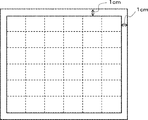
- the measurement sample is preferably sampled excluding the bent portion (for example, when sampling from a container formed of using barrier paper, it is preferable to sample excluding the bent portion). When the measurement sample is a quadrangle, as shown in FIG.
- the area 1 cm from the outer edge of the quadrangle is set as a margin, and the area inside the margin is divided into 6 equal parts in the vertical and horizontal directions for measurement within 36 areas. .. Then, the surface shapes in the vertical direction and the horizontal direction are measured within the 36 regions, and 72 measured values are obtained. Then, Ra1 is calculated from the average of the measured values of 72, and ⁇ Ra1 is calculated from the standard deviation (standard deviation 1 ⁇ ) of the measured values of 72.
- the measurement sample has a shape other than a quadrangle such as a circle, an ellipse, a triangle, or a pentagon, it is preferable to draw a quadrangle inscribed in these shapes and obtain 72 measurement values for the quadrangle by the above method.
- the surface shape of the surface of the inorganic vapor deposition layer opposite to the paper base material layer can be measured by, for example, a non-contact type surface shape measuring instrument.
- the non-contact type surface shape measuring instrument include a confocal type and a white interference type.
- the surface shape is measured by the confocal method among the non-contact type surface shape measuring instruments.
- the focus of light of the confocal surface shape measuring instrument The surface shape of the surface X can be measured by aligning the surface X with the surface X.
- Examples of the confocal surface shape measuring instrument include the product name "VK-X150" manufactured by KEYENCE CORPORATION.
- the confocal surface shape measuring instrument can measure the surface shape of any area. Then, if the horizontal direction of an arbitrary position is selected within the measured arbitrary area, Ra1 in the horizontal direction of the position can be calculated, and if the vertical direction of the arbitrary position is selected, the vertical direction of the position is selected. The arithmetic mean roughness of the direction can be calculated. In the case of the above-mentioned confocal surface shape measuring instrument (keyence brand name "VK-X150”), the horizontal direction of an arbitrary position or the vertical direction of an arbitrary position on the screen of the surface shape displayed two-dimensionally. By selecting, the arithmetic mean roughness in the selected direction can be calculated.
- the size of the measurement area in each measurement is not particularly limited, but the lower limit is preferably 100 ⁇ m in length ⁇ 100 ⁇ m in width or more, and the upper limit is preferably 500 ⁇ m in length ⁇ 500 ⁇ m in width or less.
- Ra1 and ⁇ Ra1 can be calculated, for example, by the following procedures (A1) to (A4).
- Rku1 to be described later can also be calculated, for example, by the same procedure as (A1) to (A4) below (however, the "arithmetic mean roughness" of (A3) and (A4) below can be calculated as "curtosis of roughness curve”. , And replace “Ra1" in (A4) below with "Rku1").
- A1 The measurement sample is divided into 36 regions as described above.
- A2 Using a confocal surface shape measuring instrument, the surface shape of an arbitrary area near the center in the 36 regions is measured.
- ⁇ Ra1 In order to make it easier for ⁇ Ra1 to be 0.030 ⁇ m or less, it is preferable to suppress the roughness of the paper substrate layer from being reflected in the inorganic vapor deposition layer. Therefore, it is preferable to arrange an adhesive layer between the paper base material layer and the inorganic vapor deposition layer, and it is more preferable to arrange a sealing layer and an adhesive layer. Further, in order to easily reduce ⁇ Ra1 to 0.030 ⁇ m or less, it is preferable to use a support having a substantially smooth surface shape as a support having an inorganic vapor deposition layer formed by a transfer method and having releasability.
- ⁇ Ra1 Since the inorganic vapor deposition layer formed as described above reflects the substantially smooth surface shape of the support having releasability, ⁇ Ra1 can be easily reduced.
- the above-mentioned means for facilitating the reduction of ⁇ Ra1 is also useful as a means for facilitating Ra1 in the range described later and a means for facilitating Rku in the range described later.
- the barrier paper of the present embodiment preferably has Ra1 of 0.100 ⁇ m or less.
- Ra1 is more preferably 0.080 ⁇ m or less, more preferably 0.070 ⁇ m or less, and even more preferably 0.065 ⁇ m or less.
- the lower limit of Ra1 is not particularly limited, but is preferably 0.001 ⁇ m or more, more preferably 0.002 ⁇ m or more, and further preferably 0.005 ⁇ m or more.
- the barrier paper of the present embodiment preferably has ⁇ Ra1 / Ra1 of 0.40 or less, and more preferably 0.30 or less.
- ⁇ Ra1 / Ra1 is a dimensionless value obtained by dividing the standard deviation by the average value, and is a so-called coefficient of variation.
- the barrier paper of the present embodiment preferably has Rku1 of more than 3.0 when the roughness curve of the surface opposite to the paper base material layer of the inorganic vapor deposition layer is defined as Rku1.
- Rku1 When the height distribution of the surface shape is divided into low, average, and high points, an Rku1 exceeding 3.0 means that there are many average points and few low and high points. To do. Therefore, when Rku1 exceeds 3.0, it is possible to prevent the barrier property from becoming small in a local region in the plane of the inorganic thin-film deposition layer, and it is possible to easily improve the barrier property.
- Rku1 is more preferably 5.0 or more, more preferably 7.5 or more, and even more preferably 10.0 or more.
- the upper limit of Rku1 is not particularly limited, but is preferably 30.0 or less, more preferably 25.0 or less, and even more preferably 20.0 or less.
- Rku1 means the average value of Kurtosis of the roughness curve at 72 points.
- the roughness curve Kurtosis means the roughness curve Kurtosis Rku defined in JIS B0601: 2001.
- the cutoff ⁇ s and the cutoff ⁇ c when calculating the arithmetic mean roughness are both set to “0”.
- Examples of the method for forming the inorganic vapor deposition layer include physical vapor deposition (PVD) such as vacuum vapor deposition, sputtering, and ion plating, plasma chemical vapor deposition, thermochemical vapor deposition, and photochemical vapor deposition.
- PVD physical vapor deposition
- CVD chemical vapor deposition
- the inorganic vapor deposition layer may be transparent or opaque. If the inorganic thin-film deposition layer is opaque, the barrier paper can be provided with a light-shielding property, and the quality of the contents can be easily maintained. When the inorganic thin-film deposition layer is transparent, it is preferable because it is easy to use in a microwave oven, it is easy to inspect it with a metal detector after filling the contents, and the color of the print layer is unlikely to sink.
- the inorganic compound constituting the inorganic vapor deposition layer include metals, metal oxides, metal nitrides, and metal carbides. As the inorganic compound constituting the inorganic vapor deposition layer, two or more kinds of inorganic compounds may be mixed.
- metal elements constituting the above-mentioned inorganic compound include aluminum (Al), silicon (Si), magnesium (Mg), calcium (Ca), potassium (K), tin (Sn), and sodium (Na). ), Boron (B), Titanium (Ti), Lead (Pb), Zirconium (Zr), Yttrium (Y), Zinc (Zn), Vanadium (V), Barium (Ba), Chromium (Cr) and the like. ..
- the inorganic compound examples include the metal, the oxide of the metal, the nitride of the metal, and the carbide of the metal, and further, a composite such as indium tin oxide (ITO) and a SiO x Cy film.
- ITO indium tin oxide
- SiO x Cy film a composite such as indium tin oxide (ITO) and a SiO x Cy film.
- Metal oxides are preferable because they tend to make the inorganic vapor-deposited layer transparent and are chemically stable. Further, metal oxides are preferable in that they are easy to use in a microwave oven, easy to inspect with a metal detector after filling the contents, and the color of the print layer is unlikely to become a sunken color.
- aluminum, aluminum oxide and silicon oxide are preferable, and aluminum oxide and silicon oxide are more preferable.
- Representation of the average composition of the inorganic compound for example, SiO x, AlO x, MO x, represented by MO x C y as such SiO x C y
- MO x represents a metal element
- x , Y values have different ranges depending on the metal element.
- the range of x values is 0 to 2 for silicon, 0 to 1.5 for aluminum, 0 to 1 for magnesium, 0 to 1 for calcium, and 0 to 0 for potassium.
- tin is 0 to 2
- sodium is 0 to 0.5
- boron is 0 to 1
- titanium is 0 to 2
- lead is 0 to 1
- zirconium is 0 to 2
- yttrium is It can take a value in the range of 0 to 1.5.
- the upper limit of the range of x is a value when completely oxidized.
- aluminum oxide preferably has a value in the range of 0.5 to 1.5
- silicon oxide preferably has a value in the range of 1.0 to 2.0.
- the inorganic vapor deposition layer may be composed of one layer, or may be composed of multiple layers having the same or different composition.
- the thickness of the inorganic thin-film deposition layer is preferably 30 ⁇ or more and 3000 ⁇ or less, more preferably 40 ⁇ or more and 2500 ⁇ or less, and further preferably 50 ⁇ or more and 2000 ⁇ or less.
- the thickness of the inorganic vapor deposition layer made of aluminum oxide is preferably 30 ⁇ or more and 1000 ⁇ or less, and more preferably 50 ⁇ or more and 500 ⁇ or less.
- the thickness of the inorganic vapor deposition layer made of silicon oxide is preferably 30 ⁇ or more and 3000 ⁇ or less, and more preferably 100 ⁇ or more and 300 ⁇ or less.
- the inorganic thin-film deposition layer can be formed by, for example, "a method of directly depositing an inorganic compound on an adhesive layer (direct vapor deposition method)" or "transfer method".
- a method of directly depositing an inorganic compound on an adhesive layer direct vapor deposition method
- transfer method an inorganic thin-film deposition layer donor having an inorganic thin-film deposition layer on a support having releasability and a paper base material layer are bonded together via an adhesive layer, and then inorganic vapor deposition is performed on the paper base material layer. This is a method of forming a layer by transfer.
- the transfer method is preferable in that the paper base material layer does not have a problem due to exposure to the vapor deposition atmosphere and the adhesion between the adhesive layer and the inorganic vapor deposition layer can be easily improved. .. Further, the transcription method is preferable in that Ra1, ⁇ Ra1 and Rku1 can be easily set in the above-mentioned range.
- the transfer method depends on the method of forming the adhesive layer, "1. A type in which an adhesive layer is formed on the inorganic vapor deposition layer of the inorganic vapor deposition layer donor", and "2. An adhesive layer is formed on the paper base material layer". "Type", "3.
- a type that forms an adhesive layer on both the inorganic vapor deposition layer of the inorganic vapor deposition layer donor and the paper substrate "4.
- a type that supplies an adhesive layer between them” can be mentioned.
- the types of "2" and "4" are preferable.
- the types "2" and "4" can exclude the above-mentioned possibility. Is.
- "2" is preferable because it is easy to improve the adhesion between the paper base material layer and the adhesive layer.
- the interlayer adhesion strength between the adhesive layer and the inorganic vapor deposition layer is preferably one of categories 0, 1 and 2 in the cross-cut test according to JIS K5600-5-6, and is classified into categories 0 and 1. It is more preferable to be either. If the classification is lower than the above range, classifications 3, 4 or 5, peeling occurs between the adhesive layer and the inorganic thin-film deposition layer, and the gas barrier property tends to be lowered.
- the outline of the evaluation of the interlayer adhesion strength is as follows.
- a plurality of right-angled lattice patterns are formed by cutting through the inorganic thin-film layer on the barrier paper with a cutter knife or the like.
- a cross-cutting jig capable of continuously and neatly forming a plurality of right-angled grid patterns.
- an adhesive tape having an adhesive layer on one side such as an adhesive cellophane tape, is attached so as to cover the entire lattice formed above.
- Tencilon the attached adhesive tape is peeled off from the end, the peeling condition of the inorganic thin-film deposition layer is visually observed, and the results are classified according to the following evaluation criteria.
- the size of one side of the lattice pattern is preferably 1 mm or more and 5 mm or less, more preferably 1.5 mm or more and 3 mm or less, and further preferably about 2 mm.
- the number of lattice patterns is preferably 15 or more and 50 or less, more preferably 20 or more and 30 or less, and further preferably about 25.
- the width and length of the adhesive tape are preferably a size that covers all of the formed lattice patterns and is easy to peel off.
- the adhesive tape is peeled off using Tencilon or the like at a constant speed of preferably 1 mm / min or more and 5 mm / min or less, more preferably 2 mm / min or more and 4 mm / min or less, and further preferably about 3 mm / min.
- Category 0 The edges of the cut are perfectly smooth and there is no peeling in any grid.
- Category 1 There is a small peeling of the coating film at the intersection of the cuts. However, the cross-cut portion is clearly not affected by more than 5%.
- Category 2 There is peeling along the edge of the cut of the coating and / or at the intersection. The cross-cut area is clearly affected between 5% and 15%.
- Category 3 The coating film is partially or wholly peeled off along the edges of the cut, and / or various parts of the eye are partially or wholly peeled off. The cross-cut area is affected by more than 15% and less than 35%.
- Category 4 The coating film is partially or wholly peeled off along the edges of the cut, and / or several eyes are partially or wholly peeled off. The area affected by the cross-cut part is clearly not more than 35%.
- Category 5 Any degree of peeling that cannot be classified even in Category 4.
- the barrier paper of the present embodiment preferably has a sealing layer between the paper base material layer and the adhesive layer.
- the sealing layer By having the sealing layer, the standard deviation and the coefficient of variation of the thickness of the adhesive layer can be easily set in the above-mentioned range. Further, by having a sealing layer in addition to the adhesive layer between the paper base material layer and the inorganic vapor deposition layer, it is possible to easily make the surface shape of ⁇ Ra1 or the like within the above-mentioned range.
- the sealing layer include a clay coat layer and a resin layer.
- the clay coat layer preferably contains clay and a binder.
- any clay generally called clay can be used without particular limitation.
- Specific examples of clay include kaolin, talc, bentonite, smectite, vermiculite, mica, chlorite, knot clay, gailome clay, halloysite, mica and the like. Since talc has a low hardness (Mohs hardness 1) and is excellent in heat resistance, it is possible to improve heat resistance and dimensional stability during embossing.
- the binder is usually a latex-based binder (for example, styrene-butadiene latex, acrylic-based latex, vinyl acetate-based latex), or a water-soluble binder (for example, starch (modified starch, oxidized starch, hydroxyethyl etherified starch, phosphate ester). Chemicalized starch), polyvinyl alcohol, casein, etc.).
- a latex-based binder for example, styrene-butadiene latex, acrylic-based latex, vinyl acetate-based latex
- a water-soluble binder for example, starch (modified starch, oxidized starch, hydroxyethyl etherified starch, phosphate ester). Chemicalized starch), polyvinyl alcohol, casein, etc.
- the clay coat layer preferably contains pigments such as calcium carbonate, titanium dioxide, amorphous silica, foamed barium sulfate, and satin white in order to improve the smoothness of the surface of the clay coat layer.
- pigments such as calcium carbonate, titanium dioxide, amorphous silica, foamed barium sulfate, and satin white.
- the clay coat layer may further contain additives such as a pigment dispersant, a defoaming agent, an effervescence inhibitor, a viscosity modifier, a lubricant, a water resistant agent, and a water retaining agent.
- the thickness of the clay coat layer is preferably 5 g / m 2 or more and 40 g / m 2 or less, and more preferably 10 g / m 2 or more and 40 g / m 2 or less.
- the thickness of the clay coat layer is preferably 3 ⁇ m or more and 40 ⁇ m or less, and more preferably 10 ⁇ m or more and 30 ⁇ m or less.
- the clay coat layer can be formed, for example, by applying a coating liquid containing components constituting the clay coat layer on a paper base material layer by a general-purpose coating method and drying it. Examples of the solvent for the clay coat layer coating liquid include water and alcohol.
- the resin constituting the resin layer examples include polyolefin-based resin, acrylic-based resin, urethane-based resin, and PVA (polyvinyl alcohol).
- the resin layer can be formed, for example, by coating on a paper base material layer.
- the thickness of the resin layer is preferably 10 ⁇ m or more because the effect of the sealing layer described above can be easily exerted.
- the thickness of the resin layer is preferably 60 ⁇ m or less because of its recyclability.
- the barrier paper of the present embodiment preferably has one or more layers selected from a release layer, a protective layer, a heat seal layer, and a sealant layer on the opposite side of the inorganic vapor deposition layer from the adhesive layer.
- the barrier paper may have a release layer on the opposite side of the inorganic vapor deposition layer from the adhesive layer.
- the release layer is a layer provided as needed to facilitate the release of the support having releasability from the inorganic vapor deposition layer donor.
- the release layer and the inorganic vapor deposition layer are transferred onto the paper substrate layer via the adhesive layer by using the inorganic vapor deposition layer donor on the support having releasability. Will be located on the opposite side of the inorganic vapor deposition layer from the adhesive layer.
- the release layer can function as a protective layer of the inorganic vapor deposition layer.
- the release layer can easily average and flatten the surface shape of the support having releasability. Therefore, by having the release layer, the surface shape of ⁇ Ra1 or the like can be easily set in the above-mentioned range.
- the release layer is provided on substantially the entire surface of the surface opposite to the adhesive layer of the inorganic vapor deposition layer. “Approximately the entire surface” means 95% or more of the area of the inorganic vapor-deposited layer opposite to the adhesive layer, preferably 97% or more, more preferably 99% or more, and most preferably 100%.
- the release layer is not particularly limited as long as it exhibits a well-balanced adhesive strength for achieving transfer of the inorganic vapor-filmed layer, but preferably contains a resin and / or wax.
- the resin include polyester-based resin, acrylic-based resin, silicone-based resin, polyvinyl butyral-based resin, acetal-based resin, and the like. Among these, polyester-based resins and acrylic-based resins are preferable.
- the wax include carbana wax, paraffin wax, polyethylene wax, polypropylene wax and the like. Among these, polyethylene wax is preferable.
- the release layer does not substantially contain particles such as pigments and matting agents in order to facilitate the surface shape of ⁇ Ra1 and the like within the above-mentioned range.
- substantially free means 0.1% by mass or less of the total solid content constituting the release layer, preferably 0.01% by mass or less, more preferably 0.001% by mass or less, and most preferably. Is 0% by mass.
- the coating amount of the release layer is preferably 0.2 g / m 2 or more and 5.0 g / m 2 or less.
- the thickness of the release layer is preferably 0.1 ⁇ m or more and 10 ⁇ m or less.
- the barrier paper may have a protective layer.
- the protective layer is preferably provided on the opposite side of the inorganic vapor deposition layer from the adhesive layer in order to protect the inorganic vapor deposition layer.
- the protective layer can easily average and flatten the surface shape of the support having releasability. Therefore, by having the protective layer, it is possible to easily make the surface shape of ⁇ Ra1 or the like within the above-mentioned range.
- the protective layer is provided on substantially the entire surface of the surface opposite to the adhesive layer of the inorganic vapor deposition layer. “Approximately the entire surface” means 95% or more of the area of the inorganic vapor-deposited layer opposite to the adhesive layer, preferably 97% or more, more preferably 99% or more, and most preferably 100%.
- the protective layer has, for example, "1. Applying and drying the protective layer coating liquid on the inorganic thin-film deposition layer", "2. Transferring the protective layer onto the inorganic thin-film deposition layer”, and "3. Releasability".
- an inorganic vapor deposition layer donor having a protective layer and an inorganic vapor deposition layer in this order on the support, and transferring the inorganic vapor deposition layer and the protective layer to the paper base material layer via the adhesive layer.
- "3" is preferable in order to improve workability and suppress defects in the inorganic thin-film deposition layer.
- the protective layer may be a resin component alone, an inorganic component alone, or a mixture of the resin component and the inorganic component.
- the protective layer preferably contains at least one selected from a water-soluble polymer and a metal alkoxide-based compound. Further, the protective layer more preferably contains at least one selected from the water-soluble polymer among the water-soluble polymer and the metal alkoxide-based compound, and one or more selected from the water-soluble polymer and the metal alkoxide-based compound. It is more preferable to include one or more selected from the compounds.
- the water-soluble polymer examples include polyvinyl alcohol, polyvinylpyrrolidone, and ethylene-vinyl alcohol copolymer.
- polyvinyl alcohol and ethylene-vinyl alcohol copolymer are preferable from the viewpoint of barrier properties, and polyvinyl alcohol is preferable. Is more preferable. That is, the protective layer preferably contains one or more selected from polyvinyl alcohol and an ethylene-vinyl alcohol copolymer, and more preferably contains polyvinyl alcohol.
- the content of the water-soluble polymer with respect to 100 parts by mass of the total amount of the metal alkoxide-based compound may be 5 parts by mass or more and 500 parts by mass or less. It is more preferably 7 parts by mass or more and 100 parts by mass or less, and further preferably 8 parts by mass or more and 50 parts by mass or less.
- the metal alkoxide compound examples include a metal alkoxide, a metal alkoxide hydrolyzate, and a metal alkoxide polymer.
- the metal alkoxide is a compound represented by the general formula of M (OR) n.
- M represents a metal such as Si, Ti, Al and Zr
- R represents an alkyl group such as a methyl group and an ethyl group.
- Specific examples of the metal alkoxide include tetramethoxysilane, tetraethoxysilane, isopropoxyaluminum and the like.
- the protective layer can be formed, for example, by applying a coating liquid containing a component constituting the protective layer on a support having releasability of the inorganic thin-film deposition layer donor and drying it.
- the coating liquid may contain additives such as a silane coupling agent, a curing agent and a dispersant.
- the protective layer does not substantially contain particles such as pigments and matting agents in order to facilitate the surface shape of ⁇ Ra1 and the like within the above-mentioned range.
- substantially free means 0.1% by mass or less of the total solid content constituting the protective layer, preferably 0.01% by mass or less, more preferably 0.001% by mass or less, and most preferably. Is 0% by mass.
- the lower limit of the thickness of the protective layer is preferably 70 nm or more, more preferably 85 nm or more, and further preferably 100 nm or more in order to protect the inorganic thin-film deposition layer and facilitate the improvement of the barrier property.
- the upper limit of the thickness of the protective layer is preferably 480 nm or less, more preferably 400 nm or less, and further preferably 300 nm or less.
- the barrier paper may have a heat seal layer.
- the heat seal layer is preferably provided on the side opposite to the adhesive layer of the inorganic vapor deposition layer.
- at least one of a release layer and a protective layer may be provided between the inorganic vapor deposition layer and the heat seal layer in order to protect the inorganic vapor deposition layer from the heat seal layer.
- the heat seal layer has a function as an adhesive layer when, for example, the barrier paper is formed into a container.
- the heat seal layer can be formed from, for example, a general-purpose thermoplastic resin.
- the thickness of the heat seal layer is usually about 15 ⁇ m or more and 100 ⁇ m or less.
- the heat seal layer is, for example, "1. Melting and extruding the heat seal layer onto the inorganic vapor deposition layer", “2. Applying and drying the heat seal layer coating liquid on the inorganic vapor deposition layer”, “3. Inorganic Transferring the heat seal layer onto the vapor deposition layer ”,“ 4. Prepare an inorganic vapor deposition layer donor having a heat seal layer and an inorganic vapor deposition layer in this order on a support having releasability, and use it as a paper substrate layer. On the other hand, it can be formed by "transferring the inorganic vapor deposition layer and the heat seal layer via the adhesive layer” and "5. dry laminating the heat seal layer on the inorganic vapor deposition layer".
- “1”, “2”, “3” and “5" are preferable from the viewpoint of reducing the vapor deposition cost of the inorganic vapor deposition layer. Further, in the case of “1”, “2”, “3” and “5", it is preferable to have at least one of a release layer and a protective layer between the inorganic vapor deposition layer and the heat seal layer. Further, when at least one of a release layer and a protective layer is provided between the inorganic vapor deposition layer and the heat seal layer, "1" is included in “1", “2”, “3” and "5".
- the barrier paper may have a sealant layer.
- the sealant layer is preferably provided on the opposite side of the inorganic vapor deposition layer from the adhesive layer.
- the sealant layer has a function of preventing the contents to be put in the container from coming into contact with other layers of the barrier paper and protecting the contents when the barrier paper is used as a container, for example.
- the thickness of the sealant layer is not particularly limited, and is appropriately set according to the use of the barrier paper and the type and properties of the contents.
- the thickness of the sealant layer is preferably 10 ⁇ m or more and 200 ⁇ m or less.
- the thickness of the sealant layer is more preferably 15 ⁇ m or more and 150 ⁇ m or less, and further preferably 20 ⁇ m or more and 100 ⁇ m or less.
- Materials constituting the sealant layer include propylene-based resins such as propylene homopolymer, ethylene-propylene block copolymer, and ethylene-propylene random copolymer, high-density polyethylene (HDPE), low-density polyethylene (LDPE), and linear low-density polyethylene. Chain low density polyethylene (L-LDPE) can be mentioned, and one or more of these resins can be used.
- propylene-based resins such as propylene homopolymer, ethylene-propylene block copolymer, and ethylene-propylene random copolymer, high-density polyethylene (HDPE), low-density polyethylene (LDPE), and linear low-density polyethylene.
- HDPE high-density polyethylene
- LDPE low-density polyethylene
- L-LDPE Chain low density polyethylene
- the sealant layer may be composed of a single layer or may be composed of two or more layers.
- the sealant layer preferably has a heat-sealing property.
- the sealant layer has a multi-layer structure, it is preferable that the side of the sealant layer opposite to the inorganic vapor deposition layer has a heat-sealing property.
- the sealant layer When the barrier paper is used as the lid of the container with a lid, the sealant layer preferably has an easy peel property.
- the easy peel property refers to a characteristic that the lid body can be easily peeled off from the container body when opening the container with a lid, for example.
- the sealant layer having easy peeling property uses two or more kinds of resins, and one resin (resin having good adhesion to the container body) and another resin (adhesion to the container body is not good), and the above It can be formed by mixing one resin and an incompatible resin).
- Such a resin cannot be unequivocally stated because it differs depending on the material of the container, but when the container body is made of polypropylene, polypropylene, which is one resin (resin having good adhesion to the container body), and others.
- a sealant layer from a resin that is a mixture of one or more selected from polyethylene, polypropylene, and polystyrene, which are the resins of the above (resin that does not have good adhesion to the container body and is incompatible with the above resin).
- Easy peeling property can be imparted to a polypropylene container.
- the sealant layer may be formed in a multi-layer structure, and easy peeling property may be imparted only to the side of the sealant layer to be joined to the container body.
- the sealant layer is, for example, "1. Melting and extruding the sealant layer onto the inorganic vapor deposition layer", “2. Applying and drying the sealant layer coating liquid on the inorganic vapor deposition layer", “3. On the inorganic vapor deposition layer”. Transfer the sealant layer to the surface ”,“ 4. Prepare an inorganic vapor deposition layer donor having a sealant layer and an inorganic vapor deposition layer in this order on a support having releasability, and apply an adhesive to the paper substrate layer. It can be formed by "transferring the inorganic vapor deposition layer and the sealant layer through the layer” and "5. dry laminating the sealant layer on the inorganic vapor deposition layer".
- “1”, “2”, “3” and “5" are preferable from the viewpoint of reducing the vapor deposition cost of the inorganic vapor deposition layer. Further, in the case of “1”, “2”, “3” and “5", it is preferable to have at least one of a release layer and a protective layer between the inorganic vapor deposition layer and the sealant layer.
- the barrier paper may have a print layer.
- the printing layer is preferably provided on the side opposite to the adhesive layer of the paper base material layer. Examples of the printing layer include a layer formed by printing characters (product name, product display, quality display, etc.), figures, photographs, symbols, patterns, patterns, etc., and a layer printed on one surface (so-called solid printing layer). And so on.
- the print layer may be a single layer or a multi-layer.
- the thickness of the print layer is usually 0.2 ⁇ m or more and 10.0 ⁇ m or less, preferably 0.5 ⁇ m or more and 8.0 ⁇ m or less, and more preferably 0.7 ⁇ m or more and 5.0 ⁇ m or less.
- Binder resins include acrylic resins, styrene resins, polyester resins, polyurethane resins, chlorinated polyolefin resins, vinyl chloride-vinyl acetate copolymer resins, polyvinyl butyral resins, alkyd resins, petroleum resins, and ketones. Examples thereof include resins, epoxy resins, melamine resins, fluorine resins, silicone resins, fibrous derivatives, rubber resins and the like. These may be used alone or in combination of two or more.
- the barrier paper may have a reinforcing layer.
- the reinforcing layer is preferably provided on the side opposite to the adhesive layer of the paper base material layer and / or on the side opposite to the adhesive layer of the inorganic thin-film deposition layer.
- the reinforcing layer is, for example, a barrier paper having one or more functions selected from mechanical strength, deformation resistance, drop impact resistance, pinhole resistance, heat resistance, sealing property, quality maintainability, workability, and hygiene. Is formed to grant.
- the reinforcing layer include a resin film, a resin coating film, and synthetic paper formed by extrusion or inflation.
- the resin contained in the reinforcing layer include low-density polyethylene, medium-density polyethylene, high-density polyethylene, linear low-density polyethylene, polypropylene, ethylene-propylene copolymer, and ethylene-vinyl acetate copolymer.
- ionomer resin ethylene-ethyl acrylate copolymer, ethylene-acrylic acid copolymer, ethylene-methacrylic acid copolymer, methylpentene polymer, polybutene resin, polyvinyl chloride resin, polyvinyl acetate resin, Polyvinylidene chloride resin, vinyl chloride-vinylidene chloride copolymer, poly (meth) acrylic resin, polyacrylic nitrile resin, polystyrene resin, acrylonitrile-styrene copolymer (AS resin), acrylonitrile-butadiene-styrene Copolymer (ABS-based resin), polyester-based resin, polyamide-based resin, polycarbonate-based resin, polyvinyl alcohol-based resin, saponified ethylene-vinyl acetate copolymer, fluorine-based resin, diene-based resin, polyacetal-based resin, polyurethane Examples include based resins, cellulose
- any of unstretched film, uniaxially stretched film, and biaxially stretched film can be used as the resin film constituting the reinforcing layer.
- the thickness of the reinforcing layer is not particularly limited, but is preferably 1 ⁇ m or more and 300 ⁇ m or less.
- the barrier paper may have a functional layer.
- the functional layer is preferably provided on the side opposite to the adhesive layer of the paper base material layer and / or on the side opposite to the adhesive layer of the inorganic thin-film deposition layer.
- a functional layer that imparts a barrier property to oxygen gas, water vapor, etc. a functional layer that absorbs less fragrance components contained in the contents and has excellent fragrance retention, a functional layer that imparts light-shielding property, and oxygen.
- a functional layer that absorbs examples include a functional layer that absorbs.
- the functional layer may contain one or more resins selected from a saponified ethylene-vinyl acetate copolymer, a polyamide resin, a polyacrylonitrile resin, and a polyester resin.
- the functional layer preferably contains particles made of a material having high light-shielding property such as titanium oxide, carbon black and aluminum scales, and a binder resin.
- the functional layer preferably contains particles made of a material having high oxygen absorption such as iron powder and a binder resin.
- Barrier paper temperature 40 ° C., at a relative humidity of 90%, a water vapor permeability measured according to JIS K7129 method, is preferably from 0.01g / m 2 / 24hr or 20g / m 2 / 24hr, 0.01g / m 2/24 hr or more 10g / m 2 / 24hr or less is more preferable. It is difficult to reduce the water vapor permeability than 0.01g / m 2 / 24hr. The water vapor permeability by less 20g / m 2 / 24hr, can easily suppress deterioration of the contents.
- Secondary processing For the purpose of imparting chemical function, electrical function, magnetic function, mechanical function, abrasion resistance function, lubrication function, optical function, thermal function, surface function such as biocompatibility, etc. to the barrier paper.
- Secondary processing can also be performed. Examples of secondary processing include embossing, painting, adhesion, printing, metallizing (plating, etc.), machining, surface treatment (antistatic treatment, corona discharge treatment, plasma treatment, photochromism treatment, physical vapor deposition, chemical vapor deposition, etc.) Coating, etc.) and the like.
- the barrier paper of the present embodiment can be used, for example, as a container for directly accommodating the contents (primary container), a container for accommodating the packaged contents (secondary container), or a lid material.
- a container for directly accommodating the contents primary container
- a container for accommodating the packaged contents secondary container
- a lid material a container for accommodating the packaged contents
- the container of the present embodiment contains the barrier paper of the present embodiment described above.
- the container include a container for directly accommodating the contents (primary container) and a container for accommodating the packaged contents (secondary container).
- the primary container and the secondary container may be a container with a lid having a container body having an accommodating portion and a lid body joined to the container body so as to seal the accommodating portion.
- Examples of the primary container include a pouch, a lami tube, a cup, a tray and the like.
- the barrier paper of the present embodiment described above can be used, for example, as a container body or as a lid material for the container body. It is preferable that the barrier paper is arranged so that the inorganic vapor deposition layer side is the content side of the container with the adhesive layer as a reference.
- the contents include coffee beans, tea leaves, cheese, snacks, rice confectionery, raw confectionery, semi-raw confectionery, fruits, nuts, vegetables, fruits, fish products, meat products, paste products, dried foods, smoked foods, boiled rice, raw rice, rice and rice.
- Foods such as rice cakes, infant foods, jams, mayonnaises, ketchups, cooking oils, dressings, sauces, spices, dairy products, pet foods; beverages such as beer, wine, fruit juice, green tea, coffee; pharmaceuticals; cosmetics Daily necessities such as shampoo, rinse, and detergent; metal parts; electronic parts; etc.
- the lid material of the present embodiment includes the barrier paper of the present embodiment described above.
- the lid material of the present embodiment can be used, for example, as a lid material for a container with a lid having a container body having an accommodating portion and a lid body joined to the container body so as to seal the accommodating portion.
- the method for producing the barrier paper of the present embodiment includes the following steps 1 and 2.
- Step 1 A step of forming a barrier paper intermediate by laminating an inorganic vapor deposition layer donor having an inorganic vapor deposition layer on a support having releasability and a paper base material layer via an adhesive layer.
- the inorganic vapor deposition layer donor is arranged so that the surface on the side having the inorganic vapor deposition layer faces the paper base material layer side with the support having the releasability as a reference.
- Step 2 A step of peeling the support having releasability from the barrier paper intermediate obtained in step 1 to obtain the following barrier paper.
- ⁇ Barrier paper> A barrier paper having a paper base material layer, an adhesive layer, and an inorganic thin-film deposition layer in this order, and the adhesive layer and the inorganic thin-film deposition layer are in contact with each other.
- Step 1 is a step of forming a barrier paper intermediate by laminating an inorganic vapor deposition layer donor having an inorganic vapor deposition layer on a support having releasability and a paper base material layer via an adhesive layer.
- the inorganic vapor deposition layer donor is arranged so that the surface on the side having the inorganic vapor deposition layer faces the paper base material layer side with the support having the releasability as a reference.
- the inorganic vapor deposition layer donor has an inorganic vapor deposition layer on a support having releasability.
- the inorganic vapor deposition layer donor may have one or more layers selected from a release layer and a protective layer between the support having releasability and the inorganic vapor deposition layer.
- both the release layer and the protective layer are provided between the support having the releasability and the inorganic vapor deposition layer, it is preferable to have the release layer and the protective layer in this order from the support side having the releasability.
- the embodiments of the release layer and the protective layer are as described above.
- the inorganic vapor deposition layer donor may have one or more layers selected from a heat seal layer and a sealant layer between the support having releasability and the inorganic vapor deposition layer.
- the inorganic vapor deposition layer donor has one or more layers selected from the heat seal layer and the sealant layer, one or more selected from the heat seal layer and the sealant layer in order to protect the inorganic vapor deposition layer from the heat seal layer and the sealant layer. It is preferable to have at least one of a release layer and a protective layer between the layer and the inorganic vapor deposition layer.
- the embodiments of the heat seal layer and the sealant layer are as described above.
- the inorganic vapor deposition layer donor may further have other layers such as a reinforcing layer and a functional layer, if necessary.
- the support having releasability can be used without particular limitation as long as it is suitable for the step of forming the inorganic vapor deposition layer and the transfer work of steps 1 and 2.
- a support having releasability may be referred to as "a releasable support”.
- the releasable support is preferably a film made of resin.
- the releasable support may be composed of one layer, or may be a resin layer having the same composition or two or more resin layers having different compositions laminated.
- polyester resins such as polyethylene terephthalate (PET) and polybutylene terephthalate (PBT); aromatic polyamides such as nylon MXD6, and polyamide resins such as general-purpose nylon; polyethylene.
- Polyethylene-based resins such as based resins, polypropylene-based resins, polybutene-based resins, and cyclic polyolefin resins; polystyrenes such as polystyrene-based resins, acrylonitrile-styrene copolymers (AS resins), and acrylonitrile-butadiene-styrene copolymers (ABS resins) Based resin; Polyvinyl chloride resin; Polyvinylidene chloride resin (PVDC); Polycarbonate resin; Polygonide resin; Polyamideimide resin; Diarylphthalate resin; Silicone resin; Polysulfone resin; Polyphenylene sulfide resin; Polyether Sulfonous resin; Polyurethane resin; Cellulosic resin; Poly (meth) acrylic resin; Acetal resin; Fluorine resin; Ethylene-vinyl acetate copolymer; Ethylene-vinyl alcohol copolymer (EVOH); Polyvinyl
- These resins may be used alone or in admixture of two or more. Further, these resins may be recycled (Michal recycled, material recycled, etc.) resins. Among these, it is particularly preferable to contain a polyester resin and / or a polyamide resin, and PET is particularly preferable.
- the thickness of the releasable support is not particularly limited, but is preferably 6 ⁇ m or more and 300 ⁇ m or less, and more preferably 10 ⁇ m or more and 100 ⁇ m or less.
- the releasable support preferably has a substantially smooth surface on the side where the inorganic thin-film deposition layer is formed.
- the surface of the releasable support on the side where the inorganic vapor deposition layer is formed preferably has an arithmetic mean roughness Ra of 0.080 ⁇ m or less, more preferably 0.070 ⁇ m or less, and is 0. It is more preferably .065 ⁇ m or less.
- the embodiment of the inorganic vapor deposition layer of the inorganic vapor deposition layer donor is as described above.
- Examples of the method for forming the inorganic vapor deposition layer on the releasable support include physical vapor deposition (PVD) such as vacuum vapor deposition, sputtering, and ion plating, plasma chemical vapor deposition, and thermochemical vapor deposition. Examples thereof include chemical vapor deposition (CVD) such as phase growth method and photochemical vapor deposition method.
- PVD physical vapor deposition
- CVD chemical vapor deposition
- a take-up type vapor deposition machine for example, a take-up type vapor deposition machine is used, and the releasable support taken out from the unwinding roll is put into the vapor deposition chamber in the vacuum chamber.
- the vapor deposition source heated in the crucible is evaporated, and if necessary, oxygen or the like is ejected from the oxygen outlet, and on the releasable support on the cooled coating drum, through a mask.
- Form an inorganic vapor deposition layer for example, a take-up type vapor deposition machine is used, and the releasable support taken out from the unwinding roll is put into the vapor deposition chamber in the vacuum chamber.
- the vapor deposition source heated in the crucible is evaporated, and if necessary, oxygen or the like is ejected from the oxygen outlet, and on the releasable support on the cooled coating drum, through a mask.
- an organic silicon compound, oxygen gas, and inert as a monomer gas supplied from the vapor deposition raw material volatilization supply device are applied to the surface of the releasable support unwound from the unwinding roll arranged in the vapor deposition chamber.
- An inorganic vapor deposition layer such as silicon oxide can be formed by introducing a mixed gas composed of gas or the like and using plasma.
- the surface of the releasable support (or the release layer or protective layer formed on the releasable support) is cleaned by pretreatment such as SiO x plasma, and the surface is polar.
- pretreatment such as SiO x plasma
- the tight adhesion between the inorganic vapor deposition layer and the releasable support (or the release layer or protective layer formed on the releasable support) can be enhanced. ..
- two or more inorganic vapor deposition layers are continuously laminated using a plasma chemical vapor deposition apparatus consisting of at least two or more film forming chambers, the inorganic vapor deposition layers can be continuously vapor-deposited without being opened to the atmosphere.
- the embodiment of the paper base material layer is as described above.
- a sealing layer on at least one surface of the paper base material layer before the step 1.
- the embodiment of the sealing layer is as described above.
- the surface (surface 1) of the inorganic vapor deposition layer donor on the side having the inorganic vapor deposition layer and the side on which the sealing layer of the paper base material layer is formed are formed.
- the surface 1 and the surface 2 are laminated via an adhesive layer so as to face each other.
- the adhesive layer is as described above.
- the adhesive layer can be formed or supplied, for example, as in steps 1 to 4 below.
- the types of "2" and "4" are preferable.
- the adhesive layer is formed on the inorganic thin-film deposition layer, defects may occur in the inorganic vapor-deposited layer, but the types "2" and "4" can eliminate the above-mentioned possibility.
- "2" is preferable because it is easy to improve the adhesion between the paper base material layer and the adhesive layer.
- the adhesive layer by "B1. Means for applying and drying the adhesive layer coating liquid” described later.
- 1. Inorganic vapor deposition layer An adhesive layer is formed on the inorganic vapor deposition layer of the donor. 2. An adhesive layer is formed on the paper substrate layer. 3. 3. Inorganic vapor deposition layer An adhesive layer is formed on both the inorganic vapor deposition layer of the donor and the paper substrate. 4. An adhesive layer is supplied between the paper substrate layer and the inorganic vapor deposition layer donor.
- Specific means for forming the adhesive layer in the above "1", “2" and “3" include “B1. Means for applying and drying the adhesive layer coating liquid” and “B2. Adhesive layer on the separator”. A means for producing a laminated body 1 having the above, dry laminating the laminated body 1, and then peeling off the separator.
- a laminate 1 having an adhesive layer on a separator is produced, and while the separator of the laminate 1 is peeled off, the paper base material layer and the inorganic vapor deposition layer donor are combined.
- a means of supplying an adhesive layer between them can be mentioned.
- the anchor coat layer may be formed prior to the formation of the adhesive layer.
- a general-purpose laminating means can be mentioned.
- the laminated structure of the barrier paper intermediate include a laminated structure in which a releasable support is added to the above (1) to (8) exemplified as the laminated structure of the barrier paper of the present embodiment.
- the place where the releasable support is added is the outermost surface on the inorganic vapor deposition layer side with the adhesive layer as a reference.
- the step 2 is a step of peeling the support having the releasability from the barrier paper intermediate obtained in the step 1 to obtain the following barrier paper.
- barrier paper A barrier paper having a paper base material layer, an adhesive layer, and an inorganic thin-film deposition layer in this order, and the adhesive layer and the inorganic thin-film deposition layer are in contact with each other.
- the interface with the lowest adhesive strength usually peels off first. Therefore, when only the releasable support is peeled off, the adhesive force at the interface between the releasable support and the layer in contact with the releasable support may be the weakest. Further, when the release support and the release layer are peeled off, the adhesive force at the interface between the release layer and the layer in contact with the release layer may be the weakest.
- the embodiment of the barrier paper obtained in step 2 is the same as the embodiment of the barrier paper of the present embodiment described above.
- the barrier paper obtained in step 2 preferably has a ⁇ Ra1 of 0.030 ⁇ m or less.
- the barrier paper obtained in step 2 preferably has a Ra1 of 0.100 ⁇ m or less.
- the barrier paper obtained in step 2 preferably has Rku1 of more than 3.0.
- the standard deviation of the thickness of the adhesive layer is preferably 0.80 ⁇ m or less.
- the barrier paper obtained in step 2 preferably has a coefficient of variation of the thickness of the adhesive layer of 0.17 or less.
- the printing layer may be formed before the step 1 or may be formed between the steps 1 and 2. It may be formed after step 2.
- a layer may be further laminated on the barrier paper obtained in step 2.
- the barrier paper obtained in step 2 does not have a layer selected from a protective layer, a heat seal layer, and a sealant layer on the side opposite to the adhesive layer of the inorganic vapor deposition layer, these layers are formed. You may.
- a printing layer may be formed on the side opposite to the adhesive layer of the paper base material layer after step 2.
- the inorganic vapor deposition layer is laminated on the paper substrate via the adhesive layer without putting the paper substrate layer in the vapor deposition apparatus. Therefore, the barrier paper obtained by the method for producing the barrier paper of the present embodiment has good adhesion between the paper base material layer and the inorganic thin-film deposition layer, and the barrier property can be improved. That is, according to the method for producing a barrier paper of the present embodiment, it is possible to easily and stably produce a barrier paper having excellent barrier properties.
- Measurements were carried out at 72 points according to the description in the main text of the specification, and ⁇ Ra1, Ra1 and Rku1 were calculated based on the measured values at 72 points.
- the analysis software used was Keyence's product name "Multi-file analysis application VK-X series". Details of the measurement conditions are shown below. The above series of operations was carried out in an atmosphere having a temperature of 23 ° C. ⁇ 5 ° C. and a relative humidity of 40% or more and 65% or less. In addition, the sample was exposed to the atmosphere for 30 minutes or more before the start of measurement.
- Blank-Laser illumination filter The amount of light is 100% in Examples 1 to 3 and Comparative Example 3, and the amount of light is 30% in Comparative Examples 1 and 2.
- Thickness thickness of the organic layer in contact with the inorganic thin-film deposition layer, which is located on the paper substrate layer side of the inorganic thin-film deposition layer
- Cut samples were prepared by cutting the barrier papers of Examples 1 to 3 and Comparative Examples 1 and 3 into a size of 50 mm ⁇ 50 mm.
- an embedded sample in which the cut sample was embedded with an epoxy resin was prepared.
- the embedded sample was then cut with a diamond cutter perpendicular to the plane of the embedded sample.
- an osmium film was formed on the cross section by sputtering so that the cross section of the sample could be photographed by STEM.
- An exposed cross-sectional photograph of the embedded sample was then taken using a scanning transmission electron microscope (STEM).
- STEM scanning transmission electron microscope
- the trade name "S-4800 TYPE I” manufactured by Hitachi High-Technology Co., Ltd. was used. Based on the photographed cross-sections, the thickness of the adhesive layer of the barrier paper of Examples 1 to 3 and the thickness of the primer layer of the barrier paper of Comparative Example 1 were measured according to the description of x1 to x4 in the main text of the specification. ..
- the adhesive layer of the barrier paper of Example 1 and the primer layer of the barrier paper of Comparative Example 1 are organic layers in contact with the inorganic vapor-deposited layer, and are located on the paper substrate layer side of the inorganic-deposited layer. It is a common layer.
- the thickness of the adhesive layer of the barrier paper of Examples 1 to 3 and the thickness of the primer layer of the barrier paper of Comparative Examples 1 and 3 were measured at 75 points according to the description of x1 to x4 in the main text of the specification. Then, the average value of 75 places was taken as the thickness of the adhesive layer of the barrier paper of Examples 1 to 3 and the thickness of the primer layer of the barrier paper of Comparative Examples 1 and 3. Further, the standard deviations of the thicknesses at 75 points were defined as the standard deviations of the thickness of the adhesive layer of the barrier papers of Examples 1 to 3 and the standard deviations of the thickness of the primer layer of the barrier papers of Comparative Examples 1 and 3.
- the above series of operations was carried out in an atmosphere having a temperature of 23 ° C. ⁇ 5 ° C. and a relative humidity of 40% or more and 65% or less. In addition, the sample was exposed to the atmosphere for 30 minutes or more before the start of measurement.
- Adhesion According to JIS K5600-5-6, a cross-cut test was carried out on the barrier paper to evaluate the interfacial adhesion between the inorganic vapor deposition layer and the adhesive layer. Using a cross-cutting jig, 25 squares (5 vertical ⁇ 5 horizontal) with a side of 2 mm were formed on the inorganic vapor deposition layer side of the barrier paper with a single blade. When forming the squares, the inorganic vapor deposition layer was penetrated with a single blade. Next, cellophane tape (width 15 mm ⁇ length 75 mm) was attached so as to cover all the squares. Then, using Tencilon, the attached tape was peeled off from the end at 3 mm / min, the peeling condition of the inorganic thin-film deposition layer was visually observed, and the results were classified according to the following evaluation criteria.
- Category 0 The edges of the cut are perfectly smooth and there is no peeling in any grid.
- Category 1 There is a small peeling of the coating film at the intersection of the cuts. However, the cross-cut portion is clearly not affected by more than 5%.
- Category 2 There is peeling along the edge of the cut of the coating and / or at the intersection. The cross-cut area is clearly affected between 5% and 15%.
- Category 3 The coating film is partially or wholly peeled off along the edges of the cut, and / or various parts of the eye are partially or wholly peeled off. The cross-cut area is affected by more than 15% and less than 35%.
- Category 4 The coating film is partially or wholly peeled off along the edges of the cut, and / or several eyes are partially or wholly peeled off. The area affected by the cross-cut part is clearly not more than 35%.
- Category 5 Any degree of peeling that cannot be classified even in Category 4.
- Oxygen Permeability The oxygen permeability of the barrier paper at a temperature of 23 ° C. and a relative humidity of 90% was measured using a "Mocon oxygen permeability measuring device, product number: OX-TRAN 2/20" manufactured by Hitachi High-Tech Science. “Fail” in the table indicates that the value was equal to or higher than the measurement limit (200 cc / m 2 / day / atm).
- Moisture vapor transmission rate The water vapor transmission rate of the barrier paper at a temperature of 40 ° C. and a relative humidity of 90% was measured using "Mocon oxygen permeability measuring device, product number: PERMATRAN-W 3/33" manufactured by Hitachi High-Tech Science. “Fail” in the table indicates that the value was equal to or higher than the measurement limit (50 g / m 2 / day).
- Laminated body 1 As the laminate 1 having a sealing layer on the paper base material layer, the product name of Daio Paper Corporation "Ryuou Coat (single-sided coat. Basis weight 55 g / m 2 , total thickness: about 49 ⁇ m, paper base material layer” Thickness: about 35 ⁇ m, thickness of sealing layer (clay coat layer): about 14 ⁇ m) ”was prepared.
- Laminated body 2 As the laminate 2 having a sealing layer on the paper base material layer, the product name of Daio Paper Corporation "Ryuou Coat (single-sided coat.
- Basis weight 80 g / m 2 , total thickness: about 79 ⁇ m, paper base material layer" Thickness: about 65 ⁇ m, thickness of the sealing layer (clay coat layer): about 14 ⁇ m) ” was prepared.
- Paper base material layer 1 As the paper base material layer 1, bleached paper (basis weight 50 g / m 2 , trade name “Nagoya bleached dragon king” of Daio Paper Corporation, thickness about 58 ⁇ m) composed of a single layer of the paper base material was prepared.
- Primer agent 1 As the primer agent 1, Michael Mann's "trade name: MC1548A” was prepared.
- an aluminum oxide vapor deposition layer is formed as an inorganic vapor deposition layer on the release layer by a vacuum vapor deposition method, and a releasable support (PET having a thickness of 12 ⁇ m), a release layer (1.0 g / m 2 ), and an inorganic vapor deposition layer are formed.
- barrier paper Preparation of barrier paper [Example 1]
- the adhesive 1 was applied to and dried on the surface of the laminated body 1 having a sealing layer to form an adhesive layer having a thickness of 2.9 ⁇ m.
- the coated surface of the adhesive 1 and the surface of the inorganic vapor deposition layer transfer body 1 on the inorganic vapor deposition layer side were opposed to each other and bonded together.
- the barrier paper intermediate of Example 1 is aged at 40 ° C. for 3 days and has a paper base material layer, a sealing layer, an adhesive layer, an inorganic vapor deposition layer, a release layer, and a releasable support (PET) in this order.
- PET releasable support
- the releasable support is peeled off from the barrier paper intermediate of Example 1, and the barrier paper of Example 1 having a paper base material layer, a sealing layer, an adhesive layer, an inorganic vapor deposition layer, and a peeling layer in this order.
- Example 2 A barrier paper intermediate and a barrier paper of Example 2 were obtained in the same manner as in Example 1 except that the thickness of the adhesive layer was changed to 2.0 ⁇ m in Example 1.
- Example 3 A barrier paper intermediate and a barrier paper of Example 3 were obtained in the same manner as in Example 1 except that the laminated body 1 was changed to the laminated body 2 in Example 1.
- Comparative Example 1 The primer 1 was applied to one surface of the paper substrate layer 1 and dried to form a primer layer having a thickness of 6.2 ⁇ m. Next, Comparative Example 1 in which an aluminum oxide vapor deposition layer is formed as an inorganic vapor deposition layer on the primer layer by a vacuum vapor deposition method, and a paper substrate layer, a primer layer, and an inorganic vapor deposition layer (aluminum vapor deposition layer having a thickness of 40 nm) are provided in this order. Obtained a barrier paper.
- An aluminum oxide vapor deposition layer is formed as an inorganic vapor deposition layer on the surface of the laminate 1 having a sealing layer by a vacuum vapor deposition method, and a paper base material layer, a sealing layer, and an inorganic vapor deposition layer (aluminum vapor deposition having a thickness of 40 nm) are formed.
- a barrier paper of Comparative Example 2 having layers) in this order was obtained.
- the primer 1 was applied to the surface of the laminate 1 having a sealing layer and dried to form a primer layer having a thickness of 6.4 ⁇ m.
- an aluminum oxide vapor deposition layer is formed as an inorganic vapor deposition layer on the primer layer by a vacuum vapor deposition method, and a paper substrate layer, a sealing layer, a primer layer, and an inorganic vapor deposition layer (aluminum vapor deposition layer having a thickness of 40 nm) are formed in this order.
- a barrier paper of Comparative Example 3 having the same was obtained.
- Barrier paper 10 Paper base material layer 20: Sealing layer 30: Adhesive layer 40: Inorganic vapor deposition layer 50: Release layer 60: Heat seal layer 70: Primer layer
Landscapes
- Engineering & Computer Science (AREA)
- Mechanical Engineering (AREA)
- Laminated Bodies (AREA)
- Paper (AREA)
Abstract
Par rapport à un papier barrière contenant une couche de substrat de papier, la présente invention concerne un papier barrière présentant d'excellentes performances de barrière aux gaz. Ce papier barrière présente, dans l'ordre, une couche de substrat de papier, une couche d'agent adhésif et une couche inorganique déposée en phase vapeur. Le papier barrière est obtenu suite à la mise en contact de la couche d'agent adhésif avec la couche inorganique déposée en phase vapeur. Ce papier barrière présente de préférence un σRa1 de 0,030 µm ou moins lorsque la rugosité moyenne arithmétique de la surface de la couche déposée en phase vapeur inorganique opposée à la couche de substrat de papier est définie comme Ra1 et l'écart type du Ra1 est défini comme σRa1.
Priority Applications (3)
| Application Number | Priority Date | Filing Date | Title |
|---|---|---|---|
| PH1/2022/551666A PH12022551666A1 (en) | 2019-12-06 | 2020-11-26 | Barrier paper, container and lid member containing said barrier paper, and method for producing barrier paper |
| US17/781,695 US20230068867A1 (en) | 2019-12-06 | 2020-11-26 | Barrier paper, container and lid member containing said barrier paper, and method for producing barrier paper |
| EP20897567.2A EP4070949A4 (fr) | 2019-12-06 | 2020-11-26 | Papier barrière, contenant et élément de couvercle contenant ledit papier barrière, et procédé de production de papier barrière |
Applications Claiming Priority (8)
| Application Number | Priority Date | Filing Date | Title |
|---|---|---|---|
| JP2019-221462 | 2019-12-06 | ||
| JP2019221462A JP7451977B2 (ja) | 2019-12-06 | 2019-12-06 | バリア紙 |
| JP2019221463A JP7380159B2 (ja) | 2019-12-06 | 2019-12-06 | バリア紙 |
| JP2019-221463 | 2019-12-06 | ||
| JP2020183702A JP7505373B2 (ja) | 2020-11-02 | 2020-11-02 | バリア紙、並びに、前記バリア紙を含む容器及び蓋材、並びに、バリア紙の製造方法 |
| JP2020-183702 | 2020-11-02 | ||
| JP2020183695A JP7505372B2 (ja) | 2020-11-02 | 2020-11-02 | バリア紙、並びに、前記バリア紙を含む容器及び蓋材、並びに、バリア紙の製造方法 |
| JP2020-183695 | 2020-11-02 |
Publications (1)
| Publication Number | Publication Date |
|---|---|
| WO2021111973A1 true WO2021111973A1 (fr) | 2021-06-10 |
Family
ID=76221587
Family Applications (1)
| Application Number | Title | Priority Date | Filing Date |
|---|---|---|---|
| PCT/JP2020/043996 Ceased WO2021111973A1 (fr) | 2019-12-06 | 2020-11-26 | Papier barrière, contenant et élément de couvercle contenant ledit papier barrière, et procédé de production de papier barrière |
Country Status (4)
| Country | Link |
|---|---|
| US (1) | US20230068867A1 (fr) |
| EP (1) | EP4070949A4 (fr) |
| PH (1) | PH12022551666A1 (fr) |
| WO (1) | WO2021111973A1 (fr) |
Cited By (7)
| Publication number | Priority date | Publication date | Assignee | Title |
|---|---|---|---|---|
| WO2023276601A1 (fr) * | 2021-06-30 | 2023-01-05 | サカタインクス株式会社 | Procédé de production d'un matériau d'emballage de papier barrière aux gaz, et matériau d'emballage à base de papier barrière aux gaz |
| JP2023077763A (ja) * | 2021-11-25 | 2023-06-06 | 凸版印刷株式会社 | 蓋体用積層シート、蓋体、食品用包装容器及び包装食品 |
| WO2023136220A1 (fr) * | 2022-01-11 | 2023-07-20 | 凸版印刷株式会社 | Stratifié formant barrière aux gaz et sac d'emballage |
| WO2023158393A1 (fr) | 2022-02-16 | 2023-08-24 | Duran Doğan Basim Ve Ambalaj Sanayi̇ A.Ş. | Matériau d'emballage et son procédé de production |
| EP4373669A1 (fr) | 2021-07-20 | 2024-05-29 | Société des Produits Nestlé S.A. | Matériau d'emballage souple multicouche |
| JP2024110979A (ja) * | 2019-07-12 | 2024-08-16 | 王子ホールディングス株式会社 | 紙積層体 |
| WO2025033201A1 (fr) * | 2023-08-04 | 2025-02-13 | 共同印刷株式会社 | Matériau de couvercle et son procédé de fabrication |
Families Citing this family (3)
| Publication number | Priority date | Publication date | Assignee | Title |
|---|---|---|---|---|
| EP4070949A4 (fr) * | 2019-12-06 | 2023-12-13 | Dai Nippon Printing Co., Ltd. | Papier barrière, contenant et élément de couvercle contenant ledit papier barrière, et procédé de production de papier barrière |
| WO2022154032A1 (fr) * | 2021-01-15 | 2022-07-21 | 王子ホールディングス株式会社 | Papier de dépôt en phase vapeur et son procédé de production |
| KR20260015909A (ko) * | 2023-06-15 | 2026-02-03 | 쾰러 이노베이션 & 테크놀로지 게엠베하 | 친환경 포장재 |
Citations (14)
| Publication number | Priority date | Publication date | Assignee | Title |
|---|---|---|---|---|
| JPS5571725A (en) * | 1978-11-24 | 1980-05-30 | Dainippon Printing Co Ltd | Manufacturing of metallized paper |
| JPS576534U (fr) * | 1980-06-11 | 1982-01-13 | ||
| JPS57149133U (fr) * | 1981-03-14 | 1982-09-18 | ||
| JPS5985748A (ja) * | 1982-11-09 | 1984-05-17 | 株式会社カナエ | Ptp包装体用裏張りシ−トの製造法 |
| JPH1095462A (ja) * | 1996-09-18 | 1998-04-14 | Toppan Printing Co Ltd | 複合容器 |
| JPH11240535A (ja) * | 1997-12-04 | 1999-09-07 | Nihon Tetrapak Kk | 紙容器用セミマテリアル、紙容器用セミマテリアルの製造法、紙容器用包材及び紙容器 |
| JP2003291296A (ja) * | 2002-04-04 | 2003-10-14 | Ishida Co Ltd | 積層材料 |
| JP2004351739A (ja) * | 2003-05-29 | 2004-12-16 | Toppan Printing Co Ltd | 紙容器用積層材料 |
| JP2006058408A (ja) * | 2004-08-18 | 2006-03-02 | Dainippon Printing Co Ltd | アルミニウム蒸着ラベルおよびその製造方法 |
| JP2008062990A (ja) * | 2006-09-11 | 2008-03-21 | Toppan Printing Co Ltd | サセプター台紙 |
| JP2010264984A (ja) * | 2009-05-12 | 2010-11-25 | Toppan Printing Co Ltd | 紙製液体容器 |
| JP2012025439A (ja) * | 2010-07-23 | 2012-02-09 | Toppan Printing Co Ltd | ストローの突き刺し性を有する紙製タブテープ |
| JP2012086858A (ja) * | 2010-10-18 | 2012-05-10 | Toppan Printing Co Ltd | 液体用紙容器 |
| JP2019147606A (ja) * | 2018-02-28 | 2019-09-05 | 凸版印刷株式会社 | 液体用紙容器 |
Family Cites Families (17)
| Publication number | Priority date | Publication date | Assignee | Title |
|---|---|---|---|---|
| JPS59199899A (ja) * | 1983-04-22 | 1984-11-13 | 株式会社ロツテ | 板ガム内包装用金属蒸着紙およびその製造方法 |
| US6218004B1 (en) * | 1995-04-06 | 2001-04-17 | David G. Shaw | Acrylate polymer coated sheet materials and method of production thereof |
| HU217876B (hu) * | 1995-04-12 | 2000-04-28 | Westvaco Corporation | Fedél és eljárás az előállítására |
| FI102401B (fi) * | 1997-05-28 | 1998-11-30 | Raisio Chem Oy | Menetelmä transparentin ja läpäisevyyttä vähentävän pinnoitteen aikaan saamiseksi paperille tai kartongille sekä menetelmässä käytettävä pääl lystysaine |
| US6358576B1 (en) * | 1998-02-12 | 2002-03-19 | International Paper Company | Clay-filled polymer barrier materials for food packaging applications |
| JP2002166495A (ja) * | 2000-11-29 | 2002-06-11 | Toppan Printing Co Ltd | 外装材およびそれを用いたパップ剤用外装袋 |
| JP2005053495A (ja) * | 2003-08-04 | 2005-03-03 | Dainippon Printing Co Ltd | 紙容器 |
| US20050145138A1 (en) * | 2003-12-30 | 2005-07-07 | Council Of Scientific And Industrial Research | Oxygen barrier material for packaging |
| JP4806917B2 (ja) * | 2004-10-20 | 2011-11-02 | 大日本印刷株式会社 | 合成樹脂製容器 |
| JP2007168802A (ja) * | 2005-12-19 | 2007-07-05 | Dainippon Printing Co Ltd | 注出口付き紙容器 |
| JP5553686B2 (ja) * | 2010-06-01 | 2014-07-16 | ユニチカ株式会社 | アンカーコート剤、包装材料及びその製造方法 |
| MX2018009972A (es) * | 2016-02-18 | 2019-03-06 | Evergreen Packaging Llc | Doblez en la parte superior con cierre de pico. |
| JP6672882B2 (ja) * | 2016-02-24 | 2020-03-25 | 大日本印刷株式会社 | 印刷体 |
| JP6797357B2 (ja) * | 2016-06-24 | 2020-12-09 | Dic株式会社 | 積層体、及び積層体を用いた包装材 |
| JP6903879B2 (ja) * | 2016-07-29 | 2021-07-14 | 大日本印刷株式会社 | 酸素バリア性を有する積層体および該積層体からなる包装材料 |
| US11225355B2 (en) * | 2017-11-08 | 2022-01-18 | Sonoco Development, Inc. | Membrane lid with integrated peelable portion |
| EP4070949A4 (fr) * | 2019-12-06 | 2023-12-13 | Dai Nippon Printing Co., Ltd. | Papier barrière, contenant et élément de couvercle contenant ledit papier barrière, et procédé de production de papier barrière |
-
2020
- 2020-11-26 EP EP20897567.2A patent/EP4070949A4/fr active Pending
- 2020-11-26 WO PCT/JP2020/043996 patent/WO2021111973A1/fr not_active Ceased
- 2020-11-26 US US17/781,695 patent/US20230068867A1/en active Pending
- 2020-11-26 PH PH1/2022/551666A patent/PH12022551666A1/en unknown
Patent Citations (14)
| Publication number | Priority date | Publication date | Assignee | Title |
|---|---|---|---|---|
| JPS5571725A (en) * | 1978-11-24 | 1980-05-30 | Dainippon Printing Co Ltd | Manufacturing of metallized paper |
| JPS576534U (fr) * | 1980-06-11 | 1982-01-13 | ||
| JPS57149133U (fr) * | 1981-03-14 | 1982-09-18 | ||
| JPS5985748A (ja) * | 1982-11-09 | 1984-05-17 | 株式会社カナエ | Ptp包装体用裏張りシ−トの製造法 |
| JPH1095462A (ja) * | 1996-09-18 | 1998-04-14 | Toppan Printing Co Ltd | 複合容器 |
| JPH11240535A (ja) * | 1997-12-04 | 1999-09-07 | Nihon Tetrapak Kk | 紙容器用セミマテリアル、紙容器用セミマテリアルの製造法、紙容器用包材及び紙容器 |
| JP2003291296A (ja) * | 2002-04-04 | 2003-10-14 | Ishida Co Ltd | 積層材料 |
| JP2004351739A (ja) * | 2003-05-29 | 2004-12-16 | Toppan Printing Co Ltd | 紙容器用積層材料 |
| JP2006058408A (ja) * | 2004-08-18 | 2006-03-02 | Dainippon Printing Co Ltd | アルミニウム蒸着ラベルおよびその製造方法 |
| JP2008062990A (ja) * | 2006-09-11 | 2008-03-21 | Toppan Printing Co Ltd | サセプター台紙 |
| JP2010264984A (ja) * | 2009-05-12 | 2010-11-25 | Toppan Printing Co Ltd | 紙製液体容器 |
| JP2012025439A (ja) * | 2010-07-23 | 2012-02-09 | Toppan Printing Co Ltd | ストローの突き刺し性を有する紙製タブテープ |
| JP2012086858A (ja) * | 2010-10-18 | 2012-05-10 | Toppan Printing Co Ltd | 液体用紙容器 |
| JP2019147606A (ja) * | 2018-02-28 | 2019-09-05 | 凸版印刷株式会社 | 液体用紙容器 |
Non-Patent Citations (1)
| Title |
|---|
| See also references of EP4070949A4 * |
Cited By (10)
| Publication number | Priority date | Publication date | Assignee | Title |
|---|---|---|---|---|
| JP2024110979A (ja) * | 2019-07-12 | 2024-08-16 | 王子ホールディングス株式会社 | 紙積層体 |
| JP7772134B2 (ja) | 2019-07-12 | 2025-11-18 | 王子ホールディングス株式会社 | 紙積層体 |
| WO2023276601A1 (fr) * | 2021-06-30 | 2023-01-05 | サカタインクス株式会社 | Procédé de production d'un matériau d'emballage de papier barrière aux gaz, et matériau d'emballage à base de papier barrière aux gaz |
| JP2023006393A (ja) * | 2021-06-30 | 2023-01-18 | サカタインクス株式会社 | ガスバリア性紙包材の製造方法、及び、ガスバリア性紙包材 |
| EP4373669A1 (fr) | 2021-07-20 | 2024-05-29 | Société des Produits Nestlé S.A. | Matériau d'emballage souple multicouche |
| JP2023077763A (ja) * | 2021-11-25 | 2023-06-06 | 凸版印刷株式会社 | 蓋体用積層シート、蓋体、食品用包装容器及び包装食品 |
| WO2023136220A1 (fr) * | 2022-01-11 | 2023-07-20 | 凸版印刷株式会社 | Stratifié formant barrière aux gaz et sac d'emballage |
| WO2023158393A1 (fr) | 2022-02-16 | 2023-08-24 | Duran Doğan Basim Ve Ambalaj Sanayi̇ A.Ş. | Matériau d'emballage et son procédé de production |
| JP2025506214A (ja) * | 2022-02-16 | 2025-03-07 | デュラン ドアン バシム ヴェ アンバラジ サナイ エー.エス. | 包装材料及びその製造方法 |
| WO2025033201A1 (fr) * | 2023-08-04 | 2025-02-13 | 共同印刷株式会社 | Matériau de couvercle et son procédé de fabrication |
Also Published As
| Publication number | Publication date |
|---|---|
| US20230068867A1 (en) | 2023-03-02 |
| EP4070949A1 (fr) | 2022-10-12 |
| EP4070949A4 (fr) | 2023-12-13 |
| PH12022551666A1 (en) | 2023-12-11 |
Similar Documents
| Publication | Publication Date | Title |
|---|---|---|
| WO2021111973A1 (fr) | Papier barrière, contenant et élément de couvercle contenant ledit papier barrière, et procédé de production de papier barrière | |
| JP7849843B2 (ja) | 転写フィルム及びバリア性積層体 | |
| JP7377711B2 (ja) | コーティングされたフィルムおよびそれから形成される物品 | |
| JP2002187231A (ja) | バリア性フィルムおよびその製造法 | |
| US20240416632A1 (en) | Oxygen-absorbing coated multilayer body | |
| JP7380159B2 (ja) | バリア紙 | |
| JP2008201463A (ja) | シュリンクラベルおよびラベル付き容器 | |
| RU2764989C2 (ru) | Однопорционная упаковка | |
| JP7451977B2 (ja) | バリア紙 | |
| JP6316212B2 (ja) | 積層フィルム及び包装材 | |
| JP7622365B2 (ja) | 植物由来原料を含有する酸素吸収性積層体 | |
| JP6375805B2 (ja) | 積層フィルム及び包装材 | |
| JP7505372B2 (ja) | バリア紙、並びに、前記バリア紙を含む容器及び蓋材、並びに、バリア紙の製造方法 | |
| JP7505373B2 (ja) | バリア紙、並びに、前記バリア紙を含む容器及び蓋材、並びに、バリア紙の製造方法 | |
| JP7643647B1 (ja) | 防曇性多層フィルム、これを用いる積層体、及び包装材 | |
| JP2025028241A (ja) | 積層フィルム | |
| JP7849668B1 (ja) | 防曇性多層フィルム、これを用いる積層体、及び包装材 | |
| JP7819796B2 (ja) | 酸素吸収性積層体 | |
| WO2025070687A1 (fr) | Corps à plusieurs couches stratifié | |
| JP7443834B2 (ja) | パウチ | |
| WO2026094739A1 (fr) | Stratifié formant barrière, corps d'emballage et procédé de production de stratifié formant barrière | |
| JP2007152730A (ja) | ポリオレフィン系樹脂積層フィルム | |
| JP2024043721A (ja) | 積層体、包装体、及びヒートシール組成物 | |
| HK40100085A (zh) | 转印膜和阻隔性层积体 | |
| JP2023173714A (ja) | 蓋体用積層シート、蓋体、食品用包装容器および包装食品 |
Legal Events
| Date | Code | Title | Description |
|---|---|---|---|
| 121 | Ep: the epo has been informed by wipo that ep was designated in this application |
Ref document number: 20897567 Country of ref document: EP Kind code of ref document: A1 |
|
| NENP | Non-entry into the national phase |
Ref country code: DE |
|
| ENP | Entry into the national phase |
Ref document number: 2020897567 Country of ref document: EP Effective date: 20220706 |