WO2021132486A1 - Corps stratifié - Google Patents
Corps stratifié Download PDFInfo
- Publication number
- WO2021132486A1 WO2021132486A1 PCT/JP2020/048505 JP2020048505W WO2021132486A1 WO 2021132486 A1 WO2021132486 A1 WO 2021132486A1 JP 2020048505 W JP2020048505 W JP 2020048505W WO 2021132486 A1 WO2021132486 A1 WO 2021132486A1
- Authority
- WO
- WIPO (PCT)
- Prior art keywords
- sealant sheet
- less
- sealant
- release liner
- sheet
- Prior art date
- Legal status (The legal status is an assumption and is not a legal conclusion. Google has not performed a legal analysis and makes no representation as to the accuracy of the status listed.)
- Ceased
Links
Images

Classifications
-
- C—CHEMISTRY; METALLURGY
- C09—DYES; PAINTS; POLISHES; NATURAL RESINS; ADHESIVES; COMPOSITIONS NOT OTHERWISE PROVIDED FOR; APPLICATIONS OF MATERIALS NOT OTHERWISE PROVIDED FOR
- C09K—MATERIALS FOR MISCELLANEOUS APPLICATIONS, NOT PROVIDED FOR ELSEWHERE
- C09K3/00—Materials not provided for elsewhere
- C09K3/10—Materials in mouldable or extrudable form for sealing or packing joints or covers
- C09K3/1006—Materials in mouldable or extrudable form for sealing or packing joints or covers characterised by the chemical nature of one of its constituents
- C09K3/1012—Sulfur-containing polymers, e.g. polysulfides
-
- C—CHEMISTRY; METALLURGY
- C09—DYES; PAINTS; POLISHES; NATURAL RESINS; ADHESIVES; COMPOSITIONS NOT OTHERWISE PROVIDED FOR; APPLICATIONS OF MATERIALS NOT OTHERWISE PROVIDED FOR
- C09J—ADHESIVES; NON-MECHANICAL ASPECTS OF ADHESIVE PROCESSES IN GENERAL; ADHESIVE PROCESSES NOT PROVIDED FOR ELSEWHERE; USE OF MATERIALS AS ADHESIVES
- C09J7/00—Adhesives in the form of films or foils
- C09J7/20—Adhesives in the form of films or foils characterised by their carriers
- C09J7/22—Plastics; Metallised plastics
- C09J7/24—Plastics; Metallised plastics based on macromolecular compounds obtained by reactions involving only carbon-to-carbon unsaturated bonds
- C09J7/245—Vinyl resins, e.g. polyvinyl chloride [PVC]
-
- B—PERFORMING OPERATIONS; TRANSPORTING
- B32—LAYERED PRODUCTS
- B32B—LAYERED PRODUCTS, i.e. PRODUCTS BUILT-UP OF STRATA OF FLAT OR NON-FLAT, e.g. CELLULAR OR HONEYCOMB, FORM
- B32B27/00—Layered products comprising a layer of synthetic resin
- B32B27/16—Layered products comprising a layer of synthetic resin specially treated, e.g. irradiated
-
- B—PERFORMING OPERATIONS; TRANSPORTING
- B32—LAYERED PRODUCTS
- B32B—LAYERED PRODUCTS, i.e. PRODUCTS BUILT-UP OF STRATA OF FLAT OR NON-FLAT, e.g. CELLULAR OR HONEYCOMB, FORM
- B32B27/00—Layered products comprising a layer of synthetic resin
- B32B27/18—Layered products comprising a layer of synthetic resin characterised by the use of special additives
- B32B27/20—Layered products comprising a layer of synthetic resin characterised by the use of special additives using fillers, pigments, thixotroping agents
-
- B—PERFORMING OPERATIONS; TRANSPORTING
- B32—LAYERED PRODUCTS
- B32B—LAYERED PRODUCTS, i.e. PRODUCTS BUILT-UP OF STRATA OF FLAT OR NON-FLAT, e.g. CELLULAR OR HONEYCOMB, FORM
- B32B27/00—Layered products comprising a layer of synthetic resin
- B32B27/30—Layered products comprising a layer of synthetic resin comprising vinyl (co)polymers; comprising acrylic (co)polymers
- B32B27/304—Layered products comprising a layer of synthetic resin comprising vinyl (co)polymers; comprising acrylic (co)polymers comprising vinyl halide (co)polymers, e.g. PVC, PVDC, PVF, PVDF
-
- B—PERFORMING OPERATIONS; TRANSPORTING
- B32—LAYERED PRODUCTS
- B32B—LAYERED PRODUCTS, i.e. PRODUCTS BUILT-UP OF STRATA OF FLAT OR NON-FLAT, e.g. CELLULAR OR HONEYCOMB, FORM
- B32B27/00—Layered products comprising a layer of synthetic resin
- B32B27/32—Layered products comprising a layer of synthetic resin comprising polyolefins
-
- B—PERFORMING OPERATIONS; TRANSPORTING
- B32—LAYERED PRODUCTS
- B32B—LAYERED PRODUCTS, i.e. PRODUCTS BUILT-UP OF STRATA OF FLAT OR NON-FLAT, e.g. CELLULAR OR HONEYCOMB, FORM
- B32B27/00—Layered products comprising a layer of synthetic resin
- B32B27/32—Layered products comprising a layer of synthetic resin comprising polyolefins
- B32B27/322—Layered products comprising a layer of synthetic resin comprising polyolefins comprising halogenated polyolefins, e.g. PTFE
-
- B—PERFORMING OPERATIONS; TRANSPORTING
- B32—LAYERED PRODUCTS
- B32B—LAYERED PRODUCTS, i.e. PRODUCTS BUILT-UP OF STRATA OF FLAT OR NON-FLAT, e.g. CELLULAR OR HONEYCOMB, FORM
- B32B27/00—Layered products comprising a layer of synthetic resin
- B32B27/36—Layered products comprising a layer of synthetic resin comprising polyesters
-
- B—PERFORMING OPERATIONS; TRANSPORTING
- B32—LAYERED PRODUCTS
- B32B—LAYERED PRODUCTS, i.e. PRODUCTS BUILT-UP OF STRATA OF FLAT OR NON-FLAT, e.g. CELLULAR OR HONEYCOMB, FORM
- B32B29/00—Layered products comprising a layer of paper or cardboard
- B32B29/002—Layered products comprising a layer of paper or cardboard as the main or only constituent of a layer, which is next to another layer of the same or of a different material
-
- B—PERFORMING OPERATIONS; TRANSPORTING
- B32—LAYERED PRODUCTS
- B32B—LAYERED PRODUCTS, i.e. PRODUCTS BUILT-UP OF STRATA OF FLAT OR NON-FLAT, e.g. CELLULAR OR HONEYCOMB, FORM
- B32B7/00—Layered products characterised by the relation between layers; Layered products characterised by the relative orientation of features between layers, or by the relative values of a measurable parameter between layers, i.e. products comprising layers having different physical, chemical or physicochemical properties; Layered products characterised by the interconnection of layers
- B32B7/02—Physical, chemical or physicochemical properties
- B32B7/022—Mechanical properties
-
- B—PERFORMING OPERATIONS; TRANSPORTING
- B32—LAYERED PRODUCTS
- B32B—LAYERED PRODUCTS, i.e. PRODUCTS BUILT-UP OF STRATA OF FLAT OR NON-FLAT, e.g. CELLULAR OR HONEYCOMB, FORM
- B32B7/00—Layered products characterised by the relation between layers; Layered products characterised by the relative orientation of features between layers, or by the relative values of a measurable parameter between layers, i.e. products comprising layers having different physical, chemical or physicochemical properties; Layered products characterised by the interconnection of layers
- B32B7/04—Interconnection of layers
- B32B7/06—Interconnection of layers permitting easy separation
-
- B—PERFORMING OPERATIONS; TRANSPORTING
- B32—LAYERED PRODUCTS
- B32B—LAYERED PRODUCTS, i.e. PRODUCTS BUILT-UP OF STRATA OF FLAT OR NON-FLAT, e.g. CELLULAR OR HONEYCOMB, FORM
- B32B7/00—Layered products characterised by the relation between layers; Layered products characterised by the relative orientation of features between layers, or by the relative values of a measurable parameter between layers, i.e. products comprising layers having different physical, chemical or physicochemical properties; Layered products characterised by the interconnection of layers
- B32B7/04—Interconnection of layers
- B32B7/12—Interconnection of layers using interposed adhesives or interposed materials with bonding properties
-
- C—CHEMISTRY; METALLURGY
- C09—DYES; PAINTS; POLISHES; NATURAL RESINS; ADHESIVES; COMPOSITIONS NOT OTHERWISE PROVIDED FOR; APPLICATIONS OF MATERIALS NOT OTHERWISE PROVIDED FOR
- C09J—ADHESIVES; NON-MECHANICAL ASPECTS OF ADHESIVE PROCESSES IN GENERAL; ADHESIVE PROCESSES NOT PROVIDED FOR ELSEWHERE; USE OF MATERIALS AS ADHESIVES
- C09J7/00—Adhesives in the form of films or foils
- C09J7/40—Adhesives in the form of films or foils characterised by release liners
- C09J7/401—Adhesives in the form of films or foils characterised by release liners characterised by the release coating composition
-
- B—PERFORMING OPERATIONS; TRANSPORTING
- B32—LAYERED PRODUCTS
- B32B—LAYERED PRODUCTS, i.e. PRODUCTS BUILT-UP OF STRATA OF FLAT OR NON-FLAT, e.g. CELLULAR OR HONEYCOMB, FORM
- B32B2250/00—Layers arrangement
- B32B2250/02—2 layers
-
- B—PERFORMING OPERATIONS; TRANSPORTING
- B32—LAYERED PRODUCTS
- B32B—LAYERED PRODUCTS, i.e. PRODUCTS BUILT-UP OF STRATA OF FLAT OR NON-FLAT, e.g. CELLULAR OR HONEYCOMB, FORM
- B32B2250/00—Layers arrangement
- B32B2250/03—3 layers
-
- B—PERFORMING OPERATIONS; TRANSPORTING
- B32—LAYERED PRODUCTS
- B32B—LAYERED PRODUCTS, i.e. PRODUCTS BUILT-UP OF STRATA OF FLAT OR NON-FLAT, e.g. CELLULAR OR HONEYCOMB, FORM
- B32B2250/00—Layers arrangement
- B32B2250/04—4 layers
-
- B—PERFORMING OPERATIONS; TRANSPORTING
- B32—LAYERED PRODUCTS
- B32B—LAYERED PRODUCTS, i.e. PRODUCTS BUILT-UP OF STRATA OF FLAT OR NON-FLAT, e.g. CELLULAR OR HONEYCOMB, FORM
- B32B2250/00—Layers arrangement
- B32B2250/24—All layers being polymeric
-
- B—PERFORMING OPERATIONS; TRANSPORTING
- B32—LAYERED PRODUCTS
- B32B—LAYERED PRODUCTS, i.e. PRODUCTS BUILT-UP OF STRATA OF FLAT OR NON-FLAT, e.g. CELLULAR OR HONEYCOMB, FORM
- B32B2250/00—Layers arrangement
- B32B2250/40—Symmetrical or sandwich layers, e.g. ABA, ABCBA, ABCCBA
-
- B—PERFORMING OPERATIONS; TRANSPORTING
- B32—LAYERED PRODUCTS
- B32B—LAYERED PRODUCTS, i.e. PRODUCTS BUILT-UP OF STRATA OF FLAT OR NON-FLAT, e.g. CELLULAR OR HONEYCOMB, FORM
- B32B2270/00—Resin or rubber layer containing a blend of at least two different polymers
-
- B—PERFORMING OPERATIONS; TRANSPORTING
- B32—LAYERED PRODUCTS
- B32B—LAYERED PRODUCTS, i.e. PRODUCTS BUILT-UP OF STRATA OF FLAT OR NON-FLAT, e.g. CELLULAR OR HONEYCOMB, FORM
- B32B2307/00—Properties of the layers or laminate
- B32B2307/50—Properties of the layers or laminate having particular mechanical properties
- B32B2307/54—Yield strength; Tensile strength
-
- B—PERFORMING OPERATIONS; TRANSPORTING
- B32—LAYERED PRODUCTS
- B32B—LAYERED PRODUCTS, i.e. PRODUCTS BUILT-UP OF STRATA OF FLAT OR NON-FLAT, e.g. CELLULAR OR HONEYCOMB, FORM
- B32B2307/00—Properties of the layers or laminate
- B32B2307/70—Other properties
- B32B2307/732—Dimensional properties
-
- B—PERFORMING OPERATIONS; TRANSPORTING
- B32—LAYERED PRODUCTS
- B32B—LAYERED PRODUCTS, i.e. PRODUCTS BUILT-UP OF STRATA OF FLAT OR NON-FLAT, e.g. CELLULAR OR HONEYCOMB, FORM
- B32B2307/00—Properties of the layers or laminate
- B32B2307/70—Other properties
- B32B2307/732—Dimensional properties
- B32B2307/737—Dimensions, e.g. volume or area
- B32B2307/7375—Linear, e.g. length, distance or width
- B32B2307/7376—Thickness
-
- B—PERFORMING OPERATIONS; TRANSPORTING
- B32—LAYERED PRODUCTS
- B32B—LAYERED PRODUCTS, i.e. PRODUCTS BUILT-UP OF STRATA OF FLAT OR NON-FLAT, e.g. CELLULAR OR HONEYCOMB, FORM
- B32B2307/00—Properties of the layers or laminate
- B32B2307/70—Other properties
- B32B2307/748—Releasability
-
- B—PERFORMING OPERATIONS; TRANSPORTING
- B32—LAYERED PRODUCTS
- B32B—LAYERED PRODUCTS, i.e. PRODUCTS BUILT-UP OF STRATA OF FLAT OR NON-FLAT, e.g. CELLULAR OR HONEYCOMB, FORM
- B32B27/00—Layered products comprising a layer of synthetic resin
- B32B27/06—Layered products comprising a layer of synthetic resin as the main or only constituent of a layer, which is next to another layer of the same or of a different material
- B32B27/08—Layered products comprising a layer of synthetic resin as the main or only constituent of a layer, which is next to another layer of the same or of a different material of synthetic resin
-
- B—PERFORMING OPERATIONS; TRANSPORTING
- B32—LAYERED PRODUCTS
- B32B—LAYERED PRODUCTS, i.e. PRODUCTS BUILT-UP OF STRATA OF FLAT OR NON-FLAT, e.g. CELLULAR OR HONEYCOMB, FORM
- B32B27/00—Layered products comprising a layer of synthetic resin
- B32B27/06—Layered products comprising a layer of synthetic resin as the main or only constituent of a layer, which is next to another layer of the same or of a different material
- B32B27/10—Layered products comprising a layer of synthetic resin as the main or only constituent of a layer, which is next to another layer of the same or of a different material of paper or cardboard
-
- B—PERFORMING OPERATIONS; TRANSPORTING
- B32—LAYERED PRODUCTS
- B32B—LAYERED PRODUCTS, i.e. PRODUCTS BUILT-UP OF STRATA OF FLAT OR NON-FLAT, e.g. CELLULAR OR HONEYCOMB, FORM
- B32B27/00—Layered products comprising a layer of synthetic resin
- B32B27/28—Layered products comprising a layer of synthetic resin comprising synthetic resins not wholly covered by any one of the sub-groups B32B27/30 - B32B27/42
- B32B27/286—Layered products comprising a layer of synthetic resin comprising synthetic resins not wholly covered by any one of the sub-groups B32B27/30 - B32B27/42 comprising polysulphones; polysulfides
-
- B—PERFORMING OPERATIONS; TRANSPORTING
- B32—LAYERED PRODUCTS
- B32B—LAYERED PRODUCTS, i.e. PRODUCTS BUILT-UP OF STRATA OF FLAT OR NON-FLAT, e.g. CELLULAR OR HONEYCOMB, FORM
- B32B27/00—Layered products comprising a layer of synthetic resin
- B32B27/38—Layered products comprising a layer of synthetic resin comprising epoxy resins
-
- B—PERFORMING OPERATIONS; TRANSPORTING
- B32—LAYERED PRODUCTS
- B32B—LAYERED PRODUCTS, i.e. PRODUCTS BUILT-UP OF STRATA OF FLAT OR NON-FLAT, e.g. CELLULAR OR HONEYCOMB, FORM
- B32B29/00—Layered products comprising a layer of paper or cardboard
-
- C—CHEMISTRY; METALLURGY
- C09—DYES; PAINTS; POLISHES; NATURAL RESINS; ADHESIVES; COMPOSITIONS NOT OTHERWISE PROVIDED FOR; APPLICATIONS OF MATERIALS NOT OTHERWISE PROVIDED FOR
- C09J—ADHESIVES; NON-MECHANICAL ASPECTS OF ADHESIVE PROCESSES IN GENERAL; ADHESIVE PROCESSES NOT PROVIDED FOR ELSEWHERE; USE OF MATERIALS AS ADHESIVES
- C09J2400/00—Presence of inorganic and organic materials
- C09J2400/20—Presence of organic materials
- C09J2400/28—Presence of paper
-
- C—CHEMISTRY; METALLURGY
- C09—DYES; PAINTS; POLISHES; NATURAL RESINS; ADHESIVES; COMPOSITIONS NOT OTHERWISE PROVIDED FOR; APPLICATIONS OF MATERIALS NOT OTHERWISE PROVIDED FOR
- C09J—ADHESIVES; NON-MECHANICAL ASPECTS OF ADHESIVE PROCESSES IN GENERAL; ADHESIVE PROCESSES NOT PROVIDED FOR ELSEWHERE; USE OF MATERIALS AS ADHESIVES
- C09J2423/00—Presence of polyolefin
- C09J2423/005—Presence of polyolefin in the release coating
-
- C—CHEMISTRY; METALLURGY
- C09—DYES; PAINTS; POLISHES; NATURAL RESINS; ADHESIVES; COMPOSITIONS NOT OTHERWISE PROVIDED FOR; APPLICATIONS OF MATERIALS NOT OTHERWISE PROVIDED FOR
- C09J—ADHESIVES; NON-MECHANICAL ASPECTS OF ADHESIVE PROCESSES IN GENERAL; ADHESIVE PROCESSES NOT PROVIDED FOR ELSEWHERE; USE OF MATERIALS AS ADHESIVES
- C09J2427/00—Presence of halogenated polymer
- C09J2427/005—Presence of halogenated polymer in the release coating
-
- C—CHEMISTRY; METALLURGY
- C09—DYES; PAINTS; POLISHES; NATURAL RESINS; ADHESIVES; COMPOSITIONS NOT OTHERWISE PROVIDED FOR; APPLICATIONS OF MATERIALS NOT OTHERWISE PROVIDED FOR
- C09J—ADHESIVES; NON-MECHANICAL ASPECTS OF ADHESIVE PROCESSES IN GENERAL; ADHESIVE PROCESSES NOT PROVIDED FOR ELSEWHERE; USE OF MATERIALS AS ADHESIVES
- C09J2427/00—Presence of halogenated polymer
- C09J2427/006—Presence of halogenated polymer in the substrate
-
- C—CHEMISTRY; METALLURGY
- C09—DYES; PAINTS; POLISHES; NATURAL RESINS; ADHESIVES; COMPOSITIONS NOT OTHERWISE PROVIDED FOR; APPLICATIONS OF MATERIALS NOT OTHERWISE PROVIDED FOR
- C09J—ADHESIVES; NON-MECHANICAL ASPECTS OF ADHESIVE PROCESSES IN GENERAL; ADHESIVE PROCESSES NOT PROVIDED FOR ELSEWHERE; USE OF MATERIALS AS ADHESIVES
- C09J2467/00—Presence of polyester
- C09J2467/005—Presence of polyester in the release coating
-
- C—CHEMISTRY; METALLURGY
- C09—DYES; PAINTS; POLISHES; NATURAL RESINS; ADHESIVES; COMPOSITIONS NOT OTHERWISE PROVIDED FOR; APPLICATIONS OF MATERIALS NOT OTHERWISE PROVIDED FOR
- C09J—ADHESIVES; NON-MECHANICAL ASPECTS OF ADHESIVE PROCESSES IN GENERAL; ADHESIVE PROCESSES NOT PROVIDED FOR ELSEWHERE; USE OF MATERIALS AS ADHESIVES
- C09J2481/00—Presence of sulfur containing polymers
Definitions
- the present invention relates to a laminate containing a sealant sheet.
- Patent Documents 1 and 2 disclose liquid curable compositions used as sealants for aircraft and aerospace.
- Liquid polysulfide polymers are known as raw materials for sealants for aircraft applications as described above. Since the liquid polysulfide polymer contains an —S—S— bond in the molecule, it is cured to form a rubber-like cured product having excellent resistance (oil resistance) to oils such as jet fuel and hydraulic oil. Can be done.
- liquid sealant disclosed in the above prior art document is liquid, it is difficult to accurately apply it to a desired range of an object with a desired thickness. Therefore, even a skilled worker has a limit in shortening the time required for applying the liquid sealant. In addition, there are concerns about an increase in manufacturing cost, a decrease in productivity, and a decrease in sealing quality due to difficulty in training and securing workers.
- the present inventor created a sealant sheet that was previously molded into a sheet shape in the state before the curing treatment, instead of the liquid sealant as described above.
- a sealant sheet can be attached to the object to be sealed in a tensioned state so as not to cause bending or wrinkling.
- the sealant sheet since the sealant sheet is in a so-called semi-cured state before it is completely cured, it may be stretched due to the tensile stress of the tension.
- Such a sealant sheet is released from the tension after being attached to the object to be sealed, it tends to shrink and deform in an attempt to return to its original state, and such deformation causes insufficient sealing and peeling. obtain.
- the present invention has been created in view of the above circumstances, and an object of the present invention is to provide a sealant sheet in which elongation is suppressed when it is attached to a sealing object in the form of a laminated body.
- a laminate containing a sealant sheet includes a support layer satisfying the formula (1): E'xt ⁇ 1 x 10 4 [N / m] ;.
- E' is the elastic modulus [MPa] of the support layer
- t is the thickness [ ⁇ m] of the support layer.
- a laminate containing a sealant sheet is provided.
- the laminated body includes a support layer satisfying the formula (2): E' ⁇ t ⁇ w ⁇ 250 [N] ;.
- E' is the elastic modulus [MPa] of the support layer
- t is the thickness [mm] of the support layer
- w is the minimum width [mm] of the support layer.
- the support layer may be at least one of a layer arranged in the sealant sheet; and a layer laminated on the sealant sheet. Therefore, the laminate containing the sealant sheet may be made of a sealant sheet having a laminated structure by itself, or may be a laminate having the sealant sheet and another layer different from the sealant sheet. Good.
- the support layer may be composed of two or more layers laminated or separately arranged, in which case the thickness t of the support layer is the total thickness of the two or more layers.
- the minimum width w of the support layer refers to the length (minimum length) of the minimum portion of the length of the support layer in the direction orthogonal to the direction in which the sealant sheet is pulled at the time of bonding. It is not to be interpreted in a limited way.
- the support layer may or may not have a longitudinal direction such as a band shape.
- the support layer has the formula (1): E ' ⁇ t ⁇ 1 ⁇ 10 4 [N / m]; satisfying.
- E' is the elastic modulus [MPa] of the support layer
- t is the thickness [ ⁇ m] of the support layer.
- the support layer has a thickness t of 0.025 to 0.10 mm.
- the thickness of the support layer is at least a predetermined value, it is easy to obtain a sealant sheet in which elongation at the time of sticking is suppressed. Further, since the thickness of the support layer is limited to a predetermined value or less, the sealant sheet has good flexibility and tends to improve the followability to the surface shape of the seal target portion.
- the elastic modulus E'of the support layer is 2500 MPa or more.
- the sealant sheet has a storage elastic modulus of 0.8 MPa or less at 25 ° C.
- the sealant sheet having the storage elastic modulus can exhibit good adhesion to an object, but tends to stretch easily with respect to tension. With respect to the sealant sheet having such a storage elastic modulus, the action effect of arranging the support layer disclosed herein (suppression of elongation at the time of attaching the sealant sheet) is effectively exhibited.
- the storage elastic modulus of the sealant sheet at 25 ° C. is the storage elastic modulus of the seal layer (sealant sheet surface layer) supported by the support base material. ..
- the sealant sheet is a photocurable sealant sheet.
- the photocurable sealant sheet can be well cured by light irradiation. Further, the photocurable sealant sheet is preferably used in a sealing construction in which the use of heat is not desirable because of the material to be sealed or the like.
- the sealant sheet (which is also a laminate containing the sealant sheet) comprises a support base material as the support layer and a seal layer disposed on at least one surface of the support base material. Be prepared.
- the supporting base material is preferably a resin film base material.
- the resin film substrate as the supporting substrate comprises a fluororesin film.
- the sealant sheet with a base material has a structure in which a seal layer is arranged on one side of a support base material.
- the back surface of such a base-based sealant sheet may be composed of a supporting base material. According to such a sealant sheet with a base material, the tact time can be shortened in addition to the improvement of productivity and the improvement of sealing quality as compared with the liquid sealant.
- the sealant sheet having the supporting base material (preferably a resin film base material, more preferably a fluororesin film base material) as described above, the sealant sheet has a thinner structure than the conventional one and is subjected to a sealing portion (for example, a cutting process). It is possible to prevent exposure and insufficient sealing (which can be the tip portion), and it is possible to obtain the required breaking voltage.
- a sealing portion for example, a cutting process
- a sealant sheet (sealant sheet with a base material) including a support base material and a seal layer arranged on at least one surface (preferably only one side) of the support base material.
- the sealant sheet preferably includes a resin film base material (more preferably a base material made of a fluororesin film) as the support base material.
- the support base material is a non-peelable support base material that is not intended to be separated from the seal layer during the period of use of the sealant sheet.
- the sealant sheet with a base material in which the seal layer is arranged on one side of the support base material may be one in which the back surface (opposite surface on the seal layer side) is composed of the support base material.
- a sealant sheet including a support base material and a seal layer arranged on at least one surface of the support base material
- the supporting base material is of the formula (1): E' ⁇ t ⁇ 1 ⁇ 10 4 [N / m]; and the formula (2): E' ⁇ t ⁇ w ⁇ 250 [N] ;. Satisfy at least one.
- E' is the elastic modulus [MPa] of the supporting base material
- t is the thickness of the supporting base material
- w is the minimum width [mm] of the supporting base material.
- the sealant sheet may be in the form of a sealant sheet with a release liner further comprising a release liner.
- the laminate comprises a release liner as the support layer.
- the release liner is arranged on one surface of the sealant sheet.
- the sealant sheet is attached to the object to be sealed in a state of being laminated on the release liner, and at that time, the elongation of the sealant sheet is suppressed.
- the sealant sheet with a release liner having the above configuration can be handled in the form of a sheet laminated on the release liner, and can be handled during transportation, processing, and storage as compared with other forms of curable sealants such as liquid sealants. It has excellent properties and quality retention, and can be easily and accurately placed at a desired location.
- a release liner containing a polyester resin film, a polyolefin resin film, a fluororesin film or paper is preferably used.
- a sealant sheet with a release liner includes a sealant sheet and a release liner arranged on one surface of the sealant sheet.
- the release liner is at least of the formula (1): E' ⁇ t ⁇ 1 ⁇ 10 4 [N / m]; and the formula (2): E' ⁇ t ⁇ w ⁇ 250 [N] ;. Satisfy one.
- E' is the elastic modulus [MPa] of the release liner
- t is the thickness of the release liner
- w is the minimum width [mm] of the release liner.
- the unit of the thickness of the release liner [mm] or [ ⁇ m] may be used depending on the unit of the formula.
- the sealant sheet with a release liner is a sealant sheet surface on which the first release liner is arranged in addition to the release liner (first release liner) as a support layer satisfying the above formulas (1) and / or (2).
- a second release liner, which is removed at the time of sticking, may be optionally provided on the opposite surface of the above.
- the sealant sheet is disclosed here by removing the second release liner to expose the surface of the sealant sheet, and attaching the sealant sheet to the object to be sealed in a state where the release liner (first release liner) satisfying the above formula is laminated.
- the effect of the technology to be used can be exhibited. This does not preclude that the two release liners both satisfy the above equation in the configuration including the two release liners.
- the sealant sheet preferably has a storage elastic modulus at 25 ° C. of 0.005 MPa or more and 0.8 MPa or less.
- a sealant sheet having a storage elastic modulus in this range can easily balance the adhesion to an object and the maintainability of the sheet shape.
- the sealant sheet is preferably made of a polysulfide sealant. By having the polysulfide structure, the sealant sheet can exhibit excellent oil resistance.
- the sealant sheet preferably contains a photobase generator. Since the sealant sheet containing the photobase generator is configured to promote the curing reaction by generating a base from the photobase generator by light irradiation, it suppresses the generation of bases from the photobase generator. Good storage stability can be exhibited by storing in the environment.
- a photobase generator for example, a compound containing a biguanide-type cation (a biguanide-based ionic photobase generator) can be preferably adopted. According to such a photobase generator, a sealant sheet having a good balance between good storage stability before use and good curability (photoanion curability) during use can be preferably realized.
- the sealant sheet comprises an epoxy group-containing polysulfide polymer (AB) having two or more epoxy groups in one molecule; and a thiol compound (C) having two or more thiol groups in one molecule; including.
- the sealant sheet may further contain the photobase generator (D).
- the sealant sheet of this embodiment may be referred to as a type (I) sealant sheet.
- the sealant sheets disclosed herein are, in some other embodiments, a thiol group-containing polysulfide polymer (AC) having two or more thiol groups in one molecule and an epoxy having two or more epoxy groups in one molecule. It may contain the compound (B).
- the sealant sheet may further contain the photobase generator (D).
- the sealant sheet of this embodiment may be referred to as a type (II) sealant sheet.
- All of the above-mentioned type (I) and (II) sealant sheets are cured in a state of being arranged at a desired position by an anion addition reaction of an epoxy group and a thiol group to improve the strength (for example, breaking strength). Can be made to.
- the cured sealant thus formed can exhibit excellent oil resistance due to the contribution of the polysulfide structure. Further, since the thickness of the cured product can be controlled by the thickness of the sealant sheet used, it is not necessary to adjust the coating thickness at the time of construction as in the case of applying the liquid sealant. Therefore, according to the above-mentioned sealant sheet, the polysulfide-based sealant can be easily and accurately applied.
- a step of preparing a laminate containing a sealant sheet for example, a sealant sheet with a supporting base material or a sealant sheet with a release liner; and attaching the laminate containing the sealant sheet to an object to be sealed.
- a sealing method including the steps and; is provided.
- the laminate is attached to the sealing object with a support layer satisfying at least one of the above formulas (1) and (2).
- the support layer By providing the support layer, the laminate containing the sealant sheet is prevented from stretching when the sealant sheet is attached to the object to be sealed. As a result, insufficient sealing and peeling due to tensile stress at the time of sticking are prevented.
- the above method includes, in an embodiment in which the sealant sheet is photocurable, a step of irradiating the sealant sheet with light before or at the time of attaching the laminate containing the sealant sheet to the object to be sealed. obtain.
- the sealant sheet may be irradiated with light through the release liner, or light irradiation may be performed after removing the release liner from the sealant sheet.
- the release liner can be removed from the sealant sheet before and after light irradiation.
- the curing speed of the sealant sheet after the curing treatment can be appropriately set, and light irradiation can be performed at an appropriate timing according to the appropriate setting to proceed with the curing of the sealant sheet.
- the timing of the light irradiation may be after the sealant sheet is attached to the sealing object, or before the sealant sheet is attached to the sealing object, and further, the sealing object may be irradiated.
- the light irradiation before and after the sticking includes a mode in which the light irradiation is performed while sticking the sealant sheet.
- the laminate containing the sealant sheet disclosed herein includes a support layer.
- the first aspect of the sealant sheet laminate disclosed herein is characterized by the support layer satisfying a property calculated from the product of elastic modulus and thickness.
- the support layer is based on the formula (1) :. E' ⁇ t ⁇ 1 ⁇ 10 4 [N / m] (1); To be satisfied.
- E' is the elastic modulus [MPa] of the support layer
- t is the thickness [ ⁇ m] of the support layer.
- the E'xt [N / m] in the formula (1) is preferably 3 ⁇ 10 4 N / m or more, more preferably 8 ⁇ 10 4 N / m or more, and further preferably 1 ⁇ 10 5 N / m. With the above, it may be 3 ⁇ 10 5 N / m or more, or 5 ⁇ 10 5 N / m or more.
- the upper limit of E'xt [N / m] can be set according to the application and the like, and is not limited to a specific range.
- E'xt [N / m] can be about 1 x 10⁶ N / m or less, and from the viewpoint of handleability based on good flexibility and followability to the surface shape of the seal target portion, It may be 8 ⁇ 10 5 N / m or less, 4 ⁇ 10 5 N / m or less, 2 ⁇ 10 5 N / m or less, or 1.5 ⁇ 10 5 N / m or less.
- the second aspect of the sealant sheet laminate disclosed herein is characterized by the support layer satisfying a property calculated from the product of elastic modulus, thickness and minimum width.
- the support layer is based on the formula (2) :. E' ⁇ t ⁇ w ⁇ 250 [N] (2) Satisfy.
- E' is the elastic modulus [MPa] of the support layer
- t is the thickness [mm] of the support layer
- w is the minimum width [mm] of the support layer.
- E' ⁇ t ⁇ w [N] in the formula (2) is preferably 800 N or more, more preferably 1000 N or more, further preferably 1200 N or more, particularly preferably 2000 N or more, and may be 3000 N or more. It may be 5000 N or more. Since the upper limit of E' ⁇ t ⁇ w [N] can be set according to the application and the like, it is not limited to a specific range. E' ⁇ t ⁇ w [N] can be about 1 ⁇ 10 5 N or less, and 5 ⁇ from the viewpoint of handleability based on good flexibility and followability to the surface shape of the seal target portion. 10 4 N may be less, may be a 3 ⁇ 10 4 N or less, may be 1.5 ⁇ 10 4 N or less, may be less 1 ⁇ 10 4 N may be below 8000 N, may be below 6000 N.
- the elastic modulus E'of the support layer is appropriately selected within a range that satisfies either one of the formulas (1) and (2), and is not limited to a specific range.
- the elastic modulus E'of the support layer is about 50 MPa or more, can be about 100 MPa or more, and from the viewpoint of suppressing the elongation of the sealant sheet, about 200 MPa or more is suitable, preferably about 100 MPa. It is 300 MPa or more, more preferably about 800 MPa or more.
- the elastic modulus E'of the support layer is about 1000 MPa or more, and from the viewpoint of suppressing the elongation of the sealant sheet, it can be about 1500 MPa or more, and about 2000 MPa or more is suitable and preferable.
- the upper limit of the elastic modulus E'of the support layer is, for example, 10000 MPa or less, and from the viewpoint of handleability based on good flexibility and followability to the surface shape of the sealing target portion, about 5000 MPa or less is appropriate. It is preferably about 4000 MPa or less, may be about 3600 MPa or less, may be about 3200 MPa or less, may be about 2700 MPa or less, may be about 2200 MPa or less, may be about 1600 MPa or less, and may be about 800 MPa or less.
- the elastic modulus E'of the support layer can be set and adjusted by selecting the material of the support layer or the like.
- the elastic modulus E'of the support layer is measured using a film viscoelasticity measuring device. Specifically, a support layer to be measured is prepared, cut into a width of 10 mm and a length of 50 mm, the distance between chucks is set to 20 mm, and the temperature is 1 Hz and the strain is 0.05%, and the temperature is -50 ° C to 10 ° C / min. The elastic modulus is measured at 23 ° C., and the elastic modulus is defined as E'[MPa].
- a product name "RSA3" manufactured by TA Instruments
- the stretching direction is preferably MD (Machine Direction). The examples described later are also measured by the same method.
- the thickness t of the support layer is appropriately selected within a range that satisfies either one of the formulas (1) and (2), and is not limited to a specific range.
- the thickness t of the support layer may be 1 ⁇ m or more, 2 ⁇ m or more, 5 ⁇ m or more, or 10 ⁇ m or more. From the viewpoint of suppressing the elongation of the sealant sheet, the thickness t of the support layer is preferably 20 ⁇ m or more (for example, 25 ⁇ m or more), more preferably 30 ⁇ m or more, 50 ⁇ m or more, or 70 ⁇ m or more.
- the upper limit of the thickness t of the support layer is approximately 1000 ⁇ m or less, may be 500 ⁇ m or less, or may be 300 ⁇ m or less.
- the thickness t of the support layer is preferably 200 ⁇ m or less, more preferably 150 ⁇ m or less, still more preferably 100 ⁇ m or less, and particularly preferably 80 ⁇ m or less. It may be 50 ⁇ m or less, or 30 ⁇ m or less. Needless to say, the thickness t [ ⁇ m] of the support layer can be displayed in units of mm by multiplying it by 1/1000.
- the thickness t of the support layer is the total thickness of those layers.
- the total thickness of the release liner and the support base material is the thickness t of the support layer.
- the minimum width w of the support layer is not particularly limited because an appropriate size can be adopted depending on the place of use, application, etc., and can be appropriately selected within a range that satisfies the formula (2), for example.
- the minimum width w of the support layer may be 1 mm or more, 2 mm or more, or 5 mm or more.
- the minimum width w of the support layer is preferably 7 mm or more, more preferably 10 mm or more, further preferably 15 mm or more, particularly preferably 20 mm or more, and may be 30 mm or more. It may be 40 mm or more, or 50 mm or more.
- the minimum width w of the support layer may be 500 mm or less, 300 mm or less, or 100 mm or less. From the viewpoint of handleability and the like, the minimum width w of the support layer may be 70 mm or less, 45 mm or less, 35 mm or less, 25 mm or less, 22 mm or less, 18 mm or less, 12 mm or less. However, it may be 7 mm or less.
- the minimum width w of the support layer may be the width of the support layer.
- the width of the sealant sheet can be the same as that of the support layer, the width of the sealant sheet (including the minimum width) can be the same as the width of the support layer (including the minimum width).
- the material of the support layer is not limited to a specific material.
- a resin film, a foam sheet, paper, cloth, a metal foil, a composite thereof, or the like can be used.
- Preferable examples include a material exemplified as a supporting base material described later and a material exemplified as a release liner.
- the sealant sheet laminate has a configuration comprising a support substrate and a seal layer disposed on at least one surface of the support substrate.
- the support base material corresponds to the support layer.
- the sealant sheet is provided with a support base material as a support layer, the items described below regarding the sealant sheet are applied to all the items including the composition (thickness, etc.), characteristics, and composition of the seal layer. Therefore, in this specification, the description of the matters overlapping with the sealant sheet with respect to the seal layer is omitted.
- the sealant sheet laminate is a sealant sheet with a release liner.
- the sealant sheet with a release liner includes a sealant sheet and a release liner arranged on one surface of the sealant sheet.
- the release liner corresponds to the support layer.
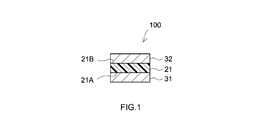
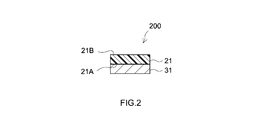
- FIGS. 1 to 3 Configuration examples of the sealant sheet laminate disclosed herein are shown in FIGS. 1 to 3.
- the sealant sheet laminate 100 shown in FIG. 1 is a sealant sheet with a release liner including the sealant sheet 21 and the release lines 31 and 32 arranged on both sides of the sealant sheet 21. More specifically, in the sealant sheet 21, each of the one surface (first surface) 21A and the other surface (second surface) 21B has a release liner 31, in which at least the sealant sheet 21 side is a release surface. Each is protected by 32.
- the release liner 31 satisfies the characteristics of the above formulas (1) and / or (2).
- the two release liners 31 and 32 are in contact with each surface of the sealant sheet 21 in a state where they can be peeled off from the sealant sheet 21, and can be peeled off with a light peeling force at an appropriate timing such as attachment to a seal object. Can be done.
- the sealant sheet laminate 200 shown in FIG. 2 is a sealant sheet with a release liner including a sealant sheet 21 and a release liner 31 arranged on one surface 21A of the sealant sheet 21. More specifically, the sealant sheet 21 has a structure in which one surface 21A is protected by a release liner 31 whose both sides are release surfaces, and when this is wound, the other surface of the sealant sheet 21 is protected. By contacting the surface 21B with the back surface of the release liner 31, the surface 21B can also be configured to be protected by the release liner 31.
- the release liner 31 of this embodiment satisfies the characteristics of the above formulas (1) and / or (2).
- the peeling liner 31 is in contact with the surface 21A of the sealant sheet 21 in a state where it can be peeled off from the sealant sheet 21, and can be peeled off with a light peeling force at an appropriate timing.
- the sealant sheet laminate 300 shown in FIG. 3 includes a sealant sheet 21, and the sealant sheet 21 includes a support base material 25 and seal layers 21a and 21b arranged on each surface of the support base material 25. It is a sealant sheet with a base material.
- the support base material 25 and the seal layers 21a and 21b are non-peelable laminates that are not intended to be separated from the seal layers 21a and 21b during the period of use of the sealant sheet.
- Such a support base material is also referred to as a non-peelable support base material.
- the supporting base material 25 of this embodiment satisfies the characteristics of the above formulas (1) and / or (2).
- the sealant sheet laminate 300 of this embodiment is in the form of a sealant sheet with a release liner, and one surface 21A (the surface of the seal layer 21a) of the sealant sheet 21 is peeled on both sides. It has a structure protected by a liner 31, and when it is wound, the other surface 21B of the sealant sheet 21 comes into contact with the back surface of the release liner 31, so that the surface 21B is also protected by the release liner 31. You can do it.
- the sealant sheet 21 of the configuration example shown in FIG. 3 had sealing layers 21a and 21b on both sides of the supporting base material 25, but is not limited to this, and only one surface of the supporting base material is sealed. It may have a layer. Further, although the sealant sheet laminate shown in FIG. 3 was provided with a release liner, the release liner may not be provided.
- the sealant sheet disclosed herein is preliminarily molded into a sheet shape, and can be arranged at a sealing target portion in the form of such a sheet shape.
- the sealant sheet is prepared by mixing a liquid sealant (for example, a liquid A containing a liquid polysulfide polymer and a liquid B containing a curing agent for the polysulfide polymer) to be applied to a portion to be sealed in a liquid form immediately before construction. It is clearly distinguished from the liquid sealant prepared together.
- a liquid sealant for example, a liquid A containing a liquid polysulfide polymer and a liquid B containing a curing agent for the polysulfide polymer
- the sealant sheet disclosed here can be cured by an appropriate curing means such as light irradiation or heating. That is, the sealant sheet disclosed herein may be a photocurable sealant sheet that is cured by light irradiation, or a thermosetting sealant sheet that is cured by heating.
- photocurable means that it can be cured by light irradiation.
- thermosetting means that it can be cured by heating.
- the heating may be heating at 30 ° C. or higher (for example, heating at 40 ° C. or higher, approximately 40 to 80 ° C.). Therefore, the photocurable sealant sheet and the thermosetting sealant sheet are terms that refer to the state before being completely cured.
- the sealant sheet is preferably photocurable. In that it has such curability, the sealant sheet disclosed herein is clearly distinguished from the cured sealant (sealant cured product).
- the sealant sheet disclosed herein can be grasped as a semi-cured sealant sheet that can be further cured after being placed at the sealing target portion.
- the sealant sheet disclosed here preferably has a shape retention property that can stably maintain the sheet shape at room temperature (for example, about 25 ° C.).
- the shape retention can also be grasped as resistance to plastic deformation such as flow.
- the storage elastic modulus of the sealant sheet at 25 ° C. (hereinafter, also simply referred to as “storage elastic modulus”) may be, for example, more than 0.005 MPa, preferably more than 0.01 MPa.
- the handleability and workability for example, cutability, blocking prevention property, reworkability, etc.) of the sealant sheet tend to be improved.
- the storage elastic modulus of the sealant sheet is preferably 0.02 MPa or more, for example, 0.05 MPa or more, 0.1 MPa or more, or 0.2 MPa or more.
- the upper limit of the storage elastic modulus is not particularly limited.
- the storage elastic modulus of the sealant sheet may be, for example, 2 MPa or less, 1 MPa or less, 0.8 MPa or less, 0.6 MPa or less, 0.5 MPa or less, and 0. It may be 4 MPa or less, 0.3 MPa or less, or 0.2 MPa or less.
- the storage elastic modulus is measured using a viscoelasticity tester under the conditions of a frequency of 1 Hz and a strain of 0.5%.
- a viscoelasticity tester a model name "ARES G2" manufactured by TA Instruments Japan Co., Ltd. or an equivalent product thereof can be used.
- the storage elastic modulus is more specifically measured by the method described in Examples described below.
- the storage elastic modulus of the sealant sheet means the storage elastic modulus of the sealant sheet before curing, and is distinguished from the storage elastic modulus of the sealant sheet (cured sealant) after curing, unless otherwise specified. Will be done.
- the storage elastic modulus of the sealant sheet typically means the storage elastic modulus before the sealant sheet is used, that is, before it is placed at the seal target portion by sticking or the like.
- the transmittance of the sealant sheet disclosed here may be, for example, more than 5%, more than 10%, more than 15%, or more than 20%.
- the upper limit of the transmittance is not particularly limited.
- the sealant sheet having a transmittance of a predetermined value or higher tends to realize uniform and efficient photocuring as a whole.
- the transmittance of the sealant sheet disclosed herein may be 100% or less, and may be 80% or less, 60% or less or 40% or less from a practical point of view.
- the sealant sheets disclosed herein can also be implemented in embodiments where the transmittance is 30% or less, 20% or less, or 15% or less. The transmittance is measured by the following method.
- the thickness of the sealant sheet is not particularly limited and can be selected according to the thickness of the desired cured sealant. From the viewpoint of seal reliability and the like, in some embodiments, the thickness of the sealant sheet may be, for example, 0.01 mm or more, 0.03 mm or more, 0.05 mm or more, 0.1 mm or more. However, it may be 0.15 mm or more.
- the sealant sheet disclosed herein can also be suitably implemented in an embodiment having a thickness of, for example, greater than 0.3 mm, greater than 0.5 mm, greater than 1 mm, or greater than 1.5 mm.
- the thickness of the sealant sheet may be, for example, 10 mm or less, 5 mm or less, 3 mm or less, 2 mm or less, 1 mm or less, 0.5 mm or less. It may be 0.3 mm or less. As the thickness of the sealant sheet decreases, the curability tends to improve. Reducing the thickness of the sealant sheet can be advantageous from the viewpoint of followability to the surface shape of the seal target portion and weight reduction.
- the material of the sealant sheet disclosed here is not particularly limited, and various materials can be used.
- sealant materials such as silicone-based, modified silicone-based, silylated acrylate-based, acrylic-based, acrylic urethane-based, polyurethane-based, polysulfide-based, polyisobutylene-based, and butyl rubber-based can be used.
- a polysulfide-based sealant material having excellent oil resistance is preferable.
- a polysulfide-based sealant material as a preferred example will be described, but the sealant disclosed herein is not limited to the polysulfide-based sealant.
- the sealant sheet comprises a polysulfide polymer (A).
- the polysulfide polymer (A) is a polymer having a repeating unit containing a dissulfide structure represented by —S—S—, and contributes to improving the oil resistance of the cured product formed from the sealant sheet.
- the type (I) sealant sheet disclosed herein contains the epoxy group-containing polysulfide polymer (AB) as the polysulfide polymer (A).
- the type (II) sealant sheet disclosed herein contains the thiol group-containing polysulfide polymer (AC) as the polysulfide polymer (A).
- the number of disulfide structures contained in one molecule of the polysulfide polymer (A) may be one or two or more. From the viewpoint of oil resistance of the cured product, a polysulfide polymer (A) containing an average of 3 or more disulfide structures per molecule can be preferably adopted.
- the average value of the number of dimethyl sulfide structures per molecule of the polysulfide polymer (A) (hereinafter, also referred to as the average number of dimethyl sulfide groups) may be, for example, 5 or more, 10 or more, 15 or more, 20 or more. The above may be sufficient.
- the upper limit of the average number of dimethyl sulfide groups is not particularly limited, but from the viewpoint of ease of manufacturing a sealant sheet (for example, ease of molding into a sheet shape), for example, it may be 100 or less, 70 or less, or 50 or less. Good.
- the dissulfide structure is preferably contained in the main chain of the polysulfide polymer (A). By including a disulfide structure in the main chain, a cured product having good elongation tends to be formed.
- the polysulfide polymer (A) preferably comprises a repeating unit represented by the following general formula (1). -R 1- OR 2- OR 3 -SS- (1)
- R 1 , R 2 , and R 3 are independently alkylene groups having 1 to 4 carbon atoms, preferably alkylene groups having 1 to 3 carbon atoms. More preferably, it is an alkylene group having 1 to 2 carbon atoms.
- the repeating unit (1) has a structure in which an ether structure and a disulfide structure are connected. According to the polysulfide polymer (A) having such a repeating unit (1), a cured product having excellent oil resistance and flexibility tends to be formed.
- the average value of the number of the repeating units (1) contained in one molecule of the polysulfide polymer (A) may be, for example, 5 or more, 10 or more, 15 or more, or 20 or more. Further, the average value may be, for example, 100 or less, 70 or less, or 50 or less.
- the polysulfide polymer (A) may have only one region in which the repeating unit (1) is continuous in one molecule, or may have two or more regions.
- the polysulfide polymer (A) may comprise at least one of the structures represented by the following general formula (2a) and the structure represented by the general formula (2b).
- R'in the general formulas (2a) and (2b) is an organic group having at least one (for example, about 1 to 5) epoxy groups.
- Structure of the general formula (2a) and (2b) formed, for example, a thiol having the structure represented by -CH 2 -SH, and an epoxy compound having a substituent R 'on the epoxy ring by the addition reaction of Can be done.
- Number of structures represented by the general formula (2a) or (2b) (If both the structure represented by the general formula (2a) and the structure represented by the general formula (2b) are included, the total number thereof. ) May be, for example, 1.1 or more, 1.3 or more, 1.5 or more, or 1.8 or more as the average value per molecule of the polysulfide polymer (A). It may be 0 or more, or more than 2.0. Further, the average value may be, for example, 15 or less, 10 or less, 7.0 or less, or 5.0 or less.
- the structures represented by the above general formulas (2a) and (2b) can be formed by an addition reaction of a thiol group and an epoxy group.
- the polysulfide polymer (A) containing the structures represented by the general formulas (2a) and (2b) is, for example, a thiol group-containing polysulfide having a disulfide structure and a thiol group in one molecule, and 2 in one molecule. It can be a reaction product of the above epoxy compound having an epoxy group or a modified product thereof.
- the weight average molecular weight (Mw) of the thiol group-containing polysulfide as a precursor of the polysulfide polymer (A) is not particularly limited, and may be, for example, 500 or more, 800 or more, 1000 or more, or 1000 or more. Well, it may be over 2000. According to the thiol group-containing polysulfide having a higher Mw, a sealant sheet that gives a cured product with better elongation tends to be formed. In some embodiments, the Mw of the thiol group-containing polysulfide may be, for example, greater than 2500, greater than 3000, or greater than 3500.
- the Mw of the thiol group-containing polysulfide may be, for example, 30,000 or less, and may be 10,000 or less. From the viewpoint of handleability and reactivity with the epoxy compound, in some embodiments, the Mw of the thiol group-containing polysulfide may be, for example, less than 9000, less than 8000, less than 7500, less than 7000. It may be less than 6500.
- Mw of a polymer such as a thiol group-containing polysulfide, an epoxy group-containing polysulfide, or a polysulfide polymer (A) described later is subjected to gel permeation chromatography (GPC) using tetrahydrofuran (THF) as a mobile phase.
- GPC gel permeation chromatography
- THF tetrahydrofuran
- the nominal value described in a catalog, literature, or the like may be used.
- the thiol group-containing polysulfide preferably contains the disulfide structure in the main chain.
- the sealant sheet containing a reaction product of a thiol group-containing polysulfide having a disulfide structure in the main chain and an epoxy compound having two or more epoxy groups in one molecule or a modified product thereof, the polysulfide polymer (A). Good cured products tend to be formed.
- the number of disulfide structures contained in one molecule of thiol group-containing polysulfide may be, for example, 3 or more, 5 or more, or 10 or more as the average value (average number of disulfide groups) of the entire thiol group-containing polysulfide used.
- the upper limit of the average number of dimethyl sulfide groups is not particularly limited, but from the viewpoint of ease of manufacturing a sealant sheet (for example, ease of molding into a sheet shape), for example, it may be 100 or less, 70 or less, or 50 or less. Good.
- the number of thiol groups contained in the thiol group-containing polysulfide as a precursor of the polysulfide polymer (A) may be one or two or more per molecule of the thiol group-containing polysulfide. .. From the viewpoint of facilitating the realization of a sealant sheet suitable for improving the strength of the cured product and shortening the curing time, a thiol group-containing polysulfide having an average number of thiol groups contained in one molecule of more than 1 is preferable.
- the average value of the number of thiol groups per molecule of thiol group-containing polysulfide used may be, for example, 1.1 or more, 1.3 or more, or 1.5 or more. It may be 8 or more, 2 or more, or 2 or more.
- the upper limit of the average number of thiol groups is not particularly limited, but from the viewpoint of flexibility of the cured product, for example, it may be 15 or less, 10 or less, 7 or less, or 5 or less.
- Polysulfide having an average number of thiol groups of 2 or more can also be grasped as a thiol compound (C) having 2 or more thiol groups in one molecule.
- the thiol group is preferably arranged at the end of the thiol group-containing polysulfide.
- an epoxy group-containing polysulfide polymer having an epoxy group at the terminal can be suitably formed.
- the thiol group-containing polysulfide used may have a thiol group at one end of the main chain, may have a thiol group at both ends of the main chain, and may have a thiol group at both ends of the main chain. It may further have a thiol group, or it may be a mixture of any combination thereof.
- a thiol group-containing polysulfide having a thiol group at both ends of the main chain that is, a thiol polysulfide having both ends.
- a sealant sheet containing the polysulfide polymer (A) synthesized by using both terminal thiol polysulfides a cured product having a good balance between strength and elongation tends to be formed.
- the proportion of bi-terminal thiol polysulfide in the total thiol group-containing polysulfide used may be, for example, greater than 50%, greater than 70%, greater than 90%, by weight. It may be more than 95%, more than 98%, or substantially 100%.
- Both terminal thiol polysulfides are preferably represented by the following general formula (3).
- R 1 , R 2 , and R 3 are independently alkylene groups having 1 to 4 carbon atoms, preferably alkylene groups having 1 to 3 carbon atoms, and more preferably. It is an alkylene group having 1 to 2 carbon atoms.
- N in the general formula (3) means that the formula amount of the compound of the general formula (3) is, for example, 500 or more and 10000 or less, or 800 or more and less than 9000, or 1000 or more and less than 8000, or more than 1000 and less than 8000, or 2000. Can be an integer chosen to be in the range greater than and less than 7500.
- the compound represented by the general formula (3) is, for example, a thiol group in which R 1 is C 2 H 4 , R 2 is CH 2 , and R 3 is C 2 H 4.
- the contained polysulfide can be preferably adopted.
- n in the general formula (3) may be, for example, 3 to 70, 5 to 60, 7 to 50, or 10 to 50.
- the sealant sheet of the type (I) contains, as the polysulfide polymer (A), an epoxy group-containing polysulfide polymer (AB) having two or more epoxy groups in one molecule. Further, it may contain a thiol compound (C) having two or more thiol groups in one molecule. In some preferred embodiments, the sealant sheet may further comprise a photobase generator (D). The sealant sheet of such an embodiment may or may not further contain a polysulfide polymer (A) that does not correspond to the epoxy group-containing polysulfide polymer (AB). Further, the sealant sheet of the above aspect may or may not further contain an epoxy compound (B) that does not correspond to the epoxy group-containing polysulfide polymer (AB).
- the average value of the number of epoxy groups per molecule of the epoxy group-containing polysulfide polymer (AB) (hereinafter, also referred to as the average number of epoxy groups) can be, for example, about 2 or more and 20 or less. From the viewpoint of the flexibility of the cured product, the average number of epoxy groups may be, for example, 15 or less, 10 or less, 7 or less, or 5 or less. In some embodiments, the average number of epoxy groups may be 4 or less and 3 or less. The average number of epoxy groups is typically 2 or more, and may be more than 2 or 2.5 or more from the viewpoint of curability and strength of the cured product. In some embodiments, the average number of epoxy groups may be, for example, 3 or more, and may be 4 or more.
- the epoxy group contained in the epoxy group-containing polysulfide polymer (AB) is preferably arranged at the end of the epoxy group-containing polysulfide polymer (AB). According to such an epoxy group-containing polysulfide polymer (AB), a cured product having good elongation tends to be formed.
- the sealant sheet disclosed herein may contain an epoxy group-containing polysulfide polymer (AB) having two or more epoxy groups at one end of the main chain, and one or more epoxys at both ends of the main chain, respectively. It may contain an epoxy group-containing polysulfide polymer (AB) having a group, or both of them.
- the epoxy group-containing polysulfide polymer (AB) having an epoxy group at one end of the main chain may have a functional group other than the epoxy group at a terminal different from the end having the epoxy group.
- the functional group other than the epoxy group may be, for example, a thiol group, an amino group, a hydroxyl group or the like.
- the sealant sheet disclosed herein preferably contains at least an epoxy group-containing polysulfide polymer (AB) having epoxy groups at both ends of the main chain.
- the epoxy group-containing polysulfide polymer (AB) reacts, for example, the thiol group-containing polysulfide as described above with an epoxy compound having two or more epoxy groups in one molecule so that the amount of epoxy groups becomes excessive.
- the epoxy compound may be a bifunctional epoxy compound having two epoxy groups in one molecule, or a polyfunctional epoxy compound having three or more epoxy groups in one molecule.
- Epoxy compounds may be used alone or in combination of two or more. From the viewpoint of operability when reacting with a thiol group-containing polysulfide, an epoxy compound liquid at room temperature can be preferably used in some embodiments.
- the bifunctional epoxy compound has a structure in which a bisphenol A type epoxy resin, a bisphenol F type epoxy resin, and a hydrogenated bisphenol A type epoxy resin (that is, the aromatic ring of the bisphenol A type epoxy resin is converted into a cycloalkyl ring by hydrogenation).
- polyfunctional epoxy compound examples include novolak type epoxy resin, glycidylamine type epoxy resin, biphenyl type epoxy resin, triphenylmethane type epoxy resin, dicyclopentadiene type epoxy resin, glycerin type epoxy resin, trimethylolpropane type epoxy resin, and N. , N, N', N'-tetraglycidyl-m-xylene diamine, 1,3-bis (N, N-diglycidylaminomethyl) cyclohexane, polyglycerol polyglycidyl ether, etc., but is not limited thereto. ..
- the number of epoxy groups contained in one molecule of the polyfunctional epoxy compound is at least 3 or more, and may be 4 or more or 5 or more.
- the number of epoxy groups contained in one molecule of the polyfunctional epoxy compound is usually 10 or less, and may be 8 or less, or 6 or less.
- a bifunctional epoxy compound can be preferably used as the epoxy compound.
- the use of a bifunctional epoxy compound can be advantageous to obtain a sealant sheet that gives a cured product that exhibits suitable elongation.
- the bifunctional epoxy compound may be used alone or in combination of two or more.
- an epoxy compound containing a carbon ring structure having a 5-membered ring or more in the molecule can be preferably adopted. According to the sealant sheet using the bifunctional epoxy compound having such a structure, a cured product having high strength and good elongation tends to be formed.
- the carbon ring structure having five or more members may be, for example, a benzene ring, a naphthalene ring, a cyclohexyl ring, or the like.
- Examples of the epoxy compound containing such a carbocyclic structure include bisphenol A type epoxy resin, bisphenol F type epoxy resin, hydrogenated bisphenol A type epoxy resin, hydrogenated bisphenol F type epoxy resin, biphenyl type epoxy resin and the like.
- a bisphenol F type epoxy resin can be used as the bifunctional epoxy compound.
- one or more polyfunctional epoxy compounds can be used in combination with the bifunctional epoxy compound or in place of the bifunctional epoxy resin.
- the strength of the cured product can be improved by using a polyfunctional epoxy compound.
- a polyfunctional epoxy compound having a repeating unit containing an epoxy group (that is, a polymer type) can be used, and for example, a novolak type epoxy resin can be preferably adopted.
- the novolac type epoxy resin include a phenol novolac type epoxy resin and an o-cresol novolac type epoxy resin.
- the use of a novolak type epoxy resin can be advantageous for obtaining a sealant sheet that gives a cured product having high strength and good elongation. By using a novolak type epoxy resin having a lower molecular weight, the elongation of the cured product tends to be improved.
- a phenol novolac type epoxy resin that is liquid at room temperature can be preferably adopted.
- any suitable catalyst is adopted as long as the effect obtained by the technique disclosed herein is not significantly impaired. You may.
- known basic catalysts such as 2,4,6-triaminomethylphenol, triethylamine, and 1,8-diazabicyclo [5.4.0] undec-7-ene can be appropriately selected and used.
- the amount used when using a basic catalyst is not particularly limited, and can be set so that the catalyst function is appropriately exhibited.
- the amount of the basic catalyst used is, for example, 1 part by weight or less based on 100 parts by weight of the total amount of the thiol group-containing polysulfide and the epoxy compound having two or more epoxy groups in one molecule.
- it is suitable to be 0.5 parts by weight or less, 0.2 parts by weight or less, 0.1 parts by weight or less, or 0.08 parts by weight or less. From the viewpoint of improving the storage stability of the sealant sheet, it is advantageous that the amount of the basic catalyst used is not too large.
- the amount of the basic catalyst used with respect to 100 parts by weight of the total amount can be, for example, 0.07 parts by weight or less, 0.05 parts by weight or less, or 0.03 parts by weight or less. It may be 0.02 parts by weight or less.
- the lower limit of the amount of the basic catalyst used with respect to 100 parts by weight of the total amount is not particularly limited, and may be, for example, 0.001 part by weight or more, and may be 0.005 part by weight or more.
- the above reaction can be carried out by mixing a thiol group-containing polysulfide, an epoxy compound having two or more epoxy groups in one molecule, and a catalyst used as needed in an appropriate reaction vessel. ..
- the thiol group-containing polysulfide, the bifunctional epoxy compound, the polyfunctional epoxy compound, and the catalyst are mixed in a suitable reaction vessel.
- the method of supplying each material to the reaction vessel and the mixing order are not particularly limited, and an appropriate reactant can be selected so as to be formed.
- the above reaction conditions can be appropriately set as long as the effects obtained by the techniques disclosed herein are not significantly impaired.
- the reaction can proceed at a reaction temperature of, for example, 0 ° C.
- the reaction temperature may be, for example, 20 ° C to 100 ° C, 30 ° C to 100 ° C, or 40 ° C to 100 ° C, in consideration of reaction controllability and reaction efficiency. It may be 60 ° C. to 100 ° C.
- the reaction time is not particularly limited, and can be selected from the range of, for example, 10 minutes to 720 hours (preferably 1 hour to 240 hours).
- the reaction involves a first heating step performed at, for example, a temperature of 60 ° C. to 120 ° C. (preferably 70 ° C. to 110 ° C.) and 40 ° C. to 80 ° C. (preferably 50 ° C. to 70 ° C.).
- the second heating step which is carried out at the same temperature as above, can be carried out in this order.
- the second heating step is preferably performed at a temperature lower than that of the first heating step.
- the heating time in the first heating step can be, for example, 10 minutes or more, usually 30 minutes or more, and may be 1 hour or more. In some preferred embodiments, the heating time in the first heating step can be selected, for example, from the range of 10 minutes to 24 hours (preferably 30 minutes to 12 hours, more preferably 1 hour to 6 hours).
- the heating time in the second heating step can be, for example, 3 hours or more, usually 6 hours or more, and may be 24 hours or more. In some preferred embodiments, the heating time in the second heating step can be selected from, for example, in the range of 3 hours to 720 hours (preferably 48 hours to 500 hours, more preferably 72 hours to 300 hours).
- the heating time in the second heating step is preferably longer than the heating time in the first heating step.
- the heating step may be divided into three or more steps and performed step by step.
- the ratio of the thiol group-containing polysulfide used and the epoxy compound used in the synthesis of the epoxy group-containing polysulfide polymer (AB) by the above reaction is included in the epoxy compound with respect to the total number of thiol groups contained in the thiol group-containing polysulfide.
- the ratio of the total number of epoxy groups that is, the equivalent ratio of epoxy groups / thiol groups (hereinafter, also referred to as epoxy / thiol ratio) can be set to be a value larger than 1.
- the epoxy / thiol ratio can be, for example, 1.05 or higher, and may be 1.1 or higher.
- the epoxy / thiol ratio may be, for example, more than 1.2, more than 1.4, more than 1.5, more than 1.7. But it may be.
- the epoxy / thiol ratio can be, for example, less than 7.0, less than 5.0, less than 4.5, or less than 4.0.
- the epoxy / thiol ratio may be, for example, less than 3.5, less than 3.2, less than 3.0, less than 2.5, from the standpoint of improving elongation of the cured product. It may be less than 2.0, less than 1.8, or less than 1.8.
- the amount of the epoxy compound having two or more epoxy groups in one molecule is not particularly limited.
- the amount of the epoxy compound used can be set, for example, so that any of the epoxy / thiol ratios described above can be achieved.
- the amount of the epoxy compound used can be, for example, 1 part by weight or more, and usually 3 parts by weight or more, based on 100 parts by weight of the thiol group-containing polysulfide. It may be 5 parts by weight or more, or 7 parts by weight or more.
- the amount of the epoxy compound used with respect to 100 parts by weight of the thiol group-containing polysulfide can be, for example, 50 parts by weight or less, usually 30 parts by weight or less, and 20 parts by weight or less. It may be 15 parts by weight or less.
- the sealant sheet of type (II) contains, as the polysulfide polymer (A), a thiol group-containing polysulfide polymer (AC) having two or more thiol groups in one molecule. Further, it may contain an epoxy compound (B) having two or more thiol groups in one molecule. In some preferred embodiments, the sealant sheet may further comprise a photobase generator (D).
- the sealant sheet of such an embodiment may or may not further contain a polysulfide polymer (A) that does not correspond to a thiol group-containing polysulfide polymer (AC). Further, the sealant sheet of the above aspect may or may not further contain a thiol compound (C) that does not correspond to the thiol group-containing polysulfide polymer (AC).
- the average number of thiol groups in a thiol group-containing polysulfide polymer (AC) is typically 2 or more, and may be more than 2.
- the upper limit of the average number of thiol groups is not particularly limited, but from the viewpoint of the flexibility of the cured product, 10 or less is usually suitable, and may be 7 or less, 5 or less, 4 or less, 3 or less, or 2 It may be 8.8 or less or 2.4 or less.
- the thiol group contained in the thiol group-containing polysulfide polymer (AC) is preferably arranged at the end of the thiol group-containing polysulfide polymer (AC).
- a cured product having good elongation tends to be formed.
- a thiol group-containing polysulfide polymer (AC) having one or more thiol groups at both ends of the main chain is preferable, and a thiol group-containing polysulfide polymer (AC) having one thiol group at both ends of the main chain is more preferable. preferable.
- the thiol group-containing polysulfide polymer (AC) for example, the above-mentioned epoxy group-containing polysulfide polymer (AB) and a thiol compound having two or more thiol groups in one molecule have an excessive amount of thiol groups. Those obtained by reacting in this way can be used.
- the thiol compound may be a bifunctional thiol compound having two thiol groups in one molecule, or a polyfunctional thiol compound having three or more thiol groups in one molecule.
- the thiol compound may be used alone or in combination of two or more.
- a bifunctional thiol compound can be preferably used from the viewpoint of obtaining a sealant sheet that gives a cured product showing suitable elongation.
- the thiol compounds to be reacted with the epoxy group of the epoxy group-containing polysulfide polymer (AB) 50% by weight or more, 70% by weight or more, or 90% by weight or more can be a bifunctional thiol compound. Only the bifunctional thiol compound may be used as the thiol compound.
- the thiol compound to be reacted with the epoxy group-containing polysulfide polymer (AB) for example, one or more selected from the materials that can be used as the thiol compound (C) described later can be used.
- the reaction between the epoxy group-containing polysulfide polymer (AB) and the thiol compound can proceed in the same manner as the reaction between the thiol group-containing polysulfide and the epoxy compound described above.
- the ratio of the epoxy group-containing polysulfide used to the thiol compound used in the synthesis of the thiol group-containing polysulfide polymer (AC) by the above reaction is included in the thiol compound with respect to the total number of epoxy groups contained in the epoxy group-containing polysulfide.
- the ratio of the total number of thiol groups can be set to be less than 1. From the viewpoint of improving the strength of the cured product and the like, in some embodiments, the epoxy / thiol ratio can be, for example, 0.95 or less, 0.9 or less, or 0.85 or less.
- the epoxy / thiol ratio may be, for example, 0.1 or more, and usually 0.2 or more is appropriate. In some embodiments, the epoxy / thiol ratio may be, for example, 0.3 or higher, 0.5 or higher, 0.6 or higher, or 0.7 or higher, from the viewpoint of improving the elongation of the cured product. ..
- the amount of the thiol compound having two or more thiol groups in one molecule is not particularly limited.
- the amount of the thiol compound used can be set, for example, so that any of the epoxy / thiol ratios described above can be achieved.
- the amount of the thiol compound used can be, for example, 1 part by weight or more, and usually 3 parts by weight or more, based on 100 parts by weight of the epoxy group-containing polysulfide. It may be 5 parts by weight or more, or 7 parts by weight or more.
- the amount of the thiol compound used with respect to 100 parts by weight of the epoxy group-containing polysulfide can be, for example, 50 parts by weight or less, usually 30 parts by weight or less, and 20 parts by weight or less. It may be 15 parts by weight or less.
- thiol group-containing polysulfide polymer (AC) in a type (II) sealant sheet for example, as a material that can be used as a precursor of a polysulfide polymer (A), the above-mentioned thiol group-containing polysulfide (preferably both terminal thiol polysulfide). ) May be used.
- the sealant sheet comprises an epoxy compound (B).
- the epoxy compound (B) contained in the sealant sheet a compound having two or more epoxy groups in one molecule can be used without particular limitation.
- one or more selected from the group consisting of various bifunctional epoxy compounds and polyfunctional epoxy compounds exemplified as materials that can be used for preparing an epoxy group-containing polysulfide polymer (AB) can be used.
- the epoxy compound (B) having an epoxy equivalent in the range of 50 g / eq or more and 600 g / eq or less can be preferably adopted.
- the epoxy equivalent may be, for example, 100 g / eq or more, 120 g / eq or more, 150 g / eq or more, or 400 g / eq or less, 300 g / eq or less, or 200 g / eq. It may be less than or equal to eq.
- the epoxy equivalent increases, the storage stability before use tends to improve, while the curability during use tends to decrease.
- the epoxy equivalent means the number of grams of a compound containing 1 equivalent of an epoxy group, and can be measured in accordance with JIS K7236: 2001. Alternatively, the nominal value described in a catalog, literature, or the like may be used.
- the average number of epoxy groups of the epoxy compound (B) can be, for example, about 2 or more and 10 or less. From the viewpoint of the flexibility of the cured product, the average number of epoxy groups may be, for example, 7 or less, 5 or less, 4 or less, or less than 4. In some embodiments, the average number of epoxy groups may be 3 or less, 2.5 or less, or 2.2 or less.
- the epoxy compound (B) only one kind or two or more kinds of bifunctional epoxy compounds may be used. According to such a configuration, it is easy to obtain a sealant sheet that gives a cured product showing suitable elongation.
- the sealant sheet comprises a thiol compound (C).
- a thiol compound (C) contained in the sealant sheet a compound having two or more thiol groups in one molecule can be used without particular limitation.
- trimetylolpropanthithiopropionate also known as trimetylolpropanetris (3-mercaptopropionate)
- pentaeristol tetrakisthiopropionate ethylene glycol bisthioglycolate
- 1,4-butanediol bis 1,4-butanediol bis.
- Thioglycolate trimethylolpropane tristhioglycolate, pentaeristol tetrakisthioglycolate, di (2-mercaptoethyl) ether, 1,4-butanedithiol, 1,5-dimercapto-3-thiapentane, 1,8- Dimercapto-3,6-dioxaoctane, 1,3,5-trimercaptomethylbenzene, 4,4'-thiodibenzenethiol, 1,3,5-trimercaptomethyl-2,4,6-trimethylbenzene, 2,4,6-Trimercapto-s-triazine, 2-dibutylamino-4,6-dimercapto-s-triazine, pentaerythritol tetrakis (3-mercaptopropionate), dipentaerythritol hexa-3-mercaptopropio Nate and the like can be mentioned, but the present invention is not limited
- thiol compound (C) Commercially available products of the thiol compound (C) include, for example, JERmate QX11, QX12, JER Cure QX30, QX40, QX60, QX900, Capcure CP3-800 manufactured by Mitsubishi Chemical Co., Ltd .; OTG, EGTG manufactured by Yodo Chemical Co., Ltd. TMTG, PETG, 3-MPA, TMTP, PETP; TEMPIC, TMMP, PEMP, PEMP-II-20P, DPMP manufactured by Sakai Chemical Co., Ltd .; Karenz MT PE1, Karenz MT BD1, Karenz MT NR1 manufactured by Showa Denko KK. TPMB, TEMB; and the like, but are not limited thereto. Each of these compounds may be used alone, or two or more thereof may be mixed and used.
- the average number of thiol groups in the thiol compound (C) can be, for example, about 2 or more and 10 or less. From the viewpoint of the flexibility of the cured product, the average number of thiol groups may be, for example, 7 or less, 5 or less, 4 or less, or less than 4. In some embodiments, the average number of thiol groups may be 3 or less, 2.5 or less, or 2.2 or less.
- the thiol compound (C) only one kind or two or more kinds of bifunctional thiol compounds may be used. According to such a configuration, it is easy to obtain a sealant sheet that gives a cured product showing suitable elongation.
- the thiol compound (C) includes a compound having a primary thiol group (hereinafter, also referred to as a primary thiol compound), a compound having a secondary thiol group (secondary thiol compound), and a compound having a tertiary thiol group (3). Any of the secondary thiol compounds) can be used. From the viewpoint of curability when using the sealant sheet, a primary thiol compound can be preferably adopted. Further, from the viewpoint of controlling the curing rate of the sealant sheet before use and preservability, a secondary or higher thiol compound (that is, a secondary thiol compound and / or a tertiary thiol compound) can be preferably adopted.
- a thiol compound having two primary thiol groups in one molecule may be referred to as a primary bifunctional thiol compound, and a thiol compound having two secondary thiol groups in one molecule may be referred to as a secondary bifunctional thiol compound.
- a thiol compound having two primary thiol groups in one molecule may be referred to as a primary bifunctional thiol compound, and a thiol compound having two secondary thiol groups in one molecule may be referred to as a secondary bifunctional thiol compound.
- a primary thiol compound and a secondary or higher thiol compound can be used in combination.
- the storage stability of the sealant sheet before use and the curability at the time of use can be suitably compatible with each other.
- the weight ratio of the primary thiol compound to the total weight of the primary thiol compound and the secondary or higher thiol compound is not particularly limited, and may be, for example, 5% by weight or more, preferably 15% by weight or more. It is preferably 25% by weight or more, may be 35% by weight or more, and may be, for example, 95% by weight or less, preferably 75% by weight or less, and may be 60% by weight or less. , 45% by weight or less.
- thiol compound (C) those having a thiol equivalent in the range of 45 g / eq or more and 450 g / eq or less are preferably adopted in consideration of the balance between the storage stability of the sealant sheet before use and the curability at the time of use. obtain.
- the thiol equivalent may be, for example, 60 g / eq or more, 70 g / eq or more, 80 g / eq or more, or 350 g / eq or less, 250 g / eq or less, 200 g / eq. It may be eq or less, or 150 g / eq or less.
- the storage stability before use tends to improve, while the curability during use tends to decrease.
- the sum of the products of the thiol equivalents and the weight fractions of each thiol compound (C) is in the above range.
- the thiol equivalent means the number of grams of a compound containing 1 equivalent of a thiol group, and can be measured by an iodine titration method. Alternatively, the nominal value described in a catalog, literature, or the like may be used.
- the ratio of the epoxy group equivalent to the thiol group equivalent that can be contained in the sealant sheet that is, the epoxy / thiol ratio of the sealant sheet is.
- the epoxy / thiol ratio of the sealant sheet may be, for example, approximately 0.1 or more and 10 or less, 0.2 or more and 5 or less, 0.3 or more and 3 or less, or 0.5 or more and 2 or less. Good.
- the epoxy / thiol ratio When the epoxy / thiol ratio is at least one of the above-mentioned lower limit values and less than or equal to the upper limit value, a cured product having both strength and elongation in a well-balanced manner tends to be formed.
- the epoxy / thiol ratio may be, for example, 0.6 or greater, 0.7 or greater, or 0.8 or greater, and 1.7 or less, 1.5 or less, or 1.2 or less. You can.
- the amount of the thiol compound (C) that can be contained in the sealant sheet is not particularly limited.
- the amount of the thiol compound (C) contained in the sealant sheet can be set so as to realize, for example, any of the above-mentioned epoxy / thiol ratios.
- the amount of the thiol compound (C) relative to 100 parts by weight of the epoxy group-containing polysulfide polymer (AB) can be, for example, 0.05 parts by weight or more, and may be 0.1 parts by weight or more. It may be 0.3 parts by weight or more, 0.5 parts by weight or more, for example, 10 parts by weight or less, 5 parts by weight or less, 3 parts by weight or less, or 1 part by weight or less. May be.
- the amount of the epoxy compound (B) that can be contained in the sealant sheet is not particularly limited.
- the amount of the epoxy compound (B) contained in the sealant sheet can be set so as to realize, for example, any of the above-mentioned epoxy / thiol ratios.
- the amount of the epoxy compound (B) relative to 100 parts by weight of the thiol group-containing polysulfide polymer (AC) can be, for example, 0.05 parts by weight or more, and may be 0.1 parts by weight or more. It may be 0.3 parts by weight or more, 0.5 parts by weight or more, 1 part by weight or more, for example, 15 parts by weight or less, 10 parts by weight or less, 5 parts by weight. It may be less than a part by weight.
- the sealant sheet disclosed herein preferably contains one or more of various photoreaction catalysts capable of initiating and promoting a curing reaction by light irradiation.
- a photoreaction catalyst may be referred to as a photoreaction initiator or photopolymerization initiator.
- a preferred example of the photoreaction catalyst is a photobase generator (D).
- the sealant sheet comprises a photobase generator (D).
- the photobase generator (D) an agent that generates a base by light irradiation is used.
- photobase generators include ⁇ -aminoacetophenone compounds; oxime ester compounds; acyloxyimino groups, N-formylated aromatic amino groups, N-acylated aromatic amino groups, nitrobenzyl carbamate groups, alcooxybenzyl carbamate. Examples thereof include a compound having a substituent such as a group; a compound having a biguanide type cation; and the like.
- the ⁇ -aminoacetophenone compound those having two or more nitrogen atoms are particularly preferable.
- the photobase generator may be used alone or in combination of two or more.
- a commercially available product may be used as the photobase generator.
- Examples of commercially available photobase generators include WPBG-018 (9-anthramethyl N, N'-diethyl carbamate) and WPBG-027 ((E) -1- [3] manufactured by Wako Pure Chemical Industries, Ltd.
- WPBG-082 guanidium 2- (3-benzoylphenyl) propionate
- WPBG-140 (1- (anthraquinone-2-yl) ethylimidazole carboxylate)
- WPBG-266 (1,2-diisopropyl-3- [bis (dimethylamino) methylene] guanidium 2- (3-benzoylphenyl) propionate
- WPBG-300 (1,2-dicyclohexyl-4,4,5,5-) Tetramethylbiguanidium n-butyltriphenylborate
- WPBG-345 (1,2-dicyclohexyl-4,4,5,5-tetramethylbiguanidiumtetrakis (3-fluorophenyl) boronate) and the like. ..
- an ionic photobase generator having a biguanide-type cation is preferable because the base generated by light irradiation can effectively promote the anion addition reaction between the epoxy group and the thiol group.
- biguanide-type cations include alkyl biguanide, cycloalkyl bigadinium, cycloalkyl-alkylbiguadinium and the like.
- the anion paired with the biguanide cation in the photobase generator can be, for example, a borate anion.
- Examples of commercially available products of this type of photobase generator include the above-mentioned WPBG-300 and WPBG-345.
- an anion paired with a biguanide-type cation in a photobase generator is a carboxylate anion.
- the above-mentioned WPBG-266 can be preferably adopted.
- the amount of the photobase generator used can be set so that the desired effect of use can be obtained.
- the amount of the photobase generator used is the total amount of the epoxy group-containing polysulfide polymer (AB) and the thiol compound (C) (in the case of a type (I) sealant sheet) or the thiol group-containing polysulfide polymer.
- the total amount of (AC) and the epoxy compound (B) (in the case of the type (II) sealant sheet) can be, for example, 0.01 part by weight or more with respect to 100 parts by weight, and the curability of the sealant sheet can be improved.
- the amount of the photobase generator used is usually preferably 3 parts by weight or less, more preferably 2 parts by weight or less, based on 100 parts by weight of the total amount, from the viewpoint of raw material cost and the like. It may be 1 part by weight or less, 0.7 parts by weight or less, 0.5 parts by weight or less, or 0.3 parts by weight or less.
- the sealant sheet disclosed herein may contain a sensitizer.
- a sensitizer By using the sensitizer, it is possible to increase the utilization efficiency of the irradiated light and improve the sensitivity of the photoreaction catalyst (for example, the photobase generator (D)).
- the photosensitizer can be appropriately selected from known materials and used. Non-limiting examples of photosensitizers include benzophenone, 4-methylbenzophenone, 3-benzoylbiphenyl, 4- (4-methylphenylthio) benzophenone, methyl 2-benzoylbenzoate, 4-phenylbenzophenone, 4,4.
- the amount used can be set so as to obtain a desired sensitizing effect.
- the amount of the photosensitizer used may be, for example, 0.001 part by weight or more, for example 0.001 part by weight or more, based on 100 parts by weight of the total amount of the epoxy compound (B) and the thiol compound (C). It may be .005 parts by weight or more, 0.01 parts by weight or more, or 0.05 parts by weight or more.
- the upper limit of the amount of the photosensitizer used is not particularly limited, but from the viewpoint of controlling the curing speed of the sealant sheet and preservability, usually 10 parts by weight or less is suitable, and 5 parts by weight or less may be used, and 1 weight by weight. It may be 5 parts or less, 0.5 parts by weight or less, or 0.3 parts by weight or less.
- the sealant sheet disclosed herein may further contain any compound that may help suppress the curing reaction, as long as other properties are not significantly impaired. By using such a compound, the storage stability of the sealant sheet before use can be improved.
- the storage stabilizer may be, for example, an organic acid, an inorganic acid, which is liquid or solid at room temperature, and an oligomer, a polymer, a borate ester, or a phosphoric acid ester containing an acidic group in the molecule, and is a functional other than the acidic group. It may have a group.
- Examples thereof include, but are not limited to, sulfuric acid, acetic acid, adipic acid, tartaric acid, fumaric acid, barbituric acid, boric acid, pyrogallol, phenol formaldehyde, carboxylic acid anhydride and the like.
- the storage stabilizer one type may be used alone or two or more types may be used in combination as appropriate.
- the amount of the storage stabilizer used is not particularly limited and can be set so as to obtain a desired effect.
- Preferable examples of storage stabilizers include boric acid esters and phosphoric acid esters.
- Boric acid esters are boric acid esters that are liquid or solid at room temperature.
- Examples of phosphoric acid esters include ethyl phosphate, butyl phosphate, propyl phosphate, -2-ethylhexyl phosphate, dibutyl phosphate, di-di (2-ethylhexyl) phosphate, oleyl phosphate, ethyldiethyl phosphate and the like. However, it is not limited to these.
- the sealant sheet disclosed herein may contain a filler, if necessary. This can improve one or both of the breaking strength of the cured product and the elongation at break.
- the filler can also help regulate the storage modulus of the sealant sheet. In addition, proper use of the filler can improve the shape retention and workability of the sealant sheet.
- the filler used is not particularly limited, and any suitable filler may be used as long as the effects obtained by the techniques disclosed herein are not significantly impaired.
- the filler may be used alone or in combination of two or more.
- Examples of materials that make up the filler include talc, silica, glass, carbon black, alumina, clay, mica, aluminum hydroxide, magnesium hydroxide, calcium carbonate, magnesium carbonate, barium sulfate, titanium dioxide, barium titanate, and titanium. Includes, but is not limited to, strontium acid acid, calcium titanate, magnesium titanate, bismuth titanate, boron nitride, aluminum borate, barium zirconate, calcium zirconate and the like. Among them, preferred examples include talc, silica, glass and calcium carbonate.
- the content of the filler is not particularly limited and can be selected so as to obtain suitable characteristics.
- the content of the filler may be, for example, 1% by weight or more of the entire sealant sheet, 5% by weight or more, 10% by weight or more, or 15% by weight or more from the viewpoint of obtaining a higher effect of use. It may be 20% by weight or more, or 25% by weight or more.
- the content of the filler can be, for example, less than 50% by weight of the entire sealant sheet, and is usually less than 40% by weight from the viewpoint of improving the moldability into the sheet shape and the elongation of the cured product. It is suitable and may be less than 35% by weight. In some embodiments, the content of the filler may be less than 30% by weight or less than 25% by weight.
- the average particle size of the filler is not particularly limited.
- the average particle size is usually preferably 100 ⁇ m or less, and preferably 50 ⁇ m or less. As the average particle size becomes smaller, the effect of improving one or both of the breaking strength and the elongation at break of the cured product tends to improve.
- the average particle size of the filler may be, for example, 30 ⁇ m or less, 20 ⁇ m or less, 15 ⁇ m or less, 10 ⁇ m or less, or 5 ⁇ m or less.
- the average particle size of the filler may be, for example, 0.1 ⁇ m or more, 0.2 ⁇ m or more, 0.5 ⁇ m or more, or 1 ⁇ m or more. It is possible that the average particle size is not too small, which is advantageous from the viewpoint of handleability and dispersibility of the filler.
- the average particle size of the filler is the particle size at which the cumulative particle size based on the volume is 50% in the particle size distribution obtained by the measurement based on the laser diffraction / scattering method, that is, the 50% volume average particle size. (50% median diameter).
- a filler made of a material having a refractive index in the range of 1.56 or more and less than 1.62 can be preferably used.
- a glass filler having a refractive index in the above range can be used.
- the range of the refractive index is equal to or close to the refractive index (typically about 1.60) of the polysulfide polymer (A). Therefore, according to the filler having the refractive index in the above range, the decrease in the transmittance of the sealant sheet due to the blending of the filler tends to be suppressed as compared with the filler having the refractive index outside the above range.
- the sealant sheet has a certain degree of transmittance, it becomes easy to observe the seal target portion through the sealant sheet. This can be advantageous from the viewpoint of positioning property when the sealant sheet is arranged at a predetermined position.
- the sealant sheet disclosed herein is a combination of a filler having a refractive index in the range of 1.56 or more and less than 1.62 (for example, a glass filler) and a filler having a refractive index outside the above range (for example, talc). May be used.
- the proportion of the filler having a refractive index in the above range in the total amount of the filler contained in the sealant sheet can be, for example, 10% by weight or more, 25% by weight or more, preferably 45% by weight or more. It may be 60% by weight or more, 85% by weight or more, or 100% by weight.
- a filler made of a material having a refractive index in the range of 1.56 or more and 1.61 or less, or 1.57 or more and 1.60 or less may be more preferably adopted.
- the refractive index can be measured using generally known methods such as the minimum declination method, the critical angle method, and the V-block method. The measurement can be performed using, for example, a multi-wavelength Abbe refractometer DR-M4 (manufactured by ATAGO) or the like. Alternatively, the nominal value described in a catalog, literature, or the like may be used.
- the sealant sheet disclosed herein may contain a curing agent for the sealant sheet.
- a curing agent for the sealant sheet.
- a material having a functional group that reacts with an epoxy group can be used.
- imidazole-based curing agents for example, 2-methylimidazole, 1-isobutyl-2 methylimidazole, 2-ethyl-4-methylimidazole, 1-cyanoethyl-2-undecylimidazolium trimerite, etc.
- amine-based curing agents for example, 2-methylimidazole, 1-isobutyl-2 methylimidazole, 2-ethyl-4-methylimidazole, 1-cyanoethyl-2-undecylimidazolium trimerite, etc.
- One or more selected from agents for example, aliphatic amine-based curing agents, aromatic amine-based curing agents), acid anhydride-based curing agents, dicyanamide-based curing agents, polyamide-based curing agents and the like can be used. ..
- agents for example, aliphatic amine-based curing agents, aromatic amine-based curing agents), acid anhydride-based curing agents, dicyanamide-based curing agents, polyamide-based curing agents and the like can be used. ..
- examples of preferable curing agents from the viewpoint of reactivity at room temperature and mild heating conditions include imidazole-based curing agents and amine-based curing agents.
- An imidazole-based curing agent is particularly preferable.
- the sealant sheet disclosed herein may contain other optional components as long as the effects obtained by the techniques disclosed herein are not significantly impaired.
- optional components include colorants such as dyes and pigments, dispersants, plasticizers, softeners, flame retardants, antioxidants, UV absorbers, antioxidants, light stabilizers and the like. , Not limited to these.
- the sealant sheet disclosed here may further contain a polymer or oligomer (hereinafter, also referred to as an arbitrary polymer) other than the above for the purpose of improving the adhesion to the sealing target portion, for example.
- a polymer or oligomer hereinafter, also referred to as an arbitrary polymer
- the content of the optional polymer is preferably 10 parts by weight or less, more preferably 5 parts by weight or less, based on 100 parts by weight of the polysulfide polymer (A). It is more preferably 1 part by weight or less.
- It may be a sealant sheet that does not substantially contain such an optional polymer.
- substantially not containing a certain component means that the component is not contained at least intentionally unless otherwise specified.
- the content of the organic solvent may be, for example, 5% or less, 2% or less, 1% or less, or 0.5% or less of the sealant sheet on a weight basis. Well, it does not have to contain substantially an organic solvent.
- the content of the organic solvent may be 0%.
- the organic solvent is intended to react with other components in the sealant sheet, such as toluene, cyclohexanone, trichloroethane, etc. (particularly, epoxy group-containing polysulfide and a curing agent that can be used if necessary). Ingredients that have not been added.
- the type (I) sealant sheet may contain a thiol compound (C) having an Mw of 1000 or less, preferably 600 or less, more preferably 400 or less (hereinafter, also referred to as a low molecular weight thiol compound).
- the content of the low molecular weight thiol compound may be, for example, 0.1% by weight or more of the total amount of the entire thiol compound (C) and the epoxy group-containing polysulfide polymer (AB) on a weight basis, and is 0.3. It may be 0.5% by weight or more, or 0.5% by weight or more.
- the low molecular weight thiol compound may exhibit a function of enhancing the tack of the sealant sheet disclosed herein.
- the temporary fixing property of the sealant sheet arranged at the seal target portion to the seal target portion can be improved.
- the temporary fixing property means a property of suppressing floating or misalignment of the sealant sheet from the sealing target portion until the sealant sheet arranged at the sealing target portion is cured.
- the low molecular weight thiol compound reacts with light irradiation and is incorporated into the cured product.
- the content of the low molecular weight thiol compound may be less than 0.1% by weight of the total amount of the total thiol compound (C) and the epoxy group-containing polysulfide polymer (AB) on a weight basis. , 0.05% by weight, and may not be substantially contained.
- the sealant sheet disclosed herein may have a tack on the surface and may be temporarily fixed to the seal target portion even in such an embodiment.
- the type (II) sealant sheet may contain an epoxy compound (B) having an Mw of 1000 or less, preferably 600 or less, more preferably 400 or less (hereinafter, also referred to as a low molecular weight epoxy compound).
- the content of the low molecular weight epoxy compound may be, for example, 0.1% by weight or more of the total amount of the entire epoxy compound (B) and the thiol group-containing polysulfide polymer (AC) on a weight basis, and is 0.3. It may be 0.5% by weight or more, or 0.5% by weight or more.
- the low molecular weight epoxy compound like the low molecular weight thiol compound, may exhibit a function of enhancing the tack of the sealant sheet disclosed herein.
- the content of the low molecular weight epoxy compound may be less than 0.1% by weight of the total amount of the total epoxy compound (B) and the thiol group containing polysulfide polymer (AC) on a weight basis. , 0.05% by weight, and may not be substantially contained.
- the sealant sheet disclosed herein may have a tack on the surface and may be temporarily fixed to the seal target portion even in such an embodiment.
- the sealant sheet disclosed herein may include a supporting substrate.
- a sealant sheet may include a supporting substrate and a sealing layer disposed on at least one surface (eg, both sides) of the supporting substrate.
- Such a sealant sheet with a supporting base material tends to be excellent in stickability and workability to the object to be sealed, and also excellent in handleability.
- the tact time can be shortened in addition to the improvement of productivity and the sealing quality as compared with the liquid sealant.
- the conventional liquid sealant needs to be cured (typically dried) until there is no tack on the surface of the sealant after applying the liquid sealant to the part to be sealed, which shortens the process work time. Had a limit.
- the sealant sheet in which the support base material is arranged on one side the back surface thereof is composed of the support base material and does not flow like a liquid. After the application, the curing (typically drying) step can be omitted, and the tact time can be shortened.
- the sealant sheet having the support base material (for example, a base material containing a resin film) is thinner than the conventional liquid sealant sheet (for example, the thickness of the sealant sheet is less than 5.0 mm and further less than 3.0 mm). Therefore, the required performance including the sealing function (various performances required for the sealing portion, for example, the durability of the sealing) can be suitably satisfied and further improved.
- the sealant sheet having the support base material it is possible to prevent the sealing portion (for example, the tip portion which has been cut and processed) from being exposed or insufficient sealing by the structure thinner than the conventional one. Further, the required breaking voltage can be obtained, or the breaking voltage can be improved.
- edge glow is a structure made of CFRP at the time of a lightning strike, for example, when a carbon reinforced fiber plastic (CFRP) material cut into a desired shape or size is used for an aircraft or the like.
- CFRP carbon reinforced fiber plastic
- the CFRP end is sealed with a sufficient thickness (for example, a thickness of about 10 mm), but according to the technology disclosed here. , Sufficient edge glow prevention can be obtained without impairing other performance.
- a resin film, a foam sheet, paper, cloth, a metal foil, a composite thereof, or the like can be used.
- the material of the supporting base material include a polyolefin film made of polyethylene (PE), polypropylene (PP), etc., a polyester film made of polyethylene terephthalate (PET), fluorine made of polytetrafluoroethylene (PTFE), etc.
- Various resin films such as resin films and polyvinyl chloride films; various fibrous substances (natural fibers such as hemp and cotton, synthetic fibers such as polyester and vinylon, semi-synthetic fibers such as acetate, etc.) alone. Alternatively, woven fabrics and non-woven fabrics made by blending or the like; etc.
- a base film containing a (self-supporting or independent) resin film that can independently maintain its shape can be preferably used as the supporting base material.
- a polyester film such as a PET film is preferable.
- the "resin film” means a resin film (of voidless) having a non-porous structure and typically containing substantially no bubbles. Therefore, the resin film is a concept that is distinguished from foam films and non-woven fabrics.
- the resin film may have a single-layer structure or a multi-layer structure having two or more layers.
- the resin film may be unstretched or stretched (for example, uniaxially stretched or biaxially stretched).
- a substrate containing a resin film is preferably used as the supporting substrate.
- the sealant sheet provided with the supporting base material containing the resin film it is easy to shorten the tact time, and the thin structure makes it easy to prevent the sealing part from being exposed or insufficient sealing, and a sufficient voltage at break is obtained.
- Cheap As the resin film, one or more of the resin films exemplified above can be used.
- the resin film material it is preferable to use a material having appropriate flexibility and high insulating properties.
- the resin film include a fluororesin film such as PTFE and a polyimide resin film.
- the supporting base material for example, resin film
- additives such as light stabilizers, antioxidants, antistatic agents, colorants (dye, pigment, etc.), fillers, slip agents, antiblocking agents, etc. Can be blended according to the above.
- the blending amount of the additive is not particularly limited, and can be appropriately set according to the intended use and the like.
- the transmittance of the support base material may be, for example, more than 5%, more than 10%, more than 15%, or more than 20%.
- 50% or more is suitable, preferably 70% or more, and 90% or more may be used from the viewpoint of curability by light irradiation.
- the upper limit of the transmittance of the supporting base material is not particularly limited, and may be 100%, or may be 80% or less, 60% or less, or 40% or less from a practical point of view.
- the supporting substrate disclosed herein can also be implemented in embodiments where the transmittance is 30% or less, 20% or less, or 15% or less. The transmittance is measured by the same method as the method for measuring the transmittance of the sealant sheet.
- the thickness of the supporting base material is not particularly limited and can be selected according to the purpose of use, the mode of use, and the like.
- the thickness of the supporting base material may be, for example, about 1000 ⁇ m or less, about 300 ⁇ m or less, about 100 ⁇ m or less, preferably about 80 ⁇ m or less, about 50 ⁇ m or less, and about 30 ⁇ m. It may be less than or equal to, and may be 15 ⁇ m or less.
- the thickness of the supporting base material becomes smaller, the flexibility of the sealant sheet and the ability to follow the surface shape of the seal target portion tend to improve.
- the thickness of the supporting base material is limited from the viewpoint of curability by light irradiation.
- the thickness of the supporting base material may be 1 ⁇ m or more, 2 ⁇ m or more, 5 ⁇ m or more, or 10 ⁇ m or more.
- the thickness of the supporting substrate is preferably 20 ⁇ m or greater (eg 25 ⁇ m or greater), more preferably 30 ⁇ m or greater, 50 ⁇ m or greater, or 70 ⁇ m or greater.
- the thickness of the supporting base material can also be specified in relation to the thickness of the seal layer.
- the ratio of the thickness T2 of the support base material to the thickness of the seal layer (when the seal layers are provided on both sides of the support base material, the total thickness of the seal layers) T1 (T2 / T1) is, for example, approximately 0.001.
- the above is appropriate, and from the viewpoint of suppressing elongation when the sealant sheet is attached, it is preferably about 0.01 or more, may be about 0.03 or more, may be 0.07 or more, and may be 0.10 or more. But it may be.
- the above ratio (T2 / T1) is, for example, about 1 or less, preferably about 0.5 or less, from the viewpoint of followability to the surface shape of the seal target portion, handleability, seal reliability, and the like. , It may be about 0.3 or less, about 0.2 or less, or 0.15 or less. In the embodiment in which the sealing layer is provided on each surface of the supporting base material, the thicknesses of the two sealing layers may be the same or different.
- the type (I) sealant sheet contains a combination of an epoxy group-containing polysulfide polymer (AB) and a thiol compound (C) (for example, the low molecular weight thiol compound described above).
- a thiol compound (C) for example, the low molecular weight thiol compound described above.
- an epoxy group-containing polysulfide polymer (AB) is prepared; a thiol compound (C), a photobase generator (D) and a filler are added to the epoxy group-containing polysulfide polymer (AB).
- the epoxy group-containing polysulfide polymer (AB) is a reaction product of a thiol group-containing polysulfide, a bifunctional epoxy compound, and a polyfunctional epoxy compound
- preparing the above mixture can be carried out by preparing the thiol group-containing polysulfide and the bifunctional compound.
- a reaction product of an epoxy compound and a polyfunctional epoxy compound and to add a thiol compound (C), a photobase generator (D) and a filler to the reaction product and mix them; in this order. obtain.
- the fillers may be mixed together during the preparation of the above reactants.
- the type (II) sealant sheet contains a thiol group-containing polysulfide polymer (AC) in combination with an epoxy compound (B) (for example, the low molecular weight epoxy compound described above).
- an epoxy compound (B) for example, the low molecular weight epoxy compound described above.
- a thiol group-containing polysulfide polymer (AC) is prepared; an epoxy compound (B), a photobase generator (D) and a filler are added to the thiol group-containing polysulfide polymer (AC).
- thiol group-containing polysulfide polymer (AC) is a thiol-modified product of an epoxy group-containing polysulfide polymer
- preparing the above mixture means that the thiol group of a compound having two or more thiol groups in one molecule is converted into the epoxy group.
- a thiol group-containing polysulfide polymer (AC) by reacting with the epoxy group of the contained polysulfide polymer (AB); the thiol group-containing polysulfide polymer (AC), the epoxy compound (B), and the photobase generator (D)
- fillers may be included in this order. Alternatively, the fillers may be mixed together during the preparation of the above reactants.
- Examples of the device that can be used for mixing the reaction product and the additive component include a closed kneading device such as a Banbury mixer, a kneader, a two-roll mill, a three-roll mill, or a batch kneading device; a single-screw extruder, two. Examples include, but are not limited to, continuous kneading devices such as shaft extruders.
- the press molding may be a normal pressure press or a vacuum press. From the viewpoint of preventing air bubbles from getting caught in the sheet and suppressing heat denaturation of the mixture, vacuum press molding or calendar molding can be preferably applied in some embodiments.
- the obtained sealant sheet is configured as a sealant sheet with a release liner as shown in FIG. 1 or 2 by laminating it on the release liner.
- a sheet may be formed by applying the above mixture onto a release liner or a supporting base material using a conventional coater such as a gravure roll coater.
- the sealant sheet with a support base material is configured as a sealant sheet with a release liner by laminating a release liner on the surface thereof.
- the sealant sheet laminate disclosed herein can be a sealant sheet with a release liner comprising a release liner. According to the structure in which the surface of the sealant sheet is protected by the release liner in this way, contamination such as deformation due to external force and adhesion of dust can be prevented. Further, the sealant sheet can be handled in a state of being laminated on the release liner, and can be attached to the object to be sealed in a state of being laminated on the release liner. Such a sealant sheet with a release liner is excellent in handleability and quality retention, and can be easily and accurately placed at a desired location.
- the release liner is not particularly limited, and for example, a release liner having a release treatment layer on the surface of the release liner base material; and a low level such as a fluoropolymer (PTFE, etc.) and a polyolefin resin (PE, PP, etc.).
- a release liner made of an adhesive resin film is included.
- a release liner having a release treatment layer on the release liner base material can be preferably adopted.
- the peeling treatment layer may be formed by surface-treating the peeling liner base material with a peeling treatment agent.
- the stripping agent may be a known stripping agent such as a silicone-based stripping agent, a long-chain alkyl-based stripping agent, a fluorine-based stripping agent, or molybdenum sulfide (IV).
- a release liner having a release treatment layer with a silicone-based release treatment agent can be preferably adopted.
- the thickness and forming method of the peeling treatment layer are not particularly limited, and can be set so that appropriate peeling property is exhibited on the peeling surface of the peeling liner.
- a plastic film is typically a non-porous sheet, a concept that distinguishes it from, for example, non-woven fabrics (ie, does not include non-woven fabrics).
- polyester resins such as PET and polyolefin resins such as PE and PP.
- a release liner base material formed from any one or a mixture of two or more of these resins can be used.
- a preferable release liner base material includes a polyester-based resin film (for example, PET film) formed from a polyester-based resin.
- the plastic film used as the above-mentioned release liner base material may be any of a non-stretched film, a uniaxially stretched film, and a biaxially stretched film. Further, the plastic film may have a single-layer structure or a multi-layer structure including two or more sub-layers.
- the plastic film is a release liner containing antioxidants, antioxidants, heat stabilizers, light stabilizers, UV absorbers, colorants such as pigments and dyes, lubricants, fillers, antistatic agents, nucleating agents, etc.
- a known additive that can be used for the base material may be blended. In the multi-layered plastic film, each additive may be blended in all sublayers or only in some sublayers.
- the release liner may have a light transmittance of 20% or more in the wavelength range of 350 to 450 nm.
- the light transmittance of the release liner is preferably 25% or more, more preferably 30% or more, still more preferably 35% or more, and 50% or more, from the viewpoint of curability by light irradiation through the release liner. It may be 70% or more, 90% or more.
- at least the release liner arranged on the light irradiation side may have the above-mentioned light transmittance.
- the two release liners may have the above-mentioned light transmittance, or only one (light irradiation side) may have the above-mentioned light transmittance. Good.
- the upper limit of the light transmittance of the release liner is not particularly limited, but is preferably 80% or less from the viewpoint of visibility.
- the presence or absence of such a release liner can be easily confirmed on the sealant sheet, and it is possible to prevent forgetting to remove the release liner, for example, after the sealant sheet is attached to the object to be sealed.
- the light transmittance is preferably 75% or less, more preferably 70% or less, still more preferably 65% or less.
- the light transmittance of the release liner in the wavelength range of 350 to 450 nm is measured by the following method. That is, the light transmittance (wavelength 365 nm) of the release liner is determined by measuring the spectrum of the release liner using a UV-vis spectrum measuring device (manufactured by Shimadzu Corporation, product name "UV-2550") and having a wavelength of 350 to 450 nm. The light transmittance in the region can be obtained. In the present specification, for convenience, a value at a wavelength of 365 nm may be used as the light transmittance (wavelength 365 nm) of the release liner.
- a value at a wavelength of 365 nm may be used as the light transmittance (wavelength 365 nm) of the release liner.
- the light transmittance of the release liner should be adjusted by selecting the material (resin material) of the release liner base material, the type and amount of additives (for example, colorants such as pigments), and the selection of the release treatment agent. Can be done.
- the release liner when the release liner has the above-mentioned light transmittance of a predetermined value or more, the main region of the whole region to be laminated with the sealant sheet (more than 50% of the whole, for example, 70% or more) has the above-mentioned light transmittance. It means to have.
- the sealant sheet is photocurable
- the release liner has the above-mentioned light transmittance over substantially the entire surface of the release liner from the viewpoint of homogeneous and efficient photocuring of the sealant sheet laminated on the release liner. It is preferable to have 20% or more, preferably 20 to 80%).
- substantially the entire surface of the release liner surface means that the surface of the release liner does not have the above-mentioned light transmittance when the area of the entire area to be laminated with the sealant sheet is 100%, for example, due to an arrangement such as printing. It means that the area ratio of the area is less than 5% of the whole.
- the area ratio of the region having no light transmittance may be less than 3% or less than 1%.
- the ratio of the region having no light transmittance to the total area of the region laminated with the sealant sheet on the surface of the release liner is not particularly limited, for example, about 30% or less, and further 10. It can be set as appropriate within the range of% or less.
- the release liner is within the range of the light transmittance over almost the entire surface of the release liner due to the uniform curing of the sealant sheet laminated on the release liner. It is preferable to have a uniform light transmittance.
- the light transmittance of the entire region to be laminated with the sealant sheet is preferably in the range of ⁇ 10% (for example, ⁇ 5%).
- the release liner having the above-mentioned light transmittance can be preferably produced by using an appropriate colorant.
- Conventionally known pigments and dyes can be used as the colorant.
- Pigments include, for example, zinc carbonate, zinc oxide, zinc sulfide, talc, kaolin, calcium carbonate, titanium oxide, silica, lithium fluoride, calcium fluoride, barium sulfate, alumina, zirconia, iron oxide, and iron hydroxide.
- Chromium oxide type Chromium hydroxide type, Spinel type firing type, Chromic acid type, Chrome vermilion type, Navy blue type, Cobalt blue type, Aluminum powder type, Bronze powder type, Silver powder type, Calcium phosphate and other inorganic pigments Phthalocyanine-based, azo-based, condensed azo-based, azolake-based, anthraquinone-based, perylene-perinone-based, flavon, indigo-based, thioindigo-based, isoindolinone-based, azomethine-based, dioxazine-based, quinacridone-based, aniline black-based, triphenylmethane Among organic pigments such as those based on carbon black and those based on carbon black, those that can easily achieve a predetermined transmittance are preferably used.
- the dye for example, among azo dyes, anthraquinone, quinophthalone, styryl, diphenylmethane, triphenylmethane, oxazine, triazine, xanthan, methane, azomethin, acrydin, and diazine, those that can easily achieve a predetermined transmittance are preferable. Used. As the colorant, one type may be used alone or two or more types may be used in combination as appropriate.
- the light transmittance is realized by including an appropriate colorant in any of the layers constituting the release liner (the release liner base material, the release treatment layer, or any layer different from them).
- the release liner substrate comprises the colorant.
- the release liner having a light transmittance in a predetermined range disclosed herein has, for example, black, gray, white, red, blue, yellow, while having a transmission rate equal to or higher than a predetermined range. It may exhibit one or more colors such as green, yellow-green, orange, purple, gold, silver, and pearl. From the viewpoint of visibility, it is preferably gray, red, blue, yellow, green, yellow-green, orange, and purple, and from the viewpoint of achieving both transparency and visibility, it is blue and green. Is more preferable, and blue is particularly preferable.
- blue means a color having a visible spectrum wavelength range of 360 nm or more and less than 480 nm
- green means a color having a visible spectrum wavelength range of 480 nm or more and less than 560 nm.
- the first release liner and the second release liner may have the same material and composition, and may have different materials and configurations. It may have.
- the sealant sheet with a release liner disclosed here is a peelable laminate of a release liner and a sealant sheet. Therefore, the peeling force of the release liner with respect to the sealant sheet is preferably limited to a predetermined value or less.
- the peeling force of the release liner is approximately 3N / 50mm or less, more preferably 1N / 50mm or less, 0.70N / 50mm or less, and 0.50N / 50mm. It may be as follows.
- the lower limit of the peeling force of the peeling liner is preferably 0.01 N / 50 mm or more, and may be 0.05 N / 50 mm or more from the viewpoint of protection by the peeling liner and prevention of floating.
- the peeling force of the peeling liner can be adjusted by a peeling treatment or the like on the surface of the peeling liner.
- the release force of each release liner is preferably different from the viewpoint of release workability, or may be designed to the same extent.
- the peeling force of the peeling liner is measured under the conditions of a sealant with a peeling liner cut to a length of 150 mm and a width of 50 mm, a tensile speed of 300 mm / min, and a peeling angle of 180 ° in an atmosphere of 23 ° C. and 50% RH. To.
- the thickness of the release liner is not particularly limited, and may be, for example, about 10 ⁇ m to 500 ⁇ m. From the viewpoint of the strength and handleability of the release liner, the thickness of the release liner is preferably 20 ⁇ m or more (for example, 25 ⁇ m or more), preferably 30 ⁇ m or more, 35 ⁇ m or more, 40 ⁇ m or more, or 45 ⁇ m or more. It may be 50 ⁇ m or more, and may be 70 ⁇ m or more.
- the large thickness of the release liner is also advantageous from the viewpoint of preventing deformation of the sealant sheet attached to the object to be sealed.
- the thickness of the release liner is preferably 300 ⁇ m or less, preferably 200 ⁇ m or less, more preferably 150 ⁇ m or less, and further preferably 100 ⁇ m or less. Particularly preferably, it is 80 ⁇ m or less, 50 ⁇ m or less, or 30 ⁇ m or less.
- the thicknesses of the first release liner and the second release liner are preferably different from the viewpoint of release workability, or even if they are the same. Good.
- the thickness of the release liner can also be specified in relation to the thickness of the sealant sheet.
- the ratio of the thickness T R of the release liner to the thickness T S of the sealant sheet (T R / T S) is and conformability to the surface shapes of the sealing target portion, handleability, from the viewpoint of sealing reliability, e.g. Approximately 1 or less is appropriate, preferably approximately 0.5 or less, may be approximately 0.3 or less, may be approximately 0.2 or less, and may be 0.15 or less.
- the sealant sheet is photocurable, it is also advantageous in terms of efficient light curing sealant sheet that satisfies the above ratio (T R / T S).
- the material of the portion to be sealed using the sealant sheet disclosed herein is not particularly limited.
- the material may be, for example, a metal, a resin, a composite material thereof, or the like, and more specifically, iron, an iron alloy (carbon steel, stainless steel, chrome steel, nickel steel, etc.), aluminum, an aluminum alloy, nickel, or the like.
- Tungsten copper, copper alloy, titanium, titanium alloy, silicon and other metal or semi-metal materials
- polyolefin resin polycarbonate resin, acrylic resin, acrylonitrile resin (PAN) and other resin materials
- alumina silica, sapphire, silicon nitride, Ceramic materials such as tantalum nitride, titanium carbide, silicon carbide, gallium nitride, gypsum; glass materials such as aluminosilicate glass, soda lime glass, soda aluminosilicate glass, quartz glass; laminates and composites thereof; etc. .
- the metal or metalloid material include a light metal such as aluminum and titanium, or an alloy containing the light metal as a main component.
- Examples of aluminum alloys include duralumin (eg, duralumin A2024, duralumin A2017, etc.).
- Examples of the composite include carbon fiber reinforced plastic (CFRP) and glass fiber reinforced plastic (FRP). The techniques disclosed herein are preferably utilized for articles or parts having seals made of such materials.
- the sealant sheet disclosed here exhibits the form of a non-liquid (that is, solid) sheet in a temperature range of about 25 ° C., unlike the liquid sealant, the operator is thick when arranging the sealant at the sealing target portion. There is no need to control the temperature.
- the sealant sheet can be cut into a desired outer shape in advance and then placed at the sealing target portion (typically, the sealant sheet can be attached by using the tack of the sealant sheet). Is. Alternatively, the roll-shaped sealant sheet may be unwound and attached to the target location, and the excess sealant sheet may be separated.
- the sealant sheet disclosed here By using the sealant sheet disclosed here, problems such as dripping, uneven coating, and protrusion during application of the liquid sealant can be fundamentally solved, and the working time can be significantly shortened.
- the sealant sheet is used in a space where light rays that affect photocuring are blocked or restricted, such as in a dark room, until it is used, that is, before the light irradiation step. It is preferable to store it in a dark place).
- the sealant sheet at the time of storage may be in the form of a sheet body of a sealant sheet with a release liner (which may have a shape according to an application or the like) or a roll body of a sealant sheet with a release liner.
- the techniques disclosed herein include a step of preparing a laminate containing a sealant sheet (eg, a sealant sheet with a supporting substrate or a sealant sheet with a release liner); and a step of attaching the laminate containing the sealant sheet to an object to be sealed.
- a sealant sheet eg, a sealant sheet with a supporting substrate or a sealant sheet with a release liner
- attaching the laminate containing the sealant sheet to an object to be sealed Includes sealing methods including and; In this method, since the laminate is attached to the seal target portion with a support layer satisfying the above formulas (1) and / or (2), elongation is suppressed when the sealant sheet is attached. ..
- the method may include a step of light-irradiating the sealant sheet before, after, or at the same time as attaching the laminate containing the sealant sheet to the object to be sealed.
- the sealant sheet may be irradiated with light through the release liner, or light irradiation may be performed after removing the release liner from the sealant sheet.
- the release liner can be removed from the sealant sheet before and after light irradiation.
- the sealant sheet is cured by light irradiation.
- the sealant sheet can be cured by irradiating light through the release liner in a form laminated on the release liner.
- the epoxy group and thiol contained in the sealant sheet are generated by generating a base from the photobase generator (D) by irradiating with light. The anion addition reaction with the group is promoted, and the curing of the sheet proceeds.
- the techniques disclosed herein include the process of preparing a sealant sheet with a release liner comprising a photocurable sealant sheet and a release liner disposed on at least one surface of the sealant sheet; a sealant over the release liner. It includes a method including a step of performing light irradiation on a sheet. According to such a method, the curing of the sealant sheet can be promoted efficiently with good handleability.
- the above method may be a part of the sealing method using a sealant sheet.
- Light irradiation can be performed using a known appropriate light source such as a chemical lamp, a black light (for example, a black light manufactured by Toshiba Lighting & Technology Corporation), a metal halide lamp, or the like.
- a light source having a spectral distribution in the wavelength region of 250 nm to 450 nm may be preferably used.
- a sensitizer in the sealant sheet, it is possible to improve the utilization efficiency of the light emitted from the light source. For example, when a light source having a spectral distribution in the wavelength region of 350 nm to 450 nm is used, the use of a sensitizer is particularly effective.
- the other surface of the sealant sheet is attached to the sealing object while the release liner is arranged on one surface of the sealant sheet. It may include a step of attaching.
- the sealant sheet in the embodiment in which the sealant sheet is photocurable, the sealant sheet can be cured by light irradiation through the release liner. Therefore, before the curing treatment by light irradiation, the release liner is applied to the object to be sealed. It is possible to paste. By such a method, the sealant sheet can be easily and accurately attached to the object to be sealed.
- the sealant sheet may be irradiated with light while being arranged at the portion to be sealed, or may be irradiated with light, for example, through the release liner before being attached to the object to be sealed.
- the step of attaching the sealant sheet to the object to be sealed may be performed after the release liner has been removed from the sealant sheet.
- the technique disclosed here includes a high degree of freedom in setting the curing rate of the sealant sheet after the curing process, and for example, it is possible to intentionally delay the curing rate. Therefore, the curing speed of the sealant sheet after the curing treatment can be appropriately set, and light irradiation can be performed through the release liner at an appropriate timing in accordance with the curing rate to promote the curing of the sealant sheet. This means that the light irradiation is not limited to a specific timing. For example, since the anion addition reaction between the epoxy group and the thiol group can proceed more slowly than general radical polymerization, the curing of the sealant sheet disclosed herein can be gradually advanced.
- Light irradiation of the sealant sheet through the release liner is performed, for example, after the sealant sheet is attached to the sealant object in a state where the sealant sheet is laminated on the release liner, or before the sealant sheet is attached to the sealant object.
- the sealant sheet disclosed herein can also be preferably used in an embodiment in which light irradiation is performed in advance and then the sealant sheet is arranged at the sealing target portion without delay. According to this aspect, it is a sealant sheet used in a usage mode in which it is difficult to uniformly irradiate sufficient light after arrangement at a sealing target portion (for example, a sealant sheet used for sealing between opaque members). Can be cured well.
- the light irradiation before and after sticking to the object to be sealed includes a mode in which light irradiation is performed while sticking the sealant sheet.
- a sealant sheet may be attached to an object to be sealed with its back surface protected by a release liner, and light irradiation may be performed through the release liner so as to follow the attaching operation. Since a release liner exists on the back surface of the sealant sheet, the sealant sheet can be well adhered to the object to be sealed via the release liner by using a crimping means such as a roller.
- a relatively soft sealant sheet which is said to be in a semi-cured state, can be directly crimped with a roller or the like, and good crimping of the sealant sheet to the object to be sealed can be preferably realized.
- the sealing method of the above embodiment includes a step of sticking the other surface of the sealant sheet to the object to be sealed (pasting step) with the release liner placed on one surface of the sealant sheet; and a sealant sheet through the release liner.
- the pasting step and the light irradiation step can be carried out in this order, preferably continuously.
- the pasting step may be carried out after the light irradiation step is carried out first.
- a sealant sheet crimping means for example, a roller
- a light irradiation device including a light source for light irradiation
- the sealant sheet is pressure-bonded to the object to be sealed and the curing process is performed in one step.
- the number of processes and the process time can be reduced, which is advantageous in terms of improving productivity.
- the sealant sheet is preliminarily blended with a curing agent so that the sealant sheet can be cured by using the curing agent contained in the sealant sheet without using a new curing agent at the time of construction. Can be advanced.
- the curing conditions may be appropriately selected according to the curing agent contained in the sealant sheet. For example, a sealant sheet containing an imidazole-based or amine-based curing agent can be cured at room temperature. Further, the curing reaction may be promoted by means such as heating.
- examples of the curing acceleration condition include a condition of maintaining the temperature at about 40 ° C. to 80 ° C. for about 6 hours to 14 days.
- a curing agent is applied to a portion to be sealed to form an undercoat layer, and a sealant sheet is placed on the sealant sheet.
- a curing agent may be supplied to the back surface of the sealant sheet by coating or the like;
- a curing agent that is liquid at room temperature (for example, about 25 ° C.) can be preferably used.
- the workability can be improved as compared with the conventional liquid sealant.
- the release liner is then removed from the sealant sheet.
- the release liner is preferably transparent from the viewpoint of light irradiation efficiency to the sealant sheet, but such a transparent release liner has a release liner present on the sealant sheet. It may be difficult to determine whether or not to do so, in which case the removal workability of the release liner may decrease or the release liner may be forgotten to be removed.
- the presence or absence of a release liner on the sealant sheet can be determined when removing the release liner. It can be easily confirmed, the peeling liner can be easily removed, and the peeling liner can be prevented from being forgotten to be peeled off. By removing the release liner from the sealant sheet placed on the object to be sealed, the sealing of the object to be sealed is completed.
- the cured product formed from the sealant sheet disclosed herein or the cured sealant product has a tensile breaking strength of 0.7 MPa or more, preferably 0.9 MPa or more, as measured by the following method. It is more preferably more than 1.0 MPa, and may be 1.1 MPa or more or 1.15 MPa or more. In some embodiments, the tensile breaking strength may be 1.2 MPa or more, or 1.3 MPa or more.
- the upper limit of the tensile breaking strength is not particularly limited, but may be, for example, 3 MPa or less from the viewpoint of facilitating compatibility with other physical properties.
- the cured product formed from the sealant sheet disclosed herein or the cured sealant product has an appropriate elongation at break measured by the following method of 100% or more, preferably 120% or more. , 150% or more, 200% or more, 250% or more.
- the upper limit of elongation at break is not particularly limited, but from the viewpoint of facilitating compatibility with other physical properties, for example, it may be 600% or less, or 400% or less.
- One side of the sealant sheet is irradiated with light of 2000 mJ / cm 2 using a black light manufactured by Toshiba Lighting & Technology Corporation. After the irradiated sealant sheet is held in an environment of 25 ° C. for 14 days, the obtained cured product (sealant cured product) is cut into a rectangular shape having a width of 10 mm and a length of 50 mm to prepare a sample piece. The sample piece produced in this way was sandwiched between the chucks of a tensile tester so that the distance between the chucks was 20 mm, pulled at a speed of 50 mm / min according to JIS K6767, and observed until the sample piece broke.
- Matters disclosed by this specification include: [1] A laminate containing a sealant sheet, which is a laminate.
- the laminated body has the formula (1): E' ⁇ t ⁇ 1 ⁇ 10 4 [N / m] (1) (In the above formula (1), E'is the elastic modulus [MPa] of the support layer, and t is the thickness [ ⁇ m] of the support layer.); [2] A laminate containing a sealant sheet, which is a laminate.
- the laminated body has the formula (2): E' ⁇ t ⁇ w ⁇ 250 [N] (2) (In the above equation (2), E'is the elastic modulus [MPa] of the support layer, t is the thickness [mm] of the support layer, and w is the minimum width [mm] of the support layer.); A laminate with a support layer that satisfies the above. [3]
- the support layer has the formula (1): E' ⁇ t ⁇ 1 ⁇ 10 4 [N / m] (1) (In the above formula (1), E'is the elastic modulus [MPa] of the support layer, and t is the thickness [ ⁇ m] of the support layer.);
- the sealant sheet comprises any of the above [1] to [7], comprising a support base material as the support layer and a seal layer arranged on at least one surface of the support base material.
- the laminate includes a release liner as the support layer.
- the release liner includes a polyester resin film, a polyolefin resin film, a fluororesin film, or paper.
- the sealant sheet is The following ingredients: Epoxy group-containing polysulfide polymer (AB) having two or more epoxy groups in one molecule; A thiol compound (C) having two or more thiol groups in one molecule; and a photobase generator (D); The laminate according to any one of the above [1] to [11], which comprises. [13] The laminate according to [12] above, wherein the epoxy group-containing polysulfide polymer (AB) is a double-ended epoxy polysulfide polymer. [14] The laminate according to the above [12] or [13], wherein the thiol compound (C) has a thiol equivalent of 45 g / eq or more and 450 g / eq or less.
- the epoxy group-containing polysulfide polymer (AB) is a reaction product of a thiol polysulfide having both ends of Mw500 to 10000 having a disulfide structure in the main chain and an epoxy compound having two or more epoxy groups in one molecule.
- [16] The laminate according to the above [15], wherein the epoxy compound contains a bifunctional epoxy compound.
- the bifunctional epoxy compound contains an epoxy compound having a carbon ring structure of 5 or more members in the molecule.
- the sealant sheet is The following ingredients: A thiol group-containing polysulfide polymer (AC) having two or more thiol groups in one molecule. Epoxy compound (B) and photobase generator (D) having two or more epoxy groups in one molecule; The laminate according to any one of the above [1] to [11], which comprises. [21] The laminate according to [20] above, wherein the thiol group-containing polysulfide polymer (AC) is a thiol polysulfide polymer at both ends. [22] The laminate according to the above [20] or [21], wherein the epoxy compound (B) has an epoxy equivalent of 50 g / eq or more and 600 g / eq or less.
- the sealant sheet includes a support base material as the support layer and a seal layer arranged on one surface of the support base material.
- the laminate according to any one of [1] to [28] above, wherein the supporting base material is made of a fluororesin film.
- a sealant sheet comprising a support base material and a seal layer arranged on at least one surface (for example, only one side) of the support base material.
- the sealant sheet according to the above [30] which comprises a resin film base material as the support base material.
- the sealant sheet according to the above [31] wherein the resin film base material is made of a fluororesin film.
- Example 1 Using a reaction vessel equipped with a stirrer, 90 parts of a liquid polysulfide polymer (both-terminal thiol polysulfide polymer), 6.7 parts of a bifunctional epoxy compound, 2 parts of a polyfunctional epoxy compound, and 0.01 part of a basic catalyst are stirred. While heating at 90 ° C. for 3 hours. Then, the contents of the reaction vessel were transferred to another vessel and kept in an environment of 50 ° C. for 168 hours. In this way, both terminal epoxy polysulfide polymers were synthesized.
- a liquid polysulfide polymer both-terminal thiol polysulfide polymer
- 6.7 parts of a bifunctional epoxy compound 2 parts of a polyfunctional epoxy compound
- 0.01 part of a basic catalyst 0.01 part
- a secondary bifunctional thiol compound After taking out the contents of the separate container and allowing it to cool to room temperature, 1 part of a secondary bifunctional thiol compound, 1 part of a photobase generator, 0.5 part of a storage stabilizer, and 30 parts of talc as a filler are added. , Kneaded uniformly using a two-roll mill. The obtained mixture was formed into a sheet using a vacuum press to obtain a sealant sheet according to this example. At that time, two types of sheets, a sheet having a thickness of 0.2 mm and a sheet having a thickness of 1 mm, were produced.
- the product name "thiocol LP-55" (manufactured by Toray Fine Chemical Co., Ltd., thiol polysulfide at both ends, weight average molecular weight 4000) is used as the liquid polysulfide polymer
- the product name "jER806” (manufactured by Mitsubishi Chemical Co., Ltd.) is used as the bifunctional epoxy compound.
- product name "jER152” (manufactured by Mitsubishi Chemical Co., Ltd., phenol novolac type epoxy resin, epoxy equivalent 176 to 178 g / eq) is used as a basic catalyst.
- a sealant sheet with a release liner was prepared in which a release liner was arranged on one side of a sealant sheet having a thickness of 0.2 mm.
- a release liner manufactured by Teijin DuPont
- the elastic modulus of the release liner according to this example is as shown in Table 1.
- the storage elastic modulus G'of the sealant sheet was in the range of 0.005 MPa to 0.8 MPa.
- Measurement of storage elastic modulus A 1 mm thick sealant sheet is punched into a disk shape with a diameter of 8 mm, sandwiched between parallel plates, and measured temperature using a viscoelasticity tester (manufactured by TA Instruments Japan, model name "ARES G2"). The storage elastic modulus G' was measured under the conditions of 25 ° C., a frequency of 1 Hz, and a strain of 0.5%.
- Example 2 to 7 As the release liner, a release liner (manufactured by Mitsubishi Chemical Corporation) in which one side of the PET film is a release surface made of a silicone-based release treatment agent was used. A sealant sheet with a release liner according to each example was produced in the same manner as in Example 1. The thickness and elastic modulus of the release liner according to each example are as shown in Table 1.
- Example 8> As the release liner, a release paper (manufactured by Oji F-Tex Co., Ltd.) having a thickness of about 92 ⁇ m in which polyethylene was laminated on one side of high-quality paper was used. A sealant sheet with a release liner according to this example was produced in the same manner as in Example 1 except for the above.
- the elastic modulus of the release liner according to this example is as shown in Table 1.
- Example 9 A sealant sheet with a release liner according to this example was produced in the same manner as in Example 1 except that a PTFE release liner (manufactured by Nitto Denko KK) having a thickness of 131 ⁇ m was used as the release liner.
- the elastic modulus of the release liner according to this example is as shown in Table 1.
- Example 10 A sealant sheet with a release liner according to this example was produced in the same manner as in Example 1 except that a 60 ⁇ m-thick unstretched PE release liner (manufactured by Okura Industrial Co., Ltd.) was used as the release liner.
- the elastic modulus of the release liner according to this example is as shown in Table 1.
- Example 11 A sealant sheet with a release liner according to this example was produced in the same manner as in Example 1 except that a stretched PP release liner (manufactured by Toray Industries, Inc.) having a thickness of 30 ⁇ m was used as the release liner.
- the elastic modulus of the release liner according to this example is as shown in Table 1.
- Example 12 to 13 In the same manner as in Example 1, a mixture containing a double-ended epoxy polysulfide polymer, a secondary bifunctional thiol compound, a photobase generator, a storage stabilizer and a filler was obtained and molded into a sheet to have a thickness of 0.1 mm. Obtained a sealant sheet. Two sealant sheets were prepared. A PET film (manufactured by Toray Industries, Inc.) was prepared, and the sealant sheet was laminated on each side of the PET film to prepare a sealant sheet with a base material having sealing layers on both sides of the PET film base material. Table 2 shows the thickness and elastic modulus of the PET film base material according to each example.
- the sealant sheet laminate provided with the support layer having an E'xt of 1 x 10 4 N / m or more has an elongation amount of less than 5% with respect to tension under predetermined conditions, and the elongation amount is less than 5%. It was sufficiently suppressed. Further, those provided with a support layer having an E'xt of 1 x 10 5 N / m or more have an elongation amount of 1% or less even if the width is as narrow as about 10 mm, and the elongation suppressing effect is particularly excellent. It was.
- Example 14 In the same manner as in Example 1, a mixture containing a double-ended epoxy polysulfide polymer, a secondary bifunctional thiol compound, a photobase generator, a storage stabilizer and a filler was obtained and molded into a sheet to have a thickness of 2.0 mm. Obtained a sealant sheet.
- a polyimide (PI) film with a thickness of 0.125 mm (manufactured by Toray DuPont, product name "Kapton (registered trademark)" is prepared as a supporting base material, and the above sealant sheet is laminated on one side of the PI film to perform PI.
- a sealant sheet with a base material having a sealing layer on one side of the film base material was prepared.
- Example 15 As the supporting base material, a PTFE film base (manufactured by Nitto Denko KK, product name "No. 900UL", the surface on the seal layer side is treated with sodium) is used, and the same as in Example 14 is used. A sealant sheet with a base material having a sealing layer (thickness 2.0 mm) on one side of the material (thickness 0.125 mm) was prepared.
- Example 16 In the same manner as in Example 1, a mixture containing a double-ended epoxy polysulfide polymer, a secondary bifunctional thiol compound, a photobase generator, a storage stabilizer and a filler was obtained and molded into a sheet to have a thickness of 5.0 mm. Obtained a sealant sheet. This was used as the sealant sheet according to this example.
- Example 17 A commercially available liquid sealant (product name "PR 1782C", manufactured by PPG Aerospace Co., Ltd.) was used to obtain a cured sealant having a thickness of 5.0 mm. This was used as the sealant according to this example.
- the base-based sealant sheets according to Examples 14 and 15 have a thinner structure than the base-less sealant sheet (Example 16) and the liquid sealant cured product (Example 17).
- the equivalent breakdown voltage was shown. From the above results, it can be seen that according to the sealant sheet having the supporting base material, it is possible to prevent the sealing portion from being exposed and the sealing shortage to be achieved, and to realize the voltage at break of the same level or higher with a thinner configuration than the conventional one. ..
Landscapes
- Chemical & Material Sciences (AREA)
- Organic Chemistry (AREA)
- Engineering & Computer Science (AREA)
- Chemical Kinetics & Catalysis (AREA)
- Materials Engineering (AREA)
- Mechanical Engineering (AREA)
- Sealing Material Composition (AREA)
- Laminated Bodies (AREA)
Abstract
L'invention concerne une feuille d'étanchéité dans laquelle l'étirement pendant la fixation à un objet en cours de scellement est réduit au minimum. L'invention concerne également un corps stratifié comprenant la feuille de matériau d'étanchéité. Le corps stratifié est pourvu d'une couche de support satisfaisant à E'× t ≥ 1 × 10 4 [N/m], E' étant le module d'élasticité (MPa) de la couche de support et t étant l'épaisseur (μm) de la couche de support.
Priority Applications (4)
| Application Number | Priority Date | Filing Date | Title |
|---|---|---|---|
| EP20907651.2A EP4082779A4 (fr) | 2019-12-25 | 2020-12-24 | Corps stratifié |
| US17/789,068 US20230054230A1 (en) | 2019-12-25 | 2020-12-24 | Laminate |
| JP2021567627A JP7764251B2 (ja) | 2019-12-25 | 2020-12-24 | 積層体 |
| CN202080090234.3A CN114867601A (zh) | 2019-12-25 | 2020-12-24 | 层叠体 |
Applications Claiming Priority (2)
| Application Number | Priority Date | Filing Date | Title |
|---|---|---|---|
| JP2019235156 | 2019-12-25 | ||
| JP2019-235156 | 2019-12-25 |
Publications (1)
| Publication Number | Publication Date |
|---|---|
| WO2021132486A1 true WO2021132486A1 (fr) | 2021-07-01 |
Family
ID=76575975
Family Applications (1)
| Application Number | Title | Priority Date | Filing Date |
|---|---|---|---|
| PCT/JP2020/048505 Ceased WO2021132486A1 (fr) | 2019-12-25 | 2020-12-24 | Corps stratifié |
Country Status (5)
| Country | Link |
|---|---|
| US (1) | US20230054230A1 (fr) |
| EP (1) | EP4082779A4 (fr) |
| JP (1) | JP7764251B2 (fr) |
| CN (1) | CN114867601A (fr) |
| WO (1) | WO2021132486A1 (fr) |
Citations (8)
| Publication number | Priority date | Publication date | Assignee | Title |
|---|---|---|---|---|
| JPH11291434A (ja) * | 1998-04-10 | 1999-10-26 | Nhk Spring Co Ltd | 粘着剤付きウレタンフォームとその製造方法 |
| JP2001089742A (ja) * | 1999-09-20 | 2001-04-03 | Sekisui Chem Co Ltd | シーリングテープ |
| JP2006526693A (ja) | 2003-06-05 | 2006-11-24 | ピーアールシー−ディーイー ソト インターナショナル, インコーポレイテッド | 低温液体のポリチオエーテルポリマー |
| JP2008179668A (ja) * | 2007-01-23 | 2008-08-07 | Konishi Co Ltd | シールテープ |
| JP2008530270A (ja) | 2005-02-08 | 2008-08-07 | ピーアールシー−デソト インターナショナル,インコーポレイティド | 燃料耐性を示す組成物およびその組成物を製造する方法 |
| WO2017038917A1 (fr) * | 2015-09-01 | 2017-03-09 | リンテック株式会社 | Feuille adhésive |
| WO2019107486A1 (fr) * | 2017-11-29 | 2019-06-06 | 日東電工株式会社 | Feuille d'étanchéité |
| JP2020029515A (ja) * | 2018-08-23 | 2020-02-27 | ニチバン株式会社 | 構造物補修用の被覆シーリング用粘着テープ又はシートのキット、及び構造物の補修方法 |
Family Cites Families (13)
| Publication number | Priority date | Publication date | Assignee | Title |
|---|---|---|---|---|
| US3476826A (en) * | 1966-05-23 | 1969-11-04 | Thiokol Chemical Corp | Organo-silane modified polysulfide polymers as adhesive additives or primers for high rank polysulfide based adhesive compositions |
| KR100611878B1 (ko) * | 1999-06-30 | 2006-08-11 | 다이요 유덴 가부시키가이샤 | 전자재료 조성물, 전자 용품 및 전자재료 조성물의 사용방법 |
| WO2012135180A1 (fr) * | 2011-03-28 | 2012-10-04 | 3M Innovative Properties Company | Composition durcissable, article, procédé de durcissement et produit réactionnel sec au toucher |
| WO2013019695A2 (fr) * | 2011-08-04 | 2013-02-07 | 3M Innovative Properties Company | Ensembles barrières à bord protégé |
| KR101815029B1 (ko) * | 2011-12-15 | 2018-01-08 | 도오레 화인케미칼 가부시키가이샤 | 경화형 조성물 |
| DE102012205951B4 (de) * | 2012-04-12 | 2016-09-01 | Chemetall Gmbh | Dichtmassen-System, ungehärtete Grundmasse und Mischung, Härter, Verfahren zum Beschichten eines Substrates und Verwendung eines Dichtmassen-Systems |
| BR112017017216B1 (pt) * | 2015-02-13 | 2022-09-27 | Chemetall Gmbh | Método para vedação, revestimento ou/e nivelamento aerodinâmico de pelo menos um elemento de conexão, aparelho automático, e, uso do método inventivo ou/e do aparelho inventivo |
| JP2017145276A (ja) * | 2016-02-15 | 2017-08-24 | 日東電工株式会社 | ポリサルファイド系粘着テープ |
| JP6798547B2 (ja) * | 2016-03-30 | 2020-12-09 | 日本ゼオン株式会社 | 有機系太陽電池用シール剤組成物、有機系太陽電池用シール剤、有機系太陽電池用電極および有機系太陽電池 |
| JP7240806B2 (ja) * | 2017-10-06 | 2023-03-16 | 日東電工株式会社 | 剥離フィルム付き粘着シート |
| JP7050498B2 (ja) * | 2018-01-24 | 2022-04-08 | 日東電工株式会社 | 積層シートおよびロール体 |
| CN112368353B (zh) * | 2018-06-15 | 2023-11-28 | 琳得科株式会社 | 设备密封用粘接片和制造设备密封体的方法 |
| EP3747925A1 (fr) * | 2019-06-07 | 2020-12-09 | Henkel AG & Co. KGaA | Composition durcissable par rayonnement par polymérisation anionique |
-
2020
- 2020-12-24 CN CN202080090234.3A patent/CN114867601A/zh active Pending
- 2020-12-24 WO PCT/JP2020/048505 patent/WO2021132486A1/fr not_active Ceased
- 2020-12-24 US US17/789,068 patent/US20230054230A1/en active Pending
- 2020-12-24 JP JP2021567627A patent/JP7764251B2/ja active Active
- 2020-12-24 EP EP20907651.2A patent/EP4082779A4/fr active Pending
Patent Citations (8)
| Publication number | Priority date | Publication date | Assignee | Title |
|---|---|---|---|---|
| JPH11291434A (ja) * | 1998-04-10 | 1999-10-26 | Nhk Spring Co Ltd | 粘着剤付きウレタンフォームとその製造方法 |
| JP2001089742A (ja) * | 1999-09-20 | 2001-04-03 | Sekisui Chem Co Ltd | シーリングテープ |
| JP2006526693A (ja) | 2003-06-05 | 2006-11-24 | ピーアールシー−ディーイー ソト インターナショナル, インコーポレイテッド | 低温液体のポリチオエーテルポリマー |
| JP2008530270A (ja) | 2005-02-08 | 2008-08-07 | ピーアールシー−デソト インターナショナル,インコーポレイティド | 燃料耐性を示す組成物およびその組成物を製造する方法 |
| JP2008179668A (ja) * | 2007-01-23 | 2008-08-07 | Konishi Co Ltd | シールテープ |
| WO2017038917A1 (fr) * | 2015-09-01 | 2017-03-09 | リンテック株式会社 | Feuille adhésive |
| WO2019107486A1 (fr) * | 2017-11-29 | 2019-06-06 | 日東電工株式会社 | Feuille d'étanchéité |
| JP2020029515A (ja) * | 2018-08-23 | 2020-02-27 | ニチバン株式会社 | 構造物補修用の被覆シーリング用粘着テープ又はシートのキット、及び構造物の補修方法 |
Non-Patent Citations (1)
| Title |
|---|
| See also references of EP4082779A4 |
Also Published As
| Publication number | Publication date |
|---|---|
| JP7764251B2 (ja) | 2025-11-05 |
| US20230054230A1 (en) | 2023-02-23 |
| JPWO2021132486A1 (fr) | 2021-07-01 |
| EP4082779A4 (fr) | 2024-01-03 |
| CN114867601A (zh) | 2022-08-05 |
| EP4082779A1 (fr) | 2022-11-02 |
Similar Documents
| Publication | Publication Date | Title |
|---|---|---|
| JP6422598B2 (ja) | チオール−エポキシマトリックスを有する量子ドット物品 | |
| JP6469887B2 (ja) | チオール−アルケン−エポキシマトリックスを有する量子ドット物品 | |
| JPWO2019107486A1 (ja) | シーラントシート | |
| JP7262459B2 (ja) | シーラントシート | |
| WO2021132486A1 (fr) | Corps stratifié | |
| JP7828954B2 (ja) | シーラントシート | |
| WO2021132487A1 (fr) | Feuille de scellement avec doublure anti-adhésive | |
| WO2021132485A1 (fr) | Procédé d'étanchéification | |
| TW201546227A (zh) | 硬化性組成物及其硬化物 |
Legal Events
| Date | Code | Title | Description |
|---|---|---|---|
| 121 | Ep: the epo has been informed by wipo that ep was designated in this application |
Ref document number: 20907651 Country of ref document: EP Kind code of ref document: A1 |
|
| ENP | Entry into the national phase |
Ref document number: 2021567627 Country of ref document: JP Kind code of ref document: A |
|
| NENP | Non-entry into the national phase |
Ref country code: DE |
|
| ENP | Entry into the national phase |
Ref document number: 2020907651 Country of ref document: EP Effective date: 20220725 |