WO2021171875A1 - インク組成物、インクセット及び画像記録方法 - Google Patents
インク組成物、インクセット及び画像記録方法 Download PDFInfo
- Publication number
- WO2021171875A1 WO2021171875A1 PCT/JP2021/002676 JP2021002676W WO2021171875A1 WO 2021171875 A1 WO2021171875 A1 WO 2021171875A1 JP 2021002676 W JP2021002676 W JP 2021002676W WO 2021171875 A1 WO2021171875 A1 WO 2021171875A1
- Authority
- WO
- WIPO (PCT)
- Prior art keywords
- group
- water
- ink composition
- mass
- soluble polymer
- Prior art date
- Legal status (The legal status is an assumption and is not a legal conclusion. Google has not performed a legal analysis and makes no representation as to the accuracy of the status listed.)
- Ceased
Links
Classifications
-
- C—CHEMISTRY; METALLURGY
- C09—DYES; PAINTS; POLISHES; NATURAL RESINS; ADHESIVES; COMPOSITIONS NOT OTHERWISE PROVIDED FOR; APPLICATIONS OF MATERIALS NOT OTHERWISE PROVIDED FOR
- C09D—COATING COMPOSITIONS, e.g. PAINTS, VARNISHES OR LACQUERS; FILLING PASTES; CHEMICAL PAINT OR INK REMOVERS; INKS; CORRECTING FLUIDS; WOODSTAINS; PASTES OR SOLIDS FOR COLOURING OR PRINTING; USE OF MATERIALS THEREFOR
- C09D11/00—Inks
- C09D11/30—Inkjet printing inks
- C09D11/40—Ink-sets specially adapted for multi-colour inkjet printing
-
- B—PERFORMING OPERATIONS; TRANSPORTING
- B41—PRINTING; LINING MACHINES; TYPEWRITERS; STAMPS
- B41J—TYPEWRITERS; SELECTIVE PRINTING MECHANISMS, i.e. MECHANISMS PRINTING OTHERWISE THAN FROM A FORME; CORRECTION OF TYPOGRAPHICAL ERRORS
- B41J2/00—Typewriters or selective printing mechanisms characterised by the printing or marking process for which they are designed
- B41J2/005—Typewriters or selective printing mechanisms characterised by the printing or marking process for which they are designed characterised by bringing liquid or particles selectively into contact with a printing material
- B41J2/01—Ink jet
-
- B—PERFORMING OPERATIONS; TRANSPORTING
- B41—PRINTING; LINING MACHINES; TYPEWRITERS; STAMPS
- B41M—PRINTING, DUPLICATING, MARKING, OR COPYING PROCESSES; COLOUR PRINTING
- B41M5/00—Duplicating or marking methods; Sheet materials for use therein
-
- C—CHEMISTRY; METALLURGY
- C09—DYES; PAINTS; POLISHES; NATURAL RESINS; ADHESIVES; COMPOSITIONS NOT OTHERWISE PROVIDED FOR; APPLICATIONS OF MATERIALS NOT OTHERWISE PROVIDED FOR
- C09D—COATING COMPOSITIONS, e.g. PAINTS, VARNISHES OR LACQUERS; FILLING PASTES; CHEMICAL PAINT OR INK REMOVERS; INKS; CORRECTING FLUIDS; WOODSTAINS; PASTES OR SOLIDS FOR COLOURING OR PRINTING; USE OF MATERIALS THEREFOR
- C09D11/00—Inks
- C09D11/02—Printing inks
- C09D11/10—Printing inks based on artificial resins
- C09D11/106—Printing inks based on artificial resins containing macromolecular compounds obtained by reactions only involving carbon-to-carbon unsaturated bonds
- C09D11/107—Printing inks based on artificial resins containing macromolecular compounds obtained by reactions only involving carbon-to-carbon unsaturated bonds from unsaturated acids or derivatives thereof
-
- C—CHEMISTRY; METALLURGY
- C09—DYES; PAINTS; POLISHES; NATURAL RESINS; ADHESIVES; COMPOSITIONS NOT OTHERWISE PROVIDED FOR; APPLICATIONS OF MATERIALS NOT OTHERWISE PROVIDED FOR
- C09D—COATING COMPOSITIONS, e.g. PAINTS, VARNISHES OR LACQUERS; FILLING PASTES; CHEMICAL PAINT OR INK REMOVERS; INKS; CORRECTING FLUIDS; WOODSTAINS; PASTES OR SOLIDS FOR COLOURING OR PRINTING; USE OF MATERIALS THEREFOR
- C09D11/00—Inks
- C09D11/30—Inkjet printing inks
- C09D11/32—Inkjet printing inks characterised by colouring agents
- C09D11/322—Pigment inks
-
- C—CHEMISTRY; METALLURGY
- C09—DYES; PAINTS; POLISHES; NATURAL RESINS; ADHESIVES; COMPOSITIONS NOT OTHERWISE PROVIDED FOR; APPLICATIONS OF MATERIALS NOT OTHERWISE PROVIDED FOR
- C09D—COATING COMPOSITIONS, e.g. PAINTS, VARNISHES OR LACQUERS; FILLING PASTES; CHEMICAL PAINT OR INK REMOVERS; INKS; CORRECTING FLUIDS; WOODSTAINS; PASTES OR SOLIDS FOR COLOURING OR PRINTING; USE OF MATERIALS THEREFOR
- C09D11/00—Inks
- C09D11/30—Inkjet printing inks
- C09D11/32—Inkjet printing inks characterised by colouring agents
- C09D11/324—Inkjet printing inks characterised by colouring agents containing carbon black
- C09D11/326—Inkjet printing inks characterised by colouring agents containing carbon black characterised by the pigment dispersant
-
- C—CHEMISTRY; METALLURGY
- C09—DYES; PAINTS; POLISHES; NATURAL RESINS; ADHESIVES; COMPOSITIONS NOT OTHERWISE PROVIDED FOR; APPLICATIONS OF MATERIALS NOT OTHERWISE PROVIDED FOR
- C09D—COATING COMPOSITIONS, e.g. PAINTS, VARNISHES OR LACQUERS; FILLING PASTES; CHEMICAL PAINT OR INK REMOVERS; INKS; CORRECTING FLUIDS; WOODSTAINS; PASTES OR SOLIDS FOR COLOURING OR PRINTING; USE OF MATERIALS THEREFOR
- C09D11/00—Inks
- C09D11/30—Inkjet printing inks
- C09D11/36—Inkjet printing inks based on non-aqueous solvents
-
- C—CHEMISTRY; METALLURGY
- C09—DYES; PAINTS; POLISHES; NATURAL RESINS; ADHESIVES; COMPOSITIONS NOT OTHERWISE PROVIDED FOR; APPLICATIONS OF MATERIALS NOT OTHERWISE PROVIDED FOR
- C09D—COATING COMPOSITIONS, e.g. PAINTS, VARNISHES OR LACQUERS; FILLING PASTES; CHEMICAL PAINT OR INK REMOVERS; INKS; CORRECTING FLUIDS; WOODSTAINS; PASTES OR SOLIDS FOR COLOURING OR PRINTING; USE OF MATERIALS THEREFOR
- C09D11/00—Inks
- C09D11/54—Inks based on two liquids, one liquid being the ink, the other liquid being a reaction solution, a fixer or a treatment solution for the ink
Definitions
- the present disclosure relates to an ink composition, an ink set, and an image recording method.
- the recording method using the inkjet recording method does not require a printing plate and can selectively eject ink to a desired portion for recording.
- the device is relatively inexpensive as compared with a recording device using another method, and has various advantages that it can be miniaturized and quiet.
- the inkjet recording method includes a method of directly applying ink to a recording medium to record an image, and a method of applying ink to a recording medium after applying a treatment liquid that acts on components in the ink in advance to record an image. ,It has been known.
- an ink for inkjet containing a resin A having a carboxy group and a resin B having a carboxy group and dispersing a pigment see, for example, Patent Document 1
- a repeating unit derived from a hydrophilic monomer are used.
- Patent Document 1 an ink for inkjet containing a resin A having a carboxy group and a resin B having a carboxy group and dispersing a pigment
- Patent Document 2 a repeating unit derived from a hydrophilic monomer
- the latter method has an advantage that it is possible to record a higher-definition image at a higher speed than the former method.
- Patent Document 3 an image is obtained using an ink set containing an aqueous ink composition containing resin fine particles composed of an aqueous medium and a resin and a pigment, and a treatment agent for aggregating the ink composition. The method of recording is disclosed.
- blocking means a phenomenon in which a contacted object sticks to an image when a contacted object (for example, an image recording object, a recording medium, etc.) is superimposed on the image.
- An object to be solved by one embodiment of the present disclosure is to provide an ink composition, an ink set, and an image recording method capable of recording an image in which bleeding and blocking are suppressed.
- the "bleeding" in the present disclosure includes shades of color that are visually observed as spots or particles, shades of color that are visually observed as linear or streaky, and the like.
- ⁇ 1> Contains water, a pigment, a pigment-dispersed polymer A, and a water-soluble polymer B different from the pigment-dispersed polymer A.
- the water-soluble polymer B is an ink composition containing at least one acid group selected from the group consisting of a phosphoric acid group, a sulfonic acid group, and a carboxylic acid group, and a structural unit represented by the following general formula (1). ..
- R 1 represents a hydrogen atom or a methyl group.
- R 11 represents a hydrogen atom, a carboxylic acid group, or a carbamoyl group.
- Y 1 and Y 2 independently represent a hydrogen atom, -OH, -R 2 , -OR 2 , -NH 2 , -NHR 2 , -NR 2 R 3 , or -SH, respectively.
- R 2 and R 3 independently represent an alkyl group, an alkenyl group, an alkynyl group, or an aryl group, respectively.
- Y 1 and Y 2 may be bonded to each other to form a nitrogen-containing heterocycle with L 1 , L 2 and N.
- the water-soluble polymer B further contains at least one structural unit selected from the group consisting of the structural unit represented by the following general formula (A) and the structural unit represented by the following general formula (B). , ⁇ 1>.
- R 4 independently represents a hydrogen atom or a methyl group.
- R 5 independently represents an alkyl group, an alkenyl group or an alkynyl group.
- m is an integer from 0 to 5.
- a 2 represents a single bond or -O-.
- Y 3 represents an alkyl group having 4 to 22 carbon atoms, an alkenyl group having 4 to 22 carbon atoms, an alkynyl group having 4 to 22 carbon atoms, a cycloalkyl group, or an aryl group having 6 to 22 carbon atoms having 4 to 22 carbon atoms Represents.
- the water-soluble polymer B has the structural units represented by the following general formula (a) and the following general formulas (b-1) to the constituent units represented by the general formula (A) or the general formula (B).
- the ink composition according to ⁇ 2> which comprises at least one structural unit selected from the group consisting of the structural units represented by any one of (b-4).
- R 5 independently represents a hydrogen atom or a methyl group.
- R 6 independently represents an alkyl group, m represents an integer of 0 to 5, and n represents an integer of 0 to 11.
- the water-soluble polymer B has a total content ratio of the structural units represented by the general formula (a) and the structural units represented by any of the general formulas (b-1) to (b-4).
- the ink composition according to ⁇ 3> which is 5% by mass to 50% by mass with respect to all the constituent units of the water-soluble polymer B.
- ⁇ 5> The ink composition according to any one of ⁇ 1> to ⁇ 4>, wherein the content of the water-soluble polymer B is 1% by mass to 10% by mass with respect to the total mass of the ink composition.
- ⁇ 6> The ink composition according to any one of ⁇ 1> to ⁇ 5>, wherein the water-soluble polymer B has a weight average molecular weight of 5,000 to 100,000.
- the water-soluble polymer B contains a carboxylic acid group as an acid group and contains a carboxylic acid group. More than 40 mol% of carboxylic acid groups are neutralized with bases,
- ⁇ 9> The ink composition according to ⁇ 8>, wherein the base is an alkali metal hydroxide or an organic amine having a boiling point of 80 ° C. or higher.
- the content ratio of the structural unit represented by the general formula (1) of the water-soluble polymer B is 3% by mass to 45% by mass with respect to all the structural units of the water-soluble polymer B.
- the ink composition further contains a water-soluble organic solvent, and the ink composition further contains a water-soluble organic solvent.
- the water-soluble organic solvent contains a first organic solvent having a boiling point of 110 ° C.
- the first organic solvent and the second organic solvent are at least one selected from the group consisting of ethylene glycol, diethylene glycol, propylene glycol, triethylene glycol, dipropylene glycol, glycerin, and alkyl ethers thereof, respectively.
- ⁇ 15> The ink composition according to any one of ⁇ 1> to ⁇ 14> and A treatment liquid containing water and at least one selected from the group consisting of polyvalent metal salts, acidic compounds, and cationic polymers. Ink set, including.
- ⁇ 16> The ink set according to ⁇ 15>, wherein the acidic compound contains a monovalent to trivalent acid.
- An image recording method including a step of applying the ink composition according to any one of ⁇ 1> to ⁇ 14> on a recording medium and recording an image.
- an ink composition capable of recording an image in which bleeding and blocking are suppressed are provided.
- the amount of each component in the composition when referred to, when a plurality of substances corresponding to each component are present in the composition, unless otherwise specified, the plurality of components present in the composition are present. Means the total amount of.
- solid content in the present specification means a component excluding a solvent, and a liquid component such as a low molecular weight component other than a solvent is also included in the “solid content” in the present specification.
- solvent is used to include water, an organic solvent, and a mixed solvent of water and an organic solvent.
- acrylic and methacryl may be referred to as "(meth) acrylic".
- (meth) acrylic acid includes both acrylic acid and methacrylic acid.
- process is included in this term as long as the intended purpose of the process is achieved, not only in an independent process but also in the case where it cannot be clearly distinguished from other processes. Is done.
- the weight average molecular weight (Mw) in the present disclosure shall be measured by gel permeation chromatography (GPC).
- GPC gel permeation chromatography
- HLC-8220GPC manufactured by Tosoh Co., Ltd.
- TSKgeL Super HZ2000, TSKgeL Super HZ4000, and TSKgeL Super HZ-H are connected in series.
- NMP N-methylpyrrolidone
- the sample concentration is 0.3% by mass
- the flow rate is 0.35 ml / min
- the sample injection amount is 10 ⁇ L
- the measurement temperature is 40 ° C.
- an RI (Refractive Index) detector differential refractive index detector
- the ink composition of the present disclosure contains water, a pigment, a pigment-dispersed polymer A, and a water-soluble polymer B different from the pigment-dispersed polymer A.
- the ink composition of the present disclosure may further contain other components, if necessary.
- the water-soluble polymer B contains at least one acid group selected from the group consisting of a phosphoric acid group, a sulfonic acid group, and a carboxylic acid group, and a structural unit represented by the following general formula (1).
- R 1 represents a hydrogen atom or a methyl group.
- R 11 represents a hydrogen atom, a carboxylic acid group, or a carbamoyl group.
- Y 1 and Y 2 independently represent a hydrogen atom, -OH, -R 2 , -OR 2 , -NH 2 , -NHR 2 , -NR 2 R 3 , or -SH, respectively.
- R 2 and R 3 independently represent an alkyl group, an alkenyl group, an alkynyl group, or an aryl group, respectively.
- Y 1 and Y 2 may be bonded to each other to form a nitrogen-containing heterocycle with L 1 , L 2 and N.
- an ink composition containing fine particles of resin may be used from the viewpoint of enhancing the fineness of an image, for example, as in Patent Document 3.
- the ink composition containing the fine particles of the resin the agglutination state when the treatment agent acts at the time of recording is not uniform in the image depending on the content of the fine particles and the like, and the color is partially unexpected in the recorded image. The shade of ink may appear.
- the shade of color in an image may be one of the causes that give a rough impression to the image visually (so-called graininess) or deteriorate the uniformity of image density. That is, when recording an image, a plurality of ink droplets applied adjacent to each other on the recording medium may interfere with each other. In a collection of a plurality of ink droplets, adjacent ink droplets may interfere with each other, and some ink droplets may be affected by other ink droplets to move the ink droplets from the landing position. Such a phenomenon causes various density irregularities in the image.
- the ink composition of the present disclosure is added to the pigment and the pigment-dispersed polymer A that disperses the pigment, and further precipitates at the time of image recording (for example, when subjected to the action of a treatment liquid) to exert a thickening effect.
- Such thickening action includes a specific acid group (that is, at least one acid group selected from the group consisting of a phosphoric acid group, a sulfonic acid group, and a carboxylic acid group) contained in the water-soluble polymer B and an amide structure. It is considered that the structural unit represented by the general formula (1) including (see the structure of the general formula (1)) contributes.
- the viscosity of the ink composition increases when it is applied to a recording medium. That is, in the present disclosure, the thickening action of the ink composition is caused by the precipitation of the water-soluble polymer B, and the agglutinating action of the pigment is brought about. As a result, the movement of ink droplets (ink dots) is suppressed by the thickening action due to the precipitation of the water-soluble polymer B, so that the image formed by the agglutination action of the pigment has fineness and partial color. The change in shade is also small. Therefore, unevenness (bleeding) in density that appears in the image due to the presence and absence of interference between ink droplets (for example, movement and coalescence of droplets) can be suppressed to a low level.
- the specific acid group contained in the water-soluble polymer B and the structural unit represented by the general formula (1) also contribute to the suppression of image blocking. It is considered that the reason why the blocking of the image can be suppressed is that the intensity of the image is enhanced by the hydrogen bonding property of the specific acid group and the structural unit represented by the general formula (1).
- the ink composition of the present disclosure it is possible to record an image in which bleeding and blocking are suppressed.
- the effect of the ink composition of the present disclosure (that is, the effect of suppressing image bleeding and blocking) is also exhibited when an image is recorded using the ink composition and without using a treatment liquid containing an agglomerating component. This is an effect that is particularly effective when an image is recorded using the ink composition and the treatment liquid.
- the ink composition of the present disclosure contains at least one pigment.
- the pigment is contained as a component for coloring the ink composition, and can be appropriately selected from known pigments according to a desired hue.
- Pigments include organic pigments and inorganic pigments.
- organic pigments include azo pigments, polycyclic pigments, dye chelates, nitro pigments, nitroso pigments, and aniline black. Of these, azo pigments or polycyclic pigments are preferable.
- examples of the azo pigment include azo lakes, insoluble azo pigments, condensed azo pigments, and chelate azo pigments.
- Examples of the polycyclic pigment include phthalocyanine pigment, perylene pigment, perinone pigment, anthraquinone pigment, quinacridone pigment, dioxazine pigment, indigo pigment, thioindigo pigment, isoindolinone pigment, and quinophthalone pigment.
- examples of the dye chelate include a basic dye type chelate and an acid dye type chelate.
- examples of the inorganic pigment include titanium oxide, iron oxide, calcium carbonate, barium sulfate, aluminum hydroxide, barium yellow, cadmium red, chrome yellow, and carbon black.
- pigments include the pigments and the like described in paragraphs 0142 to 0145 of JP-A-2007-100071.
- the volume average particle size of the pigment is preferably 10 nm to 200 nm, more preferably 10 nm to 150 nm, and even more preferably 10 nm to 100 nm.
- the particle size distribution of the pigment in the ink composition is not particularly limited, and may be either a wide particle size distribution or a monodisperse particle size distribution. Further, two or more kinds of pigments having a monodisperse particle size distribution may be mixed and used.
- the volume average particle size and particle size distribution of the pigment in the ink composition are values measured by a particle size distribution measuring device using light scattering (for example, Microtrac UPA (registered trademark) EX150 manufactured by Nikkiso Co., Ltd.). be.
- the content of the pigment in the ink composition is not particularly limited and may be appropriately selected according to the purpose, application and the like.
- the content of the pigment in the ink composition is preferably 1% by mass to 20% by mass, preferably 1% by mass to 10% by mass, based on the total solid content of the ink composition from the viewpoint of colorability and storage stability. Is more preferable.
- the ink composition of the present disclosure contains at least one pigment-dispersed polymer A.
- the pigment-dispersed polymer A is a polymer that adheres to a part or all of the surface of the pigment and functions as a dispersant that disperses the pigment. That is, a preferred embodiment of the ink composition is an embodiment in which at least a part of the total amount of the pigment-dispersed polymer A is attached to a part or all of the surface of the pigment.
- the pigment-dispersed polymer A preferably contains at least one acid group selected from the group consisting of a phosphoric acid group, a sulfonic acid group (sulfo group), and a carboxylic acid group (carboxy group). Thereby, the dispersibility of the hydrophobic pigment in water can be further enhanced.
- the pigment-dispersed polymer A preferably contains a carboxylic acid group as an acid group.
- the acid group may be introduced into the polymer by polymerizing a monomer containing an acid group.
- the pigment-dispersed polymer A preferably contains a structural unit derived from a monomer containing an acid group.
- constituent units derived from the monomer containing an acid group are shown below. However, the present disclosure is not limited to these.
- the content ratio of the constituent unit derived from the monomer containing an acid group in the pigment-dispersed polymer A is determined from the viewpoint of pigment dispersibility. It is preferably 5% by mass to 40% by mass, more preferably 8% by mass to 20% by mass, based on all the constituent units of the pigment-dispersed polymer A.
- the pigment-dispersed polymer A preferably contains an aromatic ring.
- the aromatic ring may be introduced into the pigment dispersion polymer A as a structural unit derived from the monomer containing the aromatic ring by polymerizing the monomer containing the aromatic ring.
- the pigment-dispersed polymer A tends to be more hydrophobic. As a result, the pigment-dispersed polymer A easily adheres to the pigment, and the stability of the pigment in water is further enhanced.
- Aromatic rings are cyclic unsaturated rings with aromaticity.
- the aromatic ring include aromatic hydrocarbon rings such as benzene ring, naphthalene ring, anthracene ring and pyrene ring; and heteroaromatic rings such as pyridine ring, pyrrole ring, furan ring, thiophene ring, imidazolyl ring and acridone ring; And so on. Of these, an aromatic hydrocarbon ring is preferable.
- the monomer containing an aromatic ring a monomer containing an aromatic ring and an ethylenically unsaturated double bond is preferable, and a vinyl monomer containing an aromatic ring is more preferable.
- the monomer containing an aromatic ring include styrene, methylstyrene, divinylbenzene, vinylpyridine, diallyl phthalate and the like, and (meth) acrylate containing an aromatic ring (eg, benzyl acrylate, phenoxyethyl acrylate and the like) and the like. Can be done.
- the monomer containing an aromatic ring may be unsubstituted or a substituted monomer substituted with a substituent.
- substituent include a halogen atom, an alkyl group, a carboxylic acid group, a hydroxyl group and the like.
- halogen atom include chlorine, bromine, iodine and the like.
- alkyl group an alkyl group having 1 to 12 carbon atoms (preferably 1 to 8 carbon atoms) is preferable, and examples thereof include a methyl group, an ethyl group, a propyl group, a butyl group, and a hexyl.
- the alkyl group may be unsubstituted or may have a substituent similar to the above.
- the content of the constituent unit derived from the monomer containing the aromatic ring in the pigment-dispersed polymer A is preferably 50% by mass to 85% by mass, preferably 60% by mass, based on all the constituent units in one molecule of the pigment-dispersed polymer A. % -80% by mass is more preferable.
- the pigment-dispersed polymer A can contain a structural unit derived from a monomer that does not contain an aromatic ring, in addition to a structural unit derived from a monomer that contains an aromatic ring.
- a structural unit derived from the monomer having no aromatic ring for example, alkyl (meth) acrylate and the like can be preferably mentioned.
- alkyl (meth) acrylate an alkyl (meth) acrylate having an alkyl moiety having 1 to 20 carbon atoms is preferable.
- alkyl (meth) acrylate include methyl (meth) acrylate, ethyl (meth) acrylate, butyl (meth) acrylate, stearyl (meth) acrylate and the like.
- pigment-dispersed polymer A examples include the following copolymers.
- the mass ratio of the monomers in the copolymer can be appropriately selected within a range satisfying the range of weight average molecular weight.
- the present disclosure is not limited to the following specific examples.
- the acid value of the pigment-dispersed polymer A is preferably 50 mgKOH / g to 180 mgKOH / g, more preferably 50 mgKOH / g to 150 mgKOH / g, and 50 mgKOH / g from the viewpoint of pigment dispersibility and dispersion stability. More preferably, g to 120 mgKOH / g.
- the acid value can be measured by titration of an indicator, and is a value measured by the method described in Japanese Industrial Standards (JIS) K0070: 1992.
- the weight average molecular weight (Mw) of the pigment-dispersed polymer A is preferably 1,000 to 100,000, more preferably 10,000 to 50,000.
- the content of the pigment-dispersed polymer A in the ink composition is preferably 10% by mass to 80% by mass, more preferably 25% by mass to 70% by mass, based on the amount of the pigment, from the viewpoint of improving the dispersibility of the pigment. preferable.
- the ink composition of the present disclosure contains at least one of the water-soluble polymer B.
- the water-soluble polymer B is a polymer different from the pigment-dispersed polymer A and has water solubility.
- the "water-soluble" in the water-soluble polymer B means the property that the amount dissolved in 100 g of water at 25 ° C. is 1 g or more.
- the concept that "the amount dissolved in 100 g of water at 25 ° C. is 1 g or more" is that 100 g of water at 25 ° C. is added to 1 g of an object (that is, a polymer) and stirred at 25 ° C.
- an object that is, a polymer
- dissolving the entire amount of 1 g of an object in 100 g of water under heating at a temperature of more than 25 ° C. means an operation of adding 100 g of water of more than 25 ° C. to a 1 g object and a 1 g object. It means that the entire amount of 1 g of the object is dissolved in 100 g of water by performing at least one of the operations of adding 100 g of water and heating the obtained sample to over 25 ° C.
- the water-soluble polymer B is water-soluble obtained by neutralizing the carboxylic acid group of a water-insoluble polymer containing a carboxylic acid group (that is, a polymer having a dissolution amount of less than 1 g in 100 g of water at 25 ° C.). It may be a polymer.
- the water-soluble polymer B is preferably dissolved in 100 g of water at 25 ° C. in an amount of 3 g or more (more preferably 10 g or more). The meaning of "amount dissolved in 100 g of water at 25 ° C.” is as described above.
- the water-soluble polymer B is preferably a polymer having a higher water solubility than the pigment-dispersed polymer A. It is preferable that the water-soluble polymer B is present dissolved in the ink composition rather than being present on the surface of the pigment to modify the pigment.
- the water-soluble polymer B has at least one acid group selected from the group consisting of a phosphoric acid group, a sulfonic acid group (that is, a sulfo group), and a carboxylic acid group (that is, a carboxy group), and the following general formula (1). Includes the represented building blocks and.
- a phosphoric acid group that is, a sulfonic acid group (that is, a sulfo group)
- a carboxylic acid group that is, a carboxy group
- the acid group in the water-soluble polymer B may be a base-neutralized acid group (for example, -COONa) or an unneutralized acid group (for example, -COOH).
- the water-soluble polymer B in the ink composition may contain both a base-neutralized acid group and an unneutralized acid group.
- the water-soluble polymer B in the ink composition contains an acid group neutralized by a base, the water solubility of the water-soluble polymer B is further enhanced, which is preferable.
- the base is not limited as long as it can neutralize the acid group.
- bases include inorganic bases such as alkali metal hydroxides, alkaline earth metal hydroxides, and organic bases such as organic amines.
- alkali metal include potassium (K) and sodium (Na).
- alkaline earth metal include calcium (Ca) and magnesium (Mg).
- Examples of the alkali metal hydroxide include potassium hydroxide and sodium hydroxide.
- Examples of the hydroxide of the alkaline earth metal include calcium hydroxide and magnesium hydroxide.
- Examples of organic amines include ammonia, primary amines (eg, ethylamine, monoethanolamine, etc.), secondary amines (eg, diethylamine, ethylenediamine, etc.), and tertiary amines (eg, triethylamine, triethanolamine, isopropylethylamine, etc.). Pyrrolidine, piperidine, etc.), quaternary ammonium salts can be mentioned.
- As the organic amine an organic amine having a boiling point of 80 ° C.
- the base is preferably an alkali metal hydroxide or an organic amine, and more preferably an alkali metal hydroxide or an organic amine having a boiling point of 80 ° C. or higher.
- Examples of the organic amine having a boiling point of 80 ° C. or higher include ethylenediamine (117 ° C.), triethylamine (90 ° C.), monoethanolamine (170 ° C.), triethanolamine (208 ° C.), isopropylethylamine (127 ° C.), and pyrrolidine. (87 ° C.), piperidine (106 ° C.) and the like.
- the content of the acid group in the water-soluble polymer B is preferably 5% by mass to 40% by mass, more preferably 7% by mass to 25% by mass, from the viewpoint of satisfactorily exhibiting the thickening effect of the ink composition at the time of recording. preferable.
- the water-soluble polymer B preferably contains a carboxylic acid group as an acid group from the viewpoint of satisfactorily exhibiting the thickening action of the ink composition at the time of recording. Furthermore, the water-soluble polymer B contains a carboxylic acid group as an acid group from the viewpoint of further suppressing the sticking of the pigment inside the discharge head (hereinafter, also referred to as “inkjet head”) and further improving maintainability. Moreover, it is preferable that 40 mol% or more of the carboxylic acid groups are neutralized with a base.
- the ratio of the neutralized carboxylic acid group to the whole carboxylic acid group (hereinafter, also referred to as "neutralization degree of carboxylic acid”) is preferably 50 mol% or more, more preferably 60 mol% or more, and 80 mol% or more. More preferably, mol% or more.
- the upper limit of the degree of neutralization of carboxylic acid groups (that is, the ratio of neutralized carboxylic acid groups) can be 100 mol%.
- the acid group may be introduced into the water-soluble polymer B by polymerizing a monomer containing an acid group.
- the water-soluble polymer B preferably contains a structural unit derived from a monomer containing an acid group.
- constituent units derived from the monomer containing an acid group are shown below. However, the present disclosure is not limited to these.
- the content ratio of the constituent unit derived from the monomer containing an acid group in the water-soluble polymer B increases at the time of recording. From the viewpoint of satisfactorily exhibiting the viscous action, 5% by mass to 40% by mass is preferable, and 8% by mass to 20% by mass is more preferable with respect to all the constituent units of the water-soluble polymer B.
- R 1 represents a hydrogen atom or a methyl group.
- R 11 represents a hydrogen atom, a carboxylic acid group, or a carbamoyl group.
- the carbamoyl group may be substituted with an alkyl group (for example, an alkyl group having 1 to 4 carbon atoms).
- a hydrogen atom is preferable as R 11.
- the alkylene group in group A may be unsubstituted or may have a substituent, preferably an alkylene group having 1 to 8 carbon atoms, and preferably an alkylene group having 1 to 4 carbon atoms.
- Examples of the alkylene group include a methylene group, an ethylene group, an i-propylene group, an n-butylene group, a t-butylene group and the like.
- the alkenylene group in group A may be unsubstituted or may have a substituent, and an alkenylene group having 2 to 8 carbon atoms is preferable, and an alkenylene group having 2 to 4 carbon atoms is preferable.
- alkenylene group examples include vinylene, 1-methylvinylene, propenylene, 2-butenylene, 2-pentenylene group and the like.
- the alkynylene group in group A may be unsubstituted or may have a substituent, and an alkynylene group having 2 to 8 carbon atoms is preferable, and an alkynylene group having 2 to 4 carbon atoms is preferable.
- Examples of the alkynylene group include ethynylene, propynylene, butynylene, 1,3-butadiinylene, 2-pentynylene, 2,4-pentadiinylene, 2-hexinylene, 3-heptinylene, 4-octinilen and the like.
- substituent group X examples include halogen atoms, alkyl groups, carboxylic acid groups, hydroxyl groups, amino groups and the like (hereinafter, referred to as “substituent group X”).
- halogen atom examples include chlorine, bromine, iodine and the like.
- alkyl group an alkyl group having 1 to 12 carbon atoms (preferably 1 to 8 carbon atoms) is preferable, and examples thereof include a methyl group, an ethyl group, a propyl group, a butyl group, and a hexyl.
- the alkyl group may be unsubstituted or may have a substituent similar to the above.
- Examples of the divalent linking group in which two or more kinds selected from the group A are combined in L 1 and L 2 include an alkyleneoxy group and an alkyl ester group.
- Examples of the alkyleneoxy group include ⁇ (C 2 H 4 O) n ⁇ (n: an integer of 2 to 10), ⁇ (C 3 H 6 O) n ⁇ (n: an integer of 2 to 10), and the like. Be done.
- Examples of the alkyl ester group include caprolactone-modified acrylate and the like.
- L 1 and L 2 a single bond, an alkylene group or an alkyleneoxy group is preferable, respectively, and a single bond, an alkylene group having 1 to 4 carbon atoms or an alkyleneoxy group having 2 to 3 carbon atoms is preferable. More preferably, a single bond, an alkylene group having 1 to 4 carbon atoms or an ethyleneoxy group [-(C 2 H 4 O) n- (n: an integer of 2 to 10]] is further preferable.
- the alkylene group having 1 to 4 carbon atoms include a methylene group, an ethylene group, an i-propylene group, an n-butylene group and the like.
- Y 1 and Y 2 independently have a hydrogen atom, -OH, -R 2 , -OR 2 , -NH 2 , -NHR 2 , -NR 2 R 3 , or -SH. show.
- R 2 and R 3 independently represent an alkyl group, an alkenyl group, an alkynyl group, or an aryl group, respectively.
- the alkyl group in R 2 and R 3 may be unsubstituted or may have a substituent, and an alkyl group having 1 to 8 carbon atoms is preferable, and an alkyl group having 1 to 4 carbon atoms is preferable.
- Examples of the alkyl group include a methyl group, an ethyl group, a propyl group, an n-butyl group, a t-butyl group and the like.
- the alkenyl group in R 2 and R 3 may be unsubstituted or may have a substituent, and an alkenyl group having 2 to 8 carbon atoms is preferable, and an alkenyl group having 2 to 4 carbon atoms is preferable.
- alkenyl group examples include vinyl, 1-methylvinyl, propenyl, 2-butenyl, 2-pentenyl group and the like.
- the alkynyl group in R 2 and R 3 may be unsubstituted or may have a substituent, and an alkynyl group having 2 to 8 carbon atoms is preferable, and an alkynyl group having 2 to 4 carbon atoms is preferable.
- alkynyl groups examples include ethynyl, propynyl, butynyl, 1,3-butadiynyl, 2-pentynyl, 2,4-pentadiynyl, 2-hexynyl, 3-heptinyl, 4-octynyl and the like.
- the aryl groups in R 2 and R 3 may be unsubstituted or have a substituent.
- a substituted or unsubstituted phenyl group is preferable.
- Y 1 and Y 2 may be bonded to each other to form a nitrogen-containing heterocycle together with L 1 , L 2 and N.
- the nitrogen-containing heterocycle formed may contain heteroatoms other than nitrogen (for example, oxygen atom, sulfur atom, etc.).
- a nitrogen-containing 5-membered ring or a nitrogen-containing 6-membered ring is preferable.
- the nitrogen-containing heterocycle include a morpholine ring, a piperidine ring, a piperazine ring, a pyrazolidine ring, a pyrrolidine ring, an imidazolidine ring, and the like.
- the content ratio of the structural unit represented by the general formula (1) of the water-soluble polymer B is preferably 3% by mass to 45% by mass with respect to all the structural units of the water-soluble polymer B.
- the content ratio of the structural unit represented by the general formula (1) is 3% by mass or more, image blocking is suppressed.
- the content ratio of the structural unit represented by the general formula (1) is 45% by mass or less, for example, when the ink composition is ejected from the ejection head by the inkjet method and recording is performed, the inside of the ejection head The affinity with the ink composition is suppressed, and the adhesion of the ink composition to the inside of the ejection head is suppressed. As a result, the maintainability of the discharge head is improved.
- the content ratio of the structural unit represented by the general formula (1) is more preferably 3% by mass to 25% by mass, further preferably 3% by mass to 20% by mass.
- the total amount of the acid group and the structural unit represented by the general formula (1) is 5% by mass to 80% by mass with respect to the solid content mass of the water-soluble polymer B. It is preferable, and it is more preferable that it is 5% by mass to 45% by mass.
- the total amount of the acid group and the structural unit represented by the general formula (1) is 5% by mass or more, good water solubility can be obtained and the thickening action of the ink composition is likely to be exhibited.
- the total amount of the acid group and the structural unit represented by the general formula (1) is 45% by mass or less, the viscosity of the ink composition itself can be kept low, for example, when recording is performed by an inkjet method.
- the ejection property of the ink composition becomes better. In addition, the maintainability of the discharge head is improved.
- the total amount of the acid group and the structural unit represented by the general formula (1) is more preferably 5% by mass to 40% by mass, and particularly preferably 10% by mass to 35% by mass.
- the water-soluble polymer B preferably further contains at least one structural unit selected from the group consisting of the structural unit represented by the general formula (A) and the structural unit represented by the general formula (B).
- the structural unit represented by the general formula (A) or the general formula (B) is a hydrophobic monomer unit.
- R 4 independently represents a hydrogen atom or a methyl group, and a methyl group is preferable.
- R 5 independently represents an alkyl group, an alkenyl group or an alkynyl group.
- the alkyl group, alkenyl group or alkynyl group in R 5 is synonymous with the alkyl group, alkenyl group or alkynyl group in R 2 and R 3 in the general formula (1), and the preferred embodiment is also the same.
- R 5 exists in the range of m, and m is an integer of 0 to 5. In terms of synthetic suitability, m is preferably 0 or 1. when m is an integer of 2 or more, the plurality of R 5 may be different groups may be the same groups from each other.
- a 2 in the general formula (B) represents a single bond or —O—.
- the A 2, -O- is more preferable.
- L 3 in the general formula (B) has the same meaning as L 1 in the general formula (1), and the same applies to the preferred embodiment.
- Formula (B) Y 3 in the alkyl group having 4 to 22 carbon atoms, an alkenyl group having 4 to 22 carbon atoms, an alkynyl group having 4 to 22 carbon atoms, a cycloalkyl group having 4 to 22 carbon atoms, or carbon Represents an aryl group of numbers 6-22.
- Y 3 is, many carbon atoms, a group having a hydrophobic nature.
- the alkyl group having 4 to 22 carbon atoms may be unsubstituted or has a substituent, preferably an alkyl group having 4 to 18 carbon atoms, more preferably an alkyl group having 4 to 16 carbon atoms, and 4 to 16 carbon atoms.
- An alkyl group of 10 is more preferred.
- Examples of the alkyl group include a normal butyl group, an isobutyl group, a 2-ethylhexyl group, an isooctyl group, a stearyl group and the like.
- the alkenyl group having 4 to 22 carbon atoms may be unsubstituted or may have a substituent, preferably an alkenyl group having 4 to 18 carbon atoms, more preferably an alkenyl group having 4 to 16 carbon atoms, and having 4 to 16 carbon atoms. Ten alkenyl groups are even more preferred. Examples of the alkenyl group include a 2-methyl-propenyl group, a 2-butenyl group, a 3-methyl-2-butenyl group and the like.
- the alkynyl group having 4 to 22 carbon atoms may be unsubstituted or may have a substituent, preferably an alkynyl group having 4 to 18 carbon atoms, more preferably an alkynyl group having 4 to 16 carbon atoms, and 4 to 16 carbon atoms.
- a alkynyl group of 10 is even more preferred.
- Examples of the alkynyl group include 4-methyl-1-pentynyl group, 3-3-dimethylbutynyl group and the like.
- the cycloalkyl group having 4 to 22 carbon atoms may be unsubstituted or may have a substituent, preferably a cycloalkyl group having 4 to 20 carbon atoms, more preferably a cycloalkyl group having 4 to 16 carbon atoms, and carbon. Cycloalkyl groups of number 6 to 10 are more preferred. Examples of cycloalkyl groups include cyclohexyl group, methylcyclohexyl group, dimethylcyclohexyl group, isobornyl group, dicyclopentanyl group, adamantan group, 2-methyladamantan-2-yl group, 2-ethyladamantan-2-yl group. Examples thereof include an yl group, a 2-isopropyladamantan-2-yl group, a norbornyl group and a methylnorbornyl group.
- the aryl group having 6 to 22 carbon atoms may be unsubstituted or may have a substituent, preferably an aryl group having 6 to 20 carbon atoms, more preferably an aryl group having 6 to 16 carbon atoms, and 6 to 6 carbon atoms.
- An aryl group of 10 is more preferred.
- the aryl group include a phenyl group, a tolyl group, a xsilyl group, an ethylphenyl group, a tert-butylphenyl group, an adamantylphenyl group, a biphenyl group, a naphthyl group, a 2,6-diethylphenyl group and the like.
- the water-soluble polymer B has the following constituent units among the structural units represented by the general formula (A) or the general formula (B). Include at least one structural unit selected from the group consisting of the structural unit represented by the general formula (a) and the structural unit represented by any of the following general formulas (b-1) to (b-4). Is preferable.
- R 5 independently represents a hydrogen atom or a methyl group.
- R 5 in the general formula (a) is preferably a hydrogen atom, R 5 in the general formula (b-1) ⁇ (b -4), a methyl group is preferred.
- R 6 represents an alkyl group
- m represents an integer of 0 to 5
- n represents an integer of 0 to 11.
- R 6 is preferably a chain or branched alkyl group having 1 to 10 carbon atoms independently.
- R 6 is preferably an alkyl group having 1 to 6 carbon atoms independently, and more preferably an alkyl group having 1 to 4 carbon atoms.
- m is preferably an integer of 0 to 2, more preferably 0 or 1.
- n is preferably an integer of 0 to 3, more preferably 0 or 1.
- L 4 is preferably -O-, * -O-alkylene group- (* represents a bond that binds to a carbonyl group), or -O-alkylene group-O-, respectively.
- the number of carbon atoms of the alkylene group for L 4 are, preferably 1 to 12, more preferably 1 to 8, more preferably 1-4, particularly preferably 1 or 2, and most preferably 1.
- the water-soluble polymer B has a total content ratio of the structural unit represented by the general formula (a) and the structural unit represented by any of the general formulas (b-1) to (b-4). It is preferably 3% by mass to 80% by mass, more preferably 3% by mass to 50% by mass, and further preferably 5% by mass to 50% by mass with respect to all the constituent units of B.
- the total content ratio of the constituent units represented by any of the general formulas (a) and the general formulas (b-1) to (b-4) is 3% by mass or more, the ink composition is ejected.
- the total content ratio of the structural units represented by the general formula (a) and any of the general formulas (b-1) to (b-4) is more preferably 10% by mass to 40% by mass.
- the water-soluble polymer B may contain a structural unit derived from an alkyl (meth) acrylate having 1 to 3 carbon atoms in the alkyl moiety.
- alkyl (meth) acrylate having 1 to 3 carbon atoms in the alkyl moiety include methyl (meth) acrylate, ethyl (meth) acrylate, and propyl (meth) acrylate.
- the content ratio of the structural unit derived from the alkyl (meth) acrylate having 1 to 3 carbon atoms in the alkyl moiety is preferably 3% by mass to 80% by mass with respect to all the structural units of the water-soluble polymer B. It is more preferably 5% by mass to 75% by mass, and further preferably 15% by mass to 75% by mass.
- the weight average molecular weight of the water-soluble polymer B is preferably 5,000 to 100,000. When the weight average molecular weight of the water-soluble polymer B is in the above range, bleeding and blocking of the image are further suppressed. In addition, good ejection properties can be obtained when the ink composition is ejected from the ejection head by the inkjet method.
- the weight average molecular weight of the water-soluble polymer B is more preferably 10,000 to 80,000, and even more preferably 10,000 to 30,000, in terms of ejectability of the ink composition.
- the acid value of the water-soluble polymer B is preferably 28 mgKOH / g to 230 mgKOH / g.
- the acid value is more preferably 50 mgKOH / g or more, further preferably 100 mgKOH / g or more, or 150 mgKOH / g or more, from the viewpoint of the thickening effect of the ink composition.
- the acid value can be measured by titration of an indicator as in the case of the pigment-dispersed polymer A, and is a value measured by the method described in Japanese Industrial Standards (JIS) K0070: 1992.
- the glass transition temperature (Tg) of the water-soluble polymer B is preferably 80 ° C. or higher. When Tg is 80 ° C. or higher, image blocking is further suppressed.
- the Tg of the water-soluble polymer B is more preferably 95 ° C. or higher, further preferably 110 ° C. or higher.
- the upper limit of Tg of the water-soluble polymer B is preferably 250 ° C. or lower in terms of synthetic suitability.
- Tg is measured by preparing a sample in which a solution of a water-soluble polymer is dried under reduced pressure at 150 ° C. for 6 hours and using a differential scanning calorimeter (DSC) at a heating rate of 10 ° C./min.
- DSC differential scanning calorimeter
- a differential scanning calorimeter (DSC) DSC7000X manufactured by Hitachi High-Tech Science Corporation can be used.
- the content of the water-soluble polymer B in the ink composition is preferably 1% by mass to 10% by mass with respect to the total mass of the ink composition.
- the content of the water-soluble polymer B is 1% by mass or more, the thickening effect of the ink composition can be easily obtained.
- the content of the water-soluble polymer B is 10% by mass or less, the ejection property when ejecting from the ejection head by the inkjet method is further improved.
- the pigment-dispersed polymer A has a hydrophobic property as compared with the water-soluble polymer B from the viewpoint of easily adhering to the pigment and enhancing the dispersibility, that is, the ClogP is larger than the ClogP of the water-soluble polymer B. It is preferable to have.
- the ClogP of the pigment-dispersed polymer A is preferably 1.75 or more, more preferably 1.80 or more, and even more preferably 1.85 or more.
- the water-soluble polymer B is a pigment-dispersed polymer A from the viewpoint that it is dissolved in the ink composition and contributes to thickening of the ink composition when a treatment liquid (particularly an agglomerating component such as an acid) acts on the ink composition. It is preferable that the polymer has a hydrophilic property, that is, the ClogP is smaller than the ClogP of the pigment-dispersed polymer A.
- the ClogP of the water-soluble polymer B is preferably 1.80 or less, more preferably 1.74 or less, still more preferably 1.72 or less, still more preferably 1.70 or less. ..
- ClogP indicates that the larger the value, the higher the hydrophobicity.
- ClogP shall be calculated using ChemDraw® Professional (ver.16.0.1.4) manufactured by PerkinElmer Informatics.
- the ClogP of each polymer is calculated as the ClogP of the monomer for forming the polymer.
- the weighted average value of the ClogP of the monomer for forming the copolymer is taken as the ClogP of the copolymer.
- the ClogP of polyacrylic acid is calculated as the ClogP of acrylic acid.
- a structural unit containing a neutralized acid group for example, -COONa
- the neutralized acid group for example, -COONa
- the anion ClogP obtained by removing the counter cation (for example, Na +) from the containing monomer is adopted.
- the structure and content ratio of the polymer are specified by performing component analysis on the ink composition by spectroscopic method or nuclear magnetic resonance (NMR) method. , Calculate the ClogP of the polymer.
- the ink composition of the present disclosure contains water.
- water for example, ion-exchanged water or the like can be used.
- the content of water is not particularly limited, but is preferably in the range of 10% by mass or more, more preferably 30% by mass or more, and further preferably 50% by mass or more, based on the total mass of the ink composition. ..
- the upper limit of the water content depends on the content of other components, but is, for example, 99% by mass, 90% by mass, 80% by mass, and the like.
- the ink composition of the present disclosure preferably contains a water-soluble organic solvent.
- water-soluble in a water-soluble organic solvent means a property of dissolving 5 g or more in 100 g of water at 20 ° C.
- water-soluble organic solvents examples include alkanediols (polyhydric alcohols) such as glycerin, 1,2,6-hexanetriol, trimethylolpropane, ethylene glycol, propylene glycol; sugar alcohols; ethanol, methanol, butanol, propanol, etc.
- alkanediols polyhydric alcohols
- glycerin 1,2,6-hexanetriol
- trimethylolpropane ethylene glycol, propylene glycol
- sugar alcohols ethanol, methanol, butanol, propanol, etc.
- Alkyl alcohol having 1 to 4 carbon atoms such as isopropanol; ethylene glycol monomethyl ether, ethylene glycol monoethyl ether, ethylene glycol monobutyl ether, ethylene glycol monomethyl ether acetate, diethylene glycol monomethyl ether, diethylene glycol monoethyl ether, diethylene glycol diethyl ether, diethylene glycol mono- n-propyl ether, ethylene glycol mono-iso-propyl ether, diethylene glycol mono-iso-propyl ether, ethylene glycol mono-n-butyl ether, ethylene glycol mono-t-butyl ether, diethylene glycol mono-t-butyl ether, triethylene glycol monoethyl Ether, 1-methyl-1-methoxybutanol, propylene glycol monomethyl ether, propylene glycol monoethyl ether, propylene glycol mono-t-butyl ether, propylene glycol mono-n
- Amide compounds such as formamide, N, N-dimethylformamide, N, N-dimethylacetamide, 2-pyrrolidone, N-methylpyrrolidone; and the like.
- the water-soluble organic solvent may be used alone or in combination of two or more.
- the water-soluble organic solvent preferably contains a first organic solvent having a boiling point of 110 ° C. to 240 ° C.
- the content of the high boiling point solvent for example, the second organic solvent having a boiling point of 245 ° C. to 300 ° C.
- the drying property can be improved and the blocking of the image can be improved.
- the first organic solvent having a boiling point of 110 ° C. to 240 ° C. is, for example, ethylene glycol (198 ° C.), propylene glycol (188 ° C.), dipropylene glycol (230 ° C.), ethylene glycol monomethyl ether (124 ° C.), ethylene.
- Glycoldiethyl ether (162 ° C), propylene glycol monoethyl ether (120 ° C), dipropylene glycol dimethyl ether (171 ° C), diethylene glycol monomethyl ether (194 ° C), diethylene glycol diethyl ether (188 ° C), N-methylpyrrolidone (202 ° C) ) Etc. can be mentioned.
- Examples of the second organic solvent having a boiling point of 245 ° C to 300 ° C include diethylene glycol (245 ° C), glycerin (290 ° C), 2-pyrrolidone (245 ° C), triethylene glycol monomethyl ether (248 ° C) and the like. Be done.
- an alcohol-based organic solvent and an ether-based organic solvent are preferable from the viewpoint of head maintainability.
- organic solvents such as amide compounds (2-pyrrolidone, etc.) that easily interact with polymer components
- alcohol-based organic solvents and ether-based organic solvents are less likely to adhere to the inside of the discharge head, so that the maintainability of the discharge head is good. become.
- alcohol-based organic solvent examples include ethylene glycol, propylene glycol, diethylene glycol, dipropylene glycol, glycerin and the like.
- ether-based organic solvent examples include the above-mentioned ethylene glycol, propylene glycol, diethylene glycol, dipropylene glycol, glycerin alkyl ether and the like.
- Specific examples of the ether-based organic solvent include alkyl ethers such as ethylene glycol monomethyl ether, ethylene glycol diethyl ether, propylene glycol monoethyl ether, dipropylene glycol dimethyl ether, diethylene glycol monomethyl ether, and diethylene glycol diethyl ether.
- the first organic solvent and the second organic solvent are at least one selected from the group consisting of ethylene glycol, diethylene glycol, propylene glycol, triethylene glycol, dipropylene glycol, and glycerin and alkyl ethers thereof, respectively. It is preferably one alcohol-based organic solvent.
- the mass ratio (S 2 / S 1 ) of the content (S 2 ) of the second organic solvent to the content (S 1) of the first organic solvent is , 0 to 0.3 is preferable.
- S 2 / S 1 is within the above range, the amount of the organic solvent having a high boiling point is suppressed to a low level, so that the stickiness of the image after drying is suppressed.
- the range of S 2 / S 1 is more preferably 0 to 0.2 for the same reason as described above.
- the ink composition of the present disclosure may contain an organic solvent other than the above-mentioned water-soluble organic solvent as long as the effect in the present disclosure is not significantly impaired.
- the total amount of the first organic solvent and the second organic solvent in the ink composition is preferably 5% by mass to 30% by mass with respect to the total mass of the ink composition.
- the total amount of the first organic solvent and the second organic solvent is within the above range, the amount of the organic solvent is suppressed to a low level, so that the stickiness of the image after drying is suppressed.
- the total amount of the first organic solvent and the second organic solvent is 5% by mass or more, the occurrence of clogging of the ejection holes due to the solidification of the ink composition generated at the air interface in the ejection head is suppressed. And the ejection property is improved.
- the total amount of the first organic solvent and the second organic solvent is more preferably in the range of 7.5% by mass to 40% by mass, further preferably in the range of 10% by mass to 30% by mass for the same reason as described above. ..
- the ink composition of the present disclosure may further contain other components, if necessary, as long as the effects in the present disclosure are not significantly impaired.
- anti-drying agents swelling agents
- anti-coloring agents penetration promoters
- UV absorbers preservatives
- rust inhibitors defoamers
- viscosity regulators pH regulators
- chelating agents and the like.
- the surface tension of the ink composition is not particularly limited and may be, for example, 20 mN / m or more. From the viewpoint of coatability to a recording medium, 25 mN / m to 40 mN / m is preferable, and 27 mN / m to 37 mN / m is more preferable.
- the surface tension of the ink composition is a value measured under the condition of 25 ° C. by a plate method using an Automatic Surface Tensiometer CBVP-Z (manufactured by Kyowa Interface Science Co., Ltd.). The surface tension of the ink composition can be adjusted, for example, by adding a surfactant.
- the pH (25 ° C. ⁇ 1 ° C.) of the ink composition is preferably 6 to 10, more preferably 7 to 10.
- the pH is a value measured using a pH meter (for example, WM-50EG manufactured by Toa DDK) in a state where the temperature of the treatment liquid is adjusted to 25 ° C. in an environment of 25 ° C.
- the viscosity of the ink composition is preferably in the range of 1 mPa ⁇ s to 30 mPa ⁇ s, more preferably in the range of 1 mPa ⁇ s to 20 mPa ⁇ s, and 2 mPa ⁇ s from the viewpoint of ejection property when ejected by an inkjet method.
- the range of ⁇ 15 mPa ⁇ s is more preferable, and the range of 2 mPa ⁇ s to 10 mPa ⁇ s is particularly preferable.
- Viscosity means a value measured under the condition of 25 ° C.
- the viscosity can be measured using, for example, VISCOMETER TV-22 (manufactured by TOKI SANGYO CO. LTD).
- the ink composition of the present disclosure may be used alone to record an image, or the ink set of the present disclosure described below may be used to record an image.
- the ink set of the present disclosure includes the above-mentioned ink composition of the present disclosure and a treatment liquid described above. Specifically, it contains at least one selected from the group consisting of polyvalent metal salts, acidic compounds, and cationic polymers).
- the ink set of the present disclosure includes the ink composition of the present disclosure
- the same effect as that obtained by the ink composition of the present disclosure suppression of bleeding and blocking
- bleeding of the image is further suppressed by the action of the agglutinating component.
- the ink set of the present disclosure may contain only one type of the ink composition of the present disclosure, or may contain two or more types of the ink composition.
- the ink set of the present disclosure may contain only one type of treatment liquid, or may contain two or more types of treatment liquid.
- the ink set of the present disclosure may contain a liquid other than the ink composition and the treatment liquid of the present disclosure (for example, an ink composition other than the ink composition of the present disclosure).
- the treatment liquid in the ink set of the present disclosure hereinafter, also referred to as “treatment liquid in the present disclosure” will be described in detail.
- the treatment liquid in the present disclosure contains an agglutinating component that has an agglutinating action of agglutinating components (particularly dispersed components such as pigments) in the ink composition.
- the agglutinating component in the present disclosure not only contributes to the agglutination action, but also contributes to the thickening action of the water-soluble polymer in the ink composition, and has a function of suppressing the occurrence of bleeding in the image.
- the agglutinating component is at least one compound selected from the group consisting of polyvalent metal salts, acidic compounds, and cationic polymers.
- the agglutinating component is preferably an acidic compound from the viewpoint of the above-mentioned agglutinating action and thickening action.
- the acidic compound functions as an immobilizing agent capable of immobilizing the ink composition when it comes into contact with the ink composition on a recording medium.
- a treatment liquid containing an acidic compound is applied to a recording medium (preferably coated paper) and an ink composition is applied to the treatment liquid application surface of the recording medium, at least pigments dispersed in the ink composition are present.
- a recording medium preferably coated paper
- an ink composition is applied to the treatment liquid application surface of the recording medium
- at least pigments dispersed in the ink composition are present.
- Acidic compounds are preferably acids, for example sulfuric acid, hydrochloric acid, nitrate, phosphoric acid, polyacrylic acid, acetic acid, glycolic acid, malonic acid, malonic acid, maleic acid, propantricarboxylic acid, ascorbic acid, succinic acid, glutaric acid.
- acids for example sulfuric acid, hydrochloric acid, nitrate, phosphoric acid, polyacrylic acid, acetic acid, glycolic acid, malonic acid, malonic acid, maleic acid, propantricarboxylic acid, ascorbic acid, succinic acid, glutaric acid.
- Fumaric acid citric acid, tartaric acid, lactic acid, sulfonic acid, ortholic acid, metaphosphate, pyrrolidone carboxylic acid, pyron carboxylic acid, pyrrol carboxylic acid, furan carboxylic acid, pyridine carboxylic acid, coumarin acid, thiophene carboxylic acid, nicotinic acid, Examples include oxalic acid and benzoic acid.
- an acid having a molecular weight of 35 to 1000 is preferable, an acid having a molecular weight of 50 to 500 is more preferable, and an acid having a molecular weight of 50 to 200 is particularly preferable, from the viewpoint of achieving both volatilization suppression and solubility in a solvent.
- the pKa of the acid in H 2 O, 25 °C ), from the viewpoint of compatibility of bleeding prevention and photocurable ink, preferably -10 to 7, more preferably 1 to 7, 1 to 5 more preferred.
- pKa is calculated by Advanced Chemistry Development (ACD / Labs) Software V11.02 (1994-2014 ACD / Labs) or literature value (for example, J.Phys.Chem.A2011,115,6641-6645, etc.) The described values can be used.
- the acidic compound is preferably a highly water-soluble compound.
- a monovalent to trivalent acid is preferable, and a divalent or trivalent acid is preferable from the viewpoint of satisfactorily exhibiting the agglutinating action on the components in the ink composition and the thickening action of the water-soluble polymer B. More preferred.
- the pH (25 ° C.) of the treatment liquid is preferably 0.1 to 6.8, more preferably 0.1 to 6.0, and 0. It is more preferably 1 to 5.0.
- the pH is a value measured at 25 ° C using a pH meter after adjusting the temperature of the treatment liquid to 25 ° C.
- a pH meter for example, WM-50EG manufactured by Toa DDK can be used.
- the content of the acidic compound in the treatment liquid is preferably 50% by mass or less from the viewpoint of the aggregating effect of the dispersion component such as a pigment and the thickening effect of the water-soluble polymer B. , 15% by mass to 50% by mass, more preferably 25% by mass to 40% by mass.
- the treatment liquid one type of acidic compound may be used alone, or two or more types may be used in combination.
- the amount of the treatment liquid applied to the recording medium is not particularly limited as long as it is an amount sufficient to agglutinate the ink composition.
- the application amount of the recording medium of the treatment liquid from the viewpoint of the aggregation effect and thickening effect in the ink composition, 0.5g / m 2 ⁇ 4.0g / m 2 are preferred, 1.0g / m 2 ⁇ 2 .0 g / m 2 is more preferable.
- the amount of the treatment liquid to be applied is preferably 0.5 g / m 2 to 4.0 g / m 2, and 0.9 g / m 2 to 3 More preferably, the amount is .75 g / m 2.
- the treatment liquid also preferably contains a polyvalent metal salt as an agglutinating component.
- Polyvalent metal salts are suitable for rapid agglutination.
- the polyvalent metal salt include a salt of an alkaline earth metal of the second group of the periodic table (for example, magnesium and calcium), a salt of a transition metal of the third group of the periodic table (for example, lantern), and a salt of the thirteenth group of the periodic table. Salts of cations (eg, aluminum) from the genus, salts of lanthanides (eg, neodymium) can be mentioned.
- Suitable metal salts include carboxylates (aterates, acetates, benzoates, etc.), nitrates, chlorides, and thiocyanates.
- carboxylates aterates, acetates, benzoates, etc.
- nitrates chlorides
- thiocyanates calcium salts or magnesium salts of carboxylic acids (artic acid, acetic acid, benzoic acid, etc.), calcium salts or magnesium salts of nitrates, calcium chloride, magnesium chloride, and calcium salts or magnesium salts of thiocyanic acid are preferable.
- the content of the polyvalent metal salt in the treatment liquid is 1 from the viewpoint of the aggregating effect of the dispersion component such as a pigment and the thickening effect of the water-soluble polymer B. It is preferably in the range of mass% to 10% by mass, more preferably 1.5% by mass to 7% by mass, and further preferably 2% by mass to 6% by mass.
- the cationic polymer is a homopolymer of a cationic monomer containing a primary to tertiary amino group or a quaternary ammonium base as a cationic group, and a primary to tertiary amino group or a quaternary ammonium. Examples thereof include a copolymer or a reduced polymer of a cationic monomer containing a base and a non-cationic monomer.
- the cationic polymer may be used in either the form of a water-soluble polymer or water-dispersible latex particles.
- Preferred examples of the cationic polymer include poly (vinylpyridine) salt, polyalkylaminoethyl acrylate, polyalkylaminoethyl methacrylate, poly (vinylimidazole), polyethyleneimine, polybiguanide, polyguanide, polyallylamine and derivatives thereof. Can be mentioned.
- the weight average molecular weight of the cationic polymer it is preferable to select a low molecular weight range from the viewpoint of the viscosity of the treatment liquid.
- the weight average molecular weight of the cationic polymer is preferably in the range of 1,000 to 500,000, more preferably in the range of 1,500 to 200,000, and even more preferably. Is in the range of 2,000 to 100,000.
- a weight average molecular weight of 1000 or more is advantageous in terms of agglutination rate.
- the weight average molecular weight is 500,000 or less, it is advantageous in terms of discharge reliability.
- the content of the cationic polymer in the treatment liquid is 1% by mass from the viewpoint of the aggregating effect of the dispersion component such as a pigment and the thickening effect of the water-soluble polymer B. It is preferably in the range of ⁇ 50% by mass, more preferably 2% by mass to 30% by mass, and even more preferably 2% by mass to 20% by mass.
- the treatment liquid in the present disclosure contains water.
- water for example, ion-exchanged water or the like can be used.
- the content of water is not particularly limited, but is preferably in the range of 10% by mass or more, more preferably 30% by mass or more, and further preferably 50% by mass or more, based on the total mass of the treatment liquid.
- the upper limit of the water content depends on the content of other components, but is, for example, 99% by mass, 90% by mass, 80% by mass, and the like.
- the treatment liquid in the present disclosure may contain components other than the above components.
- examples of other components include organic solvents, nitrogen-containing heterocyclic compounds, antifoaming agents, and other additives.
- organic solvent an organic solvent that dissolves 5 g or more in 100 g of water at 20 ° C.
- water-soluble organic organic solvent an organic solvent that dissolves 5 g or more in 100 g of water at 20 ° C.
- the water-soluble organic solvent the same solvent as the water-soluble organic solvent that can be contained in the ink composition can be used.
- polyalkylene glycol or a derivative thereof is preferable, and diethylene glycol monoalkyl ether (diethylene glycol monobutyl ether, etc.), triethylene glycol monoalkyl ether, dipropylene glycol, tripropylene glycol monoalkyl ether (tripropylene glycol monoalkyl ether).
- polyoxypropylene glyceryl ether polyoxyethylene polyoxypropylene glycol are more preferably at least one selected from the group.
- the content of the organic solvent in the treatment liquid is not particularly limited, but is preferably 1% by mass to 30% by mass, and 5% by mass to 15% by mass, based on the total mass of the treatment liquid from the viewpoint of curl suppression. Is more preferable.
- the defoaming agent examples include silicone-based compounds (silicone-based defoaming agents) and pluronic-based compounds (pluronic-based defoaming agents). Of these, a silicone-based antifoaming agent is preferable. As the silicone-based defoaming agent, a silicone-based defoaming agent containing a polysiloxane structure is preferable.
- the defoaming agent a commercially available product on the market may be used, for example, BYK-012, 017, 021, 022, 024, 025, 038, 094 (all manufactured by Big Chemie Japan), KS-537. , KS-604, KM-72F (manufactured by Shin-Etsu Chemical Co., Ltd.), TSA-739 (manufactured by Momentive Performance Materials Japan LLC), Orfin AF104 (manufactured by Nissin Chemical Industry Co., Ltd.), etc. ..
- silicone-based defoamers BYK-017, 021, 022, 024, 025, 094, KS-537, KS-604, KM-72F, and TSA-739 are preferable, and from the viewpoint of ink ejection stability.
- the content of the defoaming agent is preferably 0.0001% by mass to 1% by mass, preferably 0.001% by mass to 0.1% by mass, based on the total mass of the treatment liquid. % Is more preferable.
- a silicone-based defoaming agent is used as the defoaming agent, it preferably contains an amount having a silicone oil equivalent amount of 50 ppm to 200 ppm.
- the surface tension of the treatment liquid is not particularly limited and may be, for example, 20 mN / m or more. From the viewpoint of coatability to the material to be recorded, 20 mN / m to 60 mN / m is more preferable, and 25 mN / m to 45 mN / m is further preferable.
- the surface tension of the treatment liquid uses the same measuring method as that of the ink composition. The surface tension of the treatment liquid can be adjusted, for example, by adding a surfactant.
- the pH of the treatment liquid (25 ° C. ⁇ 1 ° C.) is preferably in the range of 7.0 or less, more preferably 0.5 to 3.5, and 0.5 to 2.0 from the viewpoint of the aggregation rate of the ink composition. Is even more preferable.
- the pH uses the same measuring method as that of the ink composition.
- the viscosity of the treatment liquid is preferably in the range of 1 mPa ⁇ s to 30 mPa ⁇ s, more preferably in the range of 1 mPa ⁇ s to 20 mPa ⁇ s, and 2 mPa ⁇ s to 15 mPa ⁇ s from the viewpoint of the aggregation rate of the ink composition.
- the range is more preferable, and the range of 2 mPa ⁇ s to 10 mPa ⁇ s is particularly preferable.
- the viscosity uses the same measurement method as the ink composition.
- the ink set of the present disclosure can be widely used for recording images.
- image recording methods it can be suitably used for an inkjet recording method in which an ink composition and, in some cases, a treatment liquid are ejected from an ejection head by using an inkjet method to record an image.
- the image recording method of the present disclosure includes a step of applying the above-mentioned ink composition of the present disclosure to a recording medium and recording an image (hereinafter, also referred to as an ink application step).
- the image recording method of the present disclosure may include other steps, if necessary. Since the image recording method of the present disclosure records an image using the ink composition of the present disclosure, the same effect as that obtained by the ink composition of the present disclosure can be obtained according to the image recording method of the present disclosure. ..
- printing paper mainly composed of cellulose eg, high-quality paper, coated paper, art paper
- cellulose eg, high-quality paper, coated paper, art paper
- the recording medium a commercially available one can be appropriately selected.
- High-quality paper such as “NPI high-quality” (A); High-quality coated paper such as “Silver diamond” manufactured by Nippon Paper Industries; Coated paper; Lightweight coated paper (A3) such as “OK Coat L” manufactured by Oji Paper Industries and “Aurora L” manufactured by Nippon Paper Industries; “OK Top Coat +” manufactured by Oji Paper Industries and Nippon Paper Industries Co., Ltd.
- Coated paper such as "Aurora Coat”; "OK Kanto +” manufactured by Oji Paper Industries Co., Ltd. and art paper (A1) such as "Tokuryo Art” manufactured by Mitsubishi Paper Industries Co., Ltd. may be mentioned. It is also possible to use various photographic papers for inkjet recording.
- coated paper used for general offset printing and the like is preferable.
- the coated paper is formed by applying a coating material to the surface of high-quality paper, acid-free paper, etc., which is mainly composed of cellulose and is generally not surface-treated, to provide a coating layer.
- coated paper containing a base paper and a coated layer containing kaolin and / or calcium bicarbonate is preferable, and art paper, coated paper, lightweight coated paper or finely coated paper is more preferable.
- the water absorption coefficient Ka of the recording medium can be expected to have an effect of suppressing the movement of the coloring material, and from the viewpoint of obtaining a high-quality image with better color density and hue than before, 0.05 mL / m 2 ⁇ ms 1/2.
- ⁇ 0.5 mL / m 2 ⁇ ms 1/2 is preferable, 0.1 mL / m 2 ⁇ ms 1/2 ⁇ 0.4 mL / m 2 ⁇ ms 1/2 is more preferable, 0.2 mL / m 2 ⁇ ms More preferably , 1/2 to 0.3 mL / m 2 ⁇ ms 1/2.
- the water absorption coefficient Ka is synonymous with that described in JAPAN TAPPI Pulp and Paper Test Method No. 51: 2000 (Published by Japan Technical Association of the Pulp and Paper).
- the absorption coefficient Ka is a value calculated from the difference in the amount of water transfer between the contact time of 100 ms and the contact time of 900 ms using an automatic scanning liquid absorption meter KM500Win (manufactured by Kumagai Riki Co., Ltd.).
- the ink composition of the present disclosure is applied onto a recording medium to record an image.
- the ink application step may be a step of directly applying the ink composition of the present disclosure on the recording medium, or a step of applying the ink composition of the present disclosure to the surface to which the treatment liquid of the recording medium is applied. There may be.
- the image recording method in the latter case further includes a processing liquid applying step of applying the processing liquid to the recording medium before the ink applying step.
- the treatment liquid application step will be described later.
- the method for applying the ink composition is not particularly limited as long as the ink composition can be applied on the recording medium, and any of known methods such as a coating method, a dipping method, and an inkjet method can be used. It may be adopted. Above all, the inkjet method is preferable in that a film (for example, an image) can be formed on various recording media.
- the image is recorded by ejecting the ink composition by an inkjet method.
- the ejection method of the ink composition in the inkjet method is not particularly limited, and is a known method, for example, a charge control method for ejecting the ink composition using electrostatic attraction, and a drop using the vibration pressure of the piezo element.
- the on-demand method pressure pulse method
- the acoustic inkjet method that converts an electric signal into an acoustic beam and irradiates the ink to eject the ink composition using the radiation pressure
- the acoustic inkjet method that heats the ink to form bubbles.
- any of the thermal inkjet (bubble jet (registered trademark)) method using pressure may be used.
- the inkjet method in particular, the method described in JP-A-54-59936 causes a rapid volume change in the ink composition subjected to the action of thermal energy, and the action force due to this state change causes the ink composition. Can be effectively used by the inkjet method of ejecting the ink from the nozzle.
- the inkjet method the method described in paragraphs 093 to 0105 of JP-A-2003-306623 can also be applied.
- the inkjet head method includes a shuttle method in which a short serial head is scanned in the width direction of the recording medium for recording, and a line in which recording elements are arranged in the entire area of one side of the recording medium.
- a line method using a head In the line method, an image can be recorded on the entire surface of the recording medium by scanning the recording medium in a direction intersecting the arrangement direction of the recording elements.
- the line system eliminates the need for a transport system such as a carriage that scans a short head in the shuttle system. Further, in the line method, as compared with the shuttle method, the movement of the carriage and the complicated scanning control with the recording medium become unnecessary, and only the recording medium moves. Therefore, according to the line method, the speed of image recording can be increased as compared with the shuttle method.
- the ink composition is preferably applied using an inkjet head having a resolution of 300 dpi or more (more preferably 600 dpi or more, still more preferably 800 dpi or more).
- dpi is an abbreviation for dot per inch
- 1 inch (1 inch) is 2.54 cm.
- the amount of droplets of the ink composition ejected from the nozzle of the inkjet head is preferably 1 pL (picolitre) to 10 pL, more preferably 1.5 pL to 6 pL, from the viewpoint of obtaining a high-definition image. Further, from the viewpoint of improving the unevenness of the image and the connection of continuous gradation, it is also effective to eject a combination of different droplet amounts.
- the image recording method of the present disclosure may further include a treatment liquid application step of applying the treatment liquid to the recording medium before the ink application step.
- the treatment liquid the same treatment liquid as in the ink set of the present disclosure can be used.
- the image recording method of the present disclosure includes a treatment liquid application step, bleeding in the image is further suppressed.
- the image recording method of the embodiment including the treatment liquid application step is preferably carried out using the ink set of the present disclosure described above. That is, preferably, the ink application step is carried out using the ink composition in the above-described ink set of the present disclosure, and the treatment liquid application step is carried out using the treatment liquid in the ink set.
- the treatment liquid described above is applied onto the recording medium.
- a known liquid application method can be applied to the application of the treatment liquid onto the recording medium, and for example, any method such as a coating method, an inkjet method, or a dipping method can be selected.
- coating methods include spray coating, horizontal size press, calendar size press and other size press methods; air knife coat method and other knife coat methods; gate roll coat method, direct roll coat method, reverse roll coat method, etc.
- Roll coating method such as squeeze roll coating method; Blade coating method such as bill blade coating method; Bar coating method such as rod bar coating method; Cast coating method; Gravure coating method; Curtain coating method; Die coating method; Brush coating method; etc. Can be mentioned.
- a method of controlling the coating amount by using a coating device provided with a liquid amount limiting member such as the coating device described in JP-A-10-230201, may be applied.
- the region to which the treatment liquid is applied may be a full-scale application to the entire recording medium, or a partial application to a part of the region to which the ink composition is applied in the ink application step. May be good. From the viewpoint of uniformly adjusting the amount of the treatment liquid applied, uniformly recording fine lines or fine image areas, and suppressing bleeding such as uneven density in the image, recording is performed using a roll coating method using a coating roller. It is preferable to apply the entire medium to the entire medium.
- Anilox roller refers to a roller in which the surface of a roller sprayed with ceramic is processed by a laser to give a shape such as a pyramid shape, a diagonal line, or a hexagonal shape.
- the Anilox roller can transfer and apply the treatment liquid by entering the treatment liquid into the recess provided on the roller surface and bringing it into contact with the recording medium. In this case, a controlled amount of the treatment liquid can be applied according to the size of the recess of the Anilox roller.
- the image recording method of the present disclosure can include an ink drying step, a heat fixing step, an ink removing step, and the like, if necessary.
- the applied ink composition may be heat-dried.
- the means for performing heat drying include known heating means such as a heater, known blowing means such as a dryer, and means combining these.
- the method for heating and drying include a method of applying heat with a heater or the like from the side opposite to the surface of the recording medium to which the ink composition is applied, and a method of applying warm air to the surface of the recording medium to which the ink composition is applied.
- a method of applying hot air a method of applying heat with an infrared heater from the side of the recording medium to which the ink composition is applied or a surface opposite to the surface to which the ink composition is applied, a method of combining a plurality of these, etc. Can be mentioned.
- the heating temperature during heat drying is preferably 55 ° C. or higher, more preferably 60 ° C. or higher, and particularly preferably 65 ° C. or higher.
- the upper limit of the heating temperature is not particularly limited, but examples of the upper limit include 150 ° C., preferably 130 ° C.
- the time for heating and drying the ink composition is not particularly limited, but is preferably 3 seconds to 60 seconds, more preferably 5 seconds to 60 seconds, and even more preferably 10 seconds to 30 seconds.
- the recording medium may be heated in advance before applying the ink composition.
- the heating temperature may be appropriately set, but the temperature of the recording medium is preferably 20 ° C. to 50 ° C., more preferably 25 ° C. to 40 ° C.
- a heat fixing step may be performed if necessary.
- the image on the recording medium is fixed, and the resistance to scratching of the image can be further improved.
- the heat fixing step for example, the heat fixing step described in paragraphs 0112 to 0120 of JP2010-221415A can be applied.
- (C) Ink Removal Step if necessary, the ink composition (for example, the ink solid matter adhered by drying) adhering to the ejection head used for inkjet recording is removed by a maintenance liquid.
- the maintenance liquid and ink removing step described in International Publication No. 2013/180074 can be applied.
- Example 1 ⁇ Preparation of Pigment Dispersion Polymer A-1> A monomer composition was prepared by mixing 172 g of methacrylic acid (MAA), 828 g of benzyl methacrylate (BzMA), and 375 g of isopropanol. Separately from the above, an initiator composition was prepared by mixing 22.05 g of 2,2-azobis (2-methylbutyronitrile) and 187.5 g of isopropanol. Next, 187.5 g of isopropanol was heated to 80 ° C. under a nitrogen atmosphere, and a mixture of the above-mentioned monomer composition and the above-mentioned initiator composition was added dropwise thereto over 2 hours.
- MAA methacrylic acid
- BzMA benzyl methacrylate
- an initiator composition was prepared by mixing 22.05 g of 2,2-azobis (2-methylbutyronitrile) and 187.5 g of isopropanol. Next, 187.5 g of iso
- the composition of the obtained pigment-dispersed polymer A-1 was confirmed by 1 1 H-NMR.
- the pigment-dispersed polymer A-1 contained a carboxy group as an acid group in the molecule and had an acid value of 112 mgKOH / g.
- the Mw of the pigment-dispersed polymer A-1 was 30,000.
- the mixed solution was dispersed by a bead mill using zirconia beads (bead diameter 0.1 mm ⁇ ) until a desired volume average particle size was obtained to obtain a dispersion (uncrosslinked dispersion) having a pigment concentration of 15% by mass. ..
- a dispersion uncrosslinked dispersion
- 1.3 g of Denacol EX-321 (crosslinking agent; manufactured by Nagase ChemteX Corporation) and 14.3 g of an aqueous boric acid solution (boric acid concentration: 4% by mass) were added to 136 g of the above uncrosslinked dispersion. After reacting at 50 ° C. for 6 and a half hours, the mixture was cooled to 25 ° C. to obtain a crosslinked dispersion.
- ion-exchanged water is added to the above crosslinked dispersion, and ultrafiltration is performed using a stirring type ultra holder (manufactured by ADVANTEC) and an ultrafiltration filter (manufactured by ADVANTEC, molecular weight cut-off 50,000, Q0500076E ultrafilter).
- ADVANTEC stirring type ultra holder
- ADVANTEC ultrafiltration filter
- the crosslinked dispersion was purified to bring the dipropylene glycol concentration in the crosslinked dispersion to 0.1% by mass or less.
- the cyan pigment dispersion 1 was obtained by concentrating until the pigment concentration became 15% by mass.
- the cyan pigment dispersion 1 contains a polymer-coated pigment containing a cyan pigment and a pigment-dispersed polymer A-1 adhering to a part or all of the surface of the cyan pigment.
- the pigment-dispersed polymer A-1 is crosslinked by a cross-linking agent.
- the composition of the obtained solution of the water-soluble polymer B-1 was confirmed by 1 1 H-NMR, and the solid content concentration of the solution of the water-soluble polymer B-1 was 30.1% by mass.
- the water-soluble polymer B-1 contained a phosphoric acid group as an acid group in the molecule and had an acid value of 40 mgKOH / g.
- the water-soluble polymer B-1 had a weight average molecular weight (Mw) of 15,000 and a glass transition temperature (Tg) of 118 ° C.
- the polymer B-1 was a water-soluble polymer by the following method (see the “property” column in Table 1).
- a sample that is, a polymer obtained by drying a solution of a polymer at 150 ° C. for 6 hours under reduced pressure is prepared.
- 100 g of water at 25 ° C. is added, and the mixture is heated under reflux for 30 minutes.
- the temperature of the obtained liquid is lowered to 25 ° C., and the mixture is allowed to stand at 25 ° C. for 1 hour.
- Example 1 ⁇ Preparation of cyan ink C-1> Using the cyan pigment dispersion 1 containing the pigment-dispersed polymer A-1 and the polymer B-1 which is a water-soluble polymer B, various components were mixed so as to have the following composition to prepare a mixed solution. After the liquid preparation, coarse particles were removed from the mixed solution with a 5 ⁇ m filter to prepare cyan ink C-1 as an ink composition. Cyan ink C-1 had a viscosity of 4.1 mPa ⁇ s (25 ° C.), a surface tension of 38.4 mN / m (25 ° C.), and a pH of 8.9 (25 ° C.).
- Treatment liquid 1 Each component in the following composition was mixed to obtain a treatment liquid 1 containing an acid as an agglutinating component.
- the obtained treatment liquid 1 had a viscosity of 4.5 mPa ⁇ s (25 ° C.), a surface tension of 41.0 mN / m (25 ° C.), and a pH of 0.1 (25 ° C.).
- an OK top coat (manufactured by Oji Paper Co., Ltd.) is fixed on a stage that operates at 500 mm / sec, and the treatment liquid 1 is applied to the fixed recording medium with a wire bar coater to a concentration of about 1.7 g / m 2. Immediately after, it was dried at 50 ° C. for 2 seconds. After that, a line head (printer head GELJET GX5000 manufactured by Ricoh Corporation) arranged at an angle with respect to the moving direction of the recording medium was used, and a resolution of 1200 ⁇ 1200 dpi (dots per inch) was applied to the processing liquid application surface of the recording medium.
- Cyan ink C-1 was ejected under the ejection conditions of 2.4 pL (picolitre) and a stage speed of 635 mm / sec, and a solid cyan image having a size of 20 mm ⁇ 100 mm was recorded.
- the recording medium is placed on a hot plate at 60 ° C. with the surface opposite to the image recording surface of the recording medium in contact with each other, and warm air at 120 ° C. is blown onto the image recording surface for 10 seconds using a dryer. It was dried by hitting it.
- the degree of landing interference of the ink composition was evaluated by evaluating the state of bleeding. Specifically, the evaluation was carried out as follows.
- a commercially available inkjet printer (DMP-2831 manufactured by Fujifilm Dimatics Co., Ltd.) was prepared as an inkjet recording device, and each of the obtained ink compositions was loaded into the inkjet printer. Then, a thin line having a width of 2 dots was recorded on a substrate made of polyvinyl chloride heated at 40 ° C. (Avery Dennison, AVERY 400 GLOSS WHITE PERMANENT) with a length of 5 cm. After the discharge was stopped, the bleeding of the obtained thin wire was visually observed and the bleeding was evaluated. In the following evaluation criteria, the rank in which bleeding is most suppressed is A.
- Tokuryo Art Double-sided N (manufactured by Mitsubishi Paper Mills Limited) is fixed as a recording medium on a stage that operates at 500 mm / sec, and the processing liquid is applied to the fixed recording medium with a wire bar coater to a concentration of about 1.7 g / m 2. Immediately after that, it was dried at 50 ° C. for 2 seconds. After that, using a line head (printer head GELJET GX5000 manufactured by Ricoh Co., Ltd.) arranged so as to be inclined with respect to the moving direction of the recording medium, a resolution of 1200 ⁇ 1200 dpi and a dropping amount of 2.
- Cyan ink C-1 was discharged under a discharge condition of 5 pL, and a solid image of cyan color having a size of 20 mm ⁇ 100 mm was recorded.
- the recording medium is placed on a hot plate at 60 ° C. with the surface opposite to the image recording surface of the recording medium in contact with each other, and warm air at 120 ° C. is blown onto the image recording surface for 10 seconds using a dryer. It was dried by applying it to prepare an image sample.
- the image sample was cut to obtain two 12 mm ⁇ 8 mm rectangular sample pieces.
- the two sample pieces were arranged so that the image recording surfaces faced each other, and the four corners were aligned and overlapped.
- the two stacked sample pieces were subjected to a load of 720N for 10 seconds under environmental conditions of 25 ° C. and 50% RH, and the image recording surfaces were brought into close contact with each other.
- two sample pieces were peeled off and evaluated based on the following evaluation criteria.
- the rank in which blocking is most suppressed is A.
- the rank with the best head maintainability is A.
- Examples 2 to 5, 10 to 15, 20 to 24, 30 In the synthesis of the water-soluble polymer B, the composition, Mw, etc. of the constituent units of the water-soluble polymer B were changed as shown in Tables 1 and 2 by changing the type and / or the polymerization condition of the raw material monomer. Performed the same operation as in Example 1. The results are shown in Tables 1 and 2. As a result of confirming the properties of the water-soluble polymer B in these examples (that is, whether it is water-soluble or water-insoluble) by the same method as that for the polymer B-1, water-soluble as shown in Tables 1 and 2. It was sex.
- Example 6 to 9 The same operation as in Example 12 was carried out except that the content of the water-soluble polymer B with respect to the total mass of the ink was changed as shown in Table 1. The results are shown in Table 1.
- Examples 16 to 17 The same operation as in Example 30 was carried out except that the degree of neutralization of the acid group of the water-soluble polymer B was changed as shown in Table 1. The results are shown in Table 1. As a result of confirming the properties of the water-soluble polymer B in these examples (that is, whether it is water-soluble or water-insoluble) by the same method as that for the polymer B-1, it was water-soluble as shown in Table 1. rice field.
- Examples 18 to 19 The same operation as in Example 30 was carried out except that the type of base used for neutralizing the acid group of the water-soluble polymer B was changed as shown in Table 1. The results are shown in Table 1. As a result of confirming the properties of the water-soluble polymer B in these examples (that is, whether it is water-soluble or water-insoluble) by the same method as that for the polymer B-1, it was water-soluble as shown in Table 1. rice field.
- Examples 25 to 27, 31, 32 The same operation as in Example 30 was carried out except that the composition of the water-soluble organic solvent in the ink composition was changed as shown in Tables 1 and 2. The results are shown in Tables 1 and 2.
- Example 28 The same operation as in Example 12 was performed except that the treatment liquid was not used. The results are shown in Table 2.
- Example 29 The same operation as in Example 30 was carried out except that the acid in the treatment liquid 1 was changed to calcium acetate (solid content: 5.0% by mass). The results are shown in Table 2.
- Examples 33 to 40 In the synthesis of the water-soluble polymer B, by changing the type and / or the polymerization condition of the raw material monomer, the composition, Mw, etc. of the constituent units of the water-soluble polymer B are changed as shown in Table 2, and the ink composition is changed. The same operation as in Example 1 was carried out except that the composition of the water-soluble organic solvent in the product was changed as shown in Table 2. The results are shown in Table 2. As a result of confirming the properties of the water-soluble polymer B in these examples (that is, whether it is water-soluble or water-insoluble) by the same method as that for the polymer B-1, it was water-soluble as shown in Table 2. rice field.
- Example 4 The same operation as in Example 1 was carried out except that the following polymer particles 1 made of a water-insoluble polymer (comparative polymer) were used instead of the water-soluble polymer B. The results are shown in Tables 1 and 2.
- Polymer particles 1 made of a water-insoluble polymer were prepared as follows. 360 g of methyl ethyl ketone was charged into a 2-liter three-necked flask equipped with a stirrer, a thermometer, a reflux condenser, and a nitrogen gas introduction tube, and the temperature was raised to 75 ° C.
- the polymer in the polymer particles 1 is a water-insoluble polymer which is a comparative polymer.
- Example 5 The same operation as in Example 1 was carried out except that the following polymer particles 2 made of a water-insoluble polymer (comparative polymer) were used instead of the water-soluble polymer B. The results are shown in Tables 1 and 2.
- Polymer particles 2 Polymer particles except that a mixed solution consisting of 36 g of methacrylic acid (MAA), 72 g of dicyclopentanyl methacrylate, 252 g of methyl methacrylate (MMA), 1.44 g of "V-601" and 72 g of methyl ethyl ketone was used as the dropping solution.
- Polymer particles 2 made of a water-insoluble polymer were prepared by the same operation as in 1.
- the polymer in the polymer particles 2 is a water-insoluble polymer which is a comparative polymer.
- the water-soluble polymer B is further derived from the structural unit represented by the general formula (A) and the structural unit represented by the general formula (B). It can be seen that the maintainability of the inkjet head is more excellent when at least one structural unit selected from the above group is included (Examples 4, 5, 30, and 33 to 36).
- the water-soluble polymer B is a structural unit represented by the general formula (a) and a structural unit represented by any of the general formulas (b-1) to (b-4). It can be seen that the maintainability of the inkjet head is particularly excellent when it contains at least one structural unit selected from the group consisting of (Examples 30 and 33 to 36).
- the ink composition further contains a water-soluble organic solvent
- the water-soluble organic solvent contains a first organic solvent having a boiling point of 110 ° C. to 240 ° C.
- the first organic solvent When the mass ratio of the content of the second organic solvent having a boiling point of 245 ° C. to 300 ° C. to the content of the second organic solvent is 0 to 0.3 (Example 30), image blocking may be further suppressed. Recognize.
- the first organic solvent and the second organic solvent are groups consisting of ethylene glycol, diethylene glycol, propylene glycol, triethylene glycol, dipropylene glycol, glycerin, and alkyl ethers thereof, respectively.
- the ratio of the alcohol-based organic solvent to the total amount of the first organic solvent and the second organic solvent, which contains at least one alcohol-based organic solvent selected from the above, is 90% by mass or more. It can be seen that the maintainability of the inkjet head is further improved.
Landscapes
- Chemical & Material Sciences (AREA)
- Life Sciences & Earth Sciences (AREA)
- Engineering & Computer Science (AREA)
- Materials Engineering (AREA)
- Wood Science & Technology (AREA)
- Organic Chemistry (AREA)
- Chemical Kinetics & Catalysis (AREA)
- Inks, Pencil-Leads, Or Crayons (AREA)
- Ink Jet Recording Methods And Recording Media Thereof (AREA)
- Ink Jet (AREA)
Abstract
にじみ及びブロッキングが抑制された画像を記録できる、インク組成物、インクセット、及び画像記録方法の提供。水、顔料、顔料分散ポリマーA、及び顔料分散ポリマーAと異なる水溶性ポリマーBを含有し、水溶性ポリマーBは、特定の酸基と式(1)で表される構成単位とを含むインク組成物、並びに、インクセット及び画像記録方法。R1、R11、Y1及びY2は、それぞれ独立に、水素原子又は1価の置換基を表し、L1及びL2は、それぞれ独立に、2価の連結基又は単結合を表す。Y1及びY2は、互いに結合し、L1、L2及びNと共に、含窒素複素環を形成していてもよい。
Description
本開示は、インク組成物、インクセット及び画像記録方法に関する。
紙等の記録媒体に画像を記録する画像記録方法として、電子写真方式、昇華型もしくは溶融型の熱転写方式、インクジェット方式等を利用した方法が広く知られている。そのうち、インクジェット記録方式を利用した記録方法(以下、インクジェット記録法)は、印刷版を必要とせず、所望とする部分に選択的にインクを吐出して記録することができる等の理由からランニングコストが安く、装置も他の方式を利用した記録装置に比べて比較的安価であって、かつ、小型化及び静音化も可能であるという種々の利点を有している。
インクジェット記録法としては、記録媒体に直接インクを付与して画像を記録する方法と、記録媒体にあらかじめインク中の成分に作用する処理液を付与した後にインクを付与して画像を記録する方法と、が知られている。
前者の方法としては、例えば、カルボキシ基を有する樹脂Aとカルボキシ基を有し顔料を分散する樹脂Bを含有するインクジェット用のインク(例えば、特許文献1参照)、親水性モノマー由来の繰り返し単位を含有する共重合体を含む高分子化合物の粒子、水溶性ポリマー、着色剤及び水等を含有するインクジェット用インク組成物(例えば、特許文献2参照)等をはじめ多くの文献に開示がある。従来技術の中には、インク中に水溶性ポリマーを含有する組成も提案されている。
一方、後者の方法では、前者の方法に比べてより高精細な画像を高速に記録することが可能であるという利点がある。
例えば特許文献3には、水性媒体と樹脂から構成される樹脂微粒子と顔料とを含有する水性インク組成物と、インク組成物を凝集させるための処理剤と、を含むインクセットを用いて画像を記録する方法が開示されている。
例えば特許文献3には、水性媒体と樹脂から構成される樹脂微粒子と顔料とを含有する水性インク組成物と、インク組成物を凝集させるための処理剤と、を含むインクセットを用いて画像を記録する方法が開示されている。
従来技術のうち、例えば特許文献3のように、樹脂微粒子を含有する水性インク組成物は、樹脂微粒子の含有量等によっては、記録時に処理剤が作用した際の凝集状態が一様にならず、画像中に粒状又は筋状の故障として部分的に不要な色の濃淡が現れることがある。画像中の色の濃淡は、画像の品質を悪化させる原因の1つとなる場合がある。例えばインクジェット法で画像を記録する場合、画像を形成する複数のインク滴は、互いに干渉し合いやすい傾向がある。干渉し合う複数のインク滴のうち、部分的にインク滴が移動、合一等すると、画像中に予定していない色の濃淡が発現し、画像中のざらつき感、濃度のムラ等として現れる「にじみ」が発生することがある。
また、画像記録方法において、記録された画像のブロッキングを抑制することが求められる場合がある。
ここで、ブロッキングとは、画像上に、被接触物(例えば、画像記録物、被記録媒体、等)を重ねた場合に、画像に被接触物が貼り付く現象を意味する。
ここで、ブロッキングとは、画像上に、被接触物(例えば、画像記録物、被記録媒体、等)を重ねた場合に、画像に被接触物が貼り付く現象を意味する。
本開示は、上記に鑑みなされたものである。
本開示の一実施形態が解決しようとする課題は、にじみ及びブロッキングが抑制された画像を記録できる、インク組成物、インクセット、及び画像記録方法を提供することである。
本開示の一実施形態が解決しようとする課題は、にじみ及びブロッキングが抑制された画像を記録できる、インク組成物、インクセット、及び画像記録方法を提供することである。
本開示における「にじみ」には、目視で斑点状又は粒状に観察される色の濃淡、目視で線状又は筋状に観察される色の濃淡等が含まれる。
課題を解決するための具体的手段には、以下の態様が含まれる。
<1> 水、顔料、顔料分散ポリマーA、及び顔料分散ポリマーAと異なる水溶性ポリマーBを含有し、
水溶性ポリマーBは、リン酸基、スルホン酸基、及びカルボン酸基からなる群より選ばれる少なくとも1つの酸基と、下記一般式(1)で表される構成単位と、を含むインク組成物。
<1> 水、顔料、顔料分散ポリマーA、及び顔料分散ポリマーAと異なる水溶性ポリマーBを含有し、
水溶性ポリマーBは、リン酸基、スルホン酸基、及びカルボン酸基からなる群より選ばれる少なくとも1つの酸基と、下記一般式(1)で表される構成単位と、を含むインク組成物。

式中、R1は、水素原子又はメチル基を表す。
R11は、水素原子、カルボン酸基、又はカルバモイル基を表す。
L1及びL2は、それぞれ独立に、アルキレン基、アルケニレン基、アルキニレン基、-O-、及び-C(=O)-からなる群Aより選ばれる1種である2価の連結基、群Aより選ばれる2種以上を組み合わせた2価の連結基、又は、単結合を表す。
Y1及びY2は、それぞれ独立に、水素原子、-OH、-R2、-OR2、-NH2、-NHR2、-NR2R3、又は-SHを表す。
R2及びR3は、それぞれ独立に、アルキル基、アルケニル基、アルキニル基、又はアリール基を表す。
Y1及びY2は、互いに結合し、L1、L2及びNと共に、含窒素複素環を形成していてもよい。
R11は、水素原子、カルボン酸基、又はカルバモイル基を表す。
L1及びL2は、それぞれ独立に、アルキレン基、アルケニレン基、アルキニレン基、-O-、及び-C(=O)-からなる群Aより選ばれる1種である2価の連結基、群Aより選ばれる2種以上を組み合わせた2価の連結基、又は、単結合を表す。
Y1及びY2は、それぞれ独立に、水素原子、-OH、-R2、-OR2、-NH2、-NHR2、-NR2R3、又は-SHを表す。
R2及びR3は、それぞれ独立に、アルキル基、アルケニル基、アルキニル基、又はアリール基を表す。
Y1及びY2は、互いに結合し、L1、L2及びNと共に、含窒素複素環を形成していてもよい。
<2> 水溶性ポリマーBが、更に、下記一般式(A)で表される構成単位及び下記一般式(B)で表される構成単位からなる群より選ばれる少なくとも1種の構成単位を含む、<1>に記載のインク組成物。

式中、R4は、それぞれ独立に、水素原子又はメチル基を表す。
R5は、それぞれ独立に、アルキル基、アルケニル基又はアルキニル基を表す。
mは、0~5の整数である。
A2は、単結合又は-O-を表す。
L3は、アルキレン基、アルケニレン基、アルキニレン基、-O-、及び-C(=O)-からなる群Bより選ばれる1種である2価の連結基、群Bより選ばれる2種以上を組み合わせた2価の連結基、又は単結合を表す。
Y3は、炭素数4~22のアルキル基、炭素数4~22のアルケニル基、炭素数4~22のアルキニル基、炭素数4~22のシクロアルキル基、又は炭素数6~22のアリール基を表す。
R5は、それぞれ独立に、アルキル基、アルケニル基又はアルキニル基を表す。
mは、0~5の整数である。
A2は、単結合又は-O-を表す。
L3は、アルキレン基、アルケニレン基、アルキニレン基、-O-、及び-C(=O)-からなる群Bより選ばれる1種である2価の連結基、群Bより選ばれる2種以上を組み合わせた2価の連結基、又は単結合を表す。
Y3は、炭素数4~22のアルキル基、炭素数4~22のアルケニル基、炭素数4~22のアルキニル基、炭素数4~22のシクロアルキル基、又は炭素数6~22のアリール基を表す。
<3> 水溶性ポリマーBは、一般式(A)又は一般式(B)で表される構成単位として、下記一般式(a)で表される構成単位及び下記一般式(b-1)~(b-4)のいずれかで表される構成単位からなる群より選ばれる少なくとも1種の構成単位を含む、<2>に記載のインク組成物。

式中、R5は、それぞれ独立に、水素原子又はメチル基を表す。
R6は、それぞれ独立に、アルキル基を表し、mは0~5の整数を表し、nは0~11の整数を表す。
L4は、それぞれ独立に、炭素数1~18のアルキレン基、-O-、及び-C(=O)-からなる群Cより選ばれる1種である2価の連結基、群Cより選ばれる2種以上を組合せた2価の連結基、又は単結合を表す。
R6は、それぞれ独立に、アルキル基を表し、mは0~5の整数を表し、nは0~11の整数を表す。
L4は、それぞれ独立に、炭素数1~18のアルキレン基、-O-、及び-C(=O)-からなる群Cより選ばれる1種である2価の連結基、群Cより選ばれる2種以上を組合せた2価の連結基、又は単結合を表す。
<4> 水溶性ポリマーBは、一般式(a)で表される構成単位及び一般式(b-1)~(b-4)のいずれかで表される構成単位の合計の含有比率が、水溶性ポリマーBの全構成単位に対して5質量%~50質量%である、<3>に記載のインク組成物。
<5> 水溶性ポリマーBの含有量が、インク組成物の全質量に対して1質量%~10質量%である、<1>~<4>のいずれか1つに記載のインク組成物。
<6> 水溶性ポリマーBの重量平均分子量が、5,000~100,000である、<1>~<5>のいずれか1つに記載のインク組成物。
<7> 水溶性ポリマーBの酸価が、28mgKOH/g~230mgKOH/gである、<1>~<6>のいずれか1つに記載のインク組成物。
<8> 水溶性ポリマーBは、酸基としてカルボン酸基を含み、
カルボン酸基の40モル%以上が塩基によって中和されている、
<1>~<7>のいずれか1つに記載のインク組成物。
<9> 塩基が、アルカリ金属の水酸化物又は沸点が80℃以上である有機アミンである、<8>に記載のインク組成物。
<10> 水溶性ポリマーBは、一般式(1)で表される構成単位の含有比率が、水溶性ポリマーBの全構成単位に対して、3質量%~45質量%である、<1>~<9>のいずれか1つに記載のインク組成物。
<11> 水溶性ポリマーBは、ガラス転移温度が80℃以上である、<1>~<10>のいずれか1つに記載のインク組成物。
<12> インク組成物が、更に水溶性有機溶媒を含み、
水溶性有機溶媒が、110℃~240℃の沸点を有する第1の有機溶媒を含み、第1の有機溶媒の含有量に対する、245℃~300℃の沸点を有する第2の有機溶媒の含有量の質量比が、0~0.3である、
<1>~<11>のいずれか1つに記載のインク組成物。
<13> 第1の有機溶媒及び第2の有機溶媒の総量が、インク組成物の全質量に対して、5質量%~30質量%である<12>に記載のインク組成物。
<14> 第1の有機溶媒及び第2の有機溶媒は、各々、エチレングリコール、ジエチレングリコール、プロピレングリコール、トリエチレングリコール、ジプロピレングリコール、及びグリセリン並びにこれらのアルキルエーテルからなる群より選ばれる少なくとも1種であるアルコール系有機溶媒を含み、
第1の有機溶媒及び第2の有機溶媒の総量中に占めるアルコール系有機溶媒の割合が、90質量%以上である、
<12>又は<13>に記載のインク組成物。
<15> <1>~<14>のいずれか1つに記載のインク組成物と、
水、並びに、多価金属塩、酸性化合物、及びカチオン性ポリマーからなる群より選ばれる少なくとも1種を含む処理液と、
を含む、インクセット。
<16> 酸性化合物が、1価~3価の酸を含む<15>に記載のインクセット。
<17> 記録媒体上に、<1>~<14>のいずれか1つに記載のインク組成物を付与して画像を記録する工程を含む画像記録方法。
<5> 水溶性ポリマーBの含有量が、インク組成物の全質量に対して1質量%~10質量%である、<1>~<4>のいずれか1つに記載のインク組成物。
<6> 水溶性ポリマーBの重量平均分子量が、5,000~100,000である、<1>~<5>のいずれか1つに記載のインク組成物。
<7> 水溶性ポリマーBの酸価が、28mgKOH/g~230mgKOH/gである、<1>~<6>のいずれか1つに記載のインク組成物。
<8> 水溶性ポリマーBは、酸基としてカルボン酸基を含み、
カルボン酸基の40モル%以上が塩基によって中和されている、
<1>~<7>のいずれか1つに記載のインク組成物。
<9> 塩基が、アルカリ金属の水酸化物又は沸点が80℃以上である有機アミンである、<8>に記載のインク組成物。
<10> 水溶性ポリマーBは、一般式(1)で表される構成単位の含有比率が、水溶性ポリマーBの全構成単位に対して、3質量%~45質量%である、<1>~<9>のいずれか1つに記載のインク組成物。
<11> 水溶性ポリマーBは、ガラス転移温度が80℃以上である、<1>~<10>のいずれか1つに記載のインク組成物。
<12> インク組成物が、更に水溶性有機溶媒を含み、
水溶性有機溶媒が、110℃~240℃の沸点を有する第1の有機溶媒を含み、第1の有機溶媒の含有量に対する、245℃~300℃の沸点を有する第2の有機溶媒の含有量の質量比が、0~0.3である、
<1>~<11>のいずれか1つに記載のインク組成物。
<13> 第1の有機溶媒及び第2の有機溶媒の総量が、インク組成物の全質量に対して、5質量%~30質量%である<12>に記載のインク組成物。
<14> 第1の有機溶媒及び第2の有機溶媒は、各々、エチレングリコール、ジエチレングリコール、プロピレングリコール、トリエチレングリコール、ジプロピレングリコール、及びグリセリン並びにこれらのアルキルエーテルからなる群より選ばれる少なくとも1種であるアルコール系有機溶媒を含み、
第1の有機溶媒及び第2の有機溶媒の総量中に占めるアルコール系有機溶媒の割合が、90質量%以上である、
<12>又は<13>に記載のインク組成物。
<15> <1>~<14>のいずれか1つに記載のインク組成物と、
水、並びに、多価金属塩、酸性化合物、及びカチオン性ポリマーからなる群より選ばれる少なくとも1種を含む処理液と、
を含む、インクセット。
<16> 酸性化合物が、1価~3価の酸を含む<15>に記載のインクセット。
<17> 記録媒体上に、<1>~<14>のいずれか1つに記載のインク組成物を付与して画像を記録する工程を含む画像記録方法。
本開示の一実施形態によれば、にじみ及びブロッキングが抑制された画像を記録できる、インク組成物、インクセット、及び画像記録方法が提供される。
以下において、本開示の内容について詳細に説明する。
以下に記載する構成要件の説明は、本開示の代表的な実施態様に基づいてなされることがあるが、本開示はそのような実施態様に限定されるものではない。
以下に記載する構成要件の説明は、本開示の代表的な実施態様に基づいてなされることがあるが、本開示はそのような実施態様に限定されるものではない。
本開示において、数値範囲を示す「~」とはその前後に記載される数値を下限値及び上限値として含む意味で使用される。
本開示において段階的に記載されている数値範囲において、一つの数値範囲で記載された上限値又は下限値は、他の段階的な記載の数値範囲の上限値又は下限値に置き換えてもよい。また、本開示に記載されている数値範囲において、その数値範囲の上限値又は下限値は、実施例に示されている値に置き換えてもよい。
本開示において段階的に記載されている数値範囲において、一つの数値範囲で記載された上限値又は下限値は、他の段階的な記載の数値範囲の上限値又は下限値に置き換えてもよい。また、本開示に記載されている数値範囲において、その数値範囲の上限値又は下限値は、実施例に示されている値に置き換えてもよい。
本明細書において、組成物中の各成分の量について言及する場合、組成物中に各成分に該当する物質が複数存在する場合には、特に断らない限り、組成物中に存在する複数の成分の合計量を意味する。
本明細書における「固形分」の語は、溶媒を除く成分を意味し、溶剤以外の低分子量成分などの液状の成分も本明細書における「固形分」に含まれる。
本明細書において「溶媒」とは、水、有機溶剤、及び水と有機溶剤との混合溶媒を包含する意味で用いられる。
本明細書において「溶媒」とは、水、有機溶剤、及び水と有機溶剤との混合溶媒を包含する意味で用いられる。
また、本明細書では、アクリル及びメタクリルの双方或いはいずれかを「(メタ)アクリル」と表記する場合がある。例えば「(メタ)アクリル酸」は、アクリル酸及びメタクリル酸の双方を含むものである。
本明細書において「工程」との語は、独立した工程だけでなく、他の工程と明確に区別できない場合であっても、その工程の所期の目的が達成されれば、本用語に含まれる。
本開示において、置換又は無置換を明記していない化合物については、本開示における効果を損なわない範囲で、任意の置換基を有していてもよい。
なお、本開示において、好ましい態様の組み合わせは、より好ましい態様である。
本開示における重量平均分子量(Mw)は、ゲル透過クロマトグラフ(GPC)で測定されるものとする。
GPCは、HLC-8220GPC(東ソー社製)を用い、カラムとして、TSKgeL Super HZ2000、TSKgeL Super HZ4000、TSKgeL Super HZ-H(いずれも東ソー社製、4.6mm×15cm)の3本を直列に接続し、溶離液としてNMP(N-メチルピロリドン)を用いた。試料濃度を0.3質量%、流速を0.35ml/min、サンプル注入量を10μL、測定温度を40℃とし、検出器としてはRI(Refractive Index)検出器(示差屈折率検出器)を用いた。また、検量線は、東ソー社製「標準試料TSK standard,polystyrene」:「F-80」、「F-20」、「F-4」、「F-2」、「A-5000」、「A-1000」の6サンプルから作製した。
GPCは、HLC-8220GPC(東ソー社製)を用い、カラムとして、TSKgeL Super HZ2000、TSKgeL Super HZ4000、TSKgeL Super HZ-H(いずれも東ソー社製、4.6mm×15cm)の3本を直列に接続し、溶離液としてNMP(N-メチルピロリドン)を用いた。試料濃度を0.3質量%、流速を0.35ml/min、サンプル注入量を10μL、測定温度を40℃とし、検出器としてはRI(Refractive Index)検出器(示差屈折率検出器)を用いた。また、検量線は、東ソー社製「標準試料TSK standard,polystyrene」:「F-80」、「F-20」、「F-4」、「F-2」、「A-5000」、「A-1000」の6サンプルから作製した。
<インク組成物>
本開示のインク組成物は、水、顔料、顔料分散ポリマーA、及び顔料分散ポリマーAと異なる水溶性ポリマーBを含有する。本開示のインク組成物は、必要に応じて、更に、他の成分を含有していてもよい。
水溶性ポリマーBは、リン酸基、スルホン酸基、及びカルボン酸基からなる群より選ばれる少なくとも1つの酸基と、下記一般式(1)で表される構成単位と、を含む。
本開示のインク組成物は、水、顔料、顔料分散ポリマーA、及び顔料分散ポリマーAと異なる水溶性ポリマーBを含有する。本開示のインク組成物は、必要に応じて、更に、他の成分を含有していてもよい。
水溶性ポリマーBは、リン酸基、スルホン酸基、及びカルボン酸基からなる群より選ばれる少なくとも1つの酸基と、下記一般式(1)で表される構成単位と、を含む。

一般式(1)中、R1は、水素原子又はメチル基を表す。
R11は、水素原子、カルボン酸基、又はカルバモイル基を表す。
L1及びL2は、それぞれ独立に、アルキレン基、アルケニレン基、アルキニレン基、-O-、及び-C(=O)-からなる群Aより選ばれる1種である2価の連結基、群Aより選ばれる2種以上を組み合わせた2価の連結基、又は、単結合を表す。
Y1及びY2は、それぞれ独立に、水素原子、-OH、-R2、-OR2、-NH2、-NHR2、-NR2R3、又は-SHを表す。
R2及びR3は、それぞれ独立に、アルキル基、アルケニル基、アルキニル基、又はアリール基を表す。
Y1及びY2は、互いに結合し、L1、L2及びNと共に、含窒素複素環を形成していてもよい。
R11は、水素原子、カルボン酸基、又はカルバモイル基を表す。
L1及びL2は、それぞれ独立に、アルキレン基、アルケニレン基、アルキニレン基、-O-、及び-C(=O)-からなる群Aより選ばれる1種である2価の連結基、群Aより選ばれる2種以上を組み合わせた2価の連結基、又は、単結合を表す。
Y1及びY2は、それぞれ独立に、水素原子、-OH、-R2、-OR2、-NH2、-NHR2、-NR2R3、又は-SHを表す。
R2及びR3は、それぞれ独立に、アルキル基、アルケニル基、アルキニル基、又はアリール基を表す。
Y1及びY2は、互いに結合し、L1、L2及びNと共に、含窒素複素環を形成していてもよい。
従来より、インク組成物とインク組成物中の成分を凝集させる処理液とを含むインクセットを用いて例えばインクジェット法で画像を記録する方法が知られている。
インクセットを構成するインク組成物として、画像の精細さを高める観点から、例えば特許文献3のように、樹脂の微粒子を含有するインク組成物が用いられることがある。樹脂の微粒子を含有するインク組成物は、微粒子の含有量等によっては、記録時に処理剤が作用した際の凝集状態が画像中において一様にならず、記録画像中に部分的に予期しない色の濃淡が現れることがある。画像中の色の濃淡は、視覚上画像にざらざらした印象を与える性状(いわゆる粒状性)又は画像濃度の均一性を悪化させる原因の1つとなる場合がある。つまり、画像の記録時、記録媒体に互いに隣接して付与された複数のインク滴は、互いに干渉し合うことがある。複数のインク滴の集合において、隣接するインク滴が互いに干渉し合い、一部のインク滴が他のインク滴の影響を受けてインク滴が着弾位置から移動することがある。このような現象は、画像に種々の濃度ムラを招来する。
インクセットを構成するインク組成物として、画像の精細さを高める観点から、例えば特許文献3のように、樹脂の微粒子を含有するインク組成物が用いられることがある。樹脂の微粒子を含有するインク組成物は、微粒子の含有量等によっては、記録時に処理剤が作用した際の凝集状態が画像中において一様にならず、記録画像中に部分的に予期しない色の濃淡が現れることがある。画像中の色の濃淡は、視覚上画像にざらざらした印象を与える性状(いわゆる粒状性)又は画像濃度の均一性を悪化させる原因の1つとなる場合がある。つまり、画像の記録時、記録媒体に互いに隣接して付与された複数のインク滴は、互いに干渉し合うことがある。複数のインク滴の集合において、隣接するインク滴が互いに干渉し合い、一部のインク滴が他のインク滴の影響を受けてインク滴が着弾位置から移動することがある。このような現象は、画像に種々の濃度ムラを招来する。
本開示のインク組成物は、上記に鑑み、顔料及び顔料を分散させる顔料分散ポリマーAに加え、更に、画像記録時(例えば、処理液の作用を受けた際)に析出して増粘作用を示す水溶性ポリマーBを含有する。かかる増粘作用には、水溶性ポリマーBに含まれる、特定の酸基(即ち、リン酸基、スルホン酸基、及びカルボン酸基からなる群より選ばれる少なくとも1つの酸基)と、アミド構造(一般式(1)の構造を参照)を含む一般式(1)で表される構成単位と、が寄与していると考えられる。
水溶性ポリマーBの上記増粘作用により、記録媒体に付与された際にインク組成物の粘度が上昇する。
即ち、本開示では、水溶性ポリマーBの析出に伴うインク組成物の増粘作用を招来し、かつ、顔料の凝集作用を招来する。結果、水溶性ポリマーBの析出による増粘作用によってインク滴(インクドット)の移動が抑えられるので、顔料の凝集作用によって形成される画像は、精細さを有し、かつ、部分的な色の濃淡変化も小さくなる。したがって、画像内においてインク滴間の干渉(例えば液滴の移動、合一)がある部分とない部分とができて現れる濃度のムラ(にじみ)が低く抑えられる。
水溶性ポリマーBの上記増粘作用により、記録媒体に付与された際にインク組成物の粘度が上昇する。
即ち、本開示では、水溶性ポリマーBの析出に伴うインク組成物の増粘作用を招来し、かつ、顔料の凝集作用を招来する。結果、水溶性ポリマーBの析出による増粘作用によってインク滴(インクドット)の移動が抑えられるので、顔料の凝集作用によって形成される画像は、精細さを有し、かつ、部分的な色の濃淡変化も小さくなる。したがって、画像内においてインク滴間の干渉(例えば液滴の移動、合一)がある部分とない部分とができて現れる濃度のムラ(にじみ)が低く抑えられる。
更に、本発明者等の検討により、水溶性ポリマーBに含まれる、特定の酸基及び一般式(1)で表される構成単位は、画像のブロッキング抑制にも寄与することが見い出された。画像のブロッキングを抑制できる理由は、特定の酸基及び一般式(1)で表される構成単位の水素結合性により、画像の強度が高められるためと考えられる。
以上のとおり、本開示のインク組成物によれば、にじみ及びブロッキングが抑制された画像を記録できる。
本開示のインク組成物による効果(即ち、画像のにじみ及びブロッキングを抑制する効果)は、インク組成物を用い、かつ、凝集成分を含む処理液を用いずに画像を記録した場合にも奏される効果であるが、インク組成物と処理液とを用いて画像を記録した場合に、特に効果的に奏される効果である。
本開示のインク組成物による効果(即ち、画像のにじみ及びブロッキングを抑制する効果)は、インク組成物を用い、かつ、凝集成分を含む処理液を用いずに画像を記録した場合にも奏される効果であるが、インク組成物と処理液とを用いて画像を記録した場合に、特に効果的に奏される効果である。
-顔料-
本開示のインク組成物は、顔料の少なくとも1種を含有する。
顔料は、インク組成物を着色する成分として含み、所望とする色相に応じて公知の顔料の中から適宜選択することができる。顔料には、有機顔料及び無機顔料が含まれる。
本開示のインク組成物は、顔料の少なくとも1種を含有する。
顔料は、インク組成物を着色する成分として含み、所望とする色相に応じて公知の顔料の中から適宜選択することができる。顔料には、有機顔料及び無機顔料が含まれる。
有機顔料としては、例えば、アゾ顔料、多環式顔料、染料キレート、ニトロ顔料、ニトロソ顔料、アニリンブラックが挙げられる。中でも、アゾ顔料、又は多環式顔料が好ましい。
アゾ顔料としては、例えば、アゾレーキ、不溶性アゾ顔料、縮合アゾ顔料、キレートアゾ顔料が挙げられる。
多環式顔料としては、例えば、フタロシアニン顔料、ぺリレン顔料、ぺリノン顔料、アントラキノン顔料、キナクリドン顔料、ジオキサジン顔料、インジゴ顔料、チオインジゴ顔料、イソインドリノン顔料、キノフタロン顔料が挙げられる。
染料キレートとしては、例えば、塩基性染料型キレート、酸性染料型キレートが挙げられる。
アゾ顔料としては、例えば、アゾレーキ、不溶性アゾ顔料、縮合アゾ顔料、キレートアゾ顔料が挙げられる。
多環式顔料としては、例えば、フタロシアニン顔料、ぺリレン顔料、ぺリノン顔料、アントラキノン顔料、キナクリドン顔料、ジオキサジン顔料、インジゴ顔料、チオインジゴ顔料、イソインドリノン顔料、キノフタロン顔料が挙げられる。
染料キレートとしては、例えば、塩基性染料型キレート、酸性染料型キレートが挙げられる。
無機顔料としては、例えば、酸化チタン、酸化鉄、炭酸カルシウム、硫酸バリウム、水酸化アルミニウム、バリウムイエロー、カドミウムレッド、クロムイエロー、カーボンブラックが挙げられる。
顔料の具体例は、特開2007-100071号公報の段落0142~0145に記載の顔料等が挙げられる。
顔料の体積平均粒子径としては、10nm~200nmが好ましく、10nm~150nmがより好ましく、10nm~100nmが更に好ましい。体積平均粒子径が200nm以下であると、色再現性が良好になり、インクジェット法で画像を記録する場合は打滴特性が良好になる。また、体積平均粒子径が10nm以上であると、耐光性が良好になる。
また、インク組成物中の顔料の粒径分布に関しては、特に制限はなく、広い粒径分布又は単分散性の粒径分布のいずれであってもよい。また、単分散性の粒径分布を持つ顔料を2種以上混合して用いてもよい。
また、インク組成物中の顔料の粒径分布に関しては、特に制限はなく、広い粒径分布又は単分散性の粒径分布のいずれであってもよい。また、単分散性の粒径分布を持つ顔料を2種以上混合して用いてもよい。
インク組成物中の顔料の体積平均粒子径及び粒径分布は、光散乱を用いた粒度分布測定装置(例えば、日機装(株)製のマイクロトラックUPA(登録商標)EX150)によって測定される値である。
顔料のインク組成物中における含有量は、特に制限されず、目的及び用途等に合わせて適宜選択すればよい。顔料のインク組成物中における含有量としては、着色性、保存安定性の観点から、インク組成物の全固形分に対して、1質量%~20質量%が好ましく、1質量%~10質量%がより好ましい。
-顔料分散ポリマーA-
本開示のインク組成物は、顔料分散ポリマーAの少なくとも1種を含有する。
顔料分散ポリマーAは、顔料の表面の一部又は全部に付着し、顔料を分散させる分散剤として機能するポリマーである。即ち、インク組成物の好ましい態様は、顔料分散ポリマーAの全量のうちの少なくとも一部が、顔料の表面の一部又は全部に付着している態様である。
本開示のインク組成物は、顔料分散ポリマーAの少なくとも1種を含有する。
顔料分散ポリマーAは、顔料の表面の一部又は全部に付着し、顔料を分散させる分散剤として機能するポリマーである。即ち、インク組成物の好ましい態様は、顔料分散ポリマーAの全量のうちの少なくとも一部が、顔料の表面の一部又は全部に付着している態様である。
顔料分散ポリマーAは、リン酸基、スルホン酸基(スルホ基)、及びカルボン酸基(カルボキシ基)からなる群より選ばれる少なくとも1つの酸基を含むことが好ましい。これにより、水中での疎水的な顔料の分散性をより高めることができる。
顔料分散ポリマーAは、酸基としてカルボン酸基を含むことが好ましい。
顔料分散ポリマーAは、酸基としてカルボン酸基を含むことが好ましい。
酸基は、酸基を含むモノマーを重合させることによりポリマーに導入してもよい。顔料分散ポリマーAは、酸基を含むモノマー由来の構成単位を含むことが好ましい。
酸基を含むモノマー由来の構成単位の具体例を以下に示す。但し、本開示は、これらに限られるものではない。

顔料分散ポリマーAが酸基を含むモノマー由来の構成単位を含む共重合体である場合、酸基を含むモノマー由来の構成単位の顔料分散ポリマーA中における含有比は、顔料分散性の観点から、顔料分散ポリマーAの全構成単位に対して、5質量%~40質量%が好ましく、8質量%~20質量%がより好ましい。
顔料分散ポリマーAは、芳香環を含むことが好ましい。
芳香環は、芳香環を含むモノマーを重合させることにより、芳香環を含むモノマー由来の構成単位として、顔料分散ポリマーAに導入されてもよい。
顔料分散ポリマーAが芳香環を含む場合には、顔料分散ポリマーAがより疎水的になる傾向がある。その結果、顔料分散ポリマーAが顔料に付着しやすくなり、顔料の水中における安定性がより高められる。
芳香環は、芳香環を含むモノマーを重合させることにより、芳香環を含むモノマー由来の構成単位として、顔料分散ポリマーAに導入されてもよい。
顔料分散ポリマーAが芳香環を含む場合には、顔料分散ポリマーAがより疎水的になる傾向がある。その結果、顔料分散ポリマーAが顔料に付着しやすくなり、顔料の水中における安定性がより高められる。
芳香環は、芳香族性をもつ環状不飽和環のことである。
芳香環としては、例えば、ベンゼン環、ナフタレン環、アントラセン環、ピレン環等の芳香族炭化水素環;ピリジン環、ピロール環、フラン環、チオフェン環、イミダゾリル環、アクリドン環等の複素芳香族環;などが挙げられる。中でも、芳香族炭化水素環が好ましい。
芳香環としては、例えば、ベンゼン環、ナフタレン環、アントラセン環、ピレン環等の芳香族炭化水素環;ピリジン環、ピロール環、フラン環、チオフェン環、イミダゾリル環、アクリドン環等の複素芳香族環;などが挙げられる。中でも、芳香族炭化水素環が好ましい。
芳香環を含むモノマーとしては、芳香環及びエチレン性不飽和二重結合を含むモノマーが好ましく、芳香環を含むビニルモノマーがより好ましい。芳香環を含むモノマーの例としては、スチレン、メチルスチレン、ジビニルベンゼン、ビニルピリジン、ジアリルフタレート等、及び、芳香環を含む(メタ)アクリレート(例:ベンジルアクリレート、フェノキシエチルアクリレート等)などを挙げることができる。
芳香環を含むモノマーは、無置換でもよいし、置換基で置換された置換モノマーでもよい。置換基の例としては、ハロゲン原子、アルキル基、カルボン酸基、水酸基等が挙げられる。
ハロゲン原子としては、塩素、臭素、ヨウ素等が挙げられる。
アルキル基としては、炭素数1~12(好ましくは炭素数1~8)のアルキル基が好ましく、例えば、メチル基、エチル基、プロピル基、ブチル基、ヘキシル等が挙げられる。アルキル基は、無置換でもよいし、上記と同様の置換基を有していてもよい。
ハロゲン原子としては、塩素、臭素、ヨウ素等が挙げられる。
アルキル基としては、炭素数1~12(好ましくは炭素数1~8)のアルキル基が好ましく、例えば、メチル基、エチル基、プロピル基、ブチル基、ヘキシル等が挙げられる。アルキル基は、無置換でもよいし、上記と同様の置換基を有していてもよい。
芳香環を含むモノマー由来の構成単位の具体例を以下に示す。本開示では、以下の具体例に限られるものではない。なお、各構造中の「*」は、結合手を示す。また、「iBu」はイソブチルを表し、「nBu」はノルマルブチルを表し、「tBu」はターシャルブチルを表す。

芳香環を含むモノマー由来の構成単位の、顔料分散ポリマーA中における含有量としては、顔料分散ポリマーAの1分子中の全構成単位に対して、50質量%~85質量%が好ましく、60質量%~80質量%がより好ましい。
顔料分散ポリマーAは、芳香環を含むモノマー由来の構成単位以外に、芳香環を含まないモノマー由来の構成単位を含むことができる。
芳香環を有しないモノマー由来の構成単位としては、例えば、アルキル(メタ)アクリレート等を好適に挙げることができる。
芳香環を有しないモノマー由来の構成単位としては、例えば、アルキル(メタ)アクリレート等を好適に挙げることができる。
アルキル(メタ)アクリレートとしては、アルキル部位の炭素数が1~20であるアルキル(メタ)アクリレートが好ましい。アルキル(メタ)アクリレートとしては、例えば、メチル(メタ)アクリレート、エチル(メタ)アクリレート、ブチル(メタ)アクリレート、ステアリル(メタ)アクリレート等が挙げられる。
顔料分散ポリマーAの具体例としては、以下の共重合体を挙げることができる。共重合体中のモノマーの質量比率は、重量平均分子量の範囲を満たす範囲で適宜選択することができる。なお、本開示は、以下の具体例に限られるものではない。
・ベンジルメタクリレート/アクリル酸共重合体
・ベンジルメタクリレート/メタクリル酸共重合体
・スチレン/アクリル酸/アクリル酸ステアリル共重合体
・スチレン/アクリル酸/メタクリル酸ステアリル共重合体
・ベンジルメタクリレート/メタクリル酸/メタクリル酸ステアリル共重合体
・フェノキシエチルメタクリレート/メタクリル酸/メタクリル酸ステアリル共重合体
・フェノキシエチルメタクリレート/メタクリル酸/メタクリル酸ステアリル/ヒドロキシエチルメタクリレート共重合体
・ベンジルメタクリレート/アクリル酸共重合体
・ベンジルメタクリレート/メタクリル酸共重合体
・スチレン/アクリル酸/アクリル酸ステアリル共重合体
・スチレン/アクリル酸/メタクリル酸ステアリル共重合体
・ベンジルメタクリレート/メタクリル酸/メタクリル酸ステアリル共重合体
・フェノキシエチルメタクリレート/メタクリル酸/メタクリル酸ステアリル共重合体
・フェノキシエチルメタクリレート/メタクリル酸/メタクリル酸ステアリル/ヒドロキシエチルメタクリレート共重合体
顔料分散ポリマーAの酸価は、顔料の分散性、分散安定性の観点から、50mgKOH/g~180mgKOH/gであることが好ましく、50mgKOH/g~150mgKOH/gであることがより好ましく、50mgKOH/g~120mgKOH/gが更に好ましい。
酸価は、指示薬の滴定により測定することができ、日本工業規格(JIS)K0070:1992に記載の方法により測定される値である。
酸価は、指示薬の滴定により測定することができ、日本工業規格(JIS)K0070:1992に記載の方法により測定される値である。
顔料分散ポリマーAの重量平均分子量(Mw)としては、1,000~100,000が好ましく、10,000~50,000がより好ましい。
顔料分散ポリマーAのインク組成物中における含有量は、顔料の分散性を良好にする観点から、顔料量に対して、10質量%~80質量%が好ましく、25質量%~70質量%がより好ましい。
-水溶性ポリマーB-
本開示のインク組成物は、水溶性ポリマーBの少なくとも1種を含有する。
水溶性ポリマーBは、上記顔料分散ポリマーAとは異なるポリマーであり、かつ、水溶性を有するポリマーである。
本開示のインク組成物は、水溶性ポリマーBの少なくとも1種を含有する。
水溶性ポリマーBは、上記顔料分散ポリマーAとは異なるポリマーであり、かつ、水溶性を有するポリマーである。
本開示において、水溶性ポリマーBにおける「水溶性」とは、25℃の水100gに対して溶解する量が1g以上である性質を意味する。
本開示において、「25℃の水100gに対して溶解する量が1g以上である」との概念には、1gの対象物(即ち、ポリマー)に25℃の水100gを加えて25℃で撹拌した場合に、全量の対象物が溶解する場合と、25℃超での加熱下で1gの対象物の全量を水100gに溶解させ、得られた溶液の温度を25℃に降温した場合に、25℃において、全量の対象物が溶解された状態が1時間以上維持される場合と、の両方が包含される。
ここで、「25℃超での加熱下で1gの対象物の全量を水100gに溶解させ」とは、1gの対象物に25℃超の水100gを加える操作、及び、1gの対象物に水100gを加えて得られた試料を25℃超に加熱する操作の少なくとも一方を行うことにより、1gの対象物の全量を水100gに溶解させることを意味する。
水溶性ポリマーBは、カルボン酸基を含む非水溶性ポリマー(即ち、25℃の水100gに対する溶解量が1g以未満であるポリマー)のカルボン酸基が中和されることによって得られた水溶性ポリマーであってもよい。
水溶性ポリマーBは、好ましくは、25℃の水100gに対して溶解する量が3g以上(より好ましくは10g以上)である。「25℃の水100gに対して溶解する量」の意味は前述のとおりである。
本開示において、「25℃の水100gに対して溶解する量が1g以上である」との概念には、1gの対象物(即ち、ポリマー)に25℃の水100gを加えて25℃で撹拌した場合に、全量の対象物が溶解する場合と、25℃超での加熱下で1gの対象物の全量を水100gに溶解させ、得られた溶液の温度を25℃に降温した場合に、25℃において、全量の対象物が溶解された状態が1時間以上維持される場合と、の両方が包含される。
ここで、「25℃超での加熱下で1gの対象物の全量を水100gに溶解させ」とは、1gの対象物に25℃超の水100gを加える操作、及び、1gの対象物に水100gを加えて得られた試料を25℃超に加熱する操作の少なくとも一方を行うことにより、1gの対象物の全量を水100gに溶解させることを意味する。
水溶性ポリマーBは、カルボン酸基を含む非水溶性ポリマー(即ち、25℃の水100gに対する溶解量が1g以未満であるポリマー)のカルボン酸基が中和されることによって得られた水溶性ポリマーであってもよい。
水溶性ポリマーBは、好ましくは、25℃の水100gに対して溶解する量が3g以上(より好ましくは10g以上)である。「25℃の水100gに対して溶解する量」の意味は前述のとおりである。
水溶性ポリマーBは、上記顔料分散ポリマーAに比べて水溶性が高いポリマーであることが好ましい。水溶性ポリマーBは、顔料の表面に存在して顔料を修飾するよりも、インク組成物中に溶けて存在していることが好ましい。
水溶性ポリマーBは、リン酸基、スルホン酸基(即ち、スルホ基)、及びカルボン酸基(即ち、カルボキシ基)からなる群より選ばれる少なくとも1つの酸基と、下記一般式(1)で表される構成単位と、を含む。
水溶性ポリマーBが上記酸基を含むことにより、記録される画像のにじみが抑制される。
水溶性ポリマーBが上記酸基と下記一般式(1)で表される構成単位とを含むことにより、記録される画像の膜強度が向上し、その結果、画像のブロッキングが抑制される。
水溶性ポリマーBが上記酸基を含むことにより、記録される画像のにじみが抑制される。
水溶性ポリマーBが上記酸基と下記一般式(1)で表される構成単位とを含むことにより、記録される画像の膜強度が向上し、その結果、画像のブロッキングが抑制される。
水溶性ポリマーB中の酸基は、塩基によって中和された酸基(例えば、-COONa)であってもよいし、中和されていない酸基(例えば、-COOH)であってもよい。
インク組成物中の水溶性ポリマーBが、塩基によって中和された酸基と、中和されていない酸基と、の両方を含んでいてもよい。
インク組成物中の水溶性ポリマーBが、塩基によって中和された酸基を含む場合には、水溶性ポリマーBの水溶性がより高められるので、好ましい。
インク組成物中の水溶性ポリマーBが、塩基によって中和された酸基と、中和されていない酸基と、の両方を含んでいてもよい。
インク組成物中の水溶性ポリマーBが、塩基によって中和された酸基を含む場合には、水溶性ポリマーBの水溶性がより高められるので、好ましい。
塩基としては、酸基を中和し得るものであれば制限はない。塩基の例としては、アルカリ金属の水酸化物、アルカリ土類金属の水酸化物等の無機塩基、及び有機アミン等の有機塩基が挙げられる。
アルカリ金属としては、例えば、カリウム(K)、ナトリウム(Na)が挙げられる。
アルカリ土類金属としては、例えば、カルシウム(Ca)、マグネシウム(Mg)等が挙げられる。
アルカリ金属としては、例えば、カリウム(K)、ナトリウム(Na)が挙げられる。
アルカリ土類金属としては、例えば、カルシウム(Ca)、マグネシウム(Mg)等が挙げられる。
アルカリ金属の水酸化物としては、例えば、水酸化カリウム、水酸化ナトリウム等が挙げられる。
アルカリ土類金属の水酸化物としては、水酸化カルシウム、水酸化マグネシウム等が挙げられる。
有機アミンとしては、例えば、アンモニア、1級アミン(例えば、エチルアミン、モノエタノールアミン等)、2級アミン(例えば、ジエチルアミン、エチレンジアミン等)、3級アミン(例えば、トリエチルアミン、トリエタノールアミン、イソプロピルエチルアミン、ピロリジン、ピペリジン等)、4級アンモニウム塩が挙げられる。中でも、有機アミンとしては、保存安定性の観点から、沸点が80℃以上である有機アミンが好ましい。
保存安定性の観点から、塩基としては、アルカリ金属の水酸化物又は有機アミンが好ましく、アルカリ金属の水酸化物又は沸点が80℃以上である有機アミンがより好ましい。
アルカリ土類金属の水酸化物としては、水酸化カルシウム、水酸化マグネシウム等が挙げられる。
有機アミンとしては、例えば、アンモニア、1級アミン(例えば、エチルアミン、モノエタノールアミン等)、2級アミン(例えば、ジエチルアミン、エチレンジアミン等)、3級アミン(例えば、トリエチルアミン、トリエタノールアミン、イソプロピルエチルアミン、ピロリジン、ピペリジン等)、4級アンモニウム塩が挙げられる。中でも、有機アミンとしては、保存安定性の観点から、沸点が80℃以上である有機アミンが好ましい。
保存安定性の観点から、塩基としては、アルカリ金属の水酸化物又は有機アミンが好ましく、アルカリ金属の水酸化物又は沸点が80℃以上である有機アミンがより好ましい。
沸点が80℃以上である有機アミンとしては、例えば、エチレンジアミン(117℃)、トリエチルアミン(90℃)、モノエタノールアミン(170℃)、トリエタノールアミン(208℃)、イソプロピルエチルアミン(127℃)、ピロリジン(87℃)、ピペリジン(106℃)等が挙げられる。
酸基の水溶性ポリマーB中における含有量としては、記録時にインク組成物の増粘作用を良好に発現させる観点から、5質量%~40質量%が好ましく、7質量%~25質量%がより好ましい。
水溶性ポリマーBは、記録時にインク組成物の増粘作用を良好に発現させる観点から、酸基としてカルボン酸基を含むことが好ましい。
更には、吐出ヘッド(以下、「インクジェットヘッド」ともいう)内部での顔料の固着をより抑制し、メンテナンス性をより向上させる観点から、水溶性ポリマーBは、酸基としてカルボン酸基を含み、かつ、カルボン酸基の40モル%以上が塩基によって中和されたものであることが好ましい。
この場合、カルボン酸基の全体に対する中和されたカルボン酸基の比率(以下、「カルボン酸の中和度」ともいう)は、50モル%以上が好ましく、60モル%以上がより好ましく、80モル%以上が更に好ましい。また、カルボン酸基の中和度(即ち、中和されたカルボン酸基の比率)の上限は、100モル%とすることができる。
更には、吐出ヘッド(以下、「インクジェットヘッド」ともいう)内部での顔料の固着をより抑制し、メンテナンス性をより向上させる観点から、水溶性ポリマーBは、酸基としてカルボン酸基を含み、かつ、カルボン酸基の40モル%以上が塩基によって中和されたものであることが好ましい。
この場合、カルボン酸基の全体に対する中和されたカルボン酸基の比率(以下、「カルボン酸の中和度」ともいう)は、50モル%以上が好ましく、60モル%以上がより好ましく、80モル%以上が更に好ましい。また、カルボン酸基の中和度(即ち、中和されたカルボン酸基の比率)の上限は、100モル%とすることができる。
酸基は、酸基を含むモノマーを重合させることにより水溶性ポリマーBに導入してもよい。水溶性ポリマーBは、酸基を含むモノマー由来の構成単位を含むことが好ましい。
酸基を含むモノマー由来の構成単位の具体例を以下に示す。但し、本開示は、これらに限られるものではない。

水溶性ポリマーBが酸基を含むモノマー由来の構成単位を含む共重合体である場合、酸基を含むモノマー由来の構成単位の水溶性ポリマーB中における含有比は、記録時にインク組成物の増粘作用を良好に発現させる観点から、水溶性ポリマーBの全構成単位に対して、5質量%~40質量%が好ましく、8質量%~20質量%がより好ましい。
次に、一般式(1)で表される構成単位について詳述する。
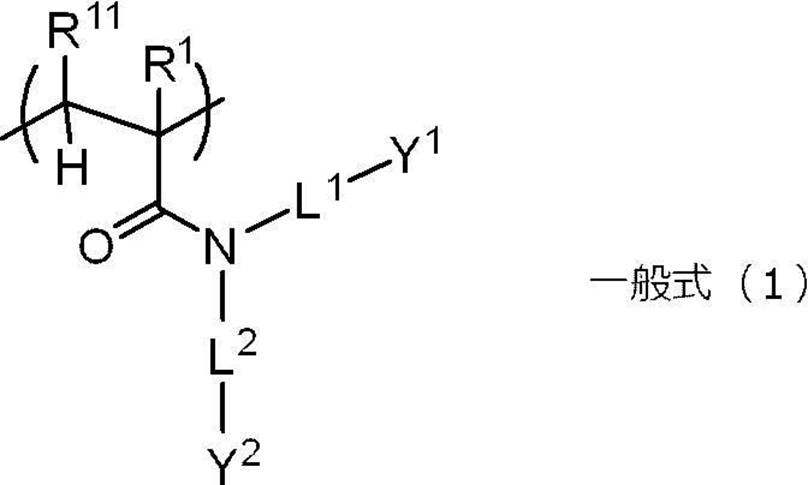
一般式(1)中、R1は、水素原子又はメチル基を表す。
一般式(1)中、R11は、水素原子、カルボン酸基、又はカルバモイル基を表す。
カルバモイル基は、アルキル基(例えば炭素数1~4のアルキル基)によって置換されていてもよい。
R11としては、水素原子が好ましい。
カルバモイル基は、アルキル基(例えば炭素数1~4のアルキル基)によって置換されていてもよい。
R11としては、水素原子が好ましい。
一般式(1)中、L1及びL2は、それぞれ独立に、アルキレン基、アルケニレン基、アルキニレン基、-O-、及び-C(=O)-からなる群Aより選ばれる1種である2価の連結基、群Aより選ばれる2種以上を組み合わせた2価の連結基、又は、単結合を表す。
群Aにおけるアルキレン基は、無置換でもよく置換基を有してもよく、炭素数1~8のアルキレン基が好ましく、炭素数1~4のアルキレン基が好ましい。アルキレン基の例としては、メチレン基、エチレン基、i-プロピレン基、n-ブチレン基、t-ブチレン基等が挙げられる。
群Aにおけるアルケニレン基は、無置換でもよく置換基を有してもよく、炭素数2~8のアルケニレン基が好ましく、炭素数2~4のアルケニレン基が好ましい。アルケニレン基の例としては、ビニレン、1-メチルビニレン、プロペニレン、2-ブテニレン、2-ペンテニレン基等が挙げられる。
群Aにおけるアルキニレン基は、無置換でもよく置換基を有してもよく、炭素数2~8のアルキニレン基が好ましく、炭素数2~4のアルキニレン基が好ましい。アルキニレン基の例としては、エチニレン、プロピニレン、ブチニレン、1、3-ブタジイニレン、2-ペンチニレン、2,4-ペンタジイニレン、2-ヘキシニレン、3-ヘプチニレン、4-オクチニレン等が挙げられる。
群Aにおけるアルケニレン基は、無置換でもよく置換基を有してもよく、炭素数2~8のアルケニレン基が好ましく、炭素数2~4のアルケニレン基が好ましい。アルケニレン基の例としては、ビニレン、1-メチルビニレン、プロペニレン、2-ブテニレン、2-ペンテニレン基等が挙げられる。
群Aにおけるアルキニレン基は、無置換でもよく置換基を有してもよく、炭素数2~8のアルキニレン基が好ましく、炭素数2~4のアルキニレン基が好ましい。アルキニレン基の例としては、エチニレン、プロピニレン、ブチニレン、1、3-ブタジイニレン、2-ペンチニレン、2,4-ペンタジイニレン、2-ヘキシニレン、3-ヘプチニレン、4-オクチニレン等が挙げられる。
群Aにおける上述した置換基の例としては、ハロゲン原子、アルキル基、カルボン酸基、水酸基、アミノ基等(以下、「置換基群X」という。)が挙げられる。
ハロゲン原子としては、塩素、臭素、ヨウ素等が挙げられる。
アルキル基としては、炭素数1~12(好ましくは炭素数1~8)のアルキル基が好ましく、例えば、メチル基、エチル基、プロピル基、ブチル基、ヘキシル等が挙げられる。アルキル基は、無置換でもよいし、上記と同様の置換基を有していてもよい。
ハロゲン原子としては、塩素、臭素、ヨウ素等が挙げられる。
アルキル基としては、炭素数1~12(好ましくは炭素数1~8)のアルキル基が好ましく、例えば、メチル基、エチル基、プロピル基、ブチル基、ヘキシル等が挙げられる。アルキル基は、無置換でもよいし、上記と同様の置換基を有していてもよい。
一般式(1)において、置換基としては、特に断りが無い限り、上記置換基群Xにおける置換基を参照できる。
L1及びL2において、群Aより選ばれる2種以上を組み合わせた2価の連結基としては、アルキレンオキシ基、アルキルエステル基等が挙げられる。
アルキレンオキシ基としては、例えば、-(C2H4O)n-(n:2~10の整数)、-(C3H6O)n-(n:2~10の整数)等が挙げられる。
アルキルエステル基としては、例えば、カプロラクトン変性アクリレート等が挙げられる。
アルキレンオキシ基としては、例えば、-(C2H4O)n-(n:2~10の整数)、-(C3H6O)n-(n:2~10の整数)等が挙げられる。
アルキルエステル基としては、例えば、カプロラクトン変性アクリレート等が挙げられる。
上記の中でも、L1及びL2としては、それぞれ独立に、単結合、アルキレン基又はアルキレンオキシ基が好ましく、単結合、炭素数1~4のアルキレン基又は炭素数2~3のアルキレンオキシ基がより好ましく、単結合、炭素数1~4のアルキレン基又はエチレンオキシ基〔-(C2H4O)n-(n:2~10の整数〕が更に好ましい。
炭素数1~4のアルキレン基としては、メチレン基、エチレン基、i-プロピレン基、n-ブチレン基等が挙げられる。
炭素数1~4のアルキレン基としては、メチレン基、エチレン基、i-プロピレン基、n-ブチレン基等が挙げられる。
一般式(1)中、Y1及びY2は、それぞれ独立に、水素原子、-OH、-R2、-OR2、-NH2、-NHR2、-NR2R3、又は-SHを表す。
R2及びR3は、それぞれ独立に、アルキル基、アルケニル基、アルキニル基、又はアリール基を表す。
R2及びR3は、それぞれ独立に、アルキル基、アルケニル基、アルキニル基、又はアリール基を表す。
R2及びR3におけるアルキル基は、無置換でもよく置換基を有してもよく、炭素数1~8のアルキル基が好ましく、炭素数1~4のアルキル基が好ましい。アルキル基の例としては、メチル基、エチル基、プロピル基、n-ブチル基、t-ブチル基等が挙げられる。
R2及びR3におけるアルケニル基は、無置換でもよく置換基を有してもよく、炭素数2~8のアルケニル基が好ましく、炭素数2~4のアルケニル基が好ましい。アルケニル基の例としては、ビニル、1-メチルビニル、プロペニル、2-ブテニル、2-ペンテニル基等が挙げられる。
R2及びR3におけるアルキニル基は、無置換でもよく置換基を有してもよく、炭素数2~8のアルキニル基が好ましく、炭素数2~4のアルキニル基が好ましい。アルキニル基の例としては、エチニル、プロピニル、ブチニル、1、3-ブタジイニル、2-ペンチニル、2,4-ペンタジイニル、2-ヘキシニル、3-ヘプチニル、4-オクチニル等が挙げられる。
R2及びR3におけるアリール基は、無置換でもよく置換基を有してもよい。R2及びR3におけるアリール基としては、置換又は無置換のフェニル基が好ましい。
R2及びR3におけるアルケニル基は、無置換でもよく置換基を有してもよく、炭素数2~8のアルケニル基が好ましく、炭素数2~4のアルケニル基が好ましい。アルケニル基の例としては、ビニル、1-メチルビニル、プロペニル、2-ブテニル、2-ペンテニル基等が挙げられる。
R2及びR3におけるアルキニル基は、無置換でもよく置換基を有してもよく、炭素数2~8のアルキニル基が好ましく、炭素数2~4のアルキニル基が好ましい。アルキニル基の例としては、エチニル、プロピニル、ブチニル、1、3-ブタジイニル、2-ペンチニル、2,4-ペンタジイニル、2-ヘキシニル、3-ヘプチニル、4-オクチニル等が挙げられる。
R2及びR3におけるアリール基は、無置換でもよく置換基を有してもよい。R2及びR3におけるアリール基としては、置換又は無置換のフェニル基が好ましい。
一般式(1)中、Y1及びY2は、互いに結合し、L1、L2及びNと共に、含窒素複素環を形成していてもよい。
形成される含窒素複素環は、窒素以外のヘテロ原子(例えば、酸素原子、硫黄原子等)を含んでいてもよい。
含窒素複素環としては、含窒素5員環又は含窒素6員環が好ましい。
含窒素複素環としては、モルホリン環、ピぺリジン環、ピペラジン環、ピラゾリジン環、ピロリジン環、イミダゾリジン環、等が挙げられる。
形成される含窒素複素環は、窒素以外のヘテロ原子(例えば、酸素原子、硫黄原子等)を含んでいてもよい。
含窒素複素環としては、含窒素5員環又は含窒素6員環が好ましい。
含窒素複素環としては、モルホリン環、ピぺリジン環、ピペラジン環、ピラゾリジン環、ピロリジン環、イミダゾリジン環、等が挙げられる。
一般式(1)で表される構成単位の具体例を以下に示すが、一般式(1)で表される構成単位は、以下の具体例には限定されない。

水溶性ポリマーBは、一般式(1)で表される構成単位の含有比率が、水溶性ポリマーBの全構成単位に対して、3質量%~45質量%であることが好ましい。一般式(1)で表される構成単位の含有比率が3質量%以上であると、画像のブロッキングが抑制される。また、一般式(1)で表される構成単位の含有比率が45質量%以下であると、例えば吐出ヘッドからインクジェット法でインク組成物を吐出して記録を行う場合に、吐出ヘッドの内部とインク組成物との親和性が抑えられ、インク組成物の吐出ヘッドの内部への付着が抑制される。結果、吐出ヘッドのメンテナンス性が向上する。
一般式(1)で表される構成単位の含有比率としては、3質量%~25質量%がより好ましく、3質量%~20質量%が更に好ましい。
一般式(1)で表される構成単位の含有比率としては、3質量%~25質量%がより好ましく、3質量%~20質量%が更に好ましい。
水溶性ポリマーBにおいて、酸基と、一般式(1)で表される構成単位と、の総量としては、水溶性ポリマーBの固形分質量に対して、5質量%~80質量%であることが好ましく、5質量%~45質量%であることがより好ましい。酸基と一般式(1)で表される構成単位との総量が5質量%以上であると、良好な水溶性が得られ、インク組成物の増粘作用を発現しやすい。また、酸基と一般式(1)で表される構成単位との総量が45質量%以下であると、インク組成物自体の粘度を低く抑えることができ、例えばインクジェット法で記録を行う場合のインク組成物の吐出性がより良好になる。また、吐出ヘッドのメンテナンス性が向上する。
酸基と一般式(1)で表される構成単位との総量としては、5質量%~40質量%が更に好ましく、10質量%~35質量%が特に好ましい。
酸基と一般式(1)で表される構成単位との総量としては、5質量%~40質量%が更に好ましく、10質量%~35質量%が特に好ましい。
水溶性ポリマーBは、更に、一般式(A)で表される構成単位及び一般式(B)で表される構成単位からなる群より選ばれる少なくとも1種の構成単位を含むことが好ましい。
一般式(A)又は一般式(B)で表される構成単位は疎水性のモノマー単位である。一般式(A)又は一般式(B)で表される構成単位を含むことで、インク組成物を吐出する吐出ヘッドを用いた場合の、吐出ヘッドの内部とインク組成物との親和性が低下し、インク組成物が吐出ヘッドの内部により付着し難くなる。結果、吐出ヘッドのメンテナンス性がより向上する。
一般式(A)又は一般式(B)で表される構成単位は疎水性のモノマー単位である。一般式(A)又は一般式(B)で表される構成単位を含むことで、インク組成物を吐出する吐出ヘッドを用いた場合の、吐出ヘッドの内部とインク組成物との親和性が低下し、インク組成物が吐出ヘッドの内部により付着し難くなる。結果、吐出ヘッドのメンテナンス性がより向上する。
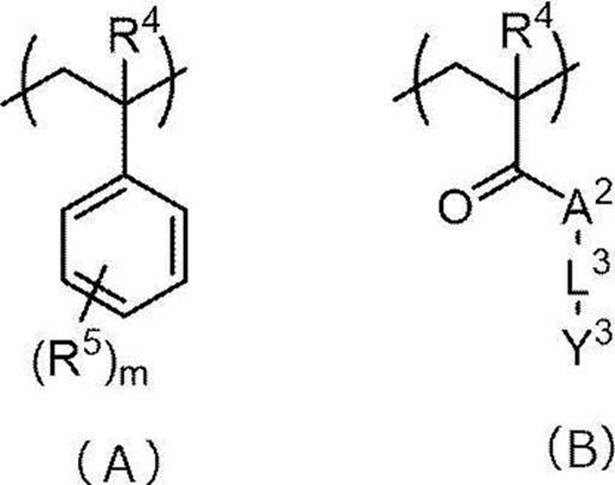
一般式(A)及び一般式(B)において、R4は、それぞれ独立に、水素原子又はメチル基を表し、メチル基が好ましい。
一般式(A)において、R5は、それぞれ独立に、アルキル基、アルケニル基又はアルキニル基を表す。
R5におけるアルキル基、アルケニル基又はアルキニル基は、一般式(1)中のR2及びR3におけるアルキル基、アルケニル基又はアルキニル基と同義であり、好ましい態様も同様である。
また、R5は、m個の範囲で存在し、mは0~5の整数である。合成適性の点で、mは、0又は1が好ましい。mが2以上の整数である場合、複数存在するR5は、互いに同一の基でもよいし異なる基であってもよい。
R5におけるアルキル基、アルケニル基又はアルキニル基は、一般式(1)中のR2及びR3におけるアルキル基、アルケニル基又はアルキニル基と同義であり、好ましい態様も同様である。
また、R5は、m個の範囲で存在し、mは0~5の整数である。合成適性の点で、mは、0又は1が好ましい。mが2以上の整数である場合、複数存在するR5は、互いに同一の基でもよいし異なる基であってもよい。
一般式(B)中のA2は、単結合又は-O-を表す。
A2としては、-O-がより好ましい。
A2としては、-O-がより好ましい。
一般式(B)中のL3は、アルキレン基、アルケニレン基、アルキニレン基、-O-、及び-C(=O)-からなる群Bより選ばれる1種である2価の連結基、上記群Bより選ばれる2種以上を組み合わせた2価の連結基、又は単結合を表す。
一般式(B)中のL3は、一般式(1)中のL1と同義であり、好ましい態様についても同様である。
一般式(B)中のL3は、一般式(1)中のL1と同義であり、好ましい態様についても同様である。
一般式(B)中のY3は、炭素数4~22のアルキル基、炭素数4~22のアルケニル基、炭素数4~22のアルキニル基、炭素数4~22のシクロアルキル基、又は炭素数6~22のアリール基を表す。Y3は、炭素数が多く、疎水的な性状を有する基である。
炭素数4~22のアルキル基は、無置換でもよく置換基を有してもよく、炭素数4~18のアルキル基が好ましく、炭素数4~16のアルキル基がより好ましく、炭素数4~10のアルキル基が更に好ましい。アルキル基の例としては、ノルマルブチル基、イソブチル基、2-エチルヘキシル基、イソオクチル基、ステアリル基等が挙げられる。
炭素数4~22のアルケニル基は、無置換でもよく置換基を有してもよく、炭素数4~18のアルケニル基が好ましく、炭素数4~16のアルケニル基がより好ましく、炭素数4~10のアルケニル基が更に好ましい。アルケニル基の例としては、2-メチル-プロペニル基、2-ブテニル基、3-メチル-2-ブテニル基等が挙げられる。
炭素数4~22のアルキニル基は、無置換でもよく置換基を有してもよく、炭素数4~18のアルキニル基が好ましく、炭素数4~16のアルキニル基がより好ましく、炭素数4~10のアルキニル基が更に好ましい。アルキニル基の例としては、4-メチル-1-ペンチニル基、3-3-ジメチルブチニル基等が挙げられる。
炭素数4~22のアルケニル基は、無置換でもよく置換基を有してもよく、炭素数4~18のアルケニル基が好ましく、炭素数4~16のアルケニル基がより好ましく、炭素数4~10のアルケニル基が更に好ましい。アルケニル基の例としては、2-メチル-プロペニル基、2-ブテニル基、3-メチル-2-ブテニル基等が挙げられる。
炭素数4~22のアルキニル基は、無置換でもよく置換基を有してもよく、炭素数4~18のアルキニル基が好ましく、炭素数4~16のアルキニル基がより好ましく、炭素数4~10のアルキニル基が更に好ましい。アルキニル基の例としては、4-メチル-1-ペンチニル基、3-3-ジメチルブチニル基等が挙げられる。
炭素数4~22のシクロアルキル基は、無置換でもよく置換基を有してもよく、炭素数4~20のシクロアルキル基が好ましく、炭素数4~16のシクロアルキル基がより好ましく、炭素数6~10のシクロアルキル基が更に好ましい。シクロアルキル基の例としては、シクロヘキシル基、メチルシクロヘキシル基、ジメチルシクロへキシル基、イソボルニル基、ジシクロペンタニル基、アダマンタン基、2-メチルアダマンタン-2-イル基、2-エチルアダマンタン-2-イル基、2-イソプロピルアダマンタン-2-イル基、ノルボルニル基、メチルノルボルニル基等が挙げられる。
炭素数6~22のアリール基は、無置換でもよく置換基を有してもよく、炭素数6~20のアリール基が好ましく、炭素数6~16のアリール基がより好ましく、炭素数6~10のアリール基が更に好ましい。アリール基の例としては、フェニル基、トリル基、キシリル基、エチルフェニル基、tert-ブチルフェニル基、アダマンチルフェニル基、ビフェニル基、ナフチル基、2,6-ジエチルフェニル基等が挙げられる。
吐出ヘッドのメンテナンス性をより向上させ、かつ、画像のブロッキングをより抑制する観点から、水溶性ポリマーBは、一般式(A)又は一般式(B)で表される構成単位の中でも、以下の一般式(a)で表される構成単位及び下記一般式(b-1)~(b-4)のいずれかで表される構成単位からなる群より選ばれる少なくとも1種の構成単位を含むことが好ましい。
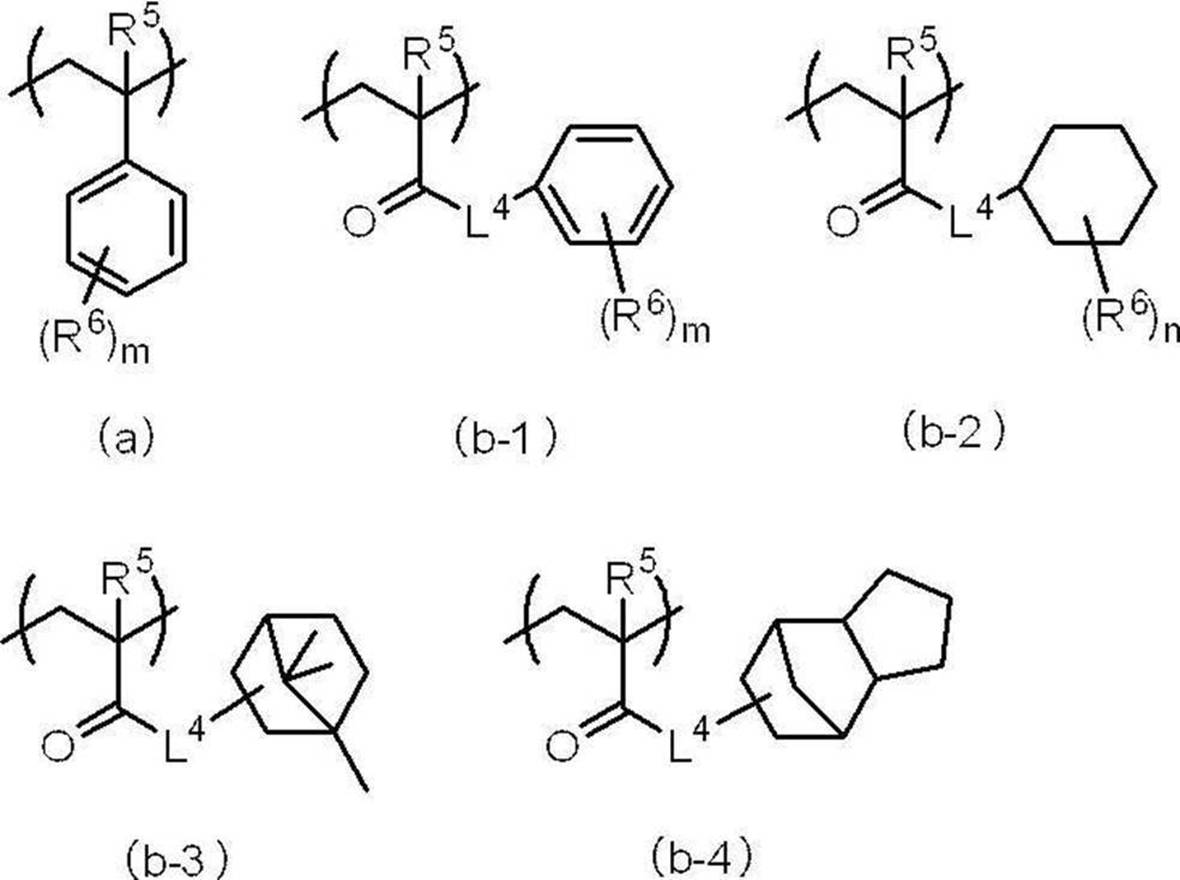
一般式(a)及び一般式(b-1)~(b-4)において、R5は、それぞれ独立に、水素原子又はメチル基を表す。一般式(a)におけるR5は、水素原子が好ましく、一般式(b-1)~(b-4)におけるR5は、メチル基が好ましい。
一般式(a)及び一般式(b-1)~(b-2)において、R6は、アルキル基を表し、mは0~5の整数を表し、nは0~11の整数を表す。R6は、それぞれ独立に、鎖状又は分岐状の炭素数が1~10のアルキル基が好ましい。R6は、それぞれ独立に、炭素数1~6のアルキル基が好ましく、炭素数1~4のアルキル基がより好ましい。mは0~2の整数が好ましく、0又は1がより好ましい。nは0~3の整数が好ましく、0又は1がより好ましい。
一般式(b-1)~(b-4)において、L4は、それぞれ独立に、炭素数1~18のアルキレン基、-O-、及び-C(=O)-からなる群Cより選ばれる1種である2価の連結基、群Cより選ばれる2種以上を組合せた2価の連結基、又は単結合を表す。
L4は、それぞれ独立に、-O-、*-O-アルキレン基-(*は、カルボニル基と結合する結合手を表す。)、又は-O-アルキレン基-O-が好ましい。
更に、L4におけるアルキレン基の炭素数は、1~12が好ましく、1~8がより好ましく、1~4が更に好ましく、1又2が特に好ましく、1が最も好ましい。
L4は、それぞれ独立に、-O-、*-O-アルキレン基-(*は、カルボニル基と結合する結合手を表す。)、又は-O-アルキレン基-O-が好ましい。
更に、L4におけるアルキレン基の炭素数は、1~12が好ましく、1~8がより好ましく、1~4が更に好ましく、1又2が特に好ましく、1が最も好ましい。
一般式(a)及び一般式(b-1)~(b-4)のいずれかで表される構成単位の具体例を以下に示す。
なお、各構造中の「*」は結合手を表す。また、「nBu」は「ノルマルブチル」を表し、「iBu」は「イソブチル」を表し、「tBu」は「ターシャルブチル」を表す。
なお、各構造中の「*」は結合手を表す。また、「nBu」は「ノルマルブチル」を表し、「iBu」は「イソブチル」を表し、「tBu」は「ターシャルブチル」を表す。

水溶性ポリマーBは、一般式(a)で表される構成単位及び一般式(b-1)~(b-4)のいずれかで表される構成単位の合計の含有比率が、水溶性ポリマーBの全構成単位に対して、3質量%~80質量%であることが好ましく、3質量%~50質量%であることがより好ましく、5質量%~50質量%であることが更に好ましい。
一般式(a)及び一般式(b-1)~(b-4)のいずれかで表される構成単位の合計の含有比率が3質量%以上であることで、インク組成物を吐出する吐出ヘッドを用いた場合の、吐出ヘッドの内部とインク組成物との親和性が低下し、インク組成物が吐出ヘッドの内部に付着し難くなる。結果、吐出ヘッドのメンテナンス性が向上する。
一般式(a)及び一般式(b-1)~(b-4)のいずれかで表される構成単位の合計の含有比率としては、10質量%~40質量%が更に好ましい。
一般式(a)及び一般式(b-1)~(b-4)のいずれかで表される構成単位の合計の含有比率が3質量%以上であることで、インク組成物を吐出する吐出ヘッドを用いた場合の、吐出ヘッドの内部とインク組成物との親和性が低下し、インク組成物が吐出ヘッドの内部に付着し難くなる。結果、吐出ヘッドのメンテナンス性が向上する。
一般式(a)及び一般式(b-1)~(b-4)のいずれかで表される構成単位の合計の含有比率としては、10質量%~40質量%が更に好ましい。
水溶性ポリマーBは、アルキル部位の炭素数が1~3であるアルキル(メタ)アクリレートに由来する構成単位を含んでいてもよい。
アルキル部位の炭素数が1~3であるアルキル(メタ)アクリレートとしては、メチル(メタ)アクリレート、エチル(メタ)アクリレート、及びプロピル(メタ)アクリレートが挙げられる。
アルキル部位の炭素数が1~3であるアルキル(メタ)アクリレートに由来する構成単位の含有比率は、水溶性ポリマーBの全構成単位に対して、3質量%~80質量%であることが好ましく、5質量%~75質量%であることがより好ましく、15質量%~75質量%であることが更に好ましい。
アルキル部位の炭素数が1~3であるアルキル(メタ)アクリレートとしては、メチル(メタ)アクリレート、エチル(メタ)アクリレート、及びプロピル(メタ)アクリレートが挙げられる。
アルキル部位の炭素数が1~3であるアルキル(メタ)アクリレートに由来する構成単位の含有比率は、水溶性ポリマーBの全構成単位に対して、3質量%~80質量%であることが好ましく、5質量%~75質量%であることがより好ましく、15質量%~75質量%であることが更に好ましい。
水溶性ポリマーBの重量平均分子量は、5,000~100,000であることが好ましい。水溶性ポリマーBの重量平均分子量が上記範囲であると、画像のにじみ及びブロッキングがより抑制される。また、インクジェット法でインク組成物を吐出ヘッドから吐出する際も良好な吐出性が得られる。
水溶性ポリマーBの重量平均分子量としては、インク組成物の吐出性の点で、10,000~80,000がより好ましく、10,000~30,000が更に好ましい。
水溶性ポリマーBの重量平均分子量としては、インク組成物の吐出性の点で、10,000~80,000がより好ましく、10,000~30,000が更に好ましい。
水溶性ポリマーBの酸価は、28mgKOH/g~230mgKOH/gであることが好ましい。酸価が230mgKOH/g以下であると、少量の水溶性ポリマーであってもインク組成物の増粘効果が得られやすく、画像中のにじみが改善される。また、酸価は、インク組成物の増粘効果の観点から、50mgKOH/g以上がより好ましく、更には、100mgKOH/g以上としてもよく、150mgKOH/g以上としてもよい。
酸価は、顔料分散ポリマーAと同様に指示薬の滴定により測定することができ、日本工業規格(JIS)K0070:1992に記載の方法により測定される値である。
酸価は、顔料分散ポリマーAと同様に指示薬の滴定により測定することができ、日本工業規格(JIS)K0070:1992に記載の方法により測定される値である。
水溶性ポリマーBのガラス転移温度(Tg)としては、80℃以上であることが好ましい。Tgが80℃以上であると、画像のブロッキングがより抑制される。
水溶性ポリマーBのTgとしては、95℃以上がより好ましく、110℃以上が更に好ましい。また、水溶性ポリマーBのTgの上限は、合成適性の点で、250℃以下が望ましい。
水溶性ポリマーBのTgとしては、95℃以上がより好ましく、110℃以上が更に好ましい。また、水溶性ポリマーBのTgの上限は、合成適性の点で、250℃以下が望ましい。
Tgは、水溶性ポリマーの溶液を150℃で6時間減圧乾燥した試料を用意し、示差走査熱量計(DSC)を用いて昇温速度10℃/分で測定されるものである。DSCとしては、例えば、日立ハイテクサイエンス社製の示差走査熱量計(DSC)DSC7000Xを用いることができる。
インク組成物中の水溶性ポリマーBの含有量としては、インク組成物の全質量に対して、1質量%~10質量%であることが好ましい。
水溶性ポリマーBの含有量が1質量%以上であると、インク組成物の増粘効果が得られやすい。
水溶性ポリマーBの含有量が10質量%以下であると、インクジェット法で吐出ヘッドから吐出する際の吐出性がより向上する。
水溶性ポリマーBの含有量が1質量%以上であると、インク組成物の増粘効果が得られやすい。
水溶性ポリマーBの含有量が10質量%以下であると、インクジェット法で吐出ヘッドから吐出する際の吐出性がより向上する。
-顔料分散ポリマーA及び水溶性ポリマーBのClogP-
顔料分散ポリマーAは、顔料へ付着して分散性を高めやすいという観点から、水溶性ポリマーBに比べて疎水的な性質を有すること、即ち、ClogPが水溶性ポリマーBのClogPよりも大きいポリマーであることが好ましい。顔料分散ポリマーAのClogPは、1.75以上であることが好ましく、1.80以上であることがより好ましく、1.85以上であることが更に好ましい。
顔料分散ポリマーAは、顔料へ付着して分散性を高めやすいという観点から、水溶性ポリマーBに比べて疎水的な性質を有すること、即ち、ClogPが水溶性ポリマーBのClogPよりも大きいポリマーであることが好ましい。顔料分散ポリマーAのClogPは、1.75以上であることが好ましく、1.80以上であることがより好ましく、1.85以上であることが更に好ましい。
一方、水溶性ポリマーBは、インク組成物中に溶けて存在し、処理液(特に酸等の凝集成分)が作用した際のインク組成物の増粘に寄与する観点から、顔料分散ポリマーAに比べて親水的な性質を有すること、即ち、ClogPが顔料分散ポリマーAのClogPよりも小さいポリマーであることが好ましい。水溶性ポリマーBのClogPは、1.80以下であることが好ましく、1.74以下であることがより好ましく、1.72以下であることが更に好ましく、1.70以下であることが更に好ましい。
ClogPは、数値が大きい程疎水性が高いことを示す。
ClogPは、PerkinElmer Informatics社製のChemDraw(登録商標)Professional(ver.16.0.1.4)を使用して計算するものとする。
各ポリマーのClogPは、そのポリマーを形成するためのモノマーのClogPとして算出する。共重合体であるポリマーのClogPについては、共重合体を形成するためのモノマーのClogPの加重平均値を、その共重合体のClogPとする。
例えば、ポリアクリル酸のClogPは、アクリル酸のClogPとして算出する。また、ポリアクリル酸-ポリメタクリル酸共重合体(共重合質量比=50:50)のClogPは、アクリル酸のClogP及びメタクリル酸のClogPの各々に共重合質量比(この場合はそれぞれ0.5)を乗算して得られた値の合計値として算出する。
ポリマー中に、中和された酸基(例えば-COONa)を含む構成単位が存在する場合、この構成単位を形成するためのモノマーのClogPとしては、中和された酸基(例えば-COONa)を含むモノマーからカウンターカチオン(例えばNa+)を除いたアニオンのClogPを採用する。
また、インク組成物に含まれるポリマーが不明である場合、インク組成物に対して分光法又は核磁気共鳴(NMR)法等により成分解析を行うことで、ポリマーの構造と含有比率とを特定し、ポリマーのClogPを計算する。
ClogPは、PerkinElmer Informatics社製のChemDraw(登録商標)Professional(ver.16.0.1.4)を使用して計算するものとする。
各ポリマーのClogPは、そのポリマーを形成するためのモノマーのClogPとして算出する。共重合体であるポリマーのClogPについては、共重合体を形成するためのモノマーのClogPの加重平均値を、その共重合体のClogPとする。
例えば、ポリアクリル酸のClogPは、アクリル酸のClogPとして算出する。また、ポリアクリル酸-ポリメタクリル酸共重合体(共重合質量比=50:50)のClogPは、アクリル酸のClogP及びメタクリル酸のClogPの各々に共重合質量比(この場合はそれぞれ0.5)を乗算して得られた値の合計値として算出する。
ポリマー中に、中和された酸基(例えば-COONa)を含む構成単位が存在する場合、この構成単位を形成するためのモノマーのClogPとしては、中和された酸基(例えば-COONa)を含むモノマーからカウンターカチオン(例えばNa+)を除いたアニオンのClogPを採用する。
また、インク組成物に含まれるポリマーが不明である場合、インク組成物に対して分光法又は核磁気共鳴(NMR)法等により成分解析を行うことで、ポリマーの構造と含有比率とを特定し、ポリマーのClogPを計算する。
-水-
本開示のインク組成物は、水を含有する。
水としては、例えば、イオン交換水等を用いることができる。
水の含有量は、特に制限はないが、インク組成物の全質量に対して、10質量%以上の範囲が好ましく、より好ましくは30質量%以上であり、更に好ましくは50質量%以上である。
水の含有量の上限は、他の成分の含有量にもよるが、例えば、99質量%、90質量%、80質量%等である。
本開示のインク組成物は、水を含有する。
水としては、例えば、イオン交換水等を用いることができる。
水の含有量は、特に制限はないが、インク組成物の全質量に対して、10質量%以上の範囲が好ましく、より好ましくは30質量%以上であり、更に好ましくは50質量%以上である。
水の含有量の上限は、他の成分の含有量にもよるが、例えば、99質量%、90質量%、80質量%等である。
-水溶性有機溶媒-
本開示のインク組成物は、水溶性有機溶媒を含有することが好ましい。
本開示において、水溶性有機溶媒における「水溶性」とは、20℃の100gの水に5g以上溶解する性質をいう。
本開示のインク組成物は、水溶性有機溶媒を含有することが好ましい。
本開示において、水溶性有機溶媒における「水溶性」とは、20℃の100gの水に5g以上溶解する性質をいう。
水溶性有機溶剤の例としては、グリセリン、1,2,6-ヘキサントリオール、トリメチロールプロパン、エチレングリコール、プロピレングリコール等のアルカンジオール(多価アルコール);糖アルコール;エタノール、メタノール、ブタノール、プロパノール、イソプロパノール等の炭素数1~4のアルキルアルコール;エチレングリコールモノメチルエーテル、エチレングリコールモノエチルエーテル、エチレングリコールモノブチルエーテル、エチレングリコールモノメチルエーテルアセテート、ジエチレングリコールモノメチルエーテル、ジエチレングリコールモノエチルエーテル、ジエチレングリコールジエチルエーテル、ジエチレングリコールモノ-n-プロピルエーテル、エチレングリコールモノ-iso-プロピルエーテル、ジエチレングリコールモノ-iso-プロピルエーテル、エチレングリコールモノ-n-ブチルエーテル、エチレングリコールモノ-t-ブチルエーテル、ジエチレングリコールモノ-t-ブチルエーテル、トリエチレングリコールモノエチルエーテル、1-メチル-1-メトキシブタノール、プロピレングリコールモノメチルエーテル、プロピレングリコールモノエチルエーテル、プロピレングリコールモノ-t-ブチルエーテル、プロピレングリコールモノ-n-プロピルエーテル、プロピレングリコールモノ-iso-プロピルエーテル、ジプロピレングリコール、ジプロピレングリコールモノメチルエーテル、ジプロピレングリコールモノエチルエーテル、ジプロピレングリコールモノ-n-プロピルエーテル、ジプロピレングリコールモノ-iso-プロピルエーテル、トリエチレングリコールモノメチルエーテル、トリプロピレングリコールモノメチルエーテル等のグリコールエーテル;ホルムアミド、N,N-ジメチルホルムアミド、N,N-ジメチルアセトアミド、2-ピロリドン、N-メチルピロリドン等のアミド化合物;などが挙げられる。
水溶性有機溶媒は、1種単独で又は2種以上を組み合わせて用いることができる。
水溶性有機溶媒は、1種単独で又は2種以上を組み合わせて用いることができる。
水溶性有機溶媒としては、110℃~240℃の沸点を有する第1の有機溶媒を含むことが好ましい。第1の有機溶媒を含むことにより、高沸点溶媒(例えば245℃~300℃の沸点を有する第2の有機溶媒)の含有量を相対的に減らすことができる。これにより、乾燥性が向上し、画像のブロッキングを改善できる。
110℃~240℃の沸点を有する第1の有機溶媒は、例えば、エチレングリコール(198℃)、プロピレングリコール(188℃)、ジプロピレングリコール(230℃)、エチレングリコールモノメチルエーテル(124℃)、エチレングリコールジエチルエーテル(162℃)、プロピレングリコールモノエチルエーテル(120℃)、ジプロピレングリコールジメチルエーテル(171℃)、ジエチレングリコールモノメチルエーテル(194℃)、ジエチレングリコールジエチルエーテル(188℃)、N-メチルピロリドン(202℃)等が挙げられる。
245℃~300℃の沸点を有する第2の有機溶媒は、例えば、ジエチレングリコール(245℃)、グリセリン(290℃)、2-ピロリドン(245℃)、トリエチレングリコールモノメチルエーテル(248℃)等が挙げられる。
第1の有機溶媒及び第2の有機溶媒は、ヘッドメンテナンス性の観点から、アルコール系有機溶媒及びエーテル系有機溶媒が好ましい。アルコール系有機溶媒及びエーテル系有機溶媒は、ポリマー成分と相互作用しやすいアミド化合物(2-ピロリドン等)等の有機溶媒に比べ、吐出ヘッドの内部に付着し難いので、吐出ヘッドのメンテナンス性が良好になる。
アルコール系有機溶媒の具体例としては、エチレングリコール、プロピレングリコール、ジエチレングリコール、ジプロピレングリコール、グリセリン等が挙げられる。
エーテル系有機溶媒としては、例えば、上記のエチレングリコール、プロピレングリコール、ジエチレングリコール、ジプロピレングリコール又はグリセリンのアルキルエーテル等が挙げられる。
エーテル系有機溶媒の具体例としては、エチレングリコールモノメチルエーテル、エチレングリコールジエチルエーテル、プロピレングリコールモノエチルエーテル、ジプロピレングリコールジメチルエーテル、ジエチレングリコールモノメチルエーテル、ジエチレングリコールジエチルエーテル等のアルキルエーテルを挙げることができる。
エーテル系有機溶媒の具体例としては、エチレングリコールモノメチルエーテル、エチレングリコールジエチルエーテル、プロピレングリコールモノエチルエーテル、ジプロピレングリコールジメチルエーテル、ジエチレングリコールモノメチルエーテル、ジエチレングリコールジエチルエーテル等のアルキルエーテルを挙げることができる。
本開示では、第1の有機溶媒及び第2の有機溶媒は、各々、エチレングリコール、ジエチレングリコール、プロピレングリコール、トリエチレングリコール、ジプロピレングリコール、及びグリセリン並びにこれらのアルキルエーテルからなる群より選ばれる少なくとも1つのアルコール系有機溶媒であることが好ましい。
水溶性有機溶媒が第1の有機溶媒を含む場合、第1の有機溶媒の含有量(S1)に対する第2の有機溶媒の含有量(S2)の質量比(S2/S1)は、0~0.3の範囲が好ましい。S2/S1が上記範囲内であると、沸点の高い有機溶媒の量が低く抑えられるので、乾燥後の画像のベタツキが抑制される。
S2/S1としては、上記と同様の理由から、0~0.2の範囲がより好ましい。
S2/S1としては、上記と同様の理由から、0~0.2の範囲がより好ましい。
本開示のインク組成物は、本開示における効果を著しく損なわない範囲で、上記の水溶性有機溶媒以外の他の有機溶媒を含有してもよい。
第1の有機溶媒及び第2の有機溶媒のインク組成物中における総量は、インク組成物の全質量に対して、5質量%~30質量%であることが好ましい。
第1の有機溶媒及び第2の有機溶媒の総量が上記範囲内であると、有機溶媒量が低く抑えられるので、乾燥後の画像のベタツキが抑制される。また、第1の有機溶媒及び第2の有機溶媒の総量が5質量%以上であることで、吐出ヘッド内の空気界面で生じるインク組成物の固化物に起因した吐出孔の詰まりの発生が抑制され、吐出性が良好になる。
第1の有機溶媒及び第2の有機溶媒の総量としては、上記と同様の理由から、7.5質量%~40質量%の範囲がより好ましく、10質量%~30質量%の範囲が更に好ましい。
第1の有機溶媒及び第2の有機溶媒の総量が上記範囲内であると、有機溶媒量が低く抑えられるので、乾燥後の画像のベタツキが抑制される。また、第1の有機溶媒及び第2の有機溶媒の総量が5質量%以上であることで、吐出ヘッド内の空気界面で生じるインク組成物の固化物に起因した吐出孔の詰まりの発生が抑制され、吐出性が良好になる。
第1の有機溶媒及び第2の有機溶媒の総量としては、上記と同様の理由から、7.5質量%~40質量%の範囲がより好ましく、10質量%~30質量%の範囲が更に好ましい。
-その他成分-
本開示のインク組成物は、上記した成分に加え、本開示における効果を著しく損なわない範囲で、必要に応じて、更にその他成分を含有することができる。
本開示のインク組成物は、上記した成分に加え、本開示における効果を著しく損なわない範囲で、必要に応じて、更にその他成分を含有することができる。
その他成分としては、乾燥防止剤(膨潤剤)、着色防止剤、浸透促進剤、紫外線吸収剤、防腐剤、防錆剤、消泡剤、粘度調整剤、pH調整剤、キレート剤等が挙げられる。
-インク組成物の物性-
1.表面張力
インク組成物の表面張力としては、特に制限はなく、例えば、20mN/m以上とすることができる。記録媒体に対する塗布性の観点から、25mN/m~40mN/mが好ましく、27mN/m~37mN/mがより好ましい。
インク組成物の表面張力は、Automatic Surface Tensiometer CBVP-Z(協和界面科学株式会社製)を用い、プレート法により25℃の条件下で測定される値である。インク組成物の表面張力は、例えば界面活性剤を添加することで調整することができる。
1.表面張力
インク組成物の表面張力としては、特に制限はなく、例えば、20mN/m以上とすることができる。記録媒体に対する塗布性の観点から、25mN/m~40mN/mが好ましく、27mN/m~37mN/mがより好ましい。
インク組成物の表面張力は、Automatic Surface Tensiometer CBVP-Z(協和界面科学株式会社製)を用い、プレート法により25℃の条件下で測定される値である。インク組成物の表面張力は、例えば界面活性剤を添加することで調整することができる。
2.pH
インク組成物のpH(25℃±1℃)は、6~10が好ましく、7~10がより好ましい。
pHは、25℃環境下において、処理液を25℃に調温した状態でpHメータ(例えば、東亜DDK社製のWM-50EG)を用いて測定される値である。
インク組成物のpH(25℃±1℃)は、6~10が好ましく、7~10がより好ましい。
pHは、25℃環境下において、処理液を25℃に調温した状態でpHメータ(例えば、東亜DDK社製のWM-50EG)を用いて測定される値である。
3.粘度
インク組成物の粘度は、インクジェット法で吐出する場合の吐出性の観点等から、1mPa・s~30mPa・sの範囲が好ましく、1mPa・s~20mPa・sの範囲がより好ましく、2mPa・s~15mPa・sの範囲がさらに好ましく、2mPa・s~10mPa・sの範囲が特に好ましい。
粘度は、25℃の条件下で測定された値を意味する。粘度は、例えばVISCOMETER TV-22(TOKI SANGYO CO.LTD製)を用いて測定できる。
インク組成物の粘度は、インクジェット法で吐出する場合の吐出性の観点等から、1mPa・s~30mPa・sの範囲が好ましく、1mPa・s~20mPa・sの範囲がより好ましく、2mPa・s~15mPa・sの範囲がさらに好ましく、2mPa・s~10mPa・sの範囲が特に好ましい。
粘度は、25℃の条件下で測定された値を意味する。粘度は、例えばVISCOMETER TV-22(TOKI SANGYO CO.LTD製)を用いて測定できる。
<インクセット>
本開示において、本開示のインク組成物を単独で用いて画像を記録してもよいし、以下で説明する、本開示のインクセットを用いて画像を記録してもよい。
本開示のインクセットは、上述した本開示のインク組成物と、処理液と、を含む
処理液は、水と、インク組成物中の成分(特に顔料等の分散成分)を凝集させる凝集成分(詳細には、多価金属塩、酸性化合物、及びカチオン性ポリマーからなる群より選ばれる少なくとも1種)と、を含有する。
本開示において、本開示のインク組成物を単独で用いて画像を記録してもよいし、以下で説明する、本開示のインクセットを用いて画像を記録してもよい。
本開示のインクセットは、上述した本開示のインク組成物と、処理液と、を含む
処理液は、水と、インク組成物中の成分(特に顔料等の分散成分)を凝集させる凝集成分(詳細には、多価金属塩、酸性化合物、及びカチオン性ポリマーからなる群より選ばれる少なくとも1種)と、を含有する。
本開示のインクセットは、本開示のインク組成物を含むので、本開示のインクセットによれば、本開示のインク組成物によって得られる同様の効果(にじみ及びブロッキングの抑制)と同様の効果が得られる。
特に、本開示のインクセットを用いて画像を記録した場合には、凝集成分の作用により、画像のにじみがより抑制される。
特に、本開示のインクセットを用いて画像を記録した場合には、凝集成分の作用により、画像のにじみがより抑制される。
本開示のインクセットは、本開示のインク組成物を1種のみ含んでいてもよいし2種以上含んでいてもよい。
本開示のインクセットは、処理液を1種のみ含んでいてもよいし2種以上含んでいてもよい。
本開示のインクセットは、本開示のインク組成物及び処理液以外の液体(例えば、本開示のインク組成物以外のインク組成物)を含んでいてもよい。
以下、本開示のインクセットにおける処理液(以下、「本開示における処理液」ともいう)について詳述する。
本開示のインクセットは、処理液を1種のみ含んでいてもよいし2種以上含んでいてもよい。
本開示のインクセットは、本開示のインク組成物及び処理液以外の液体(例えば、本開示のインク組成物以外のインク組成物)を含んでいてもよい。
以下、本開示のインクセットにおける処理液(以下、「本開示における処理液」ともいう)について詳述する。
-凝集成分-
本開示における処理液は、インク組成物中の成分(特に顔料等の分散成分)を凝集させる凝集作用を担う凝集成分を含有する。本開示における凝集成分は、上記凝集作用に寄与するだけでなく、インク組成物中の水溶性ポリマーの増粘作用にも寄与し、画像中のにじみの発生を抑制する機能がある。
本開示における処理液は、インク組成物中の成分(特に顔料等の分散成分)を凝集させる凝集作用を担う凝集成分を含有する。本開示における凝集成分は、上記凝集作用に寄与するだけでなく、インク組成物中の水溶性ポリマーの増粘作用にも寄与し、画像中のにじみの発生を抑制する機能がある。
凝集成分は、多価金属塩、酸性化合物、及びカチオン性ポリマーからなる群より選ばれる少なくとも1種の化合物である。凝集成分としては、上記の凝集作用及び増粘作用の点から、酸性化合物であることが好ましい。
-酸性化合物-
酸性化合物は、記録媒体上においてインク組成物と接触した際に、インク組成物を固定化し得る固定化剤として機能する。例えば、酸性化合物を含む処理液を記録媒体(好ましくは塗工紙)に付与し、記録媒体の処理液付与面にインク組成物を付与した場合、インク組成物中に分散して存在する少なくとも顔料を凝集させ、かつ、水溶性ポリマーBを析出させて増粘させることができる。
酸性化合物は、記録媒体上においてインク組成物と接触した際に、インク組成物を固定化し得る固定化剤として機能する。例えば、酸性化合物を含む処理液を記録媒体(好ましくは塗工紙)に付与し、記録媒体の処理液付与面にインク組成物を付与した場合、インク組成物中に分散して存在する少なくとも顔料を凝集させ、かつ、水溶性ポリマーBを析出させて増粘させることができる。
酸性化合物としては、酸が好ましく、例えば、硫酸、塩酸、硝酸、リン酸、ポリアクリル酸、酢酸、グリコール酸、マロン酸、リンゴ酸、マレイン酸、プロパントリカルボン酸、アスコルビン酸、コハク酸、グルタル酸、フマル酸、クエン酸、酒石酸、乳酸、スルホン酸、オルトリン酸、メタリン酸、ピロリドンカルボン酸、ピロンカルボン酸、ピロールカルボン酸、フランカルボン酸、ピリジンカルボン酸、クマリン酸、チオフェンカルボン酸、ニコチン酸、シュウ酸、安息香酸が挙げられる。
酸性化合物は、揮発抑制と溶媒への溶解性の両立という観点から、分子量35~1000の酸が好ましく、分子量50~500の酸がさらに好ましく、分子量50~200の酸が特に好ましい。
酸のpKa(in H2O、25℃)としては、インクのにじみ防止及び光硬化性の両立の観点から、-10~7が好ましく、1~7がより好ましく、1~5が更に好ましい。
pKaは、Advanced Chemistry Development (ACD/Labs) Software V11. 02 (1994-2014 ACD/Labs) による計算値、あるいは文献値(例えば、J. Phys. Chem. A 2011, 115, 6641-6645等)に記載の値を用いることができる。
中でも、酸性化合物は、水溶性の高い化合物が好ましい。酸性化合物としては、インク組成物中の成分に対する凝集作用と水溶性ポリマーBの増粘作用とを良好に発現させる観点から、1価~3価の酸が好ましく、2価又は3価の酸がより好ましい。
処理液が酸性化合物を含む水溶液である場合、処理液のpH(25℃)は、0.1~6.8であることが好ましく、0.1~6.0であることがより好ましく、0.1~5.0であることがさらに好ましい。
pHは、処理液を25℃に調温し、pHメータを用いて25℃で測定される値である。pHメータとしては、例えば、東亜DDK社製のWM-50EGを用いることができる。
処理液が凝集成分として酸性化合物を含む場合、処理液中の酸性化合物の含有量は、顔料等の分散成分の凝集効果及び水溶性ポリマーBの増粘効果の観点から、50質量%以下が好ましく、15質量%~50質量%がより好ましく、25質量%~40質量%が更に好ましい。
処理液には、酸性化合物を1種単独で用いてもよく、2種以上を併用してもよい。
処理液が凝集成分として酸性化合物を含む場合、処理液の記録媒体への付与量は、インク組成物を凝集させるに足る量であれば、特に制限はない。処理液の記録媒体への付与量としては、インク組成物における凝集作用及び増粘作用の観点から、0.5g/m2~4.0g/m2が好ましく、1.0g/m2~2.0g/m2がより好ましい。特に、酸性化合物による作用の観点から、処理液の付与量は、酸性化合物の付与量が0.5g/m2~4.0g/m2となる量が好ましく、0.9g/m2~3.75g/m2となる量がより好ましい。
処理液が凝集成分として酸性化合物を含む場合、処理液の記録媒体への付与量は、インク組成物を凝集させるに足る量であれば、特に制限はない。処理液の記録媒体への付与量としては、インク組成物における凝集作用及び増粘作用の観点から、0.5g/m2~4.0g/m2が好ましく、1.0g/m2~2.0g/m2がより好ましい。特に、酸性化合物による作用の観点から、処理液の付与量は、酸性化合物の付与量が0.5g/m2~4.0g/m2となる量が好ましく、0.9g/m2~3.75g/m2となる量がより好ましい。
-多価金属塩-
処理液は、凝集成分として多価金属塩を含む形態も好ましい。多価金属塩は、迅速に凝集作用を起こさせるのに適している。
多価金属塩としては、周期表の第2属のアルカリ土類金属(例えば、マグネシウム、カルシウム)の塩、周期表の第3属の遷移金属(例えば、ランタン)の塩、周期表の第13属からのカチオン(例えば、アルミニウム)の塩、ランタニド類(例えば、ネオジム)の塩を挙げることができる。金属の塩としては、カルボン酸塩(蟻酸塩、酢酸塩、安息香酸塩など)、硝酸塩、塩化物、及びチオシアン酸塩が好適である。中でも、好ましくは、カルボン酸(蟻酸、酢酸、安息香酸など)のカルシウム塩又はマグネシウム塩、硝酸のカルシウム塩又はマグネシウム塩、塩化カルシウム、塩化マグネシウム、及びチオシアン酸のカルシウム塩又はマグネシウム塩である。
処理液は、凝集成分として多価金属塩を含む形態も好ましい。多価金属塩は、迅速に凝集作用を起こさせるのに適している。
多価金属塩としては、周期表の第2属のアルカリ土類金属(例えば、マグネシウム、カルシウム)の塩、周期表の第3属の遷移金属(例えば、ランタン)の塩、周期表の第13属からのカチオン(例えば、アルミニウム)の塩、ランタニド類(例えば、ネオジム)の塩を挙げることができる。金属の塩としては、カルボン酸塩(蟻酸塩、酢酸塩、安息香酸塩など)、硝酸塩、塩化物、及びチオシアン酸塩が好適である。中でも、好ましくは、カルボン酸(蟻酸、酢酸、安息香酸など)のカルシウム塩又はマグネシウム塩、硝酸のカルシウム塩又はマグネシウム塩、塩化カルシウム、塩化マグネシウム、及びチオシアン酸のカルシウム塩又はマグネシウム塩である。
処理液が凝集成分として多価金属塩を含む場合、処理液中の多価金属塩の含有量としては、顔料等の分散成分の凝集効果及び水溶性ポリマーBの増粘効果の観点から、1質量%~10質量%が好ましく、より好ましくは1.5質量%~7質量%であり、更に好ましくは2質量%~6質量%の範囲である。
-カチオン性ポリマー-
カチオン性ポリマーとしては、カチオン性基として、第1級~第3級アミノ基又は第4級アンモニウム塩基を含むカチオン性モノマーの単独重合体、第1級~第3級アミノ基又は第4級アンモニウム塩基を含むカチオン性モノマーと非カチオン性モノマーとの共重合体又は縮重合体が挙げられる。カチオン性ポリマーは、水溶性ポリマー又は水分散性ラテックス粒子のいずれの形態で用いてもよい。
カチオン性ポリマーとしては、カチオン性基として、第1級~第3級アミノ基又は第4級アンモニウム塩基を含むカチオン性モノマーの単独重合体、第1級~第3級アミノ基又は第4級アンモニウム塩基を含むカチオン性モノマーと非カチオン性モノマーとの共重合体又は縮重合体が挙げられる。カチオン性ポリマーは、水溶性ポリマー又は水分散性ラテックス粒子のいずれの形態で用いてもよい。
カチオン性ポリマーの好ましい例としては、ポリ(ビニルピリジン)塩、ポリアルキルアミノエチルアクリレート、ポリアルキルアミノエチルメタクリレート、ポリ(ビニルイミダゾール)、ポリエチレンイミン、ポリビグアニド、ポリグアニド、又はポリアリルアミン及びその誘導体等を挙げることができる。
カチオン性ポリマーの重量平均分子量としては、処理液の粘度の観点から低分子量の範囲を選択することが好ましい。
処理液をインクジェット法で記録媒体に付与する場合は、カチオン性ポリマーの重量平均分子量は、1,000~500,000の範囲が好ましく、1,500~200,000の範囲がより好ましく、更に好ましくは2,000~100,000の範囲である。重量平均分子量が1000以上であると、凝集速度の点で有利である。重量平均分子量が500,000以下であると、吐出信頼性の点で有利である。
処理液をインクジェット法で記録媒体に付与する場合は、カチオン性ポリマーの重量平均分子量は、1,000~500,000の範囲が好ましく、1,500~200,000の範囲がより好ましく、更に好ましくは2,000~100,000の範囲である。重量平均分子量が1000以上であると、凝集速度の点で有利である。重量平均分子量が500,000以下であると、吐出信頼性の点で有利である。
処理液が凝集成分としてカチオン性ポリマーを含む場合、処理液中のカチオン性ポリマーの含有量としては、顔料等の分散成分の凝集効果及び水溶性ポリマーBの増粘効果の観点から、1質量%~50質量%が好ましく、2質量%~30質量%がより好ましく、更に好ましくは2質量%~20質量%の範囲である。
-水-
本開示における処理液は、水を含有する。
水としては、例えば、イオン交換水等を用いることができる。
水の含有量は、特に制限はないが、処理液の全質量に対して、10質量%以上の範囲が好ましく、より好ましくは30質量%以上であり、更に好ましくは50質量%以上である。
水の含有量の上限は、他の成分の含有量にもよるが、例えば、99質量%、90質量%、80質量%等である。
本開示における処理液は、水を含有する。
水としては、例えば、イオン交換水等を用いることができる。
水の含有量は、特に制限はないが、処理液の全質量に対して、10質量%以上の範囲が好ましく、より好ましくは30質量%以上であり、更に好ましくは50質量%以上である。
水の含有量の上限は、他の成分の含有量にもよるが、例えば、99質量%、90質量%、80質量%等である。
-その他成分-
本開示における処理液は、上記の成分以外の他の成分を含んでいてもよい。その他の成分としては、有機溶媒、含窒素ヘテロ環化合物、消泡剤、及びその他の添加剤等を挙げることができる。
本開示における処理液は、上記の成分以外の他の成分を含んでいてもよい。その他の成分としては、有機溶媒、含窒素ヘテロ環化合物、消泡剤、及びその他の添加剤等を挙げることができる。
-有機溶媒-
有機溶媒としては、20℃で100gの水に5g以上溶解する有機溶媒(以下、水溶性有機有機溶媒)が好ましい。
水溶性有機溶媒としては、インク組成物に含有できる水溶性有機溶剤と同様のものを用いることができる。中でも、カール抑制の観点から、ポリアルキレングリコール又はその誘導体であることが好ましく、ジエチレングリコールモノアルキルエーテル(ジエチレングリコールモノブチルエーテル等)、トリエチレングリコールモノアルキルエーテル、ジプロピレングリコール、トリプロピレングリコールモノアルキルエーテル(トリプロピレングリコールモノメチルエーテル等)、ポリオキシプロピレングリセリルエーテル、及びポリオキシエチレンポリオキシプロピレングリコールからなる群より選ばれる少なくとも1種であることがより好ましい。
有機溶媒としては、20℃で100gの水に5g以上溶解する有機溶媒(以下、水溶性有機有機溶媒)が好ましい。
水溶性有機溶媒としては、インク組成物に含有できる水溶性有機溶剤と同様のものを用いることができる。中でも、カール抑制の観点から、ポリアルキレングリコール又はその誘導体であることが好ましく、ジエチレングリコールモノアルキルエーテル(ジエチレングリコールモノブチルエーテル等)、トリエチレングリコールモノアルキルエーテル、ジプロピレングリコール、トリプロピレングリコールモノアルキルエーテル(トリプロピレングリコールモノメチルエーテル等)、ポリオキシプロピレングリセリルエーテル、及びポリオキシエチレンポリオキシプロピレングリコールからなる群より選ばれる少なくとも1種であることがより好ましい。
有機溶剤の処理液中における含有量は、特に制限されないが、カール抑制の観点から、処理液全質量に対して、1質量%~30質量%であることが好ましく、5質量%~15質量%であることがより好ましい。
-消泡剤-
消泡剤としては、例えば、シリコーン系化合物(シリコーン系消泡剤)、プルロニック系化合物(プルロニック系消泡剤)等が挙げられる。中でも、シリコーン系消泡剤が好ましい。シリコーン系消泡剤としては、ポリシロキサン構造を含むシリコーン系消泡剤が好ましい。
消泡剤としては、例えば、シリコーン系化合物(シリコーン系消泡剤)、プルロニック系化合物(プルロニック系消泡剤)等が挙げられる。中でも、シリコーン系消泡剤が好ましい。シリコーン系消泡剤としては、ポリシロキサン構造を含むシリコーン系消泡剤が好ましい。
消泡剤としては、上市されている市販品を用いてもよく、例えば、BYK-012、017、021、022、024、025、038、094(以上、ビックケミー・ジャパン社製)、KS-537、KS-604、KM-72F(以上、信越化学工業社製)、TSA-739(モメンティブ・パフォーマンス・マテリアルズ・ジャパン合同会社製)、オルフィンAF104(日信化学工業株式会社製)等が挙げられる。中でも、シリコーン系消泡剤である、BYK-017、021、022、024、025、094、KS-537、KS-604、KM-72F、TSA-739が好ましく、インクの吐出安定性の観点からは、BYK-024が特に好ましい。
処理液が消泡剤を含有する場合、消泡剤の含有量は、処理液の全質量に対して、0.0001質量%~1質量%が好ましく、0.001質量%~0.1質量%がより好ましい。また、消泡剤としてシリコーン系消泡剤を用いる場合、シリコーンオイル換算量が50ppm~200ppmとなる量を含有することが好ましい。
-処理液の物性-
1.表面張力
処理液の表面張力としては、特に制限はなく、例えば、20mN/m以上とすることができる。被記録材料に対する塗布性の観点から、20mN/m~60mN/mがより好ましく、25mN/m~45mN/mがさらに好ましい。
処理液の表面張力は、インク組成物と同じ測定方法を用いる。
処理液の表面張力は、例えば、界面活性剤を添加することで調整することができる。
1.表面張力
処理液の表面張力としては、特に制限はなく、例えば、20mN/m以上とすることができる。被記録材料に対する塗布性の観点から、20mN/m~60mN/mがより好ましく、25mN/m~45mN/mがさらに好ましい。
処理液の表面張力は、インク組成物と同じ測定方法を用いる。
処理液の表面張力は、例えば、界面活性剤を添加することで調整することができる。
2.pH
処理液のpH(25℃±1℃)は、インク組成物の凝集速度の観点から、7.0以下の範囲が好ましく、0.5~3.5がより好ましく、0.5~2.0がさらに好ましい。
pHは、インク組成物と同じ測定方法を用いる。
処理液のpH(25℃±1℃)は、インク組成物の凝集速度の観点から、7.0以下の範囲が好ましく、0.5~3.5がより好ましく、0.5~2.0がさらに好ましい。
pHは、インク組成物と同じ測定方法を用いる。
3.粘度
処理液の粘度は、インク組成物の凝集速度の観点から、1mPa・s~30mPa・sの範囲が好ましく、1mPa・s~20mPa・sの範囲がより好ましく、2mPa・s~15mPa・sの範囲がさらに好ましく、2mPa・s~10mPa・sの範囲が特に好ましい。
粘度は、インク組成物と同じ測定方法を用いる。
処理液の粘度は、インク組成物の凝集速度の観点から、1mPa・s~30mPa・sの範囲が好ましく、1mPa・s~20mPa・sの範囲がより好ましく、2mPa・s~15mPa・sの範囲がさらに好ましく、2mPa・s~10mPa・sの範囲が特に好ましい。
粘度は、インク組成物と同じ測定方法を用いる。
本開示のインクセットは、画像の記録に広く使用することができる。種々の画像記録方式の中でも、インクジェット法を利用して吐出ヘッドからインク組成物及び場合により処理液を吐出して画像を記録するインクジェット記録方法に好適に用いることができる。
<画像記録方法>
本開示の画像記録方法は、記録媒体上に、上述した本開示のインク組成物を付与して画像を記録する工程(以下、インク付与工程ともいう)を含む。
本開示の画像記録方法は、必要に応じ、その他の工程を含んでいてもよい。
本開示の画像記録方法は、本開示のインク組成物を用いて画像を記録するので、本開示の画像記録方法によれば、本開示のインク組成物によって得られる効果と同様の効果が得られる。
本開示の画像記録方法は、記録媒体上に、上述した本開示のインク組成物を付与して画像を記録する工程(以下、インク付与工程ともいう)を含む。
本開示の画像記録方法は、必要に応じ、その他の工程を含んでいてもよい。
本開示の画像記録方法は、本開示のインク組成物を用いて画像を記録するので、本開示の画像記録方法によれば、本開示のインク組成物によって得られる効果と同様の効果が得られる。
-記録媒体-
本開示の画像記録方法における記録媒体としては、セルロースを主体とした印刷用紙(例:上質紙、コート紙、アート紙)を用いることができる。
本開示の画像記録方法における記録媒体としては、セルロースを主体とした印刷用紙(例:上質紙、コート紙、アート紙)を用いることができる。
記録媒体としては、一般に市販されているものを適宜選択することができ、例えば、王子製紙社製の「OKプリンス上質」、日本製紙社製の「しらおい」、及び日本製紙社製の「ニューNPI上質」等の上質紙(A);日本製紙社製の「シルバーダイヤ」等の上質コート紙;王子製紙社製の「OKエバーライトコート」及び日本製紙社製の「オーロラS」等の微塗工紙;王子製紙社製の「OKコートL」及び日本製紙社製の「オーロラL」等の軽量コート紙(A3);王子製紙社製の「OKトップコート+」及び日本製紙社製の「オーロラコート」等のコート紙(A2、B2);王子製紙社製の「OK金藤+」及び三菱製紙社製の「特菱アート」等のアート紙(A1);などが挙げられる。また、インクジェット記録用の各種写真専用紙を用いることも可能である。
記録媒体の中でも、一般のオフセット印刷等に用いられるいわゆる塗工紙(コート紙)が好ましい。塗工紙は、セルロースを主体とした一般に表面処理されていない上質紙、中性紙等の表面にコート材を塗布してコート層を設けたものである。中でも、原紙とカオリン及び/又は重炭酸カルシウムを含むコート層とを含む塗工紙が好ましく、アート紙、コート紙、軽量コート紙又は微塗工紙がより好ましい。
記録媒体の水の吸収係数Kaは、色材の移動抑制効果が期待でき、従来以上に色濃度及び色相の良好な高品位な画像を得る観点から、0.05mL/m2・ms1/2~0.5mL/m2・ms1/2が好ましく、0.1mL/m2・ms1/2~0.4mL/m2・ms1/2がより好ましく、0.2mL/m2・ms1/2~0.3mL/m2・ms1/2が更に好ましい。
水の吸収係数Kaは、JAPAN TAPPI 紙パルプ試験方法No51:2000(発行:紙パルプ技術協会)に記載されているものと同義である。吸収係数Kaは、自動走査吸液計KM500Win(熊谷理機社製)を用いて接触時間100msと接触時間900msとにおける水の転移量の差から算出される値である。
-インク付与工程-
インク付与工程では、記録媒体上に、本開示のインク組成物を付与して画像を記録する。
インク付与工程では、記録媒体上に本開示のインク組成物を直接付与する工程であってもよいし、記録媒体の処理液が付与された面に、本開示のインク組成物を付与する工程であってもよい。後者の場合の画像記録方法は、インク付与工程の前に、記録媒体に処理液を付与する処理液付与工程を更に含む。処理液付与工程については後述する。
インク付与工程では、記録媒体上に、本開示のインク組成物を付与して画像を記録する。
インク付与工程では、記録媒体上に本開示のインク組成物を直接付与する工程であってもよいし、記録媒体の処理液が付与された面に、本開示のインク組成物を付与する工程であってもよい。後者の場合の画像記録方法は、インク付与工程の前に、記録媒体に処理液を付与する処理液付与工程を更に含む。処理液付与工程については後述する。
インク組成物の付与方法としては、記録媒体上にインク組成物を付与可能な方法であれば、特に制限はなく、塗布法、浸漬法、インクジェット法などの公知の方法を利用した態様のいずれを採用してもよい。中でも、種々の記録媒体に対して膜(例えば画像)の形成が行える点で、インクジェット法が好適である。
画像の記録は、インクジェット法によりインク組成物を吐出して行う態様が好ましい。
インクジェット法におけるインク組成物の吐出方式には、特に制限はなく、公知の方式、例えば、静電誘引力を利用してインク組成物を吐出させる電荷制御方式、ピエゾ素子の振動圧力を利用するドロップオンデマンド方式(圧力パルス方式)、電気信号を音響ビームに変えインクに照射して放射圧を利用してインク組成物を吐出させる音響インクジェット方式、及びインクを加熱して気泡を形成し、生じた圧力を利用するサーマルインクジェット(バブルジェット(登録商標))方式等のいずれであってもよい。
インクジェット法としては、特に、特開昭54-59936号公報に記載の方法で、熱エネルギーの作用を受けたインク組成物が急激な体積変化を生じ、この状態変化による作用力により、インク組成物をノズルから吐出させるインクジェット法を有効に利用することができる。
インクジェット法として、特開2003-306623号公報の段落番号0093~0105に記載の方法も適用できる。
インクジェット法におけるインク組成物の吐出方式には、特に制限はなく、公知の方式、例えば、静電誘引力を利用してインク組成物を吐出させる電荷制御方式、ピエゾ素子の振動圧力を利用するドロップオンデマンド方式(圧力パルス方式)、電気信号を音響ビームに変えインクに照射して放射圧を利用してインク組成物を吐出させる音響インクジェット方式、及びインクを加熱して気泡を形成し、生じた圧力を利用するサーマルインクジェット(バブルジェット(登録商標))方式等のいずれであってもよい。
インクジェット法としては、特に、特開昭54-59936号公報に記載の方法で、熱エネルギーの作用を受けたインク組成物が急激な体積変化を生じ、この状態変化による作用力により、インク組成物をノズルから吐出させるインクジェット法を有効に利用することができる。
インクジェット法として、特開2003-306623号公報の段落番号0093~0105に記載の方法も適用できる。
インクジェットヘッドの方式としては、短尺のシリアルヘッドを、被記録媒体の幅方向に走査させながら記録を行なうシャトル方式と、被記録媒体の1辺の全域に対応して記録素子が配列されているラインヘッドを用いたライン方式と、がある。
ライン方式では、記録素子の配列方向と交差する方向に被記録媒体を走査させることで被記録媒体の全面に画像記録を行なうことができる。ライン方式では、シャトル方式における、短尺ヘッドを走査するキャリッジ等の搬送系が不要となる。また、ライン方式では、シャトル方式と比較して、キャリッジの移動と被記録媒体との複雑な走査制御が不要になり、被記録媒体だけが移動する。このため、ライン方式によれば、シャトル方式と比較して、画像記録の高速化が実現される。
ライン方式では、記録素子の配列方向と交差する方向に被記録媒体を走査させることで被記録媒体の全面に画像記録を行なうことができる。ライン方式では、シャトル方式における、短尺ヘッドを走査するキャリッジ等の搬送系が不要となる。また、ライン方式では、シャトル方式と比較して、キャリッジの移動と被記録媒体との複雑な走査制御が不要になり、被記録媒体だけが移動する。このため、ライン方式によれば、シャトル方式と比較して、画像記録の高速化が実現される。
インク組成物の付与は、300dpi以上(より好ましくは600dpi以上、更に好ましくは800dpi以上)の解像度を有するインクジェットヘッドを用いて行うことが好ましい。ここで、dpiは、dot per inchの略であり、1inch(1インチ)は2.54cmである。
インクジェットヘッドのノズルから吐出されるインク組成物の液滴量としては、高精細な画像を得る観点から、1pL(ピコリットル)~10pLが好ましく、1.5pL~6pLがより好ましい。
また、画像のムラ、連続階調のつながりを改良する観点から、異なる液滴量を組み合わせて吐出することも有効である。
また、画像のムラ、連続階調のつながりを改良する観点から、異なる液滴量を組み合わせて吐出することも有効である。
-処理液付与工程-
本開示の画像記録方法は、インク付与工程の前に、記録媒体に処理液を付与する処理液付与工程を更に含んでもよい。処理液としては、本開示のインクセットにおける処理液と同様のものを用いることができる。
本開示の画像記録方法が処理液付与工程を含む場合には、画像ににじみがより抑制される。
処理液付与工程を含む態様の画像記録方法は、好ましくは、前述した本開示のインクセットを用いて実施する。即ち、好ましくは、前述した本開示のインクセットにおけるインク組成物を用いてインク付与工程を実施し、上記インクセットにおける処理液を用いて処理液付与工程を実施する。
本開示の画像記録方法は、インク付与工程の前に、記録媒体に処理液を付与する処理液付与工程を更に含んでもよい。処理液としては、本開示のインクセットにおける処理液と同様のものを用いることができる。
本開示の画像記録方法が処理液付与工程を含む場合には、画像ににじみがより抑制される。
処理液付与工程を含む態様の画像記録方法は、好ましくは、前述した本開示のインクセットを用いて実施する。即ち、好ましくは、前述した本開示のインクセットにおけるインク組成物を用いてインク付与工程を実施し、上記インクセットにおける処理液を用いて処理液付与工程を実施する。
処理液付与工程では、前述した処理液を記録媒体上に付与する。
処理液の記録媒体上への付与は、公知の液体付与方法を適用することができ、例えば、塗布法、インクジェット法、浸漬法等の任意の方法を選択することができる。
処理液の記録媒体上への付与は、公知の液体付与方法を適用することができ、例えば、塗布法、インクジェット法、浸漬法等の任意の方法を選択することができる。
塗布法の例として、スプレー塗布法、ホリゾンタルサイズプレス法、カレンダーサイズプレス法等のサイズプレス法;エアーナイフコート法等のナイフコート法;ゲートロールコート法、ダイレクトロールコート法、リバースロールコート法、スクイズロールコート法等のロールコート法;ビルブレードコート法等のブレードコート法;ロッドバーコート法等のバーコート法;キャストコート法;グラビアコート法;カーテンコート法;ダイコート法;ブラシコート法;などが挙げられる。
また、特開平10-230201号公報に記載の塗布装置のように、液量制限部材を備えた塗布装置を用いて塗布量を制御して塗布する方法を適用してもよい。
処理液を付与する領域は、記録媒体の全体に付与する全面付与であってもよいし、インク付与工程でインク組成物が付与される領域に選択的に一部に付与する部分付与であってもよい。処理液の付与量を均一に調整し、細線又は微細な画像部等を均質に記録し、画像中の濃度のムラ等のにじみを抑える観点から、塗布ローラーを用いたロールコート法を用い、記録媒体の全体に付与する全面付与が好ましい。
処理液の付与量を制御して記録媒体上に付与する方法としては、例えば、アニロックスローラーを用いた方法が挙げられる。アニロックスローラーとは、セラミックが溶射されたローラー表面をレーザーで加工してピラミッド型、斜線、亀甲型等の形状を付したローラーをいう。アニロックスローラーは、ローラー表面に付された凹部に処理液が入り込み、記録媒体と接触させることで処理液を転写して付与できる。この場合、アニロックスローラーの凹みの大きさに応じて制御された量の処理液を塗布することができる。
-他の工程-
本開示の画像記録方法は、必要に応じて、インク乾燥工程、熱定着工程、インク除去工程等を含むことができる。
本開示の画像記録方法は、必要に応じて、インク乾燥工程、熱定着工程、インク除去工程等を含むことができる。
(a)インク乾燥工程
インク組成物の付与後には、付与されたインク組成物を加熱乾燥させてもよい。
加熱乾燥を行うための手段としては、ヒータ等の公知の加熱手段、ドライヤ等の公知の送風手段、及び、これらを組み合わせた手段が挙げられる。
加熱乾燥を行うための方法としては、例えば、記録媒体のインク組成物が付与された面とは反対側からヒータ等で熱を与える方法、記録媒体のインク組成物が付与された面に温風又は熱風をあてる方法、記録媒体のインク組成物が付与された面又はインク組成物が付与された面とは反対側から、赤外線ヒータで熱を与える方法、及びこれらの複数を組み合わせた方法、等が挙げられる。
インク組成物の付与後には、付与されたインク組成物を加熱乾燥させてもよい。
加熱乾燥を行うための手段としては、ヒータ等の公知の加熱手段、ドライヤ等の公知の送風手段、及び、これらを組み合わせた手段が挙げられる。
加熱乾燥を行うための方法としては、例えば、記録媒体のインク組成物が付与された面とは反対側からヒータ等で熱を与える方法、記録媒体のインク組成物が付与された面に温風又は熱風をあてる方法、記録媒体のインク組成物が付与された面又はインク組成物が付与された面とは反対側から、赤外線ヒータで熱を与える方法、及びこれらの複数を組み合わせた方法、等が挙げられる。
加熱乾燥時の加熱温度は、55℃以上が好ましく、60℃以上がより好ましく、65℃以上が特に好ましい。加熱温度の上限には特に制限はないが、上限としては、例えば150℃が挙げられ、130℃が好ましい。
インク組成物の加熱乾燥の時間には特に制限はないが、3秒~60秒が好ましく、5秒~60秒がより好ましく、10秒~30秒が更に好ましい。
また、インク組成物の付与前に、あらかじめ記録媒体を加熱してもよい。
加熱温度としては、適宜設定すればよいが、記録媒体の温度を20℃~50℃とすることが好ましく、25℃~40℃とすることがより好ましい。
加熱温度としては、適宜設定すればよいが、記録媒体の温度を20℃~50℃とすることが好ましく、25℃~40℃とすることがより好ましい。
(b)熱定着工程
インク乾燥工程の後に、必要に応じて、熱定着工程を施してもよい。
熱定着処理を施すことにより、記録媒体上の画像が定着され、画像の擦過に対する耐性をより向上させることができる。熱定着工程としては、例えば、特開2010-221415号公報の段落0112~0120に記載の熱定着工程を適用することができる。
インク乾燥工程の後に、必要に応じて、熱定着工程を施してもよい。
熱定着処理を施すことにより、記録媒体上の画像が定着され、画像の擦過に対する耐性をより向上させることができる。熱定着工程としては、例えば、特開2010-221415号公報の段落0112~0120に記載の熱定着工程を適用することができる。
(c)インク除去工程
インク除去工程は、必要に応じて、インクジェット記録の際に用いた吐出ヘッドに付着したインク組成物(例えば、乾燥により付着したインク固形物)をメンテナンス液により除去する。メンテナンス液及びインク除去工程の詳細は、国際公開第2013/180074号に記載のメンテナンス液及びインク除去工程を適用することができる。
インク除去工程は、必要に応じて、インクジェット記録の際に用いた吐出ヘッドに付着したインク組成物(例えば、乾燥により付着したインク固形物)をメンテナンス液により除去する。メンテナンス液及びインク除去工程の詳細は、国際公開第2013/180074号に記載のメンテナンス液及びインク除去工程を適用することができる。
以下、本発明を実施例により更に具体的に説明する。但し、本開示は、その主旨を越えない限り、以下の実施例に限定されるものではない。
〔実施例1〕
<顔料分散ポリマーA-1の調製>
メタクリル酸(MAA)172gと、メタクリル酸ベンジル(BzMA)828gと、イソプロパノール375gと、を混合することにより、モノマー組成物を調製した。
上記とは別に、2,2-アゾビス(2-メチルブチロニトリル)22.05gと、イソプロパノール187.5gと、を混合することにより、開始剤組成物を調製した。
次に、イソプロパノール187.5gを窒素雰囲気下、80℃に加温し、ここに上記モノマー組成物及び上記開始剤組成物の混合物を2時間かけて滴下した。滴下終了後、得られた溶液を更に4時間、80℃に保った後、25℃まで冷却した。冷却後、溶媒を減圧除去することにより、顔料分散ポリマーAとしての顔料分散ポリマーA-1(BzMA:MAA=82.8:17.2[質量比])を得た。
<顔料分散ポリマーA-1の調製>
メタクリル酸(MAA)172gと、メタクリル酸ベンジル(BzMA)828gと、イソプロパノール375gと、を混合することにより、モノマー組成物を調製した。
上記とは別に、2,2-アゾビス(2-メチルブチロニトリル)22.05gと、イソプロパノール187.5gと、を混合することにより、開始剤組成物を調製した。
次に、イソプロパノール187.5gを窒素雰囲気下、80℃に加温し、ここに上記モノマー組成物及び上記開始剤組成物の混合物を2時間かけて滴下した。滴下終了後、得られた溶液を更に4時間、80℃に保った後、25℃まで冷却した。冷却後、溶媒を減圧除去することにより、顔料分散ポリマーAとしての顔料分散ポリマーA-1(BzMA:MAA=82.8:17.2[質量比])を得た。
得られた顔料分散ポリマーA-1の組成は、1H-NMRで確認した。顔料分散ポリマーA-1は、分子中に酸基としてカルボキシ基を含み、酸価は、112mgKOH/gであった。顔料分散ポリマーA-1のMwは、30,000であった。
<シアン顔料分散物1の調製>
上記で得られた顔料分散ポリマーA-1(150g)中のメタクリル酸量の0.8当量を、水酸化カリウム水溶液を用いて中和した。中和後、顔料分散ポリマーA-1の濃度が25質量%となるように、更にイオン交換水を加えて調製し、顔料分散ポリマーA-1の水溶液を得た。
顔料分散ポリマーA-1の水溶液124部と、ピグメントブルー15:3(フタロシアニンブルーA220、大日精化(株)製)48gと、水75gと、ジプロピレングリコール30gと、を混合した。混合液を、ビーズミルにより、ジルコニアビーズ(ビーズ径0.1mmφ)を用いて所望の体積平均粒径が得られるまで分散し、顔料濃度が15質量%の分散物(未架橋分散物)を得た。
次いで、上記の未架橋分散物136gに、Denacol EX-321(架橋剤;ナガセケムテックス社製)1.3gと、ホウ酸水溶液(ホウ酸濃度:4質量%)14.3gと、を添加し、50℃にて6時間半反応させた後、25℃に冷却し、架橋分散物とした。
次に、上記の架橋分散物にイオン交換水を加え、攪拌型ウルトラホルダー(ADVANTEC社製)及び限外ろ過フィルター(ADVANTEC社製、分画分子量5万、Q0500076Eウルトラフィルター)を用い、限外ろ過を行った。
次に、架橋分散物を精製し、架橋分散物中のジプロピレングリコール濃度を0.1質量%以下とした。その後、顔料濃度が15質量%となるまで濃縮することにより、シアン顔料分散物1を得た。
シアン顔料分散物1は、シアン顔料と、シアン顔料の表面の一部又は全部に付着した顔料分散ポリマーA-1と、を含むポリマー被覆顔料を含有する。顔料分散ポリマーA-1は、架橋剤によって架橋されている。
上記で得られた顔料分散ポリマーA-1(150g)中のメタクリル酸量の0.8当量を、水酸化カリウム水溶液を用いて中和した。中和後、顔料分散ポリマーA-1の濃度が25質量%となるように、更にイオン交換水を加えて調製し、顔料分散ポリマーA-1の水溶液を得た。
顔料分散ポリマーA-1の水溶液124部と、ピグメントブルー15:3(フタロシアニンブルーA220、大日精化(株)製)48gと、水75gと、ジプロピレングリコール30gと、を混合した。混合液を、ビーズミルにより、ジルコニアビーズ(ビーズ径0.1mmφ)を用いて所望の体積平均粒径が得られるまで分散し、顔料濃度が15質量%の分散物(未架橋分散物)を得た。
次いで、上記の未架橋分散物136gに、Denacol EX-321(架橋剤;ナガセケムテックス社製)1.3gと、ホウ酸水溶液(ホウ酸濃度:4質量%)14.3gと、を添加し、50℃にて6時間半反応させた後、25℃に冷却し、架橋分散物とした。
次に、上記の架橋分散物にイオン交換水を加え、攪拌型ウルトラホルダー(ADVANTEC社製)及び限外ろ過フィルター(ADVANTEC社製、分画分子量5万、Q0500076Eウルトラフィルター)を用い、限外ろ過を行った。
次に、架橋分散物を精製し、架橋分散物中のジプロピレングリコール濃度を0.1質量%以下とした。その後、顔料濃度が15質量%となるまで濃縮することにより、シアン顔料分散物1を得た。
シアン顔料分散物1は、シアン顔料と、シアン顔料の表面の一部又は全部に付着した顔料分散ポリマーA-1と、を含むポリマー被覆顔料を含有する。顔料分散ポリマーA-1は、架橋剤によって架橋されている。
<水溶性ポリマーB-1>
攪拌機、温度計、還流冷却管、及び窒素ガス導入管を備えた500ミリリットル三口フラスコに、プロピレングリコール(82g)を仕込んで、窒素気流下で90℃まで昇温した。ここに、パーブチルО(ラジカル重合開始剤;日油株式会社製)1.57g、2-メタクロイロキシエチルアシッドホスフェート(P-1M)15g、メタクリル酸メチル(MMA)45g、メタクリル酸イソボルニル(IBOMA;一般式(B)で表される構成単位)、アクリロイルモルホリン(ACMO;一般式(1)で表される構成単位)10g、ドデシルメルカプタン1.84g、及びプロピレングリコール152gを混合した混合溶液を、3時間で滴下が完了する滴下条件で等速で滴下した。混合溶液の滴下完了後、4時間攪拌した。続いて、得られた反応混合物に24質量%水酸化ナトリウム水溶液(アルカリ金属水酸化物)12gを滴下ロートで滴下し、水溶性ポリマーB-1の溶液を得た。
攪拌機、温度計、還流冷却管、及び窒素ガス導入管を備えた500ミリリットル三口フラスコに、プロピレングリコール(82g)を仕込んで、窒素気流下で90℃まで昇温した。ここに、パーブチルО(ラジカル重合開始剤;日油株式会社製)1.57g、2-メタクロイロキシエチルアシッドホスフェート(P-1M)15g、メタクリル酸メチル(MMA)45g、メタクリル酸イソボルニル(IBOMA;一般式(B)で表される構成単位)、アクリロイルモルホリン(ACMO;一般式(1)で表される構成単位)10g、ドデシルメルカプタン1.84g、及びプロピレングリコール152gを混合した混合溶液を、3時間で滴下が完了する滴下条件で等速で滴下した。混合溶液の滴下完了後、4時間攪拌した。続いて、得られた反応混合物に24質量%水酸化ナトリウム水溶液(アルカリ金属水酸化物)12gを滴下ロートで滴下し、水溶性ポリマーB-1の溶液を得た。
得られた水溶性ポリマーB-1の溶液の組成は、1H-NMRで確認し、水溶性ポリマーB-1の溶液の固形分濃度は、30.1質量%であった。
水溶性ポリマーB-1は、分子中に酸基としてリン酸基を含み、酸価は、40mgKOH/gであった。水溶性ポリマーB-1は、重量平均分子量(Mw)が15,000であり、ガラス転移温度(Tg)が118℃であった。
水溶性ポリマーB-1は、分子中に酸基としてリン酸基を含み、酸価は、40mgKOH/gであった。水溶性ポリマーB-1は、重量平均分子量(Mw)が15,000であり、ガラス転移温度(Tg)が118℃であった。
次に、以下の方法により、ポリマーB-1が、水溶性ポリマーであることを確認した(表1中、「性状」欄参照)。
まず、ポリマーの溶液を150℃で6時間減圧乾燥したサンプル(即ち、ポリマー)を1g準備する。準備したポリマー1gに対し、25℃の水100gを加えて30分加熱還流する。得られた液体を25℃まで降温し、25℃で1時間静置する。静置した液体を目視で観察し、ポリマーの全部が溶解している場合にはそのポリマーが「水溶性ポリマー」であると判断し、ポリマーの一部又は全部が溶解しなかった場合にはそのポリマーが「非水溶性ポリマー」であると判断する。
まず、ポリマーの溶液を150℃で6時間減圧乾燥したサンプル(即ち、ポリマー)を1g準備する。準備したポリマー1gに対し、25℃の水100gを加えて30分加熱還流する。得られた液体を25℃まで降温し、25℃で1時間静置する。静置した液体を目視で観察し、ポリマーの全部が溶解している場合にはそのポリマーが「水溶性ポリマー」であると判断し、ポリマーの一部又は全部が溶解しなかった場合にはそのポリマーが「非水溶性ポリマー」であると判断する。
〔実施例1〕
<シアンインクC-1の調製>
顔料分散ポリマーA-1を含むシアン顔料分散物1と、水溶性ポリマーBであるポリマーB-1と、を用い、下記の組成になるように諸成分を混合して混合液を調製した。調液後、混合液から5μmフィルターで粗大粒子を除去し、インク組成物としてシアンインクC-1を調製した。
シアンインクC-1は、粘度4.1mPa・s(25℃)、表面張力38.4mN/m(25℃)、pH8.9(25℃)であった。
<シアンインクC-1の調製>
顔料分散ポリマーA-1を含むシアン顔料分散物1と、水溶性ポリマーBであるポリマーB-1と、を用い、下記の組成になるように諸成分を混合して混合液を調製した。調液後、混合液から5μmフィルターで粗大粒子を除去し、インク組成物としてシアンインクC-1を調製した。
シアンインクC-1は、粘度4.1mPa・s(25℃)、表面張力38.4mN/m(25℃)、pH8.9(25℃)であった。
-シアンインクC-1の組成-
・シアン顔料(ピグメントブルー15:3、大日精化社製)… 3.0質量%
・顔料分散ポリマーA-1(顔料分散ポリマーA)… 2.0質量%
・水溶性ポリマーB-1(水溶性ポリマーB)… 2.0質量%(固形分換算)
・プロピレングリコール(PG;富士フイルム和光純薬社製)… 20.0質量%
・グリセリン… 5質量%
・オルフィンE1010(日信化学工業株式会社製、ノニオン性界面活性剤)… 1.25質量%
・イオン交換水… 合計で100質量%となる量
・シアン顔料(ピグメントブルー15:3、大日精化社製)… 3.0質量%
・顔料分散ポリマーA-1(顔料分散ポリマーA)… 2.0質量%
・水溶性ポリマーB-1(水溶性ポリマーB)… 2.0質量%(固形分換算)
・プロピレングリコール(PG;富士フイルム和光純薬社製)… 20.0質量%
・グリセリン… 5質量%
・オルフィンE1010(日信化学工業株式会社製、ノニオン性界面活性剤)… 1.25質量%
・イオン交換水… 合計で100質量%となる量
<処理液1の調製>
下記組成中の各成分を混合し、凝集成分としての酸を含む処理液1を得た。
得られた処理液1は、粘度4.5mPa・s(25℃)、表面張力41.0mN/m(25℃)、pH0.1(25℃)であった。
下記組成中の各成分を混合し、凝集成分としての酸を含む処理液1を得た。
得られた処理液1は、粘度4.5mPa・s(25℃)、表面張力41.0mN/m(25℃)、pH0.1(25℃)であった。
-処理液1の組成-
・TPGmME(トリプロピレングリコールモノメチルエーテル)… 4.8質量%
・DEGmBE(ジエチレングリコールモノブチルエーテル)… 4.8質量%
・マロン酸(酸)… 16.0質量%
・リンゴ酸(酸)… 7.8質量%
・プロパントリカルボン酸(酸)… 3.5質量%
・リン酸85質量%水溶液(酸)… 15.0質量%
・消泡剤(TSA-739(15質量%)、モメンティブ・パフォーマンス・マテリアルズ・ジャパン合同会社製;エマルジョン型シリコーン消泡剤)… シリコーンオイル換算で0.07質量%
・イオン交換水… 合計で100質量%となる量
・TPGmME(トリプロピレングリコールモノメチルエーテル)… 4.8質量%
・DEGmBE(ジエチレングリコールモノブチルエーテル)… 4.8質量%
・マロン酸(酸)… 16.0質量%
・リンゴ酸(酸)… 7.8質量%
・プロパントリカルボン酸(酸)… 3.5質量%
・リン酸85質量%水溶液(酸)… 15.0質量%
・消泡剤(TSA-739(15質量%)、モメンティブ・パフォーマンス・マテリアルズ・ジャパン合同会社製;エマルジョン型シリコーン消泡剤)… シリコーンオイル換算で0.07質量%
・イオン交換水… 合計で100質量%となる量
<画像記録>
記録媒体としてOKトップコート(王子製紙社製)を500mm/秒で稼動するステージ上に固定し、固定された記録媒体上に処理液1をワイヤーバーコーターで約1.7g/m2となるように塗布し、直後に50℃で2秒間乾燥させた。その後、記録媒体の移動方向に対して傾斜させて配置されたラインヘッド(リコー社製のプリンターヘッドGELJET GX5000)を用い、記録媒体の処理液付与面に、解像度1200×1200dpi(dots per inch)、打滴量2.4pL(ピコリットル)、及びステージ速度635mm/秒の吐出条件にてシアンインクC-1を吐出し、20mm×100mmサイズのシアン色のベタ画像を記録した。記録直後、60℃のホットプレート上に記録媒体を、記録媒体の画像記録面とは反対側の面を接触させて載置し、ドライヤーを用いて120℃の温風を画像記録面に10秒あてることにより乾燥を行った。
記録媒体としてOKトップコート(王子製紙社製)を500mm/秒で稼動するステージ上に固定し、固定された記録媒体上に処理液1をワイヤーバーコーターで約1.7g/m2となるように塗布し、直後に50℃で2秒間乾燥させた。その後、記録媒体の移動方向に対して傾斜させて配置されたラインヘッド(リコー社製のプリンターヘッドGELJET GX5000)を用い、記録媒体の処理液付与面に、解像度1200×1200dpi(dots per inch)、打滴量2.4pL(ピコリットル)、及びステージ速度635mm/秒の吐出条件にてシアンインクC-1を吐出し、20mm×100mmサイズのシアン色のベタ画像を記録した。記録直後、60℃のホットプレート上に記録媒体を、記録媒体の画像記録面とは反対側の面を接触させて載置し、ドライヤーを用いて120℃の温風を画像記録面に10秒あてることにより乾燥を行った。
<測定及び評価>
上記インク及び処理液を用い、以下の測定及び評価を行った。
結果を表1に示す。
上記インク及び処理液を用い、以下の測定及び評価を行った。
結果を表1に示す。
(1.にじみ)
画像が記録された記録媒体を目視で観察し、にじみの発生状態を評価し、画像中のインク滴間の着弾干渉の程度を評価する指標とした。
インク組成物に処理液が作用した際にインク組成物中の水溶性ポリマーが析出して増粘する速度(いわゆる凝集速度)によって着弾干渉の発生の程度が異なる。そのため、画像記録時における凝集速度が不十分である場合(即ち、凝集性が低い場合)、隣接するインク滴が互いに干渉し合って着弾したインク滴が移動し、結果、細線を記録した場合は線の太さが不均一になる故障(にじみ)が発生する。この現象を利用し、にじみの発生状態を評価することによってインク組成物の着弾干渉の程度を評価した。
具体的には、以下のようにして評価を行った。
インクジェット記録装置として市販のインクジェットプリンタ(富士フイルムダイマティックス社製、DMP-2831)を用意し、得られた各インク組成物を上記インクジェットプリンタに装填した。そして、40℃で加熱したポリ塩化ビニル製の基材(エイブリィ・デニソン社製、AVERY 400 GLOSS WHITE PERMANENT)に2ドット幅の細線を5cmの長さで記録した。吐出停止後、得られた細線のにじみを目視で観察し、にじみを評価した。
下記評価基準において、にじみが最も抑制されているランクは、Aである。
画像が記録された記録媒体を目視で観察し、にじみの発生状態を評価し、画像中のインク滴間の着弾干渉の程度を評価する指標とした。
インク組成物に処理液が作用した際にインク組成物中の水溶性ポリマーが析出して増粘する速度(いわゆる凝集速度)によって着弾干渉の発生の程度が異なる。そのため、画像記録時における凝集速度が不十分である場合(即ち、凝集性が低い場合)、隣接するインク滴が互いに干渉し合って着弾したインク滴が移動し、結果、細線を記録した場合は線の太さが不均一になる故障(にじみ)が発生する。この現象を利用し、にじみの発生状態を評価することによってインク組成物の着弾干渉の程度を評価した。
具体的には、以下のようにして評価を行った。
インクジェット記録装置として市販のインクジェットプリンタ(富士フイルムダイマティックス社製、DMP-2831)を用意し、得られた各インク組成物を上記インクジェットプリンタに装填した。そして、40℃で加熱したポリ塩化ビニル製の基材(エイブリィ・デニソン社製、AVERY 400 GLOSS WHITE PERMANENT)に2ドット幅の細線を5cmの長さで記録した。吐出停止後、得られた細線のにじみを目視で観察し、にじみを評価した。
下記評価基準において、にじみが最も抑制されているランクは、Aである。
-にじみの評価基準-
A:にじみがほとんどなく、細線の太さは均一である状態。
B:にじみが僅かにあるが、細線の太さは均一である状態。
C:にじみがあり、細線が一部太くなっているが、実用上支障のない状態。
D:にじみが著しく、細線が太くなり、実用上支障を来たす状態。
A:にじみがほとんどなく、細線の太さは均一である状態。
B:にじみが僅かにあるが、細線の太さは均一である状態。
C:にじみがあり、細線が一部太くなっているが、実用上支障のない状態。
D:にじみが著しく、細線が太くなり、実用上支障を来たす状態。
(2.ブロッキング)
記録媒体として特菱アート両面N(三菱製紙社製)を500mm/秒で稼動するステージ上に固定し、固定された記録媒体上に処理液をワイヤーバーコーターで約1.7g/m2となるように塗布し、直後に50℃で2秒間乾燥させた。その後、記録媒体の移動方向に対して傾斜させて配置されたラインヘッド(リコー社製のプリンターヘッドGELJET GX5000)を用い、記録媒体の処理液付与面に、解像度1200×1200dpi、打滴量3.5pLの吐出条件にてシアンインクC-1を吐出し、20mm×100mmサイズのシアン色のベタ画像を記録した。記録直後、60℃のホットプレート上に記録媒体を、記録媒体の画像記録面とは反対側の面を接触させて載置し、ドライヤーを用いて120℃の温風を画像記録面に10秒あてることにより乾燥を行い、画像サンプルとした。
記録媒体として特菱アート両面N(三菱製紙社製)を500mm/秒で稼動するステージ上に固定し、固定された記録媒体上に処理液をワイヤーバーコーターで約1.7g/m2となるように塗布し、直後に50℃で2秒間乾燥させた。その後、記録媒体の移動方向に対して傾斜させて配置されたラインヘッド(リコー社製のプリンターヘッドGELJET GX5000)を用い、記録媒体の処理液付与面に、解像度1200×1200dpi、打滴量3.5pLの吐出条件にてシアンインクC-1を吐出し、20mm×100mmサイズのシアン色のベタ画像を記録した。記録直後、60℃のホットプレート上に記録媒体を、記録媒体の画像記録面とは反対側の面を接触させて載置し、ドライヤーを用いて120℃の温風を画像記録面に10秒あてることにより乾燥を行い、画像サンプルとした。
画像サンプルを裁断し、12mm×8mmの長方形のサンプル片を2枚得た。
次に、2枚のサンプル片を、画像記録面が互いに向かい合うように配置し、4つの角を合わせて重ねた。重ねた2枚のサンプル片に対し、25℃、50%RHの環境条件下、10秒間720Nの荷重をかけ、画像記録面同士を密着させた。その後、2枚のサンプル片を剥がし、以下の評価基準に基づいて評価した。
下記評価基準において、ブロッキングが最も抑制されているランクは、Aである。
次に、2枚のサンプル片を、画像記録面が互いに向かい合うように配置し、4つの角を合わせて重ねた。重ねた2枚のサンプル片に対し、25℃、50%RHの環境条件下、10秒間720Nの荷重をかけ、画像記録面同士を密着させた。その後、2枚のサンプル片を剥がし、以下の評価基準に基づいて評価した。
下記評価基準において、ブロッキングが最も抑制されているランクは、Aである。
-ブロッキングの評価基準-
A:自然に剥がれるか、又は剥がす際に抵抗があったがサンプル片の色移りは認められない。
B:ベタ画像部の面積の10%未満の範囲にサンプル片の色移りが認められたが、実用上支障のない範囲である。
C:ベタ画像部の面積の10%以上20%未満の範囲にサンプル片の色移りが認められ、実用上支障のない範囲である。
D:ベタ画像部の面積の20%以上の範囲にサンプル片の色移りが認められ、実用上支障を来す範囲である。
A:自然に剥がれるか、又は剥がす際に抵抗があったがサンプル片の色移りは認められない。
B:ベタ画像部の面積の10%未満の範囲にサンプル片の色移りが認められたが、実用上支障のない範囲である。
C:ベタ画像部の面積の10%以上20%未満の範囲にサンプル片の色移りが認められ、実用上支障のない範囲である。
D:ベタ画像部の面積の20%以上の範囲にサンプル片の色移りが認められ、実用上支障を来す範囲である。
(3.吐出性)
記録媒体(「画彩(登録商標) 写真仕上げPro」、富士フイルム株式会社製)上に、処理液を付与せずに、下記のインク付与条件によりシアンインクを吐出して75×2400dpiの線画像を記録し、乾燥させた。乾燥後の線画像に対して、ドットアナライザDA-6000(商品名、王子計測機器株式会社製)を用いて線の中心値を計測し、線画像の中心値から離れた距離(ズレ量)を求め、標準偏差(σ)を算出した。σの算出値を指標として下記の評価基準に基づいて吐出性(吐出曲がり)を評価した。
下記評価基準において、吐出性に最も優れるランクは、Aである。
記録媒体(「画彩(登録商標) 写真仕上げPro」、富士フイルム株式会社製)上に、処理液を付与せずに、下記のインク付与条件によりシアンインクを吐出して75×2400dpiの線画像を記録し、乾燥させた。乾燥後の線画像に対して、ドットアナライザDA-6000(商品名、王子計測機器株式会社製)を用いて線の中心値を計測し、線画像の中心値から離れた距離(ズレ量)を求め、標準偏差(σ)を算出した。σの算出値を指標として下記の評価基準に基づいて吐出性(吐出曲がり)を評価した。
下記評価基準において、吐出性に最も優れるランクは、Aである。
-インク付与条件-
・ヘッド:1,200dpi(dot per inch)/20inch幅ピエゾフルラインヘッドを使用
・吐出液滴量:2.4pL
・駆動周波数:12kHz(記録媒体の搬送速度500mm/秒)
・ヘッド:1,200dpi(dot per inch)/20inch幅ピエゾフルラインヘッドを使用
・吐出液滴量:2.4pL
・駆動周波数:12kHz(記録媒体の搬送速度500mm/秒)
-吐出性(吐出曲がり)の評価基準-
A:σ<4μm
B:4μm≦σ<6μm
C:6μm≦σ≦10μm
D:σ>10μm
A:σ<4μm
B:4μm≦σ<6μm
C:6μm≦σ≦10μm
D:σ>10μm
(4.ヘッドメンテナンス性)
10μLのシアンインクをスライドガラスに滴下し、シアン色のインク膜を形成し、温度25℃、大気圧下に静置しインク膜を乾燥させた。乾燥後のインク膜(インク固形物)の上に水を1mL滴下し、温度25℃で10分間静置した。そして、インク固形物の水への溶解ないし分散性を、以下の評価基準に基づいて評価した。
下記評価基準における「%」の値は面積基準である。即ち、水の滴下前のインク固形物が存在する領域の面積(スライドガラスのインク滴下面に対して垂直方向の投影面積)を100%とした場合の、スライドガラス上に残留するインク固形物の面積割合である。
下記評価基準において、ヘッドメンテナンス性に最も優れるランクは、Aである。
10μLのシアンインクをスライドガラスに滴下し、シアン色のインク膜を形成し、温度25℃、大気圧下に静置しインク膜を乾燥させた。乾燥後のインク膜(インク固形物)の上に水を1mL滴下し、温度25℃で10分間静置した。そして、インク固形物の水への溶解ないし分散性を、以下の評価基準に基づいて評価した。
下記評価基準における「%」の値は面積基準である。即ち、水の滴下前のインク固形物が存在する領域の面積(スライドガラスのインク滴下面に対して垂直方向の投影面積)を100%とした場合の、スライドガラス上に残留するインク固形物の面積割合である。
下記評価基準において、ヘッドメンテナンス性に最も優れるランクは、Aである。
-ヘッドメンテナンス性の評価基準-
A:インク固形物が水中に完全に溶解ないし分散し、スライドガラス上に溶け残りが確認されない。
B:スライドガラス上にインク固形物が残留するが、残留物の量が水の滴下前のインク固形物の30%未満である。
C:スライドガラス上にインク固形物が残留するが、残留物の量が水の滴下前のインク固形物の30%以上60%未満である。
D:スライドガラス上にインク固形物が残留し、残留物の量が水の滴下前のインク固形物の60%以上である。
A:インク固形物が水中に完全に溶解ないし分散し、スライドガラス上に溶け残りが確認されない。
B:スライドガラス上にインク固形物が残留するが、残留物の量が水の滴下前のインク固形物の30%未満である。
C:スライドガラス上にインク固形物が残留するが、残留物の量が水の滴下前のインク固形物の30%以上60%未満である。
D:スライドガラス上にインク固形物が残留し、残留物の量が水の滴下前のインク固形物の60%以上である。
〔実施例2~5、10~15、20~24、30〕
水溶性ポリマーBの合成において、原料モノマーの種類及び/又は重合条件を変更することにより、水溶性ポリマーBの構成単位の組成、Mw等を、表1及び表2に示すように変更したこと以外は実施例1と同様の操作を行った。
結果を表1及び表2に示す。
これらの実施例における水溶性ポリマーBの性状(即ち、水溶性か非水溶性かについて)を、ポリマーB-1における方法と同様の方法により確認した結果、表1及び表2に示すように水溶性であった。
水溶性ポリマーBの合成において、原料モノマーの種類及び/又は重合条件を変更することにより、水溶性ポリマーBの構成単位の組成、Mw等を、表1及び表2に示すように変更したこと以外は実施例1と同様の操作を行った。
結果を表1及び表2に示す。
これらの実施例における水溶性ポリマーBの性状(即ち、水溶性か非水溶性かについて)を、ポリマーB-1における方法と同様の方法により確認した結果、表1及び表2に示すように水溶性であった。
〔実施例6~9〕
インク全質量に対する水溶性ポリマーBの含有量を、表1に示すように変更したこと以外は実施例12と同様の操作を行った。
結果を表1に示す。
インク全質量に対する水溶性ポリマーBの含有量を、表1に示すように変更したこと以外は実施例12と同様の操作を行った。
結果を表1に示す。
〔実施例16~17〕
水溶性ポリマーBの酸基の中和度を、表1に示すように変更したこと以外は実施例30と同様の操作を行った。
結果を表1に示す。
これらの実施例における水溶性ポリマーBの性状(即ち、水溶性か非水溶性かについて)を、ポリマーB-1における方法と同様の方法により確認した結果、表1に示すように水溶性であった。
水溶性ポリマーBの酸基の中和度を、表1に示すように変更したこと以外は実施例30と同様の操作を行った。
結果を表1に示す。
これらの実施例における水溶性ポリマーBの性状(即ち、水溶性か非水溶性かについて)を、ポリマーB-1における方法と同様の方法により確認した結果、表1に示すように水溶性であった。
〔実施例18~19〕
水溶性ポリマーBの酸基の中和に用いる塩基の種類を、表1に示すように変更したこと以外は実施例30と同様の操作を行った。
結果を表1に示す。
これらの実施例における水溶性ポリマーBの性状(即ち、水溶性か非水溶性かについて)を、ポリマーB-1における方法と同様の方法により確認した結果、表1に示すように水溶性であった。
水溶性ポリマーBの酸基の中和に用いる塩基の種類を、表1に示すように変更したこと以外は実施例30と同様の操作を行った。
結果を表1に示す。
これらの実施例における水溶性ポリマーBの性状(即ち、水溶性か非水溶性かについて)を、ポリマーB-1における方法と同様の方法により確認した結果、表1に示すように水溶性であった。
〔実施例25~27、31、32〕
インク組成物中の水溶性有機溶剤の組成を、表1及び表2に示すように変更したこと以外は実施例30と同様の操作を行った。
結果を表1及び表2に示す。
インク組成物中の水溶性有機溶剤の組成を、表1及び表2に示すように変更したこと以外は実施例30と同様の操作を行った。
結果を表1及び表2に示す。
〔実施例28〕
処理液を用いなかったこと以外は実施例12と同様の操作を行った。
結果を表2に示す。
処理液を用いなかったこと以外は実施例12と同様の操作を行った。
結果を表2に示す。
〔実施例29〕
処理液1中の酸を、酢酸カルシウム(固形分量5.0質量%)に変更したこと以外は実施例30と同様の操作を行った。
結果を表2に示す。
処理液1中の酸を、酢酸カルシウム(固形分量5.0質量%)に変更したこと以外は実施例30と同様の操作を行った。
結果を表2に示す。
〔実施例33~40〕
水溶性ポリマーBの合成において、原料モノマーの種類及び/又は重合条件を変更することにより、水溶性ポリマーBの構成単位の組成、Mw等を、表2に示すように変更し、かつ、インク組成物中の水溶性有機溶剤の組成を表2に示すように変更したこと以外は実施例1と同様の操作を行った。
結果を表2に示す。
これらの実施例における水溶性ポリマーBの性状(即ち、水溶性か非水溶性かについて)を、ポリマーB-1における方法と同様の方法により確認した結果、表2に示すように水溶性であった。
水溶性ポリマーBの合成において、原料モノマーの種類及び/又は重合条件を変更することにより、水溶性ポリマーBの構成単位の組成、Mw等を、表2に示すように変更し、かつ、インク組成物中の水溶性有機溶剤の組成を表2に示すように変更したこと以外は実施例1と同様の操作を行った。
結果を表2に示す。
これらの実施例における水溶性ポリマーBの性状(即ち、水溶性か非水溶性かについて)を、ポリマーB-1における方法と同様の方法により確認した結果、表2に示すように水溶性であった。
〔実施例41〕
顔料分散ポリマーA-1の調製において、調製に用いる酸基及びモノマーの種類及び量等を下記表2に示すように変更したこと以外は、顔料分散ポリマーA-1の溶液の調製と同様にして、顔料分散ポリマーA-3(C18MA:St:AA=20:60:20[質量比])の溶液を調製した。
・C18MA:メタクリル酸ステアリル
得られた顔料分散ポリマーA-3の組成は、1H-NMRで確認した。顔料分散ポリマーA-3は、分子中に酸基としてカルボキシ基含み、酸価は156mgKOH/gであり、Mwは、50,000あった。
顔料分散ポリマーA-1に代えて顔料分散ポリマーA-3を用いたこと以外は実施例40と同様の操作を行った。
結果を表2に示す。
顔料分散ポリマーA-1の調製において、調製に用いる酸基及びモノマーの種類及び量等を下記表2に示すように変更したこと以外は、顔料分散ポリマーA-1の溶液の調製と同様にして、顔料分散ポリマーA-3(C18MA:St:AA=20:60:20[質量比])の溶液を調製した。
・C18MA:メタクリル酸ステアリル
得られた顔料分散ポリマーA-3の組成は、1H-NMRで確認した。顔料分散ポリマーA-3は、分子中に酸基としてカルボキシ基含み、酸価は156mgKOH/gであり、Mwは、50,000あった。
顔料分散ポリマーA-1に代えて顔料分散ポリマーA-3を用いたこと以外は実施例40と同様の操作を行った。
結果を表2に示す。
〔比較例1~3〕
水溶性ポリマーBの合成において、原料モノマーの種類及び/又は重合条件を変更することにより、水溶性ポリマーBの構成単位の組成等を、表2に示すように変更したこと以外は実施例1と同様の操作を行った。
結果を表1及び表2に示す。
水溶性ポリマーBの合成において、原料モノマーの種類及び/又は重合条件を変更することにより、水溶性ポリマーBの構成単位の組成等を、表2に示すように変更したこと以外は実施例1と同様の操作を行った。
結果を表1及び表2に示す。
〔比較例4〕
水溶性ポリマーBに代えて、非水溶性ポリマー(比較用ポリマー)からなる以下のポリマー粒子1を用いたこと以外は実施例1と同様の操作を行った。
結果を表1及び表2に示す。
水溶性ポリマーBに代えて、非水溶性ポリマー(比較用ポリマー)からなる以下のポリマー粒子1を用いたこと以外は実施例1と同様の操作を行った。
結果を表1及び表2に示す。
-ポリマー粒子1の詳細-
非水溶性ポリマー(比較用ポリマー)からなるポリマー粒子1を以下のようにして調製した。
攪拌機、温度計、還流冷却管、及び窒素ガス導入管を備えた2リットル三口フラスコに、メチルエチルケトン360gを仕込んで、75℃まで昇温した。反応容器内温度を75℃に保ちながら、メタクリル酸(MAA)36g、アクリロイルモルホリン(ACMO)36g、ジシクロペンタニルメタクリレート(DCPMA)72g、メタクリル酸メチル(MMA)216g、及び「V-601」(ラジカル重合開始剤;富士フイルム和光純薬株式会社製)1.44g、メチルエチルケトン72gからなる混合溶液を、2時間で滴下が完了するように等速で滴下した。滴下完了後、「V-601」0.72g及びメチルエチルケトン36gからなる溶液を加え、75℃で2時間攪拌した後、85℃に昇温してさらに2時間攪拌を続けた。次に、イソプロパノール390g、1モル/LのNaOH水溶液209mlを加え、反応容器内温度を80℃に昇温した。次に、蒸留水720gを20ml/minの速度で滴下し、水分散化させた。その後、大気圧下にて反応容器内温度80℃で2時間、85℃で2時間、90℃で2時間保ち、溶媒を留去した。その後、更に反応容器内を減圧にし、イソプロパノール、メチルエチルケトン、及び蒸留水を合計で856g留去し、固形分濃度28.0質量%のポリマー粒子1の水分散物(エマルジョン)を得た。
非水溶性ポリマー(比較用ポリマー)からなるポリマー粒子1を以下のようにして調製した。
攪拌機、温度計、還流冷却管、及び窒素ガス導入管を備えた2リットル三口フラスコに、メチルエチルケトン360gを仕込んで、75℃まで昇温した。反応容器内温度を75℃に保ちながら、メタクリル酸(MAA)36g、アクリロイルモルホリン(ACMO)36g、ジシクロペンタニルメタクリレート(DCPMA)72g、メタクリル酸メチル(MMA)216g、及び「V-601」(ラジカル重合開始剤;富士フイルム和光純薬株式会社製)1.44g、メチルエチルケトン72gからなる混合溶液を、2時間で滴下が完了するように等速で滴下した。滴下完了後、「V-601」0.72g及びメチルエチルケトン36gからなる溶液を加え、75℃で2時間攪拌した後、85℃に昇温してさらに2時間攪拌を続けた。次に、イソプロパノール390g、1モル/LのNaOH水溶液209mlを加え、反応容器内温度を80℃に昇温した。次に、蒸留水720gを20ml/minの速度で滴下し、水分散化させた。その後、大気圧下にて反応容器内温度80℃で2時間、85℃で2時間、90℃で2時間保ち、溶媒を留去した。その後、更に反応容器内を減圧にし、イソプロパノール、メチルエチルケトン、及び蒸留水を合計で856g留去し、固形分濃度28.0質量%のポリマー粒子1の水分散物(エマルジョン)を得た。
ポリマー粒子1におけるポリマーの性状(即ち、水溶性か非水溶性かについて)を、ポリマーB-1における方法と同様の方法により確認した結果、表2に示すように非水溶性であった。即ち、ポリマー粒子1におけるポリマーは、比較用ポリマーである非水溶性ポリマーである。
〔比較例5〕
水溶性ポリマーBに代えて、非水溶性ポリマー(比較用ポリマー)からなる以下のポリマー粒子2を用いたこと以外は実施例1と同様の操作を行った。
結果を表1及び表2に示す。
水溶性ポリマーBに代えて、非水溶性ポリマー(比較用ポリマー)からなる以下のポリマー粒子2を用いたこと以外は実施例1と同様の操作を行った。
結果を表1及び表2に示す。
-ポリマー粒子2の詳細-
滴下液として、メタクリル酸(MAA)36g、ジシクロペンタニルメタクリレート72g、メタクリル酸メチル(MMA)252g、及び「V-601」1.44g、メチルエチルケトン72gからなる混合溶液を用いたこと以外はポリマー粒子1と同様の操作により、非水溶性ポリマーからなるポリマー粒子2を調製した。
滴下液として、メタクリル酸(MAA)36g、ジシクロペンタニルメタクリレート72g、メタクリル酸メチル(MMA)252g、及び「V-601」1.44g、メチルエチルケトン72gからなる混合溶液を用いたこと以外はポリマー粒子1と同様の操作により、非水溶性ポリマーからなるポリマー粒子2を調製した。
ポリマー粒子2におけるポリマーの性状(即ち、水溶性か非水溶性かについて)を、ポリマーB-1における方法と同様の方法により確認した結果、表2に示すように非水溶性であった。即ち、ポリマー粒子2におけるポリマーは、比較用ポリマーである非水溶性ポリマーである。


表1及び表2中の各素材の詳細は以下の通りである。
・BzMA:メタクリル酸ベンジル(富士フイルム和光純薬株式会社)
・C18MA:メタクリル酸ステアリル(富士フイルム和光純薬株式会社)
・St:スチレン(富士フイルム和光純薬株式会社)
・MeSt:メチルスチレン(富士フイルム和光純薬株式会社)
・MAA:メタクリル酸(富士フイルム和光純薬株式会社)
・MMA:メタクリル酸メチル(富士フイルム和光純薬株式会社)
・ACMO:アクリロイルモルホリン(KJケミカルズ株式会社、一般式(1)で表される化合物)
・MAAm:メタクリルアミド(富士フイルム和光純薬株式会社、一般式(1)で表される化合物)
・HEAAm:ヒドロキシエチルアクリルアミド(KJケミカルズ株式会社、一般式(1)で表される化合物)
・DMAAm:ジメチルアクリルアミド(富士フイルム和光純薬株式会社)
・HEMA:メタクリル酸2-ヒドロキシエチル(富士フイルム和光純薬株式会社)
・IBOMA:メタクリル酸イソボルニル(富士フイルム和光純薬株式会社)
・nBMA:メタクリル酸n-ブチル(富士フイルム和光純薬株式会社)
・EHMA:メタクリル酸2-エチルヘキシル(東京化成工業株式会社)
・AMPS:下記構造のモノマー(東京化成工業株式会社)
・P-1M:下記構造のモノマー(共栄社化学株式会社)
・CyHMA:シクロヘキシルメタクリレート(東京化成工業株式会社;一般式(B)で表される構成単位を形成するモノマー))
・DCPMA:ジシクロペンタニルメタクリレート(東京化成工業株式会社;一般式(B)で表される構成単位を形成するモノマー))
・PG:プロピレングリコール(富士フイルム和光純薬株式会社)
・GL:グリセリン(富士フイルム和光純薬株式会社)
・2-Py:2-ピロリドン(富士フイルム和光純薬株式会社)
・NaOH:水酸化ナトリウム(富士フイルム和光純薬株式会社)
・NH3:アンモニア(富士フイルム和光純薬株式会社)
・DMAE:ジメチルアミノエタノール(富士フイルム和光純薬株式会社)
また、表1中、酸価の単位はmgKOH/gであり、含有量の単位「%」は、質量%であり、水溶性ポリマーB欄の各構成単位名のカッコ内の数値は、各構成単位の質量比であり、第1有機溶剤欄及び第2有機溶剤欄における溶剤名の後のカッコ内の数値は、各溶剤の質量比である。
・BzMA:メタクリル酸ベンジル(富士フイルム和光純薬株式会社)
・C18MA:メタクリル酸ステアリル(富士フイルム和光純薬株式会社)
・St:スチレン(富士フイルム和光純薬株式会社)
・MeSt:メチルスチレン(富士フイルム和光純薬株式会社)
・MAA:メタクリル酸(富士フイルム和光純薬株式会社)
・MMA:メタクリル酸メチル(富士フイルム和光純薬株式会社)
・ACMO:アクリロイルモルホリン(KJケミカルズ株式会社、一般式(1)で表される化合物)
・MAAm:メタクリルアミド(富士フイルム和光純薬株式会社、一般式(1)で表される化合物)
・HEAAm:ヒドロキシエチルアクリルアミド(KJケミカルズ株式会社、一般式(1)で表される化合物)
・DMAAm:ジメチルアクリルアミド(富士フイルム和光純薬株式会社)
・HEMA:メタクリル酸2-ヒドロキシエチル(富士フイルム和光純薬株式会社)
・IBOMA:メタクリル酸イソボルニル(富士フイルム和光純薬株式会社)
・nBMA:メタクリル酸n-ブチル(富士フイルム和光純薬株式会社)
・EHMA:メタクリル酸2-エチルヘキシル(東京化成工業株式会社)
・AMPS:下記構造のモノマー(東京化成工業株式会社)
・P-1M:下記構造のモノマー(共栄社化学株式会社)
・CyHMA:シクロヘキシルメタクリレート(東京化成工業株式会社;一般式(B)で表される構成単位を形成するモノマー))
・DCPMA:ジシクロペンタニルメタクリレート(東京化成工業株式会社;一般式(B)で表される構成単位を形成するモノマー))
・PG:プロピレングリコール(富士フイルム和光純薬株式会社)
・GL:グリセリン(富士フイルム和光純薬株式会社)
・2-Py:2-ピロリドン(富士フイルム和光純薬株式会社)
・NaOH:水酸化ナトリウム(富士フイルム和光純薬株式会社)
・NH3:アンモニア(富士フイルム和光純薬株式会社)
・DMAE:ジメチルアミノエタノール(富士フイルム和光純薬株式会社)
また、表1中、酸価の単位はmgKOH/gであり、含有量の単位「%」は、質量%であり、水溶性ポリマーB欄の各構成単位名のカッコ内の数値は、各構成単位の質量比であり、第1有機溶剤欄及び第2有機溶剤欄における溶剤名の後のカッコ内の数値は、各溶剤の質量比である。

表1及び表2に示すように、特定の酸基と式(1)で表される構成単位とを含む水溶性ポリマーBを含有するインクを用いた各実施例では、画像のにじみ及びブロッキングの発生が抑制されていた。
これに対し、インク中の水溶性ポリマーが式(1)で表される構成単位を含まない比較例1及び2では、画像のブロッキングを抑制できなかった。
インク中の水溶性ポリマーが特定の酸基を含まない比較例3では、画像のにじみ及びブロッキングを抑制できなかった。
インクが、水溶性ポリマーを含まず水不溶性ポリマー(即ち、ポリマー粒子)を含む比較例4及び5では、画像のにじみを抑制できなかった。
これに対し、インク中の水溶性ポリマーが式(1)で表される構成単位を含まない比較例1及び2では、画像のブロッキングを抑制できなかった。
インク中の水溶性ポリマーが特定の酸基を含まない比較例3では、画像のにじみ及びブロッキングを抑制できなかった。
インクが、水溶性ポリマーを含まず水不溶性ポリマー(即ち、ポリマー粒子)を含む比較例4及び5では、画像のにじみを抑制できなかった。
実施例3~5、20、及び33~36の結果から、水溶性ポリマーBが、更に、前述の一般式(A)で表される構成単位及び一般式(B)で表される構成単位からなる群より選ばれる少なくとも1種の構成単位を含む場合(実施例4、5、30、及び33~36)、インクジェットヘッドのメンテナンス性がより優れることがわかる。
実施例4、5及び30の中でも、水溶性ポリマーBが、一般式(a)で表される構成単位及び一般式(b-1)~(b-4)のいずれかで表される構成単位からなる群より選ばれる少なくとも1種の構成単位を含む場合(実施例30、33~36)、インクジェットヘッドのメンテナンス性に特に優れることがわかる。
実施例4、5及び30の中でも、水溶性ポリマーBが、一般式(a)で表される構成単位及び一般式(b-1)~(b-4)のいずれかで表される構成単位からなる群より選ばれる少なくとも1種の構成単位を含む場合(実施例30、33~36)、インクジェットヘッドのメンテナンス性に特に優れることがわかる。
実施例6~9及び12の結果から、インク中の水溶性ポリマーBの含有量が1質量%~10質量%である場合(実施例7、8、及び12)、画像のにじみがより抑制され、かつ、インクの吐出性がより向上することがわかる。
実施例10~12及び30の結果から、水溶性ポリマーBの重量平均分子量が5,000~100,000である場合(実施例11、12、及び30)、インクの吐出性がより向上することがわかる。
実施例13~15及び30の結果から、水溶性ポリマーBの酸価が、28mgKOH/g~230mgKOH/gである場合(実施例13、14、及び30)、画像のにじみがより抑制されることがわかる。
実施例1、2及び30の結果から、水溶性ポリマーBがカルボン酸基を含む場合(実施例30)、画像のにじみ及びブロッキングがより抑制されることがわかる。
実施例16、17及び30の結果から、水溶性ポリマーBがカルボン酸基を含み、かつ、カルボン酸基の中和度が40モル%以上である場合(実施例16及び30)、画像のにじみ及びインクの吐出性がより向上することがわかる。
実施例18、19、及び30の結果から、水溶性ポリマーBの酸基が塩基によって中和され、かつ、塩基が、アルカリ金属の水酸化物又は沸点が80℃以上である有機アミンである場合(実施例19及び30)、インクジェットヘッドのメンテナンス性がより向上することがわかる。
実施例20~22、及び30の結果から、水溶性ポリマーBにおいて、一般式(1)で表される構成単位の含有比率が水溶性ポリマーBの全構成単位に対して3質量%~45質量%である場合(実施例21及び30)、画像のブロッキングがより抑制されることがわかる。
実施例25及び30の結果から、インク組成物が、更に水溶性有機溶媒を含み、水溶性有機溶媒が、110℃~240℃の沸点を有する第1の有機溶媒を含み、第1の有機溶媒の含有量に対する245℃~300℃の沸点を有する第2の有機溶媒の含有量の質量比が、0~0.3である場合(実施例30)、画像のブロッキングがより抑制されることがわかる。
実施例26及び30の結果から、第1の有機溶媒及び第2の有機溶媒の総量が、インク組成物の全質量に対して、5質量%~30質量%である場合(実施例30)、画像のブロッキングがより抑制されることがわかる。
実施例27及び30の結果から、第1の有機溶媒及び第2の有機溶媒は、各々、エチレングリコール、ジエチレングリコール、プロピレングリコール、トリエチレングリコール、ジプロピレングリコール、及びグリセリン並びにこれらのアルキルエーテルからなる群より選ばれる少なくとも1種であるアルコール系有機溶媒を含み、第1の有機溶媒及び第2の有機溶媒の総量中に占めるアルコール系有機溶媒の割合が、90質量%以上である実施例30では、インクジェットヘッドのメンテナンス性がより向上することがわかる。
実施例28~30の結果から、インクと、凝集成分を含む処理液と、を用いて画像を記録した場合(実施例29及び30)には、画像のブロッキングがより抑制されることがわかる。
特に、凝集成分として1価~3価の酸を含む場合(実施例30)、画像のにじみ及びブロッキングがより抑制されることがわかる。
特に、凝集成分として1価~3価の酸を含む場合(実施例30)、画像のにじみ及びブロッキングがより抑制されることがわかる。
Claims (17)
- 水、顔料、顔料分散ポリマーA、及び前記顔料分散ポリマーAと異なる水溶性ポリマーBを含有し、
前記水溶性ポリマーBは、リン酸基、スルホン酸基、及びカルボン酸基からなる群より選ばれる少なくとも1つの酸基と、下記一般式(1)で表される構成単位と、を含むインク組成物。

式中、R1は、水素原子又はメチル基を表す。
R11は、水素原子、カルボン酸基、又はカルバモイル基を表す。
L1及びL2は、それぞれ独立に、アルキレン基、アルケニレン基、アルキニレン基、-O-、及び-C(=O)-からなる群Aより選ばれる1種である2価の連結基、前記群Aより選ばれる2種以上を組み合わせた2価の連結基、又は、単結合を表す。
Y1及びY2は、それぞれ独立に、水素原子、-OH、-R2、-OR2、-NH2、-NHR2、-NR2R3、又は-SHを表す。
R2及びR3は、それぞれ独立に、アルキル基、アルケニル基、アルキニル基、又はアリール基を表す。
Y1及びY2は、互いに結合し、L1、L2及びNと共に、含窒素複素環を形成していてもよい。 - 前記水溶性ポリマーBが、更に、下記一般式(A)で表される構成単位及び下記一般式(B)で表される構成単位からなる群より選ばれる少なくとも1種の構成単位を含む、請求項1に記載のインク組成物。
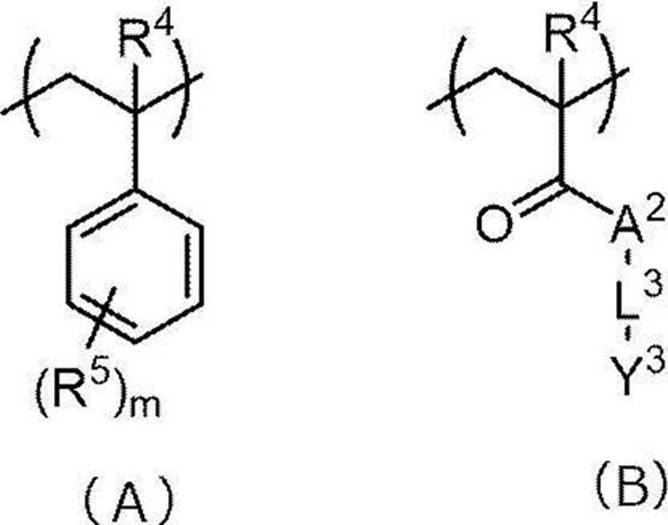
式中、R4は、それぞれ独立に、水素原子又はメチル基を表す。
R5は、それぞれ独立に、アルキル基、アルケニル基又はアルキニル基を表す。
mは、0~5の整数である。
A2は、単結合又は-O-を表す。
L3は、アルキレン基、アルケニレン基、アルキニレン基、-O-、及び-C(=O)-からなる群Bより選ばれる1種である2価の連結基、前記群Bより選ばれる2種以上を組み合わせた2価の連結基、又は単結合を表す。
Y3は、炭素数4~22のアルキル基、炭素数4~22のアルケニル基、炭素数4~22のアルキニル基、炭素数4~22のシクロアルキル基、又は炭素数6~22のアリール基を表す。 - 前記水溶性ポリマーBは、前記一般式(A)又は前記一般式(B)で表される構成単位として、下記一般式(a)で表される構成単位及び下記一般式(b-1)~(b-4)のいずれかで表される構成単位からなる群より選ばれる少なくとも1種の構成単位を含む、請求項2に記載のインク組成物。

式中、R5は、それぞれ独立に、水素原子又はメチル基を表す。
R6は、それぞれ独立に、アルキル基を表し、mは0~5の整数を表し、nは0~11の整数を表す。
L4は、それぞれ独立に、炭素数1~18のアルキレン基、-O-、及び-C(=O)-からなる群Cより選ばれる1種である2価の連結基、前記群Cより選ばれる2種以上を組合せた2価の連結基、又は単結合を表す。 - 前記水溶性ポリマーBは、前記一般式(a)で表される構成単位及び前記一般式(b-1)~(b-4)のいずれかで表される構成単位の合計の含有比率が、水溶性ポリマーBの全構成単位に対して5質量%~50質量%である、請求項3に記載のインク組成物。
- 前記水溶性ポリマーBの含有量が、インク組成物の全質量に対して1質量%~10質量%である、請求項1~請求項4のいずれか1項に記載のインク組成物。
- 前記水溶性ポリマーBの重量平均分子量が、5,000~100,000である、請求項1~請求項5のいずれか1項に記載のインク組成物。
- 前記水溶性ポリマーBの酸価が、28mgKOH/g~230mgKOH/gである、請求項1~請求項6のいずれか1項に記載のインク組成物。
- 前記水溶性ポリマーBは、前記酸基としてカルボン酸基を含み、
前記カルボン酸基の40モル%以上が塩基によって中和されている、請求項1~請求項7のいずれか1項に記載のインク組成物。 - 前記塩基が、アルカリ金属の水酸化物又は沸点が80℃以上である有機アミンである、請求項8に記載のインク組成物。
- 前記水溶性ポリマーBは、前記一般式(1)で表される構成単位の含有比率が、水溶性ポリマーBの全構成単位に対して、3質量%~45質量%である、請求項1~請求項9のいずれか1項に記載のインク組成物。
- 前記水溶性ポリマーBは、ガラス転移温度が80℃以上である、請求項1~請求項10のいずれか1項に記載のインク組成物。
- 前記インク組成物が、更に水溶性有機溶媒を含み、
前記水溶性有機溶媒が、110℃~240℃の沸点を有する第1の有機溶媒を含み、前記第1の有機溶媒の含有量に対する、245℃~300℃の沸点を有する第2の有機溶媒の含有量の質量比が、0~0.3である、
請求項1~請求項11のいずれか1項に記載のインク組成物。 - 前記第1の有機溶媒及び前記第2の有機溶媒の総量が、前記インク組成物の全質量に対して、5質量%~30質量%である請求項12に記載のインク組成物。
- 前記第1の有機溶媒及び前記第2の有機溶媒は、各々、エチレングリコール、ジエチレングリコール、プロピレングリコール、トリエチレングリコール、ジプロピレングリコール、及びグリセリン並びにこれらのアルキルエーテルからなる群より選ばれる少なくとも1種であるアルコール系有機溶媒を含み、
前記第1の有機溶媒及び前記第2の有機溶媒の総量中に占める前記アルコール系有機溶媒の割合が、90質量%以上である、
請求項12又は請求項13に記載のインク組成物。 - 請求項1~請求項14のいずれか1項に記載のインク組成物と、
水、並びに、多価金属塩、酸性化合物、及びカチオン性ポリマーからなる群より選ばれる少なくとも1種を含む処理液と、
を含む、インクセット。 - 前記酸性化合物が、1価~3価の酸を含む請求項15に記載のインクセット。
- 記録媒体上に、請求項1~請求項14のいずれか1項に記載のインク組成物を付与して画像を記録する工程を含む画像記録方法。
Priority Applications (4)
| Application Number | Priority Date | Filing Date | Title |
|---|---|---|---|
| JP2022503177A JP7376680B2 (ja) | 2020-02-28 | 2021-01-26 | インク組成物、インクセット及び画像記録方法 |
| EP21760126.9A EP4112308A4 (en) | 2020-02-28 | 2021-01-26 | INK COMPOSITION, INK SET AND IMAGE REGISTRATION METHOD |
| CN202180013741.1A CN115103885A (zh) | 2020-02-28 | 2021-01-26 | 油墨组合物、油墨组及图像记录方法 |
| US17/873,267 US20220380613A1 (en) | 2020-02-28 | 2022-07-26 | Ink composition, ink set, and image recording method |
Applications Claiming Priority (4)
| Application Number | Priority Date | Filing Date | Title |
|---|---|---|---|
| JP2020-034206 | 2020-02-28 | ||
| JP2020034206 | 2020-02-28 | ||
| JP2020145007 | 2020-08-28 | ||
| JP2020-145007 | 2020-08-28 |
Related Child Applications (1)
| Application Number | Title | Priority Date | Filing Date |
|---|---|---|---|
| US17/873,267 Continuation US20220380613A1 (en) | 2020-02-28 | 2022-07-26 | Ink composition, ink set, and image recording method |
Publications (1)
| Publication Number | Publication Date |
|---|---|
| WO2021171875A1 true WO2021171875A1 (ja) | 2021-09-02 |
Family
ID=77490433
Family Applications (1)
| Application Number | Title | Priority Date | Filing Date |
|---|---|---|---|
| PCT/JP2021/002676 Ceased WO2021171875A1 (ja) | 2020-02-28 | 2021-01-26 | インク組成物、インクセット及び画像記録方法 |
Country Status (5)
| Country | Link |
|---|---|
| US (1) | US20220380613A1 (ja) |
| EP (1) | EP4112308A4 (ja) |
| JP (1) | JP7376680B2 (ja) |
| CN (1) | CN115103885A (ja) |
| WO (1) | WO2021171875A1 (ja) |
Citations (14)
| Publication number | Priority date | Publication date | Assignee | Title |
|---|---|---|---|---|
| JPS5459936A (en) | 1977-10-03 | 1979-05-15 | Canon Inc | Recording method and device therefor |
| JPH0132895B2 (ja) | 1982-05-28 | 1989-07-11 | Tokyo Shibaura Electric Co | |
| JPH07242849A (ja) * | 1994-03-07 | 1995-09-19 | Mita Ind Co Ltd | インク |
| JPH10230201A (ja) | 1997-02-20 | 1998-09-02 | Ricoh Co Ltd | 液体塗布装置 |
| JP2003306623A (ja) | 2002-04-16 | 2003-10-31 | Fuji Photo Film Co Ltd | 水性インク |
| JP2007100071A (ja) | 2005-09-07 | 2007-04-19 | Fujifilm Corp | インクセット、画像記録方法及び装置 |
| JP2010221415A (ja) | 2009-03-19 | 2010-10-07 | Fujifilm Corp | インクジェット画像記録方法 |
| JP2012122060A (ja) | 2010-11-18 | 2012-06-28 | Canon Inc | インクジェット用のインク、インクカートリッジ、及びインクジェット記録方法 |
| JP2013159689A (ja) | 2012-02-03 | 2013-08-19 | Fujifilm Corp | インク組成物、画像形成方法及びそれを用いた印画物 |
| WO2013180074A1 (ja) | 2012-05-29 | 2013-12-05 | 富士フイルム株式会社 | インクジェット記録用メンテナンス液、インクジェット記録用インクセット、画像形成方法、及びメンテナンス方法 |
| JP2014205766A (ja) * | 2013-04-12 | 2014-10-30 | 東洋インキScホールディングス株式会社 | インクジェット用水性インキ |
| JP2016194041A (ja) * | 2015-03-31 | 2016-11-17 | 東洋インキScホールディングス株式会社 | インクジェット用インク、印刷物、およびインクジェット記録方法 |
| JP2017101125A (ja) * | 2015-11-30 | 2017-06-08 | 株式会社リコー | インク、及びインクジェット記録方法 |
| JP2017141382A (ja) * | 2016-02-12 | 2017-08-17 | セイコーエプソン株式会社 | 放射線硬化型インクジェット組成物及びインクジェット記録方法 |
Family Cites Families (15)
| Publication number | Priority date | Publication date | Assignee | Title |
|---|---|---|---|---|
| JPH10120952A (ja) * | 1996-10-24 | 1998-05-12 | Seiko Epson Corp | インクジェット記録用インク組成物および記録方法 |
| US6099632A (en) * | 1997-07-24 | 2000-08-08 | Orient Chemical Industries, Ltd. | Aqueous pigment ink composition |
| US7414082B2 (en) * | 2000-06-14 | 2008-08-19 | Mitsubishi Chemical Corporation | Recording liquid and ink jet recording method |
| JP2006199888A (ja) * | 2005-01-24 | 2006-08-03 | Seiko Epson Corp | 水性インク組成物及びそれを用いたインクジェット記録方法、並びに記録物 |
| JP2010030305A (ja) | 2009-09-02 | 2010-02-12 | Seiko Epson Corp | インクセット |
| EP2762977B1 (en) * | 2011-11-04 | 2017-09-27 | FUJIFILM Corporation | Method for recycling plate-making processing waste solution |
| JP5666498B2 (ja) * | 2012-03-22 | 2015-02-12 | 富士フイルム株式会社 | インク組成物、インクセット、及び、画像形成方法 |
| JP5840797B2 (ja) * | 2012-09-24 | 2016-01-06 | 富士フイルム株式会社 | インク組成物、インクセット、及び画像形成方法 |
| JP5862913B1 (ja) * | 2015-03-20 | 2016-02-16 | 株式会社Dnpファインケミカル | インク組成物及びそれを用いたインクジェット記録方法 |
| US10655030B2 (en) * | 2015-06-25 | 2020-05-19 | Kao Corporation | Water-based ink |
| JP6164323B1 (ja) * | 2016-03-14 | 2017-07-19 | 東洋インキScホールディングス株式会社 | 水性インクジェットインキ |
| JPWO2017212848A1 (ja) * | 2016-06-07 | 2019-04-25 | コニカミノルタ株式会社 | インクジェット記録方法 |
| JP6866597B2 (ja) * | 2016-09-29 | 2021-04-28 | セイコーエプソン株式会社 | 反応液及びインクジェット記録方法 |
| JP7182385B2 (ja) * | 2017-07-03 | 2022-12-02 | 花王株式会社 | 水系インク |
| WO2019189817A1 (ja) * | 2018-03-30 | 2019-10-03 | 富士フイルム株式会社 | インクジェット記録用インク、インクジェット記録用インクの製造方法及び画像記録方法 |
-
2021
- 2021-01-26 CN CN202180013741.1A patent/CN115103885A/zh active Pending
- 2021-01-26 EP EP21760126.9A patent/EP4112308A4/en active Pending
- 2021-01-26 WO PCT/JP2021/002676 patent/WO2021171875A1/ja not_active Ceased
- 2021-01-26 JP JP2022503177A patent/JP7376680B2/ja active Active
-
2022
- 2022-07-26 US US17/873,267 patent/US20220380613A1/en active Pending
Patent Citations (14)
| Publication number | Priority date | Publication date | Assignee | Title |
|---|---|---|---|---|
| JPS5459936A (en) | 1977-10-03 | 1979-05-15 | Canon Inc | Recording method and device therefor |
| JPH0132895B2 (ja) | 1982-05-28 | 1989-07-11 | Tokyo Shibaura Electric Co | |
| JPH07242849A (ja) * | 1994-03-07 | 1995-09-19 | Mita Ind Co Ltd | インク |
| JPH10230201A (ja) | 1997-02-20 | 1998-09-02 | Ricoh Co Ltd | 液体塗布装置 |
| JP2003306623A (ja) | 2002-04-16 | 2003-10-31 | Fuji Photo Film Co Ltd | 水性インク |
| JP2007100071A (ja) | 2005-09-07 | 2007-04-19 | Fujifilm Corp | インクセット、画像記録方法及び装置 |
| JP2010221415A (ja) | 2009-03-19 | 2010-10-07 | Fujifilm Corp | インクジェット画像記録方法 |
| JP2012122060A (ja) | 2010-11-18 | 2012-06-28 | Canon Inc | インクジェット用のインク、インクカートリッジ、及びインクジェット記録方法 |
| JP2013159689A (ja) | 2012-02-03 | 2013-08-19 | Fujifilm Corp | インク組成物、画像形成方法及びそれを用いた印画物 |
| WO2013180074A1 (ja) | 2012-05-29 | 2013-12-05 | 富士フイルム株式会社 | インクジェット記録用メンテナンス液、インクジェット記録用インクセット、画像形成方法、及びメンテナンス方法 |
| JP2014205766A (ja) * | 2013-04-12 | 2014-10-30 | 東洋インキScホールディングス株式会社 | インクジェット用水性インキ |
| JP2016194041A (ja) * | 2015-03-31 | 2016-11-17 | 東洋インキScホールディングス株式会社 | インクジェット用インク、印刷物、およびインクジェット記録方法 |
| JP2017101125A (ja) * | 2015-11-30 | 2017-06-08 | 株式会社リコー | インク、及びインクジェット記録方法 |
| JP2017141382A (ja) * | 2016-02-12 | 2017-08-17 | セイコーエプソン株式会社 | 放射線硬化型インクジェット組成物及びインクジェット記録方法 |
Non-Patent Citations (2)
| Title |
|---|
| "JAPAN TAPPI Pulp and Paper Test Method", 2000, JAPAN TECHNICAL ASSOCIATION OF THE PULP AND PAPER |
| J. PHYS. CHEM. A, vol. 115, 2011, pages 6641 - 6645 |
Also Published As
| Publication number | Publication date |
|---|---|
| JP7376680B2 (ja) | 2023-11-08 |
| EP4112308A1 (en) | 2023-01-04 |
| CN115103885A (zh) | 2022-09-23 |
| US20220380613A1 (en) | 2022-12-01 |
| EP4112308A4 (en) | 2023-07-26 |
| JPWO2021171875A1 (ja) | 2021-09-02 |
Similar Documents
| Publication | Publication Date | Title |
|---|---|---|
| EP2535380B1 (en) | Ink composition, ink set, and image forming method | |
| US8678544B2 (en) | Ink set and image recording method | |
| JP6432895B2 (ja) | 水性インク組成物、インクセット、画像形成方法、及び樹脂微粒子 | |
| EP2810993A1 (en) | Water-based ink composition and image formation method | |
| JP2002121434A (ja) | インクジェット記録用水性カラーインクセット及びこれを用いたインクジェット記録方法 | |
| JP7750857B2 (ja) | 浸透性基材用インクセット及び画像記録方法 | |
| JP7376680B2 (ja) | インク組成物、インクセット及び画像記録方法 | |
| JP7395009B2 (ja) | インクジェット用イエローインク、画像記録方法、及び画像記録物 | |
| JP6766252B2 (ja) | 水性インク組成物、インクセット、画像形成方法、及びインク用樹脂微粒子 | |
| JP5885968B2 (ja) | 黒色系インク組成物、インクセット及び画像形成方法 | |
| JP7376681B2 (ja) | インクセット及び画像記録方法 | |
| JP2013173902A (ja) | インクジェット記録用インク組成物 | |
| EP4344893B1 (en) | Image recording method | |
| JP2011195785A (ja) | インク組成物、インクセット、及び画像形成方法 | |
| WO2026094535A1 (ja) | インク、画像記録方法、及びラミネート体の製造方法 | |
| WO2025028047A1 (ja) | 画像記録方法 |
Legal Events
| Date | Code | Title | Description |
|---|---|---|---|
| 121 | Ep: the epo has been informed by wipo that ep was designated in this application |
Ref document number: 21760126 Country of ref document: EP Kind code of ref document: A1 |
|
| ENP | Entry into the national phase |
Ref document number: 2022503177 Country of ref document: JP Kind code of ref document: A |
|
| NENP | Non-entry into the national phase |
Ref country code: DE |
|
| ENP | Entry into the national phase |
Ref document number: 2021760126 Country of ref document: EP Effective date: 20220928 |