WO2021193228A1 - 使い捨て着用物品 - Google Patents
使い捨て着用物品 Download PDFInfo
- Publication number
- WO2021193228A1 WO2021193228A1 PCT/JP2021/010574 JP2021010574W WO2021193228A1 WO 2021193228 A1 WO2021193228 A1 WO 2021193228A1 JP 2021010574 W JP2021010574 W JP 2021010574W WO 2021193228 A1 WO2021193228 A1 WO 2021193228A1
- Authority
- WO
- WIPO (PCT)
- Prior art keywords
- lotion
- woven fabric
- hydrophilic
- sheet
- top sheet
- Prior art date
- Legal status (The legal status is an assumption and is not a legal conclusion. Google has not performed a legal analysis and makes no representation as to the accuracy of the status listed.)
- Ceased
Links
Images


Classifications
-
- A—HUMAN NECESSITIES
- A61—MEDICAL OR VETERINARY SCIENCE; HYGIENE
- A61F—FILTERS IMPLANTABLE INTO BLOOD VESSELS; PROSTHESES; DEVICES PROVIDING PATENCY TO, OR PREVENTING COLLAPSING OF, TUBULAR STRUCTURES OF THE BODY, e.g. STENTS; ORTHOPAEDIC, NURSING OR CONTRACEPTIVE DEVICES; FOMENTATION; TREATMENT OR PROTECTION OF EYES OR EARS; BANDAGES, DRESSINGS OR ABSORBENT PADS; FIRST-AID KITS
- A61F13/00—Bandages or dressings; Absorbent pads
- A61F13/15—Absorbent pads, e.g. sanitary towels, swabs or tampons for external or internal application to the body; Supporting or fastening means therefor; Tampon applicators
- A61F13/51—Absorbent pads, e.g. sanitary towels, swabs or tampons for external or internal application to the body; Supporting or fastening means therefor; Tampon applicators characterised by the outer layers of the pads
- A61F13/511—Topsheet, i.e. the permeable cover or layer facing the skin
- A61F13/51113—Topsheet, i.e. the permeable cover or layer facing the skin comprising an additive, e.g. lotion or odour control
-
- A—HUMAN NECESSITIES
- A61—MEDICAL OR VETERINARY SCIENCE; HYGIENE
- A61F—FILTERS IMPLANTABLE INTO BLOOD VESSELS; PROSTHESES; DEVICES PROVIDING PATENCY TO, OR PREVENTING COLLAPSING OF, TUBULAR STRUCTURES OF THE BODY, e.g. STENTS; ORTHOPAEDIC, NURSING OR CONTRACEPTIVE DEVICES; FOMENTATION; TREATMENT OR PROTECTION OF EYES OR EARS; BANDAGES, DRESSINGS OR ABSORBENT PADS; FIRST-AID KITS
- A61F13/00—Bandages or dressings; Absorbent pads
- A61F13/15—Absorbent pads, e.g. sanitary towels, swabs or tampons for external or internal application to the body; Supporting or fastening means therefor; Tampon applicators
- A61F13/51—Absorbent pads, e.g. sanitary towels, swabs or tampons for external or internal application to the body; Supporting or fastening means therefor; Tampon applicators characterised by the outer layers of the pads
- A61F13/511—Topsheet, i.e. the permeable cover or layer facing the skin
- A61F13/51121—Topsheet, i.e. the permeable cover or layer facing the skin characterised by the material
-
- A—HUMAN NECESSITIES
- A61—MEDICAL OR VETERINARY SCIENCE; HYGIENE
- A61F—FILTERS IMPLANTABLE INTO BLOOD VESSELS; PROSTHESES; DEVICES PROVIDING PATENCY TO, OR PREVENTING COLLAPSING OF, TUBULAR STRUCTURES OF THE BODY, e.g. STENTS; ORTHOPAEDIC, NURSING OR CONTRACEPTIVE DEVICES; FOMENTATION; TREATMENT OR PROTECTION OF EYES OR EARS; BANDAGES, DRESSINGS OR ABSORBENT PADS; FIRST-AID KITS
- A61F13/00—Bandages or dressings; Absorbent pads
- A61F13/15—Absorbent pads, e.g. sanitary towels, swabs or tampons for external or internal application to the body; Supporting or fastening means therefor; Tampon applicators
- A61F13/51—Absorbent pads, e.g. sanitary towels, swabs or tampons for external or internal application to the body; Supporting or fastening means therefor; Tampon applicators characterised by the outer layers of the pads
- A61F13/511—Topsheet, i.e. the permeable cover or layer facing the skin
- A61F13/51113—Topsheet, i.e. the permeable cover or layer facing the skin comprising an additive, e.g. lotion or odour control
- A61F2013/51117—Topsheet, i.e. the permeable cover or layer facing the skin comprising an additive, e.g. lotion or odour control the lotion having skin care properties
-
- A—HUMAN NECESSITIES
- A61—MEDICAL OR VETERINARY SCIENCE; HYGIENE
- A61F—FILTERS IMPLANTABLE INTO BLOOD VESSELS; PROSTHESES; DEVICES PROVIDING PATENCY TO, OR PREVENTING COLLAPSING OF, TUBULAR STRUCTURES OF THE BODY, e.g. STENTS; ORTHOPAEDIC, NURSING OR CONTRACEPTIVE DEVICES; FOMENTATION; TREATMENT OR PROTECTION OF EYES OR EARS; BANDAGES, DRESSINGS OR ABSORBENT PADS; FIRST-AID KITS
- A61F13/00—Bandages or dressings; Absorbent pads
- A61F13/15—Absorbent pads, e.g. sanitary towels, swabs or tampons for external or internal application to the body; Supporting or fastening means therefor; Tampon applicators
- A61F13/51—Absorbent pads, e.g. sanitary towels, swabs or tampons for external or internal application to the body; Supporting or fastening means therefor; Tampon applicators characterised by the outer layers of the pads
- A61F13/511—Topsheet, i.e. the permeable cover or layer facing the skin
- A61F13/51121—Topsheet, i.e. the permeable cover or layer facing the skin characterised by the material
- A61F2013/51139—Topsheet, i.e. the permeable cover or layer facing the skin characterised by the material being woven or knitted fabrics
Definitions
- the present inventor obtained the following findings while studying a top sheet made of a non-woven fabric containing a hydrophilic lotion containing water. That is, when a hydrophilic lotion containing water is applied to a top sheet made of a short fiber non-woven fabric, the hydrophilic lotion is likely to move to the absorber side after production, and the hydrophilic lotion is less likely to be retained on the top sheet than expected. It was considered that the friction reduction effect was lower than expected.
- the disposable wear articles described below are based on such findings.
- the hydrophilic lotion contains 70 to 90% by weight of glycerin and 10 to 30% by weight of water.
- the lotion-containing region has a hydrophilic lotion content of 5 to 15 g / m 2 per unit area.
- the disposable wear article of the second aspect is a hydrophilic lotion content of 5 to 15 g / m 2 per unit area.
- the short fiber non-woven fabric is a hydrophilic fiber non-woven fabric in which a hydrophilic agent is applied to a hydrophobic resin fiber.
- a disposable wearable article according to any one of the first to third aspects.
- the hydrophilic lotion has a viscosity of 150 to 400 mPa ⁇ s at a temperature of 20 ° C.
- a disposable wearable article according to any one of the first to fourth aspects.
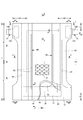
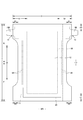
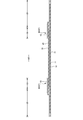
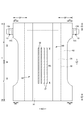
- FIGS. 1 to 5 show tape-type disposable diapers as an example of disposable wear items.
- reference numeral X indicates the total width of the diaper excluding the connecting tape
- reference numeral Y indicates the total length of the diaper.
- the dotted pattern portion in the cross-sectional view shows an adhesive as a joining means for joining each constituent member.
- Known hot melt adhesives include slot coating, continuous linear or dotted bead coating, spiral, Z, wavy and other spray coating, and pattern coating (transfer of hot melt adhesive by letterpress method). It can be applied by the method. Instead of or in conjunction with this, at the fixed portion of the elastic member, a hot melt adhesive can be applied to the outer peripheral surface of the elastic member to fix the elastic member to the adjacent member.
- the absorbent body 56 built in the range including the crotch part, the liquid permeable top sheet 30 covering the front side of the absorbent body 56, and the liquid permeable covering the back side of the absorbent body 56 are impervious. It has a sheet 11 and an exterior non-woven fabric 12 that covers the back side of the liquid-impermeable sheet 11 and constitutes the outer surface of the product.
- the planar shape of the absorber 56 can be appropriately determined, and can be a rectangular shape or a shape in which the middle of the LD in the front-rear direction is constricted along the circumference of the leg.
- the absorber 56 may contain highly absorbent polymer particles in part or all of it.
- the highly absorbent polymer particles include "powder” in addition to "particles".
- the particle size of the highly absorbent polymer particles is not particularly limited, but for example, sieving (shaking for 5 minutes) using a standard sieve (JIS Z8801-1: 2006) of 500 ⁇ m, and particles falling under the sieve by this sieving.
- the material of the highly absorbent polymer particles can be used without particular limitation, but a material having a water absorption of 40 g / g or more is preferable.
- Highly absorbent polymer particles include starch-based, cellulosic-based and synthetic polymer-based ones, which are starch-acrylic acid (salt) graft copolymers, saponified starch-acrylonitrile copolymers, and crosslinked sodium carboxymethyl cellulose.
- a substance or an acrylic acid (salt) polymer or the like can be used.
- As the shape of the highly absorbent polymer particles a powder or granular material that is usually used is preferable, but other shapes can also be used.
- the highly absorbent polymer particles those having a water absorption rate of 70 seconds or less, particularly 40 seconds or less, are preferably used. If the water absorption rate is too slow, so-called reversion, in which the liquid supplied into the absorber 56 returns to the outside of the absorber 56, is likely to occur.
- the highly absorbent polymer particles those having a gel strength of 1000 Pa or more are preferably used. As a result, even when the bulky absorber 56 is used, the sticky feeling after liquid absorption can be effectively suppressed.
- the basis weight of the highly absorbent polymer particles can be appropriately determined according to the amount of absorption required for the application of the absorber 56. Therefore, although it cannot be said unconditionally, it can usually be set to 50 to 350 g / m 2 .
- the absorber 56 can be incorporated as an absorbent element 50 wrapped in a packaging sheet 58 in order to prevent the highly absorbent polymer particles from coming off or to improve the shape retention of the absorber 56.
- tissue paper particularly crepe paper, non-woven fabric, polylami non-woven fabric, a sheet having small holes, or the like can be used. However, it is desirable that the sheet does not allow the highly absorbent polymer particles to escape.
- a non-woven fabric is used instead of the crepe paper, a hydrophilic SMMS (spunbond / meltblown / meltblown / spunbond) non-woven fabric is particularly preferable, and polypropylene, polyethylene / polypropylene or the like can be used as the material.
- the fiber basis weight is preferably 5 to 40 g / m 2 , especially 10 to 30 g / m 2 .
- the packaging sheet 58 has a structure in which one sheet wraps the entire absorber 56, or a plurality of sheets such as two upper and lower sheets may wrap the entire absorber 56.
- the packaging sheet 58 may be omitted.
- the top sheet 30 extends from the front end to the rear end of the product in the front-rear direction and extends laterally from the absorber 56 in the width direction WD.
- the starting point of the rising gather 60 described later is more than the side edge of the absorber 56. If it is located on the center side of the WD in the width direction, or if necessary, the width of the top sheet 30 can be made shorter than the total width of the absorber 56, and the like can be appropriately deformed.
- the top sheet 30 has a skin contact area in contact with the wearer's skin, and is preferably a non-woven fabric from the viewpoint of liquid permeability and touch.
- Various non-woven fabrics can be used for the top sheet 30, but in consideration of cushioning properties, flexibility, permeability of loose stools (watery stools and muddy stools), etc., air through is better than long fiber (continuous fiber) non-woven fabrics.
- Short-fiber non-woven fabrics such as non-woven fabrics are preferable, and usually short-fiber non-woven fabrics having a fineness of 1 to 10 dtex, a grain size of 10 to 30 g / m 2 , and a thickness of about 0.4 to 1.4 mm are suitable.
- the fiber length of the short-fiber non-woven fabric is not particularly limited, but is preferably about 0.5 to 1.0 mm.
- the top sheet 30 is a perforated non-woven fabric having hole arrangement regions in which holes 14 penetrating the front and back surfaces are arranged in a predetermined pattern.
- the shape, dimensions, arrangement pattern, etc. of the holes 14 can be appropriately determined.
- the holes 14 are shown only in a part D of the top sheet 30, but this does not indicate the hole arrangement region.
- the hole arrangement region may be only the intermediate region of the front-rear direction LD in the top sheet 30 or only the intermediate region of the width direction WD in the top sheet 30 (there is a region having no hole 14 in a part). May be). Further, the hole arrangement region can be the entire top sheet 30. That is, as long as the hole arrangement region is provided in the skin contact region, it may extend to other regions (for example, regions to which the gather sheets 62 are adhered on both sides in the width direction WD).
- each hole 14 can be appropriately determined.
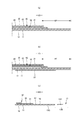
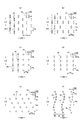
- the holes 14 have an elongated shape as shown in FIGS. 6 (a) and 6 (b), and have a perfect circular shape as shown in FIGS. 6 (c) (e) (f), 7 and 8 (FIG. 6). It can be any shape such as an ellipse, a triangle, a rectangle, a polygon such as a rhombus, a star shape, and a cloud shape as shown in d). Although not shown, holes 14 having different shapes may be mixed.
- the dimensions of the individual holes 14 are not particularly limited, but the dimensions in the front-rear direction (dimensions of the longest portion) 14L are preferably 0.5 to 2.0 mm, particularly 0.5 to 1.0 mm, and are preferably in the width direction.
- the dimension (dimension of the longest portion) 14W is preferably 0.5 to 2.0 mm, particularly 0.5 to 1.0 mm.
- shape of the hole 14 is long in the front-rear direction (a shape in which the total length in one direction is longer than the total length in the direction orthogonal to the total length in one direction) such as an elongated hole shape, an elliptical shape, a rectangle, a rhombus, etc. Is preferably 1.2 to 2.5 times the dimension in the width direction orthogonal to this.
- the longitudinal direction of the hole 14 is preferably the MD direction of the non-woven fabric, but it may be the CD direction or an oblique direction inclined with respect to these.
- the MD direction of the perforated non-woven fabric forming the top sheet 30 is equal to the LD in the front-rear direction.
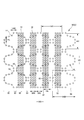
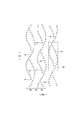
- the arrangement pattern of the holes 14 can be appropriately determined. For example, as shown in FIGS. 6A, 6C, and 6D, in the arrangement pattern of the holes 14, rows of holes 14 linearly arranged at predetermined intervals in the front-rear direction LD have a predetermined interval in the width direction WD. It is preferable that the matrix is vacant and repeated. In this case, as shown in FIGS. 6A and 6D, the arrangement is such that the distance between the front-rear LDs of the holes 14 14y is shorter than the distance 14x in the width direction WD of the holes 14, and the arrangement is shown in FIG. 6C.
- the cross-sectional shape of the hole 14 is not particularly limited.
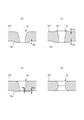
- the hole 14 is a punched type hole whose peripheral edge is formed by a cut end of a fiber, there is almost no cut end of the fiber on the peripheral edge of the hole 14, and a pin is inserted between the fibers and expanded. It may be a non-punched type hole (high fiber density at the edge) formed in the above.
- the punched-type hole has a diameter of the hole 14 that becomes smaller toward the middle in the thickness direction, but is not shown, but becomes smaller toward one side in the thickness direction. You may.
- the non-punched type hole 14 becomes smaller as the diameter of the hole 14 increases from the pin insertion side to the opposite side. This includes those in which the diameter of the holes 14 continues to decrease over the entire thickness direction of the non-woven fabric layer, and those in which the decrease in the diameter of the holes 14 almost disappears in the middle of the thickness direction.
- fibers are extruded from the edge of the hole 14 on the side opposite to the pin insertion side to the side opposite to the pin insertion side.
- a portion (burr) 14e is formed and a protruding portion 14e is not formed on the pin insertion side, and as shown in FIG.
- fibers are pin-inserted at the edge of the hole 14 on the side opposite to the pin insertion side.
- a projecting portion 14e extruded to the opposite side to the side is formed, and a projecting portion 14e formed by extruding fibers to the pin insertion side is formed on the pin insertion side.
- the protruding portion 14e has a substantially uniform protruding height 14h, and as shown in FIG. 9C, the protruding portion 14e has a protrusion 14e.
- a facing portion having the highest protruding height 14i and a facing portion facing in a direction orthogonal to the facing portion having the lowest protruding height 14j are included.
- the protruding portion 14e has a cylindrical shape continuously in the circumferential direction of the hole, but the protruding portion 14e of a part or all of the hole 14 is formed only in a part of the circumferential direction of the hole 14. May be good.
- the protrusion heights 14h, 14i, 14j (apparent heights measured using an optical microscope without applying pressure) are preferably about 0.2 to 1.2 mm.
- the highest protruding height 14i in the protruding portion 14e is preferably about 1.1 to 1.4 times the lowest protruding height 14j.
- the protruding height of the protruding portion 14e may change in the circumferential direction of the hole 14.
- the perforated non-woven fabric has a fineness of 0.1 to 5.0 dtex (more preferably 1.0 to 3.0 dtex), a texture of 15 to 20 g / m 2 (more preferably 15 to 18 g / m 2 ), and a thickness of 0.
- a long fiber non-woven fabric of 3 to 0.8 mm more preferably 0.3 to 0.6 mm
- the protruding portion 14e formed at the edge of the hole 14 becomes low. ..
- the fibers are less likely to be extruded in the thickness direction when the pin insertion holes are formed.
- the intermediate sheet 40 in the illustrated example is arranged in the center shorter than the width of the absorber 56, it may be provided over the entire width. Further, the intermediate sheet 40 may be provided over the entire length of the diaper, but may be provided only in the intermediate portion of the front-rear direction LD including the excretion position as shown in the illustrated example.
- the liquid-impermeable sheet 11 is not particularly limited, but is preferably one having moisture permeability.
- the liquid-impermeable sheet 11 is microporous obtained by kneading an inorganic filler in an olefin resin such as polyethylene or polypropylene, forming the sheet, and then stretching the sheet in the uniaxial or biaxial direction.
- the sheet can be preferably used.
- a non-woven fabric as a base material with improved waterproofness can also be used as the liquid-impermeable sheet 11.
- the exterior non-woven fabric 12 covers the entire back side of the liquid-impermeable sheet 11 and gives the outer surface of the product a cloth-like appearance.
- the fiber basis weight of the exterior nonwoven fabric 12 is preferably 10 to 50 g / m 2 , particularly 15 to 30 g / m 2 , but is not limited thereto.
- the exterior non-woven fabric 12 can be omitted, in which case the liquid-impermeable sheet 11 can be extended to the side edge of the product.
- rising gathers 60 that stand up on the skin side of the wearer are provided on both sides of the surface widthwise WD. Is preferable. Of course, the rising gather 60 can be omitted.
- the rising gather 60 of the illustrated example is composed of a gather sheet 62 substantially continuous in the width direction WD and an elongated gather elastic member 63 fixed to the gather sheet 62 in an extended state along the front-rear direction LD. ing.
- a water-repellent non-woven fabric can be used as the gather sheet 62, and a rubber thread or the like can be used as the gather elastic member 63.
- a plurality of elastic members may be provided on each side, and only one elastic member may be provided on each side.
- a side elastic member 64 made of an elongated elastic member such as rubber thread is fixed to each side flap SF in a state of being extended along the front-rear direction LD, whereby the leg circumference portion of each side flap SF is flat. It is configured as a gather. As shown in the illustrated example, the side elastic member 64 is provided between the gather sheet 62 and the liquid impermeable sheet 11 on the outside of the joint portion of the gather sheet 62 in the width direction near the joint start end, and the side flap SF. It can also be provided between the liquid-impermeable sheet 11 and the exterior non-woven fabric 12 in the above.
- a plurality of side elastic members 64 may be provided on each side as shown in the illustrated example, or only one side elastic member 64 may be provided on each side. Of course, the side elastic member 64 (flat gather) can be omitted.
- the flat gather is a portion on which the contraction force of the side elastic member 64 acts (the portion in which the side elastic member 64 is shown). Therefore, in addition to the form in which the side elastic member 64 exists only in the flat gathered portion, the side elastic member 64 exists on the front side, the rear side, or both sides of the flat gathered portion, but the side elastic member 64 exists in other than the flat gathered portion. When the member is finely cut in one place or many places, is not fixed to the sheet sandwiching the side elastic member 64, or both, the contraction force acts on the parts other than the flat gather. It also includes a structure in which the contractile force of the side elastic member 64 acts only on the flat gathered portion (substantially equivalent to not providing the elastic member).
- This tape-type disposable diaper has rear wings 81 protruding to both the left and right sides at a position separated from the center in the front-rear direction of the product.
- Both side edges of the product between the front wing 80 and the rear wing 81 are, for example, ⁇ 5 mm in the direction orthogonal to the center, centered on the direction in which the acute angle side crossing angle with respect to the anterior-posterior LD is less than ⁇ 2 degrees. It can have a substantially linear portion that passes through a range of widths. Both side edges of the product between the front wing 80 and the rear wing 81 may be wavy or arcuate (not shown) or linear as in the illustrated example.
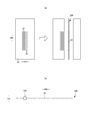
- the upper limit of the dimension 32L of the lotion-containing region 32 in the MD direction is the overall length Y of the product, but it may be shorter than this.
- the dimension 32W of the lotion-containing region 32 in the CD direction is more preferably 10 mm or more.
- the upper limit of the dimension 32W in the CD direction of the lotion-containing region 32 is the dimension of the width direction WD of the top sheet 30, but it may be shorter than this.
- the "surface moisture content” is an average value calculated by measuring any three locations in the lotion-containing region 32 using a moisture checker (MY-808S) manufactured by Scarar. After each measurement, the hydrophilic lotion adhering to the measurement surface of the moisture checker is sufficiently wiped off before the next measurement is performed.
- the numerical value is read at intervals of 10 minutes, and the time when the numerical value does not fluctuate is regarded as the equilibrium state of the water vapor pressure in the detector, and the numerical value at that time is used as the measured value of the sample.
- Each sample is measured three times, and the average value of the three measured values is taken as the water activity value.
Landscapes
- Health & Medical Sciences (AREA)
- Epidemiology (AREA)
- Engineering & Computer Science (AREA)
- Biomedical Technology (AREA)
- Heart & Thoracic Surgery (AREA)
- Vascular Medicine (AREA)
- Life Sciences & Earth Sciences (AREA)
- Animal Behavior & Ethology (AREA)
- General Health & Medical Sciences (AREA)
- Public Health (AREA)
- Veterinary Medicine (AREA)
- Absorbent Articles And Supports Therefor (AREA)
Priority Applications (4)
| Application Number | Priority Date | Filing Date | Title |
|---|---|---|---|
| US17/800,765 US12390375B2 (en) | 2020-03-25 | 2021-03-16 | Disposable wearable article |
| CN202180012335.3A CN115087415A (zh) | 2020-03-25 | 2021-03-16 | 一次性穿着物品 |
| EP21776528.8A EP4088700A4 (de) | 2020-03-25 | 2021-03-16 | Wearable-einwegartikel |
| KR1020227027047A KR20220159354A (ko) | 2020-03-25 | 2021-03-16 | 일회용 착용 물품 |
Applications Claiming Priority (2)
| Application Number | Priority Date | Filing Date | Title |
|---|---|---|---|
| JP2020-054788 | 2020-03-25 | ||
| JP2020054788 | 2020-03-25 |
Publications (1)
| Publication Number | Publication Date |
|---|---|
| WO2021193228A1 true WO2021193228A1 (ja) | 2021-09-30 |
Family
ID=77892071
Family Applications (1)
| Application Number | Title | Priority Date | Filing Date |
|---|---|---|---|
| PCT/JP2021/010574 Ceased WO2021193228A1 (ja) | 2020-03-25 | 2021-03-16 | 使い捨て着用物品 |
Country Status (7)
| Country | Link |
|---|---|
| US (1) | US12390375B2 (de) |
| EP (1) | EP4088700A4 (de) |
| JP (1) | JP7788217B2 (de) |
| KR (1) | KR20220159354A (de) |
| CN (1) | CN115087415A (de) |
| TW (1) | TW202135759A (de) |
| WO (1) | WO2021193228A1 (de) |
Families Citing this family (2)
| Publication number | Priority date | Publication date | Assignee | Title |
|---|---|---|---|---|
| KR102597383B1 (ko) * | 2018-03-20 | 2023-11-01 | 다이오 페이퍼 코퍼레이션 | 테이프 타입 일회용 기저귀 |
| JP6488040B1 (ja) * | 2018-03-20 | 2019-03-20 | 大王製紙株式会社 | テープタイプ使い捨ておむつ |
Citations (7)
| Publication number | Priority date | Publication date | Assignee | Title |
|---|---|---|---|---|
| JPH0852175A (ja) | 1994-06-24 | 1996-02-27 | Mcneil Ppc Inc | 吸収材製品が示す摩擦係数を低くする方法およびそれで製造したワツクス被覆製品 |
| JP2002509457A (ja) | 1996-12-03 | 2002-03-26 | ザ、プロクター、エンド、ギャンブル、カンパニー | スキンケア組成物が上に配置されているカフスを有する吸収体 |
| JP2003526468A (ja) * | 2000-03-15 | 2003-09-09 | ザ、プロクター、エンド、ギャンブル、カンパニー | ローション耐性の接着剤を有する吸収性物品 |
| JP2010526630A (ja) | 2007-05-15 | 2010-08-05 | ザ プロクター アンド ギャンブル カンパニー | 親水性ローション及びハイバリアカフを有する吸収性物品 |
| JP2017184962A (ja) * | 2016-04-04 | 2017-10-12 | 株式会社リブドゥコーポレーション | 吸収性物品 |
| JP2018513749A (ja) * | 2015-04-29 | 2018-05-31 | ザ プロクター アンド ギャンブル カンパニー | 処理された内側表面を有するベルト |
| JP2019170534A (ja) | 2018-03-27 | 2019-10-10 | 花王株式会社 | 吸収性物品及び吸収性物品用の表面シートの製造方法 |
Family Cites Families (13)
| Publication number | Priority date | Publication date | Assignee | Title |
|---|---|---|---|---|
| US5176672A (en) * | 1990-11-13 | 1993-01-05 | Kimberly-Clark Corporation | Pocket-like diaper or absorbent article |
| US5192606A (en) * | 1991-09-11 | 1993-03-09 | Kimberly-Clark Corporation | Absorbent article having a liner which exhibits improved softness and dryness, and provides for rapid uptake of liquid |
| US5643588A (en) * | 1994-11-28 | 1997-07-01 | The Procter & Gamble Company | Diaper having a lotioned topsheet |
| US5607760A (en) * | 1995-08-03 | 1997-03-04 | The Procter & Gamble Company | Disposable absorbent article having a lotioned topsheet containing an emollient and a polyol polyester immobilizing agent |
| CN1198547C (zh) * | 1997-11-14 | 2005-04-27 | 宝洁公司 | 多孔顶片上具有护肤组合物的一次性吸湿用品 |
| CA2357516A1 (en) * | 2000-09-28 | 2002-03-28 | Uni-Charm Corporation | Absorbent article and barrier agent for absorbent article |
| US6756520B1 (en) * | 2000-10-20 | 2004-06-29 | Kimberly-Clark Worldwide, Inc. | Hydrophilic compositions for use on absorbent articles to enhance skin barrier |
| JP4471624B2 (ja) * | 2003-02-06 | 2010-06-02 | 花王株式会社 | 吸収性物品 |
| ES2411983T3 (es) * | 2007-09-12 | 2013-07-09 | Galderma Research & Development | Utilización de excipientes como conservantes y composiciones farmacéuticas que los contienen |
| JP5913881B2 (ja) * | 2011-09-22 | 2016-04-27 | 大王製紙株式会社 | 吸収性物品の製造方法 |
| JP6418818B2 (ja) * | 2014-06-30 | 2018-11-07 | ユニ・チャーム株式会社 | 吸収性物品用の表面シート |
| US11672709B2 (en) * | 2015-01-14 | 2023-06-13 | Essity Hygiene And Health Aktiebolag | Absorbent product comprising a nonwoven material |
| CN112533567A (zh) | 2018-08-22 | 2021-03-19 | 宝洁公司 | 一次性吸收制品 |
-
2021
- 2021-03-16 WO PCT/JP2021/010574 patent/WO2021193228A1/ja not_active Ceased
- 2021-03-16 KR KR1020227027047A patent/KR20220159354A/ko not_active Withdrawn
- 2021-03-16 US US17/800,765 patent/US12390375B2/en active Active
- 2021-03-16 CN CN202180012335.3A patent/CN115087415A/zh active Pending
- 2021-03-16 JP JP2021042188A patent/JP7788217B2/ja active Active
- 2021-03-16 EP EP21776528.8A patent/EP4088700A4/de not_active Withdrawn
- 2021-03-24 TW TW110110502A patent/TW202135759A/zh unknown
Patent Citations (7)
| Publication number | Priority date | Publication date | Assignee | Title |
|---|---|---|---|---|
| JPH0852175A (ja) | 1994-06-24 | 1996-02-27 | Mcneil Ppc Inc | 吸収材製品が示す摩擦係数を低くする方法およびそれで製造したワツクス被覆製品 |
| JP2002509457A (ja) | 1996-12-03 | 2002-03-26 | ザ、プロクター、エンド、ギャンブル、カンパニー | スキンケア組成物が上に配置されているカフスを有する吸収体 |
| JP2003526468A (ja) * | 2000-03-15 | 2003-09-09 | ザ、プロクター、エンド、ギャンブル、カンパニー | ローション耐性の接着剤を有する吸収性物品 |
| JP2010526630A (ja) | 2007-05-15 | 2010-08-05 | ザ プロクター アンド ギャンブル カンパニー | 親水性ローション及びハイバリアカフを有する吸収性物品 |
| JP2018513749A (ja) * | 2015-04-29 | 2018-05-31 | ザ プロクター アンド ギャンブル カンパニー | 処理された内側表面を有するベルト |
| JP2017184962A (ja) * | 2016-04-04 | 2017-10-12 | 株式会社リブドゥコーポレーション | 吸収性物品 |
| JP2019170534A (ja) | 2018-03-27 | 2019-10-10 | 花王株式会社 | 吸収性物品及び吸収性物品用の表面シートの製造方法 |
Also Published As
| Publication number | Publication date |
|---|---|
| US12390375B2 (en) | 2025-08-19 |
| EP4088700A4 (de) | 2024-01-17 |
| KR20220159354A (ko) | 2022-12-02 |
| CN115087415A (zh) | 2022-09-20 |
| JP7788217B2 (ja) | 2025-12-18 |
| EP4088700A1 (de) | 2022-11-16 |
| JP2021154123A (ja) | 2021-10-07 |
| TW202135759A (zh) | 2021-10-01 |
| US20230119436A1 (en) | 2023-04-20 |
Similar Documents
| Publication | Publication Date | Title |
|---|---|---|
| JP6911090B2 (ja) | 使い捨て着用物品 | |
| JP7829286B2 (ja) | 使い捨て着用物品 | |
| JP2021186662A5 (de) | ||
| WO2022064918A1 (ja) | 使い捨て着用物品 | |
| JP2022054087A5 (de) | ||
| JP7370354B2 (ja) | 使い捨て着用物品 | |
| WO2021193228A1 (ja) | 使い捨て着用物品 | |
| JP7547141B2 (ja) | 使い捨て着用物品 | |
| JP7498092B2 (ja) | 使い捨て着用物品の製造方法 | |
| RU2831002C1 (ru) | Одноразовое изделие для ношения | |
| JP2022147055A5 (de) | ||
| JP7604290B2 (ja) | 使い捨て着用物品及びその製造方法 | |
| JP2022054088A5 (de) | ||
| JP7512189B2 (ja) | 使い捨て着用物品の製造装置 | |
| JP2022147054A5 (de) | ||
| JP2022147053A5 (de) | ||
| CN116634976A (zh) | 一次性穿着物品及其制造方法 |
Legal Events
| Date | Code | Title | Description |
|---|---|---|---|
| 121 | Ep: the epo has been informed by wipo that ep was designated in this application |
Ref document number: 21776528 Country of ref document: EP Kind code of ref document: A1 |
|
| ENP | Entry into the national phase |
Ref document number: 2021776528 Country of ref document: EP Effective date: 20220809 |
|
| WWE | Wipo information: entry into national phase |
Ref document number: 2022125037 Country of ref document: RU |
|
| NENP | Non-entry into the national phase |
Ref country code: DE |
|
| WWG | Wipo information: grant in national office |
Ref document number: 17800765 Country of ref document: US |