WO2021215530A1 - 発酵乳およびその製造方法 - Google Patents
発酵乳およびその製造方法 Download PDFInfo
- Publication number
- WO2021215530A1 WO2021215530A1 PCT/JP2021/016467 JP2021016467W WO2021215530A1 WO 2021215530 A1 WO2021215530 A1 WO 2021215530A1 JP 2021016467 W JP2021016467 W JP 2021016467W WO 2021215530 A1 WO2021215530 A1 WO 2021215530A1
- Authority
- WO
- WIPO (PCT)
- Prior art keywords
- fermented milk
- fatty acid
- acid ester
- food emulsifier
- content
- Prior art date
- Legal status (The legal status is an assumption and is not a legal conclusion. Google has not performed a legal analysis and makes no representation as to the accuracy of the status listed.)
- Ceased
Links
Classifications
-
- A—HUMAN NECESSITIES
- A23—FOODS OR FOODSTUFFS; TREATMENT THEREOF, NOT COVERED BY OTHER CLASSES
- A23C—DAIRY PRODUCTS, e.g. MILK, BUTTER OR CHEESE; MILK OR CHEESE SUBSTITUTES; PREPARATION THEREOF
- A23C9/00—Milk preparations; Milk powder or milk powder preparations
- A23C9/12—Fermented milk preparations; Treatment using microorganisms or enzymes
- A23C9/13—Fermented milk preparations; Treatment using microorganisms or enzymes using additives
-
- A—HUMAN NECESSITIES
- A23—FOODS OR FOODSTUFFS; TREATMENT THEREOF, NOT COVERED BY OTHER CLASSES
- A23C—DAIRY PRODUCTS, e.g. MILK, BUTTER OR CHEESE; MILK OR CHEESE SUBSTITUTES; PREPARATION THEREOF
- A23C9/00—Milk preparations; Milk powder or milk powder preparations
- A23C9/12—Fermented milk preparations; Treatment using microorganisms or enzymes
- A23C9/13—Fermented milk preparations; Treatment using microorganisms or enzymes using additives
- A23C9/1315—Non-milk proteins or fats; Seeds, pulses, cereals or soja; Fatty acids, phospholipids, mono- or diglycerides or derivatives therefrom; Egg products
-
- A—HUMAN NECESSITIES
- A23—FOODS OR FOODSTUFFS; TREATMENT THEREOF, NOT COVERED BY OTHER CLASSES
- A23C—DAIRY PRODUCTS, e.g. MILK, BUTTER OR CHEESE; MILK OR CHEESE SUBSTITUTES; PREPARATION THEREOF
- A23C9/00—Milk preparations; Milk powder or milk powder preparations
- A23C9/12—Fermented milk preparations; Treatment using microorganisms or enzymes
- A23C9/123—Fermented milk preparations; Treatment using microorganisms or enzymes using only microorganisms of the genus lactobacteriaceae; Yoghurt
-
- A—HUMAN NECESSITIES
- A23—FOODS OR FOODSTUFFS; TREATMENT THEREOF, NOT COVERED BY OTHER CLASSES
- A23C—DAIRY PRODUCTS, e.g. MILK, BUTTER OR CHEESE; MILK OR CHEESE SUBSTITUTES; PREPARATION THEREOF
- A23C9/00—Milk preparations; Milk powder or milk powder preparations
- A23C9/12—Fermented milk preparations; Treatment using microorganisms or enzymes
- A23C9/123—Fermented milk preparations; Treatment using microorganisms or enzymes using only microorganisms of the genus lactobacteriaceae; Yoghurt
- A23C9/1234—Fermented milk preparations; Treatment using microorganisms or enzymes using only microorganisms of the genus lactobacteriaceae; Yoghurt characterised by using a Lactobacillus sp. other than Lactobacillus Bulgaricus, including Bificlobacterium sp.
Definitions
- the present invention relates to fermented milk such as yogurt and a method for producing the same. More specifically, the present invention relates to fermented milk having a modified flavor and texture, fermented milk in which an increase in acidity (lactic acidity) during storage is suppressed, and a method for producing the same.
- sucrose fatty acid ester, glycerin fatty acid ester, etc. are generally used.
- the functions of these food emulsifiers by adding them to the raw materials of processed foods or processed foods (may be used in advance for processing other raw materials), it is possible to provide beverages having excellent emulsion stability.
- Non-Patent Document 1 calcium agent (Patent Documents 2 and 3), iron agent (Patent Document 4), ground nuts (Patent Document 5), plant sterol (Patent Document 6), cream (Patent Document 7), It is possible to improve the dispersibility of fats and oils (Patent Document 8) so that it can be blended in foods, suppress water separation of yogurt (Patent Document 9), and provide a beverage having excellent bacteriostatic properties (Patent Document 9). 10 and 11) and the like are known. Further, Non-Patent Document 1 describes that an emulsifier for food is added to non-fat low-calorie yogurt, but does not describe that it is added to fermented milk containing fat and having a complex flavor. ..
- the present inventors add a food emulsifier to the raw material composition of fermented milk including raw milk and then ferment it with a lactic acid bacterium starter, surprisingly, the flavor such as suppression of acidity is modified. It was also found that fermented milk having a modified texture such as a soft or hard texture can be obtained. Further, the present inventors have found that, surprisingly, an increase in acidity during storage can be suppressed by adding a food emulsifier after fermenting the raw material composition to obtain fermented milk.
- the present invention includes the following inventions in one aspect.
- a method for producing fermented milk which comprises a process of adding a food emulsifier.
- Item 2 Item 2.
- At least one fatty acid selected from the group consisting of sucrose fatty acid ester, monoglyceride, organic acid monoglyceride, polyglycerin fatty acid ester having an average degree of polymerization of 3 or less and palmitic acid as a constituent fatty acid, and stearoyl lactate.
- Item 2 The production method according to Item 2, which comprises an ester.
- the item comprising at least one fatty acid ester selected from the group consisting of polyglycerin fatty acid ester in which the food emulsifier is monoglyceride, organic acid monoglyceride, polyglycerin fatty acid ester having an average degree of polymerization of 3 or less and the constituent fatty acid is palmitic acid, and stearoyl lactate.
- the manufacturing method according to 3. [Item 5] Item 3. The production method according to Item 3 or 4, wherein the polyglycerin fatty acid ester has an average degree of polymerization of less than 3.
- Item 6 Item 8.
- [Item 10] A step of adding a lactic acid bacterium starter to a raw material composition and fermenting it, and a step of adding a food emulsifier to the obtained fermented milk after adding a lactic acid bacterium starter to the raw material composition and fermenting it.
- Item 2. The production method according to Item 1.
- Item 11 Item 10. The production method according to Item 10, wherein the food emulsifier contains at least one fatty acid ester selected from the group consisting of sucrose fatty acid ester, glycerin fatty acid ester and stearoyl lactate.
- Item 12 Item 10. The production method according to Item 10 or 11, wherein the food emulsifier is not in a state of being previously treated with calcium or iron.
- Item 13 Item 8. The production method according to any one of Items 10 to 12, wherein the content of the food emulsifier in the raw material composition is 0.01% by weight or more.
- Item 14 Item 8. The production method according to any one of Items 10 to 13, wherein the fat content in the fermented milk is 0 to 5.0%.
- lacto total viable count of Bacillus bulgaricus and Streptococcus thermophilus bacteria is 1 ⁇ 10 6 cfu / ml or more, the production method according to any one of claims 10-14.
- Item 16 Item 8. The production method according to any one of Items 2 to 15, wherein the lactic acid bacterium starter contains the genus Lactobacillus.
- Item 17 Item 8. The production method according to any one of Items 1 to 16, wherein the protein content in the fermented milk is 2.7% or more.
- Fermented milk containing a food emulsifier Fermented milk containing a food emulsifier.
- Item 19 Item 18. The fermented milk according to Item 18, wherein the food emulsifier contains at least one selected from the group consisting of sucrose fatty acid ester, glycerin fatty acid ester and stearoyl lactate.
- Item 20 Item 2. The fermented milk according to Item 18 or 19, wherein the content of the food emulsifier is 0.01% by weight or more.
- Item 21 Item 2.
- Item 22 Item 2. The fermented milk according to any one of Items 18 to 21, which contains the genus Lactobacillus as a lactic acid bacterium.
- Total viable count of Lactobacillus bulgaricus and Streptococcus thermophilus bacteria in fermented milk during storage start is 1 ⁇ 10 6 cfu / ml or more, the fermentation of any one of claim 18-22 milk.
- Item 24 Item 18. The fermented milk according to Item 18 to 23, wherein the increase in acidity (y%) when stored at x ° C.
- Item 24-1 Item 2. The fermented milk according to Item 18 to 23, wherein the increase in lactic acidity when stored at 4 to 10 ° C. for 14 days is less than 0.1%.
- Item 24-2 Item 8. The fermented milk according to Item 18 to 23, wherein the increase in lactic acidity when stored at 11 to 20 ° C. for 14 days is less than 0.2%.
- Item 24-3 Item 8. The fermented milk according to Item 18 to 23, wherein the increase in lactic acidity when stored at 21 to 30 ° C. for 14 days is less than 0.3%.
- Item 25 Item 2.
- Item 26 Item 2. The fermented milk according to any one of Items 18 to 25, which does not substantially contain plant sterols.
- Item 27 Item 2. The fermented milk according to any one of Items 18 to 26, wherein the calcium content is 1.5% by weight or less based on the non-fat milk solid content.
- Item 28 Item 2. The fermented milk according to any one of Items 18 to 27, wherein the iron content is 0.001% by weight or less.
- Item 29 A method for modifying the flavor and / or texture of fermented milk, in which a food emulsifier is added to the raw material composition in the production of fermented milk.
- Item 30 A method for suppressing an increase in acidity during storage of fermented milk by adding a food emulsifier to the fermented milk in the production of fermented milk.
- the present invention by blending a food emulsifier into the raw material composition of fermented milk and fermenting it with a lactic acid bacterium starter, the flavor such as suppression of acidity is modified, and the texture becomes soft or hard. Fermented milk with a modified texture can be obtained. Further, according to the present invention, by adding a food emulsifier after obtaining fermented milk, fermented milk in which an increase in acidity during storage is suppressed can be obtained.
- the fermented milk of the present invention contains at least a food emulsifier and general components as fermented milk (for example, lactic acid bacteria (starter), protein derived from raw milk, fat, etc.), and if necessary, further It can contain other components contained in general or known fermented milk within the range (type and amount) in which the effects of the present invention are exhibited.
- a food emulsifier for example, lactic acid bacteria (starter), protein derived from raw milk, fat, etc.
- fermented milk is a ministry ordinance based on the Japanese Food Sanitation Law, "Ministry Ordinance on Ingredient Standards for Milk and Milk Products, etc.” No.), or CODEX STANDARD FOR FERMENTED MILKS (CODEX STAN 243-2003), which is an international standard for foods, meets at least one of the definitions, and refers to foods obtained by the manufacturing methods specified in each.
- fermented milk is "milk or milk containing non-fat milk solids equal to or higher than this, fermented with lactic acid bacteria or yeast, and made into paste or liquid, or frozen.
- Such fermented milk includes solid fermented milk such as yogurt (set type yogurt), paste-like fermented milk (soft type yogurt) and liquid fermented milk (drink type yogurt), and the fermented milk of the present invention includes these. It may be any of.
- the food emulsifier in the present invention is not particularly limited as long as it is an emulsifier that can be used for food, and an appropriate emulsifier can be selected in consideration of the effects of the present invention to be exerted. can.
- Examples of food emulsifiers include sucrose fatty acid ester, glycerin fatty acid ester (monoglyceride, organic acid monoglyceride, polyglycerin fatty acid ester, etc.), polysorbate (polyoxyethylene sorbitan fatty acid ester), sorbitan fatty acid ester, propylene glycol fatty acid ester, and stearoyl. Lactates (sodium stearoyl lactate, calcium stearoyl lactate, etc.), enzymatically decomposed lecithin, fatty acid esters such as lecithin; saponin and the like can be mentioned. Any one of these food emulsifiers may be used alone, or two or more of them may be used in combination.
- the food emulsifier is at least one selected from the group consisting of sucrose fatty acid esters, glycerin fatty acid esters and stearoyl fatty acid salts in that the flavor is modified, eg, the acidity is reduced.
- sucrose fatty acid ester monoglyceride, organic acid monoglyceride, polyglycerin fatty acid ester having an average degree of polymerization of 3 or less and a constituent fatty acid of palmitic acid, and stearoyl lactate, preferably containing a fatty acid ester of the species.
- the fatty acid ester of sucrose fatty acid ester is more preferable to contain the fatty acid ester of sucrose fatty acid ester, organic acid monoglyceride and at least one fatty acid ester selected from polyglycerin fatty acid ester having an average degree of polymerization of 3 or less and the constituent fatty acid being palmitic acid. Is more preferable, and it is particularly preferable to contain a sucrose fatty acid ester and at least one fatty acid ester selected from a polyglycerin fatty acid ester having an average degree of polymerization of 3 or less and whose constituent fatty acid is palmitic acid, and contains a sucrose fatty acid ester. Is most preferable.
- the food emulsifier comprises a monoglyceride, an organic acid monoglyceride, a polyglycerin fatty acid ester having an average degree of polymerization of 3 or less and a constituent fatty acid of palmitic acid, and stearoyl lactate from the viewpoint of emulsifying property. It preferably contains at least one fatty acid ester selected from the group, and contains at least one fatty acid ester selected from an organic acid monoglyceride and a polyglycerin fatty acid ester having an average degree of polymerization of 3 or less and a constituent fatty acid of palmitic acid. More preferably, it contains a polyglycerin fatty acid ester having an average degree of polymerization of 3 or less and the constituent fatty acid being palmitic acid.
- the food emulsifier preferably contains at least one fatty acid ester selected from the group consisting of sucrose fatty acid ester and glycerin fatty acid ester from the viewpoint of softening the texture, and sucrose. It is more preferable to contain at least one fatty acid ester selected from fatty acid esters, monoglycerides and polyglycerin fatty acid esters, and more preferably to contain at least one fatty acid ester selected from sucrose fatty acid esters and polyglycerin fatty acid esters.
- the food emulsifier preferably contains at least one fatty acid ester selected from the group consisting of organic acid monoglycerides and stearoyl lactate from the viewpoint of hardening the texture, and stearoyl lactate. It is more preferable to include.
- the food emulsifier is at least one fatty acid selected from the group consisting of sucrose fatty acid ester, glycerin fatty acid ester and stearoyl fatty acid salt in that an increase in acidity during storage is suppressed. It preferably contains an ester, more preferably contains at least one fatty acid ester selected from sucrose fatty acid esters, organic acid monoglycerides and polyglycerin fatty acid esters, and even more preferably contains sucrose fatty acid esters.
- the food emulsifier is preferably composed of only the above-mentioned specific fatty acid ester, but is a mixture of the above-mentioned specific fatty acid ester and at least one of other fatty acid esters or saponins and other food emulsifiers. May be good.
- the food emulsifier is preferably composed of only the above-mentioned specific fatty acid ester, but is a mixture of the above-mentioned specific fatty acid ester and at least one of other fatty acid esters or saponins and other food emulsifiers. There may be.
- sucrose fatty acid ester examples include sucrose lauric acid ester (12 carbon atoms of fatty acid, the same applies hereinafter), sucrose myristic acid ester (14 carbon atoms), sucrose palmitate ester (16 carbon atoms), and sucrose.
- sucrose mixed fatty acid esters eg, mixed fatty acid esters of oleic acid, palmitic acid and stearic acid. Any one of such sucrose fatty acid esters may be used alone, or two or more thereof may be used in combination.
- sucrose fatty acid ester having 12 to 22 carbon atoms is preferable from the viewpoint of reducing acidity, and the constituent fatty acids.
- the sucrose fatty acid ester having 14 to 18 carbon atoms is more preferable, the sucrose fatty acid ester having 14 to 16 carbon atoms is more preferable, and the sucrose fatty acid ester having 16 carbon atoms is the most preferable.
- the monoester content of the sucrose fatty acid ester is preferably 50% by mass or more, more preferably 60% by mass or more, and further preferably 70% by mass or more.
- the texture is modified, for example, from the viewpoint of softening the texture, the constituent fatty acids have 12 to 22 carbon atoms.
- a sugar fatty acid ester is preferable, a sucrose fatty acid ester having a constituent fatty acid having 14 to 18 carbon atoms is more preferable, a sucrose fatty acid ester having a constituent fatty acid having 14 to 16 carbon atoms is further preferable, and a sucrose fatty acid ester having a constituent fatty acid having 14 to 16 carbon atoms is more preferable.
- a sucrose fatty acid ester with a value of 16 is most preferable. From this point of view, the monoester content of the sucrose fatty acid ester is preferably 50% by mass or more, more preferably 60% by mass or more, and further preferably 70% by mass or more.
- the sucrose fatty acid ester having 12 to 22 carbon atoms of the constituent fatty acids is used from the viewpoint of suppressing an increase in acidity during storage.
- a sucrose fatty acid ester having 12 to 18 carbon atoms in the constituent fatty acid is more preferable
- a sucrose fatty acid ester having 12 to 16 carbon atoms in the constituent fatty acid is further preferable
- a sucrose fatty acid ester having 16 carbon atoms in the constituent fatty acid is more preferable.
- Sugar fatty acid esters are most preferred. From this point of view, the monoester content of the sucrose fatty acid ester is preferably 50% by mass or more, more preferably 60% by mass or more, and further preferably 70% by mass or more.
- the sucrose fatty acid ester can be synthesized according to a known method (for example, transesterification reaction of sucrose with a higher alcohol ester of fatty acid), and for example, "Ryoto (registered trademark) sugar ester” manufactured by Mitsubishi Chemical Foods Co., Ltd. As a result, products of various brands (grades) having various HLBs are available.
- the monoglyceride examples include glycerin caprylic acid ester (8 carbon atoms of fatty acid, the same applies hereinafter), glycerin lauric acid ester (12 carbon atoms), glycerin myristic acid ester (14 carbon atoms), and glycerin luminic acid ester (16 carbon atoms). ), Glycerin stearic acid ester (18 carbon atoms), glycerin oleic acid ester (18 carbon atoms, 1 double bond number), and glycerin bechenic acid ester (22 carbon atoms).
- the glycerin fatty acid ester is produced, for example, as a reaction monoglyceride (monoglyceride content is, for example, 40% or more) or a distilled monoglyceride (monoglyceride content is, for example, 90% or more), which is a mixture of the above monoglycerides, which is produced from natural fats and oils and glycerin as raw materials.
- distilled monoglyceride is preferred.
- organic acid monoglyceride examples include acetic acid monoglyceride, citric acid monoglyceride, succinic acid monoglyceride, diacetyl tartaric acid monoglyceride, and lactic acid monoglyceride. Any one of such organic acid monoglycerides may be used alone, or two or more thereof may be used in combination.
- the group consists of citric acid monoglyceride, succinic acid monoglyceride and diacetyl tartaric acid monoglyceride in that the flavor is modified, for example, the acidity is reduced. At least one selected from the group consisting of citric acid monoglyceride and succinic acid monoglyceride is more preferable.
- an organic acid monoglyceride when used as a food emulsifier, it is composed of citric acid monoglyceride, succinic acid monoglyceride and diacetyl tartaric acid monoglyceride in that the texture is modified, for example, the texture becomes hard. At least one selected from the group is preferable, and at least one selected from the group consisting of succinic acid monoglyceride and diacetyl tartaric acid monoglyceride is more preferable.
- an organic acid monoglyceride when used as a food emulsifier, it is selected from the group consisting of citric acid monoglyceride, succinic acid monoglyceride and diacetyl tartaric acid monoglyceride in that an increase in acidity during storage is suppressed. At least one is preferable, and at least one selected from the group consisting of citric acid monoglyceride and succinic acid monoglyceride is more preferable.
- polyglycerin fatty acid ester examples include polyglycerin caprylic acid ester (8 carbon atoms of fatty acid, the same applies hereinafter), polyglycerin lauric acid ester (12 carbon atoms), polyglycerin myristic acid ester (14 carbon atoms), and polyglycerin. Palmitic acid ester (16 carbons), polyglycerin stearate (18 carbons), polyglycerin oleic acid ester (18 carbons, 1 double bond), and polyglycerin bechenic acid ester (22 carbons). Be done.
- the average degree of polymerization of the polyglycerin fatty acid ester and the constituent fatty acids bound to the polyglycerin fatty acid ester can be measured or specified according to a conventional method.
- a method in which polyglycerin is converted into a TMS-ized and / or acetylated derivative and then separated and quantified by gas chromatography can be mentioned.
- the analysis by the GC method shall be carried out by performing a temperature rise analysis of 10 ° C./min from 100 ° C. to 250 ° C. using a fused silica capillary tube in which a low-polarity liquid phase such as methyl silicon is chemically bonded. Can be done.
- a gas chromatograph is introduced into a double-convergent mass spectrometer, ionized and measured by a method such as chemical ionization, and then the molecular weight of the parent ion is used for identification. This can be done by determining the molecular weight of the peak on the gas chromatogram and further determining the degree of polymerization of glycerin from the chemical formula.
- the constituent fatty acids when a polyglycerin fatty acid ester is used as a food emulsifier, the constituent fatty acids have 12 to 22 carbon atoms in that the flavor is modified, for example, the acidity is reduced.
- Fatty acid esters are preferable, polyglycerin fatty acid esters having 14 to 18 carbon atoms in the constituent fatty acids are more preferable, polyglycerin fatty acid esters having 14 to 16 carbon atoms in the constituent fatty acids are even more preferable, and the constituent fatty acids have 14 to 16 carbon atoms. 16 polyglycerin fatty acid esters are most preferred.
- the monoester content of the polyglycerin fatty acid ester is preferably 20% by mass or more, more preferably 30% by mass or more, and further preferably 50% by mass or more.
- the average degree of polymerization of polyglycerin is preferably 2 to 10, more preferably 2 to 6, further preferably 2 to 4, particularly preferably 2 to 3, and most preferably 2 or more and less than 3. Any one of such polyglycerin fatty acid esters may be used alone, or two or more thereof may be used in combination.
- the texture is modified, for example, the texture is softened.
- the glycerin fatty acid ester is preferable, the polyglycerin fatty acid ester having 14 to 18 carbon atoms in the constituent fatty acid is more preferable, and the polyglycerin fatty acid ester having 16 to 18 carbon atoms in the constituent fatty acid is more preferable.
- a polyglycerin fatty acid ester with a value of 18 is most preferable.
- the monoester content of the polyglycerin fatty acid ester is preferably 20% by mass or more, more preferably 30% by mass or more, and further preferably 50% by mass or more.
- the average degree of polymerization of polyglycerin is preferably 2 or more, more preferably 3 to 10 polyglycerin fatty acid esters, and most preferably 4 to 6 polyglycerin fatty acid esters. Any one of such polyglycerin fatty acid esters may be used alone, or two or more thereof may be used in combination.
- the polyglycerin fatty acid ester having 12 to 22 carbon atoms of the constituent fatty acids is suppressed in that an increase in acidity during storage is suppressed.
- the polyglycerin fatty acid ester having 14 to 18 carbon atoms of the constituent fatty acid is more preferable, and the polyglycerin fatty acid ester having 14 to 16 carbon atoms of the constituent fatty acid is further preferable.
- the monoester content of the polyglycerin fatty acid ester is preferably 20% by mass or more, more preferably 30% by mass or more, and further preferably 50% by mass or more.
- the average degree of polymerization of polyglycerin is preferably 2 to 10, more preferably 2 to 6, further preferably 2 to 3, and most preferably 2 or more and less than 3. Any one of such polyglycerin fatty acid esters may be used alone, or two or more thereof may be used in combination.
- the polyglycerin fatty acid ester can be synthesized according to a known method (for example, transesterification reaction of polyglycerin with a higher alcohol ester of fatty acid), and for example, "Ryoto® Polyglycerate” manufactured by Mitsubishi Chemical Foods Co., Ltd. , Various brands (grades) of products with various HLBs are available.
- the unsaturated fatty acid content of the fatty acids constituting the food emulsifier is preferably 50% or less, preferably 40% or less, from the viewpoint of imparting a natural milk flavor to the fermented milk. It is more preferably 30% or less, particularly preferably 20% or less, and most preferably 10% or less.
- fatty acid esters having an HLB (Hydrophilic-Lipophilic Balance) of a reference value or more are preferable.
- the HLB reference value can be appropriately set according to the type of food emulsifier used, but it is appropriate that the HLB can be sufficiently dispersed and dissolved when blended in the raw material composition of fermented milk. Is.
- the reference value of HLB is preferably 5 or more, more preferably 9 or more, and further preferably 15 or more.
- a polyglycerin fatty acid ester it is preferably 7 or more, more preferably 11 or more, and further preferably 14 or more.
- organic acid monoglyceride it is preferably 5 or more.
- the HLB of fatty acid esters varies depending on the type (carbon number, etc.) and number of fatty acids bonded to the ester.
- the HLB of a sucrose fatty acid ester is the type and number of fatty acids ester-bonded to the eight hydroxyl groups of sucrose (generally, per molecule of sucrose fatty acid ester synthesized as a mixture having different numbers of ester bonds). It varies depending on the average value, or the monoester content and di-tri-polyester content as an index thereof).
- the HLB of the polyglycerin fatty acid ester is also the type and number of fatty acids ester-bonded to the hydroxyl group of the polyglycerin (generally, the average value per molecule of the polyglycerin fatty acid ester synthesized as a mixture having different number of ester bonds, the degree of esterification). ), And the average degree of polymerization of glycerin constituting the polyglycerin group.
- the sucrose fatty acid ester, polyglycerin fatty acid ester, and other food emulsifiers having a desired HLB can be synthesized under appropriate production conditions in consideration of the above.
- the HLB of "Ryoto (registered trademark) sugar ester” and “Ryoto (registered trademark) polyglycerate” is available in the catalog (Mitsubishi Chemical Foods Co., Ltd. website, http://www.mfc.co.jp/product/ nyuuka / ryoto_syuga / list.html, https://www.mfc.co.jp/product/nyuuka/ryoto_poriguri/list.html) states that it is an outline (as a numerical value with "about”). However, the value can be regarded as the HLB of the food emulsifier (fatty acid ester) in the present invention.
- the HLB can also refer to catalog values. If the catalog value is unknown, or if the food emulsifier is synthesized and used by itself, the HLB can be determined according to a known method.
- the HLB calculation method includes the Atlas method, the Griffin method, the Davis method, the Kawakami method, and the like, and there is also a method of determining the HLB from the retention time in high performance liquid chromatography. For example, (i) when the composition of fatty acid esters as a synthesized mixture is known, the HLB of each fatty acid ester can be calculated by the Griffin method, and then the weighted average thereof can be regarded as the HLB of fatty acid esters.
- the HLB of fatty acid esters is determined by comparing the retention time of fatty acid esters with known HLB with the retention time in high-speed liquid chromatography (HPLC). be able to.
- the content of the food emulsifier in the fermented milk (the ratio of the weight of the food emulsifier to the total weight of the fermented milk) is not particularly limited, and the effects of the present invention can be achieved depending on the type of the food emulsifier used.
- the content can be in the range provided, and such content can be appropriately set by those skilled in the art.
- the fermented milk of the present invention can have a food emulsifier content of 0.01% by weight or more.
- the content of the food emulsifier is preferably 0.01 to 0.3% by weight from the viewpoint of modifying the flavor, for example, reducing the acidity.
- the content of the food emulsifier is 0. .03% by weight or more is more preferable, and 0.06% by weight or more is most preferable.
- the fermented milk is imparted with a natural milk flavor.
- the content of the food emulsifier is more preferably 0.2% by weight or less, further preferably 0.15% by weight or less, and most preferably 0.11% by weight or less.
- the content of the food emulsifier is preferably 0.01 to 0.3% by weight from the viewpoint of soft texture.
- the content of the food emulsifier is 0. .03% by weight or more is more preferable, and 0.06% by weight or more is most preferable.
- the fermented milk is imparted with a natural milk flavor.
- the content of the food emulsifier is more preferably 0.2% by weight or less, further preferably 0.15% by weight or less, and most preferably 0.11% by weight or less.
- the content of the food emulsifier is preferably 0.01 to 0.3% by weight from the viewpoint of firmness of texture.
- the content of the food emulsifier is 0. 03% by weight or more is more preferable, and 0.06% by weight or more is most preferable.
- the content of the food emulsifier is 0.3% by weight or less, the fermented milk is imparted with a natural milk flavor in addition to the firm texture.
- the content of the food emulsifier is more preferably 0.2% by weight or less, further preferably 0.15% by weight or less, and most preferably 0.11% by weight or less.
- the content of the food emulsifier is preferably 0.01 to 0.45% by weight from the viewpoint of suppressing an increase in acidity during storage.
- the content of the food emulsifier is more preferably 0.06% by weight or more, further preferably 0.11% by weight or more, most preferably 0.15% by weight or more, and 0.35% by weight or less. Is more preferable, and 0.3% by weight or less is further preferable.
- the upper limit and the lower limit of the content of the food emulsifier can be adjusted in consideration of the storage temperature and the degree of suppression of the increase in acidity (the amount of increase in acidity in a predetermined number of days).
- the increase in acidity when stored at 10 ° C. for 14 days is preferably 0.14% or less from the viewpoint that the change in acidity of the fermented milk during storage is small and the flavor is maintained. 12% or less is more preferable, 0.1% or less is further preferable, and 0.0825% or less is most preferable.
- the increase in acidity when stored at 15 ° C. for 14 days is preferably 0.1975% or less, more preferably 0.1745% or less, and 0, from the viewpoint that the change in acidity of the fermented milk during storage is small and the flavor is maintained. .15% or less is more preferable, and 0.14% or less is most preferable.
- the increase in acidity (y%) when stored at x ° C. (4 ⁇ x ⁇ 35) for 14 days causes little change in the acidity of the fermented milk during storage, and the flavor is maintained.
- the content of the food emulsifier in the fermented milk can be measured according to a conventional method such as HPLC.
- For the acidity of fermented milk for example, use the method for measuring the acidity of milk and dairy products described in "Ministry Ordinance on Ingredient Standards for Milk and Dairy Products" (Ministry of Milk, etc. Ordinance, Ministry of Health and Welfare Ordinance No. 52, December 27, 1951). It can be measured according to a conventional method such as using it.
- lactic acid bacteria The type of lactic acid bacteria is not particularly limited, and general or known fermented milk is produced according to the properties, flavor, use, etc. of the fermented milk to be intended so that the effects of the present invention can be exhibited. It can be appropriately selected from the lactic acid bacteria used as a starter in. Examples of such lactic acid bacteria include lactic acid bacteria such as Lactobacillus, Streptococcus, and Bifidobacterium. Any one of the lactic acid bacteria may be used alone, or two or more of them may be used in combination.
- Lactobacillus lactic acid bacteria include Lactobacillus delbrueckii subsp.bulgaricus, L. acidophilus, L. amylovorus, and L. amylovorus. .Brevis), Lactobacillus buchneri, Lactobacillus casei, Lactobacillus casei subsp. Rhamnosus, L. crispatus ), Lactobacillus delbrucky subsp. Lactis, L. fermentum, L. gallinalum, L. lactobacillus gasseri gasseri), Lactobacillus helveticus, Lactobacillus subsp. Jugurti, L. johnsonii, L. johnsonii, L.
- Lactobacillus oris Lactobacillus paracasei, subsp. Paracasei, L. paraplantarum, L. pentasus , Lactobacillus plantarum (L. plantarum), Lactobacillus reuteri (L. reuteri), Lactobacillus salivalius (L. salivalius), Lactobacillus zeae (L. zeae).
- lactic acid bacteria of the genus Streptococcus include Streptococcus salivarius subsp. Thermophilus.
- lactic acid bacteria of the genus Bifidobacterium include Bifidobacterium addressis (B. adolescentis), Bifidobacterium animalis (B. animalis), Bifidobacterium bifidum (B. bifidum), and so on.
- Bifidobacterium breve, Bifidobacterium catenulatum, Bifidobacterium globosum, Bifidobacterium infantis, Bifidobacterium lactis, Bifidobacterium longum, Bifidobacterium pseudocatenulatum, Bifidobacterium suis Can be mentioned.
- the lactic acid bacterium includes the genus Lactobacillus.
- the combination of lactic acid bacteria is not particularly limited in exerting the action and effect of the present invention, but includes both Lactobacillus bulgaricus and Streptococcus thermophilus (including other lactic acid bacteria as necessary). Is preferable, and it is more preferable to contain only Lactobacillus bulgaricus and Streptococcus thermophilus.
- the combination of these lactic acid bacteria conforms to the provisions of "2.1 Fermented Milk" in CODEX STANDARD FOR FERMENTED MILKS (CODEX STAN 243-2003).
- the starter containing the above-mentioned lactic acid bacteria can be obtained as a product of, for example, Chr. Hansen, SACCO System, or the like.
- the fermented milk is raw of Lactobacillus bulgaricus and Streptococcus thermophilus at the start of storage (eg, at the end or end date of all steps for the production of fermented milk, Day 0).
- the total number of bacteria is preferably 1 ⁇ 10 6 cfu / ml or more, more preferably 1 ⁇ 10 7 cfu / ml or more, and further preferably 1 ⁇ 10 8 cfu / ml or more.
- a relatively large number of viable cells in the above range is contained at the start of storage, and the viable cell count in such a range is contained for a certain period of time (for example, 14 days, Days 1 to 14). Even in fermented milk in which the number of bacteria is maintained, an increase in acidity can be suppressed.
- the protein and fat contained in fermented milk are derived from milk, cream and the like used as raw material milk.
- the content of each protein and fat in the fermented milk is not particularly limited, and depends on the properties, flavor, use, etc. of the target fermented milk. , The content can be set within the range in which the effects of the present invention are exhibited, and such content can be appropriately set by those skilled in the art.
- the protein content in fermented milk is preferably 2.7% or more.
- the lower limit of this numerical range conforms to the "3.3 Composition / Milk protein)" regulation in CODEX STANDARD FOR FERMENTED MILKS (CODEX STAN 243-2003).
- the content of fat in the fermented milk is preferably 0.15 to 15.0%, more preferably 0.5 to 15.0%, most preferably from the viewpoint of improving the flavor. It is preferably 1.0 to 15.0%.
- the upper limit of this numerical range conforms to the provisions of "3.3 Composition / Yogurt, Alternative Culture Yogurt and Acidophilus milk" in CODEX STANDARD FOR FERMENTED MILKS (CODEX STAN 243-2003).
- the effect of the present invention that the flavor is improved is not low-fat or non-fat yogurt, but contains a certain amount of fat such as 0.15% or more, 0.5% or more, 1.0% or more. It is also played in yogurt.
- the content of fat in fermented milk is preferably 0 to 5.0%, more preferably 0 to 3.9%, from the viewpoint of suppressing an increase in acidity during storage. ..
- the action and effect of the present invention that the increase in acidity during storage is suppressed is also preferably exhibited in such low-fat or non-fat yogurt.
- the content of each protein and fat in fermented milk is determined according to the conventional method, for example, "Ministry Ordinance on Ingredient Standards for Milk and Milk Products” (Ministry of Milk, etc., Ordinance No. 52 of the Ministry of Health and Welfare, December 27, 1951) or CODEX STANDARD. It can be measured by the method described in FORFERMENTED MILKS (CODEXSTAN243-2003).
- the amount of protein and fat does not substantially increase or decrease depending on the method for producing fermented milk (fermentation process, etc.) as described later (even if the amount increases or decreases, the amount is negligible). Therefore, it can be considered that the content of protein and fat in the raw material composition in the method for producing fermented milk of the present invention and the respective contents in the fermented milk of the present invention obtained by the method for producing the present invention are the same.
- ingredients that can be optionally contained in the fermented milk of the present invention include, for example, sugars such as sugar (sucrose), sweeteners, coloring agents, thickeners / stabilizers / gelling. Examples thereof include food additives such as agents (gelatin, agar, pectin, carboxymethyl cellulose (CMC), etc.) and flavors.
- the fermented milk is in a state of being previously treated with plant sterol (for example, mixed with the food emulsifier of the present invention) from the viewpoint of deteriorating or changing the flavor and texture, as described above.
- plant sterol for example, mixed with the food emulsifier of the present invention
- Insoluble minerals such as calcium compounds such as calcium carbonate and calcium phosphate, and iron compounds such as ferric pyrophosphate (for example, preliminarily mixed with the food emulsifier of the present invention). State, calcium agent, iron agent, etc.
- substantially free of plant sterols means that the content of plant sterols in the raw material composition and / or in the fermented milk after fermentation is 0.09% by weight or less, preferably 0.03% by weight or less, and more preferably 0. It is 001% by weight or less, most preferably not contained.
- Substantially free of insoluble minerals such as calcium compounds such as calcium carbonate and calcium phosphate and iron compounds such as ferric pyrophosphate means the content of minerals in the raw material composition and / or in the fermented milk after fermentation (s).
- "Raw milk” Jersey, Holstein
- Normal milk "Normal milk”
- “Processed milk” rich, low listed in the 7th edition of the Japanese Food Standard Ingredients Table.
- the content must be less than or equal to the content of minerals ("inorganic substances" such as calcium and iron) contained in those used as raw milk such as (fat) and "defatted milk”.
- the content of the calcium compound is more preferably less than 0.1% by weight. It should be noted that the calcium originally contained in milk does not correspond to the calcium compound as "a component that is difficult to disperse in the raw material composition of fermented milk" in this context (that is, it is contained in the fermented milk of the present invention. May) is intended.
- the calcium content in the fermented milk of the present invention is preferably 1.5% by weight or less, more preferably 1.3% by weight or less, based on the solid content of non-fat milk.
- the content of the iron compound is more preferably an amount of less than 0.001% by weight as the weight of iron itself, and more preferably an amount of less than 0.0001% by weight.
- Substantially free of roasted or oil-roasted nuts is preferably the content of the roasted or oil-roasted nuts in the raw material composition and / or in the fermented milk after fermentation. It is 3% by weight or less, most preferably not contained.
- the fermented milk of the present invention can be produced basically in the same manner as conventional fermented milk except that it includes a treatment of adding a food emulsifier.
- the above-mentioned "Ministry Ordinance on Ingredient Standards for Milk and Milk Products" (Ministry Ordinance for Milk, etc., Ordinance No. 52 of the Ministry of Health and Welfare, December 27, 1951) and CODEX STANDARD FOR FERMENTED MILKS (CODEX STAN 243-2003) stipulate each.
- the method for producing fermented milk to be produced is also specified, and a production method using a food emulsifier can be used in accordance with the present invention while basically following the production method.
- the treatment of adding a food emulsifier is performed at the stage of preparing the raw material composition.
- the first method for producing fermented milk of the present invention basically includes at least the following two steps, and may also include other steps if necessary: A step of preparing a raw material composition containing a food emulsifier (intentionally blended in relation to the action and effect of the present invention) (hereinafter referred to as “first preparation step”); and a lactic acid bacterium starter in the raw material composition. (Hereinafter referred to as "first fermentation step”).
- the treatment of adding a food emulsifier is performed at the stage where fermented milk is obtained by the fermentation step.
- the second method for producing fermented milk of the present invention basically includes at least the following two steps, and may also include other steps if necessary: A step of preparing a raw material composition (hereinafter referred to as "second preparation step”); and a step of adding a lactic acid bacterium starter to the raw material composition and fermenting it, and then adding a food emulsifier to the obtained fermented milk. (Hereinafter referred to as "second fermentation step”).
- preparation step is used as a general term for the first preparation step and the second preparation step, and refers to matters applicable to the preparation steps of both embodiments. Further, when the term “fermentation step” is simply used, the first fermentation step and the second fermentation step are collectively referred to, and the matters applicable to the fermentation steps of both embodiments are mentioned.
- the raw material composition in the preparation process contains at least raw milk, and in the first preparation step further contains a food emulsifier, and various other raw materials or ingredients that can be used in the production of fermented milk, if necessary.
- a food emulsifier such as sugar (sucrose), and food additives such as sweeteners, coloring agents, thickeners / stabilizers / gelling agents (gelatin, agar, pectin, carboxymethyl cellulose (CMC), etc.
- fragrances Further can be included.
- the content of the food emulsifier in the raw material composition is such that the content of the food emulsifier in the fermented milk of the present invention is in the above-mentioned preferable range. It is preferable to set it in the same range as the preferable range.
- raw milk examples include milk, sterilized milk, defatted milk, full-fat milk powder, defatted milk powder, full-fat concentrated milk, defatted concentrated milk, cream, butter, butter milk, milk clear, milk protein concentrate (MPC), Examples thereof include milk clear protein concentrate (WPC), milk clear protein isolate (WPI), ⁇ -lactoalbumin ( ⁇ -La), ⁇ -lactoglobulin ( ⁇ -Lg) and the like. Any one of these raw material milks may be used alone, or two or more thereof may be used in combination.
- the protein content and / or fat content in the raw material composition is the same as the preferred range so that the protein content and / or fat content in the fermented milk of the present invention is in the preferred range described above. It is preferable to set it in the range.
- the raw milk to be blended in the raw material composition is based on the respective protein content and / or fat content, and any one of them is used alone so that the protein content and / or fat content in the raw material composition is within such a preferable range. Or two or more of them may be used in combination at an appropriate weight ratio.
- the raw material composition can be prepared by mixing a food emulsifier, raw milk, and other various raw materials used as needed according to a conventional method.
- the preparation step is a processed product of a pre-prepared plant sterol and a food emulsifier (see Patent Document 6 above); pre-prepared insoluble minerals such as calcium carbonate, calcium phosphate, pyrophosphate.
- pre-prepared insoluble minerals such as calcium carbonate, calcium phosphate, pyrophosphate.
- Processed product of iron or the like and a food emulsifier see Patent Documents 2, 3 or 4 above
- Processed product of a pre-prepared nut for example, a ground product of roasted nuts with skin or oil roasted nut, and a food emulsifier (See Patent Document 5 above);
- a processed product of a raw material or ingredient that is difficult to disperse in other pre-prepared raw material compositions of fermented milk and a food emulsifier is not mixed with other raw materials.
- lactic acid bacterium starter used in the fermentation step particularly preferable embodiment (lactic acid bacterium) and the like can be referred to as described in the present specification in relation to the fermented milk of the present invention.
- the amount of the lactic acid bacterium starter added to the raw material composition can also be appropriately adjusted according to a conventional method.
- Sterilization of the raw material composition before starting fermentation can be performed according to a conventional method under general sterilization conditions.
- Fermentation conditions can be basically the same as those in a general method for producing lactic acid bacteria, and if necessary, embodiments of the present invention (food emulsifier to be used, lactic acid bacteria starter) can be used. Etc.), and can be appropriately adjusted so as to be preferable.
- the fermentation temperature is usually 30-50 ° C, preferably 40-45 ° C.
- the fermentation time is usually 1 to 24 hours, preferably 3 to 24 hours. Fermentation proceeds until the pH of the fermented milk is usually 3.5-5.0, preferably 4.0-4.8, more preferably 4.3-4.8. be able to.
- the second fermentation step a process of adding a food emulsifier to the fermented milk obtained by fermentation is further performed. Details such as the type and amount of food emulsifiers added at this stage and contained in the final fermented milk product, particularly preferred embodiments, etc., are described herein in relation to the fermented milk of the present invention. You can refer to what you have done.
- the amount of the food emulsifier added to the fermented milk obtained after fermentation is preferably the content of the food emulsifier in the fermented milk of the present invention. It is preferable to set the same range as the preferable range so as to be a range.
- Patent Document 7 which is in a state of being previously treated with a cream (for example, mixed with the food emulsifier of the present invention). ); Oils and fats (for example, those described in Patent Document 8 above, which have been previously treated with the food emulsifier of the present invention); dispersed in other raw material compositions of fermented milk. It does not substantially contain difficult components (typically those which have been previously mixed with the food emulsifier of the present invention).
- the fact that the cream is not substantially blended means that the blending amount of the cream in the second fermentation step is preferably less than 10% by weight, and most preferably not blended.
- the fact that the fats and oils are not substantially blended means that the blending amount of the fats and oils in the second fermentation step is preferably less than 5% by weight, more preferably less than 1% by weight, still more preferably less than 0.1% by weight, and most preferably not blended. That is.
- the fermented milk of the present invention obtained by the first production method has a modified flavor and / or texture as compared with the conventional fermented milk.
- the modification of the flavor of fermented milk appears as, for example, suppression of acidity, but is not limited to this, and the flavor may be modified from other viewpoints, for example, suppression of fermented odor.
- the modification of the texture of fermented milk appears as, for example, the softness and hardness of the physical properties, but the present invention is not limited to this, and the texture may be modified from other viewpoints.
- the effect of modifying the flavor and / or texture can be confirmed by, for example, a sensory evaluation.
- fermented milk (the product of the present invention) produced using a raw material composition containing a food emulsifier according to the first production method, and fermented milk produced without using a raw material composition containing a food emulsifier (the product of the present invention).
- a sensory test was performed in which items and scores related to a predetermined flavor and / or texture were set, and the evaluation of the product of the present invention (the average value of the scores by a plurality of panelists) was higher than the evaluation of the control product. Therefore, it can be determined that the effect of modifying the flavor and / or texture is exhibited.
- the texture modification effect can be confirmed by, for example, card tension measurement or viscosity measurement.
- the card tension measurement may be performed by measuring the maximum stress at the time of penetration of the set type yogurt with a texture analyzer manufactured by Stable Micro Systems.
- the viscosity measurement may be carried out by measuring the viscosity of soft sipe yogurt with a B-type viscometer manufactured by Brookfield.
- indicators related to flavor and / or texture such as the type and amount (balance) of organic acids in fermented milk, and the types of polysaccharides (exopolysaccharides) excreted from lactic acid bacteria. It may be possible to evaluate the effect of modifying flavor and / or texture by using the amount (balance), the state of the protein network, the result of the texture analysis test (adhesiveness, etc.), and the like.
- the fermented milk of the present invention obtained by the second production method has a suppressed increase in acidity during storage as compared with the conventional fermented milk.
- the fermented milk is stored under the conditions of a predetermined temperature and period, the acidity at the start (day) and end (day) of storage is set, and the increase in acidity is obtained. You can check.
- a predetermined temperature for example, 4
- a food emulsifier added product of the present invention
- control product control product
- the amount of increase of the product of the present invention is the amount of increase of the control product. It can be determined that the effect of suppressing the increase in acidity during storage is exhibited by making it smaller, or by satisfying the above-mentioned predetermined relational expression when the storage temperature is x and the increase in acidity is y. can.
- the method for modifying the flavor and / or texture of fermented milk of the present invention includes blending a food emulsifier into a raw material composition in the production of fermented milk.
- Technical matters relating to such a method for modifying the flavor and / or texture of fermented milk for example, preferable embodiments (type, content, etc.) of food emulsifiers and the like are described in the present invention.
- the technical matters concerning the fermented milk and the method for producing the same (first production method) can be appropriately applied.
- the method for suppressing an increase in acidity during storage of fermented milk of the present invention includes adding a food emulsifier to the fermented milk obtained after fermentation.
- a food emulsifier for example, preferable embodiments (type, content, etc.) of a food emulsifier and the like are described in the fermentation of the present invention described in the present specification.
- Technical matters concerning milk and its production method (second production method) can be appropriately applied.
- Example 1 The fermented milks obtained in Example 1 and Comparative Example 1 were subjected to sensory evaluation by a two-point discrimination test in which those feeling weak acidity were selected by a specialized panel consisting of four trained panelists. The evaluation was carried out four times independently for each panelist, and a total of 16 evaluations were obtained. The results are shown in Table 1.
- the fermented milk of the present invention (Example 1) felt that the acidity was weaker in 13 out of 16 evaluations, and the fermented milk of the present invention (Example 1) was compared with the normal fermented milk (Comparative Example 1). It was found that the acidity was significantly weak (significance level 5% or less).
- Test Example 2 Fermented milk was obtained in the same manner as in Test Example 1 except that the raw materials were mixed according to the formulation shown in Table 2 and the amount of the lactic acid bacterium starter added was 0.02% by weight.
- Example 2 The fermented milks obtained in Example 2-1 and Example 2-2 and Comparative Example 2 were evaluated for acidity based on the following criteria by a specialized panel consisting of five trained panelists. The evaluation was carried out twice independently, and a total of 10 evaluations were made. The difference (ab) when the average score of this evaluation is compared and the average score (b) of the fermented milk to be evaluated is subtracted from the average score (a) of the normal fermented milk (Comparative Example 2) is 1.
- Test Example 3 Fermented milk was obtained in the same manner as in Test Example 1 except that each raw material was mixed according to the formulation shown in Table 3. In addition, Comparative Example 3 in Table 3 was produced by repeating the same conditions as in Comparative Example 1 in Table 1 to produce fermented milk.
- Test Example 4 Fermented milk was obtained in the same manner as in Test Example 1 except that the raw materials were mixed according to the formulation shown in Table 4 and the amount of the lactic acid bacterium starter added was 0.02% by weight. In addition, Comparative Example 4 in Table 4 was produced by repeating the same conditions as in Comparative Example 2 in Table 2 to produce fermented milk.
- Test Example 5 Fermented milk was obtained in the same manner as in Test Example 1 except that each raw material was mixed according to the formulation shown in Table 5. In addition, Comparative Example 5 in Table 5 was produced by repeating the same conditions as in Comparative Example 1 in Table 1 to produce fermented milk.
- Test Example 6 Fermented milk was obtained in the same manner as in Test Example 1 except that each raw material was mixed according to the formulation shown in Table 6 and sterilization was performed at 80 ° C. for 20 minutes.
- Test Example 7 Each raw material was mixed according to the formulation shown in Table 7, sterilization was performed at 85 ° C. for 10 minutes, the amount of lactic acid bacterium starter added was 0.02% by weight, and fermentation was performed at 42 ° C. with a pH of 4. Fermented milk was obtained in the same manner as in Test Example 1 except that it was carried out until the temperature reached 0.3.
- ⁇ Evaluation 5> A specialized panel of four trained panelists evaluated the acidity at the moment of mouthing based on the following criteria. The average scores of the four panelists were compared, and the average scores (a) of normal fermented milk (Comparative Example 7-1 for Example 7-1 and Comparative Example 7-2 for Example 7-2) were compared. ) Subtracted the average score (b) of the fermented milk to be evaluated. If it is 5 or less, it is evaluated as ⁇ , and if it is 0 or a negative value, it is evaluated as ⁇ . The results are shown in Table 7.
- Acidity evaluation criteria (evaluation points) 1: The acidity at the moment of putting it in the mouth is weak 2: The acidity at the moment of putting it in the mouth is a little weak 3: The acidity at the moment of putting it in the mouth is neither strong nor weak 4: The acidity at the moment of putting it in the mouth is a little strong 5: Strong acidity the moment you put it in your mouth
- Test Example 9 A set-type yogurt was obtained in the same manner as in Example 8 except that each raw material was mixed according to the formulation shown in Table 9 and fermentation was carried out at 42 ° C. until the pH reached about 4.45. .. Comparative Examples 9 (a to d) were repeatedly carried out in each test as a control.
- ⁇ Evaluation 6 Measurement of card tension>
- the fermented milk obtained by the methods of Test Example 8 and Test Example 9 was subjected to a texture analyzer (TA.XTplus, manufactured by Stable Micro Systems) using a columnar resin probe having a diameter of 20 mm, a speed of 1 mm / sec, and a penetration distance. The maximum load during penetration was measured under the condition of 10 mm. The difference between the fermented milk to which various emulsifiers were added and the control was calculated and evaluated. The results are shown in Tables 8 and 9. It was found that the addition of the emulsifier modified the curd tension of the fermented milk.
- Test Example 10 According to the formulation shown in Table 10, the emulsifier and fructose-glucose liquid sugar are mixed, sterilized at 85 ° C. for 10 minutes, and then mixed with the fermented milk obtained in Preparation Example 1 to form Examples 10-1 to 10-. Fermented milk of 4 and Comparative Example 10 was obtained.
- Preparation Example 2 771 g of skim milk powder is stirred and dissolved in 6168 g of water, sterilized at 85 ° C. for 10 minutes, then 1% by weight of Meiji Bulgarian yogurt plain (Meiji Co., Ltd.) is added and fermented at 42 ° C. for 3.5 hours to obtain fermented milk. rice field.
- Meiji Bulgarian yogurt plain Meiji Co., Ltd.
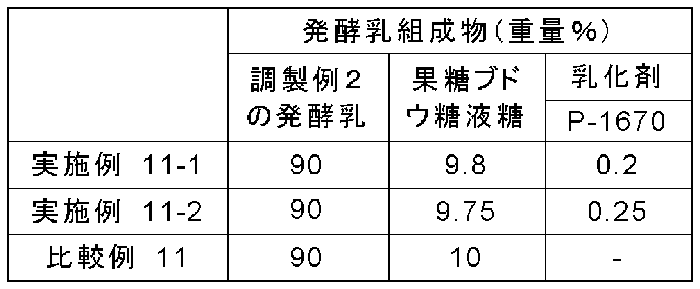
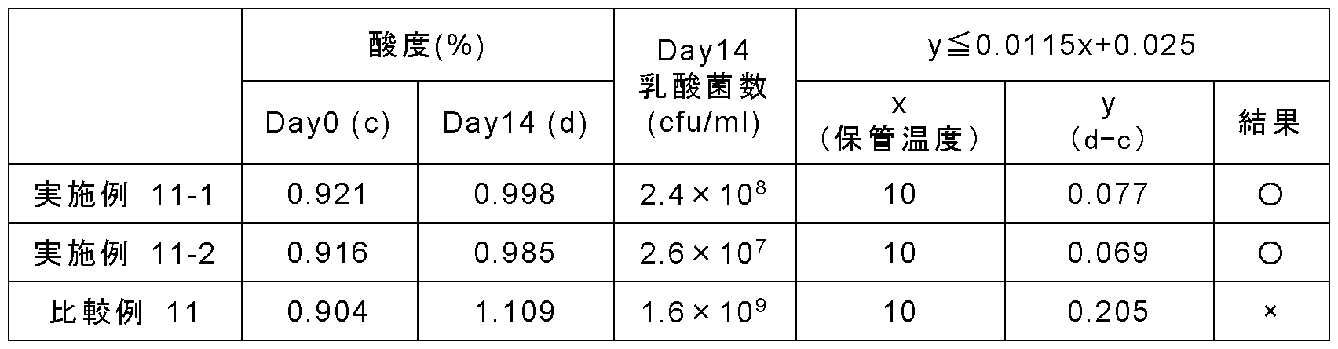
- Test Example 11 According to the formulation shown in Table 14, the emulsifier and fructose-glucose liquid sugar are mixed, sterilized at 85 ° C. for 10 minutes, and then mixed with the fermented milk obtained in Preparation Example 2 to form Examples 11-1 and 11-. 2. The fermented milk of Comparative Example 11 was obtained.
- the acidity of the fermented milks of Examples 11-1 and 11-2 and Comparative Example 11 was measured on the storage start date (Day 0) and 14 days later (Day 14), and it was evaluated whether or not the predetermined relational expression was satisfied. bottom.
- the results are shown in Table 15. It was found that the fermented milk of the present invention (Examples 11-1 and 11-2) suppressed the increase in acidity when stored at 10 ° C. as compared with the normal fermented milk (Comparative Example 11).
Landscapes
- Life Sciences & Earth Sciences (AREA)
- Microbiology (AREA)
- Chemical & Material Sciences (AREA)
- Engineering & Computer Science (AREA)
- Food Science & Technology (AREA)
- Polymers & Plastics (AREA)
- Biophysics (AREA)
- Dairy Products (AREA)
Abstract
Description
[項1]
食品用乳化剤を添加する処理を含む、発酵乳の製造方法。
[項2]
食品用乳化剤を含有する原材料組成物を調製する工程、および
前記原材料組成物に乳酸菌スターターを添加して発酵させる工程
を含む、項1に記載の製造方法。
[項3]
前記食品用乳化剤がショ糖脂肪酸エステル、モノグリセリド、有機酸モノグリセリド、平均重合度が3以下であり構成脂肪酸がパルミチン酸であるポリグリセリン脂肪酸エステルおよびステアロイル乳酸塩からなる群より選ばれる少なくとも1種の脂肪酸エステルを含む、項2に記載の製造方法。
[項4]
前記食品用乳化剤がモノグリセリド、有機酸モノグリセリド、平均重合度が3以下であり構成脂肪酸がパルミチン酸であるポリグリセリン脂肪酸エステルおよびステアロイル乳酸塩からなる群より選ばれる少なくとも1種の脂肪酸エステルを含む、項3に記載の製造方法。
[項5]
前記ポリグリセリン脂肪酸エステルの平均重合度が3未満である、項3または4に記載の製造方法。
[項6]
前記食品用乳化剤を構成する脂肪酸の不飽和脂肪酸含量が30%以下である、項3~5のいずれか一項に記載の製造方法。
[項7]
前記原材料組成物中の前記食品用乳化剤の含量が0.01~0.3重量%である、項2~6のいずれか一項に記載の製造方法。
[項8]
前記発酵乳中の脂肪含量が0.15~15.0%である、項2~7のいずれか一項に記載の製造方法。
[項9]
前記食品用乳化剤が、あらかじめ植物ステロールと処理された状態のものではない、項2~8のいずれか一項に記載の製造方法。
[項10]
原材料組成物に乳酸菌スターターを添加して発酵させる工程、および
前記原材料組成物に乳酸菌スターターを添加して発酵させた後、得られた発酵乳に食品用乳化剤を添加する工程、
を含む、項1に記載の製造方法。
[項11]
前記食品用乳化剤がショ糖脂肪酸エステル、グリセリン脂肪酸エステルおよびステアロイル乳酸塩からなる群より選ばれる少なくとも1種の脂肪酸エステルを含む、項10に記載の製造方法。
[項12]
前記食品用乳化剤が、あらかじめカルシウムまたは鉄と処理された状態のものではない、項10または11に記載の製造方法。
[項13]
前記原材料組成物中の前記食品用乳化剤の含量が0.01重量%以上である、項10~12のいずれか一項に記載の製造方法。
[項14]
前記発酵乳中の脂肪含量が0~5.0%である、項10~13のいずれか一項に記載の製造方法。
[項15]
前記発酵乳中の、ラクトバチルス・ブルガリカスおよびストレプトコッカス・サーモフィルス菌の生菌数の合計が1×10⁶cfu/ml以上である、項10~14のいずれか一項に記載の製造方法。
[項16]
前記乳酸菌スターターが、ラクトバチルス属を含む、項2~15のいずれか一項に記載の製造方法。
[項17]
前記発酵乳中のタンパク質含量が2.7%以上である、項1~16のいずれか一項に記載の製造方法。
[項18]
食品用乳化剤を含有する発酵乳。
[項19]
前記食品用乳化剤がショ糖脂肪酸エステル、グリセリン脂肪酸エステルおよびステアロイル乳酸塩からなる群より選ばれる少なくとも1種を含む、項18に記載の発酵乳。
[項20]
前記食品用乳化剤の含量が0.01重量%以上である、項18または19に記載の発酵乳。
[項21]
脂肪含量が0~5.0%である、項18~20のいずれか一項に記載の発酵乳。
[項22]
乳酸菌としてラクトバチルス属を含む、項18~21のいずれか一項に記載の発酵乳。
[項23]
保管開始時の発酵乳中のラクトバチルス・ブルガリカスおよびストレプトコッカス・サーモフィルス菌の生菌数の合計が1×10⁶cfu/ml以上である、項18~22のいずれか一項に記載の発酵乳。
[項24]
x℃(4≦x≦35)で14日間保管した際の酸度上昇(y%)が、y≦0.0115x+0.025の関係式を満たす、項18~23に記載の発酵乳。
[項24-1]
4~10℃で14日間保管した際の乳酸酸度上昇が0.1%未満である、項18~23に記載の発酵乳。
[項24-2]
11~20℃で14日間保管した際の乳酸酸度上昇が0.2%未満である、項18~23に記載の発酵乳。
[項24-3]
21~30℃で14日間保管した際の乳酸酸度上昇が0.3%未満である、項18~23に記載の発酵乳。
[項25]
タンパク質含量が2.7%以上である、項18~24のいずれか一項に記載の発酵乳。
[項26]
植物ステロールを実質含有しない、項18~25のいずれか一項に記載の発酵乳。
[項27]
カルシウムの含量が無脂乳固形分に対して1.5重量%以下である、項18~26のいずれか一項に記載の発酵乳。
[項28]
鉄の含量が0.001重量%以下である、項18~27のいずれか一項に記載の発酵乳。
[項29]
発酵乳の製造において、原材料組成物に食品用乳化剤を配合する、発酵乳の風味および/または食感の改質方法。
[項30]
発酵乳の製造において、発酵乳に食品用乳化剤を添加する、発酵乳の保管中の酸度上昇の抑制方法。
本発明の発酵乳は、少なくとも食品用乳化剤と、発酵乳としての一般的な成分(例えば、乳酸菌(スターター)や、原料乳に由来するタンパク質、脂肪等)を含有し、必要に応じてさらに、本発明の作用効果が奏される範囲(種類および量)の、一般的または公知の発酵乳が含有するその他の成分を含有することができる。
本発明において、発酵乳とは、日本の食品衛生法に基づく省令である「乳及び乳製品の成分規格等に関する省令」(乳等省令、昭和26年12月27日厚生省令第52号)の定義、または食品の国際規格であるCODEX STANDARD FOR FERMENTED MILKS(CODEX STAN 243-2003)の定義の少なくとも一方を満たし、それぞれに規定されている製造方法によって得られる食品を指す。例えば、上記乳等省令では、発酵乳とは「乳又はこれと同等以上の無脂乳固形分を含む乳等を乳酸菌又は酵母で発酵させ、糊状又は液状にしたもの又はこれらを凍結したもの」と定義されている。このような発酵乳には、ヨーグルト等の固形状発酵乳(セットタイプヨーグルト)、糊状発酵乳(ソフトタイプヨーグルト)および液状発酵乳(ドリンクタイプヨーグルト)が含まれ、本発明の発酵乳はこれらのいずれであってもよい。
本発明における食品用乳化剤は、食品に使用可能な乳化剤であれば特に限定されるものではなく、奏される本発明の作用効果を考慮して、適切なものを選択することができる。
乳酸菌の種類は特に限定されるものではなく、本発明の作用効果が奏されるよう、目的とする発酵乳の性状、風味、用途等に応じて、一般的または公知の発酵乳の製造においてスターターとして用いられている乳酸菌の中から適切に選択することができる。そのような乳酸菌としては、例えば、ラクトバチルス(Lactobacillus)属、ストレプトコッカス(Streptococcus)属、ビフィドバクテリウム(Bifidobacterium)属、などの乳酸菌が挙げられる。乳酸菌は、いずれか1種を単独で用いてもよく、2種以上を併用してもよい。
発酵乳に含まれるタンパク質および脂肪は、原料乳として用いられる牛乳、クリーム等に由来するものである。
本発明の発酵乳が任意で含有することができるその他の成分としては、例えば、砂糖(ショ糖)などの糖類や、甘味料、着色料、増粘剤・安定剤・ゲル化剤(ゼラチン、寒天、ペクチン、カルボキシメチルセルロース(CMC)等)、香料などの食品添加物が挙げられる。
本発明の発酵乳は、食品用乳化剤を添加する処理を含むこと以外は、基本的に従来の発酵乳と同様の方法で製造することができる。前掲「乳及び乳製品の成分規格等に関する省令」(乳等省令、昭和26年12月27日厚生省令第52号)およびCODEX STANDARD FOR FERMENTED MILKS(CODEX STAN 243-2003)には、それぞれで規定する発酵乳の製造方法についても規定されており、基本的にその製造方法に準じつつ、本発明に従って食品用乳化剤を使用した製造方法とすることができる。
食品用乳化剤を含有する(本発明の作用効果との関係で意図的に配合した)原材料組成物を調製する工程(以下「第1調製工程」と呼ぶ。);および
前記原材料組成物に乳酸菌スターターを添加して発酵させる工程(以下「第1発酵工程」と呼ぶ。)。
原材料組成物を調製する工程(以下「第2調製工程」と呼ぶ。);および
前記原材料組成物に乳酸菌スターターを添加して発酵させた後、得られた発酵乳に食品用乳化剤を添加する工程(以下「第2発酵工程」と呼ぶ。)。
以下の説明において、単に「調製工程」と記載した場合は、第1調製工程および第2調製工程を総称しており、両方の実施形態の調製工程に適用できる事項に言及している。また、単に「発酵工程」と記載した場合は、第1発酵工程および第2発酵工程を総称しており、両方の実施形態の発酵工程に適用できる事項に言及している。
調製工程における原材料組成物は、少なくとも原料乳を含み、第1調製工程ではさらに食品用乳化剤を含み、必要に応じて発酵乳の製造に用いることのできるその他の各種の原料または成分、例えば例えば砂糖(ショ糖)などの糖類や、甘味料、着色料、増粘剤・安定剤・ゲル化剤(ゼラチン、寒天、ペクチン、カルボキシメチルセルロース(CMC)等)、香料などの食品添加物をさらに含むことができる。
発酵工程で用いられる乳酸菌スターターの詳細、特に好ましい実施形態(乳酸菌)等については、本発明の発酵乳との関係において本明細書中に記載したことを参照することができる。原材料組成物への乳酸菌スターターの添加量も、常法に従って、適宜調節することができる。
酸度の上昇抑制は、例えば、所定の温度および期間の条件下で発酵乳を保管し、保管開始時(日)および保管終了時(日)の酸度を設定し、酸度の上昇幅を求めることにより確認することができる。例えば、第2製造方法に従って、発酵後に得られた発酵乳に食品用乳化剤を添加したもの(本発明品)と、添加しなかったもの(対照品)のそれぞれについて、所定の温度(例えば、4~10℃、11~20℃、または21~30℃)で、所定の期間(例えば、14日間)保管し、保管の前後で酸度を測定し、本発明品の上昇幅が対照品の上昇幅より小さいことをもって、あるいは保管温度をx、酸度の上昇幅をyとしたときに前記所定の関係式を満たすことをもって、保管中の酸度の上昇の抑制効果が奏されていると判断することができる。
本発明の発酵乳の風味および/または食感の改質方法は、発酵乳の製造において原材料組成物に食品用乳化剤を配合することを含む。このような発酵乳の風味および/または食感の改質方法に関する技術的事項、例えば、食品用乳化剤等の好ましい実施形態(種類、含量等)などは、本明細書の記載された、本発明の発酵乳およびその製造方法(第1製造方法)に関する技術的事項を適宜適用することができる。
本発明の発酵乳の保管中の酸度上昇の抑制方法は、発酵後に得られた発酵乳に食品用乳化剤を添加することを含む。このような発酵乳の保管中の酸度上昇の抑制方法に関する技術的事項、例えば、食品用乳化剤等の好ましい実施形態(種類、含量等)などは、本明細書の記載された、本発明の発酵乳およびその製造方法(第2製造方法)に関する技術的事項を適宜適用することができる。
「リョートーシュガーエステル P-1670」(三菱ケミカルフーズ株式会社、ショ糖パルミチン酸エステル、HLB=16)
「リョートーシュガーエステル S-1170」(三菱ケミカルフーズ株式会社、ショ糖ステアリン酸エステル、HLB=11)
「リョートーシュガーエステル O-1570」(三菱ケミカルフーズ株式会社、ショ糖オレイン酸エステル、HLB=15)
「リョートーシュガーエステル M-1695」(三菱ケミカルフーズ株式会社、ショ糖ミリスチン酸エステル、HLB=16)
「リョートーシュガーエステル L-1695」(三菱ケミカルフーズ株式会社、ショ糖ラウリン酸エステル、HLB=16)
「リョートーポリグリエステル S-10D」(三菱ケミカルフーズ株式会社、ポリグリセリンステアリン酸エステル、HLB=14)
「DP-95RF」(理研ビタミン株式会社、ジグリセリンパルミチン酸エステル)
「TRP-97RF」(理研ビタミン株式会社、トリグリセリンパルミチン酸エステル)
「MS-3S」(阪本薬品工業株式会社、テトラグリセリンステアリン酸エステル)
「MS-5S」(阪本薬品工業株式会社、ヘキサグリセリンステアリン酸エステル)
「DS-100A」(理研ビタミン株式会社、ジグリセリンステアリン酸エステル)
「GRINSTED SSL FP55」(ダニスコ社、ステアロイル乳酸ナトリウム、表中で「SSL」と表記)
「Type P(V)S」(RIKEVITA FINE CHEMICAL & FOOD INDUSTRY(SHANGHAI)社、蒸留モノグリセリド、表中で「MG」と表記)
「ポエムB-30」(理研ビタミン株式会社、コハク酸モノグリセリド、表中で「コハク酸MG」と表記)
「DATEM517K」(ダニスコ社、ジアセチル酒石酸モノグリセリド、表中で「DATEM」と表記)
「グラニュ糖」(日新製糖株式会社)
「エリスリトール」(三菱ケミカルフーズ株式会社)
表1に示す配合にしたがって、各原料を混合し、加熱しながら、均一になるまで撹拌溶解し、発酵乳ミックスを調製した。次いで、85℃で10分間殺菌した後、乳酸菌スターターとして「YoFlex F-DVS Premium1.0」(Chr. Hansen社)を0.5重量%添加し、42℃にてpHが4.4になるまで発酵させ、発酵乳を得た。

実施例1および比較例1で得られた発酵乳について、酸味が弱いと感じるものを選ぶ2点識別試験による官能評価を、訓練されたパネリスト4名からなる専門パネルによって行った。評価は、パネリスト1名につき独立して4回実施し、計16評価の評価を得た。結果を表1に合わせて示す。本発明発酵乳(実施例1)の方が、酸味が弱いと感じたのは16評価中13評価であり、本発明発酵乳(実施例1)は通常の発酵乳(比較例1)と比較して有意に酸味が弱いことがわかった(有意水準5%以下)。
表2に示す配合にしたがって各原料を混合したこと、および乳酸菌スターターの添加量を0.02重量%としたこと以外は、試験例1と同様にして、発酵乳を得た。

実施例2-1、実施例2-2および比較例2で得られた発酵乳について、訓練されたパネリスト5名からなる専門パネルによって、下記基準に基づいて酸味の評価を行った。評価は独立して2回実施し、計10回評価した。この評価の平均点を比較し、通常の発酵乳(比較例2)の平均点(a)から評価対象の発酵乳の平均点(b)を引いたときの差(a-b)が、1より大きい場合は◎、0.5より大きく1以下の場合は〇、0より大きく0.5以下の場合は△、0またはマイナスの数値である場合は×、と評価することとした。結果を表2に合わせて示す。本発明発酵乳(実施例2-1)は、通常の発酵乳(比較例2)と比較して有意に酸味が弱いことがわかった(有意水準1%以下)。また、本発明発酵乳(実施例2-2)は、通常の発酵乳(比較例2)と比較して有意に酸味が弱いことがわかった(有意水準5%以下)。
酸味評価基準(評価点)
1:酸味が弱い
2:酸味が少し弱い
3:酸味が強くも弱くもない
4:酸味が少し強い
5:酸味が強い
表3に示す配合にしたがって各原料を混合したこと以外は、試験例1と同様にして、発酵乳を得た。なお、表3の比較例3は、表1の比較例1と同様の条件で反復して、発酵乳を製造したものである。
訓練されたパネリスト4名からなる専門パネルによって、下記基準に基づいて酸味の評価を行った。パネリスト4名の平均点を比較し、通常の発酵乳(比較例3)の平均点(a)から評価対象の発酵乳の平均点(b)を引いたときの差(a-b)が、1より大きい場合は◎、0.5より大きく1以下の場合は〇、0より大きく0.5以下の場合は△、0またはマイナスの数値である場合は×、と評価することとした。結果を表3に合わせて示す。本発明発酵乳(実施例3)の評価は△であり、通常の発酵乳(比較例3)よりも酸味が抑制されていることがわかった。
酸味評価基準(評価点)
1:酸味が弱い
2:酸味が少し弱い
3:酸味が強くも弱くもない
4:酸味が少し強い
5:酸味が強い

表4に示す配合にしたがって各原料を混合したこと、および乳酸菌スターターの添加量を0.02重量%としたこと以外は、試験例1と同様にして、発酵乳を得た。なお、表4の比較例4は、表2の比較例2と同様の条件で反復して、発酵乳を製造したものである。
訓練されたパネリスト4名からなる専門パネルによって、下記基準に基づいて酸味の評価を行った。パネリスト4名の平均点を比較し、通常の発酵乳(比較例4=比較例2)の平均点(a)から評価対象の発酵乳の平均点(b)を引いたときの差(a-b)が、1より大きい場合は◎、0.5より大きく1以下の場合は〇、0より大きく0.5以下の場合は△、0またはマイナスの数値である場合は×、と評価することとした。結果を表4に合わせて示す。
酸味評価基準(評価点)
1:酸味が弱い
2:酸味が少し弱い
3:酸味が強くも弱くもない
4:酸味が少し強い
5:酸味が強い

表5に示す配合にしたがって各原料を混合したこと以外は、試験例1と同様にして、発酵乳を得た。なお、表5の比較例5は、表1の比較例1と同様の条件で反復して、発酵乳を製造したものである。

表6に示す配合にしたがって各原料を混合したこと、および殺菌を80℃で20分間行ったこと以外は、試験例1と同様にして、発酵乳を得た。

表7に示す配合にしたがって各原料を混合したこと、殺菌を85℃で10分間行ったこと、乳酸菌スターターの添加量を0.02重量%としたこと、および発酵を42℃にてpHが4.3になるまで行ったこと以外は、試験例1と同様にして、発酵乳を得た。
訓練されたパネリスト4名からなる専門パネルによって、下記基準に基づいて、口に入れた瞬間の酸味の評価を行った。パネリスト4名の平均点を比較し、通常の発酵乳(実施例7-1に対しては比較例7-1、実施例7-2に対しては比較例7-2)の平均点(a)から評価対象の発酵乳の平均点(b)を引いたときの差(a-b)が、1より大きい場合は◎、0.5より大きく1以下の場合は〇、0より大きく0.5以下の場合は△、0またはマイナスの数値である場合は×、と評価することとした。結果を表7に合わせて示す。
酸味評価基準(評価点)
1:口に入れた瞬間の酸味が弱い
2:口に入れた瞬間の酸味が少し弱い
3:口に入れた瞬間の酸味が強くも弱くもない
4:口に入れた瞬間の酸味が少し強い
5:口に入れた瞬間の酸味が強い

表8に示す配合にしたがって、各原料を混合し、加熱しながら、均一になるまで撹拌溶解し、発酵乳ミックスを調製した。次いで、85℃で10分間殺菌した後、「YoFlex F-DVS Premium1.0」(Chr. Hansen社)を0.02重量%添加し、42℃にてpHが約4.4になるまで、上部直径58mm、下部直径48mm、高さ70mmのプラスチック樹脂製容器にて、底面から60mmまで発酵乳ミックスを充填し、発酵させた。その後、5℃で恒温になるまで冷却し、セットタイプヨーグルトを得た。比較例8(a~f)は、コントロールとして、各試験で繰り返し実施した。

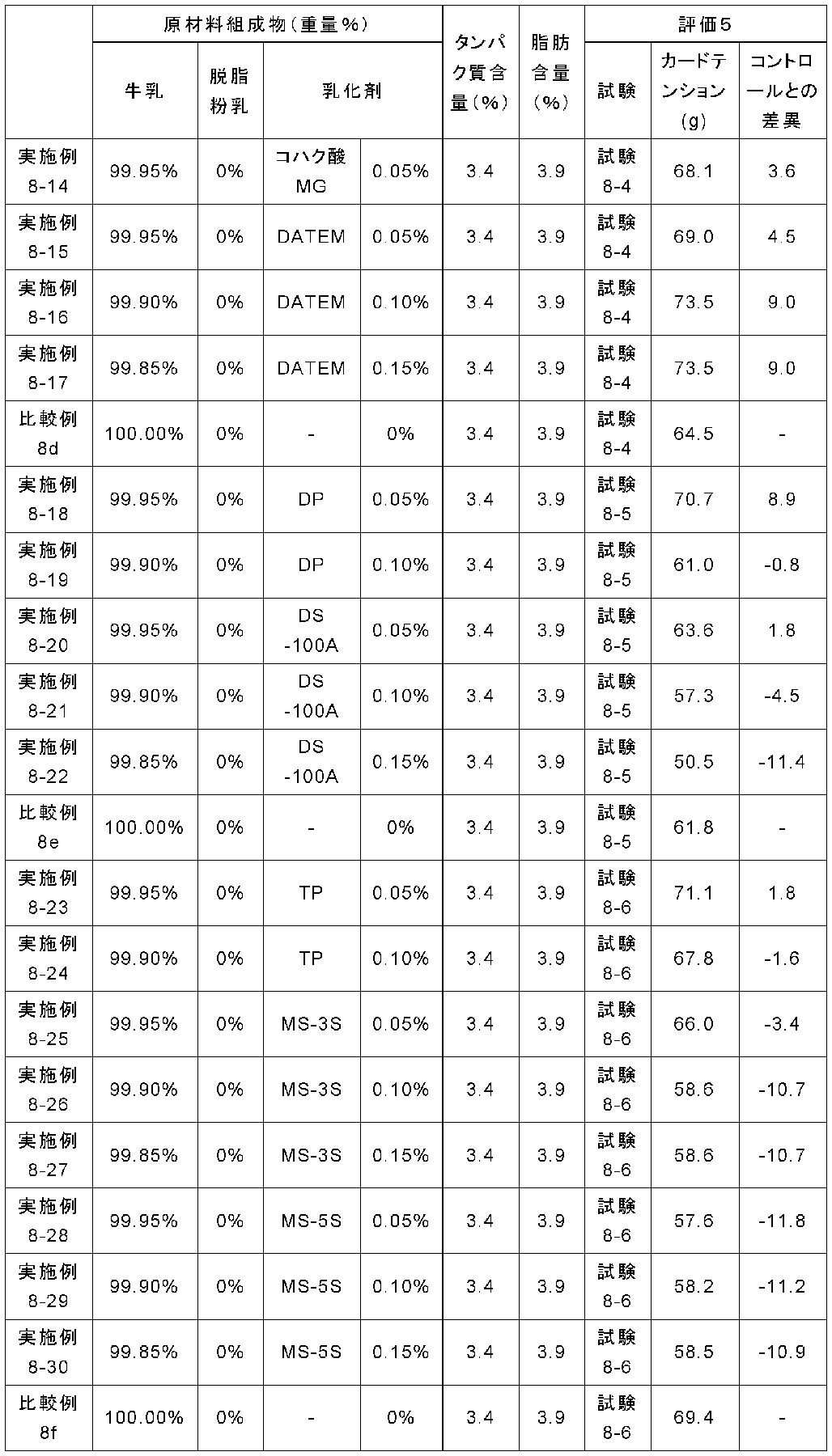
表9に示す配合にしたがって各原料を混合したこと、および発酵を42℃にてpHが約4.45になるまで行ったこと以外は、実施例8と同様にして、セットタイプヨーグルトを得た。比較例9(a~d)は、コントロールとして、各試験で繰り返し実施した。

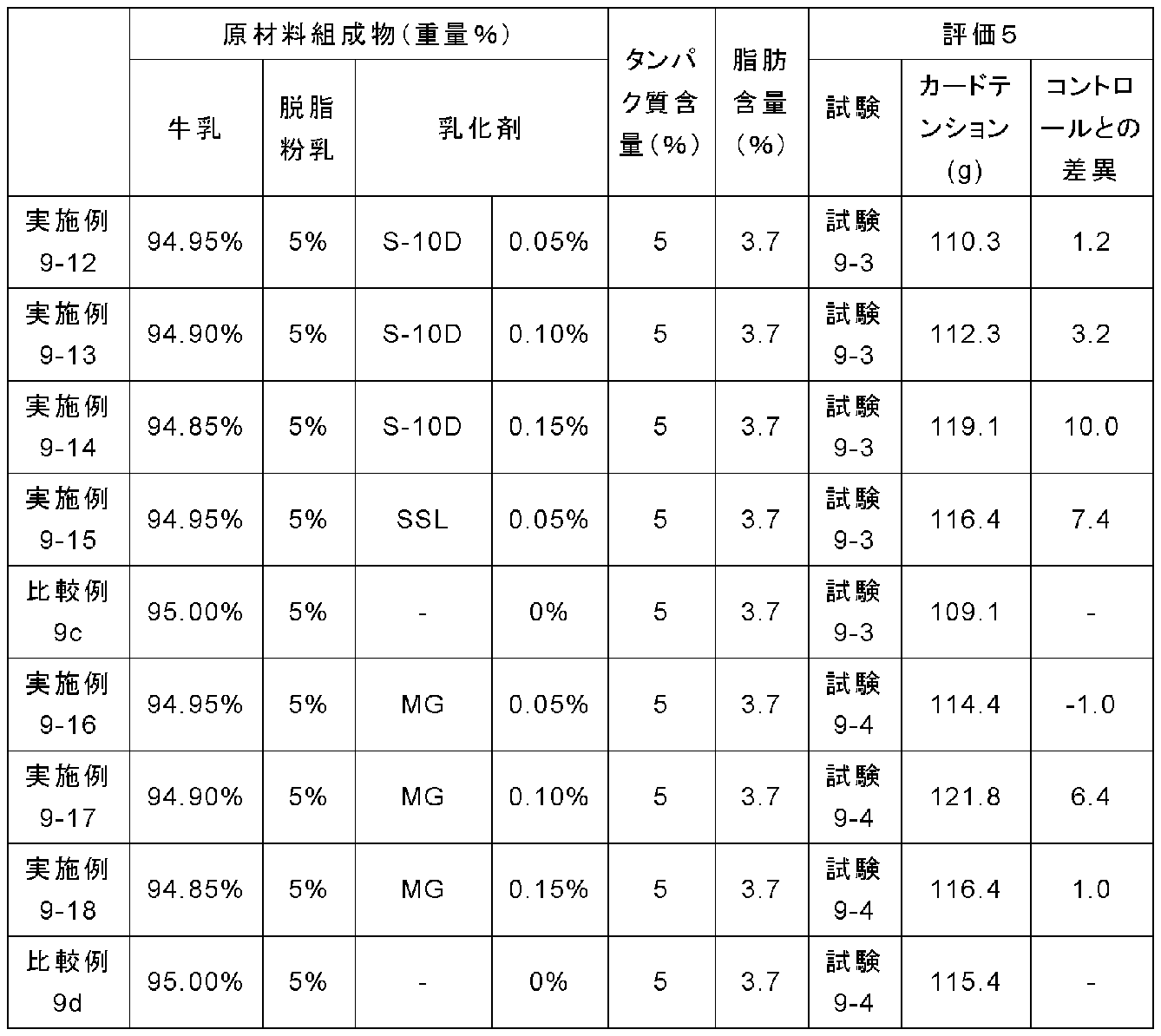
試験例8及び試験例9の方法により得た発酵乳を、テクスチャーアナライザー(TA.XTplus、Stable Micro Systems社製)にて、直径20mmの円柱状樹脂製プローブを用い、速度1mm/sec、貫入距離10mmの条件で、貫入中の最大荷重を測定した。各種乳化剤を添加した発酵乳とコントロールとの差異を算出し、評価した。結果を表8及び表9に合わせて示す。乳化剤の添加により、発酵乳のカードテンションが改質されることが分かった。
牛乳(タンパク質3.4g/100ml、脂質3.9g/100ml)を85℃で10分間殺菌した後、明治ブルガリアヨーグルトプレーン(明治社)を1重量%添加し、42℃にて3.5時間発酵させ、発酵乳を得た。
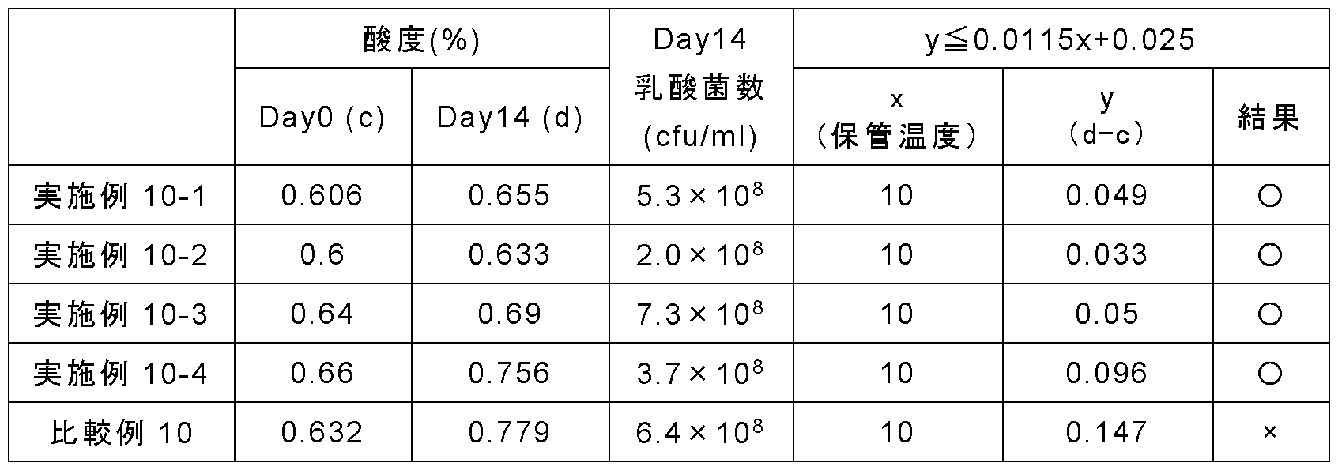
表10に示す配合にしたがって、乳化剤及び果糖ブドウ糖液糖を混合し、85℃で10分間殺菌した後、調製例1で得られた発酵乳と混合することで、実施例10-1~10-4及び比較例10の発酵乳を得た。

作製した実施例10-1~10-4及び比較例10の発酵乳を10℃で保管し、保管開始日(Day0)及び14日後(Day14)の酸度を「乳及び乳製品の成分規格等に関する省令」に記載の乳及び乳製品の酸度の測定法に従って測定し、保管開始日(Day0)の酸度(c)と比較した保管終了日(Day14)の酸度(d)の差(d-c)を求めた。y≦0.0115x+0.025(x=保管温度、y=d-c)は、所定温度で発酵乳を保管した際の好ましい酸度上昇範囲を規定しており、各実施例および比較例のxおよびyが当該関係式を満たす場合は〇、満たさない場合は×と評価した。結果を表11に示す。本発明発酵乳(実施例10-1~10-4)は通常の発酵乳(比較例10)と比較して10℃で保管した際の酸度の上昇が抑制されていることがわかった。
保管温度(x)を15℃に変更したこと以外は評価6と同様にして、実施例10-1~10-4及び比較例10の発酵乳の、保管開始日(Day0)及び14日後(Day14)の酸度を測定し、所定の関係式を満たすかどうかを評価した。結果を表12に示す。本発明発酵乳(実施例10-1~10-4)は、15℃で保管した場合も、通常の発酵乳(比較例14)と比較して酸度の上昇が抑制されていることがわかった。

保管温度(x)を25℃に変更したこと以外は評価6と同様にして、実施例10-1~10-3及び比較例10の発酵乳の、保管開始日(Day0)及び14日後(Day14)の酸度を測定し、所定の関係式を満たすかどうかを評価した。結果を表13に示す。本発明発酵乳(実施例10-1~10-3)は、25℃で保管した場合も、通常の発酵乳(比較例14)と比較しての酸度の上昇が抑制されていることがわかった。

脱脂粉乳771gを水6168gに攪拌溶解し、85℃で10分間殺菌した後、明治ブルガリアヨーグルトプレーン(明治社)を1重量%添加し、42℃にて3.5時間発酵させ、発酵乳を得た。
表14に示す配合にしたがって、乳化剤及び果糖ブドウ糖液糖を混合し、85℃で10分間殺菌した後、調製例2で得られた発酵乳と混合することで、実施例11-1、11-2、比較例11の発酵乳を得た。
Claims (30)
- 食品用乳化剤を添加する処理を含む、発酵乳の製造方法。
- 食品用乳化剤を含有する原材料組成物を調製する工程、および
前記原材料組成物に乳酸菌スターターを添加して発酵させる工程
を含む、請求項1に記載の製造方法。 - 前記食品用乳化剤がショ糖脂肪酸エステル、モノグリセリド、有機酸モノグリセリド、平均重合度が3以下であり構成脂肪酸がパルミチン酸であるポリグリセリン脂肪酸エステルおよびステアロイル乳酸塩からなる群より選ばれる少なくとも1種の脂肪酸エステルを含む、請求項2に記載の製造方法。
- 前記食品用乳化剤がモノグリセリド、有機酸モノグリセリド、平均重合度が3以下であり構成脂肪酸がパルミチン酸であるポリグリセリン脂肪酸エステルおよびステアロイル乳酸塩からなる群より選ばれる少なくとも1種の脂肪酸エステルを含む、請求項3に記載の製造方法。
- 前記ポリグリセリン脂肪酸エステルの平均重合度が3未満である、請求項3または4に記載の製造方法。
- 前記食品用乳化剤を構成する脂肪酸の不飽和脂肪酸含量が30%以下である、請求項3~5のいずれか一項に記載の製造方法。
- 前記原材料組成物中の前記食品用乳化剤の含量が0.01~0.3重量%である、請求項2~6のいずれか一項に記載の製造方法。
- 前記発酵乳中の脂肪含量が0.15~15.0%である、請求項2~7のいずれか一項に記載の製造方法。
- 前記食品用乳化剤が、あらかじめ植物ステロールと処理された状態のものではない、請求項2~8のいずれか一項に記載の製造方法。
- 原材料組成物に乳酸菌スターターを添加して発酵させる工程、および
前記原材料組成物に乳酸菌スターターを添加して発酵させた後、得られた発酵乳に食品用乳化剤を添加する工程、
を含む、請求項1に記載の製造方法。 - 前記食品用乳化剤がショ糖脂肪酸エステル、グリセリン脂肪酸エステルおよびステアロイル乳酸塩からなる群より選ばれる少なくとも1種の脂肪酸エステルを含む、請求項10に記載の製造方法。
- 前記食品用乳化剤が、あらかじめカルシウムまたは鉄と処理された状態のものではない、請求項10または11に記載の製造方法。
- 前記原材料組成物中の前記食品用乳化剤の含量が0.01重量%以上である、請求項10~12のいずれか一項に記載の製造方法。
- 前記発酵乳中の脂肪含量が0~5.0%である、請求項10~13のいずれか一項に記載の製造方法。
- 前記発酵乳中の、ラクトバチルス・ブルガリカスおよびストレプトコッカス・サーモフィルス菌の生菌数の合計が1×10⁶cfu/ml以上である、請求項10~14のいずれか一項に記載の製造方法。
- 前記乳酸菌スターターが、ラクトバチルス属を含む、請求項2~15のいずれか一項に記載の製造方法。
- 前記発酵乳中のタンパク質含量が2.7%以上である、請求項1~16のいずれか一項に記載の製造方法。
- 食品用乳化剤を含有する発酵乳。
- 前記食品用乳化剤がショ糖脂肪酸エステル、グリセリン脂肪酸エステルおよびステアロイル乳酸塩からなる群より選ばれる少なくとも1種を含む、請求項18に記載の発酵乳。
- 前記食品用乳化剤の含量が0.01重量%以上である、請求項18または19に記載の発酵乳。
- 脂肪含量が0~5.0%である、請求項18~20のいずれか一項に記載の発酵乳。
- 乳酸菌としてラクトバチルス属を含む、請求項18~21のいずれか一項に記載の発酵乳。
- 保管開始時の発酵乳中のラクトバチルス・ブルガリカスおよびストレプトコッカス・サーモフィルス菌の生菌数の合計が1×10⁶cfu/ml以上である、請求項18~22のいずれか一項に記載の発酵乳。
- x℃(4≦x≦35)で14日間保管した際の酸度上昇(y%)がy≦0.0115x+0.025の関係を満たす、請求項18~23に記載の発酵乳。
- タンパク質含量が2.7%以上である、請求項18~24のいずれか一項に記載の発酵乳。
- 植物ステロールを実質含有しない、請求項18~25のいずれか一項に記載の発酵乳。
- カルシウムの含量が無脂乳固形分に対して1.5重量%以下である、請求項18~26のいずれか一項に記載の発酵乳。
- 鉄の含量が0.001重量%以下である、請求項18~27のいずれか一項に記載の発酵乳。
- 発酵乳の製造において、原材料組成物に食品用乳化剤を配合する、発酵乳の風味および/または食感の改質方法。
- 発酵乳の製造において、発酵乳に食品用乳化剤を添加する、発酵乳の保管中の酸度上昇の抑制方法。
Priority Applications (7)
| Application Number | Priority Date | Filing Date | Title |
|---|---|---|---|
| JP2022517111A JPWO2021215530A1 (ja) | 2020-04-23 | 2021-04-23 | |
| EP21792880.3A EP4140312A4 (en) | 2020-04-23 | 2021-04-23 | FERMENTED MILK AND METHOD FOR PRODUCING THEREOF |
| AU2021260363A AU2021260363A1 (en) | 2020-04-23 | 2021-04-23 | Fermented milk and method for producing same |
| PH1/2022/552819A PH12022552819A1 (en) | 2020-04-23 | 2021-04-23 | Fermented milk and method for producing same |
| CN202180030264.XA CN115426889A (zh) | 2020-04-23 | 2021-04-23 | 发酵乳及其制造方法 |
| KR1020227039647A KR20230008094A (ko) | 2020-04-23 | 2021-04-23 | 발효유 및 그 제조 방법 |
| US18/048,653 US20230107719A1 (en) | 2020-04-23 | 2022-10-21 | Fermented milk and method for producing same |
Applications Claiming Priority (2)
| Application Number | Priority Date | Filing Date | Title |
|---|---|---|---|
| JP2020076404 | 2020-04-23 | ||
| JP2020-076404 | 2020-04-23 |
Related Child Applications (1)
| Application Number | Title | Priority Date | Filing Date |
|---|---|---|---|
| US18/048,653 Continuation US20230107719A1 (en) | 2020-04-23 | 2022-10-21 | Fermented milk and method for producing same |
Publications (1)
| Publication Number | Publication Date |
|---|---|
| WO2021215530A1 true WO2021215530A1 (ja) | 2021-10-28 |
Family
ID=78269341
Family Applications (1)
| Application Number | Title | Priority Date | Filing Date |
|---|---|---|---|
| PCT/JP2021/016467 Ceased WO2021215530A1 (ja) | 2020-04-23 | 2021-04-23 | 発酵乳およびその製造方法 |
Country Status (8)
| Country | Link |
|---|---|
| US (1) | US20230107719A1 (ja) |
| EP (1) | EP4140312A4 (ja) |
| JP (1) | JPWO2021215530A1 (ja) |
| KR (1) | KR20230008094A (ja) |
| CN (1) | CN115426889A (ja) |
| AU (1) | AU2021260363A1 (ja) |
| PH (1) | PH12022552819A1 (ja) |
| WO (1) | WO2021215530A1 (ja) |
Cited By (2)
| Publication number | Priority date | Publication date | Assignee | Title |
|---|---|---|---|---|
| CN114287605A (zh) * | 2021-12-31 | 2022-04-08 | 杭州威欧生物科技有限公司 | 酸奶香精及其发酵生产方法 |
| WO2024204667A1 (ja) | 2023-03-31 | 2024-10-03 | 三菱ケミカル株式会社 | 乳酸菌の生菌を含有する食品、及びその製造方法、並びに酸度上昇及び/又は生菌数減少の抑制方法 |
Citations (15)
| Publication number | Priority date | Publication date | Assignee | Title |
|---|---|---|---|---|
| JPS5881768A (ja) | 1981-11-09 | 1983-05-17 | Ton:Kk | 飲料用又はデザ−ト用アーモンドペ−ストの製造法 |
| JPS58175482A (ja) | 1983-03-11 | 1983-10-14 | Meiji Milk Prod Co Ltd | 加温販売用低酸度液状高温加熱滅菌食品用静菌剤 |
| JPH0137248Y2 (ja) | 1986-10-03 | 1989-11-10 | ||
| JPH0889167A (ja) | 1994-09-27 | 1996-04-09 | Nippon Oil & Fats Co Ltd | 多価不飽和脂肪酸含有醗酵乳の製造方法 |
| WO1996013176A1 (en) | 1994-11-01 | 1996-05-09 | Maruo Calcium Company Limited | Highly dispersible food additive and food composition containing the same |
| JPH08228676A (ja) | 1994-12-28 | 1996-09-10 | Riken Vitamin Co Ltd | 乳成分含有飲料 |
| JPH09313101A (ja) * | 1995-05-10 | 1997-12-09 | Fuji Oil Co Ltd | ヨーグルト類の製造法及びヨーグルト類加工品 |
| JPH10155420A (ja) * | 1996-10-03 | 1998-06-16 | Fuji Oil Co Ltd | ヨーグルト類の製造法 |
| JP2001224306A (ja) | 2000-02-14 | 2001-08-21 | Yakult Honsha Co Ltd | カルシウム強化乳発酵食品 |
| JP2005520507A (ja) | 2002-03-20 | 2005-07-14 | ユージーン サイエンス インコーポレイテッド | 植物ステロール含有食品、及びその調製方法 |
| WO2013141139A1 (ja) | 2012-03-21 | 2013-09-26 | 株式会社ヤクルト本社 | ピロリン酸鉄組成物 |
| WO2014148633A1 (ja) | 2013-03-21 | 2014-09-25 | 三菱化学フーズ株式会社 | 飲食品用乳化組成物、飲食品用乳化組成物の製造方法、飲食品及び乳飲料 |
| CN104206528A (zh) * | 2014-09-25 | 2014-12-17 | 汾州裕源土特产品有限公司 | 一种核桃风味发酵乳的生产工艺 |
| CN104273219A (zh) * | 2013-07-08 | 2015-01-14 | 内蒙古蒙牛乳业(集团)股份有限公司 | 一种冷冻酸奶及其制备方法 |
| JP2019136025A (ja) | 2018-02-07 | 2019-08-22 | 太陽化学株式会社 | ヨーグルト用離水抑制剤 |
Family Cites Families (4)
| Publication number | Priority date | Publication date | Assignee | Title |
|---|---|---|---|---|
| JPH0728657B2 (ja) | 1987-08-04 | 1995-04-05 | 明治乳業株式会社 | ホイップヨ−グルトの製造法 |
| TWI468513B (zh) * | 2005-05-27 | 2015-01-11 | Yakult Honsha Kk | 乳酸菌發酵物及含其之發酵乳食品 |
| CN104602530B (zh) * | 2012-09-06 | 2017-12-08 | 株式会社益力多本社 | 强化了铁成分和生育酚的发酵乳制品 |
| CN105230784A (zh) * | 2015-10-29 | 2016-01-13 | 光明乳业股份有限公司 | 一种活菌型常温发酵乳饮品及其制备方法 |
-
2021
- 2021-04-23 JP JP2022517111A patent/JPWO2021215530A1/ja active Pending
- 2021-04-23 PH PH1/2022/552819A patent/PH12022552819A1/en unknown
- 2021-04-23 WO PCT/JP2021/016467 patent/WO2021215530A1/ja not_active Ceased
- 2021-04-23 KR KR1020227039647A patent/KR20230008094A/ko active Pending
- 2021-04-23 EP EP21792880.3A patent/EP4140312A4/en active Pending
- 2021-04-23 AU AU2021260363A patent/AU2021260363A1/en active Pending
- 2021-04-23 CN CN202180030264.XA patent/CN115426889A/zh active Pending
-
2022
- 2022-10-21 US US18/048,653 patent/US20230107719A1/en active Pending
Patent Citations (15)
| Publication number | Priority date | Publication date | Assignee | Title |
|---|---|---|---|---|
| JPS5881768A (ja) | 1981-11-09 | 1983-05-17 | Ton:Kk | 飲料用又はデザ−ト用アーモンドペ−ストの製造法 |
| JPS58175482A (ja) | 1983-03-11 | 1983-10-14 | Meiji Milk Prod Co Ltd | 加温販売用低酸度液状高温加熱滅菌食品用静菌剤 |
| JPH0137248Y2 (ja) | 1986-10-03 | 1989-11-10 | ||
| JPH0889167A (ja) | 1994-09-27 | 1996-04-09 | Nippon Oil & Fats Co Ltd | 多価不飽和脂肪酸含有醗酵乳の製造方法 |
| WO1996013176A1 (en) | 1994-11-01 | 1996-05-09 | Maruo Calcium Company Limited | Highly dispersible food additive and food composition containing the same |
| JPH08228676A (ja) | 1994-12-28 | 1996-09-10 | Riken Vitamin Co Ltd | 乳成分含有飲料 |
| JPH09313101A (ja) * | 1995-05-10 | 1997-12-09 | Fuji Oil Co Ltd | ヨーグルト類の製造法及びヨーグルト類加工品 |
| JPH10155420A (ja) * | 1996-10-03 | 1998-06-16 | Fuji Oil Co Ltd | ヨーグルト類の製造法 |
| JP2001224306A (ja) | 2000-02-14 | 2001-08-21 | Yakult Honsha Co Ltd | カルシウム強化乳発酵食品 |
| JP2005520507A (ja) | 2002-03-20 | 2005-07-14 | ユージーン サイエンス インコーポレイテッド | 植物ステロール含有食品、及びその調製方法 |
| WO2013141139A1 (ja) | 2012-03-21 | 2013-09-26 | 株式会社ヤクルト本社 | ピロリン酸鉄組成物 |
| WO2014148633A1 (ja) | 2013-03-21 | 2014-09-25 | 三菱化学フーズ株式会社 | 飲食品用乳化組成物、飲食品用乳化組成物の製造方法、飲食品及び乳飲料 |
| CN104273219A (zh) * | 2013-07-08 | 2015-01-14 | 内蒙古蒙牛乳业(集团)股份有限公司 | 一种冷冻酸奶及其制备方法 |
| CN104206528A (zh) * | 2014-09-25 | 2014-12-17 | 汾州裕源土特产品有限公司 | 一种核桃风味发酵乳的生产工艺 |
| JP2019136025A (ja) | 2018-02-07 | 2019-08-22 | 太陽化学株式会社 | ヨーグルト用離水抑制剤 |
Non-Patent Citations (2)
| Title |
|---|
| K. FAROOQZ.U. HAQUE: "Effect of Sugar Ester on the Textural Properties of Nonfat Low Calorie Yogurt", J DAIRY SCI, vol. 75, 1992, pages 2676 - 2680 |
| See also references of EP4140312A4 |
Cited By (3)
| Publication number | Priority date | Publication date | Assignee | Title |
|---|---|---|---|---|
| CN114287605A (zh) * | 2021-12-31 | 2022-04-08 | 杭州威欧生物科技有限公司 | 酸奶香精及其发酵生产方法 |
| WO2024204667A1 (ja) | 2023-03-31 | 2024-10-03 | 三菱ケミカル株式会社 | 乳酸菌の生菌を含有する食品、及びその製造方法、並びに酸度上昇及び/又は生菌数減少の抑制方法 |
| EP4706397A1 (en) | 2023-03-31 | 2026-03-11 | Mitsubishi Chemical Corporation | Food product including viable cells of lactic acid bacteria, method for producing same, and method for inhibiting increase in acidity and/or decrease in number of viable cells |
Also Published As
| Publication number | Publication date |
|---|---|
| CN115426889A (zh) | 2022-12-02 |
| US20230107719A1 (en) | 2023-04-06 |
| AU2021260363A1 (en) | 2022-12-01 |
| JPWO2021215530A1 (ja) | 2021-10-28 |
| EP4140312A4 (en) | 2023-10-18 |
| EP4140312A1 (en) | 2023-03-01 |
| PH12022552819A1 (en) | 2024-02-12 |
| KR20230008094A (ko) | 2023-01-13 |
Similar Documents
| Publication | Publication Date | Title |
|---|---|---|
| Cuffia et al. | Technological challenges in the production of a probiotic pasta filata soft cheese | |
| Mituniewicz-Małek et al. | Effect of the addition of Bifidobacterium monocultures on the physical, chemical, and sensory characteristics of fermented goat milk | |
| CN102448311A (zh) | 低热量奶制品 | |
| Kavas et al. | The effect of using microencapsulated pro and prebiotics on the aromatic compounds and sensorial properties of synbiotic goat cheese | |
| WO2021215530A1 (ja) | 発酵乳およびその製造方法 | |
| JP2019176780A (ja) | 発酵乳及びその製造方法 | |
| WO2013017905A1 (en) | Composition comprising gellan gum, buttermilk and lactic acid bacteria process of making the same | |
| CN105979786A (zh) | 充气的粗滤发酵乳品组合物 | |
| EP2863755B1 (en) | Fermented milk product | |
| JP6901350B2 (ja) | 発酵乳飲料の製造方法 | |
| JP5980934B2 (ja) | 鉄分およびトコフェロールを強化した発酵乳製品 | |
| Pereira et al. | Lactobacillus acidophilus and Bifidobacterium sp. in co-culture improve sensory acceptance of potentially probiotic petit-suisse cheese | |
| JP2002058425A (ja) | 共役脂肪酸含有発酵食品及びその製造法 | |
| Banerjee et al. | Insights into the technological and nutritional aspects of lactic milk drinks: buttermilk | |
| Božanić et al. | Influence of culture activity on aroma components in yoghurts produced from goat's and cow's milk | |
| Dağ et al. | Assessment of quality and aroma characteristics of kefir produced by using grain and lyophilized culture | |
| EP2988602B1 (en) | Lactic acid bacteria | |
| JP4248993B2 (ja) | 糸引き粘性を有する殺菌発酵乳の製造方法 | |
| JP2022190134A (ja) | 発酵乳の製造方法、発酵乳、発酵乳製品、および発酵乳の香味の増強方法 | |
| JP7619601B2 (ja) | 高度乳酸菌発酵物、該発酵物を含む飲食品添加用高度不飽和脂肪酸含有組成物、及び該組成物を含む飲食品 | |
| JP7839636B2 (ja) | 発酵組成物、及びその製造方法 | |
| EP1651057B1 (en) | Fermented food product comprising soy protein | |
| JP2008061518A (ja) | ペプチド類含有酸性乳飲料の製造方法 | |
| WO2024204667A1 (ja) | 乳酸菌の生菌を含有する食品、及びその製造方法、並びに酸度上昇及び/又は生菌数減少の抑制方法 | |
| JP7486293B2 (ja) | 乳飲食品及びその製造方法 |
Legal Events
| Date | Code | Title | Description |
|---|---|---|---|
| 121 | Ep: the epo has been informed by wipo that ep was designated in this application |
Ref document number: 21792880 Country of ref document: EP Kind code of ref document: A1 |
|
| ENP | Entry into the national phase |
Ref document number: 2022517111 Country of ref document: JP Kind code of ref document: A |
|
| NENP | Non-entry into the national phase |
Ref country code: DE |
|
| ENP | Entry into the national phase |
Ref document number: 2021792880 Country of ref document: EP Effective date: 20221123 |
|
| ENP | Entry into the national phase |
Ref document number: 2021260363 Country of ref document: AU Date of ref document: 20210423 Kind code of ref document: A |