WO2021240931A1 - マスターバッチ、樹脂組成物、ポリオレフィン系樹脂フィルム及びその製造方法並びに積層フィルム - Google Patents
マスターバッチ、樹脂組成物、ポリオレフィン系樹脂フィルム及びその製造方法並びに積層フィルム Download PDFInfo
- Publication number
- WO2021240931A1 WO2021240931A1 PCT/JP2021/007549 JP2021007549W WO2021240931A1 WO 2021240931 A1 WO2021240931 A1 WO 2021240931A1 JP 2021007549 W JP2021007549 W JP 2021007549W WO 2021240931 A1 WO2021240931 A1 WO 2021240931A1
- Authority
- WO
- WIPO (PCT)
- Prior art keywords
- parts
- ethylene
- film
- resin
- masterbatch
- Prior art date
- Legal status (The legal status is an assumption and is not a legal conclusion. Google has not performed a legal analysis and makes no representation as to the accuracy of the status listed.)
- Ceased
Links
Classifications
-
- C—CHEMISTRY; METALLURGY
- C08—ORGANIC MACROMOLECULAR COMPOUNDS; THEIR PREPARATION OR CHEMICAL WORKING-UP; COMPOSITIONS BASED THEREON
- C08L—COMPOSITIONS OF MACROMOLECULAR COMPOUNDS
- C08L23/00—Compositions of homopolymers or copolymers of unsaturated aliphatic hydrocarbons having only one carbon-to-carbon double bond; Compositions of derivatives of such polymers
- C08L23/02—Compositions of homopolymers or copolymers of unsaturated aliphatic hydrocarbons having only one carbon-to-carbon double bond; Compositions of derivatives of such polymers not modified by chemical after-treatment
- C08L23/10—Homopolymers or copolymers of propene
- C08L23/12—Polypropene
-
- C—CHEMISTRY; METALLURGY
- C08—ORGANIC MACROMOLECULAR COMPOUNDS; THEIR PREPARATION OR CHEMICAL WORKING-UP; COMPOSITIONS BASED THEREON
- C08L—COMPOSITIONS OF MACROMOLECULAR COMPOUNDS
- C08L23/00—Compositions of homopolymers or copolymers of unsaturated aliphatic hydrocarbons having only one carbon-to-carbon double bond; Compositions of derivatives of such polymers
- C08L23/02—Compositions of homopolymers or copolymers of unsaturated aliphatic hydrocarbons having only one carbon-to-carbon double bond; Compositions of derivatives of such polymers not modified by chemical after-treatment
- C08L23/04—Homopolymers or copolymers of ethene
- C08L23/08—Copolymers of ethene
- C08L23/0807—Copolymers of ethene with unsaturated hydrocarbons only containing four or more carbon atoms
- C08L23/0815—Copolymers of ethene with unsaturated hydrocarbons only containing four or more carbon atoms with aliphatic 1-olefins containing one carbon-to-carbon double bond
-
- C—CHEMISTRY; METALLURGY
- C08—ORGANIC MACROMOLECULAR COMPOUNDS; THEIR PREPARATION OR CHEMICAL WORKING-UP; COMPOSITIONS BASED THEREON
- C08J—WORKING-UP; GENERAL PROCESSES OF COMPOUNDING; AFTER-TREATMENT NOT COVERED BY SUBCLASSES C08B, C08C, C08F, C08G or C08H
- C08J3/00—Processes of treating or compounding macromolecular substances
- C08J3/20—Compounding polymers with additives, e.g. colouring
- C08J3/22—Compounding polymers with additives, e.g. colouring using masterbatch techniques
- C08J3/226—Compounding polymers with additives, e.g. colouring using masterbatch techniques using a polymer as a carrier
-
- B—PERFORMING OPERATIONS; TRANSPORTING
- B29—WORKING OF PLASTICS; WORKING OF SUBSTANCES IN A PLASTIC STATE IN GENERAL
- B29C—SHAPING OR JOINING OF PLASTICS; SHAPING OF MATERIAL IN A PLASTIC STATE, NOT OTHERWISE PROVIDED FOR; AFTER-TREATMENT OF THE SHAPED PRODUCTS, e.g. REPAIRING
- B29C48/00—Extrusion moulding, i.e. expressing the moulding material through a die or nozzle which imparts the desired form; Apparatus therefor
- B29C48/03—Extrusion moulding, i.e. expressing the moulding material through a die or nozzle which imparts the desired form; Apparatus therefor characterised by the shape of the extruded material at extrusion
- B29C48/07—Flat, e.g. panels
- B29C48/08—Flat, e.g. panels flexible, e.g. films
-
- B—PERFORMING OPERATIONS; TRANSPORTING
- B32—LAYERED PRODUCTS
- B32B—LAYERED PRODUCTS, i.e. PRODUCTS BUILT-UP OF STRATA OF FLAT OR NON-FLAT, e.g. CELLULAR OR HONEYCOMB, FORM
- B32B27/00—Layered products comprising a layer of synthetic resin
- B32B27/06—Layered products comprising a layer of synthetic resin as the main or only constituent of a layer, which is next to another layer of the same or of a different material
- B32B27/08—Layered products comprising a layer of synthetic resin as the main or only constituent of a layer, which is next to another layer of the same or of a different material of synthetic resin
-
- B—PERFORMING OPERATIONS; TRANSPORTING
- B32—LAYERED PRODUCTS
- B32B—LAYERED PRODUCTS, i.e. PRODUCTS BUILT-UP OF STRATA OF FLAT OR NON-FLAT, e.g. CELLULAR OR HONEYCOMB, FORM
- B32B27/00—Layered products comprising a layer of synthetic resin
- B32B27/18—Layered products comprising a layer of synthetic resin characterised by the use of special additives
-
- B—PERFORMING OPERATIONS; TRANSPORTING
- B32—LAYERED PRODUCTS
- B32B—LAYERED PRODUCTS, i.e. PRODUCTS BUILT-UP OF STRATA OF FLAT OR NON-FLAT, e.g. CELLULAR OR HONEYCOMB, FORM
- B32B27/00—Layered products comprising a layer of synthetic resin
- B32B27/32—Layered products comprising a layer of synthetic resin comprising polyolefins
-
- C—CHEMISTRY; METALLURGY
- C08—ORGANIC MACROMOLECULAR COMPOUNDS; THEIR PREPARATION OR CHEMICAL WORKING-UP; COMPOSITIONS BASED THEREON
- C08J—WORKING-UP; GENERAL PROCESSES OF COMPOUNDING; AFTER-TREATMENT NOT COVERED BY SUBCLASSES C08B, C08C, C08F, C08G or C08H
- C08J5/00—Manufacture of articles or shaped materials containing macromolecular substances
- C08J5/18—Manufacture of films or sheets
-
- C—CHEMISTRY; METALLURGY
- C08—ORGANIC MACROMOLECULAR COMPOUNDS; THEIR PREPARATION OR CHEMICAL WORKING-UP; COMPOSITIONS BASED THEREON
- C08L—COMPOSITIONS OF MACROMOLECULAR COMPOUNDS
- C08L23/00—Compositions of homopolymers or copolymers of unsaturated aliphatic hydrocarbons having only one carbon-to-carbon double bond; Compositions of derivatives of such polymers
- C08L23/02—Compositions of homopolymers or copolymers of unsaturated aliphatic hydrocarbons having only one carbon-to-carbon double bond; Compositions of derivatives of such polymers not modified by chemical after-treatment
- C08L23/10—Homopolymers or copolymers of propene
- C08L23/14—Copolymers of propene
-
- B—PERFORMING OPERATIONS; TRANSPORTING
- B29—WORKING OF PLASTICS; WORKING OF SUBSTANCES IN A PLASTIC STATE IN GENERAL
- B29K—INDEXING SCHEME ASSOCIATED WITH SUBCLASSES B29B, B29C OR B29D, RELATING TO MOULDING MATERIALS OR TO MATERIALS FOR MOULDS, REINFORCEMENTS, FILLERS OR PREFORMED PARTS, e.g. INSERTS
- B29K2023/00—Use of polyalkenes or derivatives thereof as moulding material
- B29K2023/10—Polymers of propylene
- B29K2023/14—Copolymers of polypropylene
-
- B—PERFORMING OPERATIONS; TRANSPORTING
- B32—LAYERED PRODUCTS
- B32B—LAYERED PRODUCTS, i.e. PRODUCTS BUILT-UP OF STRATA OF FLAT OR NON-FLAT, e.g. CELLULAR OR HONEYCOMB, FORM
- B32B2250/00—Layers arrangement
- B32B2250/24—All layers being polymeric
- B32B2250/242—All polymers belonging to those covered by group B32B27/32
-
- B—PERFORMING OPERATIONS; TRANSPORTING
- B32—LAYERED PRODUCTS
- B32B—LAYERED PRODUCTS, i.e. PRODUCTS BUILT-UP OF STRATA OF FLAT OR NON-FLAT, e.g. CELLULAR OR HONEYCOMB, FORM
- B32B2307/00—Properties of the layers or laminate
- B32B2307/40—Properties of the layers or laminate having particular optical properties
-
- B—PERFORMING OPERATIONS; TRANSPORTING
- B32—LAYERED PRODUCTS
- B32B—LAYERED PRODUCTS, i.e. PRODUCTS BUILT-UP OF STRATA OF FLAT OR NON-FLAT, e.g. CELLULAR OR HONEYCOMB, FORM
- B32B2307/00—Properties of the layers or laminate
- B32B2307/40—Properties of the layers or laminate having particular optical properties
- B32B2307/412—Transparent
-
- C—CHEMISTRY; METALLURGY
- C08—ORGANIC MACROMOLECULAR COMPOUNDS; THEIR PREPARATION OR CHEMICAL WORKING-UP; COMPOSITIONS BASED THEREON
- C08J—WORKING-UP; GENERAL PROCESSES OF COMPOUNDING; AFTER-TREATMENT NOT COVERED BY SUBCLASSES C08B, C08C, C08F, C08G or C08H
- C08J2323/00—Characterised by the use of homopolymers or copolymers of unsaturated aliphatic hydrocarbons having only one carbon-to-carbon double bond; Derivatives of such polymers
- C08J2323/02—Characterised by the use of homopolymers or copolymers of unsaturated aliphatic hydrocarbons having only one carbon-to-carbon double bond; Derivatives of such polymers not modified by chemical after treatment
- C08J2323/04—Homopolymers or copolymers of ethene
- C08J2323/08—Copolymers of ethene
-
- C—CHEMISTRY; METALLURGY
- C08—ORGANIC MACROMOLECULAR COMPOUNDS; THEIR PREPARATION OR CHEMICAL WORKING-UP; COMPOSITIONS BASED THEREON
- C08J—WORKING-UP; GENERAL PROCESSES OF COMPOUNDING; AFTER-TREATMENT NOT COVERED BY SUBCLASSES C08B, C08C, C08F, C08G or C08H
- C08J2423/00—Characterised by the use of homopolymers or copolymers of unsaturated aliphatic hydrocarbons having only one carbon-to-carbon double bond; Derivatives of such polymers
- C08J2423/02—Characterised by the use of homopolymers or copolymers of unsaturated aliphatic hydrocarbons having only one carbon-to-carbon double bond; Derivatives of such polymers not modified by chemical after treatment
- C08J2423/04—Homopolymers or copolymers of ethene
- C08J2423/08—Copolymers of ethene
-
- C—CHEMISTRY; METALLURGY
- C08—ORGANIC MACROMOLECULAR COMPOUNDS; THEIR PREPARATION OR CHEMICAL WORKING-UP; COMPOSITIONS BASED THEREON
- C08J—WORKING-UP; GENERAL PROCESSES OF COMPOUNDING; AFTER-TREATMENT NOT COVERED BY SUBCLASSES C08B, C08C, C08F, C08G or C08H
- C08J2423/00—Characterised by the use of homopolymers or copolymers of unsaturated aliphatic hydrocarbons having only one carbon-to-carbon double bond; Derivatives of such polymers
- C08J2423/26—Characterised by the use of homopolymers or copolymers of unsaturated aliphatic hydrocarbons having only one carbon-to-carbon double bond; Derivatives of such polymers modified by chemical after-treatment
-
- C—CHEMISTRY; METALLURGY
- C08—ORGANIC MACROMOLECULAR COMPOUNDS; THEIR PREPARATION OR CHEMICAL WORKING-UP; COMPOSITIONS BASED THEREON
- C08J—WORKING-UP; GENERAL PROCESSES OF COMPOUNDING; AFTER-TREATMENT NOT COVERED BY SUBCLASSES C08B, C08C, C08F, C08G or C08H
- C08J2451/00—Characterised by the use of graft polymers in which the grafted component is obtained by reactions only involving carbon-to-carbon unsaturated bonds; Derivatives of such polymers
- C08J2451/06—Characterised by the use of graft polymers in which the grafted component is obtained by reactions only involving carbon-to-carbon unsaturated bonds; Derivatives of such polymers grafted on to homopolymers or copolymers of aliphatic hydrocarbons containing only one carbon-to-carbon double bond
-
- C—CHEMISTRY; METALLURGY
- C08—ORGANIC MACROMOLECULAR COMPOUNDS; THEIR PREPARATION OR CHEMICAL WORKING-UP; COMPOSITIONS BASED THEREON
- C08L—COMPOSITIONS OF MACROMOLECULAR COMPOUNDS
- C08L2310/00—Masterbatches
Definitions
- the present invention relates to a polyolefin-based resin film having excellent transparency and antifogging property, a method for producing the same, a masterbatch and a resin composition suitable as a raw material for the production thereof, and a laminated film.
- polyolefin-based resin films have been widely used, for example, as packaging materials. Since the non-denatured polyolefin resin has a hydrophobic property, it tends to have insufficient transparency when it is used as a molded product. Therefore, in order to obtain a transparent polyolefin resin film, a resin composition containing an anti-fog agent is used as a molding material.
- antifogging agents include polyglycerin fatty acid esters in Patent Document 1, monoesters of glycerin and C8-22 fatty acids in Patent Document 2, and diglycerin and C8-22 carbon atoms in Patent Document 2.
- Monoesters with fatty acids, polyoxyethylene alkylamino ethers, monoesters with polyoxyethylene alkylamino ethers and fatty acids with C8 to 22 carbon atoms, or mixtures of mono-esters and diesters are disclosed, respectively.
- Patent Document 3 describes glycerin fatty acid ester, polyglycerin fatty acid ester, sorbitan fatty acid ester, polyoxyethylene alkyl ether, and polyoxyethylene sorbitan as antifogging agents contained in the master batch used for forming a food packaging film or sheet.
- Fatty acid esters, polyoxyethylene glycerin fatty acid esters and the like are disclosed.
- Another object of the present invention is to provide a method for producing a polyolefin-based resin film in which the occurrence of extrusion fluctuation is suppressed during film formation in film molding by extrusion. Further, an object of the present invention is to provide a laminated film provided with a resin layer made of the above-mentioned polyolefin resin film and having excellent transparency and anti-fog properties.
- anti-fog means that an article containing water or having moisture on its surface is wrapped in a resin film and left to stand in an atmosphere of, for example, 10 ° C. or lower. , The ability to see the article well through the film with almost no water droplets on the inner surface of the film.
- a masterbatch made of a combination of a non-modified polyolefin resin, a specific modifier, and a specific anti-fog agent is a polyolefin-based resin film having excellent transparency and anti-fog properties. It was found that it is suitable as a raw material for producing.
- the present invention is shown below.
- the master batch of the present invention includes a non-modified polyolefin resin (hereinafter, also referred to as “non-modified polyolefin resin (A)”), a modifier (hereinafter, also referred to as “modifier (B)”), and antifogging.
- non-modified polyolefin resin hereinafter, also referred to as “non-modified polyolefin resin (A)”
- modifier hereinafter, also referred to as “modifier (B)”
- antifogging antifogging
- the modifier (B) is an ethylene / vinyl acetate copolymer, an ethylene / unsaturated carboxylic acid ester copolymer, and At least one selected from polyolefin resins modified with unsaturated acid anhydrides, the antifogging agent (C) is an alkylsulfonic acid alkali metal salt, an alkylarylsulfonic acid alkali metal salt and an alkylsulfate alkali metal salt.
- the antifogging agent (C) is an alkylsulfonic acid alkali metal salt, an alkylarylsulfonic acid alkali metal salt and an alkylsulfate alkali metal salt.
- the content of the modifier (B) is 4 to 85 parts by mass with respect to 100 parts by mass of the non-modified polyolefin resin (A), and the content of the modifier (B) is 4 to 85 parts by mass. ) Is 0.4 to 16.0 parts by mass with respect to 100 parts by mass of the non-modified polyolefin resin (A).
- the resin composition of the present invention is characterized by containing the above-mentioned masterbatch of the present invention.
- the method for producing a polyolefin-based resin film of the present invention is characterized by subjecting the above-mentioned resin composition of the present invention to film molding.
- the polyolefin-based resin film of the present invention contains a non-modified polyolefin resin (A), a modifier (B), and an antifogging agent (C), and the modifier (B) is ethylene / vinyl acetate. It is at least one selected from a copolymer, an ethylene / unsaturated carboxylic acid ester copolymer, and a polyolefin resin modified with an unsaturated acid anhydride, and the antifogging agent (C) is an alkylsulfonic acid.
- the content of the modifier (B) is 100 parts by mass of the non-modified polyolefin resin (A).
- the content of the antifogging agent (C) is 0.03 to 6.00 parts by mass with respect to 100 parts by mass of the non-modified polyolefin resin (A). It is characterized by that.
- the laminated film of the present invention is characterized in that a resin layer made of a polyolefin-based resin film and another layer are laminated.
- the masterbatch of the present invention is suitable as a raw material for producing a polyolefin-based resin film having excellent transparency and anti-fog properties. Further, since the resin composition of the present invention contains the masterbatch of the present invention, it is suitable for producing a polyolefin-based resin film having excellent transparency and antifogging property. Further, according to the method for producing a polyolefin-based resin film of the present invention using the resin composition of the present invention, in film molding by extrusion, the occurrence of extrusion fluctuation is suppressed during film formation, and a film having a uniform composition is efficiently produced. You can get it well. Further, the laminated film of the present invention is excellent in transparency and anti-fog property.
- the masterbatch of the present invention has, for example, a columnar shape, a prismatic shape, a spherical shape, an elliptical spherical shape, or the like, and contains a non-modified polyolefin resin (A), a modifier (B), and an anti-fog agent (C).
- An article comprising a thermoplastic resin composition contained in a specific ratio. If necessary, the masterbatch of the present invention can contain an additive (described later) to be blended in a conventionally known resin product.
- the non-modified polyolefin resin (A) is a resin that does not contain a hetero atom or a functional group containing the hetero atom, and is a polymer compound composed of only one type or two or more types of structural units represented by the following general formula (1). Is. (In the formula, R 1 , R 2 , R 3 and R 4 are independent hydrogen atoms or alkyl groups having 1 to 8 carbon atoms).
- the non-modified polyolefin resin (A) is a polyethylene composed of only structural units in which all of R 1 , R 2 , R 3 and R 4 in the general formula (1) are hydrogen atoms; in the general formula (1).
- Polyolefin consisting only of structural units in which R 1 , R 2 and R 3 are hydrogen atoms and R 4 is a methyl group; all of R 1 , R 2 , R 3 and R 4 in the above general formula (1) are hydrogen.
- Ethylene ⁇ consisting of a structural unit that is an atom and a structural unit in which R 1 , R 2 and R 3 in the above general formula (1) are hydrogen atoms and R 4 is an alkyl group having 1 to 8 carbon atoms.
- Examples include olefin copolymers.
- an ethylene / ⁇ -olefin copolymer is preferable, and an ethylene / ⁇ -olefin copolymer (ethylene / propylene copolymer) containing a structural unit derived from an ⁇ -olefin having 3 to 8 carbon atoms is particularly preferable.
- Ethylene / 1-butene copolymer, ethylene / 1-hexene copolymer, ethylene / 1-octene copolymer, etc. are preferable.
- the non-modified polyolefin resin (A) contained in the masterbatch of the present invention may be only one type or two or more types.
- the modifier (B) has excellent compatibility with the non-modified polyolefin resin (A), and in a matrix mainly composed of the non-modified polyolefin resin (A), the antifogging agent (C), In addition, it is a component that improves the retention of additives to be blended as needed.
- an ethylene / vinyl acetate copolymer, an ethylene / unsaturated carboxylic acid ester copolymer, and an unsaturated acid are used. It is at least one selected from a polyolefin resin modified with an anhydride (hereinafter referred to as "acid anhydride-modified polyolefin resin").
- the modifier (B) contained in the masterbatch of the present invention may be only one kind or two or more kinds.
- the modifier (B) is preferably an ethylene / vinyl acetate copolymer, an ethylene / unsaturated carboxylic acid ester copolymer, and an ethylene / unsaturated carboxylic acid ester copolymer having a content of structural units derived from vinyl acetate of 5 to 30 mol%.
- An acid anhydride-modified polyolefin resin more preferably an ethylene / vinyl acetate copolymer having a structural unit derived from vinyl acetate in an amount of 5 to 30 mol%, and an ethylene / unsaturated carboxylic acid ester. It is a polymer, more preferably an ethylene / vinyl acetate copolymer having a content of structural units derived from vinyl acetate of 5 to 30 mol%.
- the ethylene / unsaturated carboxylic acid ester copolymer is a copolymer composed of a structural unit derived from ethylene and a structural unit derived from an unsaturated carboxylic acid ester.
- the unsaturated carboxylic acid ester is not particularly limited, and is not particularly limited. Methyl acrylate, ethyl acrylate, propyl acrylate, butyl acrylate, amyl acrylate, hexyl acrylate, heptyl acrylate, octyl acrylate, ethyl hexyl acrylate, acrylic acid.
- Nonyl, decanyl acrylate, lauryl acrylate, cetyl acrylate, stearyl acrylate, cyclohexyl acrylate, phenyl acrylate, benzyl acrylate, methyl methacrylate, ethyl methacrylate, propyl methacrylate, butyl methacrylate, amyl methacrylate, Hexyl methacrylate, heptyl methacrylate, octyl methacrylate, ethylhexyl methacrylate, nonyl methacrylate, decanyl methacrylate, lauryl methacrylate, cetyl methacrylate, stearyl methacrylate, cyclohexyl methacrylate, phenyl methacrylate, benzyl methacrylate and the like can be mentioned.
- the structural unit derived from the unsaturated carboxylic acid ester contained in the ethylene / unsaturated carboxylic acid ester copolymer may be only one type or two or more types.
- the ethylene / unsaturated carboxylic acid ester copolymer is preferably an ethylene / methyl acrylate copolymer, an ethylene / ethyl acrylate copolymer, an ethylene / butyl acrylate copolymer and an ethylene / methyl methacrylate copolymer. It is a coalescence, and particularly preferably an ethylene / ethyl acrylate copolymer and an ethylene / methyl methacrylate copolymer.
- the acid anhydride-modified polyolefin resin is a polyolefin resin containing a structural unit derived from an unsaturated acid anhydride.
- unsaturated acid anhydride include maleic anhydride, itaconic anhydride, citraconic anhydride, 2,3-dimethylmaleic anhydride, 2-norbornene-5,6-dicarboxylic acid anhydride and the like. Of these, maleic anhydride is preferred.
- the structural unit derived from the olefin constituting the polyolefin resin include ethylene unit, propylene unit, butylene unit and the like, and may be only one type or two or more types.
- the content ratio of the modifier (B) contained in the masterbatch is the content of the non-modified polyolefin resin (A).
- the amount is 100 parts by mass, it is 4 to 85 parts by mass, preferably 6 to 55 parts by mass.
- the antifogging agent (C) is at least one selected from an alkylsulfonic acid alkali metal salt, an alkylarylsulfonic acid alkali metal salt and an alkylsulfate alkali metal salt.
- the alkyl sulfonic acid alkali metal salt is preferably an alkali metal salt of an alkyl sulfonic acid having an alkyl group composed of a hydrocarbon group derived from an aliphatic hydrocarbon.
- the alkyl sulfonic acid is a compound having an alkyl group having 6 or more carbon atoms, and is, for example, hexyl sulfonic acid, heptyl sulfonic acid, octyl sulfonic acid, nonyl sulfonic acid, decyl sulfonic acid, undecyl sulfonic acid.
- the alkali metal atom constituting the alkali metal salt is lithium, sodium or potassium, preferably sodium.
- alkyl sulfonic acid alkali metal salt examples include lithium hexyl sulfonate, sodium hexyl sulfonate, potassium hexyl sulfonate, lithium heptyl sulfonate, sodium heptyl sulfonate, potassium heptyl sulfonate, and lithium octyl sulfonate.
- the effect of the present invention is more remarkable when an antifogging agent containing an alkylsulfonic acid alkali metal salt having an alkyl group having an alkyl group having a carbon atom number of preferably 6 to 22, more preferably 10 to 18 is used. ..
- the alkylaryl sulfonic acid alkali metal salt is an alkali metal salt of an alkylaryl sulfonic acid having a hydrocarbon group derived from a hydrocarbon containing an aromatic ring.
- the alkylaryl sulfonic acid is a compound containing an aromatic ring and usually having a hydrocarbon group having 7 or more carbon atoms, and examples thereof include alkylbenzene sulfonic acid and alkylnaphthalene sulfonic acid.
- the alkylbenzene sulfonic acid includes hexylbenzenesulfonic acid, octylbenzenesulfonic acid, nonylbenzenesulfonic acid, decylbenzenesulfonic acid, undecylbenzenesulfonic acid, dodecylbenzenesulfonic acid, tridecylbenzenesulfonic acid, and tetradecylbenzenesulfonic acid.
- Monoalkylbenzene sulfonic acid such as acid, pentadecylbenzenesulfonic acid, hexadecylbenzenesulfonic acid, heptadecylbenzenesulfonic acid, octadecylbenzenesulfonic acid, behenylbenzenesulfonic acid; 2,4-dimethylbenzenesulfonic acid, 3,4-dimethyl Dialkyl benzene sulfonic acid such as benzene sulfonic acid, 2,6-dimethylbenzene sulfonic acid, 2,3-dimethylbenzene sulfonic acid, diethyl benzene sulfonic acid; trialkyl benzene sulfonic acid; tetrabenzene sulfonic acid and the like can be mentioned.
- alkylnaphthalene sulfonic acid examples include methylnaphthalene sulfonic acid, ethylnaphthalene sulfonic acid, propylnaphthalene sulfonic acid, isopropylnaphthalene sulfonic acid, butylnaphthalene sulfonic acid, isobutylnaphthalene sulfonic acid, dimethylnaphthalene sulfonic acid, diethylnaphthalene sulfonic acid and diisopropyl.
- Examples thereof include naphthalene sulfonic acid, dibutyl naphthalene sulfonic acid, diisobutyl naphthalene sulfonic acid, methylnonyl naphthalene sulfonate and the like.
- alkylarylsulfonic acid alkali metal salt examples include lithium hexylbenzenesulfonic acid, sodium hexylbenzenesulfonic acid, potassium hexylbenzenesulfonic acid, lithium octylbenzenesulfonic acid, sodium octylbenzenesulfonic acid, and octylbenzenesulfonic acid.
- the effect of the present invention is more remarkable when an antifogging agent containing an alkylarylsulfonic acid alkali metal salt having an alkylaryl group having a carbon atom number of preferably 7 to 22, more preferably 15 to 20 is used. Is.
- the above-mentioned alkyl sulfate alkali metal salt is a compound represented by R 5- O-SO 3 M 1 (R 5 is an alkyl group and M 1 is an alkali metal atom), and in this general formula, R Reference numeral 5 is a hydrocarbon group derived from an aliphatic hydrocarbon having 2 or more carbon atoms.
- M 1 is an alkali metal atom, preferably lithium, sodium and potassium, and particularly preferably sodium.
- alkyl sulfate alkali metal salt examples include sodium ethyl sulfate, sodium propyl sulfate, sodium butyl sulfate, sodium hexyl sulfate, sodium octyl sulfate, sodium nonyl sulfate, sodium decyl sulfate, potassium decyl sulfate, and sodium undecyl sulfate.
- Examples thereof include sodium dodecyl sulfate, potassium dodecyl sulfate, lithium dodecyl sulfate, sodium tridecyl sulfate, sodium tetradecyl sulfate, sodium pentadecyl sulfate, sodium hexadecyl sulfate, sodium heptadecyl sulfate, and sodium octadecyl sulfate.
- the alkyl group R preferably 4 to carbon atoms of 5 22, more preferably the use of a master batch containing an alkyl alkali metal sulfates of 6-18, the effect of the present invention is more remarkable.
- the anti-fog agent (C) contained in the master batch of the present invention may be only one type or two or more types.
- the content ratio of the anti-fog agent (C) contained in the masterbatch is the content of the non-modified polyolefin resin (A).
- the amount is 100 parts by mass, it is preferably 0.4 to 16.0 parts by mass, and more preferably 0.6 to 15 parts by mass.
- the masterbatch of the present invention may contain other conventionally known anti-fog agents in addition to the above-mentioned anti-fog agent (C).
- Other antifogging agents include partial esters of aliphatic carboxylic acids and polyhydric alcohols having 8 to 22 carbon atoms, such as partial esters of propylene glycol and lauric acid, partial esters of propylene glycol and oleic acid, glycerin and lauric acid.
- Partial ester of glycerin and oleic acid Partial ester of glycerin and oleic acid, partial ester of glycerin and stearic acid, partial ester of glycerin and behenic acid, partial ester of diglycerin and capricic acid, partial ester of diglycerin and lauric acid, diglycerin and olein Partial ester of acid, partial ester of diglycerin and stearic acid, partial ester of sorbitan and lauric acid, partial ester of sorbitan and stearic acid, partial ester of sorbitan and oleic acid, partial ester of tetraglycerin and lauric acid, partial ester of stearic acid Examples thereof include partial esters, partial esters of tetraglycerin and oleic acid, partial esters of decaglycerin and oleic acid, and the like.
- the upper limit of the content ratio is preferably 60 parts by mass, more preferably 40 parts by mass with respect to 100 parts by mass of the non-modified polyolefin resin (A). be.
- the masterbatch of the present invention can contain additives as described above.
- the additive include antioxidants, ultraviolet absorbers, weathering agents, heat stabilizers, antiblocking agents, antistatic agents, lubricants, flame retardants, neutralizing agents and the like.
- antioxidant examples include phenol-based compounds, amine-based compounds, sulfur-containing compounds, phosphorus-containing compounds and the like.
- ultraviolet absorber examples include benzophenone compounds, benzotriazole compounds, triazine compounds, salicylic acid ester compounds and the like.
- the anti-blocking agent examples include oxides such as silica, diatomaceous earth, alumina, iron oxide, and ferrite; silicates such as zeolite, talc, wollastonite, mica, and clay; crosslinked polysilicone, crosslinked polyamide, crosslinked polytriazine, and crosslinked poly. Examples thereof include crosslinked polymers such as acrylic acid and crosslinked polystyrene.
- the content ratio of the anti-blocking agent is preferably 0.1 to 30.0 parts by mass when the content of the non-modified polyolefin resin (A) is 100 parts by mass. be.
- Antistatic agents include propylene glycol and partial esters of fatty acids, glycerin and partial esters of fatty acids, diglycerin and partial esters of fatty acids, tetraglycerin and partial esters of fatty acids, sorbitan and partial esters of fatty acids, higher alcohol sulfate esters, Liquid fatty oil sulfate ester salts, aliphatic amine and aliphatic amide sulfates, aliphatic alcohol phosphate ester salts, dibasic fatty acid ester sulfonates, aliphatic amide sulfonates, alkyl sulfonic acid alkali metal salts, Alkylaryl sulfonate, formalin-condensed naphthalin sulfonate, aliphatic amine salt, quaternary ammonium salt, alkylpyridinium salt, polyoxyethylene alkyl ether, polyoxyethylene alkylphenol ether, polyoxyethylene al
- lubricant examples include silane compounds, polyolefin waxes, fatty acid amides and the like.
- a composition containing a non-modified polyolefin resin (A), a modifier (B) and an anti-fog agent (C) is made into a melt-kneaded product, which is then extruded. It can be manufactured by subjecting it to the law. The specific manufacturing method is shown below. (1) In advance, the non-modified polyolefin resin (A), the modifier (B) and the antifogging agent (C) are put into a mixer such as a tumbler blender, a super mixer or a henschel mixer and mixed, and the mixture is mixed.
- a mixer such as a tumbler blender, a super mixer or a henschel mixer
- a method of obtaining a master batch by granulating while melt-kneading with an extruder such as a single-screw extruder or a multi-screw extruder (2) A single-screw mixture of a non-modified polyolefin resin (A) and a modifier (B).
- a method of mixing the antifogging agent (C) by side feeding or liquid injection into a melted state by an extruder such as an extruder or a multi-screw extruder, and granulating while melt-kneading to obtain a master batch (3).
- non-modified polyolefin resin (A), ethylene / vinyl acetate copolymer (B) and antifogging agent (C) are supplied to an extruder such as a single-screw extruder or a multi-screw extruder by a feeder and melt-kneaded. Method of granulating while obtaining a master batch (4)) Non-modified polyolefin resin (A) and ethylene / vinyl acetate copolymer (B) are fed to an extruder such as a single-screw extruder or a multi-screw extruder. A method of supplying, supplying the antifogging agent (C) to an extruder by side feeding or liquid injection, and granulating while melting and kneading to obtain a master batch.
- Which mixer is used when mixing the polyolefin resin (A), the modifier (B) and the anti-fog agent (C) in the above methods (1), (2), (3) and (4). It may be selected depending on the properties of the polyolefin resin (A), the modifier (B) and the anti-fog agent (C).
- a mixer such as a tumbler blender, a super mixer, or a henschel mixer, or a feeder or a side feed.
- a mixer such as a tumbler blender, a super mixer, or a henschel mixer, or a feeder or a side feed.
- the solid raw material can also be used as a liquid or a liquid material after being dissolved or dispersed in the liquid raw material.
- the masterbatch of the present invention By subjecting the masterbatch of the present invention as it is or a composition obtained by combining other components (other masterbatch, etc.) to film molding, a polyolefin-based resin film having excellent transparency and antifogging property can be produced. can do. Therefore, the masterbatch of the present invention is suitable as a raw material for producing a polyolefin-based resin film having excellent transparency and anti-fog properties.
- the resin composition of the present invention is characterized by containing the above-mentioned masterbatch of the present invention.
- the resin composition of the present invention is suitable for producing a polyolefin-based resin film having excellent transparency and antifogging property, and when producing such a polyolefin-based resin film, only the masterbatch of the present invention is used.
- the resin composition is used as it is, or a resin composition composed of a mixture containing the masterbatch of the present invention and other components is used.
- the other components are not particularly limited, but are preferably a resin or a composition consisting of a resin and an additive (hereinafter, this mixture is referred to as "another composition"), and each of them is only one kind. There may be two or more. It is particularly preferable that the resin composition of the present invention comprises the above-mentioned masterbatch of the present invention and other components.
- the resin contained in the other components is preferably a thermoplastic resin having compatibility with the non-modified polyolefin resin (A) contained in the master batch of the present invention.
- a thermoplastic resin include the same or different non-modified polyolefin resin (A) contained in the masterbatch of the present invention; the structural unit represented by the above general formula (1), and all of them are hydrocarbons. Examples thereof include a copolymer composed of a structural unit derived from at least one selected from an alicyclic vinyl compound and an aromatic vinyl compound.
- the resin contained in the other components may contain the same or different modifier (B) as the modifier (B) contained in the masterbatch of the present invention.
- examples of the above-mentioned additives include antifogging agents, antioxidants, ultraviolet absorbers, weather resistant agents, heat stabilizers, antiblocking agents, antistatic agents, lubricants, flame retardants, neutralizing agents and the like.
- examples of the anti-fog agent include the same or different anti-fog agent (C) contained in the master batch of the present invention, and other anti-fog agents that can be contained in the master batch of the present invention. ..
- the resin composition of the present invention comprises the above-mentioned masterbatch of the present invention and another component (resin or other composition), and the resin contained in the other component is the non-modified polyolefin resin (A).
- the content ratio of the modifier (B) derived from the masterbatch of the present invention is the non-modified polyolefin resin (A) derived from the masterbatch of the present invention and the non-modified polyolefin resin (A) contained in other components. ), It is preferably 0.4 to 80 parts by mass, and more preferably 0.4 to 45 parts by mass with respect to 100 parts by mass.
- the content of the antifogging agent (C) derived from the masterbatch of the present invention is 100 in total of the non-modified polyolefin resin (A) derived from the masterbatch of the present invention and the resin as another component. It is preferably 0.03 to 6.00 parts by mass, and more preferably 0.05 to 4.80 parts by mass with respect to parts by mass.
- the polyolefin-based resin film of the present invention contains a non-modified polyolefin resin (A), a modifier (B), and an anti-fog agent (C), which are the same as those contained in the master batch of the present invention.
- a film with excellent transparency and anti-fog properties is 0.4 to 80 parts by mass, more preferably 0.4 to 45 parts by mass with respect to 100 parts by mass of the non-modified polyolefin resin (A).
- the content of the anti-fog agent (C) is preferably 0.03 to 6.00 parts by mass, and more preferably 0.05 to 0.05 parts by mass with respect to 100 parts by mass of the non-modified polyolefin resin (A). 4.80 parts by mass.
- the polyolefin-based resin film of the present invention may contain other resins, additives and the like, if necessary.
- the other resin is preferably a thermoplastic resin having compatibility with the above-mentioned non-modified polyolefin resin (A), and has a structural unit represented by the above-mentioned general formula (1) and a fat, both of which are hydrocarbons. Examples thereof include a copolymer composed of a structural unit derived from at least one selected from a cyclic vinyl compound and an aromatic vinyl compound.
- the additives include antifogging agents other than the antifogging agent (C), antioxidants, ultraviolet absorbers, weathering agents, heat stabilizers, antiblocking agents, antistatic agents, lubricants, flame retardants, and medium. Japanese agents and the like can be mentioned.
- the thickness of the polyolefin-based resin film of the present invention is not particularly limited, and is preferably 5 to 150 ⁇ m, more preferably 10 to 120 ⁇ m.
- the method for producing the polyolefin-based resin film of the present invention is not particularly limited, but contains the above-mentioned non-modified polyolefin resin (A), modifier (B) and antifogging agent (C) in a proportion constituting the film.
- a method of subjecting the raw material composition to a film such as an extrusion method (inflation molding method, T die cast molding method), a calendar molding method, a press molding method and the like can be applied.
- the resin composition containing the masterbatch of the present invention is subjected to film molding.
- the content ratio of the non-modified polyolefin resin (A), the modifier (B) and the anti-fog agent (C) contained in this resin composition is usually the non-modified polyolefin resin contained in the polyolefin resin film of the present invention. It is the same as the content ratio of (A), the modifier (B) and the anti-fog agent (C).
- the content ratios of the modifier (B) and the antifogging agent (C) to the non-modified polyolefin resin (A) can be in a wide range, so that the masterbatch to be used can be used.
- the resin composition can be prepared from such a masterbatch and other components (resin or other composition).
- the high-concentration component can be diluted with other components and the content ratio thereof can be adjusted to a specific range constituting the polyolefin-based resin film of the present invention.
- various polyolefin-based resins having different content ratios of the modifier (B) or anti-fog agent (C) from each other. The film can be manufactured efficiently.
- a method using a resin composition containing a master batch, a modifier (B), and a master batch consisting of a non-modified polyolefin resin (A) used in combination if necessary (iii) A modifier (B) and an antifogging agent.
- a method using a resin composition containing a master batch containing an agent (C) and not a non-modified polyolefin resin (A) and a master batch containing a non-modified polyolefin resin (A) (iv) A non-modified polyolefin resin ( A method using a resin composition containing a master batch containing A) and an antifogging agent (C) but not a modifier (B) and a modifier (B).
- the method for producing a polyolefin-based resin film is preferably a master batch containing a non-modified polyolefin resin (A), a modifier (B) and an antifogging agent (C), and a non-modified polyolefin resin (A). ), And a master batch containing the non-modified polyolefin resin (A) and the antifogging agent (C) and not the modifier (B) among the above (ii).
- it is a method using a resin composition containing a “master batch containing an antifogging agent”), a modifier (B), and a non-modified polyolefin resin (A), and the former method is particularly preferable.
- the content ratio of the antifogging agent (C) is preferably 0.4 to 16.0 parts by mass, more preferably 0, with respect to 100 parts by mass of the non-modified polyolefin resin (A). It is 6.6 to 15.0 parts by mass.
- a conventionally known film molding method can be applied.
- Examples include molding and calendar molding.
- the polyolefin-based resin film of the present invention may be unstretched or stretched, and examples of the stretching method for forming a stretched film include a sequential biaxial stretching method, a simultaneous biaxial stretching method, and a tubular biaxial stretching method. ..
- the surface may be modified by plasma treatment, corona treatment, frame treatment, chemical solution treatment with acid or alkali, or the like, if necessary.
- the laminated film of the present invention is a film in which a resin layer made of the polyolefin-based resin film of the present invention (hereinafter referred to as "first resin layer") and another layer are laminated.
- the constituent materials of the other layers are not particularly limited.
- the other layer may consist of either an organic material or an inorganic material, or may contain both. Further, the number of other layers may be 1 or 2 or more, and in the case of 2 or more, it may be arranged only on one surface side of the first resin layer, or both sides of the first resin layer. It may be arranged in. Specific examples of the other layer include another resin layer, an adhesive layer, an anchor coat layer, a metal layer and the like.
- the other layer is preferably a layer containing a thermoplastic resin
- the thermoplastic resin include a polyolefin resin (non-modified polyolefin resin, modified polyolefin resin, etc.), a polyester resin (polyethylene terephthalate, etc.), and a polyamide resin (nylon). 6 etc.), polyvinyl alcohol, ethylene vinyl alcohol, styrene resin (polystyrene etc.), acrylic resin (polymethylmethacrylate etc.) and the like.
- the other resin layer shall contain additives such as heat stabilizers, antioxidants, neutralizers, antistatic agents, lubricants, weather resistant agents, ultraviolet absorbers, antiblocking agents, antistatic agents, antistatic agents and the like. You can also.
- the other layer is a metal layer, it can be an aluminum layer or the like.
- the number of other layers in the laminated film of the present invention is 1 or 2 or more, but since the first resin layer is usually flexible, the other layers make the laminated film flexible. Can be maintained or improved, and curl resistance, oxygen barrier property, fragrance retention property, and pinhole resistance can be imparted. In order to achieve such an object, it is preferable to appropriately set the number of other layers and the thickness of each layer according to the use of the laminated film.
- a particularly preferable configuration of the laminated film of the present invention comprises a first resin layer and another resin layer, and the other resin layers are two adjacent thermoplastic resin layers that are the same as or different from each other. be.
- the adjacent thermoplastic resin layers are the second resin layer and the third resin layer from the side of the first resin layer
- the first resin layer, the second resin layer and the third resin layer in this three-layer type laminated film are used.
- the thickness ratio of is preferably 1: 1 to 10: 1 to 5, more preferably 1: 1 to 5: 1 to 3.
- the total thickness of the three-layer laminated film is preferably 20 to 150 ⁇ m, more preferably 30 to 120 ⁇ m.
- both the second resin layer and the third resin layer may be mainly composed of a thermoplastic resin having transparency, but the thermoplasticity
- the second resin layer and the third resin layer may further contain an antifogging agent.
- the anti-fog agent may be the anti-fog agent (C) contained in the first resin layer, or may be another anti-fog agent.
- these resin layers may further contain a modifier.
- the laminated film of the present invention can be produced by a conventionally known method. Such a manufacturing method is appropriately selected depending on the composition of the other layer, the use of the laminated film, and the like, but when the other layer is another resin layer, a laminating method, a coextrusion method, or the like is preferably applied.
- the laminating method include a dry laminating method, a sand laminating method, and an extrusion laminating method.
- a known adhesive polyurethane-based adhesive, organic titanium-based anchor coating agent
- An isocyanate-based anchor coating agent, an adhesive resin, etc. can be used for laminating with this intervening.
- the resin composition of the present invention forming the first resin layer and the composition (thermoplastic resin composition, number of other resin layers) forming another resin layer.
- the number is 2 or more, a method of subjecting a considerable number of types of thermoplastic resin compositions) to inflation molding or T-die molding can be used, and if necessary, they can be stretched.
- the method for producing the laminated film includes a method of adhering the polyolefin resin film of the present invention and a metal foil with an adhesive, and the method of adhering the polyolefin resin film of the present invention. Examples thereof include a method of depositing metal on the surface.
- the polyolefin-based resin film of the present invention and the laminated film of the present invention are suitable as packaging films for packaging articles.
- the polyolefin-based resin film of the present invention or the first resin layer of the laminated film faces the food (vegetables, etc.), which is an article containing water or having water on its surface.
- the food vegetables, etc.
- After packaging with a film for example, placing it in an atmosphere of 10 ° C. or lower and leaving it to stand, almost no water droplets can be seen on the inner surface of the film. Therefore, the visibility of the article is maintained, and the decrease in the commercial value can be suppressed. It is presumed that such anti-fog property is obtained because the anti-fog agent according to the present invention is held near the outermost surface of the molded resin film.
- Non-modified polyolefin resin (A) (A-1) Ethylene / 1-butene copolymer A copolymer having a content ratio of 1-butene unit of 10%, a density of 0.920 g / cm 3 , a temperature of 190 ° C. and a load of 2.16 kgf.
- the MFR is 2.1 g / 10 minutes.
- (A-2) Ethylene / 1-hexene copolymer A copolymer having a content ratio of 1-hexene unit of 5%, a density of 0.936 g / cm 3, at a temperature of 190 ° C. and a load of 2.16 kgf.
- the MFR is 2.0 g / 10 minutes.
- (A-3) Ethylene / 1-octene copolymer A copolymer having a 1-octene unit content of 10%, a density of 0.931 g / cm 3 , a temperature of 190 ° C. and a load of 2.16 kgf.
- the MFR is 2.8 g / 10 minutes.
- (A-4) Ethylene / 1-hexene copolymer A copolymer having a content ratio of 1-hexene unit of 10%, a density of 0.924 g / cm 3, at a temperature of 190 ° C. and a load of 2.16 kgf. MFR is 2.0 g / 10 minutes).
- (A-5) Ethylene / 1-butene / propylene copolymer A copolymer having a 1-butene unit content of 4% and a propylene unit content of 96%, with a density of 0.90 g / cm 3 . Yes, the MFR at a temperature of 190 ° C. and a load of 2.16 kgf is 7.0 g / 10 minutes.
- Modified agent (B) or raw material for comparative example (b-1) (B-1) Ethylene-vinyl acetate copolymer A copolymer having a vinyl acetate unit content of 15%, a density of 0.936 g / cm 3 , and an MFR at a temperature of 190 ° C. and a load of 2.16 kgf. 2.0 g / 10 minutes. (B-2) Ethylene-vinyl acetate copolymer A copolymer having a vinyl acetate unit content of 6%, a density of 0.925 g / cm 3 , and an MFR at a temperature of 190 ° C. and a load of 2.16 kgf. 2.0 g / 10 minutes.
- (B-3) Ethylene-vinyl acetate copolymer A copolymer having a vinyl acetate unit content of 25%, a density of 0.950 g / cm 3 , and an MFR at a temperature of 190 ° C. and a load of 2.16 kgf. 2.0 g / 10 minutes.
- (B-4) Ethylene / Methyl Methacrylate Copolymer A copolymer having a content ratio of methyl methacrylate unit of 10%, a density of 0.930 g / cm 3 , a temperature of 190 ° C. and a load of 2.16 kgf.
- the MFR is 2.0 g / 10 minutes.
- (B-5) Ethylene-ethyl acrylate copolymer A copolymer having a content of 10% ethyl acrylate units, a density of 0.926 g / cm 3 , a temperature of 190 ° C. and a load of 2.16 kgf. The MFR is 3.0 g / 10 minutes.
- (B-6) Maleic anhydride-modified polypropylene "REO-070-1" (trade name) manufactured by RIKEN Vitamin Co., Ltd. was used.
- C1-1 A mixture of sodium alkylsulfonate having an alkyl group having 13 to 18 carbon atoms (a mixture of 6 compounds, that is, sodium tridecylsulfonate having an alkyl group having 13 carbon atoms, carbon of an alkyl group).
- C1-2 Mixture of sodium alkylsulfonate having 10 to 16 carbon atoms of the alkyl group (mixture of 7 kinds of compounds) 1-3-2.
- C2-1 Mixture of sodium alkylbenzene sulfonate having 15 to 20 carbon atoms of an alkylaryl group (mixture of 6 compounds) 1-3-3.
- D-1 Partial ester of diglycerin and lauric acid
- D-2 Partial ester of diglycerin and capric acid
- D-3 Partial ester of glycerin and oleic acid
- D-4 Partial ester of glycerin and behenic acid
- D-5 Partial ester of tetraglycerin and lauric acid
- D-6 Partial ester of decaglycerin and oleic acid
- D-7 Partial ester of sorbitan and lauric acid
- masterbatch (masterbatch containing non-modified polyolefin resin, modifier and antifogging agent, etc.) which is a raw material used for producing a polyolefin-based resin film containing a modifier and an antifogging agent. A manufacturing example is shown.
- Example 1-1 100 parts of ethylene / 1-butene copolymer (A-1), 14.3 parts of ethylene / vinyl acetate copolymer (B-1), and 8.6 parts of anti-fog agent (C1-1). After mixing with a tumbler, 20 parts of the anti-fog agent (D-1) was supplied by liquid injection to a place where the mixture was melted at 220 ° C. by a twin-screw extruder, and all the raw materials were melt-kneaded. .. Then, granulation was performed to obtain a master batch (M-1) having the constitution shown in Table 1.
- Example 1-2 100 parts of ethylene / 1-butene copolymer (A-1), 8 parts of ethylene / vinyl acetate copolymer (B-2), and 1.3 parts of antifogging agent (C1-1). After mixing with a tumbler, 5 parts of the antifogging agent (D-2) was supplied by liquid injection to a place where the mixture was melted at 220 ° C. by a twin-screw extruder, and all the raw materials were melt-kneaded. Then, granulation was performed to obtain a master batch (M-2) having the constitution shown in Table 1. Then, the production stability (productivity) of the masterbatch was evaluated in the same manner as in Example 1-1. The results are also shown in Table 1.
- Example 1-3 100 parts of ethylene / 1-hexene copolymer (A-2), 10 parts of ethylene / vinyl acetate copolymer (B-3), and 0.6 parts of antifogging agent (C1-1). After mixing with a tumbler, 14.4 parts of the antifogging agent (D-3) was supplied by liquid injection to a place where the mixture was melted at 220 ° C. by a twin-screw extruder, and all the raw materials were melt-kneaded. .. Then, granulation was performed to obtain a master batch (M-3) having the constitution shown in Table 1. Then, the production stability (productivity) of the masterbatch was evaluated in the same manner as in Example 1-1. The results are also shown in Table 1.
- Example 1-4 100 parts of ethylene / 1-butene copolymer (A-1), 14.3 parts of ethylene / vinyl acetate copolymer (B-1), and 6 parts by mass of antifogging agent (C1-1). was mixed with a tumbler and then melted at 220 ° C. by a twin-screw extruder, and 4 parts by mass of the antifogging agent (D-1) was supplied by liquid injection to melt and knead all the raw materials. .. Then, granulation was performed to obtain a master batch (M-4) having the composition shown in Table 1. Then, the production stability (productivity) of the masterbatch was evaluated in the same manner as in Example 1-1. The results are also shown in Table 1.
- Example 1-5 100 parts of ethylene / 1-octene copolymer (A-3), 53 parts of ethylene / methyl methacrylate copolymer (B-4), 12 parts of anti-fog agent (C1-1) and 18 parts. After mixing the anti-fog agent (D-4) with a tumbler, all the raw materials were melt-kneaded at 220 ° C. using a twin-screw extruder. Then, granulation was performed to obtain a master batch (M-5) having the constitution shown in Table 1. Then, the production stability (productivity) of the masterbatch was evaluated in the same manner as in Example 1-1. The results are also shown in Table 1.
- Example 1-6 100 parts of ethylene / 1-hexene copolymer (A-4), 30 parts of ethylene / ethyl acrylate copolymer (B-5), and 8.6 parts of anti-fog agent (C1-2). was mixed with a tumbler, and then 13 parts of the anti-fog agent (D-5) was supplied by liquid injection to a place where the mixture was melted at 220 ° C. by a twin-screw extruder, and all the raw materials were melt-kneaded. Then, granulation was performed to obtain a master batch (M-6) having the constitution shown in Table 1. Then, the production stability (productivity) of the masterbatch was evaluated in the same manner as in Example 1-1. The results are also shown in Table 1.
- Example 1-7 100 parts of ethylene / 1-butene / propylene copolymer (A-5), 15 parts of anhydrous maleine-modified polypropylene (B-6), and 2 parts of antifogging agent (C2-1) are tumbled. After mixing, 18 parts of the antifogging agent (D-6) was supplied by liquid injection to a place where the mixture was melted at 220 ° C. by a twin-screw extruder, and all the raw materials were melt-kneaded. Then, granulation was performed to obtain a master batch (M-7) having the constitution shown in Table 1. Then, the production stability (productivity) of the masterbatch was evaluated in the same manner as in Example 1-1. The results are also shown in Table 1.
- Example 1-8 A tumbler containing 100 parts of an ethylene / 1-butene / propylene copolymer (A-5), 18 parts of anhydrous maleine-modified polypropylene (B-6), and 2.9 parts of an antifogging agent (C3-1). After mixing at 220 ° C., 25.7 parts of the antifogging agent (D-7) was supplied by liquid injection to the place where the mixture was melted at 220 ° C. by a twin-screw extruder, and all the raw materials were melt-kneaded. Then, granulation was performed to obtain a master batch (M-8) having the constitution shown in Table 1. Then, the production stability (productivity) of the masterbatch was evaluated in the same manner as in Example 1-1. The results are also shown in Table 1.
- Comparative Example 1-1 100 parts of ethylene / 1-butene copolymer (A-1), 4.2 parts of ethylene / vinyl acetate copolymer (B-1), and 16.2 parts of antifogging agent (C1-1). After mixing with a tumbler, 37.8 parts of antifogging agent (D-1) was supplied by liquid injection to a place where it was melted at 220 ° C. by a twin-screw extruder to melt all the raw materials. Kneaded. Then, granulation was performed to obtain a master batch (m-1) having the constitution shown in Table 1. Then, the production stability (productivity) of the masterbatch was evaluated in the same manner as in Example 1-1. The results are also shown in Table 1.
- Comparative Example 1-2 After mixing 100 parts of the ethylene / 1-butene copolymer (A-1) and 14.3 parts of the ethylene / vinyl acetate copolymer (B-1) with a tumbler, 220 parts are used in a twin-screw extruder. It was melt-kneaded at ° C. Then, granulation was performed to obtain a master batch (m-2) having the constitution shown in Table 1. Then, the production stability (productivity) of the masterbatch was evaluated in the same manner as in Example 1-1. The results are also shown in Table 1.
- Comparative Example 1-3 100 parts of ethylene / 1-butene copolymer (A-1), 14.3 parts of ethylene / vinyl acetate copolymer (B-2), and 0.2 parts of anti-fog agent (C1-1). After mixing with a tumbler, 4.8 parts of anti-fog agent (D-1) is supplied by liquid injection to the place melted at 220 ° C. by a twin-screw extruder, and all the raw materials are melt-kneaded. bottom. Then, granulation was performed to obtain a master batch (m-3) having the constitution shown in Table 1. Then, the production stability (productivity) of the masterbatch was evaluated in the same manner as in Example 1-1. The results are also shown in Table 1.
- Comparative Example 1-4 100 parts of ethylene / 1-butene copolymer (A-1), 88.2 parts of ethylene / vinyl acetate copolymer (B-2), and 1.3 parts of anti-fog agent (C1-1). After mixing with a tumbler, 20 parts of the anti-fog agent (D-1) was supplied by liquid injection to a place where the mixture was melted at 220 ° C. by a twin-screw extruder, and all the raw materials were melt-kneaded. .. Then, granulation was performed to obtain a master batch (m-4) having the constitution shown in Table 1. Then, the production stability (productivity) of the masterbatch was evaluated in the same manner as in Example 1-1. The results are also shown in Table 1.
- Comparative Example 1-5 After mixing 100 parts of ethylene / 1-butene copolymer (A-1) and 8.6 parts of anti-fog agent (C1-1) with a tumbler, it is in a molten state at 220 ° C. by a twin-screw extruder. 20 parts of the anti-fog agent (D-1) was supplied by liquid injection to the place where all the raw materials were melt-kneaded. Then, granulation was performed to obtain a master batch (m-5) having the constitution shown in Table 1. Then, the production stability (productivity) of the masterbatch was evaluated in the same manner as in Example 1-1. The results are also shown in Table 1.
- Comparative Example 1-6 100 parts of ethylene / 1-butene copolymer (A-1), 3.5 parts of ethylene / vinyl acetate copolymer (B-2), and 8.6 parts of anti-fog agent (C1-1). After mixing with a tumbler, 20 parts of the anti-fog agent (D-1) was supplied by liquid injection to a place where the mixture was melted at 220 ° C. by a twin-screw extruder, and all the raw materials were melt-kneaded. .. Then, granulation was performed to obtain a masterbatch (m-6) having the composition shown in Table 1. Then, the production stability (productivity) of the masterbatch was evaluated in the same manner as in Example 1-1. The results are also shown in Table 1.
- Comparative Example 1-7 100 parts of ethylene / 1-butene copolymer (A-1), 14.3 parts of ionomer (b-1) and 8.6 parts of antifogging agent (C1-1) are mixed with a tumbler. After that, 20 parts of the antifogging agent (D-1) was supplied by liquid injection to a place where the mixture was melted at 220 ° C. by a twin-screw extruder, and all the raw materials were melt-kneaded. Then, granulation was performed to obtain a masterbatch (m-7) having the constitution shown in Table 1. Then, the production stability (productivity) of the masterbatch was evaluated in the same manner as in Example 1-1. The results are also shown in Table 1.
- Example 2-1 Five parts of the masterbatch (M-1) obtained in Example 1-1 and 95 parts of a non-modified polyolefin resin made of an ethylene / 1-butene copolymer (A-1) were mixed with a tumbler. Next, the mixture was melted at 190 ° C. by an inflation molding machine and extruded while being air-cooled in an environment of 20 ° C. to produce a polyolefin-based resin film (F-1) having a thickness of 40 ⁇ m (see Table 2).
- the film-forming behavior of the polyolefin-based resin film was visually observed and the dimensions were measured, and the film-forming stability (film-forming property) was evaluated according to the following criteria.
- the evaluation results are also shown in Table 2.
- ⁇ Criteria for film formation> 1 Extrusion fluctuation did not occur during film formation, and the film thickness unevenness was ⁇ 5 ⁇ m with respect to the set thickness (very excellent in film formation stability).
- 2 Extrusion fluctuation occurred slightly during film formation, but the film thickness unevenness was ⁇ 5 ⁇ m with respect to the set thickness (excellent film formation stability).
- 3 During film formation, streaks and film thickness unevenness occurred due to extrusion fluctuation (poor film formation stability).
- the obtained polyolefin resin film was evaluated for anti-fog property and transparency by the following method.
- the results are also shown in Table 2.
- (1) Anti-fog property A polyolefin-based resin film was placed on a beaker at a temperature of 20 ° C. and a relative humidity of 65% for 24 hours to adjust the humidity, and then covered with water at 20 ° C. on the opening surface of a beaker. Then, in this state, the mixture was placed in an atmosphere of 5 ° C. for 24 hours, the degree of adhesion of water droplets to the beaker adherend surface was observed, and the anti-fog property was evaluated according to the following criteria.
- ⁇ Criteria for anti-fog property> 1 It was transparent with no water droplets attached (remarkably excellent anti-fog property). 2: Large water droplets adhered, but it was transparent (excellent anti-fog) 3: There were many small water droplets attached and it was opaque (poor anti-fog property).
- (2) Transparency A polyolefin-based resin film was placed on the film under conditions of a temperature of 20 ° C. and a relative humidity of 65% for 24 hours to control the humidity, and then a haze meter "NDH-5000" (model name) manufactured by Nippon Denshoku Kogyo Co., Ltd. ) was used to measure haze, and transparency was evaluated according to the following criteria.
- Example 2-2 20 parts of the masterbatch (M-2) obtained in Example 1-2 and 80 parts of a non-modified polyolefin resin made of an ethylene / 1-butene copolymer (A-1) are mixed with a tumbler. bottom. Next, the mixture was melted at 190 ° C. by an inflation molding machine and extruded while being air-cooled in an environment of 20 ° C. to produce a polyolefin-based resin film (F-2) having a thickness of 30 ⁇ m (see Table 2). Then, the film was evaluated in the same manner as in Example 2-1. The results are shown in Table 2.
- Example 2-3 15 parts of the masterbatch (M-3) obtained in Example 1-3 and 85 parts of a non-modified polyolefin resin made of an ethylene / 1-hexene copolymer (A-2) were mixed with a tumbler. Next, the mixture was melted at 190 ° C. by an inflation molding machine and extruded while being air-cooled in an environment of 20 ° C. to produce a polyolefin-based resin film (F-3) having a thickness of 20 ⁇ m (see Table 2). Then, the film was evaluated in the same manner as in Example 2-1. The results are shown in Table 2.
- Example 2-4 10 parts of the masterbatch (M-4) obtained in Example 1-4 and 90 parts of a non-modified polyolefin resin made of an ethylene / 1-butene copolymer (A-1) were mixed with a tumbler. Next, the mixture was melted at 190 ° C. by an inflation molding machine and extruded while being air-cooled in an environment of 20 ° C. to produce a polyolefin-based resin film (F-4) having a thickness of 40 ⁇ m (see Table 2). Then, the film was evaluated in the same manner as in Example 2-1. The results are shown in Table 2.
- Example 2-5 30 parts of the masterbatch (M-5) obtained in Example 1-5 and 70 parts of a non-modified polyolefin resin made of an ethylene / 1-hexene copolymer (A-3) were mixed with a tumbler. Next, the mixture was melted at 190 ° C. by an inflation molding machine and extruded while being air-cooled in an environment of 20 ° C. to produce a polyolefin-based resin film (F-5) having a thickness of 10 ⁇ m (see Table 2). Then, the film was evaluated in the same manner as in Example 2-1. The results are shown in Table 2.
- Example 2-6 Three parts of the masterbatch (M-6) obtained in Example 1-6 and 97 parts of a non-modified polyolefin resin made of an ethylene / 1-hexene copolymer (A-4) were mixed with a tumbler. Next, the mixture was melted at 190 ° C. by an inflation molding machine and extruded while being air-cooled in an environment of 20 ° C. to produce a polyolefin-based resin film (F-6) having a thickness of 120 ⁇ m (see Table 2). Then, the film was evaluated in the same manner as in Example 2-1. The results are shown in Table 2.
- Example 2-7 7 parts of the masterbatch (M-7) obtained in Example 1-7 above and 93 parts of a non-modified polyolefin resin made of an ethylene / 1-butene / propylene copolymer (A-5) are mixed with a tumbler. bottom. Next, the mixture was melted at 190 ° C. by an inflation molding machine and extruded while being air-cooled in an environment of 20 ° C. to produce a polyolefin-based resin film (F-7) having a thickness of 40 ⁇ m (see Table 2). Then, the film was evaluated in the same manner as in Example 2-1. The results are shown in Table 2.
- Comparative Example 2-1 10 parts of the masterbatch (m-1) obtained in Comparative Example 1-1 and 90 parts of a non-modified polyolefin resin made of an ethylene / 1-butene copolymer (A-1) were mixed with a tumbler. Next, the mixture was melted at 190 ° C. by an inflation molding machine and extruded while being air-cooled in an environment of 20 ° C. to produce a polyolefin-based resin film (f-1) having a thickness of 40 ⁇ m (see Table 2). Then, the film was evaluated in the same manner as in Example 2-1. The results are shown in Table 2.
- Comparative Example 2-2 Five parts of the masterbatch (m-2) obtained in Comparative Example 1-2 and 95 parts of a non-modified polyolefin resin made of an ethylene / 1-butene copolymer (A-1) were mixed with a tumbler. Next, the mixture was melted at 190 ° C. by an inflation molding machine and extruded while being air-cooled in an environment of 20 ° C. to produce a polyolefin-based resin film (f-1) having a thickness of 40 ⁇ m (see Table 2). Then, the film was evaluated in the same manner as in Example 2-1. The results are shown in Table 2.
- Comparative Example 2-3 Five parts of the masterbatch (m-3) obtained in Comparative Example 1-3 and 95 parts of a non-modified polyolefin resin made of an ethylene / 1-butene copolymer (A-1) were mixed with a tumbler. Next, the mixture was melted at 190 ° C. by an inflation molding machine and extruded while being air-cooled in an environment of 20 ° C. to produce a polyolefin-based resin film (f-3) having a thickness of 40 ⁇ m (see Table 2). Then, the film was evaluated in the same manner as in Example 2-1. The results are shown in Table 2.
- Comparative Example 2-4 Three parts of the masterbatch (m-4) obtained in Comparative Example 1-4 and 97 parts of a non-modified polyolefin resin made of an ethylene / 1-butene copolymer (A-1) were mixed with a tumbler. Next, the mixture was melted at 190 ° C. by an inflation molding machine and extruded while being air-cooled in an environment of 20 ° C. to produce a polyolefin-based resin film (f-4) having a thickness of 40 ⁇ m (see Table 2). Then, the film was evaluated in the same manner as in Example 2-1. The results are shown in Table 2.
- Comparative Example 2-5 Five parts of the masterbatch (m-5) obtained in Comparative Example 1-5 and 95 parts of a non-modified polyolefin resin made of an ethylene / 1-butene copolymer (A-1) were mixed with a tumbler. Next, the mixture was melted at 190 ° C. by an inflation molding machine and extruded while being air-cooled in an environment of 20 ° C. to produce a polyolefin-based resin film (f-5) having a thickness of 40 ⁇ m (see Table 2). Then, the film was evaluated in the same manner as in Example 2-1. The results are shown in Table 2.
- Comparative Example 2-6 Five parts of the masterbatch (m-6) obtained in Comparative Example 1-6 and 95 parts of a non-modified polyolefin resin made of an ethylene / 1-butene copolymer (A-1) were mixed with a tumbler. Next, the mixture was melted at 190 ° C. by an inflation molding machine and extruded while being air-cooled in an environment of 20 ° C. to produce a polyolefin-based resin film (f-6) having a thickness of 40 ⁇ m (see Table 2). Then, the film was evaluated in the same manner as in Example 2-1. The results are shown in Table 2.
- Comparative Example 2-7 Five parts of the masterbatch (m-7) obtained in Comparative Example 1-7 and 95 parts of a non-modified polyolefin resin made of an ethylene / 1-butene copolymer (A-1) were mixed with a tumbler. Next, the mixture was melted at 190 ° C. by an inflation molding machine and extruded while being air-cooled in an environment of 20 ° C. to produce a polyolefin-based resin film (f-7) having a thickness of 40 ⁇ m (see Table 2). Then, the film was evaluated in the same manner as in Example 2-1. The results are shown in Table 2.
- Preparation Example 1 After mixing 100 parts of the ethylene / 1-butene copolymer (A-1) and 5.3 parts of the anti-fog agent (C1-1) with a tumbler, it is melted at 220 ° C. by a twin-screw extruder. 12.3 parts of the anti-fog agent (D-1) was supplied by liquid injection to the place where all the raw materials were melt-kneaded. Then, granulation was performed to obtain a masterbatch (M-9) having the constitution shown in Table 3.
- Preparation Example 2 After mixing 100 parts of ethylene / 1-butene copolymer (A-1) and 3.5 parts of anti-fog agent (C1-1) with a tumbler, it is in a molten state at 220 ° C. by a twin-screw extruder. 14.1 parts of anti-fog agent (D-2) was supplied by liquid injection to melt and knead all the raw materials. Then, granulation was performed to obtain a masterbatch (M-10) having the constitution shown in Table 3.
- Preparation Example 3 After mixing 100 parts of the ethylene / 1-hexene copolymer (A-2) and 1.2 parts of the anti-fog agent (C1-1) with a tumbler, it is melted at 220 ° C. by a twin-screw extruder. 28.8 parts of the anti-fog agent (D-3) was supplied by liquid injection to the place where all the raw materials were melt-kneaded. Then, granulation was performed to obtain a master batch (M-11) having the constitution shown in Table 3.
- Preparation Example 4 After mixing 100 parts of ethylene / 1-butene copolymer (A-1) and 5.5 parts of anti-fog agent (C1-1) with a tumbler, it is melted at 220 ° C. by a twin-screw extruder. 5.5 parts of the anti-fog agent (D-1) was supplied by liquid injection, and all the raw materials were melt-kneaded. Then, granulation was performed to obtain a masterbatch (M-12) having the configurations shown in Table 3.
- Preparation Example 5 100 parts of ethylene / 1-octene copolymer (A-3), 14.4 parts of anti-fog agent (C1-1), and 21.6 parts of anti-fog agent (D-4) in a tumbler. After mixing, all the raw materials were melt-kneaded at 220 ° C. using a twin-screw extruder. Then, granulation was performed to obtain a masterbatch (M-13) having the constitution shown in Table 3.
- Preparation Example 6 After mixing 100 parts of the ethylene / 1-hexene copolymer (A-4) and 4.4 parts of the anti-fog agent (C1-2) with a tumbler, it is in a molten state at 220 ° C. by a twin-screw extruder. 6.7 parts of the anti-fog agent (D-5) was supplied by liquid injection to the place where all the raw materials were melt-kneaded. Then, granulation was performed to obtain a master batch (M-14) having the constitution shown in Table 3.
- Preparation Example 7 After mixing 100 parts of the ethylene / 1-butene / propylene copolymer (A-5) and 1.1 parts of the anti-fog agent (C2-1) with a tumbler, use a twin-screw extruder at 220 ° C. Ten parts of the anti-fog agent (D-6) was supplied to the molten state by liquid injection, and all the raw materials were melt-kneaded. Then, granulation was performed to obtain a masterbatch (M-15) having the constitution shown in Table 3.
- Preparation Example 8 After mixing 100 parts of ethylene / 1-butene copolymer (A-1) and 1.1 parts of anti-fog agent (C3-1) with a tumbler, it is in a molten state at 220 ° C. by a twin-screw extruder. 10 parts of the anti-fog agent (D-7) was supplied by liquid injection to the place where all the raw materials were melt-kneaded. Then, granulation was performed to obtain a master batch (M-16) having the constitution shown in Table 3.
- polyolefin-based resin film (2) A polyolefin-based resin film was obtained by using the masterbatch shown in Table 4, a non-modified polyolefin resin, and a modifier.
- Example 3-1 6 parts of the masterbatch (M-9) obtained in Preparation Example 1, 90 parts of a non-modified polyolefin resin composed of an ethylene / 1-butene polymer (A-1), and ethylene / vinyl acetate as a modifier.
- a non-modified polyolefin resin composed of an ethylene / 1-butene polymer (A-1), and ethylene / vinyl acetate as a modifier.
- B-1 ethylene / 1-butene polymer
- B-1 ethylene / vinyl acetate
- the copolymer (B-1) were mixed with a tumbler. Next, the mixture was melted at 190 ° C. by an inflation molding machine and extruded while being air-cooled in an environment of 20 ° C. to produce a 40 ⁇ m-thick polyolefin resin film (FF-1) having the constitution shown in Table 4. ..
- the obtained polyolefin-based resin film was evaluated for film-forming property, anti-fog property and transparency in the same manner as in Example 2-1. The results are also shown in Table 4.
- Example 3-2 6 parts of the masterbatch (M-10) obtained in Preparation Example 2, 79 parts of a non-modified polyolefin resin composed of an ethylene / 1-butene copolymer (A-1), and ethylene / acetic acid as a modifier. 15 parts of the vinyl copolymer (B-2) was mixed with a tumbler. The mixture was melted at 190 ° C. by an inflation molding machine and extruded in an environment of 20 ° C. to produce a polyolefin resin film (FF-2) having a thickness of 30 ⁇ m (see Table 4). Then, in the same manner as above, the film-forming property, anti-fog property and transparency were evaluated. The results are also shown in Table 4.
- Example 3-3 Eight parts of the masterbatch (M-11) obtained in Preparation Example 3, 62 parts of a non-modified polyolefin resin made of an ethylene / 1-hexene copolymer (A-2), and ethylene / acetic acid as a modifier. 30 parts of the vinyl copolymer (B-3) was mixed with a tumbler. Next, the mixture was melted at 190 ° C. by an inflation molding machine and extruded in an environment of 20 ° C. to produce a polyolefin-based resin film (FF-3) having a thickness of 20 ⁇ m (see Table 4). Then, in the same manner as above, the film-forming property, anti-fog property and transparency were evaluated. The results are also shown in Table 4.
- Example 3-4 15 parts of the masterbatch (M-12) obtained in Preparation Example 4, 65 parts of a non-modified polyolefin resin composed of an ethylene / 1-butene copolymer (A-1), and ethylene / acetic acid as a modifier. 20 parts of the vinyl copolymer (B-1) was mixed with a tumbler. Next, the mixture was melted at 190 ° C. by an inflation molding machine and extruded in an environment of 20 ° C. to produce a polyolefin-based resin film (FF-4) having a thickness of 40 ⁇ m (see Table 4). Then, in the same manner as above, the film-forming property, anti-fog property and transparency were evaluated. The results are also shown in Table 4.
- Example 3-5 35 parts of the masterbatch (M-13) obtained in Preparation Example 5, 55 parts of a non-modified polyolefin resin made of an ethylene / 1-octene copolymer (A-3), and ethylene / methacrylic which is a modifier. 10 parts of the methyl acid copolymer (B-4) was mixed with a tumbler. Next, the mixture was melted at 190 ° C. by an inflation molding machine and extruded in an environment of 20 ° C. to produce a polyolefin resin film (FF-5) having a thickness of 10 ⁇ m (see Table 4). Then, in the same manner as above, the film-forming property, anti-fog property and transparency were evaluated. The results are also shown in Table 4.
- Four parts of the copolymer (B-5) were mixed with a tumbler. Next, the mixture was melted at 190 ° C. by an inflation molding machine and extruded in an environment of 20 ° C. to produce a polyolefin-based resin film (FF-6) having a thickness of 120 ⁇ m (see Table 4). Then, in the same manner as above, the film-forming property, anti-fog property and transparency were evaluated. The results are also shown in Table
- Example 3-7 6 parts of the masterbatch (M-15) obtained in Preparation Example 7, 90 parts of a non-modified polyolefin resin composed of an ethylene / 1-butene / propylene copolymer (A-5), and anhydrous as a modifier. 4 parts of maleic acid-modified polypropylene (B-6) was mixed with a tumbler. Next, the mixture was melted at 190 ° C. by an inflation molding machine and extruded in an environment of 20 ° C. to produce a polyolefin resin film (FF-7) having a thickness of 40 ⁇ m (see Table 4). Then, in the same manner as above, the film-forming property, anti-fog property and transparency were evaluated. The results are also shown in Table 4.
- Example 3-8 6 parts of the masterbatch (M-16) obtained in Preparation Example 8, 90 parts of a non-modified polyolefin resin composed of an ethylene / 1-butene / propylene copolymer (A-5), and anhydrous as a modifier. 4 parts of maleic acid-modified polypropylene (B-6) was mixed with a tumbler. Next, the mixture was melted at 190 ° C. by an inflation molding machine and extruded in an environment of 20 ° C. to produce a polyolefin-based resin film (FF-8) having a thickness of 40 ⁇ m (see Table 4). Then, in the same manner as above, the film-forming property, anti-fog property and transparency were evaluated. The results are also shown in Table 4.
- Comparative Example 3-1 6 parts of the masterbatch (M-9) obtained in Preparation Example 1, 49 parts of a non-modified polyolefin resin composed of an ethylene / 1-butene copolymer (A-1), and ethylene / acetic acid as a modifier. 45 parts of the vinyl copolymer (B-1) was mixed with a tumbler. Next, the mixture was melted at 190 ° C. by an inflation molding machine and extruded in an environment of 20 ° C. to produce a polyolefin resin film (ff-1) having a thickness of 40 ⁇ m (see Table 4). Then, in the same manner as above, the film-forming property, anti-fog property and transparency were evaluated. The results are also shown in Table 4.
- Comparative Example 3-2 Six parts of the masterbatch (M-9) obtained in Preparation Example 1 and 94 parts of a non-modified polyolefin resin made of an ethylene / 1-butene copolymer (A-1) were mixed with a tumbler. Next, the mixture was melted at 190 ° C. by an inflation molding machine and extruded in an environment of 20 ° C. to produce a 40 ⁇ m-thick polyolefin resin film (ff-2) containing no modifier (see Table 4). ). Then, in the same manner as above, the film-forming property, anti-fog property and transparency were evaluated. The results are also shown in Table 4.
- Comparative Example 3-3 6 parts of the masterbatch (M-9) obtained in Preparation Example 1, 93.7 parts of a non-modified polyolefin resin composed of an ethylene / 1-butene copolymer (A-1), and ethylene as a modifier. -0.3 parts of the vinyl acetate copolymer (B-1) was mixed with a tumbler. Next, the mixture was melted at 190 ° C. by an inflation molding machine and extruded in an environment of 20 ° C. to produce a polyolefin-based resin film (ff-3) having a thickness of 40 ⁇ m (see Table 4). Then, in the same manner as above, the film-forming property, anti-fog property and transparency were evaluated. The results are also shown in Table 4.
- Comparative Example 3-4 6 parts of the masterbatch (M-9) obtained in Preparation Example 1, 90 parts of a non-modified polyolefin resin composed of an ethylene / 1-butene copolymer (A-1), and an ionomer (b) as a modifier. -1) was mixed with 4 parts with a tumbler. Next, the mixture was melted at 190 ° C. by an inflation molding machine and extruded in an environment of 20 ° C. to produce a polyolefin resin film (ff-4) having a thickness of 40 ⁇ m (see Table 4). Then, in the same manner as above, the film-forming property, anti-fog property and transparency were evaluated. The results are also shown in Table 4.
- Comparative Example 3-5 50 parts of the masterbatch (M-13) obtained in Preparation Example 5, 46 parts of a non-modified polyolefin resin composed of an ethylene / 1-butene copolymer (A-1), and ethylene / acetic acid as a modifier.
- a non-modified polyolefin resin composed of an ethylene / 1-butene copolymer (A-1), and ethylene / acetic acid as a modifier.
- Four parts of the vinyl copolymer (B-1) were mixed with a tumbler. Next, the mixture was melted at 190 ° C. by an inflation molding machine and extruded in an environment of 20 ° C. to produce a polyolefin resin film (ff-5) having a thickness of 40 ⁇ m (see Table 4). Then, in the same manner as above, the film-forming property, anti-fog property and transparency were evaluated. The results are also shown in Table 4.
- Comparative Example 3-6 96 parts of a non-modified polyolefin resin made of an ethylene / 1-butene copolymer (A-1) and 4 parts of an ethylene / vinyl acetate copolymer (B-2) as a modifier were mixed with a tumbler. Next, the mixture was melted at 190 ° C. by an inflation molding machine and extruded in an environment of 20 ° C. to produce a polyolefin resin film (ff-6) having a thickness of 40 ⁇ m (see Table 4). Then, in the same manner as above, the film-forming property, anti-fog property and transparency were evaluated. The results are also shown in Table 4.
- Comparative Example 3-7 0.5 parts of the masterbatch (M-9) obtained in Preparation Example 1, 95.5 parts of a non-modified polyolefin resin composed of an ethylene / 1-butene copolymer (A-1), and a modifier.
- a non-modified polyolefin resin composed of an ethylene / 1-butene copolymer (A-1), and a modifier.
- an ionomer (b-1) were mixed with a tumbler. Next, the mixture was melted at 190 ° C. by an inflation molding machine and extruded in an environment of 20 ° C. to produce a polyolefin resin film (ff-7) having a thickness of 40 ⁇ m (see Table 4). Then, in the same manner as above, the film-forming property, anti-fog property and transparency were evaluated. The results are also shown in Table 4.
- Example 4-1 As a molding material for the first resin layer, 20 parts of a masterbatch (M-9), 76 parts of an ethylene / 1-butene copolymer (A-1), and 4 parts of an ethylene / vinyl acetate copolymer (B-1) 4 A mixture was used in which the parts were mixed with each other using a tumbler. Only the ethylene / 1-butene copolymer (A-1) was used as the molding material for the second resin layer (intermediate layer) and the third resin layer (see Table 5). Using these molding materials, the mixture was melted at 190 ° C. by an inflation molding machine and co-extruded in an environment of 20 ° C.
- the film-forming property of the manufactured laminated film was evaluated in the same manner as in Example 2-1.
- anti-fog property and transparency were evaluated by the following method.
- the evaluation results are also shown in Table 6.
- Example 4-2 As a molding material for the first resin layer, 20 parts of a masterbatch (M-10), 65 parts of an ethylene / 1-butene copolymer (A-1), and 15 parts of an ethylene / vinyl acetate copolymer (B-2). Using a mixture of parts and parts using a tumbler, only the ethylene / 1-butene copolymer (A-1) is used as the molding material for the second resin layer (intermediate layer) and the third resin layer. The same operation as in Example 4-1 was performed except for the above, and the thicknesses of the first resin layer, the second resin layer (intermediate layer) and the third resin layer were 10 ⁇ m, 20 ⁇ m and 10 ⁇ m, respectively. A film (G-2) was obtained (see Tables 5 and 6). Then, the film-forming property, anti-fog property and transparency were evaluated. The results are also shown in Table 6.
- Example 4-3 As the molding material for the first resin layer, 10 parts of the master batch (M-11), 60 parts of the ethylene / 1-hexene copolymer (A-2), and 30 parts of the ethylene / vinyl acetate copolymer (B-3) Using a mixture of the parts mixed with a tumbler, 10 parts of the master batch (M-11) and the ethylene / 1-hexene copolymer (A-2) were used as the molding material for the second resin layer (intermediate layer). Using a mixture of 80 parts and 10 parts of an ethylene / vinyl acetate copolymer (B-1) using a tumbler, an ethylene / 1-hexene copolymer (A-) was used as a molding material for the third resin layer.
- Example 4-1 The same operation as in Example 4-1 was performed except that only 2) was used, and the thicknesses of the first resin layer, the second resin layer (intermediate layer), and the third resin layer were 20 ⁇ m, 20 ⁇ m, and 20 ⁇ m, respectively.
- a laminated film (G-3) having a thickness of 20 ⁇ m was obtained (see Tables 5 and 6). Then, the film-forming property, anti-fog property and transparency were evaluated. The results are also shown in Table 6.
- Example 4-4 As a molding material for the first resin layer, 25 parts of a masterbatch (M-12), 70 parts of an ethylene / 1-butene copolymer (A-1), and 5 parts of an ethylene / vinyl acetate copolymer (B-1). Using a mixture of parts and parts using a tumbler, only the ethylene / 1-butene copolymer (A-1) is used as the molding material for the second resin layer (intermediate layer) and the third resin layer. The same operation as in Example 4-1 was performed except that the first resin layer, the second resin layer (intermediate layer), and the third resin layer had thicknesses of 20 ⁇ m, 20 ⁇ m, and 20 ⁇ m, respectively. A film (G-4) was obtained (see Tables 5 and 6). Then, the film-forming property, anti-fog property and transparency were evaluated. The results are also shown in Table 6.
- Example 4-5 As the molding material for the first resin layer, 8 parts of the masterbatch (M-13), 82 parts of the ethylene / 1-octene copolymer (A-3), and the ethylene / methyl methacrylate copolymer (B-4). Using a mixture of 10 parts mixed with a tumbler, only the ethylene / 1-octene copolymer (A-3) was used as the molding material for the second resin layer (intermediate layer) and the third resin layer. Except for the use, the same operation as in Example 4-1 was carried out, and the thicknesses of the first resin layer, the second resin layer (intermediate layer) and the third resin layer were 20 ⁇ m, 20 ⁇ m and 20 ⁇ m, respectively. A laminated film (G-5) was obtained (see Tables 5 and 6). Then, the film-forming property, anti-fog property and transparency were evaluated. The results are also shown in Table 6.
- Example 4-6 As the molding material for the first resin layer, 20 parts of the master batch (M-14), 76 parts of the ethylene / hexene copolymer (A-4), and 4 parts of the ethylene / ethyl acrylate copolymer (B-5). Using a mixture of the above and a tumbler, 5 parts of a master batch (M-14) and 71 parts of an ethylene / hexene copolymer (A-4) were used as a molding material for the second resin layer (intermediate layer).
- Example 4-1 24 parts of the ethylene / vinyl acetate copolymer (B-1) mixed with a tumbler, and only the ethylene / hexene copolymer (A-4) is used as the molding material for the third resin layer.
- the same operation as in Example 4-1 was performed except that the first resin layer, the second resin layer (intermediate layer), and the third resin layer had thicknesses of 20 ⁇ m, 70 ⁇ m, and 30 ⁇ m, respectively.
- a film (G-6) was obtained (see Tables 5 and 6). Then, the film-forming property, anti-fog property and transparency were evaluated. The results are also shown in Table 6.
- Example 4-7 As the molding material for the first resin layer, 30 parts of the master batch (M-15), 66 parts of the ethylene / 1-butene / propylene copolymer (A-5), and 4 parts of the anhydrous malein-modified polypropylene (B-6). As a molding material for the second resin layer (intermediate layer), 15 parts of a master batch (M-15) and an ethylene / 1-butene / propylene copolymer (A-5) were used as a molding material for the second resin layer (intermediate layer).
- Example 4-8 As the molding material for the first resin layer, 30 parts of masterbatch (M-16), 66 parts of ethylene / 1-butene / propylene copolymer (A-5), and 4 parts of anhydrous maleine-modified polypropylene (B-6). was used as a molding material for the second resin layer (intermediate layer) and the third resin layer, and only the polypropylene 1-butene copolymer (A-1) was used as the molding material for the second resin layer (intermediate layer) and the third resin layer.
- M-16 masterbatch
- A-5 66 parts of ethylene / 1-butene / propylene copolymer
- B-6 anhydrous maleine-modified polypropylene
- Example 4-1 Except for the above, the same operation as in Example 4-1 is performed, and the thicknesses of the first resin layer, the second resin layer (intermediate layer), and the third resin layer are 10 ⁇ m, 20 ⁇ m, and 10 ⁇ m, respectively. (G-8) was obtained (see Tables 5 and 6). Then, the film-forming property, anti-fog property and transparency were evaluated. The results are also shown in Table 6.
- Comparative Example 4-1 As a molding material for the first resin layer, 20 parts of a masterbatch (M-9), 35 parts of an ethylene / 1-butene copolymer (A-1), and 45 parts of an ethylene / vinyl acetate copolymer (B-1) Using a mixture of parts and parts using a tumbler, only the ethylene / 1-butene copolymer (A-1) is used as the molding material for the second resin layer (intermediate layer) and the third resin layer. The same operation as in Example 4-1 was performed except for the above, and the thicknesses of the first resin layer, the second resin layer (intermediate layer) and the third resin layer were 10 ⁇ m, 20 ⁇ m and 10 ⁇ m, respectively. A film (g-1) was obtained (see Tables 5 and 6). Then, the film-forming property, anti-fog property and transparency were evaluated. The results are also shown in Table 6.
- Comparative Example 4-2 As a molding material for the first resin layer, a mixture of 20 parts of a masterbatch (M-9) and 80 parts of an ethylene / 1-butene copolymer (A-1) mixed with a tumbler was used, and the second resin was used. The same operation as in Example 4-1 was performed except that only the ethylene / 1-butene copolymer (A-1) was used as the molding material for the layer (intermediate layer) and the third resin layer. A laminated film (g-2) having thicknesses of the first resin layer, the second resin layer (intermediate layer), and the third resin layer of 10 ⁇ m, 20 ⁇ m, and 10 ⁇ m, respectively, was obtained (see Tables 5 and 6). ). Then, the film-forming property, anti-fog property and transparency were evaluated. The results are also shown in Table 6.
- Comparative Example 4-3 As a molding material for the first resin layer, 20 parts of a masterbatch (M-9), 79.7 parts of an ethylene / 1-butene copolymer (A-1), and an ethylene / vinyl acetate copolymer (B-1). ) Using a mixture of 0.3 parts mixed with a tumbler, both as a molding material for the second resin layer (intermediate layer) and the third resin layer, an ethylene / 1-butene copolymer (A-1). ) was used, the same operation as in Example 4-1 was performed, and the thicknesses of the first resin layer, the second resin layer (intermediate layer), and the third resin layer were 10 ⁇ m, 20 ⁇ m, and 10 ⁇ m, respectively. A laminated film (g-3) was obtained (see Tables 5 and 6). Then, the film-forming property, anti-fog property and transparency were evaluated. The results are also shown in Table 6.
- Comparative Example 4-4 As a molding material for the first resin layer, 20 parts of a masterbatch (M-9), 76 parts of an ethylene / 1-butene copolymer (A-1), and 4 parts of an ionomer (b-1) are used in a tumbler. Examples of Examples except that only the ethylene / 1-butene copolymer (A-1) was used as the molding material for the second resin layer (intermediate layer) and the third resin layer. The same operation as in 4-1 is performed, and the thicknesses of the first resin layer, the second resin layer (intermediate layer), and the third resin layer are 10 ⁇ m, 20 ⁇ m, and 10 ⁇ m, respectively, of the laminated film (g-4). (See Tables 5 and 6). Then, the film-forming property, anti-fog property and transparency were evaluated. The results are also shown in Table 6.
- Comparative Example 4-5 As the molding material for the first resin layer, 50 parts of the masterbatch (M-13), 46 parts of the ethylene / 1-butene copolymer (A-1), and 4 parts of the ethylene / vinyl acetate copolymer (B-1) 4 Using a mixture of parts and parts using a tumbler, only the ethylene / 1-butene copolymer (A-1) is used as the molding material for the second resin layer (intermediate layer) and the third resin layer. The same operation as in Example 4-1 was performed except for the above, and the thicknesses of the first resin layer, the second resin layer (intermediate layer) and the third resin layer were 10 ⁇ m, 20 ⁇ m and 10 ⁇ m, respectively. A film (g-5) was obtained (see Tables 5 and 6). Then, the film-forming property, anti-fog property and transparency were evaluated. The results are also shown in Table 6.
- Comparative Example 4-6 As a molding material for the first resin layer, a mixture of 96 parts of an ethylene / 1-butene copolymer (A-1) and 4 parts of an ethylene / vinyl acetate copolymer (B-1) mixed using a tumbler is used. Same as in Example 4-1 except that only the ethylene / 1-butene copolymer (A-1) was used as the molding material for the second resin layer (intermediate layer) and the third resin layer.
- the laminated films (G-1) to (G-8) provided with the first resin layer made of the polyolefin-based resin film of the present invention having excellent antifogging property and transparency are antifogging property and It can be seen that it is excellent in transparency.
- a polyolefin-based resin film having excellent anti-fog property and transparency can be efficiently produced.
- the polyolefin-based resin film and laminated film of the present invention are excellent in antifogging property and transparency, and are therefore suitable for packaging materials such as foods.
Landscapes
- Chemical & Material Sciences (AREA)
- Health & Medical Sciences (AREA)
- Chemical Kinetics & Catalysis (AREA)
- Medicinal Chemistry (AREA)
- Polymers & Plastics (AREA)
- Organic Chemistry (AREA)
- Engineering & Computer Science (AREA)
- Manufacturing & Machinery (AREA)
- Materials Engineering (AREA)
- Mechanical Engineering (AREA)
- Processes Of Treating Macromolecular Substances (AREA)
- Compositions Of Macromolecular Compounds (AREA)
- Manufacture Of Macromolecular Shaped Articles (AREA)
- Laminated Bodies (AREA)
Abstract
本発明のマスターバッチは、非変性のポリオレフィン樹脂と、改質剤と、防曇剤とを含有し、改質剤は、エチレン・酢酸ビニル共重合体、エチレン・不飽和カルボン酸エステル共重合体、及び、不飽和酸無水物で変性されたポリオレフィン樹脂から選ばれた少なくとも1種であり、防曇剤は、アルキルスルホン酸アルカリ金属塩、アルキルアリールスルホン酸アルカリ金属塩及びアルキル硫酸アルカリ金属塩から選ばれた少なくとも1種であり、改質剤及び防曇剤の含有割合は、非変性ポリオレフィン樹脂100質量部に対して、それぞれ、4~85質量部及び0.4~16.0質量部である。
Description
本発明は、透明性及び防曇性に優れたポリオレフィン系樹脂フィルム並びにその製造方法、その製造原料として好適なマスターバッチ及び樹脂組成物並びに積層フィルムに関する。
従来、ポリオレフィン系樹脂フィルムは、例えば、包装資材等として、広く使用されている。非変性のポリオレフィン樹脂は、疎水性の性質を持つため、これを用いて成形品とした場合に、透明性が十分ではないという傾向がある。そこで、透明性を有するポリオレフィン樹脂フィルムとするために、防曇剤を含有する樹脂組成物が成形材料として用いられている。このような防曇剤としては、例えば、特許文献1には、ポリグリセリン脂肪酸エステルが、特許文献2には、グリセリンと炭素数C8~22脂肪酸とのモノエステル、ジグリセリンと炭素数C8~22脂肪酸とのモノエステル、ポリオキシエチレンアルキルアミノエーテル、ポリオキシエチレンアルキルアミノエーテルと炭素数C8~22脂肪酸とのモノエステル又はモノ、ジエステルの混合物が、それぞれ、開示されている。また、特許文献3には、食品包装フィルム又はシートの形成に用いるマスターバッチに含有させる防曇剤として、グリセリン脂肪酸エステル、ポリグリセリン脂肪酸エステル、ソルビタン脂肪酸エステル、ポリオキシエチレンアルキルエーテル、ポリオキシエチレンソルビタン脂肪酸エステル、ポリオキシエチレングリセリン脂肪酸エステル等が開示されている。
樹脂フィルムを用いて、野菜等の、含水性又は表面に水分が付着している物品を包装し、これを低温雰囲気で保存した場合に、フィルムの内表面に結露が発生して、水滴による曇りが生じて、包装状態の物品を明瞭に視認することができない不具合を解決するため、防曇剤を含有する樹脂フィルムが検討されている。
防曇剤を含むフィルムを製造する場合、特許文献3に記載のように、防曇剤を含むマスターバッチをそのままフィルム成形に供する方法がある。また、複数種のマスターバッチを用いる製造方法、例えば、防曇剤を高濃度に含有させたマスターバッチと、防曇剤を含まない他のマスターバッチとを併用する製造方法もある。本発明は、これらのフィルム製造方法に好適であり、且つ、透明性及び防曇性に優れたポリオレフィン系樹脂フィルムを与えるマスターバッチ並びに樹脂組成物を提供することを目的とする。また、本発明は、押出によるフィルム成形において、製膜時に押出変動の発生が抑制されたポリオレフィン系樹脂フィルムの製造方法を提供することを目的とする。更に、本発明は、上記のポリオレフィン系樹脂フィルムからなる樹脂層を備え、透明性及び防曇性に優れる積層フィルムを提供することを目的とする。本明細書において、「防曇性」は、含水性又は表面に水分が付着している物品を、樹脂フィルムにより包装した状態で、例えば、10℃以下の雰囲気下に載置して放置した後、フィルムの内表面に水滴がほとんど見られず、フィルムを通して物品を良好に視認できる性能をいう。
本発明者らは、鋭意研究した結果、非変性のポリオレフィン樹脂、特定の改質剤、及び、特定の防曇剤を組み合わせてなるマスターバッチが透明性及び防曇性に優れたポリオレフィン系樹脂フィルムの製造原料として好適であることを見出した。
本発明は、以下に示される。
本発明は、以下に示される。
本発明のマスターバッチは、非変性のポリオレフィン樹脂(以下、「非変性ポリオレフィン樹脂(A)」ともいう)と、改質剤(以下、「改質剤(B)」ともいう)と、防曇剤(以下、「防曇剤(C)」ともいう)とを含有し、上記改質剤(B)は、エチレン・酢酸ビニル共重合体、エチレン・不飽和カルボン酸エステル共重合体、及び、不飽和酸無水物で変性されたポリオレフィン樹脂から選ばれた少なくとも1種であり、上記防曇剤(C)は、アルキルスルホン酸アルカリ金属塩、アルキルアリールスルホン酸アルカリ金属塩及びアルキル硫酸アルカリ金属塩から選ばれた少なくとも1種であり、上記改質剤(B)の含有量は、上記非変性ポリオレフィン樹脂(A)100質量部に対して4~85質量部であり、上記防曇剤(C)の含有量は、上記非変性ポリオレフィン樹脂(A)100質量部に対して0.4~16.0質量部であることを特徴とする。
本発明の樹脂組成物は、上記本発明のマスターバッチを含有することを特徴とする。
本発明のポリオレフィン系樹脂フィルムの製造方法は、上記本発明の樹脂組成物をフィルム成形に供することを特徴とする。
本発明のポリオレフィン系樹脂フィルムは、非変性ポリオレフィン樹脂(A)と、改質剤(B)と、防曇剤(C)とを含有し、上記改質剤(B)は、エチレン・酢酸ビニル共重合体、エチレン・不飽和カルボン酸エステル共重合体、及び、不飽和酸無水物で変性されたポリオレフィン樹脂から選ばれた少なくとも1種であり、上記防曇剤(C)は、アルキルスルホン酸アルカリ金属塩、アルキルアリールスルホン酸アルカリ金属塩及びアルキル硫酸アルカリ金属塩から選ばれた少なくとも1種であり、上記改質剤(B)の含有量は、上記非変性ポリオレフィン樹脂(A)100質量部に対して0.4~80質量部であり、上記防曇剤(C)の含有量は、上記非変性ポリオレフィン樹脂(A)100質量部に対して0.03~6.00質量部であることを特徴とする。
本発明の積層フィルムは、ポリオレフィン系樹脂フィルムからなる樹脂層と、他の層とが積層されてなることを特徴とする。
本発明のマスターバッチは、透明性及び防曇性に優れるポリオレフィン系樹脂フィルムの製造原料として好適である。また、本発明の樹脂組成物は、上記本発明のマスターバッチを含有するため、透明性及び防曇性に優れるポリオレフィン系樹脂フィルムの製造に好適である。また、上記本発明の樹脂組成物を用いた本発明のポリオレフィン系樹脂フィルムの製造方法によれば、押出によるフィルム成形において、製膜時に押出変動の発生が抑制され、均一な構成のフィルムを効率よく得ることができる。更に、本発明の積層フィルムは、透明性及び防曇性に優れる。
本発明のマスターバッチは、例えば、円柱状、角柱状、球状、楕円球状等を有し、非変性ポリオレフィン樹脂(A)と、改質剤(B)と、防曇剤(C)とを、特定の割合で含有する熱可塑性樹脂組成物からなる物品である。本発明のマスターバッチは、必要に応じて、従来、公知の樹脂製品に配合される添加剤(後述)を含有することができる。
上記非変性ポリオレフィン樹脂(A)は、ヘテロ原子又はそれを含む官能基を含まない樹脂であり、下記一般式(1)で表される構造単位の1種のみ又は2種以上からなる高分子化合物である。

(式中、R1、R2、R3及びR4は、互いに、独立して、水素原子又は炭素原子数1~8のアルキル基である)
上記非変性ポリオレフィン樹脂(A)としては、上記一般式(1)におけるR1、R2、R3及びR4のすべてが水素原子である構造単位のみからなるポリエチレン;上記一般式(1)におけるR1、R2及びR3が水素原子であり、R4がメチル基である構造単位のみからなるポリプロピレン;上記一般式(1)におけるR1、R2、R3及びR4のすべてが水素原子である構造単位と、上記一般式(1)におけるR1、R2及びR3が水素原子であり、R4が炭素原子数1~8のアルキル基である構造単位とからなるエチレン・α-オレフィン共重合体等が挙げられる。これらのうち、エチレン・α-オレフィン共重合体が好ましく、特に、炭素原子数が3~8のα-オレフィンに由来する構造単位を含むエチレン・α-オレフィン共重合体(エチレン・プロピレン共重合体、エチレン・1-ブテン共重合体、エチレン・1-ヘキセン共重合体、エチレン・1-オクテン共重合体等)が好ましい。
本発明のマスターバッチに含まれる非変性ポリオレフィン樹脂(A)は、1種のみ又は2種以上とすることができる。
上記改質剤(B)は、非変性ポリオレフィン樹脂(A)とのあいだで優れた相容性を有し、非変性ポリオレフィン樹脂(A)を主とするマトリックスにおいて、防曇剤(C)、及び、必要に応じて配合される添加剤の保持性を向上させる成分であり、本発明においては、エチレン・酢酸ビニル共重合体、エチレン・不飽和カルボン酸エステル共重合体、及び、不飽和酸無水物で変性されたポリオレフィン樹脂(以下、「酸無水物変性ポリオレフィン樹脂」という)から選ばれた少なくとも1種である。本発明のマスターバッチに含まれる改質剤(B)は、1種のみ又は2種以上とすることができる。上記改質剤(B)は、好ましくは、酢酸ビニルに由来する構造単位の含有量が5~30モル%であるエチレン・酢酸ビニル共重合体、エチレン・不飽和カルボン酸エステル共重合体、及び、酸無水物変性ポリオレフィン樹脂であり、より好ましくは、酢酸ビニルに由来する構造単位の含有量が5~30モル%であるエチレン・酢酸ビニル共重合体、及び、エチレン・不飽和カルボン酸エステル共重合体であり、更に好ましくは、酢酸ビニルに由来する構造単位の含有量が5~30モル%であるエチレン・酢酸ビニル共重合体である。
上記エチレン・不飽和カルボン酸エステル共重合体は、エチレンに由来する構造単位と、不飽和カルボン酸エステルに由来する構造単位とからなる共重合体である。不飽和カルボン酸エステルは、特に限定されず、アクリル酸メチル、アクリル酸エチル、アクリル酸プロピル、アクリル酸ブチル、アクリル酸アミル、アクリル酸ヘキシル、アクリル酸ヘプチル、アクリル酸オクチル、アクリル酸エチルヘキシル、アクリル酸ノニル、アクリル酸デカニル、アクリル酸ラウリル、アクリル酸セチル、アクリル酸ステアリル、アクリル酸シクロヘキシル、アクリル酸フェニル、アクリル酸ベンジル、メタクリル酸メチル、メタクリル酸エチル、メタクリル酸プロピル、メタクリル酸ブチル、メタクリル酸アミル、メタクリル酸ヘキシル、メタクリル酸ヘプチル、メタクリル酸オクチル、メタクリル酸エチルヘキシル、メタクリル酸ノニル、メタクリル酸デカニル、メタクリル酸ラウリル、メタクリル酸セチル、メタクリル酸ステアリル、メタクリル酸シクロヘキシル、メタクリル酸フェニル、メタクリル酸ベンジル等が挙げられる。上記エチレン・不飽和カルボン酸エステル共重合体に含まれる、不飽和カルボン酸エステルに由来する構造単位は1種のみ又は2種以上とすることができる。
上記エチレン・不飽和カルボン酸エステル共重合体は、好ましくは、エチレン・アクリル酸メチル共重合体、エチレン・アクリル酸エチル共重合体、エチレン・アクリル酸ブチル共重合体及びエチレン・メタクリル酸メチル共重合体であり、特に好ましくはエチレン・アクリル酸エチル共重合体及びエチレン・メタクリル酸メチル共重合体である。
上記エチレン・不飽和カルボン酸エステル共重合体は、好ましくは、エチレン・アクリル酸メチル共重合体、エチレン・アクリル酸エチル共重合体、エチレン・アクリル酸ブチル共重合体及びエチレン・メタクリル酸メチル共重合体であり、特に好ましくはエチレン・アクリル酸エチル共重合体及びエチレン・メタクリル酸メチル共重合体である。
上記酸無水物変性ポリオレフィン樹脂は、不飽和酸無水物に由来する構造単位を含むポリオレフィン系樹脂である。上記不飽和酸無水物としては、無水マレイン酸、無水イタコン酸、無水シトラコン酸、2,3-ジメチル無水マレイン酸、2-ノルボルネン-5,6-ジカルボン酸無水物等が挙げられる。これらのうち、無水マレイン酸が好ましい。また、ポリオレフィン樹脂を構成する、オレフィンに由来する構造単位としては、エチレン単位、プロピレン単位、ブチレン単位等が挙げられ、1種のみ又は2種以上とすることができる。
本発明において、透明性及び防曇性に優れたポリオレフィン系樹脂フィルムが容易に得られることから、マスターバッチに含まれる改質剤(B)の含有割合は、非変性ポリオレフィン樹脂(A)の含有量を100質量部とした場合に、4~85質量部であり、好ましくは6~55質量部である。
本発明において、上記防曇剤(C)は、アルキルスルホン酸アルカリ金属塩、アルキルアリールスルホン酸アルカリ金属塩及びアルキル硫酸アルカリ金属塩から選ばれた少なくとも1種である。
上記アルキルスルホン酸アルカリ金属塩は、好ましくは脂肪族炭化水素に由来する炭化水素基からなるアルキル基を有するアルキルスルホン酸のアルカリ金属塩である。
上記アルキルスルホン酸は、炭素原子数が、通常、6以上のアルキル基を有する化合物であり、例えば、ヘキシルスルホン酸、ヘプチルスルホン酸、オクチルスルホン酸、ノニルスルホン酸、デシルスルホン酸、ウンデシルスルホン酸、ドデシルスルホン酸、トリデシルスルホン酸、テトラデシルスルホン酸、ペンタデシルスルホン酸、ヘキサデシルスルホン酸、ヘプタデシルスルホン酸、オクタデシルスルホン酸、ノナデシルスルホン酸、エイコシルスルホン酸、ヘンエイコシルスルホン酸、ドコシルスルホン酸等が挙げられる。
上記アルカリ金属塩を構成するアルカリ金属原子は、リチウム、ナトリウム又はカリウムであり、好ましくはナトリウムである。
上記アルキルスルホン酸は、炭素原子数が、通常、6以上のアルキル基を有する化合物であり、例えば、ヘキシルスルホン酸、ヘプチルスルホン酸、オクチルスルホン酸、ノニルスルホン酸、デシルスルホン酸、ウンデシルスルホン酸、ドデシルスルホン酸、トリデシルスルホン酸、テトラデシルスルホン酸、ペンタデシルスルホン酸、ヘキサデシルスルホン酸、ヘプタデシルスルホン酸、オクタデシルスルホン酸、ノナデシルスルホン酸、エイコシルスルホン酸、ヘンエイコシルスルホン酸、ドコシルスルホン酸等が挙げられる。
上記アルカリ金属塩を構成するアルカリ金属原子は、リチウム、ナトリウム又はカリウムであり、好ましくはナトリウムである。
上記アルキルスルホン酸アルカリ金属塩としては、具体的には、ヘキシルスルホン酸リチウム、ヘキシルスルホン酸ナトリウム、ヘキシルスルホン酸カリウム、ヘプチルスルホン酸リチウム、ヘプチルスルホン酸ナトリウム、ヘプチルスルホン酸カリウム、オクチルスルホン酸リチウム、オクチルスルホン酸ナトリウム、オクチルスルホン酸カリウム、ノニルスルホン酸リチウム、ノニルスルホン酸ナトリウム、ノニルスルホン酸カリウム、デシルスルホン酸リチウム、デシルスルホン酸ナトリウム、デシルスルホン酸カリウム、ウンデシルスルホン酸リチウム、ウンデシルスルホン酸ナトリウム、ウンデシルスルホン酸カリウム、ドデシルスルホン酸リチウム、ドデシルスルホン酸ナトリウム、ドデシルスルホン酸リチウム、トリデシルスルホン酸リチウム、トリデシルスルホン酸ナトリウム、トリデシルスルホン酸カリウム、テトラデシルスルホン酸リチウム、テトラデシルスルホン酸ナトリウム、テトラデシルスルホン酸カリウム、ペンタデシルスルホン酸リチウム、ペンタデシルスルホン酸ナトリウム、ペンタデシルスルホン酸カリウム、ヘキサデシルスルホン酸リチウム、ヘキサデシルスルホン酸ナトリウム、ヘキサデシルスルホン酸カリウム、ヘプタデシルスルホン酸リチウム、ヘプタデシルスルホン酸ナトリウム、ヘプタデシルスルホン酸カリウム、オクタデシルスルホン酸リチウム、オクタデシルスルホン酸ナトリウム、オクタデシルスルホン酸カリウム、ノナデシルスルホン酸リチウム、ノナデシルスルホン酸ナトリウム、ノナデシルスルホン酸カリウム、エイコシルスルホン酸リチウム、エイコシルスルホン酸ナトリウム、エイコシルスルホン酸カリウム、ヘンエイコシルスルホン酸リチウム、ヘンエイコシルスルホン酸ナトリウム、ヘンエイコシルスルホン酸カリウム、ドコシルスルホン酸リチウム、ドコシルスルホン酸ナトリウム、ドコシルスルホン酸カリウム等が挙げられる。これらのうち、アルキル基の炭素原子数が、好ましくは6~22、より好ましくは10~18であるアルキルスルホン酸アルカリ金属塩を含む防曇剤を用いると、本発明の効果がより顕著である。
上記アルキルアリールスルホン酸アルカリ金属塩は、芳香環を含む炭化水素に由来する炭化水素基を有するアルキルアリールスルホン酸のアルカリ金属塩である。
上記アルキルアリールスルホン酸は、芳香環を含み、炭素原子数が、通常、7以上の炭化水素基を有する化合物であり、アルキルベンゼンスルホン酸、アルキルナフタレンスルホン酸等が挙げられる。このうち、アルキルベンゼンスルホン酸としては、ヘキシルベンゼンスルホン酸、オクチルベンゼンスルホン酸、ノニルベンゼンスルホン酸、デシルベンゼンスルホン酸、ウンデシルベンゼンスルホン酸、ドデシルベンゼンスルホン酸、トリデシルベンゼンスルホン酸、テトラデシルベンゼンスルホン酸、ペンタデシルベンゼンスルホン酸、ヘキサデシルベンゼンスルホン酸、ヘプタデシルベンゼンスルホン酸、オクタデシルベンゼンスルホン酸、ベヘニルベンゼンスルホン酸等のモノアルキルベンゼンスルホン酸;2,4-ジメチルベンゼンスルホン酸、3,4-ジメチルベンゼンスルホン酸、2,6-ジメチルベンゼンスルホン酸、2,3-ジメチルベンゼンスルホン酸、ジエチルベンゼンスルホン酸等のジアルキルベンゼンスルホン酸;トリアルキルベンゼンスルホン酸;テトラベンゼンスルホン酸等が挙げられる。また、アルキルナフタレンスルホン酸としては、メチルナフタレンスルホン酸、エチルナフタレンスルホン酸、プロピルナフタレンスルホン酸、イソプロピルナフタレンスルホン酸、ブチルナフタレンスルホン酸、イソブチルナフタレンスルホン酸、ジメチルナフタレンスルホン酸、ジエチルナフタレンスルホン酸、ジイソプロピルナフタレンスルホン酸、ジブチルナフタレンスルホン酸、ジイソブチルナフタレンスルホン酸、メチルノニルナフタレンスルホン酸塩等が挙げられる。
上記アルキルアリールスルホン酸は、芳香環を含み、炭素原子数が、通常、7以上の炭化水素基を有する化合物であり、アルキルベンゼンスルホン酸、アルキルナフタレンスルホン酸等が挙げられる。このうち、アルキルベンゼンスルホン酸としては、ヘキシルベンゼンスルホン酸、オクチルベンゼンスルホン酸、ノニルベンゼンスルホン酸、デシルベンゼンスルホン酸、ウンデシルベンゼンスルホン酸、ドデシルベンゼンスルホン酸、トリデシルベンゼンスルホン酸、テトラデシルベンゼンスルホン酸、ペンタデシルベンゼンスルホン酸、ヘキサデシルベンゼンスルホン酸、ヘプタデシルベンゼンスルホン酸、オクタデシルベンゼンスルホン酸、ベヘニルベンゼンスルホン酸等のモノアルキルベンゼンスルホン酸;2,4-ジメチルベンゼンスルホン酸、3,4-ジメチルベンゼンスルホン酸、2,6-ジメチルベンゼンスルホン酸、2,3-ジメチルベンゼンスルホン酸、ジエチルベンゼンスルホン酸等のジアルキルベンゼンスルホン酸;トリアルキルベンゼンスルホン酸;テトラベンゼンスルホン酸等が挙げられる。また、アルキルナフタレンスルホン酸としては、メチルナフタレンスルホン酸、エチルナフタレンスルホン酸、プロピルナフタレンスルホン酸、イソプロピルナフタレンスルホン酸、ブチルナフタレンスルホン酸、イソブチルナフタレンスルホン酸、ジメチルナフタレンスルホン酸、ジエチルナフタレンスルホン酸、ジイソプロピルナフタレンスルホン酸、ジブチルナフタレンスルホン酸、ジイソブチルナフタレンスルホン酸、メチルノニルナフタレンスルホン酸塩等が挙げられる。
上記アルキルアリールスルホン酸アルカリ金属塩としては、具体的には、ヘキシルベンゼンスルホン酸リチウム、ヘキシルベンゼンスルホン酸ナトリウム、ヘキシルベンゼンスルホン酸カリウム、オクチルベンゼンスルホン酸リチウム、オクチルベンゼンスルホン酸ナトリウム、オクチルベンゼンスルホン酸カリウム、ノニルベンゼンスルホン酸リチウム、ノニルベンゼンスルホン酸ナトリウム、ノニルベンゼンスルホン酸カリウム、デシルベンゼンスルホン酸リチウム、デシルベンゼンスルホン酸ナトリウム、デシルベンゼンスルホン酸カリウム、ウンデシルベンゼンスルホン酸リチウム、ウンデシルベンゼンスルホン酸ナトリウム、ウンデシルベンゼンスルホン酸カリウム、ドデシルベンゼンスルホン酸リチウム、ドデシルベンゼンスルホン酸ナトリウム、ドデシルベンゼンスルホン酸カリウム、トリデシルベンゼンスルホン酸リチウム、トリデシルベンゼンスルホン酸ナトリウム、トリデシルベンゼンスルホン酸カリウム、テトラデシルベンゼンスルホン酸リチウム、テトラデシルベンゼンスルホン酸ナトリウム、テトラデシルベンゼンスルホン酸カリウム、ペンタデシルベンゼンスルホン酸リチウム、ペンタデシルベンゼンスルホン酸ナトリウム、ペンタデシルベンゼンスルホン酸カリウム、ヘキサデシルベンゼンスルホン酸リチウム、ヘキサデシルベンゼンスルホン酸ナトリウム、ヘキサデシルベンゼンスルホン酸カリウム、ヘプタデシルベンゼンスルホン酸リチウム、ヘプタデシルベンゼンスルホン酸ナトリウム、ヘプタデシルベンゼンスルホン酸カリウム、オクタデシルベンゼンスルホン酸リチウム、オクタデシルベンゼンスルホン酸ナトリウム、オクタデシルベンゼンスルホン酸カリウム、ベヘニルベンゼンスルホン酸リチウム、ベヘニルベンゼンスルホン酸ナトリウム、ベヘニルベンゼンスルホン酸カリウム等、ジブチルナフタレンスルホン酸リチウム、ジブチルナフタレンスルホン酸ナトリウム等、ジブチルナフタレンスルホン酸カリウム等が挙げられる。これらのうち、アルキルアリール基の炭素原子数が、好ましくは7~22、より好ましくは15~20であるアルキルアリールスルホン酸アルカリ金属塩を含む防曇剤を用いると、本発明の効果がより顕著である。
上記アルキル硫酸アルカリ金属塩は、R5-O-SO3M1(R5は、アルキル基であり、M1はアルカリ金属原子である)で表される化合物であり、この一般式において、R5は、通常、炭素原子数が2以上の、脂肪族炭化水素に由来する炭化水素基である。M1はアルカリ金属原子であり、好ましくは、リチウム、ナトリウム及びカリウムであり、特に好ましくはナトリウムである。
上記アルキル硫酸アルカリ金属塩としては、具体的には、エチル硫酸ナトリウム、プロピル硫酸ナトリウム、ブチル硫酸ナトリウム、ヘキシル硫酸ナトリウム、オクチル硫酸ナトリウム、ノニル硫酸ナトリウム、デシル硫酸ナトリウム、デシル硫酸カリウム、ウンデシル硫酸ナトリウム、ドデシル硫酸ナトリウム、ドデシル硫酸カリウム、ドデシル硫酸リチウム、トリデシル硫酸ナトリウム、テトラデシル硫酸ナトリウム、ペンタデシル硫酸ナトリウム、ヘキサデシル硫酸ナトリウム、ヘプタデシル硫酸ナトリウム、オクタデシル硫酸ナトリウム等が挙げられる。これらのうち、アルキル基R5の炭素原子数が好ましくは4~22、より好ましくは6~18のアルキル硫酸アルカリ金属塩を含むマスターバッチを用いると、本発明の効果がより顕著である。
本発明のマスターバッチに含まれる防曇剤(C)は、1種のみ又は2種以上とすることができる。
本発明において、透明性及び防曇性に優れたポリオレフィン系樹脂フィルムが容易に得られることから、マスターバッチに含まれる防曇剤(C)の含有割合は、非変性ポリオレフィン樹脂(A)の含有量を100質量部とした場合に、好ましくは0.4~16.0質量部、より好ましくは0.6~15質量部である。
本発明のマスターバッチは、必要に応じて、上記防曇剤(C)に加えて、従来、公知の、他の防曇剤を含有することができる。他の防曇剤としては、炭素数8~22の脂肪族カルボン酸と多価アルコールの部分エステル、例えば、プロピレングリコールとラウリン酸の部分エステル、プロピレングリコールとオレイン酸の部分エステル、グリセリンとラウリン酸の部分エステル、グリセリンとオレイン酸の部分エステル、グリセリンとステアリン酸の部分エステル、グリセリンとベヘン酸の部分エステル、ジグリセリンとカプリル酸の部分エステル、ジグリセリンとラウリン酸の部分エステル、ジグリセリンとオレイン酸の部分エステル、ジグリセリンとステアリン酸の部分エステル、ソルビタンとラウリン酸の部分エステル、ソルビタンとステアリン酸の部分エステル、ソルビタンとオレイン酸の部分エステル、テトラグリセリンとラウリン酸の部分エステル、ステアリン酸の部分エステル、テトラグリセリンとオレイン酸の部分エステル、デカグリセリンとオレイン酸の部分エステル等が挙げられる。
本発明のマスターバッチが他の防曇剤を含有する場合、その含有割合の上限は、非変性ポリオレフィン樹脂(A)100質量部に対して、好ましくは60質量部、より好ましくは40質量部である。
本発明のマスターバッチが他の防曇剤を含有する場合、その含有割合の上限は、非変性ポリオレフィン樹脂(A)100質量部に対して、好ましくは60質量部、より好ましくは40質量部である。
本発明のマスターバッチは、上記のように、添加剤を含有することができる。添加剤としては、酸化防止剤、紫外線吸収剤、耐候剤、熱安定剤、アンチブロッキング剤、帯電防止剤、滑剤、難燃剤、中和剤等が挙げられる。
酸化防止剤としては、フェノール系化合物、アミン系化合物、含硫黄化合物、含リン化合物等が挙げられる。
紫外線吸収剤としては、ベンゾフェノン系化合物、ベンゾトリアゾール系化合物、トリアジン系化合物、サリチル酸エステル系化合物等が挙げられる。
アンチブロッキング剤としては、シリカ、珪藻土、アルミナ、酸化鉄、フェライト等の酸化物;ゼオライト、タルク、ウォラストナイト、マイカ、クレー等の珪酸塩;架橋ポリシリコーン、架橋ポリアミド、架橋ポリトリアジン、架橋ポリアクリル酸、架橋ポリスチレン等の架橋高分子等が挙げられる。本発明のマスターバッチが、このアンチブロッキング剤を含む場合、アンチブロッキング剤の含有割合は、非変性ポリオレフィン樹脂(A)100質量部とした場合に、好ましくは0.1~30.0質量部である。
帯電防止剤としては、プロピレングリコールと脂肪酸の部分エステル、グリセリンと脂肪酸の部分エステル、ジグリセリンと脂肪酸の部分エステル、テトラグリセリンと脂肪酸の部分エステル、ソルビタンと脂肪酸の部分エステル、高級アルコール硫酸エステル塩、液体脂肪油硫酸エステル塩、脂肪族アミン及び脂肪族アマイドの硫酸塩、脂肪族アルコールリン酸エステル塩、二塩基性脂肪酸エステルのスルホン酸塩、脂肪族アミドスルホン酸塩、アルキルスルホン酸アルカリ金属塩、アルキルアリールスルホン酸塩、ホルマリン縮合のナフタリンスルホン酸塩、脂肪族アミン塩、第4級アンモニウム塩、アルキルピリジニウム塩、ポリオキシエチレンアルキルエーテル、ポリオキシエチレンアルキルフェノールエーテル、ポリオキシエチレンアルキルエステル、ソルビタンアルキルエステル、ポリオキシエチレンソルビタンアルキルエステル、イミダゾリン誘導体、ベタイン型高級アルキルアミノ誘導体、硫酸エステル誘導体、リン酸エステル誘導体等が挙げられる。
滑剤としては、シラン化合物、ポリオレフィン系ワックス、脂肪酸アミド等が挙げられる。
本発明のマスターバッチは、非変性ポリオレフィン樹脂(A)、改質剤(B)及び防曇剤(C)を含有する組成物を、溶融混練物とした後、これを、従来、公知の押出法に供することにより製造することができる。具体的な製造方法は、以下に示される。
(1)予め、非変性ポリオレフィン系樹脂(A)、改質剤(B)及び防曇剤(C)をタンブラーブレンダー、スーパーミキサー、ヘンシェルミキサー等の混合機に投入して混合し、その混合物を単軸押出機や多軸押出機等の押出機により溶融混練しつつ造粒してマスターバッチを得る方法
(2)非変性ポリオレフィン系樹脂(A)及び改質剤(B)の混合物を単軸押出機や多軸押出機等の押出機により溶融状態としたところへ、防曇剤(C)をサイドフィード又は液状注入により混合し、溶融混練しつつ造粒してマスターバッチを得る方法
(3)非変性ポリオレフィン系樹脂(A)、エチレン・酢酸ビニル共重合体(B)及び防曇剤(C)をフィーダーで単軸押出機や多軸押出機等の押出機へ供給し、溶融混練しつつ造粒してマスターバッチを得る方法
(4))非変性ポリオレフィン系樹脂(A)、エチレン・酢酸ビニル共重合体(B)をフィーダーで単軸押出機や多軸押出機等の押出機へ供給し、防曇剤(C)をサイドフィード又は液状注入により押出機へ供給し溶融混練しつつ造粒してマスターバッチを得る方法
(1)予め、非変性ポリオレフィン系樹脂(A)、改質剤(B)及び防曇剤(C)をタンブラーブレンダー、スーパーミキサー、ヘンシェルミキサー等の混合機に投入して混合し、その混合物を単軸押出機や多軸押出機等の押出機により溶融混練しつつ造粒してマスターバッチを得る方法
(2)非変性ポリオレフィン系樹脂(A)及び改質剤(B)の混合物を単軸押出機や多軸押出機等の押出機により溶融状態としたところへ、防曇剤(C)をサイドフィード又は液状注入により混合し、溶融混練しつつ造粒してマスターバッチを得る方法
(3)非変性ポリオレフィン系樹脂(A)、エチレン・酢酸ビニル共重合体(B)及び防曇剤(C)をフィーダーで単軸押出機や多軸押出機等の押出機へ供給し、溶融混練しつつ造粒してマスターバッチを得る方法
(4))非変性ポリオレフィン系樹脂(A)、エチレン・酢酸ビニル共重合体(B)をフィーダーで単軸押出機や多軸押出機等の押出機へ供給し、防曇剤(C)をサイドフィード又は液状注入により押出機へ供給し溶融混練しつつ造粒してマスターバッチを得る方法
上記方法(1)、(2)、(3)及び(4)において、ポリオレフィン系樹脂(A)、改質剤(B)及び防曇剤(C)を混合する場合に、どの混合機を採用するか、どのような原料供給方法を採用するかは、ポリオレフィン系樹脂(A)、改質剤(B)及び防曇剤(C)の性状等によって選択すればよい。例えば、原料が固体の場合は、タンブラーブレンダー、スーパーミキサー、ヘンシェルミキサー等の混合機による混合又はフィーダー、サイドフィードを採用することが好ましく、また、液体の場合は液状注入又はスーパーミキサー、ヘンシェルミキサー等の混合機を採用することが好ましい。固体原料は、液状原料に溶解又は分散させた後、液体又は液状体として使用することもできる。
本発明のマスターバッチを、そのまま、あるいは、他の成分(他のマスターバッチ等)と組み合わせた組成物を、フィルム成形に供することにより、透明性及び防曇性に優れたポリオレフィン系樹脂フィルムを製造することができる。従って、本発明のマスターバッチは、透明性及び防曇性に優れたポリオレフィン系樹脂フィルムの製造原料として好適である。
本発明の樹脂組成物は、上記本発明のマスターバッチを含有することを特徴とする。本発明の樹脂組成物は、透明性及び防曇性に優れたポリオレフィン系樹脂フィルムの製造に好適であり、このようなポリオレフィン系樹脂フィルムを製造する場合には、上記本発明のマスターバッチのみからなる樹脂組成物を、そのまま用いるか、あるいは、上記本発明のマスターバッチと、他の成分とを含む混合物からなる樹脂組成物が用いられる。
他の成分は、特に限定されないが、好ましくは、樹脂、又は、樹脂と添加剤とからなる組成物(以下、この混合物を「他の組成物」という)であり、いずれも、1種のみであってよいし、2種以上であってもよい。
本発明の樹脂組成物は、上記本発明のマスターバッチと、他の成分とからなることが特に好ましい。
他の成分は、特に限定されないが、好ましくは、樹脂、又は、樹脂と添加剤とからなる組成物(以下、この混合物を「他の組成物」という)であり、いずれも、1種のみであってよいし、2種以上であってもよい。
本発明の樹脂組成物は、上記本発明のマスターバッチと、他の成分とからなることが特に好ましい。
上記他の成分に含まれる樹脂は、好ましくは、上記本発明のマスターバッチに含まれる非変性ポリオレフィン樹脂(A)と相容性を有する熱可塑性樹脂である。このような熱可塑性樹脂としては、上記本発明のマスターバッチに含まれると同一の又は異なる非変性ポリオレフィン樹脂(A);上記一般式(1)で表される構造単位と、いずれも炭化水素である、脂環式ビニル化合物及び芳香族ビニル化合物から選ばれた少なくとも1種に由来する構造単位とからなる共重合体等が挙げられる。また、上記他の成分に含まれる樹脂は、上記本発明のマスターバッチに含まれる改質剤(B)と同一の又は異なる改質剤(B)を含有してもよい。
また、上記添加剤としては、防曇剤、酸化防止剤、紫外線吸収剤、耐候剤、熱安定剤、アンチブロッキング剤、帯電防止剤、滑剤、難燃剤、中和剤等が挙げられる。防曇剤としては、上記本発明のマスターバッチに含まれると同一の又は異なる防曇剤(C)、及び、上記本発明のマスターバッチに含有させることができる、他の防曇剤が挙げられる。
本発明の樹脂組成物が、上記本発明のマスターバッチと、他の成分(樹脂又は他の組成物)とからなり、他の成分に含まれる樹脂が非変性ポリオレフィン樹脂(A)である場合、上記本発明のマスターバッチに由来する改質剤(B)の含有割合は、上記本発明のマスターバッチに由来する非変性ポリオレフィン樹脂(A)と、他の成分に含まれる非変性ポリオレフィン樹脂(A)との合計100質量部に対して、好ましくは0.4~80質量部であり、より好ましくは0.4~45質量部である。また、上記本発明のマスターバッチに由来する防曇剤(C)の含有量は、上記本発明のマスターバッチに由来する非変性ポリオレフィン樹脂(A)と、他の成分としての樹脂との合計100質量部に対して、好ましくは0.03~6.00質量部であり、より好ましくは0.05~4.80質量部である。
本発明のポリオレフィン系樹脂フィルムは、上記本発明のマスターバッチに含有されると同様の、非変性ポリオレフィン樹脂(A)と、改質剤(B)と、防曇剤(C)とを含有する、透明性及び防曇性に優れたフィルムである。上記改質剤(B)の含有量は、上記非変性ポリオレフィン樹脂(A)100質量部に対して0.4~80質量部であり、より好ましくは0.4~45質量部である。また、上記防曇剤(C)の含有量は、上記非変性ポリオレフィン樹脂(A)100質量部に対して、好ましくは0.03~6.00質量部であり、より好ましくは0.05~4.80質量部である。
本発明のポリオレフィン系樹脂フィルムは、必要に応じて、他の樹脂、添加剤等を含有することができる。他の樹脂は、好ましくは、上記非変性ポリオレフィン樹脂(A)と相容性を有する熱可塑性樹脂であり、上記一般式(1)で表される構造単位と、いずれも炭化水素である、脂環式ビニル化合物及び芳香族ビニル化合物から選ばれた少なくとも1種に由来する構造単位とからなる共重合体等が挙げられる。
また、上記添加剤としては、上記防曇剤(C)を除く防曇剤、酸化防止剤、紫外線吸収剤、耐候剤、熱安定剤、アンチブロッキング剤、帯電防止剤、滑剤、難燃剤、中和剤等が挙げられる。
また、上記添加剤としては、上記防曇剤(C)を除く防曇剤、酸化防止剤、紫外線吸収剤、耐候剤、熱安定剤、アンチブロッキング剤、帯電防止剤、滑剤、難燃剤、中和剤等が挙げられる。
本発明のポリオレフィン系樹脂フィルムの厚さは、特に限定されず、好ましくは5~150μm、より好ましくは10~120μmである。
本発明のポリオレフィン系樹脂フィルムを製造する方法は、特に限定されないが、上記の非変性ポリオレフィン樹脂(A)、改質剤(B)及び防曇剤(C)が、フィルムを構成する割合で含まれる原料組成物を、押出法(インフレーション成形法、Tダイキャスト成形法)、カレンダー成形法、プレス成形法等のフィルム成形に供する方法を適用することができる。
本発明においては、上記本発明のマスターバッチを含む樹脂組成物をフィルム成形に供する。この樹脂組成物に含まれる非変性ポリオレフィン樹脂(A)、改質剤(B)及び防曇剤(C)の含有割合は、通常、上記本発明のポリオレフィン系樹脂フィルムに含まれる非変性ポリオレフィン樹脂(A)、改質剤(B)及び防曇剤(C)の含有割合と同じである。上記本発明のマスターバッチは、非変性ポリオレフィン樹脂(A)に対する改質剤(B)及び防曇剤(C)の含有割合を、いずれも広い範囲とすることができるので、使用するマスターバッチにおいて改質剤(B)及び防曇剤(C)の少なくとも一方が高濃度である場合には、樹脂組成物を、このようなマスターバッチと、他の成分(樹脂又は他の組成物)とからなるものとして用い、他の成分によって、高濃度成分を希釈してその含有割合を、上記本発明のポリオレフィン系樹脂フィルムを構成する特定の範囲に調整することができる。上記本発明のマスターバッチと併用する他の成分の構成を、適宜、変更することにより、改質剤(B)の含有割合又は防曇剤(C)の含有割合が互いに異なる多種のポリオレフィン系樹脂フィルムを効率よく製造することができる。
本発明においては、上記本発明のマスターバッチを含む樹脂組成物をフィルム成形に供する。この樹脂組成物に含まれる非変性ポリオレフィン樹脂(A)、改質剤(B)及び防曇剤(C)の含有割合は、通常、上記本発明のポリオレフィン系樹脂フィルムに含まれる非変性ポリオレフィン樹脂(A)、改質剤(B)及び防曇剤(C)の含有割合と同じである。上記本発明のマスターバッチは、非変性ポリオレフィン樹脂(A)に対する改質剤(B)及び防曇剤(C)の含有割合を、いずれも広い範囲とすることができるので、使用するマスターバッチにおいて改質剤(B)及び防曇剤(C)の少なくとも一方が高濃度である場合には、樹脂組成物を、このようなマスターバッチと、他の成分(樹脂又は他の組成物)とからなるものとして用い、他の成分によって、高濃度成分を希釈してその含有割合を、上記本発明のポリオレフィン系樹脂フィルムを構成する特定の範囲に調整することができる。上記本発明のマスターバッチと併用する他の成分の構成を、適宜、変更することにより、改質剤(B)の含有割合又は防曇剤(C)の含有割合が互いに異なる多種のポリオレフィン系樹脂フィルムを効率よく製造することができる。
本発明のポリオレフィン系樹脂フィルムを製造する他の方法は、以下に例示される。
(i)非変性ポリオレフィン樹脂(A)及び改質剤(B)を含み、防曇剤(C)を含まないマスターバッチと、非変性ポリオレフィン樹脂(A)及び防曇剤(C)を含み、改質剤(B)を含まないマスターバッチとを含有する樹脂組成物を用いる方法
(ii)非変性ポリオレフィン樹脂(A)及び防曇剤(C)を含み、改質剤(B)を含まないマスターバッチと、改質剤(B)と、必要により併用される非変性ポリオレフィン樹脂(A)からなるマスターバッチとを含有する樹脂組成物を用いる方法
(iii)改質剤(B)及び防曇剤(C)を含み、非変性ポリオレフィン樹脂(A)を含まないマスターバッチと、非変性ポリオレフィン樹脂(A)を含むマスターバッチとを含有する樹脂組成物を用いる方法
(iv)非変性ポリオレフィン樹脂(A)及び防曇剤(C)を含み、改質剤(B)を含まないマスターバッチと、改質剤(B)とを含有する樹脂組成物を用いる方法
(i)非変性ポリオレフィン樹脂(A)及び改質剤(B)を含み、防曇剤(C)を含まないマスターバッチと、非変性ポリオレフィン樹脂(A)及び防曇剤(C)を含み、改質剤(B)を含まないマスターバッチとを含有する樹脂組成物を用いる方法
(ii)非変性ポリオレフィン樹脂(A)及び防曇剤(C)を含み、改質剤(B)を含まないマスターバッチと、改質剤(B)と、必要により併用される非変性ポリオレフィン樹脂(A)からなるマスターバッチとを含有する樹脂組成物を用いる方法
(iii)改質剤(B)及び防曇剤(C)を含み、非変性ポリオレフィン樹脂(A)を含まないマスターバッチと、非変性ポリオレフィン樹脂(A)を含むマスターバッチとを含有する樹脂組成物を用いる方法
(iv)非変性ポリオレフィン樹脂(A)及び防曇剤(C)を含み、改質剤(B)を含まないマスターバッチと、改質剤(B)とを含有する樹脂組成物を用いる方法
本発明において、ポリオレフィン系樹脂フィルムを製造する方法は、好ましくは、非変性ポリオレフィン樹脂(A)、改質剤(B)及び防曇剤(C)を含むマスターバッチと、非変性ポリオレフィン樹脂(A)とを含有する樹脂組成物を用いる方法、並びに、上記(ii)のうち、非変性ポリオレフィン樹脂(A)及び防曇剤(C)を含み、改質剤(B)を含まないマスターバッチ(以下、「防曇剤含有マスターバッチ」という)と、改質剤(B)と、非変性ポリオレフィン樹脂(A)とを含有する樹脂組成物を用いる方法であり、前者の方法が特に好ましい。
上記防曇剤含有マスターバッチにおいて、防曇剤(C)の含有割合は、非変性ポリオレフィン樹脂(A)100質量部に対して、好ましくは0.4~16.0質量部、より好ましくは0.6~15.0質量部である。
上記防曇剤含有マスターバッチにおいて、防曇剤(C)の含有割合は、非変性ポリオレフィン樹脂(A)100質量部に対して、好ましくは0.4~16.0質量部、より好ましくは0.6~15.0質量部である。
上記の樹脂組成物を用いて本発明のポリオレフィン系樹脂フィルムを製造する場合には、従来、公知のフィルム成形方法を適用することができる。例えば、空冷インフレーション成形、空冷2段インフレーション成形、空冷3段インフレーション成形、水冷インフレーション成形等のインフレーション成形、Tダイとしてストレート・マニホールド型、コート・ハンガー型、これらを組み合わせたもの等を用いたTダイ成形、カレンダー成形等が挙げられる。本発明のポリオレフィン系樹脂フィルムは未延伸及び延伸のいずれでもよく、延伸フィルムとする場合の延伸方法としては、逐次二軸延伸法、同時二軸延伸法、チューブラー二軸延伸法等が挙げられる。
本発明において、上記のフィルム成形により製膜した後、必要に応じて、プラズマ処理、コロナ処理、フレーム処理、酸又はアルカリによる薬液処理等により表面改質を行ってもよい。
次に、本発明の積層フィルムは、上記本発明のポリオレフィン系樹脂フィルムからなる樹脂層(以下、「第1樹脂層」という)と、他の層とが積層されてなるフィルムである。
他の層の構成材料は、特に限定されない。他の層は、有機材料及び無機材料のいずれからなるものでもよく、両方を含むものでもよい。また、他の層の数は、1又は2以上とすることができ、2以上の場合、第1樹脂層の1面側のみに配されたものであってよいし、第1樹脂層の両面に配されたものであってもよい。
他の層は、具体的には、他の樹脂層、接着層、アンカーコート層、金属層等が挙げられる。他の層は、好ましくは、熱可塑性樹脂を含む層であり、熱可塑性樹脂としては、ポリオレフィン系樹脂(非変性ポリオレフィン樹脂、変性ポリオレフィン樹脂等)、ポリエステル樹脂(ポリエチレンテレフタレート等)、ポリアミド樹脂(ナイロン6等)、ポリビニルアルコール、エチレンビニルアルコール、スチレン系樹脂(ポリスチレン等)、アクリル樹脂(ポリメタクリル酸メチル等)等が挙げられる。他の樹脂層は、熱安定剤、酸化防止剤、中和剤、帯電防止剤、滑剤、耐候剤、紫外線吸収剤、アンチブロッキング剤、帯電防止剤、防曇剤等の添加剤を含有することもできる。他の層が金属層である場合、アルミニウム層等とすることができる。
他の層の構成材料は、特に限定されない。他の層は、有機材料及び無機材料のいずれからなるものでもよく、両方を含むものでもよい。また、他の層の数は、1又は2以上とすることができ、2以上の場合、第1樹脂層の1面側のみに配されたものであってよいし、第1樹脂層の両面に配されたものであってもよい。
他の層は、具体的には、他の樹脂層、接着層、アンカーコート層、金属層等が挙げられる。他の層は、好ましくは、熱可塑性樹脂を含む層であり、熱可塑性樹脂としては、ポリオレフィン系樹脂(非変性ポリオレフィン樹脂、変性ポリオレフィン樹脂等)、ポリエステル樹脂(ポリエチレンテレフタレート等)、ポリアミド樹脂(ナイロン6等)、ポリビニルアルコール、エチレンビニルアルコール、スチレン系樹脂(ポリスチレン等)、アクリル樹脂(ポリメタクリル酸メチル等)等が挙げられる。他の樹脂層は、熱安定剤、酸化防止剤、中和剤、帯電防止剤、滑剤、耐候剤、紫外線吸収剤、アンチブロッキング剤、帯電防止剤、防曇剤等の添加剤を含有することもできる。他の層が金属層である場合、アルミニウム層等とすることができる。
上記のように、本発明の積層フィルムにおける他の層の数は、1又は2以上であるが、第1樹脂層は、通常、柔軟性を有するため、他の層によって、積層フィルムに柔軟性を保持又は改良させたり、耐カール性、酸素バリア性、保香性、耐ピンホール性を付与させたりすることができる。このような目的を達成するために、積層フィルムの用途に応じて、他の層の数及び各層の厚さを、適宜、設定することが好ましい。
本発明の積層フィルムの特に好ましい構成は、第1樹脂層と、他の樹脂層とを備えるものであり、他の樹脂層を、互いに同一又は異なる2つの隣り合う熱可塑性樹脂層とするものである。この隣り合う熱可塑性樹脂層を、第1樹脂層の側から、第2樹脂層及び第3樹脂層とすると、この3層型積層フィルムにおける第1樹脂層、第2樹脂層及び第3樹脂層の厚さの比は、好ましくは1:1~10:1~5、より好ましくは1:1~5:1~3である。尚、上記3層型積層フィルムの合計厚さは、好ましくは20~150μm、より好ましくは30~120μmである。
上記3層型積層フィルムに透明性を付与する場合には、第2樹脂層及び第3樹脂層が、いずれも、透明性を有する熱可塑性樹脂を主とするものであればよいが、熱可塑性樹脂が、第1樹脂層に含まれるのと同じ又は異なる非変性ポリオレフィン樹脂(A)である場合には、第2樹脂層及び第3樹脂層に更に防曇剤を含有してもよい。このとき、防曇剤は、第1樹脂層に含まれる防曇剤(C)であってよいし、他の防曇剤であってもよい。また、第2樹脂層及び第3樹脂層が防曇剤を含む場合には、これらの樹脂層は、更に改質剤を含有してもよい。
本発明の積層フィルムは、従来、公知の方法で製造することができる。かかる製造方法は、他の層の構成、積層フィルムの用途等により、適宜、選択されるが、他の層が他の樹脂層である場合、ラミネート法、共押出法等が好ましく適用される。このうち、ラミネート法としては、ドライラミネート法、サンドラミネート法、押出ラミネート法等が挙げられる。これらのラミネート法により積層フィルムを製造する場合には、ポリオレフィン系樹脂フィルムと、他の樹脂層を形成する樹脂フィルムとの間に、公知の接着剤(ポリウレタン系接着剤、有機チタン系アンカーコート剤、イソシアネート系アンカーコート剤及び接着性樹脂等)を使用して、これを介在させた状態でラミネートすることができる。また、共押出法の場合、上記第1樹脂層を形成する上記本発明の樹脂組成物と、他の樹脂層を形成することとなる組成物(熱可塑性樹脂組成物、他の樹脂層の数が2以上の場合、相当数の種類の熱可塑性樹脂組成物)とを、インフレーション成形又はTダイ成形に供する方法を用いることができ、必要に応じて、延伸させることもできる。
また、他の層が金属層である場合の積層フィルムの製造方法としては、上記本発明のポリオレフィン系樹脂フィルムと、金属箔とを接着剤により接着させる方法、上記本発明のポリオレフィン系樹脂フィルムの表面に金属蒸着を行う方法等が挙げられる。
本発明のポリオレフィン系樹脂フィルム、及び、本発明の積層フィルムは、物品を包装する包装フィルムとして好適である。特に、含水性又は表面に水分が付着している物品である食品(野菜等)の側に、本発明のポリオレフィン系樹脂フィルム、又は、積層フィルムの第1樹脂層が面するように、これらのフィルムを用いて包装し、例えば、10℃以下の雰囲気下に載置して放置した後、フィルムの内表面に、水滴がほとんど見られない。従って、物品の視認性が保持され、商品価値の低下を抑制することができる。このような防曇性が得られることについて、成形された樹脂フィルムの最表面近くに、本発明に係る防曇剤が保持されているからであると推定している。
以下、本発明の構成及び効果をより具体的にするため、実施例等を挙げるが、本発明がこれらの実施例に限定されるというものではない。尚、以下の実施例及び比較例において、「%」及び「部」は、それぞれ、「質量%」及び「質量部」を意味することがある。
1.製造原料
非変性ポリオレフィン樹脂、改質剤及び防曇剤を含有するマスターバッチの製造、並びに、これらを含有するフィルムの製造に用いた原料を示す。
1-1.非変性ポリオレフィン樹脂(A)
(A-1)エチレン・1-ブテン共重合体
1-ブテン単位の含有割合が10%の共重合体であり、密度は0.920g/cm3であり、温度190℃及び荷重2.16kgfにおけるMFRは2.1g/10分である。
(A-2)エチレン・1-ヘキセン共重合体
1-ヘキセン単位の含有割合が5%の共重合体であり、密度は0.936g/cm3であり、温度190℃及び荷重2.16kgfにおけるMFRは2.0g/10分である。
(A-3)エチレン・1-オクテン共重合体
1-オクテン単位の含有割合が10%の共重合体であり、密度は0.931g/cm3であり、温度190℃及び荷重2.16kgfにおけるMFRは2.8g/10分である。
(A-4)エチレン・1-ヘキセン共重合体
1-ヘキセン単位の含有割合が10%の共重合体であり、密度は0.924g/cm3であり、温度190℃及び荷重2.16kgfにおけるMFRは2.0g/10分)である。
(A-5)エチレン・1-ブテン・プロピレン共重合体
1-ブテン単位の含有割合が4%、プロピレン単位の含有割合が96%の共重合体であり、密度は0.90g/cm3であり、温度190℃及び荷重2.16kgfにおけるMFRは7.0g/10分である。
非変性ポリオレフィン樹脂、改質剤及び防曇剤を含有するマスターバッチの製造、並びに、これらを含有するフィルムの製造に用いた原料を示す。
1-1.非変性ポリオレフィン樹脂(A)
(A-1)エチレン・1-ブテン共重合体
1-ブテン単位の含有割合が10%の共重合体であり、密度は0.920g/cm3であり、温度190℃及び荷重2.16kgfにおけるMFRは2.1g/10分である。
(A-2)エチレン・1-ヘキセン共重合体
1-ヘキセン単位の含有割合が5%の共重合体であり、密度は0.936g/cm3であり、温度190℃及び荷重2.16kgfにおけるMFRは2.0g/10分である。
(A-3)エチレン・1-オクテン共重合体
1-オクテン単位の含有割合が10%の共重合体であり、密度は0.931g/cm3であり、温度190℃及び荷重2.16kgfにおけるMFRは2.8g/10分である。
(A-4)エチレン・1-ヘキセン共重合体
1-ヘキセン単位の含有割合が10%の共重合体であり、密度は0.924g/cm3であり、温度190℃及び荷重2.16kgfにおけるMFRは2.0g/10分)である。
(A-5)エチレン・1-ブテン・プロピレン共重合体
1-ブテン単位の含有割合が4%、プロピレン単位の含有割合が96%の共重合体であり、密度は0.90g/cm3であり、温度190℃及び荷重2.16kgfにおけるMFRは7.0g/10分である。
1-2.改質剤(B)又は比較例用の原料(b-1)
(B-1)エチレン・酢酸ビニル共重合体
酢酸ビニル単位の含有割合が15%の共重合体であり、密度は0.936g/cm3であり、温度190℃及び荷重2.16kgfにおけるMFRは2.0g/10分である。
(B-2)エチレン・酢酸ビニル共重合体
酢酸ビニル単位の含有割合が6%の共重合体であり、密度は0.925g/cm3であり、温度190℃及び荷重2.16kgfにおけるMFRは2.0g/10分である。
(B-3)エチレン・酢酸ビニル共重合体
酢酸ビニル単位の含有割合が25%の共重合体であり、密度は0.950g/cm3であり、温度190℃及び荷重2.16kgfにおけるMFRは2.0g/10分である。
(B-4)エチレン・メタクリル酸メチル共重合体
メタクリル酸メチル単位の含有割合が10%の共重合体であり、密度は0.930g/cm3であり、温度190℃及び荷重2.16kgfにおけるMFRは2.0g/10分である。
(B-5)エチレン・アクリル酸エチル共重合体
アクリル酸エチル単位の含有割合が10%の共重合体であり、密度は0.926g/cm3であり、温度190℃及び荷重2.16kgfにおけるMFRは3.0g/10分である。
(B-6)無水マレイン変性ポリプロピレン
理研ビタミン社製「REO-070-1」(商品名)を用いた。
(b-1)アイオノマー
三井・デュポン・ポリケミカル社製「ハイミラン1605」(商品名)を用いた。
(B-1)エチレン・酢酸ビニル共重合体
酢酸ビニル単位の含有割合が15%の共重合体であり、密度は0.936g/cm3であり、温度190℃及び荷重2.16kgfにおけるMFRは2.0g/10分である。
(B-2)エチレン・酢酸ビニル共重合体
酢酸ビニル単位の含有割合が6%の共重合体であり、密度は0.925g/cm3であり、温度190℃及び荷重2.16kgfにおけるMFRは2.0g/10分である。
(B-3)エチレン・酢酸ビニル共重合体
酢酸ビニル単位の含有割合が25%の共重合体であり、密度は0.950g/cm3であり、温度190℃及び荷重2.16kgfにおけるMFRは2.0g/10分である。
(B-4)エチレン・メタクリル酸メチル共重合体
メタクリル酸メチル単位の含有割合が10%の共重合体であり、密度は0.930g/cm3であり、温度190℃及び荷重2.16kgfにおけるMFRは2.0g/10分である。
(B-5)エチレン・アクリル酸エチル共重合体
アクリル酸エチル単位の含有割合が10%の共重合体であり、密度は0.926g/cm3であり、温度190℃及び荷重2.16kgfにおけるMFRは3.0g/10分である。
(B-6)無水マレイン変性ポリプロピレン
理研ビタミン社製「REO-070-1」(商品名)を用いた。
(b-1)アイオノマー
三井・デュポン・ポリケミカル社製「ハイミラン1605」(商品名)を用いた。
1-3.防曇剤(C)
1-3-1.アルキルスルホン酸アルカリ金属塩(C1)
C1-1:アルキル基の炭素原子数が13~18のアルキルスルホン酸ナトリウムの混合物(6種の化合物の混合物、即ち、アルキル基の炭素原子数が13のトリデシルスルホン酸ナトリウム、アルキル基の炭素原子数が14のテトラデシルスルホン酸ナトリウム、アルキル基の炭素原子数が15のペンタデシルスルホン酸ナトリウム、アルキル基の炭素原子数が16のヘキサデシルスルホン酸ナトリウム、アルキル基の炭素原子数が17のヘプタデシルスルホン酸ナトリウム、及び、アルキル基の炭素原子数が18のオクタデシルスルホン酸ナトリウムの混合物である。以下も同様である。)
C1-2:アルキル基の炭素原子数が10~16のアルキルスルホン酸ナトリウムの混合物(7種の化合物の混合物)
1-3-2.アルキルアリールスルホン酸アルカリ金属塩(C2)
C2-1:アルキルアリール基の炭素原子数が15~20のアルキルベンゼンスルホン酸ナトリウムの混合物(6種の化合物の混合物)
1-3-3.アルキル硫酸アルカリ金属塩(C3)
C3-1:アルキル基の炭素原子数が6~18のアルキル硫酸ナトリウムの混合物(13種の化合物の混合物)
1-3-1.アルキルスルホン酸アルカリ金属塩(C1)
C1-1:アルキル基の炭素原子数が13~18のアルキルスルホン酸ナトリウムの混合物(6種の化合物の混合物、即ち、アルキル基の炭素原子数が13のトリデシルスルホン酸ナトリウム、アルキル基の炭素原子数が14のテトラデシルスルホン酸ナトリウム、アルキル基の炭素原子数が15のペンタデシルスルホン酸ナトリウム、アルキル基の炭素原子数が16のヘキサデシルスルホン酸ナトリウム、アルキル基の炭素原子数が17のヘプタデシルスルホン酸ナトリウム、及び、アルキル基の炭素原子数が18のオクタデシルスルホン酸ナトリウムの混合物である。以下も同様である。)
C1-2:アルキル基の炭素原子数が10~16のアルキルスルホン酸ナトリウムの混合物(7種の化合物の混合物)
1-3-2.アルキルアリールスルホン酸アルカリ金属塩(C2)
C2-1:アルキルアリール基の炭素原子数が15~20のアルキルベンゼンスルホン酸ナトリウムの混合物(6種の化合物の混合物)
1-3-3.アルキル硫酸アルカリ金属塩(C3)
C3-1:アルキル基の炭素原子数が6~18のアルキル硫酸ナトリウムの混合物(13種の化合物の混合物)
1-4.他の防曇剤(D)
D-1:ジグリセリンとラウリン酸の部分エステル
D-2:ジグリセリンとカプリル酸の部分エステル
D-3:グリセリンとオレイン酸の部分エステル
D-4:グリセリンとベヘン酸の部分エステル
D-5:テトラグリセリンとラウリン酸の部分エステル
D-6:デカグリセリンとオレイン酸の部分エステル
D-7:ソルビタンとラウリン酸の部分エステル
D-1:ジグリセリンとラウリン酸の部分エステル
D-2:ジグリセリンとカプリル酸の部分エステル
D-3:グリセリンとオレイン酸の部分エステル
D-4:グリセリンとベヘン酸の部分エステル
D-5:テトラグリセリンとラウリン酸の部分エステル
D-6:デカグリセリンとオレイン酸の部分エステル
D-7:ソルビタンとラウリン酸の部分エステル
2.マスターバッチの製造
以下、改質剤及び防曇剤を含有するポリオレフィン系樹脂フィルムの作製に用いる原料であるマスターバッチ(非変性ポリオレフィン樹脂、改質剤及び防曇剤を含有するマスターバッチ等)の製造例を示す。
以下、改質剤及び防曇剤を含有するポリオレフィン系樹脂フィルムの作製に用いる原料であるマスターバッチ(非変性ポリオレフィン樹脂、改質剤及び防曇剤を含有するマスターバッチ等)の製造例を示す。
実施例1-1
100部のエチレン・1-ブテン共重合体(A-1)と、14.3部のエチレン・酢酸ビニル共重合体(B-1)と、8.6部の防曇剤(C1-1)とをタンブラーにて混合した後、二軸押出機により220℃で溶融状態としたところへ、20部の防曇剤(D-1)を液状注入により供給して、全ての原料を溶融混練した。次いで、造粒して、表1に示す構成のマスターバッチ(M-1)を得た。
100部のエチレン・1-ブテン共重合体(A-1)と、14.3部のエチレン・酢酸ビニル共重合体(B-1)と、8.6部の防曇剤(C1-1)とをタンブラーにて混合した後、二軸押出機により220℃で溶融状態としたところへ、20部の防曇剤(D-1)を液状注入により供給して、全ての原料を溶融混練した。次いで、造粒して、表1に示す構成のマスターバッチ(M-1)を得た。
マスターバッチを製造する際に、マスターバッチの製造安定性(生産性)を目視で観察し、以下の基準で評価した。その評価結果を表1に併記した。
<マスターバッチ生産性の判定基準>
1:マスターバッチ製造時に、ベントアップ及びストランド暴れが発生しなかった(製造安定性に非常に優れる)
2:マスターバッチ製造時に、ストランドの走行に乱れが発生することがあったが、ベントアップは発生しなかった(製造安定性に優れる)
3:マスターバッチ製造時に、ストランド暴れ及びベントアップが発生した(製造安定性に劣る)
<マスターバッチ生産性の判定基準>
1:マスターバッチ製造時に、ベントアップ及びストランド暴れが発生しなかった(製造安定性に非常に優れる)
2:マスターバッチ製造時に、ストランドの走行に乱れが発生することがあったが、ベントアップは発生しなかった(製造安定性に優れる)
3:マスターバッチ製造時に、ストランド暴れ及びベントアップが発生した(製造安定性に劣る)
実施例1-2
100部のエチレン・1-ブテン共重合体(A-1)と、8部のエチレン・酢酸ビニル共重合体(B-2)と、1.3部の防曇剤(C1-1)とをタンブラーにて混合した後、二軸押出機により220℃で溶融状態としたところへ、5部の防曇剤(D-2)を液状注入により供給して、全ての原料を溶融混練した。次いで、造粒して、表1に示す構成のマスターバッチ(M-2)を得た。そして、実施例1-1と同様にして、マスターバッチの製造安定性(生産性)を評価した。その結果を表1に併記した。
100部のエチレン・1-ブテン共重合体(A-1)と、8部のエチレン・酢酸ビニル共重合体(B-2)と、1.3部の防曇剤(C1-1)とをタンブラーにて混合した後、二軸押出機により220℃で溶融状態としたところへ、5部の防曇剤(D-2)を液状注入により供給して、全ての原料を溶融混練した。次いで、造粒して、表1に示す構成のマスターバッチ(M-2)を得た。そして、実施例1-1と同様にして、マスターバッチの製造安定性(生産性)を評価した。その結果を表1に併記した。
実施例1-3
100部のエチレン・1-ヘキセン共重合体(A-2)と、10部のエチレン・酢酸ビニル共重合体(B-3)と、0.6部の防曇剤(C1-1)とをタンブラーにて混合した後、二軸押出機により220℃で溶融状態としたところへ、14.4部の防曇剤(D-3)を液状注入により供給して、全ての原料を溶融混練した。次いで、造粒して、表1に示す構成のマスターバッチ(M-3)を得た。そして、実施例1-1と同様にして、マスターバッチの製造安定性(生産性)を評価した。その結果を表1に併記した。
100部のエチレン・1-ヘキセン共重合体(A-2)と、10部のエチレン・酢酸ビニル共重合体(B-3)と、0.6部の防曇剤(C1-1)とをタンブラーにて混合した後、二軸押出機により220℃で溶融状態としたところへ、14.4部の防曇剤(D-3)を液状注入により供給して、全ての原料を溶融混練した。次いで、造粒して、表1に示す構成のマスターバッチ(M-3)を得た。そして、実施例1-1と同様にして、マスターバッチの製造安定性(生産性)を評価した。その結果を表1に併記した。
実施例1-4
100部のエチレン・1-ブテン共重合体(A-1)と、14.3部のエチレン・酢酸ビニル共重合体(B-1)と、6質量部の防曇剤(C1-1)とをタンブラーにて混合した後、二軸押出機により220℃で溶融状態としたところへ、4質量部の防曇剤(D-1)を液状注入により供給して、全ての原料を溶融混練した。次いで、造粒して、表1に示す構成のマスターバッチ(M-4)を得た。そして、実施例1-1と同様にして、マスターバッチの製造安定性(生産性)を評価した。その結果を表1に併記した。
100部のエチレン・1-ブテン共重合体(A-1)と、14.3部のエチレン・酢酸ビニル共重合体(B-1)と、6質量部の防曇剤(C1-1)とをタンブラーにて混合した後、二軸押出機により220℃で溶融状態としたところへ、4質量部の防曇剤(D-1)を液状注入により供給して、全ての原料を溶融混練した。次いで、造粒して、表1に示す構成のマスターバッチ(M-4)を得た。そして、実施例1-1と同様にして、マスターバッチの製造安定性(生産性)を評価した。その結果を表1に併記した。
実施例1-5
100部のエチレン・1-オクテン共重合体(A-3)と、53部のエチレン・メタクリル酸メチル共重合体(B-4)と、12部の防曇剤(C1-1)と18部の防曇剤(D-4)とをタンブラーにて混合した後、二軸押出機により220℃で全ての原料を溶融混練した。次いで、造粒して、表1に示す構成のマスターバッチ(M-5)を得た。そして、実施例1-1と同様にして、マスターバッチの製造安定性(生産性)を評価した。その結果を表1に併記した。
100部のエチレン・1-オクテン共重合体(A-3)と、53部のエチレン・メタクリル酸メチル共重合体(B-4)と、12部の防曇剤(C1-1)と18部の防曇剤(D-4)とをタンブラーにて混合した後、二軸押出機により220℃で全ての原料を溶融混練した。次いで、造粒して、表1に示す構成のマスターバッチ(M-5)を得た。そして、実施例1-1と同様にして、マスターバッチの製造安定性(生産性)を評価した。その結果を表1に併記した。
実施例1-6
100部のエチレン・1-ヘキセン共重合体(A-4)と、30部のエチレン・アクリル酸エチル共重合体(B-5)と、8.6部の防曇剤(C1-2)とをタンブラーにて混合した後、二軸押出機により220℃で溶融状態としたところへ、13部の防曇剤(D-5)を液状注入により供給して、全ての原料を溶融混練した。次いで、造粒して、表1に示す構成のマスターバッチ(M-6)を得た。そして、実施例1-1と同様にして、マスターバッチの製造安定性(生産性)を評価した。その結果を表1に併記した。
100部のエチレン・1-ヘキセン共重合体(A-4)と、30部のエチレン・アクリル酸エチル共重合体(B-5)と、8.6部の防曇剤(C1-2)とをタンブラーにて混合した後、二軸押出機により220℃で溶融状態としたところへ、13部の防曇剤(D-5)を液状注入により供給して、全ての原料を溶融混練した。次いで、造粒して、表1に示す構成のマスターバッチ(M-6)を得た。そして、実施例1-1と同様にして、マスターバッチの製造安定性(生産性)を評価した。その結果を表1に併記した。
実施例1-7
100部のエチレン・1-ブテン・プロピレン共重合体(A-5)と、15部の無水マレイン変性ポリプロピレン(B-6)と、2部の防曇剤(C2-1)とをタンブラーにて混合した後、二軸押出機により220℃で溶融状態としたところへ、18部の防曇剤(D-6)を液状注入により供給して、全ての原料を溶融混練した。次いで、造粒して、表1に示す構成のマスターバッチ(M-7)を得た。そして、実施例1-1と同様にして、マスターバッチの製造安定性(生産性)を評価した。その結果を表1に併記した。
100部のエチレン・1-ブテン・プロピレン共重合体(A-5)と、15部の無水マレイン変性ポリプロピレン(B-6)と、2部の防曇剤(C2-1)とをタンブラーにて混合した後、二軸押出機により220℃で溶融状態としたところへ、18部の防曇剤(D-6)を液状注入により供給して、全ての原料を溶融混練した。次いで、造粒して、表1に示す構成のマスターバッチ(M-7)を得た。そして、実施例1-1と同様にして、マスターバッチの製造安定性(生産性)を評価した。その結果を表1に併記した。
実施例1-8
100部のエチレン・1-ブテン・プロピレン共重合体(A-5)と、18部の無水マレイン変性ポリプロピレン(B-6)と、2.9部の防曇剤(C3-1)とをタンブラーにて混合した後、二軸押出機により220℃で溶融状態としたところへ、25.7部の防曇剤(D-7)を液状注入により供給して、全ての原料を溶融混練した。次いで、造粒して、表1に示す構成のマスターバッチ(M-8)を得た。そして、実施例1-1と同様にして、マスターバッチの製造安定性(生産性)を評価した。その結果を表1に併記した。
100部のエチレン・1-ブテン・プロピレン共重合体(A-5)と、18部の無水マレイン変性ポリプロピレン(B-6)と、2.9部の防曇剤(C3-1)とをタンブラーにて混合した後、二軸押出機により220℃で溶融状態としたところへ、25.7部の防曇剤(D-7)を液状注入により供給して、全ての原料を溶融混練した。次いで、造粒して、表1に示す構成のマスターバッチ(M-8)を得た。そして、実施例1-1と同様にして、マスターバッチの製造安定性(生産性)を評価した。その結果を表1に併記した。
比較例1-1
100部のエチレン・1-ブテン共重合体(A-1)と、4.2部のエチレン・酢酸ビニル共重合体(B-1)と、16.2部の防曇剤(C1-1)とをタンブラーにて混合した後、二軸押出機により220℃で溶融状態としたところへ、37.8部の防曇剤(D-1)を液状注入により供給して、全ての原料を溶融混練した。次いで、造粒して、表1に示す構成のマスターバッチ(m-1)を得た。そして、実施例1-1と同様にして、マスターバッチの製造安定性(生産性)を評価した。その結果を表1に併記した。
100部のエチレン・1-ブテン共重合体(A-1)と、4.2部のエチレン・酢酸ビニル共重合体(B-1)と、16.2部の防曇剤(C1-1)とをタンブラーにて混合した後、二軸押出機により220℃で溶融状態としたところへ、37.8部の防曇剤(D-1)を液状注入により供給して、全ての原料を溶融混練した。次いで、造粒して、表1に示す構成のマスターバッチ(m-1)を得た。そして、実施例1-1と同様にして、マスターバッチの製造安定性(生産性)を評価した。その結果を表1に併記した。
比較例1-2
100部のエチレン・1-ブテン共重合体(A-1)と、14.3部のエチレン・酢酸ビニル共重合体(B-1)とをタンブラーにて混合した後、二軸押出機により220℃で溶融混練した。次いで、造粒して、表1に示す構成のマスターバッチ(m-2)を得た。そして、実施例1-1と同様にして、マスターバッチの製造安定性(生産性)を評価した。その結果を表1に併記した。
100部のエチレン・1-ブテン共重合体(A-1)と、14.3部のエチレン・酢酸ビニル共重合体(B-1)とをタンブラーにて混合した後、二軸押出機により220℃で溶融混練した。次いで、造粒して、表1に示す構成のマスターバッチ(m-2)を得た。そして、実施例1-1と同様にして、マスターバッチの製造安定性(生産性)を評価した。その結果を表1に併記した。
比較例1-3
100部のエチレン・1-ブテン共重合体(A-1)と、14.3部のエチレン・酢酸ビニル共重合体(B-2)と、0.2部の防曇剤(C1-1)とをタンブラーにて混合した後、二軸押出機により220℃で溶融状態したところへ、4.8部の防曇剤(D-1)を液状注入により供給して、全ての原料を溶融混練した。次いで、造粒して、表1に示す構成のマスターバッチ(m-3)を得た。そして、実施例1-1と同様にして、マスターバッチの製造安定性(生産性)を評価した。その結果を表1に併記した。
100部のエチレン・1-ブテン共重合体(A-1)と、14.3部のエチレン・酢酸ビニル共重合体(B-2)と、0.2部の防曇剤(C1-1)とをタンブラーにて混合した後、二軸押出機により220℃で溶融状態したところへ、4.8部の防曇剤(D-1)を液状注入により供給して、全ての原料を溶融混練した。次いで、造粒して、表1に示す構成のマスターバッチ(m-3)を得た。そして、実施例1-1と同様にして、マスターバッチの製造安定性(生産性)を評価した。その結果を表1に併記した。
比較例1-4
100部のエチレン・1-ブテン共重合体(A-1)と、88.2部のエチレン・酢酸ビニル共重合体(B-2)と、1.3部の防曇剤(C1-1)とをタンブラーにて混合した後、二軸押出機により220℃で溶融状態としたところへ、20部の防曇剤(D-1)を液状注入により供給して、全ての原料を溶融混練した。次いで、造粒して、表1に示す構成のマスターバッチ(m-4)を得た。そして、実施例1-1と同様にして、マスターバッチの製造安定性(生産性)を評価した。その結果を表1に併記した。
100部のエチレン・1-ブテン共重合体(A-1)と、88.2部のエチレン・酢酸ビニル共重合体(B-2)と、1.3部の防曇剤(C1-1)とをタンブラーにて混合した後、二軸押出機により220℃で溶融状態としたところへ、20部の防曇剤(D-1)を液状注入により供給して、全ての原料を溶融混練した。次いで、造粒して、表1に示す構成のマスターバッチ(m-4)を得た。そして、実施例1-1と同様にして、マスターバッチの製造安定性(生産性)を評価した。その結果を表1に併記した。
比較例1-5
100部のエチレン・1-ブテン共重合体(A-1)と、8.6部の防曇剤(C1-1)とをタンブラーにて混合した後、二軸押出機により220℃で溶融状態としたところへ、20部の防曇剤(D-1)を液状注入により供給して、全ての原料を溶融混練した。次いで、造粒して、表1に示す構成のマスターバッチ(m-5)を得た。そして、実施例1-1と同様にして、マスターバッチの製造安定性(生産性)を評価した。その結果を表1に併記した。
100部のエチレン・1-ブテン共重合体(A-1)と、8.6部の防曇剤(C1-1)とをタンブラーにて混合した後、二軸押出機により220℃で溶融状態としたところへ、20部の防曇剤(D-1)を液状注入により供給して、全ての原料を溶融混練した。次いで、造粒して、表1に示す構成のマスターバッチ(m-5)を得た。そして、実施例1-1と同様にして、マスターバッチの製造安定性(生産性)を評価した。その結果を表1に併記した。
比較例1-6
100部のエチレン・1-ブテン共重合体(A-1)と、3.5部のエチレン・酢酸ビニル共重合体(B-2)と、8.6部の防曇剤(C1-1)とをタンブラーにて混合した後、二軸押出機により220℃で溶融状態としたところへ、20部の防曇剤(D-1)を液状注入により供給して、全ての原料を溶融混練した。次いで、造粒して、表1に示す構成のマスターバッチ(m-6)を得た。そして、実施例1-1と同様にして、マスターバッチの製造安定性(生産性)を評価した。その結果を表1に併記した。
100部のエチレン・1-ブテン共重合体(A-1)と、3.5部のエチレン・酢酸ビニル共重合体(B-2)と、8.6部の防曇剤(C1-1)とをタンブラーにて混合した後、二軸押出機により220℃で溶融状態としたところへ、20部の防曇剤(D-1)を液状注入により供給して、全ての原料を溶融混練した。次いで、造粒して、表1に示す構成のマスターバッチ(m-6)を得た。そして、実施例1-1と同様にして、マスターバッチの製造安定性(生産性)を評価した。その結果を表1に併記した。
比較例1-7
100部のエチレン・1-ブテン共重合体(A-1)と、14.3部のアイオノマー(b-1)と、8.6部の防曇剤(C1-1)とをタンブラーにて混合した後、二軸押出機により220℃で溶融状態としたところへ、20部の防曇剤(D-1)を液状注入により供給して、全ての原料を溶融混練した。次いで、造粒して、表1に示す構成のマスターバッチ(m-7)を得た。そして、実施例1-1と同様にして、マスターバッチの製造安定性(生産性)を評価した。その結果を表1に併記した。
100部のエチレン・1-ブテン共重合体(A-1)と、14.3部のアイオノマー(b-1)と、8.6部の防曇剤(C1-1)とをタンブラーにて混合した後、二軸押出機により220℃で溶融状態としたところへ、20部の防曇剤(D-1)を液状注入により供給して、全ての原料を溶融混練した。次いで、造粒して、表1に示す構成のマスターバッチ(m-7)を得た。そして、実施例1-1と同様にして、マスターバッチの製造安定性(生産性)を評価した。その結果を表1に併記した。

3.ポリオレフィン系樹脂フィルムの製造(1)
表1に示すマスターバッチと、非変性ポリオレフィン樹脂とを用いて、ポリオレフィン系樹脂フィルムを得た。
表1に示すマスターバッチと、非変性ポリオレフィン樹脂とを用いて、ポリオレフィン系樹脂フィルムを得た。
実施例2-1
上記実施例1-1で得られたマスターバッチ(M-1)5部と、エチレン・1-ブテン共重合体(A-1)からなる非変性ポリオレフィン樹脂95部とを、タンブラーで混合した。次いで、インフレーション成形機により混合物を190℃で溶融し、20℃の環境下で空冷しながら押し出して、厚さ40μmのポリオレフィン系樹脂フィルム(F-1)を製造した(表2参照)。
上記実施例1-1で得られたマスターバッチ(M-1)5部と、エチレン・1-ブテン共重合体(A-1)からなる非変性ポリオレフィン樹脂95部とを、タンブラーで混合した。次いで、インフレーション成形機により混合物を190℃で溶融し、20℃の環境下で空冷しながら押し出して、厚さ40μmのポリオレフィン系樹脂フィルム(F-1)を製造した(表2参照)。
ポリオレフィン系樹脂フィルムの製膜挙動の目視観察及び寸法測定を行い、製膜安定性(製膜性)を、以下の基準で評価した。その評価結果を表2に併記した。
<製膜性の判定基準>
1:フィルム製膜時に、押出変動が発生せず、膜厚むらが設定厚みに対して±5μmであった(製膜安定性に非常に優れる)
2:フィルム製膜時に、押出変動がわずかに発生したが、膜厚むらが設定厚みに対して±5μmであった(製膜安定性に優れる)
3:フィルム製膜時に、押出変動によるスジや膜厚むらが発生した(製膜安定性に劣る)
<製膜性の判定基準>
1:フィルム製膜時に、押出変動が発生せず、膜厚むらが設定厚みに対して±5μmであった(製膜安定性に非常に優れる)
2:フィルム製膜時に、押出変動がわずかに発生したが、膜厚むらが設定厚みに対して±5μmであった(製膜安定性に優れる)
3:フィルム製膜時に、押出変動によるスジや膜厚むらが発生した(製膜安定性に劣る)
また、得られたポリオレフィン系樹脂フィルムについて、下記方法により、防曇性及び透明性の評価を行った。その結果を表2に併記した。
(1)防曇性
ポリオレフィン系樹脂フィルムを、温度20℃及び相対湿度65%の条件下に24時間載置して調湿した後、20℃の水を入れたビーカーの開口面に被せた。次いで、この状態で5℃の雰囲気下に24時間置いて、ビーカー被着面への水滴の付着程度を観察し、以下の基準で防曇性を評価した。
<防曇性の判定基準>
1:水滴の付着がなく、透明であった(防曇性が著しく優れる)
2:大きな水滴の付着があったが、透明であった(防曇性が優れる)
3:多数の小さい水滴の付着があり、不透明であった(防曇性が劣る)
(2)透明性
ポリオレフィン系樹脂フィルムを、温度20℃及び相対湿度65%の条件下に24時間載置して調湿した後、日本電色工業社製ヘイズメーター「NDH-5000」(型式名)を用いてヘイズを測定し、下記の基準で透明性を評価した。
<透明性の判定基準>
1:ヘイズが5%未満(透明性が優れる)
2:ヘイズが5%以上10%未満(透明性が良好である)
3:ヘイズが10%以上(透明性が劣る)
(1)防曇性
ポリオレフィン系樹脂フィルムを、温度20℃及び相対湿度65%の条件下に24時間載置して調湿した後、20℃の水を入れたビーカーの開口面に被せた。次いで、この状態で5℃の雰囲気下に24時間置いて、ビーカー被着面への水滴の付着程度を観察し、以下の基準で防曇性を評価した。
<防曇性の判定基準>
1:水滴の付着がなく、透明であった(防曇性が著しく優れる)
2:大きな水滴の付着があったが、透明であった(防曇性が優れる)
3:多数の小さい水滴の付着があり、不透明であった(防曇性が劣る)
(2)透明性
ポリオレフィン系樹脂フィルムを、温度20℃及び相対湿度65%の条件下に24時間載置して調湿した後、日本電色工業社製ヘイズメーター「NDH-5000」(型式名)を用いてヘイズを測定し、下記の基準で透明性を評価した。
<透明性の判定基準>
1:ヘイズが5%未満(透明性が優れる)
2:ヘイズが5%以上10%未満(透明性が良好である)
3:ヘイズが10%以上(透明性が劣る)
実施例2-2
上記実施例1-2で得られたマスターバッチ(M-2)20部と、エチレン・1-ブテン共重合体(A-1)からなるからなる非変性ポリオレフィン樹脂80部とを、タンブラーで混合した。次いで、インフレーション成形機により混合物を190℃で溶融し、20℃の環境下で空冷しながら押し出して、厚さ30μmのポリオレフィン系樹脂フィルム(F-2)を製造した(表2参照)。
その後、実施例2-1と同様にしてフィルムの評価を行った。その結果を表2に示す。
上記実施例1-2で得られたマスターバッチ(M-2)20部と、エチレン・1-ブテン共重合体(A-1)からなるからなる非変性ポリオレフィン樹脂80部とを、タンブラーで混合した。次いで、インフレーション成形機により混合物を190℃で溶融し、20℃の環境下で空冷しながら押し出して、厚さ30μmのポリオレフィン系樹脂フィルム(F-2)を製造した(表2参照)。
その後、実施例2-1と同様にしてフィルムの評価を行った。その結果を表2に示す。
実施例2-3
上記実施例1-3で得られたマスターバッチ(M-3)15部と、エチレン・1-ヘキセン共重合体(A-2)からなる非変性ポリオレフィン樹脂85部とを、タンブラーで混合した。次いで、インフレーション成形機により混合物を190℃で溶融し、20℃の環境下で空冷しながら押し出して、厚さ20μmのポリオレフィン系樹脂フィルム(F-3)を製造した(表2参照)。
その後、実施例2-1と同様にしてフィルムの評価を行った。その結果を表2に示す。
上記実施例1-3で得られたマスターバッチ(M-3)15部と、エチレン・1-ヘキセン共重合体(A-2)からなる非変性ポリオレフィン樹脂85部とを、タンブラーで混合した。次いで、インフレーション成形機により混合物を190℃で溶融し、20℃の環境下で空冷しながら押し出して、厚さ20μmのポリオレフィン系樹脂フィルム(F-3)を製造した(表2参照)。
その後、実施例2-1と同様にしてフィルムの評価を行った。その結果を表2に示す。
実施例2-4
上記実施例1-4で得られたマスターバッチ(M-4)10部と、エチレン・1-ブテン共重合体(A-1)からなる非変性ポリオレフィン樹脂90部とを、タンブラーで混合した。次いで、インフレーション成形機により混合物を190℃で溶融し、20℃の環境下で空冷しながら押し出して、厚さ40μmのポリオレフィン系樹脂フィルム(F-4)を製造した(表2参照)。
その後、実施例2-1と同様にしてフィルムの評価を行った。その結果を表2に示す。
上記実施例1-4で得られたマスターバッチ(M-4)10部と、エチレン・1-ブテン共重合体(A-1)からなる非変性ポリオレフィン樹脂90部とを、タンブラーで混合した。次いで、インフレーション成形機により混合物を190℃で溶融し、20℃の環境下で空冷しながら押し出して、厚さ40μmのポリオレフィン系樹脂フィルム(F-4)を製造した(表2参照)。
その後、実施例2-1と同様にしてフィルムの評価を行った。その結果を表2に示す。
実施例2-5
上記実施例1-5で得られたマスターバッチ(M-5)30部と、エチレン・1-ヘキセン共重合体(A-3)からなる非変性ポリオレフィン樹脂70部とを、タンブラーで混合した。次いで、インフレーション成形機により混合物を190℃で溶融し、20℃の環境下で空冷しながら押し出して、厚さ10μmのポリオレフィン系樹脂フィルム(F-5)を製造した(表2参照)。
その後、実施例2-1と同様にしてフィルムの評価を行った。その結果を表2に示す。
上記実施例1-5で得られたマスターバッチ(M-5)30部と、エチレン・1-ヘキセン共重合体(A-3)からなる非変性ポリオレフィン樹脂70部とを、タンブラーで混合した。次いで、インフレーション成形機により混合物を190℃で溶融し、20℃の環境下で空冷しながら押し出して、厚さ10μmのポリオレフィン系樹脂フィルム(F-5)を製造した(表2参照)。
その後、実施例2-1と同様にしてフィルムの評価を行った。その結果を表2に示す。
実施例2-6
上記実施例1-6で得られたマスターバッチ(M-6)3部と、エチレン・1-ヘキセン共重合体(A-4)からなる非変性ポリオレフィン樹脂97部とを、タンブラーで混合した。次いで、インフレーション成形機により混合物を190℃で溶融し、20℃の環境下で空冷しながら押し出して、厚さ120μmのポリオレフィン系樹脂フィルム(F-6)を製造した(表2参照)。
その後、実施例2-1と同様にしてフィルムの評価を行った。その結果を表2に示す。
上記実施例1-6で得られたマスターバッチ(M-6)3部と、エチレン・1-ヘキセン共重合体(A-4)からなる非変性ポリオレフィン樹脂97部とを、タンブラーで混合した。次いで、インフレーション成形機により混合物を190℃で溶融し、20℃の環境下で空冷しながら押し出して、厚さ120μmのポリオレフィン系樹脂フィルム(F-6)を製造した(表2参照)。
その後、実施例2-1と同様にしてフィルムの評価を行った。その結果を表2に示す。
実施例2-7
上記実施例1-7で得られたマスターバッチ(M-7)7部と、エチレン・1-ブテン・プロピレン共重合体(A-5)からなる非変性ポリオレフィン樹脂93部とを、タンブラーで混合した。次いで、インフレーション成形機により混合物を190℃で溶融し、20℃の環境下で空冷しながら押し出して、厚さ40μmのポリオレフィン系樹脂フィルム(F-7)を製造した(表2参照)。
その後、実施例2-1と同様にしてフィルムの評価を行った。その結果を表2に示す。
上記実施例1-7で得られたマスターバッチ(M-7)7部と、エチレン・1-ブテン・プロピレン共重合体(A-5)からなる非変性ポリオレフィン樹脂93部とを、タンブラーで混合した。次いで、インフレーション成形機により混合物を190℃で溶融し、20℃の環境下で空冷しながら押し出して、厚さ40μmのポリオレフィン系樹脂フィルム(F-7)を製造した(表2参照)。
その後、実施例2-1と同様にしてフィルムの評価を行った。その結果を表2に示す。
実施例2-8
上記実施例1-8で得られたマスターバッチ(M-8)5部と、エチレン・1-ブテン・プロピレン共重合体(A-5)からなる非変性ポリオレフィン樹脂95部とを、タンブラーで混合した。次いで、インフレーション成形機により混合物を190℃で溶融し、20℃の環境下で空冷しながら押し出して、厚さ40μmのポリオレフィン系樹脂フィルム(F-8)を製造した(表2参照)。
その後、実施例2-1と同様にしてフィルムの評価を行った。その結果を表2に示す。
上記実施例1-8で得られたマスターバッチ(M-8)5部と、エチレン・1-ブテン・プロピレン共重合体(A-5)からなる非変性ポリオレフィン樹脂95部とを、タンブラーで混合した。次いで、インフレーション成形機により混合物を190℃で溶融し、20℃の環境下で空冷しながら押し出して、厚さ40μmのポリオレフィン系樹脂フィルム(F-8)を製造した(表2参照)。
その後、実施例2-1と同様にしてフィルムの評価を行った。その結果を表2に示す。
比較例2-1
上記比較例1-1で得られたマスターバッチ(m-1)10部と、エチレン・1-ブテン共重合体(A-1)からなる非変性ポリオレフィン樹脂90部とを、タンブラーで混合した。次いで、インフレーション成形機により混合物を190℃で溶融し、20℃の環境下で空冷しながら押し出して、厚さ40μmのポリオレフィン系樹脂フィルム(f-1)を製造した(表2参照)。
その後、実施例2-1と同様にしてフィルムの評価を行った。その結果を表2に示す。
上記比較例1-1で得られたマスターバッチ(m-1)10部と、エチレン・1-ブテン共重合体(A-1)からなる非変性ポリオレフィン樹脂90部とを、タンブラーで混合した。次いで、インフレーション成形機により混合物を190℃で溶融し、20℃の環境下で空冷しながら押し出して、厚さ40μmのポリオレフィン系樹脂フィルム(f-1)を製造した(表2参照)。
その後、実施例2-1と同様にしてフィルムの評価を行った。その結果を表2に示す。
比較例2-2
上記比較例1-2で得られたマスターバッチ(m-2)5部と、エチレン・1-ブテン共重合体(A-1)からなる非変性ポリオレフィン樹脂95部とを、タンブラーで混合した。次いで、インフレーション成形機により混合物を190℃で溶融し、20℃の環境下で空冷しながら押し出して、厚さ40μmのポリオレフィン系樹脂フィルム(f-1)を製造した(表2参照)。
その後、実施例2-1と同様にしてフィルムの評価を行った。その結果を表2に示す。
上記比較例1-2で得られたマスターバッチ(m-2)5部と、エチレン・1-ブテン共重合体(A-1)からなる非変性ポリオレフィン樹脂95部とを、タンブラーで混合した。次いで、インフレーション成形機により混合物を190℃で溶融し、20℃の環境下で空冷しながら押し出して、厚さ40μmのポリオレフィン系樹脂フィルム(f-1)を製造した(表2参照)。
その後、実施例2-1と同様にしてフィルムの評価を行った。その結果を表2に示す。
比較例2-3
上記比較例1-3で得られたマスターバッチ(m-3)5部と、エチレン・1-ブテン共重合体(A-1)からなる非変性ポリオレフィン樹脂95部とを、タンブラーで混合した。次いで、インフレーション成形機により混合物を190℃で溶融し、20℃の環境下で空冷しながら押し出して、厚さ40μmのポリオレフィン系樹脂フィルム(f-3)を製造した(表2参照)。
その後、実施例2-1と同様にしてフィルムの評価を行った。その結果を表2に示す。
上記比較例1-3で得られたマスターバッチ(m-3)5部と、エチレン・1-ブテン共重合体(A-1)からなる非変性ポリオレフィン樹脂95部とを、タンブラーで混合した。次いで、インフレーション成形機により混合物を190℃で溶融し、20℃の環境下で空冷しながら押し出して、厚さ40μmのポリオレフィン系樹脂フィルム(f-3)を製造した(表2参照)。
その後、実施例2-1と同様にしてフィルムの評価を行った。その結果を表2に示す。
比較例2-4
上記比較例1-4で得られたマスターバッチ(m-4)3部と、エチレン・1-ブテン共重合体(A-1)からなる非変性ポリオレフィン樹脂97部とを、タンブラーで混合した。次いで、インフレーション成形機により混合物を190℃で溶融し、20℃の環境下で空冷しながら押し出して、厚さ40μmのポリオレフィン系樹脂フィルム(f-4)を製造した(表2参照)。
その後、実施例2-1と同様にしてフィルムの評価を行った。その結果を表2に示す。
上記比較例1-4で得られたマスターバッチ(m-4)3部と、エチレン・1-ブテン共重合体(A-1)からなる非変性ポリオレフィン樹脂97部とを、タンブラーで混合した。次いで、インフレーション成形機により混合物を190℃で溶融し、20℃の環境下で空冷しながら押し出して、厚さ40μmのポリオレフィン系樹脂フィルム(f-4)を製造した(表2参照)。
その後、実施例2-1と同様にしてフィルムの評価を行った。その結果を表2に示す。
比較例2-5
上記比較例1-5で得られたマスターバッチ(m-5)5部と、エチレン・1-ブテン共重合体(A-1)からなる非変性ポリオレフィン樹脂95部とを、タンブラーで混合した。次いで、インフレーション成形機により混合物を190℃で溶融し、20℃の環境下で空冷しながら押し出して、厚さ40μmのポリオレフィン系樹脂フィルム(f-5)を製造した(表2参照)。
その後、実施例2-1と同様にしてフィルムの評価を行った。その結果を表2に示す。
上記比較例1-5で得られたマスターバッチ(m-5)5部と、エチレン・1-ブテン共重合体(A-1)からなる非変性ポリオレフィン樹脂95部とを、タンブラーで混合した。次いで、インフレーション成形機により混合物を190℃で溶融し、20℃の環境下で空冷しながら押し出して、厚さ40μmのポリオレフィン系樹脂フィルム(f-5)を製造した(表2参照)。
その後、実施例2-1と同様にしてフィルムの評価を行った。その結果を表2に示す。
比較例2-6
上記比較例1-6で得られたマスターバッチ(m-6)5部と、エチレン・1-ブテン共重合体(A-1)からなる非変性ポリオレフィン樹脂95部とを、タンブラーで混合した。次いで、インフレーション成形機により混合物を190℃で溶融し、20℃の環境下で空冷しながら押し出して、厚さ40μmのポリオレフィン系樹脂フィルム(f-6)を製造した(表2参照)。
その後、実施例2-1と同様にしてフィルムの評価を行った。その結果を表2に示す。
上記比較例1-6で得られたマスターバッチ(m-6)5部と、エチレン・1-ブテン共重合体(A-1)からなる非変性ポリオレフィン樹脂95部とを、タンブラーで混合した。次いで、インフレーション成形機により混合物を190℃で溶融し、20℃の環境下で空冷しながら押し出して、厚さ40μmのポリオレフィン系樹脂フィルム(f-6)を製造した(表2参照)。
その後、実施例2-1と同様にしてフィルムの評価を行った。その結果を表2に示す。
比較例2-7
上記比較例1-7で得られたマスターバッチ(m-7)5部と、エチレン・1-ブテン共重合体(A-1)からなる非変性ポリオレフィン樹脂95部とを、タンブラーで混合した。次いで、インフレーション成形機により混合物を190℃で溶融し、20℃の環境下で空冷しながら押し出して、厚さ40μmのポリオレフィン系樹脂フィルム(f-7)を製造した(表2参照)。
その後、実施例2-1と同様にしてフィルムの評価を行った。その結果を表2に示す。
上記比較例1-7で得られたマスターバッチ(m-7)5部と、エチレン・1-ブテン共重合体(A-1)からなる非変性ポリオレフィン樹脂95部とを、タンブラーで混合した。次いで、インフレーション成形機により混合物を190℃で溶融し、20℃の環境下で空冷しながら押し出して、厚さ40μmのポリオレフィン系樹脂フィルム(f-7)を製造した(表2参照)。
その後、実施例2-1と同様にしてフィルムの評価を行った。その結果を表2に示す。
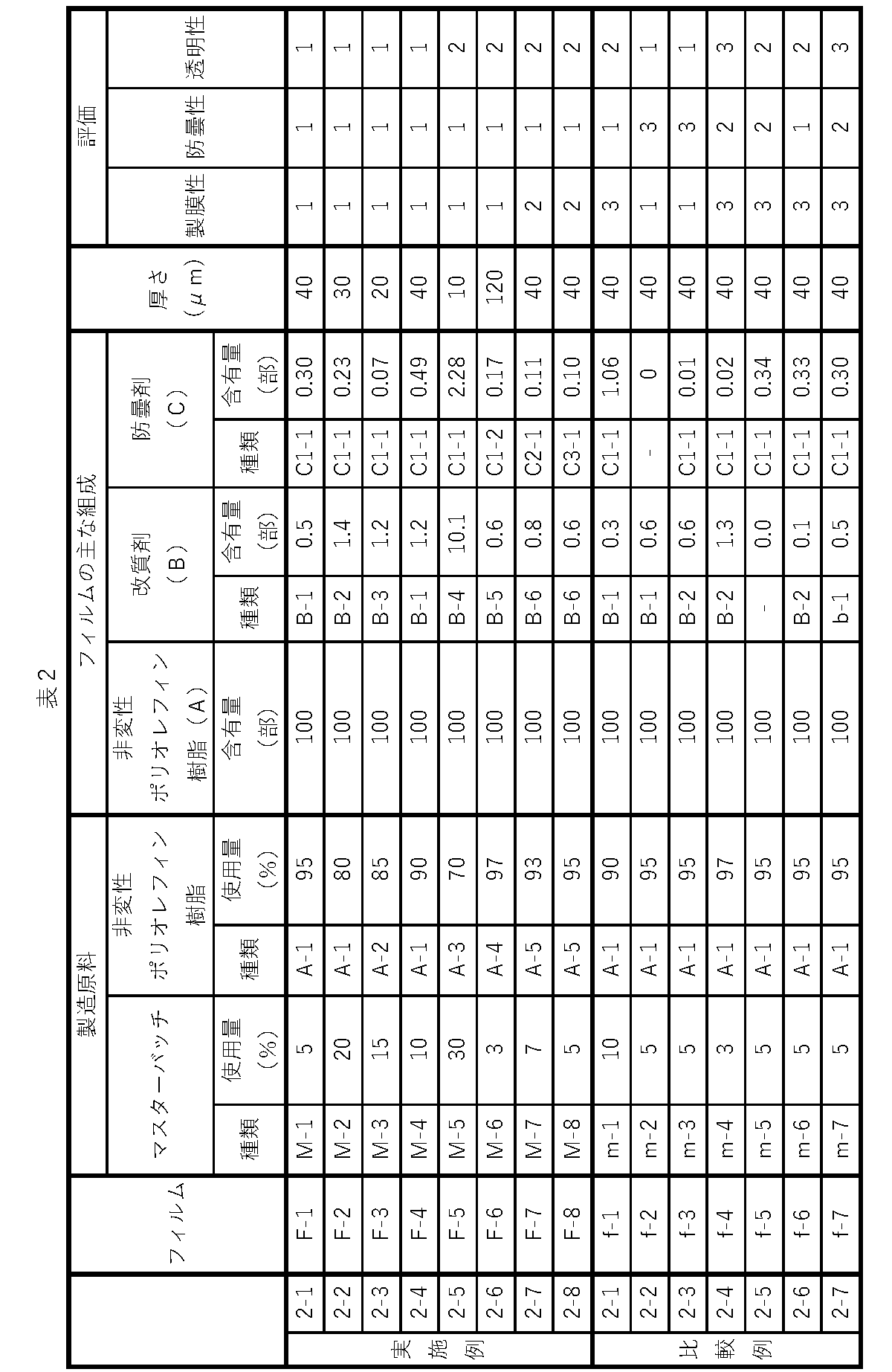
4.防曇剤を含み、改質剤を含まないマスターバッチの製造
以下、改質剤及び防曇剤を含有するポリオレフィン系樹脂フィルムの作製に用いる原料であるマスターバッチ(改質剤を含まず、非変性ポリオレフィン樹脂及び防曇剤を含有するマスターバッチ等)の製造例を示す。
以下、改質剤及び防曇剤を含有するポリオレフィン系樹脂フィルムの作製に用いる原料であるマスターバッチ(改質剤を含まず、非変性ポリオレフィン樹脂及び防曇剤を含有するマスターバッチ等)の製造例を示す。
調製例1
100部のエチレン・1-ブテン共重合体(A-1)と、5.3部の防曇剤(C1-1)とをタンブラーにて混合した後、二軸押出機により220℃で溶融状態としたところへ、12.3部の防曇剤(D-1)を液状注入により供給して、全ての原料を溶融混練した。次いで、造粒して、表3に示す構成のマスターバッチ(M-9)を得た。
100部のエチレン・1-ブテン共重合体(A-1)と、5.3部の防曇剤(C1-1)とをタンブラーにて混合した後、二軸押出機により220℃で溶融状態としたところへ、12.3部の防曇剤(D-1)を液状注入により供給して、全ての原料を溶融混練した。次いで、造粒して、表3に示す構成のマスターバッチ(M-9)を得た。
調製例2
100部のエチレン・1-ブテン共重合体(A-1)と、3.5部の防曇剤(C1-1)とをタンブラーにて混合した後、二軸押出機により220℃で溶融状態としたところへ、14.1部の防曇剤(D-2)を液状注入により供給して、全ての原料を溶融混練した。次いで、造粒して、表3に示す構成のマスターバッチ(M-10)を得た。
100部のエチレン・1-ブテン共重合体(A-1)と、3.5部の防曇剤(C1-1)とをタンブラーにて混合した後、二軸押出機により220℃で溶融状態としたところへ、14.1部の防曇剤(D-2)を液状注入により供給して、全ての原料を溶融混練した。次いで、造粒して、表3に示す構成のマスターバッチ(M-10)を得た。
調製例3
100部のエチレン・1-ヘキセン共重合体(A-2)と、1.2部の防曇剤(C1-1)とをタンブラーにて混合した後、二軸押出機により220℃で溶融状態としたところへ、28.8部の防曇剤(D-3)を液状注入により供給して、全ての原料を溶融混練した。次いで、造粒して、表3に示す構成のマスターバッチ(M-11)を得た。
100部のエチレン・1-ヘキセン共重合体(A-2)と、1.2部の防曇剤(C1-1)とをタンブラーにて混合した後、二軸押出機により220℃で溶融状態としたところへ、28.8部の防曇剤(D-3)を液状注入により供給して、全ての原料を溶融混練した。次いで、造粒して、表3に示す構成のマスターバッチ(M-11)を得た。
調製例4
100部のエチレン・1-ブテン共重合体(A-1)と、5.5部の防曇剤(C1-1)とをタンブラーにて混合した後、二軸押出機により220℃で溶融状態としたところへ、5.5部の防曇剤(D-1)を液状注入により供給して、全ての原料を溶融混練した。次いで、造粒して、表3に示す構成のマスターバッチ(M-12)を得た。
100部のエチレン・1-ブテン共重合体(A-1)と、5.5部の防曇剤(C1-1)とをタンブラーにて混合した後、二軸押出機により220℃で溶融状態としたところへ、5.5部の防曇剤(D-1)を液状注入により供給して、全ての原料を溶融混練した。次いで、造粒して、表3に示す構成のマスターバッチ(M-12)を得た。
調製例5
100部のエチレン・1-オクテン共重合体(A-3)と、14.4部の防曇剤(C1-1)と、21.6部の防曇剤(D-4)とをタンブラーにて混合した後、二軸押出機により220℃で全ての原料を溶融混練した。次いで、造粒して、表3に示す構成のマスターバッチ(M-13)を得た。
100部のエチレン・1-オクテン共重合体(A-3)と、14.4部の防曇剤(C1-1)と、21.6部の防曇剤(D-4)とをタンブラーにて混合した後、二軸押出機により220℃で全ての原料を溶融混練した。次いで、造粒して、表3に示す構成のマスターバッチ(M-13)を得た。
調製例6
100部のエチレン・1-ヘキセン共重合体(A-4)と、4.4部の防曇剤(C1-2)とをタンブラーにて混合した後、二軸押出機により220℃で溶融状態としたところへ、6.7部の防曇剤(D-5)を液状注入により供給して、全ての原料を溶融混練した。次いで、造粒して、表3に示す構成のマスターバッチ(M-14)を得た。
100部のエチレン・1-ヘキセン共重合体(A-4)と、4.4部の防曇剤(C1-2)とをタンブラーにて混合した後、二軸押出機により220℃で溶融状態としたところへ、6.7部の防曇剤(D-5)を液状注入により供給して、全ての原料を溶融混練した。次いで、造粒して、表3に示す構成のマスターバッチ(M-14)を得た。
調製例7
100部のエチレン・1-ブテン・プロピレン共重合体(A-5)と、1.1部の防曇剤(C2-1)とをタンブラーにて混合した後、二軸押出機により220℃で溶融状態としたところへ、10部の防曇剤(D-6)を液状注入により供給して、全ての原料を溶融混練した。次いで、造粒して、表3に示す構成のマスターバッチ(M-15)を得た。
100部のエチレン・1-ブテン・プロピレン共重合体(A-5)と、1.1部の防曇剤(C2-1)とをタンブラーにて混合した後、二軸押出機により220℃で溶融状態としたところへ、10部の防曇剤(D-6)を液状注入により供給して、全ての原料を溶融混練した。次いで、造粒して、表3に示す構成のマスターバッチ(M-15)を得た。
調製例8
100部のエチレン・1-ブテン共重合体(A-1)と、1.1部の防曇剤(C3-1)とをタンブラーにて混合した後、二軸押出機により220℃で溶融状態としたところへ、10部の防曇剤(D-7)を液状注入により供給して、全ての原料を溶融混練した。次いで、造粒して、表3に示す構成のマスターバッチ(M-16)を得た。
100部のエチレン・1-ブテン共重合体(A-1)と、1.1部の防曇剤(C3-1)とをタンブラーにて混合した後、二軸押出機により220℃で溶融状態としたところへ、10部の防曇剤(D-7)を液状注入により供給して、全ての原料を溶融混練した。次いで、造粒して、表3に示す構成のマスターバッチ(M-16)を得た。

5.ポリオレフィン系樹脂フィルムの製造(2)
表4に示すマスターバッチと、非変性ポリオレフィン樹脂と、改質剤とを用いて、ポリオレフィン系樹脂フィルムを得た。
表4に示すマスターバッチと、非変性ポリオレフィン樹脂と、改質剤とを用いて、ポリオレフィン系樹脂フィルムを得た。
実施例3-1
上記調製例1で得られたマスターバッチ(M-9)6部と、エチレン・1-ブテン重合体(A-1)からなる非変性ポリオレフィン樹脂90部と、改質剤であるエチレン・酢酸ビニル共重合体(B-1)4部とをタンブラーで混合した。次いで、インフレーション成形機により混合物を190℃で溶融し、20℃の環境下で空冷しながら押し出して、表4に示す構成を有する、厚さ40μmのポリオレフィン系樹脂フィルム(FF-1)を製造した。
上記調製例1で得られたマスターバッチ(M-9)6部と、エチレン・1-ブテン重合体(A-1)からなる非変性ポリオレフィン樹脂90部と、改質剤であるエチレン・酢酸ビニル共重合体(B-1)4部とをタンブラーで混合した。次いで、インフレーション成形機により混合物を190℃で溶融し、20℃の環境下で空冷しながら押し出して、表4に示す構成を有する、厚さ40μmのポリオレフィン系樹脂フィルム(FF-1)を製造した。
得られたポリオレフィン系樹脂フィルムについて、実施例2-1と同様にして、製膜性、防曇性及び透明性の評価を行った。その結果を表4に併記した。
実施例3-2
上記調製例2で得られたマスターバッチ(M-10)6部と、エチレン・1-ブテン共重合体(A-1)からなる非変性ポリオレフィン樹脂79部と、改質剤であるエチレン・酢酸ビニル共重合体(B-2)15部とをタンブラーで混合した。インフレーション成形機により混合物を190℃で溶融し、20℃の環境下で押し出して、厚さ30μmのポリオレフィン系樹脂フィルム(FF-2)を製造した(表4参照)。
その後、上記と同様にして、製膜性、防曇性及び透明性の評価を行った。その結果を表4に併記した。
上記調製例2で得られたマスターバッチ(M-10)6部と、エチレン・1-ブテン共重合体(A-1)からなる非変性ポリオレフィン樹脂79部と、改質剤であるエチレン・酢酸ビニル共重合体(B-2)15部とをタンブラーで混合した。インフレーション成形機により混合物を190℃で溶融し、20℃の環境下で押し出して、厚さ30μmのポリオレフィン系樹脂フィルム(FF-2)を製造した(表4参照)。
その後、上記と同様にして、製膜性、防曇性及び透明性の評価を行った。その結果を表4に併記した。
実施例3-3
上記調製例3で得られたマスターバッチ(M-11)8部と、エチレン・1-ヘキセン共重合体(A-2)からなる非変性ポリオレフィン樹脂62部と、改質剤であるエチレン・酢酸ビニル共重合体(B-3)30部とをタンブラーで混合した。次いで、インフレーション成形機により混合物を190℃で溶融し、20℃の環境下で押し出して、厚さ20μmのポリオレフィン系樹脂フィルム(FF-3)を製造した(表4参照)。
その後、上記と同様にして、製膜性、防曇性及び透明性の評価を行った。その結果を表4に併記した。
上記調製例3で得られたマスターバッチ(M-11)8部と、エチレン・1-ヘキセン共重合体(A-2)からなる非変性ポリオレフィン樹脂62部と、改質剤であるエチレン・酢酸ビニル共重合体(B-3)30部とをタンブラーで混合した。次いで、インフレーション成形機により混合物を190℃で溶融し、20℃の環境下で押し出して、厚さ20μmのポリオレフィン系樹脂フィルム(FF-3)を製造した(表4参照)。
その後、上記と同様にして、製膜性、防曇性及び透明性の評価を行った。その結果を表4に併記した。
実施例3-4
上記調製例4で得られたマスターバッチ(M-12)15部と、エチレン・1-ブテン共重合体(A-1)からなる非変性ポリオレフィン樹脂65部と、改質剤であるエチレン・酢酸ビニル共重合体(B-1)20部とをタンブラーで混合した。次いで、インフレーション成形機により混合物を190℃で溶融し、20℃の環境下で押し出して、厚さ40μmのポリオレフィン系樹脂フィルム(FF-4)を製造した(表4参照)。
その後、上記と同様にして、製膜性、防曇性及び透明性の評価を行った。その結果を表4に併記した。
上記調製例4で得られたマスターバッチ(M-12)15部と、エチレン・1-ブテン共重合体(A-1)からなる非変性ポリオレフィン樹脂65部と、改質剤であるエチレン・酢酸ビニル共重合体(B-1)20部とをタンブラーで混合した。次いで、インフレーション成形機により混合物を190℃で溶融し、20℃の環境下で押し出して、厚さ40μmのポリオレフィン系樹脂フィルム(FF-4)を製造した(表4参照)。
その後、上記と同様にして、製膜性、防曇性及び透明性の評価を行った。その結果を表4に併記した。
実施例3-5
上記調製例5で得られたマスターバッチ(M-13)35部と、エチレン・1-オクテン共重合体(A-3)からなる非変性ポリオレフィン樹脂55部と、改質剤であるエチレン・メタクリル酸メチル共重合体(B-4)10部とをタンブラーで混合した。次いで、インフレーション成形機により混合物を190℃で溶融し、20℃の環境下で押し出して、厚さ10μmのポリオレフィン系樹脂フィルム(FF-5)を製造した(表4参照)。
その後、上記と同様にして、製膜性、防曇性及び透明性の評価を行った。その結果を表4に併記した。
上記調製例5で得られたマスターバッチ(M-13)35部と、エチレン・1-オクテン共重合体(A-3)からなる非変性ポリオレフィン樹脂55部と、改質剤であるエチレン・メタクリル酸メチル共重合体(B-4)10部とをタンブラーで混合した。次いで、インフレーション成形機により混合物を190℃で溶融し、20℃の環境下で押し出して、厚さ10μmのポリオレフィン系樹脂フィルム(FF-5)を製造した(表4参照)。
その後、上記と同様にして、製膜性、防曇性及び透明性の評価を行った。その結果を表4に併記した。
実施例3-6
上記調製例6で得られたマスターバッチ(M-14)6部と、エチレン・ヘキセン共重合体(A-4)からなる非変性ポリオレフィン樹脂90部と、改質剤であるエチレン・アクリル酸エチル共重合体(B-5)4部とをタンブラーで混合した。次いで、インフレーション成形機により混合物を190℃で溶融し、20℃の環境下で押し出して、厚さ120μmのポリオレフィン系樹脂フィルム(FF-6)を製造した(表4参照)。
その後、上記と同様にして、製膜性、防曇性及び透明性の評価を行った。その結果を表4に併記した。
上記調製例6で得られたマスターバッチ(M-14)6部と、エチレン・ヘキセン共重合体(A-4)からなる非変性ポリオレフィン樹脂90部と、改質剤であるエチレン・アクリル酸エチル共重合体(B-5)4部とをタンブラーで混合した。次いで、インフレーション成形機により混合物を190℃で溶融し、20℃の環境下で押し出して、厚さ120μmのポリオレフィン系樹脂フィルム(FF-6)を製造した(表4参照)。
その後、上記と同様にして、製膜性、防曇性及び透明性の評価を行った。その結果を表4に併記した。
実施例3-7
上記調製例7で得られたマスターバッチ(M-15)6部と、エチレン・1-ブテン・プロピレン共重合体(A-5)からなる非変性ポリオレフィン樹脂90部と、改質剤である無水マレイン酸変性ポリプロピレン(B-6)4部とをタンブラーで混合した。次いで、インフレーション成形機により混合物を190℃で溶融し、20℃の環境下で押し出して、厚さ40μmのポリオレフィン系樹脂フィルム(FF-7)を製造した(表4参照)。
その後、上記と同様にして、製膜性、防曇性及び透明性の評価を行った。その結果を表4に併記した。
上記調製例7で得られたマスターバッチ(M-15)6部と、エチレン・1-ブテン・プロピレン共重合体(A-5)からなる非変性ポリオレフィン樹脂90部と、改質剤である無水マレイン酸変性ポリプロピレン(B-6)4部とをタンブラーで混合した。次いで、インフレーション成形機により混合物を190℃で溶融し、20℃の環境下で押し出して、厚さ40μmのポリオレフィン系樹脂フィルム(FF-7)を製造した(表4参照)。
その後、上記と同様にして、製膜性、防曇性及び透明性の評価を行った。その結果を表4に併記した。
実施例3-8
上記調製例8で得られたマスターバッチ(M-16)6部と、エチレン・1-ブテン・プロピレン共重合体(A-5)からなる非変性ポリオレフィン樹脂90部と、改質剤である無水マレイン酸変性ポリプロピレン(B-6)4部とをタンブラーで混合した。次いで、インフレーション成形機により混合物を190℃で溶融し、20℃の環境下で押し出して、厚さ40μmのポリオレフィン系樹脂フィルム(FF-8)を製造した(表4参照)。
その後、上記と同様にして、製膜性、防曇性及び透明性の評価を行った。その結果を表4に併記した。
上記調製例8で得られたマスターバッチ(M-16)6部と、エチレン・1-ブテン・プロピレン共重合体(A-5)からなる非変性ポリオレフィン樹脂90部と、改質剤である無水マレイン酸変性ポリプロピレン(B-6)4部とをタンブラーで混合した。次いで、インフレーション成形機により混合物を190℃で溶融し、20℃の環境下で押し出して、厚さ40μmのポリオレフィン系樹脂フィルム(FF-8)を製造した(表4参照)。
その後、上記と同様にして、製膜性、防曇性及び透明性の評価を行った。その結果を表4に併記した。
比較例3-1
上記調製例1で得られたマスターバッチ(M-9)6部と、エチレン・1-ブテン共重合体(A-1)からなる非変性ポリオレフィン樹脂49部と、改質剤であるエチレン・酢酸ビニル共重合体(B-1)45部とをタンブラーで混合した。次いで、インフレーション成形機により混合物を190℃で溶融し、20℃の環境下で押し出して、厚さ40μmのポリオレフィン系樹脂フィルム(ff-1)を製造した(表4参照)。
その後、上記と同様にして、製膜性、防曇性及び透明性の評価を行った。その結果を表4に併記した。
上記調製例1で得られたマスターバッチ(M-9)6部と、エチレン・1-ブテン共重合体(A-1)からなる非変性ポリオレフィン樹脂49部と、改質剤であるエチレン・酢酸ビニル共重合体(B-1)45部とをタンブラーで混合した。次いで、インフレーション成形機により混合物を190℃で溶融し、20℃の環境下で押し出して、厚さ40μmのポリオレフィン系樹脂フィルム(ff-1)を製造した(表4参照)。
その後、上記と同様にして、製膜性、防曇性及び透明性の評価を行った。その結果を表4に併記した。
比較例3-2
上記調製例1で得られたマスターバッチ(M-9)6部と、エチレン・1-ブテン共重合体(A-1)からなる非変性ポリオレフィン樹脂94部とをタンブラーで混合した。次いで、インフレーション成形機により混合物を190℃で溶融し、20℃の環境下で押し出して、改質剤を含有しない、厚さ40μmのポリオレフィン系樹脂フィルム(ff-2)を製造した(表4参照)。
その後、上記と同様にして、製膜性、防曇性及び透明性の評価を行った。その結果を表4に併記した。
上記調製例1で得られたマスターバッチ(M-9)6部と、エチレン・1-ブテン共重合体(A-1)からなる非変性ポリオレフィン樹脂94部とをタンブラーで混合した。次いで、インフレーション成形機により混合物を190℃で溶融し、20℃の環境下で押し出して、改質剤を含有しない、厚さ40μmのポリオレフィン系樹脂フィルム(ff-2)を製造した(表4参照)。
その後、上記と同様にして、製膜性、防曇性及び透明性の評価を行った。その結果を表4に併記した。
比較例3-3
上記調製例1で得られたマスターバッチ(M-9)6部と、エチレン・1-ブテン共重合体(A-1)からなる非変性ポリオレフィン樹脂93.7部と、改質剤であるエチレン・酢酸ビニル共重合体(B-1)0.3部とをタンブラーで混合した。次いで、インフレーション成形機により混合物を190℃で溶融し、20℃の環境下で押し出して、厚さ40μmのポリオレフィン系樹脂フィルム(ff-3)を製造した(表4参照)。
その後、上記と同様にして、製膜性、防曇性及び透明性の評価を行った。その結果を表4に併記した。
上記調製例1で得られたマスターバッチ(M-9)6部と、エチレン・1-ブテン共重合体(A-1)からなる非変性ポリオレフィン樹脂93.7部と、改質剤であるエチレン・酢酸ビニル共重合体(B-1)0.3部とをタンブラーで混合した。次いで、インフレーション成形機により混合物を190℃で溶融し、20℃の環境下で押し出して、厚さ40μmのポリオレフィン系樹脂フィルム(ff-3)を製造した(表4参照)。
その後、上記と同様にして、製膜性、防曇性及び透明性の評価を行った。その結果を表4に併記した。
比較例3-4
上記調製例1で得られたマスターバッチ(M-9)6部と、エチレン・1-ブテン共重合体(A-1)からなる非変性ポリオレフィン樹脂90部と、改質剤であるアイオノマー(b-1)を4部とをタンブラーで混合した。次いで、インフレーション成形機により混合物を190℃で溶融し、20℃の環境下で押し出して、厚さ40μmのポリオレフィン系樹脂フィルム(ff-4)を製造した(表4参照)。
その後、上記と同様にして、製膜性、防曇性及び透明性の評価を行った。その結果を表4に併記した。
上記調製例1で得られたマスターバッチ(M-9)6部と、エチレン・1-ブテン共重合体(A-1)からなる非変性ポリオレフィン樹脂90部と、改質剤であるアイオノマー(b-1)を4部とをタンブラーで混合した。次いで、インフレーション成形機により混合物を190℃で溶融し、20℃の環境下で押し出して、厚さ40μmのポリオレフィン系樹脂フィルム(ff-4)を製造した(表4参照)。
その後、上記と同様にして、製膜性、防曇性及び透明性の評価を行った。その結果を表4に併記した。
比較例3-5
上記調製例5で得られたマスターバッチ(M-13)50部と、エチレン・1-ブテン共重合体(A-1)からなる非変性ポリオレフィン樹脂46部と、改質剤であるエチレン・酢酸ビニル共重合体(B-1)4部とをタンブラーで混合した。次いで、インフレーション成形機により混合物を190℃で溶融し、20℃の環境下で押し出して、厚さ40μmのポリオレフィン系樹脂フィルム(ff-5)を製造した(表4参照)。
その後、上記と同様にして、製膜性、防曇性及び透明性の評価を行った。その結果を表4に併記した。
上記調製例5で得られたマスターバッチ(M-13)50部と、エチレン・1-ブテン共重合体(A-1)からなる非変性ポリオレフィン樹脂46部と、改質剤であるエチレン・酢酸ビニル共重合体(B-1)4部とをタンブラーで混合した。次いで、インフレーション成形機により混合物を190℃で溶融し、20℃の環境下で押し出して、厚さ40μmのポリオレフィン系樹脂フィルム(ff-5)を製造した(表4参照)。
その後、上記と同様にして、製膜性、防曇性及び透明性の評価を行った。その結果を表4に併記した。
比較例3-6
エチレン・1-ブテン共重合体(A-1)からなる非変性ポリオレフィン樹脂96部と、改質剤であるエチレン・酢酸ビニル共重合体(B-2)4部とをタンブラーで混合した。次いで、インフレーション成形機により混合物を190℃で溶融し、20℃の環境下で押し出して、厚さ40μmのポリオレフィン系樹脂フィルム(ff-6)を製造した(表4参照)。
その後、上記と同様にして、製膜性、防曇性及び透明性の評価を行った。その結果を表4に併記した。
エチレン・1-ブテン共重合体(A-1)からなる非変性ポリオレフィン樹脂96部と、改質剤であるエチレン・酢酸ビニル共重合体(B-2)4部とをタンブラーで混合した。次いで、インフレーション成形機により混合物を190℃で溶融し、20℃の環境下で押し出して、厚さ40μmのポリオレフィン系樹脂フィルム(ff-6)を製造した(表4参照)。
その後、上記と同様にして、製膜性、防曇性及び透明性の評価を行った。その結果を表4に併記した。
比較例3-7
上記調製例1で得られたマスターバッチ(M-9)0.5部と、エチレン・1-ブテン共重合体(A-1)からなる非変性ポリオレフィン樹脂95.5部と、改質剤であるアイオノマー(b-1)4部とをタンブラーで混合した。次いで、インフレーション成形機により混合物を190℃で溶融し、20℃の環境下で押し出して、厚さ40μmのポリオレフィン系樹脂フィルム(ff-7)を製造した(表4参照)。
その後、上記と同様にして、製膜性、防曇性及び透明性の評価を行った。その結果を表4に併記した。
上記調製例1で得られたマスターバッチ(M-9)0.5部と、エチレン・1-ブテン共重合体(A-1)からなる非変性ポリオレフィン樹脂95.5部と、改質剤であるアイオノマー(b-1)4部とをタンブラーで混合した。次いで、インフレーション成形機により混合物を190℃で溶融し、20℃の環境下で押し出して、厚さ40μmのポリオレフィン系樹脂フィルム(ff-7)を製造した(表4参照)。
その後、上記と同様にして、製膜性、防曇性及び透明性の評価を行った。その結果を表4に併記した。

表4から明らかなように、本発明に係る改質剤及び防曇剤が非変性ポリオレフィン樹脂に対して特定の含有割合で含む実施例3-1~3-8のポリオレフィン系樹脂フィルム(FF-1)~(FF-8)は、防曇性及び透明性に優れることが分かる。
6.積層フィルムの製造
表3に示すマスターバッチ、非変性ポリオレフィン樹脂及び改質剤を用いて、防曇剤及び改質剤を含有する第1樹脂層と、防曇剤及び改質剤を含有する場合がある第2樹脂層(中間層)と、第3樹脂層とをこの順に備える3層構造の積層フィルムを得た。
表3に示すマスターバッチ、非変性ポリオレフィン樹脂及び改質剤を用いて、防曇剤及び改質剤を含有する第1樹脂層と、防曇剤及び改質剤を含有する場合がある第2樹脂層(中間層)と、第3樹脂層とをこの順に備える3層構造の積層フィルムを得た。
実施例4-1
第1樹脂層の成形材料として、マスターバッチ(M-9)20部と、エチレン・1-ブテン共重合体(A-1)76部と、エチレン・酢酸ビニル共重合体(B-1)4部とをタンブラーを用いて混合した混合物を用いた。第2樹脂層(中間層)及び第3樹脂層の成形材料として、いずれも、エチレン・1-ブテン共重合体(A-1)のみを用いた(表5参照)。
これらの成形材料を用いて、インフレーション成形機により混合物を190℃で溶融し、20℃の環境下で共押出して、第1樹脂層、第2樹脂層(中間層)及び第3樹脂層が表6に示される構成を有し、各樹脂層の厚さが、それぞれ、10μm、20μm及び10μmである、合計厚さ40μmの積層フィルム(G-1)を製造した。
第1樹脂層の成形材料として、マスターバッチ(M-9)20部と、エチレン・1-ブテン共重合体(A-1)76部と、エチレン・酢酸ビニル共重合体(B-1)4部とをタンブラーを用いて混合した混合物を用いた。第2樹脂層(中間層)及び第3樹脂層の成形材料として、いずれも、エチレン・1-ブテン共重合体(A-1)のみを用いた(表5参照)。
これらの成形材料を用いて、インフレーション成形機により混合物を190℃で溶融し、20℃の環境下で共押出して、第1樹脂層、第2樹脂層(中間層)及び第3樹脂層が表6に示される構成を有し、各樹脂層の厚さが、それぞれ、10μm、20μm及び10μmである、合計厚さ40μmの積層フィルム(G-1)を製造した。
製造した積層フィルムについて、実施例2-1と同様にして、製膜性を評価した。また、下記方法により、防曇性及び透明性の評価を行った。評価結果を表6に併記した。
(1)防曇性
積層フィルムを、温度20℃及び相対湿度65%の条件下に24時間載置して調湿した後、第1樹脂層の面を20℃の水を入れたビーカー上面に被せた。次いで、この状態で5℃の雰囲気下に24時間置いて、ビーカー被着面(第1樹脂層の表面)への水滴の付着程度を観察し、以下の基準で防曇性を評価した。
<防曇性の判定基準>
1:水滴の付着がなく、透明であった(防曇性が著しく優れる)
2:大きな水滴の付着があったが、透明であった(防曇性が優れる)
3:多数の小さい水滴の付着があり、不透明であった(防曇性が劣る)
積層フィルムを、温度20℃及び相対湿度65%の条件下に24時間載置して調湿した後、第1樹脂層の面を20℃の水を入れたビーカー上面に被せた。次いで、この状態で5℃の雰囲気下に24時間置いて、ビーカー被着面(第1樹脂層の表面)への水滴の付着程度を観察し、以下の基準で防曇性を評価した。
<防曇性の判定基準>
1:水滴の付着がなく、透明であった(防曇性が著しく優れる)
2:大きな水滴の付着があったが、透明であった(防曇性が優れる)
3:多数の小さい水滴の付着があり、不透明であった(防曇性が劣る)
(2)透明性
積層フィルムを、温度20℃及び相対湿度65%の条件下に24時間載置して調湿した後、日本電色工業社製ヘイズメーター「NDH-5000」(型式名)を用いてヘイズを測定し、下記の基準で透明性を評価した。
<透明性の基準>
1:ヘイズが10%未満(透明性が優れる)
2:ヘイズが10%以上15%未満(透明性が良好である)
3:ヘイズが15%以上(透明性が劣る)
積層フィルムを、温度20℃及び相対湿度65%の条件下に24時間載置して調湿した後、日本電色工業社製ヘイズメーター「NDH-5000」(型式名)を用いてヘイズを測定し、下記の基準で透明性を評価した。
<透明性の基準>
1:ヘイズが10%未満(透明性が優れる)
2:ヘイズが10%以上15%未満(透明性が良好である)
3:ヘイズが15%以上(透明性が劣る)
実施例4-2
第1樹脂層の成形材料として、マスターバッチ(M-10)20部と、エチレン・1-ブテン共重合体(A-1)65部と、エチレン・酢酸ビニル共重合体(B-2)15部とをタンブラーを用いて混合した混合物を用い、第2樹脂層(中間層)及び第3樹脂層の成形材料として、いずれも、エチレン・1-ブテン共重合体(A-1)のみを用いた以外は、実施例4-1と同様の操作を行い、第1樹脂層、第2樹脂層(中間層)及び第3樹脂層の厚さが、それぞれ、10μm、20μm及び10μmである、積層フィルム(G-2)を得た(表5及び表6参照)。そして、製膜性、防曇性及び透明性の評価を行った。その結果を表6に併記した。
第1樹脂層の成形材料として、マスターバッチ(M-10)20部と、エチレン・1-ブテン共重合体(A-1)65部と、エチレン・酢酸ビニル共重合体(B-2)15部とをタンブラーを用いて混合した混合物を用い、第2樹脂層(中間層)及び第3樹脂層の成形材料として、いずれも、エチレン・1-ブテン共重合体(A-1)のみを用いた以外は、実施例4-1と同様の操作を行い、第1樹脂層、第2樹脂層(中間層)及び第3樹脂層の厚さが、それぞれ、10μm、20μm及び10μmである、積層フィルム(G-2)を得た(表5及び表6参照)。そして、製膜性、防曇性及び透明性の評価を行った。その結果を表6に併記した。
実施例4-3
第1樹脂層の成形材料として、マスターバッチ(M-11)10部と、エチレン・1-ヘキセン共重合体(A-2)60部と、エチレン・酢酸ビニル共重合体(B-3)30部とをタンブラーを用いて混合した混合物を用い、第2樹脂層(中間層)の成形材料として、マスターバッチ(M-11)10部と、エチレン・1-ヘキセン共重合体(A-2)80部と、エチレン・酢酸ビニル共重合体(B-1)10部とをタンブラーを用いて混合した混合物を用い、第3樹脂層の成形材料として、エチレン・1-ヘキセン共重合体(A-2)のみを用いた以外は、実施例4-1と同様の操作を行い、第1樹脂層、第2樹脂層(中間層)及び第3樹脂層の厚さが、それぞれ、20μm、20μm及び20μmである、積層フィルム(G-3)を得た(表5及び表6参照)。そして、製膜性、防曇性及び透明性の評価を行った。その結果を表6に併記した。
第1樹脂層の成形材料として、マスターバッチ(M-11)10部と、エチレン・1-ヘキセン共重合体(A-2)60部と、エチレン・酢酸ビニル共重合体(B-3)30部とをタンブラーを用いて混合した混合物を用い、第2樹脂層(中間層)の成形材料として、マスターバッチ(M-11)10部と、エチレン・1-ヘキセン共重合体(A-2)80部と、エチレン・酢酸ビニル共重合体(B-1)10部とをタンブラーを用いて混合した混合物を用い、第3樹脂層の成形材料として、エチレン・1-ヘキセン共重合体(A-2)のみを用いた以外は、実施例4-1と同様の操作を行い、第1樹脂層、第2樹脂層(中間層)及び第3樹脂層の厚さが、それぞれ、20μm、20μm及び20μmである、積層フィルム(G-3)を得た(表5及び表6参照)。そして、製膜性、防曇性及び透明性の評価を行った。その結果を表6に併記した。
実施例4-4
第1樹脂層の成形材料として、マスターバッチ(M-12)25部と、エチレン・1-ブテン共重合体(A-1)70部と、エチレン・酢酸ビニル共重合体(B-1)5部とをタンブラーを用いて混合した混合物を用い、第2樹脂層(中間層)及び第3樹脂層の成形材料として、いずれも、エチレン・1-ブテン共重合体(A-1)のみを用いた以外は、実施例4-1と同様の操作を行い、第1樹脂層、第2樹脂層(中間層)及び第3樹脂層の厚さが、それぞれ、20μm、20μm及び20μmである、積層フィルム(G-4)を得た(表5及び表6参照)。そして、製膜性、防曇性及び透明性の評価を行った。その結果を表6に併記した。
第1樹脂層の成形材料として、マスターバッチ(M-12)25部と、エチレン・1-ブテン共重合体(A-1)70部と、エチレン・酢酸ビニル共重合体(B-1)5部とをタンブラーを用いて混合した混合物を用い、第2樹脂層(中間層)及び第3樹脂層の成形材料として、いずれも、エチレン・1-ブテン共重合体(A-1)のみを用いた以外は、実施例4-1と同様の操作を行い、第1樹脂層、第2樹脂層(中間層)及び第3樹脂層の厚さが、それぞれ、20μm、20μm及び20μmである、積層フィルム(G-4)を得た(表5及び表6参照)。そして、製膜性、防曇性及び透明性の評価を行った。その結果を表6に併記した。
実施例4-5
第1樹脂層の成形材料として、マスターバッチ(M-13)8部と、エチレン・1-オクテン共重合体(A-3)82部と、エチレン・メタクリル酸メチル共重合体(B-4)10部とをタンブラーを用いて混合した混合物を用い、第2樹脂層(中間層)及び第3樹脂層の成形材料として、いずれも、エチレン・1-オクテン共重合体(A-3)のみを用いた以外は、実施例4-1と同様の操作を行い、第1樹脂層、第2樹脂層(中間層)及び第3樹脂層の厚さが、それぞれ、20μm、20μm及び20μmである、積層フィルム(G-5)を得た(表5及び表6参照)。そして、製膜性、防曇性及び透明性の評価を行った。その結果を表6に併記した。
第1樹脂層の成形材料として、マスターバッチ(M-13)8部と、エチレン・1-オクテン共重合体(A-3)82部と、エチレン・メタクリル酸メチル共重合体(B-4)10部とをタンブラーを用いて混合した混合物を用い、第2樹脂層(中間層)及び第3樹脂層の成形材料として、いずれも、エチレン・1-オクテン共重合体(A-3)のみを用いた以外は、実施例4-1と同様の操作を行い、第1樹脂層、第2樹脂層(中間層)及び第3樹脂層の厚さが、それぞれ、20μm、20μm及び20μmである、積層フィルム(G-5)を得た(表5及び表6参照)。そして、製膜性、防曇性及び透明性の評価を行った。その結果を表6に併記した。
実施例4-6
第1樹脂層の成形材料として、マスターバッチ(M-14)20部と、エチレン・ヘキセン共重合体(A-4)76部と、エチレン・アクリル酸エチル共重合体(B-5)4部とをタンブラーを用いて混合した混合物を用い、第2樹脂層(中間層)の成形材料として、マスターバッチ(M-14)5部と、エチレン・ヘキセン共重合体(A-4)71部と、エチレン・酢酸ビニル共重合体(B-1)24部とをタンブラーを用いて混合した混合物を用い、第3樹脂層の成形材料として、エチレン・ヘキセン共重合体(A-4)のみを用いた以外は、実施例4-1と同様の操作を行い、第1樹脂層、第2樹脂層(中間層)及び第3樹脂層の厚さが、それぞれ、20μm、70μm及び30μmである、積層フィルム(G-6)を得た(表5及び表6参照)。そして、製膜性、防曇性及び透明性の評価を行った。その結果を表6に併記した。
第1樹脂層の成形材料として、マスターバッチ(M-14)20部と、エチレン・ヘキセン共重合体(A-4)76部と、エチレン・アクリル酸エチル共重合体(B-5)4部とをタンブラーを用いて混合した混合物を用い、第2樹脂層(中間層)の成形材料として、マスターバッチ(M-14)5部と、エチレン・ヘキセン共重合体(A-4)71部と、エチレン・酢酸ビニル共重合体(B-1)24部とをタンブラーを用いて混合した混合物を用い、第3樹脂層の成形材料として、エチレン・ヘキセン共重合体(A-4)のみを用いた以外は、実施例4-1と同様の操作を行い、第1樹脂層、第2樹脂層(中間層)及び第3樹脂層の厚さが、それぞれ、20μm、70μm及び30μmである、積層フィルム(G-6)を得た(表5及び表6参照)。そして、製膜性、防曇性及び透明性の評価を行った。その結果を表6に併記した。
実施例4-7
第1樹脂層の成形材料として、マスターバッチ(M-15)30部と、エチレン・1-ブテン・プロピレン共重合体(A-5)66部と、無水マレイン変性ポリプロピレン(B-6)4部とをタンブラーを用いて混合した混合物を用い、第2樹脂層(中間層)の成形材料として、マスターバッチ(M-15)15部と、エチレン・1-ブテン・プロピレン共重合体(A-5)75部と、エチレン・酢酸ビニル共重合体(B-1)10部とをタンブラーを用いて混合した混合物を用い、第3樹脂層の成形材料として、エチレン・1-ブテン共重合体(A-1)のみを用いた以外は、実施例4-1と同様の操作を行い、第1樹脂層、第2樹脂層(中間層)及び第3樹脂層の厚さが、それぞれ、10μm、20μm及び30μmである、積層フィルム(G-7)を得た(表5及び表6参照)。そして、製膜性、防曇性及び透明性の評価を行った。その結果を表6に併記した。
第1樹脂層の成形材料として、マスターバッチ(M-15)30部と、エチレン・1-ブテン・プロピレン共重合体(A-5)66部と、無水マレイン変性ポリプロピレン(B-6)4部とをタンブラーを用いて混合した混合物を用い、第2樹脂層(中間層)の成形材料として、マスターバッチ(M-15)15部と、エチレン・1-ブテン・プロピレン共重合体(A-5)75部と、エチレン・酢酸ビニル共重合体(B-1)10部とをタンブラーを用いて混合した混合物を用い、第3樹脂層の成形材料として、エチレン・1-ブテン共重合体(A-1)のみを用いた以外は、実施例4-1と同様の操作を行い、第1樹脂層、第2樹脂層(中間層)及び第3樹脂層の厚さが、それぞれ、10μm、20μm及び30μmである、積層フィルム(G-7)を得た(表5及び表6参照)。そして、製膜性、防曇性及び透明性の評価を行った。その結果を表6に併記した。
実施例4-8
第1樹脂層の成形材料として、マスターバッチ(M-16)30部と、エチレン・1-ブテン・プロピレン共重合体(A-5)66部と、無水マレイン変性ポリプロピレン(B-6)4部とをタンブラーを用いて混合した混合物を用い、第2樹脂層(中間層)及び第3樹脂層の成形材料として、いずれも、エチレン・1-ブテン共重合体(A-1)のみを用いた以外は、実施例4-1と同様の操作を行い、第1樹脂層、第2樹脂層(中間層)及び第3樹脂層の厚さが、それぞれ、10μm、20μm及び10μmである、積層フィルム(G-8)を得た(表5及び表6参照)。そして、製膜性、防曇性及び透明性の評価を行った。その結果を表6に併記した。
第1樹脂層の成形材料として、マスターバッチ(M-16)30部と、エチレン・1-ブテン・プロピレン共重合体(A-5)66部と、無水マレイン変性ポリプロピレン(B-6)4部とをタンブラーを用いて混合した混合物を用い、第2樹脂層(中間層)及び第3樹脂層の成形材料として、いずれも、エチレン・1-ブテン共重合体(A-1)のみを用いた以外は、実施例4-1と同様の操作を行い、第1樹脂層、第2樹脂層(中間層)及び第3樹脂層の厚さが、それぞれ、10μm、20μm及び10μmである、積層フィルム(G-8)を得た(表5及び表6参照)。そして、製膜性、防曇性及び透明性の評価を行った。その結果を表6に併記した。
比較例4-1
第1樹脂層の成形材料として、マスターバッチ(M-9)20部と、エチレン・1-ブテン共重合体(A-1)35部と、エチレン・酢酸ビニル共重合体(B-1)45部とをタンブラーを用いて混合した混合物を用い、第2樹脂層(中間層)及び第3樹脂層の成形材料として、いずれも、エチレン・1-ブテン共重合体(A-1)のみを用いた以外は、実施例4-1と同様の操作を行い、第1樹脂層、第2樹脂層(中間層)及び第3樹脂層の厚さが、それぞれ、10μm、20μm及び10μmである、積層フィルム(g-1)を得た(表5及び表6参照)。そして、製膜性、防曇性及び透明性の評価を行った。その結果を表6に併記した。
第1樹脂層の成形材料として、マスターバッチ(M-9)20部と、エチレン・1-ブテン共重合体(A-1)35部と、エチレン・酢酸ビニル共重合体(B-1)45部とをタンブラーを用いて混合した混合物を用い、第2樹脂層(中間層)及び第3樹脂層の成形材料として、いずれも、エチレン・1-ブテン共重合体(A-1)のみを用いた以外は、実施例4-1と同様の操作を行い、第1樹脂層、第2樹脂層(中間層)及び第3樹脂層の厚さが、それぞれ、10μm、20μm及び10μmである、積層フィルム(g-1)を得た(表5及び表6参照)。そして、製膜性、防曇性及び透明性の評価を行った。その結果を表6に併記した。
比較例4-2
第1樹脂層の成形材料として、マスターバッチ(M-9)20部と、エチレン・1-ブテン共重合体(A-1)80部とをタンブラーを用いて混合した混合物を用い、第2樹脂層(中間層)及び第3樹脂層の成形材料として、いずれも、エチレン・1-ブテン共重合体(A-1)のみを用いた以外は、実施例4-1と同様の操作を行い、第1樹脂層、第2樹脂層(中間層)及び第3樹脂層の厚さが、それぞれ、10μm、20μm及び10μmである、積層フィルム(g-2)を得た(表5及び表6参照)。そして、製膜性、防曇性及び透明性の評価を行った。その結果を表6に併記した。
第1樹脂層の成形材料として、マスターバッチ(M-9)20部と、エチレン・1-ブテン共重合体(A-1)80部とをタンブラーを用いて混合した混合物を用い、第2樹脂層(中間層)及び第3樹脂層の成形材料として、いずれも、エチレン・1-ブテン共重合体(A-1)のみを用いた以外は、実施例4-1と同様の操作を行い、第1樹脂層、第2樹脂層(中間層)及び第3樹脂層の厚さが、それぞれ、10μm、20μm及び10μmである、積層フィルム(g-2)を得た(表5及び表6参照)。そして、製膜性、防曇性及び透明性の評価を行った。その結果を表6に併記した。
比較例4-3
第1樹脂層の成形材料として、マスターバッチ(M-9)20部と、エチレン・1-ブテン共重合体(A-1)79.7部と、エチレン・酢酸ビニル共重合体(B-1)0.3部とをタンブラーを用いて混合した混合物を用い、第2樹脂層(中間層)及び第3樹脂層の成形材料として、いずれも、エチレン・1-ブテン共重合体(A-1)のみを用いた以外は、実施例4-1と同様の操作を行い、第1樹脂層、第2樹脂層(中間層)及び第3樹脂層の厚さが、それぞれ、10μm、20μm及び10μmである、積層フィルム(g-3)を得た(表5及び表6参照)。そして、製膜性、防曇性及び透明性の評価を行った。その結果を表6に併記した。
第1樹脂層の成形材料として、マスターバッチ(M-9)20部と、エチレン・1-ブテン共重合体(A-1)79.7部と、エチレン・酢酸ビニル共重合体(B-1)0.3部とをタンブラーを用いて混合した混合物を用い、第2樹脂層(中間層)及び第3樹脂層の成形材料として、いずれも、エチレン・1-ブテン共重合体(A-1)のみを用いた以外は、実施例4-1と同様の操作を行い、第1樹脂層、第2樹脂層(中間層)及び第3樹脂層の厚さが、それぞれ、10μm、20μm及び10μmである、積層フィルム(g-3)を得た(表5及び表6参照)。そして、製膜性、防曇性及び透明性の評価を行った。その結果を表6に併記した。
比較例4-4
第1樹脂層の成形材料として、マスターバッチ(M-9)20部と、エチレン・1-ブテン共重合体(A-1)76部と、アイオノマー(b-1)4部とをタンブラーを用いて混合した混合物を用い、第2樹脂層(中間層)及び第3樹脂層の成形材料として、いずれも、エチレン・1-ブテン共重合体(A-1)のみを用いた以外は、実施例4-1と同様の操作を行い、第1樹脂層、第2樹脂層(中間層)及び第3樹脂層の厚さが、それぞれ、10μm、20μm及び10μmである、積層フィルム(g-4)を得た(表5及び表6参照)。そして、製膜性、防曇性及び透明性の評価を行った。その結果を表6に併記した。
第1樹脂層の成形材料として、マスターバッチ(M-9)20部と、エチレン・1-ブテン共重合体(A-1)76部と、アイオノマー(b-1)4部とをタンブラーを用いて混合した混合物を用い、第2樹脂層(中間層)及び第3樹脂層の成形材料として、いずれも、エチレン・1-ブテン共重合体(A-1)のみを用いた以外は、実施例4-1と同様の操作を行い、第1樹脂層、第2樹脂層(中間層)及び第3樹脂層の厚さが、それぞれ、10μm、20μm及び10μmである、積層フィルム(g-4)を得た(表5及び表6参照)。そして、製膜性、防曇性及び透明性の評価を行った。その結果を表6に併記した。
比較例4-5
第1樹脂層の成形材料として、マスターバッチ(M-13)50部と、エチレン・1-ブテン共重合体(A-1)46部と、エチレン・酢酸ビニル共重合体(B-1)4部とをタンブラーを用いて混合した混合物を用い、第2樹脂層(中間層)及び第3樹脂層の成形材料として、いずれも、エチレン・1-ブテン共重合体(A-1)のみを用いた以外は、実施例4-1と同様の操作を行い、第1樹脂層、第2樹脂層(中間層)及び第3樹脂層の厚さが、それぞれ、10μm、20μm及び10μmである、積層フィルム(g-5)を得た(表5及び表6参照)。そして、製膜性、防曇性及び透明性の評価を行った。その結果を表6に併記した。
第1樹脂層の成形材料として、マスターバッチ(M-13)50部と、エチレン・1-ブテン共重合体(A-1)46部と、エチレン・酢酸ビニル共重合体(B-1)4部とをタンブラーを用いて混合した混合物を用い、第2樹脂層(中間層)及び第3樹脂層の成形材料として、いずれも、エチレン・1-ブテン共重合体(A-1)のみを用いた以外は、実施例4-1と同様の操作を行い、第1樹脂層、第2樹脂層(中間層)及び第3樹脂層の厚さが、それぞれ、10μm、20μm及び10μmである、積層フィルム(g-5)を得た(表5及び表6参照)。そして、製膜性、防曇性及び透明性の評価を行った。その結果を表6に併記した。
比較例4-6
第1樹脂層の成形材料として、エチレン・1-ブテン共重合体(A-1)96部と、エチレン・酢酸ビニル共重合体(B-1)4部とをタンブラーを用いて混合した混合物を用い、第2樹脂層(中間層)及び第3樹脂層の成形材料として、いずれも、エチレン・1-ブテン共重合体(A-1)のみを用いた以外は、実施例4-1と同様の操作を行い、第1樹脂層、第2樹脂層(中間層)及び第3樹脂層の厚さが、それぞれ、10μm、20μm及び10μmである、積層フィルム(g-6)を得た(表5及び表6参照)。そして、製膜性、防曇性及び透明性の評価を行った。その結果を表6に併記した。
第1樹脂層の成形材料として、エチレン・1-ブテン共重合体(A-1)96部と、エチレン・酢酸ビニル共重合体(B-1)4部とをタンブラーを用いて混合した混合物を用い、第2樹脂層(中間層)及び第3樹脂層の成形材料として、いずれも、エチレン・1-ブテン共重合体(A-1)のみを用いた以外は、実施例4-1と同様の操作を行い、第1樹脂層、第2樹脂層(中間層)及び第3樹脂層の厚さが、それぞれ、10μm、20μm及び10μmである、積層フィルム(g-6)を得た(表5及び表6参照)。そして、製膜性、防曇性及び透明性の評価を行った。その結果を表6に併記した。


表6から明らかなように、防曇性及び透明性に優れる本発明のポリオレフィン系樹脂フィルムからなる第1樹脂層を備える積層フィルム(G-1)~(G-8)は、防曇性及び透明性に優れることが分かる。
本発明のマスターバッチを含有する樹脂組成物を用いることにより、防曇性及び透明性に優れたポリオレフィン系樹脂フィルムを効率よく製造することができる。本発明のポリオレフィン系樹脂フィルム及び積層フィルムは、防曇性及び透明性に優れるため、食品等の包装材に好適である。
Claims (5)
- 非変性のポリオレフィン樹脂と、改質剤と、防曇剤とを含有するマスターバッチであって、
前記改質剤は、エチレン・酢酸ビニル共重合体、エチレン・不飽和カルボン酸エステル共重合体、及び、不飽和酸無水物で変性されたポリオレフィン樹脂から選ばれた少なくとも1種であり、
前記防曇剤は、アルキルスルホン酸アルカリ金属塩、アルキルアリールスルホン酸アルカリ金属塩及びアルキル硫酸アルカリ金属塩から選ばれた少なくとも1種であり、
前記改質剤の含有量は、前記非変性ポリオレフィン樹脂100質量部に対して4~85質量部であり、
前記防曇剤の含有量は、前記非変性ポリオレフィン樹脂100質量部に対して0.4~16.0質量部であることを特徴とするマスターバッチ。 - 請求項1に記載のマスターバッチを含有することを特徴とする樹脂組成物。
- 請求項2に記載の樹脂組成物をフィルム成形に供することを特徴とするポリオレフィン系樹脂フィルムの製造方法。
- 非変性のポリオレフィン樹脂と、改質剤と、防曇剤とを含有するポリオレフィン系樹脂フィルムであって、
前記改質剤は、エチレン・酢酸ビニル共重合体、エチレン・不飽和カルボン酸エステル共重合体、及び、不飽和酸無水物で変性されたポリオレフィン樹脂から選ばれた少なくとも1種であり、
前記防曇剤は、アルキルスルホン酸アルカリ金属塩、アルキルアリールスルホン酸アルカリ金属塩及びアルキル硫酸アルカリ金属塩から選ばれた少なくとも1種であり、
前記改質剤の含有量は、前記非変性ポリオレフィン樹脂100質量部に対して0.4~80質量部であり、
前記防曇剤の含有量は、前記非変性ポリオレフィン樹脂100質量部に対して0.03~6.00質量部であることを特徴とするポリオレフィン系樹脂フィルム。 - 請求項4に記載のポリオレフィン系樹脂フィルムからなる樹脂層と、他の層とが積層されてなることを特徴とする積層フィルム。
Priority Applications (3)
| Application Number | Priority Date | Filing Date | Title |
|---|---|---|---|
| US17/996,983 US20230167286A1 (en) | 2020-05-28 | 2021-02-26 | Masterbatch, resin composition, polyolefin resin film, production method therefor, and laminate film |
| EP21812056.6A EP4159436A4 (en) | 2020-05-28 | 2021-02-26 | MASTERBATCH, RESIN COMPOSITION, POLYOLEFIN RESIN FILM, MANUFACTURING PROCESS THEREOF AND LAYER FILM |
| CN202180002282.7A CN114026165A (zh) | 2020-05-28 | 2021-02-26 | 母料、树脂组合物、聚烯烃系树脂薄膜和其制造方法以及层叠薄膜 |
Applications Claiming Priority (2)
| Application Number | Priority Date | Filing Date | Title |
|---|---|---|---|
| JP2020-093625 | 2020-05-28 | ||
| JP2020093625A JP6811501B1 (ja) | 2020-05-28 | 2020-05-28 | マスターバッチ、樹脂組成物、ポリオレフィン系樹脂フィルム及びその製造方法並びに積層フィルム |
Publications (1)
| Publication Number | Publication Date |
|---|---|
| WO2021240931A1 true WO2021240931A1 (ja) | 2021-12-02 |
Family
ID=74096241
Family Applications (1)
| Application Number | Title | Priority Date | Filing Date |
|---|---|---|---|
| PCT/JP2021/007549 Ceased WO2021240931A1 (ja) | 2020-05-28 | 2021-02-26 | マスターバッチ、樹脂組成物、ポリオレフィン系樹脂フィルム及びその製造方法並びに積層フィルム |
Country Status (5)
| Country | Link |
|---|---|
| US (1) | US20230167286A1 (ja) |
| EP (1) | EP4159436A4 (ja) |
| JP (1) | JP6811501B1 (ja) |
| CN (1) | CN114026165A (ja) |
| WO (1) | WO2021240931A1 (ja) |
Families Citing this family (1)
| Publication number | Priority date | Publication date | Assignee | Title |
|---|---|---|---|---|
| CN115304856B (zh) * | 2022-05-19 | 2024-06-25 | 浙江苏达山新材料有限公司 | 一种分布效果好的色母粒及其制备工艺 |
Citations (11)
| Publication number | Priority date | Publication date | Assignee | Title |
|---|---|---|---|---|
| JPS5428371A (en) * | 1977-08-04 | 1979-03-02 | Mitsubishi Chem Ind Ltd | Production of polyolefin film |
| JPH0596694A (ja) | 1991-10-04 | 1993-04-20 | Showa Denko Kk | 包装用積層フイルム |
| JPH08300582A (ja) * | 1995-05-12 | 1996-11-19 | Mitsubishi Chem Corp | きのこ類包装用積層フィルム及びきのこ類包装体 |
| JP2005059269A (ja) * | 2003-08-08 | 2005-03-10 | Takemoto Oil & Fat Co Ltd | 積層フィルム |
| JP2006231899A (ja) | 2005-01-26 | 2006-09-07 | Toyobo Co Ltd | ポリプロピレン系防曇フィルム |
| JP2007045855A (ja) * | 2005-08-05 | 2007-02-22 | Asahi Kasei Life & Living Corp | ポリオレフィン系樹脂組成物 |
| JP2007290338A (ja) * | 2006-03-27 | 2007-11-08 | Takemoto Oil & Fat Co Ltd | 包装用積層フィルム及びその製造方法 |
| JP2018127533A (ja) | 2017-02-08 | 2018-08-16 | 旭化成株式会社 | マスターバッチ |
| WO2018216305A1 (ja) * | 2017-05-22 | 2018-11-29 | 竹本油脂株式会社 | ポリオレフィン系樹脂用改質剤、ポリオレフィン系樹脂組成物、改質ポリオレフィン系樹脂フィルム及び積層フィルム |
| EP3428227A1 (en) * | 2017-07-14 | 2019-01-16 | Akzo Nobel Chemicals International B.V. | Anti-fog agent |
| WO2020013140A1 (ja) * | 2018-07-10 | 2020-01-16 | 竹本油脂株式会社 | ポリオレフィン系樹脂フィルム用改質剤、ポリオレフィン系樹脂フィルム用組成物、改質ポリオレフィン系樹脂フィルム、及び積層フィルム |
Family Cites Families (4)
| Publication number | Priority date | Publication date | Assignee | Title |
|---|---|---|---|---|
| JPH11138710A (ja) * | 1997-11-10 | 1999-05-25 | Mitsui Chem Inc | 包装用多層フィルム |
| JPH11348204A (ja) * | 1998-06-03 | 1999-12-21 | Okura Ind Co Ltd | 食品包装用ストレッチフィルム |
| KR100840150B1 (ko) * | 2007-02-23 | 2008-06-23 | 한국과학기술연구원 | 융착성과 2차 발포성이 우수한 난연성 폴리올레핀 발포입자의 수지 조성물 |
| CN106750945A (zh) * | 2016-12-23 | 2017-05-31 | 苏州曙帆信电子科技有限公司 | 一种抗菌耐磨聚丙烯色母粒 |
-
2020
- 2020-05-28 JP JP2020093625A patent/JP6811501B1/ja active Active
-
2021
- 2021-02-26 CN CN202180002282.7A patent/CN114026165A/zh active Pending
- 2021-02-26 US US17/996,983 patent/US20230167286A1/en active Pending
- 2021-02-26 EP EP21812056.6A patent/EP4159436A4/en active Pending
- 2021-02-26 WO PCT/JP2021/007549 patent/WO2021240931A1/ja not_active Ceased
Patent Citations (11)
| Publication number | Priority date | Publication date | Assignee | Title |
|---|---|---|---|---|
| JPS5428371A (en) * | 1977-08-04 | 1979-03-02 | Mitsubishi Chem Ind Ltd | Production of polyolefin film |
| JPH0596694A (ja) | 1991-10-04 | 1993-04-20 | Showa Denko Kk | 包装用積層フイルム |
| JPH08300582A (ja) * | 1995-05-12 | 1996-11-19 | Mitsubishi Chem Corp | きのこ類包装用積層フィルム及びきのこ類包装体 |
| JP2005059269A (ja) * | 2003-08-08 | 2005-03-10 | Takemoto Oil & Fat Co Ltd | 積層フィルム |
| JP2006231899A (ja) | 2005-01-26 | 2006-09-07 | Toyobo Co Ltd | ポリプロピレン系防曇フィルム |
| JP2007045855A (ja) * | 2005-08-05 | 2007-02-22 | Asahi Kasei Life & Living Corp | ポリオレフィン系樹脂組成物 |
| JP2007290338A (ja) * | 2006-03-27 | 2007-11-08 | Takemoto Oil & Fat Co Ltd | 包装用積層フィルム及びその製造方法 |
| JP2018127533A (ja) | 2017-02-08 | 2018-08-16 | 旭化成株式会社 | マスターバッチ |
| WO2018216305A1 (ja) * | 2017-05-22 | 2018-11-29 | 竹本油脂株式会社 | ポリオレフィン系樹脂用改質剤、ポリオレフィン系樹脂組成物、改質ポリオレフィン系樹脂フィルム及び積層フィルム |
| EP3428227A1 (en) * | 2017-07-14 | 2019-01-16 | Akzo Nobel Chemicals International B.V. | Anti-fog agent |
| WO2020013140A1 (ja) * | 2018-07-10 | 2020-01-16 | 竹本油脂株式会社 | ポリオレフィン系樹脂フィルム用改質剤、ポリオレフィン系樹脂フィルム用組成物、改質ポリオレフィン系樹脂フィルム、及び積層フィルム |
Non-Patent Citations (1)
| Title |
|---|
| See also references of EP4159436A4 |
Also Published As
| Publication number | Publication date |
|---|---|
| CN114026165A (zh) | 2022-02-08 |
| JP6811501B1 (ja) | 2021-01-13 |
| JP2021187932A (ja) | 2021-12-13 |
| US20230167286A1 (en) | 2023-06-01 |
| EP4159436A4 (en) | 2024-06-19 |
| EP4159436A1 (en) | 2023-04-05 |
Similar Documents
| Publication | Publication Date | Title |
|---|---|---|
| KR102815848B1 (ko) | 무광택 pe 재료 및 이의 제조 방법과 응용 | |
| CN103980618A (zh) | 单层和多层吹胀薄膜 | |
| CN104802482A (zh) | 一种三层共挤聚丙烯/聚乙烯/聚丙烯上吹薄膜及其制备方法 | |
| CN1283150A (zh) | 积层包装材料及其制造方法 | |
| WO2010001471A1 (ja) | Evoh複合体の製造方法 | |
| CN111433000B (zh) | 聚酰胺系膜和其制造方法 | |
| CN103057228B (zh) | 太阳能背板的组成及其制备方法 | |
| WO2018216305A1 (ja) | ポリオレフィン系樹脂用改質剤、ポリオレフィン系樹脂組成物、改質ポリオレフィン系樹脂フィルム及び積層フィルム | |
| CN1827362A (zh) | 模内成型用标签以及使用该标签的成型品 | |
| EP4570496A1 (en) | Low-density heat-shrinkable film for labels, preparation method and use thereof | |
| JP6811501B1 (ja) | マスターバッチ、樹脂組成物、ポリオレフィン系樹脂フィルム及びその製造方法並びに積層フィルム | |
| JPH01121362A (ja) | 帯電防止性フイルム | |
| JP5837440B2 (ja) | 多層フィルム | |
| JPH0892428A (ja) | ポリオレフィン系樹脂組成物 | |
| CN103524882A (zh) | 一种具有无光特性的聚烯烃树脂组合物 | |
| JP4527208B2 (ja) | 樹脂組成物の製造方法 | |
| JPWO2020013140A1 (ja) | ポリオレフィン系樹脂フィルム用改質剤、ポリオレフィン系樹脂フィルム用組成物、改質ポリオレフィン系樹脂フィルム、及び積層フィルム | |
| CN104109356A (zh) | 一种增强再生pet/pe合金材料及其制备方法 | |
| CN103182820B (zh) | 一种流延聚丙烯直复膜 | |
| ITMI940015A1 (it) | Pellicola dotata di elevate proprieta' anti-condensa metodo per confezionare prodotti ad alto contenuto di umidita' e prodotti cosi' confezionati | |
| JP2001071431A (ja) | 多層延伸ポリプロピレン系フィルム | |
| JP2018177983A (ja) | ポリオレフィン系樹脂用防曇剤、ポリオレフィン系樹脂組成物用マスターバッチ、ポリオレフィン系樹脂組成物、ポリオレフィン系樹脂フィルム、食品包装用積層フィルム及び食品包装用積層フィルムの製造方法 | |
| WO2013118413A1 (ja) | 多層フィルム、包装用フィルム及びその製造方法 | |
| JP6811502B1 (ja) | マスターバッチ、樹脂組成物、ポリオレフィン系樹脂フィルム及びその製造方法並びに積層フィルム | |
| CN110861376A (zh) | 一种透明背板膜用聚烯烃膜及其制备方法 |
Legal Events
| Date | Code | Title | Description |
|---|---|---|---|
| 121 | Ep: the epo has been informed by wipo that ep was designated in this application |
Ref document number: 21812056 Country of ref document: EP Kind code of ref document: A1 |
|
| NENP | Non-entry into the national phase |
Ref country code: DE |
|
| ENP | Entry into the national phase |
Ref document number: 2021812056 Country of ref document: EP Effective date: 20230102 |