WO2022004225A1 - ポリエステルモノフィラメント - Google Patents
ポリエステルモノフィラメント Download PDFInfo
- Publication number
- WO2022004225A1 WO2022004225A1 PCT/JP2021/020583 JP2021020583W WO2022004225A1 WO 2022004225 A1 WO2022004225 A1 WO 2022004225A1 JP 2021020583 W JP2021020583 W JP 2021020583W WO 2022004225 A1 WO2022004225 A1 WO 2022004225A1
- Authority
- WO
- WIPO (PCT)
- Prior art keywords
- fiber diameter
- filter
- dtex
- gel
- strength
- Prior art date
- Legal status (The legal status is an assumption and is not a legal conclusion. Google has not performed a legal analysis and makes no representation as to the accuracy of the status listed.)
- Ceased
Links
Images
Classifications
-
- D—TEXTILES; PAPER
- D01—NATURAL OR MAN-MADE THREADS OR FIBRES; SPINNING
- D01D—MECHANICAL METHODS OR APPARATUS IN THE MANUFACTURE OF ARTIFICIAL FILAMENTS, THREADS, FIBRES, BRISTLES OR RIBBONS
- D01D1/00—Treatment of filament-forming or like material
- D01D1/10—Filtering or de-aerating the spinning solution or melt
- D01D1/106—Filtering
-
- D—TEXTILES; PAPER
- D01—NATURAL OR MAN-MADE THREADS OR FIBRES; SPINNING
- D01D—MECHANICAL METHODS OR APPARATUS IN THE MANUFACTURE OF ARTIFICIAL FILAMENTS, THREADS, FIBRES, BRISTLES OR RIBBONS
- D01D5/00—Formation of filaments, threads, or the like
- D01D5/28—Formation of filaments, threads, or the like while mixing different spinning solutions or melts during the spinning operation; Spinnerette packs therefor
- D01D5/30—Conjugate filaments; Spinnerette packs therefor
- D01D5/34—Core-skin structure; Spinnerette packs therefor
-
- D—TEXTILES; PAPER
- D01—NATURAL OR MAN-MADE THREADS OR FIBRES; SPINNING
- D01F—CHEMICAL FEATURES IN THE MANUFACTURE OF ARTIFICIAL FILAMENTS, THREADS, FIBRES, BRISTLES OR RIBBONS; APPARATUS SPECIALLY ADAPTED FOR THE MANUFACTURE OF CARBON FILAMENTS
- D01F6/00—Monocomponent artificial filaments or the like of synthetic polymers; Manufacture thereof
- D01F6/58—Monocomponent artificial filaments or the like of synthetic polymers; Manufacture thereof from homopolycondensation products
- D01F6/62—Monocomponent artificial filaments or the like of synthetic polymers; Manufacture thereof from homopolycondensation products from polyesters
-
- D—TEXTILES; PAPER
- D01—NATURAL OR MAN-MADE THREADS OR FIBRES; SPINNING
- D01F—CHEMICAL FEATURES IN THE MANUFACTURE OF ARTIFICIAL FILAMENTS, THREADS, FIBRES, BRISTLES OR RIBBONS; APPARATUS SPECIALLY ADAPTED FOR THE MANUFACTURE OF CARBON FILAMENTS
- D01F8/00—Conjugated, i.e. bi- or multicomponent, artificial filaments or the like; Manufacture thereof
- D01F8/04—Conjugated, i.e. bi- or multicomponent, artificial filaments or the like; Manufacture thereof from synthetic polymers
- D01F8/14—Conjugated, i.e. bi- or multicomponent, artificial filaments or the like; Manufacture thereof from synthetic polymers with at least one polyester as constituent
Definitions
- the present invention relates to a high-definition high-mesh filter that requires high fiber diameter uniformity and a polyester monofilament suitable for a high-mesh screen gauze for high-precision printing. More specifically, the present invention relates to a high modulus screen gauze having extremely high printing accuracy and a monofilament suitable for obtaining a high mesh filter capable of achieving both filtration performance and transmission performance.
- screen gauze In the electronics field, weaving monofilaments called screen gauze is used for screen printing mesh cloth for printed circuit boards, as well as for molding filters used in automobiles, mobile phones, etc.
- Specific applications for monofilament woven gauze fabrics include lint filters that prevent reattachment of dust in washing water, filters that remove dust and dirt in the room installed in air conditioners, and vacuum cleaners. Molded filters that remove dust, dust, and dust installed inside, blood transfusion kits and artificial dialysis circuit filters that remove air bubbles in the medical field, fuel channels such as fuel pumps and fuel injection devices in the automobile field. , ABS, brake, transmission, power steering and the like.
- Patent Document 1 proposes a static kneader as a method for reducing the occurrence of an abnormal fiber diameter portion.
- the static kneader can be expected to have the effect of suppressing the viscosity unevenness caused by the thermal history of the polymer, when a high-viscosity polymer is used or when the amount of the polymer discharged is small, a complicated flow path in the kneader can be expected.
- the polymer stays in the kneaded material and forms a gelled product, so that it is not possible to obtain a monofilament having fine fineness and high strength raw yarn and excellent fiber diameter uniformity.
- Patent Document 1 a method is adopted in which the number of abnormal fiber diameter portions is determined by running a thread between slits adjusted to a specific width and regarding the number of times the yarn is broken at the slit as the number of abnormal fiber diameter portions. is doing.
- this method there is a high possibility that the thread will break at the slit if the fiber diameter is abnormal, which is sufficiently large compared to the slit width, but if the fiber diameter is relatively small, the thread will pass through the slit. Often deforms and slips through. Therefore, the method for determining the abnormal fiber diameter portion in Patent Document 1 has a problem of poor accuracy.
- Patent Document 2 proposes to suppress the thermal deterioration of the polymer by reducing the bending of the polymer liquid feeding pipe, setting the time from the introduction of the pack to the ejection within 1 minute, and reducing the amount of heat received by the polymer as much as possible. There is. Certainly, by shortening the residence time of the polymer, the effect of suppressing the thermal deterioration of the polymer can be expected, but when spinning the fineness raw yarn of the polymer, the time from the pack introduction to the ejection is within 1 minute. It is extremely difficult to do so, and it is not possible to sufficiently provide a filtration tank for filtering foreign substances and heat-deteriorated polymers, so that it is not possible to obtain a monofilament having excellent fiber diameter uniformity.
- Patent Document 3 proposes to suppress the generation of heat-deteriorated substances of the polymer by defining the compound of the polymer together with the temperature and heating time in the polymerization process of the polymer. Certainly, by adopting the method of Patent Document 3, the effect of suppressing the thermal deterioration of the polymer in the polymerization process is recognized, but the thermal degradation of the polymer is not only in the polymerization process of the polymer but also in the subsequent melting step. It happens. Especially when the amount of polymer discharged is small or when a polymer with high viscosity is used, deterioration products are generated more significantly and the uniformity of fiber diameter is impaired. Therefore, the filtration conditions immediately before the polymer is discharged from the mouthpiece must be specified. It was not possible to obtain a monofilament having fineness and high strength raw yarn and excellent fiber diameter uniformity.
- the size ratio of the deteriorated gelled product to the fiber diameter increases relatively, so even minute gelled material, which has not been a problem in the past, is likely to become apparent as an abnormal fiber diameter portion.
- fiber diameter abnormal parts such as fiber diameter abnormal parts are included, it causes fatal problems such as deterioration of filtration / permeation performance in filter applications and printing defects in screen printing applications. It is necessary to improve the fiber diameter uniformity of the monofilament as much as possible.
- the polyester monofilament has high fiber diameter uniformity which cannot be obtained by the conventional polyester monofilament, and is suitable for a high-definition high-mesh filter and a high-mesh screen gauze for high-precision printing. Is to provide.
- polyester monofilament having a fineness of 3.0 to 13.0 dtex and a strength of 5.0 to 9.0 cN / dtex and a strength of 2.7 to 6.0 cN / dtex at 5% elongation, it is present in 1 million m in the fiber longitudinal direction.
- a polyester monofilament having an abnormal portion having a fiber diameter of 110% or more with respect to the fiber diameter and having a total length L of 2,000 mm or less.
- polyester monofilaments with excellent fiber diameter uniformity which are suitable for high-definition high-mesh filters and high-mesh screen gauze for high-precision printing.
- polyester monofilament of the present invention will be described.
- polyester of the polyester monofilament of the present invention a polyester containing polyethylene terephthalate (hereinafter referred to as PET) as a main component is used.
- PET polyethylene terephthalate
- polyester having terephthalic acid as the main acid component and ethylene glycol as the main glycol component, 90 mol% or more of which is a repeating unit of ethylene terephthalate can be used.
- it may contain a copolymerization component capable of forming other ester bonds in a proportion of less than 10 mol%.
- copolymerization components include, as acidic components, bifunctional aromatic carboxylic acids such as isophthalic acid, phthalic acid, dibromoterephthalic acid, naphthalindicarboxylic acid, and octethoxybenzoic acid, sebacic acid, and oxalic acid.
- Examples thereof include dicarboxylic suns such as bifunctional aliphatic carboxylic acids such as adipic acid and dimaic acid, and cyclohexanedicarboxylic acids, and examples of the glycol component include ethylene glycol, diethylene glycol, propanediol, butanediol, and neopentyl. Examples thereof include, but are not limited to, glycols, bisphenol A, polyoxyalkylene glycols such as cyclohexanedimethanol, polyethylene glycol and polypropylene glycol.
- Titanium dioxide as a matting agent, fine particles of silica or alumina as a lubricant, hindered phenol derivatives as antioxidants, flame retardants, antistatic agents, ultraviolet absorbers, coloring pigments, etc. should be added to PET as necessary. Can be done.
- Polyester monofilaments include single component monofilaments formed from a single polyester and composite polyester monofilaments formed from two types of polyesters, but the present invention is not limited to either.
- a high-viscosity polymer is placed in the core component that bears the strength, and the core component is covered with a low-viscosity excellent wear resistance.
- the core-sheath type means that the core component may be completely covered by the sheath component, and it is not always necessary that the core components are arranged concentrically.
- There are various cross-sectional shapes such as round, flat, triangular, square, and pentagonal, but a round cross section is preferable from the viewpoint of the uniformity of the opening of the screen gauze.
- the composite ratio of the core component: the sheath component is preferably in the range of 60:40 to 95: 5, and the more preferable composite ratio is, in terms of achieving both the scum suppressing effect of the sheath component and the high strength of the core component. It is in the range of 70:30 to 90:10.
- the composite ratio referred to here is the cross-sectional area ratio of the two types of polyester constituting the composite polyester monofilament in the cross-sectional photograph of the filament.
- the physical characteristics of the polyester monofilament of the present invention will be described.
- a monofilament suitable for a high-definition high-mesh filter and a high-mesh screen for high-precision printing when the length of the abnormal fiber diameter portion is within a specific range, the variation in the opening is small. , It has been found that a good woven fabric can be obtained to obtain a fine high mesh filter and a high mesh screen gauze for high precision printing.
- the fiber diameter abnormal portion which exists in the fiber longitudinal direction of the monofilament at 1 million m and has a fiber diameter of 10% or more with respect to the fiber diameter, to 2,000 mm or less, the opening is uniform when weaving. It is possible to obtain a woven fabric having excellent properties. It is preferably 1,500 mm or less, more preferably 1,000 mm or less.
- the lower limit of the fineness is preferably 3.0 dtex or more in terms of weaving property, particularly the flying property of the weft in the sulzer type loom.
- the intensity is 5.0 to 9.0 cN / dtex, and the intensity at 5% elongation (modulus) is 2.7 to 6.0 cN / dtex. If the strength is less than 5.0 cN / dtex, the weaving property may be deteriorated, and especially in the fine fineness varieties of 13 dtex or less, there is a concern that the woven fabric may be torn due to the decrease in strength. If the strength (modulus) at 5% elongation is less than 2.7 cN / dtex, misalignment is likely to occur during gauze, clogging of openings and changes in dimensions after gauze become large, and over time. In some cases, dimensional stability may not be obtained. As the upper limit value, it is desirable that the strength is 9.0 cN / dtex or less and the strength at 5% elongation is 6.0 cN / dtex or less from the viewpoint of scum at the time of weaving.
- the intrinsic viscosity (IV) of polyester is preferably 0.75 to 1.50. By setting the intrinsic viscosity to 0.75 or more, high strength and high modulus can be achieved, and by setting it to 1.50 or less, melt molding becomes easy. Further, when the core-sheath composite monofilament is formed, the intrinsic viscosity of the polyester used as the sheath component is preferably lower than the intrinsic viscosity of the core component polyester, and the difference is preferably 0.20 to 1.00.
- the difference in intrinsic viscosity By setting the difference in intrinsic viscosity to 0.20 or more, the degree of orientation and crystallinity of the polyester of the sheath component, that is, the surface of the composite polyester monofilament fiber can be suppressed, and good scum resistance can be obtained. Further, since the sheath component bears the shear stress on the inner wall surface of the mouthpiece discharge hole of the molten spinning, the shearing force received by the core component becomes small. As a result, the core component is spun in a uniform state with a low degree of molecular chain orientation, so that the strength of the finally obtained composite polyester monofilament is improved. By setting the difference in intrinsic viscosity to 1.00 or less, the orientation of the sheath components proceeds appropriately, and high strength can be obtained. More preferably, it is 0.30 to 0.70.
- the polyester monofilament of the present invention can be obtained by melting and extruding a polymer using a spinning machine, sending it to a predetermined spinning pack, filtering the polymer in the pack, and then spinning it from a spinneret.
- a spinning machine sending it to a predetermined spinning pack, filtering the polymer in the pack, and then spinning it from a spinneret.
- the polyester monofilament of the present invention has a non-woven fabric filter layer (hereinafter referred to as a gel capture filter) and a polygonal shape in which short metal fibers having a circular cross section installed in a molten spinning pack are sintered in a molten polymer spun from a spinneret.
- Short metal fibers having a cross section are filtered in a molten spinning pack provided with a filter layer (hereinafter referred to as a gel subdivision filter) formed by sintering.
- a filter layer hereinafter referred to as a gel subdivision filter
- Two types of filter layers with different cross sections of metal short fibers enable capture and subdivision of gel-like substances generated during melting, and reduce fiber diameter abnormal parts that are 10% or more larger than the fiber diameter. , The uniformity of the monofilament becomes good.
- the first feature of the method for producing a polyester monofilament of the present invention is a filter layer formed by sintering a short metal fiber having a polygonal cross section installed in a molten spinning pack in a molten polymer spun from a spinneret (hereinafter referred to as a filter layer).
- a filter layer formed by sintering a short metal fiber having a polygonal cross section installed in a molten spinning pack in a molten polymer spun from a spinneret (hereinafter referred to as a filter layer).
- Gel subdivision filter to cut and subdivide the gel-like material generated by the thermal deterioration of the polymer before spinning.
- the desirable filtration accuracy of the gel subdivision filter is 40 ⁇ m or less. Within such a range, it is possible to reduce the fiber diameter abnormal portion having a fiber diameter of 10% or more with respect to the fiber diameter, and the fiber diameter uniformity of the monofilament becomes good. When the filtration accuracy exceeds 40 ⁇ m, the size of the gel-like substance that passes through without being subdivided becomes large.
- the filtration accuracy of 40 ⁇ m means that it has the ability to remove 98% or more of gel-like substances (foreign substances) of 40 ⁇ m or more. Further, by setting the thickness of the gel subdivision filter to 2 mm or more, the filtration flow path becomes long, and a sufficient effect of subdividing the gel-like substance can be obtained.
- the filtration flow path becomes short, a sufficient effect of subdividing the gel-like substance cannot be obtained, and the uniformity of the monofilament cannot be obtained. Further, if the thickness is increased, the effect of subdividing the gel-like substance is improved, but the pack pressure is also increased. Therefore, the preferable upper limit is 3 mm from the viewpoint of the pack pressure.
- the cross-sectional shape of the short metal fibers constituting the filter is polygonal.
- the metal short fibers having a polygonal shape the metal fibers are entangled with each other and the filterability and dispersibility are improved.
- the gel-like material can be finely dispersed by the voids formed by laminating and sintering polygonal short metal fibers, and the gel-like material generated by the thermal deterioration of the polymer by making the cross-sectional shape sharper. The object is cut, and the effect of subdividing the gel-like substance is obtained.
- the effect of subdividing the gel-like material cannot be obtained only by the filter layer made by sintering metal short fibers having a circular cross section, but by simply making the filter finer by having the metal short fibers having a circular cross section sintered. It is not fully realized and only causes a further increase in pack pressure due to clogging.
- By making the cross-sectional shape of the metal short fibers polygonal it is possible to exert a sufficient effect of subdividing the gel-like material with a filter with low filtration accuracy (coarse basis weight), and the uniformity of the monofilament is good. Become.
- the second feature of the method for producing a polyester monofilament of the present invention is that in a molten polymer spun from a spinneret, a short metal fiber having a circular cross section installed in a molten spinning pack is sintered and passes through a gel trapping filter. This is to sufficiently capture the gel-like substance generated by the thermal deterioration of the polymer.
- the desirable filtration accuracy of the gel capture filter is 10 ⁇ m or less. Within such a range, a large gelled product can be captured, the fiber diameter abnormal portion having a large fiber diameter of 10% or more with respect to the fiber diameter can be reduced, and the fiber diameter uniformity of the monofilament is good. Become. Gel capture filter When the filtration accuracy exceeds 10 ⁇ m, a large gelled product passes through without being captured, and the fiber diameter uniformity of the monofilament deteriorates. Further, by setting the thickness of the gel trapping filter to 2 mm or more, the filtration flow path becomes long, a sufficient gel-like substance trapping effect can be obtained, and the uniformity of the monofilament becomes good.
- the filtration flow path becomes short, a sufficient gel trapping effect cannot be obtained, and good monofilament uniformity cannot be obtained.
- the preferable upper limit is 3 mm from the viewpoint of the pack pressure.
- the two types of filter layers having different cross sections of the short metal fibers exert different effects of "capture” and “subdivision” of the gel-like substance, respectively, and therefore the order of the filter layers does not greatly depend on the order.
- the gel capture filter may be installed upstream. By installing the gel capture filter on the upstream side, large-sized gel-like substances were reliably captured by the gel capture filter with high filtration accuracy, and the gel-like substances that could not be captured by the gel capture filter were installed downstream. This is because the gel-like substance can be captured and subdivided more efficiently by cutting and subdividing with a gel subdivision filter.
- the pack pressure increases as compared with the case where the gel subdivision filter is installed downstream. Is. In that case, for example, by using a filter that has been processed into a corrugated shape and has an increased filtration area compared to a normal flat-section filter, the foreign matter retention capacity of the filter increases and the pressure rise of the pack is reduced for production application. Will be possible.
- the polyester monofilament of the present invention has a fiber diameter that is 10% or more larger than the fiber diameter, has few abnormal fiber diameters, has a uniform opening when woven, and is used for high-definition high-mesh filters and high-precision printing. It can be suitably used for high mesh screen gauze.
- Fineness was defined as the value obtained by multiplying the mass (g) of the skein by 20 after removing 500 m of skeins.
- the fiber diameter of the monofilament is an optical external shape measuring instrument (PSD-200) manufactured by Sensotropic, which measures the fiber diameter by irradiating the running yarn with light and detecting the change in the amount of light reflected from the yarn. )It was used.
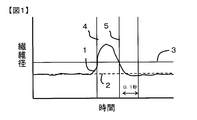
- FIG. 1 shows a schematic diagram of a fiber diameter chart obtained by an optical external shape measuring instrument.
- the horizontal axis represents time and the vertical axis represents fiber diameter, and the fiber diameter values obtained by the optical external shape measuring instrument are continuously shown as a chart.
- the point where the fiber diameter value 1 obtained by the optical external shape measuring instrument exceeds the threshold 3 which is a fiber diameter value 10% higher than the average fiber diameter 2 is the starting point 4 and the threshold 3 of the fiber diameter abnormal portion.
- the point below the limit is defined as the end point 5 of the abnormal fiber diameter portion.
- each abnormal fiber diameter portion was calculated from the time and the running speed of the thread, with the start point 4 to the end point 5 of the abnormal fiber diameter portion as the length of one abnormal fiber diameter portion.
- the sampling cycle of the measuring instrument is set to 200 kHz (200,000 times / sec), the running speed of the thread is set to 500 m / min, and the thread length is 0.04 mm at intervals of 1 million.
- the fiber diameter for m was measured. Then, the total value of the total lengths of all the abnormal fiber diameter portions existing in the 1 million m fiber length was defined as the total length L of the abnormal fiber diameter portions.
- Intrinsic viscosity (IV) Dissolve 0.8 g of the sample polymer in 10 mL of o-chlorophenol (hereinafter abbreviated as OCP) with a purity of 98% or more, and use an Ostwald viscometer at a temperature of 25 ° C. to obtain relative viscosity ( ⁇ r) and intrinsic viscosity ( ⁇ r). IV) was calculated by the following formula.
- OCP o-chlorophenol
- Intrinsic viscosity (IV) 0.0242 ⁇ r + 0.2634
- ⁇ viscosity of the polymer solution
- ⁇ 0 viscosity of OCP
- t falling time of the solution (seconds)
- d density of the solution (g / cm 3 )
- t 0 falling time of OCP (seconds)
- d 0 Density of OCP (g / cm 3 ).
- the part where the black streak of the woven fabric is confirmed is counted as the number of defects, and the number of defects per 1 m of the woven fabric is 0.010.
- the following cases were A, the cases of 0.030 or less were B, the cases of 0.050 or less were C, the cases of more than 0.050 were D, and the judgments A and B were passed.
- Example 1 PET with an intrinsic viscosity of 1.00 (glass transition temperature 80 ° C.) as a core component and PET with an intrinsic viscosity of 0.50 as a sheath component are melted at a temperature of 295 ° C. using an extruder, and then at a polymer temperature of 280 ° C.
- a gel-like substance is passed through a gel capture filter (filtration accuracy 10 ⁇ m, thickness 2 mm) layer formed by sintering metal fibers having a circular cross section installed in a melt spinning pack.
- a gel subdivision filter (filtration accuracy 40 ⁇ m, thickness 2 mm) formed by sintering metal fibers having a polygonal cross section, in which a gelled product that has been sufficiently captured and has not been completely captured by the gel capture filter is installed downstream thereof.
- the gel-like substance generated by the thermal deterioration of the polymer was captured and subdivided.
- Both the gel capture filter and the gel subdivision filter are processed into a corrugated shape, and a filter having the same diameter as the filter having a planar cross section but having a filtration area increased by 2.5 times is used.
- the composite polyester monofilament yarn discharged from the spinneret is heated and kept warm by a heating body so that the atmospheric temperature immediately below the spinneret becomes 290 ° C., then cooled by a yarn cooling blower, and a finishing agent is applied by an oiling agent. After applying, it is taken up at a rate of 552 m / min, stretched appropriately without winding once and heat-set to obtain the desired strength, and the fineness is 8.0 dtex, and the strength at 5% elongation is 4.6 cN /. A polyester monofilament having dtex and a strength of 7.5 cN / dtex was obtained.
- this polyester monofilament has fineness, high strength, and high modulus, and is very excellent in weaving property with high mesh of # 400.
- the fiber diameter uniformity is excellent
- the length L of the abnormal portion of the fiber diameter contained in the yarn length of 1 million m is 646.9 mm
- the number of defects of the woven fabric confirmed after weaving is 0.008 pieces / m. It was very good.
- Example 2 The fineness of 8.0 dtex and the strength at 5% elongation are the same as in Example 1 except that the order of the gel subdivision filter is reversed from that of the upstream side and that of the gel capture filter is reversed from that of the downstream side, and a filter having a planar cross section is used.
- the characteristics of this polyester monofilament are shown in Table 1.
- the length L of the abnormal portion of the fiber diameter contained in the yarn length of 1 million m is 818.8 mm, and the number of defects of the woven fabric confirmed after weaving is 0.011 pieces / m, which is a sufficiently practical level. there were.
- Example 3 Polyester monofilaments having a fineness of 13.0 dtex, a strength at 5% elongation of 4.6 cN / dtex, and a strength of 7.5 cN / dtex were obtained in the same manner as in Example 1 except that the fineness was changed by changing the discharge amount. ..
- the characteristics of the obtained polyester monofilament are shown in Table 1. Although it was one step inferior to Example 1, the weavability of # 400 with a high mesh was good. Further, the length L of the abnormal portion of the fiber diameter contained in the yarn length of 1 million m was 283.7 mm, and the number of defects of the woven fabric confirmed after weaving was 0.004 pieces / m, which was very good. ..
- Example 4 Polyester monofilaments having a strength of 3.0 dtex and a strength of 4.6 cN / dtex and a strength of 7.5 cN / dtex at 5% elongation were obtained in the same manner as in Example 1 except that the discharge amount was changed to change the fineness.
- the characteristics of the obtained polyester monofilament are shown in Table 1.
- the weavability of # 400 on the high mesh was very good.
- the length L of the abnormal portion of the fiber diameter contained in the yarn length of 1 million m is 1334.2 mm, and the number of defects of the woven fabric confirmed after weaving is 0.018 pieces / m, which is a sufficiently practical level. rice field.
- Example 5 Similar to Example 1, the strength is 6.0 cN / dtex, the strength at 5% elongation is 3.6 cN / dtex, and the fineness is 8., except that the intrinsic viscosity of the core component polyester is changed to 0.78. A polyester monofilament of 0 dtex was obtained. The characteristics of the obtained polyester monofilament are shown in Table 1. Compared with Example 1, the change in the woven fabric size after weaving was slightly large, and the printing accuracy when applied as a screen gauze was one step inferior, but it was at a level sufficiently durable for practical use. The length L of the abnormal portion of the fiber diameter contained in the yarn length of 1 million m was 385.8 mm, and the number of defects of the woven fabric confirmed after weaving was 0.005 pieces / m, which was very good.
- Example 6 The strength was 8.9 cN / dtex, the strength at 5% elongation was 5.9 cN / dtex, and the fineness was 8., as in Example 1, except that the intrinsic viscosity of the core component polyester was changed to 1.20. A polyester monofilament of 0 dtex was obtained. The characteristics of the obtained polyester monofilament are shown in Table 1. There was no tearing of the woven fabric, and the change in the woven fabric dimensions after weaving was very small compared to Example 1, and the printing accuracy when applied as a screen gauze was more excellent. The length L of the abnormal portion of the fiber diameter contained in the yarn length of 1 million m is 944.7 mm, and the number of defects of the woven fabric confirmed after weaving is 0.014 pieces / m, which is a sufficiently practical level. rice field.
- Example 7 PET (glass transition temperature 80 ° C.) having an intrinsic viscosity of 1.00 was melted at a temperature of 295 ° C. using an extruder, then pumped at a polymer temperature of 280 ° C. and flowed into a known single component cap.
- a single component polyester monofilament having a fineness of 8.0 dtex, a strength at 5% elongation of 5.3 cN / dtex, and a strength of 8.1 cN / dtex was obtained in the same manner as in Example 1 except for the above.
- the characteristics of the obtained polyester monofilament are shown in Table 1.
- the weaving property of # 400 on the high mesh was good, and the change in the woven fabric size after weaving was very small.
- the length L of the abnormal portion of the fiber diameter contained in the yarn length of 1 million m was 764.4 mm, and the number of defects of the woven fabric confirmed after weaving was 0.010 / m, which was very good.
- Example 1 Fineness in the same manner as in Example 1 except that a generally applied filtration filter having only a gel capture filter (filtration accuracy 10 ⁇ m, thickness 1 mm) formed by sintering metal fibers having a circular cross section was used.
- the characteristics of this polyester monofilament are as shown in Table 1, and the length L of the abnormal portion of the fiber diameter contained in the yarn length of 1 million m is 18180.0 mm, which greatly exceeds 2000 mm, which is a confirmed defect of the woven fabric. The number was 0.430 / m, which was extremely inferior to that of Example 1.
- Comparative Example 2 Similar to Comparative Example 1, the strength at 5% elongation was 2.9 cN /, except that the intrinsic viscosity of the core component polyester was changed to 0.70 and the fineness was changed by changing the discharge rate. A polyester monofilament having dtex and strength of 5.0 cN / dtex was obtained. The characteristics of this polyester monofilament are as shown in Table 1. The length L of the abnormal portion of the fiber diameter contained in the yarn length of 1 million m is 2810.0 mm, which exceeds 2000 mm, and is confirmed after weaving. The number of defects was 0.040 / m, which was inferior to that of Example 1.
- Example 3 A polyester monofilament having a fineness of 8.0 dtex, a strength at 5% elongation of 4.6 cN / dtex, and a strength of 7.5 cN / dtex was obtained in the same manner as in Example 2 except that the thickness of the gel capture filter was changed to 1 mm. rice field.
- the characteristics of the obtained polyester monofilament are as shown in Table 1.
- the length L of the abnormal portion of the fiber diameter contained in the yarn length of 1 million m is 3902.5 mm, which exceeds 2000 mm, and was confirmed after weaving.
- the number of defects of the woven fabric was 0.067 / m, which was inferior to that of Example 1.
- Fiber diameter value 2 Average fiber diameter 3: Threshold (fiber diameter value 10% higher than the average fiber diameter) 4: Start point of abnormal fiber diameter part 5: End point of abnormal fiber diameter part
- the polyester monofilament of the present invention can be applied to a high-definition high-mesh filter and a high-mesh screen gauze for high-precision printing.
Landscapes
- Engineering & Computer Science (AREA)
- Textile Engineering (AREA)
- Mechanical Engineering (AREA)
- Chemical & Material Sciences (AREA)
- Chemical Kinetics & Catalysis (AREA)
- General Chemical & Material Sciences (AREA)
- Artificial Filaments (AREA)
- Printing Plates And Materials Therefor (AREA)
Abstract
繊度3.0~13.0dtex、強度5.0~9.0cN/dtex、5%伸長時の強度2.7~6.0cN/dtexであるポリエステルモノフィラメントにおいて、繊維長手方向100万m中に存在する、繊維直径に対して110%以上の繊維径である異常部分の全長Lが2,000mm以下であるポリエステルモノフィラメント。 高精細ハイメッシュフィルタや、高精密印刷用ハイメッシュスクリーン紗に適した、高強度・高モジュラスでありながら、高い繊維径均一性を有する、ポリエステルモノフィラメントを提供する。
Description
本発明は、高い繊維径均一性が求められる高精細ハイメッシュフィルタや、高精密印刷用ハイメッシュスクリーン紗に適したポリエステルモノフィラメントに関する。さらに詳しくは、印刷精度の極めて高いハイモジュラスのスクリーン紗や、濾過性能と透過性能の両立が可能であるハイメッシュフィルタを得るのに好適なモノフィラメントに関する。
スクリーン紗と呼ばれるモノフィラメントを製織した紗織物は、エレクトロニクス分野において、プリント回路基板のスクリーン印刷用メッシュクロスをはじめ、自動車、携帯電話などに利用される成形フィルタ用途などに使用されている。
モノフィラメントを製織した紗織物の具体的な用途としては、フィルタ用途では、洗濯水中のゴミ再付着を防止するリントフィルター、エアコンの中に装着されている室内のホコリ・塵を除去するフィルタ、掃除機の中に装着されているホコリ・塵・ゴミを除去する成形フィルタ、医療分野では気泡などを除去する輸血キットや人工透析回路用フィルタ、自動車分野では燃料ポンプ、燃料噴射装置といった燃料の流路や、ABS、ブレーキ、トランスミッション、パワーステアリングなどが挙げられる。また、スクリーン印刷の用途では、Tシャツやのぼり旗、看板、自動販売機プレート、車のパネル、屋外・屋内サイン、ボールペン、各種カード類、ネームプレート、スクラッチ、点字、CD・DVD、プリント基板、プラズマディスプレイ、液晶ディスプレイなどが挙げられる。
自動車、携帯電話等に用いられるフィルタ用途では、フィルタの小型化と、防塵性・透過性の両立が求められており、フィルタのハイメッシュ化が進んでいる。そのためフィルタ用原糸として、細繊度の原糸が求められている。
家電や携帯電話、パソコン向けなどの電子回路のスクリーン印刷用途では、高印刷精度を実現するため、紗張りにおいて伸びの少ない寸法安定性に優れたスクリーン紗が要求されてきている。すなわちスクリーン紗用原糸として、高強度、高モジュラスな原糸が求められている。
これらの用途には上記特性以外に、共通して原糸の繊維径均一性が高く要求されるが、モノフィラメントには予てよりポリマーのゲル化物に起因し、繊維径異常部分が発生する事が知られており、該課題に対して様々な対策が講じられてきた。
特許文献1では、繊維径異常部分の発生を低減する方法として、静止混練子が提案されている。確かに静止混練子によって、ポリマーの熱履歴によって生じる粘度斑を抑制する効果は期待できるものの、粘度の高いポリマーを用いた際や、ポリマーの吐出量が少ない場合、混練子内の複雑な流路を通過する中で、かえってポリマーが混練子内で滞留し、ゲル化物を生じてしまうため、細繊度・高強度原糸でかつ、繊維径均一性に優れたモノフィラメントを得る事ができなかった。また、特許文献1では繊維径異常部分の個数の判定を、特定の幅に調節したスリットの間に糸を走行させ、スリットにて断糸した回数を繊維径異常部の個数とみなす手法を採用している。しかしこの方法では、スリット幅対比十分に経の大きい繊維径異常部であればスリットで糸が断糸する可能性が高いが、比較的小さな繊維径異常部の場合、スリットを通過する際に糸が変形しすり抜けてしまう事が多い。そのため特許文献1での繊維径異常部分の判定方法は、精度が悪いという課題もあった。
特許文献2では、ポリマー送液配管の曲りを減らし、パック導入から吐出までの時間を1分以内とし、ポリマーが受ける熱量を出来る限り軽減することによってポリマーの熱劣化を抑制することを提案している。確かにポリマーの滞留時間を短くすることで、ポリマーの熱劣化を抑制する効果が期待できるが、ポリマーの細繊度原糸を紡糸する際には、パック導入から吐出までの時間を1分間以内にする事は極めて困難であり、また異物や熱劣化ポリマーを濾過するための濾過槽を十分に設ける事ができなくなるため、繊維径均一性に優れたモノフィラメントを得る事ができなかった。
特許文献3では、ポリマーの重合プロセスにおける温度・加熱時間と共に、ポリマーの化合物を規定する事で、ポリマーの熱劣化物の発生を抑制することを提案している。確かに特許文献3の手法を採用する事で、重合プロセスにおけるポリマーの熱劣化物を抑制する効果が認められるものの、ポリマーの熱劣化物は、ポリマーの重合プロセスのみならず、その後の溶融工程でも発生するものである。特にポリマーの吐出量が少ない場合や粘度の高いポリマーを用いる際、より顕著に劣化物が発生し繊維径均一性が損なわれるため、口金からポリマーが吐出される直前の濾過条件を規定しなければ、細繊度・高強度原糸でかつ繊維径均一性に優れたモノフィラメントを得る事ができなかった。
高精細ハイメッシュフィルタや、高精密印刷用ハイメッシュスクリーン紗に適したポリエステルモノフィラメントを得るためには、細繊度かつ高強度の原糸が必要である。
しかし、高精細ハイメッシュフィルタや、高精密印刷用ハイメッシュスクリーン紗に適した細繊度糸を紡糸する場合、溶融紡糸するポリマー量が減少するため、ポリマー送液配管内の滞留時間が長くなる。その結果、ポリマーの熱劣化が進み、繊維径異常部分が発生しやすくなる。また糸の強度を向上させるためには、高粘度のポリマーを溶融紡糸する必要があるが、粘度が高いポリマーでは異常滞留によってゲル化物が発生しやすく、繊維径異常部分が発生しやすくなる。更に、細繊度化する事で、繊維径に対して劣化したゲル化物のサイズ比が相対的に増加するため、従来問題とならなかった微小なゲル化物でさえも繊維径異常部分として顕在化しやすくなる。繊維径異常部分をはじめとする繊維径異常部分が含まれると、フィルタ用途であれば濾過・透過性能の低下、スクリーン印刷用途であれば印刷欠点の発生などの致命的な問題を誘発するため、極力モノフィラメントの繊維径均一性を高める必要がある。
本発明では前述の問題点を改良し、従来のポリエステルモノフィラメントでは得られなかった高い繊維径均一性を有し、高精細ハイメッシュフィルタや、高精密印刷用ハイメッシュスクリーン紗に適した、ポリエステルモノフィラメントを提供することである。
繊度3.0~13.0dtex、強度5.0~9.0cN/dtex、5%伸長時の強度2.7~6.0cN/dtexであるポリエステルモノフィラメントにおいて、繊維長手方向100万m中に存在する、繊維直径に対して110%以上の繊維径である異常部分の全長Lが2,000mm以下であるポリエステルモノフィラメント。
高精細ハイメッシュフィルタや、高精密印刷用ハイメッシュスクリーン紗に適した、繊維径均一性に優れたポリエステルモノフィラメントを提供できる。
本発明のポリエステルモノフィラメントについて説明する。
本発明のポリエステルモノフィラメントのポリエステルとしては、ポリエチレンレンテレフタレート(以下、PETと称する)を主成分とするポリエステルが用いられる。
本発明で用いるPETとしては、テレフタル酸を主たる酸成分としエチレングリコールを主たるグリコール成分とする、90モル%以上がエチレンテレフタレートの繰り返し単位からなるポリエステルを用いることができる。ただし、10モル%未満の割合で他のエステル結合を形成可能な共重合成分を含むものであっても良い。このような共重合成分としては、例えば、酸性分として、イソフタル酸、フタル酸、ジブロモテレフタル酸、ナフタリンジカルボン酸、オクトエトキシ安息香酸のような二官能性芳香族カルボン酸、セバシン酸、シュウ酸、アジピン酸、ダイマ酸のような二官能性脂肪族カルボン酸、シクロヘキサンジカルボン酸などのジカルボンサン類が挙げられ、また、グリコール成分としては、例えば、エチレングリコール、ジエチレングリコール、プロパンジオール、ブタンジオール、ネオペンチルグリコール、ビスフェノールAや、シクロヘキサンジメタノール、ポリエチレングリコールやポリプロピレングリコールなどのポリオキシアルキレングリコールなどを挙げることができるが、これらに限られるものではない。
艶消剤として二酸化チタン、滑剤としてシリカやアルミナの微粒子、抗酸化剤としてヒンダードフェノール誘導体、さらには難燃剤、帯電防止剤、紫外線吸収剤および着色顔料等を必要に応じてPETに添加することができる。
ポリエステルモノフィラメントには、単一のポリエステルから形成される単成分モノフィラメント、2種類のポリエステルから形成される複合ポリエステルモノフィラメントがあるが、本発明はいずれかに限定されるものではない。ただし高強度化に伴い、製織時の筬削れが発生しやすくなるため、必要に応じ、強度を担う芯成分に高粘度のポリマーを配し、芯成分を覆うように耐摩耗性に優れる低粘度のポリマーを配する、芯鞘型複合ポリエステルモノフィラメントにする事で、高強度化と対摩耗性を両立させる事ができる。
ここで芯鞘型とは芯成分が鞘成分により完全に覆われていれば良く、必ずしも同心円状に配置されている必要はない。なお、断面形状については丸、扁平、三角、四角、五角など幾つもの形状があるが、スクリーン紗の目開きの均一性の観点から丸断面が好ましい。
鞘成分によるスカム抑制効果と芯成分による高強度化を両立するという点で、芯成分:鞘成分の複合比は60:40~95:5の範囲とすることが好ましく、より好ましい複合比は、70:30~90:10の範囲である。ここでいう、複合比とは、フィラメントの横断面写真において複合ポリエステルモノフィラメントを構成する2種のポリエステルの横断面積比率である。
次に本発明のポリエステルモノフィラメントの物性について述べる。高精細ハイメッシュフィルタや、高精密印刷用ハイメッシュスクリーンに好適なモノフィラメントについて、本発明者が鋭意検討した結果、繊維径異常部分の長さが特定の範囲内のとき、目開きのバラつきが小さく、精細ハイメッシュフィルタや、高精密印刷用ハイメッシュスクリーン紗を得るのに良好な織物が得られる事を見出した。具体的にはモノフィラメントの繊維長手方向100万mに存在する、繊維直径に対して10%以上繊維径が太い繊維径異常部を2,000mm以下とする事で、製織した際、目開きの均一性に優れた織物を得ることができる。好ましくは1,500mm以下、より好ましくは1,000mm以下である。
その上でポリエステルモノフィラメントの繊度は、3.0~13.0dtexである。好ましくは3.0~8.0dtexの範囲である。かかる範囲とすることにより、高精細フィルタ及び高精密印刷に適した#400(1インチ=2.54cm当たり400本)以上のハイメッシュフィルタ及びスクリーン紗が得られる。更に8dtex以下では、より一層のハイメッシュ化が可能となる。繊度の下限としては、製織性、特にスルーザー型織機における緯糸の飛送性の点で3.0dtex以上である事が好ましい。また、強度は5.0~9.0cN/dtex、5%伸長時の強度(モジュラス)は、2.7~6.0cN/dtexである。強度5.0cN/dtex未満では、製織性の悪化や、特に13dtex以下の細繊度品種では、強力低下に伴う織物破れの懸念がある。5%伸長時の強度(モジュラス)は、2.7cN/dtex未満では、紗張り時に目ずれが発生しやすくなり、開口部の目詰まりや、紗張り後の寸法の経時変化が大きくなり、経時での寸法安定性が得られなくなる場合がある。上限値としては、製織時のスカムの観点から、強度9.0cN/dtex以下、5%伸長時の強度6.0cN/dtex以下である事が望ましい。
次いで、本発明のポリエステルモノフィラメントの好ましい製造方法について説明する。ポリエステルの固有粘度(IV)は0.75~1.50である事が望ましい。固有粘度0.75以上とする事により、高強度・高モジュラス化が可能となり、また1.50以下とする事で溶融成形が容易になる。また芯鞘複合モノフィラメントにする際には、鞘成分に用いるポリエステルの固有粘度は、芯成分ポリエステルの固有粘度より低くし、その差を0.20~1.00にすることが好ましい。固有粘度の差を0.20以上とすることで鞘成分のポリエステル、すなわち複合ポリエステルモノフィラメント繊維表面の配向度および結晶化度を抑えることができ、良好な耐スカム性を得ることができる。また、溶融紡糸の口金吐出孔内壁面におけるせん断応力を鞘成分が担うため、芯成分が受けるせん断力は小さくなる。これにより芯成分は分子鎖配向度が低く、かつ均一な状態で紡出されるため、最終的に得られる複合ポリエステルモノフィラメントの強度が向上する。固有粘度の差を1.00以下とすることで、鞘成分の配向が適度に進行し、高い強度が得られる。さらに好ましくは、0.30~0.70である。
本発明のポリエステルモノフィラメントは、紡糸機を用いてポリマーを溶融・押出し後、所定の紡糸パックに送り、パック内でポリマーを濾過した後、紡糸口金より紡出する事で得られる。紡糸口金から吐出された糸条を一旦未延伸糸として巻き取り、その後延伸を行う2工程法、紡糸口金から吐出された糸条を一旦巻き取ることなく引き続き延伸を行う直接紡糸延伸法などいずれの製法によっても製造することができる。
本発明のポリエステルモノフィラメントは、紡糸口金から紡出される溶融ポリマーにおいて、溶融紡糸パック内に設置した円形断面を有する金属短繊維が焼結されてなる不織布フィルタ層(以下、ゲル捕捉フィルター)と多角形断面を有する金属短繊維が焼結されてなるフィルタ層(以下、ゲル細分化フィルター)を設置した溶融紡糸パック内で濾過される。金属短繊維の断面が異なる2種類のフィルタ層によって、溶融中に発生したゲル状物の捕捉と細分化が可能となり、繊維直径に対して10%以上繊維径が太い繊維径異常部が低減し、モノフィラメントの均一性が良好となる。
本発明のポリエステルモノフィラメントの製造方法における特徴は第一に、紡糸口金から紡出される溶融ポリマーにおいて、溶融紡糸パック内に設置した多角形断面を有する金属短繊維が焼結されてなるフィルタ層(以下、ゲル細分化フィルター)を通過させることで、ポリマーの熱劣化によって発生するゲル状物を紡出前に裁断・細分化することにある。
ゲル細分化フィルタの望ましい濾過精度は、40μm以下である。かかる範囲とすることで繊維直径に対して10%以上繊維径が太い繊維径異常部を減らすことができ、モノフィラメントの繊維径均一性が良好となる。濾過精度が40μmを超える場合、細分化されずに通過するゲル状物のサイズが大きくなる。なお、濾過精度40μmとは40μm以上のゲル状物(異物)を98%以上除去する性能を有するということである。更にゲル細分化フィルタの厚みを2mm以上とすることで、濾過流路が長くなり、十分なゲル状物の細分化効果が得られる。2mm未満の場合、濾過流路が短くなり、十分なゲル状物の細分化効果が得られず、モノフィラメントの均一性を得ることができない。また、厚くすればゲル状物の細分化効果は向上するもののパック圧力も上昇するため、好ましい上限は、パック圧力の観点から3mmである。
フィルタを構成する金属短繊維の断面形態は多角形状である。多角形状を有する金属短繊維を用いることによって金属繊維相互の絡み合いが発生し濾過性や分散性が向上する。多角形状の金属短繊維を積層して焼結することで形成される空隙部によりゲル状物を細かく分散させることができ、さらに鋭角な断面形状とすることによりポリマーの熱劣化によって発生するゲル状物が裁断され、ゲル状物の細分化効果が得られる。
ゲル状物の細分化効果は、単に円形断面の金属短繊維が焼結されてなるフィルタ層のみでは得られず、円形断面の金属短繊維が焼結されてなるフィルタの目付を細かくするだけでは十分に実現されず、目詰まりによってさらなるパック圧の上昇を招くのみである。金属短繊維の断面形態を多角形状とすることで、濾過精度の低い(目付の粗い)フィルタでもって、十分なゲル状物の細分化効果を発揮することができ、モノフィラメントの均一性が良好となる。
本発明のポリエステルモノフィラメントの製造方法における特徴は第二に、紡糸口金から紡出される溶融ポリマーにおいて、溶融紡糸パック内に設置した円形断面を有する金属短繊維が焼結されてなるゲル捕捉フィルターを通過させることで、ポリマーの熱劣化によって発生するゲル状物を十分に捕捉することである。
ゲル捕捉フィルタの望ましい濾過精度は、10μm以下である。かかる範囲とすることで、大型のゲル化物が捕捉されるようになり、繊維直径に対して10%以上繊維径が太い繊維径異常部を減らすことができ、モノフィラメントの繊維径均一性が良好となる。ゲル捕捉フィルタ濾過精度が10μmを超える場合、大型のゲル化物が捕捉されずに通過し、モノフィラメントの繊維径均一性が悪化する。更にゲル捕捉フィルタの厚みを2mm以上とすることで、濾過流路が長くなり、十分なゲル状物の捕捉効果が得られ、モノフィラメントの均一性が良好となる。2mm未満の場合、濾過流路が短くなり、十分なゲルの捕捉効果が得られず、良好なモノフィラメントの均一性得ることができない。また、厚くすればゲル状物の補足効果が向上するものの、パック圧力も上昇するため、好ましい上限は、パック圧力の観点から3mmである。
前記金属短繊維の断面が異なる2種類のフィルタ層は、それぞれ、ゲル状物の「捕捉」と「細分化」の別々の効果を発揮するため、フィルタ層の順番には大きくよるものでは無いが、より好ましくは、ゲル捕捉フィルタを上流に設置するとよい。ゲル捕捉フィルタを上流側に設置することにより、大きなサイズのゲル状物を濾過精度の高いゲル捕捉フィルタによって確実に捕捉し、ゲル捕捉フィルタにて捕捉仕切れなかったゲル状物を、下流に設置したゲル細分化フィルタにて裁断し細分化せしめることによって、より効率的にゲル状物の捕捉・細分化を進行させることができるためである。ただし、その繊維径異常部分の改善効果は、ゲル細分化フィルタを上流に設置する場合に一歩優れるものの、ゲル細分化フィルタを下流とする場合と比べて、パック圧力上昇を伴うことに留意が必要である。その場合、例えば波型形状に加工され、通常の平断面フィルタ対比、濾過面積を増加させたフィルタを用いる事で、フィルタの異物保持容量が増加し、パックの圧力上昇を低減させる事で生産適用が可能になる。
特に細繊度かつ高粘度ポリエステルの溶融紡糸では、粘度が高いことに起因して異常滞留が発生しやすく、更には細繊度化することで、繊維径に対して劣化したゲル化物のサイズ比が相対的に増加するため、より精度の高いゲル化物の捕捉が必要になるが、濾過精度の向上のため、単により目付の高い濾過フィルタを使用する一般的な手法では、著しいパック圧力上昇を招き、極端な生産性低下を招いていた。そのため、本発明者らは、品質面と生産性両面から鋭利検討した結果、上述したとおり、ゲル化物の補足と細分化と目的の異なる濾過フィルタを用い、それぞれの濾過フィルタの厚み(濾過流路長)を規定することや、波型形状に加工された濾過フィルタを用いる事で、濾過精度向上と生産性の両立を実現した。
その結果、本発明のポリエステルモノフィラメントは、繊維直径に対して10%以上繊維径が太い繊維径異常部が少なく、製織した際の目開きが均一で、高精細ハイメッシュフィルタや、高精密印刷用ハイメッシュスクリーン紗に好適に用いる事ができる。
以下実施例により本発明をさらに具体的に説明する。実施例の測定値は、次の方法で測定した。
(1)繊度
糸条を500mかせ取り、かせの質量(g)に20を乗じた値を繊度とした。
糸条を500mかせ取り、かせの質量(g)に20を乗じた値を繊度とした。
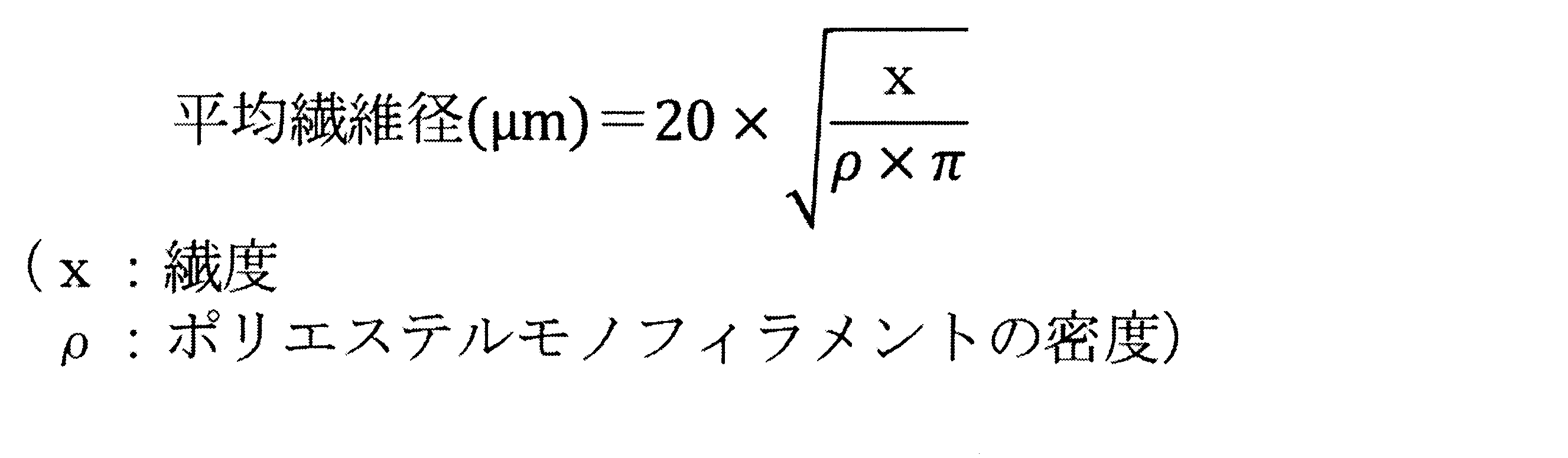
(2)平均繊維径
下式を用いて算出した。
下式を用いて算出した。
(3)繊維径異常部分の全長L
モノフィラメントの繊維径は、走行糸条に光を照射して、糸条からの反射光の光量変化を検出することで、繊維径を測定するsensoptic社製の光学式の外形測定器(PSD-200)を使用した。
モノフィラメントの繊維径は、走行糸条に光を照射して、糸条からの反射光の光量変化を検出することで、繊維径を測定するsensoptic社製の光学式の外形測定器(PSD-200)を使用した。
図1に光学式の外形測定器で得られた繊維径チャートの概略図を示す。横軸は時間、縦軸は繊維径を表し、光学式の外形測定器で得られた繊維径値を連続的にチャートとして示したものである。
光学式の外形測定器で得られた繊維径値1が、平均繊維径2に対して10%高い繊維径値である閾値3を超えた点を繊維径異常部分の開始点4、閾値3を下回った点を繊維径異常部分の終了点5とする。
この繊維径異常部分の開始点4から終了点5までを一つの繊維径異常部分の長さとして、時間と糸の走行速度から一つあたりの繊維径異常部分の長さを計算した。
局所的な異常部分について漏れなく検出すべく、測定器のサンプリング周期を200kHz(200,000回/秒)、糸の走行速度を500m/分に設定し、糸長0.04mm間隔で、100万m分の繊維径の測定を行った。そして繊維長100万m中に存在する、全ての繊維径異常部分の長さを合計した値を、繊維径異常部分の全長Lとした。
(4)固有粘度(IV)
純度98%以上のo-クロロフェノール(以下、OCPと略記する)10mL中に試料ポリマーを0.8g溶かし、25℃の温度にてオストワルド粘度計を用いて、相対粘度(ηr)、固有粘度(IV)を下式により求め、算出した。
相対粘度(ηr)=η/η0=(t×d)/(t0×d0)
固有粘度(IV)=0.0242ηr+0.2634
ここで、η:ポリマー溶液の粘度、η0:OCPの粘度、t:溶液の落下時間(秒)、d:溶液の密度(g/cm3)、t0:OCPの落下時間(秒)、d0:OCPの密度(g/cm3)。
純度98%以上のo-クロロフェノール(以下、OCPと略記する)10mL中に試料ポリマーを0.8g溶かし、25℃の温度にてオストワルド粘度計を用いて、相対粘度(ηr)、固有粘度(IV)を下式により求め、算出した。
相対粘度(ηr)=η/η0=(t×d)/(t0×d0)
固有粘度(IV)=0.0242ηr+0.2634
ここで、η:ポリマー溶液の粘度、η0:OCPの粘度、t:溶液の落下時間(秒)、d:溶液の密度(g/cm3)、t0:OCPの落下時間(秒)、d0:OCPの密度(g/cm3)。
(5)強度(cN/dtex)と5%伸長時の強度(モジュラス)(cN/dtex)
JIS L1013(2010)に従い、オリエンテック製テンシロンUCT-100を用いて測定した。
JIS L1013(2010)に従い、オリエンテック製テンシロンUCT-100を用いて測定した。
(6)織物の欠点数(紗品位)
経糸、緯糸共に本発明の各実施例および各比較例のポリエステルモノフィラメントを用い、スルーザー型織機により織機の回転数200回転/分として♯400(経密度:400本/2.54cm、緯密度400本/2.54cm)、織幅1.8mのメッシュ織物を製織した。その後得られたメッシュ織物を検反機にセットし、目視にてメッシュ織物の欠点数(目開き異常部分の個数)をカウントした。目開きの異常部分が存在する場合、メッシュ開口が拡がり織物上に黒いスジとして現れるため、織物の黒いスジが確認された部分を欠点数としてカウントし、織物1mあたりの欠点数が0.010個以下の場合をA、0.030個以下の場合をB、0.050個以下の場合をC、0.050個を超える場合をDとし、判定A、Bを合格とした。
経糸、緯糸共に本発明の各実施例および各比較例のポリエステルモノフィラメントを用い、スルーザー型織機により織機の回転数200回転/分として♯400(経密度:400本/2.54cm、緯密度400本/2.54cm)、織幅1.8mのメッシュ織物を製織した。その後得られたメッシュ織物を検反機にセットし、目視にてメッシュ織物の欠点数(目開き異常部分の個数)をカウントした。目開きの異常部分が存在する場合、メッシュ開口が拡がり織物上に黒いスジとして現れるため、織物の黒いスジが確認された部分を欠点数としてカウントし、織物1mあたりの欠点数が0.010個以下の場合をA、0.030個以下の場合をB、0.050個以下の場合をC、0.050個を超える場合をDとし、判定A、Bを合格とした。
(実施例1)
芯成分として固有粘度1.00のPET(ガラス転移温度80℃)と鞘成分として固有粘度0.50のPETを、エクストルーダーを用いてそれぞれ295℃の温度で溶融後、ポリマー温度280℃で、複合比が芯成分:鞘成分=80:20となるようにポンプ計量を行い、芯鞘型となるよう公知の複合口金に流入させた。
芯成分として固有粘度1.00のPET(ガラス転移温度80℃)と鞘成分として固有粘度0.50のPETを、エクストルーダーを用いてそれぞれ295℃の温度で溶融後、ポリマー温度280℃で、複合比が芯成分:鞘成分=80:20となるようにポンプ計量を行い、芯鞘型となるよう公知の複合口金に流入させた。
紡糸口金から紡出される溶融ポリマーにおいて、溶融紡糸パック内に設置した円形断面を有する金属繊維が焼結されてなるゲル捕捉フィルタ(濾過精度10μm、厚み2mm)層を通過させることでゲル状物を十分に捕捉し、また、上記ゲル捕捉フィルタで捕捉仕切れなかったゲル化物をその下流に設置した、多角形断面を有する金属繊維が焼結されてなるゲル細分化フィルタ(濾過精度40μm、厚み2mm)層を通過させることでポリマーの熱劣化によって発生するゲル状物を捕捉・細分化せしめた。尚、ゲル捕捉フィルタ、ゲル細分化フィルタ共に、波型形状に加工し、平面断面のフィルタと同一径でありながら、濾過面積を2.5倍に増加させたフィルタを用いている。
紡糸口金から吐出された複合ポリエステルモノフィラメント糸条を紡糸口金直下の雰囲気温度が290℃となるよう、加熱体により加熱保温し、その後、糸条冷却送風装置により冷却し、油剤付与装置により仕上げ剤を付与した後、552m/分の速度で引き取り、一旦巻き取ることなく所望の強度となるように適宜延伸、熱セットを行うことで、繊度8.0dtex、5%伸長時の強度が4.6cN/dtex、強度7.5cN/dtexのポリエステルモノフィラメントを得た。このポリエステルモノフィラメントの特性は表1のとおりであり、細繊度、高強度、高モジュラスであり、♯400のハイメッシュでの製織性に非常に優れていた。また繊維径均一性にも優れ、糸長100万m中に含まれる繊維径の異常部分の長さLは646.9mmであり、製織後に確認された織物の欠点数は0.008個/mと、非常に良好であった。
(実施例2)
ゲル細分化フィルタを上流側、ゲル捕捉フィルタを下流側と順番を逆転し、また平面断面のフィルタを用いた事以外は、実施例1と同様にして繊度8.0dtex、5%伸長時の強度が4.6cN/dtex、強度7.5cN/dtexのポリエステルモノフィラメントを得た。このポリエステルモノフィラメントの特性を表1に示す。糸長100万m中に含まれる繊維径の異常部分の長さLは818.8mmであり、製織後に確認された織物の欠点数は0.011個/mと、十分に実用可能なレベルであった。
ゲル細分化フィルタを上流側、ゲル捕捉フィルタを下流側と順番を逆転し、また平面断面のフィルタを用いた事以外は、実施例1と同様にして繊度8.0dtex、5%伸長時の強度が4.6cN/dtex、強度7.5cN/dtexのポリエステルモノフィラメントを得た。このポリエステルモノフィラメントの特性を表1に示す。糸長100万m中に含まれる繊維径の異常部分の長さLは818.8mmであり、製織後に確認された織物の欠点数は0.011個/mと、十分に実用可能なレベルであった。
(実施例3)
吐出量を変えて繊度を変更したこと以外は、実施例1と同様にして繊度13.0dtex、5%伸長時の強度が4.6cN/dtex、強度7.5cN/dtexのポリエステルモノフィラメントを得た。得られたポリエステルモノフィラメントの特性を表1に示す。実施例1には一歩劣るものの♯400のハイメッシュでの製織性は良好であった。また、糸長100万m中に含まれる繊維径の異常部分の長さLは283.7mmであり、製織後に確認された織物の欠点数は0.004個/mと非常に良好であった。
吐出量を変えて繊度を変更したこと以外は、実施例1と同様にして繊度13.0dtex、5%伸長時の強度が4.6cN/dtex、強度7.5cN/dtexのポリエステルモノフィラメントを得た。得られたポリエステルモノフィラメントの特性を表1に示す。実施例1には一歩劣るものの♯400のハイメッシュでの製織性は良好であった。また、糸長100万m中に含まれる繊維径の異常部分の長さLは283.7mmであり、製織後に確認された織物の欠点数は0.004個/mと非常に良好であった。
(実施例4)
吐出量を変えて繊度を変更したこと以外は、実施例1と同様にして3.0dtex、5%伸長時の強度が4.6cN/dtex、強度7.5cN/dtexのポリエステルモノフィラメントを得た。得られたポリエステルモノフィラメントの特性を表1に示す。♯400のハイメッシュでの製織性は非常に良好であった。糸長100万m中に含まれる繊維径の異常部分の長さLは1334.2mmであり、製織後に確認された織物の欠点数は0.018個/mと十分に実用可能なレベルであった。
吐出量を変えて繊度を変更したこと以外は、実施例1と同様にして3.0dtex、5%伸長時の強度が4.6cN/dtex、強度7.5cN/dtexのポリエステルモノフィラメントを得た。得られたポリエステルモノフィラメントの特性を表1に示す。♯400のハイメッシュでの製織性は非常に良好であった。糸長100万m中に含まれる繊維径の異常部分の長さLは1334.2mmであり、製織後に確認された織物の欠点数は0.018個/mと十分に実用可能なレベルであった。
(実施例5)
芯成分ポリエステルの固有粘度を0.78と変更したこと以外は、実施例1と同様にして、強度が6.0cN/dtex、5%伸長時の強度が3.6cN/dtex、繊度が8.0dtexのポリエステルモノフィラメントを得た。得られたポリエステルモノフィラメントの特性は表1に示す。実施例1と比較して、製織後の織物寸法の経時変化がやや大きく、スクリーン紗として適用した際の印刷精度も一歩劣る結果となったが、十分に実用に耐えられるレベルであった。糸長100万m中に含まれる繊維径の異常部分の長さLは385.8mmであり、製織後に確認された織物の欠点数は0.005個/mと非常に良好であった。
芯成分ポリエステルの固有粘度を0.78と変更したこと以外は、実施例1と同様にして、強度が6.0cN/dtex、5%伸長時の強度が3.6cN/dtex、繊度が8.0dtexのポリエステルモノフィラメントを得た。得られたポリエステルモノフィラメントの特性は表1に示す。実施例1と比較して、製織後の織物寸法の経時変化がやや大きく、スクリーン紗として適用した際の印刷精度も一歩劣る結果となったが、十分に実用に耐えられるレベルであった。糸長100万m中に含まれる繊維径の異常部分の長さLは385.8mmであり、製織後に確認された織物の欠点数は0.005個/mと非常に良好であった。
(実施例6)
芯成分ポリエステルの固有粘度を1.20と変更したこと以外は、実施例1と同様にして、強度が8.9cN/dtex、5%伸長時の強度が5.9cN/dtex、繊度が8.0dtexのポリエステルモノフィラメントを得た。得られたポリエステルモノフィラメントの特性を表1に示す。織物の破れは無く、また実施例1対比、製織後の織物寸法の経時変化も非常に小さく、スクリーン紗として適用した際の印刷精度もより優位な結果となった。糸長100万m中に含まれる繊維径の異常部分の長さLは944.7mmであり、製織後に確認された織物の欠点数は0.014個/mと十分に実用可能なレベルであった。
芯成分ポリエステルの固有粘度を1.20と変更したこと以外は、実施例1と同様にして、強度が8.9cN/dtex、5%伸長時の強度が5.9cN/dtex、繊度が8.0dtexのポリエステルモノフィラメントを得た。得られたポリエステルモノフィラメントの特性を表1に示す。織物の破れは無く、また実施例1対比、製織後の織物寸法の経時変化も非常に小さく、スクリーン紗として適用した際の印刷精度もより優位な結果となった。糸長100万m中に含まれる繊維径の異常部分の長さLは944.7mmであり、製織後に確認された織物の欠点数は0.014個/mと十分に実用可能なレベルであった。
(実施例7)
固有粘度1.00のPET(ガラス転移温度80℃)を、エクストルーダーを用いてそれぞれ295℃の温度で溶融後、ポリマー温度280℃でポンプ計量を行い、公知の単一
成分口金に流入させた事以外は実施例1と同様にして、繊度8.0dtex、5%伸長時の強度が5.3cN/dtex、強度8.1cN/dtexの単成分ポリエステルモノフィラメントを得た。得られたポリエステルモノフィラメントの特性を表1に示す。♯400のハイメッシュでの製織性は良好であり、製織後の織物寸法の経時変化も非常に小さかった。糸長100万m中に含まれる繊維径の異常部分の長さLは764.4mmであり、製織後に確認された織物の欠点数は0.010個/mと非常に良好であった。
固有粘度1.00のPET(ガラス転移温度80℃)を、エクストルーダーを用いてそれぞれ295℃の温度で溶融後、ポリマー温度280℃でポンプ計量を行い、公知の単一
成分口金に流入させた事以外は実施例1と同様にして、繊度8.0dtex、5%伸長時の強度が5.3cN/dtex、強度8.1cN/dtexの単成分ポリエステルモノフィラメントを得た。得られたポリエステルモノフィラメントの特性を表1に示す。♯400のハイメッシュでの製織性は良好であり、製織後の織物寸法の経時変化も非常に小さかった。糸長100万m中に含まれる繊維径の異常部分の長さLは764.4mmであり、製織後に確認された織物の欠点数は0.010個/mと非常に良好であった。
(比較例1)
円形断面を有する金属繊維が焼結されてなるゲル捕捉フィルター(濾過精度10μm、厚み1mm)のみを配した、一般的に適用される濾過フィルタを用いた事以外は、実施例1と同様にして繊度8.0dtex、5%伸長時の強度が4.6cN/dtex、強度7.5cN/dtexのポリエステルモノフィラメントを得た。このポリエステルモノフィラメントの特性は表1のとおりであり、糸長100万m中に含まれる繊維径の異常部分の長さLは18180.0mmと、2000mmを大きく超えており、確認された織物の欠点数は0.430個/mと、実施例1よりも極めて劣位であった。
円形断面を有する金属繊維が焼結されてなるゲル捕捉フィルター(濾過精度10μm、厚み1mm)のみを配した、一般的に適用される濾過フィルタを用いた事以外は、実施例1と同様にして繊度8.0dtex、5%伸長時の強度が4.6cN/dtex、強度7.5cN/dtexのポリエステルモノフィラメントを得た。このポリエステルモノフィラメントの特性は表1のとおりであり、糸長100万m中に含まれる繊維径の異常部分の長さLは18180.0mmと、2000mmを大きく超えており、確認された織物の欠点数は0.430個/mと、実施例1よりも極めて劣位であった。
(比較例2)
芯成分ポリエステルの固有粘度を0.70に変更し、また吐出量を変えて繊度を変更したこと以外は比較例1と同様にして繊度13.0dtex、5%伸長時の強度が2.9cN/dtex、強度5.0cN/dtexのポリエステルモノフィラメントを得た。このポリエステルモノフィラメントの特性は表1のとおりであり、糸長100万m中に含まれる繊維径の異常部分の長さLは2810.0mmと、2000mmを超えており、製織後に確認された織物の欠点数は0.040個/mと、実施例1よりも劣位であった。
芯成分ポリエステルの固有粘度を0.70に変更し、また吐出量を変えて繊度を変更したこと以外は比較例1と同様にして繊度13.0dtex、5%伸長時の強度が2.9cN/dtex、強度5.0cN/dtexのポリエステルモノフィラメントを得た。このポリエステルモノフィラメントの特性は表1のとおりであり、糸長100万m中に含まれる繊維径の異常部分の長さLは2810.0mmと、2000mmを超えており、製織後に確認された織物の欠点数は0.040個/mと、実施例1よりも劣位であった。
(比較例3)
ゲル捕捉フィルタの厚みを1mmに変更したこと以外は、実施例2同様にして、繊度8.0dtex、5%伸長時の強度が4.6cN/dtex、強度7.5cN/dtexのポリエステルモノフィラメントを得た。得られたポリエステルモノフィラメントの特性は表1のとおりであり、糸長100万m中に含まれる繊維径の異常部分の長さLは3902.5mmと、2000mmを超えており、製織後に確認された織物の欠点数は0.067個/mと実施例1よりも劣位であった。
ゲル捕捉フィルタの厚みを1mmに変更したこと以外は、実施例2同様にして、繊度8.0dtex、5%伸長時の強度が4.6cN/dtex、強度7.5cN/dtexのポリエステルモノフィラメントを得た。得られたポリエステルモノフィラメントの特性は表1のとおりであり、糸長100万m中に含まれる繊維径の異常部分の長さLは3902.5mmと、2000mmを超えており、製織後に確認された織物の欠点数は0.067個/mと実施例1よりも劣位であった。

1:繊維径値
2:平均繊維径
3:閾値(平均繊維径対して10%高い繊維径値)
4:繊維径異常部分の開始点
5:繊維径異常部分の終了点
2:平均繊維径
3:閾値(平均繊維径対して10%高い繊維径値)
4:繊維径異常部分の開始点
5:繊維径異常部分の終了点
本発明のポリエステルモノフィラメントを、高精細ハイメッシュフィルタや、高精密印刷用ハイメッシュスクリーン紗に適用する事ができる。
Claims (3)
- 繊度3.0~13.0dtex、強度5.0~9.0cN/dtex、5%伸長時の強度2.7~6.0cN/dtexであるポリエステルモノフィラメントにおいて、
繊維長手方向100万m中に存在する、繊維直径に対して110%以上の繊維径である異常部分の全長Lが2,000mm以下であるポリエステルモノフィラメント。 - 繊度が8dtex以下である請求項1に記載のポリエステルモノフィラメント。
- ポリエステルモノフィラメントの溶融紡糸方法において、溶融ポリマーを下記A~D項の特徴を有するフィルタ層で濾過した後に、紡糸口金から紡出することを特徴とする請求項1または2に記載のポリエステルモノフィラメントの製造方法。
A.円形断面を有する金属短繊維が焼結されてなるフィルタ層であって、濾過精度が10μm以下でかつ、その厚みが2mm以上のゲル捕捉フィルタを有すること。
B.多角形断面を有する金属短繊維が焼結されてなるフィルタ層であって、濾過精度が40μm以下でかつ、その厚み2mm以上のゲル細分化フィルタを有すること。
C.濾過部の上流側から、ゲル捕捉フィルタ、ゲル細分化フィルタが配されていること。
D.ゲル捕捉フィルタ、ゲル細分化フィルタの少なくともいずれか一つが波型形状になっていること。
Priority Applications (3)
| Application Number | Priority Date | Filing Date | Title |
|---|---|---|---|
| EP21834470.3A EP4144900A4 (en) | 2020-06-30 | 2021-05-31 | Polyester monofilament |
| JP2021534683A JPWO2022004225A1 (ja) | 2020-06-30 | 2021-05-31 | |
| CN202180035253.0A CN115605639A (zh) | 2020-06-30 | 2021-05-31 | 聚酯单丝 |
Applications Claiming Priority (2)
| Application Number | Priority Date | Filing Date | Title |
|---|---|---|---|
| JP2020-112490 | 2020-06-30 | ||
| JP2020112490 | 2020-06-30 |
Publications (1)
| Publication Number | Publication Date |
|---|---|
| WO2022004225A1 true WO2022004225A1 (ja) | 2022-01-06 |
Family
ID=79315927
Family Applications (1)
| Application Number | Title | Priority Date | Filing Date |
|---|---|---|---|
| PCT/JP2021/020583 Ceased WO2022004225A1 (ja) | 2020-06-30 | 2021-05-31 | ポリエステルモノフィラメント |
Country Status (4)
| Country | Link |
|---|---|
| EP (1) | EP4144900A4 (ja) |
| JP (1) | JPWO2022004225A1 (ja) |
| CN (1) | CN115605639A (ja) |
| WO (1) | WO2022004225A1 (ja) |
Citations (12)
| Publication number | Priority date | Publication date | Assignee | Title |
|---|---|---|---|---|
| JPH05253418A (ja) * | 1991-05-20 | 1993-10-05 | Tokyo Seiko Co Ltd | 焼結型フイルター |
| JP2003213528A (ja) | 2002-01-21 | 2003-07-30 | Toray Ind Inc | スクリーン紗用芯鞘型複合ポリエステルモノフィラメントおよびその製造方法 |
| JP2008069491A (ja) * | 2006-09-15 | 2008-03-27 | Teijin Fibers Ltd | スクリーン紗用ポリエステルモノフィラメント |
| JP2008095242A (ja) * | 2006-10-12 | 2008-04-24 | Teijin Fibers Ltd | スクリーン紗用ポリエステルモノフィラメント |
| JP2008101288A (ja) * | 2006-10-18 | 2008-05-01 | Teijin Fibers Ltd | 寸法安定性に優れたスクリーン紗用モノフィラメント |
| JP2011021296A (ja) * | 2009-07-16 | 2011-02-03 | Teijin Fibers Ltd | 寸法安定性に優れたスクリーン紗用モノフィラメント |
| JP2012117196A (ja) | 2012-01-06 | 2012-06-21 | Teijin Fibers Ltd | スクリーン紗用モノフィラメント |
| JP2015081399A (ja) * | 2013-10-24 | 2015-04-27 | Tmtマシナリー株式会社 | フィルタ、及び、紡糸方法 |
| WO2016052269A1 (ja) * | 2014-09-30 | 2016-04-07 | 東レ株式会社 | ポリエステルフィラメントパッケージ |
| WO2019044449A1 (ja) | 2017-08-30 | 2019-03-07 | 東レ株式会社 | 高精細ハイメッシュフィルター用単成分ポリエステルモノフィラメント |
| WO2020175370A1 (ja) * | 2019-02-25 | 2020-09-03 | 東レ株式会社 | 高精細ハイメッシュフィルター用芯鞘複合ポリエステルモノフィラメント |
| JP2020143403A (ja) * | 2019-03-07 | 2020-09-10 | 東レ株式会社 | ハイメッシュスクリーン紗用複合ポリエステルモノフィラメントおよびその製造方法 |
Family Cites Families (8)
| Publication number | Priority date | Publication date | Assignee | Title |
|---|---|---|---|---|
| CA1094957A (en) * | 1976-04-23 | 1981-02-03 | Harry M. Kennard | Filter medium |
| JP4761094B2 (ja) * | 2001-03-07 | 2011-08-31 | 東洋紡績株式会社 | 溶融紡糸口金パック及び熱可塑性樹脂繊維の製造方法 |
| JP4944561B2 (ja) * | 2006-10-18 | 2012-06-06 | 帝人ファイバー株式会社 | スクリーン紗用モノフィラメント |
| JP4870619B2 (ja) * | 2007-05-24 | 2012-02-08 | 帝人ファイバー株式会社 | スクリーン紗用芯鞘型モノフィラメント |
| JP5741493B2 (ja) * | 2011-03-10 | 2015-07-01 | 三菱レイヨン株式会社 | アクリロニトリル系重合体溶液精製用フィルター材及び同フィルター材を用いたアクリロニトリル系重合体溶液の製造方法等 |
| JP6160250B2 (ja) * | 2013-05-29 | 2017-07-12 | 東レ株式会社 | ポリアミドモノフィラメントの製造方法 |
| JP6108585B1 (ja) * | 2017-01-06 | 2017-04-05 | 武 渡邊 | 紡糸フィルタ、紡糸パック及び紡糸方法 |
| CN108754631A (zh) * | 2018-08-01 | 2018-11-06 | 张家港市金星纺织有限公司 | 一种氨纶丝原液过滤箱 |
-
2021
- 2021-05-31 WO PCT/JP2021/020583 patent/WO2022004225A1/ja not_active Ceased
- 2021-05-31 CN CN202180035253.0A patent/CN115605639A/zh active Pending
- 2021-05-31 EP EP21834470.3A patent/EP4144900A4/en active Pending
- 2021-05-31 JP JP2021534683A patent/JPWO2022004225A1/ja active Pending
Patent Citations (12)
| Publication number | Priority date | Publication date | Assignee | Title |
|---|---|---|---|---|
| JPH05253418A (ja) * | 1991-05-20 | 1993-10-05 | Tokyo Seiko Co Ltd | 焼結型フイルター |
| JP2003213528A (ja) | 2002-01-21 | 2003-07-30 | Toray Ind Inc | スクリーン紗用芯鞘型複合ポリエステルモノフィラメントおよびその製造方法 |
| JP2008069491A (ja) * | 2006-09-15 | 2008-03-27 | Teijin Fibers Ltd | スクリーン紗用ポリエステルモノフィラメント |
| JP2008095242A (ja) * | 2006-10-12 | 2008-04-24 | Teijin Fibers Ltd | スクリーン紗用ポリエステルモノフィラメント |
| JP2008101288A (ja) * | 2006-10-18 | 2008-05-01 | Teijin Fibers Ltd | 寸法安定性に優れたスクリーン紗用モノフィラメント |
| JP2011021296A (ja) * | 2009-07-16 | 2011-02-03 | Teijin Fibers Ltd | 寸法安定性に優れたスクリーン紗用モノフィラメント |
| JP2012117196A (ja) | 2012-01-06 | 2012-06-21 | Teijin Fibers Ltd | スクリーン紗用モノフィラメント |
| JP2015081399A (ja) * | 2013-10-24 | 2015-04-27 | Tmtマシナリー株式会社 | フィルタ、及び、紡糸方法 |
| WO2016052269A1 (ja) * | 2014-09-30 | 2016-04-07 | 東レ株式会社 | ポリエステルフィラメントパッケージ |
| WO2019044449A1 (ja) | 2017-08-30 | 2019-03-07 | 東レ株式会社 | 高精細ハイメッシュフィルター用単成分ポリエステルモノフィラメント |
| WO2020175370A1 (ja) * | 2019-02-25 | 2020-09-03 | 東レ株式会社 | 高精細ハイメッシュフィルター用芯鞘複合ポリエステルモノフィラメント |
| JP2020143403A (ja) * | 2019-03-07 | 2020-09-10 | 東レ株式会社 | ハイメッシュスクリーン紗用複合ポリエステルモノフィラメントおよびその製造方法 |
Non-Patent Citations (1)
| Title |
|---|
| See also references of EP4144900A4 |
Also Published As
| Publication number | Publication date |
|---|---|
| EP4144900A4 (en) | 2025-04-23 |
| CN115605639A (zh) | 2023-01-13 |
| JPWO2022004225A1 (ja) | 2022-01-06 |
| EP4144900A1 (en) | 2023-03-08 |
Similar Documents
| Publication | Publication Date | Title |
|---|---|---|
| CN102308033B (zh) | 聚酯单丝以及聚酯单丝的制造方法 | |
| CN102165110B (zh) | 聚酯单丝、其制造方法以及使用其的丝网制造方法 | |
| EP3431162B1 (en) | Filter medium for liquid filter and liquid filter | |
| JP6610778B2 (ja) | 熱接着性芯鞘型複合繊維およびトリコット編み地 | |
| WO2016052269A1 (ja) | ポリエステルフィラメントパッケージ | |
| EP3896199B1 (en) | Core-sheath composite polyester monofilament for superfine high-mesh filter | |
| JP4844515B2 (ja) | 細繊度ポリフェニレンスルフィドモノフィラメントおよびその製造方法 | |
| CN110770376B (zh) | 高精细高目数过滤器用单成分聚酯单丝 | |
| JP4900234B2 (ja) | ポリエーテルエーテルケトンモノフィラメントおよびその製造法、およびポリエーテルエーテルケトンモノフィラメントからなるフィルター | |
| WO2022004225A1 (ja) | ポリエステルモノフィラメント | |
| JP7392266B2 (ja) | ハイメッシュスクリーン紗用複合ポリエステルモノフィラメントおよびその製造方法 | |
| JP7176413B2 (ja) | 高強力細繊度ポリエステルマルチフィラメント | |
| KR20080030545A (ko) | (원착) 폴리에스테르 모노 필라멘트 | |
| JP5336615B2 (ja) | スクリーン紗用モノフィラメント | |
| JP2913794B2 (ja) | スクリーン紗用ポリエチレン―2,6―ナフタレートモノフィラメント | |
| JP2024053157A (ja) | 高精細スクリーン印刷用芯鞘複合ポリエステルモノフィラメント | |
| JP2025143685A (ja) | 溶融紡糸口金パック | |
| JP2025034561A (ja) | 芯鞘複合モノフィラメント | |
| JP2022028194A (ja) | 高精細スクリーン紗用芯鞘複合ポリエステルモノフィラメント | |
| JP2007113151A (ja) | スクリーン紗用ポリエステルモノフィラメントの溶融紡糸方法及びスクリーン紗用ポリエステルモノフィラメント | |
| JP2022041904A (ja) | ハイメッシュスクリーン紗用芯鞘型複合モノフィラメントおよびその製造方法 | |
| JP2022144471A (ja) | スクリーン紗用ポリエステルモノフィラメント | |
| JP4319468B2 (ja) | ポリエステル繊維及びその製造方法 | |
| JPH0931749A (ja) | ポリエステル繊維の製造方法 | |
| JP2024141435A (ja) | ポリエステルモノフィラメント |
Legal Events
| Date | Code | Title | Description |
|---|---|---|---|
| ENP | Entry into the national phase |
Ref document number: 2021534683 Country of ref document: JP Kind code of ref document: A |
|
| 121 | Ep: the epo has been informed by wipo that ep was designated in this application |
Ref document number: 21834470 Country of ref document: EP Kind code of ref document: A1 |
|
| ENP | Entry into the national phase |
Ref document number: 2021834470 Country of ref document: EP Effective date: 20221128 |
|
| NENP | Non-entry into the national phase |
Ref country code: DE |