WO2022009586A1 - Matériau de conversion thermoélectrique, élément de conversion thermoélectrique, module de conversion thermoélectrique, procédé de génération d'électricité et procédé de transfert thermique - Google Patents
Matériau de conversion thermoélectrique, élément de conversion thermoélectrique, module de conversion thermoélectrique, procédé de génération d'électricité et procédé de transfert thermique Download PDFInfo
- Publication number
- WO2022009586A1 WO2022009586A1 PCT/JP2021/021701 JP2021021701W WO2022009586A1 WO 2022009586 A1 WO2022009586 A1 WO 2022009586A1 JP 2021021701 W JP2021021701 W JP 2021021701W WO 2022009586 A1 WO2022009586 A1 WO 2022009586A1
- Authority
- WO
- WIPO (PCT)
- Prior art keywords
- thermoelectric conversion
- value
- composition
- formula
- conversion material
- Prior art date
- Legal status (The legal status is an assumption and is not a legal conclusion. Google has not performed a legal analysis and makes no representation as to the accuracy of the status listed.)
- Ceased
Links
Images


Classifications
-
- H—ELECTRICITY
- H10—SEMICONDUCTOR DEVICES; ELECTRIC SOLID-STATE DEVICES NOT OTHERWISE PROVIDED FOR
- H10N—ELECTRIC SOLID-STATE DEVICES NOT OTHERWISE PROVIDED FOR
- H10N10/00—Thermoelectric devices comprising a junction of dissimilar materials, i.e. devices exhibiting Seebeck or Peltier effects
- H10N10/80—Constructional details
- H10N10/85—Thermoelectric active materials
- H10N10/851—Thermoelectric active materials comprising inorganic compositions
- H10N10/852—Thermoelectric active materials comprising inorganic compositions comprising tellurium, selenium or sulfur
-
- C—CHEMISTRY; METALLURGY
- C22—METALLURGY; FERROUS OR NON-FERROUS ALLOYS; TREATMENT OF ALLOYS OR NON-FERROUS METALS
- C22C—ALLOYS
- C22C12/00—Alloys based on antimony or bismuth
-
- C—CHEMISTRY; METALLURGY
- C22—METALLURGY; FERROUS OR NON-FERROUS ALLOYS; TREATMENT OF ALLOYS OR NON-FERROUS METALS
- C22C—ALLOYS
- C22C30/00—Alloys containing less than 50% by weight of each constituent
-
- H—ELECTRICITY
- H10—SEMICONDUCTOR DEVICES; ELECTRIC SOLID-STATE DEVICES NOT OTHERWISE PROVIDED FOR
- H10N—ELECTRIC SOLID-STATE DEVICES NOT OTHERWISE PROVIDED FOR
- H10N10/00—Thermoelectric devices comprising a junction of dissimilar materials, i.e. devices exhibiting Seebeck or Peltier effects
- H10N10/10—Thermoelectric devices comprising a junction of dissimilar materials, i.e. devices exhibiting Seebeck or Peltier effects operating with only the Peltier or Seebeck effects
- H10N10/17—Thermoelectric devices comprising a junction of dissimilar materials, i.e. devices exhibiting Seebeck or Peltier effects operating with only the Peltier or Seebeck effects characterised by the structure or configuration of the cell or thermocouple forming the device
-
- B—PERFORMING OPERATIONS; TRANSPORTING
- B22—CASTING; POWDER METALLURGY
- B22F—WORKING METALLIC POWDER; MANUFACTURE OF ARTICLES FROM METALLIC POWDER; MAKING METALLIC POWDER; APPARATUS OR DEVICES SPECIALLY ADAPTED FOR METALLIC POWDER
- B22F2998/00—Supplementary information concerning processes or compositions relating to powder metallurgy
- B22F2998/10—Processes characterised by the sequence of their steps
-
- C—CHEMISTRY; METALLURGY
- C22—METALLURGY; FERROUS OR NON-FERROUS ALLOYS; TREATMENT OF ALLOYS OR NON-FERROUS METALS
- C22C—ALLOYS
- C22C23/00—Alloys based on magnesium
Definitions
- thermoelectric conversion material a thermoelectric conversion element, a thermoelectric conversion module, a power generation method, and a heat transfer method.
- thermoelectric conversion materials containing Mg are known.
- Patent Document 1 discloses a thermoelectric conversion material and a manufacturing method thereof represented by the chemical formula Mg 3 + m A a B b D 2-e E e.
- A represents at least one selected from the group consisting of Ca, Sr, Ba, and Yb.
- B represents at least one selected from the group consisting of Mn and Zn.
- D represents at least one selected from the group consisting of Sb and Bi.
- E represents at least one selected from the group consisting of Se and Te.
- m is ⁇ 0.39 or more and 0.42 or less
- the value of a is 0 or more and 0.12 or less
- the value of b is 0 or more and 0.48 or less
- the value of e is 0.001 or more. It is 0.06 or less.
- Patent Document 2 discloses a thermoelectric conversion material represented by the chemical formula Mg 3 + ma A a B 2-ce C c E e and a method for producing the same.
- the element A represents at least one selected from the group consisting of Ca, Sr, Ba, Nb, Zn, and Al.
- Element B represents at least one selected from the group consisting of Sb and Bi.
- the element C represents at least one selected from the group consisting of Mn, Si and Cr.
- the element E represents at least one selected from the group consisting of Se and Te.
- the value of m is ⁇ 0.1 or more and 0.4 or less, the value of a is 0 or more and 0.1 or less, the value of c is 0 or more and 0.1 or less, and the value of e is 0. It is 001 or more and 0.06 or less.
- Non-Patent Document 1 discloses a polycrystalline thermoelectric conversion material represented by the chemical formula Mg 3 + ⁇ Sb 1.5 Bi 0.49 Te 0.01 and a method for producing the same.
- the value of ⁇ is 0.1, 0.2, or 0.3.
- Non-Patent Document 2 discloses a single crystal thermoelectric conversion material represented by the chemical formula Mg 3 Sb 2 and a method for producing the same.
- Non-Patent Document 3 discloses a thermoelectric conversion material and a manufacturing method thereof represented by the chemical formula Mg 3 Sb 1.5-0.5x Bi 0.5-0.5x Te x .
- the value of x is 0.04, 0.05, 0.08, or 0.20.
- Non-Patent Document 4 discloses a thermoelectric conversion material represented by the chemical formula Mg 3 Bi 2-x Pn x. In this chemical formula, Pn is P or Sb.
- Non-Patent Document 5 discloses a thermoelectric conversion material represented by the chemical formula Mg 3-x Mn x Sb 2 and a method for producing the same.
- x satisfies the condition of 0 ⁇ x ⁇ 0.4.
- Non-Patent Document 6 discloses a thermoelectric conversion material represented by the chemical formula Mg 3.05-x Sc x SbBi and a method for producing the same.
- the value of x is 0.001, 0.0015, 0.003, 0.005, 0.009, 0.012, 0.015, 0.018, 0.020, 0.025, or It is 0.030.
- Non-Patent Document 7 discloses a thermoelectric conversion material represented by the chemical formula Mg 3.0 Y x Sb 1.5 Bi 0.5 and a method for producing the same. In this chemical formula, the value of x is 0.03, 0.035, or 0.04.
- Non-Patent Document 8 discloses a thermoelectric conversion material represented by the chemical formula Mg 3.05-x La x Sb 1.5 Bi 0.5 and a method for producing the same. In this chemical formula, the value of x is 0.005, 0.01, or 0.03.
- Non-Patent Document 9 discloses a thermoelectric conversion material represented by the chemical formula (Mg, Ce) 3 Sb 2.
- Non-Patent Document 10 discloses the value of the lattice thermal conductivity in the chemical formula Mg 3.05 (Sb 1-x B x ) 1.99 Te 0.01.
- thermoelectric conversion material This disclosure provides a novel thermoelectric conversion material.
- the thermoelectric conversion material of the present disclosure is It has a La 2 O 3 type crystal structure and is n type. It has a composition represented by the following formula (1).
- D is at least one element selected from the group consisting of Sb and Bi.
- E is at least one element selected from the group consisting of P and As.
- the value of m is -0.1 or more and 0.4 or less.
- the value of e is 0.001 or more and 0.25 or less.
- A is at least one element selected from the group consisting of Y, Sc, La, and Ce.
- F is at least one element selected from the group consisting of Se and Te.
- the values of a and f satisfy the condition of 0.0001 ⁇ a + f ⁇ 0.06.
- B is at least one element selected from the group consisting of Mn and Zn.
- the value of b is 0 or more and 0.25 or less.
- thermoelectric conversion material can be provided.
- FIG. 1 is a schematic diagram of a La 2 O 3 type crystal structure.
- FIG. 2 is a graph showing an example of a simulation result of an X-ray diffraction pattern of a La 2 O 3 type crystal structure.
- FIG. 3 is a schematic diagram of the La 2 O 3 type crystal structure in the thermoelectric conversion material of the present disclosure.
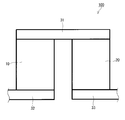
- FIG. 4 is a schematic diagram showing an example of the thermoelectric conversion module of the present disclosure.
- thermoelectric conversion performance index ZT The performance of the thermoelectric conversion material is represented by the thermoelectric conversion performance index ZT.
- Patent Document 1 Mg 3 (Sb, Bi ) to 2 as a matrix, is represented by the chemical formula Mg 3 + m A a B b D 2-e E e, n -type thermoelectric conversion material is disclosed.
- E in this chemical formula is represented by at least one selected from the group consisting of Se and Te.
- the value of e is 0.001 or more and 0.06 or less.
- the thermoelectric conversion performance index ZT of the n-type thermoelectric conversion material represented by this chemical formula is 0.5 at 300K and 1.5 at 700K.
- the value of these thermoelectric conversion performance index ZT is larger than the value of the thermoelectric conversion performance index ZT of the thermoelectric conversion material obtained when this chemical formula does not include E, in other words, when the value of e in this chemical formula is 0. expensive.
- the present inventors have newly developed a method capable of predicting the thermoelectric conversion performance index ZT, which is more reliable than before. Specifically, the present inventors calculate the electronic state by a first-principles calculation method called the density functional theory (DFT) method, and predict the thermoelectric conversion performance index ZT independently established by the present inventors. Combined with the model.
- DFT density functional theory
- the experimental results and the predicted results of the thermoelectric conversion performance index ZT are compared with respect to the thermoelectric conversion material having the composition represented by Mg 3.05 Sb x Bi 1.99-x Te 0.01, and the thermoelectric conversion of the present inventors is compared. The validity of the prediction model of the figure of merit ZT was confirmed.
- thermoelectric conversion performance index ZT of the present inventors is an n-type thermoelectric conversion material based on Mg 3 (Sb, Bi) 2, which has a Seebeck coefficient S, an electric conductivity ⁇ , and a thermal conductivity ⁇ . , And each physical property value of the thermoelectric conversion performance index ZT could be reproduced accurately.
- thermoelectric conversion performance index ZT for the crystalline substance having an unexamined composition among the crystalline substances based on Mg 3 (Sb, Bi) 2.
- the thermoelectric conversion performance index ZT was calculated and predicted by combining the above.
- the thermoelectric conversion material is n-type, the thermoelectric conversion material contains at least one of P and As, so that a higher ZT than the parent Mg 3 (Sb, Bi) 2 itself can be obtained. Do you get it. It is important to make sure that thermoelectric conversion materials with a particular composition are actually synthetic.
- thermoelectric conversion material for which the thermoelectric conversion performance index ZT was calculated and predicted by the defect formation energy obtained from the calculation based on the DFT method.
- a new thermoelectric conversion material of the present disclosure having a composition that can be actually synthesized has been found.
- thermoelectric conversion material of the present disclosure has a La 2 O 3 type crystal structure and is an n type.
- thermoelectric conversion material of the present disclosure has a composition represented by the following formula (1).
- D is at least one element selected from the group consisting of Sb and Bi.
- E is at least one element selected from the group consisting of P and As.
- the value of m is ⁇ 0.1 or more and 0.4 or less.
- the value of e is 0.001 or more and 0.25 or less.
- A is at least one element selected from the group consisting of Y, Sc, La, and Ce.
- F is at least one element selected from the group consisting of Se and Te.
- the values of a and f satisfy the condition of 0.0001 ⁇ a + f ⁇ 0.06.
- B is at least one element selected from the group consisting of Mn and Zn.
- the value of b is 0 or more and 0.25 or less.
- FIG. 1 schematically shows a La 2 O 3 type crystal structure.
- the substance based on Mg 3 (Sb, Bi) 2 has a La 2 O 3 type crystal structure or a Ca Al 2 Si 2 type crystal structure belonging to the space group P-3m1. It is stated that it can be obtained.
- (Sb, Bi) means that it is at least one selected from the group consisting of Sb and Bi.
- FIG. 2 shows an example of the simulation result of the X-ray diffraction pattern of Mg 3 (Sb, Bi) 2 having a La 2 O 3 type crystal structure.
- FIG. 2 shows the La 2 O 3 type having a lattice constant in the a-axis direction of 0.457 nanometers, a lattice constant in the b-axis direction of 0.457 nanometers, and a lattice constant in the c-axis direction of 0.723 nanometers.
- the simulation result of the X-ray diffraction pattern of the crystal structure or the CaAl 2 Si type 2 crystal structure is shown.
- the simulation results shown in FIG. 2 were obtained using the software VESTA obtained from https://jp-minerals.org/vesta/jp/download.html.
- an auxiliary line indicating the value of the diffraction angle corresponding to each peak of the X-ray diffraction pattern is shown between the X-ray diffraction pattern and the horizontal axis.
- thermoelectric conversion material has a La 2 O 3 type crystal structure
- Whether or not the thermoelectric conversion material has a La 2 O 3 type crystal structure can be determined by confirming the existence of a diffraction peak that characterizes the La 2 O 3 type crystal structure based on the X-ray diffraction method.
- the thermoelectric conversion material of the present disclosure may be single crystal or polycrystalline.
- FIG. 3 schematically shows the La 2 O 3 type crystal structure of the thermoelectric conversion material of the present disclosure.
- This crystal structure may have a defect in which a part of Mg site C1 is substituted with at least one element selected from the group consisting of Y, Sc, La, and Ce. Further, this crystal structure may have a defect in which a part of Mg site C2 is substituted with at least one element selected from the group consisting of Mn and Zn. Further, this crystal structure has a defect in which a part of the site C3 consisting of at least one element selected from the group consisting of Sb and Bi is replaced with at least one element selected from the group consisting of P and As. have. This crystal structure may have defects in which another part of site C3 is replaced by at least one element selected from the group consisting of Se and Te.
- Non-Patent Document 4 an X-ray diffraction pattern of a thermoelectric conversion material represented by the chemical formula Mg 3 Bi 2-x Pn x is shown, and it is described that the peak position shifts depending on the composition. .. In this chemical formula, Pn is P or Sb.
- thermoelectric conversion material E in the formula (1) may contain P. In this case, it is easy to obtain a thermoelectric conversion material having a thermoelectric conversion performance index ZT higher than the thermoelectric conversion performance index ZT of a substance containing Mg 3 (Sb, Bi) 2 as a parent and not containing P and As.
- thermoelectric conversion material E in the formula (1) may contain As. In this case, it is easy to obtain a thermoelectric conversion material having a thermoelectric conversion performance index ZT higher than the thermoelectric conversion performance index ZT of a substance containing Mg 3 (Sb, Bi) 2 as a parent and not containing P and As.
- the composition of the thermoelectric conversion material may be a composition represented by the following formula (2) in which D in the formula (1) contains Sb and Bi.
- the symbol indicating each atom and the symbol indicating the number of each atom in the formula (2) have the same meaning as the symbol indicating each atom and the symbol indicating the number of each atom in the formula (1).
- the value of x is 0.2 or more and 1.5 or less. In this case, it is easy to obtain a thermoelectric conversion material having a thermoelectric conversion performance index ZT higher than the thermoelectric conversion performance index ZT of a substance containing Mg 3 (Sb, Bi) 2 as a parent and not containing P and As. Mg 3 + mab A a B b Sb x Bi 2-efx E e F f formula (2)
- thermoelectric conversion material In the formula (1) showing the composition of the thermoelectric conversion material, the value of a may be 0. Even in this case, it is easy to obtain a thermoelectric conversion material having a thermoelectric conversion performance index ZT higher than the thermoelectric conversion performance index ZT of a substance containing Mg 3 (Sb, Bi) 2 as a parent and not containing P and As. Further, the thermoelectric conversion material can be produced without using a raw material containing Y, Sc, La, and Ce.
- thermoelectric conversion material In the formula (1) showing the composition of the thermoelectric conversion material, the value of a may be 0.0001 or more and 0.04 or less, and the value of f may be 0. Even in this case, it is easy to obtain a thermoelectric conversion material having a thermoelectric conversion performance index ZT higher than the thermoelectric conversion performance index ZT of a substance containing Mg 3 (Sb, Bi) 2 as a parent and not containing P and As. Further, the thermoelectric conversion material can be manufactured without using a raw material containing Se and Te.
- thermoelectric conversion material having the composition represented by the formula (1) is stable, and in the thermoelectric conversion material, a single crystal phase in which a plurality of types of crystal phases are not formed, that is, a single phase can be obtained.
- the composition represented by the formula (1) corresponds to the stable composition range of Mg 3 + mab A a B b D 2-ef E e F f.
- This stable composition range is a composition range in which only a crystalline substance having a composition of Mg 3 + mab A a B b D 2-ef E e F f can be obtained, in other words, Mg 3 + mab A a B b D 2 -ef E e F f means a composition range in which a solid solution can be stably formed.
- the value of f, the value of b, the value of m, and the value of a in the formula (1) can be determined, for example, by referring to the above-mentioned patent documents and non-patent documents.
- Patent Document 1 it is understood that the range of 0.0 ⁇ b ⁇ 0.48 and 0.0 ⁇ f ⁇ 0.06 can be the stable composition range with respect to the values of f and b.
- Patent Document 2 it is understood that the range of ⁇ 0.1 ⁇ m ⁇ 0.4 can be the stable composition range with respect to the value of m.
- Non-Patent Document 6 when A is Sc, it is understood that the range of 0.0 ⁇ a ⁇ 0.03 can be the stable composition range with respect to the value of a.
- Non-Patent Document 7 when A is Y, it is understood that the range of 0.0 ⁇ a ⁇ 0.04 can be the stable composition range with respect to the value of a.
- Non-Patent Document 8 when A is La, it is understood that the range of 0.0 ⁇ a ⁇ 0.03 can be the stable composition range with respect to the value of a.
- Non-Patent Document 9 it is understood that when A is Ce, stable synthesis of the thermoelectric conversion material is possible as compared with the case where A is La.
- Non-Patent Document 4 when E is P in the formula (1), it is understood that the range of 0.0 ⁇ e ⁇ 0.5 can be the stable composition range with respect to the value of e.
- the range of the value of e corresponding to the stable composition range can be determined as follows. Specifically, in a crystalline material having a composition of Mg 3 Bi 2-e As e having Mg 3 (Sb, Bi) 2 as a parent, the range of the value of e in which the crystal structure of La 2 O 3 type is stabilized is set. , Can be determined by the following calculation. This calculation is a method based on the defect formation theory of a semiconductor described in Non-Patent Document 11.
- the defect formation energy E form when Bisite is replaced with As is evaluated based on the following formula (3).
- E defect is the total energy in the presence of a defect
- E pure is the total energy of Mg 3 Bi 2 in the absence of a defect.
- n i is the increment or decrement of the i-th constituting element due to defects
- mu i is the chemical potential of the i-th element
- q is the charge amount that has a defect
- E F is the electron Fermi energy be.
- Equation (3) With defect formation energy E form obtained by equation (3) it can be assessed on the basis of the volume density N D of the defect on the following equation by Boltzmann distribution (4).
- N site is the volume density of the site where the defect is considered
- k B is the Boltzmann constant
- T is the absolute temperature.
- the atomic radius of Bi is 0.150 nm, which is closer to the atomic radius of As than 0.120 nm of P. Therefore, it is theoretically derived that the range of the value of e corresponding to the stable composition range when E is As is wider than the range of the value of e corresponding to the stable composition range when E is P. Be taken. Therefore, the range 0.0 ⁇ e ⁇ 0.70 of the value of e corresponding to the stable composition range when E is As, which is evaluated by the above calculation, is referred to in Non-Patent Document 4.
- the result that the value range of e in the case of P is wider than 0.0 ⁇ e ⁇ 0.5 suggests the validity of the above calculation. Therefore, it is understood that the calculation method of the stable composition range for Mg 3 + mab A a B b D 2-ef E e F f is reliable.
- the defect generation energy when A is Sc and La is lower than the defect generation energy when A is Y, and a single thermoelectric conversion material is used. It was evaluated that the phase could be stably synthesized. Therefore, based on such an evaluation result and the description of Non-Patent Documents 6 to 9, the desirable value of a in the composition represented by the formula (1) can be determined with reference to the case where A is Y. Therefore, in the formula (1), the condition of 0.0 ⁇ a ⁇ 0.04 may be satisfied.
- thermoelectric conversion efficiency of a substance can be evaluated by the thermoelectric conversion performance index ZT peculiar to the substance.
- the thermoelectric conversion performance index ZT is defined by the following equations (5) and (6).
- S, ⁇ , ⁇ e , and ⁇ lat are the Seebeck coefficient, electrical conductivity, electron thermal conductivity, and lattice thermal conductivity of the whole substance, respectively, and T is the absolute of the evaluation environment.
- T is the absolute of the evaluation environment.
- the temperature For S, ⁇ , and ⁇ e , predictions were made by combining the Vienna Ab initio Simulation Package (VASP) code, the parabolic band model, and the cane band model.
- VASP Vienna Ab initio Simulation Package
- parabolic band model and the cane band model refer to Chapters 3 and 4 of H. J. Goldsmid, “Introduction to Thermoelectricity”, Springer, 2010, respectively.
- ZT S 2 ⁇ T / ⁇ equation (5)
- ⁇ ⁇ e + ⁇ la
- Equations (12) to (15) show the calculation formulas of various characteristic values in the cane band model on the conduction band side.
- the physical quantity is determined by giving a parameter ⁇ representing a deviation from the parabolic structure in addition to the physical quantity shown by the parabolic band model. From these physical quantities, S, ⁇ , and ⁇ e of the whole substance are determined according to the following formulas (16), (17), and (18). In these equations, i and j are the indexes of the bands obtained by the VASP code, and include the indexes of the parabolic band and the cane band.
- the reduced Fermi energy is calculated from the defect concentrations of A and F in the formula (1) as described later.
- the average longitudinal elastic constant C l and the deformation potential function ⁇ are determined to reproduce the electrical modulus of the crystalline material of the parent material Mg 3 (Sb, Bi) 2.
- the lattice thermal conductivity can be determined by fitting according to the following equation (21).
- x is the ratio of Bi occupying site C3 in FIG.
- the values of A and B can be determined to reproduce the lattice thermal conductivity calculated in Mg 3.05 (Sb 1-x B x ) 1.99 Te 0.01 disclosed in Non-Patent Document 10.
- the reduced Fermi energy and the defect concentration can be related by the following equations (22) and (23).
- n (eta) is a carrier concentration of the electron
- C K is the carrier activation rate of atomic K contained in A or F in the formula (1) as a dopant
- N K is the atomic K Concentration of.
- n CB ( ⁇ ) is the electron carrier concentration derived from the parabolic band of the conduction band
- n kane ( ⁇ ) is the electron carrier concentration derived from the cane band of the conduction band
- n VB ( ⁇ ) Is the whole carrier concentration in the valence band.
- the carrier activation rate can be estimated from the relationship between the charged concentration of each dopant and the measured value of the carrier concentration. Parameters for predicting the thermoelectric properties of the target substance by combining equations (12), (22), and (23) and comparing them with the values of the Seebeck coefficient in the parent material Mg 3 (Sb, Bi) 2. The reduced Fermi energy is calculated.
- thermoelectric conversion performance index ZT in each composition of the crystalline material of Mg 3 + mab A a B b 2-ef E e F f can be calculated.
- the value of m in the formula (1) is disclosed in Non-Patent Document 1
- the Seebeck coefficient of the substance is negative in the actual synthetic evaluation, in other words, the n-type thermoelectric conversion characteristic is shown, and the Seebeck coefficient is absolute. It is understood that the value does not change.
- thermoelectric conversion material is not limited to a specific method.
- the thermoelectric conversion material can be manufactured, for example, as follows. Elemental substances of Mg, elemental substances of at least one element of Sb and Bi, elemental substances of at least one element of P and As, and if necessary, elemental substances of elements that can be contained as A or F in the formula (1) are desired chemistry. Weigh by quantitative ratio. Each weighed raw material is sealed in a stainless steel container together with a stainless steel ball in an argon atmosphere. Then, the raw materials are pulverized and mixed by the planetary ball mill method. At this time, stearic acid may be added to prevent the alloy powder derived from the raw material from adhering to the stainless steel container.
- thermoelectric conversion material is obtained.
- a spark plasma sintering method a known sintering method such as a hot press method may be used.
- a thermoelectric conversion material may be produced by preparing an alloy powder as a precursor by performing a heating step after crushing and mixing the raw materials and sintering the alloy powder.
- a thermoelectric conversion material may be produced by producing a single crystal substance by a metal flux method.
- thermoelectric conversion material of the present disclosure may contain a plurality of elements as shown in the formula (1).
- Patent Document 2 even when the raw material contains elements such as Ca, Sr, Ba, Nb, Zn, Al, Mn, Si, Cr, and Se, Mg is produced by the same method as described above.
- 3 (Sb, Bi) 2 can be produced by synthesizing thermoelectric conversion materials based on 2.
- the composition represented by the formula (1) is determined based on the stable composition range. Therefore, the thermoelectric conversion material having the composition represented by the formula (1) can be stably synthesized and manufactured by the above-mentioned manufacturing method.
- thermoelectric conversion material having the composition represented by the formula (1) can be produced by referring to the production methods described in Non-Patent Documents 1 and 2 and Patent Documents 1 and 2.
- thermoelectric conversion element provided with the thermoelectric conversion material of the present disclosure.
- This thermoelectric conversion element can function as an n-type thermoelectric conversion element.
- FIG. 4 shows an example of a thermoelectric conversion module according to this embodiment.
- the thermoelectric conversion module 100 includes an n-type thermoelectric conversion element 10, a p-type thermoelectric conversion element 20, a first electrode 31, a second electrode 32, and a third electrode 33.
- the n-type thermoelectric conversion element 10 includes the thermoelectric conversion material of the present disclosure.
- the p-type thermoelectric conversion element 20 may be a known p-type thermoelectric conversion element.
- the first electrode 31 electrically connects one end of the n-type thermoelectric conversion element 10 and one end of the p-type thermoelectric conversion element 20.
- the second electrode 32 is electrically connected to the other end of the n-type thermoelectric conversion element 10.
- the third electrode 33 is electrically connected to the other end of the p-type thermoelectric conversion element.
- thermoelectric conversion material of the present disclosure can be used to provide, for example, a power generation method including the following items (Ia) and (IIa).
- a power generation method including the following items (Ia) and (IIa).
- (Ia) Give a temperature difference to the thermoelectric conversion material.
- (IIa) The electric power associated with the thermoelectromotive force generated in the thermoelectric conversion material due to the temperature difference given in (Ia) is taken out.
- electrodes are arranged at one end and the other end of the thermoelectric conversion material of the present disclosure.
- an n-type is formed from one end of the thermoelectric conversion material to the other end of the thermoelectric conversion material.
- the carrier moves and power is obtained.
- thermoelectric conversion material of the present disclosure for example, a heat transfer method including the following items (Ib) and (IIb) can be provided.
- (Ib) Pass an electric current through the thermoelectric conversion material.
- thermoelectric conversion material For example, heat is transported from one end of the thermoelectric conversion material to the other end. In this case, reversing the direction of the current also reverses the direction of heat transport in the thermoelectric conversion material. As a result, heat can also be transported from the other end of the thermoelectric conversion material to one end.
- thermoelectric conversion material of the present disclosure is not limited to the specific aspects shown below.
- thermoelectric characteristics were evaluated by the following method.
- the obtained compact body was cut into strips and pellets.
- ZEM-3 manufactured by Advance Riko Co., Ltd.
- the Seebeck coefficient S and the electric conductivity ⁇ were measured for the sample cut into strips.
- LFA-447 manufactured by NETZSCH the thermal conductivity ⁇ was evaluated for the sample cut into pellets. In this way, the performance of the obtained crystalline material as a thermoelectric conversion material was investigated.
- thermoelectric conversion performance index ZT for each physical property value and thermoelectric conversion performance index ZT for each substance having a composition of Mg 3.05 Sb x Bi 1.99-x Te 0.01 , the experimental values obtained from the sample obtained by actual synthesis are compared with Comparative Examples 1, 3, and 3. It is shown in Table 1 as 5, 7, 9, and 11.
- the calculated values obtained by the prediction model combining the above VASP code, parabolic band model, and cane band model are shown in Table 1 as Comparative Examples 2, 4, 6, 8, 10, and 12. Both the experimental value and the calculated value are values at 330K.
- Comparative Examples 2, 4, 6, 8, 10, and 12 are the results in Comparative Examples 1, 3, 5, 7, 9, and 11 that were actually synthesized and experimentally evaluated. The results were comparable. It was confirmed that the calculated prediction model is valid in the wide stable composition range of Sb and Bi represented by the value of x. Therefore, it is suggested that the crystalline material based on Mg 3 (Sb, Bi) 2 described below can be explained using the above prediction model.
- a crystalline substance having a composition of Mg 3 + m Sb x Bi 1.99-xe P e Te 0.01 can be produced, for example, as follows. First, as raw materials, elemental Mg, Sb, Bi, Te, and P (red phosphorus) were weighed at a desired composition ratio and sealed in a stainless steel container together with a stainless steel ball in an argon atmosphere. Then, the raw materials are pulverized and mixed by a planetary ball mill method to obtain a mixed powder. The obtained mixed powder is introduced into a graphite mold and sintered by a spark plasma sintering method in an argon atmosphere to obtain a cylindrical dense body. In this manner, Mg 3 (Sb, Bi) 2 and a base, it is possible to obtain a crystalline material having a composition of Mg 3 + m Sb x Bi 1.99 -xe P e Te 0.01.
- the crystalline material having the composition of Mg 3 + m Sb x Bi 1.99-xe P e Te 0.01 is a part of the site C3 consisting of at least one selected from the group consisting of Sb and Bi, referring to FIG. It has defects replaced by P and Te. Due to this defect, lattice deformation may occur in the La 2 O 3 type crystal structure. This lattice deformation causes a change in the lattice constant in at least a part of the crystal. Therefore, the peak of the intensity of the X-ray diffraction pattern of the thermoelectric conversion material having this composition is shifted with respect to the peak of the intensity of the X-ray diffraction pattern of the Mg 3 (Sb, Bi) 2 crystalline material shown in FIG.
- the value of a and the value of b are 0, and D is at least one of Sb and Bi in the formula (1).
- X is 0.0 ⁇ x ⁇ 1.99-e
- E is P
- F is Te
- f is 0.01.
- the value of a is within the stable composition range of 0.0 ⁇ a ⁇ 0.04.
- the value of b and the value of f are within the stable composition range derived by reference to Patent Document 1.
- the value of m satisfies the condition of ⁇ 0.1 ⁇ m ⁇ 0.4 with reference to Patent Document 2.
- the value of e satisfies the condition of 0.0 ⁇ e ⁇ 0.5 with reference to Non-Patent Document 4.
- the method for calculating the thermoelectric conversion performance index ZT of a crystalline material having a composition of Mg 3 + m Sb x Bi 1.99-xe P e Te 0.01 is the above-mentioned Mg 3 + mab A a B b b 2-ef E e F f crystal.
- the same method as the method for calculating the thermoelectric conversion performance index ZT of a substance was used.
- the Seebeck coefficient S and thermoelectricity are obtained for each crystalline material having a composition of Mg 3 + msb x Bi 1.99-xe P e Te 0.01.
- the conversion performance index ZT was calculated.
- the value of m in Mg 3 + m Sb x Bi 1.99-xe P e Te 0.01 has an influence on each physical property value and the thermoelectric conversion performance index ZT within the range disclosed in Non-Patent Document 1. small.
- the Seebeck coefficient of the substance is negative in the actual synthetic evaluation, in other words, the n-type thermoelectric property is shown, and the absolute value of the Seebeck coefficient changes. It is understood not to. Thus, if the substance exhibits n-type thermoelectric properties, it is understood that the effect of the value of m on ZT is small.
- thermoelectric conversion performance index ZT is as high as or higher than that of Comparative Example 2.
- ZT was shown.
- x 0.0
- thermoelectric conversion is performed as the value of e increases in the range of 0.001 ⁇ e ⁇ 0.25. It was confirmed that the figure of merit ZT was improved.
- a crystalline substance having a composition of Mg 3 + m Sb x Bi 1.99-xe As e Te 0.01 can be produced, for example, as follows. First, as raw materials, elemental Mg, Sb, Bi, Te, and As are weighed at a desired composition ratio, sealed in a stainless steel container together with a stainless steel ball in an argon atmosphere, and the raw material is prepared by a planetary ball mill method. Grind and mix to obtain a mixed powder. The obtained mixed powder is introduced into a graphite mold and sintered by a spark plasma sintering method in an argon atmosphere to obtain a cylindrical dense body. In this way, Mg 3 (Sb, Bi) 2 is used as the mother body. A crystalline substance having a composition of Mg 3 + m Sb x Bi 1.99-xe As e Te 0.01 can be obtained.
- the crystalline material having the composition of Mg 3 + m Sb x Bi 1.99-xe As e Te 0.01 is a part of the site C3 consisting of at least one selected from the group consisting of Sb and Bi, referring to FIG. It has defects replaced by As and Te. This defect has a pattern similar to that of the above-mentioned Mg 3 + m Sb x Bi 1.99-xe P e Te 0.01 crystalline material.
- the element having an atomic radius closer to the atomic radius of Bi is more likely to replace the site C3.
- the atomic radius of Bi is 0.150 nm.
- the atomic radius of the element As is 0.120 nm, and the atomic radius of the element P is 0.109 nm. That is, it is understood that the element As is more likely to replace the site C3 than the element P. Due to this defect, lattice deformation may occur in the La 2 O 3 type crystal structure. This lattice deformation causes a change in the lattice constant in at least a part of the crystal. Therefore, the peak of the intensity of the X-ray diffraction pattern of the thermoelectric conversion material having this composition is shifted with respect to the peak of the intensity of the X-ray diffraction pattern of the Mg 3 (Sb, Bi) 2 crystalline material shown in FIG. Is expected.
- the shift of the peak observed in such an X-ray diffraction pattern is due to a change in the lattice constant.
- the peak of the X-ray diffraction pattern shifts to the low angle side
- the lattice constant decreases
- the peak of the X-ray diffraction pattern shifts to the high angle side.
- the stable composition range of the crystalline material having the composition of Mg 3 + m Sb x Bi 1.99-xe As e Te 0.01 is determined by the stability of the above-mentioned Mg 3 + mab A a B b D 2-ef E e F f crystalline material. It is performed using the same method as the method for determining the composition range.
- the value of a and the value of b are 0, D is at least one of Sb and Bi, and the value of x is 0.0 ⁇ x ⁇ 1.99-e. Satisfaction, E is As, F is Te, and the value of f is 0.01.
- the value of a is within the stable composition range of 0.0 ⁇ a ⁇ 0.04.
- the value of b and the value of f are within the stable composition range derived from the reference of Patent Document 1.
- the value of m in this crystalline material is ⁇ 0.1 ⁇ m ⁇ 0.4 with reference to Patent Document 2.
- the Mg 3 Bi 2-e As e crystalline substance stably forms a solid solution in the range of 0.0 ⁇ e ⁇ 0.70, and the crystalline substance can be synthesized and manufactured by the above-mentioned manufacturing method. .. Therefore, the stable composition range 0.0 ⁇ e ⁇ 0.70 of the value of e when E is As is wider than the stable composition range 0.0 ⁇ e ⁇ 0.5 when E is P. ..
- the stable composition range regarding the value of e when E is As is wider than the stable composition range regarding the value of e when E is P. Therefore, the stable composition range 0.0 ⁇ e ⁇ 0.70 of the value of e when E is As is the stable composition range 0.0 of the value of e when E is P described in Non-Patent Document 4.
- the evaluation result that it becomes wider than ⁇ e ⁇ 0.5 is consistent with the theory.
- thermoelectric conversion characteristics were predicted in the range of 0.0 ⁇ e ⁇ 0.5 by adjusting the stable composition range of the value of e in E to the case of P in which the range is narrower.
- the thermoelectric conversion characteristics in 330K of Mg 3 + m Sb x Bi 1.99 -xe As e Te 0.01 was predicted in the same manner as Mg 3 + m Sb x Bi 1.99 -xe P e Te 0.01. The calculated values are shown in Table 3.
- thermoelectric conversion performance equal to or higher than the thermoelectric conversion performance index ZT of Comparative Example 2 is achieved.
- the figure of merit ZT was shown.
- ZT was shown.
- a high thermoelectric conversion performance index ZT exceeding the thermoelectric conversion performance index ZT of Example 60 was shown.
- thermoelectric conversion performance increases as the value of e increases in the range of 0.001 ⁇ e ⁇ 0.25. It was shown that the index ZT was improved.
- thermoelectric conversion characteristics of Mg 3 + m Sb x Bi 1.99-x-e1-e2 P e1 As e2 Te 0.01 at 330K were predicted in the same manner as Mg 3 + m Sb x Bi 1.99-xe P e Te 0.01. The calculated values are shown in Table 4.
- thermoelectric conversion performance index ZT equal to or higher than the thermoelectric conversion performance index ZT of Comparative Example 2 was shown.
- the thermoelectric conversion performance index ZT shown in Table 4 was equivalent to the thermoelectric conversion performance index ZT shown in Tables 2 and 3.
- thermoelectric conversion performance index ZT when P and As are not contained.
- Crystalline material having a composition of Mg 3 + m Sb 1.0 Bi 0.75 -f As 0.25 Te f can be produced, for example, in the following manner. First, as raw materials, elemental Mg, Sb, Bi, Te, and As are weighed at a desired composition ratio, sealed in a stainless steel container together with a stainless steel ball in an argon atmosphere, and the raw material is prepared by a planetary ball mill method. Grind and mix to obtain a mixed powder. The obtained mixed powder is introduced into a graphite mold and sintered by a spark plasma sintering method in an argon atmosphere to obtain a cylindrical dense body. In this manner, Mg 3 (Sb, Bi) 2 and a base, it is possible to obtain a crystalline material having a composition of Mg 3 + m Sb 1.0 Bi 0.75 -f As 0.25 Te f.
- Crystalline material having a composition of Mg 3 + m Sb 1.0 Bi 0.75 -f As 0.25 Te f referring to FIG. 3, a part of the site C3 of at least one selected from the group consisting of Sb and Bi, It has defects replaced by As and Te.
- This defect has a pattern similar to that of the crystalline material having the composition of Mg 3 + m Sb x Bi 1.99-xe As e Te 0.01 described above. Due to this defect, lattice deformation may occur in the La 2 O 3 type crystal structure. This lattice deformation causes a change in the lattice constant in at least a part of the crystal.
- the peak of the intensity of the X-ray diffraction pattern of the thermoelectric conversion material having this composition is shifted with respect to the peak of the intensity of the X-ray diffraction pattern of the Mg 3 (Sb, Bi) 2 crystalline material shown in FIG. Is expected.
- the shift of the peak observed in such an X-ray diffraction pattern is due to a change in the lattice constant.
- the lattice constant increases, the peak of the X-ray diffraction pattern shifts to the low angle side, and when the lattice constant decreases, the peak of the X-ray diffraction pattern shifts to the high angle side.
- the stable composition range of the crystalline material having the composition of Mg 3 + m Sb 1.0 Bi 0.75-f As 0.25 Te f is determined by the above-mentioned stability of the Mg 3 + mab A a B b D 2-ef E e F f crystalline material. It is performed using the same method as the method for determining the composition range.
- this crystalline material in the formula (1), the value of a and the value of b are 0, D is Sb and Bi, E is As, the value of e is 0.25, and F is Te. And the value of f satisfies 0.0 ⁇ f ⁇ 0.06 with reference to Patent Document 1.
- the value of a is within the stable composition range of 0.0 ⁇ a ⁇ 0.04.
- the value of b is within the stable composition range derived from the reference of Patent Document 1.
- the value of m is ⁇ 0.1 ⁇ m ⁇ 0.4 with reference to Patent Document 2.
- the value of e is the result of the thermoelectric conversion characteristics of the crystalline material having the composition of Mg 3 + msb x Bi 1.99-xe As e Te 0.01 shown in Table 3 when E is As. It is included in the composition range obtained from.
- composition range the value of e satisfies 0.001 ⁇ e ⁇ 0.25 when the value of x is 0.0 ⁇ x ⁇ 1.74. Further, the composition ratios of Sb and Bi represented by the value of x are also included in the composition range shown in Table 3.
- thermoelectric conversion characteristics in 330K of Mg 3 + m Sb 1.0 Bi 0.75 -f As 0.25 Te f predicted in the same manner as Mg 3 + m Sb x Bi 1.99 -xe P e Te 0.01. The calculated values are shown in Table 5.
- thermoelectric conversion performance index exceeds the thermoelectric conversion performance index of Comparative Example 15. ZT was shown.
- Crystalline material having a composition of Mg 3 + m Sb 1.0 Bi 0.75 -f As 0.25 Se f can be produced, for example, in the following manner. First, as raw materials, elemental Mg, Sb, Bi, Se, and As are weighed at a desired composition ratio, sealed in a stainless steel container together with a stainless steel ball in an argon atmosphere, and the raw material is prepared by a planetary ball mill method. Grind and mix to obtain a mixed powder. The obtained mixed powder is introduced into a graphite mold and sintered by a spark plasma sintering method in an argon atmosphere to obtain a cylindrical dense body. In this manner, Mg 3 (Sb, Bi) 2 and a base, it is possible to obtain a crystalline material having a composition of Mg 3 + m Sb 1.0 Bi 0.75 -f As 0.25 Se f.
- Crystalline material having a composition of Mg 3 + m Sb 1.0 Bi 0.75 -f As 0.25 Se f referring to FIG. 3, a part of the site C3 of at least one selected from the group consisting of Sb and Bi, It has defects replaced by As and Se.
- This defect is similar to the crystalline material having the composition of Mg 3 + m Sb x Bi 1.99-xe As e Te 0.01 and the crystalline material having the composition of Mg 3 + m Sb 1.0 Bi 0.75-f As 0.25 Te f described above. It is a defect in the pattern. Due to this defect, lattice deformation may occur in the La 2 O 3 type crystal structure.
- This lattice deformation causes a change in the lattice constant in at least a part of the crystal. Therefore, the peak of the intensity of the X-ray diffraction pattern of the thermoelectric conversion material having this composition is shifted with respect to the peak of the intensity of the X-ray diffraction pattern of the Mg 3 (Sb, Bi) 2 crystalline material shown in FIG. Is expected.
- the shift of the peak observed in such an X-ray diffraction pattern is due to a change in the lattice constant.
- the lattice constant increases, the peak of the X-ray diffraction pattern shifts to the low angle side, and when the lattice constant decreases, the peak of the X-ray diffraction pattern shifts to the high angle side.
- the value of a and the value of b are 0, D is Sb and Bi, E is As, the value of e is 0.25, and F is Se in the formula (1).
- the value of f is 0.0 ⁇ f ⁇ 0.06 with reference to Patent Document 1.
- An n-type thermoelectric conversion characteristic can be exhibited in a crystalline material in which Se, which has a similar element relationship with Te, is replaced with Bi.
- the value of a is within the stable composition range of 0.0 ⁇ a ⁇ 0.04.
- the value of b is within the stable composition range derived by reference to Patent Document 1.
- the value of m is ⁇ 0.1 ⁇ m ⁇ 0.4 with reference to Patent Document 2.
- the value of e is within the composition range obtained from the results of the thermoelectric conversion characteristics of the crystalline material having the composition of Mg 3 + m Sb x Bi 1.99-xe As e Te 0.01 shown in Table 3 when E is As. include.
- the value of e satisfies the condition of 0.001 ⁇ e ⁇ 0.25 in 0.0 ⁇ x ⁇ 1.74.
- the composition ratios of Sb and Bi represented by the value of x are also included in the composition range obtained from the results shown in Table 3.
- thermoelectric conversion characteristics in 330K of Mg 3 + m Sb 1.0 Bi 0.75 -f As 0.25 Se f predicted in the same manner as Mg 3 + m Sb x Bi 1.99 -xe P e Te 0.01. The calculated values are shown in Table 6.
- thermoelectric conversion performance index ZT As shown in Table 6, in the range of 0.0001 ⁇ f ⁇ 0.06, the n-type thermoelectric conversion characteristic in which S is a negative value is shown, and the high thermoelectric conversion performance exceeding the thermoelectric conversion performance index ZT of Comparative Example 15. The figure of merit ZT was shown.
- Tables 5 and 6 show the results when either Te or Se is contained as F. When both Te and Se are contained as F, both of them can replace a part of Bi.
- the crystalline material has a composition of Mg 3 + m Sb 1.0 Bi 0.75-f1-f2 As 0.25 Te f1 Se f2.
- thermoelectric conversion performance index ZT higher than the case thermoelectric conversion performance index ZT is shown.
- the composition of the crystalline substance can be expressed as Mg 3 + m Sb x Bi 1.99-x-e1-e2-f1-f2 P e1 As e2 Te f1 Se f2.
- thermoelectric conversion characteristics in 330K of Mg 3 + m Sb 1.0 Bi 0.75 -f1-f2 As 0.25 Te f1 Se f2 predicted in the same manner as Mg 3 + m Sb x Bi 1.99 -xe P e Te 0.01. The calculated values are shown in Table 7.
- thermoelectric conversion performance index ZT As shown in Table 7, in the range of 0.0001 ⁇ f1 + f2 ⁇ 0.06, the n-type thermoelectric conversion characteristic in which S is a negative value is shown, and the high thermoelectric conversion performance exceeding the thermoelectric conversion performance index ZT of Comparative Example 15 is shown. The figure of merit ZT was shown.
- a crystalline material having an n-type thermoelectric conversion characteristic having a negative S value can also be obtained by adding Y, Sc, La, or Ce.
- Crystalline material having a composition of Mg 3 + ma Y a Sb 1.0 Bi 0.75 As 0.25 can be prepared in the following manner. First, as raw materials, elemental Mg, Y, Sb, Bi, and As are weighed at a desired composition ratio, sealed in a stainless steel container together with a stainless steel ball in an argon atmosphere, and the raw material is prepared by a planetary ball mill method. Grind and mix to obtain a mixed powder. The obtained mixed powder is introduced into a graphite mold and sintered by a spark plasma sintering method in an argon atmosphere to obtain a cylindrical dense body. In this way, a crystalline substance having a composition of Mg 3 + ma Y a Sb 1.0 Bi 0.75 As 0.25 , which is based on Mg 3 (Sb, Bi) 2, can be obtained.
- the crystalline material having the composition of Mg 3 + ma Y a Sb 1.0 Bi 0.75 As 0.25 has a defect in which a part of Mg site C1 is replaced by Y, referring to FIG.
- this crystalline material has a defect in which a portion of site C3 consisting of at least one selected from the group consisting of Sb and Bi has been replaced by As. Due to this defect, lattice deformation may occur in the La 2 O 3 type crystal structure. This lattice deformation causes a change in the lattice constant in at least a part of the crystal.
- the peak of the intensity of the X-ray diffraction pattern of the thermoelectric conversion material having this composition is shifted with respect to the peak of the intensity of the X-ray diffraction pattern of the Mg 3 (Sb, Bi) 2 crystalline material shown in FIG. Is expected.
- the shift of the peak observed in such an X-ray diffraction pattern is due to a change in the lattice constant.
- the lattice constant increases, the peak of the X-ray diffraction pattern shifts to the low angle side, and when the lattice constant decreases, the peak of the X-ray diffraction pattern shifts to the high angle side.
- Method of determining the stability the composition range of crystalline material having a composition of Mg 3 + ma Y a Sb 1.0 Bi 0.75 As 0.25 is stable composition of the above-mentioned Mg 3 + mab A a B b D 2-ef E e F f crystalline material It is performed using the same method as the method for determining the range.
- A is Y in the formula (1), and the value of a is 0.0 ⁇ a ⁇ with reference to Non-Patent Document 7. The condition of 0.04 is satisfied, and the value of b is 0.
- D is Sb and Bi
- E is As
- the value of e is 0.25
- the value of f is 0.
- a method for determining a stable composition range similar to that of the crystalline substance having the composition of Mg 3 + m Sb x Bi 1.99-xe As e Te 0.01 described above was used for the crystalline substance having A in the formula (1).
- a method for determining a stable composition range similar to that of the crystalline substance having the composition of Mg 3 + m Sb x Bi 1.99-xe As e Te 0.01 described above was used for the crystalline substance having A in the formula (1).
- A was evaluated that when A is Sc and La, the defect generation energy is lower in the crystalline substance than in the case where A is Y, and the crystalline substance can be stably synthesized.
- Non-Patent Document 9 it is understood that when A is Ce, a crystalline substance can be synthesized more stably than when A is La. Therefore, when A is Y, it is understood that the stable composition range of the value of a is the narrowest.
- the stable composition range of the value of a capable of stably synthesizing a crystalline substance regardless of which of Sc, Y, La, and Ce is selected as A is the case where A is Y having the narrowest stable composition range. It was determined that 0.0 ⁇ a ⁇ 0.04.
- the value of b of crystalline material having a composition of Mg 3 + ma Y a Sb 1.0 Bi 0.75 As 0.25 are within the stable composition range derived by reference to US Pat. In this crystalline material, the value of m satisfies the condition of ⁇ 0.1 ⁇ m ⁇ 0.4 with reference to Patent Document 2.
- the value of e is obtained from the result of the thermoelectric conversion characteristics of the crystalline material having the composition of Mg 3 + msb x Bi 1.99-xe As e Te 0.01 in Table 3 when E is As. It is included in the composition range. In this composition range, the value of e satisfies the condition of 0.001 ⁇ e ⁇ 0.25 in the range of 0.0 ⁇ x ⁇ 1.74. In this crystalline substance, the composition ratios of Sb and Bi represented by the value of x are also included in the composition range obtained from the results in Table 3. In this crystalline material, Y is added instead of Te and Se, so that the value of f is included in the composition range of 0.0 ⁇ f ⁇ 0.06 with reference to Patent Document 1.
- thermoelectric conversion performance index ZT As shown in Table 8, in the range of 0.0001 ⁇ a ⁇ 0.04, a high thermoelectric conversion performance index ZT exceeding the thermoelectric conversion performance index ZT of Comparative Example 15 was shown.
- a crystalline substance having a composition of Mg 3 + ma Sc a Sb 1.0 Bi 0.75 As 0.25 can be produced, for example, as follows. First, as raw materials, elemental Mg, Sc, Sb, Bi, and As are weighed at a desired composition ratio, sealed in a stainless steel container together with a stainless steel ball in an argon atmosphere, and the raw material is prepared by a planetary ball mill method. Grind and mix to obtain a mixed powder. The obtained mixed powder is introduced into a graphite mold and sintered by a spark plasma sintering method in an argon atmosphere to obtain a cylindrical dense body. In this way, a crystalline substance having a composition of Mg 3 + ma Sc a Sb 1.0 Bi 0.75 As 0.25 , which is based on Mg 3 (Sb, Bi) 2, can be obtained.
- the crystalline material having the composition of Mg 3 + ma Sc a Sb 1.0 Bi 0.75 As 0.25 has a defect in which a part of Mg site C1 is replaced by Sc, referring to FIG.
- a portion of the site C3 consisting of at least one selected from the group consisting of Sb and Bi has a defect replaced by As. Due to this defect, lattice deformation may occur in the La 2 O 3 type crystal structure. This lattice deformation causes a change in the lattice constant in at least a part of the crystal.
- the peak of the intensity of the X-ray diffraction pattern of the thermoelectric conversion material having this composition is shifted with respect to the peak of the intensity of the X-ray diffraction pattern of the Mg 3 (Sb, Bi) 2 crystalline material shown in FIG. Is expected.
- the shift of the peak observed in such an X-ray diffraction pattern is due to a change in the lattice constant.
- the lattice constant increases, the peak of the X-ray diffraction pattern shifts to the low angle side, and when the lattice constant decreases, the peak of the X-ray diffraction pattern shifts to the high angle side.
- the method for determining the stable composition range of the crystalline substance having the composition of Mg 3 + ma Sc a Sb 1.0 Bi 0.75 As 0.25 is the above-mentioned stable composition of the crystalline substance Mg 3 + mab A a B b D 2-ef E e F f. It is performed using the same method as the method for determining the range.
- A is Sc, and the value of a satisfies the condition of 0.0 ⁇ a ⁇ 0.04.
- the value of b is 0.
- D is Sb and Bi
- E is As
- the value of e is 0.25
- the value of f is 0.
- the n-type thermoelectric conversion characteristic can be exhibited even when Sc, which has a relationship of a homologous element with Y, replaces Mg.
- the value of a satisfies the condition of 0.0 ⁇ a ⁇ 0.03.
- the stable composition range of the value of a is the narrowest. Therefore, the stable composition range of the value of a capable of stably synthesizing a crystalline substance regardless of which of Sc, Y, La, and Ce is selected as A is the case where A is Y having the narrowest stable composition range. It was determined that 0.0 ⁇ a ⁇ 0.04.
- the value of b is within the stable composition range derived by reference to Patent Document 1.
- the value of m refer to Patent Document 2 and satisfy the condition of ⁇ 0.1 ⁇ m ⁇ 0.4.
- the value of e is within the composition range obtained from the results of the thermoelectric conversion characteristics of the crystalline material having the composition of Mg 3 + m Sb x Bi 1.99-xe As e Te 0.01 in Table 3 when E is As. include. In this composition range, the value of e satisfies the condition of 0.001 ⁇ e ⁇ 0.25 in the range of 0.0 ⁇ x ⁇ 1.74.
- composition ratios of Sb and Bi represented by the value of x are also included in the composition range obtained from the results shown in Table 3.
- Sc is added instead of Te or Se, so that the value of f satisfies the condition of 0.0 ⁇ f ⁇ 0.06 with reference to Patent Document 1.
- thermoelectric conversion performance index ZT As shown in Table 9, in the range of 0.0001 ⁇ a ⁇ 0.04, a high thermoelectric conversion performance index ZT exceeding the thermoelectric conversion performance index ZT of Comparative Example 15 was shown.
- a crystalline substance having a composition of Mg 3 + ma La a Sb 1.0 Bi 0.75 As 0.25 can be produced, for example, as follows. First, as raw materials, elemental Mg, La, Sb, Bi, and As are weighed at a desired composition ratio, sealed in a stainless steel container together with a stainless steel ball in an argon atmosphere, and the raw material is prepared by a planetary ball mill method. Grind and mix to obtain a mixed powder. The obtained mixed powder is introduced into a graphite mold and sintered by a spark plasma sintering method in an argon atmosphere to obtain a cylindrical dense body. In this way, a crystalline substance having a composition of Mg 3 + ma La a Sb 1.0 Bi 0.75 As 0.25 , which is based on Mg 3 (Sb, Bi) 2, can be obtained.
- the crystalline material having the composition of Mg 3 + ma La a Sb 1.0 Bi 0.75 As 0.25 has a defect in which a part of Mg site C1 is replaced by La, referring to FIG. Further, this crystalline material has a defect in which a part of the site C3 consisting of at least one selected from the group consisting of Sb and Bi is replaced by As. Due to this defect, lattice deformation may occur in the La 2 O 3 type crystal structure. This lattice deformation causes a change in the lattice constant in at least a part of the crystal.
- the peak of the intensity of the X-ray diffraction pattern of the thermoelectric conversion material having this composition is shifted with respect to the peak of the intensity of the X-ray diffraction pattern of the Mg 3 (Sb, Bi) 2 crystalline material shown in FIG. Is expected.
- the shift of the peak observed in such an X-ray diffraction pattern is due to a change in the lattice constant.
- the lattice constant increases, the peak of the X-ray diffraction pattern shifts to the low angle side, and when the lattice constant decreases, the peak of the X-ray diffraction pattern shifts to the high angle side.
- the method for determining the stable composition range of the crystalline substance having the composition of Mg 3 + ma La a Sb 1.0 Bi 0.75 As 0.25 is the above-mentioned stable composition of the crystalline substance Mg 3 + mab A a B b D 2-ef E e F f. It is performed using the same method as the method for determining the range.
- A is La
- the value of a satisfies the condition of 0.0 ⁇ a ⁇ 0.04.
- the value of b is 0, D is Sb and Bi, E is As, the value of e is 0.25, and the value of f is 0.
- n-type thermoelectric conversion characteristics can be exhibited even when La, which has a homologous element relationship with Y and Sc, replaces Mg.
- the value of a satisfies the condition of 0.0 ⁇ a ⁇ 0.03.
- the stable composition range of the value of a is the narrowest. Therefore, the stable composition range of the value of a capable of stably synthesizing a crystalline substance regardless of which of Sc, Y, La, and Ce is selected as A is the case where A is Y having the narrowest stable composition range. It was determined that 0.0 ⁇ a ⁇ 0.04.
- the value of b is within the stable composition range derived by reference to Patent Document 1.
- the value of m refer to Patent Document 2 and satisfy the condition of ⁇ 0.1 ⁇ m ⁇ 0.4.
- the value of e is within the composition range obtained from the results of the thermoelectric conversion characteristics of the crystalline material having the composition of Mg 3 + m Sb x Bi 1.99-xe As e Te 0.01 in Table 3 when E is As. include. In this composition range, the value of e satisfies the condition of 0.001 ⁇ e ⁇ 0.25 in the range of 0.0 ⁇ x ⁇ 1.74.
- composition ratios of Sb and Bi represented by the value of x are also included in the composition range obtained from the results shown in Table 3.
- La is added instead of Te or Se, so that the value of f satisfies the condition of 0.0 ⁇ f ⁇ 0.06 with reference to Patent Document 1.
- thermoelectric conversion performance index ZT As shown in Table 10, in the range of 0.0001 ⁇ a ⁇ 0.04, a high thermoelectric conversion performance index ZT exceeding the thermoelectric conversion performance index ZT of Comparative Example 15 was shown.
- a crystalline substance having a composition of Mg 3 + ma Ce a Sb 1.0 Bi 0.75 As 0.25 can be produced, for example, as follows. First, as raw materials, elemental Mg, Ce, Sb, Bi, and As are weighed at a desired composition ratio, sealed in a stainless steel container together with a stainless steel ball in an argon atmosphere, and the raw material is prepared by a planetary ball mill method. Grind and mix to obtain a mixed powder. The obtained mixed powder is introduced into a graphite mold and sintered by a spark plasma sintering method in an argon atmosphere to obtain a cylindrical dense body. In this manner, Mg 3 (Sb, Bi) 2 and a base, it is possible to obtain a crystalline material having a composition of Mg 3 + ma Ce a Sb 1.0 Bi 0.75 As 0.25.
- the crystalline material having the composition of Mg 3 + ma Ce a Sb 1.0 Bi 0.75 As 0.25 has a defect in which a part of Mg site C1 is replaced by Ce, referring to FIG.
- this crystalline material has a defect in which a portion of site C3 consisting of at least one selected from the group consisting of Sb and Bi has been replaced by As. Due to this defect, lattice deformation may occur in the La 2 O 3 type crystal structure. This lattice deformation causes a change in the lattice constant in at least a part of the crystal.
- the peak of the intensity of the X-ray diffraction pattern of the thermoelectric conversion material having this composition is shifted with respect to the peak of the intensity of the X-ray diffraction pattern of the Mg 3 (Sb, Bi) 2 crystalline material shown in FIG. Is expected.
- the shift of the peak observed in such an X-ray diffraction pattern is due to a change in the lattice constant.
- the lattice constant increases, the peak of the X-ray diffraction pattern shifts to the low angle side, and when the lattice constant decreases, the peak of the X-ray diffraction pattern shifts to the high angle side.
- the method for determining the stable composition range of the crystalline substance having the composition of Mg 3 + ma Ce a Sb 1.0 Bi 0.75 As 0.25 is the above-mentioned stable composition of the crystalline substance Mg 3 + mab A a B b D 2-ef E e F f. It is performed using the same method as the method for determining the range.
- A is Ce
- the value of a satisfies the condition of 0.0 ⁇ a ⁇ 0.04.
- the value of b is 0.
- D is Sb and Bi
- E is As
- the value of e is 0.25
- the value of f is 0.
- Non-Patent Document 9 it is understood that when A is Ce, a crystalline substance can be synthesized more stably than when A is La. Therefore, the stable composition range regarding the value of a when A is Ce is from the range of the value of a when A is La described in Non-Patent Document 8 from the range of 0.0 ⁇ a ⁇ 0.03. Is also understood to be wide. On the other hand, as described above, when A is Y, it is understood that the stable composition range of the value of a is the narrowest.
- the stable composition range of the value of a capable of stably synthesizing a crystalline substance regardless of which of Sc, Y, La, and Ce is selected as A is the case where A is Y having the narrowest stable composition range. It was determined that 0.0 ⁇ a ⁇ 0.04.
- the value of b is within the stable composition range derived by reference to Patent Document 1.
- the value of m refer to Patent Document 2 and satisfy the condition of ⁇ 0.1 ⁇ m ⁇ 0.4.
- the value of e is within the composition range obtained from the results of the thermoelectric conversion characteristics of the crystalline material having the composition of Mg 3 + m Sb x Bi 1.99-xe As e Te 0.01 in Table 3 when E is As. include. In this composition range, the value of e satisfies the condition of 0.001 ⁇ e ⁇ 0.25 in the range of 0.0 ⁇ x ⁇ 1.74.
- composition ratios of Sb and Bi represented by the value of x are also included in the composition range obtained from the results shown in Table 3.
- Ce is added instead of Te or Se, so that the value of f satisfies the condition of 0.0 ⁇ f ⁇ 0.06 with reference to Patent Document 1.
- thermoelectric conversion performance index ZT As shown in Table 11, in the range of 0.0001 ⁇ a ⁇ 0.04, a high thermoelectric conversion performance index ZT exceeding the thermoelectric conversion performance index ZT of Comparative Example 15 was shown.
- Tables 8 to 11 show the results when any one of Y, Sc, La, and Ce is contained as A in the formula (1).
- the plurality of kinds of elements can replace a part of Mg.
- a crystalline material having a composition of Mg 3 + m-a1-a2-a3-a4 Y a1 Sc a2 La a3 Ce a4 Sb 1.0 Bi 0.75 As 0.25 can be provided.
- the relationship of a a1 + a2 + a3 + a4 is established.
- thermoelectric conversion performance index ZT a higher thermoelectric conversion performance index
- thermoelectric conversion performance index ZT As shown in Table 12, in the range of 0.0001 ⁇ a1 + a2 ⁇ 0.04, a high thermoelectric conversion performance index ZT exceeding the thermoelectric conversion performance index ZT of Comparative Example 15 was shown.
- Tables 5 and 6 show the results when any one of Te and Se is contained as F in the formula (1).
- Tables 8 to 11 show the results when any one of Y, Sc, La, and Ce is contained as A in the formula (1).
- a crystalline material having a composition of S f 2 can be provided.
- thermoelectric conversion characteristics in 330K of Mg 3 + m-a1 Y a1 Sb 1.0 Bi 0.75-f1 As 0.25 Te f1 predicted in the same manner as Mg 3 + m Sb x Bi 1.99 -xe P e Te 0.01. The calculated values are shown in Table 13.
- thermoelectric conversion performance index ZT As shown in Table 13, in the range of 0.0001 ⁇ a1 + f1 ⁇ 0.06, a high thermoelectric conversion performance index ZT exceeding the thermoelectric conversion performance index ZT of Comparative Example 15 was shown.
- a crystalline substance having a composition of Mg 3 + mb Mn b Bi 1.865 P 0.125 Te 0.01 can be produced, for example, as follows. First, as raw materials, elemental Mg, Mn, Bi, P, and Te are weighed at a desired composition ratio, sealed in a stainless steel container together with a stainless steel ball in an argon atmosphere, and the raw material is prepared by a planetary ball mill method. Grind and mix to obtain a mixed powder. The obtained mixed powder is introduced into a graphite mold and sintered by a spark plasma sintering method in an argon atmosphere to obtain a cylindrical dense body. In this way, a crystalline substance having a composition of Mg 3 + mb Mn b Bi 1.865 P 0.125 Te 0.01 , which is based on Mg 3 (Sb, Bi) 2, can be obtained.
- the crystalline material having the composition of Mg 3 + mb Mn b Bi 1.865 P 0.125 Te 0.01 has a defect in which a part of Mg site C2 is replaced by Mn, referring to FIG.
- this crystalline material has a defect in which part of the site C3 consisting of at least one selected from the group consisting of Sb and Bi is replaced by P. Due to this defect, lattice deformation may occur in the La 2 O 3 type crystal structure. This lattice deformation causes a change in the lattice constant in at least a part of the crystal.
- the peak of the intensity of the X-ray diffraction pattern of the thermoelectric conversion material having this composition is shifted with respect to the peak of the intensity of the X-ray diffraction pattern of the Mg 3 (Sb, Bi) 2 crystalline material shown in FIG. Is expected.
- the shift of the peak observed in such an X-ray diffraction pattern is due to a change in the lattice constant.
- the lattice constant increases, the peak of the X-ray diffraction pattern shifts to the low angle side, and when the lattice constant decreases, the peak of the X-ray diffraction pattern shifts to the high angle side.
- the method for determining the stable composition range of the crystalline substance having the composition of Mg 3 + mb Mn b Bi 1.865 P 0.125 Te 0.01 is the stable composition of the above-mentioned Mg 3 + mab A a B b D 2-ef E e F f crystalline substance. It is performed using the same method as the method for determining the range.
- a crystalline material having a composition of Mg 3 + mb Mn b Bi 1.865 P 0.125 Te 0.01 in the formula (1), the value of a is 0, B is Mn, and the value of b refers to Patent Document 1.
- the condition of 0.0 ⁇ b ⁇ 0.48 is satisfied, and D is Bi.
- E is P
- the value of e is 0.125
- F is Te
- the value of f is 0.01.
- the value of a is in the stable composition range of 0.0 ⁇ a ⁇ 0.04.
- the value of m satisfies the condition of ⁇ 0.1 ⁇ m ⁇ 0.4 with reference to Patent Document 2.
- the value of e is the thermoelectric conversion characteristic of the crystalline material having the composition of Mg 3 + msb x Bi 1.99-xe P e Te 0.01 shown in Table 2 when E is P. It is included in the composition range obtained from the results of.
- the value of e satisfies 0.001 ⁇ e ⁇ 0.25 when the value of x is 0.0 ⁇ x ⁇ 1.74.
- the composition ratios of Sb and Bi represented by the value of x are also included in the composition range obtained from the results shown in Table 2.
- the value of f is included in the stable composition range of 0.0001 ⁇ f ⁇ 0.06 obtained from the results shown in Table 5.
- thermoelectric conversion characteristics in 330K of Mg 3 + mb Mn b Bi 1.865 P 0.125 Te 0.01 was predicted in the same manner as Mg 3 + m Sb x Bi 1.99 -xe P e Te 0.01. The calculated values are shown in Table 14.
- thermoelectric conversion performance index ZT As shown in Table 14, in the composition range of 0.0 ⁇ b ⁇ 0.25, the n-type thermoelectric conversion characteristic in which S is a negative value is shown, and the high thermoelectric conversion exceeding the thermoelectric conversion performance index ZT of Comparative Example 16 is shown. The figure of merit ZT is shown.
- a crystalline substance having a composition of Mg 3 + mb Zn b Bi 1.74 As 0.25 Te 0.01 can be produced, for example, as follows. First, as raw materials, elemental Mg, Zn, Bi, As, and Te are weighed at a desired composition ratio, sealed in a stainless steel container together with a stainless steel ball in an argon atmosphere, and the raw material is prepared by a planetary ball mill method. Grind and mix to obtain a mixed powder. The obtained mixed powder is introduced into a graphite mold and sintered by a spark plasma sintering method in an argon atmosphere to obtain a cylindrical dense body. In this way, a crystalline substance having a composition of Mg 3 + mb Zn b Bi 1.74 As 0.25 Te 0.0 , which is based on Mg 3 (Sb, Bi) 2, can be obtained.
- the crystalline material having the composition of Mg 3 + mb Zn b Bi 1.74 As 0.25 Te 0.01 has a defect in which a part of Mg site C2 is replaced by Zn, referring to FIG.
- This crystalline material has a defect in which a part of the site C3 consisting of at least one selected from the group consisting of Sb and Bi is replaced by As. Due to this defect, lattice deformation may occur in the La 2 O 3 type crystal structure. This lattice deformation causes a change in the lattice constant in at least a part of the crystal.
- the peak of the intensity of the X-ray diffraction pattern of the thermoelectric conversion material having this composition is shifted with respect to the peak of the intensity of the X-ray diffraction pattern of the Mg 3 (Sb, Bi) 2 crystalline material shown in FIG. Is expected.
- the shift of the peak observed in such an X-ray diffraction pattern is due to a change in the lattice constant.
- the lattice constant increases, the peak of the X-ray diffraction pattern shifts to the low angle side, and when the lattice constant decreases, the peak of the X-ray diffraction pattern shifts to the high angle side.
- the stable composition range of the crystalline material having the composition of Mg 3 + mb Zn b Bi 1.74 As 0.25 Te 0.01 is determined by the stable composition range of the above-mentioned Mg 3 + mab A a B b D 2-ef E e F f crystalline material. It is performed using the same method as the determination method of.
- a crystalline material having a composition of Mg 3 + mb Zn b Bi 1.74 As 0.25 Te 0.01 in the formula (1), the value of a is 0, B is Zn, and the value of b is Refer to Patent Document 1. Then, the condition of 0.0 ⁇ b ⁇ 0.48 is satisfied, and D is Bi.
- E is As
- the value of e is 0.25
- F is Te
- the value of f is 0.01.
- the value of a is in the stable composition range of 0.0 ⁇ a ⁇ 0.04.
- the value of m satisfies the condition of ⁇ 0.1 ⁇ m ⁇ 0.4 with reference to Patent Document 2.
- the value of e is the thermoelectric conversion characteristic of the crystalline material having the composition of Mg 3 + msb x Bi 1.99-xe As e Te 0.01 shown in Table 3 when E is As. It is included in the composition range obtained from the results of.
- the value of e satisfies the condition of 0.001 ⁇ e ⁇ 0.25 in the range of 0.0 ⁇ x ⁇ 1.74.
- the composition ratios of Sb and Bi represented by the value of x are also included in the composition range obtained from the results shown in Table 3.
- the value of f is included in the stable composition range of 0.0001 ⁇ f ⁇ 0.06 obtained from the results shown in Table 5.
- thermoelectric conversion characteristics in 330K of Mg 3 + mb Zn b Bi 1.74 As 0.25 Te 0.01 was predicted in the same manner as Mg 3 + m Sb x Bi 1.99 -xe P e Te 0.01. The calculated values are shown in Table 15.
- thermoelectric conversion characteristic in which S is a negative value is shown in the composition range of 0.0 ⁇ b ⁇ 0.25, and the high thermoelectric conversion exceeding the thermoelectric conversion performance index ZT of Comparative Example 17 is shown.
- the conversion figure of merit ZT is shown.
- Tables 14 and 15 show the results when any one of Mn and Zn is contained.
- both Mn and Zn are contained, both elements can be replaced with a part of Mg. Therefore, it is possible to provide a crystalline substance having a composition of Mg 3 + m-b1-b2 Mn b1 Zn b2 Bi 1.74 As 0.25 Te 0.01.
- the b value satisfies the condition of 0.0 ⁇ b ⁇ 0.25, the n-type thermoelectric conversion characteristic in which the Seebeck coefficient S becomes a negative value is exhibited, and b> 0.25. It is understood that a higher thermoelectric conversion figure of merit ZT is shown than if the conditions were met.
- thermoelectric conversion material according to the present invention can be used in a thermoelectric conversion device that converts thermal energy into electrical energy.
- thermoelectric conversion module 10 n-type thermoelectric conversion element 20 p-type thermoelectric conversion element 31 First electrode 32 Second electrode 33 Third electrode
Landscapes
- Chemical & Material Sciences (AREA)
- Engineering & Computer Science (AREA)
- Materials Engineering (AREA)
- Mechanical Engineering (AREA)
- Metallurgy (AREA)
- Organic Chemistry (AREA)
- Inorganic Chemistry (AREA)
- Inorganic Compounds Of Heavy Metals (AREA)
- Powder Metallurgy (AREA)
Abstract
Priority Applications (4)
| Application Number | Priority Date | Filing Date | Title |
|---|---|---|---|
| JP2022534961A JPWO2022009586A1 (fr) | 2020-07-07 | 2021-06-08 | |
| CN202180045838.0A CN116056820A (zh) | 2020-07-07 | 2021-06-08 | 热电转换材料、热电转换元件、热电转换模块、发电方法和传热方法 |
| EP21836989.0A EP4181222A4 (fr) | 2020-07-07 | 2021-06-08 | Matériau de conversion thermoélectrique, élément de conversion thermoélectrique, module de conversion thermoélectrique, procédé de génération d'électricité et procédé de transfert thermique |
| US18/068,530 US20230116962A1 (en) | 2020-07-07 | 2022-12-20 | Thermoelectric conversion material, thermoelectric conversion element, thermoelectric conversion module, method of power generation, and method of heat transfer |
Applications Claiming Priority (2)
| Application Number | Priority Date | Filing Date | Title |
|---|---|---|---|
| JP2020117153 | 2020-07-07 | ||
| JP2020-117153 | 2020-07-07 |
Related Child Applications (1)
| Application Number | Title | Priority Date | Filing Date |
|---|---|---|---|
| US18/068,530 Continuation US20230116962A1 (en) | 2020-07-07 | 2022-12-20 | Thermoelectric conversion material, thermoelectric conversion element, thermoelectric conversion module, method of power generation, and method of heat transfer |
Publications (1)
| Publication Number | Publication Date |
|---|---|
| WO2022009586A1 true WO2022009586A1 (fr) | 2022-01-13 |
Family
ID=79552415
Family Applications (1)
| Application Number | Title | Priority Date | Filing Date |
|---|---|---|---|
| PCT/JP2021/021701 Ceased WO2022009586A1 (fr) | 2020-07-07 | 2021-06-08 | Matériau de conversion thermoélectrique, élément de conversion thermoélectrique, module de conversion thermoélectrique, procédé de génération d'électricité et procédé de transfert thermique |
Country Status (5)
| Country | Link |
|---|---|
| US (1) | US20230116962A1 (fr) |
| EP (1) | EP4181222A4 (fr) |
| JP (1) | JPWO2022009586A1 (fr) |
| CN (1) | CN116056820A (fr) |
| WO (1) | WO2022009586A1 (fr) |
Cited By (1)
| Publication number | Priority date | Publication date | Assignee | Title |
|---|---|---|---|---|
| JP2023148351A (ja) * | 2022-03-30 | 2023-10-13 | 国立研究開発法人産業技術総合研究所 | 熱電変換素子およびその製造方法 |
Families Citing this family (1)
| Publication number | Priority date | Publication date | Assignee | Title |
|---|---|---|---|---|
| CN118324531A (zh) * | 2024-04-09 | 2024-07-12 | 大连理工大学 | 一种n型Mg3Bi2基热电材料及其制备方法 |
Citations (3)
| Publication number | Priority date | Publication date | Assignee | Title |
|---|---|---|---|---|
| JP6127281B1 (ja) | 2015-10-27 | 2017-05-17 | パナソニックIpマネジメント株式会社 | 熱電変換材料 |
| JP2018190953A (ja) | 2017-05-08 | 2018-11-29 | パナソニックIpマネジメント株式会社 | ジントル相熱電変換材料 |
| WO2020003554A1 (fr) * | 2018-06-27 | 2020-01-02 | パナソニックIpマネジメント株式会社 | Élément de conversion thermoélectrique et module de conversion thermoélectrique |
Family Cites Families (3)
| Publication number | Priority date | Publication date | Assignee | Title |
|---|---|---|---|---|
| JP6798339B2 (ja) * | 2016-02-24 | 2020-12-09 | 三菱マテリアル株式会社 | マグネシウム系熱電変換材料の製造方法、マグネシウム系熱電変換素子の製造方法、マグネシウム系熱電変換材料、マグネシウム系熱電変換素子、熱電変換装置 |
| CN110741485B (zh) * | 2018-05-21 | 2025-02-28 | 松下知识产权经营株式会社 | 热电转换模块 |
| JP2019207983A (ja) * | 2018-05-30 | 2019-12-05 | パナソニックIpマネジメント株式会社 | 熱電変換材料及びこれを用いた熱電変換素子 |
-
2021
- 2021-06-08 WO PCT/JP2021/021701 patent/WO2022009586A1/fr not_active Ceased
- 2021-06-08 EP EP21836989.0A patent/EP4181222A4/fr not_active Withdrawn
- 2021-06-08 JP JP2022534961A patent/JPWO2022009586A1/ja not_active Ceased
- 2021-06-08 CN CN202180045838.0A patent/CN116056820A/zh active Pending
-
2022
- 2022-12-20 US US18/068,530 patent/US20230116962A1/en not_active Abandoned
Patent Citations (3)
| Publication number | Priority date | Publication date | Assignee | Title |
|---|---|---|---|---|
| JP6127281B1 (ja) | 2015-10-27 | 2017-05-17 | パナソニックIpマネジメント株式会社 | 熱電変換材料 |
| JP2018190953A (ja) | 2017-05-08 | 2018-11-29 | パナソニックIpマネジメント株式会社 | ジントル相熱電変換材料 |
| WO2020003554A1 (fr) * | 2018-06-27 | 2020-01-02 | パナソニックIpマネジメント株式会社 | Élément de conversion thermoélectrique et module de conversion thermoélectrique |
Non-Patent Citations (15)
| Title |
|---|
| C. G. VAN DE WALLE ET AL.: "First-principles calculations for defects and impurities: Applications to III-nitrides", JOURNAL OF APPLIED PHYSICS, vol. 95, 2004, pages 3581 - 3879 |
| H. J. GOLDSMID: "Introduction to Thermoelectricity", 2010, SPRINGER |
| H. TAMAKI ET AL.: "Isotropic Conduction Network and Defect Chemistry in Mg3+6Sb2-Based Layered Zintl Compounds with High Thermoelectric Performance", ADVANCED MATERIALS, vol. 28, no. 46, 2016, pages 10182 - 10187, XP071817530, DOI: 10.1002/adma.201603955 |
| J. LI ET AL.: "Defect Chemistry for N-Type Doping of Mg3 Sb2-Based Thermoelectric Materials", JOURNAL OF PHYSICAL CHEMISTRY C, vol. 123, 2019, pages 20781 - 20788, XP055627726, DOI: 10.1021/acs.jpcc.9b05859 |
| J. ZHANGETAL.: "Discovery of high-performance low-cost n-type Mg3 Sb2based thermoelectric materials with multi-valley conduction bands", NATURE COMMUNICATIONS, vol. 8, 2017, pages 13901 |
| JOURNAL OF MATERIALS CHEMISTRY A, vol. 2, 2014, pages 11235 - 11245 |
| K. IMASATO ET AL.: "Exceptional thermoelectric performance in Mg3 Sb0.6Bi 1.4for low-grade waste heat recovery", ENERGY & ENVIRONMENTAL SCIENCE, vol. 12, 2019, pages 965 - 971, XP055744104, DOI: 10.1039/C8EE03374A |
| K. IMASATO ET AL.: "Improved stability and high thermoelectric performance through cation site doping in n-type La-doped Mg3 Sb 1. SBi0.5", JOURNAL OF MATERIALS CHEMISTRY A, vol. 6, 2018, pages 19941 - 19946, XP055627532, DOI: 10.1039/C8TA08975B |
| K. IMASATO ET AL.: "Metallic n-Type Mg3Sb2 Single Crystals Demonstrate the Absence of Ionized Impurity Scattering and Enhanced Thermoelectric Performance", ADVANCED MATERIALS, vol. 32, no. 16, 2020, pages 1908218, XP071874708, DOI: 10.1002/adma.201908218 |
| S. KIM: "Thermoelectric properties of Mn-doped Mg-Sb single crystals", JOURNAL OF MATERIALS CHEMISTRY A, vol. 2, 2014, pages 12311 - 12316 |
| S. W. SONGAL: "Joint effect of magnesium and yttrium on enhancing thermoelectric properties of n-type Zintl Mg3+δY0.02Sb1.5Bi0.5", MATERIALS TODAY PHYSICS, vol. 8, 2019, pages 25 - 33 |
| See also references of EP4181222A4 |
| SHI XUEMIN, SUN CHENG, ZHANG XINYUE, CHEN ZHIWEI, LIN SIQI, LI WEN, PEI YANZHONG: "Efficient Sc-Doped Mg3.05- xScxSbBi Thermoelectrics Near Room Temperarute", CHEMISTRY OF MATERIALS, vol. 31, no. 21, 2019, pages 8987 - 8994, XP055899321 * |
| V. PONNAMBALAM: "On the Thermoelectric Properties of Zintl Compounds Mg3Bi2-xPnx (Pn = P and Sb", JOURNAL OF ELECTRONIC MATERIALS, vol. 42, no. 7, 2013, pages 1307 - 1312, XP009500686, DOI: 10.1007/s11664-012-2417-7 |
| X. SHI: "Efficient Sc-doped MgScSbBi thermoselectrics near room temperature", CHEMISTRY OF MATERIALS, vol. 31, no. 21, 2019, pages 8987 - 8994 |
Cited By (1)
| Publication number | Priority date | Publication date | Assignee | Title |
|---|---|---|---|---|
| JP2023148351A (ja) * | 2022-03-30 | 2023-10-13 | 国立研究開発法人産業技術総合研究所 | 熱電変換素子およびその製造方法 |
Also Published As
| Publication number | Publication date |
|---|---|
| EP4181222A1 (fr) | 2023-05-17 |
| CN116056820A (zh) | 2023-05-02 |
| EP4181222A4 (fr) | 2023-12-20 |
| US20230116962A1 (en) | 2023-04-20 |
| JPWO2022009586A1 (fr) | 2022-01-13 |
Similar Documents
| Publication | Publication Date | Title |
|---|---|---|
| Ohta et al. | Low lattice thermal conductivity in Pb 5 Bi 6 Se 14, Pb 3 Bi 2 S 6, and PbBi 2 S 4: promising thermoelectric materials in the cannizzarite, lillianite, and galenobismuthite homologous series | |
| CN107078201B (zh) | 热电转换材料 | |
| Gascoin et al. | CdI2 structure type as potential thermoelectric materials: Synthesis and high temperature thermoelectric properties of the solid solution TiSxSe2− x | |
| CN107710429B (zh) | P型方钴矿热电材料、其制备方法和包含其的热电装置 | |
| KR102268703B1 (ko) | 퍼밍기어타이트 열전재료의 제조 방법 | |
| US20230116962A1 (en) | Thermoelectric conversion material, thermoelectric conversion element, thermoelectric conversion module, method of power generation, and method of heat transfer | |
| JP6833249B2 (ja) | カルコゲン化合物、その製造方法およびこれを含む熱電素子 | |
| CN109415208B (zh) | 含有硫属元素的化合物、其制备方法和包含其的热电元件 | |
| WO2018226023A1 (fr) | Composé chalcogène, son procédé de production et élément thermoélectrique le comprenant | |
| Aminzare et al. | Effect of spark plasma sintering and Sb doping on the thermoelectric properties of Co4Ge6Te6 skutterudite | |
| CN110268107B (zh) | 含硫属元素的化合物、其制备方法和包含其的热电元件 | |
| US20180233646A1 (en) | Thermoelectric materials based on tetrahedrite structure for thermoelectric devices | |
| Ali et al. | Thermal conductivity of Mg2Si1− xSnx nanowire assemblies synthesized using solid-state phase transformation of silicon nanowires | |
| US11245062B2 (en) | Chalcogen-containing compound, its preparation method and thermoelectric element comprising the same | |
| WO2019066580A2 (fr) | Composé chalcogène, son procédé de préparation et dispositif thermoélectrique le comprenant | |
| US11306004B2 (en) | Chalcogen-containing compound, its preparation method and thermoelectric element comprising the same | |
| CN117546636A (zh) | 热电转换材料、热电转换元件、热电转换模块、发电方法和传热方法 | |
| Yan et al. | Increasing the thermoelectric power factor via Ag substitution at Zn site in Ba (Zn1-xAgx) 2Sb2 | |
| JP6755566B2 (ja) | カルコゲン化合物、その製造方法、およびこれを含む熱電素子 | |
| KR20170082982A (ko) | P형 스커테루다이트 열전재료 및 이를 포함하는 열전 소자 |
Legal Events
| Date | Code | Title | Description |
|---|---|---|---|
| 121 | Ep: the epo has been informed by wipo that ep was designated in this application |
Ref document number: 21836989 Country of ref document: EP Kind code of ref document: A1 |
|
| ENP | Entry into the national phase |
Ref document number: 2022534961 Country of ref document: JP Kind code of ref document: A |
|
| NENP | Non-entry into the national phase |
Ref country code: DE |
|
| ENP | Entry into the national phase |
Ref document number: 2021836989 Country of ref document: EP Effective date: 20230207 |
|
| WWW | Wipo information: withdrawn in national office |
Ref document number: 2021836989 Country of ref document: EP |