WO2022009979A1 - 酸化セルロース、ナノセルロース及びそれらの分散液 - Google Patents
酸化セルロース、ナノセルロース及びそれらの分散液 Download PDFInfo
- Publication number
- WO2022009979A1 WO2022009979A1 PCT/JP2021/025936 JP2021025936W WO2022009979A1 WO 2022009979 A1 WO2022009979 A1 WO 2022009979A1 JP 2021025936 W JP2021025936 W JP 2021025936W WO 2022009979 A1 WO2022009979 A1 WO 2022009979A1
- Authority
- WO
- WIPO (PCT)
- Prior art keywords
- cellulose
- oxidized cellulose
- nanocellulose
- oxide
- oxidized
- Prior art date
- Legal status (The legal status is an assumption and is not a legal conclusion. Google has not performed a legal analysis and makes no representation as to the accuracy of the status listed.)
- Ceased
Links
Classifications
-
- C—CHEMISTRY; METALLURGY
- C08—ORGANIC MACROMOLECULAR COMPOUNDS; THEIR PREPARATION OR CHEMICAL WORKING-UP; COMPOSITIONS BASED THEREON
- C08B—POLYSACCHARIDES; DERIVATIVES THEREOF
- C08B15/00—Preparation of other cellulose derivatives or modified cellulose, e.g. complexes
- C08B15/02—Oxycellulose; Hydrocellulose; Cellulosehydrate, e.g. microcrystalline cellulose
-
- A—HUMAN NECESSITIES
- A61—MEDICAL OR VETERINARY SCIENCE; HYGIENE
- A61K—PREPARATIONS FOR MEDICAL, DENTAL OR TOILETRY PURPOSES
- A61K8/00—Cosmetics or similar toiletry preparations
- A61K8/18—Cosmetics or similar toiletry preparations characterised by the composition
- A61K8/72—Cosmetics or similar toiletry preparations characterised by the composition containing organic macromolecular compounds
- A61K8/73—Polysaccharides
- A61K8/731—Cellulose; Quaternized cellulose derivatives
-
- A—HUMAN NECESSITIES
- A61—MEDICAL OR VETERINARY SCIENCE; HYGIENE
- A61Q—SPECIFIC USE OF COSMETICS OR SIMILAR TOILETRY PREPARATIONS
- A61Q17/00—Barrier preparations; Preparations brought into direct contact with the skin for affording protection against external influences, e.g. sunlight, X-rays or other harmful rays, corrosive materials, bacteria or insect stings
- A61Q17/005—Antimicrobial preparations
-
- C—CHEMISTRY; METALLURGY
- C08—ORGANIC MACROMOLECULAR COMPOUNDS; THEIR PREPARATION OR CHEMICAL WORKING-UP; COMPOSITIONS BASED THEREON
- C08B—POLYSACCHARIDES; DERIVATIVES THEREOF
- C08B15/00—Preparation of other cellulose derivatives or modified cellulose, e.g. complexes
- C08B15/02—Oxycellulose; Hydrocellulose; Cellulosehydrate, e.g. microcrystalline cellulose
- C08B15/04—Carboxycellulose, e.g. prepared by oxidation with nitrogen dioxide
-
- C—CHEMISTRY; METALLURGY
- C08—ORGANIC MACROMOLECULAR COMPOUNDS; THEIR PREPARATION OR CHEMICAL WORKING-UP; COMPOSITIONS BASED THEREON
- C08L—COMPOSITIONS OF MACROMOLECULAR COMPOUNDS
- C08L1/00—Compositions of cellulose, modified cellulose or cellulose derivatives
- C08L1/02—Cellulose; Modified cellulose
- C08L1/04—Oxycellulose; Hydrocellulose, e.g. microcrystalline cellulose
-
- A—HUMAN NECESSITIES
- A61—MEDICAL OR VETERINARY SCIENCE; HYGIENE
- A61K—PREPARATIONS FOR MEDICAL, DENTAL OR TOILETRY PURPOSES
- A61K2800/00—Properties of cosmetic compositions or active ingredients thereof or formulation aids used therein and process related aspects
- A61K2800/20—Chemical, physico-chemical or functional or structural properties of the composition as a whole
- A61K2800/30—Characterized by the absence of a particular group of ingredients
-
- A—HUMAN NECESSITIES
- A61—MEDICAL OR VETERINARY SCIENCE; HYGIENE
- A61K—PREPARATIONS FOR MEDICAL, DENTAL OR TOILETRY PURPOSES
- A61K2800/00—Properties of cosmetic compositions or active ingredients thereof or formulation aids used therein and process related aspects
- A61K2800/40—Chemical, physico-chemical or functional or structural properties of particular ingredients
- A61K2800/41—Particular ingredients further characterized by their size
- A61K2800/413—Nanosized, i.e. having sizes below 100 nm
Definitions
- the present invention relates to oxidized cellulose, nanocellulose and dispersions thereof. More specifically, the present invention relates to an oxidized cellulose in which a cellulosic raw material is oxidized with an oxidizing agent and an oxidized cellulose dispersion containing the same, and a nanocellulose in which the oxidized cellulose is deflated and a nanocellulose dispersion containing the same.
- CNF cellulose nanofibers
- hypochlorous acid or a salt thereof is used as an oxidizing agent, and a cellulose-based raw material is oxidized to obtain oxidized cellulose under a high concentration condition where the effective chlorine concentration in the reaction system is 14 to 43% by mass. It has been disclosed.
- hypochlorous acid or a salt thereof is used as an oxidizing agent, the effective chlorine concentration in the reaction system is 6 to 14% by mass, and the pH is adjusted to 5.0 to 14.0 as a cellulose-based raw material. Is disclosed to oxidize to obtain oxidized cellulose.
- the N-oxyl compound is used because the oxidation treatment is performed without using an N-oxyl compound such as 2,2,6,6-tetramethyl-1-piperidin-N-oxyradic (TEMPO) as a catalyst. Since it does not remain in the cellulose fiber, it is possible to produce the nanocellulose material while reducing the influence on the environment and the like.
- TEMPO 2,2,6,6-tetramethyl-1-piperidin-N-oxyradic
- Patent Document 1 and Patent Document 2 as a specific example of producing a nanocellulose material by refining cellulose oxide, an example in which a nanocellulose material is obtained through a defibration step by mechanical treatment using an ultrasonic homogenizer. Is disclosed. However, the above treatment has room for further improvement in terms of energy required for defibration. In the production of nanocellulose materials, from the viewpoint of production cost, oxidized cellulose having easy defibration ability that can be defibrated even under mild treatment conditions is required. Further, in order to stably produce finely divided cellulose fibers or to obtain a highly transparent nanocellulose material with less light scattering in a dispersion medium, the state before the nanocellulose material is defibrated. It is required that the defibration property of the oxidized cellulose is good.
- the present invention has been made in view of the above circumstances, and a main object thereof is to provide oxidized cellulose having excellent defibration properties.
- Cellulose oxide which is an oxide of a cellulosic raw material made of hypochlorous acid or a salt thereof, which does not substantially contain an N-oxyl compound and has a degree of polymerization of 600 or less.
- Cellulose oxide which is an oxide of a cellulosic raw material, is prepared by using an aqueous dispersion having a concentration of 0.1% by mass of the cellulose oxide at a revolution speed of 2000 rpm and a rotation speed of 800 rpm for 10 minutes.
- Oxide cellulose having a light transmittance of 60% or more in the nanocellulose aqueous dispersion obtained by the defibration treatment.
- Nanocellulose obtained by defibrating any of the oxidized celluloses of [1] to [6] and having an average fiber width of 1 to 200 nm. [8] Obtained by defibrating the cellulose oxide according to any one of [1] to [6] under the conditions of a revolution speed of 1200 to 2500 rpm and a rotation speed of 600 to 1000 rpm for 3 to 15 minutes with a rotation revolution stirrer. Nanocellulose. [9] A nanocellulose dispersion liquid in which the nanocellulose of [7] or [8] is dispersed in a dispersion medium.
- the present invention it is possible to obtain oxidized cellulose having excellent defibration properties.
- the oxidized cellulose of the present invention can be uniformly refined even when the defibration treatment is performed under mild conditions, and is excellent in easy defibration.
- the cellulose oxide of the present disclosure (hereinafter, also referred to as "main oxide cellulose”) is a fibrous cellulose obtained by oxidizing a cellulose-based raw material with hypochlorous acid or a salt thereof, and is before the defibration treatment.
- the present oxidized cellulose can also be said to be an oxide of a cellulosic raw material due to hypochlorous acid or a salt thereof.
- the main component of the plant is cellulose, and a bundle of cellulose molecules is called a cellulose microfibril.
- Cellulose in cellulosic raw materials is also contained in the form of cellulosic microfibrils. Since "cellulose oxide” is fibrous cellulose oxidized as described above, it is also referred to as "cellulose oxide fiber".
- Oxidized cellulose does not substantially contain an N-oxyl compound because the cellulosic raw material is oxidized with hypochlorous acid or a salt thereof.
- substantially free of N-oxyl compound means that the oxidized cellulose does not contain any N-oxyl compound, or the content of the N-oxyl compound is the total amount of oxidized cellulose. On the other hand, it means that it is 2.0 mass ppm or less, and is preferably 1.0 mass ppm or less. Further, even when the content of the N-oxyl compound is preferably 2.0 mass ppm or less, more preferably 1.0 mass ppm or less as an increase from the cellulosic raw material, "N-oxyl compound is substantially contained.
- the N-oxyl compound is not substantially contained, it is possible to suppress the residue of the N-oxyl compound, which is concerned about the influence on the environment and the human body, in the oxidized cellulose.
- the content of the N-oxyl compound can be measured by a known means.
- a method using a trace total nitrogen analyzer can be mentioned.
- the nitrogen component derived from the N-oxyl compound in the oxidized cellulose is measured as the amount of nitrogen using a trace total nitrogen analyzer (for example, manufactured by Mitsubishi Chemical Analytech Co., Ltd., device name: TN-2100H, etc.). be able to.
- a trace total nitrogen analyzer for example, manufactured by Mitsubishi Chemical Analytech Co., Ltd., device name: TN-2100H, etc.
- the degree of polymerization of the present oxidized cellulose is 600 or less.
- the degree of polymerization of the present oxidized cellulose exceeds 600, it tends to require a large amount of energy for defibration, and it tends to be impossible to exhibit sufficient defibration.
- the degree of polymerization of the present oxidized cellulose exceeds 600, the amount of oxidized cellulose which is insufficiently defibrated increases, so that when the finely divided nanocellulose is dispersed in the dispersion medium, light scattering and the like increase. , Transparency may decrease.
- the size of the obtained nanocellulose varies, and the quality tends to be non-uniform.
- the viscosity of the slurry containing nanocellulose together with the solid particles may become unstable, and the handleability and coatability of the slurry may deteriorate.
- the lower limit of the degree of polymerization of the present oxidized cellulose is not particularly set.
- the degree of polymerization of this oxidized cellulose is less than 50, the proportion of particulate cellulose rather than fibrous is increased, the quality of the slurry becomes non-uniform, the viscosity becomes unstable, and the characteristics of nanocellulose are characteristic. It becomes difficult to obtain the viscosity property, which is one of the above.
- the degree of polymerization of the present oxidized cellulose is preferably 50 to 600.
- the degree of polymerization of the present oxidized cellulose is more preferably 580 or less, further preferably 560 or less, still more preferably 550 or less, still more preferably 500 or less, still more preferably 450 or less, still more. It is preferably 400 or less.
- the lower limit of the degree of polymerization is more preferably 60 or more, still more preferably 70 or more, still more preferably 80 or more, still more preferably, from the viewpoint of improving the viscosity stability and coatability of the slurry. Is 90 or more, more preferably 100 or more, even more preferably 110 or more, and particularly preferably 120 or more.
- the preferable range of the degree of polymerization can be determined by appropriately combining the above-mentioned upper limit and lower limit.
- the degree of polymerization of the present oxidized cellulose is more preferably 60 to 600, still more preferably 70 to 600, still more preferably 80 to 600, still more preferably 80 to 550, still more preferably 80. It is ⁇ 500, more preferably 80 ⁇ 450, and particularly preferably 80 ⁇ 400.
- the degree of polymerization of cellulose oxide can be adjusted by changing the reaction time, reaction temperature, pH, and the effective chlorine concentration of hypochlorous acid or a salt thereof during the oxidation reaction. Specifically, since the degree of polymerization tends to decrease as the degree of oxidation increases, for example, a method of increasing the reaction time and / or the reaction temperature of oxidation can be mentioned in order to reduce the degree of polymerization. As another method, the degree of polymerization of cellulose oxide can be adjusted by the stirring conditions of the reaction system at the time of the oxidation reaction. For example, under conditions in which the reaction system is sufficiently homogenized using a stirring blade or the like, the oxidation reaction proceeds smoothly and the degree of polymerization tends to decrease.
- the degree of polymerization of cellulose oxide tends to vary depending on the selection of the raw material cellulose. Therefore, the degree of polymerization of oxidized cellulose can be adjusted by selecting a cellulosic raw material.
- the degree of polymerization of cellulose oxide is the average degree of polymerization (viscosity average degree of polymerization) measured by the viscosity method. For details, follow the method described in Examples described later.
- the amount of carboxy group of the present oxidized cellulose is preferably 0.30 to 2.0 mmol / g.
- the amount of the carboxy group is 0.30 mmol / g or more, sufficient friability can be imparted to the oxidized cellulose.
- a nanocellulose-containing slurry with uniform quality can be obtained even when the defibration treatment is performed under mild conditions, and the viscosity stability, handleability and coatability of the slurry can be improved. can.
- the carboxy group amount of the present oxidized cellulose is more preferably 0.35 mmol / g or more, further preferably 0.40 mmol / g or more, still more preferably 0.42 mmol / g or more. It is even more preferably 0.50 mmol / g or more, even more preferably 0.50 mmol / g or more, and even more preferably 0.55 mmol / g or more.
- the upper limit of the amount of carboxy group is more preferably 1.5 mmol / g or less, still more preferably 1.2 mmol / g, still more preferably 1.0 mmol / g or less, and even more preferably 0. It is 9 mmol / g.
- the preferable range of the amount of carboxy group can be determined by appropriately combining the above-mentioned upper limit and lower limit.
- the amount of the carboxy group of the present oxidized cellulose is more preferably 0.35 to 2.0 mmol / g, further preferably 0.35 to 1.5 mmol / g, still more preferably 0.40 to 1.5 mmol. / G, even more preferably 0.50 to 1.2 mmol / g, even more preferably over 0.50 to 1.2 mmol / g, and even more preferably 0.55 to 1.0 mmol / g. Is.
- the amount of carboxy group (mmol / g) in cellulose oxide is adjusted to pH 2.5 by adding a 0.1 M hydrochloric acid aqueous solution to an aqueous solution of cellulose oxide mixed with water, and then a 0.05 N sodium hydroxide aqueous solution is added dropwise. Then, the electric conductivity was measured until the pH reached 11.0, and the amount of sodium hydroxide (a) consumed in the neutralization step of the weak acid in which the change in the electric conductivity was moderate was calculated using the following formula. The value. For details, follow the method described in Examples described later.
- the present oxidized cellulose is produced by, for example, oxidizing a cellulose-based raw material under the condition that the effective chlorine concentration of hypochlorous acid or a salt thereof in the reaction system is relatively high (for example, 14% by mass to 43% by mass). Obtainable.
- the present oxidized cellulose preferably has a structure in which at least two of the hydroxyl groups of the glucopyranose ring constituting the cellulose are oxidized, and more specifically, the second and third positions of the glucopyranose ring. It has a structure in which a hydroxyl group is oxidized and a carboxy group is introduced. Further, it is preferable that the hydroxyl group at the 6-position of the glucopyranose ring in the present oxidized cellulose is not oxidized and remains as a hydroxyl group.
- the position of the carboxy group in the glucopyranose ring of cellulose oxide can be analyzed by the solid 13 C-NMR spectrum.
- the peak corresponding to the carboxy group at the 2-position and the 3-position can be observed as a broad peak in the range of 165 ppm to 185 ppm.
- the broad peak here can be determined by the area ratio of the peak. That is, the ratio of the two peak area values (large area) obtained by vertically dividing the area value at the peak top after drawing a baseline on the peak in the range of 165 ppm to 185 ppm in the NMR spectrum to obtain the total area value.
- the ratio of the peak area value is 1.2 or more, it can be said that the peak is broad.
- the presence or absence of the broad peak can be determined by the ratio of the baseline length L in the range of 165 ppm to 185 ppm and the perpendicular length L'from the peak top to the baseline. That is, if the ratio L'/ L is 0.1 or more, it can be determined that a broad peak exists.
- the ratio L'/ L may be 0.2 or more, 0.3 or more, 0.4 or more, or 0.5 or more.
- the upper limit of the ratio L'/ L is not particularly limited, but usually it may be 3.0 or less, 2.0 or less, or 1.0 or less.
- the structure of the above-mentioned glucopyranose ring of this nanocellulose can also be determined by analysis according to the method described in Sustainable Chem. Eng. 2020, 8, 48, 17800-17806.
- the oxidized cellulose of the present disclosure is excellent in defibration.
- the present oxidized cellulose can be uniformly refined even when the defibration treatment is performed under mild conditions, and is excellent in defibration.
- the finely divided cellulose oxide is mixed with inorganic particles such as a pigment to form a slurry, the slurry viscosity is stable over time and is excellent in handleability and coatability.
- it does not contain an N-oxyl compound it is possible to reduce the influence on the environment and the like.
- the present oxidized cellulose can be produced by a method including a step of oxidizing a cellulosic raw material with hypochlorous acid or a salt thereof.
- the cellulosic raw material is not particularly limited as long as it is a material mainly composed of cellulose, and examples thereof include pulp, natural cellulose, regenerated cellulose, and fine cellulose depolymerized by mechanically treating cellulose.
- cellulose-based raw material a commercially available product such as crystalline cellulose made from pulp can be used as it is.
- unused biomass containing a large amount of cellulose components such as okara and soybean skin may be used as a raw material.
- the cellulosic raw material may be treated with an alkali having an appropriate concentration in advance.
- hypochlorous acid or a salt thereof used for oxidation of cellulose-based raw materials examples include hypochlorous acid water, sodium hypochlorite, potassium hypochlorite, calcium hypochlorite, and ammonium hypochlorite. Can be mentioned. Of these, sodium hypochlorite is preferable from the viewpoint of ease of handling.
- Examples of the method for producing the present oxidized cellulose by oxidizing the cellulosic raw material include a method of mixing the cellulosic raw material with a reaction solution containing hypochlorous acid or a salt thereof.
- the reaction solution preferably contains water as a solvent because it is easy to handle and side reactions are unlikely to occur.
- the effective chlorine concentration of hypochlorous acid or a salt thereof in the reaction solution is preferably 6 to 43% by mass, more preferably 7 to 43% by mass, and further preferably 10 to 43% by mass. , 14 to 43% by mass is more preferable.
- the effective chlorine concentration of the reaction solution is in the above range, the amount of carboxy groups in the cellulose oxide can be sufficiently increased, and the cellulose oxide can be easily defibrated when the nanocellulose is obtained.
- the effective chlorine concentration of the reaction solution is more preferably 15% by mass or more, further preferably 18% by mass or more, still more preferably 20. It is mass% or more. Further, from the viewpoint of suppressing excessive decomposition of cellulose during defibration, the effective chlorine concentration of the reaction solution is more preferably 40% by mass or less, still more preferably 38% by mass or less.
- the range of the effective chlorine concentration of the reaction solution can be appropriately combined with the above-mentioned lower limit and upper limit.
- the range of the effective chlorine concentration is more preferably 16 to 43% by mass, still more preferably 18 to 40% by mass.
- hypochlorous acid is a weak acid that exists as an aqueous solution
- hypochlorite is a compound in which hydrogen of hypochlorous acid is replaced with another cation.
- sodium hypochlorite which is a hypochlorite
- the concentration is measured not as the concentration of sodium hypochlorite but as the amount of effective chlorine in the solution. ..
- sodium hypochlorite since the oxidizing power of the divalent oxygen atom generated by the decomposition of sodium hypochlorite corresponds to the diatomic equivalent of monovalent chlorine, sodium hypochlorite is used.
- the sample is precisely weighed, water, potassium iodide and acetic acid are added and left to stand, and the free iodine solution is titrated with a sodium thiosulfate solution using an aqueous starch solution as an indicator to measure the effective chlorine concentration. do.
- the oxidation reaction of the cellulosic raw material with hypochlorous acid or a salt thereof should be carried out while adjusting the pH in the range of 5.0 to 14.0. Within this range, the oxidation reaction of the cellulosic raw material can be sufficiently promoted, and the amount of carboxy groups in the oxidized cellulose can be sufficiently increased. This makes it possible to easily defibrate the oxidized cellulose.
- the pH of the reaction system is more preferably 6.0 or more, further preferably 7.0 or more, and even more preferably 8.0 or more.
- the upper limit of the pH of the reaction system is more preferably 13.5 or less, still more preferably 13.0 or less.
- the pH range of the reaction system is more preferably 7.0 to 14.0, and even more preferably 8.0 to 13.5.
- hypochlorite sodium hypochlorite is used as hypochlorous acid or a salt thereof.
- the reaction solution is preferably an aqueous solution of sodium hypochlorite.
- a method of adjusting the effective chlorine concentration of the sodium hypochlorite aqueous solution to the target concentration for example, target concentration: 6% by mass to 43% by mass
- sodium hypochlorite having a lower effective chlorine concentration than the target concentration is used.
- a method of concentrating an aqueous solution, a method of diluting an aqueous solution of sodium hypochlorite having an effective chlorine concentration higher than the target concentration, and a method of diluting sodium hypochlorite crystals (for example, sodium hypochlorite pentahydrate) as a solvent for example, sodium hypochlorite pentahydrate
- Examples thereof include a method of dissolving.
- adjusting the concentration of effective chlorine as an oxidizing agent by a method of diluting an aqueous solution of sodium hypochlorite or a method of dissolving crystals of sodium hypochlorite in a solvent has less self-decomposition (that is,). There is little decrease in the effective chlorine concentration), and it is preferable because it is easy to adjust the effective chlorine concentration.
- the method of mixing the cellulosic raw material and the sodium hypochlorite aqueous solution is not particularly limited, but from the viewpoint of ease of operation, it is preferable to add the cellulosic raw material to the sodium hypochlorite aqueous solution and mix them.
- the stirring method include a magnetic stirrer, a stirring rod, a stirring machine with a stirring blade (three-one motor), a homomixer, a disper type mixer, a homogenizer, and external circulation stirring.
- shear stirrers such as homomixers and homogenizers, stirrers with stirring blades, and stirrers with stirring blades are available because the oxidation reaction of the cellulosic raw material proceeds smoothly and the degree of polymerization of the oxidized cellulose can be easily adjusted to a predetermined value or less.
- a method using one or more of the disper type mixers is preferable, and a method using a stirrer with a stirring blade is particularly preferable.
- a stirrer with a stirrer blade a device equipped with a known stirrer blade such as a propeller blade, a paddle blade, and a turbine blade can be used as the stirrer.
- a stirrer with a stirring blade it is preferable to perform stirring at a rotation speed of 50 to 300 rpm.
- the reaction temperature in the oxidation reaction is preferably 15 ° C to 100 ° C, more preferably 20 ° C to 90 ° C.
- an alkaline agent for example, sodium hydroxide or the like
- an acid for example, hydrochloric acid or the like
- the reaction time of the oxidation reaction can be set according to the degree of progress of oxidation, but is preferably about 15 minutes to 50 hours.
- the pH of the reaction system is 10 or more, it is preferable to set the reaction temperature to 30 ° C. or higher and / or the reaction time to 30 minutes or longer.
- a known isolation treatment such as filtration is performed, and further purification is performed as necessary to obtain an oxide of the cellulosic raw material by hypochlorous acid or a salt thereof.
- Oxidized cellulose can be obtained as.
- an acid is added to the solution containing the oxidized cellulose, for example, the pH is set to 4.0 or less, and the mixture is produced by oxidation.
- At least a part of the salt form of the carboxy group (-COO - X + : X + refers to a cation such as sodium or lithium) can be changed to a proton type (-COO- H +).
- a proton type (-COO- H +).
- a base was added in order to improve the handleability when the solution was used for the subsequent defibration treatment.
- the pH may be 6.0 or higher, and at least a part of the carboxy group may be in the salt type (-COO - X + : X + indicates a cation such as sodium or lithium).
- the solution containing cellulose oxide may be used as a composition containing cellulose oxide by substituting the solvent or the like.
- the pH is set to an alkaline condition of 10 or more, and at least a part of the carboxy group is a salt type (-COO - X + : X + indicates a cation such as sodium or lithium). be able to.
- the method for producing the present oxidized cellulose may further include a step of mixing the obtained oxidized cellulose with a compound having a modifying group.
- the compound having a modifying group is not particularly limited as long as it is a compound having a modifying group capable of forming an ionic bond or a covalent bond with a carboxy group or a hydroxyl group of cellulose oxide.
- Examples of the compound having a modifying group capable of forming an ionic bond include a primary amine, a secondary amine, a tertiary amine, a quaternary ammonium compound, and a phosphonium compound.
- Compounds having a modifying group capable of forming a covalent bond include, for example, alcohols, isocyanate compounds, and epoxy compounds.
- the present oxidized cellulose includes a salt type, a proton type, and a modified type by a modifying group.
- the nanocellulose obtained from the present oxidized cellulose also includes the salt type, the proton type, and the modified type by a modifying group.
- the present oxidized cellulose may be used as a mixture with a dispersion medium. That is, one of the present inventions is a cellulose oxide dispersion liquid in which the present cellulose oxide is dispersed in a dispersion medium. Examples of the dispersion medium include the same dispersion media as those described later.
- nanocellulose of the present disclosure (hereinafter, also referred to as "nanocellulose”) can be obtained by defibrating and nanonizing the oxidized cellulose obtained by oxidizing the cellulose-based raw material with an oxidizing agent. That is, the present nanocellulose can be produced by a method including a step of oxidizing a cellulosic raw material with hypochlorous acid or a salt thereof and a step of defibrating the oxidized cellulose obtained by the step. The oxidation step is as described above.
- nanocellulose is fibrous cellulose obtained by refining oxidized fibrous cellulose, it is also referred to as "fine cellulose fiber”.
- nanocellulose is a general term for nano-sized cellulose, and includes cellulose nanofibers, cellulose nanocrystals, and the like.
- a screw type mixer for example, a screw type mixer, a paddle mixer, a disper type mixer, a turbine type mixer, a homomixer under high speed rotation, a high pressure homogenizer, an ultrahigh pressure homogenizer, a double cylindrical homogenizer, and an ultrasonic homogenizer are used.
- Water flow counter-collision type disperser beater, disc type refiner, conical type refiner, double disc type refiner, grinder, single-screw or multi-screw kneader, rotation / revolution stirrer, vibration type stirrer, etc.
- the method can be mentioned.
- a method using an ultra-high pressure homogenizer may be used in that nanocellulose with more advanced defibration can be efficiently produced.
- the pressure during the defibration treatment is preferably 100 MPa or more, more preferably 120 MPa or more, still more preferably 150 MPa or more.
- the number of defibration treatments is not particularly limited, but is preferably 2 or more, more preferably 3 or more, from the viewpoint of sufficiently advancing defibration.
- this oxidized cellulose is excellent in defibration, it can be sufficiently defibrated even when mild stirring by, for example, a rotation / revolution stirrer or a vibration type stirrer is applied as a defibration method, and uniformed nanocellulose. It is preferable in that the above can be obtained.
- the rotation / revolution agitator is a device that mixes the materials in the container by rotating and revolving the container into which the material is charged. According to the rotation / revolution stirrer, stirring is performed without using a stirring blade, so that milder stirring can be realized.
- the revolution speed and the rotation speed at the time of stirring by the rotation / revolution stirrer can be appropriately set. For example, the revolution speed can be set to 400 to 3000 rpm and the rotation speed can be set to 200 to 1500 rpm.
- the defibration process is performed under the conditions of stirring at a revolution speed of 1200 to 2500 rpm and a rotation speed of 600 to 1000 rpm for 3 to 15 minutes from the viewpoint of ensuring gentle quality stirring while achieving mild stirring. Is preferable.
- the revolution speed is more preferably 1500 to 2300 rpm, and the rotation speed is more preferably 700 to 950 rpm.
- the concentration of the aqueous dispersion of cellulose oxide as a material may be appropriately adjusted, but is, for example, 0.01 to 1.0% by mass, preferably 0. .1 to 0.5% by mass.
- vibration type agitator examples include a vortex mixer (touch mixer).
- a vortex mixer stirring is performed by forming a vortex in the liquid material in the container.
- agitation is performed without using a stirring blade, so that milder agitation can be realized.
- mild agitation can be realized by simple equipment, which is excellent in terms of production equipment and production cost.
- the rotation speed of the vortex mixer is, for example, 600 to 3000 rpm, and it is preferable to perform the defibration treatment under the condition of stirring for 3 to 15 minutes.
- the concentration of the aqueous dispersion of cellulose oxide as a material may be appropriately adjusted, but is, for example, 0.01 to 1.0% by mass, preferably 0.1. ⁇ 0.5% by mass.
- the defibration treatment is preferably carried out in a state where the present oxidized cellulose is mixed with a dispersion medium.
- the dispersion medium is not particularly limited and may be appropriately selected depending on the intended purpose. Specific examples of the dispersion medium include water, alcohols, ethers, ketones, N, N-dimethylformamide, N, N-dimethylacetamide, dimethylsulfoxide and the like. As the solvent, one of these may be used alone, or two or more of them may be used in combination.
- alcohols include methanol, ethanol, isopropanol, isobutanol, sec-butyl alcohol, tert-butyl alcohol, methyl cellosolve, ethylene glycol, glycerin and the like.
- ethers include ethylene glycol dimethyl ether, 1,4-dioxane and tetrahydrofuran.
- ketone include acetone, methyl ethyl ketone and the like.
- an organic solvent as a dispersion medium during the defibration treatment, it becomes easy to isolate the oxidized cellulose and the nanocellulose obtained by defibrating the oxidized cellulose. Further, since nanocellulose dispersed in an organic solvent can be obtained, it becomes easy to mix with a resin that dissolves in the organic solvent, a resin raw material monomer, or the like.
- the nanocellulose dispersion obtained by dispersing the nanocellulose obtained by defibration in a dispersion medium of water and / or an organic solvent can be used for mixing with various components such as resin, rubber, and solid particles. ..
- the average fiber width of the nanocellulose is preferably 1 to 200 nm.
- the present oxidized cellulose is suitable in that it is possible to obtain nanocellulose having an average fiber width of 1 to 20 nm, preferably 1 to 10 nm, more preferably 1 to 5 nm by defibration treatment. Is.
- the average fiber width of the nanocellulose is sufficiently small as 1 to 5 nm, the viscosity of the slurry containing the nanocellulose is stable, and the handleability and coatability are good.
- the average fiber width of the nanocellulose is more preferably 4.8 nm or less, further preferably 4.5 nm or less, still more preferably 4.2 nm or less.
- the lower limit of the average fiber width is not set in particular.
- the average fiber width is preferably 1 nm or more, more preferably 1.5 nm or more.
- the average fiber length of the nanocellulose is preferably 100 to 2000 nm.
- the average fiber length is more preferably 100 to 1000 nm, still more preferably 100 to 500 nm, and even more preferably 100 to 400 nm.
- the aspect ratio (average fiber length / average fiber width) represented by the ratio of the average fiber width to the average fiber length is preferably 20 to 200.
- the aspect ratio is more preferably 30 or more, still more preferably 40 or more.
- the aspect ratio is more preferably 180 or less, still more preferably 150 or less.
- nanocellulose and water were mixed so that the concentration of nanocellulose was approximately 1 to 10 ppm, and a sufficiently diluted cellulose aqueous dispersion was naturally dried on a mica substrate.
- the shape of nanocellulose was observed using a scanning probe microscope, and an arbitrary number of fibers were randomly selected from the obtained images.
- Image processing software can be used to calculate such average fiber width and average fiber length. At this time, the image processing conditions are arbitrary, but the calculated values may differ depending on the image processing conditions even for the same image.
- the range of the difference in values depending on the image processing conditions is preferably within the range of ⁇ 100 nm for the average fiber length.
- the range of the difference in values depending on the conditions is preferably within the range of ⁇ 10 nm for the average fiber width.
- this cellulose oxide can be obtained by defibrating a water dispersion having a concentration of 0.1% by mass of the cellulose oxide in a rotation / revolution stirrer at a revolution speed of 2000 rpm and a rotation speed of 800 rpm for 10 minutes. It is preferable that the light transmittance of the nanocellulose aqueous dispersion to be obtained shows a value of 60% or more.
- the light transmittance of this nanocellulose aqueous dispersion is more preferably 70% or more, further preferably 75% or more, still more preferably 80% or more.
- the light transmittance is a value measured by a spectrophotometer at a wavelength of 660 nm.
- the present oxidized cellulose is a light transmittance of the nanocellulose aqueous dispersion obtained by defibrating the water dispersion having a concentration of 0.1% by mass of the oxidized cellulose with a vortex mixer at a rotation speed of 3000 rpm for 10 minutes. It is preferable that the rate shows a value of 60% or more.
- the light transmittance of this nanocellulose aqueous dispersion is more preferably 70% or more, further preferably 75% or more, still more preferably 80% or more.
- the reason why the oxidized cellulose of the present disclosure is excellent in defibration (particularly easy defibration) and gives a high quality slurry is not clear, but the following can be generally considered.
- the defibration proceeds by breaking the hydrogen bonds between the cellulose microfibrils.
- the degree of polymerization of microfibrils decreases (that is, the cellulose molecular chain is shortened) as the oxidation progresses.
- This decrease in the degree of polymerization is such that when oxidized with a relatively high concentration of hypochlorous acid or a salt thereof, the degree of polymerization is likely to decrease as the degree of oxidation increases, as compared with the case of, for example, the TEMPO oxidation method. .. Therefore, in the present embodiment, the number of hydrogen bonds to be cleaved by defibration in each microfibril by oxidation treatment is small, and the amount of carboxy group increases as the oxidation progresses, so that the microfibrils are separated from each other. It is considered that the repulsive force of the hydrogen oxide was strengthened and the defibration property of the oxidized cellulose was improved. Further, it is considered that the improved defibability of the oxidized cellulose made it possible to obtain nanocellulose capable of improving the viscosity stability, handleability and coatability of the slurry.
- oxidized cellulose obtained by oxidizing a cellulosic raw material with an oxidizing agent.
- This oxidized cellulose can also be referred to as cellulose oxide which is an oxide of a cellulosic raw material.
- the cellulose oxide of the present embodiment is nano obtained by defibrating a 0.1% by mass water dispersion of the cellulose oxide with a rotation revolution stirring machine at a revolution speed of 2000 rpm and a rotation speed of 800 rpm for 10 minutes.
- the light transmittance of the cellulose aqueous dispersion is 60% or more.
- the present cellulose oxide is subjected to defibration treatment of the 0.1% by mass water dispersion of the cellulose oxide in a vortex mixer at a rotation speed of 3000 rpm for 10 minutes.
- the light transmittance of the nanocellulose aqueous dispersion obtained by the above is 60% or more.
- nanocellulose having a fiber width of about 1 to 5 nm can be obtained. Since the obtained nanocellulose has a sufficiently small fiber width, when it is dispersed in a dispersion medium, the cellulose fibers are less light scattered and exhibit high light transmittance. Therefore, it can be effectively used in applications that require transparency. Further, the nanocellulose obtained by defibrating the above-mentioned other forms of oxidized cellulose aims to stabilize the viscosity of the slurry when it is made into a nanocellulose-containing slurry even if the defibration treatment is performed under mild conditions. At the same time, the handleability and coatability of the slurry can be improved.
- hypochlorous acid or salts thereof examples include halogens, hypochlorous acid or salts thereof, peroxides and the like.
- hypochlorous acid or a salt thereof is preferable because it is possible to obtain homogenized nanocellulose, and it has a low environmental load and is inexpensive.
- Hypochlorous acid or its salt is as described above.
- the nanocellulose described above and the nanocellulose dispersion containing the same can be applied to various uses. Specifically, for example, it may be used as a reinforcing material mixed with various materials (for example, resin, fiber, rubber, etc.), or as a thickener or dispersant for various purposes (for example, food, cosmetics, etc.). It may be used in medical products, paints, inks, etc.). It is also possible to form a nanocellulose dispersion liquid and use it as various sheets or films.
- the field to which this nanocellulose and the nanocellulose dispersion containing it are applied is not particularly limited, and for example, various fields such as automobile parts, mechanical parts, electric appliances, electronic devices, cosmetics, medical products, building materials, daily necessities, stationery and the like.
- nanocellulose and a nanocellulose dispersion containing the same are used as an additive to a slurry containing inorganic particles such as pigments, the viscosity stability, handleability, and coating performance of the slurry should be improved. It is suitable in that it can be used.
- aqueous solution having a pH of 11.0.
- This sodium hypochlorite aqueous solution is heated to 30 ° C. by a constant temperature water bath while stirring at 200 rpm using a propeller type stirring blade with a stirrer (Three One Motor, BL600) manufactured by Shinto Kagaku Co., Ltd. 50 g of mechanically defibrated coniferous kraft pulp (carboxy group amount: 0.05 mmol / g) was added. After supplying the cellulosic raw material, keep the temperature at 30 ° C.
- the oxidation reaction was carried out by stirring at 200 rpm using a propeller type stirring blade. After completion of the reaction, the product was solid-liquid separated by suction filtration using a PTFE membrane filter having an opening of 0.1 ⁇ m to obtain oxidized cellulose A. The obtained cellulose oxide A was washed with pure water, and the amount of carboxy group in the filtered product (cellulose oxide A) after washing was measured and found to be 0.45 mmol / g.
- the effective chlorine concentration in the sodium hypochlorite aqueous solution was measured by the following method. (Measurement of effective chlorine concentration in sodium hypochlorite aqueous solution) Precisely weigh 0.582 g of an aqueous solution of sodium hypochlorite pentahydrate crystals in pure water, add 50 ml of pure water, add 2 g of potassium iodide and 10 ml of acetic acid, immediately seal and place in the dark for 15 minutes. I left it. After standing for 15 minutes, the free iodine was titrated with a 0.1 mol / L sodium thiosulfate solution (indicator starch test solution), and the titration amount was 34.55 ml.
- Oxidized cellulose B and CNF aqueous dispersion B were obtained by treating under the same conditions as in Production Example 1 except that the reaction time in the oxidation reaction was 120 minutes.
- Oxidized cellulose C and CNF water were treated under the same conditions as in Production Example 1 except that the reaction time in the oxidation reaction was set to 120 minutes and the cellulose-based raw material was changed to powdered cellulose (VP-1) manufactured by TDI. Dispersion C was obtained.
- Oxidized cellulose E and CNF aqueous dispersion E were obtained by treating under the same conditions as in Production Example 1 except that the oxidation reaction time was set to 240 minutes.
- Oxidized cellulose F and CNF aqueous dispersion F were obtained by treating under the same conditions as in Production Example 1 except that the oxidation reaction time was set to 360 minutes.
- Oxidized cellulose G and CNF aqueous dispersion G were obtained by treating under the same conditions as in Production Example 1 except that the oxidation reaction temperature was set to 50 ° C.
- Oxidized cellulose H and CNF aqueous dispersion H were obtained by treating under the same conditions as in Production Example 1 except that the oxidation reaction time was set to 480 minutes.
- the solid 13 C-NMR of the sample left at 23 ° C. and 50% RH for 24 hours or more was measured. It was confirmed that the hydroxyl group at the 3-position was oxidized to have a structure in which a carboxy group was introduced.
- the measurement conditions for solid 13 C-NMR are shown below.
- the aqueous sodium hypochlorite solution was heated to 30 ° C. in a constant temperature water bath while stirring with a stirrer, and then 0.35 g of the mechanically defibrated coniferous kraft pulp was added.
- 48% by mass of sodium hydroxide was added to maintain pH 11.0 while keeping the temperature at 30 ° C. in the same constant temperature water tank, and the mixture was stirred with a stirrer for 30 minutes.
- the product was solid-liquid separated by suction filtration using a PTFE membrane filter having an opening of 0.1 ⁇ m to obtain oxidized cellulose P.
- the carboxy group amount was measured after washing the obtained filtered product (cellulose oxide P) with pure water, it was 0.42 mmol / g, and the filtered product amount was 0.31 g.
- the obtained oxidized cellulose P is dispersed in pure water to prepare a 0.1% dispersion liquid, and a revolution speed of 2000 rpm is prepared in a mix mode using a rotation / revolution mixer "Awatori Rentaro ARE-310" manufactured by Shinky.
- the defibration treatment was carried out for 10 minutes under the condition of a rotation speed of 800 rpm to obtain a CNF aqueous dispersion P.
- aqueous sodium hypochlorite solution was heated to 30 ° C. in a constant temperature water bath while stirring with a stirrer, and then 0.35 g of the mechanically defibrated coniferous kraft pulp was added.
- the pH during the reaction was adjusted to 9.0 while keeping the temperature at 30 ° C. in the same constant temperature water bath while adding 48% by mass sodium hydroxide, and the mixture was stirred with a stirrer for 30 minutes. An oxidation reaction was carried out.
- the product was solid-liquid separated by suction filtration using a PTFE mesh filter having an opening of 0.1 ⁇ m to obtain cellulose oxide Q.
- 0.12 g of the obtained filtered product was washed with pure water.
- the amount of carboxy group in the filtered product (cellulose Q oxide) after washing was measured and found to be 1.12 mmol / g.
- pure water was added to cellulose oxide Q to prepare a 0.1% dispersion liquid, which was subjected to defibration treatment under the same conditions as in Comparative Production Example 1 to obtain a CNF aqueous dispersion Q.
- the wet powder (water content 80% by mass, 20 g in terms of dry powder) was placed in a container, and then 60 L of an ozone / oxygen mixed gas having an ozone concentration of 200 g / m 3 was added and shaken at 25 ° C. for 2 minutes. After standing for 6 hours, ozone and the like in the container were removed, and then cellulose oxide (cellulose oxide R) was taken out and washed with pure water by suction filtration using a mesh filter made of PTFE with an opening of 0.1 ⁇ m. Pure water was added to the obtained cellulose oxide R to prepare a 2% by mass dispersion, and sodium hydroxide was added to prepare a 0.3% by mass solution of sodium hydroxide.
- the product obtained above was added to a 1M aqueous acetic acid solution containing sodium chlorite, and the mixture was stirred at 25 ° C. for 48 hours under the same stirring conditions as above. After completion of the reaction, the product was solid-liquid separated by suction filtration using a PTFE membrane filter having an opening of 0.1 ⁇ m, and washed with pure water. Pure water was added to the obtained oxidized cellulose S to prepare a 0.1% dispersion, which was defibrated under the same conditions as in Comparative Production Example 1 to obtain a CNF aqueous dispersion S.
- the amount of carboxy group was measured.
- the amount of carboxy group was 1.55 mmol / g, and the amount of substance on filtration was about 1.0 g.
- Pure water was added to the obtained oxidized cellulose T to prepare a 0.1% dispersion, which was defibrated under the same conditions as in Comparative Production Example 1 to obtain a CNF aqueous dispersion T.
- the nitrogen component derived from the N-oxyl compound in the oxidized cellulose T was measured as the amount of nitrogen under the same conditions as in Production Example 1, and the increase from the raw material pulp was calculated to be 5 ppm.
- the flow time of the blank solution and the flow time of the cellulose solution were measured at 25 ° C. with a capillary viscometer. From the flow time of the blank solution (t0), the flow time of the cellulose solution (t), and the concentration of oxidized cellulose (c [g / ml]), the relative viscosity ( ⁇ r ) and the specific viscosity ( ⁇ sp ) are as shown in the following equations. The intrinsic viscosity ([ ⁇ ]) was sequentially obtained, and the degree of polymerization (DP) of cellulose oxide was calculated from the viscosity measurement formula.
- ⁇ Defibering method B Each of the cellulose oxides A to H and P to T obtained above was mixed with water to prepare an aqueous dispersion of cellulose oxide having a solid content concentration of 0.1%. This aqueous cellulose oxide dispersion was taken in a glass container having a capacity of 13.5 ml and treated with a vortex mixer (VTX-3000L) manufactured by LMS for 10 minutes to obtain a CNF aqueous dispersion. The solid content concentration of each CNF aqueous dispersion was 0.1% by mass.
- Each CNF aqueous dispersion was placed in a quartz cell having a thickness of 10 mm, and the light transmittance at a wavelength of 660 nm was measured by a spectrophotometer (JASCO V-550). Each measured value was evaluated in four stages in the same manner as in the defibration method A.
- the viscosity immediately after production (initial viscosity) and after standing for one week were measured, the viscosity change rate was calculated from the following formula, and the viscosity stability of the aqueous slurry was determined according to the following evaluation criteria.
- Viscosity change rate (%) (N2 / N1) x 100 (In the formula, N1 is the initial viscosity of the slurry, and N2 is the viscosity of the slurry after standing for one week after preparing the sample.) ⁇ : Viscosity change rate is less than 105% ⁇ : Viscosity change rate is 105% or more and less than 110% ⁇ : Viscosity change rate is 110% or more and less than 115% ⁇ : Viscosity change rate is 115% or more ⁇ 2 ° C).
- the initial viscosity of the slurry and the viscosity after standing for one week were determined by stirring with a spatula at a speed that does not allow bubbles to enter, and then using an E-type viscometer (TV-22) manufactured by Toki Sangyo Co., Ltd. at 25 ° C. and 100 rpm ( It was measured under the condition of shear rate 200s -1).
- the cellulose microfibrils were easily separated from each other even by mild stirring with a rotation revolution mixer or a vortex mixer, and showed high light transmittance when used as a CNF aqueous dispersion. Further, by the defibration treatment with a rotation / revolution mixer, fine cellulose fibers having an average fiber width of 5 nm or less could be obtained. Further, the slurries of Examples 1-1 to 1-8 had a good balance of viscosity stability, handleability and coatability. In particular, in Examples 1-1 to 1-7 in which the degree of polymerization was on the order of three digits, all the evaluations of viscosity stability, handleability and coatability were " ⁇ " or " ⁇ ", and the slurry characteristics. Was excellent.
- Comparative Examples 1-1 and 1-2 having a degree of polymerization of 730 and 650 the cellulose microfibrils are difficult to be separated from each other by mild stirring with a rotation / revolution mixer or a vortex mixer, and the fragility is “x”. It was an evaluation of. In addition, all the slurry characteristics were evaluated as " ⁇ ", which was inferior to Examples 1-1 to 1-8. Even in Comparative Examples 1-3 to 1-5 having different oxidation methods, the evaluation of the easy defibration property and the slurry characteristics was inferior to that of the Examples.
- This aqueous cellulose oxide dispersion was treated with a stirrer, the obtained CNF aqueous dispersion was placed in a quartz cell having a thickness of 10 mm, and the light transmittance at a wavelength of 660 nm was measured with a spectrophotometer (JASCO V-550).
- a spectrophotometer JASCO V-550
- the CNF aqueous dispersion obtained by defibrating the 0.5% aqueous cellulose oxide dispersion the CNF aqueous dispersion was diluted with pure water to 0.1% and the light transmittance was measured.
- a stirrer a rotation / revolution mixer "Awatori Rentaro ARE-310" manufactured by Shinky Co., Ltd.
- Light transmittance is 80% or more
- Light transmittance is 70% or more and less than 80%
- Light transmittance is 60% or more and less than 70%
- Light transmittance is less than 60%
- the cellulose oxides of Examples 2-1 to 2-11 showed high light transmittance when the CNF aqueous dispersion was used, because the cellulose microfibrils were easily separated from each other even by mild stirring with a rotation / revolution mixer. Further, even when the concentration of cellulose oxide during the defibration treatment is increased from 0.1% to 0.5%, the light transmittance of the CNF aqueous dispersion is sufficiently high, and the viscosity stability of the aqueous slurry is further improved. The handling and coating properties were well balanced.
- Comparative Examples 2-1 to 2-5 the light transmittance of the CNF aqueous dispersion was as low as 50% when the defibrating was performed by gentle stirring with a rotation / revolution mixer. Indicated. Further, Comparative Examples 2-1 to 2-5 were also inferior to Examples 2-1 to 2-11 in terms of slurry characteristics.
Landscapes
- Chemical & Material Sciences (AREA)
- Health & Medical Sciences (AREA)
- Life Sciences & Earth Sciences (AREA)
- Chemical Kinetics & Catalysis (AREA)
- Medicinal Chemistry (AREA)
- Polymers & Plastics (AREA)
- Organic Chemistry (AREA)
- Engineering & Computer Science (AREA)
- Biochemistry (AREA)
- Materials Engineering (AREA)
- Veterinary Medicine (AREA)
- Animal Behavior & Ethology (AREA)
- General Health & Medical Sciences (AREA)
- Public Health (AREA)
- Epidemiology (AREA)
- Birds (AREA)
- Dermatology (AREA)
- Polysaccharides And Polysaccharide Derivatives (AREA)
- Cosmetics (AREA)
- Medicinal Preparation (AREA)
- Chemical Or Physical Treatment Of Fibers (AREA)
- General Preparation And Processing Of Foods (AREA)
- Emulsifying, Dispersing, Foam-Producing Or Wetting Agents (AREA)
Abstract
本発明は、解繊性に優れる、次亜塩素酸又はその塩によるセルロース系原料の酸化物である酸化セルロースであって、N-オキシル化合物を実質的に含まず、重合度が600以下である、酸化セルロースを提供する。
Description
本発明は、酸化セルロース、ナノセルロース及びそれらの分散液に関する。詳しくは、セルロース系原料が酸化剤で酸化された酸化セルロース及びこれを含む酸化セルロース分散液、並びに当該酸化セルロースが解繊されたナノセルロース及びこれを含むナノセルロース分散液に関する。
各種セルロース系原料を酸化剤で酸化し、得られた酸化セルロースを微細化することにより、セルロースナノファイバー(以下、「CNF」ともいう)等のナノセルロース材料を製造する技術が種々提案されている(例えば、特許文献1や特許文献2参照)。
特許文献1には、酸化剤として次亜塩素酸又はその塩を用い、反応系内の有効塩素濃度が14~43質量%の高濃度条件においてセルロース系原料を酸化して酸化セルロースを得ることが開示されている。特許文献2には、酸化剤として次亜塩素酸又はその塩を用い、反応系内の有効塩素濃度を6~14質量%として、pHを5.0~14.0に調整しながらセルロース系原料を酸化して酸化セルロースを得ることが開示されている。これらの技術では、触媒として2,2,6,6-テトラメチル-1-ピペリジン-N-オキシラジカル(TEMPO)等のN-オキシル化合物を用いずに酸化処理を行うため、N-オキシル化合物がセルロース繊維中に残存しておらず、よって、環境等に及ぼす影響の低減を図りながらナノセルロース材料を製造することが可能である。
特許文献1及び特許文献2には、酸化セルロースを微細化処理してナノセルロース材料を製造する具体例として、超音波ホモジナイザーを用いた機械的処理による解繊工程を経てナノセルロース材料を得た例が開示されている。しかしながら、上記の処理は、解繊に必要なエネルギーの点で更なる改善の余地がある。ナノセルロース材料の製造においては、生産コストの観点から、温和な処理条件でも解繊が可能な易解繊性を有する酸化セルロースが求められている。また、微細化されたセルロース繊維を安定して製造するため、あるいは分散媒中での光散乱等が少なく透明性の高いナノセルロース材料を得るためには、ナノセルロース材料を解繊する前の状態である酸化セルロースの解繊性が良好であることが求められる。
本発明は、上記事情に鑑みてなされたものであり、解繊性に優れた酸化セルロースを提供することを主たる目的とする。
上記課題を解決するべく、本発明によれば、以下の手段が提供される。
〔1〕 次亜塩素酸又はその塩によるセルロース系原料の酸化物である酸化セルロースであって、N-オキシル化合物を実質的に含まず、重合度が600以下である、酸化セルロース。
〔1〕 次亜塩素酸又はその塩によるセルロース系原料の酸化物である酸化セルロースであって、N-オキシル化合物を実質的に含まず、重合度が600以下である、酸化セルロース。
〔2〕 カルボキシ基量が0.30~2.0mmol/gである、〔1〕の酸化セルロース。
〔3〕 前記酸化セルロースの濃度0.1質量%水分散液を自転公転撹拌機にて公転速度2000rpm、自転速度800rpmで10分間の条件にて解繊処理することにより得られるナノセルロース水分散液の光透過率が60%以上である、〔1〕又は〔2〕の酸化セルロース。
〔4〕 セルロース系原料の酸化物である酸化セルロースであって、前記酸化セルロースの濃度0.1質量%水分散液を自転公転撹拌機にて公転速度2000rpm、自転速度800rpmで10分間の条件にて解繊処理することにより得られるナノセルロース水分散液の光透過率が60%以上である、酸化セルロース。
〔5〕 前記酸化セルロースが、次亜塩素酸又はその塩によるセルロース系原料の酸化物である、〔4〕の酸化セルロース。
〔6〕 〔1〕~〔5〕のいずれかの酸化セルロースが分散媒に分散された酸化セルロース分散液。
〔3〕 前記酸化セルロースの濃度0.1質量%水分散液を自転公転撹拌機にて公転速度2000rpm、自転速度800rpmで10分間の条件にて解繊処理することにより得られるナノセルロース水分散液の光透過率が60%以上である、〔1〕又は〔2〕の酸化セルロース。
〔4〕 セルロース系原料の酸化物である酸化セルロースであって、前記酸化セルロースの濃度0.1質量%水分散液を自転公転撹拌機にて公転速度2000rpm、自転速度800rpmで10分間の条件にて解繊処理することにより得られるナノセルロース水分散液の光透過率が60%以上である、酸化セルロース。
〔5〕 前記酸化セルロースが、次亜塩素酸又はその塩によるセルロース系原料の酸化物である、〔4〕の酸化セルロース。
〔6〕 〔1〕~〔5〕のいずれかの酸化セルロースが分散媒に分散された酸化セルロース分散液。
〔7〕 〔1〕~〔6〕のいずれかの酸化セルロースが解繊されてなり、平均繊維幅が1~200nmである、ナノセルロース。
〔8〕 〔1〕~〔6〕のいずれかの酸化セルロースを、自転公転撹拌機にて公転速度1200~2500rpm、自転速度600~1000rpmで3~15分間の条件で解繊処理することにより得られる、ナノセルロース。
〔9〕 〔7〕又は〔8〕のナノセルロースが分散媒に分散されたナノセルロース分散液。
〔8〕 〔1〕~〔6〕のいずれかの酸化セルロースを、自転公転撹拌機にて公転速度1200~2500rpm、自転速度600~1000rpmで3~15分間の条件で解繊処理することにより得られる、ナノセルロース。
〔9〕 〔7〕又は〔8〕のナノセルロースが分散媒に分散されたナノセルロース分散液。
本発明によれば、解繊性に優れた酸化セルロースを得ることができる。特に、本発明の酸化セルロースは、温和な条件で解繊処理を行った場合にも均一に微細化させることができ、易解繊性に優れている。
《酸化セルロース》
本開示の酸化セルロース(以下、「本酸化セルロース」ともいう)は、セルロース系原料が次亜塩素酸又はその塩で酸化された繊維状セルロースであり、解繊処理前のものである。本酸化セルロースは、次亜塩素酸又はその塩によるセルロース系原料の酸化物ともいうことができる。なお、植物の主成分はセルロースであり、セルロース分子が束になったものがセルロースミクロフィブリルと称される。セルロース系原料中のセルロースもまた、セルロースミクロフィブリルの形態で含まれている。
なお、「酸化セルロース」は、上記のとおり酸化された繊維状セルロースであるため、「酸化セルロース繊維」とも称する。
本開示の酸化セルロース(以下、「本酸化セルロース」ともいう)は、セルロース系原料が次亜塩素酸又はその塩で酸化された繊維状セルロースであり、解繊処理前のものである。本酸化セルロースは、次亜塩素酸又はその塩によるセルロース系原料の酸化物ともいうことができる。なお、植物の主成分はセルロースであり、セルロース分子が束になったものがセルロースミクロフィブリルと称される。セルロース系原料中のセルロースもまた、セルロースミクロフィブリルの形態で含まれている。
なお、「酸化セルロース」は、上記のとおり酸化された繊維状セルロースであるため、「酸化セルロース繊維」とも称する。
酸化セルロースは、セルロース系原料が次亜塩素酸又はその塩で酸化されているため、N-オキシル化合物を実質的に含まない。ここで、本明細書において、「N-オキシル化合物を実質的に含まない」とは、酸化セルロース中にN-オキシル化合物を全く含まないか、又はN-オキシル化合物の含有量が酸化セルロースの総量に対して、2.0質量ppm以下であることを意味し、好ましくは1.0質量ppm以下である。また、N-オキシル化合物の含有量が、セルロース系原料からの増加分として、好ましくは2.0質量ppm以下、より好ましくは1.0質量ppm以下である場合も、「N-オキシル化合物を実質的に含まない」ことを意味する。
N-オキシル化合物を実質的に含んでいないことにより、環境や人体への影響が懸念されているN-オキシル化合物を、酸化セルロースに残留させることを抑制できる。N-オキシル化合物の含有量は、公知の手段で測定することができる。公知の手段としては、微量全窒素分析装置を用いる方法が挙げられる。具体的には、酸化セルロース中のN-オキシル化合物由来の窒素成分は、微量全窒素分析装置(例えば、三菱ケミカルアナリテック社製、装置名:TN-2100H等)を用いて窒素量として測定することができる。
以下、本酸化セルロースについて詳しく説明する。
N-オキシル化合物を実質的に含んでいないことにより、環境や人体への影響が懸念されているN-オキシル化合物を、酸化セルロースに残留させることを抑制できる。N-オキシル化合物の含有量は、公知の手段で測定することができる。公知の手段としては、微量全窒素分析装置を用いる方法が挙げられる。具体的には、酸化セルロース中のN-オキシル化合物由来の窒素成分は、微量全窒素分析装置(例えば、三菱ケミカルアナリテック社製、装置名:TN-2100H等)を用いて窒素量として測定することができる。
以下、本酸化セルロースについて詳しく説明する。
[重合度]
本開示の好適な実施の一形態において、本酸化セルロースの重合度は600以下である。本酸化セルロースの重合度が600を超えると、解繊に大きなエネルギーを要する傾向にあり、十分な易解繊性を発現することができない傾向がある。また、本酸化セルロースの重合度が600を超えると、解繊が不十分な酸化セルロースが多くなるため、これを微細化したナノセルロースを分散媒中に分散させた場合に光散乱等が多くなり、透明度が低下することがある。また更に、得られるナノセルロースの大きさにばらつきが生じ、品質が不均一となる傾向がある。このため、ナノセルロースを固体粒子と共に含むスラリー(以下、「ナノセルロース含有スラリー」ともいう)の粘度が不安定になり、またスラリーのハンドリング性及び塗工性が低下する場合がある。易解繊性の観点からは、本酸化セルロースの重合度の下限は特に設定されない。ただし、本酸化セルロースの重合度が50未満であると、繊維状というより粒子状のセルロースの割合が多くなり、スラリーの品質が不均一になり粘度が不安定になる上に、ナノセルロースの特徴の一つであるチクソ性が得られにくくなる。上記の観点から、本酸化セルロースの重合度は、50~600であることが好ましい。
本開示の好適な実施の一形態において、本酸化セルロースの重合度は600以下である。本酸化セルロースの重合度が600を超えると、解繊に大きなエネルギーを要する傾向にあり、十分な易解繊性を発現することができない傾向がある。また、本酸化セルロースの重合度が600を超えると、解繊が不十分な酸化セルロースが多くなるため、これを微細化したナノセルロースを分散媒中に分散させた場合に光散乱等が多くなり、透明度が低下することがある。また更に、得られるナノセルロースの大きさにばらつきが生じ、品質が不均一となる傾向がある。このため、ナノセルロースを固体粒子と共に含むスラリー(以下、「ナノセルロース含有スラリー」ともいう)の粘度が不安定になり、またスラリーのハンドリング性及び塗工性が低下する場合がある。易解繊性の観点からは、本酸化セルロースの重合度の下限は特に設定されない。ただし、本酸化セルロースの重合度が50未満であると、繊維状というより粒子状のセルロースの割合が多くなり、スラリーの品質が不均一になり粘度が不安定になる上に、ナノセルロースの特徴の一つであるチクソ性が得られにくくなる。上記の観点から、本酸化セルロースの重合度は、50~600であることが好ましい。
本酸化セルロースの重合度は、より好ましくは580以下であり、更に好ましくは560以下であり、より更に好ましくは550以下であり、一層好ましくは500以下であり、より一層好ましくは450以下、更に一層好ましくは400以下である。重合度の下限については、スラリーの粘度安定性及び塗工性を良好にする観点から、より好ましくは60以上であり、更に好ましくは70以上であり、より更に好ましくは80以上であり、一層好ましくは90以上であり、より一層好ましくは100以上であり、更に一層好ましくは110以上であり、特に好ましくは120以上である。重合度の好ましい範囲は、既述の上限及び下限を適宜組み合わせることにより定めることができる。本酸化セルロースの重合度は、より好ましくは60~600であり、更に好ましくは70~600であり、より更に好ましくは80~600であり、更により好ましくは80~550であり、一層好ましくは80~500であり、より一層好ましくは80~450であり、特に好ましくは80~400である。
なお、酸化セルロースの重合度は、酸化反応の際の反応時間、反応温度、pH、及び次亜塩素酸又はその塩の有効塩素濃度等を変更することにより調整することができる。具体的には、酸化度を高めると重合度が低下する傾向があることから、重合度を小さくするには、例えば酸化の反応時間及び/又は反応温度を大きくする方法が挙げられる。他の方法として、酸化セルロースの重合度は、酸化反応時の反応系の攪拌条件によって調整することができる。例えば、攪拌翼等を用いて反応系を十分に均一化した条件下であれば、酸化反応が円滑に進行し、重合度が低下する傾向がある。一方、スターラーによる攪拌等のように反応系の攪拌が不十分となりやすい条件下では、反応が不均一になりやすく、本セルロース繊維の重合度を十分に低減することが難しい。また、酸化セルロースの重合度は、原料セルロースの選択によっても変動する傾向がある。このため、セルロース系原料の選択によって酸化セルロースの重合度を調整することもできる。なお、本明細書において、酸化セルロースの重合度は、粘度法により測定された平均重合度(粘度平均重合度)である。詳細は、後述する実施例に記載の方法に従う。
[カルボキシ基量]
本酸化セルロースのカルボキシ基量は、0.30~2.0mmol/gであることが好ましい。当該カルボキシ基量が0.30mmol/g以上であると、酸化セルロースに十分な易解繊性を付与することができる。これにより、温和な条件によって解繊処理を行った場合にも、品質が均一化されたナノセルロース含有スラリーを得ることができ、スラリーの粘度安定性、ハンドリング性及び塗工性を向上させることができる。一方、カルボキシ基量が2.0mmol/g以下であると、解繊処理時にセルロースが過度に分解することを抑制でき、粒子状のセルロースの比率が少なく品質が均一なナノセルロースを得ることができる。こうした観点から、本酸化セルロースのカルボキシ基量は、より好ましくは0.35mmol/g以上であり、更に好ましくは0.40mmol/g以上であり、より更に好ましくは0.42mmol/g以上であり、更により好ましくは0.50mmol/g以上であり、一層好ましくは0.50mmol/g超過であり、より一層好ましくは0.55mmol/g以上である。カルボキシ基量の上限については、より好ましくは1.5mmol/g以下であり、更に好ましくは1.2mmol/gであり、より更に好ましくは1.0mmol/g以下であり、更により好ましくは0.9mmol/gである。カルボキシ基量の好ましい範囲は、既述の上限及び下限を適宜組み合わせることにより定めることができる。本酸化セルロースのカルボキシ基量は、より好ましくは0.35~2.0mmol/gであり、更に好ましくは0.35~1.5mmol/gであり、より更に好ましくは0.40~1.5mmol/gであり、更により好ましくは0.50~1.2mmol/gであり、一層好ましくは0.50超過~1.2mmol/gであり、より一層好ましくは0.55~1.0mmol/gである。
本酸化セルロースのカルボキシ基量は、0.30~2.0mmol/gであることが好ましい。当該カルボキシ基量が0.30mmol/g以上であると、酸化セルロースに十分な易解繊性を付与することができる。これにより、温和な条件によって解繊処理を行った場合にも、品質が均一化されたナノセルロース含有スラリーを得ることができ、スラリーの粘度安定性、ハンドリング性及び塗工性を向上させることができる。一方、カルボキシ基量が2.0mmol/g以下であると、解繊処理時にセルロースが過度に分解することを抑制でき、粒子状のセルロースの比率が少なく品質が均一なナノセルロースを得ることができる。こうした観点から、本酸化セルロースのカルボキシ基量は、より好ましくは0.35mmol/g以上であり、更に好ましくは0.40mmol/g以上であり、より更に好ましくは0.42mmol/g以上であり、更により好ましくは0.50mmol/g以上であり、一層好ましくは0.50mmol/g超過であり、より一層好ましくは0.55mmol/g以上である。カルボキシ基量の上限については、より好ましくは1.5mmol/g以下であり、更に好ましくは1.2mmol/gであり、より更に好ましくは1.0mmol/g以下であり、更により好ましくは0.9mmol/gである。カルボキシ基量の好ましい範囲は、既述の上限及び下限を適宜組み合わせることにより定めることができる。本酸化セルロースのカルボキシ基量は、より好ましくは0.35~2.0mmol/gであり、更に好ましくは0.35~1.5mmol/gであり、より更に好ましくは0.40~1.5mmol/gであり、更により好ましくは0.50~1.2mmol/gであり、一層好ましくは0.50超過~1.2mmol/gであり、より一層好ましくは0.55~1.0mmol/gである。
なお、酸化セルロース中のカルボキシ基量(mmol/g)は、酸化セルロースを水と混合した水溶液に0.1M塩酸水溶液を加えてpH2.5にした後、0.05Nの水酸化ナトリウム水溶液を滴下して、pHが11.0になるまで電気伝導度を測定し、電気伝導度の変化が穏やかな弱酸の中和段階において消費された水酸化ナトリウム量(a)から下記式を用いて算出した値である。詳細は、後述する実施例に記載の方法に従う。酸化セルロースのカルボキシ基量は、酸化反応の反応時間、反応温度、反応液のpH等を変更することにより調整することができる。
カルボキシ基量=a(ml)×0.05/酸化セルロース質量(g)
カルボキシ基量=a(ml)×0.05/酸化セルロース質量(g)
本酸化セルロースは、例えば、反応系内における次亜塩素酸又はその塩の有効塩素濃度を比較的高濃度(例えば、14質量%~43質量%)とした条件でセルロース系原料を酸化することにより得ることができる。
本酸化セルロースは、好適には、セルロースを構成するグルコピラノース環の水酸基のうち少なくとも2個が酸化された構造を有し、より具体的には、グルコピラノース環の第2位及び第3位の水酸基が酸化されてカルボキシ基が導入された構造を有する。また、本酸化セルロースにおけるグルコピラノース環の第6位の水酸基は酸化されず、水酸基のままであることが好ましい。なお、酸化セルロースが有するグルコピラノース環におけるカルボキシ基の位置は、固体13C-NMRスペクトルにより解析することができる。
上記固体13C-NMRスペクトルにおいて、グルコピラノース環の第2位及び第3位のカルボキシ基に対応するピークが観測されることによって、酸化された構造を有すると判断することができる。このとき、第2位及び第3位のカルボキシ基に対応するピークは、165ppm~185ppmの範囲にブロードなピークとして観測されうる。ここでいうブロードなピークは、ピークの面積比率により決めることができる。
すなわち、NMRスペクトルにおける165ppm~185ppmの範囲のピークにベースラインを引いて、全体の面積値を求めた後、ピークトップで面積値を垂直分割して得られる2つのピーク面積値の比率(大きな面積値/小さな面積値)を求め、該ピーク面積値の比率が1.2以上であればブロードなピークであるといえる。
また、上記ブロードなピークの有無は、165ppm~185ppmの範囲のベースラインの長さLと、上記ピークトップからベースラインへの垂線の長さL’との比によって判断することができる。すなわち、比L’/Lが0.1以上であれば、ブロードなピークが存在すると判断できる。上記比L’/Lは、0.2以上であってもよく、0.3以上であってもよく、0.4以上であってもよく、0.5以上であってもよい。比L’/Lの上限値は特に制限されないが、通常3.0以下あればよく、2.0以下であってもよく、1.0以下であってもよい。
上記固体13C-NMRスペクトルにおいて、グルコピラノース環の第2位及び第3位のカルボキシ基に対応するピークが観測されることによって、酸化された構造を有すると判断することができる。このとき、第2位及び第3位のカルボキシ基に対応するピークは、165ppm~185ppmの範囲にブロードなピークとして観測されうる。ここでいうブロードなピークは、ピークの面積比率により決めることができる。
すなわち、NMRスペクトルにおける165ppm~185ppmの範囲のピークにベースラインを引いて、全体の面積値を求めた後、ピークトップで面積値を垂直分割して得られる2つのピーク面積値の比率(大きな面積値/小さな面積値)を求め、該ピーク面積値の比率が1.2以上であればブロードなピークであるといえる。
また、上記ブロードなピークの有無は、165ppm~185ppmの範囲のベースラインの長さLと、上記ピークトップからベースラインへの垂線の長さL’との比によって判断することができる。すなわち、比L’/Lが0.1以上であれば、ブロードなピークが存在すると判断できる。上記比L’/Lは、0.2以上であってもよく、0.3以上であってもよく、0.4以上であってもよく、0.5以上であってもよい。比L’/Lの上限値は特に制限されないが、通常3.0以下あればよく、2.0以下であってもよく、1.0以下であってもよい。
また、本ナノセルロースの上述したグルコピラノース環の構造は、Sustainable Chem. Eng. 2020, 8, 48, 17800-17806に記載の方法に準じて解析することにより決定することもできる。
こうした本開示の酸化セルロースは解繊性に優れている。特に、本酸化セルロースは、温和な条件で解繊処理を行った場合にも均一に微細化することができ、易解繊性に優れている。また、微細化した酸化セルロースを顔料等の無機粒子と混合してスラリー状態とした場合に、スラリー粘度が経時的に安定であり、かつハンドリング性及び塗工性に優れている。また、N-オキシル化合物を含まないため、環境等への影響を低減することができる。
[酸化セルロースの製造方法]
次に、本酸化セルロースの製造方法について説明する。本酸化セルロースは、セルロース系原料を次亜塩素酸又はその塩で酸化する工程を含む方法により製造することができる。
次に、本酸化セルロースの製造方法について説明する。本酸化セルロースは、セルロース系原料を次亜塩素酸又はその塩で酸化する工程を含む方法により製造することができる。
セルロース系原料は、セルロースを主体とする材料であれば特に限定されず、例えば、パルプ、天然セルロース、再生セルロース、及びセルロースを機械的処理することにより解重合した微細セルロース等が挙げられる。セルロース系原料としては、パルプを原料とする結晶セルロース等の市販品をそのまま使用することができる。その他、おからや大豆皮等、セルロース成分を多量に含む未利用バイオマスを原料としてもよい。また、使用する酸化剤を原料パルプの中に浸透しやすくする目的で、予めセルロース系原料を適度な濃度のアルカリで処理してもよい。
セルロース系原料の酸化に使用される次亜塩素酸又はその塩としては、次亜塩素酸水、次亜塩素酸ナトリウム、次亜塩素酸カリウム、次亜塩素酸カルシウム、及び次亜塩素酸アンモニウム等が挙げられる。これらの中でも、取り扱いやすさの点から、次亜塩素酸ナトリウムが好ましい。
セルロース系原料の酸化により本酸化セルロースを製造する方法としては、セルロース系原料と、次亜塩素酸又はその塩を含む反応液とを混合する方法が挙げられる。反応液は、取り扱いやすい点や副反応が生じにくい点で、溶媒として水を含むことが好ましい。反応液における次亜塩素酸又はその塩の有効塩素濃度は、6~43質量%であることが好ましく、7~43質量%であることがより好ましく、10~43質量%であることが更に好ましく、14~43質量%であることがより更に好ましい。反応液の有効塩素濃度が上記範囲であると、酸化セルロース中のカルボキシ基量を十分に多くでき、ナノセルロースを得る際に酸化セルロースの解繊を容易に行うことができる。
酸化セルロースのカルボキシ基量を効率的に十分に多くする観点から、反応液の有効塩素濃度は、より好ましくは15質量%以上であり、更に好ましくは18質量%以上であり、より更に好ましくは20質量%以上である。また、解繊時にセルロースが過度に分解することを抑制する観点から、反応液の有効塩素濃度は、より好ましくは40質量%以下であり、更に好ましくは38質量%以下である。反応液の有効塩素濃度の範囲は、既述の下限及び上限を適宜組み合わせることができる。当該有効塩素濃度の範囲は、より好ましくは16~43質量%であり、更に好ましくは18~40質量%である。
なお、次亜塩素酸又はその塩の有効塩素濃度は、以下のように定義される。次亜塩素酸は水溶液として存在する弱酸であり、次亜塩素酸塩は、次亜塩素酸の水素が他の陽イオンに置換された化合物である。例えば、次亜塩素酸塩である次亜塩素酸ナトリウムは溶媒中(好ましくは水溶液中)に存在するため、次亜塩素酸ナトリウムの濃度ではなく、溶液中の有効塩素量として濃度が測定される。ここで、次亜塩素酸ナトリウムの有効塩素について、次亜塩素酸ナトリウムの分解により生成する2価の酸素原子の酸化力が1価の塩素の2原子当量に相当するため、次亜塩素酸ナトリウム(NaClO)の結合塩素原子は、非結合塩素(Cl2)の2原子と同じ酸化力を持ち、有効塩素=2×(NaClO中の塩素)となる。測定の具体的な手順としては、まず試料を精秤し、水、ヨウ化カリウム及び酢酸を加えて放置し、遊離したヨウ素についてデンプン水溶液を指示薬としてチオ硫酸ナトリウム溶液で滴定し有効塩素濃度を測定する。
次亜塩素酸又はその塩によるセルロース系原料の酸化反応は、pHを5.0~14.0の範囲に調整しながら行うとよい。この範囲であると、セルロース系原料の酸化反応を十分に進行させることができ、酸化セルロース中のカルボキシ基量を十分に多くすることができる。これにより、酸化セルロースの解繊を容易に行うことができる。反応系のpHは、より好ましくは6.0以上であり、更に好ましくは7.0以上であり、より更に好ましくは8.0以上である。反応系のpHの上限については、より好ましくは13.5以下であり、更に好ましくは13.0以下である。また、反応系のpHの範囲は、より好ましくは7.0~14.0であり、更に好ましくは8.0~13.5である。
以下、次亜塩素酸又はその塩として次亜塩素酸ナトリウムを用いる場合を例にして、本酸化セルロースを製造する方法について更に説明する。
次亜塩素酸ナトリウムを用いてセルロース系原料の酸化を行う場合、反応液は、次亜塩素酸ナトリウム水溶液であることが好ましい。次亜塩素酸ナトリウム水溶液の有効塩素濃度を目的とする濃度(例えば、目的濃度:6質量%~43質量%)に調整する方法としては、目的濃度よりも有効塩素濃度の低い次亜塩素酸ナトリウム水溶液を濃縮する方法、目標濃度よりも有効塩素濃度の高い次亜塩素酸ナトリウム水溶液を希釈する方法、及び次亜塩素酸ナトリウムの結晶(例えば、次亜塩素酸ナトリウム5水和物)を溶媒に溶解する方法等が挙げられる。これらの中でも、次亜塩素酸ナトリウム水溶液を希釈する方法、又は次亜塩素酸ナトリウムの結晶を溶媒に溶解する方法により酸化剤としての有効塩素濃度に調整することが、自己分解が少なく(すなわち、有効塩素濃度の低下が少なく)、有効塩素濃度の調整が簡便であるため好ましい。
セルロース系原料と次亜塩素酸ナトリウム水溶液とを混合する方法は特に限定されないが、操作の容易性の観点から、次亜塩素酸ナトリウム水溶液にセルロース系原料を加えて混合することが好ましい。
セルロース系原料の酸化反応を効率良く進行させるために、酸化反応中は、セルロース系原料と次亜塩素酸ナトリウム水溶液との混合液を撹拌しながら行うことが好ましい。撹拌の方法としては、例えば、マグネチックスターラー、撹拌棒、撹拌翼付き撹拌機(スリーワンモータ)、ホモミキサー、ディスパー型ミキサー、ホモジナイザー、外部循環撹拌等が挙げられる。これらのうち、セルロース系原料の酸化反応が円滑に進行し、酸化セルロースの重合度を所定値以下に調整しやすい点で、ホモミキサー及びホモジナイザー等のせん断式撹拌機、撹拌翼付き撹拌機、並びにディスパー型ミキサーのうち1種又は2種以上を用いる方法が好ましく、攪拌翼付き撹拌機を用いる方法が特に好ましい。撹拌翼付き撹拌機を用いる場合、撹拌機としては、プロペラ翼、パドル翼、タービン翼等の公知の撹拌翼を備える装置を使用することができる。また、撹拌翼付き撹拌機を用いる場合、回転速度50~300rpmにて撹拌を行うことが好ましい。
酸化反応における反応温度は、15℃~100℃であることが好ましく、20℃~90℃であることがより好ましい。反応中は、酸化反応によりセルロース系原料にカルボキシ基が生成することに伴い反応系のpHが低下する。このため、酸化反応を効率良く進行させる観点から、アルカリ剤(例えば、水酸化ナトリウム等)又は酸(例えば、塩酸等)を反応系中に添加し、反応系のpHを調整しながら酸化反応を行うことが好ましい。酸化反応の反応時間は、酸化の進行の程度に従って設定することができるが、15分~50時間程度とすることが好ましい。反応系のpHを10以上とする場合には、反応温度を30℃以上及び/又は反応時間を30分以上に設定することが好ましい。
上記反応により得られた酸化セルロースを含む溶液を用いて、ろ過等の公知の単離処理を行い、更に必要に応じて精製することにより、次亜塩素酸又はその塩によるセルロース系原料の酸化物として酸化セルロースを得ることができる。また、ろ過等の単離処理の前に、単離処理のろ過性や収率を向上させる観点から、酸化セルロースを含む溶液に酸を添加し、例えばpHを4.0以下とし、酸化によって生成したカルボキシ基の少なくとも一部の塩型(-COO- X+:X+はナトリウム、リチウム等の陽イオンを指す)からプロトン型(-COO-H+)とすることができる。
なお、赤外吸収スペクトルにおいて、プロトン型は1720cm-1付近に、塩型は1600cm-1付近にピークが見られることから、それらを区別することができる。
なお、上記反応により得られた酸化セルロースを含む溶液をそのまま解繊処理に供してもよい。
なお、赤外吸収スペクトルにおいて、プロトン型は1720cm-1付近に、塩型は1600cm-1付近にピークが見られることから、それらを区別することができる。
なお、上記反応により得られた酸化セルロースを含む溶液をそのまま解繊処理に供してもよい。
酸化セルロースを含む溶液において、単離処理のためにpHを4.0以下としていた場合には、その後の解繊処理の用に供する際の取り扱い性を向上させるために、例えば塩基を添加してpHを6.0以上とし、カルボキシ基の少なくとも一部を塩型(-COO- X+:X+はナトリウム、リチウム等の陽イオンを指す)とすることができる。また、酸化セルロースを含む溶液は、その溶媒を置換等することによって、酸化セルロースを含む組成物としてもよい。酸化セルロースを含む組成物においても、例えばpHを10以上のアルカリ条件とし、カルボキシ基の少なくとも一部を塩型(-COO- X+:X+はナトリウム、リチウム等の陽イオンを指す)とすることができる。
本酸化セルロースの製造方法は、酸化セルロースの物性を制御するため、得られた酸化セルロースと、修飾基を有する化合物とを混合する工程をさらに含んでもよい。修飾基を有する化合物としては、酸化セルロースが有するカルボキシ基や水酸基とイオン結合又は共有結合を形成し得る修飾基を有する化合物であれば、特に限定されない。イオン結合を形成し得る修飾基を有する化合物として、例えば第1級アミン、第2級アミン、第3級アミン、第4級アンモニウム化合物、及びホスホニウム化合物が挙げられる。共有結合を形成し得る修飾基を有する化合物として、例えばアルコール、イソシアネート化合物、及びエポキシ化合物が挙げられる。
以上のとおり、本酸化セルロースは、塩型、プロトン型、及び修飾基による変性型の態様を包含する。また、本酸化セルロースより得られるナノセルロースもまた塩型、プロトン型、及び修飾基による変性型の態様を包含する。
以上のとおり、本酸化セルロースは、塩型、プロトン型、及び修飾基による変性型の態様を包含する。また、本酸化セルロースより得られるナノセルロースもまた塩型、プロトン型、及び修飾基による変性型の態様を包含する。
本酸化セルロースは、分散媒との混合物の態様としてもよい。すなわち、本発明の一つは、本酸化セルロースが分散媒に分散された酸化セルロース分散液である。分散媒としては、例えば、後述する分散媒と同様のものが挙げられる。
《ナノセルロース》
本開示のナノセルロース(以下、「本ナノセルロース」ともいう)は、セルロース系原料が酸化剤で酸化された酸化セルロースを解繊してナノ化することにより得ることができる。すなわち、本ナノセルロースは、セルロース系原料を次亜塩素酸又はその塩で酸化する工程と、当該工程により得られた酸化セルロースを解繊する工程とを含む方法により製造することができる。酸化工程については上述した通りである。
なお、「ナノセルロース」は、酸化された繊維状セルロースを微細化した繊維状セルロースであるため、「微細セルロース繊維」とも称する。
本開示のナノセルロース(以下、「本ナノセルロース」ともいう)は、セルロース系原料が酸化剤で酸化された酸化セルロースを解繊してナノ化することにより得ることができる。すなわち、本ナノセルロースは、セルロース系原料を次亜塩素酸又はその塩で酸化する工程と、当該工程により得られた酸化セルロースを解繊する工程とを含む方法により製造することができる。酸化工程については上述した通りである。
なお、「ナノセルロース」は、酸化された繊維状セルロースを微細化した繊維状セルロースであるため、「微細セルロース繊維」とも称する。
酸化セルロースを解繊する方法としては、例えば、機械的解繊による方法等が挙げられる。ここで、ナノセルロース(以下、ナノセルロースともいう)は、セルロースをナノ化したものの総称を表し、セルロースナノファイバーやセルロースナノクリスタル等を含む。
機械的解繊の方法としては、例えば、スクリュー型ミキサー、パドルミキサー、ディスパー型ミキサー、タービン型ミキサー、高速回転下でのホモミキサー、高圧ホモジナイザー、超高圧ホモジナイザー、二重円筒型ホモジナイザー、超音波ホモジナイザー、水流対抗衝突型分散機、ビーター、ディスク型リファイナー、コニカル型リファイナー、ダブルディスク型リファイナー、グラインダー、一軸又は多軸混錬機、自転公転撹拌機、振動型撹拌機等の各種混合・撹拌装置による方法が挙げられる。これらの装置を単独で又は2種類以上を組み合わせて使用し、好ましくは分散媒中で酸化セルロースを処理することにより、酸化セルロースをナノ化してナノセルロースを製造することができる。
本酸化セルロースの解繊は、解繊がより進んだナノセルロースを効率的に製造できる点で、例えば、超高圧ホモジナイザーによる方法を用いてもよい。超高圧ホモジナイザーにより解繊を行う場合、解繊処理時の圧力は、好ましくは100MPa以上であり、より好ましくは120MPa以上であり、更に好ましくは150MPa以上である。解繊処理回数は特に限定されないが、解繊を十分に進行させる観点から、好ましくは2回以上、より好ましくは3回以上である。
本酸化セルロースは易解繊性に優れるため、解繊方法として、例えば自転公転撹拌機及び振動型撹拌機等による温和な撹拌を適用した場合にも十分に解繊でき、均一化されたナノセルロースを得ることができる点で好適である。
自転公転撹拌機は、材料を投入する容器を自転及び公転させることにより容器内の材料を混合する装置である。自転公転撹拌機によれば、撹拌翼を用いずに撹拌が行われるため、より温和な撹拌を実現できる。自転公転撹拌機による撹拌時の公転速度及び自転速度は適宜設定し得るが、例えば、公転速度を400~3000rpmとし、自転速度を200~1500rpmとすることができる。自転公転撹拌機による場合、温和な撹拌を実現しつつ、品質の均一性を担保する観点から、公転速度1200~2500rpm、自転速度600~1000rpmで3~15分間撹拌する条件により解繊処理を行うことが好ましい。公転速度は、より好ましくは1500~2300rpmであり、自転速度は、より好ましくは700~950rpmである。自転公転撹拌機により本酸化セルロースの解繊を行う場合、材料とする酸化セルロース水分散体の濃度は、適宜調整すればよいが、例えば0.01~1.0質量%であり、好ましくは0.1~0.5質量%である。
振動型撹拌機としては、例えば、ボルテックスミキサー(タッチミキサー)が挙げられる。ボルテックスミキサーでは、容器内の液体材料に渦を形成することによって撹拌が行われる。ボルテックスミキサー等の振動型撹拌機によれば、撹拌翼を用いずに撹拌が行われるため、より温和な撹拌を実現できる。また、ボルテックスミキサー等の振動型撹拌機によれば、簡易な設備によって温和な撹拌を実現できるため、生産設備及び生産コストの観点において優れている。ボルテックスミキサーの回転数は、例えば600~3000rpmであり、3~15分間撹拌する条件により解繊処理を行うことが好ましい。ボルテックスミキサーにより本酸化セルロースの解繊を行う場合、材料とする酸化セルロース水分散体の濃度は、適宜調整すればよいが、例えば0.01~1.0質量%であり、好ましくは0.1~0.5質量%である。
解繊処理は、好ましくは本酸化セルロースを分散媒と混合した状態で行われる。当該分散媒としては特に制限はなく、目的に応じて適宜選択することができる。分散媒の具体例としては、水、アルコール類、エーテル類、ケトン類、N,N-ジメチルホルムアミド、N,N-ジメチルアセトアミド、及びジメチルスルホキサイド等が挙げられる。溶媒としては、これらのうちの1種を単独で使用してもよく、2種類以上を併用してもよい。
上記分散媒のうち、アルコール類としては、メタノール、エタノール、イソプロパノール、イソブタノール、sec-ブチルアルコール、tert-ブチルアルコール、メチルセロソルブ、エチレングリコール及びグリセリン等が挙げられる。エーテル類としては、エチレングリコールジメチルエーテル、1,4-ジオキサン及びテトラヒドロフラン等が挙げられる。ケトン類としては、アセトン及びメチルエチルケトン等が挙げられる。
解繊処理の際に分散媒として有機溶剤を使用することにより、酸化セルロース及びこれを解繊して得られるナノセルロースの単離が容易となる。また、有機溶剤中に分散したナノセルロースが得られるため、有機溶剤に溶解する樹脂やその樹脂原料モノマー等との混合が容易となる。解繊して得られたナノセルロースを、水及び/又は有機溶剤の分散媒に分散させたナノセルロース分散液は、樹脂やゴム、固体粒子等の各種成分と混合するために使用することができる。
[平均繊維幅]
本ナノセルロースの平均繊維幅は、1~200nmであることが好ましい。特に、本酸化セルロースによれば、解繊処理により平均繊維幅が1~20nm、好ましくは1~10nm、より好ましくは1~5nmと十分にナノ化されたナノセルロースを得ることができる点で好適である。また、本ナノセルロースの平均繊維幅が1~5nmと十分に小さい場合、このナノセルロースを含むスラリーは、粘度が安定化しており、ハンドリング性及び塗工性が良好である。本ナノセルロースの平均繊維幅は、より好ましくは4.8nm以下であり、更に好ましくは4.5nm以下であり、より更に好ましくは4.2nm以下である。易解繊性の観点からは、平均繊維幅の下限は特に設定されない。ただし、平均繊維幅が1nm未満であるとセルロース単分子の態様に近くなり、ナノセルロースとしての品質が不均一になりやすい。このため、平均繊維幅は、1nm以上が好ましく、1.5nm以上がより好ましい。
本ナノセルロースの平均繊維幅は、1~200nmであることが好ましい。特に、本酸化セルロースによれば、解繊処理により平均繊維幅が1~20nm、好ましくは1~10nm、より好ましくは1~5nmと十分にナノ化されたナノセルロースを得ることができる点で好適である。また、本ナノセルロースの平均繊維幅が1~5nmと十分に小さい場合、このナノセルロースを含むスラリーは、粘度が安定化しており、ハンドリング性及び塗工性が良好である。本ナノセルロースの平均繊維幅は、より好ましくは4.8nm以下であり、更に好ましくは4.5nm以下であり、より更に好ましくは4.2nm以下である。易解繊性の観点からは、平均繊維幅の下限は特に設定されない。ただし、平均繊維幅が1nm未満であるとセルロース単分子の態様に近くなり、ナノセルロースとしての品質が不均一になりやすい。このため、平均繊維幅は、1nm以上が好ましく、1.5nm以上がより好ましい。
[平均繊維長]
本ナノセルロースの平均繊維長は、100~2000nmであることが好ましい。平均繊維長は、より好ましくは100~1000nmであり、更に好ましくは100~500nmであり、より更に好ましくは100~400nmである。
本ナノセルロースの平均繊維長は、100~2000nmであることが好ましい。平均繊維長は、より好ましくは100~1000nmであり、更に好ましくは100~500nmであり、より更に好ましくは100~400nmである。
[アスペクト比]
本ナノセルロースにおいて、平均繊維幅と平均繊維長との比で表されるアスペクト比(平均繊維長/平均繊維幅)は、20~200であることが好ましい。当該アスペクト比は、より好ましくは30以上であり、更に好ましくは40以上である。また、アスペクト比は、より好ましくは180以下であり、更に好ましくは150以下である。
本ナノセルロースにおいて、平均繊維幅と平均繊維長との比で表されるアスペクト比(平均繊維長/平均繊維幅)は、20~200であることが好ましい。当該アスペクト比は、より好ましくは30以上であり、更に好ましくは40以上である。また、アスペクト比は、より好ましくは180以下であり、更に好ましくは150以下である。
なお、平均繊維幅及び平均繊維長は、ナノセルロースの濃度が概ね1~10ppmとなるようにナノセルロースと水とを混合し、十分希釈したセルロース水分散体をマイカ基材上で自然乾燥させ、走査型プローブ顕微鏡を用いてナノセルロースの形状観察を行い、得られた像より任意の本数の繊維を無作為に選択し、形状像の断面高さ=繊維幅とし、周囲長÷2=繊維長とすることにより算出した値である。このような平均繊維幅及び平均繊維長の算出には、画像処理のソフトウェアを用いることができる。このとき画像処理の条件は任意であるが、画像処理の条件によって同一画像であっても算出される値に差が生じる場合がある。画像処理の条件による値の差の範囲は、平均繊維長については±100nmの範囲内であることが好ましい。条件による値の差の範囲は、平均繊維幅については±10nmの範囲内であることが好ましい。より詳細な測定方法は、後述の実施例に記載の方法に従う。
[光透過率]
本酸化セルロースによれば、温和な解繊条件によっても解繊を十分に進行させることができ、繊維幅が十分に小さいナノセルロースを得ることができる。また、得られたナノセルロースは繊維幅が十分に小さいため、分散媒中に分散した場合にセルロース繊維の光散乱等が少なく、高い光透過率を示す。したがって、本ナノセルロースは、透明性が要求される用途において有効に利用することができる。
本酸化セルロースによれば、温和な解繊条件によっても解繊を十分に進行させることができ、繊維幅が十分に小さいナノセルロースを得ることができる。また、得られたナノセルロースは繊維幅が十分に小さいため、分散媒中に分散した場合にセルロース繊維の光散乱等が少なく、高い光透過率を示す。したがって、本ナノセルロースは、透明性が要求される用途において有効に利用することができる。
具体的には、本酸化セルロースは、当該酸化セルロースの濃度0.1質量%水分散液を自転公転撹拌機にて公転速度2000rpm、自転速度800rpmで10分間の条件で解繊処理することにより得られるナノセルロース水分散液の光透過率が、60%以上の値を示すことが好ましい。このナノセルロース水分散液の光透過率は、より好ましくは70%以上であり、更に好ましくは75%以上であり、より更に好ましくは80%以上である。なお、光透過率は、分光光度計により測定した波長660nmでの値である。
また、本酸化セルロースは、当該酸化セルロースの濃度0.1質量%水分散液をボルテックスミキサーにて回転数3000rpmで10分間の条件で解繊処理することにより得られるナノセルロース水分散液の光透過率が、60%以上の値を示すことが好ましい。このナノセルロース水分散液の光透過率は、より好ましくは70%以上であり、更に好ましくは75%以上であり、より更に好ましくは80%以上である。
なお、本開示の酸化セルロースが解繊性(特に、易解繊性)に優れ、また高品質なスラリーを与える理由は定かではないが、概ね以下のことが考えられる。解繊は、セルロースミクロフィブリル同士の水素結合が切断されることにより進行する。次亜塩素酸又はその塩を用いた酸化処理では、酸化の進行に伴いミクロフィブリルの重合度の低下(すなわち、セルロース分子鎖の短鎖化)が起こる。この重合度の低下は、比較的高濃度の次亜塩素酸又はその塩で酸化した場合には、例えばTEMPO酸化法による場合に比べて、酸化度の増大に伴い重合度の低下が進行しやすい。このため、本実施の形態では、酸化処理によりミクロフィブリル1本1本において解繊によって切断すべき水素結合数が少なく、更には酸化の進行に伴いカルボキシ基量が増加することにより、ミクロフィブリル同士の反発力が強まり、酸化セルロースの解繊性が向上したものと考えられる。また、酸化セルロースの解繊性が向上したことにより、スラリーの粘度安定性、ハンドリング性及び塗工性を向上できるナノセルロースを得ることができたものと考えられる。
(他の実施形態)
本開示の好適な実施の他の一形態において、セルロース系原料が酸化剤で酸化された酸化セルロースが提供される。この酸化セルロースは、セルロース系原料の酸化物である酸化セルロースともいうことができる。本実施形態の酸化セルロースは、当該酸化セルロースの0.1質量%濃度水分散液を自転公転撹拌機にて公転速度2000rpm、自転速度800rpmで10分間の条件で解繊処理することにより得られるナノセルロース水分散液の光透過率が、60%以上である。
本開示の好適な実施の他の一形態において、セルロース系原料が酸化剤で酸化された酸化セルロースが提供される。この酸化セルロースは、セルロース系原料の酸化物である酸化セルロースともいうことができる。本実施形態の酸化セルロースは、当該酸化セルロースの0.1質量%濃度水分散液を自転公転撹拌機にて公転速度2000rpm、自転速度800rpmで10分間の条件で解繊処理することにより得られるナノセルロース水分散液の光透過率が、60%以上である。
また、本開示の好適な実施の他の一形態において、本酸化セルロースは、当該酸化セルロースの0.1質量%濃度水分散液をボルテックスミキサーにて回転数3000rpmで10分間の条件で解繊処理することにより得られるナノセルロース水分散液の光透過率が、60%以上である。
すなわち、これらの他の形態の酸化セルロースによれば、温和な解繊条件によっても解繊が十分に進行し、繊維幅が1~5nm程度と十分に小さいナノセルロースを得ることができる。得られたナノセルロースは繊維幅が十分に小さいため、分散媒中に分散した場合にセルロース繊維の光散乱等が少なく、高い光透過率を示す。したがって、透明性が要求される用途において有効に利用することができる。また、上記他の形態の酸化セルロースを解繊することにより得られたナノセルロースは、解繊処理を温和な条件で行っても、ナノセルロース含有スラリーとした場合にスラリーの粘度の安定化を図ることができるとともに、スラリーのハンドリング性及び塗工性を良好にできる。
上記酸化剤としては、ハロゲン、次亜塩素酸又はその塩、過酸化物等が挙げられる。これらのうち、均一化されたナノセルロースを得ることができる点、及び環境負荷が少なくかつ安価である点で、好ましくは次亜塩素酸又はその塩である。次亜塩素酸又はその塩については既述のとおりである。
以上説明したナノセルロース及びこれを含むナノセルロース分散液は、種々の用途に適用することができる。具体的には、例えば、補強材として各種材料(例えば、樹脂、繊維、ゴム等)と混合されて使用されてもよいし、増粘剤又は分散剤等として各種用途(例えば、食品、化粧品、医療品、塗料、インク等)において使用されてもよい。また、ナノセルロース分散液を成膜し、各種シート又はフィルムとして使用することもできる。本ナノセルロース及びこれを含むナノセルロース分散液を適用する分野も特に限定されず、例えば自動車用部材、機械部品、電化製品、電子機器、化粧品、医療品、建築材、日用品、文具等といった各種分野の製品の製造において使用することができる。また、例えば、顔料等の無機粒子を含むスラリーへの添加剤としてナノセルロース及びこれを含むナノセルロース分散液を使用した場合には、スラリーの粘度安定性やハンドリング性、塗工性能を向上させることができる点で好適である。
以下、実施例により本発明を具体的に説明するが、本発明はこれらの実施例に限定されるものではない。なお、以下において、特に断らない限り、「部」は「質量部」を意味し、「%」は「質量%」を意味する。
(1)酸化セルロース及びナノセルロースの製造
〔製造例1〕
セルロース系原料として、針葉樹パルプ(SIGMA-ALDRICH社 NIST RM 8495,bleached kraft pulp)を5mm角にハサミで切断し、大阪ケミカル社製「ワンダーブレンダー WB-1」にて、25,000rpmで1分間処理して、綿状に機械解繊した。
ビーカーに、有効塩素濃度が42質量%である次亜塩素酸ナトリウム5水和物結晶を350g入れ、純水を加えて撹拌し、有効塩素濃度が21質量%の次亜塩素酸ナトリウム水溶液を得た。そこへ、35質量%塩酸を加えて撹拌し、pH11.0の水溶液とした。この次亜塩素酸ナトリウム水溶液を新東科学社製の撹拌機(スリーワンモータ、BL600)にて、プロペラ型撹拌羽根を使用して200rpmで撹拌しながら恒温水浴により30℃に加温した後、上記機械解繊した針葉樹クラフトパルプ(カルボキシ基量:0.05mmol/g)を50g加えた。
セルロース系原料を供給後、同じ恒温水槽で30℃に保温した状態で、48質量%水酸化ナトリウムを添加しながら反応中のpHを11.0に調整して、30分間、上記撹拌機にて、プロペラ型撹拌羽根を使用して200rpmで撹拌し、酸化反応を行った。反応終了後、目開き0.1μmのPTFE製メンブランフィルターを使用して、吸引ろ過により生成物を固液分離し、酸化セルロースAを得た。得られた酸化セルロースAを純水で洗浄し、洗浄後のろ過上物(酸化セルロースA)につき、カルボキシ基量を測定したところ、0.45mmol/gであった。
続いて、酸化セルロースAに純水を加えて0.1%分散液を作製し、シンキー社製の自転公転ミキサー「あわとり練太郎 ARE-310」を使用して、ミックスモードにて公転速度2000rpm、自転速度800rpmの条件で10分間処理し、ナノセルロース分散液としてCNF水分散体Aを得た。
また、酸化セルロースA中のN-オキシル化合物由来の窒素成分を、微量全窒素分析装置(三菱ケミカルアナリテック社製、装置名:TN-2100H)を用いて窒素量として測定し、原料パルプからの増加分を算出した結果、1ppm以下であった。
〔製造例1〕
セルロース系原料として、針葉樹パルプ(SIGMA-ALDRICH社 NIST RM 8495,bleached kraft pulp)を5mm角にハサミで切断し、大阪ケミカル社製「ワンダーブレンダー WB-1」にて、25,000rpmで1分間処理して、綿状に機械解繊した。
ビーカーに、有効塩素濃度が42質量%である次亜塩素酸ナトリウム5水和物結晶を350g入れ、純水を加えて撹拌し、有効塩素濃度が21質量%の次亜塩素酸ナトリウム水溶液を得た。そこへ、35質量%塩酸を加えて撹拌し、pH11.0の水溶液とした。この次亜塩素酸ナトリウム水溶液を新東科学社製の撹拌機(スリーワンモータ、BL600)にて、プロペラ型撹拌羽根を使用して200rpmで撹拌しながら恒温水浴により30℃に加温した後、上記機械解繊した針葉樹クラフトパルプ(カルボキシ基量:0.05mmol/g)を50g加えた。
セルロース系原料を供給後、同じ恒温水槽で30℃に保温した状態で、48質量%水酸化ナトリウムを添加しながら反応中のpHを11.0に調整して、30分間、上記撹拌機にて、プロペラ型撹拌羽根を使用して200rpmで撹拌し、酸化反応を行った。反応終了後、目開き0.1μmのPTFE製メンブランフィルターを使用して、吸引ろ過により生成物を固液分離し、酸化セルロースAを得た。得られた酸化セルロースAを純水で洗浄し、洗浄後のろ過上物(酸化セルロースA)につき、カルボキシ基量を測定したところ、0.45mmol/gであった。
続いて、酸化セルロースAに純水を加えて0.1%分散液を作製し、シンキー社製の自転公転ミキサー「あわとり練太郎 ARE-310」を使用して、ミックスモードにて公転速度2000rpm、自転速度800rpmの条件で10分間処理し、ナノセルロース分散液としてCNF水分散体Aを得た。
また、酸化セルロースA中のN-オキシル化合物由来の窒素成分を、微量全窒素分析装置(三菱ケミカルアナリテック社製、装置名:TN-2100H)を用いて窒素量として測定し、原料パルプからの増加分を算出した結果、1ppm以下であった。
なお、次亜塩素酸ナトリウム水溶液中の有効塩素濃度は以下の方法により測定した。
(次亜塩素酸ナトリウム水溶液中の有効塩素濃度の測定)
次亜塩素酸ナトリウム5水和物結晶を純水に加えた水溶液0.582gを精密に量り、純水50mlを加え、ヨウ化カリウム2g及び酢酸10mlを加え、直ちに密栓して暗所に15分間放置した。15分間の放置後、遊離したヨウ素を0.1mol/Lチオ硫酸ナトリウム溶液で滴定した結果(指示薬 デンプン試液)、滴定量は34.55mlであった。別に空試験を行い補正し、0.1mol/Lチオ硫酸ナトリウム溶液1mlが3.545mgClに相当するので、次亜塩素酸ナトリウム水溶液中の有効塩素濃度は21質量%である。
(次亜塩素酸ナトリウム水溶液中の有効塩素濃度の測定)
次亜塩素酸ナトリウム5水和物結晶を純水に加えた水溶液0.582gを精密に量り、純水50mlを加え、ヨウ化カリウム2g及び酢酸10mlを加え、直ちに密栓して暗所に15分間放置した。15分間の放置後、遊離したヨウ素を0.1mol/Lチオ硫酸ナトリウム溶液で滴定した結果(指示薬 デンプン試液)、滴定量は34.55mlであった。別に空試験を行い補正し、0.1mol/Lチオ硫酸ナトリウム溶液1mlが3.545mgClに相当するので、次亜塩素酸ナトリウム水溶液中の有効塩素濃度は21質量%である。
酸化セルロースのカルボキシ基量は以下の方法により測定した。
(カルボキシ基量の測定)
酸化セルロースの濃度を0.5質量%に調整した酸化セルロース水分散体60mlに、0.1M塩酸水溶液を加えてpH2.5にした後、0.05Nの水酸化ナトリウム水溶液を滴下して、pHが11.0になるまで電気伝導度を測定し、電気伝導度の変化が穏やかな弱酸の中和段階において消費された水酸化ナトリウム量(a)から、下記式を用いてカルボキシ基量(mmol/g)を算出した。
カルボキシ基量=a(ml)×0.05/酸化セルロースの質量(g)
(カルボキシ基量の測定)
酸化セルロースの濃度を0.5質量%に調整した酸化セルロース水分散体60mlに、0.1M塩酸水溶液を加えてpH2.5にした後、0.05Nの水酸化ナトリウム水溶液を滴下して、pHが11.0になるまで電気伝導度を測定し、電気伝導度の変化が穏やかな弱酸の中和段階において消費された水酸化ナトリウム量(a)から、下記式を用いてカルボキシ基量(mmol/g)を算出した。
カルボキシ基量=a(ml)×0.05/酸化セルロースの質量(g)
〔製造例2〕
酸化反応における反応時間を120分とした以外は製造例1と同条件にて処理することにより酸化セルロースB及びCNF水分散体Bを得た。
〔製造例3〕
酸化反応における反応時間を120分とし、セルロース系原料をティーディーアイ社製の粉末セルロース(VP-1)に変更した以外は製造例1と同条件にて処理することにより酸化セルロースC及びCNF水分散体Cを得た。
〔製造例4〕
酸化反応時間を120分とし、セルロース系原料を日本製紙社製の粉末セルロース(KCフロックW-100GK)に変更した以外は製造例1と同条件にて処理することにより酸化セルロースD及びCNF水分散体Dを得た。
酸化反応における反応時間を120分とした以外は製造例1と同条件にて処理することにより酸化セルロースB及びCNF水分散体Bを得た。
〔製造例3〕
酸化反応における反応時間を120分とし、セルロース系原料をティーディーアイ社製の粉末セルロース(VP-1)に変更した以外は製造例1と同条件にて処理することにより酸化セルロースC及びCNF水分散体Cを得た。
〔製造例4〕
酸化反応時間を120分とし、セルロース系原料を日本製紙社製の粉末セルロース(KCフロックW-100GK)に変更した以外は製造例1と同条件にて処理することにより酸化セルロースD及びCNF水分散体Dを得た。
〔製造例5〕
酸化反応時間を240分とした以外は製造例1と同条件にて処理することにより酸化セルロースE及びCNF水分散体Eを得た。
〔製造例6〕
酸化反応時間を360分とした以外は製造例1と同条件にて処理することにより酸化セルロースF及びCNF水分散体Fを得た。
〔製造例7〕
酸化反応温度を50℃とした以外は製造例1と同条件にて処理することにより酸化セルロースG及びCNF水分散体Gを得た。
〔製造例8〕
酸化反応時間を480分とした以外は製造例1と同条件にて処理することにより酸化セルロースH及びCNF水分散体Hを得た。
酸化反応時間を240分とした以外は製造例1と同条件にて処理することにより酸化セルロースE及びCNF水分散体Eを得た。
〔製造例6〕
酸化反応時間を360分とした以外は製造例1と同条件にて処理することにより酸化セルロースF及びCNF水分散体Fを得た。
〔製造例7〕
酸化反応温度を50℃とした以外は製造例1と同条件にて処理することにより酸化セルロースG及びCNF水分散体Gを得た。
〔製造例8〕
酸化反応時間を480分とした以外は製造例1と同条件にて処理することにより酸化セルロースH及びCNF水分散体Hを得た。
各製造例で得られた酸化セルロースを凍結乾燥させた後、23℃、50%RHで24時間以上放置した試料の固体13C-NMRを測定した結果、いずれもグルコピラノース環の第2位及び第3位の水酸基が酸化されてカルボキシ基が導入された構造を有することが確認された。固体13C-NMRの測定条件を以下に示す。
(1)試料管:ジルコニア製管(4mm径)
(2)磁場強度:9.4T(1H共鳴周波数:400MHz)
(3)MAS回転数:15kHz
(4)パルスシーケンス:CPMAS法
(5)コンタクトタイム:3ms
(6)待ち時間:5秒
(7)積算回数:10000~15000回
(8)測定装置:JNM ECA-400(日本電子社製)
また、各製造例で得られた酸化セルロースが、グルコピラノース環の第2位及び第3位の水酸基が酸化されてカルボキシ基が導入された構造を有することは、当該酸化セルロースのモデル分子を試料とし、二次元NMRを測定した結果からも確認された。
また、第6位に係る、セルロース系原料の固体13C-NMRと、酸化セルロースの固体13C-NMRとのスペクトルデータの変化が見られなかったことから、第6位の水酸基は酸化されず、酸化セルロースにおいて水酸基のままであると判断した。
(1)試料管:ジルコニア製管(4mm径)
(2)磁場強度:9.4T(1H共鳴周波数:400MHz)
(3)MAS回転数:15kHz
(4)パルスシーケンス:CPMAS法
(5)コンタクトタイム:3ms
(6)待ち時間:5秒
(7)積算回数:10000~15000回
(8)測定装置:JNM ECA-400(日本電子社製)
また、各製造例で得られた酸化セルロースが、グルコピラノース環の第2位及び第3位の水酸基が酸化されてカルボキシ基が導入された構造を有することは、当該酸化セルロースのモデル分子を試料とし、二次元NMRを測定した結果からも確認された。
また、第6位に係る、セルロース系原料の固体13C-NMRと、酸化セルロースの固体13C-NMRとのスペクトルデータの変化が見られなかったことから、第6位の水酸基は酸化されず、酸化セルロースにおいて水酸基のままであると判断した。
〔比較製造例1〕
セルロース系原料として、針葉樹パルプ(SIGMA-ALDRICH社 NIST RM 8495,bleached kraft pulp)を5mm角にハサミで切断し、大阪ケミカル社製「ワンダーブレンダー WB-1」にて、25,000rpmで1分間処理して、綿状に機械解繊した。
100mlのビーカーに、有効塩素濃度が43質量%である次亜塩素酸ナトリウム5水和物結晶を30.0g入れ、純水と35質量%の塩酸を加えて撹拌し、有効塩素濃度21質量%、pH11.0の水溶液とした。この次亜塩素酸ナトリウム水溶液をスターラーで撹拌しながら恒温水槽にて30℃に加温した後、上記機械解繊した針葉樹クラフトパルプを0.35g加えた。
セルロース系原料を供給した後、同じ恒温水槽で30℃に保温しながら、pH11.0を維持するために48質量%の水酸化ナトリウムを添加して、30分間スターラーで撹拌した。次に、目開き0.1μmのPTFE製メンブランフィルターを使用して、吸引ろ過により生成物を固液分離し、酸化セルロースPを得た。得られたろ過上物(酸化セルロースP)を純水で洗浄した後にカルボキシ基量を測定したところ、0.42mmol/gであり、ろ過上物量は0.31gであった。
得られた酸化セルロースPを純水に分散させて0.1%分散液を作製し、シンキー社製の自転公転ミキサー「あわとり練太郎 ARE-310」を使用し、ミックスモードにて公転速度2000rpm、自転速度800rpmの条件で10分間解繊処理を行い、CNF水分散体Pを得た。
セルロース系原料として、針葉樹パルプ(SIGMA-ALDRICH社 NIST RM 8495,bleached kraft pulp)を5mm角にハサミで切断し、大阪ケミカル社製「ワンダーブレンダー WB-1」にて、25,000rpmで1分間処理して、綿状に機械解繊した。
100mlのビーカーに、有効塩素濃度が43質量%である次亜塩素酸ナトリウム5水和物結晶を30.0g入れ、純水と35質量%の塩酸を加えて撹拌し、有効塩素濃度21質量%、pH11.0の水溶液とした。この次亜塩素酸ナトリウム水溶液をスターラーで撹拌しながら恒温水槽にて30℃に加温した後、上記機械解繊した針葉樹クラフトパルプを0.35g加えた。
セルロース系原料を供給した後、同じ恒温水槽で30℃に保温しながら、pH11.0を維持するために48質量%の水酸化ナトリウムを添加して、30分間スターラーで撹拌した。次に、目開き0.1μmのPTFE製メンブランフィルターを使用して、吸引ろ過により生成物を固液分離し、酸化セルロースPを得た。得られたろ過上物(酸化セルロースP)を純水で洗浄した後にカルボキシ基量を測定したところ、0.42mmol/gであり、ろ過上物量は0.31gであった。
得られた酸化セルロースPを純水に分散させて0.1%分散液を作製し、シンキー社製の自転公転ミキサー「あわとり練太郎 ARE-310」を使用し、ミックスモードにて公転速度2000rpm、自転速度800rpmの条件で10分間解繊処理を行い、CNF水分散体Pを得た。
〔比較製造例2〕
セルロース系原料として、針葉樹パルプ(SIGMA-ALDRICH社 NIST RM 8495,bleached kraft pulp)を5mm角にハサミで切断し、大阪ケミカル社製「ワンダーブレンダー WB-1」にて、25,000rpmで1分間処理して、綿状に機械解繊した。
ビーカーに、有効塩素濃度が42質量%である次亜塩素酸ナトリウム5水和物結晶を30.3g入れ、純水を加えて撹拌し有効塩素濃度を14質量%とした。そこへ、35質量%塩酸を加えて撹拌し、pH9.0の水溶液とした。この次亜塩素酸ナトリウム水溶液をスターラーで撹拌しながら恒温水浴にて30℃に加温した後、上記機械解繊した針葉樹クラフトパルプを0.35g加えた。
セルロース系原料を供給した後、同じ恒温水槽で30℃に保温した状態で、48質量%水酸化ナトリウムを添加しながら反応中のpHを9.0に調整して、30分間スターラーで撹拌して酸化反応を行った。反応終了後、目開き0.1μmのPTFE製メッシュフィルターを使用して、吸引ろ過により生成物を固液分離し、酸化セルロースQを得た。得られたろ過上物0.12gを純水で洗浄した。洗浄後のろ過上物(酸化セルロースQ)につき、カルボキシ基量を測定したところ、1.12mmol/gであった。
続いて、酸化セルロースQに純水を加えて0.1%分散液を作製し、比較製造例1と同様の条件で解繊処理を行い、CNF水分散体Qを得た。
セルロース系原料として、針葉樹パルプ(SIGMA-ALDRICH社 NIST RM 8495,bleached kraft pulp)を5mm角にハサミで切断し、大阪ケミカル社製「ワンダーブレンダー WB-1」にて、25,000rpmで1分間処理して、綿状に機械解繊した。
ビーカーに、有効塩素濃度が42質量%である次亜塩素酸ナトリウム5水和物結晶を30.3g入れ、純水を加えて撹拌し有効塩素濃度を14質量%とした。そこへ、35質量%塩酸を加えて撹拌し、pH9.0の水溶液とした。この次亜塩素酸ナトリウム水溶液をスターラーで撹拌しながら恒温水浴にて30℃に加温した後、上記機械解繊した針葉樹クラフトパルプを0.35g加えた。
セルロース系原料を供給した後、同じ恒温水槽で30℃に保温した状態で、48質量%水酸化ナトリウムを添加しながら反応中のpHを9.0に調整して、30分間スターラーで撹拌して酸化反応を行った。反応終了後、目開き0.1μmのPTFE製メッシュフィルターを使用して、吸引ろ過により生成物を固液分離し、酸化セルロースQを得た。得られたろ過上物0.12gを純水で洗浄した。洗浄後のろ過上物(酸化セルロースQ)につき、カルボキシ基量を測定したところ、1.12mmol/gであった。
続いて、酸化セルロースQに純水を加えて0.1%分散液を作製し、比較製造例1と同様の条件で解繊処理を行い、CNF水分散体Qを得た。
〔比較製造例3〕
セルロース系原料として、針葉樹パルプ(SIGMA-ALDRICH社 NIST RM 8495,bleached kraft pulp)を5mm角にハサミで切断し、大阪ケミカル社製「ワンダーブレンダー WB-1」にて、25,000rpmで1分間処理して綿状に機械解繊した。機械解繊後のセルロース繊維を十分な水に分散し、目開き0.1μmのPTFE製メッシュフィルターを使用して吸引ろ過することにより湿粉を得た。
上記湿粉(水分80質量%、乾粉換算で20g)を容器内に入れ、続いて、オゾン濃度200g/m3のオゾン・酸素混合気体60Lを加え、25℃で2分間振とうした。6時間静置後、容器内のオゾン等を除去してから酸化セルロース(酸化セルロースR)を取り出し、目開き0.1μmのPTFE製メッシュフィルターを使用して吸引ろ過にて純水で洗浄した。得られた酸化セルロースRに純水を加えて2質量%分散液を作製し、水酸化ナトリウムを加えて水酸化ナトリウム0.3質量%液とした。5分間攪拌した後、25℃で30分間静置した。続いて、目開き0.1μmのPTFE製メッシュフィルターを使用して吸引ろ過にて純水で洗浄した。その酸化セルロースRに純水を加え0.1%分散液を作製し、比較製造例1と同様の条件で解繊処理し、CNF水分散体Rを得た。
セルロース系原料として、針葉樹パルプ(SIGMA-ALDRICH社 NIST RM 8495,bleached kraft pulp)を5mm角にハサミで切断し、大阪ケミカル社製「ワンダーブレンダー WB-1」にて、25,000rpmで1分間処理して綿状に機械解繊した。機械解繊後のセルロース繊維を十分な水に分散し、目開き0.1μmのPTFE製メッシュフィルターを使用して吸引ろ過することにより湿粉を得た。
上記湿粉(水分80質量%、乾粉換算で20g)を容器内に入れ、続いて、オゾン濃度200g/m3のオゾン・酸素混合気体60Lを加え、25℃で2分間振とうした。6時間静置後、容器内のオゾン等を除去してから酸化セルロース(酸化セルロースR)を取り出し、目開き0.1μmのPTFE製メッシュフィルターを使用して吸引ろ過にて純水で洗浄した。得られた酸化セルロースRに純水を加えて2質量%分散液を作製し、水酸化ナトリウムを加えて水酸化ナトリウム0.3質量%液とした。5分間攪拌した後、25℃で30分間静置した。続いて、目開き0.1μmのPTFE製メッシュフィルターを使用して吸引ろ過にて純水で洗浄した。その酸化セルロースRに純水を加え0.1%分散液を作製し、比較製造例1と同様の条件で解繊処理し、CNF水分散体Rを得た。
〔比較製造例4〕
セルロース系原料として、針葉樹パルプ(SIGMA-ALDRICH社 NIST RM 8495,bleached kraft pulp)を5mm角にハサミで切断し、大阪ケミカル社製「ワンダーブレンダー WB-1」にて、25,000rpmで1分間処理して、綿状に機械解繊した。
ビーカーに、過ヨウ素酸ナトリウム4.92gを入れ、純水を加えて水溶液(総量600ml)とした。この過ヨウ素酸ナトリウム水溶液を新東科学社製の撹拌機(スリーワンモータ、BL600)にて、プロペラ型撹拌羽根を使用して200rpmで撹拌しながら恒温水浴にて55℃に加温した後、上記機械解繊した針葉樹クラフトパルプを6g加えた。
セルロース系原料を供給後、同じ恒温水槽で55℃に保温しながら、3時間、撹拌機にて同条件で撹拌を行った。反応終了後、目開き0.1μmのPTFE製メンブランフィルターを使用して、吸引ろ過により生成物を固液分離し、酸化セルロースSを得た後、純水で洗浄した。
次いで、亜塩素酸ナトリウムを含む1M酢酸水溶液に、上記で得られた生成物を加え、25℃で48時間、上記と同じ撹拌条件にて撹拌を行った。反応終了後、目開き0.1μmのPTFE製メンブランフィルターを使用して、吸引ろ過により生成物を固液分離し、純水で洗浄した。得られた酸化セルロースSに純水を加えて0.1%分散液を作製し、比較製造例1と同様の条件で解繊処理し、CNF水分散体Sを得た。
セルロース系原料として、針葉樹パルプ(SIGMA-ALDRICH社 NIST RM 8495,bleached kraft pulp)を5mm角にハサミで切断し、大阪ケミカル社製「ワンダーブレンダー WB-1」にて、25,000rpmで1分間処理して、綿状に機械解繊した。
ビーカーに、過ヨウ素酸ナトリウム4.92gを入れ、純水を加えて水溶液(総量600ml)とした。この過ヨウ素酸ナトリウム水溶液を新東科学社製の撹拌機(スリーワンモータ、BL600)にて、プロペラ型撹拌羽根を使用して200rpmで撹拌しながら恒温水浴にて55℃に加温した後、上記機械解繊した針葉樹クラフトパルプを6g加えた。
セルロース系原料を供給後、同じ恒温水槽で55℃に保温しながら、3時間、撹拌機にて同条件で撹拌を行った。反応終了後、目開き0.1μmのPTFE製メンブランフィルターを使用して、吸引ろ過により生成物を固液分離し、酸化セルロースSを得た後、純水で洗浄した。
次いで、亜塩素酸ナトリウムを含む1M酢酸水溶液に、上記で得られた生成物を加え、25℃で48時間、上記と同じ撹拌条件にて撹拌を行った。反応終了後、目開き0.1μmのPTFE製メンブランフィルターを使用して、吸引ろ過により生成物を固液分離し、純水で洗浄した。得られた酸化セルロースSに純水を加えて0.1%分散液を作製し、比較製造例1と同様の条件で解繊処理し、CNF水分散体Sを得た。
〔比較製造例5〕
セルロース系原料として、針葉樹パルプ(SIGMA-ALDRICH社 NIST RM 8495,bleached kraft pulp)を5mm角にハサミで切断し、大阪ケミカル社製「ワンダーブレンダー WB-1」にて、25,000rpmで1分間処理して、綿状に機械解繊した。
TEMPOを0.016g及び臭化ナトリウムを0.1gビーカーに入れ、純水を加えて撹拌して水溶液とし、上記機械解繊した針葉樹クラフトパルプを1.0g加えた。
上記水溶液をスターラーで撹拌しながら恒温水浴にて25℃に加温した後、0.1M水酸化ナトリウムを加えて撹拌し、pH10.0の水溶液とした。そこへ、有効塩素濃度13.2質量%の次亜塩素酸ナトリウム水溶液2.58gを加え、同じ恒温水槽で25℃に保温した状態で、0.1M水酸化ナトリウムを添加しながら反応中のpHを10.0に調整して、120分間スターラーで撹拌を行った。
反応終了後、目開き0.1μmのPTFE製メンブランフィルターを使用して、吸引ろ過により生成物を固液分離し、酸化セルロースTを得た。得られたろ過上物(酸化セルロースT)を純水で洗浄した後に、カルボキシ基量を測定した。カルボキシ基量は1.55mmol/gで、ろ過上物量は約1.0gであった。得られた酸化セルロースTに純水を加えて0.1%分散液を作製し、比較製造例1と同様の条件で解繊処理し、CNF水分散体Tを得た。酸化セルロースT中のN-オキシル化合物由来の窒素成分を、製造例1と同様の条件で窒素量として測定し、原料パルプからの増加分を算出した結果、5ppmであった。
セルロース系原料として、針葉樹パルプ(SIGMA-ALDRICH社 NIST RM 8495,bleached kraft pulp)を5mm角にハサミで切断し、大阪ケミカル社製「ワンダーブレンダー WB-1」にて、25,000rpmで1分間処理して、綿状に機械解繊した。
TEMPOを0.016g及び臭化ナトリウムを0.1gビーカーに入れ、純水を加えて撹拌して水溶液とし、上記機械解繊した針葉樹クラフトパルプを1.0g加えた。
上記水溶液をスターラーで撹拌しながら恒温水浴にて25℃に加温した後、0.1M水酸化ナトリウムを加えて撹拌し、pH10.0の水溶液とした。そこへ、有効塩素濃度13.2質量%の次亜塩素酸ナトリウム水溶液2.58gを加え、同じ恒温水槽で25℃に保温した状態で、0.1M水酸化ナトリウムを添加しながら反応中のpHを10.0に調整して、120分間スターラーで撹拌を行った。
反応終了後、目開き0.1μmのPTFE製メンブランフィルターを使用して、吸引ろ過により生成物を固液分離し、酸化セルロースTを得た。得られたろ過上物(酸化セルロースT)を純水で洗浄した後に、カルボキシ基量を測定した。カルボキシ基量は1.55mmol/gで、ろ過上物量は約1.0gであった。得られた酸化セルロースTに純水を加えて0.1%分散液を作製し、比較製造例1と同様の条件で解繊処理し、CNF水分散体Tを得た。酸化セルロースT中のN-オキシル化合物由来の窒素成分を、製造例1と同様の条件で窒素量として測定し、原料パルプからの増加分を算出した結果、5ppmであった。
(2)評価1
〔実施例1-1~1-8、比較例1-1~1-5〕
製造例1~8及び比較製造例1~5の各例で得られた酸化セルロース及びCNF水分散体を用いて以下の評価を行った。評価結果を表1に示す。
〔実施例1-1~1-8、比較例1-1~1-5〕
製造例1~8及び比較製造例1~5の各例で得られた酸化セルロース及びCNF水分散体を用いて以下の評価を行った。評価結果を表1に示す。
〔粘度平均重合度の測定〕
pH10に調整した水素化ホウ素ナトリウム水溶液に酸化セルロースを加え、25℃で5時間、還元処理を行った。水素化ホウ素ナトリウム量は、酸化セルロース1gに対して0.1gとした。還元処理後、吸引ろ過にて固液分離、水洗を行い、得られた酸化セルロースを凍結乾燥させた。純水10mlに乾燥させた酸化セルロース0.04gを加えて2分間撹拌した後、1M銅エチレンジアミン溶液10mlを加えて溶解させた。その後、キャピラリー型粘度計にて25℃でブランク溶液の流下時間とセルロース溶液の流下時間測定した。ブランク溶液の流下時間(t0)とセルロース溶液の流下時間(t)、酸化セルロースの濃度(c[g/ml])から次式のように相対粘度(ηr)、比粘度(ηsp)、固有粘度([η])を順次求め、粘度測の式から酸化セルロースの重合度(DP)を計算した。
ηr=η/η0=t/t0
ηsp=ηr-1
[η]=ηsp/(100×c(1+0.28ηsp))
DP=175×[η]
pH10に調整した水素化ホウ素ナトリウム水溶液に酸化セルロースを加え、25℃で5時間、還元処理を行った。水素化ホウ素ナトリウム量は、酸化セルロース1gに対して0.1gとした。還元処理後、吸引ろ過にて固液分離、水洗を行い、得られた酸化セルロースを凍結乾燥させた。純水10mlに乾燥させた酸化セルロース0.04gを加えて2分間撹拌した後、1M銅エチレンジアミン溶液10mlを加えて溶解させた。その後、キャピラリー型粘度計にて25℃でブランク溶液の流下時間とセルロース溶液の流下時間測定した。ブランク溶液の流下時間(t0)とセルロース溶液の流下時間(t)、酸化セルロースの濃度(c[g/ml])から次式のように相対粘度(ηr)、比粘度(ηsp)、固有粘度([η])を順次求め、粘度測の式から酸化セルロースの重合度(DP)を計算した。
ηr=η/η0=t/t0
ηsp=ηr-1
[η]=ηsp/(100×c(1+0.28ηsp))
DP=175×[η]
〔平均繊維幅の測定〕
上記で得られた各CNF水分散体A~H,P~Tに純水を加え、CNF水分散体中のナノセルロースの濃度が5ppmになるように調整した。濃度調整後のCNF水分散体をマイカ基材上で自然乾燥させ、オックスフォード・アサイラム社製 走査型プローブ顕微鏡「MFP-3D infinity」を用いて、ACモードでナノセルロースの形状観察を行った。平均繊維幅については、「MFP-3D infinity」に付属されているソフトウェアを用いて、繊維50本以上について、形状像の断面高さ=繊維幅として数平均繊維幅[nm]を求めた。
上記で得られた各CNF水分散体A~H,P~Tに純水を加え、CNF水分散体中のナノセルロースの濃度が5ppmになるように調整した。濃度調整後のCNF水分散体をマイカ基材上で自然乾燥させ、オックスフォード・アサイラム社製 走査型プローブ顕微鏡「MFP-3D infinity」を用いて、ACモードでナノセルロースの形状観察を行った。平均繊維幅については、「MFP-3D infinity」に付属されているソフトウェアを用いて、繊維50本以上について、形状像の断面高さ=繊維幅として数平均繊維幅[nm]を求めた。
〔易解繊性〕
○解繊方法A
上記で得られた各CNF水分散体A~H,P~Tを10mm厚の石英セルに入れて、分光光度計(JASCO V-550)により波長660nmの光透過率を測定した。各CNF水分散体の固形分濃度は、いずれも0.1質量%であった。なお、光透過率が高いほど、温和な条件であっても十分に微細な繊維にまで解繊でき、易解繊性が良好であると判断できる。評価判定基準は以下のとおりである(解繊方法Bについても同じ)。
◎:光透過率が80%以上
○:光透過率が70%以上80%未満
△:光透過率が60%以上70%未満
×:光透過率が60%未満
○解繊方法A
上記で得られた各CNF水分散体A~H,P~Tを10mm厚の石英セルに入れて、分光光度計(JASCO V-550)により波長660nmの光透過率を測定した。各CNF水分散体の固形分濃度は、いずれも0.1質量%であった。なお、光透過率が高いほど、温和な条件であっても十分に微細な繊維にまで解繊でき、易解繊性が良好であると判断できる。評価判定基準は以下のとおりである(解繊方法Bについても同じ)。
◎:光透過率が80%以上
○:光透過率が70%以上80%未満
△:光透過率が60%以上70%未満
×:光透過率が60%未満
○解繊方法B
上記で得られた各酸化セルロースA~H,P~Tを水と混合して、固形分濃度を0.1%に調整した酸化セルロース水分散体を作製した。この酸化セルロース水分散体を容量13.5mlのガラス製容器に採り、LMS社製のボルテックスミキサー(VTX-3000L)を使用して10分間処理し、CNF水分散体を得た。各CNF水分散体の固形分濃度は、いずれも0.1質量%であった。各CNF水分散体を10mm厚の石英セルに入れて、分光光度計(JASCO V-550)により波長660nmの光透過率を測定した。各測定値について、解繊方法Aと同様に4段階で評価した。
上記で得られた各酸化セルロースA~H,P~Tを水と混合して、固形分濃度を0.1%に調整した酸化セルロース水分散体を作製した。この酸化セルロース水分散体を容量13.5mlのガラス製容器に採り、LMS社製のボルテックスミキサー(VTX-3000L)を使用して10分間処理し、CNF水分散体を得た。各CNF水分散体の固形分濃度は、いずれも0.1質量%であった。各CNF水分散体を10mm厚の石英セルに入れて、分光光度計(JASCO V-550)により波長660nmの光透過率を測定した。各測定値について、解繊方法Aと同様に4段階で評価した。
〔スラリー粘度安定性〕
酸化チタン(石原産業社製、R-820)30質量%、及び各CNF水分散体A~H,P~Tを含む水系スラリー(50g)を、スラリーの作製直後の粘度である初期粘度が各例で同じ(300mPa・s)になるように、ナノセルロースの添加量を変えて作製した。水系スラリーを作製するための混合では、シンキー社のミキサー「あわとり練太郎ARE-310」(ミックスモード、公転:2000rpm、自転:800rpm、20分間)を使用した。
そして、作製直後(初期粘度)と1週間静置後の粘度を測定し、下記式より粘度変化率を算出すると共に、以下の評価判定基準に従って水系スラリーの粘度安定性を判定した。
粘度変化率(%)=(N2/N1)×100
(式中、N1はスラリーの初期粘度であり、N2は試料作製後1週間静置した後のスラリーの粘度である。)
◎:粘度変化率が105%未満
○:粘度変化率が105%以上110%未満
△:粘度変化率が110%以上115%未満
×:粘度変化率が115%以上
なお、静置は室内(23±2℃)とした。
スラリーの初期粘度及び1週間静置後の粘度は、スパチュラで泡が入らない程度の速さで撹拌した後、東機産業社のE型粘度計(TV-22)にて25℃、100rpm(せん断速度200s-1)の条件で測定した。
酸化チタン(石原産業社製、R-820)30質量%、及び各CNF水分散体A~H,P~Tを含む水系スラリー(50g)を、スラリーの作製直後の粘度である初期粘度が各例で同じ(300mPa・s)になるように、ナノセルロースの添加量を変えて作製した。水系スラリーを作製するための混合では、シンキー社のミキサー「あわとり練太郎ARE-310」(ミックスモード、公転:2000rpm、自転:800rpm、20分間)を使用した。
そして、作製直後(初期粘度)と1週間静置後の粘度を測定し、下記式より粘度変化率を算出すると共に、以下の評価判定基準に従って水系スラリーの粘度安定性を判定した。
粘度変化率(%)=(N2/N1)×100
(式中、N1はスラリーの初期粘度であり、N2は試料作製後1週間静置した後のスラリーの粘度である。)
◎:粘度変化率が105%未満
○:粘度変化率が105%以上110%未満
△:粘度変化率が110%以上115%未満
×:粘度変化率が115%以上
なお、静置は室内(23±2℃)とした。
スラリーの初期粘度及び1週間静置後の粘度は、スパチュラで泡が入らない程度の速さで撹拌した後、東機産業社のE型粘度計(TV-22)にて25℃、100rpm(せん断速度200s-1)の条件で測定した。
〔スラリーハンドリング性〕
各CNF水分散体A~H,P~Tに、ケイ酸アルミニウム粉が5質量%、ナノセルロースが0.5質量%となるようにケイ酸アルミニウム粉及び水を加えて配合・撹拌し、加工液を調製した。この加工液をスパチュラで軽く撹拌した後にすくい上げて、スパチュラを傾けた際の液だれを目視にて観察し、以下の基準に従ってスラリーハンドリング性を評価した。
◎:傾けて直ぐに液だれが生じた。
○:傾けて5秒以降に液だれが生じた。
△:傾けて10秒以降に液だれが生じた。
×:15秒以降でも液だれが生じなかった。
各CNF水分散体A~H,P~Tに、ケイ酸アルミニウム粉が5質量%、ナノセルロースが0.5質量%となるようにケイ酸アルミニウム粉及び水を加えて配合・撹拌し、加工液を調製した。この加工液をスパチュラで軽く撹拌した後にすくい上げて、スパチュラを傾けた際の液だれを目視にて観察し、以下の基準に従ってスラリーハンドリング性を評価した。
◎:傾けて直ぐに液だれが生じた。
○:傾けて5秒以降に液だれが生じた。
△:傾けて10秒以降に液だれが生じた。
×:15秒以降でも液だれが生じなかった。
〔スラリー塗工後の表面状態(塗工性)〕
各CNF水分散体A~H,P~Tに、ケイ酸アルミニウム粉が5質量%、ナノセルロースが0.5質量%となるようにケイ酸アルミニウム粉及び水を加えて配合・撹拌し、加工液を調製した。ケイ酸アルミニウム粉加工量が5g/m2となるように織布(ポリエステル100%、100mm×100mm)に加工液を塗布し、乾燥した。塗布済み織布10枚について、塗布の不均一な箇所(加工ムラ)を目視により観察し、以下の基準に従って評価した。
◎:10枚全てで加工ムラが見えなかった。
○:8~9枚で加工ムラが見えなかった。
△:4~7枚で加工ムラが見えなかった。
×:1~3枚で加工ムラが見えなかったか、10枚全てで加工ムラが見えた。
各CNF水分散体A~H,P~Tに、ケイ酸アルミニウム粉が5質量%、ナノセルロースが0.5質量%となるようにケイ酸アルミニウム粉及び水を加えて配合・撹拌し、加工液を調製した。ケイ酸アルミニウム粉加工量が5g/m2となるように織布(ポリエステル100%、100mm×100mm)に加工液を塗布し、乾燥した。塗布済み織布10枚について、塗布の不均一な箇所(加工ムラ)を目視により観察し、以下の基準に従って評価した。
◎:10枚全てで加工ムラが見えなかった。
○:8~9枚で加工ムラが見えなかった。
△:4~7枚で加工ムラが見えなかった。
×:1~3枚で加工ムラが見えなかったか、10枚全てで加工ムラが見えた。
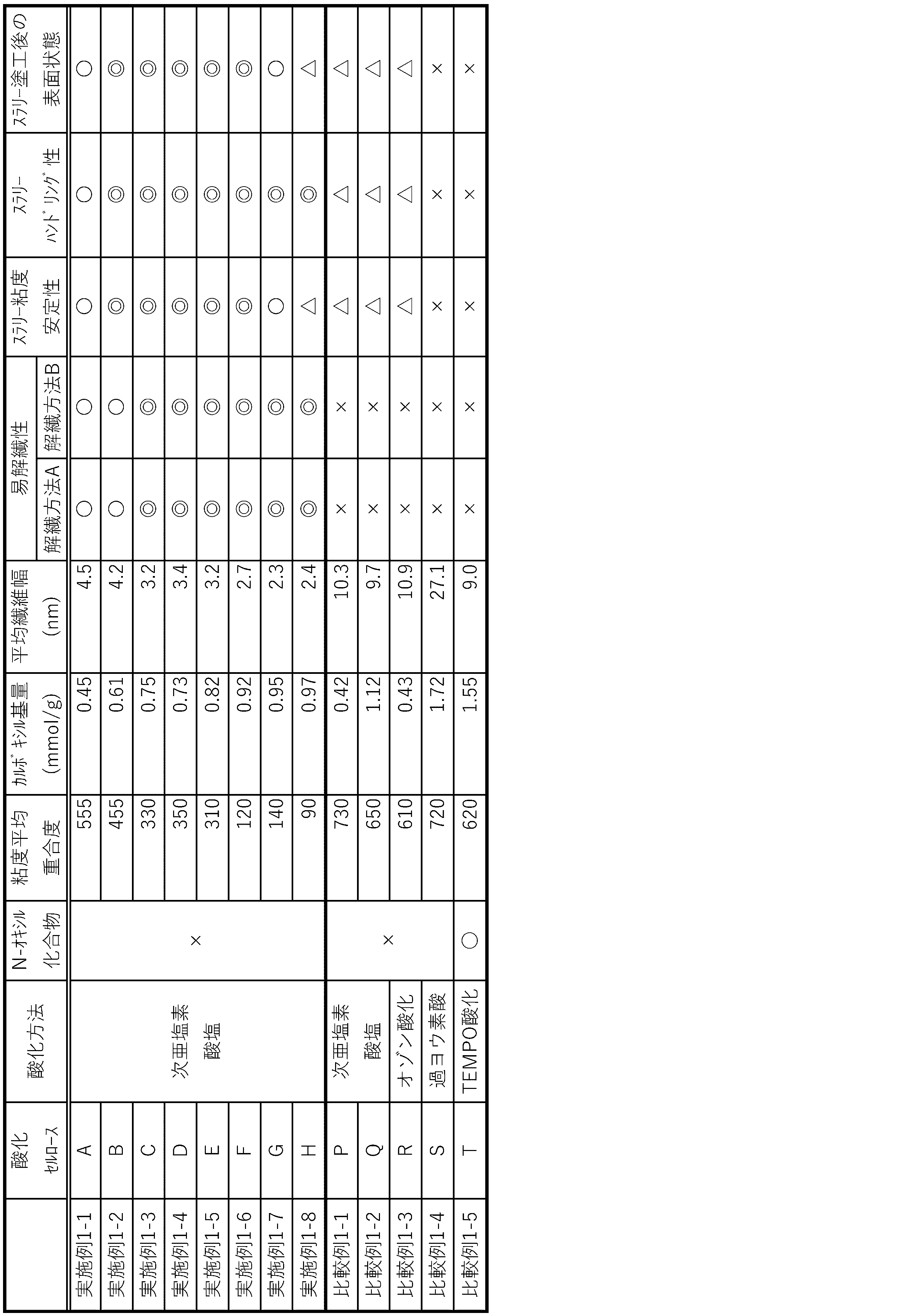
なお、表1では、セルロース系原料の酸化処理の際にN-オキシル化合物を使用しなかった場合(すなわち、CNF分散体中にN-オキシル化合物を実質的に含まない場合)を「×」、N-オキシル化合物を使用した場合(すなわち、CNF分散体中にN-オキシル化合物を含む場合)を「○」で表した(表2についても同じ)。
実施例1-1~1-8の酸化セルロースは、自転公転ミキサー又はボルテックスミキサーによる温和な撹拌によってもセルロースミクロフィブリル同士が解れやすく、CNF水分散体とした場合に高い光透過率を示した。また、自転公転ミキサーによる解繊処理により、平均繊維幅が5nm以下の細いセルロース繊維を得ることができた。さらに、実施例1-1~1-8のスラリーは、粘度安定性、ハンドリング性及び塗工性のバランスが取れていた。特に、重合度が3桁のオーダーであった実施例1-1~1-7は、粘度安定性、ハンドリング性及び塗工性の全ての評価が「◎」又は「○」であり、スラリー特性に優れていた。
これに対し、重合度が730、650である比較例1-1,1-2は、自転公転ミキサー又はボルテックスミキサーによる温和な撹拌ではセルロースミクロフィブリル同士が解れにくく、易解繊性が「×」の評価であった。また、スラリー特性については全て「△」の評価であり、実施例1-1~1-8よりも劣っていた。酸化方法が異なる比較例1-3~1-5についても、易解繊性及びスラリー特性の評価が実施例よりも劣っていた。
(3)評価2
〔実施例2-1~2-11、比較例2-1~2-5〕
〔易解繊性〕
製造例1~8及び比較製造例1~5の各例で得られた酸化セルロースA~H,P~Tを用いて、酸化セルロースの濃度が0.1%(実施例2-1,2-2,2-4,2-6,2-8~2-11、比較例2-1~2-5)又は0.5%(実施例2-3,2-5,2-7)の酸化セルロース水分散体を調製した。この酸化セルロース水分散体を撹拌機で処理し、得られたCNF水分散体を10mm厚の石英セルに入れて、分光光度計(JASCO V-550)により波長660nmの光透過率を測定した。なお、0.5%酸化セルロース水分散体の解繊により得られたCNF水分散体については、CNF水分散体を純水で0.1%に希釈して光透過率を測定した。撹拌機には、シンキー社製の自転公転ミキサー「あわとり練太郎 ARE-310」を使用し、ミックスモードにて公転速度2000rpm、自転速度800rpmの条件で10分間処理した。評価判定基準は以下のとおりである。
◎:光透過率が80%以上
○:光透過率が70%以上80%未満
△:光透過率が60%以上70%未満
×:光透過率が60%未満
〔実施例2-1~2-11、比較例2-1~2-5〕
〔易解繊性〕
製造例1~8及び比較製造例1~5の各例で得られた酸化セルロースA~H,P~Tを用いて、酸化セルロースの濃度が0.1%(実施例2-1,2-2,2-4,2-6,2-8~2-11、比較例2-1~2-5)又は0.5%(実施例2-3,2-5,2-7)の酸化セルロース水分散体を調製した。この酸化セルロース水分散体を撹拌機で処理し、得られたCNF水分散体を10mm厚の石英セルに入れて、分光光度計(JASCO V-550)により波長660nmの光透過率を測定した。なお、0.5%酸化セルロース水分散体の解繊により得られたCNF水分散体については、CNF水分散体を純水で0.1%に希釈して光透過率を測定した。撹拌機には、シンキー社製の自転公転ミキサー「あわとり練太郎 ARE-310」を使用し、ミックスモードにて公転速度2000rpm、自転速度800rpmの条件で10分間処理した。評価判定基準は以下のとおりである。
◎:光透過率が80%以上
○:光透過率が70%以上80%未満
△:光透過率が60%以上70%未満
×:光透過率が60%未満
上記の易解繊性評価において解繊処理により得られた各CNF水分散体を用いて、平均繊維幅、スラリー粘度安定性、スラリーハンドリング性及びスラリー塗工後の表面状態の測定及び評価を行った。解繊処理に用いた酸化セルロースのカルボキシ基量とともに、評価結果を表2に示す。なお、平均繊維幅、スラリー粘度安定性、スラリーハンドリング性及びスラリー塗工後の表面状態の測定及び評価は上記(2)と同様にして行った。

実施例2-1~2-11の酸化セルロースは、自転公転ミキサーによる温和な撹拌によってもセルロースミクロフィブリル同士が解れやすく、CNF水分散体とした場合に高い光透過率を示した。また、解繊処理を行う際の酸化セルロース濃度を0.1%から0.5%に高くした場合にも、CNF水分散体の光透過率は十分に高く、さらに水系スラリーの粘度安定性、ハンドリング性及び塗工性のバランスも取れていた。
これに対し、比較例2-1~2-5はいずれも、自転公転ミキサーによる温和な撹拌により解繊を行った場合には、CNF水分散体の光透過率が50%台と低い値を示した。また、比較例2-1~2-5は、スラリー特性についても実施例2-1~2-11より劣っていた。
Claims (9)
- 次亜塩素酸又はその塩によるセルロース系原料の酸化物である酸化セルロースであって、
N-オキシル化合物を実質的に含まず、
重合度が600以下である、酸化セルロース。 - カルボキシ基量が0.30~2.0mmol/gである、請求項1に記載の酸化セルロース。
- 前記酸化セルロースの濃度0.1質量%水分散液を自転公転撹拌機にて公転速度2000rpm、自転速度800rpmで10分間の条件にて解繊処理することにより得られるナノセルロース水分散液の光透過率が60%以上である、請求項1又は2に記載の酸化セルロース。
- セルロース系原料の酸化物である酸化セルロースであって、
前記酸化セルロースの濃度0.1質量%水分散液を自転公転撹拌機にて公転速度2000rpm、自転速度800rpmで10分間の条件にて解繊処理することにより得られるナノセルロース水分散液の光透過率が60%以上である、酸化セルロース。 - 前記酸化セルロースが、次亜塩素酸又はその塩によるセルロース系原料の酸化物である、請求項4に記載の酸化セルロース。
- 請求項1~5のいずれか1項に記載の酸化セルロースが分散媒に分散された酸化セルロース分散液。
- 請求項1~6のいずれか1項に記載の酸化セルロースが解繊されてなり、平均繊維幅が1~200nmである、ナノセルロース。
- 請求項1~6のいずれか1項に記載の酸化セルロースを、自転公転撹拌機にて公転速度1200~2500rpm、自転速度600~1000rpmで3~15分間解繊処理することにより得られる、ナノセルロース。
- 請求項7又は8に記載のナノセルロースが分散媒に分散されたナノセルロース分散液。
Priority Applications (7)
| Application Number | Priority Date | Filing Date | Title |
|---|---|---|---|
| JP2021572554A JP7231893B2 (ja) | 2020-07-09 | 2021-07-09 | 酸化セルロース、ナノセルロース及びそれらの分散液 |
| US18/014,550 US20230250197A1 (en) | 2020-07-09 | 2021-07-09 | Oxidized cellulose, nanocellulose, and their dispersions |
| EP21838876.7A EP4180462A4 (en) | 2020-07-09 | 2021-07-09 | OXIDIZED CELLULOSE, NANOCELLULOSE AND DISPERSIONS THEREOF |
| CN202180048753.8A CN115803349B (zh) | 2020-07-09 | 2021-07-09 | 氧化纤维素、纳米纤维素和它们的分散液 |
| CN202410912895.XA CN118852470A (zh) | 2020-07-09 | 2021-07-09 | 氧化纤维素、纳米纤维素和它们的分散液 |
| JP2022116158A JP7636723B2 (ja) | 2020-07-09 | 2022-07-21 | 酸化セルロース、ナノセルロース及びそれらの分散液 |
| JP2025008084A JP2025066769A (ja) | 2020-07-09 | 2025-01-20 | 酸化セルロース、ナノセルロース及びそれらの分散液 |
Applications Claiming Priority (2)
| Application Number | Priority Date | Filing Date | Title |
|---|---|---|---|
| JP2020-118641 | 2020-07-09 | ||
| JP2020118641 | 2020-07-09 |
Publications (1)
| Publication Number | Publication Date |
|---|---|
| WO2022009979A1 true WO2022009979A1 (ja) | 2022-01-13 |
Family
ID=79552527
Family Applications (1)
| Application Number | Title | Priority Date | Filing Date |
|---|---|---|---|
| PCT/JP2021/025936 Ceased WO2022009979A1 (ja) | 2020-07-09 | 2021-07-09 | 酸化セルロース、ナノセルロース及びそれらの分散液 |
Country Status (5)
| Country | Link |
|---|---|
| US (1) | US20230250197A1 (ja) |
| EP (1) | EP4180462A4 (ja) |
| JP (3) | JP7231893B2 (ja) |
| CN (2) | CN118852470A (ja) |
| WO (1) | WO2022009979A1 (ja) |
Cited By (2)
| Publication number | Priority date | Publication date | Assignee | Title |
|---|---|---|---|---|
| WO2023210531A1 (ja) * | 2022-04-25 | 2023-11-02 | 東亞合成株式会社 | カーボンナノチューブ分散剤、分散液及びその製造方法、電極、並びに電池 |
| WO2025004723A1 (ja) | 2023-06-30 | 2025-01-02 | 東亞合成株式会社 | セルロース含有組成物及びその製造方法、並びに粘度調節方法 |
Families Citing this family (4)
| Publication number | Priority date | Publication date | Assignee | Title |
|---|---|---|---|---|
| EP4180462A4 (en) * | 2020-07-09 | 2024-05-29 | Toagosei Co., Ltd. | OXIDIZED CELLULOSE, NANOCELLULOSE AND DISPERSIONS THEREOF |
| WO2022009980A1 (ja) * | 2020-07-09 | 2022-01-13 | 東亞合成株式会社 | ナノセルロース及びその分散液 |
| WO2022138759A1 (ja) * | 2020-12-24 | 2022-06-30 | 東亞合成株式会社 | 酸化セルロース及びナノセルロースの製造方法 |
| JP2024138861A (ja) * | 2023-03-27 | 2024-10-09 | 日本製紙株式会社 | 酸化セルロースナノファイバー分散液の製造方法 |
Citations (5)
| Publication number | Priority date | Publication date | Assignee | Title |
|---|---|---|---|---|
| JPS4934989A (ja) * | 1972-08-07 | 1974-03-30 | ||
| JP2015113453A (ja) * | 2013-12-16 | 2015-06-22 | 国立大学法人 東京大学 | トリカルボキシセルロース及びその製造方法 |
| JP2017193814A (ja) * | 2016-04-13 | 2017-10-26 | 関東電化工業株式会社 | セルロースナノファイバーの分散液およびその製造方法 |
| WO2018230354A1 (ja) | 2017-06-16 | 2018-12-20 | 東亞合成株式会社 | セルロースナノファイバーの製造方法 |
| WO2020027307A1 (ja) | 2018-08-03 | 2020-02-06 | 東亞合成株式会社 | 酸化セルロース、酸化セルロースおよびナノセルロースの製造方法ならびにナノセルロース分散液 |
Family Cites Families (22)
| Publication number | Priority date | Publication date | Assignee | Title |
|---|---|---|---|---|
| US5414079A (en) * | 1993-08-03 | 1995-05-09 | Biocontrol Incorporated | Oxidized cellulose |
| JP5108587B2 (ja) | 2007-12-11 | 2012-12-26 | 花王株式会社 | セルロース分散液の製造方法 |
| JP5162438B2 (ja) | 2008-12-26 | 2013-03-13 | 花王株式会社 | ガスバリア用材料 |
| WO2010116826A1 (ja) | 2009-03-30 | 2010-10-14 | 日本製紙株式会社 | セルロースナノファイバーの製造方法 |
| JP2011184475A (ja) | 2010-03-04 | 2011-09-22 | Toppan Printing Co Ltd | 酸化セルロースの製造方法、酸化セルロース分散液の製造方法、及び酸化セルロース分散液 |
| JP2011184648A (ja) | 2010-03-11 | 2011-09-22 | Toppan Printing Co Ltd | 酸化セルロースの製造方法 |
| WO2011118746A1 (ja) | 2010-03-26 | 2011-09-29 | 日本製紙株式会社 | セルロースナノファイバーの製造方法 |
| JPWO2011118748A1 (ja) | 2010-03-26 | 2013-07-04 | 日本製紙株式会社 | セルロースナノファイバーの製造方法 |
| JP2013256546A (ja) * | 2010-09-28 | 2013-12-26 | Nippon Paper Industries Co Ltd | セルロースナノファイバー |
| WO2012132903A1 (ja) * | 2011-03-30 | 2012-10-04 | 日本製紙株式会社 | セルロースナノファイバーの製造方法 |
| WO2013047218A1 (ja) | 2011-09-30 | 2013-04-04 | 日本製紙株式会社 | セルロースナノファイバーの製造方法 |
| RU2016105773A (ru) * | 2013-08-30 | 2017-10-05 | Дай-Ити Когио Сейяку Ко., Лтд. | Добавка для извлечения сырой нефти |
| US20170101738A1 (en) * | 2015-10-12 | 2017-04-13 | The University Of Massachusetts | Method for preparation of cellulose nanocrystals and nanofibrils |
| CN108350092B (zh) | 2015-11-02 | 2021-05-18 | 日本制纸株式会社 | 纤维素纳米纤维分散液的过滤方法和制造方法 |
| JP6874329B2 (ja) | 2016-11-01 | 2021-05-19 | 凸版印刷株式会社 | ホルムアルデヒド除去組成物およびその製造方法、ホルムアルデヒド除去シート |
| WO2018116661A1 (ja) * | 2016-12-21 | 2018-06-28 | 日本製紙株式会社 | 酸型カルボキシル化セルロースナノファイバー |
| MY191605A (en) | 2017-04-27 | 2022-07-01 | Jujo Paper Co Ltd | Masterbatch, rubber composition, and methods for manufacturing the same |
| CN108484782A (zh) * | 2018-03-30 | 2018-09-04 | 广西大学 | 一种羧基化改性的纳米纤维素晶体及其制备方法 |
| JP7283874B2 (ja) | 2018-09-04 | 2023-05-30 | 日本製紙株式会社 | 酸化セルロースナノファイバー、および酸化セルロースナノファイバー分散液 |
| JPWO2020066537A1 (ja) * | 2018-09-26 | 2021-11-25 | 良平 森 | セルロースナノファイバー(cnf)およびそれを含む複合材料の製造方法 |
| CN109678972A (zh) * | 2018-12-25 | 2019-04-26 | 华南理工大学 | 一种2,3-二醛基-6-羧基纳米纤维素及其制备方法与应用 |
| EP4180462A4 (en) * | 2020-07-09 | 2024-05-29 | Toagosei Co., Ltd. | OXIDIZED CELLULOSE, NANOCELLULOSE AND DISPERSIONS THEREOF |
-
2021
- 2021-07-09 EP EP21838876.7A patent/EP4180462A4/en active Pending
- 2021-07-09 JP JP2021572554A patent/JP7231893B2/ja active Active
- 2021-07-09 WO PCT/JP2021/025936 patent/WO2022009979A1/ja not_active Ceased
- 2021-07-09 CN CN202410912895.XA patent/CN118852470A/zh active Pending
- 2021-07-09 US US18/014,550 patent/US20230250197A1/en active Pending
- 2021-07-09 CN CN202180048753.8A patent/CN115803349B/zh active Active
-
2022
- 2022-07-21 JP JP2022116158A patent/JP7636723B2/ja active Active
-
2025
- 2025-01-20 JP JP2025008084A patent/JP2025066769A/ja active Pending
Patent Citations (5)
| Publication number | Priority date | Publication date | Assignee | Title |
|---|---|---|---|---|
| JPS4934989A (ja) * | 1972-08-07 | 1974-03-30 | ||
| JP2015113453A (ja) * | 2013-12-16 | 2015-06-22 | 国立大学法人 東京大学 | トリカルボキシセルロース及びその製造方法 |
| JP2017193814A (ja) * | 2016-04-13 | 2017-10-26 | 関東電化工業株式会社 | セルロースナノファイバーの分散液およびその製造方法 |
| WO2018230354A1 (ja) | 2017-06-16 | 2018-12-20 | 東亞合成株式会社 | セルロースナノファイバーの製造方法 |
| WO2020027307A1 (ja) | 2018-08-03 | 2020-02-06 | 東亞合成株式会社 | 酸化セルロース、酸化セルロースおよびナノセルロースの製造方法ならびにナノセルロース分散液 |
Non-Patent Citations (2)
| Title |
|---|
| See also references of EP4180462A4 |
| SUSTAINABLE CHEM. ENG., vol. 8, no. 48, 2020, pages 17800 - 17806 |
Cited By (2)
| Publication number | Priority date | Publication date | Assignee | Title |
|---|---|---|---|---|
| WO2023210531A1 (ja) * | 2022-04-25 | 2023-11-02 | 東亞合成株式会社 | カーボンナノチューブ分散剤、分散液及びその製造方法、電極、並びに電池 |
| WO2025004723A1 (ja) | 2023-06-30 | 2025-01-02 | 東亞合成株式会社 | セルロース含有組成物及びその製造方法、並びに粘度調節方法 |
Also Published As
| Publication number | Publication date |
|---|---|
| CN115803349A (zh) | 2023-03-14 |
| CN115803349B (zh) | 2024-06-07 |
| JPWO2022009979A1 (ja) | 2022-01-13 |
| JP2022165987A (ja) | 2022-11-01 |
| US20230250197A1 (en) | 2023-08-10 |
| JP2025066769A (ja) | 2025-04-23 |
| EP4180462A4 (en) | 2024-05-29 |
| JP7636723B2 (ja) | 2025-02-27 |
| JP7231893B2 (ja) | 2023-03-02 |
| EP4180462A1 (en) | 2023-05-17 |
| CN118852470A (zh) | 2024-10-29 |
Similar Documents
| Publication | Publication Date | Title |
|---|---|---|
| JP7636723B2 (ja) | 酸化セルロース、ナノセルロース及びそれらの分散液 | |
| US11919974B2 (en) | Oxidized cellulose, method of producing oxidized cellulose and nanocellulose, and nanocellulose dispersion | |
| JP7842980B2 (ja) | ナノセルロース及びその分散液 | |
| JP7778290B2 (ja) | ナノセルロース含有組成物の製造方法 | |
| JP2026021436A (ja) | 酸化セルロース及びナノセルロースの製造方法 | |
| JP2023084702A (ja) | ナノセルロースの乾燥物及びナノセルロース分散液 | |
| JP7805952B2 (ja) | 塩化ビニル樹脂組成物及びその製造方法、並びに成形体 | |
| JP2023013727A (ja) | 酸化セルロース、ナノセルロース及びそれらの分散液 | |
| JP7787489B2 (ja) | ナノセルロースの製造方法 | |
| JP7649459B2 (ja) | ナノセルロース及びその分散液並びにその製造方法 | |
| JP7746674B2 (ja) | 酸化セルロース及びナノセルロースの製造方法、並びに、酸化剤 | |
| JP2023072248A (ja) | 接着剤組成物及びその製造方法、並びに、物品 | |
| JP2023084701A (ja) | 酸化セルロースの乾燥物、酸化セルロースの分散液、及びナノセルロース | |
| WO2022186241A1 (ja) | 不織布用バインダー組成物、及び不織布 |
Legal Events
| Date | Code | Title | Description |
|---|---|---|---|
| ENP | Entry into the national phase |
Ref document number: 2021572554 Country of ref document: JP Kind code of ref document: A |
|
| 121 | Ep: the epo has been informed by wipo that ep was designated in this application |
Ref document number: 21838876 Country of ref document: EP Kind code of ref document: A1 |
|
| ENP | Entry into the national phase |
Ref document number: 2021838876 Country of ref document: EP Effective date: 20230209 |
|
| NENP | Non-entry into the national phase |
Ref country code: DE |