WO2022014252A1 - Dispositif de traitement d'informations et procédé de traitement d'informations - Google Patents
Dispositif de traitement d'informations et procédé de traitement d'informations Download PDFInfo
- Publication number
- WO2022014252A1 WO2022014252A1 PCT/JP2021/023104 JP2021023104W WO2022014252A1 WO 2022014252 A1 WO2022014252 A1 WO 2022014252A1 JP 2021023104 W JP2021023104 W JP 2021023104W WO 2022014252 A1 WO2022014252 A1 WO 2022014252A1
- Authority
- WO
- WIPO (PCT)
- Prior art keywords
- human body
- moving
- moving body
- information processing
- captured image
- Prior art date
- Legal status (The legal status is an assumption and is not a legal conclusion. Google has not performed a legal analysis and makes no representation as to the accuracy of the status listed.)
- Ceased
Links
Images





Classifications
-
- G—PHYSICS
- G06—COMPUTING OR CALCULATING; COUNTING
- G06T—IMAGE DATA PROCESSING OR GENERATION, IN GENERAL
- G06T7/00—Image analysis
- G06T7/20—Analysis of motion
- G06T7/254—Analysis of motion involving subtraction of images
-
- G—PHYSICS
- G06—COMPUTING OR CALCULATING; COUNTING
- G06T—IMAGE DATA PROCESSING OR GENERATION, IN GENERAL
- G06T7/00—Image analysis
- G06T7/20—Analysis of motion
- G06T7/246—Analysis of motion using feature-based methods, e.g. the tracking of corners or segments
- G06T7/248—Analysis of motion using feature-based methods, e.g. the tracking of corners or segments involving reference images or patches
-
- G—PHYSICS
- G06—COMPUTING OR CALCULATING; COUNTING
- G06T—IMAGE DATA PROCESSING OR GENERATION, IN GENERAL
- G06T7/00—Image analysis
- G06T7/20—Analysis of motion
- G06T7/215—Motion-based segmentation
-
- G—PHYSICS
- G06—COMPUTING OR CALCULATING; COUNTING
- G06T—IMAGE DATA PROCESSING OR GENERATION, IN GENERAL
- G06T7/00—Image analysis
- G06T7/20—Analysis of motion
- G06T7/269—Analysis of motion using gradient-based methods
-
- G—PHYSICS
- G06—COMPUTING OR CALCULATING; COUNTING
- G06T—IMAGE DATA PROCESSING OR GENERATION, IN GENERAL
- G06T7/00—Image analysis
- G06T7/60—Analysis of geometric attributes
-
- G—PHYSICS
- G06—COMPUTING OR CALCULATING; COUNTING
- G06V—IMAGE OR VIDEO RECOGNITION OR UNDERSTANDING
- G06V40/00—Recognition of biometric, human-related or animal-related patterns in image or video data
- G06V40/10—Human or animal bodies, e.g. vehicle occupants or pedestrians; Body parts, e.g. hands
-
- G—PHYSICS
- G06—COMPUTING OR CALCULATING; COUNTING
- G06T—IMAGE DATA PROCESSING OR GENERATION, IN GENERAL
- G06T2207/00—Indexing scheme for image analysis or image enhancement
- G06T2207/20—Special algorithmic details
- G06T2207/20084—Artificial neural networks [ANN]
-
- G—PHYSICS
- G06—COMPUTING OR CALCULATING; COUNTING
- G06T—IMAGE DATA PROCESSING OR GENERATION, IN GENERAL
- G06T2207/00—Indexing scheme for image analysis or image enhancement
- G06T2207/30—Subject of image; Context of image processing
- G06T2207/30196—Human being; Person
Definitions
- the present invention relates to an information processing apparatus and an information processing method.
- Patent Document 1 discloses a technique for reducing a processing load when detecting an object from a moving image by setting a moving object region in which a change occurs between frames constituting the moving image as a detection target region.
- the processing load for human body detection is sufficiently reduced because the analysis target includes moving objects other than the human body, for example, moving objects other than the human body such as corrugated cardboard on a conveyor in a factory. Not done. Further, when detecting using the shape information of an object, the human body whose shape changes depending on the posture may not be detected accurately.
- One aspect of the present invention is to provide a technique for accurately detecting the human body in real time.
- the present invention adopts the following configuration in order to achieve the above object.
- the first aspect of the present disclosure is to determine the distance between a moving body detection unit that detects a moving body from an image captured by a fish-eye camera and a predetermined two points on the contour of a moving body region including the moving body in the captured image.
- the human body determination unit for determining whether or not the moving body is a human body and the human body determination unit for determining that the human body is a human body. It is an information processing apparatus including a human body detection unit that detects a human body from a moving body region including a moving body.
- the “distance between two predetermined points on the contour of the moving body region including the moving body” is a distance corresponding to the height of the human body when the moving body is a human body. Hereinafter, it is also referred to as the length of the moving body.
- the “threshold value range” can be a range of values that the height of the human body can take at a position in the captured image when the human body is photographed.
- the information processing apparatus limits the target area for detecting the human body by motion detection, and further detects the human body only when the moving object is a human body. Therefore, the processing load due to the detection of the human body is reduced, and the information processing apparatus can accurately detect the human body in real time.
- the distance between two predetermined points on the contour of the moving body region including the moving body is the first coordinate which is the closest point or the farthest point from the center coordinate of the captured image in the moving body region, and the straight line passing through the center coordinate and the first coordinate. It may be a distance between the second coordinate and the intersection of the contour of the moving body region and the second coordinate different from the first coordinate.
- the information processing device can calculate the length of the moving object by a simple method.
- the distance between two predetermined points on the contour of the moving body region including the moving body is the distance between the two points where the straight line passing through the coordinates of the center of gravity of the moving body region and the center coordinates of the captured image intersects the contour of the moving body region. good. Even if the shape of the moving body region, which is the human body, changes due to a change in posture such as when a person reaches out, the center of gravity of the moving body region exists on the human body because the human hand is thinner than the torso. Therefore, the information processing device can accurately acquire the height of the human body by calculating the distance between two points where the straight line passing through the coordinates of the center of gravity and the center coordinates of the captured image intersects the contour of the moving body region. ..
- the threshold range may be set for each region in which the captured image is divided into a plurality of areas. Since the image of the human body differs depending on the position in the captured image, the information processing apparatus sets the assumed length of the human body for each divided region as a threshold range. As a result, the information processing apparatus can accurately determine whether or not the detected moving object is a human body.
- the moving object detection unit may detect a moving object by the background subtraction method or the inter-frame subtraction method. Further, the moving object detecting unit may detect a moving object based on the movement and the moving direction of the object commonly captured in the continuous frame of the captured image. Since the information processing device detects a moving object and limits the target area for human body detection to the moving object area including the detected moving object, the load due to unnecessary human body detection can be reduced.
- the information processing device may further include an output unit that outputs information on the human body detected by the human body detection unit.
- the information processing device can output the detection result of the human body by the human body detection unit to a display or the like in real time and present it to the user.
- the information processing device may further include an imaging unit that captures captured images.
- the information processing device can be configured in a simple manner by being integrally configured with the image pickup unit.
- the second aspect of the present invention is a captured image of a moving object detection step in which a computer detects a moving object from an image captured by a fisheye camera, and a distance between two predetermined points on the contour of a moving object region including the moving object.
- the human body determination step for determining whether or not the moving object is a human body and the human body determination step for the human body
- It is an information processing method including a human body detection unit step for detecting a human body from a moving body region including a moving body determined to be present.
- the human body can be detected accurately in real time.
- FIG. 1 is a diagram illustrating an application example of the information processing apparatus according to the embodiment.
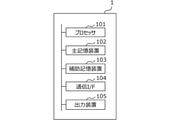
- FIG. 2 is a diagram illustrating a hardware configuration of an information processing device.
- FIG. 3 is a diagram illustrating the functional configuration of the information processing apparatus.
- FIG. 4 is a flowchart illustrating the human body detection process.
- FIG. 5 is a diagram illustrating motion detection.
- FIG. 6 is a diagram illustrating a first example of calculating the length of a moving body.
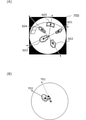
- 7A and 7B are diagrams illustrating a second example of calculating the length of a moving body.
- FIG. 8 is a graph showing the length of the human body according to the distance from the center.
- 9A and 9B are diagrams showing an example of a threshold value set for each region of the imaging range.
- FIG. 10 is a diagram showing an example of determining whether or not the moving body is a human body.
- 11A and 11B are diagrams illustrating a method of detecting a human body from a moving body
- FIG. 1 is a diagram illustrating an application example of the information processing apparatus according to the embodiment.
- the information processing apparatus 1 acquires a camera image (captured image) taken by the camera 10 (imaging unit).
- the camera 10 is, for example, an ultra-wide-angle camera equipped with a fisheye lens capable of acquiring a wide range of image information.
- a camera equipped with a fisheye lens is also called a fisheye camera, an omnidirectional camera, an omnidirectional camera, or the like, but the term "fisheye camera" is used in this specification.
- the image taken by the fisheye camera is distorted in appearance depending on the position in the captured image. For example, when the fisheye camera is placed so as to look down on the floor from the ceiling, the image of the photographed person has the feet facing the center and the crown facing outward.
- the human body is a front image, a rear image, or a side image around the captured image, and a top image at the center of the captured image.
- the information processing device 1 detects a moving object from the captured image acquired from the camera 10 and determines whether or not it is a human body. Since the human body taken with a fish-eye camera is distorted, the distance between the feet of the human body and the crown (height of the human body) differs depending on the position in the captured image.
- the information processing device 1 stores in advance the distance between the foot and the crown, which is assumed according to the position in the captured image, as a threshold range for determining whether or not the detected moving object is a human body.
- the information processing apparatus 1 compares the distance (length of the moving body) between two predetermined points on the contour of the moving body region including the detected moving body with the range of the threshold value set in advance corresponding to the position in the captured image. By doing so, it is possible to determine whether or not the moving body is a human body.
- the information processing device 1 analyzes the moving body region determined to be the human body and detects the human body.
- the information processing apparatus 1 can detect a human body by using a general object recognition algorithm.
- the human body detection algorithm can use a classifier that combines image features such as HoG or Haar-like with boosting.
- the human body detection algorithm may use human body recognition by deep learning (for example, R-CNN, Faster R-CNN, YOLO, SSD, etc.).
- the information processing apparatus 1 can determine the human body-likeness by detecting a moving object from the captured image and comparing it with a preset threshold range corresponding to the position in the captured image.
- the information processing apparatus 1 detects a human body only in a moving body region including a moving body determined to be a human body in the captured image. Therefore, the load due to the human body detection process is reduced.
- FIG. 2 is a diagram illustrating a hardware configuration of the information processing apparatus 1.
- the information processing device 1 includes a processor 101, a main storage device 102, an auxiliary storage device 103, a communication interface (I / F) 104, and an output device 105.
- the processor 101 reads the program stored in the auxiliary storage device 103 into the main storage device 102 and executes it, thereby realizing the functions as the functional configurations described with reference to FIG.
- the communication interface 104 is an interface for performing wired or wireless communication.
- the output device 105 is, for example, a device for outputting a display or the like.
- the information processing device 1 may be a general-purpose computer such as a personal computer, a server computer, a tablet terminal, or a smartphone, or may be an embedded computer such as an onboard computer.
- the information processing device 1 may be realized by, for example, distributed computing by a plurality of computer devices, or a part of each functional unit may be realized by a cloud server. Further, a part of each functional unit of the information processing apparatus 1 may be realized by a dedicated hardware apparatus such as FPGA or ASIC.
- the information processing device 1 is connected to the camera 10 by wire (USB cable, LAN cable, etc.) or wirelessly (WiFi, etc.), and receives image data taken by the camera 10.
- the camera 10 is an image pickup device having an optical system including a lens and an image pickup element (an image sensor such as a CCD or CMOS).
- the information processing device 1 may be integrally configured with the camera 10 (imaging unit). Further, a part of the processing of the information processing apparatus 1 such as motion detection and human body determination processing for the captured image may be executed by the camera 10. Further, the result of the human body detection by the information processing device 1 may be transmitted to an external device and presented to the user.
- FIG. 3 is a diagram illustrating the functional configuration of the information processing apparatus 1.
- the information processing apparatus 1 includes a motion detection unit 11, a human body determination unit 12, a human body detection unit 13, an output unit 14, and a determination information database 15 (determination information DB 15).
- the moving object detection unit 11 detects a moving object from the captured image acquired from the camera 10.
- the moving object detection unit 11 uses, for example, a background subtraction method for detecting a change between a captured image and a background image prepared in advance, and an interframe difference method for detecting a change between frames. Can be detected.
- a moving object may be detected based on both the background difference and the frame-to-frame difference.
- the method of detecting a moving object may be a method using an optical flow that estimates the movement and moving direction of an object from a portion that is commonly captured in a continuous frame.
- the human body determination unit 12 determines whether or not the moving body detected by the moving body detecting unit 11 is a human body.
- the human body determination unit 12 determines whether or not the moving body is a human body by, for example, comparing the detected length of the moving body with a threshold range set based on the height of the human body measured at the position of the moving body. It can be determined.
- the human body detection unit 13 detects (recognizes) the human body from the area of the moving body determined by the human body determination unit 12 to be a human body.
- the detection of the human body can be realized by a general object recognition technique such as deep learning.
- the output unit 14 outputs (displays) the detected human body information to an output device 105 such as a display.
- the output unit 14 can display the human body detected by the human body detection unit 13 by surrounding it with a frame, or can display it by extracting it from the captured image.
- the determination information database 15 stores information used by the human body determination unit 12 to determine whether or not the moving object detected from the captured image is a human body.
- the information for determining whether or not the moving body is a human body is, for example, the length (height) of the human body assumed according to the distance from the center in the image captured by the camera 10.
- the human body determination unit 12 can determine whether or not the moving body is a human body by comparing the length of the moving body with the length of the human body stored in the determination information database 15 as a threshold range.
- FIG. 4 is a flowchart illustrating the human body detection process.
- the human body detection process is started, for example, by turning on the power of the camera 10 and receiving the captured image from the camera 10 by the information processing apparatus 1.
- the human body detection process shown in FIG. 4 is a process executed for each frame of the captured image.
- the “captured image” is described as one frame included in the captured image.
- the moving object detection unit 11 acquires a captured image.
- the motion detection unit 11 acquires an captured image from the camera 10 via the communication interface 104.
- the information processing device 1 is integrally configured with the camera (imaging unit)
- the moving object detecting unit 11 acquires the captured image captured by the imaging unit.
- the moving object detection unit 11 detects a moving object in the captured image acquired in S101.
- the detection of a moving object in the captured image will be described with reference to FIG. It is assumed that the information processing device 1 holds the background image 501 taken in the absence of a moving object such as a human body in the auxiliary storage device 103 or the like.
- the moving object detection unit 11 extracts a region of difference between the captured image 502 and the background image 501 as a moving object region.
- the output image 503 shown in FIG. 5 the extracted moving object region is shown surrounded by a frame.
- the output image 503 shows an example in which a shelf other than the human body is detected as a moving object due to a movement of a place or misrecognition.
- the method of detecting a moving object is not limited to the example described in FIG. 5, and is a method using an optical flow that estimates the movement and moving direction of an object from a part that is commonly captured in a continuous frame. May be good.
- the human body determination unit 12 calculates the length of the moving object to be determined.
- the human body determination unit 12 calculates the length of the moving object to be determined.
- FIGS. 6 and 7A and 7B two examples of calculating the length of a moving object detected in an image taken by a fisheye camera (camera 10) will be described.
- the human body determination unit 12 calculates the distance between the coordinates of the position assumed to be the feet and the position assumed to be the crown as the length of the moving body.
- the human body determination unit 12 calculates the distance between two points where the straight line connecting the coordinates of the center of gravity of the moving body and the coordinates of the center of the captured image intersects the contour of the moving body region as the length of the moving body. ..
- FIG. 6 is a diagram illustrating a first example of calculating the length of a moving body.
- Image 600A shows the moving body region 601 to the moving body region 605 including the moving body detected in S102.
- the center of the captured image is indicated by a cross.
- image 600A when the human body is photographed with a fisheye camera, the feet face the center and the crown faces the outside.
- the human body determination unit 12 can acquire the coordinates closest to the coordinates of the center of the captured image (hereinafter referred to as center coordinates) in the moving object region and use them as the foot coordinates.
- the image 600C shows the coordinates of the position assumed to be the crown (hereinafter referred to as the coordinates of the crown) with a triangular mark when the moving object is a person.
- the human body determination unit 12 can acquire the coordinates of another intersection of the straight line passing through the foot coordinates and the center coordinates and the contour of the moving body region and use them as the coordinates of the crown. Further, the human body determination unit 12 may acquire the coordinates farthest from the center coordinates of the moving body region and use them as the parietal coordinates.
- the human body determination unit 12 calculates the distance between the acquired foot coordinates and the crown coordinates as the length of the moving body (height of the human body). In the example of FIG. 6, a method of acquiring the foot coordinates first is illustrated, but the human body determination unit 12 may acquire the coordinates of the crown first. That is, the human body determination unit 12 acquires the coordinates farthest from the center coordinates of the moving body region as the parietal coordinates, and acquires the coordinates of the other intersection of the straight line passing through the parietal coordinates and the center coordinates and the contour of the moving body region. Then, it can be used as the foot coordinates.
- Image 700 of FIG. 7A shows a moving body region 601 to a moving body region 605 including the moving body detected in S102.
- the center of the captured image is indicated by a cross.
- the coordinates of the center of gravity of the moving body region (hereinafter, referred to as the coordinates of the center of gravity) are indicated by stars.
- the human body determination unit 12 can calculate the distance between two points where the straight line passing through the center coordinates and the center coordinates intersects the contour of the moving body region as the length of the moving body (height of the human body). In the second example, the human body determination unit 12 can calculate the height of the human body more accurately even when the person reaches out.
- the method according to the first example may erroneously recognize that the tip of the hand is the foot.
- the straight line connecting the center coordinates and the coordinates of the tip of the hand may not pass through the crown of the human body as shown by the dotted line 701.
- the center of gravity of the moving body region usually exists in the torso part because the hands and arms are thinner than the torso part even when the person is reaching out.
- the straight line 702 connecting the center coordinates and the coordinates of the center of gravity of the moving body region passes through the crown of the human body. Therefore, the human body determination unit 12 can accurately calculate the height of the human body regardless of the posture of the person by the method according to the second example using the center of gravity of the moving body region.
- the human body determination unit 12 compares the length of the moving body acquired in S103 with the range of the threshold value set in advance corresponding to the position of the moving body in the captured image, so that the moving body is a human body. It is determined whether or not it is.
- the range of the threshold value for determining whether or not the moving body is a human body will be described.
- FIG. 8 is a graph showing the length of the human body according to the distance from the center.
- the horizontal axis is the distance from the center of the captured image.
- the distance from the center to the moving body can be, for example, the distance between the center of gravity of the moving body region and the center of the captured image.
- the vertical axis is the length (height) of the human body in the captured image.
- the feet and the crown are located in the center of the imaging range, and the length of the human body in the captured image is 0.
- the length of the human body increases. In the example shown in FIG. 8, when the distance from the center of the human body exceeds r, the length of the human body becomes smaller.
- the length of the human body tends to increase once as the distance from the center increases, but gradually decreases when the distance from the center exceeds a certain value.
- FIGS. 9A and 9B are diagrams showing an example of a threshold value set for each region of the imaging range.
- the image pickup range shown in the example of FIG. 9A is an example in which the image pickup range of the whole celestial sphere by the fisheye camera is expanded in a plane.
- the imaging range is divided into a plurality of regions, and is classified into groups 1 to 5 according to the distance from the center.
- a range of expected human body lengths is set for each group.
- the threshold range shown in FIG. 9A is a 1600 ⁇ 1200 pixel (px) image taken by setting a fisheye camera at a height of 3 m, and the threshold value set based on the data obtained by measuring the length of the human body. Is an example of.
- the length of the human body is assumed to be 0px to 100px.
- the length of the human body is assumed to be larger than that of group 1 and is 100 px to 200 px.
- the length of the human body is assumed to be 200 px to 300 px larger than that of group 2.
- the length of the human body becomes smaller with the area of Group 3 as the boundary.
- the length of the human body is assumed to be smaller than that of group 3 and is 100 px to 200 px.
- the length of the human body is assumed to be smaller than group 4 and 10px to 100px.
- the imaging range is divided into a plurality of areas, and information on the length of the human body assumed in each area is preset according to the installation position of the camera 10 and the number of pixels of the captured image.
- the set information on the length of the human body (threshold range) is stored in advance in the determination information database 15.
- the human body determination unit 12 determines whether or not the detected moving object is a human body by comparing the information in the threshold range stored in the determination information database 15 with the length of the moving object acquired in S103. Can be done.
- the human body determination unit 12 can determine that a moving body larger than the lower limit value in the threshold range illustrated in FIG. 9A is a human body.
- FIG. 9A shows an example in which the imaging range is divided into a plurality of rectangles and the threshold range is set in each region, but the present invention is not limited to this.
- the imaging range represented by a circle may be divided by a plurality of concentric circles, and a threshold range for the length of the human body may be set in each region.
- FIG. 10 is a diagram showing an example of determining whether or not the moving body is a human body.
- the human body determination unit 12 acquires the foot coordinates and the parietal coordinate of the detected moving body region and calculates the length of the moving body.
- the human body determination unit 12 determines which group of the moving body region belongs to in the imaging range. For example, the human body determination unit 12 can determine which group of regions it belongs to based on the coordinates of the crown of the moving object region. The human body determination unit 12 determines which group of regions the moving object belongs to based on the positions of the foot coordinates, the center of gravity coordinates, the midpoint between the foot coordinates and the crown coordinates, and the like, not limited to the coordinates of the crown. You may.
- the human body determination unit 12 acquires the threshold range of the group to which the moving object region belongs from the determination information database 15. The human body determination unit 12 compares the length of the moving object calculated in S103 with the range of the threshold value acquired from the determination information database 15. When the length of the moving body is within the threshold range, the human body determination unit 12 determines that the detected moving body is a human body.
- the calculated length of the moving body is not included in the threshold range, and it is determined that the moving body region 605 is not a human body.
- the image 1000 indicates that the moving body region 605 was not determined to be a human body by a cross. Further, the image 1000 surrounds the moving body region 601 to the moving body region 604 with a rectangle, and shows that these moving body regions are determined to be a human body.
- the human body detection unit 13 recognizes and detects the human body from the moving body region determined to be the human body in S104.
- the human body detection unit 13 can detect the human body by using a general object recognition algorithm.
- FIG. 11A shows an example in which a moving object is detected from the moving object difference between a plurality of frames in S102.
- the human body detection unit 13 can detect the human body by directly inputting the moving body region detected from the moving body difference into the CNN.
- the human body detection unit 13 may detect the human body by inputting the divided regions obtained by sequentially applying windows in the moving body region to the CNN. By searching the moving object region by the window, the human body detection unit 13 can perform accurate detection according to the length of the human body.
- the human body detection unit 13 may recognize the human body from the moving body region by a classifier that combines image features such as HoG or Haar-like and boosting. In this case as well, it may be determined whether or not the entire moving body region is a human body, or it is included in the moving body region by searching the moving body region by the window as shown in FIG. 11B. A human body of any length may be detected and recognized.
- step S106 of FIG. 4 the human body determination unit 12 determines whether or not there is another moving body detected in S102 that has not been determined whether or not it is a human body. If there is another undetermined moving object (S106: Yes), the process returns to S103. When there is no other undetermined moving object (S106: No), the human body detection process shown in FIG. 4 ends.
- the output unit 14 When the human body detection process is completed, the output unit 14 superimposes and displays a rectangle or the like indicating the detected human body on the captured image and outputs the image to the display or the like.
- the information processing apparatus 1 detects a moving object from the captured image and determines whether or not the detected moving object is a human body. When it is determined that the moving body is a human body, the information processing apparatus 1 detects the human body from the moving body region including the detected moving body by a method such as deep learning. In this way, the information processing apparatus 1 reduces the load of human body recognition due to deep learning or the like by limiting the area for detecting the human body to the moving body area determined to be the human body, and realizes the human body in real time. Can be detected with high accuracy.
- the information processing apparatus 1 compares the length of the moving object with a range of a threshold value set in advance according to the position of the moving object in the captured image. ..
- a threshold value set in advance according to the position of the moving object in the captured image.
- the captured human body is distorted depending on its position in the captured image. Since the assumed length of the human body differs depending on the position in the captured image, the range of the threshold value for determining whether or not the human body is a human body is set to the range corresponding to the position in the captured image. In this way, the threshold range is set according to the position or region in the captured image in consideration of the characteristics of the image captured by the fisheye camera, so that the information processing apparatus 1 accurately determines whether or not the image is a human body. It can be judged well.
- the threshold range for determining whether or not the body is a human body is an example in which the imaging range is divided into a plurality of regions and preset for each region, but the present invention is not limited to this.
- the range of the threshold value for determining whether or not the body is a human body may be calculated by a predetermined formula according to the distance from the center of the captured image to the center of gravity of the moving body region.
- the range of the threshold value for determining whether or not it is a human body may be set to a range of different values depending on the gender or age group of the main human body to be photographed.
- a moving object detection unit (11) that detects a moving object from an image captured by a fisheye camera, and By comparing the distance between two predetermined points on the contour of the moving body region including the moving body with the threshold range set based on the height of the human body measured at the position of the moving body in the captured image.
- a human body determination unit (12) for determining whether or not the moving body is a human body A human body detection unit (13) that detects a human body from the moving body region including the moving body determined by the human body determination unit to be a human body.
- Information processing device (1) that detects a moving object from an image captured by a fisheye camera, and By comparing the distance between two predetermined points on the contour of the moving body region including the moving body with the threshold range set based on the height of the human body measured at the position of the moving body in the captured image.
- a human body determination unit (12) for determining whether or not the moving body is a human body
- a human body detection unit (13) that detects a human body from the moving body region including
- the computer A moving object detection step (S102) that detects a moving object from an image captured by a fisheye camera, and By comparing the distance between two predetermined points on the contour of the moving body region including the moving body with the threshold range set based on the height of the human body measured at the position of the moving body in the captured image.
- a human body detection unit step (S105) for detecting a human body from the moving body region including the moving body determined to be a human body in the human body determination step.
- Information processing methods including.
Landscapes
- Engineering & Computer Science (AREA)
- Physics & Mathematics (AREA)
- General Physics & Mathematics (AREA)
- Theoretical Computer Science (AREA)
- Computer Vision & Pattern Recognition (AREA)
- Multimedia (AREA)
- Geometry (AREA)
- Human Computer Interaction (AREA)
- Image Analysis (AREA)
Abstract
L'invention concerne un dispositif de traitement d'informations comprenant : une unité de détection de corps mobile qui détecte un corps mobile présent dans une image capturée qui est capturée par une caméra ultra-grand-angulaire ; une unité de détermination de corps humain qui compare la distance entre deux points prédéfinis sur le contour d'une zone de corps mobile comprenant le corps mobile avec une plage de seuil définie sur la base de la hauteur d'un corps humain mesurée à l'emplacement du corps mobile dans l'image capturée et détermine ainsi si le corps mobile est un corps humain ; et une unité de détection de corps humain qui détecte un corps humain présent dans la zone de corps mobile comprenant le corps mobile déterminé comme étant un corps humain par l'unité de détermination de corps humain.
Priority Applications (3)
| Application Number | Priority Date | Filing Date | Title |
|---|---|---|---|
| DE112021003775.7T DE112021003775T5 (de) | 2020-07-15 | 2021-06-17 | Informationsverarbeitungsvorrichtung und informationsverarbeitungsverfahren |
| CN202180047053.7A CN115803780A (zh) | 2020-07-15 | 2021-06-17 | 信息处理装置以及信息处理方法 |
| US18/003,598 US12272078B2 (en) | 2020-07-15 | 2021-06-17 | Information processing device and information processing method |
Applications Claiming Priority (2)
| Application Number | Priority Date | Filing Date | Title |
|---|---|---|---|
| JP2020121087A JP7419999B2 (ja) | 2020-07-15 | 2020-07-15 | 情報処理装置および情報処理方法 |
| JP2020-121087 | 2020-07-15 |
Publications (1)
| Publication Number | Publication Date |
|---|---|
| WO2022014252A1 true WO2022014252A1 (fr) | 2022-01-20 |
Family
ID=79555408
Family Applications (1)
| Application Number | Title | Priority Date | Filing Date |
|---|---|---|---|
| PCT/JP2021/023104 Ceased WO2022014252A1 (fr) | 2020-07-15 | 2021-06-17 | Dispositif de traitement d'informations et procédé de traitement d'informations |
Country Status (5)
| Country | Link |
|---|---|
| US (1) | US12272078B2 (fr) |
| JP (1) | JP7419999B2 (fr) |
| CN (1) | CN115803780A (fr) |
| DE (1) | DE112021003775T5 (fr) |
| WO (1) | WO2022014252A1 (fr) |
Families Citing this family (5)
| Publication number | Priority date | Publication date | Assignee | Title |
|---|---|---|---|---|
| JP2022102947A (ja) * | 2020-12-25 | 2022-07-07 | 富士通株式会社 | 検知プログラム、検知方法、および検知装置 |
| JP7652626B2 (ja) * | 2021-06-01 | 2025-03-27 | キヤノン株式会社 | 情報処理装置、情報処理方法、及びプログラム |
| JP2023115774A (ja) | 2022-02-08 | 2023-08-21 | 株式会社デンソー | 回転電機の固定子 |
| US12356076B2 (en) * | 2022-05-24 | 2025-07-08 | Canon Kabushiki Kaisha | Image capture control device, image capture device, image capture control method, and non-transitory computer-readable storage medium |
| JP2024008196A (ja) * | 2022-07-07 | 2024-01-19 | オムロン株式会社 | 情報処理装置および情報処理方法 |
Citations (3)
| Publication number | Priority date | Publication date | Assignee | Title |
|---|---|---|---|---|
| JP2015187880A (ja) * | 2015-05-25 | 2015-10-29 | 株式会社ニコン | 検出装置 |
| JP2019159739A (ja) * | 2018-03-13 | 2019-09-19 | キヤノン株式会社 | 画像処理装置、画像処理方法およびプログラム |
| JP2020086844A (ja) * | 2018-11-22 | 2020-06-04 | キヤノン株式会社 | 画像処理装置、画像処理方法、およびプログラム |
Family Cites Families (19)
| Publication number | Priority date | Publication date | Assignee | Title |
|---|---|---|---|---|
| JP4644992B2 (ja) * | 2001-08-10 | 2011-03-09 | パナソニック電工株式会社 | 距離画像を用いた人体検知方法 |
| US7876361B2 (en) * | 2005-07-26 | 2011-01-25 | Honeywell International Inc. | Size calibration and mapping in overhead camera view |
| US7884849B2 (en) * | 2005-09-26 | 2011-02-08 | Objectvideo, Inc. | Video surveillance system with omni-directional camera |
| CN101866425A (zh) * | 2010-06-02 | 2010-10-20 | 北京交通大学 | 基于鱼眼摄像头的人体检测方法 |
| CN103221984B (zh) * | 2010-11-19 | 2016-10-05 | 株式会社尼康 | 引导装置、检测装置以及姿势状态判定装置 |
| US20140193034A1 (en) * | 2011-06-27 | 2014-07-10 | Nec Corporation | Object detection device, object detection method and object detection program |
| JP5919538B2 (ja) * | 2012-06-15 | 2016-05-18 | パナソニックIpマネジメント株式会社 | 物体検出装置及び物体検出方法 |
| KR101758684B1 (ko) * | 2012-07-23 | 2017-07-14 | 한화테크윈 주식회사 | 객체 추적 장치 및 방법 |
| CN106104631B (zh) * | 2014-03-11 | 2019-03-01 | 三菱电机株式会社 | 人物检测装置及人物检测方法 |
| JP6396838B2 (ja) * | 2015-03-31 | 2018-09-26 | 株式会社デンソー | 車両制御装置、及び車両制御方法 |
| JP6953818B2 (ja) * | 2016-11-14 | 2021-10-27 | 株式会社アイシン | 動作判定装置 |
| JP6906973B2 (ja) | 2017-02-09 | 2021-07-21 | グローリー株式会社 | 顔検出装置、顔検出方法、顔検出プログラム、及び対象物検出装置 |
| JPWO2018230104A1 (ja) * | 2017-06-16 | 2020-04-16 | コニカミノルタ株式会社 | 被監視者監視支援システムの中央処理装置および中央処理方法ならびに被監視者監視支援システム |
| US10373322B1 (en) * | 2018-07-16 | 2019-08-06 | Accel Robotics Corporation | Autonomous store system that analyzes camera images to track people and their interactions with items |
| JP7101080B2 (ja) * | 2018-08-13 | 2022-07-14 | セコム株式会社 | 画像処理装置 |
| JP7338174B2 (ja) * | 2019-03-06 | 2023-09-05 | オムロン株式会社 | 物体検出装置および物体検出方法 |
| JP7192582B2 (ja) * | 2019-03-11 | 2022-12-20 | オムロン株式会社 | 物体追跡装置および物体追跡方法 |
| WO2021050369A1 (fr) * | 2019-09-10 | 2021-03-18 | The Regents Of The University Of California | Systèmes de confort autonomes |
| JP7354767B2 (ja) * | 2019-10-29 | 2023-10-03 | オムロン株式会社 | 物体追跡装置および物体追跡方法 |
-
2020
- 2020-07-15 JP JP2020121087A patent/JP7419999B2/ja active Active
-
2021
- 2021-06-17 CN CN202180047053.7A patent/CN115803780A/zh active Pending
- 2021-06-17 DE DE112021003775.7T patent/DE112021003775T5/de active Pending
- 2021-06-17 WO PCT/JP2021/023104 patent/WO2022014252A1/fr not_active Ceased
- 2021-06-17 US US18/003,598 patent/US12272078B2/en active Active
Patent Citations (3)
| Publication number | Priority date | Publication date | Assignee | Title |
|---|---|---|---|---|
| JP2015187880A (ja) * | 2015-05-25 | 2015-10-29 | 株式会社ニコン | 検出装置 |
| JP2019159739A (ja) * | 2018-03-13 | 2019-09-19 | キヤノン株式会社 | 画像処理装置、画像処理方法およびプログラム |
| JP2020086844A (ja) * | 2018-11-22 | 2020-06-04 | キヤノン株式会社 | 画像処理装置、画像処理方法、およびプログラム |
Also Published As
| Publication number | Publication date |
|---|---|
| DE112021003775T5 (de) | 2023-06-01 |
| US20230237676A1 (en) | 2023-07-27 |
| JP7419999B2 (ja) | 2024-01-23 |
| US12272078B2 (en) | 2025-04-08 |
| JP2022018173A (ja) | 2022-01-27 |
| CN115803780A (zh) | 2023-03-14 |
Similar Documents
| Publication | Publication Date | Title |
|---|---|---|
| WO2022014252A1 (fr) | Dispositif de traitement d'informations et procédé de traitement d'informations | |
| CN114616591B (zh) | 物体跟踪装置以及物体跟踪方法 | |
| US20180165828A1 (en) | Object Recognition Device and Object Recognition System | |
| CN103996019B (zh) | 用于检测和跟踪一个物体上多个部位的系统和方法 | |
| JP7188240B2 (ja) | 人検出装置および人検出方法 | |
| JP7192582B2 (ja) | 物体追跡装置および物体追跡方法 | |
| JP7272024B2 (ja) | 物体追跡装置、監視システムおよび物体追跡方法 | |
| JP6579950B2 (ja) | カメラの撮影画像に映る人物を検出する画像解析装置、プログラム及び方法 | |
| JP2020182146A (ja) | 監視装置、及び、監視方法 | |
| US10496874B2 (en) | Facial detection device, facial detection system provided with same, and facial detection method | |
| KR20230099225A (ko) | 영상 내 건설 작업자의 안전 상태를 모니터링하는 장치 및 이의 동작 방법 | |
| US20240249427A1 (en) | Position measurement system | |
| CN113168694B (zh) | 人检测装置以及人检测方法 | |
| WO2021095095A1 (fr) | Dispositif d'étalonnage de caméra, procédé d'étalonnage de caméra et support lisible par ordinateur non transitoire dans lequel un programme d'étalonnage de caméra a été mémorisé | |
| WO2020261403A1 (fr) | Dispositif ainsi que procédé d'estimation de taille, et support non-temporaire lisible par ordinateur stockant un programme | |
| US20180082129A1 (en) | Information processing apparatus, detection system, and information processing method | |
| WO2021140844A1 (fr) | Dispositif de détection de corps humain et procédé de détection de corps humain | |
| JP2020113950A (ja) | 情報処理装置、プログラム、被画像認識用マーカセット | |
| JP2022110441A (ja) | 情報処理装置および情報処理方法 | |
| CN119648728B (zh) | 基于三维激光点云数据引导的红外图像边缘检测方法 | |
| KR101765568B1 (ko) | 보행자 인식 시스템 및 그 제어 방법 | |
| JP2020113951A (ja) | 情報処理装置、プログラム、被画像認識用マーカ | |
| CN108717532B (zh) | 一种人机交互效果良好的智能机器人 | |
| CN116755562A (zh) | 一种避障方法、装置、介质及ar/vr设备 | |
| CN121999539A (zh) | 多视角协同的作业行为风险评估方法及其系统 |
Legal Events
| Date | Code | Title | Description |
|---|---|---|---|
| 121 | Ep: the epo has been informed by wipo that ep was designated in this application |
Ref document number: 21841512 Country of ref document: EP Kind code of ref document: A1 |
|
| 122 | Ep: pct application non-entry in european phase |
Ref document number: 21841512 Country of ref document: EP Kind code of ref document: A1 |
|
| WWG | Wipo information: grant in national office |
Ref document number: 18003598 Country of ref document: US |