WO2022039090A1 - シーラント用フィルム - Google Patents
シーラント用フィルム Download PDFInfo
- Publication number
- WO2022039090A1 WO2022039090A1 PCT/JP2021/029666 JP2021029666W WO2022039090A1 WO 2022039090 A1 WO2022039090 A1 WO 2022039090A1 JP 2021029666 W JP2021029666 W JP 2021029666W WO 2022039090 A1 WO2022039090 A1 WO 2022039090A1
- Authority
- WO
- WIPO (PCT)
- Prior art keywords
- film
- layer
- resin
- less
- weight
- Prior art date
- Legal status (The legal status is an assumption and is not a legal conclusion. Google has not performed a legal analysis and makes no representation as to the accuracy of the status listed.)
- Ceased
Links
Images

Classifications
-
- C—CHEMISTRY; METALLURGY
- C08—ORGANIC MACROMOLECULAR COMPOUNDS; THEIR PREPARATION OR CHEMICAL WORKING-UP; COMPOSITIONS BASED THEREON
- C08J—WORKING-UP; GENERAL PROCESSES OF COMPOUNDING; AFTER-TREATMENT NOT COVERED BY SUBCLASSES C08B, C08C, C08F, C08G or C08H
- C08J5/00—Manufacture of articles or shaped materials containing macromolecular substances
- C08J5/18—Manufacture of films or sheets
-
- C—CHEMISTRY; METALLURGY
- C08—ORGANIC MACROMOLECULAR COMPOUNDS; THEIR PREPARATION OR CHEMICAL WORKING-UP; COMPOSITIONS BASED THEREON
- C08F—MACROMOLECULAR COMPOUNDS OBTAINED BY REACTIONS ONLY INVOLVING CARBON-TO-CARBON UNSATURATED BONDS
- C08F210/00—Copolymers of unsaturated aliphatic hydrocarbons having only one carbon-to-carbon double bond
- C08F210/04—Monomers containing three or four carbon atoms
- C08F210/06—Propene
-
- B—PERFORMING OPERATIONS; TRANSPORTING
- B32—LAYERED PRODUCTS
- B32B—LAYERED PRODUCTS, i.e. PRODUCTS BUILT-UP OF STRATA OF FLAT OR NON-FLAT, e.g. CELLULAR OR HONEYCOMB, FORM
- B32B15/00—Layered products comprising a layer of metal
- B32B15/04—Layered products comprising a layer of metal comprising metal as the main or only constituent of a layer, which is next to another layer of the same or of a different material
- B32B15/08—Layered products comprising a layer of metal comprising metal as the main or only constituent of a layer, which is next to another layer of the same or of a different material of synthetic resin
-
- B—PERFORMING OPERATIONS; TRANSPORTING
- B32—LAYERED PRODUCTS
- B32B—LAYERED PRODUCTS, i.e. PRODUCTS BUILT-UP OF STRATA OF FLAT OR NON-FLAT, e.g. CELLULAR OR HONEYCOMB, FORM
- B32B15/00—Layered products comprising a layer of metal
- B32B15/04—Layered products comprising a layer of metal comprising metal as the main or only constituent of a layer, which is next to another layer of the same or of a different material
- B32B15/08—Layered products comprising a layer of metal comprising metal as the main or only constituent of a layer, which is next to another layer of the same or of a different material of synthetic resin
- B32B15/085—Layered products comprising a layer of metal comprising metal as the main or only constituent of a layer, which is next to another layer of the same or of a different material of synthetic resin comprising polyolefins
-
- B—PERFORMING OPERATIONS; TRANSPORTING
- B32—LAYERED PRODUCTS
- B32B—LAYERED PRODUCTS, i.e. PRODUCTS BUILT-UP OF STRATA OF FLAT OR NON-FLAT, e.g. CELLULAR OR HONEYCOMB, FORM
- B32B15/00—Layered products comprising a layer of metal
- B32B15/20—Layered products comprising a layer of metal comprising aluminium or copper
-
- B—PERFORMING OPERATIONS; TRANSPORTING
- B32—LAYERED PRODUCTS
- B32B—LAYERED PRODUCTS, i.e. PRODUCTS BUILT-UP OF STRATA OF FLAT OR NON-FLAT, e.g. CELLULAR OR HONEYCOMB, FORM
- B32B27/00—Layered products comprising a layer of synthetic resin
- B32B27/06—Layered products comprising a layer of synthetic resin as the main or only constituent of a layer, which is next to another layer of the same or of a different material
- B32B27/08—Layered products comprising a layer of synthetic resin as the main or only constituent of a layer, which is next to another layer of the same or of a different material of synthetic resin
-
- B—PERFORMING OPERATIONS; TRANSPORTING
- B32—LAYERED PRODUCTS
- B32B—LAYERED PRODUCTS, i.e. PRODUCTS BUILT-UP OF STRATA OF FLAT OR NON-FLAT, e.g. CELLULAR OR HONEYCOMB, FORM
- B32B27/00—Layered products comprising a layer of synthetic resin
- B32B27/06—Layered products comprising a layer of synthetic resin as the main or only constituent of a layer, which is next to another layer of the same or of a different material
- B32B27/10—Layered products comprising a layer of synthetic resin as the main or only constituent of a layer, which is next to another layer of the same or of a different material of paper or cardboard
-
- B—PERFORMING OPERATIONS; TRANSPORTING
- B32—LAYERED PRODUCTS
- B32B—LAYERED PRODUCTS, i.e. PRODUCTS BUILT-UP OF STRATA OF FLAT OR NON-FLAT, e.g. CELLULAR OR HONEYCOMB, FORM
- B32B27/00—Layered products comprising a layer of synthetic resin
- B32B27/18—Layered products comprising a layer of synthetic resin characterised by the use of special additives
-
- B—PERFORMING OPERATIONS; TRANSPORTING
- B32—LAYERED PRODUCTS
- B32B—LAYERED PRODUCTS, i.e. PRODUCTS BUILT-UP OF STRATA OF FLAT OR NON-FLAT, e.g. CELLULAR OR HONEYCOMB, FORM
- B32B27/00—Layered products comprising a layer of synthetic resin
- B32B27/18—Layered products comprising a layer of synthetic resin characterised by the use of special additives
- B32B27/22—Layered products comprising a layer of synthetic resin characterised by the use of special additives using plasticisers
-
- B—PERFORMING OPERATIONS; TRANSPORTING
- B32—LAYERED PRODUCTS
- B32B—LAYERED PRODUCTS, i.e. PRODUCTS BUILT-UP OF STRATA OF FLAT OR NON-FLAT, e.g. CELLULAR OR HONEYCOMB, FORM
- B32B27/00—Layered products comprising a layer of synthetic resin
- B32B27/28—Layered products comprising a layer of synthetic resin comprising synthetic resins not wholly covered by any one of the sub-groups B32B27/30 - B32B27/42
- B32B27/283—Layered products comprising a layer of synthetic resin comprising synthetic resins not wholly covered by any one of the sub-groups B32B27/30 - B32B27/42 comprising polysiloxanes
-
- B—PERFORMING OPERATIONS; TRANSPORTING
- B32—LAYERED PRODUCTS
- B32B—LAYERED PRODUCTS, i.e. PRODUCTS BUILT-UP OF STRATA OF FLAT OR NON-FLAT, e.g. CELLULAR OR HONEYCOMB, FORM
- B32B27/00—Layered products comprising a layer of synthetic resin
- B32B27/30—Layered products comprising a layer of synthetic resin comprising vinyl (co)polymers; comprising acrylic (co)polymers
- B32B27/302—Layered products comprising a layer of synthetic resin comprising vinyl (co)polymers; comprising acrylic (co)polymers comprising aromatic vinyl (co)polymers, e.g. styrenic (co)polymers
-
- B—PERFORMING OPERATIONS; TRANSPORTING
- B32—LAYERED PRODUCTS
- B32B—LAYERED PRODUCTS, i.e. PRODUCTS BUILT-UP OF STRATA OF FLAT OR NON-FLAT, e.g. CELLULAR OR HONEYCOMB, FORM
- B32B27/00—Layered products comprising a layer of synthetic resin
- B32B27/30—Layered products comprising a layer of synthetic resin comprising vinyl (co)polymers; comprising acrylic (co)polymers
- B32B27/306—Layered products comprising a layer of synthetic resin comprising vinyl (co)polymers; comprising acrylic (co)polymers comprising vinyl acetate or vinyl alcohol (co)polymers
-
- B—PERFORMING OPERATIONS; TRANSPORTING
- B32—LAYERED PRODUCTS
- B32B—LAYERED PRODUCTS, i.e. PRODUCTS BUILT-UP OF STRATA OF FLAT OR NON-FLAT, e.g. CELLULAR OR HONEYCOMB, FORM
- B32B27/00—Layered products comprising a layer of synthetic resin
- B32B27/32—Layered products comprising a layer of synthetic resin comprising polyolefins
-
- B—PERFORMING OPERATIONS; TRANSPORTING
- B32—LAYERED PRODUCTS
- B32B—LAYERED PRODUCTS, i.e. PRODUCTS BUILT-UP OF STRATA OF FLAT OR NON-FLAT, e.g. CELLULAR OR HONEYCOMB, FORM
- B32B27/00—Layered products comprising a layer of synthetic resin
- B32B27/34—Layered products comprising a layer of synthetic resin comprising polyamides
-
- B—PERFORMING OPERATIONS; TRANSPORTING
- B32—LAYERED PRODUCTS
- B32B—LAYERED PRODUCTS, i.e. PRODUCTS BUILT-UP OF STRATA OF FLAT OR NON-FLAT, e.g. CELLULAR OR HONEYCOMB, FORM
- B32B27/00—Layered products comprising a layer of synthetic resin
- B32B27/36—Layered products comprising a layer of synthetic resin comprising polyesters
-
- B—PERFORMING OPERATIONS; TRANSPORTING
- B32—LAYERED PRODUCTS
- B32B—LAYERED PRODUCTS, i.e. PRODUCTS BUILT-UP OF STRATA OF FLAT OR NON-FLAT, e.g. CELLULAR OR HONEYCOMB, FORM
- B32B29/00—Layered products comprising a layer of paper or cardboard
- B32B29/002—Layered products comprising a layer of paper or cardboard as the main or only constituent of a layer, which is next to another layer of the same or of a different material
-
- B—PERFORMING OPERATIONS; TRANSPORTING
- B65—CONVEYING; PACKING; STORING; HANDLING THIN OR FILAMENTARY MATERIAL
- B65D—CONTAINERS FOR STORAGE OR TRANSPORT OF ARTICLES OR MATERIALS, e.g. BAGS, BARRELS, BOTTLES, BOXES, CANS, CARTONS, CRATES, DRUMS, JARS, TANKS, HOPPERS, FORWARDING CONTAINERS; ACCESSORIES, CLOSURES, OR FITTINGS THEREFOR; PACKAGING ELEMENTS; PACKAGES
- B65D65/00—Wrappers or flexible covers; Packaging materials of special type or form
- B65D65/38—Packaging materials of special type or form
- B65D65/40—Applications of laminates for particular packaging purposes
-
- C—CHEMISTRY; METALLURGY
- C08—ORGANIC MACROMOLECULAR COMPOUNDS; THEIR PREPARATION OR CHEMICAL WORKING-UP; COMPOSITIONS BASED THEREON
- C08K—Use of inorganic or non-macromolecular organic substances as compounding ingredients
- C08K3/00—Use of inorganic substances as compounding ingredients
- C08K3/34—Silicon-containing compounds
- C08K3/36—Silica
-
- C—CHEMISTRY; METALLURGY
- C08—ORGANIC MACROMOLECULAR COMPOUNDS; THEIR PREPARATION OR CHEMICAL WORKING-UP; COMPOSITIONS BASED THEREON
- C08K—Use of inorganic or non-macromolecular organic substances as compounding ingredients
- C08K5/00—Use of organic ingredients
- C08K5/16—Nitrogen-containing compounds
- C08K5/20—Carboxylic acid amides
-
- C—CHEMISTRY; METALLURGY
- C08—ORGANIC MACROMOLECULAR COMPOUNDS; THEIR PREPARATION OR CHEMICAL WORKING-UP; COMPOSITIONS BASED THEREON
- C08L—COMPOSITIONS OF MACROMOLECULAR COMPOUNDS
- C08L23/00—Compositions of homopolymers or copolymers of unsaturated aliphatic hydrocarbons having only one carbon-to-carbon double bond; Compositions of derivatives of such polymers
- C08L23/02—Compositions of homopolymers or copolymers of unsaturated aliphatic hydrocarbons having only one carbon-to-carbon double bond; Compositions of derivatives of such polymers not modified by chemical after-treatment
- C08L23/04—Homopolymers or copolymers of ethene
- C08L23/06—Polyethylene
-
- C—CHEMISTRY; METALLURGY
- C08—ORGANIC MACROMOLECULAR COMPOUNDS; THEIR PREPARATION OR CHEMICAL WORKING-UP; COMPOSITIONS BASED THEREON
- C08L—COMPOSITIONS OF MACROMOLECULAR COMPOUNDS
- C08L23/00—Compositions of homopolymers or copolymers of unsaturated aliphatic hydrocarbons having only one carbon-to-carbon double bond; Compositions of derivatives of such polymers
- C08L23/02—Compositions of homopolymers or copolymers of unsaturated aliphatic hydrocarbons having only one carbon-to-carbon double bond; Compositions of derivatives of such polymers not modified by chemical after-treatment
- C08L23/10—Homopolymers or copolymers of propene
-
- C—CHEMISTRY; METALLURGY
- C08—ORGANIC MACROMOLECULAR COMPOUNDS; THEIR PREPARATION OR CHEMICAL WORKING-UP; COMPOSITIONS BASED THEREON
- C08L—COMPOSITIONS OF MACROMOLECULAR COMPOUNDS
- C08L23/00—Compositions of homopolymers or copolymers of unsaturated aliphatic hydrocarbons having only one carbon-to-carbon double bond; Compositions of derivatives of such polymers
- C08L23/02—Compositions of homopolymers or copolymers of unsaturated aliphatic hydrocarbons having only one carbon-to-carbon double bond; Compositions of derivatives of such polymers not modified by chemical after-treatment
- C08L23/10—Homopolymers or copolymers of propene
- C08L23/14—Copolymers of propene
-
- C—CHEMISTRY; METALLURGY
- C08—ORGANIC MACROMOLECULAR COMPOUNDS; THEIR PREPARATION OR CHEMICAL WORKING-UP; COMPOSITIONS BASED THEREON
- C08L—COMPOSITIONS OF MACROMOLECULAR COMPOUNDS
- C08L23/00—Compositions of homopolymers or copolymers of unsaturated aliphatic hydrocarbons having only one carbon-to-carbon double bond; Compositions of derivatives of such polymers
- C08L23/02—Compositions of homopolymers or copolymers of unsaturated aliphatic hydrocarbons having only one carbon-to-carbon double bond; Compositions of derivatives of such polymers not modified by chemical after-treatment
- C08L23/10—Homopolymers or copolymers of propene
- C08L23/14—Copolymers of propene
- C08L23/142—Copolymers of propene at least partially crystalline copolymers of propene with other olefins
-
- C—CHEMISTRY; METALLURGY
- C08—ORGANIC MACROMOLECULAR COMPOUNDS; THEIR PREPARATION OR CHEMICAL WORKING-UP; COMPOSITIONS BASED THEREON
- C08L—COMPOSITIONS OF MACROMOLECULAR COMPOUNDS
- C08L23/00—Compositions of homopolymers or copolymers of unsaturated aliphatic hydrocarbons having only one carbon-to-carbon double bond; Compositions of derivatives of such polymers
- C08L23/26—Compositions of homopolymers or copolymers of unsaturated aliphatic hydrocarbons having only one carbon-to-carbon double bond; Compositions of derivatives of such polymers modified by chemical after-treatment
-
- C—CHEMISTRY; METALLURGY
- C08—ORGANIC MACROMOLECULAR COMPOUNDS; THEIR PREPARATION OR CHEMICAL WORKING-UP; COMPOSITIONS BASED THEREON
- C08L—COMPOSITIONS OF MACROMOLECULAR COMPOUNDS
- C08L83/00—Compositions of macromolecular compounds obtained by reactions forming in the main chain of the macromolecule a linkage containing silicon with or without sulfur, nitrogen, oxygen or carbon only; Compositions of derivatives of such polymers
- C08L83/10—Block- or graft-copolymers containing polysiloxane sequences
-
- B—PERFORMING OPERATIONS; TRANSPORTING
- B32—LAYERED PRODUCTS
- B32B—LAYERED PRODUCTS, i.e. PRODUCTS BUILT-UP OF STRATA OF FLAT OR NON-FLAT, e.g. CELLULAR OR HONEYCOMB, FORM
- B32B2250/00—Layers arrangement
- B32B2250/02—2 layers
-
- B—PERFORMING OPERATIONS; TRANSPORTING
- B32—LAYERED PRODUCTS
- B32B—LAYERED PRODUCTS, i.e. PRODUCTS BUILT-UP OF STRATA OF FLAT OR NON-FLAT, e.g. CELLULAR OR HONEYCOMB, FORM
- B32B2250/00—Layers arrangement
- B32B2250/24—All layers being polymeric
-
- B—PERFORMING OPERATIONS; TRANSPORTING
- B32—LAYERED PRODUCTS
- B32B—LAYERED PRODUCTS, i.e. PRODUCTS BUILT-UP OF STRATA OF FLAT OR NON-FLAT, e.g. CELLULAR OR HONEYCOMB, FORM
- B32B2250/00—Layers arrangement
- B32B2250/24—All layers being polymeric
- B32B2250/242—All polymers belonging to those covered by group B32B27/32
-
- B—PERFORMING OPERATIONS; TRANSPORTING
- B32—LAYERED PRODUCTS
- B32B—LAYERED PRODUCTS, i.e. PRODUCTS BUILT-UP OF STRATA OF FLAT OR NON-FLAT, e.g. CELLULAR OR HONEYCOMB, FORM
- B32B2250/00—Layers arrangement
- B32B2250/24—All layers being polymeric
- B32B2250/246—All polymers belonging to those covered by groups B32B27/32 and B32B27/30
-
- B—PERFORMING OPERATIONS; TRANSPORTING
- B32—LAYERED PRODUCTS
- B32B—LAYERED PRODUCTS, i.e. PRODUCTS BUILT-UP OF STRATA OF FLAT OR NON-FLAT, e.g. CELLULAR OR HONEYCOMB, FORM
- B32B2255/00—Coating on the layer surface
- B32B2255/10—Coating on the layer surface on synthetic resin layer or on natural or synthetic rubber layer
-
- B—PERFORMING OPERATIONS; TRANSPORTING
- B32—LAYERED PRODUCTS
- B32B—LAYERED PRODUCTS, i.e. PRODUCTS BUILT-UP OF STRATA OF FLAT OR NON-FLAT, e.g. CELLULAR OR HONEYCOMB, FORM
- B32B2255/00—Coating on the layer surface
- B32B2255/20—Inorganic coating
- B32B2255/205—Metallic coating
-
- B—PERFORMING OPERATIONS; TRANSPORTING
- B32—LAYERED PRODUCTS
- B32B—LAYERED PRODUCTS, i.e. PRODUCTS BUILT-UP OF STRATA OF FLAT OR NON-FLAT, e.g. CELLULAR OR HONEYCOMB, FORM
- B32B2264/00—Composition or properties of particles which form a particulate layer or are present as additives
-
- B—PERFORMING OPERATIONS; TRANSPORTING
- B32—LAYERED PRODUCTS
- B32B—LAYERED PRODUCTS, i.e. PRODUCTS BUILT-UP OF STRATA OF FLAT OR NON-FLAT, e.g. CELLULAR OR HONEYCOMB, FORM
- B32B2264/00—Composition or properties of particles which form a particulate layer or are present as additives
- B32B2264/02—Synthetic macromolecular particles
- B32B2264/0207—Particles made of materials belonging to B32B25/00
-
- B—PERFORMING OPERATIONS; TRANSPORTING
- B32—LAYERED PRODUCTS
- B32B—LAYERED PRODUCTS, i.e. PRODUCTS BUILT-UP OF STRATA OF FLAT OR NON-FLAT, e.g. CELLULAR OR HONEYCOMB, FORM
- B32B2264/00—Composition or properties of particles which form a particulate layer or are present as additives
- B32B2264/02—Synthetic macromolecular particles
- B32B2264/0214—Particles made of materials belonging to B32B27/00
- B32B2264/025—Acrylic resin particles, e.g. polymethyl methacrylate or ethylene-acrylate copolymers
-
- B—PERFORMING OPERATIONS; TRANSPORTING
- B32—LAYERED PRODUCTS
- B32B—LAYERED PRODUCTS, i.e. PRODUCTS BUILT-UP OF STRATA OF FLAT OR NON-FLAT, e.g. CELLULAR OR HONEYCOMB, FORM
- B32B2264/00—Composition or properties of particles which form a particulate layer or are present as additives
- B32B2264/02—Synthetic macromolecular particles
- B32B2264/0214—Particles made of materials belonging to B32B27/00
- B32B2264/0257—Polyolefin particles, e.g. polyethylene or polypropylene homopolymers or ethylene-propylene copolymers
-
- B—PERFORMING OPERATIONS; TRANSPORTING
- B32—LAYERED PRODUCTS
- B32B—LAYERED PRODUCTS, i.e. PRODUCTS BUILT-UP OF STRATA OF FLAT OR NON-FLAT, e.g. CELLULAR OR HONEYCOMB, FORM
- B32B2264/00—Composition or properties of particles which form a particulate layer or are present as additives
- B32B2264/10—Inorganic particles
-
- B—PERFORMING OPERATIONS; TRANSPORTING
- B32—LAYERED PRODUCTS
- B32B—LAYERED PRODUCTS, i.e. PRODUCTS BUILT-UP OF STRATA OF FLAT OR NON-FLAT, e.g. CELLULAR OR HONEYCOMB, FORM
- B32B2264/00—Composition or properties of particles which form a particulate layer or are present as additives
- B32B2264/10—Inorganic particles
- B32B2264/102—Oxide or hydroxide
- B32B2264/1021—Silica
-
- B—PERFORMING OPERATIONS; TRANSPORTING
- B32—LAYERED PRODUCTS
- B32B—LAYERED PRODUCTS, i.e. PRODUCTS BUILT-UP OF STRATA OF FLAT OR NON-FLAT, e.g. CELLULAR OR HONEYCOMB, FORM
- B32B2264/00—Composition or properties of particles which form a particulate layer or are present as additives
- B32B2264/10—Inorganic particles
- B32B2264/104—Oxysalt, e.g. carbonate, sulfate, phosphate or nitrate particles
-
- B—PERFORMING OPERATIONS; TRANSPORTING
- B32—LAYERED PRODUCTS
- B32B—LAYERED PRODUCTS, i.e. PRODUCTS BUILT-UP OF STRATA OF FLAT OR NON-FLAT, e.g. CELLULAR OR HONEYCOMB, FORM
- B32B2264/00—Composition or properties of particles which form a particulate layer or are present as additives
- B32B2264/12—Mixture of at least two particles made of different materials
-
- B—PERFORMING OPERATIONS; TRANSPORTING
- B32—LAYERED PRODUCTS
- B32B—LAYERED PRODUCTS, i.e. PRODUCTS BUILT-UP OF STRATA OF FLAT OR NON-FLAT, e.g. CELLULAR OR HONEYCOMB, FORM
- B32B2264/00—Composition or properties of particles which form a particulate layer or are present as additives
- B32B2264/20—Particles characterised by shape
- B32B2264/202—Solid spheres
-
- B—PERFORMING OPERATIONS; TRANSPORTING
- B32—LAYERED PRODUCTS
- B32B—LAYERED PRODUCTS, i.e. PRODUCTS BUILT-UP OF STRATA OF FLAT OR NON-FLAT, e.g. CELLULAR OR HONEYCOMB, FORM
- B32B2264/00—Composition or properties of particles which form a particulate layer or are present as additives
- B32B2264/30—Particles characterised by physical dimension
- B32B2264/303—Average diameter greater than 1µm
-
- B—PERFORMING OPERATIONS; TRANSPORTING
- B32—LAYERED PRODUCTS
- B32B—LAYERED PRODUCTS, i.e. PRODUCTS BUILT-UP OF STRATA OF FLAT OR NON-FLAT, e.g. CELLULAR OR HONEYCOMB, FORM
- B32B2270/00—Resin or rubber layer containing a blend of at least two different polymers
-
- B—PERFORMING OPERATIONS; TRANSPORTING
- B32—LAYERED PRODUCTS
- B32B—LAYERED PRODUCTS, i.e. PRODUCTS BUILT-UP OF STRATA OF FLAT OR NON-FLAT, e.g. CELLULAR OR HONEYCOMB, FORM
- B32B2307/00—Properties of the layers or laminate
- B32B2307/30—Properties of the layers or laminate having particular thermal properties
- B32B2307/31—Heat sealable
-
- B—PERFORMING OPERATIONS; TRANSPORTING
- B32—LAYERED PRODUCTS
- B32B—LAYERED PRODUCTS, i.e. PRODUCTS BUILT-UP OF STRATA OF FLAT OR NON-FLAT, e.g. CELLULAR OR HONEYCOMB, FORM
- B32B2307/00—Properties of the layers or laminate
- B32B2307/50—Properties of the layers or laminate having particular mechanical properties
- B32B2307/514—Oriented
-
- B—PERFORMING OPERATIONS; TRANSPORTING
- B32—LAYERED PRODUCTS
- B32B—LAYERED PRODUCTS, i.e. PRODUCTS BUILT-UP OF STRATA OF FLAT OR NON-FLAT, e.g. CELLULAR OR HONEYCOMB, FORM
- B32B2307/00—Properties of the layers or laminate
- B32B2307/70—Other properties
- B32B2307/724—Permeability to gases, adsorption
- B32B2307/7242—Non-permeable
-
- B—PERFORMING OPERATIONS; TRANSPORTING
- B32—LAYERED PRODUCTS
- B32B—LAYERED PRODUCTS, i.e. PRODUCTS BUILT-UP OF STRATA OF FLAT OR NON-FLAT, e.g. CELLULAR OR HONEYCOMB, FORM
- B32B2307/00—Properties of the layers or laminate
- B32B2307/70—Other properties
- B32B2307/746—Slipping, anti-blocking, low friction
-
- B—PERFORMING OPERATIONS; TRANSPORTING
- B32—LAYERED PRODUCTS
- B32B—LAYERED PRODUCTS, i.e. PRODUCTS BUILT-UP OF STRATA OF FLAT OR NON-FLAT, e.g. CELLULAR OR HONEYCOMB, FORM
- B32B2307/00—Properties of the layers or laminate
- B32B2307/70—Other properties
- B32B2307/748—Releasability
-
- B—PERFORMING OPERATIONS; TRANSPORTING
- B32—LAYERED PRODUCTS
- B32B—LAYERED PRODUCTS, i.e. PRODUCTS BUILT-UP OF STRATA OF FLAT OR NON-FLAT, e.g. CELLULAR OR HONEYCOMB, FORM
- B32B2439/00—Containers; Receptacles
- B32B2439/02—Open containers
- B32B2439/06—Bags, sacks, sachets
-
- B—PERFORMING OPERATIONS; TRANSPORTING
- B32—LAYERED PRODUCTS
- B32B—LAYERED PRODUCTS, i.e. PRODUCTS BUILT-UP OF STRATA OF FLAT OR NON-FLAT, e.g. CELLULAR OR HONEYCOMB, FORM
- B32B2439/00—Containers; Receptacles
- B32B2439/40—Closed containers
- B32B2439/46—Bags
-
- B—PERFORMING OPERATIONS; TRANSPORTING
- B32—LAYERED PRODUCTS
- B32B—LAYERED PRODUCTS, i.e. PRODUCTS BUILT-UP OF STRATA OF FLAT OR NON-FLAT, e.g. CELLULAR OR HONEYCOMB, FORM
- B32B2439/00—Containers; Receptacles
- B32B2439/70—Food packaging
-
- C—CHEMISTRY; METALLURGY
- C08—ORGANIC MACROMOLECULAR COMPOUNDS; THEIR PREPARATION OR CHEMICAL WORKING-UP; COMPOSITIONS BASED THEREON
- C08J—WORKING-UP; GENERAL PROCESSES OF COMPOUNDING; AFTER-TREATMENT NOT COVERED BY SUBCLASSES C08B, C08C, C08F, C08G or C08H
- C08J2323/00—Characterised by the use of homopolymers or copolymers of unsaturated aliphatic hydrocarbons having only one carbon-to-carbon double bond; Derivatives of such polymers
- C08J2323/02—Characterised by the use of homopolymers or copolymers of unsaturated aliphatic hydrocarbons having only one carbon-to-carbon double bond; Derivatives of such polymers not modified by chemical after treatment
- C08J2323/10—Homopolymers or copolymers of propene
- C08J2323/12—Polypropene
-
- C—CHEMISTRY; METALLURGY
- C08—ORGANIC MACROMOLECULAR COMPOUNDS; THEIR PREPARATION OR CHEMICAL WORKING-UP; COMPOSITIONS BASED THEREON
- C08J—WORKING-UP; GENERAL PROCESSES OF COMPOUNDING; AFTER-TREATMENT NOT COVERED BY SUBCLASSES C08B, C08C, C08F, C08G or C08H
- C08J2423/00—Characterised by the use of homopolymers or copolymers of unsaturated aliphatic hydrocarbons having only one carbon-to-carbon double bond; Derivatives of such polymers
- C08J2423/02—Characterised by the use of homopolymers or copolymers of unsaturated aliphatic hydrocarbons having only one carbon-to-carbon double bond; Derivatives of such polymers not modified by chemical after treatment
- C08J2423/04—Homopolymers or copolymers of ethene
- C08J2423/06—Polyethene
-
- C—CHEMISTRY; METALLURGY
- C08—ORGANIC MACROMOLECULAR COMPOUNDS; THEIR PREPARATION OR CHEMICAL WORKING-UP; COMPOSITIONS BASED THEREON
- C08J—WORKING-UP; GENERAL PROCESSES OF COMPOUNDING; AFTER-TREATMENT NOT COVERED BY SUBCLASSES C08B, C08C, C08F, C08G or C08H
- C08J2477/00—Characterised by the use of polyamides obtained by reactions forming a carboxylic amide link in the main chain; Derivatives of such polymers
- C08J2477/06—Polyamides derived from polyamines and polycarboxylic acids
- C08J2477/08—Polyamides derived from polyamines and polycarboxylic acids from polyamines and polymerised unsaturated fatty acids
-
- C—CHEMISTRY; METALLURGY
- C08—ORGANIC MACROMOLECULAR COMPOUNDS; THEIR PREPARATION OR CHEMICAL WORKING-UP; COMPOSITIONS BASED THEREON
- C08J—WORKING-UP; GENERAL PROCESSES OF COMPOUNDING; AFTER-TREATMENT NOT COVERED BY SUBCLASSES C08B, C08C, C08F, C08G or C08H
- C08J2483/00—Characterised by the use of macromolecular compounds obtained by reactions forming in the main chain of the macromolecule a linkage containing silicon with or without sulfur, nitrogen, oxygen, or carbon only; Derivatives of such polymers
- C08J2483/04—Polysiloxanes
-
- C—CHEMISTRY; METALLURGY
- C08—ORGANIC MACROMOLECULAR COMPOUNDS; THEIR PREPARATION OR CHEMICAL WORKING-UP; COMPOSITIONS BASED THEREON
- C08L—COMPOSITIONS OF MACROMOLECULAR COMPOUNDS
- C08L2205/00—Polymer mixtures characterised by other features
- C08L2205/03—Polymer mixtures characterised by other features containing three or more polymers in a blend
Definitions
- the present invention relates to a sealant film and a laminate using the same. More specifically, the present invention relates to a sealant film having excellent liquid repellency, heat sealability, slipperiness and blocking property, and a laminated packaging bag using the same.
- Packaging bags made of plastic film are lightweight, airtight, transparent, high-strength, and easy to handle. Therefore, foods and chemicals consisting of solid, liquid, powder, paste, sticky substances, and mixtures thereof. It is widely used for packaging such as.
- a film having improved liquid repellency made of a silylated polyolefin has also been proposed (see, for example, Patent Documents 5, 6, 7 and the like).
- a film obtained by mixing a polypropylene resin with a polyethylene resin to impart easy peeling property has also been proposed, but its liquid repellency is not sufficient (see, for example, Patent Document 8 and the like).
- Japanese Unexamined Patent Publication No. 2000-355362 Japanese Unexamined Patent Publication No. 2001-48229 Japanese Unexamined Patent Publication No. 08-337267 Japanese Patent No. 3539723 Japanese Patent No. 5990131 Japanese Unexamined Patent Publication No. 2014-177541 JP-A-2015-024548 Japanese Patent No. 5394096
- the present invention has been made in consideration of the above technical background, and even if the content is sticky, it can be easily taken out from the packaging bag, exhibits sufficient heat-sealing property, and has excellent easy peeling property. It is an object of the present invention to provide a film and / or a packaging bag showing the above.
- the present inventors have used a resin composition containing a polypropylene-based resin and a silylated polyolefin, and set the temperature dependence of the heat seal strength in the layer composed of this resin composition within a specific range. By doing so, it was found that the above-mentioned problems could be solved, and the present invention was reached. That is, the present invention A film containing a seal layer made of a resin composition containing the following (a) and (b), and a sealant film satisfying the following (1) and (2).
- (A) Polypropylene resin (b) Cyrilized polyolefin resin (1) The ratio of the sealing strength at a sealing temperature of 200 ° C.
- the sealing strength at a sealing temperature of 150 ° C. and a sealing pressure of 0.6 MPa is 40 N / 15 mm or less.
- the sealant film in which the silylated polyolefin is represented by the following formula.
- d is an integer of 1 or more.
- the resin composition contains particles made of an inorganic oxide or a synthetic resin.
- the resin composition contains a fatty acid ester or a fatty acid amide.
- the abundance ratio (S i / C) of the silicon atom Si and the carbon atom C contained in the seal layer is It is 0.001 or more and 0.02 or less.
- the abundance ratio (S i / C) of the silicon atom S i and the carbon atom C on the surface of the seal layer is 0.05 or more and 0.2 or less.
- the ratio of C) is 2 or more.
- the blocking value on the surface of the seal layer is 200 mN / 70 mm or less.
- a laminate composed of the sealant film and the base film is suitable.
- a packaging bag that is easy to take out even if it is a paste-like or sticky substance showing mucous properties is provided, and has good heat sealability, excellent slipperiness, blocking resistance, and easy peeling property.
- a film for a sealant and a laminate thereof can be provided.
- the resin composition constituting the seal layer needs to contain (a) a polypropylene-based resin and (b) a silylated polyolefin resin.
- the polypropylene-based resin used in the present invention is a homopolymer of a propylene monomer, a random copolymer of a propylene monomer and an ⁇ -olefin, or a block copolymer, or a mixture thereof, and is an ⁇ -olefin.
- Examples thereof include ethylene, butene-1, penten-1, hexene-1, 3-methylbutene-1, 4-methylpentene-1, octene-1, and decene-1.
- the polypropylene-based resin used is preferably homopolypropylene or a polypropylene-based random copolymer, and polypropylene- ⁇ -olefin random, which is a random copolymer of 85% by weight or more of propylene and 15% by weight or less of ⁇ -olefin. More preferably, it is a copolymer.
- the ⁇ -olefin monomer for obtaining such a polypropylene random copolymer ethylene, butene-1, pentene-1, 4-methylpentene-1, hexene-1, octene-1, and the like can be used, but they are produced. From the viewpoint of sex, it is particularly preferable to use ethylene and butene-1.
- the ⁇ -olefin used for the copolymerization may be at least one kind, and if necessary, two or more kinds may be mixed and used.
- the melting point peak temperature of the polypropylene resin is preferably 130 ° C. or higher.
- the melting point is measured by the method described in Examples described later.
- the melting point peak temperature of the polypropylene resin is 130 ° C or higher, the shape of the package is less likely to collapse, the film can be transported more smoothly in high-speed packaging, and the obtained bag-making product is wrinkled more. Hateful.
- retort processing and semi-retort processing can also be performed.
- the lower limit of the density of the polypropylene-based resin is preferably 880 kg / cm 3 , and more preferably 885 kg / cm 3 . When it is 880 kg / cm 3 or more, it is preferable because both heat resistance and heat sealability can be achieved.
- the upper limit of the density of the polypropylene-based resin added to the seal layer is preferably 920 kg / cm 3 , and more preferably 900 kg / cm 3 . When it is 920 kg / cm 3 or less, it is preferable because both heat resistance and heat sealability can be achieved.
- the lower limit of the melt flow rate (MFR) of the polypropylene resin is preferably 2.0 g / 10 minutes, more preferably 2.5 g / 10 minutes, and further preferably 2.7 g / 10 minutes. When it is 2.0 g / 10 minutes or more, the polypropylene-based resin and the polyethylene-based resin do not phase-separate and are easily finely dispersed, and the peel strength of the seal layers after heat-sealing does not decrease too much.
- the upper limit of the melt flow rate of the polypropylene-based resin is preferably 10.0 g / 10 minutes, more preferably 8.0 g / 10 minutes, and further preferably 7.0 g / 10 minutes. When it is 10.0 g / 10 minutes or less, polypropylene and polyethylene resin do not dissolve in each other and tend to be finely dispersed, and the peel strength of the seal layers after heat sealing does not decrease too much.
- the silylated polyolefin resin used in the present invention is selected from the group consisting of a silicon-containing compound having two or more SiH groups in the molecule and ethylene, propylene, 1-butene, 1-pentene and 1-hexene. It is a polymer of at least one kind of olefin and is obtained by reaction with a vinyl group-containing compound containing a vinyl group at the terminal.
- Examples of silicon-containing compounds having two or more SiH groups include methylhydrogenpolysiloxane represented by the formula (1), and some or all of the methyl groups in the formula (1) are ethyl groups and propyls . Examples thereof include compounds substituted with a group, a phenyl group, a trifluoropropyl group and the like. Equation (1) (CH 3 ) 3 S i O- (-S i H (CH 3 ) -O-) a -S i (CH 3 ) 3 (In the formula (1), a is an integer of 2 or more, and the upper limit is preferably 1000, more preferably 300, and more preferably 50.)
- the silicon-containing compound having two or more Si H groups for example, a dimethylsiloxane / methylhydrogensiloxane copolymer represented by the formula (2), a part of the methyl group in the formula (2).
- a compound in which all of them are substituted with an ethyl group, a propyl group, a phenyl group, a trifluoropropyl group or the like can be mentioned.
- Equation (2) (CH 3 ) 3 S i O- (-S i (CH 3 ) 2 -O-) b- (-S i H (CH 3 ) -O-) c -S i (CH 3 ) 3 (In the formula (2), b is an integer of 1 or more, c is an integer of 2 or more, and the upper limit of the total of b and c is preferably 1000, more preferably 300, and more preferably 50. .) Further, in the equation (2), the order in which the -S i (CH 3 ) 2 -O- unit and the -S i H (CH 3 ) -O- unit are arranged is not particularly limited, and may be block-like. It may be chaotic or statistically random.
- a part or all of the methyl group in the formula (3) is ethyl.
- examples thereof include compounds substituted with a group, a propyl group, a phenyl group, a trifluoropropyl group and the like.
- Equation (3) HS i (CH 3 ) 2 O- (-S i (CH 3) 2-O-) d-S i ( CH 3 ) 2 H (In the formula (3), d is an integer of 1 or more, and the upper limit is preferably 1000, more preferably 300, and more preferably 50.)
- such a compound includes, but is not limited to, a compound whose structure corresponding to its number average molecular weight corresponds to the structure shown below.
- the vinyl group-containing compound used in the present invention is obtained by copolymerizing or polymerizing at least one olefin selected from the group consisting of ethylene, propylene, 1-butene, 1-pentene and 1-hexene. ..
- the vinyl group-containing compound is an ethylene / ⁇ -olefin copolymer having an ethylene-derived structural unit in the range of 81 to 100 mol% and an ⁇ -olefin-derived structural unit having 3 to 20 carbon atoms in the range of 0 to 19 mol%. Is desirable. More preferably, it is an ethylene / ⁇ -olefin copolymer having an ethylene-derived structural unit in the range of 90 to 100 mol% and an ⁇ -olefin-derived structural unit having 3 to 20 carbon atoms in the range of 0 to 10 mol%. desirable. In particular, it is preferable that the constituent unit derived from ethylene is 100 mol%.
- the vinyl group-containing compound has a molecular weight distribution (ratio of weight average molecular weight to number average molecular weight, Mw / Mn) measured by gel permeation chromatography (GPC) in the range of 1.1 to 3.0. preferable.
- the vinyl group-containing compound preferably has a number average molecular weight (Mn) in the range of 100 or more and 500,000 or less, more preferably 500 or more and 300,000 or less, and further preferably 1,500 or more and 100,000 or less. ..
- Mn number average molecular weight
- the vinyl group-containing compound preferably has a melting point of 70 ° C. or higher and 130 ° C. or lower.
- the number average molecular weight of the vinyl group-containing compound in the present invention determined by the GPC method is preferably 100 or more and 500,000 or less, and more preferably 500 or more and 300,000 or less. More preferably, it is 1,500 or more and 100,000 or less.
- the vinyl group of the vinyl group-containing compound is preferably present at the end of the main chain, and more preferably the vinyl group is present only at the end of the main chain.
- the terminal unsaturated rate calculated by 1H-NMR is 80 mol% or more and 99.5 mol% or less, more preferably 90 mol. % Or more and 99 mol% or less.
- the silylated polyolefin resin used in the present invention was obtained by reacting the above-mentioned vinyl group-containing compound with a silicon-containing compound in the presence of a transition metal catalyst according to the method described in JP-A-2014-223752.
- silylated polyolefin resin examples include those having a structure represented by the formulas (4) to (6), and combinations of silicon-containing compounds and vinyl group-containing compounds are examples thereof. It is not limited to anything.
- Equation (4) (CH 3 ) 3 S i O- (-S i [CH 2- (CH 2 ) n-2- CH 3 ] (CH 3 ) -O- ) A -S i (CH 3 ) 3 (In the formula (4), a is an integer of 2 or more, and the upper limit is preferably 1000, more preferably 300, and more preferably 50.)
- Equation (5) (CH 3 ) 3 S i O- (-S i (CH 3 ) 2 -O-) b- (-S i [CH 2- (CH 2 )) n-2- CH 3 ] (CH 3 ) -O-) c -S i (CH 3 ) 3 (In the formula (5), b is an integer of 1 or more, c is an integer of 2 or more, and the upper limit of the total of b and c is preferably 1000, more preferably 300, and more preferably 50. .)
- Equation (6) CH 3- (CH 2 ) n-2- CH 2 - Si (CH 3) 2 O- (-S i (CH 3 ) 2 - O -) D -S i (CH 3 ) 2 -CH 2- (CH 2 ) n-2- CH 3 (In the formula (6), d is an integer of 1 or more, and the upper limit is preferably 1000, more preferably 300, more preferably 50, and particularly preferably 25.)
- the silylated polyolefin resin used in the present invention further preferably contains 80% by weight or more of a block copolymer having polyethylene at both ends of polydimethylsiloxane as represented by the formula (6), and contains 90% by weight or more. It is particularly preferable to do so.
- d is preferably an integer of 3 or more, and more preferably 10 or more.
- n is preferably an integer of 100 or more, and more preferably 150 or more.
- the silylated polyolefin resin used in the present invention preferably satisfies the following i) and ii) in order to obtain the characteristics of the film of the present invention and in producing the film of the present invention, and the following i) to iii) are preferable. ) Is more preferably satisfied, and i) to iv) below are more preferable.
- the density is in the range of 900-1000 kg / m 3 .
- the melting point is in the range of 100 to 140 ° C.
- the number average molecular weight is in the range of 1,000 to 20,000.
- the copolymerization rate of silicone is in the range of 1 to 50% by weight.
- the method for identifying the chemical formula and molecular weight of the silylated polyolefin resin is as described in Examples.
- the resin composition constituting the seal layer preferably contains a polyethylene-based resin.
- the polyethylene-based resin is a copolymer of an ethylene monomer and an ⁇ -olefin. Examples of the ⁇ -olefin include propylene, butene-1, hexene-1, 4-methylpentene-1, octene-1, decene-1, 3-methylbutene-1, and the like.
- the copolymer of an ethylene monomer and an ⁇ -olefin referred to here is generally referred to as a high-pressure method low-density polyethylene, a linear low-density polyethylene, or a polyethylene-based elastomer.
- Elastomer means an olefin-based thermoplastic copolymer that exhibits rubber-like elasticity near room temperature.
- the melting points of the high-pressure method low-density polyethylene (LDPE), linear low-density polyethylene (LLDPE), and polyethylene-based elastomer are preferably in the range of 50 to 140 ° C., respectively.
- the density range of the raw material polyethylene resin used for compounding is preferably 850 to 970 kg / m 3 , more preferably 860 to 965 kg / m 3 , and even more preferably 865 to 960 kg / m 3 .
- the density of the polyethylene resin is 850 kg / m 3 or more, the peel strength of the seal layers after heat sealing does not decrease too much.
- the density of the polyethylene resin is 970 kg / m 3 or less, the peel strength of the seal layers after heat sealing does not decrease too much. In addition, polymerization is easy.
- the lower limit of the melt flow rate (MFR) of the polyethylene resin is preferably 0.6 g / 10 minutes, more preferably 1.0 g / 10 minutes, and further preferably 1.5 g / 10 minutes. When it is 0.6 g / 10 minutes or more, fine dispersibility of polypropylene and polyethylene resin can be easily obtained, and the peel strength of the seal layers after heat sealing does not decrease too much.
- the upper limit of the melt flow rate of the polyethylene resin is preferably 5.0 g / 10 minutes, more preferably 4.0 g / 10 minutes, still more preferably 3.5 g / 10 minutes, and particularly preferably 3. It is 0 g / 10 minutes or less. When it is 5.0 g / 10 minutes or less, fine dispersibility between polypropylene and polyethylene resin is likely to be obtained, and the peel strength of the seal layers after heat sealing is likely to be lowered.
- the strength at the time of peeling tends to decrease in the order of ethylene-based copolymer (polyethylene-based elastomer), LLDPE, and LDPE.
- ethylene-based copolymer polyethylene-based elastomer
- LLDPE polyethylene-based elastomer
- LDPE LDPE
- the reason for this is that the ethylene-based copolymer has incompatibility with the polypropylene-based resin only in the ethylene portion, but LLDPE has a side chain and thus has fine dispersibility, and LDPE has a long-chain side chain. It can be inferred that this is due to the strong microdispersity.
- an ethylene-butene copolymer elastomer (Toughmer A1085S manufactured by Mitsui Chemicals, Inc.) having a density of 885 kg / m 3 , MFR (230 ° C., 2.16 kg) 2.2 g / 10 min, a density of 869 kg / m 3 , MFR ( An example is a 1.8 g / 10 min ethylene-propylene copolymer elastomer (Toughmer P0480 manufactured by Mitsui Chemicals, Inc.) at 230 ° C., 2.16 kg).
- the resin composition constituting the sealant layer contained in the sealant film of the present invention contains (a) a polypropylene-based resin and (b) a silylated polyolefin resin. At this time, it is preferable to further contain (c) a polyethylene-based resin.
- the polyethylene-based resin is LDPE or LLDPE
- the contents of (a), (b) and (c) in the resin composition constituting the seal layer are 30 to 70% by weight, respectively, with respect to the entire resin composition. It is preferably 3 to 30% by weight and 10 to 40% by weight.
- the content of the polypropylene-based resin in the resin composition is more preferably 35% by weight or more, further preferably 40% by weight or more, and particularly preferably 55% by weight or more.
- the content of the polypropylene-based resin in the resin composition is more preferably 65% by weight or less, still more preferably 60% by weight or less.
- the content of the silylated polyolefin resin in the resin composition is more preferably 5% by weight or more, further preferably 7% by weight or more, and particularly preferably 12% by weight or more.
- the silylated polyolefin resin When the silylated polyolefin resin is contained in an amount of 3% by weight or more, sufficient liquid repellency is obtained, and particularly excellent in edible oil.
- the content of the (b) silylated polyolefin resin in the resin composition is more preferably 28% by weight or less, further preferably 25% by weight or less, still more preferably 20% by weight or less, still more preferably 15% by weight. It is as follows. (B) Even if the content of the silylated polyolefin resin is larger than 30% by weight, the liquid-repellent effect is rarely further improved. (B) The smaller the content of the silylated polyolefin resin, the smaller the segregation on the surface of the seal layer.
- the content of the polyethylene-based resin in the resin composition is more preferably 12% by weight or more, further preferably 15% by weight or more, and particularly preferably 20% by weight or more.
- the content of the polyethylene-based resin (c) in the resin composition is more preferably 35% by weight or less, further preferably 30% by weight or less, still more preferably 20% by weight or less.
- the contents of a) polypropylene-based resin, (b) silylated polyolefin, and (c) polyethylene-based resin are determined by the method described in Examples.
- the contents of (a), (b), and (c) in the resin composition constituting the seal layer are 30 to 85% by weight, respectively, with respect to the entire resin composition. It is about 30% by weight and 10 to 40% by weight.
- the content of the polypropylene-based resin in the resin composition is more preferably 35% by weight or more, further preferably 40% by weight or more, and particularly preferably 55% by weight or more.
- the content of the polypropylene-based resin in the resin composition is more preferably 80% by weight or less, still more preferably 75% by weight or less.
- the content of the silylated polyolefin resin in the resin composition is more preferably 5% by weight or more, further preferably 7% by weight or more, and particularly preferably 12% by weight or more. When the silylated polyolefin resin is contained in an amount of 3% by weight or more, sufficient liquid repellency is obtained, and particularly excellent in edible oil.
- the content of the (b) silylated polyolefin resin in the resin composition is more preferably 25% by weight or less, still more preferably 20% by weight or less, still more preferably 15% by weight or less.
- the content of the polyethylene-based resin in the resin composition is more preferably 12% by weight or more, further preferably 15% by weight or more, and particularly preferably 20% by weight or more. When the polyethylene-based resin is contained in an amount of 10% by weight or more, the peel strength of the sealing layers after heat sealing tends to be lowered.
- the content of the polyethylene-based resin (c) in the resin composition is more preferably 35% by weight or less, still more preferably 30% by weight or less, still more preferably 20% by weight or less.
- C When the content of the polyethylene resin is 40% by weight or less, the heat resistance does not easily decrease.
- the contents of a) polypropylene-based resin, (b) silylated polyolefin, and (c) polyethylene-based resin are measured by the method described in Examples.
- the resin composition constituting the seal layer preferably contains particles, and the particles are preferably particles made of an inorganic oxide or a synthetic resin.
- the arithmetic mean roughness Ra of the surface of the seal layer can be easily set to 0.03 ⁇ m or more and 0.3 ⁇ m or less.
- the coefficient of dynamic friction between the surfaces of the seal layer of the film or the surface opposite to the seal layer and the blocking strength of slipperiness between the surfaces of the seal layer of the film are likely to be significantly reduced.
- the weight average particle diameter of the particles made of an inorganic oxide or a synthetic resin is preferably 2 ⁇ m or more, more preferably 3 ⁇ m or more, still more preferably 5 ⁇ m or more.
- the weight average particle size is preferably 20 ⁇ m or less, more preferably 15 ⁇ m or less, still more preferably 10 ⁇ m or less. The weight average particle size is measured by the method described in Examples.
- Examples of the particles made of synthetic resin include crosslinked acrylic particles, polymethacrylic acid particles, silicone resin particles, and polyethylene particles.
- Examples of the particles made of an inorganic oxide include particles made of silicon oxide, particles made of calcium carbonate, zeolite, and particles made of diatomaceous earth. Among the silicon oxides, silica particles and synthetic silica particles are preferably used, but diatomaceous earth and zeolite may be used in combination.
- the content of the particles made of an inorganic oxide or a synthetic resin in the resin composition is preferably 0.1% by weight or more, more preferably 0.3% by weight or more, still more preferably 0.4% by weight or more.
- the resin composition constituting the seal layer preferably contains an organic lubricant, and the organic lubricant is preferably a fatty acid amide.
- the arithmetic average roughness Ra of the surface of the seal layer is set to 0.03 ⁇ m or more and 0.3 ⁇ m or less, and the synergistic effect of the seal layer improves the blocking resistance and slipperiness of the seal layer. Easy to improve.
- the fatty acid amide include oleic acid amide, erucic acid amide, behenic acid amide, ethylene bisoleic acid amide, hexamethylene bisoleic acid amide and the like.
- fatty acid esters are widely known as emulsifiers and are also known to have the effect of imparting hydrophilicity to the film surface as an anti-fog agent. Not preferable.
- many fatty acid esters have a low melting point, and there is concern about stickiness and poor appearance due to bleed-out. Considering these points, fatty acid amides are preferable. It is preferable to add an organic lubricant having a melting point of 25 ° C. or higher.
- the content of (d) fatty acid amide and fatty acid ester in the resin composition is preferably 0.01 to 0.5% by weight, more preferably 0.05 to 0.4% by weight, and 0.1. It is particularly preferable to contain ⁇ 0.3% by weight. If the fatty acid amide is 0.5% by weight or less, the seal strength does not easily decrease.
- Additives such as antioxidants, heat-resistant stabilizers, weather-resistant stabilizers, crystal nucleating agents, ethylene-vinyl acetate copolymer, as necessary, in the resin composition, as long as the performance of the film for the sealant of the present invention is not impaired. It may contain a coalescence, an ethylene / acrylic acid ester copolymer, or the like.
- Examples of the method for producing a film for a sealant of the present invention include a step of melt-kneading a polypropylene-based resin composition containing a polyethylene-based resin, and a step of melt-extruding the melt-kneaded resin composition into a molten resin composition sheet. It is preferable to adopt a step of cooling and solidifying the molten resin composition sheet.
- the sealant film of the present invention may be a single layer, but laminating is more preferable.
- a thermoplastic resin composition preferably polyolefin-based
- Another layer made of the resin composition can be provided.
- the thickness of the film in the case of a single layer is preferably 3 ⁇ m or more, more preferably 10 ⁇ m or more, further preferably 15 ⁇ m or more, and particularly preferably 20 ⁇ m or more. Further, 200 ⁇ m or less is preferable, 150 ⁇ m or less is more preferable, and 100 ⁇ m or less is particularly preferable.
- the longitudinal direction means the direction in which the unstretched sheet is run
- the width direction means the direction perpendicular to it.
- any method may be used as long as these are uniformly mixed, and when using a masterbatch, a ribbon blender, Examples thereof include a method of mixing using a polypropylene mixer, a tumbler mixer and the like.
- melt-mixing temperature of the polyethylene-based resin composition is preferably 200 ° C, more preferably 210 ° C, and even more preferably 220 ° C. If it is less than the above, the discharge may become unstable.
- the upper limit of the resin melting temperature is preferably 260 ° C.
- the decomposition of the resin proceeds, and the amount of foreign substances such as crosslinked organic substances, so-called gels, produced as a result of recombination increases.
- the above-mentioned antioxidant is contained in the polyethylene-based resin composition, melt extrusion at a higher temperature is possible, but the temperature is preferably 270 ° C. or lower.
- the filter medium used for high-precision filtration of molten resin is not particularly limited, but in the case of a stainless sintered filter medium, Al, Si, Ti, Sb derived from additives such as catalysts in addition to foreign substances such as so-called gels. , Cu, and Ge as main components are excellent in removing aggregates and suitable. Further, the filtration accuracy is preferably 200 ⁇ m or less.
- the molten polypropylene-based resin composition sheet is melt-extruded from, for example, a T-shaped die, cast on a cooling roll, and cooled and solidified to obtain an unstretched sheet.
- a cooling roll it is preferable to cast it on a cooling roll. Since the silylated polyolefin used in the present invention is a copolymer with polyethylene, bleed-out is not observed even after undergoing melt-kneading and extrusion steps, and foreign matter and eye tar are deposited when a silicone resin is added. Is extremely unlikely to occur.
- Examples thereof include a method in which a melt-kneaded polypropylene-based resin composition sheet is melt-extruded into a film by a T-die method or an inflation method, but the T-die method is particularly preferable in that the melting temperature of the resin can be raised. ..
- the lip opening of the T-type die is less contaminated.
- the method for measuring lip stains was the method described in Examples.
- the lower limit of the cooling roll temperature is preferably 10 ° C. If it is less than the above, not only the effect of suppressing crystallization may be saturated, but also problems such as dew condensation may occur, which is not preferable.
- the upper limit of the cooling roll temperature is preferably 70 ° C. or lower. If it exceeds the above, crystallization progresses and transparency deteriorates, which is not preferable. When the temperature of the cooling roll is within the above range, it is preferable to lower the humidity of the environment near the cooling roll to prevent dew condensation.
- the temperature of the surface of the cooling roll rises because the high temperature resin comes into contact with the surface.
- the cooling roll is cooled by flowing cooling water through a pipe inside, but cooling is performed by ensuring a sufficient amount of cooling water, devising the arrangement of the pipes, and performing maintenance to prevent sludge from adhering to the pipes. It is necessary to reduce the temperature difference in the width direction of the roll surface.
- the thickness of the unstretched sheet is preferably in the range of 3 to 200 ⁇ m.
- the sealant film of the present invention preferably has a multilayer structure.
- a multilayer it contains a polyolefin resin and a silylated polyolefin, and has a layer having an arithmetic average roughness of 0.07 ⁇ m or more and 0.5 ⁇ m or less on at least one side of the surface layer, and also has a thermoplastic resin composition.
- One layer or two or more layers can be provided with another layer made of a material, preferably a polyolefin-based resin composition.
- the amount of the silylated polyolefin resin used can be reduced, and the precipitation thereof can be further reduced.
- other properties of the film can be improved or new functions can be added.
- a general multi-layer device multi-layer feed block, static mixer, multi-layer multi-manifold, etc.
- a method of stacking thermoplastic resins fed from different flow paths using two or more extruders in multiple layers using a feed block, a static mixer, a multi-manifold die, or the like can be used. It is also possible to introduce the above-mentioned multilayer device into the melt line from the extruder to the T-type die by using only one extruder.
- At least one layer contains a polyolefin resin and a silylated polyolefin resin, and a layer having an arithmetic average roughness of 0.07 ⁇ m or more and 0.5 ⁇ m or less as a surface layer is a sealing layer (layer A).
- a layer having an arithmetic average roughness of 0.07 ⁇ m or more and 0.5 ⁇ m or less as a surface layer is a sealing layer (layer A).
- another layer made of a thermoplastic resin composition, preferably a polyolefin-based resin composition is preferably a laminated layer (C layer).
- At least one layer contains a polyolefin resin and a silylated polyolefin resin, and a layer having an arithmetic average roughness of the surface layer of the surface layer of 0.07 ⁇ m or more and 0.5 ⁇ m or less is sealed.
- the layer (A layer) is used, and the other layers made of the thermoplastic resin composition, preferably the polyolefin-based resin composition, are used as the intermediate layer (B layer) and the laminated layer (C layer), respectively, and are included in this order. Is good.
- the outermost layers are A layer and C layer, respectively.
- the polyolefin resin used for the intermediate layer (B layer) and the laminate layer (C layer) is preferably a polyethylene resin or a polypropylene resin.
- the polyethylene-based resin used in the intermediate layer (B layer) and the laminated layer (C layer) includes a homopolymer of an ethylene monomer, a copolymer of an ethylene monomer and an ⁇ -olefin, and an ethylene monomer. It is either a copolymer with other monomers or a mixture thereof.
- the ⁇ -olefin include propylene, butene-1, hexene-1, 4-methylpentene-1, octene-1, decene-1, 3-methylbutene-1, and the like.
- Examples of other monomers include monomers such as vinyl acetate, (meth) acrylic acid, and (meth) acrylic acid ester.
- the polyethylene-based resin can be either crystalline, low-crystalline or non-crystalline random or block copolymer, or a mixture thereof.
- Polymers of ethylene monomers and ⁇ -olefins are also commonly referred to as high pressure low density polyethylene, linear low density polyethylene, medium density polyethylene and high density polyethylene.
- these polyethylene resins When these polyethylene resins are used, they have excellent heat seal strength, hot tack property, contaminant seal property, and impact resistance, but it is better to contain a small amount or no copolymer of ethylene monomer and other monomers. good.
- the polyethylene-based resins used for the intermediate layer (B layer) and the laminated layer (C layer) may be the same or different.
- the average density of the polyethylene-based resin in each layer of the film is the sealant layer (A layer) ⁇ intermediate layer (B layer) ⁇ laminated layer (C layer). Since the blended organic lubricant is difficult to move to a dense layer, it is effective for maintaining the slipperiness of the sealant layer after laminating.
- the lower limit of the density of the intermediate layer (B layer) is preferably 880 kg / m 3 , more preferably 890 kg / m 3 , and further preferably 900 kg / m 3 . If it is less than the above, the waist is weak and it may be difficult to process.
- the upper limit of the density of the intermediate layer (B layer) is preferably 940 kg / m 3 , more preferably 930 kg / m 3 , and further preferably 920 kg / m 3 .
- the polypropylene-based resin used in the intermediate layer (B layer) and the laminated layer (C layer) is a homopolymer of a propylene monomer, a random copolymer of a propylene monomer and an ⁇ -olefin, or a block copolymer weight. Combined, a mixture of these, as ⁇ -olefins, ethylene, butene-1, pentene-1, hexene-1, 3-methylbutene-1, 4-methylpentene-1, octene-1, decene-1, and the like are used. Can be mentioned.
- the above-mentioned organic lubricant may be used for the intermediate layer (B layer) of the film of the present invention, and the lower limit of the organic lubricant is preferably 200 ppm, more preferably 400 ppm. If it is less than the above, the slipperiness may deteriorate.
- the upper limit of the erucic acid amide concentration in the intermediate layer is preferably 2000 ppm, more preferably 1500 ppm. If it exceeds the above, it may slip too much and cause winding misalignment.
- the recovered resin may be blended in an intermediate layer (B layer) of the film of the present invention in an amount of 10 to 30% by mass.
- an active ray treatment such as a corona treatment on the laminated layer (C layer) surface of the polyethylene-based sealant film exemplified above. The correspondence improves the laminating strength.
- the characteristics of the sealant film of the present invention will be described in detail.
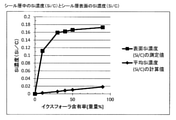
- the abundance ratio (S i / C) of the silicon atom S i and the carbon atom C in the seal layer of the sealant film of the present invention is preferably 0.001 or more. When it is 0.001 or more, the liquid repellency to the contents showing mucous properties such as cooking oil, Japanese-style dressing, Worcestershire sauce is improved. It is more preferably 0.005 or more, further preferably 0.007 or more, and particularly preferably 0.01 or more.
- the abundance ratio (S i / C) of the silicon atom S i and the carbon atom C in the seal layer of the sealant film of the present invention is preferably 0.02 or less. When it is 0.02 or less, the peel strength does not easily decrease. It is more preferably 0.018 or less, and further preferably 0.016 or less.
- the measuring method is the method described in Examples.
- the abundance ratio (S i / C) of the silicon atom S i and the carbon atom C on the surface of the seal layer of the sealant film of the present invention is 0.05 or more.
- the liquid repellency for mucous contents such as edible oil, Japanese-style dressing, Worcestershire sauce is improved, and the effect of improving the liquid repellency for edible oil is particularly large. It is more preferably 0.07 or more, further preferably 0.1 or more, preferably 0.13 or more, and particularly preferably 0.15 or more.
- the abundance ratio (S i / C) of the silicon atom S i and the carbon atom C on the surface of the seal layer of the sealant film of the present invention is preferably 0.3 or less. If it is 0.3 or less, the heat seal strength tends to decrease. It is more preferably 0.2 or less.
- the measuring method is the method described in Examples.
- the abundance ratio of silicon atom S i and carbon atom C on the surface of the seal layer to the abundance ratio (S i / C) of silicon atom S i and carbon atom C contained in the seal layer of the sealant film of the present invention is preferably 2 or more, more preferably 3 or more, further preferably 5 or more, further preferably 6 or more, and more preferably 8 or more. It is particularly preferable, and most preferably 10 or more.
- the measuring method is the method described in Examples.
- the arithmetic mean roughness Ra of the surface of the seal layer of the sealant film of the present invention is 0.05 ⁇ m or more.
- the coefficient of kinetic friction between the layers or between the layers and the film surface on the opposite side of the layer is reduced, and the coefficient of kinetic friction between the surfaces of the seal layers of the film or the surface of the seal layer and the opposite surface thereof is increased. Easy to lower.
- the blocking strength of slipperiness between the surfaces of the seal layer of the film is likely to be reduced. As a result, the handleability of the film is improved.
- the arithmetic mean roughness of the surface of the seal layer is more preferably 0.06 ⁇ m or more, further preferably 0.07 ⁇ m or more.
- the arithmetic mean roughness Ra of the surface of the sealant layer of the sealant film of the present invention is preferably 0.3 ⁇ m or less. When it is 0.3 ⁇ m or less, the coefficient of dynamic friction between the layers or between the layers and the film surface on the opposite side of the layers is not too small, the film is less likely to be unwound, and the handleability of the film is improved. It is more preferably 0.25 ⁇ m or less.
- the measuring method is the method described in Examples.
- the maximum protrusion height Rz on the surface of the sealant layer of the sealant film of the present invention is 1 ⁇ m or more. When it is 1 ⁇ m or more, the contact area between the layers or between the layers and the film surface on the opposite side of the layers is reduced, the blocking prevention effect is greatly improved, and the handleability of the film is improved.
- the maximum protrusion height Rz on the surface of the seal layer is more preferably 1 ⁇ m or more, and further preferably 3 ⁇ m or more. It is preferable that the maximum protrusion height Rz on the surface of the sealant layer of the sealant film of the present invention is 30 ⁇ m or less.
- the volume of the gap between the layers or between the layer and the film surface on the opposite side of the layer is not too large, the film is less likely to be unwound, and the handleability of the film is improved. It is more preferably 25 ⁇ m or less.
- the measuring method is the method described in Examples.
- the lower limit of the Young's modulus (longitudinal direction) of the sealant film of the present invention is preferably 100 MPa, more preferably 150 MPa, still more preferably 200 MPa, and particularly preferably 250 MPa. If it is 100 MPa or more, the waist is not too weak and it is easy to process.
- the upper limit of the Young's modulus (longitudinal direction) of the sealant film of the present invention is preferably 600 MPa, more preferably 500 MPa, and further preferably 400 MPa.
- the lower limit of the Young's modulus (width direction) of the sealant film of the present invention is preferably 100 MPa, more preferably 150 MPa, still more preferably 200 MPa, and particularly preferably 250 MPa. If it is 100 MPa or more, the waist is not too weak and it is easy to process.
- the upper limit of the Young's modulus (width direction) of the sealant film of the present invention is preferably 600 MPa, more preferably 500 MPa, and further preferably 400 MPa.
- the upper limit of the haze of the sealant film of the present invention is preferably 15%, more preferably 14%, and even more preferably 13.5%. If it is 15% or less, the contents can be easily visually recognized.
- the lower limit of the haze of the sealant film of the present invention is preferably 0%, but even 2% is practically satisfactory.
- the measuring method is the method described in Examples.
- the residual amount of sticky contents such as cooking oil, Japanese-style dressing, and Worcester sauce which is an index for evaluating the liquid repellency of the sealant film of the present invention, is 0.08 mg / 28 cm 2 for at least two of them. It is preferably 0.08 mg / 28 cm 2 or less for the two types of cooking oil and Japanese-style dressing, and 0.8 mg / 28 cm 2 or less for the three types of cooking oil, Japanese-style dressing and Worcester sauce. Is more preferable.
- the measuring method is the method described in Examples.
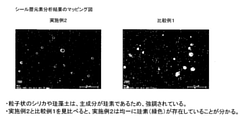
- the sealant film of the present invention preferably has a silylated polyolefin resin segregated on its surface. However, it is preferable that the silylated polyolefin resin is not deposited on the surface of the seal layer in a separated state. At this time, it is preferable that the silylated polyolefin resin is finely dispersed in the seal layer of the sealant film of the present invention and exhibits a microphase-separated structure.
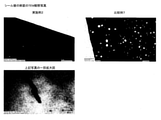
- the presence or absence of the silylated polyolefin resin or silicone resin on the surface of the seal layer can be observed using a scanning electron microscope, and qualitative analysis of Si element and C element can also be performed by energy dispersive X-ray. Further, the cross section of the seal layer can be observed using a transmission electron microscope. The measurement is carried out by the method described in Examples.
- the upper limit of the dynamic friction coefficient between the seal layers of the sealant film of the present invention is preferably 1.5, more preferably 1.0, still more preferably 0.7, and even more preferably 0.5. It is particularly preferably 0.4, and most preferably 0.3. When the coefficient of dynamic friction between the seal layers is 1.5 or less, the opening property after bag making is good and the loss during processing is likely to be reduced.
- the lower limit of the coefficient of dynamic friction between the seal layers of the sealant film of the present invention is preferably 0.05, more preferably 0.08, and even more preferably 0.1. If it is 0.05 or more, heat sealing during bag making is easy to be performed, and loss during processing is likely to be reduced.
- the upper limit of the dynamic friction coefficient between the seal layer of the sealant film of the present invention and the opposite surface of the film is preferably 2.0, more preferably 1.5, still more preferably 1.2, and even more preferably. It is 1.0, particularly preferably 0.7, most preferably 0.5, and particularly preferably 0.4.
- the lower limit of the dynamic friction coefficient between the seal layer of the sealant film of the present invention and the opposite surface of the film is preferably 0.05, more preferably 0.08, and even more preferably 0.1. If it is 0.05 or more, the film does not slip too much during winding and is less likely to be unwound.
- the measuring method is the method described in Examples.
- the upper limit of the coefficient of static friction between the seal layers of the sealant film of the present invention is preferably 1.5, more preferably 1.0, still more preferably 0.7, and even more preferably 0.5. It is particularly preferably 0.4, and most preferably 0.3. When the coefficient of dynamic friction between the seal layers is 1.5 or less, the opening property after bag making is good and the loss during processing is likely to be reduced.
- the lower limit of the coefficient of static friction between the seal layers of the sealant film of the present invention is preferably 0.05, more preferably 0.08, and even more preferably 0.1. If it is 0.05 or more, heat sealing during bag making is easy to be performed, and loss during processing is likely to be reduced.
- the measuring method is the method described in Examples.
- the upper limit of the blocking value of the slipperiness between the surfaces of the sealant film of the present invention is preferably 100 mN / 70 mm, more preferably 90 mN / 70 mm, still more preferably 80 mN / 70 mm, and particularly preferably 80 mN / 70 mm. It is 70 mN / 70 mm, most preferably 60 mN / 20 mm.
- the lower limit of the blocking strength between the surfaces of the sealant film of the present invention is preferably 0 mN / 70 mm, but even 15 mN / 70 mm is practically satisfactory.
- the measuring method is the method described in Examples.
- the 150 ° C. easy peel strength of the sealant film of the present invention is preferably 25 mN / 15 mm or less, preferably 20 mN / 15 mm or less, and even more preferably 15 mN / 10 mm or less.
- the measuring method is the method described in Examples.
- the 190 ° C. easy peel strength of the sealant film of the present invention is preferably 30 mN / 15 mm or less, preferably 25 mN / 15 mm or less, and even more preferably 20 mN / 15 mm or less.
- the measuring method is the method described in Examples.
- the 200 ° C. easy peel strength of the sealant film of the present invention is preferably 35 mN / 15 mm or less, preferably 30 mN / 15 mm or less, and even more preferably 25 mN / 20 mm or less.
- the measuring method is the method described in Examples.
- the peel strength at 150 ° C. of the sealant film of the present invention at a sealing pressure of 0.2 MPa is preferably 0.5 N / 15 mm or more, more preferably 0.7 N / 15 mm or more, and 0.9 N / 15 mm. It is more preferably 1N / 15 mm or more, further preferably 2N / 15 mm or more, further preferably 3N / 15 mm or more, and 4N / 15 mm or more. More preferably, it is particularly preferably 5N / 15 mm or more, and most preferably 6N / 15 mm or more.
- the peel strength at 150 ° C. of the sealant film of the present invention at a sealing pressure of 0.6 MPa is preferably 1N / 15 mm or more, more preferably 2N / 15 mm or more, and more preferably 3N / 15 mm or more. More preferably, it is more preferably 4N / 15 mm or more, particularly preferably 5N / 15 mm or more, and most preferably 6N / 15 mm or more.
- the measuring method is the method described in Examples.
- the peel strength at 190 ° C. of the sealant film of the present invention at a sealing pressure of 0.2 MPa is preferably 1 N / 15 mm or more, more preferably 1.5 N / 15 mm or more, and 1.8 N / 15 mm or more. It is more preferably 2N / 15 mm or more, further preferably 3N / 15 mm or more, further preferably 4N / 15 mm or more, and 5N / 15 mm or more. It is particularly preferable, and most preferably 6N / 15 mm or more.
- the peel strength at 190 ° C. of the sealant film of the present invention at a sealing pressure of 0.6 MPa is preferably 1N / 15 mm or more, more preferably 2N / 15 mm or more, and further preferably 3N / 15 mm or more. It is preferable that it is 4N / 15 mm or more, more preferably 5N / 15 mm or more, and most preferably 6N / 15 mm or more.
- the peel strength at 190 ° C. of the sealant film of the present invention at a sealing pressure of 0.6 MPa is preferably 1N / 15 mm or more, more preferably 2N / 15 mm or more, and further preferably 3N / 15 mm or more. It is preferable that it is 4N / 15 mm or more, more preferably 5N / 15 mm or more, and most preferably 6N / 15 mm or more.
- the measuring method is the method described in Examples.
- the peel strength at 200 ° C. of the sealant film of the present invention at a sealing pressure of 0.2 MPa is preferably 1 N / 15 mm or more, more preferably 1.5 N / 15 mm or more, and 1.8 N / 15 mm or more. It is more preferably 2N / 15 mm or more, further preferably 3N / 15 mm or more, further preferably 4N / 15 mm or more, and 5N / 15 mm or more. It is particularly preferable, and most preferably 6N / 15 mm or more.
- the peel strength at 200 ° C. of the sealant film of the present invention at a sealing pressure of 0.6 MPa is preferably 1N / 15 mm or more, more preferably 2N / 15 mm or more, and further preferably 3N / 15 mm or more. It is preferable that it is 4N / 15 mm or more, more preferably 5N / 15 mm or more, and most preferably 6N / 15 mm or more.
- the peel strength at 200 ° C. of the sealant film of the present invention at a sealing pressure of 0.6 MPa is preferably 1N / 15 mm or more, more preferably 2N / 15 mm or more, and further preferably 3N / 15 mm or more. It is preferable that it is 4N / 15 mm or more, more preferably 5N / 15 mm or more, and most preferably 6N / 15 mm or more.
- the measuring method is the method described in Examples.
- the sealant film of the present invention is further laminated with at least one other base film, and is generally used as a wrapping film or a wrapping sheet.
- the base film is not particularly limited, but is not particularly limited, such as a polyolefin film such as polyethylene and polypropylene, a styrene resin film, a polyester film such as polyethylene terephthalate and polybutylene terephthalate, and nylon 6 and nylons 6 and 6.
- a vapor-deposited film, paper, or the like on which or the like is vapor-deposited is appropriately selected and used according to the purpose of use of the laminated body.
- This base film can be used not only by one type but also by laminating two or more types in combination.
- the base film adjacent to the sealant layer preferably does not contain the silylated polyolefin. Further, the base film adjacent to the sealant layer is preferably a polyolefin film.
- a method of laminating the sealant film on the base film As a method of laminating the sealant film on the base film, a method of dry laminating the base film and the sealant film, an extrusion lamination method of extruding and laminating only the sealant layer resin on the base film, and the like are adopted. can do. Among these, dry lamination is preferable from the viewpoint of productivity.
- the sealant film / adhesive layer / other base film can be configured.
- an anchor coating agent such as a urethane-based or isocyanate-based adhesive
- a modified polyolefin such as an unsaturated carboxylic acid graft polyolefin
- the thickness of the laminated body is not particularly limited, but is preferably 10 to 200 ⁇ m when the laminated body is used as a film such as a lid material, and preferably 200 to 1000 ⁇ m when used as a cup or tray sheet.
- the sealant films of the laminated body face each other, or the sealant film layer of the laminated body and another base film face each other, and then at least one of the surroundings so as to form a desired container shape from the outer surface side.
- a container can be manufactured by heat-sealing the portion. Further, by heat-sealing the entire periphery, a sealed bag-shaped container can be manufactured. Combining this bag-shaped container molding process with the content filling process, that is, by heat-sealing the bottom and sides of the bag-shaped container, filling the contents, and then heat-sealing the top, the package is manufactured. can do. Therefore, this laminate can be used for an automatic packaging device for solids such as snack foods, powders, or liquid materials.
- the contents are filled in a container formed into a cup shape by vacuum molding or pressure molding, a container obtained by injection molding or blow molding, a container formed from a paper base material, or the like, and then the laminate of the present invention is used.
- a container containing the contents can also be obtained by covering it as a lid material and heat-sealing it.
- the following methods are used to determine the density, melt flow rate (MFR) and melting point of the polyolefin resin and silylated polyolefin used to prepare the sealant film, and the weight average particle size and content ratio of the particles made of inorganic oxide or synthetic resin. Measured in. For these values, if the sealant film consists of a single layer, check the boundaries of all layers, and if the sealant film consists of multiple layers, check the boundaries of the seal layer with an electron microscope, then scrape off only the relevant layer, and only the target raw material is insoluble. After filtering the solution dissolved in the solvent of the above, the residue from which the solvent has been removed may be measured in the same manner.
- composition of particles made of inorganic oxide or synthetic resin in the film was calculated from the amount added to the raw material resin composition before processing. Even after the film is formed, the silica particles should be separated and measured by using decane as a solvent, dissolving the film at a temperature at which it completely dissolves, and filtering the residue with a filter with a filtration accuracy of 2 ⁇ m. Is also possible.
- Particles made of inorganic oxide or synthetic resin have a cumulative total of 50% by mass from the smaller particle size in the particle size distribution curve measured using, for example, the Nikkiso Co., Ltd. laser diffraction / scattering type particle size distribution measuring device "MT3200II". It can be calculated as the particle size.
- the ease with which the compound was deposited from the resin composition constituting the seal layer of the obtained sealant film was measured by the following method.
- the resin composition used for the seal layer of Comparative Example 1 was discharged from a large number of nozzles having a diameter of 4 mm provided on the die of the extruder in the width direction at 230 ° C., and one hour after the start of ejection, the molten resin was discharged.
- the degree of accumulation (dirt) of the compound around the nozzle was visually observed, and it was classified into the following ⁇ and ⁇ using it as a reference ( ⁇ ).
- ⁇ The accumulation of the compound around the nozzle cannot be confirmed.
- X The accumulation of the compound around the nozzle can be clearly confirmed.
- the correlation peaks of the above were investigated, and the connection of the structures found by 1-dimensional NMR was identified in more detail.
- the abundance ratio of silicon atoms per carbon atom ( Si / C) (average Si concentration) in the resin composition constituting the seal layer of the sealant film is that of the silylated polyolefin resin contained in the resin composition. It can be derived from the molecular formula and molecular weight, and the content ratio in the resin composition constituting the seal layer.
- the resin composition constituting the seal layer is a polymer composed of only a structural unit derived from ethylene containing a vinyl group at the end of the main chain, a silylated polyolefin resin using dimethylsiloxane as a raw material compound, and a silylated polyolefin resin.
- the calculation method in the case of a mixture of polyethylene resins is given.
- the dimethylsiloxane concentration in the silylated polyolefin is calculated from the molecular formula of the silylated polyolefin resin, and assuming that the resin concentration is 26% by weight, a composition obtained by adding 10 parts by weight of the silylated polyolefin to 90 parts by weight of the polypropylene resin.
- the average polydimethylsiloxane concentration is 2.6% by weight.
- the molecular formula per unit of dimethylsiloxane is C 2 H 6 SI O (unit molecular weight 74.15 ), and the molecular formula of silylated polyolefin resin per unit of polyolefin is C 2 H 4 (unit molecular weight 28.05), polypropylene resin.
- the molecular formula per unit of propylene is C 3 H 6 (unit molecular weight 42.08).
- Arithmetic mean roughness Ra ⁇ m
- Arithmetic mean roughness Ra of any 1 mm x 0.2 mm part of the sealant layer surface of a 3 cm x 3 cm square sealant film is based on JIS B0601-2001, and the contact type surface roughness (manufactured by Kosaka Research Institute, model number). ET4000A) was used. It was measured at three places and the average value was taken as the arithmetic mean roughness Ra.
- Maximum protrusion height Rz ⁇ m
- the maximum mountain height Rz of any 1 mm x 0.2 mm part of the sealant layer surface of the 3 cm x 3 cm square sealant film is based on JIS B0601-2001, and the contact type surface roughness (manufactured by Kosaka Research Institute, model ET4000A). ) was used. The measurement was performed at three points, and the average value was taken as the maximum protrusion height Rz.
- the obtained sealant film was measured for Young's modulus in the longitudinal direction and the width direction of the film according to JIS K7127 at 23 ° C.
- the sample was cut out from a film to a size of 15 mm ⁇ 200 mm, had a chuck width of 100 mm, and was set in a tensile tester (dual column desktop tester Instron 5965 manufactured by Instron Japan Company Limited).
- a tensile test was performed at a tensile speed of 200 mm / min. From the obtained strain-stress curve, Young's modulus was obtained from the slope of the straight line portion at the initial stage of elongation.
- the tensile breaking strength and the tensile breaking elongation were taken as the strength and elongation at the time when the sample broke, respectively.
- the liquid repellency of the obtained sealant film was evaluated as follows.
- a film for sealant is cut into a size of 10 cm in the longitudinal direction and 5 cm in the width direction, and double-sided tape (Nichiban) is applied to the surface of the laminated layer at one end in the longitudinal direction and one end in the width direction adjacent thereto.
- NW-5, 5 mm width is pasted, folded so that the sealing surface is facing up at the center in the width direction, and the double-sided tape and the surface of the other laminated layer are pasted together to form a 10 cm x 2.5 cm cylinder.
- (2) The weight of the tubular strip prepared in (1) was weighed.
- Evaluation liquid Edible oil (trade name; Nissin salad oil, manufactured by Nissin Oilio Group Co., Ltd.), Japanese-style dressing (product name; S-LINE dressing Japanese-style, manufactured by SSK Foods Co., Ltd.) Worcestershire sauce (product name; Deluxe Koi) Kuchi sauce, manufactured by Komi Co., Ltd.).
- Edible oil trade name; Nissin salad oil, manufactured by Nissin Oilio Group Co., Ltd.
- Japanese-style dressing product name; S-LINE dressing Japanese-style, manufactured by SSK Foods Co., Ltd.
- Worcestershire sauce product name; Deluxe Koi) Kuchi sauce, manufactured by Komi Co., Ltd.
- the surface of the seal layer of the obtained sealant film was observed using a scanning electron microscope and irradiated with energy dispersive X-rays, and the surface was subjected to elemental qualitative analysis for mapping.
- the cross section was observed using a transmission electron microscope. The observation method is described in detail below.
- EDX element qualitative analysis A sample of the obtained sealant film (size 1 cm x 1 cm) was cut out, placed on a sample table with carbon tape attached, and platinum-palladium was coated at about 2 nm with a magnetron sputtering device to ensure conductivity and high vacuum. Observed in mode. The measurement was performed by irradiating X-rays with an acceleration voltage of 8 kV using a scanning electron microscope S-3400N manufactured by Hitachi and an energy dispersive X-ray detector XFlash5010 manufactured by Bruker. A qualitative analysis of the elements was carried out from the X-ray spectrum of the entire observation field of the sample of the sealant film, and among the recognized elements, silicon Si was mapped to green.
- the dynamic friction coefficient was measured according to JIS-K-7125 except for the following conditions.
- Environmental conditions Measured after humidity control for 2 hours or more in a 23 ° C. and 50% RH environment.
- the coefficient of static friction was measured for the sealing surfaces of the polyethylene-based resin of the sealant film in accordance with JIS-P-8147 except for the following conditions.
- Environmental conditions Measured after humidity control for 2 hours or more in a 23 ° C. and 50% RH environment.
- Measuring device Friction measuring machine AN manufactured by Toyo Seiki Seisakusho Co., Ltd.
- Measurement conditions Specimen size: 200 mm (longitudinal direction) x 100 mm (width direction)
- Load weight size 100 mm (longitudinal direction) x 60 mm (width direction)
- Weight of load weight 1.0 kg
- Tilt speed 1.5 ° / sec
- Measurement method When one test piece is fixed to the inclined plate, the load weight with the other test piece is gently placed, then the inclined plate is inclined at a constant speed, and the test piece with the weight starts to slide. The tangent (tan ⁇ ) of the angle of was calculated and used as the coefficient of static friction. The test was performed three times, and the average value was calculated.
- the blocking value was measured according to ASTM D1893-67, except that the surfaces of the sealant layers of the sealant film were placed on each other under the following conditions.
- a sample (10 cm in the width direction, 15 cm in the longitudinal direction) in which the measurement surfaces are overlapped is placed in a heat press (manufactured by Tester Sangyo Co., Ltd., model: SA-303) in the length direction (15 cm) at the center of the sample width (10 cm).
- An aluminum plate (thickness 2 mm) having a size of 7 cm ⁇ 7 cm was placed at a position 1 cm inside so as to align with each other, and pressure treatment was performed at a temperature of 50 ° C., a pressure of 440 kgf / cm 2 , and 15 minutes.
- the easy peel strength was defined as the easy peel strength sealed at 190 ° C., the strength of which was 20 mN / 15 mm or less was excellent, 30 mN / 15 mm or less was good, and the strength of more than 30 mN / 15 mm was inferior ⁇ .
- An unstretched CPP sheet having a thickness of 300 ⁇ m and consisting of the sealant surface of the collected laminated film and 100% by weight of a propylene-ethylene random copolymer (manufactured by Sumitomo Chemical Co., Ltd., WF577PG) was laminated to form a seal width of 15 mm and a seal pressure of 0. Heat sealing was performed at 2 MPa, a sealing time of 1.0 second, and sealing temperatures of 150, 190 ° C, and 200 ° C. A test piece was obtained by heat-sealing the laminate so that the width was 15 mm in parallel with the longitudinal direction.
- test pieces were set on an autograph (manufactured by Shimadzu Corporation, model: UA-3122), the sealed surface was peeled off at a speed of 200 mm / min, and the maximum value was measured. Three test pieces were measured at each seal temperature, and the average value was taken as the easy peel strength at each seal temperature.
- These test pieces were set on an autograph (manufactured by Shimadzu Corporation, model: UA-3122), the sealed surface was peeled off at a speed of 200 mm / min, and the maximum value was measured. Three test pieces were measured at each seal temperature, and the average value was taken as the peel strength at each seal temperature.
- Example 1 Polypropylene resin, polyethylene resin, silylated polyolefin, spherical silica, and erucic acid amide were mixed and melted in a twin-screw extruder so as to have the content ratio (% by weight) shown in Table 1 to form a seal layer.
- polypropylene resin and erucic acid amide were mixed and melted in a twin-screw extruder so as to have the content ratio (% by weight) shown in Table 1 to form an intermediate layer.
- the polypropylene resin was melted in a twin-screw extruder to form a laminated layer.
- the resin composition of the molten sealant layer, the resin composition of the intermediate layer and the resin composition of the laminated layer are laminated, and a single multilayer molten sheet is co-extruded with a T-die into a cooling roll. It was grounded and cooled and solidified to obtain an unstretched sheet. After corona discharge treatment was applied to the surface of the laminated layer of the obtained sheet, the film was wound into a roll at a speed of 20 m / min to obtain a sealant film having a thickness of 60 ⁇ m and a wet tension of 45 N / m on the surface of the laminated layer.
- the detailed conditions are as follows.
- Sealant layer extruder diameter 60 mm Intermediate layer extruder diameter: 90mm Laminate layer extruder diameter: 45 mm Mixing and melting temperature of raw materials for sealant layer, intermediate layer, and laminate layer: 250 ° C T-die width: 1600 mm Pick-up speed of multilayer molten sheet: 20 m / min Cooling roll temperature: 40 ° C Thickness of sealant layer in sealant film: thickness of 6 ⁇ m Thickness of intermediate layer in sealant film: 42 ⁇ m Thickness of laminated layer in sealant film: 12 ⁇ m
- the longitudinal direction means the direction in which the unstretched sheet is run, and the width direction means the direction perpendicular to it. The characteristics of the obtained film are shown in Table 2.
- the sealant films obtained in Examples 1 to 13 were excellent in liquid repellency and heat sealability.
- the resin composition used for the seal layer was excellent in easy peeling property, and the precipitation of the compound was small, and the film forming processability was also excellent.
- the reason for this is that the silylated polyolefin used for the seal layer has a dimethylsiloxane component and therefore has a small surface energy, so that it segregates on the surface of the seal layer.
- FIG. 1 shows the values of the average Si concentration and the surface Si concentration of the films described in Comparative Examples 1 and 4 and Examples 2 to 4 and 13, but is described in Comparative Example 7 and Examples 2 to 4.
- the Si concentration on the surface of the seal layer is up to about 46.5 times higher than the average Si concentration of the entire seal layer, and it can be seen that the silylated polyolefin is segregated on the surface.
- FIG. 3 shows analytical images of silicon mapping on the surface of the seal layer of Example 2 and Comparative Example 1.
- silicon green
- Silica which is a particle
- FIG. 4 shows TEM observation images of the seal layer cross sections of Example 2 and Comparative Example 7. Since the silylated polyolefin of Example 2 is a copolymer of dimethylsiloxane and polyethylene, it is difficult to separate dimethylsiloxane from polyethylene, so that although it exhibits a microphase-separated structure, it is only finely dispersed. I understand.
- Comparative Example 7 contains a silicone resin, and its phase separation and precipitation can be considered.
- FIG. 5 is a photograph of the vicinity of a die nozzle in which the seal layer raw materials of Example 2 and Comparative Example 7 are melt-kneaded by a twin-screw extruder. In Example 2, no deposition of the compound was observed, and it is considered that the silylated polyolefin in the seal layer does not precipitate on the surface thereof. On the other hand, in Comparative Example 7, precipitation of the silicone resin is observed, and there is a concern that foreign matter on the film and deterioration of the working environment may occur.
- the sealant film obtained in Comparative Example 1 was inferior in liquid repellency and easy peeling property.
- the sealant film obtained in Comparative Example 2 was excellent in liquid repellency but inferior in easy peeling property.
- the sealant film obtained in Comparative Example 3 was inferior in liquid repellency.
- the sealant film obtained in Comparative Example 4 was excellent in liquid repellency but inferior in easy peeling property.
- the sealant film obtained in Comparative Example 5 was excellent in liquid repellency but inferior in easy peeling property.
- the sealant film obtained in Comparative Example 6 was excellent in liquid repellency but inferior in easy peeling property.
- the sealant film obtained in Comparative Example 7 was excellent in liquid repellency, but the compound was easily deposited from the seal layer, and it was inferior as a sealant film. Since the compound was precipitated from the seal layer, the easy peel strength, peel strength, dynamic friction coefficient, static friction coefficient, and blocking strength were not measured.
- the sealant film of the present invention provides a packaging bag that can be easily taken out even if the content exhibits mucous properties such as a paste or a viscous substance, and has good heat-sealing properties and easy peeling properties. Can be provided, and the contribution to the industry is great.
Landscapes
- Chemical & Material Sciences (AREA)
- Chemical Kinetics & Catalysis (AREA)
- Medicinal Chemistry (AREA)
- Polymers & Plastics (AREA)
- Organic Chemistry (AREA)
- Health & Medical Sciences (AREA)
- Engineering & Computer Science (AREA)
- Manufacturing & Machinery (AREA)
- Materials Engineering (AREA)
- General Chemical & Material Sciences (AREA)
- Mechanical Engineering (AREA)
- Crystallography & Structural Chemistry (AREA)
- Laminated Bodies (AREA)
- Compositions Of Macromolecular Compounds (AREA)
- Wrappers (AREA)
Abstract
Description
加えて、ポリプロピレン樹脂にポリエチレン樹脂を混合してイージーピール性を付与したフィルムも提案されているが、その撥液性は十分ではなかった(例えば、特許文献8等参照。)。
すなわち本発明は、
下記(a)及び(b)を含む樹脂組成物からなるシール層を含むフィルムであって、下記(1)及び(2)を満足するシーラント用フィルム。
(a)ポリプロピレン系樹脂
(b)シリル化ポリオレフィン樹脂
(1)シール温度150℃、シール圧力0.4MPaでのシール強度に対する、シール温度200℃、シール圧力0.4MPaでのシール強度の比が2以下である。
(2)シール温度150℃、シール圧力0.6MPaでのシール強度が40N/15mm以下である。
CH3-(CH2)n-2-CH2-Si(CH3)2O-(-Si(CH3)2-O-
)d-Si(CH3)2-CH2-(CH2)n-2-CH3
(式中、dは1以上の整数である。)
(3)シール層中に含まれる珪素原子Siと炭素原子Cの存在比(Si/C)が0.001以上、0.02以下である。
(4)シール層の表面における珪素原子Siと炭素原子Cの存在比(Si/C)が0.05以上0.2以下である。
(5)前記シール層中に含まれる珪素原子Siと炭素原子Cの存在比(Si/C)に対する、前記シール層の表面における珪素原子Siと炭素原子Cの存在比(Si/C)の比が2以上である。
本発明においてシール層を構成する樹脂組成物は、(a)ポリプロピレン系樹脂、(b)シリル化ポリオレフィン樹脂を含むことが必要である。
本発明において使用するポリプロピレン系樹脂とは、プロピレン単量体の単独重合体、プロピレン単量体とα-オレフィンとのランダム共重合体及び又はブロック共重合体、これらの混合物であり、α-オレフィンとしては、エチレン、ブテン-1、ペンテン-1、ヘキセン-1、3-メチルブテン-1、4-メチルペンテン-1、オクテン-1、デセン-1等が挙げられる。
かかるポリプロピレンランダム共重合体を得る際のα-オレフィンモノマーとしては、エチレン、ブテン-1、ペンテン-1、4-メチルペンテン-1、ヘキセン-1、オクテン-1等を用いることができるが、生産性の面からエチレン、ブテン-1を用いるのが特に好ましい。また、共重合に用いるα-オレフィンは、少なくとも1種以上であれば良く、必要に応じて、2種類以上を混合して用いることができる。
融点は後述する実施例に記載の方法で測定される。ポリプロピレン系樹脂の融点ピーク温度が130℃以上であると包装体の形状がくずれにくく、また高速包装加工におけるフィルムの搬送をよりスムーズにすることができ、得られた製袋品にしわもより入りにくい。加えて、レトルト処理やセミレトルト処理することも出来る。
ポリプロピレン系樹脂のメルトフローレートの上限は好ましくは10.0g/10分であり、より好ましくは8.0g/10分であり、さらに好ましくは7.0g/10分である。10.0g/10分以下であるとポリプロピレンとポリエチレン樹脂が相溶せずに微分散性しやすく、シール層同志のヒートシール後の剥離強度が低下しすぎない。
本発明において使用するシリル化ポリオレフィン樹脂は、分子内にSiH基を2個以上有するケイ素含有化合物と、エチレン、プロピレン、1-ブテン、1-ペンテン及び1-ヘキセンからなる群から選択される少なくとも1種のオレフィンの重合体であって末端にビニル基を含有するビニル基含有化合物との反応によって得られるものである。
式(1)
(CH3)3SiO-(-SiH(CH3)-O-)a-Si(CH3)3
(式(1)中、aは2以上の整数であり、上限は好ましくは1000、さらに好ましくは300、より好ましくは50である。)
式(2)
(CH3)3SiO-(-Si(CH3)2-O-)b-(-SiH(CH3)-O-)
c-Si(CH3)3
(式(2)中、bは1以上の整数であり、cは2以上の整数であり、bとcとの合計の上限は、好ましくは1000、さらに好ましくは300、より好ましくは50である。)
また、式(2)において、-Si(CH3)2-O-単位と-SiH(CH3)-O-単位とが並ぶ順序には特に制限はなく、ブロック的であっても無秩序であっても統計的にランダムであっても良い。
式(3)
HSi(CH3)2O-(-Si(CH3)2-O-)d-Si(CH3)2H
(式(3)中、dは1以上の整数であり、上限は好ましくは1000、さらに好ましくは300、より好ましくは50である。)
HSi(CH3)2O-(-Si(CH3)2-O-)5-Si(CH3)2H
HSi(CH3)2O-(-Si(CH3)2-O-)8-Si(CH3)2H
HSi(CH3)2O-(-Si(CH3)2-O-)18-Si(CH3)2H
HSi(CH3)2O-(-Si(CH3)2-O-)80-Si(CH3)2H
HSi(CH3)2O-(-Si(CH3)2-O-)230-Si(CH3)2H
本発明において使用するビニル基含有化合物は、エチレン、プロピレン、1-ブテン、1-ペンテン及び1-ヘキセンからなる群から選択される少なくとも1種のオレフィンを共重合又は重合して得られるものである。
本発明において使用するシリル化ポリオレフィン樹脂は、特開2014-223752号公報記載の方法に従い、遷移金属触媒の存在下で、前述のビニル基含有化合物とケイ素含有化合物とを反応させることにより得られたシリル化ポリオレフィン樹脂もしくはその誘導体、またはこれらの混合物である。
(CH3)3SiO-(-Si[CH2-(CH2)n-2-CH3](CH3)-O-
)a-Si(CH3)3
(式(4)中、aは2以上の整数であり、上限は好ましくは1000、さらに好ましくは300、より好ましくは50である。)
(CH3)3SiO-(-Si(CH3)2-O-)b-(-Si[CH2-(CH2)
n-2-CH3](CH3)-O-)c-Si(CH3)3
(式(5)中、bは1以上の整数であり、cは2以上の整数であり、bとcとの合計の上限は、好ましくは1000、さらに好ましくは300、より好ましくは50である。)
CH3-(CH2)n-2-CH2-Si(CH3)2O-(-Si(CH3)2-O
-)d-Si(CH3)2-CH2-(CH2)n-2-CH3
(式(6)中、dは1以上の整数であり、上限は好ましくは1000、さらに好ましくは300、より好ましくは50、特に好ましくは25である。)
式(4)~(6)中、nは100以上の整数が好ましく、150以上がさらに好ましい。
i)密度が900~1000kg/m3の範囲である。
ii)融点が100~140℃の範囲である。
iii)数平均分子量が1,000~20,000の範囲である。
iv)シリコーンの共重合率が1~50重量%の範囲である。
シリル化ポリオレフィン樹脂の化学式と分子量の同定方法は実施例に記載の方法で行う。
シール層を構成する樹脂組成物は、ポリエチレン系樹脂を含有することが好ましい。ポ
リエチレン系樹脂とはエチレン単量体とα-オレフィンとの共重合体である。
α-オレフィンとしては、プロピレン、ブテン-1、ヘキセン-1、4-メチルペンテン-1、オクテン-1、デセン-1、3-メチルブテン-1等が挙げられる。
ここでいうエチレン単量体とα-オレフィンとの共重合体は一般に、高圧法低密度ポリエチレン、直鎖状低密度ポリエチレン、ポリエチレン系エラストマーと呼ばれる事もある。エラストマーは常温付近でゴム状弾性を示すオレフィン系熱可塑性共重合体を意味する。高圧法低密度ポリエチレン(LDPE)、直鎖状低密度ポリエチレン(LLDPE)、ポリエチレン系エラストマーの融点はそれぞれ50~140℃の範囲であることが好ましい。
ポリエチレン系樹脂のメルトフローレートの上限は好ましくは5.0g/10分であり、より好ましくは4.0g/10分であり、さらに好ましくは3.5g/10分であり、特に好ましくは3.0g/10分以下である。5.0g/10分以下であるとポリプロピレンとポリエチレン樹脂との微分散性が得られやすく、シール層同志のヒートシール後の剥離強度を低下させやすい。
本発明のシーラント用フィルムに含まれるシール層を構成する樹脂組成物は(a)ポリプロピレン系樹脂、(b)シリル化ポリオレフィン樹脂を含む。
このとき、さらに(c)ポリエチレン系樹脂を含むことが好ましい。
ポリエチレン系樹脂がLDPE、LLDPEの場合、シール層を構成する樹脂組成物中における(a)、(b)、(c)の含有量がそれぞれ、樹脂組成物全体に対して、30~70重量%、3~30重量%、10~40重量%であるのが好ましい。
(a)前記樹脂組成物中におけるポリプロピレン系樹脂の含有量はより好ましくは35重量%以上、さらに好ましくは40重量%以上、特に好ましくは55重量%以上である。(a)ポリプロピレン系樹脂が30重量%以上含むときは、腰感が維持される。
前記樹脂組成物中におけるポリプロピレン系樹脂の含有量は、より好ましくは65重量%以下、さらに好ましくは60重量%以下である。(a)ポリプロピレン系樹脂が70重量%以下含むときは、イージーピール性が認められる。
(b)前記樹脂組成物中におけるシリル化ポリオレフィン樹脂の含有量はより好ましくは5重量%以上、さらに好ましくは7重量%以上、特に好ましく12重量%以上である。シリル化ポリオレフィン樹脂が3重量%以上含むときは、撥液性が充分に得られ、特に食用油に対する撥液性が優れる。
前記樹脂組成物中における(b)シリル化ポリオレフィン樹脂の含有量は、より好ましくは28重量%以下、さらに好ましくは25重量%以下、よりさらに好ましくは20重量%以下、よりさらに好ましくは15重量%以下である。(b)シリル化ポリオレフィン樹脂の含有量が30重量%より大きくても撥液体性の効果がそれ以上向上することは少ない。(b)シリル化ポリオレフィン樹脂の含有量が少ない方がシール層表面への偏析もより少なくなる。(c)前記樹脂組成物中におけるポリエチレン系樹脂の含有量はより好ましくは12重量%以上、さらに好ましくは15重量%以上、特に好ましくは20重量%以上である。ポリエチレン系樹脂が10重量%以上含むときは、シール層同志のヒートシール後の剥離強度を低下させやすい。
前記樹脂組成物中における(c)ポリエチレン系樹脂の含有量は、より好ましくは35重量%以下、さらに好ましくは30重量%以下、よりさらに好ましくは20重量%以下でる。(c)ポリエチレン系樹脂の含有量が40重量%より大きくても耐熱性が低下しにくい。
a)ポリプロピレン系樹脂、(b)シリル化ポリオレフィン、(c)ポリエチレン系樹脂、の含有量は実施例に記載の方法で行う。
(a)前記樹脂組成物中におけるポリプロピレン系樹脂の含有量はより好ましくは35重量%以上、さらに好ましくは40重量%以上、特に好ましくは55重量%以上である。(a)ポリプロピレン系樹脂が30重量%以上含むときは、腰感が維持される。
前記樹脂組成物中におけるポリプロピレン系樹脂の含有量は、より好ましくは80重量%以下、さらに好ましくは75重量%以下である。(a)ポリプロピレン系樹脂が85重量%以下含むときは、イージーピール性が維持される。
(b)前記樹脂組成物中におけるシリル化ポリオレフィン樹脂の含有量はより好ましくは5重量%以上、さらに好ましくは7重量%以上、特に好ましく12重量%以上である。シリル化ポリオレフィン樹脂が3重量%以上含むときは、撥液性が充分に得られ、特に食用油に対する撥液性が優れる。
前記樹脂組成物中における(b)シリル化ポリオレフィン樹脂の含有量は、より好ましくは25重量%以下、さらに好ましくは20重量%以下、よりさらに好ましくは15重量%以下である。(b)シリル化ポリオレフィン樹脂の含有量が30重量%より大きくても撥液体性の効果がそれ以上向上することは少ない。(b)シリル化ポリオレフィン樹脂の含有量が少ない方がシール層表面への偏析もより少なくなる。
(c)前記樹脂組成物中におけるポリエチレン系樹脂の含有量は、より好ましくは12重量%以上、さらに好ましくは15重量%以上、特に好ましく20重量%以上である。ポリエチレン系樹脂が10重量%以上含むときは、シール層同志のヒートシール後の剥離強度を低下させやすい。
前記樹脂組成物中における(c)ポリエチレン系樹脂の含有量は、より好ましくは35重量%以下、さらに好ましくは30重量%以下、よりさらに好ましくは20重量%以下である。(c)ポリエチレン系樹脂の含有量が40重量%以下では耐熱性が低下しにくい。
a)ポリプロピレン系樹脂、(b)シリル化ポリオレフィン、(c)ポリエチレン系樹脂の含有量の測定は実施例に記載の方法で行う。
シール層を構成する樹脂組成物には、粒子を含有することが好ましく、粒子としては無機酸化物又は合成樹脂からなる粒子が好ましい。粒子を含有することにより、シール層の表面の算術平均粗さRaを0.03μm以上、0.3μm以下としやすい。その結果フィルムのシール層の表面同士又はシール層とその反対面の表面の動摩擦係数、及びフィルムのシール層の表面同士滑性のブロッキング強度を著しく低下させやすい。
その理由として、(b)シリル化ポリオレフィン樹脂がシール層の表面に偏在し、結晶化度と硬度が低下したフィルム表面に特定の凹凸を付与することにより、その低下の影響を小さくし、動摩擦係数及びブロッキング強度を小さくする効果が大きいことが考えられる。
無機酸化物又は合成樹脂からなる粒子の重量平均粒子径は2μm以上が好ましく、3μm以上がより好ましく、5μm以上がさらに好ましい。また重量平均粒径は20μm以下が好ましく、15μm以下がより好ましく、10μm以下がさらに好ましい。
重量平均粒径の測定方法は、実施例に記載の方法で行う。
合成樹脂からなる粒子としては架橋アクリル粒子、ポリメタクリル酸粒子、シリコーン樹脂粒子、ポリエチレン粒子が挙げられる。
無機酸化物からなる粒子としては、酸化ケイ素からなる粒子、炭酸カルシウムからなる粒子、ゼオライト、珪藻土からなる粒子が挙げられる。酸化ケイ素からの中でもシリカ粒子や合成シリカ粒子を使用するのが好ましいが、珪藻土やゼオライトを併用しても良い。
前記樹脂組成物中における無機酸化物又は合成樹脂からなる粒子の含有量は0.1重量%以上が好ましく、0.3重量%以上がより好ましく、0.4重量%以上がさらに好ましい。また、3.0重量%以下が好ましく、2.5重量%以下がより好ましく、2.0重量%以下がさらに好ましい。無機酸化物又は合成樹脂からなる粒子の含有量が3.0重量%以下では表面の突起が大きくなりすぎず、撥液性も低下しにくい。
シール層を構成する樹脂組成物には、有機系潤滑剤を含有することが好ましく、有機系潤滑剤としては脂肪酸アミドが好ましい。有機系潤滑剤を含有することにより、シール層の表面の算術平均粗さRaを0.03μm以上、0.3μm以下とすることとの相乗効果により、シール層の耐ブロッキング性と、滑り性が向上しやすい。
脂肪酸アミドとしてオレイン酸アミド、エルカ酸アミド、ベヘニン酸アミド、エチレンビスオレイン酸アミド、ヘキサメチレンビスオレイン酸アミドなどが挙げられる。これらは単独で用いても構わないが、2種類以上を併用することで過酷な環境下においても滑性やブロッキング防止効果を維持することができるので好ましい。
一方、脂肪酸エステルは、乳化剤として広く知られ、防曇剤としてフィルム表面に親水性を付与する効果も知られるが、本発明においては、撥水性を低下させるだけでなく、撥油性も損なうため、好ましくない。また、脂肪酸エステルは融点が低いものが多く、ブリードアウトによるベタツキや外観不良も懸念される。これらの点を考慮すると、脂肪酸アミドが好ましい。有機系滑剤は25℃以上の融点を持つものを添加することが好ましい。
前記樹脂組成物中における(d)脂肪酸アミド及び脂肪酸エステルの含有量は0.01~0.5重量%含むのが好ましく、0.05~0.4重量%含むのがより好ましく、0.1~0.3重量%含むのが特に好ましい。脂肪酸アミドが0.5重量%以下ではとシール強度が低下しにくい。
本発明のシーラント用フィルムとしての性能を損なわない範囲で、樹脂組成物中に必要に応じて酸化防止剤、耐熱安定剤、耐候安定剤、結晶核剤等の添加物、エチレン・酢酸ビニル共重合体、エチレン・アクリル酸エステル共重合体等を含有しても良い。
本発明のシーラント用フィルムの製造方法としては、例えば、ポリエチレン系樹脂を含むポリプロピレン系樹脂組成物を溶融混練する工程、溶融混練した樹脂組成物を溶融押出しして溶融樹脂組成物シートとする工程、溶融樹脂組成物シートを冷却固化する工程を採用するのが好ましい。
本発明のシーラント用フィルムは、単層でも良いが、積層がより好ましい。積層の場合は、ポリエチレン系樹脂とシリル化ポリオレフィンを含有し、少なくとも片側の表面層の算術平均粗さを0.07μm以上、0.5μm以下である層に熱可塑性樹脂組成物、好ましくはポリオレフィン系樹脂組成物からなる他の層を設けることができる。
単層の場合のフィルムの厚みとしては3μm以上であることが好ましく、10μm以上がより好ましく、15μm以上がさらに好ましく、20μm以上が特に好ましい。また、200μm以下が好ましく、150μm以下がより好ましく、100μm以下が特に好ましい。3μm未満ではシリカ粒子の効果が低下し、滑り性及び耐ブロッキング性の効果が出にくい。
以下に詳細に説明する。長手方向とは、未延伸シートを走行させる方向を、幅方向とはそれと直角方向を意味する。
シリル化ポリオレフィン樹脂とポリエチレン系樹脂、或いはシリカ粒子などの粒子とポリプロピレン系樹脂を混合する場合、これらが均一に混合される方法であれば良く、マスターバッチを使用する場合であれば、リボンブレンダー、ヘンシェルミキサー、タンブラーミキサー等を用いて混合する方法等が挙げられる。
まず、フィルム原料として、ポリプロピレン系樹脂などの水分率が1000ppm未満となるように、乾燥あるいは熱風乾燥する。次いで、各原料を計量、混合して押し出し機に供給し、溶融混練する。
ポリエチレン系樹脂組成物の溶融混合温度の下限は好ましくは200℃であり、より好ましくは210℃であり、さらに好ましくは220℃である。上記未満であると吐出が不安定となることがある。樹脂溶融温度の上限は好ましくは260℃である。上記を越えると樹脂の分解が進行し、再結合した結果として生成した架橋有機物、いわゆるゲルなどの異物の量が多くなってしまう。
ポリエチレン系樹脂組成物に上述の酸化防止剤を含有する場合は、より高温での溶融押し出しが可能になるが、270℃以下にするのが好ましい。
溶融混練工程では、溶融したポリエチレン系樹脂組成物中に含まれる異物を除去するために高精度濾過を行うことができる。溶融樹脂の高精度濾過に用いられる濾材は、特に限定はされないが、ステンレス焼結体の濾材の場合、いわゆるゲルなどの異物に加え、触媒などの添加物に由来するAl、Si、Ti、Sb、Cu、Geを主成分とする凝集物の除去性能に優れ好適である。また、その濾過精度は200μm以下であることが好ましい。
ポリエチレン系樹脂組成物を溶融混練中の昇圧量は小さい方が好ましい。
次に、溶融したポリプロピレン系樹脂組成物シートを例えばT型ダイスから溶融押出しし、冷却ロール上にキャスティングし、冷却固化して未延伸シートを得る。このための具体的な方法としては、冷却ロール上へキャストすることが好ましい。
本発明で使用するシリル化ポリオレフィンは、ポリエチレンとの共重合体である為、溶融混練、押出工程を経てもブリードアウトは認められず、シリコーン樹脂を添加した場合にみられる異物や目ヤニの堆積が極めて発生し難い。
溶融混練したポリプロピレン系樹脂組成物シートを溶融押出しした物をTダイ法やインフレーション法でフィルムにする方法等が挙げられるが、樹脂の溶融温度を高くすることができる点でTダイ法が特に望ましい。
シリル化ポリオレフィンとシリカ粒子とポリプロピレン系樹脂をT型ダイスから溶融押出しする際、T型ダイスのリップ口の汚れは少ない方が好ましい。リップ汚れの測定方法は実施例記載の方法で行った。
例えば、T型ダイスから溶融押出ししたポリエチレン系樹脂組成物の溶融シートを、冷却ロール上にキャスティングし、冷却を行うのが好ましい。冷却ロール温度の下限は、好ましくは10℃である。上記未満であると結晶化抑制の効果が飽和することがあるだけでなく、結露などの問題が発生し好ましくない。冷却ロール温度の上限は、好ましくは70℃以下である。上記を越えると結晶化が進み透明性が悪くなる為好ましくない。また冷却ロールの温度を上記の範囲とする場合、結露防止のため冷却ロール付近の環境の湿度を下げておくことが好ましい、
キャスティングでは、表面に高温の樹脂が接触するため、冷却ロール表面の温度が上昇する。通常、冷却ロールは内部に配管を通して冷却水を流して冷却するが、充分な冷却水量を確保し、配管の配置も工夫するとともに、配管にスラッジが付着しないようメンテナンスを行う、などして、冷却ロール表面の幅方向の温度差を少なくする必要がある。このとき、未延伸シートの厚みは3~200μmの範囲が好適である。
本発明のシーラント用フィルムは多層構成が好ましい。多層の場合は、ポリオレフィン系樹脂とシリル化ポリオレフィンを含有し、表面層の算術平均粗さを0.07μm以上、0.5μm以下である層を少なくとも片側に有するのに加えて、熱可塑性樹脂組成物、好ましくはポリオレフィン系樹脂組成物からなる他の層を1層あるいは2層以上設けることができる。
多層とし表面層のみにシリル化ポリオレフィン樹脂を含むことで、使用するシリル化ポリオレフィン樹脂の使用量を減らすことができ、またその析出もより少なくすることができる。さらにフィルムの他の特性を向上させたり、新たな機能を付与することもできる。
このように多層化する具体的な方法として、一般的な多層化装置(多層フィードブロック、スタティックミキサー、多層マルチマニホールドなど)を用いることができる。
例えば、二台以上の押出機を用いて異なる流路から送り出された熱可塑性樹脂をフィードブロックやスタティックミキサー、マルチマニホールドダイ等を用いて多層に積層する方法等を使用することができる。また、一台の押出機のみを用いて、押出機からT型ダイまでのメルトラインに上述の多層化装置を導入することも可能である。
中間層(B層)、ラミネート層(C層)において使用するポリエチレン系樹脂とは、エチレン単量体の単独重合体、エチレン単量体とα-オレフィンとの共重合体、エチレン単量体と他のモノマーとの共重合体及びこれらの混合物のいずれかである。
α-オレフィンとしては、プロピレン、ブテン-1、ヘキセン-1、4-メチルペンテン-1、オクテン-1、デセン-1、3-メチルブテン-1等が挙げられる。
他のモノマーとしては、酢酸ビニル、(メタ)アクリル酸、(メタ)アクリル酸エステル等のモノマー等が挙げられる。
ポリエチレン系樹脂は、結晶性、あるいは、低結晶性ないし非結晶性のランダムもしくはブロック共重合体、あるいはこれらの混合物のいずれか用いることができる。
エチレン単量体とα-オレフィンとの共重合体は一般に、高圧法低密度ポリエチレン、直鎖状低密度ポリエチレン、中密度ポリエチレン及び高密度ポリエチレンと呼ばれる事もある。
これらのポリエチレン系樹脂を使用すると優れたヒートシール強度、ホットタック性、夾雑物シール性、耐衝撃性を有するが、エチレン単量体と他のモノマーとの共重合体は少量あるいは含まない方が良い。
このとき、中間層(B層)、ラミネート層(C層)に使用するポリエチレン系樹脂は同じでも良いし、異なっていてもよい。
このとき、中間層(B層)の密度の下限は好ましくは880kg/m3であり、より好ましくは890kg/m3であり、さらに好ましくは900kg/m3である。
上記未満であると腰が弱く、加工しにくいことがある。
中間層(B層)の密度の上限は好ましくは940kg/m3であり、より好ましくは930kg/m3であり、さらに好ましくは920kg/m3である。
中間層(B層)、ラミネート層(C層)において使用するポリプロピレン系樹脂とは、プロピレン単量体の単独重合体、プロピレン単量体とα-オレフィンとのランダム共重合体及び又はブロック共重合体、これらの混合物であり、α-オレフィンとしては、エチレン、ブテン-1、ペンテン-1、ヘキセン-1、3-メチルブテン-1、4-メチルペンテン-1、オクテン-1、デセン-1等が挙げられる。
中間層のエルカ酸アミド濃度の上限は好ましくは2000ppmであり、より好ましくは1500ppmである。上記を越えると滑りすぎて巻きズレの原因となることがある。
本発明においては、以上に例示したポリエチレン系のシーラント用フィルムのラミネート層(C層)面にコロナ処理等の活性線処理を行うのが好ましい。該対応によりラミネート強度が向上する。
本発明のシーラント用フィルムの特性を詳細に説明する。
(シール層中における珪素原子Siと炭素原子Cの存在比(Si/C)(平均Si濃度))
本発明のシーラント用フィルムのシール層中における珪素原子Siと炭素原子Cの存在比(Si/C)が0.001以上であることが好ましい。0.001以上であると食用油、和風ドレッシング、ウスターソースなどの粘液性を示す内容物に対する撥液性が改善される。0.005以上であることがより好ましく、0.007以上がさらに好ましく、0.01以上が特に好ましい。
本発明のシーラント用フィルムのシール層中における珪素原子Siと炭素原子Cの存在比(Si/C)が0.02以下であることが好ましい。0.02以下であると剥離強度が低下しにくい。0.018以下であることがより好ましく、0.016以下であることがさらに好ましい。
測定方法は実施例に記載の方法で行う。
本発明のシーラント用フィルムのシール層の表面における珪素原子Siと炭素原子Cの存在比(Si/C)が0.05以上であることが好ましい。0.05以上であると食用油、和風ドレッシング、ウスターソースなどの粘液性を示す内容物に対する撥液性が改善され、特に食用油に対する撥液性が改善の効果が非常に大きい。0.07以上であることがより好ましく、0.1以上がさらに好ましく、0.13以上が好ましく、0.15以上が特に好ましい。
本発明のシーラント用フィルムのシール層の表面における珪素原子Siと炭素原子Cの存在比(Si/C)が0.3以下であることが好ましい。0.3以下であるとヒートシール強度が低下しやすい。0.2以下であることがより好ましい。
測定方法は実施例に記載の方法で行う。
本発明のシーラント用フィルムのシール層中に含まれる珪素原子Siと炭素原子Cの存在比(Si/C)に対する、前記シール層の表面における珪素原子Siと炭素原子Cの存在比(Si/C)の比が2以上であることが好ましく、3以上であることがより好ましく、5以上であることがさらに好ましく、6以上であることがよりさらに好ましく、8以上であることが特に好ましく、10以上であることが最も好ましい。
測定方法は実施例に記載の方法で行う。
(算術平均粗さRa)
本発明のシーラント用フィルムの前記シール層の表面の算術平均粗さRaが0.05μm以上であることが好ましい。0.05μm以上であると前記層同士あるいは前記層とその層の反対側のフィルム面との動摩擦係数を小さくし、フィルムのシール層の表面同士又はシール層とその反対面の表面の動摩擦係数を低下させやすい。またフィルムのシール層の表面同士滑性のブロッキング強度も低下させやすい。その結果フィルムの取り扱い性がよくなる。シール層の表面の算術平均粗さは0.06μm以上であることがより好ましく、0.07μm以上であることがさらに好ましい。
本発明のシーラント用フィルムの前記シール層の表面の算術平均粗さRaが0.3μm以下であることが好ましい。0.3μm以下であると前記層同士あるいは前記層とその層の反対側のフィルム面との動摩擦係数を小さすぎず、フィルムが巻きずれしにくくなり、フィルムの取り扱い性がよくなる。0.25μm以下であることがより好ましい。
測定方法は実施例に記載の方法で行う。
本発明のシーラント用フィルムの前記シール層の表面の最大突起高さRzが1μm以上であることが好ましい。1μm以上であると前記層同士あるいは前記層とその層の反対側のフィルム面との接触面積を小さくし、ブロッキング防止効果が大きく向上し、フィルムの取り扱い性がよくなる。シール層の表面の最大突起高さRzは1μm以上であることがより好ましく、3μm以上であることがさらに好ましい。
本発明のシーラント用フィルムの前記シール層の表面の最大突起高さRzが30μm以下であることが好ましい。30μm以下であると前記層同士あるいは前記層とその層の反対側のフィルム面との隙間の体積が大きすぎず、フィルムが巻きずれしにくくなり、フィルムの取り扱い性がよくなる。25μm以下であることがより好ましい。
測定方法は実施例に記載の方法で行う。
本発明のシーラント用フィルムのヤング率(長手方向)の下限は好ましくは100MPaであり、より好ましくは150MPaであり、さらに好ましくは200MPaであり、特に好ましくは250MPaである。100MPa以上であると腰が弱すぎず加工しやすい。
本発明のシーラント用フィルムのヤング率(長手方向)の上限は好ましくは600MPaであり、より好ましくは500MPaであり、さらに好ましくは400MPaである。
本発明のシーラント用フィルムのヤング率(幅方向)の下限は好ましくは100MPaであり、より好ましくは150MPaであり、さらに好ましくは200MPaであり、特に好ましくは250MPaである。100MPa以上であると腰が弱すぎず加工しやすい。
本発明のシーラント用フィルムのヤング率(幅方向)の上限は好ましくは600MPaであり、より好ましくは500MPaであり、さらに好ましくは400MPaである。
本発明のシーラント用フィルムのヘイズの上限は好ましくは15%であり、より好ましくは14%であり、さらに好ましくは13.5%である。15%以下であると内容物の視認がしやすい。
本発明のシーラント用フィルムのヘイズの下限は好ましくは0%であるが、2%であっても実用的には満足できる。
測定方法は実施例に記載の方法で行う。
本発明のシーラント用フィルムの撥液性の評価の指標である、食用油、和風ドレッシング、ウスターソースなどの粘液性を示す内容物の付着残存量はこれらのうち少なくとも2種について0.08mg/28cm2以下であることが好ましく、食用油、和風ドレッシングの2種について0.08mg/28cm2以下であることがより好ましく、食用油、和風ドレッシング、ウスターソースの3種について0.8mg/28cm2以下であることがより好ましい。
測定方法は実施例に記載の方法で行う。
本発明のシーラント用フィルムのシール層は、シリル化ポリオレフィン樹脂が表面に偏析していることが好ましい。しかし、シール層の表面にシリル化ポリオレフィン樹脂が分離した状態で堆積していないことが好ましい。
またこのとき、本発明のシーラント用フィルムのシール層中では、シリル化ポリオレフィン樹脂が微分散しており、ミクロ相分離構造を呈するのが好ましい。
シール層その表面におけるシリル化ポリオレフィン樹脂またはシリコーン樹脂の存在状態は、走査電子顕微鏡を用いて観察することができ、エネルギー分散型X線によりSi元素とC元素の定性分析も行うことができる。
また、シール層の断面は透過電子顕微鏡を用いて観察できる。
測定は実施例に記載の方法で行う。
本発明のシーラント用フィルムのシール層同士の動摩擦係数の上限は、好ましくは1.5であり、より好ましくは1.0であり、さらに好ましくは0.7であり、よりさらに好ましくは0.5であり、特に好ましくは0.4であり、最も好ましくは0.3である。シール層同士の動摩擦係数が1.5以下であると製袋後の口開き性が良く、加工時のロスが減少しやすい。
本発明のシーラント用フィルムのシール層同士の動摩擦係数の下限は、好ましくは0.05であり、より好ましくは0.08であり、より好ましくは0.1である。0.05以上であると製袋時のヒートシールが行いやすく、加工時のロスが減少しやすい。
本発明のシーラント用フィルムのシール層とフィルムの反対面の動摩擦係数の上限は好ましくは2.0であり、より好ましくは1.5であり、さらに好ましくは1.2であり、よりさらに好ましくは1.0であり、特に好ましくは0.7であり、最も好ましくは0.5であり、特に好ましくは0.4である。シール層とフィルムの反対面の動摩擦係数が2.0以下であると巻取りの際にフィルムにしわが生じにくく、加工時のロスが減少しやすい。
本発明のシーラント用フィルムのシール層とフィルムの反対面の動摩擦係数の下限は、好ましくは0.05であり、より好ましくは0.08であり、より好ましくは0.1である。0.05以上であると巻取りの際にフィルムが滑りすぎず、巻きずれしにくい。
測定方法は実施例に記載の方法で行う。
本発明のシーラント用フィルムのシール層同士の静摩擦係数の上限は、好ましくは1.5であり、より好ましくは1.0であり、さらに好ましくは0.7であり、よりさらに好ましくは0.5であり、特に好ましくは0.4であり、最も好ましくは0.3である。シール層同士の動摩擦係数が1.5以下であると製袋後の口開き性が良く、加工時のロスが減少しやすい。
本発明のシーラント用フィルムのシール層同士の静摩擦係数の下限は、好ましくは0.05であり、より好ましくは0.08であり、より好ましくは0.1である。0.05以上であると製袋時のヒートシールが行いやすく、加工時のロスが減少しやすい。
測定方法は実施例に記載の方法で行う。
本発明のシーラント用フィルムのシール層の表面同士滑性のブロッキング値の上限は、好ましくは100mN/70mmであり、より好ましくは90mN/70mmであり、さらに好ましくは80mN/70mmであり、特に好ましくは70mN/70mmであり、最も好ましくは60mN/20mmである。シール層の表面同士滑性のブロッキング強度が100mN/70mm以下であると、フィルムロールから加工のために巻き出しがスムーズに行える。
本発明のシーラント用フィルムのシール層の表面同士滑性のブロッキング強度の下限は、好ましくは0mN/70mmであるが、15mN/70mmであっても実用的には満足できる。
測定方法は実施例に記載の方法で行う。
本発明のシーラント用フィルムの150℃イージーピール強度は、25mN/15mm以下であることが好ましく、20mN/15mm以下であることが好ましく、15mN/10mm以下であることがさらに好ましい。
測定方法は実施例に記載の方法で行う。
本発明のシーラント用フィルムの190℃イージーピール強度は、30mN/15mm以下であることが好ましく、25mN/15mm以下であることが好ましく、20mN/15mm以下であることがさらに好ましい。
測定方法は実施例に記載の方法で行う。
本発明のシーラント用フィルムの200℃イージーピール強度は、35mN/15mm以下であることが好ましく、30mN/15mm以下であることが好ましく、25mN/20mm以下であることがさらに好ましい。
測定方法は実施例に記載の方法で行う。
本発明のシーラント用フィルムのシール圧力0.2MPaでの150℃剥離強度は、0.5N/15mm以上であることが好ましく、0.7N/15mm以上であることがより好ましく、0.9N/15mm以上であることがさらに好ましく、1N/15mm以上であることがよりさらに好ましく、2N/15mm以上であることがよりさらに好ましく、3N/15mm以上であることがよりさらに好ましく、4N/15mm以上であることがよりさらに好ましく、5N/15mm以上であることが特に好ましく、6N/15mm以上であることが最も好ましい。
本発明のシーラント用フィルムのシール圧力0.4MPaでの150℃剥離強度は、1N/15mm以上であることが好ましく、2N/15mm以上であることがより好ましく、3N/15mm以上であることがさらに好ましく、4N/15mm以上であることがよりさらに好ましく、5N/15mm以上であることが特に好ましく、6N/15mm以上であることが最も好ましい。
本発明のシーラント用フィルムのシール圧力0.6MPaでの150℃剥離強度は、1N/15mm以上であることが好ましく、2N/15mm以上であることがより好ましく、3N/15mm以上であることがよりさらに好ましく、4N/15mm以上であることがよりさらに好ましく、5N/15mm以上であることが特に好ましく、6N/15mm以上であることが最も好ましい。
測定方法は実施例に記載の方法で行う。
本発明のシーラント用フィルムのシール圧力0.2MPaでの190℃剥離強度は、1N/15mm以上であることが好ましく、1.5N/15mm以上であることがより好ましく、1.8N/15mm以上であることがさらに好ましく、2N/15mm以上であることがよりさらに好ましく、3N/15mm以上であることがよりさらに好ましく、4N/15mm以上であることがよりさらに好ましく、5N/15mm以上であることが特に好ましく、6N/15mm以上であることが最も好ましい。
本発明のシーラント用フィルムのシール圧力0.4MPaでの190℃剥離強度は、1N/15mm以上であることが好ましく、2N/15mm以上であることがより好ましく、3N/15mm以上であることがさらに好ましく、4N/15mm以上であることがよりさらに好ましく、5N/15mm以上であることが特に好ましく、6N/15mm以上であることが最も好ましい。
本発明のシーラント用フィルムのシール圧力0.6MPaでの190℃剥離強度は、1N/15mm以上であることが好ましく、2N/15mm以上であることがより好ましく、3N/15mm以上であることがさらに好ましく、4N/15mm以上であることがよりさらに好ましく、5N/15mm以上であることが特に好ましく、6N/15mm以上であることが最も好ましい。
測定方法は実施例に記載の方法で行う。
本発明のシーラント用フィルムのシール圧力0.2MPaでの200℃剥離強度は、1N/15mm以上であることが好ましく、1.5N/15mm以上であることがより好ましく、1.8N/15mm以上であることがさらに好ましく、2N/15mm以上であることがよりさらに好ましく、3N/15mm以上であることがよりさらに好ましく、4N/15mm以上であることがよりさらに好ましく、5N/15mm以上であることが特に好ましく、6N/15mm以上であることが最も好ましい。
本発明のシーラント用フィルムのシール圧力0.4MPaでの200℃剥離強度は、1N/15mm以上であることが好ましく、2N/15mm以上であることがより好ましく、3N/15mm以上であることがさらに好ましく、4N/15mm以上であることがよりさらに好ましく、5N/15mm以上であることが特に好ましく、6N/15mm以上であることが最も好ましい。
本発明のシーラント用フィルムのシール圧力0.6MPaでの200℃剥離強度は、1N/15mm以上であることが好ましく、2N/15mm以上であることがより好ましく、3N/15mm以上であることがさらに好ましく、4N/15mm以上であることがよりさらに好ましく、5N/15mm以上であることが特に好ましく、6N/15mm以上であることが最も好ましい。
測定方法は実施例に記載の方法で行う。
本発明のシーラント用フィルムにさらに少なくとも1種の他の基材フィルムを積層した積層体の構成で、一般に包装フィルムまたは包装シートとして使用される。
基材フィルムとしては、特に限定されるものではないが、ポリエチレンやポリプロピレン等のポリオレフィンフィルム、スチレン系樹脂のフィルム、ポリエチレンテレフタレートやポリブチレンテレフタレート等のポリエステルのフィルム、ナイロン6やナイロン6,6のようなポリアミドのフィルム、またはこれらの延伸フィルム、ポリオレフィンフィルムとポリアミドフィルムやエチレン-ビニルアルコール共重合体フィルムのようなガスバリヤー性のある樹脂フィルムとの積層フィルム、アルミニウム等の金属箔、あるいはアルミニウムやシリカ等を蒸着させた蒸着フィルムや紙等が、積層体の使用目的に応じて適宜選択使用される。この基材フィルムは、1種類のみならず、2種類以上を組み合わせて積層して使用することもできる。
前記した積層体のシーラント用フィルム同士を向かい合わせ、あるいは積層体のシーラント用フィルム層と他の基材フィルムとを向かい合わせ、その後、外表面側から所望容器形状になるようにその周囲の少なくとも一部をヒートシールすることによって、容器を製造することができる。また周囲を全てヒートシールすることにより、密封された袋状容器を製造することができる。この袋状容器の成形加工を内容物の充填工程と組み合わせると、すなわち、袋状容器の底部および側部をヒートシールした後内容物を充填し、次いで上部をヒートシールすることで包装体を製造することができる。従って、この積層体は、スナック菓子等の固形物、粉体、あるいは液体材料の自動包装装置に利用することができる。
なお、本発明の詳細な説明および実施例及び比較例中の各項目の測定値は、下記の方法で測定した。
シーラント用フィルムの作成に使用するポリオレフィン系樹脂及びシリル化ポリオレフィンの密度、メルトフローレート(MFR)及び融点、並びに無機酸化物又は合成樹脂からなる粒子の重量平均粒径、含有比率をそれぞれ下記の方法で測定した。
なお、これらの値は、シーラント用フィルムが単一層からなる場合は全層、多層からなる場合はシール層の境界を電子顕微鏡で確認した後、該当する層のみを削り取り、目的の原料のみが不溶の溶媒に溶解させた溶液を濾過した後、溶媒を除去した残渣を同様に測定して得ても良い。多層フィルムから該当する層のみを削り取る場合は、ポリエチレンテレフタレート(PET)フィルムなどにーラント用フィルムをラミネートした後にカミソリ等で削りとることで、比較的容易に行なうことが出来る。
JIS-K7112に従って密度勾配管法により測定した。
JIS-K7210に準拠し、ポリエチレン系樹脂は温度190℃、ポリプロピレン系樹脂は230℃で測定した。
SII製示差走査型熱量計(DSC)を用い、サンプル量10mg、昇温速度10℃/分で測定した。ここで検知された融解吸熱ピーク温度を融点とした。
無機酸化物又は合成樹脂からなる粒子のフィルム中の含有量は、加工前の原料樹脂組成物中の添加量から計算した。
なお、フィルム成形したあとでも、デカンを溶媒として、完全に溶解する温度でフィルムを溶解させ、フィルターの濾過精度2μmのフィルターで残留物を濾過するなどの方法でシリカ粒子を分離し、測定することも可能である。
(無機酸化物又は合成樹脂からなる粒子の重量平均粒径:μm)
無機酸化物又は合成樹脂からなる粒子は、例えば、日機装(株)レーザー回折・散乱式粒度分布測定装置「MT3200II」を用いて測定した粒度分布曲線において、粒度の小さい方から累積50質量%となる粒子径として算出できる。
(シール層を構成する樹脂組成物からの化合物の析出しやすさ)
比較例1のシール層に使用する樹脂組成物を、押出機のダイに幅方向に多数設けられた直径4mmのノズルから230℃で溶融樹脂を吐出させ、吐出開始してから1時間経過後のノズル周辺への化合物の堆積具合(汚れ具合)を目視で観察し、それを基準(〇)として下記○、×に分類した。
〇:ノズル周辺への化合物の堆積が確認出来ない。
×:ノズル周辺への化合物の堆積が明らかに確認できる。
得られたシーラント用フィルムの特性をそれぞれ下記の方法で測定した。
シーラント用フィルムのシール層表面を測定前にフィルム表面をエタノールで清拭した。シール層表面をX線電子分光(ESCA)測定器(Thermo Fisher Scientific社製K-Alpha)を用い、励起X線:モノクロ化ALKα線、X線出力:12kV,6mA、光電子脱出角度:90°、スポットサイズ:400μmφ、パスエネルギー:50eV(ナロースキャン)、ステップ:0.1eV(ナロースキャン)で励起し、これより検出された元素の表面組成比を計算した。
尚、得られた元素の表面組成比はフィルム表面から数nm~10nm程度の深さ領域についてのものである。
1)予め断面観察で層構成を大まかに把握したうえで、フェザー刃でシール層を構成する樹脂組成のみを削り取る。削り取ったものをo-ジクロロベンゼン/重水素化ベンゼン=80/20体積比の混合溶媒に135℃で完全に溶解した。試料濃度は25~30mg/0.7mL程度とした。一次元Si-NMR測定に際しては、測定液に対し、1wt%程度のアセチルアセトンクロム(III)を添加した。
この試料で下記測定を行い、シール層を構成する樹脂組成物中に含まれるシリル化ポリオレフィン樹脂の化学式と分子量、及びその含有率を同定した。
2)まず最初に、1次元NMRの1H-NMRスペクトル、13C-NMRスペクトル、13C-DEPTスペクトル、及び29Si-NMRスペクトルを使用して、Aldrich標準スペクトルや標準試料等を参照しながら、H、C、及びSi元素がどのように結合しているかを調べ、化合物のおおまかな構造を同定した。
測定条件を下記に示す。
装置::フーリエ変換核磁気共鳴装置(ブルカージャパン株式会社 AVANCE NEO 600型)
共鳴周波数::1H-NMR:600.13MHz、13C-NMR:150.92MHz、29Si-NMR:119.22MHz
測定温度::1H-NMR:110又は115℃、13C-NMR:110又は115℃、13C-DEPT:110又は115℃、29Si-NMR:110℃
パルス繰り返し時間::1H-NMR:3.75秒、13C-NMR:2.8~2.9秒、13C-DEPT:3.5秒、29Si-NMR:7.0秒
検出パルス角度::1H-NMR:30°、13C-NMR:30°、29Si-NMR:90°
1Hデカップルの方法::13C-NMR:フルデカップル、29Si-NMR:インバースゲートデカップル(FID取り込み時間0.7秒)
積算回数::1H-NMR:16回、13C-NMR:約300~1200回、13C-DEPT:約100~1100回、29Si-NMR:約4000回
3)さらに、2次元NMRであるCOSY、TOCSY、13C-HSQC、HMBC、29Si-HMBCを使用して、隣り合う1H間の相関ピーク、さらに隣、さらにその隣と、連なっている1H間の相関ピーク、直接結合した1H,13Cの相関ピーク、2結合または3結合を隔てた異核種(1H,13C)の相関ピーク、2結合または3結合を隔てた異核種(1H,29Si)の相関ピークを調べ、1次元NMRでわかった構造のつながり方をより詳しく同定した。
4)シーラント用フィルムのシール層を構成する樹脂組成物中の炭素一原子あたりのケイ素原子存在比(Si/C)(平均Si濃度))は、樹脂組成物に含まれるシリル化ポリオレフィン樹脂の分子式と分子量、およびシール層を構成する樹脂組成物中の含有比率から出することができる。
下記に具体例として、シール層を構成する樹脂組成物が、主鎖末端にビニル基を含有するエチレン由来の構成単位のみからなる重合体、およびジメチルシロキサンを原料化合物とするシリル化ポリオレフィン樹脂、及びポリエチレン樹脂の混合物である場合の算出方法を挙げる。
シリル化ポリオレフィン樹脂の分子式から、シリル化ポリオレフィン中のジメチルシロキサン濃度を計算し、仮にこの樹脂濃度を26重量%とすると、ポリプロピレン樹脂90重量部にこのシリル化ポリオレフィン10重量部を加えた組成物の平均ポリジメチルシロキサン濃度は2.6重量%となる。
ジメチルシロキサンの1単位あたりの分子式はC2H6SiO(単位分子量74.15)、シリル化ポリオレフィン樹脂のポリオレフィン1単位あたりの分子式はC2H4(単位分子量28.05)、ポリプロピレン樹脂のプロピレン1単位あたりの分子式はC3H6(単位分子量42.08)である。
樹脂組成物1kgあたりのジメチルシロキサンは(1000×2.6/100)/74.15=0.35mol、シリル化ポリオレフィン樹脂のポリオレフィンは(1000×(10-2.6)/100)/28.05=2.6mol、ポリプロピレン樹脂は(1000×90/100)/42.08=21.4molとなる。
よって、樹脂組成物1kgあたり、Si(ケイ素)は0.35mol、C(炭素)は0.35×2+2.6×2+21.4×2=48.7molとなり、樹脂組成物中の炭素一原子あたりのケイ素原子存在比(Si/C)は0.35/48.7=0.007と算出される。
3cm×3cm四方のシーラント用フィルムのシール層表面の任意の1mm×0.2mmの部分の算術平均粗さRaをJIS B0601-2001に準拠して、接触式表面粗さ(小坂研究所製・型式ET4000A)を用い求めた。3か所で測定しその平均値を算術平均粗さRaとした。
3cm×3cm四方のシーラント用フィルムのシール層表面の任意の1mm×0.2mmの部分の最大山高さRzをJIS B0601-2001に準拠して、接触式表面粗さ(小坂研究所製・型式ET4000A)を用い求めた。3か所で測定しその平均値を最大突起高さRzとした。
得られたシーラント用フィルムをJISK7127に準拠してフィルムの長手方向および幅方向のヤング率を23℃にて測定した。
サンプルは15mm×200mmのサイズにフィルムより切り出し、チャック幅は100mmで、引張試験機(インストロンジャパンカンパニイリミテッド社製デュアルコラム卓上型試験機インストロン5965)にセットした。引張速度200mm/分にて引張試験を行った。
得られた歪み-応力カーブより、伸長初期の直線部分の傾きからヤング率を求めた。
引張破断強度、引張破断伸度は、それぞれ、サンプルが破断した時点での強度と伸度とした。
得られたシーラント用フィルムのみを(株)東洋精機製作所社製の直読ヘイズメーターを使用し、JIS-K-7105に準拠し測定した。
ヘイズ(%)=〔Td(拡散透過率%)/Tt(全光線透過率%)〕x 100
得られたシーラント用フィルムの撥液性の評価は、下記の様にして行った。
(1)シーラント用フィルムを長手方向に10cm、幅方向に5cmの大きさに切り出し、その長手方向の一辺の端部及びそれに隣接する幅方向の一辺の端部のラミネート層表面に両面テープ(ニチバン株式会社、NW-5、5mm巾)を貼り、幅方向の中央部でシール面が表となる様に折り、両面テープともう一方のラミネート層表面を貼り合せ、10cm×2.5cmの筒状短冊を作成した。
(2)(1)で作成した筒状短冊の重量を秤量した。
(3-1)100mlのデスカップの中に、下記の評価液がそれぞれ7割程度の容積となるように入れた。評価液に秤量した筒状短冊をその底部から5.6cmの位置まで浸かるように1秒間浸した。浸漬時に筒状短冊の開口部から金尺定規などを支持体として挿入すると取り扱いが良く、誤って袋の口を評価液に浸すことも避けられる。
評価液:食用油(商品名;日清サラダ油、日清オイリオグループ(株)社製)、和風ドレッシング(品名;S-LINEドレッシング和風、エスエスケイフーズ(株)社製)ウスターソース(品名;デラックスこいくちソース、コーミ(株)社製)。
(3-2)筒状短冊に評価液が付着したまま、筒状短冊の長手方向が垂直の状態で10秒吊るし、続けて幅方向が水平のまま長手方向を水平に対して45°となるように傾けた状態で50秒吊るした。
(4)(3-2)の直後の評価液が付着した筒状短冊の重量を秤量し、(2)の重量との差から付着残液量を求めた。筒状短冊をその底部から5.6cmの位置までの表面積は28cm2である。
評価液3種のうち2種以上が0.08/8cm2を超える場合を劣×、2種が0.08/8cm2以下の場合を良〇、3種が0.08/8cm2以下の場合を優◎、とした。
得られたシーラント用フィルムのシール層の表面を走査電子顕微鏡を用いて観察するとともにエネルギー分散型X線を照射し、表面の元素定性分析を行い、マッピング化した。また、その断面は透過電子顕微鏡を用いて観察した。観察方法は下記に詳述した。
得られたシーラント用フィルムの試料(大きさ1cm×1cm)を切り出し、カーボンテープを貼った試料台載せ、マグネトロンスパッタ装置で、白金-パラジウムを約2nmコーティングして、導電性を確保し、高真空モードで観察した。
測定は、日立製走査型電子顕微鏡S-3400NとBruker製エネルギー分散型X線検出器XFlash5010で、加速電圧8kVでX線を照射し、分析を行った。
シーラント用フィルムの試料の観察視野全面のX線スペクトルから、元素の定性分析を実施し、認められた元素のうち、珪素Siは緑色にマッピングした。
得られたシーラント用フィルム(大きさ1cm×1cm)の両面にオスミウム蒸着を施し、エポキシ樹脂からの剥離防止処理をした後にエポキシ樹脂に包埋した。
包埋した試料を-130℃に設定したクライオミクロトームを用いて、凍結状態でフィルム面と垂直に切断された超薄切片を得た。
その断面を四酸化ルテニウム蒸気中で30分間染色した後、カーボン蒸着を施して、日本電子製JEM2100透過電子顕微鏡を加速電圧200kVで使用し、その断面の観察と写真撮影を行った。
シーラント用フィルムのポリエチレン系樹脂の各フィルム面同士について、下記条件以外はJIS-K-7125に準拠し動摩擦係数を測定した。
環境条件:23℃50%RH環境下で、2時間以上調湿後に測定した。
測定装置:トーヨーボールドウィン製 TENSILON STM-T-50BP
測定条件:固定試験片の大きさ:297mm(長手方向)×105mm(幅方向)
移動試験片の大きさ:70mm(長手方向)×50mm(幅方向)
荷重錘の質量:0.5kg
クロスヘッドスピード:20mm/min
移動距離:100mm以上
計算方法:ストロークが10mmから50mmの間の試験力平均と荷重錘の質量を用い、以下の式から算出した。
摩擦係数=ストローク10mm~40mmの平均試験力/荷重錘の質量
シーラント用フィルムのポリエチレン系樹脂のシール面同士について、下記条件以外はJIS-P-8147に準拠し、静摩擦係数を測定した。
環境条件:23℃50%RH環境下で、2時間以上調湿後に測定した。
測定装置:株式会社東洋精機製作所製 摩擦測定機AN
測定条件:試験片の大きさ:200mm(長手方向)×100mm(幅方向)
荷重錘の大きさ:100mm(長手方向)×60mm(幅方向)
荷重錘の質量:1.0kg
傾斜速度:1.5°/sec
測定方法:一方の試験片を傾斜板に固定し、他方の試験片を貼った荷重錘を静かに乗せた後、傾斜板を一定速度で傾斜させ、錘を貼った試験片が滑り出し始めたときの角度の正接(tanθ)を計算し、静摩擦係数とした。試験は3回行い、その平均値を求めた。
シーラント用フィルムのシーラント層表面同士を以下の条件で行った以外は、ASTM D1893-67に準拠し、ブロッキング値を測定した。
測定面同士を重ね合わせたサンプル(幅方向10cm、長手方向15cm)を、ヒートプレス(テスター産業社製、形式:SA-303)において、サンプル幅(10cm)の中央で長さ方向(15cm)の内側1cmの位置に大きさ7cm×7cmのアルミ板(2mm厚)の端を合わせるように乗せ、温度50℃、圧力440kgf/cm2、15分間加圧処理を行った。
この加圧処理でブロッキングしたサンプルとバー(径6mm 材質:アルミ)をオートグラフ(島津製作所製 形式:UA-3122)へ装着し、バーが速度(100m/分)でブロッキング部を剥離する時の力を測定した。
この場合、バーと剥離面は水平であることが前提である。同一サンプルにつき4回の測定をして平均値で表示した。
イージーピール性は、190℃でシールしたイージーピール強度とし、その強度が20mN/15mm以下を優◎、30mN/15mm以下を良〇とし、30mN/15mmを超えるものは劣×とした。
ナイロンフィルム(東洋紡製二軸延伸ナイロンフィルム:N1100、15μm)のコロナ面に、東洋モートン製ドライラミネート用接着剤(TM569、CAT-10L)を固形分が3g/m2になるように塗布し、80℃のオーブンで溶剤を揮発除去した後、シーラント用フィルムのコロナ面と、前記ナイロンフィルムの接着剤の塗布面とを60℃の温調ロール上でニップしラミネートした。ラミネートした積層フィルムは40℃で2日間エージングし、積層フィルムを採取した。
採取した積層フィルムのシーラント面とプロピレンーエチレンランダム共重合体(住友化学(株)製、WF577PG)100重量%からなる厚みが300μmの未延伸CPPシートを重ねて、シール幅15mm、シール圧力0.2MPa、シール時間1.0秒、シール温度は150、190℃、200℃で、ヒートシールを行った。ヒートシールして得た積層体を長手方向と平行に幅が15mmになる様にして試験片を得た。
それら試験片をオートグラフ(島津製作所製 形式:UA-3122)にセットして200mm/分の速度でシール面を剥離し、その最大値を測定した。各シール温度で3つの試験片を測定し、その平均値を各シール温度でのイージーピール強度とした。
ナイロンフィルム(東洋紡製二軸延伸ナイロンフィルム:N1100、15μm)のコロナ面に、東洋モートン製ドライラミネート用接着剤(TM569、CAT-10L)を固形分が3g/m2になるように塗布し、80℃のオーブンで溶剤を揮発除去した後、シーラント用フィルムのコロナ面と、前記ナイロンフィルムの接着剤の塗布面とを60℃の温調ロール上でニップしラミネートした。ラミネートした積層フィルムは40℃で2日間エージングし、積層フィルムを採取した。
採取した積層フィルムを長手方向が一致するように、シーラント用フィルム同士が向き合うように、シール幅15mm、シール圧力は0.2MPa、0.4MPa、0.6MPa、シール時間1.0秒、シール温度は150、190℃、200℃で、ヒートシールを行った。ヒートシールして得た積層体を長手方向と平行に幅が15mmになる様にして試験片を得た。
それら試験片をオートグラフ(島津製作所製 形式:UA-3122)にセットして200mm/分の速度でシール面を剥離し、その最大値を測定した。各シール温度で3つの試験片を測定し、その平均値を各シール温度での剥離強度とした。
(ポリプロピレンレン系樹脂)
(1)WF577PG(エチレン共重合ポリプロピレン、住友化学(株)社製、MFR3.2g/10min、融点142℃)
(2)EP3721(プロピレン-エチレンブロック共重合体、住友化学(株)社製、MFR2.5g/10min、融点143℃)
(ポリエチレン系樹脂)
(1)F222(低密度ポリエチレン、宇部丸善ポリエチレン(株)社製、密度922kg/m3、MFR2.0g/10min、融点110℃)
(2)FV407(メタロセン系直鎖状低密度ポリエチレン、住友化学(株)社製、密度930kg/m3、MFR3.2g/10min、融点124℃)
(3)A-4070S(エチレン・αオレフィンコポリマー、三井化学(株)社製、密度870kg/m3、MFR3.6g/10min、融点55℃)
(4)A-1085S(エチレン・αオレフィンコポリマー、三井化学(株)社製、密度885kg/m3、MFR1.2g/10min、融点66℃)
(5)RS1405(エチレン・αオレフィンコポリマーの混合物、三井化学(株)社製)
(6)P0480(エチレン・αオレフィンコポリマー、三井化学(株)社製、MFR1.8g/10min)
(7)G501(シリコーングリース、信越化学工業(株)社製)
(1)イクスフォーラPP2000(三井化学ファイン(株)社製、シリル化ポリプレフィン(オレフィン・シリコーン共重合体)を30重量%含有、ポリプロピレンを70重量%含有、密度917kg/m3、MFR20g/10min、融点125℃と160℃)
(2)イクスフォーラPE3027(三井化学ファイン(株)社製、シリル化ポリプレフィン(オレフィン・シリコーン共重合体)を30重量%含有、低密度ポリエチレンを70重量%含有、密度932kg/m3、MFR30g/10min、融点114℃と122℃)
(3)イクスフォーラLL1513(三井化学ファイン(株)社製、シリル化ポリプレフィン(オレフィン・シリコーン共重合体)を30重量%含有、メタロセン系直鎖状低密度ポリエチレンを70重量%含有、密度921kg/m3、MFR15g/10min、融点102℃と121℃)
(1)/(2)/(3)=90/6/4(重量%)の混合ペレット(MB)
(1)WF577PG(エチレン共重合ポリプロピレン)
(2)KMP-130-10(球状シリカ粒子、信越シリコーン社製、重量平均粒径10μm)
(3)KMP-130-4(球状シリカ粒子、信越シリコーン社製、重量平均粒径4μm)
(1)MS07(エルカ酸アミドを5重量%含有プロピレンーエチレンランダム共重合体、住友化学(株)製)
表1に示す含有比率(重量%)となるように、二軸押出機中で、ポリプロピレン樹脂、ポリエチレン樹脂、シリル化ポリオレフィン、球状シリカ、エルカ酸アミドを混合溶融させて、シール層とした。
得られたシートのラミネート層表面にコロナ放電処理を施した後、速度20m/分でロール状に巻取り、厚み60μm、ラミネート層表面の濡れ張力が45N/mのシーラント用フィルムを得た。詳細な条件は下記のとおりである。
シーラント層の押出機の直径:60mm
中間層の押出機の直径:90mm
ラミネート層の押出機の直径:45mm
シーラント層、中間層、ラミネート層の原料の混合溶融温度:250℃
Tダイの幅:1600mm
多層溶融シートの引取速度:20m/min
冷却ロール温度:40℃
シーラント用フィルムにおけるシーラント層の厚み:6μmの厚み
シーラント用フィルムにおける中間層の厚み:42μm
シーラント用フィルムにおけるラミネート層の厚み:12μm
なお、長手方向とは未延伸シートを走行させる方向を、幅方向とはそれと直角方向を意味する。得られたフィルムの特性を表2に示す。
しかも、シール層に使用された樹脂組成物は化合物の析出が少なく、製膜加工性にも優れるものであった。この理由として、シール層に使用されたシリル化ポリオレフィンは、ジメチルシロキサン成分を有するので表面エネルギーは小さいので、シール層の表面に偏析している。
図1は比較例1、4、実施例2~4、13に記載のフィルムの平均Si濃度と表面Si濃度の値を示すものであるが、比較例7、実施例2~4に記載のフィルムのSi濃度は、シール層全体の平均Si濃度に対してシール層表面のSi濃度が最大で約46.5倍高く、シリル化ポリオレフィンが表面に偏析していることがわかる。
図4は、実施例2と比較例7のシール層断面のTEM観察像を示している。実施例2のシリル化ポリオレフィンは、ジメチルシロキサンとポリエチレンの共重合体であるため、ポリエチレンに対してジメチルシロキサンが分離しにくいため、ミクロ相分離構造を呈するものの、微分散するに留まっていることが分かる。一方、比較例7はシリコーン樹脂を含み、その相分離や析出が考えられる。
図5は、実施例2と比較例7のシール層原料を、二軸押出機で溶融混練したダイノズル周辺の写真である。実施例2は化合物の堆積が認められず、シール層中のシリル化ポリオレフィンはその表面に析出することはないと考えられる。一方、比較例7はシリコーン樹脂の析出が認められ、フィルムの異物や作業環境の悪化が懸念される。
表1に示す化合物をシール層、ラミネート層、中間層の樹脂組成物の原料として使用する以外は、実施例1と同じようにしてシーラント用フィルムを得た。
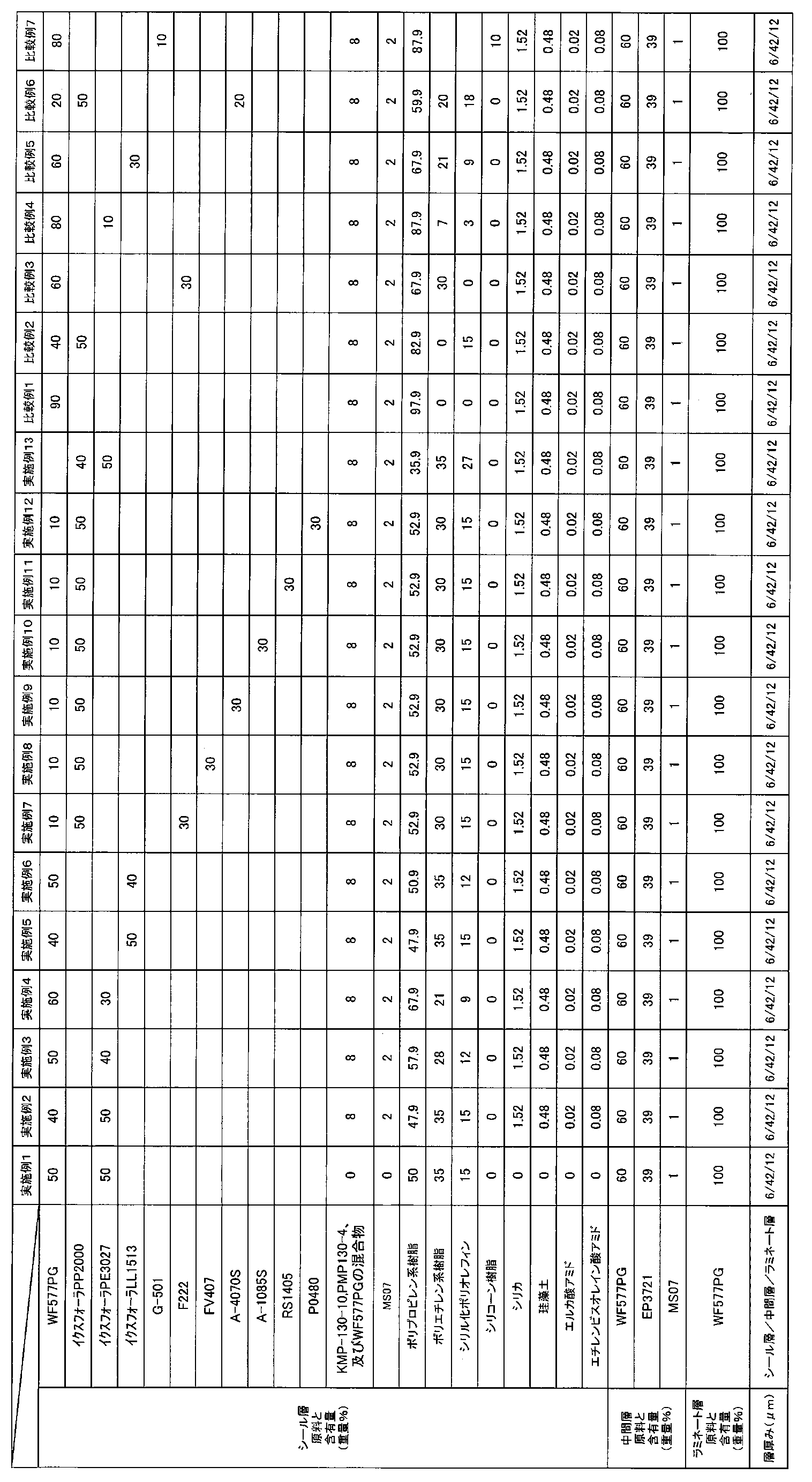
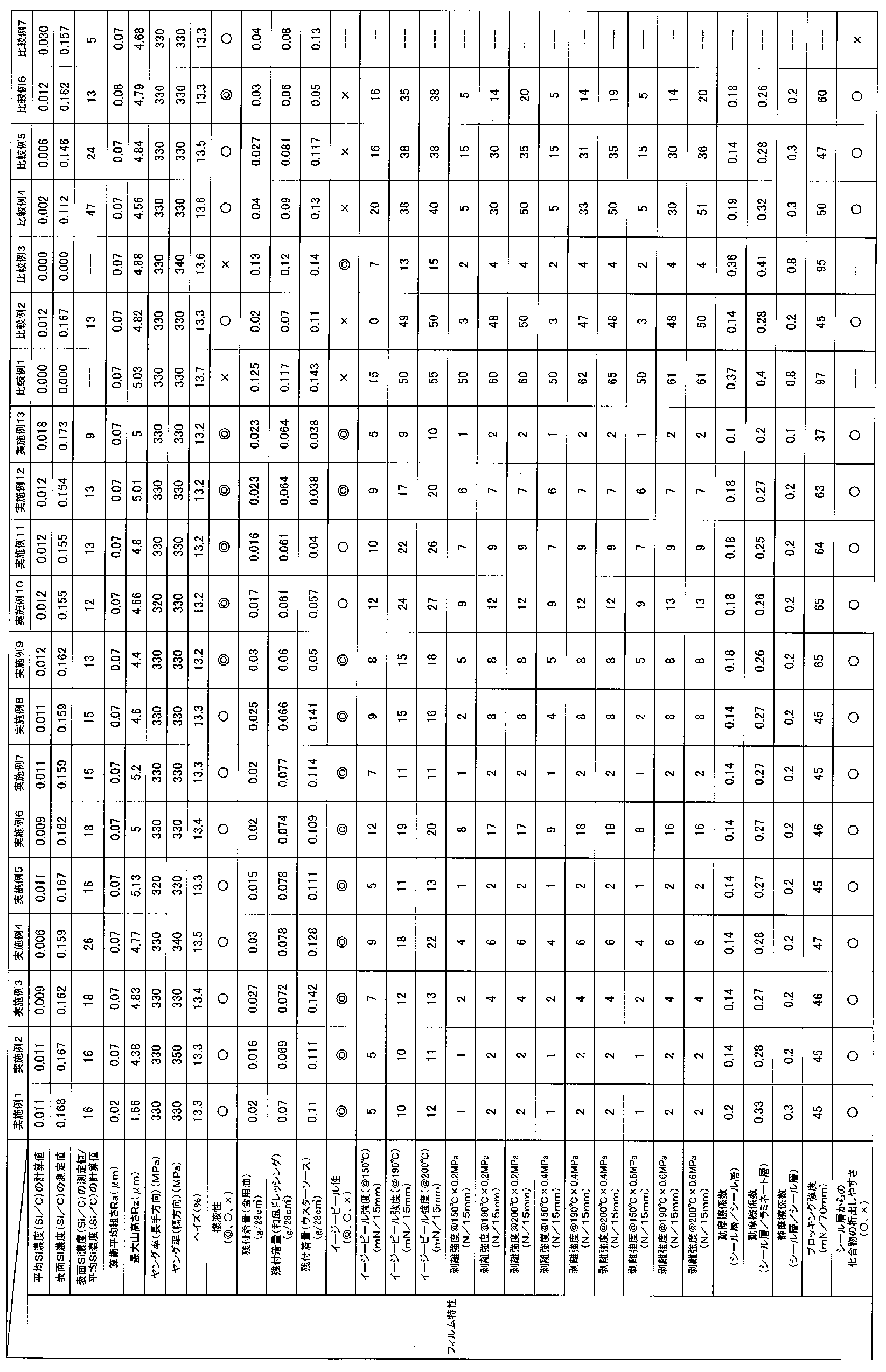
Claims (8)
- 下記(a)及び(b)を含む樹脂組成物からなるシール層を含むフィルムであって、下記(1)及び(2)を満足するシーラント用フィルム。
(a)ポリプロピレン系樹脂
(b)シリル化ポリオレフィン樹脂
(1)シール温度150℃、シール圧力0.4MPaでのシール強度に対する、シール温度200℃、シール圧力0.4MPaでのシール強度の比が2以下である。
(2)シール温度150℃、シール圧力0.6MPaでのシール強度が40N/15mm以下である。 - 前記シリル化ポリオレフィンが下記式で示される、請求項1に記載のシーラント用フィルム。
CH3-(CH2)n-2-CH2-Si(CH3)2O-(-Si(CH3)2-O-
)d-Si(CH3)2-CH2-(CH2)n-2-CH3
(式中、dは1以上の整数である。) - 前記樹脂組成物が、無機酸化物又は合成樹脂からなる粒子を含有する、請求項1又は2に記載のシーラント用フィルム。
- 前記樹脂組成物が、脂肪酸アミドを含有する、請求項1~3のいずれか記載のシーラント用フィルム。
- 下記(3)、(4)を満足する、請求項1~3のいずれか記載のシーラント用フィルム。
(3)シール層中に含まれる珪素原子Siと炭素原子Cの存在比(Si/C)が0.001以上、0.02以下である。
(4)シール層の表面における珪素原子Siと炭素原子Cの存在比(Si/C)が0.05以上0.2以下である。 - 下記(5)を満足する、請求項1~5のいずれかに記載のシーラント用フィルム。
(5)前記シール層中に含まれる珪素原子Siと炭素原子Cの存在比(Si/C)に対する、シール層の表面における珪素原子Siと炭素原子Cの存在比(Si/C)の比が2以上である。 - 前記シール層の表面のブロッキング値が200mN/70mm以下である、請求項1~6のいずれかに記載のシーラント用フィルム。
- 請求項1~7のいずれかに記載のシーラント用フィルムと基材フィルムからなる積層体。
Priority Applications (5)
| Application Number | Priority Date | Filing Date | Title |
|---|---|---|---|
| US18/041,966 US20240026045A1 (en) | 2020-08-21 | 2021-08-11 | Sealant film |
| KR1020237007356A KR20230054387A (ko) | 2020-08-21 | 2021-08-11 | 실란트용 필름 |
| EP21858237.7A EP4201982A4 (en) | 2020-08-21 | 2021-08-11 | Sealant film |
| JP2022543911A JP7740249B2 (ja) | 2020-08-21 | 2021-08-11 | シーラント用フィルム |
| CN202180055424.6A CN116056895A (zh) | 2020-08-21 | 2021-08-11 | 密封剂用薄膜 |
Applications Claiming Priority (2)
| Application Number | Priority Date | Filing Date | Title |
|---|---|---|---|
| JP2020-140435 | 2020-08-21 | ||
| JP2020140435 | 2020-08-21 |
Publications (1)
| Publication Number | Publication Date |
|---|---|
| WO2022039090A1 true WO2022039090A1 (ja) | 2022-02-24 |
Family
ID=80322723
Family Applications (1)
| Application Number | Title | Priority Date | Filing Date |
|---|---|---|---|
| PCT/JP2021/029666 Ceased WO2022039090A1 (ja) | 2020-08-21 | 2021-08-11 | シーラント用フィルム |
Country Status (7)
| Country | Link |
|---|---|
| US (1) | US20240026045A1 (ja) |
| EP (1) | EP4201982A4 (ja) |
| JP (1) | JP7740249B2 (ja) |
| KR (1) | KR20230054387A (ja) |
| CN (1) | CN116056895A (ja) |
| TW (1) | TW202218890A (ja) |
| WO (1) | WO2022039090A1 (ja) |
Cited By (1)
| Publication number | Priority date | Publication date | Assignee | Title |
|---|---|---|---|---|
| EP4650392A4 (en) * | 2023-06-06 | 2026-06-03 | Toray Advanced Film Co Ltd | UNSTRETCHED POLYPROPYLENE-BASED FILM AND LAMINATED USING IT |
Citations (5)
| Publication number | Priority date | Publication date | Assignee | Title |
|---|---|---|---|---|
| JP2014223752A (ja) | 2013-05-16 | 2014-12-04 | 三井化学株式会社 | 包装材用の積層フィルムおよび包装材 |
| JP2015025051A (ja) * | 2013-07-25 | 2015-02-05 | 大日本印刷株式会社 | 撥水性フィルム |
| JP2018123174A (ja) * | 2017-01-30 | 2018-08-09 | 三井化学株式会社 | 樹脂組成物およびその成形体 |
| JP2020050856A (ja) * | 2018-09-21 | 2020-04-02 | 凸版印刷株式会社 | 撥液層形成用樹脂組成物、並びに、それを用いた撥液性フィルム、撥液性積層体、包装材及び容器 |
| WO2020175260A1 (ja) * | 2019-02-27 | 2020-09-03 | 東洋紡株式会社 | シーラント用フィルム |
Family Cites Families (15)
| Publication number | Priority date | Publication date | Assignee | Title |
|---|---|---|---|---|
| JPS539723B2 (ja) | 1973-06-13 | 1978-04-07 | ||
| JPH08337267A (ja) | 1995-06-07 | 1996-12-24 | Dainippon Printing Co Ltd | 内容物撥水性・離型性を有する包装材 |
| JP3172912B2 (ja) | 1999-03-30 | 2001-06-04 | 勝治 本田 | パイプ継手 |
| JP2000355362A (ja) | 1999-06-14 | 2000-12-26 | Sun A Kaken Co Ltd | 粘稠物の充填包装体,粘稠物の充填包装体用積層フィルムおよび粘稠物の充填包装体の製造方法 |
| JP2001048229A (ja) | 1999-07-30 | 2001-02-20 | Kyoraku Co Ltd | 粘稠物の充填収縮包装体および粘稠物の充填収縮包装用積層フィルム |
| JP4389063B2 (ja) * | 2002-03-14 | 2009-12-24 | 三井化学株式会社 | シーラント用樹脂組成物、シーラントフィルムおよびその用途 |
| JP2008095228A (ja) | 2006-10-11 | 2008-04-24 | Teijin Fibers Ltd | 接触走行摩耗特性の改善された二酸化チタン含有ポリエステル繊維及びその製造方法 |
| JP5394096B2 (ja) | 2009-02-24 | 2014-01-22 | オカモト株式会社 | イージーピールフィルム |
| JP2014177541A (ja) | 2013-03-14 | 2014-09-25 | Mitsui Chemicals Inc | 包装材および包装体 |
| JP2014200949A (ja) * | 2013-04-02 | 2014-10-27 | 三井化学東セロ株式会社 | 拡張性フィルム、それを用いた半導体装置の製造方法 |
| JP2015024548A (ja) | 2013-07-25 | 2015-02-05 | 大日本印刷株式会社 | 撥水性フィルム |
| JP6274835B2 (ja) * | 2013-12-02 | 2018-02-07 | 三井化学株式会社 | 樹脂組成物およびその成形体 |
| JP2017030218A (ja) * | 2015-07-31 | 2017-02-09 | 三井化学株式会社 | 延伸フィルムの製造方法 |
| KR102287397B1 (ko) | 2016-03-09 | 2021-08-09 | 이데미쓰 고산 가부시키가이샤 | 폴리카보네이트계 수지 조성물 및 그 성형품 |
| EP3816225A4 (en) | 2018-06-14 | 2022-03-09 | Toppan Printing Co., Ltd. | LIQUID-REPELLENT LAYER-FORMING RESIN COMPOSITION AND LIQUID-REPELLENT FILM, LIQUID-REPELLENT LAMINATE, PACKING MATERIAL AND CONTAINER THEREOF |
-
2021
- 2021-08-11 JP JP2022543911A patent/JP7740249B2/ja active Active
- 2021-08-11 EP EP21858237.7A patent/EP4201982A4/en not_active Withdrawn
- 2021-08-11 KR KR1020237007356A patent/KR20230054387A/ko active Pending
- 2021-08-11 US US18/041,966 patent/US20240026045A1/en not_active Abandoned
- 2021-08-11 WO PCT/JP2021/029666 patent/WO2022039090A1/ja not_active Ceased
- 2021-08-11 CN CN202180055424.6A patent/CN116056895A/zh active Pending
- 2021-08-20 TW TW110130776A patent/TW202218890A/zh unknown
Patent Citations (5)
| Publication number | Priority date | Publication date | Assignee | Title |
|---|---|---|---|---|
| JP2014223752A (ja) | 2013-05-16 | 2014-12-04 | 三井化学株式会社 | 包装材用の積層フィルムおよび包装材 |
| JP2015025051A (ja) * | 2013-07-25 | 2015-02-05 | 大日本印刷株式会社 | 撥水性フィルム |
| JP2018123174A (ja) * | 2017-01-30 | 2018-08-09 | 三井化学株式会社 | 樹脂組成物およびその成形体 |
| JP2020050856A (ja) * | 2018-09-21 | 2020-04-02 | 凸版印刷株式会社 | 撥液層形成用樹脂組成物、並びに、それを用いた撥液性フィルム、撥液性積層体、包装材及び容器 |
| WO2020175260A1 (ja) * | 2019-02-27 | 2020-09-03 | 東洋紡株式会社 | シーラント用フィルム |
Non-Patent Citations (1)
| Title |
|---|
| See also references of EP4201982A4 |
Cited By (1)
| Publication number | Priority date | Publication date | Assignee | Title |
|---|---|---|---|---|
| EP4650392A4 (en) * | 2023-06-06 | 2026-06-03 | Toray Advanced Film Co Ltd | UNSTRETCHED POLYPROPYLENE-BASED FILM AND LAMINATED USING IT |
Also Published As
| Publication number | Publication date |
|---|---|
| CN116056895A (zh) | 2023-05-02 |
| EP4201982A4 (en) | 2024-08-07 |
| TW202218890A (zh) | 2022-05-16 |
| JP7740249B2 (ja) | 2025-09-17 |
| EP4201982A1 (en) | 2023-06-28 |
| JPWO2022039090A1 (ja) | 2022-02-24 |
| US20240026045A1 (en) | 2024-01-25 |
| KR20230054387A (ko) | 2023-04-24 |
Similar Documents
| Publication | Publication Date | Title |
|---|---|---|
| JP5411935B2 (ja) | 引裂方向性を有するヒートシール性1軸配向プロピレン系フィルム | |
| JP2024069298A (ja) | シーラント用フィルム | |
| JP5446422B2 (ja) | 積層2軸延伸ポリアミド系フィルム | |
| JP7428103B2 (ja) | シーラント用フィルム | |
| KR102413979B1 (ko) | 폴리에틸렌계 필름 | |
| EP2004401A2 (en) | Metallized multi-layer films, methods of manufacture and articles made therefrom | |
| DK2683772T3 (en) | Antifogging sealing composition for heat-sealable films and packaging made therefrom that can be easily opened | |
| EP3988280B1 (en) | Polyolefin-based resin film, and laminate using same | |
| JP7740249B2 (ja) | シーラント用フィルム | |
| JP7200943B2 (ja) | ポリエチレン系樹脂フィルム | |
| JP7631705B2 (ja) | シーラント用フィルム | |
| JP2015518788A (ja) | 改善された機械的および密閉特性を有するポリプロピレン系フィルムおよびその作製方法 | |
| JP2021130203A (ja) | 金属蒸着用ポリプロピレン系複合フィルム、金属蒸着ポリプロピレン系複合フィルムおよびそれを用いた積層体 | |
| JP4692818B2 (ja) | 共押出積層フィルム並びにそれを用いたラミネートフィルム及び包装容器 | |
| JP4526770B2 (ja) | 2軸延伸積層evohフィルム | |
| KR20220004822A (ko) | 폴리에틸렌계 수지 필름 | |
| JPH06262738A (ja) | 積層樹脂フィルム | |
| JP2024036304A (ja) | 積層フィルム及び包装体 | |
| EP4039470A1 (en) | Liner film | |
| JPH08258230A (ja) | 積層樹脂フィルム | |
| TW201922449A (zh) | 聚乙烯系樹脂膜的製造方法 | |
| JP2006001011A (ja) | 2軸延伸積層フィルム | |
| JPH06234196A (ja) | 積層樹脂フィルム |
Legal Events
| Date | Code | Title | Description |
|---|---|---|---|
| 121 | Ep: the epo has been informed by wipo that ep was designated in this application |
Ref document number: 21858237 Country of ref document: EP Kind code of ref document: A1 |
|
| ENP | Entry into the national phase |
Ref document number: 2022543911 Country of ref document: JP Kind code of ref document: A |
|
| WWE | Wipo information: entry into national phase |
Ref document number: 18041966 Country of ref document: US |
|
| ENP | Entry into the national phase |
Ref document number: 20237007356 Country of ref document: KR Kind code of ref document: A |
|
| WWE | Wipo information: entry into national phase |
Ref document number: 202347014833 Country of ref document: IN |
|
| NENP | Non-entry into the national phase |
Ref country code: DE |
|
| ENP | Entry into the national phase |
Ref document number: 2021858237 Country of ref document: EP Effective date: 20230321 |
|
| WWW | Wipo information: withdrawn in national office |
Ref document number: 2021858237 Country of ref document: EP |