WO2022153473A1 - Module de filtre pour équipement de peinture - Google Patents
Module de filtre pour équipement de peinture Download PDFInfo
- Publication number
- WO2022153473A1 WO2022153473A1 PCT/JP2021/001172 JP2021001172W WO2022153473A1 WO 2022153473 A1 WO2022153473 A1 WO 2022153473A1 JP 2021001172 W JP2021001172 W JP 2021001172W WO 2022153473 A1 WO2022153473 A1 WO 2022153473A1
- Authority
- WO
- WIPO (PCT)
- Prior art keywords
- outer box
- elements
- eliminator
- baffle plate
- air
- Prior art date
- Legal status (The legal status is an assumption and is not a legal conclusion. Google has not performed a legal analysis and makes no representation as to the accuracy of the status listed.)
- Ceased
Links
Images




Classifications
-
- B—PERFORMING OPERATIONS; TRANSPORTING
- B05—SPRAYING OR ATOMISING IN GENERAL; APPLYING FLUENT MATERIALS TO SURFACES, IN GENERAL
- B05B—SPRAYING APPARATUS; ATOMISING APPARATUS; NOZZLES
- B05B14/00—Arrangements for collecting, re-using or eliminating excess spraying material
- B05B14/40—Arrangements for collecting, re-using or eliminating excess spraying material for use in spray booths
- B05B14/43—Arrangements for collecting, re-using or eliminating excess spraying material for use in spray booths by filtering the air charged with excess material
-
- B—PERFORMING OPERATIONS; TRANSPORTING
- B01—PHYSICAL OR CHEMICAL PROCESSES OR APPARATUS IN GENERAL
- B01D—SEPARATION
- B01D45/00—Separating dispersed particles from gases or vapours by gravity, inertia, or centrifugal forces
- B01D45/04—Separating dispersed particles from gases or vapours by gravity, inertia, or centrifugal forces by utilising inertia
- B01D45/08—Separating dispersed particles from gases or vapours by gravity, inertia, or centrifugal forces by utilising inertia by impingement against baffle separators
-
- B—PERFORMING OPERATIONS; TRANSPORTING
- B01—PHYSICAL OR CHEMICAL PROCESSES OR APPARATUS IN GENERAL
- B01D—SEPARATION
- B01D46/00—Filters or filtering processes specially modified for separating dispersed particles from gases or vapours
- B01D46/0002—Casings; Housings; Frame constructions
- B01D46/0013—Modules
-
- B—PERFORMING OPERATIONS; TRANSPORTING
- B01—PHYSICAL OR CHEMICAL PROCESSES OR APPARATUS IN GENERAL
- B01D—SEPARATION
- B01D46/00—Filters or filtering processes specially modified for separating dispersed particles from gases or vapours
- B01D46/0039—Filters or filtering processes specially modified for separating dispersed particles from gases or vapours with flow guiding by feed or discharge devices
-
- B—PERFORMING OPERATIONS; TRANSPORTING
- B01—PHYSICAL OR CHEMICAL PROCESSES OR APPARATUS IN GENERAL
- B01D—SEPARATION
- B01D46/00—Filters or filtering processes specially modified for separating dispersed particles from gases or vapours
- B01D46/0039—Filters or filtering processes specially modified for separating dispersed particles from gases or vapours with flow guiding by feed or discharge devices
- B01D46/0041—Filters or filtering processes specially modified for separating dispersed particles from gases or vapours with flow guiding by feed or discharge devices for feeding
-
- B—PERFORMING OPERATIONS; TRANSPORTING
- B01—PHYSICAL OR CHEMICAL PROCESSES OR APPARATUS IN GENERAL
- B01D—SEPARATION
- B01D46/00—Filters or filtering processes specially modified for separating dispersed particles from gases or vapours
- B01D46/0039—Filters or filtering processes specially modified for separating dispersed particles from gases or vapours with flow guiding by feed or discharge devices
- B01D46/0047—Filters or filtering processes specially modified for separating dispersed particles from gases or vapours with flow guiding by feed or discharge devices for discharging the filtered gas
-
- B—PERFORMING OPERATIONS; TRANSPORTING
- B01—PHYSICAL OR CHEMICAL PROCESSES OR APPARATUS IN GENERAL
- B01D—SEPARATION
- B01D46/00—Filters or filtering processes specially modified for separating dispersed particles from gases or vapours
- B01D46/10—Particle separators, e.g. dust precipitators, using filter plates, sheets or pads having plane surfaces
- B01D46/12—Particle separators, e.g. dust precipitators, using filter plates, sheets or pads having plane surfaces in multiple arrangements
- B01D46/121—V-type arrangements
-
- B—PERFORMING OPERATIONS; TRANSPORTING
- B05—SPRAYING OR ATOMISING IN GENERAL; APPLYING FLUENT MATERIALS TO SURFACES, IN GENERAL
- B05B—SPRAYING APPARATUS; ATOMISING APPARATUS; NOZZLES
- B05B14/00—Arrangements for collecting, re-using or eliminating excess spraying material
- B05B14/40—Arrangements for collecting, re-using or eliminating excess spraying material for use in spray booths
- B05B14/44—Arrangements for collecting, re-using or eliminating excess spraying material for use in spray booths using walls specially adapted for promoting separation of the excess material from the air, e.g. baffle plates
-
- B—PERFORMING OPERATIONS; TRANSPORTING
- B05—SPRAYING OR ATOMISING IN GENERAL; APPLYING FLUENT MATERIALS TO SURFACES, IN GENERAL
- B05B—SPRAYING APPARATUS; ATOMISING APPARATUS; NOZZLES
- B05B14/00—Arrangements for collecting, re-using or eliminating excess spraying material
- B05B14/40—Arrangements for collecting, re-using or eliminating excess spraying material for use in spray booths
- B05B14/48—Arrangements for collecting, re-using or eliminating excess spraying material for use in spray booths specially adapted for particulate material
-
- B—PERFORMING OPERATIONS; TRANSPORTING
- B01—PHYSICAL OR CHEMICAL PROCESSES OR APPARATUS IN GENERAL
- B01D—SEPARATION
- B01D2201/00—Details relating to filtering apparatus
- B01D2201/30—Filter housing constructions
-
- B—PERFORMING OPERATIONS; TRANSPORTING
- B01—PHYSICAL OR CHEMICAL PROCESSES OR APPARATUS IN GENERAL
- B01D—SEPARATION
- B01D2201/00—Details relating to filtering apparatus
- B01D2201/32—Flow characteristics of the filter
-
- B—PERFORMING OPERATIONS; TRANSPORTING
- B01—PHYSICAL OR CHEMICAL PROCESSES OR APPARATUS IN GENERAL
- B01D—SEPARATION
- B01D2273/00—Operation of filters specially adapted for separating dispersed particles from gases or vapours
- B01D2273/20—High temperature filtration
-
- B—PERFORMING OPERATIONS; TRANSPORTING
- B05—SPRAYING OR ATOMISING IN GENERAL; APPLYING FLUENT MATERIALS TO SURFACES, IN GENERAL
- B05B—SPRAYING APPARATUS; ATOMISING APPARATUS; NOZZLES
- B05B13/00—Machines or plants for applying liquids or other fluent materials to surfaces of objects or other work by spraying, not covered by groups B05B1/00 - B05B11/00
- B05B13/02—Means for supporting work; Arrangement or mounting of spray heads; Adaptation or arrangement of means for feeding work
- B05B13/04—Means for supporting work; Arrangement or mounting of spray heads; Adaptation or arrangement of means for feeding work the spray heads being moved during spraying operation
- B05B13/0431—Means for supporting work; Arrangement or mounting of spray heads; Adaptation or arrangement of means for feeding work the spray heads being moved during spraying operation with spray heads moved by robots or articulated arms, e.g. for applying liquid or other fluent material to three-dimensional [3D] surfaces
-
- B—PERFORMING OPERATIONS; TRANSPORTING
- B05—SPRAYING OR ATOMISING IN GENERAL; APPLYING FLUENT MATERIALS TO SURFACES, IN GENERAL
- B05B—SPRAYING APPARATUS; ATOMISING APPARATUS; NOZZLES
- B05B13/00—Machines or plants for applying liquids or other fluent materials to surfaces of objects or other work by spraying, not covered by groups B05B1/00 - B05B11/00
- B05B13/02—Means for supporting work; Arrangement or mounting of spray heads; Adaptation or arrangement of means for feeding work
- B05B13/04—Means for supporting work; Arrangement or mounting of spray heads; Adaptation or arrangement of means for feeding work the spray heads being moved during spraying operation
- B05B13/0431—Means for supporting work; Arrangement or mounting of spray heads; Adaptation or arrangement of means for feeding work the spray heads being moved during spraying operation with spray heads moved by robots or articulated arms, e.g. for applying liquid or other fluent material to three-dimensional [3D] surfaces
- B05B13/0433—Means for supporting work; Arrangement or mounting of spray heads; Adaptation or arrangement of means for feeding work the spray heads being moved during spraying operation with spray heads moved by robots or articulated arms, e.g. for applying liquid or other fluent material to three-dimensional [3D] surfaces the work being vehicle components, e.g. vehicle bodies
-
- Y—GENERAL TAGGING OF NEW TECHNOLOGICAL DEVELOPMENTS; GENERAL TAGGING OF CROSS-SECTIONAL TECHNOLOGIES SPANNING OVER SEVERAL SECTIONS OF THE IPC; TECHNICAL SUBJECTS COVERED BY FORMER USPC CROSS-REFERENCE ART COLLECTIONS [XRACs] AND DIGESTS
- Y02—TECHNOLOGIES OR APPLICATIONS FOR MITIGATION OR ADAPTATION AGAINST CLIMATE CHANGE
- Y02P—CLIMATE CHANGE MITIGATION TECHNOLOGIES IN THE PRODUCTION OR PROCESSING OF GOODS
- Y02P70/00—Climate change mitigation technologies in the production process for final industrial or consumer products
- Y02P70/10—Greenhouse gas [GHG] capture, material saving, heat recovery or other energy efficient measures, e.g. motor control, characterised by manufacturing processes, e.g. for rolling metal or metal working
Definitions
- the present invention relates to a filter module for coating equipment that separates paint mist from air.
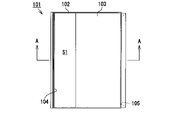
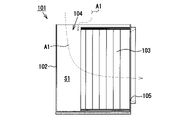
- the filter module 101 includes an outer box 102 and an obstacle wall 103.
- the outer box 102 has a rectangular cuboid shape and has an outer box inlet 104 that opens on the upper surface and an outer box outlet 105 that opens on the side surface.
- the obstacle wall 103 is arranged in the outer box 102 near the outer box outlet 105, and is housed in a state where the space S1 is provided on the inflow side.
- the air A1 containing the paint mist flows into the space S1 through the outer box inlet 104, changes its direction by about 90 °, passes through the obstacle wall 103, and is discharged from the outer box outlet 105.
- the paint mist is separated from the air A1 when passing through the obstacle wall 103.
- the space S1 is located at a biased position in the outer box 102 (the position on the left side in FIGS. 10 and 11), and the flow path is suddenly narrowed, so that the outer box is narrowed.
- a pressure loss occurs in the air A1 guided from the inlet 104 to the space S1.
- the air A1 flows unevenly toward a specific portion such as the inner surface of the outer box 102 or the obstacle wall 103, there is a problem that the efficiency of removing the paint mist is lowered.
- the present invention has been made in view of the above problems, and an object of the present invention is to provide a filter module for coating equipment capable of improving the efficiency of removing paint mist and preventing the outflow of paint mist to the outside. To do.
- the invention according to claim 1 is a filter module provided on an exhaust path of a coating facility and made of a flammable material, which has an upper surface and side surfaces and is opened at the upper surface.
- An outer box having an outer box inlet and an outer box outlet that opens on the side surface, and an outer box in which air containing paint mist flows into the inside from the outer box inlet and is discharged from the outer box outlet, and inside the outer box.
- a plurality of plate-shaped eliminator elements that are housed in the vicinity of the outer box outlet with a space on the inflow side and have a zigzag shape are arranged side by side to separate the paint mist from the air, and the eliminator.
- a plurality of baffle plate elements accommodated in the vicinity of the outer box inlet in the outer box and having an inclined surface for guiding the air in the inflow side space of the eliminator are arranged side by side, and the air introduced from the outer box inlet.
- the gist thereof is a filter module for coating equipment, which is provided with a baffle plate for guiding the inflow side space.
- a baffle plate is housed in the vicinity of the outer box entrance in the outer box, and a plurality of baffle plate elements constituting the baffle plate have an inclined surface that guides air into the inflow side space of the eliminator. is doing. Therefore, the air introduced into the outer box from the outer box inlet collides with each baffle plate element and changes the direction, so that the air is guided to the inflow side space. As a result, air is smoothly guided from the outer box entrance to the inflow side space. In this case, the air guided to the inflow side space flows evenly to the inner surface of the outer box and the surface of the eliminator element, so that the paint mist contained in the air flows to the inner surface of the outer box and the surface of the eliminator element.
- the air introduced into the outer box from the outer box inlet is guided by the baffle plate element and surely flows into the inflow side space, so that the paint mist contained in the air can be prevented from flowing out to the outside of the filter module. can.
- the filter module is made of a flammable material
- the filter module can be incinerated or disposable and replaced.
- examples of the flammable material include paper, resin, and wood. If corrugated cardboard or plastic corrugated cardboard is used as the flammable material, the strength of the filter module is improved.
- a rectifying plate in which a plurality of rectifying plate elements extending in the vertical direction are arranged side by side is housed in the inflow side space, and the pitch between the adjacent rectifying plate elements is accommodated. Is larger than the pitch between the adjacent eliminator elements and smaller than the pitch between the adjacent baffle plate elements.
- a straightening vane is housed in the inflow side space, and a plurality of straightening vane elements constituting the straightening vane extend in the vertical direction. Therefore, the air introduced from the baffle plate into the inflow side space collides with each straightening vane element and changes its direction, so that the air is guided to the eliminator on the downstream side. As a result, the air flows uniformly and evenly. That is, the contact area of air per unit flow rate increases. Therefore, the paint mist contained in the air easily adheres to the surface of the straightening vane element and also easily adheres to the surface of the eliminator element on the downstream side, so that the efficiency of removing the paint mist is further improved.
- the paint mist can be classified. Specifically, the baffle plate element having the largest pitch adheres and collects the paint mist having a large particle size, and the rectifying plate element having a medium pitch adheres the paint mist having a medium particle size.
- the eliminator element having the smallest pitch allows the paint mist having a small particle size to be attached and collected. As a result, the paint mist having a large particle size makes it difficult for the flow path on the downstream side where the pitch between adjacent elements is small to be clogged, so that the life of the filter module can be extended.
- the gist of the invention according to claim 3 is that, in claim 1, a plurality of projectiles are projected from the bottom surface of the outer box, and the space between the adjacent projectiles is a region for collecting paint. And.
- the paint mist contained in the air can be attached to the area where the paint is stored (the space between adjacent projecting pieces). As a result, it is possible to prevent the paint from flowing out of the space between the adjacent projecting pieces.
- the invention according to claim 4 is in a state in which, in claim 1, a secondary filter for passing the air that has passed through the eliminator protrudes from the outer box outlet on the outflow side of the eliminator.
- the gist is that it is provided.
- the secondary filter on the outflow side of the eliminator, the paint mist that has not been completely removed from the air after passing through the eliminator can be reliably removed by the secondary filter. Further, since the secondary filter is provided with a part of the secondary filter protruding from the outer box outlet, the volume of the secondary filter can be secured. If the entire secondary filter is housed in the outer box, it may not be possible to arrange the eliminator or the like at a desired position.
- the invention according to claim 5 is housed in a state of being placed on the upper ends of a plurality of the eliminator elements in the vicinity of the outer box entrance in the outer box, and is housed at the upper ends of the eliminator elements.
- a spacer having a spacer bottom surface that abuts and an inclined surface that guides the air into the inflow side space is provided, and the inclination angle of the baffle plate element with respect to the bottom surface of the outer box is larger than the inclination angle of the inclined surface with respect to the spacer bottom surface.
- the gist is that it is also large.
- the baffle plate is orthogonal to the plurality of baffle plate elements, and a plurality of connecting plates for connecting the plurality of baffle plate elements while maintaining a distance are provided.
- the gist is that the lower end of the baffle plate element is located above the lower end of the connecting plate.
- the invention according to claim 7 is housed in a state of being placed on the upper ends of a plurality of the eliminator elements in the vicinity of the outer box entrance in the outer box, and is housed at the upper ends of the eliminator elements.
- the baffle plate is provided with a spacer having an abutting bottom surface of the spacer and an inclined surface for guiding the air to the inflow side space, and the baffle plate is orthogonal to the plurality of baffle plate elements and is spaced between the plurality of baffle plate elements.
- the connecting plate has an inclined edge that abuts on the inclined surface, and the inclination angle of the inclined edge with respect to the bottom surface of the outer box is the inclination with respect to the bottom surface of the spacer.
- the gist is that it is equal to the inclination angle of the surface.
- the invention according to claim 8 is housed in a state of being placed on the upper ends of a plurality of the eliminator elements in the vicinity of the outer box entrance in the outer box, and is housed at the upper ends of the eliminator elements.
- a spacer having a spacer bottom surface that abuts and an inclined surface that guides the air to the inflow side space is provided, and the projected area of the inclined surface when viewed from the upper surface side of the outer box is the upstream side of the inflow side space.
- the gist is that it is larger than the opening area of the opening.
- the invention according to claim 9 is housed in a state of being placed on the upper ends of a plurality of the eliminator elements in the vicinity of the outer box entrance in the outer box, and is housed at the upper ends of the eliminator elements.
- a spacer having a bottom surface of a spacer that abuts and an inclined surface that guides the air into the inflow side space is provided, the spacer has a right-angled triangular shape in a side view, and the hypotenuse of the right-angled triangle constitutes the inclined surface. Is the gist.
- the invention according to claim 10 is a plurality of connecting plates in which the baffle plate is orthogonal to the plurality of baffle plate elements and connects the plurality of baffle plate elements while maintaining a space between the plurality of baffle plate elements.
- a rectifying plate formed by arranging a plurality of rectifying plate elements extending in the vertical direction in parallel is housed in the inflow side space, and the pitch between the adjacent rectifying plate elements is set between the adjacent connecting plates.
- the gist is that it is smaller than the pitch.
- the invention according to claim 11 is claimed in claim 1, wherein a rectifying plate formed by arranging a plurality of rectifying plate elements extending in the vertical direction in parallel is housed in the inflow side space, and the rectifying plate element is a downstream end. Is connected to the upstream end of the eliminator element.
- a plurality of projecting pieces are projected on the bottom surface of the outer box, and the space between the adjacent projecting pieces is a region for collecting paint, and the inflow side.
- a rectifying plate formed by arranging a plurality of rectifying plate elements extending in the vertical direction is housed in the space, and the rectifying plate includes a plurality of upper connecting plates for connecting the upper ends of the plurality of rectifying plate elements, and the above.
- the gist of the present invention is that a plurality of lower connecting plates for connecting the lower ends of the plurality of straightening vane elements are provided, and the lower connecting plate is used as the projecting piece.
- the gist of the invention according to claim 13 is that, in claim 1, the filter module is entirely made of corrugated cardboard.
- a filter module for coating equipment capable of improving the efficiency of removing paint mist and preventing the outflow of paint mist to the outside is provided. can do.
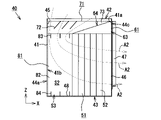
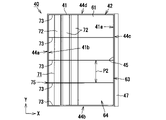
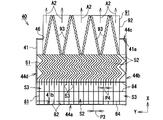
- FIG. 5 is a cross-sectional view taken along the line BB of FIG. Side view showing the filter module. Photographs showing the unfolded and folded states of the outer box, eliminator, spacer, baffle plate, and straightening vane. Schematic cross-sectional view showing a filter module in another embodiment.
- FIG. 10 is a cross-sectional view taken along the line AA.
- the filter module 40 of this embodiment is provided on the exhaust path E1 of the coating equipment 10.
- a transfer rail 12 In the coating chamber 11 constituting the coating equipment 10, a transfer rail 12, a transfer carriage 13 moving on the transfer rail 12, and a plurality of coating robots 14 arranged on both sides of the transfer rail 12 are provided. ..
- a coating film is formed on the surface of the work W1 by spraying atomized paint (paint mist) on the work W1 (automobile body in the present embodiment) from the painting gun 15 of the painting robot 14.
- a ceiling wall 16 is provided above the painting room 11.
- the ceiling wall 16 has a mesh structure, and compressed air A2 is supplied to the upper side.
- the air A2 passes through the ceiling wall 16 and flows down in the coating chamber 11, so that the coating mist that has not adhered to the work W1 is guided downward.
- the floor 17 of the painting chamber 11 has a crosspiece structure, and the underfloor wall 18 is arranged below.
- the underfloor wall 18 has the lowest central portion 19, and is provided with a pair of inclined portions 20 on both sides of the central portion 19.
- An exhaust port 21 is provided in the central portion 19, and an exhaust duct 22 is connected to the exhaust port 21 via a paint mist removing device 30.
- the inside of the exhaust duct 22 is in a negative pressure state due to a blower (not shown).
- a blower (not shown).
- the air A2 in the coating chamber 11 flows into the exhaust duct 22 after passing through the paint mist removing device 30.
- the paint mist contained in the air A2 is removed when passing through the paint mist removing device 30.
- the air A2 in the exhaust duct 22 is discharged to the outside of the coating equipment 10 after being subjected to, for example, VOC (volatile organic gas) removal treatment by a deodorizing device (not shown).
- VOC volatile organic gas
- a relay duct 23 communicating with the exhaust port 21 and extending downward is connected to the central portion 19 of the underfloor wall 18.
- the paint mist removing device 30 is connected to the lower end of the relay duct 23 and the suction hole (not shown) of the exhaust duct 22. More specifically, the paint mist removing device 30 includes an upstream duct 31 and a downstream duct 32. Then, the upper end flange (not shown) protruding from the upper end of the upstream duct 31 and the lower end flange (not shown) protruding from the lower end of the relay duct 23 are overlapped and screwed to the relay duct 23. The paint mist removing device 30 is connected. Further, the paint mist removing device 30 is connected to the exhaust duct 22 by inserting the downstream end of the downstream duct 32 into the suction hole of the exhaust duct 22.
- a filter module 40 is detachably attached between the upstream duct 31 and the downstream duct 32 in the paint mist removing device 30.
- the filter module 40 is entirely made of a flammable material (specifically, corrugated cardboard).
- the filter module 40 includes an outer box 41, an eliminator 51, a spacer 61, a baffle plate 71, and a rectifying plate 81.
- the outer box 41 has a rectangular cuboid shape having an upper surface 42, a lower surface 43, and four side surfaces 44a, 44b, 44c, 44d.
- the outer box 41 has a rectangular outer box inlet 45 that opens at the upper surface 42, and a rectangular outer box outlet 46 that opens at the side surface 44c on the downstream side (right side in FIG. 3). ..
- the opening area of the outer box inlet 45 is larger than the opening area of the outer box outlet 46, and is substantially equal to the area of the upper surface 42.
- the air A2 containing the paint mist flows into the inside from the outer box inlet 45 and is discharged from the outer box outlet 46.
- a rectangular frame-shaped duct connecting portion 47 surrounding the outer box outlet 46 is projected from the side surface 44c of the outer box 41. Then, the filter module 40 is connected to the downstream duct 32 by inserting the duct connecting portion 47 into the downstream duct 32.
- the eliminator 51 is housed in the outer box 41 in the vicinity of the outer box outlet 46 with a space (inflow side space S2) on the inflow side. ing.
- the eliminator 51 is formed by arranging a plurality of plate-shaped eliminator elements 52 in parallel, and has a function of separating the paint mist from the air A2.
- Each eliminator element 52 extends in the vertical direction Z (see FIGS. 3 and 5), and its lower end is in contact with the bottom surface 48 of the outer box 41.
- the bottom surface 48 is parallel to the top surface 42 of the outer box 41.
- each eliminator element 52 extends in the X direction (see FIGS. 3 and 6), which is the horizontal direction.
- the eliminator elements 52 have a zigzag shape in a plan view, and only the end portion 53 on the inflow side (the lower end portion in FIG. 6) has a linear shape in a plan view. Therefore, a meandering passage is formed between the adjacent eliminator elements 52.
- the spacer 61 is housed in the outer box 41 in the vicinity of the outer box entrance 45 in a state of being placed on the upper end of each eliminator element 52.
- the spacer 61 has a right-angled triangular shape when viewed from the side, and has a spacer bottom surface 62 that abuts on the upper end of each eliminator element 52, a back surface 63 that abuts on the inner side surface 41a on the downstream side of the outer box 41, and air in the inflow side space S2. It has an inclined surface 64 that guides A2.
- the hypotenuse of the right triangle constitutes the inclined surface 64.
- the projected area of the inclined surface 64 when viewed from the upper surface 42 side of the outer box 41 is larger than the opening area of the upstream opening of the inflow side space S2 (see FIGS. 3 and 4).
- the baffle plate 71 is housed in the vicinity of the outer box entrance 45 in the outer box 41.
- the baffle plate 71 is formed by arranging a plurality of baffle plate elements 72 having an inclined surface for guiding the air A2 on the upper surface side in the inflow side space S2, and the air A2 introduced from the outer box inlet 45 is introduced into the inflow side space S2. It has a guiding function.
- Each baffle plate element 72 extends in the horizontal Y direction (see FIGS. 4 and 5).
- the inclination angles ⁇ 1 of the baffle plate elements 72 with respect to the upper surface 42 of the outer box 41 are equal to each other.
- the inclination angle ⁇ 1 is larger than the inclination angle ⁇ 2 of the inclined surface 64 with respect to the spacer bottom surface 62 of the spacer 61.
- the pitches P1 between the adjacent baffle plate elements 72 are equal to each other.
- the baffle plate 71 has a plurality of connecting plates 73 that are orthogonal to each baffle plate element 72 and that connect the baffle plate elements 72 to each other while maintaining an interval. ing.
- Each connecting plate 73 extends in the horizontal X direction (see FIGS. 3 and 4).
- each connecting plate 73 has a lower end edge 74 that abuts on the upper end of the upper connecting plate 83 of the straightening vane 81, a side edge 75 that abuts on the inner side surface 41b on the upstream side of the outer box 41, and an inclined surface 64 of the spacer 61. It has an inclined edge 76 that abuts on.
- the pitches P2 between the adjacent connecting plates 73 are equal to each other.
- the lower end of each baffle plate element 72 is located above the lower end of each connecting plate 73.
- the straightening vane 81 is housed in the inflow side space S2 in the outer box 41.
- the straightening vane 81 is formed by arranging a plurality of straightening vane elements 82 in parallel.
- Each straightening vane element 82 extends in the vertical direction Z (see FIGS. 3 and 5), and its lower end is in contact with the bottom surface 48 of the outer box 41. Further, each straightening vane element 82 extends in the X direction (see FIGS. 3 and 6) in the horizontal direction, and the downstream end is connected to the upstream end of the eliminator element 52. In this way, the straightening vane 81 and the eliminator 51 can be reinforced with each other.
- the pitch P3 between the adjacent straightening vane elements 82 may be integrated with the eliminator element 52 or may be a separate body. Then, one end portion 53 of the eliminator element 52 is arranged between the adjacent straightening vane elements 82. Therefore, the pitch P3 between the adjacent straightening vane elements 82 is larger than the pitch P4 between the adjacent eliminator elements 52, and specifically, the pitch P4 is twice as large as the pitch P4. Further, the pitch P3 is smaller than the pitch P1 between the adjacent baffle plate elements 72 and the pitch P2 between the adjacent connecting plates 73.
- the straightening vane 81 includes a plurality of upper connecting plates 83 for connecting the upper end portions of the straightening vane elements 82, and a plurality of lower connecting plates 84 for connecting the lower end portions of the straightening vane elements 82. ..
- Each upper connecting plate 83 and each lower connecting plate 84 are orthogonal to each straightening vane element 82 and extend in the horizontal Y direction (see FIGS. 5 and 6).
- the upper end of each upper connecting plate 83 is in contact with the lower end of each connecting plate 73 constituting the baffle plate 71.
- the lower end of each lower connecting plate 84 is in contact with the bottom surface 48 of the outer box 41.
- Each lower connecting plate 84 of the present embodiment is used as a projecting piece projecting from the bottom surface 48. Then, the space S3 between the adjacent lower connecting plates 84 becomes an area for accumulating the paint (paint mist).
- the above-mentioned outer box 41, eliminator 51, spacer 61, baffle plate 71, and rectifying plate 81 have a foldable structure. Further, the eliminator 51 and the straightening vane 81 are connected to each other so that they can be unfolded and folded at the same time.
- the component parts of the filter module 40 (outer box 41, eliminator 51 and rectifying plate 81, spacer 61, baffle plate 71) are conveyed in a state of being folded into a flat shape. Then, the filter module 40 is completed by assembling each component in an unfolded state. The completed filter module 40 is placed in a standby position (not shown) outside the painting equipment 10.
- the filter module 40 at the use position T2 becomes dirty with the paint mist
- the filter module 40 is removed from the use position T2 and incinerated as it is without being folded. That is, the paint mist is discarded together with the filter module 40. Then, the filter module 40 in the standby position is placed and used in the use position T2.
- the oversprayed paint mist passes through the floor 17 of the paint chamber 11 together with the air A2 in the paint chamber 11 and is on the underfloor wall 18 side. Will be guided to.
- the air A2 containing the paint mist is guided into the relay duct 23 from the exhaust port 21 of the underfloor wall 18, passes through the upstream duct 31, and enters the outer box 41 (filter module 40) from the outer box inlet 45. It flows in. Then, the air A2 collides with the inclined surface 64 of the spacer 61, the surface of the baffle plate element 72 of the baffle plate 71, and the inner surface 41b on the upstream side of the outer box 41, so that the air A2 follows the inner surface 41b of the outer box 41. Is guided. At this time, a part of the paint mist contained in the air A2 is removed by adhering to the inclined surface 64 of the spacer 61, the surface of the baffle plate element 72, and the inner surface 41b of the outer box 41.
- the air A2 is guided to the straightening vane 81 on the downstream side of the baffle plate 71 and flows between the adjacent straightening vane elements 82.
- the air A2 is guided along the surface of the straightening vane element 82 by coming into contact with the surface of the straightening vane element 82.
- the flow of air A2 becomes uniform.
- a part of the paint mist contained in the air A2 is removed by adhering to the surface of the straightening vane element 82.
- the air A2 flows in the straightening vane 81 in an arc, and turns in a direction substantially opposite to the direction guided by the baffle plate 71 (see FIG. 3).
- a part of the air A2 collides with the bottom surface 48 of the outer box 41, a part of the paint mist contained in the air A2 is removed by adhering to the bottom surface 48.
- the air A2 is guided by the eliminator 51 on the downstream side of the straightening vane 81 and flows between the adjacent eliminator elements 52. Since each eliminator element 52 has a zigzag shape in a plan view, there is a meandering passage between adjacent eliminator elements 52. As a result, the air A2 flows in the meandering passage while colliding with the surface of the eliminator element 52, so that most of the paint mist contained in the air A2 is removed by adhering to the surface of the eliminator element 52. .. After that, the air A2 that has passed through the eliminator 51 is discharged from the outer box outlet 46 to the outside of the outer box 41, passes through the downstream duct 32 and the exhaust duct 22 in order, and is discharged to the outside of the painting equipment 10.
- the baffle plate element 72 constituting the baffle plate 71 has an inclined surface on the upper surface side that guides the air A2 into the inflow side space S2 of the eliminator 51. Therefore, the air A2 introduced into the outer box 41 from the outer box inlet 45 collides with the baffle plate element 72 and changes its direction, so that the air A2 is guided to the inflow side space S2. As a result, the air A2 is smoothly guided from the outer box inlet 45 to the inflow side space S2. In this case, the air A2 guided to the inflow side space S2 flows evenly to the inner side surface 41b of the outer box 41 and the surface of the eliminator element 52, so that the paint mist contained in the air A2 flows inside the outer box 41.
- the air A2 introduced into the outer box 41 from the outer box inlet 45 is guided by the baffle plate element 72 and surely flows into the inflow side space S2, so that the paint mist contained in the air A2 goes out of the filter module 40. Can be prevented from flowing out.
- the outer box 41, the eliminator 51, the rectifying plate 81, the spacer 61, and the baffle plate 71, which are the constituent parts of the filter module 40, have a foldable structure.
- the components of the filter module 40 can be transported in a folded and small state, so that the transport load can be reduced.
- the components can be folded and stored in a small size, it is easy to secure a storage place.
- the filter module 40 is made of corrugated cardboard, which is a flammable material, the filter module 40 can be incinerated and easily disposed of. Further, the filter module 40 can be formed at low cost.
- the eliminator 51, the spacer 61, the baffle plate 71 and the rectifying plate 81 are housed in the outer box 41 constituting the filter module 40, but the rectifying plate 81 and the spacer 61 may be omitted. good.
- a plurality of lower connecting plates 84 constituting the straightening vane 81 are used as projecting pieces projecting from the bottom surface 48 of the outer box 41.
- the projecting piece may be a separate body from the lower connecting plate 84 and may be connected to the bottom surface 48. Further, the projecting piece may be omitted.
- a secondary filter 91 for passing the air A2 that has passed through the eliminator 51 may be provided on the outflow side (upper side in FIG. 9) of the eliminator 50.
- the secondary filter 91 is configured by arranging filters 93 having a doglegged cross section in the case 92 in the Y direction. A part of the secondary filter 91 protrudes from the outer outlet 46. In this way, the paint mist that has not been completely removed from the air A2 after passing through the eliminator 51 can be reliably removed by the secondary filter 91. Further, since the secondary filter 91 is provided with a part thereof protruding from the outer box outlet 46, the volume of the secondary filter 91 can be secured. If the entire secondary filter 91 is housed in the outer box 41, the eliminator 51 or the like may not be arranged at a desired position.
- the work W1 to which the paint is sprayed is an automobile body.
- the work W1 may be an aerodynamic addition (such as a spoiler) or an automobile part such as a bumper.
- the work W1 does not necessarily have to be an automobile part.
Landscapes
- Chemical & Material Sciences (AREA)
- Chemical Kinetics & Catalysis (AREA)
- Separating Particles In Gases By Inertia (AREA)
- Details Or Accessories Of Spraying Plant Or Apparatus (AREA)
Abstract
L'invention concerne un module de filtre pour équipement de peinture grâce auquel il est possible d'améliorer l'efficacité de l'élimination d'un brouillard de peinture et d'empêcher l'écoulement du brouillard de peinture vers l'extérieur. Ce module de filtre (40) est formé à partir d'un matériau inflammable et comprend une boîte externe (41), un éliminateur (51) et une plaque déflectrice (71). Dans la boîte externe (41), l'air (A2) qui comprend un brouillard de peinture s'écoule à l'intérieur à partir d'une entrée de boîte externe (45) et est évacué à partir d'une sortie de boîte externe (46). L'éliminateur (51) est formé par la disposition en parallèle des éléments d'éliminateur en forme de zigzag (52), l'éliminateur (51) séparant le brouillard de peinture de l'air (A2). La plaque déflectrice (71) est formée par la disposition des éléments de plaque déflectrice (72), qui ont une surface inclinée pour guider l'air (A2) vers un espace côté entrée (S2) de l'éliminateur (51), en parallèle, la plaque déflectrice (71) guidant l'air (A2) introduit à partir de l'entrée de boîte externe (45) vers l'espace côté entrée (S2).
Priority Applications (3)
| Application Number | Priority Date | Filing Date | Title |
|---|---|---|---|
| CN202180000364.8A CN115087503B (zh) | 2021-01-15 | 2021-01-15 | 喷涂设备用的过滤模块 |
| US17/428,658 US12036570B2 (en) | 2021-01-15 | 2021-01-15 | Filter module for coating equipment |
| PCT/JP2021/001172 WO2022153473A1 (fr) | 2021-01-15 | 2021-01-15 | Module de filtre pour équipement de peinture |
Applications Claiming Priority (1)
| Application Number | Priority Date | Filing Date | Title |
|---|---|---|---|
| PCT/JP2021/001172 WO2022153473A1 (fr) | 2021-01-15 | 2021-01-15 | Module de filtre pour équipement de peinture |
Publications (1)
| Publication Number | Publication Date |
|---|---|
| WO2022153473A1 true WO2022153473A1 (fr) | 2022-07-21 |
Family
ID=82448078
Family Applications (1)
| Application Number | Title | Priority Date | Filing Date |
|---|---|---|---|
| PCT/JP2021/001172 Ceased WO2022153473A1 (fr) | 2021-01-15 | 2021-01-15 | Module de filtre pour équipement de peinture |
Country Status (3)
| Country | Link |
|---|---|
| US (1) | US12036570B2 (fr) |
| CN (1) | CN115087503B (fr) |
| WO (1) | WO2022153473A1 (fr) |
Cited By (1)
| Publication number | Priority date | Publication date | Assignee | Title |
|---|---|---|---|---|
| EP4613384A1 (fr) * | 2024-03-05 | 2025-09-10 | Innovative Paint & Conveyor Systems S.L., | Procédé de formation d'un module de filtre dans une installation de filtration pour purifier un flux d'air chargé de surpulvérisation |
Families Citing this family (1)
| Publication number | Priority date | Publication date | Assignee | Title |
|---|---|---|---|---|
| CN118635046B (zh) * | 2024-08-15 | 2024-12-10 | 安徽天柱特种电缆有限公司 | 电缆加工表面材料喷涂设备 |
Citations (4)
| Publication number | Priority date | Publication date | Assignee | Title |
|---|---|---|---|---|
| JP2012242538A (ja) * | 2011-05-18 | 2012-12-10 | Seiko Epson Corp | プロジェクター |
| US20160023231A1 (en) * | 2013-03-11 | 2016-01-28 | Eisenmann Se | Method for operating a surface treatment installation, set of filter modules and surface treatment installation |
| US20190076869A1 (en) * | 2016-02-17 | 2019-03-14 | Eisenmann Se | Method for operating a surface treatment installation and device for separating out overspray |
| JP2021000580A (ja) * | 2019-06-19 | 2021-01-07 | トリニティ工業株式会社 | 塗料ミスト除去装置及び塗装設備 |
Family Cites Families (4)
| Publication number | Priority date | Publication date | Assignee | Title |
|---|---|---|---|---|
| AT408847B (de) * | 2000-03-08 | 2002-03-25 | Eder Michael | Verfahren und einrichtung zur reinigung von mit lackpartikeln verunreinigter luft |
| EP2688656B1 (fr) * | 2011-03-23 | 2019-11-13 | General Electric Technology GmbH | Dispositif de séparation de gouttelettes d'eau d'un écoulement de gaz ou de vapeur |
| CN105149152B (zh) | 2015-09-27 | 2023-04-18 | 嘉兴启净涂装科技有限公司 | 一种干式沉降式漆雾分离装置及其应用 |
| CN105268584B (zh) * | 2015-11-09 | 2019-05-24 | 嘉兴启净涂装科技有限公司 | 一种折流式漆雾捕集装置 |
-
2021
- 2021-01-15 WO PCT/JP2021/001172 patent/WO2022153473A1/fr not_active Ceased
- 2021-01-15 CN CN202180000364.8A patent/CN115087503B/zh active Active
- 2021-01-15 US US17/428,658 patent/US12036570B2/en active Active
Patent Citations (4)
| Publication number | Priority date | Publication date | Assignee | Title |
|---|---|---|---|---|
| JP2012242538A (ja) * | 2011-05-18 | 2012-12-10 | Seiko Epson Corp | プロジェクター |
| US20160023231A1 (en) * | 2013-03-11 | 2016-01-28 | Eisenmann Se | Method for operating a surface treatment installation, set of filter modules and surface treatment installation |
| US20190076869A1 (en) * | 2016-02-17 | 2019-03-14 | Eisenmann Se | Method for operating a surface treatment installation and device for separating out overspray |
| JP2021000580A (ja) * | 2019-06-19 | 2021-01-07 | トリニティ工業株式会社 | 塗料ミスト除去装置及び塗装設備 |
Cited By (1)
| Publication number | Priority date | Publication date | Assignee | Title |
|---|---|---|---|---|
| EP4613384A1 (fr) * | 2024-03-05 | 2025-09-10 | Innovative Paint & Conveyor Systems S.L., | Procédé de formation d'un module de filtre dans une installation de filtration pour purifier un flux d'air chargé de surpulvérisation |
Also Published As
| Publication number | Publication date |
|---|---|
| US20240024907A1 (en) | 2024-01-25 |
| CN115087503A (zh) | 2022-09-20 |
| US12036570B2 (en) | 2024-07-16 |
| CN115087503B (zh) | 2024-06-07 |
Similar Documents
| Publication | Publication Date | Title |
|---|---|---|
| US10780382B2 (en) | Filter module and device for the separation of overspray, and plant having the same | |
| JP6096771B2 (ja) | オーバースプレーを分離するための方法及び装置、及び該装置を備えた設備 | |
| JP6895011B1 (ja) | 塗装設備用のフィルタモジュール | |
| CN105848751B (zh) | 用于油漆微粒的清洁系统 | |
| US9833805B2 (en) | Method for operating a surface treatment installation, set of filter modules and surface treatment installation | |
| US11400400B2 (en) | Separating unit having an impaction surface | |
| US11745206B2 (en) | Filtering apparatus with at least one filter unit | |
| US11992795B2 (en) | Filter structure body and filter module for separating impurities from a raw fluid stream | |
| WO2022153473A1 (fr) | Module de filtre pour équipement de peinture | |
| JP5422814B2 (ja) | 塗料捕集システム | |
| CN113368640B (zh) | 涂料雾捕集装置 | |
| US7806951B2 (en) | Mobile airborne contaminant control chamber | |
| JP2017070936A (ja) | 空中浮遊物の捕捉装置および空中浮遊物の分離装置 | |
| JP7475796B2 (ja) | フィルタモジュール | |
| JP2025162889A (ja) | 塗装設備用のフィルタモジュール | |
| FI130203B (fi) | Huuva | |
| HK40077938A (en) | Separation system for paint overspray | |
| JP2024148605A (ja) | 塗料ミスト除去装置 |
Legal Events
| Date | Code | Title | Description |
|---|---|---|---|
| WWE | Wipo information: entry into national phase |
Ref document number: 17428658 Country of ref document: US |
|
| 121 | Ep: the epo has been informed by wipo that ep was designated in this application |
Ref document number: 21919366 Country of ref document: EP Kind code of ref document: A1 |
|
| NENP | Non-entry into the national phase |
Ref country code: DE |
|
| 122 | Ep: pct application non-entry in european phase |
Ref document number: 21919366 Country of ref document: EP Kind code of ref document: A1 |
|
| NENP | Non-entry into the national phase |
Ref country code: JP |