WO2022153473A1 - 塗装設備用のフィルタモジュール - Google Patents
塗装設備用のフィルタモジュール Download PDFInfo
- Publication number
- WO2022153473A1 WO2022153473A1 PCT/JP2021/001172 JP2021001172W WO2022153473A1 WO 2022153473 A1 WO2022153473 A1 WO 2022153473A1 JP 2021001172 W JP2021001172 W JP 2021001172W WO 2022153473 A1 WO2022153473 A1 WO 2022153473A1
- Authority
- WO
- WIPO (PCT)
- Prior art keywords
- outer box
- elements
- eliminator
- baffle plate
- air
- Prior art date
- Legal status (The legal status is an assumption and is not a legal conclusion. Google has not performed a legal analysis and makes no representation as to the accuracy of the status listed.)
- Ceased
Links
Images




Classifications
-
- B—PERFORMING OPERATIONS; TRANSPORTING
- B05—SPRAYING OR ATOMISING IN GENERAL; APPLYING FLUENT MATERIALS TO SURFACES, IN GENERAL
- B05B—SPRAYING APPARATUS; ATOMISING APPARATUS; NOZZLES
- B05B14/00—Arrangements for collecting, re-using or eliminating excess spraying material
- B05B14/40—Arrangements for collecting, re-using or eliminating excess spraying material for use in spray booths
- B05B14/43—Arrangements for collecting, re-using or eliminating excess spraying material for use in spray booths by filtering the air charged with excess material
-
- B—PERFORMING OPERATIONS; TRANSPORTING
- B01—PHYSICAL OR CHEMICAL PROCESSES OR APPARATUS IN GENERAL
- B01D—SEPARATION
- B01D45/00—Separating dispersed particles from gases or vapours by gravity, inertia, or centrifugal forces
- B01D45/04—Separating dispersed particles from gases or vapours by gravity, inertia, or centrifugal forces by utilising inertia
- B01D45/08—Separating dispersed particles from gases or vapours by gravity, inertia, or centrifugal forces by utilising inertia by impingement against baffle separators
-
- B—PERFORMING OPERATIONS; TRANSPORTING
- B01—PHYSICAL OR CHEMICAL PROCESSES OR APPARATUS IN GENERAL
- B01D—SEPARATION
- B01D46/00—Filters or filtering processes specially modified for separating dispersed particles from gases or vapours
- B01D46/0002—Casings; Housings; Frame constructions
- B01D46/0013—Modules
-
- B—PERFORMING OPERATIONS; TRANSPORTING
- B01—PHYSICAL OR CHEMICAL PROCESSES OR APPARATUS IN GENERAL
- B01D—SEPARATION
- B01D46/00—Filters or filtering processes specially modified for separating dispersed particles from gases or vapours
- B01D46/0039—Filters or filtering processes specially modified for separating dispersed particles from gases or vapours with flow guiding by feed or discharge devices
-
- B—PERFORMING OPERATIONS; TRANSPORTING
- B01—PHYSICAL OR CHEMICAL PROCESSES OR APPARATUS IN GENERAL
- B01D—SEPARATION
- B01D46/00—Filters or filtering processes specially modified for separating dispersed particles from gases or vapours
- B01D46/0039—Filters or filtering processes specially modified for separating dispersed particles from gases or vapours with flow guiding by feed or discharge devices
- B01D46/0041—Filters or filtering processes specially modified for separating dispersed particles from gases or vapours with flow guiding by feed or discharge devices for feeding
-
- B—PERFORMING OPERATIONS; TRANSPORTING
- B01—PHYSICAL OR CHEMICAL PROCESSES OR APPARATUS IN GENERAL
- B01D—SEPARATION
- B01D46/00—Filters or filtering processes specially modified for separating dispersed particles from gases or vapours
- B01D46/0039—Filters or filtering processes specially modified for separating dispersed particles from gases or vapours with flow guiding by feed or discharge devices
- B01D46/0047—Filters or filtering processes specially modified for separating dispersed particles from gases or vapours with flow guiding by feed or discharge devices for discharging the filtered gas
-
- B—PERFORMING OPERATIONS; TRANSPORTING
- B01—PHYSICAL OR CHEMICAL PROCESSES OR APPARATUS IN GENERAL
- B01D—SEPARATION
- B01D46/00—Filters or filtering processes specially modified for separating dispersed particles from gases or vapours
- B01D46/10—Particle separators, e.g. dust precipitators, using filter plates, sheets or pads having plane surfaces
- B01D46/12—Particle separators, e.g. dust precipitators, using filter plates, sheets or pads having plane surfaces in multiple arrangements
- B01D46/121—V-type arrangements
-
- B—PERFORMING OPERATIONS; TRANSPORTING
- B05—SPRAYING OR ATOMISING IN GENERAL; APPLYING FLUENT MATERIALS TO SURFACES, IN GENERAL
- B05B—SPRAYING APPARATUS; ATOMISING APPARATUS; NOZZLES
- B05B14/00—Arrangements for collecting, re-using or eliminating excess spraying material
- B05B14/40—Arrangements for collecting, re-using or eliminating excess spraying material for use in spray booths
- B05B14/44—Arrangements for collecting, re-using or eliminating excess spraying material for use in spray booths using walls specially adapted for promoting separation of the excess material from the air, e.g. baffle plates
-
- B—PERFORMING OPERATIONS; TRANSPORTING
- B05—SPRAYING OR ATOMISING IN GENERAL; APPLYING FLUENT MATERIALS TO SURFACES, IN GENERAL
- B05B—SPRAYING APPARATUS; ATOMISING APPARATUS; NOZZLES
- B05B14/00—Arrangements for collecting, re-using or eliminating excess spraying material
- B05B14/40—Arrangements for collecting, re-using or eliminating excess spraying material for use in spray booths
- B05B14/48—Arrangements for collecting, re-using or eliminating excess spraying material for use in spray booths specially adapted for particulate material
-
- B—PERFORMING OPERATIONS; TRANSPORTING
- B01—PHYSICAL OR CHEMICAL PROCESSES OR APPARATUS IN GENERAL
- B01D—SEPARATION
- B01D2201/00—Details relating to filtering apparatus
- B01D2201/30—Filter housing constructions
-
- B—PERFORMING OPERATIONS; TRANSPORTING
- B01—PHYSICAL OR CHEMICAL PROCESSES OR APPARATUS IN GENERAL
- B01D—SEPARATION
- B01D2201/00—Details relating to filtering apparatus
- B01D2201/32—Flow characteristics of the filter
-
- B—PERFORMING OPERATIONS; TRANSPORTING
- B01—PHYSICAL OR CHEMICAL PROCESSES OR APPARATUS IN GENERAL
- B01D—SEPARATION
- B01D2273/00—Operation of filters specially adapted for separating dispersed particles from gases or vapours
- B01D2273/20—High temperature filtration
-
- B—PERFORMING OPERATIONS; TRANSPORTING
- B05—SPRAYING OR ATOMISING IN GENERAL; APPLYING FLUENT MATERIALS TO SURFACES, IN GENERAL
- B05B—SPRAYING APPARATUS; ATOMISING APPARATUS; NOZZLES
- B05B13/00—Machines or plants for applying liquids or other fluent materials to surfaces of objects or other work by spraying, not covered by groups B05B1/00 - B05B11/00
- B05B13/02—Means for supporting work; Arrangement or mounting of spray heads; Adaptation or arrangement of means for feeding work
- B05B13/04—Means for supporting work; Arrangement or mounting of spray heads; Adaptation or arrangement of means for feeding work the spray heads being moved during spraying operation
- B05B13/0431—Means for supporting work; Arrangement or mounting of spray heads; Adaptation or arrangement of means for feeding work the spray heads being moved during spraying operation with spray heads moved by robots or articulated arms, e.g. for applying liquid or other fluent material to three-dimensional [3D] surfaces
-
- B—PERFORMING OPERATIONS; TRANSPORTING
- B05—SPRAYING OR ATOMISING IN GENERAL; APPLYING FLUENT MATERIALS TO SURFACES, IN GENERAL
- B05B—SPRAYING APPARATUS; ATOMISING APPARATUS; NOZZLES
- B05B13/00—Machines or plants for applying liquids or other fluent materials to surfaces of objects or other work by spraying, not covered by groups B05B1/00 - B05B11/00
- B05B13/02—Means for supporting work; Arrangement or mounting of spray heads; Adaptation or arrangement of means for feeding work
- B05B13/04—Means for supporting work; Arrangement or mounting of spray heads; Adaptation or arrangement of means for feeding work the spray heads being moved during spraying operation
- B05B13/0431—Means for supporting work; Arrangement or mounting of spray heads; Adaptation or arrangement of means for feeding work the spray heads being moved during spraying operation with spray heads moved by robots or articulated arms, e.g. for applying liquid or other fluent material to three-dimensional [3D] surfaces
- B05B13/0433—Means for supporting work; Arrangement or mounting of spray heads; Adaptation or arrangement of means for feeding work the spray heads being moved during spraying operation with spray heads moved by robots or articulated arms, e.g. for applying liquid or other fluent material to three-dimensional [3D] surfaces the work being vehicle components, e.g. vehicle bodies
-
- Y—GENERAL TAGGING OF NEW TECHNOLOGICAL DEVELOPMENTS; GENERAL TAGGING OF CROSS-SECTIONAL TECHNOLOGIES SPANNING OVER SEVERAL SECTIONS OF THE IPC; TECHNICAL SUBJECTS COVERED BY FORMER USPC CROSS-REFERENCE ART COLLECTIONS [XRACs] AND DIGESTS
- Y02—TECHNOLOGIES OR APPLICATIONS FOR MITIGATION OR ADAPTATION AGAINST CLIMATE CHANGE
- Y02P—CLIMATE CHANGE MITIGATION TECHNOLOGIES IN THE PRODUCTION OR PROCESSING OF GOODS
- Y02P70/00—Climate change mitigation technologies in the production process for final industrial or consumer products
- Y02P70/10—Greenhouse gas [GHG] capture, material saving, heat recovery or other energy efficient measures, e.g. motor control, characterised by manufacturing processes, e.g. for rolling metal or metal working
Definitions
- the present invention relates to a filter module for coating equipment that separates paint mist from air.
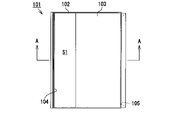
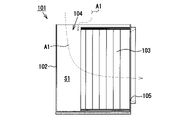
- the filter module 101 includes an outer box 102 and an obstacle wall 103.
- the outer box 102 has a rectangular cuboid shape and has an outer box inlet 104 that opens on the upper surface and an outer box outlet 105 that opens on the side surface.
- the obstacle wall 103 is arranged in the outer box 102 near the outer box outlet 105, and is housed in a state where the space S1 is provided on the inflow side.
- the air A1 containing the paint mist flows into the space S1 through the outer box inlet 104, changes its direction by about 90 °, passes through the obstacle wall 103, and is discharged from the outer box outlet 105.
- the paint mist is separated from the air A1 when passing through the obstacle wall 103.
- the space S1 is located at a biased position in the outer box 102 (the position on the left side in FIGS. 10 and 11), and the flow path is suddenly narrowed, so that the outer box is narrowed.
- a pressure loss occurs in the air A1 guided from the inlet 104 to the space S1.
- the air A1 flows unevenly toward a specific portion such as the inner surface of the outer box 102 or the obstacle wall 103, there is a problem that the efficiency of removing the paint mist is lowered.
- the present invention has been made in view of the above problems, and an object of the present invention is to provide a filter module for coating equipment capable of improving the efficiency of removing paint mist and preventing the outflow of paint mist to the outside. To do.
- the invention according to claim 1 is a filter module provided on an exhaust path of a coating facility and made of a flammable material, which has an upper surface and side surfaces and is opened at the upper surface.
- An outer box having an outer box inlet and an outer box outlet that opens on the side surface, and an outer box in which air containing paint mist flows into the inside from the outer box inlet and is discharged from the outer box outlet, and inside the outer box.
- a plurality of plate-shaped eliminator elements that are housed in the vicinity of the outer box outlet with a space on the inflow side and have a zigzag shape are arranged side by side to separate the paint mist from the air, and the eliminator.
- a plurality of baffle plate elements accommodated in the vicinity of the outer box inlet in the outer box and having an inclined surface for guiding the air in the inflow side space of the eliminator are arranged side by side, and the air introduced from the outer box inlet.
- the gist thereof is a filter module for coating equipment, which is provided with a baffle plate for guiding the inflow side space.
- a baffle plate is housed in the vicinity of the outer box entrance in the outer box, and a plurality of baffle plate elements constituting the baffle plate have an inclined surface that guides air into the inflow side space of the eliminator. is doing. Therefore, the air introduced into the outer box from the outer box inlet collides with each baffle plate element and changes the direction, so that the air is guided to the inflow side space. As a result, air is smoothly guided from the outer box entrance to the inflow side space. In this case, the air guided to the inflow side space flows evenly to the inner surface of the outer box and the surface of the eliminator element, so that the paint mist contained in the air flows to the inner surface of the outer box and the surface of the eliminator element.
- the air introduced into the outer box from the outer box inlet is guided by the baffle plate element and surely flows into the inflow side space, so that the paint mist contained in the air can be prevented from flowing out to the outside of the filter module. can.
- the filter module is made of a flammable material
- the filter module can be incinerated or disposable and replaced.
- examples of the flammable material include paper, resin, and wood. If corrugated cardboard or plastic corrugated cardboard is used as the flammable material, the strength of the filter module is improved.
- a rectifying plate in which a plurality of rectifying plate elements extending in the vertical direction are arranged side by side is housed in the inflow side space, and the pitch between the adjacent rectifying plate elements is accommodated. Is larger than the pitch between the adjacent eliminator elements and smaller than the pitch between the adjacent baffle plate elements.
- a straightening vane is housed in the inflow side space, and a plurality of straightening vane elements constituting the straightening vane extend in the vertical direction. Therefore, the air introduced from the baffle plate into the inflow side space collides with each straightening vane element and changes its direction, so that the air is guided to the eliminator on the downstream side. As a result, the air flows uniformly and evenly. That is, the contact area of air per unit flow rate increases. Therefore, the paint mist contained in the air easily adheres to the surface of the straightening vane element and also easily adheres to the surface of the eliminator element on the downstream side, so that the efficiency of removing the paint mist is further improved.
- the paint mist can be classified. Specifically, the baffle plate element having the largest pitch adheres and collects the paint mist having a large particle size, and the rectifying plate element having a medium pitch adheres the paint mist having a medium particle size.
- the eliminator element having the smallest pitch allows the paint mist having a small particle size to be attached and collected. As a result, the paint mist having a large particle size makes it difficult for the flow path on the downstream side where the pitch between adjacent elements is small to be clogged, so that the life of the filter module can be extended.
- the gist of the invention according to claim 3 is that, in claim 1, a plurality of projectiles are projected from the bottom surface of the outer box, and the space between the adjacent projectiles is a region for collecting paint. And.
- the paint mist contained in the air can be attached to the area where the paint is stored (the space between adjacent projecting pieces). As a result, it is possible to prevent the paint from flowing out of the space between the adjacent projecting pieces.
- the invention according to claim 4 is in a state in which, in claim 1, a secondary filter for passing the air that has passed through the eliminator protrudes from the outer box outlet on the outflow side of the eliminator.
- the gist is that it is provided.
- the secondary filter on the outflow side of the eliminator, the paint mist that has not been completely removed from the air after passing through the eliminator can be reliably removed by the secondary filter. Further, since the secondary filter is provided with a part of the secondary filter protruding from the outer box outlet, the volume of the secondary filter can be secured. If the entire secondary filter is housed in the outer box, it may not be possible to arrange the eliminator or the like at a desired position.
- the invention according to claim 5 is housed in a state of being placed on the upper ends of a plurality of the eliminator elements in the vicinity of the outer box entrance in the outer box, and is housed at the upper ends of the eliminator elements.
- a spacer having a spacer bottom surface that abuts and an inclined surface that guides the air into the inflow side space is provided, and the inclination angle of the baffle plate element with respect to the bottom surface of the outer box is larger than the inclination angle of the inclined surface with respect to the spacer bottom surface.
- the gist is that it is also large.
- the baffle plate is orthogonal to the plurality of baffle plate elements, and a plurality of connecting plates for connecting the plurality of baffle plate elements while maintaining a distance are provided.
- the gist is that the lower end of the baffle plate element is located above the lower end of the connecting plate.
- the invention according to claim 7 is housed in a state of being placed on the upper ends of a plurality of the eliminator elements in the vicinity of the outer box entrance in the outer box, and is housed at the upper ends of the eliminator elements.
- the baffle plate is provided with a spacer having an abutting bottom surface of the spacer and an inclined surface for guiding the air to the inflow side space, and the baffle plate is orthogonal to the plurality of baffle plate elements and is spaced between the plurality of baffle plate elements.
- the connecting plate has an inclined edge that abuts on the inclined surface, and the inclination angle of the inclined edge with respect to the bottom surface of the outer box is the inclination with respect to the bottom surface of the spacer.
- the gist is that it is equal to the inclination angle of the surface.
- the invention according to claim 8 is housed in a state of being placed on the upper ends of a plurality of the eliminator elements in the vicinity of the outer box entrance in the outer box, and is housed at the upper ends of the eliminator elements.
- a spacer having a spacer bottom surface that abuts and an inclined surface that guides the air to the inflow side space is provided, and the projected area of the inclined surface when viewed from the upper surface side of the outer box is the upstream side of the inflow side space.
- the gist is that it is larger than the opening area of the opening.
- the invention according to claim 9 is housed in a state of being placed on the upper ends of a plurality of the eliminator elements in the vicinity of the outer box entrance in the outer box, and is housed at the upper ends of the eliminator elements.
- a spacer having a bottom surface of a spacer that abuts and an inclined surface that guides the air into the inflow side space is provided, the spacer has a right-angled triangular shape in a side view, and the hypotenuse of the right-angled triangle constitutes the inclined surface. Is the gist.
- the invention according to claim 10 is a plurality of connecting plates in which the baffle plate is orthogonal to the plurality of baffle plate elements and connects the plurality of baffle plate elements while maintaining a space between the plurality of baffle plate elements.
- a rectifying plate formed by arranging a plurality of rectifying plate elements extending in the vertical direction in parallel is housed in the inflow side space, and the pitch between the adjacent rectifying plate elements is set between the adjacent connecting plates.
- the gist is that it is smaller than the pitch.
- the invention according to claim 11 is claimed in claim 1, wherein a rectifying plate formed by arranging a plurality of rectifying plate elements extending in the vertical direction in parallel is housed in the inflow side space, and the rectifying plate element is a downstream end. Is connected to the upstream end of the eliminator element.
- a plurality of projecting pieces are projected on the bottom surface of the outer box, and the space between the adjacent projecting pieces is a region for collecting paint, and the inflow side.
- a rectifying plate formed by arranging a plurality of rectifying plate elements extending in the vertical direction is housed in the space, and the rectifying plate includes a plurality of upper connecting plates for connecting the upper ends of the plurality of rectifying plate elements, and the above.
- the gist of the present invention is that a plurality of lower connecting plates for connecting the lower ends of the plurality of straightening vane elements are provided, and the lower connecting plate is used as the projecting piece.
- the gist of the invention according to claim 13 is that, in claim 1, the filter module is entirely made of corrugated cardboard.
- a filter module for coating equipment capable of improving the efficiency of removing paint mist and preventing the outflow of paint mist to the outside is provided. can do.
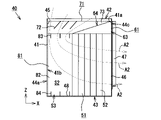
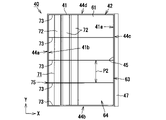
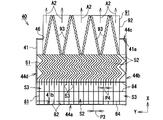
- FIG. 5 is a cross-sectional view taken along the line BB of FIG. Side view showing the filter module. Photographs showing the unfolded and folded states of the outer box, eliminator, spacer, baffle plate, and straightening vane. Schematic cross-sectional view showing a filter module in another embodiment.
- FIG. 10 is a cross-sectional view taken along the line AA.
- the filter module 40 of this embodiment is provided on the exhaust path E1 of the coating equipment 10.
- a transfer rail 12 In the coating chamber 11 constituting the coating equipment 10, a transfer rail 12, a transfer carriage 13 moving on the transfer rail 12, and a plurality of coating robots 14 arranged on both sides of the transfer rail 12 are provided. ..
- a coating film is formed on the surface of the work W1 by spraying atomized paint (paint mist) on the work W1 (automobile body in the present embodiment) from the painting gun 15 of the painting robot 14.
- a ceiling wall 16 is provided above the painting room 11.
- the ceiling wall 16 has a mesh structure, and compressed air A2 is supplied to the upper side.
- the air A2 passes through the ceiling wall 16 and flows down in the coating chamber 11, so that the coating mist that has not adhered to the work W1 is guided downward.
- the floor 17 of the painting chamber 11 has a crosspiece structure, and the underfloor wall 18 is arranged below.
- the underfloor wall 18 has the lowest central portion 19, and is provided with a pair of inclined portions 20 on both sides of the central portion 19.
- An exhaust port 21 is provided in the central portion 19, and an exhaust duct 22 is connected to the exhaust port 21 via a paint mist removing device 30.
- the inside of the exhaust duct 22 is in a negative pressure state due to a blower (not shown).
- a blower (not shown).
- the air A2 in the coating chamber 11 flows into the exhaust duct 22 after passing through the paint mist removing device 30.
- the paint mist contained in the air A2 is removed when passing through the paint mist removing device 30.
- the air A2 in the exhaust duct 22 is discharged to the outside of the coating equipment 10 after being subjected to, for example, VOC (volatile organic gas) removal treatment by a deodorizing device (not shown).
- VOC volatile organic gas
- a relay duct 23 communicating with the exhaust port 21 and extending downward is connected to the central portion 19 of the underfloor wall 18.
- the paint mist removing device 30 is connected to the lower end of the relay duct 23 and the suction hole (not shown) of the exhaust duct 22. More specifically, the paint mist removing device 30 includes an upstream duct 31 and a downstream duct 32. Then, the upper end flange (not shown) protruding from the upper end of the upstream duct 31 and the lower end flange (not shown) protruding from the lower end of the relay duct 23 are overlapped and screwed to the relay duct 23. The paint mist removing device 30 is connected. Further, the paint mist removing device 30 is connected to the exhaust duct 22 by inserting the downstream end of the downstream duct 32 into the suction hole of the exhaust duct 22.
- a filter module 40 is detachably attached between the upstream duct 31 and the downstream duct 32 in the paint mist removing device 30.
- the filter module 40 is entirely made of a flammable material (specifically, corrugated cardboard).
- the filter module 40 includes an outer box 41, an eliminator 51, a spacer 61, a baffle plate 71, and a rectifying plate 81.
- the outer box 41 has a rectangular cuboid shape having an upper surface 42, a lower surface 43, and four side surfaces 44a, 44b, 44c, 44d.
- the outer box 41 has a rectangular outer box inlet 45 that opens at the upper surface 42, and a rectangular outer box outlet 46 that opens at the side surface 44c on the downstream side (right side in FIG. 3). ..
- the opening area of the outer box inlet 45 is larger than the opening area of the outer box outlet 46, and is substantially equal to the area of the upper surface 42.
- the air A2 containing the paint mist flows into the inside from the outer box inlet 45 and is discharged from the outer box outlet 46.
- a rectangular frame-shaped duct connecting portion 47 surrounding the outer box outlet 46 is projected from the side surface 44c of the outer box 41. Then, the filter module 40 is connected to the downstream duct 32 by inserting the duct connecting portion 47 into the downstream duct 32.
- the eliminator 51 is housed in the outer box 41 in the vicinity of the outer box outlet 46 with a space (inflow side space S2) on the inflow side. ing.
- the eliminator 51 is formed by arranging a plurality of plate-shaped eliminator elements 52 in parallel, and has a function of separating the paint mist from the air A2.
- Each eliminator element 52 extends in the vertical direction Z (see FIGS. 3 and 5), and its lower end is in contact with the bottom surface 48 of the outer box 41.
- the bottom surface 48 is parallel to the top surface 42 of the outer box 41.
- each eliminator element 52 extends in the X direction (see FIGS. 3 and 6), which is the horizontal direction.
- the eliminator elements 52 have a zigzag shape in a plan view, and only the end portion 53 on the inflow side (the lower end portion in FIG. 6) has a linear shape in a plan view. Therefore, a meandering passage is formed between the adjacent eliminator elements 52.
- the spacer 61 is housed in the outer box 41 in the vicinity of the outer box entrance 45 in a state of being placed on the upper end of each eliminator element 52.
- the spacer 61 has a right-angled triangular shape when viewed from the side, and has a spacer bottom surface 62 that abuts on the upper end of each eliminator element 52, a back surface 63 that abuts on the inner side surface 41a on the downstream side of the outer box 41, and air in the inflow side space S2. It has an inclined surface 64 that guides A2.
- the hypotenuse of the right triangle constitutes the inclined surface 64.
- the projected area of the inclined surface 64 when viewed from the upper surface 42 side of the outer box 41 is larger than the opening area of the upstream opening of the inflow side space S2 (see FIGS. 3 and 4).
- the baffle plate 71 is housed in the vicinity of the outer box entrance 45 in the outer box 41.
- the baffle plate 71 is formed by arranging a plurality of baffle plate elements 72 having an inclined surface for guiding the air A2 on the upper surface side in the inflow side space S2, and the air A2 introduced from the outer box inlet 45 is introduced into the inflow side space S2. It has a guiding function.
- Each baffle plate element 72 extends in the horizontal Y direction (see FIGS. 4 and 5).
- the inclination angles ⁇ 1 of the baffle plate elements 72 with respect to the upper surface 42 of the outer box 41 are equal to each other.
- the inclination angle ⁇ 1 is larger than the inclination angle ⁇ 2 of the inclined surface 64 with respect to the spacer bottom surface 62 of the spacer 61.
- the pitches P1 between the adjacent baffle plate elements 72 are equal to each other.
- the baffle plate 71 has a plurality of connecting plates 73 that are orthogonal to each baffle plate element 72 and that connect the baffle plate elements 72 to each other while maintaining an interval. ing.
- Each connecting plate 73 extends in the horizontal X direction (see FIGS. 3 and 4).
- each connecting plate 73 has a lower end edge 74 that abuts on the upper end of the upper connecting plate 83 of the straightening vane 81, a side edge 75 that abuts on the inner side surface 41b on the upstream side of the outer box 41, and an inclined surface 64 of the spacer 61. It has an inclined edge 76 that abuts on.
- the pitches P2 between the adjacent connecting plates 73 are equal to each other.
- the lower end of each baffle plate element 72 is located above the lower end of each connecting plate 73.
- the straightening vane 81 is housed in the inflow side space S2 in the outer box 41.
- the straightening vane 81 is formed by arranging a plurality of straightening vane elements 82 in parallel.
- Each straightening vane element 82 extends in the vertical direction Z (see FIGS. 3 and 5), and its lower end is in contact with the bottom surface 48 of the outer box 41. Further, each straightening vane element 82 extends in the X direction (see FIGS. 3 and 6) in the horizontal direction, and the downstream end is connected to the upstream end of the eliminator element 52. In this way, the straightening vane 81 and the eliminator 51 can be reinforced with each other.
- the pitch P3 between the adjacent straightening vane elements 82 may be integrated with the eliminator element 52 or may be a separate body. Then, one end portion 53 of the eliminator element 52 is arranged between the adjacent straightening vane elements 82. Therefore, the pitch P3 between the adjacent straightening vane elements 82 is larger than the pitch P4 between the adjacent eliminator elements 52, and specifically, the pitch P4 is twice as large as the pitch P4. Further, the pitch P3 is smaller than the pitch P1 between the adjacent baffle plate elements 72 and the pitch P2 between the adjacent connecting plates 73.
- the straightening vane 81 includes a plurality of upper connecting plates 83 for connecting the upper end portions of the straightening vane elements 82, and a plurality of lower connecting plates 84 for connecting the lower end portions of the straightening vane elements 82. ..
- Each upper connecting plate 83 and each lower connecting plate 84 are orthogonal to each straightening vane element 82 and extend in the horizontal Y direction (see FIGS. 5 and 6).
- the upper end of each upper connecting plate 83 is in contact with the lower end of each connecting plate 73 constituting the baffle plate 71.
- the lower end of each lower connecting plate 84 is in contact with the bottom surface 48 of the outer box 41.
- Each lower connecting plate 84 of the present embodiment is used as a projecting piece projecting from the bottom surface 48. Then, the space S3 between the adjacent lower connecting plates 84 becomes an area for accumulating the paint (paint mist).
- the above-mentioned outer box 41, eliminator 51, spacer 61, baffle plate 71, and rectifying plate 81 have a foldable structure. Further, the eliminator 51 and the straightening vane 81 are connected to each other so that they can be unfolded and folded at the same time.
- the component parts of the filter module 40 (outer box 41, eliminator 51 and rectifying plate 81, spacer 61, baffle plate 71) are conveyed in a state of being folded into a flat shape. Then, the filter module 40 is completed by assembling each component in an unfolded state. The completed filter module 40 is placed in a standby position (not shown) outside the painting equipment 10.
- the filter module 40 at the use position T2 becomes dirty with the paint mist
- the filter module 40 is removed from the use position T2 and incinerated as it is without being folded. That is, the paint mist is discarded together with the filter module 40. Then, the filter module 40 in the standby position is placed and used in the use position T2.
- the oversprayed paint mist passes through the floor 17 of the paint chamber 11 together with the air A2 in the paint chamber 11 and is on the underfloor wall 18 side. Will be guided to.
- the air A2 containing the paint mist is guided into the relay duct 23 from the exhaust port 21 of the underfloor wall 18, passes through the upstream duct 31, and enters the outer box 41 (filter module 40) from the outer box inlet 45. It flows in. Then, the air A2 collides with the inclined surface 64 of the spacer 61, the surface of the baffle plate element 72 of the baffle plate 71, and the inner surface 41b on the upstream side of the outer box 41, so that the air A2 follows the inner surface 41b of the outer box 41. Is guided. At this time, a part of the paint mist contained in the air A2 is removed by adhering to the inclined surface 64 of the spacer 61, the surface of the baffle plate element 72, and the inner surface 41b of the outer box 41.
- the air A2 is guided to the straightening vane 81 on the downstream side of the baffle plate 71 and flows between the adjacent straightening vane elements 82.
- the air A2 is guided along the surface of the straightening vane element 82 by coming into contact with the surface of the straightening vane element 82.
- the flow of air A2 becomes uniform.
- a part of the paint mist contained in the air A2 is removed by adhering to the surface of the straightening vane element 82.
- the air A2 flows in the straightening vane 81 in an arc, and turns in a direction substantially opposite to the direction guided by the baffle plate 71 (see FIG. 3).
- a part of the air A2 collides with the bottom surface 48 of the outer box 41, a part of the paint mist contained in the air A2 is removed by adhering to the bottom surface 48.
- the air A2 is guided by the eliminator 51 on the downstream side of the straightening vane 81 and flows between the adjacent eliminator elements 52. Since each eliminator element 52 has a zigzag shape in a plan view, there is a meandering passage between adjacent eliminator elements 52. As a result, the air A2 flows in the meandering passage while colliding with the surface of the eliminator element 52, so that most of the paint mist contained in the air A2 is removed by adhering to the surface of the eliminator element 52. .. After that, the air A2 that has passed through the eliminator 51 is discharged from the outer box outlet 46 to the outside of the outer box 41, passes through the downstream duct 32 and the exhaust duct 22 in order, and is discharged to the outside of the painting equipment 10.
- the baffle plate element 72 constituting the baffle plate 71 has an inclined surface on the upper surface side that guides the air A2 into the inflow side space S2 of the eliminator 51. Therefore, the air A2 introduced into the outer box 41 from the outer box inlet 45 collides with the baffle plate element 72 and changes its direction, so that the air A2 is guided to the inflow side space S2. As a result, the air A2 is smoothly guided from the outer box inlet 45 to the inflow side space S2. In this case, the air A2 guided to the inflow side space S2 flows evenly to the inner side surface 41b of the outer box 41 and the surface of the eliminator element 52, so that the paint mist contained in the air A2 flows inside the outer box 41.
- the air A2 introduced into the outer box 41 from the outer box inlet 45 is guided by the baffle plate element 72 and surely flows into the inflow side space S2, so that the paint mist contained in the air A2 goes out of the filter module 40. Can be prevented from flowing out.
- the outer box 41, the eliminator 51, the rectifying plate 81, the spacer 61, and the baffle plate 71, which are the constituent parts of the filter module 40, have a foldable structure.
- the components of the filter module 40 can be transported in a folded and small state, so that the transport load can be reduced.
- the components can be folded and stored in a small size, it is easy to secure a storage place.
- the filter module 40 is made of corrugated cardboard, which is a flammable material, the filter module 40 can be incinerated and easily disposed of. Further, the filter module 40 can be formed at low cost.
- the eliminator 51, the spacer 61, the baffle plate 71 and the rectifying plate 81 are housed in the outer box 41 constituting the filter module 40, but the rectifying plate 81 and the spacer 61 may be omitted. good.
- a plurality of lower connecting plates 84 constituting the straightening vane 81 are used as projecting pieces projecting from the bottom surface 48 of the outer box 41.
- the projecting piece may be a separate body from the lower connecting plate 84 and may be connected to the bottom surface 48. Further, the projecting piece may be omitted.
- a secondary filter 91 for passing the air A2 that has passed through the eliminator 51 may be provided on the outflow side (upper side in FIG. 9) of the eliminator 50.
- the secondary filter 91 is configured by arranging filters 93 having a doglegged cross section in the case 92 in the Y direction. A part of the secondary filter 91 protrudes from the outer outlet 46. In this way, the paint mist that has not been completely removed from the air A2 after passing through the eliminator 51 can be reliably removed by the secondary filter 91. Further, since the secondary filter 91 is provided with a part thereof protruding from the outer box outlet 46, the volume of the secondary filter 91 can be secured. If the entire secondary filter 91 is housed in the outer box 41, the eliminator 51 or the like may not be arranged at a desired position.
- the work W1 to which the paint is sprayed is an automobile body.
- the work W1 may be an aerodynamic addition (such as a spoiler) or an automobile part such as a bumper.
- the work W1 does not necessarily have to be an automobile part.
Landscapes
- Chemical & Material Sciences (AREA)
- Chemical Kinetics & Catalysis (AREA)
- Separating Particles In Gases By Inertia (AREA)
- Details Or Accessories Of Spraying Plant Or Apparatus (AREA)
Abstract
塗料ミストの除去効率を向上でき、かつ外部への塗料ミストの流出を防止できる塗装設備用のフィルタモジュールを提供する。本発明のフィルタモジュール40は、可燃性材料からなり、外箱41、エリミネータ51及びバッフル板71を備える。外箱41では、塗料ミストを含む空気A2が外箱入口45から内部に流れ込んで外箱出口46から排出される。エリミネータ51は、ジグザグ状をなすエリミネータエレメント52を並設してなり、空気A2から塗料ミストを分離する。バッフル板71は、エリミネータ51の流入側空間S2に空気A2を導く傾斜面を有するバッフル板エレメント72を並設してなり、外箱入口45から導入された空気A2を流入側空間S2に導く。
Description
本発明は、空気から塗料ミストを分離する塗装設備用のフィルタモジュールに関するものである。
従来、空気から塗料ミストを分離するフィルタモジュールが種々提案されている(例えば、特許文献1参照)。図10,図11に示されるように、フィルタモジュール101は、外箱102と障害壁103とを備えている。外箱102は、直方体状をなし、上面にて開口する外箱入口104及び側面にて開口する外箱出口105を有している。また、障害壁103は、外箱102内における外箱出口105付近に寄せて配置され、かつ流入側に空間S1を有した状態で収容されている。そして、塗料ミストを含む空気A1は、外箱入口104を介して空間S1に流れ込み、90°程度向きを変えてから障害壁103を通過し、外箱出口105から排出される。なお、塗料ミストは、障害壁103の通過時に空気A1から分離される。
ところが、上記した従来のフィルタモジュール101の場合、空間S1が外箱102内における偏った位置(図10,図11では左寄りの位置)にあり、流路が急に狭くなっているため、外箱入口104から空間S1に導かれる空気A1に圧力損失が生じてしまう。この場合、空気A1が外箱102の内側面や障害壁103等の特定の部分に偏って流れるため、塗料ミストの除去効率が低下するという問題がある。
本発明は上記の課題に鑑みてなされたものであり、その目的は、塗料ミストの除去効率を向上させることができ、かつ外部への塗料ミストの流出を防止できる塗装設備用のフィルタモジュールを提供することにある。
上記課題を解決するために、請求項1に記載の発明は、塗装設備の排気経路上に設けられ、可燃性材料からなるフィルタモジュールであって、上面及び側面を有し、前記上面にて開口する外箱入口及び前記側面にて開口する外箱出口を有し、塗料ミストを含む空気が前記外箱入口から内部に流れ込んで前記外箱出口から排出される外箱と、前記外箱内における前記外箱出口付近にて流入側に空間を有した状態で収容され、ジグザグ状をなす複数の板状のエリミネータエレメントを並設してなり、前記空気から前記塗料ミストを分離するエリミネータと、前記外箱内における前記外箱入口付近に収容され、前記エリミネータの流入側空間に前記空気を導く傾斜面を有する複数のバッフル板エレメントを並設してなり、前記外箱入口から導入された前記空気を前記流入側空間に導くバッフル板とを備えることを特徴とする塗装設備用のフィルタモジュールをその要旨とする。
請求項1に記載の発明によると、外箱内における外箱入口付近にバッフル板が収容され、バッフル板を構成する複数のバッフル板エレメントが、エリミネータの流入側空間に空気を導く傾斜面を有している。このため、外箱入口から外箱内に導入された空気が各バッフル板エレメントに衝突して方向を変えることで、空気が流入側空間に導かれる。その結果、外箱入口から流入側空間に空気がスムーズに導かれる。この場合、流入側空間に導かれた空気が、外箱の内側面やエリミネータエレメントの表面に対して万遍なく流れるため、空気に含まれる塗料ミストが外箱の内側面やエリミネータエレメントの表面のより多くの領域に付着しやすくなり、塗料ミストの除去効率が向上する。また、外箱入口から外箱内に導入された空気は、バッフル板エレメントによって案内されて確実に流入側空間に流れ込むため、空気に含まれる塗料ミストのフィルタモジュール外への流出を防止することができる。
さらに、請求項1では、フィルタモジュールが可燃性材料からなるため、フィルタモジュールの焼却や使い捨て交換が可能である。ここで、可燃性材料としては、紙、樹脂、木材などが挙げられる。なお、可燃性材料として、段ボール紙やプラスチック段ボールを用いれば、フィルタモジュールの強度が向上する。
請求項2に記載の発明は、請求項1において、前記流入側空間に、上下方向に延びる複数の整流板エレメントを並設してなる整流板が収容され、隣接する前記整流板エレメント間のピッチは、隣接する前記エリミネータエレメント間のピッチよりも大きく、かつ、隣接する前記バッフル板エレメント間のピッチよりも小さいことをその要旨とする。
請求項2に記載の発明によると、流入側空間に整流板が収容され、整流板を構成する複数の整流板エレメントが上下方向に延びている。このため、バッフル板から流入側空間に導入された空気が各整流板エレメントに衝突して方向を変えることで、空気が下流側のエリミネータに導かれる。その結果、空気が偏りなく均一に流れる。即ち、単位流量当りの空気の接触面積が増加する。このため、空気に含まれる塗料ミストが整流板エレメントの表面に付着しやすくなり、下流側のエリミネータエレメントの表面にも付着しやすくなるため、塗料ミストの除去効率がよりいっそう向上する。
また、請求項2では、下流側に行くに従って、隣接するエレメント間のピッチが小さくなるため、塗料ミストの分級を行うことができる。具体的に言うと、ピッチが最も大きいバッフル板エレメントにより、粒子径が大きい塗料ミストを付着させて回収し、ピッチが中程度の整流板エレメントにより、粒子径が中程度の塗料ミストを付着させて回収し、ピッチが最も小さいエリミネータエレメントにより、粒子径が小さい塗料ミストを付着させて回収することができる。その結果、粒子径が大きい塗料ミストによって、隣接するエレメント間のピッチが小さい下流側の流路が詰まりにくくなるため、フィルタモジュールの長寿命化を図ることができる。
請求項3に記載の発明は、請求項1において、前記外箱の底面に複数の突片が突設され、隣接する前記突片間の空間が塗料を溜める領域となっていることをその要旨とする。
請求項3に記載の発明によると、外箱の底面に空気を接触させることにより、空気に含まれる塗料ミストを、塗料を溜める領域(隣接する突片間の空間)に付着させることができる。その結果、隣接する突片間の空間外への塗料流出を防止することができる。
請求項4に記載の発明は、請求項1において、前記エリミネータの流出側に、前記エリミネータを通過した前記空気を通過させる2次フィルタが、その一部を前記外箱出口から突出させた状態で設けられていることをその要旨とする。
請求項4に記載の発明によると、エリミネータの流出側に2次フィルタを設けることにより、エリミネータの通過後に空気から除去し切れていない塗料ミストを、2次フィルタで確実に除去することができる。また、2次フィルタが、その一部を外箱出口から突出させた状態で設けられるため、2次フィルタの容積を確保することができる。仮に、2次フィルタの全体を外箱に収容してしまうと、エリミネータ等を所望の位置に配置できない可能性がある。
請求項5に記載の発明は、請求項1において、前記外箱内における前記外箱入口付近にて複数の前記エリミネータエレメントの上端上に載置された状態で収容され、前記エリミネータエレメントの上端に当接するスペーサ底面と、前記流入側空間に前記空気を導く傾斜面とを有するスペーサを備え、前記外箱の底面に対する前記バッフル板エレメントの傾斜角度は、前記スペーサ底面に対する前記傾斜面の傾斜角度よりも大きいことをその要旨とする。
請求項6に記載の発明は、請求項1において、前記バッフル板は、前記複数のバッフル板エレメントに直交するとともに、前記複数のバッフル板エレメント同士を間隔を保持しながら連結する複数の連結板を有しており、前記バッフル板エレメントの下端は、前記連結板の下端よりも上方に位置していることをその要旨とする。
請求項7に記載の発明は、請求項1において、前記外箱内における前記外箱入口付近にて複数の前記エリミネータエレメントの上端上に載置された状態で収容され、前記エリミネータエレメントの上端に当接するスペーサ底面と、前記流入側空間に前記空気を導く傾斜面とを有するスペーサを備え、前記バッフル板は、前記複数のバッフル板エレメントに直交するとともに、前記複数のバッフル板エレメント同士を間隔を保持しながら連結する複数の連結板を有し、前記連結板は、前記傾斜面に当接する傾斜縁を有し、前記外箱の底面に対する前記傾斜縁の傾斜角度は、前記スペーサ底面に対する前記傾斜面の傾斜角度と等しいことをその要旨とする。
請求項8に記載の発明は、請求項1において、前記外箱内における前記外箱入口付近にて複数の前記エリミネータエレメントの上端上に載置された状態で収容され、前記エリミネータエレメントの上端に当接するスペーサ底面と、前記流入側空間に前記空気を導く傾斜面とを有するスペーサを備え、前記外箱の上面側から見たときの前記傾斜面の投影面積は、前記流入側空間の上流側開口部の開口面積よりも大きいことをその要旨とする。
請求項9に記載の発明は、請求項1において、前記外箱内における前記外箱入口付近にて複数の前記エリミネータエレメントの上端上に載置された状態で収容され、前記エリミネータエレメントの上端に当接するスペーサ底面と、前記流入側空間に前記空気を導く傾斜面とを有するスペーサを備え、前記スペーサは側面視で直角三角形状をなし、直角三角形の斜辺は前記傾斜面を構成していることをその要旨とする。
請求項10に記載の発明は、請求項1において、前記バッフル板は、前記複数のバッフル板エレメントに直交するとともに、前記複数のバッフル板エレメント同士を間隔を保持しながら連結する複数の連結板を有しており、前記流入側空間に、上下方向に延びる複数の整流板エレメントを並設してなる整流板が収容され、隣接する前記整流板エレメント間のピッチは、隣接する前記連結板間のピッチよりも小さいことをその要旨とする。
請求項11に記載の発明は、請求項1において、前記流入側空間に、上下方向に延びる複数の整流板エレメントを並設してなる整流板が収容され、前記整流板エレメントは、下流側端が前記エリミネータエレメントの上流側端に接続されていることをその要旨とする。
請求項12に記載の発明は、請求項1において、前記外箱の底面に複数の突片が突設され、隣接する前記突片間の空間が塗料を溜める領域となっており、前記流入側空間に、上下方向に延びる複数の整流板エレメントを並設してなる整流板が収容され、前記整流板が、前記複数の整流板エレメントの上端部同士を連結する複数の上側連結板と、前記複数の整流板エレメントの下端部同士を連結する複数の下側連結板とを備え、前記下側連結板が前記突片として用いられていることをその要旨とする。
請求項13に記載の発明は、請求項1において、前記フィルタモジュールは、全体が段ボール紙で形成されていることをその要旨とする。
以上詳述したように、請求項1~13に記載の発明によると、塗料ミストの除去効率を向上させることができ、かつ外部への塗料ミストの流出を防止できる塗装設備用のフィルタモジュールを提供することができる。
以下、本発明を具体化した一実施形態を図面に基づき詳細に説明する。
図1に示されるように、本実施形態のフィルタモジュール40は、塗装設備10の排気経路E1上に設けられる。塗装設備10を構成する塗装室11内には、搬送レール12と、搬送レール12上を移動する搬送台車13と、搬送レール12の両側に配置された複数の塗装ロボット14とが設けられている。なお、塗装室11では、塗装ロボット14の塗装ガン15からワークW1(本実施形態では自動車ボディ)に霧化した塗料(塗料ミスト)が吹き付けられることにより、ワークW1の表面に塗膜が形成される。
また、塗装室11の上部には天井壁16が設けられている。天井壁16は、メッシュ構造をなしており、上側に圧縮した空気A2が供給されるようになっている。その結果、空気A2は、天井壁16を通過して塗装室11内を流下するため、ワークW1に付着しなかった塗装ミストが下方に導かれる。一方、塗装室11の床17は、桟構造をなしており、下方には床下壁18が配置されている。床下壁18は、中央部19が最も低くなっており、中央部19の両側に一対の傾斜部20を備えている。そして、中央部19には排気口21が設けられており、排気口21には塗料ミスト除去装置30を介して排気ダクト22が接続されている。
なお、排気ダクト22内は、図示しないブロアーにより負圧状態となっている。これにより、塗装室11内の空気A2は、塗料ミスト除去装置30を通過した後、排気ダクト22に流れ込む。また、空気A2に含まれる塗料ミストは、塗料ミスト除去装置30の通過時に除去される。そして、排気ダクト22内の空気A2は、図示しない脱臭装置で例えばVOC(揮発性有機ガス)の除去処理を受けた後、塗装設備10外に排出される。
図1に示されるように、床下壁18の中央部19には、排気口21に連通しかつ下方に延びる中継ダクト23が接続されている。そして、塗料ミスト除去装置30は、中継ダクト23の下端部と、排気ダクト22の吸引孔(図示略)とに接続されている。詳述すると、塗料ミスト除去装置30は、上流側ダクト31及び下流側ダクト32を備えている。そして、上流側ダクト31の上端から張り出した上端フランジ(図示略)と、中継ダクト23の下端から張り出した下端フランジ(図示略)とを重ね合わせた状態でネジ止めすることにより、中継ダクト23に塗料ミスト除去装置30が接続される。また、下流側ダクト32の下流側端部が排気ダクト22の吸引孔に挿入されることにより、排気ダクト22に塗料ミスト除去装置30が接続される。
そして、塗料ミスト除去装置30における上流側ダクト31と下流側ダクト32との間には、フィルタモジュール40が着脱可能に取り付けられている。フィルタモジュール40は、全体が可燃性材料(具体的には、段ボール紙)で形成されている。図2~図7に示されるように、フィルタモジュール40は、外箱41、エリミネータ51、スペーサ61、バッフル板71及び整流板81を備えている。外箱41は、上面42、下面43、及び、4つの側面44a,44b,44c,44dを有する直方体状をなしている。また、外箱41は、上面42にて開口する矩形状の外箱入口45と、下流側(図3では右側)の側面44cにて開口する矩形状の外箱出口46とを有している。外箱入口45の開口面積は、外箱出口46の開口面積よりも大きく、上面42の面積とほぼ等しくなっている。なお、本実施形態の外箱41では、塗料ミストを含む空気A2が外箱入口45から内部に流れ込んで、外箱出口46から排出されるようになっている。さらに、外箱41の側面44cには、外箱出口46を包囲する矩形枠状のダクト接続部47が突設されている。そして、ダクト接続部47が下流側ダクト32に挿入されることにより、フィルタモジュール40が下流側ダクト32に接続される。
図2,図3,図5,図6に示されるように、エリミネータ51は、外箱41内における外箱出口46付近にて流入側に空間(流入側空間S2)を有した状態で収容されている。エリミネータ51は、複数の板状のエリミネータエレメント52を並設してなり、空気A2から塗料ミストを分離する機能を有している。各エリミネータエレメント52は、上下方向であるZ方向(図3,図5参照)に延びており、下端が外箱41の底面48に接触している。なお、底面48は、外箱41の上面42と平行になっている。また、各エリミネータエレメント52は、水平方向であるX方向(図3,図6参照)にも延びている。詳述すると、各エリミネータエレメント52は、大部分が平面視でジグザグ状をなしており、流入側の端部53(図6では下端部)のみが平面視で直線状をなしている。よって、隣接するエリミネータエレメント52間には、蛇行した通路が形成される。
図2~図5に示されるように、スペーサ61は、外箱41内における外箱入口45付近において、各エリミネータエレメント52の上端上に載置された状態で収容されている。スペーサ61は、側面視で直角三角形状をなし、各エリミネータエレメント52の上端に当接するスペーサ底面62と、外箱41の下流側の内側面41aに当接する背面63と、流入側空間S2に空気A2を導く傾斜面64とを有している。なお、直角三角形の斜辺は傾斜面64を構成している。また、外箱41の上面42側から見たときの傾斜面64の投影面積は、流入側空間S2の上流側開口部の開口面積よりも大きくなっている(図3,図4参照)。
そして、外箱41内における外箱入口45付近には、バッフル板71が収容されている。バッフル板71は、流入側空間S2に空気A2を導く傾斜面を上面側に有する複数のバッフル板エレメント72を並設してなり、外箱入口45から導入された空気A2を流入側空間S2に導く機能を有している。各バッフル板エレメント72は、水平方向であるY方向(図4,図5参照)に延びている。なお、外箱41の上面42に対する各バッフル板エレメント72の傾斜角度θ1は、互いに等しくなっている。また、傾斜角度θ1は、スペーサ61のスペーサ底面62に対する傾斜面64の傾斜角度θ2よりも大きくなっている。さらに、隣接するバッフル板エレメント72間のピッチP1は、互いに等しくなっている。
さらに、図2~図5に示されるように、バッフル板71は、各バッフル板エレメント72に直交するとともに、各バッフル板エレメント72同士を間隔を保持しながら連結する複数の連結板73を有している。各連結板73は、水平方向であるX方向(図3,図4参照)に延びている。また、各連結板73は、整流板81の上側連結板83の上端に当接する下端縁74と、外箱41の上流側の内側面41bに当接する側縁75と、スペーサ61の傾斜面64に当接する傾斜縁76とを有している。なお、隣接する連結板73間のピッチP2は、互いに等しくなっている。また、各バッフル板エレメント72の下端は、各連結板73の下端よりも上方に位置している。
図2,図3,図5,図6に示されるように、外箱41内の流入側空間S2には、整流板81が収容されている。整流板81は、複数の整流板エレメント82を並設してなる。各整流板エレメント82は、上下方向であるZ方向(図3,図5参照)に延びており、下端が外箱41の底面48に接触している。また、各整流板エレメント82は、水平方向であるX方向(図3,図6参照)にも延びており、下流側端がエリミネータエレメント52の上流側端に接続されている。このようにすれば、整流板81とエリミネータ51とを互いに補強することができる。また、隣接する整流板エレメント82間のピッチP3を一定に保持しやすくなる。さらに、整流板エレメント82の下流側端とエリミネータエレメント52の上流側端との間に隙間が生じなくなるため、空気A2が隙間に入り込んで乱れるといった問題を解消することができる。なお、整流板エレメント82は、エリミネータエレメント52と一体であってもよいし、別体であってもよい。そして、それぞれの隣接する整流板エレメント82間には、エリミネータエレメント52の端部53が1つずつ配置されている。よって、隣接する整流板エレメント82間のピッチP3は、隣接するエリミネータエレメント52間のピッチP4よりも大きくなっており、具体的には、ピッチP4の2倍の大きさになっている。また、ピッチP3は、隣接するバッフル板エレメント72間のピッチP1や隣接する連結板73間のピッチP2よりも小さくなっている。
また、整流板81は、各整流板エレメント82の上端部同士を連結する複数の上側連結板83と、各整流板エレメント82の下端部同士を接続する複数の下側連結板84を備えている。各上側連結板83及び各下側連結板84は、各整流板エレメント82に直交しており、水平方向であるY方向(図5,図6参照)に延びている。また、各上側連結板83の上端は、バッフル板71を構成する各連結板73の下端に当接している。一方、各下側連結板84の下端は、外箱41に底面48に当接している。なお、本実施形態の各下側連結板84は、底面48に突設される突片として用いられている。そして、隣接する下側連結板84間の空間S3が、塗料(塗料ミスト)を溜める領域となる。
図8に示されるように、上述した外箱41、エリミネータ51、スペーサ61、バッフル板71、整流板81は、折畳み可能な構造を有している。また、エリミネータ51及び整流板81は、互いに連結されており、同時に展開及び折畳みされるようになっている。なお、本実施形態では、フィルタモジュール40の構成部品(外箱41、エリミネータ51及び整流板81、スペーサ61、バッフル板71)が、平形状に折畳まれた状態で搬送される。そして、各構成部品を展開した状態で組み立てることにより、フィルタモジュール40が完成する。なお、完成したフィルタモジュール40は、塗装設備10外の待機位置(図示略)に載置される。その後、使用位置T2(図1参照)にあるフィルタモジュール40が塗料ミストで汚れてくると、そのフィルタモジュール40は使用位置T2から取り外されて、折畳まれることなく、そのまま焼却処分される。即ち、塗料ミストは、フィルタモジュール40ごと破棄される。そして、待機位置にあるフィルタモジュール40が、使用位置T2に載置されて用いられる。
次に、塗装設備10の作用を説明する。
まず、塗装ガン15から塗料を噴霧してワークW1の塗装を行うと、オーバースプレーされた塗料ミストが、塗装室11内の空気A2とともに、塗装室11の床17を通過して床下壁18側に案内される。
その後、塗料ミストを含む空気A2は、床下壁18の排気口21から中継ダクト23内に導かれ、上流側ダクト31を通過して、外箱入口45から外箱41(フィルタモジュール40)内に流れ込む。そして、空気A2は、スペーサ61の傾斜面64、バッフル板71のバッフル板エレメント72の表面、及び外箱41の上流側の内側面41bに衝突することにより、外箱41の内側面41bに沿うように誘導される。このとき、空気A2に含まれる塗料ミストの一部が、スペーサ61の傾斜面64、バッフル板エレメント72の表面及び外箱41の内側面41bに付着することにより除去される。
次に、空気A2は、バッフル板71の下流側にある整流板81に導かれ、隣接する整流板エレメント82間に流れ込む。このとき、空気A2は、整流板エレメント82の表面に接触することにより、整流板エレメント82の表面に沿うように誘導される。その結果、空気A2の流れが均一になる。また、空気A2に含まれる塗料ミストの一部は、整流板エレメント82の表面に付着することにより除去される。さらに、空気A2は、整流板81内で円弧を描くように流れ、バッフル板71で誘導された方向とはほぼ逆方向に向きを変える(図3参照)。このとき、空気A2の一部が外箱41の底面48に衝突するため、空気A2に含まれる塗料ミストの一部は、底面48に付着することにより除去される。
さらに、空気A2は、整流板81の下流側にあるエリミネータ51に導かれ、隣接するエリミネータエレメント52間に流れ込む。なお、各エリミネータエレメント52は平面視でジグザグ状をなすため、隣接するエリミネータエレメント52間は蛇行した通路となっている。その結果、空気A2は、蛇行した通路内をエリミネータエレメント52の表面に衝突しながら流れるため、空気A2に含まれている塗料ミストの殆どは、エリミネータエレメント52の表面に付着することにより除去される。その後、エリミネータ51を通過した空気A2は、外箱出口46から外箱41外に排出され、下流側ダクト32及び排気ダクト22を順番に通過して塗装設備10外に排出される。
従って、本実施形態によれば以下のような効果を得ることができる。
(1)本実施形態の塗装設備10によれば、バッフル板71を構成するバッフル板エレメント72が、エリミネータ51の流入側空間S2に空気A2を導く傾斜面を上面側に有している。このため、外箱入口45から外箱41内に導入された空気A2がバッフル板エレメント72に衝突して方向を変えることで、空気A2が流入側空間S2に導かれる。その結果、外箱入口45から流入側空間S2に空気A2がスムーズに導かれる。この場合、流入側空間S2に導かれた空気A2が、外箱41の内側面41bやエリミネータエレメント52の表面に対して万遍なく流れるため、空気A2に含まれる塗料ミストが外箱41の内側面41bやエリミネータエレメント52の表面のより多くの領域に付着しやすくなり、塗料ミストの除去効率が向上する。また、外箱入口45から外箱41内に導入された空気A2は、バッフル板エレメント72によって案内されて確実に流入側空間S2に流れ込むため、空気A2に含まれる塗料ミストのフィルタモジュール40外への流出を防止することができる。
(2)本実施形態では、フィルタモジュール40の構成部品である外箱41、エリミネータ51及び整流板81、スペーサ61、バッフル板71が、折畳み可能な構造となっている。その結果、フィルタモジュール40の構成部品を折畳んで小さくした状態で搬送できるため、搬送の負荷を低減することができる。また、構成部品を折畳んで小さくした状態で保管できるため、保管場所の確保も容易になる。
(3)本実施形態では、フィルタモジュール40が可燃性材料である段ボール紙からなるため、フィルタモジュール40を焼却して容易に処分することができる。また、フィルタモジュール40を低コストで形成できる。
なお、上記実施形態を以下のように変更してもよい。
・上記実施形態では、フィルタモジュール40を構成する外箱41内に、エリミネータ51、スペーサ61、バッフル板71及び整流板81が収容されていたが、整流板81やスペーサ61は省略されていてもよい。
・上記実施形態では、整流板81を構成する複数の下側連結板84が、外箱41の底面48に突設される突片として用いられていた。しかし、突片は、下側連結板84とは別体であって、底面48に接続されたものであってもよい。また、突片は省略されていてもよい。
・図9に示されるように、エリミネータ50の流出側(図9では上側)に、エリミネータ51を通過した空気A2を通過させる2次フィルタ91を設けてもよい。2次フィルタ91は、ケース92内において、断面く字状をなすフィルタ93をY方向に並設することにより構成されている。また、2次フィルタ91の一部は、外側出口46から突出している。このようにすれば、エリミネータ51の通過後に空気A2から除去しきれていない塗料ミストを、2次フィルタ91で確実に除去することができる。また、2次フィルタ91が、その一部を外箱出口46から突出させた状態で設けられるため、2次フィルタ91の容積を確保することができる。仮に、2次フィルタ91の全体を外箱41に収容してしまうと、エリミネータ51等を所望の位置に配置できない可能性がある。
・上記実施形態では、塗料が吹き付けられるワークW1は自動車ボディであった。しかし、ワークW1は、空力付加物(スポイラーなど)やバンパーなどの自動車用部品であってもよい。なお、ワークW1は、必ずしも自動車用部品でなくてもよい。
10…塗装設備
40…フィルタモジュール
41…外箱
42…外箱の上面
44c…外箱の側面
45…外箱入口
46…外箱出口
48…外箱の底面
51…エリミネータ
52…エリミネータエレメント
71…バッフル板
72…バッフル板エレメント
81…整流板
82…整流板エレメント
84…突片としての下側連結板
91…2次フィルタ
A2…空気
E1…排気経路
P3…隣接する整流板エレメント間のピッチ
P4…隣接するエリミネータエレメント間のピッチ
S2…流入側空間
S3…隣接する突片間の空間
40…フィルタモジュール
41…外箱
42…外箱の上面
44c…外箱の側面
45…外箱入口
46…外箱出口
48…外箱の底面
51…エリミネータ
52…エリミネータエレメント
71…バッフル板
72…バッフル板エレメント
81…整流板
82…整流板エレメント
84…突片としての下側連結板
91…2次フィルタ
A2…空気
E1…排気経路
P3…隣接する整流板エレメント間のピッチ
P4…隣接するエリミネータエレメント間のピッチ
S2…流入側空間
S3…隣接する突片間の空間
Claims (13)
- 塗装設備の排気経路上に設けられ、可燃性材料からなるフィルタモジュールであって、
上面及び側面を有し、前記上面にて開口する外箱入口及び前記側面にて開口する外箱出口を有し、塗料ミストを含む空気が前記外箱入口から内部に流れ込んで前記外箱出口から排出される外箱と、
前記外箱内における前記外箱出口付近にて流入側に空間を有した状態で収容され、ジグザグ状をなす複数の板状のエリミネータエレメントを並設してなり、前記空気から前記塗料ミストを分離するエリミネータと、
前記外箱内における前記外箱入口付近に収容され、前記エリミネータの流入側空間に前記空気を導く傾斜面を有する複数のバッフル板エレメントを並設してなり、前記外箱入口から導入された前記空気を前記流入側空間に導くバッフル板と
を備えることを特徴とする塗装設備用のフィルタモジュール。 - 前記流入側空間に、上下方向に延びる複数の整流板エレメントを並設してなる整流板が収容され、
隣接する前記整流板エレメント間のピッチは、隣接する前記エリミネータエレメント間のピッチよりも大きく、かつ、隣接する前記バッフル板エレメント間のピッチよりも小さい
ことを特徴とする請求項1に記載の塗装設備用のフィルタモジュール。 - 前記外箱の底面に複数の突片が突設され、隣接する前記突片間の空間が塗料を溜める領域となっていることを特徴とする請求項1に記載の塗装設備用のフィルタモジュール。
- 前記エリミネータの流出側に、前記エリミネータを通過した前記空気を通過させる2次フィルタが、その一部を前記外箱出口から突出させた状態で設けられていることを特徴とする請求項1に記載の塗装設備用のフィルタモジュール。
- 前記外箱内における前記外箱入口付近にて複数の前記エリミネータエレメントの上端上に載置された状態で収容され、前記エリミネータエレメントの上端に当接するスペーサ底面と、前記流入側空間に前記空気を導く傾斜面とを有するスペーサを備え、
前記外箱の底面に対する前記バッフル板エレメントの傾斜角度は、前記スペーサ底面に対する前記傾斜面の傾斜角度よりも大きい
ことを特徴とする請求項1に記載の塗装設備用のフィルタモジュール。 - 前記バッフル板は、前記複数のバッフル板エレメントに直交するとともに、前記複数のバッフル板エレメント同士を間隔を保持しながら連結する複数の連結板を有しており、
前記バッフル板エレメントの下端は、前記連結板の下端よりも上方に位置している
ことを特徴とする請求項1に記載の塗装設備用のフィルタモジュール。 - 前記外箱内における前記外箱入口付近にて複数の前記エリミネータエレメントの上端上に載置された状態で収容され、前記エリミネータエレメントの上端に当接するスペーサ底面と、前記流入側空間に前記空気を導く傾斜面とを有するスペーサを備え、
前記バッフル板は、前記複数のバッフル板エレメントに直交するとともに、前記複数のバッフル板エレメント同士を間隔を保持しながら連結する複数の連結板を有し、
前記連結板は、前記傾斜面に当接する傾斜縁を有し、
前記外箱の底面に対する前記傾斜縁の傾斜角度は、前記スペーサ底面に対する前記傾斜面の傾斜角度と等しい
ことを特徴とする請求項1に記載の塗装設備用のフィルタモジュール。 - 前記外箱内における前記外箱入口付近にて複数の前記エリミネータエレメントの上端上に載置された状態で収容され、前記エリミネータエレメントの上端に当接するスペーサ底面と、前記流入側空間に前記空気を導く傾斜面とを有するスペーサを備え、
前記外箱の上面側から見たときの前記傾斜面の投影面積は、前記流入側空間の上流側開口部の開口面積よりも大きい
ことを特徴とする請求項1に記載の塗装設備用のフィルタモジュール。 - 前記外箱内における前記外箱入口付近にて複数の前記エリミネータエレメントの上端上に載置された状態で収容され、前記エリミネータエレメントの上端に当接するスペーサ底面と、前記流入側空間に前記空気を導く傾斜面とを有するスペーサを備え、
前記スペーサは側面視で直角三角形状をなし、直角三角形の斜辺は前記傾斜面を構成している
ことを特徴とする請求項1に記載の塗装設備用のフィルタモジュール。 - 前記バッフル板は、前記複数のバッフル板エレメントに直交するとともに、前記複数のバッフル板エレメント同士を間隔を保持しながら連結する複数の連結板を有しており、
前記流入側空間に、上下方向に延びる複数の整流板エレメントを並設してなる整流板が収容され、
隣接する前記整流板エレメント間のピッチは、隣接する前記連結板間のピッチよりも小さい
ことを特徴とする請求項1に記載の塗装設備用のフィルタモジュール。 - 前記流入側空間に、上下方向に延びる複数の整流板エレメントを並設してなる整流板が収容され、
前記整流板エレメントは、下流側端が前記エリミネータエレメントの上流側端に接続されている
ことを特徴とする請求項1に記載の塗装設備用のフィルタモジュール。 - 前記外箱の底面に複数の突片が突設され、隣接する前記突片間の空間が塗料を溜める領域となっており、
前記流入側空間に、上下方向に延びる複数の整流板エレメントを並設してなる整流板が収容され、
前記整流板が、前記複数の整流板エレメントの上端部同士を連結する複数の上側連結板と、前記複数の整流板エレメントの下端部同士を連結する複数の下側連結板とを備え、
前記下側連結板が前記突片として用いられている
ことを特徴とする請求項1に記載の塗装設備用のフィルタモジュール。 - 前記フィルタモジュールは、全体が段ボール紙で形成されていることを特徴とする請求項1に記載の塗装設備用のフィルタモジュール。
Priority Applications (3)
| Application Number | Priority Date | Filing Date | Title |
|---|---|---|---|
| CN202180000364.8A CN115087503B (zh) | 2021-01-15 | 2021-01-15 | 喷涂设备用的过滤模块 |
| US17/428,658 US12036570B2 (en) | 2021-01-15 | 2021-01-15 | Filter module for coating equipment |
| PCT/JP2021/001172 WO2022153473A1 (ja) | 2021-01-15 | 2021-01-15 | 塗装設備用のフィルタモジュール |
Applications Claiming Priority (1)
| Application Number | Priority Date | Filing Date | Title |
|---|---|---|---|
| PCT/JP2021/001172 WO2022153473A1 (ja) | 2021-01-15 | 2021-01-15 | 塗装設備用のフィルタモジュール |
Publications (1)
| Publication Number | Publication Date |
|---|---|
| WO2022153473A1 true WO2022153473A1 (ja) | 2022-07-21 |
Family
ID=82448078
Family Applications (1)
| Application Number | Title | Priority Date | Filing Date |
|---|---|---|---|
| PCT/JP2021/001172 Ceased WO2022153473A1 (ja) | 2021-01-15 | 2021-01-15 | 塗装設備用のフィルタモジュール |
Country Status (3)
| Country | Link |
|---|---|
| US (1) | US12036570B2 (ja) |
| CN (1) | CN115087503B (ja) |
| WO (1) | WO2022153473A1 (ja) |
Cited By (1)
| Publication number | Priority date | Publication date | Assignee | Title |
|---|---|---|---|---|
| EP4613384A1 (de) * | 2024-03-05 | 2025-09-10 | Innovative Paint & Conveyor Systems S.L., | Verfahren zur ausbildung eines filtermoduls in einer filteranlage zur reinigung eines mit overspray-beladenen luftstroms |
Families Citing this family (1)
| Publication number | Priority date | Publication date | Assignee | Title |
|---|---|---|---|---|
| CN118635046B (zh) * | 2024-08-15 | 2024-12-10 | 安徽天柱特种电缆有限公司 | 电缆加工表面材料喷涂设备 |
Citations (4)
| Publication number | Priority date | Publication date | Assignee | Title |
|---|---|---|---|---|
| JP2012242538A (ja) * | 2011-05-18 | 2012-12-10 | Seiko Epson Corp | プロジェクター |
| US20160023231A1 (en) * | 2013-03-11 | 2016-01-28 | Eisenmann Se | Method for operating a surface treatment installation, set of filter modules and surface treatment installation |
| US20190076869A1 (en) * | 2016-02-17 | 2019-03-14 | Eisenmann Se | Method for operating a surface treatment installation and device for separating out overspray |
| JP2021000580A (ja) * | 2019-06-19 | 2021-01-07 | トリニティ工業株式会社 | 塗料ミスト除去装置及び塗装設備 |
Family Cites Families (4)
| Publication number | Priority date | Publication date | Assignee | Title |
|---|---|---|---|---|
| AT408847B (de) * | 2000-03-08 | 2002-03-25 | Eder Michael | Verfahren und einrichtung zur reinigung von mit lackpartikeln verunreinigter luft |
| EP2688656B1 (en) * | 2011-03-23 | 2019-11-13 | General Electric Technology GmbH | Device for separating water droplets from a gas or vapor flow |
| CN105149152B (zh) | 2015-09-27 | 2023-04-18 | 嘉兴启净涂装科技有限公司 | 一种干式沉降式漆雾分离装置及其应用 |
| CN105268584B (zh) * | 2015-11-09 | 2019-05-24 | 嘉兴启净涂装科技有限公司 | 一种折流式漆雾捕集装置 |
-
2021
- 2021-01-15 WO PCT/JP2021/001172 patent/WO2022153473A1/ja not_active Ceased
- 2021-01-15 CN CN202180000364.8A patent/CN115087503B/zh active Active
- 2021-01-15 US US17/428,658 patent/US12036570B2/en active Active
Patent Citations (4)
| Publication number | Priority date | Publication date | Assignee | Title |
|---|---|---|---|---|
| JP2012242538A (ja) * | 2011-05-18 | 2012-12-10 | Seiko Epson Corp | プロジェクター |
| US20160023231A1 (en) * | 2013-03-11 | 2016-01-28 | Eisenmann Se | Method for operating a surface treatment installation, set of filter modules and surface treatment installation |
| US20190076869A1 (en) * | 2016-02-17 | 2019-03-14 | Eisenmann Se | Method for operating a surface treatment installation and device for separating out overspray |
| JP2021000580A (ja) * | 2019-06-19 | 2021-01-07 | トリニティ工業株式会社 | 塗料ミスト除去装置及び塗装設備 |
Cited By (1)
| Publication number | Priority date | Publication date | Assignee | Title |
|---|---|---|---|---|
| EP4613384A1 (de) * | 2024-03-05 | 2025-09-10 | Innovative Paint & Conveyor Systems S.L., | Verfahren zur ausbildung eines filtermoduls in einer filteranlage zur reinigung eines mit overspray-beladenen luftstroms |
Also Published As
| Publication number | Publication date |
|---|---|
| US20240024907A1 (en) | 2024-01-25 |
| CN115087503A (zh) | 2022-09-20 |
| US12036570B2 (en) | 2024-07-16 |
| CN115087503B (zh) | 2024-06-07 |
Similar Documents
| Publication | Publication Date | Title |
|---|---|---|
| US10780382B2 (en) | Filter module and device for the separation of overspray, and plant having the same | |
| JP6096771B2 (ja) | オーバースプレーを分離するための方法及び装置、及び該装置を備えた設備 | |
| JP6895011B1 (ja) | 塗装設備用のフィルタモジュール | |
| CN105848751B (zh) | 用于油漆微粒的清洁系统 | |
| US9833805B2 (en) | Method for operating a surface treatment installation, set of filter modules and surface treatment installation | |
| US11400400B2 (en) | Separating unit having an impaction surface | |
| US11745206B2 (en) | Filtering apparatus with at least one filter unit | |
| US11992795B2 (en) | Filter structure body and filter module for separating impurities from a raw fluid stream | |
| WO2022153473A1 (ja) | 塗装設備用のフィルタモジュール | |
| JP5422814B2 (ja) | 塗料捕集システム | |
| CN113368640B (zh) | 涂料雾捕集装置 | |
| US7806951B2 (en) | Mobile airborne contaminant control chamber | |
| JP2017070936A (ja) | 空中浮遊物の捕捉装置および空中浮遊物の分離装置 | |
| JP7475796B2 (ja) | フィルタモジュール | |
| JP2025162889A (ja) | 塗装設備用のフィルタモジュール | |
| FI130203B (fi) | Huuva | |
| HK40077938A (en) | Separation system for paint overspray | |
| JP2024148605A (ja) | 塗料ミスト除去装置 |
Legal Events
| Date | Code | Title | Description |
|---|---|---|---|
| WWE | Wipo information: entry into national phase |
Ref document number: 17428658 Country of ref document: US |
|
| 121 | Ep: the epo has been informed by wipo that ep was designated in this application |
Ref document number: 21919366 Country of ref document: EP Kind code of ref document: A1 |
|
| NENP | Non-entry into the national phase |
Ref country code: DE |
|
| 122 | Ep: pct application non-entry in european phase |
Ref document number: 21919366 Country of ref document: EP Kind code of ref document: A1 |
|
| NENP | Non-entry into the national phase |
Ref country code: JP |