WO2022158493A1 - アントラキノン化合物を含有する液晶組成物及び調光素子 - Google Patents
アントラキノン化合物を含有する液晶組成物及び調光素子 Download PDFInfo
- Publication number
- WO2022158493A1 WO2022158493A1 PCT/JP2022/001831 JP2022001831W WO2022158493A1 WO 2022158493 A1 WO2022158493 A1 WO 2022158493A1 JP 2022001831 W JP2022001831 W JP 2022001831W WO 2022158493 A1 WO2022158493 A1 WO 2022158493A1
- Authority
- WO
- WIPO (PCT)
- Prior art keywords
- liquid crystal
- group
- linear
- crystal composition
- carbon atoms
- Prior art date
- Legal status (The legal status is an assumption and is not a legal conclusion. Google has not performed a legal analysis and makes no representation as to the accuracy of the status listed.)
- Ceased
Links
Classifications
-
- C—CHEMISTRY; METALLURGY
- C09—DYES; PAINTS; POLISHES; NATURAL RESINS; ADHESIVES; COMPOSITIONS NOT OTHERWISE PROVIDED FOR; APPLICATIONS OF MATERIALS NOT OTHERWISE PROVIDED FOR
- C09K—MATERIALS FOR MISCELLANEOUS APPLICATIONS, NOT PROVIDED FOR ELSEWHERE
- C09K19/00—Liquid crystal materials
- C09K19/52—Liquid crystal materials characterised by components which are not liquid crystals, e.g. additives with special physical aspect: solvents, solid particles
- C09K19/60—Pleochroic dyes
- C09K19/603—Anthroquinonic
-
- C—CHEMISTRY; METALLURGY
- C09—DYES; PAINTS; POLISHES; NATURAL RESINS; ADHESIVES; COMPOSITIONS NOT OTHERWISE PROVIDED FOR; APPLICATIONS OF MATERIALS NOT OTHERWISE PROVIDED FOR
- C09K—MATERIALS FOR MISCELLANEOUS APPLICATIONS, NOT PROVIDED FOR ELSEWHERE
- C09K19/00—Liquid crystal materials
- C09K19/52—Liquid crystal materials characterised by components which are not liquid crystals, e.g. additives with special physical aspect: solvents, solid particles
-
- C—CHEMISTRY; METALLURGY
- C08—ORGANIC MACROMOLECULAR COMPOUNDS; THEIR PREPARATION OR CHEMICAL WORKING-UP; COMPOSITIONS BASED THEREON
- C08F—MACROMOLECULAR COMPOUNDS OBTAINED BY REACTIONS ONLY INVOLVING CARBON-TO-CARBON UNSATURATED BONDS
- C08F2/00—Processes of polymerisation
- C08F2/44—Polymerisation in the presence of compounding ingredients, e.g. plasticisers, dyestuffs, fillers
-
- C—CHEMISTRY; METALLURGY
- C08—ORGANIC MACROMOLECULAR COMPOUNDS; THEIR PREPARATION OR CHEMICAL WORKING-UP; COMPOSITIONS BASED THEREON
- C08F—MACROMOLECULAR COMPOUNDS OBTAINED BY REACTIONS ONLY INVOLVING CARBON-TO-CARBON UNSATURATED BONDS
- C08F2/00—Processes of polymerisation
- C08F2/46—Polymerisation initiated by wave energy or particle radiation
- C08F2/48—Polymerisation initiated by wave energy or particle radiation by ultraviolet or visible light
- C08F2/50—Polymerisation initiated by wave energy or particle radiation by ultraviolet or visible light with sensitising agents
-
- C—CHEMISTRY; METALLURGY
- C09—DYES; PAINTS; POLISHES; NATURAL RESINS; ADHESIVES; COMPOSITIONS NOT OTHERWISE PROVIDED FOR; APPLICATIONS OF MATERIALS NOT OTHERWISE PROVIDED FOR
- C09B—ORGANIC DYES OR CLOSELY-RELATED COMPOUNDS FOR PRODUCING DYES, e.g. PIGMENTS; MORDANTS; LAKES
- C09B67/00—Influencing the physical, e.g. the dyeing or printing properties of dyestuffs without chemical reactions, e.g. by treating with solvents grinding or grinding assistants, coating of pigments or dyes; Process features in the making of dyestuff preparations; Dyestuff preparations of a special physical nature, e.g. tablets, films
- C09B67/0033—Blends of pigments; Mixtured crystals; Solid solutions
- C09B67/0034—Mixtures of two or more pigments or dyes of the same type
- C09B67/0038—Mixtures of anthraquinones
-
- C—CHEMISTRY; METALLURGY
- C09—DYES; PAINTS; POLISHES; NATURAL RESINS; ADHESIVES; COMPOSITIONS NOT OTHERWISE PROVIDED FOR; APPLICATIONS OF MATERIALS NOT OTHERWISE PROVIDED FOR
- C09K—MATERIALS FOR MISCELLANEOUS APPLICATIONS, NOT PROVIDED FOR ELSEWHERE
- C09K19/00—Liquid crystal materials
- C09K19/52—Liquid crystal materials characterised by components which are not liquid crystals, e.g. additives with special physical aspect: solvents, solid particles
- C09K19/54—Additives having no specific mesophase characterised by their chemical composition
- C09K19/542—Macromolecular compounds
-
- C—CHEMISTRY; METALLURGY
- C09—DYES; PAINTS; POLISHES; NATURAL RESINS; ADHESIVES; COMPOSITIONS NOT OTHERWISE PROVIDED FOR; APPLICATIONS OF MATERIALS NOT OTHERWISE PROVIDED FOR
- C09K—MATERIALS FOR MISCELLANEOUS APPLICATIONS, NOT PROVIDED FOR ELSEWHERE
- C09K19/00—Liquid crystal materials
- C09K19/52—Liquid crystal materials characterised by components which are not liquid crystals, e.g. additives with special physical aspect: solvents, solid particles
- C09K19/60—Pleochroic dyes
-
- G—PHYSICS
- G02—OPTICS
- G02F—OPTICAL DEVICES OR ARRANGEMENTS FOR THE CONTROL OF LIGHT BY MODIFICATION OF THE OPTICAL PROPERTIES OF THE MEDIA OF THE ELEMENTS INVOLVED THEREIN; NON-LINEAR OPTICS; FREQUENCY-CHANGING OF LIGHT; OPTICAL LOGIC ELEMENTS; OPTICAL ANALOGUE/DIGITAL CONVERTERS
- G02F1/00—Devices or arrangements for the control of the intensity, colour, phase, polarisation or direction of light arriving from an independent light source, e.g. switching, gating or modulating; Non-linear optics
- G02F1/01—Devices or arrangements for the control of the intensity, colour, phase, polarisation or direction of light arriving from an independent light source, e.g. switching, gating or modulating; Non-linear optics for the control of the intensity, phase, polarisation or colour
- G02F1/13—Devices or arrangements for the control of the intensity, colour, phase, polarisation or direction of light arriving from an independent light source, e.g. switching, gating or modulating; Non-linear optics for the control of the intensity, phase, polarisation or colour based on liquid crystals, e.g. single liquid crystal display cells
-
- C—CHEMISTRY; METALLURGY
- C09—DYES; PAINTS; POLISHES; NATURAL RESINS; ADHESIVES; COMPOSITIONS NOT OTHERWISE PROVIDED FOR; APPLICATIONS OF MATERIALS NOT OTHERWISE PROVIDED FOR
- C09K—MATERIALS FOR MISCELLANEOUS APPLICATIONS, NOT PROVIDED FOR ELSEWHERE
- C09K19/00—Liquid crystal materials
- C09K19/04—Liquid crystal materials characterised by the chemical structure of the liquid crystal components, e.g. by a specific unit
- C09K19/06—Non-steroidal liquid crystal compounds
- C09K19/08—Non-steroidal liquid crystal compounds containing at least two non-condensed rings
- C09K19/10—Non-steroidal liquid crystal compounds containing at least two non-condensed rings containing at least two benzene rings
- C09K19/12—Non-steroidal liquid crystal compounds containing at least two non-condensed rings containing at least two benzene rings at least two benzene rings directly linked, e.g. biphenyls
- C09K2019/121—Compounds containing phenylene-1,4-diyl (-Ph-)
- C09K2019/122—Ph-Ph
-
- C—CHEMISTRY; METALLURGY
- C09—DYES; PAINTS; POLISHES; NATURAL RESINS; ADHESIVES; COMPOSITIONS NOT OTHERWISE PROVIDED FOR; APPLICATIONS OF MATERIALS NOT OTHERWISE PROVIDED FOR
- C09K—MATERIALS FOR MISCELLANEOUS APPLICATIONS, NOT PROVIDED FOR ELSEWHERE
- C09K19/00—Liquid crystal materials
- C09K19/04—Liquid crystal materials characterised by the chemical structure of the liquid crystal components, e.g. by a specific unit
- C09K19/06—Non-steroidal liquid crystal compounds
- C09K19/08—Non-steroidal liquid crystal compounds containing at least two non-condensed rings
- C09K19/10—Non-steroidal liquid crystal compounds containing at least two non-condensed rings containing at least two benzene rings
- C09K19/12—Non-steroidal liquid crystal compounds containing at least two non-condensed rings containing at least two benzene rings at least two benzene rings directly linked, e.g. biphenyls
- C09K2019/121—Compounds containing phenylene-1,4-diyl (-Ph-)
- C09K2019/123—Ph-Ph-Ph
Definitions
- the present invention relates to a liquid crystal composition containing an anthraquinone compound, and a light control device using the liquid crystal composition or a photocured product of the composition.
- liquid crystal display elements called GH (guest-host) type using a liquid crystal composition containing dyes.
- GH guest-host
- These liquid crystal display devices which are characterized by their viewing angles and brightness, are also put into practical use for in-vehicle applications and dimming device applications.
- Dichroic dyes that are generally used in liquid crystal compositions for light control elements have not only contrast when used as an element, but also light resistance, UV resistance, heat resistance, and dichroic properties for the components of the liquid crystal composition.
- the compatibility (solubility) of the colorant is required. Efforts have been made to improve these characteristics, but on the other hand, when a black light control element is used, the remaining color of the light control element when light is transmitted has become a problem. It is desirable to make it close to colorless and transparent because the color remaining at the time of transmission causes poor visibility. Since the red region is particularly highly visible, it is important not to leave the color in this region.
- the dichroic dyes described in Patent Documents 1 and 2 are improved in lightfastness and contrast, they do not satisfy the market demand for color retention during transmission.
- a first object of the present invention is to provide a novel liquid crystal composition containing a dye compound having a specific structure.
- Another object of the present invention is to provide a light modulating element containing the liquid crystal composition or a cured product of the liquid crystal composition and having excellent contrast and red coloration suppressing effect during transmission.
- novel liquid crystal compositions containing a plurality of types of anthraquinone compounds (dichroic dyes) having specific structures and dye compounds other than the anthraquinone compounds. Further, the present inventors have found that by using such a novel liquid crystal composition, it is possible to provide a light modulating device that is excellent in contrast and in the effect of suppressing red coloration during transmission. That is, aspects included in the present invention are as follows. (1).
- the (A) dye compound is (i) the following general formula (1) (In Formula (1), one of X and Y represents a hydroxy group, and the other of X and Y represents a hydrogen atom, a hydroxy group, or an amino group.
- R 1 and R 2 represents a hydrogen atom
- the other of R 1 and R 2 represents the following formula (a) (In formula (a)
- R 7 is a linear or branched alkyl group having 4 to 12 carbon atoms, a linear or branched alkoxy group having 4 to 12 carbon atoms, or the following formula (b) (In the formula (b), R 8 represents a linear or branched alkyl group having 1 to 12 carbon atoms)
- Z 1 represents an oxygen atom or a sulfur atom.
- R 1 represents a substituent represented by formula (a)
- R 2 represents a hydrogen atom
- X is a hydrogen atom or an amino group.
- R 1 represents a hydrogen atom
- R 2 represents a substituent represented by formula (a).
- R 3 is a hydrogen atom, a linear or branched alkyl group having 1 to 12 carbon atoms, a linear or branched alkoxy group having 1 to 12 carbon atoms, or a substituent represented by the above formula (b); and R 4 represents a linear or branched alkyl group having 4 to 12 carbon atoms, a linear or branched alkoxy group having 4 to 12 carbon atoms, or a substituent represented by the above formula (b) .
- An anthraquinone compound represented by (ii) the following general formula (2) (In formula (2), R 5 represents a linear or branched alkyl group having 1 to 18 carbon atoms, or a linear or branched alkoxy group having 1 to 18 carbon atoms, and R 6 represents a carbon number represents a linear or branched alkyl group of 1 to 18, a linear or branched alkoxy group of 1 to 18 carbon atoms, or a substituent represented by the above formula (b).) and (iii) an anthraquinone compound represented by the general formula (1) or a dye compound other than the anthraquinone compound represented by the general formula (2) (i.e., represented by the general formula (1) Dye compound that is neither an anthraquinone compound nor an anthraquinone compound represented by general formula (2)) including The mass ratio of the anthraquinone compound represented by the general formula (1) to the anthraquinone compound represented by the general formula (2) is 2:1 to 1:2
- liquid crystal composition (2).
- R 4 and R 7 are each independently a linear or branched alkyl group having 6 to 12 carbon atoms or a linear or branched alkoxy group having 6 to 12 carbon atoms.
- liquid crystal composition (4).
- R 3 is a linear or branched alkyl group having 4 to 7 carbon atoms or a linear or branched alkoxy group having 4 to 7 carbon atoms.
- R 4 and R 7 are each independently a substituent represented by the above formula (b), R 3 is a linear or branched alkyl group having 1 to 8 carbon atoms, or The liquid crystal composition according to (2) above, which is a linear or branched alkoxy group. (6).
- liquid crystal composition (7).
- the difference in the transmittance values is 6% or less, and the minimum transmittance in each of the wavelength range of 420 to 460 nm, the wavelength range of 520 to 590 nm, and the wavelength range of 600 to 640 nm when no voltage is applied is the highest.
- anthraquinone compound used herein means a compound (dye) having an anthraquinone structure as a main skeleton.
- liquid crystal composition of the present invention By using the liquid crystal composition of the present invention, it is possible to obtain a light modulating element that is excellent in contrast and in the effect of suppressing red coloration during transmission.
- the liquid crystal composition of the present invention contains an anthraquinone compound represented by the following formula (1).
- the anthraquinone compound represented by Formula (1) contained in the composition of the present invention functions as a dichroic dye in the composition of the present invention.
- one of X and Y represents a hydroxy group, and the other of X and Y represents a hydrogen atom, a hydroxy group, or an amino group.
- One of R 1 and R 2 represents a hydrogen atom, and the other of R 1 and R 2 represents a substituent represented by formula (a) below.
- R 1 represents a substituent represented by the following formula (a)
- R 2 represents a hydrogen atom
- X represents a hydrogen atom or an amino
- R 1 represents a hydrogen atom
- R 2 represents a substituent represented by the following formula (a).
- X is a hydroxy group
- Y is an amino group
- R 1 is a substituent represented by formula (a)
- R 2 is a hydrogen atom
- R 3 is a hydrogen atom, a linear or branched alkyl group having 1 to 12 carbon atoms, a linear or branched alkoxy group having 1 to 12 carbon atoms, or a substituent represented by the following formula (b); show.
- R 4 represents a linear or branched alkyl group having 4 to 12 carbon atoms, a linear or branched alkoxy group having 4 to 12 carbon atoms, or a substituent represented by the following formula (b).
- R 7 is a linear or branched alkyl group having 4 to 12 carbon atoms, a linear or branched alkoxy group having 4 to 12 carbon atoms, or represented by the following formula (b) represents a substituent.
- Z1 represents an oxygen atom or a sulfur atom.
- Z 1 is preferably an oxygen atom.
- linear or branched alkyl group having 4 to 12 carbon atoms represented by R 7 in formula (a) include n-butyl, iso-butyl, sec-butyl, t-butyl, n -pentyl group, iso-pentyl group, neo-pentyl group, t-pentyl group, n-hexyl group, n-heptyl group, n-octyl group, n-nonyl group, n-decyl group, n-undecyl group and n -dodecyl group and the like.
- linear or branched alkyl groups having 6 to 12 carbon atoms such as n-hexyl group, n-heptyl group, n-octyl group, n-nonyl group, n-decyl group, n-undecyl group or n-dodecyl group; is preferred, a straight or branched chain alkyl group having 6 to 9 carbon atoms is more preferred, and a straight or branched chain alkyl group having 7 or 8 carbon atoms is even more preferred.
- the linear or branched alkoxy group having 4 to 12 carbon atoms represented by R 7 in formula (a) is a substituent in which a linear or branched alkyl group having 4 to 12 carbon atoms and an oxygen atom are bonded.
- Specific examples of the alkyl group include the same straight-chain or branched-chain alkyl groups having 4 to 12 carbon atoms represented by R 7 in formula (a).
- Specific examples of linear or branched alkoxy groups having 4 to 12 carbon atoms include n-butyloxy, iso-butyloxy, t-butyloxy, n-pentyloxy, iso-pentyloxy and neo-pentyl.
- a linear or branched alkoxy group having 6 to 12 carbon atoms such as n-hexyloxy group, n-heptyloxy group, n-octyloxy group or n-dodecyloxy group is preferred, and linear chain having 6 to 9 carbon atoms is preferred. Or a branched alkoxy group is more preferred, and a straight or branched alkoxy group having 7 or 8 carbon atoms is even more preferred.
- linear or branched alkyl group having 1 to 12 carbon atoms represented by R 3 in formula (1) include methyl group, ethyl group, n-butyl group, iso-butyl group, sec-butyl group, t-butyl group, n-pentyl group, iso-pentyl group, neo-pentyl group, t-pentyl group, hexyl group, heptyl group, octyl group and nonyl group.
- the number of carbon atoms in the linear or branched alkyl group having 1 to 12 carbon atoms represented by R 3 in formula (1) is 4 to 7 when R 4 and R 7 are alkyl groups.
- R 4 and R 7 are substituents represented by (b)
- 1 to 8 are preferable, and 3 to 8 are more preferable.
- the linear or branched alkoxy group having 1 to 12 carbon atoms represented by R 3 in formula (1) is a substituent in which a linear or branched alkyl group having 1 to 12 carbon atoms and an oxygen atom are bonded.
- Specific examples of the alkyl group include the same alkyl groups having 1 to 12 carbon atoms represented by R 3 in formula (1).
- linear or branched alkoxy groups having 1 to 12 carbon atoms include methyloxy, ethyloxy, n-butyloxy, iso-butyloxy, t-butyloxy, n-pentyloxy, iso- pentyloxy group, neo-pentyloxy group, t-pentyloxy group, n-hexyloxy group, n-heptyloxy group, n-nonyloxy group, n-decyloxy group, n-undecyloxy group and n-dodecyloxy group etc.
- n-butyloxy, t-butyloxy, n-pentyloxy, n-hexyloxy, n-heptyloxy, n-octyloxy and n-dodecyloxy Preferred are n-butyloxy, t-butyloxy, n-pentyloxy, n-hexyloxy, n-heptyloxy, n-octyloxy and n-dodecyloxy. More specifically, the number of carbon atoms in the linear or branched alkoxy group having 1 to 12 carbon atoms represented by R 3 in formula (1) is 4 to 7 when R 4 and R 7 are alkyl groups. Preferably, when R 4 and R 7 are substituents represented by formula (b), 1 to 8 are preferable, and 3 to 8 are more preferable.
- linear or branched alkyl group having 4 to 12 carbon atoms represented by R 4 in formula (1) include n-butyl, iso-butyl, sec-butyl, t-butyl, n -pentyl group, iso-pentyl group, neo-pentyl group, t-pentyl group, hexyl group, heptyl group, octyl group and nonyl group.
- Linear or branched alkyl groups having 6 to 12 carbon atoms such as n-hexyl group, n-heptyl group, n-octyl group and n-dodecyl group are preferred, and straight or branched chain alkyl groups having 6 to 9 carbon atoms are preferred.
- An alkyl group is more preferred, and a linear or branched alkyl group having 7 to 8 carbon atoms is even more preferred.
- the linear or branched alkoxy group having 4 to 12 carbon atoms represented by R 4 in formula (1) is a substituent in which a linear or branched alkyl group having 4 to 12 carbon atoms and an oxygen atom are bonded.
- Specific examples of the alkoxy group include n-butyloxy, iso-butyloxy, t-butyloxy, n-pentyloxy, iso-pentyloxy, neo-pentyloxy, t-pentyloxy, n- Examples include hexyloxy, n-heptyloxy, n-nonyloxy, n-decyloxy, n-undecyloxy and n-dodecyloxy groups.
- a linear or branched alkoxy group having 6 to 12 carbon atoms such as n-hexyloxy group, n-heptyloxy group, n-octyloxy group or n-dodecyloxy group is preferred, and linear chain having 6 to 9 carbon atoms is preferred. Or a branched alkoxy group is more preferred, and a straight or branched alkoxy group having 7 to 8 carbon atoms is even more preferred.
- R 8 represents a linear or branched alkyl group having 1 to 12 carbon atoms.
- Specific examples of the linear or branched alkyl group having 1 to 12 carbon atoms represented by R 8 in formula (b) include methyl group, ethyl group, n-butyl group, iso-butyl group, sec-butyl group, t-butyl group, n-pentyl group, iso-pentyl group, neo-pentyl group, t-pentyl group, hexyl group, heptyl group, octyl group and nonyl group.
- n-butyl, t-butyl, n-pentyl, n-hexyl, n-heptyl, n-octyl or n-dodecyl groups are preferred.
- a plurality of anthraquinone compounds included in formula (1) may be used in combination.
- composition of the present invention contains an anthraquinone compound represented by the following formula (2).
- the anthraquinone compound represented by formula (2) contained in the composition of the present invention functions as a dichroic dye in the composition of the present invention.
- R 5 represents a linear or branched alkyl group having 1 to 18 carbon atoms or a linear or branched alkoxy group having 1 to 18 carbon atoms.
- R 6 represents a linear or branched alkyl group having 1 to 18 carbon atoms, a linear or branched alkoxy group having 1 to 18 carbon atoms, or a substituent represented by the above formula (b).
- linear or branched alkyl group having 1 to 18 carbon atoms represented by R 5 in formula (2) include methyl group, ethyl group, n-butyl group, iso-butyl group, sec-butyl group, t-butyl group, n-pentyl group, iso-pentyl group, neo-pentyl group, t-pentyl group, hexyl group, heptyl group, octyl group, nonyl group, n-decyl group, n-undecyl group, n-dodecyl and the like.
- a linear or branched alkyl group having 1 to 8 carbon atoms such as methyl group, n-butyl group, sec-butyl group, t-butyl group, hexyl group, heptyl group and octyl group is preferred.
- the linear or branched alkoxy group having 1 to 18 carbon atoms represented by R 5 in formula (2) is a substituent in which a linear or branched alkyl group having 1 to 18 carbon atoms and an oxygen atom are bonded.
- Specific examples of the alkoxy group include methoxy, ethoxy, n-propyloxy, iso-propyloxy, n-butyloxy, iso-butyloxy, t-butyloxy, n-pentyloxy, iso- pentyloxy group, neo-pentyloxy group, t-pentyloxy group, n-hexyloxy group, n-heptyloxy group, n-nonyloxy group, n-decyloxy group, n-undecyloxy group and n-dodecyloxy group etc.
- Linear or branched alkoxy groups having 6 to 12 carbon atoms such as n-hexyloxy group, n-heptyloxy group, n-octyloxy group and n-dodecyloxy group are preferred, and straight chain having 6 to 10 carbon atoms. or a branched alkoxy group is more preferred.
- linear or branched alkyl group having 1 to 18 carbon atoms represented by R 6 in formula (2) include methyl group, ethyl group, n-butyl group, iso-butyl group, sec-butyl group, t-butyl group, n-pentyl group, iso-pentyl group, neo-pentyl group, t-pentyl group, hexyl group, heptyl group, octyl group, nonyl group, n-decyl group, n-undecyl group, n-dodecyl and the like.
- a linear or branched alkyl group having 4 to 10 carbon atoms such as n-butyl group, t-butyl group, n-heptyl group and n-decyl group is preferred.
- the linear or branched alkoxy group having 1 to 18 carbon atoms represented by R 6 in formula (2) is a substituent in which a linear or branched alkyl group having 1 to 18 carbon atoms and an oxygen atom are bonded.
- Specific examples of the alkyl group include the same straight-chain or branched-chain alkyl groups having 1 to 18 carbon atoms represented by R 6 in formula (2).
- n-butyloxy group iso-butyloxy group, t-butyloxy group, n-pentyloxy group, iso-pentyloxy group, neo-pentyloxy group, t-pentyloxy group, n-hexyloxy group, n-heptyloxy group , an n-nonyloxy group, an n-decyloxy group, and other linear or branched alkoxy groups having 4 to 10 carbon atoms are preferred.
- a plurality of anthraquinone compounds included in formula (2) may be used in combination.
- the composition of the present invention contains a dye compound other than the anthraquinone compound represented by the above formula (1) or the anthraquinone compound represented by the above formula (2).
- the anthraquinone compound represented by formula (1) or the dye compound other than the anthraquinone compound represented by formula (2) is used to make the light modulating element a desired hue (preferably black).
- the anthraquinone compound represented by the formula (1) or the dye compound other than the anthraquinone compound represented by the formula (2) is not particularly limited, but preferably has a maximum absorption wavelength in the range of 420 to 460 nm. in the range of 420-460 nm are more preferred.
- Preferred skeletons of the anthraquinone compound represented by the formula (1) or the dye compound other than the anthraquinone compound represented by the general formula (2) include anthraquinone-based compounds (compounds having an anthraquinone skeleton. meaning), azo-based compounds, quinophthalone-based compounds, perylene-based compounds, coumarin-based compounds and naphthalimide-based compounds. Among these, anthraquinone-based compounds, azo-based compounds, and quinophthalone-based compounds are preferred.
- a plurality of dye compounds other than the anthraquinone compound represented by the formula (1) or the anthraquinone compound represented by the formula (2) may be used in combination.
- the total proportion of the anthraquinone compound represented by formula (1) and the anthraquinone compound represented by formula (2) in (A) the dye compound is preferably 50% by mass or more.
- the content ratio (mass ratio) of the anthraquinone compound represented by formula (1) to the anthraquinone compound represented by formula (2) in the composition of the present invention is 2:1 to 1:2.
- the content of the dye compound other than the anthraquinone compound represented by the formula (1) or the anthraquinone compound represented by the formula (2) in the composition of the present invention is such that the purpose of adding such a dye compound is light control. Although it cannot be generalized because the purpose is to adjust the hue of the device, it is preferably 4 to 60% by mass based on the total of the anthraquinone compound represented by formula (1) and the anthraquinone compound represented by formula (2). about 10 to 30% by mass, more preferably about 10 to 30% by mass.
- the compound represented by the formula (1) and the compound represented by the formula (2) are, for example, JP-A-62-5941, JP-A-2017-518413, JP-A-58-196260, etc. It can be synthesized by the conventionally known method described.
- Preferred specific examples of the anthraquinone compound represented by the formula (1) or the dye compound other than the anthraquinone compound represented by the formula (2) include the following represented by the following formulas (3) to (6): mentioned.
- the (B) liquid crystal material contained in the liquid crystal composition of the present invention is not particularly limited as long as it is a material having liquid crystallinity (a compound having liquid crystallinity) such as nematic liquid crystal, cholesteric liquid crystal, or smectic liquid crystal. Nematic liquid crystals are preferred.
- the liquid crystal compound include liquid crystal compounds described in "Liquid Crystal Device Handbook” (edited by Japan Society for the Promotion of Science, 142nd Committee, Nikkan Kogyo Shimbun, 1989), paragraphs 154 to 192 and paragraphs 715 to 722. be done.
- the total solubility of the dye compound (A) contained in the liquid crystal composition was determined by adding the dye compound (A) to all the components other than the dye compound of the liquid crystal composition, stirring at 40 to 50 ° C. for 1 hour, and then filtering.
- the concentration of the dye compound relative to all constituent components of the liquid crystal composition other than the dye compound the concentration is 0.5 to 10% by mass. is preferred, and 1 to 6% by mass is more preferred.
- the solubility of (A) the dye compound is set within the above range, so that (C) The curability is improved without inhibiting the polymerization of the photocurable compound.
- the (C) photocurable compound contained in the liquid crystal composition of the present invention is not particularly limited as long as it is a compound having a functional group capable of being polymerized by the action of a photopolymerization initiator described below when irradiated with light. .
- the photocurable compound it is preferable to use both a monofunctional monomer having one polymerizable functional group and a bifunctional monomer having two polymerizable functional groups.
- the monofunctional monomer as the photocurable compound used in the liquid crystal composition of the present invention has compatibility with the liquid crystal in the liquid crystal composition before light irradiation, and phase-separates from the liquid crystal when polymerized by light irradiation. It forms a cured product phase and plays a role in relaxing the interfacial interaction with the liquid crystal phase. Therefore, if the polarity of the monofunctional monomer is excessively high, the interfacial interaction with the liquid crystal phase becomes too strong, impeding movement of the liquid crystal and requiring a high driving voltage. Therefore, the lower the polarity of the monofunctional monomer, the better.
- the bifunctional monomer as a photocurable compound used in the liquid crystal composition of the present invention forms a cured product phase by phase separation from the liquid crystal when polymerized by light irradiation, and stabilizes the state of separation from the liquid crystal phase. play a role. Therefore, if the polarity of the bifunctional monomer is excessively high, the interfacial interaction with the liquid crystal phase becomes too strong, hindering movement of the liquid crystal and requiring a high driving voltage. Therefore, it is preferable that the polarity of the bifunctional monomer is also low.
- the compound having a functional group polymerizable by the action of a photopolymerization initiator includes, for example, a compound having a (meth)acrylate group, a compound having a vinyl group, and a compound having an allyl group.
- Compounds with (meth)acrylate groups are preferred. That is, it is more preferable to use both a mono(meth)acrylate compound having one (meth)acrylate group in one molecule and a di(meth)acrylate compound having two (meth)acrylate groups in one molecule together.
- (meth)acrylate means "methacrylate and/or acrylate".
- the mono(meth)acrylate compound is preferably a mono(meth)acrylate having a linear, cyclic or branched alkyl group with 5 to 13 carbon atoms. Specific examples thereof include pentyl (meth)acrylate, hexyl (meth)acrylate, heptyl (meth)acrylate, octyl (meth)acrylate, nonyl (meth)acrylate, decyl (meth)acrylate, undecyl (meth)acrylate, dodecyl Linear alkyl mono (meth) acrylates such as (meth) acrylate and tridecyl (meth) acrylate, cyclic alkyl mono (meth) acrylates such as isobornyl (meth) acrylate, 2-methylhexyl (meth) acrylate, 2-ethylhexyl ( Branched alkyl mono(meth)acrylates such as meth)acrylate, 2-propylhexyl(
- Di(meth)acrylate compounds include, for example, 1,4-butanediol di(meth)acrylate, 1,5-pentanediol di(meth)acrylate, 1,6-hexanediol di(meth)acrylate, 1,7 -heptanediol di(meth)acrylate, 1,8-octanediol di(meth)acrylate, 1,9-nonanediol di(meth)acrylate, 1,10-decanediol di(meth)acrylate, 1,11-undecane Diol di(meth)acrylate, 1,12-dodecanediol di(meth)acrylate and 1,13-tridecanediol di(meth)acrylate, and trialkylene glycol di(meth)acrylate such as triethylene glycol di(meth)acrylate. ) acrylates and the like are preferably used.
- the mass ratio of monofunctional monomer:bifunctional monomer is preferably 10:90 to 97:3, and 50:50 to 96:4. is more preferred.
- the amount of the monofunctional monomer is preferably 10:90 to 97:3, and 50:50 to 96:4. is more preferred.
- the compatibility between (C) the photocurable compound and (B) the liquid crystal material used in the liquid crystal composition of the present invention is determined by the temperature
- the phase separation that occurs with the fall of .sup.2 can be visually observed with a polarizing microscope or can be evaluated by the phase separation temperature obtained by measurement such as DSC.
- the phase separation temperature between (C) the photocurable compound and (B) the liquid crystal material is preferably in the range of 0 to 50°C, more preferably in the range of 10 to 40°C.
- the (D) photopolymerization initiator contained in the liquid crystal composition of the present invention is not particularly limited as long as it is a compound capable of polymerizing a photocurable compound upon irradiation with light. It is preferable to use one that does not remain in the cured product of the liquid crystal composition after light irradiation to cause deterioration of the dichroic dye or the like.
- the photopolymerization initiator for example, alkylphenone photopolymerization initiators such as Darocure 1173, Irgacure 651 and Irgacure 184, and phosphine oxide photopolymerization initiators such as Irgacure TPO are preferably used.
- the content of (A) the dye compound in the liquid crystal composition of the present invention is preferably 1 to 6 parts by mass with respect to 100 parts by mass of the (B) liquid crystal material.
- the mixing ratio of the total of (A) the dye compound and (B) the liquid crystal material to the (C) photocurable compound is preferably 90:10 to 50:50, more preferably 80:20 to 50. :50 is more preferred.
- (C) By setting the blending ratio of the photocurable compound in the above range, the (B) liquid crystal material and (C) the photocurable compound are separated before curing by light irradiation, and the light-shielding property of the cured product can be prevented from declining.
- the content of (D) the photopolymerization initiator is preferably about 0.1 to 5 parts by mass with respect to 100 parts by mass of the (C) photocurable compound.
- the photopolymerization initiator for example, benzotriazole-based, benzophenone-based, hindered amine-based light stabilizers, phosphite-based, hindered Phenol-based antioxidants, thermal polymerization inhibitors, thiol compounds, photosensitizers, photosensitizers, chain transfer inhibitors, polymerization inhibitors, adhesion promoters, antifoaming agents, cross-linking agents, surfactants , a thermosetting accelerator, a thermoplastic resin, a thermosetting resin, a thickening agent such as urethane diacrylate, and the like may be used in combination.
- the dye compound to (D) the photopolymerization initiator for example, benzotriazole-based, benzophenone-based, hindered amine-based light stabilizers, phosphite-based, hindered Phenol-based antioxidants, thermal polymerization inhibitors, thiol compounds, photosensitizers, photos
- a spherical or cylindrical spacer made of silica, glass, plastic, ceramic, or the like may be added in order to control the cell gap as a light modulating element.
- the cell gap at this time can be set in the range of 2 to 100 ⁇ m.
- the liquid crystal composition of the present invention is obtained by mixing and stirring essential components (A) a dye compound and (B) a liquid crystal material, and optionally added optional components. Mixing and stirring may most simply be done by simply putting all the components in a container and stirring manually, but stirring using a device such as a magnetic stirrer is effective.
- a cured product of the liquid crystal composition in which the photocurable compound (C) is cured (polymerized) can be obtained.
- the term "cured product” means a state in which the functional groups of the photocurable compound are polymerized or copolymerized by irradiation with light, and (A) the dye compound and (B) the liquid crystal material are not necessarily cured. It does not mean a cured product that contributed to
- the light source for irradiating light is not particularly limited as long as it is a light source capable of irradiating light having a wavelength that is absorbed by the (D) photopolymerization initiator.
- Preferred light sources include high-pressure mercury lamps, metal halide lamps, xenon lamps and halogen lamps capable of irradiating ultraviolet rays.
- the temperature at which the light is irradiated is preferably a temperature at which the liquid crystal composition can maintain a uniformly compatible state, that is, a temperature higher than the phase separation temperature. It is more preferable to keep it within range.
- the temperature during light irradiation is higher than the phase separation temperature, the photocurable compound and the liquid crystal material are prevented from separating before light irradiation, and a more uniform cured product can be obtained.
- the temperature when irradiating light is not significantly higher than the phase separation temperature, when the polymer of the photocurable compound obtained by photocuring is separated from the liquid crystal material, the liquid crystal material is formed. Domain sizes can be prevented from becoming too small.
- the light modulating element of the present invention comprises the liquid crystal composition of the present invention or a cured product of the liquid crystal composition of the present invention between a pair of substrates in which at least one of the substrates is a transparent substrate having a transparent electrode. It consists of sandwiched thin film layers.
- substrate materials include glass, quartz, metals, metal oxides, semiconductors, ceramics, and organic polymer materials. Composite materials obtained by combining these materials with fillers, reinforcing fibers, or the like may be used, and the shape of the substrate may be plate-like or film-like.
- the electrode is a conductive thin film provided on the entire surface or part of the substrate by coating, printing, sputtering, or other vapor deposition using, for example, a metal oxide, metal, semiconductor, organic conductive material, or the like.
- the electrodes provided on the substrate can also be partially etched.
- a substrate is preferably used. Wiring may be provided on the substrate for connecting between the electrodes or between the electrodes and an external device.
- a segment driving electrode substrate, a matrix driving electrode substrate, or an active matrix driving electrode substrate may be used.
- a protective film or alignment film made of organic compounds such as polyimide, polyamide, silicon, cyanide compounds, inorganic compounds such as SiO 2 , TiO 2 and ZrO 2 , or mixtures thereof. may be provided.
- the a * value of the hue determined according to JIS Z 8781 is 5.0 or less when the transmittance is measured in a state where a voltage is applied between the pair of substrates, so that the color persistence in the red region is reduced. It can be said that it is sufficiently reduced. More preferably, the value is 3.0 or less.
- the object color display method defined in JIS Z 8781 corresponds to the object color display method defined by the International Commission on Illumination (abbreviation: CIE).
- the wavelength region of 420 to 460 nm among the minimum transmittance in each of the wavelength region of 420 to 460 nm, the wavelength region of 520 to 590 nm, and the wavelength region of 600 to 640 nm when a voltage is applied between the pair of substrates,
- the difference between the transmittance value and the maximum transmittance value is 6% or less, it can be said that the residual color in the red region is sufficiently reduced.
- the minimum transmittance value and the maximum transmittance value is 6% or less, a good black light-modulating device can be obtained.
- either one of these conditions is met, more preferably both. Satisfaction of both of these conditions results in a good black dimming element with sufficiently reduced color retention in the red region.
- Example 1 (Preparation of liquid crystal composition of the present invention)
- C 0.362 parts of isobornyl acrylate (manufactured by Osaka Organic Chemical Industry) as a monofunctional monomer of the photocurable compound
- C triethylene glycol dimethacrylate (Shin-Nakamura Chemical Co., Ltd.) as a bifunctional monomer of the photocurable compound
- B 0.297 parts of 1-cyano-4′-n-pentylbiphenyl as a liquid crystal material, 0.146 parts of 1-cyano-4′-n-heptylbiphenyl, 1-cyano-4 '-n-octyloxybiphenyl 0.093 parts, and 1-cyano-4''-n-pentyl terphenyl 0.047 parts
- D Irgacure TPO as a photopolymerization initiator (manufactured by BASF) 0.004 parts , and 0.004 parts of Irgacure 184 (man
- Example 2 (Preparation of liquid crystal composition of the present invention)
- A The colorant compound of specific example No. 0.0126 parts of the compound represented by No. 2 of the specific example. 0.0090 parts of the compound represented by No. 102 and specific example no.
- the liquid crystal composition of the present invention ((C) photocurable compound, (B) liquid crystal material and (D) photopolymerization initiation
- the content of the dye compound (A) with respect to the total amount of the agent was about 3.0% by mass, and the content ratio of No. 2 and No. 102 was 2:1.4).
- Example 3 (Preparation of liquid crystal composition of the present invention)
- A The colorant compound of specific example No. 0.0093 parts of the compound represented by No. 1 of the specific example. 0.0122 parts of the compound represented by 102 and specific example no.
- the liquid crystal composition of the present invention ((C) a photocurable compound, (B) a liquid crystal material and (D) photopolymerization initiation
- the content of the dye compound (A) with respect to the total amount of the agent was about 3.0% by mass, and the content ratio of No. 1 and No. 102 was 2:2.6).
- Example 4 (Preparation of liquid crystal composition of the present invention)
- the dye compound is a specific example of No. 0.0105 parts of the compound represented by No. 25; 0.0150 parts of the compound represented by 107 and specific example No.
- the liquid crystal composition of the present invention ((C) a photocurable compound, (B) a liquid crystal material and (D) photopolymerization initiation
- the content of the dye compound (A) with respect to the total amount of the agent was about 3.0% by mass, and the content ratio of No. 25 and No. 107 was 2:2.9).
- Example 5 (Preparation of liquid crystal composition of the present invention)
- A The colorant compound of specific example No. 0.0093 parts of the compound represented by No. 19, specific example no. 0.0122 parts of the compound represented by 101 and specific example no.
- the liquid crystal composition of the present invention ((C) a photocurable compound, (B) a liquid crystal material and (D) photopolymerization initiation
- the content of the dye compound (A) with respect to the total amount of the agent was about 3.0% by mass, and the content ratio of No. 19 and No. 101 was 2:2.6).
- Example 6 (Preparation of liquid crystal composition of the present invention)
- A The colorant compound of specific example No. 0.0102 parts of the compound represented by No. 1 of the specific example. 0.0135 parts of the compound represented by 102 and specific example no.
- the liquid crystal composition of the present invention ((C) a photocurable compound, (B) a liquid crystal material and (D) photopolymerization initiation
- the content of the dye compound (A) with respect to the total amount of the agent was about 3.0% by mass, and the content ratio of No. 1 and No. 102 was 2:2.6).
- Example 7 (Preparation of liquid crystal composition of the present invention)
- A The colorant compound of specific example No. 0.0108 parts of the compound represented by 16, specific example no. 0.0152 parts of the compound represented by 102 and specific example no.
- the liquid crystal composition of the present invention ((C) a photocurable compound, (B) a liquid crystal material and (D) photopolymerization initiation
- the content of the dye compound (A) with respect to the total amount of the agent was about 3.0% by mass, and the content ratio of No. 16 and No. 102 was 2:2.8).
- Example 8 (Preparation of liquid crystal composition of the present invention)
- A The colorant compound of specific example No. 0.0081 part of the compound represented by 18, specific example no. 0.0114 parts of the compound represented by 101 and specific example no.
- the liquid crystal composition of the present invention ((C) a photocurable compound, (B) a liquid crystal material and (D) photopolymerization initiation
- the content of the dye compound (A) with respect to the total amount of the agent was about 3.0% by mass, and the content ratio of No. 18 and No. 101 was 2:2.8).
- Example 9 (Preparation of liquid crystal composition of the present invention)
- A The colorant compound of specific example No. 0.0105 parts of the compound represented by No. 23; 0.0115 parts of the compound represented by 102 and specific example no.
- the liquid crystal composition of the present invention ((C) a photocurable compound, (B) a liquid crystal material and (D) photopolymerization initiation
- the content of the dye compound (A) with respect to the total amount of the agent was about 3.0% by mass, and the content ratio of No. 23 and No. 102 was 2:2.2).
- Example 10 (Preparation of liquid crystal composition of the present invention)
- A The colorant compound of specific example No. 0.0108 parts of the compound represented by No. 1 of the specific example. 0.0153 parts of the compound represented by 101 and specific example no.
- the liquid crystal composition of the present invention ((C) a photocurable compound, (B) a liquid crystal material and (D) photopolymerization initiation
- the content of the dye compound (A) with respect to the total amount of the agent was about 3.0% by mass, and the content ratio of No. 1 and No. 101 was 2:2.8).
- Example 11 (Preparation of liquid crystal composition of the present invention)
- A The colorant compound of specific example No. 0.0125 parts of the compound represented by No. 19, specific example no. 0.0162 parts of the compound represented by 101 and specific example no.
- the liquid crystal composition of the present invention ((C) a photocurable compound, (B) a liquid crystal material and (D) photopolymerization initiation
- the content of the dye compound (A) with respect to the total amount of the agent was about 3.0% by mass, and the content ratio of No. 19 and No. 101 was 2:2.6).
- Example 12 (Preparation of liquid crystal composition of the present invention)
- A The colorant compound of specific example No. 0.0102 parts of the compound represented by No. 17, specific example no. 0.0171 part of the compound represented by 102 and specific example no.
- the liquid crystal composition of the present invention ((C) a photocurable compound, (B) a liquid crystal material and (D) photopolymerization initiation
- the content of the dye compound (A) with respect to the total amount of the agent was about 3.0% by mass, and the content ratio of No. 17 and No. 102 was 2:3.4).
- Example 13 (Preparation of liquid crystal composition of the present invention)
- A The colorant compound of specific example No. 0.0090 parts of the compound represented by No. 22, specific example no. 0.0120 parts of the compound represented by 101 and specific example no.
- the liquid crystal composition of the present invention ((C) a photocurable compound, (B) a liquid crystal material and (D) photopolymerization initiation
- the content of the dye compound (A) with respect to the total amount of the agent was about 3.0% by mass, and the content ratio of No. 22 and No. 101 was 2:2.7).
- Comparative Example 1 (Preparation of liquid crystal composition for comparison)
- A) As a dye compound 0.0135 parts of a compound represented by the following formula (X), 0.0120 parts of a compound represented by the following formula (Y), and specific example No. Comparative liquid crystal compositions ((C) photocurable compound, (B) liquid crystal material and (D) photopolymerization initiation
- the content of (A) the dye compound relative to the total amount of the agent was about 3.0% by mass, and the content ratio of (X) and (Y) was 2:1.8).
- Comparative Example 2 (Preparation of liquid crystal composition for comparison) (A) 0.0090 parts of a compound represented by the following formula (Z) as a dye compound, specific example No. 0.0120 parts of the compound represented by 102 and specific example no. Comparative liquid crystal composition ((C) photocurable compound, (B) liquid crystal material and (D) photopolymerization initiation The content of the dye compound (A) with respect to the total amount of the agent was about 3.0% by mass, and the content ratio of (Z) and No. 102 was 2:2.7).
- Comparative Example 3 (Preparation of liquid crystal composition for comparison)
- A The colorant compound of specific example No. 0.006 parts of the compound represented by No. 2 of the specific example. 0.018 part of the compound represented by 102 and specific example no.
- Comparative liquid crystal composition ((C) photocurable compound, (B) liquid crystal material and (D) photopolymerization initiation
- the content of the dye compound (A) with respect to the total amount of the agent was about 3.0% by mass, and the content ratio of No. 2 and No. 102 was 2:6).
- Example 14 (Fabrication of light modulating device of the present invention)
- the liquid crystal composition obtained in Example 1 was mixed with 0.010 part of a spacer agent having a diameter of 20 ⁇ m (“Micropearl (registered trademark) SP220” manufactured by Sekisui Chemical Co., Ltd.) at room temperature.
- a spacer agent having a diameter of 20 ⁇ m (“Micropearl (registered trademark) SP220” manufactured by Sekisui Chemical Co., Ltd.) at room temperature.
- the liquid crystal composition containing the spacer agent was applied onto the ITO film of the 5 cm square PET film provided with the ITO film to form a liquid crystal composition layer.
- this film and a 5 cm square PET film provided with the same ITO film as described above were superimposed so that the liquid crystal composition layer faced the ITO film.
- the thus-obtained laminate of the two films and the liquid crystal composition layer was set at a position where the light intensity of the LED lamp at 365 nm was 9 mW/cm 2 while maintaining the temperature at 23° C. with a thermoplate.
- the light modulating element of the present invention was obtained by photocuring the photocurable compound by light irradiation for a minute.
- Examples 15 to 26 (Fabrication of light modulating device of the present invention) A light modulating device of the present invention was produced in the same manner as in Example 14, except that the liquid crystal compositions obtained in Examples 2 to 13 were used instead of the liquid crystal compositions obtained in Example 1.
- Comparative Examples 4 to 6 (Fabrication of light modulating element for comparison) A light control device for comparison was produced in the same manner as in Example 14, except that the liquid crystal compositions obtained in Comparative Examples 1 to 3 were used instead of the liquid crystal compositions obtained in Example 1.
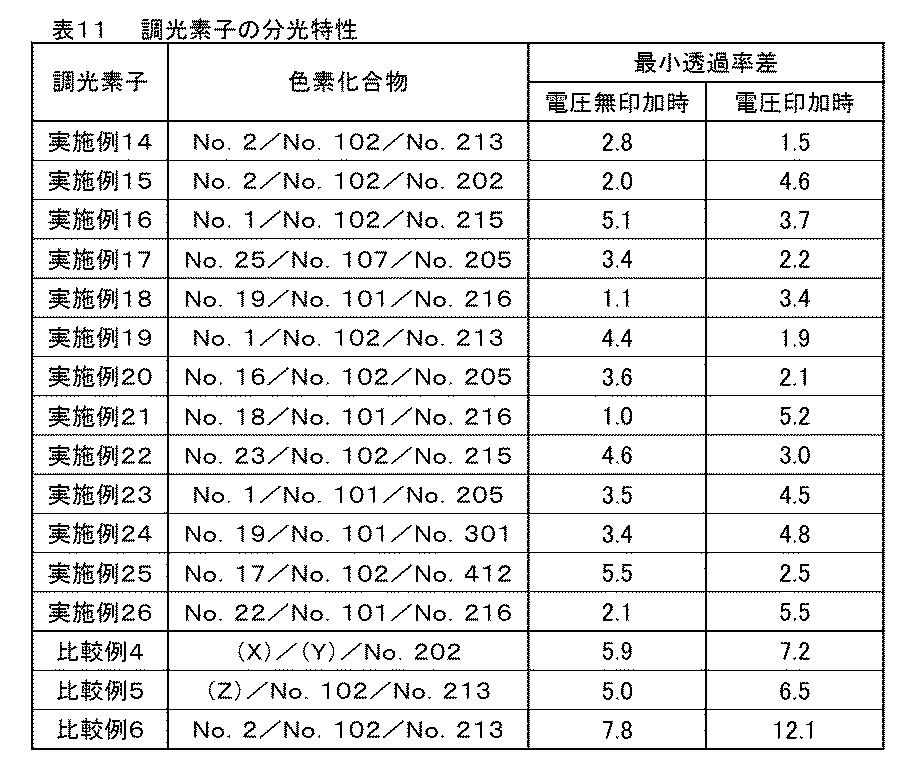
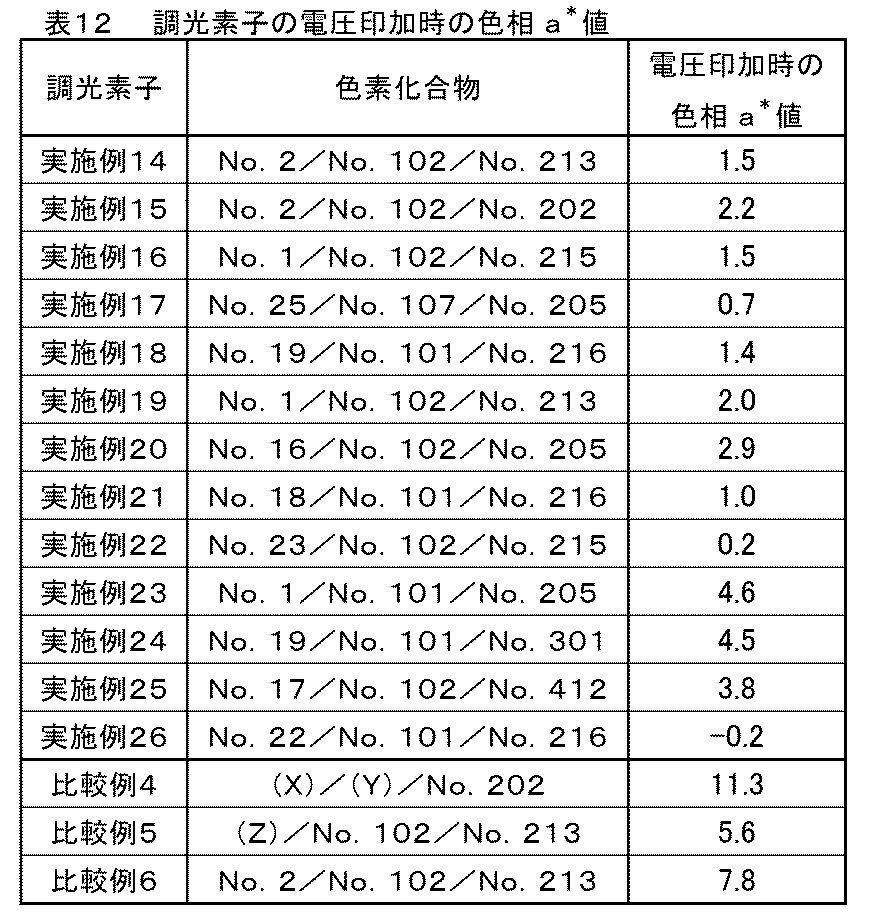
- the light modulating elements of the present invention obtained in Examples 14 to 26 have a wavelength range of 420 to 460 nm, a wavelength range of 520 to 590 nm, and a wavelength range of 600 to 640 nm, respectively.
- the difference between the smallest transmittance value and the largest transmittance value is as small as 6% or less, and the hue a * value is 5 or less, and the color residue in the red region during transmission is Few.
- the light modulating elements for comparison obtained in Comparative Examples 4 and 5 had the minimum transmittance of , the difference between the smallest transmittance value and the largest transmittance value is greater than 6%, and the hue a * value is greater than 5, indicating that the red region remains colored when transmitted. .
- Example 27 (Preparation of liquid crystal composition of the present invention)
- A As a coloring compound, specific examples of No. 0.0085 parts of the compound represented by No. 2 of the specific example. 0.0100 parts of the compound represented by No. 102 and specific example no.
- Example 28 (Preparation of liquid crystal composition of the present invention)
- the liquid crystal composition of the present invention (the content of (A) the dye compound relative to the (B) liquid crystal material was about 5.0 mass %, and the content ratio (mass ratio) of No. 2 and No. 102 was 2:1.2).
- Example 29 (Preparation of liquid crystal composition of the present invention)
- the liquid crystal composition of the present invention (the content of (A) dye compound relative to (B) liquid crystal material was about 5.0 mass %, and the content ratio (mass ratio) of No. 1 and No. 102 was 2:2.5).
- Example 30 (Preparation of liquid crystal composition of the present invention)
- the dye compound is a specific example of No. 0.0078 parts of the compound represented by 19, specific example no. 0.0089 part of the compound represented by 101 and specific example No.
- the liquid crystal composition of the present invention (the content of (A) dye compound relative to (B) liquid crystal material was about 5.0 mass %, and the content ratio (mass ratio) of No. 19 and No. 101 was 2:2.3).
- Example 31 (Preparation of liquid crystal composition of the present invention)
- A The colorant compound of specific example No. 0.0079 parts of the compound represented by No. 1 of the specific example. 0.0106 parts of the compound represented by 102 and specific example no.
- the liquid crystal composition of the present invention (the content of (A) the dye compound relative to the (B) liquid crystal material was about 5.0 mass %, and the content ratio (mass ratio) of No. 1 and No. 102 was 2:2.7).
- Example 32 (Preparation of liquid crystal composition of the present invention)
- the liquid crystal composition of the present invention (the content of (A) dye compound relative to (B) liquid crystal material was about 5.0 mass %, and the content ratio (mass ratio) of No. 23 and No. 102 was 2:1.6).
- Example 33 (Preparation of liquid crystal composition of the present invention)
- the liquid crystal composition of the present invention (the content of (A) dye compound relative to (B) liquid crystal material was about 5.0 mass %, and the content ratio (mass ratio) of No. 19 and No. 101 was 2:2.2).
- Example 34 (Preparation of liquid crystal composition of the present invention)
- the liquid crystal composition of the present invention ((A) dye compound content relative to (B) liquid crystal material was about 5.0 mass %, and the content ratio (mass ratio) of No. 17 and No. 102 was 2:3.0).
- Example 35 (Preparation of liquid crystal composition of the present invention)
- the liquid crystal composition of the present invention (the content of (A) dye compound relative to (B) liquid crystal material was about 5.0 mass %, and the content ratio (mass ratio) of No. 22 and No. 101 was 2:2.3).
- Example 36 (Preparation of liquid crystal composition of the present invention)
- the liquid crystal composition of the present invention (the content of (A) the dye compound relative to the (B) liquid crystal material was about 5.0 mass %, and the content ratio (mass ratio) of No. 17 and No. 107 was 2:2.8).
- Comparative Example 7 (Preparation of liquid crystal composition for comparison) (A) 0.0075 parts of the compound represented by the above formula (X), 0.0075 parts of the compound represented by the above formula (Y), and specific example No.
- a comparative liquid crystal composition ((A) dye compound content relative to (B) liquid crystal material was about 5.0 mass %, and the content ratio (mass ratio) of (X) and (Y) was 2:2.0).
- Comparative Example 8 (Preparation of liquid crystal composition for comparison)
- A The colorant compound of specific example No. 0.0050 parts of the compound represented by No. 2 of the specific example. 0.0150 parts of the compound represented by 102 and specific example no.
- a comparative liquid crystal composition ((A) dye compound content relative to (B) liquid crystal material was about 5.0 mass %, and the content ratio (mass ratio) of No. 2 and No. 102 was 2:6.0).
- Comparative Example 9 (Preparation of liquid crystal composition for comparison) (A) 0.0075 parts of the compound represented by the above formula (Z) as a dye compound, specific example No. 0.0100 parts of the compound represented by No. 102 and specific example no. In the same manner as in Example 27 except that the compound represented by 213 was changed to 0.0075 parts, a comparative liquid crystal composition ((A) dye compound content relative to (B) liquid crystal material was about 5.0 mass %, and the content ratio (mass ratio) of (Z) and No. 102 was 2:2.7).
- Examples 37 to 46 and Comparative Examples 10 to 12 (Preparation of light modulating elements for the present invention and comparison)
- Examples 27 to 36 and a comparative example were applied to an element having a gap between the substrates of 30 ⁇ m, which had a transparent electrode and consisted of two upper and lower glass substrates which had been subjected to homogeneous alignment treatment by rubbing a polyamide resin on the surface in contact with the liquid crystal composition.
- the liquid crystal compositions obtained in steps 7 to 9 were encapsulated to prepare light modulating devices of the present invention and comparison.
- the liquid crystal material in the liquid crystal composition was in a homogeneous alignment state, and the dye compound molecules were also in a similar alignment according to the host liquid crystal.
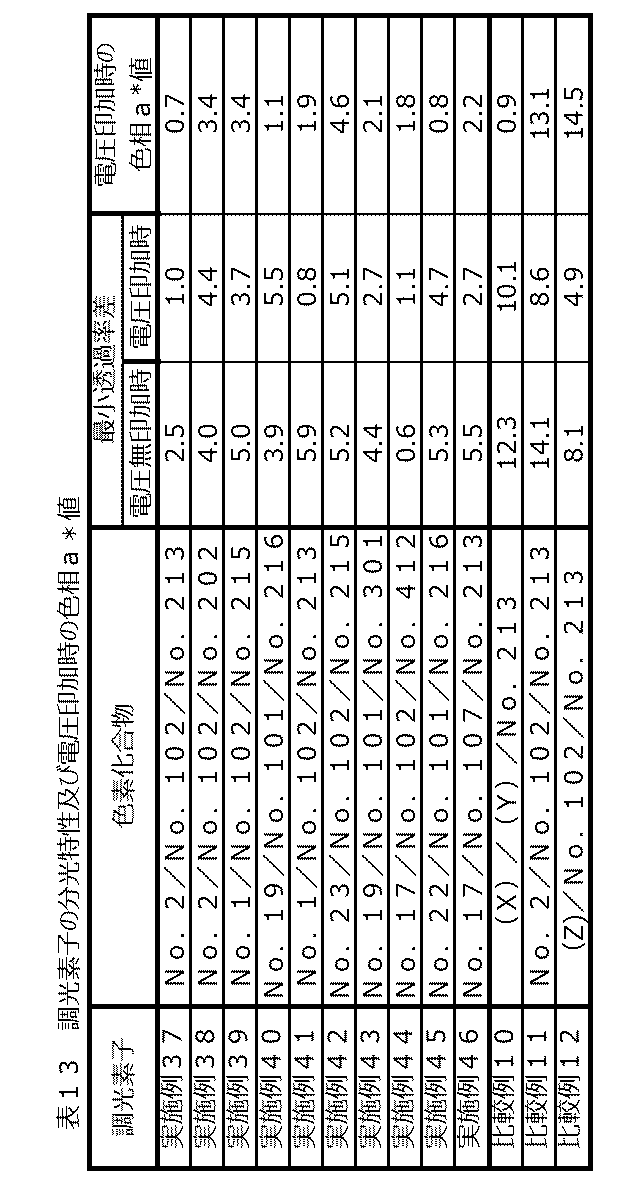
- the light modulating elements of the present invention obtained in Examples 37 to 46 have a wavelength region of 420 to 460 nm, a wavelength region of 520 to 590 nm, and a wavelength of 600 to 640 nm when no voltage is applied and when voltage is applied.
- the difference between the smallest transmittance value and the largest transmittance value is as small as 6% or less, and the hue a * value is 5 or less, and the red region at the time of transmission Less color residue.
- the light modulating elements for comparison obtained in Comparative Examples 10 and 11 had a wavelength range of 420 to 460 nm, a wavelength range of 520 to 590 nm, and a wavelength range of 600 to 640 nm when no voltage was applied and when voltage was applied.
- the difference between the smallest transmittance value and the largest transmittance value is greater than 6%
- the comparative light modulating element obtained in Comparative Example 12 has a wavelength of 420 to 460 nm when no voltage is applied.
- the wavelength region of 520 to 590 nm, and the wavelength region of 600 to 640 nm the difference between the smallest transmittance value and the largest transmittance value is greater than 6%.
- the comparative light modulating elements obtained in Comparative Examples 11 and 12 had a hue a * value that greatly exceeded 5, and color residue was observed in the red region during transmission, and a black light modulating element could not be produced. I understood it.
- liquid crystal composition of the present invention and its cured product are excellent in spectral characteristics when a voltage is applied, the use of the composition provides an excellent contrast and suppresses coloration when a voltage is applied to a light modulating element. can get.
- light modulating elements can be applied to a wide range of objects such as windows, doors and partitions of vehicles such as trains and automobiles, and buildings such as business buildings and hospitals.
Landscapes
- Chemical & Material Sciences (AREA)
- Organic Chemistry (AREA)
- Crystallography & Structural Chemistry (AREA)
- Engineering & Computer Science (AREA)
- Materials Engineering (AREA)
- Chemical Kinetics & Catalysis (AREA)
- Polymers & Plastics (AREA)
- Medicinal Chemistry (AREA)
- Health & Medical Sciences (AREA)
- Physics & Mathematics (AREA)
- Nonlinear Science (AREA)
- General Physics & Mathematics (AREA)
- Optics & Photonics (AREA)
- Organic Low-Molecular-Weight Compounds And Preparation Thereof (AREA)
- Liquid Crystal (AREA)
- Liquid Crystal Substances (AREA)
Abstract
Description
本発明の他の目的は、該液晶組成物若しくは該液晶組成物の硬化物を含み、コントラストと透過時の赤色着色抑制効果に優れた調光素子を提供することである。
また、本発明者らは、そのような新規な液晶組成物を用いることにより、コントラストと透過時の赤色着色抑制効果に優れた調光素子を提供可能であることを見出した。
すなわち、本発明に包含される諸態様は、以下のとおりである。
(1).
(A)色素化合物、及び(B)液晶材料を含有する液晶組成物であって、
該(A)色素化合物が、
(i)下記一般式(1)
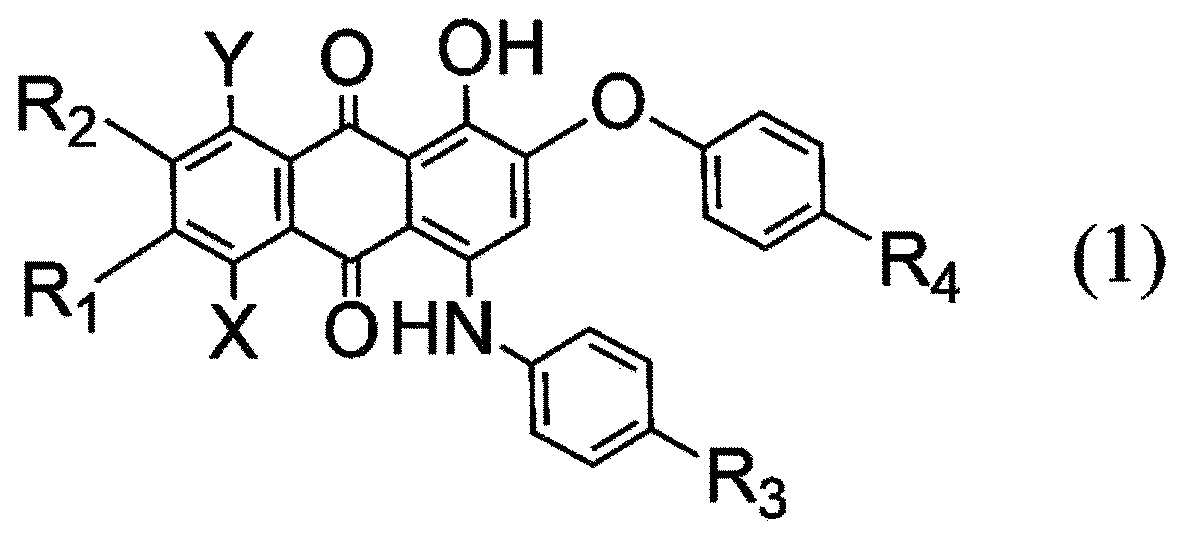
(式(1)中、X及びYの一方は、ヒドロキシ基を表し、X及びYの他方は、水素原子、ヒドロキシ基又はアミノ基を表す。
R1及びR2の一方は、水素原子を表し、R1及びR2の他方は、下記式(a)
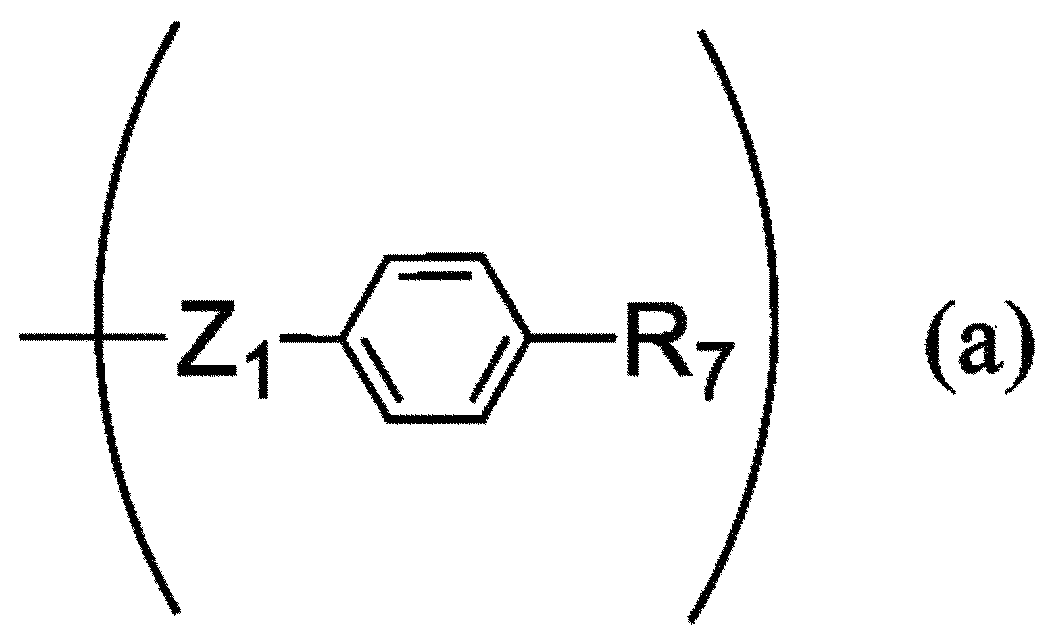
(式(a)中、R7は、炭素数4乃至12の直鎖若しくは分岐鎖のアルキル基、炭素数4乃至12の直鎖若しくは分岐鎖のアルコキシ基、又は下記式(b)

(式(b)中、R8は、炭素数1乃至12の直鎖又は分岐鎖のアルキル基を表す。)で表される置換基を表し、Z1は、酸素原子又は硫黄原子を表す。)で表される置換基を表す。
但し、Xがヒドロキシ基でYが水素原子又はアミノ基の場合には、R1は式(a)で表される置換基を、R2は水素原子をそれぞれ表し、Xが水素原子又はアミノ基でYがヒドロキシ基の場合には、R1は水素原子を、R2は式(a)で表される置換基をそれぞれ表す。
R3は、水素原子、炭素数1乃至12の直鎖若しくは分岐鎖のアルキル基、炭素数1乃至12の直鎖若しくは分岐鎖のアルコキシ基、又は上記式(b)で表される置換基を表し、R4は、炭素数4乃至12の直鎖若しくは分岐鎖のアルキル基、炭素数4乃至12の直鎖若しくは分岐鎖のアルコキシ基、又は上記式(b)で表される置換基を表す。)
で表されるアントラキノン化合物、
(ii)下記一般式(2)
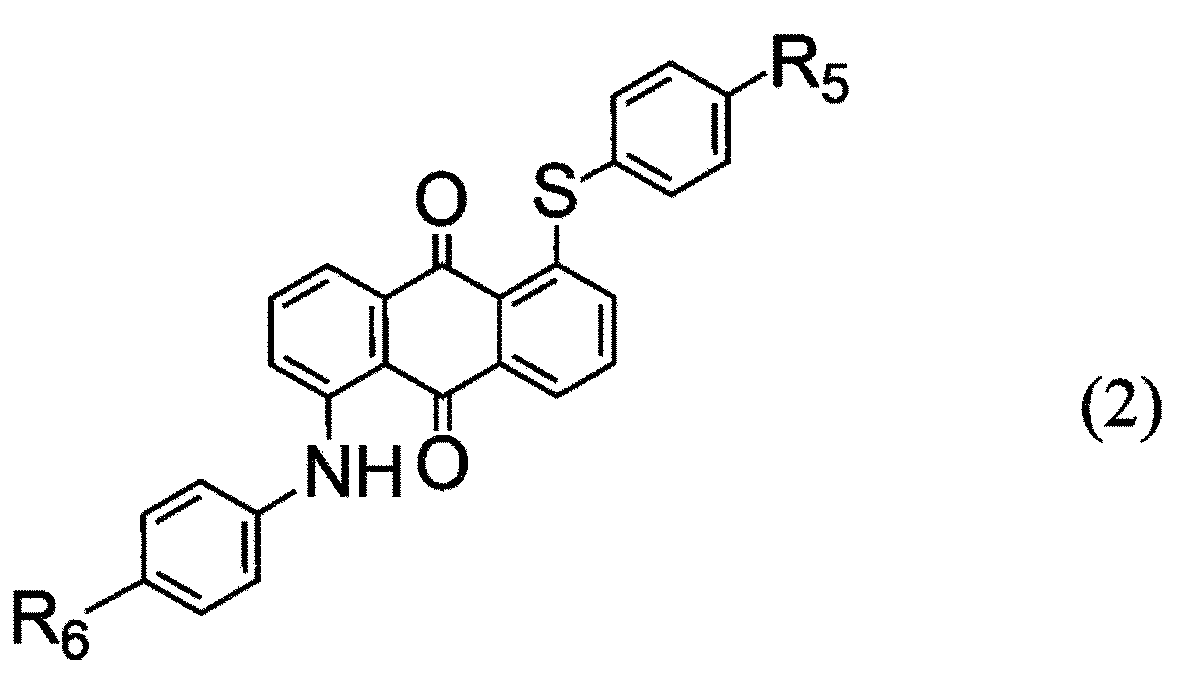
(式(2)中、R5は、炭素数1乃至18の直鎖若しくは分岐鎖のアルキル基、又は炭素数1乃至18の直鎖若しくは分岐鎖のアルコキシ基を表し、R6は、炭素数1乃至18の直鎖若しくは分岐鎖のアルキル基、炭素数1乃至18の直鎖若しくは分岐鎖のアルコキシ基、又は上記式(b)で表される置換基を表す。)
で表されるアントラキノン化合物、ならびに
(iii)一般式(1)で表されるアントラキノン化合物又は一般式(2)で表されるアントラキノン化合物以外の色素化合物(すなわち、一般式(1)で表されるアントラキノン化合物ではなく、かつ一般式(2)で表されるアントラキノン化合物でもない色素化合物)
を含み、
一般式(1)で表されるアントラキノン化合物と一般式(2)で表されるアントラキノン化合物との質量比が2:1乃至1:2である、
液晶組成物。
(2).
Xがヒドロキシ基であり、Yがアミノ基であり、R1が式(a)で表される置換基であり、かつZ1が酸素原子である、前項(1)に記載の液晶組成物。
(3).
R4及びR7が、それぞれ独立に炭素数6乃至12の直鎖若しくは分岐鎖のアルキル基、又は炭素数6乃至12の直鎖若しくは分岐鎖のアルコキシ基である、前項(2)に記載の液晶組成物。
(4).
R3が、炭素数4乃至7の直鎖若しくは分岐鎖のアルキル基、又は炭素数4乃至7の直鎖若しくは分岐鎖のアルコキシ基である、前項(3)に記載の液晶組成物。
(5).
R4及びR7が、それぞれ独立に上記式(b)で表される置換基であり、R3が、炭素数1乃至8の直鎖若しくは分岐鎖のアルキル基、又は炭素数1乃至8の直鎖若しくは分岐鎖のアルコキシ基である、前項(2)に記載の液晶組成物。
(6).
R4及びR7が、それぞれ独立に上記式(b)で表される置換基であり、R8が炭素数3乃至8の直鎖若しくは分岐鎖のアルキル基である、前項(5)に記載の液晶組成物。
(7).
(C)光硬化性化合物及び(D)光重合開始剤を更に含有する、前項(1)乃至(6)のいずれか一項に記載の液晶組成物。
(8).
(C)光硬化性化合物が、重合可能な官能基を一つ有する単官能モノマー及び重合可能な官能基を二つ有する二官能モノマーを含有する、前項(7)に記載の液晶組成物。
(9).
(C)光硬化性化合物が、モノ(メタ)アクリレート化合物及びジ(メタ)アクリレート化合物を含有する、前項(8)に記載の液晶組成物。
(10).
前項(7)乃至(9)のいずれか一項に記載の液晶組成物の硬化物。
(11).
少なくとも一方が透明電極を有する透明基板である基板が対向配置された一対の基板間に、前項(1)乃至(6)のいずれか一項に記載の液晶組成物、又は前項(10)に記載の硬化物を挟持してなる調光素子。
(12).
一対の基板間に電圧を印加した状態で、JIS Z 8781-4:2013に規定する方法で求めた色相のa*値が5.0以下である、前項(11)に記載の調光素子。
(13).
一対の基板間に電圧を印加した際の、420乃至460nmの波長領域、520乃至590nmの波長領域及び600乃至640nmの波長領域のそれぞれにおける最小透過率のうち、最も小さい透過率の値と最も大きい透過率の値の差が6%以下であり、かつ
電圧無印加時の、420乃至460nmの波長領域、520乃至590nmの波長領域及び600乃至640nmの波長領域のそれぞれにおける最小透過率のうち、最も小さい透過率の値と最も大きい透過率の値の差が6%以下である、前項(11)又は(12)に記載の調光素子。
尚、本明細書における「アントラキノン化合物」とは、アントラキノン構造を主骨格とする化合物(色素)を意味する。
本発明の液晶組成物(以下、単に「本発明の組成物」と称することもある)は、下記式(1)で表されるアントラキノン化合物を含有する。
本発明の組成物が含有する式(1)で表されるアントラキノン化合物は、本発明の組成物において二色性色素として機能する。
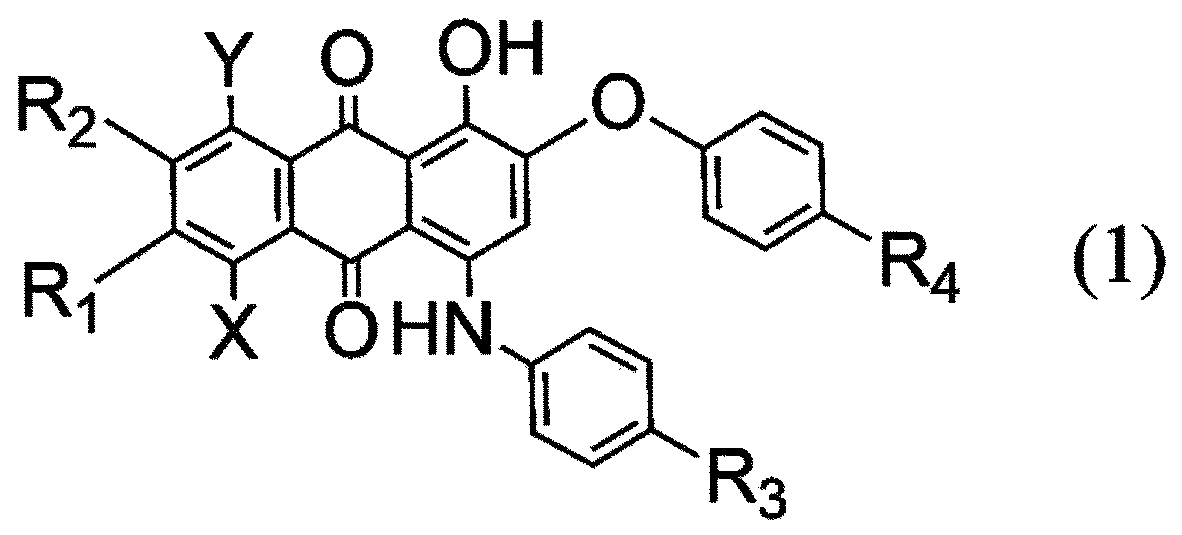
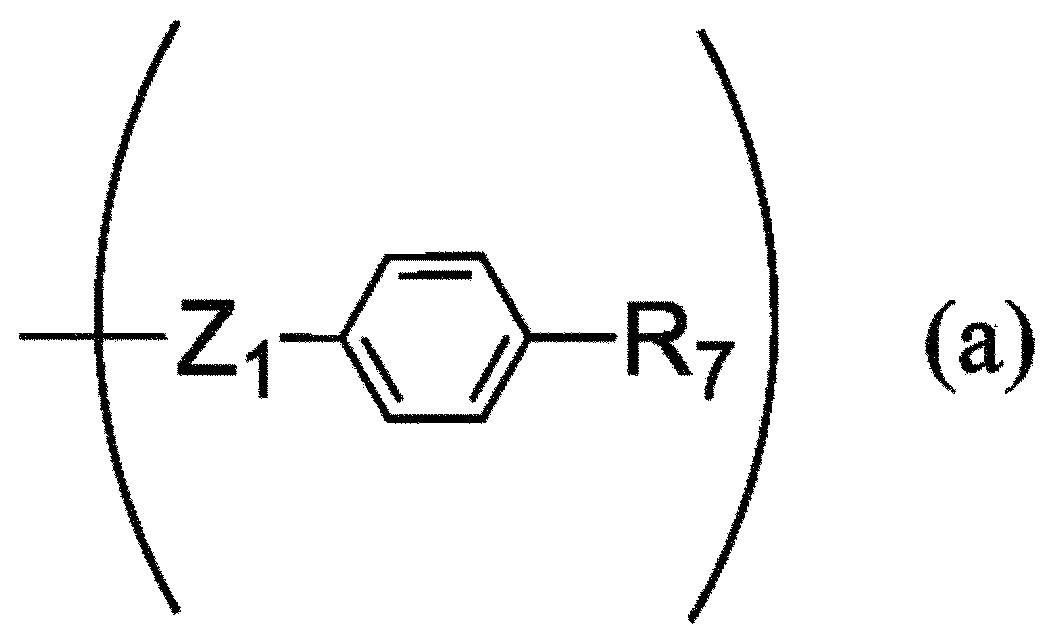
より詳しくは、式(1)のR3が表す炭素数1乃至12の直鎖又は分岐鎖のアルキル基の炭素数は、R4及びR7がアルキル基の場合、4乃至7であることが好ましく、R4及びR7が(b)で表される置換基の場合、1乃至8が好ましく、3乃至8であることがより好ましい。
より詳しくは、式(1)のR3が表す炭素数1乃至12の直鎖又は分岐鎖のアルコキシ基の炭素数は、R4及びR7がアルキル基の場合は4乃至7であることが好ましく、R4及びR7が式(b)で表される置換基の場合は1乃至8が好ましく、3乃至8であることがより好ましい。
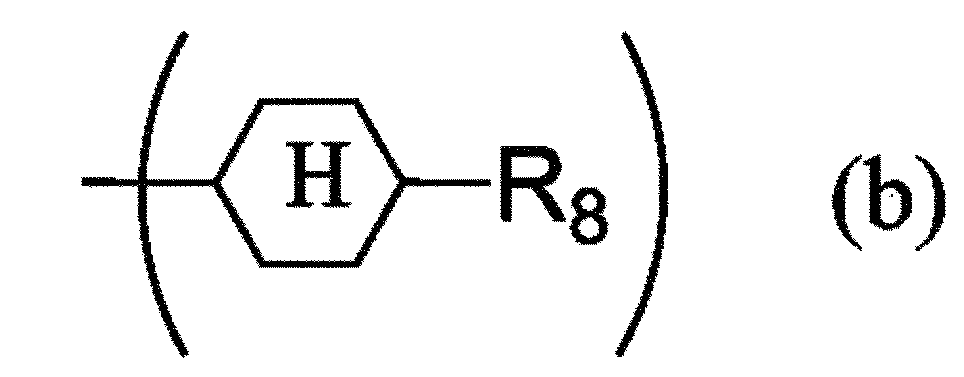
式(b)のR8が表す炭素数1乃至12の直鎖又は分岐鎖のアルキル基の具体例としては、メチル基、エチル基、n-ブチル基、iso-ブチル基、sec-ブチル基、t-ブチル基、n-ペンチル基、iso-ペンチル基、neo-ペンチル基、t-ペンチル基、ヘキシル基、ヘプチル基、オクチル基及びノニル基等が挙げられる。n-ブチル基、t-ブチル基、n-ペンチル基、n-ヘキシル基、n-ヘプチル基、n-オクチル基又はn-ドデシル基が好ましい。
尚、本発明の組成物には、式(1)に含まれる複数のアントラキノン化合物を併用してもよい。
本発明の組成物が含有する式(2)で表されるアントラキノン化合物は、本発明の組成物において二色性色素として機能する。

尚、本発明の組成物には、式(2)に含まれる複数のアントラキノン化合物を併用してもよい。
式(1)で表されるアントラキノン化合物又は式(2)で表されるアントラキノン化合物以外の色素化合物は、特に限定されないが、最大吸収波長を420乃至460nmの範囲に有するものが好ましく、最大吸収波長を420乃至460nmの範囲に有する二色性色素がより好ましい。式(1)で表されるアントラキノン化合物又は一般式(2)で表されるアントラキノン化合物以外の色素化合物の好適な骨格としては、アントラキノン系化合物(アントラキノン骨格を有する化合物。以下「系化合物」は同様の意味である)、アゾ系化合物、キノフタロン系化合物、ペリレン系化合物、クマリン系化合物及びナフタルイミド系化合物などが挙げられる。この中でも、アントラキノン系化合物、アゾ系化合物又はキノフタロン系化合物が好ましい。
尚、本発明の組成物には、式(1)で表されるアントラキノン化合物又は式(2)で表されるアントラキノン化合物以外の色素化合物を複数併用してもよい。
また、本発明の組成物における式(1)で表されるアントラキノン化合物と式(2)で表されるアントラキノン化合物の含有比(質量比)は、2:1乃至1:2である。式(1)の化合物及び式(2)の化合物の含有比を前記の範囲とすることにより、後述する調光素子における電圧無印加時の十分な着色及び電圧印加時の赤色領域の色残存を消失させる効果が得られる。
尚、本発明の組成物における式(1)で表されるアントラキノン化合物又は式(2)で表されるアントラキノン化合物以外の色素化合物の含有量は、このような色素化合物を添加する目的が調光素子の色相の調整を目的とするため一概には言えないが、好ましくは式(1)で表されるアントラキノン化合物及び式(2)で表されるアントラキノン化合物の合計に対して4乃至60質量%程度、より好ましくは10乃至30質量%程度である。
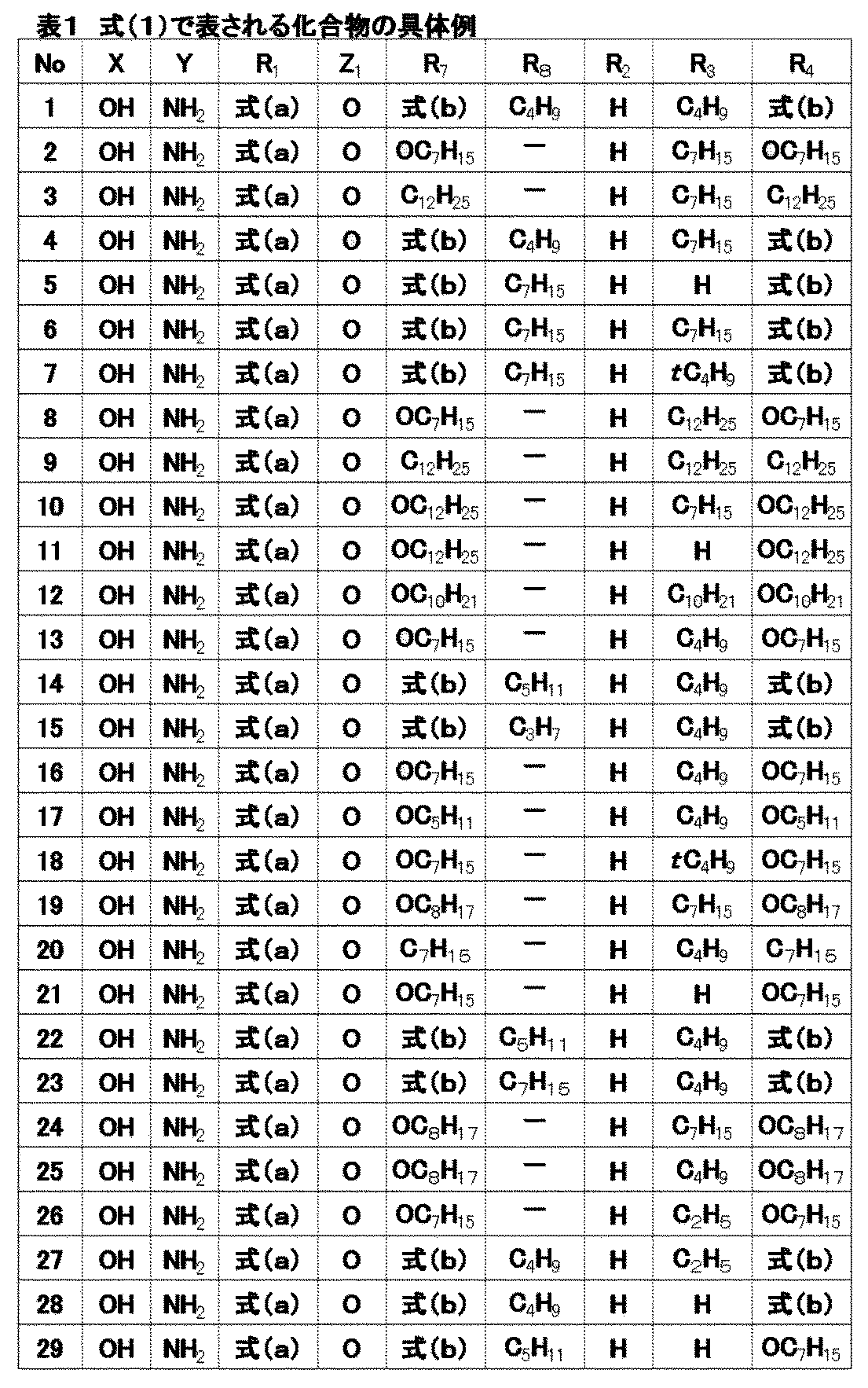
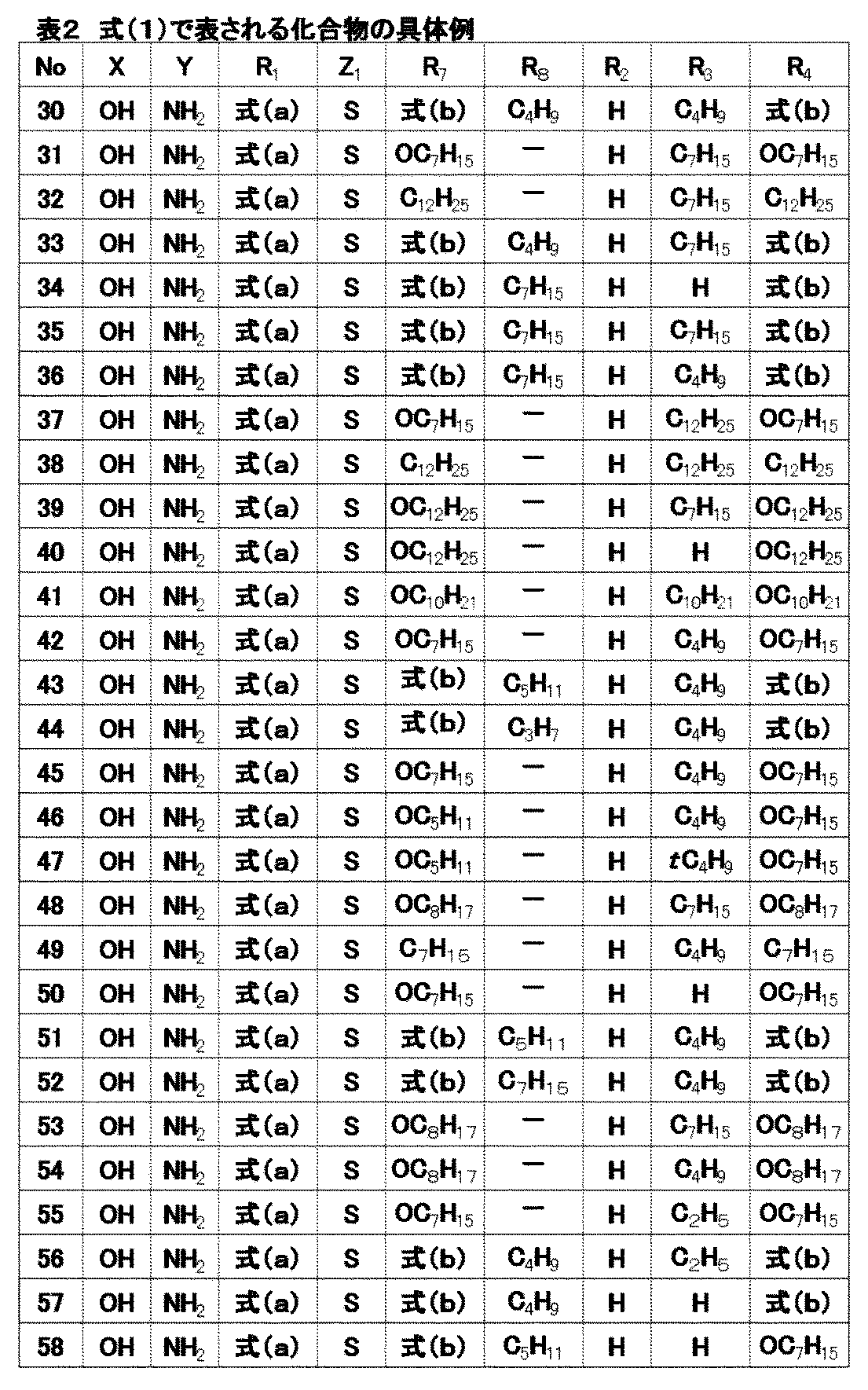
なお、表中のアルキル基又はアルコキシ基の表示において、「t」は「タ-シャリー」基の略語を指すが、「t」が付されていない基は「ノルマル」基を指すものとする。
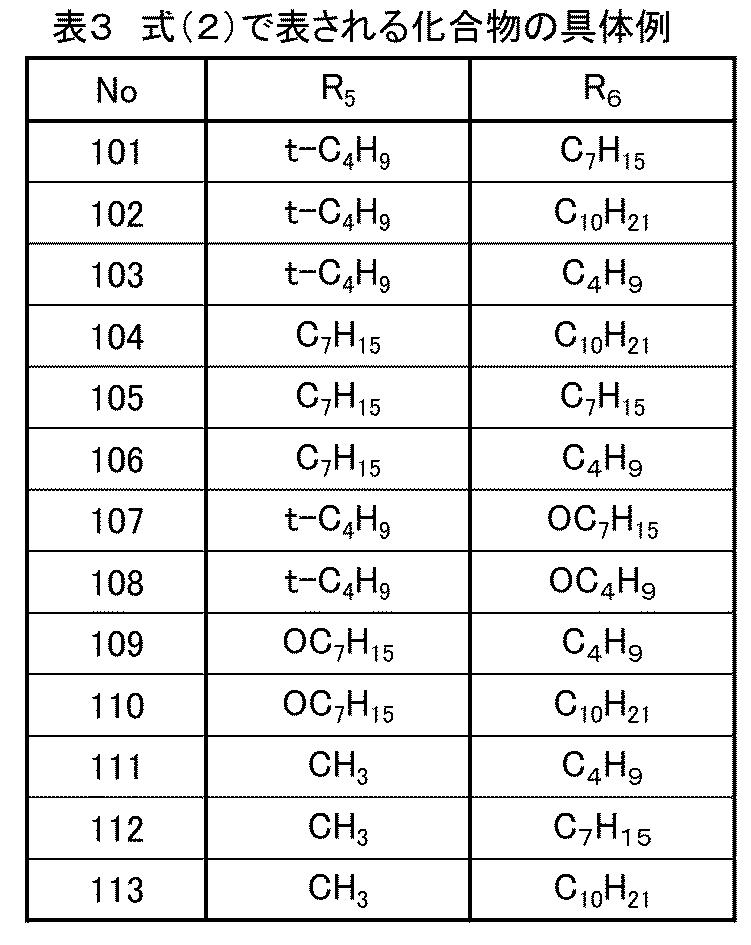
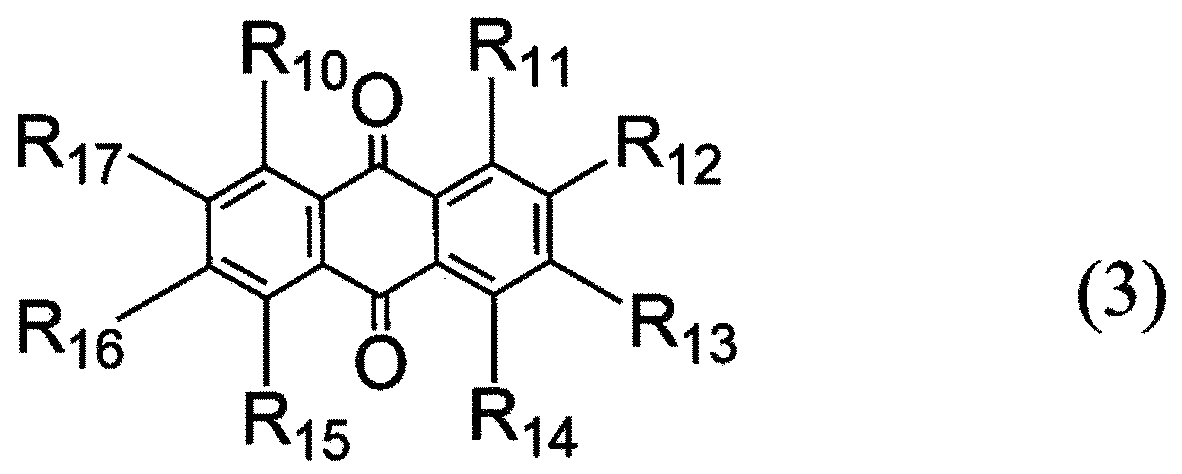


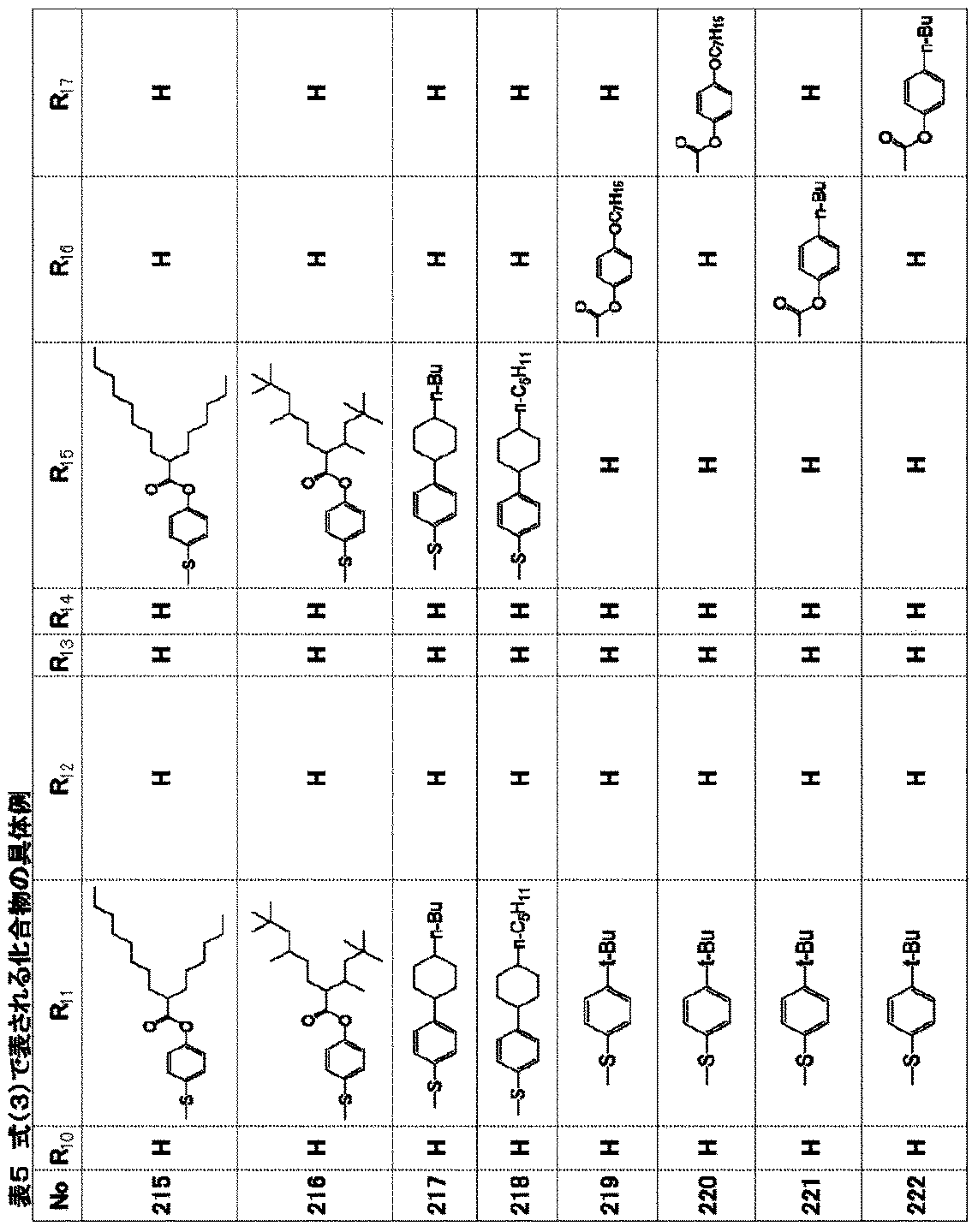


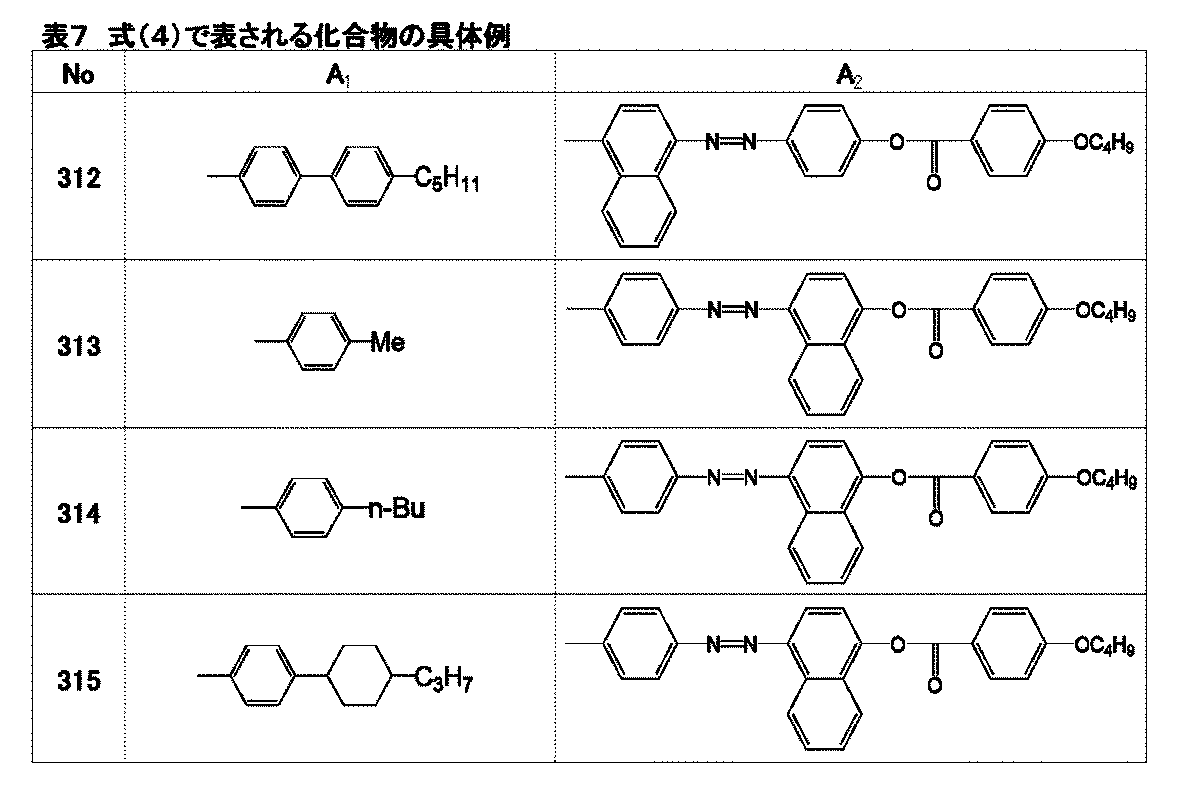
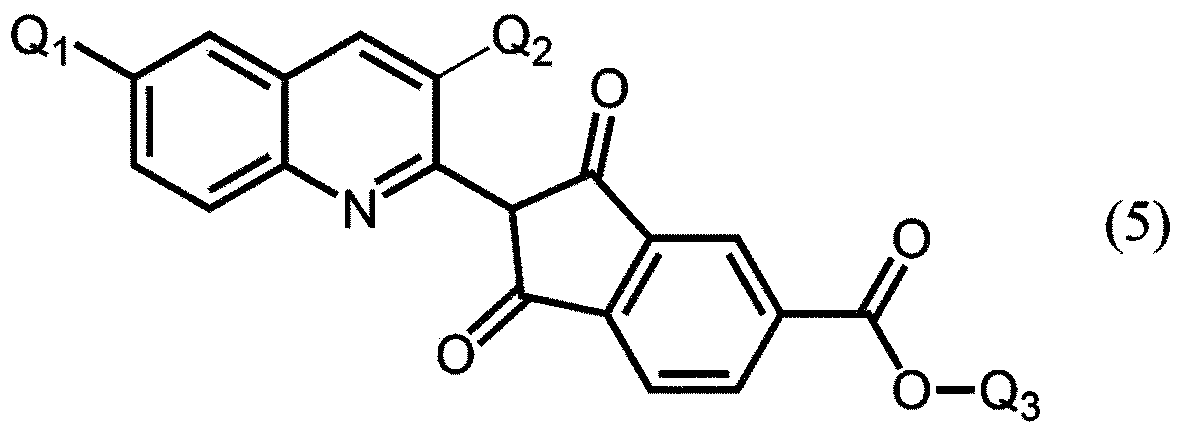
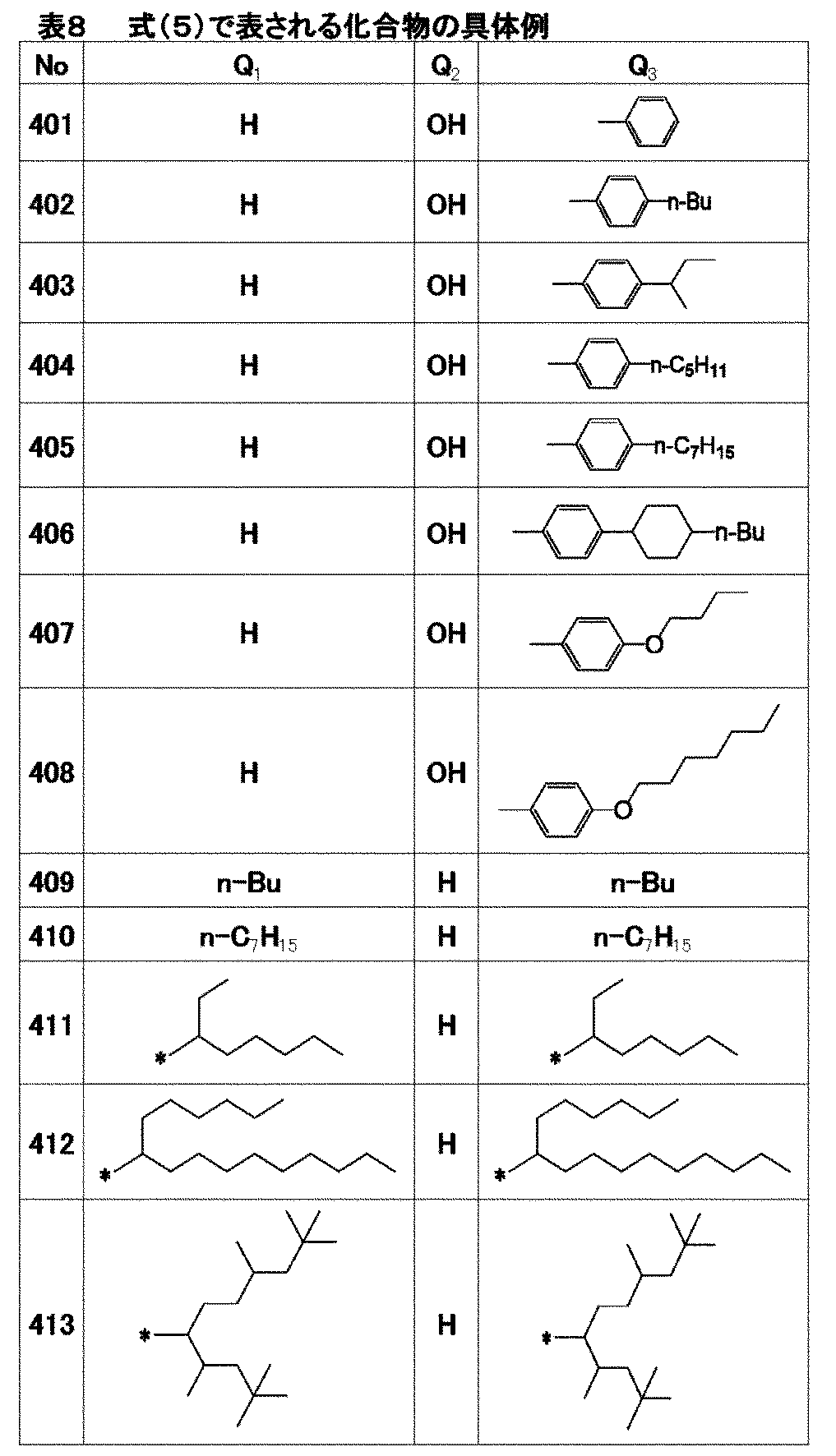
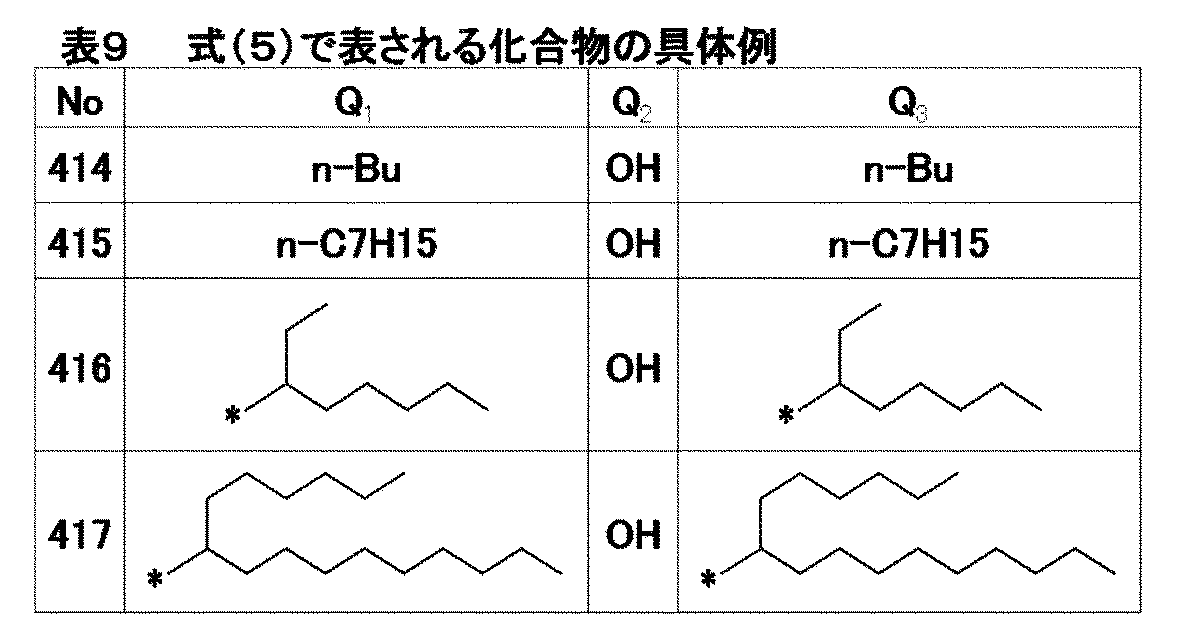
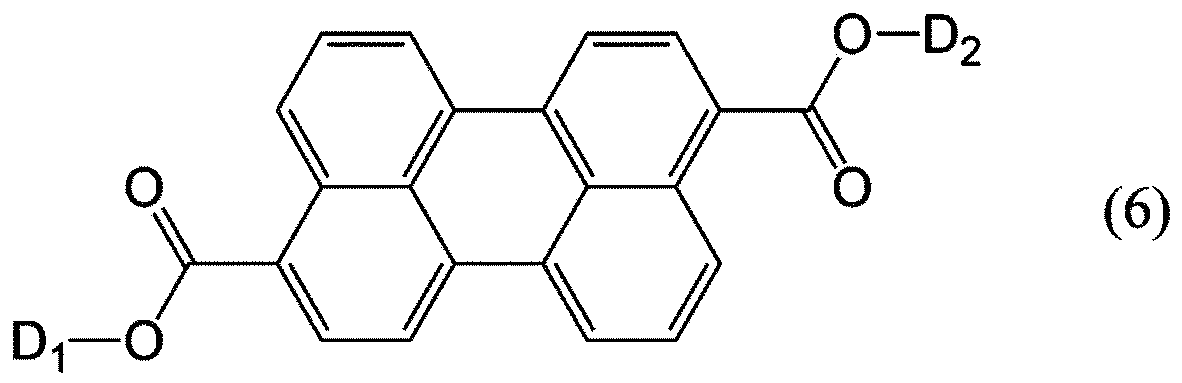
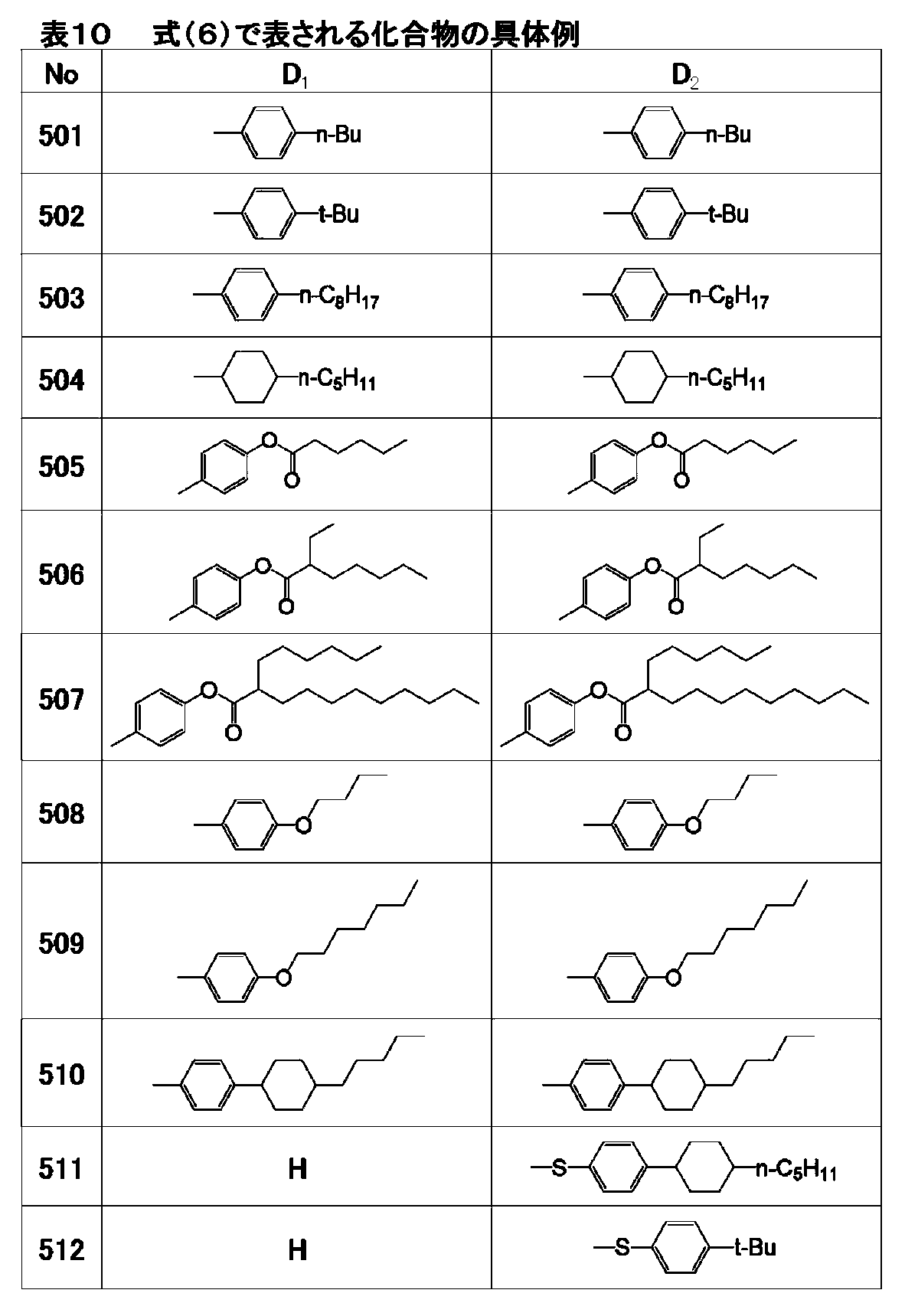
尚、本明細書において「(メタ)アクリレート」との記載は、「メタクリレート及び/又はアクリレート」を意味する。
光重合開始剤としては、例えば、ダロキュア1173、イルガキュア651、イルガキュア184等のアルキルフェノン系光重合開始剤や、イルガキュアTPO等のホスフィンオキシド系光重合開始剤が好ましく用いられる。
尚、(D)光重合開始剤の含有量は、(C)光硬化性化合物100質量部に対して0.1乃至5質量部程度が好ましい。
光を照射する際の光源としては、(D)光重合開始剤の吸収する波長の光を照射可能な光源であれば特に限定されない。好ましい光源としては、紫外線を照射可能な高圧水銀灯、メタルハライドランプ、キセノンランプ及びハロゲンランプ等が挙げられる。
光を照射する際の温度は、液晶組成物が均一に相溶した状態を維持できる温度、即ち相分離温度よりも高い温度とすることが好ましく、相分離温度よりも1乃至5℃高い温度の範囲に保つことがより好ましい。光を照射する際の温度が相分離温度よりも高いことによって、光硬化性化合物と液晶材料とが光を照射する前に分離することが防止され、より均一な硬化物を得ることができる。一方、光を照射する際の温度が相分離温度よりも大幅に高くないことによって、光硬化によって得られる光硬化性化合物の重合物と液晶材料とが分離する際に、液晶材料により形成されるドメインサイズが過度に小さくなることが防止され得る。
基板上には電極間あるいは電極と外部装置を結ぶための配線が設けられていてもよい。例えば、セグメント駆動用電極基板やマトリックス駆動用電極基板、アクティブマトリックス駆動用電極基板が用いられてもよい。更に、基板上に設けられた電極面上に、ポリイミドやポリアミド、シリコン、シアン化合物等の有機化合物、SiO2、TiO2、ZrO2等の無機化合物、またはこれらの混合物よりなる保護膜や配向膜が設けられていてもよい。
(C)光硬化性化合物の単官能モノマーとしてイソボルニルアクリレート(大阪有機化学工業製)0.362部、(C)光硬化性化合物の二官能モノマーとしてトリエチレングリコールジメタクリレート(新中村化学社製)0.018部、(B)液晶材料として1-シアノ-4’-n-ペンチルビフェニル0.297部、1-シアノ-4’-n-ヘプチルビフェニル0.146部、1-シアノ-4’-n-オクチルオキシビフェニル0.093部、及び1-シアノ-4’’-n-ペンチルターフェニル0.047部、(D)光重合開始剤としてイルガキュアTPO(BASF社製)0.004部、及びイルガキュア184(BASF社製)0.004部、ならびに(A)色素化化合物として具体例のNo.2で表される化合物0.0102部、具体例のNo.102で表される化合物0.0135部、及び具体例のNo.213で表される化合物0.0063部を、70℃のホットプレートで1時間撹拌し、本発明の液晶組成物((C)光硬化性化合物、(B)液晶材料及び(D)光重合開始剤の総量に対する(A)色素化合物の含有量は約3.0質量%、No.2とNo.102の含有比(質量比)は2:2.6)を調製した。
(A)色素化合物を具体例のNo.2で表される化合物0.0126部、具体例のNo.102で表される化合物0.0090部及び具体例のNo.202で表される化合物0.0069部に変更した以外は実施例1と同じ方法で、本発明の液晶組成物((C)光硬化性化合物、(B)液晶材料及び(D)光重合開始剤の総量に対する(A)色素化合物の含有量は約3.0質量%、No.2とNo.102の含有比は2:1.4)を調製した。
(A)色素化合物を具体例のNo.1で表される化合物0.0093部、具体例のNo.102で表される化合物0.0122部及び具体例のNo.215で表される化合物0.0085部に変更した以外は実施例1と同じ方法で、本発明の液晶組成物((C)光硬化性化合物、(B)液晶材料及び(D)光重合開始剤の総量に対する(A)色素化合物の含有量は約3.0質量%、No.1とNo.102の含有比は2:2.6)を調製した。
(A)色素化合物を具体例のNо.25で表される化合物0.0105部、具体例のNo.107で表される化合物0.0150部及び具体例のNо.205で表される化合物0.0045部に変更した以外は実施例1と同じ方法で、本発明の液晶組成物((C)光硬化性化合物、(B)液晶材料及び(D)光重合開始剤の総量に対する(A)色素化合物の含有量は約3.0質量%、Nо.25とNo.107の含有比は2:2.9)を調製した。
(A)色素化合物を具体例のNo.19で表される化合物0.0093部、具体例のNo.101で表される化合物0.0122部及び具体例のNo.216で表される化合物0.0085部に変更した以外は実施例1と同じ方法で、本発明の液晶組成物((C)光硬化性化合物、(B)液晶材料及び(D)光重合開始剤の総量に対する(A)色素化合物の含有量は約3.0質量%、No.19とNo.101の含有比は2:2.6)を調製した。
(A)色素化合物を具体例のNo.1で表される化合物0.0102部、具体例のNo.102で表される化合物0.0135部及び具体例のNo.213で表される化合物0.0065部に変更した以外は実施例1と同じ方法で、本発明の液晶組成物((C)光硬化性化合物、(B)液晶材料及び(D)光重合開始剤の総量に対する(A)色素化合物の含有量は約3.0質量%、No.1とNo.102の含有比は2:2.6)を調製した。
(A)色素化合物を具体例のNo.16で表される化合物0.0108部、具体例のNo.102で表される化合物0.0152部及び具体例のNo.205で表される化合物0.0039部に変更した以外は実施例1と同じ方法で、本発明の液晶組成物((C)光硬化性化合物、(B)液晶材料及び(D)光重合開始剤の総量に対する(A)色素化合物の含有量は約3.0質量%、No.16とNo.102の含有比は2:2.8)を調製した。
(A)色素化合物を具体例のNo.18で表される化合物0.0081部、具体例のNo.101で表される化合物0.0114部及び具体例のNo.216で表される化合物0.0100部に変更した以外は実施例1と同じ方法で、本発明の液晶組成物((C)光硬化性化合物、(B)液晶材料及び(D)光重合開始剤の総量に対する(A)色素化合物の含有量は約3.0質量%、No.18とNo.101の含有比は2:2.8)を調製した。
(A)色素化合物を具体例のNo.23で表される化合物0.0105部、具体例のNo.102で表される化合物0.0115部及び具体例のNo.215で表される化合物0.0080部に変更した以外は実施例1と同じ方法で、本発明の液晶組成物((C)光硬化性化合物、(B)液晶材料及び(D)光重合開始剤の総量に対する(A)色素化合物の含有量は約3.0質量%、No.23とNo.102の含有比は2:2.2)を調製した。
(A)色素化合物を具体例のNo.1で表される化合物0.0108部、具体例のNo.101で表される化合物0.0153部及び具体例のNo.205で表される化合物0.0039部に変更した以外は実施例1と同じ方法で、本発明の液晶組成物((C)光硬化性化合物、(B)液晶材料及び(D)光重合開始剤の総量に対する(A)色素化合物の含有量は約3.0質量%。No.1とNo.101の含有比は2:2.8)を調製した。
(A)色素化合物を具体例のNo.19で表される化合物0.0125部、具体例のNo.101で表される化合物0.0162部及び具体例のNo.301で表される化合物0.0014部に変更した以外は実施例1と同じ方法で、本発明の液晶組成物((C)光硬化性化合物、(B)液晶材料及び(D)光重合開始剤の総量に対する(A)色素化合物の含有量は約3.0質量%、No.19とNo.101の含有比は2:2.6)を調製した。
(A)色素化合物を具体例のNo.17で表される化合物0.0102部、具体例のNo.102で表される化合物0.0171部及び具体例のNo.412で表される化合物0.0027部に変更した以外は実施例1と同じ方法で、本発明の液晶組成物((C)光硬化性化合物、(B)液晶材料及び(D)光重合開始剤の総量に対する(A)色素化合物の含有量は約3.0質量%、No.17とNo.102の含有比は2:3.4)を調製した。
(A)色素化合物を具体例のNo.22で表される化合物0.0090部、具体例のNo.101で表される化合物0.0120部及び具体例のNo.216で表される化合物0.0090部に変更した以外は実施例1と同じ方法で、本発明の液晶組成物((C)光硬化性化合物、(B)液晶材料及び(D)光重合開始剤の総量に対する(A)色素化合物の含有量は約3.0質量%、No.22とNo.101の含有比は2:2.7)を調製した。
(A)色素化合物を下記式(X)で表される化合物0.0135部、下記式(Y)で表される化合物0.0120部及び具体例のNo.202で表される化合物0.0045部に変更した以外は実施例1と同じ方法で、比較用の液晶組成物((C)光硬化性化合物、(B)液晶材料及び(D)光重合開始剤の総量に対する(A)色素化合物の含有量は約3.0質量%、(X)と(Y)の含有比は2:1.8)を調製した。
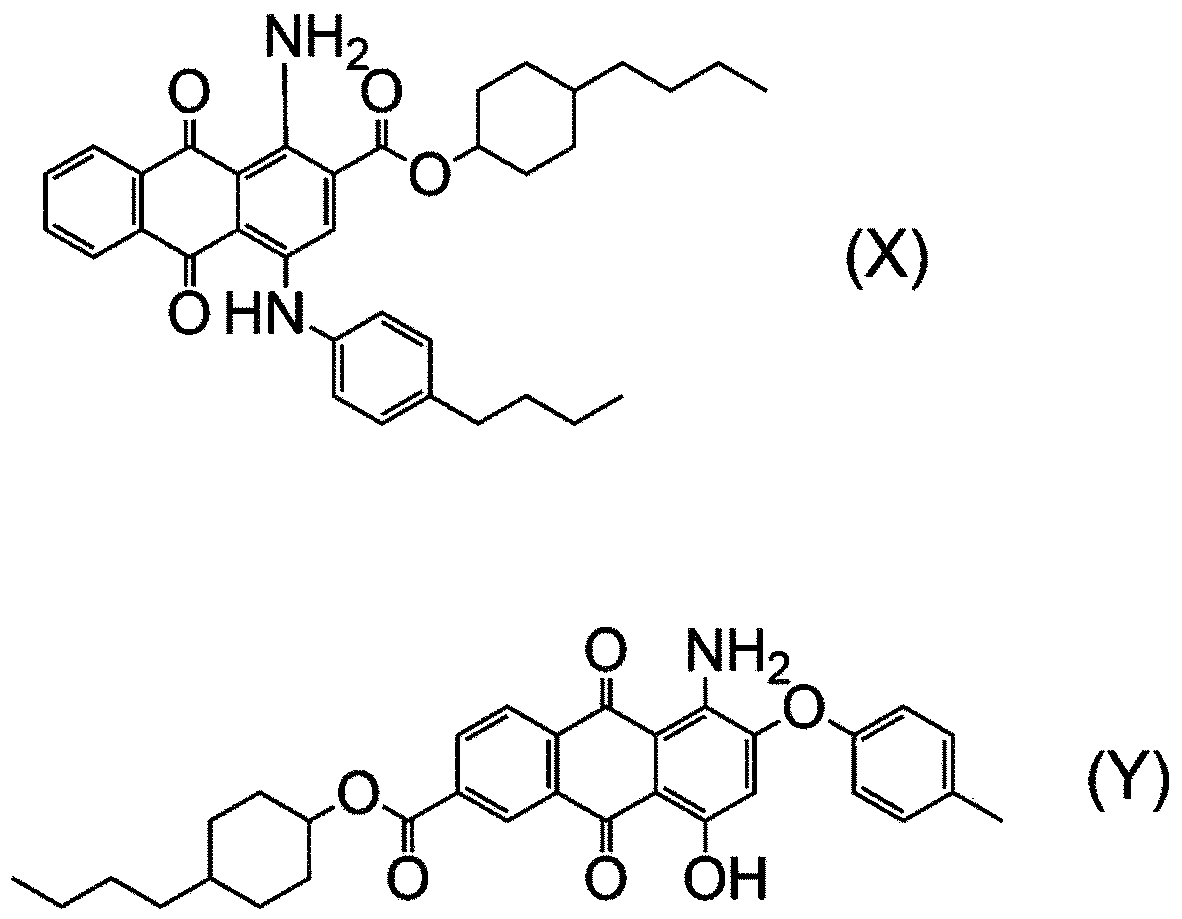
(A)色素化合物を下記式(Z)で表される化合物0.0090部、具体例のNo.102で表される化合物0.0120部及び具体例のNo.213で表される化合物0.0090部に変更した以外は実施例1と同じ方法で、比較用の液晶組成物((C)光硬化性化合物、(B)液晶材料及び(D)光重合開始剤の総量に対する(A)色素化合物の含有量は約3.0質量%、(Z)とNo.102の含有比は2:2.7)を調製した。

(A)色素化合物を具体例のNo.2で表される化合物0.006部、具体例のNo.102で表される化合物0.018部及び具体例のNo.213で表される化合物0.006部に変更した以外は実施例1と同じ方法で、比較用の液晶組成物((C)光硬化性化合物、(B)液晶材料及び(D)光重合開始剤の総量に対する(A)色素化合物の含有量は約3.0質量%、No.2とNo.102の含有比は2:6)を調製した。
実施例1で得られた液晶組成物に、直径20μmのスペーサー剤(積水化学株式会社製「ミクロパール(登録商標)SP220」)0.010部を室温で混合した。アプリケーターを用いて、ITO膜の設けられた5cm角のPETフィルムのITO膜上に前記のスペーサー剤入りの液晶組成物を塗布し、液晶組成物層を形成した。次いで、このフィルムと前記と同じITO膜の設けられた5cm角のPETフィルムとを、液晶組成物層がITO膜と対向する様に重ね合わせた。このように得られた2枚のフィルムと液晶組成物層との積層体を、サーモプレートで23℃に維持したままLEDランプの365nmの光強度が9mW/cm2になる位置にセットし、1分間光照射を行って光硬化性化合物を光硬化させることにより、本発明の調光素子を得た。
実施例1で得られた液晶組成物の代わりに実施例2乃至13で得られた液晶組成物を用いた以外は実施例14と同じ方法で、本発明の調光素子を作製した。
実施例1で得られた液晶組成物の代わりに比較例1乃至3で得られた液晶組成物を用いた以外は実施例14と同じ方法で、比較用の調光素子を作製した。
実施例14乃至26、比較例4乃至6で得られた調光素子について、電圧を印加しない場合と電圧(100V)を印加した場合の透過率を分光光度計で測定し、420乃至460nmの波長領域、520乃至590nmの波長領域及び600乃至640nmの波長領域のそれぞれにおける最小透過率のうち、最も小さい透過率の値と最も大きい透過率の値の差を表11に示した。
実施例14乃至26、比較例4乃至6で得られた調光素子について、電圧(100V)を印加した場合の透過率を分光光度計で測定し、JIS Z 8781-4:2013に従って求めた色相a*値を表12に示した。
(A)色素化化合物として具体例のNo.2で表される化合物0.0085部、具体例のNo.102で表される化合物0.0100部、及び具体例のNo.213で表される化合物0.0065部、ならびに(B)液晶材料(1-シアノ-4’-n-ペンチルビフェニル0.242部、1-シアノ-4’-n-ヘプチルビフェニル0.118部、1-シアノ-4’-n-オクチルオキシビフェニル0.076部、及び1-シアノ-4’’-n-ペンチルターフェニル0.038部)を室温で混合し、本発明の液晶組成物((B)液晶材料に対する(A)色素化合物の含有量は約5.0質量%、No.2とNo.102の含有比(質量比)は2:2.4)を調製した。
(A)色素化合物を具体例のNo.2で表される化合物0.0105部、具体例のNo.102で表される化合物0.0062部及び具体例のNo.202で表される化合物0.0070部に変更した以外は実施例27と同じ方法で、本発明の液晶組成物((B)液晶材料に対する(A)色素化合物の含有量は約5.0質量%、No.2とNo.102の含有比(質量比)は2:1.2)を調製した。
(A)色素化合物を具体例のNo.1で表される化合物0.0070部、具体例のNo.102で表される化合物0.0089部及び具体例のNo.215で表される化合物0.0091部に変更した以外は実施例27と同じ方法で、本発明の液晶組成物((B)液晶材料に対する(A)色素化合物の含有量は約5.0質量%、No.1とNo.102の含有比(質量比)は2:2.5)を調製した。
(A)色素化合物を具体例のNо.19で表される化合物0.0078部、具体例のNo.101で表される化合物0.0089部及び具体例のNо.216で表される化合物0.0083部に変更した以外は実施例27と同じ方法で、本発明の液晶組成物((B)液晶材料に対する(A)色素化合物の含有量は約5.0質量%、No.19とNo.101の含有比(質量比)は2:2.3)を調製した。
(A)色素化合物を具体例のNo.1で表される化合物0.0079部、具体例のNo.102で表される化合物0.0106部及び具体例のNo.213で表される化合物0.0065部に変更した以外は実施例27と同じ方法で、本発明の液晶組成物((B)液晶材料に対する(A)色素化合物の含有量は約5.0質量%、No.1とNo.102の含有比(質量比)は2:2.7)を調製した。
(A)色素化合物を具体例のNo.23で表される化合物0.0096部、具体例のNo.102で表される化合物0.0079部及び具体例のNo.215で表される化合物0.0075部に変更した以外は実施例27と同じ方法で、本発明の液晶組成物((B)液晶材料に対する(A)色素化合物の含有量は約5.0質量%、No.23とNo.102の含有比(質量比)は2:1.6)を調製した。
(A)色素化合物を具体例のNo.19で表される化合物0.0110部、具体例のNo.101で表される化合物0.0122部及び具体例のNo.301で表される化合物0.0018部に変更した以外は実施例27と同じ方法で、本発明の液晶組成物((B)液晶材料に対する(A)色素化合物の含有量は約5.0質量%、No.19とNo.101の含有比(質量比)は2:2.2)を調製した。
(A)色素化合物を具体例のNo.17で表される化合物0.0085部、具体例のNo.102で表される化合物0.0130部及び具体例のNo.412で表される化合物0.0035部に変更した以外は実施例27と同じ方法で、本発明の液晶組成物((B)液晶材料に対する(A)色素化合物の含有量は約5.0質量%、No.17とNo.102の含有比(質量比)は2:3.0)を調製した。
(A)色素化合物を具体例のNo.22で表される化合物0.0075部、具体例のNo.101で表される化合物0.0088部及び具体例のNo.216で表される化合物0.0088部に変更した以外は実施例27と同じ方法で、本発明の液晶組成物((B)液晶材料に対する(A)色素化合物の含有量は約5.0質量%、No.22とNo.101の含有比(質量比)は2:2.3)を調製した。
(A)色素化合物を具体例のNo.17で表される化合物0.0072部、具体例のNo.107で表される化合物0.0102部及び具体例のNo.213で表される化合物0.0075部に変更した以外は実施例27と同じ方法で、本発明の液晶組成物((B)液晶材料に対する(A)色素化合物の含有量は約5.0質量%、No.17とNo.107の含有比(質量比)は2:2.8)を調製した。
(A)色素化合物を上記式(X)で表される化合物0.0075部、上記式(Y)で表される化合物0.0075部及び具体例のNo.213で表される化合物0.0100部に変更した以外は実施例27と同じ方法で、比較用の液晶組成物((B)液晶材料に対する(A)色素化合物の含有量は約5.0質量%、(X)と(Y)の含有比(質量比)は2:2.0)を調製した。
(A)色素化合物を具体例のNo.2で表される化合物0.0050部、具体例のNo.102で表される化合物0.0150部及び具体例のNo.213で表される化合物0.0050部に変更した以外は実施例27と同じ方法で、比較用の液晶組成物((B)液晶材料に対する(A)色素化合物の含有量は約5.0質量%、No.2とNo.102の含有比(質量比)は2:6.0)を調製した。
(A)色素化合物を上記式(Z)で表される化合物0.0075部、具体例のNo.102で表される化合物0.0100部及び具体例のNo.213で表される化合物0.0075部に変更した以外は実施例27と同じ方法で、比較用の液晶組成物((B)液晶材料に対する(A)色素化合物の含有量は約5.0質量%、(Z)とNo.102の含有比(質量比)は2:2.7)を調製した。
透明電極を有し、液晶組成物と接する面にポリアミド系樹脂をラビングしてホモジニアス配向処理を施した上下2枚のガラス基板からなる基板間ギャップ30μmの素子に、実施例27乃至36及び比較例7乃至9で得られた液晶組成物をそれぞれ封入して本発明および比較用の調光素子を作製した。上記配向処理を施した素子内では電圧無印加の時、上記液晶組成物中の液晶材料は、ホモジニアス配向状態をとり、色素化合物の分子もホスト液晶に従って同様の配向を取るものであった。
実施例37乃至46、比較例10乃至12で得られた調光素子について、電圧を印加しない場合と電圧(100V)を印加した場合の透過率を分光光度計で測定し、420乃至460nmの波長領域、520乃至590nmの波長領域及び600乃至640nmの波長領域のそれぞれにおける最小透過率のうち、最も小さい透過率の値と最も大きい透過率の値の差を表13に示した。また、実施例37乃至46、比較例10乃至12で得られた調光素子について、電圧(100V)を印加した場合の透過率を分光光度計で測定し、JIS Z 8781-4:2013に従って求めた色相a*値を表13に示した。
Claims (13)
- (A)色素化合物、及び(B)液晶材料を含有する液晶組成物であって、
該(A)色素化合物が、
(i)下記一般式(1)

(式(1)中、X及びYの一方は、ヒドロキシ基を表し、X及びYの他方は、水素原子、ヒドロキシ基又はアミノ基を表す。
R1及びR2の一方は、水素原子を表し、R1及びR2の他方は、下記式(a)
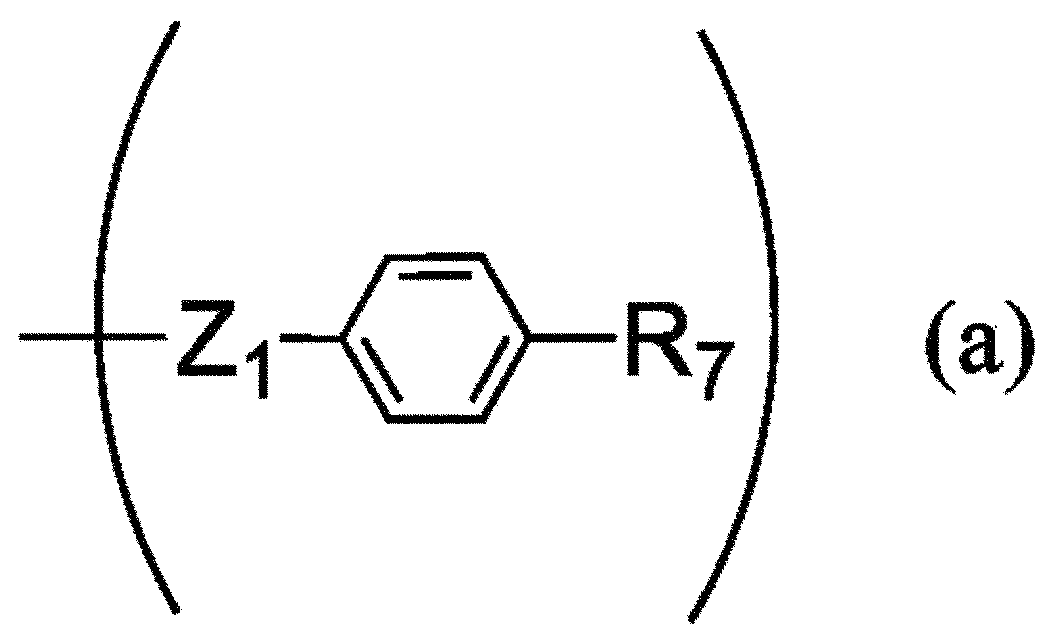
(式(a)中、R7は、炭素数4乃至12の直鎖若しくは分岐鎖のアルキル基、炭素数4乃至12の直鎖若しくは分岐鎖のアルコキシ基、又は下記式(b)
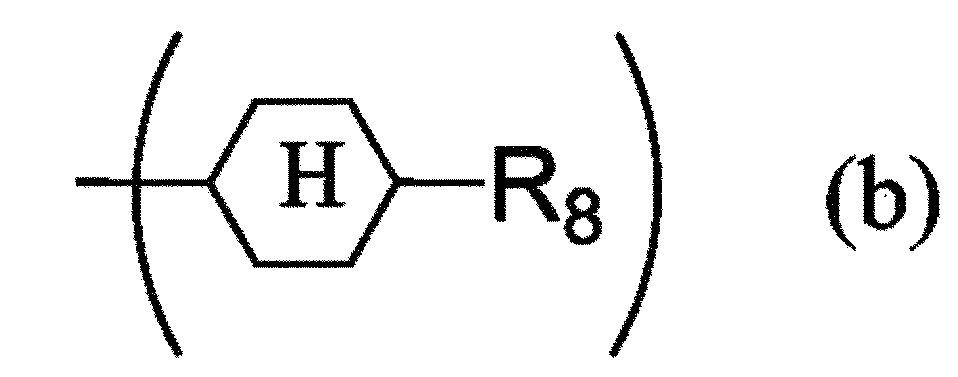
(式(b)中、R8は、炭素数1乃至12の直鎖又は分岐鎖のアルキル基を表す。)で表される置換基を表し、Z1は、酸素原子又は硫黄原子を表す。)で表される置換基を表す。
但し、Xがヒドロキシ基でYが水素原子又はアミノ基の場合には、R1は式(a)で表される置換基を、R2は水素原子をそれぞれ表し、Xが水素原子又はアミノ基でYがヒドロキシ基の場合には、R1は水素原子を、R2は式(a)で表される置換基をそれぞれ表す。
R3は、水素原子、炭素数1乃至12の直鎖若しくは分岐鎖のアルキル基、炭素数1乃至12の直鎖若しくは分岐鎖のアルコキシ基、又は上記式(b)で表される置換基を表し、R4は、炭素数4乃至12の直鎖若しくは分岐鎖のアルキル基、炭素数4乃至12の直鎖若しくは分岐鎖のアルコキシ基、又は上記式(b)で表される置換基を表す。)
で表されるアントラキノン化合物、
(ii)下記一般式(2)
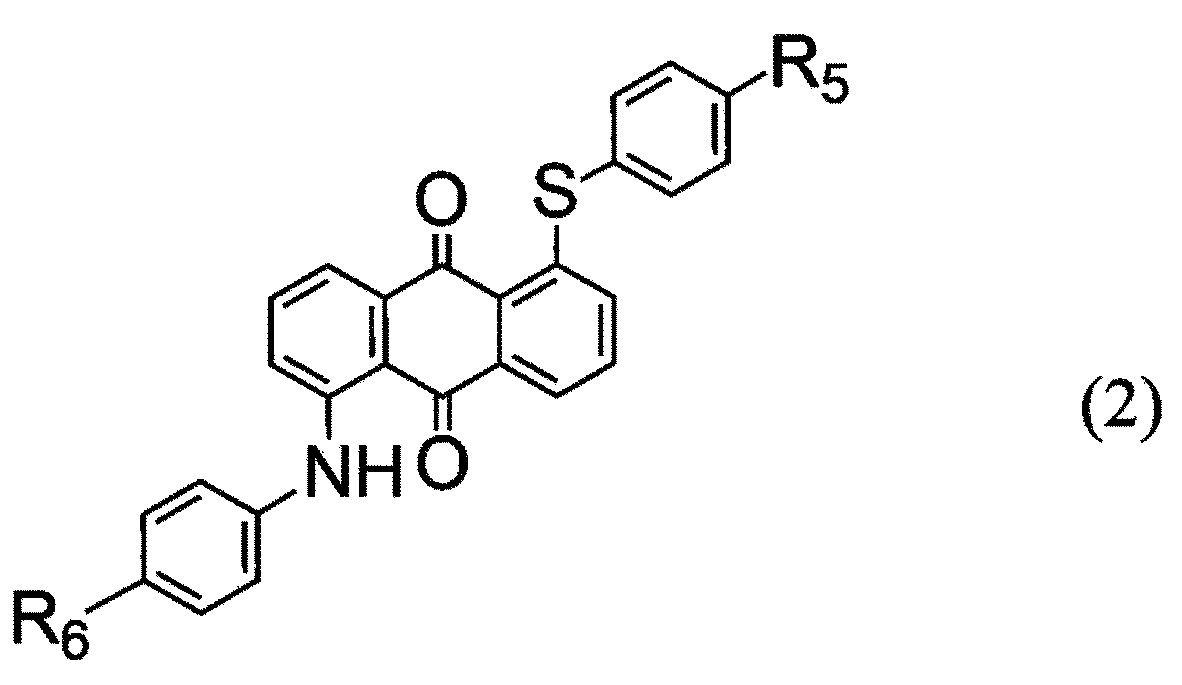
(式(2)中、R5は、炭素数1乃至18の直鎖若しくは分岐鎖のアルキル基、又は炭素数1乃至18の直鎖若しくは分岐鎖のアルコキシ基を表し、R6は、炭素数1乃至18の直鎖若しくは分岐鎖のアルキル基、炭素数1乃至18の直鎖若しくは分岐鎖のアルコキシ基、又は上記式(b)で表される置換基を表す。)
で表されるアントラキノン化合物、ならびに
(iii)一般式(1)で表されるアントラキノン化合物又は一般式(2)で表されるアントラキノン化合物以外の色素化合物
を含み、
一般式(1)で表されるアントラキノン化合物と一般式(2)で表されるアントラキノン化合物との質量比が2:1乃至1:2である、
液晶組成物。 - Xがヒドロキシ基であり、Yがアミノ基であり、R1が式(a)で表される置換基であり、かつZ1が酸素原子である、請求項1に記載の液晶組成物。
- R4及びR7が、それぞれ独立に炭素数6乃至12の直鎖若しくは分岐鎖のアルキル基、又は炭素数6乃至12の直鎖若しくは分岐鎖のアルコキシ基である、請求項2に記載の液晶組成物。
- R3が、炭素数4乃至7の直鎖若しくは分岐鎖のアルキル基、又は炭素数4乃至7の直鎖若しくは分岐鎖のアルコキシ基である、請求項3に記載の液晶組成物。
- R4及びR7が、それぞれ独立に上記式(b)で表される置換基であり、R3が、炭素数1乃至8の直鎖若しくは分岐鎖のアルキル基、又は炭素数1乃至8の直鎖若しくは分岐鎖のアルコキシ基である、請求項2に記載の液晶組成物。
- R4及びR7が、それぞれ独立に上記式(b)で表される置換基であり、R8が炭素数3乃至8の直鎖若しくは分岐鎖のアルキル基である、請求項5に記載の液晶組成物。
- (C)光硬化性化合物及び(D)光重合開始剤を更に含有する、請求項1乃至6のいずれか一項に記載の液晶組成物。
- (C)光硬化性化合物が、重合可能な官能基を一つ有する単官能モノマー及び重合可能な官能基を二つ有する二官能モノマーを含有する、請求項7に記載の液晶組成物。
- (C)光硬化性化合物が、モノ(メタ)アクリレート化合物及びジ(メタ)アクリレート化合物を含有する、請求項8に記載の液晶組成物。
- 請求項7乃至9のいずれか一項に記載の液晶組成物の硬化物。
- 少なくとも一方が透明電極を有する透明基板である基板が対向配置された一対の基板間に、請求項1乃至6のいずれか一項に記載の液晶組成物、又は請求項10に記載の硬化物を挟持してなる調光素子。
- 一対の基板間に電圧を印加した状態で、JIS Z 8781-4:2013に規定する方法で求めた色相のa*値が5.0以下である、請求項11に記載の調光素子。
- 一対の基板間に電圧を印加した際の、420乃至460nmの波長領域、520乃至590nmの波長領域及び600乃至640nmの波長領域のそれぞれにおける最小透過率のうち、最も小さい透過率の値と最も大きい透過率の値の差が6%以下であり、かつ
電圧無印加時の、420乃至460nmの波長領域、520乃至590nmの波長領域及び600乃至640nmの波長領域のそれぞれにおける最小透過率のうち、最も小さい透過率の値と最も大きい透過率の値の差が6%以下である、請求項11又は12に記載の調光素子。
Priority Applications (5)
| Application Number | Priority Date | Filing Date | Title |
|---|---|---|---|
| US18/267,853 US12378474B2 (en) | 2021-01-21 | 2022-01-19 | Liquid-crystal composition containing anthraquinone compound and light-modulating element |
| CN202280008706.5A CN116745385B (zh) | 2021-01-21 | 2022-01-19 | 含有蒽醌化合物的液晶组合物及调光元件 |
| JP2022576722A JP7787107B2 (ja) | 2021-01-21 | 2022-01-19 | アントラキノン化合物を含有する液晶組成物及び調光素子 |
| EP22742615.2A EP4282934A4 (en) | 2021-01-21 | 2022-01-19 | LIQUID CRYSTAL COMPOSITION WITH AN ANTHRAQUINONE COMPOUND AND A LIGHT-MODULATING ELEMENT |
| KR1020237023838A KR20230134483A (ko) | 2021-01-21 | 2022-01-19 | 안트라퀴논 화합물을 함유하는 액정 조성물 및 조광소자 |
Applications Claiming Priority (2)
| Application Number | Priority Date | Filing Date | Title |
|---|---|---|---|
| JP2021007694 | 2021-01-21 | ||
| JP2021-007694 | 2021-01-21 |
Publications (1)
| Publication Number | Publication Date |
|---|---|
| WO2022158493A1 true WO2022158493A1 (ja) | 2022-07-28 |
Family
ID=82549463
Family Applications (1)
| Application Number | Title | Priority Date | Filing Date |
|---|---|---|---|
| PCT/JP2022/001831 Ceased WO2022158493A1 (ja) | 2021-01-21 | 2022-01-19 | アントラキノン化合物を含有する液晶組成物及び調光素子 |
Country Status (7)
| Country | Link |
|---|---|
| US (1) | US12378474B2 (ja) |
| EP (1) | EP4282934A4 (ja) |
| JP (1) | JP7787107B2 (ja) |
| KR (1) | KR20230134483A (ja) |
| CN (1) | CN116745385B (ja) |
| TW (1) | TW202246466A (ja) |
| WO (1) | WO2022158493A1 (ja) |
Cited By (4)
| Publication number | Priority date | Publication date | Assignee | Title |
|---|---|---|---|---|
| JPWO2023100848A1 (ja) * | 2021-12-01 | 2023-06-08 | ||
| US20230340268A1 (en) * | 2020-06-25 | 2023-10-26 | Nippon Kayaku Kabushiki Kaisha | Anthraquinone Compound, Liquid Crystal Composition For Dimming Including Said Compound, And Dimming Element |
| CN117567875A (zh) * | 2024-01-15 | 2024-02-20 | 北京大学 | 一种二向性黑色染料、包含该染料的pdlc调光膜及其制备方法 |
| KR103001226B1 (ko) | 2021-12-01 | 2026-08-05 | 닛뽄 가야쿠 가부시키가이샤 | 안트라퀴논 화합물, 당해 화합물을 포함하는 액정 조성물 및 조광 소자 |
Families Citing this family (5)
| Publication number | Priority date | Publication date | Assignee | Title |
|---|---|---|---|---|
| WO2022191169A1 (ja) * | 2021-03-11 | 2022-09-15 | 日本化薬株式会社 | アントラキノン化合物、該化合物を含有する液晶組成物、及び調光素子 |
| WO2022220212A1 (ja) * | 2021-04-14 | 2022-10-20 | 日本化薬株式会社 | アントラキノン化合物、該化合物を含む液晶組成物及び調光素子 |
| WO2023063408A1 (ja) * | 2021-10-14 | 2023-04-20 | 日本化薬株式会社 | アントラキノン化合物、該化合物を含む液晶組成物及び調光素子 |
| CN118176265B (zh) * | 2021-11-04 | 2026-04-28 | 日本化药株式会社 | 蒽醌化合物、含该化合物的液晶组合物及调光元件 |
| CN119432400B (zh) * | 2024-11-06 | 2026-08-04 | 北京八亿时空液晶科技股份有限公司 | 一种染料pdlc组合物及pdlc调光膜 |
Citations (8)
| Publication number | Priority date | Publication date | Assignee | Title |
|---|---|---|---|---|
| JPS58196260A (ja) | 1982-05-03 | 1983-11-15 | バイエル・アクチエンゲゼルシヤフト | アントラキノン染料を含有する二色性液晶物質 |
| JPS625941A (ja) | 1985-03-15 | 1987-01-12 | Nippon Kayaku Co Ltd | アントラキノン化合物及びこれを含有する液晶組成物 |
| JP2000336366A (ja) * | 1999-05-31 | 2000-12-05 | Mitsubishi Chemicals Corp | 二色性色素組成物、これを用いたゲストホスト型液晶組成物および液晶表示素子 |
| JP2003167239A (ja) * | 2001-11-30 | 2003-06-13 | Nippon Kayaku Co Ltd | 画像表示装置 |
| JP2003167238A (ja) * | 2001-11-30 | 2003-06-13 | Nippon Kayaku Co Ltd | 画像表示装置 |
| CN103235445A (zh) * | 2013-05-06 | 2013-08-07 | 江苏和成显示科技股份有限公司 | 反射型液晶显示装置 |
| JP2017518413A (ja) | 2014-05-21 | 2017-07-06 | ロリク アーゲーRolic Ag | 重合性二色性染料 |
| CN108663866A (zh) * | 2017-03-30 | 2018-10-16 | 江苏和成显示科技有限公司 | 一种包含宾主液晶组合物的调光装置 |
Family Cites Families (7)
| Publication number | Priority date | Publication date | Assignee | Title |
|---|---|---|---|---|
| JPS5659512U (ja) | 1979-10-12 | 1981-05-21 | ||
| JPH04264193A (ja) * | 1991-02-19 | 1992-09-18 | Mitsubishi Kasei Corp | 調光材料およびそれを含む調光素子 |
| JPH05224191A (ja) * | 1992-02-12 | 1993-09-03 | Ricoh Co Ltd | 液晶膜、それを用いた液晶表示素子およびその製造方法 |
| JP2009108295A (ja) * | 2007-10-10 | 2009-05-21 | Fujifilm Corp | 液晶組成物、液晶素子、反射型表示材料、及び調光材料 |
| JP5659512B2 (ja) | 2010-03-12 | 2015-01-28 | 三菱化学株式会社 | 調光用液晶組成物、並びに、その光硬化物及び調光素子 |
| CN103483864B (zh) * | 2012-06-13 | 2016-06-15 | 江苏和成显示科技股份有限公司 | 二色性染料组合物及其应用 |
| JP2019178249A (ja) * | 2018-03-30 | 2019-10-17 | 日本化薬株式会社 | 調光用液晶組成物、並びに、その光硬化物及び調光素子 |
-
2022
- 2022-01-19 CN CN202280008706.5A patent/CN116745385B/zh active Active
- 2022-01-19 KR KR1020237023838A patent/KR20230134483A/ko active Pending
- 2022-01-19 JP JP2022576722A patent/JP7787107B2/ja active Active
- 2022-01-19 WO PCT/JP2022/001831 patent/WO2022158493A1/ja not_active Ceased
- 2022-01-19 US US18/267,853 patent/US12378474B2/en active Active
- 2022-01-19 EP EP22742615.2A patent/EP4282934A4/en active Pending
- 2022-01-21 TW TW111102626A patent/TW202246466A/zh unknown
Patent Citations (8)
| Publication number | Priority date | Publication date | Assignee | Title |
|---|---|---|---|---|
| JPS58196260A (ja) | 1982-05-03 | 1983-11-15 | バイエル・アクチエンゲゼルシヤフト | アントラキノン染料を含有する二色性液晶物質 |
| JPS625941A (ja) | 1985-03-15 | 1987-01-12 | Nippon Kayaku Co Ltd | アントラキノン化合物及びこれを含有する液晶組成物 |
| JP2000336366A (ja) * | 1999-05-31 | 2000-12-05 | Mitsubishi Chemicals Corp | 二色性色素組成物、これを用いたゲストホスト型液晶組成物および液晶表示素子 |
| JP2003167239A (ja) * | 2001-11-30 | 2003-06-13 | Nippon Kayaku Co Ltd | 画像表示装置 |
| JP2003167238A (ja) * | 2001-11-30 | 2003-06-13 | Nippon Kayaku Co Ltd | 画像表示装置 |
| CN103235445A (zh) * | 2013-05-06 | 2013-08-07 | 江苏和成显示科技股份有限公司 | 反射型液晶显示装置 |
| JP2017518413A (ja) | 2014-05-21 | 2017-07-06 | ロリク アーゲーRolic Ag | 重合性二色性染料 |
| CN108663866A (zh) * | 2017-03-30 | 2018-10-16 | 江苏和成显示科技有限公司 | 一种包含宾主液晶组合物的调光装置 |
Non-Patent Citations (2)
| Title |
|---|
| "Liquid Crystal Device Handbook", 1989, THE NIKKAN KOGYO SHIMBUN, LTD., pages: 154 - 722 |
| See also references of EP4282934A4 |
Cited By (9)
| Publication number | Priority date | Publication date | Assignee | Title |
|---|---|---|---|---|
| US20230340268A1 (en) * | 2020-06-25 | 2023-10-26 | Nippon Kayaku Kabushiki Kaisha | Anthraquinone Compound, Liquid Crystal Composition For Dimming Including Said Compound, And Dimming Element |
| US11905417B2 (en) * | 2020-06-25 | 2024-02-20 | Nippon Kayaku Kabushiki Kaisha | Anthraquinone compound, liquid crystal composition for dimming including said compound, and dimming element |
| JPWO2023100848A1 (ja) * | 2021-12-01 | 2023-06-08 | ||
| WO2023100848A1 (ja) * | 2021-12-01 | 2023-06-08 | 日本化薬株式会社 | アントラキノン化合物、該化合物を含む液晶組成物及び調光素子 |
| US12637421B2 (en) | 2021-12-01 | 2026-05-26 | Nippon Kayaku Kabushiki Kaisha | Anthraquinone compound, liquid crystal composition containing said compound, and dimming element |
| KR103001226B1 (ko) | 2021-12-01 | 2026-08-05 | 닛뽄 가야쿠 가부시키가이샤 | 안트라퀴논 화합물, 당해 화합물을 포함하는 액정 조성물 및 조광 소자 |
| JP7901612B2 (ja) | 2021-12-01 | 2026-08-06 | 日本化薬株式会社 | アントラキノン化合物、該化合物を含む液晶組成物及び調光素子 |
| CN117567875A (zh) * | 2024-01-15 | 2024-02-20 | 北京大学 | 一种二向性黑色染料、包含该染料的pdlc调光膜及其制备方法 |
| CN117567875B (zh) * | 2024-01-15 | 2024-04-16 | 北京大学 | 一种二向性黑色染料、包含该染料的pdlc调光膜及其制备方法 |
Also Published As
| Publication number | Publication date |
|---|---|
| US12378474B2 (en) | 2025-08-05 |
| CN116745385A (zh) | 2023-09-12 |
| JP7787107B2 (ja) | 2025-12-16 |
| US20240141234A1 (en) | 2024-05-02 |
| KR20230134483A (ko) | 2023-09-21 |
| JPWO2022158493A1 (ja) | 2022-07-28 |
| CN116745385B (zh) | 2024-11-05 |
| EP4282934A4 (en) | 2025-01-08 |
| EP4282934A1 (en) | 2023-11-29 |
| TW202246466A (zh) | 2022-12-01 |
Similar Documents
| Publication | Publication Date | Title |
|---|---|---|
| JP7787107B2 (ja) | アントラキノン化合物を含有する液晶組成物及び調光素子 | |
| JP7796050B2 (ja) | アントラキノン化合物を含有する調光用液晶組成物、その光硬化物及び調光素子 | |
| US12331240B2 (en) | Anthraquinone compound, liquid crystal composition containing said compound, and light-controlling element | |
| JP7654655B2 (ja) | アントラキノン化合物、該化合物を含む調光用液晶組成物及び調光素子 | |
| JP7796048B2 (ja) | アントラキノン化合物を含有する調光用液晶組成物、その光硬化物及び調光素子 | |
| JP7723078B2 (ja) | アントラキノン化合物、該化合物を含む液晶組成物及び調光素子 | |
| WO2023100848A1 (ja) | アントラキノン化合物、該化合物を含む液晶組成物及び調光素子 | |
| JP2019178249A (ja) | 調光用液晶組成物、並びに、その光硬化物及び調光素子 | |
| EP4306616B1 (en) | Anthraquinone compound, liquid crystal composition containing said compound, and dimming element | |
| EP4417597A1 (en) | Anthraquinone compound, liquid crystal composition containing said compound, and dimming element | |
| JP2025133090A (ja) | アントラキノン化合物を含有する液晶組成物及び調光素子 |
Legal Events
| Date | Code | Title | Description |
|---|---|---|---|
| 121 | Ep: the epo has been informed by wipo that ep was designated in this application |
Ref document number: 22742615 Country of ref document: EP Kind code of ref document: A1 |
|
| ENP | Entry into the national phase |
Ref document number: 2022576722 Country of ref document: JP Kind code of ref document: A |
|
| WWE | Wipo information: entry into national phase |
Ref document number: 18267853 Country of ref document: US |
|
| WWE | Wipo information: entry into national phase |
Ref document number: 202280008706.5 Country of ref document: CN |
|
| NENP | Non-entry into the national phase |
Ref country code: DE |
|
| ENP | Entry into the national phase |
Ref document number: 2022742615 Country of ref document: EP Effective date: 20230821 |
|
| WWG | Wipo information: grant in national office |
Ref document number: 18267853 Country of ref document: US |