WO2022190745A1 - 硬化性樹脂組成物、硬化物及び接着剤 - Google Patents
硬化性樹脂組成物、硬化物及び接着剤 Download PDFInfo
- Publication number
- WO2022190745A1 WO2022190745A1 PCT/JP2022/004965 JP2022004965W WO2022190745A1 WO 2022190745 A1 WO2022190745 A1 WO 2022190745A1 JP 2022004965 W JP2022004965 W JP 2022004965W WO 2022190745 A1 WO2022190745 A1 WO 2022190745A1
- Authority
- WO
- WIPO (PCT)
- Prior art keywords
- resin composition
- curable resin
- compound
- amine
- group
- Prior art date
- Legal status (The legal status is an assumption and is not a legal conclusion. Google has not performed a legal analysis and makes no representation as to the accuracy of the status listed.)
- Ceased
Links
Classifications
-
- C—CHEMISTRY; METALLURGY
- C08—ORGANIC MACROMOLECULAR COMPOUNDS; THEIR PREPARATION OR CHEMICAL WORKING-UP; COMPOSITIONS BASED THEREON
- C08G—MACROMOLECULAR COMPOUNDS OBTAINED OTHERWISE THAN BY REACTIONS ONLY INVOLVING UNSATURATED CARBON-TO-CARBON BONDS
- C08G59/00—Polycondensates containing more than one epoxy group per molecule; Macromolecules obtained by polymerising compounds containing more than one epoxy group per molecule using curing agents or catalysts which react with the epoxy groups
- C08G59/18—Macromolecules obtained by polymerising compounds containing more than one epoxy group per molecule using curing agents or catalysts which react with the epoxy groups ; e.g. general methods of curing
- C08G59/20—Macromolecules obtained by polymerising compounds containing more than one epoxy group per molecule using curing agents or catalysts which react with the epoxy groups ; e.g. general methods of curing characterised by the epoxy compounds used
- C08G59/22—Di-epoxy compounds
- C08G59/24—Di-epoxy compounds carbocyclic
- C08G59/245—Di-epoxy compounds carbocyclic aromatic
-
- C—CHEMISTRY; METALLURGY
- C08—ORGANIC MACROMOLECULAR COMPOUNDS; THEIR PREPARATION OR CHEMICAL WORKING-UP; COMPOSITIONS BASED THEREON
- C08L—COMPOSITIONS OF MACROMOLECULAR COMPOUNDS
- C08L63/00—Compositions of epoxy resins; Compositions of derivatives of epoxy resins
-
- C—CHEMISTRY; METALLURGY
- C08—ORGANIC MACROMOLECULAR COMPOUNDS; THEIR PREPARATION OR CHEMICAL WORKING-UP; COMPOSITIONS BASED THEREON
- C08G—MACROMOLECULAR COMPOUNDS OBTAINED OTHERWISE THAN BY REACTIONS ONLY INVOLVING UNSATURATED CARBON-TO-CARBON BONDS
- C08G59/00—Polycondensates containing more than one epoxy group per molecule; Macromolecules obtained by polymerising compounds containing more than one epoxy group per molecule using curing agents or catalysts which react with the epoxy groups
- C08G59/18—Macromolecules obtained by polymerising compounds containing more than one epoxy group per molecule using curing agents or catalysts which react with the epoxy groups ; e.g. general methods of curing
- C08G59/182—Macromolecules obtained by polymerising compounds containing more than one epoxy group per molecule using curing agents or catalysts which react with the epoxy groups ; e.g. general methods of curing using pre-adducts of epoxy compounds with curing agents
- C08G59/184—Macromolecules obtained by polymerising compounds containing more than one epoxy group per molecule using curing agents or catalysts which react with the epoxy groups ; e.g. general methods of curing using pre-adducts of epoxy compounds with curing agents with amines
-
- C—CHEMISTRY; METALLURGY
- C08—ORGANIC MACROMOLECULAR COMPOUNDS; THEIR PREPARATION OR CHEMICAL WORKING-UP; COMPOSITIONS BASED THEREON
- C08G—MACROMOLECULAR COMPOUNDS OBTAINED OTHERWISE THAN BY REACTIONS ONLY INVOLVING UNSATURATED CARBON-TO-CARBON BONDS
- C08G59/00—Polycondensates containing more than one epoxy group per molecule; Macromolecules obtained by polymerising compounds containing more than one epoxy group per molecule using curing agents or catalysts which react with the epoxy groups
- C08G59/18—Macromolecules obtained by polymerising compounds containing more than one epoxy group per molecule using curing agents or catalysts which react with the epoxy groups ; e.g. general methods of curing
- C08G59/20—Macromolecules obtained by polymerising compounds containing more than one epoxy group per molecule using curing agents or catalysts which react with the epoxy groups ; e.g. general methods of curing characterised by the epoxy compounds used
- C08G59/22—Di-epoxy compounds
- C08G59/28—Di-epoxy compounds containing acyclic nitrogen atoms
-
- C—CHEMISTRY; METALLURGY
- C08—ORGANIC MACROMOLECULAR COMPOUNDS; THEIR PREPARATION OR CHEMICAL WORKING-UP; COMPOSITIONS BASED THEREON
- C08G—MACROMOLECULAR COMPOUNDS OBTAINED OTHERWISE THAN BY REACTIONS ONLY INVOLVING UNSATURATED CARBON-TO-CARBON BONDS
- C08G59/00—Polycondensates containing more than one epoxy group per molecule; Macromolecules obtained by polymerising compounds containing more than one epoxy group per molecule using curing agents or catalysts which react with the epoxy groups
- C08G59/18—Macromolecules obtained by polymerising compounds containing more than one epoxy group per molecule using curing agents or catalysts which react with the epoxy groups ; e.g. general methods of curing
- C08G59/20—Macromolecules obtained by polymerising compounds containing more than one epoxy group per molecule using curing agents or catalysts which react with the epoxy groups ; e.g. general methods of curing characterised by the epoxy compounds used
- C08G59/32—Epoxy compounds containing three or more epoxy groups
- C08G59/34—Epoxy compounds containing three or more epoxy groups obtained by epoxidation of an unsaturated polymer
-
- C—CHEMISTRY; METALLURGY
- C08—ORGANIC MACROMOLECULAR COMPOUNDS; THEIR PREPARATION OR CHEMICAL WORKING-UP; COMPOSITIONS BASED THEREON
- C08G—MACROMOLECULAR COMPOUNDS OBTAINED OTHERWISE THAN BY REACTIONS ONLY INVOLVING UNSATURATED CARBON-TO-CARBON BONDS
- C08G59/00—Polycondensates containing more than one epoxy group per molecule; Macromolecules obtained by polymerising compounds containing more than one epoxy group per molecule using curing agents or catalysts which react with the epoxy groups
- C08G59/18—Macromolecules obtained by polymerising compounds containing more than one epoxy group per molecule using curing agents or catalysts which react with the epoxy groups ; e.g. general methods of curing
- C08G59/40—Macromolecules obtained by polymerising compounds containing more than one epoxy group per molecule using curing agents or catalysts which react with the epoxy groups ; e.g. general methods of curing characterised by the curing agents used
- C08G59/4007—Curing agents not provided for by the groups C08G59/42 - C08G59/66
- C08G59/4014—Nitrogen containing compounds
-
- C—CHEMISTRY; METALLURGY
- C08—ORGANIC MACROMOLECULAR COMPOUNDS; THEIR PREPARATION OR CHEMICAL WORKING-UP; COMPOSITIONS BASED THEREON
- C08G—MACROMOLECULAR COMPOUNDS OBTAINED OTHERWISE THAN BY REACTIONS ONLY INVOLVING UNSATURATED CARBON-TO-CARBON BONDS
- C08G59/00—Polycondensates containing more than one epoxy group per molecule; Macromolecules obtained by polymerising compounds containing more than one epoxy group per molecule using curing agents or catalysts which react with the epoxy groups
- C08G59/18—Macromolecules obtained by polymerising compounds containing more than one epoxy group per molecule using curing agents or catalysts which react with the epoxy groups ; e.g. general methods of curing
- C08G59/40—Macromolecules obtained by polymerising compounds containing more than one epoxy group per molecule using curing agents or catalysts which react with the epoxy groups ; e.g. general methods of curing characterised by the curing agents used
- C08G59/50—Amines
- C08G59/5006—Amines aliphatic
-
- C—CHEMISTRY; METALLURGY
- C08—ORGANIC MACROMOLECULAR COMPOUNDS; THEIR PREPARATION OR CHEMICAL WORKING-UP; COMPOSITIONS BASED THEREON
- C08G—MACROMOLECULAR COMPOUNDS OBTAINED OTHERWISE THAN BY REACTIONS ONLY INVOLVING UNSATURATED CARBON-TO-CARBON BONDS
- C08G59/00—Polycondensates containing more than one epoxy group per molecule; Macromolecules obtained by polymerising compounds containing more than one epoxy group per molecule using curing agents or catalysts which react with the epoxy groups
- C08G59/18—Macromolecules obtained by polymerising compounds containing more than one epoxy group per molecule using curing agents or catalysts which react with the epoxy groups ; e.g. general methods of curing
- C08G59/40—Macromolecules obtained by polymerising compounds containing more than one epoxy group per molecule using curing agents or catalysts which react with the epoxy groups ; e.g. general methods of curing characterised by the curing agents used
- C08G59/50—Amines
- C08G59/5006—Amines aliphatic
- C08G59/502—Polyalkylene polyamines
-
- C—CHEMISTRY; METALLURGY
- C08—ORGANIC MACROMOLECULAR COMPOUNDS; THEIR PREPARATION OR CHEMICAL WORKING-UP; COMPOSITIONS BASED THEREON
- C08G—MACROMOLECULAR COMPOUNDS OBTAINED OTHERWISE THAN BY REACTIONS ONLY INVOLVING UNSATURATED CARBON-TO-CARBON BONDS
- C08G59/00—Polycondensates containing more than one epoxy group per molecule; Macromolecules obtained by polymerising compounds containing more than one epoxy group per molecule using curing agents or catalysts which react with the epoxy groups
- C08G59/18—Macromolecules obtained by polymerising compounds containing more than one epoxy group per molecule using curing agents or catalysts which react with the epoxy groups ; e.g. general methods of curing
- C08G59/40—Macromolecules obtained by polymerising compounds containing more than one epoxy group per molecule using curing agents or catalysts which react with the epoxy groups ; e.g. general methods of curing characterised by the curing agents used
- C08G59/50—Amines
- C08G59/56—Amines together with other curing agents
-
- C—CHEMISTRY; METALLURGY
- C08—ORGANIC MACROMOLECULAR COMPOUNDS; THEIR PREPARATION OR CHEMICAL WORKING-UP; COMPOSITIONS BASED THEREON
- C08K—Use of inorganic or non-macromolecular organic substances as compounding ingredients
- C08K3/00—Use of inorganic substances as compounding ingredients
- C08K3/02—Elements
- C08K3/08—Metals
-
- C—CHEMISTRY; METALLURGY
- C08—ORGANIC MACROMOLECULAR COMPOUNDS; THEIR PREPARATION OR CHEMICAL WORKING-UP; COMPOSITIONS BASED THEREON
- C08K—Use of inorganic or non-macromolecular organic substances as compounding ingredients
- C08K3/00—Use of inorganic substances as compounding ingredients
- C08K3/34—Silicon-containing compounds
- C08K3/36—Silica
-
- C—CHEMISTRY; METALLURGY
- C08—ORGANIC MACROMOLECULAR COMPOUNDS; THEIR PREPARATION OR CHEMICAL WORKING-UP; COMPOSITIONS BASED THEREON
- C08L—COMPOSITIONS OF MACROMOLECULAR COMPOUNDS
- C08L61/00—Compositions of condensation polymers of aldehydes or ketones; Compositions of derivatives of such polymers
- C08L61/04—Condensation polymers of aldehydes or ketones with phenols only
- C08L61/06—Condensation polymers of aldehydes or ketones with phenols only of aldehydes with phenols
- C08L61/14—Modified phenol-aldehyde condensates
-
- C—CHEMISTRY; METALLURGY
- C09—DYES; PAINTS; POLISHES; NATURAL RESINS; ADHESIVES; COMPOSITIONS NOT OTHERWISE PROVIDED FOR; APPLICATIONS OF MATERIALS NOT OTHERWISE PROVIDED FOR
- C09J—ADHESIVES; NON-MECHANICAL ASPECTS OF ADHESIVE PROCESSES IN GENERAL; ADHESIVE PROCESSES NOT PROVIDED FOR ELSEWHERE; USE OF MATERIALS AS ADHESIVES
- C09J163/00—Adhesives based on epoxy resins; Adhesives based on derivatives of epoxy resins
-
- C—CHEMISTRY; METALLURGY
- C09—DYES; PAINTS; POLISHES; NATURAL RESINS; ADHESIVES; COMPOSITIONS NOT OTHERWISE PROVIDED FOR; APPLICATIONS OF MATERIALS NOT OTHERWISE PROVIDED FOR
- C09J—ADHESIVES; NON-MECHANICAL ASPECTS OF ADHESIVE PROCESSES IN GENERAL; ADHESIVE PROCESSES NOT PROVIDED FOR ELSEWHERE; USE OF MATERIALS AS ADHESIVES
- C09J163/00—Adhesives based on epoxy resins; Adhesives based on derivatives of epoxy resins
- C09J163/08—Epoxidised polymerised polyenes
-
- C—CHEMISTRY; METALLURGY
- C08—ORGANIC MACROMOLECULAR COMPOUNDS; THEIR PREPARATION OR CHEMICAL WORKING-UP; COMPOSITIONS BASED THEREON
- C08K—Use of inorganic or non-macromolecular organic substances as compounding ingredients
- C08K3/00—Use of inorganic substances as compounding ingredients
- C08K3/02—Elements
- C08K3/08—Metals
- C08K2003/0812—Aluminium
-
- C—CHEMISTRY; METALLURGY
- C08—ORGANIC MACROMOLECULAR COMPOUNDS; THEIR PREPARATION OR CHEMICAL WORKING-UP; COMPOSITIONS BASED THEREON
- C08K—Use of inorganic or non-macromolecular organic substances as compounding ingredients
- C08K2201/00—Specific properties of additives
- C08K2201/002—Physical properties
- C08K2201/003—Additives being defined by their diameter
-
- C—CHEMISTRY; METALLURGY
- C08—ORGANIC MACROMOLECULAR COMPOUNDS; THEIR PREPARATION OR CHEMICAL WORKING-UP; COMPOSITIONS BASED THEREON
- C08K—Use of inorganic or non-macromolecular organic substances as compounding ingredients
- C08K3/00—Use of inorganic substances as compounding ingredients
- C08K3/10—Metal compounds
- C08K3/105—Compounds containing metals of Groups 1 to 3 or of Groups 11 to 13 of the Periodic Table
-
- C—CHEMISTRY; METALLURGY
- C08—ORGANIC MACROMOLECULAR COMPOUNDS; THEIR PREPARATION OR CHEMICAL WORKING-UP; COMPOSITIONS BASED THEREON
- C08L—COMPOSITIONS OF MACROMOLECULAR COMPOUNDS
- C08L2205/00—Polymer mixtures characterised by other features
- C08L2205/02—Polymer mixtures characterised by other features containing two or more polymers of the same C08L -group
- C08L2205/025—Polymer mixtures characterised by other features containing two or more polymers of the same C08L -group containing two or more polymers of the same hierarchy C08L, and differing only in parameters such as density, comonomer content, molecular weight, structure
-
- C—CHEMISTRY; METALLURGY
- C08—ORGANIC MACROMOLECULAR COMPOUNDS; THEIR PREPARATION OR CHEMICAL WORKING-UP; COMPOSITIONS BASED THEREON
- C08L—COMPOSITIONS OF MACROMOLECULAR COMPOUNDS
- C08L2205/00—Polymer mixtures characterised by other features
- C08L2205/03—Polymer mixtures characterised by other features containing three or more polymers in a blend
- C08L2205/035—Polymer mixtures characterised by other features containing three or more polymers in a blend containing four or more polymers in a blend
Definitions
- the present invention relates to a curable resin composition, and more particularly to a curable resin composition containing a cyanate ester resin, an epoxy resin, a latent curing agent and an ion trapping agent.
- Epoxy resins are widely used industrially as paints, adhesives, and various molding materials.
- Patent Document 6 and the like describe a resin composition containing an ion scavenger, but do not describe its use in a cyanate-epoxy composite resin composition.
- Patent Document 7 describes an insulating adhesive obtained by combining an epoxy resin, a cyanate ester curing agent, and an inorganic ion exchange agent. not suggested to do so.
- Cured products of the cyanate-epoxy resin compositions described in Patent Documents 1 to 5 may become cloudy under high-temperature and high-humidity environments. This is a particular problem when the cyanate-epoxy resin composition is used as an adhesive for optical parts such as lenses.
- Patent Documents 6 and 7 do not consider antifogging properties.
- a curing system that uses an epoxy resin and a cyanate ester curing agent and does not use an amine-based latent curing agent containing active hydrogen lacks curability and requires curing at a high temperature. Therefore, it cannot be used for applications such as adhesives.
- the problem to be solved by the present invention is to provide a curable resin composition that has excellent curability and that can give a cured product with excellent antifogging properties even when placed under high temperature and high humidity conditions.
- the present inventors have made extensive studies and found that a curable resin composition containing a cyanate ester resin, an epoxy resin, an amine-based latent curing agent containing active hydrogen, and an ion scavenger can achieve the above objects. have arrived at the present invention.
- the present invention provides a curable resin composition containing (A) a cyanate ester resin, (B) an epoxy resin, (C) an amine latent curing agent containing active hydrogen, and (D) an ion scavenger. It is something to do.
- the present invention also provides a cured product of the curable resin composition and an adhesive containing the curable resin composition.
- the curable resin composition of the present invention is described below.
- the present inventor believes that the cloudiness of the cyanate-epoxy curable resin composition is caused by the components generated by the reaction of the components generated by the decomposition of the adhesive component in a high-temperature and high-humidity environment and the components generated by the reaction of silicon, sodium, etc. derived from glass. Presumed to be precipitation. Then, it is thought that the component generated by the decomposition of the cured product of the cyanate-epoxy curable resin composition in a high-temperature and high-humidity environment can be captured by the ion scavenger. The use of ion scavengers in formulations has been reached.
- the cyanate ester resin which is the component (A) used in the present invention, is a compound having two or more cyanate groups, and can be used without any particular limitation in terms of molecular structure, molecular weight, and the like.
- cyanate ester resin which is the component (A)
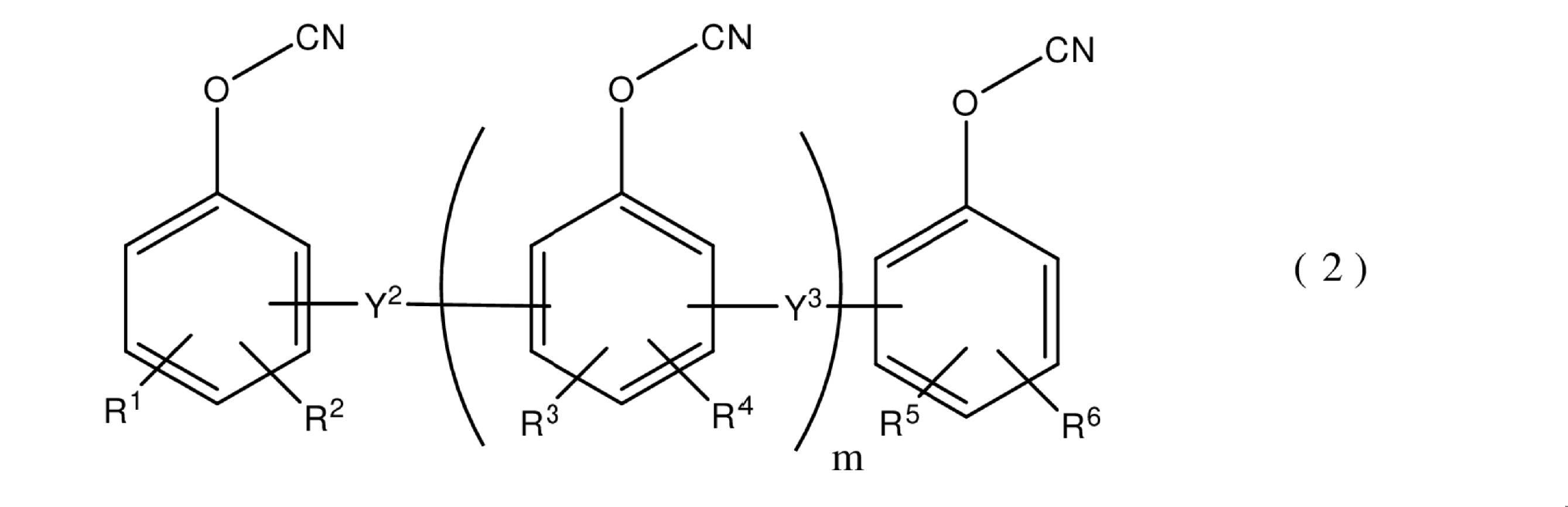
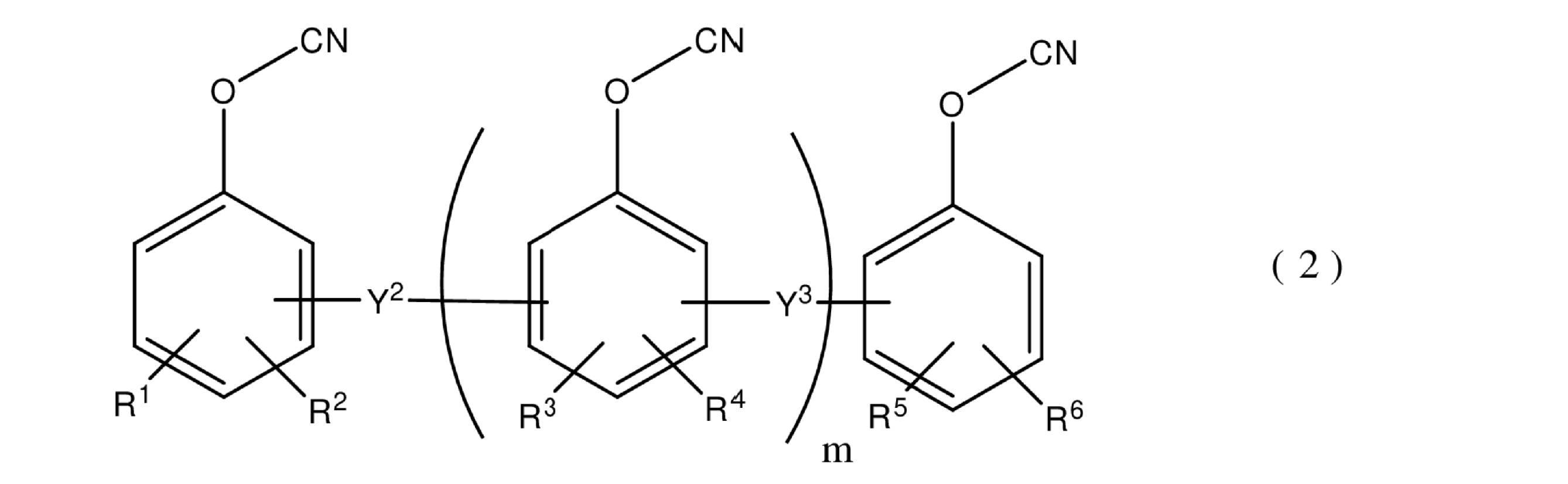
- a compound represented by the following formula (1) for example, a compound represented by the following formula (1), a compound represented by the following formula (2), and these compounds represented by the formula (1) and at least one polymer selected from compounds represented by formula (2).
- the polymer referred to here is also called a prepolymer.
- NC-OA 1 -Y 1 -A 2 -O-CN (1)
- Y 1 represents a divalent hydrocarbon group that is unsubstituted or substituted with a fluorine atom or a cyanato group, or represents —O—, —S—, or a single bond
- a 1 and A 2 are each independently a phenylene group that is unsubstituted or substituted with an alkyl group for 1 to 4 hydrogen atoms on the ring.
- m is an integer of 1 or more, and Y 2 and Y 3 each independently represent —S—, or are unsubstituted or substituted with a fluorine atom or a cyanato group, and are divalent carbonized represents a hydrogen group, and R 1 to R 6 are each independently a hydrogen atom or an alkyl group having 1 to 4 carbon atoms.
- alkyl groups having 1 to 4 carbon atoms include methyl group, ethyl group, propyl group, isopropyl group, butyl group, isobutyl group, s-butyl group and t-butyl group.
- the alkyl group includes an alkyl group having 1 to 4 carbon atoms.
- the unsubstituted or fluorine-substituted divalent hydrocarbon group represented by Y 1 in formula (1) and Y 2 and Y 3 in formula (2) has 1 to 20 carbon atoms. are preferably mentioned.
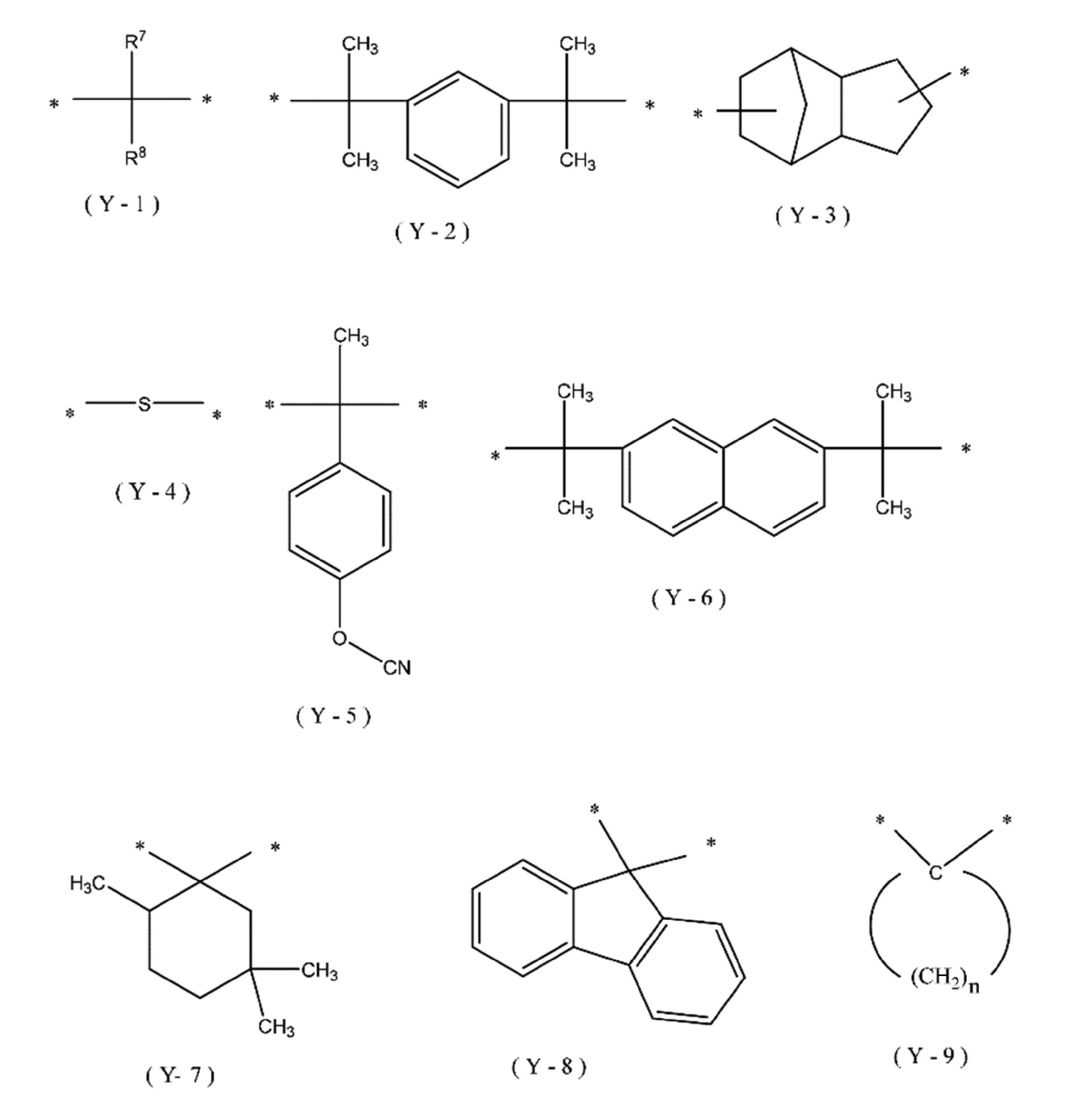
- Y 1 in the formula (1) and Y 2 and Y 3 in the formula (2) have structures represented by any of the following formulas (Y-1) to (Y-9). It is preferable that it is a thing because it is easily available.
- n is an integer of 4 to 12
- R 7 and R 8 are each independently a hydrogen atom or an unsubstituted or fluorine atom-substituted methyl group. * represents a bond.
- cyanate ester resins bisphenol E type cyanate ester resins, biphenyl type, novolak phenol type, bisphenol A type cyanate ester resins, and the like are preferable because they can provide a cured product having excellent heat resistance.
- bisphenol-type cyanate ester resins such as bisphenol E-type and bisphenol A-type resins include resins in which Y1 in the formula (1) is represented by (Y- 1 ).
- Examples of biphenyl-type cyanate ester resins include resins in which Y 1 is a single bond in the formula (1).
- novolak phenol-type cyanate ester resins include resins in which Y 2 and Y 3 are independently (Y-1) in the formula (2).
- 80% by mass or more of the total cyanate ester resin is a bisphenol-type, biphenyl-type, or novolacphenol-type cyanate ester.
- the resin preferably accounts for 90% by mass or more, and more preferably the bisphenol-type, biphenyl-type, or novolacphenol-type cyanate ester resin accounts for 90% by mass or more.
- the bisphenol-type cyanate ester resin preferably accounts for 80% by mass or more of the total cyanate ester resin, more preferably 90% by mass or more for the bisphenol-type cyanate ester resin, and 95% by mass or more.
- a bisphenol-type cyanate ester resin is particularly preferred.
- the content of the cyanate ester resin is more preferably 5 parts by mass or more and 80 parts by mass or less in 100 parts by mass of the solid content of the composition, and 10 parts by mass or more. 60 parts by mass or less is particularly preferred.
- the solid content refers to the total amount of all components other than the solvent.
- the solvent may or may not be contained, but when it is contained, it is preferably 5% by mass or less in the curable resin composition, and 2% by mass % or less is more preferable.
- the epoxy resin which is the component (B) used in the present invention, has at least two epoxy groups in its molecule, and can be used without any particular restrictions on its molecular structure, molecular weight, and the like.
- epoxy resin examples include polyglycidyl ether compounds of mononuclear polyhydric phenol compounds such as hydroquinone, resorcinol, pyrocatechol and phloroglucinol; dihydroxynaphthalene, biphenol, methylenebisphenol (bisphenol F), methylenebis(orthocresol), ethylidenebisphenol , isopropylidenebisphenol (bisphenol A), isopropylidenebis(orthocresol), tetrabromobisphenol A, 1,3-bis(4-hydroxycumylbenzene), 1,4-bis(4-hydroxycumylbenzene), 1,1,3-tris(4-hydroxyphenyl)butane, 1,1,2,2-tetra(4-hydroxyphenyl)ethane, thiobisphenol, sulfobisphenol, oxybisphenol, phenol novolak, ortho-cresol novolak, ethylphenol Polyglycidyl ether compounds of mono
- epoxy resins are internally cross-linked with a prepolymer having terminal isocyanate, or have a high molecular weight with a polyvalent active hydrogen compound (polyhydric phenol, polyamine, carbonyl group-containing compound, polyphosphate ester, etc.). It's okay.
- a polyvalent active hydrogen compound polyhydric phenol, polyamine, carbonyl group-containing compound, polyphosphate ester, etc.
- the epoxy resins from the viewpoint of reactivity, it is preferable to have a glycidyl-type epoxy resin having a glycidyl group. It is preferable to contain one or more polyglycidyl ether compounds (specifically, diglycidyl ether compounds) of dimethanol. Containing a polyglycidyl ether compound of a polynuclear polyhydric phenol compound is preferable in terms of heat resistance. Containing an epoxy compound having a glycidylamino group is preferable from the viewpoint of excellent reactivity and excellent heat resistance. Containing a polyglycidyl ether compound of dicyclopentadiene dimethanol is preferable in terms of the effect of imparting adhesion.
- the "glycidylamino group” may be monofunctional or bifunctional, but preferably refers to a bifunctional "diglycidylamino group". All of the preferred numerical ranges of the amount of the "epoxy compound having a glycidylamino group” in this specification can be regarded as the preferred numerical range of the amount of the "epoxy compound having a diglycidylamino group”.
- the number of epoxy groups in the epoxy resin, which is the component (B), is 1.1 or more per molecule, and 10 or less is preferable for excellent heat resistance and one-component stability, and is preferably 2 or more and 4 or less. is more preferable.
- the epoxy equivalent (g/eq) of the epoxy resin which is the component (B) is preferably 50 or more in terms of heat resistance, more preferably 60 or more and 30,000 or less, and 70 or more and 20,000 or less. is more preferable.
- the epoxy resin as component (B) preferably has a molecular weight of 150 or more and 80,000 or less, more preferably 200 or more and 10,000 or less, from the viewpoint of heat resistance.
- the molecular weight can be measured as a weight average molecular weight and can be measured by the following method.
- the weight average molecular weight can be determined, for example, by GPC (gel permeation chromatography) measurement as a standard polystyrene conversion value, and can be measured, for example, under the following conditions.
- Weight average molecular weight for example, using GPC (LC-2000plus series) manufactured by JASCO Corporation, using tetrahydrofuran as the elution solvent, and Mw 1,110,000, 707,000, 397,000 as the polystyrene standard for the calibration curve, 189,000, 98,900, 37,200, 13,700, 9,490, 5,430, 3,120, 1,010, 589 (TSKgel standard polystyrene manufactured by Tosoh Corporation), and the measurement column is KF -804, KF-803, KF-802 (manufactured by Showa Denko KK). Also, the measurement temperature can be 40° C. and the flow rate can be 1.0 mL/min.
- the amount of the epoxy resin used as the component (B) is preferably 1 to 1000 parts by mass, more preferably 3 to 500 parts by mass, with respect to 100 parts by mass of the cyanate ester resin as the component (A). is more preferable, and 5 to 200 parts by mass is more preferable because excellent physical properties of the cured product can be obtained.
- the content of the compound is preferably 80 parts by mass or more and 100 parts by mass or less with respect to 100 parts by mass of the epoxy resin (B). 95 parts by mass or more and 100 parts by mass or less is more preferable.
- the content of the compound is 10 parts by mass or more and 90 parts by mass with respect to 100 parts by mass of the epoxy resin (B).
- the following is preferable, and 20 to 80 parts by mass is more preferable.
- the content of the compound is preferably 5 parts by mass or more, preferably 10 parts by mass, with respect to 100 parts by mass of the epoxy resin (B). 80 parts by mass or less is more preferable, and 20 parts by mass or more and 80 parts by mass or less is particularly preferable.
- the content of the compound is preferably 5 parts by mass or more with respect to 100 parts by mass of the epoxy resin (B). 10 parts by mass or more and 80 parts by mass or less is preferable, and 15 parts by mass or more and 80 parts by mass or less is more preferable.
- an amine-based latent curing agent having active hydrogen as the curing agent, excellent reactivity and one-liquid stability can be obtained.
- the active hydrogen-containing amine-based latent curing agent (C) used in the present invention include oxalic acid dihydrazide, malonic acid dihydrazide, succinic acid dihydrazide, glutaric acid dihydrazide, adipic acid dihydrazide, and suberic acid dihydrazide.
- dibasic acid dihydrazides such as azelaic acid dihydrazide, sebacic acid dihydrazide, and phthalic acid dihydrazide
- guanidine compounds such as dicyandiamide, benzoguanamine, and acetoguanamine
- melamine examples include modified amines such as adducts of amines and isocyanates, Michael adducts of amines, Mannich reaction products of amines, condensates of amines and urea, and condensates of amines and ketones.
- guanidine compounds such as dicyandiamide, benzoguanamine, and acetoguanamine; or (C-1) modification obtained by reacting an amine compound having one or more active hydrogens and an epoxy compound Amine, (C-2) a modified amine obtained by reacting an amine compound having one or more active hydrogens and an isocyanate compound, (C-3) an amine compound having one or more active hydrogens, an epoxy compound and an isocyanate compound.
- Examples of the amine compound having one or more active hydrogens include ethylenediamine, 1,2-diaminopropane, 1,3-diaminopropane, 1,3-diaminobutane, 1,4-diaminobutane, hexamethylenediamine, and the like.
- alkylenediamines such as diethylenetriamine, triethylenetriamine and tetraethylenepentamine; 1,4-diaminocyclohexane, 1,3-diaminocyclohexane, 1,3-diaminomethylcyclohexane, 1,2-diaminocyclohexane, 1,4-diamino-3,6-diethylcyclohexane, 4,4'-diaminodicyclohexylmethane, 1,3-bis(aminomethyl)cyclohexane, 1,4-bis(aminomethyl)cyclohexane, 4,4'-diamino Alicyclic polyamines such as dicyclohexylpropane, bis(4-aminocyclohexyl)sulfone, 4,4'-diaminodicyclohexyl ether, 2,2'-dimethyl-4,4'-dia
- the active hydrogen equivalent (g/eq) of the amine compound is preferably 10 or more and 300 or less, more preferably 15 or more and 150 or less, from the viewpoint of the balance between curability and storage stability.
- epoxy compounds examples include polyglycidyl ether compounds of mononuclear polyhydric phenol compounds such as hydroquinone, resorcinol, pyrocatechol and phloroglucinol; ethylidene bisphenol, isopropylidene bisphenol (bisphenol A), isopropylidene bis(ortho-cresol), tetrabromobisphenol A, 1,3-bis(4-hydroxycumylbenzene), 1,4-bis(4-hydroxycumylbenzene) ), 1,1,3-tris(4-hydroxyphenyl)butane, 1,1,2,2-tetra(4-hydroxyphenyl)ethane, thiobisphenol, sulfonylbisphenol, oxybisphenol, phenol novolak, ortho-cresol novolak, Polyglycidyl ether compounds of polynuclear polyhydric phenol compounds such as ethylphenol novolak, butylphenol novolak, oc
- the epoxy compound may be either a glycidyl-type epoxy compound, which is an epoxy compound having a glycidyl group, or a cycloalkene oxide-type epoxy compound represented by an epoxidized product of a cyclic olefin compound.
- a glycidyl type it may be either an aromatic epoxy compound having an aromatic ring or an aliphatic epoxy compound having no aromatic ring. From the viewpoint of reactivity, it is preferable to use a glycidyl-type epoxy compound as the epoxy compound, and from the viewpoint of heat resistance, it is more preferable to use a glycidyl-type aromatic epoxy compound.
- isocyanate compound examples include 2,4-tolylene diisocyanate, 2,6-tolylene diisocyanate, diphenylmethane-4,4′-diisocyanate, phenylene diisocyanate, xylylene diisocyanate, tetramethylxylylene diisocyanate, 1,5- aromatic diisocyanates such as naphthylene diisocyanate, 1,5-tetrahydronaphthalene diisocyanate, 3,3′-dimethyldiphenyl-4,4′-diisocyanate, dianisidine diisocyanate, tetramethylxylylene diisocyanate; isophorone diisocyanate, dicyclohexylmethane-4, Alicyclic diisocyanates such as 4′-diisocyanate, trans-1,4-cyclohexyl diisocyanate, norbornene diisocyanate; tetramethylene diisocyanate,
- diisocyanates triphenylmethane triisocyanate, 1-methylbenzol-2 ,4,6-triisocyanate, dimethyltriphenylmethanetetraisocyanate, and the like.
- isocyanate compounds may be used in the form of carbodiimide modification, isocyanurate modification, biuret modification, etc., or may be used in the form of blocked isocyanate blocked with various blocking agents.
- the amount of the amine compound having one or more active hydrogens and the epoxy compound used is such that the epoxy group of the epoxy compound is 0 per equivalent of the active hydrogen of the amine compound. .1 to 0.9 equivalents, preferably 0.2 to 0.8 equivalents are reacted.
- the amount of the amine compound having one or more active hydrogens and the isocyanate compound to be used is such that the isocyanate group of the isocyanate compound is 0.00 per equivalent of the active hydrogen of the amine compound. It is preferable to react an amount of 1 to 0.9 equivalents, particularly 0.2 to 0.8 equivalents.
- the amount of the amine compound having one or more active hydrogens, the epoxy compound (C-2), and the isocyanate compound (C-3) is The total amount of the epoxy group of the epoxy compound and the isocyanate group of the polyisocyanate compound is 0.1 to 0.9 equivalents, particularly 0.2 to 0.8 equivalents, relative to 1 equivalent of active hydrogen in the compound. It is preferable to react.
- the amount of the epoxy compound and/or the isocyanate compound to the above lower limit or more with respect to the amine compound having one or more active hydrogens, the storage stability of the curable resin composition can be improved, which is preferable. , the above upper limit value or less is preferable because curability can be reliably obtained.
- the method for producing the modified amines (C-1), (C-2) and (C-3) is not particularly limited, but if necessary, using a solvent, heating at room temperature to 140 ° C. A method of reacting for 1 to 10 hours under the same conditions can be mentioned.
- the modified amine (C-3) it is generally preferred to react the amine compound with the epoxy compound and then react the polyisocyanate compound. When a solvent is used, the solvent can be removed under heating under normal pressure or under reduced pressure after the reaction is completed.
- Examples of the solvent used for producing the modified amine include ketones such as methyl ethyl ketone, methyl amyl ketone, diethyl ketone, acetone, methyl isopropyl ketone, propylene glycol monomethyl ether acetate, and cyclohexane; tetrahydrofuran, 1,2-dimethoxyethane, 1 Ethers such as , 2-diethoxyethane and propylene glycol monomethyl ether; Esters such as ethyl acetate and n-butyl acetate; Aromatic hydrocarbons such as benzene, toluene and xylene; Carbon tetrachloride, chloroform, trichlorethylene, methylene chloride halogenated aliphatic hydrocarbons such as chlorobenzene; and halogenated aromatic hydrocarbons such as chlorobenzene.
- ketones such as methyl ethyl ketone, methyl amyl
- phenol resin used in the component (C-4) examples include phenol novolac resin, cresol novolac resin, aromatic hydrocarbon formaldehyde resin-modified phenol resin, dicyclopentadiene phenol addition type resin, phenol aralkyl resin (Zyloc resin), Naphthol aralkyl resins, trisphenylolmethane resins, tetraphenylolethane resins, naphthol novolac resins, naphthol-phenol cocondensation novolac resins, naphthol-cresol cocondensation novolac resins, biphenyl-modified phenolic resins (the phenolic nuclei are linked by bismethylene groups polyhydric phenol compounds), biphenyl-modified naphthol resins (polyhydric naphthol compounds in which phenol nuclei are linked by bismethylene groups), aminotriazine-modified phenol resins (compounds having a phenol skeleton,
- (C-4) a phenol resin having a softening point of 50 to 200 ° C. is used. preferably.
- the amount of the phenolic resin used in (C-4) is 10 to 100 parts by mass with respect to 100 parts by mass of the modified amines (C-1), (C-2), and (C-3). is preferably 20 to 60 parts by mass. When the amount is 10 parts by mass or more, sufficient curability can be obtained.
- the latent curing agents (C-1) to (C-4) may be pulverized using a pulverizer such as a jet mill.
- ADEKA HARDNER EH-3636AS manufactured by ADEKA Corporation; dicyandiamide type latent curing agent
- ADEKA HARDNER EH-4351S manufactured by ADEKA Corporation
- ADEKA ADEKA; dicyandiamide type latent curing agent
- ADEKA hardener EH-5011S (ADEKA Corporation; imidazole type latent curing agent), ADEKA hardener EH-5046S (ADEKA Corporation; imidazole type latent curing agent), ADEKA Hardener EH-4357S (manufactured by ADEKA Corporation; polyamine type latent curing agent), ADEKA Hardener EH-5057P (manufactured by ADEKA Corporation; polyamine type latent curing agent), ADEKA Hardener EH-5057PK (manufactured by ADEKA Corporation; polyamine type latent curing agent), Amicure PN-23 (manufactured by Ajinomoto Fine-Techno Co., Inc.; amine adduct-based latent curing agent), Amicure PN-40 (manufactured by Ajinomoto Fine-Techno Co., Ltd.; amine adduct-based la
- the amount of the (C) amine-based latent curing agent having an active hydrogen is not particularly limited. It is preferably 1 to 70 parts by mass, more preferably 3 to 60 parts by mass, based on 100 parts by mass of the total amount of the resin.
- a known curing accelerator can be used in combination with (C) the active hydrogen-containing amine-based latent curing agent, if necessary.
- these curing accelerators include phosphines such as triphenylphosphine; phosphonium salts such as tetraphenylphosphonium bromide; 2-methylimidazole, 2-phenylimidazole, 2-ethyl-4-methylimidazole, 2-un Imidazoles such as decylimidazole and 1-cyanoethyl-2-methylimidazole; imidazole salts which are salts of said imidazoles with trimellitic acid, isocyanuric acid, boron, etc.; benzyldimethylamine, 2,4,6-tris ( Amines such as dimethylaminomethyl)phenol; Quaternary ammonium salts such as tetramethylammonium chloride; 3-(p-chlorophenyl)-1,1-dimethylurea
- the ion scavenger which is the component (D) used in the present invention, should have an ion exchange capacity of 1.0 meq/g or more, and should have excellent antifogging properties under high temperature and high humidity conditions. It is preferable in that it can be obtained.
- the upper limit of ion exchange capacity is usually 10 meq/g or less.
- the ion exchange capacity of the ion trapping agent was measured by the ICP emission spectroscopy method. For example, the following method described in the pamphlet of WO2008/053694. Put 1.0 g of the measurement sample and 50 mL of 0.1 mol / L sodium hydroxide aqueous solution in a 100 mL polyethylene bottle, shake at 40 ° C.
- the ion trapping agent used in the present invention preferably has at least cation trapping ability, and preferably has both ion trapping ability.
- the ion scavenger, component (D) used in the present invention is a material having an ion scavenger that can scavenge decomposed components generated from the curable resin composition when exposed to a high-temperature, high-humidity environment.
- Organic or inorganic ones can be mentioned, but from the viewpoint of excellent heat resistance, inorganic ion scavengers are preferable. Inorganic fine particles having the ability are preferred.
- Inorganic fine particles having an ion-trapping ability are at least selected from zirconium, antimony, bismuth, aluminum, magnesium, yttrium, lanthanum, and neodymium, from the viewpoint of particularly excellent ability to trap glass-derived decomposition products under high temperature and high humidity.
- Inorganic fine particles containing one metal element are preferred.
- the composition of the inorganic fine particles containing a metal element may be either a single metal or a metal compound, but a metal compound is preferable because it has an excellent ability to trap glass-derived decomposed substances under high temperature and high humidity conditions.
- compositions of inorganic fine particles having an ion trapping ability include zirconium phosphate, zirconium tungstate, zirconium molybdate, zirconium tungstate, zirconium antimonate, zirconium selenate, zirconium tellurate, and zirconium silicate.
- zirconium phosphate silicate, zirconium polyphosphate bismuth oxide compound, bismuth hydroxide compound, yttrium oxide, lanthanum oxide, neodymium oxide, composite oxide of magnesium and aluminum, hydrotalcite, hydrocalumite, hydroomite, zeolite, etc.
- a metal complex compound, or a mixture thereof, and the like are included.
- the particle size of these ion scavengers is preferably 0.001 to 100 ⁇ m, particularly 0.01 to 20 ⁇ m, in view of their excellent ability to capture decomposed substances derived from glass under high temperature and high humidity conditions.
- the particle size here means an average particle size, which can be measured by a laser diffraction/scattering method.
- the particle size distribution of the inorganic ion trapping agent can be prepared on a volume basis using a laser diffraction scattering type particle size distribution analyzer, and the median diameter can be used as the particle diameter (average particle diameter).
- inorganic fine particles containing magnesium, aluminum and zirconium are preferred from the viewpoint of excellent anti-fogging effect.
- Ion scavengers which are fine particles of 01 to 10 ⁇ m are more preferred, and among these, those containing no bismuth are particularly preferred because they are excellent in the effect of improving anti-fogging properties.
- ion trapping agent Commercially available products of the ion trapping agent include, for example, IXE-100, IXE-300, IXE-500, IXE-530, IXE-550, IXE-600, IXE-633, IXE-700F, IXE-770D, IXE- 800, IXE-1000, IXE-6107, IXE-6136, IXEPLAS-A1, IXEPLAS-A2, IXEPLAS-B1 (manufactured by Toagosei Co., Ltd.); KW-2000, DHT-4A, (manufactured by Kyowa Chemical Industry Co., Ltd.) and the like.
- commercially available products of particularly preferred ion trapping agents include, for example, IXEPLAS-A1 and A2.
- the amount of the ion trapping agent that is the component (D) used in the present invention is preferably 0.01 when the total amount of the components (A), (B) and (C) is 100 parts by mass. to 5 parts by weight, more preferably 0.1 to 5 parts by weight, particularly preferably 1 to 5 parts by weight, most preferably 1.5 to 5 parts by weight.
- 0.01 parts by mass or more it is possible to prevent the possibility that the antifogging improvement effect is not observed, and by making it 10 parts by mass or less, it is possible to prevent the possibility of adversely affecting the physical properties of the cured product of the resin composition. can be prevented.
- the curable resin composition of the present invention can further contain a phosphorus antioxidant, a phenol antioxidant, or a sulfur antioxidant.
- Examples of the phosphorus-based antioxidant include triphenylphosphite, tris(2,4-di-tert-butylphenyl)phosphite, tris(nonylphenyl)phosphite, tris(dinonylphenyl)phosphite, tris( mono- and di-mixed nonylphenyl) phosphites, bis(2-tert-butyl-4,6-dimethylphenyl) ethyl phosphite, diphenyl acid phosphite, 2,2'-methylenebis(4,6-di-tert-butyl phenyl)octylphosphite, diphenyldecylphosphite, phenyldiisodecylphosphite, tributylphosphite, tris(2-ethylhexyl)phosphite, tridecylphosphit
- phenol antioxidant examples include 2,6-di-tert-butyl-p-cresol, 2,6-diphenyl-4-octadecyloxyphenol, stearyl (3,5-di-tert-butyl-4- hydroxyphenyl)propionate, distearyl (3,5-di-tert-butyl-4-hydroxybenzyl)phosphonate, tridecyl 3,5-di-tert-butyl-4-hydroxybenzylthioacetate, thiodiethylenebis[(3,5 -di-tert-butyl-4-hydroxyphenyl)propionate], 4,4′-thiobis(6-tert-butyl-m-cresol), 2-octylthio-4,6-di(3,5-di-tert-butyl -4-hydroxyphenoxy)-s-triazine, 2,2′-methylenebis(4-methyl-6-tert-butylphenol), bis[3,3-bis(4-
- sulfur-based antioxidants examples include dilauryl, dimyristyl, myristylstearyl, and distearyl esters of thiodipropionic acid such as dialkylthiodipropionates, and pentaerythritol tetra( ⁇ -dodecylmercaptopropionate).
- the curable resin composition of the present invention can contain an ultraviolet absorber or a hindered amine light stabilizer.
- Examples of the ultraviolet absorber include 2,4-dihydroxybenzophenone, 2-hydroxy-4-methoxybenzophenone, 2-hydroxy-4-octoxybenzophenone, 2-hydroxy-4-tert-butyl-4′-(2 -methacryloyloxyethoxyethoxy)benzophenone, 2-hydroxybenzophenones such as 5,5′-methylenebis(2-hydroxy-4-methoxybenzophenone); 2-(2-hydroxy-5-methylphenyl)benzotriazole, 2-( 2-hydroxy-5-tert-octylphenyl)benzotriazole, 2-(2-hydroxy-3,5-di-tert-butylphenyl)-5-chlorobenzotriazole, 2-(2-hydroxy-3-tert-butyl -5-methylphenyl)-5-chlorobenzotriazole, 2-(2-hydroxy-3-dodecyl-5-methylphenyl)benzotriazole, 2-(2-hydroxy-3-tert-butyl-5-C7-9 mixed
- hindered amine light stabilizer examples include 2,2,6,6-tetramethyl-4-piperidyl stearate, 1,2,2,6,6-pentamethyl-4-piperidyl stearate, 2,2, 6,6-tetramethyl-4-piperidyl benzoate, bis(2,2,6,6-tetramethyl-4-piperidyl) sebacate, bis(1,2,2,6,6-pentamethyl-4-piperidyl) sebacate , tetrakis(2,2,6,6-tetramethyl-4-piperidyl)-1,2,3,4-butane tetracarboxylate, tetrakis(1,2,2,6,6-pentamethyl-4-piperidyl) -1,2,3,4-butane tetracarboxylate, bis(2,2,6,6-tetramethyl-4-piperidyl) bis(tridecyl)-1,2,3,4-butane tetracarboxylate, Bis(1,2,2,6,6-p
- the curable resin composition of the present invention can contain a silane coupling agent.
- the silane coupling agent include ⁇ -aminopropyltriethoxysilane, N- ⁇ -(aminoethyl)- ⁇ -aminopropyltriethoxysilane, N- ⁇ -(aminoethyl)-N'- ⁇ -(aminoethyl)- ⁇ -aminopropyltriethoxysilane, ⁇ -anilinopropyltriethoxysilane, ⁇ -glycidoxypropyltri Ethoxysilane, ⁇ -(3,4-epoxycyclohexyl)ethyltriethoxysilane, vinyltriethoxysilane, N- ⁇ -(N-vinylbenzylaminoethyl)- ⁇ -aminopropyltriethoxysilane, ⁇ -methacryloxypropyltriethoxysilane methoxysi
- the curable resin composition of the present invention may contain a filler.
- the filler include silica such as fused silica and crystalline silica; magnesium hydroxide, aluminum hydroxide, zinc molybdate, calcium carbonate, silicon carbonate, calcium silicate, potassium titanate, beryllia, zirconia, zircon, Powders such as forsterite, steatite, spinel, mullite, titania, or spherical beads thereof, and inorganic fillers such as glass fiber, pulp fiber, synthetic fiber, ceramic fiber; acrylic resin, silicone resin, polystyrene resin, Organic fillers such as polydivinylbenzene; Rubber fillers such as acrylonitrile-butadiene rubber (NBR) and styrene-butadiene rubber (SBR); is mentioned.
- silica such as fused silica and crystalline silica
- Examples of commercially available fillers include METABLEN (registered trademark) E series, METABLEN (registered trademark) C series, and METABLEN (registered trademark) W series manufactured by Mitsubishi Rayon Co., Ltd.; MX series and SX manufactured by Soken Chemical Co., Ltd. series, SGP series; Zefiac series from Aica Kogyo Co., Ltd.; ChromoSphere-T series from ThermoFisher Scientific; Estapor® series from Merck Chimie; -91P, XER-81P; TMS-2670 manufactured by Dow Chemical Co., and the like.
- the curable resin composition of the present invention contains a filler
- its content is the sum of (A) cyanate ester resin, (B) epoxy resin and (C) active hydrogen-containing amine latent curing agent. It is preferably 20 to 1,000 parts by mass with respect to 100 parts by mass, and more preferably 50 to 500 parts by mass, from the viewpoint of workability when one liquid is used.
- the curable resin composition of the present invention can be used by dissolving in various solvents, preferably organic solvents.
- Suitable organic solvents include ethers such as tetrahydrofuran, 1,2-dimethoxyethane, 1,2-diethoxyethane, iso- or n-butanol, iso- or n-propanol, amyl alcohol, benzyl alcohol, fluorine Alcohols such as furyl alcohol and tetrahydrofurfuryl alcohol, ketones such as methyl ethyl ketone, methyl isopropyl ketone and methyl butyl ketone, aromatic hydrocarbons such as benzene, toluene and xylene, triethylamine, pyridine, dioxane and acetonitrile. can.
- ethers such as tetrahydrofuran, 1,2-dimethoxyethane, 1,2-diethoxyethane, iso- or n-butano
- the curable resin composition of the present invention may further contain various other additives as necessary.
- the additives include phenol compounds such as biphenol; reactive diluents such as monoalkyl glycidyl ether; non-reactive diluents (plasticizers) such as dioctyl phthalate, dibutyl phthalate, benzyl alcohol and coal tar; Aramid cloth, reinforcing materials such as carbon fiber; pigments; candelilla wax, carnauba wax, Japan wax, wart wax, beeswax, lanolin, spermaceti, montan wax, petroleum wax, aliphatic wax, aliphatic ester, aliphatic ether, Lubricants such as aromatic esters and aromatic ethers; thickeners; thixotropic agents; antifoaming agents; rust inhibitors; can be given.
- tacky resins such as xylene resins and petroleum resins can also be used in combination.
- the amount of components other than (A) a cyanate ester resin, (B) an epoxy resin, (C) an amine-based latent curing agent having an active hydrogen, and (D) an ion scavenger may be an amount that does not impair curability and antifogging properties, but is preferably 10% by mass or less in the solid content of the composition (A) It is preferable from the viewpoint of ensuring a sufficient amount of (D), and it is more preferably 5% by mass or less.
- the curable resin composition of the present invention is useful as a one-component curable resin composition that is cured by heating.
- the curable resin composition of the present invention can be used as a paint or adhesive for concrete, cement mortar, various metals, leather, glass, rubber, plastics, wood, cloth, paper, and the like.
- it is suitable for use as a coating material for optical materials or as an adhesive due to its excellent fast-curing properties, excellent heat resistance, and excellent antifogging properties.
- lenses, mirrors, prisms, filters, and fibers can be used even when the cured product is placed under a high temperature such as 50 to 100° C. and a relative humidity of 0 to 90%, especially for a long time, such as 500 hours or more, under high temperature and high humidity. It is possible to effectively prevent fogging of optical elements and optical parts such as, solar cell members such as solar panels, and display members such as liquid crystal panels and touch panels.
- Examples 1 to 4 and Comparative Example 1 Each component was mixed according to the formulation shown in [Table 1] below to prepare a resin composition, which was subjected to the following tests. The evaluation results are shown in [Table 1] below. In addition, the numerical value of the composition of Table 1 represents a mass part. Further, “ion trapping agent to resin” in Table 1 indicates the mass ratio (% by mass) of component (D) with respect to the total amount of components (A) to (C).
- 0.1 g of the resin composition was spread thinly on the center of a glass petri dish (outer diameter 75 mm ⁇ height 20 mm, made of ordinary glass) and cured by heating in an oven set at 120° C. for 1 hour.
- the petri dish was covered with a gap of about 500 ⁇ m, and placed in a constant temperature and humidity chamber set at a temperature of 85° C. and a relative humidity of 85% for 2000 hours.
- the petri dish was taken out, and the glass surface around the cured product was observed with an optical microscope.
- D Cloudiness occurs by 500h.
- C Almost no cloudiness is observed up to 500h, but cloudiness occurs up to 1000h.
- B Almost no cloudiness is observed up to 1000h, but cloudiness occurs up to 2000h.
- EP-1 EP-4300E manufactured by ADEKA Corporation (Bisphenol A type epoxy resin (polyglycidyl ether compound of polynuclear polyhydric phenol compound))
- EP-2 EP-3950S manufactured by ADEKA Corporation (aminophenol type epoxy resin (epoxy compound having a glycidylamino group))
- EP-3 EP-4088S manufactured by ADEKA Corporation (dicyclopentadiene type epoxy resin (polyglycidyl ether compound of dicyclopentadiene dimethanol))
- CY-1 Lecy manufactured by Lonza (bisphenol-type cyanate ester resin) Silica: 200SX-E1 manufactured by Admatechs Co., Ltd.
- IC-1 IXEPLAS-A1 manufactured by Toagosei Co., Ltd. (Mg, Al, Zr-based ion trapping agent, median diameter 0.5 ⁇ m, ion exchange capacity Na + 1 meq / g or more and 10 meq / g or less: catalog value)
- the curable resin composition of the present invention exhibits excellent curability because no decrease in the degree of cure is observed, and the obtained cured product has antifogging properties under high temperature and high humidity conditions. It is excellent for
- the curable resin composition of the present invention is particularly excellent in curability and anti-fogging properties of the obtained cured product under high temperature and high humidity conditions, so that it can be suitably used, for example, as an adhesive for optical parts. can be done.
Landscapes
- Chemical & Material Sciences (AREA)
- Organic Chemistry (AREA)
- Health & Medical Sciences (AREA)
- Chemical Kinetics & Catalysis (AREA)
- Medicinal Chemistry (AREA)
- Polymers & Plastics (AREA)
- Epoxy Resins (AREA)
Abstract
Description
特許文献7には、エポキシ樹脂、シアネートエステル系硬化剤及び無機イオン交換剤を組合せて得られる絶縁性接着剤が記載されているが、活性水素を含有するアミン系潜在性硬化剤を組み合わせて使用することは示唆されてない。
特許文献6及び7は、防曇性について考慮したものではない。特に特許文献7に記載のように、エポキシ樹脂とシアネートエステル系硬化剤とを用い活性水素を含有するアミン系潜在性硬化剤を用いない硬化系では硬化性が不足し、高温での硬化が必要となるため、接着剤などの用途には用いることができない。
本発明者はシアネート-エポキシ硬化性樹脂組成物の曇りの原因は、接着剤成分が高温高湿環境下で分解して生じる成分とガラス由来のケイ素、ナトリウムなどとが反応して生成した成分が析出することにあると推測した。そして、シアネート-エポキシ硬化性樹脂組成物の硬化物が高温高湿環境下で分解することによって生じる成分をイオン捕捉剤で捕捉することができるものと考え、シアネート-エポキシ樹脂組成物を含む特定の配合においてイオン捕捉剤を使用することに到達した。
(式中Y1は、非置換又はフッ素原子若しくはシアナト基に置換された2価の炭化水素基を示すか、或いは、-O-、-S-、又は単結合を示し、A1及びA2はそれぞれ独立して、非置換若しくはその環上の水素原子の1~4個がアルキル基で置換されているフェニレン基である。)

なお、本明細書において「グリシジルアミノ基」は一官能であっても二官能であってもよいが、特に二官能の「ジグリシジルアミノ基」を指すことが好ましい。本明細書中の「グリシジルアミノ基を有するエポキシ化合物」の好ましい量の数値範囲は全て、「ジグリシジルアミノ基を有するエポキシ化合物」の好ましい量の数値範囲とみなすことができる。
重量平均分子量は、例えばGPC(ゲルパーミエーションクロマトグラフィー)測定により標準ポリスチレン換算値として求めることができ、例えば下記条件で測定できる。
重量平均分子量は、例えば、日本分光(株)製のGPC(LC-2000plusシリーズ)を用い、溶出溶媒をテトラヒドロフランとし、校正曲線用ポリスチレンスタンダードをMw1,110,000、707,000、397,000、189,000、98,900、37,200、13,700、9,490、5,430、3,120、1,010、589(東ソー(株)社製 TSKgel標準ポリスチレン)とし、測定カラムをKF-804、KF-803、KF-802(昭和電工(株)製)として測定して得ることができる。また、測定温度は40℃とすることができ、流速は1.0mL/分とすることができる。
本発明に使用される(C)成分である活性水素を有するアミン系潜在性硬化剤としては、例えば、シュウ酸ジヒドラジド、マロン酸ジヒドラジド、コハク酸ジヒドラジド、グルタル酸ジヒドラジド、アジピン酸ジヒドラジド、スベリン酸ジヒドラジド、アゼライン酸ジヒドラジド、セバシン酸ジヒドラジド、フタル酸ジヒドラジド等の二塩基酸ジヒドラジド;ジシアンジアミド、ベンゾグアナミン、アセトグアナミン等のグアニジン化合物;メラミン;アミンとカルボン酸との脱水縮合物、アミンとエポキシとの付加物、アミンとイソシアネートとの付加物、アミンのマイケル付加物、アミンのマンニッヒ反応物、アミンと尿素との縮合物、アミンとケトンとの縮合物等の変性アミンなどが挙げられる。
更にこれらのイソシアネート化合物はカルボジイミド変性、イソシアヌレート変性、ビウレット変性等の形で用いてもよく、各種のブロッキング剤によってブロックされたブロックイソシアネートの形で用いてもよい。
また、(C-2)である変性アミンにおいては、活性水素を1個以上有するアミン化合物とイソシアネート化合物との使用量は、アミン化合物の活性水素1当量に対し、イソシアネート化合物のイソシアネート基が0.1~0.9当量となる量、特に0.2~0.8当量となる量を反応させることが好ましい。
更に、(C-3)である変性アミンにおいては、活性水素を1個以上有するアミン化合物、(C-2)であるエポキシ化合物及び(C-3)であるイソシアネート化合物との使用量は、アミン化合物の活性水素1当量に対し、エポキシ化合物のエポキシ基及びポリイソシアネート化合物のイソシアネート基の合計量が0.1~0.9当量となる量、特に0.2~0.8当量となる量を反応させることが好ましい。
ここで、活性水素を1個以上有するアミン化合物に対する、エポキシ化合物及び/又はイソシアネート化合物の量を上記下限値以上とすることで、硬化性樹脂組成物の保存安定性を向上させることができるため好ましく、上記上限値以下とすることで、硬化性が確実に得られるため好ましい。
(C-3)変性アミンにおいては、通常アミン化合物とエポキシ化合物とを反応させた後にポリイソシアネート化合物を反応させることが好ましい。溶媒を用いた場合は、反応終了後、溶媒を加熱下、常圧若しくは減圧により除去することもできる。
イオン捕捉剤のイオン交換容量は、ICP発光分光分析方法によって測定されたものである。例えば、WO2008/053694号のパンフレットに記載の下記の方法である。
測定検体1,0gと50mLの0.1mol/L濃度の水酸化ナトリウム水溶液とを100mLのポリエチレン製の瓶に入れ、40℃で20時間振盪し、その後、上清のナトリウムイオン濃度をICP発光分光分析装置で測定することにより行う。検体を入れないで同様の操作を行ってナトリウムイオン濃度を測定したものをブランク値としてイオン交換容量を算出する。
本発明で用いるイオン捕捉剤は、陽イオン捕捉能を少なくとも有することが好適であり、両イオン捕捉能を有することも好ましい。
これらのイオン捕捉剤の粒子径は高温高湿下におけるガラス由来の分解物の捕捉能に優れるという点から、0.001~100μm、特に0.01~20μmであることが好ましい。ここでいう粒子径とは、平均粒径であり、レーザー回折・散乱法で測定できる。具体的にはレーザー回折散乱式粒度分布測定装置により、無機イオン捕捉剤の粒度分布を体積基準で作成し、そのメディアン径を上記粒子径(平均粒径)とすることができる。
前記特に好ましいイオン捕捉剤の市販品としては、例えば、IXEPLAS-A1、A2が挙げられる。
充填剤の市販品としては、例えば、三菱レイヨン株式会社製のメタブレン(登録商標)Eシリーズ、メタブレン(登録商標)Cシリーズ、メタブレン(登録商標)Wシリーズ;綜研化学株式会社製のMXシリーズ、SXシリーズ、SGPシリーズ;アイカ工業株式会社製のゼフィアックシリーズ;ThermoFisher Scientific製のChromoSphere-Tシリーズ;MerckChimie製のEstapor(登録商標)シリーズ;松浦株式会社製のファインパール(登録商標);JSR社製XER-91P、XER-81P;ダウケミカル社製TMS-2670などが挙げられる。
本発明の硬化性樹脂組成物は、加熱することで硬化させる一液型の硬化性樹脂組成物として有用である。
フラスコに、1,2-ジアミノプロパン201g(2.71モル)を仕込んで60℃に加温した後、アデカレジンEP-4100E((株)ADEKAの商品名;ビスフェノールA型エポキシ樹脂でエポキシ当量は190)580g(3.05当量)を、系内温度が100~110℃に保たれるように少しずつ加えた。アデカレジンEP-4100Eを全て添加した後、反応系を140℃に昇温し、1.5時間反応させて変性ポリアミンを得た。次いで、得られた変性ポリアミン100gに対してMP-800K(旭有機材(株)製;フェノール樹脂、軟化点100℃)30gを仕込み、180~190℃、30~40トールの条件で1時間かけて減圧脱気による未反応物の除去を行い、ジェットミルを用いて粉砕して潜在性硬化剤(EH-1)を得た。
下記の〔表1〕に記載された配合にて各成分を混合し樹脂組成物を製造して下記試験を行った。評価結果について下記〔表1〕に示した。尚、表1に記載の配合の数値は質量部を表す。また表1における「イオン捕捉剤 対樹脂」とは、(A)~(C)成分の合計量に対する(D)成分の質量割合(質量%)を示す。
樹脂組成物をアルミパンに入れDSCで総発熱量を測定した。また、樹脂組成物をアルミパンに入れて120℃に設定したオーブンで1時間加熱硬化し、DSCで残留発熱量を測定、下記式にて硬化度(%)を求めた。
硬化度(%)=[(総発熱量-残留発熱量)/総発熱量]×100
樹脂組成物をガラスシャーレ(外径75mm×高さ20mm、並ガラス製)の中央に0.1g薄く塗り広げ、120℃に設定したオーブンで1時間加熱硬化させた。500μm程度のギャップを設けてシャーレに蓋をし、温度85℃ 相対湿度85%に設定した恒温恒湿槽に2000時間入れた。試験終了後シャーレを取出し、光学顕微鏡にて硬化物周辺のガラス面を観察し、曇りが生じるまでの時間によって防曇性を4段階で判定した。
D: 500hまでに曇りが生じる。
C: 500hまで曇りがほとんど見られないが1000hまでに曇りが生じる。
B:1000hまで曇りがほとんど見られないが2000hまでに曇りが生じる。
A:2000hまで曇りがほとんど見られない。

EP-2:(株)ADEKA製EP-3950S(アミノフェノール型エポキシ樹脂(グリシジルアミノ基を有するエポキシ化合物))
EP-3:(株)ADEKA製EP-4088S(ジシクロペンタジエン型エポキシ樹脂(ジシクロペンタジエンジメタノールのポリグリシジルエーテル化合物))
CY-1:ロンザ社製Lecy(ビスフェノール型シアネートエステル樹脂)
シリカ:(株)アドマテックス製 200SX-E1
IC-1:東亞合成(株)製IXEPLAS-A1(Mg、Al、Zr系イオン捕捉剤、上記メディアン径0.5μm、イオン交換容量Na+1meq/g以上10meq/g以下:カタログ値)
Claims (11)
- (A)シアネートエステル樹脂、(B)エポキシ樹脂、(C)活性水素を有するアミン系潜在性硬化剤、及び(D)イオン捕捉剤を含有する硬化性樹脂組成物。
- (A)シアネートエステル樹脂が、下記式(1)で表される化合物、下記式(2)で表される化合物、及びこれらから選ばれる少なくとも1種の重合体からなる群から選択される1種以上である、請求項1に記載された硬化性樹脂組成物。
NC-O-A1-Y1-A2-O-CN(1)
(式中Y1は、非置換又はフッ素原子若しくはシアナト基に置換された2価の炭化水素基を示すか、或いは、-O-、-S-、又は単結合を示し、A1及びA2は、それぞれ独立して非置換又は1~4個のアルキル基で置換されているフェニレン基である。)
- 前記式(1)におけるY1並びに前記式(2)におけるY2及びY3がそれぞれ独立して、下記式(Y-1)~(Y-9)から選ばれる少なくとも1種である、請求項2に記載された硬化性樹脂組成物。
- (C)成分である活性水素を含有するアミン系潜在性硬化剤が、以下の(C-1)~(C-4)から選ばれる少なくとも一種である、請求項1~3の何れかに記載の硬化性樹脂組成物。
(C-1):活性水素を1個以上有するアミン化合物及びエポキシ化合物を反応させてなる変性アミン。
(C-2):活性水素を1個以上有するアミン化合物及びイソシアネート化合物を反応させてなる変性アミン。
(C-3):活性水素を1個以上有するアミン化合物、エポキシ化合物及びイソシアネート化合物を反応させてなる変性アミン。
(C-4):(C-1)、(C-2)又は(C-3)の中から選ばれる少なくとも一種の変性アミンに加えてフェノール樹脂を含有してなる潜在性硬化剤。 - (C)成分である活性水素を含有するアミン系潜在性硬化剤が、(C-4)である潜在性硬化剤である、請求項4に記載の硬化性樹脂組成物。
- (D)成分であるイオン捕捉剤のイオン交換容量が、1.0meq/g以上である、請求項1~5の何れか1項に記載の硬化性樹脂組成物。
- (D)成分であるイオン捕捉剤が、無機微粒子である請求項1~6の何れか1項に記載の硬化性樹脂組成物。
- (D)成分であるイオン捕捉剤が、ジルコニウム、アンチモン、ビスマス、アルミニウム、マグネシウム、イットリウム、ランタン及びネオジムから選ばれる少なくとも一つの金属元素を含有する無機微粒子である、請求項7に記載の硬化性樹脂組成物。
- (D)成分であるイオン捕捉剤が、マグネシウム、アルミニウム及びジルコニウムを含有する無機微粒子である請求項8に記載の硬化性樹脂組成物。
- 請求項1~9の何れか1項に記載された硬化性樹脂組成物を硬化して得られる硬化物。
- 請求項1~9の何れか1項に記載された硬化性樹脂組成物からなる接着剤。
Priority Applications (4)
| Application Number | Priority Date | Filing Date | Title |
|---|---|---|---|
| CN202280017441.5A CN116888184A (zh) | 2021-03-08 | 2022-02-08 | 固化性树脂组合物、固化物及粘接剂 |
| JP2023505232A JP7811201B2 (ja) | 2021-03-08 | 2022-02-08 | 硬化性樹脂組成物、硬化物及び接着剤 |
| US18/547,066 US20240141094A1 (en) | 2021-03-08 | 2022-02-08 | Curable resin composition, cured product, and adhesive |
| EP22766710.2A EP4306567B1 (en) | 2021-03-08 | 2022-02-08 | Curable resin composition, cured product, and adhesive |
Applications Claiming Priority (2)
| Application Number | Priority Date | Filing Date | Title |
|---|---|---|---|
| JP2021-036705 | 2021-03-08 | ||
| JP2021036705 | 2021-03-08 |
Publications (1)
| Publication Number | Publication Date |
|---|---|
| WO2022190745A1 true WO2022190745A1 (ja) | 2022-09-15 |
Family
ID=83227912
Family Applications (1)
| Application Number | Title | Priority Date | Filing Date |
|---|---|---|---|
| PCT/JP2022/004965 Ceased WO2022190745A1 (ja) | 2021-03-08 | 2022-02-08 | 硬化性樹脂組成物、硬化物及び接着剤 |
Country Status (5)
| Country | Link |
|---|---|
| US (1) | US20240141094A1 (ja) |
| EP (1) | EP4306567B1 (ja) |
| JP (1) | JP7811201B2 (ja) |
| CN (1) | CN116888184A (ja) |
| WO (1) | WO2022190745A1 (ja) |
Cited By (1)
| Publication number | Priority date | Publication date | Assignee | Title |
|---|---|---|---|---|
| WO2023068109A1 (ja) * | 2021-10-18 | 2023-04-27 | 株式会社Adeka | 硬化性樹脂組成物、硬化物及び接着剤 |
Citations (14)
| Publication number | Priority date | Publication date | Assignee | Title |
|---|---|---|---|---|
| JPS60250026A (ja) | 1984-05-28 | 1985-12-10 | Mitsubishi Rayon Co Ltd | エポキシ樹脂組成物 |
| US6342577B1 (en) | 1997-07-24 | 2002-01-29 | Loctite Corporation | Thermosetting resin compositions useful as underfill sealants |
| US6469074B1 (en) | 1999-05-26 | 2002-10-22 | Matsushita Electric Works, Ltd. | Composition of cyanate ester, epoxy resin and acid anhydride |
| WO2008053694A1 (fr) | 2006-10-27 | 2008-05-08 | Toagosei Co., Ltd. | Nouveau phosphate de zirconium lamellaire |
| US20120178853A1 (en) | 2009-09-25 | 2012-07-12 | Adeka Corporation | Solventless one liquid type cyanate ester-epoxy composite resin composition |
| US20120309923A1 (en) | 2010-02-12 | 2012-12-06 | Adeka Corporation | Solventless one liquid type cyanate ester-epoxy composite resin composition |
| JP2013170254A (ja) * | 2012-02-22 | 2013-09-02 | Hitachi Chemical Co Ltd | ダイボンディング用樹脂ペースト、半導体装置の製造方法及び半導体装置 |
| JP2014232854A (ja) * | 2013-05-30 | 2014-12-11 | 住友ベークライト株式会社 | 半導体装置 |
| WO2016157259A1 (ja) * | 2015-03-31 | 2016-10-06 | パナソニックIpマネジメント株式会社 | 封止用樹脂組成物と、この封止用樹脂組成物を用いた半導体装置、この封止用樹脂組成物を用いる半導体装置の製造方法 |
| JP2017103332A (ja) | 2015-12-01 | 2017-06-08 | 味の素株式会社 | 半導体チップパッケージの製造方法 |
| US20190031790A1 (en) | 2016-01-12 | 2019-01-31 | Hitachi Chemical Company, Ltd. | Photosensitive resin composition, dry film using same, printed wiring board, and method for manufacturing printed wiring board |
| WO2020021968A1 (ja) * | 2018-07-25 | 2020-01-30 | 味の素株式会社 | 磁性ペースト |
| JP2020200389A (ja) * | 2019-06-10 | 2020-12-17 | 株式会社Adeka | 硬化性樹脂組成物 |
| JP2021015932A (ja) * | 2019-07-16 | 2021-02-12 | 住友ベークライト株式会社 | 封止樹脂組成物およびモールドコイル |
Family Cites Families (2)
| Publication number | Priority date | Publication date | Assignee | Title |
|---|---|---|---|---|
| KR101481196B1 (ko) * | 2007-06-22 | 2015-01-09 | 가부시키가이샤 아데카 | 일액형 시아네이트-에폭시 복합 수지 조성물 |
| JP5517326B2 (ja) * | 2008-06-27 | 2014-06-11 | 株式会社Adeka | 一液型シアネート−エポキシ複合樹脂組成物 |
-
2022
- 2022-02-08 JP JP2023505232A patent/JP7811201B2/ja active Active
- 2022-02-08 WO PCT/JP2022/004965 patent/WO2022190745A1/ja not_active Ceased
- 2022-02-08 CN CN202280017441.5A patent/CN116888184A/zh active Pending
- 2022-02-08 US US18/547,066 patent/US20240141094A1/en active Pending
- 2022-02-08 EP EP22766710.2A patent/EP4306567B1/en active Active
Patent Citations (14)
| Publication number | Priority date | Publication date | Assignee | Title |
|---|---|---|---|---|
| JPS60250026A (ja) | 1984-05-28 | 1985-12-10 | Mitsubishi Rayon Co Ltd | エポキシ樹脂組成物 |
| US6342577B1 (en) | 1997-07-24 | 2002-01-29 | Loctite Corporation | Thermosetting resin compositions useful as underfill sealants |
| US6469074B1 (en) | 1999-05-26 | 2002-10-22 | Matsushita Electric Works, Ltd. | Composition of cyanate ester, epoxy resin and acid anhydride |
| WO2008053694A1 (fr) | 2006-10-27 | 2008-05-08 | Toagosei Co., Ltd. | Nouveau phosphate de zirconium lamellaire |
| US20120178853A1 (en) | 2009-09-25 | 2012-07-12 | Adeka Corporation | Solventless one liquid type cyanate ester-epoxy composite resin composition |
| US20120309923A1 (en) | 2010-02-12 | 2012-12-06 | Adeka Corporation | Solventless one liquid type cyanate ester-epoxy composite resin composition |
| JP2013170254A (ja) * | 2012-02-22 | 2013-09-02 | Hitachi Chemical Co Ltd | ダイボンディング用樹脂ペースト、半導体装置の製造方法及び半導体装置 |
| JP2014232854A (ja) * | 2013-05-30 | 2014-12-11 | 住友ベークライト株式会社 | 半導体装置 |
| WO2016157259A1 (ja) * | 2015-03-31 | 2016-10-06 | パナソニックIpマネジメント株式会社 | 封止用樹脂組成物と、この封止用樹脂組成物を用いた半導体装置、この封止用樹脂組成物を用いる半導体装置の製造方法 |
| JP2017103332A (ja) | 2015-12-01 | 2017-06-08 | 味の素株式会社 | 半導体チップパッケージの製造方法 |
| US20190031790A1 (en) | 2016-01-12 | 2019-01-31 | Hitachi Chemical Company, Ltd. | Photosensitive resin composition, dry film using same, printed wiring board, and method for manufacturing printed wiring board |
| WO2020021968A1 (ja) * | 2018-07-25 | 2020-01-30 | 味の素株式会社 | 磁性ペースト |
| JP2020200389A (ja) * | 2019-06-10 | 2020-12-17 | 株式会社Adeka | 硬化性樹脂組成物 |
| JP2021015932A (ja) * | 2019-07-16 | 2021-02-12 | 住友ベークライト株式会社 | 封止樹脂組成物およびモールドコイル |
Non-Patent Citations (1)
| Title |
|---|
| See also references of EP4306567A4 |
Cited By (1)
| Publication number | Priority date | Publication date | Assignee | Title |
|---|---|---|---|---|
| WO2023068109A1 (ja) * | 2021-10-18 | 2023-04-27 | 株式会社Adeka | 硬化性樹脂組成物、硬化物及び接着剤 |
Also Published As
| Publication number | Publication date |
|---|---|
| EP4306567A1 (en) | 2024-01-17 |
| JP7811201B2 (ja) | 2026-02-04 |
| EP4306567B1 (en) | 2025-06-04 |
| JPWO2022190745A1 (ja) | 2022-09-15 |
| EP4306567A4 (en) | 2025-01-08 |
| CN116888184A (zh) | 2023-10-13 |
| US20240141094A1 (en) | 2024-05-02 |
Similar Documents
| Publication | Publication Date | Title |
|---|---|---|
| JP7811201B2 (ja) | 硬化性樹脂組成物、硬化物及び接着剤 | |
| JP7261580B2 (ja) | 樹脂組成物 | |
| JP2020200389A (ja) | 硬化性樹脂組成物 | |
| EP4289837A1 (en) | Novel compound, and curable resin composition containing said compound | |
| JP7699104B2 (ja) | 硬化性樹脂組成物、及び硬化性樹脂組成物の硬化収縮を抑制する方法 | |
| JP7672191B2 (ja) | 潜在性硬化剤組成物及びそれを含有した硬化性樹脂組成物 | |
| EP4289821A1 (en) | Charge transfer complex | |
| EP4029896A1 (en) | Curable resin composition | |
| EP4306566B1 (en) | Curable resin composition, cured product and adhesive | |
| EP4421122A1 (en) | Curable resin composition, cured product, and adhesive | |
| JP4297772B2 (ja) | 樹脂組成物 | |
| EP4289883A1 (en) | Curable resin composition | |
| JP2025016928A (ja) | リン化合物の結晶体及びその製造方法 | |
| KR20240087786A (ko) | 포접 화합물, 에폭시 수지 경화제 및 경화성 수지 조성물 | |
| JP2023070208A (ja) | エポキシ樹脂組成物 | |
| WO2021112091A1 (ja) | 樹脂組成物 | |
| CA2012064A1 (en) | Resin composition curable at low temperature |
Legal Events
| Date | Code | Title | Description |
|---|---|---|---|
| 121 | Ep: the epo has been informed by wipo that ep was designated in this application |
Ref document number: 22766710 Country of ref document: EP Kind code of ref document: A1 |
|
| ENP | Entry into the national phase |
Ref document number: 2023505232 Country of ref document: JP Kind code of ref document: A |
|
| WWE | Wipo information: entry into national phase |
Ref document number: 18547066 Country of ref document: US |
|
| WWE | Wipo information: entry into national phase |
Ref document number: 202280017441.5 Country of ref document: CN |
|
| WWE | Wipo information: entry into national phase |
Ref document number: 2022766710 Country of ref document: EP |
|
| NENP | Non-entry into the national phase |
Ref country code: DE |
|
| ENP | Entry into the national phase |
Ref document number: 2022766710 Country of ref document: EP Effective date: 20231009 |
|
| WWG | Wipo information: grant in national office |
Ref document number: 2022766710 Country of ref document: EP |