WO2022200721A1 - Composition émulsifiante pour bitumes - Google Patents
Composition émulsifiante pour bitumes Download PDFInfo
- Publication number
- WO2022200721A1 WO2022200721A1 PCT/FR2022/050507 FR2022050507W WO2022200721A1 WO 2022200721 A1 WO2022200721 A1 WO 2022200721A1 FR 2022050507 W FR2022050507 W FR 2022050507W WO 2022200721 A1 WO2022200721 A1 WO 2022200721A1
- Authority
- WO
- WIPO (PCT)
- Prior art keywords
- bituminous
- chosen
- emulsion
- carbon atoms
- emulsifying composition
- Prior art date
- Legal status (The legal status is an assumption and is not a legal conclusion. Google has not performed a legal analysis and makes no representation as to the accuracy of the status listed.)
- Ceased
Links
Classifications
-
- C—CHEMISTRY; METALLURGY
- C08—ORGANIC MACROMOLECULAR COMPOUNDS; THEIR PREPARATION OR CHEMICAL WORKING-UP; COMPOSITIONS BASED THEREON
- C08L—COMPOSITIONS OF MACROMOLECULAR COMPOUNDS
- C08L95/00—Compositions of bituminous materials, e.g. asphalt, tar, pitch
- C08L95/005—Aqueous compositions, e.g. emulsions
-
- C—CHEMISTRY; METALLURGY
- C08—ORGANIC MACROMOLECULAR COMPOUNDS; THEIR PREPARATION OR CHEMICAL WORKING-UP; COMPOSITIONS BASED THEREON
- C08L—COMPOSITIONS OF MACROMOLECULAR COMPOUNDS
- C08L2555/00—Characteristics of bituminous mixtures
- C08L2555/20—Mixtures of bitumen and aggregate defined by their production temperatures, e.g. production of asphalt for road or pavement applications
- C08L2555/28—Asphalt produced between 0°C and below 65°C, e.g. cold mix asphalt produced between 0°C and 35°C
-
- C—CHEMISTRY; METALLURGY
- C08—ORGANIC MACROMOLECULAR COMPOUNDS; THEIR PREPARATION OR CHEMICAL WORKING-UP; COMPOSITIONS BASED THEREON
- C08L—COMPOSITIONS OF MACROMOLECULAR COMPOUNDS
- C08L2555/00—Characteristics of bituminous mixtures
- C08L2555/40—Mixtures based upon bitumen or asphalt containing functional additives
Definitions
- This disclosure relates to the field of polymeric emulsifiers.
- the present disclosure relates to emulsifying compositions for bitumens incorporating at least one polymeric emulsifier, in particular for the preparation of bituminous road materials. More specifically, this disclosure belongs to the fields of upkeep and maintenance of road networks with bituminous mixes in bitumen emulsion (ACBE), according to the definition given in point 3.1.9 of standard NF EN 13108-31 of September 2019.
- bituminous materials There are several techniques for preparing road bituminous materials. They are classified into three main categories, the so-called cold techniques, the so-called hot techniques and the so-called warm techniques. [0003]
- the so-called cold techniques make it possible to use the binder and the aggregates at temperatures below 100° C. and most often at room temperature. They are based on the use of bitumen emulsions as a binder. The bitumen is then dispersed in the aqueous phase by mechanical action in the presence of surfactants.
- the so-called hot techniques use an anhydrous binder which is made, or maintained, fluid by heating, generally at 160° C. or more.
- the so-called hot techniques use aggregates heated and dried at high temperature before being brought into contact with the binder.
- the manufacture of an asphalt mix can take place at a temperature of around 160°C, or more depending on the characteristics of the binder, by coating aggregates with the binder, we then speak of hot mix asphalt.
- the so-called warm techniques also make it possible to carry out the operations described above but at temperatures lower than those used for the hot techniques, generally between 100° C. and 150° C., we then speak of coated lukewarm.
- Some so-called lukewarm techniques can be carried out in the presence of water at a mass percentage of less than 3% compared to the mass of bitumen, in these techniques the components are dry before the addition of water.
- Bitumen emulsions are obtained by hot dispersion of a bituminous binder in an aqueous phase.
- the manufacture of such emulsions uses mechanical shear energy but also chemical energy. The latter is necessary in order to reduce the water/bitumen surface tension and to allow the conservation in the medium term, that is to say about 1 month, bitumen in the dispersed state in the aqueous phase.
- This chemical energy is provided by so-called surfactant molecules and its intensity is therefore dependent on the family of molecule considered.
- bitumen emulsions in particular the so-called cold techniques, can be implemented for different applications such as:
- bitumen emulsions whose characteristics are adapted to the intended application.
- a slow-breaking emulsion is required so that it can diffuse into the granular matrix during the coating phase. It is also necessary that the emulsion be stable on storage to avoid rupture in storage or transport tanks and that it has sufficient adhesiveness to respond favorably to the performance criteria of these materials.
- the emulsions which respond favorably to these criteria are emulsions of the C60B5/B7 and/or C65B5/B7 type.
- emulsifiers generally used in these coating techniques are cationic surfactants of the polyamine, polyamidoamine or imidazopolyamine type. These applications also include the use of amphoteric surfactants.
- bitumen emulsions in particular cationic bitumen emulsions, having a good binder content.
- bitumen emulsions in particular cationic bitumen emulsions, having a good binder content.
- the present invention aims to improve the water resistance, while maintaining or improving the coating rate, of the materials obtained from a bitumen emulsion and to better control the fracture kinetics.
- the kinetics of rupture are linked to the kinetics of evaporation and drying in the context of the use of anionic emulsifying compositions but linked to the kinetics of chemical reaction in the context of the use of cationic emulsifying compositions . Summary
- An emulsifying composition comprising:
- emulsifiers chosen from the group comprising cationic emulsifiers, non-ionic emulsifiers and amphoteric emulsifiers and mixtures thereof.
- a bituminous emulsion comprising a bituminous binder, the emulsifying composition as described above, and water characterized in that the percentage by weight of the copolymer of said emulsifying composition, relative to the total weight of the emulsion, is between 0.75% and 3%, more advantageously between 0.9% and 2% and even more advantageously between 1% and 1.4%.
- a copolymer of formula I in salified form or not, is proposed: in which :
- R is a linear or branched, saturated or unsaturated, aliphatic or aromatic monovalent hydrocarbon radical, comprising at most 1000 carbon atoms, preferably between 5 and 25 carbon atoms, which may comprise one or more heteroatoms chosen from nitrogen and oxygen, preferably R is an alkyl chain containing at least one primary, secondary, tertiary or quaternary amine function;
- - X, Y and Z represent the molar fraction of each of the monomeric units, X is less than 0.1, Y is between 0.1 and 0.7 and Z is between 0.3 and 0.9, the sum X + Y + Z being equal to 1; for the preparation of a bituminous emulsion of the cationic or non-ionic type.
- a method for preparing a bituminous emulsion as described above comprising a step of mixing a bituminous binder and an emulsifying composition as described above.
- the invention therefore relates to an emulsifying composition
- an emulsifying composition comprising
- emulsifiers chosen from the group comprising cationic emulsifiers, non-ionic emulsifiers and amphoteric emulsifiers and mixtures thereof.
- the term cationisable designates the property of a molecule of being able to bear one or more positive charges depending on its immediate environment.
- a molecule carrying a primary, secondary or tertiary amine function may be non-ionic at a pH greater than or equal to the pKa of the amine function and cationic at a pH lower than its pKa, it being understood that the rate of functions protonated amines increases with decreasing pH.
- An emulsifying composition is a composition capable of forming an emulsion when it is mixed with another composition such as an oil or bitumen. In some cases, particularly for bitumen emulsions, the supply of shear energy may be necessary.
- the copolymer of the emulsifying composition according to the invention is a random, alternating, block or graft copolymer, preferably the copolymer is an alternating copolymer.
- the copolymer has a weight-average molecular weight
- the monomeric unit A is chosen from the group comprising, and more advantageously consisting of, olefins, diolefins, styrenes, vinyl esters, vinyl ethers, acrylates, methacrylates, acrylonitrile and their alkyl derivatives or aryls, adipic acid, benzoic acid, butyl benzoic acid, decadiene, ethylene, isobutene, iso-octylene, (meth)acrylic esters of saturated or unsaturated cyclic or bicyclic alcohols having 6 to 20 carbon atoms, (meth)acrylic esters , branched chain alkyl alcohols, neopentyl glycol, octadecene, palmitic acid, pentaerythritol/neopentyl glycol, phthalic anhydride, styrene, trimethylol ethane vinyl acetate or vinyl alkyl ethers and mixture
- the molar percentage of monomer unit A, relative to the total number of monomer units in the copolymer, is between 10% and 70%, preferably between 20% and 60%, more preferably between 45% and 65% and even more preferentially, the molar percentage of monomeric unit A is 50%.
- the monomeric unit B is cationic or cationizable.
- said monomeric unit B advantageously comprises a quaternary ammonium.
- said monomeric unit B comprises advantageously a primary, secondary or tertiary amine function.
- said amine function captures a proton when the copolymer is placed in a medium whose pH is lower than the pKa of said amine function, it being understood that the level of protonated amine functions increases with the drop in pH.
- the molar percentage of monomer unit B, relative to the total number of monomer units in the copolymer, is between 30% and 90%, preferably between 40% and 70%, more preferably between 45% and 65% and even more preferentially, the molar percentage of monomeric unit B is 50%.
- the emulsifying composition according to the invention is characterized in that the copolymer is of formula I, in salified form or not: in which :
- R is a linear or branched, saturated or unsaturated, aliphatic or aromatic monovalent hydrocarbon radical, comprising at most 1000 carbon atoms, preferably between 5 and 25 carbon atoms, which may comprise one or more heteroatoms chosen from nitrogen and oxygen, preferably R is an alkyl chain containing at least one primary, secondary, tertiary or quaternary amine function;
- X is less than 0.1
- Y is between 0.1 and 0.7
- Z is between 0.3 and 0.9
- R is chosen from the group comprising, preferably consisting of, 2-ethylhexylamine, N-octylamine, decylamine, octadecylamine, stearylamine, laurylamine, N-methylstearin amine, N-ethyloctadecylamine, N-butyllaurylamine and their mixtures.
- X is less than 0.5, advantageously X is less than 0.1 and even more advantageously X is equal to 0.
- Y is between 0.1 and 0.7, advantageously, Y is between 0.2 and 0.6, more advantageously Y is between 0.35 and 0.55 and even more more advantageous, Y is equal to 0.5.
- Z is between 0.3 and 0.9, advantageously Z is between 0.4 and 0.7, more advantageously Z is between 0.45 and 0.65 and even more more advantageous, Z is equal to 0.5.
- the emulsifier composition according to the invention comprises at least one emulsifier chosen from the group comprising cationic emulsifiers, nonionic emulsifiers and amphoteric emulsifiers and mixtures thereof, advantageously the emulsifier is chosen from the group comprising cationic emulsifiers and non-ionic emulsifiers even more advantageously the emulsifier is a cationic emulsifier.
- the emulsifying composition comprises between 0.5% and 2.5% by weight, relative to the total weight of the emulsion, of emulsifier.
- the emulsifying composition comprises between 50% and 90% by weight, relative to the total weight of the components other than water, of the copolymer of formula I, between 0.1% and 30% by weight, based on the total weight of the components other than water, of the non-ionic emulsifier and between 0% and 5% by weight, based on the total weight of the components other than water, of cationic emulsifier and/or amphoteric.
- the emulsifiers have an HLB of between 10 and 30 according to the Griffin method of 1949.
- the emulsifier comprises at least one amine, polyamine, amide, alkylamidoamine, alkylimidazoline, quaternary ammonium, ethylene oxide and propylene oxide function.
- the emulsifier comprises at least two different functions chosen from amine, polyamine, amide, alkylamidoamine, alkylimidazoline, quaternary ammonium, ethylene oxide and propylene oxide functions.
- said emulsifier is chosen from fatty alkylimidazopolyamines, fatty alkylamidopolyamines, fatty polyamines, alkoxylated fatty polyamines, alkylated fatty polyamines and mixtures thereof, more advantageously, said emulsifier is chosen from mixtures of fatty alkylimidazopolyamines in C16-C18 obtained by reaction of fatty acids or vegetable oil with polyethylenepolyamines such as triethylenetetramine (TETA), tetraethylenepentamine (TEPA) and pentaethylenehexamine (PEHA) and ethoxylated tallow fatty polyamines.
- TETA triethylenetetramine
- TEPA tetraethylenepentamine
- PEHA pentaethylenehexamine
- the invention also relates to a bituminous emulsion comprising a bituminous binder, the emulsifying composition as described above, and water, characterized in that the percentage by weight of the copolymer of said emulsifying composition, relative to the weight total of the emulsion, is between 0.75% and 3%, more advantageously between 0.9% and 2% and even more advantageously between 1% and 1.4%.
- the bituminous emulsion has a mass percentage of bituminous binder, relative to the total weight of the emulsion, of between 50% and 80%, preferably between 55% and 75% and more preferably , between 60% and 70%.
- bituminous binder is understood to mean all of the following products: natural bitumen, bitumens derived from mineral oil and the resulting mixtures, bitumens obtained by atmospheric distillation, by distillation under reduced pressure, by visbreaking, by cracking, precipitation residues (such as in propane for example), blown bitumens, tars as well as mixtures which may result therefrom, synthetic road binders or of plant origin containing natural resins, modified or not, mixed with oils of petroleum or vegetable origin or their derivatives and bitumens modified with natural or synthetic polymers.
- thermoplastic elastomers such as random or block copolymers of styrene and butadiene, linear or starred (SBR, SBS) or of styrene and isoprene (SIS), optionally crosslinked, copolymers of ethylene and vinyl acetate, homopolymers and olefinic copolymers of ethylene, propylene or butylene, polyisobutylenes, polybutadienes, polyisoprenes, polyvinyl chloride, crumbs rubber or any polymer used for the modification of bitumens as well as their mixtures.
- thermoplastic elastomers such as random or block copolymers of styrene and butadiene, linear or starred (SBR, SBS) or of styrene and isoprene (SIS), optionally crosslinked, copolymers of ethylene and vinyl acetate, homopolymers and olefinic copolymers of ethylene, propylene or butylene,
- a quantity of polymer of 2 to 10% by weight relative to the weight of bitumen is generally used.
- These different polymers are considered without limitation of presentation, whether they are in anhydrous form (powder, granules or in solution) but also in the form of an aqueous dispersion (latex).
- bitumens are also sometimes called clear, pigmentable or colorable bitumens. These bitumens contain little or no asphaltenes and can therefore be colored. These bitumens are based on petroleum resin and/or indene-coumarone resin and lubricating oil as described for example in patent EP 0 179 510.
- Examples of common synthetic binders are Kromatis® binders from Total and/or Bituclair® from Colas.
- bituminous binders that can be used for the invention can also be mixtures of bitumens with hydrocarbon binders from industrial processes such as tall oil pitch (from the paper pulp refining process) or pitch from distillation process of vegetable oils.
- Such products, bituminous binders resulting from refining or synthetic can be used as they are or thinned via a mineral or vegetable organic solvent, drying or not for example for their use as primer, sealing coating for road adhesion layer .
- they can be dispersed in an aqueous medium and thus give rise to hydrocarbon binders in the aqueous phase.
- These binders, whether anhydrous or aqueous can be used as such or mixed with mineral materials, for example in the form of aggregates, such as sand, gravel, etc. to obtain bituminous road materials.
- bitumens used are bitumens originating from the refining of crude oil, in particular from the atmospheric and/or vacuum distillation of oil. These bitumens can optionally be blown, visbroken and/or deasphalted.
- the bitumens can be hard grade or soft grade bitumens. The different bitumens obtained by the refining processes can be combined with each other to obtain the best technical compromise.
- bitumens used are bitumens fluxed by adding volatile solvents, fluxing agents of petroleum origin, carbochemical fluxing agents and/or fluxing agents of plant origin.
- bitumen according to the invention is chosen from unmodified crude oil refining bitumens, fluxed or not.
- bituminous road materials for the preparation of bituminous road materials, the bitumens or binders used can be pure or else modified with polymers. In the case of the use of polymers, these can be added to the bitumen so as to obtain bituminous products with improved mechanical properties. These bituminous products modified by polymers are used in road, urban and airport construction using for example the techniques mentioned above.
- the Polymers are macromolecules formed by covalent chemical bonds between several repeating units or monomers. The modification of bitumens with linear or branched polymers of high molar masses is used to improve the mechanical properties of the bituminous product.
- bitumens thus modified have greater flexibility at low temperature and better plasticity at high temperature than their unmodified equivalent. They also exhibit greater internal cohesion. Finally, BmPs have a higher modulus of rigidity, which also improves the resistance to rutting of bituminous materials or to the tearing of aggregates from coatings, for example.
- the bituminous emulsion can also comprise one or more additives to further improve performance.
- bituminous emulsion according to the invention can be advantageously used to prepare a bituminous mix.
- a bituminous mix is a mixture between a bituminous binder and one or more granular, recycled or native materials such as gravel or sand.
- the bituminous emulsion according to the invention is particularly suitable for the preparation of a bituminous coating comprising between 5% and 12% by weight, relative to the total weight of the bituminous coating, of the bituminous emulsion and between 88% and 95% by weight, relative to the total weight of the bituminous mix of granular materials.
- the invention also relates to the use of a copolymer of formula I, in salified form or not: in which :
- R is a linear or branched, saturated or unsaturated, aliphatic or aromatic monovalent hydrocarbon radical, comprising at most 1000 carbon atoms, preferably between 5 and 25 carbon atoms, which may comprise one or more heteroatoms chosen from nitrogen and oxygen, preferably R is an alkyl chain containing at least one primary, secondary, tertiary or quaternary amine function;
- - X, Y and Z represent the molar fraction of each of the monomeric units, X is less than 0.1, Y is between 0.1 and 0.7 and Z is between 0.3 and 0.9, the sum X + Y + Z being equal to 1; for the preparation of a bituminous emulsion of the cationic or non-ionic type.
- the copolymer of formula I is advantageously obtained by the reaction of a copolymer of formula II in which: - X', Y' represent the molar fraction of each of the monomeric units, X' is between 0.3 and 0.9 and Y' is between 0.1 and 0.7, the sum X' + Y' being equal to 1; and an amine of formula III
- Ri is a linear or branched, saturated or unsaturated, aliphatic or aromatic monovalent hydrocarbon radical, comprising at most 1000 carbon atoms, preferably between 5 and 25 carbon atoms, which may comprise one or more heteroatoms chosen from nitrogen and oxygen, preferably Ri is an alkyl chain containing at least one primary, secondary, tertiary or quaternary amine function;
- R 2 and R 3 which are identical or different, are chosen from a hydrogen atom, a linear or branched, saturated or unsaturated, aliphatic or aromatic monovalent hydrocarbon radical, comprising at most 1000 carbon atoms, preferably between 5 and 25 carbon, which may comprise one or more heteroatoms chosen from nitrogen and the oxygen, preferably R 2 and/or R 3 is an alkyl chain containing at least one primary, secondary, tertiary or quaternary amine function.
- the invention also relates to a method for preparing a bituminous emulsion as described above, comprising a step of mixing a bituminous binder and an emulsifying composition as described above.
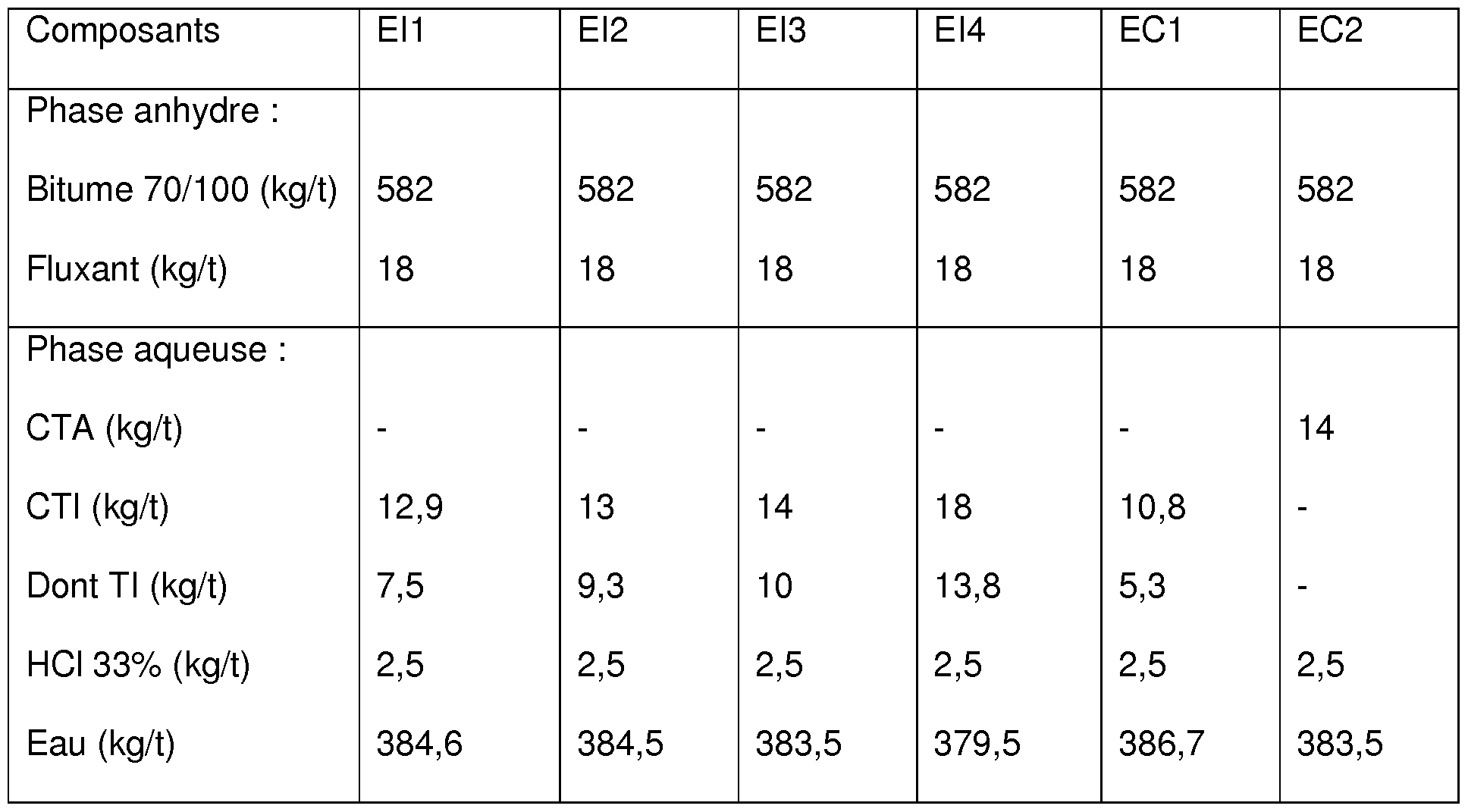
- bituminous emulsions EU to EI4, according to the invention, and EC1 and EC2 (counter-examples) were obtained with a colloid mill of the Emulbitume brand.
- the mass content of bitumen in the emulsion is 60%.
- the bitumen used is a paraffinic bitumen with a 70/100 penetrability supplied by Total and originating from the Feyzin refinery in France.
- the temperature of the bitumen during emulsification is 145°C.
- the bitumen was used fluxed with a petroleum flux.
- the emulsions were prepared by introducing into a container the emulsifying composition in the aqueous phase and the bituminous binder.
- the compositions of the bituminous emulsions are listed in Table 1 below:
- CTA emulsifier: INDULIN GEF2®
- CTI emulsifying composition comprising XI RAN 1000IC®, SERDOX NSP50® as nonionic emulsifier and DINORAM O® as cationic emulsifier; TI: XI RAN 1000IC®.
- the emulsions are analyzed to determine their quality and their application properties, according to the criteria of standard NE EN 13808 of August 2013.
- the binder content of the emulsion is characterized by the desiccant balance method (measured according to standard NF EN 16849 of December 2016).
- the quality of the emulsion is judged by the residue on a 0.5 mm sieve after manufacture (measured according to standard NF EN 1429 of August 2013)
- the quality of the destabilization after application is judged using the breaking index measured with Q92 filler expressed in Forshamer according to the procedure described in standard NF EN 13075-1 of December 2016. The lower this index, the the more the emulsion will tend to destabilize rapidly leading to a more or less good coating quality.
- the EN 13108-31 standard defines the different performance criteria for bitumen emulsion mixes as well as the performance classes. In this standard, a particular criterion linked to the quality of coating is specified on page 42 reproduced in table 4 below.
- the NF P 98251-4 standard defines the performance of bituminous mixes with bitumen emulsion of the grave emulsion type, this The standard specifies, among other things, the application thicknesses of such materials, as well as the minimum characteristics to be achieved depending on the type of product formulated.
- a summary table presents the minimum performances to be achieved in the Duriez test, the information in this table is reproduced in part in table 5 below. [0080] [Table 5]
- the emulsifying composition according to the invention makes it possible to achieve the desired water resistance specifications without degrading the quality of the coating, or the workability of the asphalt.
Landscapes
- Chemical & Material Sciences (AREA)
- Engineering & Computer Science (AREA)
- Civil Engineering (AREA)
- Materials Engineering (AREA)
- Structural Engineering (AREA)
- Health & Medical Sciences (AREA)
- Chemical Kinetics & Catalysis (AREA)
- Medicinal Chemistry (AREA)
- Polymers & Plastics (AREA)
- Organic Chemistry (AREA)
- Compositions Of Macromolecular Compounds (AREA)
- Addition Polymer Or Copolymer, Post-Treatments, Or Chemical Modifications (AREA)
Abstract
Description




Claims


Priority Applications (4)
| Application Number | Priority Date | Filing Date | Title |
|---|---|---|---|
| US18/282,567 US20240166881A1 (en) | 2021-03-22 | 2022-03-21 | Emulsifying composition for bitumen |
| MX2023011144A MX2023011144A (es) | 2021-03-22 | 2022-03-21 | Composicion emulsionante para bitumen. |
| CA3214048A CA3214048A1 (fr) | 2021-03-22 | 2022-03-21 | Composition emulsifiante pour bitumes |
| EP22715126.3A EP4314162B1 (fr) | 2021-03-22 | 2022-03-21 | Composition émulsifiante pour bitumes |
Applications Claiming Priority (2)
| Application Number | Priority Date | Filing Date | Title |
|---|---|---|---|
| FRFR2102819 | 2021-03-22 | ||
| FR2102819A FR3120869B1 (fr) | 2021-03-22 | 2021-03-22 | Composition émulsifiante pour bitumes |
Publications (1)
| Publication Number | Publication Date |
|---|---|
| WO2022200721A1 true WO2022200721A1 (fr) | 2022-09-29 |
Family
ID=75539640
Family Applications (1)
| Application Number | Title | Priority Date | Filing Date |
|---|---|---|---|
| PCT/FR2022/050507 Ceased WO2022200721A1 (fr) | 2021-03-22 | 2022-03-21 | Composition émulsifiante pour bitumes |
Country Status (6)
| Country | Link |
|---|---|
| US (1) | US20240166881A1 (fr) |
| EP (1) | EP4314162B1 (fr) |
| CA (1) | CA3214048A1 (fr) |
| FR (1) | FR3120869B1 (fr) |
| MX (1) | MX2023011144A (fr) |
| WO (1) | WO2022200721A1 (fr) |
Citations (5)
| Publication number | Priority date | Publication date | Assignee | Title |
|---|---|---|---|---|
| EP0179510A1 (fr) | 1984-10-15 | 1986-04-30 | Shell Internationale Researchmaatschappij B.V. | Composition de liant pigmentable |
| EP0357459A2 (fr) * | 1988-09-01 | 1990-03-07 | ARCO Chemical Technology, L.P. | Composition de moulage d'un copolymère styrène-anhydride maléique et de téréphtalate de polybutylène |
| US5776234A (en) | 1996-08-12 | 1998-07-07 | Westvaco Corporation | Anionic bituminous emulsions with improved adhesion |
| EP2665757A1 (fr) * | 2011-01-21 | 2013-11-27 | Stellenbosch University | Poly(styrène-co-anhydride maléique) modifié et ses utilisations |
| EP3299398A1 (fr) * | 2015-05-19 | 2018-03-28 | Denka Company Limited | Copolymère destiné à être utilisé en tant qu'agent de compatibilité de mélange polymère, et composition de résine |
Family Cites Families (5)
| Publication number | Priority date | Publication date | Assignee | Title |
|---|---|---|---|---|
| FR2585947A1 (fr) * | 1985-08-08 | 1987-02-13 | Johnson Products Co | Composition et procede de conditionnement pour defriser les cheveux |
| FR2684676A1 (fr) * | 1991-12-09 | 1993-06-11 | Hoechst France | Nouveaux copolymeres cationiques insolubles dans l'eau, de nouvelles dispersions et leur application dans l'enduction des papiers. |
| DE4342157A1 (de) * | 1993-12-10 | 1995-06-14 | Leuna Werke Gmbh | Kationische Papierleimungsmittel |
| FR2873121B1 (fr) * | 2004-07-15 | 2007-12-14 | Clariant France Soc Par Action | Dispersions cationiques pour le collage du papier |
| FR3094373B1 (fr) * | 2019-03-29 | 2022-01-07 | S N F Sa | Emulsion inverse pour la fracturation hydraulique |
-
2021
- 2021-03-22 FR FR2102819A patent/FR3120869B1/fr active Active
-
2022
- 2022-03-21 MX MX2023011144A patent/MX2023011144A/es unknown
- 2022-03-21 US US18/282,567 patent/US20240166881A1/en active Pending
- 2022-03-21 WO PCT/FR2022/050507 patent/WO2022200721A1/fr not_active Ceased
- 2022-03-21 CA CA3214048A patent/CA3214048A1/fr active Pending
- 2022-03-21 EP EP22715126.3A patent/EP4314162B1/fr active Active
Patent Citations (5)
| Publication number | Priority date | Publication date | Assignee | Title |
|---|---|---|---|---|
| EP0179510A1 (fr) | 1984-10-15 | 1986-04-30 | Shell Internationale Researchmaatschappij B.V. | Composition de liant pigmentable |
| EP0357459A2 (fr) * | 1988-09-01 | 1990-03-07 | ARCO Chemical Technology, L.P. | Composition de moulage d'un copolymère styrène-anhydride maléique et de téréphtalate de polybutylène |
| US5776234A (en) | 1996-08-12 | 1998-07-07 | Westvaco Corporation | Anionic bituminous emulsions with improved adhesion |
| EP2665757A1 (fr) * | 2011-01-21 | 2013-11-27 | Stellenbosch University | Poly(styrène-co-anhydride maléique) modifié et ses utilisations |
| EP3299398A1 (fr) * | 2015-05-19 | 2018-03-28 | Denka Company Limited | Copolymère destiné à être utilisé en tant qu'agent de compatibilité de mélange polymère, et composition de résine |
Non-Patent Citations (3)
| Title |
|---|
| CAO KUN ET AL: "Influences of the Molecular Weight and Its Distribution of Poly(styrene- alt -octadecyl maleimide) as a Flow Improver for Crude Oils", ENERGY & FUELS, vol. 30, no. 4, 21 April 2016 (2016-04-21), WASHINGTON, DC, US., pages 2721 - 2728, XP055926866, ISSN: 0887-0624, DOI: 10.1021/acs.energyfuels.5b02946 * |
| FLORJANCZYK * ZBIGNIEW ET AL: "A study of the relative reactivity of maleic anhydride and some maleimides in free radical copolymerization and terpolymerization", JOURNAL OF POLYMER SCIENCE PART A: POLYMER CHEMISTRY, vol. 28, no. 4, 1 March 1990 (1990-03-01), US, pages 795 - 801, XP055926854, ISSN: 0887-624X, DOI: 10.1002/pola.1990.080280408 * |
| ZHU QINGJUN ET AL: "Influences of Molecular Structure of Poly(styrene- co -octadecyl maleimide) on Stabilizing Asphaltenes in Crude Oil", ENERGY & FUELS, vol. 34, no. 3, 19 March 2020 (2020-03-19), WASHINGTON, DC, US., pages 3057 - 3064, XP055926876, ISSN: 0887-0624, DOI: 10.1021/acs.energyfuels.9b04372 * |
Also Published As
| Publication number | Publication date |
|---|---|
| MX2023011144A (es) | 2023-10-05 |
| FR3120869A1 (fr) | 2022-09-23 |
| EP4314162A1 (fr) | 2024-02-07 |
| EP4314162B1 (fr) | 2025-06-18 |
| FR3120869B1 (fr) | 2024-04-26 |
| CA3214048A1 (fr) | 2022-09-29 |
| US20240166881A1 (en) | 2024-05-23 |
| EP4314162C0 (fr) | 2025-06-18 |
Similar Documents
| Publication | Publication Date | Title |
|---|---|---|
| CA2981750C (fr) | Additif dispersant des asphaltenes et ses utilisations | |
| EP0837909B1 (fr) | Compositions bitume/polymere a stabilite amelioree et leur application a la realisation de revetements | |
| EP2097475B1 (fr) | Fluxant et ses applications | |
| EP2162492A2 (fr) | Liant concentre non gelifiable et pompable pour bitume/polymere | |
| CA2716075C (fr) | Compositions bitumineuses | |
| EP3350239B1 (fr) | Composition bitume / polymere presentant des proprietes mecaniques ameliorees | |
| FR2919298A1 (fr) | Composition bitume/polymere a reticulation thermoreversible. | |
| EP4103646A1 (fr) | Utilisation d'un additif pour retarder le vieillissement du bitume | |
| EP2178925B1 (fr) | Polymere greffe et composition de bitume a reticulation thermoreversible comprenant ledit polymere greffe | |
| WO2019211560A1 (fr) | Composition bitume/polymere presentant des proprietes mecaniques ameliorees | |
| EP2396286B1 (fr) | Systeme d'additifs pour la preparation d'enrobe tiede a usage routier a base de surfactant de type amine | |
| EP2638075B1 (fr) | Polymeres greffes reticules de maniere thermoreversible | |
| EP4314162B1 (fr) | Composition émulsifiante pour bitumes | |
| FR2931483A1 (fr) | Additifs pour produits bitumeux | |
| EP3612591B1 (fr) | Composition émulsifiante de répandage pour le bitume | |
| FR3099486A1 (fr) | Composition bitume/polymère fluxée et son procédé de préparation | |
| EP4103651A1 (fr) | Composition bitumineuse contenant une huile époxydée | |
| WO2014006340A2 (fr) | Émulsifiants pour émulsions de bitume | |
| OA18634A (en) | Composition bitume / polymère présentant des propriétés mécaniques améliorées. |
Legal Events
| Date | Code | Title | Description |
|---|---|---|---|
| 121 | Ep: the epo has been informed by wipo that ep was designated in this application |
Ref document number: 22715126 Country of ref document: EP Kind code of ref document: A1 |
|
| WWE | Wipo information: entry into national phase |
Ref document number: 18282567 Country of ref document: US |
|
| WWE | Wipo information: entry into national phase |
Ref document number: 3214048 Country of ref document: CA |
|
| WWE | Wipo information: entry into national phase |
Ref document number: MX/A/2023/011144 Country of ref document: MX |
|
| WWE | Wipo information: entry into national phase |
Ref document number: 2022715126 Country of ref document: EP |
|
| NENP | Non-entry into the national phase |
Ref country code: DE |
|
| ENP | Entry into the national phase |
Ref document number: 2022715126 Country of ref document: EP Effective date: 20231023 |
|
| WWG | Wipo information: grant in national office |
Ref document number: 2022715126 Country of ref document: EP |