WO2022210552A1 - Procédé permettant de faire lever des semis, système permettant de faire lever des semis, et semis - Google Patents
Procédé permettant de faire lever des semis, système permettant de faire lever des semis, et semis Download PDFInfo
- Publication number
- WO2022210552A1 WO2022210552A1 PCT/JP2022/015043 JP2022015043W WO2022210552A1 WO 2022210552 A1 WO2022210552 A1 WO 2022210552A1 JP 2022015043 W JP2022015043 W JP 2022015043W WO 2022210552 A1 WO2022210552 A1 WO 2022210552A1
- Authority
- WO
- WIPO (PCT)
- Prior art keywords
- seedlings
- seedling
- plant
- plant cultivation
- light
- Prior art date
- Legal status (The legal status is an assumption and is not a legal conclusion. Google has not performed a legal analysis and makes no representation as to the accuracy of the status listed.)
- Ceased
Links
Images





Classifications
-
- A—HUMAN NECESSITIES
- A01—AGRICULTURE; FORESTRY; ANIMAL HUSBANDRY; HUNTING; TRAPPING; FISHING
- A01G—HORTICULTURE; CULTIVATION OF VEGETABLES, FLOWERS, RICE, FRUIT, VINES, HOPS OR SEAWEED; FORESTRY; WATERING
- A01G22/00—Cultivation of specific crops or plants not otherwise provided for
- A01G22/05—Fruit crops, e.g. strawberries, tomatoes or cucumbers
-
- A—HUMAN NECESSITIES
- A01—AGRICULTURE; FORESTRY; ANIMAL HUSBANDRY; HUNTING; TRAPPING; FISHING
- A01G—HORTICULTURE; CULTIVATION OF VEGETABLES, FLOWERS, RICE, FRUIT, VINES, HOPS OR SEAWEED; FORESTRY; WATERING
- A01G7/00—Botany in general
-
- A—HUMAN NECESSITIES
- A01—AGRICULTURE; FORESTRY; ANIMAL HUSBANDRY; HUNTING; TRAPPING; FISHING
- A01G—HORTICULTURE; CULTIVATION OF VEGETABLES, FLOWERS, RICE, FRUIT, VINES, HOPS OR SEAWEED; FORESTRY; WATERING
- A01G9/00—Cultivation in receptacles, forcing-frames or greenhouses; Edging for beds, lawn or the like
- A01G9/02—Receptacles, e.g. flower-pots or boxes; Glasses for cultivating flowers
-
- Y—GENERAL TAGGING OF NEW TECHNOLOGICAL DEVELOPMENTS; GENERAL TAGGING OF CROSS-SECTIONAL TECHNOLOGIES SPANNING OVER SEVERAL SECTIONS OF THE IPC; TECHNICAL SUBJECTS COVERED BY FORMER USPC CROSS-REFERENCE ART COLLECTIONS [XRACs] AND DIGESTS
- Y02—TECHNOLOGIES OR APPLICATIONS FOR MITIGATION OR ADAPTATION AGAINST CLIMATE CHANGE
- Y02A—TECHNOLOGIES FOR ADAPTATION TO CLIMATE CHANGE
- Y02A40/00—Adaptation technologies in agriculture, forestry, livestock or agroalimentary production
- Y02A40/10—Adaptation technologies in agriculture, forestry, livestock or agroalimentary production in agriculture
- Y02A40/25—Greenhouse technology, e.g. cooling systems therefor
Definitions
- the present invention relates to a method for cultivating plant seedlings, a seedling-raising system, and seedlings, and in particular, a cultivation method, a seedling-raising system, and a method for raising seedlings using artificial light in a closed-type multi-stage plant cultivation apparatus.
- seedlings refer to plants 30 to 40 days after sowing, which are used for transplanting to other cultivation sites such as greenhouses and fields.
- Tomatoes and other fruit vegetables are cultivated in greenhouses throughout the year, regardless of the season, and are generally cultivated by planting seedlings.
- the seedlings are plug seedlings (also called cell-formed seedlings) obtained by first seedling-raising by germinating seeds sown in the nursery bed in pots, and so-called large seedlings, which are grown large enough to be permanently planted by secondary seedling-raising of the plug seedlings. and so on. Plug seedlings can also be planted, but in the case of greenhouse cultivation, overgrowth occurs after planting.
- tomato seedlings are raised in a closed multistage plant cultivation apparatus using artificial light and cell trays with 72 or 128 holes. Raise seedlings to about 3 to 4 true leaves in a seedling raising period of about 20 days after sowing, transplant (pot up) them into a slightly larger pot or rock wool cube, and perform secondary seedling raising in a dedicated house. Plant when one inflorescence develops.
- the secondary seedling raising process is omitted and seedlings that can be directly planted by an artificial light type seedling raising apparatus can be obtained, the labor of replanting for the secondary seedling raising can be saved and the efficiency of seedling production can be improved. Since the cultivation period in this field is shortened, the turnover rate can be expected to improve. In addition, since the artificial light type seedling-raising apparatus forms higher flower buds in a stable environment, stable production leads to high yield. Furthermore, since the cultivation period can be shortened in the main field, which has a high risk of diseases and pests, it is expected that the risk of diseases and pests and the frequency of pesticide spraying can be reduced.
- a plant cultivation apparatus of the type that uses an artificial light source such as an LED as a light source in a seedling raising apparatus installed in a closed structure is known (for example, Patent Document 1).
- the seedlings grown by such a cultivation method grow taller and cling to the ceiling of the raising seedling shelf in the closed structure, causing heat damage due to the light source at the tips.
- the seedlings stop growing when the seedlings are young, so if they are transplanted to a field using sunlight, they cannot adapt to sudden environmental changes, and the seedlings wither and the quality of the seedlings deteriorates, or the growth is delayed. There were problems such as drying and drying.
- Non-Patent Document 1 describes a seedling-raising method for large tomato seedlings in a closed-type multistage plant cultivation apparatus using artificial light.
- Tomato seedlings are generally grown by changing the set temperature during the daytime, which is the light period, and at night, which is the dark period, by several degrees.” Since the humidity in the experimental apparatus increases due to the transpiration rate from the seedlings from the time of switching the dark period to the dark period, a dehumidifying device was used to maintain the humidity environment in the range of 60 to 80% during the raising of the seedlings. ” is stated.
- FIG. 1 describes a seedling-raising method for large tomato seedlings in a closed-type multistage plant cultivation apparatus using artificial light.
- Tomato seedlings are generally grown by changing the set temperature during the daytime, which is the light period, and at night, which is the dark period, by several degrees. Since the humidity in the experimental apparatus increases due to the transpiration rate from the seedlings from the time of switching the dark period to the dark period, a de
- Non-Patent Document 1 it is described that the appropriate temperature and humidity ranges were controlled in the light period and the dark period when raising tomato seedlings.
- Non-Patent Document 1 focuses on preventing the occurrence of physiological disorders such as leaf lump disease, and does not examine the optimization of cultivation conditions for efficiently cultivating large seedlings.
- Non-Patent Document 2 describes the effect of the temperature difference between the light period and the dark period (hereinafter abbreviated as DIF) during seedling raising on the effect of plants.
- DIF takes both positive and negative values, and the unit is °C; It has been described that growth in height is suppressed when DIF is negative.
- Non-Patent Document 3 studies the effect of DIF on tomato seedlings and discusses differences in hormone production due to negative DIF. is not.
- the purpose of the present invention is to provide a seedling production method that improves the efficiency of raising seedlings into large seedlings that have started to differentiate into second flower clusters in a closed multistage plant cultivation apparatus that uses an artificial light source.
- the goal is to produce a large amount of seedlings that can not only be planted directly in the main field, but also guarantee flowering, efficiently, and with a high yield, using closed-type artificial light nursery equipment.
- good seedling appearance was important in conventional seedling raising, but the greatest appeal to conventional seedlings is that the present invention guarantees flower bud differentiation while maintaining a good seedling appearance that allows direct planting in this field. It is a point.
- Another problem of the present invention is that such flower bud differentiation (the initiation of second inflorescence differentiation) occurs uniformly in all seedlings. That is, although there are a plurality of seedlings in the closed-type artificial light seedling-raising apparatus, even if only one of the seedlings undergoes flower bud differentiation, it has no commercial value. % or more, more preferably 100% of all, must be flower-bud differentiated and the desired growth must occur uniformly. Such a problem is also recognized for the first time in the present invention.
- the gist of the present invention is as follows.
- a plant cultivation method for raising seedlings using a plant cultivation apparatus arranged in a closed structure wherein the closed structure is equipped with an air conditioner for controlling temperature and humidity, and the plant
- the cultivation apparatus includes a plurality of plant cultivation shelves arranged in multiple stages, at least one seedling container for plant growth placed on the plant cultivation shelf, and a lighting device for irradiating the seedling container with light. Cultivated under conditions where the average temperature in the dark period during raising seedlings is higher than the average temperature in the light period, and under conditions where the photon flux density at the bottom of the plant cultivation shelf is 330 ⁇ mol / m 2 sec or more. Cultivate, plant cultivation method.
- [5] A method for cultivating plants, characterized by directly planting seedlings raised by any of the methods described in [1] to [4] in the main field.
- a closed structure a plant cultivation device disposed within the closed structure;
- a plant cultivation system for raising seedlings comprising an air conditioner for controlling temperature and humidity in the closed structure,
- the air conditioner has a temperature control function that makes the average temperature in the dark period during seedling raising higher than the average temperature in the light period
- the plant cultivation device is A plurality of plant cultivation racks arranged in multiple stages above and below; at least one seedling container for plant growth placed on the plant cultivation shelf; and a lighting device that irradiates the seedling-growing container with light so that the photon flux density on the bottom surface of the plant cultivation shelf is 330 ⁇ mol/m 2 ⁇ sec or more.
- seedlings with high seedling age and stable quality are cultivated using artificial light in a closed multistage plant cultivation apparatus, thereby eliminating the need for a secondary seedling raising process before planting in the main field. Facilities and manpower for the next raising of seedlings become unnecessary.
- seedlings of uniform seedling quality can be stably and systematically supplied without being affected by the weather, so systematic production is possible.
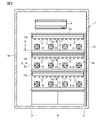
- FIG. 2 is a sectional view taken along line II-II of FIG. 1; 2 is a cross-sectional view taken along line III-III of FIG. 1;
- FIG. 1 is a perspective view of a cell tray;
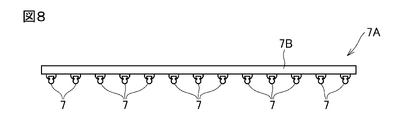
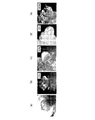
- FIG. 5 is a cross-sectional view taken along line VV of FIG. 4; It is a perspective view from the downward direction of an illuminating device. It is a bottom view of an illuminating device. It is a front view of an illuminating device. It is a top view of an irrigation apparatus. It is a perspective view of an irrigation device. It is a perspective view of a tomato seedling. It is a photograph which shows the progress of flower bud differentiation.
- the method for producing seedlings of the present invention provides high quality seedlings in a closed structure covered with heat insulating walls that do not transmit natural light, under an artificial environment using an air conditioner, an artificial light source, a carbon dioxide fertilization device, and a watering device. It is a method to stably produce healthy seedlings.
- various environmental conditions such as the quality of light irradiated to seedlings, photon flux density, light irradiation time, temperature, humidity, carbon dioxide gas concentration, amount of irrigation water, and fertilization concentration are optimized for seedling growth. It is possible to control
- seedling-raising device As the seedling-raising device that performs these controls, a commercially available seedling-raising device, or a seedling-raising device with parts and other specifications changed as necessary, may be used.
- a commercially available seedling raising apparatus As a commercially available seedling raising apparatus, a product (Naeterasu (registered trademark)) of Mitsubishi Chemical Agri Dream Co., Ltd. can be used.
- the closed type structure arranges one or a plurality of growing modules (multi-shelf plant growing apparatuses) side by side in its internal space.
- the size of the internal space shall be such that one or more workers can work in front of the cultivating module.
- a space with a width of about 5 to 30 cm should be provided between the wall of the closed structure and the back of the growth module to accommodate the air chamber of the growth module. It is used as a circulation passage for the air that has passed through.
- Air conditioner has the function of adjusting the temperature and humidity of the air inside the closed structure and circulating the air in the closed structure.
- the indoor unit of the air conditioner shall be installed in an appropriate place inside the enclosed space.
- the suitable place is a place where the indoor unit can be installed, for example, the ceiling wall surface, the side wall surface, the floor surface, etc. inside the closed space, but it is usually preferable to install it above the growth module such as the ceiling wall surface.
- the outdoor unit is installed outside the enclosed structure. Air conditioners can control the temperature and humidity of the entire interior space of a closed structure with a single device when the interior space of the closed structure is small. When the number is large, it is preferable to set the number corresponding to a plurality of breeding modules.
- the temperature and humidity are adjusted by the indoor unit of the air conditioner, and the cooled air whose temperature and humidity are adjusted is supplied to the front side of the seedling-raising space of one or a plurality of growing modules.
- Air conditioners for domestic and commercial use (hereinafter abbreviated as air conditioners) can be used as air conditioners. Air conditioners for domestic and business use are not only excellent from the viewpoint of energy efficiency, but are also inexpensive due to mass production, and are effective in reducing equipment costs according to the present invention.
- the humidity in the closed structure tends to increase. Therefore, by installing a dehumidifier or by using a heater or the like to heat the space corresponding to the heat emitted from the artificial light source (artificial light source), it is possible to prevent the deterioration of the operation of the air conditioner.
- a plurality of air conditioners may be installed in the closed structure as heaters for heating operation.
- the dehumidifier is preferably of the compressor type, which generates little heat.
- the growing module arranged in the inner space of the closed structure is, for example, a box-shaped hexahedron, and raises seedlings having a top wall, a side wall, and a back wall on the top surface, side walls, and back surface. It has a nursery space.
- the seedling-raising shelves 5 are arranged in multiple stages at regular intervals in the vertical direction to improve the utilization efficiency of the seedling-raising space.
- the front of the growing module has an open structure without a wall, and one or more exhaust fans are installed on the rear side of the seedling space (opposite side to the open front).
- rectification It is important to control the flow of air to each seedling shelf in the growing module (rectification) and ensure air replacement in the seedling shelf.
- the purpose of rectification is to control the amount and direction of air flowing into each growing module, and to reduce the difference in temperature and humidity between the entrance and exit of the nursery shelf.
- various known methods such as air cooling fans, perforated plates, and wind direction control plates disclosed in JP-A-2008-212078 and WO/163629 can be used.
- the circulating flow passes through each growing module in the structure of the closed-type artificial light seedling-raising facility, the circulating flow entrains the water vapor evaporated from the irrigation system, the culture medium, the plants, etc., and the heat emitted from the artificial light source.
- the flow velocity of air flowing through the seedling rack in the growing module is preferably 0.1 m/sec or more, more preferably 0.2 m/sec or more, and even more preferably 0.3 m/sec or more. If the speed of the airflow is too high, there is a risk of causing problems in plant growth, so it is generally preferred that the speed is 2.0 m/sec or less.
- the airflow may flow from the front of the seedling rack to the back of the growing module via the fan under negative pressure, or conversely from the rear of the rack to the front under positive pressure.
- the air flow in the growth module is more uniform if the air is flown from the front side to the rear side of the shelf under a negative pressure.
- thermo-hygrometer is installed in the nursery rack, and the set value of the air conditioner is adjusted so that the inside of the nursery rack is at a predetermined temperature and humidity.
- the temperature deviation occurs for the following reasons.
- the heat generated by the light source, the heat generated by the power source of the light source, the transpiration of water from the leaves of the seedlings, and the latent heat of water vaporization due to the residual liquid in the receiving part after watering will cause the air conditioning system to function.
- the load is determined, there is no heat generation from the light source during the dark period, and less water evaporates from the leaves, greatly reducing the load on the air conditioner. Therefore, since the internal heat load changes greatly, the load on the air conditioner also changes greatly between the light period and the dark period.
- each cultivating module is about 200 cm, which is the height at which an operator can work. It is preferable that the width of the cultivation rack be adjusted to a constant value, for example, about 100 cm to 200 cm, and the depth of the cultivation shelf is 50 cm to 100 cm.
- the number of stages of cultivation shelves in the growing module there is no limit to the number of stages of cultivation shelves in the growing module, but usually there are multiple stages of two or more. There is no upper limit on the number of steps in principle, but there is a practical limit to the height of the closed structure from an economic point of view, and it is constrained by it. Accordingly, the number of stages is usually about 10 stages or less, preferably about 5 stages or less. In FIG. 3, there are three stages.
- a plant cultivation space (seedling-raising space) is formed above each cultivation shelf.
- the height of the space (height per shelf) is usually 20 cm to 100 cm. Space utilization can be improved by increasing the number of cultivation shelves by reducing the spacing between adjacent cultivation shelves.
- the lower limit is preferably more than 30 cm, more preferably 35 cm or more, because there are drawbacks such as the inability to ensure the maximum length of the plant.
- the upper limit is 60 cm, more preferably 50 cm.
- the cultivation shelf can be formed by metal plates, metal nets, metal rods, or the like.
- Various containers such as cell trays, seedling pots, and seedling boxes can be used for raising seedlings. A plurality of seedlings are raised on this container.
- the dimensions of one cell tray are about 300 mm in width and about 600 mm in length, but are not limited to this.
- Various types of cell trays are commercially available, but those manufactured from resin sheets by differential pressure molding are preferred.
- the shape of one cell constituting the cell tray is preferably a truncated inverted cone type, and the cone may be either a cone or a pyramid.
- the size of one cell is preferably 15 to 50 mm in depth and about 4 to 30 ml in capacity, and the cell is provided with a cell hole in the bottom of the cell so that the bottom can be watered.
- the number of cells per container (tray) is preferably 50 or more, preferably 72 or more. Although the upper limit of the number of cells is not particularly limited, it is preferably 288 or less, more preferably 128 or less.
- the seedlings grow densely in a cell tray with a large number of cells, so the amount of light received by the leaves of adjacent seedlings decreases, making it difficult to grow well. .
- the uniformity of seedlings is improved even in a cell tray having a large number of cells, and the yield of seedling production is improved.
- the medium used in the present invention may be any material that can be used as a seed bed for hydroponics, such as soil, sponge, or fibrous material such as rock wool.
- rock wool When rock wool is used as a culture medium, Nippon Rock Wool Co., Ltd.: Yasaihana Block 40 or Grodan Co., Ltd.: RockWool Multi block can be used, but the medium is not limited thereto. Since these rock wools are sold in the form of sheets with cuts, they are cut off one by one along the cuts and packed in cells of a cell tray for use.
- Each cultivation shelf is provided with an automatic bottom irrigation device or a manual irrigation device.
- An automatic watering device is preferred as the watering device.
- the irrigation device the devices disclosed in JP-A-2001-346450, JP-A-2003-52253, International Publication WO2018/163629, etc. can be used, but not limited thereto.
- EC of the culture solution is preferably 0.5 or more and 3.0 or less, more preferably 1.0 or more and 2.0 or less.
- the lighting device illuminates the seedlings grown in the seedling-raising containers (such as cell trays) on the cultivation shelf.
- the light source of the lighting device is not particularly limited, and can be selected from fluorescent lamps, semiconductor light sources such as LEDs, organic ELs, lasers, and the like. Considering power consumption and luminous efficiency, it is preferable to use an inorganic optical semiconductor, and it is more preferable to use an LED.
- the shape of the semiconductor light-emitting device is not particularly limited, but in consideration of simplification of the method of attaching the lighting to the cultivation device and maintainability such as replacement, an elongated lighting device along the long side direction of the cultivation shelf. is preferably installed.
- COB type LEDs in addition to lighting devices in which small semiconductor light sources are mounted regularly or irregularly in the longitudinal direction, multiple COB type LEDs in which multiple semiconductor light emitting elements are arranged on the same substrate are arranged.
- a lighting device or the like can be used, but the present invention is not limited to these.
- COB type LEDs are preferable because light having a photon flux density necessary for the growth of seedlings can be efficiently obtained.
- the position where the lighting apparatus is installed is not limited to the case where the lighting apparatus is installed below the plant cultivation shelf as in the embodiment described later.
- the shape of the semiconductor light source may be square, rectangular, elongated, circular, elliptical, triangular, or rhombic, and the light emitting portion may be square, rectangular, elongated, circular, elliptical, triangular, or rhombic. It's okay. When mounted on a linear light source, it is preferable to use a rectangular or elongated semiconductor light source in terms of mountability.
- the semiconductor light source of the illumination device preferably has a first emission peak wavelength in the range of 400-480 nm. Having the first emission peak wavelength in the range of 400 to 480 nm suppresses the elongation of seedling internodes, making it possible to cultivate seedlings with short and firm hypocotyls.
- the semiconductor light source of the lighting device preferably has a second emission peak wavelength in the range of 500 to 700 nm, more preferably in the range of 500 to 680 nm, still more preferably in the range of 500 to 660 nm.
- the second emission peak wavelength preferably has a half width of 80 nm or more, more preferably 100 nm or more, more preferably 120 nm or more, and still more preferably 140 nm or more.
- the illumination device may be a single semiconductor light source having an emission peak wavelength in the range of 400 to 480 nm and a single semiconductor light source having an emission peak wavelength in the range of 500 to 700 nm.
- a single semiconductor light source may have both emission peak wavelengths in the range of 400 to 480 nm and in the range of 600 to 700 nm, and may emit a combined light spectrum.
- the chromaticity of the light in the irradiation region becomes more uniform, and the light spectrum having a peak at 400 to 480 nm and the light spectrum having a peak at 500 to 700 nm are irradiated. It is even better because it can suppress variations in the area.
- the light intensity distribution irradiated to the plants on the nursery shelf is as uniform as possible in order to ensure uniform growth of the seedlings.
- the intensity of light irradiation from the artificial light source used in the present invention is represented by photosynthetic photon flux density (PPF, PPFD). It is sometimes simply called "photon flux density”.
- the photosynthetic photon flux density is a unit expressed by the number of light quanta (photons), which are particles of light. Photosynthesis is governed by the number of light quanta incident on chlorophyll. In general, 8 to 10 photons are required to consume one molecule of carbon dioxide (carbon dioxide, CO2) in photosynthesis. Therefore, the photosynthetic photon flux density indicates the number of incident light quanta per unit time and unit area in the wavelength range of 400 nm to 700 nm, which is the absorption wavelength range of chlorophyll. The unit is ⁇ mol/m 2 ⁇ sec.
- the photon flux density is set to 330 ⁇ mol/m 2 ⁇ second or more, preferably 350 ⁇ mol/m 2 ⁇ second or more, more preferably 380 ⁇ mol/m 2 ⁇ second or more, and still more preferably 400 ⁇ mol/m 2 ⁇ second or more. , 450 ⁇ mol/m 2 ⁇ sec or more is most preferred.
- the photon flux density is the value measured on the surface (bottom surface) of each plant cultivation shelf described above.
- the photon flux density is 330 ⁇ mol/m 2 ⁇ sec or more
- the photon flux density is 330 ⁇ mol/m 2 ⁇ sec or more
- the photon flux density there is no upper limit to the photon flux density, but since there are restrictions on the seedling space, there is a limit to the amount of heat generated from the light source, preferably 700 ⁇ mol/m 2 ⁇ sec or less, more preferably It is 650 ⁇ mol/m 2 ⁇ sec or less. It is preferable to use the above-described LED light source as the light source.
- methods such as increasing or decreasing the amount of current, increasing or decreasing the number of LED lights, or increasing or decreasing the number of LED units can be exemplified.
- the seedling cultivation apparatus preferably includes a carbon dioxide supply device.
- a carbon dioxide supply device In order to artificially supply the carbon dioxide consumed by the seedlings in photosynthesis, a liquefied carbon dioxide cylinder was installed outside the closed artificial light type seedling raising facility, and the carbon dioxide concentration in the room measured by the carbon dioxide concentration measuring device was constant. It is preferable to supply carbon dioxide gas from a carbon dioxide cylinder so as to obtain the concentration.
- the temperature in the light period and the temperature in the dark period of the present invention are usually in the range of 15 to 40°C, and the average daily temperature including the light period and the dark period is also usually in the range of 15 to 35°C.
- the preferable range is limited by the temperature control capability of the closed artificial light system and the economic effect of power consumption.
- the photoperiod temperature is in the range of 21°C ⁇ 5°C, more preferably in the range of 21°C ⁇ 3°C.
- the temperature control value and the actual measurement value of the closed artificial light system do not always match, and usually there is a difference of about 0.1 to 5°C, so adjust the control value so that the actual measurement value is the desired temperature.
- the value of the control value is adjusted again by feedback from the measured data after changing the control value.
- the combination of the light period temperature and the dark period temperature is normally such that the light period temperature is 16 hours and the dark period temperature is 8 hours. This cycle is repeated for a predetermined number of days. However, the combination of the light period time and the dark period time in one cycle is not limited to this.
- the time for one cycle is not limited to 24 hours, but can be changed within the range of 8 to 48 hours. If it is less than 8 hours, it is not preferable because the load on equipment increases due to an increase in switching frequency, and the cultivation efficiency decreases due to an increase in deduction time (described later) at the time of switching. Conversely, if it exceeds 48 hours, the time of one light period or one dark period becomes too long, which hinders the growth of plants, which is not preferable.
- the light period is long, so the ratio of the light period and the dark period per cycle is 1:1 or more, preferably 2:1 or more.
- a dark period is also required for the translocation of photosynthetic products, and it is preferable to secure 6 hours or more.
- the average temperature in the dark period is higher than the average temperature in the light period.
- the average temperature refers to the average temperature of the cultivation shelf measured at predetermined time intervals during the light period or the dark period. However, as will be described later, in certain cases, it is preferable to exclude from the average calculation from the viewpoint of accuracy improvement.
- the “average temperature in the dark period” refers to the temperature at which seedlings are moved from the plant cultivation apparatus of the present invention to another place for fixed planting or the like from the stage of transplanting from the sprouting device to the plant cultivation apparatus of the present invention and starting seedling raising.
- the average temperature in the light period refers to the time from the stage when seedlings are transplanted from the sprouting device to the plant cultivation apparatus of the present invention and seedlings are raised, and then moved from the plant cultivation apparatus of the present invention to another place for fixed planting or the like. Means the average value of all light period temperatures for the period up to
- the average temperature in the dark period is higher than the average temperature in the light period, there may be a period in which the temperature in the dark period is temporarily equal to the temperature in the light period. There may be periods of lower temperature.
- DIF Temporal difference obtained by subtracting the average temperature in the dark period from the average temperature in the light period
- DIF the temperature difference obtained by subtracting the average temperature in the dark period from the average temperature in the light period
- DIF takes a negative value. Its value is usually in the range from over 0 to -15°C, preferably up to -10°C.
- the values of the light period temperature, the dark period temperature, and the negative DIF mean the average of the actually measured values.
- Plants targeted by the present invention are generally applicable to fruit vegetables cultivated by forcing cultivation by greenhouse cultivation in which a transparent film is spread, but vegetables of the family Solanaceae or Cucurbitaceae are preferred. More preferred are tomato, paprika and cucumber, with tomato being particularly preferred.
- the flowering habit of tomato is "usually between the 8th and 9th node leaves. It is common for the first inflorescence to grow at the first inflorescence, and thereafter, to grow inflorescences at intervals of three nodes. There is a variation from the 7th node leaf to the 14th and 15th node leaves.” In this way, the position where the first inflorescence of tomato grows varies greatly depending on the environment.
- the epiphytic node of the first inflorescence is preferably as small as possible, preferably the 8th leaf or less, more preferably the 7th leaf or less.
- FIG. 1 An example of a tomato seedling is shown in FIG. 1
- the second flower differentiates below it, and a new growth point is formed between the final leaf and this inflorescence at almost the same time. Furthermore, a third flower is formed on the lower back side of the second flower, and the new meristem also grows and differentiates into leaves. In this way, flowers differentiate one after another, and there is generally an interval of about 2 to 3 days between the differentiation of one flower in the same inflorescence and the differentiation of the next flower bud. The differentiation of the following flowers can be recognized around this time.
- the newly formed meristem elongates while differentiating leaves, and when three leaves are differentiated, the apex becomes thickened and flattened again to produce flower buds. This will be the first flower of the second flower cluster.
- a new meristem develops just below the second inflorescence, and when it elongates and differentiates into three leaves, the top of the leaf becomes a flower bud again, and the third inflorescence grows. is formed.
- the number of flower clusters increases one after another, and at the same time, the number of flowers in each flower cluster increases.
- the present invention is characterized by promoting the formation of flower buds in the second flower cluster during the seedling-raising period in the closed-type artificial light seedling-raising facility.
- the flower bud formation of the second inflorescence can be confirmed by cutting the vicinity of the growing point of the seedling with a sharp knife and observing the cross section.
- the progress of flower bud differentiation of the second inflorescence is defined as follows (a) to (e). i.e. (a) 0% when flower bud differentiation cannot be confirmed, (b) 25% when the number of differentiated flower buds can be confirmed but the sepals are underdeveloped; (c) 50% when the shape of the sepals can be confirmed but the sepals have not developed to the center of the flower bud; (d) 75% when it can be confirmed that the sepals have developed to the center of the flower and are closed; (e) 100% when the sepals are elongated upward at the center of the flower bud and the part is dyed brown; and These numerical values refer to the standard described in the document "Steiner et al. Plant Methods (2020) 16:152, page 9, Figure 8".
- FIG. 14 shows specific states of (a) to (e).
- second inflorescence differentiation has started in the present invention refers to a state in which the presence of differentiated flower buds can be confirmed, that is, a state after the above (b).
- the tip of the plant withers or dies due to the heat of the light source, or the stem bends, continuing normal growth. Can not. Therefore, even if the plant grows 26 days after sowing, it is preferable that the height of the plant does not come into contact with the light source on the upper surface of the seedling rack, and more preferably, the plant can grow for 28 days or more after sowing.
- a group of tomato seedlings raised on a container refers to, for example, a group of tomato seedlings grown on a container such as a cell tray.
- Large seedlings of tomato that have visible first flower clusters directly above the 6th to 7th leaves, and that are in a state where differentiation of the second flower cluster has already started near the meristematic point are grown most efficiently.
- Such seedlings are already known per se. However, it is a case of focusing on a specific one, and in the process of mass cultivation such as a plant factory, such a collection of seedlings with uniform growth and good seedling appearance As far as I know, it's new.
- a group of tomato seedlings grown on a container When tomato seedlings are raised using artificial light in a closed multistage plant cultivation apparatus, cultivation is performed on a cell tray, so the “container” means, for example, 72 holes (the number of cells is 72). Same hereafter) refers to the cell tray.
- the present invention is characterized by "a group of tomato seedlings grown on a container, and at least half (50%) or more of the tomato seedlings have started secondary inflorescence differentiation".
- “half” means half (four) of eight seedlings sampled at random from one container (for example, a cell tray with 72 holes).
- a sampling number of 8 is sufficient for population error. Therefore, even in the case of the upper limit number of cell trays (288 holes) in the present invention, eight samples are sufficient.
- This figure is preferably 62.5% or more, more preferably 87.5% or more, and even more preferably 100%.
- the plant cultivation system of the present invention is a plant cultivation system in which seedlings are raised using a plant cultivation apparatus arranged in a closed structure, and the average temperature during raising the seedlings is higher than the specified average temperature. Equipped with an air conditioner having a temperature control function to control.
- the closed structure of the plant cultivation system is equipped with an air conditioner to control temperature and humidity.
- the plant cultivation apparatus includes a plurality of plant cultivation shelves arranged in multiple stages, at least one seedling-raising container for plant growth placed on the plant cultivation shelf, and irradiating the seedling-raising container with light.
- the lighting device has a photon flux density of 330 ⁇ mol/m 2 ⁇ sec or more at the bottom surface of the plant cultivation shelf.
- the plant cultivation system may be equipped with a light/dark switching control device that switches between light and dark periods. Also, a humidity control device may be provided to control the humidity in the dark period to 80% or less. The effects of providing these control devices are the same as those described above.
- the seedling cultivation apparatus of the present invention preferably comprises an irrigation device for irrigating the seedlings, which is arranged in the closed structure.
- the cultivation apparatus has a growing module with an open front surface, and the growing module forms a seedling-raising space by arranging seedling-raising racks in multiple stages in the vertical direction.
- FIGS. 1 to 3 in a room of a closed building structure 1 surrounded by heat-insulating walls and having a completely light-shielding property, a space is provided between the wall 1j and a box-shaped multi-tiered shelf system for growing plants.
- a device (cultivating module) 3 is installed.
- the structure 1 has a rectangular shape in plan view, and an entrance with a door 2 is provided on the wall surface 1i on the opposite side of the wall surface 1j. It is preferable to install an air curtain on the inner side of the door 2 for entering and exiting the room because it can prevent outside air from entering when the worker enters and exits the room.
- the multi-shelf plant growing device 3 is arranged so that its open front face faces the wall surface 1i.
- a space large enough for one or more workers to work is provided between the multi-shelf plant growing apparatus 3 and the wall surface 1i.
- a space having a width of about 50 to 300 mm is provided between the wall surface 1j and the rear surface of the multi-shelf plant growing apparatus 3 to form an air passage passing through the multi-shelf plant growing apparatus 3.
- One end side of the multi-shelf plant growing device 3 is in contact with or close to the building wall surface 1h.
- the other end side of the multi-shelf plant growing apparatus 3 is slightly separated from the wall surface 1k opposite to the wall surface 1h.
- the plant growing device is a seedling growing device.
- the multi-shelf plant growing apparatus 3 is a box-shaped structure having left and right side panels 3a, a back panel 3b, and a top panel 3c at the zenith, and having an open front. It has Inside the box-shaped structure, a plurality of seedling-raising racks 5 are arranged in multiple stages at regular intervals in the vertical direction.
- the height of the multi-shelf type plant growing device 3 is set to about 2000 mm, which is the height at which an operator can work, and the lateral width of the seedling-raising shelf 5 is such that a plurality of cell trays 20 (FIGS. 4 and 5) can be placed side by side.
- the width of the upper space of each seedling rack 5 can be adjusted to a constant temperature and humidity, for example, about 1000 mm to 2000 mm, and the depth of the seedling rack 5 is 500 mm to 1000 mm.
- a plurality of cell trays 20 are placed almost horizontally on each seedling rack 5 .
- the cell tray 20 is in the shape of a rectangular plate in which a plurality of cells 21 are arranged in a grid pattern.
- a cell hole 22 is provided in the bottom surface of the cell 21 .
- the dimensions of one cell tray are generally about 300 mm in width and 600 mm in depth.
- Each seedling rack 5 is provided with a watering device 30, which will be described later.
- a lighting device 7A is installed on the bottom surface of the seedling-growing shelf and the bottom surface of the top panel 3c so as to irradiate each seedling-growing shelf 5 with artificial light from above.
- the lighting device 7A is configured to irradiate the plants growing on the cell tray 20 of the seedling rack 5 with light.
- the illumination device 7A has a base 7B and a light source 7 provided on the lower surface of the base 7B.
- An LED will be described below as an example.
- the light source 7 has an elongated substrate, a plurality of LEDs mounted on the substrate, and circuitry for driving the LEDs. The LEDs are spaced along the length of the substrate. The arrayed LEDs are covered with a translucent cover. In this embodiment, the lower surface of the cover is the light exit surface.
- the back panel 3b is provided with vents behind each space (seedling space) between the seedling shelves 5 and between the uppermost seedling shelf 5 and the top panel 3c.
- an exhaust fan 8 is attached to each vent.
- an air conditioner (air conditioner) 4 is installed that has the function of adjusting the temperature and humidity of the air in the room and circulating the air whose temperature and humidity are adjusted to the set conditions.
- the air conditioner 4 is positioned above the wall surface 1j of the room.
- a circulation flow of air is generated in the room. That is, the temperature-controlled and humidity-controlled air blown forward from the air conditioner 4 is sucked from the space on the open front side of the multi-shelf plant growing apparatus 3 into the seedling growing space on each stage of the growing seedling shelf 5, and the exhaust fan 8 is discharged to the rear of the rear panel 3b, rises through the space between the rear of the rear panel 3b and the wall surface 1j of the building, and returns to the vicinity of the air conditioner 4.
- the circulating flow passes through each seedling-raising space of the multi-shelf plant growing apparatus 3, the circulating flow is accompanied by the water vapor evaporated from the watering device, the medium, the plants, etc. and the heat emitted from the lighting device 7A.
- the air conditioner 4 By continuously circulating this circulating flow with the temperature and humidity controlled by the air conditioner 4, the room can be maintained at the optimum temperature and humidity environment for plant body growth.
- a sensor 10 is provided as shown in FIG.
- the irrigation tray 31 of this irrigation device 30 is rectangular and has a bottom plate 31d with erected walls on three sides (rear side and both left and right sides).
- a drainage groove 32 is provided in the front side of the irrigation tray 31 where there is no upright wall so as to be connected to the bottom plate 31d, and one end of the drainage groove 32 is formed with a drainage port 32a.
- the drain 32 and the bottom slab 31 d are partitioned by a weir 34 , and the nutrient solution flows out into the drain 32 through notches 34 a at both ends of the weir 34 .
- a water supply pipe 33 for supplying the nutrient solution into the irrigation tray 31 is provided along the side wall 31a on the rear side of the irrigation tray 31, a water supply pipe 33 for supplying the nutrient solution into the irrigation tray 31 is provided. It is designed to be supplied onto the tray bottom plate 31d.
- a plurality of ribs 35 having a height of about 7 mm are provided on the upper surface of the irrigation tray bottom plate 31 d and extend parallel to each other toward the drain groove 32 , and the cell tray 20 is placed on these ribs 35 . ing.
- This watering device 30 is dimensioned such that when the watering tray 31 is installed on the seedling rack 5 of the multi-shelf plant growing device 3, the drainage groove 32 protrudes from the open front surface of the growing device 3, as shown in FIGS. ing.
- the nutrient solution discharged from the drainage port 32a of the drainage groove 32 of the watering tray 31 placed on each stage of the seedling rack 5 is collected and discharged to the outside of the building structure 1. Easier to discharge to
- the nutrient solution When the nutrient solution is continuously supplied from the small hole 33a provided in the water supply pipe 33 of the irrigation device 30, the nutrient solution is blocked by the weir 34 and accumulates to a predetermined water level, forming a pool. While the nutrient solution is being supplied from the water supply pipe 33, the nutrient solution flows out to the drainage groove 32 little by little from the notch 34a. By adjusting the amount of nutrient solution supplied and the amount of outflow from the notch 34a, it is preferable to maintain a pool state with a water level of about 10 to 12 mm in the irrigation tray 31, for example.
- the upper surface of the bottom plate 31d of the watering tray 31 is inclined toward the drainage groove 32. As shown in FIG. As a result, the nutrient solution can be drained to the drainage groove 32 in a short period of time when watering is stopped.
- the height of the ribs 35 is changed so that the tops 35a of the ribs are horizontal. can be held to
- Carbon dioxide gas is supplied from the carbon dioxide cylinder 16 so that the carbon dioxide gas concentration becomes constant.
- this seedling-raising device By growing seedlings using this seedling-raising device, it is possible to automatically adjust environmental conditions such as the amount of light, temperature, humidity, carbon dioxide, and moisture that are suitable for growing seedlings. In addition, since all the seedlings on each nursery rack can grow under the same environment, the uniformity of the quality of the obtained seedlings can be improved.
- Example 1 A 72-hole cell tray (FPCO Tuba, plug tray, cell depth: about 50 mm) was filled with rock wool cubes (Grodan: RockWool Multi block), and EC was adjusted to 0.6. (adjusted by mixing the diluent and the diluent of the high-tempo CU solution at a ratio of 1:3) was watered for each plug tray using a funnel.
- LEDs (Citizen Electronics Co., Ltd.: CITILED COB series) are mounted in a 6-light module, and the degree of diffusion (transmittance 87%) is set in consideration of the balance between the uniformity of the light intensity and the light extraction efficiency in the seedling rack. Selected and driven. As shown in FIGS. 6 to 8, 13 LED modules were arranged on the base plate, and the amount of light was adjusted, and the light source device was operated so that the light period was 16 hours and the dark period was 8 hours. The distance h (see FIG. 2) from the bottom surface of the nursery shelf to the light exit surface was 40 cm.
- the photon flux density was measured using a long photon sensor (LI-191R-BNC-2) manufactured by Li-Cor at the bottom of the seedling shelf. This bottom surface is at a distance of 40 cm from the light source.
- the sensor portion of this device was set on the cultivation shelf, the value of the light intensity of the cultivation surface was displayed, and the value was 510 ⁇ mol/m 2 ⁇ sec.
- a dehumidifier manufactured by Mitsubishi Electric Corporation: MJ-P180RX
- a heater inside the room Noden Engei manufactured by Nippon Norden Co., Ltd. A mat
- a second watering was performed for 400 seconds 8 hours after the start of the light period.
- the carbon dioxide gas concentration was set at 1,000 ppm in the light period during the entire seedling raising period.
- Example 1 Five days after moving to the closed-type artificial light seedling raising device, the temperature was set to 21 ° C. Noden gardening mat) was used to raise seedlings. The average light period temperature and humidity during the seedling raising period were 21° C. and 53%, respectively, and the dark period average temperature and humidity were 26° C. and 70%, respectively.
- Example 1 Seedlings were raised in the same manner as in Example 1, except that the temperature was set to 27°C in the light period and 21°C in the dark period.
- the average light period temperature and humidity during the seedling raising period were 24° C. and 62%, respectively, and the dark period average temperature and humidity were 19° C. and 72%, respectively.
- Example 2 Seedlings were raised in the same manner as in Example 1, except that an Hf fluorescent lamp was used as the light source.
- the average light intensity at 40 cm from the bottom measured with a Li-Cor LI-191R type long photon sensor was 270 ⁇ mol/m 2 ⁇ sec.
- the average temperature and humidity in the light period were 19°C and 60%, respectively, and the average temperature and humidity in the dark period were 26°C and 75%, respectively.
- the amount of photon flux density was adjusted by using the same light source as in Example 1 and changing the drive power.
- the humidity in the dark period was adjusted using a commercially available dehumidifier (Mitsubishi Electric Co., Ltd.: MJ-P180RX).
- Table 1 shows the culture conditions and results.
- Table 2 shows the evaluation results of the seedlings 28 days after seeding.
- Growth rate of seedlings is an index that indicates that seedlings guaranteed to flower can be planted directly.
- the degree of growth of seedlings was evaluated based on the differentiation of the second inflorescence on the 28th day after sowing according to the criteria shown in FIG.
- the differentiation rate of eight sampled seedlings was evaluated according to the following criteria.
- Plant height Plant height is an index that indicates that seedlings can be directly planted. When the tips of the seedlings come into contact with the artificial light source of the seedling rack in the growing module, the heat from the light source causes the tips of the seedlings to wither and hinder their growth. occurs and normal seedlings cannot be obtained. Therefore, the plant height of seedlings (the length from the ground to the growing point) was evaluated according to the following criteria.
- A The seedling has a large number of leaves and spreads moderately from the upper part of the seedling to the whole.
- C The middle part of the stem hangs down from the upper part, and the lower leaves turn yellow or die.
- Table 1 shows the cultivation conditions and measurement results of Examples 1-3 and Comparative Examples 1-8.
- Table 2 shows the evaluation results of the seedlings 28 days after seeding in Examples 1 to 3 and Comparative Examples 1 to 5.
- Table 3 shows the evaluation results of the seedlings of Comparative Examples 6 to 8. In Table 3, "Note 1" indicates that the seedlings grew too much on the 28th day of sowing and got stuck on the ceiling of the upper stage of the cultivation shelf.
- the temperature in the dark period should be higher than the temperature in the light period, and the photon flux density should be 330 ⁇ mol/m 2 ⁇ sec or more. I know it is necessary.
- the present invention has been described in detail using specific embodiments, it will be apparent to those skilled in the art that various modifications can be made without departing from the spirit and scope of the invention. This application is based on Japanese Patent Application 2021-60050 filed on March 31, 2021 and Japanese Patent Application 2022-39280 filed on March 14, 2022, the entirety of which is incorporated by reference. .
Landscapes
- Life Sciences & Earth Sciences (AREA)
- Environmental Sciences (AREA)
- Botany (AREA)
- Biodiversity & Conservation Biology (AREA)
- Ecology (AREA)
- Forests & Forestry (AREA)
- Cultivation Of Plants (AREA)
Abstract
La présente invention se rapporte à un procédé de culture de plantes et à un système de culture de plantes. Le procédé de culture de plantes est destiné à faire lever des semis à l'aide d'un appareil de culture de plantes disposé à l'intérieur d'une structure de type fermé. La structure de type fermé est équipée d'un conditionneur d'air pour réguler la température et l'humidité. L'appareil de culture de plantes comprend : une pluralité d'étagères de culture de plantes qui sont agencées verticalement sur de multiples niveaux ; un ou plusieurs récipients de semis qui sont destinés à cultiver des plantes et qui sont placés sur les étagères de culture de plantes ; et un dispositif d'éclairage pour éclairer lesdits récipients de semis avec de la lumière. Les semis sont cultivés dans un état où la température moyenne est réglée de sorte à être plus élevée pendant une période sombre que pendant une période de lumière pendant la culture de semis et également dans un état où la densité de flux de photons au niveau de la surface inférieure de chacune des étagères de culture de plantes est d'au moins 330 µmol/m2∙sec.
Applications Claiming Priority (4)
| Application Number | Priority Date | Filing Date | Title |
|---|---|---|---|
| JP2021060050 | 2021-03-31 | ||
| JP2021-060050 | 2021-03-31 | ||
| JP2022-039280 | 2022-03-14 | ||
| JP2022039280A JP2022159002A (ja) | 2021-03-31 | 2022-03-14 | 苗の育苗方法、育苗システム及び苗 |
Publications (1)
| Publication Number | Publication Date |
|---|---|
| WO2022210552A1 true WO2022210552A1 (fr) | 2022-10-06 |
Family
ID=83456337
Family Applications (1)
| Application Number | Title | Priority Date | Filing Date |
|---|---|---|---|
| PCT/JP2022/015043 Ceased WO2022210552A1 (fr) | 2021-03-31 | 2022-03-28 | Procédé permettant de faire lever des semis, système permettant de faire lever des semis, et semis |
Country Status (1)
| Country | Link |
|---|---|
| WO (1) | WO2022210552A1 (fr) |
Cited By (2)
| Publication number | Priority date | Publication date | Assignee | Title |
|---|---|---|---|---|
| CN119969162A (zh) * | 2025-04-15 | 2025-05-13 | 烟台市牟平㟙山省级自然保护区管理服务中心(烟台市牟平区玉泉寺林场) | 林业用种植育苗移栽运输箱 |
| CN120130279A (zh) * | 2025-04-01 | 2025-06-13 | 南京全有电子科技有限公司 | 一种水冷式多层育苗车 |
Citations (3)
| Publication number | Priority date | Publication date | Assignee | Title |
|---|---|---|---|---|
| JP2019017350A (ja) * | 2017-07-20 | 2019-02-07 | 国立大学法人京都大学 | 植物育成システム、植物育成方法および植物育成システム用プログラム |
| WO2020013011A1 (fr) * | 2018-07-13 | 2020-01-16 | 三菱ケミカルアグリドリーム株式会社 | Système de culture et procédé de culture pour des semis de solanacées |
| WO2020211926A1 (fr) * | 2019-04-15 | 2020-10-22 | Growcer Ag | Procédé de manipulation de modules de culture dans une ferme verticale |
-
2022
- 2022-03-28 WO PCT/JP2022/015043 patent/WO2022210552A1/fr not_active Ceased
Patent Citations (3)
| Publication number | Priority date | Publication date | Assignee | Title |
|---|---|---|---|---|
| JP2019017350A (ja) * | 2017-07-20 | 2019-02-07 | 国立大学法人京都大学 | 植物育成システム、植物育成方法および植物育成システム用プログラム |
| WO2020013011A1 (fr) * | 2018-07-13 | 2020-01-16 | 三菱ケミカルアグリドリーム株式会社 | Système de culture et procédé de culture pour des semis de solanacées |
| WO2020211926A1 (fr) * | 2019-04-15 | 2020-10-22 | Growcer Ag | Procédé de manipulation de modules de culture dans une ferme verticale |
Non-Patent Citations (1)
Cited By (2)
| Publication number | Priority date | Publication date | Assignee | Title |
|---|---|---|---|---|
| CN120130279A (zh) * | 2025-04-01 | 2025-06-13 | 南京全有电子科技有限公司 | 一种水冷式多层育苗车 |
| CN119969162A (zh) * | 2025-04-15 | 2025-05-13 | 烟台市牟平㟙山省级自然保护区管理服务中心(烟台市牟平区玉泉寺林场) | 林业用种植育苗移栽运输箱 |
Similar Documents
| Publication | Publication Date | Title |
|---|---|---|
| JP6760436B2 (ja) | 植物栽培方法及び施設 | |
| US20190261589A1 (en) | Smart cabinet for home gardening | |
| JP7472788B2 (ja) | ナス科植物の苗の栽培装置及び栽培方法 | |
| JP2020506729A (ja) | 作物を栽培するための方法及びデバイス | |
| WO2017208906A1 (fr) | Système de culture et procédé de culture pour semis de solanaceae | |
| JP4610695B2 (ja) | 多段棚式育苗装置およびその灌水方法 | |
| CN111296270A (zh) | 一种植物的栽培温室 | |
| WO2022210552A1 (fr) | Procédé permettant de faire lever des semis, système permettant de faire lever des semis, et semis | |
| JP6676898B2 (ja) | 栽培装置及び栽培方法 | |
| Kozai | Closed systems for high quality transplants using minimum resources | |
| AU2018229982A1 (en) | Rice seedling cultivation device and rice seedling cultivation method | |
| RU192183U1 (ru) | Аэропонная установка для промышленного выращивания мини-клубней картофеля | |
| JP2022159002A (ja) | 苗の育苗方法、育苗システム及び苗 | |
| Fleming et al. | Controlled environments for cannabis cultivation to support “omics” research studies and production | |
| JPH01235525A (ja) | 水耕栽培方法およびその方法で使用する栽培ベッドおよび栽培ポット | |
| Särkkä et al. | Greenhouse cooling in summer in Finland-Preliminary results of climate control and plant response | |
| JP5400979B2 (ja) | 植物栽培施設 | |
| KR102827415B1 (ko) | 둥근평판형 재배틀 및 솥뚜껑을 이용한 수경재배시스템 | |
| JPH01225422A (ja) | 完全制御型植物工場の建屋 | |
| WO1999063804A1 (fr) | Serre et procede de culture de plantes exploitant la serre | |
| WO2025197628A1 (fr) | Dispositif de culture pour plant de légume-fruit, et procédé de culture pour plant de légume-fruit | |
| WO2025243734A1 (fr) | Procédé de culture de légumes-fruits de la famille des solanacées | |
| JPH01225420A (ja) | 完全制御型植物工場の照明装置 |
Legal Events
| Date | Code | Title | Description |
|---|---|---|---|
| 121 | Ep: the epo has been informed by wipo that ep was designated in this application |
Ref document number: 22780763 Country of ref document: EP Kind code of ref document: A1 |
|
| NENP | Non-entry into the national phase |
Ref country code: DE |
|
| 122 | Ep: pct application non-entry in european phase |
Ref document number: 22780763 Country of ref document: EP Kind code of ref document: A1 |