WO2023013331A1 - ケミカルリサイクルpet繊維、ゴム-繊維複合体、コンベヤベルト、ホース及びタイヤ - Google Patents
ケミカルリサイクルpet繊維、ゴム-繊維複合体、コンベヤベルト、ホース及びタイヤ Download PDFInfo
- Publication number
- WO2023013331A1 WO2023013331A1 PCT/JP2022/026410 JP2022026410W WO2023013331A1 WO 2023013331 A1 WO2023013331 A1 WO 2023013331A1 JP 2022026410 W JP2022026410 W JP 2022026410W WO 2023013331 A1 WO2023013331 A1 WO 2023013331A1
- Authority
- WO
- WIPO (PCT)
- Prior art keywords
- recycled pet
- chemically
- chemically recycled
- pet fiber
- pet
- Prior art date
- Legal status (The legal status is an assumption and is not a legal conclusion. Google has not performed a legal analysis and makes no representation as to the accuracy of the status listed.)
- Ceased
Links
Classifications
-
- D—TEXTILES; PAPER
- D01—NATURAL OR MAN-MADE THREADS OR FIBRES; SPINNING
- D01F—CHEMICAL FEATURES IN THE MANUFACTURE OF ARTIFICIAL FILAMENTS, THREADS, FIBRES, BRISTLES OR RIBBONS; APPARATUS SPECIALLY ADAPTED FOR THE MANUFACTURE OF CARBON FILAMENTS
- D01F6/00—Monocomponent artificial filaments or the like of synthetic polymers; Manufacture thereof
- D01F6/58—Monocomponent artificial filaments or the like of synthetic polymers; Manufacture thereof from homopolycondensation products
- D01F6/62—Monocomponent artificial filaments or the like of synthetic polymers; Manufacture thereof from homopolycondensation products from polyesters
-
- C—CHEMISTRY; METALLURGY
- C08—ORGANIC MACROMOLECULAR COMPOUNDS; THEIR PREPARATION OR CHEMICAL WORKING-UP; COMPOSITIONS BASED THEREON
- C08G—MACROMOLECULAR COMPOUNDS OBTAINED OTHERWISE THAN BY REACTIONS ONLY INVOLVING UNSATURATED CARBON-TO-CARBON BONDS
- C08G63/00—Macromolecular compounds obtained by reactions forming a carboxylic ester link in the main chain of the macromolecule
- C08G63/02—Polyesters derived from hydroxycarboxylic acids or from polycarboxylic acids and polyhydroxy compounds
- C08G63/12—Polyesters derived from hydroxycarboxylic acids or from polycarboxylic acids and polyhydroxy compounds derived from polycarboxylic acids and polyhydroxy compounds
- C08G63/16—Dicarboxylic acids and dihydroxy compounds
- C08G63/18—Dicarboxylic acids and dihydroxy compounds the acids or hydroxy compounds containing carbocyclic rings
- C08G63/19—Hydroxy compounds containing aromatic rings
-
- C—CHEMISTRY; METALLURGY
- C08—ORGANIC MACROMOLECULAR COMPOUNDS; THEIR PREPARATION OR CHEMICAL WORKING-UP; COMPOSITIONS BASED THEREON
- C08J—WORKING-UP; GENERAL PROCESSES OF COMPOUNDING; AFTER-TREATMENT NOT COVERED BY SUBCLASSES C08B, C08C, C08F, C08G or C08H
- C08J11/00—Recovery or working-up of waste materials
- C08J11/04—Recovery or working-up of waste materials of polymers
- C08J11/10—Recovery or working-up of waste materials of polymers by chemically breaking down the molecular chains of polymers or breaking of crosslinks, e.g. devulcanisation
-
- B—PERFORMING OPERATIONS; TRANSPORTING
- B60—VEHICLES IN GENERAL
- B60C—VEHICLE TYRES; TYRE INFLATION; TYRE CHANGING; CONNECTING VALVES TO INFLATABLE ELASTIC BODIES IN GENERAL; DEVICES OR ARRANGEMENTS RELATED TO TYRES
- B60C9/00—Reinforcements or ply arrangement of pneumatic tyres
- B60C9/0042—Reinforcements made of synthetic materials
-
- B—PERFORMING OPERATIONS; TRANSPORTING
- B65—CONVEYING; PACKING; STORING; HANDLING THIN OR FILAMENTARY MATERIAL
- B65G—TRANSPORT OR STORAGE DEVICES, e.g. CONVEYORS FOR LOADING OR TIPPING, SHOP CONVEYOR SYSTEMS OR PNEUMATIC TUBE CONVEYORS
- B65G15/00—Conveyors having endless load-conveying surfaces, i.e. belts and like continuous members, to which tractive effort is transmitted by means other than endless driving elements of similar configuration
- B65G15/30—Belts or like endless load-carriers
- B65G15/32—Belts or like endless load-carriers made of rubber or plastics
- B65G15/34—Belts or like endless load-carriers made of rubber or plastics with reinforcing layers, e.g. of fabric
-
- C—CHEMISTRY; METALLURGY
- C08—ORGANIC MACROMOLECULAR COMPOUNDS; THEIR PREPARATION OR CHEMICAL WORKING-UP; COMPOSITIONS BASED THEREON
- C08J—WORKING-UP; GENERAL PROCESSES OF COMPOUNDING; AFTER-TREATMENT NOT COVERED BY SUBCLASSES C08B, C08C, C08F, C08G or C08H
- C08J2367/00—Characterised by the use of polyesters obtained by reactions forming a carboxylic ester link in the main chain; Derivatives of such polymers
- C08J2367/02—Polyesters derived from dicarboxylic acids and dihydroxy compounds
- C08J2367/03—Polyesters derived from dicarboxylic acids and dihydroxy compounds the dicarboxylic acids and dihydroxy compounds having the hydroxy and the carboxyl groups directly linked to aromatic rings
-
- C—CHEMISTRY; METALLURGY
- C08—ORGANIC MACROMOLECULAR COMPOUNDS; THEIR PREPARATION OR CHEMICAL WORKING-UP; COMPOSITIONS BASED THEREON
- C08J—WORKING-UP; GENERAL PROCESSES OF COMPOUNDING; AFTER-TREATMENT NOT COVERED BY SUBCLASSES C08B, C08C, C08F, C08G or C08H
- C08J2367/00—Characterised by the use of polyesters obtained by reactions forming a carboxylic ester link in the main chain; Derivatives of such polymers
- C08J2367/04—Polyesters derived from hydroxy carboxylic acids, e.g. lactones
-
- C—CHEMISTRY; METALLURGY
- C08—ORGANIC MACROMOLECULAR COMPOUNDS; THEIR PREPARATION OR CHEMICAL WORKING-UP; COMPOSITIONS BASED THEREON
- C08L—COMPOSITIONS OF MACROMOLECULAR COMPOUNDS
- C08L2207/00—Properties characterising the ingredient of the composition
- C08L2207/20—Recycled plastic
-
- D—TEXTILES; PAPER
- D10—INDEXING SCHEME ASSOCIATED WITH SUBLASSES OF SECTION D, RELATING TO TEXTILES
- D10B—INDEXING SCHEME ASSOCIATED WITH SUBLASSES OF SECTION D, RELATING TO TEXTILES
- D10B2505/00—Industrial
-
- D—TEXTILES; PAPER
- D10—INDEXING SCHEME ASSOCIATED WITH SUBLASSES OF SECTION D, RELATING TO TEXTILES
- D10B—INDEXING SCHEME ASSOCIATED WITH SUBLASSES OF SECTION D, RELATING TO TEXTILES
- D10B2505/00—Industrial
- D10B2505/02—Reinforcing materials; Prepregs
- D10B2505/022—Reinforcing materials; Prepregs for tyres
-
- F—MECHANICAL ENGINEERING; LIGHTING; HEATING; WEAPONS; BLASTING
- F16—ENGINEERING ELEMENTS AND UNITS; GENERAL MEASURES FOR PRODUCING AND MAINTAINING EFFECTIVE FUNCTIONING OF MACHINES OR INSTALLATIONS; THERMAL INSULATION IN GENERAL
- F16L—PIPES; JOINTS OR FITTINGS FOR PIPES; SUPPORTS FOR PIPES, CABLES OR PROTECTIVE TUBING; MEANS FOR THERMAL INSULATION IN GENERAL
- F16L11/00—Hoses, i.e. flexible pipes
- F16L11/02—Hoses, i.e. flexible pipes made of fibres or threads, e.g. of textile
-
- F—MECHANICAL ENGINEERING; LIGHTING; HEATING; WEAPONS; BLASTING
- F16—ENGINEERING ELEMENTS AND UNITS; GENERAL MEASURES FOR PRODUCING AND MAINTAINING EFFECTIVE FUNCTIONING OF MACHINES OR INSTALLATIONS; THERMAL INSULATION IN GENERAL
- F16L—PIPES; JOINTS OR FITTINGS FOR PIPES; SUPPORTS FOR PIPES, CABLES OR PROTECTIVE TUBING; MEANS FOR THERMAL INSULATION IN GENERAL
- F16L11/00—Hoses, i.e. flexible pipes
- F16L11/04—Hoses, i.e. flexible pipes made of rubber or flexible plastics
-
- Y—GENERAL TAGGING OF NEW TECHNOLOGICAL DEVELOPMENTS; GENERAL TAGGING OF CROSS-SECTIONAL TECHNOLOGIES SPANNING OVER SEVERAL SECTIONS OF THE IPC; TECHNICAL SUBJECTS COVERED BY FORMER USPC CROSS-REFERENCE ART COLLECTIONS [XRACs] AND DIGESTS
- Y02—TECHNOLOGIES OR APPLICATIONS FOR MITIGATION OR ADAPTATION AGAINST CLIMATE CHANGE
- Y02W—CLIMATE CHANGE MITIGATION TECHNOLOGIES RELATED TO WASTEWATER TREATMENT OR WASTE MANAGEMENT
- Y02W30/00—Technologies for solid waste management
- Y02W30/50—Reuse, recycling or recovery technologies
- Y02W30/62—Plastics recycling; Rubber recycling
Definitions
- the present invention relates to chemically recycled PET fibers, rubber-fiber composites, conveyor belts, hoses and tires.
- Polyesters are now used in many products for human consumption, the most popular being the saturated polyester obtained from the reaction of terephthalic acid and ethylene glycol, more commonly known as PET. There is polyethylene terephthalate. The consumption of PET has grown rapidly in recent years, and in particular the compound is used in large quantities in the manufacture of containers for various liquid products such as bottled beverages.
- PET is widely used, especially in the production of beverage bottles, due to its light weight, high durability, low gas permeability, and above all, no harmful effects on human health.
- PET is highly resistant to the atmosphere and organisms and decomposes very slowly, so there is a problem that mass production causes environmental problems.
- Patent Literature 1 discloses a technique of depolymerizing PET waste into monomers and polymerizing the depolymerized monomers to produce chemically recycled PET, which is used as a reinforcing material for tires.
- PET recycled by the technology of Patent Document 1 or the like has the problem that the components (impurities) contained in the PET products used as recycled materials hinder crystallization and facilitate deterioration. Therefore, application to applications requiring strength and durability such as tire cords is not sufficient, and further improvements have been desired.
- an object of the present invention is to provide a chemically recycled PET fiber that is suppressed in deterioration and has excellent strength and durability.
- Another object of the present invention is to provide rubber-tire composites, conveyor belts, hoses and tires that are excellent in strength and durability.
- PET terephthalic acid
- DMT dimethyl terephthalate
- BHET bis(2-hydroxyethyl) terephthalate
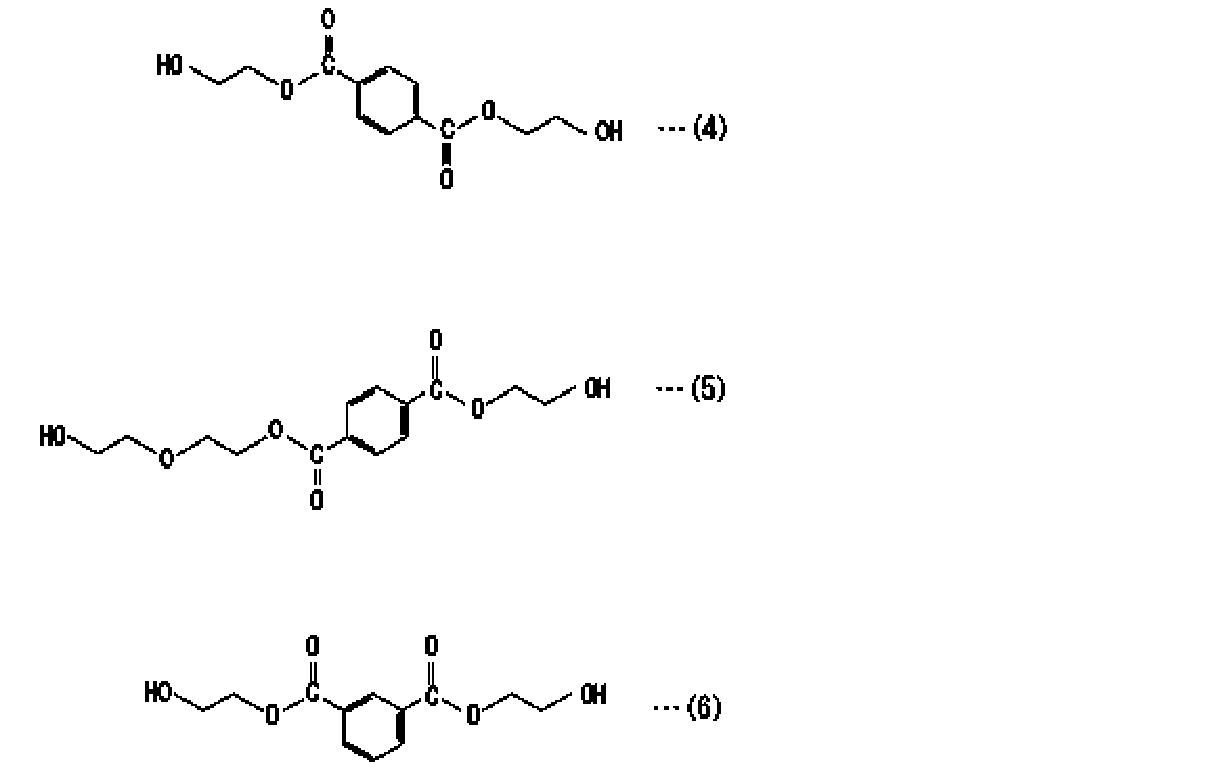
- impurities include, for example, isophthalic acid (IPA), diethylene glycol (DEG), etc. contained in the raw material PET product, or components represented by the following formulas (1) and (2) contained in the BHET oligomer. mentioned.
- IPA isophthalic acid
- DEG diethylene glycol
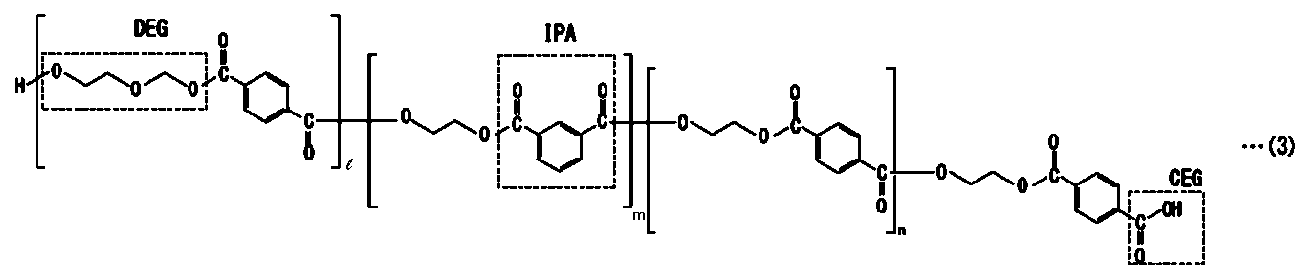
- the present inventors found that the terminal carboxyl group (CEG) of the chemically recycled PET fiber acts as a catalyst for the deterioration reaction and promotes the deterioration reaction, and the CEG concentration If it is possible to keep the CEG concentration low and increase the crystallinity of PET to a certain level or more even if a certain amount of impurities such as IPA is contained, , the deterioration of chemically recycled PET fibers can be suppressed, and excellent strength and durability can be realized.
- CEG terminal carboxyl group
- the chemically recycled PET fiber of the present invention comprises monomers containing terephthalic acid (TPA) and/or dimethyl terephthalate (DMT) obtained by depolymerizing PET products, and bis(2-hydroxyethyl) terephthalate.
- a chemically recycled PET fiber obtained by polymerizing a raw material containing at least one of an intermediate containing (BHET), wherein the chemically recycled PET fiber has a terminal carboxyl group concentration (CEG) of 15 eq/ton or less. and a crystallinity of 40% or more.
- the rubber-fiber composite of the present invention is characterized by using the above-described chemically recycled PET fiber of the present invention.
- the conveyor belt of the present invention is characterized by using the chemically recycled PET fiber of the present invention described above.
- the hose of the present invention is characterized by using the chemically recycled PET fiber of the present invention described above.
- the tire of the present invention is characterized by using the chemically recycled PET fiber of the present invention described above.
- the present invention it is possible to provide chemically recycled PET fibers whose deterioration is suppressed and which are excellent in strength and durability. Further, according to the present invention, it is possible to provide rubber-fiber composites, conveyor belts, hoses and tires that are excellent in strength and durability.
- the chemically recycled PET fiber of the present invention includes monomers such as terephthalic acid (TPA) and dimethyl terephthalate (DMT) obtained by depolymerizing PET products, and bis(2-hydroxyethyl) terephthalate (BHET).
- TPA terephthalic acid
- DMT dimethyl terephthalate
- BHET bis(2-hydroxyethyl) terephthalate
- the PET products to be recycled are plastic products mainly composed of polyethylene terephthalate, and examples thereof include PET bottles, food packaging films, optical sheets, clothing fibers, and tire cords. Among these, it is preferable to use a PET bottle as the PET product. This is because it is easy to obtain in large quantities and is easy to process.
- the PET product is preferably pulverized (made into flakes) prior to the step of depolymerizing into monomers, BHET, etc., although not particularly limited.
- PET polyethylene terephthalate
- MEG polyethylene terephthalate
- PET polyethylene terephthalate
- BHET polyethylene terephthalate
- the raw materials are monomers containing terephthalic acid (TPA) and/or dimethyl terephthalate (DMT) obtained by depolymerization of PET products, and bis(2- hydroxyethyl) (BHET).
- TPA terephthalic acid
- DMT dimethyl terephthalate
- BHET bis(2- hydroxyethyl)
- PET polyethylene terephthalate
- impurities such as isophthalic acid (IPA) and diethylene glycol (DEG) are randomly contained, as shown in formula (3) below.
- This impurity was contained in the PET product from which it was recycled, and when chemical recycling is performed, it can be removed to some extent by purifying it before polymerization, but it is unavoidably contained.
- the intermediates such as BHET obtained by chemical recycling are not only pure (without impurities) BHET oligomers as shown in formula (4), but also components as shown in formulas (5) and (6). is contained in the BHET oligomer, it is extremely difficult to purify them by distillation or the like to remove the components that become impurities.
- an intermediate such as BHET containing these impurities is polymerized, there is a problem that crystallization of PET is inhibited and PET fibers are likely to deteriorate.
- the terminal carboxyl group (CEG) concentration is controlled to 15 eq / ton or less and the crystallinity is controlled to 40% or more to remove impurities As a result of being able to suppress deterioration while containing, strength and durability can be improved.
- a hydrolysis method is used as a depolymerization method for obtaining the TPA.
- a methanolysis method is used as a depolymerization technique for obtaining the DMT.
- the intermediates such as BHET include not only completely decomposed pure BHET but also oligomers of BHET partially containing impurity components as shown in formulas (5) and (6).
- a glycolysis method is used when decomposing into intermediates such as BHET. When this method is used, it is possible to obtain the effect of shortening the recycling process and reducing the cost required for recycling, as compared with the case where monomers such as TPA and DMT are depolymerized.
- the intermediates such as BHET obtained by depolymerizing the PET product preferably do not contain residual components such as polymerization catalysts and dyes.
- the residual component may adversely affect the deterioration of the obtained chemically recycled PET fiber, and if there is a large amount of the residual polymerization catalyst, it may become difficult to control the polymerization reaction during repolymerization.
- the strength and durability of chemically recycled PET fibers can be more reliably improved.
- the chemically recycled PET fiber of the present invention has a degree of crystallinity of 40% or more from the viewpoint of being able to further improve strength and durability. If the degree of crystallinity of the chemically recycled PET fiber is 40% or more, even if there is an influence of inhibition of crystallization due to the above-mentioned IPA, DEG, etc., the penetration of moisture, amine, etc. in the rubber into the amorphous region This is because it is considered possible to suppress the deterioration reaction that is likely to be caused to a level that poses no problem in terms of product use. From the same point of view, the crystallinity of the chemically recycled PET fiber is preferably 45% or more.
- the chemically recycled PET fiber of the present invention has a terminal carboxyl group concentration (CEG) of 15 eq/ton or less from the viewpoint of suppressing deterioration of the PET fiber. This is because when the CEG of the chemically recycled PET fiber is 15 eq/ton or less, acceleration of deterioration due to terminal carboxyl groups is minimized, and deterioration can be suppressed. Furthermore, it is preferable that the terminal carboxyl group (CEG) concentration in the obtained chemically recycled PET fiber is 10 eq/ton or less.
- the CEG in the chemically recycled PET fiber can be measured by the titration method described in Analytic. Chem., 26, 1614 (1954).
- the obtained chemically recycled PET fibers preferably have a diethylene glycol (DEG) content of 1.0% by weight or less, and 0.5% by weight or less. is more preferred.
- DEG diethylene glycol
- the content of DEG in the chemically cycled PET fiber was measured by GC after decomposition with hydrazine according to the method described in J. Polym. Sci., Part A-1, 8, 679-682 (1970). can be quantified.
- the raw material obtained by depolymerizing the PET product is polymerized by solid phase polymerization following melt polymerization.
- Detailed polymerization conditions conditions such as catalyst, reaction temperature, polymerization time, etc. are not particularly limited, and can be appropriately selected according to the use and required performance of the chemically recycled PET fiber.
- the chemically recycled PET fiber of the present invention is a fibrous PET resin obtained through the above polymerization.
- the fiber conditions are not particularly limited, and can be appropriately selected according to the use and required performance of the chemically recycled PET fiber.
- the chemically recycled PET fiber of the present invention preferably has an intrinsic viscosity of 0.9 to 1.05 dl/g.
- the chemically recycled PET fiber has an intrinsic viscosity of 0.9 dl/g or more, the strength of the PET fiber can be enhanced. This is because when the intrinsic viscosity of the chemically recycled PET fiber is 1.05 dl/g or less, problems such as deterioration of workability do not occur.
- the chemically recycled fiber of the present invention may further contain PET derived from biomass. This can further reduce the load on the environment.
- the biomass-derived PET include PET products obtained by polymerizing ethylene glycol and terephthalic acid, which are made from non-petroleum-derived materials such as plants. Chemically recycled PET can be obtained by depolymerizing such biomass-derived PET and then repolymerizing it. Also, mechanically recycled PET can be obtained by remolding after melting biomass-derived PET.
- the biomass-derived PET also includes those having isophthalic acid and terminal carboxyl groups (CEG) during the manufacturing process.
- the rubber-fiber composite of the present invention is characterized by using the above-described chemically recycled PET fiber of the present invention.
- excellent strength and durability can be realized even in a rubber-fiber composite using recycled materials.
- the rubber-fiber composite of the present invention only needs to contain the chemically recycled PET fiber, and can be used by mixing with other organic fibers. Further, other conditions for the chemically recycled PET fiber can be appropriately selected according to the required performance.
- the tire of the present invention is characterized by using the above-mentioned chemically recycled PET fiber of the present invention.
- the chemically recycled PET fiber of the present invention in a member, excellent strength and durability can be achieved even when a tire cord made of recycled material is included.
- the rubber-fiber composite When used for a tire, it is preferably used as a pneumatic tire carcass or a belt reinforcing layer, but is not limited thereto. It can also be suitably used for other members.
- the conveyor belt of the present invention is characterized by using the chemically recycled PET fiber of the present invention described above.
- the hose of the present invention is characterized by using the chemically recycled PET fiber of the present invention described above.
- the structure of the chemically recycled PET fiber is the same as that described in the chemically recycled PET fiber of the present invention.
- the present invention it is possible to provide chemically recycled PET fibers whose deterioration is suppressed and which are excellent in strength and durability. Further, according to the present invention, it is possible to provide rubber-fiber composites, conveyor belts, hoses and tires that are excellent in strength and durability.
Landscapes
- Chemical & Material Sciences (AREA)
- Chemical Kinetics & Catalysis (AREA)
- Polymers & Plastics (AREA)
- Health & Medical Sciences (AREA)
- Medicinal Chemistry (AREA)
- Organic Chemistry (AREA)
- General Chemical & Material Sciences (AREA)
- Engineering & Computer Science (AREA)
- Textile Engineering (AREA)
- Sustainable Development (AREA)
- Life Sciences & Earth Sciences (AREA)
- Polyesters Or Polycarbonates (AREA)
- Separation, Recovery Or Treatment Of Waste Materials Containing Plastics (AREA)
- Reinforced Plastic Materials (AREA)
Abstract
Description
近年PETの消費は急激な成長を遂げ、特に該化合物はボトル飲料など種々の液体製品の容器製造に大量に使用されている。
例えば、廃棄ポリマーを収集し、浄化し、粉砕し、粒子状にし、品質や純度に関する高い基準を満たす必要のない製品の材料として使用する「マテリアルリサイクル」として知られる手法があるが、その形態のリサイクルは利用分野が限定される。
例えば、特許文献1には、PET廃棄物をモノマーへと解重合し、解重合されたモノマーを重合させることで、ケミカルリサイクルPETを製造し、タイヤの補強材として用いる技術が開示されている。
そこで、本発明者らは、さらに鋭意研究を行った結果、ケミカルリサイクルPET繊維の、末端カルボキシル基(CEG)が劣化反応に対して触媒的に働き、劣化反応を促進することや、CEGの濃度の劣化に与える影響に着目し、上述したIPA等の不純物を一定量の含有する場合であっても、CEG濃度を低く抑え、且つPETの結晶化度を一定以上にする事が可能であれば、ケミカルリサイクルPET繊維の劣化を抑制でき、優れた強度及び耐久性を実現できることを見出した。

上記構成を具えることによって、ケミカルリサイクルPET繊維の劣化が抑制され、優れた強度及び耐久性を実現できる。
上記構成を具えることによって、劣化が抑制され、優れた強度及び耐久性を実現できる。
上記構成を具えることによって、劣化が抑制され、優れた強度及び耐久性を実現できる。
上記構成を具えることによって、劣化が抑制され、優れた強度及び耐久性を実現できる。
上記構成を具えることによって、劣化が抑制され、優れた強度及び耐久性を実現できる。
<リサイクルPET繊維>
本発明のケミカルリサイクルPET繊維は、PET製品の解重合によって得られた、テレフタル酸(TPA)、テレフタル酸ジメチル(DMT)等のモノマー、及び、テレフタル酸ビス(2-ヒドロキシエチル)(BHET)等の中間体(BHETオリゴマーを含む)、のうちの少なくとも一つを含む原料を、重合してなるケミカルリサイクルPET繊維である。
なお、前記PET製品は、特に限定はされないが、モノマーやBHET等への解重合する工程に先立って、粉砕(フレーク化)されることが好ましい。
本発明では、PET製品を解重合することによって得られたBHETを直接原料として用いることで、TPA、DMT等のモノマーまで解重合する場合と比較して、環境的及び経済的な利点を得ることができる。

ここで、前記BHET等の中間体に分解する際には、グリコリシス法が用いられる。この方法を用いた場合、TPA、DMT等のモノマーまで解重合する場合と比較して、リサイクル工程の短縮やリサイクルに要する費用の低減効果を得ることができる。
なお、結晶化度(XC)は繊維密度(ρ)を密度勾配管を用いて測定し、PETの結晶密度、ρC=1.455 g/cm3 (Polymer, 1, 330-339 (1960))、非晶密度、ρa=1.335 g/cm3 (Proc. Roy. Soc., A226, 531-542 (1954))の数値を用いて次式から計算する。

さらに、得られたケミカルリサイクルPET繊維中の、末端カルボキシル基(CEG)濃度が10eq/ton以下であることが好ましい。
なお、前記ケミカルリサイクルPET繊維中のCEGについては、Analytic. Chem., 26, 1614 (1954) に記載の滴定による方法によって測定することができる。
なお、前記ケミカルサイクルPET繊維中のDEGの含有量については、J. Polym. Sci., Part A-1, 8, 679-682 (1970)に記載の方法に従って、ヒドラジンで分解した後にGC測定で定量することができる。
また、前記バイオマス由来のPETは、製造過程においてイソフタル酸や末端カルボキシル基(CEG)を有するものも含む。
本発明のゴム-繊維複合体は、上述した本発明のケミカルリサイクルPET繊維を用いたことを特徴とする。
本発明のケミカルリサイクルPET繊維を用いることで、リサイクル材料を用いたゴム-繊維複合体であっても、優れた強度及び耐久性を実現できる。
また、本発明のタイヤは、上述した本発明のケミカルリサイクルPET繊維を用いたことを特徴とする。
本発明のケミカルリサイクルPET繊維を部材中に含むことで、リサイクル材料を用いたタイヤ用コードを含む場合であっても、優れた強度及び耐久性を実現できる。
本発明のコンベヤベルトは、上述した本発明のケミカルリサイクルPET繊維を用いたことを特徴とする。
また、本発明のホースは、上述した本発明のケミカルリサイクルPET繊維を用いたことを特徴とする。
本発明のケミカルリサイクルPET繊維をこれらの物品に用いることで、リサイクル材料を用いたものであっても、優れた強度及び耐久性を実現できる。
Claims (7)
- PET製品の解重合によって得られた、テレフタル酸(TPA)及び/又はテレフタル酸ジメチル(DMT)を含むモノマー、並びに、テレフタル酸ビス(2-ヒドロキシエチル)(BHET)を含む中間体、のうちの少なくとも一つを含む原料を、重合してなるケミカルリサイクルPET繊維であって、
前記ケミカルリサイクルPET繊維の、末端カルボキシル基濃度(CEG)が15eq/ton以下であり、且つ、結晶化度が40%以上であることを特徴とする、ケミカルリサイクルPET繊維。 - 前記ケミカルリサイクルPET繊維は、ジエチレングリコール(DEG)の含有量が1.0重量%以下であることを特徴とする、請求項1に記載のケミカルリサイクルPET繊維。
- 前記ケミカルリサイクルPET繊維は、固有粘度が0.9~1.05dl/gであることを特徴とする、請求項1又は2に記載のケミカルリサイクルPET繊維。
- 請求項1又は2に記載のケミカルリサイクルPET繊維を用いたことを特徴とする、ゴム-繊維複合体。
- 請求項1又は2に記載のケミカルリサイクルPET繊維を用いたことを特徴とする、コンベヤベルト。
- 請求項1又は2に記載のケミカルリサイクルPET繊維を用いたことを特徴とする、ホース。
- 請求項1又は2に記載のケミカルリサイクルPET繊維を用いたことを特徴とする、タイヤ。
Priority Applications (4)
| Application Number | Priority Date | Filing Date | Title |
|---|---|---|---|
| EP22852757.8A EP4382645A4 (en) | 2021-08-05 | 2022-06-30 | Chemically-recycled pet fibers, rubber-fiber composite, conveyor belt, hose and tire |
| JP2023539718A JPWO2023013331A1 (ja) | 2021-08-05 | 2022-06-30 | |
| US18/294,751 US20240344242A1 (en) | 2021-08-05 | 2022-06-30 | Chemically-recycled pet fiber, rubber-fiber composite, conveyor belt, hose and tire |
| CN202280054402.2A CN117795141A (zh) | 2021-08-05 | 2022-06-30 | 化学回收的pet纤维、橡胶-纤维复合体、输送带、软管和轮胎 |
Applications Claiming Priority (2)
| Application Number | Priority Date | Filing Date | Title |
|---|---|---|---|
| JP2021129363 | 2021-08-05 | ||
| JP2021-129363 | 2021-08-05 |
Publications (1)
| Publication Number | Publication Date |
|---|---|
| WO2023013331A1 true WO2023013331A1 (ja) | 2023-02-09 |
Family
ID=85154195
Family Applications (1)
| Application Number | Title | Priority Date | Filing Date |
|---|---|---|---|
| PCT/JP2022/026410 Ceased WO2023013331A1 (ja) | 2021-08-05 | 2022-06-30 | ケミカルリサイクルpet繊維、ゴム-繊維複合体、コンベヤベルト、ホース及びタイヤ |
Country Status (5)
| Country | Link |
|---|---|
| US (1) | US20240344242A1 (ja) |
| EP (1) | EP4382645A4 (ja) |
| JP (1) | JPWO2023013331A1 (ja) |
| CN (1) | CN117795141A (ja) |
| WO (1) | WO2023013331A1 (ja) |
Citations (9)
| Publication number | Priority date | Publication date | Assignee | Title |
|---|---|---|---|---|
| JPH0625916A (ja) * | 1991-12-26 | 1994-02-01 | Toray Ind Inc | シートベルト用ポリエステル繊維 |
| JP2000169623A (ja) * | 1998-12-10 | 2000-06-20 | Is:Kk | ポリエチレンテレフタレ―ト廃棄物のケミカルリサイクル方法 |
| JP2000512250A (ja) * | 1996-06-04 | 2000-09-19 | ローマン ゲーエムベーハー ウンド コー.カーゲー | 食品用コンベヤベルト |
| JP2002161437A (ja) * | 2000-11-30 | 2002-06-04 | Teijin Ltd | ポリアルキレンテレフタレート繊維及びその識別方法 |
| JP2003055300A (ja) * | 2001-08-17 | 2003-02-26 | Is:Kk | ビス−β−ヒドロキシエチルテレフタレートの製造法 |
| JP2004019783A (ja) * | 2002-06-17 | 2004-01-22 | Ashimori Ind Co Ltd | 消防用ホース |
| JP2007217832A (ja) * | 2006-02-17 | 2007-08-30 | Toray Ind Inc | 産業資材用ポリエステル繊維 |
| JP2010126614A (ja) * | 2008-11-27 | 2010-06-10 | Toray Ind Inc | ポリエステル重縮合触媒およびそれを用いるポリエステルの製造方法 |
| JP2016182685A (ja) * | 2015-03-25 | 2016-10-20 | 富士フイルム株式会社 | ポリエステルフィルム及びその製造方法、太陽電池用裏面保護シート、並びに太陽電池モジュール |
Family Cites Families (6)
| Publication number | Priority date | Publication date | Assignee | Title |
|---|---|---|---|---|
| JPS59116414A (ja) * | 1982-12-24 | 1984-07-05 | Unitika Ltd | ゴム補強用ポリエステル繊維 |
| JPS59192714A (ja) * | 1983-04-11 | 1984-11-01 | Toray Ind Inc | ポリエチレンテレフタレ−ト系繊維およびその製造方法 |
| US4690866A (en) * | 1984-07-09 | 1987-09-01 | Teijin Limited | Polyester fiber |
| US4867936A (en) * | 1987-06-03 | 1989-09-19 | Allied-Signal Inc. | Process for producing high strength polyester yarn for improved fatigue resistance |
| WO1991007529A1 (en) * | 1989-11-15 | 1991-05-30 | Toray Industries, Inc. | Rubber-reinforcing polyester fiber and process for preparation thereof |
| KR101779442B1 (ko) * | 2010-12-15 | 2017-09-18 | 코오롱인더스트리 주식회사 | 폴리에스테르 원사 및 그의 제조방법 |
-
2022
- 2022-06-30 EP EP22852757.8A patent/EP4382645A4/en active Pending
- 2022-06-30 JP JP2023539718A patent/JPWO2023013331A1/ja active Pending
- 2022-06-30 WO PCT/JP2022/026410 patent/WO2023013331A1/ja not_active Ceased
- 2022-06-30 US US18/294,751 patent/US20240344242A1/en active Pending
- 2022-06-30 CN CN202280054402.2A patent/CN117795141A/zh active Pending
Patent Citations (9)
| Publication number | Priority date | Publication date | Assignee | Title |
|---|---|---|---|---|
| JPH0625916A (ja) * | 1991-12-26 | 1994-02-01 | Toray Ind Inc | シートベルト用ポリエステル繊維 |
| JP2000512250A (ja) * | 1996-06-04 | 2000-09-19 | ローマン ゲーエムベーハー ウンド コー.カーゲー | 食品用コンベヤベルト |
| JP2000169623A (ja) * | 1998-12-10 | 2000-06-20 | Is:Kk | ポリエチレンテレフタレ―ト廃棄物のケミカルリサイクル方法 |
| JP2002161437A (ja) * | 2000-11-30 | 2002-06-04 | Teijin Ltd | ポリアルキレンテレフタレート繊維及びその識別方法 |
| JP2003055300A (ja) * | 2001-08-17 | 2003-02-26 | Is:Kk | ビス−β−ヒドロキシエチルテレフタレートの製造法 |
| JP2004019783A (ja) * | 2002-06-17 | 2004-01-22 | Ashimori Ind Co Ltd | 消防用ホース |
| JP2007217832A (ja) * | 2006-02-17 | 2007-08-30 | Toray Ind Inc | 産業資材用ポリエステル繊維 |
| JP2010126614A (ja) * | 2008-11-27 | 2010-06-10 | Toray Ind Inc | ポリエステル重縮合触媒およびそれを用いるポリエステルの製造方法 |
| JP2016182685A (ja) * | 2015-03-25 | 2016-10-20 | 富士フイルム株式会社 | ポリエステルフィルム及びその製造方法、太陽電池用裏面保護シート、並びに太陽電池モジュール |
Non-Patent Citations (4)
| Title |
|---|
| J. POLYM. SCI., vol. 8, 1970, pages 679 - 682 |
| POLYMER, vol. 1, 1960, pages 330 - 339 |
| PROC. ROY. SOC., vol. A226, 1954, pages 531 - 542 |
| See also references of EP4382645A4 |
Also Published As
| Publication number | Publication date |
|---|---|
| JPWO2023013331A1 (ja) | 2023-02-09 |
| EP4382645A1 (en) | 2024-06-12 |
| EP4382645A4 (en) | 2025-05-14 |
| US20240344242A1 (en) | 2024-10-17 |
| CN117795141A (zh) | 2024-03-29 |
Similar Documents
| Publication | Publication Date | Title |
|---|---|---|
| WO2023013330A1 (ja) | ケミカルリサイクルpet繊維、ゴム-繊維複合体、コンベヤベルト、ホース及びタイヤ | |
| Park et al. | Poly (ethylene terephthalate) recycling for high value added textiles | |
| US20220348715A1 (en) | Copolyesters produced from recycled copolyesters | |
| JP4531988B2 (ja) | 使用後のpetリサイクルのための解糖法 | |
| CA2464646C (en) | Continuous production of transparent polyester using waste | |
| CN104395383B (zh) | 酯混合物的薄片及其生产方法 | |
| JP2009091694A (ja) | ポリエチレンテレフタレート、それを用いた繊維及び自動車内装材 | |
| WO2007078780A2 (en) | Process for recycling polyesters | |
| JP4330918B2 (ja) | ポリエステル廃棄物のリサイクル方法 | |
| CN118406282A (zh) | 一种废弃混合塑料中回收制备再生聚合物的方法及再生聚合物 | |
| NZ552556A (en) | Crystallized polyethylene terephthalate, which contains silicon, and process for its preparation | |
| KR20240076318A (ko) | 재생 비스(4-히드록시부틸)테레프탈레이트, 이의 제조방법 및 이를 이용한 폴리에스테르 수지 | |
| CN117795141A (zh) | 化学回收的pet纤维、橡胶-纤维复合体、输送带、软管和轮胎 | |
| JP2011207822A (ja) | ポリエステルからビス(2−ヒドロキシエチル)テレフタレートを製造する方法 | |
| WO2026063443A1 (ja) | ケミカルリサイクルpet繊維、タイヤ用コード及びタイヤ | |
| CN117050282A (zh) | 一种利用废弃聚酯和二氧化碳合成生物可降解塑料的方法及所得产品 | |
| TH2301005018A (th) | กระบวนการแบบเบ็ดเสร็จ | |
| MX2008002085A (es) | Proceso para fabricar polietilentereftalato (pet) a partir de materia prima virgen y polimero reciclado de botellas de pet. | |
| KR20260011306A (ko) | 폴리에틸렌 테레프탈레이트의 구조체 및 그 제조방법 | |
| CN119775120A (zh) | 一种聚酯类聚合物回收再利用方法 | |
| CN115304478A (zh) | 一种再生有色涤纶泡料提纯bhet粒子工艺 | |
| WO2023228034A1 (es) | Catalizador y proceso para la obtención de bhet a partir de pet | |
| Santos et al. | Acid-hydrolysis of post-consumer pet using variable routes | |
| JPS63309617A (ja) | 高強力ポリエステル成形物の製造方法 | |
| JP2000256451A (ja) | ポリエステルの製造方法 |
Legal Events
| Date | Code | Title | Description |
|---|---|---|---|
| 121 | Ep: the epo has been informed by wipo that ep was designated in this application |
Ref document number: 22852757 Country of ref document: EP Kind code of ref document: A1 |
|
| WWE | Wipo information: entry into national phase |
Ref document number: 2023539718 Country of ref document: JP |
|
| WWE | Wipo information: entry into national phase |
Ref document number: 18294751 Country of ref document: US |
|
| WWE | Wipo information: entry into national phase |
Ref document number: 202280054402.2 Country of ref document: CN |
|
| NENP | Non-entry into the national phase |
Ref country code: DE |
|
| ENP | Entry into the national phase |
Ref document number: 2022852757 Country of ref document: EP Effective date: 20240305 |