WO2023190813A1 - エチレン-ビニルアルコール系共重合体組成物、エチレン-ビニルアルコール系共重合体組成物の製造方法、ペレット、多層構造体及び、多層構造体の製造方法 - Google Patents
エチレン-ビニルアルコール系共重合体組成物、エチレン-ビニルアルコール系共重合体組成物の製造方法、ペレット、多層構造体及び、多層構造体の製造方法 Download PDFInfo
- Publication number
- WO2023190813A1 WO2023190813A1 PCT/JP2023/013062 JP2023013062W WO2023190813A1 WO 2023190813 A1 WO2023190813 A1 WO 2023190813A1 JP 2023013062 W JP2023013062 W JP 2023013062W WO 2023190813 A1 WO2023190813 A1 WO 2023190813A1
- Authority
- WO
- WIPO (PCT)
- Prior art keywords
- evoh resin
- resin composition
- ethylene
- present
- evoh
- Prior art date
- Legal status (The legal status is an assumption and is not a legal conclusion. Google has not performed a legal analysis and makes no representation as to the accuracy of the status listed.)
- Ceased
Links
Classifications
-
- C—CHEMISTRY; METALLURGY
- C08—ORGANIC MACROMOLECULAR COMPOUNDS; THEIR PREPARATION OR CHEMICAL WORKING-UP; COMPOSITIONS BASED THEREON
- C08K—Use of inorganic or non-macromolecular organic substances as compounding ingredients
- C08K3/00—Use of inorganic substances as compounding ingredients
- C08K3/18—Oxygen-containing compounds, e.g. metal carbonyls
- C08K3/20—Oxides; Hydroxides
- C08K3/22—Oxides; Hydroxides of metals
-
- B—PERFORMING OPERATIONS; TRANSPORTING
- B32—LAYERED PRODUCTS
- B32B—LAYERED PRODUCTS, i.e. PRODUCTS BUILT-UP OF STRATA OF FLAT OR NON-FLAT, e.g. CELLULAR OR HONEYCOMB, FORM
- B32B27/00—Layered products comprising a layer of synthetic resin
- B32B27/28—Layered products comprising a layer of synthetic resin comprising synthetic resins not wholly covered by any one of the sub-groups B32B27/30 - B32B27/42
-
- C—CHEMISTRY; METALLURGY
- C08—ORGANIC MACROMOLECULAR COMPOUNDS; THEIR PREPARATION OR CHEMICAL WORKING-UP; COMPOSITIONS BASED THEREON
- C08F—MACROMOLECULAR COMPOUNDS OBTAINED BY REACTIONS ONLY INVOLVING CARBON-TO-CARBON UNSATURATED BONDS
- C08F216/00—Copolymers of compounds having one or more unsaturated aliphatic radicals, each having only one carbon-to-carbon double bond, and at least one being terminated by an alcohol, ether, aldehydo, ketonic, acetal or ketal radical
- C08F216/02—Copolymers of compounds having one or more unsaturated aliphatic radicals, each having only one carbon-to-carbon double bond, and at least one being terminated by an alcohol, ether, aldehydo, ketonic, acetal or ketal radical by an alcohol radical
- C08F216/04—Acyclic compounds
- C08F216/06—Polyvinyl alcohol ; Vinyl alcohol
-
- C—CHEMISTRY; METALLURGY
- C08—ORGANIC MACROMOLECULAR COMPOUNDS; THEIR PREPARATION OR CHEMICAL WORKING-UP; COMPOSITIONS BASED THEREON
- C08J—WORKING-UP; GENERAL PROCESSES OF COMPOUNDING; AFTER-TREATMENT NOT COVERED BY SUBCLASSES C08B, C08C, C08F, C08G or C08H
- C08J3/00—Processes of treating or compounding macromolecular substances
- C08J3/12—Powdering or granulating
-
- C—CHEMISTRY; METALLURGY
- C08—ORGANIC MACROMOLECULAR COMPOUNDS; THEIR PREPARATION OR CHEMICAL WORKING-UP; COMPOSITIONS BASED THEREON
- C08J—WORKING-UP; GENERAL PROCESSES OF COMPOUNDING; AFTER-TREATMENT NOT COVERED BY SUBCLASSES C08B, C08C, C08F, C08G or C08H
- C08J3/00—Processes of treating or compounding macromolecular substances
- C08J3/20—Compounding polymers with additives, e.g. colouring
- C08J3/203—Solid polymers with solid and/or liquid additives
-
- C—CHEMISTRY; METALLURGY
- C08—ORGANIC MACROMOLECULAR COMPOUNDS; THEIR PREPARATION OR CHEMICAL WORKING-UP; COMPOSITIONS BASED THEREON
- C08K—Use of inorganic or non-macromolecular organic substances as compounding ingredients
- C08K3/00—Use of inorganic substances as compounding ingredients
- C08K3/38—Boron-containing compounds
-
- C—CHEMISTRY; METALLURGY
- C08—ORGANIC MACROMOLECULAR COMPOUNDS; THEIR PREPARATION OR CHEMICAL WORKING-UP; COMPOSITIONS BASED THEREON
- C08K—Use of inorganic or non-macromolecular organic substances as compounding ingredients
- C08K5/00—Use of organic ingredients
- C08K5/04—Oxygen-containing compounds
- C08K5/09—Carboxylic acids; Metal salts thereof; Anhydrides thereof
- C08K5/098—Metal salts of carboxylic acids
-
- C—CHEMISTRY; METALLURGY
- C08—ORGANIC MACROMOLECULAR COMPOUNDS; THEIR PREPARATION OR CHEMICAL WORKING-UP; COMPOSITIONS BASED THEREON
- C08K—Use of inorganic or non-macromolecular organic substances as compounding ingredients
- C08K5/00—Use of organic ingredients
- C08K5/04—Oxygen-containing compounds
- C08K5/10—Esters; Ether-esters
- C08K5/11—Esters; Ether-esters of acyclic polycarboxylic acids
-
- C—CHEMISTRY; METALLURGY
- C08—ORGANIC MACROMOLECULAR COMPOUNDS; THEIR PREPARATION OR CHEMICAL WORKING-UP; COMPOSITIONS BASED THEREON
- C08K—Use of inorganic or non-macromolecular organic substances as compounding ingredients
- C08K5/00—Use of organic ingredients
- C08K5/16—Nitrogen-containing compounds
- C08K5/20—Carboxylic acid amides
-
- C—CHEMISTRY; METALLURGY
- C08—ORGANIC MACROMOLECULAR COMPOUNDS; THEIR PREPARATION OR CHEMICAL WORKING-UP; COMPOSITIONS BASED THEREON
- C08L—COMPOSITIONS OF MACROMOLECULAR COMPOUNDS
- C08L23/00—Compositions of homopolymers or copolymers of unsaturated aliphatic hydrocarbons having only one carbon-to-carbon double bond; Compositions of derivatives of such polymers
- C08L23/02—Compositions of homopolymers or copolymers of unsaturated aliphatic hydrocarbons having only one carbon-to-carbon double bond; Compositions of derivatives of such polymers not modified by chemical after-treatment
- C08L23/04—Homopolymers or copolymers of ethene
- C08L23/08—Copolymers of ethene
-
- C—CHEMISTRY; METALLURGY
- C08—ORGANIC MACROMOLECULAR COMPOUNDS; THEIR PREPARATION OR CHEMICAL WORKING-UP; COMPOSITIONS BASED THEREON
- C08J—WORKING-UP; GENERAL PROCESSES OF COMPOUNDING; AFTER-TREATMENT NOT COVERED BY SUBCLASSES C08B, C08C, C08F, C08G or C08H
- C08J2357/00—Characterised by the use of unspecified polymers obtained by reactions only involving carbon-to-carbon unsaturated bonds
- C08J2357/06—Homopolymers or copolymers containing elements other than carbon and hydrogen
- C08J2357/10—Homopolymers or copolymers containing elements other than carbon and hydrogen containing oxygen atoms
-
- C—CHEMISTRY; METALLURGY
- C08—ORGANIC MACROMOLECULAR COMPOUNDS; THEIR PREPARATION OR CHEMICAL WORKING-UP; COMPOSITIONS BASED THEREON
- C08K—Use of inorganic or non-macromolecular organic substances as compounding ingredients
- C08K3/00—Use of inorganic substances as compounding ingredients
- C08K3/18—Oxygen-containing compounds, e.g. metal carbonyls
- C08K3/20—Oxides; Hydroxides
- C08K3/22—Oxides; Hydroxides of metals
- C08K2003/2217—Oxides; Hydroxides of metals of magnesium
- C08K2003/222—Magnesia, i.e. magnesium oxide
-
- C—CHEMISTRY; METALLURGY
- C08—ORGANIC MACROMOLECULAR COMPOUNDS; THEIR PREPARATION OR CHEMICAL WORKING-UP; COMPOSITIONS BASED THEREON
- C08K—Use of inorganic or non-macromolecular organic substances as compounding ingredients
- C08K3/00—Use of inorganic substances as compounding ingredients
- C08K3/18—Oxygen-containing compounds, e.g. metal carbonyls
- C08K3/20—Oxides; Hydroxides
- C08K3/22—Oxides; Hydroxides of metals
- C08K2003/2237—Oxides; Hydroxides of metals of titanium
- C08K2003/2241—Titanium dioxide
Definitions
- the present invention relates to an ethylene-vinyl alcohol copolymer composition, a method for producing an ethylene-vinyl alcohol copolymer composition, pellets, a multilayer structure, and a method for producing a multilayer structure.
- Ethylene-vinyl alcohol copolymer (hereinafter sometimes referred to as "EVOH resin”) has excellent transparency, gas barrier properties against oxygen and other gases, fragrance retention, solvent resistance, oil resistance, mechanical strength, etc. It is formed into films, sheets, bottles, etc., and is widely used as various packaging materials such as food packaging materials, pharmaceutical packaging materials, industrial chemical packaging materials, and pesticide packaging materials.
- EVOH resin has a relatively active hydroxyl group in its molecule, it tends to deteriorate easily due to heat, and coloring problems tend to occur during melt molding.
- Patent Document 1 discloses that by containing a specific amount of unsaturated aldehyde in EVOH resin, oxidative deterioration during melt molding can be suppressed and coloration can be suppressed.
- An object of the present invention is to provide an EVOH resin composition in which color change due to thermal deterioration during melt molding is suppressed.
- the present inventors added a specific small amount of a titanium compound to EVOH resin to obtain an EVOH resin composition in which color change due to thermal deterioration during melt molding was suppressed, that is, excellent in long-run properties. I found out that it can be done.
- the present inventors also used at least one selected from the group consisting of an alkaline earth metal compound, an alkali metal compound, a lubricant, and an antioxidant, and/or the EVOH resin composition. It has been found that by controlling the water content of the material below a certain level, long-run performance can be improved.
- the present inventors have achieved excellent long-run properties by using at least one selected from the group consisting of a compound having a conjugated polyene structure, a boron compound, and a styrene derivative in addition to the titanium compound, and furthermore, the EVOH resin It has been found that coloring of the composition itself can be suppressed.
- An EVOH resin composition containing an EVOH resin and a titanium compound, wherein the content of ethylene structural units in the EVOH resin is 20 to 60 mol%, and the content of the titanium compound in terms of metal is An EVOH resin composition in which the content is 0.001 ppm or more and less than 5 ppm per mass of the resin composition.
- it contains at least one selected from the group consisting of an alkaline earth metal compound, an alkali metal compound, a lubricant, a compound having a conjugated polyene structure, a boron compound, an antioxidant, and a styrene derivative
- a multilayer structure comprising at least one layer made of the EVOH resin composition according to any one of [1] to [10].
- a method for producing a multilayer structure according to [13] which comprises a step of melt-molding a layer made of the EVOH resin composition.
- the EVOH resin composition of the present invention containing a specific amount of titanium compound can suppress color change of the EVOH resin during melt molding, and has excellent long-run properties. Further, in addition to the titanium compound, the EVOH resin composition contains at least one selected from the group consisting of an alkaline earth metal compound, an alkali metal compound, a lubricant, and an antioxidant, and/or the EVOH resin composition has a water content below a certain level. The EVOH resin composition of the present invention, which is more excellent in long-run properties.
- the EVOH resin composition of the present invention which contains at least one selected from the group consisting of a compound having a conjugated polyene structure, a boron compound, and a styrene derivative in addition to the titanium compound, has excellent long-run properties, and Coloring of the resin composition itself can be suppressed.
- the EVOH resin composition of the present invention comprises a "first embodiment” containing an EVOH resin and a specific trace amount of a titanium compound, a “second embodiment” further containing an alkaline earth metal compound, and an alkali metal compound.
- the EVOH resin composition has a "seventh embodiment” containing a styrene derivative, an "eighth embodiment” containing a styrene derivative, and a "ninth embodiment” in which the water content of the EVOH resin composition is 1% by mass or less.
- this EVOH resin composition has an EVOH resin as a main component and contains a specific trace amount of a titanium compound.
- the present invention has the following aspects.
- a method for producing the EVOH resin composition according to [1-1] comprising: A method for producing an EVOH resin composition, comprising a step of melt-mixing composition raw materials containing the EVOH resin and a titanium compound.
- the base resin is an EVOH resin
- the content of EVOH resin in the present EVOH resin composition is usually 70% by mass or more, preferably 80% by mass or more, and more preferably 90% by mass or more. , particularly preferably 95% by mass or more.
- the EVOH resin used in the present invention is usually a resin obtained by saponifying an ethylene-vinyl ester copolymer, which is a copolymer of ethylene and a vinyl ester monomer, and is a water-insoluble thermoplastic resin. It is.
- vinyl ester monomer vinyl acetate is typically used because of its market availability and good efficiency in treating impurities during production.
- vinyl ester monomers other than vinyl acetate include vinyl formate, vinyl propionate, vinyl valerate, vinyl butyrate, vinyl isobutyrate, vinyl pivalate, vinyl caprate, vinyl laurate, vinyl stearate, and versatic acid.
- examples include aliphatic vinyl esters such as vinyl, aromatic vinyl esters such as vinyl benzoate, and aliphatic vinyls having usually 3 to 20 carbon atoms, preferably 4 to 10 carbon atoms, and particularly preferably 4 to 7 carbon atoms. Esters are used. These are usually used alone, but multiple types may be used simultaneously if necessary.
- the copolymerization method for copolymerizing ethylene and the vinyl ester monomer can be carried out using any known polymerization method, such as solution polymerization, suspension polymerization, emulsion polymerization, etc., but generally methanol is used. Solution polymerization using a solvent is used. Furthermore, the obtained ethylene-vinyl ester copolymer may be saponified by a known method.
- the EVOH resin produced in this manner mainly contains structural units derived from ethylene and vinyl alcohol structural units, and contains a small amount of vinyl ester structural units that remain without being saponified.
- the content of ethylene structural units in the EVOH resin is 20 to 60 mol%, preferably 25 to 50 mol%, particularly preferably 25 to 35 mol%.
- the content of the ethylene structural unit can be controlled by the pressure of ethylene when copolymerizing the vinyl ester monomer and ethylene, and if this content is too low, the gas barrier property under high humidity, melt molding On the other hand, if it is too high, gas barrier properties tend to decrease. Note that the content of such ethylene structural units can be measured based on ISO14663.
- the saponification degree of the EVOH resin is usually 90 to 100 mol%, preferably 95 to 100 mol%, particularly preferably 99 to 100 mol%.
- the degree of saponification can be controlled by the amount, temperature, time, etc. of the saponification catalyst (usually an alkaline catalyst such as sodium hydroxide is used) when saponifying the ethylene-vinyl ester copolymer. If the degree of oxidation is too low, gas barrier properties, thermal stability, moisture resistance, etc. tend to deteriorate.
- the degree of saponification of such EVOH resin can be measured based on JIS K6726 (however, the EVOH resin is used as a solution uniformly dissolved in a water/methanol solvent).
- the melt flow rate (MFR) (210° C., load 2160 g) of the EVOH resin is usually 0.5 to 100 g/10 minutes, preferably 1 to 50 g/10 minutes, particularly preferably 3 to 35 g/10 minutes. be. If the MFR is too large, stability during film formation tends to be impaired, and if it is too small, the viscosity tends to become too high, making melt extrusion difficult.
- the MFR is an indicator of the degree of polymerization of the EVOH resin, and can be adjusted by adjusting the amount of polymerization initiator and the amount of solvent when copolymerizing ethylene and vinyl ester monomer.
- the EVOH resin may further contain a structural unit derived from a comonomer shown below (eg, 10 mol% or less of the EVOH resin) within a range that does not impede the effects of the present invention.
- the comonomer include olefins such as propylene, 1-butene, and isobutene, 3-buten-1-ol, 3-buten-1,2-diol, 4-penten-1-ol, 5-hexene-1, Hydroxy group-containing ⁇ -olefins such as 2-diol, and derivatives thereof such as esters and acylated products; Hydroxyalkylvinylidenes such as 2-methylenepropane-1,3-diol and 3-methylenepentane-1,5-diol ; Hydroxyalkyl vinylidene diacetates such as 1,3-diacetoxy-2-methylenepropane, 1,3-dipropionyloxy-2-methylenepropane,
- hydroxy group-containing ⁇ -olefins are preferred, with 3-butene-1,2-diol and 5-hexene-1,2-diol being particularly preferred.
- the resulting EVOH resin will have a primary hydroxyl group in the side chain.
- the content of the structural unit derived from the monomer having the primary hydroxyl group is usually 0.1 to 20 mol%, preferably 0.5 to 15% by mole of the EVOH resin. mol %, particularly preferably 1 to 10 mol %.
- EVOH resin it is also possible to use an EVOH resin that has been "post-modified” such as esterification, urethanization, acetalization, cyanoethylation, or oxyalkylenation.
- the modification rate is usually 10 mol% or less, preferably 4 mol% or less. If the modification rate of the EVOH resin is too high, it tends to be easily thermally degraded and its long run properties tend to decrease.
- the EVOH resin may be a mixture of EVOH resins having different contents of ethylene structural units, degrees of saponification, degrees of polymerization, copolymerization components, etc.
- titanium compound examples include inorganic titanium compounds and organic titanium compounds. Note that the titanium compounds may be used alone or in combination of two or more. Among them, inorganic titanium compounds are preferred.
- Examples of the inorganic titanium compound include titanium oxide, titanium hydroxide, titanium chloride, and inorganic salts of titanium.
- examples of the titanium oxide include titanium (II) oxide, titanium (III) oxide, titanium (IV) oxide, and titanium suboxide.
- examples of the titanium hydroxide include titanous titanium hydroxide, titanium dihydroxide, and the like.
- examples of the titanium chloride include titanous titanium chloride and titanium chloride.
- examples of the inorganic salt of titanium include titanium phosphate and titanium sulfate. Among these, titanium oxide is preferred, titanium (IV) oxide is more preferred, and rutile type titanium (IV) oxide is particularly preferred.
- organic titanium compound examples include titanium carboxylates such as titanium acetate, titanium butyrate, and titanium stearate.
- the titanium compound may exist in the EVOH resin composition as a titanium compound, or may exist in an ionized state or in a complex state that interacts with the EVOH resin or other ligands. .
- the average particle size of the titanium compound is usually 0.001 to 100 ⁇ m, preferably 0.01 to 50 ⁇ m, and more preferably 0.015 to 20 ⁇ m. When the average particle size of the titanium compound is within the above range, the effect of suppressing coloring tends to be excellent.
- the content of the titanium compound in terms of metal is 0.001 ppm or more and less than 5 ppm per mass of the EVOH resin composition. It is preferably 0.01 to 3 ppm, more preferably 0.03 to 1 ppm, particularly preferably 0.05 to 0.5 ppm.
- the metal equivalent content of the titanium compound is determined by weighing the present EVOH resin composition in a platinum crucible, incinerating it sequentially with a burner and electric furnace, heating the ashed product with nitric acid and hydrofluoric acid, and decomposing it with dilute nitric acid and diluted diluted nitric acid. Quantification of titanium in a fixed volume solution obtained by treatment with a mixed acid of hydrofluoric acid is carried out by ICP mass spectrometry using an ICP mass spectrometer (manufactured by Agilent Technologies, Agilent 8800). can do.
- EVOH resin becomes discolored due to thermal deterioration. This is because the EVOH resin deteriorates due to heat and radicals are generated, and these radicals dehydrate the hydroxyl group of the EVOH resin, forming a double bond in the main chain of the EVOH resin, and this site becomes the reaction starting point, causing further dehydration. This is thought to be due to the formation of a conjugated polyene structure in the main chain of the EVOH resin.
- the present EVOH resin composition contains a specific trace amount of a titanium compound, thereby suppressing color change due to thermal deterioration of the EVOH resin and exhibiting excellent long-run properties.
- titanium is stable as a tetravalent ion, and even if it is in a small amount, it coordinates with the double bond in the main chain of the EVOH resin as described above, stabilizes it by forming a chelate, etc., and forms a polyene structure. It is assumed that this suppresses the
- the present EVOH resin composition contains a thermoplastic resin other than the EVOH resin within a range that does not impede the effects of the present invention (for example, usually 30% by mass or less, preferably 20% by mass or less, particularly preferably 10% by mass or less of the present EVOH resin composition). mass% or less).
- thermoplastic resins known thermoplastic resins can be used, such as polyester resins, polystyrene resins, polyvinyl chloride resins, polycarbonate resins, ionomers, polyvinylidene chloride, polyester elastomers, and polyurethane elastomers. , chlorinated polyethylene, chlorinated polypropylene, etc. These can be used alone or in combination of two or more.
- the present EVOH resin composition may contain additives that are generally blended into EVOH resins within a range that does not impede the effects of the present invention.
- additives that are generally blended into EVOH resins within a range that does not impede the effects of the present invention.
- the above compounding agents include inorganic double salts (e.g. hydrotalcite, etc.), plasticizers (e.g. aliphatic polyhydric alcohols such as ethylene glycol, glycerin, hexanediol, etc.), oxygen absorbers [e.g. aluminum powder, potassium sulfite, etc.
- Inorganic oxygen absorbers such as ascorbic acid, its fatty acid esters and metal salts, gallic acid, polyhydric phenols such as hydroxyl group-containing phenol aldehyde resin, terpene compounds, blends of tertiary hydrogen-containing resins and transition metals.
- thermally stable Contains additives, light stabilizers, ultraviolet absorbers, colorants, antistatic agents, surfactants (excluding those used as lubricants), antibacterial agents, anti-blocking agents, fillers (e.g. inorganic fillers, etc.). It's okay. These compounds can be used alone or in combination of two or more.
- the present EVOH resin composition can be produced, for example, by mixing the EVOH resin and the titanium compound by a known method such as a dry blending method, a melt mixing method, a solution mixing method, an impregnation method, etc. Among these, It is preferable to manufacture by including a step of melt-mixing composition raw materials containing the EVOH resin and a titanium compound. Moreover, these manufacturing methods can also be combined arbitrarily.
- Examples of the dry blending method include (i) a method in which pelletized EVOH resin and a titanium compound are dry blended using a tumbler or the like.
- melt mixing method examples include (ii) a method of melt-kneading a dry blend obtained by dry blending pellet-shaped EVOH resin and a titanium compound, and (iii) a method of adding a titanium compound to a molten EVOH resin. Examples include a method of melting and kneading.
- Examples of the solution mixing method include (iv) a method in which a solution is prepared using commercially available EVOH resin, a titanium compound is blended therein, solidified and molded, and then solid-liquid separation is performed by known means and dried; , (v) In the manufacturing process of EVOH resin, a titanium compound is contained in an ethylene-vinyl ester copolymer solution before saponification or a homogeneous solution (water/alcohol solution, etc.) of EVOH resin, and then solidified and molded, Thereafter, methods include solid-liquid separation and drying using known means.
- Examples of the impregnation method include (vi) a method in which pelletized EVOH resin is brought into contact with an aqueous solution containing a titanium compound, the titanium compound is incorporated into the EVOH resin, and then dried.
- the aqueous solution containing the titanium compound an aqueous solution of a titanium compound or a titanium compound obtained by immersing the titanium compound in water containing various chemicals to elute titanium ions can be used.
- the content of the titanium compound (metal equivalent) can be controlled by the concentration of the titanium compound in the aqueous solution in which the EVOH resin is immersed, the immersion temperature, the immersion time, and the like.
- the immersion temperature and time are usually 0.5 to 48 hours, preferably 1 to 36 hours, and the immersion temperature is usually 10 to 40°C, preferably 20 to 35°C.
- drying methods can be employed as the drying method in each of the above manufacturing methods, and either stationary drying or fluidized drying may be used. Moreover, these can also be performed in combination.
- the melt-mixing method is preferred, and the method (ii) is particularly preferred, since a resin composition with more remarkable productivity and the effects of the present invention can be obtained.
- the other thermoplastic resins and other compounding agents they may be compounded by a conventional method according to the above-mentioned manufacturing method.
- pellets are preferable.
- the pellets include, for example, a spherical shape, an oval shape, a cylinder shape, a cubic shape, a rectangular parallelepiped shape, etc., but they are usually oval or cylindrical, and the size depends on the convenience when later used as a molding material.
- the short axis is usually 1 to 10 mm, preferably 2 to 6 mm, more preferably 2.5 to 5.5 mm, and the long axis is usually 1.5 to 30 mm, preferably 3 ⁇ 20mm, more preferably 3.5 ⁇ 10mm.
- the diameter of the bottom surface is usually 1 to 6 mm, preferably 2 to 5 mm, and the length is usually 1 to 6 mm, preferably 2 to 5 mm. Further, it is preferable that the shape and size of the pellet-shaped EVOH resin used in each of the above manufacturing methods are also the same.
- This EVOH resin composition suppresses color change even when heated during melt molding and has excellent long-run properties, and the ratio of the YI value after heating to the YI value (yellow index) before heating.
- YI value after heating/YI value before heating is usually 4.5 or less, preferably 4.2 or less, and particularly preferably 3.9 or less.
- coloring tends to be more suppressed.
- the ratio of the YI value after heating to the YI value before heating exceeds 4.8, it is judged that coloring due to thermal deterioration is large, which is not preferable.
- the lower limit of the ratio of the YI value after heating to the YI value before heating is usually 1.
- the YI value before heating is determined by filling a cylinder with an inner diameter of 32 mm and a height of 30 mm with the EVOH resin composition crushed into pieces of 1 to 5 mm square, and measuring it with a spectrocolorimeter SE6000 (Nippon Denki). (manufactured by Iro Kogyo Co., Ltd.).
- the YI value after heating is measured by the same method after heating the present EVOH resin composition crushed into 1 to 5 mm square pieces at 150°C for 5 hours in an oven under an air atmosphere. It is obtained by
- the moisture content of the EVOH resin composition is usually 0.01 to 0.5% by mass, preferably 0.05 to 0.35% by mass, particularly preferably 0.1 to 0.3% by mass. .
- a known lubricant to the surface of the pellets in order to stabilize the feedability during melt molding.
- Types of lubricants include, for example, higher fatty acids having 12 or more carbon atoms (for example, lauric acid, myristic acid, palmitic acid, stearic acid, behenic acid, oleic acid, etc.), higher fatty acid esters (higher fatty acid methyl esters, isopropyl esters, butyl ester, octyl ester, etc.), higher fatty acid amides (for example, saturated higher fatty acid amides such as lauric acid amide, myristic acid amide, palmitic acid amide, stearic acid amide, behenic acid amide, etc.); Saturated higher fatty acid amide, ethylene bis stearamide, ethylene bis oleic acid amide, ethylene bis erucic acid amide
- the EVOH resin composition thus obtained is prepared in various forms such as pellets, powder, and liquid, and provided as a molding material for various molded products.
- the material in particular, in the present invention, it is preferable to provide the material as a material for melt molding, since the effects of the present invention tend to be more efficiently obtained.
- the present EVOH resin composition also includes a resin composition obtained by mixing resins other than the EVOH resin used in the present EVOH resin composition.
- Examples of the molded product include a single layer film molded from the present EVOH resin composition, and a multilayer structure having layers made of the present EVOH resin composition.
- a multilayer structure according to an embodiment of the present invention includes a layer made of the present EVOH resin composition.
- a layer made of the present EVOH resin composition (hereinafter simply referred to as “the present EVOH resin composition layer”) may be formed by using another base material (hereinafter referred to as a base material) containing a thermoplastic resin as a main component other than the present EVOH resin composition. (sometimes abbreviated as "base material resin”), the EVOH resin composition layer can be further strengthened, protected from the effects of moisture, etc., and provided with other functions. be able to.
- the base resin examples include linear low density polyethylene, low density polyethylene, very low density polyethylene, medium density polyethylene, high density polyethylene, ethylene-propylene (block and random) copolymers, ethylene- ⁇ -olefin (Polethylene resins such as copolymers ( ⁇ -olefins having 4 to 20 carbon atoms), polypropylene, polypropylene resins such as propylene- ⁇ -olefin ( ⁇ -olefins having 4 to 20 carbon atoms) copolymers, polybutene, polypentene, (Unmodified) polyolefin resins such as polycyclic olefin resins (polymers with a cyclic olefin structure having at least one of a main chain and a side chain), and graft-modified polyolefins of these polyolefins with unsaturated carboxylic acids or their esters.
- Polyethylene resins such as copolymers ( ⁇ -olefins having 4 to 20 carbon
- polyolefin resins including modified olefin resins such as unsaturated carboxylic acid modified polyolefin resins, ionomers, ethylene-vinyl acetate copolymers, ethylene-acrylic acid copolymers, ethylene-acrylic acid ester copolymers, polyesters resin, polyamide resin (including copolyamide polyamide), polyvinyl chloride, polyvinylidene chloride, acrylic resin, polystyrene resin, vinyl ester resin, polyester elastomer, polyurethane elastomer, polystyrene elastomer, chlorinated polyethylene , halogenated polyolefins such as chlorinated polypropylene, aromatic or aliphatic polyketones, and the like. These can be used alone or in combination of two or more.
- modified olefin resins such as unsaturated carboxylic acid modified polyolefin resins, ionomers, ethylene-vinyl acetate cop
- hydrophobic resins such as polyamide resins, polyolefin resins, polyester resins, and polystyrene resins are preferred, and polyethylene resins, polypropylene resins, polycyclic olefin resins, and unsaturated resins thereof are more preferred.
- polyolefin resins such as carboxylic acid-modified polyolefin resins.
- the layer structure of the present multilayer structure is a/b, where the present EVOH resin composition layer is a (a1, a2, ...) and the base resin layer is b (b1, b2, ). b/a/b, a/b/a, a1/a2/b, a/b1/b2, b2/b1/a/b1/b2, b2/b1/a/b1/a/b1/b2, etc., arbitrary A combination of these is possible.
- recycling includes a mixture of the present EVOH resin composition and a thermoplastic resin other than the present EVOH resin composition, which is obtained by remelting and molding the edges and defective products generated in the process of manufacturing the present multilayer structure.
- the layer is R, b/R/a, b/R/a/b, b/R/a/R/b, b/a/R/a/b, b/R/a/R/a /R/b etc. is also possible.
- the total number of layers in the present multilayer structure is usually 2 to 15, preferably 3 to 10.
- an adhesive resin layer containing an adhesive resin may be interposed between each layer, if necessary.
- any known adhesive resin can be used, and it may be selected as appropriate depending on the type of thermoplastic resin used for the base resin layer "b".
- a typical example is a modified polyolefin polymer containing a carboxyl group obtained by chemically bonding an unsaturated carboxylic acid or its anhydride to a polyolefin resin by an addition reaction, a graft reaction, or the like.
- modified polyolefin polymer containing a carboxyl group examples include maleic anhydride graft-modified polyethylene, maleic anhydride graft-modified polypropylene, maleic anhydride graft-modified ethylene-propylene (block and random) copolymers, and maleic anhydride graft-modified polypropylene (block and random) copolymers.
- examples include graft-modified ethylene-ethyl acrylate copolymer, maleic anhydride graft-modified ethylene-vinyl acetate copolymer, maleic anhydride-modified polycyclic olefin resin, maleic anhydride graft-modified polyolefin resin, and the like. These may be used alone or in combination of two or more.
- the above-mentioned base resin and adhesive resin may contain conventionally known plasticizers within a range that does not impede the purpose of the present invention (for example, 30% by mass or less, preferably 10% by mass or less based on the entire resin). , fillers, clays (such as montmorillonite), colorants, antioxidants, antistatic agents, lubricants, core materials, antiblocking agents, waxes, and the like. These can be used alone or in combination of two or more.
- Lamination of the present EVOH resin composition layer and the base resin layer can be performed by a known method.
- a method of melt extrusion laminating a base resin on a film, sheet, etc. of the present EVOH resin composition a method of melt extrusion laminating the present EVOH resin composition on a base resin layer, a method of melt extrusion laminating the present EVOH resin composition and a base resin, A method of dry laminating the present EVOH resin composition (layer) and a base resin (layer) using a known adhesive such as an organic titanium compound, an isocyanate compound, a polyester compound, or a polyurethane compound.
- Examples include a method in which a solution of the present EVOH resin composition is applied onto the base resin and then the solvent is removed.
- a method in which a solution of the present EVOH resin composition is applied onto the base resin and then the solvent is removed is preferable.
- This multilayer structure may be subjected to (heating) stretching treatment if necessary.
- the stretching treatment may be either uniaxial stretching or biaxial stretching, and in the case of biaxial stretching, simultaneous stretching or sequential stretching may be performed.
- the stretching method a method with a high stretching ratio among roll stretching methods, tenter stretching methods, tubular stretching methods, stretch blowing methods, vacuum-pressure forming, etc. can be adopted.
- the stretching temperature is selected from the range of usually 40 to 170°C, preferably about 60 to 160°C, near the melting point of the multilayer structure. If the stretching temperature is too low, the stretchability will be poor, and if it is too high, it will be difficult to maintain a stable stretched state.
- the present multilayer structure after the stretching treatment may be heat-set for the purpose of imparting dimensional stability.
- Heat fixation can be carried out by well-known means.
- the stretched multilayer structure is heat-treated at a temperature of usually 80 to 180°C, preferably 100 to 165°C, for about 2 to 600 seconds while maintaining a tensioned state. conduct.
- the stretched multilayer structure is used as a shrink film, in order to impart heat shrinkability, the above heat setting is not performed, and for example, cold air is applied to the stretched multilayer structure. Processing such as cooling and fixing may be performed.
- the thickness of the present multilayer structure (including the stretched one) and the thickness of the present EVOH resin composition layer, base resin layer, and adhesive resin layer that constitute the multilayer structure are determined by the layer structure and the type of base resin.
- the thickness of the present multilayer structure (including the stretched one) is usually 10 to 5000 ⁇ m, preferably 30 to 3000 ⁇ m, although it cannot be definitively stated depending on the type of adhesive resin, application, packaging form, required physical properties, etc. Particularly preferred is 50 to 2000 ⁇ m.
- the EVOH resin composition layer is usually 1 to 500 ⁇ m, preferably 3 to 300 ⁇ m, particularly preferably 5 to 200 ⁇ m, and the base resin layer is usually 5 to 3000 ⁇ m, preferably 10 to 2000 ⁇ m, particularly preferably 20 to 1000 ⁇ m.
- the adhesive resin layer has a thickness of usually 0.5 to 250 ⁇ m, preferably 1 to 150 ⁇ m, particularly preferably 3 to 100 ⁇ m.
- the thickness ratio of the present EVOH resin composition layer to the base resin layer is the thickness ratio between the thickest layers when there is a plurality of each layer.
- the ratio is usually 1/99 to 50/50, preferably 5/95 to 45/55, particularly preferably 10/90 to 40/60.
- the thickness ratio of the present EVOH resin composition layer to the adhesive resin layer in the present multilayer structure is the ratio of the thickest layers when there is a plurality of each layer.
- the ratio is usually 10/90 to 99/1, preferably 20/80 to 95/5, particularly preferably 50/50 to 90/10.
- a draw forming method is usually employed, and specific examples thereof include a vacuum forming method, a pressure forming method, a vacuum pressure forming method, a plug-assisted vacuum pressure forming method, and the like.
- a blow molding method is employed.
- extrusion blow molding methods double-head type, moving mold type, parison shift type, rotary type, accumulator type, horizontal parison type, etc.
- cold parison blow molding injection blow molding
- biaxial stretching Examples include blow molding methods (extrusion type cold parison biaxial stretch blow molding method, injection type cold parison biaxial stretch blow molding method, injection molding inline type biaxial stretch blow molding method, etc.).
- the obtained laminate may be subjected to heat treatment, cooling treatment, rolling treatment, printing treatment, dry lamination treatment, solution or melt coating treatment, bag making processing, deep drawing processing, box processing, tube processing, split processing, etc. as necessary. I can do it.
- Single-layer films molded from this EVOH resin composition, bags made from this multilayer structure, and containers and lids such as cups, trays, tubes, and bottles can be used for general foods, as well as mayonnaise, dressings, etc. It is useful as a variety of packaging material containers for seasonings, fermented foods such as miso, oil and fat foods such as salad oil, beverages, cosmetics, pharmaceuticals, etc.
- EVOH resin has excellent transparency, gas barrier properties such as oxygen, aroma retention, solvent resistance, oil resistance, mechanical strength, etc., and is molded into films, sheets, bottles, etc., and is used as food packaging materials, pharmaceutical packaging materials, It is widely used as a variety of packaging materials such as industrial drug packaging materials and agricultural chemical packaging materials.
- EVOH resin has a relatively active hydroxyl group in its molecule, it tends to deteriorate easily due to heat, and coloring problems tend to occur during melt molding.
- Patent Document 1 discloses that the EVOH resin (A), acetic acid (B), magnesium acetate and/or calcium acetate (C) is contained, and the content of (B) is that of (A).
- this resin composition By using this resin composition, a molded product with excellent long-run properties during melt molding, less fish eyes, streaks, and coloring, and excellent appearance can be obtained, and furthermore, when the molded product is made into a laminate. It is disclosed that the odor is also reduced, and the interlayer adhesion of the laminate is also excellent even after secondary processing such as stretching and deep drawing.
- Patent Document 1 Japanese Patent Application Laid-Open No. 11-106592
- Patent Document 1 has excellent long-run properties during melt molding, and can produce molded products with less fish eyes, streaks, and coloring, and excellent appearance.
- molding equipment has been a tendency for molding equipment to become more sophisticated due to the diversification of feedblock and die shapes in molding equipment, as well as demands for higher functionality such as thinner multilayer structures and increased number of layers in final products. be.
- resins tend to thermally deteriorate in molding equipment that has become more complex due to higher functionality, causing coloring and the like, resulting in a decrease in product productivity (long-run performance), and further improvements are required.
- the present invention provides an EVOH resin composition in which color change of the EVOH resin during heating such as melt molding is suppressed.
- the present inventor has created an EVOH resin composition in which the color change of the EVOH resin during heating during melt molding is suppressed by adding an alkaline earth metal compound and a specific trace amount of a titanium compound to the EVOH resin. It was found that it was possible to obtain
- the mass ratio of the metal equivalent content of the alkaline earth metal compound to the metal equivalent content of the titanium compound is 0.02 to 500000, [2-1] or [2-2].
- [2-4] A pellet made of the EVOH resin composition according to any one of [2-1] to [2-3].
- [2-5] A multilayer structure comprising at least one layer made of the EVOH resin composition according to any one of [2-1] to [2-3].
- [2-6] A method for producing the EVOH resin composition according to any one of [2-1] to [2-3], comprising: A method for producing an EVOH resin composition, comprising a step of melt-mixing composition raw materials containing the EVOH resin and a titanium compound.
- [2-7] A method for manufacturing the multilayer structure according to [2-5], comprising: A method for producing a multilayer structure, comprising the step of melt-molding a layer made of the EVOH resin composition.
- the EVOH resin composition of the present invention can suppress color change of the EVOH resin during melt molding, and has excellent long-run properties.
- the EVOH resin composition according to one embodiment of the present invention (hereinafter referred to as the "present EVOH resin composition”) has an EVOH resin as a main component, and contains an alkaline earth metal compound and a specific trace amount of a titanium compound. be. That is, in the present EVOH resin composition, the base resin is an EVOH resin, and the content of EVOH resin in the present EVOH resin composition is usually 70% by mass or more, preferably 80% by mass or more, and more preferably 90% by mass or more. , particularly preferably 95% by mass or more. Each component will be explained below.
- the EVOH resin used in the present invention is usually a resin obtained by saponifying an ethylene-vinyl ester copolymer, which is a copolymer of ethylene and a vinyl ester monomer, and is a resin obtained by saponifying an ethylene-vinyl ester copolymer, which is a copolymer of ethylene and a vinyl ester monomer. EVOH resins similar to those described can be used.
- alkaline earth metal compounds examples include salts, oxides, and hydroxides of alkaline earth metals. These may be used alone or in combination of two or more. Among these, alkaline earth metal salts and alkaline earth metal oxides are preferred from the viewpoint of economy and dispersibility, and alkaline earth metal oxides are particularly preferred.
- alkaline earth metal salts examples include inorganic alkaline earth metal salts and alkaline earth metal carboxylates.
- Examples of the inorganic salts of alkaline earth metals include carbonates, hydrogen carbonates, phosphates, borates, sulfates, and chlorides of alkaline earth metals.
- Examples of the alkaline earth metal carboxylates include saturated or unsaturated carboxylates having 2 to 25 carbon atoms, preferably 2 to 22 carbon atoms, and particularly preferably 6 to 20 carbon atoms, and specifically, acetates.
- monovalent carboxylates such as butyrate, propionate, enanthate, caprate, laurate, palmitate, stearate, 12-hydroxystearate, behenate, montanate, sulfur
- divalent carboxylates such as acid salts, malonates, succinates, adipates, suberates, and sebatates.
- linear saturated carboxylic acid salts are preferred from the viewpoint of market availability, and monovalent carboxylic acid salts are more preferred.
- alkaline earth metal species of the alkaline earth metal compound examples include beryllium, magnesium, calcium, strontium, barium, and radium.
- magnesium and calcium are preferred in terms of market availability and economic efficiency, and magnesium is particularly preferred.
- magnesium oxide is preferred as the alkaline earth metal compound.
- layered inorganic compounds such as montmorillonite and double salts such as hydrotalcite from the alkaline earth metal compound.
- the alkaline earth metal compound may be in any form such as solid (powder, fine powder, flakes, etc.), semi-solid, liquid, paste, solution, emulsion (aqueous dispersion), etc. It is possible to use materials with different properties. Among these, a powder form is preferable.
- the content of the alkaline earth metal compound is usually 0.1 to 1000 ppm, preferably 1 to 800 ppm, more preferably 5 to 500 ppm, particularly preferably 10 to 200 ppm, based on the mass of the EVOH resin composition. If the content of the alkaline earth metal compound is too large, the thermal stability tends to decrease, and if it is too small, the moldability of the EVOH resin composition tends to decrease.
- the content of the alkaline earth metal compound in terms of metal is preferably 0.1 to 500 ppm, more preferably 0.5 to 300 ppm, still more preferably 1 to 200 ppm, particularly preferably is from 2 to 150 ppm, particularly preferably from 3 to 80 ppm, most preferably from 5 to 40 ppm. If the metal equivalent content of the alkaline earth metal compound is too large, the thermal stability tends to decrease, and if it is too small, the moldability of the EVOH resin composition tends to decrease.
- the metal equivalent content of the alkaline earth metal compound is determined by, for example, adding pure water to a solution obtained by heating and incinerating the present EVOH resin composition and acid-treating it with hydrochloric acid or the like. It can be measured using an atomic absorption spectrophotometer using a sample as a test solution.
- titanium compound examples include inorganic titanium compounds and organic titanium compounds. Note that as the titanium compound, the same titanium compound as described in the first aspect can be used.
- the content of the titanium compound in terms of metal is 0.001 ppm or more and less than 5 ppm per mass of the EVOH resin composition. It is preferably 0.01 to 3 ppm, more preferably 0.03 to 1 ppm, particularly preferably 0.05 to 0.5 ppm.
- the metal equivalent content of the titanium compound is determined by weighing the present EVOH resin composition in a platinum crucible, incinerating it sequentially with a burner and electric furnace, heating the ashed product with nitric acid and hydrofluoric acid, and decomposing it with dilute nitric acid and diluted diluted nitric acid. Quantification of titanium in a fixed volume solution obtained by treatment with a mixed acid of hydrofluoric acid is carried out by ICP mass spectrometry using an ICP mass spectrometer (manufactured by Agilent Technologies, Agilent 8800). can do.
- the mass ratio of the content of the alkaline earth metal compound to the metal equivalent content of the titanium compound is usually 0.06 to 180,000, preferably 2 to 36,000, particularly preferably 7 to 15,000, especially Preferably it is 15-1500, most preferably 100-800.
- the mass ratio is within the range, there is a tendency that color change due to thermal deterioration can be further suppressed.
- the mass ratio of the metal equivalent content of the alkaline earth metal compound to the metal equivalent content of the titanium compound is preferably from 0.02 to 500,000, more preferably from 0.03 to 50,000, and more preferably from 0.02 to 500,000. It is preferably from 0.5 to 10,000, particularly preferably from 2 to 4,000, particularly preferably from 9 to 1,000, and most preferably from 50 to 500.
- the mass ratio is within the range, there is a tendency that color change due to thermal deterioration can be further suppressed. Furthermore, if the mass ratio is too large, thermal stability tends to decrease, and if it is too small, the molded product tends to be colored.
- the color change of EVOH resin after heating is due to the formation of a double bond structure in the main chain of EVOH resin during the above reaction, and this structure becomes a reaction starting point again and causes a dehydration reaction, etc., and a polyene structure is formed in the main chain of EVOH resin. It is assumed that this is due to the formation of In contrast, the present EVOH resin composition contains an alkaline earth metal compound and a specific trace amount of a titanium compound, thereby suppressing the color change due to thermal deterioration of the EVOH resin.
- titanium when a titanium compound is contained in an EVOH resin composition, it is thought that the EVOH resin composition is colored by titanium ions, and therefore, it is common general knowledge for those skilled in the art to avoid the use of titanium compounds.
- an EVOH resin composition in which color change due to thermal deterioration is suppressed can be obtained.
- titanium is stable as a tetravalent ion, and even in small amounts, it coordinates with the double bond in the main chain of the EVOH resin as described above, stabilizes it by forming a chelate, etc., and forms a polyene structure. It is assumed that this suppresses the
- the amount of the titanium compound if the amount of the titanium compound is too large, it is thought that titanium causes thermal decomposition of the EVOH resin, resulting in coloration.
- the present EVOH resin composition contains a thermoplastic resin other than the EVOH resin within a range that does not impede the effects of the present invention (for example, usually 30% by mass or less, preferably 20% by mass or less, particularly preferably 10% by mass or less of the present EVOH resin composition). mass% or less).
- thermoplastic resins known thermoplastic resins can be used, such as polyester resins, polystyrene resins, polyvinyl chloride resins, polycarbonate resins, ionomers, polyvinylidene chloride, polyester elastomers, polyurethane elastomers, Examples include chlorinated polyethylene and chlorinated polypropylene. These can be used alone or in combination of two or more.
- the present EVOH resin composition may contain additives that are generally blended into EVOH resins within a range that does not impede the effects of the present invention.
- the same compounding agent as explained in the first aspect can be used.
- the present EVOH resin composition can be produced by mixing the EVOH resin, alkaline earth metal compound, and titanium compound by a known method, such as a dry blending method, a melt mixing method, a solution mixing method, an impregnation method, etc. Among these, it is preferable to manufacture by including a step of melt-mixing composition raw materials containing the EVOH resin and a titanium compound. Moreover, these manufacturing methods can also be combined arbitrarily.
- Examples of the dry blending method include (i) a method in which pelletized EVOH resin and an alkaline earth metal compound and/or a titanium compound are dry blended using a tumbler or the like.
- melt mixing method examples include (ii) a method of melt-kneading a dry blend of pelletized EVOH resin and an alkaline earth metal compound and/or a titanium compound; Examples include a method of adding an alkaline earth metal compound and/or a titanium compound to a resin and melt-kneading the mixture.
- a solution is prepared using a commercially available EVOH resin, an alkaline earth metal compound and/or a titanium compound is mixed therein, solidified and formed, and then solidified by known means.
- alkaline earth metals are added to the ethylene-vinyl ester copolymer solution before saponification or the homogeneous solution of EVOH resin (water/alcohol solution, etc.). Examples include a method of containing a compound and/or a titanium compound, coagulating and molding the material, followed by solid-liquid separation and drying by known means.
- the impregnation method includes, for example, (vi) bringing the EVOH resin in the form of pellets into contact with an aqueous solution containing an alkaline earth metal compound and/or a titanium compound, and injecting the alkaline earth metal compound and/or titanium compound into the EVOH resin.
- examples include a method of containing the material and then drying it.
- the aqueous solution containing the titanium compound an aqueous solution of a titanium compound or a titanium compound obtained by immersing the titanium compound in water containing various chemicals to elute titanium ions can be used.
- the content of the alkaline earth metal compound and titanium compound depends on the concentration of the alkaline earth metal compound and titanium compound in the aqueous solution in which the EVOH resin is immersed, the immersion temperature, the immersion time, etc. It is possible to control by The immersion temperature and time are usually 0.5 to 48 hours, preferably 1 to 36 hours, and the immersion temperature is usually 10 to 40°C, preferably 20 to 35°C.
- drying methods can be employed as the drying method in each of the above manufacturing methods, and either stationary drying or fluidized drying may be used. Moreover, these can also be performed in combination.
- the melt-mixing method is preferred, and the method (ii) is particularly preferred, since a resin composition with more remarkable productivity and the effects of the present invention can be obtained.
- the other thermoplastic resins and other compounding agents they may be compounded by a conventional method according to the above-mentioned manufacturing method.
- pellets are preferable.
- the pellets include, for example, a spherical shape, an oval shape, a cylinder shape, a cubic shape, a rectangular parallelepiped shape, etc., but they are usually oval or cylindrical, and the size depends on the convenience when later used as a molding material.
- the short axis is usually 1 to 10 mm, preferably 2 to 6 mm, more preferably 2.5 to 5.5 mm, and the long axis is usually 1.5 to 30 mm, preferably 3 ⁇ 20mm, more preferably 3.5 ⁇ 10mm.
- the diameter of the bottom surface is usually 1 to 6 mm, preferably 2 to 5 mm, and the length is usually 1 to 6 mm, preferably 2 to 5 mm. Further, it is preferable that the shape and size of the pellet-shaped EVOH resin used in each of the above manufacturing methods are also the same.
- This EVOH resin composition suppresses color change even when heated during melt molding and has excellent long-run properties, and the ratio of the YI value after heating to the YI value (yellow index) before heating.
- YI value after heating/YI value before heating is usually less than 3.2, preferably 3.1 or less, particularly preferably 2.7 or less.
- the ratio of the YI value after heating to the YI value before heating is within the above range, color change tends to be more suppressed.
- the lower limit of the ratio of the YI value after heating to the YI value before heating is usually 1. Note that a difference of 0.1 in the ratio of the YI values appears as a large difference in yield in actual production, so the difference is very large.
- the YI value before heating is determined by filling a cylinder with an inner diameter of 32 mm and a height of 30 mm with the EVOH resin composition crushed into 1 to 5 mm squares, and measuring with a spectrocolorimeter SE6000 (Nippon Electric Power Co., Ltd.). (manufactured by Iroki Kogyo Co., Ltd.). In addition, the YI value after heating is measured by the same method after heating the present EVOH resin composition crushed into 1 to 5 mm square pieces at 150° C. for 5 hours in an oven under an air atmosphere. It is obtained by
- the moisture content of the EVOH resin composition is usually 0.01 to 0.5% by mass, preferably 0.05 to 0.35% by mass, particularly preferably 0.1 to 0.3% by mass. .
- a known lubricant to the surface of the pellets in order to stabilize the feedability during melt molding.
- Types of lubricants include, for example, higher fatty acids having 12 or more carbon atoms (for example, lauric acid, myristic acid, palmitic acid, stearic acid, behenic acid, oleic acid, etc.), higher fatty acid esters (higher fatty acid methyl esters, isopropyl esters, butyl ester, octyl ester, etc.), higher fatty acid amides (for example, saturated higher fatty acid amides such as lauric acid amide, myristic acid amide, palmitic acid amide, stearic acid amide, behenic acid amide, etc.); Saturated higher fatty acid amide, ethylene bis stearamide, ethylene bis oleic acid amide, ethylene bis erucic acid amide
- the EVOH resin composition thus obtained is prepared in various forms such as pellets, powder, and liquid, and provided as a molding material for various molded products. Particularly in the present invention, it is preferable to provide the material as a material for melt molding, since the effects of the present invention tend to be more efficiently obtained.
- the present EVOH resin composition also includes a resin composition obtained by mixing resins other than the EVOH resin used in the present EVOH resin composition.
- Examples of the molded product include a single layer film molded from the present EVOH resin composition, and a multilayer structure having layers made of the present EVOH resin composition.
- a multilayer structure according to an embodiment of the present invention includes a layer made of the present EVOH resin composition.
- a layer made of the present EVOH resin composition (hereinafter simply referred to as “this EVOH resin composition layer”) may be formed by using another base material (hereinafter referred to as a base material) containing a thermoplastic resin as a main component other than the present EVOH resin composition. (sometimes abbreviated as "base material resin”), the EVOH resin composition layer can be laminated with a "base resin” to provide further strength, protect the EVOH resin composition layer from the effects of moisture, etc., and provide other functions. be able to.
- the base resin examples include linear low density polyethylene, low density polyethylene, very low density polyethylene, medium density polyethylene, high density polyethylene, ethylene-propylene (block and random) copolymers, ethylene- ⁇ -olefin (Polethylene resins such as copolymers ( ⁇ -olefins having 4 to 20 carbon atoms), polypropylene, polypropylene resins such as propylene- ⁇ -olefin ( ⁇ -olefins having 4 to 20 carbon atoms) copolymers, polybutene, polypentene, (Unmodified) polyolefin resins such as polycyclic olefin resins (polymers with a cyclic olefin structure having at least one of a main chain and a side chain), and graft-modified polyolefins of these polyolefins with unsaturated carboxylic acids or their esters.
- Polyethylene resins such as copolymers ( ⁇ -olefins having 4 to 20 carbon
- polyolefin resins including modified olefin resins such as unsaturated carboxylic acid modified polyolefin resins, ionomers, ethylene-vinyl acetate copolymers, ethylene-acrylic acid copolymers, ethylene-acrylic acid ester copolymers, polyesters resin, polyamide resin (including copolyamide polyamide), polyvinyl chloride, polyvinylidene chloride, acrylic resin, polystyrene resin, vinyl ester resin, polyester elastomer, polyurethane elastomer, polystyrene elastomer, chlorinated polyethylene , halogenated polyolefins such as chlorinated polypropylene, aromatic or aliphatic polyketones, and the like. These can be used alone or in combination of two or more.
- modified olefin resins such as unsaturated carboxylic acid modified polyolefin resins, ionomers, ethylene-vinyl acetate cop
- hydrophobic resins such as polyamide resins, polyolefin resins, polyester resins, and polystyrene resins are preferred, and polyethylene resins, polypropylene resins, polycyclic olefin resins, and unsaturated resins thereof are more preferred.
- polyolefin resins such as carboxylic acid-modified polyolefin resins.
- the layer structure of the present multilayer structure is a/b, where the present EVOH resin composition layer is a (a1, a2, ...) and the base resin layer is b (b1, b2, ). b/a/b, a/b/a, a1/a2/b, a/b1/b2, b2/b1/a/b1/b2, b2/b1/a/b1/a/b1/b2, etc., arbitrary A combination of these is possible.
- recycling includes a mixture of the present EVOH resin composition and a thermoplastic resin other than the present EVOH resin composition, which is obtained by remelting and molding the edges and defective products generated in the process of manufacturing the present multilayer structure.
- the layer is R, b/R/a, b/R/a/b, b/R/a/R/b, b/a/R/a/b, b/R/a/R/a /R/b etc. is also possible.
- the total number of layers in the present multilayer structure is usually 2 to 15, preferably 3 to 10.
- an adhesive resin layer containing an adhesive resin may be interposed between each layer, if necessary.
- any known adhesive resin can be used, and it may be selected as appropriate depending on the type of thermoplastic resin used for the base resin layer "b".
- a typical example is a modified polyolefin polymer containing a carboxyl group obtained by chemically bonding an unsaturated carboxylic acid or its anhydride to a polyolefin resin by an addition reaction, a graft reaction, or the like.
- modified polyolefin polymer containing a carboxyl group examples include maleic anhydride graft-modified polyethylene, maleic anhydride graft-modified polypropylene, maleic anhydride graft-modified ethylene-propylene (block and random) copolymers, and maleic anhydride graft-modified polypropylene (block and random) copolymers.
- examples include graft-modified ethylene-ethyl acrylate copolymer, maleic anhydride graft-modified ethylene-vinyl acetate copolymer, maleic anhydride-modified polycyclic olefin resin, maleic anhydride graft-modified polyolefin resin, and the like. These may be used alone or in combination of two or more.
- the above-mentioned base resin and adhesive resin may contain conventionally known plasticizers within a range that does not impede the purpose of the present invention (for example, 30% by mass or less, preferably 10% by mass or less based on the entire resin). , fillers, clays (such as montmorillonite), colorants, antioxidants, antistatic agents, lubricants, core materials, antiblocking agents, waxes, and the like. These can be used alone or in combination of two or more.
- Lamination of the present EVOH resin composition layer and the base resin layer can be performed by a known method.
- a method of melt extrusion laminating a base resin on a film, sheet, etc. of the present EVOH resin composition a method of melt extrusion laminating the present EVOH resin composition on a base resin layer, a method of melt extrusion laminating the present EVOH resin composition and a base resin, A method of dry laminating the present EVOH resin composition (layer) and a base resin (layer) using a known adhesive such as an organic titanium compound, an isocyanate compound, a polyester compound, or a polyurethane compound.
- Examples include a method in which a solution of the present EVOH resin composition is applied onto the base resin and then the solvent is removed.
- a method in which a solution of the present EVOH resin composition is applied onto the base resin and then the solvent is removed is preferable.
- This multilayer structure may be subjected to (heating) stretching treatment if necessary.
- the stretching treatment may be either uniaxial stretching or biaxial stretching, and in the case of biaxial stretching, simultaneous stretching or sequential stretching may be performed.
- the stretching method a method with a high stretching ratio among roll stretching methods, tenter stretching methods, tubular stretching methods, stretch blowing methods, vacuum-pressure forming, etc. can be adopted.
- the stretching temperature is selected from the range of usually 40 to 170°C, preferably about 60 to 160°C, near the melting point of the multilayer structure. If the stretching temperature is too low, the stretchability will be poor, and if it is too high, it will be difficult to maintain a stable stretched state.
- the present multilayer structure after the stretching treatment may be heat-set for the purpose of imparting dimensional stability.
- Heat fixation can be carried out by well-known means.
- the stretched multilayer structure is heat-treated at a temperature of usually 80 to 180°C, preferably 100 to 165°C, for about 2 to 600 seconds while maintaining a tensioned state. conduct.
- the stretched multilayer structure is used as a shrink film, in order to impart heat shrinkability, the above heat setting is not performed, and for example, cold air is applied to the stretched multilayer structure. Processing such as cooling and fixing may be performed.
- the thickness of the present multilayer structure (including the stretched one) and the thickness of the present EVOH resin composition layer, base resin layer, and adhesive resin layer that constitute the multilayer structure are determined by the layer structure and the type of base resin.
- the thickness of the present multilayer structure (including the stretched one) is usually 10 to 5000 ⁇ m, preferably 30 to 3000 ⁇ m, although it cannot be definitively stated depending on the type of adhesive resin, application, packaging form, required physical properties, etc. Particularly preferred is 50 to 2000 ⁇ m.
- the EVOH resin composition layer is usually 1 to 500 ⁇ m, preferably 3 to 300 ⁇ m, particularly preferably 5 to 200 ⁇ m, and the base resin layer is usually 5 to 3000 ⁇ m, preferably 10 to 2000 ⁇ m, particularly preferably 20 to 1000 ⁇ m.
- the adhesive resin layer has a thickness of usually 0.5 to 250 ⁇ m, preferably 1 to 150 ⁇ m, particularly preferably 3 to 100 ⁇ m.
- the thickness ratio of the present EVOH resin composition layer to the base resin layer is the thickness ratio between the thickest layers when there is a plurality of each layer.
- the ratio is usually 1/99 to 50/50, preferably 5/95 to 45/55, particularly preferably 10/90 to 40/60.
- the thickness ratio of the present EVOH resin composition layer to the adhesive resin layer in the present multilayer structure is the ratio of the thickest layers when there is a plurality of each layer.
- the ratio is usually 10/90 to 99/1, preferably 20/80 to 95/5, particularly preferably 50/50 to 90/10.
- a draw forming method is usually employed, and specific examples thereof include a vacuum forming method, a pressure forming method, a vacuum pressure forming method, a plug-assisted vacuum pressure forming method, and the like.
- a blow molding method is employed.
- extrusion blow molding methods double-head type, moving mold type, parison shift type, rotary type, accumulator type, horizontal parison type, etc.
- cold parison blow molding injection blow molding
- biaxial stretching Examples include blow molding methods (extrusion type cold parison biaxial stretch blow molding method, injection type cold parison biaxial stretch blow molding method, injection molding inline type biaxial stretch blow molding method, etc.).
- the obtained laminate may be subjected to heat treatment, cooling treatment, rolling treatment, printing treatment, dry lamination treatment, solution or melt coating treatment, bag making processing, deep drawing processing, box processing, tube processing, split processing, etc. as necessary. I can do it.
- Single-layer films molded from this EVOH resin composition, bags made from this multilayer structure, and containers and lids such as cups, trays, tubes, and bottles can be used for general foods, as well as mayonnaise, dressings, etc. It is useful as a variety of packaging material containers for seasonings, fermented foods such as miso, oil and fat foods such as salad oil, beverages, cosmetics, pharmaceuticals, etc.
- EVOH resin has excellent transparency, gas barrier properties against oxygen and other gases, aroma retention, solvent resistance, oil resistance, mechanical strength, etc., and can be molded into films, sheets, bottles, etc., and is used as food packaging materials, pharmaceutical packaging materials, It is widely used as a variety of packaging materials such as industrial drug packaging materials and agricultural chemical packaging materials.
- EVOH resin has a relatively active hydroxyl group in its molecule, it tends to deteriorate easily due to heat, and coloring problems tend to occur during melt molding.
- Patent Document 1 discloses that the EVOH resin (A), acetic acid (B), magnesium acetate and/or calcium acetate (C) is contained, and the content of (B) is that of (A).
- this resin composition By using this resin composition, a molded product with excellent long-run properties during melt molding, less fish eyes, streaks, and coloring, and excellent appearance can be obtained, and furthermore, when the molded product is made into a laminate. It is also disclosed that the odor is reduced, and the interlayer adhesion of the laminate is also excellent even after secondary processing such as stretching and deep drawing.
- Patent Document 1 Japanese Patent Application Laid-Open No. 11-106592
- Patent Document 1 has excellent long-run properties during melt molding, and can produce molded products with less fish eyes, streaks, and coloring, and excellent appearance.
- molding equipment has been a tendency for molding equipment to become more sophisticated due to the diversification of feedblock and die shapes in molding equipment, as well as demands for higher functionality such as thinner multilayer structures and increased number of layers in final products. be.
- resins tend to thermally deteriorate in molding equipment that has become more complex due to higher functionality, causing coloring and the like, resulting in a decrease in product productivity (long-run performance), and further improvements are required.
- the present invention provides an EVOH resin composition in which color change of the EVOH resin during heating such as melt molding is suppressed.
- the present inventors added an alkali metal compound and a specific trace amount of a titanium compound to the EVOH resin to obtain an EVOH resin composition in which the color change of the EVOH resin during heating such as melt molding is suppressed. I found out that it can be done.
- the present invention has the following aspects.
- EVOH resin composition. [3-2] The EVOH resin composition according to [3-1], wherein the content of the alkali metal compound in terms of metal is 1 to 1000 ppm based on the mass of the EVOH resin composition.
- [3-5] A pellet made of the EVOH resin composition according to any one of [3-1] to [3-4].
- [3-6] A multilayer structure comprising at least one layer made of the EVOH resin composition according to any one of [3-1] to [3-4].
- [3-7] A method for producing the EVOH resin composition according to any one of [3-1] to [3-4], A method for producing an EVOH resin composition, comprising a step of melt-mixing composition raw materials containing the EVOH resin and a titanium compound.
- [3-8] A method for manufacturing the multilayer structure according to [3-6], comprising: A method for producing a multilayer structure, comprising the step of melt-molding a layer made of the EVOH resin composition.
- the EVOH resin composition of the present invention can suppress color change of the EVOH resin during melt molding, and has excellent long-run properties.
- An EVOH resin composition according to an embodiment of the present invention (hereinafter referred to as "this EVOH resin composition”) has an EVOH resin as a main component, and contains an alkali metal compound and a specific trace amount of a titanium compound. That is, in the present EVOH resin composition, the base resin is an EVOH resin, and the content of EVOH resin in the present EVOH resin composition is usually 70% by mass or more, preferably 80% by mass or more, and more preferably 90% by mass or more. , particularly preferably 95% by mass or more. Each component will be explained below.
- the EVOH resin used in the present invention is usually a resin obtained by saponifying an ethylene-vinyl ester copolymer, which is a copolymer of ethylene and a vinyl ester monomer, and is a resin obtained by saponifying an ethylene-vinyl ester copolymer, which is a copolymer of ethylene and a vinyl ester monomer. EVOH resins similar to those described can be used.
- alkali metal compounds examples include alkali metal salts and hydroxides. These may be used alone or in combination of two or more. Among these, the alkali metal compound is preferably water-soluble, and from the viewpoint of dispersibility, an alkali metal salt is preferable.
- alkali metal salts examples include inorganic salts of alkali metals and carboxylates of alkali metals. Among these, alkali metal carboxylates are preferred.
- alkali metal inorganic salts examples include alkali metal carbonates, hydrogen carbonates, phosphates, borates, sulfates, and chlorides.
- alkali metal carboxylate examples include monocarboxylate having 2 to 11 carbon atoms such as acetate, butyrate, propionate, enanthate, and caprate, oxalate, malonate, and succinate.
- acid salts dicarboxylic acid salts having 2 to 11 carbon atoms such as adipate, suberate, sebatate, laurate, palmitate, stearate, 12-hydroxystearate, behenate, montane
- examples include monocarboxylic acid salts having 12 or more carbon atoms such as acid salts, and carboxylic acid salts such as carboxylic acid salts with the polymerization terminal carboxy group of EVOH resin.
- monocarboxylate salts having 2 to 11 carbon atoms are preferred, and acetate salts are particularly preferred.
- alkali metal species of the alkali metal compound examples include lithium, sodium, potassium, rubidium, and cesium. Among these, sodium and potassium are preferred, and sodium is particularly preferred.
- the molecular weight of the alkali metal compound is usually 20 to 10,000, preferably 20 to 1,000, particularly preferably 20 to 500.
- sodium acetate is preferred as the alkali metal compound. Further, from the viewpoint of economy and dispersibility, it is preferable to exclude inorganic layered compounds and double salts from the alkali metal compound.
- the content of the alkali metal compound in terms of metal is preferably 1 to 1000 ppm, more preferably 5 to 800 ppm, even more preferably 10 to 700 ppm, particularly preferably 100 to 600 ppm, especially Preferably it is 150 to 400 ppm. If the content of the alkali metal compound is too high, the thermal stability tends to decrease, and if it is too low, the moldability of the EVOH resin composition tends to decrease.
- the metal equivalent content of the alkali metal compound is, for example, the solution obtained by heating and incinerating the present EVOH resin composition and treating it with hydrochloric acid or the like, and adding pure water to a constant volume. It can be used as a test solution and measured using an atomic absorption photometer.
- titanium compound examples include inorganic titanium compounds and organic titanium compounds. Note that as the titanium compound, the same titanium compound as described in the first aspect can be used.
- the content of the titanium compound in terms of metal is 0.001 ppm or more and less than 5 ppm per mass of the EVOH resin composition. It is preferably 0.01 to 3 ppm, more preferably 0.03 to 1 ppm, particularly preferably 0.05 to 0.5 ppm.
- the metal equivalent content of the titanium compound is determined by weighing the present EVOH resin composition in a platinum crucible, incinerating it sequentially with a burner and electric furnace, heating the ashed product with nitric acid and hydrofluoric acid, and decomposing it with dilute nitric acid and diluted diluted nitric acid. Quantification of titanium in a fixed volume solution obtained by treatment with a mixed acid of hydrofluoric acid is carried out by ICP mass spectrometry using an ICP mass spectrometer (manufactured by Agilent Technologies, Agilent 8800). can do.
- the mass ratio of the content of the alkali metal compound to the metal equivalent content of the titanium compound is usually 1 to 360,000, preferably 18 to 100,000, particularly preferably 100 to 50,000. When the mass ratio is within the range, there is a tendency that color change due to thermal deterioration can be further suppressed.
- the mass ratio of the metal equivalent content of the alkali metal compound to the metal equivalent content of the titanium compound is preferably 0.2 to 1,000,000, more preferably 0.3 to 100,000, and more preferably 5 to 27,000, particularly preferably 20 to 14,000, particularly preferably 100 to 7,000, most preferably 300 to 4,000.
- the mass ratio is within the range, there is a tendency that color change due to thermal deterioration can be further suppressed.
- the mass ratio is too large, thermal stability tends to decrease, and if it is too small, the molded product tends to be colored.
- the color change of EVOH resin after heating is due to the formation of a double bond structure in the main chain of EVOH resin during the above reaction, and this structure becomes a reaction starting point again and causes a dehydration reaction, etc., and a polyene structure is formed in the main chain of EVOH resin. It is assumed that this is due to the formation of
- the present EVOH resin composition contains an alkali metal compound and a specific trace amount of a titanium compound, thereby suppressing the color change due to thermal deterioration of the EVOH resin.
- a titanium compound is contained in an EVOH resin composition, it is thought that the EVOH resin composition is colored by titanium ions, so it is common general knowledge for those skilled in the art to avoid the use of titanium compounds.
- titanium is stable as a tetravalent ion, and even if it is in a small amount, it coordinates with the double bond in the main chain of the EVOH resin as described above, stabilizes it by forming a chelate, etc., and forms a polyene structure. It is assumed that this suppresses the On the other hand, if the amount of the titanium compound is too large, it is thought that titanium causes thermal decomposition of the EVOH resin, resulting in coloration.
- the present EVOH resin composition contains a thermoplastic resin other than the EVOH resin within a range that does not impede the effects of the present invention (for example, usually 30% by mass or less, preferably 20% by mass or less, particularly preferably 10% by mass or less of the present EVOH resin composition). mass% or less).
- thermoplastic resins known thermoplastic resins can be used, such as polyester resins, polystyrene resins, polyvinyl chloride resins, polycarbonate resins, ionomers, polyvinylidene chloride, polyester elastomers, polyurethane elastomers, Examples include chlorinated polyethylene and chlorinated polypropylene. These can be used alone or in combination of two or more.
- the present EVOH resin composition may contain additives that are generally blended into EVOH resins within a range that does not impede the effects of the present invention.
- the same compounding agent as explained in the first aspect can be used.
- the present EVOH resin composition can be produced, for example, by mixing the EVOH resin, an alkali metal compound, and a titanium compound by a known method, such as a dry blending method, a melt mixing method, a solution mixing method, an impregnation method, etc. Among these, it is preferable to manufacture by including a step of melt-mixing composition raw materials containing the EVOH resin and a titanium compound. Moreover, these manufacturing methods can also be combined arbitrarily.
- Examples of the dry blending method include (i) a method in which pelletized EVOH resin and an alkali metal compound and/or a titanium compound are dry blended using a tumbler or the like.
- melt mixing method examples include (ii) a method of melt-kneading a dry blend obtained by dry blending a pellet-shaped EVOH resin and an alkali metal compound and/or a titanium compound, and (iii) a method of melt-kneading a dry blend of pellet-shaped EVOH resin and an alkali metal compound and/or a titanium compound; Examples include a method in which an alkali metal compound and/or a titanium compound is added and melt-kneaded.
- a solution is prepared using a commercially available EVOH resin, an alkali metal compound and/or a titanium compound is mixed therein, solidified and molded, and then solid-liquid separation is performed by a known means.
- an alkali metal compound and/or Examples include a method in which a titanium compound is contained, solidified and molded, and then solid-liquid separated and dried by known means.
- a pellet-shaped EVOH resin is brought into contact with an aqueous solution containing an alkali metal compound and/or a titanium compound, and after the alkali metal compound and/or titanium compound is contained in the EVOH resin. , drying method, etc.
- an aqueous solution containing the titanium compound an aqueous solution of a titanium compound or a titanium compound obtained by immersing the titanium compound in water containing various chemicals to elute titanium ions can be used.
- the content of the alkali metal compound and titanium compound (metal equivalent) can be controlled by the concentration of the alkali metal compound and titanium compound, the immersion temperature, the immersion time, etc. in the aqueous solution in which the EVOH resin is immersed. is possible.
- the immersion temperature and time are usually 0.5 to 48 hours, preferably 1 to 36 hours, and the immersion temperature is usually 10 to 40°C, preferably 20 to 35°C.
- drying methods can be employed as the drying method in each of the above manufacturing methods, and either stationary drying or fluidized drying may be used. Moreover, these can also be performed in combination.
- the melt-mixing method is preferred, and the method (ii) is particularly preferred, since a resin composition with more remarkable productivity and the effects of the present invention can be obtained.
- the other thermoplastic resins and other compounding agents they may be compounded by a conventional method according to the above-mentioned manufacturing method.
- pellets are preferable.
- the pellets include, for example, a spherical shape, an oval shape, a cylinder shape, a cubic shape, a rectangular parallelepiped shape, etc., but they are usually oval or cylindrical, and the size depends on the convenience when later used as a molding material.
- the short axis is usually 1 to 10 mm, preferably 2 to 6 mm, more preferably 2.5 to 5.5 mm, and the long axis is usually 1.5 to 30 mm, preferably 3 ⁇ 20mm, more preferably 3.5 ⁇ 10mm.
- the diameter of the bottom surface is usually 1 to 6 mm, preferably 2 to 5 mm, and the length is usually 1 to 6 mm, preferably 2 to 5 mm. Further, it is preferable that the shape and size of the pellet-shaped EVOH resin used in each of the above manufacturing methods are also the same.
- This EVOH resin composition suppresses color change even when heated during melt molding and has excellent long-run properties, and the ratio of the YI value after heating to the YI value (yellow index) before heating.
- YI value after heating/YI value before heating is usually 3.9 or less, preferably 3.7 or less, and more preferably 3.2 or less.
- the ratio of the YI value after heating to the YI value before heating is within the above range, color change tends to be more suppressed.
- the lower limit of the ratio of the YI value after heating to the YI value before heating is usually 1. Note that a difference of 0.1 in the ratio of the YI values appears as a large difference in yield in actual production, so the difference is very large.
- the YI value before heating is determined by filling a cylinder with an inner diameter of 32 mm and a height of 30 mm with the EVOH resin composition crushed into pieces of 1 to 5 mm square, and measuring it with a spectrocolorimeter SE6000 (Nippon Denki). (manufactured by Iro Kogyo Co., Ltd.).
- the YI value after heating is measured by the same method after heating the present EVOH resin composition crushed into 1 to 5 mm square pieces at 150°C for 5 hours in an oven under an air atmosphere. It is obtained by
- the moisture content of the EVOH resin composition is usually 0.01 to 0.5% by mass, preferably 0.05 to 0.35% by mass, particularly preferably 0.1 to 0.3% by mass. .
- a known lubricant to the surface of the pellets in order to stabilize the feedability during melt molding.
- Types of lubricants include, for example, higher fatty acids having 12 or more carbon atoms (for example, lauric acid, myristic acid, palmitic acid, stearic acid, behenic acid, oleic acid, etc.), higher fatty acid esters (higher fatty acid methyl esters, isopropyl esters, butyl ester, octyl ester, etc.), higher fatty acid amides (for example, saturated higher fatty acid amides such as lauric acid amide, myristic acid amide, palmitic acid amide, stearic acid amide, behenic acid amide, etc.); Saturated higher fatty acid amide, ethylene bis stearamide, ethylene bis oleic acid amide, ethylene bis erucic acid amide
- the EVOH resin composition thus obtained is prepared in various forms such as pellets, powder, and liquid, and provided as a molding material for various molded products.
- the material in particular, in the present invention, it is preferable to provide the material as a material for melt molding, since the effects of the present invention tend to be more efficiently obtained.
- the present EVOH resin composition also includes a resin composition obtained by mixing resins other than the EVOH resin used in the present EVOH resin composition.
- Examples of the molded product include a single layer film molded from the present EVOH resin composition, and a multilayer structure having layers made of the present EVOH resin composition.
- a multilayer structure according to an embodiment of the present invention includes a layer made of the present EVOH resin composition.
- a layer made of the present EVOH resin composition (hereinafter simply referred to as “this EVOH resin composition layer”) may be formed by using another base material (hereinafter referred to as a base material) containing a thermoplastic resin as a main component other than the present EVOH resin composition. (sometimes abbreviated as "base material resin”), the EVOH resin composition layer can be laminated with a "base resin” to provide further strength, protect the EVOH resin composition layer from the effects of moisture, etc., and provide other functions. be able to.
- the base resin examples include linear low density polyethylene, low density polyethylene, very low density polyethylene, medium density polyethylene, high density polyethylene, ethylene-propylene (block and random) copolymers, ethylene- ⁇ -olefin (Polethylene resins such as copolymers ( ⁇ -olefins having 4 to 20 carbon atoms), polypropylene, polypropylene resins such as propylene- ⁇ -olefin ( ⁇ -olefins having 4 to 20 carbon atoms) copolymers, polybutene, polypentene, (Unmodified) polyolefin resins such as polycyclic olefin resins (polymers with a cyclic olefin structure having at least one of a main chain and a side chain), and graft-modified polyolefins of these polyolefins with unsaturated carboxylic acids or their esters.
- Polyethylene resins such as copolymers ( ⁇ -olefins having 4 to 20 carbon
- polyolefin resins including modified olefin resins such as unsaturated carboxylic acid modified polyolefin resins, ionomers, ethylene-vinyl acetate copolymers, ethylene-acrylic acid copolymers, ethylene-acrylic acid ester copolymers, polyesters resin, polyamide resin (including copolyamide polyamide), polyvinyl chloride, polyvinylidene chloride, acrylic resin, polystyrene resin, vinyl ester resin, polyester elastomer, polyurethane elastomer, polystyrene elastomer, chlorinated polyethylene , halogenated polyolefins such as chlorinated polypropylene, aromatic or aliphatic polyketones, and the like. These may be used alone or in combination of two or more.
- modified olefin resins such as unsaturated carboxylic acid modified polyolefin resins, ionomers, ethylene-vinyl acetate cop
- hydrophobic resins such as polyamide resins, polyolefin resins, polyester resins, and polystyrene resins are preferred, and polyethylene resins, polypropylene resins, polycyclic olefin resins, and unsaturated resins thereof are more preferred.
- polyolefin resins such as carboxylic acid-modified polyolefin resins.
- the layer structure of the present multilayer structure is a/b, where the present EVOH resin composition layer is a (a1, a2, ...) and the base resin layer is b (b1, b2, ). b/a/b, a/b/a, a1/a2/b, a/b1/b2, b2/b1/a/b1/b2, b2/b1/a/b1/a/b1/b2, etc., arbitrary A combination of these is possible.
- recycling includes a mixture of the present EVOH resin composition and a thermoplastic resin other than the present EVOH resin composition, which is obtained by remelting and molding the edges and defective products generated in the process of manufacturing the present multilayer structure.
- the layer is R, b/R/a, b/R/a/b, b/R/a/R/b, b/a/R/a/b, b/R/a/R/a /R/b etc. is also possible.
- the total number of layers in the present multilayer structure is usually 2 to 15, preferably 3 to 10.
- an adhesive resin layer containing an adhesive resin may be interposed between each layer, if necessary.
- any known adhesive resin can be used, and it may be selected as appropriate depending on the type of thermoplastic resin used for the base resin layer "b".
- a typical example is a modified polyolefin polymer containing a carboxyl group obtained by chemically bonding an unsaturated carboxylic acid or its anhydride to a polyolefin resin by an addition reaction, a graft reaction, or the like.
- modified polyolefin polymer containing a carboxyl group examples include maleic anhydride graft-modified polyethylene, maleic anhydride graft-modified polypropylene, maleic anhydride graft-modified ethylene-propylene (block and random) copolymers, and maleic anhydride graft-modified polypropylene (block and random) copolymers.
- examples include graft-modified ethylene-ethyl acrylate copolymer, maleic anhydride graft-modified ethylene-vinyl acetate copolymer, maleic anhydride-modified polycyclic olefin resin, maleic anhydride graft-modified polyolefin resin, and the like. These may be used alone or in combination of two or more.
- the above-mentioned base resin and adhesive resin may contain conventionally known plasticizers within a range that does not impede the purpose of the present invention (for example, 30% by mass or less, preferably 10% by mass or less based on the entire resin). , fillers, clays (such as montmorillonite), colorants, antioxidants, antistatic agents, lubricants, core materials, antiblocking agents, waxes, and the like. These can be used alone or in combination of two or more.
- Lamination of the present EVOH resin composition layer and the base resin layer can be performed by a known method.
- a method of melt extrusion laminating a base resin on a film, sheet, etc. of the present EVOH resin composition a method of melt extrusion laminating the present EVOH resin composition on a base resin layer, a method of melt extrusion laminating the present EVOH resin composition and a base resin, A method of dry laminating the present EVOH resin composition (layer) and a base resin (layer) using a known adhesive such as an organic titanium compound, an isocyanate compound, a polyester compound, or a polyurethane compound.
- Examples include a method in which a solution of the present EVOH resin composition is applied onto the base resin and then the solvent is removed.
- a method in which a solution of the present EVOH resin composition is applied onto the base resin and then the solvent is removed is preferable.
- This multilayer structure may be subjected to (heating) stretching treatment if necessary.
- the stretching treatment may be either uniaxial stretching or biaxial stretching, and in the case of biaxial stretching, simultaneous stretching or sequential stretching may be performed.
- the stretching method a method with a high stretching ratio among roll stretching methods, tenter stretching methods, tubular stretching methods, stretch blowing methods, vacuum-pressure forming, etc. can be adopted.
- the stretching temperature is selected from the range of usually 40 to 170°C, preferably about 60 to 160°C, near the melting point of the multilayer structure. If the stretching temperature is too low, the stretchability will be poor, and if it is too high, it will be difficult to maintain a stable stretched state.
- the present multilayer structure after the stretching treatment may be heat-set for the purpose of imparting dimensional stability.
- Heat fixation can be carried out by well-known means.
- the stretched multilayer structure is heat-treated at a temperature of usually 80 to 180°C, preferably 100 to 165°C, for about 2 to 600 seconds while maintaining a tensioned state. conduct.
- the stretched multilayer structure is used as a shrink film, in order to impart heat shrinkability, the above heat setting is not performed, and for example, cold air is applied to the stretched multilayer structure. Processing such as cooling and fixing may be performed.
- the thickness of the present multilayer structure (including the stretched one) and the thickness of the present EVOH resin composition layer, base resin layer, and adhesive resin layer that constitute the multilayer structure are determined by the layer structure and the type of base resin.
- the thickness of the present multilayer structure (including the stretched one) is usually 10 to 5000 ⁇ m, preferably 30 to 3000 ⁇ m, although it cannot be definitively stated depending on the type of adhesive resin, application, packaging form, required physical properties, etc. Particularly preferred is 50 to 2000 ⁇ m.
- the EVOH resin composition layer is usually 1 to 500 ⁇ m, preferably 3 to 300 ⁇ m, particularly preferably 5 to 200 ⁇ m, and the base resin layer is usually 5 to 3000 ⁇ m, preferably 10 to 2000 ⁇ m, particularly preferably 20 to 1000 ⁇ m.
- the adhesive resin layer has a thickness of usually 0.5 to 250 ⁇ m, preferably 1 to 150 ⁇ m, particularly preferably 3 to 100 ⁇ m.
- the thickness ratio of the present EVOH resin composition layer to the base resin layer is the thickness ratio between the thickest layers when there is a plurality of each layer.
- the ratio is usually 1/99 to 50/50, preferably 5/95 to 45/55, particularly preferably 10/90 to 40/60.
- the thickness ratio of the present EVOH resin composition layer to the adhesive resin layer in the present multilayer structure is the ratio of the thickest layers when there is a plurality of each layer.
- the ratio is usually 10/90 to 99/1, preferably 20/80 to 95/5, particularly preferably 50/50 to 90/10.
- a draw forming method is usually employed, and specific examples thereof include a vacuum forming method, a pressure forming method, a vacuum pressure forming method, a plug-assisted vacuum pressure forming method, and the like.
- a blow molding method is employed.
- extrusion blow molding methods double-head type, moving mold type, parison shift type, rotary type, accumulator type, horizontal parison type, etc.
- cold parison blow molding injection blow molding
- biaxial stretching Examples include blow molding methods (extrusion type cold parison biaxial stretch blow molding method, injection type cold parison biaxial stretch blow molding method, injection molding inline type biaxial stretch blow molding method, etc.).
- the obtained laminate may be subjected to heat treatment, cooling treatment, rolling treatment, printing treatment, dry lamination treatment, solution or melt coating treatment, bag making processing, deep drawing processing, box processing, tube processing, split processing, etc. as necessary. Can be done.
- Single-layer films molded from this EVOH resin composition, bags made from this multilayer structure, and containers and lids such as cups, trays, tubes, and bottles can be used for general foods, as well as mayonnaise, dressings, etc. It is useful as a variety of packaging material containers for seasonings, fermented foods such as miso, oil and fat foods such as salad oil, beverages, cosmetics, pharmaceuticals, etc.
- EVOH resin has excellent transparency, gas barrier properties such as oxygen, aroma retention, solvent resistance, oil resistance, mechanical strength, etc., and is molded into films, sheets, bottles, etc., and is used as food packaging materials, pharmaceutical packaging materials, It is widely used as a variety of packaging materials such as industrial drug packaging materials and pesticide packaging materials.
- EVOH resin has a relatively active hydroxyl group in its molecule, it tends to deteriorate easily due to heat, and coloring problems tend to occur during melt molding.
- Patent Document 1 discloses that by containing a specific amount of unsaturated aldehyde in EVOH resin, oxidative deterioration during melt molding can be suppressed and coloring can be suppressed.
- Patent Document 1 International Publication No. 2013/146961
- the present invention provides an EVOH resin composition in which color change due to thermal deterioration during melt molding is suppressed.
- the present invention has the following aspects.
- Resin composition. [4-2] The EVOH resin composition according to [4-1], wherein the content of the lubricant is 500 ppm or less per mass of the EVOH resin composition.
- [4-4] A pellet made of the EVOH resin composition according to any one of [4-1] to [4-3].
- [4-5] A multilayer structure comprising at least one layer made of the ethylene-vinyl alcohol copolymer composition according to any one of [4-1] to [4-3].
- [4-6] A method for producing the EVOH resin composition according to any one of [4-1] to [4-3], comprising: A method for producing an EVOH resin composition, comprising a step of melt-mixing composition raw materials containing an EVOH resin and a titanium compound.
- [4-7] A method for manufacturing the multilayer structure according to [4-5], comprising: A method for producing a multilayer structure, comprising the step of melt-molding a layer made of the EVOH resin composition.
- the EVOH resin composition of the present invention can suppress color change of EVOH resin during melt molding, and has excellent long-run properties.
- the EVOH resin composition according to one embodiment of the present invention (hereinafter referred to as "this EVOH resin composition”) has an EVOH resin as a main component, and contains a lubricant and a specific trace amount of a titanium compound. That is, in the present EVOH resin composition, the base resin is an EVOH resin, and the content of EVOH resin in the present EVOH resin composition is usually 70% by mass or more, preferably 80% by mass or more, and more preferably 90% by mass or more. , particularly preferably 95% by mass or more. Each component will be explained below.
- the EVOH resin used in the present invention is usually a resin obtained by saponifying an ethylene-vinyl ester copolymer, which is a copolymer of ethylene and a vinyl ester monomer, and is a resin obtained by saponifying an ethylene-vinyl ester copolymer, which is a copolymer of ethylene and a vinyl ester monomer. EVOH resins similar to those described can be used.
- Examples of the lubricant include higher fatty acids having 12 to 25 carbon atoms, preferably 13 to 23 carbon atoms, and more preferably 15 to 20 carbon atoms.
- Examples of the higher fatty acids include higher fatty acids such as lauric acid, myristic acid, palmitic acid, stearic acid, behenic acid, and oleic acid, and aluminum salts, calcium salts, zinc salts, magnesium salts, barium salts, etc. of these higher fatty acids.
- esters of higher fatty acids such as methyl esters, isopropyl esters, butyl esters, and octyl esters of the above-mentioned higher fatty acids, saturated higher fatty acid amides such as stearic acid amide and behenic acid amide, oleic acid amide, erucic acid amide
- saturated higher fatty acid amides such as stearic acid amide and behenic acid amide
- oleic acid amide such as oleic acid amide
- erucic acid amide examples include amides of higher fatty acids such as unsaturated higher fatty acid amides such as ethylene bisstearic acid amide, ethylene bis oleic acid amide, ethylene bis erucic acid amide, bis higher fatty acid amide such as ethylene bis lauric acid amide, and the like.
- examples of lubricants other than the higher fatty acids include, for example, low molecular weight polyethylene with a molecular weight of about 500 to 10,000, low molecular weight polypropylene, or low molecular weight polyolefins such as acid-modified products thereof, higher alcohols, ester oligomers, fluorinated ethylene resins, etc. can be given. These lubricants can be used alone or in combination of two or more.
- the valence of the higher fatty acids is usually 1 to 5, preferably 1 to 3, particularly preferably 1 to 2.
- the valence means the number of structures derived from higher fatty acids in one molecule of the compound used in the lubricant.
- the number of structures derived from higher fatty acid molecules having 18 carbon atoms is 1. Since there are two in the molecule, it is an amide of a higher fatty acid with 18 carbon atoms, and the valence of the higher fatty acid is divalent.
- higher fatty acids preferred are higher fatty acids, metal salts of higher fatty acids, esters of higher fatty acids, and amides of higher fatty acids, particularly preferred are metal salts of higher fatty acids and amides of higher fatty acids, and even more preferred are From the viewpoint of stability, higher fatty acid amides are preferred, and ethylene bisstearic acid amide is particularly preferred.
- the lubricant may be in any form, such as solid (powder, fine powder, flakes, etc.), semi-solid, liquid, paste, solution, emulsion (aqueous dispersion), etc. be able to. Among these, a powder form is preferable.
- the particle size of the powdered lubricant is usually 0.1 to 100 ⁇ m, preferably 1 to 75 ⁇ m, particularly preferably 5 to 50 ⁇ m.
- the content of the lubricant is preferably 500 ppm or less, more preferably 300 ppm or less, and particularly preferably 200 ppm or less based on the mass of the EVOH resin composition.
- the lower limit of the content of the lubricant is usually 1 ppm, preferably 10 ppm, particularly preferably 50 ppm. If the amount of lubricant is too small, the moldability of the EVOH resin composition tends to decrease.
- the content of the lubricant can be measured, for example, by the following method.
- the amount of the lubricant added can be regarded as the content.
- the total nitrogen amount in the present EVOH resin composition is measured using a trace total nitrogen analyzer, and the amount of lubricant contained in the present EVOH resin composition is measured.
- the content of the lubricant in the present EVOH resin composition can be measured by converting it into the amount.
- titanium compound examples include inorganic titanium compounds and organic titanium compounds. Note that as the titanium compound, the same titanium compound as described in the first aspect can be used.
- the content of the titanium compound in terms of metal is 0.001 ppm or more and less than 5 ppm per mass of the EVOH resin composition. It is preferably 0.01 to 3 ppm, more preferably 0.03 to 1 ppm, particularly preferably 0.05 to 0.5 ppm.
- the metal equivalent content of the titanium compound is determined by weighing the present EVOH resin composition in a platinum crucible, incinerating it sequentially with a burner and electric furnace, heating the ashed product with nitric acid and hydrofluoric acid, and decomposing it with dilute nitric acid and diluted diluted nitric acid. Quantification of titanium in a fixed volume solution obtained by treatment with a mixed acid of hydrofluoric acid is carried out by ICP mass spectrometry using an ICP mass spectrometer (manufactured by Agilent Technologies, Agilent 8800). can do.
- the mass ratio of the content of the lubricant to the content of the titanium compound in terms of metal is usually 0.2 to 500,000, preferably 0.3. to 50,000, more preferably 10 to 10,000, particularly preferably 100 to 4,000, particularly preferably 900 to 3,000. If this value is too large, it tends to impair thermal stability, and if it is too small, the molded product tends to be colored.
- EVOH resin becomes discolored due to thermal deterioration. This is because the EVOH resin deteriorates due to heat and radicals are generated, and these radicals dehydrate the hydroxyl group of the EVOH resin, forming a double bond in the main chain of the EVOH resin, and this site becomes the reaction starting point, causing further dehydration. This is thought to be due to the formation of a conjugated polyene structure in the main chain of the EVOH resin.
- the present EVOH resin composition contains a specific trace amount of a titanium compound, thereby suppressing color change due to thermal deterioration of the EVOH resin and exhibiting excellent long-run properties.
- titanium is stable as a tetravalent ion, and even if it is in a small amount, it coordinates with the double bond in the main chain of the EVOH resin as described above, stabilizes it by forming a chelate, etc., and forms a polyene structure. It is assumed that this suppresses the
- the present EVOH resin composition contains a thermoplastic resin other than the EVOH resin within a range that does not impede the effects of the present invention (for example, usually 30% by mass or less, preferably 20% by mass or less, particularly preferably 10% by mass or less of the present EVOH resin composition). mass% or less).
- thermoplastic resins known thermoplastic resins can be used, such as polyester resins, polystyrene resins, polyvinyl chloride resins, polycarbonate resins, ionomers, polyvinylidene chloride, polyester elastomers, polyurethane elastomers, Examples include chlorinated polyethylene and chlorinated polypropylene. These can be used alone or in combination of two or more.
- the present EVOH resin composition may contain additives that are generally blended into EVOH resins within a range that does not impede the effects of the present invention.
- the same compounding agent as explained in the first aspect can be used.
- the present EVOH resin composition can be produced, for example, by mixing the EVOH resin and the titanium compound by a known method such as a dry blending method, a melt mixing method, a solution mixing method, an impregnation method, etc. Among these, It is preferable to manufacture by including a step of melt-mixing composition raw materials containing the EVOH resin and a titanium compound. Moreover, these manufacturing methods can also be combined arbitrarily.
- Examples of the dry blending method include (i) a method in which pelletized EVOH resin and a lubricant and/or a titanium compound are dry blended using a tumbler or the like.
- melt mixing method examples include (ii) melt-kneading a dry blend of pelletized EVOH resin, a lubricant and/or a titanium compound, and (iii) adding a lubricant to the molten EVOH resin. and/or a method in which a titanium compound is added and melt-kneaded.
- a solution is prepared using a commercially available EVOH resin, a lubricant and/or a titanium compound is mixed therein, solidified and molded, and then solid-liquid separation is performed by a known means.
- lubricants and/or titanium compounds may be added to the ethylene-vinyl ester copolymer solution or EVOH resin homogeneous solution (water/alcohol solution, etc.) before saponification. After that, the solid-liquid material is solid-liquid separated and dried by known means.
- the impregnation method includes, for example, (vi) a method in which pelletized EVOH resin is brought into contact with an aqueous solution containing a lubricant and/or a titanium compound, the lubricant and/or titanium compound is incorporated into the EVOH resin, and then dried. etc. can be mentioned.
- an aqueous solution containing the titanium compound an aqueous solution of a lubricant and/or a titanium compound, or a solution obtained by immersing a lubricant and/or a titanium compound in water containing various chemicals to elute titanium ions can be used. .
- the content of the titanium compound can be controlled by the concentration of the titanium compound in the aqueous solution in which the EVOH resin is immersed, the immersion temperature, the immersion time, and the like.
- the immersion temperature and time are usually 0.5 to 48 hours, preferably 1 to 36 hours, and the immersion temperature is usually 10 to 40°C, preferably 20 to 35°C.
- drying methods can be employed as the drying method in each of the above manufacturing methods, and either stationary drying or fluidized drying may be used. Moreover, these can also be performed in combination.
- the melt-mixing method is preferred, and the method (ii) is particularly preferred, since a resin composition with more remarkable productivity and the effects of the present invention can be obtained.
- the other thermoplastic resins and other compounding agents they may be compounded by a conventional method according to the above-mentioned manufacturing method.
- pellets are preferable.
- the pellets include, for example, a spherical shape, an oval shape, a cylinder shape, a cubic shape, a rectangular parallelepiped shape, etc., but they are usually oval or cylindrical, and the size depends on the convenience when later used as a molding material.
- the short axis is usually 1 to 10 mm, preferably 2 to 6 mm, more preferably 2.5 to 5.5 mm, and the long axis is usually 1.5 to 30 mm, preferably 3 ⁇ 20mm, more preferably 3.5 ⁇ 10mm.
- the diameter of the bottom surface is usually 1 to 6 mm, preferably 2 to 5 mm, and the length is usually 1 to 6 mm, preferably 2 to 5 mm. Further, it is preferable that the shape and size of the pellet-shaped EVOH resin used in each of the above manufacturing methods are also the same.
- This EVOH resin composition suppresses color change even when heated during melt molding and has excellent long-run properties, and the ratio of the YI value after heating to the YI value (yellow index) before heating.
- YI value after heating/YI value before heating is usually 3.9 or less, preferably 3.6 or less, and more preferably 3.0 or less.
- the ratio of the YI value after heating to the YI value before heating is within the above range, color change tends to be more suppressed.
- the lower limit of the ratio of the YI value after heating to the YI value before heating is usually 1.
- the YI value before heating is determined by filling a cylinder with an inner diameter of 32 mm and a height of 30 mm with the EVOH resin composition crushed into 1 to 5 mm squares, and measuring with a spectrocolorimeter SE6000 (Nippon Electric Power Co., Ltd.). (manufactured by Iro Kogyo Co., Ltd.). In addition, the YI value after heating is measured by the same method after heating the present EVOH resin composition crushed into 1 to 5 mm square pieces at 150° C. for 5 hours in an oven under an air atmosphere. It is obtained by
- the moisture content of the EVOH resin composition is usually 0.01 to 0.5% by mass, preferably 0.05 to 0.35% by mass, particularly preferably 0.1 to 0.3% by mass. .
- the EVOH resin composition thus obtained is prepared in various forms such as pellets, powder, and liquid, and provided as a molding material for various molded products.
- the material in particular, in the present invention, it is preferable to provide the material as a material for melt molding, since the effects of the present invention tend to be more efficiently obtained.
- the present EVOH resin composition also includes a resin composition obtained by mixing resins other than the EVOH resin used in the present EVOH resin composition.
- Examples of the molded product include a single layer film molded from the present EVOH resin composition, and a multilayer structure having layers made of the present EVOH resin composition.
- a multilayer structure according to an embodiment of the present invention includes a layer made of the present EVOH resin composition.
- a layer made of the present EVOH resin composition (hereinafter simply referred to as “this EVOH resin composition layer”) may be formed by using another base material (hereinafter referred to as a base material) containing a thermoplastic resin as a main component other than the present EVOH resin composition. (sometimes abbreviated as "base material resin”), the EVOH resin composition layer can be laminated with a "base resin” to provide further strength, protect the EVOH resin composition layer from the effects of moisture, etc., and provide other functions. be able to.
- the base resin examples include linear low density polyethylene, low density polyethylene, very low density polyethylene, medium density polyethylene, high density polyethylene, ethylene-propylene (block and random) copolymers, ethylene- ⁇ -olefin (Polethylene resins such as copolymers ( ⁇ -olefins having 4 to 20 carbon atoms), polypropylene, polypropylene resins such as propylene- ⁇ -olefin ( ⁇ -olefins having 4 to 20 carbon atoms) copolymers, polybutene, polypentene, (Unmodified) polyolefin resins such as polycyclic olefin resins (polymers with a cyclic olefin structure having at least one of a main chain and a side chain), and graft-modified polyolefins of these polyolefins with unsaturated carboxylic acids or their esters.
- Polyethylene resins such as copolymers ( ⁇ -olefins having 4 to 20 carbon
- polyolefin resins including modified olefin resins such as unsaturated carboxylic acid modified polyolefin resins, ionomers, ethylene-vinyl acetate copolymers, ethylene-acrylic acid copolymers, ethylene-acrylic acid ester copolymers, polyesters resin, polyamide resin (including copolyamide polyamide), polyvinyl chloride, polyvinylidene chloride, acrylic resin, polystyrene resin, vinyl ester resin, polyester elastomer, polyurethane elastomer, polystyrene elastomer, chlorinated polyethylene , halogenated polyolefins such as chlorinated polypropylene, aromatic or aliphatic polyketones, and the like. These can be used alone or in combination of two or more.
- modified olefin resins such as unsaturated carboxylic acid modified polyolefin resins, ionomers, ethylene-vinyl acetate cop
- hydrophobic resins such as polyamide resins, polyolefin resins, polyester resins, and polystyrene resins are preferred, and polyethylene resins, polypropylene resins, polycyclic olefin resins, and unsaturated resins thereof are more preferred.
- polyolefin resins such as carboxylic acid-modified polyolefin resins.
- the layer structure of the present multilayer structure is a/b, where the present EVOH resin composition layer is a (a1, a2, ...) and the base resin layer is b (b1, b2, ). b/a/b, a/b/a, a1/a2/b, a/b1/b2, b2/b1/a/b1/b2, b2/b1/a/b1/a/b1/b2, etc., arbitrary A combination of these is possible.
- recycling includes a mixture of the present EVOH resin composition and a thermoplastic resin other than the present EVOH resin composition, which is obtained by remelting and molding the edges and defective products generated in the process of manufacturing the present multilayer structure.
- the layer is R, b/R/a, b/R/a/b, b/R/a/R/b, b/a/R/a/b, b/R/a/R/a /R/b etc. is also possible.
- the total number of layers in the present multilayer structure is usually 2 to 15, preferably 3 to 10.
- an adhesive resin layer containing an adhesive resin may be interposed between each layer, if necessary.
- any known adhesive resin can be used, and it may be selected as appropriate depending on the type of thermoplastic resin used for the base resin layer "b".
- a typical example is a modified polyolefin polymer containing a carboxyl group obtained by chemically bonding an unsaturated carboxylic acid or its anhydride to a polyolefin resin by an addition reaction, a graft reaction, or the like.
- modified polyolefin polymer containing a carboxyl group examples include maleic anhydride graft-modified polyethylene, maleic anhydride graft-modified polypropylene, maleic anhydride graft-modified ethylene-propylene (block and random) copolymers, and maleic anhydride graft-modified polypropylene (block and random) copolymers.
- examples include graft-modified ethylene-ethyl acrylate copolymer, maleic anhydride graft-modified ethylene-vinyl acetate copolymer, maleic anhydride-modified polycyclic olefin resin, maleic anhydride graft-modified polyolefin resin, and the like. These may be used alone or in combination of two or more.
- the above-mentioned base resin and adhesive resin may contain conventionally known plasticizers within a range that does not impede the purpose of the present invention (for example, 30% by mass or less, preferably 10% by mass or less based on the entire resin). , fillers, clays (such as montmorillonite), colorants, antioxidants, antistatic agents, lubricants, core materials, antiblocking agents, waxes, and the like. These can be used alone or in combination of two or more.
- Lamination of the present EVOH resin composition layer and the base resin layer can be performed by a known method.
- a method of melt extrusion laminating a base resin on a film, sheet, etc. of the present EVOH resin composition a method of melt extrusion laminating the present EVOH resin composition on a base resin layer, a method of melt extrusion laminating the present EVOH resin composition and a base resin, A method of dry laminating the present EVOH resin composition (layer) and a base resin (layer) using a known adhesive such as an organic titanium compound, an isocyanate compound, a polyester compound, or a polyurethane compound.
- Examples include a method in which a solution of the present EVOH resin composition is applied onto the base resin and then the solvent is removed.
- a method in which a solution of the present EVOH resin composition is applied onto the base resin and then the solvent is removed is preferable.
- This multilayer structure may be subjected to (heating) stretching treatment if necessary.
- the stretching treatment may be either uniaxial stretching or biaxial stretching, and in the case of biaxial stretching, simultaneous stretching or sequential stretching may be performed.
- the stretching method a method with a high stretching ratio among roll stretching methods, tenter stretching methods, tubular stretching methods, stretch blowing methods, vacuum-pressure forming, etc. can be adopted.
- the stretching temperature is selected from the range of usually 40 to 170°C, preferably about 60 to 160°C, near the melting point of the multilayer structure. If the stretching temperature is too low, the stretchability will be poor, and if it is too high, it will be difficult to maintain a stable stretched state.
- the present multilayer structure after the stretching treatment may be heat-set for the purpose of imparting dimensional stability.
- Heat fixation can be carried out by well-known means.
- the stretched multilayer structure is heat-treated at a temperature of usually 80 to 180°C, preferably 100 to 165°C, for about 2 to 600 seconds while maintaining a tensioned state. conduct.
- the stretched multilayer structure is used as a shrink film, in order to impart heat shrinkability, the above heat setting is not performed, and for example, cold air is applied to the stretched multilayer structure. Processing such as cooling and fixing may be performed.
- the thickness of the present multilayer structure (including the stretched one) and the thickness of the present EVOH resin composition layer, base resin layer, and adhesive resin layer that constitute the multilayer structure are determined by the layer structure and the type of base resin.
- the thickness of the present multilayer structure (including the stretched one) is usually 10 to 5000 ⁇ m, preferably 30 to 3000 ⁇ m, although it cannot be definitively stated depending on the type of adhesive resin, application, packaging form, required physical properties, etc. Particularly preferred is 50 to 2000 ⁇ m.
- the EVOH resin composition layer is usually 1 to 500 ⁇ m, preferably 3 to 300 ⁇ m, particularly preferably 5 to 200 ⁇ m, and the base resin layer is usually 5 to 3000 ⁇ m, preferably 10 to 2000 ⁇ m, particularly preferably 20 to 1000 ⁇ m.
- the adhesive resin layer has a thickness of usually 0.5 to 250 ⁇ m, preferably 1 to 150 ⁇ m, particularly preferably 3 to 100 ⁇ m.
- the thickness ratio of the present EVOH resin composition layer to the base resin layer is the thickness ratio between the thickest layers when there is a plurality of each layer.
- the ratio is usually 1/99 to 50/50, preferably 5/95 to 45/55, particularly preferably 10/90 to 40/60.
- the thickness ratio of the present EVOH resin composition layer to the adhesive resin layer in the present multilayer structure is the ratio of the thickest layers when there is a plurality of each layer.
- the ratio is usually 10/90 to 99/1, preferably 20/80 to 95/5, particularly preferably 50/50 to 90/10.
- a draw forming method is usually employed, and specific examples thereof include a vacuum forming method, a pressure forming method, a vacuum pressure forming method, a plug-assisted vacuum pressure forming method, and the like.
- a blow molding method is employed.
- extrusion blow molding methods double-head type, moving mold type, parison shift type, rotary type, accumulator type, horizontal parison type, etc.
- cold parison blow molding injection blow molding
- biaxial stretching Examples include blow molding methods (extrusion type cold parison biaxial stretch blow molding method, injection type cold parison biaxial stretch blow molding method, injection molding inline type biaxial stretch blow molding method, etc.).
- the obtained laminate may be subjected to heat treatment, cooling treatment, rolling treatment, printing treatment, dry lamination treatment, solution or melt coating treatment, bag making processing, deep drawing processing, box processing, tube processing, split processing, etc. as necessary. I can do it.
- Single-layer films molded from this EVOH resin composition, bags made from this multilayer structure, and containers and lids such as cups, trays, tubes, and bottles can be used for general foods, as well as mayonnaise, dressings, etc. It is useful as a variety of packaging material containers for seasonings, fermented foods such as miso, oil and fat foods such as salad oil, beverages, cosmetics, pharmaceuticals, etc.
- EVOH resin has excellent transparency, gas barrier properties such as oxygen, aroma retention, solvent resistance, oil resistance, mechanical strength, etc., and is molded into films, sheets, bottles, etc., and is used as food packaging materials, pharmaceutical packaging materials, It is widely used as a variety of packaging materials such as industrial drug packaging materials and pesticide packaging materials.
- EVOH resin has a relatively active hydroxyl group in its molecule, it tends to deteriorate easily due to heat, and coloring problems tend to occur during melt molding.
- Patent Document 1 discloses that by containing a specific amount of unsaturated aldehyde in EVOH resin, oxidative deterioration during melt molding can be suppressed and coloring can be suppressed.
- Patent Document 1 International Publication No. 2013/146961
- An object of the present invention is to provide an EVOH resin composition in which color change due to thermal deterioration during melt molding is suppressed.
- the present inventors added a compound having a conjugated polyene structure and a specific trace amount of a titanium compound to the EVOH resin to create an EVOH resin composition in which color change due to thermal deterioration during melt molding is suppressed. was found to be obtained.
- the present invention has the following aspects.
- [5-3] The EVOH according to [5-1] or [5-2], wherein the mass ratio of the content of the compound having a conjugated polyene structure to the metal equivalent content of the titanium compound is 0.2 to 1,000,000. Resin composition.
- [5-4] The EVOH resin composition according to any one of [5-1] to [5-3], wherein the compound having a conjugated polyene structure is sorbic acid.
- [5-5] A pellet made of the EVOH resin composition according to any one of [5-1] to [5-4].
- [5-6] A multilayer structure comprising at least one layer made of the EVOH resin composition according to any one of [5-1] to [5-4].
- the EVOH resin composition of the present invention can suppress color change of the EVOH resin during melt molding, and has excellent long-run properties.
- the EVOH resin composition according to one embodiment of the present invention (hereinafter referred to as "this EVOH resin composition”) has an EVOH resin as a main component, and contains a compound having a conjugated polyene structure and a specific trace amount of a titanium compound. It is. That is, in the present EVOH resin composition, the base resin is an EVOH resin, and the content of EVOH resin in the present EVOH resin composition is usually 70% by mass or more, preferably 80% by mass or more, and more preferably 90% by mass or more. , particularly preferably 95% by mass or more. Each component will be explained below.
- the EVOH resin used in the present invention is usually a resin obtained by saponifying an ethylene-vinyl ester copolymer, which is a copolymer of ethylene and a vinyl ester monomer, and is a resin obtained by saponifying an ethylene-vinyl ester copolymer, which is a copolymer of ethylene and a vinyl ester monomer. EVOH resins similar to those described can be used.
- the compound having a conjugated polyene structure has a structure in which carbon-carbon double bonds and carbon-carbon single bonds are alternately connected, and the number of carbon-carbon double bonds is 2 or more, so-called conjugated polyene structure. It is a compound that has a double bond.
- Compounds with a conjugated polyene structure include conjugated diene compounds, which have a structure in which two carbon-carbon double bonds and one carbon-carbon single bond are alternately connected, three carbon-carbon double bonds, and two carbon-carbon double bonds.
- Conjugated triene compounds have a structure in which carbon-carbon single bonds are connected alternately, or conjugated polyene compounds have a structure in which more carbon-carbon double bonds and carbon-carbon single bonds are connected alternately. It may be.
- the above compounds having a conjugated polyene structure exclude aromatic carboxylic acids such as cinnamic acids, and quinones such as hydroquinone and benzoquinone.
- the number of conjugated carbon-carbon double bonds in the compound having the conjugated polyene structure is 8 or more, there is a concern that the molded product will be colored by the color of the conjugated polyene compound itself. It is preferable that the number of double bonds is 7 or less.
- the compound having a conjugated polyene structure may have multiple pairs of conjugated double bonds consisting of two or more carbon-carbon double bonds in one molecule without being conjugated with each other, for example, conjugated polyene structure as in tung oil. Compounds having three trienes in the same molecule are also included in compounds having a conjugated polyene structure.
- the molecular weight of the compound having a conjugated polyene structure is generally 30 to 500, preferably 50 to 400, particularly preferably 100 to 300 from the viewpoint of productivity and handling. Further, the number of carbon atoms in one molecule of the compound having a conjugated polyene structure is usually 4 to 30, preferably 4 to 20, particularly preferably 4 to 10, from the viewpoint of productivity and handling.
- Examples of compounds having such a conjugated polyene structure include isoprene, 2,3-dimethyl-1,3-butadiene, 2,3-diethyl-1,3-butadiene, and 2-t-butyl-1,3-butadiene.
- any of them may be used.
- the compounds having a conjugated polyene structure may be used alone or in combination of two or more.
- those having a carboxyl group are preferable because they have a high affinity with water, and chain compounds having a carboxyl group are more preferable, and in particular, sorbic acids. , especially sorbic acid.
- the content of the compound having a conjugated polyene structure is preferably 1 to 1000 ppm, more preferably 10 to 700 ppm, particularly preferably 50 to 600 ppm, particularly preferably 70 to 700 ppm, based on the mass of the EVOH resin composition. It is 300 ppm. If the content of the compound having a conjugated polyene structure is too large, productivity tends to be impaired, and if it is too small, thermal stability tends to decrease.
- the content of the compound having a conjugated polyene structure can be measured using, for example, a liquid chromatograph-ultraviolet spectrometer based on the following procedure. The following procedure is described using sorbic acid as an example, but compounds with other conjugated polyene structures can be measured using the same procedure by using an extraction solvent suitable for the compound. be able to.
- This solution is subjected to ultrasonic treatment at a temperature of 20°C for 1 hour in a stationary state to extract sorbic acid in the resin, and after cooling, the volume is adjusted to 10 mL with an extraction solvent. Further, dilution may be performed to an arbitrary ratio as necessary.
- a calibration curve is created from a standard solution of sorbic acid prepared using the above extraction solvent, and the content of sorbic acid is determined by the absolute calibration curve method.
- titanium compound examples include inorganic titanium compounds and organic titanium compounds. Note that as the titanium compound, the same titanium compound as described in the first aspect can be used.
- the content of the titanium compound in terms of metal is 0.001 ppm or more and less than 5 ppm per mass of the EVOH resin composition. It is preferably 0.01 to 3 ppm, more preferably 0.03 to 1 ppm, particularly preferably 0.05 to 0.5 ppm.
- the mass ratio of the content of the compound having a conjugated polyene structure to the metal equivalent content of the titanium compound is 0.2 to 1,000,000. It is preferably 0.3 to 100,000, more preferably 10 to 23,000, particularly preferably 50 to 12,000, particularly preferably 100 to 5,000, most preferably 150 to 3,000. If the mass ratio is too large, thermal stability tends to be impaired, and if it is too small, the molded product tends to be colored.
- the metal equivalent content of the titanium compound is determined by measuring the present EVOH resin composition in a platinum crucible, sequentially incinerating it with a burner and an electric furnace, heating the ashed product with nitric acid and hydrofluoric acid, and decomposing it with dilute nitric acid and dilute Quantification of titanium in a fixed volume solution obtained by treatment with a mixed acid of hydrofluoric acid is carried out by ICP mass spectrometry using an ICP mass spectrometer (manufactured by Agilent Technologies, Agilent 8800). can do.
- EVOH resin becomes discolored due to thermal deterioration. This is because the EVOH resin deteriorates due to heat and radicals are generated, and these radicals dehydrate the hydroxyl group of the EVOH resin, forming a double bond in the main chain of the EVOH resin, and this site becomes the reaction starting point, causing further dehydration. This is thought to be due to the formation of a conjugated polyene structure in the main chain of the EVOH resin.
- the present EVOH resin composition contains a compound having a conjugated polyene structure and a specific trace amount of a titanium compound, thereby suppressing color change due to thermal deterioration of the EVOH resin and exhibiting excellent long-run properties.
- the reason why the effects of the present invention can be obtained by using a compound having a conjugated polyene structure and a small amount of a titanium compound is that titanium can exist as trivalent and tetravalent ions, and the conjugated polyene structure
- the compound having the above reduces the tetravalent titanium ion and generates the trivalent titanium ion. It is assumed that this is because a cycle occurs in which the trivalent titanium ions reduce the compound having a conjugated polyene structure again, thereby regaining the activity of the compound having a conjugated polyene structure.
- titanium is stable as a tetravalent ion, and even if it is in a small amount, it coordinates with the double bond in the main chain of EVOH resin as described above and stabilizes it by forming a chelate, etc., forming a polyene structure. It is assumed that this suppresses the On the other hand, if the content of the titanium compound is too large, it is thought that thermal decomposition of the EVOH resin by the titanium compound occurs, resulting in coloration.
- the present EVOH resin composition contains a thermoplastic resin other than the EVOH resin within a range that does not impede the effects of the present invention (for example, usually 30% by mass or less, preferably 20% by mass or less, particularly preferably 10% by mass or less of the present EVOH resin composition). mass% or less).
- thermoplastic resins known thermoplastic resins can be used, such as polyester resins, polystyrene resins, polyvinyl chloride resins, polycarbonate resins, ionomers, polyvinylidene chloride, polyester elastomers, polyurethane elastomers, Examples include chlorinated polyethylene and chlorinated polypropylene. These can be used alone or in combination of two or more.
- the present EVOH resin composition may contain additives that are generally blended into EVOH resins within a range that does not impede the effects of the present invention.
- the same compounding agent as explained in the first aspect can be used.
- the present EVOH resin composition can be produced by, for example, mixing the EVOH resin, a compound having a conjugated polyene structure, and a titanium compound by a known method such as a dry blending method, a melt mixing method, a solution mixing method, an impregnation method, etc. Among these, it is preferable to manufacture by including a step of melt-mixing composition raw materials containing the EVOH resin and a titanium compound. Moreover, these manufacturing methods can also be combined arbitrarily.
- Examples of the dry blending method include (i) a method of dry blending a pellet-shaped EVOH resin and a compound having a conjugated polyene structure and/or a titanium compound using a tumbler or the like.
- melt mixing method examples include (ii) a method of melt-kneading a dry blend obtained by dry blending a pellet-shaped EVOH resin and a compound having a conjugated polyene structure and/or a titanium compound; Examples include a method in which a compound having a conjugated polyene structure and/or a titanium compound is added to an EVOH resin and then melt-kneaded.
- a solution is prepared using a commercially available EVOH resin, a compound having a conjugated polyene structure and/or a titanium compound is blended therein, solidified and molded, and then mixed by known means.
- a conjugated polyene structure is added to an ethylene-vinyl ester copolymer solution before saponification or a homogeneous solution of EVOH resin (water/alcohol solution, etc.) in the solid-liquid separation and drying method, or (v) in the EVOH resin manufacturing process.
- Examples include a method in which a compound having a compound and/or a titanium compound is contained, solidified and molded, and then solid-liquid separated and dried by known means.
- the impregnation method includes, for example, (vi) bringing a pellet-shaped EVOH resin into contact with an aqueous solution containing a compound having a conjugated polyene structure and/or a titanium compound, and injecting the compound having a conjugated polyene structure and/or titanium into the EVOH resin.
- Examples include a method of containing a compound and then drying it.
- the aqueous solution containing a compound having a conjugated polyene structure and/or a titanium compound may be an aqueous solution of a compound having a conjugated polyene structure and/or a titanium compound, or a compound having a conjugated polyene structure and/or a titanium compound mixed with various chemicals.
- Titanium ions can be eluted by immersion in water containing the titanium ions.
- the content of the titanium compound (metal equivalent) can be controlled by the concentration of the titanium compound in the aqueous solution in which the EVOH resin is immersed, the immersion temperature, the immersion time, and the like.
- the immersion temperature and time are usually 0.5 to 48 hours, preferably 1 to 36 hours, and the immersion temperature is usually 10 to 40°C, preferably 20 to 35°C.
- drying methods can be employed as the drying method in each of the above manufacturing methods, and either stationary drying or fluidized drying may be used. Moreover, these can also be performed in combination.
- the melt-mixing method is preferred, and the method (ii) is particularly preferred, since a resin composition with more remarkable productivity and the effects of the present invention can be obtained.
- the other thermoplastic resins and other compounding agents they may be compounded by a conventional method according to the above-mentioned manufacturing method.
- pellets are preferable.
- the pellets include, for example, a spherical shape, an oval shape, a cylinder shape, a cubic shape, a rectangular parallelepiped shape, etc., but they are usually oval or cylindrical, and the size of the pellets depends on the convenience when later used as a molding material.
- the short axis is usually 1 to 10 mm, preferably 2 to 6 mm, more preferably 2.5 to 5.5 mm
- the long axis is usually 1.5 to 30 mm, preferably 3 mm. ⁇ 20mm, more preferably 3.5 ⁇ 10mm.
- the diameter of the bottom surface is usually 1 to 6 mm, preferably 2 to 5 mm, and the length is usually 1 to 6 mm, preferably 2 to 5 mm. Further, it is preferable that the shape and size of the pellet-shaped EVOH resin used in each of the above manufacturing methods are also the same.
- This EVOH resin composition suppresses color change even when heated during melt molding and has excellent long-run properties, and the ratio of the YI value after heating to the YI value (yellow index) before heating.
- YI value after heating/YI value before heating is usually less than 5.0, preferably 4.9 or less, and more preferably 4.5 or less.
- the ratio of the YI value after heating to the YI value before heating is within the above range, color change tends to be more suppressed.
- the lower limit of the ratio of the YI value after heating to the YI value before heating is usually 1.
- a difference of 0.1 in the ratio of YI values appears as a large difference in yield in actual production, so the difference is very large.
- the YI value before heating is determined by filling a cylinder with an inner diameter of 32 mm and a height of 30 mm with the EVOH resin composition crushed into pieces of 1 to 5 mm square, and measuring it with a spectrocolorimeter SE6000 (Nippon Denki). (manufactured by Iro Kogyo Co., Ltd.).
- the YI value after heating is measured by the same method after heating the present EVOH resin composition crushed into 1 to 5 mm square pieces at 150°C for 5 hours in an oven under an air atmosphere. It is obtained by
- the moisture content of the EVOH resin composition is usually 0.01 to 0.5% by mass, preferably 0.05 to 0.35% by mass, particularly preferably 0.1 to 0.3% by mass. .
- a known lubricant to the surface of the pellets in order to stabilize the feedability during melt molding.
- Types of lubricants include, for example, higher fatty acids having 12 or more carbon atoms (for example, lauric acid, myristic acid, palmitic acid, stearic acid, behenic acid, oleic acid, etc.), higher fatty acid esters (higher fatty acid methyl esters, isopropyl esters, butyl ester, octyl ester, etc.), higher fatty acid amides (for example, saturated higher fatty acid amides such as lauric acid amide, myristic acid amide, palmitic acid amide, stearic acid amide, behenic acid amide, etc.); Saturated higher fatty acid amide, ethylene bis stearamide, ethylene bis oleic acid amide, ethylene bis erucic acid amide
- the EVOH resin composition thus obtained is prepared in various forms such as pellets, powder, and liquid, and provided as a molding material for various molded products. Particularly in the present invention, it is preferable to provide the material as a material for melt molding, since the effects of the present invention tend to be more efficiently obtained.
- the present EVOH resin composition also includes a resin composition obtained by mixing resins other than the EVOH resin used in the present EVOH resin composition.
- Examples of the molded product include a single layer film molded from the present EVOH resin composition, and a multilayer structure having layers made of the present EVOH resin composition.
- a multilayer structure according to an embodiment of the present invention includes a layer made of the present EVOH resin composition.
- a layer made of the present EVOH resin composition (hereinafter simply referred to as “this EVOH resin composition layer”) may be formed by using another base material (hereinafter referred to as a base material) containing a thermoplastic resin as a main component other than the present EVOH resin composition. (sometimes abbreviated as "base material resin”), the EVOH resin composition layer can be laminated with a "base resin” to provide further strength, protect the EVOH resin composition layer from the effects of moisture, etc., and provide other functions. be able to.
- the base resin examples include linear low density polyethylene, low density polyethylene, very low density polyethylene, medium density polyethylene, high density polyethylene, ethylene-propylene (block and random) copolymers, ethylene- ⁇ -olefin (Polethylene resins such as copolymers ( ⁇ -olefins having 4 to 20 carbon atoms), polypropylene, polypropylene resins such as propylene- ⁇ -olefin ( ⁇ -olefins having 4 to 20 carbon atoms) copolymers, polybutene, polypentene, (Unmodified) polyolefin resins such as polycyclic olefin resins (polymers with a cyclic olefin structure having at least one of a main chain and a side chain), and graft-modified polyolefins such as these polyolefins with unsaturated carboxylic acids or their esters.
- Polyethylene resins such as copolymers ( ⁇ -olefins having 4 to 20
- polyolefin resins including modified olefin resins such as unsaturated carboxylic acid modified polyolefin resins, ionomers, ethylene-vinyl acetate copolymers, ethylene-acrylic acid copolymers, ethylene-acrylic acid ester copolymers, polyesters resin, polyamide resin (including copolyamide polyamide), polyvinyl chloride, polyvinylidene chloride, acrylic resin, polystyrene resin, vinyl ester resin, polyester elastomer, polyurethane elastomer, polystyrene elastomer, chlorinated polyethylene , halogenated polyolefins such as chlorinated polypropylene, aromatic or aliphatic polyketones, and the like. These can be used alone or in combination of two or more.
- modified olefin resins such as unsaturated carboxylic acid modified polyolefin resins, ionomers, ethylene-vinyl acetate cop
- hydrophobic resins such as polyamide resins, polyolefin resins, polyester resins, and polystyrene resins are preferable, and polyethylene resins, polypropylene resins, polycyclic olefin resins, and unsaturated resins thereof are more preferable.
- polyolefin resins such as carboxylic acid-modified polyolefin resins.
- the layer structure of the present multilayer structure is a/b, where the present EVOH resin composition layer is a (a1, a2, ...) and the base resin layer is b (b1, b2, ). b/a/b, a/b/a, a1/a2/b, a/b1/b2, b2/b1/a/b1/b2, b2/b1/a/b1/a/b1/b2, etc., arbitrary A combination of these is possible.
- recycling includes a mixture of the present EVOH resin composition and a thermoplastic resin other than the present EVOH resin composition, which is obtained by remelting and molding the edges and defective products generated in the process of manufacturing the present multilayer structure.
- the layer is R, b/R/a, b/R/a/b, b/R/a/R/b, b/a/R/a/b, b/R/a/R/a /R/b etc. is also possible.
- the total number of layers in the present multilayer structure is usually 2 to 15, preferably 3 to 10.
- an adhesive resin layer containing an adhesive resin may be interposed between each layer, if necessary.
- any known adhesive resin can be used, and it may be selected as appropriate depending on the type of thermoplastic resin used for the base resin layer "b".
- a typical example is a modified polyolefin polymer containing a carboxyl group obtained by chemically bonding an unsaturated carboxylic acid or its anhydride to a polyolefin resin by an addition reaction, a graft reaction, or the like.
- modified polyolefin polymer containing a carboxyl group examples include maleic anhydride graft-modified polyethylene, maleic anhydride graft-modified polypropylene, maleic anhydride graft-modified ethylene-propylene (block and random) copolymers, and maleic anhydride graft-modified polypropylene.
- examples include graft-modified ethylene-ethyl acrylate copolymer, maleic anhydride graft-modified ethylene-vinyl acetate copolymer, maleic anhydride-modified polycyclic olefin resin, maleic anhydride graft-modified polyolefin resin, and the like. These may be used alone or in combination of two or more.
- the above-mentioned base resin and adhesive resin may contain conventionally known plasticizers within a range that does not impede the purpose of the present invention (for example, 30% by mass or less, preferably 10% by mass or less based on the entire resin). , fillers, clays (such as montmorillonite), colorants, antioxidants, antistatic agents, lubricants, core materials, antiblocking agents, waxes, and the like. These can be used alone or in combination of two or more.
- Lamination of the present EVOH resin composition layer and the base resin layer can be performed by a known method.
- a method of melt extrusion laminating a base resin on a film, sheet, etc. of the present EVOH resin composition a method of melt extrusion laminating the present EVOH resin composition on a base resin layer, a method of melt extrusion laminating the present EVOH resin composition and a base resin, A method of dry laminating the present EVOH resin composition (layer) and a base resin (layer) using a known adhesive such as an organic titanium compound, an isocyanate compound, a polyester compound, or a polyurethane compound.
- Examples include a method in which a solution of the present EVOH resin composition is applied onto the base resin and then the solvent is removed.
- a method in which a solution of the present EVOH resin composition is applied onto the base resin and then the solvent is removed is preferable.
- This multilayer structure may be subjected to (heating) stretching treatment if necessary.
- the stretching treatment may be either uniaxial stretching or biaxial stretching, and in the case of biaxial stretching, simultaneous stretching or sequential stretching may be performed.
- the stretching method a method with a high stretching ratio among roll stretching methods, tenter stretching methods, tubular stretching methods, stretch blowing methods, vacuum-pressure forming, etc. can be adopted.
- the stretching temperature is selected from the range of usually 40 to 170°C, preferably about 60 to 160°C, near the melting point of the multilayer structure. If the stretching temperature is too low, the stretchability will be poor, and if it is too high, it will be difficult to maintain a stable stretched state.
- the present multilayer structure after the stretching treatment may be heat-set for the purpose of imparting dimensional stability.
- Heat fixation can be carried out by well-known means.
- the stretched multilayer structure is heat-treated at a temperature of usually 80 to 180°C, preferably 100 to 165°C, for about 2 to 600 seconds while maintaining a tensioned state. conduct.
- the stretched multilayer structure is used as a shrink film, in order to impart heat shrinkability, the above heat setting is not performed, and for example, cold air is applied to the stretched multilayer structure. Processing such as cooling and fixing may be performed.
- the thickness of the present multilayer structure (including the stretched one) and the thickness of the present EVOH resin composition layer, base resin layer, and adhesive resin layer that constitute the multilayer structure are determined by the layer structure and the type of base resin.
- the thickness of the present multilayer structure (including the stretched one) is usually 10 to 5000 ⁇ m, preferably 30 to 3000 ⁇ m, although it cannot be definitively stated depending on the type of adhesive resin, application, packaging form, required physical properties, etc. Particularly preferred is 50 to 2000 ⁇ m.
- the EVOH resin composition layer is usually 1 to 500 ⁇ m, preferably 3 to 300 ⁇ m, particularly preferably 5 to 200 ⁇ m, and the base resin layer is usually 5 to 3000 ⁇ m, preferably 10 to 2000 ⁇ m, particularly preferably 20 to 1000 ⁇ m.
- the adhesive resin layer has a thickness of usually 0.5 to 250 ⁇ m, preferably 1 to 150 ⁇ m, particularly preferably 3 to 100 ⁇ m.
- the thickness ratio of the present EVOH resin composition layer to the base resin layer is the thickness ratio between the thickest layers when there is a plurality of each layer.
- the ratio is usually 1/99 to 50/50, preferably 5/95 to 45/55, particularly preferably 10/90 to 40/60.
- the thickness ratio of the present EVOH resin composition layer to the adhesive resin layer in the present multilayer structure is the ratio of the thickest layers when there is a plurality of each layer.
- the ratio is usually 10/90 to 99/1, preferably 20/80 to 95/5, particularly preferably 50/50 to 90/10.
- a draw forming method is usually employed, and specific examples thereof include a vacuum forming method, a pressure forming method, a vacuum pressure forming method, a plug-assisted vacuum pressure forming method, and the like.
- a blow molding method is employed.
- extrusion blow molding methods double-head type, moving mold type, parison shift type, rotary type, accumulator type, horizontal parison type, etc.
- cold parison blow molding injection blow molding
- biaxial stretching Examples include blow molding methods (extrusion type cold parison biaxial stretch blow molding method, injection type cold parison biaxial stretch blow molding method, injection molding inline type biaxial stretch blow molding method, etc.).
- the obtained laminate may be subjected to heat treatment, cooling treatment, rolling treatment, printing treatment, dry lamination treatment, solution or melt coating treatment, bag making processing, deep drawing processing, box processing, tube processing, split processing, etc. as necessary. I can do it.
- Single-layer films molded from this EVOH resin composition and containers and lids made of bags, cups, trays, tubes, bottles, etc. made of this multilayer structure can be used for general foods, as well as mayonnaise, dressings, etc. It is useful as a variety of packaging material containers for seasonings, fermented foods such as miso, oil and fat foods such as salad oil, beverages, cosmetics, pharmaceuticals, etc.
- EVOH resin has excellent transparency, gas barrier properties such as oxygen, aroma retention, solvent resistance, oil resistance, mechanical strength, etc., and is molded into films, sheets, bottles, etc., and is used as food packaging materials, pharmaceutical packaging materials, It is widely used as a variety of packaging materials such as industrial drug packaging materials and agricultural chemical packaging materials.
- EVOH resin has a relatively active hydroxyl group in its molecule, it tends to deteriorate easily due to heat, and coloring problems tend to occur during melt molding.
- Patent Document 1 discloses that by containing a specific amount of unsaturated aldehyde in EVOH resin, oxidative deterioration during melt molding can be suppressed and coloring can be suppressed.
- Patent Document 1 International Publication No. 2013/146961
- An object of the present invention is to provide an EVOH resin composition in which color change due to thermal deterioration during melt molding is suppressed.
- the present invention has the following aspects.
- EVOH resin composition. [6-2] The EVOH resin composition according to [6-1], wherein the boron content of the boron compound is 5 to 400 ppm based on the mass of the EVOH resin composition.
- [6-4] A pellet comprising the EVOH resin composition according to any one of [6-1] to [6-3].
- [6-5] A multilayer structure comprising at least one layer made of the EVOH resin composition according to any one of [6-1] to [6-3].
- [6-6] A method for producing the EVOH resin composition according to any one of [6-1] to [6-3], comprising: A method for producing an EVOH resin composition, comprising a step of melt-mixing composition raw materials containing the EVOH resin and a titanium compound.
- a method for manufacturing the multilayer structure according to [6-5] comprising: A method for producing a multilayer structure, comprising the step of melt-molding a layer made of the EVOH resin composition.
- the EVOH resin composition of the present invention can suppress color change of EVOH resin during melt molding, and has excellent long-run properties.
- An EVOH resin composition according to an embodiment of the present invention (hereinafter referred to as "this EVOH resin composition”) has an EVOH resin as a main component, and contains a boron compound and a specific trace amount of a titanium compound. That is, in the present EVOH resin composition, the base resin is an EVOH resin, and the content of EVOH resin in the present EVOH resin composition is usually 70% by mass or more, preferably 80% by mass or more, and more preferably 90% by mass or more. , particularly preferably 95% by mass or more. Each component will be explained below.
- the EVOH resin used in the present invention is usually a resin obtained by saponifying an ethylene-vinyl ester copolymer, which is a copolymer of ethylene and a vinyl ester monomer, and is a resin obtained by saponifying an ethylene-vinyl ester copolymer, which is a copolymer of ethylene and a vinyl ester monomer. EVOH resins similar to those described can be used.
- the boron compound includes boric acid or a metal salt thereof, such as sodium borate (sodium metaborate, sodium diborate, sodium tetraborate, sodium pentaborate, sodium hexaborate, sodium octaborate, etc.), Potassium borate (potassium metaborate, potassium tetraborate, potassium pentaborate, potassium hexaborate, potassium octaborate, etc.), lithium borate (lithium metaborate, lithium tetraborate, lithium pentaborate, etc.), Calcium borate, barium borate (barium orthoborate, barium metaborate, barium diborate, barium tetraborate, etc.), magnesium borate (magnesium orthoborate, magnesium diborate, magnesium metaborate, trimagnesium tetraborate, etc.) , pentamagnesium tetraborate, etc.), manganese borate (manganous borate, manganese metaborate, manganese metaborate
- the boron compound may be in any form such as solid (powder, fine powder, flakes, etc.), semi-solid, liquid, paste, solution, emulsion (aqueous dispersion), etc. Although it is possible, a powder form is particularly preferable.
- the particle size of the boron compound is usually 0.1 to 100 ⁇ m, preferably 1 to 75 ⁇ m, particularly preferably 5 to 50 ⁇ m.
- the content of the boron compound is preferably 5 to 400 ppm, more preferably 10 to 300 ppm, still more preferably 50 to 200 ppm, based on the mass of the EVOH resin composition in terms of boron. If this content is too small, the moldability of the EVOH resin composition tends to decrease.
- the content of the boron compound in terms of boron can be determined, for example, by adding pure water to a solution obtained by heating and incinerating the present EVOH resin composition and treating it with hydrochloric acid, etc. to a fixed volume. It is a liquid and can be measured using an atomic absorption spectrophotometer.
- titanium compound examples include inorganic titanium compounds and organic titanium compounds. Note that as the titanium compound, the same titanium compound as described in the first aspect can be used.
- the content of the titanium compound in terms of metal is 0.001 ppm or more and less than 5 ppm per mass of the EVOH resin composition. It is preferably 0.01 to 3 ppm, more preferably 0.03 to 2 ppm, particularly preferably 0.05 to 1 ppm.
- the metal equivalent content of the titanium compound is determined by measuring the present EVOH resin composition in a platinum crucible, sequentially incinerating it with a burner and an electric furnace, heating the ashed product with nitric acid and hydrofluoric acid, and decomposing it with dilute nitric acid and dilute Quantification of titanium in a fixed volume solution obtained by treatment with a mixed acid of hydrofluoric acid is carried out by ICP mass spectrometry using an ICP mass spectrometer (manufactured by Agilent Technologies, Agilent 8800). can do.
- the mass ratio of the boron equivalent content of the boron compound to the metal equivalent content of the titanium compound is preferably 1 to 400,000, and 2 It is more preferably from 5 to 40,000, more preferably from 5 to 10,000, particularly preferably from 30 to 4,000, especially preferably from 50 to 2,000, and most preferably from 70 to 900. If the mass ratio is too large, the coloring prevention effect tends to decrease, and if it is too small, the molded product tends to be colored.
- EVOH resin becomes discolored due to thermal deterioration. This is because the EVOH resin deteriorates due to heat and radicals are generated, and these radicals dehydrate the hydroxyl group of the EVOH resin, forming a double bond in the main chain of the EVOH resin, and this site becomes the reaction starting point, causing further dehydration. This is thought to be due to the formation of a conjugated polyene structure in the main chain of the EVOH resin.
- the present EVOH resin composition contains a boron compound and a specific trace amount of a titanium compound, thereby suppressing color change due to thermal deterioration of the EVOH resin and exhibiting excellent long-run properties.
- titanium is stable as a tetravalent ion, and even if it is in a small amount, it coordinates with the double bond in the main chain of the EVOH resin as described above, stabilizes it by forming a chelate, etc., and forms a polyene structure. It is assumed that this suppresses the On the other hand, if the content of the titanium compound is too large, it is thought that thermal decomposition of the EVOH resin by the titanium compound occurs, resulting in coloration.
- the present EVOH resin composition contains a thermoplastic resin other than the EVOH resin within a range that does not impede the effects of the present invention (for example, usually 30% by mass or less, preferably 20% by mass or less, particularly preferably 10% by mass or less of the present EVOH resin composition). mass% or less).
- thermoplastic resins known thermoplastic resins can be used, such as polyester resins, polystyrene resins, polyvinyl chloride resins, polycarbonate resins, ionomers, polyvinylidene chloride, polyester elastomers, polyurethane elastomers, Examples include chlorinated polyethylene and chlorinated polypropylene. These can be used alone or in combination of two or more.
- the present EVOH resin composition may contain additives that are generally blended into EVOH resins within a range that does not impede the effects of the present invention.
- the same compounding agent as explained in the first aspect can be used.
- the present EVOH resin composition can be produced, for example, by mixing the EVOH resin, a boron compound, and a titanium compound by a known method such as a dry blending method, a melt mixing method, a solution mixing method, an impregnation method, etc. Among these, it is preferable to manufacture by including a step of melt-mixing composition raw materials containing the EVOH resin and a titanium compound. Moreover, these manufacturing methods can also be combined arbitrarily.
- Examples of the dry blending method include (i) a method in which pelletized EVOH resin and a boron compound and/or titanium compound are dry blended using a tumbler or the like.
- melt-mixing method examples include (ii) a method of melt-kneading a dry blend of pellet-shaped EVOH resin and a boron compound and/or a titanium compound; Examples include a method in which a boron compound and/or a titanium compound is added and melt-kneaded.
- a solution is prepared using a commercially available EVOH resin, a boron compound and/or a titanium compound is blended therein, solidified and molded, and then solid-liquid separation is performed by a known means.
- boron compounds and/or titanium compounds are added to the ethylene-vinyl ester copolymer solution or homogeneous solution of EVOH resin (water/alcohol solution, etc.) before saponification. Examples include a method in which the material is coagulated and formed, followed by solid-liquid separation and drying by known means.
- the impregnation method includes, for example, (vi) bringing a pellet-shaped EVOH resin into contact with an aqueous solution containing a boron compound and/or a titanium compound to incorporate the boron compound and/or titanium compound into the EVOH resin, and then drying the EVOH resin.
- the aqueous solution containing the boron compound and/or titanium compound may be an aqueous solution of the boron compound and/or titanium compound, or a boron compound and/or titanium compound may be immersed in water containing various chemicals to elute titanium ions. can be used.
- the content of boron compounds (in terms of boron) and the content of titanium compounds (in terms of metal) depend on the concentration of boron compounds and titanium compounds in the aqueous solution in which the EVOH resin is immersed, the immersion temperature, the immersion time, etc. It is possible to control by The immersion temperature and time are usually 0.5 to 48 hours, preferably 1 to 36 hours, and the immersion temperature is usually 10 to 40°C, preferably 20 to 35°C.
- drying methods can be employed as the drying method in each of the above manufacturing methods, and either stationary drying or fluidized drying may be used. Moreover, these can also be performed in combination.
- the melt-mixing method is preferred, and the method (ii) is particularly preferred, since a resin composition with more remarkable productivity and the effects of the present invention can be obtained.
- the other thermoplastic resins and other compounding agents they may be compounded by a conventional method according to the above-mentioned manufacturing method.
- pellets are preferable.
- the pellets include, for example, a spherical shape, an oval shape, a cylinder shape, a cubic shape, a rectangular parallelepiped shape, etc., but they are usually oval or cylindrical, and the size of the pellets depends on the convenience when later used as a molding material.
- the short axis is usually 1 to 10 mm, preferably 2 to 6 mm, more preferably 2.5 to 5.5 mm
- the long axis is usually 1.5 to 30 mm, preferably 3 mm. ⁇ 20mm, more preferably 3.5 ⁇ 10mm.
- the diameter of the bottom surface is usually 1 to 6 mm, preferably 2 to 5 mm, and the length is usually 1 to 6 mm, preferably 2 to 5 mm. Further, it is preferable that the shape and size of the pellet-shaped EVOH resin used in each of the above manufacturing methods are also the same.
- This EVOH resin composition suppresses color change even when heated during melt molding and has excellent long-run properties, and the ratio of the YI value after heating to the YI value (yellow index) before heating.
- YI value after heating/YI value before heating is usually 5.0 or less, preferably 4.9 or less.
- the ratio of the YI value after heating to the YI value before heating is within the above range, color change tends to be more suppressed.
- the lower limit of the ratio of the YI value after heating to the YI value before heating is usually 1. Note that a difference of 0.1 in the ratio of the YI values appears as a large difference in yield in actual production, so the difference is very large.
- the YI value before heating is determined by filling a cylinder with an inner diameter of 32 mm and a height of 30 mm with the EVOH resin composition crushed into 1 to 5 mm squares, and measuring with a spectrocolorimeter SE6000 (Nippon Electric Power Co., Ltd.). (manufactured by Iroki Kogyo Co., Ltd.). In addition, the YI value after heating is measured by the same method after heating the present EVOH resin composition crushed into 1 to 5 mm square pieces at 150° C. for 5 hours in an oven under an air atmosphere. It is obtained by
- the moisture content of the EVOH resin composition is usually 0.01 to 0.5% by mass, preferably 0.05 to 0.35% by mass, particularly preferably 0.1 to 0.3% by mass. .
- a known lubricant to the surface of the pellets in order to stabilize the feedability during melt molding.
- Types of lubricants include, for example, higher fatty acids having 12 or more carbon atoms (for example, lauric acid, myristic acid, palmitic acid, stearic acid, behenic acid, oleic acid, etc.), higher fatty acid esters (higher fatty acid methyl esters, isopropyl esters, butyl ester, octyl ester, etc.), higher fatty acid amides (for example, saturated higher fatty acid amides such as lauric acid amide, myristic acid amide, palmitic acid amide, stearic acid amide, behenic acid amide, etc.); Saturated higher fatty acid amide, ethylene bis stearamide, ethylene bis oleic acid amide, ethylene bis erucic acid amide
- the EVOH resin composition thus obtained is prepared in various forms such as pellets, powder, and liquid, and provided as a molding material for various molded products.
- the material in particular, in the present invention, it is preferable to provide the material as a material for melt molding, since the effects of the present invention tend to be more efficiently obtained.
- the present EVOH resin composition also includes a resin composition obtained by mixing resins other than the EVOH resin used in the present EVOH resin composition.
- Examples of the molded product include a single layer film molded from the present EVOH resin composition, and a multilayer structure having layers made of the present EVOH resin composition.
- a multilayer structure according to an embodiment of the present invention includes a layer made of the present EVOH resin composition.
- a layer made of the present EVOH resin composition (hereinafter simply referred to as “the present EVOH resin composition layer”) may be formed by using another base material (hereinafter referred to as a base material) containing a thermoplastic resin as a main component other than the present EVOH resin composition. (sometimes abbreviated as "base material resin”), the EVOH resin composition layer can be further strengthened, protected from the effects of moisture, etc., and provided with other functions. be able to.
- the base resin examples include linear low density polyethylene, low density polyethylene, very low density polyethylene, medium density polyethylene, high density polyethylene, ethylene-propylene (block and random) copolymers, ethylene- ⁇ -olefin (Polethylene resins such as copolymers ( ⁇ -olefins having 4 to 20 carbon atoms), polypropylene, polypropylene resins such as propylene- ⁇ -olefin ( ⁇ -olefins having 4 to 20 carbon atoms) copolymers, polybutene, polypentene, (Unmodified) polyolefin resins such as polycyclic olefin resins (polymers with a cyclic olefin structure having at least one of a main chain and a side chain), and graft-modified polyolefins such as these polyolefins with unsaturated carboxylic acids or their esters.
- Polyethylene resins such as copolymers ( ⁇ -olefins having 4 to 20
- polyolefin resins including modified olefin resins such as unsaturated carboxylic acid modified polyolefin resins, ionomers, ethylene-vinyl acetate copolymers, ethylene-acrylic acid copolymers, ethylene-acrylic acid ester copolymers, polyesters resin, polyamide resin (including copolyamide polyamide), polyvinyl chloride, polyvinylidene chloride, acrylic resin, polystyrene resin, vinyl ester resin, polyester elastomer, polyurethane elastomer, polystyrene elastomer, chlorinated polyethylene , halogenated polyolefins such as chlorinated polypropylene, aromatic or aliphatic polyketones, and the like. These can be used alone or in combination of two or more.
- modified olefin resins such as unsaturated carboxylic acid modified polyolefin resins, ionomers, ethylene-vinyl acetate cop
- hydrophobic resins such as polyamide resins, polyolefin resins, polyester resins, and polystyrene resins are preferable, and polyethylene resins, polypropylene resins, polycyclic olefin resins, and unsaturated resins thereof are more preferable.
- polyolefin resins such as carboxylic acid-modified polyolefin resins.
- the layer structure of the present multilayer structure is a/b, where the present EVOH resin composition layer is a (a1, a2, ...) and the base resin layer is b (b1, b2, ). b/a/b, a/b/a, a1/a2/b, a/b1/b2, b2/b1/a/b1/b2, b2/b1/a/b1/a/b1/b2, etc., arbitrary A combination of these is possible.
- recycling includes a mixture of the present EVOH resin composition and a thermoplastic resin other than the present EVOH resin composition, which is obtained by remelting and molding the edges and defective products generated in the process of manufacturing the present multilayer structure.
- the layer is R, b/R/a, b/R/a/b, b/R/a/R/b, b/a/R/a/b, b/R/a/R/a /R/b etc. is also possible.
- the total number of layers in the present multilayer structure is usually 2 to 15, preferably 3 to 10.
- an adhesive resin layer containing an adhesive resin may be interposed between each layer, if necessary.
- any known adhesive resin can be used, and it may be selected as appropriate depending on the type of thermoplastic resin used for the base resin layer "b".
- a typical example is a modified polyolefin polymer containing a carboxyl group obtained by chemically bonding an unsaturated carboxylic acid or its anhydride to a polyolefin resin by an addition reaction, a graft reaction, or the like.
- modified polyolefin polymer containing a carboxyl group examples include maleic anhydride graft-modified polyethylene, maleic anhydride graft-modified polypropylene, maleic anhydride graft-modified ethylene-propylene (block and random) copolymers, and maleic anhydride graft-modified polypropylene.
- examples include graft-modified ethylene-ethyl acrylate copolymer, maleic anhydride graft-modified ethylene-vinyl acetate copolymer, maleic anhydride-modified polycyclic olefin resin, maleic anhydride graft-modified polyolefin resin, and the like. These may be used alone or in combination of two or more.
- the above-mentioned base resin and adhesive resin may contain conventionally known plasticizers within a range that does not impede the purpose of the present invention (for example, 30% by mass or less, preferably 10% by mass or less based on the entire resin). , fillers, clays (such as montmorillonite), colorants, antioxidants, antistatic agents, lubricants, core materials, antiblocking agents, waxes, and the like. These can be used alone or in combination of two or more.
- Lamination of the present EVOH resin composition layer and the base resin layer can be performed by a known method.
- a method of melt extrusion laminating a base resin on a film, sheet, etc. of the present EVOH resin composition a method of melt extrusion laminating the present EVOH resin composition on a base resin layer, a method of melt extrusion laminating the present EVOH resin composition and a base resin, A method of dry laminating the present EVOH resin composition (layer) and a base resin (layer) using a known adhesive such as an organic titanium compound, an isocyanate compound, a polyester compound, or a polyurethane compound.
- Examples include a method in which a solution of the present EVOH resin composition is applied onto the base resin and then the solvent is removed.
- a method in which a solution of the present EVOH resin composition is applied onto the base resin and then the solvent is removed is preferable.
- This multilayer structure may be subjected to (heating) stretching treatment if necessary.
- the stretching treatment may be either uniaxial stretching or biaxial stretching, and in the case of biaxial stretching, simultaneous stretching or sequential stretching may be performed.
- the stretching method a method with a high stretching ratio among roll stretching methods, tenter stretching methods, tubular stretching methods, stretch blowing methods, vacuum-pressure forming, etc. can be adopted.
- the stretching temperature is selected from the range of usually 40 to 170°C, preferably about 60 to 160°C, near the melting point of the multilayer structure. If the stretching temperature is too low, the stretchability will be poor, and if it is too high, it will be difficult to maintain a stable stretched state.
- the present multilayer structure after the stretching treatment may be heat-set for the purpose of imparting dimensional stability.
- Heat fixation can be carried out by well-known means.
- the stretched multilayer structure is heat-treated at a temperature of usually 80 to 180°C, preferably 100 to 165°C, for about 2 to 600 seconds while maintaining a tensioned state. conduct.
- the stretched multilayer structure is used as a shrink film, in order to impart heat shrinkability, the above heat setting is not performed, and for example, cold air is applied to the stretched multilayer structure. Processing such as cooling and fixing may be performed.
- the thickness of the present multilayer structure (including the stretched one) and the thickness of the present EVOH resin composition layer, base resin layer, and adhesive resin layer that constitute the multilayer structure are determined by the layer structure and the type of base resin.
- the thickness of the present multilayer structure (including the stretched one) is usually 10 to 5000 ⁇ m, preferably 30 to 3000 ⁇ m, although it cannot be definitively stated depending on the type of adhesive resin, application, packaging form, required physical properties, etc. Particularly preferred is 50 to 2000 ⁇ m.
- the EVOH resin composition layer is usually 1 to 500 ⁇ m, preferably 3 to 300 ⁇ m, particularly preferably 5 to 200 ⁇ m, and the base resin layer is usually 5 to 3000 ⁇ m, preferably 10 to 2000 ⁇ m, particularly preferably 20 to 1000 ⁇ m.
- the adhesive resin layer has a thickness of usually 0.5 to 250 ⁇ m, preferably 1 to 150 ⁇ m, particularly preferably 3 to 100 ⁇ m.
- the thickness ratio of the present EVOH resin composition layer to the base resin layer is the thickness ratio between the thickest layers when there is a plurality of each layer.
- the ratio is usually 1/99 to 50/50, preferably 5/95 to 45/55, particularly preferably 10/90 to 40/60.
- the thickness ratio of the present EVOH resin composition layer to the adhesive resin layer in the present multilayer structure is the ratio of the thickest layers when there is a plurality of each layer.
- the ratio is usually 10/90 to 99/1, preferably 20/80 to 95/5, particularly preferably 50/50 to 90/10.
- a draw forming method is usually employed, and specific examples thereof include a vacuum forming method, a pressure forming method, a vacuum pressure forming method, a plug-assisted vacuum pressure forming method, and the like.
- a blow molding method is employed.
- extrusion blow molding methods double-head type, moving mold type, parison shift type, rotary type, accumulator type, horizontal parison type, etc.
- cold parison blow molding injection blow molding
- biaxial stretching Examples include blow molding methods (extrusion type cold parison biaxial stretch blow molding method, injection type cold parison biaxial stretch blow molding method, injection molding inline type biaxial stretch blow molding method, etc.).
- the obtained laminate may be subjected to heat treatment, cooling treatment, rolling treatment, printing treatment, dry lamination treatment, solution or melt coating treatment, bag making processing, deep drawing processing, box processing, tube processing, split processing, etc. as necessary. I can do it.
- Single-layer films molded from this EVOH resin composition and containers and lids made of bags, cups, trays, tubes, bottles, etc. made of this multilayer structure can be used for general foods, as well as mayonnaise, dressings, etc. It is useful as a variety of packaging material containers for seasonings, fermented foods such as miso, oil and fat foods such as salad oil, beverages, cosmetics, pharmaceuticals, etc.
- EVOH resin has excellent transparency, gas barrier properties against oxygen and other gases, aroma retention, solvent resistance, oil resistance, mechanical strength, etc., and can be molded into films, sheets, bottles, etc., and is used as food packaging materials, pharmaceutical packaging materials, It is widely used as a variety of packaging materials such as industrial drug packaging materials and agricultural chemical packaging materials. Furthermore, EVOH resin is also used as a molding material for one layer of a multilayer pipe used in a floor heating system using a hot water circulation method, in order to prevent corrosion of the pipe.
- An object of the present invention is to provide an EVOH resin composition in which color change of the EVOH resin during heating such as melt molding is suppressed.
- the present invention has the following aspects.
- the EVOH resin composition of the present invention can suppress color change of EVOH resin during melt molding, and has excellent long-run properties.
- an EVOH resin composition according to an embodiment of the present invention (hereinafter referred to as "this EVOH resin composition”) has an EVOH resin as a main component, and contains an antioxidant and a specific trace amount of a titanium compound. That is, in the present EVOH resin composition, the base resin is an EVOH resin, and the content of EVOH resin in the present EVOH resin composition is usually 70% by mass or more, preferably 80% by mass or more, and more preferably 90% by mass or more. , particularly preferably 95% by mass or more. Each component will be explained below.
- the EVOH resin used in the present invention is usually a resin obtained by saponifying an ethylene-vinyl ester copolymer, which is a copolymer of ethylene and a vinyl ester monomer, and is a resin obtained by saponifying an ethylene-vinyl ester copolymer, which is a copolymer of ethylene and a vinyl ester monomer. EVOH resins similar to those described can be used.
- antioxidant is not limited to any particular compound as long as it excludes quinone compounds and compounds having a conjugated polyene structure, and has the effect of capturing radicals generated by deterioration of resins, and can be used for various resins. antioxidants can be used.
- the melting point of the antioxidant is usually 200°C or lower, preferably 170°C or lower. Note that the lower limit of the melting point of the antioxidant is usually 30°C. If the melting point of the antioxidant is too high, the antioxidant will not melt in the extruder, so the antioxidant will tend to be localized in the molded product and the quality will deteriorate.
- the molecular weight of the antioxidant is usually 100 to 8,000. It is preferably 200 to 6,000, particularly preferably 300 to 4,000. If the molecular weight of the antioxidant is too low, the antioxidant tends to bleed out from the surface of the resulting molded product, whereas if the molecular weight is too high, the antioxidant will be localized in the molded product, resulting in poor quality. tends to decrease.
- antioxidants examples include hindered phenolic antioxidants, phosphite antioxidants, thioether antioxidants, hindered amine antioxidants, benzotriazole antioxidants, benzophenone antioxidants, and the like. It will be done. These may be used alone or in combination of two or more. Among these, hindered phenol-based antioxidants and hindered amine-based antioxidants are preferred, and hindered phenol-based antioxidants are particularly preferred since they have excellent deterioration resistance effects.
- the hindered phenol antioxidant itself has excellent thermal stability, it also has the ability to capture oxygen radicals, which are the cause of oxidative deterioration, and is used as an antioxidant in EVOH resin compositions. In this case, the effect of preventing oxidative deterioration is excellent.
- the hindered amine antioxidant not only prevents thermal deterioration of EVOH resin, but also has the effect of capturing aldehyde generated by thermal decomposition of EVOH resin, and reduces the generation of decomposed gas during molding. The generation of bubbles can be suppressed. By capturing the aldehyde, the problem that the odor caused by the aldehyde impairs the taste of the contents when the present EVOH resin composition is used, for example, as a food packaging container material, can be alleviated.
- hindered phenolic antioxidant examples include pentaerythritol tetrakis [3-(3,5-di-tert-butyl-4-hydroxyphenyl)propionate] (“IRGANOX 1010” manufactured by BASF: melting point 110 to 125°C).
- the hindered amine antioxidant is a piperidine derivative.
- 2,2,6,6-tetraalkylpiperidine derivatives having a substituent at the 4-position are preferably used.
- the substituent at the 4-position include a carboxyl group, an alkoxy group, and an alkylamino group.
- the N position of the hindered amine group may be substituted with an alkyl group, but it is preferable to use one to which a hydrogen atom is bonded because of its excellent thermal stability effect.
- hindered amine antioxidant examples include bis(2,2,6,6-tetramethyl-4-piperidyl) sebacate (“TINUVIN 770” manufactured by BASF: melting point 81-85°C, molecular weight 481), bis(1 , 2,2,6,6-pentamethyl-4-piperidyl) sebacate and 1,2,2,6,6-pentamethyl-4-piperidyl sebacate (mixture) (BASF "TINUVIN 765": liquid compound, molecular weight 509), dimethyl succinate/1-(2-hydroxyethyl)-4-hydroxy-2,2,6,6-tetramethylpiperidine polycondensate (BASF "TINUVIN 622LD”: melting point 55-70°C, molecular weight 3100-4000), N,N'-bis(3-aminopropyl)ethylenediamine/2,4-bis[N-butyl-N-(1,2,2,6,6-pentamethyl-4-piperidyl)amino] -6-chloro-1
- the antioxidant may be in any form such as powder, granules, liquid, paste, emulsion, etc.
- the content of the antioxidant is preferably 1 to 30,000 ppm, more preferably 100 to 10,000 ppm, particularly preferably 1,000 to 5,000 ppm, particularly preferably 2,000 to 4,000 ppm, based on the mass of the EVOH resin composition. be. If the content is too small, the deterioration resistance tends to decrease, and if the content is too large, the antioxidant tends to bleed out from the surface of the molded article. Note that when two or more types of antioxidants having different structures, compositions, molecular weights, etc. are used in combination, the total mass (total content) thereof may be within the above range.
- the content of the antioxidant can be measured as follows. First, 1 g of a freeze-pulverized sample of the present EVOH resin composition is extracted with an extraction solvent, the volume of the extract is determined, and the sample is measured using a liquid chromatograph-ultraviolet spectrometer. Separately, a calibration curve is created from a standard solution of the antioxidant, and the content of the antioxidant can be determined by the absolute calibration curve method.
- titanium compound examples include inorganic titanium compounds and organic titanium compounds. Note that as the titanium compound, the same titanium compound as described in the first aspect can be used.
- the content of the titanium compound in terms of metal is 0.001 ppm or more and less than 5 ppm per mass of the EVOH resin composition. It is preferably 0.01 to 3 ppm, more preferably 0.03 to 1 ppm, particularly preferably 0.05 to 0.5 ppm.
- the metal equivalent content of the titanium compound is determined by measuring the present EVOH resin composition in a platinum crucible, sequentially incinerating it with a burner and an electric furnace, heating the ashed product with nitric acid and hydrofluoric acid, and decomposing it with dilute nitric acid and dilute Quantification of titanium in a fixed volume solution obtained by treatment with a mixed acid of hydrofluoric acid is carried out by ICP mass spectrometry using an ICP mass spectrometer (manufactured by Agilent Technologies, Agilent 8800). can do.
- the mass ratio of the antioxidant content to the metal equivalent content of the titanium compound is preferably 0.2 to 30,000,000, and 0. It is more preferably from .3 to 3,000,000, more preferably from 100 to 300,000, particularly preferably from 500 to 100,000, especially preferably from 2,000 to 80,000, most preferably from 5,000 to 50,000. If the mass ratio is too large, thermal stability tends to decrease, and if it is too small, the molded product tends to be colored.
- EVOH resin becomes discolored due to thermal deterioration. This is because the EVOH resin deteriorates due to heat and radicals are generated, and these radicals dehydrate the hydroxyl group of the EVOH resin, forming a double bond in the main chain of the EVOH resin, and this site becomes the reaction starting point, causing further dehydration. This is thought to be due to the formation of a conjugated polyene structure in the main chain of the EVOH resin.
- the present EVOH resin composition contains an antioxidant and a specific trace amount of a titanium compound, thereby suppressing color change due to thermal deterioration of the EVOH resin and exhibiting excellent long-run properties.
- titanium is stable as a tetravalent ion, and even if it is in a small amount, it coordinates with the double bond in the main chain of the EVOH resin as described above, stabilizes it by forming a chelate, etc., and forms a polyene structure. It is assumed that this suppresses the On the other hand, if the content of the titanium compound is too large, it is thought that thermal decomposition of the EVOH resin by the titanium compound occurs, resulting in coloration.
- the present EVOH resin composition contains a thermoplastic resin other than the EVOH resin within a range that does not impede the effects of the present invention (for example, usually 30% by mass or less, preferably 20% by mass or less, particularly preferably 10% by mass or less of the present EVOH resin composition). mass% or less).
- thermoplastic resins known thermoplastic resins can be used, such as polyester resins, polystyrene resins, polyvinyl chloride resins, polycarbonate resins, ionomers, polyvinylidene chloride, polyester elastomers, polyurethane elastomers, Examples include chlorinated polyethylene and chlorinated polypropylene. These can be used alone or in combination of two or more.
- the present EVOH resin composition may contain additives that are generally blended into EVOH resins within a range that does not impede the effects of the present invention.
- the same compounding agent as explained in the first aspect can be used.
- the present EVOH resin composition can be produced, for example, by mixing the EVOH resin, antioxidant, and titanium compound by a known method, such as a dry blending method, a melt mixing method, a solution mixing method, an impregnation method, etc. Among these, it is preferable to manufacture by including a step of melt-mixing composition raw materials containing the EVOH resin and a titanium compound. Moreover, these manufacturing methods can also be combined arbitrarily.
- Examples of the dry blending method include (i) a method in which pelletized EVOH resin and an antioxidant and/or a titanium compound are dry blended using a tumbler or the like.
- melt mixing method examples include (ii) melt-kneading a dry blend of pelletized EVOH resin and an antioxidant and/or titanium compound; Examples include a method in which an antioxidant and/or a titanium compound is added and melt-kneaded.
- a solution is prepared using a commercially available EVOH resin, an antioxidant and/or a titanium compound is mixed therein, solidified and molded, and then solid-liquid separation is performed by known means.
- antioxidant and/or Examples include a method in which a titanium compound is contained, solidified and molded, and then solid-liquid separated and dried by known means.
- a pellet-shaped EVOH resin is brought into contact with an aqueous solution containing an antioxidant and/or a titanium compound, and after the antioxidant and/or titanium compound is contained in the EVOH resin. , drying method, etc.
- an aqueous solution containing the titanium compound an aqueous solution of a titanium compound or a titanium compound obtained by immersing the titanium compound in water containing various chemicals to elute titanium ions can be used.
- the content of the antioxidant and titanium compound (metal equivalent) can be controlled by the concentration of the antioxidant and titanium compound, the immersion temperature, the immersion time, etc. in the aqueous solution in which the EVOH resin is immersed. is possible.
- the immersion temperature and time are usually 0.5 to 48 hours, preferably 1 to 36 hours, and the immersion temperature is usually 10 to 40°C, preferably 20 to 35°C.
- drying methods can be employed as the drying method in each of the above manufacturing methods, and either stationary drying or fluidized drying may be used. Moreover, these can also be performed in combination.
- the melt-mixing method is preferred, and the method (ii) is particularly preferred, since a resin composition with more remarkable productivity and the effects of the present invention can be obtained.
- the other thermoplastic resins and other compounding agents they may be compounded by a conventional method according to the above-mentioned manufacturing method.
- pellets are preferable.
- the pellets include, for example, a spherical shape, an oval shape, a cylinder shape, a cubic shape, a rectangular parallelepiped shape, etc., but they are usually oval or cylindrical, and the size of the pellets depends on the convenience when later used as a molding material.
- the short axis is usually 1 to 10 mm, preferably 2 to 6 mm, more preferably 2.5 to 5.5 mm
- the long axis is usually 1.5 to 30 mm, preferably 3 mm. ⁇ 20mm, more preferably 3.5 ⁇ 10mm.
- the diameter of the bottom surface is usually 1 to 6 mm, preferably 2 to 5 mm, and the length is usually 1 to 6 mm, preferably 2 to 5 mm. Further, it is preferable that the shape and size of the pellet-shaped EVOH resin used in each of the above manufacturing methods are also the same.
- This EVOH resin composition suppresses discoloration even when heated during melt molding and has excellent long-run properties, and the ratio of the YI value before heating to the YI value after heating (yellow index) ( YI value before heating/YI value after heating) is usually 4.1 or less, preferably 4.0 or less, and more preferably 3.7 or less.
- the ratio of the YI value before heating to the YI value after heating is within the above range, coloring tends to be more suppressed.
- the lower limit of the ratio of the YI value before heating to the YI value after heating is usually 1. Note that a difference of 0.1 in the ratio of the YI values appears as a large difference in yield in actual production, so the difference is very large.
- the YI value before heating is determined by filling a cylinder with an inner diameter of 32 mm and a height of 30 mm with the EVOH resin composition crushed into 1 to 5 mm squares, and measuring with a spectrocolorimeter SE6000 (Nippon Electric Power Co., Ltd.). (manufactured by Iroki Kogyo Co., Ltd.). In addition, the YI value after heating is measured by the same method after heating the present EVOH resin composition crushed into 1 to 5 mm square pieces at 150° C. for 5 hours in an oven under an air atmosphere. It is obtained by
- the moisture content of the EVOH resin composition is usually 0.01 to 0.5% by mass, preferably 0.05 to 0.35% by mass, particularly preferably 0.1 to 0.3% by mass. .
- a known lubricant to the surface of the pellets in order to stabilize the feedability during melt molding.
- Types of lubricants include, for example, higher fatty acids having 12 or more carbon atoms (for example, lauric acid, myristic acid, palmitic acid, stearic acid, behenic acid, oleic acid, etc.), higher fatty acid esters (higher fatty acid methyl esters, isopropyl esters, butyl ester, octyl ester, etc.), higher fatty acid amides (for example, saturated higher fatty acid amides such as lauric acid amide, myristic acid amide, palmitic acid amide, stearic acid amide, behenic acid amide, etc.); Saturated higher fatty acid amide, ethylene bis stearamide, ethylene bis oleic acid amide, ethylene bis erucic acid amide
- the EVOH resin composition thus obtained is prepared in various forms such as pellets, powder, and liquid, and provided as a molding material for various molded products.
- the material in particular, in the present invention, it is preferable to provide the material as a material for melt molding, since the effects of the present invention tend to be more efficiently obtained.
- the present EVOH resin composition also includes a resin composition obtained by mixing resins other than the EVOH resin used in the present EVOH resin composition.
- Examples of the molded product include a single layer film molded from the present EVOH resin composition, and a multilayer structure having layers made of the present EVOH resin composition.
- a multilayer structure according to an embodiment of the present invention includes a layer made of the present EVOH resin composition.
- a layer made of the present EVOH resin composition (hereinafter simply referred to as “the present EVOH resin composition layer”) may be formed by using another base material (hereinafter referred to as a base material) containing a thermoplastic resin as a main component other than the present EVOH resin composition. (sometimes abbreviated as "base material resin”), the EVOH resin composition layer can be further strengthened, protected from the effects of moisture, etc., and provided with other functions. be able to.
- the base resin examples include linear low density polyethylene, low density polyethylene, very low density polyethylene, medium density polyethylene, high density polyethylene, ethylene-propylene (block and random) copolymers, ethylene- ⁇ -olefin (Polethylene resins such as copolymers ( ⁇ -olefins having 4 to 20 carbon atoms), polypropylene, polypropylene resins such as propylene- ⁇ -olefin ( ⁇ -olefins having 4 to 20 carbon atoms) copolymers, polybutene, polypentene, (Unmodified) polyolefin resins such as polycyclic olefin resins (polymers with a cyclic olefin structure having at least one of a main chain and a side chain), and graft-modified polyolefins such as these polyolefins with unsaturated carboxylic acids or their esters.
- Polyethylene resins such as copolymers ( ⁇ -olefins having 4 to 20
- polyolefin resins including modified olefin resins such as unsaturated carboxylic acid modified polyolefin resins, ionomers, ethylene-vinyl acetate copolymers, ethylene-acrylic acid copolymers, ethylene-acrylic acid ester copolymers, polyesters resin, polyamide resin (including copolyamide polyamide), polyvinyl chloride, polyvinylidene chloride, acrylic resin, polystyrene resin, vinyl ester resin, polyester elastomer, polyurethane elastomer, polystyrene elastomer, chlorinated polyethylene , halogenated polyolefins such as chlorinated polypropylene, aromatic or aliphatic polyketones, and the like. These can be used alone or in combination of two or more.
- modified olefin resins such as unsaturated carboxylic acid modified polyolefin resins, ionomers, ethylene-vinyl acetate cop
- hydrophobic resins such as polyamide resins, polyolefin resins, polyester resins, and polystyrene resins are preferable, and polyethylene resins, polypropylene resins, polycyclic olefin resins, and unsaturated resins thereof are more preferable.
- polyolefin resins such as carboxylic acid-modified polyolefin resins.
- the layer structure of the present multilayer structure is a/b, where the present EVOH resin composition layer is a (a1, a2, ...) and the base resin layer is b (b1, b2, ). b/a/b, a/b/a, a1/a2/b, a/b1/b2, b2/b1/a/b1/b2, b2/b1/a/b1/a/b1/b2, etc., arbitrary A combination of these is possible.
- recycling includes a mixture of the present EVOH resin composition and a thermoplastic resin other than the present EVOH resin composition, which is obtained by remelting and molding the edges and defective products generated in the process of manufacturing the present multilayer structure.
- the layer is R, b/R/a, b/R/a/b, b/R/a/R/b, b/a/R/a/b, b/R/a/R/a /R/b etc. is also possible.
- the total number of layers in the present multilayer structure is usually 2 to 15, preferably 3 to 10.
- an adhesive resin layer containing an adhesive resin may be interposed between each layer, if necessary.
- any known adhesive resin can be used, and it may be selected as appropriate depending on the type of thermoplastic resin used for the base resin layer "b".
- a typical example is a modified polyolefin polymer containing a carboxyl group obtained by chemically bonding an unsaturated carboxylic acid or its anhydride to a polyolefin resin by an addition reaction, a graft reaction, or the like.
- modified polyolefin polymer containing a carboxyl group examples include maleic anhydride graft-modified polyethylene, maleic anhydride graft-modified polypropylene, maleic anhydride graft-modified ethylene-propylene (block and random) copolymers, and maleic anhydride graft-modified polypropylene.
- examples include graft-modified ethylene-ethyl acrylate copolymer, maleic anhydride graft-modified ethylene-vinyl acetate copolymer, maleic anhydride-modified polycyclic olefin resin, maleic anhydride graft-modified polyolefin resin, and the like. These may be used alone or in combination of two or more.
- the above-mentioned base resin and adhesive resin may contain conventionally known plasticizers within a range that does not impede the purpose of the present invention (for example, 30% by mass or less, preferably 10% by mass or less based on the entire resin). , fillers, clays (such as montmorillonite), colorants, antioxidants, antistatic agents, lubricants, core materials, antiblocking agents, waxes, and the like. These can be used alone or in combination of two or more.
- Lamination of the present EVOH resin composition layer and the base resin layer can be performed by a known method.
- a method of melt extrusion laminating a base resin on a film, sheet, etc. of the present EVOH resin composition a method of melt extrusion laminating the present EVOH resin composition on a base resin layer, a method of melt extrusion laminating the present EVOH resin composition and a base resin, A method of dry laminating the present EVOH resin composition (layer) and a base resin (layer) using a known adhesive such as an organic titanium compound, an isocyanate compound, a polyester compound, or a polyurethane compound.
- Examples include a method in which a solution of the present EVOH resin composition is applied onto the base resin and then the solvent is removed.
- a method in which a solution of the present EVOH resin composition is applied onto the base resin and then the solvent is removed is preferable.
- This multilayer structure may be subjected to (heating) stretching treatment if necessary.
- the stretching treatment may be either uniaxial stretching or biaxial stretching, and in the case of biaxial stretching, simultaneous stretching or sequential stretching may be performed.
- the stretching method a method with a high stretching ratio among roll stretching methods, tenter stretching methods, tubular stretching methods, stretch blowing methods, vacuum-pressure forming, etc. can be adopted.
- the stretching temperature is selected from the range of usually 40 to 170°C, preferably about 60 to 160°C, near the melting point of the multilayer structure. If the stretching temperature is too low, the stretchability will be poor, and if it is too high, it will be difficult to maintain a stable stretched state.
- the present multilayer structure after the stretching treatment may be heat-set for the purpose of imparting dimensional stability.
- Heat fixation can be carried out by well-known means.
- the stretched multilayer structure is heat-treated at a temperature of usually 80 to 180°C, preferably 100 to 165°C, for about 2 to 600 seconds while maintaining a tensioned state. conduct.
- the stretched multilayer structure is used as a shrink film, in order to impart heat shrinkability, the above heat setting is not performed, and for example, cold air is applied to the stretched multilayer structure. Processing such as cooling and fixing may be performed.
- the thickness of the present multilayer structure (including the stretched one) and the thickness of the present EVOH resin composition layer, base resin layer, and adhesive resin layer that constitute the multilayer structure are determined by the layer structure and the type of base resin.
- the thickness of the present multilayer structure (including the stretched one) is usually 10 to 5000 ⁇ m, preferably 30 to 3000 ⁇ m, although it cannot be definitively stated depending on the type of adhesive resin, application, packaging form, required physical properties, etc. Particularly preferred is 50 to 2000 ⁇ m.
- the EVOH resin composition layer is usually 1 to 500 ⁇ m, preferably 3 to 300 ⁇ m, particularly preferably 5 to 200 ⁇ m, and the base resin layer is usually 5 to 3000 ⁇ m, preferably 10 to 2000 ⁇ m, particularly preferably 20 to 1000 ⁇ m.
- the adhesive resin layer has a thickness of usually 0.5 to 250 ⁇ m, preferably 1 to 150 ⁇ m, particularly preferably 3 to 100 ⁇ m.
- the thickness ratio of the present EVOH resin composition layer to the base resin layer is the thickness ratio between the thickest layers when there is a plurality of each layer.
- the ratio is usually 1/99 to 50/50, preferably 5/95 to 45/55, particularly preferably 10/90 to 40/60.
- the thickness ratio of the present EVOH resin composition layer to the adhesive resin layer in the present multilayer structure is the ratio of the thickest layers when there is a plurality of each layer.
- the ratio is usually 10/90 to 99/1, preferably 20/80 to 95/5, particularly preferably 50/50 to 90/10.
- a draw forming method is usually employed, and specific examples thereof include a vacuum forming method, a pressure forming method, a vacuum pressure forming method, a plug-assisted vacuum pressure forming method, and the like.
- a blow molding method is employed.
- extrusion blow molding methods double-head type, moving mold type, parison shift type, rotary type, accumulator type, horizontal parison type, etc.
- cold parison blow molding injection blow molding
- biaxial stretching Examples include blow molding methods (extrusion type cold parison biaxial stretch blow molding method, injection type cold parison biaxial stretch blow molding method, injection molding inline type biaxial stretch blow molding method, etc.).
- the obtained laminate may be subjected to heat treatment, cooling treatment, rolling treatment, printing treatment, dry lamination treatment, solution or melt coating treatment, bag making processing, deep drawing processing, box processing, tube processing, split processing, etc. as necessary. Can be done.
- Single-layer films molded from this EVOH resin composition and containers and lids made of bags, cups, trays, tubes, bottles, etc. made of this multilayer structure can be used for general foods, as well as mayonnaise, dressings, etc. It is useful as a variety of packaging material containers for seasonings, fermented foods such as miso, oil and fat foods such as salad oil, beverages, cosmetics, pharmaceuticals, etc. Furthermore, since the layer made of the present EVOH resin composition has excellent deterioration resistance, it is particularly useful as agricultural materials such as silage films and mulch films.
- a multilayer pipe according to an embodiment of the present invention (hereinafter referred to as "this multilayer pipe") is a pipe with a multilayer structure having the above-mentioned present EVOH resin composition layer.
- This EVOH resin composition layer can be laminated with a layer made of another resin composition whose main component is a resin other than the present EVOH resin composition to provide further strength or to remove water from the present EVOH resin composition layer. It is possible to protect from the influence of etc., and to add other functions.
- This multilayer pipe has excellent gas barrier properties because the EVOH resin composition layer that constitutes the multilayer pipe contains EVOH resin as a main component.
- the present EVOH resin composition layer has excellent deterioration resistance even when exposed to high temperatures for a long period of time. This means that the occurrence of cracks due to this will be suppressed. Because it has such characteristics, the present multilayer pipe can be suitably used as, for example, a pipe for hot water circulation or an insulated multilayer pipe for district heating and cooling.
- the layer structure of this multilayer pipe the layer structure of the multilayer structure described above can be adopted.
- the outermost layer is a layer made of the EVOH resin composition
- the middle layer is a layer formed using an adhesive resin
- the innermost layer is formed using a thermoplastic resin.
- a multilayer pipe having a three-layer structure having a layer structure of the present EVOH resin composition layer/adhesive resin layer/thermoplastic resin layer is generally employed.
- thermoplastic resin examples include polyolefins such as polyethylene, polypropylene, poly-1-butene, poly-4-methyl-1-pentene, and the like.
- polyethylene particularly high-density polyethylene, is preferred.
- the adhesive resin may be made by chemically bonding unsaturated carboxylic acid or its anhydride to a polyolefin resin by addition reaction, graft reaction, etc., similar to the adhesive resin used in the multilayer structure described above.
- examples include modified polyolefin polymers containing carboxyl groups obtained by
- this multilayer pipe is advantageous in terms of barrier properties as a multilayer pipe by arranging the present EVOH resin composition layer, which has excellent gas barrier properties and also excellent deterioration resistance, as the outermost layer.
- this multilayer pipe uses this EVOH resin composition with excellent long-run properties as the molding material for the outermost layer that comes into direct contact with air, so it has good barrier properties and suppresses the occurrence of cracks due to oxidative deterioration. This makes it possible to create multi-layered pipes.
- the present multilayer pipe can be manufactured by coextrusion coating the present EVOH resin composition and adhesive resin onto the outer peripheral surface of a single layer pipe made of a thermoplastic resin such as crosslinked polyolefin.
- a thermoplastic resin such as crosslinked polyolefin.
- When performing coextrusion coating of the present EVOH resin composition and adhesive resin on the outer peripheral surface of the single-layer pipe simply coat the outer peripheral surface of the single-layer pipe with a molten film of the present EVOH resin composition and adhesive resin.
- the adhesive force between the single-layer pipe and the coating layer may be insufficient, and the coating layer may peel off during long-term use and lose gas barrier properties. For this reason, it is preferable to previously perform surface treatment on the outer peripheral surface of the single-layer pipe by flame treatment and/or corona discharge treatment before performing coextrusion coating.
- Another multilayer molding method for manufacturing this multilayer pipe uses extruders whose number corresponds to the type of layer molding material (number of layers), and the flow of the layer molding material melted in the extruder.
- An example of this is a method of manufacturing by so-called co-extrusion molding, in which layers are overlapped and co-extruded.
- a multilayer molding method such as dry lamination can also be adopted.
- the present method for producing a multilayer pipe preferably includes a step of cooling with water at 10 to 70°C immediately after molding. That is, after melt molding, it is preferable to solidify the present EVOH resin composition layer by cooling with water at 10 to 70° C. before solidifying the present EVOH resin composition layer.
- the temperature of the cooling water is preferably 15 to 60°C, particularly preferably 20 to 50°C. If the temperature of the cooling water is too low, when the multilayer pipe is bent in the subsequent secondary processing step, cracks tend to occur in the EVOH resin composition layer at the bent portions due to distortion. Furthermore, even if the temperature of the cooling water is too high, cracks due to distortion tend to occur in the present EVOH resin composition layer at bent portions during secondary processing.
- the secondary processing method is not particularly limited, and any known secondary processing method can be used as appropriate.
- a method may be used in which the multilayer pipe is heated to 80 to 160° C., then deformed into a desired shape, and then fixed for 1 minute to 2 hours.
- this multilayer pipe has the present EVOH resin composition layer, it has excellent deterioration resistance. Therefore, this multilayer pipe is particularly useful as a hot water circulation pipe, etc.
- EVOH resin has excellent transparency, gas barrier properties against oxygen and other gases, aroma retention, solvent resistance, oil resistance, mechanical strength, etc., and can be molded into films, sheets, bottles, etc., and is used as food packaging materials, pharmaceutical packaging materials, It is widely used as a variety of packaging materials such as industrial drug packaging materials and agricultural chemical packaging materials.
- EVOH resin has a relatively active hydroxyl group in its molecule, it tends to deteriorate easily due to heat, and coloring problems tend to occur during melt molding.
- Patent Document 1 discloses that by containing an unsaturated aldehyde in EVOH resin, oxidative deterioration and coloring can be suppressed during melt molding of EVOH resin.
- Patent Document 1 International Publication No. 2013/146961
- aldehyde compounds such as the above-mentioned unsaturated aldehydes may cause a bad odor even in a trace amount, and there is a concern that they may volatilize and worsen the working environment, especially during the molding process where the compound is exposed to high temperatures. Furthermore, it cannot be said that the effects of improving long-run moldability, such as suppressing coloring during heating during melt kneading and melt molding, are still sufficient. Therefore, there is a strong demand for an EVOH resin composition that suppresses color change during heating without deteriorating the working environment and that allows high-quality molded products to be obtained.
- An object of the present invention is to provide an EVOH resin composition in which color change of the EVOH resin during heating such as melt molding is suppressed.
- the present inventors added a styrene derivative and a specific trace amount of a titanium compound to the EVOH resin to obtain an EVOH resin composition in which the color change of the EVOH resin during heating such as melt molding is suppressed. I found out that it can be done.
- the present invention has the following aspects.
- [8-5] A pellet comprising the EVOH resin composition according to any one of [8-1] to [8-4].
- [8-7] A method for producing the EVOH resin composition according to any one of [8-1] to [8-4], comprising: A method for producing an EVOH resin composition, comprising a step of melt-mixing composition raw materials containing the EVOH resin and a titanium compound.
- the EVOH resin composition of the present invention has excellent thermal stability, it can suppress color change of the EVOH resin during heating such as melt molding, and has excellent long-run properties.
- an EVOH resin composition according to an embodiment of the present invention (hereinafter referred to as "this EVOH resin composition”) has an EVOH resin as a main component, and contains a styrene derivative and a specific trace amount of a titanium compound. That is, in the present EVOH resin composition, the base resin is an EVOH resin, and the content of EVOH resin in the present EVOH resin composition is usually 70% by mass or more, preferably 80% by mass or more, and more preferably 90% by mass or more. , particularly preferably 95% by mass or more. Each component will be explained below.
- the EVOH resin (A) used in the present invention is usually a resin obtained by saponifying an ethylene-vinyl ester copolymer, which is a copolymer of ethylene and a vinyl ester monomer, and is a resin obtained by saponifying an ethylene-vinyl ester copolymer as described above.
- the same EVOH resin as described in the embodiment can be used.
- the styrene derivative used in the present invention is a styrene derivative having a styrene molecular structure as a molecular skeleton and having a substituent at the ⁇ position, among aromatic compounds having the ability to resonance stabilize and capture radicals, and a styrene derivative having a substituent at the ⁇ position.
- examples include various styrene derivatives, such as styrene derivatives having substituents.
- styrene compounds having a substituent at the ⁇ -position are preferably styrene compounds having a substituent at the ⁇ -position from the viewpoint of resonance stabilization of radicals at the benzyl position, such as 2,4-diphenyl. Examples include -4-methyl-1-pentene.
- styrene derivative having a substituent at the ⁇ position a styrene compound having an enone structure and a carbonyl group at the ⁇ position is preferable in terms of resonance stabilization of radicals, such as cinnamic acid, cinnamic acid alcohol, and cinnamic acid alcohol.
- radicals such as cinnamic acid, cinnamic acid alcohol, and cinnamic acid alcohol.
- examples include cinnamic acid derivatives such as esters and cinnamic acid salts.
- the styrene derivative it is better to use a styrene derivative without a substituent at the ⁇ -position than a styrene derivative having a substituent at the ⁇ -position, which has a superior effect of suppressing coloring. suitable.
- styrene derivatives having a substituent at the ⁇ -position are preferred, and cinnamic acid derivatives are particularly preferred.
- the cinnamic acid derivatives it is particularly preferable to use cinnamic acid in terms of effectiveness.
- the molecular weight of the styrene derivative is usually 100 to 100,000, preferably 100 to 10,000, particularly preferably 100 to 1,000, particularly preferably 130 to 300. When the molecular weight is within the above range, the effects of the present invention tend to be more effectively obtained.
- the content of the styrene derivative is preferably 1 to 1000 ppm, more preferably 10 to 800 ppm, particularly preferably 50 to 700 ppm, particularly preferably 200 to 650 ppm, based on the mass of the EVOH resin composition. If it is too large, productivity tends to decrease, and if it is too small, thermal stability tends to decrease and the effect of suppressing coloring tends to decrease.
- the EVOH resin composition that serves as the standard for the content ratio of the styrene derivative is an EVOH resin composition as a final product containing EVOH resin, styrene derivative, titanium compound, various additives, etc. blended as necessary. It is a thing.
- the content of the styrene derivative in the EVOH resin composition of the present invention can be measured, for example, using liquid chromatography mass spectrometry (LC/MS/MS) based on the following procedure.
- LC/MS/MS liquid chromatography mass spectrometry
- the following procedure will be described using cinnamic acid as an example, but other styrene derivatives (B) can also be measured using the same procedure.
- Cinnamic acid (10.89 mg) is weighed into a 10 mL volumetric flask and dissolved in methanol to make a 10 mL solution (standard stock solution; 1089 ⁇ g/mL).
- the prepared standard stock solution was diluted with methanol to obtain each mixed standard with multiple concentrations (0.109 ⁇ g/mL, 0.218 ⁇ g/mL, 0.545 ⁇ g/mL, 1.09 ⁇ g/mL, 2.18 ⁇ g/mL).
- LC/MS/MS analysis is performed using these mixed standard solutions to create a calibration curve.
- sample solution (1) After weighing the crushed pellets (1 g) of the EVOH resin composition of the present invention into a 10 mL volumetric flask, 9 mL of methanol is added. (2) After performing ultrasonic treatment for 120 minutes, it is left to cool at room temperature (25° C.). (3) Add methanol to adjust the volume to 10 mL (sample solution (I)). (4) Collect 1 mL of sample solution (I) into a 10 mL volumetric flask, then add methanol to adjust the volume to 10 mL (sample solution (II)).
- Sample solution (I) or sample solution (II) is filtered through a PTFE filter (0.45 ⁇ m) and the liquid is used as a measurement solution for LC/MS/MS analysis.
- the detected concentration of cinnamic acid is calculated from the peak area value detected by LC/MS/MS analysis and the calibration curve of the standard solution.
- titanium compound examples of the titanium compound used in the present invention include inorganic titanium compounds and organic titanium compounds. Note that as the titanium compound, the same titanium compound as described in the first aspect can be used.
- the content of the titanium compound (C) in terms of metal is 0.001 or more and less than 5 ppm per mass of the EVOH resin composition. It is preferably 0.01 to 3 ppm, more preferably 0.03 to 1 ppm, particularly preferably 0.05 to 0.5 ppm.
- the metal equivalent content of the titanium compound (C) is determined by weighing the present EVOH resin composition into a platinum crucible, sequentially incinerating it with a burner and an electric furnace, and heating and decomposing the ashed product with nitric acid and hydrofluoric acid. Titanium in a fixed volume solution obtained by treatment with a mixed acid of nitric acid and dilute hydrofluoric acid is measured by ICP mass spectrometry using an ICP mass spectrometer (manufactured by Agilent Technologies, Agilent 8800). It can be quantified by
- the mass ratio of the content of the styrene derivative (B) to the metal equivalent content of the titanium compound (C) is preferably 0.3 to 100,000, more preferably 10 to 30,000, and particularly preferably 100,000. -12,000, particularly preferably 300-10,000, most preferably 600-8,000. If this value is too large, the ultraviolet absorbing ability of the EVOH resin composition tends to decrease, and if it is too small, the molded product tends to be colored.
- EVOH resins become discolored due to thermal deterioration.
- This can be considered as follows. That is, the EVOH resin is degraded by heat and radicals are generated, and the radicals cause a dehydration reaction in the hydroxyl groups of the EVOH resin, and a double bond structure is generated in the main chain of the EVOH resin. This is thought to be because this site becomes a reaction starting point and further causes a dehydration reaction, forming a polyene structure in the main chain of the EVOH resin.
- titanium is stable as a tetravalent ion, and even if it is in a small amount, it coordinates with the double bond in the main chain of the EVOH resin and stabilizes it by forming a chelate. It is assumed that this suppresses the formation of It is presumed that the styrene derivative (B) coexists with the titanium compound (C), so that the stabilizing effect of the titanium compound (C) is more effectively exerted. On the other hand, if the content of the titanium compound (C) is too large, it is thought that the titanium compound (C) will thermally decompose the EVOH resin and cause coloring. Therefore, in the present invention, the content of the titanium compound (C) is Limited to specific trace amounts.
- the present EVOH resin composition contains a thermoplastic resin other than the EVOH resin (A) within a range that does not impede the effects of the present invention (for example, usually 30% by mass or less, preferably 20% by mass or less, particularly 20% by mass or less of the present EVOH resin composition). (preferably 10% by mass or less).
- thermoplastic resins known thermoplastic resins can be used, such as polyester resins, polystyrene resins, polyvinyl chloride resins, polycarbonate resins, ionomers, polyvinylidene chloride, polyester elastomers, and polyurethane elastomers. , chlorinated polyethylene, chlorinated polypropylene, etc. These can be used alone or in combination of two or more.
- the present EVOH resin composition may contain additives that are generally blended into EVOH resins within a range that does not impede the effects of the present invention.
- the compounding agent the same compounding agent as explained in the first aspect can be used.
- the present EVOH resin composition can be prepared by blending the EVOH resin (A), styrene derivative (B), and titanium compound (C) using a known method such as a dry blending method, a melt mixing method, a solution mixing method, an impregnation method, etc. Among these, it is preferable to manufacture by including a step of melt-mixing composition raw materials containing the EVOH resin and a titanium compound. Moreover, these manufacturing methods can also be combined arbitrarily.
- Examples of the dry blending method include a method in which (i) pelletized EVOH resin (A), styrene derivative (B), and titanium compound (C) are dry blended using a tumbler or the like.
- melt mixing method for example, (ii) a dry blend of pelletized EVOH resin (A), styrene derivative (B), and titanium compound (C) is melt-kneaded to obtain pellets or molded products. and (iii) a method in which a styrene derivative (B) and/or a titanium compound (C) is added to a molten EVOH resin (A) and melt-kneaded to obtain pellets or molded products.
- a solution is prepared using pelletized EVOH resin (A), a styrene derivative (B) and/or a titanium compound (C) is blended therein, and the solution is solidified and molded.
- styrene is added to a homogeneous solution (water/alcohol solution, etc.) of EVOH resin before saponification.
- examples include a method of containing the derivative (B) and/or the titanium compound (C), coagulating and forming into pellets, followed by solid-liquid separation and drying by known means.
- pellet-shaped EVOH resin (A) is brought into contact with an aqueous solution containing a styrene derivative (B) and/or a titanium compound (C), and the styrene is added to the EVOH resin (A).
- examples include a method of containing the derivative (B) and/or the titanium compound (C) and then drying.
- the aqueous solution containing the titanium compound (C) an aqueous solution of the titanium compound (C) or a titanium compound (C) obtained by immersing the titanium compound (C) in water containing various chemicals to elute titanium ions can be used. can. The same applies to the aqueous solution containing the styrene derivative (B).
- the content (metal equivalent) of the styrene derivative (B) and titanium compound (C) in the aqueous solution in which the EVOH resin (A) is immersed is It is possible to control the concentration by the immersion temperature, immersion time, etc.
- the immersion temperature and time are usually 0.5 to 48 hours, preferably 1 to 36 hours, and the immersion temperature is usually 10 to 40°C, preferably 20 to 35°C.
- drying methods can be employed as the drying method in each of the above manufacturing methods, and either stationary drying or fluidized drying may be used. Moreover, these can also be performed in combination.
- thermoplastic resins and other compounding agents may be compounded by a conventional method according to the above-mentioned manufacturing method.
- the shape of the EVOH resin composition obtained in this way is arbitrary, but pellets are preferable.
- the pellets include, for example, a spherical shape, an oval shape, a cylinder shape, a cubic shape, a rectangular parallelepiped shape, etc., but they are usually oval or cylindrical, and the size of the pellets depends on the convenience when later used as a molding material.
- the short axis is usually 1 to 10 mm, preferably 2 to 6 mm, more preferably 2.5 to 5.5 mm
- the long axis is usually 1.5 to 30 mm, preferably 3 ⁇ 20mm, more preferably 3.5 ⁇ 10mm.
- the diameter of the bottom surface is usually 1 to 6 mm, preferably 2 to 5 mm, and the length is usually 1 to 6 mm, preferably 2 to 5 mm.
- the shape and size of the pellet-shaped EVOH resin (A) used in each of the above manufacturing methods are also the same.
- a known lubricant when the present EVOH resin composition is in the form of pellets, it is preferable to attach a known lubricant to the surface of the pellets in order to stabilize the feedability during melt molding.
- Types of lubricants include, for example, higher fatty acids having 12 or more carbon atoms (for example, lauric acid, myristic acid, palmitic acid, stearic acid, behenic acid, oleic acid, etc.), higher fatty acid esters (higher fatty acid methyl esters, isopropyl esters, butyl ester, octyl ester, etc.), higher fatty acid amides (for example, saturated higher fatty acid amides such as lauric acid amide, myristic acid amide, palmitic acid amide, stearic acid amide, behenic acid amide, etc.); Saturated higher fatty acid amide, ethylene bis stearamide, ethylene bis oleic acid amide, ethylene bis
- the EVOH resin composition obtained in this manner suppresses color change during heating such as melt molding, has excellent long-run properties, and has a YI value (yellow index) after heating relative to the YI value (yellow index) before heating.
- the ratio (YI value after heating/YI value before heating) is usually less than 6.5, preferably 6.0 or less, particularly preferably 5.5 or less.
- the ratio of the YI value after heating to the YI value before heating is within the above range, the coloration suppressing effect is excellent.
- the lower limit of the ratio of the YI value after heating to the YI value before heating is usually 1. Note that a difference of 0.1 in the ratio of the YI values appears as a large difference in yield in actual production, so the difference is very large.
- the YI value before heating is determined by filling a cylinder with an inner diameter of 32 mm and a height of 30 mm with the EVOH resin composition crushed into 1 to 5 mm squares, and measuring with a spectrocolorimeter SE6000 (Nippon Electric Power Co., Ltd.). (manufactured by Iroki Kogyo Co., Ltd.). In addition, the YI value after heating is measured by the same method after heating the present EVOH resin composition crushed into 1 to 5 mm square pieces at 150° C. for 5 hours in an oven under an air atmosphere. It is obtained by
- the water content of the EVOH resin composition is usually 0.01 to 0.5% by mass, preferably 0.05 to 0.35% by mass, particularly preferably 0.1 to 0.3% by mass. It is.
- the present EVOH resin composition is prepared in various forms such as pellets, powder, and liquid, and is provided as a molding material for various molded products.
- the material in particular, in the present invention, it is preferable to provide the material as a material for melt molding, since the effects of the present invention tend to be more efficiently obtained.
- the present EVOH resin composition also includes a resin composition obtained by mixing resins other than the EVOH resin (A) used in the present EVOH resin composition.
- Examples of the molded product include a single layer film molded from the present EVOH resin composition, and a multilayer structure having layers made of the present EVOH resin composition.
- a multilayer structure according to an embodiment of the present invention includes a layer made of the present EVOH resin composition.
- a layer made of the present EVOH resin composition (hereinafter simply referred to as “the present EVOH resin composition layer”) may be formed by using another base material (hereinafter referred to as a base material) containing a thermoplastic resin as a main component other than the present EVOH resin composition. (sometimes abbreviated as "base material resin”), the EVOH resin composition layer can be further strengthened, protected from the effects of moisture, etc., and provided with other functions. be able to.
- the base resin examples include linear low density polyethylene, low density polyethylene, very low density polyethylene, medium density polyethylene, high density polyethylene, ethylene-propylene (block and random) copolymers, and ethylene- ⁇ -olefin.
- Polyethylene resins such as ( ⁇ -olefin having 4 to 20 carbon atoms) copolymers, polypropylene, polypropylene resins such as propylene- ⁇ -olefin ( ⁇ -olefin having 4 to 20 carbon atoms) copolymers, polybutene, polypentene , (unmodified) polyolefin resins such as polycyclic olefin resins (polymers with a cyclic olefin structure having at least one of a main chain and a side chain), and graft modification of these polyolefins with unsaturated carboxylic acids or their esters.
- polyolefin resins including modified olefin resins such as unsaturated carboxylic acid-modified polyolefin resins, ionomers, ethylene-vinyl acetate copolymers, ethylene-acrylic acid copolymers, ethylene-acrylic acid ester copolymers, Polyester resin, polyamide resin (including copolyamide polyamide), polyvinyl chloride, polyvinylidene chloride, acrylic resin, polystyrene resin, vinyl ester resin, polyester elastomer, polyurethane elastomer, polystyrene elastomer, chlorinated Examples include halogenated polyolefins such as polyethylene and chlorinated polypropylene, aromatic or aliphatic polyketones, and the like.
- modified olefin resins such as unsaturated carboxylic acid-modified polyolefin resins, ionomers, ethylene-vinyl acetate copolymers, ethylene-acrylic
- hydrophobic resins such as polyamide resins, polyolefin resins, polyester resins, and polystyrene resins are preferable, and polyethylene resins, polypropylene resins, polycyclic olefin resins, and unsaturated resins thereof are more preferable.
- Polyolefin resins such as carboxylic acid-modified polyolefin resins, particularly polycyclic olefin resins, are preferably used as hydrophobic resins.
- the layer structure of the present multilayer structure is a/b, where the present EVOH resin composition layer is a (a1, a2, ...) and the base resin layer is b (b1, b2, ). b/a/b, a/b/a, a1/a2/b, a/b1/b2, b2/b1/a/b1/b2, b2/b1/a/b1/a/b1/b2, etc., arbitrary A combination of these is possible.
- recycling includes a mixture of the present EVOH resin composition and a thermoplastic resin other than the present EVOH resin composition, which is obtained by remelting and molding the edges and defective products generated in the process of manufacturing the present multilayer structure.
- the layer is R, b/R/a, b/R/a/b, b/R/a/R/b, b/a/R/a/b, b/R/a/R/a /R/b etc. is also possible.
- the total number of layers in the present multilayer structure is usually 2 to 15, preferably 3 to 10.
- an adhesive resin layer containing an adhesive resin may be interposed between each layer, if necessary.
- any known adhesive resin can be used, and it may be selected as appropriate depending on the type of thermoplastic resin used for the base resin layer "b".
- a typical example is a modified polyolefin polymer containing a carboxyl group obtained by chemically bonding an unsaturated carboxylic acid or its anhydride to a polyolefin resin by an addition reaction, a graft reaction, or the like.
- the modified polyolefin polymer containing a carboxyl group include maleic anhydride-grafted modified polyethylene, maleic anhydride-grafted modified polypropylene, maleic anhydride-grafted modified ethylene-propylene (block and random) copolymers, and maleic anhydride.
- Examples include graft-modified ethylene-ethyl acrylate copolymer, maleic anhydride graft-modified ethylene-vinyl acetate copolymer, maleic anhydride-modified polycyclic olefin resin, maleic anhydride graft-modified polyolefin resin, and the like. These may be used alone or in combination of two or more.
- the base resin and the adhesive resin may contain a conventionally known plasticizer within a range that does not impede the spirit of the present invention (for example, 30% by mass or less, preferably 10% by mass or less based on the entire resin). , fillers, clays (such as montmorillonite), colorants, antioxidants, antistatic agents, lubricants, core materials, antiblocking agents, waxes, and the like. These can be used alone or in combination of two or more.
- Lamination of the present EVOH resin composition layer and the base resin layer can be performed by a known method.
- a method of melt extrusion laminating a base resin on a film, sheet, etc. of the present EVOH resin composition a method of melt extrusion laminating the present EVOH resin composition on a base resin layer, a method of melt extrusion laminating the present EVOH resin composition and a base resin, A method of dry laminating the present EVOH resin composition (layer) and a base resin (layer) using a known adhesive such as an organic titanium compound, an isocyanate compound, a polyester compound, or a polyurethane compound.
- Examples include a method in which a solution of the present EVOH resin composition is applied onto the base resin and then the solvent is removed.
- a method in which a solution of the present EVOH resin composition is applied onto the base resin and then the solvent is removed is preferable.
- This multilayer structure may be subjected to (heating) stretching treatment if necessary.
- the stretching treatment may be either uniaxial stretching or biaxial stretching, and in the case of biaxial stretching, simultaneous stretching or sequential stretching may be performed.
- the stretching method a method with a high stretching ratio among roll stretching methods, tenter stretching methods, tubular stretching methods, stretch blowing methods, vacuum-pressure forming, etc. can be adopted.
- the stretching temperature is selected from the range of usually 40 to 170°C, preferably about 60 to 160°C, near the melting point of the multilayer structure. If the stretching temperature is too low, the stretchability will be poor, and if it is too high, it will be difficult to maintain a stable stretched state.
- the present multilayer structure after the stretching treatment may be heat-set for the purpose of imparting dimensional stability.
- Heat fixation can be carried out by well-known means.
- the stretched multilayer structure is heat-treated at a temperature of usually 80 to 180°C, preferably 100 to 165°C, for about 2 to 600 seconds while maintaining a tensioned state. conduct.
- the stretched multilayer structure is used as a shrink film, in order to impart heat shrinkability, the above heat setting is not performed, and the stretched multilayer structure is, for example, blown with cold air. Processing such as cooling and fixing may be performed.
- the thickness of the present multilayer structure (including the stretched one) and the thickness of the present EVOH resin composition layer, base resin layer, and adhesive resin layer that constitute the multilayer structure are determined by the layer structure and the type of base resin.
- the thickness of the present multilayer structure (including the stretched one) is usually 10 to 5000 ⁇ m, preferably 30 to 3000 ⁇ m, although it cannot be definitively stated depending on the type of adhesive resin, application, packaging form, required physical properties, etc. Particularly preferred is 50 to 2000 ⁇ m.
- the EVOH resin composition layer is usually 1 to 500 ⁇ m, preferably 3 to 300 ⁇ m, particularly preferably 5 to 200 ⁇ m, and the base resin layer is usually 5 to 3000 ⁇ m, preferably 10 to 2000 ⁇ m, particularly preferably 20 to 1000 ⁇ m.
- the adhesive resin layer has a thickness of usually 0.5 to 250 ⁇ m, preferably 1 to 150 ⁇ m, particularly preferably 3 to 100 ⁇ m.
- the thickness ratio of the present EVOH resin composition layer to the base resin layer is the thickness ratio between the thickest layers when there is a plurality of each layer.
- the ratio is usually 1/99 to 50/50, preferably 5/95 to 45/55, particularly preferably 10/90 to 40/60.
- the thickness ratio of the present EVOH resin composition layer to the adhesive resin layer in the present multilayer structure is the ratio of the thickest layers when there is a plurality of each layer.
- the ratio is usually 10/90 to 99/1, preferably 20/80 to 95/5, particularly preferably 50/50 to 90/10.
- a draw forming method is usually employed, and specific examples thereof include a vacuum forming method, a pressure forming method, a vacuum pressure forming method, a plug-assisted vacuum pressure forming method, and the like.
- a blow molding method is employed.
- extrusion blow molding methods double-head type, moving mold type, parison shift type, rotary type, accumulator type, horizontal parison type, etc.
- cold parison blow molding injection blow molding
- biaxial stretching Examples include blow molding methods (extrusion type cold parison biaxial stretch blow molding method, injection type cold parison biaxial stretch blow molding method, injection molding inline type biaxial stretch blow molding method, etc.).
- the obtained laminate may be subjected to heat treatment, cooling treatment, rolling treatment, printing treatment, dry lamination treatment, solution or melt coating treatment, bag making processing, deep drawing processing, box processing, tube processing, split processing, etc. as necessary. I can do it.
- Single-layer films molded from this EVOH resin composition and containers and lids made of bags, cups, trays, tubes, bottles, etc. made of this multilayer structure can be used for general foods, as well as mayonnaise, dressings, etc. It is useful as a variety of packaging materials for seasonings, fermented foods such as miso, oil and fat foods such as salad oil, beverages, cosmetics, pharmaceuticals, etc.
- EVOH resin has excellent transparency, gas barrier properties against oxygen and other gases, aroma retention, solvent resistance, oil resistance, mechanical strength, etc., and can be molded into films, sheets, bottles, etc., and is used as food packaging materials, pharmaceutical packaging materials, It is widely used as a variety of packaging materials such as industrial drug packaging materials and agricultural chemical packaging materials.
- EVOH resin has a relatively active hydroxyl group in its molecule, it tends to deteriorate easily due to heat, and coloring problems tend to occur during melt molding.
- Patent Document 1 discloses that by containing a specific amount of unsaturated aldehyde in EVOH resin, oxidative deterioration during melt molding can be suppressed and coloration can be suppressed.
- Patent Document 1 International Publication No. 2013/146961
- An object of the present invention is to provide an EVOH resin composition in which color change due to thermal deterioration during melt molding is suppressed.
- the present invention has the following aspects.
- [9-3] A multilayer structure comprising at least one layer made of the EVOH resin composition according to [9-1].
- the EVOH resin composition of the present invention can suppress color change of EVOH resin during melt molding, and has excellent long-run properties.
- An EVOH resin composition according to one embodiment of the present invention (hereinafter referred to as "this EVOH resin composition”) has an EVOH resin as a main component and contains a specific trace amount of a titanium compound. That is, in the present EVOH resin composition, the base resin is an EVOH resin, and the content of EVOH resin in the present EVOH resin composition is usually 70% by mass or more, preferably 80% by mass or more, and more preferably 90% by mass or more. , particularly preferably 95% by mass or more. Each component will be explained below.
- the EVOH resin used in the present invention is usually a resin obtained by saponifying an ethylene-vinyl ester copolymer, which is a copolymer of ethylene and a vinyl ester monomer, and is a resin obtained by saponifying an ethylene-vinyl ester copolymer, which is a copolymer of ethylene and a vinyl ester monomer. EVOH resins similar to those described can be used.
- titanium compound examples include inorganic titanium compounds and organic titanium compounds. Note that as the titanium compound, the same titanium compound as described in the first aspect can be used.
- the content of the titanium compound in terms of metal is 0.001 ppm or more and less than 5 ppm per mass of the EVOH resin composition. It is preferably 0.01 to 3 ppm, more preferably 0.03 to 1 ppm, particularly preferably 0.05 to 0.5 ppm.
- the metal equivalent content of the titanium compound is determined by weighing the present EVOH resin composition in a platinum crucible, incinerating it sequentially with a burner and electric furnace, heating the ashed product with nitric acid and hydrofluoric acid, and decomposing it with dilute nitric acid and diluted diluted nitric acid. Quantification of titanium in a fixed volume solution obtained by treatment with a mixed acid of hydrofluoric acid is carried out by ICP mass spectrometry using an ICP mass spectrometer (manufactured by Agilent Technologies, Agilent 8800). can do.
- EVOH resin becomes discolored due to thermal deterioration. This is because the EVOH resin deteriorates due to heat and radicals are generated, and these radicals dehydrate the hydroxyl group of the EVOH resin, forming a double bond in the main chain of the EVOH resin, and this site becomes the reaction starting point, causing further dehydration. This is thought to be due to the formation of a conjugated polyene structure in the main chain of the EVOH resin.
- the present EVOH resin composition contains a specific trace amount of a titanium compound, thereby suppressing color change due to thermal deterioration of the EVOH resin and exhibiting excellent long-run properties.
- titanium is stable as a tetravalent ion, and even if it is in a small amount, it coordinates with the double bond in the main chain of the EVOH resin as described above, stabilizes it by forming a chelate, etc., and forms a polyene structure. It is assumed that this suppresses the
- the present EVOH resin composition contains a thermoplastic resin other than the EVOH resin within a range that does not impede the effects of the present invention (for example, usually 30% by mass or less, preferably 20% by mass or less, particularly preferably 10% by mass or less of the present EVOH resin composition). mass% or less).
- thermoplastic resins known thermoplastic resins can be used, such as polyester resins, polystyrene resins, polyvinyl chloride resins, polycarbonate resins, ionomers, polyvinylidene chloride, polyester elastomers, polyurethane elastomers, Examples include chlorinated polyethylene and chlorinated polypropylene. These can be used alone or in combination of two or more.
- the present EVOH resin composition may contain additives that are generally blended into EVOH resins within a range that does not impede the effects of the present invention.
- the same compounding agent as explained in the first aspect can be used.
- the present EVOH resin composition can be produced, for example, by mixing the EVOH resin and the titanium compound by a known method such as a dry blending method, a melt mixing method, a solution mixing method, an impregnation method, etc. Among these, It is preferable to manufacture by including a step of melt-mixing composition raw materials containing the EVOH resin and a titanium compound. Moreover, these manufacturing methods can also be combined arbitrarily.
- Examples of the dry blending method include (i) a method in which pelletized EVOH resin and a titanium compound are dry blended using a tumbler or the like.
- melt mixing method examples include (ii) a method of melt-kneading a dry blend obtained by dry blending pellet-shaped EVOH resin and a titanium compound, and (iii) a method of adding a titanium compound to a molten EVOH resin. Examples include a method of melting and kneading.
- Examples of the solution mixing method include (iv) a method in which a solution is prepared using commercially available EVOH resin, a titanium compound is blended therein, solidified and molded, and then solid-liquid separation is performed by known means and dried; , (v) In the manufacturing process of EVOH resin, a titanium compound is contained in an ethylene-vinyl ester copolymer solution before saponification or a homogeneous solution (water/alcohol solution, etc.) of EVOH resin, and then solidified and molded, Thereafter, methods include solid-liquid separation and drying using known means.
- Examples of the impregnation method include (vi) a method in which pelletized EVOH resin is brought into contact with an aqueous solution containing a titanium compound, the titanium compound is incorporated into the EVOH resin, and then dried.
- the aqueous solution containing the titanium compound an aqueous solution of a titanium compound or a titanium compound obtained by immersing the titanium compound in water containing various chemicals to elute titanium ions can be used.
- the content of the titanium compound (metal equivalent) can be controlled by the concentration of the titanium compound in the aqueous solution in which the EVOH resin is immersed, the immersion temperature, the immersion time, and the like.
- the immersion temperature and time are usually 0.5 to 48 hours, preferably 1 to 36 hours, and the immersion temperature is usually 10 to 40°C, preferably 20 to 35°C.
- drying methods can be employed as the drying method in each of the above manufacturing methods, and either stationary drying or fluidized drying may be used. Moreover, these can also be performed in combination.
- the melt-mixing method is preferred, and the method (ii) is particularly preferred, since a resin composition with more remarkable productivity and the effects of the present invention can be obtained.
- the other thermoplastic resins and other compounding agents they may be compounded by a conventional method according to the above-mentioned manufacturing method.
- pellets are preferable.
- the pellets include, for example, a spherical shape, an oval shape, a cylinder shape, a cubic shape, a rectangular parallelepiped shape, etc., but they are usually oval or cylindrical, and the size of the pellets depends on the convenience when later used as a molding material.
- the short axis is usually 1 to 10 mm, preferably 2 to 6 mm, more preferably 2.5 to 5.5 mm
- the long axis is usually 1.5 to 30 mm, preferably 3 mm. ⁇ 20mm, more preferably 3.5 ⁇ 10mm.
- the diameter of the bottom surface is usually 1 to 6 mm, preferably 2 to 5 mm, and the length is usually 1 to 6 mm, preferably 2 to 5 mm. Further, it is preferable that the shape and size of the pellet-shaped EVOH resin used in each of the above manufacturing methods are also the same.
- the water content of the present EVOH resin composition is 1% by mass or less, preferably 0.05 to 0.8% by mass, more preferably 0.1 to 0.5% by mass, particularly preferably 0.15 to 0. .3% by mass.
- This EVOH resin composition contains a specific amount of a titanium compound and has a water content within a specific range, thereby suppressing color change due to thermal deterioration during melt molding. If the water content is too high, the thermal stability of the EVOH resin composition at high temperatures will decrease due to the thermal conductivity of the water molecules themselves. Furthermore, if the water content is too low, the long run properties of the EVOH resin composition tend to decrease.
- Examples of methods for adjusting the moisture content of the present EVOH resin composition include (1) increasing the drying temperature, (2) increasing the drying time, and (3) ) A method of adjusting the humidity of the drying gas to a low level, and (4) a method of spraying water.
- the water content of the EVOH resin composition can be controlled within a specific range.
- method (4) of spraying water is preferred.
- This EVOH resin composition suppresses color change even when heated during melt molding and has excellent long-run properties, and the ratio of the YI value after heating to the YI value (yellow index) before heating.
- YI value after heating/YI value before heating is usually 4.7 or less, preferably 4.6 or less, and more preferably 3.5 or less.
- the ratio of the YI value after heating to the YI value before heating is within the above range, coloring tends to be more suppressed.
- the lower limit of the ratio of the YI value after heating to the YI value before heating is usually 1.
- the YI value before heating is determined by filling a cylinder with an inner diameter of 32 mm and a height of 30 mm with the EVOH resin composition crushed into 1 to 5 mm squares, and measuring with a spectrocolorimeter SE6000 (Nippon Electric Power Co., Ltd.). (manufactured by Iroki Kogyo Co., Ltd.). In addition, the YI value after heating is measured by the same method after heating the present EVOH resin composition crushed into 1 to 5 mm square pieces at 150° C. for 5 hours in an oven under an air atmosphere. It is obtained by
- a known lubricant to the surface of the pellets in order to stabilize the feedability during melt molding.
- Types of lubricants include, for example, higher fatty acids having 12 or more carbon atoms (for example, lauric acid, myristic acid, palmitic acid, stearic acid, behenic acid, oleic acid, etc.), higher fatty acid esters (higher fatty acid methyl esters, isopropyl esters, butyl ester, octyl ester, etc.), higher fatty acid amides (for example, saturated higher fatty acid amides such as lauric acid amide, myristic acid amide, palmitic acid amide, stearic acid amide, behenic acid amide, etc.); Saturated higher fatty acid amide, ethylene bis stearamide, ethylene bis oleic acid amide, ethylene bis erucic acid amide
- the EVOH resin composition thus obtained is prepared in various forms such as pellets, powder, and liquid, and provided as a molding material for various molded products.
- the material in particular, in the present invention, it is preferable to provide the material as a material for melt molding, since the effects of the present invention tend to be more efficiently obtained.
- the present EVOH resin composition also includes a resin composition obtained by mixing resins other than the EVOH resin used in the present EVOH resin composition.
- Examples of the molded product include a single layer film molded from the present EVOH resin composition, and a multilayer structure having layers made of the present EVOH resin composition.
- a multilayer structure according to an embodiment of the present invention includes a layer made of the present EVOH resin composition.
- a layer made of the present EVOH resin composition (hereinafter simply referred to as “the present EVOH resin composition layer”) may be formed by using another base material (hereinafter referred to as a base material) containing a thermoplastic resin as a main component other than the present EVOH resin composition. (sometimes abbreviated as "base material resin”), the EVOH resin composition layer can be further strengthened, protected from the effects of moisture, etc., and provided with other functions. be able to.
- the base resin examples include linear low density polyethylene, low density polyethylene, very low density polyethylene, medium density polyethylene, high density polyethylene, ethylene-propylene (block and random) copolymers, ethylene- ⁇ -olefin (Polethylene resins such as copolymers ( ⁇ -olefins having 4 to 20 carbon atoms), polypropylene, polypropylene resins such as propylene- ⁇ -olefin ( ⁇ -olefins having 4 to 20 carbon atoms) copolymers, polybutene, polypentene, (Unmodified) polyolefin resins such as polycyclic olefin resins (polymers with a cyclic olefin structure having at least one of a main chain and a side chain), and graft-modified polyolefins of these polyolefins with unsaturated carboxylic acids or their esters.
- Polyethylene resins such as copolymers ( ⁇ -olefins having 4 to 20 carbon
- polyolefin resins including modified olefin resins such as unsaturated carboxylic acid modified polyolefin resins, ionomers, ethylene-vinyl acetate copolymers, ethylene-acrylic acid copolymers, ethylene-acrylic acid ester copolymers, polyesters resin, polyamide resin (including copolyamide polyamide), polyvinyl chloride, polyvinylidene chloride, acrylic resin, polystyrene resin, vinyl ester resin, polyester elastomer, polyurethane elastomer, polystyrene elastomer, chlorinated polyethylene , halogenated polyolefins such as chlorinated polypropylene, aromatic or aliphatic polyketones, and the like. These can be used alone or in combination of two or more.
- modified olefin resins such as unsaturated carboxylic acid modified polyolefin resins, ionomers, ethylene-vinyl acetate cop
- hydrophobic resins such as polyamide resins, polyolefin resins, polyester resins, and polystyrene resins are preferred, and polyethylene resins, polypropylene resins, polycyclic olefin resins, and unsaturated resins thereof are more preferred.
- polyolefin resins such as carboxylic acid-modified polyolefin resins.
- the layer structure of the present multilayer structure is a/b, where the present EVOH resin composition layer is a (a1, a2, ...) and the base resin layer is b (b1, b2, ). b/a/b, a/b/a, a1/a2/b, a/b1/b2, b2/b1/a/b1/b2, b2/b1/a/b1/a/b1/b2, etc., arbitrary A combination of these is possible.
- recycling includes a mixture of the present EVOH resin composition and a thermoplastic resin other than the present EVOH resin composition, which is obtained by remelting and molding the edges and defective products generated in the process of manufacturing the present multilayer structure.
- the layer is R, b/R/a, b/R/a/b, b/R/a/R/b, b/a/R/a/b, b/R/a/R/a /R/b etc. is also possible.
- the total number of layers in the present multilayer structure is usually 2 to 15, preferably 3 to 10.
- an adhesive resin layer containing an adhesive resin may be interposed between each layer, if necessary.
- any known adhesive resin can be used, and it may be selected as appropriate depending on the type of thermoplastic resin used for the base resin layer "b".
- a typical example is a modified polyolefin polymer containing a carboxyl group obtained by chemically bonding an unsaturated carboxylic acid or its anhydride to a polyolefin resin by an addition reaction, a graft reaction, or the like.
- modified polyolefin polymer containing a carboxyl group examples include maleic anhydride graft-modified polyethylene, maleic anhydride graft-modified polypropylene, maleic anhydride graft-modified ethylene-propylene (block and random) copolymers, and maleic anhydride graft-modified polypropylene (block and random) copolymers.
- examples include graft-modified ethylene-ethyl acrylate copolymer, maleic anhydride graft-modified ethylene-vinyl acetate copolymer, maleic anhydride-modified polycyclic olefin resin, maleic anhydride graft-modified polyolefin resin, and the like. These may be used alone or in combination of two or more.
- the above-mentioned base resin and adhesive resin may contain conventionally known plasticizers within a range that does not impede the purpose of the present invention (for example, 30% by mass or less, preferably 10% by mass or less based on the entire resin). , fillers, clays (such as montmorillonite), colorants, antioxidants, antistatic agents, lubricants, core materials, antiblocking agents, waxes, and the like. These can be used alone or in combination of two or more.
- Lamination of the present EVOH resin composition layer and the base resin layer can be performed by a known method.
- a method of melt extrusion laminating a base resin on a film, sheet, etc. of the present EVOH resin composition a method of melt extrusion laminating the present EVOH resin composition on a base resin layer, a method of melt extrusion laminating the present EVOH resin composition and a base resin, A method of dry laminating the present EVOH resin composition (layer) and a base resin (layer) using a known adhesive such as an organic titanium compound, an isocyanate compound, a polyester compound, or a polyurethane compound.
- Examples include a method in which a solution of the present EVOH resin composition is applied onto the base resin and then the solvent is removed.
- a method in which a solution of the present EVOH resin composition is applied onto the base resin and then the solvent is removed is preferable.
- This multilayer structure may be subjected to (heating) stretching treatment if necessary.
- the stretching treatment may be either uniaxial stretching or biaxial stretching, and in the case of biaxial stretching, simultaneous stretching or sequential stretching may be performed.
- the stretching method a method with a high stretching ratio among roll stretching methods, tenter stretching methods, tubular stretching methods, stretch blowing methods, vacuum-pressure forming, etc. can be adopted.
- the stretching temperature is selected from the range of usually 40 to 170°C, preferably about 60 to 160°C, near the melting point of the multilayer structure. If the stretching temperature is too low, the stretchability will be poor, and if it is too high, it will be difficult to maintain a stable stretched state.
- the present multilayer structure after the stretching treatment may be heat-set for the purpose of imparting dimensional stability.
- Heat fixation can be carried out by well-known means.
- the stretched multilayer structure is heat-treated at a temperature of usually 80 to 180°C, preferably 100 to 165°C, for about 2 to 600 seconds while maintaining a tensioned state. conduct.
- the stretched multilayer structure is used as a shrink film, in order to impart heat shrinkability, the above heat setting is not performed, and for example, cold air is applied to the stretched multilayer structure. Processing such as cooling and fixing may be performed.
- the thickness of the present multilayer structure (including the stretched one) and the thickness of the present EVOH resin composition layer, base resin layer, and adhesive resin layer that constitute the multilayer structure are determined by the layer structure and the type of base resin.
- the thickness of the present multilayer structure (including the stretched one) is usually 10 to 5000 ⁇ m, preferably 30 to 3000 ⁇ m, although it cannot be definitively stated depending on the type of adhesive resin, application, packaging form, required physical properties, etc. Particularly preferred is 50 to 2000 ⁇ m.
- the EVOH resin composition layer is usually 1 to 500 ⁇ m, preferably 3 to 300 ⁇ m, particularly preferably 5 to 200 ⁇ m, and the base resin layer is usually 5 to 3000 ⁇ m, preferably 10 to 2000 ⁇ m, particularly preferably 20 to 1000 ⁇ m.
- the adhesive resin layer has a thickness of usually 0.5 to 250 ⁇ m, preferably 1 to 150 ⁇ m, particularly preferably 3 to 100 ⁇ m.
- the thickness ratio of the present EVOH resin composition layer to the base resin layer is the thickness ratio between the thickest layers when there is a plurality of each layer.
- the ratio is usually 1/99 to 50/50, preferably 5/95 to 45/55, particularly preferably 10/90 to 40/60.
- the thickness ratio of the present EVOH resin composition layer to the adhesive resin layer in the present multilayer structure is the ratio of the thickest layers when there is a plurality of each layer.
- the ratio is usually 10/90 to 99/1, preferably 20/80 to 95/5, particularly preferably 50/50 to 90/10.
- a draw forming method is usually employed, and specific examples thereof include a vacuum forming method, a pressure forming method, a vacuum pressure forming method, a plug-assisted vacuum pressure forming method, and the like.
- a blow molding method is employed.
- extrusion blow molding methods double-head type, moving mold type, parison shift type, rotary type, accumulator type, horizontal parison type, etc.
- cold parison blow molding injection blow molding
- biaxial stretching Examples include blow molding methods (extrusion type cold parison biaxial stretch blow molding method, injection type cold parison biaxial stretch blow molding method, injection molding inline type biaxial stretch blow molding method, etc.).
- the obtained laminate may be subjected to heat treatment, cooling treatment, rolling treatment, printing treatment, dry lamination treatment, solution or melt coating treatment, bag making processing, deep drawing processing, box processing, tube processing, split processing, etc. as necessary. I can do it.
- Single-layer films molded from this EVOH resin composition, bags made from this multilayer structure, and containers and lids such as cups, trays, tubes, and bottles can be used for general foods, as well as mayonnaise, dressings, etc. It is useful as a variety of packaging material containers for seasonings, fermented foods such as miso, oil and fat foods such as salad oil, beverages, cosmetics, pharmaceuticals, etc.
- EVOH resin pellets of EVOH resin having an ethylene structural unit content of 29 mol %, a degree of saponification of 99.6 mol %, and an MFR of 4 g/10 minutes (210° C., load 2160 g) were used. Furthermore, titanium oxide (manufactured by Fujifilm Wako Pure Chemical Industries, Ltd.) was used as a titanium compound. The EVOH resin pellets were dry-blended with the titanium oxide in a metal equivalent amount of 0.1 ppm per mass of the EVOH resin composition to obtain a mixture.
- Example 1-2 Pellets of an EVOH resin composition were obtained in the same manner as in Example 1-1, except that the amount of titanium oxide was changed to 1 ppm per mass of the EVOH resin composition in terms of metal.
- Example 1-1 Pellets of an EVOH resin composition were obtained in the same manner as in Example 1-1, except that titanium oxide was not used in Example 1-1.
- Example 1-1 pellets of an EVOH resin composition were obtained in the same manner as in Example 1, except that the amount of titanium oxide was changed to 10 ppm per mass of the EVOH resin composition in metal terms.
- the obtained pellets of the EVOH resin composition were crushed at 650 rpm using a crusher (manufactured by Sometani Sangyo Co., Ltd., SKR16-240) to obtain a crushed product of 1 to 5 mm square.
- the obtained pulverized material was filled into a cylinder with an inner diameter of 32 mm and a height of 30 mm, and the YI value was measured using a spectrophotometer SE6000 (manufactured by Nippon Denshoku Kogyo Co., Ltd.) in a rubbed state. Further, the YI value was similarly measured for the pulverized product that had been heat-treated in an oven at 150° C. for 5 hours. Thereafter, the ratio of the YI value after heating to the YI value before heating was calculated. The larger the ratio of the YI value after heating to the YI value before heating, the more the EVOH resin composition is colored yellow after heating.
- the EVOH resin compositions of Examples 1-1 and 1-2 containing a specific trace amount of a titanium compound are different from the EVOH resin composition of Comparative Example 1-1 containing no titanium compound.
- the YI value ratio was smaller and color change due to heating was suppressed, so it had excellent long-run properties.
- the multilayer structure including the layers made of the EVOH resin compositions of Examples 1-1 and 1-2 also has the effect of suppressing color change and having excellent long-run properties.
- EVOH resin pellets of EVOH resin having an ethylene structural unit content of 29 mol %, a degree of saponification of 99.6 mol %, and an MFR of 4 g/10 minutes (210° C., load 2160 g) were used. Moreover, magnesium oxide (manufactured by Fuji Film Wako Pure Chemical Industries, Ltd.) was used as the alkaline earth metal compound, and titanium oxide (manufactured by Fuji Film Wako Pure Chemical Industries, Ltd.) was used as the titanium compound.
- the pellets of the EVOH resin are dried so that the magnesium oxide content is 10 ppm per mass of the EVOH resin composition in terms of metal, and the titanium oxide is 0.1 ppm per mass of the EVOH resin composition in terms of metal content. Blend to obtain a mixture.
- the mixture was supplied to a twin-screw extruder (20 mm ⁇ ) equipped with a two-hole die, extruded under the following extrusion conditions, and the discharged strand was air-cooled and solidified on a belt conveyor. Next, the solidified strands were cut to obtain pellets of the EVOH resin composition.
- Example 2-2 Pellets of an EVOH resin composition were obtained in the same manner as in Example 2-1, except that the amount of titanium oxide was changed to 1 ppm per mass of the EVOH resin composition in terms of metal.
- Example 2-1 Pellets of an EVOH resin composition were obtained in the same manner as in Example 2-1, except that titanium oxide was not used in Example 2-1.
- ⁇ Comparative example 2-2> Pellets of an EVOH resin composition were obtained in the same manner as in Example 2-1, except that the amount of titanium oxide was changed to 10 ppm per mass of the EVOH resin composition in terms of metal.
- the obtained pellets of the EVOH resin composition were crushed at 650 rpm using a crusher (manufactured by Sometani Sangyo Co., Ltd., SKR16-240) to obtain a crushed product of 1 to 5 mm square.
- the obtained pulverized material was filled into a cylinder with an inner diameter of 32 mm and a height of 30 mm, and the YI value was measured using a spectrophotometer SE6000 (manufactured by Nippon Denshoku Kogyo Co., Ltd.) in a rubbed state. Further, the YI value was similarly measured for the pulverized product that had been heat-treated in an oven at 150° C. for 5 hours. Thereafter, the ratio of the YI value after heating to the YI value before heating was calculated. The larger the ratio of the YI value after heating to the YI value before heating, the more the EVOH resin composition is colored yellow after heating.
- the EVOH resin compositions of Examples 2-1 and 2-2 containing a specific trace amount of a titanium compound the EVOH resin composition of Comparative Example 2-1 containing no titanium compound, and the titanium compound
- the YI value ratio was smaller and coloring due to heating was suppressed, so it had excellent long-run properties.
- the ratio of YI values between Example 2-2 and Comparative Example 1 differs by only 0.1, but in actual manufacturing sites, the yield changes significantly and the difference becomes a very large difference. It is.
- the multilayer structure including the layer made of the EVOH resin composition of Examples 2-1 and 2-2 also has the effect that color change is suppressed and excellent long-run properties are obtained.
- EVOH resin pellets of EVOH resin having an ethylene structural unit content of 29 mol %, a degree of saponification of 99.6 mol %, and an MFR of 4 g/10 minutes (210° C., load 2160 g) were used.
- sodium acetate manufactured by Fuji Film Wako Pure Chemical Industries, Ltd.
- titanium oxide manufactured by Fuji Film Wako Pure Chemical Industries, Ltd.
- Example 3-2 Pellets of an EVOH resin composition were obtained in the same manner as in Example 3-1, except that the amount of titanium oxide was changed to 1 ppm per mass of the EVOH resin composition in terms of metal.
- the obtained pellets of the EVOH resin composition were crushed at 650 rpm using a crusher (manufactured by Sometani Sangyo Co., Ltd., SKR16-240) to obtain a crushed product of 1 to 5 mm square.
- the obtained pulverized material was filled into a cylinder with an inner diameter of 32 mm and a height of 30 mm, and the YI value was measured using a spectrophotometer SE6000 (manufactured by Nippon Denshoku Kogyo Co., Ltd.) in a rubbed state. Further, the YI value was similarly measured for the pulverized product that had been heat-treated in an oven at 150° C. for 5 hours. Thereafter, the ratio of the YI value after heating to the YI value before heating was calculated. The larger the ratio of the YI value after heating to the YI value before heating, the more the EVOH resin composition is colored yellow after heating.
- the EVOH resin compositions of Examples 3-1 and 3-2 containing a specific trace amount of a titanium compound the EVOH resin composition of Comparative Example 3-1 containing no titanium compound, and the titanium compound
- the YI value ratio was smaller and coloring due to heating was suppressed, so it had excellent long-run properties.
- the multilayer structure including the layers made of the EVOH resin compositions of Examples 3-1 and 3-2 also has the effect of suppressing color change and having excellent long-run properties.
- EVOH resin pellets of EVOH resin having an ethylene structural unit content of 29 mol %, a degree of saponification of 99.6 mol %, and an MFR of 4 g/10 minutes (210° C., load 2160 g) were used. Furthermore, ethylene bisstearamide (Alflo H50-FP, manufactured by NOF Corporation) was used as a lubricant, and titanium oxide (manufactured by Fuji Film Wako Pure Chemical Industries, Ltd.) was used as a titanium compound.
- Example 4-2 Pellets of an EVOH resin composition were obtained in the same manner as in Example 4-1, except that the amount of titanium oxide was changed to 1 ppm per mass of the EVOH resin composition in metal terms.
- the obtained pellets of the EVOH resin composition were crushed at 650 rpm using a crusher (manufactured by Sometani Sangyo Co., Ltd., SKR16-240) to obtain a crushed product of 1 to 5 mm square.
- the obtained pulverized material was filled into a cylinder with an inner diameter of 32 mm and a height of 30 mm, and the YI value was measured using a spectrophotometer SE6000 (manufactured by Nippon Denshoku Kogyo Co., Ltd.) in a rubbed state. Further, the YI value was similarly measured for the pulverized product that had been heat-treated in an oven at 150° C. for 5 hours. Thereafter, the ratio of the YI value after heating to the YI value before heating was calculated. The larger the ratio of the YI value after heating to the YI value before heating, the more the EVOH resin composition is colored yellow after heating.
- the EVOH resin compositions of Examples 4-1 and 4-2 containing a specific trace amount of a titanium compound are different from the EVOH resin composition of Comparative Example 4-1 containing no titanium compound, and the EVOH resin composition of Comparative Example 4-1 containing no titanium compound.
- the YI value ratio was smaller and the color change due to heating was suppressed, so it had excellent long-run properties.
- the multilayer structure including the layers made of the EVOH resin compositions of Examples 4-1 and 4-2 also has the effect of suppressing color change and having excellent long-run properties.
- EVOH resin pellets of EVOH resin having an ethylene structural unit content of 29 mol %, a degree of saponification of 99.6 mol %, and an MFR of 4 g/10 minutes (210° C., load 2160 g) were used. Further, sorbic acid (manufactured by Fuji Film Wako Pure Chemical Industries, Ltd.) was used as a compound having a conjugated polyene structure, and titanium oxide (manufactured by Fuji Film Wako Pure Chemical Industries, Ltd.) was used as a titanium compound.
- the pellets of the EVOH resin are dry-blended so that the sorbic acid is 100 ppm per mass of the EVOH resin composition and the titanium oxide is 0.1 ppm per mass of the EVOH resin composition as a metal equivalent content, and a mixture is obtained. I got it.
- the mixture was supplied to a twin-screw extruder (20 mm ⁇ ) equipped with a two-hole die, extruded under the following extrusion conditions, and the discharged strand was air-cooled and solidified on a belt conveyor. Next, the solidified strands were cut to obtain pellets of the EVOH resin composition.
- Example 5-2 Pellets of an EVOH resin composition were obtained in the same manner as in Example 5-1, except that the amount of titanium oxide was changed to 1 ppm per mass of the EVOH resin composition in terms of metal.
- EVOH resin pellets of EVOH resin having an ethylene structural unit content of 29 mol %, a degree of saponification of 99.6 mol %, and an MFR of 4 g/10 minutes (210° C., load 2160 g) were used. Further, sorbic acid (manufactured by Fuji Film Wako Pure Chemical Industries, Ltd.) was used as a compound having a conjugated polyene structure, and titanium oxide (manufactured by Fuji Film Wako Pure Chemical Industries, Ltd.) was used as a titanium compound.
- the pellets of the EVOH resin are dry-blended so that the sorbic acid is 100 ppm per mass of the EVOH resin composition and the titanium oxide is 0.1 ppm per mass of the EVOH resin composition as a metal equivalent content, and a mixture is obtained. I got it.
- the mixture was supplied to a twin-screw extruder (20 mm ⁇ ) equipped with a two-hole die, extruded under the following extrusion conditions, and the discharged strand was air-cooled and solidified on a belt conveyor. Next, the solidified strands were cut to obtain pellets of the EVOH resin composition.
- Example 5-3 pellets of an EVOH resin composition were obtained in the same manner as in Example 5-3, except that sorbic acid was not used.
- the obtained pellets of the EVOH resin composition were crushed at 650 rpm using a crusher (manufactured by Sometani Sangyo Co., Ltd., SKR16-240) to obtain a crushed product of 1 to 5 mm square.
- the obtained pulverized material was filled into a cylinder with an inner diameter of 32 mm and a height of 30 mm, and the YI value was measured using a spectrophotometer SE6000 (manufactured by Nippon Denshoku Kogyo Co., Ltd.) in a rubbed state. Further, the YI value was similarly measured for the pulverized product that had been heat-treated in an oven at 150° C. for 5 hours. Thereafter, the ratio of the YI value after heating to the YI value before heating was calculated. The larger the ratio of the YI value after heating to the YI value before heating, the more the EVOH resin composition is colored yellow after heating.
- Coloring was evaluated based on the area ratio of the colored area having (R: 41, G: 132, B: 0) ("2984"/"3273").
- the color number "2984” is a color with a deep yellow tinge
- the color number "3273” is a color with a pale yellow tinge, and the larger this ratio is, the more yellow the sample is.
- the EVOH resin composition of Example 5-3 has a smaller value of "2984"/"3273" than the EVOH resin composition of Comparative Example 5-3, and coloration is suppressed. It had been. Furthermore, the multilayer structure including layers made of the EVOH resin compositions of Examples 5-1 to 5-3 also has the effect of suppressing color change and having excellent long-run properties.
- EVOH resin pellets of EVOH resin having an ethylene structural unit content of 29 mol %, a degree of saponification of 99.6 mol %, and an MFR of 4 g/10 minutes (210° C., load 2160 g) were used. Further, boric acid (manufactured by Fuji Film Wako Pure Chemical Industries, Ltd.) was used as the boron compound, and titanium oxide (manufactured by Fuji Film Wako Pure Chemical Industries, Ltd.) was used as the titanium compound.
- Example 6-2 Pellets of an EVOH resin composition were obtained in the same manner as in Example 6-1, except that the amount of titanium oxide was changed to 1 ppm per mass of the EVOH resin composition in terms of metal.
- Example 6-1 Pellets of an EVOH resin composition were obtained in the same manner as in Example 6-1, except that titanium oxide was not used.
- Example 6-2 Pellets of an EVOH resin composition were obtained in the same manner as in Example 6-1, except that the amount of titanium oxide was changed to 10 ppm per mass of the EVOH resin composition in terms of metal.
- Example 6-3 As the EVOH resin, pellets of EVOH resin having an ethylene structural unit content of 29 mol %, a degree of saponification of 99.6 mol %, and an MFR of 4 g/10 minutes (210° C., load 2160 g) were used. Further, boric acid (manufactured by Fuji Film Wako Pure Chemical Industries, Ltd.) was used as the boron compound, and titanium oxide (manufactured by Fuji Film Wako Pure Chemical Industries, Ltd.) was used as the titanium compound.
- boric acid manufactured by Fuji Film Wako Pure Chemical Industries, Ltd.
- titanium oxide manufactured by Fuji Film Wako Pure Chemical Industries, Ltd.
- Example 6-3 pellets of an EVOH resin composition were obtained in the same manner as in Example 6-3, except that boric acid was not used.
- the obtained pellets of the EVOH resin composition were crushed at 650 rpm using a crusher (manufactured by Sometani Sangyo Co., Ltd., SKR16-240) to obtain a crushed product of 1 to 5 mm square.
- the obtained pulverized material was filled into a cylinder with an inner diameter of 32 mm and a height of 30 mm, and the YI value was measured using a spectrophotometer SE6000 (manufactured by Nippon Denshoku Kogyo Co., Ltd.) in a rubbed state. Further, the YI value was similarly measured for the pulverized product that had been heat-treated in an oven at 150° C. for 5 hours. Thereafter, the ratio of the YI value after heating to the YI value before heating was calculated. The larger the ratio of the YI value after heating to the YI value before heating, the more the EVOH resin composition is colored yellow after heating.
- the EVOH resin compositions of Examples 6-1 and 6-2 containing a boron compound and a specific trace amount of a titanium compound are different from the EVOH resin composition of Comparative Example 6-1 containing no titanium compound, Compared to the EVOH resin composition of Comparative Example 6-2, which contains a titanium compound exceeding a specific range, the YI value ratio is smaller and color change due to heating is suppressed, so it has excellent long-run properties. Ta. Further, from Table 6-2 above, the EVOH resin composition of Example 6-3 had a larger maximum color number than the EVOH resin composition of Comparative Example 6-3, and coloration was suppressed. Furthermore, the multilayer structure including layers made of the EVOH resin compositions of Examples 6-1 to 6-3 also has the effect of suppressing color change and having excellent long-run properties.
- EVOH resin an EVOH resin having an ethylene structural unit content of 29 mol %, a degree of saponification of 99.6%, and an MFR of 4 g/10 minutes (210° C., load 2160 g) was used.
- pentaerythritol tetrakis [3-(3,5-di-tert-butyl-4-hydroxyphenyl)propionate] (manufactured by BASF Japan, Irganox 1010) is used as an antioxidant
- titanium oxide Flujifilm Co., Ltd.
- Wako Pure Chemical Industries, Ltd. was used.
- the pellets of the EVOH resin contain the pentaerythritol tetrakis [3-(3,5-di-tert-butyl-4-hydroxyphenyl)propionate] at 3000 ppm per mass of the EVOH resin composition, and the titanium oxide in terms of metal. Dry blending was performed so that the amount was 0.1 ppm based on the EVOH resin composition to obtain a mixture.
- the mixture was supplied to a twin-screw extruder (20 mm ⁇ ) equipped with a two-hole die, extruded under the following extrusion conditions, and the discharged strand was air-cooled and solidified on a belt conveyor. Next, the solidified strands were cut to obtain pellets of the EVOH resin composition.
- Example 7-2 Pellets of an EVOH resin composition were obtained in the same manner as in Example 7-1, except that the amount of titanium oxide was changed to 1 ppm per mass of the EVOH resin composition in terms of metal.
- Example 7-1 Pellets of an EVOH resin composition were obtained in the same manner as in Example 7-1, except that titanium oxide was not used.
- Example 7-2 Pellets of an EVOH resin composition were obtained in the same manner as in Example 7-1, except that the amount of titanium oxide was changed to 10 ppm per mass of the EVOH resin composition in metal terms.
- the obtained pellets of the EVOH resin composition were crushed at 650 rpm using a crusher (manufactured by Sometani Sangyo Co., Ltd., SKR16-240) to obtain a crushed product of 1 to 5 mm square.
- the obtained pulverized material was filled into a cylinder with an inner diameter of 32 mm and a height of 30 mm, and the YI value was measured using a spectrophotometer SE6000 (manufactured by Nippon Denshoku Kogyo Co., Ltd.) in a rubbed state. Further, the YI value was similarly measured for the pulverized product that had been heat-treated in an oven at 150° C. for 5 hours. Thereafter, the ratio of the YI value after heating to the YI value before heating was calculated. The larger the ratio of the YI value after heating to the YI value before heating, the more the EVOH resin composition is colored yellow after heating.
- the EVOH resin compositions of Examples 7-1 and 7-2 containing an antioxidant and a specific trace amount of a titanium compound are different from the EVOH resin composition of Comparative Example 7-1 containing no titanium compound.
- the YI value ratio is smaller and the color change due to heating is suppressed, so it has excellent long-run properties. there were.
- the multilayer structure including the layers made of the EVOH resin compositions of Examples 7-1 and 7-2 also has the effect of suppressing color change and having excellent long-run properties.
- a multilayer pipe including a layer made of an EVOH resin composition has good barrier properties and has the effect of suppressing the occurrence of cracks due to oxidative deterioration.
- EVOH resin pellets of EVOH resin having an ethylene structural unit content of 29 mol %, a degree of saponification of 99.6 mol %, and an MFR of 4 g/10 minutes (210° C., load 2160 g) were used.
- trans-cinnamic acid manufactured by Tokyo Chemical Industry Co., Ltd.
- titanium oxide manufactured by Fuji Film Wako Pure Chemical Industries, Ltd.
- the pellets of the EVOH resin are dry-blended so that the styrene derivative is 500 ppm per mass of the EVOH resin composition and the titanium oxide is 0.1 ppm per mass of the EVOH resin composition as a metal equivalent content, and a mixture is obtained. I got it.
- the mixture was then supplied to a twin-screw extruder (20 mm ⁇ ) equipped with a two-hole die, extruded under the following extrusion conditions, and the extruded strand was cooled and solidified in a water tank. Next, water droplets on the surface of the strand were removed by blowing air onto the solidified strand, and then cut to obtain pellets of the EVOH resin composition.
- Example 8-2 Pellets of an EVOH resin composition were obtained in the same manner as in Example 8-1, except that the amount of titanium oxide was changed to 1 ppm per mass of the EVOH resin composition in terms of metal.
- Example 8-1 pellets of an EVOH resin composition were obtained in the same manner as in Example 8-1, except that titanium oxide was not used.
- Example 8-2 Pellets of an EVOH resin composition were obtained in the same manner as in Example 8-1, except that the amount of titanium oxide was changed to 10 ppm per mass of the EVOH resin composition in terms of metal.
- Example 8-3> As the EVOH resin, pellets of EVOH resin having an ethylene structural unit content of 29 mol %, a degree of saponification of 99.6 mol %, and an MFR of 4 g/10 minutes (210° C., load 2160 g) were used. In addition, trans-cinnamic acid (manufactured by Tokyo Chemical Industry Co., Ltd.) was used as a styrene derivative, and titanium oxide (manufactured by Fuji Film Wako Pure Chemical Industries, Ltd.) was used as a titanium compound.
- trans-cinnamic acid manufactured by Tokyo Chemical Industry Co., Ltd.
- titanium oxide manufactured by Fuji Film Wako Pure Chemical Industries, Ltd.
- the pellets of the EVOH resin are dry-blended so that the styrene derivative is 500 ppm per mass of the EVOH resin composition and the titanium oxide is 0.1 ppm per mass of the EVOH resin composition as a metal equivalent content, and a mixture is obtained. I got it.
- the mixture was then supplied to a twin-screw extruder (20 mm ⁇ ) equipped with a two-hole die, extruded under the following extrusion conditions, and the extruded strand was cooled and solidified in a water tank. Next, water droplets on the surface of the strand were removed by blowing air onto the solidified strand, and then cut to obtain pellets of the EVOH resin composition.
- the obtained pellets of the EVOH resin composition were crushed at 650 rpm using a crusher (manufactured by Sometani Sangyo Co., Ltd., SKR16-240) to obtain a crushed product of 1 to 5 mm square.
- the obtained pulverized material was filled into a cylinder with an inner diameter of 32 mm and a height of 30 mm, and the YI value was measured using a spectrophotometer SE6000 (manufactured by Nippon Denshoku Kogyo Co., Ltd.) in a rubbed state. Further, the YI value was similarly measured for the pulverized product that had been heat-treated in an oven at 150° C. for 5 hours. Thereafter, the ratio of the YI value after heating to the YI value before heating was calculated. The larger the ratio of the YI value after heating to the YI value before heating, the more the EVOH resin composition is colored yellow after heating.
- Coloring was evaluated based on the area ratio of the colored area having (R: 41, G: 132, B: 0) ("2984"/"3273").
- the color number "2984” is a color with a deep yellow tinge
- the color number "3273” is a color with a pale yellow tinge, and the larger this ratio is, the more yellow the sample is.
- the EVOH resin compositions of Examples 8-1 and 8-2 containing a styrene derivative and a specific trace amount of a titanium compound are different from the EVOH resin composition of Comparative Example 8-1 containing no titanium compound.
- the EVOH resin composition of Comparative Example 8-2 which contains a titanium compound in an amount larger than a specific range, the YI value ratio is smaller and discoloration due to heating is suppressed, so it has excellent long-run properties. It can be seen that it is.
- the EVOH resin composition of Example 8-3 has a smaller value of "2984"/"3273" than the EVOH resin composition of Comparative Example 8-3, and coloration is suppressed. It had been.
- the multilayer structures comprising layers made of the EVOH resin compositions of Examples 8-1 to 8-3 also have excellent thermal stability, with coloration due to thermal deterioration being suppressed.
- EVOH resin pellets of EVOH resin having an ethylene structural unit content of 29 mol %, a degree of saponification of 99.6 mol %, and an MFR of 4 g/10 minutes (210° C., load 2160 g) were used. Furthermore, titanium oxide (manufactured by Fujifilm Wako Pure Chemical Industries, Ltd.) was used as a titanium compound. The EVOH resin pellets are dry-blended so that the titanium oxide is 0.1 ppm per mass of the EVOH resin composition as a metal equivalent, and then water is sprayed with a sprayer so that the water content is 0.16%. , an EVOH resin composition was obtained.
- the EVOH resin composition was supplied to a twin-screw extruder (20 mm ⁇ ) equipped with a two-hole die, extruded under the following extrusion conditions, and the discharged strand was air-cooled and solidified on a belt conveyor. Next, the solidified strands were cut to obtain pellets of the EVOH resin composition.
- Example 9-2 Pellets of an EVOH resin composition were obtained in the same manner as in Example 9-1, except that the amount of titanium oxide was changed to 1 ppm per mass of the EVOH resin composition in metal terms.
- Example 9-2 Pellets of an EVOH resin composition were obtained in the same manner as in Example 9-1, except that the amount of titanium oxide was changed to 10 ppm per mass of the EVOH resin composition in metal terms.
- the obtained pellets of the EVOH resin composition were crushed at 650 rpm using a crusher (manufactured by Sometani Sangyo Co., Ltd., SKR16-240) to obtain a crushed product of 1 to 5 mm square.
- the obtained pulverized material was filled into a cylinder with an inner diameter of 32 mm and a height of 30 mm, and the YI value was measured using a spectrophotometer SE6000 (manufactured by Nippon Denshoku Kogyo Co., Ltd.) in a rubbed state. Further, the YI value was similarly measured for the pulverized product that had been heat-treated in an oven at 150° C. for 5 hours. Thereafter, the ratio of the YI value after heating to the YI value before heating was calculated. The larger the ratio of the YI value after heating to the YI value before heating, the more the EVOH resin composition is colored yellow after heating.
- the EVOH resin compositions of Examples 9-1 and 9-2 containing specific trace amounts of titanium compounds are different from the EVOH resin compositions of Comparative Example 9-1 containing no titanium compounds, and the EVOH resin compositions of Comparative Example 9-1 containing no titanium compounds.
- the YI value ratio was smaller and color change due to heating was suppressed, so it had excellent long-run properties.
- the multilayer structure including the layers made of the EVOH resin compositions of Examples 9-1 and 9-2 also has the effect of suppressing color change and having excellent long-run properties.
- This EVOH resin composition suppresses color change due to heat deterioration during melt molding and has excellent long-run properties, so it can be used in various foods, seasonings such as mayonnaise and dressing, fermented foods such as miso, oils and fats such as salad oil, etc. It is useful as a variety of packaging materials for foods, beverages, cosmetics, pharmaceuticals, etc.
Landscapes
- Chemical & Material Sciences (AREA)
- Health & Medical Sciences (AREA)
- Chemical Kinetics & Catalysis (AREA)
- Medicinal Chemistry (AREA)
- Polymers & Plastics (AREA)
- Organic Chemistry (AREA)
- Laminated Bodies (AREA)
- Compositions Of Macromolecular Compounds (AREA)
- Processes Of Treating Macromolecular Substances (AREA)
Abstract
Description
前記特許文献1では、溶融成形時の着色の抑制のために不飽和アルデヒドを用いているが、このようなアルデヒド化合物は、微量であっても悪臭の原因となることがある。特に高温に晒される溶融成形時において、アルデヒド化合物が揮発し、作業環境の悪化が懸念される。そのため、このような揮発する化合物を用いることなく、溶融成形工程時の着色が抑制された、すなわちロングラン性に優れるEVOH樹脂組成物が求められている。
また、本発明者らは、前記チタン化合物に加え、アルカリ土類金属化合物、アルカリ金属化合物、滑剤、及び酸化防止剤からなる群から選択される少なくとも1つを用いること及び/又はEVOH樹脂組成物の含水率を特定以下とすることにより、よりロングラン性に優れることを見出した。
さらに、本発明者らは、前記チタン化合物に加え、共役ポリエン構造を有する化合物、ホウ素化合物、及びスチレン誘導体からなる群から選択される少なくとも1つを用いることにより、ロングラン性に優れ、さらにEVOH樹脂組成物の着色そのものを抑制することができることを見出した。
[1] EVOH樹脂、及びチタン化合物を含有するEVOH樹脂組成物であって、前記EVOH樹脂のエチレン構造単位の含有量が20~60モル%であり、前記チタン化合物の金属換算含有量が、EVOH樹脂組成物の質量あたり0.001ppm以上5ppm未満であるEVOH樹脂組成物。
[2] さらに、アルカリ土類金属化合物、アルカリ金属化合物、滑剤、共役ポリエン構造を有する化合物、ホウ素化合物、酸化防止剤、及びスチレン誘導体からなる群から選択される少なくとも1つを含有する[1]に記載のEVOH樹脂組成物。
[3] 前記EVOH樹脂組成物の含水率が1質量%以下である[1]に記載のEVOH樹脂組成物。
[4] 前記アルカリ土類金属化合物の金属換算含有量がEVOH樹脂組成物の質量あたり0.1~500ppmである[2]に記載のEVOH樹脂組成物。
[5] 前記アルカリ金属化合物の金属換算含有量がEVOH樹脂組成物の質量あたり1~1000ppmである[2]に記載のEVOH樹脂組成物。
[6] 前記滑剤の含有量が、EVOH樹脂組成物の質量あたり500ppm以下である[2]に記載のEVOH樹脂組成物。
[7] 前記共役ポリエン構造を有する化合物の含有量が、EVOH樹脂組成物の質量あたり1~1000ppmである[2]に記載のEVOH樹脂組成物。
[8] 前記ホウ素化合物のホウ素換算含有量がEVOH樹脂組成物の質量あたり5~400ppmである[2]に記載のEVOH樹脂組成物。
[9] 前記酸化防止剤の含有量がEVOH樹脂組成物の質量あたり1~30000ppmである[2]に記載のEVOH樹脂組成物。
[10] 前記スチレン誘導体の含有量が、EVOH樹脂組成物の質量あたり1~1000ppmである[2]に記載のEVOH樹脂組成物。
[11] [1]~[10]のいずれかに記載のEVOH樹脂組成物を製造する方法であって、前記EVOH樹脂組成物の原料を溶融混合する工程を備える、EVOH樹脂組成物の製造方法。
[12] [1]~[10]のいずれかに記載のEVOH樹脂組成物からなるペレット。
[13] [1]~[10]のいずれかに記載のEVOH樹脂組成物からなる層を少なくとも1層備える多層構造体。
[14] [13]に記載の多層構造体の製造方法であって、前記EVOH樹脂組成物からなる層を溶融成形する工程を備える、多層構造体の製造方法。
また、前記チタン化合物に加え、アルカリ土類金属化合物、アルカリ金属化合物、滑剤、及び酸化防止剤からなる群から選択される少なくとも1つを含有する及び/又はEVOH樹脂組成物の含水率が特定以下である本発明のEVOH樹脂組成物は、よりロングラン性に優れる。
さらに、前記チタン化合物に加え、共役ポリエン構造を有する化合物、ホウ素化合物、及びスチレン誘導体からなる群から選択される少なくとも1つを含有する本発明のEVOH樹脂組成物は、ロングラン性に優れ、更にEVOH樹脂組成物の着色そのものを抑制することができる。
なお、本発明において「X~Y」(X,Yは任意の数字)と表現する場合、特にことわらない限り「X以上Y以下」の意と共に、「好ましくはXより大きい」又は「好ましくはYより小さい」の意も包含する。
また、「X以上」(Xは任意の数字)又は「Y以下」(Yは任意の数字)と表現した場合、「Xより大きいことが好ましい」又は「Y未満であることが好ましい」旨の意図も包含する。
なお、本発明において、「x及び/又はy(x,yは任意の構成又は成分)」とは、xのみ、yのみ、x及びy、という3通りの組合せを意味するものである。
<EVOH樹脂組成物>
本発明の一実施態様に係るEVOH樹脂組成物(以下、「本EVOH樹脂組成物」と称する)は、EVOH樹脂を主成分とし、特定微量のチタン化合物を含有するものである。
[1-1] EVOH樹脂、及びチタン化合物を含有するEVOH樹脂組成物であって、前記チタン化合物の金属換算含有量が、EVOH樹脂組成物の質量あたり0.001ppm以上5ppm未満であるEVOH樹脂組成物。
[1-2] [1-1]記載のEVOH樹脂組成物からなるペレット。
[1-3] [1-1]記載のEVOH樹脂組成物からなる層を少なくとも1層備える多層構造体。
[1-4] [1-1]記載のEVOH樹脂組成物を製造する方法であって、
前記EVOH樹脂とチタン化合物とを含有する組成物原料を溶融混合する工程を備える、EVOH樹脂組成物の製造方法。
[1-5] [1-3]記載の多層構造体を製造する方法であって、
前記EVOH樹脂組成物からなる層を溶融成形する工程を備える、多層構造体の製造方法。
以下、各成分について説明する。
本発明で用いるEVOH樹脂は、通常、エチレンとビニルエステル系モノマーとの共重合体であるエチレン-ビニルエステル系共重合体をケン化させることにより得られる樹脂であり、非水溶性の熱可塑性樹脂である。
このようにして製造されるEVOH樹脂は、エチレン由来の構造単位とビニルアルコール構造単位を主とし、ケン化されずに残存する若干量のビニルエステル構造単位を含むものである。
なお、かかるエチレン構造単位の含有量は、ISO14663に基づいて測定することができる。
かかるEVOH樹脂のケン化度は、JIS K6726(ただし、EVOH樹脂は水/メタノール溶媒に均一に溶解した溶液として用いる)に基づいて測定することができる。
前記MFRは、EVOH樹脂の重合度の指標となるものであり、エチレンとビニルエステル系モノマーを共重合する際の重合開始剤の量や、溶媒の量によって調整することができる。
前記コモノマーとしては、例えばプロピレン、1-ブテン、イソブテン等のオレフィン類、3-ブテン-1-オール、3-ブテン-1,2-ジオール、4-ペンテン-1-オール、5-ヘキセン-1,2-ジオール等のヒドロキシ基含有α-オレフィン類やそのエステル化物、アシル化物等の誘導体;2-メチレンプロパン-1,3-ジオール、3-メチレンペンタン-1,5-ジオール等のヒドロキシアルキルビニリデン類;1,3-ジアセトキシ-2-メチレンプロパン、1,3-ジプロピオニルオキシ-2-メチレンプロパン、1,3-ジブチリルオキシ-2-メチレンプロパン等のヒドロキシアルキルビニリデンジアセテート類;アクリル酸、メタクリル酸、クロトン酸、(無水)フタル酸、(無水)マレイン酸、(無水)イタコン酸等の不飽和酸類あるいはその塩あるいはアルキル基の炭素数が1~18のモノ又はジアルキルエステル類;アクリルアミド、アルキル基の炭素数が1~18のN-アルキルアクリルアミド、N,N-ジメチルアクリルアミド、2-アクリルアミドプロパンスルホン酸あるいはその塩、アクリルアミドプロピルジメチルアミンあるいはその酸塩あるいはその4級塩等のアクリルアミド類;メタアクリルアミド、アルキル基の炭素数が1~18のN-アルキルメタクリルアミド、N,N-ジメチルメタクリルアミド、2-メタクリルアミドプロパンスルホン酸あるいはその塩、メタクリルアミドプロピルジメチルアミンあるいはその酸塩あるいはその4級塩等のメタクリルアミド類;N-ビニルピロリドン、N-ビニルホルムアミド、N-ビニルアセトアミド等のN-ビニルアミド類;アクリルニトリル、メタクリルニトリル等のシアン化ビニル類;アルキル基の炭素数が1~18のアルキルビニルエーテル、ヒドロキシアルキルビニルエーテル、アルコキシアルキルビニルエーテル等のビニルエーテル類;塩化ビニル、塩化ビニリデン、フッ化ビニル、フッ化ビニリデン、臭化ビニル等のハロゲン化ビニル化合物類;トリメトキシビニルシラン等のビニルシラン類;酢酸アリル、塩化アリル等のハロゲン化アリル化合物類;アリルアルコール、ジメトキシアリルアルコール等のアリルアルコール類;トリメチル-(3-アクリルアミド-3-ジメチルプロピル)-アンモニウムクロリド、アクリルアミド-2-メチルプロパンスルホン酸等のコモノマーがあげられる。これらは単独でもしくは2種以上併せて用いることができる。
前記チタン化合物としては、例えば無機チタン化合物、有機チタン化合物があげられる。なお、チタン化合物は単独でもしくは2種以上を併せて用いてもよい。なかでも無機チタン化合物が好ましい。
前記チタン酸化物としては、例えば酸化チタン(II)、酸化チタン(III)、酸化チタン(IV)、亜酸化チタン等があげられる。
前記チタン水酸化物としては、例えば水酸化第一チタン、水酸化第二チタン等があげられる。
前記チタン塩化物としては、例えば塩化第一チタン、塩化第二チタン等があげられる。
前記チタンの無機塩としては、例えばリン酸チタン、硫酸チタン等があげられる。
なかでも、チタン酸化物が好ましく、酸化チタン(IV)がより好ましく、ルチル型の酸化チタン(IV)が特に好ましい。
これに対し、本EVOH樹脂組成物は、特定微量のチタン化合物を含有することにより、EVOH樹脂の熱劣化による着色変化が抑制され、ロングラン性に優れるものである。
通常、EVOH樹脂組成物にチタン化合物を含有させた場合、チタンイオンにより、EVOH樹脂組成物が着色すると考えられるため、当業者であればチタン化合物の使用を避けることが技術常識である。しかしながら、本発明では、このような技術常識に反して、特定微量のチタン化合物物を用いる場合に、熱劣化による着色変化が抑制されたEVOH樹脂組成物が得られることを見出したのである。
すなわち、チタンは、4価のイオンとして安定であり、微量であっても前記のようなEVOH樹脂の主鎖の二重結合に配位し、キレートを形成する等によって安定化し、ポリエン構造の形成を抑制しているものと推測される。
本EVOH樹脂組成物には、EVOH樹脂以外の熱可塑性樹脂を、本発明の効果を阻害しない範囲(例えば本EVOH樹脂組成物の通常30質量%以下、好ましくは20質量%以下、特に好ましくは10質量%以下)にて含有することができる。
他の熱可塑性樹脂としては、公知の熱可塑性樹脂を用いることができ、例えば、ポリエステル系樹脂、ポリスチレン系樹脂、ポリ塩化ビニル系樹脂、ポリカーボネート系樹脂、アイオノマー、ポリ塩化ビニリデン、ポリエステルエラストマー、ポリウレタンエラストマー、塩素化ポリエチレン、塩素化ポリプロピレン等があげられる。これらは単独でもしくは2種以上併せて用いることができる。
また、本EVOH樹脂組成物には、本発明の効果を阻害しない範囲において、一般にEVOH樹脂に配合する配合剤が含有されていてもよい。上記配合剤としては、例えば、無機複塩(例えばハイドロタルサイト等)、可塑剤(例えばエチレングリコール、グリセリン、ヘキサンジオール等の脂肪族多価アルコール等)、酸素吸収剤[例えばアルミニウム粉、亜硫酸カリウム等の無機系酸素吸収剤;アスコルビン酸、さらにその脂肪酸エステルや金属塩等、没食子酸、水酸基含有フェノールアルデヒド樹脂等の多価フェノール類、テルペン化合物、三級水素含有樹脂と遷移金属とのブレンド物(例えば、ポリプロピレンとコバルトの組合せ)、炭素-炭素不飽和結合含有樹脂と遷移金属とのブレンド物(例えばポリブタジエンとコバルトの組合せ)、光酸化崩壊性樹脂(例えばポリケトン)、アントラキノン重合体(例えばポリビニルアントラキノン)等や、さらにこれらの配合物に光開始剤(ベンゾフェノン等)や、上記以外の酸化防止剤や消臭剤(活性炭等)を添加したもの等の高分子系酸素吸収剤]、熱安定剤、光安定剤、紫外線吸収剤、着色剤、帯電防止剤、界面活性剤(ただし、滑剤として用いるものを除く)、抗菌剤、アンチブロッキング剤、充填材(例えば無機フィラー等)等を配合してもよい。これらの化合物は、単独でもしくは2種以上併せて用いることができる。
本EVOH樹脂組成物は、例えば、前記EVOH樹脂、チタン化合物を、公知の方法、例えばドライブレンド法、溶融混合法、溶液混合法、含浸法等によって混合することにより製造でき、これらのなかでも、前記EVOH樹脂とチタン化合物とを含有する組成物原料を溶融混合する工程を備えることにより製造することが好ましい。また、これらの製造方法は、任意に組み合わせることも可能である。
前記チタン化合物を含有する水溶液としては、チタン化合物の水溶液や、チタン化合物を、各種薬剤を含む水に浸漬することでチタンイオンを溶出させたものを用いることができる。
なお、前記含浸法において、チタン化合物の含有量(金属換算)は、EVOH樹脂を浸漬する水溶液中のチタン化合物の濃度や浸漬温度、浸漬時間等によって制御することが可能である。
前記浸漬温度、浸漬時間としては、通常、0.5~48時間、好ましくは1~36時間であり、浸漬温度は通常10~40℃、好ましくは20~35℃である。
前記ペレットとしては、例えば、球形、オーバル形、円柱形、立方体形、直方体形等があるが、通常、オーバル形、又は円柱形であり、その大きさは、後に成形材料として用いる場合の利便性の観点から、オーバル形の場合は短径が通常1~10mm、好ましくは2~6mmであり、更に好ましくは2.5~5.5mmであり、長径は通常1.5~30mm、好ましくは3~20mm、更に好ましくは3.5~10mmである。また、円柱形の場合は底面の直径が通常1~6mm、好ましくは2~5mmであり、長さは通常1~6mm、好ましくは2~5mmである。
また、前記各製造方法で用いるペレット状のEVOH樹脂の形状、大きさも同様であることが好ましい。
また、前記加熱後のYI値は、前記1~5mm角に粉砕した本EVOH樹脂組成物を、空気雰囲気下のオーブン内で150℃、5時間加熱処理したものを、同様の方法で測定することにより得られる。
本EVOH樹脂組成物の乾燥前質量(W1)を電子天秤にて秤量し、150℃の熱風乾燥機中で5時間乾燥させ、デシケーター中で30分間放冷後の質量(W2)を秤量し、下記式より算出する。
含水率(質量%)=[(W1-W2)/W1]×100
なお、本EVOH樹脂組成物には、本EVOH樹脂組成物に用いられるEVOH樹脂以外の樹脂を混合して得られる樹脂組成物も含まれる。
本発明の一実施形態に係る多層構造体(以下、「本多層構造体」と称する)は、本EVOH樹脂組成物からなる層を備えるものである。本EVOH樹脂組成物からなる層(以下、単に「本EVOH樹脂組成物層」という)は、本EVOH樹脂組成物以外の熱可塑性樹脂を主成分とする他の基材(以下、基材に用いられる樹脂を「基材樹脂」と略記することがある)と積層することで、さらに強度を付与したり、本EVOH樹脂組成物層を水分等の影響から保護したり、他の機能を付与することができる。
EVOH樹脂は、透明性、酸素等のガスバリア性、保香性、耐溶剤性、耐油性、機械強度等に優れており、フィルム、シート、ボトル等に成形され、食品包装材料、医薬品包装材料、工業薬品包装材料、農薬包装材料等の各種包装材料として広く用いられている。
〔特許文献1〕特開平11-106592号公報
しかるに、本発明者はかかる事情に鑑み、EVOH樹脂にアルカリ土類金属化合物と特定微量のチタン化合物を加えることにより、溶融成形等の加熱時のEVOH樹脂の着色変化が抑制されたEVOH樹脂組成物が得られることを見出した。
[2-1] EVOH樹脂、アルカリ土類金属化合物、及びチタン化合物を含有するEVOH樹脂組成物であって、前記チタン化合物の金属換算含有量がEVOH樹脂組成物の質量あたり0.001ppm以上5ppm未満であるEVOH樹脂組成物。
[2-2] 前記アルカリ土類金属化合物の金属換算含有量がEVOH樹脂組成物の質量あたり0.1~500ppmである[2-1]記載のEVOH樹脂組成物。
[2-3] 前記チタン化合物の金属換算含有量に対する、前記アルカリ土類金属化合物の金属換算含有量の質量比が0.02~500000である[2-1]又は[2-2]記載のEVOH樹脂組成物。
[2-4] [2-1]~[2-3]のいずれかに記載のEVOH樹脂組成物からなるペレット。
[2-5] [2-1]~[2-3]のいずれかに記載のEVOH樹脂組成物からなる層を少なくとも1層備える多層構造体。
[2-6] [2-1]~[2-3]のいずれかに記載のEVOH樹脂組成物を製造する方法であって、
前記EVOH樹脂とチタン化合物とを含有する組成物原料を溶融混合する工程を備える、EVOH樹脂組成物の製造方法。
[2-7] [2-5]記載の多層構造体を製造する方法であって、
前記EVOH樹脂組成物からなる層を溶融成形する工程を備える、多層構造体の製造方法。
本発明のEVOH樹脂組成物は、溶融成形時におけるEVOH樹脂の着色変化を抑制することができ、ロングラン性に優れる。
以下、本発明の実施形態例に基づいて本発明をより詳細に説明するが、本発明はこれらの実施形態に限定されない。
本発明の一実施態様に係るEVOH樹脂組成物(以下、「本EVOH樹脂組成物」と称する)は、EVOH樹脂を主成分とし、アルカリ土類金属化合物と特定微量のチタン化合物を含有するものである。
すなわち、本EVOH樹脂組成物は、ベース樹脂がEVOH樹脂であり、本EVOH樹脂組成物におけるEVOH樹脂の含有量は、通常70質量%以上、好ましくは80質量%以上、より好ましくは90質量%以上、特に好ましくは95質量%以上である。
以下、各成分について説明する。
本発明で用いるEVOH樹脂は、通常、エチレンとビニルエステル系モノマーとの共重合体であるエチレン-ビニルエステル系共重合体をケン化させることにより得られる樹脂であり、前記の第1の態様で説明したEVOH樹脂と同様のものを用いることができる。
前記アルカリ土類金属化合物としては、例えばアルカリ土類金属の塩、酸化物、水酸化物等があげられる。これらは単独でもしくは2種以上を併せて用いてもよい。なかでも、経済性や分散性の点からアルカリ土類金属塩、アルカリ土類金属酸化物が好ましく、アルカリ土類金属酸化物が特に好ましい。
前記アルカリ土類金属のカルボン酸塩としては、例えば炭素数2~25、好ましくは2~22、特に好ましくは6~20の飽和又は不飽和のカルボン酸塩があげられ、具体的には酢酸塩、酪酸塩、プロピオン酸塩、エナント酸塩、カプリン酸塩、ラウリン酸塩、パルミチン酸塩、ステアリン酸塩、12ヒドロキシステアリン酸塩、ベヘン酸塩、モンタン酸塩等の1価カルボン酸塩、シュウ酸塩、マロン酸塩、コハク酸塩、アジピン酸塩、スベリン酸塩、セバチン酸塩等の2価カルボン酸塩等があげられる。なかでも、市場入手性の点で好ましくは直鎖飽和カルボン酸塩であり、より好ましくは1価カルボン酸塩である。
アルカリ土類金属化合物の含有量が多すぎる場合は、熱安定性が低下する傾向があり、少なすぎる場合はEVOH樹脂組成物の成形性が低下する傾向がある。
アルカリ土類金属化合物の金属換算含有量が多すぎる場合は、熱安定性が低下する傾向があり、少なすぎる場合はEVOH樹脂組成物の成形性が低下する傾向がある。
なお、前記アルカリ土類金属化合物の金属換算含有量は、例えば本EVOH樹脂組成物を、加熱灰化したものを塩酸等にて酸処理して得られる溶液に、純水を加えて定容したものを検液とし、原子吸光光度計にて測定することができる。
前記チタン化合物としては、例えば無機チタン化合物、有機チタン化合物があげられる。なお、チタン化合物としては、前記の第1の態様で説明したチタン化合物と同様のものを用いることができる。
前記質量比が前記範囲内であると、熱劣化による着色変化をより抑制できる傾向がある。
前記質量比が前記範囲内であると、熱劣化による着色変化をより抑制できる傾向がある。また、前記質量比が大きすぎる場合、熱安定性が低下する傾向があり、小さすぎる場合成形物が着色する傾向がある。
これに対し、本EVOH樹脂組成物は、アルカリ土類金属化合物と特定微量のチタン化合物を含有することにより、EVOH樹脂の熱劣化による着色変化が抑制されるものである。
通常、EVOH樹脂組成物にチタン化合物を含有させた場合、チタンイオンにより、EVOH樹脂組成物が着色すると考えられるため、当業者であればチタン化合物の使用を避けることが技術常識である。しかしながら、本発明では、このような技術常識に反して、特定微量のチタン化合物を用いる場合に、熱劣化による着色変化が抑制されたEVOH樹脂組成物が得られることを見出したのである。
すなわち、チタンは、4価のイオンとして安定であり、微量であっても前記のようなEVOH樹脂の主鎖の二重結合に配位し、キレートを形成する等によって安定化し、ポリエン構造の形成を抑制しているものと推測される。
一方で、チタン化合物の量が多すぎるとチタンによってEVOH樹脂の熱分解が起こり着色すると考えられる。
本EVOH樹脂組成物には、EVOH樹脂以外の熱可塑性樹脂を、本発明の効果を阻害しない範囲(例えば本EVOH樹脂組成物の通常30質量%以下、好ましくは20質量%以下、特に好ましくは10質量%以下)にて含有することができる。
他の熱可塑性樹脂としては、公知の熱可塑性樹脂を用いることができ、例えばポリエステル系樹脂、ポリスチレン系樹脂、ポリ塩化ビニル系樹脂、ポリカーボネート系樹脂、アイオノマー、ポリ塩化ビニリデン、ポリエステルエラストマー、ポリウレタンエラストマー、塩素化ポリエチレン、塩素化ポリプロピレン等があげられる。これらは単独でもしくは2種以上併せて用いることができる。
また、本EVOH樹脂組成物には、本発明の効果を阻害しない範囲において、一般にEVOH樹脂に配合する配合剤が含有されていてもよい。上記配合剤としては、前記の第1の態様で説明した配合剤と同様のものを用いることができる。
本EVOH樹脂組成物は、前記EVOH樹脂、アルカリ土類金属化合物、及びチタン化合物を、公知の方法、例えばドライブレンド法、溶融混合法、溶液混合法、含浸法等によって混合することにより製造でき、これらのなかでも、前記EVOH樹脂とチタン化合物とを含有する組成物原料を溶融混合する工程を備えることにより製造することが好ましい。また、これらの製造方法は、任意に組み合わせることも可能である。
前記チタン化合物を含有する水溶液としては、チタン化合物の水溶液や、チタン化合物を、各種薬剤を含む水に浸漬することでチタンイオンを溶出させたものを用いることができる。
なお、前記含浸法において、アルカリ土類金属化合物、チタン化合物の含有量(金属換算)は、EVOH樹脂を浸漬する水溶液中の、アルカリ土類金属化合物、チタン化合物の濃度や浸漬温度、浸漬時間等によって制御することが可能である。
前記浸漬温度、浸漬時間としては、通常、0.5~48時間、好ましくは1~36時間であり、浸漬温度は通常10~40℃、好ましくは20~35℃である。
前記ペレットとしては、例えば、球形、オーバル形、円柱形、立方体形、直方体形等があるが、通常、オーバル形、又は円柱形であり、その大きさは、後に成形材料として用いる場合の利便性の観点から、オーバル形の場合は短径が通常1~10mm、好ましくは2~6mmであり、更に好ましくは2.5~5.5mmであり、長径は通常1.5~30mm、好ましくは3~20mm、更に好ましくは3.5~10mmである。また、円柱形の場合は底面の直径が通常1~6mm、好ましくは2~5mmであり、長さは通常1~6mm、好ましくは2~5mmである。
また、前記各製造方法で用いるペレット状のEVOH樹脂の形状、大きさも同様であることが好ましい。
なお、前記YI値の比における0.1の違いは、実際の製造において、大きな収率の差として現れることから、その差は非常に大きいものである。
また、前記加熱後のYI値は、前記1~5mm角に粉砕した本EVOH樹脂組成物を、空気雰囲気下のオーブン内で150℃、5時間加熱処理したものを、同様の方法で測定することにより得られる。
本EVOH樹脂組成物の乾燥前質量(W1)を電子天秤にて秤量し、150℃の熱風乾燥機中で5時間乾燥させ、デシケーター中で30分間放冷後の質量(W2)を秤量し、下記式より算出する。
含水率(質量%)=[(W1-W2)/W1]×100
なお、本EVOH樹脂組成物には、本EVOH樹脂組成物に用いられるEVOH樹脂以外の樹脂を混合して得られる樹脂組成物も含まれる。
本発明の一実施形態に係る多層構造体(以下、「本多層構造体」と称する)は、本EVOH樹脂組成物からなる層を備えるものである。本EVOH樹脂組成物からなる層(以下、単に「本EVOH樹脂組成物層」という)は、本EVOH樹脂組成物以外の熱可塑性樹脂を主成分とする他の基材(以下、基材に用いられる樹脂を「基材樹脂」と略記することがある)と積層することで、さらに強度を付与したり、本EVOH樹脂組成物層を水分等の影響から保護したり、他の機能を付与することができる。
EVOH樹脂は、透明性、酸素等のガスバリア性、保香性、耐溶剤性、耐油性、機械強度等に優れており、フィルム、シート、ボトル等に成形され、食品包装材料、医薬品包装材料、工業薬品包装材料、農薬包装材料等の各種包装材料として広く用いられている。
〔特許文献1〕特開平11-106592号公報
しかるに、本発明者はかかる事情に鑑み、EVOH樹脂にアルカリ金属化合物と特定微量のチタン化合物を加えることにより、溶融成形等の加熱時のEVOH樹脂の着色変化が抑制されたEVOH樹脂組成物が得られることを見出した。
[3-1] EVOH樹脂、アルカリ金属化合物、及びチタン化合物を含有するEVOH樹脂組成物であって、前記チタン化合物の金属換算含有量がEVOH樹脂組成物の質量あたり0.001ppm以上5ppm未満であるEVOH樹脂組成物。
[3-2] 前記アルカリ金属化合物の金属換算含有量がEVOH樹脂組成物の質量あたり1~1000ppmである[3-1]記載のEVOH樹脂組成物。
[3-3] 前記チタン化合物の金属換算含有量に対する、前記アルカリ金属化合物の金属含有量の質量比が0.2~1000000である[3-1]又は[3-2]記載のEVOH樹脂組成物。
[3-4] 前記アルカリ金属化合物が、アルカリ金属のカルボン酸塩である[3-1]~[3-3]のいずれかに記載のEVOH樹脂組成物。
[3-5] [3-1]~[3-4]のいずれかに記載のEVOH樹脂組成物からなるペレット。
[3-6] [3-1]~[3-4]のいずれかに記載のEVOH樹脂組成物からなる層を少なくとも1層備える多層構造体。
[3-7] [3-1]~[3-4]のいずれかに記載のEVOH樹脂組成物を製造する方法であって、
前記EVOH樹脂とチタン化合物とを含有する組成物原料を溶融混合する工程を備える、EVOH樹脂組成物の製造方法。
[3-8] [3-6]記載の多層構造体を製造する方法であって、
前記EVOH樹脂組成物からなる層を溶融成形する工程を備える、多層構造体の製造方法。
本発明のEVOH樹脂組成物は、溶融成形時におけるEVOH樹脂の着色変化を抑制することができ、ロングラン性に優れる。
以下、本発明の実施形態例に基づいて本発明をより詳細に説明するが、本発明はこれらの実施形態に限定されない。
本発明の一実施態様に係るEVOH樹脂組成物(以下、「本EVOH樹脂組成物」と称する)は、EVOH樹脂を主成分とし、アルカリ金属化合物と特定微量のチタン化合物を含有するものである。
すなわち、本EVOH樹脂組成物は、ベース樹脂がEVOH樹脂であり、本EVOH樹脂組成物におけるEVOH樹脂の含有量は、通常70質量%以上、好ましくは80質量%以上、より好ましくは90質量%以上、特に好ましくは95質量%以上である。
以下、各成分について説明する。
本発明で用いるEVOH樹脂は、通常、エチレンとビニルエステル系モノマーとの共重合体であるエチレン-ビニルエステル系共重合体をケン化させることにより得られる樹脂であり、前記の第1の態様で説明したEVOH樹脂と同様のものを用いることができる。
前記アルカリ金属化合物としては、例えばアルカリ金属の塩、水酸化物等があげられる。これらは単独でもしくは2種以上を併せて用いてもよい。なかでも、アルカリ金属化合物としては、水溶性であることが好ましく、分散性の点からアルカリ金属塩が好ましい。
前記アルカリ金属のカルボン酸塩としては、例えば酢酸塩、酪酸塩、プロピオン酸塩、エナント酸塩、カプリン酸塩等の炭素数2~11のモノカルボン酸塩、シュウ酸塩、マロン酸塩、コハク酸塩、アジピン酸塩、スベリン酸塩、セバチン酸塩等の炭素数2~11のジカルボン酸塩、ラウリン酸塩、パルミチン酸塩、ステアリン酸塩、12-ヒドロキシステアリン酸塩、ベヘン酸塩、モンタン酸塩等の炭素数12以上のモノカルボン酸塩、EVOH樹脂の重合末端カルボキシ基とのカルボン酸塩等のカルボン酸塩等があげられる。
なかでも、炭素数2~11のモノカルボン酸塩が好ましく、酢酸塩が特に好ましい。
アルカリ金属化合物の含有量が多すぎる場合は熱安定性が低下する傾向があり、少なすぎる場合はEVOH樹脂組成物の成形性が低下する傾向がある。
なお、前記アルカリ金属化合物の金属換算含有量は、例えば本EVOH樹脂組成物を、加熱灰化したものを塩酸等にて酸処理して得られる溶液に、純水を加えて定容したものを検液とし、原子吸光光度計にて測定することができる。
前記チタン化合物としては、例えば無機チタン化合物、有機チタン化合物があげられる。なお、チタン化合物としては、前記の第1の態様で説明したチタン化合物と同様のものを用いることができる。
前記質量比が前記範囲内であると、熱劣化による着色変化をより抑制できる傾向がある。
前記質量比が前記範囲内であると、熱劣化による着色変化をより抑制できる傾向がある。また、前記質量比が大きすぎる場合、熱安定性が低下する傾向があり、小さすぎる場合成形物が着色する傾向がある。
これに対し、本EVOH樹脂組成物は、アルカリ金属化合物と特定微量のチタン化合物を含有することにより、EVOH樹脂の熱劣化による着色変化が抑制されるものである。
通常、EVOH樹脂組成物にチタン化合物を含有させた場合、チタンイオンにより、EVOH樹脂組成物が着色すると考えられるため、当業者であればチタン化合物の使用を避けることが技術常識である。しかしながら、本発明では、このような技術常識に反して、特定微量のチタン化合物物を用いる場合に、熱劣化による着色変化が抑制されたEVOH樹脂組成物が得られることを見出したのである。
すなわち、チタンは、4価のイオンとして安定であり、微量であっても前記のようなEVOH樹脂の主鎖の二重結合に配位し、キレートを形成する等によって安定化し、ポリエン構造の形成を抑制しているものと推測される。
一方で、チタン化合物の量が多すぎるとチタンによってEVOH樹脂の熱分解が起こり着色すると考えられる。
本EVOH樹脂組成物には、EVOH樹脂以外の熱可塑性樹脂を、本発明の効果を阻害しない範囲(例えば本EVOH樹脂組成物の通常30質量%以下、好ましくは20質量%以下、特に好ましくは10質量%以下)にて含有することができる。
他の熱可塑性樹脂としては、公知の熱可塑性樹脂を用いることができ、例えばポリエステル系樹脂、ポリスチレン系樹脂、ポリ塩化ビニル系樹脂、ポリカーボネート系樹脂、アイオノマー、ポリ塩化ビニリデン、ポリエステルエラストマー、ポリウレタンエラストマー、塩素化ポリエチレン、塩素化ポリプロピレン等があげられる。これらは単独でもしくは2種以上併せて用いることができる。
また、本EVOH樹脂組成物には、本発明の効果を阻害しない範囲において、一般にEVOH樹脂に配合する配合剤が含有されていてもよい。上記配合剤としては、前記の第1の態様で説明した配合剤と同様のものを用いることができる。
本EVOH樹脂組成物は、例えば、前記EVOH樹脂、アルカリ金属化合物、及びチタン化合物を、公知の方法、例えばドライブレンド法、溶融混合法、溶液混合法、含浸法等によって混合することにより製造でき、これらのなかでも、前記EVOH樹脂とチタン化合物とを含有する組成物原料を溶融混合する工程を備えることにより製造することが好ましい。また、これらの製造方法は、任意に組み合わせることも可能である。
前記チタン化合物を含有する水溶液としては、チタン化合物の水溶液や、チタン化合物を、各種薬剤を含む水に浸漬することでチタンイオンを溶出させたものを用いることができる。
なお、前記含浸法において、アルカリ金属化合物、チタン化合物の含有量(金属換算)は、EVOH樹脂を浸漬する水溶液中の、アルカリ金属化合物、チタン化合物の濃度や浸漬温度、浸漬時間等によって制御することが可能である。
前記浸漬温度、浸漬時間としては、通常、0.5~48時間、好ましくは1~36時間であり、浸漬温度は通常10~40℃、好ましくは20~35℃である。
前記ペレットとしては、例えば、球形、オーバル形、円柱形、立方体形、直方体形等があるが、通常、オーバル形、又は円柱形であり、その大きさは、後に成形材料として用いる場合の利便性の観点から、オーバル形の場合は短径が通常1~10mm、好ましくは2~6mmであり、更に好ましくは2.5~5.5mmであり、長径は通常1.5~30mm、好ましくは3~20mm、更に好ましくは3.5~10mmである。また、円柱形の場合は底面の直径が通常1~6mm、好ましくは2~5mmであり、長さは通常1~6mm、好ましくは2~5mmである。
また、前記各製造方法で用いるペレット状のEVOH樹脂の形状、大きさも同様であることが好ましい。
なお、前記YI値の比における0.1の違いは、実際の製造において、大きな収率の差として現れることから、その差は非常に大きいものである。
また、前記加熱後のYI値は、前記1~5mm角に粉砕した本EVOH樹脂組成物を、空気雰囲気下のオーブン内で150℃、5時間加熱処理したものを、同様の方法で測定することにより得られる。
本EVOH樹脂組成物の乾燥前質量(W1)を電子天秤にて秤量し、150℃の熱風乾燥機中で5時間乾燥させ、デシケーター中で30分間放冷後の質量(W2)を秤量し、下記式より算出する。
含水率(質量%)=[(W1-W2)/W1]×100
なお、本EVOH樹脂組成物には、本EVOH樹脂組成物に用いられるEVOH樹脂以外の樹脂を混合して得られる樹脂組成物も含まれる。
本発明の一実施形態に係る多層構造体(以下、「本多層構造体」と称する)は、本EVOH樹脂組成物からなる層を備えるものである。本EVOH樹脂組成物からなる層(以下、単に「本EVOH樹脂組成物層」という)は、本EVOH樹脂組成物以外の熱可塑性樹脂を主成分とする他の基材(以下、基材に用いられる樹脂を「基材樹脂」と略記することがある)と積層することで、さらに強度を付与したり、本EVOH樹脂組成物層を水分等の影響から保護したり、他の機能を付与することができる。
EVOH樹脂は、透明性、酸素等のガスバリア性、保香性、耐溶剤性、耐油性、機械強度等に優れており、フィルム、シート、ボトル等に成形され、食品包装材料、医薬品包装材料、工業薬品包装材料、農薬包装材料等の各種包装材料として広く用いられている。
〔特許文献1〕国際公開第2013/146961号
前記特許文献1では、溶融成形時の着色の抑制のために不飽和アルデヒドを用いているが、このようなアルデヒド化合物は、微量であっても悪臭の原因となることがある。特に高温に晒される溶融成形時において、アルデヒド化合物が揮発し、作業環境の悪化が懸念される。そのため、このような揮発する化合物を用いることなく、溶融成形工程時の着色が抑制された、すなわちロングラン性に優れるEVOH樹脂組成物が求められている。
しかるに、本発明者はかかる事情に鑑み、EVOH樹脂に、滑剤と特定微量のチタン化合物を加えることにより、溶融成形時の熱劣化による着色変化が抑制されたEVOH樹脂組成物が得られることを見出した。
[4-1] EVOH樹脂、滑剤、及びチタン化合物を含有するEVOH樹脂組成物であって、前記チタン化合物の金属換算含有量が、EVOH樹脂組成物の質量あたり0.001ppm以上5ppm未満であるEVOH樹脂組成物。
[4-2] 前記滑剤の含有量が、EVOH樹脂組成物の質量あたり500ppm以下である[4-1]記載のEVOH樹脂組成物。
[4-3] 前記チタン化合物の金属換算含有量に対する、前記滑剤の含有量の質量比が、0.2~500000である[4-1]又は[4-2]記載のEVOH樹脂組成物。
[4-4] [4-1]~[4-3]のいずれかに記載のEVOH樹脂組成物からなるペレット。
[4-5] [4-1]~[4-3]のいずれかに記載のエチレン-ビニルアルコール系共重合体組成物からなる層を少なくとも1層備える多層構造体。
[4-6] [4-1]~[4-3]のいずれかに記載のEVOH樹脂組成物を製造する方法であって、
EVOH樹脂とチタン化合物とを含有する組成物原料を溶融混合する工程を備える、EVOH樹脂組成物の製造方法。
[4-7] [4-5]記載の多層構造体を製造する方法であって、
前記EVOH樹脂組成物からなる層を溶融成形する工程を備える、多層構造体の製造方法。
本発明のEVOH樹脂組成物は、溶融成形時におけるEVOH樹脂の着色変化を抑制することができ、ロングラン性に優れる。
以下、本発明の実施形態例に基づいて本発明をより詳細に説明するが、本発明はこれらの実施形態に限定されない。
本発明の一実施態様に係るEVOH樹脂組成物(以下、「本EVOH樹脂組成物」と称する)は、EVOH樹脂を主成分とし、滑剤と特定微量のチタン化合物を含有するものである。
すなわち、本EVOH樹脂組成物は、ベース樹脂がEVOH樹脂であり、本EVOH樹脂組成物におけるEVOH樹脂の含有量は、通常70質量%以上、好ましくは80質量%以上、より好ましくは90質量%以上、特に好ましくは95質量%以上である。
以下、各成分について説明する。
本発明で用いるEVOH樹脂は、通常、エチレンとビニルエステル系モノマーとの共重合体であるエチレン-ビニルエステル系共重合体をケン化させることにより得られる樹脂であり、前記の第1の態様で説明したEVOH樹脂と同様のものを用いることができる。
前記滑剤としては、例えば炭素数12~25、好ましくは炭素数13~23、より好ましくは炭素数15~20の高級脂肪酸類があげられる。
前記高級脂肪酸類としては、例えばラウリン酸、ミリスチン酸、パルミチン酸、ステアリン酸、ベヘニン酸、オレイン酸等の高級脂肪酸や、これら高級脂肪酸のアルミニウム塩、カルシウム塩、亜鉛塩、マグネシウム塩、バリウム塩等の高級脂肪酸の金属塩、前記高級脂肪酸のメチルエステル、イソプロピルエステル、ブチルエステル、オクチルエステル等の高級脂肪酸のエステル、ステアリン酸アミド、ベヘニン酸アミド等の飽和高級脂肪酸アミド、オレイン酸アミド、エルカ酸アミド等の不飽和高級脂肪酸アミド、エチレンビスステアリン酸アミド、エチレンビスオレイン酸アミド、エチレンビスエルカ酸アミド、エチレンビスラウリン酸アミド等のビス高級脂肪酸アミド等の高級脂肪酸のアミド等があげられる。
また、前記高級脂肪酸類以外の滑剤としては、例えば分子量500~10000程度の低分子量ポリエチレン、低分子量ポリプロピレン、又はこれらの酸変性品等の低分子量ポリオレフィン、高級アルコール、エステルオリゴマー、フッ化エチレン樹脂等があげられる。
これらの滑剤は、単独でもしくは2種以上併せて用いることができる。
滑剤をEVOH樹脂の表面に添着させる場合は、滑剤の添加量を含有量とみることができる。
また、滑剤を本EVOH樹脂組成物内に含有させた場合、滑剤が例えば高級脂肪酸アミドであれば、微量全窒素分析装置を用いて本EVOH樹脂組成物中の全窒素量を測定し、滑剤含有量に換算することで本EVOH樹脂組成物中の滑剤の含有量を測定することができる。
前記チタン化合物としては、例えば無機チタン化合物、有機チタン化合物があげられる。なお、チタン化合物としては、前記の第1の態様で説明したチタン化合物と同様のものを用いることができる。
これに対し、本EVOH樹脂組成物は、特定微量のチタン化合物を含有することにより、EVOH樹脂の熱劣化による着色変化が抑制され、ロングラン性に優れるものである。
通常、EVOH樹脂組成物にチタン化合物を含有させた場合、チタンイオンにより、EVOH樹脂組成物が着色すると考えられるため、当業者であればチタン化合物の使用を避けることが技術常識である。しかしながら、本発明では、このような技術常識に反して、特定微量のチタン化合物物を用いる場合に、熱劣化による着色変化が抑制されたEVOH樹脂組成物が得られることを見出したのである。
すなわち、チタンは、4価のイオンとして安定であり、微量であっても前記のようなEVOH樹脂の主鎖の二重結合に配位し、キレートを形成する等によって安定化し、ポリエン構造の形成を抑制しているものと推測される。
本EVOH樹脂組成物には、EVOH樹脂以外の熱可塑性樹脂を、本発明の効果を阻害しない範囲(例えば本EVOH樹脂組成物の通常30質量%以下、好ましくは20質量%以下、特に好ましくは10質量%以下)にて含有することができる。
他の熱可塑性樹脂としては、公知の熱可塑性樹脂を用いることができ、例えばポリエステル系樹脂、ポリスチレン系樹脂、ポリ塩化ビニル系樹脂、ポリカーボネート系樹脂、アイオノマー、ポリ塩化ビニリデン、ポリエステルエラストマー、ポリウレタンエラストマー、塩素化ポリエチレン、塩素化ポリプロピレン等があげられる。これらは単独でもしくは2種以上併せて用いることができる。
また、本EVOH樹脂組成物には、本発明の効果を阻害しない範囲において、一般にEVOH樹脂に配合する配合剤が含有されていてもよい。上記配合剤としては、前記の第1の態様で説明した配合剤と同様のものを用いることができる。
本EVOH樹脂組成物は、例えば、前記EVOH樹脂、チタン化合物を、公知の方法、例えばドライブレンド法、溶融混合法、溶液混合法、含浸法等によって混合することにより製造でき、これらのなかでも、前記EVOH樹脂とチタン化合物とを含有する組成物原料を溶融混合する工程を備えることにより製造することが好ましい。また、これらの製造方法は、任意に組み合わせることも可能である。
前記チタン化合物を含有する水溶液としては、滑剤及び/又はチタン化合物の水溶液や、滑剤及び/又はチタン化合物を、各種薬剤を含む水に浸漬することでチタンイオンを溶出させたものを用いることができる。
なお、前記含浸法において、チタン化合物の含有量(金属換算)は、EVOH樹脂を浸漬する水溶液中のチタン化合物の濃度や浸漬温度、浸漬時間等によって制御することが可能である。
前記浸漬温度、浸漬時間としては、通常、0.5~48時間、好ましくは1~36時間であり、浸漬温度は通常10~40℃、好ましくは20~35℃である。
前記ペレットとしては、例えば、球形、オーバル形、円柱形、立方体形、直方体形等があるが、通常、オーバル形、又は円柱形であり、その大きさは、後に成形材料として用いる場合の利便性の観点から、オーバル形の場合は短径が通常1~10mm、好ましくは2~6mmであり、更に好ましくは2.5~5.5mmであり、長径は通常1.5~30mm、好ましくは3~20mm、更に好ましくは3.5~10mmである。また、円柱形の場合は底面の直径が通常1~6mm、好ましくは2~5mmであり、長さは通常1~6mm、好ましくは2~5mmである。
また、前記各製造方法で用いるペレット状のEVOH樹脂の形状、大きさも同様であることが好ましい。
また、前記加熱後のYI値は、前記1~5mm角に粉砕した本EVOH樹脂組成物を、空気雰囲気下のオーブン内で150℃、5時間加熱処理したものを、同様の方法で測定することにより得られる。
本EVOH樹脂組成物の乾燥前質量(W1)を電子天秤にて秤量し、150℃の熱風乾燥機中で5時間乾燥させ、デシケーター中で30分間放冷後の質量(W2)を秤量し、下記式より算出する。
含水率(質量%)=[(W1-W2)/W1]×100
なお、本EVOH樹脂組成物には、本EVOH樹脂組成物に用いられるEVOH樹脂以外の樹脂を混合して得られる樹脂組成物も含まれる。
本発明の一実施形態に係る多層構造体(以下、「本多層構造体」と称する)は、本EVOH樹脂組成物からなる層を備えるものである。本EVOH樹脂組成物からなる層(以下、単に「本EVOH樹脂組成物層」という)は、本EVOH樹脂組成物以外の熱可塑性樹脂を主成分とする他の基材(以下、基材に用いられる樹脂を「基材樹脂」と略記することがある)と積層することで、さらに強度を付与したり、本EVOH樹脂組成物層を水分等の影響から保護したり、他の機能を付与することができる。
EVOH樹脂は、透明性、酸素等のガスバリア性、保香性、耐溶剤性、耐油性、機械強度等に優れており、フィルム、シート、ボトル等に成形され、食品包装材料、医薬品包装材料、工業薬品包装材料、農薬包装材料等の各種包装材料として広く用いられている。
〔特許文献1〕国際公開第2013/146961号
前記特許文献1では、溶融成形時の着色の抑制のために不飽和アルデヒドを用いているが、このようなアルデヒド化合物は、微量であっても悪臭の原因となることがある。特に高温に晒される溶融成形時において、アルデヒド化合物が揮発し、作業環境の悪化が懸念される。そのため、このような揮発する化合物を用いることなく、溶融成形工程時の着色が抑制された、すなわちロングラン性に優れるEVOH樹脂組成物が求められている。
しかるに、本発明者等はかかる事情に鑑み、EVOH樹脂に、共役ポリエン構造を有する化合物と特定微量のチタン化合物を加えることにより、溶融成形時の熱劣化による着色変化が抑制されたEVOH樹脂組成物が得られることを見出した。
[5-1] EVOH樹脂、共役ポリエン構造を有する化合物、及びチタン化合物を含有するEVOH樹脂組成物であって、前記チタン化合物の金属換算含有量が、EVOH樹脂組成物の質量あたり0.001ppm以上5ppm未満であるEVOH樹脂組成物。
[5-2] 前記共役ポリエン構造を有する化合物の含有量が、EVOH樹脂組成物の質量あたり1~1000ppmである[5-1]記載のEVOH樹脂組成物。
[5-3] 前記チタン化合物の金属換算含有量に対する、前記共役ポリエン構造を有する化合物の含有量の質量比が0.2~1000000である[5-1]又は[5-2]記載のEVOH樹脂組成物。
[5-4] 前記共役ポリエン構造を有する化合物が、ソルビン酸である[5-1]~[5-3]のいずれかに記載のEVOH樹脂組成物。
[5-5] [5-1]~[5-4]のいずれかに記載のEVOH樹脂組成物からなるペレット。
[5-6] [5-1]~[5-4]のいずれかに記載のEVOH樹脂組成物からなる層を少なくとも1層備える多層構造体。
[5-7] [5-1]~[5-4]のいずれかに記載のEVOH樹脂組成物を製造する方法であって、
前記EVOH樹脂とチタン化合物とを含有する組成物原料を溶融混合する工程を備える、EVOH樹脂組成物の製造方法。
[5-8] [5-6]記載の多層構造体を製造する方法であって、
前記EVOH樹脂組成物からなる層を溶融成形する工程を備える、多層構造体の製造方法。
本発明のEVOH樹脂組成物は、溶融成形時におけるEVOH樹脂の着色変化を抑制することができ、ロングラン性に優れる。
以下、本発明の実施形態例に基づいて本発明をより詳細に説明するが、本発明はこれらの実施形態に限定されない。
本発明の一実施態様に係るEVOH樹脂組成物(以下、「本EVOH樹脂組成物」と称する)は、EVOH樹脂を主成分とし、共役ポリエン構造を有する化合物と特定微量のチタン化合物を含有するものである。
すなわち、本EVOH樹脂組成物は、ベース樹脂がEVOH樹脂であり、本EVOH樹脂組成物におけるEVOH樹脂の含有量は、通常70質量%以上、好ましくは80質量%以上、より好ましくは90質量%以上、特に好ましくは95質量%以上である。
以下、各成分について説明する。
本発明で用いるEVOH樹脂は、通常、エチレンとビニルエステル系モノマーとの共重合体であるエチレン-ビニルエステル系共重合体をケン化させることにより得られる樹脂であり、前記の第1の態様で説明したEVOH樹脂と同様のものを用いることができる。
前記共役ポリエン構造を有する化合物とは、炭素-炭素二重結合と炭素-炭素単結合が交互に繋がってなる構造であって、炭素-炭素二重結合の数が2個以上である、いわゆる共役二重結合を有する化合物である。
共役ポリエン構造を有する化合物は、2個の炭素-炭素二重結合と1個の炭素-炭素単結合が交互に繋がってなる構造である共役ジエン化合物、3個の炭素-炭素二重結合と2個の炭素-炭素単結合が交互に繋がってなる構造である共役トリエン化合物、あるいはそれ以上の数の炭素-炭素二重結合と炭素-炭素単結合が交互に繋がってなる構造である共役ポリエン化合物であってもよい。ただし、上記共役ポリエン構造を有する化合物としては、桂皮酸類等の芳香族カルボン酸類、及びハイドロキノン、ベンゾキノン等のキノン類を除く。
また、前記共役ポリエン構造を有する化合物の1分子における炭素数は、生産性及び取り扱い性の観点から通常4~30であり、好ましくは4~20であり、特に好ましくは4~10である。
[共役ポリエン構造を有する化合物の含有量の測定方法]
(1)本EVOH樹脂組成物を凍結粉砕した粉末1gに対して、抽出溶媒(蒸留水:メタノール=1:1、体積比)8mLを添加する。
(2)この溶液に対し温度20℃、静置状態で超音波処理を1時間行い、樹脂中のソルビン酸を抽出し、冷却後に抽出溶媒で10mLに定容する。また、必要に応じて任意の倍率に希釈を行ってもよい。
(3)上記溶液をポアサイズ0.45μmのフィルターで濾過後、液体クロマトグラフ-紫外分光検出器で抽出溶液中のソルビン酸を測定する。
(4)上記の抽出溶媒を用いて調製したソルビン酸の標準溶液から検量線を作成し、絶対検量線法によって、ソルビン酸の含有量を定量する。
[HPLC測定条件]
LCシステム :Agilent1260/1290[Agilent Technologies社製]
検出器 :Agilent1260 infinity ダイオードアレイ検出器[Agilent Technologies社製]
カラム :Cadenza CD-C18(100×3.0mm、3μm)[Imtakt社製]
カラム温度 :40℃
移動相A :0.05%ギ酸含有 5%アセトニトリルの水溶液
移動相B :0.05%ギ酸含有 95%アセトニトリルの水溶液
タイムプログラム:0.0→5.0分 B%=30%
5.0→8.0分 B%=30%→50%
8.0→10.0分 B%=50%
10.0→13.0分 B%=50%→30%
13.0→15.0分 B%=30%
流量 :0.2mL/分
UV検出波長 :190~400nm
定量波長 :262nm
なお、上記HPLC測定条件における「%」は、体積%を意味する。
前記チタン化合物としては、例えば無機チタン化合物、有機チタン化合物があげられる。なお、チタン化合物としては、前記の第1の態様で説明したチタン化合物と同様のものを用いることができる。
これに対し、本EVOH樹脂組成物は、共役ポリエン構造を有する化合物と特定微量のチタン化合物を含有することにより、EVOH樹脂の熱劣化による着色変化が抑制され、ロングラン性に優れるものである。
通常、EVOH樹脂組成物にチタン化合物を含有させた場合、チタンイオンにより、EVOH樹脂組成物が着色すると考えられるため、当業者であればチタン化合物の使用を避けることが技術常識である。しかしながら、本発明では、このような技術常識に反して、特定微量のチタン化合物を用いる場合に、熱劣化による着色変化が抑制されたEVOH樹脂組成物が得られることを見出したのである。
共役ポリエン構造を有する化合物と微量のチタン化合物とを併用することで本発明の効果が得られる理由としては、チタンは、3価及び4価のイオンとして存在することが可能であり、共役ポリエン構造を有する化合物が、4価のチタンイオンを還元し、3価のチタンイオンが生成する。そして、この3価のチタンイオンが再び共役ポリエン構造を有する化合物を還元することで、共役ポリエン構造を有する化合物の活性を取り戻すというサイクルが起こっているためと推測される。
また、チタンは、4価のイオンとして安定であり、微量であっても前記のようなEVOH樹脂の主鎖の二重結合に配位し、キレートを形成する等によって安定化し、ポリエン構造の形成を抑制しているものと推測される。
一方、チタン化合物の含有量が多すぎると、チタン化合物によるEVOH樹脂の熱分解が起こり着色すると考えられる。
本EVOH樹脂組成物には、EVOH樹脂以外の熱可塑性樹脂を、本発明の効果を阻害しない範囲(例えば本EVOH樹脂組成物の通常30質量%以下、好ましくは20質量%以下、特に好ましくは10質量%以下)にて含有することができる。
他の熱可塑性樹脂としては、公知の熱可塑性樹脂を用いることができ、例えばポリエステル系樹脂、ポリスチレン系樹脂、ポリ塩化ビニル系樹脂、ポリカーボネート系樹脂、アイオノマー、ポリ塩化ビニリデン、ポリエステルエラストマー、ポリウレタンエラストマー、塩素化ポリエチレン、塩素化ポリプロピレン等があげられる。これらは単独でもしくは2種以上併せて用いることができる。
また、本EVOH樹脂組成物には、本発明の効果を阻害しない範囲において、一般にEVOH樹脂に配合する配合剤が含有されていてもよい。上記配合剤としては、前記の第1の態様で説明した配合剤と同様のものを用いることができる。
本EVOH樹脂組成物は、例えば、前記EVOH樹脂、共役ポリエン構造を有する化合物、及びチタン化合物を、公知の方法、例えばドライブレンド法、溶融混合法、溶液混合法、含浸法等によって混合することにより製造でき、これらのなかでも、前記EVOH樹脂とチタン化合物とを含有する組成物原料を溶融混合する工程を備えることにより製造することが好ましい。また、これらの製造方法は、任意に組み合わせることも可能である。
前記共役ポリエン構造を有する化合物及び/又はチタン化合物を含有する水溶液としては、共役ポリエン構造を有する化合物及び/又はチタン化合物の水溶液や、共役ポリエン構造を有する化合物及び/又はチタン化合物を、各種薬剤を含む水に浸漬することでチタンイオンを溶出させたものを用いることができる。
なお、前記含浸法において、チタン化合物の含有量(金属換算)は、EVOH樹脂を浸漬する水溶液中のチタン化合物の濃度や浸漬温度、浸漬時間等によって制御することが可能である。
前記浸漬温度、浸漬時間としては、通常、0.5~48時間、好ましくは1~36時間であり、浸漬温度は通常10~40℃、好ましくは20~35℃である。
前記ペレットとしては、例えば、球形、オーバル形、円柱形、立方体形、直方体形等があるが、通常、オーバル形、又は円柱形であり、その大きさは、後に成形材料として用いる場合の利便性の観点から、オーバル形の場合は短径が通常1~10mm、好ましくは2~6mmであり、更に好ましくは2.5~5.5mmであり、長径は通常1.5~30mm、好ましくは3~20mm、更に好ましくは3.5~10mmである。また、円柱形の場合は底面の直径が通常1~6mm、好ましくは2~5mmであり、長さは通常1~6mm、好ましくは2~5mmである。
また、前記各製造方法で用いるペレット状のEVOH樹脂の形状、大きさも同様であることが好ましい。
前記YI値の比における0.1の違いは、実際の製造において、大きな収率の差として現れることから、その差は非常に大きいものである。
また、前記加熱後のYI値は、前記1~5mm角に粉砕した本EVOH樹脂組成物を、空気雰囲気下のオーブン内で150℃、5時間加熱処理したものを、同様の方法で測定することにより得られる。
本EVOH樹脂組成物の乾燥前質量(W1)を電子天秤にて秤量し、150℃の熱風乾燥機中で5時間乾燥させ、デシケーター中で30分間放冷後の質量(W2)を秤量し、下記式より算出する。
含水率(質量%)=[(W1-W2)/W1]×100
なお、本EVOH樹脂組成物には、本EVOH樹脂組成物に用いられるEVOH樹脂以外の樹脂を混合して得られる樹脂組成物も含まれる。
本発明の一実施形態に係る多層構造体(以下、「本多層構造体」と称する)は、本EVOH樹脂組成物からなる層を備えるものである。本EVOH樹脂組成物からなる層(以下、単に「本EVOH樹脂組成物層」という)は、本EVOH樹脂組成物以外の熱可塑性樹脂を主成分とする他の基材(以下、基材に用いられる樹脂を「基材樹脂」と略記することがある)と積層することで、さらに強度を付与したり、本EVOH樹脂組成物層を水分等の影響から保護したり、他の機能を付与することができる。
EVOH樹脂は、透明性、酸素等のガスバリア性、保香性、耐溶剤性、耐油性、機械強度等に優れており、フィルム、シート、ボトル等に成形され、食品包装材料、医薬品包装材料、工業薬品包装材料、農薬包装材料等の各種包装材料として広く用いられている。
〔特許文献1〕国際公開第2013/146961号
前記特許文献1では、溶融成形時の着色の抑制のために不飽和アルデヒドを用いているが、このようなアルデヒド化合物は、微量であっても悪臭の原因となることがある。特に高温に晒される溶融成形時において、アルデヒド化合物が揮発し、作業環境の悪化が懸念される。そのため、このような揮発する化合物を用いることなく、溶融成形工程時の着色が抑制された、すなわちロングラン性に優れるEVOH樹脂組成物が求められている。
しかるに、本発明者等はかかる事情に鑑み、EVOH樹脂に、ホウ素化合物と特定微量のチタン化合物を加えることにより、溶融成形時の熱劣化による着色変化が抑制されたEVOH樹脂組成物が得られることを見出した。
[6-1] EVOH樹脂、ホウ素化合物、及びチタン化合物を含有するEVOH樹脂組成物であって、前記チタン化合物の金属換算含有量が、EVOH樹脂組成物の質量あたり0.001ppm以上5ppm未満であるEVOH樹脂組成物。
[6-2] 前記ホウ素化合物のホウ素換算含有量がEVOH樹脂組成物の質量あたり5~400ppmである[6-1]記載のEVOH樹脂組成物。
[6-3] 前記チタン化合物の金属含有量に対する、前記ホウ素化合物のホウ素換算含有量の質量比が1~400000である[6-1]又は[6-2]記載のEVOH樹脂組成物。
[6-4] [6-1]~[6-3]のいずれかに記載のEVOH樹脂組成物からなるペレット。
[6-5] [6-1]~[6-3]のいずれかに記載のEVOH樹脂組成物からなる層を少なくとも1層備える多層構造体。
[6-6] [6-1]~[6-3]のいずれかに記載のEVOH樹脂組成物を製造する方法であって、
前記EVOH樹脂とチタン化合物とを含有する組成物原料を溶融混合する工程を備える、EVOH樹脂組成物の製造方法。
[6-7] [6-5]記載の多層構造体を製造する方法であって、
前記EVOH樹脂組成物からなる層を溶融成形する工程を備える、多層構造体の製造方法。
本発明のEVOH樹脂組成物は、溶融成形時におけるEVOH樹脂の着色変化を抑制することができ、ロングラン性に優れる。
以下、本発明の実施形態例に基づいて本発明をより詳細に説明するが、本発明はこれらの実施形態に限定されない。
本発明の一実施態様に係るEVOH樹脂組成物(以下、「本EVOH樹脂組成物」と称する)は、EVOH樹脂を主成分とし、ホウ素化合物と特定微量のチタン化合物を含有するものである。
すなわち、本EVOH樹脂組成物は、ベース樹脂がEVOH樹脂であり、本EVOH樹脂組成物におけるEVOH樹脂の含有量は、通常70質量%以上、好ましくは80質量%以上、より好ましくは90質量%以上、特に好ましくは95質量%以上である。
以下、各成分について説明する。
本発明で用いるEVOH樹脂は、通常、エチレンとビニルエステル系モノマーとの共重合体であるエチレン-ビニルエステル系共重合体をケン化させることにより得られる樹脂であり、前記の第1の態様で説明したEVOH樹脂と同様のものを用いることができる。
前記ホウ素化合物としては、ホウ酸又はその金属塩、例えば、ホウ酸ナトリウム(メタホウ酸ナトリウム、二ホウ酸ナトリウム、四ホウ酸ナトリウム、五ホウ酸ナトリウム、六ホウ酸ナトリウム、八ホウ酸ナトリウム等)、ホウ酸カリウム(メタホウ酸カリウム、四ホウ酸カリウム、五ホウ酸カリウム、六ホウ酸カリウム、八ホウ酸カリウム等)、ホウ酸リチウム(メタホウ酸リチウム、四ホウ酸リチウム、五ホウ酸リチウム等)、ホウ酸カルシウム、ホウ酸バリウム(オルトホウ酸バリウム、メタホウ酸バリウム、二ホウ酸バリウム、四ホウ酸バリウム等)、ホウ酸マグネシウム(オルトホウ酸マグネシウム、二ホウ酸マグネシウム、メタホウ酸マグネシウム、四ホウ酸三マグネシウム、四ホウ酸五マグネシウム等)、ホウ酸マンガン(ホウ酸第1マンガン、メタホウ酸マンガン、四ホウ酸マンガン等)、ホウ酸コバルト、ホウ酸亜鉛(四ホウ酸亜鉛、メタホウ酸亜鉛等)、ホウ酸カドミウム(オルトホウ酸カドミウム、四ホウ酸カドミウム等)、ホウ酸銀(メタホウ酸銀、四ホウ酸銀等)、ホウ酸銅(ホウ酸第2銅、メタホウ酸銅、四ホウ酸銅等)、ホウ酸ニッケル(オルトホウ酸ニッケル、二ホウ酸ニッケル、四ホウ酸ニッケル、八ホウ酸ニッケル等)、ホウ酸アルミニウム・カリウム、ホウ酸アンモニウム(メタホウ酸アンモニウム、四ホウ酸アンモニウム、五ホウ酸アンモニウム、八ホウ酸アンモニウム等)、ホウ酸鉛(メタホウ酸鉛、六ホウ酸鉛等)、ホウ酸ビスマス、等の他、ホウ砂、カーナイト、インヨーアイト、コトウ石、スイアン石、ザイベリ石等のホウ酸塩鉱物等があげられる。これらは単独でもしくは2種以上併せて用いることができる。なかでもホウ砂、ホウ酸が好ましく、ホウ酸が特に好ましい。
なお、前記ホウ素化合物のホウ素換算含有量は、例えば本EVOH樹脂組成物を、加熱灰化したものを塩酸等にて酸処理して得られる溶液に、純水を加えて定容したものを検液とし、原子吸光光度計にて測定することができる。
前記チタン化合物としては、例えば無機チタン化合物、有機チタン化合物があげられる。なお、チタン化合物としては、前記の第1の態様で説明したチタン化合物と同様のものを用いることができる。
前記質量比が大きすぎる場合、着色防止効果が低下する傾向があり、小さすぎる場合は成形物が着色する傾向がある。
これに対し、本EVOH樹脂組成物は、ホウ素化合物と特定微量のチタン化合物を含有することにより、EVOH樹脂の熱劣化による着色変化が抑制され、ロングラン性に優れるものである。
通常、EVOH樹脂組成物にチタン化合物を含有させた場合、チタンイオンにより、EVOH樹脂組成物が着色すると考えられるため、当業者であればチタン化合物の使用を避けることが技術常識である。しかしながら、本発明では、このような技術常識に反して、特定微量のチタン化合物を用いる場合に、熱劣化による着色変化が抑制されたEVOH樹脂組成物が得られることを見出したのである。
すなわち、チタンは、4価のイオンとして安定であり、微量であっても前記のようなEVOH樹脂の主鎖の二重結合に配位し、キレートを形成する等によって安定化し、ポリエン構造の形成を抑制しているものと推測される。
一方、チタン化合物の含有量が多すぎると、チタン化合物によるEVOH樹脂の熱分解が起こり着色すると考えられる。
本EVOH樹脂組成物には、EVOH樹脂以外の熱可塑性樹脂を、本発明の効果を阻害しない範囲(例えば本EVOH樹脂組成物の通常30質量%以下、好ましくは20質量%以下、特に好ましくは10質量%以下)にて含有することができる。
他の熱可塑性樹脂としては、公知の熱可塑性樹脂を用いることができ、例えばポリエステル系樹脂、ポリスチレン系樹脂、ポリ塩化ビニル系樹脂、ポリカーボネート系樹脂、アイオノマー、ポリ塩化ビニリデン、ポリエステルエラストマー、ポリウレタンエラストマー、塩素化ポリエチレン、塩素化ポリプロピレン等があげられる。これらは単独でもしくは2種以上併せて用いることができる。
また、本EVOH樹脂組成物には、本発明の効果を阻害しない範囲において、一般にEVOH樹脂に配合する配合剤が含有されていてもよい。上記配合剤としては、前記の第1の態様で説明した配合剤と同様のものを用いることができる。
本EVOH樹脂組成物は、例えば、前記EVOH樹脂、ホウ素化合物、及びチタン化合物を、公知の方法、例えばドライブレンド法、溶融混合法、溶液混合法、含浸法等によって混合することにより製造でき、これらのなかでも、前記EVOH樹脂とチタン化合物とを含有する組成物原料を溶融混合する工程を備えることにより製造することが好ましい。また、これらの製造方法は、任意に組み合わせることも可能である。
前記ホウ素化合物及び/又はチタン化合物を含有する水溶液としては、ホウ素化合物及び/又はチタン化合物の水溶液や、ホウ素化合物及び/又はチタン化合物を、各種薬剤を含む水に浸漬することでチタンイオンを溶出させたものを用いることができる。
なお、前記含浸法において、ホウ素化合物の含有量(ホウ素換算)、チタン化合物の含有量(金属換算)は、EVOH樹脂を浸漬する水溶液中のホウ素化合物、チタン化合物の濃度や浸漬温度、浸漬時間等によって制御することが可能である。
前記浸漬温度、浸漬時間としては、通常、0.5~48時間、好ましくは1~36時間であり、浸漬温度は通常10~40℃、好ましくは20~35℃である。
前記ペレットとしては、例えば、球形、オーバル形、円柱形、立方体形、直方体形等があるが、通常、オーバル形、又は円柱形であり、その大きさは、後に成形材料として用いる場合の利便性の観点から、オーバル形の場合は短径が通常1~10mm、好ましくは2~6mmであり、更に好ましくは2.5~5.5mmであり、長径は通常1.5~30mm、好ましくは3~20mm、更に好ましくは3.5~10mmである。また、円柱形の場合は底面の直径が通常1~6mm、好ましくは2~5mmであり、長さは通常1~6mm、好ましくは2~5mmである。
また、前記各製造方法で用いるペレット状のEVOH樹脂の形状、大きさも同様であることが好ましい。
なお、前記YI値の比における0.1の違いは、実際の製造において、大きな収率の差として現れることから、その差は非常に大きいものである。
また、前記加熱後のYI値は、前記1~5mm角に粉砕した本EVOH樹脂組成物を、空気雰囲気下のオーブン内で150℃、5時間加熱処理したものを、同様の方法で測定することにより得られる。
本EVOH樹脂組成物の乾燥前質量(W1)を電子天秤にて秤量し、150℃の熱風乾燥機中で5時間乾燥させ、デシケーター中で30分間放冷後の質量(W2)を秤量し、下記式より算出する。
含水率(質量%)=[(W1-W2)/W1]×100
なお、本EVOH樹脂組成物には、本EVOH樹脂組成物に用いられるEVOH樹脂以外の樹脂を混合して得られる樹脂組成物も含まれる。
本発明の一実施形態に係る多層構造体(以下、「本多層構造体」と称する)は、本EVOH樹脂組成物からなる層を備えるものである。本EVOH樹脂組成物からなる層(以下、単に「本EVOH樹脂組成物層」という)は、本EVOH樹脂組成物以外の熱可塑性樹脂を主成分とする他の基材(以下、基材に用いられる樹脂を「基材樹脂」と略記することがある)と積層することで、さらに強度を付与したり、本EVOH樹脂組成物層を水分等の影響から保護したり、他の機能を付与することができる。
EVOH樹脂は、透明性、酸素等のガスバリア性、保香性、耐溶剤性、耐油性、機械強度等に優れており、フィルム、シート、ボトル等に成形され、食品包装材料、医薬品包装材料、工業薬品包装材料、農薬包装材料等の各種包装材料として広く用いられている。
また、EVOH樹脂は、温水循環方式によるフロアーヒーティングシステムに用いる多層構造のパイプにおいて、その腐食防止等のため、多層構造のパイプのうちの1層を構成する成形材料としても用いられている。
〔特許文献1〕特開昭63-286459号公報
〔特許文献2〕国際公開第2011/125736号
〔特許文献3〕特開2014-172928号公報
また、近年、成形装置におけるフィードブロック・ダイ形状の多様化、最終製品における多層構造体の薄膜化や層数増加等の各種高機能化要求に伴って、成形装置が高機能化する傾向がある。その反面、高機能化により複雑化した成形装置内で樹脂が熱劣化し、着色等が発生して製品の生産性が低下する傾向があり、さらなる改善が求められていた。
しかるに、本発明者等はかかる事情に鑑み、EVOH樹脂に酸化防止剤と特定微量のチタン化合物を加えることにより、溶融成形等の加熱時のEVOH樹脂の着色変化が抑制されたEVOH樹脂組成物が得られることを見出した。
[7-1] EVOH樹脂、酸化防止剤、及びチタン化合物を含有するEVOH樹脂組成物であって、前記チタン化合物の金属換算含有量がEVOH樹脂組成物の質量あたり0.001ppm以上5ppm未満であるEVOH樹脂組成物。
[7-2] 前記酸化防止剤の含有量がEVOH樹脂組成物の質量あたり1~30000ppmである[7-1]記載のEVOH樹脂組成物。
[7-3] 前記チタン化合物の金属換算含有量に対する、前記酸化防止剤の含有量の質量比が0.2~30000000である[7-1]又は[7-2]記載のEVOH樹脂組成物。
[7-4] [7-1]~[7-3]のいずれかに記載のEVOH樹脂組成物からなるペレット。
[7-5] [7-1]~[7-3]のいずれかに記載のEVOH樹脂組成物からなる層を少なくとも1層備える多層構造体。
[7-6] [7-1]~[7-3]のいずれかに記載のEVOH樹脂組成物からなる層を少なくとも1層備える多層パイプ。
[7-7] [7-1]~[7-3]のいずれかに記載のEVOH樹脂組成物を製造する方法であって、
前記EVOH樹脂とチタン化合物とを含有する組成物原料を溶融混合する工程を備える、EVOH樹脂組成物の製造方法。
[7-8] [7-5]記載の多層構造体を製造する方法であって、
前記EVOH樹脂組成物からなる層を溶融成形する工程を備える、多層構造体の製造方法。
本発明のEVOH樹脂組成物は、溶融成形時におけるEVOH樹脂の着色変化を抑制することができ、ロングラン性に優れる。
以下、本発明の実施形態例に基づいて本発明をより詳細に説明するが、本発明はこれらの実施形態に限定されない。
本発明の一実施態様に係るEVOH樹脂組成物(以下、「本EVOH樹脂組成物」と称する)は、EVOH樹脂を主成分とし、酸化防止剤と特定微量のチタン化合物を含有するものである。
すなわち、本EVOH樹脂組成物は、ベース樹脂がEVOH樹脂であり、本EVOH樹脂組成物におけるEVOH樹脂の含有量は、通常70質量%以上、好ましくは80質量%以上、より好ましくは90質量%以上、特に好ましくは95質量%以上である。
以下、各成分について説明する。
本発明で用いるEVOH樹脂は、通常、エチレンとビニルエステル系モノマーとの共重合体であるエチレン-ビニルエステル系共重合体をケン化させることにより得られる樹脂であり、前記の第1の態様で説明したEVOH樹脂と同様のものを用いることができる。
前記酸化防止剤は、キノン化合物及び共役ポリエン構造を有する化合物を除くものであり、それ以外の、樹脂が劣化して発生するラジカルを捕捉する作用を有する化合物であれば特に限定されず、各種樹脂用酸化防止剤を使用することができる。
また、前記ヒンダードアミン系酸化防止剤は、EVOH樹脂の熱劣化を防止するのみにとどまらず、EVOH樹脂の熱分解により生成するアルデヒドを捕捉する効果もあり、分解ガスの発生を低減することで成形時の気泡の発生を抑制することができる。そして、アルデヒドを捕捉することにより、本EVOH樹脂組成物を、例えば、食品包装容器材料として用いた際に、アルデヒドによる臭気が内容物の味覚を損ねるという問題も改善されることとなる。
また、前記ヒンダードアミン系酸化防止剤における、ヒンダードアミン基のN位にはアルキル基が置換していてもよいが、水素原子が結合しているものを用いる方が熱安定効果に優れ好ましい。
前記ヒンダードアミン系酸化防止剤としては、例えばビス(2,2,6,6-テトラメチル-4-ピペリジル)セバケート(BASF社製「TINUVIN 770」:融点81-85℃、分子量481)、ビス(1,2,2,6,6-ペンタメチル-4-ピペリジル)セバケート及び1,2,2,6,6-ペンタメチル-4-ピペリジルセバケート(混合物)(BASF社製「TINUVIN 765」:液状化合物、分子量509)、コハク酸ジメチル・1-(2-ヒドロキシエチル)-4-ヒドロキシ-2,2,6,6-テトラメチルピペリジン重縮合物(BASF社製「TINUVIN 622LD」:融点55-70℃、分子量3100-4000)、N,N'-ビス(3-アミノプロピル)エチレンジアミン・2,4-ビス〔N-ブチル-N-(1,2,2,6,6-ペンタメチル-4-ピペリジル)アミノ〕-6-クロロ-1,3,5-トリアジン縮合物(BASF社製「CHIMASSORB 119FL」:融点130-140℃、分子量2000以上)、ポリ[〔6-(1,1,3,3-テトラメチルブチル)アミノ-1,3,5-トリアジン-2,4-ジイル〕〔(2,2,6,6-テトラメチル-4-ピペリジル)イミノ〕ヘキサメチレン〔(2,2,6,6-テトラメチル-4-ピペジリル)イミノ〕](BASF社製「CHIMASSORB 944LD」:融点100-135℃、分子量2000-3100)、ビス(1,2,2,6,6-ペンタメチル-4-ピペリジル)〔〔3,5-ビス(1,1-ジメチルエチル)-4-ヒドリキシフェニル〕メチル〕ブチルマロネート(BASF社製「TINUVIN 144」:融点146-150℃、分子量685)、N,N'-1,6-ヘキサンジイルビス{N-(2,2,6,6-テトラメチル-4-ピペリジニル)-ホルムアミド}(BASF社製「UVINUL 4050H」:融点157℃、分子量450)、BASF社製「UVINUL 5050H」(融点104-112℃、分子量約3500)等があげられる。
なお、構造、組成、分子量等の異なる酸化防止剤を2種類以上併せて用いる場合は、その総質量(総含有量)が上記の範囲にあればよい。
前記チタン化合物としては、例えば無機チタン化合物、有機チタン化合物があげられる。なお、チタン化合物としては、前記の第1の態様で説明したチタン化合物と同様のものを用いることができる。
これに対し、本EVOH樹脂組成物は、酸化防止剤と特定微量のチタン化合物を含有することにより、EVOH樹脂の熱劣化による着色変化が抑制され、ロングラン性に優れるものである。
通常、EVOH樹脂組成物にチタン化合物を含有させた場合、チタンイオンにより、EVOH樹脂組成物が着色すると考えられるため、当業者であればチタン化合物の使用を避けることが技術常識である。しかしながら、本発明では、このような技術常識に反して、特定微量のチタン化合物を用いる場合に、熱劣化による着色変化が抑制されたEVOH樹脂組成物が得られることを見出したのである。
すなわち、チタンは、4価のイオンとして安定であり、微量であっても前記のようなEVOH樹脂の主鎖の二重結合に配位し、キレートを形成する等によって安定化し、ポリエン構造の形成を抑制しているものと推測される。
一方で、チタン化合物の含有量が多すぎると、チタン化合物によるEVOH樹脂の熱分解が起こり着色すると考えられる。
本EVOH樹脂組成物には、EVOH樹脂以外の熱可塑性樹脂を、本発明の効果を阻害しない範囲(例えば本EVOH樹脂組成物の通常30質量%以下、好ましくは20質量%以下、特に好ましくは10質量%以下)にて含有することができる。
他の熱可塑性樹脂としては、公知の熱可塑性樹脂を用いることができ、例えばポリエステル系樹脂、ポリスチレン系樹脂、ポリ塩化ビニル系樹脂、ポリカーボネート系樹脂、アイオノマー、ポリ塩化ビニリデン、ポリエステルエラストマー、ポリウレタンエラストマー、塩素化ポリエチレン、塩素化ポリプロピレン等があげられる。これらは単独でもしくは2種以上併せて用いることができる。
また、本EVOH樹脂組成物には、本発明の効果を阻害しない範囲において、一般にEVOH樹脂に配合する配合剤が含有されていてもよい。上記配合剤としては、前記の第1の態様で説明した配合剤と同様のものを用いることができる。
本EVOH樹脂組成物は、例えば、前記EVOH樹脂、酸化防止剤、及びチタン化合物を、公知の方法、例えばドライブレンド法、溶融混合法、溶液混合法、含浸法等によって混合することにより製造でき、これらのなかでも、前記EVOH樹脂とチタン化合物とを含有する組成物原料を溶融混合する工程を備えることにより製造することが好ましい。また、これらの製造方法は、任意に組み合わせることも可能である。
前記チタン化合物を含有する水溶液としては、チタン化合物の水溶液や、チタン化合物を、各種薬剤を含む水に浸漬することでチタンイオンを溶出させたものを用いることができる。
なお、前記含浸法において、酸化防止剤、チタン化合物の含有量(金属換算)は、EVOH樹脂を浸漬する水溶液中の、酸化防止剤、チタン化合物の濃度や浸漬温度、浸漬時間等によって制御することが可能である。
前記浸漬温度、浸漬時間としては、通常、0.5~48時間、好ましくは1~36時間であり、浸漬温度は通常10~40℃、好ましくは20~35℃である。
前記ペレットとしては、例えば、球形、オーバル形、円柱形、立方体形、直方体形等があるが、通常、オーバル形、又は円柱形であり、その大きさは、後に成形材料として用いる場合の利便性の観点から、オーバル形の場合は短径が通常1~10mm、好ましくは2~6mmであり、更に好ましくは2.5~5.5mmであり、長径は通常1.5~30mm、好ましくは3~20mm、更に好ましくは3.5~10mmである。また、円柱形の場合は底面の直径が通常1~6mm、好ましくは2~5mmであり、長さは通常1~6mm、好ましくは2~5mmである。
また、前記各製造方法で用いるペレット状のEVOH樹脂の形状、大きさも同様であることが好ましい。
なお、前記YI値の比における0.1の違いは、実際の製造において、大きな収率の差として現れることから、その差は非常に大きいものである。
また、前記加熱後のYI値は、前記1~5mm角に粉砕した本EVOH樹脂組成物を、空気雰囲気下のオーブン内で150℃、5時間加熱処理したものを、同様の方法で測定することにより得られる。
本EVOH樹脂組成物の乾燥前質量(W1)を電子天秤にて秤量し、150℃の熱風乾燥機中で5時間乾燥させ、デシケーター中で30分間放冷後の質量(W2)を秤量し、下記式より算出する。
含水率(質量%)=[(W1-W2)/W1]×100
なお、本EVOH樹脂組成物には、本EVOH樹脂組成物に用いられるEVOH樹脂以外の樹脂を混合して得られる樹脂組成物も含まれる。
本発明の一実施形態に係る多層構造体(以下、「本多層構造体」と称する)は、本EVOH樹脂組成物からなる層を備えるものである。本EVOH樹脂組成物からなる層(以下、単に「本EVOH樹脂組成物層」という)は、本EVOH樹脂組成物以外の熱可塑性樹脂を主成分とする他の基材(以下、基材に用いられる樹脂を「基材樹脂」と略記することがある)と積層することで、さらに強度を付与したり、本EVOH樹脂組成物層を水分等の影響から保護したり、他の機能を付与することができる。
本発明の一実施態様に係る多層パイプ(以下、「本多層パイプ」と称する)は、前記本EVOH樹脂組成物層を有する多層構造のパイプである。本EVOH樹脂組成物層は、本EVOH樹脂組成物以外の樹脂を主成分とする他の樹脂組成物からなる層と積層することで、さらに強度を付与したり、本EVOH樹脂組成物層を水分等の影響から保護したり、他の機能を付与することができる。
本多層パイプは、例えば架橋ポリオレフィン等の熱可塑性樹脂からなる単層パイプの外周面上に本EVOH樹脂組成物と接着性樹脂を共押出コーティングすることにより製造することができる。前記単層パイプの外周面上に本EVOH樹脂組成物と接着性樹脂の共押出コーティングを行う際には、単に単層パイプの外周面上に本EVOH樹脂組成物と接着性樹脂の溶融したフィルムをコートしてもよいが、上記単層パイプとコート層の間の接着力が不十分となる場合があり、長期間の使用中にコート層が剥離してガスバリア性を失う可能性がある。このようなことから、共押出コーティングを行う前に、予め単層パイプの外周表面をフレーム処理及び/又はコロナ放電処理にて表面処理することが好ましい。
EVOH樹脂は、透明性、酸素等のガスバリア性、保香性、耐溶剤性、耐油性、機械強度等に優れており、フィルム、シート、ボトル等に成形され、食品包装材料、医薬品包装材料、工業薬品包装材料、農薬包装材料等の各種包装材料として広く用いられている。
〔特許文献1〕国際公開第2013/146961号
しかるに、本発明者はかかる事情に鑑み、EVOH樹脂に、スチレン誘導体と特定微量のチタン化合物を加えることにより、溶融成形等の加熱時のEVOH樹脂の着色変化が抑制されたEVOH樹脂組成物が得られることを見出した。
[8-1] EVOH樹脂(A)、スチレン誘導体(B)、及びチタン化合物(C)を含有するEVOH樹脂組成物であって、前記チタン化合物(C)の金属換算含有量がEVOH樹脂組成物の質量あたり0.001ppm以上5ppm未満であるEVOH樹脂組成物。
[8-2] 前記スチレン誘導体(B)の含有量が、EVOH樹脂組成物の質量あたり1~1000ppmである[8-1]記載のEVOH樹脂組成物。
[8-3] 前記チタン化合物(C)の金属換算含有量に対する、前記スチレン誘導体(B)の含有量の質量比が0.3~100000である[8-1]又は[8-2]記載のEVOH樹脂組成物。
[8-4] 前記スチレン誘導体(B)が桂皮酸誘導体である[8-1]~[8-3]のいずれかに記載のEVOH樹脂組成物。
[8-5] [8-1]~[8-4]のいずれかに記載のEVOH樹脂組成物からなるペレット。
[8-6] [8-1]~[8-4]のいずれかに記載のEVOH樹脂組成物からなる層を少なくとも1層備える多層構造体。
[8-7] [8-1]~[8-4]のいずれかに記載のEVOH樹脂組成物を製造する方法であって、
前記EVOH樹脂とチタン化合物とを含有する組成物原料を溶融混合する工程を備える、EVOH樹脂組成物の製造方法。
[8-8] [8-6]記載の多層構造体を製造する方法であって、
前記EVOH樹脂組成物からなる層を溶融成形する工程を備える、多層構造体の製造方法。
本発明のEVOH樹脂組成物は、熱安定性に優れるため、溶融成形等の加熱時におけるEVOH樹脂の着色変化を抑制することができ、ロングラン性に優れたものとなる。
以下、本発明の実施形態例に基づいて本発明をより詳細に説明するが、本発明はこれらの実施形態に限定されない。
本発明の一実施態様に係るEVOH樹脂組成物(以下、「本EVOH樹脂組成物」と称する)は、EVOH樹脂を主成分とし、スチレン誘導体と特定微量のチタン化合物を含有するものである。
すなわち、本EVOH樹脂組成物は、ベース樹脂がEVOH樹脂であり、本EVOH樹脂組成物におけるEVOH樹脂の含有量は、通常70質量%以上、好ましくは80質量%以上、より好ましくは90質量%以上、特に好ましくは95質量%以上である。
以下、各成分について説明する。
本発明で用いるEVOH樹脂(A)は、通常、エチレンとビニルエステル系モノマーとの共重合体であるエチレン-ビニルエステル系共重合体をケン化させることにより得られる樹脂であり、前記の第1の態様で説明したEVOH樹脂と同様のものを用いることができる。
本発明に用いられる、前記スチレン誘導体は、ラジカルを共鳴安定化し捕捉する能力を有する芳香族化合物のうち、分子骨格としてスチレン分子構造を有し、α位に置換基を有するスチレン誘導体、β位に置換基を有するスチレン誘導体等、各種のスチレン誘導体があげられる。
[標準溶液の調整]
桂皮酸(10.89mg)を10mLメスフラスコに秤量し、メタノールに溶解して10mL溶液とする(標準原液;1089μg/mL)。ついで、調製した標準原液をメタノールで希釈して、複数濃度(0.109μg/mL、0.218μg/mL、0.545μg/mL、1.09μg/mL、2.18μg/mL)の各混合標準溶液を調製する。これら混合標準溶液を用いてLC/MS/MS分析を実施し、検量線を作成する。
(1)粉砕した本発明のEVOH樹脂組成物のペレット(1g)を10mLメスフラスコに秤量後、メタノール9mLを加える。
(2)超音波処理を120分間実施後、室温(25℃)で放冷する。
(3)メタノールを加えて10mLに定容する(試料溶液(I))。
(4)試料溶液(I)1mLを10mLメスフラスコに採取後、メタノールを加えて10mLに定容する(試料溶液(II))。
(5)試料溶液(I)あるいは試料溶液(II)をPTFEフィルタ(0.45μm)で濾過した液体を測定溶液としてLC/MS/MS分析に供する。
LC/MS/MS分析で検出されたピーク面積値と、標準溶液の検量線から桂皮酸の検出濃度を算出する。
LCシステム: LC-20A[島津製作所社製]
質量分析計: API4000[AB/MDS Sciex]
分析カラム: Scherzo SM-C18(3.0×75mm、3μm)
カラム温度: 45℃
移動相: A 10mmol/L 酢酸アンモニウム水溶液
B メタノール
タイムプログラム:
0.0→5.0min B%=30%→95%
5.0→10.0min B%=95%
10.1→15.0min B%=30%
流量: 0.4mL/min
切り替えバルブ:2.0 to 6.0min: to MS
注入量: 5μL
イオン化: ESI法
検出: 負イオン検出(SRM法)
モニターイオン:Q1=147.0→Q3=102.9(CE:-15eV)
本発明に用いられる、前記チタン化合物としては、例えば無機チタン化合物、有機チタン化合物があげられる。なお、チタン化合物としては、前記の第1の態様で説明したチタン化合物と同様のものを用いることができる。
かかる値が大きすぎる場合は、本EVOH樹脂組成物の紫外線吸収能が低下する傾向があり、小さすぎる場合は、成形物が着色する傾向がある。
一方で、チタン化合物(C)の含有量が多すぎると、チタン化合物(C)によりEVOH樹脂の熱分解が起こり着色が生じると考えられるため、本発明では、チタン化合物(C)の含有量を特定微量に限定している。
本EVOH樹脂組成物には、EVOH樹脂(A)以外の熱可塑性樹脂を、本発明の効果を阻害しない範囲(例えば本EVOH樹脂組成物の通常30質量%以下、好ましくは20質量%以下、特に好ましくは10質量%以下)にて含有することができる。
他の熱可塑性樹脂としては、公知の熱可塑性樹脂を用いることができ、例えば、ポリエステル系樹脂、ポリスチレン系樹脂、ポリ塩化ビニル系樹脂、ポリカーボネート系樹脂、アイオノマー、ポリ塩化ビニリデン、ポリエステルエラストマー、ポリウレタンエラストマー、塩素化ポリエチレン、塩素化ポリプロピレン等があげられる。これらは単独でもしくは2種以上併せて用いることができる。
また、本EVOH樹脂組成物には、本発明の効果を阻害しない範囲において、一般にEVOH樹脂に配合する配合剤が含有されていてもよい。前記配合剤としては、前記の第1の態様で説明した配合剤と同様のものを用いることができる。
本EVOH樹脂組成物は、例えば、前記EVOH樹脂(A)、スチレン誘導体(B)、及びチタン化合物(C)を、公知の方法、例えばドライブレンド法、溶融混合法、溶液混合法、含浸法等によって混合することにより製造でき、これらのなかでも、前記EVOH樹脂とチタン化合物とを含有する組成物原料を溶融混合する工程を備えることにより製造することが好ましい。また、これらの製造方法は、任意に組み合わせることも可能である。
前記チタン化合物(C)を含有する水溶液としては、チタン化合物(C)の水溶液や、チタン化合物(C)を、各種薬剤を含む水に浸漬することでチタンイオンを溶出させたものを用いることができる。前記スチレン誘導体(B)を含有する水溶液についても同様である。
前記浸漬温度、浸漬時間としては、通常、0.5~48時間、好ましくは1~36時間であり、浸漬温度は通常10~40℃、好ましくは20~35℃である。
前記ペレットとしては、例えば、球形、オーバル形、円柱形、立方体形、直方体形等があるが、通常、オーバル形、又は円柱形であり、その大きさは、後に成形材料として用いる場合の利便性の観点から、オーバル形の場合は短径が通常1~10mm、好ましくは2~6mmであり、さらに好ましくは2.5~5.5mmであり、長径は通常1.5~30mm、好ましくは3~20mm、さらに好ましくは3.5~10mmである。また、円柱形の場合は底面の直径が通常1~6mm、好ましくは2~5mmであり、長さは通常1~6mm、好ましくは2~5mmである。
また、前記各製造方法で用いるペレット状のEVOH樹脂(A)の形状、大きさも同様であることが好ましい。
なお、前記YI値の比における0.1の違いは、実際の製造において、大きな収率の差として現れることから、その差は非常に大きいものである。
また、前記加熱後のYI値は、前記1~5mm角に粉砕した本EVOH樹脂組成物を、空気雰囲気下のオーブン内で150℃、5時間加熱処理したものを、同様の方法で測定することにより得られる。
本EVOH樹脂組成物の乾燥前質量(W1)を電子天秤にて秤量し、150℃の熱風乾燥機中で5時間乾燥させ、デシケーター中で30分間放冷後の質量(W2)を秤量し、下記の式より算出する。
<式>
含水率(質量%)=[(W1-W2)/W1]×100
なお、本EVOH樹脂組成物には、本EVOH樹脂組成物に用いられるEVOH樹脂(A)以外の樹脂を混合して得られる樹脂組成物も含まれる。
本発明の一実施形態に係る多層構造体(以下、「本多層構造体」と称する)は、本EVOH樹脂組成物からなる層を備えるものである。本EVOH樹脂組成物からなる層(以下、単に「本EVOH樹脂組成物層」という)は、本EVOH樹脂組成物以外の熱可塑性樹脂を主成分とする他の基材(以下、基材に用いられる樹脂を「基材樹脂」と略記することがある)と積層することで、さらに強度を付与したり、本EVOH樹脂組成物層を水分等の影響から保護したり、他の機能を付与することができる。
EVOH樹脂は、透明性、酸素等のガスバリア性、保香性、耐溶剤性、耐油性、機械強度等に優れており、フィルム、シート、ボトル等に成形され、食品包装材料、医薬品包装材料、工業薬品包装材料、農薬包装材料等の各種包装材料として広く用いられている。
〔特許文献1〕国際公開第2013/146961号
前記特許文献1では、溶融成形時の着色の抑制のために不飽和アルデヒドを用いているが、このようなアルデヒド化合物は、微量であっても悪臭の原因となることがある。特に高温に晒される溶融成形時において、アルデヒド化合物が揮発し、作業環境の悪化が懸念される。そのため、このような揮発する化合物を用いることなく、溶融成形工程時の着色が抑制された、すなわちロングラン性に優れるEVOH樹脂組成物が求められている。
しかるに、本発明者等はかかる事情に鑑み、EVOH樹脂にチタン化合物を特定微量加え、含水率を低い範囲とすることにより、溶融成形時の熱劣化による着色変化が抑制されたEVOH樹脂組成物が得られることを見出した。
[9-1] EVOH樹脂、及びチタン化合物を含有するEVOH樹脂組成物であって、前記EVOH樹脂組成物の含水率が1質量%以下であり、前記チタン化合物の金属換算含有量が、EVOH樹脂組成物の質量あたり0.001ppm以上5ppm未満であるEVOH樹脂組成物。
[9-2] [9-1]記載のEVOH樹脂組成物からなるペレット。
[9-3] [9-1]記載のEVOH樹脂組成物からなる層を少なくとも1層備える多層構造体。
[9-4] [9-1]記載のEVOH樹脂組成物を製造する方法であって、
前記EVOH樹脂とチタン化合物とを含有する組成物原料を溶融混合する工程を備える、EVOH樹脂組成物の製造方法。
[9-5] [9-3]記載の多層構造体を製造する方法であって、
前記EVOH樹脂組成物からなる層を溶融成形する工程を備える、多層構造体の製造方法。
本発明のEVOH樹脂組成物は、溶融成形時におけるEVOH樹脂の着色変化を抑制することができ、ロングラン性に優れる。
以下、本発明の実施形態例に基づいて本発明をより詳細に説明するが、本発明はこれらの実施形態に限定されない。
本発明の一実施態様に係るEVOH樹脂組成物(以下、「本EVOH樹脂組成物」と称する)は、EVOH樹脂を主成分とし、特定微量のチタン化合物を含有するものである。
すなわち、本EVOH樹脂組成物は、ベース樹脂がEVOH樹脂であり、本EVOH樹脂組成物におけるEVOH樹脂の含有量は、通常70質量%以上、好ましくは80質量%以上、より好ましくは90質量%以上、特に好ましくは95質量%以上である。
以下、各成分について説明する。
本発明で用いるEVOH樹脂は、通常、エチレンとビニルエステル系モノマーとの共重合体であるエチレン-ビニルエステル系共重合体をケン化させることにより得られる樹脂であり、前記の第1の態様で説明したEVOH樹脂と同様のものを用いることができる。
前記チタン化合物としては、例えば無機チタン化合物、有機チタン化合物があげられる。なお、チタン化合物としては、前記の第1の態様で説明したチタン化合物と同様のものを用いることができる。
これに対し、本EVOH樹脂組成物は、特定微量のチタン化合物を含有することにより、EVOH樹脂の熱劣化による着色変化が抑制され、ロングラン性に優れるものである。
通常、EVOH樹脂組成物にチタン化合物を含有させた場合、チタンイオンにより、EVOH樹脂組成物が着色すると考えられるため、当業者であればチタン化合物の使用を避けることが技術常識である。しかしながら、本発明では、このような技術常識に反して、特定微量のチタン化合物物を用いる場合に、熱劣化による着色変化が抑制されたEVOH樹脂組成物が得られることを見出したのである。
すなわち、チタンは、4価のイオンとして安定であり、微量であっても前記のようなEVOH樹脂の主鎖の二重結合に配位し、キレートを形成する等によって安定化し、ポリエン構造の形成を抑制しているものと推測される。
本EVOH樹脂組成物には、EVOH樹脂以外の熱可塑性樹脂を、本発明の効果を阻害しない範囲(例えば本EVOH樹脂組成物の通常30質量%以下、好ましくは20質量%以下、特に好ましくは10質量%以下)にて含有することができる。
他の熱可塑性樹脂としては、公知の熱可塑性樹脂を用いることができ、例えばポリエステル系樹脂、ポリスチレン系樹脂、ポリ塩化ビニル系樹脂、ポリカーボネート系樹脂、アイオノマー、ポリ塩化ビニリデン、ポリエステルエラストマー、ポリウレタンエラストマー、塩素化ポリエチレン、塩素化ポリプロピレン等があげられる。これらは単独でもしくは2種以上併せて用いることができる。
また、本EVOH樹脂組成物には、本発明の効果を阻害しない範囲において、一般にEVOH樹脂に配合する配合剤が含有されていてもよい。上記配合剤としては、前記の第1の態様で説明した配合剤と同様のものを用いることができる。
本EVOH樹脂組成物は、例えば、前記EVOH樹脂、チタン化合物を、公知の方法、例えばドライブレンド法、溶融混合法、溶液混合法、含浸法等によって混合することにより製造でき、これらのなかでも、前記EVOH樹脂とチタン化合物とを含有する組成物原料を溶融混合する工程を備えることにより製造することが好ましい。また、これらの製造方法は、任意に組み合わせることも可能である。
前記チタン化合物を含有する水溶液としては、チタン化合物の水溶液や、チタン化合物を、各種薬剤を含む水に浸漬することでチタンイオンを溶出させたものを用いることができる。
なお、前記含浸法において、チタン化合物の含有量(金属換算)は、EVOH樹脂を浸漬する水溶液中のチタン化合物の濃度や浸漬温度、浸漬時間等によって制御することが可能である。
前記浸漬温度、浸漬時間としては、通常、0.5~48時間、好ましくは1~36時間であり、浸漬温度は通常10~40℃、好ましくは20~35℃である。
前記ペレットとしては、例えば、球形、オーバル形、円柱形、立方体形、直方体形等があるが、通常、オーバル形、又は円柱形であり、その大きさは、後に成形材料として用いる場合の利便性の観点から、オーバル形の場合は短径が通常1~10mm、好ましくは2~6mmであり、更に好ましくは2.5~5.5mmであり、長径は通常1.5~30mm、好ましくは3~20mm、更に好ましくは3.5~10mmである。また、円柱形の場合は底面の直径が通常1~6mm、好ましくは2~5mmであり、長さは通常1~6mm、好ましくは2~5mmである。
また、前記各製造方法で用いるペレット状のEVOH樹脂の形状、大きさも同様であることが好ましい。
本EVOH樹脂組成物の乾燥前質量(W1)を電子天秤にて秤量し、150℃の熱風乾燥機中で5時間乾燥させ、デシケーター中で30分間放冷後の質量(W2)を秤量し、下記式より算出する。
含水率(質量%)=[(W1-W2)/W1]×100
また、前記加熱後のYI値は、前記1~5mm角に粉砕した本EVOH樹脂組成物を、空気雰囲気下のオーブン内で150℃、5時間加熱処理したものを、同様の方法で測定することにより得られる。
なお、本EVOH樹脂組成物には、本EVOH樹脂組成物に用いられるEVOH樹脂以外の樹脂を混合して得られる樹脂組成物も含まれる。
本発明の一実施形態に係る多層構造体(以下、「本多層構造体」と称する)は、本EVOH樹脂組成物からなる層を備えるものである。本EVOH樹脂組成物からなる層(以下、単に「本EVOH樹脂組成物層」という)は、本EVOH樹脂組成物以外の熱可塑性樹脂を主成分とする他の基材(以下、基材に用いられる樹脂を「基材樹脂」と略記することがある)と積層することで、さらに強度を付与したり、本EVOH樹脂組成物層を水分等の影響から保護したり、他の機能を付与することができる。
なお、例中「部」とあるのは、断りのない限り質量基準を意味する。
<実施例1-1>
EVOH樹脂として、エチレン構造単位の含有量29モル%、ケン化度99.6モル%、MFR4g/10分(210℃、荷重2160g)のEVOH樹脂のペレットを用いた。
また、チタン化合物として、酸化チタン(富士フイルム和光純薬社製)を用いた。
前記EVOH樹脂ペレットに対し、前記酸化チタンを金属換算量としてEVOH樹脂組成物の質量あたり0.1ppmとなるようにドライブレンドし、混合物を得た。
前記混合物を、二穴ダイを備えた二軸押出機(20mmφ)に供給し、下記の押出条件で押出、吐出されるストランドをベルトコンベア上にて空冷、固化させた。次に固化させたストランドを切断することでEVOH樹脂組成物のペレットを得た。
[押出条件]
押出機設定温度(℃):C1/C2/C3/C4/C5/C6
=150/200/210/210/210/210
実施例1-1において、酸化チタンの配合量を金属換算量としてEVOH樹脂組成物の質量あたり1ppmに変更した以外は、実施例1-1と同様にしてEVOH樹脂組成物のペレットを得た。
実施例1-1において、酸化チタンを用いなかった以外は、実施例1-1と同様にしてEVOH樹脂組成物のペレットを得た。
実施例1-1において、酸化チタンの配合量を金属換算量としてEVOH樹脂組成物の質量あたり10ppmに変更した以外は、実施例1と同様にしてEVOH樹脂組成物のペレットを得た。
得られたEVOH樹脂組成物のペレットを、粉砕機(ソメタニ産業社製、SKR16-240)にて650rpmで粉砕し、1~5mm角の粉砕物とした。
得られた粉砕物を、内径32mm高さ30mmの円筒に粉砕物を充填し、擦きった状態で、分光色差計SE6000(日本電色工業社製)にてYI値を測定した。
また、前記粉砕物をオーブン内で150℃、5時間加熱処理したものについても同様にYI値を測定した。
その後、加熱前のYI値に対する加熱後のYI値の比を算出した。
加熱前のYI値に対する加熱後のYI値の比が大きいほど、EVOH樹脂組成物が加熱後に黄色く着色変化していることを意味する。

<実施例2-1>
EVOH樹脂として、エチレン構造単位の含有量29モル%、ケン化度99.6モル%、MFR4g/10分(210℃、荷重2160g)のEVOH樹脂のペレットを用いた。
また、アルカリ土類金属化合物として酸化マグネシウム(富士フィルム和光純薬社製)、チタン化合物として、酸化チタン(富士フイルム和光純薬社製)を用いた。
前記EVOH樹脂のペレットに対し、前記酸化マグネシウムを金属換算含有量としてEVOH樹脂組成物の質量あたり10ppm、および前記酸化チタンを金属換算量としてEVOH樹脂組成物の質量あたり0.1ppmとなるようにドライブレンドし、混合物を得た。
前記混合物を、二穴ダイを備えた二軸押出機(20mmφ)に供給し、下記の押出条件で押出、吐出されるストランドをベルトコンベア上にて空冷、固化させた。次に固化させたストランドを切断することでEVOH樹脂組成物のペレットを得た。
[押出条件]
押出機設定温度(℃):C1/C2/C3/C4/C5/C6
=150/200/210/210/210/210
実施例2-1において、酸化チタンの配合量を金属換算量としてEVOH樹脂組成物の質量あたり1ppmに変更した以外は、実施例2-1と同様にしてEVOH樹脂組成物のペレットを得た。
実施例2-1において、酸化チタンを用いなかった以外は、実施例2-1と同様にしてEVOH樹脂組成物のペレットを得た。
実施例2-1において、酸化チタンの配合量を金属換算量としてEVOH樹脂組成物の質量あたり10ppmに変更した以外は、実施例2-1と同様にしてEVOH樹脂組成物のペレットを得た。
得られたEVOH樹脂組成物のペレットを、粉砕機(ソメタニ産業社製、SKR16-240)にて650rpmで粉砕し、1~5mm角の粉砕物とした。
得られた粉砕物を、内径32mm高さ30mmの円筒に粉砕物を充填し、擦きった状態で、分光色差計SE6000(日本電色工業社製)にてYI値を測定した。
また、前記粉砕物をオーブン内で150℃、5時間加熱処理したものについても同様にYI値を測定した。
その後、加熱前のYI値に対する加熱後のYI値の比を算出した。
加熱前のYI値に対する加熱後のYI値の比が大きいほど、EVOH樹脂組成物が加熱後に黄色く着色変化していることを意味する。

なお、実施例2-2と比較例1のYI値の比は、0.1しか差がないが、実際の製造現場においては、収率が大きく変わり、その差は非常に大きな差となるものである。また、実施例2-1、2-2のEVOH樹脂組成物からなる層を備える多層構造体も、着色変化が抑制されロングラン性に優れるという効果が得られる。
<実施例3-1>
EVOH樹脂として、エチレン構造単位の含有量29モル%、ケン化度99.6モル%、MFR4g/10分(210℃、荷重2160g)のEVOH樹脂のペレットを用いた。
また、アルカリ金属化合物として酢酸ナトリウム(富士フィルム和光純薬社製)、チタン化合物として、酸化チタン(富士フイルム和光純薬社製)を用いた。
前記EVOH樹脂のペレットに対し、前記酢酸ナトリウムを金属換算含有量としてEVOH樹脂組成物の質量あたり200ppm、および前記酸化チタンを金属換算量としてEVOH樹脂組成物の質量あたり0.1ppmとなるようにドライブレンドし、混合物を得た。
前記混合物を、二穴ダイを備えた二軸押出機(20mmφ)に供給し、下記の押出条件で押出、吐出されるストランドをベルトコンベア上で空冷、固化させた。次に固化させたストランドを切断することでEVOH樹脂組成物のペレットを得た。
[押出条件]
押出機設定温度(℃):C1/C2/C3/C4/C5/C6
=150/200/210/210/210/210
実施例3-1において、酸化チタンの配合量を金属換算量としてEVOH樹脂組成物の質量あたり1ppmに変更した以外は、実施例3-1と同様にしてEVOH樹脂組成物のペレットを得た。
実施例3-1において、酸化チタンを用いなかった以外は、実施例3-1と同様にしてEVOH樹脂組成物のペレットを得た。
実施例3-1において、酸化チタンの配合量を金属換算量としてEVOH樹脂組成物の質量あたり10ppmに変更した以外は、実施例3-1と同様にしてEVOH樹脂組成物のペレットを得た。
得られたEVOH樹脂組成物のペレットを、粉砕機(ソメタニ産業社製、SKR16-240)にて650rpmで粉砕し、1~5mm角の粉砕物とした。
得られた粉砕物を、内径32mm高さ30mmの円筒に粉砕物を充填し、擦きった状態で、分光色差計SE6000(日本電色工業社製)にてYI値を測定した。
また、前記粉砕物をオーブン内で150℃、5時間加熱処理したものについても同様にYI値を測定した。
その後、加熱前のYI値に対する加熱後のYI値の比を算出した。
加熱前のYI値に対する加熱後のYI値の比が大きいほど、EVOH樹脂組成物が加熱後に黄色く着色変化していることを意味する。

<実施例4-1>
EVOH樹脂として、エチレン構造単位の含有量29モル%、ケン化度99.6モル%、MFR4g/10分(210℃、荷重2160g)のEVOH樹脂のペレットを用いた。
また、滑剤としてエチレンビスステアリン酸アミド(日油社製、アルフロー H50-FP)を、チタン化合物として、酸化チタン(富士フイルム和光純薬社製)を用いた。
前記EVOH樹脂のペレットに対し、前記エチレンビスステアリン酸アミドをEVOH樹脂組成物の質量あたり180ppm、および前記酸化チタンを金属換算含有量としてEVOH樹脂組成物の質量あたり0.1ppmとなるようにドライブレンドし、混合物を得た。
前記混合物を、二穴ダイを備えた二軸押出機(20mmφ)に供給し、下記の押出条件で押出、吐出されるストランドをベルトコンベア上にて空冷、固化させた。次に固化させたストランドを切断することでEVOH樹脂組成物のペレットを得た。
[押出条件]
押出機設定温度(℃):C1/C2/C3/C4/C5/C6
=150/200/210/210/210/210
実施例4-1において、酸化チタンの配合量を金属換算量としてEVOH樹脂組成物の質量あたり1ppmに変更した以外は、実施例4-1と同様にしてEVOH樹脂組成物のペレットを得た。
実施例4-1において、酸化チタンを用いなかった以外は、実施例4-1と同様にしてEVOH樹脂組成物のペレットを得た。
実施例4-1において、酸化チタンの配合量を金属換算量としてEVOH樹脂組成物の質量あたり10ppmに変更した以外は、実施例4-1と同様にしてEVOH樹脂組成物のペレットを得た。
得られたEVOH樹脂組成物のペレットを、粉砕機(ソメタニ産業社製、SKR16-240)にて650rpmで粉砕し、1~5mm角の粉砕物とした。
得られた粉砕物を、内径32mm高さ30mmの円筒に粉砕物を充填し、擦きった状態で、分光色差計SE6000(日本電色工業社製)にてYI値を測定した。
また、前記粉砕物をオーブン内で150℃、5時間加熱処理したものについても同様にYI値を測定した。
その後、加熱前のYI値に対する加熱後のYI値の比を算出した。
加熱前のYI値に対する加熱後のYI値の比が大きいほど、EVOH樹脂組成物が加熱後に黄色く着色変化していることを意味する。
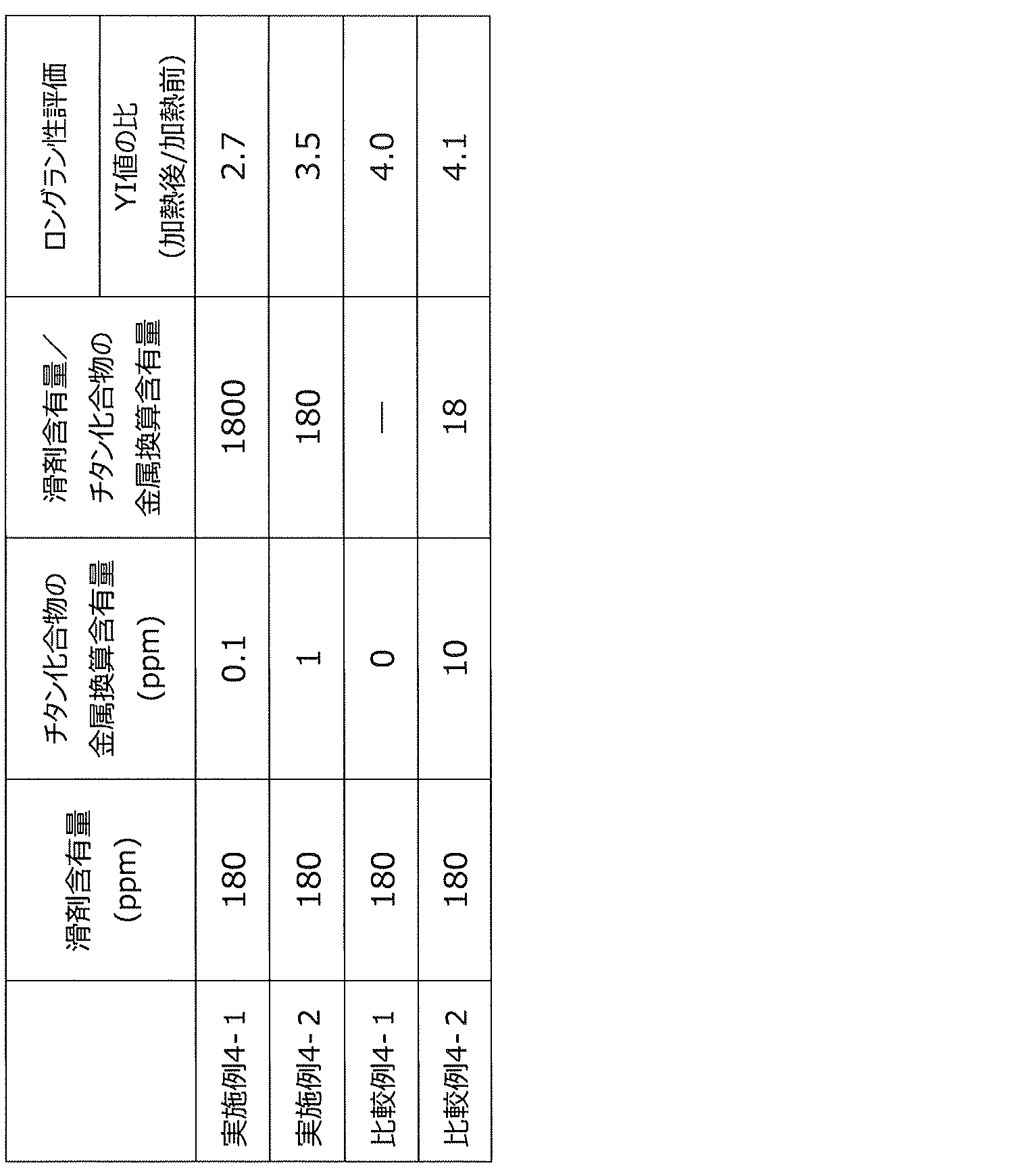
<実施例5-1>
EVOH樹脂として、エチレン構造単位の含有量29モル%、ケン化度99.6モル%、MFR4g/10分(210℃、荷重2160g)のEVOH樹脂のペレットを用いた。
また、共役ポリエン構造を有する化合物としてソルビン酸(富士フイルム和光純薬社製)を、チタン化合物として、酸化チタン(富士フイルム和光純薬社製)を用いた。
前記EVOH樹脂のペレットに対し、前記ソルビン酸をEVOH樹脂組成物の質量あたり100ppm、および前記酸化チタンを金属換算含有量としてEVOH樹脂組成物の質量あたり0.1ppmとなるようにドライブレンドし、混合物を得た。
前記混合物を、二穴ダイを備えた二軸押出機(20mmφ)に供給し、下記の押出条件で押出、吐出されるストランドをベルトコンベア上にて空冷、固化させた。次に固化させたストランドを切断することでEVOH樹脂組成物のペレットを得た。
[押出条件]
押出機設定温度(℃):C1/C2/C3/C4/C5/C6
=150/200/210/210/210/210
実施例5-1において、酸化チタンの配合量を金属換算量としてEVOH樹脂組成物の質量あたり1ppmに変更した以外は、実施例5-1と同様にしてEVOH樹脂組成物のペレットを得た。
実施例5-1において、酸化チタンを用いなかった以外は、実施例5-1と同様にしてEVOH樹脂組成物のペレットを得た。
実施例5-1において、酸化チタンの配合量を金属換算量としてEVOH樹脂組成物の質量あたり10ppmに変更した以外は、実施例5-1と同様にしてEVOH樹脂組成物のペレットを得た。
EVOH樹脂として、エチレン構造単位の含有量29モル%、ケン化度99.6モル%、MFR4g/10分(210℃、荷重2160g)のEVOH樹脂のペレットを用いた。
また、共役ポリエン構造を有する化合物としてソルビン酸(富士フイルム和光純薬社製)を、チタン化合物として、酸化チタン(富士フイルム和光純薬社製)を用いた。
前記EVOH樹脂のペレットに対し、前記ソルビン酸をEVOH樹脂組成物の質量あたり100ppm、および前記酸化チタンを金属換算含有量としてEVOH樹脂組成物の質量あたり0.1ppmとなるようにドライブレンドし、混合物を得た。
前記混合物を、二穴ダイを備えた二軸押出機(20mmφ)に供給し、下記の押出条件で押出、吐出されるストランドをベルトコンベア上にて空冷、固化させた。次に固化させたストランドを切断することでEVOH樹脂組成物のペレットを得た。
[押出条件]
押出機設定温度(℃):C1/C2/C3/C4/C5/C6
=150/200/210/210/210/210
実施例5-3において、ソルビン酸を用いなかった以外は、実施例5-3と同様にしてEVOH樹脂組成物のペレットを得た。
得られたEVOH樹脂組成物のペレットを、粉砕機(ソメタニ産業社製、SKR16-240)にて650rpmで粉砕し、1~5mm角の粉砕物とした。
得られた粉砕物を、内径32mm高さ30mmの円筒に粉砕物を充填し、擦きった状態で、分光色差計SE6000(日本電色工業社製)にてYI値を測定した。
また、前記粉砕物をオーブン内で150℃、5時間加熱処理したものについても同様にYI値を測定した。
その後、加熱前のYI値に対する加熱後のYI値の比を算出した。
加熱前のYI値に対する加熱後のYI値の比が大きいほど、EVOH樹脂組成物が加熱後に黄色く着色変化していることを意味する。
得られた実施例3及び比較例3のEVOH樹脂組成物のペレットを、粉砕機(ソメタニ産業社製、SKR16-240)にて650rpmで粉砕し、1~5mm角の粉砕物とした。
上記の各粉砕物をサンプルとし、ビジュアルアナライザー IRIS VA400(Alpha mos社製)にて、色番号「3273」(R:50、G:115、B:0)を有する着色領域に対する色番号「2984」(R:41、G:132、B:0)を有する着色領域の面積比が占める割合(「2984」/「3273」)に基づいて着色を評価した。色番号「2984」は、濃い黄色味を有する色であり、色番号「3273」は、薄い黄色味を有する色であり、この割合が大きいほど、サンプルが黄色く着色していることを意味する。

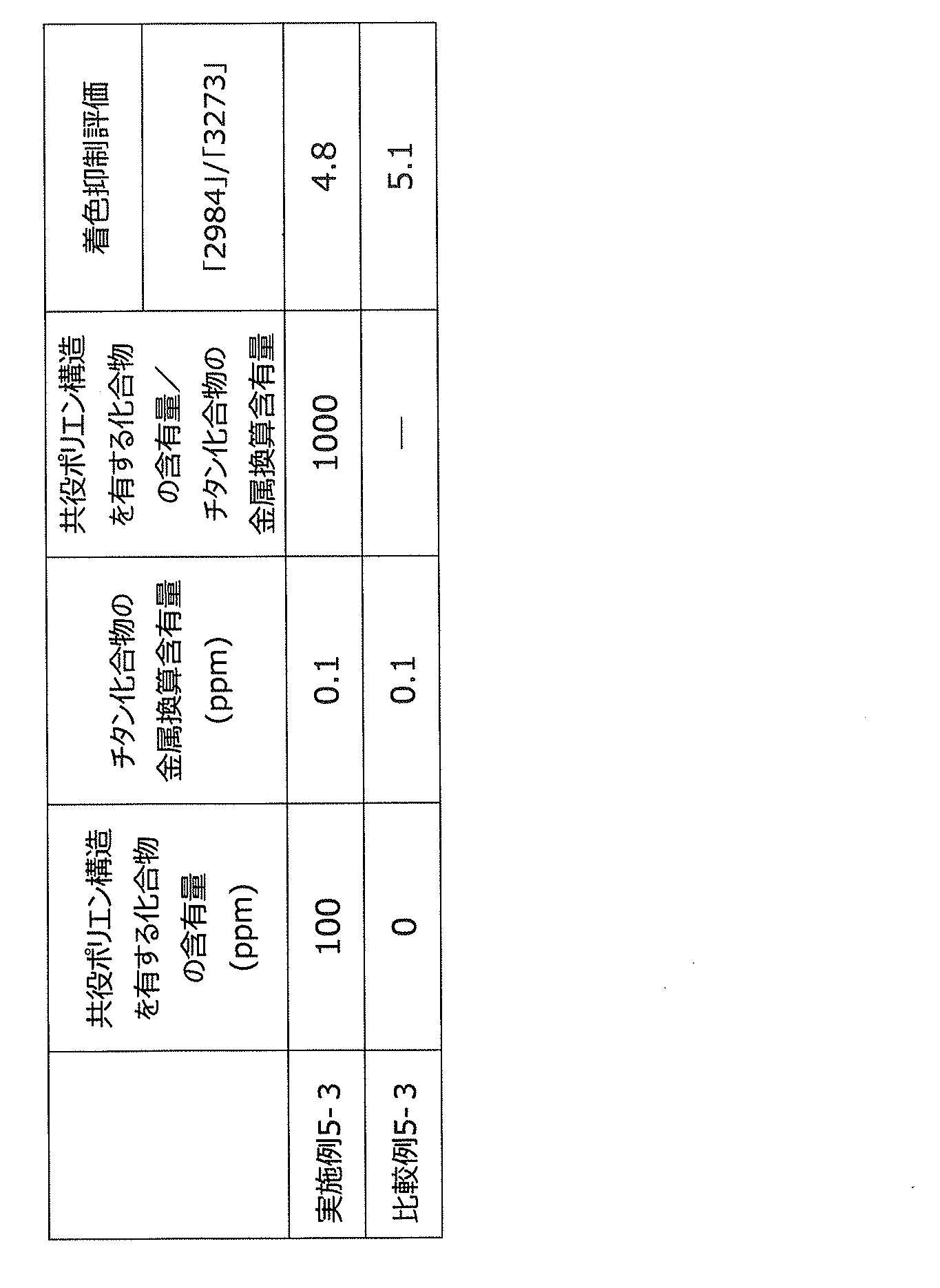
なお、実施例5-2と比較例1のYI値の比は、0.1しか差がないが、実際の製造現場においては、収率が大きく変わり、その差は非常に大きな差となるものである。
また、上記表5-2から、実施例5-3のEVOH樹脂組成物は、比較例5-3のEVOH樹脂組成物に比べて、「2984」/「3273」の数値が小さく、着色が抑制されていた。
さらに、実施例5-1~3のEVOH樹脂組成物からなる層を備える多層構造体も、着色変化が抑制されロングラン性に優れるという効果が得られる。
<実施例6-1>
EVOH樹脂として、エチレン構造単位の含有量29モル%、ケン化度99.6モル%、MFR4g/10分(210℃、荷重2160g)のEVOH樹脂のペレットを用いた。
また、ホウ素化合物としてホウ酸(富士フィルム和光純薬社製)を、チタン化合物として、酸化チタン(富士フイルム和光純薬社製)を用いた。
前記EVOH樹脂ペレットに対し、前記ホウ酸をホウ素換算含有量としてEVOH樹脂組成物の質量あたり100ppm、前記酸化チタンを金属換算量としてEVOH樹脂組成物の質量あたり0.1ppmとなるようにドライブレンドし、混合物を得た。
前記混合物を、二穴ダイを備えた二軸押出機(20mmφ)に供給し、下記の押出条件で押出、吐出されるストランドをベルトコンベア上にて空冷、固化させた。次に固化させたストランドを切断することでEVOH樹脂組成物のペレットを得た。
[押出条件]
押出機設定温度(℃):C1/C2/C3/C4/C5/C6
=150/200/210/210/210/210
実施例6-1において、酸化チタンの配合量を金属換算量としてEVOH樹脂組成物の質量あたり1ppmに変更した以外は、実施例6-1と同様にしてEVOH樹脂組成物のペレットを得た。
実施例6-1において、酸化チタンを用いなかった以外は、実施例6-1と同様にしてEVOH樹脂組成物のペレットを得た。
実施例6-1において、酸化チタンの配合量を金属換算量としてEVOH樹脂組成物の質量あたり10ppmに変更した以外は、実施例6-1と同様にしてEVOH樹脂組成物のペレットを得た。
EVOH樹脂として、エチレン構造単位の含有量29モル%、ケン化度99.6モル%、MFR4g/10分(210℃、荷重2160g)のEVOH樹脂のペレットを用いた。
また、ホウ素化合物としてホウ酸(富士フィルム和光純薬社製)を、チタン化合物として、酸化チタン(富士フイルム和光純薬社製)を用いた。
前記EVOH樹脂ペレットに対し、前記ホウ酸をホウ素換算含有量としてEVOH樹脂組成物の質量あたり100ppm、前記酸化チタンを金属換算量としてEVOH樹脂組成物の質量あたり0.1ppmとなるようにドライブレンドし、混合物を得た。
前記混合物を、二穴ダイを備えた二軸押出機(20mmφ)に供給し、下記の押出条件で押出、吐出されるストランドをベルトコンベア上にて空冷、固化させた。次に固化させたストランドを切断することでEVOH樹脂組成物のペレットを得た。
[押出条件]
押出機設定温度(℃):C1/C2/C3/C4/C5/C6
=150/200/210/210/210/210
実施例6-3において、ホウ酸を用いなかった以外は、実施例6-3と同様にしてEVOH樹脂組成物のペレットを得た。
得られたEVOH樹脂組成物のペレットを、粉砕機(ソメタニ産業社製、SKR16-240)にて650rpmで粉砕し、1~5mm角の粉砕物とした。
得られた粉砕物を、内径32mm高さ30mmの円筒に粉砕物を充填し、擦きった状態で、分光色差計SE6000(日本電色工業社製)にてYI値を測定した。
また、前記粉砕物をオーブン内で150℃、5時間加熱処理したものについても同様にYI値を測定した。
その後、加熱前のYI値に対する加熱後のYI値の比を算出した。
加熱前のYI値に対する加熱後のYI値の比が大きいほど、EVOH樹脂組成物が加熱後に黄色く着色変化していることを意味する。
得られた実施例6-3及び比較例6-3のEVOH樹脂組成物のペレットを、粉砕機(ソメタニ産業社製、SKR16-240)にて650rpmで粉砕し、1~5mm角の粉砕物とした。
上記の各粉砕物をサンプルとし、ビジュアルアナライザー IRIS VA400(Alpha mos社製)にて最大色番号を測定した。色番号は、数字が小さいほど、濃い黄色を示し、数字が大きいほど、薄い黄色を示す。すなわち、色番号が小さいほど、サンプルが黄色く着色していることを意味する。
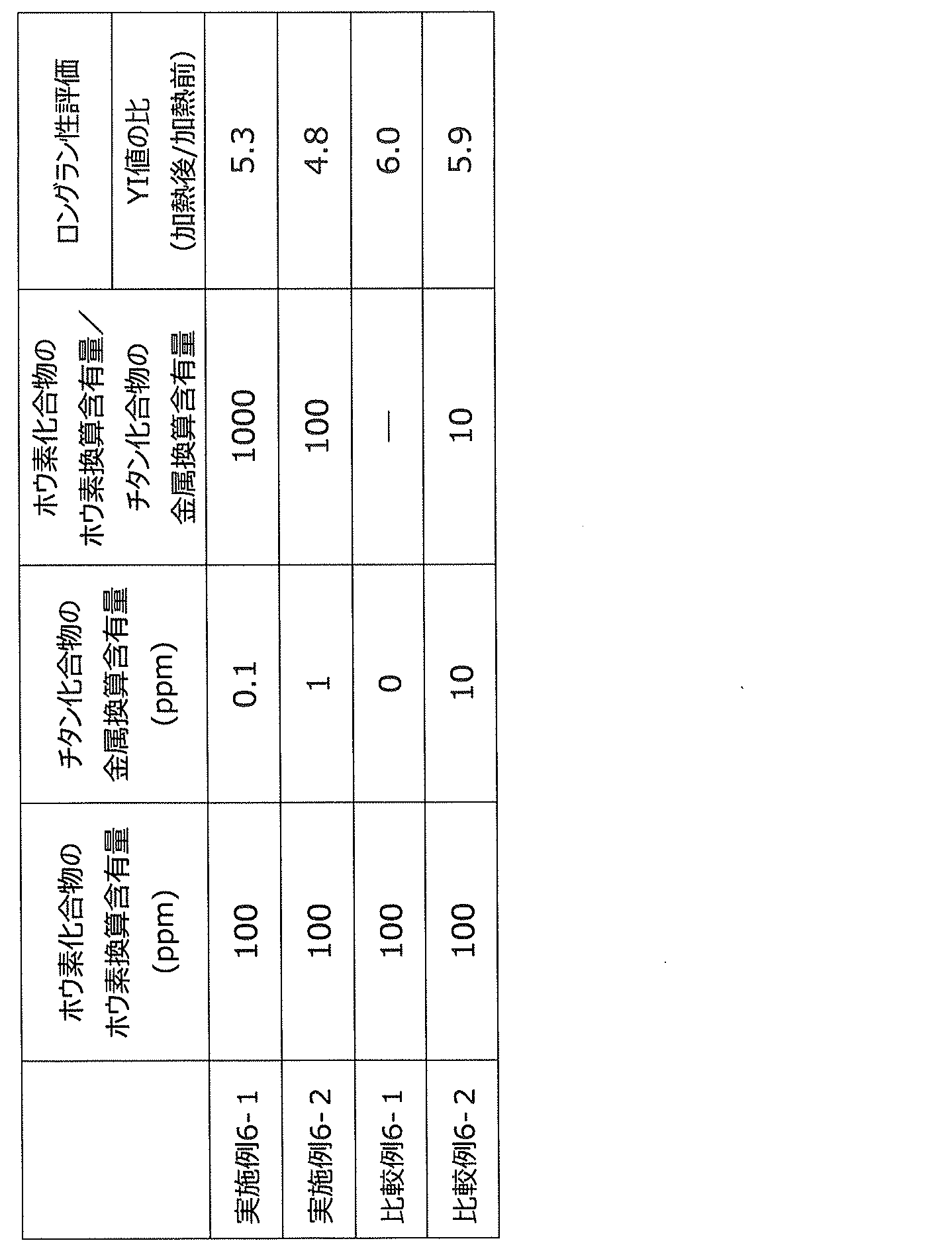

また、上記表6-2から、実施例6-3のEVOH樹脂組成物は、比較例6-3のEVOH樹脂組成物よりも最大色番号の数字が大きく、着色が抑制されていた。
さらに、実施例6-1~3のEVOH樹脂組成物からなる層を備える多層構造体も、着色変化が抑制されロングラン性に優れるという効果が得られる。
<実施例7-1>
EVOH樹脂として、エチレン構造単位の含有量29モル%、ケン化度99.6%、MFR4g/10分(210℃、荷重2160g)のEVOH樹脂を用いた。
また、酸化防止剤としてペンタエリスリトールテトラキス〔3-(3,5-ジ-tert-ブチル-4-ヒドロキシフェニル)プロピオネート〕(BASFジャパン社製、Irganox 1010)を、チタン化合物として、酸化チタン(富士フイルム和光純薬社製)を用いた。
前記EVOH樹脂のペレットに対し、前記ペンタエリスリトールテトラキス〔3-(3,5-ジ-tert-ブチル-4-ヒドロキシフェニル)プロピオネート〕をEVOH樹脂組成物の質量あたり3000ppm、前記酸化チタンを金属換算含有量としてEVOH樹脂組成物あたり0.1ppmとなるようにドライブレンドし、混合物を得た。
前記混合物を、二穴ダイを備えた二軸押出機(20mmφ)に供給し、下記の押出条件で押出、吐出されるストランドをベルトコンベア上にて空冷、固化させた。次に固化させたストランドを切断することでEVOH樹脂組成物のペレットを得た。
[押出条件]
押出機設定温度(℃):C1/C2/C3/C4/C5/C6
=150/200/210/210/210/210
実施例7-1において、酸化チタンの配合量を金属換算量としてEVOH樹脂組成物の質量あたり1ppmに変更した以外は、実施例7-1と同様にしてEVOH樹脂組成物のペレットを得た。
実施例7-1において、酸化チタンを用いなかった以外は、実施例7-1と同様にしてEVOH樹脂組成物のペレットを得た。
実施例7-1において、酸化チタンの配合量を金属換算量としてEVOH樹脂組成物の質量あたり10ppmに変更した以外は、実施例7-1と同様にしてEVOH樹脂組成物のペレットを得た。
得られたEVOH樹脂組成物のペレットを、粉砕機(ソメタニ産業社製、SKR16-240)にて650rpmで粉砕し、1~5mm角の粉砕物とした。
得られた粉砕物を、内径32mm高さ30mmの円筒に粉砕物を充填し、擦きった状態で、分光色差計SE6000(日本電色工業社製)にてYI値を測定した。
また、前記粉砕物をオーブン内で150℃、5時間加熱処理したものについても同様にYI値を測定した。
その後、加熱前のYI値に対する加熱後のYI値の比を算出した。
加熱前のYI値に対する加熱後のYI値の比が大きいほど、EVOH樹脂組成物が加熱後に黄色く着色変化していることを意味する。
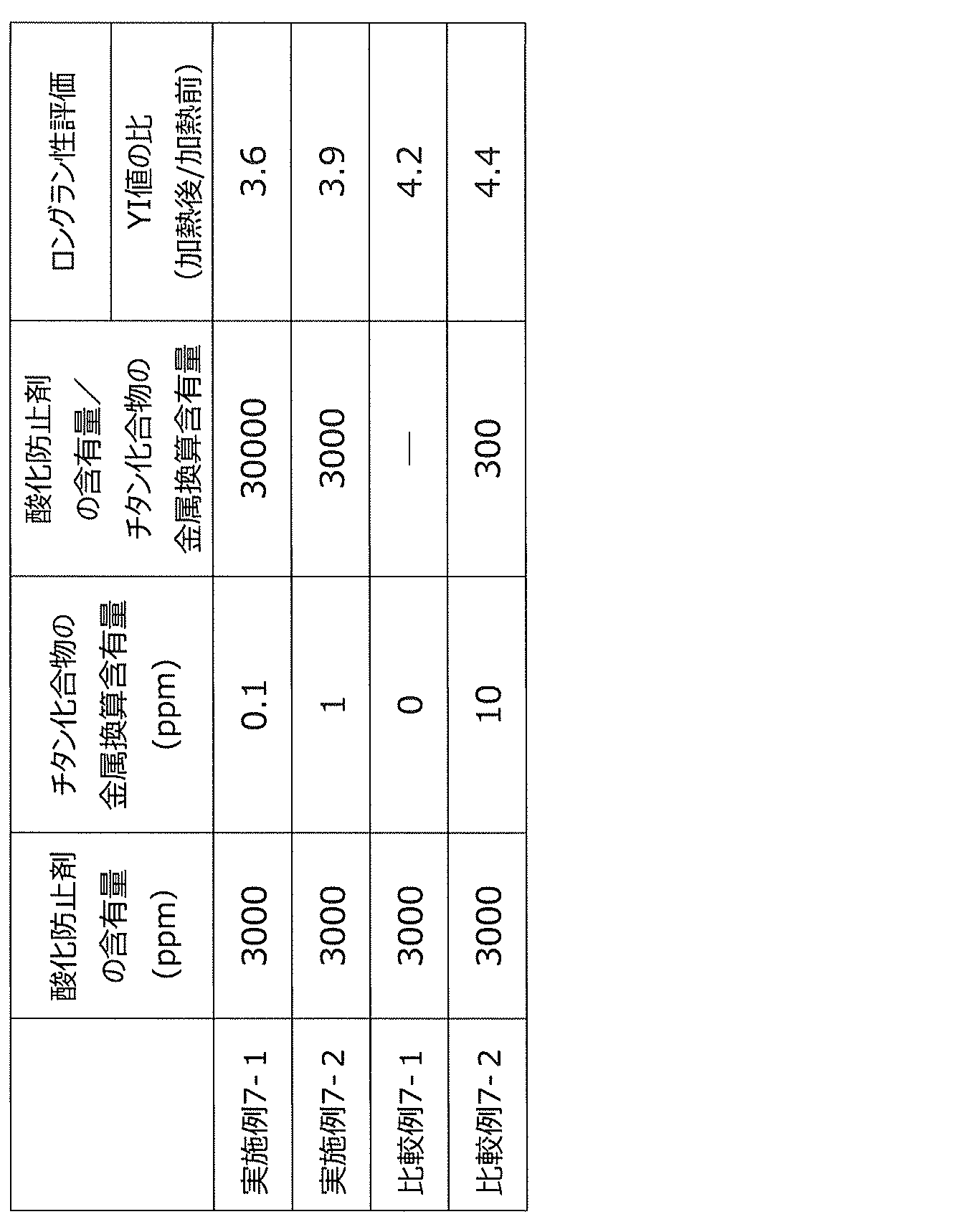
<実施例8-1>
EVOH樹脂として、エチレン構造単位の含有量29モル%、ケン化度99.6モル%、MFR4g/10分(210℃、荷重2160g)のEVOH樹脂のペレットを用いた。
また、スチレン誘導体として、trans-桂皮酸(東京化成工業社製)、チタン化合物として酸化チタン(富士フイルム和光純薬社製)を用いた。
前記EVOH樹脂のペレットに対し、前記スチレン誘導体をEVOH樹脂組成物の質量あたり500ppm、及び前記酸化チタンを金属換算含有量としてEVOH樹脂組成物の質量あたり0.1ppmとなるようにドライブレンドし、混合物を得た。そして、前記混合物を、二穴ダイを備えた二軸押出機(20mmφ)に供給し、下記の押出条件で押出、吐出されるストランドを水槽にて冷却、固化させた。つぎに、固化させたストランドに空気を吹き付けることでストランド表面の水滴を除去した後、切断することでEVOH樹脂組成物のペレットを得た。
押出機設定温度(℃):C1/C2/C3/C4/C5/C6
=150/200/210/210/210/210
実施例8-1において、酸化チタンの配合量を金属換算量としてEVOH樹脂組成物の質量あたり1ppmに変更した以外は、実施例8-1と同様にしてEVOH樹脂組成物のペレットを得た。
実施例8-1において、酸化チタンを用いなかった以外は、実施例8-1と同様にしてEVOH樹脂組成物のペレットを得た。
実施例8-1において、酸化チタンの配合量を金属換算量としてEVOH樹脂組成物の質量あたり10ppmに変更した以外は、実施例8-1と同様にしてEVOH樹脂組成物のペレットを得た。
EVOH樹脂として、エチレン構造単位の含有量29モル%、ケン化度99.6モル%、MFR4g/10分(210℃、荷重2160g)のEVOH樹脂のペレットを用いた。
また、スチレン誘導体として、trans-桂皮酸(東京化成工業社製)、チタン化合物として酸化チタン(富士フイルム和光純薬社製)を用いた。
前記EVOH樹脂のペレットに対し、前記スチレン誘導体をEVOH樹脂組成物の質量あたり500ppm、及び前記酸化チタンを金属換算含有量としてEVOH樹脂組成物の質量あたり0.1ppmとなるようにドライブレンドし、混合物を得た。そして、前記混合物を、二穴ダイを備えた二軸押出機(20mmφ)に供給し、下記の押出条件で押出、吐出されるストランドを水槽にて冷却、固化させた。つぎに、固化させたストランドに空気を吹き付けることでストランド表面の水滴を除去した後、切断することでEVOH樹脂組成物のペレットを得た。
[押出条件]
押出機設定温度(℃):C1/C2/C3/C4/C5/C6
=150/200/210/210/210/210
実施例8-3において、trans-桂皮酸を用いなかった以外は、実施例8-3と同様にしてEVOH樹脂組成物のペレットを得た。
得られたEVOH樹脂組成物のペレットを、粉砕機(ソメタニ産業社製、SKR16-240)にて650rpmで粉砕し、1~5mm角の粉砕物とした。
得られた粉砕物を、内径32mm高さ30mmの円筒に粉砕物を充填し、擦きった状態で、分光色差計SE6000(日本電色工業社製)にてYI値を測定した。
また、前記粉砕物をオーブン内で150℃、5時間加熱処理したものについても同様にYI値を測定した。
その後、加熱前のYI値に対する加熱後のYI値の比を算出した。
加熱前のYI値に対する加熱後のYI値の比が大きいほど、EVOH樹脂組成物が加熱後に黄色く着色変化していることを意味する。
得られた実施例8-3及び比較例8-3のEVOH樹脂組成物のペレットを、粉砕機(ソメタニ産業社製、SKR16-240)にて650rpmで粉砕し、1~5mm角の粉砕物とした。
上記の各粉砕物をサンプルとし、ビジュアルアナライザー IRIS VA400(Alpha mos社製)にて、色番号「3273」(R:50、G:115、B:0)を有する着色領域に対する色番号「2984」(R:41、G:132、B:0)を有する着色領域の面積比が占める割合(「2984」/「3273」)に基づいて着色を評価した。色番号「2984」は、濃い黄色味を有する色であり、色番号「3273」は、薄い黄色味を有する色であり、この割合が大きいほど、サンプルが黄色く着色していることを意味する。
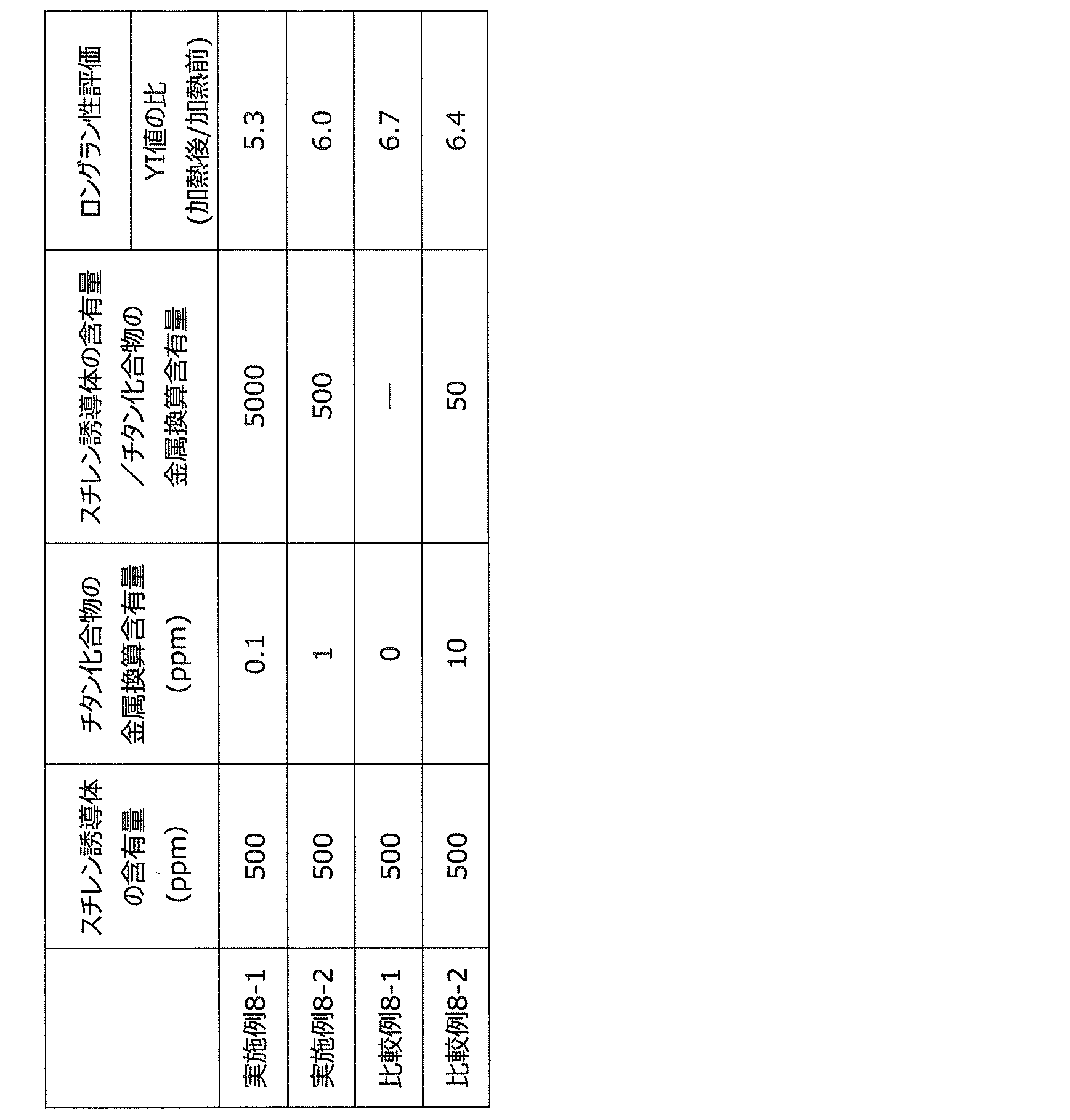
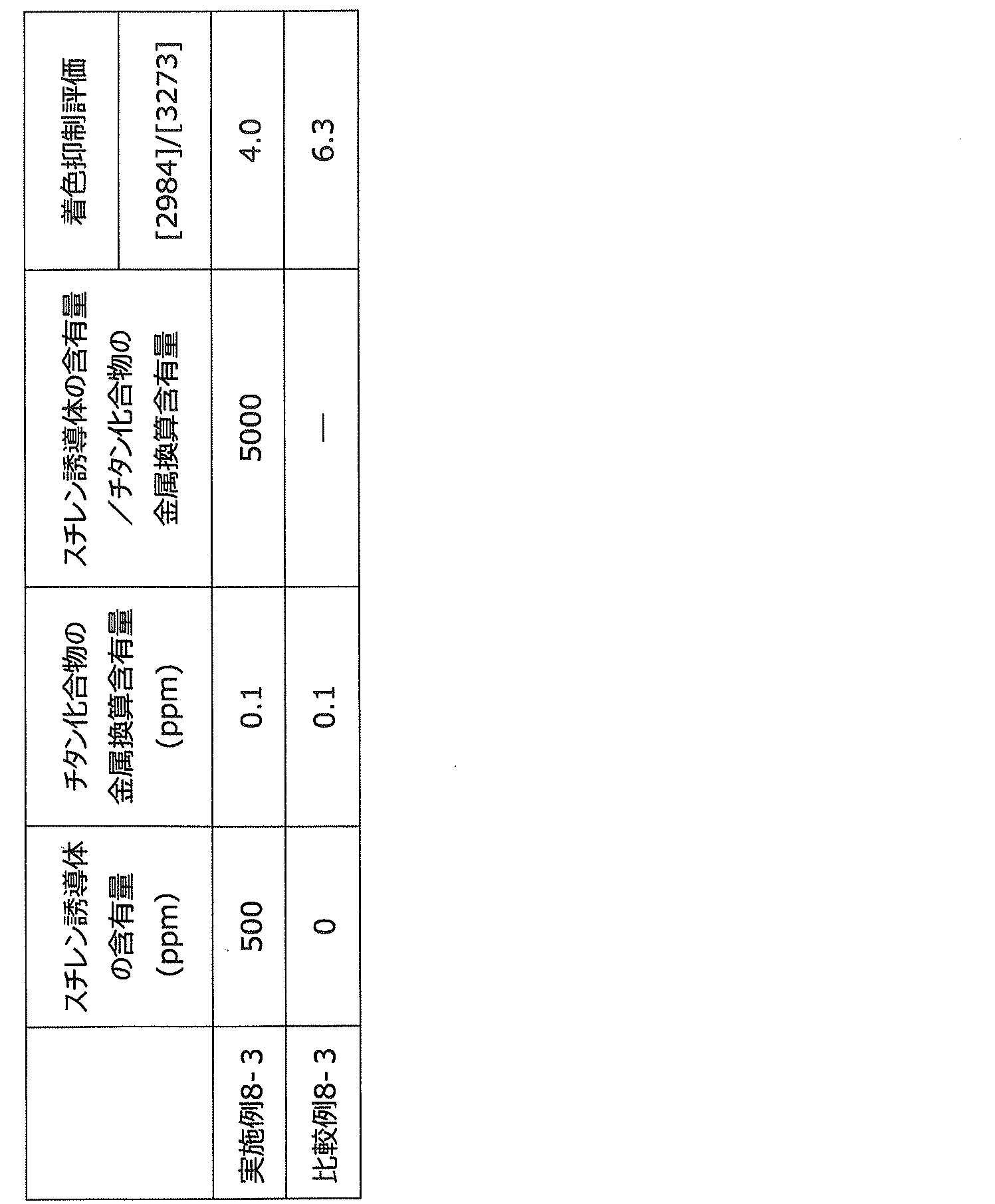
また、上記表8-2から、実施例8-3のEVOH樹脂組成物は、比較例8-3のEVOH樹脂組成物に比べて、「2984」/「3273」の数値が小さく、着色が抑制されていた。
さらに、実施例8-1~3のEVOH樹脂組成物からなる層を備える多層構造体も、熱劣化による着色が抑制され熱安定性に優れるものである。
<実施例9-1>
EVOH樹脂として、エチレン構造単位の含有量29モル%、ケン化度99.6モル%、MFR4g/10分(210℃、荷重2160g)のEVOH樹脂のペレットを用いた。
また、チタン化合物として、酸化チタン(富士フイルム和光純薬社製)を用いた。
前記EVOH樹脂ペレットに対し、前記酸化チタンを金属換算量としてEVOH樹脂組成物の質量あたり0.1ppmとなるようにドライブレンドした後、含水率が0.16%になるように霧吹きで水を吹き付け、EVOH樹脂組成物を得た。
前記EVOH樹脂組成物を、二穴ダイを備えた二軸押出機(20mmφ)に供給し、下記の押出条件で押出、吐出されるストランドをベルトコンベア上にて空冷、固化させた。次に固化させたストランドを切断することでEVOH樹脂組成物のペレットを得た。
[押出条件]
押出機設定温度(℃):C1/C2/C3/C4/C5/C6
=150/200/210/210/210/210
実施例9-1において、酸化チタンの配合量を金属換算量としてEVOH樹脂組成物の質量あたり1ppmに変更した以外は、実施例9-1と同様にしてEVOH樹脂組成物のペレットを得た。
実施例9-1において、酸化チタンを用いなかった以外は、実施例9-1と同様にしてEVOH樹脂組成物のペレットを得た。
実施例9-1において、酸化チタンの配合量を金属換算量としてEVOH樹脂組成物の質量あたり10ppmに変更した以外は、実施例9-1と同様にしてEVOH樹脂組成物のペレットを得た。
得られたEVOH樹脂組成物のペレットを、粉砕機(ソメタニ産業社製、SKR16-240)にて650rpmで粉砕し、1~5mm角の粉砕物とした。
得られた粉砕物を、内径32mm高さ30mmの円筒に粉砕物を充填し、擦きった状態で、分光色差計SE6000(日本電色工業社製)にてYI値を測定した。
また、前記粉砕物をオーブン内で150℃、5時間加熱処理したものについても同様にYI値を測定した。
その後、加熱前のYI値に対する加熱後のYI値の比を算出した。
加熱前のYI値に対する加熱後のYI値の比が大きいほど、EVOH樹脂組成物が加熱後に黄色く着色変化していることを意味する。

Claims (14)
- エチレン-ビニルアルコール系共重合体、及びチタン化合物を含有するエチレン-ビニルアルコール系共重合体組成物であって、前記エチレン-ビニルアルコール系共重合体のエチレン構造単位の含有量が20~60モル%であり、前記チタン化合物の金属換算含有量が、エチレン-ビニルアルコール系共重合体組成物の質量あたり0.001ppm以上5ppm未満であるエチレン-ビニルアルコール系共重合体組成物。
- さらに、アルカリ土類金属化合物、アルカリ金属化合物、滑剤、共役ポリエン構造を有する化合物、ホウ素化合物、酸化防止剤、及びスチレン誘導体からなる群から選択される少なくとも1つを含有する請求項1記載のエチレン-ビニルアルコール系共重合体組成物。
- 前記エチレン-ビニルアルコール系共重合体組成物の含水率が1質量%以下である請求項1記載のエチレン-ビニルアルコール系共重合体組成物。
- 前記アルカリ土類金属化合物の金属換算含有量がエチレン-ビニルアルコール系共重合体組成物の質量あたり0.1~500ppmである請求項2記載のエチレン-ビニルアルコール系共重合体組成物。
- 前記アルカリ金属化合物の金属換算含有量がエチレン-ビニルアルコール系共重合体組成物の質量あたり1~1000ppmである請求項2記載のエチレン-ビニルアルコール系共重合体組成物。
- 前記滑剤の含有量が、エチレン-ビニルアルコール系共重合体組成物の質量あたり500ppm以下である請求項2記載のエチレン-ビニルアルコール系共重合体組成物。
- 前記共役ポリエン構造を有する化合物の含有量が、エチレン-ビニルアルコール系共重合体組成物の質量あたり1~1000ppmである請求項2記載のエチレン-ビニルアルコール系共重合体組成物。
- 前記ホウ素化合物のホウ素換算含有量がエチレン-ビニルアルコール系共重合体組成物の質量あたり5~400ppmである請求項2記載のエチレン-ビニルアルコール系共重合体組成物。
- 前記酸化防止剤の含有量がエチレン-ビニルアルコール系共重合体組成物の質量あたり1~30000ppmである請求項2記載のエチレン-ビニルアルコール系共重合体組成物。
- 前記スチレン誘導体の含有量が、エチレン-ビニルアルコール系共重合体組成物の質量あたり1~1000ppmである請求項2記載のエチレン-ビニルアルコール系共重合体組成物。
- 請求項1~10のいずれか一項に記載のエチレン-ビニルアルコール系共重合体組成物を製造する方法であって、前記エチレン-ビニルアルコール系共重合体組成物の原料を溶融混合する工程を備える、エチレン-ビニルアルコール系共重合体組成物の製造方法。
- 請求項1~10のいずれか一項に記載のエチレン-ビニルアルコール系共重合体組成物からなるペレット。
- 請求項1~10のいずれか一項に記載のエチレン-ビニルアルコール系共重合体組成物からなる層を少なくとも1層備える多層構造体。
- 請求項13記載の多層構造体の製造方法であって、前記エチレン-ビニルアルコール系共重合体組成物からなる層を溶融成形する工程を備える、多層構造体の製造方法。
Priority Applications (3)
| Application Number | Priority Date | Filing Date | Title |
|---|---|---|---|
| CN202380030856.0A CN118946627A (zh) | 2022-03-30 | 2023-03-30 | 乙烯-乙烯醇系共聚物组合物、乙烯-乙烯醇系共聚物组合物的制造方法、粒料、多层结构体、以及多层结构体的制造方法 |
| EP23780821.7A EP4502042A4 (en) | 2022-03-30 | 2023-03-30 | ETHYLENE-VINYL ALCOHOL COPOLYMER COMPOSITION, METHOD FOR PRODUCING ETHYLENE-VINYL ALCOHOL COPOLYMER COMPOSITION, PELLETS, MULTILAYER STRUCTURE, AND METHOD FOR PRODUCING MULTILAYER STRUCTURE |
| US18/895,530 US20250011508A1 (en) | 2022-03-30 | 2024-09-25 | Ethylene-vinyl alcohol copolymer composition, method for producing ethylene-vinyl alcohol copolymer composition, pellets, multilayer structure, and method for producing multilayer structure |
Applications Claiming Priority (18)
| Application Number | Priority Date | Filing Date | Title |
|---|---|---|---|
| JP2022057033 | 2022-03-30 | ||
| JP2022057024 | 2022-03-30 | ||
| JP2022-057033 | 2022-03-30 | ||
| JP2022057028 | 2022-03-30 | ||
| JP2022057023 | 2022-03-30 | ||
| JP2022-057025 | 2022-03-30 | ||
| JP2022-057028 | 2022-03-30 | ||
| JP2022057032 | 2022-03-30 | ||
| JP2022-057023 | 2022-03-30 | ||
| JP2022-057030 | 2022-03-30 | ||
| JP2022-057022 | 2022-03-30 | ||
| JP2022057026 | 2022-03-30 | ||
| JP2022057030 | 2022-03-30 | ||
| JP2022-057024 | 2022-03-30 | ||
| JP2022057022 | 2022-03-30 | ||
| JP2022-057032 | 2022-03-30 | ||
| JP2022057025 | 2022-03-30 | ||
| JP2022-057026 | 2022-03-30 |
Related Child Applications (1)
| Application Number | Title | Priority Date | Filing Date |
|---|---|---|---|
| US18/895,530 Continuation US20250011508A1 (en) | 2022-03-30 | 2024-09-25 | Ethylene-vinyl alcohol copolymer composition, method for producing ethylene-vinyl alcohol copolymer composition, pellets, multilayer structure, and method for producing multilayer structure |
Publications (1)
| Publication Number | Publication Date |
|---|---|
| WO2023190813A1 true WO2023190813A1 (ja) | 2023-10-05 |
Family
ID=88202734
Family Applications (1)
| Application Number | Title | Priority Date | Filing Date |
|---|---|---|---|
| PCT/JP2023/013062 Ceased WO2023190813A1 (ja) | 2022-03-30 | 2023-03-30 | エチレン-ビニルアルコール系共重合体組成物、エチレン-ビニルアルコール系共重合体組成物の製造方法、ペレット、多層構造体及び、多層構造体の製造方法 |
Country Status (4)
| Country | Link |
|---|---|
| US (1) | US20250011508A1 (ja) |
| EP (1) | EP4502042A4 (ja) |
| TW (1) | TW202402841A (ja) |
| WO (1) | WO2023190813A1 (ja) |
Cited By (3)
| Publication number | Priority date | Publication date | Assignee | Title |
|---|---|---|---|---|
| WO2025053124A1 (ja) * | 2023-09-08 | 2025-03-13 | 三菱ケミカル株式会社 | 組成物、多層構造体、成形体、包装材料容器、および組成物の製造方法 |
| WO2025063232A1 (ja) * | 2023-09-22 | 2025-03-27 | 三菱ケミカル株式会社 | 蒸着フィルム、多層構造体、成形体、食品容器、および蒸着フィルムの製造方法 |
| WO2025164194A1 (ja) * | 2024-01-29 | 2025-08-07 | 三菱ケミカル株式会社 | 樹脂組成物、成形材料、多層構造体、成形体、食品包装体、樹脂組成物及び多層構造体の製造方法 |
Citations (12)
| Publication number | Priority date | Publication date | Assignee | Title |
|---|---|---|---|---|
| JPS63286459A (ja) | 1987-05-19 | 1988-11-24 | Kuraray Co Ltd | 樹脂組成物 |
| JPH06155665A (ja) * | 1992-11-20 | 1994-06-03 | Mitsubishi Kasei Corp | 包装用フィルム |
| JPH0971620A (ja) * | 1995-06-26 | 1997-03-18 | Kuraray Co Ltd | 酢酸ビニル系重合体の製法、酢酸ビニル系重合体ケン化物の製法および樹脂組成物 |
| JPH0987549A (ja) * | 1995-09-22 | 1997-03-31 | Daicel Chem Ind Ltd | 帯電防止性コーティング組成物および帯電防止加工成形体 |
| JPH11106592A (ja) | 1997-10-02 | 1999-04-20 | Nippon Synthetic Chem Ind Co Ltd:The | 樹脂組成物およびその積層体 |
| WO2011125736A1 (ja) | 2010-03-31 | 2011-10-13 | 株式会社クラレ | 樹脂組成物、成形体、多層パイプ及びそれらの製造方法 |
| WO2013146961A1 (ja) | 2012-03-28 | 2013-10-03 | 株式会社クラレ | エチレン-ビニルアルコール共重合体含有樹脂組成物 |
| JP2014172928A (ja) | 2013-03-06 | 2014-09-22 | Kuraray Co Ltd | サイレージフィルム |
| WO2018116765A1 (ja) * | 2016-12-20 | 2018-06-28 | 日本合成化学工業株式会社 | エチレン-ビニルアルコール系共重合体樹脂組成物および多層構造体 |
| JP2019163378A (ja) * | 2018-03-19 | 2019-09-26 | 三菱ケミカル株式会社 | 変性エチレン−ビニルアルコール系共重合体およびその製造方法 |
| JP2020105317A (ja) * | 2018-12-27 | 2020-07-09 | 株式会社クラレ | 樹脂組成物、成形体及び多層構造体 |
| JP2022007785A (ja) * | 2020-06-26 | 2022-01-13 | 株式会社クラレ | 樹脂組成物、その製造方法、成形体及び積層体 |
Family Cites Families (4)
| Publication number | Priority date | Publication date | Assignee | Title |
|---|---|---|---|---|
| JP3122745B2 (ja) * | 1996-02-05 | 2001-01-09 | 大日精化工業株式会社 | エチレン−ビニルアルコール系共重合樹脂及びその製造方法 |
| JP6973084B2 (ja) * | 2016-12-20 | 2021-11-24 | 三菱ケミカル株式会社 | エチレン−ビニルアルコール系共重合体ペレット、樹脂組成物および多層構造体 |
| SG11201910978WA (en) * | 2017-06-27 | 2020-01-30 | Mitsubishi Chem Corp | Melt-formable ethylene-vinyl alcohol copolymer composition, pellets, and multilayer structure |
| JP7569629B2 (ja) * | 2020-05-20 | 2024-10-18 | 株式会社クラレ | 樹脂組成物、成形体及び多層パイプ |
-
2023
- 2023-03-30 TW TW112112164A patent/TW202402841A/zh unknown
- 2023-03-30 EP EP23780821.7A patent/EP4502042A4/en active Pending
- 2023-03-30 WO PCT/JP2023/013062 patent/WO2023190813A1/ja not_active Ceased
-
2024
- 2024-09-25 US US18/895,530 patent/US20250011508A1/en active Pending
Patent Citations (12)
| Publication number | Priority date | Publication date | Assignee | Title |
|---|---|---|---|---|
| JPS63286459A (ja) | 1987-05-19 | 1988-11-24 | Kuraray Co Ltd | 樹脂組成物 |
| JPH06155665A (ja) * | 1992-11-20 | 1994-06-03 | Mitsubishi Kasei Corp | 包装用フィルム |
| JPH0971620A (ja) * | 1995-06-26 | 1997-03-18 | Kuraray Co Ltd | 酢酸ビニル系重合体の製法、酢酸ビニル系重合体ケン化物の製法および樹脂組成物 |
| JPH0987549A (ja) * | 1995-09-22 | 1997-03-31 | Daicel Chem Ind Ltd | 帯電防止性コーティング組成物および帯電防止加工成形体 |
| JPH11106592A (ja) | 1997-10-02 | 1999-04-20 | Nippon Synthetic Chem Ind Co Ltd:The | 樹脂組成物およびその積層体 |
| WO2011125736A1 (ja) | 2010-03-31 | 2011-10-13 | 株式会社クラレ | 樹脂組成物、成形体、多層パイプ及びそれらの製造方法 |
| WO2013146961A1 (ja) | 2012-03-28 | 2013-10-03 | 株式会社クラレ | エチレン-ビニルアルコール共重合体含有樹脂組成物 |
| JP2014172928A (ja) | 2013-03-06 | 2014-09-22 | Kuraray Co Ltd | サイレージフィルム |
| WO2018116765A1 (ja) * | 2016-12-20 | 2018-06-28 | 日本合成化学工業株式会社 | エチレン-ビニルアルコール系共重合体樹脂組成物および多層構造体 |
| JP2019163378A (ja) * | 2018-03-19 | 2019-09-26 | 三菱ケミカル株式会社 | 変性エチレン−ビニルアルコール系共重合体およびその製造方法 |
| JP2020105317A (ja) * | 2018-12-27 | 2020-07-09 | 株式会社クラレ | 樹脂組成物、成形体及び多層構造体 |
| JP2022007785A (ja) * | 2020-06-26 | 2022-01-13 | 株式会社クラレ | 樹脂組成物、その製造方法、成形体及び積層体 |
Non-Patent Citations (1)
| Title |
|---|
| See also references of EP4502042A4 |
Cited By (3)
| Publication number | Priority date | Publication date | Assignee | Title |
|---|---|---|---|---|
| WO2025053124A1 (ja) * | 2023-09-08 | 2025-03-13 | 三菱ケミカル株式会社 | 組成物、多層構造体、成形体、包装材料容器、および組成物の製造方法 |
| WO2025063232A1 (ja) * | 2023-09-22 | 2025-03-27 | 三菱ケミカル株式会社 | 蒸着フィルム、多層構造体、成形体、食品容器、および蒸着フィルムの製造方法 |
| WO2025164194A1 (ja) * | 2024-01-29 | 2025-08-07 | 三菱ケミカル株式会社 | 樹脂組成物、成形材料、多層構造体、成形体、食品包装体、樹脂組成物及び多層構造体の製造方法 |
Also Published As
| Publication number | Publication date |
|---|---|
| EP4502042A1 (en) | 2025-02-05 |
| US20250011508A1 (en) | 2025-01-09 |
| EP4502042A4 (en) | 2025-07-09 |
| TW202402841A (zh) | 2024-01-16 |
Similar Documents
| Publication | Publication Date | Title |
|---|---|---|
| WO2023190813A1 (ja) | エチレン-ビニルアルコール系共重合体組成物、エチレン-ビニルアルコール系共重合体組成物の製造方法、ペレット、多層構造体及び、多層構造体の製造方法 | |
| CN110662802B (zh) | 熔融成形用乙烯-乙烯醇系共聚物组合物、粒料及多层结构体 | |
| WO2019004255A1 (ja) | エチレン-ビニルアルコール系共重合体組成物、ペレット群および多層構造体 | |
| US11384184B2 (en) | Melt-formable ethylene-vinyl alcohol copolymer composition, pellets, and multilayer structure | |
| EP3392305A1 (en) | Resin composition, melt-molded article using same, and multilayered structure | |
| JP7151482B2 (ja) | エチレン-ビニルアルコール系共重合体組成物、ペレット、多層構造体、および多層パイプ | |
| WO2023190814A1 (ja) | エチレン-ビニルアルコール系共重合体組成物及びその製造方法、それを用いた溶融成形用材料、ぺレット、並びに多層構造体及びその製造方法 | |
| EP3647365B1 (en) | Ethylene-vinyl alcohol copolymer composition, pellets, and multilayer structure | |
| US12473421B2 (en) | Ethylene-vinyl alcohol copolymer composition, pellets, and multilayer structure | |
| JP7388184B2 (ja) | エチレン-ビニルアルコール系共重合体樹脂組成物、多層構造体および包装体 | |
| CN118946627A (zh) | 乙烯-乙烯醇系共聚物组合物、乙烯-乙烯醇系共聚物组合物的制造方法、粒料、多层结构体、以及多层结构体的制造方法 | |
| JP2023152994A (ja) | エチレン-ビニルアルコール系共重合体組成物、ペレット、多層構造体、多層パイプ、エチレン-ビニルアルコール系共重合体組成物の製造方法及び、多層構造体の製造方法 | |
| JPWO2019004261A1 (ja) | エチレン−ビニルアルコール系共重合体組成物、ペレットおよび多層構造体 | |
| JP2023152990A (ja) | エチレン-ビニルアルコール系共重合体組成物、ペレット、多層構造体、エチレン-ビニルアルコール系共重合体組成物の製造方法及び、多層構造体の製造方法 | |
| JP2023152992A (ja) | エチレン-ビニルアルコール系共重合体組成物、ペレット、多層構造体、エチレン-ビニルアルコール系共重合体組成物の製造方法及び、多層構造体の製造方法 | |
| JP7388182B2 (ja) | エチレン-ビニルアルコール系共重合体樹脂組成物、多層構造体および包装体 | |
| JP2023152984A (ja) | エチレン-ビニルアルコール系共重合体組成物、ペレット、多層構造体、エチレン-ビニルアルコール系共重合体組成物の製造方法、及び層構造体の製造方法 | |
| JP2023152996A (ja) | エチレン-ビニルアルコール系共重合体組成物、溶融成形用エチレン-ビニルアルコール系共重合体組成物、ぺレット、多層構造体、エチレン-ビニルアルコール系共重合体組成物の製造方法、及び多層構造体の製造方法。 | |
| JP2023153000A (ja) | エチレン-ビニルアルコール系共重合体組成物、ぺレット、多層構造体、エチレン-ビニルアルコール系共重合体組成物の製造方法、及び多層構造体の製造方法 | |
| JP2023152985A (ja) | エチレン-ビニルアルコール系共重合体組成物、ペレット、多層構造体、エチレン-ビニルアルコール系共重合体組成物の製造方法及び、多層構造体の製造方法 | |
| JP2023152986A (ja) | エチレン-ビニルアルコール系共重合体組成物、ペレット、多層構造体、エチレン-ビニルアルコール系共重合体組成物の製造方法及び、多層構造体の製造方法 | |
| JP2023152988A (ja) | エチレン-ビニルアルコール系共重合体組成物、ペレット、多層構造体、エチレン-ビニルアルコール系共重合体組成物の製造方法及び、多層構造体の製造 | |
| JP2023152987A (ja) | エチレン-ビニルアルコール系共重合体組成物、ペレット、多層構造体、エチレン-ビニルアルコール系共重合体組成物の製造方法及び、多層構造体の製造方法 |
Legal Events
| Date | Code | Title | Description |
|---|---|---|---|
| 121 | Ep: the epo has been informed by wipo that ep was designated in this application |
Ref document number: 23780821 Country of ref document: EP Kind code of ref document: A1 |
|
| WWE | Wipo information: entry into national phase |
Ref document number: 202380030856.0 Country of ref document: CN |
|
| WWE | Wipo information: entry into national phase |
Ref document number: 2023780821 Country of ref document: EP |
|
| NENP | Non-entry into the national phase |
Ref country code: DE |
|
| ENP | Entry into the national phase |
Ref document number: 2023780821 Country of ref document: EP Effective date: 20241030 |
|
| WWE | Wipo information: entry into national phase |
Ref document number: 11202406742W Country of ref document: SG |