WO2023190832A1 - Fil en alliage rhénium-tungstène et son procédé de production, et aiguille médicale - Google Patents
Fil en alliage rhénium-tungstène et son procédé de production, et aiguille médicale Download PDFInfo
- Publication number
- WO2023190832A1 WO2023190832A1 PCT/JP2023/013103 JP2023013103W WO2023190832A1 WO 2023190832 A1 WO2023190832 A1 WO 2023190832A1 JP 2023013103 W JP2023013103 W JP 2023013103W WO 2023190832 A1 WO2023190832 A1 WO 2023190832A1
- Authority
- WO
- WIPO (PCT)
- Prior art keywords
- rhenium
- wire
- rew
- tungsten
- tungsten alloy
- Prior art date
- Legal status (The legal status is an assumption and is not a legal conclusion. Google has not performed a legal analysis and makes no representation as to the accuracy of the status listed.)
- Ceased
Links
Images


Classifications
-
- A—HUMAN NECESSITIES
- A61—MEDICAL OR VETERINARY SCIENCE; HYGIENE
- A61B—DIAGNOSIS; SURGERY; IDENTIFICATION
- A61B17/00—Surgical instruments, devices or methods
- A61B17/04—Surgical instruments, devices or methods for suturing wounds; Holders or packages for needles or suture materials
- A61B17/06—Needles ; Sutures; Needle-suture combinations; Holders or packages for needles or suture materials
-
- A—HUMAN NECESSITIES
- A61—MEDICAL OR VETERINARY SCIENCE; HYGIENE
- A61M—DEVICES FOR INTRODUCING MEDIA INTO, OR ONTO, THE BODY; DEVICES FOR TRANSDUCING BODY MEDIA OR FOR TAKING MEDIA FROM THE BODY; DEVICES FOR PRODUCING OR ENDING SLEEP OR STUPOR
- A61M5/00—Devices for bringing media into the body in a subcutaneous, intra-vascular or intramuscular way; Accessories therefor, e.g. filling or cleaning devices, arm-rests
- A61M5/178—Syringes
- A61M5/31—Details
- A61M5/32—Needles; Details of needles pertaining to their connection with syringe or hub; Accessories for bringing the needle into, or holding the needle on, the body; Devices for protection of needles
-
- B—PERFORMING OPERATIONS; TRANSPORTING
- B22—CASTING; POWDER METALLURGY
- B22F—WORKING METALLIC POWDER; MANUFACTURE OF ARTICLES FROM METALLIC POWDER; MAKING METALLIC POWDER; APPARATUS OR DEVICES SPECIALLY ADAPTED FOR METALLIC POWDER
- B22F1/00—Metallic powder; Treatment of metallic powder, e.g. to facilitate working or to improve properties
- B22F1/09—Mixtures of metallic powders
-
- B—PERFORMING OPERATIONS; TRANSPORTING
- B22—CASTING; POWDER METALLURGY
- B22F—WORKING METALLIC POWDER; MANUFACTURE OF ARTICLES FROM METALLIC POWDER; MAKING METALLIC POWDER; APPARATUS OR DEVICES SPECIALLY ADAPTED FOR METALLIC POWDER
- B22F5/00—Manufacture of workpieces or articles from metallic powder characterised by the special shape of the product
- B22F5/12—Manufacture of workpieces or articles from metallic powder characterised by the special shape of the product of wires
-
- C—CHEMISTRY; METALLURGY
- C22—METALLURGY; FERROUS OR NON-FERROUS ALLOYS; TREATMENT OF ALLOYS OR NON-FERROUS METALS
- C22C—ALLOYS
- C22C1/00—Making non-ferrous alloys
- C22C1/04—Making non-ferrous alloys by powder metallurgy
- C22C1/045—Alloys based on refractory metals
-
- C—CHEMISTRY; METALLURGY
- C22—METALLURGY; FERROUS OR NON-FERROUS ALLOYS; TREATMENT OF ALLOYS OR NON-FERROUS METALS
- C22C—ALLOYS
- C22C27/00—Alloys based on rhenium or a refractory metal not mentioned in groups C22C14/00 or C22C16/00
- C22C27/04—Alloys based on tungsten or molybdenum
-
- C—CHEMISTRY; METALLURGY
- C25—ELECTROLYTIC OR ELECTROPHORETIC PROCESSES; APPARATUS THEREFOR
- C25F—PROCESSES FOR THE ELECTROLYTIC REMOVAL OF MATERIALS FROM OBJECTS; APPARATUS THEREFOR
- C25F3/00—Electrolytic etching or polishing
- C25F3/16—Polishing
- C25F3/22—Polishing of heavy metals
- C25F3/26—Polishing of heavy metals of refractory metals
-
- B—PERFORMING OPERATIONS; TRANSPORTING
- B22—CASTING; POWDER METALLURGY
- B22F—WORKING METALLIC POWDER; MANUFACTURE OF ARTICLES FROM METALLIC POWDER; MAKING METALLIC POWDER; APPARATUS OR DEVICES SPECIALLY ADAPTED FOR METALLIC POWDER
- B22F1/00—Metallic powder; Treatment of metallic powder, e.g. to facilitate working or to improve properties
- B22F1/05—Metallic powder characterised by the size or surface area of the particles
- B22F1/052—Metallic powder characterised by the size or surface area of the particles characterised by a mixture of particles of different sizes or by the particle size distribution
-
- B—PERFORMING OPERATIONS; TRANSPORTING
- B22—CASTING; POWDER METALLURGY
- B22F—WORKING METALLIC POWDER; MANUFACTURE OF ARTICLES FROM METALLIC POWDER; MAKING METALLIC POWDER; APPARATUS OR DEVICES SPECIALLY ADAPTED FOR METALLIC POWDER
- B22F3/00—Manufacture of workpieces or articles from metallic powder characterised by the manner of compacting or sintering; Apparatus specially adapted therefor ; Presses and furnaces
- B22F3/17—Manufacture of workpieces or articles from metallic powder characterised by the manner of compacting or sintering; Apparatus specially adapted therefor ; Presses and furnaces by forging
- B22F2003/175—Manufacture of workpieces or articles from metallic powder characterised by the manner of compacting or sintering; Apparatus specially adapted therefor ; Presses and furnaces by forging by hot forging, below sintering temperature
-
- B—PERFORMING OPERATIONS; TRANSPORTING
- B22—CASTING; POWDER METALLURGY
- B22F—WORKING METALLIC POWDER; MANUFACTURE OF ARTICLES FROM METALLIC POWDER; MAKING METALLIC POWDER; APPARATUS OR DEVICES SPECIALLY ADAPTED FOR METALLIC POWDER
- B22F3/00—Manufacture of workpieces or articles from metallic powder characterised by the manner of compacting or sintering; Apparatus specially adapted therefor ; Presses and furnaces
- B22F3/24—After-treatment of workpieces or articles
- B22F2003/248—Thermal after-treatment
-
- C—CHEMISTRY; METALLURGY
- C22—METALLURGY; FERROUS OR NON-FERROUS ALLOYS; TREATMENT OF ALLOYS OR NON-FERROUS METALS
- C22F—CHANGING THE PHYSICAL STRUCTURE OF NON-FERROUS METALS AND NON-FERROUS ALLOYS
- C22F1/00—Changing the physical structure of non-ferrous metals or alloys by heat treatment or by hot or cold working
- C22F1/16—Changing the physical structure of non-ferrous metals or alloys by heat treatment or by hot or cold working of other metals or alloys based thereon
- C22F1/18—High-melting or refractory metals or alloys based thereon
-
- G—PHYSICS
- G01—MEASURING; TESTING
- G01R—MEASURING ELECTRIC VARIABLES; MEASURING MAGNETIC VARIABLES
- G01R3/00—Apparatus or processes specially adapted for the manufacture or maintenance of measuring instruments, e.g. of probe tips
Definitions
- the embodiments described below relate to a rhenium-tungsten alloy wire, a method for manufacturing the same, and a medical needle.
- a tungsten alloy (ReW) wire containing a predetermined amount of rhenium (Re) has improved electrical resistance characteristics and wear resistance compared to a normal tungsten (W) wire. It also has improved tensile strength over a wide range of temperatures and ductility after recrystallization. For this reason, it is used in probe pins for semiconductor testing, heaters for electron tubes, filament materials for anti-vibration light bulbs, thermocouples, filaments for fluorescent display tubes, medical needles, etc.
- the ReW wire After the surface mixture layer generated during the manufacturing process is removed by electropolishing or the like, the ReW wire has a white silver color with metallic luster, but as the storage period increases, the surface becomes blue, yellow, or Discolors to reddish-purple, etc. When discoloration occurs, the electrical resistance of the probe pin may change. In display tube filaments, the oxide coating (electrodeposition surface treatment) for emitting thermoelectrons is not uniform. Medical needles have problems with quality deterioration and impurity, such as changes in frictional force at discolored parts and the risk of discolored parts falling off.
- the discolored part cannot be used and requires additional treatment such as re-electrolysis. Additionally, additional processing changes the size of the wire, changing its electrical resistance and strength, making it unusable and reducing yield. For this reason, after the electrolytic step, for example, the wire spool is sufficiently dried, and the wound wire spool is sealed and packed under reduced pressure and stored isolated from the external environment.
- the electrolytic step for example, the wire spool is sufficiently dried, and the wound wire spool is sealed and packed under reduced pressure and stored isolated from the external environment.
- the problem to be solved by the present invention is to provide a ReW wire that can be easily stored for a long time by suppressing discoloration.
- the rhenium-tungsten alloy wire according to the embodiment is a wire made of a tungsten alloy containing rhenium, and in an arbitrary measurement area whose unit area on the wire surface is 50 ⁇ m in diameter, tungsten alloy wire according to an XPS analysis is The ratio W/Re of the atomic concentration (atm%) of (W) to the atomic concentration (atm%) of rhenium (Re) is 2.5 or more.
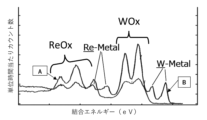
- FIG. 1 shows an example of the analysis results of a discolored sample and a non-discolored sample by X-ray photoelectron spectroscopy (XPS).
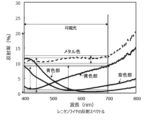
- FIG. 2 is a graph showing the color change of the ReW line and its reflection spectrum.
- FIG. 3 is a binary phase diagram of Re-W.
- FIG. 4a shows the result of energy dispersive X-ray spectrometry (EDS) analysis of the cross section of the sample before removing the surface mixture layer.
- Figure 4b is the result of EDS analysis of the sample cross section before removing the surface mixture layer.
- Figure 4c is the result of EDS analysis of the sample cross section before removing the surface mixture layer.
- FIG. 5a is a potential-pH diagram of tungsten (W).
- FIG. 5b is a potential-pH diagram of rhenium (Re).
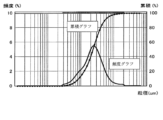
- FIG. 6 is an explanatory diagram of particle size distribution.
- the rhenium-tungsten alloy wire of the embodiment will be described with reference to the drawings.
- the rhenium-tungsten alloy wire may be referred to as ReW wire.
- the drawings are schematic and, for example, the ratio of dimensions of each part, etc. are not limited to those shown in the drawings.
- the rhenium-tungsten alloy wire according to the embodiment is a wire made of a tungsten alloy containing rhenium, and the atomic concentration of tungsten (W) (atm %) and the atomic concentration (atm%) of rhenium (Re), W/Re, is 2.5 or more.
- Re 2 O 5 is also called dirhenium pentoxide and is a blue compound.
- ReO 3 is also called rhenium trioxide and is a red cubic crystal with metallic luster.
- Re 2 O 7 is also called dirhenium heptoxide, and is a yellow orthorhombic crystal (Non-Patent Document 1).
- rhenium oxide has a color, and the color changes depending on the type of oxide.
- rhenium oxide is responsible for the discoloration of ReW wires.
- Figure 1 shows that a sample (A) with a discolored surface and a sample without discoloration (B) with a 26 wt% Re-W beam of ⁇ 0.152 mm, which had been stored for a certain period of time after electrolytically polishing the surface to give a metallic luster, and a sample with no discoloration (B) were exposed to X-ray photoelectrons.
- An example of the results analyzed by spectroscopy (XPS) is shown.
- the apparatus used was Quantera SXM manufactured by PHI, the X-ray source was a single crystal A1K ⁇ ray, the X-ray output was 12.5 W, and the analysis range was ⁇ 50 ⁇ m.
- Table 1 shows the results of the ratio W/Re of the atomic concentration of tungsten (W) to the atomic concentration of rhenium (Re) obtained by XPS semi-quantitative analysis of the same part. In discolored samples, the abundance ratio of rhenium is large, and therefore rhenium oxide is likely to be generated.
- Table 1a shows the compositions of the sample with discoloration (A) and the sample without discoloration (B) in the measurement ranges.
- the surface of the ReW wire consists of C, N, O, W and Re. Therefore, it can be said that the surface of the ReW wire can contain C, N, O, W, and Re.
- the content of C, N, and O in the sample (B) without discoloration is approximately equal to the content of C, N, and O in the sample (A) with discoloration.
- the W content in the sample (B) without discoloration is greater than that in the sample (A) with discoloration
- the Re content in the sample (B) without discoloration is smaller than that in the sample (A) with discoloration.
- Figure 2 shows the color change of the ReW line and its reflection spectrum.
- the discoloration takes on the colors of rhenium oxide mentioned above (blue, purple (red-blue), yellow).
- the reflection spectra of each discolored area were measured using a microspectroscopy system (DF-1037, manufactured by Techno Synergy), which is capable of spectroscopy measurement of minute spots by incorporating a spectroscopy system into a microscope.
- the measurement spot was approximately 10 ⁇ m in diameter, and the exposure time was Measurement was performed under the conditions of 10 ms and 200 integrations.
- the difference between the maximum and minimum reflectance was 5% or less for white silver color (metal color) without discoloration.
- the reflectance of the discolored portion changed, and the spectrum changed to a peak with a difference of 5% or more from the minimum value in the wavelength portion corresponding to each color. From this, the discolored portion is determined by visual inspection or by whether the difference between the maximum value and the minimum value of the reflectance in the wavelength range of 400 nm to 700 nm of the reflection spectrum exceeds 5%. In FIG. 2, the difference between the maximum value and the minimum value of the reflectance of the reflection spectrum for determining a discolored portion is added.
- FIG. 3 shows a binary phase diagram of Re-W.
- Re-W is manufactured by a powder metallurgy method in which tungsten (W) powder and rhenium (Re) powder are mixed, molded, and sintered.
- Sintering of Re-W proceeds by solid phase diffusion, so depending on the particle size distribution of each powder, powder mixing state, or molding/sintering conditions, rhenium may be diffused and homogenized (solid solution) into the tungsten matrix. becomes impossible. As a result, a phase region (segregation phase of ⁇ phase) having a locally high composition ratio of rhenium is generated. This presence on the surface increases the abundance ratio of rhenium on the surface.
- FIGS. 4a, 4b, and 4c show the results of EDS (energy dispersive X-ray spectrometry) analysis of the cross section of the sample before the surface mixture layer was removed.
- FIG. 4a is an image showing an EDS secondary electron image of a sample cross section. The surface mixture layer is indicated by an arrow in FIG. 4a. As shown in Figure 4a, the thickness of the surface mixture layer is not uniform and there are variations.
- FIG. 4b is an image showing W element mapping by EDS of a sample cross section.
- FIG. 4b there is a portion (indicated by an arrow in FIG. 4b) with a low tungsten concentration in the surface mixture layer.
- FIG. 4c is an image showing Re element mapping by EDS of a sample cross section.
- FIG. 4c there is a portion (indicated by an arrow in FIG. 4c) with a high rhenium concentration in the surface mixture layer.
- the thickness of the surface mixture layer varies depending on the location. When the amount of surface removal is insufficient, a surface mixture layer remains locally, which may increase the abundance ratio of rhenium.
- FIGS. 5a and 5b show potential-pH diagrams of tungsten (W) and rhenium (Re).
- FIG. 5a is a potential-pH diagram of tungsten (W).
- FIG. 5b is a potential-pH diagram of rhenium (Re).
- the horizontal axis represents pH, and the vertical axis represents potential (V). Since tungsten is easier to dissolve, for example, when the electrolysis rate is slow or the electrolysis potential is low, tungsten tends to dissolve preferentially. Therefore, there is a possibility that the abundance ratio of rhenium on the surface increases.
- the ReW line of the embodiment is subjected to surface polishing and subjected to semi-quantitative analysis by XPS analysis.
- surface polishing chemical polishing such as electrolytic polishing may be performed.
- the XPS analysis is performed using, for example, Quantera SXM manufactured by PHI, the X-ray source is single crystal A1K ⁇ ray, the X-ray output is 12.5 W, and the analysis range is ⁇ 50 ⁇ m.
- the ReW line of the embodiment has a ratio W/Re of tungsten (W) atomic concentration (atm%) to rhenium (Re) atomic concentration (atm%) determined by XPS analysis of 2.5 or more in any measurement area. It is.
- W/Re of tungsten and rhenium at the surface it is possible to suppress the formation of rhenium oxides.
- discoloration is suppressed and manufacturing can be performed with a high yield.
- the value of the ratio W/Re is determined by, for example, at least one of, or a combination of, the particle size of the raw material tungsten powder, the particle size of the raw material rhenium powder, the sintering temperature during manufacturing, and the polishing speed of electrolytic polishing. It can be adjusted by
- the content of rhenium contained in the ReW wire of the embodiment is, for example, 2 wt% or more and less than 30 wt%. Further, the content of rhenium contained in the ReW wire of the embodiment is preferably, for example, 10 wt% or more and 28 wt% or less.
- the content of rhenium is a value analyzed by inductively coupled plasma-optical emission spectrometry (ICP-OES). Rhenium improves tungsten's elongation at high temperatures and increases its workability. In addition, strength is increased by solid solution strengthening.
- the rhenium content is less than 2 wt%, the effect is insufficient. For example, if a ReW wire with a rhenium content of less than 2wt% is used as a material for a probe pin, the completed probe pin will become more deformed as it is used more frequently, causing contact failure and reducing semiconductor inspection accuracy. Resulting in.
- the content of rhenium exceeds 30 wt%, it exceeds the solid solubility limit with tungsten, making it impossible to diffuse and homogenize rhenium (solid solution) in the tungsten matrix.
- a phase region having a locally high rhenium composition ratio is generated, which may cause W/Re to be locally reduced. If such areas appear on the surface, they are likely to discolor.
- rhenium content 2 wt% or more and less than 30 wt%
- discoloration can be suppressed and the manufacturing yield can be improved.
- Mechanical properties can be ensured.
- the content of rhenium is preferably, for example, 10 wt% or more and 28 wt% or less.
- the ReW wire of the embodiment may contain potassium (K) as a dopant in an amount of 30 wtppm or more and 90 wtppm or less.
- the potassium content is a value analyzed by inductively coupled plasma optical emission spectroscopy (ICP-OES). Containing potassium improves tensile strength and creep strength at high temperatures due to the doping effect. If the potassium content is less than 30 wtppm, the doping effect will be insufficient. If the potassium content exceeds 90 wtppm, processability may be reduced and yield may be significantly reduced.
- the thin wire for thermocouples or electron tube heaters made of the ReW wire of the embodiment secures high-temperature characteristics (prevention of wire breakage and deformation during high-temperature use). However, it can be manufactured with high yield.
- the ReW wire of the embodiment has a diameter of, for example, 0.1 mm or more and 1.00 mm or less.
- the ReW wire of this embodiment suppresses surface discoloration and greatly contributes to long-term storage and improved yield. Moreover, the ReW wire of the embodiment can be applied to medical needles. It can also be applied to ReW wires for thermocouples and probe pins.
- Tungsten powder and rhenium powder are mixed so that the rhenium content is 2 wt% or more and less than 30 wt%.
- the mixing method is not particularly limited, but a method of mixing the powder in the form of a slurry using water or an alcoholic solution is particularly preferred since powder with good dispersibility can be obtained. Further, in order to ensure the homogeneity of the powder lots, it is more preferable to dry the slurry and then dry-stir the same powder lots.
- the rhenium powder to be mixed preferably has an average particle size of less than 8 ⁇ m.
- the particle size distribution preferably has an SD value of less than 11 ⁇ m.
- FIG. 6 shows an explanatory diagram of particle size distribution.
- the horizontal axis is grain diameter ( ⁇ m), the left vertical axis is frequency (%), and the right vertical axis is cumulative (%).
- This is a value determined by , and serves as a guideline for the distribution width of the measured particle size.
- the particle size distribution shall be measured by laser diffraction method.
- the amount of powder used for one measurement shall be the amount recommended for the measuring device. Generally, 0.02g is recommended.
- the measurement sample shall be sufficiently stirred before measurement and then weighed.
- the tungsten powder is pure tungsten powder excluding unavoidable impurities, or doped tungsten powder containing an amount of potassium (K) in consideration of the yield up to the wire rod.
- the tungsten powder preferably has an average particle size of less than 16 ⁇ m.
- the particle size distribution preferably has an SD value of less than 13 ⁇ m.
- the diffusion distance of rhenium atoms or tungsten atoms to diffuse and homogenize (solid solution) rhenium in the tungsten matrix increases, making it easier to generate the ⁇ phase.
- the ratio of the average particle size of the rhenium powder to the average particle size of the tungsten powder is preferably 0.4 or more and 2.0 or less. If the ratio of the average particle size of rhenium powder to the average particle size of tungsten powder is less than 0.4 or more than 2.0, the diffusion distance of rhenium atoms to the center of tungsten grains or the ratio of tungsten atoms to rhenium grains There is a possibility that the diffusion distance to the center becomes longer and ⁇ phase is more likely to occur.
- the mixed powder is put into a predetermined mold and press-molded.
- the press pressure at this time is preferably 150 MPa or more.
- the molded body may be pre-sintered at 1200 to 1400° C. in a hydrogen furnace to facilitate handling.
- the obtained molded body is sintered under a hydrogen atmosphere, an inert gas atmosphere such as argon, or under vacuum.
- the sintering temperature is preferably 2500°C or higher. If the sintering temperature is less than 2500° C., rhenium atoms and tungsten atoms do not diffuse sufficiently during sintering.
- the upper limit of the sintering temperature is 3400°C (below the melting point of tungsten, 3422°C).
- a first swaging (SW) process is performed on the sintered body obtained in the main sintering process.
- the first rolling process is preferably carried out at a heating temperature of 1300 to 1600°C.
- the cross-sectional area reduction rate (area reduction rate) processed in one heat treatment (one heat) is preferably 5 to 15%.
- rolling process may be performed.
- the rolling process is preferably carried out at a heating temperature of 1200 to 1600°C.
- the area reduction rate in one heat is preferably 40 to 75%.
- a two-way roller mill, a four-way roller mill, a type roll mill, or the like can be used. Rolling makes it possible to significantly increase manufacturing efficiency.
- the first rolling (SW) process and rolling process may be combined.
- a second rolling (SW) process is applied to the sintered body (ReW bar) that has been processed by the first rolling process, rolling process, or a combination of the first rolling process and rolling process. implement.
- the second rolling process is preferably carried out at a heating temperature of 1200 to 1500°C.
- the area reduction rate in one heating (one heat) is preferably about 5 to 20%.
- the ReW bar that has undergone the second rolling process is then subjected to recrystallization treatment.
- the recrystallization treatment can be performed, for example, using a high-frequency heating device under a hydrogen atmosphere, an inert gas atmosphere such as argon, or under vacuum at a treatment temperature in the range of 1800 to 2600°C.
- the ReW bar material that has undergone the recrystallization process is subjected to a third rolling process.
- the third rolling process is preferably carried out at a heating temperature of 1200 to 1500°C.
- the area reduction rate in one heat is preferably about 10 to 30%.
- the third rolling process is carried out until the ReW bar has a diameter that can be wire drawn (preferably 2 to 4 mm in diameter).
- the ReW bar material is subjected to a process of applying a lubricant to its surface and then dried to enable smooth wire drawing (DW) processing.
- the wire drawing process repeats the following steps: application of lubricant, drying of the lubricant, heating to a temperature that allows processing, and drawing using a drawing die.
- the lubricant it is desirable to use a carbon (C)-based lubricant that has excellent heat resistance.
- the processing temperature is set according to the wire diameter to be drawn.
- the processing temperature is preferably 1100° C. or lower, for example.
- the area reduction rate per die is preferably 10 to 35%.
- an annealing process or a surface polishing process for example, an electrolytic process may be added under known conditions as necessary.
- the ReW wire is polished.
- the polishing process for example, there is a method of electrochemical polishing (electrolytic polishing) in an aqueous sodium hydroxide solution having a concentration of 3 to 15 wt%.
- the area reduction rate during polishing is preferably 10 to 25%. If it is less than 10%, it may not be possible to remove the unevenness on the material surface that occurs during the rolling process or the wire drawing process and the mixture that adheres to the unevenness on the material surface. If the amount of surface removal is insufficient, a mixture layer may remain locally, which may increase the abundance ratio of rhenium. If it exceeds 25%, the material yield will deteriorate.
- the polishing rate is preferably 0.5 to 3.0 ⁇ m/sec. If it is slower than 0.5 ⁇ m/sec, there is a possibility that tungsten on the surface will be preferentially dissolved and the abundance ratio of rhenium on the surface will increase. If it exceeds 3.0 ⁇ m/sec, the amount of electrolysis per unit time will increase, resulting in rapid electrolysis, and there is a possibility that the cross-sectional shape of the ReW wire may not be sufficiently corrected.
- the ReW wire that has been polished may be subjected to a drying process, for example.
- the drying step is performed, for example, in a vacuum dryer with an internal temperature set in the range of 50 to 80°C.
- the drying time is, for example, 1 hour or more.
- a predetermined shipping inspection is performed.
- adsorption of moisture can be prevented by storing it in a moisture-proof storage with a relative humidity of 5% or less, for example.
- the ReW wire is housed and stored in the moisture-proof storage, except when conducting property and quantity inspections.
- the ReW wire is wound onto a shipping spool while undergoing a shipping inspection.
- the outermost surface of the ReW wire that has been inspected for shipment is wrapped around a shipping spool and covered with a protective paper, and fixed with a rubber band or the like. Thereafter, it is stored in, for example, an aluminum bag, subjected to deaeration treatment, and sealed.
- a probe pin with a predetermined wire diameter and the necessary characteristics can be produced. or get medical needles.
- Example 1 Doped tungsten powder containing potassium (K) in an amount of 50 wtppm to 80 wtppm in the final wire, with an average particle size of 13 ⁇ m and an SD value of 12 ⁇ m, and a rhenium powder with an average particle size of 6 ⁇ m and an SD value of 7 ⁇ m. A slurry was mixed using an alcoholic solution so that the ratio of rhenium was 10 wt%. The obtained slurry was dried to obtain a raw material powder.
- K potassium
- the mixed powder of raw materials was press-molded to obtain a molded body.
- the compact was pre-sintered at 1300°C in a hydrogen furnace.
- the molded body was sintered at 3000° C. in a hydrogen atmosphere to obtain a sintered body.
- the first rolling process was performed on the sintered body at a heating temperature of 1400° C. and a reduction rate of the cross-sectional area of 14% in one heat treatment.
- a second rolling process was performed on the sintered body subjected to the first rolling process at a heating temperature of 1300° C. and a reduction rate of the cross-sectional area processed in one heat treatment of 15%.
- the ReW bar material that had undergone the second rolling process was subjected to recrystallization treatment in a hydrogen atmosphere at a treatment temperature of 2400°C. After the recrystallization treatment, a third rolling process was performed at a heating temperature of 1300° C. and a cross-sectional area reduction rate of 13% in one heat treatment to obtain a bar with a diameter of 2.5 mm.
- a lubricant was applied to the surface of the bar that had undergone the third rolling process and was dried.
- the obtained bar material was subjected to wire drawing.
- the wire drawing process was carried out at 1000° C. so that the reduction rate of the cross-sectional area in one drawing process was 10% to 35%.
- an annealing process was performed at 1300°C.
- the ReW wire that had been drawn was subjected to electrolytic polishing in an aqueous sodium hydroxide solution with a concentration of 8 wt%.
- the electrolytic polishing process was carried out at a cross-sectional area reduction rate of 15 to 20% and a polishing rate of 2.2 ⁇ m/sec.
- the diameter of the obtained ReW wire is 0.8 mm.
- ReW was subjected to a drying process for 2 hours in a vacuum dryer with an internal temperature of 70°C.
- the obtained ReW wire was wound onto a shipping spool of 100 m/spool, the outermost surface was covered with protective paper, and fixed with a rubber band.
- the shipping spool wound with the ReW wire was placed in an aluminum bag together with a desiccant containing silica gel, and the aluminum bag was deaerated and sealed.
- Example 2 A ReW wire was produced in the same manner as in Example 1, except that the raw material tungsten powder was not doped with potassium, the ratio of rhenium was 26 wt%, and the wire diameter of the final ReW wire was 0.15 mm. was manufactured, wound onto a shipping spool of 500 m/spool, and stored in an aluminum bag together with a desiccant using the same packing method as in Example 1. As in Example 1, three spools of the same type were manufactured and stored for 8 months in the same manner as in Example 1. After 8 months, the presence or absence of discoloration was checked.
- ReW wire was manufactured by using the same raw material powder as in Example 1 and performing the same steps as in Example 1 up to the wire drawing process.
- the obtained ReW wire was subjected to an electrolytic polishing process at a polishing rate of 0.4 ⁇ m/sec to obtain a ReW wire with a wire diameter of 0.8 mm.
- the obtained ReW wire was wound onto a shipping spool of 100 m/spool, the outermost surface was covered with protective paper, and fixed with a rubber band.
- the shipping spool wound with the ReW wire was placed in an aluminum bag together with a desiccant containing silica gel, and the aluminum bag was deaerated and sealed.
- Three spools of the same type were manufactured and stored for 8 months in the same manner as in Example 1. After 8 months, the presence or absence of discoloration was checked.
- ReW wire was manufactured by using the same raw material powder as in Example 2 and performing the same steps as in Example 2 up to the wire drawing process.
- the obtained ReW wire was subjected to an electrolytic polishing process at a polishing rate of 0.4 ⁇ m/sec to obtain a ReW wire with a wire diameter of 0.15 mm.
- the obtained ReW wire was wound onto a shipping spool of 500 m/spool and packed in the same manner as in Comparative Example 1.
- Three spools of the same type were manufactured and stored for 8 months in the same manner as in Example 1. After 8 months, the presence or absence of discoloration was checked.
- Table 2 shows the measurement results of rhenium content, potassium content, and W/Re.
- Analysis of rhenium content and potassium content was performed using inductively coupled plasma optical emission spectroscopy (ICP-OES).
- the lower detection limit for potassium is 5wtppm, and the case where the analytical value is less than 5wtppm without addition is marked with a "-”.
- W/Re was determined by XPS analysis.
- Quantera SXM manufactured by PHI was used, the X-ray source was single crystal A1K ⁇ ray, the X-ray output was 12.5 W, and the analysis range was ⁇ 50 ⁇ m.
- the ReW wire according to the embodiment can suppress discoloration even during long-term storage, and can greatly improve the yield in medical needle processing.
- the abundance ratio of rhenium on the surface became large because the electrolytic polishing rate was slow, and W/Re became smaller than 2.5.
- ⁇ 1> The atomic concentration of tungsten (W) (atm%) and the atomic concentration of rhenium (Re) by XPS analysis of a wire made of a tungsten alloy containing rhenium, in an arbitrary measurement area with a unit area of 50 ⁇ m in diameter on the wire surface.
- ⁇ 2> The rhenium-tungsten alloy wire according to ⁇ 1>, wherein the rhenium content is 2 wt% or more and less than 30 wt%.
- ⁇ 3> The rhenium-tungsten alloy wire according to ⁇ 1>, wherein the rhenium content is 10 wt% or more and 28 wt% or less.
- ⁇ 4> The rhenium-tungsten alloy wire according to any one of ⁇ 1> to ⁇ 3>, wherein the potassium (K) content is 30 wtppm or more and 90 wtppm or less.
- ⁇ 5> The rhenium-tungsten alloy wire according to any one of ⁇ 1> to ⁇ 4>, having a diameter of 0.1 mm or more and 1.00 mm or less.
- ⁇ 6> The rhenium-tungsten alloy wire according to any one of ⁇ 1> to ⁇ 5>, which is used as a wire for medical needles.
- ⁇ 7> The method for manufacturing a rhenium tungsten alloy wire according to any one of ⁇ 1> to ⁇ 6>.
- ⁇ 8> A medical needle using the rhenium-tungsten alloy wire according to any one of ⁇ 1> to ⁇ 6>.
Landscapes
- Chemical & Material Sciences (AREA)
- Engineering & Computer Science (AREA)
- Health & Medical Sciences (AREA)
- Materials Engineering (AREA)
- Mechanical Engineering (AREA)
- Metallurgy (AREA)
- Organic Chemistry (AREA)
- Life Sciences & Earth Sciences (AREA)
- Biomedical Technology (AREA)
- Surgery (AREA)
- Veterinary Medicine (AREA)
- Public Health (AREA)
- Heart & Thoracic Surgery (AREA)
- Animal Behavior & Ethology (AREA)
- General Health & Medical Sciences (AREA)
- Physics & Mathematics (AREA)
- Thermal Sciences (AREA)
- Crystallography & Structural Chemistry (AREA)
- Hematology (AREA)
- Anesthesiology (AREA)
- Nuclear Medicine, Radiotherapy & Molecular Imaging (AREA)
- Vascular Medicine (AREA)
- Medical Informatics (AREA)
- Molecular Biology (AREA)
- Manufacturing & Machinery (AREA)
- Electrochemistry (AREA)
- Chemical Kinetics & Catalysis (AREA)
- Powder Metallurgy (AREA)
- Analysing Materials By The Use Of Radiation (AREA)
Abstract
Priority Applications (6)
| Application Number | Priority Date | Filing Date | Title |
|---|---|---|---|
| JP2024512775A JP7776208B2 (ja) | 2022-03-30 | 2023-03-30 | レニウムタングステン合金線、およびその製造方法並びに医療用針 |
| CN202380024253.XA CN118786256A (zh) | 2022-03-30 | 2023-03-30 | 铼钨合金线及其制造方法以及医疗用针 |
| EP23780840.7A EP4502250A4 (fr) | 2022-03-30 | 2023-03-30 | Fil en alliage rhénium-tungstène et son procédé de production, et aiguille médicale |
| KR1020247028345A KR20240141283A (ko) | 2022-03-30 | 2023-03-30 | 레늄 텅스텐 합금선 및 그 제조 방법 그리고 의료용 바늘 |
| US18/902,266 US20250019805A1 (en) | 2022-03-30 | 2024-09-30 | Rhenium-tungsten alloy wire, method of manufacturing same, and medical needle |
| JP2025186408A JP2026016752A (ja) | 2022-03-30 | 2025-11-05 | レニウムタングステン合金線、医療用針、プローブピン、熱電対及び電子管ヒータ |
Applications Claiming Priority (2)
| Application Number | Priority Date | Filing Date | Title |
|---|---|---|---|
| JP2022-055239 | 2022-03-30 | ||
| JP2022055239 | 2022-03-30 |
Related Child Applications (1)
| Application Number | Title | Priority Date | Filing Date |
|---|---|---|---|
| US18/902,266 Continuation US20250019805A1 (en) | 2022-03-30 | 2024-09-30 | Rhenium-tungsten alloy wire, method of manufacturing same, and medical needle |
Publications (1)
| Publication Number | Publication Date |
|---|---|
| WO2023190832A1 true WO2023190832A1 (fr) | 2023-10-05 |
Family
ID=88202760
Family Applications (1)
| Application Number | Title | Priority Date | Filing Date |
|---|---|---|---|
| PCT/JP2023/013103 Ceased WO2023190832A1 (fr) | 2022-03-30 | 2023-03-30 | Fil en alliage rhénium-tungstène et son procédé de production, et aiguille médicale |
Country Status (6)
| Country | Link |
|---|---|
| US (1) | US20250019805A1 (fr) |
| EP (1) | EP4502250A4 (fr) |
| JP (2) | JP7776208B2 (fr) |
| KR (1) | KR20240141283A (fr) |
| CN (1) | CN118786256A (fr) |
| WO (1) | WO2023190832A1 (fr) |
Cited By (1)
| Publication number | Priority date | Publication date | Assignee | Title |
|---|---|---|---|---|
| WO2024204650A1 (fr) * | 2023-03-31 | 2024-10-03 | 株式会社 東芝 | Alliage de tungstène, structure et poudre de rhénium |
Citations (5)
| Publication number | Priority date | Publication date | Assignee | Title |
|---|---|---|---|---|
| JPH04308003A (ja) | 1991-04-05 | 1992-10-30 | Sumitomo Electric Ind Ltd | 放射線遮蔽用タングステン合金粒 |
| JP2002075059A (ja) * | 2000-08-23 | 2002-03-15 | Toshiba Corp | レニウムタングステン線、それを用いたプローブピン、コロナ放電用チャージワイヤ、蛍光表示管用フィラメントおよびその製造方法 |
| JP2011506104A (ja) * | 2007-12-17 | 2011-03-03 | エシコン・インコーポレイテッド | 曲げ剛性を改良するために金属合金外科用縫合針を処理する方法 |
| CN104480485A (zh) * | 2014-11-18 | 2015-04-01 | 安徽华东光电技术研究所 | 一种用于多注阴极灯丝组件的钨铼丝清洗方法 |
| JP2021095585A (ja) | 2019-12-13 | 2021-06-24 | パナソニックIpマネジメント株式会社 | 金属線 |
Family Cites Families (2)
| Publication number | Priority date | Publication date | Assignee | Title |
|---|---|---|---|---|
| KR910010108B1 (ko) * | 1988-05-27 | 1991-12-16 | 도오시바 라이텍크 가부시기가이샤 | 편봉지형 메탈해라이드 램프 |
| CN113174521B (zh) * | 2021-01-15 | 2022-08-16 | 厦门虹鹭钨钼工业有限公司 | 一种钨铼合金丝材及其制备方法 |
-
2023
- 2023-03-30 WO PCT/JP2023/013103 patent/WO2023190832A1/fr not_active Ceased
- 2023-03-30 JP JP2024512775A patent/JP7776208B2/ja active Active
- 2023-03-30 KR KR1020247028345A patent/KR20240141283A/ko active Pending
- 2023-03-30 EP EP23780840.7A patent/EP4502250A4/fr active Pending
- 2023-03-30 CN CN202380024253.XA patent/CN118786256A/zh active Pending
-
2024
- 2024-09-30 US US18/902,266 patent/US20250019805A1/en active Pending
-
2025
- 2025-11-05 JP JP2025186408A patent/JP2026016752A/ja active Pending
Patent Citations (5)
| Publication number | Priority date | Publication date | Assignee | Title |
|---|---|---|---|---|
| JPH04308003A (ja) | 1991-04-05 | 1992-10-30 | Sumitomo Electric Ind Ltd | 放射線遮蔽用タングステン合金粒 |
| JP2002075059A (ja) * | 2000-08-23 | 2002-03-15 | Toshiba Corp | レニウムタングステン線、それを用いたプローブピン、コロナ放電用チャージワイヤ、蛍光表示管用フィラメントおよびその製造方法 |
| JP2011506104A (ja) * | 2007-12-17 | 2011-03-03 | エシコン・インコーポレイテッド | 曲げ剛性を改良するために金属合金外科用縫合針を処理する方法 |
| CN104480485A (zh) * | 2014-11-18 | 2015-04-01 | 安徽华东光电技术研究所 | 一种用于多注阴极灯丝组件的钨铼丝清洗方法 |
| JP2021095585A (ja) | 2019-12-13 | 2021-06-24 | パナソニックIpマネジメント株式会社 | 金属線 |
Non-Patent Citations (2)
| Title |
|---|
| SABURO NAGAKURA: "Iwanami Dictionary of Physics and Chemistry", February 1998, IWANAMI SHOTEN, pages: 541 |
| See also references of EP4502250A4 |
Cited By (1)
| Publication number | Priority date | Publication date | Assignee | Title |
|---|---|---|---|---|
| WO2024204650A1 (fr) * | 2023-03-31 | 2024-10-03 | 株式会社 東芝 | Alliage de tungstène, structure et poudre de rhénium |
Also Published As
| Publication number | Publication date |
|---|---|
| CN118786256A (zh) | 2024-10-15 |
| US20250019805A1 (en) | 2025-01-16 |
| JPWO2023190832A1 (fr) | 2023-10-05 |
| JP7776208B2 (ja) | 2025-11-26 |
| JP2026016752A (ja) | 2026-02-03 |
| KR20240141283A (ko) | 2024-09-26 |
| EP4502250A4 (fr) | 2026-04-01 |
| EP4502250A1 (fr) | 2025-02-05 |
Similar Documents
| Publication | Publication Date | Title |
|---|---|---|
| JP2026016752A (ja) | レニウムタングステン合金線、医療用針、プローブピン、熱電対及び電子管ヒータ | |
| EP2248920B1 (fr) | Alliage d'iridium présentant d'excellentes dureté, aptitude à la transformation et propriété anti-contamination | |
| JP2026012938A (ja) | レニウムタングステン合金線、医療用針、プローブピン、熱電対及び電子管ヒータ | |
| JP7753481B2 (ja) | プローブピン、熱電対、及び電子管ヒータ | |
| US20250331423A1 (en) | Rhenium-tungsten wire rod and thermocouple using the same | |
| US11760887B2 (en) | Titanium material | |
| JP2009504917A (ja) | スパークプラグ電極のための改善された表面を有する酸化物分散強化されたPt−Ir合金および他の合金からのワイヤ | |
| US3853491A (en) | Tungsten filament having uniform concentration gradient of thoria particles | |
| US5795366A (en) | Method of manufacturing a non-sag tungsten wire for electric lamps | |
| US20240170177A1 (en) | Tungsten wire, and tungsten wire processing method and electrolytic wire using the same | |
| JP7646818B2 (ja) | タングステン線およびそれを用いたタングステン線加工方法並びに電解線 | |
| JP7726794B2 (ja) | タングステンを含む線 | |
| JP3320650B2 (ja) | タングステンまたはモリブデンからなる金属材料、同金属材料を使用した二次製品材の製造方法およびその方法を実施するための熱処理装置 | |
| DE102009014615A1 (de) | Elektrodenmaterial, Elektrode und Kaltkathoden-Leuchtstofflampe | |
| EP4455324A1 (fr) | Fil d'aluminium extrudé | |
| JP7852757B2 (ja) | ワイヤー放電加工用電極線及びワイヤー放電加工用電極線の製造方法 | |
| WO2024204650A1 (fr) | Alliage de tungstène, structure et poudre de rhénium | |
| WO2024204092A1 (fr) | Fil de tungstène | |
| HU210281B (en) | Molybdenum material, particularly for the manufacture of lamps and process for producing same | |
| JP2009289556A (ja) | 電極及びその製造方法 |
Legal Events
| Date | Code | Title | Description |
|---|---|---|---|
| 121 | Ep: the epo has been informed by wipo that ep was designated in this application |
Ref document number: 23780840 Country of ref document: EP Kind code of ref document: A1 |
|
| WWE | Wipo information: entry into national phase |
Ref document number: 2024512775 Country of ref document: JP |
|
| ENP | Entry into the national phase |
Ref document number: 20247028345 Country of ref document: KR Kind code of ref document: A |
|
| WWE | Wipo information: entry into national phase |
Ref document number: 202380024253.X Country of ref document: CN |
|
| WWE | Wipo information: entry into national phase |
Ref document number: 2023780840 Country of ref document: EP |
|
| NENP | Non-entry into the national phase |
Ref country code: DE |
|
| ENP | Entry into the national phase |
Ref document number: 2023780840 Country of ref document: EP Effective date: 20241030 |