WO2024150714A1 - 加工安定剤、樹脂組成物、および有機材料の安定化方法 - Google Patents
加工安定剤、樹脂組成物、および有機材料の安定化方法 Download PDFInfo
- Publication number
- WO2024150714A1 WO2024150714A1 PCT/JP2024/000050 JP2024000050W WO2024150714A1 WO 2024150714 A1 WO2024150714 A1 WO 2024150714A1 JP 2024000050 W JP2024000050 W JP 2024000050W WO 2024150714 A1 WO2024150714 A1 WO 2024150714A1
- Authority
- WO
- WIPO (PCT)
- Prior art keywords
- butyl
- compound
- bis
- formula
- hydroxy
- Prior art date
- Legal status (The legal status is an assumption and is not a legal conclusion. Google has not performed a legal analysis and makes no representation as to the accuracy of the status listed.)
- Ceased
Links
Classifications
-
- C—CHEMISTRY; METALLURGY
- C07—ORGANIC CHEMISTRY
- C07D—HETEROCYCLIC COMPOUNDS
- C07D493/00—Heterocyclic compounds containing oxygen atoms as the only ring hetero atoms in the condensed system
- C07D493/02—Heterocyclic compounds containing oxygen atoms as the only ring hetero atoms in the condensed system in which the condensed system contains two hetero rings
- C07D493/10—Spiro-condensed systems
-
- C—CHEMISTRY; METALLURGY
- C08—ORGANIC MACROMOLECULAR COMPOUNDS; THEIR PREPARATION OR CHEMICAL WORKING-UP; COMPOSITIONS BASED THEREON
- C08K—Use of inorganic or non-macromolecular organic substances as compounding ingredients
- C08K5/00—Use of organic ingredients
- C08K5/0008—Organic ingredients according to more than one of the "one dot" groups of C08K5/01 - C08K5/59
- C08K5/005—Stabilisers against oxidation, heat, light, ozone
-
- C—CHEMISTRY; METALLURGY
- C08—ORGANIC MACROMOLECULAR COMPOUNDS; THEIR PREPARATION OR CHEMICAL WORKING-UP; COMPOSITIONS BASED THEREON
- C08K—Use of inorganic or non-macromolecular organic substances as compounding ingredients
- C08K5/00—Use of organic ingredients
- C08K5/04—Oxygen-containing compounds
- C08K5/15—Heterocyclic compounds having oxygen in the ring
- C08K5/156—Heterocyclic compounds having oxygen in the ring having two oxygen atoms in the ring
- C08K5/1575—Six-membered rings
-
- C—CHEMISTRY; METALLURGY
- C08—ORGANIC MACROMOLECULAR COMPOUNDS; THEIR PREPARATION OR CHEMICAL WORKING-UP; COMPOSITIONS BASED THEREON
- C08L—COMPOSITIONS OF MACROMOLECULAR COMPOUNDS
- C08L101/00—Compositions of unspecified macromolecular compounds
-
- C—CHEMISTRY; METALLURGY
- C08—ORGANIC MACROMOLECULAR COMPOUNDS; THEIR PREPARATION OR CHEMICAL WORKING-UP; COMPOSITIONS BASED THEREON
- C08L—COMPOSITIONS OF MACROMOLECULAR COMPOUNDS
- C08L23/00—Compositions of homopolymers or copolymers of unsaturated aliphatic hydrocarbons having only one carbon-to-carbon double bond; Compositions of derivatives of such polymers
- C08L23/02—Compositions of homopolymers or copolymers of unsaturated aliphatic hydrocarbons having only one carbon-to-carbon double bond; Compositions of derivatives of such polymers not modified by chemical after-treatment
- C08L23/10—Homopolymers or copolymers of propene
- C08L23/12—Polypropene
-
- C—CHEMISTRY; METALLURGY
- C08—ORGANIC MACROMOLECULAR COMPOUNDS; THEIR PREPARATION OR CHEMICAL WORKING-UP; COMPOSITIONS BASED THEREON
- C08K—Use of inorganic or non-macromolecular organic substances as compounding ingredients
- C08K2201/00—Specific properties of additives
- C08K2201/014—Additives containing two or more different additives of the same subgroup in C08K
Definitions
- the present invention relates to a processing stabilizer containing a specific phenolic compound, a resin composition containing a specific phenolic compound, and a method for stabilizing organic materials using a specific phenolic compound.
- Organic materials such as thermoplastic resins, thermosetting resins, natural or synthetic rubber, mineral oil, lubricants, adhesives, and paints are known to deteriorate due to the effects of heat and oxygen during production, processing, and even use, resulting in a decrease in the strength properties of the organic materials due to phenomena such as molecular scission and molecular cross-linking, changes in flow properties, coloration, and deterioration of surface properties, which can significantly impair their commercial value.
- Patent Document 1 In order to prevent such deterioration due to heat or oxygen, various phenol-based antioxidants and phosphorus-based antioxidants have been developed, and it is known that adding these to organic materials can stabilize the organic materials (Patent Document 1). However, the antioxidants that have been used so far may not be sufficient in their stabilizing effect against deterioration due to heat or oxygen when processing organic materials, and compounds with even greater stabilizing effects are needed.
- the objective of the present invention is to provide a processing stabilizer that is effective in improving stability when processing organic materials.
- the present invention includes the following preferred embodiments.
- the organic material comprises a compound of formula (I): and a compound represented by formula (II): [In formula (II), R 1 represents an alkyl group having 1 to 2 carbon atoms] In an amount such that the content of compound (II) is 0.02 to 10 parts by mass relative to 100 parts by mass of compound (I), or A method for stabilizing an organic material, comprising adding the processing stabilizer according to [1] or [2] to the organic material. [8] The stabilization method according to [7], wherein the organic material is a thermoplastic resin. [9] The stabilization method according to [8], wherein the thermoplastic resin is a polyolefin or an engineering plastic.
- the processing stabilizer of the present invention is effective in improving stability when processing organic materials such as thermoplastic resins.
- the resin composition of the present invention has high stability.
- the processing stabilizer of the present invention has the formula (I): and a compound represented by formula (II): [In formula (II), R 1 represents an alkyl group having 1 to 2 carbon atoms] and a compound (II) represented by the following formula:
- the compound (I) represented by formula (I) contained in the processing stabilizer of the present invention is a known compound and can be synthesized, for example, according to the method described in the specification of Japanese Patent No. 3661198.
- compound (I) a compound commercially available as Sumilizer (registered trademark) GA-80 from Sumitomo Chemical Co., Ltd. may be used.
- the processing stabilizer of the present invention contains a compound (II) represented by the above formula (II) in addition to the compound represented by the above formula (I).
- R 1 in formula (II) represents an alkyl group having 1 to 2 carbon atoms, specifically a methyl group or an ethyl group. From the viewpoint of facilitating stabilization of organic materials such as thermoplastic resins, R 1 is preferably a methyl group.
- the processing stabilizer of the present invention may contain one type of compound represented by formula (II) in addition to the compound represented by formula (I), or may contain two or more types of compounds represented by formula (II).
- the phenol compound represented by formula (II) can be produced by reacting the compound represented by formula (I) with an alkyl halide having an alkyl group having 1 to 2 carbon atoms (e.g., methyl iodide or ethyl iodide) in the presence of nitrogen.
- an alkyl halide having an alkyl group having 1 to 2 carbon atoms e.g., methyl iodide or ethyl iodide
- the reaction is usually carried out in an organic solvent.
- organic solvent There are no particular limitations on the organic solvent as long as it does not inhibit the reaction, but examples include ketone solvents, ether solvents, aromatic hydrocarbon solvents, aliphatic hydrocarbon solvents, and halogenated hydrocarbon solvents.
- the reaction may be carried out in one type of organic solvent, in a mixed solvent of two or more types of organic solvents, or in a mixed solvent of the organic solvent with another solvent.
- Ketone solvents include acetone, methyl ethyl ketone, methyl isobutyl ketone, cyclohexanone, etc.
- Ether solvents include, for example, diethyl ether, dibutyl ether, etc.
- Aromatic hydrocarbon solvents include, for example, benzene, toluene, xylene, ethylbenzene, etc.
- Aliphatic hydrocarbon solvents include, for example, n-hexane, n-heptane, n-octane, etc.
- Halogenated hydrocarbon solvents include, for example, chloroform, carbon tetrachloride, monochlorobenzene, dichloromethane, 1,2-dichloroethane, dichlorobenzene, etc.
- the reaction temperature is usually room temperature.
- the amount of alkyl halide having an alkyl group with 1 to 2 carbon atoms relative to the compound represented by formula (I) used as a raw material is preferably about 3 times the molar amount of alkyl halide relative to the compound represented by formula (I).
- the amount of potassium carbonate added is preferably about 3 times the molar amount of the compound represented by formula (I) used as a raw material.
- compound (II) represented by formula (II) can be produced using the compound represented by formula (I) as a raw material.
- compound (I) and compound (II) are contained in an amount such that the content of compound (II) is 0.02 to 10 parts by mass relative to 100 parts by mass of compound (I). If the content of compound (II) relative to 100 parts by mass of compound (I) is less than 0.02 parts by mass, compound (II) is not substantially contained, and therefore the synergistic stabilizing effect of the resin composition by using compound (I) and compound (II) in combination cannot be obtained. If the content of compound (II) relative to 100 parts by mass of compound (I) exceeds 10 parts by mass, the amount of compound (II) relative to the amount of compound (I) becomes too large, and therefore the stabilizing effect of the resin composition cannot be synergistically improved.
- the content of compound (II) in the processing stabilizer of the present invention relative to 100 parts by mass of compound (I) is 0.02 parts by mass or more, preferably 0.04 parts by mass or more, and more preferably 0.09 parts by mass or more, from the viewpoint of measurability during use and from the viewpoint of easily enhancing the synergistic stabilizing effect of the resin composition by using compound (I) and compound (II) in combination, and is 10 parts by mass or less, preferably 8 parts by mass or less, and more preferably 5 parts by mass or less, from the viewpoint of efficiently stabilizing the resin composition.
- the amounts of compound (I) and compound (II) contained in the processing stabilizer of the present invention are not particularly limited as long as they are contained in the above ratio, and may be set appropriately depending on the manner in which the processing stabilizer is added to the resin, but from the viewpoint of resin stabilization, the amount is preferably 50 mass% or more, more preferably 70 mass% or more, and even more preferably 90 mass% or more based on the total weight of the processing stabilizer.
- the upper limit of the amount of compound (I) and compound (II) contained in the processing stabilizer may be 100 mass% or less based on the total weight of the processing stabilizer.
- the processing stabilizer of the present invention may be a material containing only the compound (I) represented by the above formula (I) and the compound (II) represented by the above formula (II) in the above ratio, or may be a material containing, in addition to the compound (I) and the compound (II), at least one other additive that may be contained in the resin composition described below.
- the processing stabilizer of the present invention may also be a material containing, in addition to the compound (I) and the compound (II), at least one organic material. Such a material is also called, for example, a master batch.
- the processing stabilizer of the present invention By adding the processing stabilizer of the present invention to an organic material, or by adding a specific ratio of the compound (I) represented by formula (I) and the compound (II) represented by formula (II), the thermal deterioration and oxidative deterioration of the organic material can be reduced, and the organic material can be stabilized, for example, preventing a decrease in viscosity. It is also believed that coloring can be prevented. Therefore, the processing stabilizer of the present invention is suitable as a stabilizer for organic materials.
- the present invention also provides a method for stabilizing an organic material, which comprises adding a specific ratio of the compound (I) represented by formula (I) and the compound (II) represented by formula (II) in addition to the above-mentioned processing stabilizer. Furthermore, the present invention also provides a stabilized resin composition containing an organic material and the processing stabilizer of the present invention, or a specific ratio of the compound (I) represented by formula (I) and the compound (II) represented by formula (II).
- Organic materials that can be stabilized by the processing stabilizer of the present invention include, but are not limited to, the following organic materials.
- the organic material may be one type of organic material or a mixture of two or more types of organic materials.
- Polyethylene such as high density polyethylene (HD-PE), low density polyethylene (LD-PE), linear low density polyethylene (LLDPE), (2) polypropylene, (3) methylpentene polymers, (4) EEA (ethylene/ethyl acrylate copolymer) resin, (5) ethylene/vinyl acetate copolymer resin, (6) Polystyrenes, for example, polystyrene, poly(p-methylstyrene), poly( ⁇ -methylstyrene), (7) AS (acrylonitrile/styrene copolymer) resin, (8) ABS (acrylonitrile/butadiene/styrene copolymer) resin, (9) AAS (special acrylic rubber/acrylonitrile/styrene copolymer) resin, (10) ACS (acrylonitrile / chlorinated polyethylene / styrene copolymer) resin,
- HD-PE high density polyethylene
- LD-PE low density polyethylene
- polycarbonate (21) polycarbonate, (22) polyacrylate, (23) Polysulfone, polyether ether ketone, polyether sulfone, (24) Thermoplastic resins such as aromatic polyester resins, (25) epoxy resin, (26) diallyl phthalate prepolymer, (27) silicone resin, (28) unsaturated polyester resin, (29) Acrylic modified benzoguanamine resin, (30) benzoguanamine/melamine resins, (31) Thermosetting resins such as urea resins,
- thermoplastic resins particularly polyolefins such as polyethylene, HD-PE, LD-PE, LLDPE, and polypropylene
- engineering plastics such as polyamide, polyethylene terephthalate, polybutylene terephthalate, and polycarbonate.
- the polyolefin is not particularly limited, and may be, for example, one obtained by radical polymerization, or one produced by polymerization using a catalyst containing a metal of group IVb, Vb, VIb, or VIII of the periodic table.
- catalysts containing such metals include metal complexes having one or more ligands, such as oxides, halides, alcoholates, esters, and aryls, coordinated by ⁇ or ⁇ bonds. These complexes may be metal complexes as they are, or may be supported on a substrate such as magnesium chloride, titanium chloride, alumina, or silicon oxide.
- Polyolefins produced using, for example, Ziegler-Natta catalysts, TNZ catalysts, metallocene catalysts, and Phillips catalysts are preferably used.
- the polyamide resin may be any one that has an amide bond in the polymer chain and can be melted by heating.
- the polyamide resin may be one that is manufactured by any method, such as condensation reaction of diamines and dicarboxylic acids, condensation reaction of aminocarboxylic acids, ring-opening polymerization of lactams, etc.
- Examples of polyamide resins include nylon 66, nylon 69, nylon 610, nylon 612, poly-bis-(p-aminocyclohexyl)methandodecamide, nylon 46, nylon 6, nylon 12, nylon 66/6, which is a copolymer of nylon 66 and nylon 6, and nylon 6/12 copolymers, etc.
- the polyester resin may be any one that has an ester bond in the polymer chain and can be melted by heating, such as polyester obtained by polycondensation of dicarboxylic acids and dihydroxy compounds.
- the polyester resin may be either a homopolyester or a copolyester.
- the polycarbonate resin may be any resin that has a carbonate bond in the polymer chain and can be melted by heating. For example, there is a polycarbonate obtained by reacting an aromatic hydroxy compound or a small amount of a polyhydroxy compound with a carbonate precursor such as phosgene or diphenyl carbonate in the presence of a solvent, an acid acceptor, and a molecular weight regulator.
- the polycarbonate resin may be linear or branched, or may be a copolymer.
- the organic material can be stabilized by adding compound (I) represented by formula (I) and compound (II) represented by formula (II) to the organic material.
- compounds (I) and (II) are added to the organic material in an amount such that the content of compound (II) is 0.02 to 10 parts by mass relative to 100 parts by mass of compound (I).
- the content of compound (II) relative to 100 parts by mass of compound (I) is 0.02 parts by mass or more, preferably 0.04 parts by mass or more, more preferably 0.09 parts by mass or more, from the viewpoint of measurability during use and the viewpoint of easily enhancing the synergistic stabilizing effect of the resin composition by using compound (I) and compound (II) in combination, and is 10 parts by mass or less, preferably 8 parts by mass or less, more preferably 5 parts by mass or less, from the viewpoint of efficiently stabilizing the resin composition.
- Compound (I) represented by formula (I) and compound (II) represented by formula (II) may be added to the organic material by adding the processing stabilizer of the present invention. In either case, compound (I) and compound (II) are contained in the organic material in a specific quantitative ratio.
- the total weight of the compound (I) represented by formula (I) and the compound (II) represented by formula (II) is preferably 0.005 parts by mass or more, more preferably 0.01 parts by mass or more, and even more preferably 0.05 parts by mass or more, per 100 parts by mass of the organic material, from the viewpoint of stabilizing the organic material.
- the total weight of the compound (I) represented by formula (I) and the compound (II) represented by formula (II) is usually 5 parts by mass or less, preferably 3 parts by mass or less, and more preferably 1 part by mass or less, per 100 parts by mass of the organic material, from the viewpoint of efficiently stabilizing the organic material and being economical.
- phenolic compound represented by the compound (I) represented by formula (I) and the phenolic compound represented by the compound (II) represented by formula (II) are added to an organic material
- other additives may be added to the organic material as necessary, such as a phenolic antioxidant, a sulfur-based antioxidant, a phosphorus-based antioxidant, an ultraviolet absorber, a light stabilizer, a peroxide scavenger, a polyamide stabilizer, a hydroxylamine, a lubricant, a plasticizer, a flame retardant, a nucleating agent, a metal deactivator, an antistatic agent, a pigment, a filler, an antiblocking agent, a surfactant, a processing aid, a foaming agent, an emulsifier, a gloss agent, calcium stearate, etc.
- Neutralizing agents such as calcium and hydrotalcite, coloring improvers such as 9,10-dihydro-9-oxa-10-phosphophenanthrene-10-oxide, and auxiliary stabilizers such as benzofurans and indolines described in U.S. Patents 4,325,853, 4,338,244, 5,175,312, 5,216,053, 5,252,643, 4,316,611, DE-A-4,316,622, 4,316,876, EP-A-589,839, and EP-A-591,102 can also be added.
- additives can be added to the organic material simultaneously with the compounds (I) and (II) contained in the resin composition of the present invention, or can be added to the organic material at a stage separate from the compounds (I) and (II) contained in the resin composition of the present invention.
- the additive one type of additive may be used, or two or more types of additives may be used in combination.
- phenol-based antioxidant examples include the following: As the phenol-based antioxidant, the following compounds may be used alone or in combination of two or more kinds. (1) Examples of alkylated monophenols: 2,6-di-t-butyl-4-methylphenol, 2,4,6-tri-t-butylphenol, 2,6-di-t-butylphenol, 2-t-butyl-4,6-dimethylphenol, 2,6-di-t-butyl-4-ethylphenol, 2,6-di-t-butyl-4-n-butylphenol, 2,6-di-t-butyl-4-isobutylphenol, 2,6-dicyclopentyl-4-methylphenol, 2-( ⁇ -methylcyclohexyl)-4,6-dimethylphenol, 2 ,6-dioctadecyl-4-methylphenol, 2,4,6-tricyclohexylphenol, 2,6-di-t-butyl-4-methoxymethylphenol, 2,6-d
- alkylthiomethylphenols examples include 2,4-dioctylthiomethyl-6-t-butylphenol, 2,4-dioctylthiomethyl-6-methylphenol, 2,4-dioctylthiomethyl-6-ethylphenol, 2,6-didodecylthiomethyl-4-nonylphenol, and mixtures thereof.
- hydroquinone and alkylated hydroquinone examples include 2,6-di-t-butyl-4-methoxyphenol, 2,5-di-t-butylhydroquinone, 2,5-di-t-amylhydroquinone, 2,6-diphenyl-4-octadecyloxyphenol, 2,6-di-t-butylhydroquinone, 2,5-di-t-butyl-4-hydroxyanisole, 3,5-di-t-butyl-4-hydroxyphenyl stearate, bis(3,5-di-t-butyl-4-hydroxyphenyl)adipate, and mixtures thereof.
- tocopherols include ⁇ -tocopherol, ⁇ -tocopherol, ⁇ -tocopherol, ⁇ -tocopherol, and mixtures thereof.
- hydroxylated thiodiphenyl ethers 2,2'-thiobis(6-t-butylphenol), 2,2'-thiobis(4-methyl-6-t-butylphenol), 2,2'-thiobis(4-octylphenol), 4,4'-thiobis(3-methyl-6-t-butylphenol), 4,4'-thiobis(2-methyl-6-t-butylphenol), 4,4'-thiobis(3,6-di-t-amylphenol), 4,4'-(2,6-dimethyl-4-hydroxyphenyl) disulfide, and the like.
- alkylidene bisphenols and their derivatives 2,2'-methylenebis(4-methyl-6-t-butylphenol), 2,2'-methylenebis(4-ethyl-6-t-butylphenol), 2,2'-methylenebis[4-methyl-6-( ⁇ -methylcyclohexyl)phenol)], 2,2'-methylenebis(4-methyl-6-cyclohexylphenol), 2,2'-methylenebis(4-methyl-6-nonylphenol), 2,2'-methylenebis(4,6-di-t-butylphenol), 2,2'-ethylidenebis(4,6-di-t-butylphenol), 2,2'-ethylidenebis(4-isobutyl-6-t-butylphenol), 2,2'-methylenebis[6-( ⁇ -methylbenzyl)-4-nonylphenol], 2,2'-methylenebis[4,6-( ⁇ , ⁇ - dimethylbenzyl)-4-nonylphenol
- O-, N- and S-benzyl derivatives include 3,5,3',5'-tetra-t-butyl-4,4'-dihydroxydibenzyl ether, octadecyl-4-hydroxy-3,5-dimethylbenzyl mercaptoacetate, tris(3,5-di-t-butyl-4-hydroxybenzyl)amine, bis(4-t-butyl-3-hydroxy-2,6-dimethylbenzyl)dithioterephthalate, bis(3,5-di-t-butyl-4-hydroxybenzyl)sulfide, isooctyl-3,5-di-t-butyl-4-hydroxybenzyl mercaptoacetate, and mixtures thereof.
- hydroxybenzylated malonate derivatives include dioctadecyl-2,2-bis(3,5-di-t-butyl-2-hydroxybenzyl)malonate, dioctadecyl-2-(3-t-butyl-4-hydroxy-5-methylbenzyl)malonate, didodecylmercaptoethyl-2,2-bis(3,5-di-t-butyl-4-hydroxybenzyl)malonate, bis[4-(1,1,3,3-tetramethylbutyl)phenyl]-2,2-bis(3,5-di-t-butyl-4-hydroxybenzyl)malonate, and mixtures thereof.
- aromatic hydroxybenzyl derivatives include 1,3,5-trimethyl-2,4,6-tris(3,5-di-t-butyl-4-hydroxybenzyl)benzene, 1,4-bis(3,5-di-t-butyl-4-hydroxybenzyl)-2,3,5,6-tetramethylbenzene, 2,4,6-tris(3,5-t-butyl-4-hydroxybenzyl)phenol, and mixtures thereof.
- benzylphosphonate derivatives include dimethyl-3,5-di-t-butyl-4-hydroxybenzylphosphonate, diethyl-3,5-di-t-butyl-4-hydroxybenzylphosphonate, dioctadecyl-3,5-di-t-butyl-4-hydroxybenzylphosphonate, dioctadecyl-5-t-butyl-4-hydroxy-3-methylbenzylphosphonate, calcium salt of 3,5-di-t-butyl-4-hydroxybenzylphosphonic acid monoester, and mixtures thereof.
- acylaminophenol derivatives include 4-hydroxylauric acid anilide, 4-hydroxystearic acid anilide, octyl-N-(3,5-di-t-butyl-4-hydroxyphenyl)carbamate, and mixtures thereof.
- esters of ⁇ -(3,5-di-t-butyl-4-hydroxyphenyl)propionic acid with the following monohydric or polyhydric alcohols methanol, ethanol, octanol, octadecanol, ethylene glycol, 1,3-propanediol, 1,4-butanediol, 1,6-hexanediol, 1,9-nonanediol, neopentyl glycol, diethylene glycol, thioethylene glycol, spiroglycol, triethylene glycol, pentaerythritol, tris(hydroxyethyl)isocyanurate, N,N'-bis(hydroxyethyl)oxamide, 3-thiaundecanol, 3-thiapentadecanol, trimethylhexanediol, trimethylolpropane, 4-hydroxymethyl-1-phospha-2,6,7-trioxabicyclo
- esters of ⁇ -(5-t-butyl-4-hydroxy-3-methylphenyl)propionic acid with the following monohydric or polyhydric alcohols methanol, ethanol, octanol, octadecanol, ethylene glycol, 1,3-propanediol, 1,4-butanediol, 1,6-hexanediol, 1,9-nonanediol, neopentyl glycol, diethylene glycol, thioethylene glycol, spiroglycol, triethylene glycol, pentaerythritol, tris(hydroxyethyl)isocyanurate, N,N'-bis(hydroxyethyl)oxamide, 3-thiaundecanol, 3-thiapentadecanol, trimethylhexanediol, trimethylolpropane, 4-hydroxymethyl-1-phospha-2,6,7-trioxabicyclo[
- esters of ⁇ -(3,5-dicyclohexyl-4-hydroxyphenyl)propionic acid with the following monohydric or polyhydric alcohols methanol, ethanol, octanol, octadecanol, ethylene glycol, 1,3-propanediol, 1,4-butanediol, 1,6-hexanediol, 1,9-nonanediol, neopentyl glycol, diethylene glycol, thioethylene glycol, spiroglycol, triethylene glycol, pentaerythritol, tris(hydroxyethyl)isocyanurate, N,N'-bis(hydroxyethyl)oxamide, 3-thiaundecanol, 3-thiapentadecanol, trimethylhexanediol, trimethylolpropane, 4-hydroxymethyl-1-phospha-2,6,7-trioxabicyclo[
- esters of 3,5-di-t-butyl-4-hydroxyphenylacetic acid with the following monohydric or polyhydric alcohols methanol, ethanol, octanol, octadecanol, ethylene glycol, 1,3-propanediol, 1,4-butanediol, 1,6-hexanediol, 1,9-nonanediol, neopentyl glycol, diethylene glycol, thioethylene glycol, spiroglycol, triethylene glycol, pentaerythritol, tris(hydroxyethyl)isocyanurate, N,N'-bis(hydroxyethyl)oxamide, 3-thiaundecanol, 3-thiapentadecanol, trimethylhexanediol, trimethylolpropane, 4-hydroxymethyl-1-phospha-2,6,7-trioxabicyclo[2,2,2]oct
- Examples of amides of ⁇ -(3,5-di-t-butyl-4-hydroxyphenyl)propionic acid include N,N'-bis[3-(3',5'-di-t-butyl-4'-hydroxyphenyl)propionyl]hydrazine, N,N'-bis[3-(3',5'-di-t-butyl-4'-hydroxyphenyl)propionyl]hexamethylenediamine, N,N'-bis[3-(3',5'-di-t-butyl-4'-hydroxyphenyl)propionyl]trimethylenediamine, and mixtures thereof.
- sulfur-based antioxidants include the following: Dilauryl 3,3'-thiodipropionate, tridecyl 3,3'-thiodipropionate, dimyristyl 3,3'-thiodipropionate, distearyl 3,3'-thiodipropionate, lauryl stearyl 3,3'-thiodipropionate, neopentanetetrayltetrakis (3-laurylthiopropionate), and the like.
- phosphorus-based antioxidants include the following: As the phosphorus-based antioxidant, the following compounds may be used alone or in combination of two or more kinds. Triphenyl phosphite, tris(nonylphenyl)phosphite, tris(2,4-di-t-butylphenyl)phosphite, trilauryl phosphite, trioctadecyl phosphite, distearyl pentaerythritol diphosphite, diisodecyl pentaerythritol diphosphite, bis(2,4-di-t-butylphenyl)pentaerythritol diphosphite, bis(2,4-di-t-butyl-6-methylphenyl)pentaerythritol diphosphite, bis(2,6-di-t-butyl-4-methylphenyl)pentaerythritol diphosphi
- Examples of the ultraviolet absorbing agent include the following: As the ultraviolet absorbing agent, the following compounds may be used alone or in combination of two or more kinds.
- Examples of salicylate derivatives include phenyl salicylate, 4-t-butylphenyl salicylate, 2,4-di-t-butylphenyl 3',5'-di-t-butyl-4'-hydroxybenzoate, 4-t-octylphenyl salicylate, bis(4-t-butylbenzoyl)resorcinol, benzoylresorcinol, hexadecyl 3',5'-di-t-butyl-4'-hydroxybenzoate, octadecyl 3',5'-di-t-butyl-4'-hydroxybenzoate, 2-methyl-4,6-di-t-butylphenyl 3',5'-di-t-butyl-4'-hydroxybenzoate, and mixtures thereof.
- 2-hydroxybenzophenone derivatives include 2,4-dihydroxybenzophenone, 2-hydroxy-4-methoxybenzophenone, 2-hydroxy-4-octoxybenzophenone, 2,2'-dihydroxy-4-methoxybenzophenone, bis(5-benzoyl-4-hydroxy-2-methoxyphenyl)methane, 2,2',4,4'-tetrahydroxybenzophenone, and mixtures thereof.
- 2-(2'-hydroxyphenyl)benzotriazole 2-(2-hydroxy-5-methylphenyl)benzotriazole, 2-(3',5'-di-t-butyl-2'-hydroxyphenyl)benzotriazole, 2-(5'-t-butyl-2'-hydroxyphenyl)benzotriazole, 2-(2'-hydroxy-5'-t-octylphenyl)benzotriazole, 2-(3-t-butyl-2-hydroxy-5-methylphenyl)-5-chlorobenzotriazole, 2-(3'-s-butyl-2'-hydroxy-5'-t-butylphenyl)benzotriazole, 2-(2'-hydroxy-4'-octyloxyphenyl)benzotriazole, 2-(3',5'-di-t-amyl-2'-hydroxyphenyl)benzotriazole 2-[2'-hydroxy-3',3'-bis( ⁇ , ⁇ -dimethylbenzyl
- Examples of the light stabilizer include the following: As the light stabilizer, the following compounds may be used alone or in combination of two or more kinds.
- acrylate light stabilizers examples include ethyl ⁇ -cyano- ⁇ , ⁇ -diphenylacrylate, isooctyl ⁇ -cyano- ⁇ , ⁇ -diphenylacrylate, methyl ⁇ -carbomethoxycinnamate, methyl ⁇ -cyano- ⁇ -methyl-p-methoxycinnamate, butyl ⁇ -cyano- ⁇ -methyl-p-methoxycinnamate, methyl ⁇ -carbomethoxy-p-methoxycinnamate, N-( ⁇ -carbomethoxy- ⁇ -cyanovinyl)-2-methylindoline, and mixtures thereof.
- nickel-based light stabilizers examples include nickel complex of 2,2'-thiobis-[4-(1,1,3,3-tetramethylbutyl)phenol], nickel dibutyldithiocarbamate, nickel salts of monoalkyl esters, nickel complex of ketoxime, and mixtures thereof.
- oxamide light stabilizers examples include 4,4'-dioctyloxyoxanilide, 2,2'-diethoxyoxanilide, 2,2'-dioctyloxy-5,5'-di-t-butylanilide, 2,2'-didodecyloxy-5,5'-di-t-butylanilide, 2-ethoxy-2'-ethyloxanilide, N,N'-bis(3-dimethylaminopropyl)oxamide, 2-ethoxy-5-t-butyl-2'-ethoxyanilide, 2-ethoxy-5,4'-di-t-butyl-2'-ethyloxanilide, and mixtures thereof.
- Examples of 2-(2-hydroxyphenyl)-1,3,5-triazine-based light stabilizers 2,4,6-tris(2-hydroxy-4-octyloxyphenyl)-1,3,5-triazine, 2-(2-hydroxy-4-octyloxyphenyl)-4,6-bis(2,4-dimethylphenyl)-1,3,5-triazine, 2-[2,4-dihydroxyphenyl-4,6-bis(2,4-dimethylphenyl]-1,3,5-triazine, 2,4-bis(2-hydroxy-4-propyloxyphenyl)-6-(2,4-dimethylphenyl)-1,3,5-triazine, 2-(2-hydroxy-4-octyloxyphenyl)-4,6-biphenyl bis(4-methylphenyl)-1,3,5-triazine, 2-(2-hydroxy-4-dodecyloxyphenyl)-4,6-bis(2,4-dimethylphenyl)
- metal deactivators include the following: N,N'-diphenyloxamide, N-salicylal-N'-salicyloylhydrazine, N,N'-bis(salicyloyl)hydrazine, N,N'-bis(3,5-di-t-butyl-4-hydroxyphenylpropionyl)hydrazine, 3-salicyloylamino-1,2,4-triazole, bis(benzylidene)oxalyl dihydrazide, oxanilide, isophthaloyl dihydrazide, sebacoyl bisphenylhydrazide, N,N'-bis(salicyloyl)oxalyl dihydrazide, N,N'-bis(salicyloyl)thiopropionyl dihydrazide, and mixtures thereof.
- Peroxide scavengers include, for example, esters of ⁇ -thiodipropionic acid, mercaptobenzimidazole, the zinc salt of 2-mercaptobenzimidazole, the zinc salt of dibutyldithiocarbamic acid, dioctadecyl disulfide, pentaerythritol tetrakis( ⁇ -dodecylmercapto)propionate, and mixtures thereof.
- Polyamide stabilizers include, for example, copper or divalent manganese salts of iodides or phosphorus compounds, and mixtures thereof.
- hydroxyamines include N,N-dibenzylhydroxyamine, N,N-diethylhydroxyamine, N,N-dioctylhydroxyamine, N,N-dilaurylhydroxyamine, N,N-ditetradecylhydroxyamine, N,N-dihexadecylhydroxyamine, N,N-dioctadecylhydroxyamine, N-hexadecyl-N-octadecylhydroxyamine, N-heptadecyl-N-octadecylhydroxyamine, and mixtures thereof.
- Neutralizing agents include, for example, calcium stearate, zinc stearate, magnesium stearate, hydrotalcite (basic magnesium aluminum hydroxy carbonate hydrate), melamine, amines, polyamides, polyurethanes, and mixtures thereof.
- Lubricants include, for example, aliphatic hydrocarbons such as paraffin and wax, higher fatty acids with 8 to 22 carbon atoms, metal (Al, Ca, Mg, Zn) salts of higher fatty acids with 8 to 22 carbon atoms, aliphatic alcohols with 8 to 22 carbon atoms, polyglycols, esters of higher fatty acids with 4 to 22 carbon atoms and aliphatic monohydric alcohols with 4 to 18 carbon atoms, higher aliphatic amides with 8 to 22 carbon atoms, silicone oils, and rosin derivatives.
- aliphatic hydrocarbons such as paraffin and wax
- metal (Al, Ca, Mg, Zn) salts of higher fatty acids with 8 to 22 carbon atoms aliphatic alcohols with 8 to 22 carbon atoms
- polyglycols polyglycols
- nucleating agents include the following: sodium 2,2'-methylenebis(4,6-di-t-butylphenyl) phosphate, [2,2'-methylenebis(4,6-di-t-butylphenyl)] dihydroxyaluminum, bis[2,2'-methylenebis(4,6-di-t-butylphenyl)] phosphate hydroxyaluminum, tris[2,2'-methylenebis(4,6-di-t-butylphenyl)]aluminum, sodium bis(4-t-butylphenyl) phosphate, metal salts of benzoic acid such as sodium benzoate, p-t-butylaluminum benzoate, 1,3:2,4-bis(O-benzylidene)sorbitol, 1,3:2,4-bis(O-methylbenzyl) sorbitol, benzylidene) sorbitol, 1,3:2,4-bis(O-ethyl
- Fillers include, for example, calcium carbonate, silicates, glass fibers, asbestos, talc, kaolin, mica, barium sulfate, carbon black, carbon fibers, zeolites, and mixtures thereof.
- phenol-based antioxidants include the following compounds: 2,6-di-t-butyl-4-methylphenol, 2,4,6-tri-t-butylphenol, 2,4-dioctylthiomethyl-6-methylphenol, 2,2'-thiobis(6-t-butylphenol), 4,4'-thiobis(3-methyl-6-t-butylphenol), 2,2'-methylenebis(4-methyl-6-t-butylphenol), 2,2'-methylenebis(4-ethyl-6-t-butylphenol), 2,2'-methylenebis[4-methyl-6-( ⁇ -methylcyclohexyl)phenol)], 2,2'-methylenebis(4-methyl-6-cyclohexylphenol), 2,2 '-Methylenebis(4,6
- Particularly preferred phosphorus-based antioxidants include the following compounds: Tris(nonylphenyl)phosphite, tris(2,4-di-t-butylphenyl)phosphite, distearyl pentaerythritol diphosphite, bis(2,4-di-t-butylphenyl)pentaerythritol diphosphite, bis(2,4-di-t-butyl-6-methylphenyl)pentaerythritol diphosphite, bis(2,6-di-t-butyl-4-methylphenyl)pentaerythritol diphosphite, tetrakis(2,4-di-t-butylphenyl)-4,4'-diphenylenediphosphonite, 2,2'-methylenebis(4,6-di-t-butylphenyl) 2-ethylhexyl phosphite, 2,2
- the ultraviolet absorber include the following compounds: Phenyl salicylate, 4-t-butylphenyl salicylate, 2,4-di-t-butylphenyl 3',5'-di-t-butyl-4'-hydroxybenzoate, 4-t-octylphenyl salicylate, 2,4-dihydroxybenzophenone, 2-hydroxy-4-methoxybenzophenone, 2-hydroxy-4-octoxybenzophenone, 2,2'-dihydroxy-4-methoxybenzophenone, bis(5-benzoyl-4-hydroxy-2-methoxyphenyl)methane, 2,2',4,4'-tetrahydroxybenzophenone, 2-(2-hydroxy-5-methylphenyl)benzotriazole, 2-(3',5'-di-t-butyl-2'-hydroxyphenyl)benzotriazole, 2-(5'-t-butyl-2'-hydroxyphenyl)benzotriazo benzotriazole,
- Particularly preferred light stabilizers include the following compounds: Bis(2,2,6,6-tetramethyl-4-piperidyl)sebacate, bis(1,2,2,6,6-pentamethyl-4-piperidyl)sebacate, bis(N-octoxy-2,2,6,6-tetramethyl-4-piperidyl)sebacate, bis(N-benzyloxy-2,2,6,6-tetramethyl-4-piperidyl)sebacate, bis(N-cyclohexyloxy-2,2,6,6-tetramethyl-4-piperidyl)sebacate, bis(1,2,2,6,6-pentamethyl-4-piperidyl) 2-(3,5-di-t-butyl-4-hydroxybenzyl)-2-butylmalonate, bis(1-acryloyl-2,2,6,6-tetramethyl-4-piperidyl) 2,2-bis(3,5-di-t-butyl-4-hydroxybenzyl)-2-butylmalon
- the processing stabilizer of the present invention can be added to the organic material using any known method and device for obtaining a homogeneous mixture.
- the processing stabilizer of the present invention when the organic material is a solid polymer, the processing stabilizer of the present invention and/or other additives added as needed can be dry-blended directly with the solid polymer, or the processing stabilizer of the present invention and/or other additives added as needed can be added to the solid polymer in the form of a masterbatch.
- the processing stabilizer of the present invention and/or other additives added as needed can be blended in the form of a solution or dispersion into the polymer solution during or immediately after polymerization.
- the organic material is a liquid other than a solid polymer (such as an oil)
- the processing stabilizer of the present invention and/or other additives added as needed can be added directly to the organic material and dissolved therein, or the processing stabilizer of the present invention and/or other additives added as needed can be added in a dissolved or suspended state in a liquid medium.
- the processing stabilizer of the present invention has excellent performance as a stabilizer for various organic materials, including thermoplastic resins such as polyolefins.
- Organic materials to which the processing stabilizer of the present invention has been added, and organic materials to which a specific ratio of compound (I) represented by formula (I) and compound (II) represented by formula (II) has been added, are stable against thermal and oxidative degradation during production, processing, and use, and become high-quality products.
- MFR MFR was measured using a melt indexer (model L246-3537, manufactured by Techno Seven Co., Ltd.) at a temperature of 230° C. and a load of 21.18 N.
- Polypropylene resin undergoes decomposition during thermal processing, and its MFR increases. Therefore, the more the MFR of a polypropylene resin composition containing a stabilizer is not easily increased by thermal processing, the better the processing stability of the resin composition.
- Example 1 Preparation of resin composition 100 parts by mass of polypropylene resin (manufactured by Sumitomo Chemical Co., Ltd., MFR: 25 g/10 min) was dry-blended with 0.05 parts by mass of calcium stearate, 0.1 parts by mass of Sumilizer (registered trademark) GA-80, which is a compound represented by formula (I), and 0.00005 parts by mass of the compound (1) obtained in Synthesis Example 1. The resulting mixture was kneaded using a twin-screw extruder (model: BTN32-S2-36-L, manufactured by Plastics Engineering Research Institute Co., Ltd.) having a cylinder diameter of 32 mm under conditions of a temperature of 230° C.
- a twin-screw extruder model: BTN32-S2-36-L, manufactured by Plastics Engineering Research Institute Co., Ltd.
- the MFR of the obtained pellet (1) was measured according to the above-mentioned measurement method.
- the ratio of the MFR of the obtained pellet (1) to the MFR of the pellet of the resin composition of Comparative Example 1 described later (also referred to as MFR ratio) was calculated.
- the results are shown in Table 1. The smaller the MFR ratio, the higher the stabilization effect of the resin.
- Examples 2 to 6 and Comparative Example 2 Pellets of the resin composition were obtained in the same manner as in Example 1, except that the amount of compound (2) relative to 100 parts by mass of compound (1) contained in the resin composition was changed as shown in Table 1.
- the MFR of the obtained pellets and the ratio to the MFR of the pellets of the resin composition of Comparative Example 1 (also referred to as MFR ratio) were calculated in the same manner as in Example 1. The results are shown in Table 1.
- Example 7 Preparation of processing stabilizer 100 parts by mass of GA-80 and 0.1 parts by mass of the compound (1) obtained in Synthesis Example 1 are ground in a mortar to obtain a mixed powder, thereby obtaining the processing stabilizer (1) of the present invention.
- Example 8 Preparation of resin composition 100 parts by mass of polypropylene resin (manufactured by Sumitomo Chemical Co., Ltd., MFR: 25 g/10 min) is dry-blended with 0.05 parts by mass of calcium stearate and the processing stabilizer (1) obtained in Example 7. The resulting mixture is kneaded under air atmosphere, temperature 230 ° C. and screw rotation speed 100 rpm using a twin-screw extruder (model: BTN32-S2-36-L, manufactured by Plastics Engineering Research Institute Co., Ltd.) to obtain pellets of the resin composition of the present invention.
- the pellets of the resin composition obtained by blending 0.1001 parts by mass of the processing stabilizer (1) obtained in Example 7 with 100 parts by mass of polypropylene resin are considered to show the same MFR ratio as the pellets of the resin composition obtained in Example 2.
- the resin composition of the present invention which contains a compound (I) represented by formula (I) and a compound (II) represented by formula (II) in a specific ratio, has a low MFR in the pellets after the kneading operation, and it was confirmed that the decomposition of the resin, which is thought to be caused by the action of heat, oxygen, etc. during processing, is suppressed.
- the resin composition of Comparative Example 1 which contains the compound (I) represented by formula (I) but does not contain the compound (II) represented by formula (II)
- Comparative Example 2 which contains these but not in a specific ratio
Landscapes
- Chemical & Material Sciences (AREA)
- Organic Chemistry (AREA)
- Health & Medical Sciences (AREA)
- Chemical Kinetics & Catalysis (AREA)
- Medicinal Chemistry (AREA)
- Polymers & Plastics (AREA)
- Compositions Of Macromolecular Compounds (AREA)
- Heterocyclic Carbon Compounds Containing A Hetero Ring Having Oxygen Or Sulfur (AREA)
Abstract
Description
〔1〕式(I):


で表される化合物(II)とを含み、化合物(I)100質量部に対する化合物(II)の含有量が0.02~10質量部である、加工安定剤。
〔2〕式(II)中のR1はメチル基である、〔1〕に記載の加工安定剤。
〔3〕式(I):

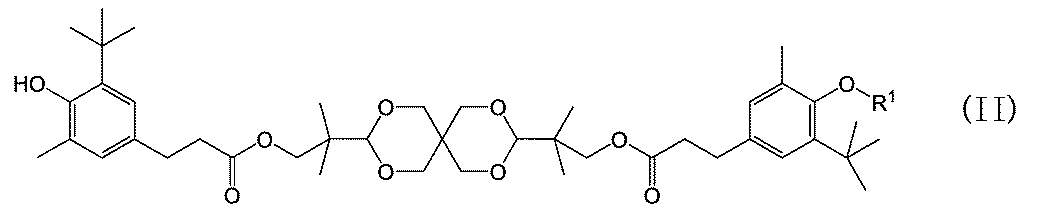
で表される化合物(II)と、少なくとも1種の有機材料とを含み、化合物(I)100質量部に対する化合物(II)の含有量が0.02~10質量部である、樹脂組成物。
〔4〕化合物(I)及び(II)として〔1〕又は〔2〕に記載の加工安定剤を含む、〔3〕に記載の樹脂組成物。
〔5〕有機材料が熱可塑性樹脂である〔3〕又は〔4〕に記載の樹脂組成物。
〔6〕熱可塑性樹脂がポリオレフィン又はエンジニアリングプラスチックである、〔5〕に記載の樹脂組成物。
〔7〕有機材料に、式(I):


で表される化合物(II)とを、化合物(I)100質量部に対する化合物(II)の含有量が0.02~10質量部となる量で添加する、又は、
有機材料に、〔1〕又は〔2〕に記載の加工安定剤を添加する、有機材料の安定化方法。
〔8〕有機材料が熱可塑性樹脂である〔7〕に記載の安定化方法。
〔9〕熱可塑性樹脂がポリオレフィン又はエンジニアリングプラスチックである、〔8〕に記載の安定化方法。
本発明の加工安定剤は、式(I):


で表される化合物(II)とを含み、化合物(I)100質量部に対する化合物(II)の含有量が0.02~10質量部である、加工安定剤である。
有機材料に、本発明の加工安定剤を添加することにより、または、特定の割合の式(I)で表される化合物(I)および式(II)で表される化合物(II)を添加することにより、有機材料の熱劣化及び酸化劣化等を低減させ、有機材料を安定化することができ、例えば粘度低下を防止することができる。また、着色も防止することができると考えられる。そのため、本発明の加工安定剤は、有機材料用安定剤として適当である。
本発明は、上記の加工安定剤に加えて、特定の割合の式(I)で表される化合物(I)および式(II)で表される化合物(II)を添加する、有機材料の安定化方法も提供する。さらに、有機材料と、本発明の加工安定剤、または、特定の割合の式(I)で表される化合物(I)および式(II)で表される化合物(II)を含有する、安定化された樹脂組成物も提供する。
(2)ポリプロピレン、
(3)メチルペンテンポリマー、
(4)EEA(エチレン/アクリル酸エチル共重合)樹脂、
(5)エチレン/酢酸ビニル共重合樹脂、
(6)ポリスチレン類、例えばポリスチレン、ポリ(p-メチルスチレン)、ポリ(α-メチルスチレン)、
(7)AS(アクリロニトリル/スチレン共重合)樹脂、
(8)ABS(アクリロニトリル/ブタジエン/スチレン共重合)樹脂、
(9)AAS(特殊アクリルゴム/アクリロニトリル/スチレン共重合)樹脂、
(10)ACS(アクリロニトリル/塩素化ポリエチレン/スチレン共重合)樹脂、
(12)ポリ塩化ビニル、ポリ塩化ビニリデン、
(13)メタクリル樹脂、
(14)エチレン/ビニルアルコール共重合樹脂、
(15)フッ素樹脂、
(16)ポリアセタール、
(17)グラフト化ポリフェニレンエーテル樹脂及びポリフェニレンサルファイド樹脂、
(18)ポリウレタン、
(19)ポリアミド、
(20)ポリエステル樹脂、例えばポリエチレンテレフタレート、ポリブチレンテレフタレート、
(22)ポリアクリレート、
(23)ポリスルホン、ポリエーテルエーテルケトン、ポリエーテルスルホン、
(24)芳香族ポリエステル樹脂等の熱可塑性樹脂、
(25)エポキシ樹脂、
(26)ジアリルフタレートプリポリマー、
(27)シリコーン樹脂、
(28)不飽和ポリエステル樹脂、
(29)アクリル変性ベンゾグアナミン樹脂、
(30)ベンゾグアナミン/メラミン樹脂、
(31)ユリア樹脂等の熱硬化性樹脂、
(33)1,2-ポリブタジエン、
(34)ポリイソプレン、
(35)スチレン/ブタジエン共重合体、
(36)ブタジエン/アクリロニトリル共重合体、
(37)エチレン/プロピレン共重合体、
(38)シリコーンゴム、
(39)エピクロルヒドリンゴム、
(40)アクリルゴム、
(41)天然ゴム、
(43)ポリエステル樹脂塗料、
(44)ウレタン樹脂塗料、
(45)エポキシ樹脂塗料、
(46)アクリル樹脂塗料、
(47)ビニル樹脂塗料、
(48)アミノアルキド樹脂塗料、
(49)アルキド樹脂塗料、
(50)ニトロセルロース樹脂塗料、
(51)油性塗料、
(52)ワックス、
(53)潤滑油など。
(1)アルキル化モノフェノールの例
2,6-ジ-t-ブチル-4-メチルフェノール、2,4,6-トリ-t-ブチルフェノール、2,6-ジ-t-ブチルフェノール、2-t-ブチル-4,6-ジメチルフェノール、2,6-ジ-t-ブチル-4-エチルフェノール、2,6-ジ-t-ブチル-4-n-ブチルフェノール、2,6-ジ-t-ブチル-4-イソブチルフェノール、2,6-ジシクロペンチル-4-メチルフェノール、2-(α-メチルシクロヘキシル)-4,6-ジメチルフェノール、2,6-ジオクダデシル-4-メチルフェノール、2,4,6-トリシクロヘキシルフェノール、2,6-ジ-t-ブチル-4-メトキシメチルフェノール、2,6-ジ-ノニル-4-メチルフェノール、2,4-ジメチル-6-(1'-メチルウンデシル-1'-イル)フェノール、2,4-ジメチル-6-(1'-メチルヘプタデシル-1'-イル)フェノール、2,4-ジメチル-6-(1'-メチルトリデシル-1'-イル)フェノール及びそれらの混合物など。
2,4-ジオクチルチオメチル-6-t-ブチルフェノール、2,4-ジオクチルチオメチル-6-メチルフェノール、2,4-ジオクチルチオメチル-6-エチルフェノール、2,6-ジドデシルチオメチル-4-ノニルフェノール及びそれらの混合物など。
(3)ヒドロキノン及びアルキル化ヒドロキノンの例
2,6-ジ-t-ブチル-4-メトキシフェノール、2,5-ジ-t-ブチルヒドロキノン、2,5-ジ-t-アミルヒドロキノン、2,6-ジフェニル-4-オクタデシルオキシフェノール、2,6-ジ-t-ブチルヒドロキノン、2,5-ジ-t-ブチル-4-ヒドロキシアニソール、3,5-ジ-t-ブチル-4-ヒドロキシフェニルステアレート、ビス(3,5-ジ-t-ブチル-4-ヒドロキシフェニル)アジペート及びそれらの混合物など。
α-トコフェロール、β-トコフェロール、γ-トコフェロール、δ-トコフェロール及びそれらの混合物など。
(5)ヒドロキシル化チオジフェニルエーテルの例
2,2'-チオビス(6-t-ブチルフェノール)、2,2'-チオビス(4-メチル-6-t-ブチルフェノール)、2,2'-チオビス(4-オクチルフェノール)、4,4'-チオビス(3-メチル-6-t-ブチルフェノール)、4,4'-チオビス(2-メチル-6-t-ブチルフェノール)、4,4'-チオビス(3,6-ジ-t-アミルフェノール)、4,4'-(2,6-ジメチル-4-ヒドロキシフェニル)ジスルフィドなど。
2,2'-メチレンビス(4-メチル-6-t-ブチルフェノール)、2,2'-メチレンビス(4-エチル-6-t-ブチルフェノール)、2,2'-メチレンビス[4-メチル-6-(α-メチルシクロヘキシル)フェノール)]、2,2'-メチレンビス(4-メチル-6-シクロヘキシルフェノール)、2,2'-メチレンビス(4-メチル-6-ノニルフェノール)、2,2'-メチレンビス(4,6-ジ-t-ブチルフェノール)、2,2'-エチリデンビス(4,6-ジ-t-ブチルフェノール)、2,2'-エチリデンビス(4-イソブチル-6-t-ブチルフェノール)、2,2'-メチレンビス[6-(α-メチルベンジル)-4-ノニルフェノール]、2,2'-メチレンビス[4,6-(α,α-ジメチルベンジル)-4-ノニルフェノール]、4,4'-メチレンビス(6-t-ブチル-2-メチルフェノール)、4,4'-メチレンビス(2,6-ジ-t-ブチルフェノール)、4,4'-ブチリデンビス(3-メチル-6-t-ブチルフェノール)、1,1-ビス(4-ヒドロキシフェニル)シクロヘキサン、1,1-ビス(5-t-ブチル-4-ヒドロキシ-2-メチルフェニル)ブタン、2,6-ビス(3-t-ブチル-5-メチル-2-ヒドロキシベンジル)-4-メチルフェノール、1,1,3-トリス(5-t-ブチル-4-ヒドロキシ-2-メチルフェニル)ブタン、1,1-ビス(5-t-ブチル-4-ヒドロキシ-2-メチルフェニル)-3-n-ドデシルメルカプトブタン、エチレングリコール ビス[3,3-ビス-3'-t-ブチル-4'-ヒドロキシフェニル)ブチレート]、ビス(3-t-ブチル-4-ヒドロキシ-5-メチルフェニル)ジシクロペンタジエン、ビス[2-(3'-t-ブチル-2'-ヒドロキシ-5'-メチルベンジル)-6-t-ブチル-4-メチルフェニル]テレフタレート、1,1-ビス(3,5-ジメチル-2-ヒドロキシフェニル)ブタン、2,2-ビス(3,5-ジ-t-ブチル-4-ヒドロキシフェニル)プロパン、2,2-ビス(5-t-ブチル-4-ヒドロキシ-2-メチルフェニル)-4-n-ドデシルメルカプトブタン、1,1,5,5-テトラ(5-t-ブチル-4-ヒドロキシ-2-メチルフェニル)ペンタン、2-t-ブチル-6-(3'-t-ブチル-5'-メチル-2'-ヒドロキシベンジル)-4-メチルフェニル アクリレート、2,4-ジ-t-ペンチル-6-[1-(2-ヒドロキシ-3,5-ジ-t-ペンチルフェニル)エチル]フェニル アクリレート及びそれらの混合物など。
3,5,3',5'-テトラ-t-ブチル-4,4'-ジヒドロキシジベンジルエーテル、オクタデシル-4-ヒドロキシ-3,5-ジメチルベンジルメルカプトアセテート、トリス(3,5-ジ-t-ブチル-4-ヒドロキシベンジル)アミン、ビス(4-t-ブチル-3-ヒドロキシ-2,6-ジメチルベンジル)ジチオテレフタレート、ビス(3,5-ジ-t-ブチル-4-ヒドロキシベンジル)スルフィド、イソオクチル-3,5-ジ-t-ブチル-4-ヒドロキシベンジルメルカプトアセテート及びそれらの混合物など。
(8)ヒドロキシベンジル化マロネート誘導体の例
ジオクタデシル-2,2-ビス(3,5-ジ-t-ブチル-2-ヒドロキシベンジル)マロネート、ジオクタデシル-2-(3-t-ブチル-4-ヒドロキシ-5-メチルベンジル)マロネート、ジドデシルメルカプトエチル-2,2-ビス(3,5-ジ-t-ブチル-4-ヒドロキシベンジル)マロネート、ビス[4-(1,1,3,3-テトラメチルブチル)フェニル]-2,2-ビス(3,5-ジ-t-ブチル-4-ヒドロキシベンジル)マロネート及びそれらの混合物など。
(9)芳香族ヒドロキシベンジル誘導体の例
1,3,5-トリメチル-2,4,6-トリス(3,5-ジ-t-ブチル-4-ヒドロキシベンジル)ベンゼン、1,4-ビス(3,5-ジ-t-ブチル-4-ヒドロキシベンジル)-2,3,5,6-テトラメチルベンゼン、2,4,6-トリス(3,5-t-ブチル-4-ヒドロキシベンジル)フェノール及びそれらの混合物など。
2,4-ビス(n-オクチルチオ)-6-(4-ヒドロキシ-3,5-ジ-t-ブチルアニリノ)-1,3,5-トリアジン、2-n-オクチルチオ-4,6-ビス(4-ヒドロキシ-3,5-ジ-t-ブチルアニリノ)-1,3,5-トリアジン、2-n-オクチルチオ-4,6-ビス(4-ヒドロキシ-3,5-ジ-t-ブチルフェノキシ)-1,3,5-トリアジン、2,4,6-トリス(3,5-ジ-t-ブチル-4-フェノキシ)-1,3,5-トリアジン、トリス(4-t-ブチル-3-ヒドロキシ-2,6-ジメチルベンジル)イソシアヌレート、トリス(3,5-ジ-t-ブチル-4-ヒドロキシベンジル)イソシアヌレート、2,4,6-トリス(3,5-ジ-t-ブチル-4-ヒドロキシフェニルエチル)-1,3,5-トリアジン、2,4,6-トリス(3,5-ジ-t-ブチル-4-ヒドロキシフェニルプロピル)-1,3,5-トリアジン、トリス(3,5-ジシクロヘキシル-4-ヒドロキシベンジル)イソシアヌレート、トリス[2-(3',5'-ジ-t-ブチル-4'-ヒドロキシシンナモイルオキシ)エチル]イソシアヌレート及びそれらの混合物など。
ジメチル-3,5-ジ-t-ブチル-4-ヒドロキシベンジルホスホネート、ジエチル-3,5-ジ-t-ブチル-4-ヒドロキシベンジルホスホネート、ジオクタデシル-3,5-ジ-t-ブチル-4-ヒドロキシベンジルホスホネート、ジオクタデシル-5-t-ブチル-4-ヒドロキシ-3-メチルベンジルホスホネート、3,5-ジ-t-ブチル-4-ヒドロキシベンジルホスホン酸モノエステルのカルシウム塩及びそれらの混合物など。
(12)アシルアミノフェノール誘導体の例
4-ヒドロキシラウリル酸アニリド、4-ヒドロキシステアリン酸アニリド、オクチル-N-(3,5-ジ-t-ブチル-4-ヒドロキシフェニル)カルバネート及びそれらの混合物など。
(13)β-(3,5-ジ-t-ブチル-4-ヒドロキシフェニル)プロピオン酸と以下の一価又は多価アルコールとのエステルの例
メタノール、エタノール、オクタノール、オクタデカノール、エチレングリコール、1,3-プロパンジオール、1,4-ブタンジオール、1,6-ヘキサンジオール、1,9-ノナンジオール、ネオペンチルグリコール、ジエチレングリコール、チオエチレングリコール、スピログリコール、トリエチレングリコール、ペンタエリスリトール、トリス(ヒドロキシエチル)イソシアヌレート、N,N'-ビス(ヒドロキシエチル)オキサミド、3-チアウンデカノール、3-チアペンタデカノール、トリメチルヘキサンジオール、トリメチロールプロパン、4-ヒドロキシメチル-1-ホスファ-2,6,7-トリオキサビシクロ[2,2,2]オクタン及びそれらの混合物など。
メタノール、エタノール、オクタノール、オクタデカノール、エチレングリコール、1,3-プロパンジオール、1,4-ブタンジオール、1,6-ヘキサンジオール、1,9-ノナンジオール、ネオペンチルグリコール、ジエチレングリコール、チオエチレングリコール、スピログリコール、トリエチレングリコール、ペンタエリスリトール、トリス(ヒドロキシエチル)イソシアヌレート、N,N'-ビス(ヒドロキシエチル)オキサミド、3-チアウンデカノール、3-チアペンタデカノール、トリメチルヘキサンジオール、トリメチロールプロパン、4-ヒドロキシメチル-1-ホスファ-2,6,7-トリオキサビシクロ[2,2,2]オクタン及びそれらの混合物など。
(15)β-(3,5-ジシクロヘキシル-4-ヒドロキシフェニル)プロピオン酸と以下の一価又は多価アルコールとのエステルの例
メタノール、エタノール、オクタノール、オクタデカノール、エチレングリコール、1,3-プロパンジオール、1,4-ブタンジオール、1,6-ヘキサンジオール、1,9-ノナンジオール、ネオペンチルグリコール、ジエチレングリコール、チオエチレングリコール、スピログリコール、トリエチレングリコール、ペンタエリスリトール、トリス(ヒドロキシエチル)イソシアヌレート、N,N'-ビス(ヒドロキシエチル)オキサミド、3-チアウンデカノール、3-チアペンタデカノール、トリメチルヘキサンジオール、トリメチロールプロパン、4-ヒドロキシメチル-1-ホスファ-2,6,7-トリオキサビシクロ[2,2,2]オクタン及びそれらの混合物など。
メタノール、エタノール、オクタノール、オクタデカノール、エチレングリコール、1,3-プロパンジオール、1,4-ブタンジオール、1,6-ヘキサンジオール、1,9-ノナンジオール、ネオペンチルグリコール、ジエチレングリコール、チオエチレングリコール、スピログリコール、トリエチレングリコール、ペンタエリスリトール、トリス(ヒドロキシエチル)イソシアヌレート、N,N'-ビス(ヒドロキシエチル)オキサミド、3-チアウンデカノール、3-チアペンタデカノール、トリメチルヘキサンジオール、トリメチロールプロパン、4-ヒドロキシメチル-1-ホスファ-2,6,7-トリオキサビシクロ[2,2,2]オクタン及びそれらの混合物など。
(17)β-(3,5-ジ-t-ブチル-4-ヒドロキシフェニル)プロピオン酸のアミドの例
N,N'-ビス[3-(3',5'-ジ-t-ブチル-4'-ヒドロキシフェニル)プロピオニル]ヒドラジン、N,N'-ビス[3-(3',5'-ジ-t-ブチル-4'-ヒドロキシフェニル)プロピオニル]ヘキサメチレンジアミン、N,N'-ビス[3-(3',5'-ジ-t-ブチル-4'-ヒドロキシフェニル)プロピオニル]トリメチレンジアミン及びそれらの混合物など。
ジラウリル 3,3'-チオジプロピオネート、トリデシル 3,3'-チオジプロピオネート、ジミリスチル 3,3'-チオジプロピオネート、ジステアリル 3,3'-チオジプロピオネート、ラウリル ステアリル 3,3'-チオジプロピオネート、ネオペンタンテトライルテトラキス (3-ラウリルチオプロピオネート)など。
トリフェニルホスファイト、トリス(ノニルフェニル)ホスファイト、トリス(2,4-ジ-t-ブチルフェニル)ホスファイト、トリラウリルホスファイト、トリオクタデシルホスファイト、ジステアリル ペンタエリスリトール ジホスファイト、ジイソデシル ペンタエリスリトール ジホスファイト、ビス(2,4-ジ-t-ブチルフェニル)ペンタエリスリトール ジホスファイト、ビス(2,4-ジ-t-ブチル-6-メチルフェニル)ペンタエリスリトール ジホスファイト、ビス(2,6-ジ-t-ブチル-4-メチルフェニル)ペンタエリスリトール ジホスファイト、ビス(2,4,6-トリ-t-ブチルフェニル)ペンタエリスリトール ジホスファイト、トリステアリルソルビトールトリホスファイト、テトラキス(2,4-ジ-t-ブチルフェニル)-4,4'-ジフェニレンジホスホナイト、2,2'-メチレンビス(4,6-ジ-t-ブチルフェニル) 2-エチルヘキシル ホスファイト、2,2'-エチリデンビス(4,6-ジ-t-ブチルフェニル) フルオロ ホスファイト、ビス(2,4-ジ-t-ブチル-6-メチルフェニル) エチル ホスファイト、ビス(2,4-ジ-t-ブチル-6-メチルフェニル) メチル ホスファイト、2-(2,4,6-トリ-t-ブチルフェニル)-5-エチル-5-ブチル-1,3,2-オキサホスホリナン、2,2',2''-ニトリロ[トリエチル-トリス(3,3',5,5'-テトラ-t-ブチル-1,1'-ビフェニル-2,2'-ジイル) ホスファイト、6-[3-(3-t-ブチル-4-ヒドロキシ-5-メチルフェニル)プロポキシ]-2,4,8,10-テトラ-t-ブチルジベンズ[d,f][1,3,2]ジオキサホスフェピン及びそれらの混合物など。
(1)サリシレート誘導体の例
フェニル サリシレート、4-t-ブチルフェニル サリシレート、2,4-ジ-t-ブチルフェニル 3',5'-ジ-t-ブチル-4'-ヒドロキシベンゾエート、4-t-オクチルフェニル サリシレート、ビス(4-t-ブチルベンゾイル)レゾルシノール、ベンゾイルレゾルシノール、ヘキサデシル 3',5'-ジ-t-ブチル-4'-ヒドロキシベンゾエート、オクタデシル 3',5'-ジ-t-ブチル-4'-ヒドロキシベンゾエート、2-メチル-4,6-ジ-t-ブチルフェニル 3',5'-ジ-t-ブチル-4'-ヒドロキシベンゾエート及びそれらの混合物など。
(2)2-ヒドロキシベンゾフェノン誘導体の例
2,4-ジヒドロキシベンゾフェノン、2-ヒドロキシ-4-メトキシベンゾフェノン、2-ヒドロキシ-4-オクトキシベンゾフェノン、2,2'-ジヒドロキシ-4-メトキシベンゾフェノン、ビス(5-ベンゾイル-4-ヒドロキシ-2-メトキシフェニル)メタン、2,2',4,4'-テトラヒドロキシベンゾフェノン及びそれらの混合物など。
2-(2-ヒドロキシ-5-メチルフェニル)ベンゾトリアゾール、2-(3',5'-ジ-t-ブチル-2'-ヒドロキシフェニル)ベンゾトリアゾール、2-(5'-t-ブチル-2'-ヒドロキシフェニル)ベンゾトリアゾール、2-(2'-ヒドロキシ-5'-t-オクチルフェニル)ベンゾトリアゾール、2-(3-t-ブチル-2-ヒドロキシ-5-メチルフェニル)-5-クロロベンゾトリアゾール、2-(3'-s-ブチル-2'-ヒドロキシ-5'-t-ブチルフェニル)ベンゾトリアゾール、2-(2'-ヒドロキシ-4'-オクチルオキシフェニル)ベンゾトリアゾール、2-(3',5'-ジ-t-アミル-2'-ヒドロキシフェニル)ベンゾトリアゾール、2-[2'-ヒドロキシ-3',3'-ビス(α,α-ジメチルベンジル)フェニル]-2H-ベンゾトリアゾール、2-[(3'-t-ブチル-2'-ヒドロキシフェニル)-5'-(2-オクチルオキシカルボニルエチル)フェニル]-5-クロロベンゾトリアゾール、2-[3'-t-ブチル-5'-[2-(2-エチルヘキシルオキシ)カルボニルエチル]-2'-ヒドロキシフェニル]-5-クロロベンゾトリアゾール、2-[3'-t-ブチル-3'-ヒドロキシ-5'-(2-メトキシカルボニルエチル)フェニル]-5-クロロベンゾトリアゾール、2-[3'-t-ブチル-2'-ヒドロキシ-5'-(2-メトキシカルボニルエチル)フェニル] ベンゾトリアゾール、2-[3'-t-ブチル-2'-ヒドロキシ-5-(2-オクチルオキシカルボニルエチル)フェニル] ベンゾトリアゾール、2-[3'-t-ブチル-2'-ヒドロキシ-5'-[2-(2-エチルヘキシルオキシ)カルボニルエチル]フェニル] ベンゾトリアゾール、2-[2-ヒドロキシ-3-(3,4,5,6-テトラヒドロフタルイミドメチル)-5-メチルフェニル] ベンゾトリアゾール、2-(3,5-ジ-t-ブチル-2-ヒドロキシフェニル)-5-クロロベンゾトリアゾール、2-(3'-ドデシル-2'-ヒドロキシ-5'-メチルフェニル)ベンゾトリアゾール及び2-[3'-t-ブチル-2'-ヒドロキシ-5'-(2-イソオクチルオキシカルボニルエチル)フェニル] ベンゾトリアゾールの混合物、2,2'-メチレンビス[6-(2H-ベンゾトリアゾール-2-イル)-4-(1,1,3,3-テトラメチルブチル)フェノール、2,2'-メチレンビス[4-t-ブチル-6-(2H-ベンゾトリアゾール-2-イル)フェノール]、ポリ(3~11)(エチレングリコール)と2-[3'-t-ブチル-2'-ヒドロキシ-5'-(2-メトキシカルボニルエチル)フェニル] ベンゾトリアゾールとの縮合物、ポリ(3~11)(エチレングリコール)とメチル 3-[3-(2H-ベンゾトリアゾール-2-イル)-5-t-ブチル-4-ヒドロキシフェニル]プロピオネートとの縮合物、2-エチルヘキシル 3-[3-t-ブチル-5-(5-クロロ-2H-ベンゾトリアゾール-2-イル)-4-ヒドロキシフェニル]プロピオネート、オクチル 3-[3-t-ブチル-5-(5-クロロ-2H-ベンゾトリアゾール-2-イル)-4-ヒドロキシフェニル]プロピオネート、メチル 3-[3-t-ブチル-5-(5-クロロ-2H-ベンゾトリアゾール-2-イル)-4-ヒドロキシフェニル]プロピオネート、3-[3-t-ブチル-5-(5-クロロ-2H-ベンゾトリアゾール-2-イル)-4-ヒドロキシフェニル]プロピオン酸及びそれらの混合物など。
(1)ヒンダードアミン系光安定剤の例
ビス(2,2,6,6-テトラメチル-4-ピペリジル)セバケート、ビス(2,2,6,6-テトラメチル-4-ピペリジル)スクシネート、ビス(1,2,2,6,6-ペンタメチル-4-ピペリジル)セバケート、ビス(N-オクトキシ-2,2,6,6-テトラメチル-4-ピペリジル)セバケート、ビス(N-ベンジルオキシ-2,2,6,6-テトラメチル-4-ピペリジル)セバケート、ビス(N-シクロヘキシルオキシ-2,2,6,6-テトラメチル-4-ピペリジル)セバケート、ビス(1,2,2,6,6-ペンタメチル-4-ピペリジル)2-(3,5-ジ-t-ブチル-4-ヒドロキシベンジル)-2-ブチルマロネート、ビス(1-アクロイル-2,2,6,6-テトラメチル-4-ピペリジル)2,2-ビス(3,5-ジ-t-ブチル-4-ヒドロキシベンジル)-2-ブチルマロネート、ビス(1,2,2,6,6-ペンタメチル-4-ピペリジル)デカンジオエート、2,2,6,6-テトラメチル-4-ピペリジル メタクリレート、4-[3-(3,5-ジ-t-ブチル-4-ヒドロキシフェニル)プロピオニルオキシ]-1-[2-(3-(3,5-ジ-t-ブチル-4-ヒドロキシフェニル)プロピオニルオキシ)エチル]-2,2,6,6-テトラメチルピペリジン、2-メチル-2-(2,2,6,6-テトラメチル-4-ピペリジル)アミノ-N-(2,2,6,6-テトラメチル-4-ピペリジル)プロピオンアミド、テトラキス(2,2,6,6-テトラメチル-4-ピペリジル)1,2,3,4-ブタンテトラカルボキシレート、テトラキス(1,2,2,6,6-ペンタメチル-4-ピペリジル)1,2,3,4-ブタンテトラカルボキシレート、1,2,3,4-ブタンテトラカルボン酸と1,2,2,6,6-ペンタメチル-4-ピペリジノール及び1-トリデカノールとの混合エステル化物、
エチル α-シアノ-β,β-ジフェニルアクリレート、イソオクチル α-シアノ-β,β-ジフェニルアクリレート、メチル α-カルボメトキシシンナメート、メチル α-シアノ-β-メチル-p-メトキシシンナメート、ブチルα-シアノ-β-メチル-p-メトキシシンナメート、メチル α-カルボメトキシ-p-メトキシシンナメート及びN-(β-カルボメトキシ-β-シアノビニル)-2-メチルインドリン及びそれらの混合物など。
(3)ニッケル系光安定剤の例
2,2'-チオビス-[4-(1,1,3,3-テトラメチルブチル)フェノール]のニッケル錯体、ニッケルジブチルジチオカルバメート、モノアルキルエステルのニッケル塩、ケトキシムのニッケル錯体及びそれらの混合物など。
4,4'-ジオクチルオキシオキサニリド、2,2'-ジエトキシオキサニリド、2,2'-ジオクチルオキシ-5,5'-ジ-t-ブチルアニリド、2,2'-ジドデシルオキシ-5,5'-ジ-t-ブチルアニリド、2-エトキシ-2'-エチルオキサニリド、N,N'-ビス(3-ジメチルアミノプロピル)オキサミド、2-エトキシ-5-t-ブチル-2'-エトキシアニリド、2-エトキシ-5,4'-ジ-t-ブチル-2'-エチルオキサニリド及びそれらの混合物など。
(5)2-(2-ヒドロキシフェニル)-1,3,5-トリアジン系光安定剤の例
2,4,6-トリス(2-ヒドロキシ-4-オクチルオキシフェニル)-1,3,5-トリアジン、2-(2-ヒドロキシ-4-オクチルオキシフェニル)-4,6-ビス(2,4-ジメチルフェニル)-1,3,5-トリアジン、2-[2,4-ジヒドロキシフェニル-4,6-ビス(2,4-ジメチルフェニル]-1,3,5-トリアジン、2,4-ビス(2-ヒドロキシ-4-プロピルオキシフェニル)-6-(2,4-ジメチルフェニル)-1,3,5-トリアジン、2-(2-ヒドロキシ-4-オクチルオキシフェニル)-4,6-ビス(4-メチルフェニル)-1,3,5-トリアジン、2-(2-ヒドロキシ-4-ドデシルオキシフェニル)-4,6-ビス(2,4-ジメチルフェニル)-1,3,5-トリアジン、2-[2-ヒドロキシ-4-(2-ヒドロキシ-3-ブチルオキシプロポキシ)フェニル]-4,6-ビス(2,4-ジメチルフェニル)-1,3,5-トリアジン、2-[2-ヒドロキシ-4-(2-ヒドロキシ-3-オクチルオキシプロポキシ)フェニル]-4,6-ビス(2,4-ジメチルフェニル)-1,3,5-トリアジン及びそれらの混合物など。
N,N'-ジフェニルオキサミド、N-サリチラル-N'-サリチロイルヒドラジン、N,N'-ビス(サリチロイル)ヒドラジン、N,N'-ビス(3,5-ジ-t-ブチル-4-ヒドロキシフェニルプロピオニル)ヒドラジン、3-サリチロイルアミノ-1,2,4-トリアゾール、ビス(ベンジリデン)オキサリルジヒドラジド、オキサニリド、イソフタロイルジヒドラジド、セバコイルビスフェニルヒドラジド、N,N'-ビス(サリチロイル)オキサリルジヒドラジド、N,N'-ビス(サリチロイル)チオプロピオニルジヒドラジド及びそれらの混合物など。
ポリアミド安定剤としては、例えばヨウ化物又はリン化合物の銅又は2価のマンガン塩及びそれらの混合物等が挙げられる。
特に好ましいフェノール系酸化防止剤としては、以下の化合物が挙げられる。
2,6-ジ-t-ブチル-4-メチルフェノール、2,4,6-トリ-t-ブチルフェノール、2,4-ジオクチルチオメチル-6-メチルフェノール、2,2'-チオビス(6-t-ブチルフェノール)、4,4'-チオビス(3-メチル-6-t-ブチルフェノール)、2,2'-メチレンビス(4-メチル-6-t-ブチルフェノール)、2,2'-メチレンビス(4-エチル-6-t-ブチルフェノール)、2,2'-メチレンビス[4-メチル-6-(α-メチルシクロヘキシル)フェノール)]、2,2'-メチレンビス(4-メチル-6-シクロヘキシルフェノール)、2,2'-メチレンビス(4,6-ジ-t-ブチルフェノール)、2,2'-エチリデンビス(4,6-ジ-t-ブチルフェノール)、4,4'-メチレンビス(6-t-ブチル-2-メチルフェノール)、4,4'-メチレンビス(2,6-ジ-t-ブチルフェノール)、4,4'-ブチリデンビス(3-メチル-6-t-ブチルフェノール)、1,1-ビス(4-ヒドロキシフェニル)シクロヘキサン、1,1-ビス(5-t-ブチル-4-ヒドロキシ-2-メチルフェニル)ブタン、1,1,3-トリス(5-t-ブチル-4-ヒドロキシ-2-メチルフェニル)ブタン、エチレングリコール ビス[3,3-ビス-3'-t-ブチル-4'-ヒドロキシフェニル)ブチレート]、2-t-ブチル-6-(3'-t-ブチル-5'-メチル-2'-ヒドロキシベンジル)-4-メチルフェニル アクリレート、2,4-ジ-t-ペンチル-6-[1-(2-ヒドロキシ-3,5-ジ-t-ペンチルフェニル)エチル]フェニル アクリレート、
トリス(ノニルフェニル)ホスファイト、トリス(2,4-ジ-t-ブチルフェニル)ホスファイト、ジステアリル ペンタエリスリトール ジホスファイト、ビス(2,4-ジ-t-ブチルフェニル)ペンタエリスリトール ジホスファイト、ビス(2,4-ジ-t-ブチル-6-メチルフェニル)ペンタエリスリトール ジホスファイト、ビス(2,6-ジ-t-ブチル-4-メチルフェニル)ペンタエリスリトール ジホスファイト、テトラキス(2,4-ジ-t-ブチルフェニル)-4,4'-ジフェニレンジホスホナイト、2,2'-メチレンビス(4,6-ジ-t-ブチルフェニル) 2-エチルヘキシル ホスファイト、2,2'-エチリデンビス(4,6-ジ-t-ブチルフェニル) フルオロ ホスファイト、ビス(2,4-ジ-t-ブチル-6-メチルフェニル) エチルホスファイト、2-(2,4,6-トリ-t-ブチルフェニル)-5-エチル-5-ブチル-1,3,2-オキサホスホリナン、2,2',2''-ニトリロ[トリエチル-トリス(3,3',5,5'-テトラ-t-ブチル-1,1'-ビフェニル-2,2'-ジイル)ホスファイト、6-[3-(3-t-ブチル-4-ヒドロキシ-5-メチルフェニル)プロポキシ]-2,4,8,10-テトラ-t-ブチルジベンズ[d,f][1,3,2]ジオキサホスフェピンなど。
フェニル サリシレート、4-t-ブチルフェニル サリシレート、2,4-ジ-t-ブチルフェニル 3',5'-ジ-t-ブチル-4'-ヒドロキシベンゾエート、4-t-オクチルフェニル サリシレート、2,4-ジヒドロキシベンゾフェノン、2-ヒドロキシ-4-メトキシベンゾフェノン、2-ヒドロキシ-4-オクトキシベンゾフェノン、2,2'-ジヒドロキシ-4-メトキシベンゾフェノン、ビス(5-ベンゾイル-4-ヒドロキシ-2-メトキシフェニル)メタン、2,2',4,4'-テトラヒドロキシベンゾフェノン、2-(2-ヒドロキシ-5-メチルフェニル)ベンゾトリアゾール、2-(3',5'-ジ-t-ブチル-2'-ヒドロキシフェニル)ベンゾトリアゾール、2-(5'-t-ブチル-2'-ヒドロキシフェニル)ベンゾトリアゾール、2-(2'-ヒドロキシ-5'-t-オクチルフェニル)ベンゾトリアゾール、2-(3-t-ブチル-2-ヒドロキシ-5-メチルフェニル)-5-クロロベンゾトリアゾール、2-(3'-s-ブチル-2'-ヒドロキシ-5'-t-ブチルフェニル)ベンゾトリアゾール、2-(2'-ヒドロキシ-4'-オクチルオキシフェニル)ベンゾトリアゾール、2-(3',5'-ジ-t-アミル-2'-ヒドロキシフェニル)ベンゾトリアゾール、2-[2'-ヒドロキシ-3',5'-ビス(α,α-ジメチルベンジル)フェニル]-2H-ベンゾトリアゾールなど。
ビス(2,2,6,6-テトラメチル-4-ピペリジル)セバケート、ビス(1,2,2,6,6-ペンタメチル-4-ピペリジル)セバケート、ビス(N-オクトキシ-2,2,6,6-テトラメチル-4-ピペリジル)セバケート、ビス(N-ベンジルオキシ-2,2,6,6-テトラメチル-4-ピペリジル)セバケート、ビス(N-シクロヘキシルオキシ-2,2,6,6-テトラメチル-4-ピペリジル)セバケート、ビス(1,2,2,6,6-ペンタメチル-4-ピペリジル) 2-(3,5-ジ-t-ブチル-4-ヒドロキシベンジル)-2-ブチルマロネート、ビス(1-アクロイル-2,2,6,6-テトラメチル-4-ピペリジル) 2,2-ビス(3,5-ジ-t-ブチル-4-ヒドロキシベンジル)-2-ブチルマロネート、ビス(2,2,6,6-テトラメチル-4-ピペリジル)スクシネート、2,2,6,6-テトラメチル-4-ピペリジル メタクリレート、4-[3-(3,5-ジ-t-ブチル-4-ヒドロキシフェニル)プロピオニルオキシ]-1-[2-(3-(3,5-ジ-t-ブチル-4-ヒドロキシフェニル)プロピオニルオキシ)エチル]-2,2,6,6-テトラメチルピペリジン、2-メチル-2-(2,2,6,6-テトラメチル-4-ピペリジル)アミノ-N-(2,2,6,6-テトラメチル-4-ピペリジル)プロピオンアミド、テトラキス(2,2,6,6-テトラメチル-4-ピペリジル) 1,2,3,4-ブタンテトラカルボキシレート、
装置:bruker社製、AV-300M
測定溶媒:CDCl3
MFRの測定は、メルトインデクサ(型式L246-3537、株式会社テクノ・セブン社製)を用いて、温度230℃及び荷重21.18Nで行った。
ポリプロピレン樹脂は、熱による加工時に分解が進行し、そのMFRが上昇する。そのため、安定剤を添加したポリプロピレン樹脂組成物のMFRが、熱による加工によって上昇しにくい程、該樹脂組成物の加工安定性は良好である。
スミライザー(登録商標)GA-80を10g(13.5mmol、化学式C43H64O10、Exact Mass:740.45、分子量740.98)、アセトン100mL、炭酸カリウム1.87g(13.5mmol)及びヨウ化メチル1.92g(13.5mmol)を仕込み、室温で終夜撹拌した。原料と生成物の比率がLCにておよそ8:2であったため、炭酸カリウム及びヨウ化メチルを各1等量ずつ追加し、室温で6時間撹拌した。炭酸カリウム及びヨウ化メチルをさらに各1等量ずつ追加して終夜撹拌したのち、ろ過し、残渣を濃縮して粗生成物を得た。残渣をシリカゲルカラムクロマトグラフィー(展開溶媒:ヘキサン/酢酸エチル系)にて精製することで、下記式(II)1-MeOで示されるモノメトキシ体化合物(1)(化学式:C44H66O10、Exact Mass:754.47、分子量755.00)を4.5g、下記式DMeOで示されるジメトキシ体(化学式:C45H68O10、Exact Mass:768.48、分子量769.03)を2.9g得た。

機種:LC-20A
カラム:L-column2 ODS(5μm、4.6mmφ、150mm)
注入量:5μL(各メタノール溶液)
移動相:A液 水/酢酸=1000/1(v/v)
B液 メタノール/THF/酢酸=930/70/1(v/v/v)
グラジエント:Time(min.) 0 7 37 47
B conc.(%)70 70 100 100
流量:1.0mL/min
カラム温度:40°C
測定波長:UV、280nm
純度:99.3%(1-MeO)、97.4%(DMeO)
δ0.91(d,J=1.8Hz,12H,CH3),δ1.37(s,9H,C(CH3)3),δ1.40(s,9H,C(CH3)3),δ2.22(s,3H,ArCH3),δ2.29(s,3H,ArCH3),δ2.57-2.64(m,4H,CH2),δ2.82-2.89(m,4H,CH2),δ3.22-3.27(dd,J=11.7Hz,1.5Hz,2H,CH2),δ3.40-3.55(m,4H,CH2),δ3.74(s,3H,OCH3),δ3.92(d,J=2.1Hz,4H,COOCH2),δ4.18(d,J=2.4Hz,2H,CH),δ4.47(m,2H,CH2),δ4.67(s,1H,ArOH),δ6.83(d,J=1.8Hz,1H,Ar),δ6.88(d,J=2.1Hz,1H,Ar),δ6.96(m,2H,Ar)
ポリプロピレン樹脂(住友化学株式会社製 MFR:25g/10min)100質量部に、ステアリン酸カルシウム0.05質量部と、式(I)で表される化合物であるスミライザー(登録商標)GA-80を0.1質量部と、合成例1で得た化合物(1)0.00005質量部とをドライブレンドした。得られた混合物を、シリンダー径32mmの二軸押出機(型式:BTN32-S2-36-L、プラスチック工学研究所社製)を用いて、空気雰囲気下、温度230℃及びスクリュー回転数100rpmの条件で混練して、本発明の樹脂組成物のペレット(1)を得た。
得られたペレット(1)のMFRを、上記の測定方法に従い測定した。得られたペレット(1)のMFRについて、後述する比較例1の樹脂組成物のペレットのMFRに対する割合(MFR比とも称する)を算出した。結果を表1に示す。なお、MFR比が小さい程、樹脂の安定化効果が高いことを意味する。
化合物(2)を添加しなかったこと以外は実施例1と同様にして、樹脂組成物のペレットを得た。得られたペレットのMFRを、実施例1と同様にして測定した。得られた結果を表1に示す。
樹脂組成物中に含まれる化合物(1)100質量部に対する化合物(2)の量を表1に示すように変更した以外は、実施例1と同様にして、樹脂組成物のペレットを得た。得られたペレットのMFRと、比較例1の樹脂組成物のペレットのMFRに対する割合(MFR比とも称する)を、実施例1と同様にして算出した。結果を表1に示す。

GA-80を100質量部と、合成例1で得た化合物(1)0.1質量部とを、乳鉢を用いてすり潰し混合粉末とし、本発明の加工安定剤(1)を得る。
ポリプロピレン樹脂(住友化学株式会社製 MFR:25g/10min)100質量部に、ステアリン酸カルシウム0.05質量部と、実施例7で得た加工安定剤(1)をドライブレンドする。得られる混合物を、シリンダー径32mmの二軸押出機(型式:BTN32-S2-36-L、プラスチック工学研究所社製)を用いて、空気雰囲気下、温度230℃及びスクリュー回転数100rpmの条件で混練して、本発明の樹脂組成物のペレットを得る。上記において、ポリプロピレン樹脂100質量部に、実施例7で得た加工安定剤(1)0.1001質量部をブレンドして得られる樹脂組成物のペレットは、実施例2で得た樹脂組成物のペレットと同程度のMFR比を示すと考えられる。
Claims (9)
- 式(I):

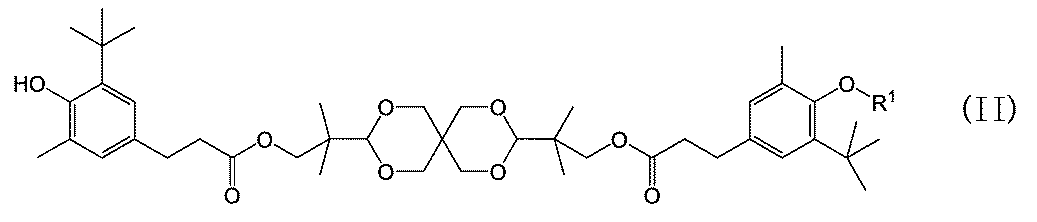
で表される化合物(II)とを含み、化合物(I)100質量部に対する化合物(II)の含有量が0.02~10質量部である、加工安定剤。 - 式(II)中のR1はメチル基である、請求項1に記載の加工安定剤。
- 式(I):

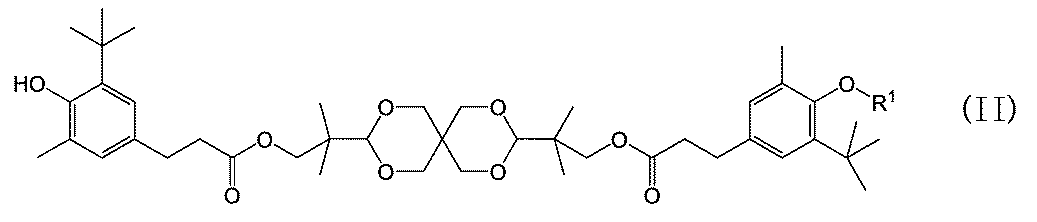
で表される化合物(II)と、少なくとも1種の有機材料とを含み、化合物(I)100質量部に対する化合物(II)の含有量が0.02~10質量部である、樹脂組成物。 - 化合物(I)及び(II)として請求項1又は2に記載の加工安定剤を含む、請求項3に記載の樹脂組成物。
- 有機材料が熱可塑性樹脂である請求項3又は4に記載の樹脂組成物。
- 熱可塑性樹脂がポリオレフィン又はエンジニアリングプラスチックである、請求項5に記載の樹脂組成物。
- 有機材料に、式(I):
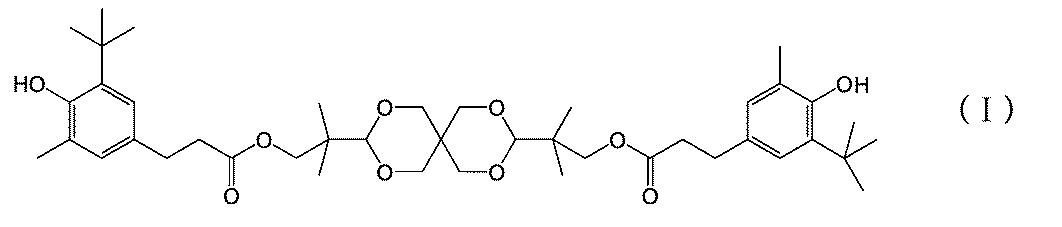

で表される化合物(II)とを、化合物(I)100質量部に対する化合物(II)の含有量が0.02~10質量部となる量で添加する、又は、
有機材料に、請求項1又は2に記載の加工安定剤を添加する、有機材料の安定化方法。 - 有機材料が熱可塑性樹脂である請求項7に記載の安定化方法。
- 熱可塑性樹脂がポリオレフィン又はエンジニアリングプラスチックである、請求項8に記載の安定化方法。
Priority Applications (3)
| Application Number | Priority Date | Filing Date | Title |
|---|---|---|---|
| CN202480007520.7A CN120548344A (zh) | 2023-01-13 | 2024-01-05 | 加工稳定剂、树脂组合物和有机材料的稳定化方法 |
| KR1020257023060A KR20250136322A (ko) | 2023-01-13 | 2024-01-05 | 가공 안정제, 수지 조성물, 및 유기 재료의 안정화 방법 |
| EP24741487.3A EP4650401A1 (en) | 2023-01-13 | 2024-01-05 | Processing stabilizer, resin composition, and organic material stabilizing method |
Applications Claiming Priority (2)
| Application Number | Priority Date | Filing Date | Title |
|---|---|---|---|
| JP2023004071A JP2024100231A (ja) | 2023-01-13 | 2023-01-13 | 加工安定剤、樹脂組成物、および有機材料の安定化方法。 |
| JP2023-004071 | 2023-01-13 |
Publications (1)
| Publication Number | Publication Date |
|---|---|
| WO2024150714A1 true WO2024150714A1 (ja) | 2024-07-18 |
Family
ID=91897014
Family Applications (1)
| Application Number | Title | Priority Date | Filing Date |
|---|---|---|---|
| PCT/JP2024/000050 Ceased WO2024150714A1 (ja) | 2023-01-13 | 2024-01-05 | 加工安定剤、樹脂組成物、および有機材料の安定化方法 |
Country Status (5)
| Country | Link |
|---|---|
| EP (1) | EP4650401A1 (ja) |
| JP (1) | JP2024100231A (ja) |
| KR (1) | KR20250136322A (ja) |
| CN (1) | CN120548344A (ja) |
| WO (1) | WO2024150714A1 (ja) |
Citations (17)
| Publication number | Priority date | Publication date | Assignee | Title |
|---|---|---|---|---|
| US4316611A (en) | 1980-06-20 | 1982-02-23 | Stokes W Fred | Competition game machine |
| US4325853A (en) | 1980-07-31 | 1982-04-20 | Gulf Oil Corporation | Hot melt adhesive compositions containing rosin esters |
| US4338244A (en) | 1979-02-05 | 1982-07-06 | Sandoz Ltd. | Benzofuran(2)one or indolin(2)one compounds useful as stabilizers for organic materials |
| JPS60240745A (ja) * | 1984-05-15 | 1985-11-29 | Sumitomo Chem Co Ltd | 高分子用安定剤 |
| JPH01193362A (ja) * | 1988-01-29 | 1989-08-03 | Mitsubishi Petrochem Co Ltd | 安定化された合成樹脂組成物 |
| US5175312A (en) | 1989-08-31 | 1992-12-29 | Ciba-Geigy Corporation | 3-phenylbenzofuran-2-ones |
| US5216053A (en) | 1989-10-30 | 1993-06-01 | The Dow Chemical Company | Chlorinated polyethlene mastic adhesive compositions, and process for the production of these compositions |
| US5252643A (en) | 1991-07-01 | 1993-10-12 | Ciba-Geigy Corporation | Thiomethylated benzofuran-2-ones |
| DE4316876A1 (de) | 1992-05-22 | 1993-11-25 | Ciba Geigy | 3-(Alkoxyphenyl)benzofuran-2-one als Stabilisatoren |
| DE4316622A1 (de) | 1992-05-22 | 1993-11-25 | Ciba Geigy | 3-(Carboxymethoxyphenyl)benzofuran-2-one als Stabilisatoren |
| EP0589839A1 (de) | 1992-09-23 | 1994-03-30 | Ciba-Geigy Ag | 3-(Dihydrobenzofuran-5-yl)benzofuran-2-one als Stabilisatoren |
| EP0591102A1 (de) | 1992-09-23 | 1994-04-06 | Ciba-Geigy Ag | 3-(2-Acyloxyethoxyphenyl)benzofuran-2-one als Stabilisatoren |
| JPH082998A (ja) | 1994-06-15 | 1996-01-09 | Sumitomo Electric Ind Ltd | 酸化物誘電体薄膜及びその製造方法 |
| JP3661198B2 (ja) | 1994-04-12 | 2005-06-15 | 住友化学株式会社 | ヒドロキシフェニルプロピオン酸エステルの製造法 |
| JP2007161997A (ja) * | 2005-10-31 | 2007-06-28 | Sumitomo Chemical Co Ltd | 顆粒群およびその製造方法 |
| WO2016021315A1 (ja) * | 2014-08-05 | 2016-02-11 | 株式会社Adeka | 熱可塑性樹脂用酸化防止剤及びそれを含有してなる熱可塑性樹脂組成物 |
| WO2023286616A1 (ja) * | 2021-07-15 | 2023-01-19 | 住友化学株式会社 | フェノール化合物、有機材料用安定剤、樹脂組成物、及び有機材料の安定化方法 |
-
2023
- 2023-01-13 JP JP2023004071A patent/JP2024100231A/ja active Pending
-
2024
- 2024-01-05 EP EP24741487.3A patent/EP4650401A1/en active Pending
- 2024-01-05 WO PCT/JP2024/000050 patent/WO2024150714A1/ja not_active Ceased
- 2024-01-05 KR KR1020257023060A patent/KR20250136322A/ko active Pending
- 2024-01-05 CN CN202480007520.7A patent/CN120548344A/zh active Pending
Patent Citations (17)
| Publication number | Priority date | Publication date | Assignee | Title |
|---|---|---|---|---|
| US4338244A (en) | 1979-02-05 | 1982-07-06 | Sandoz Ltd. | Benzofuran(2)one or indolin(2)one compounds useful as stabilizers for organic materials |
| US4316611A (en) | 1980-06-20 | 1982-02-23 | Stokes W Fred | Competition game machine |
| US4325853A (en) | 1980-07-31 | 1982-04-20 | Gulf Oil Corporation | Hot melt adhesive compositions containing rosin esters |
| JPS60240745A (ja) * | 1984-05-15 | 1985-11-29 | Sumitomo Chem Co Ltd | 高分子用安定剤 |
| JPH01193362A (ja) * | 1988-01-29 | 1989-08-03 | Mitsubishi Petrochem Co Ltd | 安定化された合成樹脂組成物 |
| US5175312A (en) | 1989-08-31 | 1992-12-29 | Ciba-Geigy Corporation | 3-phenylbenzofuran-2-ones |
| US5216053A (en) | 1989-10-30 | 1993-06-01 | The Dow Chemical Company | Chlorinated polyethlene mastic adhesive compositions, and process for the production of these compositions |
| US5252643A (en) | 1991-07-01 | 1993-10-12 | Ciba-Geigy Corporation | Thiomethylated benzofuran-2-ones |
| DE4316876A1 (de) | 1992-05-22 | 1993-11-25 | Ciba Geigy | 3-(Alkoxyphenyl)benzofuran-2-one als Stabilisatoren |
| DE4316622A1 (de) | 1992-05-22 | 1993-11-25 | Ciba Geigy | 3-(Carboxymethoxyphenyl)benzofuran-2-one als Stabilisatoren |
| EP0589839A1 (de) | 1992-09-23 | 1994-03-30 | Ciba-Geigy Ag | 3-(Dihydrobenzofuran-5-yl)benzofuran-2-one als Stabilisatoren |
| EP0591102A1 (de) | 1992-09-23 | 1994-04-06 | Ciba-Geigy Ag | 3-(2-Acyloxyethoxyphenyl)benzofuran-2-one als Stabilisatoren |
| JP3661198B2 (ja) | 1994-04-12 | 2005-06-15 | 住友化学株式会社 | ヒドロキシフェニルプロピオン酸エステルの製造法 |
| JPH082998A (ja) | 1994-06-15 | 1996-01-09 | Sumitomo Electric Ind Ltd | 酸化物誘電体薄膜及びその製造方法 |
| JP2007161997A (ja) * | 2005-10-31 | 2007-06-28 | Sumitomo Chemical Co Ltd | 顆粒群およびその製造方法 |
| WO2016021315A1 (ja) * | 2014-08-05 | 2016-02-11 | 株式会社Adeka | 熱可塑性樹脂用酸化防止剤及びそれを含有してなる熱可塑性樹脂組成物 |
| WO2023286616A1 (ja) * | 2021-07-15 | 2023-01-19 | 住友化学株式会社 | フェノール化合物、有機材料用安定剤、樹脂組成物、及び有機材料の安定化方法 |
Non-Patent Citations (1)
| Title |
|---|
| See also references of EP4650401A1 |
Also Published As
| Publication number | Publication date |
|---|---|
| CN120548344A (zh) | 2025-08-26 |
| JP2024100231A (ja) | 2024-07-26 |
| KR20250136322A (ko) | 2025-09-16 |
| EP4650401A1 (en) | 2025-11-19 |
Similar Documents
| Publication | Publication Date | Title |
|---|---|---|
| JP7670567B2 (ja) | フェノール化合物、有機材料用安定剤、樹脂組成物、及び有機材料の安定化方法 | |
| EP3348541B1 (en) | Stabilizer for organic materials | |
| WO2024150714A1 (ja) | 加工安定剤、樹脂組成物、および有機材料の安定化方法 | |
| US9902747B2 (en) | Phosphite compound, method for producing the same and uses thereof | |
| EP3257858B1 (en) | Phosphorous acid compound, method for producing said compound, and use of said compound | |
| JP7798608B2 (ja) | 加工安定剤、有機材料組成物、及び有機材料の安定化方法。 | |
| US6046261A (en) | Piperidine compound | |
| WO2025187677A1 (ja) | ジホスファイト系化合物、その製造方法およびその用途 | |
| WO2022210295A1 (ja) | 亜リン酸エステル化合物、その製造方法及びその用途 | |
| JP2025165196A (ja) | 組成物、有機材料組成物、及び有機材料の安定化方法 | |
| JP2017036237A (ja) | 液状亜リン酸エステル化合物及びその用途 | |
| WO2023166983A1 (ja) | 亜リン酸エステル組成物 | |
| JP2023166639A (ja) | 新規フェノール化合物及び該化合物を含む樹脂組成物 | |
| JP2023170490A (ja) | 加工安定剤及びポリアミド樹脂組成物 | |
| JP3887881B2 (ja) | 5配位リン化合物、その製造方法及びその用途 | |
| WO2024090435A1 (ja) | フェノール系化合物、安定剤、有機材料組成物、有機材料の安定化方法、およびフェノール系化合物の製造方法 | |
| JP2017052705A (ja) | 液状亜リン酸エステル化合物及びその用途 | |
| JPH10120694A (ja) | 亜リン酸エステル類、その製造方法及びその用途 | |
| JPH1149751A (ja) | ピペリジン系化合物、その製法及びその用途 | |
| JPH10158283A (ja) | 有機リン化合物、その製造方法及びその用途 | |
| JPH10114784A (ja) | 亜リン酸エステル類、その製造方法及びその用途 |
Legal Events
| Date | Code | Title | Description |
|---|---|---|---|
| 121 | Ep: the epo has been informed by wipo that ep was designated in this application |
Ref document number: 24741487 Country of ref document: EP Kind code of ref document: A1 |
|
| ENP | Entry into the national phase |
Ref document number: 1020257023060 Country of ref document: KR Free format text: ST27 STATUS EVENT CODE: A-0-1-A10-A15-NAP-PA0105 (AS PROVIDED BY THE NATIONAL OFFICE) |
|
| WWE | Wipo information: entry into national phase |
Ref document number: 202480007520.7 Country of ref document: CN |
|
| NENP | Non-entry into the national phase |
Ref country code: DE |
|
| WWP | Wipo information: published in national office |
Ref document number: 202480007520.7 Country of ref document: CN |
|
| WWP | Wipo information: published in national office |
Ref document number: 2024741487 Country of ref document: EP |