WO2024251895A1 - Elastomère diénique fonctionnel et composition de caoutchouc le contenant - Google Patents
Elastomère diénique fonctionnel et composition de caoutchouc le contenant Download PDFInfo
- Publication number
- WO2024251895A1 WO2024251895A1 PCT/EP2024/065642 EP2024065642W WO2024251895A1 WO 2024251895 A1 WO2024251895 A1 WO 2024251895A1 EP 2024065642 W EP2024065642 W EP 2024065642W WO 2024251895 A1 WO2024251895 A1 WO 2024251895A1
- Authority
- WO
- WIPO (PCT)
- Prior art keywords
- diene elastomer
- butadiene units
- rubber composition
- butadiene
- mol
- Prior art date
- Legal status (The legal status is an assumption and is not a legal conclusion. Google has not performed a legal analysis and makes no representation as to the accuracy of the status listed.)
- Ceased
Links
Classifications
-
- B—PERFORMING OPERATIONS; TRANSPORTING
- B60—VEHICLES IN GENERAL
- B60C—VEHICLE TYRES; TYRE INFLATION; TYRE CHANGING; CONNECTING VALVES TO INFLATABLE ELASTIC BODIES IN GENERAL; DEVICES OR ARRANGEMENTS RELATED TO TYRES
- B60C1/00—Tyres characterised by the chemical composition or the physical arrangement or mixture of the composition
- B60C1/0016—Compositions of the tread
-
- C—CHEMISTRY; METALLURGY
- C08—ORGANIC MACROMOLECULAR COMPOUNDS; THEIR PREPARATION OR CHEMICAL WORKING-UP; COMPOSITIONS BASED THEREON
- C08C—TREATMENT OR CHEMICAL MODIFICATION OF RUBBERS
- C08C19/00—Chemical modification of rubber
- C08C19/22—Incorporating nitrogen atoms into the molecule
-
- C—CHEMISTRY; METALLURGY
- C08—ORGANIC MACROMOLECULAR COMPOUNDS; THEIR PREPARATION OR CHEMICAL WORKING-UP; COMPOSITIONS BASED THEREON
- C08F—MACROMOLECULAR COMPOUNDS OBTAINED BY REACTIONS ONLY INVOLVING CARBON-TO-CARBON UNSATURATED BONDS
- C08F136/00—Homopolymers of compounds having one or more unsaturated aliphatic radicals, at least one having two or more carbon-to-carbon double bonds
- C08F136/02—Homopolymers of compounds having one or more unsaturated aliphatic radicals, at least one having two or more carbon-to-carbon double bonds the radical having only two carbon-to-carbon double bonds
- C08F136/04—Homopolymers of compounds having one or more unsaturated aliphatic radicals, at least one having two or more carbon-to-carbon double bonds the radical having only two carbon-to-carbon double bonds conjugated
- C08F136/06—Butadiene
-
- C—CHEMISTRY; METALLURGY
- C08—ORGANIC MACROMOLECULAR COMPOUNDS; THEIR PREPARATION OR CHEMICAL WORKING-UP; COMPOSITIONS BASED THEREON
- C08F—MACROMOLECULAR COMPOUNDS OBTAINED BY REACTIONS ONLY INVOLVING CARBON-TO-CARBON UNSATURATED BONDS
- C08F236/00—Copolymers of compounds having one or more unsaturated aliphatic radicals, at least one having two or more carbon-to-carbon double bonds
- C08F236/02—Copolymers of compounds having one or more unsaturated aliphatic radicals, at least one having two or more carbon-to-carbon double bonds the radical having only two carbon-to-carbon double bonds
- C08F236/04—Copolymers of compounds having one or more unsaturated aliphatic radicals, at least one having two or more carbon-to-carbon double bonds the radical having only two carbon-to-carbon double bonds conjugated
- C08F236/10—Copolymers of compounds having one or more unsaturated aliphatic radicals, at least one having two or more carbon-to-carbon double bonds the radical having only two carbon-to-carbon double bonds conjugated with vinyl-aromatic monomers
Definitions
- the present invention relates to a functional diene elastomer for use in a rubber composition, particularly a tire rubber composition.
- the Applicant has described copolymers of 1,3-butadiene and styrene having a very low content of 1,2-chain, typically less than 8 mol% of the butadiene units, and a high content of 1,4-trans chain, typically greater than 70 mol% of the butadiene units, while retaining an elastomeric character.
- the synthesis of such elastomers for example described in documents FR 2273822 A1 and
- WO 2004099277 Al generally requires the use of a catalytic composition containing three organometallic compounds, namely a barium alcoholate, an organoaluminum and an organolithium.
- organometallic compounds namely a barium alcoholate, an organoaluminum and an organolithium.
- These elastomers are distinguished from emulsion elastomers, diene elastomers synthesized by radical emulsion, in particular by both their low 1,2-chain content and their high 1,4-trans chain content. They are also known to give a rubber composition mechanical properties at break that are much better than rubber compositions containing emulsion diene elastomers, as demonstrated in document FR 227822 Al.
- the inventors discovered that the crack propagation resistance of rubber compositions containing a copolymer of 1,3-butadiene and styrene having a very low content of 1,2-chain and a high content of 1,4-trans chain was improved by the introduction of pendant imidazole functions into the copolymer.
- a first object of the invention is a diene elastomer which is a copolymer of 1,3-butadiene and styrene and which is functionalized by pendant imidazole groups of formula (I) in which:
- Yi represents a hydrogen atom or a carbon chain that may contain at least one heteroatom
- Y2 denotes an attachment to a butadiene unit of the diene elastomer, which diene elastomer contains 1,4-trans butadiene units and 1,2-trans butadiene units, the 1,4-trans butadiene units representing more than 70 mol% of the butadiene units of the diene elastomer, the 1,2-trans butadiene units representing less than 10 mol% of the butadiene units of the diene elastomer.
- a second subject of the invention is a rubber composition which comprises a diene elastomer in accordance with the invention, a reinforcing filler and a crosslinking system.
- a third subject of the invention is a process for preparing a rubber composition in accordance with the invention, which process comprises the following steps: - during a so-called non-productive step, kneading a starting diene elastomer and a 1,3-dipolar compound by thermomechanical kneading, the starting diene elastomer being a copolymer of 1,3-butadiene and styrene which contains more than 70 mol% of 1,4-trans chained butadiene units and less than 10 mol% of 1,2-chained butadiene units, the molar percentages of the 1,4-trans chained butadiene units and the 1,2-chained butadiene units being calculated relative to the total number of butadiene units in the starting diene elastomer, the 1,3-dipolar compound being a compound containing a dipole chosen from a nitrile oxide, a nitrile imine and a nitron
- a fourth subject of the invention is a tire comprising a rubber composition preferentially in its tread, which rubber composition is a rubber composition in accordance with the invention or obtained according to a process in accordance with the invention for preparing said composition.
- the abbreviation "pce” means parts by weight per hundred parts of elastomer (of the total elastomers if multiple elastomers are present).
- any interval of values denoted by the expression “between a and b” represents the domain of values greater than “a” and less than “b” (i.e. excluding the limits a and b) while any interval of values denoted by the expression “from a to b” signifies the domain of values from "a” to "b” (i.e. including the strict limits a and b).
- the compounds mentioned in the description may be of fossil or bio-sourced origin. In the latter case, they may be, partially or totally, derived from biomass or obtained from renewable raw materials derived from biomass. Similarly, the compounds mentioned may also come from the recycling of materials already used, i.e. they may be, partially or totally, derived from a recycling process, or obtained from raw materials themselves derived from a recycling process.
- the term "tyre” means a pneumatic or non-pneumatic bandage.
- a pneumatic bandage usually comprises two beads intended to come into contact with a rim, a crown composed of at least one crown reinforcement and a tread, two sidewalls, the tire being reinforced by a carcass reinforcement anchored in the two beads.
- a non-pneumatic bandage for its part, usually comprises a base, designed for example for mounting on a rigid rim, a crown reinforcement, ensuring the connection with a tread and a deformable structure, such as spokes, ribs or cells, this structure being arranged between the base and the crown.
- Such non-pneumatic bandages do not necessarily comprise a sidewall.
- Non-pneumatic bandages are described for example in documents WO 03/018332 and FR2898077.
- the tire according to the invention is preferably a pneumatic bandage.
- the diene elastomer according to the invention has the essential characteristic of being a functionalized copolymer of 1,3-butadiene and styrene which contains 1,4-trans chained butadiene units and 1,2-chained butadiene units.
- the 1,4-trans chained butadiene units represent more than 70 mol% of the butadiene units of the diene elastomer according to the invention, the 1,2-chained butadiene units representing less than 10 mol% of the butadiene units of the diene elastomer according to the invention.
- the 1,4-trans chained butadiene units represent more than 75 mol% of the butadiene units of the diene elastomer according to the invention.
- the 1,2-chained butadiene units represent less than 8 mol% of the butadiene units of the diene elastomer according to the invention.
- the diene elastomer according to the invention preferably comprises between 5% and 45% by mass of styrene, more preferably between 15% and 40% by mass of styrene, even more preferably between 25% and 35% by mass of styrene.
- the styrene content in an elastomer is given per 100 g of the elastomer.
- an elastomer containing 10% styrene is an elastomer in which the proportion of styrene in the form of monomer unit is 10 g per 100 g of this elastomer.
- the diene elastomer according to the invention also has the other essential characteristic of carrying functional groups.
- the functional groups are pendant imidazole groups of formula (I) in which Yi represents a hydrogen atom or a carbon chain which may contain at least one heteroatom, Y2 denotes a bond to a butadiene unit of the diene elastomer in accordance with the invention.
- Yi represents a hydrogen atom or a carbon chain which may contain at least one heteroatom
- Y2 denotes a bond to a butadiene unit of the diene elastomer in accordance with the invention.
- a person skilled in the art will understand that the functional groups are bonded to the diene elastomer in accordance with the invention by covalent bonding.
- the bond to a butadiene unit may be direct or indirect, i.e. via a group of atoms. It is preferably indirect.
- group of atoms means a chain of atoms bonded covalently to
- Yi is a hydrogen atom or an alkyl group.
- the alkyl group is preferably a C 1 -C 6 alkyl, more preferably a methyl.
- C 1 -C 6 alkyl is meant an alkyl which contains from 1 to 6 carbon atoms.
- Yi is a methyl group.
- the pendant imidazole groups of formula (I) are preferably randomly distributed along the diene elastomer chain.
- the molar rate of pendant imidazole groups of formula (I) in the diene elastomer in accordance with the invention is preferably at most 3 mol% of the repeating units constituting the diene elastomer in accordance with the invention to obtain the best compromise between the properties of the rubber composition containing the diene elastomer according to the invention and its additional cost compared to a rubber composition containing a diene elastomer devoid of pendant imidazole groups.
- These preferential ranges can apply to any of the embodiments of the invention.
- the diene elastomer according to the invention may be a mixture of several elastomers which can be differentiated from each other by their microstructure and their macrostructure.
- Each of the elastomers making up the mixture meets the definition of the diene elastomer according to the invention both from the point of view of functionalization and microstructure.
- the diene elastomer in accordance with the invention is obtained by modification of a starting diene elastomer by a grafting reaction of a 1,3-dipolar compound.
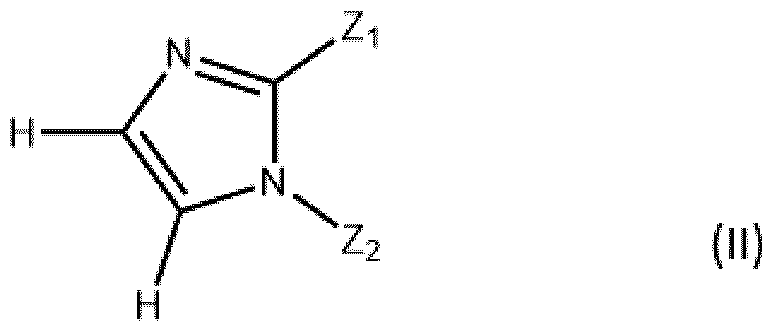
- the 1,3-dipolar compound contains a dipole chosen from a nitrile oxide, a nitrile imine and a nitrone and contains a group of formula (II) in which Zi is identical to Yi of formula (I) and Z2 denotes an attachment to the dipole.
- the dipole is preferably a nitrile oxide.
- the symbol Zi represents a hydrogen atom or a carbon chain which may contain at least one heteroatom, in particular an alkyl, more particularly a C 1 -C 6 alkyl.
- the alkyl group represented by Zi is a methyl.
- the starting diene elastomer is a copolymer of 1,3-butadiene and styrene which contains more than 70 mol% of 1,4-trans chained butadiene units and less than 10 mol% of 1,2-chained butadiene units, the molar percentages of the 1,4-trans chained butadiene units and the 1,2-chained butadiene units being calculated relative to the total number of butadiene units in the starting diene elastomer.
- the starting diene elastomer is a copolymer of 1,3-butadiene and styrene which contains more than 75 mol% of 1,4-trans chained butadiene units and less than 8 mol% of 1,2-chained butadiene units, the molar percentages of the 1,4-trans chained butadiene units and of the styrene units butadiene with a 1,2 chain being calculated relative to the total number of butadiene units in the starting diene elastomer.
- the starting diene elastomer preferably comprises between 5% and 45% by mass of styrene, more preferably between 15% and 40% by mass of styrene, even more preferably between 25% and 35% by mass of styrene.
- the starting diene elastomer can be synthesized according to the process described in patent applications EP 0037617 A1, WO 03037946 A2, WO 2004099277 A1.
- the dipole of the 1,3-dipolar compound typically reacts with the carbon-carbon double bonds of the butadiene units of the starting diene elastomer.
- the 1,3-dipolar compound useful for the purposes of the invention is preferably an aromatic nitrile monooxide, i.e. an aromatic compound which contains a single nitrile oxide dipole, in particular a compound which contains a benzene ring and a single nitrile oxide dipole and in which the benzene ring is substituted by the nitrile oxide dipole.
- the benzene ring is substituted ortho to the dipole.
- the 1,3-dipolar compound contains a unit of formula (III) in which four of the six symbols Ri to Re, identical or different, are each an atom or a group of atoms, knowing that the fifth symbol represents an attachment to the group of formula (II) and the sixth symbol a direct attachment to the dipole.
- the symbols Ri and Rs are both different from a hydrogen atom, which makes it possible to confer greater stability to the 1,3-dipolar compound and thus easier use of the 1,3-dipolar compound.
- the symbols Ri, R3 and R5 each preferably represent a hydrocarbon group, more preferably an alkyl, even more preferably a methyl or an ethyl and one of the symbols R2 and R4 is preferably a hydrogen atom.
- the synthesis of the 1,3-dipolar compound can then be carried out from a relatively easy synthesis route from a commercially available precursor, for example mesitylene, as described in particular in document WO 2015059269.
- the fifth symbol is attached to the group of formula (II) preferably via a group of atoms called a spacer.
- the spacer is preferably a carbon chain which may contain at least one heteroatom.
- the spacer preferably contains 1 to 6 carbon atoms, in particular 1 to 3 carbon atoms.
- the spacer is more preferably an alkanediyl group, better still methanediyl.
- the 1,3-dipolar compound is advantageously the compound 2,4,6-trimethyl-3-((2-methyl-1/7-imidazol-1-yl)methyl)benzo-nitrile oxide of formula (III-a) or the compound 2,4,6-triethyl-3-((2-methyl-1/7-imidazol-1-yl)methyl)benzo-nitrile oxide of formula (III-b), more advantageously the compound of formula (III-a).
- the diene elastomer in accordance with the invention is intended to be used in a rubber composition, in particular a rubber composition for a tire, another subject of the invention.
- the rubber composition also has the essential characteristic of including a reinforcing filler.
- the total rate of the reinforcing filler in the rubber composition can vary to a large extent. It is adjusted according to the use for which the rubber composition is intended, in particular in a tire.
- the total rate of reinforcing filler is preferably between 40 and 80 phr. A rate less than or equal to 40 phr may lead to a reinforcement of the rubber composition after crosslinking which may be considered insufficient for use in a tire tread. A rate greater than or equal to 80 phr may lead to a level of hysteresis which may be considered too high for use in a tread, in particular for a tire intended to equip a heavy goods vehicle or a civil engineering vehicle.
- the reinforcing filler may be any type of so-called reinforcing filler, known for its ability to reinforce a rubber composition that can be used for manufacturing tires, for example carbon black, a reinforcing inorganic filler such as silica with which a coupling agent is associated in a known manner, or a mixture of these two types of filler.
- a reinforcing filler typically consists of nanoparticles whose average size (by mass) is less than a micrometer, generally less than 500 nm, most often between 20 and 200 nm, in particular and more preferably between 20 and 150 nm.
- the reinforcing filler preferably contains a carbon black.
- All carbon blacks are suitable as carbon blacks, in particular conventional blacks. used in tires or their treads (so-called tire grade blacks).
- tire grade blacks we will mention more particularly the reinforcing carbon blacks of the 100, 200, 300 series, or the 500, 600 or 700 series blacks (ASTM grades, also known respectively by the acronyms SAF, ISAF, HAF, FF, GPF and SRF), such as for example blacks N115, N134, N234, N326, N330, N339, N347, N375, N550, N683, N772).
- These carbon blacks can be used in the isolated state, as commercially available, or in any other form, for example as a carrier for certain of the rubber additives used.
- the carbon black preferably represents more than 50% by mass of the reinforcing filler, more preferably more than 90% by mass of the reinforcing filler. According to any one of the embodiments of the invention, the carbon black advantageously represents 100% by mass of the reinforcing filler.
- the rubber composition may comprise an elastomer other than the diene elastomer according to the invention.
- this other elastomer may be an unmodified diene elastomer, for example the starting diene elastomer used in the preparation of the diene elastomer according to the invention.
- the content of the diene elastomer according to the invention in the rubber composition is preferably at least 50 phr, more preferably at least 75 phr, even more preferably at least 90 phr.
- the content of diene elastomer according to the invention in the rubber composition therefore preferably varies from 50 to 100 phr, more preferably from 75 to 100 phr, even more preferably from 90 to 100 phr.
- the higher the content of the diene elastomer according to the invention in the rubber composition the more the resistance to crack propagation of the rubber composition is improved.
- the rubber composition contains a crosslinking system for the diene elastomer according to the invention and, where appropriate, a diene elastomer different from the diene elastomer according to the invention.
- the crosslinking system may be a vulcanization system or may be based on one or more peroxide compounds, for example conventionally used in rubber compositions that can be used for manufacturing tires.
- the crosslinking system is preferably a vulcanization system, i.e. a system based on sulfur (or a sulfur-donating agent) and a primary vulcanization accelerator.
- various known secondary accelerators or vulcanization activators such as zinc oxide, stearic acid or an equivalent compound, guanidine derivatives (in particular diphenylguanidine), or known vulcanization retarders are incorporated during the first non-productive phase and/or during the productive phase as described later.
- Sulfur is used at a preferential rate of between between 0.5 and 5 pce, in particular between 1 and 3 pce.
- the primary vulcanization accelerator is used at a preferential rate of between 0.5 and 5 pce, in particular between 0.5 and 3 pce.
- the rubber composition may further contain other additives known to be used in rubber compositions for tires, such as pigments, processing agents, antiozonants, antioxidants.
- additives known to be used in rubber compositions for tires, such as pigments, processing agents, antiozonants, antioxidants.
- the person skilled in the art will be able to adjust the formulation of the rubber composition according to his particular needs.
- the rubber composition according to the invention is typically manufactured in suitable mixers, using two successive preparation phases well known to those skilled in the art: a first working phase, a thermomechanical kneading step (so-called “non-productive” phase) at high temperature, up to a maximum temperature of between 130°C and 200°C, followed by a second mechanical working phase (so-called “productive” phase) down to a lower temperature, typically below 110°C, for example between 40°C and 100°C, a finishing phase during which the crosslinking system is incorporated.
- the starting diene elastomer being a copolymer of 1,3-butadiene and styrene which contains more than 70 mol% of the 1,4-trans chained butadiene units and less than 10 mol% of the 1,2-chained butadiene units, the molar percentages of the 1,4-trans chained butadiene units and the 1,2-chained butadiene units being calculated relative to the total number of butadiene units in the starting diene elastomer, the 1,3-dipolar compound being as defined above according to any one of the embodiments,
- the contact time between the starting diene elastomer and the 1,3-dipolar compound which are thermomechanically kneaded is adjusted according to the conditions of the thermomechanical kneading, in particular according to the temperature.
- an antioxidant is preferably added to the starting diene elastomer before thermo-mechanically kneading it, in particular at the end of the synthesis of the starting diene elastomer as is done conventionally.
- the final composition thus obtained can then be calendered, for example in the form of a sheet, a plate or even extruded, for example to form a rubber profile used for the manufacture of a semi-finished product, such as for example a tread for a tire.
- the rubber composition according to the invention which may be either in the raw state (before crosslinking or vulcanization) or in the cured state (after crosslinking or vulcanization), can be used in a semi-finished article for a tire.
- the tire contains the rubber composition in its tread.
- Diene elastomer which is a copolymer of 1,3-butadiene and styrene and which is functionalized by pendant imidazole groups of formula (I) in which:
- Yi represents a hydrogen atom or a carbon chain which may contain at least one heteroatom
- Y2 denotes an attachment to a butadiene unit of the diene elastomer, which diene elastomer contains 1,4-trans butadiene units and 1,2-trans butadiene units, the 1,4-trans butadiene units representing more than 70 mol% of the butadiene units of the diene elastomer, the 1,2-trans butadiene units representing less than 10 mol% of the butadiene units of the diene elastomer.
- Mode 2 Diene elastomer according to mode 1 in which the 1,4-trans chained butadiene units represent more than 75 mol% of the butadiene units of the diene elastomer.
- Mode 3 Diene elastomer according to mode 1 or 2 in which the 1,2-chain butadiene units represent less than 8 mol% of the butadiene units of the diene elastomer.
- Mode 4 Diene elastomer according to any one of modes 1 to 3 which contains between 5% and 45% by mass of styrene.
- Mode 5 Diene elastomer according to any one of modes 1 to 4 which contains between 15% and 40% by mass of styrene.
- Mode 6 Diene elastomer according to any one of modes 1 to 5 which contains between 25% and 35% by mass of styrene.
- Mode 7 Diene elastomer according to any one of modes 1 to 6 in which the molar rate of pendant groups of formula (I) is at most 3 mol% of the constituent repeat units of the diene elastomer.
- Mode 8 Diene elastomer according to any one of modes 1 to 7 in which Yi is a hydrogen atom or an alkyl group.
- Mode 9 Diene elastomer according to mode 8 in which the alkyl group represented by Yi contains from 1 to 6 carbon atoms.
- Mode 10 Diene elastomer according to mode 8 or 9 in which the alkyl group represented by Yi is methyl.
- Mode 11 A diene elastomer according to any one of modes 1 to 10 in which the pendant imidazole groups are randomly distributed along the diene elastomer chain.
- Method 12 Diene elastomer according to any one of methods 1 to 11, which diene elastomer is obtained by modification of a starting diene elastomer by a grafting reaction of a 1,3-dipolar compound, the starting diene elastomer being a copolymer of 1,3-butadiene and styrene which contains more than 70 mol% of the 1,4-trans chained butadiene units and less than 10 mol% of the 1,2-chained butadiene units, the molar percentages of the 1,4-trans chained butadiene units and the 1,2-chained butadiene units being calculated relative to the total number of butadiene units in the starting diene elastomer, the 1,3-dipolar compound being a compound containing a dipole chosen from a nitrile oxide, a nitrile imine and a nitrone and containing a group of formula (II) in which Zi represents a
- Mode 13 Diene elastomer according to mode 12 in which the 1,3-dipolar compound is an aromatic compound which contains a single nitrile oxide dipole.
- Mode 14 Diene elastomer according to mode 12 or 13 in which the 1,3-dipolar compound is a compound which contains a benzene ring and which contains a single nitrile oxide dipole and in which the benzene ring is substituted by the nitrile oxide dipole, preferably ortho.
- Mode 15 Diene elastomer according to any one of modes 12 to 14 in which the 1,3-dipolar compound contains a unit of formula (III) in which four of the six symbols Ri to Re, identical or different, are each an atom or a group of atoms, knowing that the fifth symbol represents an attachment to the group of formula (II) and the sixth symbol a direct attachment to the dipole.
- the 1,3-dipolar compound contains a unit of formula (III) in which four of the six symbols Ri to Re, identical or different, are each an atom or a group of atoms, knowing that the fifth symbol represents an attachment to the group of formula (II) and the sixth symbol a direct attachment to the dipole.
- Mode 16 Diene elastomer according to mode 15 in which Re represents a direct attachment to the dipole, the symbols Ri and R5 are both different from a hydrogen atom.
- Mode 17 Diene elastomer according to mode 15 or 16 in which the symbols Ri, R3 and R5 each represent an alkyl.
- Mode 18 Diene elastomer according to any one of modes 15 to 17 in which the symbols R1, R3 and R5 each represent a methyl or ethyl, and one of the symbols R2 and R4 is a hydrogen atom.
- Mode 19 Diene elastomer according to any one of modes 15 to 18 in which the fifth symbol is attached to the group of formula (II) via an alkanediyl group, preferably methanediyl.
- Mode 20 Diene elastomer according to any one of modes 15 to 18 in which the 1,3-dipolar compound is of formula (III-a) or (III-b), preferably (III-a).
- Mode 21 A rubber composition which comprises a diene elastomer which is a copolymer of 1,3-butadiene and styrene and which is functionalized with pendant imidazole groups, a reinforcing filler and a crosslinking system, which diene elastomer is defined in any one of modes 1 to 20.
- Mode 22 Rubber composition according to mode 21 in which the reinforcing filler contains a carbon black.
- Mode 23 Rubber composition according to mode 22 in which the carbon black represents more than 50% by mass of the reinforcing filler.
- Mode 24 Rubber composition according to mode 22 or 23 in which the carbon black represents more than 90% by mass of the reinforcing filler.
- Mode 25 Rubber composition according to any one of modes 21 to 24 in which the total level of reinforcing filler is between 40 and 80 pce.
- Mode 27 A process for preparing a rubber composition defined in any one of modes 21 to 26, which process comprises the following steps:
- the starting diene elastomer being a copolymer of 1,3-butadiene and styrene which contains more than 70 mol% of 1,4-trans chained butadiene units and less than 10 mol% of 1,2-chained butadiene units, the molar percentages of the 1,4-trans chained butadiene units and the 1,2-chained butadiene units being calculated relative to the total number of butadiene units in the starting diene elastomer, the 1,3-dipolar compound being a compound containing a dipole chosen from nitrile oxide, nitrile imine and nitrone and containing a group of formula (II) in which Zi represents a hydrogen atom or a carbon chain which may contain at least one heteroatom and Z2
- Mode 28 Tire comprising a rubber composition preferentially in its tread, which rubber composition is defined in any one of modes 21 to 26 or obtained according to a process defined in mode 27.
- the microstructure is determined by 1 H NMR.
- the molar rate of grafted nitrile oxide compound is also determined by NMR analysis.
- the samples are solubilized in a mixture of carbon disulfide and deuterated benzene (CS2/C6D6 (50/50)) in order to obtain a "lock" signal.
- the spectra are acquired on a 500 MHz BRUKER spectrometer equipped with a "CryoSonde BBFO-zgrad-5 mm".
- the quantitative 1 H NMR experiment uses a single 30° pulse sequence and a 5-second repetition delay between each acquisition. 2D NMR experiments are used to verify the nature of the grafted pattern using the chemical shifts of the carbon and proton atoms.
- the glass transition temperature (Tg) is measured using a differential scanning calorimeter according to ASTM D3418 (1999).
- the cracking rate was measured on rubber composition specimens using a cyclic fatigue machine (“Elastomer Test System”) type 381 from MTS, as explained below.
- compositions T1 to T4 For the manufacture of compositions T1 to T4, the procedure is as follows: the elastomer, then the reinforcing filler, as well as the various other ingredients with the exception of the vulcanization system, are introduced into an internal mixer (final filling rate: approximately 70% by volume), whose initial tank temperature is approximately 80°C. Thermomechanical work (non-productive phase) is then carried out in one step, lasting approximately 5 min to 6 minutes, until a maximum "drop" temperature of 160°C is reached. The mixture thus obtained is recovered, cooled and then incorporated sulfur and a sulfenamide type accelerator on a mixer (homo-finisher) at 23°C, mixing everything (productive phase) for an appropriate time (for example between 5 and 12 min).
- compositions T1 to T4 the procedure is as mentioned for compositions T1 to T4 except that before introducing the reinforcing filler, the 1,3-dipolar compound is introduced which is kneaded alone with the elastomer for 1 minute at 120°C, which makes it possible to functionalize the elastomer with pendant groups of formula (I) before introducing the other ingredients of the rubber composition.
- the rate of 1,3-dipolar compound introduced into the internal mixer to functionalize the elastomer before the introduction of the other ingredients of the rubber composition is shown in Table 1 and is expressed in phr.
- the rate introduced corresponds to a molar rate of modification of 0.5 moles per 100 moles of the monomer units of the functional elastomer.
- compositions thus obtained are then calendered, either in the form of plates (with a thickness ranging from 2 to 3 mm) or thin sheets of rubber, for the measurement of their physical or mechanical properties after vulcanization at 150°C (cooked state), or in the form of profiles directly usable, after cutting and/or assembly to the desired dimensions, for example as semi-finished products for tires, in particular as tire treads.
- Rubber compositions C1 to C4 all contain an elastomer functionalized by imidazole functions, since the elastomer is modified by the 1,3-dipolar compound of formula (III-a).
- Rubber compositions Tl to T4 do not contain any functional elastomer and are the control compositions for compositions C1 to C4 respectively.
- composition C1 contains a diene elastomer in accordance with the invention which is a copolymer of styrene and 1,3-butadiene functionalized by pendant imidazole functions of formula (I) and in which the butadiene units with a 1,4-trans chain represent more than 70 mol% of the butadiene units of the diene elastomer and the butadiene units with a 1,2 chain represent less than 10 mol% of the butadiene units of the diene elastomer.
- Composition C1 is a composition in accordance with the invention.
- Compositions C2 to C4 are not in accordance with the invention.
- composition Cl The highest improvement in crack propagation resistance resulting from functionalization of the diene elastomer is observed for composition Cl. Indeed, compared to its control composition, the resistance to crack propagation is multiplied by a factor of 1.7 while the compositions not in accordance with the invention C2 and C3 which also contain an SBR have their performance much lower than that of their respective control. It is recalled that the composition C1 differs from the compositions C2 and C3 in that the SBR in C1 is an SBR in which the 1,4-trans chain and 1,2-chain butadiene units represent respectively more than 70 mol% and less than 10 mol% of the butadiene units of the elastomer.
- Composition C4 which also contains an elastomer with high stereospecificity, in this case a BR containing more than 98% 1,4-cis bond, has a performance identical to that of its control T4.
Landscapes
- Chemical & Material Sciences (AREA)
- Health & Medical Sciences (AREA)
- Chemical Kinetics & Catalysis (AREA)
- Medicinal Chemistry (AREA)
- Polymers & Plastics (AREA)
- Organic Chemistry (AREA)
- General Chemical & Material Sciences (AREA)
- Engineering & Computer Science (AREA)
- Mechanical Engineering (AREA)
- Compositions Of Macromolecular Compounds (AREA)
- Addition Polymer Or Copolymer, Post-Treatments, Or Chemical Modifications (AREA)
Abstract
Description




Claims


Priority Applications (2)
| Application Number | Priority Date | Filing Date | Title |
|---|---|---|---|
| EP24731953.6A EP4724284A1 (fr) | 2023-06-08 | 2024-06-06 | Elastomère diénique fonctionnel et composition de caoutchouc le contenant |
| CN202480037189.3A CN121263315A (zh) | 2023-06-08 | 2024-06-06 | 官能化二烯弹性体和含有该官能化二烯弹性体的橡胶组合物 |
Applications Claiming Priority (2)
| Application Number | Priority Date | Filing Date | Title |
|---|---|---|---|
| FRFR2305781 | 2023-06-08 | ||
| FR2305781A FR3149608B1 (fr) | 2023-06-08 | 2023-06-08 | Elastomère diénique fonctionnel et composition de caoutchouc le contenant. |
Publications (1)
| Publication Number | Publication Date |
|---|---|
| WO2024251895A1 true WO2024251895A1 (fr) | 2024-12-12 |
Family
ID=87974252
Family Applications (1)
| Application Number | Title | Priority Date | Filing Date |
|---|---|---|---|
| PCT/EP2024/065642 Ceased WO2024251895A1 (fr) | 2023-06-08 | 2024-06-06 | Elastomère diénique fonctionnel et composition de caoutchouc le contenant |
Country Status (4)
| Country | Link |
|---|---|
| EP (1) | EP4724284A1 (fr) |
| CN (1) | CN121263315A (fr) |
| FR (1) | FR3149608B1 (fr) |
| WO (1) | WO2024251895A1 (fr) |
Citations (12)
| Publication number | Priority date | Publication date | Assignee | Title |
|---|---|---|---|---|
| FR2273822A1 (fr) | 1974-06-05 | 1976-01-02 | Michelin & Cie | Polymeres ou copolymeres a composition sterique modifiee, obtenus par mise en oeuvre d'une nouvelle composition catalytique |
| EP0037617A1 (fr) | 1980-04-09 | 1981-10-14 | MICHELIN & CIE (Compagnie Générale des Etablissements Michelin) Société dite: | Procédé de préparation de polymères de diènes conjugués ou de copolymères de diènes conjugués soit entre eux, soit avec un composé vinylaromatique |
| US4785058A (en) * | 1981-05-15 | 1988-11-15 | The Toyo Rubber Industry Co., Ltd. | Compositions for tires |
| WO2003018332A1 (fr) | 2001-08-24 | 2003-03-06 | Societe De Technologie Michelin | Pneu non pneumatique |
| WO2003037946A2 (fr) | 2001-10-31 | 2003-05-08 | Societe De Technologie Michelin | Procede de preparation de copolymeres a blocs pour compositions de bande de roulement de pneumatique |
| US20040060630A1 (en) * | 2002-09-26 | 2004-04-01 | Sandstrom Paul Harry | Tire with rubber sidewall containing trans polybutadiene and brominated copolymer |
| WO2004099277A1 (fr) | 2003-05-07 | 2004-11-18 | Societe De Technologie Michelin | Procede de preparation de copolymeres a blocs pour compositions de bande de roulement de pneumatique, et ces copolymeres |
| FR2898077A1 (fr) | 2006-03-01 | 2007-09-07 | Peugeot Citroen Automobiles Sa | Bandage non pneumatique pour une roue de vehicule, notamment une roue de vehicule automobile |
| US20080216934A1 (en) * | 2007-03-08 | 2008-09-11 | Paul Harry Sandstrom | Tire with sidewall comprised of low viscosity trans 1,4-polybutadiene, cis 1,4-polyisoprene rubber and cis 1,4-polybutadiene rubber |
| WO2015059269A1 (fr) | 2013-10-25 | 2015-04-30 | Compagnie Generale Des Etablissements Michelin | Compose 1,3-dipolaire portant une fonction imidazole |
| FR3097222A1 (fr) * | 2019-06-11 | 2020-12-18 | Compagnie Generale Des Etablissements Michelin | Nouveaux composes 1,3-dipolaires comprenant un heterocycle aromatique et un cycle imidazole |
| US20220235164A1 (en) * | 2019-06-11 | 2022-07-28 | Compagnie Generale Des Etablissements Michelin | Grafted polymer carrying pendent imidazole functional groups |
-
2023
- 2023-06-08 FR FR2305781A patent/FR3149608B1/fr active Active
-
2024
- 2024-06-06 WO PCT/EP2024/065642 patent/WO2024251895A1/fr not_active Ceased
- 2024-06-06 EP EP24731953.6A patent/EP4724284A1/fr active Pending
- 2024-06-06 CN CN202480037189.3A patent/CN121263315A/zh active Pending
Patent Citations (12)
| Publication number | Priority date | Publication date | Assignee | Title |
|---|---|---|---|---|
| FR2273822A1 (fr) | 1974-06-05 | 1976-01-02 | Michelin & Cie | Polymeres ou copolymeres a composition sterique modifiee, obtenus par mise en oeuvre d'une nouvelle composition catalytique |
| EP0037617A1 (fr) | 1980-04-09 | 1981-10-14 | MICHELIN & CIE (Compagnie Générale des Etablissements Michelin) Société dite: | Procédé de préparation de polymères de diènes conjugués ou de copolymères de diènes conjugués soit entre eux, soit avec un composé vinylaromatique |
| US4785058A (en) * | 1981-05-15 | 1988-11-15 | The Toyo Rubber Industry Co., Ltd. | Compositions for tires |
| WO2003018332A1 (fr) | 2001-08-24 | 2003-03-06 | Societe De Technologie Michelin | Pneu non pneumatique |
| WO2003037946A2 (fr) | 2001-10-31 | 2003-05-08 | Societe De Technologie Michelin | Procede de preparation de copolymeres a blocs pour compositions de bande de roulement de pneumatique |
| US20040060630A1 (en) * | 2002-09-26 | 2004-04-01 | Sandstrom Paul Harry | Tire with rubber sidewall containing trans polybutadiene and brominated copolymer |
| WO2004099277A1 (fr) | 2003-05-07 | 2004-11-18 | Societe De Technologie Michelin | Procede de preparation de copolymeres a blocs pour compositions de bande de roulement de pneumatique, et ces copolymeres |
| FR2898077A1 (fr) | 2006-03-01 | 2007-09-07 | Peugeot Citroen Automobiles Sa | Bandage non pneumatique pour une roue de vehicule, notamment une roue de vehicule automobile |
| US20080216934A1 (en) * | 2007-03-08 | 2008-09-11 | Paul Harry Sandstrom | Tire with sidewall comprised of low viscosity trans 1,4-polybutadiene, cis 1,4-polyisoprene rubber and cis 1,4-polybutadiene rubber |
| WO2015059269A1 (fr) | 2013-10-25 | 2015-04-30 | Compagnie Generale Des Etablissements Michelin | Compose 1,3-dipolaire portant une fonction imidazole |
| FR3097222A1 (fr) * | 2019-06-11 | 2020-12-18 | Compagnie Generale Des Etablissements Michelin | Nouveaux composes 1,3-dipolaires comprenant un heterocycle aromatique et un cycle imidazole |
| US20220235164A1 (en) * | 2019-06-11 | 2022-07-28 | Compagnie Generale Des Etablissements Michelin | Grafted polymer carrying pendent imidazole functional groups |
Also Published As
| Publication number | Publication date |
|---|---|
| FR3149608B1 (fr) | 2025-05-23 |
| EP4724284A1 (fr) | 2026-04-15 |
| FR3149608A1 (fr) | 2024-12-13 |
| CN121263315A (zh) | 2026-01-02 |
Similar Documents
| Publication | Publication Date | Title |
|---|---|---|
| EP3864083B1 (fr) | Composition de caoutchouc | |
| EP3877461B1 (fr) | Elastomere dienique fonctionnel et composition de caoutchouc | |
| EP3380556A1 (fr) | Composition de caoutchouc | |
| EP3849822B1 (fr) | Pneumatique | |
| EP3720700A1 (fr) | Stratifié élastomère | |
| EP3703956A1 (fr) | Pneumatique pourvu d'une couche interne a base d'au moins un elastomere isoprenique, une resine renforçante et un sel metallique | |
| EP4436789B1 (fr) | Composition de caoutchouc | |
| EP4724284A1 (fr) | Elastomère diénique fonctionnel et composition de caoutchouc le contenant | |
| EP4267405B1 (fr) | Composition de caoutchouc comprenant une poudrette de caoutchouc | |
| EP4436791A1 (fr) | Composition de caoutchouc | |
| CA3235539A1 (fr) | Composition de caoutchouc | |
| EP3849823A1 (fr) | Composition de caoutchouc | |
| EP4540073B1 (fr) | Composition de caoutchouc diénique comprenant une polynitrone | |
| CA3137509A1 (fr) | Composition de caoutchouc | |
| WO2023247198A1 (fr) | Composition de caoutchouc diénique comportant une microsilice | |
| WO2025186219A1 (fr) | Composition de caoutchouc comprenant un elastomere dienique fortement sature | |
| EP4705116A1 (fr) | Composition de caoutchouc | |
| FR3143035A1 (fr) | Composition de caoutchouc | |
| WO2024231186A1 (fr) | Composition de caoutchouc |
Legal Events
| Date | Code | Title | Description |
|---|---|---|---|
| 121 | Ep: the epo has been informed by wipo that ep was designated in this application |
Ref document number: 24731953 Country of ref document: EP Kind code of ref document: A1 |
|
| WWE | Wipo information: entry into national phase |
Ref document number: 2024731953 Country of ref document: EP |
|
| NENP | Non-entry into the national phase |
Ref country code: DE |
|
| ENP | Entry into the national phase |
Ref document number: 2024731953 Country of ref document: EP Effective date: 20260108 |
|
| ENP | Entry into the national phase |
Ref document number: 2024731953 Country of ref document: EP Effective date: 20260108 |
|
| ENP | Entry into the national phase |
Ref document number: 2024731953 Country of ref document: EP Effective date: 20260108 |
|
| ENP | Entry into the national phase |
Ref document number: 2024731953 Country of ref document: EP Effective date: 20260108 |
|
| ENP | Entry into the national phase |
Ref document number: 2024731953 Country of ref document: EP Effective date: 20260108 |
|
| WWP | Wipo information: published in national office |
Ref document number: 2024731953 Country of ref document: EP |