WO2024252525A1 - Electric vehicle control method and electric vehicle control device - Google Patents
Electric vehicle control method and electric vehicle control device Download PDFInfo
- Publication number
- WO2024252525A1 WO2024252525A1 PCT/JP2023/021026 JP2023021026W WO2024252525A1 WO 2024252525 A1 WO2024252525 A1 WO 2024252525A1 JP 2023021026 W JP2023021026 W JP 2023021026W WO 2024252525 A1 WO2024252525 A1 WO 2024252525A1
- Authority
- WO
- WIPO (PCT)
- Prior art keywords
- upper limit
- battery
- power
- driving force
- mode
- Prior art date
- Legal status (The legal status is an assumption and is not a legal conclusion. Google has not performed a legal analysis and makes no representation as to the accuracy of the status listed.)
- Ceased
Links
Images



Classifications
-
- B—PERFORMING OPERATIONS; TRANSPORTING
- B60—VEHICLES IN GENERAL
- B60L—PROPULSION OF ELECTRICALLY-PROPELLED VEHICLES; SUPPLYING ELECTRIC POWER FOR AUXILIARY EQUIPMENT OF ELECTRICALLY-PROPELLED VEHICLES; ELECTRODYNAMIC BRAKE SYSTEMS FOR VEHICLES IN GENERAL; MAGNETIC SUSPENSION OR LEVITATION FOR VEHICLES; MONITORING OPERATING VARIABLES OF ELECTRICALLY-PROPELLED VEHICLES; ELECTRIC SAFETY DEVICES FOR ELECTRICALLY-PROPELLED VEHICLES
- B60L58/00—Methods or circuit arrangements for monitoring or controlling batteries or fuel cells, specially adapted for electric vehicles
- B60L58/10—Methods or circuit arrangements for monitoring or controlling batteries or fuel cells, specially adapted for electric vehicles for monitoring or controlling batteries
- B60L58/24—Methods or circuit arrangements for monitoring or controlling batteries or fuel cells, specially adapted for electric vehicles for monitoring or controlling batteries for controlling the temperature of batteries
-
- Y—GENERAL TAGGING OF NEW TECHNOLOGICAL DEVELOPMENTS; GENERAL TAGGING OF CROSS-SECTIONAL TECHNOLOGIES SPANNING OVER SEVERAL SECTIONS OF THE IPC; TECHNICAL SUBJECTS COVERED BY FORMER USPC CROSS-REFERENCE ART COLLECTIONS [XRACs] AND DIGESTS
- Y02—TECHNOLOGIES OR APPLICATIONS FOR MITIGATION OR ADAPTATION AGAINST CLIMATE CHANGE
- Y02T—CLIMATE CHANGE MITIGATION TECHNOLOGIES RELATED TO TRANSPORTATION
- Y02T10/00—Road transport of goods or passengers
- Y02T10/60—Other road transportation technologies with climate change mitigation effect
- Y02T10/72—Electric energy management in electromobility
Definitions
- the present invention relates to an electric vehicle control method and an electric vehicle control device.
- JP2008-123773A describes an on-board maximum output display device for an electric vehicle that obtains power from a battery as an output source, which calculates the maximum output value of the battery according to the battery temperature, and calculates the maximum output of at least one of the battery or motor and displays it on a meter inside the vehicle.
- the vehicle driving force is limited by restricting the battery output power so that it does not exceed an upper power limit set from the perspective of heat resistance protection.
- a process heat resistance protection process
- a large difference in driving force occurs, which may cause discomfort to the occupants of the electric vehicle.
- the object of the present invention is therefore to reduce the discomfort felt by occupants when heat-resistant protection processing is performed on the battery.
- an electric vehicle control method that is executed in an electric vehicle that includes a battery and an electric motor that is driven by receiving power from the battery, and that adjusts the vehicle driving force output by the electric vehicle based on an upper limit electric motor torque and an upper limit battery power.
- a first power limit mode or a second power limit mode is selectively executed as a battery heat protection mode that limits the vehicle driving force based on the upper limit battery power.
- the upper limit battery power is calculated using a basic upper limit battery power function.
- the basic upper limit battery power function is defined so that it decreases in response to an increase in battery temperature in a temperature range equal to or higher than a predetermined basic battery protection temperature.
- the upper limit battery power is calculated using a corrected upper limit battery power function.
- the corrected upper limit battery power function is defined so that it decreases at a lower rate of change than the basic upper limit battery power function in response to an increase in battery temperature in a temperature range equal to or higher than a corrected battery protection temperature that is lower than the basic battery protection temperature.
- FIG. 1 is a diagram illustrating a vehicle configuration to which an electric vehicle control method according to an embodiment of the present invention is applied.
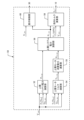
- FIG. 2 is a block diagram illustrating the overall configuration of the electric vehicle control device (controller).
- FIG. 3 is a flowchart showing the overall process of the electric vehicle control method.
- FIG. 4 is a diagram showing an example of an upper limit battery power map.
- FIG. 5 is a diagram showing an example of an upper limit torque map.
- FIG. 6 is a diagram showing an example of the display mode determination map.
- FIG. 7 is a diagram for explaining the effect of setting the upper limit battery power.
- FIG. 8 is a timing chart showing the control results of the first embodiment.
- FIG. 9 is a timing chart showing the control results of the second embodiment.
- FIG. 10 is a diagram showing an example of a control result when the electric vehicle control method according to the second embodiment is executed.
- Fig. 1 is a block diagram illustrating the configuration of an electric vehicle 100 according to this embodiment.
- the electric vehicle 100 is a vehicle equipped with a motor 4 consisting of one or more electric motors (two in Fig. 1) as a driving source for traveling such as an electric vehicle (EV) or a hybrid vehicle (HEV).
- the motor 4 in this embodiment includes a front motor 4f and a rear motor 4r arranged at the front and rear, respectively.
- the electric vehicle 100 includes a front motor unit 10f, a rear motor unit 10r, a battery 20, a display device 30, and a controller 50.
- the front motor unit 10f is mainly configured as a unit including a front inverter 3f and a front motor 4f.
- the front motor 4f operates by receiving power from the battery 20 via the front inverter 3f, and drives the front wheels 9f via the front drive system 5f.
- the front inverter 3f also converts the direct current supplied from the battery 20 into alternating current by turning on/off the switching element in response to a drive signal generated by the controller 50, and adjusts the current supplied to the front motor 4f.
- the rear motor unit 10r is mainly configured as a unit including a rear inverter 3r and a rear motor 4r.
- the rear motor 4r operates by receiving power from the battery 20 via the rear inverter 3r, and drives the rear wheels 9r via the rear drive system 5r.
- the rear inverter 3r converts the direct current supplied from the battery 20 into alternating current by turning on/off the switching element in response to a drive signal generated by the controller 50, and adjusts the current supplied to the rear motor 4r.
- the battery 20 is electrically connected to each front motor 4f and rear motor 4r via the front inverter 3f and rear inverter 3r.
- the front motor unit 10f and rear motor unit 10r will be collectively referred to as the "motor unit 10"
- the front inverter 3f and rear inverter 3r will be collectively referred to as the "inverter 3”
- the front motor 4f and rear motor 4r will be collectively referred to as the "motor 4”.
- the display device 30 is a device for displaying and informing passengers (particularly the driver) of the electric vehicle 100 of specific information.
- the display device 30 is, for example, configured with an instrument panel mounted on the vehicle.
- the display device 30 of this embodiment switches the pop-up display of a specific mark on the instrument panel among a first display (red pop-up display), a second display (yellow pop-up display), and a third display (pop-up off) in response to a command from the controller 50.
- the controller 50 is a control device for the electric vehicle 100, and is an on-board computer consisting of a central processing unit (CPU), read-only memory (ROM), random access memory (RAM), an input/output interface (I/O interface), etc.
- the controller 50 is composed of on-board control units such as a vehicle controller (VC) that manages the processing of each part in the electric vehicle 100, and a motor controller that controls the operation of the motor 4.
- VC vehicle controller
- the controller 50 acquires various input values indicating the vehicle status of the electric vehicle 100 from the sensors 15, and generates a control signal for controlling the motor unit 10 (operating the motor 4) and a control signal for causing the display device 30 to execute a predetermined display.
- the various input values in this embodiment include the accelerator opening APO, the vehicle speed measurement value V_det , the battery temperature measurement value Teb_det , and the motor temperature measurement value Tem_det .
- the accelerator opening APO is a parameter indicating the amount of accelerator pedal operation by the driver of the electric vehicle 100, and is obtained, for example, from a detection value by an accelerator opening sensor (not shown).
- the vehicle speed measurement value V_det is a parameter indicating the current vehicle speed V of the electric vehicle 100, and is obtained, for example, from a detection value by a vehicle speed sensor (not shown).
- the battery temperature measurement value Te b_det is a parameter indicating the current temperature (hereinafter referred to as "battery temperature Te b ") of the battery 20.
- the battery temperature measurement value Te b_det is obtained, for example, from a value detected by a temperature sensor (not shown).
- the motor temperature measurement value Tem_det is a parameter indicating the current temperature (hereinafter referred to as "motor temperature Tem ”) of the motor 4.
- the motor temperature measurement value Tem_det is obtained, for example, from the maximum value among the detection values of the temperature sensors disposed in each of the front motor units 10f and the rear motor unit 10r.
- the controller 50 calculates a basic command torque Tm * that corresponds to a driving force required for the electric vehicle 100, based on the accelerator opening APO and the vehicle speed measurement value V_det . That is, the basic command torque Tm * corresponds to the sum of the torques to be output by the front motor 4f and the rear motor 4r.
- the controller 50 determines the upper limit battery power P b_up and the upper limit motor torque T m_up from the various input values described above, and determines the final command torque T m ** by limiting the basic command torque T m * with the upper limit battery power P b_up and/or the upper limit motor torque T m_up .
- the upper limit battery power Pb_up is an upper limit value of the output power of the battery 20 (hereinafter referred to as "battery power Pb "), which is determined from the viewpoint of heat resistance protection of the battery 20. More specifically, for example, if the battery power Pb becomes excessively high, it is assumed that the amount of heat generated in the battery 20 increases and the battery temperature Teb rises beyond the allowable heat resistance limit. For this reason, the upper limit battery power Pb_up is appropriately determined to limit the battery power Pb , thereby suppressing the temperature rise of the battery 20.
- the upper limit battery power Pb_up is set to a variable value according to the battery temperature Teb , thereby adjusting the degree of limitation on the driving force of the electric vehicle 100 (hereinafter referred to as "vehicle driving force D") according to changes in the battery temperature Teb .
- the controller 50 selectively executes either a first power limit mode or a second power limit mode as a battery heat protection mode that limits the vehicle driving force D based on the upper limit battery power Pb_up .
- the first power limit mode and the second power limit mode will be described in detail later.
- the upper limit motor torque T m_up is an upper limit value of the output torque of the motor 4 (hereinafter referred to as "motor torque T m ”) determined from the viewpoint of heat resistance protection of the motor unit 10.
- the upper limit motor torque T m_up is given as an upper limit value for the combined torque of the front motor 4f and the rear motor 4r.
- the upper limit motor torque T m_up is appropriately determined to limit the motor torque T m , thereby suppressing the temperature rise of the motor unit 10.
- the controller 50 adjusts the degree of limitation on the vehicle driving force D by setting the upper limit motor torque Tm_up to a variable value corresponding to the motor temperature Tem . More specifically, the controller 50 selectively executes either a first torque limit mode or a second torque limit mode as the electric motor thermal protection mode for limiting the vehicle driving force D based on the upper limit motor torque Tm_up .
- the first torque limit mode and the second torque limit mode will be described in detail later.
- the controller 50 operates the front inverter 3f and the rear inverter 3r based on the final command torque Tm ** and an appropriately determined front/rear driving force distribution ratio, and adjusts the power output from the battery 20 to each of the front motor 4f and the rear motor 4r. In this way, the front motor 4f and the rear motor 4r can be operated so as to realize the desired vehicle driving force D.
- the controller 50 refers to multiple thresholds (driving force thresholds C1, C2) related to the upper limit of the vehicle driving force D (hereinafter referred to as the “upper limit vehicle driving force D_up ”) which is determined based on the upper limit battery power Pb_up and the upper limit motor torque Tm_up, determines the corresponding display mode of the display device 30 from the vehicle speed measurement value V_det and the estimated value of the current vehicle driving force D (hereinafter referred to as the "actual vehicle driving force D_det "), and causes the display device 30 to display the determined display mode.
- driving force thresholds C1, C2 related to the upper limit of the vehicle driving force D
- FIG. 2 is a block diagram explaining the overall configuration of the controller 50 according to this embodiment.
- FIG. 3 is a flowchart showing the flow of processing by the controller 50.
- the controller 50 acquires the various input values described above (S100) and executes various calculations (S200 to S650) to control the drive of the motor unit 10 (motor 4) and the display on the display device 30.
- the controller 50 has an upper limit battery power calculation unit 52, an upper limit motor torque calculation unit 54, an upper limit motor power consumption calculation unit 55, an upper limit system power calculation unit 56, a command torque calculation unit 58, and a display control unit 60.
- the upper limit battery power calculation unit 52 receives as input the battery temperature measurement value Te b — det , the vehicle speed measurement value V — det , and the basic upper limit battery power function P 1 [ Teb ] (S100), and calculates the upper limit battery power P b — up (S200).
- the basic upper limit battery power function P1 [ Teb ] is set to a profile that maintains (reserves restriction on) the battery power Pb for ensuring driving performance as much as possible, while strongly restricting the battery power Pb for heat protection when the battery temperature Teb reaches a predetermined basic upper limit value (hereinafter referred to as "basic battery protection temperature Teb_up1 ").
- the basic upper limit battery power function P1 [ Teb ] has a profile that takes a fixed value in a temperature range where the battery temperature Teb is less than the basic battery protection temperature Teb_up1 , and decreases at a predetermined rate of change in a temperature range where the battery temperature Teb is equal to or higher than the basic battery protection temperature Teb_up1 .
- the controller 50 either stores the basic upper limit battery power function P 1 [Te b ] in a predetermined storage area in advance and acquires it by referring to the storage area, or acquires it as an input value from another on-board control device (such as a battery controller).
- the upper limit battery power calculation unit 52 generates an upper limit battery power map that specifies the basic upper limit battery power function P1 [Te b ] and the corrected upper limit battery power function P2 [Te b ], and refers to this to calculate the upper limit battery power Pb_up from the battery temperature measurement value Te b_det and the vehicle speed measurement value V_det .
- Fig. 4 is a diagram showing an example of an upper limit battery power map.
- a corrected upper limit battery power function P2 [Te b ] is defined, in which the rate of change (rate of decrease) varies depending on the magnitude of the vehicle speed V, for a defined basic upper limit battery power function P1 [Te b ].
- the corrected upper limit battery power function P2 [ Teb ] is set to a profile that starts limiting the battery power Pb from a corrected battery protection temperature Teb_up2 that is set lower than the basic battery protection temperature Teb_uP1 , and that reduces the temperature rise of the battery 20 while easing the limiting range.
- the corrected upper limit battery power function P2[ Teb ] has a profile that takes a fixed value in a temperature range where the battery temperature Teb is lower than the corrected battery protection temperature Teb_up2 , and decreases at a lower rate of change than the basic upper limit battery power function P1 [ Teb ] in a temperature range where the battery temperature Teb is equal to or higher than the corrected battery protection temperature Teb_up2 .
- the rate of change (decrease rate) in the corrected upper limit battery power function P2 [ Teb ] is set to be larger as the vehicle speed V is higher.
- the corrected battery protection temperature Teb_up2 is also set as a variable value according to the vehicle speed V. 4, it is preferable that the corrected battery protection temperature Te b_up2 is set to a smaller value as the vehicle speed V increases.
- the corrected battery protection temperature Te b_up2 may be set to the same value regardless of the vehicle speed V.
- the upper limit battery power calculation unit 52 calculates the upper limit battery power Pb_up using either the basic upper limit battery power function P1 [ Teb ] or the corrected upper limit battery power function P2 [ Teb ] depending on whether the vehicle speed measurement value V_det is larger than a predetermined vehicle speed threshold Vth.
- the upper limit battery power calculation unit 52 calculates the upper limit battery power Pb_up by applying the battery temperature measurement value Teb_det to the basic upper limit battery power function P1 [ Teb ] (first power limit mode).
- the upper limit battery power calculation unit 52 calculates the upper limit battery power Pb_up by applying the vehicle speed measurement value V_det and the battery temperature measurement value Teb_det to the corrected upper limit battery power function P2 [ Teb ] (second power limit mode).
- the vehicle speed threshold Vth is set to an appropriate value from the viewpoint of distinguishing between a low-speed driving region where there is likely to be a surplus of battery power Pb relative to the required vehicle driving force D, and a high-speed driving region where there is unlikely to be a surplus of battery power Pb .
- the upper limit motor torque calculation unit 54 receives the motor temperature measurement value Te m_det , the vehicle speed measurement value V_det and the basic upper limit motor torque function T 1 [ Tem ] as input (S100), and calculates the upper limit motor torque T m_up (S300).
- the basic upper limit motor torque function T1 [ Tem ] is set to a profile that maintains (reserves restriction on) the motor torque Tm for ensuring driving performance as much as possible, while strongly restricting the motor torque Tm for heat protection when the motor temperature Tem reaches a predetermined basic upper limit value (hereinafter referred to as "basic motor protection temperature Tem_up1 ").
- the basic upper limit motor torque function T1 [ Tem ] has a profile that takes a fixed value in the region where the motor temperature Tem is equal to or lower than the basic motor protection temperature Tem_up1 , and decreases in the region above this.
- the controller 50 stores the basic upper limit motor torque function T 1 [Te m ] in a predetermined storage area in advance and acquires it by referring to the storage area, or acquires it from another on-board control device (such as a motor unit management controller).
- the upper limit motor torque calculation unit 54 generates an upper limit motor torque map that specifies the basic upper limit motor torque function T1 [ Tem ] and the corrected upper limit motor torque function T2 [ Tem ], and by referring to this, calculates the upper limit motor torque Tm_up from the motor temperature measurement value Tem_det and the vehicle speed measurement value V_det .
- Fig. 5 is a diagram showing an example of an upper limit motor torque map, in which a corrected upper limit motor torque function T2 [ Tem ] whose rate of change (rate of decrease) varies depending on the magnitude of the vehicle speed V is defined for a defined basic upper limit motor torque function T1 [ Tem ].
- the corrected upper limit motor torque function T2 [ Tem ] is set to a profile that suppresses the temperature rise of the motor 4 by starting to limit the motor torque Tm from a corrected motor protection temperature Tem_up2 that is set lower than the basic motor protection temperature Tem_up1 , thereby making the limit width gentler.
- the corrected upper limit motor torque function T2 [ Tem ] has a profile that takes a fixed value in a region where the motor temperature Tem is less than the corrected motor protection temperature Tem_up2 , and decreases at a lower rate of change than the basic upper limit motor torque function T1 [ Tem ] in a temperature region where the motor temperature Tem is equal to or higher than the corrected motor protection temperature Tem_up2 .
- the rate of change (decrease rate) in the corrected upper limit motor torque function T2 [ Tem ] is set to be larger as the vehicle speed V is higher.
- the upper limit motor torque calculation unit 54 determines the upper limit motor torque Tm_up using either the basic upper limit motor torque function T1 [ Tem ] or the corrected upper limit motor torque function T2 [ Tem ] depending on the magnitude between the measured vehicle speed V_det and the vehicle speed threshold Vth.
- the upper limit motor torque calculation unit 54 calculates the upper limit motor torque Tm_up by applying the motor temperature measurement value Tem_det to the basic upper limit motor torque function T1 [ Tem ] (first torque limit mode).
- the upper limit motor torque calculation unit 54 calculates the upper limit motor torque Tm_up by applying the vehicle speed measurement value V_det and the motor temperature measurement value Tem_det to the corrected upper limit motor torque function T2 [ Tem ] (second torque limit mode).
- the upper limit motor power consumption calculation unit 55 performs calculations such as multiplying the upper limit motor torque Tm_up by a predetermined gain to find the upper limit motor power consumption Pm_up .
- the upper limit system power calculation unit 56 calculates the upper limit system power Pv_up based on the upper limit battery power Pb_up and the upper limit motor power consumption Pm_up (S400).
- the upper limit system power Pv_up is the upper limit of the power that can be used (consumed) for driving (traveling) the electric vehicle 100 and for operating the associated accessories.
- the upper limit system power calculation unit 56 determines the upper limit system power Ps_up by performing minimum selection on the upper limit battery power Pb_up and the upper limit motor power consumption Pm_up (S400). That is, the upper limit system power Pv_up calculated in this manner becomes a parameter that indicates the vehicle driving force D that is permissible in consideration of the heat resistance protection of both the battery 20 and the motor 4. Then, the upper limit system power calculation unit 56 outputs the upper limit system power Ps_up to the command torque calculation unit 58 and the display control unit 60.
- the command torque calculation unit 58 calculates the final command torque Tm ** from the basic command torque Tm * determined from the accelerator opening APO, the vehicle speed measurement value V_det , and the upper system power limit Ps_up . More specifically, the command torque calculation unit 58 determines the final command torque Tm ** to be a value obtained by limiting the basic command torque Tm * by the upper system power limit Pv_up (S500).
- the display control unit 60 controls the display mode of the display device 30 based on the vehicle speed measurement value V_det and the upper limit system power Pv_up (S600). More specifically, the display control unit 60 multiplies the upper limit system power Pv_up by a predetermined gain to obtain the upper limit vehicle driving force D_up . Furthermore, the display control unit 60 determines the display mode on the display device 30 from the upper limit vehicle driving force D_up and the vehicle speed measurement value V_det .
- the display mode determination map of this embodiment defines a first driving force threshold C1 when the upper limit vehicle driving force D_up is limited based on the basic upper limit battery power function P1 [ Teb ], and a second driving force threshold C2 when the upper limit vehicle driving force D_up is limited based on the corrected upper limit battery power function P2 [ Teb ].
- the second driving force threshold C2 is defined only in a region where the vehicle speed V is equal to or greater than the vehicle speed threshold Vth .
- the display control unit 60 causes the display device 30 to execute the first display (Yes in S610 in FIG. 3, S630).
- the first driving region is a region where the vehicle speed V is equal to or lower than the vehicle speed threshold Vth and the upper limit vehicle driving force D_up is equal to or higher than the first driving force threshold C1, or where the vehicle speed V is equal to or higher than the vehicle speed threshold Vth and the upper limit vehicle driving force D_up is equal to or higher than the second driving force threshold C2.
- the first display means a display (in this embodiment, a pop-up off) that makes the occupant recognize that the vehicle performance is unlikely to be insufficient (a situation where driving force restriction is unlikely to be applied).
- the display control unit 60 causes the display device 30 to execute the second display (No in S610 and Yes in S620, S640 in FIG. 3).
- the second operating region is a driving region in which the vehicle speed V is equal to or higher than the vehicle speed threshold Vth and the upper limit vehicle driving force D_up is equal to or higher than the first driving force threshold C1 and lower than the second driving force threshold C2.
- the second display is a display mode for making the occupant recognize a situation in which the vehicle driving force D is limited to a certain degree. More specifically, a display (in this embodiment, a yellow pop-up display) that informs the occupant that the driving force is limited to a certain degree is adopted as the second display.
- the display control unit 60 causes the display device 30 to execute the third display (No in S610 and No in S620, S650 in FIG. 3).
- the third operating region is a driving region in which the upper limit vehicle driving force D_up is less than the first driving force threshold C1 in the entire vehicle speed range.
- the third display is a display mode for making the occupant recognize a situation in which the vehicle driving force D is strongly restricted. More specifically, a warning display (in this embodiment, a red pop-up display) is adopted as the third display to inform the occupant that the driving force is strongly restricted.
- the controller 50 controls the motor torque T (vehicle driving force D) using the final command torque Tm ** calculated taking into account the limitation imposed by the upper limit system power Pv_up , while causing the display device 30 to display various display modes based on the upper limit system power Pv_up .
- FIG. 7A and 7B are diagrams for explaining the effects of setting the upper limit battery power Pb_up .
- Fig. 7A shows, with thick solid lines and thin solid lines, the changes over time in the vehicle driving force D , the battery temperature Te b , and the vehicle speed V when the upper limit battery power Pb_up is determined from the basic upper limit battery power function P1 [ Teb ] (when the first power limit mode is executed) and when the upper limit battery power Pb_up is determined from the corrected upper limit battery power function P2 [Teb ] (when the second power limit mode is executed).
- Fig. 7B shows, with thick solid lines and thin solid lines, the changes in G of the electric vehicle 100 in each of the above cases.
- the battery power Pb decreases more gradually from an earlier timing than when the first power limit mode is executed, and accordingly the battery temperature Teb and the vehicle driving force D also decrease more gradually. Therefore, it is possible to obtain the effect of suppressing an increase in the battery temperature Teb while suppressing a step in the vehicle driving force D when the driving force is limited.
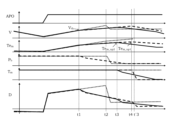
- Example 1 is a timing chart showing the control result of Example 1 according to the electric vehicle control method of the present embodiment.
- Example 1 assumes a control result in which the first power limit mode is executed when the vehicle speed V is less than the vehicle speed threshold Vth , and the second power limit mode is executed when the vehicle speed V is equal to or greater than the vehicle speed threshold Vth .
- the transition of each quantity in the control result of Example 1 is shown by a solid line.
- the transition of each quantity in the control result (Comparative Example 1) in which the first power limit mode is continuously executed regardless of the vehicle speed V is shown by a dotted line.
- the upper limit motor power consumption Pm_up is set constant to simplify the drawing.
- the upper limit battery power Pb_up is determined from the corrected upper limit battery power function P2 [ Teb ] (see FIG. 4). Therefore, when the battery temperature Teb at which the vehicle speed V is equal to or higher than the vehicle speed threshold Vth rises and reaches the corrected battery protection temperature Teb_up2 (time t1), the battery power Pb starts to gradually decrease along the profile of the corrected upper limit battery power function P2 [ Teb ]. Then, with this decrease in the battery power Pb , the vehicle driving force D gradually decreases while the increase in the battery temperature Teb is suppressed.
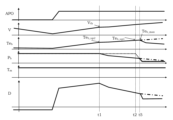
- FIG. 9 is a timing chart showing the control result of Example 2 according to the electric vehicle control method of this embodiment.
- the control mode is selected as in Example 1, and the control result is assumed when the first torque limit mode is executed when the vehicle speed V is less than the vehicle speed threshold Vth , and the second torque limit mode is executed when the vehicle speed V is equal to or greater than the vehicle speed threshold Vth .
- the transition of each amount in the control result of Example 2 is shown by a solid line.
- the transition of each amount in the control result (Comparative Example 2) in the case where the first torque limit mode is continuously executed regardless of the vehicle speed V is shown by a dotted line.
- the control result of Comparative Example 1 (the control result in the case where the first power limit mode is continuously executed regardless of the vehicle speed V) is shown by a dashed line for reference.
- the motor torque Tm starts to gradually decrease along the profile of the corrected upper limit motor torque function T2 [ Tem ]. Then, as the motor torque Tm decreases, the vehicle driving force D gradually decreases and the increase in the motor temperature Tem is suppressed.
- the thermal protection function for both the battery 20 and the motor unit 10 is ensured, and the driving force step is suppressed to reduce the discomfort given to the occupant.
- the suppression of the increase in the motor temperature Tem is started at an earlier timing than in the second comparative example, so that the motor temperature Tem at the time t3 when the restriction is started in the third comparative example is relatively low. This allows the motor temperature Tem to increase, and the upper limit motor torque Tm_up to be increased (after time t'3 in FIG. 9). That is, the limit width (decreasing width) of the vehicle driving force D can be reduced.
- an electric vehicle control method is provided that is executed in an electric vehicle 100 that has a battery 20 and an electric motor (motor 4) that is driven by receiving power supply from the battery 20, and that adjusts the vehicle driving force D output by the electric vehicle 100 based on an upper limit motor torque (upper limit motor torque T m_up ) and an upper limit battery power P b_up .
- either a first power limit mode or a second power limit mode is selectively executed as a battery thermal protection mode that limits the vehicle driving force D based on the upper limit battery power Pb_up .
- the upper limit battery power Pb_up is calculated using a basic upper limit battery power function P1 [ Teb ].
- the basic upper limit battery power function P1 [ Teb ] is determined so as to decrease with an increase in the battery temperature Tb in a temperature range equal to or higher than a predetermined basic battery protection temperature Tb_up1 .
- the upper limit battery power Pb_up is calculated using a corrected upper limit battery power function P2 [ Teb ].
- the corrected upper limit battery power function P2 [ Teb ] is determined so as to decrease at a lower rate of change than the basic upper limit battery power function P1 [ Teb ] in response to an increase in the battery temperature Tb in a temperature range equal to or higher than a corrected battery protection temperature Tb_up2 that is lower than the basic battery protection temperature Tb_up1.
- the vehicle driving force D can be gradually reduced, so that the driving force step can be reduced while suppressing a temperature rise of the battery 20, thereby reducing the discomfort felt by the occupants.
- the current vehicle speed V (measured vehicle speed V_det ) of the electric vehicle 100 is acquired, and when the measured vehicle speed V_det is less than a predetermined vehicle speed threshold Vth , the first power limit mode is selected as the battery heat protection mode. On the other hand, when the measured vehicle speed V_det is equal to or greater than the vehicle speed threshold Vth , the second power limit mode is executed as the control mode.
- the first power limit mode is selected, making it possible to ensure vehicle output performance by minimizing limitations on the vehicle driving force D.
- the second power limit mode is selected, making it possible to suppress steps in the vehicle driving force D while suppressing a rise in temperature of the battery 20.
- the rate of change of the corrected upper limit battery power function P 2 [ Teb ] is increased as the vehicle speed V increases (see FIG. 4).
- display control is executed to switch the display mode displayed to the occupant on the in-vehicle display device 30 with reference to the upper limit vehicle driving force D_up determined from the upper limit battery power Pb_up and the vehicle speed measurement value V_det .
- a first driving force threshold C1 related to the upper limit vehicle driving force D_up is determined based on a basic upper limit battery power function P1 [ Teb ].
- a second driving force threshold C2 related to the upper limit vehicle driving force D_up is determined based on a corrected upper limit battery power function P2 [ Teb ]. Then, when the vehicle speed measurement value V_det is equal to or greater than a predetermined vehicle speed threshold Vth , a first display is executed if the upper limit vehicle driving force D_up is equal to the second driving force threshold C2.
- the upper limit vehicle driving force D_up is equal to or greater than the first driving force threshold C1 and less than the second driving force threshold C2
- a second display different from the first display is executed.
- a third display different from the first and second displays is executed.
- either a first torque limit mode or a second torque limit mode is selectively executed as a motor thermal protection mode for limiting the vehicle driving force D based on the upper limit motor torque Tm_up .
- the upper limit motor torque Tm_up is calculated using a basic upper limit motor torque function (basic upper limit motor torque function T1 [ Tem ]).
- the basic upper limit motor torque function T1 [ Tem ] is determined so as to decrease in accordance with an increase in battery temperature Tb in a temperature range equal to or higher than a predetermined basic motor protection temperature (basic motor protection temperature Tem_up1 ).
- the upper limit motor torque Tm_up is calculated using a corrected upper limit motor torque function (corrected upper limit motor torque function T2 [ Tem ]).
- the corrected upper limit motor torque function T2 [ Tem ] is determined so as to decrease at a lower rate of change than the basic upper limit motor torque function T1 [ Tem ] in response to an increase in battery temperature Tb in a temperature range equal to or higher than a corrected motor protection temperature (corrected motor protection temperature Tem_up2 ) that is lower than the basic motor protection temperature Tem_up1 .
- an electric vehicle control device suitable for executing the above-mentioned electric vehicle control method.
- This controller 50 has a thermal protection control unit (52, 54, 55, 56, 58) that selectively executes either the above-mentioned first power limit mode or the second power limit mode.
- a logic is adopted that, when the battery temperature measurement value Te b_det reaches a predetermined allowable limit value Te max while the controller 50 is executing the second power limit mode as the control mode, forcibly switches the control mode from the second power limit mode to the first power limit mode.
- FIG. 10 is a diagram showing an example of a control result when the electric vehicle control method of this embodiment is executed.
- the control mode is switched from the second power limit mode to the first power limit mode.
- an example of executing the above-mentioned electric vehicle control method is described assuming an electric vehicle 100 that is equipped with a front motor unit 10f (front motor 4f) and a rear motor unit 10r (rear motor 4r) for driving the front wheels 9f and the rear wheels 9r individually.
- a front motor unit 10f front motor 4f
- a rear motor unit 10r rear motor 4r
Landscapes
- Engineering & Computer Science (AREA)
- Life Sciences & Earth Sciences (AREA)
- Sustainable Development (AREA)
- Sustainable Energy (AREA)
- Power Engineering (AREA)
- Transportation (AREA)
- Mechanical Engineering (AREA)
- Electric Propulsion And Braking For Vehicles (AREA)
Abstract
Description
本発明は、電動車両制御方法及び電動車両制御装置に関する。 The present invention relates to an electric vehicle control method and an electric vehicle control device.
JP2008-123773Aには、バッテリを出力源として動力を得る電動車両において、バッテリ温度に応じて当該バッテリの最大出力値を演算し、バッテリ又はモータの内の少なくとも一方の最大出力を演算して車室内のメータに表示させる車載の最大出力表示装置が記載されている。 JP2008-123773A describes an on-board maximum output display device for an electric vehicle that obtains power from a battery as an output source, which calculates the maximum output value of the battery according to the battery temperature, and calculates the maximum output of at least one of the battery or motor and displays it on a meter inside the vehicle.
電動車両では、バッテリの出力電力が耐熱保護の観点から定められた上限電力値を超えないように制限されることで、車両駆動力が制限されることとなる。一方で、高負荷走行時などの高い車両駆動力が要求される走行シーンにおいては、バッテリの最大出力値が継続的に上限電力値付近に維持されて、冷却が追い付かずにバッテリ温度が上昇することが想定される。したがって、この場合には、車両駆動力に対する制限をさらに強めてバッテリ温度の上昇を抑制する処理(耐熱保護処理)が行われる。しかしながら、この耐熱保護処理が実行される際には、大きな駆動力段差が生じるので、電動車両の乗員に違和感を与えるおそれがある。 In electric vehicles, the vehicle driving force is limited by restricting the battery output power so that it does not exceed an upper power limit set from the perspective of heat resistance protection. On the other hand, in driving situations that require high vehicle driving force, such as high-load driving, it is expected that the maximum battery output value will be continuously maintained near the upper power limit, causing the battery temperature to rise without cooling being able to keep up. Therefore, in this case, a process (heat resistance protection process) is performed that further tightens the limit on the vehicle driving force to suppress the rise in battery temperature. However, when this heat resistance protection process is performed, a large difference in driving force occurs, which may cause discomfort to the occupants of the electric vehicle.
したがって、本発明の目的は、バッテリに対する耐熱保護処理が実行される際の乗員に与える違和感を軽減することにある。 The object of the present invention is therefore to reduce the discomfort felt by occupants when heat-resistant protection processing is performed on the battery.
本発明のある態様によれば、バッテリと、バッテリから電力供給を受けて駆動する電動機と、を備えた電動車両において実行され、上限電動機トルク及び上限バッテリ電力に基づいて、電動車両が出力する車両駆動力を調節する電動車両制御方法が提供される。この電動車両制御方法では、上限バッテリ電力に基づいて車両駆動力を制限するバッテリ熱保護モードとして、第1電力制限モード及び第2電力制限モードの何れかを選択的に実行する。 According to one aspect of the present invention, there is provided an electric vehicle control method that is executed in an electric vehicle that includes a battery and an electric motor that is driven by receiving power from the battery, and that adjusts the vehicle driving force output by the electric vehicle based on an upper limit electric motor torque and an upper limit battery power. In this electric vehicle control method, either a first power limit mode or a second power limit mode is selectively executed as a battery heat protection mode that limits the vehicle driving force based on the upper limit battery power.
特に、第1電力制限モードでは、上限バッテリ電力を、基本上限バッテリ電力関数を用いて演算する。なお、基本上限バッテリ電力関数は、所定の基本バッテリ保護温度以上の温度領域においてバッテリ温度の上昇に応じて減少するように定められる。一方、第2電力制限モードでは、上限バッテリ電力を、補正上限バッテリ電力関数を用いて演算する。なお、補正上限バッテリ電力関数は、基本バッテリ保護温度よりも低い補正バッテリ保護温度以上の温度領域において、バッテリ温度の上昇に応じて基本上限バッテリ電力関数よりも低い変化レートで減少するように定められる。 In particular, in the first power limit mode, the upper limit battery power is calculated using a basic upper limit battery power function. The basic upper limit battery power function is defined so that it decreases in response to an increase in battery temperature in a temperature range equal to or higher than a predetermined basic battery protection temperature. On the other hand, in the second power limit mode, the upper limit battery power is calculated using a corrected upper limit battery power function. The corrected upper limit battery power function is defined so that it decreases at a lower rate of change than the basic upper limit battery power function in response to an increase in battery temperature in a temperature range equal to or higher than a corrected battery protection temperature that is lower than the basic battery protection temperature.
以下、添付図面を参照しながら本発明の各実施形態について説明する。 Each embodiment of the present invention will be described below with reference to the attached drawings.
[第1実施形態]
図1は、本実施形態にかかる電動車両100の構成を説明するブロック図である。電動車両100は、電気自動車(EV)やハイブリッド車両(HEV)等の走行駆動源として一又は複数(図1では2つ)の電動機で構成されるモータ4を搭載した車両である。特に、本実施形態におけるモータ4は、それぞれ、前後に配置されたフロントモータ4fと、リアモータ4rと、を含む。
[First embodiment]
Fig. 1 is a block diagram illustrating the configuration of an
より具体的に、電動車両100は、フロントモータユニット10fと、リアモータユニット10rと、バッテリ20と、表示装置30と、コントローラ50と、を備える。
More specifically, the
フロントモータユニット10fは、主に、フロントインバータ3f及びフロントモータ4fを含むユニットとして構成される。特に、フロントモータ4fは、フロントインバータ3fを介してバッテリ20から電力の供給を受けて作動し、フロント駆動系5fを介して前輪9fを駆動する。また、フロントインバータ3fは、コントローラ50が生成する駆動信号に応じてスイッチング素子をオン/オフすることで、バッテリ20から供給される直流電流を交流電流に変換し、フロントモータ4fに供給する電流を調節する。
The
リアモータユニット10rは、主に、リアインバータ3r及びリアモータ4rを含むユニットとして構成される。特に、リアモータ4rは、リアインバータ3rを介してバッテリ20から電力の供給を受けて作動し、リア駆動系5rを介して後輪9rを駆動する。リアインバータ3rは、コントローラ50が生成する駆動信号に応じてスイッチング素子をオン/オフすることで、バッテリ20から供給される直流電流を交流電流に変換し、リアモータ4rに供給する電流を調節する。
The
バッテリ20はフロントインバータ3f及びリアインバータ3rを介して各フロントモータ4f及びリアモータ4rに電気的に接続する。
The battery 20 is electrically connected to each
なお、以下では記載の簡略化のため、適宜、フロント及びリアを包括させた符号を用いて説明を行う。具体的に、フロントモータユニット10f及びリアモータユニット10rを包括させて「モータユニット10」、フロントインバータ3f及びリアインバータ3rを包括させて「インバータ3」、並びにフロントモータ4f及びリアモータ4rを包括させて「モータ4」などと記載する。
In the following, to simplify the description, reference numerals that collectively refer to the front and rear will be used where appropriate. Specifically, the
表示装置30は、電動車両100の乗員(特に運転者)に対して所定の情報を表示して報知するための装置である。表示装置30は、例えば、車載のインストルメントパネルにより構成される。特に、本実施形態の表示装置30は、コントローラ50からの指令に応じて、インストルメントパネル上における所定のマークのポップアップ表示を、第1表示(赤色ポップアップ表示)、第2表示(黄色ポップアップ表示)、及び第3表示(ポップアップオフ)の間で切り替える。
The
コントローラ50は電動車両100の制御装置であり、中央演算装置(CPU)、読み出し専用メモリ(ROM)、ランダムアクセスメモリ(RAM)、入出力インタフェース(I/Oインタフェース)等から構成される車載のコンピュータである。具体的に、コントローラ50は電動車両100における各部の処理を統括する車両コントローラ(VC:Vehicle Controller)及びモータ4の動作を制御するモータコントローラなどの車載の制御ユニットにより構成される。
The
コントローラ50は、センサ類15から電動車両100の車両状況を示す各種入力値を取得し、モータユニット10を制御する(モータ4を作動させる)ための制御信号及び表示装置30に所定の表示を実行させるための制御信号を生成する。特に、本実施形態における各種入力値には、アクセル開度APO、車速計測値V_det、バッテリ温度計測値Teb_det、及びモータ温度計測値Tem_detが含まれる。
The
アクセル開度APOは、電動車両100の運転者によるアクセルペダルへの操作量を示唆するパラメータであり、例えば、図示しないアクセル開度センサによる検出値により得られる。車速計測値V_detは、現在の電動車両100の車速Vを示唆するパラメータであり、図示しない車速センサの検出値などにより得られる。
The accelerator opening APO is a parameter indicating the amount of accelerator pedal operation by the driver of the
バッテリ温度計測値Teb_detは、現在のバッテリ20の温度(以下、「バッテリ温度Teb」と称する)を示唆するパラメータである。バッテリ温度計測値Teb_detは、例えば、図示しない温度センサ検出値などにより得られる。 The battery temperature measurement value Te b_det is a parameter indicating the current temperature (hereinafter referred to as "battery temperature Te b ") of the battery 20. The battery temperature measurement value Te b_det is obtained, for example, from a value detected by a temperature sensor (not shown).
モータ温度計測値Tem_detは、現在のモータ4の温度(以下、「モータ温度Tem」と称する)を示唆するパラメータである。モータ温度計測値Tem_detは、例えば、各フロントモータユニット10f及びリアモータユニット10r内に配置されるそれぞれ配置される温度センサ検出値の内の最大値などにより得られる。
The motor temperature measurement value Tem_det is a parameter indicating the current temperature (hereinafter referred to as "motor temperature Tem ") of the motor 4. The motor temperature measurement value Tem_det is obtained, for example, from the maximum value among the detection values of the temperature sensors disposed in each of the
特に、コントローラ50は、アクセル開度APO及び車速計測値V_detに基づいて、電動車両100に対して要求される駆動力に相当する基本指令トルクTm
*を演算する。すなわち、基本指令トルクTm
*は、フロントモータ4f及びリアモータ4rのそれぞれにより出力すべきトルクの合算値に相当する。
In particular, the
さらに、本実施形態においては、コントローラ50は、上述の各種入力値から上限バッテリ電力Pb_up及び上限モータトルクTm_upを定め、基本指令トルクTm
*を上限バッテリ電力Pb_up及び/又は上限モータトルクTm_upで制限して最終指令トルクTm
**を求める。
Furthermore, in this embodiment, the
ここで、上限バッテリ電力Pb_upは、バッテリ20の耐熱保護の観点から定められる、バッテリ20の出力電力(以下、「バッテリ電力Pb」と称する)の上限値である。より具体的に、例えば、バッテリ電力Pbが過剰に高くなるとバッテリ20における発熱量が大きくなりバッテリ温度Tebが耐熱許容限界を超えて上昇することが想定される。このため、上限バッテリ電力Pb_upを適切に定めてバッテリ電力Pbを制限することで、バッテリ20の昇温を抑制する。 Here, the upper limit battery power Pb_up is an upper limit value of the output power of the battery 20 (hereinafter referred to as "battery power Pb "), which is determined from the viewpoint of heat resistance protection of the battery 20. More specifically, for example, if the battery power Pb becomes excessively high, it is assumed that the amount of heat generated in the battery 20 increases and the battery temperature Teb rises beyond the allowable heat resistance limit. For this reason, the upper limit battery power Pb_up is appropriately determined to limit the battery power Pb , thereby suppressing the temperature rise of the battery 20.
特に、本実施形態では、上限バッテリ電力Pb_upをバッテリ温度Tebに応じた可変値にすることで、当該バッテリ温度Tebの変化に応じて電動車両100の駆動力(以下、「車両駆動力D」と称する)に対する制限度合を調節する。より具体的に、コントローラ50は、上限バッテリ電力Pb_upに基づいて車両駆動力Dを制限するバッテリ熱保護モードとして、第1電力制限モード及び第2電力制限モードの何れかに選択的に実行する。なお、第1電力制限モード及び第2電力制限モードの詳細については後述する。
In particular, in this embodiment, the upper limit battery power Pb_up is set to a variable value according to the battery temperature Teb , thereby adjusting the degree of limitation on the driving force of the electric vehicle 100 (hereinafter referred to as "vehicle driving force D") according to changes in the battery temperature Teb . More specifically, the
また、上限モータトルクTm_upは、モータユニット10の耐熱保護の観点から定められる、モータ4の出力トルク(以下、「モータトルクTm」と称する)の上限値である。特に、上限モータトルクTm_upは、フロントモータ4f及びリアモータ4rの合算トルクに対する上限値として与えられる。上記のように、電動車両100が連続して高負荷にさらされる走行路を走行するシーンでは、バッテリ20だけでなく、モータユニット10の発熱量が大きくなりモータ温度Teが耐熱許容限界を超えて上昇することも想定される。このため、上限モータトルクTm_upを適切に定めてモータトルクTmを制限することで、モータユニット10の昇温を抑制する。
Moreover, the upper limit motor torque T m_up is an upper limit value of the output torque of the motor 4 (hereinafter referred to as "motor torque T m ") determined from the viewpoint of heat resistance protection of the
特に、コントローラ50は、上限モータトルクTm_upをモータ温度Temに応じた可変値にすることで、車両駆動力Dに対する制限度合を調節する。より具体的に、コントローラ50は、上限モータトルクTm_upに基づいて車両駆動力Dを制限する電動機熱保護モードとして、第1トルク制限モード及び第2トルク制限モードの何れかに選択的に実行する。なお、第1トルク制限モード及び第2トルク制限モードの詳細については後述する。
In particular, the
そして、コントローラ50は、最終指令トルクTm
**と、適切に定めた前後駆動力配分比と、に基づいてフロントインバータ3f及びリアインバータ3rを操作し、バッテリ20から各フロントモータ4f及びリアモータ4rに出力する電力を調節する。これにより、所望の車両駆動力Dが実現されるように、フロントモータ4f及びリアモータ4rを動作させることができる。
Then, the
また、コントローラ50は、上限バッテリ電力Pb_up及び上限モータトルクTm_upに基づいて定める車両駆動力Dの上限(以下、「上限車両駆動力D_up」と称する)に関する複数の閾値(駆動力閾値C1,C2)を参照して、車速計測値V_det現在の車両駆動力Dの推定値(以下、「実車両駆動力D_det」と称する)から該当する表示装置30の表示態様を決定し、表示装置30に決定した表示態様を表示させる。
In addition , the
以下では、コントローラ50により実行される各種処理の詳細を説明する。
The various processes executed by the
図2は、本実施形態によるコントローラ50の全体構成を説明するブロック図である。図3は、コントローラ50による処理の流れを示すフローチャートである。本実施形態において、コントローラ50は、上述した各種入力値を取得し(S100)、各種演算(S200~S650)を実行することで、モータユニット10(モータ4)の駆動制御及び表示装置30における表示制御を行う。
FIG. 2 is a block diagram explaining the overall configuration of the
より詳細に、コントローラ50は、上限バッテリ電力演算部52と、上限モータトルク演算部54と、上限モータ消費電力演算部55と、上限システム電力演算部56と、指令トルク演算部58と、表示制御部60と、を有している。
In more detail, the
上限バッテリ電力演算部52は、バッテリ温度計測値Teb_det、車速計測値V_det、及び基本上限バッテリ電力関数P1[Teb]を入力として(S100)、上限バッテリ電力Pb_upを演算する(S200)。
The upper limit battery
ここで、基本上限バッテリ電力関数P1[Teb]は、できるだけ走行性能を確保するためのバッテリ電力Pbを維持(制限を保留)しつつも、バッテリ温度Tebが所定の基本上限値(以下、「基本バッテリ保護温度Teb_up1」と称する)に達した際には耐熱保護のためにバッテリ電力Pbを強く制限するプロファイルに定められる。特に、基本上限バッテリ電力関数P1[Teb]は、バッテリ温度Tebが基本バッテリ保護温度Teb_up1未満となる温度領域では固定値をとり、当該基本バッテリ保護温度Teb_up1以上となる温度領域では所定の変化レートで減少するプロファイルを持つ。 Here, the basic upper limit battery power function P1 [ Teb ] is set to a profile that maintains (reserves restriction on) the battery power Pb for ensuring driving performance as much as possible, while strongly restricting the battery power Pb for heat protection when the battery temperature Teb reaches a predetermined basic upper limit value (hereinafter referred to as "basic battery protection temperature Teb_up1 "). In particular, the basic upper limit battery power function P1 [ Teb ] has a profile that takes a fixed value in a temperature range where the battery temperature Teb is less than the basic battery protection temperature Teb_up1 , and decreases at a predetermined rate of change in a temperature range where the battery temperature Teb is equal to or higher than the basic battery protection temperature Teb_up1 .
なお、コントローラ50は、基本上限バッテリ電力関数P1[Teb]を、所定の記憶領域に予め記憶させておき当該記憶領域を参照して取得するか、他の車載制御装置(バッテリコントローラ等)などからの入力値として取得する。
The
そして、上限バッテリ電力演算部52は、基本上限バッテリ電力関数P1[Teb]及び補正上限バッテリ電力関数P2[Teb]を規定する上限バッテリ電力マップを生成し、これを参照して、バッテリ温度計測値Teb_det及び車速計測値V_detから上限バッテリ電力Pb_upを演算する。
Then, the upper limit battery
図4は、上限バッテリ電力マップの一例を示す図である。図4に示す上限バッテリ電力マップでは、定められた基本上限バッテリ電力関数P1[Teb]に対して、車速Vの大きさに応じて変化レート(減少率)が可変となる補正上限バッテリ電力関数P2[Teb]が定められている。 Fig. 4 is a diagram showing an example of an upper limit battery power map. In the upper limit battery power map shown in Fig. 4, a corrected upper limit battery power function P2 [Te b ] is defined, in which the rate of change (rate of decrease) varies depending on the magnitude of the vehicle speed V, for a defined basic upper limit battery power function P1 [Te b ].
なお、補正上限バッテリ電力関数P2[Teb]は、基本バッテリ保護温度Teb_uP1よりも低く定められた補正バッテリ保護温度Teb_up2からバッテリ電力Pbの制限を開始することで、その制限幅を緩やかにしつつ、バッテリ20の昇温を抑制するプロファイルに定められる。特に、補正上限バッテリ電力関数P2[Teb]は、バッテリ温度Tebが補正バッテリ保護温度Teb_up2未満となる温度領域では固定値をとり、当該補正バッテリ保護温度Teb_up2以上となる温度領域では基本上限バッテリ電力関数P1[Teb]よりも低い変化レートで減少するプロファイルを持つ。また、本実施形態では、補正上限バッテリ電力関数P2[Teb]における変化レート(減少率)は、車速Vが高いほど大きく設定される。さらに、補正バッテリ保護温度Teb_up2も車速Vに応じた可変値として定められる。特に、図4に示すように、補正バッテリ保護温度Teb_up2は、車速Vが大きいほど小さい値に定められることが好ましい。一方で、補正バッテリ保護温度Teb_up2を、車速Vに関わらず同一の値に設定しても良い。 The corrected upper limit battery power function P2 [ Teb ] is set to a profile that starts limiting the battery power Pb from a corrected battery protection temperature Teb_up2 that is set lower than the basic battery protection temperature Teb_uP1 , and that reduces the temperature rise of the battery 20 while easing the limiting range. In particular, the corrected upper limit battery power function P2[ Teb ] has a profile that takes a fixed value in a temperature range where the battery temperature Teb is lower than the corrected battery protection temperature Teb_up2 , and decreases at a lower rate of change than the basic upper limit battery power function P1 [ Teb ] in a temperature range where the battery temperature Teb is equal to or higher than the corrected battery protection temperature Teb_up2 . In this embodiment, the rate of change (decrease rate) in the corrected upper limit battery power function P2 [ Teb ] is set to be larger as the vehicle speed V is higher. Furthermore, the corrected battery protection temperature Teb_up2 is also set as a variable value according to the vehicle speed V. 4, it is preferable that the corrected battery protection temperature Te b_up2 is set to a smaller value as the vehicle speed V increases. On the other hand, the corrected battery protection temperature Te b_up2 may be set to the same value regardless of the vehicle speed V.
そして、上限バッテリ電力演算部52は、車速計測値V_detと予め定めた車速閾値Vthの大小に応じて、基本上限バッテリ電力関数P1[Teb]及び補正上限バッテリ電力関数P2[Teb]の何れかを用いて上限バッテリ電力Pb_upを求める。
Then, the upper limit battery
より具体的に、上限バッテリ電力演算部52は、車速計測値V_detが車速閾値Vth未満である場合には、基本上限バッテリ電力関数P1[Teb]にバッテリ温度計測値Teb_detを適用することで、上限バッテリ電力Pb_upを演算する(第1電力制限モード)。一方、上限バッテリ電力演算部52は、車速計測値V_detが車速閾値Vth以上である場合には、補正上限バッテリ電力関数P2[Teb]に車速計測値V_det及びバッテリ温度計測値Teb_detを適用することで、上限バッテリ電力Pb_upを演算する(第2電力制限モード)。
More specifically, when the vehicle speed measurement value V_det is less than the vehicle speed threshold Vth , the upper limit battery
なお、車速閾値Vthは、要求される車両駆動力Dに対してバッテリ電力Pbの余裕が生じやすい低速走行領域と、バッテリ電力Pbの余裕が生じにくい高速走行領域と、を判別する観点から適切な値に定められる。 The vehicle speed threshold Vth is set to an appropriate value from the viewpoint of distinguishing between a low-speed driving region where there is likely to be a surplus of battery power Pb relative to the required vehicle driving force D, and a high-speed driving region where there is unlikely to be a surplus of battery power Pb .
図2、図3に戻り、上限モータトルク演算部54は、モータ温度計測値Tem_det、車速計測値V_det、及び基本上限モータトルク関数T1[Tem]を入力として(S100)、上限モータトルクTm_upを演算する(S300)。
Returning to Figs. 2 and 3, the upper limit motor
ここで、基本上限モータトルク関数T1[Tem]は、できるだけ走行性能を確保するためのモータトルクTmを維持(制限を保留)しつつも、モータ温度Temが所定の基本上限値(以下、「基本モータ保護温度Tem_up1」と称する)に達した際には耐熱保護のためにモータトルクTmを強く制限するプロファイルに定められる。特に、基本上限モータトルク関数T1[Tem]は、モータ温度Temが基本モータ保護温度Tem_up1以下となる領域では固定値をとり、これを超える領域では減少するプロファイルを持つ。 Here, the basic upper limit motor torque function T1 [ Tem ] is set to a profile that maintains (reserves restriction on) the motor torque Tm for ensuring driving performance as much as possible, while strongly restricting the motor torque Tm for heat protection when the motor temperature Tem reaches a predetermined basic upper limit value (hereinafter referred to as "basic motor protection temperature Tem_up1 "). In particular, the basic upper limit motor torque function T1 [ Tem ] has a profile that takes a fixed value in the region where the motor temperature Tem is equal to or lower than the basic motor protection temperature Tem_up1 , and decreases in the region above this.
なお、コントローラ50は、基本上限モータトルク関数T1[Tem]を、所定の記憶領域に予め記憶させておき当該記憶領域を参照して取得するか、他の車載制御装置(モータユニット管理用コントローラ等)などから取得する。
The
そして、上限モータトルク演算部54は、基本上限モータトルク関数T1[Tem]及び補正上限モータトルク関数T2[Tem]を規定する上限モータトルクマップを生成し、これを参照して、モータ温度計測値Tem_det及び車速計測値V_detから上限モータトルクTm_upを演算する。
Then, the upper limit motor
図5は、上限モータトルクマップの一例を示す図である。図5に示す上限モータトルクマップでは、定められた基本上限モータトルク関数T1[Tem]に対して、車速Vの大きさに応じて変化レート(減少率)が可変となる補正上限モータトルク関数T2[Tem]が定められている。 Fig. 5 is a diagram showing an example of an upper limit motor torque map, in which a corrected upper limit motor torque function T2 [ Tem ] whose rate of change (rate of decrease) varies depending on the magnitude of the vehicle speed V is defined for a defined basic upper limit motor torque function T1 [ Tem ].
なお、補正上限モータトルク関数T2[Tem]は、基本モータ保護温度Tem_up1よりも低く定められた補正モータ保護温度Tem_up2からモータトルクTmの制限を開始することでその制限幅を緩やかにしつつ、モータ4の昇温を抑制するプロファイルに定められる。特に、補正上限モータトルク関数T2[Tem]は、モータ温度Temが補正モータ保護温度Tem_up2未満となる領域では固定値をとり、当該補正モータ保護温度Tem_up2以上となる温度領域では基本上限モータトルク関数T1[Tem]よりも低い変化レートで減少するプロファイルを持つ。また、本実施形態では、補正上限モータトルク関数T2[Tem]における変化レート(減少率)は、車速Vが高いほど大きく設定される。 The corrected upper limit motor torque function T2 [ Tem ] is set to a profile that suppresses the temperature rise of the motor 4 by starting to limit the motor torque Tm from a corrected motor protection temperature Tem_up2 that is set lower than the basic motor protection temperature Tem_up1 , thereby making the limit width gentler. In particular, the corrected upper limit motor torque function T2 [ Tem ] has a profile that takes a fixed value in a region where the motor temperature Tem is less than the corrected motor protection temperature Tem_up2 , and decreases at a lower rate of change than the basic upper limit motor torque function T1 [ Tem ] in a temperature region where the motor temperature Tem is equal to or higher than the corrected motor protection temperature Tem_up2 . In this embodiment, the rate of change (decrease rate) in the corrected upper limit motor torque function T2 [ Tem ] is set to be larger as the vehicle speed V is higher.
そして、上限モータトルク演算部54は、車速計測値V_detと車速閾値Vthの大小に応じて、基本上限モータトルク関数T1[Tem]及び補正上限モータトルク関数T2[Tem]の何れかを用いて上限モータトルクTm_upを求める。
Then, the upper limit motor
より具体的に、上限モータトルク演算部54は、車速計測値V_detが車速閾値Vth未満である場合には、基本上限モータトルク関数T1[Tem]にモータ温度計測値Tem_detを適用することで、上限モータトルクTm_upを演算する(第1トルク制限モード)。一方、上限モータトルク演算部54は、車速計測値V_detが車速閾値Vth以上である場合には、補正上限モータトルク関数T2[Tem]に車速計測値V_det及びモータ温度計測値Tem_detを適用することで、上限モータトルクTm_upを演算する(第2トルク制限モード)。
More specifically, when the vehicle speed measurement value V_det is less than the vehicle speed threshold Vth , the upper limit motor
図2、図3に戻り、上限モータ消費電力演算部55は、上限モータトルクTm_upに所定のゲインを乗じるなどの演算を行うことで、上限モータ消費電力Pm_upを求める。
Returning to Figs. 2 and 3, the upper limit motor power
上限システム電力演算部56は、上限バッテリ電力Pb_up及び上限モータ消費電力Pm_upに基づいて、上限システム電力Pv_upを演算する(S400)。ここで、上限システム電力Pv_upとは、電動車両100の駆動(走行)及び付随する補機類の作動で利用(消費)することのできる電力の上限値である。
The upper limit system
特に、上限システム電力演算部56は、上限バッテリ電力Pb_up及び上限モータ消費電力Pm_upに対してミニマムセレクトを行うことで上限システム電力Ps_upを求める(S400)。すなわち、このように演算された上限システム電力Pv_upは、バッテリ20及びモータ4の双方の耐熱保護を考慮した上で許容される車両駆動力Dを示唆するパラメータとなる。そして、上限システム電力演算部56は、上限システム電力Ps_upを指令トルク演算部58及び表示制御部60に出力する。
In particular, the upper limit system
指令トルク演算部58は、アクセル開度APOから定まる基本指令トルクTm
*、車速計測値V_det、及び上限システム電力Ps_upから、最終指令トルクTm
**を演算する。より具体的に、指令トルク演算部58は、指令トルク演算部58は、基本指令トルクTm
*を上限システム電力Pv_upで制限した値を最終指令トルクTm
**に定める(S500)。
The command
表示制御部60は、車速計測値V_det及び上限システム電力Pv_upに基づいて、表示装置30の表示態様を制御する(S600)。より具体的に、表示制御部60は、上限システム電力Pv_upに所定のゲインを乗じて、上限車両駆動力D_upを求める。さらに、表示制御部60は、上限車両駆動力D_up及び車速計測値V_detから、表示装置30における表示態様を決定する。
The
図6は、表示態様決定マップの一例を示す図である。図示のように、本実施形態の表示態様決定マップでは、上限車両駆動力D_upが基本上限バッテリ電力関数P1[Teb]に基づいて制限される場合の第1駆動力閾値C1と、補正上限バッテリ電力関数P2[Teb]に基づいて制限される場合の第2駆動力閾値C2と、が定められている。特に、第2駆動力閾値C2は、車速Vが車速閾値Vth以上となる領域においてのみ規定されている。 6 is a diagram showing an example of a display mode determination map. As shown in the figure, the display mode determination map of this embodiment defines a first driving force threshold C1 when the upper limit vehicle driving force D_up is limited based on the basic upper limit battery power function P1 [ Teb ], and a second driving force threshold C2 when the upper limit vehicle driving force D_up is limited based on the corrected upper limit battery power function P2 [ Teb ]. In particular, the second driving force threshold C2 is defined only in a region where the vehicle speed V is equal to or greater than the vehicle speed threshold Vth .
そして、表示制御部60は、車速計測値V_det及び上限車両駆動力D_upの組み合わせからなる現在運転点(V_det,D_up)が第1運転領域に含まれる場合には、表示装置30に第1表示を実行させる(図3のS610がYes,S630)。なお、第1運転領域は、車速Vが車速閾値Vth以下であって上限車両駆動力D_upが第1駆動力閾値C1以上となるか、車速Vが車速閾値Vth以上であって上限車両駆動力D_upが第2駆動力閾値C2以上となる領域である。また、第1表示は、乗員に車両性能の不足が生じにくい状況(駆動力制限がかかりにくい状況)であることを認識させる表示(本実施形態では、ポップアップオフ)を意味する。
When the current driving point ( V_det , D_up ) consisting of the combination of the vehicle speed measurement value V_det and the upper limit vehicle driving force D_up is included in the first driving region, the
また、表示制御部60は、電動車両100の現在運転点(V_det,D_up)が第2運転領域に含まれる場合には、表示装置30に第2表示を実行させる(図3のS610がNo且つS620がYes,S640)。なお、第2運転領域は、車速Vが車速閾値Vth以上であって上限車両駆動力D_upが第1駆動力閾値C1以上且つ第2駆動力閾値C2未満となる運転領域である。また、第2表示は、乗員に車両駆動力Dが一定程度制限される状況を認識させるための表示態様である。より具体的に、第2表示としては、一定程度の駆動力制限の下にあることを乗員に知らせる表示(本実施形態では、黄色ポップアップ表示)が採用される。
Furthermore, when the current operating point ( V_det , D_up ) of the
さらに、表示制御部60は、電動車両100の現在運転点(V_det,D_up)が第3運転領域に含まれる場合には、表示装置30に第3表示を実行させる(図3のS610がNo且つS620がNo,S650)。なお、第3運転領域は、全車速域において上限車両駆動力D_upが第1駆動力閾値C1未満となる運転領域である。また、第3表示は、乗員に車両駆動力Dが強く制限される状況を認識させるための表示態様である。より具体的に、第3表示としては、強い駆動力制限の下にあることを乗員に知らせる警告表示(本実施形態では、赤色ポップアップ表示)が採用される。
Furthermore, when the current operating point ( V_det , D_up ) of the
以上説明した制御ロジックにより、コントローラ50は、上限システム電力Pv_upによる制限を加味して演算された最終指令トルクTm
**を用いてモータトルクT(車両駆動力D)を制御する一方で、表示装置30に上限システム電力Pv_upに基づいた各種の表示態様を表示させる。
According to the control logic described above, the
図7は、上限バッテリ電力Pb_upの設定による作用効果を説明する図である。特に図7(A)には、基本上限バッテリ電力関数P1[Teb]から上限バッテリ電力Pb_upを定める場合(第1電力制限モードを実行する場合)、及び補正上限バッテリ電力関数P2[Teb]から上限バッテリ電力Pb_upを定める場合(第2電力制限モードを実行する場合)の車両駆動力D、バッテリ温度Teb、及び車速Vの経時変化をそれぞれ太実線及び細実線で示している。また、図7(B)には、上記各場合における電動車両100のG変化をそれぞれ太実線及び細実線で示している。
7A and 7B are diagrams for explaining the effects of setting the upper limit battery power Pb_up . In particular, Fig. 7A shows, with thick solid lines and thin solid lines, the changes over time in the vehicle driving force D , the battery temperature Te b , and the vehicle speed V when the upper limit battery power Pb_up is determined from the basic upper limit battery power function P1 [ Teb ] (when the first power limit mode is executed) and when the upper limit battery power Pb_up is determined from the corrected upper limit battery power function P2 [Teb ] (when the second power limit mode is executed). Fig. 7B shows, with thick solid lines and thin solid lines, the changes in G of the
図示のように、第2電力制限モードを実行する場合には、第1電力制限モードを実行する場合に比べて、より早いタイミングからバッテリ電力Pbが緩やかに減少するので、これに合わせてバッテリ温度Teb及び車両駆動力Dも緩やかに減少する。このため、駆動力制限時における車両駆動力Dの段差を抑制しつつ、バッテリ温度Tebの上昇抑制効果を得ることができる。 As shown in the figure, when the second power limit mode is executed, the battery power Pb decreases more gradually from an earlier timing than when the first power limit mode is executed, and accordingly the battery temperature Teb and the vehicle driving force D also decrease more gradually. Therefore, it is possible to obtain the effect of suppressing an increase in the battery temperature Teb while suppressing a step in the vehicle driving force D when the driving force is limited.
次に、本実施形態の電動車両制御方法に係る制御ロジックを適用した場合における制御結果の各実施例について説明する。 Next, we will explain examples of control results when the control logic related to the electric vehicle control method of this embodiment is applied.
(実施例1)
図8は、本実施形態の電動車両制御方法に係る実施例1の制御結果を示すタイミングチャートである。特に、実施例1では、制御モードとして、車速Vが車速閾値Vth未満で第1電力制限モード、及び車速Vが車速閾値Vth以上で第2電力制限モードをそれぞれ実行した場合の制御結果を想定する。また、図8では実施例1の制御結果における各量の遷移を実線で示す。さらに、図8においては、車速Vに関わらず、第1電力制限モードを実行し続ける場合の制御結果(比較例1)における各量の遷移を点線で示す。なお、図8では、図面の簡略化のため、上限モータ消費電力Pm_upを一定としている。
Example 1
FIG. 8 is a timing chart showing the control result of Example 1 according to the electric vehicle control method of the present embodiment. In particular, Example 1 assumes a control result in which the first power limit mode is executed when the vehicle speed V is less than the vehicle speed threshold Vth , and the second power limit mode is executed when the vehicle speed V is equal to or greater than the vehicle speed threshold Vth . In addition, in FIG. 8, the transition of each quantity in the control result of Example 1 is shown by a solid line. Furthermore, in FIG. 8, the transition of each quantity in the control result (Comparative Example 1) in which the first power limit mode is continuously executed regardless of the vehicle speed V is shown by a dotted line. In addition, in FIG. 8, the upper limit motor power consumption Pm_up is set constant to simplify the drawing.
図示のように、先ず、比較例1では、バッテリ温度Tebが基本バッテリ保護温度Teb_up1に到達すると(時刻t2)、バッテリ電力Pbが急激に減少を始める。これにより、高いバッテリ温度Tebの上昇抑制効果が得られるものの、車両駆動力Dも急減少するので大きな駆動力段差が生じて電動車両100の乗員(特に運転者)に違和感を与える。
As shown in the figure, first, in Comparative Example 1, when the battery temperature Teb reaches the basic battery protection temperature Teb_up1 (time t2), the battery power Pb starts to decrease rapidly. As a result, although the effect of suppressing the increase in the battery temperature Teb can be obtained, the vehicle driving force D also decreases rapidly, causing a large driving force step, which gives an uncomfortable feeling to the passengers (especially the driver) of the
一方、実施例1では、車速Vが車速閾値Vth以上となる領域において、補正上限バッテリ電力関数P2[Teb]から上限バッテリ電力Pb_upが定められる(図4参照)。このため、車速Vが車速閾値Vth以上となるバッテリ温度Tebが上昇して補正バッテリ保護温度Teb_up2に到達すると(時刻t1)、バッテリ電力Pbが補正上限バッテリ電力関数P2[Teb]のプロファイルに沿って緩やかに減少し始める。そして、このバッテリ電力Pbの減少に伴って、車両駆動力Dが緩やかに減少しつつバッテリ温度Tebの上昇が抑えられる。このため、実施例1の制御では、高車速域における走行シーンで車両駆動力Dを制限する際に、バッテリ20に対する熱保護機能を確保しつつ、駆動力段差を抑制して乗員に与える違和感を低減することができる。特に、実施例1では、比較例1に比べてより早いタイミングでバッテリ温度Tebの上昇抑制が開始されることで、比較例1で制限が開始される時刻t2におけるバッテリ温度Tebが相対的に低くなる。このため、バッテリ温度Tebの上昇代を増やすことができ、上限バッテリ電力Pb_upをより大きくすることができる(図8の時刻t´2以降)。すなわち、車両駆動力Dの制限幅(減少幅)も小さくすることができる。 On the other hand, in the first embodiment, in the region where the vehicle speed V is equal to or higher than the vehicle speed threshold Vth , the upper limit battery power Pb_up is determined from the corrected upper limit battery power function P2 [ Teb ] (see FIG. 4). Therefore, when the battery temperature Teb at which the vehicle speed V is equal to or higher than the vehicle speed threshold Vth rises and reaches the corrected battery protection temperature Teb_up2 (time t1), the battery power Pb starts to gradually decrease along the profile of the corrected upper limit battery power function P2 [ Teb ]. Then, with this decrease in the battery power Pb , the vehicle driving force D gradually decreases while the increase in the battery temperature Teb is suppressed. Therefore, in the control of the first embodiment, when the vehicle driving force D is limited in a driving scene in the high vehicle speed range, it is possible to suppress the driving force step while ensuring the thermal protection function for the battery 20, thereby reducing the discomfort felt by the occupant. In particular, in Example 1, suppression of an increase in the battery temperature Teb is started at an earlier timing than in Comparative Example 1, so that the battery temperature Teb at time t2 when the restriction is started in Comparative Example 1 is relatively low. This makes it possible to increase the increase in the battery temperature Teb and to increase the upper limit battery power Pb_up (after time t'2 in FIG. 8 ). In other words, the restriction range (reduction range) of the vehicle driving force D can also be reduced.
(実施例2)
図9は、本実施形態の電動車両制御方法に係る実施例2の制御結果を示すタイミングチャートである。特に、実施例2では、実施例1と同様に制御モードを選択することを前提として、さらに車速Vが車速閾値Vth未満で第1トルク制限モード、及び車速Vが車速閾値Vth以上で第2トルク制限モードをそれぞれ実行した場合の制御結果を想定する。また、図9では実施例2の制御結果における各量の遷移を実線で示す。さらに、図9においては、車速Vに関わらず、第1トルク制限モードを実行し続ける場合の制御結果(比較例2)における各量の遷移を点線で示す。なお、図9では、参考のため、上記比較例1の制御結果(車速Vに関わらず第1電力制限モードを実行し続ける場合の制御結果)を破線で示す。
Example 2
FIG. 9 is a timing chart showing the control result of Example 2 according to the electric vehicle control method of this embodiment. In particular, in Example 2, the control mode is selected as in Example 1, and the control result is assumed when the first torque limit mode is executed when the vehicle speed V is less than the vehicle speed threshold Vth , and the second torque limit mode is executed when the vehicle speed V is equal to or greater than the vehicle speed threshold Vth . In addition, in FIG. 9, the transition of each amount in the control result of Example 2 is shown by a solid line. Furthermore, in FIG. 9, the transition of each amount in the control result (Comparative Example 2) in the case where the first torque limit mode is continuously executed regardless of the vehicle speed V is shown by a dotted line. In addition, in FIG. 9, the control result of Comparative Example 1 (the control result in the case where the first power limit mode is continuously executed regardless of the vehicle speed V) is shown by a dashed line for reference.
図示のように、先ず、比較例1では、モータ温度Temが基本モータ保護温度Tem_up1に到達すると(時刻t3)、モータトルクTmが急激に減少を始める。これにより、高いモータ温度Temの上昇抑制効果が得られるものの、車両駆動力Dも急減少するので大きな駆動力段差が生じて電動車両100の乗員(特に運転者)に違和感を与える。
As shown in the figure, first, in Comparative Example 1, when the motor temperature Tem reaches the basic motor protection temperature Tem_up1 (time t3), the motor torque Tm starts to decrease rapidly. As a result, although the effect of suppressing the rise in the motor temperature Tem is obtained, the vehicle driving force D also decreases rapidly, causing a large driving force step, which gives an uncomfortable feeling to the passengers (especially the driver) of the
一方、実施例2では、車速Vが車速閾値Vth以上の領域における第2電力制限モードの実行により車両駆動力Dが制限されている状況下(時刻t1以降)において、モータ温度Temが上昇して補正モータ保護温度Tem_up2に到達すると(時刻t3)、モータトルクTmが補正上限モータトルク関数T2[Tem]のプロファイルに沿って緩やかに減少し始める。そして、このモータトルクTmに減少に伴って、車両駆動力Dが緩やかに減少しつつモータ温度Temの上昇が抑えられる。このため、実施例2の制御では、高車速域における走行シーンで車両駆動力Dを制限する際に、バッテリ20及びモータユニット10の双方に対する熱保護機能を確保しつつ、駆動力段差を抑制して乗員に与える違和感を低減することができる。特に、実施例2では、比較例2に比べてより早いタイミングでモータ温度Temの上昇抑制が開始されることで、比較例3で制限が開始される時刻t3におけるモータ温度Temが相対的に低くなる。このため、モータ温度Temの上昇代を増やすことができ、上限モータトルクTm_upをより大きくすることができる(図9の時刻t´3以降)。すなわち、車両駆動力Dの制限幅(減少幅)も小さくすることができる。
On the other hand, in the second embodiment, under the condition that the vehicle driving force D is limited by the execution of the second power limit mode in the region where the vehicle speed V is equal to or higher than the vehicle speed threshold Vth (after time t1), when the motor temperature Tem rises and reaches the corrected motor protection temperature Tem_up2 (time t3), the motor torque Tm starts to gradually decrease along the profile of the corrected upper limit motor torque function T2 [ Tem ]. Then, as the motor torque Tm decreases, the vehicle driving force D gradually decreases and the increase in the motor temperature Tem is suppressed. Therefore, in the control of the second embodiment, when the vehicle driving force D is limited in a driving scene in a high vehicle speed range, the thermal protection function for both the battery 20 and the
以上説明した本実施形態の電動車両制御方法の構成及びそれによる作用効果について説明する。 The configuration of the electric vehicle control method of this embodiment and the resulting effects will now be described.
本実施形態では、バッテリ20と、バッテリ20から電力供給を受けて駆動する電動機(モータ4)と、を備えた電動車両100において実行され、上限電動機トルク(上限モータトルクTm_up)及び上限バッテリ電力Pb_upに基づいて、電動車両100が出力する車両駆動力Dを調節する電動車両制御方法が提供される。
In this embodiment, an electric vehicle control method is provided that is executed in an
この電動車両制御方法では、上限バッテリ電力Pb_upに基づいて車両駆動力Dを制限するバッテリ熱保護モードとして、第1電力制限モード及び第2電力制限モードの何れかを選択的に実行する。特に、第1電力制限モードでは、上限バッテリ電力Pb_upを、基本上限バッテリ電力関数P1[Teb]を用いて演算する。特に、基本上限バッテリ電力関数P1[Teb]は、所定の基本バッテリ保護温度Tb_up1以上の温度領域においてバッテリ温度Tbの上昇に応じて減少するように定められる。 In this electric vehicle control method, either a first power limit mode or a second power limit mode is selectively executed as a battery thermal protection mode that limits the vehicle driving force D based on the upper limit battery power Pb_up . In particular, in the first power limit mode, the upper limit battery power Pb_up is calculated using a basic upper limit battery power function P1 [ Teb ]. In particular, the basic upper limit battery power function P1 [ Teb ] is determined so as to decrease with an increase in the battery temperature Tb in a temperature range equal to or higher than a predetermined basic battery protection temperature Tb_up1 .
一方、第2電力制限モードでは、上限バッテリ電力Pb_upを、補正上限バッテリ電力関数P2[Teb]を用いて演算する。特に、補正上限バッテリ電力関数P2[Teb]は、基本バッテリ保護温度Tb_up1よりも低い補正バッテリ保護温度Tb_up2以上の温度領域において、バッテリ温度Tbの上昇に応じて基本上限バッテリ電力関数P1[Teb]よりも低い変化レートで減少するように定められる。 On the other hand, in the second power limit mode, the upper limit battery power Pb_up is calculated using a corrected upper limit battery power function P2 [ Teb ]. In particular, the corrected upper limit battery power function P2 [ Teb ] is determined so as to decrease at a lower rate of change than the basic upper limit battery power function P1 [ Teb ] in response to an increase in the battery temperature Tb in a temperature range equal to or higher than a corrected battery protection temperature Tb_up2 that is lower than the basic battery protection temperature Tb_up1.
これにより、バッテリ20の耐熱保護を目的として車両駆動力Dを制限するにあたり、バッテリ電力Pbをできるだけ高く維持しつつも所定のタイミングにおいてバッテリ電力Pb(車両駆動力D)に対して強い制限をかける第1電力制限モードと、比較的早いタイミングでバッテリ電力Pb(車両駆動力D)に対する緩やかな制限を開始する第2電力制限モードと、を適宜切り替えることができる。特に、第2電力制限モードが実行される場合には車両駆動力Dを緩やかに減少させることができるので、バッテリ20の温度上昇を抑制しつつも、駆動力段差を小さくして乗員に与える違和感を軽減することができる。 This makes it possible to appropriately switch between a first power limit mode that places a strong limit on the battery power Pb (vehicle driving force D) at a predetermined timing while maintaining the battery power Pb as high as possible, and a second power limit mode that starts to place a gentle limit on the battery power Pb (vehicle driving force D) at a relatively early timing, when limiting the vehicle driving force D for the purpose of protecting the heat resistance of the battery 20. In particular, when the second power limit mode is executed, the vehicle driving force D can be gradually reduced, so that the driving force step can be reduced while suppressing a temperature rise of the battery 20, thereby reducing the discomfort felt by the occupants.
また、本実施形態では、電動車両100の現在の車速V(車速計測値V_det)を取得し、車速計測値V_detが所定の車速閾値Vth未満である場合には、バッテリ熱保護モードとして第1電力制限モードを選択する。一方、車速計測値V_detが車速閾値Vth以上である場合に、車速計測値V_detが車速閾値Vth以上である場合に、制御モードとして第2電力制限モードを実行する。
In this embodiment, the current vehicle speed V (measured vehicle speed V_det ) of the
これにより、求められる車両駆動力Dに対して、上限バッテリ電力Pb_upに余裕が生じやすい低速域においては、第1電力制限モードを選択することで、車両駆動力Dに対する制限ができるだけかからないようにして車両出力性能を確保することができる。一方で、求められる車両駆動力Dに対して上限バッテリ電力Pb_upに余裕が無くなる傾向にある高速域においては、第2電力制限モードを選択することで、バッテリ20の温度上昇を抑制しつつ、車両駆動力Dの段差を抑制することができる。 As a result, in the low speed range where there is likely to be a margin in the upper limit battery power Pb_up relative to the required vehicle driving force D, the first power limit mode is selected, making it possible to ensure vehicle output performance by minimizing limitations on the vehicle driving force D. On the other hand, in the high speed range where there is a tendency for there to be no margin in the upper limit battery power Pb_up relative to the required vehicle driving force D, the second power limit mode is selected, making it possible to suppress steps in the vehicle driving force D while suppressing a rise in temperature of the battery 20.
さらに、本実施形態では、補正上限バッテリ電力関数P2[Teb]の変化レートを、車速Vが高いほど大きくする(図4参照)。 Furthermore, in this embodiment, the rate of change of the corrected upper limit battery power function P 2 [ Teb ] is increased as the vehicle speed V increases (see FIG. 4).
これにより、車速Vの大きさに応じたバッテリ温度Tebの上昇傾向の違いを考慮して、補正上限バッテリ電力関数P2[Teb]のプロファイルを適切に定めることができる。 This makes it possible to appropriately determine the profile of the corrected upper limit battery power function P 2 [ Teb ] by taking into consideration the difference in the increasing tendency of the battery temperature Teb according to the magnitude of the vehicle speed V.
また、本実施形態では、上限バッテリ電力Pb_upから定まる上限車両駆動力D_up及び車速計測値V_detを参照して、車載の表示装置30による乗員への表示態様を切り替える表示制御を実行する。
In this embodiment, display control is executed to switch the display mode displayed to the occupant on the in-
この表示制御では、基本上限バッテリ電力関数P1[Teb]に基づいて、上限車両駆動力D_upに関する第1駆動力閾値C1を定める。また、補正上限バッテリ電力関数P2[Teb]に基づいて、上限車両駆動力D_upに関する第2駆動力閾値C2を定める。そして、車速計測値V_detが所定の車速閾値Vth以上である場合に、上限車両駆動力D_upが第2駆動力閾値C2であると第1表示を実行し、上限車両駆動力D_upが第1駆動力閾値C1以上で且つ第2駆動力閾値C2未満であると第1表示とは異なる態様の第2表示を実行し、上限車両駆動力D_upが第1駆動力閾値C1未満であると、第1表示及び第2表示とは異なる第3表示を実行する。 In this display control, a first driving force threshold C1 related to the upper limit vehicle driving force D_up is determined based on a basic upper limit battery power function P1 [ Teb ]. A second driving force threshold C2 related to the upper limit vehicle driving force D_up is determined based on a corrected upper limit battery power function P2 [ Teb ]. Then, when the vehicle speed measurement value V_det is equal to or greater than a predetermined vehicle speed threshold Vth , a first display is executed if the upper limit vehicle driving force D_up is equal to the second driving force threshold C2. When the upper limit vehicle driving force D_up is equal to or greater than the first driving force threshold C1 and less than the second driving force threshold C2, a second display different from the first display is executed. When the upper limit vehicle driving force D_up is less than the first driving force threshold C1, a third display different from the first and second displays is executed.
これにより、上限バッテリ電力Pb_upに応じた車両駆動力Dに対する制限の度合に応じて、個別の表示態様で表示装置30による表示(乗員への報知)を行うことができる。
This allows the
また、本実施形態では、さらに、上限モータトルクTm_upに基づいて車両駆動力Dを制限する電動機熱保護モードとして、第1トルク制限モード及び第2トルク制限モードの何れかを選択的に実行する。特に、第1トルク制限モードでは、上限モータトルクTm_upを、基本上限電動機トルク関数(基本上限モータトルク関数T1[Tem])を用いて演算する。なお、基本上限モータトルク関数T1[Tem]は、所定の基本電動機保護温度(基本モータ保護温度Tem_up1)以上の温度領域においてバッテリ温度Tbの上昇に応じて減少するように定められる。 Furthermore, in this embodiment, either a first torque limit mode or a second torque limit mode is selectively executed as a motor thermal protection mode for limiting the vehicle driving force D based on the upper limit motor torque Tm_up . In particular, in the first torque limit mode, the upper limit motor torque Tm_up is calculated using a basic upper limit motor torque function (basic upper limit motor torque function T1 [ Tem ]). Note that the basic upper limit motor torque function T1 [ Tem ] is determined so as to decrease in accordance with an increase in battery temperature Tb in a temperature range equal to or higher than a predetermined basic motor protection temperature (basic motor protection temperature Tem_up1 ).
一方、第2トルク制限モードでは、上限モータトルクTm_upを、補正上限電動機トルク関数(補正上限モータトルク関数T2[Tem])を用いて演算する。なお、補正上限モータトルク関数T2[Tem]は、基本モータ保護温度Tem_up1よりも低い補正電動機保護温度(補正モータ保護温度Tem_up2)以上の温度領域において、バッテリ温度Tbの上昇に応じて基本上限モータトルク関数T1[Tem]よりも低い変化レートで減少するように定められる。 On the other hand, in the second torque limit mode, the upper limit motor torque Tm_up is calculated using a corrected upper limit motor torque function (corrected upper limit motor torque function T2 [ Tem ]). The corrected upper limit motor torque function T2 [ Tem ] is determined so as to decrease at a lower rate of change than the basic upper limit motor torque function T1 [ Tem ] in response to an increase in battery temperature Tb in a temperature range equal to or higher than a corrected motor protection temperature (corrected motor protection temperature Tem_up2 ) that is lower than the basic motor protection temperature Tem_up1 .
これにより、上述したバッテリ20の温度上昇を抑制するための車両駆動力Dに対する制限に加えて、モータ4の耐熱保護を考慮した制御ロジックを実現することができる。より具体的には、モータトルクTmをできるだけ高く維持しつつ所定のタイミングにおいてモータトルクTm(車両駆動力D)に対して強い制限をかける第1トルク制限モードと、比較的早いタイミングでモータトルクTm(車両駆動力D)に対する緩やかな制限を開始する第2トルク制限モードと、を適宜切り替えることができる。特に、第2トルク制限モードが実行される場合には車両駆動力Dを緩やかに減少させることができるので、モータ4の温度上昇を抑制しつつも、駆動力段差を小さくして乗員に与える違和感を軽減することができる。 This makes it possible to realize a control logic that takes into consideration the heat resistance protection of the motor 4, in addition to the above-mentioned limitation on the vehicle driving force D to suppress the temperature rise of the battery 20. More specifically, it is possible to appropriately switch between a first torque limit mode that strongly limits the motor torque T m (vehicle driving force D) at a predetermined timing while maintaining the motor torque T m as high as possible, and a second torque limit mode that starts to gently limit the motor torque T m (vehicle driving force D) at a relatively early timing. In particular, when the second torque limit mode is executed, the vehicle driving force D can be gradually reduced, so that the driving force step can be reduced and the discomfort felt by the occupant can be alleviated while suppressing the temperature rise of the motor 4.
さらに、本実施形態では、上述した電動車両制御方法の実行に適した電動車両制御装置(コントローラ50)が提供される。このコントローラ50は、上述した第1電力制限モード及び第2電力制限モードの何れかを選択的に実行する熱保護制御部(52,54,55,56,58)を有する。
Furthermore, in this embodiment, an electric vehicle control device (controller 50) suitable for executing the above-mentioned electric vehicle control method is provided. This
[第2実施形態]
以下、第2実施形態について説明する。なお、第1実施形態と同様の要素には同一の符号を付し、その説明を省略する。
[Second embodiment]
The second embodiment will be described below, in which the same elements as those in the first embodiment are given the same reference numerals and the description thereof will be omitted.
本実施形態の電動車両制御方法では、第1実施形態で説明した制御構成に加えて、コントローラ50が制御モードとして第2電力制限モードの実行している際に、バッテリ温度計測値Teb_detが所定の許容限界値Temaxに到達すると、制御モードを強制的に第2電力制限モードから第1電力制限モードに切り替えるロジックが採用される。
In the electric vehicle control method of this embodiment, in addition to the control configuration described in the first embodiment, a logic is adopted that, when the battery temperature measurement value Te b_det reaches a predetermined allowable limit value Te max while the
図10は、本実施形態の電動車両制御方法を実行した場合の制御結果の一例を示す図である。図示のように、本実施形態では、車速Vが車速閾値Vth以上の領域における第2電力制限モードを実行することで車両駆動力Dが制限されている状況下(時刻t1以降)において、バッテリ温度Tebが許容限界値Temaxに到達すると(時刻t5)、制御モードを第2電力制限モードから第1電力制限モードに切り替える。 10 is a diagram showing an example of a control result when the electric vehicle control method of this embodiment is executed. As shown in the figure, in this embodiment, in a situation (after time t1) in which the vehicle driving force D is limited by executing the second power limit mode in a region in which the vehicle speed V is equal to or higher than the vehicle speed threshold Vth, when the battery temperature Teb reaches the allowable limit value Temax (time t5), the control mode is switched from the second power limit mode to the first power limit mode.
これにより、補正上限バッテリ電力関数P2[Teb]の設定により車両駆動力Dが制限されている状況下であっても、バッテリ温度Tebの昇温抑制効果が不足して許容限界値Temaxに到達し得るシーンにおいては、バッテリ20に対する耐熱保護を優先させて、バッテリ温度Tebをより確実に低下させることができる。 As a result, even in a situation where the vehicle driving force D is limited by setting the corrected upper limit battery power function P2 [ Teb ], in a scene where the effect of suppressing the rise in battery temperature Teb is insufficient and the battery temperature Teb may reach the allowable limit value Temax , heat resistance protection for the battery 20 is prioritized, and the battery temperature Teb can be more reliably reduced.
以上、本発明の各実施形態について説明したが、上記各実施形態で説明した構成は本発明の適用例の一部を示したに過ぎず、本発明の技術的範囲を限定する趣旨ではない。 Although each embodiment of the present invention has been described above, the configurations described in the above embodiments merely represent some of the application examples of the present invention and are not intended to limit the technical scope of the present invention.
例えば、各実施形態では、前輪9f及び後輪9rをそれぞれ個別に駆動するためのフロントモータユニット10f(フロントモータ4f)及びリアモータユニット10r(リアモータ4r)を配置した電動車両100を前提として上述した電動車両制御方法を実行する例について説明した。しかしながら、これに限られず、単一又は3以上の電動機を走行駆動源として搭載した電動車両に対しても、上記各実施形態で説明した制御ロジックを適宜修正しつつ適用することができる。
For example, in each embodiment, an example of executing the above-mentioned electric vehicle control method is described assuming an
Claims (7)
前記上限バッテリ電力に基づいて前記車両駆動力を制限するバッテリ熱保護モードとして、第1電力制限モード及び第2電力制限モードの何れかを選択的に実行し、
前記第1電力制限モードでは、
前記上限バッテリ電力を、基本上限バッテリ電力関数を用いて演算し、
前記基本上限バッテリ電力関数は、所定の基本バッテリ保護温度以上の温度領域においてバッテリ温度の上昇に応じて減少するように定められ、
前記第2電力制限モードでは、
前記上限バッテリ電力を、補正上限バッテリ電力関数を用いて演算し、
前記補正上限バッテリ電力関数は、前記基本バッテリ保護温度よりも低い補正バッテリ保護温度以上の温度領域において、前記バッテリ温度の上昇に応じて前記基本上限バッテリ電力関数よりも低い変化レートで減少するように定められる、
電動車両制御方法。 An electric vehicle control method that is executed in an electric vehicle including a battery and an electric motor that is driven by receiving power supply from the battery, and adjusts a vehicle driving force output by the electric vehicle based on an upper limit electric motor torque and an upper limit battery power,
selectively executing either a first power limit mode or a second power limit mode as a battery heat protection mode in which the vehicle driving force is limited based on the upper limit battery power;
In the first power limiting mode,
Calculating the upper limit battery power using a basic upper limit battery power function;
the basic upper limit battery power function is determined to decrease in accordance with an increase in battery temperature in a temperature region equal to or higher than a predetermined basic battery protection temperature;
In the second power limiting mode,
calculating the upper limit battery power using a corrected upper limit battery power function;
the corrected upper limit battery power function is determined to decrease at a lower rate of change than the basic upper limit battery power function in response to an increase in the battery temperature in a temperature region equal to or higher than a corrected battery protection temperature which is lower than the basic battery protection temperature;
An electric vehicle control method.
前記電動車両の現在の車速を取得し、
現在の前記車速が所定の車速閾値未満である場合には、前記バッテリ熱保護モードとして前記第1電力制限モードを選択し、
現在の前記車速が前記車速閾値以上である場合に、前記バッテリ熱保護モードとして前記第2電力制限モードを選択する、
電動車両制御方法。 2. The electric vehicle control method according to claim 1,
Acquire a current vehicle speed of the electric vehicle;
When the current vehicle speed is less than a predetermined vehicle speed threshold, the first power limiting mode is selected as the battery thermal protection mode;
When the current vehicle speed is equal to or greater than the vehicle speed threshold, the second power limiting mode is selected as the battery thermal protection mode.
An electric vehicle control method.
前記補正上限バッテリ電力関数の変化レートを、車速が高いほど大きく設定する、
電動車両制御方法。 2. The electric vehicle control method according to claim 1,
The rate of change of the corrected upper limit battery power function is set to be larger as the vehicle speed is higher.
An electric vehicle control method.
前記第2電力制限モードの実行している際に、バッテリ温度計測値が所定の許容限界値に到達すると、前記バッテリ熱保護モードを前記第2電力制限モードから前記第1電力制限モードに切り替える、
電動車両制御方法。 2. The electric vehicle control method according to claim 1,
when a battery temperature measurement value reaches a predetermined allowable limit value while the second power limit mode is being executed, the battery thermal protection mode is switched from the second power limit mode to the first power limit mode.
An electric vehicle control method.
前記上限バッテリ電力から定まる上限車両駆動力及び現在の車速を参照して、車載の表示装置による乗員への表示態様を切り替える表示制御を実行し、
前記表示制御では、
前記基本上限バッテリ電力関数に基づいて、前記上限車両駆動力に関する第1駆動力閾値を定め、
前記補正上限バッテリ電力関数に基づいて、前記上限車両駆動力に関する第2駆動力閾値を定め、
現在の前記車速が所定の車速閾値以上である場合に、
前記上限車両駆動力が前記第2駆動力閾値以上であると、第1表示を実行し、
前記上限車両駆動力が前記第1駆動力閾値以上で且つ前記第2駆動力閾値未満であると、前記第1表示とは異なる態様の第2表示を実行し、
前記上限車両駆動力が前記第1駆動力閾値未満であると、前記第1表示及び前記第2表示とは異なる第3表示を実行する、
電動車両制御方法。 2. The electric vehicle control method according to claim 1,
executes a display control for switching a display mode for a passenger on an in-vehicle display device by referring to an upper limit vehicle driving force determined from the upper limit battery power and a current vehicle speed;
In the display control,
determining a first driving force threshold for the upper limit vehicle driving force based on the basic upper limit battery power function;
determining a second driving force threshold for the upper limit vehicle driving force based on the corrected upper limit battery power function;
When the current vehicle speed is equal to or greater than a predetermined vehicle speed threshold,
When the upper limit vehicle driving force is equal to or greater than the second driving force threshold, a first display is executed,
When the upper limit vehicle driving force is equal to or greater than the first driving force threshold and is less than the second driving force threshold, a second display is executed in a manner different from the first display.
When the upper limit vehicle driving force is less than the first driving force threshold, a third display different from the first display and the second display is executed.
An electric vehicle control method.
さらに、前記上限電動機トルクに基づいて前記車両駆動力を制限する電動機熱保護モードとして、第1トルク制限モード及び第2トルク制限モードの何れかを選択的に実行し、
前記第1トルク制限モードでは、
前記上限電動機トルクを、基本上限電動機トルク関数を用いて演算し、
前記基本上限電動機トルク関数は、所定の基本電動機保護温度以上の温度領域において前記バッテリ温度の上昇に応じて減少するように定められ、
前記第2トルク制限モードでは、
前記上限電動機トルクを、補正上限電動機トルク関数を用いて演算し、
前記補正上限電動機トルク関数は、前記基本電動機保護温度よりも低い補正電動機保護温度以上の温度領域において、前記バッテリ温度の上昇に応じて前記基本上限電動機トルク関数よりも低い変化レートで減少するように定められる、
電動車両制御方法。 2. The electric vehicle control method according to claim 1,
and selectively executing either a first torque limit mode or a second torque limit mode as an electric motor thermal protection mode in which the vehicle driving force is limited based on the upper limit electric motor torque.
In the first torque limit mode,
The upper limit motor torque is calculated using a basic upper limit motor torque function;
the basic upper limit motor torque function is determined to decrease in accordance with an increase in the battery temperature in a temperature region equal to or higher than a predetermined basic motor protection temperature,
In the second torque limit mode,
The upper limit motor torque is calculated using a corrected upper limit motor torque function;
the corrected upper limit motor torque function is determined to decrease at a lower rate of change than the basic upper limit motor torque function in response to an increase in the battery temperature in a temperature region equal to or higher than a corrected motor protection temperature which is lower than the basic motor protection temperature.
An electric vehicle control method.
前記上限バッテリ電力に基づいて前記車両駆動力を制限するバッテリ熱保護モードとして、第1電力制限モード及び第2電力制限モードの何れかを選択的に実行する熱保護制御部を有し、
前記第1電力制限モードでは、
前記上限バッテリ電力を、基本上限バッテリ電力関数を用いて演算し、
前記基本上限バッテリ電力関数は、所定の基本バッテリ保護温度以上の温度領域においてバッテリ温度の上昇に応じて減少するように定められ、
前記第2電力制限モードでは、
前記上限バッテリ電力を、補正上限バッテリ電力関数を用いて演算し、
前記補正上限バッテリ電力関数は、前記基本バッテリ保護温度よりも低い補正バッテリ保護温度以上の温度領域において、前記バッテリ温度の上昇に応じて前記基本上限バッテリ電力関数よりも低い変化レートで減少するように定められる、
電動車両制御装置。 An electric vehicle control device is provided in an electric vehicle including a battery and an electric motor that is driven by receiving power supply from the battery, and adjusts a vehicle driving force output by the electric vehicle based on an upper limit electric motor torque and an upper limit battery power,
a thermal protection control unit that selectively executes either a first power limit mode or a second power limit mode as a battery thermal protection mode that limits the vehicle driving force based on the upper limit battery power,
In the first power limiting mode,
Calculating the upper limit battery power using a basic upper limit battery power function;
the basic upper limit battery power function is determined to decrease in accordance with an increase in battery temperature in a temperature region equal to or higher than a predetermined basic battery protection temperature;
In the second power limiting mode,
calculating the upper limit battery power using a corrected upper limit battery power function;
the corrected upper limit battery power function is determined to decrease at a lower rate of change than the basic upper limit battery power function in response to an increase in the battery temperature in a temperature region equal to or higher than a corrected battery protection temperature which is lower than the basic battery protection temperature;
Electric vehicle control device.
Priority Applications (4)
| Application Number | Priority Date | Filing Date | Title |
|---|---|---|---|
| CN202380098389.5A CN121127390A (en) | 2023-06-06 | 2023-06-06 | Electric vehicle control methods and electric vehicle control devices |
| JP2025525497A JPWO2024252525A1 (en) | 2023-06-06 | 2023-06-06 | |
| EP23940630.9A EP4725756A1 (en) | 2023-06-06 | 2023-06-06 | Electric vehicle control method and electric vehicle control device |
| PCT/JP2023/021026 WO2024252525A1 (en) | 2023-06-06 | 2023-06-06 | Electric vehicle control method and electric vehicle control device |
Applications Claiming Priority (1)
| Application Number | Priority Date | Filing Date | Title |
|---|---|---|---|
| PCT/JP2023/021026 WO2024252525A1 (en) | 2023-06-06 | 2023-06-06 | Electric vehicle control method and electric vehicle control device |
Publications (1)
| Publication Number | Publication Date |
|---|---|
| WO2024252525A1 true WO2024252525A1 (en) | 2024-12-12 |
Family
ID=93795365
Family Applications (1)
| Application Number | Title | Priority Date | Filing Date |
|---|---|---|---|
| PCT/JP2023/021026 Ceased WO2024252525A1 (en) | 2023-06-06 | 2023-06-06 | Electric vehicle control method and electric vehicle control device |
Country Status (4)
| Country | Link |
|---|---|
| EP (1) | EP4725756A1 (en) |
| JP (1) | JPWO2024252525A1 (en) |
| CN (1) | CN121127390A (en) |
| WO (1) | WO2024252525A1 (en) |
Citations (4)
| Publication number | Priority date | Publication date | Assignee | Title |
|---|---|---|---|---|
| JP2008123773A (en) | 2006-11-10 | 2008-05-29 | Mitsubishi Motors Corp | Maximum output display device |
| JP2012090416A (en) * | 2010-10-19 | 2012-05-10 | Nissan Motor Co Ltd | Electric vehicle control device |
| JP2013184519A (en) * | 2012-03-07 | 2013-09-19 | Nissan Motor Co Ltd | Control device of hybrid vehicle |
| JP2020184857A (en) * | 2019-05-09 | 2020-11-12 | 日野自動車株式会社 | Vehicle control device |
-
2023
- 2023-06-06 WO PCT/JP2023/021026 patent/WO2024252525A1/en not_active Ceased
- 2023-06-06 EP EP23940630.9A patent/EP4725756A1/en active Pending
- 2023-06-06 JP JP2025525497A patent/JPWO2024252525A1/ja active Pending
- 2023-06-06 CN CN202380098389.5A patent/CN121127390A/en active Pending
Patent Citations (4)
| Publication number | Priority date | Publication date | Assignee | Title |
|---|---|---|---|---|
| JP2008123773A (en) | 2006-11-10 | 2008-05-29 | Mitsubishi Motors Corp | Maximum output display device |
| JP2012090416A (en) * | 2010-10-19 | 2012-05-10 | Nissan Motor Co Ltd | Electric vehicle control device |
| JP2013184519A (en) * | 2012-03-07 | 2013-09-19 | Nissan Motor Co Ltd | Control device of hybrid vehicle |
| JP2020184857A (en) * | 2019-05-09 | 2020-11-12 | 日野自動車株式会社 | Vehicle control device |
Also Published As
| Publication number | Publication date |
|---|---|
| EP4725756A1 (en) | 2026-04-15 |
| JPWO2024252525A1 (en) | 2024-12-12 |
| CN121127390A (en) | 2025-12-12 |
Similar Documents
| Publication | Publication Date | Title |
|---|---|---|
| JP4751854B2 (en) | Vehicle control device, control method, program for realizing the method, and recording medium recording the program | |
| EP2781721B1 (en) | Vehicle control device, vehicle, and vehicle control method | |
| US20130015791A1 (en) | Regeneration control device of electrically powered vehicle | |
| CN111824114B (en) | Vehicle and control method thereof | |
| JP3200885B2 (en) | Battery-compatible electric vehicle controller | |
| JP2003304604A (en) | Motor control device and method | |
| JP7183614B2 (en) | Drive control device for vehicle drive system | |
| JP7363702B2 (en) | motor drive device | |
| JPH10248106A (en) | Electric vehicle control device | |
| WO2024252525A1 (en) | Electric vehicle control method and electric vehicle control device | |
| US12162473B2 (en) | Driving force control method and driving force control device | |
| JP2006275019A (en) | Control device for hybrid vehicle | |
| JP2006115664A (en) | DRIVE DEVICE, VEHICLE MOUNTING THE SAME, AND DRIVE DEVICE CONTROL METHOD | |
| JPH099411A (en) | Motor control device for running electric vehicle | |
| JP2008279980A (en) | Vehicle power supply control device | |
| JP2013129299A (en) | Electric vehicle | |
| JP2013090451A (en) | Electric vehicle | |
| JP5668869B2 (en) | VEHICLE DRIVE CONTROL DEVICE AND VEHICLE DRIVE CONTROL METHOD | |
| JP5125153B2 (en) | Motor control device | |
| JP7263946B2 (en) | vehicle | |
| US10654485B2 (en) | Controller for vehicle and information providing method | |
| JP4305409B2 (en) | Vehicle drive control device | |
| JP2005143183A (en) | Vehicle drive device | |
| US20240190291A1 (en) | Control device for vehicle | |
| CN110978937A (en) | Power control device and power control method for vehicle |
Legal Events
| Date | Code | Title | Description |
|---|---|---|---|
| 121 | Ep: the epo has been informed by wipo that ep was designated in this application |
Ref document number: 23940630 Country of ref document: EP Kind code of ref document: A1 |
|
| ENP | Entry into the national phase |
Ref document number: 2025525497 Country of ref document: JP Kind code of ref document: A |
|
| WWE | Wipo information: entry into national phase |
Ref document number: 2023940630 Country of ref document: EP |
|
| NENP | Non-entry into the national phase |
Ref country code: DE |
|
| ENP | Entry into the national phase |
Ref document number: 2023940630 Country of ref document: EP Effective date: 20260107 |
|
| ENP | Entry into the national phase |
Ref document number: 2023940630 Country of ref document: EP Effective date: 20260107 |
|
| ENP | Entry into the national phase |
Ref document number: 2023940630 Country of ref document: EP Effective date: 20260107 |
|
| ENP | Entry into the national phase |
Ref document number: 2023940630 Country of ref document: EP Effective date: 20260107 |
|
| ENP | Entry into the national phase |
Ref document number: 2023940630 Country of ref document: EP Effective date: 20260107 |
|
| WWP | Wipo information: published in national office |
Ref document number: 2023940630 Country of ref document: EP |