WO2024252525A1 - 電動車両制御方法及び電動車両制御装置 - Google Patents
電動車両制御方法及び電動車両制御装置 Download PDFInfo
- Publication number
- WO2024252525A1 WO2024252525A1 PCT/JP2023/021026 JP2023021026W WO2024252525A1 WO 2024252525 A1 WO2024252525 A1 WO 2024252525A1 JP 2023021026 W JP2023021026 W JP 2023021026W WO 2024252525 A1 WO2024252525 A1 WO 2024252525A1
- Authority
- WO
- WIPO (PCT)
- Prior art keywords
- upper limit
- battery
- power
- driving force
- mode
- Prior art date
- Legal status (The legal status is an assumption and is not a legal conclusion. Google has not performed a legal analysis and makes no representation as to the accuracy of the status listed.)
- Ceased
Links
Images



Classifications
-
- B—PERFORMING OPERATIONS; TRANSPORTING
- B60—VEHICLES IN GENERAL
- B60L—PROPULSION OF ELECTRICALLY-PROPELLED VEHICLES; SUPPLYING ELECTRIC POWER FOR AUXILIARY EQUIPMENT OF ELECTRICALLY-PROPELLED VEHICLES; ELECTRODYNAMIC BRAKE SYSTEMS FOR VEHICLES IN GENERAL; MAGNETIC SUSPENSION OR LEVITATION FOR VEHICLES; MONITORING OPERATING VARIABLES OF ELECTRICALLY-PROPELLED VEHICLES; ELECTRIC SAFETY DEVICES FOR ELECTRICALLY-PROPELLED VEHICLES
- B60L58/00—Methods or circuit arrangements for monitoring or controlling batteries or fuel cells, specially adapted for electric vehicles
- B60L58/10—Methods or circuit arrangements for monitoring or controlling batteries or fuel cells, specially adapted for electric vehicles for monitoring or controlling batteries
- B60L58/24—Methods or circuit arrangements for monitoring or controlling batteries or fuel cells, specially adapted for electric vehicles for monitoring or controlling batteries for controlling the temperature of batteries
-
- Y—GENERAL TAGGING OF NEW TECHNOLOGICAL DEVELOPMENTS; GENERAL TAGGING OF CROSS-SECTIONAL TECHNOLOGIES SPANNING OVER SEVERAL SECTIONS OF THE IPC; TECHNICAL SUBJECTS COVERED BY FORMER USPC CROSS-REFERENCE ART COLLECTIONS [XRACs] AND DIGESTS
- Y02—TECHNOLOGIES OR APPLICATIONS FOR MITIGATION OR ADAPTATION AGAINST CLIMATE CHANGE
- Y02T—CLIMATE CHANGE MITIGATION TECHNOLOGIES RELATED TO TRANSPORTATION
- Y02T10/00—Road transport of goods or passengers
- Y02T10/60—Other road transportation technologies with climate change mitigation effect
- Y02T10/72—Electric energy management in electromobility
Definitions
- the present invention relates to an electric vehicle control method and an electric vehicle control device.
- JP2008-123773A describes an on-board maximum output display device for an electric vehicle that obtains power from a battery as an output source, which calculates the maximum output value of the battery according to the battery temperature, and calculates the maximum output of at least one of the battery or motor and displays it on a meter inside the vehicle.
- the vehicle driving force is limited by restricting the battery output power so that it does not exceed an upper power limit set from the perspective of heat resistance protection.
- a process heat resistance protection process
- a large difference in driving force occurs, which may cause discomfort to the occupants of the electric vehicle.
- the object of the present invention is therefore to reduce the discomfort felt by occupants when heat-resistant protection processing is performed on the battery.
- an electric vehicle control method that is executed in an electric vehicle that includes a battery and an electric motor that is driven by receiving power from the battery, and that adjusts the vehicle driving force output by the electric vehicle based on an upper limit electric motor torque and an upper limit battery power.
- a first power limit mode or a second power limit mode is selectively executed as a battery heat protection mode that limits the vehicle driving force based on the upper limit battery power.
- the upper limit battery power is calculated using a basic upper limit battery power function.
- the basic upper limit battery power function is defined so that it decreases in response to an increase in battery temperature in a temperature range equal to or higher than a predetermined basic battery protection temperature.
- the upper limit battery power is calculated using a corrected upper limit battery power function.
- the corrected upper limit battery power function is defined so that it decreases at a lower rate of change than the basic upper limit battery power function in response to an increase in battery temperature in a temperature range equal to or higher than a corrected battery protection temperature that is lower than the basic battery protection temperature.
- FIG. 1 is a diagram illustrating a vehicle configuration to which an electric vehicle control method according to an embodiment of the present invention is applied.
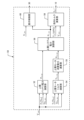
- FIG. 2 is a block diagram illustrating the overall configuration of the electric vehicle control device (controller).
- FIG. 3 is a flowchart showing the overall process of the electric vehicle control method.
- FIG. 4 is a diagram showing an example of an upper limit battery power map.
- FIG. 5 is a diagram showing an example of an upper limit torque map.
- FIG. 6 is a diagram showing an example of the display mode determination map.
- FIG. 7 is a diagram for explaining the effect of setting the upper limit battery power.
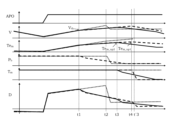
- FIG. 8 is a timing chart showing the control results of the first embodiment.
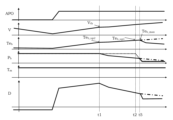
- FIG. 9 is a timing chart showing the control results of the second embodiment.
- FIG. 10 is a diagram showing an example of a control result when the electric vehicle control method according to the second embodiment is executed.
- Fig. 1 is a block diagram illustrating the configuration of an electric vehicle 100 according to this embodiment.
- the electric vehicle 100 is a vehicle equipped with a motor 4 consisting of one or more electric motors (two in Fig. 1) as a driving source for traveling such as an electric vehicle (EV) or a hybrid vehicle (HEV).
- the motor 4 in this embodiment includes a front motor 4f and a rear motor 4r arranged at the front and rear, respectively.
- the electric vehicle 100 includes a front motor unit 10f, a rear motor unit 10r, a battery 20, a display device 30, and a controller 50.
- the front motor unit 10f is mainly configured as a unit including a front inverter 3f and a front motor 4f.
- the front motor 4f operates by receiving power from the battery 20 via the front inverter 3f, and drives the front wheels 9f via the front drive system 5f.
- the front inverter 3f also converts the direct current supplied from the battery 20 into alternating current by turning on/off the switching element in response to a drive signal generated by the controller 50, and adjusts the current supplied to the front motor 4f.
- the rear motor unit 10r is mainly configured as a unit including a rear inverter 3r and a rear motor 4r.
- the rear motor 4r operates by receiving power from the battery 20 via the rear inverter 3r, and drives the rear wheels 9r via the rear drive system 5r.
- the rear inverter 3r converts the direct current supplied from the battery 20 into alternating current by turning on/off the switching element in response to a drive signal generated by the controller 50, and adjusts the current supplied to the rear motor 4r.
- the battery 20 is electrically connected to each front motor 4f and rear motor 4r via the front inverter 3f and rear inverter 3r.
- the front motor unit 10f and rear motor unit 10r will be collectively referred to as the "motor unit 10"
- the front inverter 3f and rear inverter 3r will be collectively referred to as the "inverter 3”
- the front motor 4f and rear motor 4r will be collectively referred to as the "motor 4”.
- the display device 30 is a device for displaying and informing passengers (particularly the driver) of the electric vehicle 100 of specific information.
- the display device 30 is, for example, configured with an instrument panel mounted on the vehicle.
- the display device 30 of this embodiment switches the pop-up display of a specific mark on the instrument panel among a first display (red pop-up display), a second display (yellow pop-up display), and a third display (pop-up off) in response to a command from the controller 50.
- the controller 50 is a control device for the electric vehicle 100, and is an on-board computer consisting of a central processing unit (CPU), read-only memory (ROM), random access memory (RAM), an input/output interface (I/O interface), etc.
- the controller 50 is composed of on-board control units such as a vehicle controller (VC) that manages the processing of each part in the electric vehicle 100, and a motor controller that controls the operation of the motor 4.
- VC vehicle controller
- the controller 50 acquires various input values indicating the vehicle status of the electric vehicle 100 from the sensors 15, and generates a control signal for controlling the motor unit 10 (operating the motor 4) and a control signal for causing the display device 30 to execute a predetermined display.
- the various input values in this embodiment include the accelerator opening APO, the vehicle speed measurement value V_det , the battery temperature measurement value Teb_det , and the motor temperature measurement value Tem_det .
- the accelerator opening APO is a parameter indicating the amount of accelerator pedal operation by the driver of the electric vehicle 100, and is obtained, for example, from a detection value by an accelerator opening sensor (not shown).
- the vehicle speed measurement value V_det is a parameter indicating the current vehicle speed V of the electric vehicle 100, and is obtained, for example, from a detection value by a vehicle speed sensor (not shown).
- the battery temperature measurement value Te b_det is a parameter indicating the current temperature (hereinafter referred to as "battery temperature Te b ") of the battery 20.
- the battery temperature measurement value Te b_det is obtained, for example, from a value detected by a temperature sensor (not shown).
- the motor temperature measurement value Tem_det is a parameter indicating the current temperature (hereinafter referred to as "motor temperature Tem ”) of the motor 4.
- the motor temperature measurement value Tem_det is obtained, for example, from the maximum value among the detection values of the temperature sensors disposed in each of the front motor units 10f and the rear motor unit 10r.
- the controller 50 calculates a basic command torque Tm * that corresponds to a driving force required for the electric vehicle 100, based on the accelerator opening APO and the vehicle speed measurement value V_det . That is, the basic command torque Tm * corresponds to the sum of the torques to be output by the front motor 4f and the rear motor 4r.
- the controller 50 determines the upper limit battery power P b_up and the upper limit motor torque T m_up from the various input values described above, and determines the final command torque T m ** by limiting the basic command torque T m * with the upper limit battery power P b_up and/or the upper limit motor torque T m_up .
- the upper limit battery power Pb_up is an upper limit value of the output power of the battery 20 (hereinafter referred to as "battery power Pb "), which is determined from the viewpoint of heat resistance protection of the battery 20. More specifically, for example, if the battery power Pb becomes excessively high, it is assumed that the amount of heat generated in the battery 20 increases and the battery temperature Teb rises beyond the allowable heat resistance limit. For this reason, the upper limit battery power Pb_up is appropriately determined to limit the battery power Pb , thereby suppressing the temperature rise of the battery 20.
- the upper limit battery power Pb_up is set to a variable value according to the battery temperature Teb , thereby adjusting the degree of limitation on the driving force of the electric vehicle 100 (hereinafter referred to as "vehicle driving force D") according to changes in the battery temperature Teb .
- the controller 50 selectively executes either a first power limit mode or a second power limit mode as a battery heat protection mode that limits the vehicle driving force D based on the upper limit battery power Pb_up .
- the first power limit mode and the second power limit mode will be described in detail later.
- the upper limit motor torque T m_up is an upper limit value of the output torque of the motor 4 (hereinafter referred to as "motor torque T m ”) determined from the viewpoint of heat resistance protection of the motor unit 10.
- the upper limit motor torque T m_up is given as an upper limit value for the combined torque of the front motor 4f and the rear motor 4r.
- the upper limit motor torque T m_up is appropriately determined to limit the motor torque T m , thereby suppressing the temperature rise of the motor unit 10.
- the controller 50 adjusts the degree of limitation on the vehicle driving force D by setting the upper limit motor torque Tm_up to a variable value corresponding to the motor temperature Tem . More specifically, the controller 50 selectively executes either a first torque limit mode or a second torque limit mode as the electric motor thermal protection mode for limiting the vehicle driving force D based on the upper limit motor torque Tm_up .
- the first torque limit mode and the second torque limit mode will be described in detail later.
- the controller 50 operates the front inverter 3f and the rear inverter 3r based on the final command torque Tm ** and an appropriately determined front/rear driving force distribution ratio, and adjusts the power output from the battery 20 to each of the front motor 4f and the rear motor 4r. In this way, the front motor 4f and the rear motor 4r can be operated so as to realize the desired vehicle driving force D.
- the controller 50 refers to multiple thresholds (driving force thresholds C1, C2) related to the upper limit of the vehicle driving force D (hereinafter referred to as the “upper limit vehicle driving force D_up ”) which is determined based on the upper limit battery power Pb_up and the upper limit motor torque Tm_up, determines the corresponding display mode of the display device 30 from the vehicle speed measurement value V_det and the estimated value of the current vehicle driving force D (hereinafter referred to as the "actual vehicle driving force D_det "), and causes the display device 30 to display the determined display mode.
- driving force thresholds C1, C2 related to the upper limit of the vehicle driving force D
- FIG. 2 is a block diagram explaining the overall configuration of the controller 50 according to this embodiment.
- FIG. 3 is a flowchart showing the flow of processing by the controller 50.
- the controller 50 acquires the various input values described above (S100) and executes various calculations (S200 to S650) to control the drive of the motor unit 10 (motor 4) and the display on the display device 30.
- the controller 50 has an upper limit battery power calculation unit 52, an upper limit motor torque calculation unit 54, an upper limit motor power consumption calculation unit 55, an upper limit system power calculation unit 56, a command torque calculation unit 58, and a display control unit 60.
- the upper limit battery power calculation unit 52 receives as input the battery temperature measurement value Te b — det , the vehicle speed measurement value V — det , and the basic upper limit battery power function P 1 [ Teb ] (S100), and calculates the upper limit battery power P b — up (S200).
- the basic upper limit battery power function P1 [ Teb ] is set to a profile that maintains (reserves restriction on) the battery power Pb for ensuring driving performance as much as possible, while strongly restricting the battery power Pb for heat protection when the battery temperature Teb reaches a predetermined basic upper limit value (hereinafter referred to as "basic battery protection temperature Teb_up1 ").
- the basic upper limit battery power function P1 [ Teb ] has a profile that takes a fixed value in a temperature range where the battery temperature Teb is less than the basic battery protection temperature Teb_up1 , and decreases at a predetermined rate of change in a temperature range where the battery temperature Teb is equal to or higher than the basic battery protection temperature Teb_up1 .
- the controller 50 either stores the basic upper limit battery power function P 1 [Te b ] in a predetermined storage area in advance and acquires it by referring to the storage area, or acquires it as an input value from another on-board control device (such as a battery controller).
- the upper limit battery power calculation unit 52 generates an upper limit battery power map that specifies the basic upper limit battery power function P1 [Te b ] and the corrected upper limit battery power function P2 [Te b ], and refers to this to calculate the upper limit battery power Pb_up from the battery temperature measurement value Te b_det and the vehicle speed measurement value V_det .
- Fig. 4 is a diagram showing an example of an upper limit battery power map.
- a corrected upper limit battery power function P2 [Te b ] is defined, in which the rate of change (rate of decrease) varies depending on the magnitude of the vehicle speed V, for a defined basic upper limit battery power function P1 [Te b ].
- the corrected upper limit battery power function P2 [ Teb ] is set to a profile that starts limiting the battery power Pb from a corrected battery protection temperature Teb_up2 that is set lower than the basic battery protection temperature Teb_uP1 , and that reduces the temperature rise of the battery 20 while easing the limiting range.
- the corrected upper limit battery power function P2[ Teb ] has a profile that takes a fixed value in a temperature range where the battery temperature Teb is lower than the corrected battery protection temperature Teb_up2 , and decreases at a lower rate of change than the basic upper limit battery power function P1 [ Teb ] in a temperature range where the battery temperature Teb is equal to or higher than the corrected battery protection temperature Teb_up2 .
- the rate of change (decrease rate) in the corrected upper limit battery power function P2 [ Teb ] is set to be larger as the vehicle speed V is higher.
- the corrected battery protection temperature Teb_up2 is also set as a variable value according to the vehicle speed V. 4, it is preferable that the corrected battery protection temperature Te b_up2 is set to a smaller value as the vehicle speed V increases.
- the corrected battery protection temperature Te b_up2 may be set to the same value regardless of the vehicle speed V.
- the upper limit battery power calculation unit 52 calculates the upper limit battery power Pb_up using either the basic upper limit battery power function P1 [ Teb ] or the corrected upper limit battery power function P2 [ Teb ] depending on whether the vehicle speed measurement value V_det is larger than a predetermined vehicle speed threshold Vth.
- the upper limit battery power calculation unit 52 calculates the upper limit battery power Pb_up by applying the battery temperature measurement value Teb_det to the basic upper limit battery power function P1 [ Teb ] (first power limit mode).
- the upper limit battery power calculation unit 52 calculates the upper limit battery power Pb_up by applying the vehicle speed measurement value V_det and the battery temperature measurement value Teb_det to the corrected upper limit battery power function P2 [ Teb ] (second power limit mode).
- the vehicle speed threshold Vth is set to an appropriate value from the viewpoint of distinguishing between a low-speed driving region where there is likely to be a surplus of battery power Pb relative to the required vehicle driving force D, and a high-speed driving region where there is unlikely to be a surplus of battery power Pb .
- the upper limit motor torque calculation unit 54 receives the motor temperature measurement value Te m_det , the vehicle speed measurement value V_det and the basic upper limit motor torque function T 1 [ Tem ] as input (S100), and calculates the upper limit motor torque T m_up (S300).
- the basic upper limit motor torque function T1 [ Tem ] is set to a profile that maintains (reserves restriction on) the motor torque Tm for ensuring driving performance as much as possible, while strongly restricting the motor torque Tm for heat protection when the motor temperature Tem reaches a predetermined basic upper limit value (hereinafter referred to as "basic motor protection temperature Tem_up1 ").
- the basic upper limit motor torque function T1 [ Tem ] has a profile that takes a fixed value in the region where the motor temperature Tem is equal to or lower than the basic motor protection temperature Tem_up1 , and decreases in the region above this.
- the controller 50 stores the basic upper limit motor torque function T 1 [Te m ] in a predetermined storage area in advance and acquires it by referring to the storage area, or acquires it from another on-board control device (such as a motor unit management controller).
- the upper limit motor torque calculation unit 54 generates an upper limit motor torque map that specifies the basic upper limit motor torque function T1 [ Tem ] and the corrected upper limit motor torque function T2 [ Tem ], and by referring to this, calculates the upper limit motor torque Tm_up from the motor temperature measurement value Tem_det and the vehicle speed measurement value V_det .
- Fig. 5 is a diagram showing an example of an upper limit motor torque map, in which a corrected upper limit motor torque function T2 [ Tem ] whose rate of change (rate of decrease) varies depending on the magnitude of the vehicle speed V is defined for a defined basic upper limit motor torque function T1 [ Tem ].
- the corrected upper limit motor torque function T2 [ Tem ] is set to a profile that suppresses the temperature rise of the motor 4 by starting to limit the motor torque Tm from a corrected motor protection temperature Tem_up2 that is set lower than the basic motor protection temperature Tem_up1 , thereby making the limit width gentler.
- the corrected upper limit motor torque function T2 [ Tem ] has a profile that takes a fixed value in a region where the motor temperature Tem is less than the corrected motor protection temperature Tem_up2 , and decreases at a lower rate of change than the basic upper limit motor torque function T1 [ Tem ] in a temperature region where the motor temperature Tem is equal to or higher than the corrected motor protection temperature Tem_up2 .
- the rate of change (decrease rate) in the corrected upper limit motor torque function T2 [ Tem ] is set to be larger as the vehicle speed V is higher.
- the upper limit motor torque calculation unit 54 determines the upper limit motor torque Tm_up using either the basic upper limit motor torque function T1 [ Tem ] or the corrected upper limit motor torque function T2 [ Tem ] depending on the magnitude between the measured vehicle speed V_det and the vehicle speed threshold Vth.
- the upper limit motor torque calculation unit 54 calculates the upper limit motor torque Tm_up by applying the motor temperature measurement value Tem_det to the basic upper limit motor torque function T1 [ Tem ] (first torque limit mode).
- the upper limit motor torque calculation unit 54 calculates the upper limit motor torque Tm_up by applying the vehicle speed measurement value V_det and the motor temperature measurement value Tem_det to the corrected upper limit motor torque function T2 [ Tem ] (second torque limit mode).
- the upper limit motor power consumption calculation unit 55 performs calculations such as multiplying the upper limit motor torque Tm_up by a predetermined gain to find the upper limit motor power consumption Pm_up .
- the upper limit system power calculation unit 56 calculates the upper limit system power Pv_up based on the upper limit battery power Pb_up and the upper limit motor power consumption Pm_up (S400).
- the upper limit system power Pv_up is the upper limit of the power that can be used (consumed) for driving (traveling) the electric vehicle 100 and for operating the associated accessories.
- the upper limit system power calculation unit 56 determines the upper limit system power Ps_up by performing minimum selection on the upper limit battery power Pb_up and the upper limit motor power consumption Pm_up (S400). That is, the upper limit system power Pv_up calculated in this manner becomes a parameter that indicates the vehicle driving force D that is permissible in consideration of the heat resistance protection of both the battery 20 and the motor 4. Then, the upper limit system power calculation unit 56 outputs the upper limit system power Ps_up to the command torque calculation unit 58 and the display control unit 60.
- the command torque calculation unit 58 calculates the final command torque Tm ** from the basic command torque Tm * determined from the accelerator opening APO, the vehicle speed measurement value V_det , and the upper system power limit Ps_up . More specifically, the command torque calculation unit 58 determines the final command torque Tm ** to be a value obtained by limiting the basic command torque Tm * by the upper system power limit Pv_up (S500).
- the display control unit 60 controls the display mode of the display device 30 based on the vehicle speed measurement value V_det and the upper limit system power Pv_up (S600). More specifically, the display control unit 60 multiplies the upper limit system power Pv_up by a predetermined gain to obtain the upper limit vehicle driving force D_up . Furthermore, the display control unit 60 determines the display mode on the display device 30 from the upper limit vehicle driving force D_up and the vehicle speed measurement value V_det .
- the display mode determination map of this embodiment defines a first driving force threshold C1 when the upper limit vehicle driving force D_up is limited based on the basic upper limit battery power function P1 [ Teb ], and a second driving force threshold C2 when the upper limit vehicle driving force D_up is limited based on the corrected upper limit battery power function P2 [ Teb ].
- the second driving force threshold C2 is defined only in a region where the vehicle speed V is equal to or greater than the vehicle speed threshold Vth .
- the display control unit 60 causes the display device 30 to execute the first display (Yes in S610 in FIG. 3, S630).
- the first driving region is a region where the vehicle speed V is equal to or lower than the vehicle speed threshold Vth and the upper limit vehicle driving force D_up is equal to or higher than the first driving force threshold C1, or where the vehicle speed V is equal to or higher than the vehicle speed threshold Vth and the upper limit vehicle driving force D_up is equal to or higher than the second driving force threshold C2.
- the first display means a display (in this embodiment, a pop-up off) that makes the occupant recognize that the vehicle performance is unlikely to be insufficient (a situation where driving force restriction is unlikely to be applied).
- the display control unit 60 causes the display device 30 to execute the second display (No in S610 and Yes in S620, S640 in FIG. 3).
- the second operating region is a driving region in which the vehicle speed V is equal to or higher than the vehicle speed threshold Vth and the upper limit vehicle driving force D_up is equal to or higher than the first driving force threshold C1 and lower than the second driving force threshold C2.
- the second display is a display mode for making the occupant recognize a situation in which the vehicle driving force D is limited to a certain degree. More specifically, a display (in this embodiment, a yellow pop-up display) that informs the occupant that the driving force is limited to a certain degree is adopted as the second display.
- the display control unit 60 causes the display device 30 to execute the third display (No in S610 and No in S620, S650 in FIG. 3).
- the third operating region is a driving region in which the upper limit vehicle driving force D_up is less than the first driving force threshold C1 in the entire vehicle speed range.
- the third display is a display mode for making the occupant recognize a situation in which the vehicle driving force D is strongly restricted. More specifically, a warning display (in this embodiment, a red pop-up display) is adopted as the third display to inform the occupant that the driving force is strongly restricted.
- the controller 50 controls the motor torque T (vehicle driving force D) using the final command torque Tm ** calculated taking into account the limitation imposed by the upper limit system power Pv_up , while causing the display device 30 to display various display modes based on the upper limit system power Pv_up .
- FIG. 7A and 7B are diagrams for explaining the effects of setting the upper limit battery power Pb_up .
- Fig. 7A shows, with thick solid lines and thin solid lines, the changes over time in the vehicle driving force D , the battery temperature Te b , and the vehicle speed V when the upper limit battery power Pb_up is determined from the basic upper limit battery power function P1 [ Teb ] (when the first power limit mode is executed) and when the upper limit battery power Pb_up is determined from the corrected upper limit battery power function P2 [Teb ] (when the second power limit mode is executed).
- Fig. 7B shows, with thick solid lines and thin solid lines, the changes in G of the electric vehicle 100 in each of the above cases.
- the battery power Pb decreases more gradually from an earlier timing than when the first power limit mode is executed, and accordingly the battery temperature Teb and the vehicle driving force D also decrease more gradually. Therefore, it is possible to obtain the effect of suppressing an increase in the battery temperature Teb while suppressing a step in the vehicle driving force D when the driving force is limited.
- Example 1 is a timing chart showing the control result of Example 1 according to the electric vehicle control method of the present embodiment.
- Example 1 assumes a control result in which the first power limit mode is executed when the vehicle speed V is less than the vehicle speed threshold Vth , and the second power limit mode is executed when the vehicle speed V is equal to or greater than the vehicle speed threshold Vth .
- the transition of each quantity in the control result of Example 1 is shown by a solid line.
- the transition of each quantity in the control result (Comparative Example 1) in which the first power limit mode is continuously executed regardless of the vehicle speed V is shown by a dotted line.
- the upper limit motor power consumption Pm_up is set constant to simplify the drawing.
- the upper limit battery power Pb_up is determined from the corrected upper limit battery power function P2 [ Teb ] (see FIG. 4). Therefore, when the battery temperature Teb at which the vehicle speed V is equal to or higher than the vehicle speed threshold Vth rises and reaches the corrected battery protection temperature Teb_up2 (time t1), the battery power Pb starts to gradually decrease along the profile of the corrected upper limit battery power function P2 [ Teb ]. Then, with this decrease in the battery power Pb , the vehicle driving force D gradually decreases while the increase in the battery temperature Teb is suppressed.
- FIG. 9 is a timing chart showing the control result of Example 2 according to the electric vehicle control method of this embodiment.
- the control mode is selected as in Example 1, and the control result is assumed when the first torque limit mode is executed when the vehicle speed V is less than the vehicle speed threshold Vth , and the second torque limit mode is executed when the vehicle speed V is equal to or greater than the vehicle speed threshold Vth .
- the transition of each amount in the control result of Example 2 is shown by a solid line.
- the transition of each amount in the control result (Comparative Example 2) in the case where the first torque limit mode is continuously executed regardless of the vehicle speed V is shown by a dotted line.
- the control result of Comparative Example 1 (the control result in the case where the first power limit mode is continuously executed regardless of the vehicle speed V) is shown by a dashed line for reference.
- the motor torque Tm starts to gradually decrease along the profile of the corrected upper limit motor torque function T2 [ Tem ]. Then, as the motor torque Tm decreases, the vehicle driving force D gradually decreases and the increase in the motor temperature Tem is suppressed.
- the thermal protection function for both the battery 20 and the motor unit 10 is ensured, and the driving force step is suppressed to reduce the discomfort given to the occupant.
- the suppression of the increase in the motor temperature Tem is started at an earlier timing than in the second comparative example, so that the motor temperature Tem at the time t3 when the restriction is started in the third comparative example is relatively low. This allows the motor temperature Tem to increase, and the upper limit motor torque Tm_up to be increased (after time t'3 in FIG. 9). That is, the limit width (decreasing width) of the vehicle driving force D can be reduced.
- an electric vehicle control method is provided that is executed in an electric vehicle 100 that has a battery 20 and an electric motor (motor 4) that is driven by receiving power supply from the battery 20, and that adjusts the vehicle driving force D output by the electric vehicle 100 based on an upper limit motor torque (upper limit motor torque T m_up ) and an upper limit battery power P b_up .
- either a first power limit mode or a second power limit mode is selectively executed as a battery thermal protection mode that limits the vehicle driving force D based on the upper limit battery power Pb_up .
- the upper limit battery power Pb_up is calculated using a basic upper limit battery power function P1 [ Teb ].
- the basic upper limit battery power function P1 [ Teb ] is determined so as to decrease with an increase in the battery temperature Tb in a temperature range equal to or higher than a predetermined basic battery protection temperature Tb_up1 .
- the upper limit battery power Pb_up is calculated using a corrected upper limit battery power function P2 [ Teb ].
- the corrected upper limit battery power function P2 [ Teb ] is determined so as to decrease at a lower rate of change than the basic upper limit battery power function P1 [ Teb ] in response to an increase in the battery temperature Tb in a temperature range equal to or higher than a corrected battery protection temperature Tb_up2 that is lower than the basic battery protection temperature Tb_up1.
- the vehicle driving force D can be gradually reduced, so that the driving force step can be reduced while suppressing a temperature rise of the battery 20, thereby reducing the discomfort felt by the occupants.
- the current vehicle speed V (measured vehicle speed V_det ) of the electric vehicle 100 is acquired, and when the measured vehicle speed V_det is less than a predetermined vehicle speed threshold Vth , the first power limit mode is selected as the battery heat protection mode. On the other hand, when the measured vehicle speed V_det is equal to or greater than the vehicle speed threshold Vth , the second power limit mode is executed as the control mode.
- the first power limit mode is selected, making it possible to ensure vehicle output performance by minimizing limitations on the vehicle driving force D.
- the second power limit mode is selected, making it possible to suppress steps in the vehicle driving force D while suppressing a rise in temperature of the battery 20.
- the rate of change of the corrected upper limit battery power function P 2 [ Teb ] is increased as the vehicle speed V increases (see FIG. 4).
- display control is executed to switch the display mode displayed to the occupant on the in-vehicle display device 30 with reference to the upper limit vehicle driving force D_up determined from the upper limit battery power Pb_up and the vehicle speed measurement value V_det .
- a first driving force threshold C1 related to the upper limit vehicle driving force D_up is determined based on a basic upper limit battery power function P1 [ Teb ].
- a second driving force threshold C2 related to the upper limit vehicle driving force D_up is determined based on a corrected upper limit battery power function P2 [ Teb ]. Then, when the vehicle speed measurement value V_det is equal to or greater than a predetermined vehicle speed threshold Vth , a first display is executed if the upper limit vehicle driving force D_up is equal to the second driving force threshold C2.
- the upper limit vehicle driving force D_up is equal to or greater than the first driving force threshold C1 and less than the second driving force threshold C2
- a second display different from the first display is executed.
- a third display different from the first and second displays is executed.
- either a first torque limit mode or a second torque limit mode is selectively executed as a motor thermal protection mode for limiting the vehicle driving force D based on the upper limit motor torque Tm_up .
- the upper limit motor torque Tm_up is calculated using a basic upper limit motor torque function (basic upper limit motor torque function T1 [ Tem ]).
- the basic upper limit motor torque function T1 [ Tem ] is determined so as to decrease in accordance with an increase in battery temperature Tb in a temperature range equal to or higher than a predetermined basic motor protection temperature (basic motor protection temperature Tem_up1 ).
- the upper limit motor torque Tm_up is calculated using a corrected upper limit motor torque function (corrected upper limit motor torque function T2 [ Tem ]).
- the corrected upper limit motor torque function T2 [ Tem ] is determined so as to decrease at a lower rate of change than the basic upper limit motor torque function T1 [ Tem ] in response to an increase in battery temperature Tb in a temperature range equal to or higher than a corrected motor protection temperature (corrected motor protection temperature Tem_up2 ) that is lower than the basic motor protection temperature Tem_up1 .
- an electric vehicle control device suitable for executing the above-mentioned electric vehicle control method.
- This controller 50 has a thermal protection control unit (52, 54, 55, 56, 58) that selectively executes either the above-mentioned first power limit mode or the second power limit mode.
- a logic is adopted that, when the battery temperature measurement value Te b_det reaches a predetermined allowable limit value Te max while the controller 50 is executing the second power limit mode as the control mode, forcibly switches the control mode from the second power limit mode to the first power limit mode.
- FIG. 10 is a diagram showing an example of a control result when the electric vehicle control method of this embodiment is executed.
- the control mode is switched from the second power limit mode to the first power limit mode.
- an example of executing the above-mentioned electric vehicle control method is described assuming an electric vehicle 100 that is equipped with a front motor unit 10f (front motor 4f) and a rear motor unit 10r (rear motor 4r) for driving the front wheels 9f and the rear wheels 9r individually.
- a front motor unit 10f front motor 4f
- a rear motor unit 10r rear motor 4r
Landscapes
- Engineering & Computer Science (AREA)
- Life Sciences & Earth Sciences (AREA)
- Sustainable Development (AREA)
- Sustainable Energy (AREA)
- Power Engineering (AREA)
- Transportation (AREA)
- Mechanical Engineering (AREA)
- Electric Propulsion And Braking For Vehicles (AREA)
Abstract
Description
図1は、本実施形態にかかる電動車両100の構成を説明するブロック図である。電動車両100は、電気自動車(EV)やハイブリッド車両(HEV)等の走行駆動源として一又は複数(図1では2つ)の電動機で構成されるモータ4を搭載した車両である。特に、本実施形態におけるモータ4は、それぞれ、前後に配置されたフロントモータ4fと、リアモータ4rと、を含む。
図8は、本実施形態の電動車両制御方法に係る実施例1の制御結果を示すタイミングチャートである。特に、実施例1では、制御モードとして、車速Vが車速閾値Vth未満で第1電力制限モード、及び車速Vが車速閾値Vth以上で第2電力制限モードをそれぞれ実行した場合の制御結果を想定する。また、図8では実施例1の制御結果における各量の遷移を実線で示す。さらに、図8においては、車速Vに関わらず、第1電力制限モードを実行し続ける場合の制御結果(比較例1)における各量の遷移を点線で示す。なお、図8では、図面の簡略化のため、上限モータ消費電力Pm_upを一定としている。
図9は、本実施形態の電動車両制御方法に係る実施例2の制御結果を示すタイミングチャートである。特に、実施例2では、実施例1と同様に制御モードを選択することを前提として、さらに車速Vが車速閾値Vth未満で第1トルク制限モード、及び車速Vが車速閾値Vth以上で第2トルク制限モードをそれぞれ実行した場合の制御結果を想定する。また、図9では実施例2の制御結果における各量の遷移を実線で示す。さらに、図9においては、車速Vに関わらず、第1トルク制限モードを実行し続ける場合の制御結果(比較例2)における各量の遷移を点線で示す。なお、図9では、参考のため、上記比較例1の制御結果(車速Vに関わらず第1電力制限モードを実行し続ける場合の制御結果)を破線で示す。
以下、第2実施形態について説明する。なお、第1実施形態と同様の要素には同一の符号を付し、その説明を省略する。
Claims (7)
- バッテリと、前記バッテリから電力供給を受けて駆動する電動機と、を備えた電動車両において実行され、上限電動機トルク及び上限バッテリ電力に基づいて、前記電動車両が出力する車両駆動力を調節する電動車両制御方法であって、
前記上限バッテリ電力に基づいて前記車両駆動力を制限するバッテリ熱保護モードとして、第1電力制限モード及び第2電力制限モードの何れかを選択的に実行し、
前記第1電力制限モードでは、
前記上限バッテリ電力を、基本上限バッテリ電力関数を用いて演算し、
前記基本上限バッテリ電力関数は、所定の基本バッテリ保護温度以上の温度領域においてバッテリ温度の上昇に応じて減少するように定められ、
前記第2電力制限モードでは、
前記上限バッテリ電力を、補正上限バッテリ電力関数を用いて演算し、
前記補正上限バッテリ電力関数は、前記基本バッテリ保護温度よりも低い補正バッテリ保護温度以上の温度領域において、前記バッテリ温度の上昇に応じて前記基本上限バッテリ電力関数よりも低い変化レートで減少するように定められる、
電動車両制御方法。 - 請求項1に記載の電動車両制御方法であって、
前記電動車両の現在の車速を取得し、
現在の前記車速が所定の車速閾値未満である場合には、前記バッテリ熱保護モードとして前記第1電力制限モードを選択し、
現在の前記車速が前記車速閾値以上である場合に、前記バッテリ熱保護モードとして前記第2電力制限モードを選択する、
電動車両制御方法。 - 請求項1に記載の電動車両制御方法であって、
前記補正上限バッテリ電力関数の変化レートを、車速が高いほど大きく設定する、
電動車両制御方法。 - 請求項1に記載の電動車両制御方法であって、
前記第2電力制限モードの実行している際に、バッテリ温度計測値が所定の許容限界値に到達すると、前記バッテリ熱保護モードを前記第2電力制限モードから前記第1電力制限モードに切り替える、
電動車両制御方法。 - 請求項1に記載の電動車両制御方法であって、
前記上限バッテリ電力から定まる上限車両駆動力及び現在の車速を参照して、車載の表示装置による乗員への表示態様を切り替える表示制御を実行し、
前記表示制御では、
前記基本上限バッテリ電力関数に基づいて、前記上限車両駆動力に関する第1駆動力閾値を定め、
前記補正上限バッテリ電力関数に基づいて、前記上限車両駆動力に関する第2駆動力閾値を定め、
現在の前記車速が所定の車速閾値以上である場合に、
前記上限車両駆動力が前記第2駆動力閾値以上であると、第1表示を実行し、
前記上限車両駆動力が前記第1駆動力閾値以上で且つ前記第2駆動力閾値未満であると、前記第1表示とは異なる態様の第2表示を実行し、
前記上限車両駆動力が前記第1駆動力閾値未満であると、前記第1表示及び前記第2表示とは異なる第3表示を実行する、
電動車両制御方法。 - 請求項1に記載の電動車両制御方法であって、
さらに、前記上限電動機トルクに基づいて前記車両駆動力を制限する電動機熱保護モードとして、第1トルク制限モード及び第2トルク制限モードの何れかを選択的に実行し、
前記第1トルク制限モードでは、
前記上限電動機トルクを、基本上限電動機トルク関数を用いて演算し、
前記基本上限電動機トルク関数は、所定の基本電動機保護温度以上の温度領域において前記バッテリ温度の上昇に応じて減少するように定められ、
前記第2トルク制限モードでは、
前記上限電動機トルクを、補正上限電動機トルク関数を用いて演算し、
前記補正上限電動機トルク関数は、前記基本電動機保護温度よりも低い補正電動機保護温度以上の温度領域において、前記バッテリ温度の上昇に応じて前記基本上限電動機トルク関数よりも低い変化レートで減少するように定められる、
電動車両制御方法。 - バッテリと、前記バッテリから電力供給を受けて駆動する電動機と、を備えた電動車両に設けられ、上限電動機トルク及び上限バッテリ電力に基づいて、前記電動車両が出力する車両駆動力を調節する電動車両制御装置であって、
前記上限バッテリ電力に基づいて前記車両駆動力を制限するバッテリ熱保護モードとして、第1電力制限モード及び第2電力制限モードの何れかを選択的に実行する熱保護制御部を有し、
前記第1電力制限モードでは、
前記上限バッテリ電力を、基本上限バッテリ電力関数を用いて演算し、
前記基本上限バッテリ電力関数は、所定の基本バッテリ保護温度以上の温度領域においてバッテリ温度の上昇に応じて減少するように定められ、
前記第2電力制限モードでは、
前記上限バッテリ電力を、補正上限バッテリ電力関数を用いて演算し、
前記補正上限バッテリ電力関数は、前記基本バッテリ保護温度よりも低い補正バッテリ保護温度以上の温度領域において、前記バッテリ温度の上昇に応じて前記基本上限バッテリ電力関数よりも低い変化レートで減少するように定められる、
電動車両制御装置。
Priority Applications (4)
| Application Number | Priority Date | Filing Date | Title |
|---|---|---|---|
| EP23940630.9A EP4725756A1 (en) | 2023-06-06 | 2023-06-06 | Electric vehicle control method and electric vehicle control device |
| JP2025525497A JPWO2024252525A1 (ja) | 2023-06-06 | 2023-06-06 | |
| CN202380098389.5A CN121127390A (zh) | 2023-06-06 | 2023-06-06 | 电动车辆控制方法及电动车辆控制装置 |
| PCT/JP2023/021026 WO2024252525A1 (ja) | 2023-06-06 | 2023-06-06 | 電動車両制御方法及び電動車両制御装置 |
Applications Claiming Priority (1)
| Application Number | Priority Date | Filing Date | Title |
|---|---|---|---|
| PCT/JP2023/021026 WO2024252525A1 (ja) | 2023-06-06 | 2023-06-06 | 電動車両制御方法及び電動車両制御装置 |
Publications (1)
| Publication Number | Publication Date |
|---|---|
| WO2024252525A1 true WO2024252525A1 (ja) | 2024-12-12 |
Family
ID=93795365
Family Applications (1)
| Application Number | Title | Priority Date | Filing Date |
|---|---|---|---|
| PCT/JP2023/021026 Ceased WO2024252525A1 (ja) | 2023-06-06 | 2023-06-06 | 電動車両制御方法及び電動車両制御装置 |
Country Status (4)
| Country | Link |
|---|---|
| EP (1) | EP4725756A1 (ja) |
| JP (1) | JPWO2024252525A1 (ja) |
| CN (1) | CN121127390A (ja) |
| WO (1) | WO2024252525A1 (ja) |
Citations (4)
| Publication number | Priority date | Publication date | Assignee | Title |
|---|---|---|---|---|
| JP2008123773A (ja) | 2006-11-10 | 2008-05-29 | Mitsubishi Motors Corp | 最大出力表示装置 |
| JP2012090416A (ja) * | 2010-10-19 | 2012-05-10 | Nissan Motor Co Ltd | 電動車両の制御装置 |
| JP2013184519A (ja) * | 2012-03-07 | 2013-09-19 | Nissan Motor Co Ltd | ハイブリッド車両の制御装置 |
| JP2020184857A (ja) * | 2019-05-09 | 2020-11-12 | 日野自動車株式会社 | 車両制御装置 |
-
2023
- 2023-06-06 WO PCT/JP2023/021026 patent/WO2024252525A1/ja not_active Ceased
- 2023-06-06 CN CN202380098389.5A patent/CN121127390A/zh active Pending
- 2023-06-06 JP JP2025525497A patent/JPWO2024252525A1/ja active Pending
- 2023-06-06 EP EP23940630.9A patent/EP4725756A1/en active Pending
Patent Citations (4)
| Publication number | Priority date | Publication date | Assignee | Title |
|---|---|---|---|---|
| JP2008123773A (ja) | 2006-11-10 | 2008-05-29 | Mitsubishi Motors Corp | 最大出力表示装置 |
| JP2012090416A (ja) * | 2010-10-19 | 2012-05-10 | Nissan Motor Co Ltd | 電動車両の制御装置 |
| JP2013184519A (ja) * | 2012-03-07 | 2013-09-19 | Nissan Motor Co Ltd | ハイブリッド車両の制御装置 |
| JP2020184857A (ja) * | 2019-05-09 | 2020-11-12 | 日野自動車株式会社 | 車両制御装置 |
Also Published As
| Publication number | Publication date |
|---|---|
| EP4725756A1 (en) | 2026-04-15 |
| CN121127390A (zh) | 2025-12-12 |
| JPWO2024252525A1 (ja) | 2024-12-12 |
Similar Documents
| Publication | Publication Date | Title |
|---|---|---|
| JP4751854B2 (ja) | 車両の制御装置、制御方法、その方法を実現するプログラムおよびそのプログラムを記録した記録媒体 | |
| EP2781721B1 (en) | Vehicle control device, vehicle, and vehicle control method | |
| US20130015791A1 (en) | Regeneration control device of electrically powered vehicle | |
| CN111824114B (zh) | 车辆及其控制方法 | |
| JP3200885B2 (ja) | バッテリー電圧対応型電気自動車制御装置 | |
| EP2789514A1 (en) | Hybrid-vehicle control device | |
| JP2003304604A (ja) | モータ制御装置および方法 | |
| JP7183614B2 (ja) | 車両の駆動システムの駆動制御装置 | |
| JP7363702B2 (ja) | モータ駆動装置 | |
| JPH10248106A (ja) | 電気自動車の制御装置 | |
| JP2006170128A (ja) | 車両の制御装置および車両 | |
| US12162473B2 (en) | Driving force control method and driving force control device | |
| JP2006275019A (ja) | ハイブリッド車の制御装置 | |
| JP2006115664A (ja) | 駆動装置およびこれを搭載する車両並びに駆動装置の制御方法 | |
| JPH099411A (ja) | 電気自動車の走行用モータ制御装置 | |
| JP2008279980A (ja) | 車両用電源制御装置 | |
| CN110978938B (zh) | 车辆的电力控制装置及电力控制方法 | |
| JP2013129299A (ja) | 電気自動車 | |
| JP2013090451A (ja) | 電動車両 | |
| JP5668869B2 (ja) | 車両用駆動制御装置、車両用駆動制御方法 | |
| EP4725756A1 (en) | Electric vehicle control method and electric vehicle control device | |
| JP5125153B2 (ja) | モータの制御装置 | |
| JP7263946B2 (ja) | 車両 | |
| US10654485B2 (en) | Controller for vehicle and information providing method | |
| JP4305409B2 (ja) | 車両用駆動制御装置 |
Legal Events
| Date | Code | Title | Description |
|---|---|---|---|
| 121 | Ep: the epo has been informed by wipo that ep was designated in this application |
Ref document number: 23940630 Country of ref document: EP Kind code of ref document: A1 |
|
| ENP | Entry into the national phase |
Ref document number: 2025525497 Country of ref document: JP Kind code of ref document: A |
|
| WWE | Wipo information: entry into national phase |
Ref document number: 2023940630 Country of ref document: EP |
|
| NENP | Non-entry into the national phase |
Ref country code: DE |
|
| ENP | Entry into the national phase |
Ref document number: 2023940630 Country of ref document: EP Effective date: 20260107 |
|
| ENP | Entry into the national phase |
Ref document number: 2023940630 Country of ref document: EP Effective date: 20260107 |
|
| ENP | Entry into the national phase |
Ref document number: 2023940630 Country of ref document: EP Effective date: 20260107 |
|
| ENP | Entry into the national phase |
Ref document number: 2023940630 Country of ref document: EP Effective date: 20260107 |
|
| ENP | Entry into the national phase |
Ref document number: 2023940630 Country of ref document: EP Effective date: 20260107 |
|
| WWP | Wipo information: published in national office |
Ref document number: 2023940630 Country of ref document: EP |