WO2024252686A1 - ポリエステル樹脂組成物及びポリエステルフィルム - Google Patents
ポリエステル樹脂組成物及びポリエステルフィルム Download PDFInfo
- Publication number
- WO2024252686A1 WO2024252686A1 PCT/JP2023/027111 JP2023027111W WO2024252686A1 WO 2024252686 A1 WO2024252686 A1 WO 2024252686A1 JP 2023027111 W JP2023027111 W JP 2023027111W WO 2024252686 A1 WO2024252686 A1 WO 2024252686A1
- Authority
- WO
- WIPO (PCT)
- Prior art keywords
- resin composition
- polyester resin
- weight
- ppm
- content
- Prior art date
- Legal status (The legal status is an assumption and is not a legal conclusion. Google has not performed a legal analysis and makes no representation as to the accuracy of the status listed.)
- Ceased
Links
Classifications
-
- C—CHEMISTRY; METALLURGY
- C08—ORGANIC MACROMOLECULAR COMPOUNDS; THEIR PREPARATION OR CHEMICAL WORKING-UP; COMPOSITIONS BASED THEREON
- C08L—COMPOSITIONS OF MACROMOLECULAR COMPOUNDS
- C08L67/00—Compositions of polyesters obtained by reactions forming a carboxylic ester link in the main chain; Compositions of derivatives of such polymers
Definitions
- the present invention relates to a polyester resin composition.
- Polyesters have excellent mechanical properties, thermal properties, chemical resistance, electrical properties, and moldability, and are used in a variety of applications.
- polyethylene terephthalate hereinafter referred to as PET
- PET polyethylene terephthalate
- various optical films such as prism sheets for liquid crystal display components, light diffusion sheets, reflectors, base films for touch panels, anti-reflection base films, explosion-proof base films for displays, PDP filter films, and films for dry film resist supports.
- the required quality also improves.
- the electrostatic casting method When making PET resin into a film, the electrostatic casting method is often used, in which a high voltage is applied to the top surface of an unsolidified sheet-like material, and the sheet-like material is adhered to a rotating cooling drum.
- the electrostatic casting method if the speed of the rotating cooling drum is increased to increase the film production speed, the adhesion between the sheet-like material and the rotating cooling drum decreases, resulting in a decrease in the uniformity of the film thickness and transparency, and defects on the film surface due to uneven voltage application.
- Patent Document 1 proposes a method of adding large amounts of alkali metal compounds, alkaline earth metal compounds, and phosphorus compounds to polyester as a method of improving electrostatic applicability.
- this method can improve electrostatic applicability to a certain extent, it uses large amounts of metal compounds such as magnesium acetate, which generates metal foreign matter and causes the polyester film to fall short of the required quality.
- Patent Document 2 proposes the addition of a quaternary phosphonium sulfonate salt as a method for improving electrostatic applicability, but because it contains a large amount of alkali metal or alkaline earth metal, it is insufficient in suppressing metallic foreign matter, and is also insufficient in suppressing gel-like foreign matter caused by thermal decomposition.
- Patent Document 3 proposes a method for producing a polyester resin composition in which a sulfonic acid compound is added and no metal elements other than the polymerization catalyst are added, but the amount of phosphoric acid added is large and is insufficient to obtain the electrostatic applicability required for film molding.
- JP 2006-249213 A International Publication No. WO 1990/8171 Japanese Patent Application Publication No. 10-36495
- the object of the present invention is to provide a polyester resin composition that has little foreign matter, good color tone, excellent transparency, excellent heat resistance and hydrolysis resistance, and good electrostatic applicability during film molding.
- the polyester resin composition according to (2) wherein the content of antimony element is 15 ppm by weight or less and the content of germanium element is 5 ppm by weight to 150 ppm by weight, based on the total weight of the polyester resin composition.
- a polyester resin composition having an intrinsic viscosity of 0.55 dL/g or more, the content of a p-toluenesulfonic acid component being 0.07 to 0.65 mol/t, the content of a quaternary phosphonium component being 0.07 to 0.65 mol/t, and the content of an alkali metal element being 3 ppm by weight or less, relative to the total weight of the polyester resin composition, the heat resistance parameter X represented by formula 1 being 1.0 ⁇ X ⁇ 1.3, the number of foreign matter particles having a circle equivalent diameter of 0.2 ⁇ m or more being 630 pieces/0.1 mm2 or less, and the color tone b value measured by a color difference meter being 10.0 or less.
- the present invention provides a polyester resin composition that has few foreign matter, good color tone, excellent transparency, excellent heat resistance and hydrolysis resistance, good electrostatic applicability during film molding, and few defects due to exposure damage when used as a film for a dry film resist support.
- weight are synonymous with “mass”, “mass %”, and “parts by mass”, respectively.
- element may also be used synonymously with “atom”.
- the polyester resin composition used in the present invention refers to a polyester resin composition obtained by polycondensation of a dicarboxylic acid component and a diol component.
- the dicarboxylic acid component of the present invention includes terephthalic acid, 2,6-naphthalenedicarboxylic acid, isophthalic acid, 4,4'-diphenyldicarboxylic acid, 5-sodium sulfoisophthalic acid, oxalic acid, succinic acid, adipic acid, sebacic acid, malonic acid, dimer acid, and the like. More preferred embodiments of the dicarboxylic acid of the present invention are terephthalic acid, 2,6-naphthalenedicarboxylic acid, isophthalic acid, or alkyl esters thereof, since they have a high melting point and can provide a polyester composition that is easily processed into films, fibers, and the like. Terephthalic acid or its alkyl esters are more preferred, since they have a high melting point and provide better processability.
- the diol component of the present invention is aliphatic diols such as ethylene glycol, 1,2-propanediol, 1,3-propanediol, 1,4-butanediol, 2-methyl-1,3-propanediol, 1,2-hexanediol, 1,6-hexanediol, and neopentyl glycol; saturated alicyclic primary diols such as cyclohexanedimethanol, cyclohexanediethanol, norbornanedimethanol, norbornanediethanol, tricyclodecane dimethanol, tricyclodecane diethanol, decalin dimethanol, and decalin diethanol; saturated heterocyclic primary diols containing cyclic ethers such as isosorbide; and other cycloaliphatic diols.
- saturated alicyclic primary diols such as ethylene glycol, 1,2-propanediol, 1,3
- diol examples include various alicyclic diols such as cyclohexanediol, bicyclohexyl-4,4'-diol, 2,2-bis(4-hydroxycyclohexylpropane), 2,2-bis(4-(2-hydroxyethoxy)cyclohexyl)propane, cyclopentanediol, 3-methyl-1,2-cyclopentadiol, 4-cyclopentene-1,3-diol, and adamantanediol, and aromatic diols such as paraxylene glycol, bisphenol A, bisphenol S, styrene glycol, 9,9-bis(4-(2-hydroxyethoxy)phenyl)fluorene, and 9,9'-bis(4-hydroxyphenyl)fluorene.
- aromatic diols such as paraxylene glycol, bisphenol A, bisphenol S, styrene glycol, 9,9-bis(4-(2-hydroxy
- polyfunctional alcohols such as trimethylolpropane and pentaerythritol can also be used within the scope of the present invention, so long as the effects of the present invention are not impaired.
- diols having a boiling point of 230°C or less are preferred because they can be easily distilled out of the reaction system, and aliphatic diols are more preferred because they are low cost and highly reactive.
- ethylene glycol is particularly preferred from the viewpoint of the mechanical properties of the resulting polyester resin composition and its molded products.
- the polyester in the present invention is not particularly limited, but is preferably one having at least one structural unit selected from ethylene terephthalate, ethylene-2,6-naphthalate, propylene terephthalate, butylene terephthalate, hexamethylene terephthalate, cyclohexanedimethylene terephthalate, propylene-2,6-naphthalate, butylene-2,6-naphthalate, hexamethylene-2,6-naphthalate, cyclohexanedimethylene-2,6-naphthalate units, etc. as a main constituent component.
- polyesters having ethylene terephthalate as a main constituent unit are particularly preferred because of their excellent moldability.
- two or more polyesters may be mixed, or a copolymerized polyester may be used.
- 99 mol % or more of the polyester constituent units are ethylene terephthalate, and it is particularly preferable that the polyester is polyethylene terephthalate that does not substantially contain a copolymerization component.
- the polyester resin composition of the present invention must contain a p-toluenesulfonic acid component and a quaternary phosphonium component.
- a p-toluenesulfonic acid component and a quaternary phosphonium component in the polyester resin composition, good electrostatic applicability can be obtained during film formation.
- the content of the p-toluenesulfonic acid component in the polyester resin composition of the present invention must be 0.07 to 0.65 mol/t relative to the total weight of the polyester resin composition. It is preferably 0.20 to 0.60 mol/t, and more preferably 0.25 to 0.50 mol/t. If the content of the p-toluenesulfonic acid component is less than 0.07 mol/t, the melt resistivity of the polyester resin composition when melted increases, which may result in poor electrostatic applicability during film molding.
- the p-toluenesulfonic acid component refers to a compound having a p-toluenesulfonic acid anion, such as p-toluenesulfonic acid and its alkali metal salts.
- p-toluenesulfonic acid sodium p-toluenesulfonate, potassium p-toluenesulfonate, and methyl p-toluenesulfonate.
- the p-toluenesulfonic acid component does not contain an alkali metal, and p-toluenesulfonic acid is preferable. Since the p-toluenesulfonic acid component does not have an ester-forming functional group, it is dispersed in the resin without being copolymerized with the polyester resin, and therefore good electrostatic applicability can be imparted during film molding without impairing the thermal properties of the polyester resin composition, such as the melting point and glass transition point. In addition, since it does not have an ester-forming functional group, it is possible to suppress the coarsening of foreign matter derived from the sulfonic acid compound when it is formed.
- the polyester resin composition of the present invention must have a quaternary phosphonium component content of 0.07 to 0.65 mol/t relative to the total weight of the polyester resin composition. This is preferably 0.10 to 0.49 mol/t, and more preferably 0.15 to 0.33 mol/t. If the quaternary phosphonium component content is less than 0.07 mol/t, the melt resistivity of the polyester resin composition when melted may increase, resulting in poor electrostatic applicability during film molding. If the quaternary phosphonium component content exceeds 0.65 mol/t, foreign matter may be generated and the solution haze of the polyester resin composition may worsen.
- the quaternary phosphonium component refers to a compound having a quaternary phosphonium cation.
- Specific examples of quaternary phosphonium include tetraethylphosphonium, tetrabutylphosphonium, tetrahexylphosphonium, methyltributylphosphonium, ethyltributylphosphonium, octyltributylphosphonium, hexadecyltributylphosphonium, benzyltrimethylphosphonium, benzyltriethylphosphonium, and 3-(trifluoromethyl)phenyltrimethylphosphonium.
- Examples of the quaternary phosphonium component include hydroxides of these compounds, and halides such as chlorides and bromides. Of these, tetrabutylphosphonium hydroxide is preferred.
- the method of incorporating the p-toluenesulfonic acid component and the quaternary phosphonium component into the polyester resin composition is not particularly limited. They can be implemented by known methods, such as a method of adding them during the polycondensation reaction of the polyester resin composition, or a method of kneading them with the polyester resin composition after the polycondensation reaction using a twin-screw kneading extruder.
- a method of incorporating them by neutralizing the p-toluenesulfonic acid component and the quaternary phosphonium component to prepare a diol solution of p-toluenesulfonic acid quaternary phosphonium, passing it through a filtration filter, and then adding it to the reaction system before the start of the polycondensation reaction is also suitable.
- the intrinsic viscosity of the polyester resin composition of the present invention is 0.55 dL/g or more. There is no upper limit, but it is preferably 0.75 dL/g or less. If it is less than 0.55 dL/g, the mechanical properties during film molding may be inadequate. From the viewpoint of reducing the temperature rise due to shear heat during melt extrusion in film molding, suppressing the regeneration of cyclic trimers when the resin is melted, and preventing deterioration of mechanical properties during film molding due to thermal degradation of the resin, it is preferable that the intrinsic viscosity of the polyester resin composition is 0.60 dL/g or more.
- the polyester resin composition of the present invention must have a heat resistance parameter X, represented by formula 1, of 1.0 ⁇ X ⁇ 1.3. Preferably, 1.0 ⁇ X ⁇ 1.2, and more preferably, 1.0 ⁇ X ⁇ 1.1.
- 1610 cm -1 is an IR absorption peak characteristic of thermally modified polyesters (gelled products formed by repeated hydrolysis, thermal decomposition and crosslinking reactions of polyesters), and 1580 cm -1 is an IR absorption peak of the polyester main chain.
- the range is set to ⁇ 10 cm -1 in consideration of measurement error, and the peaks with the highest absorption intensity within this range are defined as the absorption of the thermally modified polyester and the polyester main chain, respectively.
- the ratio of the absorption near 1610 cm -1 to the absorption near 1580 cm -1 in the numerator and denominator, respectively indicates the proportion of the thermally modified polyester to the polyester main chain.
- the polyester resin composition of the present invention must have a number of foreign matter particles having a circle equivalent diameter of 0.2 ⁇ m or more of 650/0.1 mm2 or less . It is preferably 630/0.1 mm2 or less, more preferably 600/0.1 mm2 or less, and even more preferably 500/0.1 mm2 or less . If the polyester resin composition has more than 650 foreign matter particles having a circle equivalent diameter of 0.2 ⁇ m or more , the transparency of the polyester resin composition may be impaired. Details of the method for measuring the number of foreign matter particles in the polyester resin composition will be described in the examples.
- the first polyester resin composition of the present invention must have a melt resistivity of 4.0 ⁇ 10 6 ⁇ cm or less, and the second polyester resin composition preferably has a melt resistivity of 4.0 ⁇ 10 6 ⁇ cm or less. It is preferably 3.5 ⁇ 10 6 ⁇ cm or less, and more preferably 3.0 ⁇ 10 6 ⁇ cm or less. If the melt resistivity of the polyester resin composition is greater than 4.0 ⁇ 10 6 ⁇ cm, the electrostatic applicability may be poor when the polyester resin composition is used to form a film. Details of the method for measuring the melt resistivity of the polyester resin composition will be described in the examples.
- the polyester resin composition of the present invention must have a color tone b value of 10.0 or less in a color difference meter.
- the larger the color tone b value the more yellowish the polyester resin composition is. If the color tone b value exceeds 10.0, the polyester resin composition is perceived to be too yellowish, which is unsuitable.
- the color tone b value is preferably 9.0 or less.
- the polycondensation reaction catalyst may be a known compound. For example, oxides, carboxylates, acetates, hydroxides, chelate complexes, alkoxides, etc.
- the form of these polycondensation reaction catalysts when added may be any of powder, slurry, and solution, and it is preferable to add them as a solution or slurry from the viewpoint of dispersibility.
- the solvent used in this case is preferably the same as the diol component of the polyester resin composition.
- the content of antimony element is preferably in the range of 50 ppm by weight to 150 ppm by weight based on the total weight of the polyester resin composition from the viewpoint of polymerization reactivity and activity for decomposition reaction. If the content of antimony element exceeds 150 ppm by weight, the amount of metal antimony in the polyester resin composition increases, which is not preferable because it becomes a foreign matter during film processing. If the content of antimony element is less than 50 ppm by weight, the polymerization activity may be insufficient, and the polyester resin composition may not reach the target intrinsic viscosity.
- the content of antimony element is preferably in the range of 50 ppm by weight to 120 ppm by weight, and more preferably in the range of 50 ppm by weight to 100 ppm by weight.
- the content of antimony element is preferably 15 ppm by weight or less, more preferably 10 ppm by weight or less, based on the total weight of the polyester resin composition. Furthermore, the content of titanium element is preferably 0.1 ppm by weight to 20 ppm by weight, more preferably 2 ppm by weight to 15 ppm by weight.
- the content of antimony element is 15 ppm by weight or less, foreign matter originating from metallic antimony in the polyester resin composition can be reduced.
- Metallic antimony is generated by the reduction of antimony compounds such as antimony trioxide, and is known to become foreign matter in the polyester resin composition, causing a decrease in transparency and defects during film molding.
- the content of titanium element exceeds 20 ppm by weight, the color tone b value and heat resistance of the polyester resin composition deteriorate, which is not preferable.
- the content of titanium element is less than 0.1 ppm by weight, the polymerization activity is insufficient, and the polyester resin composition may not reach the target intrinsic viscosity.
- the content of antimony element is preferably 15 ppm by weight or less, more preferably 10 ppm by weight or less, based on the total weight of the polyester resin composition. Furthermore, the content of germanium element is preferably 5 ppm by weight to 150 ppm by weight. When the content of antimony element is 15 ppm by weight or less, foreign matter originating from metallic antimony in the polyester resin composition can be reduced, and defects during film molding can be suppressed. When the content of germanium element exceeds 150 ppm by weight, foreign matter is likely to be generated, and the solution haze of the polyester resin composition may worsen. When the content of germanium element is less than 5 ppm by weight, the polymerization activity is insufficient, and the polyester resin composition may not reach the target intrinsic viscosity.
- the content of antimony element is preferably 15 ppm by weight or less, more preferably 10 ppm by weight or less, based on the total weight of the polyester resin composition. Furthermore, the content of aluminum element is preferably 0.1 ppm by weight to 100 ppm by weight, and the upper limit of the content of aluminum element is more preferably 50 ppm by weight, and even more preferably 30 ppm by weight. Furthermore, the lower limit of the content of aluminum element is more preferably 3 ppm by weight.
- the content of antimony element is 15 ppm by weight or less, foreign matter originating from metallic antimony in the polyester resin composition can be reduced, and defects during film molding can be suppressed.
- the content of aluminum element exceeds 100 ppm by weight, foreign matter is likely to be generated, and the solution haze of the polyester resin composition deteriorates, as well as the color tone b value and heat resistance deteriorate, which is not preferable.
- the content of aluminum element is less than 0.1 ppm by weight, the polymerization activity is insufficient, and the polyester resin composition may not reach the target intrinsic viscosity.
- the polyester resin composition of the present invention may contain elemental manganese.
- the content of elemental manganese is preferably 5 to 40 ppm by weight, more preferably 5 to 30 ppm by weight, relative to the total weight of the polyester resin composition.
- elemental manganese By including elemental manganese, gel-like foreign matter can be reduced, but if the content of elemental manganese exceeds 40 ppm by weight, the amount of foreign matter increases and the solution haze of the polyester resin composition worsens, which is not preferred. Also, if the content of elemental manganese is less than 5 ppm by weight, the amount of gel-like foreign matter produced increases, which is not preferred.
- the polyester resin composition of the present invention may contain a phosphorus compound other than the quaternary phosphonium component.
- the phosphorus compound other than the quaternary phosphonium component may be one or more selected from the group consisting of phosphoric acid, phosphorous acid, phosphonic acid, phosphonoacetic acid, or their methyl esters, ethyl esters, phenyl esters, and half esters. Two or more of these may be mixed and used, and phosphoric acid is more preferred.
- the polyester resin composition of the present invention preferably has a phosphorus content of 3 to 50 ppm by weight, more preferably 5 to 40 ppm by weight, based on the total weight of the polyester resin composition.
- the phosphorus content represents the total amount of the quaternary phosphonium component and other phosphorus compounds. If the phosphorus content exceeds 50 ppm by weight, foreign matter increases and the solution haze of the polyester resin composition deteriorates, which is not preferred. If the phosphorus content is less than 3 ppm by weight, the melt resistivity of the polyester resin composition when melted increases, which is not preferred, and also results in poor electrostatic applicability during film molding.
- the polyester resin composition of the present invention may contain an alkali metal element within a range that does not impair the effects of the present invention. From the viewpoint of suppressing foreign matter having a circular equivalent diameter of 0.2 ⁇ m or more and suppressing an increase in solution haze of the polyester resin composition, it is preferable that the content of alkali metal is 3 ppm by weight or less relative to the total weight of the polyester resin composition, and it is more preferable that the alkali metal is not substantially contained. In order to make the polyester resin composition of the present invention contain an alkali metal element, an alkali metal compound is used.
- alkali metal compound examples include lithium acetate, alkali metal hydroxides such as lithium hydroxide, sodium hydroxide, and potassium hydroxide, alkali metal phosphate salts such as sodium dihydrogen phosphate, disodium hydrogen phosphate, trisodium phosphate, potassium dihydrogen phosphate, dipotassium hydrogen phosphate, and tripotassium phosphate, and alkali metal salts of sulfonic acid compounds such as sodium methanesulfonate, potassium methanesulfonate, sodium butylsulfonate, potassium butylsulfonate, sodium trifluoromethanesulfonate, potassium trifluoromethanesulfonate, sodium tetrafluoroethanesulfonate, and tetrafluoroethanesulfonic acid.
- alkali metal hydroxides such as lithium hydroxide, sodium hydroxide, and potassium hydroxide
- alkali metal phosphate salts such
- alkali metal compounds include potassium, sodium nonafluorobutanesulfonate, potassium nonafluorobutanesulfonate, sodium benzenesulfonate, potassium benzenesulfonate, sodium p-toluenesulfonate, potassium p-toluenesulfonate, sodium 2,4,6-trimethylbenzenesulfonate, potassium 2,4,6-trimethylbenzenesulfonate, sodium styrenesulfonate, potassium styrenesulfonate, sodium perfluorooctane sulfonate, potassium perfluorooctane sulfonate, sodium heptadecafluorooctane sulfonate, and potassium heptadecafluorooctane sulfonate.
- alkali metal compounds can be added to the polyester resin composition by known methods, such as adding the compounds during the polycondensation reaction of the polyester resin composition or kneading the compounds with the polyester resin composition after the polycondensation reaction using a twin-screw kneading extruder or the like.
- the polyester resin composition of the present invention may contain particles.
- the particles contained in the polyester resin composition of the present invention include inorganic particles such as silica, alumina, barium sulfate, barium carbonate, magnesium oxide, magnesium sulfate, magnesium carbonate, zinc oxide, zinc sulfide, zinc carbonate, titanium dioxide, cerium oxide, zirconium oxide, iron oxide, kaolin, talc, mica, carbon black, and silicon, and organic particles such as crosslinked polystyrene, crosslinked silicon, crosslinked acrylic, crosslinked styrene-acrylic, crosslinked polyester, polyimide, and melamine resin particles, but the type of particles is not particularly limited. From the viewpoints of economy, thermal stability, and particle dispersibility, it is preferable to use silica particles, alumina particles, and crosslinked polystyrene particles.
- the method of incorporating particles into the polyester resin composition of the present invention is not particularly limited, but from the viewpoint of improving particle dispersibility, it is preferable to incorporate particles into the polyester resin composition by adding the particles during the polycondensation reaction of the polyester resin composition, or by kneading the particles with the polyester resin composition after the polycondensation reaction using a twin-screw kneading extruder or the like.
- the number of particle types incorporated into the polyester resin composition of the present invention is not particularly limited as long as it is within a range that does not impair the effects of the present invention, and one or more types of particles can be incorporated.
- the particles When the particles are added to the polyester resin composition of the present invention, they may be in the form of either a powder or a slurry, but it is preferable to add them as a slurry from the viewpoint of dispersibility.
- the slurry may be either a water slurry or a slurry of the diol component of the polyester composition, but it is preferable that the slurry is the same as the diol component of the polyester from the viewpoint of particle dispersibility of the polyester resin composition.
- the method for producing the polyester resin composition of the present invention is specifically described below.
- the polyester in the present invention is polyethylene terephthalate (hereinafter referred to as PET), it is usually manufactured by a process in which terephthalic acid or dimethyl terephthalate and ethylene glycol are used as raw materials, and a low polymer such as bishydroxyethyl terephthalate (hereinafter referred to as BHET) is obtained by a reaction such as esterification or transesterification, and then a high molecular weight PET is obtained by a polycondensation reaction.
- PET polyethylene terephthalate
- BHET bishydroxyethyl terephthalate
- the reaction for obtaining low polymer BHET is not particularly limited, and can be carried out by known reactions.
- BHET can be obtained by an ester exchange reaction that proceeds by adding an ester exchange reaction catalyst to dimethyl terephthalate and ethylene glycol as raw materials, or an esterification reaction that proceeds without a catalyst due to the self-catalytic action of carboxylic acid using terephthalic acid and ethylene glycol as raw materials.
- BHET can also be obtained by depolymerizing recovered PET products.
- An esterification reaction is preferable because the reaction proceeds sufficiently without a catalyst due to the self-catalytic action of carboxylic acid, and there is no need to add a reaction catalyst such as a calcium compound, magnesium compound, or manganese compound.
- the obtained BHET is transferred to a polymerization tank, where additives such as a p-toluenesulfonic acid component and a quaternary phosphonium component, as well as a polycondensation reaction catalyst, are added, after which the temperature inside the apparatus is slowly heated to 279°C and the pressure is reduced from normal pressure to 133 Pa or less. As the polymerization reaction progresses, the viscosity of the reactants increases. When a predetermined stirring torque is reached, the reaction is terminated and molten PET is obtained. The obtained molten PET is then extruded in the form of strands from a nozzle, cooled, and pelletized using a cutter to produce a polyester resin composition.
- additives such as a p-toluenesulfonic acid component and a quaternary phosphonium component, as well as a polycondensation reaction catalyst
- the obtained polyester resin composition is preferably pre-crystallized before the drying step.
- Pre-crystallization can be performed by applying a mechanical shock to the polyester resin composition to perform a shear treatment, or by performing a heat treatment under a hot air flow.
- the polyester composition of the present invention may be subjected to solid-phase polymerization in order to obtain a polyester resin composition having a high molecular weight.
- the solid-phase polymerization is carried out by heating the polyester composition in an inert gas atmosphere or under reduced pressure at a temperature below the melting point of the polyester resin composition, although the apparatus and method are not particularly limited.
- Any inert gas may be used as long as it is inert to the polyester resin composition, and examples of such gas include nitrogen, helium, and carbon dioxide gas, although nitrogen is preferably used from an economical standpoint.
- a higher vacuum is advantageous because it shortens the time required for the solid-phase polymerization reaction, and specifically, it is preferable to maintain the pressure at 110 Pa or less.
- the polyester resin composition of the present invention can be suitably used for various applications such as films, fibers, and molded articles, and is particularly suitable for use in films due to its good electrostatic applicability and transparency.
- the film can be molded by a known molding method.
- one or more types of additives such as colorants including pigments and dyes, lubricants, antistatic agents, flame retardants, ultraviolet absorbers, antibacterial agents, nucleating agents, plasticizers, and release agents, can also be added within a range that does not impair the effects of the present invention.
- the film made of the polyester resin composition of the present invention may be an unstretched film produced by melt extrusion, or a stretched film produced by uniaxial or biaxial stretching.
- the film may be a sequentially biaxially stretched film or a simultaneous biaxially stretched film.
- the pellets of the obtained polyester resin composition are vacuum dried at 180°C for 3 hours or more, and then fed to an extruder heated to 280-320°C under a nitrogen stream or vacuum so as not to reduce the intrinsic viscosity.
- the pellets are then passed through a fiber-sintered stainless steel metal filter, extruded from a slit-shaped die, and cooled while applying a static charge to the cast drum to obtain an unstretched film.
- the unstretched film is then guided to an infrared heater device and stretched between rolls in the longitudinal direction, which is the running direction of the film, to obtain a uniaxially stretched film.
- the uniaxially stretched film is then held by a clip and stretched in the width direction perpendicular to the longitudinal direction while being heated, and then cooled to complete the crystal orientation to obtain a sequentially biaxially stretched film.
- an unstretched film can be stretched in both the longitudinal and transverse directions at the same time to obtain a simultaneously biaxially stretched film.
- the film made of the polyester resin composition of the present invention may be a single-layer film in which the entire film is made of the same resin, or may be a single-layer film made by blending the polyester resin composition of the present invention with another polyester resin composition. It may also be a laminated film containing at least one film layer containing the polyester resin composition of the present invention. When a film layer containing the polyester resin composition of the present invention is laminated, the blending amount of the polyester resin composition of the present invention is not particularly limited. In addition, from the viewpoint of imparting easy slipperiness to the obtained polyester film, a polyester resin composition containing particles may be blended.
- the polyester resin composition of the present invention has few foreign matters, good color tone, excellent transparency (haze), heat resistance, and good electrostatic applicability, and can therefore be suitably used for films for release applications such as substrates for green sheet molding of multilayer ceramic capacitors, separators for liquid crystal polarizing plates, and substrates for dry film resists, as well as high-quality films for optical applications.
- a polyester film made from the polyester resin composition of the present invention has the characteristics of good electrostatic applicability during molding, little unevenness in film thickness, few metal foreign matters, and excellent transparency.
- alkali metal elements lithium (atom), sodium (atom), potassium (atom)
- atomic absorption spectrometry polarized Zeeman atomic absorption spectrophotometer 180-80 manufactured by Hitachi, Ltd., flame: acetylene air.
- the Daruma flask was heated to 80°C and slowly sprayed with nitrogen gas, concentrated, and then diluted with dimethyl sulfoxide to obtain a sample for liquid chromatography (hereinafter referred to as HPLC).
- HPLC liquid chromatography
- the content (mol/t) of the p-toluenesulfonic acid component in the sample was determined from a calibration curve of p-toluenesulfonic acid prepared in advance, and the content (mol/t) of the quaternary phosphonium component was determined from a calibration curve of each substance (tetrabutylphosphonium hydroxide, tetraethylphosphonium hydroxide, and other quaternary phosphonium compounds were added in the same manner) prepared in advance using an HPLC device.
- the components separated by HPLC were identified by liquid chromatography-mass spectrometry (LC-MS).
- Amount of COOH terminal groups in polyester resin composition (unit: eq/t) The measurement was performed by the method of M. J. Maurice, F. Huizinga, Anal. Chem. Acta, 22, 363 (1960). That is, 0.5 g of the polyester resin composition is weighed out to within 0.001 g accuracy. 50 ml of a solvent made by mixing o-cresol/chloroform in a mass ratio of 7/3 is added to the sample, and the mixture is heated until the internal temperature reaches 90°C, after which it is heated and stirred for 20 minutes to dissolve. The mixed solvent alone is also heated separately as a blank solution.
- the solution is cooled to room temperature, and titration is performed with a 1/50N solution of potassium hydroxide in methanol using a potentiometric titrator. Titration is also performed similarly on the blank solution of the mixed solvent alone.
- the amount of COOH terminal groups in the polyester resin composition was calculated according to the following formula.
- COOH terminal group amount (eq/t) ⁇ (V1-V0) x N x f ⁇ x 1000/S
- V1 is the titration volume (mL) of the sample solution
- V0 is the titration volume (mL) of the blank solution
- N is the normality (N) of the titration solution
- f is the factor of the titration solution
- S is the mass (g) of the polyester resin composition.
- Heat resistance parameter X (measurement of FT-IR absorption peak before and after heat treatment) Sampling was performed from inside each sample, and the FT-IR of the polymer was measured using a micro infrared spectrometer (FT-IR MICROSCOPE: Nicolet Continuum II (Micro FT-IR manufactured by ThermoFisher scientific)) before heat treatment and after heat treatment for 5 hours at 285°C in a nitrogen atmosphere, and the absorption intensities at 1610 cm -1 and 1580 cm -1 ⁇ 10 cm -1 were obtained. In order to minimize measurement variation, the same sample was measured five times and the arithmetic mean was used. The heat resistance parameter X was calculated from the obtained absorption intensities according to Equation 1.
- Measurements are performed at different observation points over 0.1 square mm, and the number of white matter observed with a circle equivalent diameter of 0.2 ⁇ m or more is counted as metallic antimony in the filtered matter, and is used as an index of the number of metallic antimony in the polyester resin composition.
- the white matter observed in the backscattered electron image was confirmed to be antimony by observation with SEM-EDX (energy dispersive X-ray spectroscopy). The fewer the number of metallic antimony particles in the filtered matter, the better. 100 particles/0.1 mm2 or less was considered good, 101 particles/0.1 mm2 to 500 particles/0.1 mm2 was considered pass, and 501 particles/0.1 mm2 or more was considered fail.
- a photomask patterned with chromium metal was placed on top of the polyester film, and exposure was performed from above the photomask using an I-line stepper.
- the resist layer was placed in a container containing the developer N-A5 and developed for about 1 minute. Then, the resist layer was taken out of the developer and washed with water for about 1 minute.
- the occurrence rate of open defects or short defects was evaluated as ⁇ (good) when it was less than 5%, ⁇ (pass) when it was 5% or more but less than 10%, and ⁇ (fail) when it was 10% or more. Note that an evaluation of ⁇ or higher is a practical level.
- Example 1 A slurry consisting of 86 parts by weight of terephthalic acid and 37 parts by weight of ethylene glycol (1.15 times the molar amount relative to terephthalic acid) was gradually added to an esterification reactor charged with 105 parts by weight of BHET dissolved at 250° C., and the esterification reaction was allowed to proceed while distilling off water. The temperature in the reaction system was controlled to 245 to 250° C., and the esterification reaction was terminated when the reaction rate reached 95%, and 105 parts by weight of the resulting esterification reaction product (corresponding to 100 parts by weight of PET) was charged in a molten state into a polymerization apparatus equipped with a distillation device.
- tetrabutylphosphonium hydroxide 0.0112 parts by weight of tetrabutylphosphonium hydroxide was added as an ethylene glycol solution, and then 0.0077 parts by weight of p-toluenesulfonic acid was added as an ethylene glycol solution. Then, 0.0090 parts by weight of manganese acetate tetrahydrate was added as an ethylene glycol solution, and then 0.0084 parts by weight of diantimony trioxide was added as an ethylene glycol slurry.
- the pressure inside the polymerization reaction tank was gradually reduced to 0.13 kPa or less in 35 minutes, and at the same time, the temperature was gradually increased to 279°C, and the polymerization reaction was carried out until the intrinsic viscosity of the polyester resin composition reached 0.62 dL/g.
- the polycondensation reaction tank was then returned to normal pressure with nitrogen gas, the mixture was discharged in the form of strands from the nozzle into cold water, and then pelletized into cylindrical pellets using an extrusion cutter to obtain a polyester resin composition having a number of foreign matter particles with a circular equivalent diameter of 0.2 ⁇ m or more of 490/0.1 mm2 , a melt resistivity of 2.2 x 10⁶ ⁇ cm, and a heat resistance parameter X of 1.1.
- the obtained polyester resin composition contained the p-toluenesulfonic acid component, the quaternary phosphonium component, elemental antimony, elemental phosphorus, and elemental manganese in the amounts shown in Table 1.
- the color tone b value was 6.8, the main chain scission rate (% BB) as a heat resistance index was 0.38%, the increase in the amount of COOH terminal groups ( ⁇ COOH) as a hydrolysis resistance index was 72.9 eq/t, and the solution haze was 0.9%, all of which were good values.
- the number of metallic antimonies in the filtered matter was 270 pieces/0.1 mm2 , which was within the acceptable range.
- the resin pellets of the obtained polyester resin composition were dried under reduced pressure at 160°C for 8 hours, fed to an extruder, melt extruded at a temperature of 285°C, and cast onto a statically charged cast drum at 20°C to obtain an unstretched sheet.
- This unstretched sheet was stretched 3.5 times in the longitudinal direction using a stretching roll heated to 90°C, then stretched 4.0 times in the transverse direction at 120°C using a tenter-type stretching machine, and then heat-set at 230°C for 10 seconds. After uniformly cooling in the cooling zone, the sheet was wound up on a roll to obtain a polyester film with a thickness of 16 ⁇ m.
- the film-forming property of this polyester film was evaluated to have good static electricity applicability. Furthermore, the yield of conductor circuits using the obtained polyester film was evaluated to be good.
- Examples 2 to 7, Comparative Examples 1 to 3 A polyester resin composition and a polyester film were obtained in the same manner as in Example 1, except that the amount of p-toluenesulfonic acid added was changed to the contents shown in Tables 1 and 2. The results are shown in Table 2.
- Table 2 to 4 and Comparative Example 1 As the p-toluenesulfonic acid component content increased, the amount of foreign matter with a circular equivalent diameter of 0.2 ⁇ m or more increased, causing an increase in the solution haze of the polyester resin composition, and ⁇ COOH also increased. These indices were within the acceptable range in Examples 2 to 4, but were unacceptable in Comparative Example 1.
- Comparative Example 3 since no p-toluenesulfonic acid component was added, the melt resistivity increased significantly and the film formability of the polyester film was unacceptable. The number of metallic antimony particles in the filtered matter of the polyester resin composition was also unacceptable, and the yield of the conductor circuit in Comparative Example 3 could not be evaluated because a film could not be obtained.
- Examples 8 to 14, Comparative Examples 4 to 6 A polyester resin composition and a polyester film were obtained in the same manner as in Example 1, except that the amount of tetrabutylphosphonium hydroxide added was changed to the contents shown in Tables 1 and 2. The results are shown in Table 2.
- Example 8 to 11 and Comparative Example 4 as the content of the quaternary phosphonium component increased, the amount of foreign matter having a circle equivalent diameter of 0.2 ⁇ m or more increased, and the solution haze of the polyester resin composition increased. In addition, the number of metallic antimony particles in the filtered matter of the polyester resin composition also increased. In addition, the yield evaluation of the conductor circuit using the obtained polyester film tended to deteriorate.
- Example 15 A slurry consisting of 86 parts by weight of terephthalic acid and 37 parts by weight of ethylene glycol (1.15 times the molar amount relative to terephthalic acid) was gradually added to an esterification reactor charged with 105 parts by weight of BHET dissolved at 250° C., and the esterification reaction was allowed to proceed while distilling off water. The temperature in the reaction system was controlled to 245 to 250° C., and the esterification reaction was terminated when the reaction rate reached 95%, and 105 parts by weight of the resulting esterification reaction product (corresponding to 100 parts by weight of PET) was charged in a molten state into a polymerization apparatus equipped with a distillation device.
- tetrabutylphosphonium p-toluenesulfonate which had been previously prepared by neutralizing equimolar amounts of p-toluenesulfonic acid and tetrabutylphosphonium hydroxide, was added as an ethylene glycol solution, followed by 0.0090 parts by weight of manganese acetate tetrahydrate as an ethylene glycol solution, and then 0.0050 parts by weight of tetra-n-butyl titanate as an ethylene glycol solution.
- the pressure in the polymerization reaction tank was gradually reduced to 0.13 kPa or less in 35 minutes, and at the same time the temperature was gradually increased to 279° C., and the polymerization reaction was carried out until the intrinsic viscosity of the polyester resin composition reached 0.62 dL/g.
- the polycondensation reaction tank was then returned to normal pressure with nitrogen gas, the mixture was discharged from the die into cold water in the form of strands, and pelletized into cylindrical shapes using an extrusion cutter to obtain a polyester resin composition having a number of foreign objects with a circle equivalent diameter of 0.2 ⁇ m or more of 380/0.1 mm 2 , a melt resistivity of 2.2 ⁇ 10 6 ⁇ cm, and a heat resistance parameter X of 1.1.
- a polyester film was also obtained in the same manner as in Example 1.
- the results are shown in Table 4.
- the obtained polyester resin composition had a color tone b value of 8.2, which was high, but within a good range.
- the electrostatic applicability was good.
- the yield evaluation of the conductor circuit using the obtained polyester film was good.
- Examples 16 to 19, Comparative Examples 7 and 8 A polyester resin composition and a polyester film were obtained in the same manner as in Example 15, except that the amount of tetra-n-butyl titanate added was changed to the titanium element content shown in Table 3. The results are shown in Table 4.
- the color tone b value, % BB, and ⁇ COOH tended to increase with increasing titanium element content, but these indices were within the acceptable range in Examples 16 and 17.
- the color tone b value and % BB were unacceptable.
- the polymerization time tended to become longer as the titanium element content decreased, but Examples 18 and 19 were within the acceptable range.
- Example 20 A polyester resin composition and a polyester film were obtained in the same manner as in Example 15, except that 0.0072 parts by weight of germanium dioxide was added as an ethylene glycol solution instead of adding tetra-n-butyl titanate as a polycondensation reaction catalyst.
- the color tone b value was 6.8, % BB was 0.34%, ⁇ COOH was 68.5 eq/t, and the solution haze was 0.5%, all of which were good values. Since no antimony catalyst was used, metallic antimony was not observed in the filtered matter of the polyester resin composition. In the film-forming property evaluation of the polyester film, the electrostatic applicability was good, and the yield evaluation of the conductor circuit using the obtained polyester film was good.
- Example 21 and 22 Comparative Examples 9 and 10.
- a polyester resin composition and a polyester film were obtained in the same manner as in Example 20, except that the amount of germanium dioxide added was changed to the germanium element content shown in Table 3.
- the number of foreign matter particles having a circle equivalent diameter of 0.2 ⁇ m or more was as high as 610 pieces/0.1 mm2, and the solution haze of the polyester resin composition was 1.1%, but was within the acceptable range.
- the electrostatic applicability was good, and the yield evaluation of the conductor circuit using the obtained polyester film tended to deteriorate, but was within the acceptable range.
- Comparative Example 9 the number of foreign matter particles having a circular equivalent diameter of 0.2 ⁇ m or more was even higher at 680 particles/0.1 mm2 , and the solution haze of the polyester resin composition was 1.4%, which was unacceptable.
- Example 22 the amount of germanium element was smaller and the polymerization time was longer than in Example 20, but the evaluation of the properties of the polyester resin composition was all within the acceptable range. In addition, the yield evaluation of the conductor circuit using the obtained polyester film tended to deteriorate, but was still within the acceptable range.
- the amount of germanium element was even less than that in Example 22, and the activity of the polycondensation reaction was insufficient, so that the target intrinsic viscosity was not reached even after the polymerization time exceeded 5 hours. Therefore, the characteristics of the polyester resin composition and the polyester film were not evaluated.
- Example 23 A polyester resin composition and a polyester film were obtained in the same manner as in Example 15, except that instead of adding tetra-n-butyl titanate as a polycondensation reaction catalyst, an ethylene glycol solution of aluminum acetate was added, and the aluminum element content was set as shown in Table 3.
- the color tone b value was 6.9
- % BB was 0.38%
- ⁇ COOH was 70.6 eq/t
- the solution haze was 0.9%, all of which were good values. Since no antimony catalyst was used, metallic antimony was not observed in the filtration capture of the polyester resin composition.
- the electrostatic applicability was good, and the yield evaluation of the conductor circuit using the obtained polyester film was good.
- Examples 24 to 28, Comparative Examples 11 and 12 A polyester resin composition and a polyester film were obtained in the same manner as in Example 23, except that the amount of aluminum acetate added was changed to the aluminum element content shown in Table 3.
- the solution haze of the polyester resin composition increased due to an increase in foreign matter with a circle equivalent diameter of 0.2 ⁇ m or more, and the color tone b value, % BB, and ⁇ COOH tended to increase, but these indices were within the acceptable range in Examples 24 to 26.
- the yield evaluation of the conductor circuit using the polyester film obtained in Example 26 tended to deteriorate, but was within the acceptable range.
- Example 29 A polyester resin composition and a polyester film were obtained in the same manner as in Example 1, except that the polycondensation reaction catalyst was changed from diantimony trioxide to tetra-n-butyl titanate, and the titanium element and p-toluenesulfonic acid component were changed to the contents shown in Table 5. The results are shown in Table 6.
- Example 29 has the same contents of p-toluenesulfonic acid component, quaternary phosphonium component, titanium element, and phosphorus element as Example 15, but the method of adding the p-toluenesulfonic acid component and the quaternary phosphonium component was changed.
- Examples 36 to 42, Comparative Examples 15 and 16 A polyester resin composition and a polyester film were obtained in the same manner as in Example 1, except that the polycondensation reaction catalyst was changed from diantimony trioxide to tetra-n-butyl titanate, and the contents of titanium element, phosphorus element, and quaternary phosphonium component were changed to those shown in Table 5. The results are shown in Table 6. In Examples 36 to 39 and Comparative Example 15, as the quaternary phosphonium component content increases, the solution haze of the polyester resin composition increases due to an increase in foreign matter with a circle equivalent diameter of 0.2 ⁇ m or more, and the results were within the acceptable range in Examples 36 to 39, but were unsuccessful in Comparative Example 15.
- Example 43 and 44, Comparative Examples 17 and 18 polyester resin compositions and polyester films were obtained in the same manner as in Example 29, except that after the addition of tetra-n-butyl titanate, an ethylene glycol solution of manganese acetate was then added to obtain the manganese element content shown in Table 7. The results are shown in Table 8.
- Example 43 the manganese element was reduced from the polyester resin composition of Example 29, and as a result, the heat resistance parameter X was slightly increased, and the yield evaluation of the conductor circuit using the obtained polyester film tended to deteriorate, but was within the acceptable range. In addition, in the film-forming property evaluation of the polyester film, the electrostatic applicability was good.
- Example 44 the manganese content was increased from that in Example 29, and the number of foreign matter particles having a circle equivalent diameter of 0.2 ⁇ m or more further increased, and the solution haze increased, but was within the acceptable range.
- the electrostatic applicability was good, and the yield of the conductor circuit using the obtained polyester film was evaluated as good.
- Comparative Example 17 the manganese element content was further increased from that of Example 44. The number of foreign matter particles having a circular equivalent diameter of 0.2 ⁇ m or more further increased, the solution haze increased, and the result was unacceptable, and the yield evaluation of the conductor circuit using the obtained polyester film was unacceptable.
- Comparative Example 18 the same procedure as in Example 29 was followed except that manganese acetate was not added. Since the heat resistance parameter X exceeded the prescribed range, the yield of the conductor circuit using the obtained polyester film was unsatisfactory.
- Comparative Example 19 A polyester resin composition and a polyester film were obtained in the same manner as in Example 29, except that an ethylene glycol solution of magnesium acetate was added instead of manganese acetate to give the magnesium element content shown in Table 7. The results are shown in Table 8. The use of magnesium acetate caused the heat resistance parameter X to exceed the prescribed range, and therefore the yield evaluation of the conductor circuit using the obtained polyester film was unacceptable.
- Example 45 A polyester resin composition and a polyester film were obtained in the same manner as in Example 29, except that phosphoric acid was added as an ethylene glycol solution between the addition of tetrabutylphosphonium hydroxide and p-toluenesulfonic acid and the addition of tetra-n-butyl titanate to obtain the phosphorus element content shown in Table 7. The results are shown in Table 8.
- Example 45 all of the properties of the polyester resin composition were within the acceptable range as compared with the polyester resin composition of Example 29 in which the amount of manganese element was reduced and no phosphoric acid was added.
- the amount of phosphoric acid added was increased from that in Example 45, and the phosphorus element content was increased.
- the polyester resin compositions were all within the acceptable range in the property evaluation.
- Example 48 A polyester resin composition and a polyester film were obtained in the same manner as in Example 29, except that the quaternary phosphonium component was changed from tetrabutylphosphonium hydroxide to an ethylene glycol solution of tetraethylphosphonium hydroxide. The results are shown in Table 8. The obtained polyester resin composition had properties equivalent to those of the polyester resin composition of Example 29, and all of the indices were within the acceptable range. In addition, in the evaluation of the film-forming properties of the polyester film, the electrostatic applicability was good, and the yield of the conductor circuit using the obtained polyester film was evaluated as good.
- the melt resistivity was high, and the electrostatic applicability was unsatisfactory in the film-forming evaluation of the polyester film, and the yield evaluation of the conductor circuit was not able to be performed because a film could not be obtained.
- Comparative Example 21 3,5-dicarboxybenzenesulfonic acid having two ester-forming functional groups was used, and therefore the number of foreign matters having a circle equivalent diameter of 0.2 ⁇ m or more was greater than that of the polyester resin composition of Example 45, and the solution haze was high and unacceptable, so that the yield evaluation of the conductor circuit using the obtained polyester film was unacceptable.
- the melt resistivity was high, the electrostatic applicability was within the acceptable range in the film-forming property evaluation of the polyester film.
- the reaction product BHET was filtered through a pleated filter with an opening of 10 ⁇ m, and then 105 parts by weight (corresponding to 100 parts by weight of PET) was charged in a molten state into a polymerization reactor equipped with a distillation device.
- 0.0112 parts by weight of tetrabutylphosphonium hydroxide, then 0.0077 parts by weight of p-toluenesulfonic acid were added as ethylene glycol solutions, then 0.0090 parts by weight of manganese acetate tetrahydrate was added as an ethylene glycol solution, then 0.0050 parts by weight of tetra-n-butyl titanate was added as an ethylene glycol solution.
- the pressure in the polymerization reaction tank was gradually reduced to 0.13 kPa or less in 35 minutes, and at the same time the temperature was gradually increased to 279° C., and the polymerization reaction was carried out until the intrinsic viscosity of the polyester resin composition reached 0.62 dL/g.
- the polycondensation reaction tank was then returned to normal pressure with nitrogen gas, the mixture was discharged in the form of strands from the nozzle into cold water, and then pelletized into cylindrical pellets using an extrusion cutter to obtain a polyester resin composition having a number of foreign matter particles with a circular equivalent diameter of 0.2 ⁇ m or more of 400/0.1 mm2 , a melt resistivity of 2.2 x 10⁶ ⁇ cm, and a heat resistance parameter X of 1.1.
- the obtained polyester resin composition contained the p-toluenesulfonic acid component, the quaternary phosphonium component, the titanium element, and the phosphorus element in the amounts shown in Table 7.
- the color tone b value was 8.2
- the % BB was 0.41%
- the ⁇ COOH was 77.2 eq/t
- the solution haze was 0.7%, all of which were good values.
- metallic antimony was not observed in the filtration capture of the polyester resin composition.
- a polyester film was obtained in the same manner as in Example 1. In the film-forming evaluation of this polyester film, the electrostatic applicability was good, and the yield evaluation of the conductor circuit using the obtained polyester film was good.
- Examples 50 to 53 A polyester resin composition and a polyester film were obtained in the same manner as in Example 1, except that the amount of diantimony trioxide added was changed to the contents shown in Table 9. The results are shown in Table 10.
- the polyester resin composition obtained showed an increasing tendency in the %BB and the number of metal antimony in the filtered matter of the polyester resin composition as the antimony element content increased, but all the indices were within the acceptable range.
- the electrostatic applicability was good, and the yield of the conductor circuit using the obtained polyester film was good.
- Examples 54 and 55 A polyester resin composition and a polyester film were obtained in the same manner as in Example 1, except that the p-toluenesulfonic acid component was changed to a mixture of p-toluenesulfonic acid and sodium p-toluenesulfonate to have the alkali metal content shown in Table 9. The results are shown in Table 10. As the content of alkali metal elements in the obtained polyester resin composition increased, the amount of foreign matter having a circle equivalent diameter of 0.2 ⁇ m or more increased, and the solution haze of the polyester resin composition increased, but was within the acceptable range. On the other hand, in the film-forming evaluation of the obtained polyester film, the electrostatic applicability was good. In addition, the yield evaluation of the conductor circuit using the obtained polyester film was good in Example 54, and tended to deteriorate in Example 55, but was within the acceptable range.
- Example 23 A polyester resin composition and a polyester film were obtained in the same manner as in Example 1, except that the p-toluenesulfonic acid component was changed to sodium p-toluenesulfonate and the alkali metal content was set as shown in Table 9. The results are shown in Table 10.
- the obtained polyester resin composition had a higher alkali metal element content than the polyester resin composition of Example 55, and had an inappropriate number of foreign matter particles having a circular equivalent diameter of 0.2 ⁇ m or more at 760 pieces/0.1 mm2 . Therefore, the solution haze of the polyester resin composition was 1.4%, which was unacceptable, and the yield evaluation of the conductor circuit using the obtained polyester film was unacceptable.
- Examples 56 and 57 A polyester resin composition and a polyester film were obtained in the same manner as in Example 1, except that phosphoric acid was added as an ethylene glycol solution between the addition of tetrabutylphosphonium hydroxide and p-toluenesulfonic acid and the addition of diantimony trioxide, and furthermore, an ethylene glycol solution of manganese acetate was added after the addition of diantimony trioxide to achieve the contents shown in Table 9. The results are shown in Table 10.
- the color tone b value of the polyester resin composition obtained in Example 58 was 7.0, % BB was 0.29%, and ⁇ COOH was 78.7 eq/t, all of which were good values.
- the solution haze was 1.1%, and the number of metallic antimony particles in the filtered matter was 270/0.1 mm2 , all of which were within the acceptable range.
- the color tone b value of the polyester resin composition obtained in Example 57 was 7.3, % BB was 0.30%, and ⁇ COOH was 66.9 eq/t, all of which were good values.
- the solution haze was 1.1%, and the number of metallic antimony particles in the filtered matter was 270/0.1 mm2 , all of which were within the acceptable range.
- the film-forming properties of the polyester films obtained in Examples 56 and 57 were evaluated to be good in terms of electrostatic applicability.
- the yield of conductor circuits using the obtained polyester films was evaluated to be good in Example 56, and tended to deteriorate in Example 57, but was within the acceptable range.
- Example 58 and 59 A polyester resin composition and a polyester film were obtained in the same manner as in Examples 56 and 57, except that the polycondensation reaction catalyst was changed from diantimony trioxide to an ethylene glycol solution of germanium dioxide and the germanium element content was set as shown in Table 9. The results are shown in Table 10.
- the polyester resin compositions obtained in Examples 58 and 59 were all within the acceptable range in terms of all properties, and furthermore, no metallic antimony was observed in the filtered matter of the polyester resin composition, which was a good result.
- the electrostatic applicability was good in all cases.
- the yield evaluation of the conductor circuit using the obtained polyester film was good in Example 58, and tended to deteriorate in Example 59, but was within the acceptable range.
Landscapes
- Chemical & Material Sciences (AREA)
- Health & Medical Sciences (AREA)
- Chemical Kinetics & Catalysis (AREA)
- Medicinal Chemistry (AREA)
- Polymers & Plastics (AREA)
- Organic Chemistry (AREA)
- Polyesters Or Polycarbonates (AREA)
Abstract
【課題】異物が少なく、色調が良好で、透明性に優れ、耐熱性と耐加水分解性に優れ、フィルム成形時の良好な静電印加性を有し、ドライフィルムレジスト支持体用フィルムとして使用した際に露光障害による欠陥が少ないポリエステル樹脂組成物を提供する。
【解決手段】固有粘度が0.55dL/g以上のポリエステル樹脂組成物であって、ポリエステル樹脂組成物の全重量に対して、p-トルエンスルホン酸成分の含有量が0.07~0.65mol/t、4級ホスホニウム成分の含有量が0.07~0.65mol/tであり、式1で表される耐熱性パラメータXが、1.0≦X≦1.3であり、円相当径0.2μm以上の異物数が650個/0.1mm2以下、溶融比抵抗が4.0×106Ω・cm以下、色差計における色調b値が10.0以下であることを特徴とするポリエステル樹脂組成物。
Description
本発明は、ポリエステル樹脂組成物に関するものである。
ポリエステルは機械特性、熱特性、耐薬品性、電気特性、成形性に優れ、様々な用途に用いられている。ポリエステルの中でも、特にポリエチレンテレフタレート(以降PETと記す)は、透明性や加工性に優れていることから、各種光学用フィルム、例えば液晶ディスプレイの部材のプリズムシート、光拡散シート、反射板、タッチパネル等のベースフィルム、反射防止用ベースフィルムやディスプレイの防爆用ベースフィルム、PDPフィルター用フィルム、ドライフィルムレジスト支持体用フィルム等の各種用途に用いられている。しかしながら、用途が幅広くなるにつれて、求められる品位も向上し、例えばドライフィルムレジスト支持体用フィルムの場合、露光工程時の紫外線照射の際、紫外線の散乱や反射を引き起こし、微細配線の解像度の低下や欠損等の原因となることから、金属異物やポリエステルの熱分解により発生するゲル状の異物などのフィルム欠点の原因を抑制する樹脂組成物が望まれている。
また、PET樹脂をフィルム化する際には、未固化のシート状物の上面に高電圧を印加し、シート状物を回転冷却ドラムに密着させる静電印加キャスト法が多く採用されている。静電印加キャスト法において製膜速度を高めるために回転冷却ドラムの速度を速くしていくと、シート状物と回転冷却ドラムとの密着力が低下しフィルムの厚み均一性や透明性の低下、印加ムラによるフィルム表面の欠点を生じさせる。
これらの課題に対して、以下の文献に示されるような検討がなされている。
例えば、特許文献1には、静電印加性を向上させる方法として、アルカリ金属化合物、アルカリ土類金属化合物、リン化合物をポリエステルに多量に添加する方法が提案されている。しかし、この方法は静電印加性をある程度改良できるものの、酢酸マグネシウムに代表される金属化合物を多量に用いるため、金属異物が発生し、ポリエステルフィルムの要求品位に満たない問題があった。
特許文献2には、静電印加性を向上させる方法として、スルホン酸4級ホスホニウム塩を添加する方法が提案されているが、アルカリ金属もしくはアルカリ土類金属を多量に含有させるため、金属異物抑制には不十分であり、熱分解によるゲル状の異物の抑制も不十分であった。
特許文献3には、スルホン酸化合物を添加し、かつ、重合触媒以外の金属元素を添加しないポリエステル樹脂組成物の製造方法が提案されているが、リン酸の添加量が多く、フィルム成形のための静電印加性を得るには不十分であった。
しかし、ポリエステル樹脂組成物に単にスルホン酸化合物またはスルホン酸ホスホニウム化合物を添加するだけでは、フィルム成形のための静電印加性を得るには不十分であった。また、スルホン酸化合物およびアルカリ金属の添加により異物が発生したり、ポリエステル樹脂組成物の耐熱性が不良となり、ゲル化を引き起こすという課題があった。つまり、前述した従来の技術では、フィルム成形時の静電印加性向上と、金属化合物に由来する異物低減、および耐熱性の改善によるゲル状の異物の発生の抑制を両立するには不十分であった。本発明の目的は、異物が少なく、色調が良好で、透明性に優れ、耐熱性と耐加水分解性に優れ、フィルム成形時の良好な静電印加性を有するポリエステル樹脂組成物を提供することである。
上記課題を解決すべく鋭意検討した結果、本発明は、以下の構成を有する。
(1)固有粘度が0.55dL/g以上のポリエステル樹脂組成物であって、ポリエステル樹脂組成物の全重量に対して、p-トルエンスルホン酸成分の含有量が0.07~0.65mol/t、4級ホスホニウム成分の含有量が0.07~0.65mol/tであり、式1で表される耐熱性パラメータXが、1.0≦X≦1.3であり、円相当径0.2μm以上の異物数が650個/0.1mm2以下、溶融比抵抗が4.0×106Ω・cm以下、色差計における色調b値が10.0以下であるポリエステル樹脂組成物。
(1)固有粘度が0.55dL/g以上のポリエステル樹脂組成物であって、ポリエステル樹脂組成物の全重量に対して、p-トルエンスルホン酸成分の含有量が0.07~0.65mol/t、4級ホスホニウム成分の含有量が0.07~0.65mol/tであり、式1で表される耐熱性パラメータXが、1.0≦X≦1.3であり、円相当径0.2μm以上の異物数が650個/0.1mm2以下、溶融比抵抗が4.0×106Ω・cm以下、色差計における色調b値が10.0以下であるポリエステル樹脂組成物。

(2)ポリエステル樹脂組成物の全重量に対して、アルカリ金属元素の含有量が3重量ppm以下である、(1)に記載のポリエステル樹脂組成物。
(3)ポリエステル樹脂組成物の全重量に対して、アンチモン元素の含有量が15重量ppm以下であり、かつ、チタン元素の含有量が0.1重量ppm~20重量ppmである、(2)に記載のポリエステル樹脂組成物。
(4)ポリエステル樹脂組成物の全重量に対して、マンガン元素の含有量が5~40重量ppmであり、リン元素の含有量が3~50重量ppmである、(3)に記載のポリエステル樹脂組成物。
(5)ポリエステル樹脂組成物の全重量に対して、アンチモン元素の含有量が15重量ppm以下であり、かつ、ゲルマニウム元素の含有量が5重量ppm~150重量ppmである、(2)に記載のポリエステル樹脂組成物。
(6)ポリエステル樹脂組成物の全重量に対して、マンガン元素の含有量が5~40重量ppmであり、リン元素の含有量が3~50重量ppmである、(5)に記載のポリエステル樹脂組成物。
(7)ポリエステル樹脂組成物の全重量に対して、アンチモン元素の含有量が15重量ppm以下であり、かつ、アルミニウム元素の含有量が0.1重量ppm~100重量ppmである、(2)に記載のポリエステル樹脂組成物。
(8)ポリエステル樹脂組成物の全重量に対して、マンガン元素の含有量が5~40重量ppmであり、リン元素の含有量が3~50重量ppmである、(7)に記載のポリエステル樹脂組成物。
(9)ポリエステル樹脂組成物の全重量に対して、アンチモン元素の含有量が50重量ppm~150重量ppmである、(2)に記載のポリエステル樹脂組成物。
(10)ポリエステル樹脂組成物の全重量に対して、マンガン元素の含有量が5~40重量ppmであり、リン元素の含有量が3~50重量ppmである、(9)に記載のポリエステル樹脂組成物。
(11)固有粘度が0.55dL/g以上のポリエステル樹脂組成物であって、ポリエステル樹脂組成物の全重量に対して、p-トルエンスルホン酸成分の含有量が0.07~0.65mol/t、4級ホスホニウム成分の含有量が0.07~0.65mol/t、アルカリ金属元素の含有量が3重量ppm以下であり、式1で表される耐熱性パラメータXが、1.0≦X≦1.3であり、円相当径0.2μm以上の異物数が630個/0.1mm2以下、色差計における色調b値が10.0以下であるポリエステル樹脂組成物。
(3)ポリエステル樹脂組成物の全重量に対して、アンチモン元素の含有量が15重量ppm以下であり、かつ、チタン元素の含有量が0.1重量ppm~20重量ppmである、(2)に記載のポリエステル樹脂組成物。
(4)ポリエステル樹脂組成物の全重量に対して、マンガン元素の含有量が5~40重量ppmであり、リン元素の含有量が3~50重量ppmである、(3)に記載のポリエステル樹脂組成物。
(5)ポリエステル樹脂組成物の全重量に対して、アンチモン元素の含有量が15重量ppm以下であり、かつ、ゲルマニウム元素の含有量が5重量ppm~150重量ppmである、(2)に記載のポリエステル樹脂組成物。
(6)ポリエステル樹脂組成物の全重量に対して、マンガン元素の含有量が5~40重量ppmであり、リン元素の含有量が3~50重量ppmである、(5)に記載のポリエステル樹脂組成物。
(7)ポリエステル樹脂組成物の全重量に対して、アンチモン元素の含有量が15重量ppm以下であり、かつ、アルミニウム元素の含有量が0.1重量ppm~100重量ppmである、(2)に記載のポリエステル樹脂組成物。
(8)ポリエステル樹脂組成物の全重量に対して、マンガン元素の含有量が5~40重量ppmであり、リン元素の含有量が3~50重量ppmである、(7)に記載のポリエステル樹脂組成物。
(9)ポリエステル樹脂組成物の全重量に対して、アンチモン元素の含有量が50重量ppm~150重量ppmである、(2)に記載のポリエステル樹脂組成物。
(10)ポリエステル樹脂組成物の全重量に対して、マンガン元素の含有量が5~40重量ppmであり、リン元素の含有量が3~50重量ppmである、(9)に記載のポリエステル樹脂組成物。
(11)固有粘度が0.55dL/g以上のポリエステル樹脂組成物であって、ポリエステル樹脂組成物の全重量に対して、p-トルエンスルホン酸成分の含有量が0.07~0.65mol/t、4級ホスホニウム成分の含有量が0.07~0.65mol/t、アルカリ金属元素の含有量が3重量ppm以下であり、式1で表される耐熱性パラメータXが、1.0≦X≦1.3であり、円相当径0.2μm以上の異物数が630個/0.1mm2以下、色差計における色調b値が10.0以下であるポリエステル樹脂組成物。

(12)ポリエステル樹脂組成物の全重量に対して、アンチモン元素の含有量が15重量ppm以下であり、かつ、チタン元素の含有量が0.1重量ppm~20重量ppmである、(11)に記載のポリエステル樹脂組成物。
(13)ポリエステル樹脂組成物の全重量に対して、マンガン元素の含有量が5~40重量ppmであり、リン元素の含有量が3~50重量ppmである、(12)に記載のポリエステル樹脂組成物。
(14)ポリエステル樹脂組成物の全重量に対して、アンチモン元素の含有量が15重量ppm以下であり、かつ、ゲルマニウム元素の含有量が5重量ppm~150重量ppmである、(11)に記載のポリエステル樹脂組成物。
(15)ポリエステル樹脂組成物の全重量に対して、マンガン元素の含有量が5~40重量ppmであり、リン元素の含有量が3~50重量ppmである、(14)に記載のポリエステル樹脂組成物。
(16)ポリエステル樹脂組成物の全重量に対して、アンチモン元素の含有量が15重量ppm以下であり、かつ、アルミニウム元素の含有量が0.1重量ppm~100重量ppmである、(11)に記載のポリエステル樹脂組成物。
(17)ポリエステル樹脂組成物の全重量に対して、マンガン元素の含有量が5~40重量ppmであり、リン元素の含有量が3~50重量ppmである、(16)に記載のポリエステル樹脂組成物。
(18)ポリエステル樹脂組成物の全重量に対して、アンチモン元素の含有量が50重量ppm~150重量ppmである、(11)に記載のポリエステル樹脂組成物。
(19)ポリエステル樹脂組成物の全重量に対して、マンガン元素の含有量が5~40重量ppmであり、リン元素の含有量が3~50重量ppmである、(18)に記載のポリエステル樹脂組成物。
(20)(1)~(19)のいずれかに記載のポリエステル樹脂組成物を用いてなるポリエステルフィルム。
(13)ポリエステル樹脂組成物の全重量に対して、マンガン元素の含有量が5~40重量ppmであり、リン元素の含有量が3~50重量ppmである、(12)に記載のポリエステル樹脂組成物。
(14)ポリエステル樹脂組成物の全重量に対して、アンチモン元素の含有量が15重量ppm以下であり、かつ、ゲルマニウム元素の含有量が5重量ppm~150重量ppmである、(11)に記載のポリエステル樹脂組成物。
(15)ポリエステル樹脂組成物の全重量に対して、マンガン元素の含有量が5~40重量ppmであり、リン元素の含有量が3~50重量ppmである、(14)に記載のポリエステル樹脂組成物。
(16)ポリエステル樹脂組成物の全重量に対して、アンチモン元素の含有量が15重量ppm以下であり、かつ、アルミニウム元素の含有量が0.1重量ppm~100重量ppmである、(11)に記載のポリエステル樹脂組成物。
(17)ポリエステル樹脂組成物の全重量に対して、マンガン元素の含有量が5~40重量ppmであり、リン元素の含有量が3~50重量ppmである、(16)に記載のポリエステル樹脂組成物。
(18)ポリエステル樹脂組成物の全重量に対して、アンチモン元素の含有量が50重量ppm~150重量ppmである、(11)に記載のポリエステル樹脂組成物。
(19)ポリエステル樹脂組成物の全重量に対して、マンガン元素の含有量が5~40重量ppmであり、リン元素の含有量が3~50重量ppmである、(18)に記載のポリエステル樹脂組成物。
(20)(1)~(19)のいずれかに記載のポリエステル樹脂組成物を用いてなるポリエステルフィルム。
本発明は、異物が少なく、色調が良好で、透明性に優れ、耐熱性と耐加水分解性に優れ、フィルム成形時に良好な静電印加性を有し、ドライフィルムレジスト支持体用フィルムとして使用した際に露光障害による欠陥が少ないポリエステル樹脂組成物を提供するものである。
以下に本発明を詳細に説明する。
なお、本明細書において、「重量」、「重量%」、及び「重量部」は、「質量」、「質量%」、及び「質量部」とそれぞれ同義である。「元素」についても「原子」と同義に用いることがある。
なお、本明細書において、「重量」、「重量%」、及び「重量部」は、「質量」、「質量%」、及び「質量部」とそれぞれ同義である。「元素」についても「原子」と同義に用いることがある。
本発明に用いられるポリエステル樹脂組成物とは、ジカルボン酸成分とジオール成分とを重縮合して得られるポリエステル樹脂組成物を指す。
本発明のジカルボン酸成分は、テレフタル酸、2,6-ナフタレンジカルボン酸、イソフタル酸、4,4’-ジフェニルジカルボン酸、5-ナトリウムスルホイソフタル酸、シュウ酸、コハク酸、アジピン酸、セバシン酸、マロン酸、ダイマー酸などが挙げられる。本発明のジカルボン酸としてより好ましい態様は、融点が高く、フィルムや繊維などに加工しやすいポリエステル組成物を得ることができる点で、テレフタル酸、2,6-ナフタレンジカルボン酸、イソフタル酸、またはこれらのアルキルエステルである。融点が高く、より好ましい加工性を得る点で、テレフタル酸、またはそのアルキルエステルであることがより好ましい。
本発明のジオール成分は、エチレングリコール、1,2-プロパンジオール、1,3-プロパンジオール、1,4-ブタンジオール、2-メチル-1,3-プロパンジオール、1,2-ヘキサンジオール、1,6-ヘキサンジオール、ネオペンチルグリコールなどの脂肪族ジオール、シクロヘキサンジメタノール、シクロヘキサンジエタノール、ノルボルナンジメタノール、ノルボルナンジエタノール、トリシクロデカンジメタノール、トリシクロデカンジエタノール、デカリンジメタノール、デカリンジエタノールなどの飽和脂環式1級ジオール、イソソルビドなどの環状エーテルを含む飽和ヘテロ環1級ジオール、その他シクロヘキサンジオール、ビシクロヘキシル-4,4’-ジオール、2,2-ビス(4-ヒドロキシシクロヘキシルプロパン)、2,2-ビス(4-(2-ヒドロキシエトキシ)シクロヘキシル)プロパン、シクロペンタンジオール、3-メチル-1,2-シクロペンタジオール、4-シクロペンテン-1,3-ジオール、アダマンタンジオールなどの各種脂環式ジオールや、パラキシレングリコール、ビスフェノールA、ビスフェノールS,スチレングリコール、9,9-ビス(4-(2-ヒドロキシエトキシ)フェニル)フルオレン、9,9’-ビス(4-ヒドロキシフェニル)フルオレンなどの芳香環式ジオールが例示できる。またジオール以外にも本発明の効果を損なわない範囲で、トリメチロールプロパン、ペンタエリスリトールなどの多官能アルコールも用いることができる。この中で、反応系外に留出させやすいことから、沸点230℃以下のジオールであることが好ましく、低コストであり反応性が高いことから、脂肪族ジオールがより好ましい。さらに、得られたポリエステル樹脂組成物やその成形品の機械的特性の観点からエチレングリコールが特に好ましい。
本発明におけるポリエステルとは、特に限定されないが、エチレンテレフタレート、エチレン-2,6-ナフタレート、プロピレンテレフタレート、ブチレンテレフタレート、ヘキサメチレンテレフタレート、シクロヘキサンジメチレンテレフタレート、プロピレン-2,6-ナフタレート、ブチレン-2,6-ナフタレート、ヘキサメチレン-2,6-ナフタレート、シクロヘキサンジメチレン-2,6-ナフタレート単位等から選ばれた少なくとも一種の構造単位を主要構成成分とすることが好ましい。中でも、エチレンテレフタレートを主要構成単位とするポリエステルは、成形加工性に優れるため特に好ましい。本発明の効果を損なわない範囲であれば、2種以上のポリエステルを混合しても良いし、共重合のポリエステルを用いても良いが、ポリエステル樹脂組成物の融点やガラス転移点などの熱特性を損なわない観点から、ポリエステルの構成単位の99mol%以上がエチレンテレフタレートであることが好ましく、共重合成分を実質的に含まないポリエチレンテレフタレートであることが特に好ましい。
本発明のポリエステル樹脂組成物は、p-トルエンスルホン酸成分および4級ホスホニウム成分を含有する必要がある。ポリエステル樹脂組成物にp-トルエンスルホン酸成分および4級ホスホニウム成分を含有させることにより、フィルム成形時の良好な静電印加性を得ることができる。
本発明のポリエステル樹脂組成物は、ポリエステル樹脂組成物の全重量に対するp-トルエンスルホン酸成分の含有量を、0.07~0.65mol/tとする必要がある。好ましくは0.20~0.60mol/tであり、さらに好ましくは0.25~0.50mol/tである。p-トルエンスルホン酸成分の含有量が0.07mol/t未満の場合は、ポリエステル樹脂組成物溶融時の溶融比抵抗が高くなり、フィルム成形時の静電印加性が不良となることがある。p-トルエンスルホン酸の含有量が0.65mol/tを超える場合、p-トルエンスルホン酸成分由来の異物によりポリエステル樹脂組成物の溶液ヘイズが悪化するほか、スルホン酸基によりポリエステル樹脂組成物の耐加水分解性が悪化することがある。
本発明においてp-トルエンスルホン酸成分は、p-トルエンスルホン酸およびそのアルカリ金属塩などp-トルエンスルホン酸アニオンを有する化合物を指す。具体的には、p-トルエンスルホン酸、p-トルエンスルホン酸ナトリウム、p-トルエンスルホン酸カリウム、p-トルエンスルホン酸メチルなどが例示されるが、ポリエステル樹脂組成物中の異物抑制の観点から、p-トルエンスルホン酸成分はアルカリ金属を含まないことが好ましく、p-トルエンスルホン酸が好ましい。p-トルエンスルホン酸成分はエステル形成性官能基を持たないことから、ポリエステル樹脂に共重合されることなく樹脂中を分散しているため、ポリエステル樹脂組成物の融点やガラス転移点などの熱特性を損なうことなく、フィルム成形時の良好な静電印加性を付与することができる。加えて、エステル形成性官能基を持たないことから、スルホン酸化合物に由来する異物が形成した場合に異物粗大化を抑制することができる。p-トルエンスルホン酸成分以外で、炭素数6以上の直鎖アルキル基や、炭素数8以上のアリール基を用いると、スルホン酸化合物に由来する異物が形成した場合に異物が粗大化しやすいほか、ポリエステル樹脂組成物を重縮合反応槽から冷水中にストランド状に吐出しペレット化する工程において、冷水の泡立ちが多くなり生産性を損なうため、好ましくない。一方、ベンゼンスルホン酸や炭素数5以下のアルキルスルホン酸を用いると、ポリエステル樹脂組成物中に残存しにくくなりフィルム成形時の静電印加性が不良になるため、好ましくない。
本発明のポリエステル樹脂組成物は、ポリエステル樹脂組成物の全重量に対する4級ホスホニウム成分の含有量を、0.07~0.65mol/tとする必要がある。好ましくは0.10~0.49mol/tであり、さらに好ましくは0.15~0.33mol/tである。4級ホスホニウム成分の含有量が0.07mol/t未満の場合は、ポリエステル樹脂組成物溶融時の溶融比抵抗が高くなり、フィルム成形時の静電印加性が不良となることがある。4級ホスホニウム成分の含有量が0.65mol/tを超える場合、異物が発生しポリエステル樹脂組成物の溶液ヘイズが悪化することがある。
本発明において4級ホスホニウム成分は、4級ホスホニウムカチオンを有する化合物を指す。4級ホスホニウムの具体例として、テトラエチルホスホニウム、テトラブチルホスホニウム、テトラヘキシルホスホニウム、メチルトリブチルホスホニウム、エチルトリブチルホスホニウム、オクチルトリブチルホスホニウム、ヘキサデシルトリブチルホスホニウム、ベンジルトリメチルホスホニウム、ベンジルトリエチルホスホニウム、3-(トリフルオロメチル)フェニルトリメチルホスホニウムが例示され、4級ホスホニウム成分としては、これらの水酸化物や、塩化物や臭化物といったハロゲン化物が挙げられる。なかでも、テトラブチルホスホニウムヒドロキシドが好ましい。
本発明において、p-トルエンスルホン酸成分、および、4級ホスホニウム成分をポリエステル樹脂組成物に含有させる方法は、特に限定されない。ポリエステル樹脂組成物の重縮合反応時に添加する方法や、二軸混練押出機などを用いて重縮合反応後のポリエステル樹脂組成物と混練する方法など、公知の方法により実施することができる。特に、p-トルエンスルホン酸や4級ホスホニウム成分に由来するポリエステル樹脂組成物中の異物を抑制するため、p-トルエンスルホン酸成分と4級ホスホニウム成分とを別々に、ポリエステル樹脂組成物の重縮合反応開始前までの反応系内に添加することで含有させる方法が好ましい。また、p-トルエンスルホン酸成分と4級ホスホニウム成分とを中和反応させてp-トルエンスルホン酸4級ホスホニウムのジオール溶液に調整してから、ろ過フィルターを通過させた後に、重縮合反応開始前までの反応系内に添加することで含有させる方法なども、好適である。
本発明のポリエステル樹脂組成物の固有粘度は、0.55dL/g以上である。上限は限定されないが、好ましくは0.75dL/g以下である。0.55dL/gより小さい場合は、フィルム成形時の機械特性において不適となることがある。フィルム成形における溶融押出時のせん断発熱による温度上昇を軽減し、樹脂溶融時の環状三量体の再生を抑制する観点、および、樹脂の熱劣化によるフィルム成形時の機械特性の悪化を防止する観点から、ポリエステル樹脂組成物の固有粘度は0.60dL/g以上であることが好ましい。
本発明のポリエステル樹脂組成物は、式1で表される耐熱性パラメータXが、1.0≦X≦1.3である必要がある。好ましくは1.0≦X≦1.2、さらに好ましくは1.0≦X≦1.1である。本発明における耐熱性パラメータXは、ポリエステル樹脂組成物の耐熱安定性を示すパラメータであり、ポリエステルが全く変性しない場合はX=1となり、変性するほど値は大きくなり、Xが1.3を超えると、ポリエステル樹脂組成物の耐熱性が低下し、フィルムとした際にはゲル状の異物が多量に発生する。ポリエステル樹脂組成物中の耐熱性パラメータXの測定方法の詳細は、実施例において説明する。

1610cm-1はポリエステル熱変性物(ポリエステルが加水分解、熱分解や架橋反応を繰り返して生成したゲル化物)に特徴的なIR吸収ピークであり、1580cm-1はポリエステル主鎖のIR吸収ピークである。範囲を±10cm-1としたのは測定誤差を考慮してのことであるが、本範囲で最も吸収強度が大きいピークをそれぞれポリエステル熱変性物およびポリエステル主鎖の吸収と規定する。すなわち、分母および分子それぞれにおける、1580cm-1付近の吸収に対する1610cm-1付近の吸収の比は、ポリエステル主鎖に対するポリエステル熱変性物の割合を示す。
本発明のポリエステル樹脂組成物は、円相当径0.2μm以上の異物数が650個/0.1mm2以下である必要がある。好ましくは630個/0.1mm2以下であり、より好ましくは600個/0.1mm2以下、さらに好ましくは500個/0.1mm2以下である。ポリエステル樹脂組成物中に、円相当径0.2μm以上の異物が650個/0.1mm2より多く存在する場合、ポリエステル樹脂組成物の透明性を損なうことがある。ポリエステル樹脂組成物中の異物数測定方法の詳細は、実施例において説明する。
本発明の第1のポリエステル樹脂組成物は、溶融比抵抗が4.0×10⁶Ω・cm以下である必要があり、第2のポリエステル樹脂組成物は溶融比抵抗が4.0×10⁶Ω・cm以下であることが好ましい。好ましくは3.5×10⁶Ω・cm以下であり、さらに好ましくは3.0×10⁶Ω・cm以下である。ポリエステル樹脂組成物の溶融比抵抗が4.0×10⁶Ω・cmより大きい場合、このポリエステル樹脂組成物を用いてフィルムを成形するときに静電印加性が不良となることがある。ポリエステル樹脂組成物の溶融比抵抗測定方法の詳細は、実施例において説明する。
本発明のポリエステル樹脂組成物は、色差計における色調b値が10.0以下である必要がある。色調b値が大きいほどポリエステル樹脂組成物の黄味が強いことを意味し、これが10.0を上回ると、ポリエステル樹脂組成物の黄味が強く感じられ、不適である。さらに、色調b値は9.0以下であることが好ましい。
本発明のポリエステル樹脂組成物において、重縮合反応触媒は公知の化合物を使用できる。例えば、アンチモン、チタン、アルミニウム、スズ、ゲルマニウム、亜鉛、コバルト、鉛、マンガン、マグネシウムの酸化物、カルボン酸塩、酢酸塩、水酸化物、キレート錯体、アルコキシドなどが挙げられ、これら金属化合物の水和物であってもよい。これら重縮合反応触媒を添加する際の形態は粉体、スラリー、溶液のいずれでもよく、分散性の点から溶液またはスラリーとして添加することが好ましい。このときの溶媒は、ポリエステル樹脂組成物のジオール成分と同一であることが好ましい。
本発明のポリエステル樹脂組成物において、重縮合反応触媒にアンチモン化合物を使用する場合、重合反応性と分解反応に対する活性の観点から、ポリエステル樹脂組成物の全重量に対してアンチモン元素の含有量が50重量ppm~150重量ppmの範囲であることが好ましい。アンチモン元素の含有量が150重量ppmを超える場合、ポリエステル樹脂組成物中の金属アンチモン量が多くなり、フィルム加工時に異物となるため好ましくない。アンチモン元素の含有量が50重量ppmより少ない場合、重合活性が不足し、ポリエステル樹脂組成物が目標の固有粘度に到達しなくなることがある。溶液ヘイズの悪化抑制の観点、および、ポリエステル樹脂組成物中の金属アンチモン抑制の観点から、アンチモン元素の含有量は50重量ppm~120重量ppmの範囲であることが好ましく、さらには50重量ppm~100重量ppmの範囲であることがより好ましい。
本発明のポリエステル樹脂組成物において、重縮合反応触媒は公知の化合物を使用できる。例えば、アンチモン、チタン、アルミニウム、スズ、ゲルマニウム、亜鉛、コバルト、鉛、マンガン、マグネシウムの酸化物、カルボン酸塩、酢酸塩、水酸化物、キレート錯体、アルコキシドなどが挙げられ、これら金属化合物の水和物であってもよい。これら重縮合反応触媒を添加する際の形態は粉体、スラリー、溶液のいずれでもよく、分散性の点から溶液またはスラリーとして添加することが好ましい。このときの溶媒は、ポリエステル樹脂組成物のジオール成分と同一であることが好ましい。
本発明のポリエステル樹脂組成物において、重縮合反応触媒にアンチモン化合物を使用する場合、重合反応性と分解反応に対する活性の観点から、ポリエステル樹脂組成物の全重量に対してアンチモン元素の含有量が50重量ppm~150重量ppmの範囲であることが好ましい。アンチモン元素の含有量が150重量ppmを超える場合、ポリエステル樹脂組成物中の金属アンチモン量が多くなり、フィルム加工時に異物となるため好ましくない。アンチモン元素の含有量が50重量ppmより少ない場合、重合活性が不足し、ポリエステル樹脂組成物が目標の固有粘度に到達しなくなることがある。溶液ヘイズの悪化抑制の観点、および、ポリエステル樹脂組成物中の金属アンチモン抑制の観点から、アンチモン元素の含有量は50重量ppm~120重量ppmの範囲であることが好ましく、さらには50重量ppm~100重量ppmの範囲であることがより好ましい。
本発明のポリエステル樹脂組成物において、重縮合反応触媒にチタン化合物を使用する場合、ポリエステル樹脂組成物の全重量に対して、アンチモン元素の含有量が15重量ppm以下であることが好ましく、10重量ppm以下でありことがより好ましい。さらに、チタン元素の含有量が0.1重量ppm~20重量ppmであることが好ましく、チタン元素の含有量は2重量ppm~15重量ppmであることがより好ましい。アンチモン元素の含有量が15重量ppm以下であると、ポリエステル樹脂組成物中の金属アンチモン由来の異物が削減できる。金属アンチモンは、三酸化アンチモンなどのアンチモン化合物が還元されることで生成し、ポリエステル樹脂組成物中の異物となり、透明性の低下や、フィルム成形時の欠点の原因となることが知られている。チタン元素の含有量が20重量ppmを超える場合、ポリエステル樹脂組成物の色調b値と耐熱性が悪化し、好ましくない。チタン元素の含有量が0.1重量ppm未満の場合、重合活性が不足し、ポリエステル樹脂組成物が目標の固有粘度に到達しなくなることがある。
本発明のポリエステル樹脂組成物において、重縮合反応触媒にゲルマニウム化合物を使用する場合、ポリエステル樹脂組成物の全重量に対して、アンチモン元素の含有量が15重量ppm以下であることが好ましく、10重量ppm以下であることがより好ましい。さらに、ゲルマニウム元素の含有量が5重量ppm~150重量ppmであることが好ましい。アンチモン元素の含有量が15重量ppm以下であると、ポリエステル樹脂組成物中の金属アンチモン由来の異物が削減でき、フィルム成形時の欠点を抑制できる。ゲルマニウム元素の含有量が150重量ppmを超える場合、異物が発生しやすくなり、ポリエステル樹脂組成物の溶液ヘイズが悪化することがある。ゲルマニウム元素の含有量が5重量ppm未満の場合、重合活性が不足し、ポリエステル樹脂組成物が目標の固有粘度に到達しなくなることがある。
本発明のポリエステル樹脂組成物において、重縮合反応触媒にアルミニウム化合物を使用する場合、ポリエステル樹脂組成物の全重量に対して、アンチモン元素の含有量が15重量ppm以下であることが好ましく、10重量ppm以下であることがより好ましい。さらに、アルミニウム元素の含有量が0.1重量ppm~100重量ppmであることが好ましく、アルミニウム元素の含有量上限は50重量ppmがより好ましく、30重量ppmがさらに好ましい。また、アルミニウム元素の含有量下限は、3重量ppmがより好ましい。アンチモン元素の含有量が15重量ppm以下であると、ポリエステル樹脂組成物中の金属アンチモン由来の異物が削減でき、フィルム成形時の欠点を抑制できる。アルミニウム元素の含有量が100重量ppmを超える場合、異物が発生しやすくなり、ポリエステル樹脂組成物の溶液ヘイズが悪化するほか、色調b値と耐熱性が悪化し、好ましくない。アルミニウム元素の含有量が0.1重量ppm未満の場合、重合活性が不足し、ポリエステル樹脂組成物が目標の固有粘度に到達しなくなることがある。
本発明のポリエステル樹脂組成物は、マンガン元素を含有することができる。ポリエステル樹脂組成物の全重量に対して、マンガン元素の含有量は5~40重量ppmであることが好ましく、より好ましくは5~30重量ppmである。マンガン元素を含有させることで、ゲル状の異物を低減できるが、マンガン元素の含有量が40重量ppmを超える場合は、異物が多くなり、ポリエステル樹脂組成物の溶液ヘイズが悪化するため、好ましくない。また、マンガン元素の含有量が5重量ppmを下回る場合は、ゲル状異物の生成が多くなるため好ましくない。
本発明のポリエステル樹脂組成物は、4級ホスホニウム成分以外のリン化合物を含有することができる。4級ホスホニウム成分以外のリン化合物は、リン酸、亜リン酸、ホスホン酸、ホスホノ酢酸、もしくはこれらのメチルエステルまたはエチルエステル、フェニルエステル、さらにはハーフエステルより成る群から選ばれた1種以上が挙げられ、これら2種以上を混合して用いても良く、より好ましくはリン酸が用いられる。
本発明のポリエステル樹脂組成物は、ポリエステル樹脂組成物の全重量に対して、リン元素の含有量が3~50重量ppmであることが好ましく、さらに5~40重量ppmであることがより好ましい。リン元素の含有量は、4級ホスホニウム成分およびそれ以外のリン化合物の合計量を表している。リン元素の含有量が50重量ppmを超える場合、異物が多くなり、ポリエステル樹脂組成物の溶液ヘイズが悪化するため、好ましくない。リン元素の含有量が3重量ppm未満の場合は、ポリエステル樹脂組成物溶融時の溶融比抵抗が高くなり、フィルム成形時の静電印加性が不良となるほか、好ましくない。
本発明のポリエステル樹脂組成物は、本発明の効果を損なわない範囲でアルカリ金属元素を含有することができるが、円相当径0.2μm以上の異物を抑制し、ポリエステル樹脂組成物の溶液ヘイズ増加を抑制する観点から、ポリエステル樹脂組成物の全重量に対してアルカリ金属の含有量が3重量ppm以下であることが好ましく、実質的に含有しないことがより好ましい。本発明のポリエステル樹脂組成物にアルカリ金属元素を含有させるためには、アルカリ金属化合物を使用する。アルカリ金属化合物としては、酢酸リチウムや、アルカリ金属水酸化物の水酸化リチウム、水酸化ナトリウム、水酸化カリウム、リン酸アルカリ金属塩のリン酸二水素ナトリウム、リン酸水素二ナトリウム、リン酸三ナトリウム、リン酸二水素カリウム、リン酸水素二カリウム、リン酸三カリウム、スルホン酸化合物のアルカリ金属塩であるメタンスルホン酸ナトリウム、メタンスルホン酸カリウム、ブチルスルホン酸ナトリウム、ブチルスルホン酸カリウム、トリフルオロメタンスルホン酸ナトリウム、トリフルオロメタンスルホン酸カリウム、テトラフルオロエタンスルホン酸ナトリウム、テトラフルオロエタンスルホン酸カリウム、ノナフルオロブタンスルホン酸ナトリウム、ノナフルオロブタンスルホン酸カリウム、ベンゼンスルホン酸ナトリウム、ベンゼンスルホン酸カリウム、p-トルエンスルホン酸ナトリウム、p-トルエンスルホン酸カリウム、2,4,6-トリメチルベンゼンスルホン酸ナトリウム、2,4,6-トリメチルベンゼンスルホン酸カリウム、スチレンスルホン酸ナトリウム、スチレンスルホン酸カリウム、パーフルオロオクタンスルホン酸ナトリウム、パーフルオロオクタンスルホン酸カリウム、ヘプタデカフルオロオクタンスルホン酸ナトリウム、ヘプタデカフルオロオクタンスルホン酸カリウムなどが例示される。これらのアルカリ金属化合物を、ポリエステル樹脂組成物の重縮合反応時に添加する方法や、二軸混練押出機などを用いて重縮合反応後のポリエステル樹脂組成物と混練する方法など、公知の方法でポリエステル樹脂組成物に含有させることができる。
本発明のポリエステル樹脂組成物には、粒子を含有させることができる。
本発明のポリエステル樹脂組成物に含有させる粒子は、無機粒子であればシリカ、アルミナ、硫酸バリウム、炭酸バリウム、酸化マグネシウム、硫酸マグネシウム、炭酸マグネシウム、酸化亜鉛、硫化亜鉛、炭酸亜鉛、二酸化チタン、酸化セリウム、酸化ジルコニウム、酸化鉄、カオリン、タルク、マイカ、カーボンブラック、シリコンが、有機粒子であれば架橋ポリスチレン、架橋シリコン、架橋アクリル、架橋スチレン-アクリル、架橋ポリエステル、ポリイミド、メラミンの樹脂粒子が例示されるが、粒子の種類は特に限定されない。経済性、熱安定性、粒子分散性の観点から、シリカ粒子、アルミナ粒子、架橋ポリスチレン粒子を用いることが好ましい。
本発明のポリエステル樹脂組成物に含有させる粒子は、無機粒子であればシリカ、アルミナ、硫酸バリウム、炭酸バリウム、酸化マグネシウム、硫酸マグネシウム、炭酸マグネシウム、酸化亜鉛、硫化亜鉛、炭酸亜鉛、二酸化チタン、酸化セリウム、酸化ジルコニウム、酸化鉄、カオリン、タルク、マイカ、カーボンブラック、シリコンが、有機粒子であれば架橋ポリスチレン、架橋シリコン、架橋アクリル、架橋スチレン-アクリル、架橋ポリエステル、ポリイミド、メラミンの樹脂粒子が例示されるが、粒子の種類は特に限定されない。経済性、熱安定性、粒子分散性の観点から、シリカ粒子、アルミナ粒子、架橋ポリスチレン粒子を用いることが好ましい。
本発明のポリエステル樹脂組成物に粒子を含有させる方法は特に限定されないが、粒子分散性を向上させる観点から、ポリエステル樹脂組成物の重縮合反応時に添加する方法や、二軸混練押出機などを用いて重縮合反応後のポリエステル樹脂組成物と混練する方法により、ポリエステル樹脂組成物に含有させることが好ましい。また、本発明のポリエステル樹脂組成物に含有させる粒子種の数は、本発明の効果を損なわない範囲であれば特に限定されず、1種以上の粒子を含有させることができる。
本発明のポリエステル樹脂組成物に粒子を含有させる際の形態は粉体、スラリーのいずれでもよく、分散性の点からスラリーとして添加することが好ましい。また、スラリーは水スラリーでも、ポリエステル組成物のジオール成分のスラリーのいずれでも良いが、ポリエステル樹脂組成物の粒子分散性の観点から、ポリエステルのジオール成分と同一であることが好ましい。
以下に、本発明のポリエステル樹脂組成物の製造方法を具体的に記載する。
例えば、本発明におけるポリエステルがポリエチレンテレフタレート(以降PETと呼ぶ)である場合、通常、テレフタル酸あるいはテレフタル酸ジメチルとエチレングリコールとを原料とし、エステル化反応やエステル交換反応などの反応によりビスヒドロキシエチルテレフタレート(以降BHETと呼ぶ)に代表される低重合体を得た後、重縮合反応によって高分子量PETを得るプロセスで製造される。
低重合体のBHETを得る反応は特に限定されず、公知の反応により実施できる。例として、テレフタル酸ジメチルとエチレングリコールを原料としてエステル交換反応触媒を加えることで進行するエステル交換反応や、テレフタル酸とエチレングリコールを原料として無触媒でもカルボン酸の自己触媒作用により進行するエステル化反応によりBHETを得ることができる。また、回収されたPET製品を解重合してBHETを得ることもできる。無触媒でもカルボン酸の自己触媒作用により反応が十分に進行し、カルシウム化合物、マグネシウム化合物、マンガン化合物などの反応触媒を添加する必要がない点で、エステル化反応によることが好ましい。エステル化反応を無触媒で実施することにより、重縮合反応の段階における熱分解や異物の発生などを抑制することができる。
続いて、得られたBHETを重合槽へ移送し、p-トルエンスルホン酸成分や4級ホスホニウム成分等の添加剤、および、重縮合反応触媒などを添加した後、装置内温度をゆっくり279℃まで加熱し、常圧から133Pa以下まで減圧する。重合反応の進行に従って反応物の粘度が上昇する。所定の撹拌トルクとなった時点で反応を終了し、溶融PETを得る。その後、得られた溶融PETは口金よりストランド状に吐出、冷却し、カッターによってペレット化する方法によりポリエステル樹脂組成物を製造できる。
得られたポリエステル樹脂組成物は、乾燥工程前に予備結晶化することが好ましい。予備結晶化はポリエステル樹脂組成物に機械的衝撃を与えせん断処理を施す方法や、熱風流通下で加熱処理を施す方法などを採用することができる。
本発明のポリエステル組成物について、高分子量のポリエステル樹脂組成物を得るため、固相重合を行ってもよい。固相重合は、装置・方法は特に限定されないが、ポリエステル組成物を不活性ガス雰囲気下または減圧下、ポリエステル樹脂組成物の融点以下の温度で加熱処理することで実施される。不活性ガスはポリエステル樹脂組成物に対して不活性なものであればよく、例えば窒素、ヘリウム、炭酸ガスなどを挙げることができるが、経済性から窒素が好ましく用いられる。また、減圧条件では、より高真空にすることが固相重合反応に要する時間を短くできるため有利であり、具体的には110Pa以下を保つことが好ましい。
本発明のポリエステル樹脂組成物は、フィルム、繊維、成形体などの各種用途に好適に用いることができ、良好な静電印加性および透明性を有していることから、特にフィルムに好適に用いることができる。また、本発明のポリエステル樹脂組成物をフィルムに成形するときは、公知の成形加工方法でフィルムを成形することができる。本発明のポリエステル樹脂組成物をフィルムに加工する際に、本発明の効果を損なわない範囲で各種添加剤、例えば、顔料および染料を含む着色剤、滑剤、帯電防止剤、難燃剤、紫外線吸収剤、抗菌剤、核剤、可塑剤、離型剤などの添加剤を1種以上添加することもできる。
本発明のポリエステル樹脂組成物からなるフィルムは、溶融押出による未延伸フィルムであっても、または1軸延伸、2軸延伸を施した延伸フィルムであっても構わない。また、2軸延伸を施す場合は、逐次2軸延伸フィルムであっても同時2軸延伸フィルムであっても構わない。例えば、得られたポリエステル樹脂組成物のペレットを180℃で3時間以上真空乾燥した後、固有粘度が低下しないように窒素気流下あるいは真空下で280~320℃に加熱された押出機に供給し、繊維焼結ステンレス金属フィルター内を通過させた後、スリット状のダイから押出し、キャストドラムに静電荷を印加させながら冷却して未延伸フィルムを得る。さらに、この未延伸フィルムを赤外線ヒーター装置に導き、ロール間でフィルムの走行方向である長手方向に延伸することで1軸延伸フィルムを得る。次いで、1軸延伸フィルムをクリップで把持して加熱しながら長手方向と直交する幅方向に延伸した後、冷却により結晶配向を完了させて逐次2軸延伸フィルムを得る。あるいは、未延伸フィルムを長手および幅方向に同時に延伸することで同時2軸延伸フィルムを得る。
本発明のポリエステル樹脂組成物からなるフィルムは、フィルム全体が同じ樹脂で構成される単膜フィルムであっても構わないし、本発明のポリエステル樹脂組成物と他のポリエステル樹脂組成物を配合して構成される単膜フィルムであっても構わない。また、本発明のポリエステル樹脂組成物を含むフィルム層が少なくとも1層含まれる積層フィルムであっても構わない。本発明のポリエステル樹脂組成物を含むフィルム層を積層する場合、本発明のポリエステル樹脂組成物の配合量は特に限定されるものではない。また、得られるポリエステルフィルムに易滑性を与える観点から、粒子を含有したポリエステル樹脂組成物を配合することができる。
本発明のポリエステル樹脂組成物は、異物が少なく、色調が良好で、透明性(ヘイズ)に優れ、耐熱性、良好な静電印加性を有することから、積層セラミックコンデンサのグリーンシート成形用基材、液晶偏光板のセパレータ、ドライフィルムレジスト用基材のような離型用途のフィルムや、光学用途の高品位フィルムに好適に使用できる。本発明のポリエステル樹脂組成物からなるポリエステルフィルムは、成形時に良好な静電印加性を有し、フィルムの厚みムラが少なく、金属異物が少なく透明性に優れる特徴をもつ。
以下に実施例を挙げて、本発明を具体的に説明する。なお、物性の測定方法、効果の評価方法は以下の方法で行った。
(1)ポリエステル樹脂組成物の固有粘度[η](単位:dL/g)
ポリエステル樹脂組成物の0.1gを0.001g以内の精度で秤量し、10mLのo-クロロフェノール(以降OCPと呼ぶ)を用いて100℃×30分間加熱して溶解した。溶液を室温まで冷却し、25℃の水槽中に設置したオストワルド粘度計に該溶液を8mL仕込み、標線を通過する秒数を計測した(A秒)。また、OCPのみ8mL用いて前記と同様に25℃の水槽中に設置したオストワルド粘度計で標線を通過する秒数を計測した(B秒)。固有粘度[η]は、[η]=-1+[1+4×K×{(A/B)-1}]^0.5/(2×K×C)の式により算出した。ここで、Kは0.343、Cは試料溶液の濃度(g/100mL)である。
ポリエステル樹脂組成物の0.1gを0.001g以内の精度で秤量し、10mLのo-クロロフェノール(以降OCPと呼ぶ)を用いて100℃×30分間加熱して溶解した。溶液を室温まで冷却し、25℃の水槽中に設置したオストワルド粘度計に該溶液を8mL仕込み、標線を通過する秒数を計測した(A秒)。また、OCPのみ8mL用いて前記と同様に25℃の水槽中に設置したオストワルド粘度計で標線を通過する秒数を計測した(B秒)。固有粘度[η]は、[η]=-1+[1+4×K×{(A/B)-1}]^0.5/(2×K×C)の式により算出した。ここで、Kは0.343、Cは試料溶液の濃度(g/100mL)である。
(2)ポリエステル樹脂組成物の重合時間
ポリエステル樹脂組成物の重縮合反応において、装置内温度の昇温および常圧からの減圧を開始した時点を0分とし、所定の撹拌トルクとなった時点を反応終了として重合時間とした。重合時間が5時間を超える場合は、ポリエステル樹脂組成物の製造効率を損なうため、不適とした。
ポリエステル樹脂組成物の重縮合反応において、装置内温度の昇温および常圧からの減圧を開始した時点を0分とし、所定の撹拌トルクとなった時点を反応終了として重合時間とした。重合時間が5時間を超える場合は、ポリエステル樹脂組成物の製造効率を損なうため、不適とした。
(3)ポリエステル樹脂組成物中の元素含有量(単位:重量ppm)
リン元素(原子)、マグネシウム元素(原子)、マンガン元素(原子)、アンチモン元素(原子)、チタン元素(原子)、ゲルマニウム元素(原子)、およびアルミニウム元素(原子)の含有量については、ポリエステル樹脂組成物の試料ペレットを溶融プレス機で円柱状に成形し、理学電機(株)製蛍光X線分析装置(型番:3270)を用いて蛍光X線強度を求め、あらかじめ作成しておいた検量線から算出した。 アルカリ金属元素(リチウム元素(原子)、ナトリウム元素(原子)、カリウム元素(原子))の含有量については、原子吸光分析法(株式会社日立製作所製:偏光ゼーマン原子吸光光度計180-80形、フレーム:アセチレン空気)にて定量を行った。
リン元素(原子)、マグネシウム元素(原子)、マンガン元素(原子)、アンチモン元素(原子)、チタン元素(原子)、ゲルマニウム元素(原子)、およびアルミニウム元素(原子)の含有量については、ポリエステル樹脂組成物の試料ペレットを溶融プレス機で円柱状に成形し、理学電機(株)製蛍光X線分析装置(型番:3270)を用いて蛍光X線強度を求め、あらかじめ作成しておいた検量線から算出した。 アルカリ金属元素(リチウム元素(原子)、ナトリウム元素(原子)、カリウム元素(原子))の含有量については、原子吸光分析法(株式会社日立製作所製:偏光ゼーマン原子吸光光度計180-80形、フレーム:アセチレン空気)にて定量を行った。
(4)ポリエステル樹脂組成物の色調
ポリエステル樹脂組成物の樹脂ペレットを円柱状の粉体測定用セルに充填し、スガ試験機(株)社製の色差計(SMカラーメーターSM-T)で反射法を用いて、b値をn=3で測定した。測定値の算術平均を色調b値として、色調の評価指標とした。この値が9.0以下であれば良好、9.0より大きく10.0以下であれば合格、10.0を上回る場合は不合格とした。
ポリエステル樹脂組成物の樹脂ペレットを円柱状の粉体測定用セルに充填し、スガ試験機(株)社製の色差計(SMカラーメーターSM-T)で反射法を用いて、b値をn=3で測定した。測定値の算術平均を色調b値として、色調の評価指標とした。この値が9.0以下であれば良好、9.0より大きく10.0以下であれば合格、10.0を上回る場合は不合格とした。
(5)p-トルエンスルホン酸成分および4級ホスホニウム成分の含有量(単位:mol/t)
ポリエチレンテレフタレート樹脂組成物0.5gをヘキサフルオロイソプロパノール8mLに溶解し、ジクロロメタン10mLで希釈後、メタノール30mLを徐々に添加し再沈した。遠心分離を行い、上澄液をダルマフラスコに採取した。残渣にジクロロメタン10mLとメタノール20mLを加えて洗浄し、上澄液を先ほどのダルマフラスコに採取した。ダルマフラスコを80℃に加温しながら緩やかに窒素ガスを吹き付け、濃縮後、ジメチルスルホキシドにてメスアップを行い、液体クロマトグラフィー(以降HPLCと記す)の試料とした。試料中のp-トルエンスルホン酸成分の含有量(mol/t)はあらかじめ作成しておいたp-トルエンスルホン酸の検量線から、4級ホスホニウム成分の含有量(mol/t)はあらかじめ作成しておいた各物質(テトラブチルホスホニウムヒドロキシド、テトラエチルホスホニウムヒドロキシド、その他の4級ホスホニウム化合物を添加した場合でも同様)の検量線から、HPLC装置を用いて求めた。なお、HPLCで成分分割した各成分の同定には、液体クロマトグラフィー質量分析法(LC-MS)による分析を行った。
ポリエチレンテレフタレート樹脂組成物0.5gをヘキサフルオロイソプロパノール8mLに溶解し、ジクロロメタン10mLで希釈後、メタノール30mLを徐々に添加し再沈した。遠心分離を行い、上澄液をダルマフラスコに採取した。残渣にジクロロメタン10mLとメタノール20mLを加えて洗浄し、上澄液を先ほどのダルマフラスコに採取した。ダルマフラスコを80℃に加温しながら緩やかに窒素ガスを吹き付け、濃縮後、ジメチルスルホキシドにてメスアップを行い、液体クロマトグラフィー(以降HPLCと記す)の試料とした。試料中のp-トルエンスルホン酸成分の含有量(mol/t)はあらかじめ作成しておいたp-トルエンスルホン酸の検量線から、4級ホスホニウム成分の含有量(mol/t)はあらかじめ作成しておいた各物質(テトラブチルホスホニウムヒドロキシド、テトラエチルホスホニウムヒドロキシド、その他の4級ホスホニウム化合物を添加した場合でも同様)の検量線から、HPLC装置を用いて求めた。なお、HPLCで成分分割した各成分の同定には、液体クロマトグラフィー質量分析法(LC-MS)による分析を行った。
HPLC測定条件は以下の通りである。
メーカー:HITACHI
機種名:Chromaster(検出器:5420、カラムオーブン:6310)
カラム:ODS-2 6.0×250mm、5μm(GLサイエンス)
移動相:A:B=40:60(A:0.1%リン酸水溶液、B:アセト二トリル)
流量:1.2mL/分
注入量:30μL
カラム温度:45℃
UV波長:235nm。
メーカー:HITACHI
機種名:Chromaster(検出器:5420、カラムオーブン:6310)
カラム:ODS-2 6.0×250mm、5μm(GLサイエンス)
移動相:A:B=40:60(A:0.1%リン酸水溶液、B:アセト二トリル)
流量:1.2mL/分
注入量:30μL
カラム温度:45℃
UV波長:235nm。
(6)ポリエステル樹脂組成物の溶融比抵抗(単位:Ω・cm)
ポリエチレンテレフタレート樹脂組成物を290℃で溶融した後、面積0.5cm2のステンレス製電極2枚を8mmの間隔で並行に挿入し、温度が安定した後に抵抗計(日置電機株式会社製:抵抗計RM3545)で抵抗値(R)を測定した。続いて、ρ(Ω・cm)=R×0.5/0.8 の式から溶融比抵抗(ρ)を算出した。
ポリエチレンテレフタレート樹脂組成物を290℃で溶融した後、面積0.5cm2のステンレス製電極2枚を8mmの間隔で並行に挿入し、温度が安定した後に抵抗計(日置電機株式会社製:抵抗計RM3545)で抵抗値(R)を測定した。続いて、ρ(Ω・cm)=R×0.5/0.8 の式から溶融比抵抗(ρ)を算出した。
(7)ポリエステル樹脂組成物の耐熱性(主鎖分断率(%BB))(単位:%)
ポリエステル樹脂組成物5gを試験管に採取し、160℃で5時間真空乾燥後、290℃のオイルバス中で窒素気流300mL/分流通下、6時間溶融した。溶融物の固有粘度[η]6hr、および溶融前の固有粘度[η]0hrを用いて、主鎖分断率(%)=0.27×{[η]6hr^(-1.33)-[η]0hr^(-1.33)}の式により主鎖分断率を算出した。この値が0.43%以下であれば良好、0.43%より大きく0.48%以下であれば合格、0.48%を上回る場合を不合格とした。
ポリエステル樹脂組成物5gを試験管に採取し、160℃で5時間真空乾燥後、290℃のオイルバス中で窒素気流300mL/分流通下、6時間溶融した。溶融物の固有粘度[η]6hr、および溶融前の固有粘度[η]0hrを用いて、主鎖分断率(%)=0.27×{[η]6hr^(-1.33)-[η]0hr^(-1.33)}の式により主鎖分断率を算出した。この値が0.43%以下であれば良好、0.43%より大きく0.48%以下であれば合格、0.48%を上回る場合を不合格とした。
(8)ポリエステル樹脂組成物のCOOH末端基量(単位:eq/t)
Mauriceの方法によって測定した(文献M.J.Maurice,F.Huizinga,Anal.Chem.Acta、22、363(1960))。
すなわち、ポリエステル樹脂組成物0.5gを0.001g以内の精度で秤量する。該試料にo-クレゾール/クロロホルムを7/3の質量比で混合した溶媒50mlを加え、加熱して内温が90℃になってから20分間加熱攪拌して溶解する。また混合溶媒のみもブランク液として同様に別途加熱する。溶液を室温に冷却し、1/50Nの水酸化カリウムのメタノール溶液で電位差滴定装置を用いて滴定をおこなう。また、混合溶媒のみのブランク液についても同様に滴定を実施する。
ポリエステル樹脂組成物のCOOH末端基量は、以下の式により計算した。
COOH末端基量(eq/t)={(V1-V0)×N×f}×1000/S
ここでV1は試料溶液での滴定液量(mL)、V0はブランク液での滴定液量(mL)、Nは滴定液の規定度(N)、fは滴定液のファクター、Sはポリエステル樹脂組成物の質量(g)である。
Mauriceの方法によって測定した(文献M.J.Maurice,F.Huizinga,Anal.Chem.Acta、22、363(1960))。
すなわち、ポリエステル樹脂組成物0.5gを0.001g以内の精度で秤量する。該試料にo-クレゾール/クロロホルムを7/3の質量比で混合した溶媒50mlを加え、加熱して内温が90℃になってから20分間加熱攪拌して溶解する。また混合溶媒のみもブランク液として同様に別途加熱する。溶液を室温に冷却し、1/50Nの水酸化カリウムのメタノール溶液で電位差滴定装置を用いて滴定をおこなう。また、混合溶媒のみのブランク液についても同様に滴定を実施する。
ポリエステル樹脂組成物のCOOH末端基量は、以下の式により計算した。
COOH末端基量(eq/t)={(V1-V0)×N×f}×1000/S
ここでV1は試料溶液での滴定液量(mL)、V0はブランク液での滴定液量(mL)、Nは滴定液の規定度(N)、fは滴定液のファクター、Sはポリエステル樹脂組成物の質量(g)である。
(9)ポリエステル樹脂組成物の耐加水分解性(COOH末端基増加量(ΔCOOH))(単位:eq/t)
ポリエステル樹脂組成物を飽和水蒸気下、155℃で4時間湿熱処理し、処理前後のCOOH末端基量を測定することで、COOH末端基増加量(ΔCOOH=処理後COOH-処理前COOH)を算出し耐加水分解性を評価した。なお、処理装置はPRESSERCOOKER306SIII(HIRAYAMA製作所(株)製)を使用した。ΔCOOHの値が低ければ低いほど、耐加水分解性が良好である。本発明のポリエステル樹脂組成物のΔCOOH値は80.0以下を良好、80.0より大きく90.0以下を合格とし、90.0を上回る場合は不合格とした。
ポリエステル樹脂組成物を飽和水蒸気下、155℃で4時間湿熱処理し、処理前後のCOOH末端基量を測定することで、COOH末端基増加量(ΔCOOH=処理後COOH-処理前COOH)を算出し耐加水分解性を評価した。なお、処理装置はPRESSERCOOKER306SIII(HIRAYAMA製作所(株)製)を使用した。ΔCOOHの値が低ければ低いほど、耐加水分解性が良好である。本発明のポリエステル樹脂組成物のΔCOOH値は80.0以下を良好、80.0より大きく90.0以下を合格とし、90.0を上回る場合は不合格とした。
(10)ポリエステル樹脂組成物の溶液ヘイズ(単位:%)
ポリエステル樹脂組成物2.0gを、フェノール/1,1,2,2-テトラクロロエタン(60:40wt%)の混合溶媒20mLに100℃で60分撹拌して溶解させ、室温まで冷却後、その溶液を20mmのガラスセルに入れ、スガ試験機製ヘイズコンピューター(HGM-2DP)で測定した。溶液ヘイズの測定値が1.0%以下であればポリエステル樹脂組成物の透明性は良好、1.0%より大きく1.2%以下であれば透明性は合格とし、1.2%を上回る場合は不合格とした。
ポリエステル樹脂組成物2.0gを、フェノール/1,1,2,2-テトラクロロエタン(60:40wt%)の混合溶媒20mLに100℃で60分撹拌して溶解させ、室温まで冷却後、その溶液を20mmのガラスセルに入れ、スガ試験機製ヘイズコンピューター(HGM-2DP)で測定した。溶液ヘイズの測定値が1.0%以下であればポリエステル樹脂組成物の透明性は良好、1.0%より大きく1.2%以下であれば透明性は合格とし、1.2%を上回る場合は不合格とした。
(11)ポリエステル樹脂組成物中の異物数(単位:個/0.1mm2)
ポリエステル樹脂組成物をプラズマ低温灰化処理法で除去し、粗大な異物を露出させる。処理条件は、異物が極力ダメージを受けない条件を選択する。その異物を走査型電子顕微鏡(SEM)で観察し、異物画像をイメージアナライザで処理する。SEMの倍率は1000倍を選択する。観察箇所を変えて0.1平方mm以上測定を行い、観察される白色物について、円相当径0.2μm以上を異物とし異物個数をカウントした。
ポリエステル樹脂組成物をプラズマ低温灰化処理法で除去し、粗大な異物を露出させる。処理条件は、異物が極力ダメージを受けない条件を選択する。その異物を走査型電子顕微鏡(SEM)で観察し、異物画像をイメージアナライザで処理する。SEMの倍率は1000倍を選択する。観察箇所を変えて0.1平方mm以上測定を行い、観察される白色物について、円相当径0.2μm以上を異物とし異物個数をカウントした。
(12)耐熱性パラメータX(熱処理前後のFT-IR吸収ピークの測定)
各試料内部からサンプリングを行い、顕微赤外分光装置(FT-IR・MICROSCOPE:NicoletContinuumII(ThermoFisher scientific製顕微FT-IR))にて、熱処理前、および窒素雰囲気下285°Cにて5時間加熱処理後のポリマーのFT-IRを測定し、それぞれの1610cm-1および1580cm-1±10cm-1の吸収強度を求めた。なお測定バラツキを極小化するため、同一サンプルを5回測定し、その相加平均を使用した。得られた吸収強度を用いて、式1より耐熱性パラメータXを算出した。
各試料内部からサンプリングを行い、顕微赤外分光装置(FT-IR・MICROSCOPE:NicoletContinuumII(ThermoFisher scientific製顕微FT-IR))にて、熱処理前、および窒素雰囲気下285°Cにて5時間加熱処理後のポリマーのFT-IRを測定し、それぞれの1610cm-1および1580cm-1±10cm-1の吸収強度を求めた。なお測定バラツキを極小化するため、同一サンプルを5回測定し、その相加平均を使用した。得られた吸収強度を用いて、式1より耐熱性パラメータXを算出した。

(13)ポリエステル樹脂組成物の濾過捕捉物中の金属アンチモン数(単位:個/0.1mm2)
ポリエステル樹脂組成物の樹脂ペレット2.0gを、ジクロロメタン-OCP混合溶媒20mLに溶解し、孔径0.1μmのメンブレンフィルターで濾過する。濾過後のフィルター上の異物を、走査型電子顕微鏡(SEM)の反射電子像で観察し、異物画像をイメージアナライザで処理する。SEMの倍率は1000倍を選択する。観察箇所を変えて0.1平方mm以上測定を行い、観察される白色物について、円相当径0.2μm以上を濾過捕捉物中の金属アンチモンとし個数をカウントし、ポリエステル樹脂組成物中の金属アンチモン数の指標とした。反射電子像で観察される白色物は、SEM-EDX(エネルギー分散型X線分光法)の観察により、アンチモンであることを確認した。濾過捕捉物中の金属アンチモン数は少ないほど良く、100個/0.1mm2以下であれば良好、101個/0.1mm2以上500個/0.1mm2以下であれば合格、501個/0.1mm2以上であれば不合格とした。
ポリエステル樹脂組成物の樹脂ペレット2.0gを、ジクロロメタン-OCP混合溶媒20mLに溶解し、孔径0.1μmのメンブレンフィルターで濾過する。濾過後のフィルター上の異物を、走査型電子顕微鏡(SEM)の反射電子像で観察し、異物画像をイメージアナライザで処理する。SEMの倍率は1000倍を選択する。観察箇所を変えて0.1平方mm以上測定を行い、観察される白色物について、円相当径0.2μm以上を濾過捕捉物中の金属アンチモンとし個数をカウントし、ポリエステル樹脂組成物中の金属アンチモン数の指標とした。反射電子像で観察される白色物は、SEM-EDX(エネルギー分散型X線分光法)の観察により、アンチモンであることを確認した。濾過捕捉物中の金属アンチモン数は少ないほど良く、100個/0.1mm2以下であれば良好、101個/0.1mm2以上500個/0.1mm2以下であれば合格、501個/0.1mm2以上であれば不合格とした。
(14)ポリエステルフィルムの製膜性(静電印加性)
実施例・比較例において未延伸フィルムを製膜した際に、以下の基準で製膜性を判断した。
○(良好):問題なくフィルムが作成できた。
△(合格):キャストドラムへの密着性の低下が見られるが、フィルムの作成は問題なかった。
×(不合格):キャストドラムへの密着性が不良となり、フィルムの作成が困難となった。
実施例・比較例において未延伸フィルムを製膜した際に、以下の基準で製膜性を判断した。
○(良好):問題なくフィルムが作成できた。
△(合格):キャストドラムへの密着性の低下が見られるが、フィルムの作成は問題なかった。
×(不合格):キャストドラムへの密着性が不良となり、フィルムの作成が困難となった。
(15)導体回路の歩留まり評価
実施例・比較例において延伸後のフィルムを製膜した際に、以下のような手順で導体回路の歩留まり評価を行った。
(i)片面鏡面研磨した6インチSiウエハー上に、東京応化(株)製のネガレジスト“PMER N-HC600”を塗布し、大型スピナーで回転させることによって厚み7μmのレジスト層を作製した。次いで、窒素循環の通風オーブンを用いて70℃の温度条件で、約20分間の前熱処理を行った。
(ii)ポリエステルフィルムの表面をレジスト層と接触するように重ね、ゴム製のローラーを用いて、レジスト層上にポリエステルフィルムをラミネートし、その上に、クロム金属でパターニングされたフォトマスクを配置し、そのフォトマスク上からI線ステッパーを用いて露光を行った。
(iii)レジスト層からポリエステルフィルムを剥離した後、現像液N-A5が入った容器にレジスト層を入れ約1分間の現像を行った。その後、現像液から取り出し、水で約1分間の洗浄を行った。
(iv)現像後に作成された導体回路のオープンショート試験の結果から、オープン不良またはショート不良の発生率が5%未満のものを○(良好)、5%以上10%未満のものを△(合格)、10%以上のものを×(不合格)と評価した。なお、△以上の評価が実用可能レベルとなる。
実施例・比較例において延伸後のフィルムを製膜した際に、以下のような手順で導体回路の歩留まり評価を行った。
(i)片面鏡面研磨した6インチSiウエハー上に、東京応化(株)製のネガレジスト“PMER N-HC600”を塗布し、大型スピナーで回転させることによって厚み7μmのレジスト層を作製した。次いで、窒素循環の通風オーブンを用いて70℃の温度条件で、約20分間の前熱処理を行った。
(ii)ポリエステルフィルムの表面をレジスト層と接触するように重ね、ゴム製のローラーを用いて、レジスト層上にポリエステルフィルムをラミネートし、その上に、クロム金属でパターニングされたフォトマスクを配置し、そのフォトマスク上からI線ステッパーを用いて露光を行った。
(iii)レジスト層からポリエステルフィルムを剥離した後、現像液N-A5が入った容器にレジスト層を入れ約1分間の現像を行った。その後、現像液から取り出し、水で約1分間の洗浄を行った。
(iv)現像後に作成された導体回路のオープンショート試験の結果から、オープン不良またはショート不良の発生率が5%未満のものを○(良好)、5%以上10%未満のものを△(合格)、10%以上のものを×(不合格)と評価した。なお、△以上の評価が実用可能レベルとなる。
(実施例1)
250℃にて溶解したBHET105重量部が仕込まれたエステル化反応器に、テレフタル酸86重量部とエチレングリコール37重量部(テレフタル酸に対して1.15倍モル)からなるスラリーを徐々に添加し、水を留出させながらエステル化反応を進行させる。反応系内の温度は245~250℃になるようにコントロールし、反応率が95%に到達した段階でエステル化反応を終了とし、得られたエステル化反応物105重量部(PET100重量部相当)を留出装置の付いた重合装置に溶融状態で仕込んだ。
250℃にて溶解したBHET105重量部が仕込まれたエステル化反応器に、テレフタル酸86重量部とエチレングリコール37重量部(テレフタル酸に対して1.15倍モル)からなるスラリーを徐々に添加し、水を留出させながらエステル化反応を進行させる。反応系内の温度は245~250℃になるようにコントロールし、反応率が95%に到達した段階でエステル化反応を終了とし、得られたエステル化反応物105重量部(PET100重量部相当)を留出装置の付いた重合装置に溶融状態で仕込んだ。
テトラブチルホスホニウムヒドロキシド0.0112重量部をエチレングリコール溶液として添加し、次いでp-トルエンスルホン酸0.0077重量部をエチレングリコール溶液として添加した。続いて、酢酸マンガン4水和物を0.0090重量部をエチレングリコール溶液として添加し、次いで三酸化二アンチモン0.0084重量部をエチレングリコールスラリーとして添加した。引き続いて重合反応槽内を除々に減圧にし、35分で0.13kPa以下とし、それと同時に除々に昇温して279℃とし、ポリエステル樹脂組成物の固有粘度が0.62dL/gとなるまで重合反応を実施した。その後、窒素ガスによって重縮合反応槽を常圧に戻し、口金より冷水中にストランド状に吐出し、押し出しカッターによって円柱状にペレット化して、円相当径0.2μm以上の異物数が490個/0.1mm2、溶融比抵抗が2.2×106Ω・cm、耐熱性パラメータXが1.1であるポリエステル樹脂組成物を得た。
得られたポリエステル樹脂組成物は、表1に記載した量のp-トルエンスルホン酸成分、4級ホスホニウム成分、アンチモン元素、リン元素、マンガン元素を含有していた。色調b値は6.8、耐熱性指標の主鎖分断率(%BB)は0.38%、耐加水分解性指標のCOOH末端基増加量(ΔCOOH)は72.9eq/t、溶液ヘイズは0.9%であり、いずれも良好な値であった。また、濾過捕捉物中の金属アンチモン数は270個/0.1mm2、であり合格範囲内であった。
続いて、得られたポリエステル樹脂組成物の樹脂ペレットを160℃で8時間減圧乾燥した後、押出機に供給し、285℃の温度条件下で溶融押出しをおこない、静電印加された20℃のキャストドラム上にキャストすることで未延伸シートを得た。この未延伸シートを90℃に加熱された延伸ロールによって長手方向に3.5倍延伸し、次いでテンター式延伸機によって120℃で幅方向に4.0倍延伸し、その後230℃で10秒間の熱固定を施した。冷却ゾーンで均一に徐冷後、ロールに巻き取り、厚み16μmのポリエステルフィルムを得た。このポリエステルフィルムの製膜性評価では、静電印加性が良好であった。また、得られたポリエステルフィルムを用いた導体回路の歩留まり評価は良好であった。
(実施例2~7、比較例1~3)
p-トルエンスルホン酸の添加量を変更し、表1、2に記載の含有量とした以外は、実施例1と同様にしてポリエステル樹脂組成物、および、ポリエステルフィルムを得た。結果を表2に示す。
実施例2~4と比較例1では、p-トルエンスルホン酸成分含有量の増加につれて円相当径0.2μm以上の異物の増加によりポリエステル樹脂組成物の溶液ヘイズが上昇し、ΔCOOHも上昇した。これらの指標は、実施例2~4では合格範囲内であったが、比較例1では不合格となった。
実施例5~7と比較例2では、p-トルエンスルホン酸成分含有量の減少につれて溶融比抵抗が上昇し、ポリエステルフィルムの製膜性評価において静電印加性が悪化する傾向であった。また、ポリエステル樹脂組成物の濾過捕捉物中の金属アンチモン数も増加した。また、得られたポリエステルフィルムを用いた導体回路の歩留まり評価が悪化する傾向であった。これらの指標は、実施例5~7では合格範囲内であったが、比較例2では不合格となり、比較例2の導体回路の歩留まり評価は、フィルムが採取できず評価に至らなかった。
さらに比較例3では、p-トルエンスルホン酸成分を添加しなかったため、溶融比抵抗が大きく上昇し、ポリエステルフィルムの製膜性が不合格であった。また、ポリエステル樹脂組成物の濾過捕捉物中の金属アンチモン数においても不合格であり、比較例3の導体回路の歩留まり評価は、フィルムが採取できず評価に至らなかった。
p-トルエンスルホン酸の添加量を変更し、表1、2に記載の含有量とした以外は、実施例1と同様にしてポリエステル樹脂組成物、および、ポリエステルフィルムを得た。結果を表2に示す。
実施例2~4と比較例1では、p-トルエンスルホン酸成分含有量の増加につれて円相当径0.2μm以上の異物の増加によりポリエステル樹脂組成物の溶液ヘイズが上昇し、ΔCOOHも上昇した。これらの指標は、実施例2~4では合格範囲内であったが、比較例1では不合格となった。
実施例5~7と比較例2では、p-トルエンスルホン酸成分含有量の減少につれて溶融比抵抗が上昇し、ポリエステルフィルムの製膜性評価において静電印加性が悪化する傾向であった。また、ポリエステル樹脂組成物の濾過捕捉物中の金属アンチモン数も増加した。また、得られたポリエステルフィルムを用いた導体回路の歩留まり評価が悪化する傾向であった。これらの指標は、実施例5~7では合格範囲内であったが、比較例2では不合格となり、比較例2の導体回路の歩留まり評価は、フィルムが採取できず評価に至らなかった。
さらに比較例3では、p-トルエンスルホン酸成分を添加しなかったため、溶融比抵抗が大きく上昇し、ポリエステルフィルムの製膜性が不合格であった。また、ポリエステル樹脂組成物の濾過捕捉物中の金属アンチモン数においても不合格であり、比較例3の導体回路の歩留まり評価は、フィルムが採取できず評価に至らなかった。
(実施例8~14、比較例4~6)
テトラブチルホスホニウムヒドロキシドの添加量を変更し、表1、2に記載の含有量とした以外は、実施例1と同様にしてポリエステル樹脂組成物、および、ポリエステルフィルムを得た。結果を表2に示す。
実施例8~11と比較例4では、4級ホスホニウム成分含有量の増加につれて、円相当径0.2μm以上の異物の増加によりポリエステル樹脂組成物の溶液ヘイズが上昇した。また、ポリエステル樹脂組成物の濾過捕捉物中の金属アンチモン数も増加した。また、得られたポリエステルフィルムを用いた導体回路の歩留まり評価が悪化する傾向であった。これらの指標は、実施例8~11では合格範囲内であったが、比較例4では不合格となった。
実施例12~14と比較例5では、4級ホスホニウム成分含有量の減少につれて、溶融比抵抗が上昇し、ポリエステルフィルムの製膜性評価において静電印加性が悪化する傾向であった。また、ΔCOOHも上昇する傾向であった。これらの指標は、実施例12~14では合格範囲内であったが、比較例5では不合格となり、導体回路の歩留まり評価は、フィルムが採取できず評価に至らなかった。
さらに比較例6では、4級ホスホニウム成分を添加しなかったため、溶融比抵抗が大きく上昇し、ポリエステルフィルムの製膜性が不合格であった。また、ΔCOOHの値も大きく不合格であり、導体回路の歩留まり評価は、フィルムが採取できず評価に至らなかった。
テトラブチルホスホニウムヒドロキシドの添加量を変更し、表1、2に記載の含有量とした以外は、実施例1と同様にしてポリエステル樹脂組成物、および、ポリエステルフィルムを得た。結果を表2に示す。
実施例8~11と比較例4では、4級ホスホニウム成分含有量の増加につれて、円相当径0.2μm以上の異物の増加によりポリエステル樹脂組成物の溶液ヘイズが上昇した。また、ポリエステル樹脂組成物の濾過捕捉物中の金属アンチモン数も増加した。また、得られたポリエステルフィルムを用いた導体回路の歩留まり評価が悪化する傾向であった。これらの指標は、実施例8~11では合格範囲内であったが、比較例4では不合格となった。
実施例12~14と比較例5では、4級ホスホニウム成分含有量の減少につれて、溶融比抵抗が上昇し、ポリエステルフィルムの製膜性評価において静電印加性が悪化する傾向であった。また、ΔCOOHも上昇する傾向であった。これらの指標は、実施例12~14では合格範囲内であったが、比較例5では不合格となり、導体回路の歩留まり評価は、フィルムが採取できず評価に至らなかった。
さらに比較例6では、4級ホスホニウム成分を添加しなかったため、溶融比抵抗が大きく上昇し、ポリエステルフィルムの製膜性が不合格であった。また、ΔCOOHの値も大きく不合格であり、導体回路の歩留まり評価は、フィルムが採取できず評価に至らなかった。


(実施例15)
250℃にて溶解したBHET105重量部が仕込まれたエステル化反応器に、テレフタル酸86重量部とエチレングリコール37重量部(テレフタル酸に対して1.15倍モル)からなるスラリーを徐々に添加し、水を留出させながらエステル化反応を進行させる。反応系内の温度は245~250℃になるようにコントロールし、反応率が95%に到達した段階でエステル化反応を終了とし、得られたエステル化反応物105重量部(PET100重量部相当)を留出装置の付いた重合装置に溶融状態で仕込んだ。
250℃にて溶解したBHET105重量部が仕込まれたエステル化反応器に、テレフタル酸86重量部とエチレングリコール37重量部(テレフタル酸に対して1.15倍モル)からなるスラリーを徐々に添加し、水を留出させながらエステル化反応を進行させる。反応系内の温度は245~250℃になるようにコントロールし、反応率が95%に到達した段階でエステル化反応を終了とし、得られたエステル化反応物105重量部(PET100重量部相当)を留出装置の付いた重合装置に溶融状態で仕込んだ。
事前に等モルのp-トルエンスルホン酸とテトラブチルホスホニウムヒドロキシドとを中和調整したp-トルエンスルホン酸テトラブチルホスホニウム0.0175重量部を、エチレングリコール溶液として添加し、続いて、酢酸マンガン4水和物を0.0090重量部をエチレングリコール溶液として添加し、次いで、テトラ-n-ブチルチタネート0.0050重量部をエチレングリコール溶液として添加した。引き続いて重合反応槽内を除々に減圧にし、35分で0.13kPa以下とし、それと同時に除々に昇温して279℃とし、ポリエステル樹脂組成物の固有粘度が0.62dL/gとなるまで重合反応を実施した。その後、窒素ガスによって重縮合反応槽を常圧に戻し、口金より冷水中にストランド状に吐出し、押し出しカッターによって円柱状にペレット化して、円相当径0.2μm以上の異物数が380個/0.1mm2、溶融比抵抗が2.2×106Ω・cm、耐熱性パラメータXが1.1であるポリエステル樹脂組成物を得た。また、実施例1と同様の方法でポリエステルフィルムを得た。結果を表4に示す。
得られたポリエステル樹脂組成物は、色調b値が8.2と高めだが良好範囲内であった。また、実施例1のポリエステル樹脂組成物と比べて円相当径0.2μm以上の異物が少なく、また、アンチモン触媒を使用していないことから、ポリエステル樹脂組成物の濾過捕捉物中の金属アンチモンは観察されなかった。このポリエステルフィルムの製膜性評価において、静電印加性は良好であった。また、得られたポリエステルフィルムを用いた導体回路の歩留まり評価は良好であった。
得られたポリエステル樹脂組成物は、色調b値が8.2と高めだが良好範囲内であった。また、実施例1のポリエステル樹脂組成物と比べて円相当径0.2μm以上の異物が少なく、また、アンチモン触媒を使用していないことから、ポリエステル樹脂組成物の濾過捕捉物中の金属アンチモンは観察されなかった。このポリエステルフィルムの製膜性評価において、静電印加性は良好であった。また、得られたポリエステルフィルムを用いた導体回路の歩留まり評価は良好であった。
(実施例16~19、比較例7、8)
テトラ-n-ブチルチタネートの添加量を変更して、表3に記載のチタン元素の含有量とした以外は、実施例15と同様の方法でポリエステル樹脂組成物、および、ポリエステルフィルムを得た。結果を表4に示す。
実施例16、17と比較例7では、チタン元素含有量の増加につれて、色調b値、%BB、ΔCOOHが上昇する傾向であったが、これらの指標は実施例16と17では合格範囲内であった。一方で、比較例7では、色調b値と%BBが不合格であった。
実施例18,19と比較例8では、チタン元素含有量の減少につれて、重合時間が長くなる傾向があったが、実施例18と19は合格範囲であった。一方で、比較例8ではチタン元素の含有量が少なく重縮合反応の活性が不足したため、重合時間が5時間を超えても目標の固有粘度に到達しなかった。そのため、ポリエステル樹脂組成物およびポリエステルフィルムの特性評価は実施しなかった。
テトラ-n-ブチルチタネートの添加量を変更して、表3に記載のチタン元素の含有量とした以外は、実施例15と同様の方法でポリエステル樹脂組成物、および、ポリエステルフィルムを得た。結果を表4に示す。
実施例16、17と比較例7では、チタン元素含有量の増加につれて、色調b値、%BB、ΔCOOHが上昇する傾向であったが、これらの指標は実施例16と17では合格範囲内であった。一方で、比較例7では、色調b値と%BBが不合格であった。
実施例18,19と比較例8では、チタン元素含有量の減少につれて、重合時間が長くなる傾向があったが、実施例18と19は合格範囲であった。一方で、比較例8ではチタン元素の含有量が少なく重縮合反応の活性が不足したため、重合時間が5時間を超えても目標の固有粘度に到達しなかった。そのため、ポリエステル樹脂組成物およびポリエステルフィルムの特性評価は実施しなかった。
(実施例20)
重縮合反応触媒としてテトラ-n-ブチルチタネートを添加する代わりに、二酸化ゲルマニウム0.0072重量部を、エチレングリコール溶液として添加した以外は、実施例15と同様の方法で、ポリエステル樹脂組成物およびポリエステルフィルムを得た。色調b値は6.8、%BBは0.34%、ΔCOOHは68.5eq/t、溶液ヘイズは0.5%であり、いずれも良好な値であった。アンチモン触媒を使用していないことから、ポリエステル樹脂組成物の濾過捕捉物中の金属アンチモンは観察されなかった。ポリエステルフィルムの製膜性評価において、静電印加性は良好であり、得られたポリエステルフィルムを用いた導体回路の歩留まり評価は良好であった。
重縮合反応触媒としてテトラ-n-ブチルチタネートを添加する代わりに、二酸化ゲルマニウム0.0072重量部を、エチレングリコール溶液として添加した以外は、実施例15と同様の方法で、ポリエステル樹脂組成物およびポリエステルフィルムを得た。色調b値は6.8、%BBは0.34%、ΔCOOHは68.5eq/t、溶液ヘイズは0.5%であり、いずれも良好な値であった。アンチモン触媒を使用していないことから、ポリエステル樹脂組成物の濾過捕捉物中の金属アンチモンは観察されなかった。ポリエステルフィルムの製膜性評価において、静電印加性は良好であり、得られたポリエステルフィルムを用いた導体回路の歩留まり評価は良好であった。
(実施例21、22、比較例9、10)
二酸化ゲルマニウムの添加量を変更して、表3に記載のゲルマニウム元素の含有量とした以外は、実施例20と同様の方法でポリエステル樹脂組成物、および、ポリエステルフィルムを得た。
実施例21では、円相当径0.2μm以上の異物数が610個/0.1mm2と多く、ポリエステル樹脂組成物の溶液ヘイズが1.1%であったが合格範囲内であった。また、ポリエステルフィルムの製膜性評価において、静電印加性は良好であり、得られたポリエステルフィルムを用いた導体回路の歩留まり評価は悪化する傾向であったが、合格範囲内であった。
比較例9では、円相当径0.2μm以上の異物数が680個/0.1mm2とさらに多くなり、ポリエステル樹脂組成物の溶液ヘイズが1.4%の不合格となった。
実施例22では、実施例20と比べてゲルマニウム元素量が少なく、重合時間が長くなったが、ポリエステル樹脂組成物の特性評価においては、いずれも合格範囲内であった。また、得られたポリエステルフィルムを用いた導体回路の歩留まり評価が悪化する傾向であったが、合格範囲内であった。
比較例10では、実施例22よりもさらにゲルマニウム元素量が少なく、重縮合反応の活性が不足したため、重合時間が5時間を超えても目標の固有粘度に到達しなかった。そのため、ポリエステル樹脂組成物およびポリエステルフィルムの特性評価は実施しなかった。
二酸化ゲルマニウムの添加量を変更して、表3に記載のゲルマニウム元素の含有量とした以外は、実施例20と同様の方法でポリエステル樹脂組成物、および、ポリエステルフィルムを得た。
実施例21では、円相当径0.2μm以上の異物数が610個/0.1mm2と多く、ポリエステル樹脂組成物の溶液ヘイズが1.1%であったが合格範囲内であった。また、ポリエステルフィルムの製膜性評価において、静電印加性は良好であり、得られたポリエステルフィルムを用いた導体回路の歩留まり評価は悪化する傾向であったが、合格範囲内であった。
比較例9では、円相当径0.2μm以上の異物数が680個/0.1mm2とさらに多くなり、ポリエステル樹脂組成物の溶液ヘイズが1.4%の不合格となった。
実施例22では、実施例20と比べてゲルマニウム元素量が少なく、重合時間が長くなったが、ポリエステル樹脂組成物の特性評価においては、いずれも合格範囲内であった。また、得られたポリエステルフィルムを用いた導体回路の歩留まり評価が悪化する傾向であったが、合格範囲内であった。
比較例10では、実施例22よりもさらにゲルマニウム元素量が少なく、重縮合反応の活性が不足したため、重合時間が5時間を超えても目標の固有粘度に到達しなかった。そのため、ポリエステル樹脂組成物およびポリエステルフィルムの特性評価は実施しなかった。
(実施例23)
重縮合反応触媒としてテトラ-n-ブチルチタネートを添加する代わりに、酢酸アルミニウムのエチレングリコール溶液に変更して添加し、表3に記載のアルミニウム元素の含有量とした以外は、実施例15と同様の方法で、ポリエステル樹脂組成物およびポリエステルフィルムを得た。色調b値は6.9、%BBは0.38%、ΔCOOHは70.6eq/t、溶液ヘイズは0.9%であり、いずれも良好な値であった。アンチモン触媒を使用していないことから、ポリエステル樹脂組成物の濾過捕捉物中の金属アンチモンは観察されなかった。ポリエステルフィルムの製膜性評価において、静電印加性は良好であり、得られたポリエステルフィルムを用いた導体回路の歩留まり評価は良好であった。
重縮合反応触媒としてテトラ-n-ブチルチタネートを添加する代わりに、酢酸アルミニウムのエチレングリコール溶液に変更して添加し、表3に記載のアルミニウム元素の含有量とした以外は、実施例15と同様の方法で、ポリエステル樹脂組成物およびポリエステルフィルムを得た。色調b値は6.9、%BBは0.38%、ΔCOOHは70.6eq/t、溶液ヘイズは0.9%であり、いずれも良好な値であった。アンチモン触媒を使用していないことから、ポリエステル樹脂組成物の濾過捕捉物中の金属アンチモンは観察されなかった。ポリエステルフィルムの製膜性評価において、静電印加性は良好であり、得られたポリエステルフィルムを用いた導体回路の歩留まり評価は良好であった。
(実施例24~28、比較例11、12)
酢酸アルミニウムの添加量を変更して、表3に記載のアルミニウム元素の含有量とした以外は、実施例23と同様の方法で、ポリエステル樹脂組成物およびポリエステルフィルムを得た。
実施例24~26と比較例11では、アルミニウム元素の含有量の増加につれて、円相当径0.2μm以上の異物の増加によりポリエステル樹脂組成物の溶液ヘイズが上昇し、色調b値、%BB、ΔCOOHが上昇する傾向であったが、これらの指標は、実施例24~26では合格範囲内であった。また、実施例26で得られたポリエステルフィルムを用いた導体回路の歩留まり評価が悪化する傾向であったが、合格範囲内であった。一方で比較例11では、%BB、溶液ヘイズにおいて不合格となり、得られたポリエステルフィルムを用いた導体回路の歩留まり評価は不合格であった。
実施例27、28と比較例12では、アルミニウム元素含有量の減少につれて、重合時間が長くなる傾向があったが、実施例27と28は合格範囲であった。一方で、比較例12ではアルミニウム元素の含有量が少なく重縮合反応の活性が不足したため、重合時間が5時間を超えても目標の固有粘度に到達しなかった。そのため、ポリエステル樹脂組成物およびポリエステルフィルムの特性評価は実施しなかった。
酢酸アルミニウムの添加量を変更して、表3に記載のアルミニウム元素の含有量とした以外は、実施例23と同様の方法で、ポリエステル樹脂組成物およびポリエステルフィルムを得た。
実施例24~26と比較例11では、アルミニウム元素の含有量の増加につれて、円相当径0.2μm以上の異物の増加によりポリエステル樹脂組成物の溶液ヘイズが上昇し、色調b値、%BB、ΔCOOHが上昇する傾向であったが、これらの指標は、実施例24~26では合格範囲内であった。また、実施例26で得られたポリエステルフィルムを用いた導体回路の歩留まり評価が悪化する傾向であったが、合格範囲内であった。一方で比較例11では、%BB、溶液ヘイズにおいて不合格となり、得られたポリエステルフィルムを用いた導体回路の歩留まり評価は不合格であった。
実施例27、28と比較例12では、アルミニウム元素含有量の減少につれて、重合時間が長くなる傾向があったが、実施例27と28は合格範囲であった。一方で、比較例12ではアルミニウム元素の含有量が少なく重縮合反応の活性が不足したため、重合時間が5時間を超えても目標の固有粘度に到達しなかった。そのため、ポリエステル樹脂組成物およびポリエステルフィルムの特性評価は実施しなかった。


(実施例29~35、比較例13、14)
重縮合反応触媒を三酸化二アンチモンからテトラ-n-ブチルチタネートに変更し、チタン元素およびp-トルエンスルホン酸成分を、表5に記載の含有量に変更した以外は、実施例1と同様の方法で、ポリエステル樹脂組成物およびポリエステルフィルムを得た。結果を表6に示す。
実施例29は、実施例15とp-トルエンスルホン酸成分と4級ホスホニウム成分、チタン元素、リン元素の含有量が同一であるが、p-トルエンスルホン酸成分と4級ホスホニウム成分の添加方法を変更した。そのため、円相当径0.2μm以上の異物数が減少した。得られたポリエステル樹脂組成物およびポリエステルフィルムの評価においては、いずれの指標も合格範囲内であった。
実施例30~32と比較例13では、p-トルエンスルホン酸成分含有量の増加につれて円相当径0.2μm以上の異物の増加によりポリエステル樹脂組成物の溶液ヘイズが上昇し、ΔCOOHも上昇した。これらの指標は、実施例30~32では合格範囲内であったが、比較例13では不合格となった。
実施例33~35と比較例14では、p-トルエンスルホン酸成分含有量の減少につれて溶融比抵抗上昇し、ポリエステルフィルムの製膜性評価において静電印加性が悪化する傾向であり、実施例33~35では合格範囲内であったが、比較例14では不合格となった。また、比較例14では導体回路の歩留まり評価は、フィルムが採取できず評価に至らなかった。
重縮合反応触媒を三酸化二アンチモンからテトラ-n-ブチルチタネートに変更し、チタン元素およびp-トルエンスルホン酸成分を、表5に記載の含有量に変更した以外は、実施例1と同様の方法で、ポリエステル樹脂組成物およびポリエステルフィルムを得た。結果を表6に示す。
実施例29は、実施例15とp-トルエンスルホン酸成分と4級ホスホニウム成分、チタン元素、リン元素の含有量が同一であるが、p-トルエンスルホン酸成分と4級ホスホニウム成分の添加方法を変更した。そのため、円相当径0.2μm以上の異物数が減少した。得られたポリエステル樹脂組成物およびポリエステルフィルムの評価においては、いずれの指標も合格範囲内であった。
実施例30~32と比較例13では、p-トルエンスルホン酸成分含有量の増加につれて円相当径0.2μm以上の異物の増加によりポリエステル樹脂組成物の溶液ヘイズが上昇し、ΔCOOHも上昇した。これらの指標は、実施例30~32では合格範囲内であったが、比較例13では不合格となった。
実施例33~35と比較例14では、p-トルエンスルホン酸成分含有量の減少につれて溶融比抵抗上昇し、ポリエステルフィルムの製膜性評価において静電印加性が悪化する傾向であり、実施例33~35では合格範囲内であったが、比較例14では不合格となった。また、比較例14では導体回路の歩留まり評価は、フィルムが採取できず評価に至らなかった。
(実施例36~42、比較例15、16)
重縮合反応触媒を三酸化二アンチモンからテトラ-n-ブチルチタネートに変更し、チタン元素、リン元素および4級ホスホニウム成分を、表5に記載の含有量に変更した以外は、実施例1と同様の方法で、ポリエステル樹脂組成物およびポリエステルフィルムを得た。結果を表6に示す。
実施例36~39と比較例15では、4級ホスホニウム成分含有量の増加につれて、円相当径0.2μm以上の異物の増加によりポリエステル樹脂組成物の溶液ヘイズが上昇し、実施例36~39では合格範囲内であったが、比較例15では不合格となった。また、得られたポリエステルフィルムを用いた導体回路の歩留まり評価は、実施例39では悪化する傾向であったものの合格範囲内であったが、比較例15では不合格であった
実施例40~42と比較例16では、4級ホスホニウム成分含有量の減少につれて、溶融比抵抗が上昇し、ポリエステルフィルムの製膜性評価において静電印加性が悪化する傾向であった。また、ΔCOOHも上昇する傾向であった。これらの指標は、実施例40~42では合格範囲内であったが、比較例16では不合格となった。また、比較例16では導体回路の歩留まり評価は、フィルムが採取できず評価に至らなかった。
重縮合反応触媒を三酸化二アンチモンからテトラ-n-ブチルチタネートに変更し、チタン元素、リン元素および4級ホスホニウム成分を、表5に記載の含有量に変更した以外は、実施例1と同様の方法で、ポリエステル樹脂組成物およびポリエステルフィルムを得た。結果を表6に示す。
実施例36~39と比較例15では、4級ホスホニウム成分含有量の増加につれて、円相当径0.2μm以上の異物の増加によりポリエステル樹脂組成物の溶液ヘイズが上昇し、実施例36~39では合格範囲内であったが、比較例15では不合格となった。また、得られたポリエステルフィルムを用いた導体回路の歩留まり評価は、実施例39では悪化する傾向であったものの合格範囲内であったが、比較例15では不合格であった
実施例40~42と比較例16では、4級ホスホニウム成分含有量の減少につれて、溶融比抵抗が上昇し、ポリエステルフィルムの製膜性評価において静電印加性が悪化する傾向であった。また、ΔCOOHも上昇する傾向であった。これらの指標は、実施例40~42では合格範囲内であったが、比較例16では不合格となった。また、比較例16では導体回路の歩留まり評価は、フィルムが採取できず評価に至らなかった。
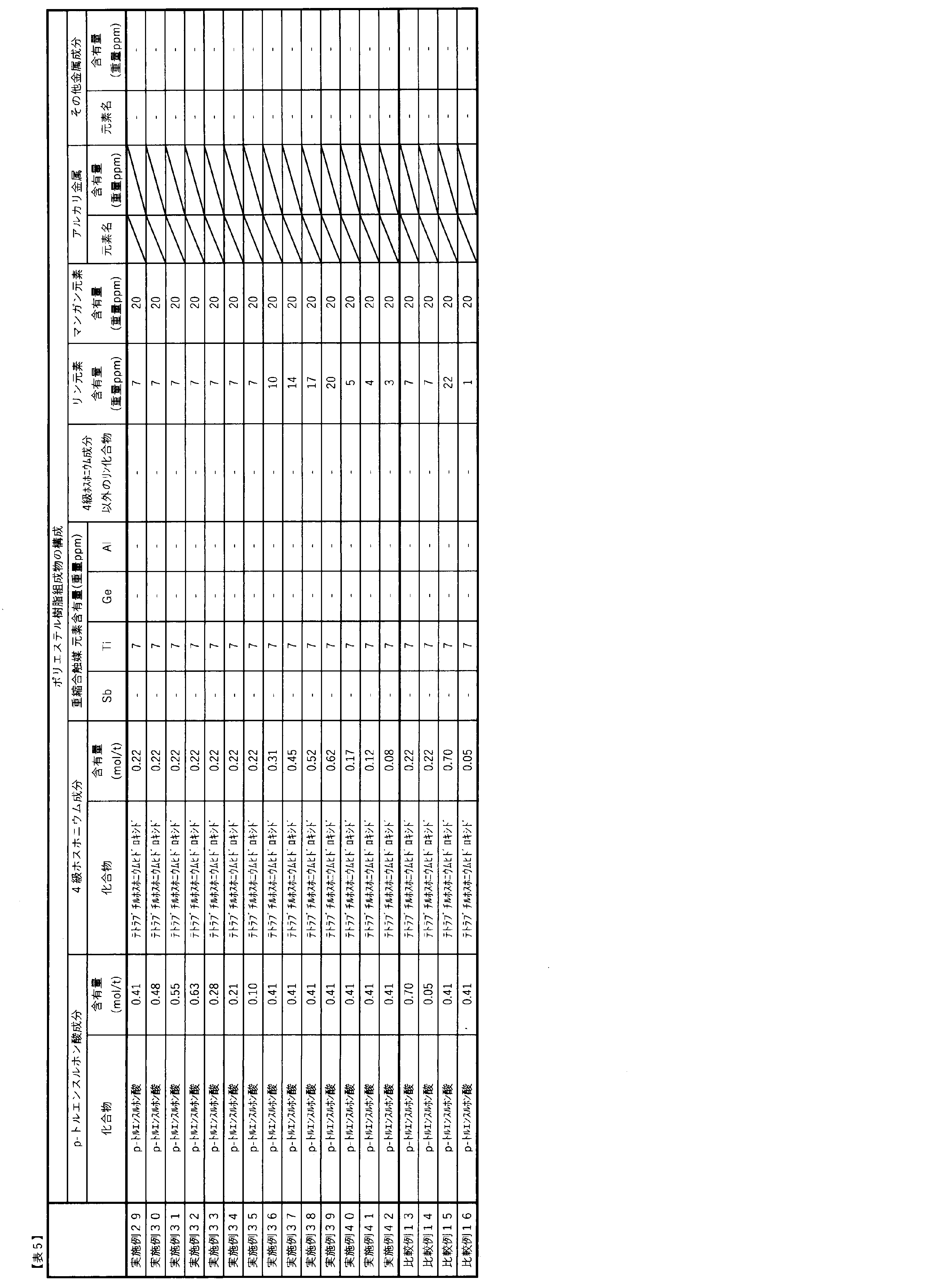

(実施例43、44、比較例17、18)
実施例43、44、および、比較例17は、テトラ-n-ブチルチタネート添加後に、次いで酢酸マンガンのエチレングリコール溶液を添加し、表7に記載のマンガン元素の含有量とした以外は、実施例29と同様の方法で、ポリエステル樹脂組成物およびポリエステルフィルムを得た。結果を表8に示す。
実施例43では、実施例29のポリエステル樹脂組成物からマンガン元素を減少させたことで、耐熱性パラメータXが若干増大したことにより、得られたポリエステルフィルムを用いた導体回路の歩留まり評価は、悪化する傾向であったものの合格範囲内であった。また、ポリエステルフィルムの製膜性評価において、静電印加性は良好であった。
実施例44では、実施例29よりもマンガン元素含有量を増加させたところ、円相当径0.2μm以上の異物数がさらに増加し、溶液ヘイズが上昇したが、合格範囲内であった。また、ポリエステルフィルムの製膜性評価において、静電印加性は良好であり、得られたポリエステルフィルムを用いた導体回路の歩留まり評価は良好であった。
比較例17では、実施例44からマンガン元素含有量をさらに増加した。円相当径0.2μm以上の異物数はさらに増加し、溶液ヘイズが上昇し不合格となり、得られたポリエステルフィルムを用いた導体回路の歩留まり評価は不合格であった。
比較例18では、酢酸マンガンを添加しないこと以外は、実施例29と同様としたところ、耐熱性パラメータXが規定の範囲を超えたことにより、得られたポリエステルフィルムを用いた導体回路の歩留まり評価は不合格となった。
実施例43、44、および、比較例17は、テトラ-n-ブチルチタネート添加後に、次いで酢酸マンガンのエチレングリコール溶液を添加し、表7に記載のマンガン元素の含有量とした以外は、実施例29と同様の方法で、ポリエステル樹脂組成物およびポリエステルフィルムを得た。結果を表8に示す。
実施例43では、実施例29のポリエステル樹脂組成物からマンガン元素を減少させたことで、耐熱性パラメータXが若干増大したことにより、得られたポリエステルフィルムを用いた導体回路の歩留まり評価は、悪化する傾向であったものの合格範囲内であった。また、ポリエステルフィルムの製膜性評価において、静電印加性は良好であった。
実施例44では、実施例29よりもマンガン元素含有量を増加させたところ、円相当径0.2μm以上の異物数がさらに増加し、溶液ヘイズが上昇したが、合格範囲内であった。また、ポリエステルフィルムの製膜性評価において、静電印加性は良好であり、得られたポリエステルフィルムを用いた導体回路の歩留まり評価は良好であった。
比較例17では、実施例44からマンガン元素含有量をさらに増加した。円相当径0.2μm以上の異物数はさらに増加し、溶液ヘイズが上昇し不合格となり、得られたポリエステルフィルムを用いた導体回路の歩留まり評価は不合格であった。
比較例18では、酢酸マンガンを添加しないこと以外は、実施例29と同様としたところ、耐熱性パラメータXが規定の範囲を超えたことにより、得られたポリエステルフィルムを用いた導体回路の歩留まり評価は不合格となった。
(比較例19) 酢酸マンガンの代わりに、酢酸マグネシウムのエチレングリコール溶液を添加し、表7に記載のマグネシウム元素の含有量とした以外は、実施例29と同様の方法でポリエステル樹脂組成物およびポリエステルフィルムを得た。結果を表8に示す。
酢酸マグネシウムを使用したことで耐熱性パラメータXが規定の範囲を超えたことにより、得られたポリエステルフィルムを用いた導体回路の歩留まり評価は不合格となった。
酢酸マグネシウムを使用したことで耐熱性パラメータXが規定の範囲を超えたことにより、得られたポリエステルフィルムを用いた導体回路の歩留まり評価は不合格となった。
(実施例45~47)
テトラブチルホスホニウムヒドロキシドとp-トルエンスルホン酸の添加から、テトラ-n-ブチルチタネートの添加までの間に、リン酸をエチレングリコール溶液として添加し、表7に記載のリン元素の含有量とした以外は、実施例29と同様の方法でポリエステル樹脂組成物およびポリエステルフィルムを得た。結果を表8に示す。
実施例45では、マンガン元素量を低減しリン酸を添加しなかった実施例29のポリエステル樹脂組成物と比べて、ポリエステル樹脂組成物の特性評価においては、いずれも合格範囲であった。
実施例46、47では、実施例45からさらにリン酸添加量を増やし、リン元素の含有量を増加させた。これにより、ポリエステル樹脂組成物の特性評価においては、いずれも合格範囲であった。
テトラブチルホスホニウムヒドロキシドとp-トルエンスルホン酸の添加から、テトラ-n-ブチルチタネートの添加までの間に、リン酸をエチレングリコール溶液として添加し、表7に記載のリン元素の含有量とした以外は、実施例29と同様の方法でポリエステル樹脂組成物およびポリエステルフィルムを得た。結果を表8に示す。
実施例45では、マンガン元素量を低減しリン酸を添加しなかった実施例29のポリエステル樹脂組成物と比べて、ポリエステル樹脂組成物の特性評価においては、いずれも合格範囲であった。
実施例46、47では、実施例45からさらにリン酸添加量を増やし、リン元素の含有量を増加させた。これにより、ポリエステル樹脂組成物の特性評価においては、いずれも合格範囲であった。
(実施例48)
4級ホスホニウム成分を、テトラブチルホスホニウムヒドロキシドからテトラエチルホスホニウムヒドロキシドのエチレングリコール溶液に変更した以外は、実施例29と同様の方法でポリエステル樹脂組成物およびポリエステルフィルムを得た。結果を表8に示す。
得られたポリエステル樹脂組成物は、実施例29のポリエステル樹脂組成物と同等の特性を有しており、いずれの指標においても合格範囲内であった。また、ポリエステルフィルムの製膜性評価において、静電印加性は良好であり、得られたポリエステルフィルムを用いた導体回路の歩留まり評価は良好であった。
4級ホスホニウム成分を、テトラブチルホスホニウムヒドロキシドからテトラエチルホスホニウムヒドロキシドのエチレングリコール溶液に変更した以外は、実施例29と同様の方法でポリエステル樹脂組成物およびポリエステルフィルムを得た。結果を表8に示す。
得られたポリエステル樹脂組成物は、実施例29のポリエステル樹脂組成物と同等の特性を有しており、いずれの指標においても合格範囲内であった。また、ポリエステルフィルムの製膜性評価において、静電印加性は良好であり、得られたポリエステルフィルムを用いた導体回路の歩留まり評価は良好であった。
(比較例20~22)
p-トルエンスルホン酸の代わりに、表7に記載のスルホン酸化合物を含有させた以外は、実施例45と同様の方法でポリエステル樹脂組成物およびポリエステルフィルムを得た。結果を表8に示す。
比較例20では、p-トルエンスルホン酸よりも炭素数が大きいドデシルベンゼンスルホン酸を使用したため、実施例45のポリエステル樹脂組成物と比べて円相当径0.2μm以上の異物数が多くなり、溶液ヘイズが高く不合格となった。また、溶融比抵抗が高く、ポリエステルフィルムの製膜性評価において、静電印加性が不合格であり、導体回路の歩留まり評価は、フィルムが採取できず評価に至らなかった。
比較例21では、エステル形成性官能基を2つもつ3,5-ジカルボキシベンゼンスルホン酸を使用したため、実施例45のポリエステル樹脂組成物と比べて円相当径0.2μm以上の異物数が多くなり、溶液ヘイズが高く不合格となったため、得られたポリエステルフィルムを用いた導体回路の歩留まり評価は不合格となった。また、溶融比抵抗が高めであったが、ポリエステルフィルムの製膜性評価において、静電印加性が合格範囲であった。
比較例22では、p-トルエンスルホン酸よりも炭素数が小さいメタンスルホン酸を使用したため、実施例45のポリエステル樹脂組成物と比べて溶融比抵抗が高くなり、ポリエステルフィルムの製膜性評価において、静電印加性が不合格となった。また、導体回路の歩留まり評価は、フィルムが採取できず評価に至らなかった
(実施例49)
回収したPET製品250重量部に対して、エチレングリコール87重量部を反応装置に仕込み、同時に昇温開始して、240℃、常圧下で解重合を開始し、その後、徐々に昇温し2時間50分後に解重合反応を終了した。この時の反応生成物であるBHETを、開口10μmのプリーツ型フィルターで濾過した後、105重量部(PET100重量部相当)を留出装置の付いた重合装置に溶融状態で仕込んだ。
テトラブチルホスホニウムヒドロキシド0.0112重量部、次いでp-トルエンスルホン酸0.0077重量部をエチレングリコール溶液として添加し、続いて、酢酸マンガン4水和物を0.0090重量部をエチレングリコール溶液として添加し、次いで、テトラ-n-ブチルチタネート0.0050重量部をエチレングリコール溶液として添加した。引き続いて重合反応槽内を除々に減圧にし、35分で0.13kPa以下とし、それと同時に除々に昇温して279℃とし、ポリエステル樹脂組成物の固有粘度が0.62dL/gとなるまで重合反応を実施した。その後、窒素ガスによって重縮合反応槽を常圧に戻し、口金より冷水中にストランド状に吐出し、押し出しカッターによって円柱状にペレット化して、円相当径0.2μm以上の異物数が400個/0.1mm2、溶融比抵抗が2.2×106Ω・cm、耐熱性パラメータXが1.1であるポリエステル樹脂組成物を得た。
得られたポリエステル樹脂組成物は、表7に記載した量のp-トルエンスルホン酸成分、4級ホスホニウム成分、チタン元素、リン元素を含有していた。色調b値は8.2、%BBは0.41%、ΔCOOHは77.2eq/t、溶液ヘイズは0.7%であり、いずれも良好な値であった。また、アンチモン触媒を使用していないことから、ポリエステル樹脂組成物の濾過捕捉物中の金属アンチモンは観察されなかった。続いて、実施例1と同様の方法でポリエステルフィルムを得た。このポリエステルフィルムの製膜性評価では、静電印加性が良好であり、得られたポリエステルフィルムを用いた導体回路の歩留まり評価は良好であった。
p-トルエンスルホン酸の代わりに、表7に記載のスルホン酸化合物を含有させた以外は、実施例45と同様の方法でポリエステル樹脂組成物およびポリエステルフィルムを得た。結果を表8に示す。
比較例20では、p-トルエンスルホン酸よりも炭素数が大きいドデシルベンゼンスルホン酸を使用したため、実施例45のポリエステル樹脂組成物と比べて円相当径0.2μm以上の異物数が多くなり、溶液ヘイズが高く不合格となった。また、溶融比抵抗が高く、ポリエステルフィルムの製膜性評価において、静電印加性が不合格であり、導体回路の歩留まり評価は、フィルムが採取できず評価に至らなかった。
比較例21では、エステル形成性官能基を2つもつ3,5-ジカルボキシベンゼンスルホン酸を使用したため、実施例45のポリエステル樹脂組成物と比べて円相当径0.2μm以上の異物数が多くなり、溶液ヘイズが高く不合格となったため、得られたポリエステルフィルムを用いた導体回路の歩留まり評価は不合格となった。また、溶融比抵抗が高めであったが、ポリエステルフィルムの製膜性評価において、静電印加性が合格範囲であった。
比較例22では、p-トルエンスルホン酸よりも炭素数が小さいメタンスルホン酸を使用したため、実施例45のポリエステル樹脂組成物と比べて溶融比抵抗が高くなり、ポリエステルフィルムの製膜性評価において、静電印加性が不合格となった。また、導体回路の歩留まり評価は、フィルムが採取できず評価に至らなかった
(実施例49)
回収したPET製品250重量部に対して、エチレングリコール87重量部を反応装置に仕込み、同時に昇温開始して、240℃、常圧下で解重合を開始し、その後、徐々に昇温し2時間50分後に解重合反応を終了した。この時の反応生成物であるBHETを、開口10μmのプリーツ型フィルターで濾過した後、105重量部(PET100重量部相当)を留出装置の付いた重合装置に溶融状態で仕込んだ。
テトラブチルホスホニウムヒドロキシド0.0112重量部、次いでp-トルエンスルホン酸0.0077重量部をエチレングリコール溶液として添加し、続いて、酢酸マンガン4水和物を0.0090重量部をエチレングリコール溶液として添加し、次いで、テトラ-n-ブチルチタネート0.0050重量部をエチレングリコール溶液として添加した。引き続いて重合反応槽内を除々に減圧にし、35分で0.13kPa以下とし、それと同時に除々に昇温して279℃とし、ポリエステル樹脂組成物の固有粘度が0.62dL/gとなるまで重合反応を実施した。その後、窒素ガスによって重縮合反応槽を常圧に戻し、口金より冷水中にストランド状に吐出し、押し出しカッターによって円柱状にペレット化して、円相当径0.2μm以上の異物数が400個/0.1mm2、溶融比抵抗が2.2×106Ω・cm、耐熱性パラメータXが1.1であるポリエステル樹脂組成物を得た。
得られたポリエステル樹脂組成物は、表7に記載した量のp-トルエンスルホン酸成分、4級ホスホニウム成分、チタン元素、リン元素を含有していた。色調b値は8.2、%BBは0.41%、ΔCOOHは77.2eq/t、溶液ヘイズは0.7%であり、いずれも良好な値であった。また、アンチモン触媒を使用していないことから、ポリエステル樹脂組成物の濾過捕捉物中の金属アンチモンは観察されなかった。続いて、実施例1と同様の方法でポリエステルフィルムを得た。このポリエステルフィルムの製膜性評価では、静電印加性が良好であり、得られたポリエステルフィルムを用いた導体回路の歩留まり評価は良好であった。
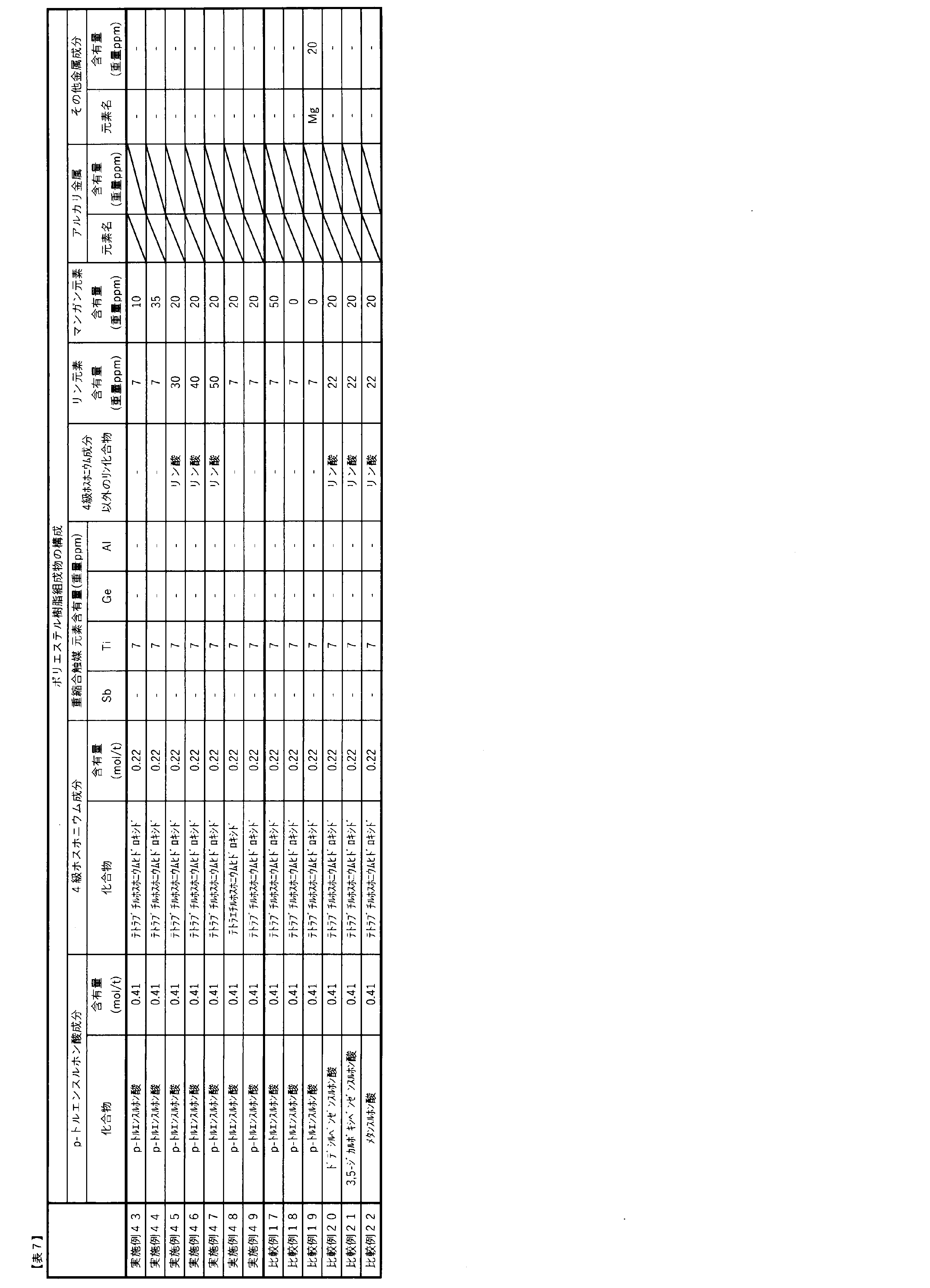

(実施例50~53)
三酸化二アンチモンの添加量を変更し、表9に記載の含有量とした以外は、実施例1と同様にしてポリエステル樹脂組成物、および、ポリエステルフィルムを得た。結果を表10に示す。
得られたポリエステル樹脂組成物は、アンチモン元素含有量が増加するにつれて、%BBとポリエステル樹脂組成物の濾過捕捉物中の金属アンチモン数が増加傾向であったが、いずれの指標も合格範囲内であった。また、ポリエステルフィルムの製膜性評価において、静電印加性は良好であり、得られたポリエステルフィルムを用いた導体回路の歩留まり評価は良好であった。
三酸化二アンチモンの添加量を変更し、表9に記載の含有量とした以外は、実施例1と同様にしてポリエステル樹脂組成物、および、ポリエステルフィルムを得た。結果を表10に示す。
得られたポリエステル樹脂組成物は、アンチモン元素含有量が増加するにつれて、%BBとポリエステル樹脂組成物の濾過捕捉物中の金属アンチモン数が増加傾向であったが、いずれの指標も合格範囲内であった。また、ポリエステルフィルムの製膜性評価において、静電印加性は良好であり、得られたポリエステルフィルムを用いた導体回路の歩留まり評価は良好であった。
(実施例54、55)
p-トルエンスルホン酸成分を、p-トルエンスルホン酸とp-トルエンスルホン酸ナトリウムの混合物に変更して、表9に記載のアルカリ金属含有量とした以外は、実施例1と同様にしてポリエステル樹脂組成物、および、ポリエステルフィルムを得た。結果を表10に示す。
得られたポリエステル樹脂組成物は、アルカリ金属元素の含有量の増加につれて、円相当径0.2μm以上の異物の増加によりポリエステル樹脂組成物の溶液ヘイズが上昇したが、合格範囲内であった。一方、得られたポリエステルフィルムの製膜性評価において、静電印加性は良好であった。また、得られたポリエステルフィルムを用いた導体回路の歩留まり評価は、実施例54では良好であり、実施例55では悪化する傾向であったものの合格範囲内であった。
p-トルエンスルホン酸成分を、p-トルエンスルホン酸とp-トルエンスルホン酸ナトリウムの混合物に変更して、表9に記載のアルカリ金属含有量とした以外は、実施例1と同様にしてポリエステル樹脂組成物、および、ポリエステルフィルムを得た。結果を表10に示す。
得られたポリエステル樹脂組成物は、アルカリ金属元素の含有量の増加につれて、円相当径0.2μm以上の異物の増加によりポリエステル樹脂組成物の溶液ヘイズが上昇したが、合格範囲内であった。一方、得られたポリエステルフィルムの製膜性評価において、静電印加性は良好であった。また、得られたポリエステルフィルムを用いた導体回路の歩留まり評価は、実施例54では良好であり、実施例55では悪化する傾向であったものの合格範囲内であった。
(比較例23)
p-トルエンスルホン酸成分を、p-トルエンスルホン酸ナトリウムに変更して、表9に記載のアルカリ金属含有量とした以外は、実施例1と同様にしてポリエステル樹脂組成物、および、ポリエステルフィルムを得た。結果を表10に示す。
得られたポリエステル樹脂組成物は、実施例55のポリエステル樹脂組成物よりもアルカリ金属元素の含有量が増加し、円相当径0.2μm以上の異物が760個/0.1mm2と不適であったことから、ポリエステル樹脂組成物の溶液ヘイズが1.4%の不合格となり、得られたポリエステルフィルムを用いた導体回路の歩留まり評価は不合格となった。
p-トルエンスルホン酸成分を、p-トルエンスルホン酸ナトリウムに変更して、表9に記載のアルカリ金属含有量とした以外は、実施例1と同様にしてポリエステル樹脂組成物、および、ポリエステルフィルムを得た。結果を表10に示す。
得られたポリエステル樹脂組成物は、実施例55のポリエステル樹脂組成物よりもアルカリ金属元素の含有量が増加し、円相当径0.2μm以上の異物が760個/0.1mm2と不適であったことから、ポリエステル樹脂組成物の溶液ヘイズが1.4%の不合格となり、得られたポリエステルフィルムを用いた導体回路の歩留まり評価は不合格となった。
(実施例56、57)
テトラブチルホスホニウムヒドロキシドとp-トルエンスルホン酸の添加から三酸化二アンチモンの添加までの間に、リン酸をエチレングリコール溶液として添加し、さらに、三酸化二アンチモンの添加後に酢酸マンガンのエチレングリコール溶液を添加して、表9に記載の含有量とした以外は、実施例1と同様にしてポリエステル樹脂組成物、および、ポリエステルフィルムを得た。結果を表10に示す。
実施例58で得られたポリエステル樹脂組成物の色調b値は7.0、%BBは0.29%、ΔCOOHは78.7eq/tであり、いずれも良好な値であった。溶液ヘイズは1.1%、濾過捕捉物中の金属アンチモン数は270個/0.1mm2であり、いずれも合格範囲内であった。
実施例57で得られたポリエステル樹脂組成物の色調b値は7.3、%BBは0.30%、ΔCOOHは66.9eq/tであり、いずれも良好な値であった。また、溶液ヘイズは1.1%、濾過捕捉物中の金属アンチモン数は270個/0.1mm2であり、いずれも合格範囲内であった。
実施例56と57で得られたポリエステルフィルムの製膜性評価において、静電印加性は良好であった。また、得られたポリエステルフィルムを用いた導体回路の歩留まり評価は、実施例56では良好であり、実施例57では悪化する傾向であったものの合格範囲内であった。
テトラブチルホスホニウムヒドロキシドとp-トルエンスルホン酸の添加から三酸化二アンチモンの添加までの間に、リン酸をエチレングリコール溶液として添加し、さらに、三酸化二アンチモンの添加後に酢酸マンガンのエチレングリコール溶液を添加して、表9に記載の含有量とした以外は、実施例1と同様にしてポリエステル樹脂組成物、および、ポリエステルフィルムを得た。結果を表10に示す。
実施例58で得られたポリエステル樹脂組成物の色調b値は7.0、%BBは0.29%、ΔCOOHは78.7eq/tであり、いずれも良好な値であった。溶液ヘイズは1.1%、濾過捕捉物中の金属アンチモン数は270個/0.1mm2であり、いずれも合格範囲内であった。
実施例57で得られたポリエステル樹脂組成物の色調b値は7.3、%BBは0.30%、ΔCOOHは66.9eq/tであり、いずれも良好な値であった。また、溶液ヘイズは1.1%、濾過捕捉物中の金属アンチモン数は270個/0.1mm2であり、いずれも合格範囲内であった。
実施例56と57で得られたポリエステルフィルムの製膜性評価において、静電印加性は良好であった。また、得られたポリエステルフィルムを用いた導体回路の歩留まり評価は、実施例56では良好であり、実施例57では悪化する傾向であったものの合格範囲内であった。
(実施例58、59)
重縮合反応触媒を三酸化二アンチモンから二酸化ゲルマニウムのエチレングリコール溶液に変更し、表9に記載のゲルマニウム元素の含有量とした以外は、実施例56、57と同様にしてポリエステル樹脂組成物、および、ポリエステルフィルムを得た。結果を表10に示す。
実施例58と59で得られたポリエステル樹脂組成物は、いずれの特性も合格範囲内であり、さらに、ポリエステル樹脂組成物の濾過捕捉物中の金属アンチモンは観察されない良好な結果であった。また、得られたポリエステルフィルムの製膜性評価において、静電印加性はいずれも良好であった。また、得られたポリエステルフィルムを用いた導体回路の歩留まり評価は、実施例58では良好であり、実施例59では悪化する傾向であったものの合格範囲内であった。
重縮合反応触媒を三酸化二アンチモンから二酸化ゲルマニウムのエチレングリコール溶液に変更し、表9に記載のゲルマニウム元素の含有量とした以外は、実施例56、57と同様にしてポリエステル樹脂組成物、および、ポリエステルフィルムを得た。結果を表10に示す。
実施例58と59で得られたポリエステル樹脂組成物は、いずれの特性も合格範囲内であり、さらに、ポリエステル樹脂組成物の濾過捕捉物中の金属アンチモンは観察されない良好な結果であった。また、得られたポリエステルフィルムの製膜性評価において、静電印加性はいずれも良好であった。また、得られたポリエステルフィルムを用いた導体回路の歩留まり評価は、実施例58では良好であり、実施例59では悪化する傾向であったものの合格範囲内であった。


Claims (20)
- 固有粘度が0.55dL/g以上のポリエステル樹脂組成物であって、ポリエステル樹脂組成物の全重量に対して、p-トルエンスルホン酸成分の含有量が0.07~0.65mol/t、4級ホスホニウム成分の含有量が0.07~0.65mol/tであり、式1で表される耐熱性パラメータXが、1.0≦X≦1.3であり、円相当径0.2μm以上の異物数が650個/0.1mm2以下、溶融比抵抗が4.0×106Ω・cm以下、色差計における色調b値が10.0以下であるポリエステル樹脂組成物。

- ポリエステル樹脂組成物の全重量に対して、アルカリ金属元素の含有量が3重量ppm以下である、請求項1に記載のポリエステル樹脂組成物。
- ポリエステル樹脂組成物の全重量に対して、アンチモン元素の含有量が15重量ppm以下であり、かつ、チタン元素の含有量が0.1重量ppm~20重量ppmである、請求項2に記載のポリエステル樹脂組成物。
- ポリエステル樹脂組成物の全重量に対して、マンガン元素の含有量が5~40重量ppmであり、リン元素の含有量が3~50重量ppmである、請求項3に記載のポリエステル樹脂組成物。
- ポリエステル樹脂組成物の全重量に対して、アンチモン元素の含有量が15重量ppm以下であり、かつ、ゲルマニウム元素の含有量が5重量ppm~150重量ppmである、請求項2に記載のポリエステル樹脂組成物。
- ポリエステル樹脂組成物の全重量に対して、マンガン元素の含有量が5~40重量ppmであり、リン元素の含有量が3~50重量ppmである、請求項5に記載のポリエステル樹脂組成物。
- ポリエステル樹脂組成物の全重量に対して、アンチモン元素の含有量が15重量ppm以下であり、かつ、アルミニウム元素の含有量が0.1重量ppm~100重量ppmである、請求項2に記載のポリエステル樹脂組成物。
- ポリエステル樹脂組成物の全重量に対して、マンガン元素の含有量が5~40重量ppmであり、リン元素の含有量が3~50重量ppmである、請求項7に記載のポリエステル樹脂組成物。
- ポリエステル樹脂組成物の全重量に対して、アンチモン元素の含有量が50重量ppm~150重量ppmである、請求項2に記載のポリエステル樹脂組成物。
- ポリエステル樹脂組成物の全重量に対して、マンガン元素の含有量が5~40重量ppmであり、リン元素の含有量が3~50重量ppmである、請求項9に記載のポリエステル樹脂組成物。
- 固有粘度が0.55dL/g以上のポリエステル樹脂組成物であって、ポリエステル樹脂組成物の全重量に対して、p-トルエンスルホン酸成分の含有量が0.07~0.65mol/t、4級ホスホニウム成分の含有量が0.07~0.65mol/t、アルカリ金属元素の含有量が3重量ppm以下であり、式1で表される耐熱性パラメータXが、1.0≦X≦1.3であり、円相当径0.2μm以上の異物数が630個/0.1mm2以下、色差計における色調b値が10.0以下であるポリエステル樹脂組成物。

- ポリエステル樹脂組成物の全重量に対して、アンチモン元素の含有量が15重量ppm以下であり、かつ、チタン元素の含有量が0.1重量ppm~20重量ppmである、請求項11に記載のポリエステル樹脂組成物。
- ポリエステル樹脂組成物の全重量に対して、マンガン元素の含有量が5~40重量ppmであり、リン元素の含有量が3~50重量ppmである、請求項12に記載のポリエステル樹脂組成物。
- ポリエステル樹脂組成物の全重量に対して、アンチモン元素の含有量が15重量ppm以下であり、かつ、ゲルマニウム元素の含有量が5重量ppm~150重量ppmである、請求項11に記載のポリエステル樹脂組成物。
- ポリエステル樹脂組成物の全重量に対して、マンガン元素の含有量が5~40重量ppmであり、リン元素の含有量が3~50重量ppmである、請求項14に記載のポリエステル樹脂組成物。
- ポリエステル樹脂組成物の全重量に対して、アンチモン元素の含有量が15重量ppm以下であり、かつ、アルミニウム元素の含有量が0.1重量ppm~100重量ppmである、請求項11に記載のポリエステル樹脂組成物。
- ポリエステル樹脂組成物の全重量に対して、マンガン元素の含有量が5~40重量ppmであり、リン元素の含有量が3~50重量ppmである、請求項16に記載のポリエステル樹脂組成物。
- ポリエステル樹脂組成物の全重量に対して、アンチモン元素の含有量が50重量ppm~150重量ppmである、請求項11に記載のポリエステル樹脂組成物。
- ポリエステル樹脂組成物の全重量に対して、マンガン元素の含有量が5~40重量ppmであり、リン元素の含有量が3~50重量ppmである、請求項18に記載のポリエステル樹脂組成物。
- 請求項1~19のいずれかに記載のポリエステル樹脂組成物を用いてなるポリエステルフィルム。
Priority Applications (1)
| Application Number | Priority Date | Filing Date | Title |
|---|---|---|---|
| JP2023547193A JPWO2024252686A1 (ja) | 2023-06-08 | 2023-07-25 |
Applications Claiming Priority (2)
| Application Number | Priority Date | Filing Date | Title |
|---|---|---|---|
| JP2023-094467 | 2023-06-08 | ||
| JP2023094467 | 2023-06-08 |
Publications (1)
| Publication Number | Publication Date |
|---|---|
| WO2024252686A1 true WO2024252686A1 (ja) | 2024-12-12 |
Family
ID=93795855
Family Applications (1)
| Application Number | Title | Priority Date | Filing Date |
|---|---|---|---|
| PCT/JP2023/027111 Ceased WO2024252686A1 (ja) | 2023-06-08 | 2023-07-25 | ポリエステル樹脂組成物及びポリエステルフィルム |
Country Status (3)
| Country | Link |
|---|---|
| JP (1) | JPWO2024252686A1 (ja) |
| TW (1) | TW202449015A (ja) |
| WO (1) | WO2024252686A1 (ja) |
Citations (5)
| Publication number | Priority date | Publication date | Assignee | Title |
|---|---|---|---|---|
| JP2000211009A (ja) * | 1999-01-25 | 2000-08-02 | Teijin Ltd | 多層フイルムの製造方法 |
| JP2018062574A (ja) * | 2016-10-13 | 2018-04-19 | 東レ株式会社 | ポリエチレンテレフタレート樹脂組成物およびそれからなるフィルム |
| JP2020007542A (ja) * | 2018-06-27 | 2020-01-16 | 東レ株式会社 | ポリエステル樹脂組成物およびその製造方法 |
| JP2022089784A (ja) * | 2020-12-04 | 2022-06-16 | 東レ株式会社 | ポリエステル樹脂組成物及びそれを用いてなるポリエステルフィルム |
| JP2023015002A (ja) * | 2021-07-19 | 2023-01-31 | 東レ株式会社 | 二軸配向ポリエステルフィルム、および積層体 |
-
2023
- 2023-07-25 WO PCT/JP2023/027111 patent/WO2024252686A1/ja not_active Ceased
- 2023-07-25 JP JP2023547193A patent/JPWO2024252686A1/ja active Pending
- 2023-08-07 TW TW112129516A patent/TW202449015A/zh unknown
Patent Citations (5)
| Publication number | Priority date | Publication date | Assignee | Title |
|---|---|---|---|---|
| JP2000211009A (ja) * | 1999-01-25 | 2000-08-02 | Teijin Ltd | 多層フイルムの製造方法 |
| JP2018062574A (ja) * | 2016-10-13 | 2018-04-19 | 東レ株式会社 | ポリエチレンテレフタレート樹脂組成物およびそれからなるフィルム |
| JP2020007542A (ja) * | 2018-06-27 | 2020-01-16 | 東レ株式会社 | ポリエステル樹脂組成物およびその製造方法 |
| JP2022089784A (ja) * | 2020-12-04 | 2022-06-16 | 東レ株式会社 | ポリエステル樹脂組成物及びそれを用いてなるポリエステルフィルム |
| JP2023015002A (ja) * | 2021-07-19 | 2023-01-31 | 東レ株式会社 | 二軸配向ポリエステルフィルム、および積層体 |
Also Published As
| Publication number | Publication date |
|---|---|
| TW202449015A (zh) | 2024-12-16 |
| JPWO2024252686A1 (ja) | 2024-12-12 |
Similar Documents
| Publication | Publication Date | Title |
|---|---|---|
| JP4048373B2 (ja) | ポリ(エチレン芳香族ジカルボキシレートエステル)樹脂の製造方法 | |
| TWI757524B (zh) | 聚酯樹脂組成物及其製造方法 | |
| JP7771683B2 (ja) | ポリエステル樹脂組成物及びそれを用いてなるポリエステルフィルム | |
| JP2024000492A (ja) | ポリエステルフィルム、およびリサイクルポリエステルフィルムの製造方法 | |
| JP6946950B2 (ja) | ポリエステル樹脂組成物及びその製造方法 | |
| JP7310348B2 (ja) | ポリエステル樹脂組成物およびその製造方法 | |
| JP6896998B2 (ja) | ポリエステル樹脂組成物及びその製造方法 | |
| JP2004067733A (ja) | 共重合ポリエステル及びその製造方法 | |
| TW202242021A (zh) | 樹脂組成物及使用其之薄膜 | |
| JP2023171275A (ja) | ポリエステル樹脂組成物及びポリエステルフィルム | |
| JP2022029085A (ja) | ポリエステル樹脂組成物およびその製造方法 | |
| CN104672437B (zh) | 一种高折射率水性聚酯及其制备 | |
| WO2024252686A1 (ja) | ポリエステル樹脂組成物及びポリエステルフィルム | |
| WO2025070473A1 (ja) | 二軸配向ポリエステルフィルム | |
| JPH06104718B2 (ja) | ポリエステルの製造方法 | |
| JP7771824B2 (ja) | ポリエチレンテレフタレート樹脂組成物、ポリエステルフィルムおよびポリエチレンテレフタレート樹脂組成物の製造方法 | |
| TW202530306A (zh) | 白色聚酯膜 | |
| CN118660922A (zh) | 聚酯树脂组合物及其制造方法、叠层聚酯膜 | |
| JP2026005280A (ja) | ポリエステル樹脂組成物、ポリエステルフィルム、および、ポリエステルフィルムの製造方法 | |
| JP2019099791A (ja) | ポリエステル組成物およびその製造方法 | |
| JP7690749B2 (ja) | ポリエステル組成物およびその製造方法 | |
| JP2013194106A (ja) | ポリエステルフィルム | |
| JP7310165B2 (ja) | ポリエチレンテレフタレート樹脂組成物 | |
| JP2019151831A (ja) | ポリエステル樹脂組成物およびポリエステルフィルム | |
| JP6402441B2 (ja) | ポリエステルの製造方法 |
Legal Events
| Date | Code | Title | Description |
|---|---|---|---|
| WWE | Wipo information: entry into national phase |
Ref document number: 2023547193 Country of ref document: JP |
|
| 121 | Ep: the epo has been informed by wipo that ep was designated in this application |
Ref document number: 23940782 Country of ref document: EP Kind code of ref document: A1 |
|
| NENP | Non-entry into the national phase |
Ref country code: DE |