WO2024252741A1 - Ophthalmic device - Google Patents
Ophthalmic device Download PDFInfo
- Publication number
- WO2024252741A1 WO2024252741A1 PCT/JP2024/008254 JP2024008254W WO2024252741A1 WO 2024252741 A1 WO2024252741 A1 WO 2024252741A1 JP 2024008254 W JP2024008254 W JP 2024008254W WO 2024252741 A1 WO2024252741 A1 WO 2024252741A1
- Authority
- WO
- WIPO (PCT)
- Prior art keywords
- light
- eye
- imaging unit
- subject
- support arm
- Prior art date
- Legal status (The legal status is an assumption and is not a legal conclusion. Google has not performed a legal analysis and makes no representation as to the accuracy of the status listed.)
- Ceased
Links
Images



Classifications
-
- A—HUMAN NECESSITIES
- A61—MEDICAL OR VETERINARY SCIENCE; HYGIENE
- A61B—DIAGNOSIS; SURGERY; IDENTIFICATION
- A61B3/00—Apparatus for testing the eyes; Instruments for examining the eyes
- A61B3/10—Objective types, i.e. instruments for examining the eyes independent of the patients' perceptions or reactions
- A61B3/13—Ophthalmic microscopes
- A61B3/135—Slit-lamp microscopes
-
- A—HUMAN NECESSITIES
- A61—MEDICAL OR VETERINARY SCIENCE; HYGIENE
- A61B—DIAGNOSIS; SURGERY; IDENTIFICATION
- A61B3/00—Apparatus for testing the eyes; Instruments for examining the eyes
- A61B3/0008—Apparatus for testing the eyes; Instruments for examining the eyes provided with illuminating means
-
- A—HUMAN NECESSITIES
- A61—MEDICAL OR VETERINARY SCIENCE; HYGIENE
- A61B—DIAGNOSIS; SURGERY; IDENTIFICATION
- A61B3/00—Apparatus for testing the eyes; Instruments for examining the eyes
- A61B3/0083—Apparatus for testing the eyes; Instruments for examining the eyes provided with means for patient positioning
-
- A—HUMAN NECESSITIES
- A61—MEDICAL OR VETERINARY SCIENCE; HYGIENE
- A61B—DIAGNOSIS; SURGERY; IDENTIFICATION
- A61B3/00—Apparatus for testing the eyes; Instruments for examining the eyes
- A61B3/10—Objective types, i.e. instruments for examining the eyes independent of the patients' perceptions or reactions
- A61B3/12—Objective types, i.e. instruments for examining the eyes independent of the patients' perceptions or reactions for looking at the eye fundus, e.g. ophthalmoscopes
-
- A—HUMAN NECESSITIES
- A61—MEDICAL OR VETERINARY SCIENCE; HYGIENE
- A61B—DIAGNOSIS; SURGERY; IDENTIFICATION
- A61B3/00—Apparatus for testing the eyes; Instruments for examining the eyes
- A61B3/10—Objective types, i.e. instruments for examining the eyes independent of the patients' perceptions or reactions
- A61B3/14—Arrangements specially adapted for eye photography
- A61B3/15—Arrangements specially adapted for eye photography with means for aligning, spacing or blocking spurious reflection ; with means for relaxing
- A61B3/152—Arrangements specially adapted for eye photography with means for aligning, spacing or blocking spurious reflection ; with means for relaxing for aligning
Definitions
- This disclosure relates to an ophthalmic device.
- an ophthalmic device that includes a slit lamp that irradiates slit light, a mirror unit having a reflector or prism that reflects the slit light irradiated from the slit lamp and irradiates the slit light onto the subject's eye, a microscope unit for observing the subject's eye, and a background illumination system (specific light irradiation system) that irradiates the subject's eye with background light (specific light) to illuminate the background of the slit light (see, for example, Patent Document 1).
- the ophthalmic device is also provided with an imaging device that captures an image of the subject's eye illuminated by the specific light.
- the specific light irradiation system is often provided integrally with the microscope unit or mirror unit, and the operation unit of the specific light irradiation system is often provided integrally with the stand of the ophthalmic device, so it cannot be flexibly attached or detached according to the user's usage pattern.
- This disclosure has been made in response to the above problem, and aims to provide an ophthalmic device to which a specific light irradiation system that irradiates specific light and its operating unit can be easily and selectively attached.
- the ophthalmic device disclosed herein comprises a main body having an illumination system that irradiates illumination light onto the subject's eye and an observation system that observes the return light from the subject's eye, and an imaging unit that can be detachably attached to the main body.
- the imaging unit has an imaging section that obtains an image of the subject's eye, and a specific light irradiation system that irradiates the subject's eye with specific light different from the illumination light.
- a specific light irradiation system that irradiates specific light can be easily and selectively attached by attaching and detaching the imaging unit to the main body. Therefore, a user can selectively use an ophthalmic device equipped with a specific light irradiation system and an ophthalmic device without a specific light irradiation system.
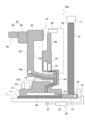
- FIG. 1A is a right side view showing the overall configuration of an ophthalmic apparatus according to a first embodiment
- FIG. 1B is a perspective view showing a moving mechanism portion.
- FIG. 2 is an explanatory diagram for explaining a wiring state and a detachable imaging unit of the ophthalmic apparatus of the first embodiment, and is a left side view generally showing the ophthalmic apparatus in a state where the imaging unit is not attached.
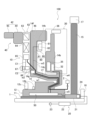
- FIG. 2 is an explanatory diagram for explaining a wiring state and a detachable imaging unit of the ophthalmic apparatus of the first embodiment, and is a left side view generally showing the ophthalmic apparatus in a state where the imaging unit is attached.
- FIG. 2 is an explanatory diagram for explaining a wiring state and a detachable imaging unit of the ophthalmic apparatus of the first embodiment, and is a left side view generally showing the ophthalmic apparatus in a state where the imaging unit is attached.
- FIG. 2 is a rear view of the vicinity of the background light switching unit of the ophthalmic apparatus of Example 1 as seen from the examiner side, and is an explanatory diagram for explaining the state of the background light switching unit when switching the background light.
- 2 is a front view of the background illumination system and the vicinity of the objective lens of the ophthalmic apparatus of the first embodiment, as viewed from the subject side.
- FIG. FIG. 11 is a perspective view showing the overall configuration of an ophthalmic apparatus according to a second embodiment.
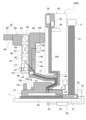
- FIG. 11 is an explanatory diagram for explaining the wiring state and the detachable imaging unit of the ophthalmic apparatus of the second embodiment, and is a left side view showing the ophthalmic apparatus in a state where the imaging unit is attached.
- Example 1 A slit lamp microscope 100 according to Example 1, which is an embodiment of an ophthalmic device according to the present disclosure, will be described as follows with reference to Figures 1 to 4.
- the slit lamp microscope 100 shown in Figure 1 is an ophthalmic device that obtains an image of a cross section of the cornea by cutting out an optical slice of the cornea of a subject's eye E using slit-shaped illumination light (hereinafter, sometimes referred to as "slit light”), and is also referred to as a "slit lamp microscope.”
- slit light slit-shaped illumination light
- the slit lamp microscope 100 of Example 1 mainly comprises a main body 10, a power supply unit 20, and an imaging unit 60.
- the main body 10 mainly comprises an illumination system 30, an observation system 40, and a control device 50.
- the imaging unit 60 mainly comprises an imaging section 61 and a background illumination system 80, which is an example of a specific light irradiation system.
- the slit lamp microscope 100 of Example 1 is a so-called Zeiss type (Littman type) slit lamp microscope, and since the illumination system 30 is arranged below the observation system 40, it is a more compact device than the slit lamp microscope 100A of Example 2 described below.
- the main body 10 is installed on the optical table 1. As described above, the main body 10 includes the illumination system 30, the observation system 40, and the control device 50.
- the main body 10 further includes a base 11 fixed to the upper surface of the optical table 1, a mount 12 provided on the upper surface of the base 11, a movement mechanism 13 that moves the mount 12 in the left-right direction, a support 14 provided on the upper surface of the mount 12, a face support 15 supported by the base 11, and a pair of grips 16 provided on both the left-right sides of the base 11.
- the stand unit 12 includes a stand 12a, a dimming knob (dimming operation unit) 12b, an operation lever (movement operation unit) 12c, and a shooting button 12d provided on the upper surface of the operation lever 12c.
- the stand unit 12 can be moved by a movement mechanism 13 in the front-rear and left-right directions when viewed from the subject's eye E relative to the base 11.
- the movement mechanism 13 includes a slide rod 13a inserted into the stand 12a, and a pair of fixed parts 13b that support both ends of the slide rod 13a so that they can be moved in the front-rear direction.
- the front direction of the front-rear direction is the direction approaching the subject
- the rear direction is the direction away from the subject and toward the examiner.
- the left direction of the left-right direction is the direction of the subject's left hand
- the right direction is the direction of the subject's right hand.
- the operating lever 12c is a member for giving instructions to move the stand 12.
- the photographing button 12d is a member for giving photographing instructions to the imaging unit 61.
- the operating lever 12c and the photographing button 12d are electrically connected to the control device 50.
- the examiner who is the user of the slit lamp microscope 100, can move the entire stand 12 in the front-back and left-right directions by the action of the moving mechanism 13 by gripping and moving the operating lever 12c.
- the control device 50 controls the observation system 40 according to the amount and direction of the operation to perform focusing.
- the control device 50 controls the imaging unit 61 to take an image of the subject's eye E.
- the dimmer knob 12b is a member that allows the examiner to turn on and off the slit light of the illumination system 30 and adjust the brightness (amount of light).
- the illumination system 30 is turned on or off under the control of the control device 50, and when it is turned on, the brightness of the illumination light of the illumination system 30 is continuously and freely changed depending on the amount and direction of operation from the off position.
- the support section 14 comprises a base 14a, a first support arm 14b, and a second support arm 14c.
- the base 14a is provided on the upper surface of the stand 12a.
- the first support arm 14b and the second support arm 14c stand upright from the base 14a.
- the first support arm 14b and the second support arm 14c can each rotate independently around a coaxial vertical axis 14d.
- the support section 14 also includes a test rod 14e that can be detachably attached to a rotation axis hole (not shown) provided in the vertical axis 14d.
- This test rod 14e is a member for checking the state of the slit light irradiated from the illumination system 30, and is removed when irradiating the slit light onto the subject's eye E for observation.
- the first support arm 14b has an illumination system housing 31, which contains the optical components of the illumination system 30, attached to its upper portion, and supports the illumination system 30.
- This first support arm 14b can be rotated manually.
- the illumination system housing 31 revolves around the subject's eye E. This changes the direction in which the slit light is irradiated onto the subject's eye E.
- the first support arm 14b can also rotate up and down, in which case the elevation and depression angles of the slit light relative to the subject's eye E are changed.
- the second support arm 14c is composed of a cylindrical body that is L-shaped when viewed from the side, and has an accommodation space 14f (see Figures 2A and 2B) inside which various wiring is accommodated.
- the observation system housing 41 that accommodates the optical members of the observation system 40 is attached to the upper part of the second support arm 14c, and supports the observation system 40.
- the imaging unit 60 is also detachably attached to the second support arm 14c below the observation system 40, and supports the imaging unit 60.
- the second support arm 14c can be rotated manually. By rotating the second support arm 14c, the observation system 40 and the imaging unit 60 rotate around the first support arm 14b. This changes the observation direction of the observation system 40 and the imaging unit 60 with respect to the subject's eye E.
- the second support arm 14c accommodates a relay board 14g below the accommodation space 14f.
- This relay board 14g is electrically connected to the control device 50 accommodated in the stand 12a by a first power cable w1 accommodated in the accommodation space 14f and the stand 12a.
- a second power cable w2 extending from the imaging section 61 of the imaging unit 60 (described later) and a third power cable w3 extending from the background illumination system 80 can be detachably connected to the relay board 14g.
- These power cables w2 and w3 can also be accommodated in the accommodation space 14f.
- the second support arm 14c is provided with a mounting portion 14h for mounting the background illumination system 80 on the side facing the subject, below the objective lens 43 of the observation system 40.
- This mounting portion 14h has a hole (not shown) into which one end of the background illumination system 80 is inserted, and is covered with a lid (not shown) when the background illumination system 80 is not in use.
- the mounting portion 14h may be configured as an input/output terminal to which the background illumination system 80 is connected.
- the first support arm 14b and the second support arm 14c may be configured to rotate automatically by electricity.
- the support unit 14 includes an actuator that generates a driving force to rotate the first support arm 14b and the second support arm 14c, and a transmission mechanism that transmits this driving force.
- a stepping motor pulse motor
- a combination of gears or a rack and pinion is used as the transmission mechanism.
- the face support part 15 is disposed in front of the observation system 40, facing it.
- the face support part 15 includes a chin rest part 15a on which the subject's chin is placed, and a forehead rest part 15b on which the forehead is placed.
- the subject faces the optical table 1 and places his/her face in contact with the chin rest part 15a and forehead rest part 15b, while the examiner operates the slit lamp microscope 100 to observe the subject's eye E, etc.
- the face support unit 15 is also provided with a detachable fixation unit 17 used for external fixation.
- the fixation unit 17 includes a fixation lamp holder 17a consisting of a flexible arm, and an external fixation lamp 17b (e.g., an LED light source) that is provided at the tip of the fixation lamp holder 17a and emits fixation light.
- the fixation unit 17 can arbitrarily adjust the position of the external fixation lamp 17b and the emission direction of the fixation light using the fixation lamp holder 17a.
- the fixation unit 17 can guide the line of sight of the subject's eye E using the external fixation lamp 17b, and adjust the direction of the subject's eye E.
- the pair of gripping parts 16 are members that the subject holds with both hands when undergoing the examination. By gripping these gripping parts 16, the subject can stabilize his or her body and maintain a stable posture to undergo the examination appropriately.
- the power supply unit 20 is a device that supplies power to the slit lamp microscope 100.
- the power supply unit 20 is connected to the control device 50 by a fifth power cable w5.
- the power supply unit 20 mainly comprises a switch box 21, an AC/DC converter 22, and a plug 23.
- the switch box 21 comprises a switch board 24, a power switch 25, and a confirmation indicator light 26.
- the switch board 24 is a control device that controls the switching of the power of the slit lamp microscope 100 ON or OFF depending on the operating state of the power switch 25.
- the power switch 25 is a member for indicating whether the power is ON or OFF.
- the confirmation indicator light 26 is a so-called pilot lamp and is made of, for example, an LED light source.
- the confirmation indicator light 26 is for informing the user of the power status of the slit lamp microscope 100.
- the confirmation indicator light 26 is lit when the slit lamp microscope 100 is energized, i.e., activated (power ON), and is turned off when the microscope is deenergized, i.e., stopped (power OFF).
- the AC/DC converter 22 converts AC voltage into DC voltage.
- the plug 23 is inserted into a socket (not shown).
- the power supply unit 20 supplies power via the AC/DC converter 22 to the control device 50 and the illumination system 30, observation system 40, and imaging unit 60 connected to the control device 50.
- the illumination system 30 irradiates slit light toward the subject's eye E.
- the illumination system 30 mainly comprises a slit lamp (e.g., an LED light source) 32 housed in an illumination system housing 31, and a deflection optical system 33.
- the illumination system 30 may also comprise an exciter filter 35, a diffuser plate 36 (see FIG. 2B) and the like selectively arranged on the optical path.
- the exciter filter 35 when combined with a barrier filter provided in the observation system 40 or the imaging unit 61, for example, enables fluorescent observation of the cornea of the subject's eye E.
- the diffuser plate 36 diffuses the illumination light irradiated from the slit lamp 32, allowing a wider range of the subject's eye E to be observed.
- the slit lamp 32 irradiates slit light toward the deflection optical system 33.
- the deflection optical system 33 is provided above the slit lamp 32.
- the deflection optical system 33 includes a deflection optical element 34.
- the deflection optical element 34 is configured from a prism.
- the deflection optical element 34 deflects the slit light irradiated from the slit lamp 32 toward the subject's eye E. This causes the slit light to be irradiated onto the subject's eye E.
- the deflection optical element 34 is not limited to a prism, but may be configured from a mirror (reflecting mirror) or the like, and may deflect the slit light by reflecting it toward the subject's eye E.
- the slit lamp 32 and the deflection optical system 33 are not limited to the configuration shown in FIG. 1, and may be any type used in a Zeiss-type slit lamp microscope, and there are no particular limitations on their shape, structure, and
- the slit lamp 32 is electrically connected to the control device 50 by the first support arm 14b and a fourth power cable w4 housed within the support section 14. With this configuration, the slit lamp 32 is supplied with power from the power supply section 20 via the control device 50 and is controlled by the control device 50.
- the brightness of the slit light is changed by operating the dimming knob 12b provided on the stand 12a as described above.
- the width of the slit light is changed by the examiner operating the slit opening/closing knob (slit opening/closing operation unit) 37 provided on the illumination system 30.
- the slit light is light in which the irradiation area is formed in a band shape by blocking part of the irradiation area, and is illumination light for observing the cornea and fundus of the subject eye E.
- the observation system 40 is used to observe the return light (also called “reflected light") from the subject's eye E, and is a so-called microscope.
- the "return light” includes not only the slit light and background light reflected by the subject's eye E, but also various types of light, such as scattered light from the subject's eye E and its surroundings. In the first embodiment, all of these types of light are called “return light”.
- the observation system 40 is attached to the top of the second support arm 14c, and the observation optical system 42 that guides the return light from the subject's eye E is housed in the observation system housing 41.
- the observation system housing 41 in the first embodiment is composed of a first observation system housing 41a arranged on the subject side (front side) of the second support arm 14c, and a second observation system housing 41b arranged on the examiner side (rear side) of the second support arm 14c.
- the observation optical system 42 includes one objective lens 43, a pair of left and right relay optical systems 44, and a pair of left and right eyepieces 45.
- the objective lens 43 is a lens that faces the subject's eye E.
- the pair of left and right eyepieces 45 each include an eyepiece 45a that faces the examiner's left and right eyes e of the examiner.
- the pair of left and right relay optical systems 44 each include optical members such as a variable magnification optical system, an aperture, and a prism unit (not shown).
- the objective lens 43 and a part of the relay optical system 44 are housed in the first observation system housing 41a, and the remainder of the relay optical system 44 (e.g., the prism unit) and the eyepieces 45 are housed in the second observation system housing 41b.
- the relay optical system 44 may be configured so that the entirety of the relay optical system 44 is housed in the first observation system housing 41a or the second observation system housing 41b.
- observation magnification adjustment handles (observation magnification adjustment operation unit) 46 for changing the observation magnification are provided on the left and right sides of the observation system housing 41.
- the imaging unit 60 mainly comprises the imaging section 61 and the background illumination system 80, and is detachably attached to the second support arm 14c of the main body 10.
- the imaging section 61 is attached to the side of the second support arm 14c facing the examiner (rear side).
- the background illumination system 80 is attached to a mounting section 14h provided below the objective lens 43 of the observation system 40 on the side of the second support arm 14c facing the subject (front side).
- the imaging unit 61 receives return light from the subject's eye E and captures an image of the subject's eye E.
- the imaging unit 61 mainly comprises an imaging unit housing 62, an imaging unit deflection optical member 63, an imaging optical system 64, an imaging element 65, an LED board 66 which is a control board, and a background light switching unit 67 which is an operation unit.
- the imaging unit housing 62 is attached to the second support arm 14c so as to be sandwiched between the second observation system housing 41b and the second support arm 14c.
- the imaging unit deflection optical member 63, the imaging optical system 64, the imaging element 65, and the LED board 66 are contained within the imaging unit housing 62.
- the imaging unit deflection optical member 63 When the imaging unit 61 is attached to the second support arm 14c, the imaging unit deflection optical member 63 is disposed in the optical path of the observation system 40, more specifically, in the optical path of one of the pair of relay optical systems 44, and deflects a portion of the return light from the subject's eye E out of the optical path of the observation system 40.
- the imaging unit deflection optical member 63 is composed of a beam splitter, and by reflecting a portion of the return light, deflects the return light toward the imaging element 65 and transmits the remaining return light.
- the imaging optical system 64 is composed of optical elements such as an imaging lens, and collects the return light deflected by the imaging unit deflection optical member 63 and forms an image on the imaging element 65.
- the imaging element 65 is a photoelectric conversion element that detects the return light collected by the imaging optical system 64, converts it into an electrical signal (image signal), and outputs it.
- a CCD (Charge Coupled Device) image sensor or a CMOS (Complementary Metal Oxide Semiconductor) image sensor is used as the imaging element 65.
- the imaging element 65 is connected to a personal computer (PC) 2 (see FIG. 2B), which is an external device, by a communication cable u1, and is capable of outputting an image signal to the PC 2. Therefore, an image captured by the imaging unit 61 can be stored in the PC 2.
- the image signal may also be input to the control device 50, and the image may be stored in a storage device of the control device 50.
- the communication cable u1 is, for example, a USB cable, and is housed within the imaging unit housing 62, the housing space 14f of the second support arm 14c, and the stand 12a.
- One end of the communication cable u1 is connected to the imaging element 65, and the other end extends from the stand 12a to the outside and is connected to the PC 2, or is connected to the PC 2 via an input/output terminal (not shown) or a USB cable provided on the main body 10.
- the LED board 66 is a circuit board equipped with an LED light source.
- the LED board 66 is connected to the relay board 14g by the second power cable w2.
- the relay board 14g is connected to the control device 50 by the first power cable w1
- the control device 50 is connected to the power supply unit 20 by the fifth power cable w5.
- the LED board 66 is supplied with power from the power supply unit 20 via the relay board 14g and the control device 50, and is controlled by the control device 50.
- the LED board 66 is connected to the imaging element 65 via the first circuit cable C1, supplies power to the imaging element 65, and controls the imaging element 65 under the control of the control device 50. That is, when the photographing button 12d is pressed, the control device 50 controls the LED board 66 via the relay board 14g, and the LED board 66 controls the imaging element 65 to photograph an image of the subject's eye E.
- the LED board 66 is also connected to the background light switching unit 67 by a second circuit cable C2.
- the LED board 66 is further connected to the background illumination system 80 via the second power cable w2, the relay board 14g, and the third power cable w3 housed in the accommodation space 14f.
- an electrical signal based on the examiner's rotation operation of the background light switching unit 67 is output to the control device 50 via the LED board 66 and the relay board 14g.
- the control device 50 controls the background illumination system 80 in accordance with this electrical signal, and causes it to turn the background light on and off, switch the background light, and adjust the brightness (amount of light).
- the LED light source of the LED board 66 functions as a light-emitting unit 70 that informs the examiner of the power-on state (power ON or OFF) of the imaging unit 61 and the color of the background light irradiated from the background illumination system 80.
- the light-emitting unit 70 is turned off when the imaging unit 61 is not powered, i.e., stopped (power OFF), and is turned on, for example, in green when the imaging unit 61 is powered, i.e., started (power ON).
- the light-emitting unit 70 is turned on, for example, in blue when visible light is irradiated from the background illumination system 80, and is turned on, for example, in red when infrared light is irradiated.
- the color of the light irradiated from the light-emitting unit 70 is not limited to these colors, and may be other colors as long as the power-on state of the imaging unit 61 and the color of the background light can be identified.
- the light-emitting unit 70 may also indicate the state of the imaging unit 61 and the background light by changing the light-emitting mode, such as blinking.
- the examiner can check the lighting state and color of the light-emitting unit 70 through a display window 71 (see FIG. 3) located on the examiner side of the imaging unit housing 62, in the center above the background light switching unit 67.
- the background light switching unit 67 is a member that allows the examiner to turn the background illumination system 80 on or off, switch the background light, and adjust the brightness (amount of light). As shown in Figures 1 to 3, the background light switching unit 67 is provided on one side of the imaging unit housing 62, below the side (rear side) that faces the examiner. The background light switching unit 67 has a marker 67a on its surface to indicate the rotation position. In addition, the aforementioned display window 71 is provided on one side of the imaging unit housing 62 at the 12 o'clock position above the background light switching unit 67. This display window 71 is also the off position of the background illumination system 80.
- a predetermined range in the clockwise direction is the range in which visible light is irradiated from the background light source 82 and the brightness can be adjusted, and the letters "BG" are displayed at the position where the brightness of the visible light is maximum (maximum visible light position 72).
- a certain range in the counterclockwise direction is the range in which infrared light is irradiated from the background light source 82 and the brightness can be adjusted, and the letters "IR" are displayed at the position where the brightness of the infrared light is at its maximum (maximum infrared light position 73).
- the LED board 66 turns off the background light source 82.
- the LED board 66 responds by irradiating visible light from the background light source 82.
- the LED board 66 increases the brightness of the visible light according to the amount of operation (amount of rotation) of the background light switching unit 67 from the off position, and controls the lighting of the background light source 82 so that the brightness of the visible light is at its maximum when the marker 67a reaches the "BG" position.
- this operation causes the LED board 66 to emit infrared light from the background light source 82.
- the LED board 66 increases the brightness of the infrared light according to the amount of operation (amount of rotation) of the background light switching unit 67 from the off position, and controls the lighting of the background light source 82 so that the brightness of the infrared light is at its maximum when the marker 67a reaches the "IR" position.
- the background illumination system 80 illuminates with background light the area surrounding the illumination area of the slit light emitted from the illumination system 30.
- the illumination area by the background illumination system 80 needs to include at least this surrounding area, and may partially overlap with the illumination area by the illumination system 30.
- the background illumination system 80 mainly comprises a background illumination housing 81, a background light source 82, and optical components such as a focusing lens (not shown).
- the background light source 82 has a visible light source 82a that emits visible light (background light: BG), and a pair of infrared light sources 82b on either side that emit infrared light (IR).
- the visible light and infrared light emitted from the background light source 82 are turned on, switched, and the brightness is adjusted by operating the background light switching unit 67 located on the examiner's side. Visible light is used for naked eye observation and photography, and infrared light is used for observation and photography of the meibomian glands.
- the background light source 82 emits background light from an irradiation port 83 opened in the background illumination housing 81 toward the subject's eye E.
- the background light emitted from the background light source 82 is collected by a condensing lens and then irradiated toward the subject's eye E.
- the background light emitted from the background light source 82 is not limited to both visible light and infrared light, and may emit either one of them.
- the background light source 82 is composed of a visible light source 82a and an infrared light source 82b, but it may be configured to selectively emit visible light and infrared light from a single LED light source.
- the control device 50 controls each part of the slit lamp microscope 100.
- the control device 50 is composed of a motherboard (main board) having a CPU (Central Processing Unit) that functions as a control unit, and storage devices such as a ROM (Read Only Memory), a RAM (Random Access Memory), and a hard disk drive.
- the control device 50 is built into the stand 12a.
- the control device 50 is connected to the power supply unit 20, lighting system 30, observation system 40, imaging unit 61, and background lighting system 80 via power cables w1 to w5, acquires necessary information, and outputs appropriate control commands to these.
- a control program is stored in advance in the storage device of the control device 50. Control commands from the CPU are realized by the cooperation of this control program and hardware.
- the control device 50 also supplies power from the power supply unit 20 to the lighting system 30, observation system 40, imaging unit 61, and background lighting system 80.
- the control device 50 may be connected to a PC, tablet terminal, dedicated controller, etc., having an operation unit and a display unit.
- the control device 50 may receive operation input from the examiner via the operation unit of a PC or the like, control the slit lamp microscope 100, and output captured images, measurement results, etc., to be displayed on the display unit.
- the installation worker attaches the second observation system housing 41b (see FIG. 1), which houses part of the relay optical system 44 and the eyepiece 45, to the second support arm 14c, as shown in FIG. 2A. This allows the examiner to observe the subject's eye E with the naked eye through the objective lens 43, relay optical system 44, and eyepiece 45 of the observation system 40.
- the operator attaches the imaging section 61 to the examiner side of the second support arm 14c, and attaches the background illumination system 80 to the attachment section 14h on the subject side of the second support arm 14c.
- the operator connects the second power cable w2 extending from the imaging section 61 and the third power cable w3 extending from the background illumination system 80 to the relay board 14g inside the second support arm 14c.
- the imaging section 61 and the background illumination system 80 are electrically connected to the control device 50, and their operation is controlled by the control device 50.
- the operator attaches the second observation system housing 41b to the examiner side of the imaging section 61.
- This allows the examiner to observe the subject's eye E with the naked eye through the objective lens 43, relay optical system 44, and eyepiece section 45 of the observation system 40.
- a portion of the returning light from the subject's eye E is deflected by the imaging section deflection optical member 63, allowing the examiner to capture an image of the subject's eye E using the imaging section 61.
- the imaging unit 60 may be attached (or detached) by the manufacturer when the slit lamp microscope 100 is manufactured, by a contractor or the like when it is delivered to the user, or by the user themselves.
- the slit lamp microscope 100 of Example 1 comprises a main body 10 having an illumination system 30 that irradiates illumination light onto the subject's eye E and an observation system 40 that observes the return light from the subject's eye E, and an imaging unit 60 that can be detachably attached to the main body 10.
- the imaging unit 60 comprises an imaging section 61 that captures an image of the subject's eye E, and a specific light irradiation system (background illumination system 80) that irradiates the subject's eye E with specific light (background light) that is different from the illumination light.
- the slit lamp microscope 100 of Example 1 can be configured without the imaging unit 60 as shown in FIG. 2A, or with the imaging unit 60 as shown in FIG. 2B, depending on the user's needs and intended use.
- the background illumination system 80 used in combination with the imaging section 61 can be attached and detached without changing the configuration of other components such as the observation system 40. Therefore, the slit lamp microscope 100 of Example 1 can easily and selectively attach a background illumination system 80 (specific light irradiation system) that irradiates background light (specific light).
- the main body 10 of Example 1 also includes a second support arm 14c that supports the observation system 40, and the imaging unit 60 is detachably attached to the second support arm 14c. This configuration allows the operator to more easily attach and detach the imaging unit 60.
- the observation system 40 of Example 1 is attached to the upper part of the second support arm 14c, and has an objective lens 43 facing the subject's eye E, and an eyepiece lens 45a facing the examiner's eye e.
- the background illumination system 80 (specific light irradiation system) is disposed below the objective lens 43 on the side of the second support arm 14c facing the subject. With this configuration, the background illumination system 80 can appropriately irradiate the subject's eye E with background light from below. Therefore, the subject's eye E can be observed and photographed more appropriately using the background light, and the subject is less likely to feel dazzled even if the background light is visible light.
- wiring such as the power cable for the background lighting system and the communication cable for the imaging unit was connected to the power supply unit or external devices from outside the ophthalmic device and was exposed to the outside. This made the ophthalmic device look unattractive, and the wiring could get in the way when moving the main unit back and forth or left and right.
- the slit lamp microscope 100 of Example 1 is equipped with a power supply unit 20 that supplies power, and the second support arm 14c has a storage space 14f that stores wiring such as the first to fourth power cables w1 to w4.
- the imaging unit 60 is connected to the power supply unit 20 by wiring stored in the storage space 14f.
- the communication cable u1 that outputs images captured by the imaging unit 61 to the external device PC2 is also connected to the PC2 through the storage space 14f.
- the wiring of the slit lamp microscope 100 of Example 1 is stored within the storage space 14f of the second support arm 14c and is not exposed to the outside. Therefore, the slit lamp microscope 100 of Example 1 has improved wiring storage capacity, improved appearance, and excellent operability.
- the second support arm 14c of the first embodiment has a relay board 14g in the accommodation space 14f to which the first power cable (first wiring) w1 from the imaging unit 61 and the second power cable (second wiring) w2 from the background illumination system 80 are connected.
- the relay board 14g is connected to the power supply unit 20 by the third power cable w3 (third wiring) accommodated in the main body 10, and further the control device 50 and the fifth power cable w5. Therefore, when attaching the imaging unit 60 to the main body 10, the worker can install the wiring by simply connecting the second power cable w2 extending from the imaging unit 61 and the third power cable w3 extending from the background illumination system 80 to the relay board 14g, improving workability.
- the third wiring is accommodated in the main body 10, it is not exposed to the outside and does not affect the appearance or operability.
- the background lighting system is positioned on the side facing the subject, and the operation unit for turning on the background light, etc. is also positioned on the subject's side, making it difficult for the examiner to operate the operation unit.
- the imaging unit 61 in Example 1 is positioned on the side of the second support arm 14c facing the examiner, and a background light switching unit 67 (operation unit) of the background lighting system 80 is provided on the side of the imaging unit 61 facing the examiner. This allows the examiner to easily operate the background light switching unit 67, and allows the background light to be turned on, off, switched, and the brightness to be adjusted more appropriately.
- the imaging section 61 of Example 1 has an imaging section deflection optical member 63 that is arranged in the optical path of the observation system 40 and deflects a portion of the returning light out of the optical path of the observation system 40, and an imaging element 65 that receives the returning light deflected by the imaging section deflection optical member 63.
- the imaging element 65 can capture an image of the subject's eye E similar to the image observed by the examiner.
- the imaging section deflection optical member 63 is also attached and detached from the optical path of the observation system 40. Therefore, there is no need to change the configuration of the observation optical system 42 of the observation system 40, and by arranging the imaging section deflection optical member 63 in this optical path, the returning light can be deflected toward the imaging element 65.
- the background illumination system 80 which is the specific light irradiation system of Example 1, irradiates background light as the specific light, and irradiates at least one of visible light and infrared light as this background light onto the subject's eye E.
- the examiner can use visible light to observe and photograph the area around the area irradiated with the slit light, and can use infrared light to observe and photograph the meibomian glands.
- the imaging unit 60 of Example 1 also has a light-emitting section 70 on the side facing the examiner, which emits light in different ways depending on the color of the background light irradiated from the background illumination system 80.
- This configuration allows the examiner to easily determine whether the background light irradiated from the background illumination system 80 is visible light, infrared light, etc., and allows the examiner to more appropriately observe and photograph the subject's eye E.
- Example 2 A slit lamp microscope 100 according to a second embodiment of the ophthalmologic apparatus of the present disclosure will be described below with reference to Figures 5 and 6.
- the slit lamp microscope 100A according to the second embodiment is a so-called Haag type (Goldmann type) slit lamp microscope, and has the same basic configuration as the slit lamp microscope 100 according to the first embodiment, except that the illumination system 30 is disposed above the observation system 40.
- the same components as those in the slit lamp microscope 100 according to the first embodiment are denoted by the same reference numerals as those in the first embodiment, and detailed descriptions thereof will be omitted.
- the slit lamp microscope 100A of Example 2 mainly comprises a main body 10 and a power supply unit 20.
- the main body 10 mainly comprises an illumination system 30, an observation system 40, a control device 50, a base 11 fixed to the upper surface of the optical table 1, a stand 12, a moving mechanism 13, a support unit 14, and a face support unit 15.
- the illumination system 30 is attached to the upper part of the first support arm 14b, above the observation system 40.
- the observation system 40 is attached to the upper part of the second support arm 14c, which has an internal storage space 14f.
- the imaging unit 60 mainly comprises an imaging section 61 and a background illumination system 80 that selectively irradiates visible light and infrared light, and is detachably attached to the second support arm 14c of the main body 10.
- Figures 5 and 6 show the imaging unit 60 attached to the second support arm 14c, the imaging unit 60 can also be detached and used in Example 2.
- the imaging unit 61 is attached to the side (rear side) of the second support arm 14c facing the examiner.
- the background illumination system 80 is attached to a mounting portion 14h provided below the objective lens 43 of the observation system 40 on the side (front) of the second support arm 14c facing the examinee.
- the imaging unit housing 62 is provided with a background light switching unit 67 and a light emitting unit 70 on the examiner side.
- the imaging unit 61 and background illumination system 80 are connected to the relay board 14g by a first power cable w1 and a second power cable w2, respectively, housed in the accommodation space 14f.
- the relay board 14g is connected to the control device 50 by a third power cable w3 housed in the accommodation space 14f and the stand 12.
- the imaging element 65 is connected to the PC 2 by a communication cable u1 housed in the accommodation space 14f and the stand 12.
- the slit lamp microscope 100A of Example 2 can achieve the same effects as the slit lamp microscope 100 of Example 1 described above.
- the slit lamp microscope 100A of Example 2 has an imaging unit 60 equipped with an imaging section 61 and a background illumination system 80, which is detachably mounted on the main body 10, as in Example 1, so that a background illumination system 80 (specific light illumination system) that irradiates background light (specific light) can be easily and selectively attached.
- Example 1 The ophthalmic device of the present disclosure has been described above based on Example 1 and Example 2, but the specific configuration is not limited to these examples, and design changes and additions are permitted as long as they do not deviate from the gist of the invention according to each claim in the scope of the claims.
- the ophthalmic device in each of the above embodiments is a slit lamp microscope, but the ophthalmic device to which the present disclosure is applied is not limited to a slit lamp microscope.
- the ophthalmic device may be a surgical microscope.
- the present disclosure can be applied to ophthalmic devices that observe and photograph the subject's eye using specific light that is different from the illumination light.
- the specific light irradiation system is not limited to a configuration that irradiates background light, but may be a configuration that irradiates a second illumination light that has a different wavelength, illumination range, etc. from the illumination light used for observation.
- the light-emitting unit 70 in each of the above-described embodiments is an LED light source of the LED board 66 in the imaging unit housing 62, and emits light through the display window 71 in response to background light, but is not limited to this configuration.
- the light-emitting unit 70 may be provided on the back side of the characters "BG" and "IR” attached to the maximum visible light position 72 and the maximum infrared light position 73, and may be configured to cause these characters to emit light in a predetermined color or manner in response to the operation of the background light switching unit 67.
- the light-emitting unit 70 may be provided in the marker 67a portion within the background light switching unit 67, and may be configured to cause the marker 67a to emit light in a predetermined color or manner in response to the operation of the background light switching unit 67.
Landscapes
- Life Sciences & Earth Sciences (AREA)
- Health & Medical Sciences (AREA)
- Medical Informatics (AREA)
- Biophysics (AREA)
- Ophthalmology & Optometry (AREA)
- Engineering & Computer Science (AREA)
- Biomedical Technology (AREA)
- Heart & Thoracic Surgery (AREA)
- Physics & Mathematics (AREA)
- Molecular Biology (AREA)
- Surgery (AREA)
- Animal Behavior & Ethology (AREA)
- General Health & Medical Sciences (AREA)
- Public Health (AREA)
- Veterinary Medicine (AREA)
- Eye Examination Apparatus (AREA)
Abstract
Description
本開示は、眼科装置に関するものである。 This disclosure relates to an ophthalmic device.
従来、スリット光を照射する細隙灯と、該細隙灯から照射されたスリット光を反射させて被検眼に照射する反射鏡又はプリズムを有するミラーユニットと、被検眼を観察するための顕微鏡ユニットと、スリット光の背景を照射するための背景光(特定光)を被検眼に照射させる背景照明系(特定光照射系)とを備える眼科装置が知られている(例えば、特許文献1参照)。また、眼科装置には、特定光により照明された被検眼の画像を撮影する撮像装置が設けられている。 Conventionally, there is known an ophthalmic device that includes a slit lamp that irradiates slit light, a mirror unit having a reflector or prism that reflects the slit light irradiated from the slit lamp and irradiates the slit light onto the subject's eye, a microscope unit for observing the subject's eye, and a background illumination system (specific light irradiation system) that irradiates the subject's eye with background light (specific light) to illuminate the background of the slit light (see, for example, Patent Document 1). The ophthalmic device is also provided with an imaging device that captures an image of the subject's eye illuminated by the specific light.
ところで、眼科装置のユーザの中には、特定光を用いて観察や撮影を行わず、特定光照射系を不要とするユーザも存在する。しかしながら、従来の眼科装置では、特定光照射系が顕微鏡ユニット又はミラーユニットと一体に設けられ、特定光照射系の操作部は眼科装置の架台部と一体に設けられることが多いため、ユーザの使用形態に応じて柔軟に着脱できるものではなかった。 By the way, some users of ophthalmic devices do not use specific light for observation or photography and therefore do not require a specific light irradiation system. However, in conventional ophthalmic devices, the specific light irradiation system is often provided integrally with the microscope unit or mirror unit, and the operation unit of the specific light irradiation system is often provided integrally with the stand of the ophthalmic device, so it cannot be flexibly attached or detached according to the user's usage pattern.
本開示は、上記問題に着目してなされたもので、特定光を照射する特定光照射系やその操作部を容易かつ選択的に取り付けることが可能な眼科装置を提供することを目的とする。 This disclosure has been made in response to the above problem, and aims to provide an ophthalmic device to which a specific light irradiation system that irradiates specific light and its operating unit can be easily and selectively attached.
上記目的を達成するため、本開示の眼科装置は、被検者の被検眼に照明光を照射する照明系、及び前記被検眼からの戻り光を観察する観察系を有する本体部と、前記本体部に着脱自在に取り付けられる撮像ユニットと、を備える。前記撮像ユニットは、前記被検眼の画像を取得する撮像部と、前記被検眼に前記照明光とは異なる特定光を照射する特定光照射系と、を有する。 In order to achieve the above object, the ophthalmic device disclosed herein comprises a main body having an illumination system that irradiates illumination light onto the subject's eye and an observation system that observes the return light from the subject's eye, and an imaging unit that can be detachably attached to the main body. The imaging unit has an imaging section that obtains an image of the subject's eye, and a specific light irradiation system that irradiates the subject's eye with specific light different from the illumination light.
このように構成された眼科装置は、撮像ユニットを本体部に着脱することで、特定光を照射する特定光照射系を容易かつ選択的に取り付けることが可能となる。したがって、ユーザは、特定光照射系を備えた眼科装置、及び特定光照射系を備えない眼科装置を選択的に使用することができる。 In an ophthalmic device configured in this manner, a specific light irradiation system that irradiates specific light can be easily and selectively attached by attaching and detaching the imaging unit to the main body. Therefore, a user can selectively use an ophthalmic device equipped with a specific light irradiation system and an ophthalmic device without a specific light irradiation system.
(実施例1)
本開示の眼科装置の一実施の形態である実施例1の細隙灯顕微鏡100は、図1~図4を参照して、以下のように説明される。図1に示される細隙灯顕微鏡100は、スリット状の照明光(以下、「スリット光」ということがある。)を用いて被検眼Eの角膜の光切片を切り取ることにより、角膜の断面の画像を取得する眼科装置であり、「スリットランプ顕微鏡」とも称される。
Example 1
A
実施例1の細隙灯顕微鏡100は、図1に示されるように、本体部10と、電源部20と、撮像ユニット60とを主に備える。本体部10は、照明系30と、観察系40と、制御装置50とを主に備える。撮像ユニット60は、撮像部61と、特定光照射系の一例である背景照明系80とを主に備える。
As shown in FIG. 1, the
実施例1の細隙灯顕微鏡100は、いわゆるZeiss式(Littman式)の細隙灯顕微鏡であり、照明系30が観察系40の下方に配置された構成であることで、後述の実施例2の細隙灯顕微鏡100Aと比較してコンパクトな装置である。
The
本体部10は、光学台1に設置される。本体部10は、前述したように照明系30と、観察系40と、制御装置50とを備える。本体部10は、さらに、光学台1の上面に固定された基部11と、基部11の上面に設けられた架台部12と、架台部12を左右方向に移動させる移動機構13と、架台部12の上面に設けられた支持部14と、基部11に支持された顔支持部15と、基部の11の左右方向の両側に設けられた一対の把持部16とを備える。
The
架台部12は、架台12aと、調光つまみ(調光操作部)12bと、操作レバー(移動操作部)12cと、操作レバー12cの上面に設けられた撮影ボタン12dとを備える。架台部12は、基部11に対し、移動機構13によって被検眼Eから見て前後方向及び左右方向に移動可能となっている。移動機構13は、架台12aに挿通されたスライド棒13aと、スライド棒13aの両端を前後方向に移動可能に支持する一対の固定部13bとを備える。なお、本明細書では、前後方向のうち前方向は、被検者に近づく方向であり、後方向は被検者から遠ざかる方向であって検者に向かう方向である。左右方向のうち左方向は被検者の左手方向であり、右方向は被検者の右手方向である。
The
操作レバー12cは、架台部12の移動操作指示等を与えるための部材である。撮影ボタン12dは、撮像部61に撮影指示を与えるための部材である。操作レバー12cと撮影ボタン12dは、制御装置50と電気的に接続されている。細隙灯顕微鏡100を使用するユーザである検者は、操作レバー12cを握った状態で動かすことで、移動機構13の作用によって、前後左右方向に架台部12全体を移動させることができる。また、検者が操作レバー12cを傾倒操作することで、その操作量及び操作方向に応じて制御装置50が観察系40を制御し、焦点合わせ(フォーカス)を行わせる。検者が操作レバー12cを軸周りに回転操作することで、その操作量及び操作方向に応じて基部11の上面に設けられた支持部14が図示しない昇降機構によって上下方向に移動する。検者が撮影ボタン12dを押し下げることで、制御装置50が撮像部61を制御して、被検眼Eの画像を撮影させる。
The
調光つまみ12bは、検者が照明系30のスリット光の点灯と消灯操作及び明るさ(光量)の調整操作を行うための部材である。検者が調光つまみ12bを回転操作することで、制御装置50の制御の下、照明系30が点灯又は消灯し、点灯時は消灯位置からの操作量及び操作方向に応じて照明系30の照明光の明るさが、連続的かつ自在に変更される。
The
支持部14は、台座14aと、第1支持アーム14bと、第2支持アーム14cとを備える。台座14aは、架台12aの上面に設けられる。第1支持アーム14b及び第2支持アーム14cは、台座14aから起立している。第1支持アーム14b及び第2支持アーム14cは、同軸の垂直軸14dを中心にそれぞれ独立して回動可能である。
The
また、支持部14は、垂直軸14dに設けられた図示しない回転軸穴に着脱自在に取り付けられるテスト棒14eを備える。このテスト棒14eは、照明系30から照射されるスリット光の状態を確認するための部材であり、被検眼Eにスリット光を照射して観察する際には取り外される。
The
第1支持アーム14bは、照明系30の光学部材を収容した照明系ハウジング31が上部に取り付けられ、この照明系30を支持する。この第1支持アーム14bは、手動により回動させられる。第1支持アーム14bが回動することで、照明系ハウジング31が被検眼Eの周囲を旋回する。これにより、被検眼Eに対するスリット光の照射方向が変更される。なお、第1支持アーム14bは、上下方向にも回動してよく、この場合では被検眼Eに対するスリット光の仰角や俯角が変更される。
The
第2支持アーム14cは、側面視L字状の筒状体から構成され、内部に各種配線が収容される収容空間14f(図2A、図2B参照)が設けられている。第2支持アーム14cは、観察系40の光学部材を収容した観察系ハウジング41が上部に取り付けられ、この観察系40を支持する。また、第2支持アーム14cは、観察系40の下方に、撮像ユニット60が着脱自在に取り付けられ、この撮像ユニット60を支持する。この第2支持アーム14cは、手動により回動させられる。第2支持アーム14cが回動することで、観察系40及び撮像ユニット60が第1支持アーム14bの周囲を旋回する。これにより、被検眼Eに対する観察系40及び撮像ユニット60の観察方向が変更される。
The
第2支持アーム14cは、収容空間14fの下方に中継基板14gが収容されている。この中継基板14gは、収容空間14f及び架台12a内に収容された第1電源ケーブルw1によって、架台12a内に収容された制御装置50と電気的に接続されている。また、中継基板14gには、後述する撮像ユニット60の撮像部61から延びる第2電源ケーブルw2及び背景照明系80から延びる第3電源ケーブルw3が着脱自在に接続可能となっている。これらの電源ケーブルw2,w3も、収容空間14f内に収容可能である。
The
また、第2支持アーム14cは、被検者に対峙する側であって観察系40の対物レンズ43の下方に、背景照明系80を取り付ける取付部14hが設けられている。この取付部14hは、背景照明系80の一端を挿入する図示しない孔部を有し、背景照明系80を使用しない場合は、図示しない蓋体で被覆されている。若しくは、取付部14hは、入出力端子から構成され、この入出力端子に背景照明系80が接続される構成としてもよい。
The
なお、第1支持アーム14b及び第2支持アーム14cは、電動により自動で回動する構成であってもよい。この場合、支持部14は、第1支持アーム14bと第2支持アーム14cを回動させる駆動力を発生するアクチュエータと、この駆動力を伝達する伝達機構とを備える。アクチュエータは、例えばステッピングモータ(パルスモータ)が用いられる。また、伝達機構は、例えば歯車の組み合わせやラック・アンド・ピニオン等が用いられる。
The
顔支持部15は、観察系40の前方に観察系40と対峙して配置されている。顔支持部15は、被検者の顎を載せる顎受部15aと、額をあてがう額当部15bとを備える。実施例1では、光学台1に正対した被検者が顎受部15a及び額当部15bに顔を接触させた状態で、検者が細隙灯顕微鏡100を操作して被検眼Eの観察等を行う。
The
また、顔支持部15は、外部固視に用いられる固視部17が着脱可能に設けられている。固視部17は、フレキシブルアームからなる固視灯保持部17aと、この固視灯保持部17aの先端に設けられ、固視光を出射する外部固視灯17b(例えば、LED光源)とを備える。固視部17は、固視灯保持部17aによって外部固視灯17bの位置及び固視光の出射方向を任意に調整することできる。固視部17は、外部固視灯17bによって被検眼Eの視線を誘導し、被検眼Eの向きを調整することができる。
The
一対の把持部16は、被検者が検査を受ける際に、両手で把持する部材である。この把持部16を把持することで、被検者は、身体を固定することができ、安定した姿勢を保って、適切に検査を受けることができる。
The pair of
電源部20は、細隙灯顕微鏡100に電力を供給する装置である。電源部20は、制御装置50と第5電源ケーブルw5によって接続されている。電源部20は、スイッチボックス21と、AC/DCコンバータ22と、差込プラグ23とを主に備える。スイッチボックス21は、スイッチ基板24と、電源スイッチ25と、確認表示灯26とを備える。スイッチ基板24は、電源スイッチ25の操作状態に応じて、細隙灯顕微鏡100の電源ON又はOFFの切り替えを制御する制御装置である。電源スイッチ25は、電源ON又はOFFを指示するための部材である。確認表示灯26は、いわゆるパイロットランプであり、例えばLED光源からなる。確認表示灯26は、細隙灯顕微鏡100の通電状態をユーザに知らしめるためのものである。確認表示灯26は、細隙灯顕微鏡100が通電状態、つまり起動状態(電源ON)では点灯し、非通電状態、つまり停止状態(電源OFF)では消灯する。
The
AC/DCコンバータ22は、交流電圧を直流電圧に変換する。差込プラグ23は図示しないコンセントに差し込まれる。検者が電源スイッチ25をON操作することで、電源部20は、AC/DCコンバータ22を介して、制御装置50と、この制御装置50に接続された照明系30、観察系40及び撮像ユニット60とに電力を供給する。
The AC/
照明系30は、被検眼Eに向けてスリット光を照射する。照明系30は、照明系ハウジング31に収容された細隙灯(例えば、LED光源)32と、偏向光学系33とを主に備える。また、照明系30は、その光路上に選択的に配置されるエキサイタフィルタ35、拡散板36(以上、図2B参照)等を備えてもよい。エキサイタフィルタ35は、例えば観察系40又は撮像部61等に設けられたバリアフィルタとの組み合わせにより、被検眼Eの角膜の蛍光観察が可能となる。拡散板36は、細隙灯32から照射される照明光を拡散することで、被検眼Eのより広い範囲の観察を可能とする。
The
細隙灯32は、偏向光学系33に向けてスリット光を照射する。偏向光学系33は、細隙灯32の上方に設けられている。偏向光学系33は、偏向光学素子34を備える。偏向光学素子34は、実施例1ではプリズムから構成される。偏向光学素子34は、細隙灯32から照射されたスリット光を被検眼Eに向けて偏向する。これにより、被検眼Eに対してスリット光が照射される。なお、偏向光学素子34は、プリズムに限定されず、ミラー(反射鏡)等から構成され、スリット光を被検眼Eに向けて反射することで偏向するものとしてもよい。また、細隙灯32及び偏向光学系33は図1に示される構成に限定されず、Zeiss式の細隙灯顕微鏡で用いられるものであればよく、その形状、構造、及び配置は特に限定されない。
The
細隙灯32は、第1支持アーム14b及び支持部14内に収容された第4電源ケーブルw4によって制御装置50と電気的に接続されている。この構成により、細隙灯32は、制御装置50を介して電源部20から電力が供給されるとともに、制御装置50に制御される。
The
スリット光の明るさは、前述のように架台12aに設けられた調光つまみ12bを操作することで変更される。スリット光の幅は、照明系30に設けられたスリット開閉ノブ(スリット開閉操作部)37を検者が操作することで変更される。スリット光は、照射領域の一部を遮ることで照射領域が帯状に形成された光であり、被検眼Eの角膜や眼底を観察するための照明光である。
The brightness of the slit light is changed by operating the dimming
観察系40は、被検眼Eからの戻り光(「反射光」とも称される。)を観察するために用いられるもので、いわゆる顕微鏡である。ここで、「戻り光」には、被検眼Eで反射されたスリット光や背景光だけでなく、例えば被検眼Eやその周辺からの散乱光などの各種の光が含まれる。実施例1では、これら各種の光を含めたものが「戻り光」と呼ばれる。観察系40は、前述のように第2支持アーム14cの上部に取り付けられており、観察系ハウジング41内に、被検眼Eからの戻り光を案内する観察光学系42が収容されている。実施例1の観察系ハウジング41は、第2支持アーム14cの被検者側(前側)に配置される第1観察系ハウジング41aと、第2支持アーム14cの検者側(後側)に配置される第2観察系ハウジング41bとからなる。
The
観察光学系42は、1つの対物レンズ43と、左右一対のリレー光学系44と、左右一対の接眼部45とを備える。対物レンズ43は、被検眼Eに対峙させるレンズである。左右一対の接眼部45は、検者の左右の検者眼eに対峙させる接眼レンズ45aを各々備える。左右一対のリレー光学系44は、図示しない変倍光学系、絞り、プリズムユニット等の光学部材を各々備える。対物レンズ43とリレー光学系44の一部(例えば、変倍光学系と絞り等)は、第1観察系ハウジング41a内に収容され、リレー光学系44の残り(例えば、プリズムユニット等)と接眼部45は、第2観察系ハウジング41b内に収容されている。なお、リレー光学系44は、全部が第1観察系ハウジング41a内又は第2観察系ハウジング41b内に収容される構成でもよい。
The observation
検者は、一対の接眼部45を両眼で覗き込むことで被検眼Eを肉眼で観察することができる。また、観察系ハウジング41の左右の側面には、観察倍率を変更するための観察倍率調整ハンドル(観察倍率調整操作部)46が設けられている。
The examiner can observe the subject's eye E with the naked eye by looking into the pair of
撮像ユニット60は、前述したように撮像部61と、背景照明系80とを主に備え、本体部10の第2支持アーム14cに着脱自在に取り付けられる。撮像部61は、第2支持アーム14cの検者に対峙する側(後側)に取り付けられる。背景照明系80は、第2支持アーム14cの被検者に対峙する側(前方)あって観察系40の対物レンズ43の下方に設けられた取付部14hに取り付けられる。
As described above, the
撮像部61は、被検眼Eからの戻り光を受光して、被検眼Eの画像を撮影する。撮像部61は、図2Bに示されるように、撮像部ハウジング62と、撮像部偏向光学部材63と、結像光学系64と、撮像素子65と、制御基板であるLED基板66と、操作部である背景光切替部67とを主に備える。撮像部ハウジング62は、第2観察系ハウジング41bと第2支持アーム14cに挟持されるように、第2支持アーム14cに取り付けられる。撮像部偏向光学部材63、結像光学系64、撮像素子65及びLED基板66は、撮像部ハウジング62内に収容されている。
The
撮像部偏向光学部材63は、撮像部61が第2支持アーム14cに取り付けられた状態で、観察系40の光路内、より具体的には一対のリレー光学系44の何れか一方の光路内に配置されて被検眼Eからの戻り光の一部を観察系40の光路外に偏向する。撮像部偏向光学部材63は、実施例1ではビームスプリッタから構成され、戻り光の一部を反射することで、戻り光を撮像素子65に向けて偏向し、残りの戻り光を透過する。結像光学系64は、結像レンズ等の光学素子から構成され、撮像部偏向光学部材63によって偏向された戻り光を集めて撮像素子65に結像させる。
When the
撮像素子65は、結像光学系64で集められた戻り光を検出し、電気信号(画像信号)に変換して出力する光電変換素子である。撮像素子65は、例えばCCD(Charge Coupled Device)イメージセンサ、CMOS(Complementary Metal Oxide Semiconductor)イメージセンサが用いられる。
The
撮像素子65は、実施例1では外部装置であるパーソナルコンピュータ(PC)2(図2B参照)と通信ケーブルu1により接続されており、画像信号をPC2に出力可能となっている。したがって、撮像部61で撮影された画像はPC2に保存可能である。なお、画像信号は、制御装置50に入力されて、制御装置50の記憶装置に画像が保存されてもよい。
In the first embodiment, the
通信ケーブルu1は、例えばUSBケーブルから構成され、撮像部ハウジング62内、第2支持アーム14cの収容空間14f及び架台12a内に収容されている。通信ケーブルu1は、一端が撮像素子65に接続され、他端は架台12aから外部に出てPC2と接続されているか又は本体部10に設けられた図示しない入出力端子やUSBケーブルを介してPC2と接続されている。
The communication cable u1 is, for example, a USB cable, and is housed within the
LED基板66は、LED光源を備えた回路基板である。LED基板66は、第2電源ケーブルw2によって中継基板14gと接続されている。中継基板14gは、前述のとおり、第1電源ケーブルw1によって制御装置50と接続され、制御装置50は第5電源ケーブルw5によって電源部20と接続されている。この構成により、LED基板66は、中継基板14g及び制御装置50を介して電源部20から電力が供給されるとともに、制御装置50によって制御される。
The
LED基板66は、第1回路ケーブルC1を介して撮像素子65と接続され、撮像素子65に電力を供給するとともに、制御装置50の制御の下、撮像素子65を制御する。すなわち、撮影ボタン12dの押し下げ操作があると、制御装置50は中継基板14gを介してLED基板66を制御し、LED基板66が撮像素子65を制御して被検眼Eの画像を撮影させる。
The
また、LED基板66は、背景光切替部67と第2回路ケーブルC2によって接続されている。さらにLED基板66は、第2電源ケーブルw2と、中継基板14gと、収容空間14f内に収容された第3電源ケーブルw3とを介して背景照明系80と接続されている。この構成により、検者の背景光切替部67の回転操作に基づく電気信号が、LED基板66及び中継基板14gを介して制御装置50に出力される。制御装置50は、この電気信号にしたがって背景照明系80を制御し、背景光の点灯と消灯、背景光の切り替え、及び明るさ(光量)の調整を実行させる。
The
LED基板66のLED光源は、撮像部61の通電状態(電源ON又はOFF)、及び背景照明系80から照射される背景光の色を検者に知らしめる発光部70として機能する。この発光部70は、撮像部61が非通電状態、つまり停止状態(電源OFF)では消灯し、撮像部61が通電状態、つまり起動状態(電源ON)では、例えば緑色で点灯する。また、発光部70は、背景照明系80から可視光が照射されているときは、例えば青色で点灯し、赤外光が照射されているときは、例えば赤色で点灯する。なお、発光部70から照射される光の色は、これらの色に限定されず、撮像部61の通電状態、及び背景光の色が識別できればよく、他の色であってもよい。また、発光部70は、光の点滅等、発光態様を変更することで、撮像部61及び背景光の状態を示すものであってもよい。検者は、撮像部ハウジング62の検者側であって背景光切替部67の上方中央に設けられた表示窓71(図3参照)を通して、発光部70の点灯状態及び色を確認できる。
The LED light source of the
背景光切替部67は、検者が背景照明系80の点灯又は消灯操作、背景光の切り替え操作及び明るさ(光量)の調整操作を行うための部材である。背景光切替部67は、図1~図3に示されるように、撮像部ハウジング62の一面であって検者に対峙する側(後側)の下方に設けられている。背景光切替部67は、表面に回転位置を示すためのマーカ67aが設けられている。また、撮像部ハウジング62の一面には、背景光切替部67の上方であって12時の位置に、前述した表示窓71が設けられている。この表示窓71は背景照明系80の消灯位置でもある。この表示窓71を基準に、時計回り方向の所定範囲が、背景用光源82から可視光が照射され、その明るさが調整可能な範囲であり、可視光の明るさが最大となる位置(可視光最大位置72)に、「BG」の文字が表示されている。また、表示窓71を基準に、反時計回り方向の所定範囲が、背景用光源82から赤外光が照射され、その明るさが調整可能な範囲であり、赤外光の明るさが最大となる位置(赤外光最大位置73)に、「IR」の文字が表示されている。
The background
図3の紙面上図に示されるように、マーカ67aが消灯位置にあるときは、LED基板66は背景用光源82を消灯させる。図3の紙面右図のように、検者が背景光切替部67を時計回りに回転操作すると、この操作を受けて、LED基板66は背景用光源82から可視光を照射させる。このとき、LED基板66は、消灯位置からの背景光切替部67の操作量(回転量)に応じて、可視光の明るさを強くし、マーカ67aが「BG」の位置に到達したときに、可視光の明るさが最大となるように背景用光源82の点灯を制御する。
As shown in the top view of Figure 3, when the
同様に、検者が背景光切替部67を反時計回りに回転操作すると、この操作を受けて、LED基板66は背景用光源82から赤外光を照射させる。このとき、LED基板66は、消灯位置からの背景光切替部67の操作量(回転量)に応じて、赤外光の明るさを強くし、マーカ67aが「IR」の位置に到達したときに、赤外光の明るさが最大となるように背景用光源82の点灯を制御する。
Similarly, when the examiner rotates the background
背景照明系80は、照明系30から照射されたスリット光の照射領域の周囲の領域を背景光で照明する。背景照明系80による照射領域は、少なくともこの周囲領域を含んでいればよく、照明系30による照射領域と一部が重複していてもよい。背景照明系80は、背景照明ハウジング81と、背景用光源82と、図示しない集光レンズ等の光学部材とを主に備える。
The
背景用光源82は、図4に示されるように、可視光(背景光:BG)を照射する可視光源82aを有し、その両側に赤外光(IR)を照射する一対の赤外光源82bを有する。背景用光源82から照射される可視光及び赤外光の点灯、切り替え及び明るさの調整は、検者側に配置された背景光切替部67の操作によって行われる。可視光は肉眼観察や撮影に用いられ、赤外光はマイボーム腺の観察や撮影に用いられる。背景用光源82は、背景照明ハウジング81に開口した照射口83から被検眼Eに向けて背景光を照射する。背景用光源82から照射された背景光は、集光レンズによって集められた後、被検眼Eに向けて照射される。なお、背景用光源82から照射される背景光が、可視光及び赤外光の双方に限定されず、何れか一方を照射するものであってもよい。また、実施例1では、背景用光源82は、可視光源82aと赤外光源82bから構成されるが、1つのLED光源から択一的に可視光と赤外光を照射する構成としてもよい。
As shown in FIG. 4, the
制御装置50は、細隙灯顕微鏡100の各部を制御する。制御装置50は、制御部として機能するCPU(Central Processing Unit)と、ROM(Read Only Memory)、RAM(Random Access Memory)、ハードディスクドライブ等の記憶装置とを有するマザーボード(メイン基板)から構成される。制御装置50は、架台12aに内蔵されている。
The
制御装置50は、電源ケーブルw1~w5によって電源部20、照明系30、観察系40、撮像部61及び背景照明系80と接続され、必要な情報を取得し、これらに対して適宜制御指令を出力する。制御装置50の記憶装置は、制御プログラムが予め記憶される。CPUからの制御指令は、この制御プログラムとハードウェアとが協働することで実現される。また、制御装置50は、電源部20からの電力を照明系30、観察系40、撮像部61及び背景照明系80へ供給する。
The
制御装置50は、操作部や表示部を有するPC、タブレット端末、専用コントローラ等に接続されてもよい。制御装置50は、PC等の操作部からの検者による操作入力を受けて、細隙灯顕微鏡100を制御し、撮影された画像、測定結果等を出力して、表示部に表示させてもよい。
The
上述のような構成の実施例1の細隙灯顕微鏡100において、撮像ユニット60を使用しない場合は、図2Aに示されるように、取り付けの作業者はリレー光学系44の一部及び接眼部45を収容する第2観察系ハウジング41b(図1参照)を、第2支持アーム14cに取り付ける。これにより、検者は、観察系40の対物レンズ43、リレー光学系44及び接眼部45を通して、被検眼Eを肉眼で観察することができる。
When the
一方、撮像ユニット60を使用する場合は、図2Bに示されるように、作業者は、第2支持アーム14cの検者側に、撮像部61を取り付け、第2支持アーム14c被検者側の取付部14hに、背景照明系80を取り付ける。このとき、作業者は、撮像部61から延びる第2電源ケーブルw2と、背景照明系80から延びる第3電源ケーブルw3を、第2支持アーム14c内の中継基板14gに各々接続する。これにより、撮像部61と背景照明系80は、制御装置50と電気的に接続され、制御装置50によって動作が制御されるものとなる。
On the other hand, when using the
そして、作業者は、撮像部61の検者側に、第2観察系ハウジング41bを取り付ける。これにより、検者は、観察系40の対物レンズ43、リレー光学系44及び接眼部45を通して、被検眼Eを肉眼で観察することができる。また、被検眼Eからの戻り光の一部が撮像部偏向光学部材63で偏向されることで、検者は撮像部61を用いて被検眼Eの画像を撮影することができる。撮像ユニット60の取り付け(又は取り外し)は、細隙灯顕微鏡100の製造時に製造者によって行われてもよいし、ユーザへの納品時等に業者等によって行われてもよいし、ユーザ自身が行ってもよい。
Then, the operator attaches the second
以上説明したように、実施例1の細隙灯顕微鏡100は、被検者の被検眼Eに照明光を照射する照明系30、及び被検眼Eからの戻り光を観察する観察系40を有する本体部10と、本体部10に着脱自在に取り付けられる撮像ユニット60と、を備える。撮像ユニット60は、被検眼Eの画像を取得する撮像部61と、被検眼Eに照明光とは異なる特定光(背景光)を照射する特定光照射系(背景照明系80)と、を有する。
As described above, the
このように、撮像ユニット60が、本体部10に対して着脱自在であることから、実施例1の細隙灯顕微鏡100は、ユーザの要望や使用目的に応じて、図2Aに示されるように、撮像ユニット60を設けない構成とされることもできるし、図2Bに示されるように、撮像ユニット60を設けた構成とされることもできる。また、撮像ユニット60を着脱することで、撮像部61とセットで使用される背景照明系80を、観察系40等の他の部材の構成を変更することなく、着脱することができる。このため、実施例1の細隙灯顕微鏡100は、背景光(特定光)を照射する背景照明系80(特定光照射系)を容易かつ選択的に取り付けることが可能となる。
Since the
また、実施例1の本体部10は、観察系40を支持する第2支持アーム14cを備え、撮像ユニット60は、第2支持アーム14cに着脱自在に設けられる。この構成により、作業者は、撮像ユニット60の着脱を、より容易に行うことができる。
The
また、実施例1の観察系40は、第2支持アーム14cの上部に取り付けられており、被検眼Eに対峙させる対物レンズ43と、検者の検者眼eに対峙させる接眼レンズ45aとを有する。背景照明系80(特定光照射系)は、第2支持アーム14cの被検者に対峙する側であって対物レンズ43の下方に配置される。この構成により、背景照明系80は、被検眼Eに対して、その下方から背景光を適切に照射することができる。よって、背景光を用いた被検眼Eの観察や撮影が、より適切に行われるとともに、背景光が可視光であっても、被検者は眩しさを感じにくくなる。
The
また、従来の眼科装置では、背景照明系の電源ケーブル、撮像部の通信ケーブル等の配線は、眼科装置の外から電源部や外部装置に接続され、外部に露出していた。このため、眼科装置の見栄えが悪く、本体部を前後左右に移動する際に、配線が邪魔になる場合があった。 In addition, in conventional ophthalmic devices, wiring such as the power cable for the background lighting system and the communication cable for the imaging unit was connected to the power supply unit or external devices from outside the ophthalmic device and was exposed to the outside. This made the ophthalmic device look unattractive, and the wiring could get in the way when moving the main unit back and forth or left and right.
これに対して、実施例1の細隙灯顕微鏡100は、電力を供給する電源部20を備え、第2支持アーム14cは、第1~第4電源ケーブルw1~w4等の配線を収容する収容空間14fを有する。そして、撮像ユニット60は、収容空間14fに収容された配線によって電源部20と接続されている。また、実施例1では、撮像部61で撮影した画像を外部装置であるPC2に出力する通信ケーブルu1も、収容空間14f内を通ってPC2に接続されている。この構成により、実施例1の細隙灯顕微鏡100は、配線が第2支持アーム14cの収容空間14f内に収容されて、外部に露出することがない。よって、実施例1の細隙灯顕微鏡100は、配線の収容性が向上し、見栄えが向上し、かつ、操作性に優れるものとなる。
In contrast, the
また、実施例1の第2支持アーム14cは、撮像部61からの第1電源ケーブル(第1の配線)w1及び背景照明系80からの第2電源ケーブル(第2の配線)w2が接続される中継基板14gを収容空間14f内に有する。中継基板14gは、本体部10内に収容された第3電源ケーブルw3(第3の配線)、さらには制御装置50及び第5電源ケーブルw5によって電源部20と接続されている。このため、作業者は、撮像ユニット60を本体部10に取り付ける際に、撮像部61から延びる第2電源ケーブルw2と背景照明系80から延びる第3電源ケーブルw3を、中継基板14gに接続するだけで、配線の設置を行うことができ、作業性が向上する。また、第3の配線は本体部10内に収容されているため、外部に露出することなく、見栄えや操作性に影響することがない。
The
ここで、従来の眼科装置は、背景照明系が被検者に対峙する側に配置されることから、背景光の点灯等のための操作部も被検者側に配置されていたため、検者は操作部を操作しにくかった。これに対して、実施例1の撮像部61は、第2支持アーム14cの検者に対峙する側に配置され、撮像部61の検者に対峙する側に、背景照明系80の背景光切替部67(操作部)が設けられている。このため、検者は背景光切替部67を容易に操作することができ、背景光の点灯、消灯、切り替え及び明るさの調整を、より適切に行うことができる。
In conventional ophthalmic devices, the background lighting system is positioned on the side facing the subject, and the operation unit for turning on the background light, etc. is also positioned on the subject's side, making it difficult for the examiner to operate the operation unit. In contrast, the
さらに、実施例1の撮像部61は、観察系40の光路内に配置されて戻り光の一部を観察系40の光路外に偏向する撮像部偏向光学部材63と、撮像部偏向光学部材63によって偏向された戻り光を受光する撮像素子65と、を有する。この構成により、撮像素子65は、検者が観察しているものと同様の被検眼Eの画像を撮影することができる。また、撮像ユニット60が本体部10に着脱されることで、撮像部偏向光学部材63も観察系40の光路から着脱される。このため、観察系40の観察光学系42の構成を変更する必要がなく、この光路内への撮像部偏向光学部材63の配置によって、戻り光を撮像素子65に向けて偏向することができる。
Furthermore, the
また、実施例1の特定光照射系である背景照明系80は、特定光として背景光を照射し、この背景光として可視光及び赤外光の少なくとも一方を被検眼Eに照射する。この構成により、検者は、可視光によってスリット光で照射された部位の周囲の観察や撮影をしたり、赤外光によってマイボーム腺の観察や撮影をしたりすることができる。
The
また、実施例1の撮像ユニット60は、検者に対峙する側に、背景照明系80から照射される背景光の色に応じて異なる態様で発光する発光部70を有する。この構成により、検者は、背景照明系80から照射されている背景光が、可視光か、赤外光か等を、容易に把握でき、被検眼Eの観察や撮影をより適切に行うことができる。
The
(実施例2)
本開示の眼科装置に係る実施例2の細隙灯顕微鏡100は、図5及び図6を参照して、以下のように説明される。実施例2の細隙灯顕微鏡100Aは、いわゆるHaag式(Goldmann式)の細隙灯顕微鏡であり、照明系30が観察系40の上方に配置された構成であること以外は、実施例1の細隙灯顕微鏡100と、同じ基本構成を備える。このため、実施例2の細隙灯顕微鏡100Aは、実施例1の細隙灯顕微鏡100と同じ構成には、実施例1と同様の符号が付され、詳細な説明は省略される。
Example 2
A
実施例2の細隙灯顕微鏡100Aは、図5及び図6に示されるように、本体部10と、電源部20とを主に備える。本体部10は、照明系30と、観察系40と、制御装置50と、光学台1の上面に固定された基部11と、架台部12と、移動機構13と、支持部14と、顔支持部15と、を主に備える。
As shown in Figures 5 and 6, the
照明系30は、第1支持アーム14bの上部であって、観察系40よりも上方に取り付けられている。観察系40は、内部に収容空間14fを有する第2支持アーム14cの上部に取り付けられている。
The
撮像ユニット60は、撮像部61と、可視光及び赤外光を選択的に照射する背景照明系80とを主に備え、本体部10の第2支持アーム14cに着脱自在に取り付けられる。図5及び図6では、第2支持アーム14cに撮像ユニット60が取り付けられた状態を示しているが、実施例2でも、撮像ユニット60を取り外して使用することができる。
The
撮像部61は、第2支持アーム14cの検者に対峙する側(後側)に取り付けられる。背景照明系80は、第2支持アーム14cの被検者に対峙する側(前方)あって観察系40の対物レンズ43の下方に設けられた取付部14hに取り付けられる。撮像部ハウジング62は、検者側に背景光切替部67と発光部70とが設けられている。
The
撮像部61及び背景照明系80は、各々収容空間14f内に収容された第1電源ケーブルw1及び第2電源ケーブルw2によって中継基板14gと接続されている。中継基板14gは、収容空間14f及び架台部12内に収容された第3電源ケーブルw3によって制御装置50と接続されている。撮像素子65は、収容空間14f及び架台部12内に収容された通信ケーブルu1によってPC2と接続されている。
The
実施例2の細隙灯顕微鏡100Aでも、上述した実施例1の細隙灯顕微鏡100と同様の作用効果を奏することができる。また、実施例2の細隙灯顕微鏡100Aは、実施例1と同様に撮像部61及び背景照明系80を備える撮像ユニット60が、本体部10に着脱自在に設けられていることから、背景光(特定光)を照射する背景照明系80(特定光照射系)を容易かつ選択的に取り付けることが可能となる。
The
以上、本開示の眼科装置を実施例1及び実施例2に基づいて説明してきたが、具体的な構成については、これらの実施例に限定されるものではなく、特許請求の範囲の各請求項に係る発明の要旨を逸脱しない限り、設計の変更や追加等は許容される。 The ophthalmic device of the present disclosure has been described above based on Example 1 and Example 2, but the specific configuration is not limited to these examples, and design changes and additions are permitted as long as they do not deviate from the gist of the invention according to each claim in the scope of the claims.
上記各実施例の眼科装置は、細隙灯顕微鏡であるが、本開示が適用される眼科装置は、細隙灯顕微鏡に限定されない。例えば、眼科装置は、外科手術用顕微鏡であってもよい。また、これら以外にも、本開示は、照明光とは異なる特定光を用いて被検眼の観察や撮影を行う眼科装置に適用することができる。この場合、特定光照射系が、背景光を照射する構成に限定されず、観察用の照明光と波長、照明範囲等が異なる第2の照明光を照射する構成でもよい。 The ophthalmic device in each of the above embodiments is a slit lamp microscope, but the ophthalmic device to which the present disclosure is applied is not limited to a slit lamp microscope. For example, the ophthalmic device may be a surgical microscope. In addition to these, the present disclosure can be applied to ophthalmic devices that observe and photograph the subject's eye using specific light that is different from the illumination light. In this case, the specific light irradiation system is not limited to a configuration that irradiates background light, but may be a configuration that irradiates a second illumination light that has a different wavelength, illumination range, etc. from the illumination light used for observation.
また、上記各実施例の発光部70は、撮像部ハウジング62内のLED基板66のLED光源であり、表示窓71を介して背景光に応じて発光しているが、この構成に限定されない。例えば、発光部70は、可視光最大位置72及び赤外光最大位置73に付された「BG」及び「IR」の文字の裏面にも設けられ、背景光切替部67の操作に応じて、これらの文字を所定の色や態様で発光させる構成としてもよい。または、発光部70は、背景光切替部67内であってマーカ67a部分に設けられ、背景光切替部67の操作に応じて、マーカ67aを所定の色や態様で発光させる構成としてもよい。
[関連出願への相互参照]
The light-emitting
CROSS-REFERENCE TO RELATED APPLICATIONS
本出願は、2023年6月5日に日本国特許庁に出願された特願2023-092438に基づいて優先権を主張し、その全ての開示は完全に本明細書で参照により組み込まれる。 This application claims priority based on Patent Application No. 2023-092438, filed with the Japan Patent Office on June 5, 2023, the entire disclosure of which is incorporated herein by reference in its entirety.
Claims (9)
前記被検眼からの戻り光を観察する観察系を有する本体部と、
前記本体部に着脱自在に取り付けられる撮像ユニットと、を備え、
前記撮像ユニットは、前記被検眼の画像を取得する撮像部と、前記被検眼に前記照明光とは異なる特定光を照射する特定光照射系と、を有する
ことを特徴とする眼科装置。 a main body having an illumination system for irradiating an eye to be examined with illumination light, and an observation system for observing return light from the eye to be examined;
an imaging unit that is detachably attached to the main body,
The imaging unit comprises an imaging section for acquiring an image of the subject's eye, and a specific light irradiation system for irradiating the subject's eye with specific light different from the illumination light.
前記撮像ユニットは、前記支持アームに着脱自在に設けられる
ことを特徴とする請求項1に記載の眼科装置。 the main body portion includes a support arm for supporting the observation system,
The ophthalmologic apparatus according to claim 1 , wherein the imaging unit is detachably provided on the support arm.
前記特定光照射系は、前記支持アームの前記被検者に対峙する側であって前記対物レンズの下方に配置される
ことを特徴とする請求項2に記載の眼科装置。 the observation system is attached to an upper portion of the support arm, and has an objective lens facing the subject's eye and an eyepiece facing the examiner's eye,
3. The ophthalmic apparatus according to claim 2, wherein the specific light irradiation system is disposed below the objective lens on a side of the support arm facing the subject.
前記支持アームは、配線を収容する収容空間を有し、
前記撮像ユニットは、前記収容空間に収容された前記配線によって前記電源部と接続されている
ことを特徴とする請求項2に記載の眼科装置。 A power supply unit for supplying power is provided,
The support arm has an accommodation space for accommodating wiring,
The ophthalmologic apparatus according to claim 2 , wherein the imaging unit is connected to the power supply unit by the wiring housed in the housing space.
前記中継基板は、前記本体部内に収容された第3の配線によって前記電源部と接続されている
ことを特徴とする請求項4に記載の眼科装置。 the support arm has a relay board in the accommodation space to which a first wiring from the imaging unit and a second wiring from the specific light irradiation system are connected,
The ophthalmologic apparatus according to claim 4 , wherein the relay board is connected to the power supply unit by a third wiring housed in the main body unit.
前記撮像部の前記検者に対峙する側に、前記特定光照射系の操作部が設けられていることを特徴とする請求項2に記載の眼科装置。 the imaging unit is disposed on a side of the support arm facing an examiner,
3. The ophthalmologic apparatus according to claim 2, wherein an operation unit for the specific light irradiation system is provided on a side of the imaging unit facing the examiner.
ことを特徴とする請求項1に記載の眼科装置。 2. The ophthalmic apparatus according to claim 1, wherein the imaging section comprises: a deflection optical element disposed in an optical path of the observation system and deflecting a portion of the returning light out of the optical path of the observation system; and an imaging element that receives the returning light deflected by the deflection optical element.
ことを特徴とする請求項1に記載の眼科装置。 2. The ophthalmologic apparatus according to claim 1, wherein the specific light irradiation system irradiates the subject's eye with at least one of visible light and infrared light as the specific light.
ことを特徴とする請求項8に記載の眼科装置。 9. The ophthalmologic apparatus according to claim 8, wherein the imaging unit has a light-emitting section, on a side facing an examiner, that emits light in different modes depending on the color of the specific light irradiated from the specific light irradiation system.
Priority Applications (2)
| Application Number | Priority Date | Filing Date | Title |
|---|---|---|---|
| CN202480034862.8A CN121194736A (en) | 2023-06-05 | 2024-03-05 | ophthalmic devices |
| EP24818980.5A EP4721644A1 (en) | 2023-06-05 | 2024-03-05 | Ophthalmic device |
Applications Claiming Priority (2)
| Application Number | Priority Date | Filing Date | Title |
|---|---|---|---|
| JP2023092438A JP2024174554A (en) | 2023-06-05 | 2023-06-05 | Ophthalmic Equipment |
| JP2023-092438 | 2023-06-05 |
Publications (1)
| Publication Number | Publication Date |
|---|---|
| WO2024252741A1 true WO2024252741A1 (en) | 2024-12-12 |
Family
ID=93795694
Family Applications (1)
| Application Number | Title | Priority Date | Filing Date |
|---|---|---|---|
| PCT/JP2024/008254 Ceased WO2024252741A1 (en) | 2023-06-05 | 2024-03-05 | Ophthalmic device |
Country Status (4)
| Country | Link |
|---|---|
| EP (1) | EP4721644A1 (en) |
| JP (1) | JP2024174554A (en) |
| CN (1) | CN121194736A (en) |
| WO (1) | WO2024252741A1 (en) |
Citations (7)
| Publication number | Priority date | Publication date | Assignee | Title |
|---|---|---|---|---|
| JP2003047595A (en) * | 2001-08-06 | 2003-02-18 | Nidek Co Ltd | Ophthalmic imaging system |
| JP2014147476A (en) * | 2013-01-31 | 2014-08-21 | Takagi Seiko Corp | Slit lamp microscope |
| JP2016150032A (en) * | 2015-02-16 | 2016-08-22 | 株式会社トプコン | Ophthalmic surgical microscope and ophthalmic surgical attachment |
| WO2018189873A1 (en) * | 2017-04-13 | 2018-10-18 | 株式会社ライト製作所 | Slit-lamp microscope |
| JP2019170636A (en) * | 2018-03-28 | 2019-10-10 | 株式会社トプコン | Slit-lamp microscope |
| US20200305710A1 (en) * | 2019-03-31 | 2020-10-01 | Box Medical Solutions, Inc. | HANDHELD and SLIT LAMP DETACHABLE CAMERA WITH PIVOTABLE ARM |
| JP2023092438A (en) | 2021-12-21 | 2023-07-03 | 横浜ゴム株式会社 | tire |
-
2023
- 2023-06-05 JP JP2023092438A patent/JP2024174554A/en active Pending
-
2024
- 2024-03-05 CN CN202480034862.8A patent/CN121194736A/en active Pending
- 2024-03-05 EP EP24818980.5A patent/EP4721644A1/en active Pending
- 2024-03-05 WO PCT/JP2024/008254 patent/WO2024252741A1/en not_active Ceased
Patent Citations (8)
| Publication number | Priority date | Publication date | Assignee | Title |
|---|---|---|---|---|
| JP2003047595A (en) * | 2001-08-06 | 2003-02-18 | Nidek Co Ltd | Ophthalmic imaging system |
| JP2014147476A (en) * | 2013-01-31 | 2014-08-21 | Takagi Seiko Corp | Slit lamp microscope |
| JP5747924B2 (en) | 2013-01-31 | 2015-07-15 | 株式会社タカギセイコー | Slit lamp microscope |
| JP2016150032A (en) * | 2015-02-16 | 2016-08-22 | 株式会社トプコン | Ophthalmic surgical microscope and ophthalmic surgical attachment |
| WO2018189873A1 (en) * | 2017-04-13 | 2018-10-18 | 株式会社ライト製作所 | Slit-lamp microscope |
| JP2019170636A (en) * | 2018-03-28 | 2019-10-10 | 株式会社トプコン | Slit-lamp microscope |
| US20200305710A1 (en) * | 2019-03-31 | 2020-10-01 | Box Medical Solutions, Inc. | HANDHELD and SLIT LAMP DETACHABLE CAMERA WITH PIVOTABLE ARM |
| JP2023092438A (en) | 2021-12-21 | 2023-07-03 | 横浜ゴム株式会社 | tire |
Also Published As
| Publication number | Publication date |
|---|---|
| CN121194736A (en) | 2025-12-23 |
| JP2024174554A (en) | 2024-12-17 |
| EP4721644A1 (en) | 2026-04-08 |
Similar Documents
| Publication | Publication Date | Title |
|---|---|---|
| JP5748268B2 (en) | Meibomian gland observation device | |
| JP6519878B2 (en) | Proximity shooting device with lighting function | |
| JP2011177273A (en) | Slit-lamp microscope | |
| JP2003047595A (en) | Ophthalmic imaging system | |
| JP2012254197A (en) | Slit lamp microscope device | |
| US5840012A (en) | Diagnostic instrument supporting system | |
| JP2003275177A (en) | Ophthalmic equipment | |
| KR102243321B1 (en) | Eyelid fastener | |
| JP6054669B2 (en) | Ophthalmic observation device | |
| JP4590206B2 (en) | Ophthalmic examination equipment | |
| JP4633213B2 (en) | Surgical microscope | |
| WO2024252741A1 (en) | Ophthalmic device | |
| JP7016748B2 (en) | Slit lamp microscope | |
| JP4592905B2 (en) | Slit lamp microscope | |
| JP2009118955A (en) | Surgical microscope equipment | |
| JP2012152361A (en) | Astigmatic axis measurement instrument and ophthalmic apparatus | |
| JP3124676U (en) | Auxiliary illuminator for slit lamp microscope | |
| JP6843306B1 (en) | Medical optical imaging device | |
| JP3649957B2 (en) | Slit lamp microscope | |
| JP2025158347A (en) | slit lamp microscope | |
| JP7220471B2 (en) | Slit-lamp microscope capable of observing meibomian glands | |
| JPH10314119A (en) | Ophthalmic equipment | |
| JP2012249700A (en) | Slit lamp | |
| JP6691596B2 (en) | Ophthalmic imaging device | |
| WO2026033893A1 (en) | Ophthalmological device |
Legal Events
| Date | Code | Title | Description |
|---|---|---|---|
| 121 | Ep: the epo has been informed by wipo that ep was designated in this application |
Ref document number: 24818980 Country of ref document: EP Kind code of ref document: A1 |
|
| ENP | Entry into the national phase |
Ref document number: 2024818980 Country of ref document: EP Effective date: 20260105 |
|
| WWE | Wipo information: entry into national phase |
Ref document number: 2024818980 Country of ref document: EP |
|
| NENP | Non-entry into the national phase |
Ref country code: DE |
|
| ENP | Entry into the national phase |
Ref document number: 2024818980 Country of ref document: EP Effective date: 20260105 |
|
| ENP | Entry into the national phase |
Ref document number: 2024818980 Country of ref document: EP Effective date: 20260105 |
|
| ENP | Entry into the national phase |
Ref document number: 2024818980 Country of ref document: EP Effective date: 20260105 |
|
| ENP | Entry into the national phase |
Ref document number: 2024818980 Country of ref document: EP Effective date: 20260105 |
|
| ENP | Entry into the national phase |
Ref document number: 2024818980 Country of ref document: EP Effective date: 20260105 |
|
| WWP | Wipo information: published in national office |
Ref document number: 2024818980 Country of ref document: EP |