WO2024252741A1 - Dispositif ophtalmique - Google Patents
Dispositif ophtalmique Download PDFInfo
- Publication number
- WO2024252741A1 WO2024252741A1 PCT/JP2024/008254 JP2024008254W WO2024252741A1 WO 2024252741 A1 WO2024252741 A1 WO 2024252741A1 JP 2024008254 W JP2024008254 W JP 2024008254W WO 2024252741 A1 WO2024252741 A1 WO 2024252741A1
- Authority
- WO
- WIPO (PCT)
- Prior art keywords
- light
- eye
- imaging unit
- subject
- support arm
- Prior art date
- Legal status (The legal status is an assumption and is not a legal conclusion. Google has not performed a legal analysis and makes no representation as to the accuracy of the status listed.)
- Ceased
Links
Images



Classifications
-
- A—HUMAN NECESSITIES
- A61—MEDICAL OR VETERINARY SCIENCE; HYGIENE
- A61B—DIAGNOSIS; SURGERY; IDENTIFICATION
- A61B3/00—Apparatus for testing the eyes; Instruments for examining the eyes
- A61B3/10—Objective types, i.e. instruments for examining the eyes independent of the patients' perceptions or reactions
- A61B3/13—Ophthalmic microscopes
- A61B3/135—Slit-lamp microscopes
-
- A—HUMAN NECESSITIES
- A61—MEDICAL OR VETERINARY SCIENCE; HYGIENE
- A61B—DIAGNOSIS; SURGERY; IDENTIFICATION
- A61B3/00—Apparatus for testing the eyes; Instruments for examining the eyes
- A61B3/0008—Apparatus for testing the eyes; Instruments for examining the eyes provided with illuminating means
-
- A—HUMAN NECESSITIES
- A61—MEDICAL OR VETERINARY SCIENCE; HYGIENE
- A61B—DIAGNOSIS; SURGERY; IDENTIFICATION
- A61B3/00—Apparatus for testing the eyes; Instruments for examining the eyes
- A61B3/0083—Apparatus for testing the eyes; Instruments for examining the eyes provided with means for patient positioning
-
- A—HUMAN NECESSITIES
- A61—MEDICAL OR VETERINARY SCIENCE; HYGIENE
- A61B—DIAGNOSIS; SURGERY; IDENTIFICATION
- A61B3/00—Apparatus for testing the eyes; Instruments for examining the eyes
- A61B3/10—Objective types, i.e. instruments for examining the eyes independent of the patients' perceptions or reactions
- A61B3/12—Objective types, i.e. instruments for examining the eyes independent of the patients' perceptions or reactions for looking at the eye fundus, e.g. ophthalmoscopes
-
- A—HUMAN NECESSITIES
- A61—MEDICAL OR VETERINARY SCIENCE; HYGIENE
- A61B—DIAGNOSIS; SURGERY; IDENTIFICATION
- A61B3/00—Apparatus for testing the eyes; Instruments for examining the eyes
- A61B3/10—Objective types, i.e. instruments for examining the eyes independent of the patients' perceptions or reactions
- A61B3/14—Arrangements specially adapted for eye photography
- A61B3/15—Arrangements specially adapted for eye photography with means for aligning, spacing or blocking spurious reflection ; with means for relaxing
- A61B3/152—Arrangements specially adapted for eye photography with means for aligning, spacing or blocking spurious reflection ; with means for relaxing for aligning
Definitions
- This disclosure relates to an ophthalmic device.
- an ophthalmic device that includes a slit lamp that irradiates slit light, a mirror unit having a reflector or prism that reflects the slit light irradiated from the slit lamp and irradiates the slit light onto the subject's eye, a microscope unit for observing the subject's eye, and a background illumination system (specific light irradiation system) that irradiates the subject's eye with background light (specific light) to illuminate the background of the slit light (see, for example, Patent Document 1).
- the ophthalmic device is also provided with an imaging device that captures an image of the subject's eye illuminated by the specific light.
- the specific light irradiation system is often provided integrally with the microscope unit or mirror unit, and the operation unit of the specific light irradiation system is often provided integrally with the stand of the ophthalmic device, so it cannot be flexibly attached or detached according to the user's usage pattern.
- This disclosure has been made in response to the above problem, and aims to provide an ophthalmic device to which a specific light irradiation system that irradiates specific light and its operating unit can be easily and selectively attached.
- the ophthalmic device disclosed herein comprises a main body having an illumination system that irradiates illumination light onto the subject's eye and an observation system that observes the return light from the subject's eye, and an imaging unit that can be detachably attached to the main body.
- the imaging unit has an imaging section that obtains an image of the subject's eye, and a specific light irradiation system that irradiates the subject's eye with specific light different from the illumination light.
- a specific light irradiation system that irradiates specific light can be easily and selectively attached by attaching and detaching the imaging unit to the main body. Therefore, a user can selectively use an ophthalmic device equipped with a specific light irradiation system and an ophthalmic device without a specific light irradiation system.
- FIG. 1A is a right side view showing the overall configuration of an ophthalmic apparatus according to a first embodiment
- FIG. 1B is a perspective view showing a moving mechanism portion.
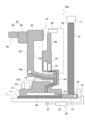
- FIG. 2 is an explanatory diagram for explaining a wiring state and a detachable imaging unit of the ophthalmic apparatus of the first embodiment, and is a left side view generally showing the ophthalmic apparatus in a state where the imaging unit is not attached.
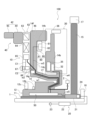
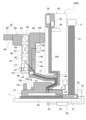
- FIG. 2 is an explanatory diagram for explaining a wiring state and a detachable imaging unit of the ophthalmic apparatus of the first embodiment, and is a left side view generally showing the ophthalmic apparatus in a state where the imaging unit is attached.
- FIG. 2 is an explanatory diagram for explaining a wiring state and a detachable imaging unit of the ophthalmic apparatus of the first embodiment, and is a left side view generally showing the ophthalmic apparatus in a state where the imaging unit is attached.
- FIG. 2 is a rear view of the vicinity of the background light switching unit of the ophthalmic apparatus of Example 1 as seen from the examiner side, and is an explanatory diagram for explaining the state of the background light switching unit when switching the background light.
- 2 is a front view of the background illumination system and the vicinity of the objective lens of the ophthalmic apparatus of the first embodiment, as viewed from the subject side.
- FIG. FIG. 11 is a perspective view showing the overall configuration of an ophthalmic apparatus according to a second embodiment.
- FIG. 11 is an explanatory diagram for explaining the wiring state and the detachable imaging unit of the ophthalmic apparatus of the second embodiment, and is a left side view showing the ophthalmic apparatus in a state where the imaging unit is attached.
- Example 1 A slit lamp microscope 100 according to Example 1, which is an embodiment of an ophthalmic device according to the present disclosure, will be described as follows with reference to Figures 1 to 4.
- the slit lamp microscope 100 shown in Figure 1 is an ophthalmic device that obtains an image of a cross section of the cornea by cutting out an optical slice of the cornea of a subject's eye E using slit-shaped illumination light (hereinafter, sometimes referred to as "slit light”), and is also referred to as a "slit lamp microscope.”
- slit light slit-shaped illumination light
- the slit lamp microscope 100 of Example 1 mainly comprises a main body 10, a power supply unit 20, and an imaging unit 60.
- the main body 10 mainly comprises an illumination system 30, an observation system 40, and a control device 50.
- the imaging unit 60 mainly comprises an imaging section 61 and a background illumination system 80, which is an example of a specific light irradiation system.
- the slit lamp microscope 100 of Example 1 is a so-called Zeiss type (Littman type) slit lamp microscope, and since the illumination system 30 is arranged below the observation system 40, it is a more compact device than the slit lamp microscope 100A of Example 2 described below.
- the main body 10 is installed on the optical table 1. As described above, the main body 10 includes the illumination system 30, the observation system 40, and the control device 50.
- the main body 10 further includes a base 11 fixed to the upper surface of the optical table 1, a mount 12 provided on the upper surface of the base 11, a movement mechanism 13 that moves the mount 12 in the left-right direction, a support 14 provided on the upper surface of the mount 12, a face support 15 supported by the base 11, and a pair of grips 16 provided on both the left-right sides of the base 11.
- the stand unit 12 includes a stand 12a, a dimming knob (dimming operation unit) 12b, an operation lever (movement operation unit) 12c, and a shooting button 12d provided on the upper surface of the operation lever 12c.
- the stand unit 12 can be moved by a movement mechanism 13 in the front-rear and left-right directions when viewed from the subject's eye E relative to the base 11.
- the movement mechanism 13 includes a slide rod 13a inserted into the stand 12a, and a pair of fixed parts 13b that support both ends of the slide rod 13a so that they can be moved in the front-rear direction.
- the front direction of the front-rear direction is the direction approaching the subject
- the rear direction is the direction away from the subject and toward the examiner.
- the left direction of the left-right direction is the direction of the subject's left hand
- the right direction is the direction of the subject's right hand.
- the operating lever 12c is a member for giving instructions to move the stand 12.
- the photographing button 12d is a member for giving photographing instructions to the imaging unit 61.
- the operating lever 12c and the photographing button 12d are electrically connected to the control device 50.
- the examiner who is the user of the slit lamp microscope 100, can move the entire stand 12 in the front-back and left-right directions by the action of the moving mechanism 13 by gripping and moving the operating lever 12c.
- the control device 50 controls the observation system 40 according to the amount and direction of the operation to perform focusing.
- the control device 50 controls the imaging unit 61 to take an image of the subject's eye E.
- the dimmer knob 12b is a member that allows the examiner to turn on and off the slit light of the illumination system 30 and adjust the brightness (amount of light).
- the illumination system 30 is turned on or off under the control of the control device 50, and when it is turned on, the brightness of the illumination light of the illumination system 30 is continuously and freely changed depending on the amount and direction of operation from the off position.
- the support section 14 comprises a base 14a, a first support arm 14b, and a second support arm 14c.
- the base 14a is provided on the upper surface of the stand 12a.
- the first support arm 14b and the second support arm 14c stand upright from the base 14a.
- the first support arm 14b and the second support arm 14c can each rotate independently around a coaxial vertical axis 14d.
- the support section 14 also includes a test rod 14e that can be detachably attached to a rotation axis hole (not shown) provided in the vertical axis 14d.
- This test rod 14e is a member for checking the state of the slit light irradiated from the illumination system 30, and is removed when irradiating the slit light onto the subject's eye E for observation.
- the first support arm 14b has an illumination system housing 31, which contains the optical components of the illumination system 30, attached to its upper portion, and supports the illumination system 30.
- This first support arm 14b can be rotated manually.
- the illumination system housing 31 revolves around the subject's eye E. This changes the direction in which the slit light is irradiated onto the subject's eye E.
- the first support arm 14b can also rotate up and down, in which case the elevation and depression angles of the slit light relative to the subject's eye E are changed.
- the second support arm 14c is composed of a cylindrical body that is L-shaped when viewed from the side, and has an accommodation space 14f (see Figures 2A and 2B) inside which various wiring is accommodated.
- the observation system housing 41 that accommodates the optical members of the observation system 40 is attached to the upper part of the second support arm 14c, and supports the observation system 40.
- the imaging unit 60 is also detachably attached to the second support arm 14c below the observation system 40, and supports the imaging unit 60.
- the second support arm 14c can be rotated manually. By rotating the second support arm 14c, the observation system 40 and the imaging unit 60 rotate around the first support arm 14b. This changes the observation direction of the observation system 40 and the imaging unit 60 with respect to the subject's eye E.
- the second support arm 14c accommodates a relay board 14g below the accommodation space 14f.
- This relay board 14g is electrically connected to the control device 50 accommodated in the stand 12a by a first power cable w1 accommodated in the accommodation space 14f and the stand 12a.
- a second power cable w2 extending from the imaging section 61 of the imaging unit 60 (described later) and a third power cable w3 extending from the background illumination system 80 can be detachably connected to the relay board 14g.
- These power cables w2 and w3 can also be accommodated in the accommodation space 14f.
- the second support arm 14c is provided with a mounting portion 14h for mounting the background illumination system 80 on the side facing the subject, below the objective lens 43 of the observation system 40.
- This mounting portion 14h has a hole (not shown) into which one end of the background illumination system 80 is inserted, and is covered with a lid (not shown) when the background illumination system 80 is not in use.
- the mounting portion 14h may be configured as an input/output terminal to which the background illumination system 80 is connected.
- the first support arm 14b and the second support arm 14c may be configured to rotate automatically by electricity.
- the support unit 14 includes an actuator that generates a driving force to rotate the first support arm 14b and the second support arm 14c, and a transmission mechanism that transmits this driving force.
- a stepping motor pulse motor
- a combination of gears or a rack and pinion is used as the transmission mechanism.
- the face support part 15 is disposed in front of the observation system 40, facing it.
- the face support part 15 includes a chin rest part 15a on which the subject's chin is placed, and a forehead rest part 15b on which the forehead is placed.
- the subject faces the optical table 1 and places his/her face in contact with the chin rest part 15a and forehead rest part 15b, while the examiner operates the slit lamp microscope 100 to observe the subject's eye E, etc.
- the face support unit 15 is also provided with a detachable fixation unit 17 used for external fixation.
- the fixation unit 17 includes a fixation lamp holder 17a consisting of a flexible arm, and an external fixation lamp 17b (e.g., an LED light source) that is provided at the tip of the fixation lamp holder 17a and emits fixation light.
- the fixation unit 17 can arbitrarily adjust the position of the external fixation lamp 17b and the emission direction of the fixation light using the fixation lamp holder 17a.
- the fixation unit 17 can guide the line of sight of the subject's eye E using the external fixation lamp 17b, and adjust the direction of the subject's eye E.
- the pair of gripping parts 16 are members that the subject holds with both hands when undergoing the examination. By gripping these gripping parts 16, the subject can stabilize his or her body and maintain a stable posture to undergo the examination appropriately.
- the power supply unit 20 is a device that supplies power to the slit lamp microscope 100.
- the power supply unit 20 is connected to the control device 50 by a fifth power cable w5.
- the power supply unit 20 mainly comprises a switch box 21, an AC/DC converter 22, and a plug 23.
- the switch box 21 comprises a switch board 24, a power switch 25, and a confirmation indicator light 26.
- the switch board 24 is a control device that controls the switching of the power of the slit lamp microscope 100 ON or OFF depending on the operating state of the power switch 25.
- the power switch 25 is a member for indicating whether the power is ON or OFF.
- the confirmation indicator light 26 is a so-called pilot lamp and is made of, for example, an LED light source.
- the confirmation indicator light 26 is for informing the user of the power status of the slit lamp microscope 100.
- the confirmation indicator light 26 is lit when the slit lamp microscope 100 is energized, i.e., activated (power ON), and is turned off when the microscope is deenergized, i.e., stopped (power OFF).
- the AC/DC converter 22 converts AC voltage into DC voltage.
- the plug 23 is inserted into a socket (not shown).
- the power supply unit 20 supplies power via the AC/DC converter 22 to the control device 50 and the illumination system 30, observation system 40, and imaging unit 60 connected to the control device 50.
- the illumination system 30 irradiates slit light toward the subject's eye E.
- the illumination system 30 mainly comprises a slit lamp (e.g., an LED light source) 32 housed in an illumination system housing 31, and a deflection optical system 33.
- the illumination system 30 may also comprise an exciter filter 35, a diffuser plate 36 (see FIG. 2B) and the like selectively arranged on the optical path.
- the exciter filter 35 when combined with a barrier filter provided in the observation system 40 or the imaging unit 61, for example, enables fluorescent observation of the cornea of the subject's eye E.
- the diffuser plate 36 diffuses the illumination light irradiated from the slit lamp 32, allowing a wider range of the subject's eye E to be observed.
- the slit lamp 32 irradiates slit light toward the deflection optical system 33.
- the deflection optical system 33 is provided above the slit lamp 32.
- the deflection optical system 33 includes a deflection optical element 34.
- the deflection optical element 34 is configured from a prism.
- the deflection optical element 34 deflects the slit light irradiated from the slit lamp 32 toward the subject's eye E. This causes the slit light to be irradiated onto the subject's eye E.
- the deflection optical element 34 is not limited to a prism, but may be configured from a mirror (reflecting mirror) or the like, and may deflect the slit light by reflecting it toward the subject's eye E.
- the slit lamp 32 and the deflection optical system 33 are not limited to the configuration shown in FIG. 1, and may be any type used in a Zeiss-type slit lamp microscope, and there are no particular limitations on their shape, structure, and
- the slit lamp 32 is electrically connected to the control device 50 by the first support arm 14b and a fourth power cable w4 housed within the support section 14. With this configuration, the slit lamp 32 is supplied with power from the power supply section 20 via the control device 50 and is controlled by the control device 50.
- the brightness of the slit light is changed by operating the dimming knob 12b provided on the stand 12a as described above.
- the width of the slit light is changed by the examiner operating the slit opening/closing knob (slit opening/closing operation unit) 37 provided on the illumination system 30.
- the slit light is light in which the irradiation area is formed in a band shape by blocking part of the irradiation area, and is illumination light for observing the cornea and fundus of the subject eye E.
- the observation system 40 is used to observe the return light (also called “reflected light") from the subject's eye E, and is a so-called microscope.
- the "return light” includes not only the slit light and background light reflected by the subject's eye E, but also various types of light, such as scattered light from the subject's eye E and its surroundings. In the first embodiment, all of these types of light are called “return light”.
- the observation system 40 is attached to the top of the second support arm 14c, and the observation optical system 42 that guides the return light from the subject's eye E is housed in the observation system housing 41.
- the observation system housing 41 in the first embodiment is composed of a first observation system housing 41a arranged on the subject side (front side) of the second support arm 14c, and a second observation system housing 41b arranged on the examiner side (rear side) of the second support arm 14c.
- the observation optical system 42 includes one objective lens 43, a pair of left and right relay optical systems 44, and a pair of left and right eyepieces 45.
- the objective lens 43 is a lens that faces the subject's eye E.
- the pair of left and right eyepieces 45 each include an eyepiece 45a that faces the examiner's left and right eyes e of the examiner.
- the pair of left and right relay optical systems 44 each include optical members such as a variable magnification optical system, an aperture, and a prism unit (not shown).
- the objective lens 43 and a part of the relay optical system 44 are housed in the first observation system housing 41a, and the remainder of the relay optical system 44 (e.g., the prism unit) and the eyepieces 45 are housed in the second observation system housing 41b.
- the relay optical system 44 may be configured so that the entirety of the relay optical system 44 is housed in the first observation system housing 41a or the second observation system housing 41b.
- observation magnification adjustment handles (observation magnification adjustment operation unit) 46 for changing the observation magnification are provided on the left and right sides of the observation system housing 41.
- the imaging unit 60 mainly comprises the imaging section 61 and the background illumination system 80, and is detachably attached to the second support arm 14c of the main body 10.
- the imaging section 61 is attached to the side of the second support arm 14c facing the examiner (rear side).
- the background illumination system 80 is attached to a mounting section 14h provided below the objective lens 43 of the observation system 40 on the side of the second support arm 14c facing the subject (front side).
- the imaging unit 61 receives return light from the subject's eye E and captures an image of the subject's eye E.
- the imaging unit 61 mainly comprises an imaging unit housing 62, an imaging unit deflection optical member 63, an imaging optical system 64, an imaging element 65, an LED board 66 which is a control board, and a background light switching unit 67 which is an operation unit.
- the imaging unit housing 62 is attached to the second support arm 14c so as to be sandwiched between the second observation system housing 41b and the second support arm 14c.
- the imaging unit deflection optical member 63, the imaging optical system 64, the imaging element 65, and the LED board 66 are contained within the imaging unit housing 62.
- the imaging unit deflection optical member 63 When the imaging unit 61 is attached to the second support arm 14c, the imaging unit deflection optical member 63 is disposed in the optical path of the observation system 40, more specifically, in the optical path of one of the pair of relay optical systems 44, and deflects a portion of the return light from the subject's eye E out of the optical path of the observation system 40.
- the imaging unit deflection optical member 63 is composed of a beam splitter, and by reflecting a portion of the return light, deflects the return light toward the imaging element 65 and transmits the remaining return light.
- the imaging optical system 64 is composed of optical elements such as an imaging lens, and collects the return light deflected by the imaging unit deflection optical member 63 and forms an image on the imaging element 65.
- the imaging element 65 is a photoelectric conversion element that detects the return light collected by the imaging optical system 64, converts it into an electrical signal (image signal), and outputs it.
- a CCD (Charge Coupled Device) image sensor or a CMOS (Complementary Metal Oxide Semiconductor) image sensor is used as the imaging element 65.
- the imaging element 65 is connected to a personal computer (PC) 2 (see FIG. 2B), which is an external device, by a communication cable u1, and is capable of outputting an image signal to the PC 2. Therefore, an image captured by the imaging unit 61 can be stored in the PC 2.
- the image signal may also be input to the control device 50, and the image may be stored in a storage device of the control device 50.
- the communication cable u1 is, for example, a USB cable, and is housed within the imaging unit housing 62, the housing space 14f of the second support arm 14c, and the stand 12a.
- One end of the communication cable u1 is connected to the imaging element 65, and the other end extends from the stand 12a to the outside and is connected to the PC 2, or is connected to the PC 2 via an input/output terminal (not shown) or a USB cable provided on the main body 10.
- the LED board 66 is a circuit board equipped with an LED light source.
- the LED board 66 is connected to the relay board 14g by the second power cable w2.
- the relay board 14g is connected to the control device 50 by the first power cable w1
- the control device 50 is connected to the power supply unit 20 by the fifth power cable w5.
- the LED board 66 is supplied with power from the power supply unit 20 via the relay board 14g and the control device 50, and is controlled by the control device 50.
- the LED board 66 is connected to the imaging element 65 via the first circuit cable C1, supplies power to the imaging element 65, and controls the imaging element 65 under the control of the control device 50. That is, when the photographing button 12d is pressed, the control device 50 controls the LED board 66 via the relay board 14g, and the LED board 66 controls the imaging element 65 to photograph an image of the subject's eye E.
- the LED board 66 is also connected to the background light switching unit 67 by a second circuit cable C2.
- the LED board 66 is further connected to the background illumination system 80 via the second power cable w2, the relay board 14g, and the third power cable w3 housed in the accommodation space 14f.
- an electrical signal based on the examiner's rotation operation of the background light switching unit 67 is output to the control device 50 via the LED board 66 and the relay board 14g.
- the control device 50 controls the background illumination system 80 in accordance with this electrical signal, and causes it to turn the background light on and off, switch the background light, and adjust the brightness (amount of light).
- the LED light source of the LED board 66 functions as a light-emitting unit 70 that informs the examiner of the power-on state (power ON or OFF) of the imaging unit 61 and the color of the background light irradiated from the background illumination system 80.
- the light-emitting unit 70 is turned off when the imaging unit 61 is not powered, i.e., stopped (power OFF), and is turned on, for example, in green when the imaging unit 61 is powered, i.e., started (power ON).
- the light-emitting unit 70 is turned on, for example, in blue when visible light is irradiated from the background illumination system 80, and is turned on, for example, in red when infrared light is irradiated.
- the color of the light irradiated from the light-emitting unit 70 is not limited to these colors, and may be other colors as long as the power-on state of the imaging unit 61 and the color of the background light can be identified.
- the light-emitting unit 70 may also indicate the state of the imaging unit 61 and the background light by changing the light-emitting mode, such as blinking.
- the examiner can check the lighting state and color of the light-emitting unit 70 through a display window 71 (see FIG. 3) located on the examiner side of the imaging unit housing 62, in the center above the background light switching unit 67.
- the background light switching unit 67 is a member that allows the examiner to turn the background illumination system 80 on or off, switch the background light, and adjust the brightness (amount of light). As shown in Figures 1 to 3, the background light switching unit 67 is provided on one side of the imaging unit housing 62, below the side (rear side) that faces the examiner. The background light switching unit 67 has a marker 67a on its surface to indicate the rotation position. In addition, the aforementioned display window 71 is provided on one side of the imaging unit housing 62 at the 12 o'clock position above the background light switching unit 67. This display window 71 is also the off position of the background illumination system 80.
- a predetermined range in the clockwise direction is the range in which visible light is irradiated from the background light source 82 and the brightness can be adjusted, and the letters "BG" are displayed at the position where the brightness of the visible light is maximum (maximum visible light position 72).
- a certain range in the counterclockwise direction is the range in which infrared light is irradiated from the background light source 82 and the brightness can be adjusted, and the letters "IR" are displayed at the position where the brightness of the infrared light is at its maximum (maximum infrared light position 73).
- the LED board 66 turns off the background light source 82.
- the LED board 66 responds by irradiating visible light from the background light source 82.
- the LED board 66 increases the brightness of the visible light according to the amount of operation (amount of rotation) of the background light switching unit 67 from the off position, and controls the lighting of the background light source 82 so that the brightness of the visible light is at its maximum when the marker 67a reaches the "BG" position.
- this operation causes the LED board 66 to emit infrared light from the background light source 82.
- the LED board 66 increases the brightness of the infrared light according to the amount of operation (amount of rotation) of the background light switching unit 67 from the off position, and controls the lighting of the background light source 82 so that the brightness of the infrared light is at its maximum when the marker 67a reaches the "IR" position.
- the background illumination system 80 illuminates with background light the area surrounding the illumination area of the slit light emitted from the illumination system 30.
- the illumination area by the background illumination system 80 needs to include at least this surrounding area, and may partially overlap with the illumination area by the illumination system 30.
- the background illumination system 80 mainly comprises a background illumination housing 81, a background light source 82, and optical components such as a focusing lens (not shown).
- the background light source 82 has a visible light source 82a that emits visible light (background light: BG), and a pair of infrared light sources 82b on either side that emit infrared light (IR).
- the visible light and infrared light emitted from the background light source 82 are turned on, switched, and the brightness is adjusted by operating the background light switching unit 67 located on the examiner's side. Visible light is used for naked eye observation and photography, and infrared light is used for observation and photography of the meibomian glands.
- the background light source 82 emits background light from an irradiation port 83 opened in the background illumination housing 81 toward the subject's eye E.
- the background light emitted from the background light source 82 is collected by a condensing lens and then irradiated toward the subject's eye E.
- the background light emitted from the background light source 82 is not limited to both visible light and infrared light, and may emit either one of them.
- the background light source 82 is composed of a visible light source 82a and an infrared light source 82b, but it may be configured to selectively emit visible light and infrared light from a single LED light source.
- the control device 50 controls each part of the slit lamp microscope 100.
- the control device 50 is composed of a motherboard (main board) having a CPU (Central Processing Unit) that functions as a control unit, and storage devices such as a ROM (Read Only Memory), a RAM (Random Access Memory), and a hard disk drive.
- the control device 50 is built into the stand 12a.
- the control device 50 is connected to the power supply unit 20, lighting system 30, observation system 40, imaging unit 61, and background lighting system 80 via power cables w1 to w5, acquires necessary information, and outputs appropriate control commands to these.
- a control program is stored in advance in the storage device of the control device 50. Control commands from the CPU are realized by the cooperation of this control program and hardware.
- the control device 50 also supplies power from the power supply unit 20 to the lighting system 30, observation system 40, imaging unit 61, and background lighting system 80.
- the control device 50 may be connected to a PC, tablet terminal, dedicated controller, etc., having an operation unit and a display unit.
- the control device 50 may receive operation input from the examiner via the operation unit of a PC or the like, control the slit lamp microscope 100, and output captured images, measurement results, etc., to be displayed on the display unit.
- the installation worker attaches the second observation system housing 41b (see FIG. 1), which houses part of the relay optical system 44 and the eyepiece 45, to the second support arm 14c, as shown in FIG. 2A. This allows the examiner to observe the subject's eye E with the naked eye through the objective lens 43, relay optical system 44, and eyepiece 45 of the observation system 40.
- the operator attaches the imaging section 61 to the examiner side of the second support arm 14c, and attaches the background illumination system 80 to the attachment section 14h on the subject side of the second support arm 14c.
- the operator connects the second power cable w2 extending from the imaging section 61 and the third power cable w3 extending from the background illumination system 80 to the relay board 14g inside the second support arm 14c.
- the imaging section 61 and the background illumination system 80 are electrically connected to the control device 50, and their operation is controlled by the control device 50.
- the operator attaches the second observation system housing 41b to the examiner side of the imaging section 61.
- This allows the examiner to observe the subject's eye E with the naked eye through the objective lens 43, relay optical system 44, and eyepiece section 45 of the observation system 40.
- a portion of the returning light from the subject's eye E is deflected by the imaging section deflection optical member 63, allowing the examiner to capture an image of the subject's eye E using the imaging section 61.
- the imaging unit 60 may be attached (or detached) by the manufacturer when the slit lamp microscope 100 is manufactured, by a contractor or the like when it is delivered to the user, or by the user themselves.
- the slit lamp microscope 100 of Example 1 comprises a main body 10 having an illumination system 30 that irradiates illumination light onto the subject's eye E and an observation system 40 that observes the return light from the subject's eye E, and an imaging unit 60 that can be detachably attached to the main body 10.
- the imaging unit 60 comprises an imaging section 61 that captures an image of the subject's eye E, and a specific light irradiation system (background illumination system 80) that irradiates the subject's eye E with specific light (background light) that is different from the illumination light.
- the slit lamp microscope 100 of Example 1 can be configured without the imaging unit 60 as shown in FIG. 2A, or with the imaging unit 60 as shown in FIG. 2B, depending on the user's needs and intended use.
- the background illumination system 80 used in combination with the imaging section 61 can be attached and detached without changing the configuration of other components such as the observation system 40. Therefore, the slit lamp microscope 100 of Example 1 can easily and selectively attach a background illumination system 80 (specific light irradiation system) that irradiates background light (specific light).
- the main body 10 of Example 1 also includes a second support arm 14c that supports the observation system 40, and the imaging unit 60 is detachably attached to the second support arm 14c. This configuration allows the operator to more easily attach and detach the imaging unit 60.
- the observation system 40 of Example 1 is attached to the upper part of the second support arm 14c, and has an objective lens 43 facing the subject's eye E, and an eyepiece lens 45a facing the examiner's eye e.
- the background illumination system 80 (specific light irradiation system) is disposed below the objective lens 43 on the side of the second support arm 14c facing the subject. With this configuration, the background illumination system 80 can appropriately irradiate the subject's eye E with background light from below. Therefore, the subject's eye E can be observed and photographed more appropriately using the background light, and the subject is less likely to feel dazzled even if the background light is visible light.
- wiring such as the power cable for the background lighting system and the communication cable for the imaging unit was connected to the power supply unit or external devices from outside the ophthalmic device and was exposed to the outside. This made the ophthalmic device look unattractive, and the wiring could get in the way when moving the main unit back and forth or left and right.
- the slit lamp microscope 100 of Example 1 is equipped with a power supply unit 20 that supplies power, and the second support arm 14c has a storage space 14f that stores wiring such as the first to fourth power cables w1 to w4.
- the imaging unit 60 is connected to the power supply unit 20 by wiring stored in the storage space 14f.
- the communication cable u1 that outputs images captured by the imaging unit 61 to the external device PC2 is also connected to the PC2 through the storage space 14f.
- the wiring of the slit lamp microscope 100 of Example 1 is stored within the storage space 14f of the second support arm 14c and is not exposed to the outside. Therefore, the slit lamp microscope 100 of Example 1 has improved wiring storage capacity, improved appearance, and excellent operability.
- the second support arm 14c of the first embodiment has a relay board 14g in the accommodation space 14f to which the first power cable (first wiring) w1 from the imaging unit 61 and the second power cable (second wiring) w2 from the background illumination system 80 are connected.
- the relay board 14g is connected to the power supply unit 20 by the third power cable w3 (third wiring) accommodated in the main body 10, and further the control device 50 and the fifth power cable w5. Therefore, when attaching the imaging unit 60 to the main body 10, the worker can install the wiring by simply connecting the second power cable w2 extending from the imaging unit 61 and the third power cable w3 extending from the background illumination system 80 to the relay board 14g, improving workability.
- the third wiring is accommodated in the main body 10, it is not exposed to the outside and does not affect the appearance or operability.
- the background lighting system is positioned on the side facing the subject, and the operation unit for turning on the background light, etc. is also positioned on the subject's side, making it difficult for the examiner to operate the operation unit.
- the imaging unit 61 in Example 1 is positioned on the side of the second support arm 14c facing the examiner, and a background light switching unit 67 (operation unit) of the background lighting system 80 is provided on the side of the imaging unit 61 facing the examiner. This allows the examiner to easily operate the background light switching unit 67, and allows the background light to be turned on, off, switched, and the brightness to be adjusted more appropriately.
- the imaging section 61 of Example 1 has an imaging section deflection optical member 63 that is arranged in the optical path of the observation system 40 and deflects a portion of the returning light out of the optical path of the observation system 40, and an imaging element 65 that receives the returning light deflected by the imaging section deflection optical member 63.
- the imaging element 65 can capture an image of the subject's eye E similar to the image observed by the examiner.
- the imaging section deflection optical member 63 is also attached and detached from the optical path of the observation system 40. Therefore, there is no need to change the configuration of the observation optical system 42 of the observation system 40, and by arranging the imaging section deflection optical member 63 in this optical path, the returning light can be deflected toward the imaging element 65.
- the background illumination system 80 which is the specific light irradiation system of Example 1, irradiates background light as the specific light, and irradiates at least one of visible light and infrared light as this background light onto the subject's eye E.
- the examiner can use visible light to observe and photograph the area around the area irradiated with the slit light, and can use infrared light to observe and photograph the meibomian glands.
- the imaging unit 60 of Example 1 also has a light-emitting section 70 on the side facing the examiner, which emits light in different ways depending on the color of the background light irradiated from the background illumination system 80.
- This configuration allows the examiner to easily determine whether the background light irradiated from the background illumination system 80 is visible light, infrared light, etc., and allows the examiner to more appropriately observe and photograph the subject's eye E.
- Example 2 A slit lamp microscope 100 according to a second embodiment of the ophthalmologic apparatus of the present disclosure will be described below with reference to Figures 5 and 6.
- the slit lamp microscope 100A according to the second embodiment is a so-called Haag type (Goldmann type) slit lamp microscope, and has the same basic configuration as the slit lamp microscope 100 according to the first embodiment, except that the illumination system 30 is disposed above the observation system 40.
- the same components as those in the slit lamp microscope 100 according to the first embodiment are denoted by the same reference numerals as those in the first embodiment, and detailed descriptions thereof will be omitted.
- the slit lamp microscope 100A of Example 2 mainly comprises a main body 10 and a power supply unit 20.
- the main body 10 mainly comprises an illumination system 30, an observation system 40, a control device 50, a base 11 fixed to the upper surface of the optical table 1, a stand 12, a moving mechanism 13, a support unit 14, and a face support unit 15.
- the illumination system 30 is attached to the upper part of the first support arm 14b, above the observation system 40.
- the observation system 40 is attached to the upper part of the second support arm 14c, which has an internal storage space 14f.
- the imaging unit 60 mainly comprises an imaging section 61 and a background illumination system 80 that selectively irradiates visible light and infrared light, and is detachably attached to the second support arm 14c of the main body 10.
- Figures 5 and 6 show the imaging unit 60 attached to the second support arm 14c, the imaging unit 60 can also be detached and used in Example 2.
- the imaging unit 61 is attached to the side (rear side) of the second support arm 14c facing the examiner.
- the background illumination system 80 is attached to a mounting portion 14h provided below the objective lens 43 of the observation system 40 on the side (front) of the second support arm 14c facing the examinee.
- the imaging unit housing 62 is provided with a background light switching unit 67 and a light emitting unit 70 on the examiner side.
- the imaging unit 61 and background illumination system 80 are connected to the relay board 14g by a first power cable w1 and a second power cable w2, respectively, housed in the accommodation space 14f.
- the relay board 14g is connected to the control device 50 by a third power cable w3 housed in the accommodation space 14f and the stand 12.
- the imaging element 65 is connected to the PC 2 by a communication cable u1 housed in the accommodation space 14f and the stand 12.
- the slit lamp microscope 100A of Example 2 can achieve the same effects as the slit lamp microscope 100 of Example 1 described above.
- the slit lamp microscope 100A of Example 2 has an imaging unit 60 equipped with an imaging section 61 and a background illumination system 80, which is detachably mounted on the main body 10, as in Example 1, so that a background illumination system 80 (specific light illumination system) that irradiates background light (specific light) can be easily and selectively attached.
- Example 1 The ophthalmic device of the present disclosure has been described above based on Example 1 and Example 2, but the specific configuration is not limited to these examples, and design changes and additions are permitted as long as they do not deviate from the gist of the invention according to each claim in the scope of the claims.
- the ophthalmic device in each of the above embodiments is a slit lamp microscope, but the ophthalmic device to which the present disclosure is applied is not limited to a slit lamp microscope.
- the ophthalmic device may be a surgical microscope.
- the present disclosure can be applied to ophthalmic devices that observe and photograph the subject's eye using specific light that is different from the illumination light.
- the specific light irradiation system is not limited to a configuration that irradiates background light, but may be a configuration that irradiates a second illumination light that has a different wavelength, illumination range, etc. from the illumination light used for observation.
- the light-emitting unit 70 in each of the above-described embodiments is an LED light source of the LED board 66 in the imaging unit housing 62, and emits light through the display window 71 in response to background light, but is not limited to this configuration.
- the light-emitting unit 70 may be provided on the back side of the characters "BG" and "IR” attached to the maximum visible light position 72 and the maximum infrared light position 73, and may be configured to cause these characters to emit light in a predetermined color or manner in response to the operation of the background light switching unit 67.
- the light-emitting unit 70 may be provided in the marker 67a portion within the background light switching unit 67, and may be configured to cause the marker 67a to emit light in a predetermined color or manner in response to the operation of the background light switching unit 67.
Landscapes
- Life Sciences & Earth Sciences (AREA)
- Health & Medical Sciences (AREA)
- Medical Informatics (AREA)
- Biophysics (AREA)
- Ophthalmology & Optometry (AREA)
- Engineering & Computer Science (AREA)
- Biomedical Technology (AREA)
- Heart & Thoracic Surgery (AREA)
- Physics & Mathematics (AREA)
- Molecular Biology (AREA)
- Surgery (AREA)
- Animal Behavior & Ethology (AREA)
- General Health & Medical Sciences (AREA)
- Public Health (AREA)
- Veterinary Medicine (AREA)
- Eye Examination Apparatus (AREA)
Abstract
Priority Applications (2)
| Application Number | Priority Date | Filing Date | Title |
|---|---|---|---|
| CN202480034862.8A CN121194736A (zh) | 2023-06-05 | 2024-03-05 | 眼科装置 |
| EP24818980.5A EP4721644A1 (fr) | 2023-06-05 | 2024-03-05 | Dispositif ophtalmique |
Applications Claiming Priority (2)
| Application Number | Priority Date | Filing Date | Title |
|---|---|---|---|
| JP2023092438A JP2024174554A (ja) | 2023-06-05 | 2023-06-05 | 眼科装置 |
| JP2023-092438 | 2023-06-05 |
Publications (1)
| Publication Number | Publication Date |
|---|---|
| WO2024252741A1 true WO2024252741A1 (fr) | 2024-12-12 |
Family
ID=93795694
Family Applications (1)
| Application Number | Title | Priority Date | Filing Date |
|---|---|---|---|
| PCT/JP2024/008254 Ceased WO2024252741A1 (fr) | 2023-06-05 | 2024-03-05 | Dispositif ophtalmique |
Country Status (4)
| Country | Link |
|---|---|
| EP (1) | EP4721644A1 (fr) |
| JP (1) | JP2024174554A (fr) |
| CN (1) | CN121194736A (fr) |
| WO (1) | WO2024252741A1 (fr) |
Citations (7)
| Publication number | Priority date | Publication date | Assignee | Title |
|---|---|---|---|---|
| JP2003047595A (ja) * | 2001-08-06 | 2003-02-18 | Nidek Co Ltd | 眼科撮影装置 |
| JP2014147476A (ja) * | 2013-01-31 | 2014-08-21 | Takagi Seiko Corp | 細隙灯顕微鏡 |
| JP2016150032A (ja) * | 2015-02-16 | 2016-08-22 | 株式会社トプコン | 眼科手術用顕微鏡および眼科手術用アタッチメント |
| WO2018189873A1 (fr) * | 2017-04-13 | 2018-10-18 | 株式会社ライト製作所 | Microscope à lampe à fente |
| JP2019170636A (ja) * | 2018-03-28 | 2019-10-10 | 株式会社トプコン | 細隙灯顕微鏡 |
| US20200305710A1 (en) * | 2019-03-31 | 2020-10-01 | Box Medical Solutions, Inc. | HANDHELD and SLIT LAMP DETACHABLE CAMERA WITH PIVOTABLE ARM |
| JP2023092438A (ja) | 2021-12-21 | 2023-07-03 | 横浜ゴム株式会社 | タイヤ |
-
2023
- 2023-06-05 JP JP2023092438A patent/JP2024174554A/ja active Pending
-
2024
- 2024-03-05 EP EP24818980.5A patent/EP4721644A1/fr active Pending
- 2024-03-05 CN CN202480034862.8A patent/CN121194736A/zh active Pending
- 2024-03-05 WO PCT/JP2024/008254 patent/WO2024252741A1/fr not_active Ceased
Patent Citations (8)
| Publication number | Priority date | Publication date | Assignee | Title |
|---|---|---|---|---|
| JP2003047595A (ja) * | 2001-08-06 | 2003-02-18 | Nidek Co Ltd | 眼科撮影装置 |
| JP2014147476A (ja) * | 2013-01-31 | 2014-08-21 | Takagi Seiko Corp | 細隙灯顕微鏡 |
| JP5747924B2 (ja) | 2013-01-31 | 2015-07-15 | 株式会社タカギセイコー | 細隙灯顕微鏡 |
| JP2016150032A (ja) * | 2015-02-16 | 2016-08-22 | 株式会社トプコン | 眼科手術用顕微鏡および眼科手術用アタッチメント |
| WO2018189873A1 (fr) * | 2017-04-13 | 2018-10-18 | 株式会社ライト製作所 | Microscope à lampe à fente |
| JP2019170636A (ja) * | 2018-03-28 | 2019-10-10 | 株式会社トプコン | 細隙灯顕微鏡 |
| US20200305710A1 (en) * | 2019-03-31 | 2020-10-01 | Box Medical Solutions, Inc. | HANDHELD and SLIT LAMP DETACHABLE CAMERA WITH PIVOTABLE ARM |
| JP2023092438A (ja) | 2021-12-21 | 2023-07-03 | 横浜ゴム株式会社 | タイヤ |
Also Published As
| Publication number | Publication date |
|---|---|
| EP4721644A1 (fr) | 2026-04-08 |
| CN121194736A (zh) | 2025-12-23 |
| JP2024174554A (ja) | 2024-12-17 |
Similar Documents
| Publication | Publication Date | Title |
|---|---|---|
| JP5748268B2 (ja) | マイボーム腺観察装置 | |
| JP6519878B2 (ja) | 照明機能を備えた近接撮影装置 | |
| JP2011177273A (ja) | 細隙灯顕微鏡 | |
| JP2012254197A (ja) | 細隙灯顕微鏡装置 | |
| US5840012A (en) | Diagnostic instrument supporting system | |
| JP6843306B1 (ja) | 医療用光学撮影装置 | |
| JP2003275177A (ja) | 眼科装置 | |
| KR102243321B1 (ko) | 눈꺼풀 고정 기구 | |
| JP6054669B2 (ja) | 眼科観察装置 | |
| JP7016748B2 (ja) | 細隙灯顕微鏡 | |
| JP4590206B2 (ja) | 眼科検査装置 | |
| JP4633213B2 (ja) | 手術用顕微鏡 | |
| JP2009118955A (ja) | 手術用顕微鏡装置 | |
| JP2024174554A (ja) | 眼科装置 | |
| JP4592905B2 (ja) | 細隙灯顕微鏡 | |
| JP2012152361A (ja) | 乱視軸測定装置、及び眼科装置 | |
| JP3124676U (ja) | 細隙灯顕微鏡用補助照明装置 | |
| JP3649957B2 (ja) | 細隙灯顕微鏡 | |
| JP2025158347A (ja) | スリットランプ顕微鏡 | |
| JP7220471B2 (ja) | マイボーム腺観察可能な細隙灯顕微鏡 | |
| JPH10314119A (ja) | 眼科装置 | |
| JP2012249700A (ja) | スリットランプ | |
| JP6691596B2 (ja) | 眼科撮影装置 | |
| WO2026033893A1 (fr) | Dispositif ophtalmologique | |
| JP2025084002A (ja) | 眼科装置 |
Legal Events
| Date | Code | Title | Description |
|---|---|---|---|
| 121 | Ep: the epo has been informed by wipo that ep was designated in this application |
Ref document number: 24818980 Country of ref document: EP Kind code of ref document: A1 |
|
| ENP | Entry into the national phase |
Ref document number: 2024818980 Country of ref document: EP Effective date: 20260105 |
|
| WWE | Wipo information: entry into national phase |
Ref document number: 2024818980 Country of ref document: EP |
|
| NENP | Non-entry into the national phase |
Ref country code: DE |
|
| ENP | Entry into the national phase |
Ref document number: 2024818980 Country of ref document: EP Effective date: 20260105 |
|
| ENP | Entry into the national phase |
Ref document number: 2024818980 Country of ref document: EP Effective date: 20260105 |
|
| ENP | Entry into the national phase |
Ref document number: 2024818980 Country of ref document: EP Effective date: 20260105 |
|
| ENP | Entry into the national phase |
Ref document number: 2024818980 Country of ref document: EP Effective date: 20260105 |
|
| ENP | Entry into the national phase |
Ref document number: 2024818980 Country of ref document: EP Effective date: 20260105 |
|
| WWP | Wipo information: published in national office |
Ref document number: 2024818980 Country of ref document: EP |