WO2024252753A1 - 凍結細胞解凍装置 - Google Patents
凍結細胞解凍装置 Download PDFInfo
- Publication number
- WO2024252753A1 WO2024252753A1 PCT/JP2024/010319 JP2024010319W WO2024252753A1 WO 2024252753 A1 WO2024252753 A1 WO 2024252753A1 JP 2024010319 W JP2024010319 W JP 2024010319W WO 2024252753 A1 WO2024252753 A1 WO 2024252753A1
- Authority
- WO
- WIPO (PCT)
- Prior art keywords
- cells
- frozen
- culture medium
- container
- frozen cells
- Prior art date
- Legal status (The legal status is an assumption and is not a legal conclusion. Google has not performed a legal analysis and makes no representation as to the accuracy of the status listed.)
- Ceased
Links
Images

Classifications
-
- C—CHEMISTRY; METALLURGY
- C12—BIOCHEMISTRY; BEER; SPIRITS; WINE; VINEGAR; MICROBIOLOGY; ENZYMOLOGY; MUTATION OR GENETIC ENGINEERING
- C12M—APPARATUS FOR ENZYMOLOGY OR MICROBIOLOGY; APPARATUS FOR CULTURING MICROORGANISMS FOR PRODUCING BIOMASS, FOR GROWING CELLS OR FOR OBTAINING FERMENTATION OR METABOLIC PRODUCTS, i.e. BIOREACTORS OR FERMENTERS
- C12M1/00—Apparatus for enzymology or microbiology
Definitions
- the present invention relates to a frozen cell thawing device that thaws frozen cells and recovers the cells.
- Patent Document 1 discloses a device for thawing frozen cells that includes a heater for heating a vial. A suspension containing cells is frozen inside the vial. The heat of thawing the frozen cells is transferred from the heater to the vial. The frozen cells gradually thaw from the periphery toward the center.
- cryoprotectants When freezing cells, a cryoprotectant is mixed into the suspension.
- Cryoprotectants generally contain dimethyl sulfoxide (DMSO). Since dimethyl sulfoxide damages cells after thawing, it is desirable to complete thawing as quickly as possible. However, if cells are exposed to temperatures above 42°C, they will die. On the other hand, if the contact time between cells and dimethyl sulfoxide is extended due to low-temperature thawing, the cells will die. Therefore, complex and advanced temperature control is required when heating the vials.
- DMSO dimethyl sulfoxide
- the present invention aims to provide a device for thawing frozen cells that can avoid the effects of cryoprotectants as much as possible when thawing frozen cells.
- the frozen cell thawing device of the present invention comprises an inlet pipe for introducing a liquid culture medium, a melting unit that holds a container that contains frozen cells containing a freezing treatment liquid including a cryoprotectant and introduces the culture medium from the inlet pipe while storing the frozen cells, applies thawing heat to the frozen cells from the culture medium that contacts the frozen cells, a liquid flow unit that generates relative movement of the culture medium with respect to the frozen cells, and a discharge pipe that is connected to the container and guides the discharge of the culture medium containing the thawed cells, and when the thawed cells are dispersed in the culture medium, the concentration of the cryoprotectant in the culture medium is maintained at 3 vol% or less.
- the disclosed frozen cell thawing device can avoid the effects of the cryoprotectant as much as possible when thawing frozen cells.
- FIG. 1 is an overall view showing, in outline, the configuration of a frozen cell thawing device according to one embodiment of the present invention
- FIG. 2 is a schematic diagram illustrating the sensible heat change of a frozen cell.
- FIG. 2 is a schematic diagram illustrating the change in latent heat of a frozen cell.
- FIG. 1 is a diagram illustrating a container containing frozen cells used in a simulation of the time required for thawing in a frozen cell thawing device.
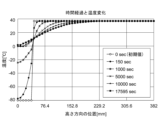
- FIG. 1 is a diagram showing an example of the time course and thawing state during thawing in a frozen cell thawing device.
- FIG. 1 is a diagram showing an example of time course and temperature change during thawing in a frozen cell thawing device.
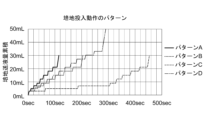
- FIG. 13 is a diagram showing a pattern of a culture medium introduction operation in the frozen cell thawing device of the embodiment.
- FIG. 1 shows a schematic configuration of a frozen cell thawing device according to one embodiment of the present invention.
- the frozen cell thawing device 11 includes a first container 13 that contains frozen cells 12, and a melting unit 15 that applies melting heat from a culture medium 14 in the first container 13 to the frozen cells 12 contained in the first container 13.
- the first container 13 can be composed of, for example, a glass vial 13a and a cap 13b that closes the opening of the vial 13a.
- the frozen cells 12 are contained in the vial 13a.
- a suspension is contained in the vial 13a.
- the suspension is frozen together with the vial 13a.
- the frozen cells 12 can be cooled with liquid nitrogen, for example. At this time, the temperature of the frozen cells 12 drops to around minus 196°C.
- An inlet port 16 and an outlet port 17 are formed in the cap 13b.
- the suspension is composed of a freezing solution and cells dispersed in the freezing solution.
- the freezing solution contains a culture medium, a cell freezing solution, and human serum albumin.
- the cell freezing solution contains, for example, dimethyl sulfoxide (DMSO) as a cryoprotectant.
- DMSO dimethyl sulfoxide
- the concentration of dimethyl sulfoxide is, for example, 5 vol% to 10 vol% of the freezing solution, specifically set to 5 vol%.
- Dimethyl sulfoxide can prevent the expansion of water that solidifies within the cells when the cells are frozen.
- Dimethyl sulfoxide can effectively prevent the death of cells.
- other cryoprotectants include glycerol, ethylene glycol, and propylene glycol.
- the above cryoprotectants are cell membrane permeable and have the effect of penetrating into cells and suppressing ice crystal formation, but they are known to be transformed into harmful substances through metabolism within the cells and to exhibit biological toxicity.
- the first container 13 is connected to a sensible heat change unit 23 that heats the vial 13a from the outside.
- the sensible heat change unit 23 includes a heater 24 that heats the vial 13a to a temperature lower than the melting temperature of the frozen cells 12.
- the heater 24 can have a shape that receives the vial 13a and supports it, for example. Since the temperature of the heater 24 is limited to a temperature lower than the melting temperature of the frozen cells 12, melting of the frozen cells 12 can be avoided by heat transfer from the vial 13a. On the other hand, the temperature of the frozen cells 12 can be brought as close as possible to the melting temperature by sensible heat change.
- the temperature of the heater 24 is set to, for example, -1°C.
- the temperature of the heater 24 may be set to a high temperature within a range that does not kill the cells, for example, 37°C to 42°C, specifically 42°C, in order to hasten the sensible heat change.
- the sensible heat change unit 23 heats the temperature of the frozen cells 12 to as high a temperature as possible through sensible heat change prior to thawing, so that the thermal energy of the culture medium can be efficiently utilized for latent heat change, and thawing of the frozen cells 12 based on the culture medium can be promoted. If the temperature of the frozen cells 12 is lower than the melting temperature of the culture medium, the culture medium in contact with the frozen cells 12 will freeze, hindering thawing of the frozen cells 12; however, if the temperature of the frozen cells 12 is increased, the freezing of the culture medium can be avoided even if the culture medium comes into contact with the frozen cells 12, and the culture medium can efficiently thaw the frozen cells 12.
- a tilt unit 21 is connected to the first container 13 to rotate the first container 13 around the horizontal axis 18.
- the tilt unit 21 includes a motor 22, for example, connected to a heater 24, to drive the heater 24 around the horizontal axis 18.
- the motor 22 includes, for example, a drive shaft that rotates around its axis in response to the supply of power. The rotational force of the drive shaft can be transmitted to the heater 24 via a gear mechanism.
- the tilt unit 21 allows the attitude of the first container 13 to change around the horizontal axis 18.
- the first container 13 can be held in a first position where the central axis of the vial (cylinder) 13a coincides with the vertical direction, and in a second position where the cap 13b is located below the bottom of the vial 13a. In the second position, the discharge port 17 is located below the introduction port 16.
- the inlet pipe 25 can be composed of a tube made of soft resin, for example.
- a second container 27 that holds a liquid culture medium 26 is connected to the other end of the inlet pipe 25.
- a culture medium suitable for the cells contained in the frozen cells 12 is used as the culture medium 26.
- the culture medium 26 can provide a survival environment for the cells at room temperature, for example.
- the liquid culture medium 26 is introduced from the inlet pipe 25 to the first container 13. The introduced culture medium comes into contact with the frozen cells 12. In this way, the heat of fusion is transferred from the culture medium 26 to the frozen cells 12.
- a heating unit 31 is connected to the second container 27 for heating the culture medium 26 contained in the second container 27.
- the heating unit 31 can heat the culture medium 26 in the second container 27 to above room temperature. Thermal energy is supplied to the culture medium 26.
- the culture medium 26 is heated prior to introduction into the first container 13. However, the temperature of the culture medium 26 is maintained below the cell death temperature. Here, the temperature of the culture medium 26 is limited to 37°C or below.
- One end of a discharge pipe 32 that defines one flow path is connected to the discharge port 17 of the cap 13b.
- the other end of the discharge pipe 32 is connected to a third container 33 that collects the thawed cells.
- the discharge pipe 32 guides the discharge of the culture medium containing the thawed cells from the first container 13 to the third container 33.
- the suspension that has been thawed and diluted with the culture medium flows into the third container 33.
- a pump 34 is connected to the inlet pipe 25 to move the culture medium from the second container 27 toward the first container 13.
- the pump 34 can function as a liquid flow unit that generates a relative movement of the culture medium with respect to the frozen cells 12 in the first container 13.
- a tube pump can be used for the pump 34. Since the first container 13 is sealed, the pressure of the pump 34 can promote the discharge of the diluted suspension from the first container 13.
- the flow rate of the culture medium can be adjusted according to the operation of the pump 34. By adjusting the flow rate in this way, the concentration of dimethyl sulfoxide in the culture medium can be maintained at 3 vol% or less when the thawed cells in the first container 13 are dispersed in the culture medium.
- the thawed cells come into contact with the culture medium containing dimethyl sulfoxide at a concentration of 3 vol% or less, the death of the cells due to dimethyl sulfoxide can be reduced regardless of the contact time with the culture medium.
- the cells can be thawed well.
- the concentration of dimethyl sulfoxide in the medium is preferably maintained at 1 vol% or less when the thawed cells are dispersed in the medium. This further reduces cell death, allowing the cells to be thawed well.
- a control unit 35 is connected to the motor 22, the heater 24, the heating unit 31, and the pump 34.
- the control unit 35 supplies control signals to the motor 22, the heater 24, the heating unit 31, and the pump 34, respectively.
- the motor 22 drives the first container 13 around the horizontal axis 18 between the first position and the second position in response to the supply of the control signal.
- the heater 24 contacts the first container 13 at a temperature specified by the control signal in response to the supply of the control signal.
- the control signal can be generated, for example, based on the output of a temperature sensor attached to the vial 13a.
- the heating unit 31 contacts the second container 27 at a temperature specified by the control signal in response to the supply of the control signal.
- the control signal can be generated, for example, based on the output of a temperature sensor incorporated in the second container 27 to detect the temperature of the culture medium 26.
- the control unit 35 can be composed of, for example, a microprocessor unit (MPU). In this case, the operation of the control unit 35 can be realized based on software stored in the memory in the control unit 35.
- MPU microprocessor unit
- Frozen cells 12 are prepared.
- the frozen cells 12 correspond to a coagulated body of the suspension.
- the suspension is contained in a first container 13 and frozen together with the first container 13.
- the freezing treatment liquid is formed, for example, of 50 vol. % culture medium, 34 vol. % cell freezing preservation liquid, and 16 vol. % human serum albumin.
- the freezing treatment liquid contains dimethyl sulfoxide at a concentration of 5 vol. %. Dimethyl sulfoxide can effectively prevent the death of cells when they are frozen.
- the first container 13 containing the frozen cells 12 is cooled, for example, with liquid nitrogen.
- the first container 13 of frozen cells 12 is set in the melting unit 15.
- the first container 13 is attached to and supported by, for example, a heater 24.
- An inlet pipe 25 is connected to the inlet port 16 of the cap 13b.
- the inlet pipe 25 connects the first container 13 to a second container 27.
- An outlet pipe 32 is connected to the outlet port 17 of the cap 13b.
- the outlet pipe 32 connects the first container 13 to a third container 33.
- a control unit 35 controls the tilt unit 21.
- the first container 13 is positioned at a first position about the horizontal axis 18.
- the second container 27 holds the liquid culture medium 26.
- the control unit 35 controls the heating unit 31.
- a control signal is supplied from the control unit 35 to the heating unit 31.
- the heating unit 31 heats the culture medium 26 in the second container 27.
- the culture medium 26 can be heated to a temperature higher than room temperature.
- the heating unit 31 is maintained at, for example, 37°C.
- the control unit 35 controls the sensible heat change unit 23.
- a control signal is supplied from the control unit 35 to the heater 24.
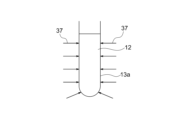
- the heater 24 heats the frozen cells 12 in the vial 13a. As shown in FIG. 2, thermal energy is transferred from the vial 13a to the frozen cells 12. A sensible heat change is realized in the frozen cells 12. The temperature of the frozen cells 12 rises. The frozen cells 12 are warmed to below the melting temperature. The temperature of the frozen cells 12 is maintained below the melting temperature.
- the control unit 35 controls the pump 34.
- the liquid culture medium 26 flows from the second container 27 into the first container 13.
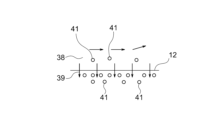
- the culture medium 38 comes into contact with the surface of the frozen cells 12 in the first container 13.
- Thermal energy (heat of fusion) 39 is transferred from the culture medium 38 to the surface of the frozen cells 12.
- the frozen cells 12 melt.
- the thawed suspension can be dispersed in the culture medium 38 immediately.
- the thawed suspension is diluted with the culture medium 38.
- the cells 41 are dispersed in the culture medium 38. Since the suspension is pushed away from the surface of the frozen cells 12 by the flow of the culture medium 38, the concentration of the cryoprotectant can be regulated within a good range.
- the effect of the cryoprotectant on the cells 41 can be avoided as much as possible. Regardless of the duration of thawing, the death of the cells 41 due to the cryoprotectant can be reduced.
- the cells 41 can be thawed well. Prior to the introduction of the culture medium 38, the culture medium 38 can be warmed to a temperature higher than room temperature. The thawing of frozen cells 12 can be accelerated.
- control unit 35 controls the operation of the pump 34 according to the temperature of the frozen cells 12.
- a control signal is supplied from the control unit 35 to the pump 34.
- the control signal specifies the amount of operation of the pump 34 based on the volume of the suspension melted by convective heat transfer in the medium 38.
- the amount of operation of the pump 34 determines the flow rate of the medium 38. Based on the determined flow rate, the concentration of dimethyl sulfoxide in the medium 38 is maintained at 1 vol% or less when the thawed cells 41 are dispersed in the medium 38.
- the thawed cells 41 come into contact with the medium 38 containing dimethyl sulfoxide at a concentration of 3 vol% or less, preferably 1 vol% or less, death of the cells 41 due to the cryoprotectant can be reduced regardless of the contact time with the medium 38.
- the cells 41 can be thawed well.
- the culture medium 38 containing the thawed cells 41 flows from the first container 13 into the third container 33.
- the cells 41 are thus collected in the third container 33.
- the cells 41 can be separated from the culture medium 38, for example, by the action of a centrifuge.
- the control unit 35 may control the tilting unit 21 during thawing of the frozen cells 12.
- the first container 13 can be positioned at a second position around the horizontal axis 18. In the second position, the discharge port 17 of the cap 13b is positioned below the frozen cells 12, so that discharge of the thawed cells 41 can be facilitated.
- the heater 24 of the sensible heat change unit 23 heats the vial 13a below the melting temperature of the frozen cells 12. Melting of the frozen cells 12 due to heat transfer from the heater 24 can be avoided. Melting of the frozen cells 12 separated from dilution can be prevented. In this way, the cells 41 can be well protected from a high concentration of cryoprotectant. Cell death due to the cryoprotectant can be reduced.
- the thermal energy 39 of the medium 38 can be efficiently used for latent heat change. Thawing of the frozen cells 12 based on the medium 38 can be promoted.
- the temperature of the frozen cells 12 is raised as high as possible, freezing of the medium 38 can be avoided even if the medium 38 comes into contact with the frozen cells 12.
- the medium 38 can efficiently thaw the frozen cells 12. If the temperature of the frozen cells 12 is lower than the melting temperature of the medium 38, the medium 38 in contact with the frozen cells 12 will freeze. This will cause problems with thawing frozen cells 12.
- the "temperature having a sufficient amount of heat to thaw the cells” is expressed by the following formula, where M i is the mass [kg] of the frozen cells 12, ⁇ i is the initial temperature [°C] of the frozen cells, C i is the specific heat [J/(kg ⁇ K)] of the frozen cells, L is the latent heat [J/kg] of the frozen cells, M w is the mass [kg] of the medium, ⁇ w is the initial temperature [°C] of the medium, and C w is the specific heat [J/(kg ⁇ K)] of the medium.
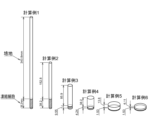
- the frozen cells and culture medium were placed in a cylindrical container.
- the container was assumed to be insulated in the calculations. Convective heat transfer was not taken into account. Only temperature changes (sensible heat changes) and phase changes (latent heat changes) due to thermal conduction were considered.
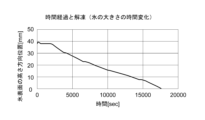
- the calculations were performed centrally, assuming that there was no temperature gradient in the radial direction of the cylinder. As shown in Figure 5, in Example 1, it was calculated that the amount of melting per unit time was maintained roughly constant. As shown in Figure 6, it was calculated that the temperature was maintained roughly constant on the surface of the frozen cells regardless of the passage of time.
- the heat of thawing is transferred to the frozen cells 12 from the culture medium in contact with the frozen cells 12.
- the thawed suspension can be dispersed in the culture medium immediately.
- the thawed suspension can be diluted with the culture medium. Since the suspension is pushed away from the frozen cells 12 by the flow of the culture medium, the concentration of dimethyl sulfoxide contained in the cell cryopreservation solution can be regulated within a good range. In this way, the influence of the cryoprotectant can be avoided as much as possible when thawing the frozen cells. Regardless of the duration of thawing, cell death due to dimethyl sulfoxide contained in the cryoprotectant is reduced, and the cells can be thawed well.
- Example 2 The inventor prepared a suspension of iris pigmented epithelial cells.
- the cell concentration was set to 1.0-2.0x10 6 [live cells/mL] in the freezing solution.
- the freezing solution was formed of 50 vol% medium, 34 vol% cell cryopreservation solution, and 16 vol% human serum albumin.
- the freezing solution contained dimethyl sulfoxide at a concentration of 5 vol%.
- the suspension was sealed in a 5 [mL] storage container.
- the storage container was slowly cooled in a freezer at minus 80°C.
- the cells were frozen in the storage container.
- the total amount of frozen cells and medium was adjusted to 30 [mL].
- the medium was introduced into the storage container in several patterns. In Example 7, two storage containers were directly connected. In this verification, a heating unit was used instead of the sensible heat change unit 23.
- Table 3 The experimental conditions and results are shown in Table 3.
- cell viability refers to the total number of viable cells, including the remaining frozen cells
- cell yield refers to the number of cells contained in the medium discharged from the discharge pipe 32.
- Frozen cell thawing device 12 Frozen cells 13 Container (first container) 15 Melting unit 23 Sensible heat change unit 25 Inlet pipe 26 Culture medium (in the second container) 31 Heating unit 32 Discharge pipe 34 Liquid flow unit (pump) 38 Culture medium (in the first container)
Landscapes
- Life Sciences & Earth Sciences (AREA)
- Chemical & Material Sciences (AREA)
- Engineering & Computer Science (AREA)
- Bioinformatics & Cheminformatics (AREA)
- Health & Medical Sciences (AREA)
- Wood Science & Technology (AREA)
- Biotechnology (AREA)
- Organic Chemistry (AREA)
- Zoology (AREA)
- Microbiology (AREA)
- Sustainable Development (AREA)
- Biomedical Technology (AREA)
- Biochemistry (AREA)
- General Engineering & Computer Science (AREA)
- General Health & Medical Sciences (AREA)
- Genetics & Genomics (AREA)
- Medicinal Chemistry (AREA)
- Apparatus Associated With Microorganisms And Enzymes (AREA)
- Micro-Organisms Or Cultivation Processes Thereof (AREA)
Abstract
凍結細胞の解凍にあたってできる限り凍結保護剤の影響を回避することができる凍結細胞解凍装置を提供する。凍結細胞解凍装置11は、液体の培地26を案内する導入配管25と、凍結保護剤を含む凍結処理液を含有する凍結細胞12を収容しながら導入配管25から培地26を導入する容器13を保持し、凍結細胞12に接触する培地から凍結細胞12に融解熱を加える融解ユニット15と、凍結細胞12に対して培地の相対移動を生み出す液流れユニット34と、容器13に接続されて、解凍された細胞を含む培地の排出を案内する排出配管32とを備え、解凍された細胞が培地に分散する際に培地中で凍結保護剤の濃度は3vol%以下、好ましくは1vol%以下に維持される。
Description
本発明は、凍結細胞を解凍して細胞を回収する凍結細胞解凍装置に関する。
特許文献1は、バイアルを加熱するヒーターを備える凍結細胞解凍装置を開示する。細胞を含む懸濁液はバイアル内で凍結する。ヒーターからバイアルに凍結細胞の融解熱は伝達される。凍結細胞は外周から中心に向かって徐々に融解していく。
細胞の凍結にあたって懸濁液には凍結保護剤が混ぜられる。凍結保護剤には一般にジメチルスルホキシド(DMSO)が含まれる。解凍後のジメチルスルホキシドは細胞にダメージを与えることから、できるだけ短時間で解凍は完了することが望まれる。とはいえ、細胞が42℃を超えた高温に曝されると、細胞は死滅してしまう。その一方で、低温の解凍に伴って細胞とジメチルスルホキシドとの接触時間が延びると、細胞は死滅してしまう。したがって、バイアルの加熱にあたって複雑かつ高度な温度制御が要求される。
本発明は、凍結細胞の解凍にあたってできる限り凍結保護剤の影響を回避することができる凍結細胞解凍装置を提供することを目的とする。
本発明の凍結細胞解凍装置は、液体の培地を案内する導入配管と、凍結保護剤を含む凍結処理液を含有する凍結細胞を収容しながら前記導入配管から前記培地を導入する容器を保持し、前記凍結細胞に接触する前記培地から前記凍結細胞に融解熱を加える融解ユニットと、前記凍結細胞に対して前記培地の相対移動を生み出す液流れユニットと、前記容器に接続されて、解凍された細胞を含む前記培地の排出を案内する排出配管とを備え、解凍された前記細胞が前記培地に分散する際に前記培地中で前記凍結保護剤の濃度は3vol%以下に維持される。
以上のように開示の凍結細胞解凍装置によれば、凍結細胞の解凍にあたってできる限り凍結保護剤の影響を回避できる。
以下、添付図面を参照しつつ本発明の一実施形態を説明する。
(凍結細胞解凍装置11の構成)
図1は本発明の一実施形態に係る凍結細胞解凍装置の構成を概略的に示す。凍結細胞解凍装置11は、凍結細胞12を収容する第1容器13を保持し、第1容器13に収容される凍結細胞12に第1容器13内の培地14から融解熱を加える融解ユニット15を備える。ここでは、第1容器13は、例えばガラス製のバイアル13aと、バイアル13aの開口を塞ぐキャップ13bとで構成されることができる。バイアル13aに凍結細胞12は収容される。細胞の凍結にあたってバイアル13aには懸濁液が収容される。懸濁液はバイアル13aとともに凍結される。凍結細胞12の保存にあたって例えば凍結細胞12は液体窒素で冷却されることができる。このとき、凍結細胞12の温度はマイナス196℃付近まで低下する。キャップ13bには導入ポート16および排出ポート17が形成される。
図1は本発明の一実施形態に係る凍結細胞解凍装置の構成を概略的に示す。凍結細胞解凍装置11は、凍結細胞12を収容する第1容器13を保持し、第1容器13に収容される凍結細胞12に第1容器13内の培地14から融解熱を加える融解ユニット15を備える。ここでは、第1容器13は、例えばガラス製のバイアル13aと、バイアル13aの開口を塞ぐキャップ13bとで構成されることができる。バイアル13aに凍結細胞12は収容される。細胞の凍結にあたってバイアル13aには懸濁液が収容される。懸濁液はバイアル13aとともに凍結される。凍結細胞12の保存にあたって例えば凍結細胞12は液体窒素で冷却されることができる。このとき、凍結細胞12の温度はマイナス196℃付近まで低下する。キャップ13bには導入ポート16および排出ポート17が形成される。
懸濁液は凍結処理液と当該凍結処理液に分散する細胞とで構成される。凍結処理液は培地と細胞凍結保存液とヒト血清アルブミンとを含有する。細胞凍結保存液には凍結保護剤として、例えばジメチルスルホキシド(DMSO)が含有される。ジメチルスルホキシドの濃度は例えば凍結処理液の5vol%以上10vol%以下であり、具体的には5vol%に設定される。ジメチルスルホキシドは細胞の凍結にあたって細胞内で凝固する水分の膨張を防止することができる。ジメチルスルホキシドは良好に細胞の死滅を防止することができる。凍結保護剤としては、ジメチルスルホキシドの他にグリセロール、エチレングリコール、プロピレングリコール等が挙げられる。上記の凍結保護剤は細胞膜透過性であり、細胞内へ浸透し氷晶形成を抑制する効果がある反面、細胞内で代謝により有害物質へ変化し、生物学的毒性を発現することが知られている。
第1容器13には、外側からバイアル13aを加熱する顕熱変化ユニット23が結合される。顕熱変化ユニット23は、例えば、凍結細胞12の融解温度未満でバイアル13aを加熱するヒーター24を備える。ヒーター24は、例えば、バイアル13aを受け止めバイアル13aを支持する形状を有することができる。ヒーター24の温度は凍結細胞12の融解温度未満に制限されることから、バイアル13aからの熱伝達で凍結細胞12の融解は回避されることができる。その一方で、凍結細胞12の温度は顕熱変化で可能な限り融解温度に近づくことができる。ここでは、ヒーター24の温度は例えばマイナス1℃に設定される。あるいは、ヒーター24の温度は、顕熱変化を早めるために細胞を死滅させない範囲の高温、例えば37℃~42℃、具体的には42℃に設定しても良い。
顕熱変化ユニット23によって、凍結細胞12の温度は融解に先立って顕熱変化でできる限り高温まで加熱されることから、培地の熱エネルギーは効率的に潜熱変化に利用されることができ、培地に基づく凍結細胞12の解凍は促進されることができる。凍結細胞12の温度が培地の融解温度よりも低温であると、凍結細胞12に接触する培地は凍結してしまい、凍結細胞12の解凍に支障を来してしまうが、凍結細胞12の温度が高まれば、凍結細胞12に培地が接触しても培地の凍結は回避されることができ、培地は効率的に凍結細胞12を解凍することができる。
第1容器13には水平軸線18回りに第1容器13の回転を生み出す傾斜ユニット21が結合される。傾斜ユニット21は、例えばヒーター24に接続されて、水平軸線18回りでヒーター24を駆動するモーター22を備える。モーター22は、例えば、電力の供給に応じて軸心回りで回転する駆動軸を備える。駆動軸の回転力は歯車機構を介してヒーター24に伝達されることができる。傾斜ユニット21の働きで第1容器13の姿勢は水平軸線18回りに変化することができる。第1容器13は、バイアル(円筒)13aの中心軸線が鉛直方向に一致する第1位置と、バイアル13aの底よりもキャップ13bが下方に位置する第2位置とで保持されることができる。第2位置では導入ポート16よりも排出ポート17は下方に位置する。
キャップ13bの導入ポート16には、1本の流路を区画する導入配管25の一端が連結される。導入配管25は例えば軟質樹脂製のチューブで構成されることができる。導入配管25の他端には、液体の培地26を保持する第2容器27が接続される。培地26には、凍結細胞12に含まれる細胞に適した培地が用いられる。培地26は例えば常温で細胞の生存環境を提供することができる。第1容器13には導入配管25から液体の培地26が導入される。導入された培地は凍結細胞12に接触する。こうして培地26から凍結細胞12に融解熱は伝達される。
第2容器27には第2容器27に収容される培地26を加熱する加温ユニット31が結合される。加温ユニット31の働きで第2容器27内の培地26は室温以上に温められることができる。培地26に熱エネルギーは供給される。培地26は第1容器13への導入に先立って加熱される。ただし、培地26の温度は細胞の死滅温度未満に維持される。ここでは、培地26の温度は37℃以下に制限される。
キャップ13bの排出ポート17には、1本の流路を区画する排出配管32の一端が連結される。排出配管32の他端には、解凍された細胞を回収する第3容器33が接続される。排出配管32は、第1容器13から第3容器33に、解凍された細胞を含む培地の排出を案内する。第3容器33には、解凍されて培地で希釈化された懸濁液が流れ込む。
導入配管25には第2容器27から第1容器13に向かって培地を動かすポンプ34が結合される。ポンプ34は第1容器13内で凍結細胞12に対して培地の相対移動を生み出す液流れユニットとして機能することができる。ポンプ34には例えばチューブポンプが用いられることができる。第1容器13は密閉されることから、ポンプ34の圧力は第1容器13から希釈化された懸濁液の排出を促すことができる。ポンプ34の働きに応じて、培地の流量は調整されることができる。こうして流量が調整されることで、第1容器13内で解凍された細胞が培地に分散する際に培地中でジメチルスルホキシドの濃度は3vol%以下に維持されることができる。解凍された細胞は3vol%以下の濃度でジメチルスルホキシドを含む培地に接触するので、培地との接触時間に関係なくジメチルスルホキシドに基づく細胞の死滅は低減されることができる。細胞は良好に解凍されることができる。
凍結細胞解凍装置11では、解凍された細胞が培地に分散する際に培地中でジメチルスルホキシドの濃度は、好ましくは1vol%以下に維持される。細胞の死滅はさらに低減され、細胞は良好に解凍されることができる。
モーター22、ヒーター24、加温ユニット31およびポンプ34には制御ユニット35が接続される。制御ユニット35は、モーター22、ヒーター24、加温ユニット31およびポンプ34にそれぞれ制御信号を供給する。モーター22は制御信号の供給に応じて第1位置および第2位置の間で水平軸線18回りに第1容器13を駆動する。ヒーター24は制御信号の供給に応じて制御信号で特定される温度で第1容器13に接触する。制御信号は、例えば、バイアル13aに装着される温度センサーの出力に基づき生成されることができる。加温ユニット31は制御信号の供給に応じて制御信号で特定される温度で第2容器27に接触する。制御信号は、例えば、第2容器27に組み込まれて培地26の温度を検出する温度センサーの出力に基づき生成されることができる。制御ユニット35は例えばマイクロプロセッサーユニット(MPU)から構成されることができる。このとき、制御ユニット35の動作は制御ユニット35内のメモリーに格納されるソフトウエアに基づき実現されることができる。
次に凍結細胞解凍装置11の動作を説明する。凍結細胞12は準備される。凍結細胞12は懸濁液の凝固体に相当する。懸濁液は第1容器13に収容されて第1容器13ともども凍結される。懸濁液の調製にあたって凍結処理液に細胞は混入される。凍結処理液は、例えば、50vol%の培地、34vol%の細胞凍結保存液および16vol%のヒト血清アルブミンで形成される。ここでは、凍結処理液は5vol%の濃度でジメチルスルホキシドを含有する。ジメチルスルホキシドは細胞の凍結時に良好に細胞の死滅を防止することができる。凍結細胞12の保存にあたって凍結細胞12を収容する第1容器13は例えば液体窒素で冷却される。
凍結細胞12の第1容器13は融解ユニット15にセットされる。第1容器13は例えばヒーター24に装着され支持される。キャップ13bの導入ポート16には導入配管25が結合される。導入配管25は第1容器13に第2容器27を接続する。キャップ13bの排出ポート17には排出配管32が結合される。排出配管32は第1容器13に第3容器33を接続する。制御ユニット35は傾斜ユニット21を制御する。ここでは、第1容器13は水平軸線18回りに第1位置に位置決めされる。
第2容器27には液体の培地26が保持される。制御ユニット35は加温ユニット31を制御する。加温ユニット31には制御ユニット35から制御信号が供給される。加温ユニット31は第2容器27内の培地26を加熱する。培地26は室温よりも高温に温められることができる。ここでは、加温ユニット31は例えば37℃に維持される。
制御ユニット35は顕熱変化ユニット23を制御する。ヒーター24には制御ユニット35から制御信号が供給される。ヒーター24はバイアル13a内の凍結細胞12を加熱する。図2に示されるように、凍結細胞12にはバイアル13aから熱エネルギーが伝達される。凍結細胞12では顕熱変化が実現される。凍結細胞12の温度は上昇していく。凍結細胞12は融解温度未満まで温められる。凍結細胞12の温度は融解温度未満で維持される。
制御ユニット35はポンプ34を制御する。液体の培地26は第2容器27から第1容器13に流入する。図3に示されるように、第1容器13内で培地38は凍結細胞12の表面に接触する。凍結細胞12の表面には培地38から熱エネルギー(融解熱)39が伝達される。凍結細胞12は融解する。解凍された懸濁液はすぐさま培地38に分散することができる。融解した懸濁液は培地38で希釈化される。細胞41は培地38に分散する。培地38の流れで懸濁液は凍結細胞12の表面から押しのけられることから、凍結保護剤の濃度は良好な範囲で規制されることができる。こうして細胞41に対してできる限り凍結保護剤の影響は回避されることができる。解凍の継続時間に関係なく、凍結保護剤に基づく細胞41の死滅は低減されることができる。細胞41は良好に解凍されることができる。培地38の導入に先立って培地38は室温よりも高温に温められることができる。凍結細胞12の融解は促進されることができる。
ここでは、制御ユニット35は凍結細胞12の温度に応じてポンプ34の動作を制御する。ポンプ34には制御ユニット35から制御信号が供給される。制御信号は、培地38の対流熱伝達で融解する懸濁液の容量に基づきポンプ34の動作量を特定する。ポンプ34の動作量は培地38の流量を決定する。決定された流量に基づき、解凍された細胞41が培地38に分散する際に培地38中でジメチルスルホキシドの濃度は1vol%以下に維持される。解凍された細胞41は3vol%以下、好ましくは1vol%以下の濃度でジメチルスルホキシドを含む培地38に接触するので、培地38との接触時間に関係なく凍結保護剤に基づく細胞41の死滅は低減されることができる。細胞41は良好に解凍されることができる。
解凍された細胞41を含有する培地38は第1容器13から第3容器33に流入する。こうして細胞41は第3容器33に回収される。細胞41は例えば遠心分離機の働きで培地38から分離されることができる。凍結細胞12の解凍中に制御ユニット35は傾斜ユニット21を制御してもよい。制御に応じて第1容器13は水平軸線18回りで第2位置に位置決めされることができる。第2位置ではキャップ13bの排出ポート17は凍結細胞12よりも下方に位置することから、解凍された細胞41の排出は促進されることができる。
本実施形態では、顕熱変化ユニット23のヒーター24は凍結細胞12の融解温度未満でバイアル13aを加熱する。ヒーター24からの熱伝達に基づく凍結細胞12の融解は回避されることができる。希釈化から分離された凍結細胞12の融解は阻止されることができる。こうして細胞41は高濃度の凍結保護剤から良好に保護されることができる。凍結保護剤に基づく細胞の死滅は低減されることができる。その一方で、凍結細胞12の温度は融解に先立って顕熱変化でできる限り高温まで加熱されることから、培地38の熱エネルギー39は効率的に潜熱変化に利用されることができる。培地38に基づく凍結細胞12の解凍は促進されることができる。しかも、凍結細胞12の温度ができる限り高まれば、凍結細胞12に培地38が接触しても培地38の凍結は回避されることができる。培地38は効率的に凍結細胞12を解凍することができる。凍結細胞12の温度が培地38の融解温度よりも低温であると、凍結細胞12に接触する培地38は凍結してしまう。凍結細胞12の解凍に支障を来してしまう。
凍結細胞12の解凍にあたって「細胞の解凍に十分な熱量を持つ温度」は次式で表される。ただし、Miは凍結細胞12の質量[kg]、θiは凍結細胞の初期温度[℃]、Ciは凍結細胞の比熱[J/(kg・K)]、Lは凍結細胞の潜熱[J/kg]、Mwは培地の質量[kg]、θwは培地の初期温度[℃]、および、Cwは培地の比熱[J/(kg・K)]である。


[数2]に基づき表1に示す「細胞の解凍に十分な熱量を持つ温度」が算出された。
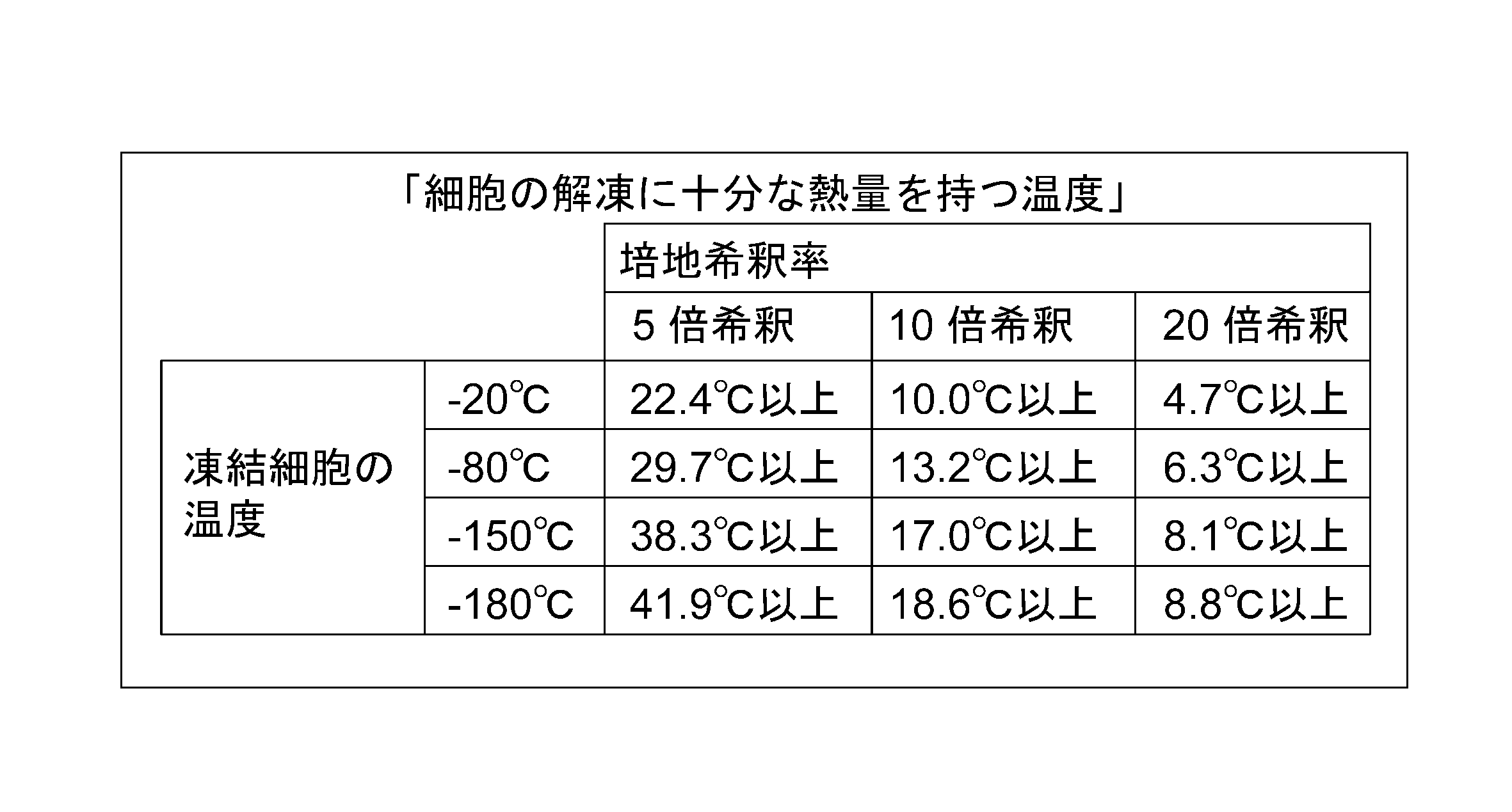
ここでは、比熱Ci=2040[J/(kg・K)](氷0[℃]の比熱)、比熱Cw=4180[J/(kg・K)](水20[℃]の比熱)、および、潜熱L=3.336x105[J/kg]に設定された。
次に、凍結細胞を収容した容器に培地を供給した状況を想定し、解凍に費やされる時間をシミュレーションしたところ、表2に示す計算結果が得られた。
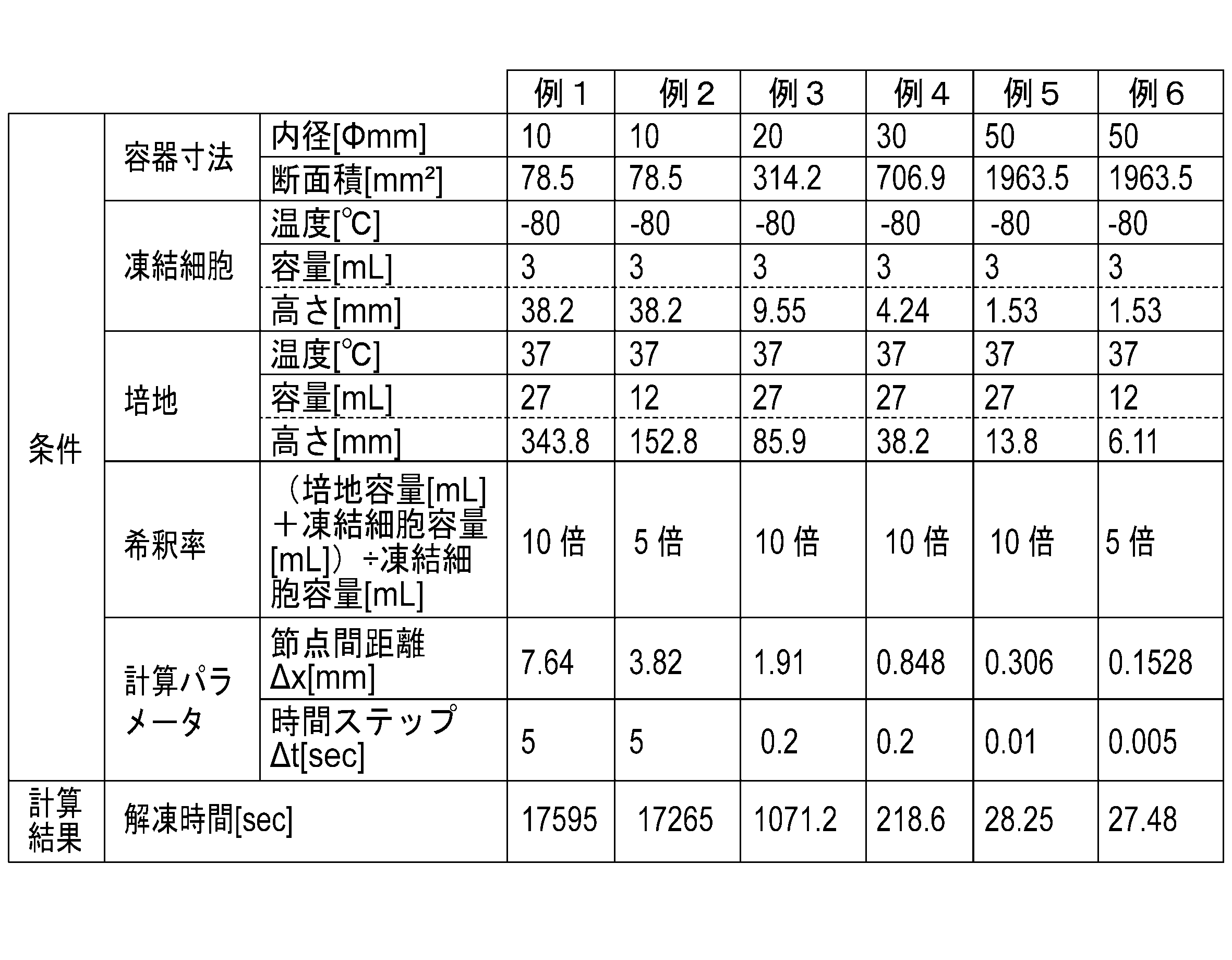
図4に示されるように、円筒形の容器に凍結細胞および培地は収容された。なお、計算にあたって容器は断熱と仮定された。対流熱伝達は考慮されなかった。熱伝導に基づく温度変化(顕熱変化)および相変化(潜熱変化)のみが考慮された。円柱の半径方向に温度勾配はないものと仮定され一元的に計算は実施された。図5に示されるように、例1では単位時間あたりの融解量は概ね一定に維持されることが算出された。図6に示されるように、時間の経過に拘わらず凍結細胞の表面では温度は概ね一定に維持されることが算出された。
(凍結細胞解凍装置11の作用・効果)
本実施形態の凍結細胞解凍装置11において、凍結細胞12には凍結細胞12に接触する培地から融解熱が伝達される。解凍された懸濁液はすぐさま培地に分散することができる。融解した懸濁液は培地で希釈化されることができる。培地の流れで懸濁液は凍結細胞12から押しのけられることから、細胞凍結保存液に含有されるジメチルスルホキシドの濃度は良好な範囲で規制されることができる。このようにして、凍結細胞の解凍にあたってできる限り凍結保護剤の影響を回避することができる。解凍の継続時間に関係なく、凍結保護剤に含有されるジメチルスルホキシドに基づく細胞の死滅は低減され、細胞は良好に解凍されることができる。
本実施形態の凍結細胞解凍装置11において、凍結細胞12には凍結細胞12に接触する培地から融解熱が伝達される。解凍された懸濁液はすぐさま培地に分散することができる。融解した懸濁液は培地で希釈化されることができる。培地の流れで懸濁液は凍結細胞12から押しのけられることから、細胞凍結保存液に含有されるジメチルスルホキシドの濃度は良好な範囲で規制されることができる。このようにして、凍結細胞の解凍にあたってできる限り凍結保護剤の影響を回避することができる。解凍の継続時間に関係なく、凍結保護剤に含有されるジメチルスルホキシドに基づく細胞の死滅は低減され、細胞は良好に解凍されることができる。
(実施例)
本発明者は虹彩色素上皮細胞の懸濁液を調製した。細胞の濃度は凍結処理液中で1.0~2.0x10⁶[live cells/mL]に設定された。凍結処理液は、50vol%の培地、34vol%の細胞凍結保存液および16vol%のヒト血清アルブミンで形成された。凍結処理液は5vol%の濃度でジメチルスルホキシドを含有した。懸濁液は5[mL]の保存容器に封入された。保存容器はマイナス80℃のフリーザーで緩慢冷却された。保存容器内で細胞は凍結した。凍結細胞および培地の総量は30[mL]に調整された。図7に示されるように、培地はいくつかのパターンで保存容器に導入された。実施例7では2つの保存容器が直接に接続された。本検証では顕熱変化ユニット23に代えて加温ユニットが用いられた。実験条件及び結果を表3に示す。
本発明者は虹彩色素上皮細胞の懸濁液を調製した。細胞の濃度は凍結処理液中で1.0~2.0x10⁶[live cells/mL]に設定された。凍結処理液は、50vol%の培地、34vol%の細胞凍結保存液および16vol%のヒト血清アルブミンで形成された。凍結処理液は5vol%の濃度でジメチルスルホキシドを含有した。懸濁液は5[mL]の保存容器に封入された。保存容器はマイナス80℃のフリーザーで緩慢冷却された。保存容器内で細胞は凍結した。凍結細胞および培地の総量は30[mL]に調整された。図7に示されるように、培地はいくつかのパターンで保存容器に導入された。実施例7では2つの保存容器が直接に接続された。本検証では顕熱変化ユニット23に代えて加温ユニットが用いられた。実験条件及び結果を表3に示す。
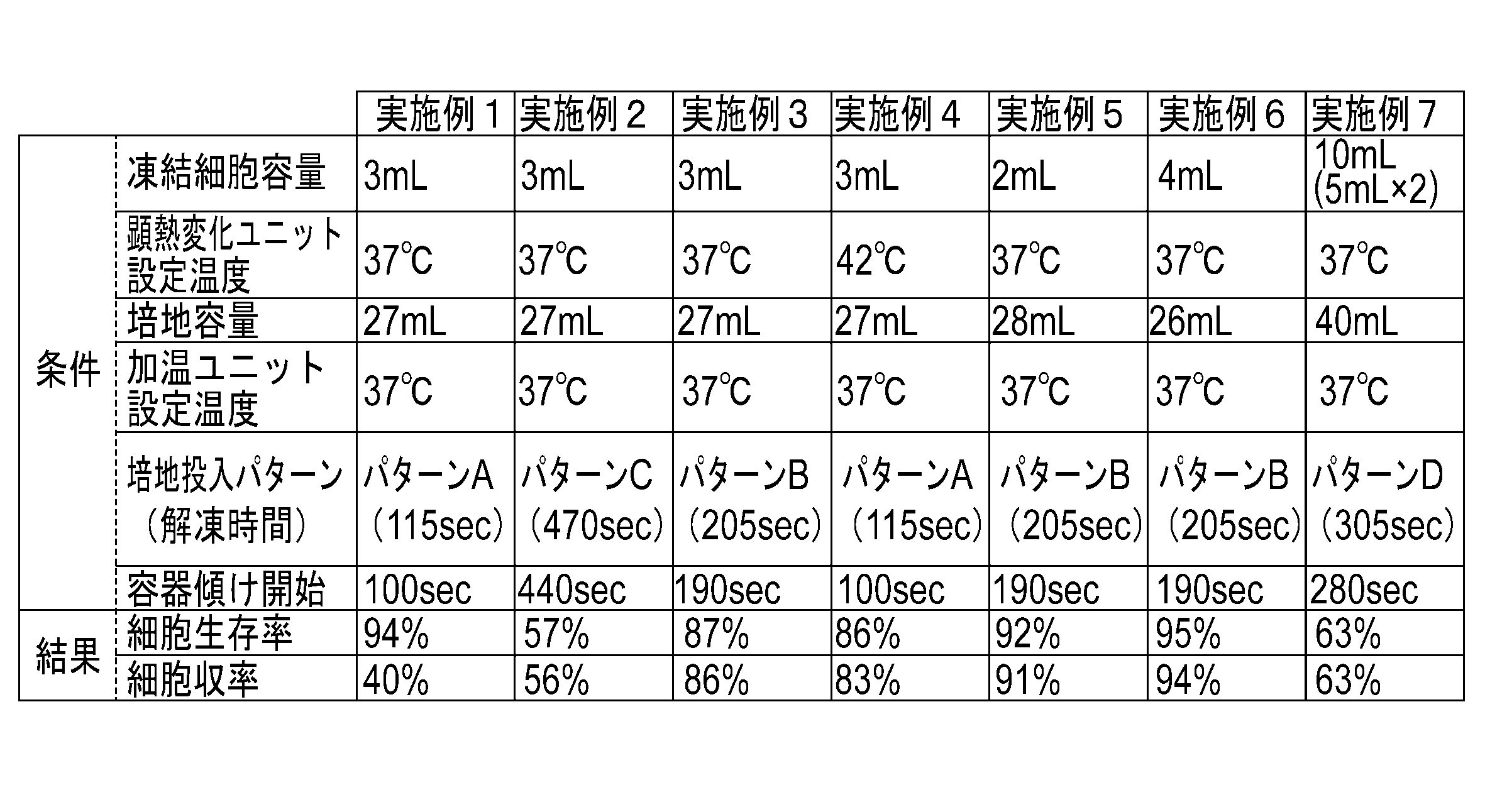
表3中、「細胞生存率」では、残存する凍結細胞も含んで生存する細胞の総数が計数され、「細胞収率」では、排出配管32から排出された培地内に含まれる細胞が計数された。
11 凍結細胞解凍装置
12 凍結細胞
13 容器(第1容器)
15 融解ユニット
23 顕熱変化ユニット
25 導入配管
26 (第2容器内の)培地
31 加温ユニット
32 排出配管
34 液流れユニット(ポンプ)
38 (第1容器内の)培地
12 凍結細胞
13 容器(第1容器)
15 融解ユニット
23 顕熱変化ユニット
25 導入配管
26 (第2容器内の)培地
31 加温ユニット
32 排出配管
34 液流れユニット(ポンプ)
38 (第1容器内の)培地
Claims (6)
- 液体の培地を案内する導入配管と、
凍結保護剤を含む凍結処理液を含有する凍結細胞を収容しながら前記導入配管から前記培地を導入する容器を保持し、前記凍結細胞に接触する前記培地から前記凍結細胞に融解熱を加える融解ユニットと、
前記凍結細胞に対して前記培地の相対移動を生み出す液流れユニットと、
前記容器に接続されて、解凍された細胞を含む前記培地の排出を案内する排出配管と
を備え、
解凍された前記細胞が前記培地に分散する際に前記培地中で前記凍結保護剤の濃度は3vol%以下に維持される
凍結細胞解凍装置。 - 前記凍結細胞は、前記凍結保護剤を5vol%以上10vol%以下で含有する
請求項1に記載の凍結細胞解凍装置。 - 解凍された前記細胞が前記培地に分散する際に前記培地中で前記凍結保護剤の濃度は1vol%以下に維持される
請求項1に記載の凍結細胞解凍装置。 - 前記容器への導入に先立って前記培地を加熱する加温ユニットを備える
請求項1に記載の凍結細胞解凍装置。 - 前記容器に接続されて、前記容器を加熱する顕熱変化ユニットを備える
請求項1に記載の凍結細胞解凍装置。 - 前記凍結保護剤は、ジメチルスルホキシドを含有する
請求項1に記載の凍結細胞解凍装置。
Applications Claiming Priority (2)
| Application Number | Priority Date | Filing Date | Title |
|---|---|---|---|
| JP2023094537A JP2024176189A (ja) | 2023-06-08 | 2023-06-08 | 凍結細胞解凍装置 |
| JP2023-094537 | 2023-06-08 |
Publications (1)
| Publication Number | Publication Date |
|---|---|
| WO2024252753A1 true WO2024252753A1 (ja) | 2024-12-12 |
Family
ID=93795832
Family Applications (1)
| Application Number | Title | Priority Date | Filing Date |
|---|---|---|---|
| PCT/JP2024/010319 Ceased WO2024252753A1 (ja) | 2023-06-08 | 2024-03-15 | 凍結細胞解凍装置 |
Country Status (3)
| Country | Link |
|---|---|
| JP (1) | JP2024176189A (ja) |
| TW (1) | TW202449136A (ja) |
| WO (1) | WO2024252753A1 (ja) |
Citations (4)
| Publication number | Priority date | Publication date | Assignee | Title |
|---|---|---|---|---|
| JP2009189362A (ja) * | 2008-01-15 | 2009-08-27 | Panasonic Corp | 細胞培養装置 |
| WO2015159950A1 (ja) * | 2014-04-17 | 2015-10-22 | 東京エレクトロン株式会社 | 多能性幹細胞の細胞集塊製造方法および細胞集塊製造システム |
| JP2019006695A (ja) * | 2017-06-22 | 2019-01-17 | 学校法人明治大学 | 生体試料保存容器 |
| JP2019154761A (ja) * | 2018-03-13 | 2019-09-19 | テルモ株式会社 | 融解装置及び融解方法 |
-
2023
- 2023-06-08 JP JP2023094537A patent/JP2024176189A/ja active Pending
-
2024
- 2024-03-15 WO PCT/JP2024/010319 patent/WO2024252753A1/ja not_active Ceased
- 2024-04-01 TW TW113112317A patent/TW202449136A/zh unknown
Patent Citations (4)
| Publication number | Priority date | Publication date | Assignee | Title |
|---|---|---|---|---|
| JP2009189362A (ja) * | 2008-01-15 | 2009-08-27 | Panasonic Corp | 細胞培養装置 |
| WO2015159950A1 (ja) * | 2014-04-17 | 2015-10-22 | 東京エレクトロン株式会社 | 多能性幹細胞の細胞集塊製造方法および細胞集塊製造システム |
| JP2019006695A (ja) * | 2017-06-22 | 2019-01-17 | 学校法人明治大学 | 生体試料保存容器 |
| JP2019154761A (ja) * | 2018-03-13 | 2019-09-19 | テルモ株式会社 | 融解装置及び融解方法 |
Also Published As
| Publication number | Publication date |
|---|---|
| JP2024176189A (ja) | 2024-12-19 |
| TW202449136A (zh) | 2024-12-16 |
Similar Documents
| Publication | Publication Date | Title |
|---|---|---|
| JP4022878B2 (ja) | 樹枝状凍結境界面速度が制御される冷凍保存システム | |
| JP7237406B2 (ja) | 凍結保存方法及び装置 | |
| JP4693834B2 (ja) | 低温保存システムのためのアイスシーディング装置 | |
| US8037696B2 (en) | Method and apparatus for freezing or thawing of a biological material | |
| US11441979B2 (en) | Thawing methods and apparatus | |
| US20090255276A1 (en) | Enhanced integrated operation blender based sterile medical ice slurry production device | |
| JP2001514877A (ja) | 凍結保存を容易にするためのカセット型デバイスおよびシステム | |
| Gavish et al. | Cryopreservation of whole murine and porcine livers | |
| US10046325B2 (en) | Self-heating device for warming of biological samples | |
| WO2007093978A1 (en) | Frozen viable solid organs and method for freezing same | |
| WO2024252753A1 (ja) | 凍結細胞解凍装置 | |
| JP2001514866A (ja) | 凍結保護剤除去方法および装置 | |
| CN111479465A (zh) | 涉及冷冻生物样品的至少部分的设备和方法 | |
| JPH0160441B2 (ja) | ||
| Nannou et al. | Cryopreservation: Methods, equipment and critical concerns | |
| US20250234858A1 (en) | Systems and methods for cryopreservation of biological material | |
| Deeb et al. | ADVANCEMENTS IN CRYOGENIC COOLING ANDWARMING INSTRUMENTATION FOR CRYOPRESERVATION IN MILLILITER AND SUB-MILLILITER SCALE | |
| CN118202995A (zh) | 一种用于大体积生物样本的新型等容玻璃化装置及方法 | |
| Sareen et al. | Overview of Cryobiology in ART | |
| Bischof | 11. Thermodynamics and beyond: connecting modeling with outcome in cryobiology | |
| JPH0534953B2 (ja) | ||
| Gavish et al. | Cryopreservation of a whole liver | |
| Beckmann et al. | The freezing behavior of human lymphocytes in a process of directional solidification characterized by thermal gradient and ice front velocity | |
| Talwar | Overview of Cryobiology in Assisted Reproductive Technology |
Legal Events
| Date | Code | Title | Description |
|---|---|---|---|
| 121 | Ep: the epo has been informed by wipo that ep was designated in this application |
Ref document number: 24818992 Country of ref document: EP Kind code of ref document: A1 |
|
| NENP | Non-entry into the national phase |
Ref country code: DE |