WO2024252783A1 - PROCÉDÉ DE CHAUFFAGE OPTIQUE, DISPOSITIF DE CHAUFFAGE OPTIQUE POUR SEMI-CONDUCTEUR SiC, ET DISPOSITIF SOURCE DE LUMIÈRE À DEL - Google Patents
PROCÉDÉ DE CHAUFFAGE OPTIQUE, DISPOSITIF DE CHAUFFAGE OPTIQUE POUR SEMI-CONDUCTEUR SiC, ET DISPOSITIF SOURCE DE LUMIÈRE À DEL Download PDFInfo
- Publication number
- WO2024252783A1 WO2024252783A1 PCT/JP2024/014663 JP2024014663W WO2024252783A1 WO 2024252783 A1 WO2024252783 A1 WO 2024252783A1 JP 2024014663 W JP2024014663 W JP 2024014663W WO 2024252783 A1 WO2024252783 A1 WO 2024252783A1
- Authority
- WO
- WIPO (PCT)
- Prior art keywords
- light
- heating
- led
- light source
- workpiece
- Prior art date
- Legal status (The legal status is an assumption and is not a legal conclusion. Google has not performed a legal analysis and makes no representation as to the accuracy of the status listed.)
- Ceased
Links
Images



Classifications
-
- H—ELECTRICITY
- H10—SEMICONDUCTOR DEVICES; ELECTRIC SOLID-STATE DEVICES NOT OTHERWISE PROVIDED FOR
- H10H—INORGANIC LIGHT-EMITTING SEMICONDUCTOR DEVICES HAVING POTENTIAL BARRIERS
- H10H20/00—Individual inorganic light-emitting semiconductor devices having potential barriers, e.g. light-emitting diodes [LED]
- H10H20/80—Constructional details
-
- H—ELECTRICITY
- H10—SEMICONDUCTOR DEVICES; ELECTRIC SOLID-STATE DEVICES NOT OTHERWISE PROVIDED FOR
- H10H—INORGANIC LIGHT-EMITTING SEMICONDUCTOR DEVICES HAVING POTENTIAL BARRIERS
- H10H20/00—Individual inorganic light-emitting semiconductor devices having potential barriers, e.g. light-emitting diodes [LED]
- H10H20/80—Constructional details
- H10H20/85—Packages
-
- H—ELECTRICITY
- H10—SEMICONDUCTOR DEVICES; ELECTRIC SOLID-STATE DEVICES NOT OTHERWISE PROVIDED FOR
- H10P—GENERIC PROCESSES OR APPARATUS FOR THE MANUFACTURE OR TREATMENT OF DEVICES COVERED BY CLASS H10
- H10P34/00—Irradiation with electromagnetic or particle radiation of wafers, substrates or parts of devices
Definitions
- the present invention relates to an optical heating method, and in particular to an optical heating method for a workpiece including a SiC semiconductor.
- the present invention also relates to an optical heating device for SiC semiconductors and an LED light source device used in the optical heating device.
- various heat treatments such as film formation, oxidation diffusion, modification, and annealing are performed on objects to be treated, including semiconductor wafers.
- Light is often used to carry out these heat treatments. Heating an object to be treated using light in this way is called “light heating.”
- the light used for heating is also called “heating light.”
- Patent Document 1 As an example of a semiconductor heating device that uses optical heating, the technology described in Patent Document 1 below is known.
- the device in Patent Document 1 uses an LED lamp that emits heating light with a wavelength of 810 nm to 980 nm as the light source.
- SiC has a larger band gap than conventional Si, and has a high dielectric breakdown field strength, and is expected to reduce environmental impact through lower loss, smaller size, and lighter weight.
- SiC transmits most of the light emitted from halogen lamps used as heating light sources in semiconductor manufacturing processes, and LED lamps such as those described in Patent Document 1, making it difficult to heat efficiently.
- Patent Document 1 does not specifically consider the case where SiC wafers are used as the object to be heated. For this reason, Patent Document 1 does not mention at all that there is a suitable wavelength range of light for heat-treating SiC wafers.
- the present invention aims to provide an optical heating method capable of efficiently heating a workpiece containing a SiC semiconductor.
- the present invention also aims to provide an optical heating device suitable for heating a workpiece containing a SiC semiconductor and an LED light source device for use in the optical heating device.
- the light heating method according to the present invention comprises the steps of:
- the method is characterized by including a step (a) of irradiating a workpiece including a SiC semiconductor with heating light having a peak wavelength in the range of 370 nm to 460 nm emitted from an LED light source through a window member to heat the workpiece.
- the heating light preferably has a peak wavelength within a range of 370 nm to 420 nm.
- SiC comes in a variety of crystal structures, including 4H-SiC (band gap 3.3 eV), 6H-SiC (band gap 3 eV), and 3C-SiC (band gap 2.2 eV).
- 4H-SiC band gap 3.3 eV
- 6H-SiC band gap 3 eV
- 3C-SiC band gap 2.2 eV
- the transmittance of light gradually increases in the wavelength range longer than about 420 nm, and almost all light in the wavelength range longer than 500 nm is transmitted.
- Broad halogen lamp light with a peak at a wavelength of about 1 ⁇ m transmits SiC over a wide wavelength range.
- Figure 1 is a graph showing the relationship between wavelength and absorptance in SiC.
- the graph shown in Figure 1 is calculated based on reflectance characteristic data and transmittance characteristic data for SiC.
- Figure 1 shows that the absorptance is 40% or more when the wavelength is in the range of 370 nm to 460 nm.
- high heating efficiency can be achieved by irradiating it with heating light from an LED light source with a peak wavelength in the range of 370 nm to 460 nm.
- the absorption rate is 50% or more in the wavelength range of 370 nm to 420 nm.
- higher heating efficiency can be achieved by irradiating and heating with heating light from an LED light source with a peak wavelength in the range of 370 nm to 420 nm.
- the light emission efficiency is prone to variation, as is recognized particularly for GaN-based epitaxial (AlGaN) LED elements. For this reason, from the perspective of more reliably achieving higher heating efficiency, it is preferable to use light with a wavelength of 370 nm or more as the heating light.
- the window member is made of a material having a high transmittance to the heating light as described above. This transmittance is preferably 50% or more, more preferably 70% or more, and particularly preferably 80% or more.
- synthetic quartz, fused quartz, sapphire, magnesium fluoride (MgF 2 ), calcium fluoride (CaF 2 ), or barium fluoride (BaF 2 ) is preferably used.
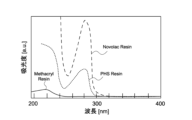
- Figure 2 is a graph showing the tendency of the light absorbance characteristics of resins used in semiconductor photoresists, as shown in the above-mentioned non-patent document 1.
- Resins used in semiconductor photoresists include novolac resin, methacrylic resin, and PHS resin. As shown in Figure 2, these resins are characterized by showing relatively high absorbance for light with a wavelength of 300 nm or less, and novolac resin and PHS resin in particular suddenly show high absorbance for light with a wavelength of 300 nm or less.
- semiconductor photoresist is used as a photoresist mask when ion implantation is performed on the SiC substrate.
- important indices for the resin used in semiconductor photoresist include light transparency, chemical resistance, and solubility in developing solution, and light transparency is adjusted according to the spectrum of light emitted from the light source.
- the resins used in semiconductor photoresists exhibit high absorbance for light with wavelengths of 300 nm or less.
- the light source even light emitted from an LED element, to have a certain degree of bandwidth, and from the standpoint of further reducing absorption by the resin, it is preferable for the peak wavelength of the emitted heating light to be at least 370 nm or more.
- the above-mentioned light heating method uses heating light with a peak wavelength in the range of 370 nm to 460 nm, a wavelength range that is significantly shorter than conventional methods.
- the heating light can be absorbed by the workpiece to an extent that it can exert a heating effect, even if the workpiece contains a SiC semiconductor. This allows the workpiece to be heated without contact.
- the above-mentioned light heating method uses heating light with a peak wavelength in the range of 370 nm to 460 nm, so the effects of absorption by semiconductor photoresist are reduced compared to when using heating light with a peak wavelength in a shorter wavelength band.
- the light heating method includes: During the execution of the step (a), a step (b) may be included in which a radiation thermometer having a sensitivity wavelength range of a predetermined wavelength range of 0.6 ⁇ m to 5 ⁇ m receives light emitted from the object to be treated, thereby measuring the temperature of the object to be treated.
- Semiconductor light-emitting elements such as LED elements, are known to emit light in a wavelength range (main emission wavelength range) that includes the peak wavelength and has a relatively high emission intensity, as well as light in a wavelength range longer than the main emission wavelength range and with a relatively low emission intensity. While the emission intensity of this long-wavelength light is very low compared to the intensity of the main emission wavelength range, it is slightly higher than the intensity of the tail when approximated by a Gaussian distribution. This long-wavelength light is derived from defects or impurity levels in the active layer that inevitably occur during the manufacture of semiconductor light-emitting elements, and is referred to as "deep light.”
- the wavelength range of the deep light emitted from this light source which has a relatively high intensity, overlaps with the sensitivity wavelength range of the radiation thermometer.
- some of the light from the heating light source is received by the radiation thermometer, which may result in an erroneous detection of the temperature of the workpiece.
- a radiation thermometer with a sensitivity wavelength range of 0.6 ⁇ m to 5 ⁇ m can measure the temperature of the workpiece from a relatively low temperature range of 200°C to 500°C, allowing for more precise temperature adjustment. From the perspective of accurately detecting the temperature from the initial stage after heating of the workpiece begins, it is more preferable for the sensitivity wavelength range of the radiation thermometer to be 0.7 ⁇ m to 4 ⁇ m, and especially preferable for it to be 1 ⁇ m to 3 ⁇ m.
- the upper limit of the sensitivity wavelength range of the radiation thermometer may be set appropriately according to the melting point of the SiC contained in the workpiece. However, this does not exclude the use of a radiation thermometer capable of measuring a temperature range higher than the melting point to measure the temperature of the workpiece.
- the light heating device of the present invention is A light heating device for a SiC semiconductor, an LED light source that emits heating light having a peak wavelength in the range of 370 nm to 460 nm; and a window member through which the heating light emitted from the LED light source passes and guides the light to an object to be treated that includes a SiC semiconductor.
- the optical heating device described above can efficiently heat SiC semiconductors used in power semiconductor devices without contact when processing them.
- the light heating device is a chamber for accommodating the object to be processed; A support member for supporting the object to be processed within the chamber may also be provided.
- the LED light source includes a plurality of LED substrates on which a plurality of LED elements are mounted,
- the LED boards may be arranged in line symmetry, point symmetry, or rotational symmetry when viewed in a normal direction to the surface of the LED board.
- the above configuration homogenizes the light intensity distribution on the workpiece, making it possible to heat the workpiece uniformly.
- the LED light source device is characterized in that it includes an LED light source used in the optical heating device for the SiC semiconductor.
- the present invention provides an optical heating method capable of efficiently heating a workpiece containing a SiC semiconductor.
- the present invention also provides an optical heating device suitable for heating a workpiece containing a SiC semiconductor.
- FIG. 1 is a graph showing the relationship between wavelength and absorptance in SiC. 1 is a graph showing the tendency of the light absorbance characteristics of a resin used in a semiconductor photoresist.
- FIG. 1 is a cross-sectional view showing a schematic configuration of an embodiment of a light heating device. 1 is an example of the spectrum of heating light emitted from an LED light source and having a peak wavelength of 395 nm.
- FIG. 2 is a schematic plan view of an LED light source as viewed from the ⁇ Z side.
- FIG. 2 is a plan view illustrating a schematic configuration of an LED substrate.
- the optical heating method according to the present invention includes a step (a) of irradiating a workpiece containing a SiC semiconductor with heating light having a peak wavelength in the range of 370 nm to 460 nm emitted from an LED light source through a window member to heat the workpiece.
- This optical heating method will be described below with reference to a drawing of an optical heating device, which is one embodiment of the method.
- FIG. 3 is a cross-sectional view showing a schematic configuration of one embodiment of the optical heating device 1.
- the optical heating device 1 shown in FIG. 3 includes a chamber 10 that houses a workpiece W1 containing a SiC semiconductor, an LED light source 2, and a radiation thermometer 14.
- the LED light source 2 includes a plurality of LED elements 11 and a support substrate 12 on which the LED elements 11 are placed. More specifically, the LED light source 2 in this embodiment includes a plurality of LED boards 20 on which a plurality of LED elements 11 are mounted, and these plurality of LED boards 20 are placed on the support substrate 12.
- an X-Y-Z coordinate system will be referred to where appropriate, in which a plane parallel to the main surfaces (W1a, W1b) of the workpiece W1 is defined as the X-Y plane, and the normal direction of this X-Y plane is defined as the Z direction.
- the LED light source 2 and the workpiece W1 face each other in the Z direction.
- Figure 3 corresponds to a schematic cross-sectional view of the light heating device 1 cut in the X-Z plane.
- the LED light source 2 emits heating light L1 with a peak wavelength in the range of 370 nm to 460 nm.
- the peak wavelength of the heating light L1 emitted by the LED light source 2 refers to the wavelength that exhibits the highest light intensity (light output) on the emission spectrum.
- the LED light source 2 has a main emission wavelength in the range of 370 nm to 460 nm. Specifically, it is preferable to adopt an LED light source 2 in which the wavelength band showing a light intensity of 50% or more of the peak intensity of the heating light L1 falls within the range of 370 nm to 460 nm. Furthermore, it is more preferable to adopt a light source in which the wavelength band showing a light intensity of 50% or more of the peak intensity of the heating light L1 falls within the range of 370 nm to 420 nm. This makes the LED light source 2 a light source more suitable for heat treatment of a workpiece including a SiC semiconductor.
- the LED light source 2 has a majority of the emission wavelength of the radiated heating light L1 in the range of 370 nm to 460 nm. Specifically, it is preferable to adopt an LED light source 2 in which the wavelength band showing 90% or more of the peak intensity of the heating light L1 falls within the range of 370 nm to 460 nm. Furthermore, it is more preferable to adopt a light source in which the wavelength band showing 90% or more of the light intensity of the peak intensity of the heating light L1 falls within the range of 370 nm to 420 nm. This makes the LED light source 2 a light source more suitable for heat treatment of a workpiece including a SiC semiconductor.
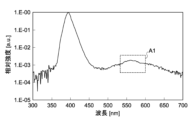
- FIG. 4 shows an example of the spectrum of heating light L1 emitted from the LED light source 2 and having a peak wavelength of 395 nm. Note that in FIG. 4, the vertical axis is expressed in logarithm.
- the light intensity is about 0.1% to 0.3% of the light intensity at the peak wavelength (area A1 in Figure 4). This is light originating from impurity levels or defect levels that is inevitably generated when the light source is an LED, and corresponds to the "deep light” mentioned above.
- the LED light source 2 provided in the light heating device 1 has a much shorter emission wavelength range than the LED lamp provided in the device of the above-mentioned Patent Document 1.
- the chamber 10 has a support member 13 on the inside.
- the support member 13 supports the workpiece W1 so that the main surface W1a and the main surface W1b of the workpiece W1 are arranged on the X-Y plane.
- the main surface W1b of the workpiece W1 is arranged to face the LED light source 2. That is, circuit elements, wiring, etc. are formed on the main surface W1a or the main surface W1b, and the main surface W1b is the surface to which the heating light L1 emitted from the LED light source 2 is irradiated.
- the present invention does not exclude the case where the workpiece W1 is a bare substrate on which wiring, etc. is not formed, and the main surface W1a of the workpiece W1 is arranged to face the LED light source 2.
- the support member 13 may support the workpiece W1 in any manner as long as its main surface W1a is disposed on the X-Y plane.
- the support member 13 may have multiple pin-shaped protrusions that support the workpiece W1 at points.
- the chamber 10 has a first window 10a facing the main surface W1a of the workpiece W1 supported by the support member 13, and a second window 10b facing the main surface W1b.
- the first window 10a is a window that is used by the radiation thermometer 14 to measure the temperature of the main surface W1a of the workpiece W1.
- the radiation thermometer 14 is a thermometer that measures the surface temperature of an object to be measured by receiving light emitted from the object to be measured.
- the sensitivity wavelength range of the radiation thermometer 14 is a predetermined wavelength range that falls within the range of 0.6 ⁇ m to 5 ⁇ m.
- the first window 10a is made of a material that transmits light that falls within the sensitivity wavelength range of the radiation thermometer 14.
- the first window 10a is made of general quartz glass, calcium fluoride, or the like.
- the sensitivity wavelength range of the radiation thermometer 14 provided in the optical heating device 1 is located on the longer wavelength side than the main emission wavelength range of the heating light L1 emitted from the LED light source 2. More preferably, the lower limit of the sensitivity wavelength range of the radiation thermometer 14 is on the longer wavelength side than the wavelength showing the maximum intensity of the deep light contained in the heating light L1. As described above, the intensity of deep light is about 0.1% to 0.3% of the peak intensity of the heating light L1, but if the wavelength of this deep light is included in the sensitivity wavelength range of the radiation thermometer 14, there is a possibility that the temperature of the workpiece W1 will be erroneously detected.
- the emission wavelength of the LED light source 2 can be set to a shorter wavelength, or the lower limit of the sensitivity wavelength range of the radiation thermometer 14 can be set to a longer wavelength.
- the sensitivity wavelength range of the radiation thermometer 14 is shifted to the longer wavelength side, the relative detection ability of the detection element included in the radiation thermometer 14 decreases, making it difficult to measure the temperature with high accuracy. For this reason, when heating the workpiece W1 while measuring the temperature with high accuracy within the low temperature range, it is preferable to set the emission wavelength of the LED light source 2 to a shorter wavelength.
- the second window 10b is a window member for guiding the heating light L1 emitted from the LED light source 2 to the main surface W1b of the workpiece W1.
- the peak wavelength of the heating light L1 is in the range of 370 nm to 460 nm.
- the second window 10b is made of a material that has a transmittance of 50% or more for this heating light L1.
- the second window 10b is made of synthetic quartz.
- the material of the second window 10b may be selected appropriately depending on the peak wavelength of the heating light L1.
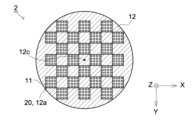
- FIG. 5 is a schematic plan view of the LED light source 2 as viewed from the -Z side.
- the LED light source 2 is configured by arranging a plurality of light source regions 12a, each including a plurality of LED elements 11, on the main surface of the support substrate 12. More specifically, the light source regions 12a are formed on an LED substrate 20. The plurality of LED substrates 20 are then placed on the main surface of the support substrate 12.
- a plurality of LED substrates 20 forming the light source region 12a are arranged in a regular pattern.
- the arrangement pattern of the LED substrates 20 is not limited, but it is preferable that the LED substrates 20 are arranged symmetrically when viewed in the Z direction. Typically, it is preferable that the LED substrates 20 are arranged with line symmetry, point symmetry, or rotational symmetry when viewed in the Z direction. This allows the heating light L1 to be uniformly irradiated to the main surface W1b of the workpiece W1.
- FIG. 6 is a plan view showing a schematic configuration of the LED board 20.
- the LED board 20 includes a plurality of LED elements 11, an anode electrode 30a, and a cathode electrode 30b.
- the plurality of LED elements 11 are electrically connected to the anode electrode 30a and the cathode electrode 30b.
- a Zener diode 30c is mounted on the LED board 20. This Zener diode 30c is connected in parallel to the plurality of LED elements 11 between the anode electrode 30a and the cathode electrode 30b.
- the Zener diode 30c is arranged to prevent the LED elements 11 from deteriorating due to static electricity or surge current.
- the multiple LED elements 11 mounted on the LED board 20 are connected in series and parallel. That is, some of the multiple LED elements 11 are connected in series to each other to form an LED element group 11s, and these LED element groups 11s are connected in parallel.
- All of the multiple LED elements 11 emit heating light L1 with a peak wavelength in the range of 370 nm to 460 nm. It is preferable that the peak wavelengths of the heating light L1 emitted from these multiple LED elements 11 are substantially identical. “Substantially identical” here means that wavelength deviations due to element variations during the manufacturing process are tolerated. Typically, it is acceptable for the wavelength deviation to be within ⁇ 5 nm.
- the peak wavelength of the heating light L1 emitted from the LED light source 2 is in the range of 370 nm to 460 nm, so this heating light L1 is absorbed by the workpiece W1 even if the workpiece W1 contains a SiC semiconductor. This allows non-contact heating of the workpiece W1.
- the temperature of the workpiece W1 can be detected by receiving the light emitted from the workpiece W1 with the radiation thermometer 14.
- the sensitivity wavelength range of the radiation thermometer 14 is set to the longer wavelength side than the wavelength showing the maximum intensity of the deep light contained in the heating light L1, it is possible to prevent erroneous detection of the temperature of the workpiece W1 due to receiving light derived from deep light.
- a controller not shown
- the light output of the LED light source 2 it is possible to heat the workpiece W1 containing SiC with high accuracy.
- the main emission wavelength range which includes the peak wavelength of the heating light L1 is clearly outside the sensitivity wavelength range of the radiation thermometer 14.
- the peak wavelength of the heating light L1 is within the range of 370 nm to 420 nm. In this case, even if the LED light source 2 is installed in the atmosphere, the effect of suppressing the amount of ozone generated can be obtained.
- Figure 5 illustrates an example in which the light source area 12a is square-shaped, but this shape is merely one example.
- Figure 6 illustrates an example in which the LED board 20 is rectangular-shaped, but this shape is merely one example.
- the multiple LED boards 20 are arranged in a staggered pattern on the support substrate 12, but the arrangement pattern of the multiple LED boards 20 is arbitrary. As another example, the multiple LED boards 20 may be arranged in a ring shape around the center 12c of the support substrate 12.
- the multiple LED element groups 11s mounted on the LED substrate 20 are all composed of the same number of LED elements 11, but the number of LED elements 11 included in the LED element groups 11s may be different, taking into consideration differences in voltage drops that occur depending on the distance from the anode electrode 30a and the cathode electrode 30b.
- the first window 10a for measuring the temperature with the radiation thermometer 14 is provided at a position facing the main surface W1a on the opposite side to the main surface W1b where the heating light L1 is irradiated on the workpiece W1.
- the position of the first window 10a is arbitrary.
- the first window 10a may be provided on the side wall of the chamber 10, or on the main surface W1b side.
- the sensitivity wavelength range of the radiation thermometer 14 is adjusted so as to be significantly different from the main emission wavelength range of the heating light L1 and not to overlap with the wavelength range in which the deep light shows maximum intensity.
- the wavelength range of this reflected light is different from the sensitivity wavelength range of the radiation thermometer 14, so that even if the radiation thermometer 14 receives the reflected light, there is little risk of misrecognizing the temperature of the workpiece W1.
- LED heating device 2 LED light source 10: Chamber 10a: First window 10b: Second window 11: LED element 11s: LED element group 12: Support substrate 12a: Light source region 12c: Center of support substrate 13: Support member 14: Radiation thermometer 20: LED substrate 30a: Anode electrode 30b: Cathode electrode 30c: Zener diode L1: Heating light W1: Workpieces W1a, W1b: Main surface of workpiece
Landscapes
- Resistance Heating (AREA)
Abstract
L'invention concerne un procédé de chauffage optique grâce auquel il est possible de chauffer efficacement un corps de traitement contenant un semi-conducteur au SiC. La présente invention comprend une étape (a) dans laquelle un corps de traitement contenant un semi-conducteur au SiC est irradié, par l'intermédiaire d'un élément de fenêtre, avec une lumière de chauffage qui est émise à partir d'une source de lumière à DEL et qui a une longueur d'onde de pic dans la plage de 370-460 nm, et en conséquence, le corps de traitement est chauffé.
Priority Applications (1)
| Application Number | Priority Date | Filing Date | Title |
|---|---|---|---|
| JP2025525965A JPWO2024252783A1 (fr) | 2023-06-07 | 2024-04-11 |
Applications Claiming Priority (2)
| Application Number | Priority Date | Filing Date | Title |
|---|---|---|---|
| JP2023-093745 | 2023-06-07 | ||
| JP2023093745 | 2023-06-07 |
Publications (1)
| Publication Number | Publication Date |
|---|---|
| WO2024252783A1 true WO2024252783A1 (fr) | 2024-12-12 |
Family
ID=93795369
Family Applications (1)
| Application Number | Title | Priority Date | Filing Date |
|---|---|---|---|
| PCT/JP2024/014663 Ceased WO2024252783A1 (fr) | 2023-06-07 | 2024-04-11 | PROCÉDÉ DE CHAUFFAGE OPTIQUE, DISPOSITIF DE CHAUFFAGE OPTIQUE POUR SEMI-CONDUCTEUR SiC, ET DISPOSITIF SOURCE DE LUMIÈRE À DEL |
Country Status (3)
| Country | Link |
|---|---|
| JP (1) | JPWO2024252783A1 (fr) |
| TW (1) | TW202514758A (fr) |
| WO (1) | WO2024252783A1 (fr) |
Citations (3)
| Publication number | Priority date | Publication date | Assignee | Title |
|---|---|---|---|---|
| JP2007141896A (ja) * | 2005-11-14 | 2007-06-07 | Tokyo Electron Ltd | 加熱装置、熱処理装置及び記憶媒体 |
| JP2022076258A (ja) * | 2020-11-09 | 2022-05-19 | ウシオ電機株式会社 | 温度測定方法、温度測定装置及び光加熱装置 |
| JP2022187280A (ja) * | 2021-06-07 | 2022-12-19 | ウシオ電機株式会社 | 光加熱装置 |
-
2024
- 2024-04-11 JP JP2025525965A patent/JPWO2024252783A1/ja active Pending
- 2024-04-11 WO PCT/JP2024/014663 patent/WO2024252783A1/fr not_active Ceased
- 2024-04-29 TW TW113115946A patent/TW202514758A/zh unknown
Patent Citations (3)
| Publication number | Priority date | Publication date | Assignee | Title |
|---|---|---|---|---|
| JP2007141896A (ja) * | 2005-11-14 | 2007-06-07 | Tokyo Electron Ltd | 加熱装置、熱処理装置及び記憶媒体 |
| JP2022076258A (ja) * | 2020-11-09 | 2022-05-19 | ウシオ電機株式会社 | 温度測定方法、温度測定装置及び光加熱装置 |
| JP2022187280A (ja) * | 2021-06-07 | 2022-12-19 | ウシオ電機株式会社 | 光加熱装置 |
Also Published As
| Publication number | Publication date |
|---|---|
| JPWO2024252783A1 (fr) | 2024-12-12 |
| TW202514758A (zh) | 2025-04-01 |
Similar Documents
| Publication | Publication Date | Title |
|---|---|---|
| KR101101132B1 (ko) | 발광소자 검사장치 및 이를 이용한 발광소자 검사방법 | |
| US20170011922A1 (en) | Apparatus and method for light-irradiation heat treatment | |
| KR102504970B1 (ko) | 기판 지지 장치, 열처리 장치, 기판 지지 방법, 열처리 방법 | |
| CN1556910A (zh) | 通过优化电磁能的吸收加热半导体晶片的系统和方法 | |
| CN101256929A (zh) | 白炽灯及光照射式加热处理装置 | |
| KR20220007520A (ko) | 광 가열 장치 및 가열 처리 방법 | |
| CN111668135B (zh) | 热处理方法及热处理装置 | |
| CN112349587B (zh) | 热处理方法 | |
| KR20200033733A (ko) | 열처리 방법 및 열처리 장치 | |
| CN107818926B (zh) | 热处理装置 | |
| US10134612B2 (en) | Semiconductor manufacturing apparatus and method of manufacturing semiconductor device | |
| US20230187237A1 (en) | Optical heating method and optical heating apparatus for heating wide band gap semiconductor | |
| WO2024252783A1 (fr) | PROCÉDÉ DE CHAUFFAGE OPTIQUE, DISPOSITIF DE CHAUFFAGE OPTIQUE POUR SEMI-CONDUCTEUR SiC, ET DISPOSITIF SOURCE DE LUMIÈRE À DEL | |
| US10475674B2 (en) | Light irradiation type heat treatment apparatus and method for manufacturing heat treatment apparatus | |
| JP2025047216A (ja) | 光加熱方法、n型SiC半導体用の光加熱装置 | |
| CN111799171B (zh) | 热处理方法及热处理装置 | |
| KR101046057B1 (ko) | 발광소자 검사장치 및 이를 이용한 발광소자 검사방법 | |
| KR101092027B1 (ko) | 박막 형성장치, 이를 이용한 박막 형성방법 및 상기 박막 형성장치를 이용한 발광다이오드 제조방법 | |
| KR20170031827A (ko) | 투명 플레이트 및 그를 포함하는 기판 처리 장치 | |
| US12525490B2 (en) | Heat treatment apparatus and heat treatment method | |
| JP7631457B1 (ja) | 光加熱方法、n型SiC半導体用の光加熱装置 | |
| US20250391662A1 (en) | Method and System for Efficient Photoelectrochemical Etching of Silicon Carbide and Silicon Carbide on Insulator Using LED Lamp | |
| JP5280717B2 (ja) | 熱処理装置 | |
| JP2003234303A (ja) | 熱処理装置 | |
| WO2024006225A3 (fr) | Appareil d'exposition de bord, son procédé de fabrication et d'utilisation |
Legal Events
| Date | Code | Title | Description |
|---|---|---|---|
| 121 | Ep: the epo has been informed by wipo that ep was designated in this application |
Ref document number: 24819022 Country of ref document: EP Kind code of ref document: A1 |
|
| ENP | Entry into the national phase |
Ref document number: 2025525965 Country of ref document: JP Kind code of ref document: A |
|
| WWE | Wipo information: entry into national phase |
Ref document number: 2025525965 Country of ref document: JP |
|
| NENP | Non-entry into the national phase |
Ref country code: DE |