WO2024252783A1 - 光加熱方法、SiC半導体用の光加熱装置、LED光源装置 - Google Patents
光加熱方法、SiC半導体用の光加熱装置、LED光源装置 Download PDFInfo
- Publication number
- WO2024252783A1 WO2024252783A1 PCT/JP2024/014663 JP2024014663W WO2024252783A1 WO 2024252783 A1 WO2024252783 A1 WO 2024252783A1 JP 2024014663 W JP2024014663 W JP 2024014663W WO 2024252783 A1 WO2024252783 A1 WO 2024252783A1
- Authority
- WO
- WIPO (PCT)
- Prior art keywords
- light
- heating
- led
- light source
- workpiece
- Prior art date
- Legal status (The legal status is an assumption and is not a legal conclusion. Google has not performed a legal analysis and makes no representation as to the accuracy of the status listed.)
- Ceased
Links
Images



Classifications
-
- H—ELECTRICITY
- H10—SEMICONDUCTOR DEVICES; ELECTRIC SOLID-STATE DEVICES NOT OTHERWISE PROVIDED FOR
- H10H—INORGANIC LIGHT-EMITTING SEMICONDUCTOR DEVICES HAVING POTENTIAL BARRIERS
- H10H20/00—Individual inorganic light-emitting semiconductor devices having potential barriers, e.g. light-emitting diodes [LED]
- H10H20/80—Constructional details
-
- H—ELECTRICITY
- H10—SEMICONDUCTOR DEVICES; ELECTRIC SOLID-STATE DEVICES NOT OTHERWISE PROVIDED FOR
- H10H—INORGANIC LIGHT-EMITTING SEMICONDUCTOR DEVICES HAVING POTENTIAL BARRIERS
- H10H20/00—Individual inorganic light-emitting semiconductor devices having potential barriers, e.g. light-emitting diodes [LED]
- H10H20/80—Constructional details
- H10H20/85—Packages
-
- H—ELECTRICITY
- H10—SEMICONDUCTOR DEVICES; ELECTRIC SOLID-STATE DEVICES NOT OTHERWISE PROVIDED FOR
- H10P—GENERIC PROCESSES OR APPARATUS FOR THE MANUFACTURE OR TREATMENT OF DEVICES COVERED BY CLASS H10
- H10P34/00—Irradiation with electromagnetic or particle radiation of wafers, substrates or parts of devices
Definitions
- the present invention relates to an optical heating method, and in particular to an optical heating method for a workpiece including a SiC semiconductor.
- the present invention also relates to an optical heating device for SiC semiconductors and an LED light source device used in the optical heating device.
- various heat treatments such as film formation, oxidation diffusion, modification, and annealing are performed on objects to be treated, including semiconductor wafers.
- Light is often used to carry out these heat treatments. Heating an object to be treated using light in this way is called “light heating.”
- the light used for heating is also called “heating light.”
- Patent Document 1 As an example of a semiconductor heating device that uses optical heating, the technology described in Patent Document 1 below is known.
- the device in Patent Document 1 uses an LED lamp that emits heating light with a wavelength of 810 nm to 980 nm as the light source.
- SiC has a larger band gap than conventional Si, and has a high dielectric breakdown field strength, and is expected to reduce environmental impact through lower loss, smaller size, and lighter weight.
- SiC transmits most of the light emitted from halogen lamps used as heating light sources in semiconductor manufacturing processes, and LED lamps such as those described in Patent Document 1, making it difficult to heat efficiently.
- Patent Document 1 does not specifically consider the case where SiC wafers are used as the object to be heated. For this reason, Patent Document 1 does not mention at all that there is a suitable wavelength range of light for heat-treating SiC wafers.
- the present invention aims to provide an optical heating method capable of efficiently heating a workpiece containing a SiC semiconductor.
- the present invention also aims to provide an optical heating device suitable for heating a workpiece containing a SiC semiconductor and an LED light source device for use in the optical heating device.
- the light heating method according to the present invention comprises the steps of:
- the method is characterized by including a step (a) of irradiating a workpiece including a SiC semiconductor with heating light having a peak wavelength in the range of 370 nm to 460 nm emitted from an LED light source through a window member to heat the workpiece.
- the heating light preferably has a peak wavelength within a range of 370 nm to 420 nm.
- SiC comes in a variety of crystal structures, including 4H-SiC (band gap 3.3 eV), 6H-SiC (band gap 3 eV), and 3C-SiC (band gap 2.2 eV).
- 4H-SiC band gap 3.3 eV
- 6H-SiC band gap 3 eV
- 3C-SiC band gap 2.2 eV
- the transmittance of light gradually increases in the wavelength range longer than about 420 nm, and almost all light in the wavelength range longer than 500 nm is transmitted.
- Broad halogen lamp light with a peak at a wavelength of about 1 ⁇ m transmits SiC over a wide wavelength range.
- Figure 1 is a graph showing the relationship between wavelength and absorptance in SiC.
- the graph shown in Figure 1 is calculated based on reflectance characteristic data and transmittance characteristic data for SiC.
- Figure 1 shows that the absorptance is 40% or more when the wavelength is in the range of 370 nm to 460 nm.
- high heating efficiency can be achieved by irradiating it with heating light from an LED light source with a peak wavelength in the range of 370 nm to 460 nm.
- the absorption rate is 50% or more in the wavelength range of 370 nm to 420 nm.
- higher heating efficiency can be achieved by irradiating and heating with heating light from an LED light source with a peak wavelength in the range of 370 nm to 420 nm.
- the light emission efficiency is prone to variation, as is recognized particularly for GaN-based epitaxial (AlGaN) LED elements. For this reason, from the perspective of more reliably achieving higher heating efficiency, it is preferable to use light with a wavelength of 370 nm or more as the heating light.
- the window member is made of a material having a high transmittance to the heating light as described above. This transmittance is preferably 50% or more, more preferably 70% or more, and particularly preferably 80% or more.
- synthetic quartz, fused quartz, sapphire, magnesium fluoride (MgF 2 ), calcium fluoride (CaF 2 ), or barium fluoride (BaF 2 ) is preferably used.
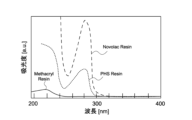
- Figure 2 is a graph showing the tendency of the light absorbance characteristics of resins used in semiconductor photoresists, as shown in the above-mentioned non-patent document 1.
- Resins used in semiconductor photoresists include novolac resin, methacrylic resin, and PHS resin. As shown in Figure 2, these resins are characterized by showing relatively high absorbance for light with a wavelength of 300 nm or less, and novolac resin and PHS resin in particular suddenly show high absorbance for light with a wavelength of 300 nm or less.
- semiconductor photoresist is used as a photoresist mask when ion implantation is performed on the SiC substrate.
- important indices for the resin used in semiconductor photoresist include light transparency, chemical resistance, and solubility in developing solution, and light transparency is adjusted according to the spectrum of light emitted from the light source.
- the resins used in semiconductor photoresists exhibit high absorbance for light with wavelengths of 300 nm or less.
- the light source even light emitted from an LED element, to have a certain degree of bandwidth, and from the standpoint of further reducing absorption by the resin, it is preferable for the peak wavelength of the emitted heating light to be at least 370 nm or more.
- the above-mentioned light heating method uses heating light with a peak wavelength in the range of 370 nm to 460 nm, a wavelength range that is significantly shorter than conventional methods.
- the heating light can be absorbed by the workpiece to an extent that it can exert a heating effect, even if the workpiece contains a SiC semiconductor. This allows the workpiece to be heated without contact.
- the above-mentioned light heating method uses heating light with a peak wavelength in the range of 370 nm to 460 nm, so the effects of absorption by semiconductor photoresist are reduced compared to when using heating light with a peak wavelength in a shorter wavelength band.
- the light heating method includes: During the execution of the step (a), a step (b) may be included in which a radiation thermometer having a sensitivity wavelength range of a predetermined wavelength range of 0.6 ⁇ m to 5 ⁇ m receives light emitted from the object to be treated, thereby measuring the temperature of the object to be treated.
- Semiconductor light-emitting elements such as LED elements, are known to emit light in a wavelength range (main emission wavelength range) that includes the peak wavelength and has a relatively high emission intensity, as well as light in a wavelength range longer than the main emission wavelength range and with a relatively low emission intensity. While the emission intensity of this long-wavelength light is very low compared to the intensity of the main emission wavelength range, it is slightly higher than the intensity of the tail when approximated by a Gaussian distribution. This long-wavelength light is derived from defects or impurity levels in the active layer that inevitably occur during the manufacture of semiconductor light-emitting elements, and is referred to as "deep light.”
- the wavelength range of the deep light emitted from this light source which has a relatively high intensity, overlaps with the sensitivity wavelength range of the radiation thermometer.
- some of the light from the heating light source is received by the radiation thermometer, which may result in an erroneous detection of the temperature of the workpiece.
- a radiation thermometer with a sensitivity wavelength range of 0.6 ⁇ m to 5 ⁇ m can measure the temperature of the workpiece from a relatively low temperature range of 200°C to 500°C, allowing for more precise temperature adjustment. From the perspective of accurately detecting the temperature from the initial stage after heating of the workpiece begins, it is more preferable for the sensitivity wavelength range of the radiation thermometer to be 0.7 ⁇ m to 4 ⁇ m, and especially preferable for it to be 1 ⁇ m to 3 ⁇ m.
- the upper limit of the sensitivity wavelength range of the radiation thermometer may be set appropriately according to the melting point of the SiC contained in the workpiece. However, this does not exclude the use of a radiation thermometer capable of measuring a temperature range higher than the melting point to measure the temperature of the workpiece.
- the light heating device of the present invention is A light heating device for a SiC semiconductor, an LED light source that emits heating light having a peak wavelength in the range of 370 nm to 460 nm; and a window member through which the heating light emitted from the LED light source passes and guides the light to an object to be treated that includes a SiC semiconductor.
- the optical heating device described above can efficiently heat SiC semiconductors used in power semiconductor devices without contact when processing them.
- the light heating device is a chamber for accommodating the object to be processed; A support member for supporting the object to be processed within the chamber may also be provided.
- the LED light source includes a plurality of LED substrates on which a plurality of LED elements are mounted,
- the LED boards may be arranged in line symmetry, point symmetry, or rotational symmetry when viewed in a normal direction to the surface of the LED board.
- the above configuration homogenizes the light intensity distribution on the workpiece, making it possible to heat the workpiece uniformly.
- the LED light source device is characterized in that it includes an LED light source used in the optical heating device for the SiC semiconductor.
- the present invention provides an optical heating method capable of efficiently heating a workpiece containing a SiC semiconductor.
- the present invention also provides an optical heating device suitable for heating a workpiece containing a SiC semiconductor.
- FIG. 1 is a graph showing the relationship between wavelength and absorptance in SiC. 1 is a graph showing the tendency of the light absorbance characteristics of a resin used in a semiconductor photoresist.
- FIG. 1 is a cross-sectional view showing a schematic configuration of an embodiment of a light heating device. 1 is an example of the spectrum of heating light emitted from an LED light source and having a peak wavelength of 395 nm.
- FIG. 2 is a schematic plan view of an LED light source as viewed from the ⁇ Z side.
- FIG. 2 is a plan view illustrating a schematic configuration of an LED substrate.
- the optical heating method according to the present invention includes a step (a) of irradiating a workpiece containing a SiC semiconductor with heating light having a peak wavelength in the range of 370 nm to 460 nm emitted from an LED light source through a window member to heat the workpiece.
- This optical heating method will be described below with reference to a drawing of an optical heating device, which is one embodiment of the method.
- FIG. 3 is a cross-sectional view showing a schematic configuration of one embodiment of the optical heating device 1.
- the optical heating device 1 shown in FIG. 3 includes a chamber 10 that houses a workpiece W1 containing a SiC semiconductor, an LED light source 2, and a radiation thermometer 14.
- the LED light source 2 includes a plurality of LED elements 11 and a support substrate 12 on which the LED elements 11 are placed. More specifically, the LED light source 2 in this embodiment includes a plurality of LED boards 20 on which a plurality of LED elements 11 are mounted, and these plurality of LED boards 20 are placed on the support substrate 12.
- an X-Y-Z coordinate system will be referred to where appropriate, in which a plane parallel to the main surfaces (W1a, W1b) of the workpiece W1 is defined as the X-Y plane, and the normal direction of this X-Y plane is defined as the Z direction.
- the LED light source 2 and the workpiece W1 face each other in the Z direction.
- Figure 3 corresponds to a schematic cross-sectional view of the light heating device 1 cut in the X-Z plane.
- the LED light source 2 emits heating light L1 with a peak wavelength in the range of 370 nm to 460 nm.
- the peak wavelength of the heating light L1 emitted by the LED light source 2 refers to the wavelength that exhibits the highest light intensity (light output) on the emission spectrum.
- the LED light source 2 has a main emission wavelength in the range of 370 nm to 460 nm. Specifically, it is preferable to adopt an LED light source 2 in which the wavelength band showing a light intensity of 50% or more of the peak intensity of the heating light L1 falls within the range of 370 nm to 460 nm. Furthermore, it is more preferable to adopt a light source in which the wavelength band showing a light intensity of 50% or more of the peak intensity of the heating light L1 falls within the range of 370 nm to 420 nm. This makes the LED light source 2 a light source more suitable for heat treatment of a workpiece including a SiC semiconductor.
- the LED light source 2 has a majority of the emission wavelength of the radiated heating light L1 in the range of 370 nm to 460 nm. Specifically, it is preferable to adopt an LED light source 2 in which the wavelength band showing 90% or more of the peak intensity of the heating light L1 falls within the range of 370 nm to 460 nm. Furthermore, it is more preferable to adopt a light source in which the wavelength band showing 90% or more of the light intensity of the peak intensity of the heating light L1 falls within the range of 370 nm to 420 nm. This makes the LED light source 2 a light source more suitable for heat treatment of a workpiece including a SiC semiconductor.
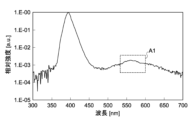
- FIG. 4 shows an example of the spectrum of heating light L1 emitted from the LED light source 2 and having a peak wavelength of 395 nm. Note that in FIG. 4, the vertical axis is expressed in logarithm.
- the light intensity is about 0.1% to 0.3% of the light intensity at the peak wavelength (area A1 in Figure 4). This is light originating from impurity levels or defect levels that is inevitably generated when the light source is an LED, and corresponds to the "deep light” mentioned above.
- the LED light source 2 provided in the light heating device 1 has a much shorter emission wavelength range than the LED lamp provided in the device of the above-mentioned Patent Document 1.
- the chamber 10 has a support member 13 on the inside.
- the support member 13 supports the workpiece W1 so that the main surface W1a and the main surface W1b of the workpiece W1 are arranged on the X-Y plane.
- the main surface W1b of the workpiece W1 is arranged to face the LED light source 2. That is, circuit elements, wiring, etc. are formed on the main surface W1a or the main surface W1b, and the main surface W1b is the surface to which the heating light L1 emitted from the LED light source 2 is irradiated.
- the present invention does not exclude the case where the workpiece W1 is a bare substrate on which wiring, etc. is not formed, and the main surface W1a of the workpiece W1 is arranged to face the LED light source 2.
- the support member 13 may support the workpiece W1 in any manner as long as its main surface W1a is disposed on the X-Y plane.
- the support member 13 may have multiple pin-shaped protrusions that support the workpiece W1 at points.
- the chamber 10 has a first window 10a facing the main surface W1a of the workpiece W1 supported by the support member 13, and a second window 10b facing the main surface W1b.
- the first window 10a is a window that is used by the radiation thermometer 14 to measure the temperature of the main surface W1a of the workpiece W1.
- the radiation thermometer 14 is a thermometer that measures the surface temperature of an object to be measured by receiving light emitted from the object to be measured.
- the sensitivity wavelength range of the radiation thermometer 14 is a predetermined wavelength range that falls within the range of 0.6 ⁇ m to 5 ⁇ m.
- the first window 10a is made of a material that transmits light that falls within the sensitivity wavelength range of the radiation thermometer 14.
- the first window 10a is made of general quartz glass, calcium fluoride, or the like.
- the sensitivity wavelength range of the radiation thermometer 14 provided in the optical heating device 1 is located on the longer wavelength side than the main emission wavelength range of the heating light L1 emitted from the LED light source 2. More preferably, the lower limit of the sensitivity wavelength range of the radiation thermometer 14 is on the longer wavelength side than the wavelength showing the maximum intensity of the deep light contained in the heating light L1. As described above, the intensity of deep light is about 0.1% to 0.3% of the peak intensity of the heating light L1, but if the wavelength of this deep light is included in the sensitivity wavelength range of the radiation thermometer 14, there is a possibility that the temperature of the workpiece W1 will be erroneously detected.
- the emission wavelength of the LED light source 2 can be set to a shorter wavelength, or the lower limit of the sensitivity wavelength range of the radiation thermometer 14 can be set to a longer wavelength.
- the sensitivity wavelength range of the radiation thermometer 14 is shifted to the longer wavelength side, the relative detection ability of the detection element included in the radiation thermometer 14 decreases, making it difficult to measure the temperature with high accuracy. For this reason, when heating the workpiece W1 while measuring the temperature with high accuracy within the low temperature range, it is preferable to set the emission wavelength of the LED light source 2 to a shorter wavelength.
- the second window 10b is a window member for guiding the heating light L1 emitted from the LED light source 2 to the main surface W1b of the workpiece W1.
- the peak wavelength of the heating light L1 is in the range of 370 nm to 460 nm.
- the second window 10b is made of a material that has a transmittance of 50% or more for this heating light L1.
- the second window 10b is made of synthetic quartz.
- the material of the second window 10b may be selected appropriately depending on the peak wavelength of the heating light L1.
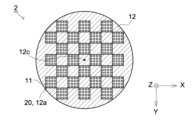
- FIG. 5 is a schematic plan view of the LED light source 2 as viewed from the -Z side.
- the LED light source 2 is configured by arranging a plurality of light source regions 12a, each including a plurality of LED elements 11, on the main surface of the support substrate 12. More specifically, the light source regions 12a are formed on an LED substrate 20. The plurality of LED substrates 20 are then placed on the main surface of the support substrate 12.
- a plurality of LED substrates 20 forming the light source region 12a are arranged in a regular pattern.
- the arrangement pattern of the LED substrates 20 is not limited, but it is preferable that the LED substrates 20 are arranged symmetrically when viewed in the Z direction. Typically, it is preferable that the LED substrates 20 are arranged with line symmetry, point symmetry, or rotational symmetry when viewed in the Z direction. This allows the heating light L1 to be uniformly irradiated to the main surface W1b of the workpiece W1.
- FIG. 6 is a plan view showing a schematic configuration of the LED board 20.
- the LED board 20 includes a plurality of LED elements 11, an anode electrode 30a, and a cathode electrode 30b.
- the plurality of LED elements 11 are electrically connected to the anode electrode 30a and the cathode electrode 30b.
- a Zener diode 30c is mounted on the LED board 20. This Zener diode 30c is connected in parallel to the plurality of LED elements 11 between the anode electrode 30a and the cathode electrode 30b.
- the Zener diode 30c is arranged to prevent the LED elements 11 from deteriorating due to static electricity or surge current.
- the multiple LED elements 11 mounted on the LED board 20 are connected in series and parallel. That is, some of the multiple LED elements 11 are connected in series to each other to form an LED element group 11s, and these LED element groups 11s are connected in parallel.
- All of the multiple LED elements 11 emit heating light L1 with a peak wavelength in the range of 370 nm to 460 nm. It is preferable that the peak wavelengths of the heating light L1 emitted from these multiple LED elements 11 are substantially identical. “Substantially identical” here means that wavelength deviations due to element variations during the manufacturing process are tolerated. Typically, it is acceptable for the wavelength deviation to be within ⁇ 5 nm.
- the peak wavelength of the heating light L1 emitted from the LED light source 2 is in the range of 370 nm to 460 nm, so this heating light L1 is absorbed by the workpiece W1 even if the workpiece W1 contains a SiC semiconductor. This allows non-contact heating of the workpiece W1.
- the temperature of the workpiece W1 can be detected by receiving the light emitted from the workpiece W1 with the radiation thermometer 14.
- the sensitivity wavelength range of the radiation thermometer 14 is set to the longer wavelength side than the wavelength showing the maximum intensity of the deep light contained in the heating light L1, it is possible to prevent erroneous detection of the temperature of the workpiece W1 due to receiving light derived from deep light.
- a controller not shown
- the light output of the LED light source 2 it is possible to heat the workpiece W1 containing SiC with high accuracy.
- the main emission wavelength range which includes the peak wavelength of the heating light L1 is clearly outside the sensitivity wavelength range of the radiation thermometer 14.
- the peak wavelength of the heating light L1 is within the range of 370 nm to 420 nm. In this case, even if the LED light source 2 is installed in the atmosphere, the effect of suppressing the amount of ozone generated can be obtained.
- Figure 5 illustrates an example in which the light source area 12a is square-shaped, but this shape is merely one example.
- Figure 6 illustrates an example in which the LED board 20 is rectangular-shaped, but this shape is merely one example.
- the multiple LED boards 20 are arranged in a staggered pattern on the support substrate 12, but the arrangement pattern of the multiple LED boards 20 is arbitrary. As another example, the multiple LED boards 20 may be arranged in a ring shape around the center 12c of the support substrate 12.
- the multiple LED element groups 11s mounted on the LED substrate 20 are all composed of the same number of LED elements 11, but the number of LED elements 11 included in the LED element groups 11s may be different, taking into consideration differences in voltage drops that occur depending on the distance from the anode electrode 30a and the cathode electrode 30b.
- the first window 10a for measuring the temperature with the radiation thermometer 14 is provided at a position facing the main surface W1a on the opposite side to the main surface W1b where the heating light L1 is irradiated on the workpiece W1.
- the position of the first window 10a is arbitrary.
- the first window 10a may be provided on the side wall of the chamber 10, or on the main surface W1b side.
- the sensitivity wavelength range of the radiation thermometer 14 is adjusted so as to be significantly different from the main emission wavelength range of the heating light L1 and not to overlap with the wavelength range in which the deep light shows maximum intensity.
- the wavelength range of this reflected light is different from the sensitivity wavelength range of the radiation thermometer 14, so that even if the radiation thermometer 14 receives the reflected light, there is little risk of misrecognizing the temperature of the workpiece W1.
- LED heating device 2 LED light source 10: Chamber 10a: First window 10b: Second window 11: LED element 11s: LED element group 12: Support substrate 12a: Light source region 12c: Center of support substrate 13: Support member 14: Radiation thermometer 20: LED substrate 30a: Anode electrode 30b: Cathode electrode 30c: Zener diode L1: Heating light W1: Workpieces W1a, W1b: Main surface of workpiece
Landscapes
- Resistance Heating (AREA)
Abstract
SiC半導体を含む被処理体を効率よく加熱することのできる光加熱方法を提供する。 SiC半導体を含む被処理体に対し、LED光源から出射されたピーク波長が370nm~460nmの範囲内の加熱光を、窓部材を介して照射して前記被処理体を加熱する工程(a)を有する。
Description
本発明は、光加熱方法に関し、特にSiC半導体を含む被処理体に対する光加熱方法に関する。また、本発明は、SiC半導体用の光加熱装置及び当該光加熱装置に用いられるLED光源装置に関する。
半導体の製造プロセスでは、半導体ウェハを初めとする被処理体に対して、成膜処理、酸化拡散処理、改質処理、又はアニール処理等の種々の熱処理が行われる。これらの熱処理の実行の際には、光が用いられることが多い。このように、光を用いて被処理体を加熱することを「光加熱」と称する。また、加熱に用いられる光を「加熱光」と称する。
光加熱を利用した半導体加熱装置としては、例えば下記特許文献1の技術が知られている。特許文献1の装置では、810nm~980nmの波長の加熱光を発するLEDランプが光源として利用されている。
「フォトレジスト材料における高分子材料技術」 征矢野 晃雅 日本ゴム協会誌 第85巻 第2号(2012) p.33~p.39
近年、従来のデバイスよりも高電圧、大電流に対応した、パワー半導体デバイスの開発が進められている。このため、従来のデバイスではSiが一般的に利用されていたが、最近のデバイスでは、小型で高耐圧特性を示すデバイスを実現するために、SiCの利用が検討されている。
SiCは、従来のSiに比べてバンドギャップが大きく、高い絶縁破壊電界強度などを有し、低損失化、小型化、軽量化といった環境負荷軽減への期待がある。ところが、SiCは、半導体の製造プロセスにおいて加熱用の光源として用いられるハロゲンランプや、上記特許文献1に記載されているようなLEDランプから発せられる光のほとんどを透過してしまい、効率よく加熱できないという課題があった。なお、上記特許文献1において、SiCウェハを加熱対象物とした場合の検討は特段なされていない。このため、上記特許文献1には、SiCウェハを加熱処理するために好適な光の波長範囲が存在すること等は、全く言及されていない。
本発明は、上記の課題に鑑み、SiC半導体を含む被処理体を効率よく加熱することのできる光加熱方法を提供することを目的とする。また、本発明は、SiC半導体を含む被処理体の加熱に適した光加熱装置及び当該光加熱装置に用いられるLED光源装置を提供することを目的とする。
本発明に係る光加熱方法は、
SiC半導体を含む被処理体に対し、LED光源から出射されたピーク波長が370nm~460nmの範囲内の加熱光を、窓部材を介して照射して前記被処理体を加熱する工程(a)を有することを特徴とする。
SiC半導体を含む被処理体に対し、LED光源から出射されたピーク波長が370nm~460nmの範囲内の加熱光を、窓部材を介して照射して前記被処理体を加熱する工程(a)を有することを特徴とする。
上記光加熱方法において、
前記加熱光は、ピーク波長が370nm~420nmの範囲内であることが好ましい。
前記加熱光は、ピーク波長が370nm~420nmの範囲内であることが好ましい。
本発明者は、SiCを含む被処理体の加熱方法について鋭意検討していたところ、以下のことを見い出した。SiCには結晶構造の違いで4H-SiC(バンドギャップ3.3eV)、6H-SiC(バンドギャップ3eV)、3C-SiC(バンドギャップ2.2eV)などがある。バンドギャップが3eVの6H-SiCの場合、波長420nm付近より長波長域において、徐々に光に対する透過率が高くなり、波長500nm以上より長波長域の光はほとんど透過してしまう。波長1μm付近にピークを有するブロードなハロゲンランプ光では広い波長域においてSiCを透過してしまう。
図1は、SiCにおける波長と吸収率の関係を示すグラフである。図1に示すグラフは、SiCの反射率特性データ、及び透過率特性データに基づいて算出したグラフである。図1によれば、波長が370nm~460nmの範囲内において吸収率が40%以上を示すことが分かる。つまり、被処理体が、SiCを含む場合においても、LED光源からピーク波長が370nm~460nmの範囲内である加熱光を照射して加熱することで、高い加熱効率が実現される。
また、波長が370nm~420nmの範囲内において吸収率が50%以上を示すことが分かる。つまり、被処理体が、SiCを含む場合においても、LED光源からピーク波長が370nm~420nmの範囲内である加熱光を照射して加熱することで、より高い加熱効率が実現される。なお、360nm以上370nm未満の波長域に関しては、特に、GaN系エピ(AlGaN)のLED素子において認識されているような、発光効率がバラつきやすいという課題が存在する。このため、より高い加熱効率をより確実に実現する観点から、加熱光として波長が370nm以上の光を利用することが好ましい。
窓部材は、上述したような加熱光に対する透過率が高い材料で構成される。この透過率は、50%以上であるのが好ましく、70%以上であるのがより好ましく、80%以上であるのが特に好ましい。窓部材の材料としては合成石英、溶融石英、サファイア、フッ化マグネシウム(MgF2)、フッ化カルシウム(CaF2)、又はフッ化バリウム(BaF2)が好適に採用される。このような材料で窓部材を構成することにより、窓部材において加熱光が大幅に吸収されることがなく、LED光源からの加熱光を効率的に被処理体の加熱に利用できる。
図2は、上記非特許文献1において示されている、半導体用フォトレジストに用いられる樹脂の光に対する吸光度特性の傾向を示すグラフである。半導体用フォトレジスト用いられる樹脂としては、ノボラック樹脂(Novolac Resin)、メタクリル樹脂(Methtcryl Resin)、PHS樹脂(PHS Resin)等が用いられる。これらの樹脂は、図2に示すように、波長が300nm以下の光に対して相対的に高い吸光度を示す特徴があり、特に、ノボラック樹脂、PHS樹脂は、波長が300nm以下の光に対して急に高い吸光度を示すようになる。
半導体用フォトレジストは、例えば、被処理体がSiC基板であった場合に、SiC基板に対いてイオン注入を行う際のフォトレジストマスクとして用いられる。このため、半導体用フォトレジストに用いられる樹脂としては、光透過性、耐薬品性、現像液への溶解性等が重要な指標となるが、光透過性に関しては、光源から発せられる光のスペクトルに応じて調整される。
しかしながら、上述したように、半導体用フォトレジストに用いられる樹脂の多くは、波長が300nm以下の光に対して高い吸光度を示す。このような事情から、光源としては、LED素子から出射される光であってもある程度の帯域幅を有することと、樹脂による吸収をより低減する観点から、発する加熱光のピーク波長が少なくとも370nm以上であることが好ましい。
上記光加熱方法では、ピーク波長が370nm~460nmの範囲内である、従来よりもかなり短い波長域の加熱光が利用される。この波長域の加熱光が利用されることで、被処理体がSiC半導体を含む場合であっても、加熱作用を奏することのできる程度に被処理体において加熱光が吸収され得る。これにより、被処理体を非接触で加熱できる。
また、上記光加熱方法では、ピーク波長が370nm~460nmの範囲内である加熱光が利用されるため、より短い波長帯にピーク波長を示す加熱光を用いる場合と比較して、半導体用フォトレジストによる吸収の影響が低減される。
上記光加熱方法は、
前記工程(a)の実行中に、0.6μm~5μmの範囲内に属する所定の波長域を感度波長域とする放射温度計が、前記被処理体から放射される光を受光することで、前記被処理体の温度を計測する工程(b)を有していても構わない。
前記工程(a)の実行中に、0.6μm~5μmの範囲内に属する所定の波長域を感度波長域とする放射温度計が、前記被処理体から放射される光を受光することで、前記被処理体の温度を計測する工程(b)を有していても構わない。
LED素子に代表される半導体発光素子からは、ピーク波長を含み発光強度が相対的に高い波長域(主発光波長域)の光に加えて、主発光波長域よりも長波長側において、発光強度が相対的に低い波長域の光が発せられることが知られている。この長波長側の光は、発光強度自体は主発光波長域の強度と比較して非常に低いながらも、ガウシアン分布で近似した場合における裾の強度よりは少し高い強度を示す。この長波長側の光は、半導体発光素子の製造時に不可避的に発生した活性層中の欠陥又は不純物準位由来の光であり、「ディープ光」と称される。
例えば、加熱用光源としてピーク波長が400nm~1000nmの範囲内に位置する光源を用いた場合、この光源から出射されるディープ光のうちの強度が比較的高い波長域が、放射温度計の感度波長域に重なりを有してしまう。この結果、加熱用光源からの光の一部が放射温度計に受光されることで、被処理体の温度を誤検知するおそれがある。
感度波長域が0.6μm~5μmであるような放射温度計によれば、被処理体の温度を200℃~500℃といった比較的低温の範囲から測定することができるため、より精密な温度調整が可能となる。被処理体に対する加熱が開始されてからの初期段階から、精度良く温度を検出する観点からは、放射温度計の感度波長域は、0.7μm~4μmとするのがより好ましく、1μm~3μmとするのが特に好ましい。
なお、放射温度計の感度波長域の上限は、被処理体に含まれるSiCの融点に応じて適宜設定されてもよい。ただし、このことは、前記融点より高い温度範囲が計測可能な放射温度計を用いて被処理体の温度を計測することを排除するものではない。
本発明の光加熱装置は、
SiC半導体用の光加熱装置であって、
ピーク波長が370nm~460nmの範囲内の加熱光を発するLED光源と、
前記LED光源から出射された前記加熱光を通過させてSiC半導体を含む被処理体に導く窓部材とを備えたことを特徴とする。
SiC半導体用の光加熱装置であって、
ピーク波長が370nm~460nmの範囲内の加熱光を発するLED光源と、
前記LED光源から出射された前記加熱光を通過させてSiC半導体を含む被処理体に導く窓部材とを備えたことを特徴とする。
上記光加熱装置によれば、パワー半導体デバイスに利用されるSiC半導体の処理の際に、非接触でありながらも効率的に加熱を行うことができる。
前記光加熱装置は、
前記被処理体を収容するチャンバと、
前記チャンバ内で前記被処理体を支持する支持部材とを備えるものとしても構わない。
前記被処理体を収容するチャンバと、
前記チャンバ内で前記被処理体を支持する支持部材とを備えるものとしても構わない。
上記光加熱装置において、
前記LED光源は、複数のLED素子が搭載されたLED基板を複数枚備え、
複数の前記LED基板は、前記LED基板の面に対する法線方向に見たときに、線対称、点対称又は回転対称に配置されていても構わない。
前記LED光源は、複数のLED素子が搭載されたLED基板を複数枚備え、
複数の前記LED基板は、前記LED基板の面に対する法線方向に見たときに、線対称、点対称又は回転対称に配置されていても構わない。
上記構成によれば、被処理体に対する光強度分布が均質化されるため、被処理体に対する均質な加熱が可能となる。
また、本発明に係るLED光源装置は、上記SiC半導体用の光加熱装置に用いられるLED光源を含むことを特徴とする
本発明によれば、SiC半導体を含む被処理体を効率よく加熱することのできる光加熱方法が提供される。また、本発明によれば、SiC半導体を含む被処理体の加熱に適した光加熱装置が実現される。
本発明に係る光加熱方法は、SiC半導体を含む被処理体に対し、LED光源から出射されたピーク波長が370nm~460nmの範囲内の加熱光を、窓部材を介して照射して前記被処理体を加熱する工程(a)を有する。以下では、この光加熱方法に関し、同方法を実施する一形態である光加熱装置の図面を参照しながら説明する。
なお、以下の各図面は、いずれも模式的に図示されたものであり、図面上の寸法比や個数は、実際の寸法比や個数と必ずしも一致していない。
図3は、光加熱装置1の一実施形態の構成を模式的に示す断面図である。図3に示す光加熱装置1は、SiC半導体を含む被処理体W1が収容されるチャンバ10と、LED光源2と、放射温度計14とを備える。LED光源2は、複数のLED素子11と、LED素子11が載置された支持基板12とを備える。なお、より詳細には、この実施形態におけるLED光源2は、複数のLED素子11が搭載されたLED基板20を複数備えており、これらの複数のLED基板20が、支持基板12上に載置されている。
以下の説明においては、図3に示すように、被処理体W1の主面(W1a,W1b)と平行な面をX-Y平面とし、このX-Y平面の法線方向をZ方向とする、X-Y-Z座標系が適宜参照される。図3に示すように、LED光源2と被処理体W1とは、Z方向に対向している。この表記法を用いて記載すると、図3は、光加熱装置1をX-Z平面で切断したときの模式的な断面図に対応する。
なお、以下では、方向を表現する際に正負の向きを区別する場合には、「+Z方向」、「-Z方向」のように、正負の符号を付して記載され、正負の向きを区別せずに方向を表現する場合には、単に「Z方向」と記載される。
LED光源2は、ピーク波長が370nm~460nmの範囲内の加熱光L1を発する。なお、本明細書において、LED光源2が発する加熱光L1のピーク波長とは、発光スペクトル上において最も高い光強度(光出力)を示す波長を指す。
また、LED光源2は、主たる発光波長が370nm~460nmの範囲内であることがより望ましい。具体的には、加熱光L1のピーク強度に対して50%以上の光強度を示す波長帯域が370nm~460nmの範囲内に収まるLED光源2を採用することが望ましい。さらには、加熱光L1のピーク強度に対して50%以上の光強度を示す波長帯域が370nm~420nmの範囲内に収まる光源を採用することがより望ましい。これにより、LED光源2は、SiC半導体を含む被処理体の加熱処理により適した光源となる。
また、LED光源2は、放射される加熱光L1の大半の発光波長が370nm~460nmの範囲内であることがより望ましい。具体的には、加熱光L1のピーク強度に対して90%以上を示す波長帯域が370nm~460nmの範囲内に収まるLED光源2を採用することが望ましい。さらには、加熱光L1のピーク強度に対して90%以上の光強度を示す波長帯域が370nm~420nmの範囲内に収まる光源を採用することがより望ましい。これにより、LED光源2は、SiC半導体を含む被処理体の加熱処理により適した光源となる。
図4は、LED光源2から出射されるピーク波長が395nmの加熱光L1のスペクトルの一例である。なお、図4において、縦軸は対数表記されている。
図4に示すスペクトルによれば、ピーク波長よりも長波長側の550nm~600nm付近において、ピーク波長の光強度に対して0.1%~0.3%程度の光強度が示されている(図4内の領域A1)。これは、光源がLEDである場合に、不可避的に発生する、不純物準位又は欠陥準位由来の光であり、上述した「ディープ光」に対応する。
光加熱装置1が備えるLED光源2は、上述した特許文献1の装置が備えるLEDランプと比較して、発光波長域がかなり短い。
図3に示すように、チャンバ10は、内側に支持部材13を備える。支持部材13は、被処理体W1の主面W1a及び主面W1bがX-Y平面上に配置されるように、被処理体W1を支持する。なお、図3では、被処理体W1の主面W1bが、LED光源2に対面するように配置される。すなわち、主面W1a又は主面W1bには、回路素子や配線等が形成されており、主面W1bはLED光源2から出射される加熱光L1が照射される面である。ただし、本発明は、配線等が形成されていないベア状態の基板を被処理体W1とする場合、被処理体W1の主面W1aが、LED光源2に対面するように配置される場合を排除するものではない。
支持部材13による被処理体W1の支持態様は、その主面W1aがX-Y平面上に配置される限りにおいて任意である。例えば、支持部材13がピン状の突起を複数備え、その突起により被処理体W1を点で支持するものであっても構わない。
図3に示すように、チャンバ10は、支持部材13で支持された状態の被処理体W1の主面W1aに対向する、第一窓10aと、主面W1bに対向する第二窓10bとを備える。
第一窓10aは、放射温度計14が被処理体W1の主面W1aの温度を計測するために利用される窓である。放射温度計14は、測定対象物から放射される光を受光することで、当該測定対象物の表面温度を計測する温度計である。本実施形態において、放射温度計14の感度波長域は、0.6μm~5μmの範囲内に属する所定の波長域である。つまり、第一窓10aは、この放射温度計14の感度波長域に属する光を透過する部材で構成されている。一例として、第一窓10aは、一般的な石英ガラス、又はフッ化カルシウム等で構成される。
光加熱装置1が備える放射温度計14の感度波長域は、LED光源2から出射される加熱光L1の主発光波長域よりも、長波長側に位置する。より好ましくは、放射温度計14の感度波長域の下限値は、加熱光L1に含まれるディープ光の強度の最大値を示す波長よりも長波長側であるのが好ましい。上述したように、ディープ光の強度は、加熱光L1のピーク強度に対して0.1%~0.3%程度ではあるが、このディープ光の波長が放射温度計14の感度波長域に含まれている場合には、被処理体W1の温度を誤検知する可能性があるためである。
なお、LED光源2から出射される加熱光L1のピーク波長が短波長になるほど、ディープ光の最大強度を示す波長も短波長側にシフトする。このため、ディープ光の波長域と放射温度計14の感度波長域との重なりを可能な限りなくすためには、LED光源2の発光波長を短波長にするか、放射温度計14の感度波長域の下限値を長波長にする方法が挙げられる。ただし、放射温度計14の感度波長域を長波長側にシフトさせると、放射温度計14に含まれる検出素子の比検出能力が低下するために、高精度な温度計測が困難になる。このため、低温領域の範囲内で高精度に温度を計測しながら被処理体W1の加熱を行う場合には、LED光源2の発光波長を短波長にするのが好ましい。
第二窓10bは、LED光源2から出射された加熱光L1を、被処理体W1の主面W1bに導くための窓部材である。上述したように、加熱光L1のピーク波長は、370nm~460nmの範囲内である。第二窓10bは、この加熱光L1に対する透過率が50%以上である材料で構成される。一例として、第二窓10bは合成石英で構成される。ただし、第二窓10bの材料は、加熱光L1のピーク波長に応じて適宜選択されてもよい。
図5は、LED光源2を-Z側から見たときの模式的な平面図である。図5に示すように、LED光源2は、支持基板12の主面上に、複数のLED素子11を含む複数の光源領域12aが配列されて構成されている。より詳細には、光源領域12aはLED基板20上に形成されている。そして、複数のLED基板20が支持基板12の主面上に載置されている。
図5に示すLED光源2では、光源領域12aを形成するLED基板20が、複数枚、規則的に配列されている。本発明において、LED基板20の配列パターンは限定されないが、Z方向に見たときに、各LED基板20が対称性を有して配列されるのが好ましい。典型的には、Z方向に見たときに、各LED基板20は線対称、点対称、又は回転対称に配列されるのが好ましい。これにより、被処理体W1の主面W1bに対して加熱光L1が均質に照射される。
図6は、LED基板20の構成を模式的に示す平面図である。図6に示すように、LED基板20は、複数のLED素子11と、アノード電極30a及びカソード電極30bとを備える。複数のLED素子11は、アノード電極30a及びカソード電極30bに対して電気的に接続されている。なお、図6に示す例では、LED基板20上にはツェナーダイオード30cが搭載されている。このツェナーダイオード30cは、アノード電極30aとカソード電極30bとの間において、複数のLED素子11と並列に接続されている。ツェナーダイオード30cは、静電気やサージ電流によってLED素子11が劣化することを防ぐために配置されている。
図6に示す例では、LED基板20に搭載された複数のLED素子11は、直並列に接続されている。すなわち、複数のLED素子11の一部は、相互に直列に接続されることでLED素子群11sを構成し、このLED素子群11s同士が並列に接続されている。
複数のLED素子11は、いずれもピーク波長が370nm~460nmの範囲内の加熱光L1を発する素子である。これらの複数のLED素子11から発せられる加熱光L1のピーク波長は、実質的に同一であるのが好ましい。ここでいう「実質的に同一」とは、製造過程における素子ばらつきに起因した波長のズレを許容する趣旨である。典型的には、波長のズレが±5nm以内であるものとしても構わない。
光加熱装置1によれば、LED光源2から出射される加熱光L1のピーク波長が370nm~460nmの範囲内であるため、被処理体W1がSiC半導体を含む場合であっても、この加熱光L1が被処理体W1において吸収される。これにより、被処理体W1に対して非接触による加熱を行うことができる。
更に、この光照射工程の実行時に、放射温度計14によって被処理体W1から放射される光を受光することで、被処理体W1の温度を検知できる。上述したように、放射温度計14の感度波長域を、加熱光L1に含まれるディープ光の最大強度を示す波長よりも長波長側とすることで、ディープ光由来の光を受光することによる被処理体W1の温度の誤検知を防止できる。すなわち、放射温度計14による検知結果を、LED光源2の光出力を制御する制御器(不図示)に対してフィードバックすることで、SiCを含む被処理体W1に対して、高精度な加熱が可能となる。なお、加熱光L1のピーク波長を含む主発光波長域は、明らかに放射温度計14の感度波長域から外れている。
なお、加熱光L1のピーク波長は、370nm~420nmの範囲内とするのがより好適である。この場合、LED光源2を大気中に設置した場合であっても、オゾン生成量を抑制する効果が得られる。
[別実施形態]
以下において、別実施形態について説明する。
以下において、別実施形態について説明する。
〈1〉図5では、光源領域12aが正方形状である場合が例示されているが、この形状はあくまで一例である。同様に、図6では、LED基板20が長方形状である場合が例示されているが、この形状はあくまで一例である。
図5では、支持基板12上に、複数のLED基板20が千鳥格子状に配列されているが、複数のLED基板20の配列パターンは任意である。他の例として、複数のLED基板20が、支持基板12の中心12cの周囲に環状に配列されても構わない。
図6では、LED基板20に搭載されている複数のLED素子群11sは、全て同じ数のLED素子11で構成されているが、アノード電極30aやカソード電極30bからそれぞれの距離に応じて生じる電圧降下の差等を考慮して、LED素子群11sに含まれるLED素子11の数を異ならせても構わない。
〈2〉図3に示す光加熱装置1では、放射温度計14によって温度計測をするための第一窓10aが、被処理体W1に対して加熱光L1が照射される主面W1bとは反対側の主面W1aに対向する位置に設けられていた。しかし、本発明において、第一窓10aの位置は任意である。例えば、第一窓10aはチャンバ10の側壁に設けられていても構わないし、主面W1b側に設けられていても構わない。
後者の場合、上述したように、放射温度計14による感度波長域は、加熱光L1の主発光波長域からは大きく外れていると共に、ディープ光が最大強度を示す波長域とも重なりが生じないように調整される。これにより、被処理体W1の主面W1bで、仮に加熱光L1が反射された場合であっても、この反射光の波長域が放射温度計14による感度波長域から外れているため、反射光を放射温度計14が受光しても、被処理体W1の温度を誤認識するリスクが小さい。
1 :光加熱装置
2 :LED光源
10 :チャンバ
10a :第一窓
10b :第二窓
11 :LED素子
11s :LED素子群
12 :支持基板
12a :光源領域
12c :支持基板の中心
13 :支持部材
14 :放射温度計
20 :LED基板
30a :アノード電極
30b :カソード電極
30c :ツェナーダイオード
L1 :加熱光
W1 :被処理体
W1a,W1b :被処理体の主面
2 :LED光源
10 :チャンバ
10a :第一窓
10b :第二窓
11 :LED素子
11s :LED素子群
12 :支持基板
12a :光源領域
12c :支持基板の中心
13 :支持部材
14 :放射温度計
20 :LED基板
30a :アノード電極
30b :カソード電極
30c :ツェナーダイオード
L1 :加熱光
W1 :被処理体
W1a,W1b :被処理体の主面
Claims (7)
- SiC半導体を含む被処理体に対し、LED光源から出射されたピーク波長が370nm~460nmの範囲内の加熱光を、窓部材を介して照射して前記被処理体を加熱する工程(a)を有することを特徴とする、光加熱方法。
- 前記加熱光は、ピーク波長が370nm~420nmの範囲内であることを特徴とする、請求項1に記載の光加熱方法。
- 前記工程(a)の実行中に、0.6μm~5μmの範囲内に属する所定の波長域を感度波長域とする放射温度計が、前記被処理体から放射される光を受光することで、前記被処理体の温度を計測する工程(b)を有することを特徴とする、請求項1又は2に記載の光加熱方法。
- SiC半導体用の光加熱装置であって、
ピーク波長が370nm~460nmの範囲内の加熱光を発するLED光源と、
前記LED光源から出射された前記加熱光を通過させて、SiC半導体を含む被処理体に導く窓部材とを備えたことを特徴とする、SiC半導体用の光加熱装置。 - 前記被処理体を収容するチャンバと、
前記チャンバ内で前記被処理体を支持する支持部材とを備えたことを特徴とする、請求項4に記載のSiC半導体用の光加熱装置。 - 前記LED光源は、複数のLED素子が搭載されたLED基板を複数枚備え、
複数の前記LED基板は、前記LED基板の面に対する法線方向に見たときに、線対称、点対称又は回転対称に配置されていることを特徴とする、請求項4に記載のSiC半導体用の光加熱装置。 - 請求項4~6のいずれか1項に記載のSiC半導体用の光加熱装置に用いられるLED光源を含む光源装置。
Priority Applications (1)
| Application Number | Priority Date | Filing Date | Title |
|---|---|---|---|
| JP2025525965A JPWO2024252783A1 (ja) | 2023-06-07 | 2024-04-11 |
Applications Claiming Priority (2)
| Application Number | Priority Date | Filing Date | Title |
|---|---|---|---|
| JP2023-093745 | 2023-06-07 | ||
| JP2023093745 | 2023-06-07 |
Publications (1)
| Publication Number | Publication Date |
|---|---|
| WO2024252783A1 true WO2024252783A1 (ja) | 2024-12-12 |
Family
ID=93795369
Family Applications (1)
| Application Number | Title | Priority Date | Filing Date |
|---|---|---|---|
| PCT/JP2024/014663 Ceased WO2024252783A1 (ja) | 2023-06-07 | 2024-04-11 | 光加熱方法、SiC半導体用の光加熱装置、LED光源装置 |
Country Status (3)
| Country | Link |
|---|---|
| JP (1) | JPWO2024252783A1 (ja) |
| TW (1) | TW202514758A (ja) |
| WO (1) | WO2024252783A1 (ja) |
Citations (3)
| Publication number | Priority date | Publication date | Assignee | Title |
|---|---|---|---|---|
| JP2007141896A (ja) * | 2005-11-14 | 2007-06-07 | Tokyo Electron Ltd | 加熱装置、熱処理装置及び記憶媒体 |
| JP2022076258A (ja) * | 2020-11-09 | 2022-05-19 | ウシオ電機株式会社 | 温度測定方法、温度測定装置及び光加熱装置 |
| JP2022187280A (ja) * | 2021-06-07 | 2022-12-19 | ウシオ電機株式会社 | 光加熱装置 |
-
2024
- 2024-04-11 JP JP2025525965A patent/JPWO2024252783A1/ja active Pending
- 2024-04-11 WO PCT/JP2024/014663 patent/WO2024252783A1/ja not_active Ceased
- 2024-04-29 TW TW113115946A patent/TW202514758A/zh unknown
Patent Citations (3)
| Publication number | Priority date | Publication date | Assignee | Title |
|---|---|---|---|---|
| JP2007141896A (ja) * | 2005-11-14 | 2007-06-07 | Tokyo Electron Ltd | 加熱装置、熱処理装置及び記憶媒体 |
| JP2022076258A (ja) * | 2020-11-09 | 2022-05-19 | ウシオ電機株式会社 | 温度測定方法、温度測定装置及び光加熱装置 |
| JP2022187280A (ja) * | 2021-06-07 | 2022-12-19 | ウシオ電機株式会社 | 光加熱装置 |
Also Published As
| Publication number | Publication date |
|---|---|
| JPWO2024252783A1 (ja) | 2024-12-12 |
| TW202514758A (zh) | 2025-04-01 |
Similar Documents
| Publication | Publication Date | Title |
|---|---|---|
| KR101101132B1 (ko) | 발광소자 검사장치 및 이를 이용한 발광소자 검사방법 | |
| US20170011922A1 (en) | Apparatus and method for light-irradiation heat treatment | |
| KR102504970B1 (ko) | 기판 지지 장치, 열처리 장치, 기판 지지 방법, 열처리 방법 | |
| CN1556910A (zh) | 通过优化电磁能的吸收加热半导体晶片的系统和方法 | |
| CN101256929A (zh) | 白炽灯及光照射式加热处理装置 | |
| KR20220007520A (ko) | 광 가열 장치 및 가열 처리 방법 | |
| CN111668135B (zh) | 热处理方法及热处理装置 | |
| CN112349587B (zh) | 热处理方法 | |
| KR20200033733A (ko) | 열처리 방법 및 열처리 장치 | |
| CN107818926B (zh) | 热处理装置 | |
| US10134612B2 (en) | Semiconductor manufacturing apparatus and method of manufacturing semiconductor device | |
| US20230187237A1 (en) | Optical heating method and optical heating apparatus for heating wide band gap semiconductor | |
| WO2024252783A1 (ja) | 光加熱方法、SiC半導体用の光加熱装置、LED光源装置 | |
| US10475674B2 (en) | Light irradiation type heat treatment apparatus and method for manufacturing heat treatment apparatus | |
| JP2025047216A (ja) | 光加熱方法、n型SiC半導体用の光加熱装置 | |
| CN111799171B (zh) | 热处理方法及热处理装置 | |
| KR101046057B1 (ko) | 발광소자 검사장치 및 이를 이용한 발광소자 검사방법 | |
| KR101092027B1 (ko) | 박막 형성장치, 이를 이용한 박막 형성방법 및 상기 박막 형성장치를 이용한 발광다이오드 제조방법 | |
| KR20170031827A (ko) | 투명 플레이트 및 그를 포함하는 기판 처리 장치 | |
| US12525490B2 (en) | Heat treatment apparatus and heat treatment method | |
| JP7631457B1 (ja) | 光加熱方法、n型SiC半導体用の光加熱装置 | |
| US20250391662A1 (en) | Method and System for Efficient Photoelectrochemical Etching of Silicon Carbide and Silicon Carbide on Insulator Using LED Lamp | |
| JP5280717B2 (ja) | 熱処理装置 | |
| JP2003234303A (ja) | 熱処理装置 | |
| WO2024006225A3 (en) | Edge exposure apparatus, method of making and using the same |
Legal Events
| Date | Code | Title | Description |
|---|---|---|---|
| 121 | Ep: the epo has been informed by wipo that ep was designated in this application |
Ref document number: 24819022 Country of ref document: EP Kind code of ref document: A1 |
|
| ENP | Entry into the national phase |
Ref document number: 2025525965 Country of ref document: JP Kind code of ref document: A |
|
| WWE | Wipo information: entry into national phase |
Ref document number: 2025525965 Country of ref document: JP |
|
| NENP | Non-entry into the national phase |
Ref country code: DE |