WO2024252816A1 - Resin member - Google Patents
Resin member Download PDFInfo
- Publication number
- WO2024252816A1 WO2024252816A1 PCT/JP2024/016063 JP2024016063W WO2024252816A1 WO 2024252816 A1 WO2024252816 A1 WO 2024252816A1 JP 2024016063 W JP2024016063 W JP 2024016063W WO 2024252816 A1 WO2024252816 A1 WO 2024252816A1
- Authority
- WO
- WIPO (PCT)
- Prior art keywords
- particles
- resin
- resin member
- member according
- titanium oxide
- Prior art date
- Legal status (The legal status is an assumption and is not a legal conclusion. Google has not performed a legal analysis and makes no representation as to the accuracy of the status listed.)
- Ceased
Links
Images


Classifications
-
- B—PERFORMING OPERATIONS; TRANSPORTING
- B01—PHYSICAL OR CHEMICAL PROCESSES OR APPARATUS IN GENERAL
- B01J—CHEMICAL OR PHYSICAL PROCESSES, e.g. CATALYSIS OR COLLOID CHEMISTRY; THEIR RELEVANT APPARATUS
- B01J35/00—Catalysts, in general, characterised by their form or physical properties
- B01J35/30—Catalysts, in general, characterised by their form or physical properties characterised by their physical properties
- B01J35/39—Photocatalytic properties
-
- B—PERFORMING OPERATIONS; TRANSPORTING
- B01—PHYSICAL OR CHEMICAL PROCESSES OR APPARATUS IN GENERAL
- B01J—CHEMICAL OR PHYSICAL PROCESSES, e.g. CATALYSIS OR COLLOID CHEMISTRY; THEIR RELEVANT APPARATUS
- B01J35/00—Catalysts, in general, characterised by their form or physical properties
- B01J35/50—Catalysts, in general, characterised by their form or physical properties characterised by their shape or configuration
- B01J35/51—Spheres
-
- C—CHEMISTRY; METALLURGY
- C23—COATING METALLIC MATERIAL; COATING MATERIAL WITH METALLIC MATERIAL; CHEMICAL SURFACE TREATMENT; DIFFUSION TREATMENT OF METALLIC MATERIAL; COATING BY VACUUM EVAPORATION, BY SPUTTERING, BY ION IMPLANTATION OR BY CHEMICAL VAPOUR DEPOSITION, IN GENERAL; INHIBITING CORROSION OF METALLIC MATERIAL OR INCRUSTATION IN GENERAL
- C23C—COATING METALLIC MATERIAL; COATING MATERIAL WITH METALLIC MATERIAL; SURFACE TREATMENT OF METALLIC MATERIAL BY DIFFUSION INTO THE SURFACE, BY CHEMICAL CONVERSION OR SUBSTITUTION; COATING BY VACUUM EVAPORATION, BY SPUTTERING, BY ION IMPLANTATION OR BY CHEMICAL VAPOUR DEPOSITION, IN GENERAL
- C23C24/00—Coating starting from inorganic powder
- C23C24/02—Coating starting from inorganic powder by application of pressure only
- C23C24/04—Impact or kinetic deposition of particles
-
- C—CHEMISTRY; METALLURGY
- C23—COATING METALLIC MATERIAL; COATING MATERIAL WITH METALLIC MATERIAL; CHEMICAL SURFACE TREATMENT; DIFFUSION TREATMENT OF METALLIC MATERIAL; COATING BY VACUUM EVAPORATION, BY SPUTTERING, BY ION IMPLANTATION OR BY CHEMICAL VAPOUR DEPOSITION, IN GENERAL; INHIBITING CORROSION OF METALLIC MATERIAL OR INCRUSTATION IN GENERAL
- C23C—COATING METALLIC MATERIAL; COATING MATERIAL WITH METALLIC MATERIAL; SURFACE TREATMENT OF METALLIC MATERIAL BY DIFFUSION INTO THE SURFACE, BY CHEMICAL CONVERSION OR SUBSTITUTION; COATING BY VACUUM EVAPORATION, BY SPUTTERING, BY ION IMPLANTATION OR BY CHEMICAL VAPOUR DEPOSITION, IN GENERAL
- C23C24/00—Coating starting from inorganic powder
- C23C24/08—Coating starting from inorganic powder by application of heat or pressure and heat
-
- B—PERFORMING OPERATIONS; TRANSPORTING
- B01—PHYSICAL OR CHEMICAL PROCESSES OR APPARATUS IN GENERAL
- B01J—CHEMICAL OR PHYSICAL PROCESSES, e.g. CATALYSIS OR COLLOID CHEMISTRY; THEIR RELEVANT APPARATUS
- B01J2235/00—Indexing scheme associated with group B01J35/00, related to the analysis techniques used to determine the catalysts form or properties
- B01J2235/15—X-ray diffraction
-
- B—PERFORMING OPERATIONS; TRANSPORTING
- B01—PHYSICAL OR CHEMICAL PROCESSES OR APPARATUS IN GENERAL
- B01J—CHEMICAL OR PHYSICAL PROCESSES, e.g. CATALYSIS OR COLLOID CHEMISTRY; THEIR RELEVANT APPARATUS
- B01J2235/00—Indexing scheme associated with group B01J35/00, related to the analysis techniques used to determine the catalysts form or properties
- B01J2235/30—Scanning electron microscopy; Transmission electron microscopy
Definitions
- the present invention relates to a resin member, and more specifically, to a resin member that has self-cleaning properties.
- Titanium oxide has a photocatalytic effect that causes oxidation when exposed to light energy, and can oxidize and decompose organic matter such as pollutants and odorous substances. In addition, it also exhibits antibacterial and antiviral effects, so by coating the surface of a component with it, it can impart self-cleaning properties that keep the surface clean.
- the photocatalytic effect of titanium oxide is higher when the crystal structure is anatase than when it is rutile, and the anatase titanium oxide transforms to rutile at temperatures above 700°C, reducing the photocatalytic effect.
- Patent Document 1 discloses that by enlarging the particle size of titanium oxide particles through granulation, it is possible to suppress the transition of titanium oxide from anatase to rutile due to heat during thermal spraying, and to improve the remaining ratio of anatase titanium oxide.
- the photocatalytic coating material described in Patent Document 1 does not sufficiently suppress the transition of titanium oxide to the rutile type, resulting in low photocatalytic effect and deterioration of the resin substrate due to the oxidizing action of titanium oxide.
- the present invention was made in consideration of the problems associated with the conventional technology, and its purpose is to provide a resin component with a photocatalytic coating that has a high photocatalytic effect on the surface and can prevent deterioration of the resin substrate.
- the inventors discovered that the above object could be achieved by spraying anatase-type titanium oxide particles and metal particles in a non-molten state onto a resin substrate using a cold spray method, and shielding the resin substrate with the metal particles, thereby completing the present invention.
- the resin workpiece of the present invention has a photocatalytic coating on the surface of a resin substrate.
- the photocatalytic coating contains anatase type titanium oxide particles and metal particles, The metal particles are piled up to shield the resin substrate, and the anatase type titanium oxide particles are dispersed among the metal particles.
- the method for producing a resin member of the present invention is a method for producing the resin member of the present invention, and includes a coating step of spraying raw material particles in a non-molten state onto the surface of the resin substrate to form a photocatalytic film.
- the raw material particles include anatase type titanium oxide particles and metal particles,
- the coating step is characterized in that it includes a treatment for lowering the temperature of the raw material particles colliding with the resin substrate to 100 to 150°C.
- anatase-type titanium oxide particles and metal particles are sprayed onto a resin substrate in a non-molten state, and the resin substrate is shielded by the metal particles, making it possible to provide a resin component with a photocatalytic coating that achieves both a high photocatalytic effect and prevention of deterioration of the resin substrate.
- FIG. 2 is a cross-sectional view showing an example of the structure of the resin member of the present invention.
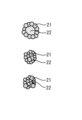
- FIG. 2 is a diagram showing an example of granulated raw material particles.
- 1 is a cross-sectional image of a resin member of the present invention.
- the resin member of the present invention has a photocatalytic coating on the surface of a resin substrate. As shown in FIG. 1, this photocatalytic coating is made of stacked metal particles that shield the resin substrate, and anatase-type titanium oxide particles are dispersed between the stacked metal particles.
- metal particles are present in the out-of-plane direction (at a different depth) at that location and block the light, and this does not mean that the metal particles form a continuous layer in the in-plane direction at a certain depth.
- the metal particles shield the resin substrate in this way, even if titanium oxide particles are present near the interface between the photocatalytic coating and the resin substrate, the titanium oxide near this interface does not exhibit an oxidizing effect, preventing deterioration of the resin substrate.
- the photocatalytic coating on the resin member of the present invention is formed by piling up metal particles, so unlike plating films with dispersed titanium oxide, even if peeling occurs, the photocatalytic coating does not form edges, so there is no risk of injury even when used in areas that may come into contact with hands, etc.
- the photocatalytic coating can be formed by a cold spray method.
- the cold spray method is a method for forming a coating by colliding raw material particles in a solid phase with a substrate using a supersonic flow of a working gas while the raw material particles are in an unmolten state, without melting or gasifying the raw material particles.
- This cold spray method allows the photocatalytic coating to be formed at low temperatures, and there is no need to heat the anatase-type titanium oxide particles above their transition temperature, as is the case with other thermal spray methods. This prevents the titanium oxide particles from transitioning from anatase to rutile, and provides a high photocatalytic effect.
- the photocatalytic coating preferably has a cross-sectional area percentage of metal particles of more than 50% and not more than 95%, more preferably 55-90%, and even more preferably 60-80%, although this depends on the thickness.
- the area percentage of the metal particles is within the above range, it is possible to simultaneously prevent light from passing through to the vicinity of the resin substrate and obtain the photocatalytic effect of the titanium oxide particles near the surface. If the area percentage of the metal particles exceeds 95%, the titanium oxide particles are reduced and the photocatalytic effect is reduced. Also, if it is 50% or less, as described below, the metal particles also play a role as a binder, and the coating strength may decrease.
- the metal material that constitutes the metal particles can be a single metal or an alloy.
- the above metal material is ductile and malleable, and can undergo plastic deformation.
- the metal particles of the present invention not only shield the resin substrate from incident light, but also act as a binder that holds the above titanium oxide particles and forms a photocatalytic coating with high adhesion strength.
- the Vickers hardness of the above metal material is preferably 700 (Hv) or less, more preferably 500 (Hv) or less, and even more preferably 400 (Hv) or less.
- the metal particles are made of a metal material with a Vickers hardness of 700 (Hv) or less, so that the metal particles undergo significant plastic deformation when collided with each other during coating formation using the cold spray method.
- plastic deformation of these metal particles provides high adhesion and bonding strength, improving the strength of the coating, while at the same time retaining the titanium oxide particles that do not undergo plastic deformation, improving the efficiency of coating formation.
- the metal particles sprayed onto the resin substrate by the cold spray method sink into the resin substrate, undergo plastic deformation and adhere to it, forming irregular irregularities at the interface with the resin substrate and bonding to the resin substrate through an anchor effect. Furthermore, these metal particles receive and hold titanium oxide particles that collide with them later, preventing them from bouncing off.
- the metal particles undergo plastic deformation upon collision and are metallurgically bonded together, and the titanium oxide particles are mechanically bonded to the metal particles and resin substrate by the anchor effect, without relying on metallurgical bonding such as the formation or diffusion of intermetallic compounds.
- the above-mentioned metal elements include copper (Cu), aluminum (Al), nickel (Ni), chromium (Cr), iron (Fe), silver (Ag), titanium (Ti), zinc (Zn), and magnesium (Mg).
- the above alloy may be an alloy containing 50 mass% or more of one metal selected from the group consisting of copper (Cu), aluminum (Al), nickel (Ni), chromium (Cr), iron (Fe), silver (Ag), titanium (Ti), zinc (Zn), and magnesium (Mg).
- one metal selected from the group consisting of copper (Cu), aluminum (Al), nickel (Ni), chromium (Cr), iron (Fe), silver (Ag), titanium (Ti), zinc (Zn), and magnesium (Mg).
- copper and silver have antibacterial properties, so it is preferable to use copper or silver alone or an alloy containing 50% or more by mass of these metals.
- the use of elemental copper (Cu), aluminum (Al), nickel (Ni), chromium (Cr), and silver (Ag) can impart luster and shine to the photocatalytic coating, while the use of elemental iron (Fe) and titanium (Ti) can form a matte photocatalytic coating.
- the color of the photocatalytic coating can also be changed by forming a colored layer on the surface of the metal particles.
- the colored layer include plating films, chemical conversion films, and inorganic pigment coating films.
- the above-mentioned plating films include nickel (Ni), nickel-phosphorus (Ni-P), copper (Cu), zinc (Zn) and other plating films, and these plating films can be formed by electroless plating.
- Examples of the above-mentioned chemical conversion films include phosphate films such as zinc phosphate film, iron phosphate film, and manganese phosphate film formed by phosphate film treatment, chromium oxide film formed by chromate treatment, and triiron tetroxide film formed by black dye treatment.
- phosphate films such as zinc phosphate film, iron phosphate film, and manganese phosphate film formed by phosphate film treatment, chromium oxide film formed by chromate treatment, and triiron tetroxide film formed by black dye treatment.
- the inorganic pigment coating film can be formed by embedding inorganic pigments into the surface of metal particles using a high-velocity air current impact method, or by spray coating using molten glass as a binder.
- the inorganic pigments include natural mineral pigments obtained from minerals and soil, as well as synthetic inorganic pigments such as metal oxides.
- the resin member of the present invention can further have a plating film having defects on the photocatalytic coating. This allows the color of the surface of the resin member to be different from the color of the photocatalytic coating, and also allows the anatase type titanium oxide particles of the photocatalytic coating to be exposed through the defects in the plating film, thereby enabling the photocatalytic effect to be expressed.
- a plating film having the above defects can be produced by connecting a photocatalytic coating to a DC power source and forming a plating film in a treatment solution.
- anatase-type titanium oxide particles are not conductive, so a plating film is not formed on the anatase-type titanium oxide particles exposed on the surface of the photocatalytic coating, and a plating film is formed only on the parts of the photocatalytic coating surface that are formed by metal particles, so that anatase-type titanium oxide particles can be exposed from defective parts of the plating film.
- the plating film formed on the photocatalytic coating can be made of metals that can be electroplated, such as copper, nickel, chromium, gold, silver, and zinc.
- the resin member of the present invention can improve its tactile feel by making its surface roughness (Ra) 25 ⁇ m or less. If the surface roughness (Ra) is in the range of 5 to 25 ⁇ m, a luxurious feel can be created by the texture, and by making the surface roughness (Ra) less than 5 ⁇ m, the metallic luster can be improved.
- the average particle size of the metal particles is preferably 10 to 50 ⁇ m, and more preferably 20 to 40 ⁇ m. This improves the shielding properties, and also increases the kinetic energy of the metal particles during cold spraying, thereby improving the efficiency of film formation. Furthermore, when the thickness of the photocatalytic coating is about 100 ⁇ m, if the particle size of the metal particles exceeds 50 ⁇ m, the metal particles will be more likely to fall off during polishing and grinding, and in addition, the metal particles will become larger, reducing the uniform dispersion of the titanium oxide particles on the surface of the photocatalytic coating.
- the titanium oxide particles used may be anatase type titanium oxide particles with an average particle size of 0.01 ⁇ m to 2 ⁇ m.
- anatase-type titanium oxide particles that support copper within the particles exhibit a photocatalytic effect not only with ultraviolet light but also with visible light, making them suitable for use indoors where there is little ultraviolet light, as they can provide self-cleaning properties.
- titanium oxide particles is TKP-103 manufactured by Teika.
- the resin member of the present invention has self-cleaning properties, so it can be used favorably for automobile resin parts such as handles and door knobs that are prone to adhesion of sebum stains, as well as for transport equipment resin parts, electronic equipment resin parts, home appliance resin parts, office resin parts, housing resin parts, and medical and hygiene resin parts.
- the method for producing a resin member of the present invention includes a coating step of spraying raw material particles containing anatase type titanium oxide particles and metal particles onto the surface of a resin substrate by a cold spray method to form a photocatalytic film.
- the cold spray method is a method of forming a coating by colliding raw material particles in a solid phase with a substrate using a supersonic flow of working gas without melting or gasifying the raw material particles, as described above.
- the cold spray method metal particles in the raw material particles collide at supersonic speed and undergo plastic deformation to form a coating. Unlike other thermal spraying methods, this method can minimize changes in the properties of the raw material particles due to heat and oxidation in the coating, preventing the titanium oxide particles from transitioning from anatase to rutile.
- the cold spray method uses a working gas at about 500 to 600°C, which does not melt the raw material particles.
- the nozzle spraying the raw material particles is placed close to the metal substrate to prevent a drop in the temperature and kinetic energy of the raw material particles, causing the raw material particles to collide with the metal substrate.
- a coating is formed on a resin substrate, so the distance between the nozzle that sprays the raw material particles and the resin substrate is increased to lower the temperature of the working gas below the heat resistance temperature of the resin substrate.
- the working gas is sprayed at 500-600°C, and the temperature is lowered to 100-150°C before the raw material particles collide with the resin substrate. This makes it possible to prevent deformation and deterioration of the resin substrate due to the working gas.
- the working gas expands and its temperature drops when it is sprayed from the nozzle. If the distance between the nozzle and the resin substrate is too close, the temperature of the working gas will not drop sufficiently and the resin substrate will melt. Conversely, if the distance is too far, not only will the working gas become too cold, but the speed of the raw material particles will decrease and adhesion to the resin substrate will decrease, so it is preferable that the distance between the nozzle and the resin substrate is about 150 mm.
- thermoplastic resin a thermosetting resin
- thermosetting resin a thermoplastic resin or a thermosetting resin
- the resin substrate is a thermoplastic resin
- the kinetic energy of the raw material particles is converted into thermal energy by the collision, and the thermoplastic resin at the site of collision with the raw material particles melts locally and fuses to the colliding raw material particles, which, combined with the bonding due to the anchor effect described above, improves the bonding strength between the resin substrate and the photocatalytic coating.
- the speed at which the raw material particles can be embedded into the resin substrate by the cold spray method and bonded by the anchor effect is preferably 200 to 500 m/s, although this depends on factors such as the hardness of the resin substrate.
- the raw material particles may be a mixture of anatase-type titanium oxide particles and metal particles, but are preferably granulated particles made by bonding anatase-type titanium oxide particles and metal particles to increase the particle size.
- the titanium oxide particles are fine powder with an average particle size of 0.01 ⁇ m to 2 ⁇ m, so they tend to agglomerate and are difficult to transport, easily causing nozzle clogging.
- the form of the granulated particles is not particularly limited, and may be, as shown in FIG. 2, a metal particle serving as a nucleus with the anatase-type titanium oxide particles attached thereto, or conversely, an anatase-type titanium oxide particle serving as a nucleus with the metal particles attached thereto, or even a mixture of anatase-type titanium oxide particles and metal particles.
- the method for manufacturing a resin member of the present invention can include a step of polishing or grinding the surface of the formed photocatalytic coating after the coating step.
- titanium oxide particles are smaller in diameter than metal particles and are therefore more likely to be exposed on the surface of the photocatalytic coating.
- polishing and grinding the surface of the photocatalytic coating the anatase type titanium oxide is uniformly exposed, resulting in a uniform photocatalytic effect.
- Example 1 A raw material particle mixture of copper particles (Cu-HWQ-350 manufactured by Fukuda Metal Foil & Powder Co., Ltd.) and anatase type titanium oxide particles (JA-1 manufactured by Teika Co., Ltd.) in a mass ratio of 6:1 was sprayed onto the surface of a polypropylene resin substrate by a cold spray method under the following conditions to form a photocatalytic coating, and the surface was ground with a brush to produce a resin part.
- Cu-HWQ-350 manufactured by Fukuda Metal Foil & Powder Co., Ltd.
- anatase type titanium oxide particles JA-1 manufactured by Teika Co., Ltd.
- Cold spray conditions Apparatus: PCS-1000 (manufactured by Plasma Giken Kogyo)
- the cross section of the prepared resin member was observed by energy dispersive X-ray spectroscopy (SEM-EDX), and the elemental analysis of the photocatalytic film was performed. The analysis results are shown in FIG.
Landscapes
- Chemical & Material Sciences (AREA)
- Chemical Kinetics & Catalysis (AREA)
- Engineering & Computer Science (AREA)
- Materials Engineering (AREA)
- Organic Chemistry (AREA)
- Mechanical Engineering (AREA)
- Metallurgy (AREA)
- Catalysts (AREA)
Abstract
Description
本発明は、樹脂部材に係り、更に詳細には、セルフクリーニング性を有する樹脂部材に関する。 The present invention relates to a resin member, and more specifically, to a resin member that has self-cleaning properties.
酸化チタンは、光エネルギーによって酸化作用を発現する光触媒効果を有し、汚染物質や臭い物質などの有機物を酸化分解することができるのに加えて、抗菌・抗ウイルス効果をも示すので、部材の表面を被覆することで、部材の表面をきれいに保つセルフクリーニング性を付与することができる。 Titanium oxide has a photocatalytic effect that causes oxidation when exposed to light energy, and can oxidize and decompose organic matter such as pollutants and odorous substances. In addition, it also exhibits antibacterial and antiviral effects, so by coating the surface of a component with it, it can impart self-cleaning properties that keep the surface clean.
この酸化チタンの光触媒効果は、結晶構造がアナターゼ型の方がルチル型よりも高く、上記アナターゼ型の酸化チタンは、700℃を超える温度でルチル型に転移し、光触媒効果が低下してしまう。 The photocatalytic effect of titanium oxide is higher when the crystal structure is anatase than when it is rutile, and the anatase titanium oxide transforms to rutile at temperatures above 700°C, reducing the photocatalytic effect.
特許文献1には、酸化チタン粒子を造粒により大粒径化することで、溶射時の熱による酸化チタンのアナターゼ型からルチル型への転移を抑制でき、アナターゼ型酸化チタンの残存比率を向上できる旨が開示されている。
しかしながら、特許文献1に記載の光触媒被覆材にあっては、酸化チタンのルチル型への転移抑制が充分でなく、光触媒効果が低いのに加えて、酸化チタンの酸化作用よって樹脂基材が劣化しまう。
However, the photocatalytic coating material described in
本発明は、このような従来技術の有する課題に鑑みてなされたものであり、その目的とするところは、表面の光触媒効果が高く、かつ樹脂基材の劣化を防止できる、光触媒被膜を備えた樹脂部材を提供することにある。 The present invention was made in consideration of the problems associated with the conventional technology, and its purpose is to provide a resin component with a photocatalytic coating that has a high photocatalytic effect on the surface and can prevent deterioration of the resin substrate.
本発明者は、上記目的を達成すべく鋭意検討を重ねた結果、コールドスプレー法によりアナターゼ型酸化チタン粒子と金属粒子とを非溶融状態で樹脂基材に吹き付け、上記金属粒子によって樹脂基材を遮蔽することにより、上記目的を達成できることを見出し、本発明を完成するに至った。 As a result of extensive research into achieving the above object, the inventors discovered that the above object could be achieved by spraying anatase-type titanium oxide particles and metal particles in a non-molten state onto a resin substrate using a cold spray method, and shielding the resin substrate with the metal particles, thereby completing the present invention.
即ち、本発明の樹脂部材は、樹脂基材表面に光触媒被膜を備える。
そして、上記光触媒被膜が、アナターゼ型酸化チタン粒子と金属粒子とを含み、
上記金属粒子が積み重なって上記樹脂基材を遮蔽し、上記金属粒子間に上記アナターゼ型酸化チタン粒子が分散していることを特徴とする。
That is, the resin workpiece of the present invention has a photocatalytic coating on the surface of a resin substrate.
The photocatalytic coating contains anatase type titanium oxide particles and metal particles,
The metal particles are piled up to shield the resin substrate, and the anatase type titanium oxide particles are dispersed among the metal particles.
また、本発明の樹脂部材の製造方法は、上記本発明の樹脂部材を製造する方法であり、非溶融状態の原料粒子を上記樹脂基材表面に吹き付けて光触媒被膜を形成する被覆工程を備える。
そして、上記原料粒子が、アナターゼ型酸化チタン粒子と金属粒子とを含み、
上記被覆工程が、上記樹脂基材に衝突する上記原料粒子の温度を100~150℃に低下させる処理を含むことを特徴とする。
The method for producing a resin member of the present invention is a method for producing the resin member of the present invention, and includes a coating step of spraying raw material particles in a non-molten state onto the surface of the resin substrate to form a photocatalytic film.
The raw material particles include anatase type titanium oxide particles and metal particles,
The coating step is characterized in that it includes a treatment for lowering the temperature of the raw material particles colliding with the resin substrate to 100 to 150°C.
本発明によれば、アナターゼ型酸化チタン粒子と金属粒子とを非溶融状態で樹脂基材に吹き付け、上記金属粒子によって樹脂基材を遮蔽することしたため、高い光触媒効果と樹脂基材の劣化防止とを両立させた、光触媒被膜を備えた樹脂部材を提供することができる。 According to the present invention, anatase-type titanium oxide particles and metal particles are sprayed onto a resin substrate in a non-molten state, and the resin substrate is shielded by the metal particles, making it possible to provide a resin component with a photocatalytic coating that achieves both a high photocatalytic effect and prevention of deterioration of the resin substrate.
<樹脂部材>
本発明の樹脂部材について詳細に説明する。
本発明の樹脂部材は、樹脂基材表面に光触媒被膜を備え、この光触媒被膜は、図1に示すように、金属粒子が積み重なって上記樹脂基材を遮蔽しており、積み重なった金属粒子と金属粒子との間にアナターゼ型酸化チタン粒子が分散している。
<Resin material>
The resin member of the present invention will now be described in detail.
The resin member of the present invention has a photocatalytic coating on the surface of a resin substrate. As shown in FIG. 1, this photocatalytic coating is made of stacked metal particles that shield the resin substrate, and anatase-type titanium oxide particles are dispersed between the stacked metal particles.
本発明において、金属粒子が樹脂基材を遮蔽しているとは、樹脂部材に入射する、あらゆる方向からの光の光路上に金属粒子が存在し、光を透過する酸化チタンが、表面から光触媒被膜と樹脂基材との界面までつながっておらず、光が樹脂基材まで到達しないことをいう。 In the present invention, when metal particles shield the resin substrate, this means that metal particles are present on the optical path of light incident on the resin component from all directions, and the titanium oxide that transmits light does not extend from the surface to the interface between the photocatalytic coating and the resin substrate, preventing the light from reaching the resin substrate.
つまり、光触媒被膜のある深さにおいて、その面内方向に金属粒子が不連続である箇所があっても、その箇所の面外方向(異なる深さ)に金属粒子が存在して光を遮っていればよく、ある深さの面内方向に金属粒子が連続して層を形成していることまでを意味するものではない。 In other words, even if there is a location at a certain depth in the photocatalytic coating where the metal particles are discontinuous in the in-plane direction, it is sufficient that metal particles are present in the out-of-plane direction (at a different depth) at that location and block the light, and this does not mean that the metal particles form a continuous layer in the in-plane direction at a certain depth.
このように金属粒子が樹脂基材を遮蔽していることで、光触媒被膜と樹脂基材との界面近傍に酸化チタン粒子が存在しても、この界面近傍の酸化チタンは酸化作用を発現しないので、樹脂基材の劣化を防止することができる。 Since the metal particles shield the resin substrate in this way, even if titanium oxide particles are present near the interface between the photocatalytic coating and the resin substrate, the titanium oxide near this interface does not exhibit an oxidizing effect, preventing deterioration of the resin substrate.
また、本発明の樹脂部材の光触媒被膜は、金属粒子が積み重なって形成されているので、酸化チタンを分散しためっき膜とは異なり、剥がれが生じたとしても光触媒被膜でエッジが形成させることがないので、手などが触れる箇所に使用してもケガのおそれが生じない。 In addition, the photocatalytic coating on the resin member of the present invention is formed by piling up metal particles, so unlike plating films with dispersed titanium oxide, even if peeling occurs, the photocatalytic coating does not form edges, so there is no risk of injury even when used in areas that may come into contact with hands, etc.
上記光触媒被膜は、コールドスプレー法で成膜することができる。
このコールドスプレー法は、原料粒子を溶融またはガス化させることなく非溶融状態で、作動ガスの超音速流によって固相状態の原料粒子を基材に衝突させて被膜を形成する方法である。
The photocatalytic coating can be formed by a cold spray method.
The cold spray method is a method for forming a coating by colliding raw material particles in a solid phase with a substrate using a supersonic flow of a working gas while the raw material particles are in an unmolten state, without melting or gasifying the raw material particles.
このような、コールドスプレー法によれば、光触媒被膜を低温下で成膜することができ、他の溶射法のように、アナターゼ型酸化チタン粒子をその転移温度以上に加熱する必要がないため、酸化チタン粒子がアナターゼ型からルチル型に転移することが防止され、高い光触媒効果を得ることができる。 This cold spray method allows the photocatalytic coating to be formed at low temperatures, and there is no need to heat the anatase-type titanium oxide particles above their transition temperature, as is the case with other thermal spray methods. This prevents the titanium oxide particles from transitioning from anatase to rutile, and provides a high photocatalytic effect.
上記光触媒被膜は、その厚さにもよるが、断面の金属粒子の面積%が50%を超え95%以下であることが好ましく、さらに、55~90%であることが好ましく、60~80%であることがより好ましい。 The photocatalytic coating preferably has a cross-sectional area percentage of metal particles of more than 50% and not more than 95%, more preferably 55-90%, and even more preferably 60-80%, although this depends on the thickness.
金属粒子の面積%が上記範囲内であることで、樹脂基材近傍への光の透過防止と表面近傍の酸化チタン粒子による光触媒効果とを両立させることができる。
金属粒子の面積%が95%を超えると酸化チタン粒子が減少して光触媒作用が低下してしまう。また、50%以下であると、後述するように、金属粒子はバインダーとしての役割をも担っているので、被膜強度が低下することがある。
By ensuring that the area percentage of the metal particles is within the above range, it is possible to simultaneously prevent light from passing through to the vicinity of the resin substrate and obtain the photocatalytic effect of the titanium oxide particles near the surface.
If the area percentage of the metal particles exceeds 95%, the titanium oxide particles are reduced and the photocatalytic effect is reduced. Also, if it is 50% or less, as described below, the metal particles also play a role as a binder, and the coating strength may decrease.
上記金属粒子を構成する金属材料としては、金属単体や合金を使用することができる。 The metal material that constitutes the metal particles can be a single metal or an alloy.
上記金属材料は、延性・展性を有し塑性変形が可能である。本発明の金属粒子は、入射光から樹脂基材を遮蔽するだけでなく、上記酸化チタン粒子を保持し、密着強度の高い光触媒被膜を形成するバインダーとしての役割をも担っている。 The above metal material is ductile and malleable, and can undergo plastic deformation. The metal particles of the present invention not only shield the resin substrate from incident light, but also act as a binder that holds the above titanium oxide particles and forms a photocatalytic coating with high adhesion strength.
上記金属材料のビッカース硬度は、700(Hv)以下であることが好ましく、さらに500(Hv)以下であることが好ましく、400(Hv)以下であることがより好ましい。 The Vickers hardness of the above metal material is preferably 700 (Hv) or less, more preferably 500 (Hv) or less, and even more preferably 400 (Hv) or less.
金属粒子が、ビッカース硬度が700(Hv)以下の金属材料で形成されていることで、コールドスプレー法による被膜形成時の衝突によって金属粒子が大きく塑性変形する。 The metal particles are made of a metal material with a Vickers hardness of 700 (Hv) or less, so that the metal particles undergo significant plastic deformation when collided with each other during coating formation using the cold spray method.
この金属粒子の塑性変形により高い付着力・密着力が得られ、被膜強度を向上させることができると共に、塑性変形しない酸化チタン粒子を保持することができるので被膜形成効率を向上させることができる。 The plastic deformation of these metal particles provides high adhesion and bonding strength, improving the strength of the coating, while at the same time retaining the titanium oxide particles that do not undergo plastic deformation, improving the efficiency of coating formation.
つまり、コールドスプレー法によって樹脂基材に吹き付けられた金属粒子は、樹脂基材中にめり込んで塑性変形して密着し、樹脂基材との界面に不規則な凹凸を形成してアンカー効果によって樹脂基材と接合する。さらにこの金属粒子は後から衝突した酸化チタン粒子を受け止めて保持し跳ね返りを抑制する。 In other words, the metal particles sprayed onto the resin substrate by the cold spray method sink into the resin substrate, undergo plastic deformation and adhere to it, forming irregular irregularities at the interface with the resin substrate and bonding to the resin substrate through an anchor effect. Furthermore, these metal particles receive and hold titanium oxide particles that collide with them later, preventing them from bouncing off.
このように、金属粒子を含有する原料粒子をコールドスプレーする被膜形成法によれば、金属粒子同士は衝突により塑性変形して冶金的に接合し、酸化チタン粒子は、金属間化合物の形成や拡散など冶金的な接合によらず、アンカー効果により金属粒子や樹脂基材と機械的に接合する。 In this way, with the coating formation method in which raw material particles containing metal particles are cold sprayed, the metal particles undergo plastic deformation upon collision and are metallurgically bonded together, and the titanium oxide particles are mechanically bonded to the metal particles and resin substrate by the anchor effect, without relying on metallurgical bonding such as the formation or diffusion of intermetallic compounds.
上記金属材料のビッカース硬度の下限は、特に制限はないが、350(Hv)の金属粒子でも成膜できることを確認した。 There is no particular limit to the lower limit of the Vickers hardness of the above metal materials, but it has been confirmed that a film can be formed using metal particles with a hardness of 350 (Hv).
上記金属単体としては、銅(Cu)、アルミニウム(Al)、ニッケル(Ni)、クロム(Cr)、鉄(Fe)、銀(Ag)、チタン(Ti)、亜鉛(Zn)、マグネシウム(Mg)を挙げることができる。 The above-mentioned metal elements include copper (Cu), aluminum (Al), nickel (Ni), chromium (Cr), iron (Fe), silver (Ag), titanium (Ti), zinc (Zn), and magnesium (Mg).
また、上記合金としては、銅(Cu)、アルミニウム(Al)、ニッケル(Ni)、クロム(Cr)、鉄(Fe)、銀(Ag)、チタン(Ti)、亜鉛(Zn)、マグネシウム(Mg)から成る群から選ばれた1種の金属を50質量%以上含有する合金を挙げることができる。 Furthermore, the above alloy may be an alloy containing 50 mass% or more of one metal selected from the group consisting of copper (Cu), aluminum (Al), nickel (Ni), chromium (Cr), iron (Fe), silver (Ag), titanium (Ti), zinc (Zn), and magnesium (Mg).
中でも、銅や銀は、殺菌作用を有するので、銅や銀の単体やこれらを50質量%以上含有する合金を好ましく使用することができる。 Of these, copper and silver have antibacterial properties, so it is preferable to use copper or silver alone or an alloy containing 50% or more by mass of these metals.
また、意匠性の観点からは、銅(Cu)、アルミニウム(Al)、ニッケル(Ni)、クロム(Cr)、銀(Ag)の単体を用いることで、光触媒被膜に光沢や艶を付与することができ、鉄(Fe)やチタン(Ti)の単体を用いることで、艶消しの光触媒被膜を形成することができる。 In addition, from the standpoint of design, the use of elemental copper (Cu), aluminum (Al), nickel (Ni), chromium (Cr), and silver (Ag) can impart luster and shine to the photocatalytic coating, while the use of elemental iron (Fe) and titanium (Ti) can form a matte photocatalytic coating.
さらに、上記合金、例えば、Cu-ZnやCu-Ni-Znは、その成分比を変えることで光触媒被膜の硬さや耐久性を向上できるだけでなく、光触媒被膜の色を変えることも可能である。 Furthermore, by changing the component ratio of the above alloys, such as Cu-Zn and Cu-Ni-Zn, it is possible not only to improve the hardness and durability of the photocatalytic coating, but also to change the color of the photocatalytic coating.
また、金属粒子の表面に着色層を形成することによっても光触媒被膜の色を変えることができる。上記着色層としては、めっき膜、化成膜、無機顔料被覆膜などを挙げることができる。 The color of the photocatalytic coating can also be changed by forming a colored layer on the surface of the metal particles. Examples of the colored layer include plating films, chemical conversion films, and inorganic pigment coating films.
上記めっき膜としては、ニッケル(Ni)、ニッケル-リン(Ni-P)、銅(Cu)、亜鉛(Zn)などのめっき膜を挙げることができ、これらのめっき膜は、無電解メッキによって形成可能である。 The above-mentioned plating films include nickel (Ni), nickel-phosphorus (Ni-P), copper (Cu), zinc (Zn) and other plating films, and these plating films can be formed by electroless plating.
上記化成膜としては、リン酸塩皮膜処理によって形成されるリン酸亜鉛皮膜、リン酸鉄皮膜、リン酸マンガン皮膜などのリン酸塩皮膜、クロメート処理によって形成される酸化クロム皮膜、黒染め処理によって形成される四酸化三鉄皮膜などを挙げることができる。 Examples of the above-mentioned chemical conversion films include phosphate films such as zinc phosphate film, iron phosphate film, and manganese phosphate film formed by phosphate film treatment, chromium oxide film formed by chromate treatment, and triiron tetroxide film formed by black dye treatment.
上記無機顔料被覆膜は、高速気流中衝撃法などによって金属粒子の表面に無機顔料をめり込ませることや、溶融したガラスをバインダーとしてスプレー塗工することで形成できる。上記無機顔料としては、鉱物や土から得られた天然鉱物顔料の他、金属酸化物などの合成無機顔料を挙げることができる。 The inorganic pigment coating film can be formed by embedding inorganic pigments into the surface of metal particles using a high-velocity air current impact method, or by spray coating using molten glass as a binder. Examples of the inorganic pigments include natural mineral pigments obtained from minerals and soil, as well as synthetic inorganic pigments such as metal oxides.
本発明の樹脂部材は、さらに、上記光触媒被膜上に欠陥を有するめっき膜を有することができる。これにより、樹脂部材表面の色を光触媒被膜の色とは異なる色にすることができ、また、めっき膜の欠陥から上記光触媒被膜のアナターゼ型酸化チタン粒子が露出していることで、光触媒効果を発現させることができる。 The resin member of the present invention can further have a plating film having defects on the photocatalytic coating. This allows the color of the surface of the resin member to be different from the color of the photocatalytic coating, and also allows the anatase type titanium oxide particles of the photocatalytic coating to be exposed through the defects in the plating film, thereby enabling the photocatalytic effect to be expressed.
上記欠陥を有するめっき膜は、光触媒被膜を直流電源に繋ぎ、処理液中でめっき膜を形成することで作製できる。 A plating film having the above defects can be produced by connecting a photocatalytic coating to a DC power source and forming a plating film in a treatment solution.
このような直流電源を利用した電解めっき法によれば、アナターゼ型酸化チタン粒子は導電性を有さないので、光触媒被膜の表面に露出したアナターゼ型酸化チタン粒子の上にはめっき膜が形成されず、光触媒被膜表面の金属粒子で形成されている部分のみにめっき膜が形成されるので、該めっき膜の欠陥部分からアナターゼ型酸化チタン粒子を露出させることができる。 In this electrolytic plating method using a DC power source, anatase-type titanium oxide particles are not conductive, so a plating film is not formed on the anatase-type titanium oxide particles exposed on the surface of the photocatalytic coating, and a plating film is formed only on the parts of the photocatalytic coating surface that are formed by metal particles, so that anatase-type titanium oxide particles can be exposed from defective parts of the plating film.
光触媒被膜上に形成するめっき膜としては、銅、ニッケル、クロム、金、銀、亜鉛などの電解めっき可能な金属のめっき膜を挙げることができる。 The plating film formed on the photocatalytic coating can be made of metals that can be electroplated, such as copper, nickel, chromium, gold, silver, and zinc.
また、本発明の樹脂部材は、表面粗さ(Ra)を、25μm以下にすることで触感を向上させることができる。表面粗さ(Ra)が5~25μmの範囲であればシボ感による高級感を演出でき、表面粗さ(Ra)を5μm未満にすることで金属光沢を向上させることができる。 In addition, the resin member of the present invention can improve its tactile feel by making its surface roughness (Ra) 25 μm or less. If the surface roughness (Ra) is in the range of 5 to 25 μm, a luxurious feel can be created by the texture, and by making the surface roughness (Ra) less than 5 μm, the metallic luster can be improved.
上記金属粒子の平均粒径は、10~50μmであることが好ましく、20~40μmがより好ましい。
これにより、遮蔽性が向上すると共に、コールドスプレー時の金属粒子の運動エネルギーが大きくなって被膜形成効率を向上させることができる。
また、光触媒被膜の厚さが100μm程度である場合、金属粒子の粒径が50μm超えると研磨研削時に金属粒子が脱落し易くなり、加えて、金属粒子が大きくなるため光触媒被膜表面の酸化チタン粒子の均一分散性が低下してしまう。
The average particle size of the metal particles is preferably 10 to 50 μm, and more preferably 20 to 40 μm.
This improves the shielding properties, and also increases the kinetic energy of the metal particles during cold spraying, thereby improving the efficiency of film formation.
Furthermore, when the thickness of the photocatalytic coating is about 100 μm, if the particle size of the metal particles exceeds 50 μm, the metal particles will be more likely to fall off during polishing and grinding, and in addition, the metal particles will become larger, reducing the uniform dispersion of the titanium oxide particles on the surface of the photocatalytic coating.
上記酸化チタン粒子としては、平均粒径が0.01μm~2μmのアナターゼ型酸化チタン粒子を使用することができる。 The titanium oxide particles used may be anatase type titanium oxide particles with an average particle size of 0.01 μm to 2 μm.
また、粒子中に銅を担持したアナターゼ型酸化チタン粒子は、紫外光でなく可視光によっても光触媒効果を発現するため、紫外光の少ない屋内においてもセルフクリーニング性を付与することができるため好ましく使用できる。 In addition, anatase-type titanium oxide particles that support copper within the particles exhibit a photocatalytic effect not only with ultraviolet light but also with visible light, making them suitable for use indoors where there is little ultraviolet light, as they can provide self-cleaning properties.
このような酸化チタン粒子としては、例えば、テイカ製のTKP-103などを挙げることができる。 An example of such titanium oxide particles is TKP-103 manufactured by Teika.
本発明の樹脂部材は、セルフクリーニング性を有するので、皮脂汚れなどが付着し易いハンドルやドアの取っ手などの自動車用樹脂部品の他、輸送機器用樹脂部品、電子機器用樹脂部品、家電用樹脂部品、事務用樹脂部品、住宅用樹脂部品、医療衛生用樹脂部品などに好ましく使用できる。 The resin member of the present invention has self-cleaning properties, so it can be used favorably for automobile resin parts such as handles and door knobs that are prone to adhesion of sebum stains, as well as for transport equipment resin parts, electronic equipment resin parts, home appliance resin parts, office resin parts, housing resin parts, and medical and hygiene resin parts.
<樹脂部材の製造方法>
次に、上記樹脂部材を製造する方法について詳細に説明する。
本発明の樹脂部材の製造方法は、コールドスプレー法により、樹脂基材表面にアナターゼ型酸化チタン粒子と金属粒子とを含む原料粒子を吹き付け、光触媒被膜を形成する被覆工程を有する。
<Method of manufacturing resin member>
Next, a method for producing the resin member will be described in detail.
The method for producing a resin member of the present invention includes a coating step of spraying raw material particles containing anatase type titanium oxide particles and metal particles onto the surface of a resin substrate by a cold spray method to form a photocatalytic film.
上記コールドスプレー法は、上記のように、原料粒子を溶融またはガス化させることなく非溶融状態で、作動ガスの超音速流によって固相状態の原料粒子を基材に衝突させて被膜を形成する方法である。 The cold spray method is a method of forming a coating by colliding raw material particles in a solid phase with a substrate using a supersonic flow of working gas without melting or gasifying the raw material particles, as described above.
コールドスプレー法によれば、超音速で衝突した原料粒子中の金属粒子が塑性変型することで被膜を形成するので、他の溶射方法と異なり、熱による原料粒子の特性変化や被膜中の酸化を最小限にすることができるため、酸化チタン粒子がアナターゼ型からルチル型に転移することを防止できる。 In the cold spray method, metal particles in the raw material particles collide at supersonic speed and undergo plastic deformation to form a coating. Unlike other thermal spraying methods, this method can minimize changes in the properties of the raw material particles due to heat and oxidation in the coating, preventing the titanium oxide particles from transitioning from anatase to rutile.
また、コールドスプレー法は、原料粒子が溶融することのない、500~600℃程度の作動ガスを用いる。 In addition, the cold spray method uses a working gas at about 500 to 600°C, which does not melt the raw material particles.
金属基材に対して被膜を形成する一般的なコールドスプレー法においては、原料粒子の温度や運動エネルギーの低下を抑制するため、原料粒子を噴射するノズルと金属基材とを近接させて原料粒子を金属基材に衝突させる。 In the typical cold spray method for forming a coating on a metal substrate, the nozzle spraying the raw material particles is placed close to the metal substrate to prevent a drop in the temperature and kinetic energy of the raw material particles, causing the raw material particles to collide with the metal substrate.
本発明においては、樹脂基材に被膜を形成するので、原料粒子を噴射するノズルと樹脂基材との間隔を拡げて、作動ガスの温度を樹脂基材の耐熱温度未満に低下させる。 In the present invention, a coating is formed on a resin substrate, so the distance between the nozzle that sprays the raw material particles and the resin substrate is increased to lower the temperature of the working gas below the heat resistance temperature of the resin substrate.
具体的には、500~600℃で噴射した作動ガスを、100~150℃まで低下させて樹脂基材に原料粒子を衝突させる。これにより、作動ガスによる樹脂基材の変形や劣化を防止することができる。 Specifically, the working gas is sprayed at 500-600°C, and the temperature is lowered to 100-150°C before the raw material particles collide with the resin substrate. This makes it possible to prevent deformation and deterioration of the resin substrate due to the working gas.
上記作動ガスは、ノズルから噴射されることで膨張して温度が低下する。ノズル樹脂基材との間隔が近すぎると十分に作動ガスの温度が下がらず樹脂基材が溶けてしまい、逆に遠すぎると作動ガスが冷えすぎるだけでなく、原料粒子の速度が低下して樹脂基材との付着性が低下するので、ノズルと樹脂基材間の距離は150mm程度であることが好ましい。 The working gas expands and its temperature drops when it is sprayed from the nozzle. If the distance between the nozzle and the resin substrate is too close, the temperature of the working gas will not drop sufficiently and the resin substrate will melt. Conversely, if the distance is too far, not only will the working gas become too cold, but the speed of the raw material particles will decrease and adhesion to the resin substrate will decrease, so it is preferable that the distance between the nozzle and the resin substrate is about 150 mm.
上記樹脂基材を構成する樹脂としては、特に制限はなく、熱可塑性樹脂、熱硬化性樹脂のいずれも使用することができる。 There are no particular limitations on the resin that constitutes the resin substrate, and either a thermoplastic resin or a thermosetting resin can be used.
なかでも、樹脂基材が熱可塑性樹脂であると、原料粒子の運動エネルギーが衝突によって熱エネルギーに変換されて、原料粒子が衝突した部位の熱可塑性樹脂が局所的に溶融し、衝突した原料粒子と溶着するので、上記アンカー効果による接合と相俟って樹脂基材と光触媒被膜との接合強度を向上させることができる。 In particular, when the resin substrate is a thermoplastic resin, the kinetic energy of the raw material particles is converted into thermal energy by the collision, and the thermoplastic resin at the site of collision with the raw material particles melts locally and fuses to the colliding raw material particles, which, combined with the bonding due to the anchor effect described above, improves the bonding strength between the resin substrate and the photocatalytic coating.
コールドスプレー法により、原料粒子を樹脂基材中にめり込ませ、アンカー効果によって接合できる原料粒子の速度は、樹脂基材の硬さなどにもよるが、200~500m/sであることが好ましい。 The speed at which the raw material particles can be embedded into the resin substrate by the cold spray method and bonded by the anchor effect is preferably 200 to 500 m/s, although this depends on factors such as the hardness of the resin substrate.
原料粒子は、アナターゼ型酸化チタン粒子と金属粒子との混合粒子であってもよいが、アナターゼ型酸化チタン粒子と金属粒子とをくっつけて大粒径化した造粒粒子であることが好ましい。 The raw material particles may be a mixture of anatase-type titanium oxide particles and metal particles, but are preferably granulated particles made by bonding anatase-type titanium oxide particles and metal particles to increase the particle size.
上記酸化チタン粒子は、上記のように、平均粒径が0.01μm~2μmの微粉末であるため、凝集し易く搬送し難く、ノズルつまりを生じさせ易い。 As mentioned above, the titanium oxide particles are fine powder with an average particle size of 0.01 μm to 2 μm, so they tend to agglomerate and are difficult to transport, easily causing nozzle clogging.
原料粒子として、上記大粒径化した造粒粒子を用いることでノズルつまりを防止することができると共に、原料粒子の運動エネルギーが増大して光触媒被膜の成膜効率が向上する。 By using the large granulated particles as the raw material particles, nozzle clogging can be prevented, and the kinetic energy of the raw material particles is increased, improving the efficiency of forming the photocatalytic film.
上記造粒粒子の態様としては、特に制限はなく、図2に示すように、金属粒子を核とし、その周囲に上記アナターゼ型酸化チタン粒子が付着したものや、逆に、アナターゼ型酸化チタン粒子を核とし、その周囲に上記金属粒子が付着したもの、さらに、アナターゼ型酸化チタン粒子と金属粒子とが混在したものであってもよい。 The form of the granulated particles is not particularly limited, and may be, as shown in FIG. 2, a metal particle serving as a nucleus with the anatase-type titanium oxide particles attached thereto, or conversely, an anatase-type titanium oxide particle serving as a nucleus with the metal particles attached thereto, or even a mixture of anatase-type titanium oxide particles and metal particles.
本発明の樹脂部材の製造方法は、上記被覆工程の後に、形成した光触媒被膜の表面を研磨・研削する工程を備えることができる。 The method for manufacturing a resin member of the present invention can include a step of polishing or grinding the surface of the formed photocatalytic coating after the coating step.
上記のように、酸化チタン粒子は金属粒子よりも粒径が小さいので、光触媒被膜表面に露出し易いが、光触媒被膜の表面を研磨・研削することで、アナターゼ型酸化チタンが均一に露出するので、均質な光触媒効果を得ることができる。 As mentioned above, titanium oxide particles are smaller in diameter than metal particles and are therefore more likely to be exposed on the surface of the photocatalytic coating. However, by polishing and grinding the surface of the photocatalytic coating, the anatase type titanium oxide is uniformly exposed, resulting in a uniform photocatalytic effect.
さらに、研磨・研削によって光触媒被膜の表面粗さを調節することで、上記のように、触感を向上させる、艶あり、艶消し、シボ感などの意匠性を付与することができる。 Furthermore, by adjusting the surface roughness of the photocatalytic coating through polishing and grinding, it is possible to impart design features such as gloss, matte finish, and textured finishes that improve the tactile feel, as described above.
以下、本発明を実施例により詳細に説明するが、本発明は下記実施例に限定されるものではない。 The present invention will be described in detail below with reference to examples, but the present invention is not limited to the following examples.
[実施例1]
銅粒子(福田金属箔粉工業製Cu-HWQ-350)とアナターゼ型酸化チタン粒子(テイカ製JA-1)とを質量比6:1で混合した原料粒子を、下記条件のコールドスプレー法によりポリプロピレン樹脂基材の表面に吹き付けて光触媒被膜を形成し、ブラシで表面を研削して樹脂部材を作製した。
コールドスプレー条件
装置:PCS-1000(プラズマ技研工業製)
作動ガス : N2ガス、噴射圧3MPa、噴射温度600℃
ノズル~基材間距離 : 150mm
(樹脂基材に衝突時の原料粒子の温度100℃、原料粒子の衝突速度300m/s)
[Example 1]
A raw material particle mixture of copper particles (Cu-HWQ-350 manufactured by Fukuda Metal Foil & Powder Co., Ltd.) and anatase type titanium oxide particles (JA-1 manufactured by Teika Co., Ltd.) in a mass ratio of 6:1 was sprayed onto the surface of a polypropylene resin substrate by a cold spray method under the following conditions to form a photocatalytic coating, and the surface was ground with a brush to produce a resin part.
Cold spray conditions: Apparatus: PCS-1000 (manufactured by Plasma Giken Kogyo)
Working gas: N2 gas, injection pressure 3MPa, injection temperature 600℃
Distance between nozzle and substrate: 150 mm
(The temperature of the raw material particles when colliding with the resin substrate was 100° C., and the collision speed of the raw material particles was 300 m/s.)
作製した樹脂部材の断面をエネルギー分散型X線分光法(SEM-EDX)で観察し、光触媒被膜の元素分析を行った。
分析結果を図3に示す。
The cross section of the prepared resin member was observed by energy dispersive X-ray spectroscopy (SEM-EDX), and the elemental analysis of the photocatalytic film was performed.
The analysis results are shown in FIG.
図3から、チタン(Ti)が表面から樹脂基材まで連続している箇所がなく、樹脂基材が銅(Cu)粒子によって遮蔽されており、酸化チタンによる樹脂基材の劣化を防止できることが分かる。 From Figure 3, it can be seen that there is no place where titanium (Ti) continues from the surface to the resin substrate, and the resin substrate is shielded by copper (Cu) particles, preventing deterioration of the resin substrate by titanium oxide.
1 樹脂部材
2 光触媒被膜
21 アナターゼ型酸化チタン粒子
22 金属粒子
3 樹脂基材
Claims (18)
上記光触媒被膜が、アナターゼ型酸化チタン粒子と金属粒子とを含み、
上記金属粒子が積み重なって上記樹脂基材を遮蔽し、上記金属粒子間に上記アナターゼ型酸化チタン粒子が分散していることを特徴とする樹脂部材。 A resin member having a photocatalytic coating on a surface of a resin substrate,
the photocatalytic coating contains anatase type titanium oxide particles and metal particles,
The resin member is characterized in that the metal particles are piled up to shield the resin substrate, and the anatase type titanium oxide particles are dispersed among the metal particles.
上記めっき膜の欠陥から上記光触媒被膜のアナターゼ型酸化チタン粒子が露出していることを特徴とする請求項1に記載の樹脂部材。 Furthermore, a plating film having defects is provided on the photocatalytic coating,
2. The resin member according to claim 1, wherein anatase type titanium oxide particles of the photocatalytic coating are exposed through defects in the plating film.
非溶融状態の原料粒子を上記樹脂基材表面に吹き付けて光触媒被膜を形成する被覆工程を備え、
上記原料粒子が、アナターゼ型酸化チタン粒子と金属粒子とを含み、
上記被覆工程が、上記樹脂基材に衝突する上記原料粒子の温度を100~150℃に低下させる処理を含むことを特徴とする樹脂部材の製造方法。 A method for producing a resin member according to any one of claims 1 to 11,
A coating step is provided in which raw material particles in a non-molten state are sprayed onto the surface of the resin substrate to form a photocatalytic film,
The raw material particles include anatase type titanium oxide particles and metal particles,
The method for producing a resin member, wherein the coating step includes a treatment for lowering the temperature of the raw material particles colliding with the resin substrate to 100 to 150°C.
Priority Applications (3)
| Application Number | Priority Date | Filing Date | Title |
|---|---|---|---|
| JP2025525983A JPWO2024252816A1 (en) | 2023-06-06 | 2024-04-24 | |
| CN202480032377.7A CN121152897A (en) | 2023-06-06 | 2024-04-24 | resin parts |
| EP24817472.4A EP4726073A1 (en) | 2023-06-06 | 2024-04-24 | Resin member |
Applications Claiming Priority (2)
| Application Number | Priority Date | Filing Date | Title |
|---|---|---|---|
| JP2023-092849 | 2023-06-06 | ||
| JP2023092849 | 2023-06-06 |
Publications (1)
| Publication Number | Publication Date |
|---|---|
| WO2024252816A1 true WO2024252816A1 (en) | 2024-12-12 |
Family
ID=93795410
Family Applications (1)
| Application Number | Title | Priority Date | Filing Date |
|---|---|---|---|
| PCT/JP2024/016063 Ceased WO2024252816A1 (en) | 2023-06-06 | 2024-04-24 | Resin member |
Country Status (4)
| Country | Link |
|---|---|
| EP (1) | EP4726073A1 (en) |
| JP (1) | JPWO2024252816A1 (en) |
| CN (1) | CN121152897A (en) |
| WO (1) | WO2024252816A1 (en) |
Citations (6)
| Publication number | Priority date | Publication date | Assignee | Title |
|---|---|---|---|---|
| WO1995015816A1 (en) * | 1993-12-10 | 1995-06-15 | Toto, Ltd. | Multi-functional material having photo-catalytic function and production method therefor |
| US20070110919A1 (en) * | 2005-11-15 | 2007-05-17 | ATG Advanced Technology Group s.r.o. | Method for producing photocatalytically active polymers |
| US20070148363A1 (en) * | 2005-11-08 | 2007-06-28 | Linde Aktiengesellschaft | Method for manufacturing a photocatalytically active layer |
| JP3944551B2 (en) | 2004-02-26 | 2007-07-11 | 地方独立行政法人 岩手県工業技術センター | Method for producing photocatalyst coating material |
| WO2010107087A1 (en) * | 2009-03-18 | 2010-09-23 | Toto株式会社 | Photocatalyst member |
| US20110027496A1 (en) * | 2008-03-28 | 2011-02-03 | Christian Doye | Method for producing a coating through cold gas spraying |
-
2024
- 2024-04-24 JP JP2025525983A patent/JPWO2024252816A1/ja active Pending
- 2024-04-24 CN CN202480032377.7A patent/CN121152897A/en active Pending
- 2024-04-24 EP EP24817472.4A patent/EP4726073A1/en active Pending
- 2024-04-24 WO PCT/JP2024/016063 patent/WO2024252816A1/en not_active Ceased
Patent Citations (6)
| Publication number | Priority date | Publication date | Assignee | Title |
|---|---|---|---|---|
| WO1995015816A1 (en) * | 1993-12-10 | 1995-06-15 | Toto, Ltd. | Multi-functional material having photo-catalytic function and production method therefor |
| JP3944551B2 (en) | 2004-02-26 | 2007-07-11 | 地方独立行政法人 岩手県工業技術センター | Method for producing photocatalyst coating material |
| US20070148363A1 (en) * | 2005-11-08 | 2007-06-28 | Linde Aktiengesellschaft | Method for manufacturing a photocatalytically active layer |
| US20070110919A1 (en) * | 2005-11-15 | 2007-05-17 | ATG Advanced Technology Group s.r.o. | Method for producing photocatalytically active polymers |
| US20110027496A1 (en) * | 2008-03-28 | 2011-02-03 | Christian Doye | Method for producing a coating through cold gas spraying |
| WO2010107087A1 (en) * | 2009-03-18 | 2010-09-23 | Toto株式会社 | Photocatalyst member |
Also Published As
| Publication number | Publication date |
|---|---|
| JPWO2024252816A1 (en) | 2024-12-12 |
| CN121152897A (en) | 2025-12-16 |
| EP4726073A1 (en) | 2026-04-15 |
Similar Documents
| Publication | Publication Date | Title |
|---|---|---|
| US4655832A (en) | Blast material for mechanical plating and continuous mechanical plating using the same | |
| CN101608088B (en) | Powder coating and preparation method thereof | |
| CN1269993C (en) | Multi-element alloy coating | |
| EP0528292A1 (en) | Coated parts with film having powder-skeleton structure, and method for forming the coating | |
| CN102351497B (en) | High temperature resistant environment-friendly nano modified inorganic coating, its preparation method and application | |
| Yeom et al. | Improving deposition efficiency in cold spraying chromium coatings by powder annealing | |
| EP0511318B1 (en) | Plasma spraying of rapidly solidified aluminum base alloys | |
| KR101890078B1 (en) | Quasicrystal-containing plated steel sheet and method for producing quasicrystal-containing plated steel sheet | |
| CA2129448A1 (en) | A material and a method for forming a protective coating on a substrate of a copper-based alloy | |
| JPH09502769A (en) | Improved composite powder for thermal spray coating | |
| WO2024252816A1 (en) | Resin member | |
| Srivatsav et al. | Exploring the potential of gas atomized high entropy alloys in thermal spray coatings–a comprehensive review | |
| TWI546139B (en) | Method for making a composite material, and composite material | |
| JP4730657B2 (en) | Light alloy wheel having brilliant surface and method for producing the same | |
| CA1191038A (en) | Flame spray powder | |
| WO2024252508A1 (en) | Resin member | |
| JP2024175237A (en) | Plastic parts | |
| JPH11264060A (en) | Cold dry plating method | |
| JPH0293007A (en) | Manufacture of powder | |
| Brodmann | Cold spray process parameters: powders | |
| CN103276238B (en) | A kind of preparation method of copper base alloy sliding surface bearing | |
| GB2096178A (en) | Flame spray powder | |
| EP0608468B1 (en) | Method to produce a metallic powder for making wear-resistant coatings | |
| WO2013004913A2 (en) | Method, arrangement and raw material for producing metal coating, and steel product | |
| CN106637197B (en) | A kind of process of surface treatment of high-speed rail battery box |
Legal Events
| Date | Code | Title | Description |
|---|---|---|---|
| 121 | Ep: the epo has been informed by wipo that ep was designated in this application |
Ref document number: 24817472 Country of ref document: EP Kind code of ref document: A1 |
|
| WWE | Wipo information: entry into national phase |
Ref document number: CN2024800323777 Country of ref document: CN |
|
| ENP | Entry into the national phase |
Ref document number: 2025525983 Country of ref document: JP Kind code of ref document: A |
|
| WWE | Wipo information: entry into national phase |
Ref document number: 2024817472 Country of ref document: EP |
|
| NENP | Non-entry into the national phase |
Ref country code: DE |
|
| ENP | Entry into the national phase |
Ref document number: 2024817472 Country of ref document: EP Effective date: 20260107 |
|
| ENP | Entry into the national phase |
Ref document number: 2024817472 Country of ref document: EP Effective date: 20260107 |
|
| ENP | Entry into the national phase |
Ref document number: 2024817472 Country of ref document: EP Effective date: 20260107 |
|
| ENP | Entry into the national phase |
Ref document number: 2024817472 Country of ref document: EP Effective date: 20260107 |
|
| WWP | Wipo information: published in national office |
Ref document number: 2024817472 Country of ref document: EP |