WO2024252816A1 - Élément en résine - Google Patents
Élément en résine Download PDFInfo
- Publication number
- WO2024252816A1 WO2024252816A1 PCT/JP2024/016063 JP2024016063W WO2024252816A1 WO 2024252816 A1 WO2024252816 A1 WO 2024252816A1 JP 2024016063 W JP2024016063 W JP 2024016063W WO 2024252816 A1 WO2024252816 A1 WO 2024252816A1
- Authority
- WO
- WIPO (PCT)
- Prior art keywords
- particles
- resin
- resin member
- member according
- titanium oxide
- Prior art date
- Legal status (The legal status is an assumption and is not a legal conclusion. Google has not performed a legal analysis and makes no representation as to the accuracy of the status listed.)
- Ceased
Links
Images


Classifications
-
- B—PERFORMING OPERATIONS; TRANSPORTING
- B01—PHYSICAL OR CHEMICAL PROCESSES OR APPARATUS IN GENERAL
- B01J—CHEMICAL OR PHYSICAL PROCESSES, e.g. CATALYSIS OR COLLOID CHEMISTRY; THEIR RELEVANT APPARATUS
- B01J35/00—Catalysts, in general, characterised by their form or physical properties
- B01J35/30—Catalysts, in general, characterised by their form or physical properties characterised by their physical properties
- B01J35/39—Photocatalytic properties
-
- B—PERFORMING OPERATIONS; TRANSPORTING
- B01—PHYSICAL OR CHEMICAL PROCESSES OR APPARATUS IN GENERAL
- B01J—CHEMICAL OR PHYSICAL PROCESSES, e.g. CATALYSIS OR COLLOID CHEMISTRY; THEIR RELEVANT APPARATUS
- B01J35/00—Catalysts, in general, characterised by their form or physical properties
- B01J35/50—Catalysts, in general, characterised by their form or physical properties characterised by their shape or configuration
- B01J35/51—Spheres
-
- C—CHEMISTRY; METALLURGY
- C23—COATING METALLIC MATERIAL; COATING MATERIAL WITH METALLIC MATERIAL; CHEMICAL SURFACE TREATMENT; DIFFUSION TREATMENT OF METALLIC MATERIAL; COATING BY VACUUM EVAPORATION, BY SPUTTERING, BY ION IMPLANTATION OR BY CHEMICAL VAPOUR DEPOSITION, IN GENERAL; INHIBITING CORROSION OF METALLIC MATERIAL OR INCRUSTATION IN GENERAL
- C23C—COATING METALLIC MATERIAL; COATING MATERIAL WITH METALLIC MATERIAL; SURFACE TREATMENT OF METALLIC MATERIAL BY DIFFUSION INTO THE SURFACE, BY CHEMICAL CONVERSION OR SUBSTITUTION; COATING BY VACUUM EVAPORATION, BY SPUTTERING, BY ION IMPLANTATION OR BY CHEMICAL VAPOUR DEPOSITION, IN GENERAL
- C23C24/00—Coating starting from inorganic powder
- C23C24/02—Coating starting from inorganic powder by application of pressure only
- C23C24/04—Impact or kinetic deposition of particles
-
- C—CHEMISTRY; METALLURGY
- C23—COATING METALLIC MATERIAL; COATING MATERIAL WITH METALLIC MATERIAL; CHEMICAL SURFACE TREATMENT; DIFFUSION TREATMENT OF METALLIC MATERIAL; COATING BY VACUUM EVAPORATION, BY SPUTTERING, BY ION IMPLANTATION OR BY CHEMICAL VAPOUR DEPOSITION, IN GENERAL; INHIBITING CORROSION OF METALLIC MATERIAL OR INCRUSTATION IN GENERAL
- C23C—COATING METALLIC MATERIAL; COATING MATERIAL WITH METALLIC MATERIAL; SURFACE TREATMENT OF METALLIC MATERIAL BY DIFFUSION INTO THE SURFACE, BY CHEMICAL CONVERSION OR SUBSTITUTION; COATING BY VACUUM EVAPORATION, BY SPUTTERING, BY ION IMPLANTATION OR BY CHEMICAL VAPOUR DEPOSITION, IN GENERAL
- C23C24/00—Coating starting from inorganic powder
- C23C24/08—Coating starting from inorganic powder by application of heat or pressure and heat
-
- B—PERFORMING OPERATIONS; TRANSPORTING
- B01—PHYSICAL OR CHEMICAL PROCESSES OR APPARATUS IN GENERAL
- B01J—CHEMICAL OR PHYSICAL PROCESSES, e.g. CATALYSIS OR COLLOID CHEMISTRY; THEIR RELEVANT APPARATUS
- B01J2235/00—Indexing scheme associated with group B01J35/00, related to the analysis techniques used to determine the catalysts form or properties
- B01J2235/15—X-ray diffraction
-
- B—PERFORMING OPERATIONS; TRANSPORTING
- B01—PHYSICAL OR CHEMICAL PROCESSES OR APPARATUS IN GENERAL
- B01J—CHEMICAL OR PHYSICAL PROCESSES, e.g. CATALYSIS OR COLLOID CHEMISTRY; THEIR RELEVANT APPARATUS
- B01J2235/00—Indexing scheme associated with group B01J35/00, related to the analysis techniques used to determine the catalysts form or properties
- B01J2235/30—Scanning electron microscopy; Transmission electron microscopy
Definitions
- the present invention relates to a resin member, and more specifically, to a resin member that has self-cleaning properties.
- Titanium oxide has a photocatalytic effect that causes oxidation when exposed to light energy, and can oxidize and decompose organic matter such as pollutants and odorous substances. In addition, it also exhibits antibacterial and antiviral effects, so by coating the surface of a component with it, it can impart self-cleaning properties that keep the surface clean.
- the photocatalytic effect of titanium oxide is higher when the crystal structure is anatase than when it is rutile, and the anatase titanium oxide transforms to rutile at temperatures above 700°C, reducing the photocatalytic effect.
- Patent Document 1 discloses that by enlarging the particle size of titanium oxide particles through granulation, it is possible to suppress the transition of titanium oxide from anatase to rutile due to heat during thermal spraying, and to improve the remaining ratio of anatase titanium oxide.
- the photocatalytic coating material described in Patent Document 1 does not sufficiently suppress the transition of titanium oxide to the rutile type, resulting in low photocatalytic effect and deterioration of the resin substrate due to the oxidizing action of titanium oxide.
- the present invention was made in consideration of the problems associated with the conventional technology, and its purpose is to provide a resin component with a photocatalytic coating that has a high photocatalytic effect on the surface and can prevent deterioration of the resin substrate.
- the inventors discovered that the above object could be achieved by spraying anatase-type titanium oxide particles and metal particles in a non-molten state onto a resin substrate using a cold spray method, and shielding the resin substrate with the metal particles, thereby completing the present invention.
- the resin workpiece of the present invention has a photocatalytic coating on the surface of a resin substrate.
- the photocatalytic coating contains anatase type titanium oxide particles and metal particles, The metal particles are piled up to shield the resin substrate, and the anatase type titanium oxide particles are dispersed among the metal particles.
- the method for producing a resin member of the present invention is a method for producing the resin member of the present invention, and includes a coating step of spraying raw material particles in a non-molten state onto the surface of the resin substrate to form a photocatalytic film.
- the raw material particles include anatase type titanium oxide particles and metal particles,
- the coating step is characterized in that it includes a treatment for lowering the temperature of the raw material particles colliding with the resin substrate to 100 to 150°C.
- anatase-type titanium oxide particles and metal particles are sprayed onto a resin substrate in a non-molten state, and the resin substrate is shielded by the metal particles, making it possible to provide a resin component with a photocatalytic coating that achieves both a high photocatalytic effect and prevention of deterioration of the resin substrate.
- FIG. 2 is a cross-sectional view showing an example of the structure of the resin member of the present invention.
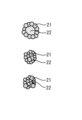
- FIG. 2 is a diagram showing an example of granulated raw material particles.
- 1 is a cross-sectional image of a resin member of the present invention.
- the resin member of the present invention has a photocatalytic coating on the surface of a resin substrate. As shown in FIG. 1, this photocatalytic coating is made of stacked metal particles that shield the resin substrate, and anatase-type titanium oxide particles are dispersed between the stacked metal particles.
- metal particles are present in the out-of-plane direction (at a different depth) at that location and block the light, and this does not mean that the metal particles form a continuous layer in the in-plane direction at a certain depth.
- the metal particles shield the resin substrate in this way, even if titanium oxide particles are present near the interface between the photocatalytic coating and the resin substrate, the titanium oxide near this interface does not exhibit an oxidizing effect, preventing deterioration of the resin substrate.
- the photocatalytic coating on the resin member of the present invention is formed by piling up metal particles, so unlike plating films with dispersed titanium oxide, even if peeling occurs, the photocatalytic coating does not form edges, so there is no risk of injury even when used in areas that may come into contact with hands, etc.
- the photocatalytic coating can be formed by a cold spray method.
- the cold spray method is a method for forming a coating by colliding raw material particles in a solid phase with a substrate using a supersonic flow of a working gas while the raw material particles are in an unmolten state, without melting or gasifying the raw material particles.
- This cold spray method allows the photocatalytic coating to be formed at low temperatures, and there is no need to heat the anatase-type titanium oxide particles above their transition temperature, as is the case with other thermal spray methods. This prevents the titanium oxide particles from transitioning from anatase to rutile, and provides a high photocatalytic effect.
- the photocatalytic coating preferably has a cross-sectional area percentage of metal particles of more than 50% and not more than 95%, more preferably 55-90%, and even more preferably 60-80%, although this depends on the thickness.
- the area percentage of the metal particles is within the above range, it is possible to simultaneously prevent light from passing through to the vicinity of the resin substrate and obtain the photocatalytic effect of the titanium oxide particles near the surface. If the area percentage of the metal particles exceeds 95%, the titanium oxide particles are reduced and the photocatalytic effect is reduced. Also, if it is 50% or less, as described below, the metal particles also play a role as a binder, and the coating strength may decrease.
- the metal material that constitutes the metal particles can be a single metal or an alloy.
- the above metal material is ductile and malleable, and can undergo plastic deformation.
- the metal particles of the present invention not only shield the resin substrate from incident light, but also act as a binder that holds the above titanium oxide particles and forms a photocatalytic coating with high adhesion strength.
- the Vickers hardness of the above metal material is preferably 700 (Hv) or less, more preferably 500 (Hv) or less, and even more preferably 400 (Hv) or less.
- the metal particles are made of a metal material with a Vickers hardness of 700 (Hv) or less, so that the metal particles undergo significant plastic deformation when collided with each other during coating formation using the cold spray method.
- plastic deformation of these metal particles provides high adhesion and bonding strength, improving the strength of the coating, while at the same time retaining the titanium oxide particles that do not undergo plastic deformation, improving the efficiency of coating formation.
- the metal particles sprayed onto the resin substrate by the cold spray method sink into the resin substrate, undergo plastic deformation and adhere to it, forming irregular irregularities at the interface with the resin substrate and bonding to the resin substrate through an anchor effect. Furthermore, these metal particles receive and hold titanium oxide particles that collide with them later, preventing them from bouncing off.
- the metal particles undergo plastic deformation upon collision and are metallurgically bonded together, and the titanium oxide particles are mechanically bonded to the metal particles and resin substrate by the anchor effect, without relying on metallurgical bonding such as the formation or diffusion of intermetallic compounds.
- the above-mentioned metal elements include copper (Cu), aluminum (Al), nickel (Ni), chromium (Cr), iron (Fe), silver (Ag), titanium (Ti), zinc (Zn), and magnesium (Mg).
- the above alloy may be an alloy containing 50 mass% or more of one metal selected from the group consisting of copper (Cu), aluminum (Al), nickel (Ni), chromium (Cr), iron (Fe), silver (Ag), titanium (Ti), zinc (Zn), and magnesium (Mg).
- one metal selected from the group consisting of copper (Cu), aluminum (Al), nickel (Ni), chromium (Cr), iron (Fe), silver (Ag), titanium (Ti), zinc (Zn), and magnesium (Mg).
- copper and silver have antibacterial properties, so it is preferable to use copper or silver alone or an alloy containing 50% or more by mass of these metals.
- the use of elemental copper (Cu), aluminum (Al), nickel (Ni), chromium (Cr), and silver (Ag) can impart luster and shine to the photocatalytic coating, while the use of elemental iron (Fe) and titanium (Ti) can form a matte photocatalytic coating.
- the color of the photocatalytic coating can also be changed by forming a colored layer on the surface of the metal particles.
- the colored layer include plating films, chemical conversion films, and inorganic pigment coating films.
- the above-mentioned plating films include nickel (Ni), nickel-phosphorus (Ni-P), copper (Cu), zinc (Zn) and other plating films, and these plating films can be formed by electroless plating.
- Examples of the above-mentioned chemical conversion films include phosphate films such as zinc phosphate film, iron phosphate film, and manganese phosphate film formed by phosphate film treatment, chromium oxide film formed by chromate treatment, and triiron tetroxide film formed by black dye treatment.
- phosphate films such as zinc phosphate film, iron phosphate film, and manganese phosphate film formed by phosphate film treatment, chromium oxide film formed by chromate treatment, and triiron tetroxide film formed by black dye treatment.
- the inorganic pigment coating film can be formed by embedding inorganic pigments into the surface of metal particles using a high-velocity air current impact method, or by spray coating using molten glass as a binder.
- the inorganic pigments include natural mineral pigments obtained from minerals and soil, as well as synthetic inorganic pigments such as metal oxides.
- the resin member of the present invention can further have a plating film having defects on the photocatalytic coating. This allows the color of the surface of the resin member to be different from the color of the photocatalytic coating, and also allows the anatase type titanium oxide particles of the photocatalytic coating to be exposed through the defects in the plating film, thereby enabling the photocatalytic effect to be expressed.
- a plating film having the above defects can be produced by connecting a photocatalytic coating to a DC power source and forming a plating film in a treatment solution.
- anatase-type titanium oxide particles are not conductive, so a plating film is not formed on the anatase-type titanium oxide particles exposed on the surface of the photocatalytic coating, and a plating film is formed only on the parts of the photocatalytic coating surface that are formed by metal particles, so that anatase-type titanium oxide particles can be exposed from defective parts of the plating film.
- the plating film formed on the photocatalytic coating can be made of metals that can be electroplated, such as copper, nickel, chromium, gold, silver, and zinc.
- the resin member of the present invention can improve its tactile feel by making its surface roughness (Ra) 25 ⁇ m or less. If the surface roughness (Ra) is in the range of 5 to 25 ⁇ m, a luxurious feel can be created by the texture, and by making the surface roughness (Ra) less than 5 ⁇ m, the metallic luster can be improved.
- the average particle size of the metal particles is preferably 10 to 50 ⁇ m, and more preferably 20 to 40 ⁇ m. This improves the shielding properties, and also increases the kinetic energy of the metal particles during cold spraying, thereby improving the efficiency of film formation. Furthermore, when the thickness of the photocatalytic coating is about 100 ⁇ m, if the particle size of the metal particles exceeds 50 ⁇ m, the metal particles will be more likely to fall off during polishing and grinding, and in addition, the metal particles will become larger, reducing the uniform dispersion of the titanium oxide particles on the surface of the photocatalytic coating.
- the titanium oxide particles used may be anatase type titanium oxide particles with an average particle size of 0.01 ⁇ m to 2 ⁇ m.
- anatase-type titanium oxide particles that support copper within the particles exhibit a photocatalytic effect not only with ultraviolet light but also with visible light, making them suitable for use indoors where there is little ultraviolet light, as they can provide self-cleaning properties.
- titanium oxide particles is TKP-103 manufactured by Teika.
- the resin member of the present invention has self-cleaning properties, so it can be used favorably for automobile resin parts such as handles and door knobs that are prone to adhesion of sebum stains, as well as for transport equipment resin parts, electronic equipment resin parts, home appliance resin parts, office resin parts, housing resin parts, and medical and hygiene resin parts.
- the method for producing a resin member of the present invention includes a coating step of spraying raw material particles containing anatase type titanium oxide particles and metal particles onto the surface of a resin substrate by a cold spray method to form a photocatalytic film.
- the cold spray method is a method of forming a coating by colliding raw material particles in a solid phase with a substrate using a supersonic flow of working gas without melting or gasifying the raw material particles, as described above.
- the cold spray method metal particles in the raw material particles collide at supersonic speed and undergo plastic deformation to form a coating. Unlike other thermal spraying methods, this method can minimize changes in the properties of the raw material particles due to heat and oxidation in the coating, preventing the titanium oxide particles from transitioning from anatase to rutile.
- the cold spray method uses a working gas at about 500 to 600°C, which does not melt the raw material particles.
- the nozzle spraying the raw material particles is placed close to the metal substrate to prevent a drop in the temperature and kinetic energy of the raw material particles, causing the raw material particles to collide with the metal substrate.
- a coating is formed on a resin substrate, so the distance between the nozzle that sprays the raw material particles and the resin substrate is increased to lower the temperature of the working gas below the heat resistance temperature of the resin substrate.
- the working gas is sprayed at 500-600°C, and the temperature is lowered to 100-150°C before the raw material particles collide with the resin substrate. This makes it possible to prevent deformation and deterioration of the resin substrate due to the working gas.
- the working gas expands and its temperature drops when it is sprayed from the nozzle. If the distance between the nozzle and the resin substrate is too close, the temperature of the working gas will not drop sufficiently and the resin substrate will melt. Conversely, if the distance is too far, not only will the working gas become too cold, but the speed of the raw material particles will decrease and adhesion to the resin substrate will decrease, so it is preferable that the distance between the nozzle and the resin substrate is about 150 mm.
- thermoplastic resin a thermosetting resin
- thermosetting resin a thermoplastic resin or a thermosetting resin
- the resin substrate is a thermoplastic resin
- the kinetic energy of the raw material particles is converted into thermal energy by the collision, and the thermoplastic resin at the site of collision with the raw material particles melts locally and fuses to the colliding raw material particles, which, combined with the bonding due to the anchor effect described above, improves the bonding strength between the resin substrate and the photocatalytic coating.
- the speed at which the raw material particles can be embedded into the resin substrate by the cold spray method and bonded by the anchor effect is preferably 200 to 500 m/s, although this depends on factors such as the hardness of the resin substrate.
- the raw material particles may be a mixture of anatase-type titanium oxide particles and metal particles, but are preferably granulated particles made by bonding anatase-type titanium oxide particles and metal particles to increase the particle size.
- the titanium oxide particles are fine powder with an average particle size of 0.01 ⁇ m to 2 ⁇ m, so they tend to agglomerate and are difficult to transport, easily causing nozzle clogging.
- the form of the granulated particles is not particularly limited, and may be, as shown in FIG. 2, a metal particle serving as a nucleus with the anatase-type titanium oxide particles attached thereto, or conversely, an anatase-type titanium oxide particle serving as a nucleus with the metal particles attached thereto, or even a mixture of anatase-type titanium oxide particles and metal particles.
- the method for manufacturing a resin member of the present invention can include a step of polishing or grinding the surface of the formed photocatalytic coating after the coating step.
- titanium oxide particles are smaller in diameter than metal particles and are therefore more likely to be exposed on the surface of the photocatalytic coating.
- polishing and grinding the surface of the photocatalytic coating the anatase type titanium oxide is uniformly exposed, resulting in a uniform photocatalytic effect.
- Example 1 A raw material particle mixture of copper particles (Cu-HWQ-350 manufactured by Fukuda Metal Foil & Powder Co., Ltd.) and anatase type titanium oxide particles (JA-1 manufactured by Teika Co., Ltd.) in a mass ratio of 6:1 was sprayed onto the surface of a polypropylene resin substrate by a cold spray method under the following conditions to form a photocatalytic coating, and the surface was ground with a brush to produce a resin part.
- Cu-HWQ-350 manufactured by Fukuda Metal Foil & Powder Co., Ltd.
- anatase type titanium oxide particles JA-1 manufactured by Teika Co., Ltd.
- Cold spray conditions Apparatus: PCS-1000 (manufactured by Plasma Giken Kogyo)
- the cross section of the prepared resin member was observed by energy dispersive X-ray spectroscopy (SEM-EDX), and the elemental analysis of the photocatalytic film was performed. The analysis results are shown in FIG.
Landscapes
- Chemical & Material Sciences (AREA)
- Chemical Kinetics & Catalysis (AREA)
- Engineering & Computer Science (AREA)
- Materials Engineering (AREA)
- Organic Chemistry (AREA)
- Mechanical Engineering (AREA)
- Metallurgy (AREA)
- Catalysts (AREA)
Abstract
Priority Applications (3)
| Application Number | Priority Date | Filing Date | Title |
|---|---|---|---|
| JP2025525983A JPWO2024252816A1 (fr) | 2023-06-06 | 2024-04-24 | |
| CN202480032377.7A CN121152897A (zh) | 2023-06-06 | 2024-04-24 | 树脂部件 |
| EP24817472.4A EP4726073A1 (fr) | 2023-06-06 | 2024-04-24 | Élément en résine |
Applications Claiming Priority (2)
| Application Number | Priority Date | Filing Date | Title |
|---|---|---|---|
| JP2023-092849 | 2023-06-06 | ||
| JP2023092849 | 2023-06-06 |
Publications (1)
| Publication Number | Publication Date |
|---|---|
| WO2024252816A1 true WO2024252816A1 (fr) | 2024-12-12 |
Family
ID=93795410
Family Applications (1)
| Application Number | Title | Priority Date | Filing Date |
|---|---|---|---|
| PCT/JP2024/016063 Ceased WO2024252816A1 (fr) | 2023-06-06 | 2024-04-24 | Élément en résine |
Country Status (4)
| Country | Link |
|---|---|
| EP (1) | EP4726073A1 (fr) |
| JP (1) | JPWO2024252816A1 (fr) |
| CN (1) | CN121152897A (fr) |
| WO (1) | WO2024252816A1 (fr) |
Citations (6)
| Publication number | Priority date | Publication date | Assignee | Title |
|---|---|---|---|---|
| WO1995015816A1 (fr) * | 1993-12-10 | 1995-06-15 | Toto, Ltd. | Substance multifonction a effet photocatalytique et procede de production |
| US20070110919A1 (en) * | 2005-11-15 | 2007-05-17 | ATG Advanced Technology Group s.r.o. | Method for producing photocatalytically active polymers |
| US20070148363A1 (en) * | 2005-11-08 | 2007-06-28 | Linde Aktiengesellschaft | Method for manufacturing a photocatalytically active layer |
| JP3944551B2 (ja) | 2004-02-26 | 2007-07-11 | 地方独立行政法人 岩手県工業技術センター | 光触媒被覆材の製造方法 |
| WO2010107087A1 (fr) * | 2009-03-18 | 2010-09-23 | Toto株式会社 | Elément photocatalytique |
| US20110027496A1 (en) * | 2008-03-28 | 2011-02-03 | Christian Doye | Method for producing a coating through cold gas spraying |
-
2024
- 2024-04-24 JP JP2025525983A patent/JPWO2024252816A1/ja active Pending
- 2024-04-24 CN CN202480032377.7A patent/CN121152897A/zh active Pending
- 2024-04-24 EP EP24817472.4A patent/EP4726073A1/fr active Pending
- 2024-04-24 WO PCT/JP2024/016063 patent/WO2024252816A1/fr not_active Ceased
Patent Citations (6)
| Publication number | Priority date | Publication date | Assignee | Title |
|---|---|---|---|---|
| WO1995015816A1 (fr) * | 1993-12-10 | 1995-06-15 | Toto, Ltd. | Substance multifonction a effet photocatalytique et procede de production |
| JP3944551B2 (ja) | 2004-02-26 | 2007-07-11 | 地方独立行政法人 岩手県工業技術センター | 光触媒被覆材の製造方法 |
| US20070148363A1 (en) * | 2005-11-08 | 2007-06-28 | Linde Aktiengesellschaft | Method for manufacturing a photocatalytically active layer |
| US20070110919A1 (en) * | 2005-11-15 | 2007-05-17 | ATG Advanced Technology Group s.r.o. | Method for producing photocatalytically active polymers |
| US20110027496A1 (en) * | 2008-03-28 | 2011-02-03 | Christian Doye | Method for producing a coating through cold gas spraying |
| WO2010107087A1 (fr) * | 2009-03-18 | 2010-09-23 | Toto株式会社 | Elément photocatalytique |
Also Published As
| Publication number | Publication date |
|---|---|
| JPWO2024252816A1 (fr) | 2024-12-12 |
| CN121152897A (zh) | 2025-12-16 |
| EP4726073A1 (fr) | 2026-04-15 |
Similar Documents
| Publication | Publication Date | Title |
|---|---|---|
| US4655832A (en) | Blast material for mechanical plating and continuous mechanical plating using the same | |
| CN101608088B (zh) | 一种粉末涂料及其制备方法 | |
| CN1269993C (zh) | 多元合金涂层 | |
| EP0528292A1 (fr) | Eléments revêtus avec un film possédant une structure à squelette de poudre et procédé de fabrication | |
| CN102351497B (zh) | 一种耐高温环保型纳米改性无机涂料及制备方法与应用 | |
| Yeom et al. | Improving deposition efficiency in cold spraying chromium coatings by powder annealing | |
| EP0511318B1 (fr) | Pulverisation au plasma d'alliages a base d'aluminium solidifies rapidement | |
| KR101890078B1 (ko) | 준결정 함유 도금 강판 및 준결정 함유 도금 강판의 제조 방법 | |
| CA2129448A1 (fr) | Materiau et procede pour la formation d'un revetement protecteur sur un substrat en un alliage a base de cuivre | |
| JPH09502769A (ja) | 熱溶射コーティング用の改善された複合粉末 | |
| WO2024252816A1 (fr) | Élément en résine | |
| Srivatsav et al. | Exploring the potential of gas atomized high entropy alloys in thermal spray coatings–a comprehensive review | |
| TWI546139B (zh) | 複合材料之製造方法及複合材料 | |
| JP4730657B2 (ja) | 光輝面を有する軽合金ホイールおよびその製造方法 | |
| CA1191038A (fr) | Poudre de chargement a la flamme | |
| WO2024252508A1 (fr) | Élément en résine | |
| JP2024175237A (ja) | 樹脂部材 | |
| JPH11264060A (ja) | 冷間乾式メッキ法 | |
| JPH0293007A (ja) | 粉末の製造法 | |
| Brodmann | Cold spray process parameters: powders | |
| CN103276238B (zh) | 一种铜基合金滑动轴承的制备方法 | |
| GB2096178A (en) | Flame spray powder | |
| EP0608468B1 (fr) | Procédé pour la production d'une poudre métallique pour la fabrication des revêtements résistant à l'usure | |
| WO2013004913A2 (fr) | Procédé, système et matière première pour produire un revêtement métallique, et produit à base d'acier | |
| CN106637197B (zh) | 一种高铁电瓶箱的表面处理工艺 |
Legal Events
| Date | Code | Title | Description |
|---|---|---|---|
| 121 | Ep: the epo has been informed by wipo that ep was designated in this application |
Ref document number: 24817472 Country of ref document: EP Kind code of ref document: A1 |
|
| WWE | Wipo information: entry into national phase |
Ref document number: CN2024800323777 Country of ref document: CN |
|
| ENP | Entry into the national phase |
Ref document number: 2025525983 Country of ref document: JP Kind code of ref document: A |
|
| WWE | Wipo information: entry into national phase |
Ref document number: 2024817472 Country of ref document: EP |
|
| NENP | Non-entry into the national phase |
Ref country code: DE |
|
| ENP | Entry into the national phase |
Ref document number: 2024817472 Country of ref document: EP Effective date: 20260107 |
|
| ENP | Entry into the national phase |
Ref document number: 2024817472 Country of ref document: EP Effective date: 20260107 |
|
| ENP | Entry into the national phase |
Ref document number: 2024817472 Country of ref document: EP Effective date: 20260107 |
|
| ENP | Entry into the national phase |
Ref document number: 2024817472 Country of ref document: EP Effective date: 20260107 |
|
| WWP | Wipo information: published in national office |
Ref document number: 2024817472 Country of ref document: EP |