WO2024252849A1 - Dispositif d'éclairage - Google Patents
Dispositif d'éclairage Download PDFInfo
- Publication number
- WO2024252849A1 WO2024252849A1 PCT/JP2024/017453 JP2024017453W WO2024252849A1 WO 2024252849 A1 WO2024252849 A1 WO 2024252849A1 JP 2024017453 W JP2024017453 W JP 2024017453W WO 2024252849 A1 WO2024252849 A1 WO 2024252849A1
- Authority
- WO
- WIPO (PCT)
- Prior art keywords
- light
- lighting device
- mirror
- unit
- reflected
- Prior art date
- Legal status (The legal status is an assumption and is not a legal conclusion. Google has not performed a legal analysis and makes no representation as to the accuracy of the status listed.)
- Ceased
Links
Images


Classifications
-
- F—MECHANICAL ENGINEERING; LIGHTING; HEATING; WEAPONS; BLASTING
- F21—LIGHTING
- F21V—FUNCTIONAL FEATURES OR DETAILS OF LIGHTING DEVICES OR SYSTEMS THEREOF; STRUCTURAL COMBINATIONS OF LIGHTING DEVICES WITH OTHER ARTICLES, NOT OTHERWISE PROVIDED FOR
- F21V14/00—Controlling the distribution of the light emitted by adjustment of elements
- F21V14/04—Controlling the distribution of the light emitted by adjustment of elements by movement of reflectors
-
- F—MECHANICAL ENGINEERING; LIGHTING; HEATING; WEAPONS; BLASTING
- F21—LIGHTING
- F21V—FUNCTIONAL FEATURES OR DETAILS OF LIGHTING DEVICES OR SYSTEMS THEREOF; STRUCTURAL COMBINATIONS OF LIGHTING DEVICES WITH OTHER ARTICLES, NOT OTHERWISE PROVIDED FOR
- F21V3/00—Globes; Bowls; Cover glasses
-
- F—MECHANICAL ENGINEERING; LIGHTING; HEATING; WEAPONS; BLASTING
- F21—LIGHTING
- F21V—FUNCTIONAL FEATURES OR DETAILS OF LIGHTING DEVICES OR SYSTEMS THEREOF; STRUCTURAL COMBINATIONS OF LIGHTING DEVICES WITH OTHER ARTICLES, NOT OTHERWISE PROVIDED FOR
- F21V7/00—Reflectors for light sources
- F21V7/04—Optical design
- F21V7/09—Optical design with a combination of different curvatures
-
- F—MECHANICAL ENGINEERING; LIGHTING; HEATING; WEAPONS; BLASTING
- F21—LIGHTING
- F21V—FUNCTIONAL FEATURES OR DETAILS OF LIGHTING DEVICES OR SYSTEMS THEREOF; STRUCTURAL COMBINATIONS OF LIGHTING DEVICES WITH OTHER ARTICLES, NOT OTHERWISE PROVIDED FOR
- F21V9/00—Elements for modifying spectral properties, polarisation or intensity of the light emitted, e.g. filters
- F21V9/30—Elements containing photoluminescent material distinct from or spaced from the light source
-
- F—MECHANICAL ENGINEERING; LIGHTING; HEATING; WEAPONS; BLASTING
- F21—LIGHTING
- F21Y—INDEXING SCHEME ASSOCIATED WITH SUBCLASSES F21K, F21L, F21S and F21V, RELATING TO THE FORM OR THE KIND OF THE LIGHT SOURCES OR OF THE COLOUR OF THE LIGHT EMITTED
- F21Y2115/00—Light-generating elements of semiconductor light sources
- F21Y2115/10—Light-emitting diodes [LED]
-
- F—MECHANICAL ENGINEERING; LIGHTING; HEATING; WEAPONS; BLASTING
- F21—LIGHTING
- F21Y—INDEXING SCHEME ASSOCIATED WITH SUBCLASSES F21K, F21L, F21S and F21V, RELATING TO THE FORM OR THE KIND OF THE LIGHT SOURCES OR OF THE COLOUR OF THE LIGHT EMITTED
- F21Y2115/00—Light-generating elements of semiconductor light sources
- F21Y2115/30—Semiconductor lasers
Definitions
- the present invention relates to a lighting device.
- a lighting device that uses laser light as excitation light to make a phosphor emit light, converts the light into a desired color, and provides illumination (see, for example, Patent Document 1).
- the light distribution can be controlled by making the light that has been wavelength-converted by the phosphor enter a lens.
- the lens In the lighting device described above, the lens must be replaced when switching between multiple light distribution patterns, making the process complicated.
- the object of the present invention is to provide a lighting device that can easily switch between multiple light distribution patterns.
- the lighting device comprises a light-emitting unit, a reflecting unit that reflects light emitted by the light-emitting unit, and a deformation unit that deforms the reflecting unit, the reflecting unit having a planar mirror portion and comprising a plurality of mirror elements arranged two-dimensionally and a holding unit that holds the plurality of mirror elements, the deformation unit changing the light distribution pattern of the light reflected by the reflecting unit by deforming a reference plane that includes the center of gravity of each of the plurality of mirror elements.
- the lighting device according to the present invention allows the light distribution pattern to be easily switched.
- FIG. 1 is a schematic cross-sectional view showing a schematic configuration of a lighting device according to an embodiment.
- FIG. 2 is a plan view showing a schematic configuration of a reflecting section according to the embodiment.
- FIG. 3 is a cross-sectional view showing a schematic configuration of a reflecting section according to the embodiment.
- FIG. 4 is a cross-sectional view showing a reflecting portion after deformation according to the embodiment.
- FIG. 5 is a table showing light distribution patterns based on the shape of the reflecting portion according to the embodiment.
- FIG. 6 is a plan view showing a schematic configuration of a reflecting section according to the first modification.
- FIG. 7 is a cross-sectional view showing a schematic configuration of a reflecting section according to the second modification.
- each figure is a schematic diagram and is not necessarily a precise illustration. Furthermore, the same components are given the same reference numerals in each figure.
- FIG. 1 is a schematic cross-sectional view showing a schematic configuration of a lighting device 10 according to the embodiment.
- the lighting device 10 includes a housing 20, a light-emitting unit 30, a reflecting unit 40, a deformation unit 50, and a diffusion unit 60.
- the lighting device 10 also includes a power source that supplies power to the light source 32 of the light-emitting unit 30.
- the housing 20 is a long box body, and contains the light-emitting unit 30, the reflecting unit 40, the deformation unit 50, and the diffusion unit 60.
- An opening 21 through which illumination light is emitted is formed in a portion of the housing 20 facing the reflecting unit 40.
- the opening 21 may be a simple opening, or may be covered with a translucent member.
- the light-emitting unit 30 includes a heat sink 31, a light source 32, a first lens 33, a mirror pipe 34, a wavelength conversion element 35, and a second lens 36.
- the heat sink 31, the light source 32, the first lens 33, the mirror pipe 34, the wavelength conversion element 35, and the second lens 36 are arranged in this order from one end to the other end in the longitudinal direction of the housing 20.
- the heat sink 31 is attached to one end of the housing 20 in the longitudinal direction, and has a base 311 and a number of fins 312 protruding from the base 311.
- the base 311 is disposed inside the housing 20, and supports the light source 32.
- the multiple fins 312 protrude outward from the housing 20. This allows heat transferred from the light source 32 to the base 311 to be released to the outside of the housing 20 via the multiple fins 312.
- the light source 32 is a laser element that generates laser light whose emission peak wavelength is included in the blue wavelength band. In this embodiment, the case where two light sources 32 are provided is illustrated, but the number of light sources 32 provided may be one or three or more.
- the light source 32 is fixed to the base portion 311 of the heat sink 31 in a position in which it irradiates laser light toward the other end of the housing 20 in the longitudinal direction.
- the light source 32 may be an LED whose emission peak wavelength is included in the blue wavelength band.
- the first lens 33 is a focusing lens that focuses the laser light emitted from the light source 32.
- the first lens 33 is disposed in a position facing the light source 32.
- the mirror pipe 34 is an optical component that guides the laser light focused by the first lens 33 to the wavelength conversion element 35.
- the mirror pipe 34 is a cylinder with both ends open, and the laser light is reflected on its inner surface.
- the mirror pipe 34 is arranged with its axial direction aligned with the longitudinal direction of the housing 20. The laser light received at one end of the mirror pipe 34 is reflected on the inner surface of the mirror pipe 34 and travels toward the other end of the mirror pipe 34.
- the wavelength conversion element 35 is an element that converts at least a portion of the laser light emitted from the other end of the mirror pipe 34 into light of a different wavelength band. Specifically, the wavelength conversion element 35 is arranged so as to cover the other end of the mirror pipe 34.
- the wavelength conversion element 35 comprises a substrate 351 and a fluorescent section 352.
- the substrate 351 is a plate that holds the fluorescent section 352.
- the substrate 351 is formed from a light-transmitting material such as glass or sapphire.
- the fluorescent section 352 is layered on this substrate 351.
- the fluorescent part 352 has a plurality of dispersed particles of phosphor that are excited by the laser light emitted from the other end of the mirror pipe 34 and transmitted through the substrate 351 to emit fluorescence, and the phosphor emits fluorescence when irradiated with the laser light.
- the fluorescent part 352 can be a material in which phosphor particles are dispersed inside a base material made of transparent resin or glass, or a material in which phosphor particles are solidified.
- the fluorescent part 352 emits white light. That is, the fluorescent part 352 converts the laser light into light of a longer wavelength band.
- the type and characteristics of the phosphor are not particularly limited, but since a relatively high-output laser light is used as the excitation light, it is desirable that the phosphor has high heat resistance and does not cause brightness saturation.
- a relatively high-output laser light is used as the excitation light, it is desirable that the phosphor has high heat resistance and does not cause brightness saturation.
- YAG yttrium aluminum garnet
- the type of base material that holds the phosphor in a dispersed state is not particularly limited, but if the transparency is high, it is good because the yellow light emission efficiency is also high.
- a relatively high-output laser light is incident, a material with high heat resistance is good.
- the second lens 36 is a collimating lens that converts the light wavelength-converted by the wavelength conversion element 35 into parallel light.
- the second lens 36 is disposed in a position opposite the wavelength conversion element 35.
- the reflecting section 40 is a section that reflects the light emitted by the light emitting section 30, i.e., the light whose wavelength has been converted by the wavelength conversion element 35, toward the opening 21 of the housing 20. Specifically, the reflecting section 40 is disposed at the other end of the housing 20 in the longitudinal direction.
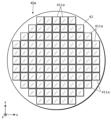
- FIG. 2 is a plan view showing a schematic configuration of the reflector 40 according to the embodiment.
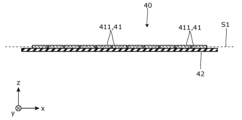
- FIG. 3 is a cross-sectional view showing a schematic configuration of the reflector 40 according to the embodiment.
- the Z-axis direction is the thickness direction of the reflector 40
- the X-axis direction and the Y-axis direction are directions perpendicular to each other in a plane perpendicular to the Z-axis direction.
- the reflecting section 40 has a plurality of mirror elements 41 and a holding section 42 that holds the plurality of mirror elements 41.
- the holding section 42 is a flexible sheet body made of, for example, a circular rubber sheet.
- the holding section 42 may be made of a material other than rubber as long as it is flexible.
- the plurality of mirror elements 41 are attached two-dimensionally to the surface of the holding section 42.
- the multiple mirror elements 41 are each of the same type and are rigid bodies having higher rigidity than the holding portion 42.
- Each mirror element 41 is formed from, for example, metal, glass, or resin.
- Each mirror element 41 has a planar mirror portion 411.
- the mirror portion 411 is polygonal in plan view (hexagonal in this embodiment), and its surface is a reflective surface. Specifically, the surface of the mirror portion 411 may be polished to form a reflective surface, or a reflective layer may be laminated on the surface of the mirror portion 411 to form a reflective surface.
- the multiple mirror elements 41 are arranged in a honeycomb shape such that there is a small gap between adjacent mirror elements 41.
- the mirror elements 41 are also arranged in a planar shape.
- the reference plane S1 including the center of gravity of each mirror element 41 is also planar.
- the deformation portion 50 is a portion that deforms the reflecting portion 40. Specifically, the deformation portion 50 is disposed at a position on the reflecting portion 40 that faces the holding portion 42. The deformation portion 50 is disposed at the center of the holding portion 42 when viewed from above.
- the deformation portion 50 is a piston device that expands and contracts in the Z-axis direction, and its tip is fixed to the center of the holding portion 42.
- the deformation portion 50 is in the reference state
- the reflecting portion 40 is in the state shown in FIG. 3, and the reference surface S1 is flat.
- the deformation portion 50 expands from the reference state in the Z-axis positive direction, the center of the holding portion 42 is also pushed in the Z-axis positive direction and deformed.
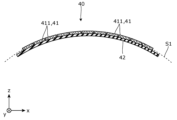
- FIG. 4 is a cross-sectional view showing the reflecting portion 40 after deformation according to the embodiment.
- the reference surface S1 also curves convexly following the deformation of the holding portion 42.
- the holding portion 42 and the reference surface S1 are approximately spherical.
- the curvature of the holding portion 42 and the reference surface S1 can be adjusted by adjusting the amount of extension of the deformation portion 50.
- the posture and position of each mirror element 41 are changed independently when the holding portion 42 is deformed.
- the reference surface S1 is a surface that includes the center of gravity of each mirror element 41.
- the normal directions of each mirror element 41 are different from each other.
- the reference surface S1 can be freely deformed into a form that includes two or more planes (the reflecting surfaces of each mirror element 41) with different normal directions.
- the holding portion 42 also returns to its original shape (see Figure 3).
- the deformation unit 50 may be driven manually or by power from a drive source.
- the amount of extension of the deformation unit 50 may be adjusted based on the control of a control unit.
- the drive source include a motor and a solenoid.
- the control unit include a microcomputer.
- the diffusion section 60 is a diffusion plate that diffuses the reflected light reflected by the reflection section 40.
- the diffusion section 60 is disposed between the opening 21 of the housing 20 and the reflection section 40. In other words, the diffusion section 60 is disposed on the optical path of the reflected light.
- the light reflected by each mirror element 41 is diffused by the diffusion section 60, thereby suppressing the graininess.
- the optical axis direction of the reflected light reflected by each mirror element 41 is different. Therefore, a light distribution pattern consisting of multiple discrete spot lights is obtained.
- the reflected light reflected by each mirror element 41 is diffused and spreads by passing through the diffusion section 60. By appropriately selecting this diffusion angle, the gaps (dark areas) of the discrete spot lights disappear, and a light distribution pattern consisting of one large spot light can be obtained. This suppresses the graininess.
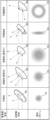
- Figure 5 is a table showing the light distribution patterns based on the shape of the reflector 40 in the embodiment.
- the light distribution pattern P1 of the light reflected by the reflecting portion 40 is circular.
- the light distribution pattern P2 of the light reflected by the reflecting section 40 becomes a substantially circular or elliptical shape larger than the light distribution pattern P1.
- the deforming unit 50 can change the light distribution pattern of the light reflected by the reflecting unit 40 by deforming the reference surface S1.
- the reference surface S1 can be deformed into a wider variety of shapes by providing multiple deformation sections 50.
- the reference surface S1 can be deformed into a cylindrical surface.
- the light distribution pattern P4 reflected by the reflecting section 40 will be elliptical.
- the reference surface S1 can be deformed into a more complex shape, and the light distribution pattern can also be made more complex.
- the tip of the deformation portion 50 can be made sharp, the reference surface S1 can be deformed into a conical surface. In this case, the light distribution pattern P5 reflected by the reflection portion 40 becomes annular.
- the light (incident light) that enters the reflector 40 from the light-emitting unit 30 is collimated by the second lens 36.
- the light reflected by the reflector 40 spreads as it moves away from the reflector 40. In other words, the spread angle of the incident light is smaller than the spread angle of the reflected light, making it possible to illuminate a wide range.
- the lighting device 10 comprises a light-emitting unit 30, a reflecting unit 40 that reflects light emitted by the light-emitting unit 30, and a deformation unit 50 that deforms the reflecting unit 40.
- the reflecting unit 40 has a planar mirror portion 411 and comprises a plurality of mirror elements 41 arranged two-dimensionally, and a holding unit 42 that holds the plurality of mirror elements 41.
- the deformation unit 50 changes the light distribution patterns P1 to P5 of the light reflected from the reflecting unit 40 by deforming a reference plane S1 that includes the center of gravity of each of the plurality of mirror elements 41.
- the deformation unit 50 changes the light distribution patterns P1 to P5 of the light reflected by the reflection unit 40 by deforming the reference surface S1, so that the light distribution patterns P1 to P5 can be easily switched.
- each mirror element 41 is independently provided on the holding portion 42, when the reference surface S1 is deformed, each mirror element 41 smoothly changes its posture and position. Therefore, the light distribution patterns P1 to P5 can be switched smoothly. Furthermore, for example, if the reflecting portion is formed from a single flexible reflecting plate, wrinkles may occur when the reflecting plate is deformed three-dimensionally, making it impossible to realize the intended reflective surface shape, which may hinder the formation of the intended light distribution patterns P1 to P5. In this embodiment, since each mirror element 41 constituting the reflecting portion 40 is independent, wrinkles are unlikely to occur even if the posture and position of each mirror element 41 changes. In other words, the intended light distribution patterns P1 to P5 can be more reliably realized.
- the reference surface S1 can be freely transformed into at least one of an approximately spherical, ellipsoidal, cylindrical, or conical shape, a variety of light distribution patterns P1 to P5 can be realized.
- the reference surface S1 can be freely transformed into a shape that includes two or more planes with different normal directions, a wide variety of light distribution patterns P1 to P5 can be suitably realized in the reflecting section 40 that includes multiple mirror elements 41.
- the mirror elements 41 can be arranged densely. This allows the gaps between the mirror portions 411 of each mirror element 41 to be made as small as possible. The larger the gaps between the mirror portions 411, the more light is lost, but if the gaps can be made smaller, the amount of light lost can be reduced.
- the mirror portion 411 has a hexagonal shape in plan view, so the mirror elements 41 can be arranged in a honeycomb pattern. This allows the gaps between the mirror portions 411 to be small even when the reference surface S1 is curved.
- the light distribution patterns P1 to P5 can be easily switched.
- the spread angle of the incident light is smaller than the spread angle of the reflected light, it is possible to illuminate a wide range. Even if a light source with a small spread angle is used and the spread angle of the incident light is reduced, it is possible to increase the variation in the final light distribution pattern of the illumination light. Furthermore, it is possible to reduce the size of the housing 20.
- the mirror element 41 is a rigid body, even if the holding portion 42 is deformed, the mirror element 41 itself is unlikely to deform. This makes it possible to more reliably achieve the intended light distribution patterns P1 to P5.
- each mirror element 41 of the reflecting section 40 is diffused by the diffusing section 60, so the graininess is suppressed. This allows for lighting that is less unnatural.
- the diffusion unit 60 is a diffusion plate that is placed on the optical path of the light reflected by the reflection unit 40, so the diffusion unit 60 and the reflection unit 40 can be separate and their positions can be adjusted individually.
- the mirror portion 411 has a hexagonal shape in plan view.
- the mirror portion may have another polygonal shape in plan view.
- FIG. 6 is a plan view showing a schematic configuration of the reflector 40a according to the first modification.
- the mirror portion 411a has a square shape in plan view.
- the mirror portion may have a shape other than a polygon in plan view. Examples of shapes of the mirror portion other than a polygon in plan view include a circle, an ellipse, and an oval.
- the diffusion unit 60 is a diffusion plate disposed opposite the reflector 40.
- the diffusion unit may be disposed anywhere as long as it can diffuse the light reflected by the reflector.
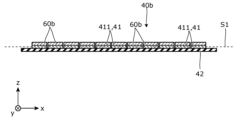
- FIG. 7 is a cross-sectional view showing the schematic configuration of the reflector 40b according to the second modification.
- a diffusion layer laminated on the surface of the mirror section 411 serves as the diffusion section 60b.
- This diffusion section 60b is designed to diffuse light immediately before it is reflected by the mirror section 411 and light immediately after it is reflected. In this case, since the diffusion section 60b is integrated into the reflector 40b, the number of parts can be reduced.
- the light source 32 is a laser element or an LED.
- other light sources may be used. Examples of other light sources include incandescent light bulbs, halogen light bulbs, and fluorescent lights.
- the mirror element 41 is a rigid body, but the mirror element may be elastically deformable.
- the reference surface S1 is deformed from a flat surface to a convex curved surface.
- the light wavelength-converted by the wavelength conversion element 35 is converted to parallel light by the second lens 36 before reaching the reflecting section 40. Because it is parallel light, the spread angle of the reflected light can be made larger than the spread angle of the incident light whether the reference surface S1 is a convex curved surface or a concave curved surface.
- the present invention also includes forms obtained by applying various modifications to the embodiments that a person skilled in the art may conceive, and forms realized by arbitrarily combining the components and functions of each embodiment within the scope of the spirit of the present invention.
- the lighting device according to the present invention is not limited to the following examples.
- the lighting device of Technology 1 includes a light-emitting unit, a reflecting unit that reflects light emitted by the light-emitting unit, and a deformation unit that deforms the reflecting unit, the reflecting unit having a planar mirror portion and including a plurality of mirror elements that are two-dimensionally arranged, and a holding unit that holds the plurality of mirror elements, and the deformation unit changes the light distribution pattern of the light reflected by the reflecting unit by deforming a reference plane that includes the center of gravity of each of the plurality of mirror elements.
- Technology 2 relates to the lighting device described in Technology 1, in which the reference surface can be freely transformed into at least one of a spherical surface, a cylindrical surface, and a conical surface.
- Technology 3 is a lighting device according to technology 1 or 2, in which the reference surface can be freely transformed into a form including two or more planes with different normal directions.
- Technology 4 is a lighting device according to any one of technologies 1 to 3, in which the mirror portion has a polygonal shape in plan view.
- Technology 5 is a lighting device according to any one of Technology 1 to Technology 4, in which the light-emitting unit has a light source made of a laser element or an LED, and a wavelength conversion element that converts a portion of the light emitted by the light source into light of a different wavelength band.
- Technology 6 is a lighting device according to any one of technologies 1 to 5, in which the spread angle of the incident light from the light-emitting section to the reflecting section is smaller than the spread angle of the reflected light reflected by the reflecting section.
- Technology 7 is a lighting device according to any one of technologies 1 to 6, in which the mirror element is a rigid body.
- Technology 8 is a lighting device according to any one of technologies 1 to 7, which has a diffusion section 60 that diffuses the light reflected by the reflection section.
- Technology 9 is the lighting device described in Technology 8, in which the diffusion section is a diffusion plate disposed on the optical path of the reflected light.
- Technology 10 is the lighting device described in Technology 7, in which the diffusion section is a diffusion layer laminated on the mirror section.
- Illumination device 30 Light-emitting portion 32 Light source 35 Wavelength conversion element 40, 40a, 40b Reflection portion 41 Mirror element 42 Holding portion 50 Deformation portion 60, 60b Diffusion portion 352 Fluorescent portion 411, 411a Mirror portion P1, P2, P3, P4, P5 Light distribution pattern S1 Reference surface
Landscapes
- Engineering & Computer Science (AREA)
- General Engineering & Computer Science (AREA)
- Physics & Mathematics (AREA)
- Spectroscopy & Molecular Physics (AREA)
- Non-Portable Lighting Devices Or Systems Thereof (AREA)
Abstract
Un dispositif d'éclairage (10) comprend : une unité électroluminescente (30) ; une unité de réflexion (40) qui réfléchit une lumière émise par l'unité électroluminescente (30) ; et une unité de déformation (50) qui déforme l'unité de réflexion (40). L'unité de réflexion (40) comprend une pluralité d'éléments de miroir (41) qui comprennent une unité de miroir plane (411) et sont disposés de manière bidimensionnelle et d'une unité de maintien (42) qui maintient la pluralité d'éléments de miroir (41). L'unité de déformation (50) modifie des motifs de distribution de lumière (P1 à P5) de la lumière réfléchie par l'unité de réflexion (40) par déformation d'une surface de référence (S1) comprenant le centre de gravité de chacun de la pluralité d'éléments miroirs (41).
Priority Applications (1)
| Application Number | Priority Date | Filing Date | Title |
|---|---|---|---|
| JP2025526004A JPWO2024252849A1 (fr) | 2023-06-09 | 2024-05-10 |
Applications Claiming Priority (2)
| Application Number | Priority Date | Filing Date | Title |
|---|---|---|---|
| JP2023-095424 | 2023-06-09 | ||
| JP2023095424 | 2023-06-09 |
Publications (1)
| Publication Number | Publication Date |
|---|---|
| WO2024252849A1 true WO2024252849A1 (fr) | 2024-12-12 |
Family
ID=93795298
Family Applications (1)
| Application Number | Title | Priority Date | Filing Date |
|---|---|---|---|
| PCT/JP2024/017453 Ceased WO2024252849A1 (fr) | 2023-06-09 | 2024-05-10 | Dispositif d'éclairage |
Country Status (2)
| Country | Link |
|---|---|
| JP (1) | JPWO2024252849A1 (fr) |
| WO (1) | WO2024252849A1 (fr) |
Citations (2)
| Publication number | Priority date | Publication date | Assignee | Title |
|---|---|---|---|---|
| JPH09298154A (ja) * | 1996-05-07 | 1997-11-18 | Nikon Corp | 照明装置 |
| US20200208787A1 (en) * | 2017-06-14 | 2020-07-02 | Yi YANG | Lamp |
-
2024
- 2024-05-10 JP JP2025526004A patent/JPWO2024252849A1/ja active Pending
- 2024-05-10 WO PCT/JP2024/017453 patent/WO2024252849A1/fr not_active Ceased
Patent Citations (2)
| Publication number | Priority date | Publication date | Assignee | Title |
|---|---|---|---|---|
| JPH09298154A (ja) * | 1996-05-07 | 1997-11-18 | Nikon Corp | 照明装置 |
| US20200208787A1 (en) * | 2017-06-14 | 2020-07-02 | Yi YANG | Lamp |
Also Published As
| Publication number | Publication date |
|---|---|
| JPWO2024252849A1 (fr) | 2024-12-12 |
Similar Documents
| Publication | Publication Date | Title |
|---|---|---|
| JP5711147B2 (ja) | Led、光ガイド及びリフレクタを備える光源 | |
| JP5026968B2 (ja) | Ledランプシステム | |
| JP2008515138A (ja) | 照明システム | |
| JP5313991B2 (ja) | 光源装置 | |
| JP2008515139A (ja) | 照明システム | |
| US10795071B2 (en) | Luminaire module having a light guide with a redirecting end-face | |
| JP6890287B2 (ja) | 照明器具 | |
| WO2012141226A1 (fr) | Dispositif d'éclairage | |
| JP5577209B2 (ja) | 照明装置 | |
| US9612001B2 (en) | Lighting arrangement with improved illumination uniformity | |
| US9494295B2 (en) | Ring light module | |
| EP1936261B1 (fr) | Dispositif d'illumination | |
| US8956015B2 (en) | Light-emitting apparatus and lighting system | |
| JP2010027229A (ja) | 面光源装置 | |
| WO2024252849A1 (fr) | Dispositif d'éclairage | |
| JP2016058325A (ja) | 照明装置 | |
| WO2013046305A1 (fr) | Dispositif électroluminescent et appareil d'éclairage | |
| JP2018037257A (ja) | 面光源装置および液晶表示装置 | |
| JP7515107B2 (ja) | 照明器具 | |
| JP6041082B2 (ja) | 照明装置 | |
| JP2021018976A (ja) | 照明装置 | |
| JP5820365B2 (ja) | 発光装置および光照射装置 | |
| JP2014203604A (ja) | 照明装置 | |
| WO2024257505A1 (fr) | Dispositif miroir et dispositif d'éclairage | |
| JP5350072B2 (ja) | 照明器具 |
Legal Events
| Date | Code | Title | Description |
|---|---|---|---|
| 121 | Ep: the epo has been informed by wipo that ep was designated in this application |
Ref document number: 24819086 Country of ref document: EP Kind code of ref document: A1 |
|
| ENP | Entry into the national phase |
Ref document number: 2025526004 Country of ref document: JP Kind code of ref document: A |
|
| WWE | Wipo information: entry into national phase |
Ref document number: 2025526004 Country of ref document: JP |
|
| NENP | Non-entry into the national phase |
Ref country code: DE |