WO2024252878A1 - 熱硬化性エポキシ樹脂組成物および繊維強化複合材料 - Google Patents
熱硬化性エポキシ樹脂組成物および繊維強化複合材料 Download PDFInfo
- Publication number
- WO2024252878A1 WO2024252878A1 PCT/JP2024/018042 JP2024018042W WO2024252878A1 WO 2024252878 A1 WO2024252878 A1 WO 2024252878A1 JP 2024018042 W JP2024018042 W JP 2024018042W WO 2024252878 A1 WO2024252878 A1 WO 2024252878A1
- Authority
- WO
- WIPO (PCT)
- Prior art keywords
- epoxy resin
- resin composition
- thermosetting epoxy
- composition according
- sorbitol
- Prior art date
- Legal status (The legal status is an assumption and is not a legal conclusion. Google has not performed a legal analysis and makes no representation as to the accuracy of the status listed.)
- Ceased
Links
Classifications
-
- C—CHEMISTRY; METALLURGY
- C08—ORGANIC MACROMOLECULAR COMPOUNDS; THEIR PREPARATION OR CHEMICAL WORKING-UP; COMPOSITIONS BASED THEREON
- C08G—MACROMOLECULAR COMPOUNDS OBTAINED OTHERWISE THAN BY REACTIONS ONLY INVOLVING UNSATURATED CARBON-TO-CARBON BONDS
- C08G59/00—Polycondensates containing more than one epoxy group per molecule; Macromolecules obtained by polymerising compounds containing more than one epoxy group per molecule using curing agents or catalysts which react with the epoxy groups
- C08G59/18—Macromolecules obtained by polymerising compounds containing more than one epoxy group per molecule using curing agents or catalysts which react with the epoxy groups ; e.g. general methods of curing
- C08G59/20—Macromolecules obtained by polymerising compounds containing more than one epoxy group per molecule using curing agents or catalysts which react with the epoxy groups ; e.g. general methods of curing characterised by the epoxy compounds used
-
- C—CHEMISTRY; METALLURGY
- C08—ORGANIC MACROMOLECULAR COMPOUNDS; THEIR PREPARATION OR CHEMICAL WORKING-UP; COMPOSITIONS BASED THEREON
- C08J—WORKING-UP; GENERAL PROCESSES OF COMPOUNDING; AFTER-TREATMENT NOT COVERED BY SUBCLASSES C08B, C08C, C08F, C08G or C08H
- C08J5/00—Manufacture of articles or shaped materials containing macromolecular substances
- C08J5/04—Reinforcing macromolecular compounds with loose or coherent fibrous material
Definitions
- the present invention relates to a thermosetting epoxy resin composition and a fiber-reinforced composite material.
- Patent Document 1 proposes a curing agent consisting of a reaction product of a naturally occurring polyfunctional carboxylic acid, a hydroxyl-containing solvent, and an epoxidized triglyceride, the curing agent being characterized by including an ester bond formed between the hydroxyl-containing solvent and the naturally occurring polyfunctional carboxylic acid.
- One of the objectives of the present invention is to provide a thermosetting epoxy resin composition and a fiber-reinforced composite material that have a high biomass content and excellent strength.
- thermosetting epoxy resin composition that includes a base agent and a curing agent, the base agent having a biomass ratio of 50% or more, the base agent including a sorbitol-type epoxy resin, and capable of forming a cured product having a glass transition temperature of 90°C or more.
- thermosetting epoxy resin composition comprising a base agent and a curing agent, the thermosetting epoxy resin composition having a biomass degree of 50% or more, the base agent comprising a sorbitol-type epoxy resin, and the thermosetting epoxy resin composition capable of forming a cured product having a glass transition temperature of 90°C or more.
- thermosetting epoxy resin composition and a fiber-reinforced composite material that have a high biomass content and excellent strength.
- thermosetting epoxy resin composition comprising a base agent and a curing agent, The biomass ratio is 50% or more, The base resin contains a sorbitol-type epoxy resin, A thermosetting epoxy resin composition capable of forming a cured product having a glass transition temperature of 90°C or higher.
- thermosetting epoxy resin composition according to [1] in which the biomass ratio is 70% or more and 100% or less.
- thermosetting epoxy resin composition according to any one of [1] to [3], wherein the epoxy equivalent of the sorbitol-type epoxy resin is 162 g/eq or more and 200 g/eq or less.
- thermosetting epoxy resin composition according to any one of [1] to [4], wherein the epoxy equivalent of the sorbitol-type epoxy resin is 162 g/eq or more and 182 g/eq or less.
- thermosetting epoxy resin composition according to any one of [1] to [5], wherein the curing agent contains at least one of an amine compound and an acid anhydride compound.
- thermosetting epoxy resin composition according to any one of [1] to [6], wherein the amine compound forms a complex with a Lewis acid.
- the complex is a complex of a tertiary amine containing at least one alkyl group having 6 or more carbon atoms and a Lewis acid,
- thermosetting epoxy resin composition according to any one of [1] to [9], wherein the amine compound is a primary polyamine compound having two or more primary amino groups and no ether bond.
- thermosetting epoxy resin composition according to any one of [1] to [12], for use in a fiber-reinforced composite material.
- thermosetting epoxy resin composition includes a base agent and a curing agent, The biomass ratio of the thermosetting epoxy resin composition is 50% or more,
- the base resin contains a sorbitol-type epoxy resin,
- the thermosetting epoxy resin composition is capable of forming a cured product having a glass transition temperature of 90° C. or higher.
- thermosetting epoxy resin composition contains a base agent and a curing agent, and contains a sorbitol-type epoxy resin as at least a part of the base agent.
- the biomass degree of the sorbitol-type epoxy resin is, for example, 70% or more and 100% or less, or 90% or more and 100% or less, and can also be 99% or more and 100% or less.
- the biomass degree of the resin composition (HB) as a whole is significantly increased.
- the biomass degree of the resin composition (HB) is, for example, 70% to 100%, or 90% to 100%, and can also be 95% to 100%, or 99% to 100%.
- the biomass degree of the resin composition (HB) can easily be 90% or more.
- the components other than the sorbitol-type epoxy resin are mainly hardeners, and can contain small amounts of additives.
- the “base agent” may be referred to as "epoxy resin”.
- the “main component” of the base agent refers to a component that occupies 60% by mass or more, preferably 70% by mass or more or 90% by mass or more, of the base agent (or epoxy resin).
- 60% by mass or more, preferably 70% by mass or more or 90% by mass or more (it may be 100%) of the base agent contained in one embodiment of the resin composition (HB) is a sorbitol-type epoxy resin.
- the biomass content can be measured by testing the biobased carbon content of biobased products using radiocarbon measurements, based on ASTM D6866-22 Method B.
- Sorbitol-type epoxy resins are epoxy resins whose main structure is sorbitol, as shown in the following structural formula (1).
- Sorbitol-type epoxy resins can be obtained, for example, by reacting sorbitol with epichlorohydrin to epoxidize the hydroxyl groups.
- the following structural formula (2) shows an example of a sorbitol-type epoxy resin in which four hydroxyl groups have been epoxidized.
- a commercially available sorbitol-type epoxy resin is, for example, the EX-600 series of "Denacol (registered trademark)" manufactured by Nagase ChemteX Corporation.
- Sorbitol-type epoxy resins preferably have an average of 3.8 to 4.2 (preferably an average of 4.0) epoxy groups (glycidyl ether groups) in the molecule.
- Such sorbitol-type epoxy resins are preferred from the viewpoint of realizing a cured product with a high Tg and high elastic modulus.
- the epoxy equivalent of the sorbitol-type epoxy resin may be, for example, 162 g/eq or more and 200 g/eq or less. If the epoxy equivalent is within this range, a cured product with a high Tg and high elastic modulus can be achieved.
- the epoxy equivalent of the sorbitol-type epoxy resin is preferably 162 g/eq or more and 182 g/eq or less. Sorbitol-type epoxy resins with an epoxy equivalent in this range can produce cured products with a good balance of high Tg and high elastic modulus.
- sorbitol-based epoxy resins with a high biomass degree generally have low heat resistance, and it is thought that it is difficult to obtain a cured product with a high Tg.
- sorbitol-based epoxy resins are promising as alternative materials to petroleum-derived epoxy resins.
- sorbitol-based epoxy resins with approximately four epoxy groups in the molecule can form cured products with an excellent balance of physical properties such as Tg, elastic modulus, and adhesion to fibers.
- Tg physical properties
- the curing agent is selected so that the resin composition (HB) can form a cured product having a glass transition temperature (Tg) of 90°C or higher. If the Tg of the cured product of the resin composition (HB) is 90°C or higher, the cured product can be said to satisfy the mechanical strength and heat resistance generally required.
- a cured product of the resin composition (HB) having a Tg of 90°C or higher is suitable, for example, as a material for structures (building materials, housings, car bodies, etc.).
- a resin composition (HB) having a cured product with a Tg of 90°C or higher is particularly suitable as a material for fiber-reinforced composite materials. The higher the Tg of the cured product of the resin composition (HB), the more preferable it is, and it may be 100°C or higher, 120°C or higher, or 150°C or higher.
- the case where the resin composition (HB) can form a cured product having a glass transition temperature (Tg) of 90°C or higher refers to, for example, the case where the resin composition (HB) is heated at 140°C for 3 hours and cured, and the cured product has a Tg of 90°C or higher as measured by a differential scanning calorimeter (DSC).
- the curing conditions for the resin composition (HB) are typically 140°C for 3 hours, but are not limited thereto.
- the amine compound used as the curing agent may form a complex with a Lewis acid.
- a complex with a high viscosity is less likely to precipitate in the liquid resin composition (HB) and can dissolve.
- the complex in a stable state in which the non-shared electron pair of the amine compound is coordinated to the vacant orbital of the Lewis acid is dissolved in the liquid resin composition (HB).
- the complex in the resin composition (HB) reaches a predetermined activation temperature
- the amine compound and the Lewis acid dissociate, and the amine compound and the Lewis acid exert a catalytic action that promotes the polymerization reaction of the epoxy resin.
- a complex of an amine compound and a Lewis acid having such properties is suitable for a so-called one-liquid type epoxy resin composition (liquid in which the base agent and the curing agent are mixed).
- the activation temperature of the complex i.e., the temperature at which the amine compound and the Lewis acid dissociate
- the resin composition (HB) may be a one-component liquid resin composition.
- Such an amine compound may be, for example, an amine containing at least one alkyl group having 6 or more carbon atoms.
- examples of such an amine compound include dimethyloctylamine and di(2-ethylhexyl)amine.
- a tertiary amine containing at least one alkyl group having 6 or more carbon atoms is preferable.
- the alkyl group having 6 or more carbon atoms may be an alkyl group having 6 to 20 carbon atoms, or an alkyl group having 6 to 15 carbon atoms. It is preferable that the alkyl group having 6 or more carbon atoms has a branched structure.
- the amine compound may further have two or less alkyl groups having 3 or less carbon atoms.
- the Lewis acid is not particularly limited, but may be a compound of at least one element selected from the group consisting of boron and aluminum.
- boron compounds include boron trifluoride, boron trichloride, boron tribromide, and boron triiodide.
- aluminum compounds include aluminum trifluoride, aluminum trichloride, aluminum tribromide, and aluminum triiodide.
- Other compounds that may be used include silicon tetrafluoride, silicon tetrachloride, silicon tetrabromide, silicon tetraiodide, phosphorus pentafluoride, and antimony pentafluoride.
- the amount of the curing agent used may be small.
- the amount of the complex used may be, for example, 3 parts by mass or more and 20 parts by mass or less, 4 parts by mass or more and 17 parts by mass or less, or 8 parts by mass or more and 17 parts by mass or less per 100 parts by mass of the resin composition (HB).
- the biomass degree of the resin composition (HB) is, for example, 85% or more, and may reach 90% or more or 95% or more.
- complexes include boron trichloride-dimethyloctylamine complex, boron trichloride-monomethylamine complex, and boron trifluoride-monoethylamine complex.
- the amine compound may be a primary polyamine compound having two or more primary amino groups. However, from the viewpoint of realizing a higher Tg, it is preferable that the primary polyamine compound does not have an ether bond.
- a primary polyamine compound having two or more primary amino groups and no ether bond is also referred to as a "non-ether primary polyamine”.
- the molecular weight of the non-ether primary polyamine is, for example, 150 or more and 300 or less, and may be 150 or more and 270 or less, taking into consideration the balance of the viscosity, stability, and biomass degree of the resin composition (HB).
- the non-ether primary polyamine may be, for example, at least one selected from the group consisting of aromatic diamine compounds and alicyclic diamine compounds. Both aromatic diamine compounds and alicyclic diamine compounds are suitable for obtaining a cured product with a high Tg.
- the aromatic diamine compound preferably has one or two aromatic rings, taking into consideration the balance of the viscosity, biomass degree, etc. of the resin composition (HB).
- the aromatic ring may be a benzene ring or a naphthalene ring.
- the aromatic diamine compound preferably has two or more NH 2 groups per aromatic ring or benzene ring in terms of increasing Tg.
- the nitrogen atom of the NH 2 group is preferably directly bonded to the aromatic ring.
- 4,4'-methylenebis(2-methylaniline), diethylmethylbenzenediamine, etc. may be used as the aromatic diamine compound.
- the alicyclic diamine compound may be a monocycloamine compound or a bicycloamine compound.
- the alicyclic diamine compound preferably has two or more NH2 groups per aliphatic ring in terms of increasing Tg.
- the nitrogen atom of the NH2 group may be directly bonded to the aliphatic ring, or may be bonded as a group such as a CH2 - NH2 group via an alkylene group such as a methylene group.
- the alicyclic diamine compound is preferably high-capped and preferably has an alkyl group such as a methyl group directly bonded to the aliphatic ring.
- the number of alkyl groups may be 2 or more and 5 or less. Specifically, 2,2'-dimethyl-4,4'-methylenebis(cyclohexylamine), isophoronediamine, etc. may be used as the alicyclic diamine compound.
- aromatic diamine compounds or alicyclic diamine compounds that can be used include 4,4'-methylenebis(2-methylaniline), diethylmethylbenzenediamine, 2,2'-dimethyl-4,4'-methylenebis(cyclohexylamine), isophoronediamine, and the like.
- the non-ether primary polyamine may be, for example, an aliphatic diamine compound having a main chain with 6 or more carbon atoms and a branched structure.
- the number of carbon atoms in the main chain may be 6 or more and 13 or less, or 6 or more and 10 or less.
- the number of carbon atoms in the side chain in the branched structure may be the same as or less than that of the main chain, and may be 1 or more.
- the number of carbon atoms in the side chain may be, for example, 1 to 3, or 1 or 2. More specifically, trimethylhexamethylenediamine, etc., may be used as such an aliphatic diamine compound.
- the amount of the curing agent used is, for example, 0.7 to 1.5 equivalents of hydrogen (hereinafter also referred to as "active hydrogen") bonded to the nitrogen atom of the amine compound per 1 epoxy equivalent of the sorbitol-type epoxy resin, or 0.8 to 1.3 equivalents or 0.8 to 1.1 equivalents. From the viewpoint of increasing the biomass degree of the resin composition (HB), it is preferable to set the active hydrogen equivalent per 1 epoxy equivalent to 1.1 or less.
- an acid anhydride compound that can be used as a curing agent an acid anhydride having a ring structure is preferable.
- the ring structure may be an aliphatic ring or an aromatic ring.
- a functional group or an alkyl group may be bonded to the ring structure.
- the number of carbon atoms in the alkyl group may be, for example, 1 to 5, 1 to 3, or 1 or 2. More specifically, examples include methyltetrahydrophthalic anhydride, methylhexahydrophthalic anhydride, and 5-norbornene-2,3-dicarboxylic anhydride.
- the viscosity of the resin composition (HB) measured at 25°C using an E-type viscometer is, for example, 20,000 mPa ⁇ s or less, preferably 16,000 mPa ⁇ s or less, with the lower the viscosity being the better.
- the time until the viscosity doubles at 25°C is preferably 10 minutes or more, and more preferably 50 minutes or more.
- the fiber reinforced composite material contains fibers and the resin composition (HB) impregnated into the fibers.
- the biomass degree of the fibers themselves may be 50% or more, or 90% or more, and the biomass degree of the fibers themselves may be increased to 99% or more or even 100%.
- the biomass degree of the fiber reinforced composite material can be, for example, 70% or more, 90% or more, or even 99% or more.
- Fibers with a high biomass content are derived from plants, such as hemp, basalt, palm, and bamboo.
- Other examples include polylactic acid fiber made from lactic acid derived from starch, polytrimethylene terephthalate (PTT) fiber made from 1,3-propanediol derived from starch, aliphatic polyester fibers such as polyamide fiber derived from castor oil, and cellulosic fibers such as regenerated cellulose fiber and cellulose acetate fiber.
- Plant fibers such as straw, rush grass, and palm can also be used. Note that fibers are not limited to plant-derived fibers, and carbon fiber and glass fiber can also be used.
- the fiber content in the fiber-reinforced composite material is not particularly limited, but may be, for example, 20% by volume or more and 70% by volume or less, or 30% by volume or more and 60% by volume or less.
- Example A1 As the base resin, a sorbitol type epoxy resin represented by the above-mentioned structural formula (2) ("GEX-600 series” manufactured by Nagase Chemtex Corporation) was used.
- the curing agent used was boron trichloride-dimethyloctylamine complex, which is a complex of an amine compound and a Lewis acid.
- sorbitol-type epoxy resin (GEX-600 series)
- hardener boron trichloride-dimethyloctylamine complex
- the viscosity of the resin composition A1 was measured at 25° C. using an E-type viscometer and found to be 15,000 mPa ⁇ s.
- the gel time of the resin composition A1 was measured.
- the gel time is the time until the viscosity of the resin composition A1 increases rapidly in the intermediate stage of curing by heating and becomes gel-like.
- the gel time was measured using a torque type gel time tester manufactured by Yasuda Seiki Seisakusho Co., Ltd. Specifically, 2 mL of a sample of the resin composition A1 was placed in a glass tube, a glass rod was inserted, and the tube was placed in an oil bath at 140°C to rotate the rotor, and the reaction of the resin composition A1 was progressed and the time until a specified torque was applied to the torque detection part was measured. The gel time was measured twice for the same sample to obtain an average value. The gel time was 17 minutes.
- Tg Resin composition A1 was heated at 140° C. for 3 hours to obtain a cured product.
- the Tg of the cured product was measured by DSC and found to be 90° C.
- a resin composition RE1 of Reference Example 1 was prepared in the same manner as in Example A1, except that a petroleum-derived bisphenol A-type epoxy resin was used as the base resin instead of a sorbitol-type epoxy resin, and was evaluated in the same manner. The results are shown in Table 1.
- Example B1> As the base resin, a sorbitol type epoxy resin represented by the above-mentioned structural formula (2) ("GEX-600 series” manufactured by Nagase Chemtex Corporation) was used.
- Diethylmethylbenzenediamine also known as diethyltoluenediamine was used as the hardener.
- the base material sorbitol type epoxy resin (GEX-600 series) was mixed with 30.33 parts by mass of diethylmethylbenzenediamine (hardener) as the second liquid to prepare a two-liquid liquid resin composition (HB) (hereinafter also referred to as "resin composition B1").
- the active hydrogen equivalent per epoxy equivalent (eq/eq ratio) was 1.06.
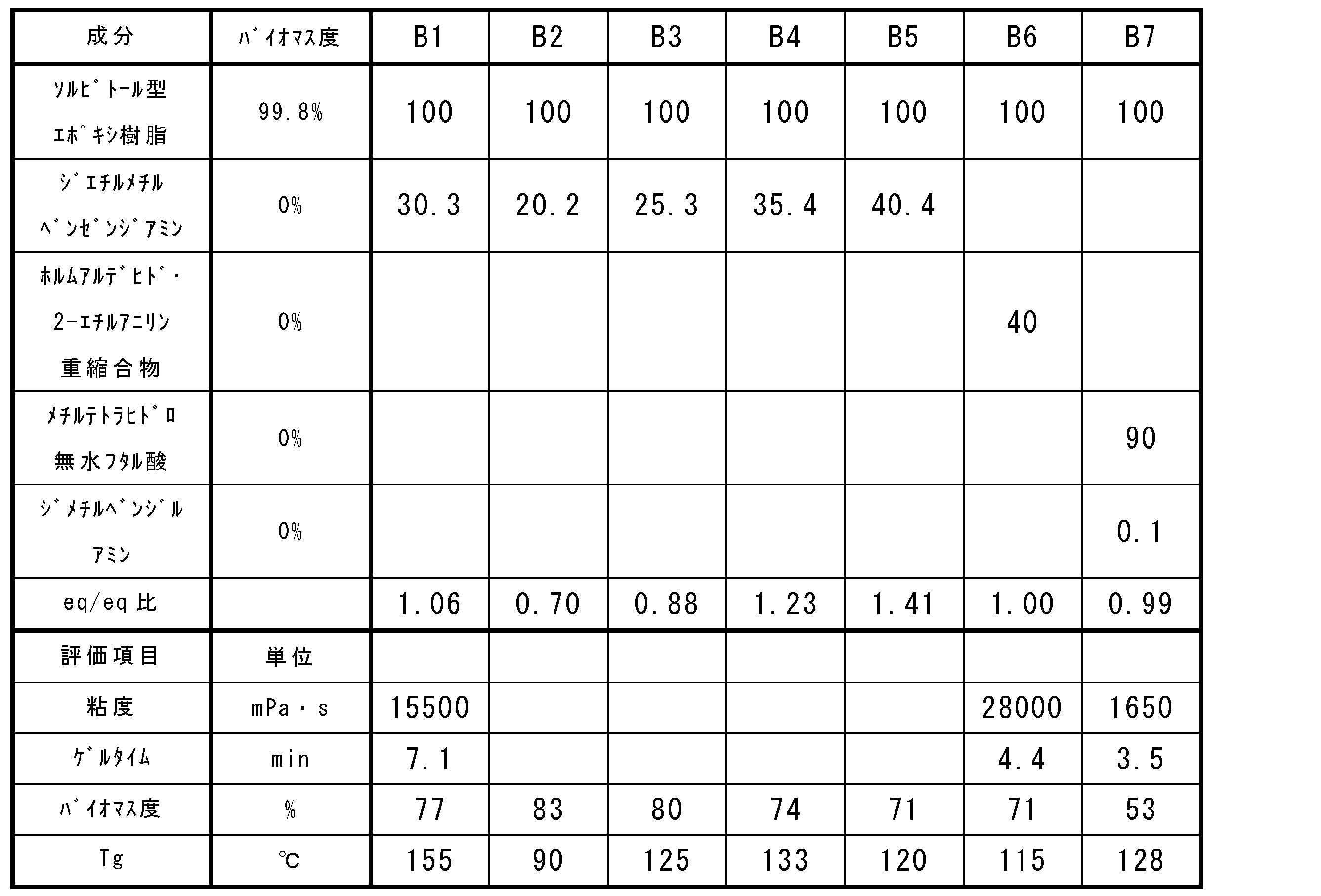
- the viscosity, gel time, and Tg were evaluated in the same manner as in Example A1, and the viscosity at 25°C was 15,500 mPa ⁇ s, the gel time at 140°C was 7.1 minutes, and the Tg was 155°C.
- Examples B2 to B7 Resin compositions B2 to B7 of Examples B2 to B7 were prepared and evaluated in the same manner as in Example B1, except that the amount of the curing agent relative to the base resin was changed to the amount (parts by mass) shown in Table 2, and the type of curing agent was changed in Examples B6 and B7. The results are shown in Table 2.
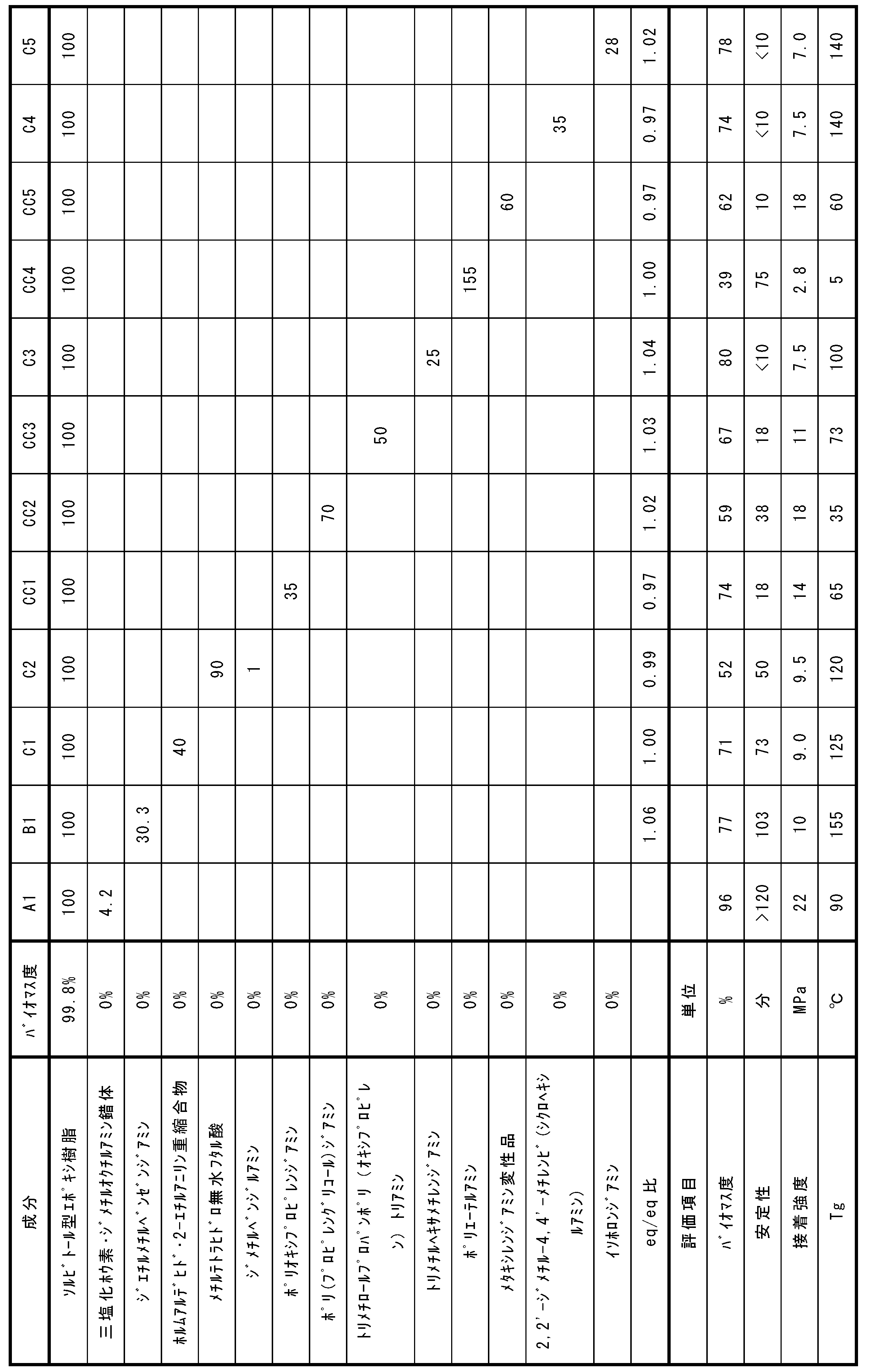
- Comparative Examples C1 to C5 > Resin compositions C1 to C5 of Examples C1 to C5 and resin compositions CC1 to CC5 of Comparative Examples C1 to C5 were prepared in the same manner as in Example 1B, except that the curing agents shown below were used in the amounts (parts by mass) shown in Table 3, and Tg was evaluated in the same manner. In addition, stability and adhesive strength were evaluated. The results are shown in Table 3.
- the resin composition was left at 25° C., and the time until the viscosity doubled was measured.
- the stability until the viscosity doubled is preferably 10 minutes or more, and ideally 50 minutes or more.
- the tensile shear adhesive strength was evaluated.
- the resin composition was applied to the adherend 1, and the adherend 2 was attached to the applied resin composition.
- the adherend was an aluminum plate with a thickness of 1.5 mm, a width of 25 mm, and a length of 150 mm, the surface of which was polished at the adhesive portion.
- the adhesive was then heated at 140°C for 3 hours to cure.
- the tensile shear adhesive strength was measured at a tensile speed of 5 mm/min using a tensile tester (manufactured by Instron).
- the adhesive strength is preferably 2 MPa or more, and ideally 5 MPa or more, in consideration of the adhesiveness to the fiber.
- thermosetting epoxy resin composition disclosed herein has a high biomass content and is suitable for fiber-reinforced composite materials.
Landscapes
- Chemical & Material Sciences (AREA)
- Health & Medical Sciences (AREA)
- Chemical Kinetics & Catalysis (AREA)
- Medicinal Chemistry (AREA)
- Polymers & Plastics (AREA)
- Organic Chemistry (AREA)
- Engineering & Computer Science (AREA)
- Manufacturing & Machinery (AREA)
- Materials Engineering (AREA)
- Epoxy Resins (AREA)
Abstract
Description
本発明の新規な特徴を添付の請求の範囲に記述するが、本発明は、構成および内容の両方に関し、本発明の他の目的および特徴と併せ、図面を照合した以下の詳細な説明によりさらによく理解されるであろう。
[1]主剤および硬化剤を含む熱硬化性エポキシ樹脂組成物であって、
バイオマス度が50%以上であり、
前記主剤は、ソルビトール型エポキシ樹脂を含み、
90℃以上のガラス転移温度を有する硬化物を形成し得る、熱硬化性エポキシ樹脂組成物。
前記ルイス酸が、ホウ素およびアルミニウムからなる群より選択される少なくとも1種の化合物である、[7]または[8]に記載の熱硬化性エポキシ樹脂組成物。
前記熱硬化性エポキシ樹脂組成物は、主剤および硬化剤を含み、
前記熱硬化性エポキシ樹脂組成物のバイオマス度が50%以上であり、
前記主剤は、ソルビトール型エポキシ樹脂を含み、
前記熱硬化性エポキシ樹脂組成物は、90℃以上のガラス転移温度を有する硬化物を形成し得る、繊維強化複合材料。
本開示に係る熱硬化性エポキシ樹脂組成物(以下、「樹脂組成物(HB)」とも称する。)は、主剤および硬化剤を含み、主剤の少なくとも一部としてソルビトール型エポキシ樹脂を含む。ソルビトール型エポキシ樹脂のバイオマス度は、例えば、70%以上100%以下、もしくは90%以上100%以下であり、99%以上100%以下にもなり得る。
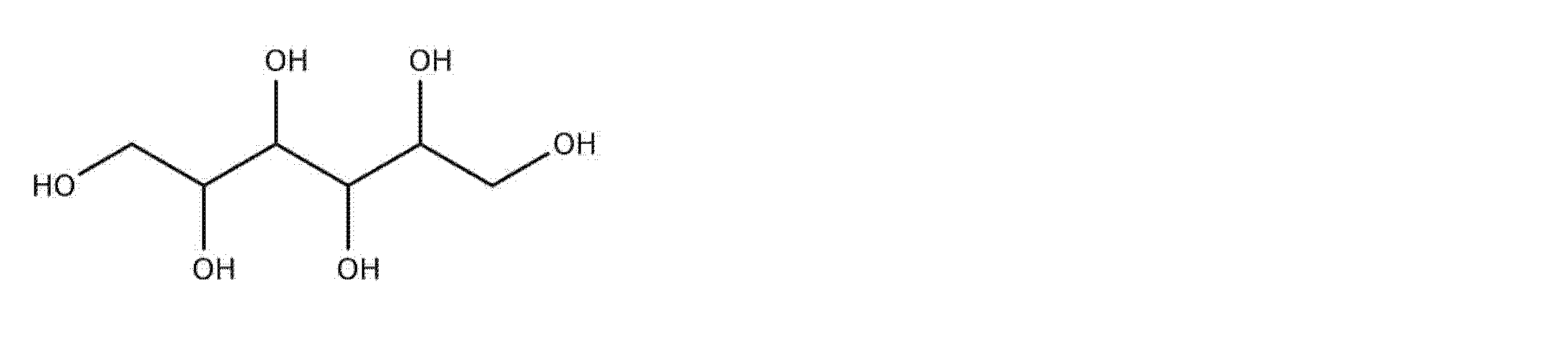

以下、実施例を挙げて本発明を説明するが、本発明は以下の実施例に限定されない。表Aに、使用した原材料の成分、役割、構造式を示す。
主剤として、既述の構造式(2)で示されるソルビトール型エポキシ樹脂(ナガセケムテックス株式会社製の「GEX-600番シリーズ」)を用いた。
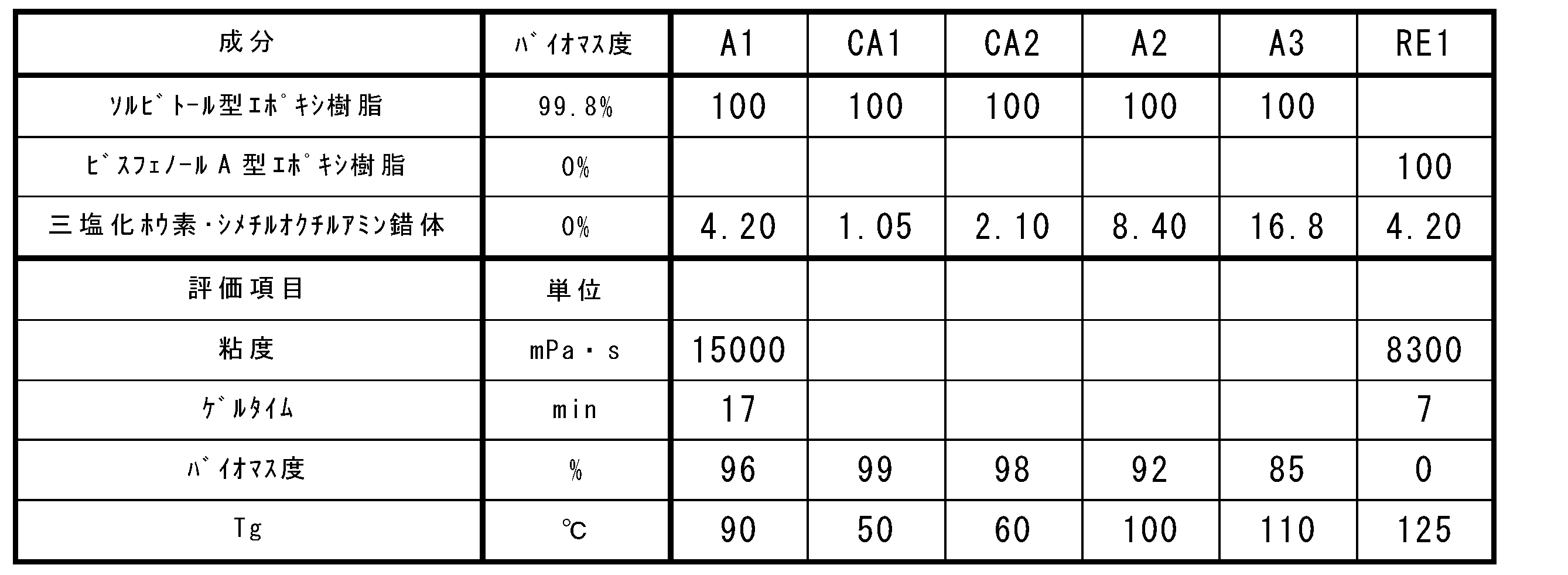
樹脂組成物A1の粘度を25℃でE型粘度計を用いて測定したところ、15000mPa・sであった。
樹脂組成物A1のゲルタイムを測定した。ゲルタイムは、樹脂組成物A1が加熱によって硬化する中間段階で急激に粘度が増大してゲル状になるまでの時間である。ゲルタイムは、株式会社安田精機製作所のトルク式ゲルタイムテスターで計測した。具体的には、樹脂組成物A1の試料2mLをガラス管に入れガラス棒を挿入し、140℃の油槽中に入れてローターを回転させ、樹脂組成物A1の反応が進んでトルク検出部に規定トルクがかかるまでの時間を計測した。同一試料について2回ゲルタイムを測定して平均値を求めた。ゲルタイムは17分であった。
樹脂組成物A1を140℃で3時間加熱して硬化物を得た。その硬化物のTgをDSCで測定したところ、90℃であった。
主剤に対する硬化剤の配合量を表1に示す配合量(質量部)に変更した点以外、実施例A1と同様に、実施例A2、A3の樹脂組成物A2、A3および比較例A1、A2の樹脂組成物CA1、CA2を調製し、同様に評価した。結果を表1に示す。
主剤としてソルビトール型エポキシ樹脂の代わりに、石油由来のビスフェノールA型エポキシ樹脂を用いた点以外、実施例A1と同様に、参考例1の樹脂組成物RE1を調製し、同様に評価した。結果を表1に示す。
主剤として、既述の構造式(2)で示されるソルビトール型エポキシ樹脂(ナガセケムテックス株式会社製の「GEX-600番シリーズ」)を用いた。
主剤に対する硬化剤の配合量を表2に示す配合量(質量部)に変更し、実施例B6、B7では硬化剤の種類を変更した点以外、実施例B1と同様に、実施例B2~B7の樹脂組成物B2~B7を調製し、同様に評価した。結果を表2に示す。
以下に示す硬化剤を表3に示す配合量(質量部)で用いた点以外、実施例1Bと同様に、実施例C1~C5の樹脂組成物C1~C5および比較例C1~C5の樹脂組成物CC1~CC5を調製し、同様にTgを評価した。また、安定性、接着強度を評価した。結果を表3に示す。
樹脂組成物を25℃で放置し、粘度が2倍に増粘するまでの時間を求めた。粘度が2倍になるまでの安定性は10分以上が好ましく、50分以上が理想的である。
引張せん断接着強度で評価した。樹脂組成物を被着体1に塗布し、塗布した樹脂組成物上に被着体2を貼り合わせた。被着体としては、1.5mm厚×25mm幅×150mm長の、接着部分の表面が研磨されたアルミニウム板を用いた。その後、140℃で3時間加熱して硬化させた。引張り試験機(インストロン社製)により引張速度5mm/minで引張せん断接着強度を測定した。樹脂組成物を例えば繊維強化複合材料に用いる場合、繊維との接着性を考慮すると、接着強度は2MPa以上が好ましく、5MPa以上が理想的である。
Claims (14)
- 主剤および硬化剤を含む熱硬化性エポキシ樹脂組成物であって、
バイオマス度が50%以上であり、
前記主剤は、ソルビトール型エポキシ樹脂を含み、
90℃以上のガラス転移温度を有する硬化物を形成し得る、熱硬化性エポキシ樹脂組成物。 - 前記バイオマス度が、70%以上100%以下である、請求項1に記載の熱硬化性エポキシ樹脂組成物。
- 前記バイオマス度が、90%以上100%以下である、請求項1に記載の熱硬化性エポキシ樹脂組成物。
- 前記ソルビトール型エポキシ樹脂のエポキシ当量が、162g/eq以上200g/eq以下である、請求項1に記載の熱硬化性エポキシ樹脂組成物。
- 前記ソルビトール型エポキシ樹脂のエポキシ当量が、162g/eq以上182g/eq以下である、請求項1に記載の熱硬化性エポキシ樹脂組成物。
- 前記硬化剤が、アミン化合物および酸無水物化合物の少なくとも1種を含む、請求項1に記載の熱硬化性エポキシ樹脂組成物。
- 前記アミン化合物が、ルイス酸との錯体を形成している、請求項1に記載の熱硬化性エポキシ樹脂組成物。
- 前記錯体の活性化温度が90℃以上である、請求項7に記載の熱硬化性エポキシ樹脂組成物。
- 前記錯体が、炭素数6以上のアルキル基を少なくとも1つ含む3級アミンと、ルイス酸との錯体であり、
前記ルイス酸が、ホウ素およびアルミニウムからなる群より選択される少なくとも1種の化合物である、請求項7または8に記載の熱硬化性エポキシ樹脂組成物。 - 前記アミン化合物が、2つ以上の1級アミノ基を有し、かつエーテル結合を有さない1級ポリアミン化合物である、請求項1に記載の熱硬化性エポキシ樹脂組成物。
- 前記1級ポリアミン化合物が、芳香族ジアミン化合物および脂環式ジアミン化合物からなる群より選択される少なくとも1種である、請求項10に記載の熱硬化性エポキシ樹脂組成物。
- 前記1級ポリアミン化合物が、分岐構造を有する炭素数6以上の主鎖を有する脂肪族ジアミン化合物である、請求項10に記載の熱硬化性エポキシ樹脂組成物。
- 繊維強化複合材料に用いる、請求項1~12のいずれか1項に記載の熱硬化性エポキシ樹脂組成物。
- 繊維と、前記繊維に含浸された熱硬化性エポキシ樹脂組成物と、を含み、
前記熱硬化性エポキシ樹脂組成物は、主剤および硬化剤を含み、
前記熱硬化性エポキシ樹脂組成物のバイオマス度が50%以上であり、
前記主剤は、ソルビトール型エポキシ樹脂を含み、
前記熱硬化性エポキシ樹脂組成物は、90℃以上のガラス転移温度を有する硬化物を形成し得る、繊維強化複合材料。
Priority Applications (2)
| Application Number | Priority Date | Filing Date | Title |
|---|---|---|---|
| JP2025507858A JPWO2024252878A1 (ja) | 2023-06-06 | 2024-05-15 | |
| EP24819115.7A EP4725974A1 (en) | 2023-06-06 | 2024-05-15 | Thermosetting epoxy resin composition and fiber-reinforced composite material |
Applications Claiming Priority (2)
| Application Number | Priority Date | Filing Date | Title |
|---|---|---|---|
| JP2023-093277 | 2023-06-06 | ||
| JP2023093277 | 2023-06-06 |
Publications (1)
| Publication Number | Publication Date |
|---|---|
| WO2024252878A1 true WO2024252878A1 (ja) | 2024-12-12 |
Family
ID=93795325
Family Applications (1)
| Application Number | Title | Priority Date | Filing Date |
|---|---|---|---|
| PCT/JP2024/018042 Ceased WO2024252878A1 (ja) | 2023-06-06 | 2024-05-15 | 熱硬化性エポキシ樹脂組成物および繊維強化複合材料 |
Country Status (3)
| Country | Link |
|---|---|
| EP (1) | EP4725974A1 (ja) |
| JP (1) | JPWO2024252878A1 (ja) |
| WO (1) | WO2024252878A1 (ja) |
Citations (7)
| Publication number | Priority date | Publication date | Assignee | Title |
|---|---|---|---|---|
| JPH05320303A (ja) * | 1992-05-21 | 1993-12-03 | Sumitomo Chem Co Ltd | エポキシ樹脂組成物 |
| JP2012007036A (ja) * | 2010-06-23 | 2012-01-12 | Nagase Chemtex Corp | エポキシ樹脂硬化剤、エポキシ樹脂組成物及び接着剤 |
| WO2015046030A1 (ja) * | 2013-09-30 | 2015-04-02 | 東レ株式会社 | 繊維強化複合材料用2液型エポキシ樹脂組成物および繊維強化複合材料 |
| JP2020019932A (ja) * | 2018-07-24 | 2020-02-06 | 東レ株式会社 | エポキシ樹脂組成物、プリプレグおよび繊維強化複合材料 |
| JP2021532199A (ja) | 2018-04-21 | 2021-11-25 | ナチュラル ファイバー ウェルディング インコーポレーテッド | 硬化剤 |
| WO2022100926A1 (en) * | 2020-11-16 | 2022-05-19 | Henkel Ag & Co. Kgaa | An epoxy composition comprising a bio-based epoxy compound |
| WO2024029233A1 (ja) * | 2022-08-02 | 2024-02-08 | 東レ株式会社 | プリプレグ、繊維強化複合材料、繊維強化複合材料製管状体、ゴルフクラブシャフトおよび釣り竿 |
-
2024
- 2024-05-15 JP JP2025507858A patent/JPWO2024252878A1/ja active Pending
- 2024-05-15 EP EP24819115.7A patent/EP4725974A1/en active Pending
- 2024-05-15 WO PCT/JP2024/018042 patent/WO2024252878A1/ja not_active Ceased
Patent Citations (7)
| Publication number | Priority date | Publication date | Assignee | Title |
|---|---|---|---|---|
| JPH05320303A (ja) * | 1992-05-21 | 1993-12-03 | Sumitomo Chem Co Ltd | エポキシ樹脂組成物 |
| JP2012007036A (ja) * | 2010-06-23 | 2012-01-12 | Nagase Chemtex Corp | エポキシ樹脂硬化剤、エポキシ樹脂組成物及び接着剤 |
| WO2015046030A1 (ja) * | 2013-09-30 | 2015-04-02 | 東レ株式会社 | 繊維強化複合材料用2液型エポキシ樹脂組成物および繊維強化複合材料 |
| JP2021532199A (ja) | 2018-04-21 | 2021-11-25 | ナチュラル ファイバー ウェルディング インコーポレーテッド | 硬化剤 |
| JP2020019932A (ja) * | 2018-07-24 | 2020-02-06 | 東レ株式会社 | エポキシ樹脂組成物、プリプレグおよび繊維強化複合材料 |
| WO2022100926A1 (en) * | 2020-11-16 | 2022-05-19 | Henkel Ag & Co. Kgaa | An epoxy composition comprising a bio-based epoxy compound |
| WO2024029233A1 (ja) * | 2022-08-02 | 2024-02-08 | 東レ株式会社 | プリプレグ、繊維強化複合材料、繊維強化複合材料製管状体、ゴルフクラブシャフトおよび釣り竿 |
Also Published As
| Publication number | Publication date |
|---|---|
| EP4725974A1 (en) | 2026-04-15 |
| JPWO2024252878A1 (ja) | 2024-12-12 |
Similar Documents
| Publication | Publication Date | Title |
|---|---|---|
| US10392468B2 (en) | Highly functional natural material-derived epoxy resin, preparation method therefor, and epoxy resin curing composition using same | |
| JP6787130B2 (ja) | エポキシ樹脂組成物、プリプレグおよび炭素繊維強化複合材料 | |
| JP6812671B2 (ja) | 繊維強化複合材料、成形品および圧力容器 | |
| JP6521969B2 (ja) | エポキシ樹脂用の硬化剤としての2,5−ビスアミノメチルフランの使用 | |
| JP5933707B2 (ja) | 熱硬化性エポキシ系の強化剤用付加体 | |
| US9056942B2 (en) | Curable resin compositions | |
| JP6790492B2 (ja) | エポキシ樹脂組成物、繊維強化複合材料、成形品および圧力容器 | |
| JPS63165426A (ja) | ポリアルキレングリコールをベースとするポリエステルを含むエポキシド樹脂 | |
| JP2012524828A (ja) | 新しいエポキシ樹脂及びこれを含むエポキシ樹脂組成物 | |
| JP2015532937A (ja) | 硬化性エポキシ樹脂組成物 | |
| TW201213271A (en) | Polymer concrete composition | |
| JP7139572B2 (ja) | エポキシ樹脂組成物、繊維強化複合材料、成形品および圧力容器 | |
| JP2017001963A (ja) | エポキシフラン化合物、その製造方法、エポキシフラン化合物を含む硬化性組成物、及びその硬化物 | |
| EP2794714A2 (en) | Epoxy elastomer compositions | |
| JPS60181121A (ja) | エポキシ樹脂組成物 | |
| WO2024252878A1 (ja) | 熱硬化性エポキシ樹脂組成物および繊維強化複合材料 | |
| KR20180083662A (ko) | 개질 에폭시 수지, 이의 제조방법 및 이를 포함하는 열경화성 수지 조성물 | |
| JP2004231787A (ja) | エポキシ樹脂希釈剤、エポキシ樹脂組成物及びエポキシ樹脂硬化物 | |
| CN118240518B (zh) | 一种胶粘剂用环氧树脂组合物及其制备方法、胶粘剂 | |
| JP6961912B2 (ja) | エポキシ樹脂組成物、繊維強化複合材料、成形品および圧力容器 | |
| EP4172161B1 (fr) | Procédé d'obtention de polyépoxydes biosourcés aux propriétés améliorées | |
| JP2024542597A (ja) | エポキシ樹脂の硬化剤として使用される新規な脂肪族ポリアミン | |
| JP2019059827A (ja) | エポキシ樹脂組成物、プリプレグ、樹脂硬化物および繊維強化複合材料 | |
| JP7757568B2 (ja) | 接着剤 | |
| JP7508949B2 (ja) | エポキシ樹脂組成物、中間基材、トウプレグ、および繊維強化複合材料 |
Legal Events
| Date | Code | Title | Description |
|---|---|---|---|
| 121 | Ep: the epo has been informed by wipo that ep was designated in this application |
Ref document number: 24819115 Country of ref document: EP Kind code of ref document: A1 |
|
| WWE | Wipo information: entry into national phase |
Ref document number: 2025507858 Country of ref document: JP |
|
| WWE | Wipo information: entry into national phase |
Ref document number: 2024819115 Country of ref document: EP |
|
| NENP | Non-entry into the national phase |
Ref country code: DE |
|
| ENP | Entry into the national phase |
Ref document number: 2024819115 Country of ref document: EP Effective date: 20260107 |
|
| ENP | Entry into the national phase |
Ref document number: 2024819115 Country of ref document: EP Effective date: 20260107 |
|
| ENP | Entry into the national phase |
Ref document number: 2024819115 Country of ref document: EP Effective date: 20260107 |
|
| ENP | Entry into the national phase |
Ref document number: 2024819115 Country of ref document: EP Effective date: 20260107 |
|
| WWP | Wipo information: published in national office |
Ref document number: 2024819115 Country of ref document: EP |