WO2024252914A1 - Hand/foot heating implement - Google Patents
Hand/foot heating implement Download PDFInfo
- Publication number
- WO2024252914A1 WO2024252914A1 PCT/JP2024/018604 JP2024018604W WO2024252914A1 WO 2024252914 A1 WO2024252914 A1 WO 2024252914A1 JP 2024018604 W JP2024018604 W JP 2024018604W WO 2024252914 A1 WO2024252914 A1 WO 2024252914A1
- Authority
- WO
- WIPO (PCT)
- Prior art keywords
- heating device
- pair
- main body
- device main
- hands
- Prior art date
- Legal status (The legal status is an assumption and is not a legal conclusion. Google has not performed a legal analysis and makes no representation as to the accuracy of the status listed.)
- Ceased
Links
Images



Classifications
-
- A—HUMAN NECESSITIES
- A61—MEDICAL OR VETERINARY SCIENCE; HYGIENE
- A61F—FILTERS IMPLANTABLE INTO BLOOD VESSELS; PROSTHESES; DEVICES PROVIDING PATENCY TO, OR PREVENTING COLLAPSING OF, TUBULAR STRUCTURES OF THE BODY, e.g. STENTS; ORTHOPAEDIC, NURSING OR CONTRACEPTIVE DEVICES; FOMENTATION; TREATMENT OR PROTECTION OF EYES OR EARS; BANDAGES, DRESSINGS OR ABSORBENT PADS; FIRST-AID KITS
- A61F7/00—Heating or cooling appliances for medical or therapeutic treatment of the human body
- A61F7/02—Compresses or poultices for effecting heating or cooling
- A61F7/03—Compresses or poultices for effecting heating or cooling thermophore, i.e. self-heating, e.g. using a chemical reaction
Definitions
- This disclosure relates to a heating device for hands and feet that is used to warm the extremities, such as the fingers, or the extremities, such as the toes.
- Patent Document 1 proposes a foot warmer that can sufficiently warm the toes.
- the foot warmer in Patent Document 1 comprises a pair of warming agent storage sections that store a warming agent, and a band-shaped connecting section that connects the pair of warming agent storage sections.
- the connecting section is arranged along the side of the foot, and a pair of warming agent storage sections are arranged on the front and back sides of the foot, respectively, so that heat can be applied to the toes from both the front and back sides.
- the foot warmer in Patent Document 1 clamps the toes from above and below the sides of the foot, leaving the tips of the toes exposed. This means that the foot warmer in Patent Document 1 has the problem of being unable to warm the tips of the toes, which are prone to getting cold and having poor blood circulation.
- the foot warmer in Patent Document 1 has an adhesive layer on the entire surface, including the connecting parts, so if the pair of heating agent containing parts are attached directly to the skin rather than over socks or stockings, the toes will have difficulty moving. This means that the foot warmer in Patent Document 1 has the problem that the user feels uncomfortable when using it. The above problem with the foot warmer in Patent Document 1 also arises when the warmer is used on the hands.
- the present disclosure aims to provide a heating device for hands and feet that can warm the tips of the fingers when used on the toes or hands and does not inhibit finger movement.
- the heating device for hands and feet disclosed herein includes as its subject the heating device for hands and feet described in item 1 below in order to solve the above problems.
- a heating device body that holds a heat generating material and has a pair of heat generating parts that are spaced apart in the vertical direction, and is bendable between the pair of heat generating parts;
- a pair of first adhesive layers for attaching the heating device main body to the user's fingertips or feet;
- a heating device for hands and feet wherein one of the pair of first adhesive layers is formed on a portion of one end side of the heating device main body in the vertical direction, and the other of the pair of first adhesive layers is formed on a portion of the other end side of the heating device main body in the vertical direction.
- the heating device for hands and feet disclosed herein includes the heating device for hands and feet described in the following item 2 as a preferred embodiment of the heating device for hands and feet described in the above item 1.
- Item 2 The heating device for hands and feet described in Item 1, in which the first adhesive layer is formed in a portion extending from the end of the heating device body in the vertical direction toward the center in the vertical direction over a length of at least 1/6 of the distance between both ends in the vertical direction.
- the heating device for hands and feet disclosed herein includes the heating device for hands and feet described in the following item 3 as a preferred embodiment of the heating device for hands and feet described in items 1 and 2 above.
- Item 3 The heating device for hands and feet described in item 1 or 2, in which the first adhesive layer is formed in a portion extending from the end of the heating device body in the vertical direction toward the center in the vertical direction over a length of 1/4 or less of the distance between both ends in the vertical direction.
- the heating device for hands and feet disclosed herein includes the heating device for hands and feet described in the following item 4 as a preferred embodiment of the heating device for hands and feet described in items 1 to 3 above.
- Item 4 The heating device for hands and feet described in any one of items 1 to 3, further comprising a second adhesive layer formed between the pair of heat generating parts of the heating device main body.
- the heating device for hands and feet disclosed herein includes the heating device for hands and feet described in the following item 5 as a preferred embodiment of the heating device for hands and feet described in items 1 to 4 above.
- Item 5 A heating device for hands and feet according to any one of items 1 to 4, in which a pair of side edges extending along the vertical direction of the heating device body and spaced apart in a horizontal direction perpendicular to the vertical direction have recesses formed between the pair of heat generating parts that are recessed toward the opposite side edge.
- the heating device for hands and feet disclosed herein includes the heating device for hands and feet described in the following item 6 as a preferred embodiment of the heating device for hands and feet described in items 1 to 5 above.
- Item 6 The heating device for hands and feet described in any one of items 1 to 5, in which the pair of side edges are inclined so that the distance between them gradually increases from between the pair of heat generating parts toward both ends in the vertical direction.
- the heating device for hands and feet disclosed herein can warm the toes or fingers when used on the hands or feet, and does not inhibit finger movement.
- FIG. 1 is a plan view of a heating device for hands and feet according to one embodiment of the present disclosure.
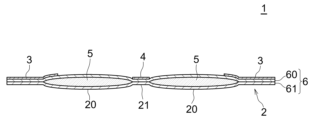
- FIG. 2 is a cross-sectional view of the heating device for hands and feet according to one embodiment of the present disclosure (a cross-sectional view taken along line AA in FIG. 1).
- FIG. 3 is a cross-sectional view illustrating the steps of a method for using the heating device for hands and feet according to one embodiment of the present disclosure.
- FIG. 4 is a perspective view illustrating the steps of a method of using the heating device for hands and feet according to one embodiment of the present disclosure.
- FIG. 5 is a perspective view illustrating the steps of a method of using the heating device for hands and feet according to one embodiment of the present disclosure.
- FIG. 1 is a plan view of a heating device for hands and feet according to one embodiment of the present disclosure.
- FIG. 2 is a cross-sectional view of the heating device for hands and feet according to one embodiment of the present disclosure (a cross-sectional view taken along line AA in FIG
- FIG. 6 is a plan view of a heating device for hands and feet according to an embodiment of the present disclosure, worn on the toes.
- FIG. 7 is a cross-sectional view of a heating device for hands and feet according to an embodiment of the present disclosure, worn on the toes.
- the heating device for hands and feet disclosed herein is used, for example, to warm the tips of the hands, such as the fingers, or the tips of the feet, such as the toes.
- the heating device for hands and feet can be worn directly on bare feet, wrapping the tips of the toes from the tips of the fingers, to effectively alleviate the coldness of the feet.
- usage examples of the heating device for hands and feet disclosed herein are not limited to the above examples.
- the heating device for hands and feet disclosed herein is preferably worn directly on the skin of the feet or hands, but does not exclude usage forms in which it is worn on the feet or hands wearing socks, stockings, tights, gloves, etc.
- the heating device for hands and feet disclosed herein will be described with reference to the attached drawings. Note that in the user's hands and feet, the direction toward the tips of the fingers is referred to as the "forward direction,” and the opposite direction is referred to as the “rearward direction.” Additionally, the width direction of the hand and foot perpendicular to the front-to-back direction is referred to as the "left-right direction.”
- FIGS 1 and 2 show the heating device for hands and feet 1 of this embodiment.
- the heating device for hands and feet 1 comprises a heating device main body 2 having a pair of heat generating parts 20, a pair of first adhesive layers 3, and a second adhesive layer 4.
- the heating device main body 2 comprises a pair of heat generating parts 20 arranged at a distance from each other.
- the direction in which the pair of heat generating parts 20 are lined up is the vertical direction, and the direction perpendicular to the vertical direction is the horizontal direction.
- one of the pair of heat generating parts 20 is a part that applies heat to the front side of the fingertips or toes
- the other of the pair of heat generating parts 20 is a part that applies heat to the back side of the fingertips or toes.
- the heating device main body 2 can be folded between the pair of heat generating parts 20.
- the heating device main body 2 has a folding part 21 between the pair of heat generating parts 20.
- the heating device main body 2 can be folded at the folding part 21, for example, by being flexible.
- the heating device main body 2 is preferably formed in a thin, flat shape. This allows the heating device main body 2 to be easily folded at the folding part 21.
- the heating device main body 2 is attached to the fingertips or toes with its length facing the front-to-back direction of the hand or foot.
- the bent portion 21 between the pair of heat generating parts 20 of the heating device main body 2 is arranged on the tip side of the toes of the hand or toe, one heat generating part 20 of the heating device main body 2 is arranged on the sole side of the hand or foot (palm or sole), and by bending the heating device main body 2, the other heat generating part 20 of the heating device main body 2 is arranged on the front side of the hand or foot (back of the hand or back of the foot).
- the heating device main body 2 wraps around the fingertips or toes from the tips of the fingers, and the pair of heat generating parts 20 apply heat to the fingertips or toes from both the front and back sides.
- the heating device body 2 is preferably formed in a vertically elongated shape with a larger vertical dimension than a horizontal dimension, although there is no particular limitation.
- the vertical length of the heating device body 2, i.e., the distance D between both vertical ends, is designed so that when the heating device body 2 is attached to the fingertips or toes, both vertical ends E reach the palm and back of the hand beyond the base of the fingers if the heating device body 2 is attached to the fingertips, and both vertical ends E reach the sole and top of the foot if the heating device body 2 is attached to the toes.
- the heating device main body 2 is formed with an external shape that is symmetrical with respect to a center line C that extends horizontally (i.e., a line that passes through the vertical center of the heating device main body 2 and bisects the vertical length D of the heating device main body 2). Therefore, the bent portion 21 between a pair of heat generating parts 20 of the heating device main body 2 is located in the vertical center of the heating device main body 2.
- the heating device main body 2 is also formed with an external shape that is symmetrical with respect to a center line that extends vertically (i.e., a line that bisects the horizontal length and is perpendicular to the center line C). It is not necessary for the heating device main body 2 to be formed with an external shape that is symmetrical with respect to the center line C that extends horizontally and the center line that extends vertically.
- the heating device main body 2 has a pair of side edges 22 and a pair of end edges 23, and the pair of side edges 22 and the pair of end edges 23 form the outer shape of the heating device main body 2.
- the pair of end edges 23 extend along the lateral direction of the heating device main body 2 and are spaced apart in the longitudinal direction.
- the pair of side edges 22 extend along the longitudinal direction of the heating device main body 2 and are spaced apart in the lateral direction.
- the corners of the pair of side edges 22 and the pair of end edges 23 are rounded, although this is not limited thereto.
- the pair of side edges 22 are not particularly limited, but are preferably inclined so that the distance between them gradually increases from the bent portion 21 in the vertical center (between the pair of heat generating parts 20) toward both ends E in the vertical direction.
- the pair of side edges 22 are constricted at the bent portion 21 in the vertical center (between the pair of heat generating parts 20), and the horizontal length of the heating device main body 2 is preferably narrowest at the bent portion 21 in the vertical center (between the pair of heat generating parts 20) and increases toward both ends E in the vertical direction. Since the horizontal length of the heating device main body 2 is narrowest at the bent portion 21 in the vertical center (between the pair of heat generating parts 20), the heating device main body 2 is easily bent at the bent portion 21 between the pair of heat generating parts 20.
- the pair of side edges 22 may be inclined linearly to form a gentle V-shape, or may be inclined curvedly to be smoothly concave.
- Fingers and toes are shaped so that the length (width) in the left-right direction gradually increases from the base of the fingers to the tip side in a plan view. Therefore, if the pair of side edges 22 of the heating device main body 2 are inclined so that the distance between them gradually increases from the vertical center toward both vertical ends, the shape of the part of the heating device main body 2 from the vertical center (between the pair of heat generating parts 20) to both vertical ends E will be a shape that conforms to the shape of the fingers and toes. This makes it possible to prevent the heating device main body 2 from having a marginal part that protrudes from the finger or foot and does not come into contact with the finger or foot when the heating device main body 2 is attached to the finger or foot. If the heating device main body 2 has a large marginal part that protrudes from the finger or foot when the heating device main body 2 is attached to the finger or foot, the user may feel uncomfortable when using the device, so this embodiment reduces the discomfort felt by the user when using the device.
- a first recess 24 is preferably formed in the vertical center of the pair of side edges 22 (between the pair of heat generating parts 20), recessing toward the opposite side edge 22.
- the maximum width of the first recess 24 is about 3 mm to 7 mm, and the depth of the first recess 24 is about 2 mm to 5 mm.
- the first recess 24 is formed in a semicircular shape, but it may be formed in various shapes, such as a triangular shape with an acute or obtuse angle.
- a second recess 25 recessed toward the opposite side edge 22 is formed near both ends E of the pair of side edges 22 in the vertical direction.
- the second recess 25 is formed in the attachment area 26 of the heating device main body 2 where the first adhesive layer 3 is formed and attached to the fingertips or toes.
- the maximum width of the second recess 25 is about 6 mm to 10 mm
- the depth of the second recess 25 is about 2 mm to 5 mm
- the second recess 25 is formed in a size and shape that does not contact the heat generating part 20.
- the second recess 25 is formed in a semicircular shape, but may be formed in various shapes such as a triangular shape with an acute or obtuse angle.
- the attachment area 26 of the heating device main body 2 is easily deformed at the position of the second recess 25.
- the attachment area 26 of the heating device main body 2 that is attached to the hands or feet can easily follow the movement of the skin of the hands or feet, making it difficult for the attachment area 26 of the heating device main body 2 to peel off from the hands or feet.
- the pair of edges 23 are curved so as to bulge outward in the vertical direction.
- the pair of edges 23 may be formed straight, or may be curved so as to be recessed inward in the vertical direction.
- the vertical end E of the heating device main body 2 is the position of the pair of edges 23 that is the outermost in the vertical direction. In this embodiment, the center position in the horizontal direction of the pair of edges 23 is the vertical end E of the heating device main body 2.
- the heating device main body 2 is composed of, for example, a heat generating material 5 and a sheet material 6.
- the heat generating material 5 is held by the sheet material 6.
- the portion of the sheet material 6 where the heat generating material 5 is held is the heat generating section 20 of the heating device main body 2.
- the heat generating material 5 may be built into the sheet material 6, or may be attached externally to the sheet material 6.
- the heating material warming device main body 2 can provide warmth to the user's hands and feet by the heating material 5 shown in FIG. 2 generating heat.
- the material of the heating material 5 is not particularly limited as long as the heating material 5 can generate heat in some way.
- a preferred example of the material of the heating material 5 is a powdered, granular or fibrous exothermic composition that generates heat in association with an oxidation reaction caused by contact with air and is used in conventional chemical warmers.
- the exothermic composition contains, for example, a predetermined amount of an oxidizable metal, activated carbon, a water retention agent, a metal salt and water.
- the oxidizable metal is a metal that generates heat in an oxidation reaction, and examples of the metal include one or more selected from iron, aluminum, zinc, manganese, magnesium and calcium.
- the water retention agent include wood flour, vermiculite, diatomaceous earth, perlite, silica gel, alumina and water-absorbent resin.
- the metal salt include table salt.
- the material for the heat generating material 5 include materials that generate heat when irradiated with microwaves from a microwave oven or the like, specifically, ceramic powders such as powdered ferrite, red beans, or gel-like heat storage materials.
- gel-like heat storage materials include polyvinyl alcohol, carboxymethyl cellulose, polyacrylamide, sodium polyacrylate, and carboxyvinyl polymer.
- the above-mentioned powdery, granular, fibrous or gel-like materials exemplified as the materials for the heat generating material 5 may be enclosed inside the sheet material 6, or may be enclosed in a bag and fixed to the outside of the sheet material 6.
- a powdery, granular or fibrous heat generating composition is enclosed inside the sheet material 6.
- the sheet material 6 is composed of two sheets 60, 61, e.g., a first sheet 60 and a second sheet 61, which are flexible.
- the sheet material 6 is formed into a flat bag shape by overlapping the two sheets 60, 61 and bonding the two sheets 60, 61 along the entire periphery.
- the bonded portion on the periphery of the sheet material 6 is referred to as the "periphery bonded portion.”
- the internal space inside the peripheral bonded portion is the storage space for the heat generating material 5.
- the width of the outer peripheral joint may be approximately the same around the entire circumference, or may vary as in this embodiment.
- the outer peripheral joint is formed so that the width of the portion along the pair of end edges 23 of the heating device main body 2 is wider than the width of the portion along the pair of side edges 22 of the heating device main body 2.
- the width of the portion along the pair of side edges 22 of the heating device main body 2 is, for example, 5 mm or more and 9 mm or less
- the width of the portion along the pair of end edges 23 is, for example, 20 mm or more and 25 mm or less.
- the two sheets 60, 61 of the sheet material 6 are also joined at the center in the vertical direction.
- the joined portion at the center in the vertical direction of the sheet material 6 is referred to as the "central joint".
- the central joint crosses the sheet material 6 and both ends are connected to the peripheral joints.
- the internal space of the sheet material 6 is divided by the central joint into two storage spaces spaced apart in the vertical direction of the sheet material 6.
- the central joint of the sheet material 6 corresponds to the folded portion 21 between the pair of heat generating portions 20 of the heating device main body 2.
- the joining of the two sheets 60, 61 described above can be achieved by methods such as thermal welding (heat sealing), ultrasonic welding, adhesion, and sewing.
- the width of the central joint is, for example, 2 mm to 7 mm.
- the first sheet 60 comes into contact with the fingers or toes when the heating device main body 2 is folded to encase the fingers or toes.
- the second sheet 61 is exposed to the outside when the heating device main body 2 is folded to encase the fingers or toes.
- the first sheet 60 constitutes one of the main surfaces, front or back, of the heating device main body 2, and the second sheet 61 constitutes the other main surface, front or back, of the heating device main body 2.
- a pair of first adhesive layers 3 and second adhesive layers 4 are formed on the first sheet 60.
- the resin material for the resin film is preferably a thermoplastic resin.
- thermoplastic resins include polyethylene, polypropylene, polyester, polyamide, polyurethane, polystyrene, polyvinyl alcohol, polyvinyl chloride, polyvinylidene chloride, polycarbonate, and ethylene-vinyl acetate copolymer.
- the resin film may be formed from one of the above-mentioned resins, or may be formed from a combination of two or more types.
- the first sheet 60 and the second sheet 61 are preferably formed by laminating a woven or nonwoven fabric to a resin film from the viewpoint of improving the feel on the hands and feet.
- fibers that are the material for the woven or nonwoven fabric include natural fibers such as cotton, hemp, silk, and paper; semi-synthetic fibers such as rayon and acetate; synthetic fibers such as nylon, vinylon, polyester, acrylic, polyethylene, polypropylene, polyvinyl chloride, and polybutylene terephthalate; and mixed fibers of the above-mentioned fibers.
- nylon, polyester, and polypropylene are preferred from the viewpoint of improving the feel on the skin.
- the woven or nonwoven fabric may be formed from one of the above-mentioned fiber materials, or may be formed from a combination of two or more types.
- the weight of the woven or nonwoven fabric is designed to allow air to pass through but to prevent the passage of heat-generating materials such as powder.
- At least one of the first sheet 60 and the second sheet 61 is breathable.
- the second sheet 61 exposed to the outside when the heating device main body 1 is folded to encase the fingertips or toes is breathable.
- a resin film having multiple micropores is used for the second sheet 61.
- the micropores are designed to have dimensions that allow air to pass through but prevent the passage of heat-generating materials such as powder.
- Resin films having multiple micropores are conventionally known, and examples include resin films or porous films in which numerous perforations are formed. The multiple micropores may be uniformly present throughout the entire resin film, or may be densely present in a portion of the resin film.
- the first sheet 60 and the second sheet 61 do not necessarily need to be made of resin film, and may be made of only woven fabric or nonwoven fabric.
- the sheet material 6 in this embodiment is composed of two separate sheets, a first sheet 60 and a second sheet 61.
- the sheet material 6 may also be composed of a single flexible and breathable sheet.
- the sheet material 6 may be formed into a flattened bag by folding a single sheet in half, folding one of the two equal parts of the sheet over the other, and joining the one and the other parts along the entire periphery.
- the sheet material 6 can be made of a single sheet or a laminate of multiple sheets.
- the first adhesive layer 3 is a portion where adhesive is present on both ends of the heating device main body 2 in the vertical direction.
- the pair of first adhesive layers 3 allows the heating device main body 2 to be attached to the user's fingers or toes.
- adhesives that form the first adhesive layer 3 include acrylic adhesives, vinyl adhesives, vinyl acetate adhesives, polyvinyl acetal adhesives, vinyl chloride adhesives, cellulose adhesives, chloroprene adhesives, nitrile rubber adhesives, styrene rubber adhesives, silicone rubber adhesives, polysulfide adhesives, terpene resins, water-soluble rosins, and other adhesives.
- the first adhesive layer 3 is preferably formed using an acrylic adhesive in order to ensure an adhesive strength that is neither too strong nor too weak.
- the first adhesive layer 3 is formed on a portion of one vertical end of the heating device main body 2, and on a portion of the other vertical end of the heating device main body 2. Note that the portion on the vertical end E side of the heating device main body 2 refers to a portion of the heating device main body 2 that extends a predetermined length from the vertical end E toward the vertical center.
- the pair of first adhesive layers 3 serve to attach the heating device main body 2 to the user's fingers or toes. Therefore, the portion of the heating device main body 2 where the pair of first adhesive layers 3 are formed is the attachment area 26 that is attached to the fingers or toes. In addition, the portion of the heating device main body 2 between the pair of first adhesive layers 3 is a non-adhesive area 27 that is free of adhesive, except for the folded portion 21 where the second adhesive layer 4 is formed. In other words, the area between one first adhesive layer 3 and the second adhesive layer 4, and the area between the other first adhesive layer 3 and the second adhesive layer 4 are each a non-adhesive area 27.
- both vertical ends E reach beyond the base of the fingers and reach the palm and back of the hand or the sole and instep of the foot. Since the first adhesive layer 3 is formed on a portion of both vertical ends E of the heating device main body 2, the attachment area 26 of the heating device main body 2 is attached mostly to the palm and back of the hand or the sole and instep of the foot at the fingertips or toes, and is hardly attached to the finger parts. The non-adhesive area 27 of the heating device main body 2 mostly touches the finger parts. Therefore, even if the heating device main body 2 is attached directly to the skin of the fingertips or toes, it is prevented from making it difficult to move the fingers. This reduces the discomfort felt by the user when using the heating device for hands and feet 1.
- the first adhesive layer 3 is preferably formed in a portion that extends from the vertical end E of the heating device main body 2 toward the vertical center, over a length of at least 1/6 of the distance D between both vertical ends.
- the pair of attachment areas 26 are preferably areas whose outer edges are along the end edges 23 of the heating device main body 2, and whose inner edges extend to a position where d is the length from the vertical end E of the heating device main body 2, d ⁇ 1/6D. This ensures that the vertical length d of the attachment areas 26 in the heating device main body 2 is sufficiently secured, so that the heating device main body 2 can be firmly attached to the fingertips or toes. This makes it difficult for the heating device main body 2 to peel off from the fingertips or toes when the heating device for hands and feet 1 is in use.
- the first adhesive layer 3 is preferably formed in a portion that extends from the vertical end E of the heating device main body 2 toward the vertical center, over a length of 1/4 or less of the distance D between both vertical ends.
- the pair of attachment areas 26 are preferably areas that extend to a position where the inner edge is d ⁇ 1/4D. In the heating device main body 2, if the attachment area 26 spreads too far vertically, when the heating device main body 2 is attached to the finger or foot, the attachment area 26 may extend too far toward the fingers of the finger or foot and stick to the finger, hindering the freedom of movement of the finger.
- the attachment area 26 is prevented from extending toward the fingers of the finger or foot, so that the freedom of movement of the finger is not hindered. This effectively reduces the discomfort felt by the user when using the heating device for hands and feet 1.
- the inner edges of the pair of application areas 26 are formed in straight lines, they may be curved along the lateral direction of the heating device main body 2.
- the first adhesive layer 3 is preferably formed over the entire surface of each attachment area 26, but the first adhesive layer 3 may be formed partially in each attachment area 26.
- Examples of partially forming the first adhesive layer 3 in the attachment area 26 include a case where the first adhesive layer 3 is formed in a border pattern (multiple lines parallel in the horizontal direction) or a striped pattern (multiple lines parallel in the vertical direction), or a case where the first adhesive layer 3 is formed in a polka dot pattern with multiple dots evenly scattered.
- most of the first adhesive layer 3 is formed on the outer periphery joint of the heating device main body 2.
- the outer periphery joint is thinner and more easily deformed than the heating part 20 in which the heat generating material 5 is held, so by forming most of the first adhesive layer 3 on the outer periphery joint of the heating device main body 2, it becomes easier to attach the heating device main body 2 to the palm and back of the hand or the sole and back of the foot.
- the second adhesive layer 4 is a portion where adhesive is present in the vertical center of the heating device main body 2 (between the pair of heat generating parts 20).
- the folded state is maintained by bonding the folded parts 21 between the pair of heat generating parts 20 together with the second adhesive layer 4. Therefore, when attaching the heating device main body 2 to the fingertips or toes, the tips of the fingertips or toes can be easily aligned, making it easy to attach the heating device main body 2 to the appropriate position on the palm and back of the hand or the sole and back of the foot.
- Examples of adhesives that form the second adhesive layer 4 include acrylic adhesives, vinyl adhesives, vinyl acetate adhesives, polyvinyl acetal adhesives, vinyl chloride adhesives, cellulose adhesives, chloroprene adhesives, nitrile rubber adhesives, styrene rubber adhesives, silicone rubber adhesives, polysulfide adhesives, terpene resins, water-soluble rosin, and other adhesives.
- the second adhesive layer 4 may be formed over the entire area between the pair of heat generating parts 20, or the second adhesive layer 4 may be formed partially in the area between the pair of heat generating parts 20.
- Examples of a case in which the second adhesive layer 4 is formed partially in the area between the pair of heat generating parts 20 include a case in which the second adhesive layer 4 is formed in a border pattern (multiple lines parallel in the horizontal direction) or a striped pattern (multiple lines parallel in the vertical direction), or a case in which the second adhesive layer 4 is formed in a polka dot pattern with multiple dots evenly scattered.
- the heating device for hands and feet 1 of this embodiment is first folded at the folding part 21 between the pair of heat generating parts 20, and the folded folding part 21 is attached by the second adhesive layer 4.
- the toes are placed between the pair of heat generating parts 20, and at this time, the tips of each toe are aligned along the folding part 21.
- a part (attachment area 26) of one end side of the heating device main body 2 in the vertical direction is attached to the sole of the foot via one of the pair of first adhesive layers 3. This allows one of the pair of heat generating parts 20 to contact the sole of the toes.
- a part (attachment area 26) of the other end side of the heating device main body 2 in the vertical direction is attached to the instep via the other of the pair of first adhesive layers 3. This allows the other of the pair of heat generating parts 20 to contact the front side of the toes.
- the warming device for hands and feet 1 on the hands it can be used in the same manner as when using the warming device for hands and feet 1 on the toes.
- the pair of heat generating parts 20 contact the front and back sides of the fingertips or toes, respectively, so that heat can be applied to the fingertips or toes from both the front and back sides.
- the heating device main body 2 is attached to the fingertips or toes so as to wrap around the tips of the fingers, so that the tips of the fingers are not exposed and can be warmed up to the tips of the fingers.
- one of the pair of first adhesive layers 3 is formed on a portion (attachment area 26) on one end side of the heating device main body 2 in the vertical direction
- the other of the pair of first adhesive layers 3 is formed on a portion (attachment area 26) on the other end side of the heating device main body 2 in the vertical direction.
- the heating device for hands and feet 1 of this embodiment the user can easily move his/her fingers when using the heating device for hands and feet 1, and the discomfort caused by the difficulty in moving the fingers can be reduced.
- the second adhesive layer 4 is formed at the folding portion 21 between the pair of heat generating parts 20 of the heating device main body 2.
- the heating device main body 2 is easy to attach to the fingertips or toes.
- a pair of side edges 22 of the heating device main body 2 is formed between the pair of heat generating parts 20 with a recess 24 that is recessed toward the opposite side edge 22.
- the pair of side edges 22 of the heating device main body 2 are inclined so that the distance between them gradually increases from between the pair of heat generating parts 20 toward both ends of the heating device main body 2 in the vertical direction.
- the heating device main body 2 has a narrowest horizontal length between the pair of heat generating parts 20. Therefore, according to the heating device for hands and feet 1 of this embodiment, it is easy to fold the heating device main body 2 between the pair of heat generating parts 20.
- the shape of the portion of the heating device main body 2 extending from between the pair of heat generating parts 20 to both ends E in the vertical direction can be shaped to match the shape of the fingers and toes. This makes it possible to prevent the heating device main body 2 from having marginal portions that protrude beyond the fingers or toes and do not come into contact with the fingers or toes when the heating device main body 2 is attached to the fingers or toes. Therefore, with the heating device for hands and feet 1 of this embodiment, it is possible to reduce the discomfort caused by the large amount of marginal portions of the heating device main body 2 that protrude beyond the fingers or toes when the user uses the heating device for hands and feet 1.
- the heating device main body 2 has a widest horizontal length at both vertical ends E. This ensures a wide area for the attachment region 26 at both vertical ends of the heating device main body 2. Therefore, with the heating device for hands and feet 1 of this embodiment, the heating device main body 2 can be firmly attached to the fingertips or toes, so that the heating device main body 2 is less likely to peel off from the fingertips or toes when the heating device for hands and feet 1 is in use.
- the heating device for hands and feet of the present disclosure is not limited to the above-mentioned embodiment, and various modifications can be made without departing from the spirit of the present disclosure. For example, the following modifications can be made. In addition, the gist of the following modifications can be combined as appropriate.
- the bend 21 between the pair of heat generating parts 20 of the heating device main body 2 is located in the vertical center of the heating device main body 2.
- the bend 21 may be offset from the vertical center of the heating device main body 2.
- the pair of heat generating parts 20 of the heating device main body 2 in the above embodiment may each be configured as a collection of multiple smaller heat generating parts that are partitioned from each other.
- the pair of heat generating parts 20 of the heating device main body 2 may each be configured as two or more small heat generating parts that are partitioned and lined up in the vertical direction of the heating device main body 2, or two or more small heat generating parts that are partitioned and lined up in the horizontal direction of the heating device main body 2.
- the second adhesive layer 4 is formed between the pair of heat generating parts 20 of the heating device main body 2.
- the area between the pair of heat generating parts 20 of the heating device main body 2 may be a non-adhesive area with no adhesive.
- the pair of side edges 22 of the heating device main body 2 are inclined inward (so that the distance between the pair of side edges 22 gradually narrows) as they approach the space between the pair of heat generating parts 20 in the vertical direction.
- the pair of side edges 22 of the heating device main body 2 may be parallel to each other in the vertical direction so that the distance between them is constant.
- a first recess 24 and a second recess 25 are formed on a pair of side edges 22 of the heating device main body 2.
- only the first recess 24 may be formed on the pair of side edges 22 of the heating device main body 2, only the second recess 25 may be formed, or neither the first recess 24 nor the second recess 25 may be formed.
Landscapes
- Health & Medical Sciences (AREA)
- Vascular Medicine (AREA)
- Thermal Sciences (AREA)
- Engineering & Computer Science (AREA)
- Biomedical Technology (AREA)
- Heart & Thoracic Surgery (AREA)
- Physics & Mathematics (AREA)
- Life Sciences & Earth Sciences (AREA)
- Animal Behavior & Ethology (AREA)
- General Health & Medical Sciences (AREA)
- Public Health (AREA)
- Veterinary Medicine (AREA)
- Thermotherapy And Cooling Therapy Devices (AREA)
Abstract
Description
本開示は、例えば手の指などの手先又は足の指などの足先を温めるために使用される手足用温熱具に関する。 This disclosure relates to a heating device for hands and feet that is used to warm the extremities, such as the fingers, or the extremities, such as the toes.
身体を温めるための温熱具として、通気性を有する袋体に空気と接触することで発熱する粉状の発熱性組成物を封入した化学カイロが従来から使用されている。化学カイロは、ユーザの身体又は衣服に貼り付けて使用できるように、袋体の一方の面に粘着層を設けた、いわゆる「貼るタイプ」のものが存在する。しかし、従来の貼るタイプの化学カイロを使用して例えば足先又は手先を温めようとすると、足先及び手先のおもて側又はうら側の一方側しか温めることができない。そのため、従来の貼るタイプの化学カイロを使用した場合には、冬の寒冷時に特に冷えやすい手先及び足先を十分に温めることができない。 As a heating device for warming the body, chemical warmers have been used in the past, in which a powdered heat-generating composition that generates heat when it comes into contact with air is enclosed in a breathable bag. There are so-called "stick-on" chemical warmers, which have an adhesive layer on one side of the bag so that they can be attached to the user's body or clothing. However, when trying to warm, for example, the toes or hands using a conventional stick-on type chemical warmer, only one side of the toes or hand can be warmed, either the front or back. Therefore, when using a conventional stick-on type chemical warmer, it is not possible to adequately warm the hands and feet, which are particularly susceptible to getting cold during the cold winter months.
そこで、特許文献1により、足先を十分に温めることのできる足用温熱体が提案されている。特許文献1の足用温熱体は、温熱剤を収容する一対の温熱剤収容部と、一対の温熱剤収容部を連結する帯状の連結部とを備えている。特許文献1の足用温熱体によると、連結部を足の側面に沿って配設し、足のおもて側及び裏側に一対の温熱剤収容部をそれぞれ配設することで、足先に対しておもて側及びうら側の両側から温熱を付与できる。
特許文献1の足用温熱体は、足の側面から足先を上下で挟むため、指の先端は露出している。そのため、特許文献1の足用温熱体は、冷えやすく血行が悪くなりやすい指の先端を温めることができないという課題がある。また、特許文献1の足用温熱体は、粘着層が連結部を含む全面に設けられているため、足先に対して一対の温熱剤収容部を靴下又はストッキングなどの上からではなく皮膚に直接に貼り付けると、足の指が動きにくくなる。よって、特許文献1の足用温熱体は、ユーザが使用時に違和感を感じるという課題がある。特許文献1の足用温熱体の上記課題は、温熱体を手先に使用した場合にも同様に生じる。
The foot warmer in
本開示は、上記課題を解決するため、足先又は手先に使用した際に指の先端まで温めることができ、かつ、指の動きを阻害しない手足用温熱具の提供を目的とする。 In order to solve the above problems, the present disclosure aims to provide a heating device for hands and feet that can warm the tips of the fingers when used on the toes or hands and does not inhibit finger movement.
本開示の手足用温熱具は、上記課題を解決するため、以下の項1に記載の手足用温熱具を主題として包含する。
The heating device for hands and feet disclosed herein includes as its subject the heating device for hands and feet described in
項1.発熱材を保持しかつ縦方向に間隔をあけて配置された一対の発熱部を備え、前記一対の発熱部の間で折り曲げ可能な温熱具本体と、
前記温熱具本体をユーザの手先又は足先に貼り付けるための一対の第一粘着層と、を備え、
前記一対の第一粘着層の一方は、前記温熱具本体の前記縦方向の一方の端側の一部分に形成され、前記一対の第一粘着層の他方は、前記温熱具本体の前記縦方向の他方の端側の一部分に形成されている、手足用温熱具。
A pair of first adhesive layers for attaching the heating device main body to the user's fingertips or feet;
A heating device for hands and feet, wherein one of the pair of first adhesive layers is formed on a portion of one end side of the heating device main body in the vertical direction, and the other of the pair of first adhesive layers is formed on a portion of the other end side of the heating device main body in the vertical direction.
また、本開示の手足用温熱具は、上記項1に記載の手足用温熱具の好ましい態様として、以下の項2に記載の手足用温熱具を包含する。
Furthermore, the heating device for hands and feet disclosed herein includes the heating device for hands and feet described in the following
項2.前記第一粘着層は、前記温熱具本体の前記縦方向の端から前記縦方向の中央に向かって、前記縦方向の両側の端の間の距離の少なくとも1/6以上の長さにわたる部分に形成される、項1に記載の手足用温熱具。
また、本開示の手足用温熱具は、上記項1から項2に記載の手足用温熱具の好ましい態様として、以下の項3に記載の手足用温熱具を包含する。
Furthermore, the heating device for hands and feet disclosed herein includes the heating device for hands and feet described in the following
項3.前記第一粘着層は、前記温熱具本体の前記縦方向の端から前記縦方向の中央に向かって、前記縦方向の両側の端の間の距離の1/4以下の長さにわたる部分に形成される、項1又は2に記載の手足用温熱具。
また、本開示の手足用温熱具は、上記項1から項3に記載の手足用温熱具の好ましい態様として、以下の項4に記載の手足用温熱具を包含する。
Furthermore, the heating device for hands and feet disclosed herein includes the heating device for hands and feet described in the following
項4.前記温熱具本体の前記一対の発熱部の間に形成された第二粘着層をさらに備える、項1から項3のいずれか一項に記載の手足用温熱具。
また、本開示の手足用温熱具は、上記項1から項4に記載の手足用温熱具の好ましい態様として、以下の項5に記載の手足用温熱具を包含する。
Furthermore, the heating device for hands and feet disclosed herein includes the heating device for hands and feet described in the following
項5.前記温熱具本体の前記縦方向に沿って延びかつ前記縦方向に直交する横方向に離れた一対の側縁には、前記一対の発熱部の間に、反対側の前記側縁の方に向かってへこむ凹部が形成されている、項1から項4のいずれか一項に記載の手足用温熱具。
また、本開示の手足用温熱具は、上記項1から項5に記載の手足用温熱具の好ましい態様として、以下の項6に記載の手足用温熱具を包含する。
Furthermore, the heating device for hands and feet disclosed herein includes the heating device for hands and feet described in the following
項6.前記一対の側縁は、前記一対の発熱部の間から前記縦方向の両端に向かって互いの間隔が次第に広がるように傾斜する、項1から項5のいずれか一項に記載の手足用温熱具。
本開示の手足用温熱具によれば、足先又は手先に使用した際に指の先端まで温めることができ、かつ、指の動きを阻害しない。 The heating device for hands and feet disclosed herein can warm the toes or fingers when used on the hands or feet, and does not inhibit finger movement.
本開示の手足用温熱具は、例えば手の指などの手先又は足の指などの足先を温めるために使用される。使用例の一例としては、就寝時において、寝付きづらい程に足先が冷えている場合に、足先を指の先端の方から包み込むようにして手足用温熱具を素足に直接に装着することで、足先の冷えを効果的に緩和できる。なお、本開示の手足用温熱具の使用例は上述した例に限定されない。また、本開示の手足用温熱具は、足又は手の皮膚に直接に装着することが好適であるが、例えば靴下、ストッキング、タイツ、手袋などを着用した足又は手に装着する使用形態を除外するものではない。 The heating device for hands and feet disclosed herein is used, for example, to warm the tips of the hands, such as the fingers, or the tips of the feet, such as the toes. As an example of usage, when the feet are so cold that it is difficult to fall asleep at bedtime, the heating device for hands and feet can be worn directly on bare feet, wrapping the tips of the toes from the tips of the fingers, to effectively alleviate the coldness of the feet. Note that usage examples of the heating device for hands and feet disclosed herein are not limited to the above examples. Furthermore, the heating device for hands and feet disclosed herein is preferably worn directly on the skin of the feet or hands, but does not exclude usage forms in which it is worn on the feet or hands wearing socks, stockings, tights, gloves, etc.
以下、本開示の手足用温熱具の実施形態について添付図面を参照して説明する。なお、ユーザの手及び足において、指の先端に向かう方向を「前方向」とし、その反対方向を「後方向」とする。また、前後方向に直交する手及び足の幅方向を「左右方向」とする。 Below, an embodiment of the heating device for hands and feet disclosed herein will be described with reference to the attached drawings. Note that in the user's hands and feet, the direction toward the tips of the fingers is referred to as the "forward direction," and the opposite direction is referred to as the "rearward direction." Additionally, the width direction of the hand and foot perpendicular to the front-to-back direction is referred to as the "left-right direction."
図1及び図2は、本実施形態の手足用温熱具1を示す。手足用温熱具1は、一対の発熱部20を備える温熱具本体2と、一対の第一粘着層3と、第二粘着層4と、を備える。
Figures 1 and 2 show the heating device for hands and
温熱具本体
図1及び図2に示すように、温熱具本体2は、互いに間隔をあけて配置された一対の発熱部20を備える。温熱具本体2において、一対の発熱部20が並ぶ方向が縦方向であり、縦方向に直交する方向が横方向である。温熱具本体2において、一対の発熱部20の一方の発熱部20は、手先又は足先のおもて側に温熱を付与する部分であり、一対の発熱部20の他方の発熱部20は、手先又は足先の裏側に温熱を付与する部分である。
As shown in Figures 1 and 2, the heating device
温熱具本体2は、一対の発熱部20の間で折り曲げ可能である。温熱具本体2は、一対の発熱部20の間に折曲部21を備える。温熱具本体2は、例えば可撓性を有することで、折曲部21において折り曲げ可能である。温熱具本体2は、特に限定されないが、厚みの薄い偏平状に形成されることが好ましい。これにより、温熱具本体2は、折曲部21において容易に折り曲げ可能となる。
The heating device
温熱具本体2は、縦方向が手又は足の前後方向を向くようにして手先又は足先に装着される。温熱具本体2の一対の発熱部20の間の折曲部21が手又は足の指の先端側に配備され、温熱具本体2の一方の発熱部20が手又は足の裏側(手の平又は足裏側)に配備され、温熱具本体2の折り曲げにより温熱具本体2の他方の発熱部20が手又は足のおもて側(手の甲又は足の甲側)に配備される。これにより、温熱具本体2は、指の先端の方から手先又は足先を包み込みながら、一対の発熱部20により手先又は足先に対しておもて側及び裏側の両側から温熱を付与する。
The heating device
温熱具本体2は、特に限定されないが、横方向よりも縦方向の方が寸法の大きい縦長形状に形成されることが好ましい。温熱具本体2の縦方向の長さ、つまりは、縦方向の両側の端の間の距離Dは、温熱具本体2が手先又は足先に装着される際に、手先であれば縦方向の両端Eが指の付け根を越えて手の平及び手の甲まで到達し、足先であれば縦方向の両端Eが指の付け根を越えて足裏及び足の甲まで到達するように、設計されている。
The
温熱具本体2は、横方向に延びる中心線(つまりは温熱具本体2の縦方向の中央を通り、温熱具本体2の縦方向の長さDを二等分する線)Cに対して左右対称な外形に形成される。そのため、温熱具本体2の一対の発熱部20の間の折曲部21は、温熱具本体2の縦方向の中央に位置する。また、温熱具本体2は、縦方向に延びる中心線(つまりは横方向の長さを二等分する線であり、中心線Cと直交する線)に対して左右対称な外形に形成される。なお、温熱具本体2は、横方向に延びる中心線C及び縦方向に延びる中心線に対して左右対称な外形に形成されている必要はない。
The heating device
温熱具本体2は、一対の側縁22及び一対の端縁23を備え、一対の側縁22及び一対の端縁23により、温熱具本体2の外形が形づくられている。一対の端縁23は、温熱具本体2の横方向に沿って延びかつ縦方向に離れている。一対の側縁22は、温熱具本体2の縦方向に沿って延びかつ横方向に離れている。一対の側縁22及び一対の端縁23の角部は、特に限定されないが丸みを帯びている。
The heating device
一対の側縁22は、特に限定されないが、縦方向の中央(一対の発熱部20の間)の折曲部21から縦方向の両端Eに向かって互いの間隔が次第に拡がるように傾斜していることが好ましい。つまり、一対の側縁22は、縦方向の中央(一対の発熱部20の間)の折曲部21において括れており、温熱具本体2の横方向の長さは、縦方向の中央(一対の発熱部20の間)の折曲部21において最も狭く、縦方向の両端Eに向かうに連れて広がっていることが好ましい。温熱具本体2の横方向の長さが縦方向の中央(一対の発熱部20の間)の折曲部21において最も狭いことで、温熱具本体2は一対の発熱部20の間の折曲部21において折れ曲がりやすくなる。一対の側縁22は、例えば緩やかなV字をなすように直線的に傾斜していてもよいし、なめらかに凹状にへこむように曲線的に傾斜していてもよい
The pair of side edges 22 are not particularly limited, but are preferably inclined so that the distance between them gradually increases from the
また、手先及び足先は、指の先端側よりも付け根側の方が平面視で左右方向の長さ(横幅)が次第に広がる形状をなす。そのため、温熱具本体2の一対の側縁22が縦方向の中央から縦方向の両端に向かって互いの間隔が次第に拡がるように傾斜していると、温熱具本体2の縦方向の中央(一対の発熱部20の間)から縦方向の両端Eにわたる部分の形状が手先及び足先の形状に沿った形状となる。これにより、温熱具本体2を手先又は足先に装着した際に、温熱具本体2に手先又は足先からはみ出て手先又は足先に接触しない余白部分が生じるのを抑制できる。温熱具本体2を手先又は足先に装着した際に、温熱具本体2に手先又は足先からはみ出る余白部分が多く生じていると、ユーザが使用時に違和感を感じるおそれがあるため、本実施形態では、使用時にユーザが感じる違和感を低減できる。
Fingers and toes are shaped so that the length (width) in the left-right direction gradually increases from the base of the fingers to the tip side in a plan view. Therefore, if the pair of side edges 22 of the heating device
一対の側縁22の縦方向の中央(一対の発熱部20の間)には、特に限定されないが、反対側の側縁22の方に向かってへこむ第一凹部24が形成されていることが好ましい。第一凹部24の最大幅は3mm以上7mm程度であり、第一凹部24の深さは2mm以上5mm程度である。第一凹部24は、本実施形態では、半円状に形成されているが、鋭角又は鈍角の三角形状など、種々の形状に形成されていてもよい。一対の側縁22の縦方向の中央(一対の発熱部20の間)に第一凹部24が形成されていることで、温熱具本体2は一対の発熱部20の間の折曲部21において折れ曲がりやすくなる。
Although not particularly limited, a
一対の側縁22の縦方向の両端Eの近傍には、特に限定されないが、反対側の側縁22の方に向かってへこむ第二凹部25が形成されていることが好ましい。第二凹部25は、温熱具本体2において、第一粘着層3が形成されて手先又は足先に貼り付けられる貼付領域26に形成されている。第二凹部25の最大幅は6mm以上10mm程度であり、第二凹部25の深さは2mm以上5mm程度であり、第二凹部25は発熱部20と接触しない大きさ及び形状に形成されている。第二凹部25は、本実施形態では、半円状に形成されているが、鋭角又は鈍角の三角形状など、種々の形状に形成されていてもよい。一対の側縁22の縦方向の両端E近傍に第二凹部25が形成されていると、温熱具本体2の貼付領域26が第二凹部25の位置で変形しやすくなる。これにより、ユーザが手足用温熱具1の使用時に手先又は足先を動かした際に、温熱具本体2において手先又は足先に貼り付けられる貼付領域26が手先又は足先の皮膚の動きに追随しやすくなるため、温熱具本体2の貼付領域26を手先又は足先から剥がれにくくできる。
Although not particularly limited, it is preferable that a
一対の端縁23は、縦方向の外側に向かって膨出するように湾曲している。一対の端縁23は、直線状に形成されてもよいし、縦方向の内側に向かってへこむように湾曲していてもよい。温熱具本体2の縦方向の端Eは、一対の端縁23において最も縦方向の外側にある位置である。本実施形態では、一対の端縁23における横方向の中央位置が温熱具本体2の縦方向の端Eである。
The pair of
温熱具本体2は、図2に示すように、例えば、発熱材5及びシート材6で構成される。発熱材5はシート材6に保持される。シート材6において発熱材5が保持される部分が温熱具本体2の発熱部20である。発熱材5はシート材6に内蔵されていてもよいし、シート材6に外付けされていてもよい。
As shown in FIG. 2, the heating device
発熱材
温熱具本体2は、図2に示す発熱材5が発熱することで、ユーザの手先及び足先に対して温熱を付与できる。発熱材5の素材は、発熱材5が何らかの方法で発熱できれば、特に限定されない。発熱材5の素材としては、従来の化学カイロに用いられている、空気との接触により起こる酸化反応に伴い発熱する粉状、粒状又は繊維状の発熱性組成物を好ましく例示できる。発熱性組成物は、例えば、被酸化性金属、活性炭、保水剤、金属塩及び水をそれぞれ所定量含有するものである。酸化性金属は、酸化反応熱を発する金属であり、例えば、鉄、アルミニウム、亜鉛、マンガン、マグネシウム、及びカルシウムから選ばれる1種又は2種以上が挙げられる。保水剤は、例えば、木粉、バーミキュライト、けい藻土、パーライト、シリカゲル、アルミナ、吸水性樹脂が挙げられる。金属塩は、例えば食塩が挙げられる。
The heating material warming device
その他、電子レンジなどでマイクロ波の照射を受けることで発熱する材料、具体的には、粉状のフェライトなどのセラミック粉末、小豆、又は、ゲル状の蓄熱剤などを発熱材5の素材として例示できる。ゲル状の蓄熱剤としては、ポリビニルアルコール、カルボキシメチルセルロース、ポリアクリルアミド、ポリアクリル酸ナトリウム、カルボキシビニルポリマーなどを例示できる。
Other examples of the material for the
発熱材5の素材として例示された上述の粉状、粒状、繊維状又はゲル状の材料は、シート材6の内部に封入されていてもよいし、例えば袋体に封入した状態でシート材6に外付けで固定されていてもよい。本実施形態では、粉状、粒状又は繊維状の発熱性組成物がシート材6の内部に封入されている。
The above-mentioned powdery, granular, fibrous or gel-like materials exemplified as the materials for the
シート材
図2に示すように、シート材6は、例えば可撓性を有する第一シート60及び第二シート61の二枚のシート60,61で構成される。シート材6は、二枚のシート60,61を重ねた状態で二枚のシート60,61を外周に沿って全周にわたって接合することで、偏平状の袋体の形態を呈する。以下、シート材6の外周において接合した部分を「外周接合部」という。シート材6において、外周接合部の内側の内部空間が発熱材5の収容空間である。
As shown in Figure 2, the
外周接合部の幅は、全周にわたって略同じであってもよいし、本実施形態のように異なっていてもよい。本実施形態では、図1に示すように、外周接合部は、温熱具本体2の一対の側縁22に沿う部分の幅よりも、温熱具本体2の一対の端縁23に沿う部分の幅の方が広くなるように形成されている。外周接合部において、温熱具本体2の一対の側縁22に沿う部分の幅は、例えば5mm以上9mm以下であり、一対の端縁23に沿う部分の幅は、例えば20mm以上25mm以下である。
The width of the outer peripheral joint may be approximately the same around the entire circumference, or may vary as in this embodiment. In this embodiment, as shown in FIG. 1, the outer peripheral joint is formed so that the width of the portion along the pair of end edges 23 of the heating device
シート材6は、縦方向の中央においても二枚のシート60,61が接合されている。以下、シート材6の縦方向の中央において接合した部分を「中央接合部」という。中央接合部は、シート材6を横断してその両端が外周接合部につながっている。シート材6の内部空間は、中央接合部により、シート材6の縦方向に間隔をあけて配置された二つの収容空間に仕切られている。シート材6の中央接合部は、温熱具本体2の一対の発熱部20の間の折曲部21に相当する。上述した二枚のシート60,61の接合は、熱溶着(ヒートシール)、超音波溶着、接着、縫合などの方法により実現できる。中央接合部の幅は、例えば2mm以上7mm以下である。
The two
第一シート60は、温熱具本体2が折り曲げられて手先又は足先を包み込む際に手先又は足先に接触する。第二シート61は、温熱具本体2が折り曲げられて手先又は足先を包み込む際に外側に露出する。第一シート60は、温熱具本体2の表裏一方の主面を構成し、第二シート61は、温熱具本体2の表裏他方の主面を構成する。図2に示すように、第一シート60に一対の第一粘着層3及び第二粘着層4が形成されている。
The
第一シート60及び第二シート61は、強度及び発熱材5の発熱に対する耐久性の観点から、樹脂フィルムが用いられることが好ましい。樹脂フィルムの素材となる樹脂は、熱可塑性樹脂が好ましい。熱可塑性樹脂は、ポリエチレン、ポリプロピレン、ポリエステル、ポリアミド、ポリウレタン、ポリスチレン、ポリビニルアルコール、ポリ塩化ビニル、ポリ塩化ビニリデン、ポリカーボネート、エチレン-酢酸ビニル共重合体などを例示できる。樹脂フィルムは、上述した樹脂の中の一種で形成されていてもよいし、二種以上を組み合わせて形成されていてもよい。
From the viewpoint of strength and durability against heat generation by the
第一シート60及び第二シート61は、手先及び足先に対する肌触りを良好にするとの観点から、樹脂フィルムに織布又は不織布が積層されていることが好ましい。織布又は不織布の素材となる繊維は、コットン、麻、絹、紙などの天然繊維;レーヨン、アセテートなどの半合成繊維;ナイロン、ビニロン、ポリエステル、アクリル、ポリエチレン、ポリプロピレン、ポリ塩化ビニル、ポリブチレンテレフタレートなどの合成繊維;上述した繊維の混合繊維を例示できる。上述した繊維の中でも、肌触りを良好とするとの観点からは、ナイロン、ポリエステル、ポリプロピレンなどを好ましく例示できる。織布又は不織布は、上述した繊維素材の中の一種で形成されていてもよいし、二種以上を組み合わせて形成されていてもよい。織布又は不織布は、空気の通過は許容するが、粉状などの発熱材料の通過は抑制できるように、目付などが設計される。
The
第一シート60及び第二シート61の少なくとも一方は、通気性を有する。例えば、温熱具本体1が折り曲げられて手先又は足先を包み込む際に外側に露出する第二シート61が通気性を有する。例えば第二シート61が通気性を有する場合、第二シート61には複数の微細孔を有する樹脂フィルムが用いられる。微細孔は、空気の通過は許容するが、粉状などの発熱材料の通過は抑制する寸法に設計される。複数の微細孔を有する樹脂フィルムは、従来公知であり、多数の穿孔が形成された樹脂フィルム又は多孔質フィルムを例示できる。複数の微細孔は、樹脂フィルムの全域に均一に存在していてもよいし、樹脂フィルムの一部分に密集して存在していてもよい。
At least one of the
第一シート60及び第二シート61は、必ずしも樹脂フィルムが用いられる必要はなく、織布又は不織布のみが用いられていてもよい。
The
本実施形態のシート材6は、第一シート60及び第二シート61の別々の二枚シートで構成されている。シート材6は、可撓性及び通気性を有する一枚のシートで構成してもよい。一枚のシートを二つ折りして該シートの二つに等分した一方部分を他方部分に折り重ね、一方部分及び他方部分を外周に沿って全周にわたって接合することで、シート材6を偏平状の袋体の形態にしてもよい。
The
また、シート材6は、発熱材5が外付けで固定される場合は、単なる一枚のシート又は複数のシートの積層体で構成できる。
In addition, when the
第一粘着層
図1及び図2に示すように、第一粘着層3は、温熱具本体2の縦方向の両方の端側において粘着剤がある部分である。一対の第一粘着層3により、温熱具本体2はユーザの手先又は足先に対して貼り付けられる。第一粘着層3を形成する粘着剤としては、例えば、アクリル系粘着剤、ビニル系粘着剤、酢酸ビニル系粘着剤、ポリビニルアセタール系粘着剤、塩化ビニル系粘着剤、セルロース系粘着剤、クロロプレン系粘着剤、ニトリルゴム系粘着剤、スチレンゴム系粘着剤、シリコーンゴム系粘着剤、ポリサルファイド系粘着剤、テルペン樹脂又は水溶性ロジンなどの粘着剤が挙げられる。第一粘着層3は、強過ぎずかつ弱過ぎない適切な強度の粘着力を確保する観点から、アクリル系粘着剤を用いて形成することが好ましい。
First adhesive layer As shown in Fig. 1 and Fig. 2, the first
第一粘着層3は、温熱具本体2の縦方向の一方の端側の一部分に形成されるとともに、温熱具本体2の縦方向の他方の端側の一部分に形成されている。なお、温熱具本体2の縦方向の端E側の一部分とは、温熱具本体2において縦方向の端Eから縦方向の中央に向かって所定の長さにわたる部分を指す。
The first
一対の第一粘着層3は、温熱具本体2をユーザの手先又は足先に対して貼り付ける役割を果たす。そのため、温熱具本体2において、一対の第一粘着層3が形成された部分が手先又は足先に貼り付けられる貼付領域26である。また、温熱具本体2において、一対の第一粘着層3の間の部分は、第二粘着層4が形成された折曲部21を除いて粘着剤がない非粘着領域27である。つまり、一方の第一粘着層3及び第二粘着層4の間、及び、他方の第一粘着層3及び第二粘着層4の間はそれぞれ非粘着領域27である。
The pair of first
温熱具本体2は手先又は足先に装着された際に、縦方向の両端Eが指の付け根を越えて手の平及び手の甲又は足裏及び足の甲まで到達している。温熱具本体2の縦方向の両端E側の一部分に第一粘着層3が形成されていることで、温熱具本体2の貼付領域26は手先又は足先において、概ね手の平及び手の甲又は足裏及び足の甲に貼り付けられ、指の部分にほとんど貼り付けられない。指の部分には概ね温熱具本体2の非粘着領域27が当たる。そのため、温熱具本体2を手先又は足先の皮膚に直接に貼り付けても、指を動かしにくくなるのが抑制される。よって、ユーザが手足用温熱具1の使用時に感じる違和感を軽減できる。
When the heating device
第一粘着層3は、特に限定されないが、温熱具本体2の縦方向の端Eから縦方向の中央に向かって、縦方向の両側の端の間の距離Dの少なくとも1/6以上の長さにわたる部分に形成されることが好ましい。つまり、温熱具本体2において、一対の貼付領域26は、それぞれ、外縁が温熱具本体2の端縁23に沿っており、かつ、内縁が温熱具本体2の縦方向の端Eからの長さをdとした場合にd≧1/6Dとなる位置まで延びる領域であることが好ましい。これにより、温熱具本体2において、貼付領域26の縦方向の長さdが十分に確保されているため、温熱具本体2が手先又は足先に強く貼り付けられる。よって、手足用温熱具1の使用時に温熱具本体2を手先又は足先から剥がれにくくできる。
The first
また、第一粘着層3は、特に限定されないが、温熱具本体2の縦方向の端Eから縦方向の中央に向かって、縦方向の両側の端の間の距離Dの1/4以下の長さにわたる部分に形成されることが好ましい。つまり、温熱具本体2において、一対の貼付領域26は、内縁がd≦1/4Dとなる位置まで延びる領域であることが好ましい。温熱具本体2において、貼付領域26が縦方向に広がり過ぎると、温熱具本体2を手先又は足先に貼り付けた際に、貼付領域26が手先又は足先の指の方まで大きくはみ出て指の部分に貼り付き、指の動きの自由を阻害するおそれがある。しかし、第一粘着層3が温熱具本体2の縦方向の端Eから縦方向の中央に向かって縦方向の両側の端の間の距離Dの1/4以下の長さにわたる部分に形成されることで、温熱具本体2を手先又は足先の皮膚に直接に貼り付けた際に、貼付領域26が手先又は足先の指の方まではみ出すのが抑制されるため、指の動きの自由が阻害されない。よって、ユーザが手足用温熱具1の使用時に感じる違和感を効果的に軽減できる。なお、一対の貼付領域26の内縁は直線状に形成されているが、温熱具本体2の横方向に沿って湾曲していてもよい。
In addition, the first
温熱具本体2において、それぞれの貼付領域26の全面に第一粘着層3が形成されていることが好ましいが、それぞれの貼付領域26に部分的に第一粘着層3が形成されていてもよい。貼付領域26に部分的に第一粘着層3が形成される例として、第一粘着層3がボーダー柄(横方向に平行な複数の線状)又はストライプ柄(縦方向に平行な複数の線状)の縞模様に形成されている、あるいは、第一粘着層3が複数のドットが均一に散在する水玉模様に形成されている例が挙げられる。なお、本実施形態では、第一粘着層3の大部分は温熱具本体2の外周接合部に形成されている。温熱具本体2において、外周接合部は発熱材5が保持される発熱部20よりも薄く変形しやすいため、第一粘着層3の大部分が温熱具本体2の外周接合部に形成されていることで、手の平及び手の甲又は足裏及び足の甲に対する温熱具本体2の貼り付けが容易になる。
In the heating device
第二粘着層
図1及び図2に示すように、第二粘着層4は、温熱具本体2の縦方向の中央(一対の発熱部20の間)において粘着剤がある部分である。温熱具本体2は、縦方向の中央(一対の発熱部20の間)で折り曲げられると、第二粘着層4により一対の発熱部20の間の折曲部21同士が貼り合わされることで、二つ折りされた状態が保持される。よって、手先又は足先に温熱具本体2を装着する際に、手先又は足先の先端を容易に合わせられるため、手の平及び手の甲又は足裏及び足の甲に対して、適切な位置に温熱具本体2を貼り付けることが容易になる。第二粘着層4を形成する粘着剤としては、例えば、アクリル系粘着剤、ビニル系粘着剤、酢酸ビニル系粘着剤、ポリビニルアセタール系粘着剤、塩化ビニル系粘着剤、セルロース系粘着剤、クロロプレン系粘着剤、ニトリルゴム系粘着剤、スチレンゴム系粘着剤、シリコーンゴム系粘着剤、ポリサルファイド系粘着剤、テルペン樹脂又は水溶性ロジンなどの粘着剤が挙げられる。
Second Adhesive Layer As shown in Figures 1 and 2, the second
温熱具本体2において、一対の発熱部20の間の領域の全面に第二粘着層4が形成されていてもよいし、一対の発熱部20の間の領域に部分的に第二粘着層4が形成されていてもよい。一対の発熱部20の間の領域に部分的に第二粘着層4が形成される例として、第二粘着層4がボーダー柄(横方向に平行な複数の線状)又はストライプ柄(縦方向に平行な複数の線状)の縞模様に形成されている、あるいは、第二粘着層4が複数のドットが均一に散在する水玉模様に形成されている例が挙げられる。
In the heating device
手足用温熱具の使用方法
本実施形態の手足用温熱具1は、図3に示すように、まず、温熱具本体2を一対の発熱部20の間の折曲部21において折り曲げ、折り重ねた折曲部21を第二粘着層4により貼り合わせる。次に、図4に示すように、例えば足先を一対の発熱部20の間に入れるが、この際に、折曲部21に足の各指の先端を沿わせる。そして、一対の第一粘着層3の一方を介して温熱具本体2の縦方向の一方の端側の一部分(貼付領域26)を足裏に貼り付ける。これにより、一対の発熱部20の一方を足先の裏側に接触させる。最後に、図5に示すように、一対の第一粘着層3の他方を介して温熱具本体2の縦方向の他方の端側の一部分(貼付領域26)を足の甲に貼り付ける。これにより、一対の発熱部20の他方を足先のおもて側に接触させる。なお、手足用温熱具1を手先に使用する場合は、手足用温熱具1を足先に使用する場合と同様の手順で使用可能である。
How to use the heating device for hands and feet As shown in FIG. 3, the heating device for hands and
手足用温熱具の作用・効果
以上説明した本実施形態の手足用温熱具1によれば、手先又は足先のおもて側及び裏側に一対の発熱部20がそれぞれ接触するため、手先又は足先に対しておもて側及びうら側の両側から温熱を付与できる。また、本実施形態の手足用温熱具1によれば、手又は足の指の先端の方から包み込むようにして温熱具本体2を手先又は足先に装着するため、指の先端が露出せず、指の先端まで温めることができる。
According to the
また、本実施形態の手足用温熱具1では、一対の第一粘着層3の一方は、温熱具本体2の縦方向の一方の端側の一部分(貼付領域26)に形成され、一対の第一粘着層3の他方は、温熱具本体2の縦方向の他方の端側の一部分(貼付領域26)に形成されている。これにより、手先又は足先に温熱具本体2を装着した際に、手の平及び手の甲又は足裏及び足の甲に温熱具本体2の一対の貼付領域26が貼り付けられ、指の部分には温熱具本体2の非粘着領域27が接触する。そのため、温熱具本体2を手先又は足先の皮膚に直接に貼り付けても、指の動きが第一粘着層3により阻害されるのが抑制される。よって、本実施形態の手足用温熱具1によれば、ユーザは手足用温熱具1の使用時に指を動かしやすいため、指を動かしにくいことが原因の違和感を低減できる。
In addition, in the heating device for hands and
また、本実施形態の手足用温熱具1では、温熱具本体2の一対の発熱部20の間の折曲部21に第二粘着層4が形成されている。これにより、温熱具本体2を一対の発熱部20の間で折り曲げた際に、第二粘着層4により折曲部21同士が貼り合わされて、温熱具本体2は二つ折りされた状態が保持される。そのため、温熱具本体2を手先又は足先に装着する際に、折曲部21に各指の先端を沿わせやすい。さらに、温熱具本体2の一対の貼付領域26を手先又は足先のおもて側及び裏側にそれぞれ貼り付ける際に、一方の貼付領域26に対して他方の貼付領域26が左右方向に位置ずれしにくいので、一対の発熱部20を手先又は足先のおもて側及び裏側に対して困難なく適切な箇所に配置できる。よって、本実施形態の手足用温熱具1によれば、温熱具本体2を手先又は足先に装着しやすい。
In addition, in the heating device for hands and
また、本実施形態の手足用温熱具1では、温熱具本体2の一対の側縁22には、一対の発熱部20の間に、反対側の側縁22の方に向かってへこむ凹部24が形成されている。これにより、本実施形態の手足用温熱具1によれば、温熱具本体2を一対の発熱部20の間で折り曲げるのを容易にできる。
Furthermore, in the heating device for hands and
また、本実施形態の手足用温熱具1では、温熱具本体2の一対の側縁22は、一対の発熱部20の間から温熱具本体2の縦方向の両端に向かって互いの間隔が次第に広がるように傾斜する。これにより、温熱具本体2は、一対の発熱部20の間において横方向の長さが最も狭くなる。よって、本実施形態の手足用温熱具1によれば、温熱具本体2を一対の発熱部20の間で折り曲げるのを容易にできる。
Furthermore, in the heating device for hands and
さらに、本実施形態の手足用温熱具1では、温熱具本体2の一対の発熱部20の間から縦方向の両端Eにわたる部分の形状を手先及び足先の形状に沿った形状にできる。これにより、温熱具本体2を手先又は足先に装着した際に、温熱具本体2に手先又は足先からはみ出て手先又は足先に接触しない余白部分が生じるのを抑制できる。よって、本実施形態の手足用温熱具1によれば、ユーザが手足用温熱具1を使用した際に、温熱具本体2に手先又は足先からはみ出る余白部分が多く生じることが原因の違和感を低減できる。
Furthermore, in the heating device for hands and
さらに、本実施形態の手足用温熱具1では、温熱具本体2は、縦方向の両側の端Eにおいて横方向の長さが最も広くなる。これにより、温熱具本体2の縦方向の両方の端側にある貼付領域26の面積を広く確保できる。よって、本実施形態の手足用温熱具1によれば、温熱具本体2を手先又は足先に強く貼り付けられるため、手足用温熱具1の使用時に温熱具本体2が手先又は足先から剥がれにくい。
Furthermore, in the heating device for hands and
手足用温熱具の変形例
以上、本開示の手足用温熱具の一実施形態について説明したが、本開示の手足用温熱具は上述した実施形態に限定されるものではなく、本開示の趣旨を逸脱しない限りにおいて種々の変形ができる。例えば、以下の変形ができる。また、以下の変形例の要旨は、適宜組み合わせることができる。
Although one embodiment of the heating device for hands and feet of the present disclosure has been described above, the heating device for hands and feet of the present disclosure is not limited to the above-mentioned embodiment, and various modifications can be made without departing from the spirit of the present disclosure. For example, the following modifications can be made. In addition, the gist of the following modifications can be combined as appropriate.
上記実施形態では、温熱具本体2の一対の発熱部20の間の折曲部21は、温熱具本体2の縦方向の中央に位置している。変形例として、折曲部21は、温熱具本体2の縦方向の中央から位置ずれしていてもよい。
In the above embodiment, the
また、他の変形例として、上記実施形態における温熱具本体2の一対の発熱部20について、それぞれを互いに区画された複数のより狭い面積の小発熱部の集合体で構成してもよい。例えば、温熱具本体2の一対の発熱部20について、それぞれを、温熱具本体2の縦方向に区画されて並ぶ二以上の小発熱部、又は、温熱具本体2の横方向に区画されて並ぶ二以上の小発熱部で構成してもよい。
In another variation, the pair of
また、上記実施形態では、温熱具本体2の一対の発熱部20の間に第二粘着層4が形成されている。他の変形例として、温熱具本体2の一対の発熱部20の間は粘着剤がない非粘着領域であってもよい。
In addition, in the above embodiment, the second
また、上記実施形態では、温熱具本体2の一対の側縁22は、縦方向において一対の発熱部20の間に近付くに連れて内側に位置するように(一対の側縁22の間隔が次第に狭まるように)傾斜している。他の変形例として、温熱具本体2の一対の側縁22は、互いの間隔が一定となるよう縦方向に沿って平行であってもよい。
In addition, in the above embodiment, the pair of side edges 22 of the heating device
また、上記実施形態では、温熱具本体2の一対の側縁22には、第一凹部24及び第二凹部25が形成されている。他の変形例として、温熱具本体2の一対の側縁22には、第一凹部24だけが形成されていてもよいし、第二凹部25だけが形成されていてもよく、あるいは、第一凹部24及び第二凹部25のいずれも形成されていなくてもよい。
In addition, in the above embodiment, a
1 手足用温熱具
2 温熱具本体
3 第一粘着層
4 第二粘着層
5 発熱材
20 発熱部
22 温熱具本体の一対の側縁
24 凹部(第一凹部)
REFERENCE SIGNS
Claims (6)
前記温熱具本体をユーザの手先又は足先に貼り付けるための一対の第一粘着層と、を備え、
前記一対の第一粘着層の一方は、前記温熱具本体の前記縦方向の一方の端側の一部分に形成され、前記一対の第一粘着層の他方は、前記温熱具本体の前記縦方向の他方の端側の一部分に形成されている、手足用温熱具。 A heating device body that holds a heat-generating material and has a pair of heat-generating parts that are spaced apart in the vertical direction, and that can be folded between the pair of heat-generating parts;
A pair of first adhesive layers for attaching the heating device main body to the user's fingertips or feet;
A heating device for hands and feet, wherein one of the pair of first adhesive layers is formed on a portion of one end side of the heating device main body in the vertical direction, and the other of the pair of first adhesive layers is formed on a portion of the other end side of the heating device main body in the vertical direction.
Applications Claiming Priority (2)
| Application Number | Priority Date | Filing Date | Title |
|---|---|---|---|
| JP2023-093044 | 2023-06-06 | ||
| JP2023093044A JP2024175339A (en) | 2023-06-06 | 2023-06-06 | Heating devices for hands and feet |
Publications (1)
| Publication Number | Publication Date |
|---|---|
| WO2024252914A1 true WO2024252914A1 (en) | 2024-12-12 |
Family
ID=93795443
Family Applications (1)
| Application Number | Title | Priority Date | Filing Date |
|---|---|---|---|
| PCT/JP2024/018604 Ceased WO2024252914A1 (en) | 2023-06-06 | 2024-05-21 | Hand/foot heating implement |
Country Status (3)
| Country | Link |
|---|---|
| JP (1) | JP2024175339A (en) |
| TW (1) | TW202448401A (en) |
| WO (1) | WO2024252914A1 (en) |
Citations (3)
| Publication number | Priority date | Publication date | Assignee | Title |
|---|---|---|---|---|
| JPS56103149U (en) * | 1980-01-10 | 1981-08-12 | ||
| JP2005349024A (en) * | 2004-06-11 | 2005-12-22 | Hakugen:Kk | Foot-warming body |
| JP2014177726A (en) * | 2013-03-15 | 2014-09-25 | Masahiro Isoda | Disposable warmer for heat insulation of fingers in glove |
-
2023
- 2023-06-06 JP JP2023093044A patent/JP2024175339A/en active Pending
-
2024
- 2024-05-14 TW TW113117793A patent/TW202448401A/en unknown
- 2024-05-21 WO PCT/JP2024/018604 patent/WO2024252914A1/en not_active Ceased
Patent Citations (3)
| Publication number | Priority date | Publication date | Assignee | Title |
|---|---|---|---|---|
| JPS56103149U (en) * | 1980-01-10 | 1981-08-12 | ||
| JP2005349024A (en) * | 2004-06-11 | 2005-12-22 | Hakugen:Kk | Foot-warming body |
| JP2014177726A (en) * | 2013-03-15 | 2014-09-25 | Masahiro Isoda | Disposable warmer for heat insulation of fingers in glove |
Also Published As
| Publication number | Publication date |
|---|---|
| TW202448401A (en) | 2024-12-16 |
| JP2024175339A (en) | 2024-12-18 |
Similar Documents
| Publication | Publication Date | Title |
|---|---|---|
| US20070256677A1 (en) | Multi-seamed warming devices with adhesive and methods of warming | |
| WO2020096648A1 (en) | Exothermically heated elastic adhesive tape and wrap with improvements | |
| US20170172234A1 (en) | Exothermic glove insert | |
| JPH0898856A (en) | Adhesive processing packaging material for body warmers | |
| WO2024252914A1 (en) | Hand/foot heating implement | |
| EP1990029A2 (en) | Multi-seamed warming devices with adhesive disposed thereon and methods of warming | |
| US20230029162A1 (en) | Heat generator for knees | |
| CN112135587A (en) | Heating appliance | |
| JPH05176951A (en) | Throw-way foot warmer | |
| JP4628699B2 (en) | Foot heating element | |
| WO2025100142A1 (en) | Heating element | |
| TWI807061B (en) | heating element | |
| TWI807060B (en) | heating element | |
| KR102148530B1 (en) | Hot Patch for Chundol Hueol | |
| JPH0626829U (en) | Disposable Cairo and poultice tool using it | |
| JP3120300U (en) | Disposable body warmer for ankle warming | |
| JP2022014551A (en) | Heat generator | |
| JP7366699B2 (en) | Heating element for feet | |
| JP2024062691A (en) | Heating element for anus and heating element for treating hemorrhoids | |
| JPH07213549A (en) | Disposable body warmer | |
| JPS6142590Y2 (en) | ||
| CN110974528B (en) | Flexible self-heating sheet and self-heating device | |
| JP4636482B2 (en) | Thermal material | |
| JP3895149B2 (en) | Sticky Cairo | |
| JPH0674122U (en) | Disposable body warmer |
Legal Events
| Date | Code | Title | Description |
|---|---|---|---|
| 121 | Ep: the epo has been informed by wipo that ep was designated in this application |
Ref document number: 24819147 Country of ref document: EP Kind code of ref document: A1 |
|
| NENP | Non-entry into the national phase |
Ref country code: DE |