WO2024252914A1 - Dispositif de chauffage des mains/pieds - Google Patents
Dispositif de chauffage des mains/pieds Download PDFInfo
- Publication number
- WO2024252914A1 WO2024252914A1 PCT/JP2024/018604 JP2024018604W WO2024252914A1 WO 2024252914 A1 WO2024252914 A1 WO 2024252914A1 JP 2024018604 W JP2024018604 W JP 2024018604W WO 2024252914 A1 WO2024252914 A1 WO 2024252914A1
- Authority
- WO
- WIPO (PCT)
- Prior art keywords
- heating device
- pair
- main body
- device main
- hands
- Prior art date
- Legal status (The legal status is an assumption and is not a legal conclusion. Google has not performed a legal analysis and makes no representation as to the accuracy of the status listed.)
- Ceased
Links
Images



Classifications
-
- A—HUMAN NECESSITIES
- A61—MEDICAL OR VETERINARY SCIENCE; HYGIENE
- A61F—FILTERS IMPLANTABLE INTO BLOOD VESSELS; PROSTHESES; DEVICES PROVIDING PATENCY TO, OR PREVENTING COLLAPSING OF, TUBULAR STRUCTURES OF THE BODY, e.g. STENTS; ORTHOPAEDIC, NURSING OR CONTRACEPTIVE DEVICES; FOMENTATION; TREATMENT OR PROTECTION OF EYES OR EARS; BANDAGES, DRESSINGS OR ABSORBENT PADS; FIRST-AID KITS
- A61F7/00—Heating or cooling appliances for medical or therapeutic treatment of the human body
- A61F7/02—Compresses or poultices for effecting heating or cooling
- A61F7/03—Compresses or poultices for effecting heating or cooling thermophore, i.e. self-heating, e.g. using a chemical reaction
Definitions
- This disclosure relates to a heating device for hands and feet that is used to warm the extremities, such as the fingers, or the extremities, such as the toes.
- Patent Document 1 proposes a foot warmer that can sufficiently warm the toes.
- the foot warmer in Patent Document 1 comprises a pair of warming agent storage sections that store a warming agent, and a band-shaped connecting section that connects the pair of warming agent storage sections.
- the connecting section is arranged along the side of the foot, and a pair of warming agent storage sections are arranged on the front and back sides of the foot, respectively, so that heat can be applied to the toes from both the front and back sides.
- the foot warmer in Patent Document 1 clamps the toes from above and below the sides of the foot, leaving the tips of the toes exposed. This means that the foot warmer in Patent Document 1 has the problem of being unable to warm the tips of the toes, which are prone to getting cold and having poor blood circulation.
- the foot warmer in Patent Document 1 has an adhesive layer on the entire surface, including the connecting parts, so if the pair of heating agent containing parts are attached directly to the skin rather than over socks or stockings, the toes will have difficulty moving. This means that the foot warmer in Patent Document 1 has the problem that the user feels uncomfortable when using it. The above problem with the foot warmer in Patent Document 1 also arises when the warmer is used on the hands.
- the present disclosure aims to provide a heating device for hands and feet that can warm the tips of the fingers when used on the toes or hands and does not inhibit finger movement.
- the heating device for hands and feet disclosed herein includes as its subject the heating device for hands and feet described in item 1 below in order to solve the above problems.
- a heating device body that holds a heat generating material and has a pair of heat generating parts that are spaced apart in the vertical direction, and is bendable between the pair of heat generating parts;
- a pair of first adhesive layers for attaching the heating device main body to the user's fingertips or feet;
- a heating device for hands and feet wherein one of the pair of first adhesive layers is formed on a portion of one end side of the heating device main body in the vertical direction, and the other of the pair of first adhesive layers is formed on a portion of the other end side of the heating device main body in the vertical direction.
- the heating device for hands and feet disclosed herein includes the heating device for hands and feet described in the following item 2 as a preferred embodiment of the heating device for hands and feet described in the above item 1.
- Item 2 The heating device for hands and feet described in Item 1, in which the first adhesive layer is formed in a portion extending from the end of the heating device body in the vertical direction toward the center in the vertical direction over a length of at least 1/6 of the distance between both ends in the vertical direction.
- the heating device for hands and feet disclosed herein includes the heating device for hands and feet described in the following item 3 as a preferred embodiment of the heating device for hands and feet described in items 1 and 2 above.
- Item 3 The heating device for hands and feet described in item 1 or 2, in which the first adhesive layer is formed in a portion extending from the end of the heating device body in the vertical direction toward the center in the vertical direction over a length of 1/4 or less of the distance between both ends in the vertical direction.
- the heating device for hands and feet disclosed herein includes the heating device for hands and feet described in the following item 4 as a preferred embodiment of the heating device for hands and feet described in items 1 to 3 above.
- Item 4 The heating device for hands and feet described in any one of items 1 to 3, further comprising a second adhesive layer formed between the pair of heat generating parts of the heating device main body.
- the heating device for hands and feet disclosed herein includes the heating device for hands and feet described in the following item 5 as a preferred embodiment of the heating device for hands and feet described in items 1 to 4 above.
- Item 5 A heating device for hands and feet according to any one of items 1 to 4, in which a pair of side edges extending along the vertical direction of the heating device body and spaced apart in a horizontal direction perpendicular to the vertical direction have recesses formed between the pair of heat generating parts that are recessed toward the opposite side edge.
- the heating device for hands and feet disclosed herein includes the heating device for hands and feet described in the following item 6 as a preferred embodiment of the heating device for hands and feet described in items 1 to 5 above.
- Item 6 The heating device for hands and feet described in any one of items 1 to 5, in which the pair of side edges are inclined so that the distance between them gradually increases from between the pair of heat generating parts toward both ends in the vertical direction.
- the heating device for hands and feet disclosed herein can warm the toes or fingers when used on the hands or feet, and does not inhibit finger movement.
- FIG. 1 is a plan view of a heating device for hands and feet according to one embodiment of the present disclosure.
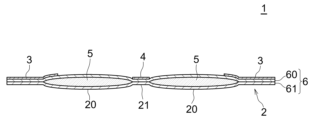
- FIG. 2 is a cross-sectional view of the heating device for hands and feet according to one embodiment of the present disclosure (a cross-sectional view taken along line AA in FIG. 1).
- FIG. 3 is a cross-sectional view illustrating the steps of a method for using the heating device for hands and feet according to one embodiment of the present disclosure.
- FIG. 4 is a perspective view illustrating the steps of a method of using the heating device for hands and feet according to one embodiment of the present disclosure.
- FIG. 5 is a perspective view illustrating the steps of a method of using the heating device for hands and feet according to one embodiment of the present disclosure.
- FIG. 1 is a plan view of a heating device for hands and feet according to one embodiment of the present disclosure.
- FIG. 2 is a cross-sectional view of the heating device for hands and feet according to one embodiment of the present disclosure (a cross-sectional view taken along line AA in FIG
- FIG. 6 is a plan view of a heating device for hands and feet according to an embodiment of the present disclosure, worn on the toes.
- FIG. 7 is a cross-sectional view of a heating device for hands and feet according to an embodiment of the present disclosure, worn on the toes.
- the heating device for hands and feet disclosed herein is used, for example, to warm the tips of the hands, such as the fingers, or the tips of the feet, such as the toes.
- the heating device for hands and feet can be worn directly on bare feet, wrapping the tips of the toes from the tips of the fingers, to effectively alleviate the coldness of the feet.
- usage examples of the heating device for hands and feet disclosed herein are not limited to the above examples.
- the heating device for hands and feet disclosed herein is preferably worn directly on the skin of the feet or hands, but does not exclude usage forms in which it is worn on the feet or hands wearing socks, stockings, tights, gloves, etc.
- the heating device for hands and feet disclosed herein will be described with reference to the attached drawings. Note that in the user's hands and feet, the direction toward the tips of the fingers is referred to as the "forward direction,” and the opposite direction is referred to as the “rearward direction.” Additionally, the width direction of the hand and foot perpendicular to the front-to-back direction is referred to as the "left-right direction.”
- FIGS 1 and 2 show the heating device for hands and feet 1 of this embodiment.
- the heating device for hands and feet 1 comprises a heating device main body 2 having a pair of heat generating parts 20, a pair of first adhesive layers 3, and a second adhesive layer 4.
- the heating device main body 2 comprises a pair of heat generating parts 20 arranged at a distance from each other.
- the direction in which the pair of heat generating parts 20 are lined up is the vertical direction, and the direction perpendicular to the vertical direction is the horizontal direction.
- one of the pair of heat generating parts 20 is a part that applies heat to the front side of the fingertips or toes
- the other of the pair of heat generating parts 20 is a part that applies heat to the back side of the fingertips or toes.
- the heating device main body 2 can be folded between the pair of heat generating parts 20.
- the heating device main body 2 has a folding part 21 between the pair of heat generating parts 20.
- the heating device main body 2 can be folded at the folding part 21, for example, by being flexible.
- the heating device main body 2 is preferably formed in a thin, flat shape. This allows the heating device main body 2 to be easily folded at the folding part 21.
- the heating device main body 2 is attached to the fingertips or toes with its length facing the front-to-back direction of the hand or foot.
- the bent portion 21 between the pair of heat generating parts 20 of the heating device main body 2 is arranged on the tip side of the toes of the hand or toe, one heat generating part 20 of the heating device main body 2 is arranged on the sole side of the hand or foot (palm or sole), and by bending the heating device main body 2, the other heat generating part 20 of the heating device main body 2 is arranged on the front side of the hand or foot (back of the hand or back of the foot).
- the heating device main body 2 wraps around the fingertips or toes from the tips of the fingers, and the pair of heat generating parts 20 apply heat to the fingertips or toes from both the front and back sides.
- the heating device body 2 is preferably formed in a vertically elongated shape with a larger vertical dimension than a horizontal dimension, although there is no particular limitation.
- the vertical length of the heating device body 2, i.e., the distance D between both vertical ends, is designed so that when the heating device body 2 is attached to the fingertips or toes, both vertical ends E reach the palm and back of the hand beyond the base of the fingers if the heating device body 2 is attached to the fingertips, and both vertical ends E reach the sole and top of the foot if the heating device body 2 is attached to the toes.
- the heating device main body 2 is formed with an external shape that is symmetrical with respect to a center line C that extends horizontally (i.e., a line that passes through the vertical center of the heating device main body 2 and bisects the vertical length D of the heating device main body 2). Therefore, the bent portion 21 between a pair of heat generating parts 20 of the heating device main body 2 is located in the vertical center of the heating device main body 2.
- the heating device main body 2 is also formed with an external shape that is symmetrical with respect to a center line that extends vertically (i.e., a line that bisects the horizontal length and is perpendicular to the center line C). It is not necessary for the heating device main body 2 to be formed with an external shape that is symmetrical with respect to the center line C that extends horizontally and the center line that extends vertically.
- the heating device main body 2 has a pair of side edges 22 and a pair of end edges 23, and the pair of side edges 22 and the pair of end edges 23 form the outer shape of the heating device main body 2.
- the pair of end edges 23 extend along the lateral direction of the heating device main body 2 and are spaced apart in the longitudinal direction.
- the pair of side edges 22 extend along the longitudinal direction of the heating device main body 2 and are spaced apart in the lateral direction.
- the corners of the pair of side edges 22 and the pair of end edges 23 are rounded, although this is not limited thereto.
- the pair of side edges 22 are not particularly limited, but are preferably inclined so that the distance between them gradually increases from the bent portion 21 in the vertical center (between the pair of heat generating parts 20) toward both ends E in the vertical direction.
- the pair of side edges 22 are constricted at the bent portion 21 in the vertical center (between the pair of heat generating parts 20), and the horizontal length of the heating device main body 2 is preferably narrowest at the bent portion 21 in the vertical center (between the pair of heat generating parts 20) and increases toward both ends E in the vertical direction. Since the horizontal length of the heating device main body 2 is narrowest at the bent portion 21 in the vertical center (between the pair of heat generating parts 20), the heating device main body 2 is easily bent at the bent portion 21 between the pair of heat generating parts 20.
- the pair of side edges 22 may be inclined linearly to form a gentle V-shape, or may be inclined curvedly to be smoothly concave.
- Fingers and toes are shaped so that the length (width) in the left-right direction gradually increases from the base of the fingers to the tip side in a plan view. Therefore, if the pair of side edges 22 of the heating device main body 2 are inclined so that the distance between them gradually increases from the vertical center toward both vertical ends, the shape of the part of the heating device main body 2 from the vertical center (between the pair of heat generating parts 20) to both vertical ends E will be a shape that conforms to the shape of the fingers and toes. This makes it possible to prevent the heating device main body 2 from having a marginal part that protrudes from the finger or foot and does not come into contact with the finger or foot when the heating device main body 2 is attached to the finger or foot. If the heating device main body 2 has a large marginal part that protrudes from the finger or foot when the heating device main body 2 is attached to the finger or foot, the user may feel uncomfortable when using the device, so this embodiment reduces the discomfort felt by the user when using the device.
- a first recess 24 is preferably formed in the vertical center of the pair of side edges 22 (between the pair of heat generating parts 20), recessing toward the opposite side edge 22.
- the maximum width of the first recess 24 is about 3 mm to 7 mm, and the depth of the first recess 24 is about 2 mm to 5 mm.
- the first recess 24 is formed in a semicircular shape, but it may be formed in various shapes, such as a triangular shape with an acute or obtuse angle.
- a second recess 25 recessed toward the opposite side edge 22 is formed near both ends E of the pair of side edges 22 in the vertical direction.
- the second recess 25 is formed in the attachment area 26 of the heating device main body 2 where the first adhesive layer 3 is formed and attached to the fingertips or toes.
- the maximum width of the second recess 25 is about 6 mm to 10 mm
- the depth of the second recess 25 is about 2 mm to 5 mm
- the second recess 25 is formed in a size and shape that does not contact the heat generating part 20.
- the second recess 25 is formed in a semicircular shape, but may be formed in various shapes such as a triangular shape with an acute or obtuse angle.
- the attachment area 26 of the heating device main body 2 is easily deformed at the position of the second recess 25.
- the attachment area 26 of the heating device main body 2 that is attached to the hands or feet can easily follow the movement of the skin of the hands or feet, making it difficult for the attachment area 26 of the heating device main body 2 to peel off from the hands or feet.
- the pair of edges 23 are curved so as to bulge outward in the vertical direction.
- the pair of edges 23 may be formed straight, or may be curved so as to be recessed inward in the vertical direction.
- the vertical end E of the heating device main body 2 is the position of the pair of edges 23 that is the outermost in the vertical direction. In this embodiment, the center position in the horizontal direction of the pair of edges 23 is the vertical end E of the heating device main body 2.
- the heating device main body 2 is composed of, for example, a heat generating material 5 and a sheet material 6.
- the heat generating material 5 is held by the sheet material 6.
- the portion of the sheet material 6 where the heat generating material 5 is held is the heat generating section 20 of the heating device main body 2.
- the heat generating material 5 may be built into the sheet material 6, or may be attached externally to the sheet material 6.
- the heating material warming device main body 2 can provide warmth to the user's hands and feet by the heating material 5 shown in FIG. 2 generating heat.
- the material of the heating material 5 is not particularly limited as long as the heating material 5 can generate heat in some way.
- a preferred example of the material of the heating material 5 is a powdered, granular or fibrous exothermic composition that generates heat in association with an oxidation reaction caused by contact with air and is used in conventional chemical warmers.
- the exothermic composition contains, for example, a predetermined amount of an oxidizable metal, activated carbon, a water retention agent, a metal salt and water.
- the oxidizable metal is a metal that generates heat in an oxidation reaction, and examples of the metal include one or more selected from iron, aluminum, zinc, manganese, magnesium and calcium.
- the water retention agent include wood flour, vermiculite, diatomaceous earth, perlite, silica gel, alumina and water-absorbent resin.
- the metal salt include table salt.
- the material for the heat generating material 5 include materials that generate heat when irradiated with microwaves from a microwave oven or the like, specifically, ceramic powders such as powdered ferrite, red beans, or gel-like heat storage materials.
- gel-like heat storage materials include polyvinyl alcohol, carboxymethyl cellulose, polyacrylamide, sodium polyacrylate, and carboxyvinyl polymer.
- the above-mentioned powdery, granular, fibrous or gel-like materials exemplified as the materials for the heat generating material 5 may be enclosed inside the sheet material 6, or may be enclosed in a bag and fixed to the outside of the sheet material 6.
- a powdery, granular or fibrous heat generating composition is enclosed inside the sheet material 6.
- the sheet material 6 is composed of two sheets 60, 61, e.g., a first sheet 60 and a second sheet 61, which are flexible.
- the sheet material 6 is formed into a flat bag shape by overlapping the two sheets 60, 61 and bonding the two sheets 60, 61 along the entire periphery.
- the bonded portion on the periphery of the sheet material 6 is referred to as the "periphery bonded portion.”
- the internal space inside the peripheral bonded portion is the storage space for the heat generating material 5.
- the width of the outer peripheral joint may be approximately the same around the entire circumference, or may vary as in this embodiment.
- the outer peripheral joint is formed so that the width of the portion along the pair of end edges 23 of the heating device main body 2 is wider than the width of the portion along the pair of side edges 22 of the heating device main body 2.
- the width of the portion along the pair of side edges 22 of the heating device main body 2 is, for example, 5 mm or more and 9 mm or less
- the width of the portion along the pair of end edges 23 is, for example, 20 mm or more and 25 mm or less.
- the two sheets 60, 61 of the sheet material 6 are also joined at the center in the vertical direction.
- the joined portion at the center in the vertical direction of the sheet material 6 is referred to as the "central joint".
- the central joint crosses the sheet material 6 and both ends are connected to the peripheral joints.
- the internal space of the sheet material 6 is divided by the central joint into two storage spaces spaced apart in the vertical direction of the sheet material 6.
- the central joint of the sheet material 6 corresponds to the folded portion 21 between the pair of heat generating portions 20 of the heating device main body 2.
- the joining of the two sheets 60, 61 described above can be achieved by methods such as thermal welding (heat sealing), ultrasonic welding, adhesion, and sewing.
- the width of the central joint is, for example, 2 mm to 7 mm.
- the first sheet 60 comes into contact with the fingers or toes when the heating device main body 2 is folded to encase the fingers or toes.
- the second sheet 61 is exposed to the outside when the heating device main body 2 is folded to encase the fingers or toes.
- the first sheet 60 constitutes one of the main surfaces, front or back, of the heating device main body 2, and the second sheet 61 constitutes the other main surface, front or back, of the heating device main body 2.
- a pair of first adhesive layers 3 and second adhesive layers 4 are formed on the first sheet 60.
- the resin material for the resin film is preferably a thermoplastic resin.
- thermoplastic resins include polyethylene, polypropylene, polyester, polyamide, polyurethane, polystyrene, polyvinyl alcohol, polyvinyl chloride, polyvinylidene chloride, polycarbonate, and ethylene-vinyl acetate copolymer.
- the resin film may be formed from one of the above-mentioned resins, or may be formed from a combination of two or more types.
- the first sheet 60 and the second sheet 61 are preferably formed by laminating a woven or nonwoven fabric to a resin film from the viewpoint of improving the feel on the hands and feet.
- fibers that are the material for the woven or nonwoven fabric include natural fibers such as cotton, hemp, silk, and paper; semi-synthetic fibers such as rayon and acetate; synthetic fibers such as nylon, vinylon, polyester, acrylic, polyethylene, polypropylene, polyvinyl chloride, and polybutylene terephthalate; and mixed fibers of the above-mentioned fibers.
- nylon, polyester, and polypropylene are preferred from the viewpoint of improving the feel on the skin.
- the woven or nonwoven fabric may be formed from one of the above-mentioned fiber materials, or may be formed from a combination of two or more types.
- the weight of the woven or nonwoven fabric is designed to allow air to pass through but to prevent the passage of heat-generating materials such as powder.
- At least one of the first sheet 60 and the second sheet 61 is breathable.
- the second sheet 61 exposed to the outside when the heating device main body 1 is folded to encase the fingertips or toes is breathable.
- a resin film having multiple micropores is used for the second sheet 61.
- the micropores are designed to have dimensions that allow air to pass through but prevent the passage of heat-generating materials such as powder.
- Resin films having multiple micropores are conventionally known, and examples include resin films or porous films in which numerous perforations are formed. The multiple micropores may be uniformly present throughout the entire resin film, or may be densely present in a portion of the resin film.
- the first sheet 60 and the second sheet 61 do not necessarily need to be made of resin film, and may be made of only woven fabric or nonwoven fabric.
- the sheet material 6 in this embodiment is composed of two separate sheets, a first sheet 60 and a second sheet 61.
- the sheet material 6 may also be composed of a single flexible and breathable sheet.
- the sheet material 6 may be formed into a flattened bag by folding a single sheet in half, folding one of the two equal parts of the sheet over the other, and joining the one and the other parts along the entire periphery.
- the sheet material 6 can be made of a single sheet or a laminate of multiple sheets.
- the first adhesive layer 3 is a portion where adhesive is present on both ends of the heating device main body 2 in the vertical direction.
- the pair of first adhesive layers 3 allows the heating device main body 2 to be attached to the user's fingers or toes.
- adhesives that form the first adhesive layer 3 include acrylic adhesives, vinyl adhesives, vinyl acetate adhesives, polyvinyl acetal adhesives, vinyl chloride adhesives, cellulose adhesives, chloroprene adhesives, nitrile rubber adhesives, styrene rubber adhesives, silicone rubber adhesives, polysulfide adhesives, terpene resins, water-soluble rosins, and other adhesives.
- the first adhesive layer 3 is preferably formed using an acrylic adhesive in order to ensure an adhesive strength that is neither too strong nor too weak.
- the first adhesive layer 3 is formed on a portion of one vertical end of the heating device main body 2, and on a portion of the other vertical end of the heating device main body 2. Note that the portion on the vertical end E side of the heating device main body 2 refers to a portion of the heating device main body 2 that extends a predetermined length from the vertical end E toward the vertical center.
- the pair of first adhesive layers 3 serve to attach the heating device main body 2 to the user's fingers or toes. Therefore, the portion of the heating device main body 2 where the pair of first adhesive layers 3 are formed is the attachment area 26 that is attached to the fingers or toes. In addition, the portion of the heating device main body 2 between the pair of first adhesive layers 3 is a non-adhesive area 27 that is free of adhesive, except for the folded portion 21 where the second adhesive layer 4 is formed. In other words, the area between one first adhesive layer 3 and the second adhesive layer 4, and the area between the other first adhesive layer 3 and the second adhesive layer 4 are each a non-adhesive area 27.
- both vertical ends E reach beyond the base of the fingers and reach the palm and back of the hand or the sole and instep of the foot. Since the first adhesive layer 3 is formed on a portion of both vertical ends E of the heating device main body 2, the attachment area 26 of the heating device main body 2 is attached mostly to the palm and back of the hand or the sole and instep of the foot at the fingertips or toes, and is hardly attached to the finger parts. The non-adhesive area 27 of the heating device main body 2 mostly touches the finger parts. Therefore, even if the heating device main body 2 is attached directly to the skin of the fingertips or toes, it is prevented from making it difficult to move the fingers. This reduces the discomfort felt by the user when using the heating device for hands and feet 1.
- the first adhesive layer 3 is preferably formed in a portion that extends from the vertical end E of the heating device main body 2 toward the vertical center, over a length of at least 1/6 of the distance D between both vertical ends.
- the pair of attachment areas 26 are preferably areas whose outer edges are along the end edges 23 of the heating device main body 2, and whose inner edges extend to a position where d is the length from the vertical end E of the heating device main body 2, d ⁇ 1/6D. This ensures that the vertical length d of the attachment areas 26 in the heating device main body 2 is sufficiently secured, so that the heating device main body 2 can be firmly attached to the fingertips or toes. This makes it difficult for the heating device main body 2 to peel off from the fingertips or toes when the heating device for hands and feet 1 is in use.
- the first adhesive layer 3 is preferably formed in a portion that extends from the vertical end E of the heating device main body 2 toward the vertical center, over a length of 1/4 or less of the distance D between both vertical ends.
- the pair of attachment areas 26 are preferably areas that extend to a position where the inner edge is d ⁇ 1/4D. In the heating device main body 2, if the attachment area 26 spreads too far vertically, when the heating device main body 2 is attached to the finger or foot, the attachment area 26 may extend too far toward the fingers of the finger or foot and stick to the finger, hindering the freedom of movement of the finger.
- the attachment area 26 is prevented from extending toward the fingers of the finger or foot, so that the freedom of movement of the finger is not hindered. This effectively reduces the discomfort felt by the user when using the heating device for hands and feet 1.
- the inner edges of the pair of application areas 26 are formed in straight lines, they may be curved along the lateral direction of the heating device main body 2.
- the first adhesive layer 3 is preferably formed over the entire surface of each attachment area 26, but the first adhesive layer 3 may be formed partially in each attachment area 26.
- Examples of partially forming the first adhesive layer 3 in the attachment area 26 include a case where the first adhesive layer 3 is formed in a border pattern (multiple lines parallel in the horizontal direction) or a striped pattern (multiple lines parallel in the vertical direction), or a case where the first adhesive layer 3 is formed in a polka dot pattern with multiple dots evenly scattered.
- most of the first adhesive layer 3 is formed on the outer periphery joint of the heating device main body 2.
- the outer periphery joint is thinner and more easily deformed than the heating part 20 in which the heat generating material 5 is held, so by forming most of the first adhesive layer 3 on the outer periphery joint of the heating device main body 2, it becomes easier to attach the heating device main body 2 to the palm and back of the hand or the sole and back of the foot.
- the second adhesive layer 4 is a portion where adhesive is present in the vertical center of the heating device main body 2 (between the pair of heat generating parts 20).
- the folded state is maintained by bonding the folded parts 21 between the pair of heat generating parts 20 together with the second adhesive layer 4. Therefore, when attaching the heating device main body 2 to the fingertips or toes, the tips of the fingertips or toes can be easily aligned, making it easy to attach the heating device main body 2 to the appropriate position on the palm and back of the hand or the sole and back of the foot.
- Examples of adhesives that form the second adhesive layer 4 include acrylic adhesives, vinyl adhesives, vinyl acetate adhesives, polyvinyl acetal adhesives, vinyl chloride adhesives, cellulose adhesives, chloroprene adhesives, nitrile rubber adhesives, styrene rubber adhesives, silicone rubber adhesives, polysulfide adhesives, terpene resins, water-soluble rosin, and other adhesives.
- the second adhesive layer 4 may be formed over the entire area between the pair of heat generating parts 20, or the second adhesive layer 4 may be formed partially in the area between the pair of heat generating parts 20.
- Examples of a case in which the second adhesive layer 4 is formed partially in the area between the pair of heat generating parts 20 include a case in which the second adhesive layer 4 is formed in a border pattern (multiple lines parallel in the horizontal direction) or a striped pattern (multiple lines parallel in the vertical direction), or a case in which the second adhesive layer 4 is formed in a polka dot pattern with multiple dots evenly scattered.
- the heating device for hands and feet 1 of this embodiment is first folded at the folding part 21 between the pair of heat generating parts 20, and the folded folding part 21 is attached by the second adhesive layer 4.
- the toes are placed between the pair of heat generating parts 20, and at this time, the tips of each toe are aligned along the folding part 21.
- a part (attachment area 26) of one end side of the heating device main body 2 in the vertical direction is attached to the sole of the foot via one of the pair of first adhesive layers 3. This allows one of the pair of heat generating parts 20 to contact the sole of the toes.
- a part (attachment area 26) of the other end side of the heating device main body 2 in the vertical direction is attached to the instep via the other of the pair of first adhesive layers 3. This allows the other of the pair of heat generating parts 20 to contact the front side of the toes.
- the warming device for hands and feet 1 on the hands it can be used in the same manner as when using the warming device for hands and feet 1 on the toes.
- the pair of heat generating parts 20 contact the front and back sides of the fingertips or toes, respectively, so that heat can be applied to the fingertips or toes from both the front and back sides.
- the heating device main body 2 is attached to the fingertips or toes so as to wrap around the tips of the fingers, so that the tips of the fingers are not exposed and can be warmed up to the tips of the fingers.
- one of the pair of first adhesive layers 3 is formed on a portion (attachment area 26) on one end side of the heating device main body 2 in the vertical direction
- the other of the pair of first adhesive layers 3 is formed on a portion (attachment area 26) on the other end side of the heating device main body 2 in the vertical direction.
- the heating device for hands and feet 1 of this embodiment the user can easily move his/her fingers when using the heating device for hands and feet 1, and the discomfort caused by the difficulty in moving the fingers can be reduced.
- the second adhesive layer 4 is formed at the folding portion 21 between the pair of heat generating parts 20 of the heating device main body 2.
- the heating device main body 2 is easy to attach to the fingertips or toes.
- a pair of side edges 22 of the heating device main body 2 is formed between the pair of heat generating parts 20 with a recess 24 that is recessed toward the opposite side edge 22.
- the pair of side edges 22 of the heating device main body 2 are inclined so that the distance between them gradually increases from between the pair of heat generating parts 20 toward both ends of the heating device main body 2 in the vertical direction.
- the heating device main body 2 has a narrowest horizontal length between the pair of heat generating parts 20. Therefore, according to the heating device for hands and feet 1 of this embodiment, it is easy to fold the heating device main body 2 between the pair of heat generating parts 20.
- the shape of the portion of the heating device main body 2 extending from between the pair of heat generating parts 20 to both ends E in the vertical direction can be shaped to match the shape of the fingers and toes. This makes it possible to prevent the heating device main body 2 from having marginal portions that protrude beyond the fingers or toes and do not come into contact with the fingers or toes when the heating device main body 2 is attached to the fingers or toes. Therefore, with the heating device for hands and feet 1 of this embodiment, it is possible to reduce the discomfort caused by the large amount of marginal portions of the heating device main body 2 that protrude beyond the fingers or toes when the user uses the heating device for hands and feet 1.
- the heating device main body 2 has a widest horizontal length at both vertical ends E. This ensures a wide area for the attachment region 26 at both vertical ends of the heating device main body 2. Therefore, with the heating device for hands and feet 1 of this embodiment, the heating device main body 2 can be firmly attached to the fingertips or toes, so that the heating device main body 2 is less likely to peel off from the fingertips or toes when the heating device for hands and feet 1 is in use.
- the heating device for hands and feet of the present disclosure is not limited to the above-mentioned embodiment, and various modifications can be made without departing from the spirit of the present disclosure. For example, the following modifications can be made. In addition, the gist of the following modifications can be combined as appropriate.
- the bend 21 between the pair of heat generating parts 20 of the heating device main body 2 is located in the vertical center of the heating device main body 2.
- the bend 21 may be offset from the vertical center of the heating device main body 2.
- the pair of heat generating parts 20 of the heating device main body 2 in the above embodiment may each be configured as a collection of multiple smaller heat generating parts that are partitioned from each other.
- the pair of heat generating parts 20 of the heating device main body 2 may each be configured as two or more small heat generating parts that are partitioned and lined up in the vertical direction of the heating device main body 2, or two or more small heat generating parts that are partitioned and lined up in the horizontal direction of the heating device main body 2.
- the second adhesive layer 4 is formed between the pair of heat generating parts 20 of the heating device main body 2.
- the area between the pair of heat generating parts 20 of the heating device main body 2 may be a non-adhesive area with no adhesive.
- the pair of side edges 22 of the heating device main body 2 are inclined inward (so that the distance between the pair of side edges 22 gradually narrows) as they approach the space between the pair of heat generating parts 20 in the vertical direction.
- the pair of side edges 22 of the heating device main body 2 may be parallel to each other in the vertical direction so that the distance between them is constant.
- a first recess 24 and a second recess 25 are formed on a pair of side edges 22 of the heating device main body 2.
- only the first recess 24 may be formed on the pair of side edges 22 of the heating device main body 2, only the second recess 25 may be formed, or neither the first recess 24 nor the second recess 25 may be formed.
Landscapes
- Health & Medical Sciences (AREA)
- Vascular Medicine (AREA)
- Thermal Sciences (AREA)
- Engineering & Computer Science (AREA)
- Biomedical Technology (AREA)
- Heart & Thoracic Surgery (AREA)
- Physics & Mathematics (AREA)
- Life Sciences & Earth Sciences (AREA)
- Animal Behavior & Ethology (AREA)
- General Health & Medical Sciences (AREA)
- Public Health (AREA)
- Veterinary Medicine (AREA)
- Thermotherapy And Cooling Therapy Devices (AREA)
Abstract
La présente invention a pour objet de fournir un dispositif de chauffage des mains/pieds qui, lorsqu'il est utilisé au niveau des mains ou des pieds, peut chauffer les extrémités des doigts/orteils mais n'entrave pas le mouvement des doigts/orteils. La solution selon l'invention consiste en un dispositif de chauffage des mains/pieds 1 comprenant : un corps de dispositif de chauffage 2 qui comprend une paire de parties émettrices de chaleur 20 et peut se courber entre celles-ci, la paire de parties émettrices de chaleur 20 contenant un matériau émetteur de chaleur 5 et étant disposée à un intervalle dans la direction verticale ; et une paire de premières couches adhésives 3 pour coller le corps de dispositif de chauffage 2 à la main ou au pied d'un utilisateur. L'une de la paire de premières couches adhésives 3 est formée au niveau d'une partie d'un côté première extrémité du corps de dispositif de chauffage 2 dans la direction verticale, et l'autre de la paire de premières couches adhésives 3 est formée au niveau d'une partie du côté autre extrémité du corps de dispositif de chauffage 2 dans la direction verticale.
Applications Claiming Priority (2)
| Application Number | Priority Date | Filing Date | Title |
|---|---|---|---|
| JP2023-093044 | 2023-06-06 | ||
| JP2023093044A JP2024175339A (ja) | 2023-06-06 | 2023-06-06 | 手足用温熱具 |
Publications (1)
| Publication Number | Publication Date |
|---|---|
| WO2024252914A1 true WO2024252914A1 (fr) | 2024-12-12 |
Family
ID=93795443
Family Applications (1)
| Application Number | Title | Priority Date | Filing Date |
|---|---|---|---|
| PCT/JP2024/018604 Ceased WO2024252914A1 (fr) | 2023-06-06 | 2024-05-21 | Dispositif de chauffage des mains/pieds |
Country Status (3)
| Country | Link |
|---|---|
| JP (1) | JP2024175339A (fr) |
| TW (1) | TW202448401A (fr) |
| WO (1) | WO2024252914A1 (fr) |
Citations (3)
| Publication number | Priority date | Publication date | Assignee | Title |
|---|---|---|---|---|
| JPS56103149U (fr) * | 1980-01-10 | 1981-08-12 | ||
| JP2005349024A (ja) * | 2004-06-11 | 2005-12-22 | Hakugen:Kk | 足用温熱体 |
| JP2014177726A (ja) * | 2013-03-15 | 2014-09-25 | Masahiro Isoda | 手袋内手指保温用使い捨てカイロ |
-
2023
- 2023-06-06 JP JP2023093044A patent/JP2024175339A/ja active Pending
-
2024
- 2024-05-14 TW TW113117793A patent/TW202448401A/zh unknown
- 2024-05-21 WO PCT/JP2024/018604 patent/WO2024252914A1/fr not_active Ceased
Patent Citations (3)
| Publication number | Priority date | Publication date | Assignee | Title |
|---|---|---|---|---|
| JPS56103149U (fr) * | 1980-01-10 | 1981-08-12 | ||
| JP2005349024A (ja) * | 2004-06-11 | 2005-12-22 | Hakugen:Kk | 足用温熱体 |
| JP2014177726A (ja) * | 2013-03-15 | 2014-09-25 | Masahiro Isoda | 手袋内手指保温用使い捨てカイロ |
Also Published As
| Publication number | Publication date |
|---|---|
| TW202448401A (zh) | 2024-12-16 |
| JP2024175339A (ja) | 2024-12-18 |
Similar Documents
| Publication | Publication Date | Title |
|---|---|---|
| JP3857048B2 (ja) | 廃棄可能で弾性のある一軸関節用温熱ラップ | |
| US20200138625A1 (en) | Exothermically heated elastic adhesive tape and wrap with improvements | |
| EP1990031A2 (fr) | Dispositif de chauffage multi-coutures avec adhésif disposé dessus et procédés de chauffage | |
| JPH0898856A (ja) | カイロ用粘着剤加工包材 | |
| EP1990029A2 (fr) | Dispositif de chauffage multi-coutures avec adhésif disposé dessus et procédés de chauffage | |
| JP2024175339A (ja) | 手足用温熱具 | |
| US20230029162A1 (en) | Heat generator for knees | |
| CN112135587A (zh) | 发热用具 | |
| JPH05176951A (ja) | 使いすて足温め懐炉 | |
| JP4628699B2 (ja) | 足用温熱体 | |
| WO2025100142A1 (fr) | Élément chauffant | |
| TWI807061B (zh) | 發熱件 | |
| TWI807060B (zh) | 發熱件 | |
| KR102148530B1 (ko) | 천돌혈 부착형 온열 패치 | |
| JPH0626829U (ja) | 使いすてカイロおよびそれを使用した湿布用具 | |
| JP3120300U (ja) | 足首保温用使い捨てカイロ | |
| JP2022014551A (ja) | 発熱具 | |
| JP7366699B2 (ja) | 足元用発熱体 | |
| JP2024062691A (ja) | 肛門用発熱体及びいぼ痔治療用発熱体 | |
| JPH07213549A (ja) | 使い捨てカイロ | |
| JPS6142590Y2 (fr) | ||
| JP4636482B2 (ja) | 温熱材 | |
| JP3895149B2 (ja) | 貼着型カイロ | |
| JPH0674122U (ja) | 使い捨てカイロ | |
| JP2002017768A (ja) | 懐 炉 |
Legal Events
| Date | Code | Title | Description |
|---|---|---|---|
| 121 | Ep: the epo has been informed by wipo that ep was designated in this application |
Ref document number: 24819147 Country of ref document: EP Kind code of ref document: A1 |
|
| NENP | Non-entry into the national phase |
Ref country code: DE |