WO2024252926A1 - Polypropylene-based non-stretched film and laminate using same - Google Patents
Polypropylene-based non-stretched film and laminate using same Download PDFInfo
- Publication number
- WO2024252926A1 WO2024252926A1 PCT/JP2024/018779 JP2024018779W WO2024252926A1 WO 2024252926 A1 WO2024252926 A1 WO 2024252926A1 JP 2024018779 W JP2024018779 W JP 2024018779W WO 2024252926 A1 WO2024252926 A1 WO 2024252926A1
- Authority
- WO
- WIPO (PCT)
- Prior art keywords
- film
- polypropylene
- heat
- mass
- propylene
- Prior art date
- Legal status (The legal status is an assumption and is not a legal conclusion. Google has not performed a legal analysis and makes no representation as to the accuracy of the status listed.)
- Ceased
Links
Classifications
-
- C—CHEMISTRY; METALLURGY
- C08—ORGANIC MACROMOLECULAR COMPOUNDS; THEIR PREPARATION OR CHEMICAL WORKING-UP; COMPOSITIONS BASED THEREON
- C08J—WORKING-UP; GENERAL PROCESSES OF COMPOUNDING; AFTER-TREATMENT NOT COVERED BY SUBCLASSES C08B, C08C, C08F, C08G or C08H
- C08J5/00—Manufacture of articles or shaped materials containing macromolecular substances
- C08J5/18—Manufacture of films or sheets
-
- B—PERFORMING OPERATIONS; TRANSPORTING
- B32—LAYERED PRODUCTS
- B32B—LAYERED PRODUCTS, i.e. PRODUCTS BUILT-UP OF STRATA OF FLAT OR NON-FLAT, e.g. CELLULAR OR HONEYCOMB, FORM
- B32B15/00—Layered products comprising a layer of metal
- B32B15/04—Layered products comprising a layer of metal comprising metal as the main or only constituent of a layer, which is next to another layer of the same or of a different material
- B32B15/08—Layered products comprising a layer of metal comprising metal as the main or only constituent of a layer, which is next to another layer of the same or of a different material of synthetic resin
- B32B15/085—Layered products comprising a layer of metal comprising metal as the main or only constituent of a layer, which is next to another layer of the same or of a different material of synthetic resin comprising polyolefins
-
- B—PERFORMING OPERATIONS; TRANSPORTING
- B32—LAYERED PRODUCTS
- B32B—LAYERED PRODUCTS, i.e. PRODUCTS BUILT-UP OF STRATA OF FLAT OR NON-FLAT, e.g. CELLULAR OR HONEYCOMB, FORM
- B32B15/00—Layered products comprising a layer of metal
- B32B15/20—Layered products comprising a layer of metal comprising aluminium or copper
-
- B—PERFORMING OPERATIONS; TRANSPORTING
- B32—LAYERED PRODUCTS
- B32B—LAYERED PRODUCTS, i.e. PRODUCTS BUILT-UP OF STRATA OF FLAT OR NON-FLAT, e.g. CELLULAR OR HONEYCOMB, FORM
- B32B27/00—Layered products comprising a layer of synthetic resin
- B32B27/06—Layered products comprising a layer of synthetic resin as the main or only constituent of a layer, which is next to another layer of the same or of a different material
- B32B27/08—Layered products comprising a layer of synthetic resin as the main or only constituent of a layer, which is next to another layer of the same or of a different material of synthetic resin
-
- B—PERFORMING OPERATIONS; TRANSPORTING
- B32—LAYERED PRODUCTS
- B32B—LAYERED PRODUCTS, i.e. PRODUCTS BUILT-UP OF STRATA OF FLAT OR NON-FLAT, e.g. CELLULAR OR HONEYCOMB, FORM
- B32B27/00—Layered products comprising a layer of synthetic resin
- B32B27/32—Layered products comprising a layer of synthetic resin comprising polyolefins
-
- B—PERFORMING OPERATIONS; TRANSPORTING
- B32—LAYERED PRODUCTS
- B32B—LAYERED PRODUCTS, i.e. PRODUCTS BUILT-UP OF STRATA OF FLAT OR NON-FLAT, e.g. CELLULAR OR HONEYCOMB, FORM
- B32B27/00—Layered products comprising a layer of synthetic resin
- B32B27/34—Layered products comprising a layer of synthetic resin comprising polyamides
-
- B—PERFORMING OPERATIONS; TRANSPORTING
- B32—LAYERED PRODUCTS
- B32B—LAYERED PRODUCTS, i.e. PRODUCTS BUILT-UP OF STRATA OF FLAT OR NON-FLAT, e.g. CELLULAR OR HONEYCOMB, FORM
- B32B27/00—Layered products comprising a layer of synthetic resin
- B32B27/36—Layered products comprising a layer of synthetic resin comprising polyesters
-
- C—CHEMISTRY; METALLURGY
- C08—ORGANIC MACROMOLECULAR COMPOUNDS; THEIR PREPARATION OR CHEMICAL WORKING-UP; COMPOSITIONS BASED THEREON
- C08J—WORKING-UP; GENERAL PROCESSES OF COMPOUNDING; AFTER-TREATMENT NOT COVERED BY SUBCLASSES C08B, C08C, C08F, C08G or C08H
- C08J7/00—Chemical treatment or coating of shaped articles made of macromolecular substances
- C08J7/12—Chemical modification
- C08J7/123—Treatment by wave energy or particle radiation
-
- B—PERFORMING OPERATIONS; TRANSPORTING
- B32—LAYERED PRODUCTS
- B32B—LAYERED PRODUCTS, i.e. PRODUCTS BUILT-UP OF STRATA OF FLAT OR NON-FLAT, e.g. CELLULAR OR HONEYCOMB, FORM
- B32B2255/00—Coating on the layer surface
- B32B2255/10—Coating on the layer surface on synthetic resin layer or on natural or synthetic rubber layer
-
- B—PERFORMING OPERATIONS; TRANSPORTING
- B32—LAYERED PRODUCTS
- B32B—LAYERED PRODUCTS, i.e. PRODUCTS BUILT-UP OF STRATA OF FLAT OR NON-FLAT, e.g. CELLULAR OR HONEYCOMB, FORM
- B32B2255/00—Coating on the layer surface
- B32B2255/20—Inorganic coating
-
- B—PERFORMING OPERATIONS; TRANSPORTING
- B32—LAYERED PRODUCTS
- B32B—LAYERED PRODUCTS, i.e. PRODUCTS BUILT-UP OF STRATA OF FLAT OR NON-FLAT, e.g. CELLULAR OR HONEYCOMB, FORM
- B32B2255/00—Coating on the layer surface
- B32B2255/20—Inorganic coating
- B32B2255/205—Metallic coating
-
- B—PERFORMING OPERATIONS; TRANSPORTING
- B32—LAYERED PRODUCTS
- B32B—LAYERED PRODUCTS, i.e. PRODUCTS BUILT-UP OF STRATA OF FLAT OR NON-FLAT, e.g. CELLULAR OR HONEYCOMB, FORM
- B32B2307/00—Properties of the layers or laminate
- B32B2307/30—Properties of the layers or laminate having particular thermal properties
-
- B—PERFORMING OPERATIONS; TRANSPORTING
- B32—LAYERED PRODUCTS
- B32B—LAYERED PRODUCTS, i.e. PRODUCTS BUILT-UP OF STRATA OF FLAT OR NON-FLAT, e.g. CELLULAR OR HONEYCOMB, FORM
- B32B2307/00—Properties of the layers or laminate
- B32B2307/30—Properties of the layers or laminate having particular thermal properties
- B32B2307/306—Resistant to heat
-
- B—PERFORMING OPERATIONS; TRANSPORTING
- B32—LAYERED PRODUCTS
- B32B—LAYERED PRODUCTS, i.e. PRODUCTS BUILT-UP OF STRATA OF FLAT OR NON-FLAT, e.g. CELLULAR OR HONEYCOMB, FORM
- B32B2307/00—Properties of the layers or laminate
- B32B2307/30—Properties of the layers or laminate having particular thermal properties
- B32B2307/31—Heat sealable
-
- B—PERFORMING OPERATIONS; TRANSPORTING
- B32—LAYERED PRODUCTS
- B32B—LAYERED PRODUCTS, i.e. PRODUCTS BUILT-UP OF STRATA OF FLAT OR NON-FLAT, e.g. CELLULAR OR HONEYCOMB, FORM
- B32B2307/00—Properties of the layers or laminate
- B32B2307/50—Properties of the layers or laminate having particular mechanical properties
- B32B2307/514—Oriented
- B32B2307/516—Oriented mono-axially
-
- B—PERFORMING OPERATIONS; TRANSPORTING
- B32—LAYERED PRODUCTS
- B32B—LAYERED PRODUCTS, i.e. PRODUCTS BUILT-UP OF STRATA OF FLAT OR NON-FLAT, e.g. CELLULAR OR HONEYCOMB, FORM
- B32B2307/00—Properties of the layers or laminate
- B32B2307/50—Properties of the layers or laminate having particular mechanical properties
- B32B2307/514—Oriented
- B32B2307/518—Oriented bi-axially
-
- B—PERFORMING OPERATIONS; TRANSPORTING
- B32—LAYERED PRODUCTS
- B32B—LAYERED PRODUCTS, i.e. PRODUCTS BUILT-UP OF STRATA OF FLAT OR NON-FLAT, e.g. CELLULAR OR HONEYCOMB, FORM
- B32B2307/00—Properties of the layers or laminate
- B32B2307/50—Properties of the layers or laminate having particular mechanical properties
- B32B2307/538—Roughness
-
- B—PERFORMING OPERATIONS; TRANSPORTING
- B32—LAYERED PRODUCTS
- B32B—LAYERED PRODUCTS, i.e. PRODUCTS BUILT-UP OF STRATA OF FLAT OR NON-FLAT, e.g. CELLULAR OR HONEYCOMB, FORM
- B32B2307/00—Properties of the layers or laminate
- B32B2307/50—Properties of the layers or laminate having particular mechanical properties
- B32B2307/542—Shear strength
-
- B—PERFORMING OPERATIONS; TRANSPORTING
- B32—LAYERED PRODUCTS
- B32B—LAYERED PRODUCTS, i.e. PRODUCTS BUILT-UP OF STRATA OF FLAT OR NON-FLAT, e.g. CELLULAR OR HONEYCOMB, FORM
- B32B2307/00—Properties of the layers or laminate
- B32B2307/70—Other properties
- B32B2307/726—Permeability to liquids, absorption
- B32B2307/7265—Non-permeable
-
- B—PERFORMING OPERATIONS; TRANSPORTING
- B32—LAYERED PRODUCTS
- B32B—LAYERED PRODUCTS, i.e. PRODUCTS BUILT-UP OF STRATA OF FLAT OR NON-FLAT, e.g. CELLULAR OR HONEYCOMB, FORM
- B32B2307/00—Properties of the layers or laminate
- B32B2307/70—Other properties
- B32B2307/732—Dimensional properties
- B32B2307/737—Dimensions, e.g. volume or area
- B32B2307/7375—Linear, e.g. length, distance or width
- B32B2307/7376—Thickness
-
- B—PERFORMING OPERATIONS; TRANSPORTING
- B32—LAYERED PRODUCTS
- B32B—LAYERED PRODUCTS, i.e. PRODUCTS BUILT-UP OF STRATA OF FLAT OR NON-FLAT, e.g. CELLULAR OR HONEYCOMB, FORM
- B32B2307/00—Properties of the layers or laminate
- B32B2307/70—Other properties
- B32B2307/744—Non-slip, anti-slip
-
- B—PERFORMING OPERATIONS; TRANSPORTING
- B32—LAYERED PRODUCTS
- B32B—LAYERED PRODUCTS, i.e. PRODUCTS BUILT-UP OF STRATA OF FLAT OR NON-FLAT, e.g. CELLULAR OR HONEYCOMB, FORM
- B32B2323/00—Polyalkenes
- B32B2323/10—Polypropylene
-
- C—CHEMISTRY; METALLURGY
- C08—ORGANIC MACROMOLECULAR COMPOUNDS; THEIR PREPARATION OR CHEMICAL WORKING-UP; COMPOSITIONS BASED THEREON
- C08J—WORKING-UP; GENERAL PROCESSES OF COMPOUNDING; AFTER-TREATMENT NOT COVERED BY SUBCLASSES C08B, C08C, C08F, C08G or C08H
- C08J2323/00—Characterised by the use of homopolymers or copolymers of unsaturated aliphatic hydrocarbons having only one carbon-to-carbon double bond; Derivatives of such polymers
- C08J2323/02—Characterised by the use of homopolymers or copolymers of unsaturated aliphatic hydrocarbons having only one carbon-to-carbon double bond; Derivatives of such polymers not modified by chemical after treatment
- C08J2323/10—Homopolymers or copolymers of propene
-
- C—CHEMISTRY; METALLURGY
- C08—ORGANIC MACROMOLECULAR COMPOUNDS; THEIR PREPARATION OR CHEMICAL WORKING-UP; COMPOSITIONS BASED THEREON
- C08J—WORKING-UP; GENERAL PROCESSES OF COMPOUNDING; AFTER-TREATMENT NOT COVERED BY SUBCLASSES C08B, C08C, C08F, C08G or C08H
- C08J2323/00—Characterised by the use of homopolymers or copolymers of unsaturated aliphatic hydrocarbons having only one carbon-to-carbon double bond; Derivatives of such polymers
- C08J2323/02—Characterised by the use of homopolymers or copolymers of unsaturated aliphatic hydrocarbons having only one carbon-to-carbon double bond; Derivatives of such polymers not modified by chemical after treatment
- C08J2323/10—Homopolymers or copolymers of propene
- C08J2323/14—Copolymers of propene
Definitions
- the present invention relates to a polypropylene-based unstretched film for retort food packaging and a laminate using the same.
- Laminates and packaging bags for retort food packaging include PET/ON/CPP and PET/ON/AL foil/CPP, which are made by laminating a heat-resistant base material such as biaxially oriented polyethylene terephthalate film (hereinafter sometimes referred to as PET), biaxially oriented polyamide film (hereinafter sometimes referred to as ON), or aluminum foil (hereinafter sometimes referred to as AL foil) with a heat-sealable unoriented polypropylene film (hereinafter sometimes referred to as CPP).
- a heat-resistant base material such as biaxially oriented polyethylene terephthalate film (hereinafter sometimes referred to as PET), biaxially oriented polyamide film (hereinafter sometimes referred to as ON), or aluminum foil (hereinafter sometimes referred to as AL foil) with a heat-sealable unoriented polypropylene film (hereinafter sometimes referred to as CPP).
- required properties for these packaging bags include heat resistance, impact resistance, high heat seal strength, blocking resistance,
- Patent Document 1 proposes a laminate in which a heat seal layer is laminated on one side of a biaxially oriented polypropylene film with high heat resistance and elastic modulus, but the low-temperature heat sealability, high-temperature blocking resistance, and retort suitability are insufficient.
- Patent Document 2 also proposes a polypropylene-based multi-layer sealant film for retort in which inorganic particles are added to the heat seal layer to define the surface roughness, but there are concerns about particles falling off during the film-forming and laminating processes and particles being mixed into food, and the film properties are insufficient in terms of low-temperature heat sealability, high-temperature blocking resistance, and retort suitability, and the bag-making processability is also poor.
- the objective of the present invention is to provide a polypropylene-based unstretched film that has excellent low-temperature heat sealability, high-temperature blocking resistance, bag-making processability, and retort suitability, and a laminate using the same, as a packaging bag for retort food packaging with a reduced number of layers that is environmentally friendly.
- the inventors have come to solve the above problem by using the following polypropylene-based unstretched film and a laminate using the same.
- the present invention relates to a polypropylene-based non-oriented film having as its main component a propylene-based random copolymer having a melting temperature peak of 135°C or higher and 145°C or lower, and having, on at least one side thereof, a surface as a heat seal surface, in which the film surface average roughness Ra is 0.1 ⁇ m or higher and the peak count of 0.3 ⁇ m or higher is 100 or more/10 mm2 .
- the present invention also provides a polypropylene-based unstretched film which is made up of two layers, a base layer and a seal layer, in which the base layer contains 50% by mass or more of a propylene-ethylene block copolymer, has a melting temperature peak of 150°C or higher, the seal layer has a melting temperature peak in the range of 135°C to 145°C, and has a heat-sealable surface which has an average surface roughness Ra of 0.1 ⁇ m or higher and a peak count of 0.3 ⁇ m or higher of 100/10 mm2 or higher .
- the ratio of the propylene-based random copolymer with a melting temperature peak in the range of 135°C to 145°C is less than 50% by mass, the heat seal strength of 23 N/15 mm or more at 170°C required for retort food applications cannot be obtained, and when the contents are filled into the bag and heat sterilized at 130°C or higher, scattering or leakage of the contents may occur.
- the peak melting temperature of the propylene random copolymer is in the range of 135°C to 145°C, which is preferable because it can provide a heat seal strength of 23N/15mm or more at 170°C, which is necessary for use in retort food, and can provide a blocking shear force of 15N/12cm2 or less at 130°C.
- the blocking shear force at 130° C. may be 15 N/12 cm2 or more. If the melting temperature peak is more than 145° C., when the heat seal surfaces are overlapped and heat sealed, the heat seal initiation temperature at which the heat seal strength is 3 N/15 mm or more may be 150° C. or more, slowing down the bag making speed.
- the melt flow rate (hereinafter sometimes referred to as MFR) of the propylene random copolymer is preferably in the range of 0.5 to 100 g/10 min (230°C, load 2.18 N), and preferably in the range of 2 to 20 g/10 min, since this allows stable melt extrusion film formation.
- the propylene-based random copolymer having a melting temperature peak in the range of 135°C to 145°C is preferably a propylene-based random copolymer consisting of propylene and one or more comonomers, which can achieve both high-temperature blocking resistance and heat seal strength.
- Examples of the comonomer include ethylene and ⁇ -olefins having 4 or more carbon atoms.
- Examples of the random copolymer include propylene-ethylene random copolymers of propylene and ethylene, random copolymers of propylene and ⁇ -olefins having 4 or more carbon atoms, and random copolymers of propylene, ethylene, and ⁇ -olefins having 4 or more carbon atoms.
- Examples of the ⁇ -olefins having 4 or more carbon atoms constituting the random copolymer include 1-butene, 4-methylpentene-1, 1-octene, 1-hexene, etc., and preferably 1-butene.
- the polypropylene-based non-oriented film of the present invention has an average film surface roughness Ra of 0.1 ⁇ m or more on at least one side that will become the heat seal surface.
- a roughness in the range of 0.2 to 0.7 ⁇ m is preferable because it provides good slipperiness of the film and good processability during film formation and lamination.
- the film surface is not formed using inorganic or organic particles, as this can prevent particles from falling off during film formation and from becoming mixed into the contents.
- the propylene random copolymer is mixed with at least one type of polyethylene and an organic peroxide crosslinking agent, and chips are produced by high-temperature, high-shear extrusion, and the chips are used to produce a film using a T-die type film-making machine or an inflation film-making machine.
- linear low density polyethylene which is a copolymer of ethylene and an ⁇ -olefin
- LLDPE linear low density polyethylene
- ⁇ -olefin a copolymer of ethylene and an ⁇ -olefin
- examples of the ⁇ -olefin constituting the linear low density polyethylene include 1-butene, 1-hexene, and 1-octene.
- the peak melting temperature of the polyethylene is preferably 100°C or higher and lower than 140°C, and more preferably 120°C or higher and lower than 140°C, from the viewpoints of heat seal strength and blocking shear force at 130°C.
- the amount of the linear low density polyethylene (LLDPE) mixed into the propylene-based random copolymer is preferably less than 50% by mass, more preferably 5 to 40% by mass, and even more preferably 10 to 30% by mass, which is preferable because it is easy to obtain the average surface roughness of the film and a peak count of 0.3 ⁇ m or more, and the blocking shear force at 130° C. is easy to become 15 N/12 cm2 or less.
- the amount of organic peroxide added is preferably in the range of 0.1 to 10% by mass relative to the resin component, and more preferably 0.5 to 5% by mass, since this provides good dispersibility in the resin, allows the effect of the crosslinking agent on the polyethylene to be exerted, and makes it easier to obtain the average film surface roughness and a peak count of 0.3 ⁇ m or more. If the amount is less than 1% by mass, the effect of the addition is difficult to see, and if it exceeds 40% by mass, poor dispersion is likely to occur and extrusion properties may deteriorate.
- the organic peroxide is not particularly limited, but examples thereof include alkyl peroxides, diacyl peroxides, ester peroxides, and carbonate peroxides.
- alkyl peroxides include dicumyl peroxide, di-tert-butyl peroxide, di-tert-butylcumyl peroxide, 2,5-dimethyl-2,5-di(tert-butylperoxy)hexane, 2,5-dimethyl-2,5-di(tert-butyl-oxy)hexyne-3, tert-butylcumyl, 1,3-bis(tert-butylperoxyisopropyl)benzene, and 3,6,9-triethyl-3,6,9-trimethyl-1,4,7-triperoxonane.
- diacyl peroxides include benzoyl peroxide, lauroyl peroxide, and decanoyl peroxide.
- peroxide esters include 1,1,3,3-tetramethylbutyl peroxy neodecanoate, ⁇ -cumyl peroxy neodecanoate, tert-butyl peroxy neodecanoate, tert-butyl peroxy neoheptanoate, tert-butyl peroxy pivalate, tert-hexyl peroxy pivalate, 1,1,3,3-tetramethylbutyl peroxy-2-ethylhexanoate, and tert-amyl peroxy-2-ethylhexanoate.
- tert-butylperoxy-2-ethylhexanoate tert-butylperoxyisobutyrate, di-tert-butylperoxyhexahydroterephthalate, tert-amylperoxy 3,5,5-trimethylhexanoate, tert-butylperoxy 3,5,5-trimethylhexanoate, tert-butylperoxyacetate, tert-butylperoxybenzoate, di-butylperoxytrimethyladipate, etc.
- peroxycarbonates examples include di-3-methoxybutyl peroxydicarbonate, di(2-ethylhexyl) peroxydicarbonate, diisopropyl peroxycarbonate, tert-butyl peroxyisopropyl carbonate, di(4-t- butylcyclohexyl) peroxydicarbonate, dicetyl peroxydicarbonate, dimyristyl peroxydicarbonate, etc.
- the organic peroxide does not remain in the polypropylene-based non-oriented film of the present invention.
- Another method for achieving a preferred range of average film surface roughness Ra and peak count of 0.3 ⁇ m or more is to use a film-forming nip roller to impart an embossed shape to one side of the film (heat seal surface).
- a film-forming nip roller to impart an embossed shape to one side of the film (heat seal surface).
- the film-forming nip roller there are no particular limitations on the film-forming nip roller as long as it can form the heat seal surface of the present invention, but for example, the film-forming nip rollers disclosed in International Publication No. 2013/80925 and JP-A No. 2020-55189 can be preferably used.
- an embossing nip roller with an arithmetic mean roughness Ra of 0.2 ⁇ m or less, a ten-point mean roughness Rz of 2 to 8 ⁇ m, and an average spacing Sm of irregularities of 90 ⁇ m or less is preferred.
- the polypropylene-based non-oriented film of the present invention preferably has a blocking shear strength between heat-sealed surfaces of 15 N/12 cm2 or less at 130°C.
- the film has excellent bag opening properties and excellent filling properties when automatically filling a bag with contents. If the blocking shear strength at 130°C exceeds 15 N/12 cm2 , the bag may not open and the contents may spill out when automatically filling a bag with contents, resulting in a decrease in bag making speed.
- the heat seal initiation temperature at which the heat seal strength is 3 N/15 mm or more is preferably 150°C or less, and more preferably 145°C or less.
- the bag making speed is preferably 40 spm or more, and more preferably 45 spm or more. If the bag making speed is less than 40 spm, the product yield may be poor and the manufacturing cost may be high, which is not preferable.
- the polypropylene-based unstretched film of the present invention is preferable because the blocking shear force and heat seal strength at 130°C are within the preferred ranges of the present invention, and the addition of a thermoplastic elastomer improves low-temperature heat sealability and impact resistance.
- the content of the thermoplastic elastomer is preferably 5% by mass or more and 40% by mass or less. If the content is less than 5% by mass, the effect of improving low-temperature heat sealability and impact resistance may not be observed, whereas if the content exceeds 40% by mass, the heat seal strength may decrease significantly during retort treatment or heating in a microwave oven, etc., and liquid may leak from the packaging bag.
- thermoplastic elastomer is preferably a copolymer of 55 to 95% by mass of ethylene or propylene as the main component and 5 to 45% by mass of an ⁇ -olefin as a copolymerization monomer. Specifically, it is preferable to use one produced using a metallocene catalyst.
- thermoplastic elastomers include ethylene-propylene copolymer elastomers, ethylene-butene copolymer elastomers, ethylene-octene copolymer elastomers, propylene-ethylene copolymer elastomers, propylene-butene copolymer elastomers, propylene-hexene copolymer elastomers, and propylene-octene copolymer elastomers.
- the MFR of the thermoplastic elastomer is preferably in the range of 0.5 to 10 g/10 min at 190°C under a load of 21.18 N, from the viewpoints of miscibility with the propylene-based random copolymer and blocking resistance.
- the polypropylene-based unstretched film of the present invention is composed of two layers, a base layer and the polypropylene-based unstretched film as a seal layer, the base layer contains 50% by mass or more of a propylene-ethylene block copolymer, has a melting temperature peak of 150°C or higher, the seal layer has a melting temperature peak in the range of 135°C to 145°C, the seal layer has a surface average roughness Ra based on roughness curve elements of 0.1 ⁇ m or more, and the peak count RPc based on roughness curve elements of 0.3 ⁇ m or more is 100 peaks/10 mm2 or more .
- the propylene-ethylene block copolymer has an intrinsic viscosity [ ⁇ ]CXS of the 20°C xylene soluble portion CXS of 2.5 dl/g or more and 3.5 dl/g or less, the amount of the 20°C xylene soluble portion CXS of 10 mass% or more and 25.0 mass% or less, and the 20°C xylene insoluble portion CXIS of 1.5 dl/g or more and 2.2 dl/g or less.
- the polypropylene film is completely dissolved in boiling xylene, cooled to 20°C, and left for at least 4 hours, and then filtered to separate the precipitate and solution.
- the precipitate is referred to as the 20°C xylene insoluble portion CXIS (hereinafter, may be referred to as the xylene insoluble portion CXIS), and the portion obtained by drying the solution portion (filtrate) to dryness and at 70°C under reduced pressure is referred to as the 20°C xylene soluble portion CXS (hereinafter, may be referred to as the xylene soluble portion CXS).
- the 20°C xylene insoluble portion CXIS corresponds to simple polypropylene
- the xylene soluble portion CXS corresponds to the rubber component.
- the amount of 20°C xylene soluble CXS in the base layer is less than 10% by mass, the low-temperature impact resistance may be poor, and the decrease in heat seal strength of the laminate at 100°C may be small, resulting in poor vapor permeability. If it exceeds 25.0% by mass, the decrease in heat seal strength at 100°C may be large, resulting in liquid leakage from the packaging bag when heated in a microwave oven or the like.
- the amount of CXS is preferably in the range of 8% to 20.0% by mass.
- the intrinsic viscosity ([ ⁇ ]CXS) of the 20°C xylene soluble portion CXS in the base layer is less than 2.5 dl/g, low-temperature impact resistance may decrease, and if it is more than 3.5 dl/g, dispersibility in the xylene insoluble portion CXIS may decrease, resulting in poor melt extrudability.
- the intrinsic viscosity ([ ⁇ ]CXIS) of the 20°C xylene insoluble portion CXIS in the polypropylene film is less than 1.5 dl/g, the low-temperature impact resistance may decrease, and if it is more than 2.2 dl/g, the dispersibility of the xylene soluble portion CXS may deteriorate.
- the melt flow rate (hereinafter sometimes referred to as MFR) of the propylene-ethylene block copolymer is preferably in the range of 0.5 to 10 g/10 min at 230°C under a load of 21.18 N from the viewpoints of extrusion stability and low-temperature impact resistance.
- the base layer preferably contains 10% by mass or more and less than 50% by mass of propylene-ethylene random copolymer, which allows adjustment of the low-temperature impact resistance and heat seal strength of the retort packaging laminate.
- the ethylene content of the propylene-ethylene random copolymer is preferably 1% by mass or more and 7% by mass or less, as this provides good miscibility with the propylene-ethylene block copolymer.
- the MFR of the propylene-ethylene random copolymer is preferably in the range of 0.5 to 10 g/10 min at 230°C under a load of 21.18 N, from the viewpoints of extrusion stability and melt miscibility with the propylene-ethylene block copolymer.
- the base layer preferably contains 10% to 40% by mass of ethylene- ⁇ -olefin copolymer (where the total mass of the base layer resin is taken as 100% by mass), which is preferable because it allows adjustment of vapor permeability during microwave heating.
- the content of the ethylene- ⁇ -olefin copolymer is less than 10% by mass, the effect of the content on vapor permeability during microwave heating may not be observed, and if it exceeds 40% by mass, the heat seal strength may decrease significantly during retort processing or heating in a microwave oven, etc., and liquid may leak from the packaging bag.
- the melting point of the ethylene- ⁇ -olefin copolymer is preferably 110°C or higher and 140°C or lower. If the melting point is less than 110°C, the heat seal strength at high temperatures may decrease, causing the packaging bag to break, while if it exceeds 140°C, the heat seal strength at high temperatures may increase, causing the vapor permeability to deteriorate when heated in a microwave oven.
- the ethylene- ⁇ -olefin copolymer is a copolymer of 50 to 95% by mass of ethylene as the main component and an ⁇ -olefin as a copolymerization monomer, and is preferably produced using a metallocene catalyst.
- LLDPE linear low-density polyethylene
- the MFR of the ethylene- ⁇ -olefin copolymer is preferably in the range of 0.5 to 10 g/10 min at 190°C under a load of 21.18 N, from the viewpoints of miscibility with polypropylene resins and blocking resistance.
- thermoplastic elastomer to the polypropylene-based non-oriented film is preferable because it improves low-temperature heat sealability and impact resistance.
- the content of the thermoplastic elastomer is preferably 5% by mass or more and 40% by mass or less. If the content is less than 5% by mass, the effect of improving low-temperature heat sealability and impact resistance may not be observed, and if the content exceeds 40% by mass, the heat seal strength may decrease significantly during retort processing or heating in a microwave oven, etc., and liquid may leak from the packaging bag.
- thermoplastic elastomer is preferably a copolymer of 55 to 95% by mass of ethylene or propylene as the main component and 5 to 45% by mass of an ⁇ -olefin as a copolymerization monomer. Specifically, it is preferable to use one produced using a metallocene catalyst.
- thermoplastic elastomers include ethylene-propylene copolymer elastomers, ethylene-butene copolymer elastomers, ethylene-octene copolymer elastomers, propylene-ethylene copolymer elastomers, propylene-butene copolymer elastomers, propylene-hexene copolymer elastomers, and propylene-octene copolymer elastomers.
- the MFR of the thermoplastic elastomer is preferably in the range of 0.5 to 10 g/10 min at 190°C and a load of 21.18 N for elastomers mainly composed of ethylene, and in the range of 0.5 to 10 g/10 min at 230°C and a load of 21.18 N for elastomers mainly composed of propylene, from the viewpoints of compatibility with the polypropylene-based resin that is the main component of the sealing layer and film formation stability.
- the polypropylene-based non-oriented film of the present invention may contain antioxidants, heat stabilizers, neutralizing agents, antistatic agents, hydrochloric acid absorbers, antiblocking agents, lubricants, etc., to the extent that the object of the present invention is not impaired. These additives may be used alone or in combination of two or more.
- antioxidants include hindered phenols such as 2,6-di-t-butylphenol (BHT), n-octadecyl-3-(3',5'-di-t-butyl-4'-hydroxyphenyl)propionate (Irganox 1076, Sumilizer BP-76), tetrakis[methylene-3-(3,5-di-t-butyl-4-hydroxyphenyl)propionate]methane (Irganox 1010, Sumilizer BP-101), and tris(3,5-di-t-butyl-4-hydroxybenzyl)isocyanurate (Irganox 3114, Mark AO-20).
- BHT 2,6-di-t-butylphenol
- Irganox 1076 Sumilizer BP-76
- the amount of antioxidant to be added depends on the type of antioxidant used, but can be set appropriately within the range of 100 to 10,000 ppm.
- hydrotalcite compounds As neutralizing agents, hydrotalcite compounds, calcium hydroxide, etc. are preferred for reducing smoke generation during film production.
- the polypropylene-based non-oriented film of the present invention may contain 100 to 1000 ppm of fatty acid amide-based lubricant relative to the total amount of resin composition, as long as there is no deterioration in film-forming properties due to contamination of the film-forming process caused by heat scattering during melt extrusion, or a decrease in heat seal strength. If the amount of fatty acid amide-based lubricant added is less than 100 ppm, the slipperiness may decrease, and if it exceeds 1000 ppm, there will be a lot of heat scattering during melt extrusion, which may contaminate the film-forming process, resulting in a deterioration in film-forming properties and a decrease in heat seal strength.
- fatty acid amide lubricants examples include oleamide, erucamide, stearamide, palmitamide, and behenamide.
- Methods for obtaining the polypropylene-based non-oriented film of the present invention include, for example, a method in which the resin and additive composition is melted and kneaded in a single-screw extruder, twin-screw co-rotating extruder, or twin-screw counter-rotating extruder, and then extruded from a T-type nozzle onto a cooling drum and cooled to solidify, or a method in which the melt is extruded onto a heat-resistant substrate and laminated.
- the method in which the resin and additive composition is extruded from a T-type nozzle onto a cooling drum and cooled to solidify is preferred because it provides higher heat seal strength.
- the thickness of the polypropylene-based non-oriented film is preferably 20 ⁇ m or more and 150 ⁇ m or less, and the thickness ratio of the base layer to the sealing layer is preferably 9:1 to 3:1.
- the film has stable film-forming properties, low-temperature impact resistance, and heat seal strength, and bag-forming properties can be maintained.
- the heat seal strength at 170°C is 23N/15mm or higher. If the heat seal strength at 170°C is less than 23N/15mm, the heat seal strength may decrease due to heating at 130°C or higher when used as a retort packaging material, which may result in scattering or leakage of the contents.
- the heat-resistant substrate having a melting point of 160°C or higher is preferably at least one selected from the group consisting of biaxially oriented polyamide film, biaxially oriented polyethylene terephthalate film, biaxially oriented polypropylene film, biaxially oriented polybutylene terephthalate, biaxially oriented polyester/polyamide hybrid film, uniaxially oriented polyamide film, uniaxially oriented polyethylene terephthalate film, uniaxially oriented polypropylene film, uniaxially oriented polybutylene terephthalate, and films having at least one gas barrier layer selected from the group consisting of metal vapor deposition, inorganic vapor deposition, transparent metal oxide vapor deposition, and gas barrier resin, as well as at least one substrate layer selected from the group consisting of synthetic paper and aluminum foil.
- the method for laminating the heat-resistant substrate and the polypropylene-based non-oriented film of the present invention is not particularly limited, but the dry lamination method is preferred from the viewpoint of productivity.
- the adhesive for dry lamination is not particularly limited, but examples thereof include a two-liquid reactive aromatic adhesive composed of a first liquid made of one or more polyols selected from the group consisting of polyurethane polyols, polyester polyols, and polyether polyols, and a second liquid (curing agent) made of isocyanate, or a two-liquid reactive aliphatic adhesive;
- the adhesive include polyurethane adhesives, acrylic adhesives, epoxy adhesives, polyolefin adhesives, elastomer adhesives, and fluorine adhesives.
- the thickness of the adhesive layer is preferably 0.5 to 5 ⁇ m, and more preferably 0.5 to 3 ⁇ m. If the thickness of the adhesive layer is 0.5 ⁇ m or more, it is easier to control the film thickness, and if it is 5 ⁇ m or less, it is easier to shorten the drying time and reduce production costs while providing sufficient adhesive strength.
- the laminate can be used by processing it into flat bags (flat pouches), standing pouches, etc., with the polypropylene-based non-oriented film of the present invention as the inner surface of the bag that is heat-sealed.
- MFR Melt flow rate
- the propylene random copolymer, propylene-ethylene block copolymer, and propylene- ⁇ -olefin copolymer elastomer were measured at a temperature of 230°C, and the polyethylene resin and ethylene- ⁇ -olefin copolymer elastomer were measured at a temperature of 190°C, with a load of 21.18 N, respectively.
- Ethylene content was determined by infrared spectroscopy according to the method described on page 616 and subsequent pages of Polymer Analysis Handbook (published by Kinokuniya Shoten in 1995).
- the ethylene content (mass %) in the 20° C. xylene soluble portion in the propylene-ethylene block copolymer (a) was calculated from the following formula.
- (Ethylene content contained in xylene soluble part at 20° C.) ⁇ (Ethylene content contained in (a))-(Ethylene content contained in xylene insoluble part at 20° C.) ⁇ (Content of said insoluble part in (a)) ⁇ 100/(Content of xylene soluble part at 20° C. in (a)) (content unit: mass %).
- Blocking shear strength at 130°C A film sample 30mm wide and 100mm long was prepared from a polypropylene-based unstretched film, the sealing layers were overlapped in an area of 30mm x 40mm, a load of 10g was placed on the film, and the film was heat-treated in an oven at 130°C for 30 minutes, and then left in an atmosphere of 23°C and 65% humidity for 30 minutes or more.
- the shear peel strength was measured at a pulling speed of 300mm/min using a Tensilon manufactured by Orientec Co., Ltd. If the shear peel strength measured by this method was 15N/12cm2 or less , the film was deemed to have good high-temperature blocking resistance.
- a top seal temperature (sealed part after filling with contents) of 130° C. or more and 230° C. or less, depending on the heat-resistant substrate, was defined as the bag-making speed spm (shots per minute), and a speed of 40 spm or more was evaluated as good high-speed bag-making property.
- a three-sided bag measuring 150 mm long x 130 mm wide was heat-sealed on three sides at 210°C, filled with 160 g of saline solution, and then sealed with an impulse sealer set to 210°C to obtain a packaging bag.
- the resulting packaging bag was dropped 10 times with a 1 kg load from a height of 20 cm (base shape: 152 mm x 152 mm) in a 5°C atmosphere using a DuPont drop impact tester, and the bag breakage retention rate was measured.
- Laminates with a bag breakage retention rate of 50% or more without liquid leakage were evaluated as having good low-temperature impact resistance, and laminates with a bag breakage retention rate of less than 50% due to bag rupture or liquid leakage from the seal were evaluated as having poor low-temperature impact resistance.
- compositions of the various raw materials used in the present invention are described below.
- properties of the polypropylene-based unstretched film and laminates produced using these raw material formulations are summarized in Table 1.
- Propylene-ethylene block copolymer (a1) MFR: 2.1g/10min (230°C) CXS amount: 20% by mass [ ⁇ ]CXIS: 1.8dl/g [ ⁇ ]CXS: 3.2dl/g Melting temperature peak: 163°C
- Propylene-based random copolymer (a3) Ethylene-propylene random copolymer.
- MFR 3.6g/10min (190°C) Melting temperature peak: 66°C (10) Propylene-butene copolymer elastomer (c2) "Toughmer” (registered trademark) manufactured by Mitsui Chemicals, Inc. MFR: 7g/10min (230°C) Peak melting temperature: 75°C.
- Example 1 The composition of the polypropylene-based unstretched film was prepared by thoroughly cooling with liquid nitrogen and then pulverizing the propylene-based random copolymer (a3) into powder form by an impeller mill at 67.6% by mass, linear low-density polyethylene (b1) at 30% by mass, and 2.4% by mass of Perhexa 25B (manufactured by NOF Corporation, chemical name: 2,5-dimethyl-2,5-di(t-butylperoxy)hexane) as a peroxide.
- Perhexa 25B manufactured by NOF Corporation, chemical name: 2,5-dimethyl-2,5-di(t-butylperoxy)hexane
- the mixture was fed into a twin-screw extruder whose temperature was adjusted to 260°C and melt-kneaded, then extruded from a T-die at 250°C at 60 m/min, brought into contact with a cooling roll at 45°C to cool and solidify, and one side was corona discharge treated to obtain a 60 ⁇ m thick unstretched polypropylene film.
- the polypropylene-based unstretched film was laminated to a 12 ⁇ m-thick transparent vapor-deposited biaxially stretched polyethylene terephthalate film (Barrierox SBR2 (registered trademark)) as a heat-resistant substrate using an aliphatic ester-based adhesive (Takelac A385/Takenate A50, manufactured by Mitsui Chemicals, Inc., adhesive layer thickness 2.5 ⁇ m) by the usual dry lamination method, and then aged at 40°C for 3 days to obtain a laminate.
- aliphatic ester-based adhesive Takelac A385/Takenate A50, manufactured by Mitsui Chemicals, Inc., adhesive layer thickness 2.5 ⁇ m
- the laminate was used to confirm the heat seal strength at 170°C, and bag formability was confirmed by using a bag making machine with a bottom seal temperature (bottom edge) of 210°C, a vertical seal temperature of 210°C, and a top seal temperature (sealed part after filling with contents) of 210°C, and the number of packaging bags filled with 200g of saline solution as the contents was evaluated as the bag making speed spm (shots per minute).
- the properties of the obtained polypropylene-based unoriented film and the properties of the laminate with a heat-resistant substrate are shown in Table 1.
- the polypropylene-based unoriented film had a melting temperature peak of 142°C, a film surface average roughness Ra of 0.29 ⁇ m on the heat-sealed surface, and a very large peak count of 2690 peaks/10 mm2 of 0.3 ⁇ m or more.
- the heat-sealed surfaces were overlapped and heat-sealed, the heat-seal strength reached 3 N/15 mm or more at a temperature of 144°C, which was excellent in low-temperature heat sealability.
- the blocking shear force at 130°C was 2.4 N/12 cm2 , which was excellent in high-temperature blocking resistance.
- the heat-seal strength at 170°C was as high as 60 N/15 mm, making it suitable for retort packaging.
- the bag-making speed was 45 spm, which was excellent in bag-making properties, and the film satisfied all of the required properties of the present invention.
- Example 2 a polypropylene-based unstretched film was obtained in the same manner as in Example 1, except that the ethylene-propylene random copolymer of the propylene-based random copolymer (a3) was changed to the ethylene-propylene random copolymer of the propylene-based random copolymer (a4).
- a laminate was obtained in the same manner as in Example 1, using a commercially available biaxially oriented polypropylene film (Pylen Film-OT (registered trademark)) P2171 manufactured by Toyobo Co., Ltd., with a thickness of 20 ⁇ m, as the heat-resistant substrate and biaxially oriented polypropylene film.
- Pylen Film-OT registered trademark
- the heat seal strength at 170 ° C. was confirmed, and the bag formability was evaluated in the same manner as in Example 1, at a bottom seal temperature (bottom side) of 145 ° C., a vertical seal temperature of 145 ° C., and a top seal temperature (sealed part after filling with contents) of 150 ° C., in order to confirm the bag formability.
- the properties of the obtained polypropylene-based unstretched film and the properties of the laminate with the heat-resistant substrate are shown in Table 1.
- Example 3 A polypropylene-based non-oriented film was obtained in the same manner as in Example 1, except that the propylene-based random copolymer (a3) was changed to 87.6% by mass of an ethylene-propylene random copolymer and the polyethylene (b1) was changed to 10% by mass of a linear low-density polyethylene.
- a laminate was also obtained in the same manner as in Example 1. The properties of the obtained polypropylene-based non-oriented film and the properties of the laminate with the heat-resistant substrate are shown in Table 1.
- Example 4 A polypropylene-based unstretched film was obtained in the same manner as in Example 1, except that the mixed composition in Example 1 was changed to 89 mass% of ethylene-propylene random copolymer as propylene-based random copolymer (a3), 10 mass% of linear low-density polyethylene as polyethylene (b1), and 1 mass% of Perhexa 25B (manufactured by NOF Corporation, chemical name: 2,5-dimethyl-2,5-di(t-butylperoxy)hexane) as a peroxide, totaling 100 mass parts.
- a laminate was also obtained in the same manner as in Example 1. The properties of the obtained polypropylene-based unstretched film and the properties of the laminate with the heat-resistant substrate are shown in Table 1.
- Example 5 In Example 1, the mixed composition was changed to 67.6 mass% of ethylene-propylene random copolymer of propylene random copolymer (a3), 20 mass% of linear low-density polyethylene of polyethylene (b1), 10 mass% of ethylene-butene copolymer elastomer (c1), and 2.4 mass% of Perhexa 25B (manufactured by NOF Corp., chemical name: 2,5-dimethyl-2,5-di(t-butylperoxy)hexane) as a peroxide, totaling 100 mass parts.
- a polypropylene-based unstretched film was obtained in the same manner as in Example 1.
- a laminate was obtained in the same manner as in Example 1. The properties of the obtained polypropylene-based unstretched film and the properties of the laminate with the heat-resistant substrate are shown in Table 1.
- composition of the polypropylene-based unstretched film was 100 parts by mass of a mixed resin consisting of 70% by mass of an ethylene-propylene random copolymer (a3) as a propylene-based random copolymer, 20% by mass of a linear low-density polyethylene (b1), and 10% by mass of an ethylene-butene copolymer elastomer (c1).
- composition of the polypropylene-based unstretched film was 70% by mass of an ethylene-propylene random copolymer (a3) as a propylene-based random copolymer, 20% by mass of a linear low-density polyethylene (b1) as a polyethylene, and 10% by mass of an ethylene-butene copolymer elastomer (c1) with respect to a total amount of 100 parts by mass of a mixed resin, and 0.4 parts by weight of spherical silica having a particle size of 2 ⁇ m and tetrakis[methylene-3-(3,5-di-t- 0.05 parts by mass of butyl-4-hydroxyphenyl)propionate]methane ("Sumilizer" BP-101) and 0.01 parts by mass of Irganox 1076 (manufactured by Ciba Specialty Chemicals) were added, and the mixture was mixed for 3 minutes in a Henschel mixer, and then fed to
- Example 1 The properties of the obtained polypropylene-based unstretched film and the properties of the laminate with the heat-resistant substrate are shown in Table 1.
- the polypropylene-based unoriented film had a melting temperature peak of 142°C, but the average roughness Ra of the heat-sealed surface was 0.04 ⁇ m, and the peak count of 0.3 ⁇ m or more was 68/10 mm2. Therefore, the blocking shear force at 130°C was 42 N/12 cm2, which was poor in high-temperature blocking resistance, and the bag-making speed was 35 spm, which was poor in bag-making properties.
- Example 2 A polypropylene-based non-stretched film was obtained in the same manner as in Example 1, except that the ethylene-propylene random copolymer of the propylene-based random copolymer (a3) was changed to an ethylene-propylene-butene random copolymer of the propylene-based random copolymer (a5) as the composition of the polypropylene-based non-stretched film.
- a laminate was also obtained in the same manner as in Example 1. The properties of the obtained polypropylene-based non-stretched film and the properties of the laminate with the heat-resistant substrate are shown in Table 1.
- the polypropylene-based unoriented film had a peak melting temperature of 132°C, and therefore had a blocking shear force of 17 N/12 cm2 at 130°C, which was poor in high-temperature blocking resistance, and had a low heat seal strength of 20 N/15 mm at 170°C, which caused leakage of the contents during retort treatment at 130°C, and the bag-making speed was 32 spm, which was poor in bag-making properties.
- Example 3 A polypropylene-based non-oriented film was obtained in the same manner as in Example 1, except that the linear low-density polyethylene of polyethylene (b1) was changed to a high-pressure low-density polyethylene of polyethylene (b3) as the composition of the polypropylene-based non-oriented film.
- a laminate was also obtained in the same manner as in Example 1. The properties of the obtained polypropylene-based non-oriented film and the properties of the laminate with the heat-resistant substrate are shown in Table 1.
- the polypropylene-based unstretched film had a low average roughness Ra of 0.08 ⁇ m, and the melting temperature of the mixed high-pressure low-density polyethylene was low at 106° C., so that the blocking shear force at 130° C. was 25 N/12 cm2 , resulting in poor high-temperature blocking resistance, and the heat seal strength at 170° C. was low at 20 N/15 mm, causing leakage of the contents during retort treatment at 130° C., and the bag-making speed was also poor at 37 spm.
- Example 4 A polypropylene-based non-stretched film was obtained in the same manner as in Example 1, except that the composition of the polypropylene-based non-stretched film was 100 parts by mass of a mixed resin of 85% by mass of an ethylene-propylene block copolymer of a propylene-based block copolymer (a1), 5% by mass of a high-density polyethylene, and 10% by mass of an ethylene-butene copolymer elastomer (c1).
- a laminate was also obtained in the same manner as in Example 1. The properties of the obtained polypropylene-based non-stretched film and the properties of the laminate with the heat-resistant substrate are shown in Table 1.
- the polypropylene-based unstretched film had an average roughness Ra that satisfied the range specified in the present invention, but the peak count of 0.3 ⁇ m or more was below the range specified in the present invention.
- the blocking shear force at 130° C. was 40 N/12 cm2, indicating poor high-temperature blocking resistance. Since the melting temperature of the main component, ethylene-propylene block copolymer, was as high as 163° C., the temperature at which the heat seal strength became 3 N/15 mm or more was as high as 170° C., indicating poor low-temperature heat sealability. Furthermore, the heat seal strength at 170° C. was as low as 4 N/15 mm, and it was not possible to obtain a bag under the bag-making conditions described above.
- the base layer composition of the polypropylene-based unstretched film was 100 parts by mass of a mixed resin of 50% by mass of a propylene-ethylene block copolymer (a1), 20% by mass of a propylene-ethylene random copolymer (a3), and 30% by mass of a linear low-density polyethylene of a polyethylene-based resin (b1).
- a1 propylene-ethylene block copolymer
- a3 propylene-ethylene random copolymer
- a3 a linear low-density polyethylene of a polyethylene-based resin
- antioxidants 500 ppm of "Sumilizer” GP and 750 ppm of "Sumilizer” GS were mixed in a Henschel mixer for 3 minutes, and the mixture was supplied to a twin-screw extruder whose temperature was adjusted to 260°C and melt-kneaded.
- the sealing layer composition was made up of 57.5% by mass of propylene-ethylene random copolymer (a3) with a melting temperature peak of 142°C, which had been thoroughly cooled with liquid nitrogen and then pulverized into powder using an impeller mill, 40% by mass of linear low-density polyethylene (b1), and 2.5% by mass of Perhexa 25B (registered trademark) (manufactured by Nippon Oil & Fats Co., Ltd., chemical name: 2,5-dimethyl-2,5-di(t-butylperoxy)hexane) as a peroxide.
- a3 propylene-ethylene random copolymer
- b1 linear low-density polyethylene
- Perhexa 25B registered trademark
- the melt-kneaded base layer resin and seal layer resin were extruded from a multi-layer T-shaped two-layer die in a ratio of 6:1 at 250°C and 60 m/min, and cooled and solidified by contacting with a cooling roll at 45°C.
- the base layer surface was then corona discharge treated to obtain a 60 ⁇ m thick polypropylene-based unstretched film.
- the above polypropylene-based unstretched film was laminated to a 15 ⁇ m-thick biaxially oriented polyamide film as a heat-resistant substrate using an aliphatic ester-based adhesive (Takelac A385/Takenate A50, manufactured by Mitsui Chemicals, Inc., adhesive layer thickness 2.5 ⁇ m) by a standard dry lamination method, and then aged at 40°C for 3 days to obtain a laminate.
- an aliphatic ester-based adhesive Takelac A385/Takenate A50, manufactured by Mitsui Chemicals, Inc., adhesive layer thickness 2.5 ⁇ m
- the above laminate was used to confirm the heat seal strength at 170°C, and to confirm bag formability, a bag making machine was used with a bottom seal temperature (bottom edge) of 210°C, a vertical seal temperature of 210°C, and a top seal temperature (sealed part after filling with contents) of 210°C, and the number of packaging bags filled with 200g of saline solution as the contents was evaluated as the bag making speed spm (shots per minute).
- the properties of the obtained polypropylene-based unoriented film and the properties of the laminate with a heat-resistant substrate are shown in Table 2.
- Example 8 A polypropylene-based unstretched film and a laminate were obtained in the same manner as in Example 7, except that the base layer contained 60% by mass of propylene-ethylene block copolymer (a1), 20% by mass of propylene-ethylene random copolymer (a3), and 20% by mass of linear low-density polyethylene (b1).
- the properties of the obtained polypropylene-based unstretched film and the properties of the laminate with the heat-resistant substrate are shown in Table 2.
- the above polypropylene-based unstretched film has excellent low-temperature heat sealability, excellent high-temperature blocking resistance, high heat seal strength at 170°C as a laminate, excellent low-temperature impact resistance, excellent bag-making properties, and excellent steam permeability when heated in a microwave oven, and satisfies all of the required properties of the present invention for use in retort packaging.
- Example 9 A polypropylene-based unstretched film was obtained in the same manner as in Example 1, except that in Example 7, the propylene-ethylene block copolymer (a1) having a melting temperature peak of 162° C. in the base layer was changed to a propylene-ethylene block copolymer (a2) having a melting temperature peak of 155° C.
- a laminate was obtained in the same manner as in Example 7. The properties of the obtained polypropylene-based unstretched film and the properties of the laminate with the heat-resistant substrate are shown in Table 2.
- the above polypropylene-based unstretched film has excellent low-temperature heat sealability, excellent high-temperature blocking resistance, high heat seal strength at 170°C as a laminate, excellent low-temperature impact resistance, excellent bag-making properties, and excellent steam permeability when heated in a microwave oven, and satisfies all of the required properties of the present invention for use in retort packaging.
- Example 10 A polypropylene-based non-oriented film was obtained in the same manner as in Example 1, except that in Example 7, the propylene-ethylene random copolymer (a3) having a melting temperature peak of 142° C. in the seal layer was replaced with a propylene-ethylene random copolymer (a4) having a melting temperature peak of 135° C.
- a laminate was obtained in the same manner as in Example 7. The properties of the obtained polypropylene-based non-oriented film and the properties of the laminate with the heat-resistant substrate are shown in Table 2.
- the above polypropylene-based unstretched film has excellent low-temperature heat sealability, excellent high-temperature blocking resistance, high heat seal strength at 170°C as a laminate, excellent low-temperature impact resistance, excellent bag-making properties, and excellent steam permeability when heated in a microwave oven, and satisfies all of the required properties of the present invention for use in retort packaging.
- Example 11 A polypropylene-based non-oriented film was obtained in the same manner as in Example 1, except that in Example 7, the propylene-ethylene random copolymer (a3) was changed to 87.5% by mass and the linear low-density polyethylene of the polyethylene-based resin (b1) was changed to 10% by mass in the seal layer.
- a laminate was also obtained in the same manner as in Example 7. The properties of the obtained polypropylene-based non-oriented film and the properties of the laminate with the heat-resistant substrate are shown in Table 2.
- the above polypropylene-based unoriented film had excellent low-temperature heat sealing properties, excellent high-temperature blocking resistance, and as a laminate had high heat sealing strength at 170°C, excellent low-temperature impact resistance, excellent bag formability, and excellent steam permeability when heated in a microwave oven, satisfying all of the required properties of the present invention for retort packaging.
- Example 12 a polypropylene-based non-oriented film was obtained in the same manner as in Example 1, except that the seal layer was changed to a mixed composition of 89 mass% propylene-ethylene random copolymer (a3), 10 mass% linear low-density polyethylene of the polyethylene-based resin (b1), and 1 mass% Perhexa 25B, totaling 100 mass parts.
- a laminate was also obtained in the same manner as in Example 7. The properties of the obtained polypropylene-based non-oriented film and the properties of the laminate with the heat-resistant substrate are shown in Table 2.
- the above polypropylene-based unstretched film has excellent low-temperature heat sealability, excellent high-temperature blocking resistance, high heat seal strength at 170°C as a laminate, excellent low-temperature impact resistance, excellent bag-making properties, and excellent steam permeability when heated in a microwave oven, and satisfies all of the required properties of the present invention for use in retort packaging.
- Example 13 In Example 7, the seal layer was changed to 77.5% by mass of propylene-ethylene random copolymer (a1), 15% by mass of linear low-density polyethylene of polyethylene resin (b1), 5% by mass of ethylene-butene copolymer elastomer (c1), and 2.5% by mass of Perhexa 25B, with the exception that the total amount of the mixed composition was 100 parts by mass.
- a polypropylene-based non-stretched film was obtained in the same manner as in Example 1.
- a laminate was also obtained in the same manner as in Example 7. The properties of the obtained polypropylene-based non-stretched film and the properties of the laminate with the heat-resistant substrate are shown in Table 2.
- the above polypropylene-based unstretched film has excellent low-temperature heat sealability, excellent high-temperature blocking resistance, high heat seal strength at 170°C as a laminate, excellent low-temperature impact resistance, excellent bag-making properties, and excellent steam permeability when heated in a microwave oven, and satisfies all of the required properties of the present invention for use in retort packaging.
- Example 14 In Example 7, 60% by mass of propylene-ethylene random copolymer (a3) and 40% by mass of linear low-density polyethylene (b1) were used for the seal layer composition. For a total of 100 parts by mass of the mixed composition, 500 ppm of "Sumilizer” GP and 750 ppm of "Sumilizer” GS were mixed as antioxidants in a Henschel mixer for 3 minutes, and the mixture was fed to a twin-screw extruder adjusted to 260°C for melt kneading.
- a stainless steel core having a heat medium flow path was coated with HTV silicone rubber to a thickness of 8 mm, and further coated with a heat shrinkable tube made of PFA having a thickness of 0.2 mm.
- the surface of the PFA was buffed and then sprayed with steel spheres to obtain an embossing rubber roller with a depth of 1.0 ⁇ m and 1,400 recesses per 10 mm2 and a mirror-finished metal roll.
- the rubber roller was extruded at 50 m/min from a multilayer T-shaped die so that the seal layer was on the rubber roll side, to obtain a polypropylene-based non-stretched film having a thickness of 60 ⁇ m.
- a laminate was also obtained in the same manner as in Example 7. The properties of the obtained polypropylene-based non-stretched film and the properties of the laminate with the heat-resistant substrate are shown in Table 2.
- the above polypropylene-based unstretched film has excellent low-temperature heat sealability, excellent high-temperature blocking resistance, high heat seal strength at 170°C as a laminate, excellent low-temperature impact resistance, excellent bag-making properties, and excellent steam permeability when heated in a microwave oven, and satisfies all of the required properties of the present invention for use in retort packaging.
- Example 15 the base layer composition was 100 parts by mass of a mixed resin containing 72% by mass of propylene-ethylene block copolymer (a1), 18% by mass of linear low-density polyethylene of polyethylene-based resin (b1), and 10% by mass of propylene-butene copolymer elastomer.
- As antioxidants 500 ppm of "Sumilizer” GP and 750 ppm of "Sumilizer” GS were mixed in a Henschel mixer for 3 minutes, and the mixture was supplied to a twin-screw extruder whose temperature was adjusted to 260°C and melt-kneaded.
- the sealing layer composition was made up of 87.5% by mass of propylene-ethylene random copolymer (a3) with a melting temperature peak of 142°C, which had been thoroughly cooled with liquid nitrogen and then pulverized into powder using an impeller mill, 10% by mass of high-density polyethylene (b2), and 2.5% by mass of Perhexa 25B (registered trademark) (manufactured by Nippon Oil & Fats Co., Ltd., chemical name: 2,5-dimethyl-2,5-di(t-butylperoxy)hexane) as a peroxide.
- a3 propylene-ethylene random copolymer
- b2 high-density polyethylene
- Perhexa 25B registered trademark
- the melt-kneaded base layer resin and seal layer resin were extruded from a multi-layer T-shaped two-layer die in a ratio of 6:1 at 250°C and 60 m/min, and cooled and solidified by contacting with a cooling roll at 45°C.
- the base layer surface was then corona discharge treated to obtain a 60 ⁇ m thick polypropylene-based unstretched film.
- the above polypropylene-based unstretched film was laminated with a biaxially oriented polyamide film having a thickness of 15 ⁇ m in the same manner as in Example 7.
- the properties of the obtained polypropylene-based unstretched film and the properties of the laminate with the heat-resistant substrate are shown in Table 2.
- the above polypropylene-based unstretched film has excellent low-temperature heat sealability, excellent high-temperature blocking resistance, high heat seal strength at 170°C as a laminate, excellent low-temperature impact resistance, excellent bag-making properties, and excellent steam permeability when heated in a microwave oven, and satisfies all of the required properties of the present invention for use in retort packaging.
- Example 5 A polypropylene-based non-stretched film was obtained in the same manner as in Example 7, except that the propylene-ethylene block copolymer (a1) was 40% by mass and the propylene-ethylene random copolymer (a3) was 30% by mass in the base layer.
- a laminate was also obtained in the same manner as in Example 1. The properties of the obtained polypropylene-based non-stretched film and the properties of the laminate with the heat-resistant substrate are shown in Table 2.
- the polypropylene-based unstretched film had a low content of propylene-ethylene block copolymer in the base layer, which resulted in some liquid leakage when the bags were heat-treated at 130°C, and the film also had poor low-temperature impact resistance.
- Example 7 a polypropylene-based unstretched film was obtained in the same manner as in Example 1, except that the base layer was a mixed resin of 70 mass% of propylene-ethylene random copolymer (a3) and 30 mass% of linear low-density polyethylene (b1) of a polyethylene-based resin. A laminate was also obtained in the same manner as in Example 7. The properties of the obtained polypropylene-based unstretched film and the properties of the laminate with the heat-resistant substrate are shown in Table 2.
- the above polypropylene-based non-oriented film had a low melting temperature peak for the base layer, so the heat during bag making caused the bags to deform, slowing down the bag making speed and resulting in a low bag break retention rate.
- Example 7 for the seal layer, 80% by mass of ethylene-propylene random copolymer (a5) and 20% by mass of linear low-density polyethylene (b1) were mixed to a total of 100 parts by mass of the mixed resin, and 0.4 parts by mass of spherical silica having a particle size of 2 ⁇ m, 0.05 parts by mass of tetrakis[methylene-3-(3,5-di-t-butyl-4-hydroxyphenyl)propionate]methane ("Sumilizer" BP-101), and 0.01 parts by mass of Irganox 1076 (manufactured by Ciba Specialty Chemicals) were added as inorganic particles to the mixed resin.
- spherical silica having a particle size of 2 ⁇ m 0.05 parts by mass of tetrakis[methylene-3-(3,5-di-t-butyl-4-hydroxyphenyl)propionate]methane
- Sumilizer tetraki
- the mixture was mixed for 3 minutes in a Henschel mixer, and then fed to a twin-screw extruder adjusted to a temperature of 260° C. for melt kneading.
- the mixture was then extruded from a T-die at 250° C. at 60 m/min, and cooled and solidified by contacting with a cooling roll at 45° C. Thereafter, one side was subjected to a corona discharge treatment to obtain a polypropylene-based non-oriented film having a thickness of 60 ⁇ m.
- a laminate was obtained in the same manner as in Example 7.
- the properties of the obtained polypropylene-based non-oriented film and the properties of the laminate with the heat-resistant substrate are shown in Table 2.
- the above polypropylene-based unoriented film had a seal layer melting temperature peak of 150°C, an average roughness Ra of 0.04 ⁇ m, and a peak count of 68 peaks/10 mm2 of 0.3 ⁇ m or more. Therefore, the blocking shear force at 130°C was 42 N/12 cm2 , resulting in poor high-temperature blocking resistance, a bag-making speed of 35 spm, resulting in poor bag-making properties, and a high heat seal strength in a 100°C atmosphere, resulting in poor steam permeability when heated in a microwave oven.
- Example 8 A polypropylene-based non-oriented film was obtained in the same manner as in Example 7, except that the propylene-ethylene random copolymer (a3) having a melting temperature peak of 142° C. was replaced with an ethylene-propylene-butene random copolymer (a6) having a melting temperature peak of 132° C. for the seal layer.
- a laminate was also obtained in the same manner as in Example 1. The properties of the obtained polypropylene-based non-oriented film and the properties of the laminate with the heat-resistant substrate are shown in Table 2.
- the above polypropylene-based unoriented film had a peak melting temperature of the seal layer at 132°C, and therefore had a blocking shear force of 17 N/12 cm2 at 130°C, making it poor in high-temperature blocking resistance, and the heat seal strength of the laminate at 170°C was low at 20 N/15 mm, causing leakage of the contents during retort treatment at 130°C in the made-up bag, and the bag-making speed was also poor at 32 spm.
- Example 9 A polypropylene-based non-oriented film was obtained in the same manner as in Example 7, except that the linear low-density polyethylene of the polyethylene-based resin (b1) was changed to a high-pressure low-density polyethylene of the polyethylene-based resin (b3) for the seal layer in Example 7. A laminate was also obtained in the same manner as in Example 1. The properties of the obtained polypropylene-based non-oriented film and the properties of the laminate with the heat-resistant substrate are shown in Table 2.
- the polypropylene-based unstretched film had a low average roughness Ra of 0.08 ⁇ m for the seal layer, and a low melting temperature of 106° C. for the mixed high-pressure low-density polyethylene, resulting in a blocking shear force of 25 N/12 cm2 at 130° C. and poor high-temperature blocking resistance.
- the laminate had a low heat seal strength of 20 N/15 mm at 170° C., causing leakage of the contents during retort treatment at 130° C. in the made-up bag, and the bag-making speed was 37 spm, resulting in poor bag-making properties.
- Example 7 a polypropylene-based non-oriented film was obtained in the same manner as in Example 1, except that the total amount of the mixed resin for the seal layer was 100 parts by mass, which was 85% by mass of ethylene-propylene block copolymer (a1), 5% by mass of high-density polyethylene, and 10% by mass of ethylene-butene copolymer elastomer (c1). A laminate was also obtained in the same manner as in Example 7. The properties of the obtained polypropylene-based non-oriented film and the properties of the laminate with the heat-resistant substrate are shown in Table 2.
- the above polypropylene-based unstretched film satisfied the ranges specified in the present invention for the average roughness Ra of the seal layer and the peak count of 0.3 ⁇ m or more.
- the melting temperature was as high as 162°C
- the temperature at which the heat seal strength reached 3 N/15 mm or more was as high as 162°C, resulting in poor low-temperature heat sealability, and the heat seal strength of the laminate at 170°C was as low as 4 N/15 mm, making it impossible to obtain a bag product under the above bag-making conditions.
- the present invention provides a polypropylene-based non-oriented film and a laminate using the same that are suitable for use as packaging bags for retort food packaging with fewer layers in consideration of the environment, have excellent low-temperature heat sealability, high-temperature blocking resistance, and excellent bag-making processability, and as a laminate have high heat seal strength at 170°C, excellent low-temperature impact resistance, excellent steam permeability when heated in a microwave oven, and excellent suitability for retort.
Landscapes
- Chemical & Material Sciences (AREA)
- Manufacturing & Machinery (AREA)
- Engineering & Computer Science (AREA)
- Organic Chemistry (AREA)
- Medicinal Chemistry (AREA)
- Polymers & Plastics (AREA)
- Chemical Kinetics & Catalysis (AREA)
- Health & Medical Sciences (AREA)
- Materials Engineering (AREA)
- General Chemical & Material Sciences (AREA)
- Laminated Bodies (AREA)
- Wrappers (AREA)
- Packages (AREA)
Abstract
Description
本発明は、レトルト食品包装用のポリプロピレン系無延伸フィルムおよびそれを用いた積層体に関する。 The present invention relates to a polypropylene-based unstretched film for retort food packaging and a laminate using the same.
レトルト食品包装用の積層体および包装袋としては、二軸延伸ポリエチレンテレフタレートフィルム(以下、PETと称することがある。)、二軸延伸ポリアミドフィルム(以下、ONと称することがある。)、アルミニウム箔(以下、AL箔と称することがある。)などの耐熱性基材とヒートシール性の無延伸ポリプロピレンフィルム(以下、CPPと称することがある。)を貼合わせた、PET/ON/CPP、PET/ON/AL箔/CPP、などが製袋されて使用されている。この包装袋の要求特性としては、耐熱性、耐衝撃性、高いヒートシール強度、耐ブロッキング性、製袋加工性等である。 Laminates and packaging bags for retort food packaging include PET/ON/CPP and PET/ON/AL foil/CPP, which are made by laminating a heat-resistant base material such as biaxially oriented polyethylene terephthalate film (hereinafter sometimes referred to as PET), biaxially oriented polyamide film (hereinafter sometimes referred to as ON), or aluminum foil (hereinafter sometimes referred to as AL foil) with a heat-sealable unoriented polypropylene film (hereinafter sometimes referred to as CPP). Required properties for these packaging bags include heat resistance, impact resistance, high heat seal strength, blocking resistance, and bag-making processability.
近年では、包装の環境対応に関連する法律が施行されており、包装袋において環境を配慮した設計が必須の状況となってきているため、前記積層体の層数削減の要求が高まっており、PET/CPP、ON/CPP、OPP/CPPの2層構成の検討が行われている。また、モノマテリアルでリサイクル適性に優れた同一系の素材の包装袋の要求が高まっており、二軸延伸ポリプロピレンフィルム/無延伸ポリプロピレンフィルムという、OPP/CPP構成の同一系素材の積層体の検討が行われているが、OPPはPETやONと比べて耐熱性が低いことから、従来の製袋条件では製袋加工性に劣るのが課題となっている。そこで、従来どおりの製袋加工性を維持するために、無延伸ポリプロピレンフィルムに対して、低温ヒートシール性、高温耐ブロッキング性、レトルト適性への要求が高くなっている。 In recent years, environmentally friendly packaging laws have been enacted, making it essential to design packaging bags with environmental considerations. This has led to an increased demand for a reduction in the number of layers in the laminate, and two-layer structures such as PET/CPP, ON/CPP, and OPP/CPP are being considered. In addition, there is an increased demand for mono-material packaging bags made of the same material with excellent recyclability, and a laminate made of the same material with an OPP/CPP structure, such as biaxially oriented polypropylene film/non-oriented polypropylene film, is being considered. However, since OPP has lower heat resistance than PET and ON, the issue is that it is inferior in bag-making processability under conventional bag-making conditions. Therefore, in order to maintain the same bag-making processability as before, there is an increasing demand for low-temperature heat sealability, high-temperature blocking resistance, and retort suitability for non-oriented polypropylene film.
前記問題を解決するために、特許文献1では、耐熱性と弾性率の高い二軸延伸ポリプロピレンフィルムの片面に、ヒートシール層を積層した積層体が提案されているが、低温ヒートシール性、高温耐ブロッキング性、レトルト適性が不十分であった。また、特許文献2では、ヒートシール層に無機粒子を添加して表面粗さを規定したレトルト用ポリプロピレン系多層シーラントフィルム提案されているが、製膜工程やラミネート工程での粒子の脱落や、食品への粒子の混入の懸念があり、また、フィルム特性として低温ヒートシール性、高温耐ブロッキング性、レトルト適性が不十分であり、製袋加工性にも劣るものであった。 To solve the above problems, Patent Document 1 proposes a laminate in which a heat seal layer is laminated on one side of a biaxially oriented polypropylene film with high heat resistance and elastic modulus, but the low-temperature heat sealability, high-temperature blocking resistance, and retort suitability are insufficient. Patent Document 2 also proposes a polypropylene-based multi-layer sealant film for retort in which inorganic particles are added to the heat seal layer to define the surface roughness, but there are concerns about particles falling off during the film-forming and laminating processes and particles being mixed into food, and the film properties are insufficient in terms of low-temperature heat sealability, high-temperature blocking resistance, and retort suitability, and the bag-making processability is also poor.
そこで、本発明の課題は、環境を配慮した層数削減のレトルト食品包装用の包装袋として、低温ヒートシール性、高温耐ブロッキング性、製袋加工性、レトルト適性に優れたポリプロピレン系無延伸フィルムおよびそれを用いた積層体を提供することにある。 The objective of the present invention is to provide a polypropylene-based unstretched film that has excellent low-temperature heat sealability, high-temperature blocking resistance, bag-making processability, and retort suitability, and a laminate using the same, as a packaging bag for retort food packaging with a reduced number of layers that is environmentally friendly.
本発明者らは、下記のポリプロピレン系無延伸フィルムおよびそれを用いた積層体によって前記課題を解決するに至った。 The inventors have come to solve the above problem by using the following polypropylene-based unstretched film and a laminate using the same.
すなわち本発明は、融解温度ピークが135℃以上145℃以下であるプロピレン系ランダム共重合体を主成分とし、少なくとも片面に、フィルム表面平均粗さRaが0.1μm以上、かつ、0.3μm以上のピークカウントが100個以上/10mm2である面をヒートシール面として有する、ポリプロピレン系無延伸フィルムである。 That is, the present invention relates to a polypropylene-based non-oriented film having as its main component a propylene-based random copolymer having a melting temperature peak of 135°C or higher and 145°C or lower, and having, on at least one side thereof, a surface as a heat seal surface, in which the film surface average roughness Ra is 0.1 μm or higher and the peak count of 0.3 μm or higher is 100 or more/10 mm2 .
また、ベース層とシール層の2層からなり、ベース層がプロピレン・エチレンブロック共重合体を50質量%以上含有し、融解温度ピークが150℃以上であり、シール層の融解温度ピークが135℃~145℃の範囲であり、シール層面の表面平均粗さRaが0.1μm以上、かつ、0.3μm以上のピークカウントが100個/10mm2以上である面をヒートシール面として有する、ポリプロピレン系無延伸フィルムである。 The present invention also provides a polypropylene-based unstretched film which is made up of two layers, a base layer and a seal layer, in which the base layer contains 50% by mass or more of a propylene-ethylene block copolymer, has a melting temperature peak of 150°C or higher, the seal layer has a melting temperature peak in the range of 135°C to 145°C, and has a heat-sealable surface which has an average surface roughness Ra of 0.1 μm or higher and a peak count of 0.3 μm or higher of 100/10 mm2 or higher .
レトルト食品包装用として、低温ヒートシール性と高温耐ブロッキング性に優れたポリプロピレン系無延伸フィルムおよびそれを用いた積層体を用いることにより、環境に配慮した、包装材の減量化が可能なレトルト食品包装用の包装袋を提供することができる。 By using a polypropylene-based unstretched film with excellent low-temperature heat sealability and high-temperature blocking resistance for packaging retort foods, and a laminate made from the film, it is possible to provide an environmentally friendly packaging bag for packaging retort foods that allows for a reduction in the amount of packaging material used.
以下に、本発明のポリプロピレン系無延伸フィルムおよびそれを用いた積層体について具体的に説明する。 The following provides a detailed explanation of the polypropylene-based unstretched film of the present invention and the laminate using the same.
本発明のポリプロピレン系無延伸フィルムは、融解温度ピークが135℃~145℃の範囲のプロピレン系ランダム共重合体を主成分とする。ここで主成分とは、フィルムの樹脂総量に対してプロピレン系ランダム共重合体が50質量%以上であることをいう。 The polypropylene-based unstretched film of the present invention is mainly composed of a propylene-based random copolymer whose melting temperature peak is in the range of 135°C to 145°C. Here, "main component" means that the propylene-based random copolymer is 50% by mass or more of the total resin amount of the film.
前記融解温度ピークが135℃~145℃の範囲のプロピレン系ランダム共重合体の比率が50質量%未満では、レトルト食品用途として必要な170℃でのヒートシール強度である23N/15mm以上が得られず、製袋品に内容物を充填して130℃以上で加熱殺菌した際に、内容物の飛散や漏れなどが起こることがある。 If the ratio of the propylene-based random copolymer with a melting temperature peak in the range of 135°C to 145°C is less than 50% by mass, the heat seal strength of 23 N/15 mm or more at 170°C required for retort food applications cannot be obtained, and when the contents are filled into the bag and heat sterilized at 130°C or higher, scattering or leakage of the contents may occur.
前記プロピレン系ランダム共重合体の融解温度ピークが135℃~145℃の範囲であることにより、レトルト食品用途として必要な170℃でのヒートシール強度である23N/15mm以上が得られ、また、130℃でのブロッキング剪断力が15N/12cm2以下とできるので好ましい。 The peak melting temperature of the propylene random copolymer is in the range of 135°C to 145°C, which is preferable because it can provide a heat seal strength of 23N/15mm or more at 170°C, which is necessary for use in retort food, and can provide a blocking shear force of 15N/12cm2 or less at 130°C.
融解温度ピークが135℃未満では、130℃でのブロッキング剪断力が15N/12cm2以上となることがある。融解温度ピークが145℃を超えるとヒートシール面どうしを重ねてヒートシールしたときに、ヒートシール強度が3N/15mm以上になるヒートシール開始温度が150℃以上となることがあり、製袋速度が遅くなる。 If the melting temperature peak is less than 135° C., the blocking shear force at 130° C. may be 15 N/12 cm2 or more. If the melting temperature peak is more than 145° C., when the heat seal surfaces are overlapped and heat sealed, the heat seal initiation temperature at which the heat seal strength is 3 N/15 mm or more may be 150° C. or more, slowing down the bag making speed.
前記プロピレン系ランダム共重合体のメルトフローレート(以下、MFRと称することがある。)は、0.5~100g/10分(230℃、荷重2.18N)の範囲が好ましく、2~20g/10分の範囲が安定した溶融押出製膜ができるので好ましい。 The melt flow rate (hereinafter sometimes referred to as MFR) of the propylene random copolymer is preferably in the range of 0.5 to 100 g/10 min (230°C, load 2.18 N), and preferably in the range of 2 to 20 g/10 min, since this allows stable melt extrusion film formation.
前記融解温度ピークが135℃~145℃の範囲のプロピレン系ランダム共重合体としては、プロピレンと1種以上のコモノマーとからなるプロピレン系ランダム共重合体であることが、高温耐ブロッキング性とヒートシール強度を両立できて好ましい。 The propylene-based random copolymer having a melting temperature peak in the range of 135°C to 145°C is preferably a propylene-based random copolymer consisting of propylene and one or more comonomers, which can achieve both high-temperature blocking resistance and heat seal strength.
前記コモノマーとしては、例えば、エチレン、炭素数4以上のα-オレフィン等が挙げられる。前記ランダム共重合体としては、例えば、プロピレンとエチレンとのプロピレン・エチレンランダム共重合体、プロピレンと炭素数4以上のα-オレフィンとのランダム共重合体、プロピレンとエチレンと炭素数4以上のα-オレフィンとのランダム共重合体が挙げられる。前記ランダム共重合体を構成する炭素数4以上のα-オレフィンとしては、例えば、1-ブテン、4-メチルペンテン-1、1-オクテン、1-ヘキセン等が挙げられ、好ましくは、1-ブテンである。 Examples of the comonomer include ethylene and α-olefins having 4 or more carbon atoms. Examples of the random copolymer include propylene-ethylene random copolymers of propylene and ethylene, random copolymers of propylene and α-olefins having 4 or more carbon atoms, and random copolymers of propylene, ethylene, and α-olefins having 4 or more carbon atoms. Examples of the α-olefins having 4 or more carbon atoms constituting the random copolymer include 1-butene, 4-methylpentene-1, 1-octene, 1-hexene, etc., and preferably 1-butene.
前記コモノマー共重合量は、ヒートシール強度の観点から、共重合量では1mol%以上10mol%以下が好ましい。共重合量が1mol%未満ではヒートシール強度が低くなることがあり、10mol%を超えると滑り性が悪くなることがあり、フィルムの巻き取り時に皺が入りやすく、また巻き出し性にブロッキングしてフィルム破れが起こることがある。 From the viewpoint of heat seal strength, the copolymerization amount of the comonomer is preferably 1 mol% or more and 10 mol% or less. If the copolymerization amount is less than 1 mol%, the heat seal strength may be low, and if it exceeds 10 mol%, the slipperiness may be poor, the film may wrinkle easily when wound up, and the film may tear due to blocking during unwinding.
本発明のポリプロピレン系無延伸フィルムは、少なくとも片面の、ヒートシール面となる面の、フィルム表面平均粗さRaが0.1μm以上である。好ましくは0.2~0.7μmの範囲である場合に、フィルムの滑り性がよく、製膜時およびラミネート加工時の工程通過性が良好となるので好ましい。 The polypropylene-based non-oriented film of the present invention has an average film surface roughness Ra of 0.1 μm or more on at least one side that will become the heat seal surface. A roughness in the range of 0.2 to 0.7 μm is preferable because it provides good slipperiness of the film and good processability during film formation and lamination.
本発明のポリプロピレン系無延伸フィルムは、少なくとも片面の、ヒートシール面となる面の、0.3μm以上のピークカウントが100個以上/10mm2である。その場合、130℃でのブロッキング剪断力が15N/12cm2以下となるのに適し、製袋品に内容物を自動充填する際、袋の開封性に優れ、内容物の充填性に優れ、製袋速度が速くなるので好ましい。0.3μm以上のピークカウントは、好ましくは300個以上/10mm2、より好ましくは500個以上/10mm2である。 The polypropylene-based non-oriented film of the present invention has a peak count of 0.3 μm or more on at least one side that will become the heat seal surface of 100 or more/10 mm2 . In this case, the blocking shear force at 130° C. is suitable for being 15 N/12 cm2 or less, and is preferable because it provides excellent bag opening properties, excellent filling properties, and a high bag making speed when automatically filling contents into bags. The peak count of 0.3 μm or more is preferably 300 or more/10 mm2 , more preferably 500 or more/10 mm2 .
前記ヒートシール面のフィルム表面平均粗さと0.3μm以上のピークカウントを好ましい範囲とするには、無機粒子または有機粒子によるフィルム表面形成でないことが、製膜上での粒子の脱落や、内容物への粒子の混入を防ぐことができるので好ましい。 In order to keep the average film surface roughness of the heat seal surface and the peak count of 0.3 μm or more within the preferred range, it is preferable that the film surface is not formed using inorganic or organic particles, as this can prevent particles from falling off during film formation and from becoming mixed into the contents.
前記フィルム表面平均粗さと0.3μm以上のピークカウントを好ましい範囲とするには、例えば、前記プロピレン系ランダム共重合体に、ポリエチレンの少なくとも1種と有機過酸化物の架橋剤を混合して高温高剪断押出をしたチップを作成し、そのチップを用いてTダイ型製膜機やインフレーション製膜機にて製膜することが例示される。 In order to set the average surface roughness of the film and the peak count of 0.3 μm or more in the preferred range, for example, the propylene random copolymer is mixed with at least one type of polyethylene and an organic peroxide crosslinking agent, and chips are produced by high-temperature, high-shear extrusion, and the chips are used to produce a film using a T-die type film-making machine or an inflation film-making machine.
前記ポリエチレンとしては、例えば、密度が0.900g/cm3以上0.945g/cm3未満の低密度ポリエチレン、密度が0.945g/cm3以上0.970g/cm3未満の高密度ポリエチレン等が挙げられる。密度が0.900g/cm3未満のポリエチレンを混合した場合は、前記フィルム表面平均粗さとピークカウントを形成することができないことがある。 Examples of the polyethylene include low-density polyethylene having a density of 0.900 g/cm3 or more and less than 0.945 g/ cm3 , and high-density polyethylene having a density of 0.945 g/cm3 or more and less than 0.970 g/ cm3 . When polyethylene having a density of less than 0.900 g/ cm3 is mixed, the average surface roughness and peak count of the film may not be achieved.
前記低密度ポリエチレンとしては、エチレンとα-オレフィンの共重合体である直鎖状低密度ポリエチレン(以下、LLDPEと称することがある。)が、プロピレン系ランダム共重合体への分散性が良く、0.3μm以上のピークカウントが、100個以上/10mm2以上とすることが容易となるので好ましい。前記直鎖状低密度ポリエチレンを構成するα-オレフィンとしては、1-ブテン、1-ヘキセン、1-オクテン等が挙げられる。 As the low density polyethylene, linear low density polyethylene (hereinafter sometimes referred to as LLDPE), which is a copolymer of ethylene and an α-olefin, is preferred because it has good dispersibility in a propylene-based random copolymer and can easily achieve a peak count of 0.3 μm or more of 100 or more/10 mm2 or more . Examples of the α-olefin constituting the linear low density polyethylene include 1-butene, 1-hexene, and 1-octene.
前記ポリエチレンの融解温度ピークは、好ましくは、100℃以上140℃未満であり、より好ましくは、120℃以上140℃未満であることが、ヒートシール強度と130℃でのブロッキング剪断力の観点から好ましい。 The peak melting temperature of the polyethylene is preferably 100°C or higher and lower than 140°C, and more preferably 120°C or higher and lower than 140°C, from the viewpoints of heat seal strength and blocking shear force at 130°C.
JIS-K7210(1999年)に従って、190℃、21.18N荷重下で測定される前記ポリエチレンのメルトフローレートは、0.2~10g/10分が好ましく、より好ましくは0.5~5g/10分であることが、前記プロピレン系ランダム共重合体への分散性が良く、前記フィルム表面平均粗さと0.3μm以上のピークカウントが得られやすいので好ましい。 The melt flow rate of the polyethylene measured in accordance with JIS-K7210 (1999) at 190°C under a load of 21.18 N is preferably 0.2 to 10 g/10 min, more preferably 0.5 to 5 g/10 min, since this provides good dispersibility in the propylene-based random copolymer and makes it easier to obtain the film surface average roughness and a peak count of 0.3 μm or more.
前記プロピレン系ランダム共重合体への前記直鎖状低密度ポリエチレン(LLDPE)混合量は、50質量%未満が好ましく、より好ましくは5~40質量%、さらに好ましくは10~30質量%の範囲であることが、前記フィルム表面平均粗さと0.3μm以上のピークカウントが得られやすく、130℃でのブロッキング剪断力が15N/12cm2以下となりやすく、好ましい。 The amount of the linear low density polyethylene (LLDPE) mixed into the propylene-based random copolymer is preferably less than 50% by mass, more preferably 5 to 40% by mass, and even more preferably 10 to 30% by mass, which is preferable because it is easy to obtain the average surface roughness of the film and a peak count of 0.3 μm or more, and the blocking shear force at 130° C. is easy to become 15 N/12 cm2 or less.
前記有機過酸化物の添加量としては、樹脂成分に対して0.1~10質量%の範囲が好ましく、より好ましくは0.5~5質量%であることが、樹脂への分散性が良く、前記ポリエチレンへの架橋剤の効果が発揮でき、前記フィルム表面平均粗さと0.3μm以上のピークカウントが得られやすいので好ましい。添加量が1質量%未満では添加効果がみられにくく、40質量%を超えると分散不良が起きやすく、押出性が悪化することがある。 The amount of organic peroxide added is preferably in the range of 0.1 to 10% by mass relative to the resin component, and more preferably 0.5 to 5% by mass, since this provides good dispersibility in the resin, allows the effect of the crosslinking agent on the polyethylene to be exerted, and makes it easier to obtain the average film surface roughness and a peak count of 0.3 μm or more. If the amount is less than 1% by mass, the effect of the addition is difficult to see, and if it exceeds 40% by mass, poor dispersion is likely to occur and extrusion properties may deteriorate.
前記有機過酸化物としては特に限定されないが、例えば、過酸化アルキル類、過酸化ジアシル類、過酸化エステル類、過酸化カーボネート類等が挙げられる。過酸化アルキル類としては、例えば、ジクミルパーオキサイド、ジ-tert-ブチルパーオキサイド、ジ-tert-ブチルクミルパーオキサイド、2,5-ジメチル-2,5-ジ(tert-ブチルパーオキシ)ヘキサン、2,5-ジメチル-2,5-ジ(tert-ブチルーオキシ)ヘキシン-3、tert-ブチルクミル、1,3-ビス(tert-ブチルパーオキシイソプロピル)ベンゼン、3,6,9-トリエチル-3,6,9-トリメチル-1,4,7-トリパーオキソナン等が挙げられる。 The organic peroxide is not particularly limited, but examples thereof include alkyl peroxides, diacyl peroxides, ester peroxides, and carbonate peroxides. Examples of alkyl peroxides include dicumyl peroxide, di-tert-butyl peroxide, di-tert-butylcumyl peroxide, 2,5-dimethyl-2,5-di(tert-butylperoxy)hexane, 2,5-dimethyl-2,5-di(tert-butyl-oxy)hexyne-3, tert-butylcumyl, 1,3-bis(tert-butylperoxyisopropyl)benzene, and 3,6,9-triethyl-3,6,9-trimethyl-1,4,7-triperoxonane.
過酸化ジアシル類としては、例えば、ベンゾイルパーオキサイド、ラウロイルパーオキサイド、デカノイルパーオキサイド等が挙げられる。過酸化エステル類としては、例えば、1,1,3,3-テトラメチルブチルパーオキシネオデカノエート、α-クミルパーオキシネオデカノエート、tert-ブチルパーオキシネオデカノエート、tert-ブチルパーオキシネオヘプタノエート、tert-ブチルパーオキシピバレート、tert-ヘキシルパーオキシピバレート、1,1,3,3-テトラメチルブチルパーオキシ-2-エチルヘキサノエート、tert-アミルパーオキシル-2-エチルヘキサノエート、tert-ブチルパーオキシ-2-エチルヘキサノエート、tert-ブチルパーオキシイソブチレート、ジ-tert-ブチルパーオキシヘキサヒドロテレフタレート、tert-アミルパーオキシ3,5,5-トリメチルヘキサノエート、tert-ブチルパーオキシ3,5,5-トリメチルヘキサノエート、tert-ブチルパーオキシアセテート、tert-ブチルパーオキシベンゾエート、ジ-ブチルパーオキシトリメチルアディペート等が挙げられる。 Examples of diacyl peroxides include benzoyl peroxide, lauroyl peroxide, and decanoyl peroxide. Examples of peroxide esters include 1,1,3,3-tetramethylbutyl peroxy neodecanoate, α-cumyl peroxy neodecanoate, tert-butyl peroxy neodecanoate, tert-butyl peroxy neoheptanoate, tert-butyl peroxy pivalate, tert-hexyl peroxy pivalate, 1,1,3,3-tetramethylbutyl peroxy-2-ethylhexanoate, and tert-amyl peroxy-2-ethylhexanoate. tert-butylperoxy-2-ethylhexanoate, tert-butylperoxyisobutyrate, di-tert-butylperoxyhexahydroterephthalate, tert-amylperoxy 3,5,5-trimethylhexanoate, tert-butylperoxy 3,5,5-trimethylhexanoate, tert-butylperoxyacetate, tert-butylperoxybenzoate, di-butylperoxytrimethyladipate, etc.
過酸化カーボネート類としては、例えば、ジ-3-メトキシブチルパーオキシジカーボネート、ジ(2-エチルヘキシル)パーオキシジカーボネート、ジイソプロピルパーオキシーボネート、tert-ブチルパーオキシイソプロピルカーボネート、ジ(4-t-
ブチルシクロヘキシル)パーオキシジカーボネート、ジセチル パーオキシジカーボネート、ジミリスチルパーオキシジカーボネート等が挙げられる。
Examples of peroxycarbonates include di-3-methoxybutyl peroxydicarbonate, di(2-ethylhexyl) peroxydicarbonate, diisopropyl peroxycarbonate, tert-butyl peroxyisopropyl carbonate, di(4-t-
butylcyclohexyl) peroxydicarbonate, dicetyl peroxydicarbonate, dimyristyl peroxydicarbonate, etc.
なお、前記有機過酸化物は、本発明のポリプロピレン系無延伸フィルム中には残存しないことが、レトルト食品包装の食品衛生上好ましい。 In addition, it is preferable from the viewpoint of food hygiene for retort food packaging that the organic peroxide does not remain in the polypropylene-based non-oriented film of the present invention.
また、前記以外のフィルム表面平均粗さRaと0.3μm以上のピークカウントを好ましい範囲とする方法として、製膜ニップローラーを使用してフィルムの片側(ヒートシール面)にエンボス形状を付与する方法が挙げられる。本発明におけるヒートシール面が形成できる製膜ニップローラーであれば、特に制限はないが、例えば、国際公開第2013/80925号や特開2020-55189号公報に開示されている製膜ニップローラーが好ましく利用できる。具体的には、算術平均粗さRaが0.2μm以下、十点平均粗さRzが2~8μm、かつ、凹凸の平均間隔Smが90μm以下であるエンボスニップローラーが好ましい。 Another method for achieving a preferred range of average film surface roughness Ra and peak count of 0.3 μm or more is to use a film-forming nip roller to impart an embossed shape to one side of the film (heat seal surface). There are no particular limitations on the film-forming nip roller as long as it can form the heat seal surface of the present invention, but for example, the film-forming nip rollers disclosed in International Publication No. 2013/80925 and JP-A No. 2020-55189 can be preferably used. Specifically, an embossing nip roller with an arithmetic mean roughness Ra of 0.2 μm or less, a ten-point mean roughness Rz of 2 to 8 μm, and an average spacing Sm of irregularities of 90 μm or less is preferred.
本発明のポリプロピレン系無延伸フィルムは、ヒートシール面どうしの130℃でのブロッキング剪断力が15N/12cm2以下であることが好ましい。その場合、製袋品に内容物を自動充填する際に袋の開封性に優れ、内容物の充填性に優れる。130℃でのブロッキング剪断力が15N/12cm2を超えると、製袋品に内容物を自動充填する際に袋の口が開かずに内容物がこぼれることがあり、製袋速度が低下することがある。 The polypropylene-based non-oriented film of the present invention preferably has a blocking shear strength between heat-sealed surfaces of 15 N/12 cm2 or less at 130°C. In this case, the film has excellent bag opening properties and excellent filling properties when automatically filling a bag with contents. If the blocking shear strength at 130°C exceeds 15 N/12 cm2 , the bag may not open and the contents may spill out when automatically filling a bag with contents, resulting in a decrease in bag making speed.
また、パウチなどの包装袋においては、ヒートシール面どうしを重ねてヒートシールしたときに、ヒートシール強度が3N/15mm以上になるときのヒートシール開始温度が150℃以下が好ましく、より好ましくは145℃以下である。 In addition, for packaging bags such as pouches, when the heat seal surfaces are overlapped and heat sealed, the heat seal initiation temperature at which the heat seal strength is 3 N/15 mm or more is preferably 150°C or less, and more preferably 145°C or less.
前記製袋速度としては、40spm以上が好ましく、より好ましくは45spm以上である。前記製袋速度が40spm未満では、製品の歩留まりが悪いことがあり、製造コストが高くなることがあるので好ましくない。 The bag making speed is preferably 40 spm or more, and more preferably 45 spm or more. If the bag making speed is less than 40 spm, the product yield may be poor and the manufacturing cost may be high, which is not preferable.
本発明のポリプロピレン系無延伸フィルムは、130℃でのブロッキング剪断力とヒートシール強度が本発明における好ましい範囲で、熱可塑性エラストマーを追加添加することで低温ヒートシール性と耐衝撃性が向上するので好ましい。 The polypropylene-based unstretched film of the present invention is preferable because the blocking shear force and heat seal strength at 130°C are within the preferred ranges of the present invention, and the addition of a thermoplastic elastomer improves low-temperature heat sealability and impact resistance.
前記熱可塑性エラストマーの含有量は、5質量%以上40質量%以下が好ましい。
含有量が5質量%未満では、低温ヒートシール性と耐衝撃性の向上効果が見られないことがあり、40質量%を超えるとレトルト処理や電子レンジ等で加熱する際にヒートシール強度の低下が大きくて包装袋から液漏れすることがある。
The content of the thermoplastic elastomer is preferably 5% by mass or more and 40% by mass or less.
If the content is less than 5% by mass, the effect of improving low-temperature heat sealability and impact resistance may not be observed, whereas if the content exceeds 40% by mass, the heat seal strength may decrease significantly during retort treatment or heating in a microwave oven, etc., and liquid may leak from the packaging bag.
前記熱可塑性エラストマーは、主成分として55~95質量%のエチレンまたはプロピレンと、共重合モノマーとしてα-オレフィン5~45質量%との共重合体であることが好ましい。具体的にはメタロセン系触媒により製造されるものが好ましい。 The thermoplastic elastomer is preferably a copolymer of 55 to 95% by mass of ethylene or propylene as the main component and 5 to 45% by mass of an α-olefin as a copolymerization monomer. Specifically, it is preferable to use one produced using a metallocene catalyst.
前記α-オレフィンとしては、炭素数が2~10の、エチレン、プロピレン、1-ブテン、1-ヘキセン、1-オクテンなどが使用でき、具体的な熱可塑性エラストマーとしては、エチレン・プロピレン共重合体エラストマー、エチレン・ブテン共重合体エラストマー、エチレン・オクテン共重合体エラストマー、プロピレン・エチレン共重合体エラストマー、プロピレン・ブテン共重合体エラストマー、プロピレン・ヘキセン共重合体エラストマー、プロピレン・オクテン共重合体エラストマー等を挙げることができる。特に、ヒートシール強度と耐低温衝撃性から、プロピレンを主成分とするエラストマーを追加添加するのが好ましい。 As the α-olefin, ethylene, propylene, 1-butene, 1-hexene, 1-octene, etc., having 2 to 10 carbon atoms can be used, and specific examples of thermoplastic elastomers include ethylene-propylene copolymer elastomers, ethylene-butene copolymer elastomers, ethylene-octene copolymer elastomers, propylene-ethylene copolymer elastomers, propylene-butene copolymer elastomers, propylene-hexene copolymer elastomers, and propylene-octene copolymer elastomers. In particular, it is preferable to add an elastomer whose main component is propylene, in terms of heat seal strength and low-temperature impact resistance.
前記熱可塑性エラストマーのMFRは、190℃、荷重21.18N下で、プロピレン系ランダム共重合体との混和性の観点及び耐ブロッキング性の観点から、0.5~10g/10分の範囲が好ましい。 The MFR of the thermoplastic elastomer is preferably in the range of 0.5 to 10 g/10 min at 190°C under a load of 21.18 N, from the viewpoints of miscibility with the propylene-based random copolymer and blocking resistance.
本発明のポリプロピレン系無延伸フィルムは、ベース層と前記ポリプロピレン系無延伸フィルムをシール層とする2層からなり、ベース層がプロピレン・エチレンブロック共重合体を50質量%以上含有し、融解温度ピークが150℃以上であり、前記シール層の融解温度ピークが135℃~145℃の範囲であり、シール層の粗さ曲線要素に基づく表面平均粗さRaが0.1μm以上、かつ、粗さ曲線要素に基づくピークカウント数RPcで0.3μm以上のピークカウントが100個/10mm2以上である。 The polypropylene-based unstretched film of the present invention is composed of two layers, a base layer and the polypropylene-based unstretched film as a seal layer, the base layer contains 50% by mass or more of a propylene-ethylene block copolymer, has a melting temperature peak of 150°C or higher, the seal layer has a melting temperature peak in the range of 135°C to 145°C, the seal layer has a surface average roughness Ra based on roughness curve elements of 0.1 μm or more, and the peak count RPc based on roughness curve elements of 0.3 μm or more is 100 peaks/10 mm2 or more .
前記ベース層は、プロピレン・エチレンブロック共重合体を50質量%以上含有することが好ましい。前記プロピレン・エチレンブロック共重合体が50質量%未満では、耐熱性基材と積層した積層体を包装袋として用いたときに、耐低温衝撃性に劣ることがある。 The base layer preferably contains 50% by mass or more of a propylene-ethylene block copolymer. If the propylene-ethylene block copolymer is less than 50% by mass, the laminate laminated with a heat-resistant substrate may have poor low-temperature impact resistance when used as a packaging bag.
前記プロピレン・エチレンブロック共重合体は、20℃キシレン可溶部CXSの極限粘度[η]CXSが2.5dl/g以上3.5dl/g以下、前記20℃キシレン可溶部CXSの量が10質量%以上25.0質量%以下、20℃キシレン不溶部CXISの極限粘度[η]CXISが1.5dl/g以上2.2dl/g以下が、本発明の積層体の特性を得るために好ましい。 In order to obtain the properties of the laminate of the present invention, it is preferable that the propylene-ethylene block copolymer has an intrinsic viscosity [η]CXS of the 20°C xylene soluble portion CXS of 2.5 dl/g or more and 3.5 dl/g or less, the amount of the 20°C xylene soluble portion CXS of 10 mass% or more and 25.0 mass% or less, and the 20°C xylene insoluble portion CXIS of 1.5 dl/g or more and 2.2 dl/g or less.
ここで、前記20℃キシレン不溶部CXIS、および可溶部CXSに関し、前記ポリプロピレン系フィルムを沸騰キシレンに完全に溶解させた後20℃に降温し、4時間以上放置し、その後これを析出物と溶液とに濾別した際、析出物を20℃キシレン不溶部CXISと称し(以下、キシレン不溶部CXISと称することがある。)、溶液部分(濾液)を乾固して減圧下70℃で乾燥して得られる部分を20℃キシレン可溶部CXSと称す(以下、キシレン可溶部CXSと称することがある。)。 Here, with regard to the 20°C xylene insoluble portion CXIS and the soluble portion CXS, the polypropylene film is completely dissolved in boiling xylene, cooled to 20°C, and left for at least 4 hours, and then filtered to separate the precipitate and solution. The precipitate is referred to as the 20°C xylene insoluble portion CXIS (hereinafter, may be referred to as the xylene insoluble portion CXIS), and the portion obtained by drying the solution portion (filtrate) to dryness and at 70°C under reduced pressure is referred to as the 20°C xylene soluble portion CXS (hereinafter, may be referred to as the xylene soluble portion CXS).
かかる20℃キシレン不溶部CXISはポリプロピレン単体に相当し、キシレン可溶部CXSはゴム成分に相当する。 The 20°C xylene insoluble portion CXIS corresponds to simple polypropylene, and the xylene soluble portion CXS corresponds to the rubber component.
前記ベース層中の20℃キシレン可溶部CXSの量が、10質量%未満では耐低温衝撃性に劣ることがあり、積層体の100℃でのヒートシール強度の低下が小さくて通蒸性に劣ることがあり、25.0質量%を超えると100℃でのヒートシール強度の低下が大きくて、電子レンジ等で加熱する際に包装袋から液漏れすることがある。CXSの量は、好ましくは8質量%以上20.0質量%の範囲である。 If the amount of 20°C xylene soluble CXS in the base layer is less than 10% by mass, the low-temperature impact resistance may be poor, and the decrease in heat seal strength of the laminate at 100°C may be small, resulting in poor vapor permeability. If it exceeds 25.0% by mass, the decrease in heat seal strength at 100°C may be large, resulting in liquid leakage from the packaging bag when heated in a microwave oven or the like. The amount of CXS is preferably in the range of 8% to 20.0% by mass.
前記ベース層中の20℃キシレン可溶部CXSの極限粘度([η]CXS)は、2.5dl/gより小さいと耐低温衝撃性が低下することがあり、3.5dl/gより大きいと、キシレン不溶部CXISへの分散性が低下して、溶融押出性が悪化することがある。 If the intrinsic viscosity ([η]CXS) of the 20°C xylene soluble portion CXS in the base layer is less than 2.5 dl/g, low-temperature impact resistance may decrease, and if it is more than 3.5 dl/g, dispersibility in the xylene insoluble portion CXIS may decrease, resulting in poor melt extrudability.
また、前記ポリプロピレン系フィルム中の20℃キシレン不溶部CXISの極限粘度([η]CXIS)が1.5dl/gより小さいと耐低温衝撃性が低下することがあり、2.2dl/gより大きいとシレン可溶部CXSの分散性が悪化することがある。 Furthermore, if the intrinsic viscosity ([η]CXIS) of the 20°C xylene insoluble portion CXIS in the polypropylene film is less than 1.5 dl/g, the low-temperature impact resistance may decrease, and if it is more than 2.2 dl/g, the dispersibility of the xylene soluble portion CXS may deteriorate.
前記プロピレン・エチレンブロック共重合体のメルトフローレート(以下、MFRと称することがある)は、230℃、荷重21.18N下で、押出安定性と耐低温衝撃性の観点から、0.5~10g/10分の範囲が好ましい。 The melt flow rate (hereinafter sometimes referred to as MFR) of the propylene-ethylene block copolymer is preferably in the range of 0.5 to 10 g/10 min at 230°C under a load of 21.18 N from the viewpoints of extrusion stability and low-temperature impact resistance.
前記ベース層には、プロピレン・エチレンランダム共重合体を10質量%以上50質量%未満で含有することが、レトルト包装用積層体の耐低温衝撃性とヒートシール強度の調整ができるので好ましい。 The base layer preferably contains 10% by mass or more and less than 50% by mass of propylene-ethylene random copolymer, which allows adjustment of the low-temperature impact resistance and heat seal strength of the retort packaging laminate.
前記プロピレン・エチレンランダム共重合体のエチレン含有量は、1質量%以上7質量%以下であることが、プロピレン・エチレンブロック共重合体への混和性がよくて好ましい。 The ethylene content of the propylene-ethylene random copolymer is preferably 1% by mass or more and 7% by mass or less, as this provides good miscibility with the propylene-ethylene block copolymer.
前記プロピレン・エチレンランダム共重合体のMFRは、230℃、荷重21.18N下で、押出安定性とプロピレン・エチレンブロック共重合体への溶融混和性の観点から、0.5~10g/10分の範囲が好ましい。 The MFR of the propylene-ethylene random copolymer is preferably in the range of 0.5 to 10 g/10 min at 230°C under a load of 21.18 N, from the viewpoints of extrusion stability and melt miscibility with the propylene-ethylene block copolymer.
前記ベース層には、エチレン・α-オレフィン共重合体を10質量%以上40質量%以下含有する(但し、ベース層樹脂総質量を100質量%とする)ことが好ましく、その場合、電子レンジ加熱時の通蒸性の調整ができるので好ましい。 The base layer preferably contains 10% to 40% by mass of ethylene-α-olefin copolymer (where the total mass of the base layer resin is taken as 100% by mass), which is preferable because it allows adjustment of vapor permeability during microwave heating.
前記エチレン・α-オレフィン共重合体の含有量が10質量%未満では電子レンジ加熱時の通蒸性への含有効果がみられないことがあり、40質量%を超えるとレトルト処理や電子レンジ等で加熱する際にヒートシール強度の低下が大きくて包装袋から液漏れすることがある。 If the content of the ethylene-α-olefin copolymer is less than 10% by mass, the effect of the content on vapor permeability during microwave heating may not be observed, and if it exceeds 40% by mass, the heat seal strength may decrease significantly during retort processing or heating in a microwave oven, etc., and liquid may leak from the packaging bag.
前記エチレン・α-オレフィン共重合体の融点は、110℃以上140℃以下であることが好ましい。融点が110℃未満の場合、高温時のヒートシール強度が低下し包装袋が破袋することがあり、140℃を超えると逆に高温時のヒートシール強度が強くなり、電子レンジ加熱時の通蒸性が悪化することがある。 The melting point of the ethylene-α-olefin copolymer is preferably 110°C or higher and 140°C or lower. If the melting point is less than 110°C, the heat seal strength at high temperatures may decrease, causing the packaging bag to break, while if it exceeds 140°C, the heat seal strength at high temperatures may increase, causing the vapor permeability to deteriorate when heated in a microwave oven.
前記エチレン・α-オレフィン共重合体は、主成分として50~95質量%の、エチレンと共重合モノマーとしてα-オレフィンとの共重合体であり、具体的にはメタロセン系触媒により製造されるものが好ましい。 The ethylene-α-olefin copolymer is a copolymer of 50 to 95% by mass of ethylene as the main component and an α-olefin as a copolymerization monomer, and is preferably produced using a metallocene catalyst.
前記α-オレフィンとしては、炭素数が4~10の1-ブテン、1-ヘキセン、1-オクテンなどが使用でき、具体的には直鎖状低密度ポリエチレン(以下、LLDPEと称することがある)を挙げることができる。 As the α-olefin, 1-butene, 1-hexene, 1-octene, etc., which have 4 to 10 carbon atoms, can be used, and a specific example is linear low-density polyethylene (hereinafter sometimes referred to as LLDPE).
前記エチレン・α-オレフィン共重合体のMFRは、190℃、荷重21.18N下で、ポリプロピレン系樹脂との混和性の観点及び耐ブロッキング性の観点から、0.5~10g/10分の範囲が好ましい。 The MFR of the ethylene-α-olefin copolymer is preferably in the range of 0.5 to 10 g/10 min at 190°C under a load of 21.18 N, from the viewpoints of miscibility with polypropylene resins and blocking resistance.
前記ポリプロピレン系無延伸フィルムには、熱可塑性エラストマーを追加添加することで低温ヒートシール性と耐衝撃性が向上するので好ましい。 The addition of a thermoplastic elastomer to the polypropylene-based non-oriented film is preferable because it improves low-temperature heat sealability and impact resistance.
前記熱可塑性エラストマーの含有量は、5質量%以上40質量%以下が好ましい。含有量が5質量%未満では、低温ヒートシール性と耐衝撃性の向上効果が見られないことがあり、40質量%を超えるとレトルト処理や電子レンジ等で加熱する際にヒートシール強度の低下が大きくて包装袋から液漏れすることがある。 The content of the thermoplastic elastomer is preferably 5% by mass or more and 40% by mass or less. If the content is less than 5% by mass, the effect of improving low-temperature heat sealability and impact resistance may not be observed, and if the content exceeds 40% by mass, the heat seal strength may decrease significantly during retort processing or heating in a microwave oven, etc., and liquid may leak from the packaging bag.
前記熱可塑性エラストマーは、主成分として55~95質量%のエチレンまたはプロピレンと、共重合モノマーとしてα-オレフィン5~45質量%との共重合体であることが好ましい。具体的にはメタロセン系触媒により製造されるものが好ましい。 The thermoplastic elastomer is preferably a copolymer of 55 to 95% by mass of ethylene or propylene as the main component and 5 to 45% by mass of an α-olefin as a copolymerization monomer. Specifically, it is preferable to use one produced using a metallocene catalyst.
前記α-オレフィンとしては、炭素数が2~10の、エチレン、プロピレン、1-ブテン、1-ヘキセン、1-オクテンなどが使用でき、具体的な熱可塑性エラストマーとしては、エチレン・プロピレン共重合体エラストマー、エチレン・ブテン共重合体エラストマー、エチレン・オクテン共重合体エラストマー、プロピレン・エチレン共重合体エラストマー、プロピレン・ブテン共重合体エラストマー、プロピレン・ヘキセン共重合体エラストマー、プロピレン・オクテン共重合体エラストマー等を挙げることができる。特に、ヒートシール強度と耐低温衝撃性から、プロピレンを主成分とするエラストマーを追加添加するのが好ましい。 As the α-olefin, ethylene, propylene, 1-butene, 1-hexene, 1-octene, etc., having 2 to 10 carbon atoms can be used, and specific examples of thermoplastic elastomers include ethylene-propylene copolymer elastomers, ethylene-butene copolymer elastomers, ethylene-octene copolymer elastomers, propylene-ethylene copolymer elastomers, propylene-butene copolymer elastomers, propylene-hexene copolymer elastomers, and propylene-octene copolymer elastomers. In particular, it is preferable to add an elastomer whose main component is propylene, in terms of heat seal strength and low-temperature impact resistance.
前記熱可塑性エラストマーのMFRは、エチレンを主成分とするエラストマーは、190℃、荷重21.18N下で、0.5~10g/10分の範囲であり、プロピレンを主成分とするエラストマーは、230℃、荷重21.18N下で、0.5~10g/10分の範囲が、前記シール層の主成分であるポリプロピレン系樹脂との混和性の観点及び製膜安定性の観点から好ましい。 The MFR of the thermoplastic elastomer is preferably in the range of 0.5 to 10 g/10 min at 190°C and a load of 21.18 N for elastomers mainly composed of ethylene, and in the range of 0.5 to 10 g/10 min at 230°C and a load of 21.18 N for elastomers mainly composed of propylene, from the viewpoints of compatibility with the polypropylene-based resin that is the main component of the sealing layer and film formation stability.
本発明のポリプロピレン系無延伸フィルムには、本発明の目的を損なわない範囲で、酸化防止剤、耐熱安定剤、中和剤、帯電防止剤、塩酸吸収剤、アンチブロッキング剤、滑剤等を含むことができる。これらの添加剤は1種用いてもよく、2種以上を組み合わせて用いてもよい。 The polypropylene-based non-oriented film of the present invention may contain antioxidants, heat stabilizers, neutralizing agents, antistatic agents, hydrochloric acid absorbers, antiblocking agents, lubricants, etc., to the extent that the object of the present invention is not impaired. These additives may be used alone or in combination of two or more.
ここで酸化防止剤の具体例としては、ヒンダードフェノール系として、2,6-ジ-t-ブチルフェノール(BHT)、n-オクタデシル-3-(3’,5’-ジ-t-ブチル-4’-ヒドロキシフェニル)プロピオネート(“イルガノックス”1076、“Sumilizer”BP-76)、テトラキス[メチレン-3-(3,5-ジ-t-ブチル-4-ヒドロキシフェニル)プロピオネート]メタン(“イルガノックス”1010、“Sumilizer”BP-101)、トリス(3,5-ジ-t-ブチル-4-ヒドロキシベンジル)イソシアヌレート(“イルガノックス”3114、Mark AO-20)等があげられる。 Specific examples of antioxidants include hindered phenols such as 2,6-di-t-butylphenol (BHT), n-octadecyl-3-(3',5'-di-t-butyl-4'-hydroxyphenyl)propionate (Irganox 1076, Sumilizer BP-76), tetrakis[methylene-3-(3,5-di-t-butyl-4-hydroxyphenyl)propionate]methane (Irganox 1010, Sumilizer BP-101), and tris(3,5-di-t-butyl-4-hydroxybenzyl)isocyanurate (Irganox 3114, Mark AO-20).
ホスファイト系(リン系)酸化防止剤として、トリス(2,4-ジ-t-ブチルフェニル)ホスファイト(“Irgafos”168、Mark 2112)、テトラキス(2,4-ジ-t-ブチルフェニル)-4-4’-ビフェニレン-ジホスホナイト(“Sandstab”P-EPQ)、ビス(2,4-ジ-t-ブチルフェニル)ペンタエリスリトールジホスファイト(“Ultranox”626,Mark PEP-24G)、ジステアリルペンタエリスリトールジホスファイト(Mark PEP-8)等が挙げられる。 Phosphite (phosphorus) antioxidants include tris(2,4-di-t-butylphenyl)phosphite ("Irgafos" 168, Mark 2112), tetrakis(2,4-di-t-butylphenyl)-4-4'-biphenylene-diphosphonite ("Sandstab" P-EPQ), bis(2,4-di-t-butylphenyl)pentaerythritol diphosphite ("Ultranox" 626, Mark PEP-24G), and distearyl pentaerythritol diphosphite (Mark PEP-8).
なかでもこれらのヒンダードフェノール系とホスファイト系の両機能を合わせ持つ6-[3-(3-t-ブチル-4-ヒドロキシ-5-メチル)プロポキシ]-2,4,8,10-テトラ-t-ブチルジベンズ[d,f][1,3,2]-ジオキサホスフェピン(“Sumilizer”GP)、及び、アクリル酸2[1-2-ヒドロキシ-3,5-ジ-t-ペンチルフェニル]エチル]-4,6-ジ-t-ペンチルフェニル(“Sumilizer”GS)が好ましく、特に、この両者の併用は、フィルムの製膜に際し、樹脂の分解抑制に効果を発揮し、ヒートシール強度と耐ブロッキング性の両立に寄与することから好ましい。 Among these, 6-[3-(3-t-butyl-4-hydroxy-5-methyl)propoxy]-2,4,8,10-tetra-t-butyldibenz[d,f][1,3,2]-dioxaphosphepine ("Sumilizer" GP) and 2[1-2-hydroxy-3,5-di-t-pentylphenyl]ethyl]-4,6-di-t-pentylphenyl acrylate ("Sumilizer" GS) are preferred, as they have both hindered phenol and phosphite functions. The combined use of these two is particularly preferred, as it is effective in suppressing resin decomposition during film formation and contributes to achieving both heat seal strength and blocking resistance.
酸化防止剤の添加量としては、用いる酸化防止剤の種類にもよるが、100~10000ppmの範囲で適宜設定すればよい。 The amount of antioxidant to be added depends on the type of antioxidant used, but can be set appropriately within the range of 100 to 10,000 ppm.
中和剤としては、ハイドロタルサイト類化合物、水酸化カルシウムなどがフィルム製膜時の発煙低下に好ましい。 As neutralizing agents, hydrotalcite compounds, calcium hydroxide, etc. are preferred for reducing smoke generation during film production.
本発明のポリプロピレン系無延伸フィルムには、溶融押出時の熱飛散による製膜工程汚染による製膜性の悪化や、ヒートシール強度の低下がない範囲で、樹脂組成総量に対して脂肪酸アミド系滑剤を100~1000ppm添加してもよい。脂肪酸アミド系滑剤の添加量が100ppm未満では滑り性が悪くなることがあり、1000ppmを超えると溶融押出時に熱飛散が多くなり製膜工程を汚して製膜性の悪化や、ヒートシール強度も低下することがある。 The polypropylene-based non-oriented film of the present invention may contain 100 to 1000 ppm of fatty acid amide-based lubricant relative to the total amount of resin composition, as long as there is no deterioration in film-forming properties due to contamination of the film-forming process caused by heat scattering during melt extrusion, or a decrease in heat seal strength. If the amount of fatty acid amide-based lubricant added is less than 100 ppm, the slipperiness may decrease, and if it exceeds 1000 ppm, there will be a lot of heat scattering during melt extrusion, which may contaminate the film-forming process, resulting in a deterioration in film-forming properties and a decrease in heat seal strength.
前記脂肪酸アミド系滑剤は、例えば、オレイン酸アミド、エルカ酸アミド、ステアリン酸アミド、パルミチン酸アミド、ベヘン酸アミド等が挙げられる。 Examples of the fatty acid amide lubricants include oleamide, erucamide, stearamide, palmitamide, and behenamide.
本発明のポリプロピレン系無延伸フィルムを得る方法としては、例えば、前記樹脂および添加剤組成を単軸押出機、二軸同方向回転押出機、二軸異方向回転押出機で溶融、混練後、T型口金から冷却ドラム上に押出し、冷却固化する方法や、耐熱性基材上に溶融押出してラミネートする方法等を挙げることができるが、本発明ではT型口金から冷却ドラム上に押出し、冷却固化する方法が、ヒートシール強度が高くなるので好ましい。 Methods for obtaining the polypropylene-based non-oriented film of the present invention include, for example, a method in which the resin and additive composition is melted and kneaded in a single-screw extruder, twin-screw co-rotating extruder, or twin-screw counter-rotating extruder, and then extruded from a T-type nozzle onto a cooling drum and cooled to solidify, or a method in which the melt is extruded onto a heat-resistant substrate and laminated. In the present invention, the method in which the resin and additive composition is extruded from a T-type nozzle onto a cooling drum and cooled to solidify is preferred because it provides higher heat seal strength.
上記ポリプロピレン系無延伸フィルムのフィルム厚さは、20μm以上150μm以下が好ましく、ベース層とシール層の厚み割合としては、9:1~3:1が好ましい。その場合、フィルムの安定製膜性、フィルムの耐低温衝撃性、ヒートシール強度が得られ、製袋性も維持できる。 The thickness of the polypropylene-based non-oriented film is preferably 20 μm or more and 150 μm or less, and the thickness ratio of the base layer to the sealing layer is preferably 9:1 to 3:1. In this case, the film has stable film-forming properties, low-temperature impact resistance, and heat seal strength, and bag-forming properties can be maintained.
本発明のポリプロピレン系無延伸フィルムと融点が160℃以上の耐熱性基材とが積層された積層体において、170℃でのヒートシール強度が23N/15mm以上であることが好ましい。170℃でのヒートシール強度が23N/15mm未満では、レトルト用包装材として用いたときに、130℃以上の加熱処理によるヒートシール強度が低下することがあり、それにより内容物の飛散や漏れが起こることがある。 In a laminate of the polypropylene-based unoriented film of the present invention and a heat-resistant substrate having a melting point of 160°C or higher, it is preferable that the heat seal strength at 170°C is 23N/15mm or higher. If the heat seal strength at 170°C is less than 23N/15mm, the heat seal strength may decrease due to heating at 130°C or higher when used as a retort packaging material, which may result in scattering or leakage of the contents.
前記融点が160℃以上の耐熱性基材としては、二軸延伸ポリアミドフィルム、二軸延伸ポリエチレンテレフタレートフィルム、二軸延伸ポリプロピレンフィルム、二軸延伸ポリブチレンテレフタレート、二軸延伸ポリエステル/ポリアミドハイブリッドフィルム、一軸延伸ポリアミドフィルム、一軸延伸ポリエチレンテレフタレートフィルム、一軸延伸ポリプロピレンフィルム、一軸延伸ポリブチレンテレフタレート、からなる群から選ばれる少なくとも一つ、および、それらのフィルムに金属蒸着、無機蒸着、酸化金属透明蒸着、ガスバリア性樹脂からなる群から選ばれる少なくとも一つのガスバリア層が施されたフィルム、ならびに、合成紙、アルミ箔、からなる群から選ばれる少なくとも一つ以上の基材層が好ましく、モノマテリアルからは、二軸延伸ポリプロピレンフィルム、一軸延伸ポリプロピレンフィルムの基材を用いるのが好ましい。 The heat-resistant substrate having a melting point of 160°C or higher is preferably at least one selected from the group consisting of biaxially oriented polyamide film, biaxially oriented polyethylene terephthalate film, biaxially oriented polypropylene film, biaxially oriented polybutylene terephthalate, biaxially oriented polyester/polyamide hybrid film, uniaxially oriented polyamide film, uniaxially oriented polyethylene terephthalate film, uniaxially oriented polypropylene film, uniaxially oriented polybutylene terephthalate, and films having at least one gas barrier layer selected from the group consisting of metal vapor deposition, inorganic vapor deposition, transparent metal oxide vapor deposition, and gas barrier resin, as well as at least one substrate layer selected from the group consisting of synthetic paper and aluminum foil. Of the monomaterials, it is preferable to use a substrate of biaxially oriented polypropylene film or uniaxially oriented polypropylene film.
前記耐熱性基材と、本発明のポリプロピレン系無延伸フィルムを積層する方法は特に限定されないが、生産性からドライラミネート法が好ましい。 The method for laminating the heat-resistant substrate and the polypropylene-based non-oriented film of the present invention is not particularly limited, but the dry lamination method is preferred from the viewpoint of productivity.
ドライラミネート用接着剤としては特に限定されないが、例えば、ポリウレタン系ポリオール、ポリエステル系ポリオール、及び、ポリエーテル系ポリオールからなる群より選ばれるポリオールの1種または2種以上からなる第1液と、イソシアネートからなる第2液(硬化剤)とで構成される2液反応型の芳香族系接着剤、または、2液反応型脂肪族系接着剤、
ポリウレタン系接着剤、アクリル系接着剤、エポキシ系接着剤、ポリオレフィン系接着剤、エラストマー系接着剤、フッ素系接着剤等が挙げられる。
The adhesive for dry lamination is not particularly limited, but examples thereof include a two-liquid reactive aromatic adhesive composed of a first liquid made of one or more polyols selected from the group consisting of polyurethane polyols, polyester polyols, and polyether polyols, and a second liquid (curing agent) made of isocyanate, or a two-liquid reactive aliphatic adhesive;
Examples of the adhesive include polyurethane adhesives, acrylic adhesives, epoxy adhesives, polyolefin adhesives, elastomer adhesives, and fluorine adhesives.
接着剤層の厚さは0.5~5μmが好ましく、0.5~3μmがより好ましい。接着剤層の厚さが0.5μm以上であれば膜厚のコントロールがしやすくなり、5μm以下であれば充分な接着強度を付与しつつ、乾燥時間に短縮と生産コストを抑えることが容易になる。 The thickness of the adhesive layer is preferably 0.5 to 5 μm, and more preferably 0.5 to 3 μm. If the thickness of the adhesive layer is 0.5 μm or more, it is easier to control the film thickness, and if it is 5 μm or less, it is easier to shorten the drying time and reduce production costs while providing sufficient adhesive strength.
前記積層体は、本発明のポリプロピレン系無延伸フィルムを袋の内面をヒートシール面として、平袋(平パウチ)、スタンディングパウチなどに製袋加工されて使用することができる。 The laminate can be used by processing it into flat bags (flat pouches), standing pouches, etc., with the polypropylene-based non-oriented film of the present invention as the inner surface of the bag that is heat-sealed.
以下、実施例によって本発明を具体的に説明するが、本発明の範囲はこれに限定されるものではない。また、本発明の詳細な説明および実施例中の各評価項目の測定値は、下記の方法で測定した。 The present invention will be specifically explained below with reference to examples, but the scope of the present invention is not limited thereto. In addition, the measurement values of each evaluation item in the detailed description of the present invention and the examples were measured by the following methods.
(1)融解温度ピーク
示差走査熱量計(島津製作所製 DSC-60)を用いて、20℃から10℃/分の速度で昇温し、250℃まで加熱した際の融解ピークの最も高いピーク温度を融解温度ピークとした。
(1) Melting Temperature Peak Using a differential scanning calorimeter (DSC-60 manufactured by Shimadzu Corporation), the temperature was raised from 20° C. at a rate of 10° C./min up to 250° C., and the highest melting peak temperature was recorded as the melting temperature peak.
(2)ポリエチレンの密度(単位:g/cm3)
JIS-K7112:1999のA法(水中置換法)に従い測定した。
(2) Density of polyethylene (unit: g/cm 3 )
Measurement was performed according to JIS-K7112:1999 Method A (underwater displacement method).
(3)メルトフローレート(MFR)
JIS K7210:1999に準拠し、プロピレン系ランダム共重合体、プロピレン・エチレンブロック共重合体、プロピレン・α-オレフィン共重合体エラストマーは温度230℃で、ポリエチレン系樹脂、エチレン・α-オレフィン共重合体エラストマーは温度190℃で、それぞれ荷重21.18Nにて測定した。
(3) Melt flow rate (MFR)
In accordance with JIS K7210:1999, the propylene random copolymer, propylene-ethylene block copolymer, and propylene-α-olefin copolymer elastomer were measured at a temperature of 230°C, and the polyethylene resin and ethylene-α-olefin copolymer elastomer were measured at a temperature of 190°C, with a load of 21.18 N, respectively.
(4)20℃キシレン可溶部CXSと不溶部CXISの含有量
フィルム又は重合体5gを沸騰キシレン(関東化学社製1級)500mlに完全に溶解させた後に、20℃に降温し、4時間以上放置する。その後、これを析出物と溶液とに濾過して、キシレン可溶部とキシレン不溶部に分離した。キシレン不溶部の質量は、析出部を減圧下70℃で乾燥後、その質量を23℃で測定して含有量(質量%)を求めた。また、キシレン可溶部CXSは濾液を乾固して減圧下70℃で乾燥後、その質量を測定して含有量(質量%)を求めた。
(4) Content of 20°C xylene soluble part CXS and insoluble part CXIS 5g of film or polymer was completely dissolved in 500ml of boiling xylene (Kanto Chemical Co., Ltd. Grade 1), then cooled to 20°C and left for 4 hours or more. Then, this was filtered into precipitate and solution, and separated into xylene soluble part and xylene insoluble part. The mass of the xylene insoluble part was determined by drying the precipitate at 70°C under reduced pressure, and measuring the mass at 23°C to obtain the content (mass%). In addition, the xylene soluble part CXS was determined by drying the filtrate at 70°C under reduced pressure, measuring the mass, and obtaining the content (mass%).
(5)フィルム及び重合体のキシレン不溶部CXISと可溶部CXSの極限粘度
前記方法で分離したサンプルを用い、ウベローデ型粘度計を用いて、135℃テトラリン中で測定を行った。
(5) Intrinsic Viscosity of Xylene-Insoluble Portion CXIS and Xylene-Soluble Portion CXS of Film and Polymer: Using the samples separated by the above method, measurements were carried out in tetralin at 135° C. using an Ubbelohde viscometer.
(6)エチレン含量
高分子分析ハンドブック(1995年、紀伊国屋書店発行)の616ページ以降に記載されている方法により、赤外分光法で測定を行い、求めた。
(6) Ethylene Content: Ethylene content was determined by infrared spectroscopy according to the method described on page 616 and subsequent pages of Polymer Analysis Handbook (published by Kinokuniya Shoten in 1995).
プロピレン・エチレンブロック共重合体(a)中の20℃キシレン可溶部に含まれるエチレンの含有量(質量%)は、次式から計算した。
(20℃キシレン可溶部に含まれるエチレンの含有量)={((a)に含まれるエチレン含有量)-(20℃キシレン不溶部に含まれるエチレンの含有量)×((a)中の該不溶部の含有量)}×100/((a)中の20℃キシレン可溶部の含有量)(含有量の単
位:質量%)。
The ethylene content (mass %) in the 20° C. xylene soluble portion in the propylene-ethylene block copolymer (a) was calculated from the following formula.
(Ethylene content contained in xylene soluble part at 20° C.)={(Ethylene content contained in (a))-(Ethylene content contained in xylene insoluble part at 20° C.)×(Content of said insoluble part in (a))}×100/(Content of xylene soluble part at 20° C. in (a)) (content unit: mass %).
(7)ポリエチレンの密度(単位:g/cm3)
JIS-K7112:1999のA法(水中置換法)に従い測定した。
(7) Density of polyethylene (unit: g/cm 3 )
Measurement was performed according to JIS-K7112:1999 Method A (underwater displacement method).
(8)フィルム表面平均粗さRa、粗さ曲線要素に基づくピークカウント数RPcで0.3μm以上のピークカウント
(株)小坂研究所製の全自動微細形状測定機(SURFCORDER ET4000A)を用いて、JISB-0601:1982に定める測定方法により、測定方向はフィルムの流れ方向に直交する方向(TD)のフィルム表面を下記条件で測定して、フィルム表面平均粗さRaと、粗さ曲線要素に基づくピークカウント数RPcで0.3μm以上のピークカウントを求めた。
測定長:2mm
Y方向測定長:10mm
Y方向測定ピッチ:0.1mm
スキャン数:100回。
(8) Film surface average roughness Ra, and peak count of 0.3 μm or more in the peak count number RPc based on roughness curve element Using a fully automatic microprofile measuring instrument (SURFCORDER ET4000A) manufactured by Kosaka Laboratory Ltd., the film surface was measured in the direction perpendicular to the film flow direction (TD) according to the measurement method specified in JIS B-0601:1982 under the following conditions to determine the film surface average roughness Ra and the peak count of 0.3 μm or more in the peak count number RPc based on roughness curve element.
Measurement length: 2 mm
Y direction measurement length: 10mm
Y-direction measurement pitch: 0.1 mm
Number of scans: 100.
(9)フィルム厚さおよび厚み構成
フィルム厚さは、ダイヤルゲージを用い、JIS K7130(1992)A-2法に準じて、フィルムの任意の10ヶ所について厚さを測定した。その平均値をフィルム厚みとした。
(9) Film Thickness and Thickness Configuration The film thickness was measured at 10 random locations on the film using a dial gauge in accordance with JIS K7130 (1992) A-2 method, and the average value was taken as the film thickness.
(10)ヒートシール強度が3N/15mm以上となる温度
JIS Z1713:1999に沿って、ポリプロピレン系無延伸フィルムのヒートシール面どうしを重ねてヒートシール温度を変更したサンプルを、オリエンテック社製テンシロンを使用して、300mm/分の剥離速度でヒートシール強度を測定した。本測定法で23℃でのヒートシール強度が3N/15mm以上となるヒートシール開始温度が150℃以下を低温ヒートシール性良好とした。
(10) Temperature at which heat seal strength is 3N/15mm or more According to JIS Z1713:1999, samples were overlapped with heat seal surfaces of polypropylene-based non-oriented films and heat seal temperatures were changed, and the heat seal strength was measured at a peel speed of 300mm/min using a Tensilon manufactured by Orientec Co., Ltd. A heat seal initiation temperature of 150°C or less at which the heat seal strength at 23°C is 3N/15mm or more by this measurement method was considered to have good low-temperature heat sealability.
(11)170℃でのヒートシール強度
脂肪族エステル系接着剤(三井化学(株)製タケラックA385/タケネートA50、接着剤層厚さ2.5μm)を用いて通常のドライラミネート法で、耐熱性基材層とポリプロピレン系無延伸フィルムを貼合わせ、40℃で3日間エージングして、積層体を作成した。該積層体のポリプロピレン系無延伸フィルムどうしを重ねて170℃でヒートシールしたサンプルを、オリエンテック社製テンシロンを使用して、300mm/分の剥離速度でヒートシール強度を測定し、23N/15mm以上をレトルト包装用として適しているとした。
(11) Heat seal strength at 170° C. A heat-resistant base layer and a polypropylene-based non-oriented film were laminated together by a normal dry lamination method using an aliphatic ester adhesive (Takelac A385/Takenate A50, manufactured by Mitsui Chemicals, Inc., adhesive layer thickness 2.5 μm), and aged for 3 days at 40° C. to produce a laminate. The polypropylene-based non-oriented films of the laminate were overlapped and heat-sealed at 170° C. to produce a sample, which was measured for heat seal strength at a peeling speed of 300 mm/min using a Tensilon manufactured by Orientec Co., Ltd., and a value of 23 N/15 mm or more was deemed suitable for retort packaging.
(12)130℃でのブロッキング剪断力
ポリプロピレン系無延伸フィルムから幅30mmで長さ100mmのフィルムサンプルを準備し、シール層どうしを30mm×40mmの範囲を重ね合わせて10gの荷重を載せ、130℃のオーブン内で30分加熱処理した後、温度23℃、湿度65%の雰囲気下に30分以上放置した後、オリエンテック社製テンシロンを使用して300mm/分の引張速度で剪断剥離力を測定した。本測定法で剪断剥離力が15N/12cm2以下であれば、高温耐ブロッキング性良好とした。
(12) Blocking shear strength at 130°C A film sample 30mm wide and 100mm long was prepared from a polypropylene-based unstretched film, the sealing layers were overlapped in an area of 30mm x 40mm, a load of 10g was placed on the film, and the film was heat-treated in an oven at 130°C for 30 minutes, and then left in an atmosphere of 23°C and 65% humidity for 30 minutes or more. The shear peel strength was measured at a pulling speed of 300mm/min using a Tensilon manufactured by Orientec Co., Ltd. If the shear peel strength measured by this method was 15N/12cm2 or less , the film was deemed to have good high-temperature blocking resistance.
(13)製袋速度
脂肪族エステル系接着剤(三井化学(株)製タケラックA385/タケネートA50、接着剤層厚さ2.5μm)を用いて通常のドライラミネート法で、耐熱基材層とポリプロピレン系無延伸フィルムを貼合わせ、40℃で3日間エージングして、長尺の積層体を作成した。次に、該積層体を用いて、耐熱性基材に応じて、製袋機にてボトムシール温度(底辺部)140℃以上230℃以下、縦シール温度130℃以上230℃以下、トップシール温度(内容物充填後の密封部)130℃以上230℃以下の温度の条件において、1分間に内容物として食塩水を200g詰めた包装袋ができる個数を製袋速度spm(shots per minute)として、40spm以上を高速製袋性良好と評価した。
(13) Bag-making speed A heat-resistant substrate layer and a polypropylene-based non-oriented film were laminated together by a normal dry lamination method using an aliphatic ester adhesive (Takelac A385/Takenate A50, adhesive layer thickness 2.5 μm, manufactured by Mitsui Chemicals, Inc.), and aged for 3 days at 40° C. to prepare a long laminate. Next, using the laminate, the number of packaging bags filled with 200 g of saline as the contents that can be produced in one minute in a bag-making machine under the conditions of a bottom seal temperature (bottom part) of 140° C. or more and 230° C. or less, a vertical seal temperature of 130° C. or more and 230° C. or less, and a top seal temperature (sealed part after filling with contents) of 130° C. or more and 230° C. or less, depending on the heat-resistant substrate, was defined as the bag-making speed spm (shots per minute), and a speed of 40 spm or more was evaluated as good high-speed bag-making property.
(14)破袋保持率(耐低温衝撃性)
厚さ15μmの二軸延伸ポリアミドフィルムの耐熱性基材層の片面に、脂肪族エステル系接着剤(三井化学(株)タケラックA385/タケネートA50、接着剤層厚さ2.5μm)を用いて、ポリプロピレン系無延伸フィルム60μmを通常のドライラミネート法で貼合わせ、40℃で3日間エージングして、積層体を作成した。
(14) Bag breakage retention rate (low temperature impact resistance)
A 60 μm thick polypropylene-based unoriented film was laminated to one side of a heat-resistant substrate layer of a 15 μm thick biaxially oriented polyamide film by a conventional dry lamination method using an aliphatic ester-based adhesive (Takelac A385/Takenate A50, Mitsui Chemicals, Inc., adhesive layer thickness 2.5 μm), and the laminate was aged at 40° C. for 3 days to prepare a laminate.
その積層体を用いて、210℃で3方をヒートシールした縦150mm×横130mmの三方袋に、食塩水160gを充填した後にインパルスシーラにて210℃設定で密封シールして包装袋を得た。得られた包装袋をデュポン式落下衝撃試験機にて、5℃雰囲気下で高さ20cmから荷重1kgの落板(底辺形状:152mm×152mm)を10回落錘したときの破袋保持率を測定した。液漏れのない破袋保持率が50%以上の積層体を耐低温衝撃性良好と評価し、袋の破裂やシール部から液漏れして破袋保持率が50%未満の積層体を耐低温衝撃性に劣ると評価した。 Using this laminate, a three-sided bag measuring 150 mm long x 130 mm wide was heat-sealed on three sides at 210°C, filled with 160 g of saline solution, and then sealed with an impulse sealer set to 210°C to obtain a packaging bag. The resulting packaging bag was dropped 10 times with a 1 kg load from a height of 20 cm (base shape: 152 mm x 152 mm) in a 5°C atmosphere using a DuPont drop impact tester, and the bag breakage retention rate was measured. Laminates with a bag breakage retention rate of 50% or more without liquid leakage were evaluated as having good low-temperature impact resistance, and laminates with a bag breakage retention rate of less than 50% due to bag rupture or liquid leakage from the seal were evaluated as having poor low-temperature impact resistance.
(15)100℃雰囲気下でのヒートシール強度(電子レンジ加熱時の通蒸性)
上記(14)で得た包装袋を用いて、オリエンテック社製テンシロンを使用して、100℃雰囲気下で、300mm/分の剥離速度でヒートシール強度を測定し、30N/15mm以下を電子レンジ加熱時の通蒸性良好と評価し、30N/15mm以上を通蒸性不良と評価した。
(15) Heat seal strength in an atmosphere of 100°C (steam permeability when heated in a microwave oven)
Using the packaging bag obtained in (14) above, the heat seal strength was measured at a peeling speed of 300 mm/min in an atmosphere of 100° C. using a Tensilon manufactured by Orientec Co., Ltd. A value of 30 N/15 mm or less was evaluated as good steam permeability when heated in a microwave oven, and a value of 30 N/15 mm or more was evaluated as poor steam permeability.
本発明において用いた各種原料組成について下記する。また、その原料処方によるポリプロピレン系無延伸フィルムの特性と積層体の特性を表1にまとめて記した。 The compositions of the various raw materials used in the present invention are described below. The properties of the polypropylene-based unstretched film and laminates produced using these raw material formulations are summarized in Table 1.
(1)プロピレン・エチレンブロック共重合体(a1)
MFR:2.1g/10min(230℃)
CXS量:20質量%
[η]CXIS:1.8dl/g
[η]CXS:3.2dl/g
融解温度ピーク:163℃
(2)プロピレン・エチレンブロック共重合体(a2)
MFR:2.7g/10min(230℃)
CXS量:27質量%
[η]CXIS:1.9dl/g
[η]CXS:3.0dl/g
融解温度ピーク:155℃
(3)プロピレン系ランダム共重合体(a3)
エチレン・プロピレンランダム共重合体。
(1) Propylene-ethylene block copolymer (a1)
MFR: 2.1g/10min (230℃)
CXS amount: 20% by mass
[η]CXIS: 1.8dl/g
[η]CXS: 3.2dl/g
Melting temperature peak: 163°C
(2) Propylene-ethylene block copolymer (a2)
MFR: 2.7g/10min (230℃)
CXS amount: 27% by mass
[η]CXIS: 1.9dl/g
[η]CXS: 3.0dl/g
Melting temperature peak: 155°C
(3) Propylene-based random copolymer (a3)
Ethylene-propylene random copolymer.
エチレン含量:4質量%
MFR:3.0g/10min(230℃)
融解温度ピーク:142℃
(4)プロピレン系ランダム共重合体(a4)
エチレン・プロピレンランダム共重合体
エチレン含量:6質量%
MFR:3.0g/10min(230℃)
融解温度ピーク:135℃
(5)プロピレン系ランダム共重合体(a5)
エチレン・プロピレン・ブテンランダム共重合体
プロピレン含有量:90.7質量%、エチレン含有量:2.5質量%、ブテン含有量:6.8質量%
MFR:3.5g/10分(230℃)
融解温度ピーク:132℃
(6)ポリエチレン(b1)
1-オクテン共重合の直鎖状低密度ポリエチレン
MFR:0.8g/10min(190℃)
密度:0.925g/cm3
融解温度ピーク:125℃
(7)ポリエチレン(b2)
高密度ポリエチレン
MFR:1.1g/10min(190℃)
密度:0.950g/cm3
融解温度ピーク:132℃
(8)ポリエチレン(b3)
高圧法低密度ポリエチレン
MFR:7.0g/10min(190℃)密度:0.905g/cm3
融解温度ピーク:106℃
(9)エチレン・ブテン共重合体エラストマー(c1)
三井化学株式会社製“タフマー”(登録商標)
MFR:3.6g/10min(190℃)
融解温度ピーク:66℃
(10)プロピレン・ブテン共重合体エラストマー(c2)
三井化学株式会社製“タフマー”(登録商標)
MFR:7g/10min(230℃)
融解温度ピーク:75℃。
Ethylene content: 4% by mass
MFR: 3.0g/10min (230℃)
Melting temperature peak: 142°C
(4) Propylene-based random copolymer (a4)
Ethylene-propylene random copolymer Ethylene content: 6% by mass
MFR: 3.0g/10min (230℃)
Melting temperature peak: 135°C
(5) Propylene-based random copolymer (a5)
Ethylene-propylene-butene random copolymer Propylene content: 90.7% by mass, ethylene content: 2.5% by mass, butene content: 6.8% by mass
MFR: 3.5g/10min (230℃)
Melting temperature peak: 132°C
(6) Polyethylene (b1)
Linear low density polyethylene copolymerized with 1-octene MFR: 0.8 g/10 min (190°C)
Density: 0.925g/ cm3
Melting temperature peak: 125°C
(7) Polyethylene (b2)
High density polyethylene MFR: 1.1g/10min (190℃)
Density: 0.950g/ cm3
Melting temperature peak: 132°C
(8) Polyethylene (b3)
High pressure low density polyethylene MFR: 7.0g/10min (190°C) Density: 0.905g/ cm3
Melting temperature peak: 106°C
(9) Ethylene-butene copolymer elastomer (c1)
"Toughmer" (registered trademark) manufactured by Mitsui Chemicals, Inc.
MFR: 3.6g/10min (190℃)
Melting temperature peak: 66°C
(10) Propylene-butene copolymer elastomer (c2)
"Toughmer" (registered trademark) manufactured by Mitsui Chemicals, Inc.
MFR: 7g/10min (230℃)
Peak melting temperature: 75°C.
[実施例1]
ポリプロピレン系無延伸フィルムの組成として、液体窒素で十分に冷却した後、インペラーミルによって粉砕処理して粉末状にしたプロピレン系ランダム共重合体(a3)のエチレン・プロピレンランダム共重合体67.6質量%と、ポリエチレン(b1)の直鎖状低密度ポリエチレン30質量%に、過酸化物としてパーヘキサ25B(日本油脂(株)製、化学名:2,5-ジメチル-2,5-ジ(t-ブチルパーオキシ)へキサン)2.4質量%を用いた。
[Example 1]
The composition of the polypropylene-based unstretched film was prepared by thoroughly cooling with liquid nitrogen and then pulverizing the propylene-based random copolymer (a3) into powder form by an impeller mill at 67.6% by mass, linear low-density polyethylene (b1) at 30% by mass, and 2.4% by mass of Perhexa 25B (manufactured by NOF Corporation, chemical name: 2,5-dimethyl-2,5-di(t-butylperoxy)hexane) as a peroxide.
その混合組成の合計量100質量部に対して、テトラキス[メチレン-3-(3,5-ジ-t-ブチル-4-ヒドロキシフェニル)プロピオネート]メタン(“Sumilizer”BP-101)0.05質量部、イルガノックス1076(チバスペシャリティーケミカルズ社製)0.01質量部を添加し、ヘンシェルミキサーにて3分間混合した。 To a total of 100 parts by mass of the mixture, 0.05 parts by mass of tetrakis[methylene-3-(3,5-di-t-butyl-4-hydroxyphenyl)propionate]methane ("Sumilizer" BP-101) and 0.01 parts by mass of Irganox 1076 (manufactured by Ciba Specialty Chemicals) were added, and the mixture was mixed for 3 minutes using a Henschel mixer.
その後、260℃に温調された二軸押出機に供給して溶融混練し、次いで250℃でTダイより60m/分で押出し、45℃の冷却ロールに接触させて冷却・固化させた後、片面をコロナ放電処理して、厚さ60μmのポリプロピレン系無延伸フィルムを得た。 Then, the mixture was fed into a twin-screw extruder whose temperature was adjusted to 260°C and melt-kneaded, then extruded from a T-die at 250°C at 60 m/min, brought into contact with a cooling roll at 45°C to cool and solidify, and one side was corona discharge treated to obtain a 60 μm thick unstretched polypropylene film.
前記ポリプロピレン系無延伸フィルムを、脂肪族エステル系接着剤(三井化学(株)製タケラックA385/タケネートA50、接着剤層厚さ2.5μm)を用いて、耐熱性基材として、厚さ12μmの透明蒸着二軸延伸ポリエチレンテレフタレ-トフィルム(バリアロックスSBR2(登録商標))に、通常のドライラミネート法で貼合わせた後、40℃で3日間エージングして積層体を得た。 The polypropylene-based unstretched film was laminated to a 12 μm-thick transparent vapor-deposited biaxially stretched polyethylene terephthalate film (Barrierox SBR2 (registered trademark)) as a heat-resistant substrate using an aliphatic ester-based adhesive (Takelac A385/Takenate A50, manufactured by Mitsui Chemicals, Inc., adhesive layer thickness 2.5 μm) by the usual dry lamination method, and then aged at 40°C for 3 days to obtain a laminate.
前記積層体を用いて、170℃でのヒートシール強度の確認と、製袋性確認として製袋機にてボトムシール温度(底辺部)210℃、縦シール温度210℃、トップシール温度(内容物充填後の密封部)210℃の温度で、内容物として食塩水を200g詰めた包装袋ができる個数を製袋速度spm(shots per minute)として評価した。得られたポリプロピレン系無延伸フィルムの特性および耐熱性基材との積層体特性の特性を表1に示した。 The laminate was used to confirm the heat seal strength at 170°C, and bag formability was confirmed by using a bag making machine with a bottom seal temperature (bottom edge) of 210°C, a vertical seal temperature of 210°C, and a top seal temperature (sealed part after filling with contents) of 210°C, and the number of packaging bags filled with 200g of saline solution as the contents was evaluated as the bag making speed spm (shots per minute). The properties of the obtained polypropylene-based unoriented film and the properties of the laminate with a heat-resistant substrate are shown in Table 1.
前記ポリプロピレン系無延伸フィルムは、融解温度ピークが142℃であり、ヒートシール面のフィルム表面平均粗さRaが0.29μmで、0.3μm以上のピークカウント2690個/10mm2と非常にピークカウントが多く、該ヒートシール面どうしを重ねてヒートシールしたときのヒートシール強度が3N/15mm以上となる温度が144℃で低温ヒートシール性に優れ、130℃でのブロッキング剪断力が2.4N/12cm2で高温耐ブロッキング性に優れ、170℃でのヒートシール強度が60N/15mmと高く、レトルト包装用に適し、製袋速度も45spmが得られて製袋性に優れ、本発明の要求特性を全て満たしていた。 The polypropylene-based unoriented film had a melting temperature peak of 142°C, a film surface average roughness Ra of 0.29 μm on the heat-sealed surface, and a very large peak count of 2690 peaks/10 mm2 of 0.3 μm or more. When the heat-sealed surfaces were overlapped and heat-sealed, the heat-seal strength reached 3 N/15 mm or more at a temperature of 144°C, which was excellent in low-temperature heat sealability. The blocking shear force at 130°C was 2.4 N/12 cm2 , which was excellent in high-temperature blocking resistance. The heat-seal strength at 170°C was as high as 60 N/15 mm, making it suitable for retort packaging. The bag-making speed was 45 spm, which was excellent in bag-making properties, and the film satisfied all of the required properties of the present invention.
[実施例2]
実施例1において、プロピレン系ランダム共重合体(a3)のエチレン・プロピレンランダム共重合体をプロピレン系ランダム共重合体(a4)のエチレン・プロピレンランダム共重合体に変更した以外は実施例1と同様にして、ポリプロピレン系無延伸フィルムを得た。また、耐熱性基材として、二軸延伸ポリプロピレンフィルムとして、市販の東洋紡(株)製二軸延伸ポリプロピレンフィルム(パイレンフィルム-OT(登録商標))P2171の厚さ20μmのフィルムを用いた実施例1と同様にして積層体を得た。 前記積層体を用いて、170℃でのヒートシール強度の確認を行い、また、製袋性確認として製袋機にてボトムシール温度(底辺部)145℃、縦シール温度145℃、トップシール温度(内容物充填後の密封部)150℃の温度で、実施例1と同様に製袋性を評価した。
得られたポリプロピレン系無延伸フィルムの特性および耐熱性基材との積層体特性の特性を表1に示した。
[Example 2]
In Example 1, a polypropylene-based unstretched film was obtained in the same manner as in Example 1, except that the ethylene-propylene random copolymer of the propylene-based random copolymer (a3) was changed to the ethylene-propylene random copolymer of the propylene-based random copolymer (a4). In addition, a laminate was obtained in the same manner as in Example 1, using a commercially available biaxially oriented polypropylene film (Pylen Film-OT (registered trademark)) P2171 manufactured by Toyobo Co., Ltd., with a thickness of 20 μm, as the heat-resistant substrate and biaxially oriented polypropylene film. Using the laminate, the heat seal strength at 170 ° C. was confirmed, and the bag formability was evaluated in the same manner as in Example 1, at a bottom seal temperature (bottom side) of 145 ° C., a vertical seal temperature of 145 ° C., and a top seal temperature (sealed part after filling with contents) of 150 ° C., in order to confirm the bag formability.
The properties of the obtained polypropylene-based unstretched film and the properties of the laminate with the heat-resistant substrate are shown in Table 1.
[実施例3]
実施例1において、プロピレン系ランダム共重合体(a3)のエチレン・プロピレンランダム共重合体87.6質量%、ポリエチレン(b1)の直鎖状低密度ポリエチレン10質量%に変更した以外は実施例1と同様にして、ポリプロピレン系無延伸フィルムを得た。また、実施例1と同様にして積層体を得た。得られたポリプロピレン系無延伸フィルムの特性および耐熱性基材との積層体特性の特性を表1に示した。
[Example 3]
A polypropylene-based non-oriented film was obtained in the same manner as in Example 1, except that the propylene-based random copolymer (a3) was changed to 87.6% by mass of an ethylene-propylene random copolymer and the polyethylene (b1) was changed to 10% by mass of a linear low-density polyethylene. A laminate was also obtained in the same manner as in Example 1. The properties of the obtained polypropylene-based non-oriented film and the properties of the laminate with the heat-resistant substrate are shown in Table 1.
[実施例4]
実施例1において、プロピレン系ランダム共重合体(a3)のエチレン・プロピレンランダム共重合体89質量%、ポリエチレン(b1)の直鎖状低密度ポリエチレン10質量%に、過酸化物としてパーヘキサ25B(日本油脂(株)製、化学名:2,5-ジメチル-2,5-ジ(t-ブチルパーオキシ)へキサン)を1質量%の混合組成の合計量100質量部に変更した以外は実施例1と同様にして、ポリプロピレン系無延伸フィルムを得た。また、実施例1と同様にして積層体を得た。得られたポリプロピレン系無延伸フィルムの特性および耐熱性基材との積層体特性の特性を表1に示した。
[Example 4]
A polypropylene-based unstretched film was obtained in the same manner as in Example 1, except that the mixed composition in Example 1 was changed to 89 mass% of ethylene-propylene random copolymer as propylene-based random copolymer (a3), 10 mass% of linear low-density polyethylene as polyethylene (b1), and 1 mass% of Perhexa 25B (manufactured by NOF Corporation, chemical name: 2,5-dimethyl-2,5-di(t-butylperoxy)hexane) as a peroxide, totaling 100 mass parts. A laminate was also obtained in the same manner as in Example 1. The properties of the obtained polypropylene-based unstretched film and the properties of the laminate with the heat-resistant substrate are shown in Table 1.
[実施例5]
実施例1において、プロピレン系ランダム共重合体(a3)のエチレン・プロピレンランダム共重合体67.6質量%と、ポリエチレン(b1)の直鎖状低密度ポリエチレン20質量%、エチレン・ブテン共重合体エラストマー(c1)10質量%に、過酸化物としてパーヘキサ25B(日本油脂(株)製、化学名:2,5-ジメチル-2,5-ジ(t-ブチルパーオキシ)へキサン)を2.4質量%の混合組成の合計量100質量部に変更した以外は実施例1と同様にして、ポリプロピレン系無延伸フィルムを得た。また、実施例1と同様にして積層体を得た。得られたポリプロピレン系無延伸フィルムの特性および耐熱性基材との積層体特性の特性を表1に示した。
[Example 5]
In Example 1, the mixed composition was changed to 67.6 mass% of ethylene-propylene random copolymer of propylene random copolymer (a3), 20 mass% of linear low-density polyethylene of polyethylene (b1), 10 mass% of ethylene-butene copolymer elastomer (c1), and 2.4 mass% of Perhexa 25B (manufactured by NOF Corp., chemical name: 2,5-dimethyl-2,5-di(t-butylperoxy)hexane) as a peroxide, totaling 100 mass parts. A polypropylene-based unstretched film was obtained in the same manner as in Example 1. A laminate was obtained in the same manner as in Example 1. The properties of the obtained polypropylene-based unstretched film and the properties of the laminate with the heat-resistant substrate are shown in Table 1.
[実施例6]
ポリプロピレン系無延伸フィルムの組成として、プロピレン系ランダム共重合体(a3)のエチレン・プロピレンランダム共重合体70質量%、ポリエチレン(b1)の直鎖状低密度ポリエチレン20質量%、エチレン・ブテン共重合体エラストマー(c1)10質量%の混合樹脂合計量100質量部に対して、テトラキス[メチレン-3-(3,5-ジ-t-ブチル-4-ヒドロキシフェニル)プロピオネート]メタン(“Sumilizer”BP-101)0.05質量部、イルガノックス1076(チバスペシャリティーケミカルズ社製)0.01質量部を添加し、ヘンシェルミキサーにて3分間混合した。
[Example 6]
The composition of the polypropylene-based unstretched film was 100 parts by mass of a mixed resin consisting of 70% by mass of an ethylene-propylene random copolymer (a3) as a propylene-based random copolymer, 20% by mass of a linear low-density polyethylene (b1), and 10% by mass of an ethylene-butene copolymer elastomer (c1). To the mixed resin, 0.05 parts by mass of tetrakis[methylene-3-(3,5-di-t-butyl-4-hydroxyphenyl)propionate]methane ("Sumilizer" BP-101) and 0.01 parts by mass of Irganox 1076 (manufactured by Ciba Specialty Chemicals) were added, and the mixture was mixed for 3 minutes using a Henschel mixer.
その後、260℃に温調された二軸押出機に供給して溶融混練して押出し、熱媒流路を保有するステンレス鋼製の芯金に、厚さ8mmになるようにHTVシリコーンゴムを被覆し、さらに厚さ0.2mmのPFA製の熱収縮チューブを被覆して、PFAの表面をバフ研磨施した後にスチール製の球状体を吹き付けて、表面の凹部の深さが1.0μm、凹部の個数が10mm2あたり1400個としたエンボス成型用ゴムローラーを用いて、鏡面仕上げした金属ロールと前記エンボス成型用ゴムローラー間に押し出して、厚さ60μmのポリプロピレン系無延伸フィルムを得た。また、実施例1と同様にして積層体を得た。得られたポリプロピレン系無延伸フィルムの特性および耐熱性基材との積層体特性の特性を表1に示した。 Then, the mixture was fed to a twin-screw extruder adjusted to 260°C, melt-kneaded, and extruded. A stainless steel core having a heat transfer medium passage was coated with HTV silicone rubber to a thickness of 8 mm, and further coated with a heat-shrinkable tube made of PFA having a thickness of 0.2 mm. The surface of the PFA was buffed and then sprayed with steel spheres. The surface was extruded between a mirror-finished metal roll and the rubber roller for embossing molding, with a depth of 1.0 μm and 1400 recesses per 10 mm2. A polypropylene-based non-stretched film having a thickness of 60 μm was obtained. A laminate was also obtained in the same manner as in Example 1. The characteristics of the obtained polypropylene-based non-stretched film and the laminate characteristics with the heat-resistant substrate are shown in Table 1.
[比較例1]
ポリプロピレン系無延伸フィルムの組成として、プロピレン系ランダム共重合体(a3)のエチレン・プロピレンランダム共重合体70質量%、ポリエチレン(b1)の直鎖状低密度ポリエチレン20質量%、エチレン・ブテン共重合体エラストマー(c1)10質量%の混合樹脂合計量100質量部に対して、無機粒子として、粒径2μmの球状シリカを0.4重量部、テトラキス[メチレン-3-(3,5-ジ-t-ブチル-4-ヒドロキシフェニル)プロピオネート]メタン(“Sumilizer”BP-101)0.05質量部、イルガノックス1076(チバスペシャリティーケミカルズ社製)0.01質量部を添加し、ヘンシェルミキサーにて3分間混合した後、260℃に温調された二軸押出機に供給して溶融混練し、次いで250℃でTダイより60m/分で押出し、45℃の冷却ロールに接触させて冷却・固化させた。その後、片面をコロナ放電処理して、厚さ60μmのポリプロピレン系無延伸フィルムを得た。また、実施例1と同様にして積層体を得た。得られたポリプロピレン系無延伸フィルムの特性および耐熱性基材との積層体特性の特性を表1に示した。
[Comparative Example 1]
The composition of the polypropylene-based unstretched film was 70% by mass of an ethylene-propylene random copolymer (a3) as a propylene-based random copolymer, 20% by mass of a linear low-density polyethylene (b1) as a polyethylene, and 10% by mass of an ethylene-butene copolymer elastomer (c1) with respect to a total amount of 100 parts by mass of a mixed resin, and 0.4 parts by weight of spherical silica having a particle size of 2 μm and tetrakis[methylene-3-(3,5-di-t- 0.05 parts by mass of butyl-4-hydroxyphenyl)propionate]methane ("Sumilizer" BP-101) and 0.01 parts by mass of Irganox 1076 (manufactured by Ciba Specialty Chemicals) were added, and the mixture was mixed for 3 minutes in a Henschel mixer, and then fed to a twin-screw extruder adjusted to a temperature of 260°C for melt kneading, and then extruded at 60 m/min from a T-die at 250°C and brought into contact with a cooling roll at 45°C for cooling and solidification. Thereafter, one side was subjected to a corona discharge treatment to obtain a polypropylene-based unstretched film having a thickness of 60 μm. Also, a laminate was obtained in the same manner as in Example 1. The properties of the obtained polypropylene-based unstretched film and the properties of the laminate with the heat-resistant substrate are shown in Table 1.
前記ポリプロピレン系無延伸フィルムは、融解温度ピークは142℃であるが、ヒートシール面の平均粗さRaが0.04μmで、0.3μm以上のピークカウント68個/10mm2であるため、130℃でのブロッキング剪断力が42N/12cm2で高温耐ブロッキング性に劣り、製袋速度が35spmとなり製袋性に劣ったものであった。 The polypropylene-based unoriented film had a melting temperature peak of 142°C, but the average roughness Ra of the heat-sealed surface was 0.04 µm, and the peak count of 0.3 µm or more was 68/10 mm2. Therefore, the blocking shear force at 130°C was 42 N/12 cm2, which was poor in high-temperature blocking resistance, and the bag-making speed was 35 spm, which was poor in bag-making properties.
[比較例2]
ポリプロピレン系無延伸フィルムの組成として、プロピレン系ランダム共重合体(a3)のエチレン・プロピレンランダム共重合体をプロピレン系ランダム共重合体(a5)のエチレン・プロピレン・ブテンランダム共重合体に変更した以外は実施例1と同様にして、ポリプロピレン系無延伸フィルムを得た。また、実施例1と同様にして積層体を得た。得られたポリプロピレン系無延伸フィルムの特性および耐熱性基材との積層体特性の特性を表1に示した。
[Comparative Example 2]
A polypropylene-based non-stretched film was obtained in the same manner as in Example 1, except that the ethylene-propylene random copolymer of the propylene-based random copolymer (a3) was changed to an ethylene-propylene-butene random copolymer of the propylene-based random copolymer (a5) as the composition of the polypropylene-based non-stretched film. A laminate was also obtained in the same manner as in Example 1. The properties of the obtained polypropylene-based non-stretched film and the properties of the laminate with the heat-resistant substrate are shown in Table 1.
前記ポリプロピレン系無延伸フィルムは、融解温度ピークが132℃であるため、130℃でのブロッキング剪断力が17N/12cm2で高温耐ブロッキング性に劣り、170℃でのヒートシール強度が20N/15mmと低くて、130℃のレトルト処理において内容物の液漏れが起こり、製袋速度も32spmとなり製袋性に劣ったものであった。 The polypropylene-based unoriented film had a peak melting temperature of 132°C, and therefore had a blocking shear force of 17 N/12 cm2 at 130°C, which was poor in high-temperature blocking resistance, and had a low heat seal strength of 20 N/15 mm at 170°C, which caused leakage of the contents during retort treatment at 130°C, and the bag-making speed was 32 spm, which was poor in bag-making properties.
[比較例3]
ポリプロピレン系無延伸フィルムの組成として、ポリエチレン(b1)の直鎖状低密度ポリエチレンをポリエチレン(b3)の高圧法低密度ポリエチレンに変更した以外は実施例1と同様にして、ポリプロピレン系無延伸フィルムを得た。また、実施例1と同様にして積層体を得た。得られたポリプロピレン系無延伸フィルムの特性および耐熱性基材との積層体特性の特性を表1に示した。
[Comparative Example 3]
A polypropylene-based non-oriented film was obtained in the same manner as in Example 1, except that the linear low-density polyethylene of polyethylene (b1) was changed to a high-pressure low-density polyethylene of polyethylene (b3) as the composition of the polypropylene-based non-oriented film. A laminate was also obtained in the same manner as in Example 1. The properties of the obtained polypropylene-based non-oriented film and the properties of the laminate with the heat-resistant substrate are shown in Table 1.
前記ポリプロピレン系無延伸フィルムは、平均粗さRaが0.08μmと低く、混合した高圧法低密度ポリエチレンの融解温度が106℃と低いため、130℃でのブロッキング剪断力が25N/12cm2となり高温耐ブロッキング性に劣り、170℃でのヒートシール強度が20N/15mmと低くて、130℃のレトルト処理において内容物の液漏れが起こり、製袋速度も37spmとなり製袋性に劣ったものであった。 The polypropylene-based unstretched film had a low average roughness Ra of 0.08 μm, and the melting temperature of the mixed high-pressure low-density polyethylene was low at 106° C., so that the blocking shear force at 130° C. was 25 N/12 cm2 , resulting in poor high-temperature blocking resistance, and the heat seal strength at 170° C. was low at 20 N/15 mm, causing leakage of the contents during retort treatment at 130° C., and the bag-making speed was also poor at 37 spm.
[比較例4]
ポリプロピレン系無延伸フィルムの組成として、プロピレン系ブロック共重合体(a1)のエチレン・プロピレンブロック共重合体85質量%、高密度ポリエチレン5質量%、エチレン・ブテン共重合体エラストマー(c1)10質量%の混合樹脂合計量100質量部とした以外は実施例1と同様にして、ポリプロピレン系無延伸フィルムを得た。また、実施例1と同様にして積層体を得た。得られたポリプロピレン系無延伸フィルムの特性および耐熱性基材との積層体特性の特性を表1に示した。
[Comparative Example 4]
A polypropylene-based non-stretched film was obtained in the same manner as in Example 1, except that the composition of the polypropylene-based non-stretched film was 100 parts by mass of a mixed resin of 85% by mass of an ethylene-propylene block copolymer of a propylene-based block copolymer (a1), 5% by mass of a high-density polyethylene, and 10% by mass of an ethylene-butene copolymer elastomer (c1). A laminate was also obtained in the same manner as in Example 1. The properties of the obtained polypropylene-based non-stretched film and the properties of the laminate with the heat-resistant substrate are shown in Table 1.
前記ポリプロピレン系無延伸フィルムは、平均粗さRaは本発明で規定する範囲を満たしていたが、0.3μm以上のピークカウントは本発明で規定する範囲以下となり、130℃でのブロッキング剪断力が40N/12cm2で高温耐ブロッキング性に劣り、主成分のエチレン・プロピレンブロック共重合体の融解温度が163℃と高いため、ヒートシール強度が3N/15mm以上となる温度が170℃と高くて低温ヒートシール性に劣り、170℃でのヒートシール強度が4N/15mmと低くて、前記製袋条件では製袋品を得ることができなかった。 The polypropylene-based unstretched film had an average roughness Ra that satisfied the range specified in the present invention, but the peak count of 0.3 μm or more was below the range specified in the present invention. The blocking shear force at 130° C. was 40 N/12 cm2, indicating poor high-temperature blocking resistance. Since the melting temperature of the main component, ethylene-propylene block copolymer, was as high as 163° C., the temperature at which the heat seal strength became 3 N/15 mm or more was as high as 170° C., indicating poor low-temperature heat sealability. Furthermore, the heat seal strength at 170° C. was as low as 4 N/15 mm, and it was not possible to obtain a bag under the bag-making conditions described above.
[実施例7]
ポリプロピレン系無延伸フィルムのベース層組成として、プロピレン・エチレンブロック共重合体(a1)50質量%、プロピレン・エチレンランダム共重合体(a3)20質量%、ポリエチレン系樹脂(b1)の直鎖状低密度ポリエチレン30質量%の混合樹脂を100質量部として、酸化防止剤として、“Sumilizer”GP500ppm、及び、“Sumilizer”GS750ppmをヘンシェルミキサーにて3分間混合し、1台の温度260℃に温調された二軸押出機に供給して溶融混練した。
[Example 7]
The base layer composition of the polypropylene-based unstretched film was 100 parts by mass of a mixed resin of 50% by mass of a propylene-ethylene block copolymer (a1), 20% by mass of a propylene-ethylene random copolymer (a3), and 30% by mass of a linear low-density polyethylene of a polyethylene-based resin (b1). As antioxidants, 500 ppm of "Sumilizer" GP and 750 ppm of "Sumilizer" GS were mixed in a Henschel mixer for 3 minutes, and the mixture was supplied to a twin-screw extruder whose temperature was adjusted to 260°C and melt-kneaded.
シール層組成として、液体窒素で十分に冷却した後、インペラーミルによって粉砕処理して粉末状にした融解温度ピークが142℃のプロピレン・エチレンランダム共重合体(a3)57.5質量%と、直鎖状低密度ポリエチレン(b1)40質量%に、過酸化物としてパーヘキサ25B(登録商標)(日本油脂(株)製、化学名:2,5-ジメチル-2,5-ジ(t-ブチルパーオキシ)へキサン)2.5質量%を用いた。その混合組成の合計量100質量部に対して、テトラキス[メチレン-3-(3,5-ジ-t-ブチル-4-ヒドロキシフェニル)プロピオネート]メタン(“Sumilizer”BP-101)0.05質量部、イルガノックス1076(チバスペシャリティーケミカルズ社製)0.01質量部を添加し、ヘンシェルミキサーにて3分間混合し、260℃に温調された二軸押出機に供給して溶融混練してマスターチップを作成した。 The sealing layer composition was made up of 57.5% by mass of propylene-ethylene random copolymer (a3) with a melting temperature peak of 142°C, which had been thoroughly cooled with liquid nitrogen and then pulverized into powder using an impeller mill, 40% by mass of linear low-density polyethylene (b1), and 2.5% by mass of Perhexa 25B (registered trademark) (manufactured by Nippon Oil & Fats Co., Ltd., chemical name: 2,5-dimethyl-2,5-di(t-butylperoxy)hexane) as a peroxide. For a total of 100 parts by mass of the mixture, 0.05 parts by mass of tetrakis[methylene-3-(3,5-di-t-butyl-4-hydroxyphenyl)propionate]methane ("Sumilizer" BP-101) and 0.01 parts by mass of Irganox 1076 (manufactured by Ciba Specialty Chemicals) were added, mixed for 3 minutes in a Henschel mixer, and fed to a twin-screw extruder temperature-controlled at 260°C for melt-kneading to create a master chip.
次に、プロピレン・エチレンランダム共重合体(a3)25質量%に、上記マスターチップ75質量%を混合し、260℃に温調された二軸押出機に供給して溶融混練した。 Next, 25% by mass of propylene-ethylene random copolymer (a3) was mixed with 75% by mass of the above master chips, and the mixture was fed to a twin-screw extruder whose temperature was adjusted to 260°C and melt-kneaded.
次に、上記溶融混練りしたベース層樹脂とシール層樹脂を6:1の比率で多層T型2層口金から250℃、60m/分で押出し、45℃の冷却ロールに接触させて冷却・固化させた後、ベース層面をコロナ放電処理して、厚さ60μmのポリプロピレン系無延伸フィルムを得た。 Then, the melt-kneaded base layer resin and seal layer resin were extruded from a multi-layer T-shaped two-layer die in a ratio of 6:1 at 250°C and 60 m/min, and cooled and solidified by contacting with a cooling roll at 45°C. The base layer surface was then corona discharge treated to obtain a 60 μm thick polypropylene-based unstretched film.
上記ポリプロピレン系無延伸フィルムを、脂肪族エステル系接着剤(三井化学(株)製タケラックA385/タケネートA50、接着剤層厚さ2.5μm)を用いて、耐熱性基材として、厚さ15μmの二軸延伸ポリアミドフィルムに、通常のドライラミネート法で貼合わせた後、40℃で3日間エージングして積層体を得た。 The above polypropylene-based unstretched film was laminated to a 15 μm-thick biaxially oriented polyamide film as a heat-resistant substrate using an aliphatic ester-based adhesive (Takelac A385/Takenate A50, manufactured by Mitsui Chemicals, Inc., adhesive layer thickness 2.5 μm) by a standard dry lamination method, and then aged at 40°C for 3 days to obtain a laminate.
上記積層体を用いて、170℃でのヒートシール強度の確認と、製袋性確認として製袋機にてボトムシール温度(底辺部)210℃、縦シール温度210℃、トップシール温度(内容物充填後の密封部)210℃の温度で、内容物として食塩水を200g詰めた包装袋ができる個数を製袋速度spm(shots per minute)として評価した。得られた上記ポリプロピレン系無延伸フィルムの特性および耐熱性基材との積層体特性の特性を表2に示した。 The above laminate was used to confirm the heat seal strength at 170°C, and to confirm bag formability, a bag making machine was used with a bottom seal temperature (bottom edge) of 210°C, a vertical seal temperature of 210°C, and a top seal temperature (sealed part after filling with contents) of 210°C, and the number of packaging bags filled with 200g of saline solution as the contents was evaluated as the bag making speed spm (shots per minute). The properties of the obtained polypropylene-based unoriented film and the properties of the laminate with a heat-resistant substrate are shown in Table 2.
上記ポリプロピレン系無延伸フィルムは、低温ヒートシール性に優れ、高温耐ブロッキング性に優れ、積層体として170℃でのヒートシール強度が高く、耐低温衝撃性に優れ、製袋性に優れ、電子レンジ加熱時の通蒸性に優れ、レトルト包装用として本発明の要求特性を全て満たしていた。 The above polypropylene-based unstretched film has excellent low-temperature heat sealability, excellent high-temperature blocking resistance, high heat seal strength at 170°C as a laminate, excellent low-temperature impact resistance, excellent bag-making properties, and excellent steam permeability when heated in a microwave oven, and satisfies all of the required properties of the present invention for use in retort packaging.
[実施例8]
実施例7において、ベース層についてプロピレン・エチレンブロック共重合体(a1)を60質量%、プロピレン・エチレンランダム共重合体(a3)20質量%、直鎖状低密度ポリエチレン(b1)を20質量%に変更した以外は実施例7と同様にして、ポリプロピレン系無延伸フィルムと積層体を得た。得られたポリプロピレン系無延伸フィルムの特性および耐熱性基材との積層体特性の特性を表2に示した。
[Example 8]
A polypropylene-based unstretched film and a laminate were obtained in the same manner as in Example 7, except that the base layer contained 60% by mass of propylene-ethylene block copolymer (a1), 20% by mass of propylene-ethylene random copolymer (a3), and 20% by mass of linear low-density polyethylene (b1). The properties of the obtained polypropylene-based unstretched film and the properties of the laminate with the heat-resistant substrate are shown in Table 2.
上記ポリプロピレン系無延伸フィルムは、低温ヒートシール性に優れ、高温耐ブロッキング性に優れ、積層体として170℃でのヒートシール強度が高く、耐低温衝撃性に優れ、製袋性に優れ、電子レンジ加熱時の通蒸性に優れ、レトルト包装用として本発明の要求特性を全て満たしていた。 The above polypropylene-based unstretched film has excellent low-temperature heat sealability, excellent high-temperature blocking resistance, high heat seal strength at 170°C as a laminate, excellent low-temperature impact resistance, excellent bag-making properties, and excellent steam permeability when heated in a microwave oven, and satisfies all of the required properties of the present invention for use in retort packaging.
[実施例9]
実施例7において、ベース層の融解温度ピークが162℃のプロピレン・エチレンブロック共重合体(a1)を、融解温度ピークが155℃のプロピレン・エチレンブロック共重合体(a2)に変更した以外は実施例1と同様にして、ポリプロピレン系無延伸フィルムを得た。また、実施例7と同様にして積層体を得た。得られたポリプロピレン系無延伸フィルムの特性および耐熱性基材との積層体特性の特性を表2に示した。
[Example 9]
A polypropylene-based unstretched film was obtained in the same manner as in Example 1, except that in Example 7, the propylene-ethylene block copolymer (a1) having a melting temperature peak of 162° C. in the base layer was changed to a propylene-ethylene block copolymer (a2) having a melting temperature peak of 155° C. In addition, a laminate was obtained in the same manner as in Example 7. The properties of the obtained polypropylene-based unstretched film and the properties of the laminate with the heat-resistant substrate are shown in Table 2.
上記ポリプロピレン系無延伸フィルムは、低温ヒートシール性に優れ、高温耐ブロッキング性に優れ、積層体として170℃でのヒートシール強度が高く、耐低温衝撃性に優れ、製袋性に優れ、電子レンジ加熱時の通蒸性に優れ、レトルト包装用として本発明の要求特性を全て満たしていた。 The above polypropylene-based unstretched film has excellent low-temperature heat sealability, excellent high-temperature blocking resistance, high heat seal strength at 170°C as a laminate, excellent low-temperature impact resistance, excellent bag-making properties, and excellent steam permeability when heated in a microwave oven, and satisfies all of the required properties of the present invention for use in retort packaging.
[実施例10]
実施例7において、シール層の融解温度ピークが142℃のプロピレン・エチレンランダム共重合体(a3)を、融解温度ピークが135℃のプロピレン・エチレンランダム共重合体(a4)に変更した以外は実施例1と同様にして、ポリプロピレン系無延伸フィルムを得た。また、実施例7と同様にして積層体を得た。得られたポリプロピレン系無延伸フィルムの特性および耐熱性基材との積層体特性の特性を表2に示した。
[Example 10]
A polypropylene-based non-oriented film was obtained in the same manner as in Example 1, except that in Example 7, the propylene-ethylene random copolymer (a3) having a melting temperature peak of 142° C. in the seal layer was replaced with a propylene-ethylene random copolymer (a4) having a melting temperature peak of 135° C. In addition, a laminate was obtained in the same manner as in Example 7. The properties of the obtained polypropylene-based non-oriented film and the properties of the laminate with the heat-resistant substrate are shown in Table 2.
上記ポリプロピレン系無延伸フィルムは、低温ヒートシール性に優れ、高温耐ブロッキング性に優れ、積層体として170℃でのヒートシール強度が高く、耐低温衝撃性に優れ、製袋性に優れ、電子レンジ加熱時の通蒸性に優れ、レトルト包装用として本発明の要求特性を全て満たしていた。 The above polypropylene-based unstretched film has excellent low-temperature heat sealability, excellent high-temperature blocking resistance, high heat seal strength at 170°C as a laminate, excellent low-temperature impact resistance, excellent bag-making properties, and excellent steam permeability when heated in a microwave oven, and satisfies all of the required properties of the present invention for use in retort packaging.
[実施例11]
実施例7において、シール層についてプロピレン・エチレンランダム共重合体(a3)を87.5質量%、ポリエチレン系樹脂(b1)の直鎖状低密度ポリエチレンを10質量%に変更した以外は実施例1と同様にして、ポリプロピレン系無延伸フィルムを得た。また、実施例7と同様にして積層体を得た。得られたポリプロピレン系無延伸フィルムの特性および耐熱性基材との積層体特性の特性を表2に示した。
上記ポリプロピレン系無延伸フィルムは、低温ヒートシール性に優れ、高温耐ブロッキング性に優れ、積層体として170℃でのヒートシール強度が高く、耐低温衝撃性に優れ、製袋性に優れ、電子レンジ加熱時の通蒸性に優れ、レトルト包装用として本発明の要求特性を全て満たしていた。
[Example 11]
A polypropylene-based non-oriented film was obtained in the same manner as in Example 1, except that in Example 7, the propylene-ethylene random copolymer (a3) was changed to 87.5% by mass and the linear low-density polyethylene of the polyethylene-based resin (b1) was changed to 10% by mass in the seal layer. A laminate was also obtained in the same manner as in Example 7. The properties of the obtained polypropylene-based non-oriented film and the properties of the laminate with the heat-resistant substrate are shown in Table 2.
The above polypropylene-based unoriented film had excellent low-temperature heat sealing properties, excellent high-temperature blocking resistance, and as a laminate had high heat sealing strength at 170°C, excellent low-temperature impact resistance, excellent bag formability, and excellent steam permeability when heated in a microwave oven, satisfying all of the required properties of the present invention for retort packaging.
[実施例12]
実施例7において、シール層についてプロピレン・エチレンランダム共重合体(a3)を89質量%、ポリエチレン系樹脂(b1)の直鎖状低密度ポリエチレンを10質量%に、パーヘキサ25Bを1質量%の混合組成の合計量100質量部に変更した以外は実施例1と同様にして、ポリプロピレン系無延伸フィルムを得た。また、実施例7と同様にして積層体を得た。得られたポリプロピレン系無延伸フィルムの特性および耐熱性基材との積層体特性の特性を表2に示した。
[Example 12]
In Example 7, a polypropylene-based non-oriented film was obtained in the same manner as in Example 1, except that the seal layer was changed to a mixed composition of 89 mass% propylene-ethylene random copolymer (a3), 10 mass% linear low-density polyethylene of the polyethylene-based resin (b1), and 1 mass% Perhexa 25B, totaling 100 mass parts. A laminate was also obtained in the same manner as in Example 7. The properties of the obtained polypropylene-based non-oriented film and the properties of the laminate with the heat-resistant substrate are shown in Table 2.
上記ポリプロピレン系無延伸フィルムは、低温ヒートシール性に優れ、高温耐ブロッキング性に優れ、積層体として170℃でのヒートシール強度が高く、耐低温衝撃性に優れ、製袋性に優れ、電子レンジ加熱時の通蒸性に優れ、レトルト包装用として本発明の要求特性を全て満たしていた。 The above polypropylene-based unstretched film has excellent low-temperature heat sealability, excellent high-temperature blocking resistance, high heat seal strength at 170°C as a laminate, excellent low-temperature impact resistance, excellent bag-making properties, and excellent steam permeability when heated in a microwave oven, and satisfies all of the required properties of the present invention for use in retort packaging.
[実施例13]
実施例7において、シール層についてプロピレン・エチレンランダム共重合体(a1)77.5質量%と、ポリエチレン系樹脂(b1)の直鎖状低密度ポリエチレンを15質量%、エチレン・ブテン共重合体エラストマー(c1)5質量%、パーヘキサ25B2.5質量%の混合組成の合計量100質量部に変更した以外は実施例1と同様にして、ポリプロピレン系無延伸フィルムを得た。また、実施例7と同様にして積層体を得た。得られたポリプロピレン系無延伸フィルムの特性および耐熱性基材との積層体特性の特性を表2に示した。
[Example 13]
In Example 7, the seal layer was changed to 77.5% by mass of propylene-ethylene random copolymer (a1), 15% by mass of linear low-density polyethylene of polyethylene resin (b1), 5% by mass of ethylene-butene copolymer elastomer (c1), and 2.5% by mass of Perhexa 25B, with the exception that the total amount of the mixed composition was 100 parts by mass. A polypropylene-based non-stretched film was obtained in the same manner as in Example 1. A laminate was also obtained in the same manner as in Example 7. The properties of the obtained polypropylene-based non-stretched film and the properties of the laminate with the heat-resistant substrate are shown in Table 2.
上記ポリプロピレン系無延伸フィルムは、低温ヒートシール性に優れ、高温耐ブロッキング性に優れ、積層体として170℃でのヒートシール強度が高く、耐低温衝撃性に優れ、製袋性に優れ、電子レンジ加熱時の通蒸性に優れ、レトルト包装用として本発明の要求特性を全て満たしていた。 The above polypropylene-based unstretched film has excellent low-temperature heat sealability, excellent high-temperature blocking resistance, high heat seal strength at 170°C as a laminate, excellent low-temperature impact resistance, excellent bag-making properties, and excellent steam permeability when heated in a microwave oven, and satisfies all of the required properties of the present invention for use in retort packaging.
[実施例14]
実施例7において、シール層組成について、プロピレン・エチレンランダム共重合体(a3)60質量%と、直鎖状低密度ポリエチレン(b1)40質量%を用いた。その混合組成の合計量100質量部に対して、酸化防止剤として、“Sumilizer”GP500ppm、及び、“Sumilizer”GS750ppmをヘンシェルミキサーにて3分間混合し、260℃に温調された二軸押出機に供給して溶融混練した。
[Example 14]
In Example 7, 60% by mass of propylene-ethylene random copolymer (a3) and 40% by mass of linear low-density polyethylene (b1) were used for the seal layer composition. For a total of 100 parts by mass of the mixed composition, 500 ppm of "Sumilizer" GP and 750 ppm of "Sumilizer" GS were mixed as antioxidants in a Henschel mixer for 3 minutes, and the mixture was fed to a twin-screw extruder adjusted to 260°C for melt kneading.
次に、熱媒流路を保有するステンレス鋼製の芯金に、厚さ8mmになるようにHTVシリコーンゴムを被覆し、さらに厚さ0.2mmのPFA製の熱収縮チューブを被覆して、PFAの表面をバフ研磨施した後にスチール製の球状体を吹き付けて、表面の凹部の深さが1.0μm、凹部の個数が10mm2あたり1400個としたエンボス成型用ゴムローラーと、鏡面仕上げした金属ロール間に、上記シール層が上記ゴムロール側になるように多層T型口金から50m/分で押し出して、厚さ60μmのポリプロピレン系無延伸フィルムを得た。また、実施例7と同様にして積層体を得た。得られたポリプロピレン系無延伸フィルムの特性および耐熱性基材との積層体特性の特性を表2に示した。 Next, a stainless steel core having a heat medium flow path was coated with HTV silicone rubber to a thickness of 8 mm, and further coated with a heat shrinkable tube made of PFA having a thickness of 0.2 mm. The surface of the PFA was buffed and then sprayed with steel spheres to obtain an embossing rubber roller with a depth of 1.0 μm and 1,400 recesses per 10 mm2 and a mirror-finished metal roll. The rubber roller was extruded at 50 m/min from a multilayer T-shaped die so that the seal layer was on the rubber roll side, to obtain a polypropylene-based non-stretched film having a thickness of 60 μm. A laminate was also obtained in the same manner as in Example 7. The properties of the obtained polypropylene-based non-stretched film and the properties of the laminate with the heat-resistant substrate are shown in Table 2.
上記ポリプロピレン系無延伸フィルムは、低温ヒートシール性に優れ、高温耐ブロッキング性に優れ、積層体として170℃でのヒートシール強度が高く、耐低温衝撃性に優れ、製袋性に優れ、電子レンジ加熱時の通蒸性に優れ、レトルト包装用として本発明の要求特性を全て満たしていた。 The above polypropylene-based unstretched film has excellent low-temperature heat sealability, excellent high-temperature blocking resistance, high heat seal strength at 170°C as a laminate, excellent low-temperature impact resistance, excellent bag-making properties, and excellent steam permeability when heated in a microwave oven, and satisfies all of the required properties of the present invention for use in retort packaging.
[実施例15]
実施例7において、ベース層組成として、プロピレン・エチレンブロック共重合体(a1)72質量%、ポリエチレン系樹脂(b1)の直鎖状低密度ポリエチレン18質量%、プロピレン・ブテン共重合体エラストマー10質量%の混合樹脂を100質量部として、酸化防止剤として、“Sumilizer”GP500ppm、及び、“Sumilizer”GS750ppmをヘンシェルミキサーにて3分間混合し、1台の温度260℃に温調された二軸押出機に供給して溶融混練した。
[Example 15]
In Example 7, the base layer composition was 100 parts by mass of a mixed resin containing 72% by mass of propylene-ethylene block copolymer (a1), 18% by mass of linear low-density polyethylene of polyethylene-based resin (b1), and 10% by mass of propylene-butene copolymer elastomer. As antioxidants, 500 ppm of "Sumilizer" GP and 750 ppm of "Sumilizer" GS were mixed in a Henschel mixer for 3 minutes, and the mixture was supplied to a twin-screw extruder whose temperature was adjusted to 260°C and melt-kneaded.
シール層組成として、液体窒素で十分に冷却した後、インペラーミルによって粉砕処理して粉末状にした融解温度ピークが142℃のプロピレン・エチレンランダム共重合体(a3)87.5質量%と、高密度ポリエチレン(b2)10質量%に、過酸化物としてパーヘキサ25B(登録商標)(日本油脂(株)製、化学名:2,5-ジメチル-2,5-ジ(t-ブチルパーオキシ)へキサン)2.5質量%を用いた。その混合組成の合計量100質量部に対して、テトラキス[メチレン-3-(3,5-ジ-t-ブチル-4-ヒドロキシフェニル)プロピオネート]メタン(“Sumilizer”BP-101)0.05質量部、イルガノックス1076(チバスペシャリティーケミカルズ社製)0.01質量部を添加し、ヘンシェルミキサーにて3分間混合し、260℃に温調された二軸押出機に供給して溶融混練してマスターチップを作成した。 The sealing layer composition was made up of 87.5% by mass of propylene-ethylene random copolymer (a3) with a melting temperature peak of 142°C, which had been thoroughly cooled with liquid nitrogen and then pulverized into powder using an impeller mill, 10% by mass of high-density polyethylene (b2), and 2.5% by mass of Perhexa 25B (registered trademark) (manufactured by Nippon Oil & Fats Co., Ltd., chemical name: 2,5-dimethyl-2,5-di(t-butylperoxy)hexane) as a peroxide. For a total of 100 parts by mass of the mixture, 0.05 parts by mass of tetrakis[methylene-3-(3,5-di-t-butyl-4-hydroxyphenyl)propionate]methane ("Sumilizer" BP-101) and 0.01 parts by mass of Irganox 1076 (manufactured by Ciba Specialty Chemicals) were added, mixed for 3 minutes in a Henschel mixer, and fed to a twin-screw extruder temperature-controlled at 260°C for melt-kneading to create a master chip.
次に、上記マスターチップ70質量%に、プロピレン・エチレンブロック共重合体20質量%と、プロピレン・ブテン共重合体エラストマー10質量%を混合し、260℃に温調された二軸押出機に供給して溶融混練した。 Next, 70% by mass of the above master chips was mixed with 20% by mass of propylene-ethylene block copolymer and 10% by mass of propylene-butene copolymer elastomer, and the mixture was fed into a twin-screw extruder whose temperature was adjusted to 260°C and melt-kneaded.
次に、上記溶融混練りしたベース層樹脂とシール層樹脂を6:1の比率で多層T型2層口金から250℃、60m/分で押出し、45℃の冷却ロールに接触させて冷却・固化させた後、ベース層面をコロナ放電処理して、厚さ60μmのポリプロピレン系無延伸フィルムを得た。 Then, the melt-kneaded base layer resin and seal layer resin were extruded from a multi-layer T-shaped two-layer die in a ratio of 6:1 at 250°C and 60 m/min, and cooled and solidified by contacting with a cooling roll at 45°C. The base layer surface was then corona discharge treated to obtain a 60 μm thick polypropylene-based unstretched film.
上記ポリプロピレン系無延伸フィルムを、実施例7と同様にして、厚さ15μmの二軸延伸ポリアミドフィルムとの積層体を得た。得られたポリプロピレン系無延伸フィルムの特性および耐熱性基材との積層体特性の特性を表2に示した。 The above polypropylene-based unstretched film was laminated with a biaxially oriented polyamide film having a thickness of 15 μm in the same manner as in Example 7. The properties of the obtained polypropylene-based unstretched film and the properties of the laminate with the heat-resistant substrate are shown in Table 2.
上記ポリプロピレン系無延伸フィルムは、低温ヒートシール性に優れ、高温耐ブロッキング性に優れ、積層体として170℃でのヒートシール強度が高く、耐低温衝撃性に優れ、製袋性に優れ、電子レンジ加熱時の通蒸性に優れ、レトルト包装用として本発明の要求特性を全て満たしていた。 The above polypropylene-based unstretched film has excellent low-temperature heat sealability, excellent high-temperature blocking resistance, high heat seal strength at 170°C as a laminate, excellent low-temperature impact resistance, excellent bag-making properties, and excellent steam permeability when heated in a microwave oven, and satisfies all of the required properties of the present invention for use in retort packaging.
[比較例5]
実施例7において、ベース層についてプロピレン・エチレンブロック共重合体(a1)を40質量%、プロピレン・エチレンランダム共重合体(a3)を30質量%とした以外は実施例7と同様にして、ポリプロピレン系無延伸フィルムを得た。また、実施例1と同様にして積層体を得た。得られたポリプロピレン系無延伸フィルムの特性および耐熱性基材との積層体特性の特性を表2に示した。
[Comparative Example 5]
A polypropylene-based non-stretched film was obtained in the same manner as in Example 7, except that the propylene-ethylene block copolymer (a1) was 40% by mass and the propylene-ethylene random copolymer (a3) was 30% by mass in the base layer. A laminate was also obtained in the same manner as in Example 1. The properties of the obtained polypropylene-based non-stretched film and the properties of the laminate with the heat-resistant substrate are shown in Table 2.
上記ポリプロピレン系無延伸フィルムは、ベース層のプロピレン・エチレンブロック共重合体の含有量が低いために、製袋品を130℃の熱処理時に液漏れが生じるものがあり、また耐低温衝撃性に劣っていた。 The polypropylene-based unstretched film had a low content of propylene-ethylene block copolymer in the base layer, which resulted in some liquid leakage when the bags were heat-treated at 130°C, and the film also had poor low-temperature impact resistance.
[比較例6]
実施例7において、ベース層について、プロピレン・エチレンランダム共重合体(a3)70質量%、ポリエチレン系樹脂の直鎖状低密度ポリエチレン(b1)30質量%の混合樹脂とした以外は実施例1と同様にして、ポリプロピレン系無延伸フィルムを得た。また、実施例7と同様にして積層体を得た。得られたポリプロピレン系無延伸フィルムの特性および耐熱性基材との積層体特性の特性を表2に示した。
[Comparative Example 6]
In Example 7, a polypropylene-based unstretched film was obtained in the same manner as in Example 1, except that the base layer was a mixed resin of 70 mass% of propylene-ethylene random copolymer (a3) and 30 mass% of linear low-density polyethylene (b1) of a polyethylene-based resin. A laminate was also obtained in the same manner as in Example 7. The properties of the obtained polypropylene-based unstretched film and the properties of the laminate with the heat-resistant substrate are shown in Table 2.
上記ポリプロピレン系無延伸フィルムは、ベース層の融解温度ピークが低いために、製袋時の熱により製袋品が変形して製袋速度が低下し、破袋保持率の低いものであった。 The above polypropylene-based non-oriented film had a low melting temperature peak for the base layer, so the heat during bag making caused the bags to deform, slowing down the bag making speed and resulting in a low bag break retention rate.
[比較例7]
実施例7において、シール層について、プロピレン・エチレンランダム共重合体(a5)のエチレン・プロピレンランダム共重合体80質量%、ポリエチレン系樹脂(b1)の直鎖状低密度ポリエチレン20質量%の混合樹脂合計量100質量部に対して、無機粒子として、粒径2μmの球状シリカを0.4質量部、テトラキス[メチレン-3-(3,5-ジ-t-ブチル-4-ヒドロキシフェニル)プロピオネート]メタン(“Sumilizer”BP-101)0.05質量部、イルガノックス1076(チバスペシャリティーケミカルズ社製)0.01質量部を添加し、ヘンシェルミキサーにて3分間混合した後、260℃に温調された二軸押出機に供給して溶融混練し、次いで250℃でTダイより60m/分で押出し、45℃の冷却ロールに接触させて冷却・固化させた。その後、片面をコロナ放電処理して、厚さ60μmのポリプロピレン系無延伸フィルムを得た。また、実施例7と同様にして積層体を得た。得られたポリプロピレン系無延伸フィルムの特性および耐熱性基材との積層体特性の特性を表2に示した。
[Comparative Example 7]
In Example 7, for the seal layer, 80% by mass of ethylene-propylene random copolymer (a5) and 20% by mass of linear low-density polyethylene (b1) were mixed to a total of 100 parts by mass of the mixed resin, and 0.4 parts by mass of spherical silica having a particle size of 2 μm, 0.05 parts by mass of tetrakis[methylene-3-(3,5-di-t-butyl-4-hydroxyphenyl)propionate]methane ("Sumilizer" BP-101), and 0.01 parts by mass of Irganox 1076 (manufactured by Ciba Specialty Chemicals) were added as inorganic particles to the mixed resin. The mixture was mixed for 3 minutes in a Henschel mixer, and then fed to a twin-screw extruder adjusted to a temperature of 260° C. for melt kneading. The mixture was then extruded from a T-die at 250° C. at 60 m/min, and cooled and solidified by contacting with a cooling roll at 45° C. Thereafter, one side was subjected to a corona discharge treatment to obtain a polypropylene-based non-oriented film having a thickness of 60 μm. A laminate was obtained in the same manner as in Example 7. The properties of the obtained polypropylene-based non-oriented film and the properties of the laminate with the heat-resistant substrate are shown in Table 2.
上記ポリプロピレン系無延伸フィルムは、シール層の融解温度ピークは150℃であり、平均粗さRaが0.04μmで、0.3μm以上のピークカウント68個/10mm2であるため、130℃でのブロッキング剪断力が42N/12cm2で高温耐ブロッキング性に劣り、製袋速度が35spmと製袋性に劣り、100℃雰囲気下でのヒートシール強度が高くて電子レンジ加熱時の通蒸性に劣ったものであった。 The above polypropylene-based unoriented film had a seal layer melting temperature peak of 150°C, an average roughness Ra of 0.04 µm, and a peak count of 68 peaks/10 mm2 of 0.3 µm or more. Therefore, the blocking shear force at 130°C was 42 N/12 cm2 , resulting in poor high-temperature blocking resistance, a bag-making speed of 35 spm, resulting in poor bag-making properties, and a high heat seal strength in a 100°C atmosphere, resulting in poor steam permeability when heated in a microwave oven.
[比較例8]
実施例7において、シール層について、融解温度ピークが142℃のプロピレン・エチレンランダム共重合体(a3)を、融解温度ピークが132℃のプロピレン・エチレンランダム共重合体(a6)のエチレン・プロピレン・ブテンランダム共重合体に変更した以外は実施例7と同様にして、ポリプロピレン系無延伸フィルムを得た。また、実施例1と同様にして積層体を得た。得られたポリプロピレン系無延伸フィルムの特性および耐熱性基材との積層体特性の特性を表2に示した。
[Comparative Example 8]
A polypropylene-based non-oriented film was obtained in the same manner as in Example 7, except that the propylene-ethylene random copolymer (a3) having a melting temperature peak of 142° C. was replaced with an ethylene-propylene-butene random copolymer (a6) having a melting temperature peak of 132° C. for the seal layer. A laminate was also obtained in the same manner as in Example 1. The properties of the obtained polypropylene-based non-oriented film and the properties of the laminate with the heat-resistant substrate are shown in Table 2.
上記ポリプロピレン系無延伸フィルムは、シール層の融解温度ピークが132℃であるため、130℃でのブロッキング剪断力が17N/12cm2で高温耐ブロッキング性に劣り、積層体での170℃でのヒートシール強度が20N/15mmと低くて、製袋品での130℃のレトルト処理において内容物の液漏れが起こり、製袋速度も32spmとなり製袋性に劣ったものであった。 The above polypropylene-based unoriented film had a peak melting temperature of the seal layer at 132°C, and therefore had a blocking shear force of 17 N/12 cm2 at 130°C, making it poor in high-temperature blocking resistance, and the heat seal strength of the laminate at 170°C was low at 20 N/15 mm, causing leakage of the contents during retort treatment at 130°C in the made-up bag, and the bag-making speed was also poor at 32 spm.
[比較例9]
実施例7において、シール層について、ポリエチレン系樹脂(b1)の直鎖状低密度ポリエチレンを、ポリエチレン系樹脂(b3)の高圧法低密度ポリエチレンに変更した以外は実施例7と同様にして、ポリプロピレン系無延伸フィルムを得た。また、実施例1と同様にして積層体を得た。得られたポリプロピレン系無延伸フィルムの特性および耐熱性基材との積層体特性の特性を表2に示した。
[Comparative Example 9]
A polypropylene-based non-oriented film was obtained in the same manner as in Example 7, except that the linear low-density polyethylene of the polyethylene-based resin (b1) was changed to a high-pressure low-density polyethylene of the polyethylene-based resin (b3) for the seal layer in Example 7. A laminate was also obtained in the same manner as in Example 1. The properties of the obtained polypropylene-based non-oriented film and the properties of the laminate with the heat-resistant substrate are shown in Table 2.
上記ポリプロピレン系無延伸フィルムは、シール層の平均粗さRaが0.08μmと低く、混合した高圧法低密度ポリエチレンの融解温度が106℃と低いため、130℃でのブロッキング剪断力が25N/12cm2となり高温耐ブロッキング性に劣り、積層体での170℃でのヒートシール強度が20N/15mmと低くて、製袋品での130℃のレトルト処理において内容物の液漏れが起こり、製袋速度も37spmとなり製袋性に劣ったものであった。 The polypropylene-based unstretched film had a low average roughness Ra of 0.08 μm for the seal layer, and a low melting temperature of 106° C. for the mixed high-pressure low-density polyethylene, resulting in a blocking shear force of 25 N/12 cm2 at 130° C. and poor high-temperature blocking resistance. The laminate had a low heat seal strength of 20 N/15 mm at 170° C., causing leakage of the contents during retort treatment at 130° C. in the made-up bag, and the bag-making speed was 37 spm, resulting in poor bag-making properties.
[比較例10]
実施例7において、シール層について、エチレン・プロピレンブロック共重合体(a1)85質量%、高密度ポリエチレン5質量%、エチレン・ブテン共重合体エラストマー(c1)10質量%の混合樹脂合計量100質量部とした以外は実施例1と同様にして、ポリプロピレン系無延伸フィルムを得た。また、実施例7と同様にして積層体を得た。得られたポリプロピレン系無延伸フィルムの特性および耐熱性基材との積層体特性の特性を表2に示した。
[Comparative Example 10]
In Example 7, a polypropylene-based non-oriented film was obtained in the same manner as in Example 1, except that the total amount of the mixed resin for the seal layer was 100 parts by mass, which was 85% by mass of ethylene-propylene block copolymer (a1), 5% by mass of high-density polyethylene, and 10% by mass of ethylene-butene copolymer elastomer (c1). A laminate was also obtained in the same manner as in Example 7. The properties of the obtained polypropylene-based non-oriented film and the properties of the laminate with the heat-resistant substrate are shown in Table 2.
上記ポリプロピレン系無延伸フィルムは、シール層の平均粗さRaと0.3μm以上のピークカウントは本発明で規定する範囲を満たしていたが、融解温度が162℃と高いため、ヒートシール強度が3N/15mm以上となる温度が162℃と高くて低温ヒートシール性に劣り、積層体での170℃でのヒートシール強度が4N/15mmと低くて、上記製袋条件では製袋品を得ることができなかった。 The above polypropylene-based unstretched film satisfied the ranges specified in the present invention for the average roughness Ra of the seal layer and the peak count of 0.3 μm or more. However, because the melting temperature was as high as 162°C, the temperature at which the heat seal strength reached 3 N/15 mm or more was as high as 162°C, resulting in poor low-temperature heat sealability, and the heat seal strength of the laminate at 170°C was as low as 4 N/15 mm, making it impossible to obtain a bag product under the above bag-making conditions.

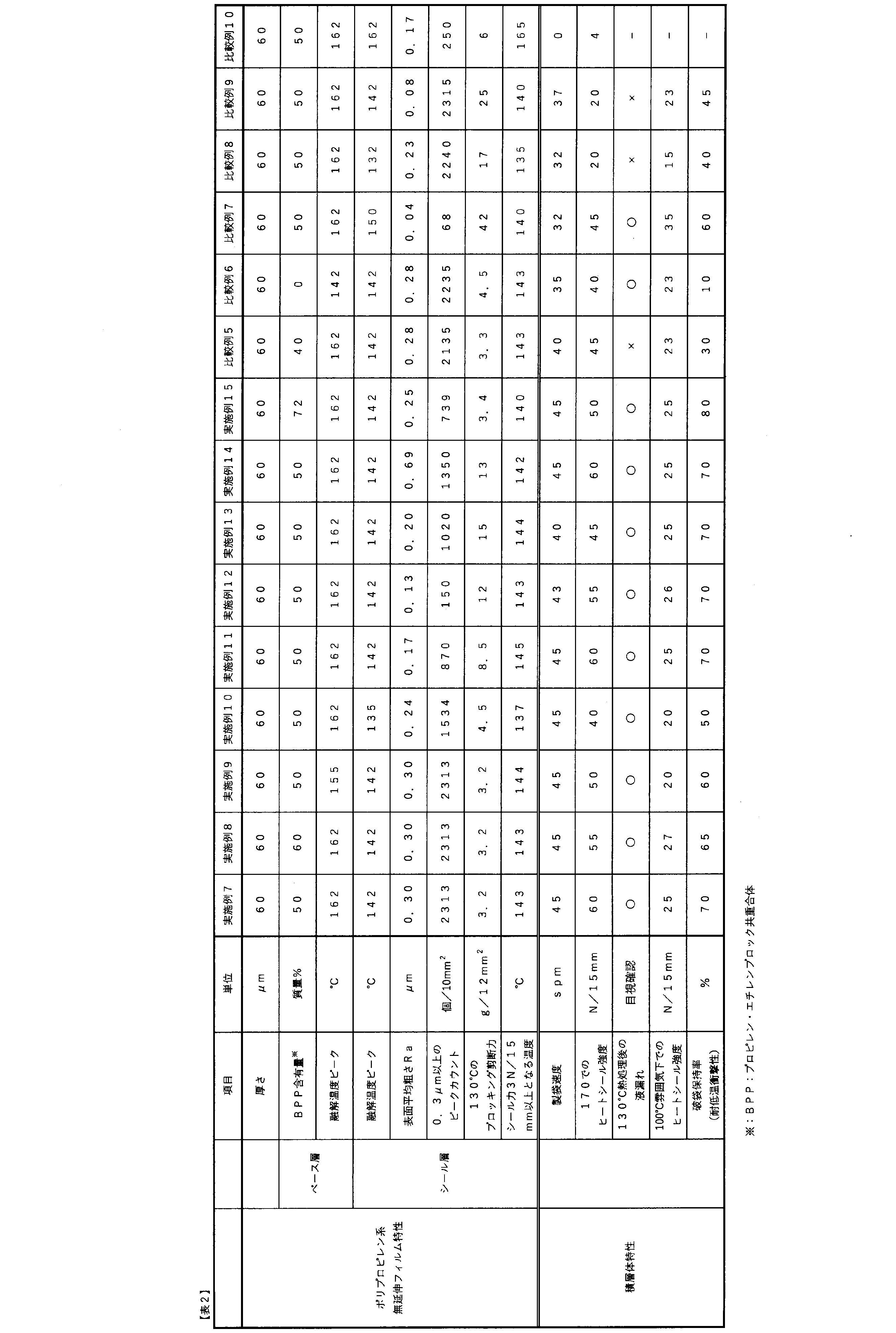
本発明は、環境を配慮した層数削減のレトルト食品包装用の包装袋として、低温ヒートシール性、高温耐ブロッキング性に優れ、製袋加工性に優れ、積層体として170℃でのヒートシール強度が高く、耐低温衝撃性に優れ、電子レンジ加熱時の通蒸性に優れ、レトルト適性に優れたポリプロピレン系無延伸系フィルムおよびそれを用いた積層体を提供することができる。 The present invention provides a polypropylene-based non-oriented film and a laminate using the same that are suitable for use as packaging bags for retort food packaging with fewer layers in consideration of the environment, have excellent low-temperature heat sealability, high-temperature blocking resistance, and excellent bag-making processability, and as a laminate have high heat seal strength at 170°C, excellent low-temperature impact resistance, excellent steam permeability when heated in a microwave oven, and excellent suitability for retort.
Claims (8)
少なくとも片面に、フィルム表面平均粗さRaが0.1μm以上、かつ、0.3μm以上のピークカウントが100個以上/10mm2である面をヒートシール面として有する、ポリプロピレン系無延伸フィルム。 The polymer comprises as a main component a propylene-based random copolymer having a melting temperature peak of 135° C. or more and 145° C. or less,
A polypropylene-based unstretched film having, on at least one side thereof as a heat seal surface, a film surface average roughness Ra of 0.1 μm or more and a peak count of 0.3 μm or more of 100 or more/10 mm2 .
ベース層がプロピレン・エチレンブロック共重合体を50質量%以上含有し、融解温度ピークが150℃以上であり、
シール層の融解温度ピークが135℃~145℃の範囲であり、シール層面の表面平均粗さRaが0.1μm以上、かつ、0.3μm以上のピークカウントが100個/10mm2以上である面をヒートシール面として有する、ポリプロピレン系無延伸フィルム。 It consists of two layers: a base layer and a seal layer.
The base layer contains 50% by mass or more of a propylene-ethylene block copolymer and has a melting temperature peak of 150° C. or more;
A polypropylene-based unstretched film having a heat seal surface in which the melting temperature peak of the seal layer is in the range of 135°C to 145°C, the surface average roughness Ra of the seal layer surface is 0.1 μm or more, and the peak count of 0.3 μm or more is 100/10 mm2 or more.
Priority Applications (4)
| Application Number | Priority Date | Filing Date | Title |
|---|---|---|---|
| JP2024549181A JP7755756B2 (en) | 2023-06-06 | 2024-05-22 | Polypropylene-based unstretched film and laminate using the same |
| EP24819159.5A EP4650392A4 (en) | 2023-06-06 | 2024-05-22 | Unstretched polypropylene-based film and laminate so that |
| CN202480008553.3A CN120603880A (en) | 2023-06-06 | 2024-05-22 | Polypropylene-based unstretched film and laminate using the same |
| KR1020257027419A KR20260019438A (en) | 2023-06-06 | 2024-05-22 | Polypropylene-based non-stretched film and laminate using the same |
Applications Claiming Priority (4)
| Application Number | Priority Date | Filing Date | Title |
|---|---|---|---|
| JP2023-092835 | 2023-06-06 | ||
| JP2023092835 | 2023-06-06 | ||
| JP2023103021 | 2023-06-23 | ||
| JP2023-103021 | 2023-06-23 |
Publications (1)
| Publication Number | Publication Date |
|---|---|
| WO2024252926A1 true WO2024252926A1 (en) | 2024-12-12 |
Family
ID=93795474
Family Applications (1)
| Application Number | Title | Priority Date | Filing Date |
|---|---|---|---|
| PCT/JP2024/018779 Ceased WO2024252926A1 (en) | 2023-06-06 | 2024-05-22 | Polypropylene-based non-stretched film and laminate using same |
Country Status (6)
| Country | Link |
|---|---|
| EP (1) | EP4650392A4 (en) |
| JP (1) | JP7755756B2 (en) |
| KR (1) | KR20260019438A (en) |
| CN (1) | CN120603880A (en) |
| TW (1) | TW202502561A (en) |
| WO (1) | WO2024252926A1 (en) |
Cited By (1)
| Publication number | Priority date | Publication date | Assignee | Title |
|---|---|---|---|---|
| WO2025164501A1 (en) * | 2024-01-31 | 2025-08-07 | 王子ホールディングス株式会社 | Food packaging film and food packaging bag |
Citations (7)
| Publication number | Priority date | Publication date | Assignee | Title |
|---|---|---|---|---|
| JPH05329992A (en) * | 1992-06-02 | 1993-12-14 | Chisso Corp | Heat-sealable matte film |
| JP2002294216A (en) * | 2001-03-29 | 2002-10-09 | Mitsui Chemicals Inc | Sealant composition and its use |
| US20110083796A1 (en) * | 2008-07-16 | 2011-04-14 | Sheppard Robert M | Matte Surface Multilayer Films Having Improved Sealing Properties, Their Methods of Manufacture, and Articles Made Therefrom |
| JP2012236973A (en) * | 2011-04-28 | 2012-12-06 | Sumitomo Chemical Co Ltd | Polypropylene resin composition, and film produced thereby |
| US20130212983A1 (en) * | 2010-09-20 | 2013-08-22 | Exxonmobil Oil Corporation | Multi-Layer Films Having Improved Sealing Properties |
| JP2017145299A (en) * | 2016-02-16 | 2017-08-24 | 日本ポリプロ株式会社 | Polypropylene resin composition for rough surface film, and film |
| JP2024057587A (en) * | 2022-10-12 | 2024-04-24 | 東レフィルム加工株式会社 | Sealant film for electrical storage device exterior material and electrical storage device exterior material using same |
Family Cites Families (7)
| Publication number | Priority date | Publication date | Assignee | Title |
|---|---|---|---|---|
| JP6121898B2 (en) | 2011-11-29 | 2017-04-26 | 東レ株式会社 | Method and apparatus for manufacturing surface protective film, and surface protective film |
| JP6292442B2 (en) * | 2014-03-12 | 2018-03-14 | 東レフィルム加工株式会社 | Polypropylene composite film and laminate using the same |
| JP6819820B2 (en) * | 2018-05-31 | 2021-01-27 | Dic株式会社 | Laminated film and food packaging bag |
| JP7153487B2 (en) | 2018-07-06 | 2022-10-14 | 三井化学東セロ株式会社 | Food packaging film and food package |
| JP7106416B2 (en) | 2018-10-01 | 2022-07-26 | 東レ株式会社 | Silicone rubber roller for embossing, method and apparatus for producing plastic film using the same, and surface protective film |
| JP7740249B2 (en) * | 2020-08-21 | 2025-09-17 | 東洋紡株式会社 | Sealant film |
| EP4279268A4 (en) * | 2021-01-15 | 2024-11-27 | Toyobo Co., Ltd. | MULTILAYER BODY AND PACKAGING WITH IT |
-
2024
- 2024-05-22 WO PCT/JP2024/018779 patent/WO2024252926A1/en not_active Ceased
- 2024-05-22 KR KR1020257027419A patent/KR20260019438A/en active Pending
- 2024-05-22 JP JP2024549181A patent/JP7755756B2/en active Active
- 2024-05-22 CN CN202480008553.3A patent/CN120603880A/en active Pending
- 2024-05-22 EP EP24819159.5A patent/EP4650392A4/en active Pending
- 2024-06-04 TW TW113120602A patent/TW202502561A/en unknown
Patent Citations (7)
| Publication number | Priority date | Publication date | Assignee | Title |
|---|---|---|---|---|
| JPH05329992A (en) * | 1992-06-02 | 1993-12-14 | Chisso Corp | Heat-sealable matte film |
| JP2002294216A (en) * | 2001-03-29 | 2002-10-09 | Mitsui Chemicals Inc | Sealant composition and its use |
| US20110083796A1 (en) * | 2008-07-16 | 2011-04-14 | Sheppard Robert M | Matte Surface Multilayer Films Having Improved Sealing Properties, Their Methods of Manufacture, and Articles Made Therefrom |
| US20130212983A1 (en) * | 2010-09-20 | 2013-08-22 | Exxonmobil Oil Corporation | Multi-Layer Films Having Improved Sealing Properties |
| JP2012236973A (en) * | 2011-04-28 | 2012-12-06 | Sumitomo Chemical Co Ltd | Polypropylene resin composition, and film produced thereby |
| JP2017145299A (en) * | 2016-02-16 | 2017-08-24 | 日本ポリプロ株式会社 | Polypropylene resin composition for rough surface film, and film |
| JP2024057587A (en) * | 2022-10-12 | 2024-04-24 | 東レフィルム加工株式会社 | Sealant film for electrical storage device exterior material and electrical storage device exterior material using same |
Non-Patent Citations (1)
| Title |
|---|
| See also references of EP4650392A1 * |
Cited By (1)
| Publication number | Priority date | Publication date | Assignee | Title |
|---|---|---|---|---|
| WO2025164501A1 (en) * | 2024-01-31 | 2025-08-07 | 王子ホールディングス株式会社 | Food packaging film and food packaging bag |
Also Published As
| Publication number | Publication date |
|---|---|
| EP4650392A4 (en) | 2026-06-03 |
| CN120603880A (en) | 2025-09-05 |
| JPWO2024252926A1 (en) | 2024-12-12 |
| KR20260019438A (en) | 2026-02-10 |
| EP4650392A1 (en) | 2025-11-19 |
| TW202502561A (en) | 2025-01-16 |
| JP7755756B2 (en) | 2025-10-16 |
Similar Documents
| Publication | Publication Date | Title |
|---|---|---|
| CN101111544B (en) | Polypropylene film and its laminate | |
| JP5510710B2 (en) | Easy tear polypropylene-based unstretched film and laminate thereof | |
| WO2007015415A1 (en) | Polypropylene resin composition, film or sheet, stretched film obtained from such film or sheet, multilayer body, and stretched film obtained from such multilayer body | |
| JPWO2018181011A1 (en) | Biaxially oriented polypropylene resin film | |
| TW201900806A (en) | Battery laminate | |
| CN101909887A (en) | Surface protective film | |
| WO2018062390A1 (en) | Resin composition for extrusion lamination, multilayer film, lid, and method for manufacturing multilayer film | |
| JP2006327183A (en) | Heat-sealable laminated polypropylene based resin film and package | |
| JP7839071B2 (en) | Food packaging film and food packaging body | |
| JP6942530B2 (en) | Multi-layer biaxially stretched film and transfer film | |
| WO2024214407A1 (en) | Laminated sealant film | |
| JP7755756B2 (en) | Polypropylene-based unstretched film and laminate using the same | |
| TW202411077A (en) | Polypropylene-based film for retort packaging, and layered body | |
| JPH06328639A (en) | Easily peelable film for polypropylene vessel | |
| JP2011020299A (en) | Surface protective film | |
| JP2021169194A (en) | Vapor deposition film and laminate including the same | |
| TW202348706A (en) | Polypropylene films and laminates for retort packaging (RETORT PACKAGING) | |
| JP2009061705A (en) | Manufacturing process of polypropylene resin laminated non-oriented film | |
| JP2025068258A (en) | Multi-layer biaxially oriented film and method for manufacturing the same | |
| JP2021066470A (en) | Food packaging film and food packaging body | |
| JP7698448B2 (en) | Multi-layer biaxially oriented film | |
| JP2018144351A (en) | Multilayer biaxially oriented film | |
| JP4239079B2 (en) | Heat-sealable laminated polypropylene resin film and package | |
| JP2025177209A (en) | Polypropylene film and packaging laminate using the same | |
| JP4239067B2 (en) | Laminated polypropylene resin film and package using the same |
Legal Events
| Date | Code | Title | Description |
|---|---|---|---|
| WWE | Wipo information: entry into national phase |
Ref document number: 2024549181 Country of ref document: JP |
|
| 121 | Ep: the epo has been informed by wipo that ep was designated in this application |
Ref document number: 24819159 Country of ref document: EP Kind code of ref document: A1 |
|
| WWE | Wipo information: entry into national phase |
Ref document number: 202480008553.3 Country of ref document: CN |
|
| WWP | Wipo information: published in national office |
Ref document number: 202480008553.3 Country of ref document: CN |
|
| WWE | Wipo information: entry into national phase |
Ref document number: 2501007547 Country of ref document: TH |
|
| WWP | Wipo information: published in national office |
Ref document number: 2024819159 Country of ref document: EP |
|
| WWE | Wipo information: entry into national phase |
Ref document number: 202547129999 Country of ref document: IN |
|
| NENP | Non-entry into the national phase |
Ref country code: DE |