WO2024252949A1 - Dispositif de conversion de puissance et dispositif d'entraînement - Google Patents
Dispositif de conversion de puissance et dispositif d'entraînement Download PDFInfo
- Publication number
- WO2024252949A1 WO2024252949A1 PCT/JP2024/019108 JP2024019108W WO2024252949A1 WO 2024252949 A1 WO2024252949 A1 WO 2024252949A1 JP 2024019108 W JP2024019108 W JP 2024019108W WO 2024252949 A1 WO2024252949 A1 WO 2024252949A1
- Authority
- WO
- WIPO (PCT)
- Prior art keywords
- current
- fault
- predetermined
- phase
- power conversion
- Prior art date
- Legal status (The legal status is an assumption and is not a legal conclusion. Google has not performed a legal analysis and makes no representation as to the accuracy of the status listed.)
- Ceased
Links
Images




Classifications
-
- H—ELECTRICITY
- H02—GENERATION; CONVERSION OR DISTRIBUTION OF ELECTRIC POWER
- H02M—APPARATUS FOR CONVERSION BETWEEN AC AND AC, BETWEEN AC AND DC, OR BETWEEN DC AND DC, AND FOR USE WITH MAINS OR SIMILAR POWER SUPPLY SYSTEMS; CONVERSION OF DC OR AC INPUT POWER INTO SURGE OUTPUT POWER; CONTROL OR REGULATION THEREOF
- H02M7/00—Conversion of AC power input into DC power output; Conversion of DC power input into AC power output
- H02M7/42—Conversion of DC power input into AC power output without possibility of reversal
- H02M7/44—Conversion of DC power input into AC power output without possibility of reversal by static converters
- H02M7/48—Conversion of DC power input into AC power output without possibility of reversal by static converters using discharge tubes with control electrode or semiconductor devices with control electrode
- H02M7/53—Conversion of DC power input into AC power output without possibility of reversal by static converters using discharge tubes with control electrode or semiconductor devices with control electrode using devices of a triode or transistor type requiring continuous application of a control signal
- H02M7/537—Conversion of DC power input into AC power output without possibility of reversal by static converters using discharge tubes with control electrode or semiconductor devices with control electrode using devices of a triode or transistor type requiring continuous application of a control signal using semiconductor devices only, e.g. single switched pulse inverters
- H02M7/5387—Conversion of DC power input into AC power output without possibility of reversal by static converters using discharge tubes with control electrode or semiconductor devices with control electrode using devices of a triode or transistor type requiring continuous application of a control signal using semiconductor devices only, e.g. single switched pulse inverters in a bridge configuration
- H02M7/53871—Conversion of DC power input into AC power output without possibility of reversal by static converters using discharge tubes with control electrode or semiconductor devices with control electrode using devices of a triode or transistor type requiring continuous application of a control signal using semiconductor devices only, e.g. single switched pulse inverters in a bridge configuration with automatic control of output voltage or current
- H02M7/53875—Conversion of DC power input into AC power output without possibility of reversal by static converters using discharge tubes with control electrode or semiconductor devices with control electrode using devices of a triode or transistor type requiring continuous application of a control signal using semiconductor devices only, e.g. single switched pulse inverters in a bridge configuration with automatic control of output voltage or current with analogue control of three-phase output
-
- H—ELECTRICITY
- H02—GENERATION; CONVERSION OR DISTRIBUTION OF ELECTRIC POWER
- H02M—APPARATUS FOR CONVERSION BETWEEN AC AND AC, BETWEEN AC AND DC, OR BETWEEN DC AND DC, AND FOR USE WITH MAINS OR SIMILAR POWER SUPPLY SYSTEMS; CONVERSION OF DC OR AC INPUT POWER INTO SURGE OUTPUT POWER; CONTROL OR REGULATION THEREOF
- H02M1/00—Details of apparatus for conversion
- H02M1/32—Means for protecting converters other than automatic disconnection
-
- H—ELECTRICITY
- H02—GENERATION; CONVERSION OR DISTRIBUTION OF ELECTRIC POWER
- H02P—CONTROL OR REGULATION OF ELECTRIC MOTORS, ELECTRIC GENERATORS OR DYNAMO-ELECTRIC CONVERTERS; CONTROLLING TRANSFORMERS, REACTORS OR CHOKE COILS
- H02P29/00—Arrangements for regulating or controlling electric motors, appropriate for both AC and DC motors
- H02P29/02—Providing protection against overload without automatic interruption of supply
- H02P29/024—Detecting a fault condition, e.g. short circuit, locked rotor, open circuit or loss of load
- H02P29/027—Detecting a fault condition, e.g. short circuit, locked rotor, open circuit or loss of load the fault being an over-current
Definitions
- the present invention relates to a power conversion device and a drive device.
- a power conversion device installed in a drive device for an electric vehicle or the like converts DC power supplied from a DC power source into AC power to drive a motor or the like. If an open fault or stuck-off fault occurs in a switching element for power conversion installed in the power conversion device, correct current control cannot be performed and the output torque of the motor fluctuates. For this reason, technology is known for diagnosing open faults in switching elements.
- the fault diagnosis device described in Patent Document 1 determines that a switching element has a fault when the absolute value of the smoothed AC current is equal to or greater than a predetermined value.
- the fault diagnosis device described in Patent Document 2 diagnoses that the switching element has an open fault when the sum of the current phase difference and the magnetic pole position is within a predetermined range and the absolute value of the current is smaller than a fault diagnosis value.
- a fault is determined based on the smoothed current, so when the current frequency is low, the smoothed current becomes large even under normal conditions, and there is a possibility that the switching element may be erroneously diagnosed as faulty. This poses the problem that stable diagnosis cannot be performed when the current frequency is low.
- a diagnosis is performed when the sum of the current phase and magnetic pole position is within a specified range, so the range in which abnormalities can be counted through diagnosis is limited to a part of one current cycle, and a time equivalent to several current cycles is required to perform a stable diagnosis.
- the power conversion device includes a current detection unit that detects the output current of each phase of a three-phase inverter circuit having switching elements, and a fault diagnosis unit that diagnoses an open fault in the switching elements based on the output current of each phase.
- the fault diagnosis unit calculates a fault detection counter for each phase by adding a predetermined addition amount when the value of the output current is within a predetermined range, and subtracting a predetermined subtraction amount when the value of the output current is not within the predetermined range, and diagnoses the open fault when the fault detection counter exceeds a first counter threshold. The lower the frequency of the output current, the smaller the predetermined addition amount and the predetermined subtraction amount are set, or the first counter threshold is set to a larger value.
- the present invention makes it possible to stably diagnose open faults in switching elements regardless of the frequency of the current.
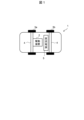
- FIG. 1 is a schematic diagram of a vehicle.
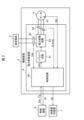
- FIG. 2 is a diagram showing a schematic configuration of the drive device.
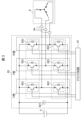
- FIG. 3 is a diagram illustrating an example of a configuration of a power conversion circuit.
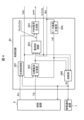
- FIG. 4 is a control block diagram showing the details of the function of the control circuit.
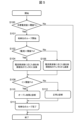
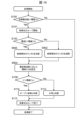
- FIG. 5 is a flowchart illustrating an example of an open fault diagnosis process.
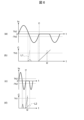
- FIG. 6 is an example of a timing chart of the open failure diagnosis process.
- FIG. 7 is a flowchart illustrating an example of an open fault diagnosis process according to the second embodiment.
- FIG. 8 is a flowchart illustrating an example of an open fault diagnosis process according to the second embodiment.
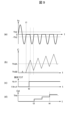
- FIG. 9 is an example of a timing chart of the open circuit failure diagnosis process according to the second embodiment.
- FIG. 1 is a schematic diagram of a vehicle.
- FIG. 2 is a diagram showing a schematic configuration of the drive device.
- FIG. 3 is a diagram illustrating an example of a configuration of a
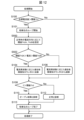
- FIG. 10 is a flowchart illustrating an example of an open fault diagnosis process according to the third embodiment.
- FIG. 11 is a diagram showing a current waveform when an open circuit failure occurs.
- FIG. 12 is a flowchart illustrating an example of an open fault diagnosis process according to the fourth embodiment.
- FIG. 13 is a diagram showing a current waveform when an open circuit failure occurs.
- FIG. 14 is a flowchart illustrating an example of an open fault diagnosis process according to the fourth embodiment.
- FIG. 15 is an example of a timing chart of the open circuit failure diagnosis process in the fourth embodiment.
- FIG. 16 shows signal waveforms for comparing the first and fifth embodiments.
- FIG. 1 is a schematic diagram of a vehicle that runs on a motor (not shown).
- the vehicle 1 is equipped with a drive unit 2 to which power is supplied from a DC power source 5.
- the drive unit 2 has a power conversion device, a motor, and a reducer. The driving force of the motor is transmitted via the reducer to an axle 4 on which wheels 3a are provided.
- the drive unit 2 is installed on the axle 4 of the front wheels (wheels 3a), but it may also be installed on the axle of the rear wheels (wheels 3b).
- the drive units 2 may also be installed on the axles 4 of the front and rear wheels, or independent drive units 2 may be installed on each of the left and right wheels 3a, 3b instead of on the axles.
- a drive unit using an internal combustion engine may be installed in parallel with the drive unit 2 on the axle 4, separate from the drive unit 2 described in FIG. 1.
- FIG. 2 is a diagram showing the general configuration of the drive unit 2.
- a DC power supply 5, a control device 6, and a fault notification device 7 are provided around the drive unit 2.
- the control device 6 transmits the target torque ⁇ s, the operating mode Sm, and the like to the drive unit 2.
- the control device 6 also receives a fault notification signal Sf output from the drive unit 2. In this embodiment, only one control device 6 is shown, but multiple control devices may send and receive information.
- the control device 6 also has a control function for the drive unit using the internal combustion engine described above, for example.
- the DC power supply 5 is a power supply for driving the motor 9 in the drive device 2, and may be, for example, a battery.
- the fault notification device 7 receives a fault notification signal Sf from the drive device 2 and notifies the passenger of the occurrence of a fault.
- Methods for notifying the passenger of a fault include, for example, turning on a lamp, emitting a warning sound, or notifying by voice.
- the drive unit 2 is equipped with a power conversion device 8, a motor 9, and a reducer (not shown).
- the reducer amplifies the driving force of the motor 9 and transmits it to the axle 4 (or wheels 3a, 3b).
- the motor 9 is a three-phase motor with three internal windings, and may be, for example, a synchronous motor using permanent magnets or an induction motor without permanent magnets.
- the motor 9 is equipped with a motor angle sensor 91.
- the motor angle sensor 91 measures the rotation angle of the motor rotor and outputs the measured angle to the power conversion device 8 as a motor angle sensor value ⁇ m.
- the power conversion device 8 converts the DC power supplied from the DC power source 5 into AC power based on the target torque ⁇ s input from the control device 6, and supplies it to the motor 9.
- the power conversion device 8 also has the function of converting the power of the motor 9 into DC power to charge the DC power source 5.
- the power conversion device 8 includes a control circuit 80, a driver circuit 81, a power conversion circuit 82, a DC voltage sensor 83, and an AC current sensor 84.
- the control circuit 80 generates a PWM (Pulse Width Modulation) signal pwm for controlling the current of each of the U, V, and W phases output from the power conversion device 8 to a predetermined value based on the target torque ⁇ s and the operating mode Sm from the control device 6. The details of the control circuit 80 will be described later.
- the driver circuit 81 outputs a drive signal for switching on/off multiple power semiconductors provided in the power conversion circuit 82 based on the PWM signal pwm output by the control circuit 80.
- the DC voltage sensor 83 is a sensor that measures the output voltage of the DC power supply 5, and outputs the measured voltage value as a DC voltage sensor value Vdc to the control circuit 80.
- the AC current sensor 84 is a sensor that measures the AC current flowing through each phase (U phase, V phase, W phase) of the motor 9.
- the AC current values of each phase measured by the AC current sensor 84 are input to the control circuit 80 as AC current sensor values Iu, Iv, Iw (hereinafter simply referred to as currents Iu, Iv, Iw).
- the power conversion circuit 82 receives a drive signal from the driver circuit 81 to drive the internal power semiconductors and control the current flowing through the motor 9.
- FIG. 3 is a diagram showing an example of the configuration of the power conversion circuit 82.
- the power conversion circuit 82 has a smoothing capacitor 821 and six power semiconductors 822 inside. Two power semiconductors 822 that constitute an upper arm and a lower arm are provided for each phase (U phase, V phase, W phase). The output terminals of the upper and lower arms of each phase are connected to the windings of the corresponding phase of the motor 9.
- the power semiconductor 822 switches on/off in response to the drive signal input from the driver circuit 81, and converts between DC and AC power.
- Examples of this power semiconductor 822 include a power MOSFET (Metal Oxide Semiconductor Field Effect Transistor) and an IGBT (Insulated Gate Bipolar Transistor). In the example shown in Figure 3, an IGBT is used as the power semiconductor 822.
- the smoothing capacitor 821 is a capacitor that smoothes the current generated by turning on/off the power semiconductor 822 and suppresses ripples in the DC current supplied from the DC power source 5 to the power conversion circuit 82.
- an electrolytic capacitor or a film capacitor is used as the smoothing capacitor 821.
- the motor neutral point is floating, but it may be connected to ground (not shown).
- Methods for connecting the motor neutral point to ground include a direct grounding method, a resistive grounding method, a compensating reactor grounding method, and an arc suppression reactor grounding method.
- FIG. 4 is a control block diagram showing the detailed functions of the control circuit 80.
- the control circuit 80 is equipped with a CPU, RAM, ROM, communication circuits, etc. (not shown) inside.
- the CPU implements the functions of each part described below by expanding a program stored in the ROM into the RAM and executing it.
- the ROM may be an electrically erasable programmable ROM (EEPROM) or a flash ROM.
- the control circuit 80 has a state control unit 801, a target current calculation unit 802, a current control unit 803, a PWM signal generation unit 804, a motor speed calculation unit 805, and a diagnosis unit 806.
- the control circuit 80 communicates with the external control device 6, and receives the above-mentioned operation mode Sm and target torque ⁇ s from the control device 6.
- the control circuit 80 also controls the PWM signal pwm based on the operation mode Sm and the target torque ⁇ s, and drives the power conversion circuit 82 via the driver circuit 81 shown in FIG. 2. If the control circuit 80 determines that a fault has occurred internally, it outputs a fault notification signal Sf to the external control device 6 and fault notification device 7 shown in FIG. 2.
- the motor speed calculation unit 805 calculates the motor angular speed ⁇ 0 based on the motor angle sensor value ⁇ m.
- the calculated motor angular speed ⁇ 0 is input to the target current calculation unit 802 and the diagnosis unit 806.
- the state control unit 801 transitions the operating state of the power conversion device 8 using the operating mode Sm and the fault notification signal Sf output by the diagnosis unit 806, and outputs the current operating state to the PWM signal generation unit 804.
- operating states include a PWM state, a three-phase short-circuit state, and a three-phase open state.
- the target current calculation unit 802 uses the target torque ⁇ s, the DC voltage sensor value Vdc, and the motor angular velocity ⁇ 0 to calculate the target current value required for the motor 9 to output the same torque as the target torque ⁇ s.
- the target current value is output to the current control unit 803.
- the target current value is expressed, for example, in the form of a d-axis target current value and a q-axis target current value.
- the current control unit 803 performs feedback control using the target current value, currents Iu, Iv, Iw, motor angle sensor value ⁇ m, and DC voltage sensor value Vdc so that the AC current flowing through the motor 9 follows the target current value, and calculates duty values Du, Dv, Dw for three phases in PWM control.
- the duty values Du, Dv, Dw are then input to the PWM signal generation unit 804.
- the PWM signal generating unit 804 switches the signal to be output to the driver circuit 81 depending on the operating state output from the state control unit 801.
- the PWM signal generating unit 804 has an internal timer (not shown), and when the operating state is the PWM state, it generates a PWM signal pwm using this timer value and the duty values Du, Dv, and Dw of each phase output by the current control unit 803.
- the PWM signal generating unit 804 then outputs the generated PWM signal pwm to the driver circuit 81 shown in FIG. 2.
- a PWM signal pwm is generated that turns off all six power semiconductors 822 (see FIG. 3) in the power conversion circuit 82.
- a PWM signal pwm is generated that turns off all of the power semiconductors 822 in the upper arm and turns on all of the power semiconductors 822 in the lower arm, or turns on all of the power semiconductors 822 in the upper arm and turns off all of the power semiconductors 822 in the lower arm.
- the generated PWM signal pwm is output to the driver circuit 81.
- the diagnosis unit 806 diagnoses faults within the power conversion device 8 based on the currents Iu, Iv, and Iw, the motor angular velocity ⁇ 0 calculated by the motor speed calculation unit 805, and the target current value calculated by the target current calculation unit 802. If a fault is detected as a result of the diagnosis, the diagnosis unit 806 outputs the details of the fault location as a fault notification signal Sf to the state control unit 801, the external control device 6, and the fault notification device 7.
- FIG. 5 is a flowchart showing an example of an open circuit failure diagnosis process executed by the diagnosis unit 806.
- the diagnosis unit 806 repeatedly executes a series of processes shown in Fig. 5 at a fixed time interval.
- step S100 the diagnosis unit 806 determines whether the target current value input from the target current calculation unit 802 is greater than the threshold value Th1. If it is determined in step S100 that the target current value is greater than the threshold value Th1, the process proceeds to step S101, and if it is determined that the target current value is equal to or less than the threshold value Th1, the diagnosis process in FIG. 5 is terminated.
- step S101 loop processing for each phase is started.
- the loop processing from step S101 to step S113 is performed for each of the U phase, V phase, and W phase.
- step S102 the diagnosis unit 806 determines whether the absolute value of the U-phase current Iu (represented as
- the diagnosis unit 806 adds a predetermined additional amount according to the current frequency to the U-phase fault detection counter C in step S104.
- the diagnosis unit 806 subtracts a predetermined subtraction amount according to the current frequency from the U-phase fault detection counter C in step S106.
- the predetermined addition amount in step S104 and the predetermined subtraction amount in step S106 are values proportional to the frequency of the current. In other words, the higher the current frequency, the larger the predetermined addition amount and the predetermined subtraction amount are set. Since the current frequency is proportional to the motor speed, the predetermined addition amount and the predetermined subtraction amount are set based on the motor angular velocity ⁇ 0 calculated by the motor speed calculation unit 805. In that case, the current frequency may be calculated from the motor angular velocity ⁇ 0, or the predetermined addition amount and the predetermined subtraction amount may be values proportional to the motor angular velocity ⁇ 0 itself. Of course, the current frequency may also be calculated from the input currents Iu, Iv, and Iw.
- step S108 the diagnosis unit 806 determines whether the U-phase failure detection counter C exceeds the threshold value Th3. If the failure detection counter exceeds the threshold value Th3, the process proceeds to step S110, where it is diagnosed that the U-phase power semiconductor 822 has an open failure. On the other hand, if the failure detection counter C does not exceed the threshold value Th3, the process proceeds to step S112, where it is diagnosed that the U-phase power semiconductor 822 is normal.
- step S113 the loop processing of the U phase is completed, and then the process returns to step S101 to execute the loop processing for the V phase. Then, once the loop processing for the V phase is completed, the process returns again to step S101 to execute the loop processing for the W phase.
- step S113 the same processing as for the U phase is executed in steps S102 to S112 for the V and W phases.
- Figure 6 is an example of a timing chart for open fault diagnosis processing, showing the U phase as an example.
- Signal waveforms (a) and (b) show an example when the frequency of current Iu is low.
- the solid line in signal waveform (a) shows the change in current Iu.
- the solid line in signal waveform (b) shows the change in fault detection counter C.
- signal waveforms (c) and (d) show an example when the frequency of current Iu is high.
- the solid line in signal waveform (c) shows the change in current Iu.
- the solid line in signal waveform (d) shows the change in fault detection counter C.
- the horizontal axis is time t.
- an open circuit fault occurs at time t1.
- a sinusoidal current flows through the motor 9.
- an open circuit fault occurs in the U-phase power semiconductor 822 at time t1
- no current flows in either the positive or negative direction in the U-phase.
- Figure 6 shows a case where an open circuit fault occurs in the power semiconductor 822 of the upper arm of the U-phase, and no current flows in the positive direction.
- the diagnostic unit 806 diagnoses that the power semiconductor 822 has an open fault.
- the higher the current frequency the larger the increment/decrement amount of the fault detection counter C is set.
- the increment/decrement amount of the fault detection counter C is constant regardless of the current frequency.
- the dashed lines L1 and L2 shown in the signal waveforms (b) and (d) of FIG. 6 show the comparative example.
- the time period during which the current Iu is below the threshold value Th2 during normal operation is longer as the frequency of the current Iu is lower.
- the diagnostic process is performed at a constant cycle regardless of the frequency of the current Iu. Therefore, even when the frequency of the current Iu is high as in signal waveform (c), it is necessary to set the amount of addition/subtraction of the fault detection counter C so that the fault detection counter C exceeds the threshold value Th3 by the time approximately 1/2 cycle has elapsed since the fault occurred at time t1.
- the amount of addition/subtraction in the comparative example is constant regardless of frequency, when the frequency of the current Iu is low as in signal waveform (a), the fault detection counter C during normal operation is as shown by line L1.
- the power semiconductor 822 is erroneously diagnosed as having an open circuit fault even during normal operation.
- the increment/decrement of the fault detection counter C is set so that when the frequency of the current Iu is low, the fault is detected within 1/2 period when an open fault occurs, and a false diagnosis of an open fault does not occur under normal conditions. That is, regardless of the frequency of the current Iu, the increment/decrement of the fault detection counter C is set as shown by the solid line in the signal waveform (b) of FIG. 6. With this setting, when the frequency of the current Iu is high as in the signal waveform (c), the fault detection counter C after the occurrence of an open fault will be as shown by line L2 in the signal waveform (d). As a result, the fault detection counter C may not reach the threshold value Th3, and an open fault in the power semiconductor 822 may not be detected.
- the higher the current frequency the larger the increment/decrement amount of the fault detection counter C is set. Therefore, as shown by the solid lines in the signal waveforms (b) and (d) of Figure 6, it is possible to set the increment/decrement amount of the fault detection counter C so that when an open fault occurs, the fault detection counter C reaches the threshold value Th3 within 1/2 the period of the current change, and so that the fault detection counter C does not reach the threshold value Th3 under normal conditions. As a result, stable open fault diagnosis can be performed regardless of the high or low frequency of the current.
- step S100 by performing the processing of step S100, if the target current value is equal to or less than the threshold value Th1, the processing of the open fault diagnosis is not performed. For example, if the processing of step S100 is not provided, even if an open fault has not occurred, if the absolute value of the current flowing through the motor 9 is smaller than the threshold value Th2, the fault detection counter C may exceed the threshold value Th3, resulting in a misdiagnosis of an open fault. Therefore, in this embodiment, by performing the processing of step S100, such a misdiagnosis can be avoided.
- the amount of current to be passed through the motor 9 is determined by the target torque ⁇ s and the motor speed (i.e., the motor angular speed ⁇ 0). Therefore, in the determination process of step S100, the determination may be made using the target torque ⁇ s and the motor angular speed ⁇ 0 instead of using the target current value.
- the increment/decrement amount of the fault detection counter C is set to a larger amount as the current frequency increases, it is possible to detect an open fault in the power semiconductor 822 regardless of the motor rotation speed (i.e., the current frequency). Furthermore, in the first embodiment, an open fault is detected within a period of approximately 1/2 the cycle of the current Iu regardless of the motor rotation speed, allowing for rapid fault detection.
- Second Embodiment A second embodiment of a drive device of the present invention will be described with reference to Figures 7 to 9.
- the drive device 2 mounted on the vehicle 1 shown in Figure 1 will also be described as an example.
- the schematic configuration of the drive device 2, the configuration of the power conversion circuit 82 provided in the power conversion device 8 of the drive device 2, and the configuration of the control circuit 80 provided in the power conversion device 8 are similar to the configurations shown in Figures 2, 3, and 4 of the first embodiment described above.
- FIGS. 7 and 8 are flowcharts showing an example of an open circuit fault diagnosis process executed by the diagnosis unit 806 (see FIG. 4) of the control circuit 80.
- the diagnosis unit 806 repeatedly executes the process shown in FIG. 7 and the process shown in FIG. 8 at regular time intervals. Note that the execution periods of the processes in FIG. 7 and FIG. 8 may be the same or different.
- step S200 the diagnosis unit 806 judges whether the U-phase fault detection counter C exceeds the threshold value Th3A. If it is judged in step S200 that C>Th3A, the process proceeds to step S202, where the U-phase abnormality flag is set. On the other hand, if it is judged in step S200 that C ⁇ Th3A, the process proceeds to step S204, where it is judged whether the U-phase fault detection counter C is below the threshold value Th3B. If it is judged in step S204 that C ⁇ Th3B, the process proceeds to step S206, where the U-phase abnormality flag is reset. On the other hand, if it is judged in step S204 that C ⁇ Th3B, the process proceeds to step S113.
- the threshold value Th3B is set so that Th3B ⁇ Th3A.
- step S113 the loop processing for the U phase is completed, and then the process returns to step S101 to execute the loop processing for the V phase. Then, once the loop processing for the V phase is completed, the process returns to step S101 again to execute the loop processing for the W phase.
- step S113 the same processing as that for the U phase described above is executed for the V and W phases.
- step S300 the diagnosis unit 806 determines whether or not an abnormality flag is set for any of the phases. If it is determined in step S300 that the abnormality flag is set (yes), the process proceeds to step S302, where the debounce counter Cd is incremented. On the other hand, if the abnormality flags for all phases are reset, the process proceeds to step S304, where the debounce counter Cd is decremented.
- step S306 the diagnostic unit 806 determines whether the debounce counter Cd exceeds the threshold value Th4. If it is determined in step S306 that Cd>Th4, the process proceeds to step S308, where the power semiconductor 822 is diagnosed as having an open circuit fault. On the other hand, if it is determined in step S306 that Cd ⁇ Th4, the power semiconductor 822 is diagnosed as being normal.
- FIG. 9 shows an example of a timing chart of the open fault diagnosis process in the second embodiment, using the U phase as an example.
- the solid line in signal waveform (a) indicates the change in current Iu
- the solid line in signal waveform (b) indicates the change in fault detection counter C
- the solid line in signal waveform (c) indicates the change in the abnormality flag
- the solid line in signal waveform (d) indicates the change in debounce counter Cd.
- the horizontal axis is time t.
- step S104 and the amount subtracted in step S106 are set so that the increase in the fault detection counter C in the interval (Th2>Iu>-Th2) is greater than the decrease in the interval (Iu ⁇ -Th2).
- the turning point of the fault detection counter C from increase to decrease and decrease to increase gradually moves upward in the figure, and the fault detection counter C is maintained in the state of C ⁇ Th3, and the abnormality flag is maintained in the set state.
- step S300 in FIG. 8 is executed at time t3 after the abnormality flag is set (time t2)
- the process of step S302 is performed and the debounce counter Cd is incremented as shown in the signal waveform (d). Thereafter, the debounce counter Cd is incremented each time the process of FIG. 8 is repeated at a fixed time period. Then, when the debounce counter Cd exceeds the threshold value Th4 at time t4, step 308 in FIG. 8 is executed and an open failure is diagnosed.
- the fault detection counter C exceeds the threshold value Th3A, an abnormality flag is set, and the abnormality flag remains set until the fault detection counter C falls below the threshold value Th3B. Then, by performing increments and decrements on the debounce counter Cd based on the state of the abnormality flag, a stable diagnosis of fault or normality can be performed regardless of the processing timing of the debounce counter Cd.
- the fault detection counter C exceeds the threshold value Th3 and an open fault is detected, so that the open fault can be detected quickly.
- the second embodiment by introducing a debounce counter Cd based on the abnormality flag as described above, the occurrence of erroneous detection due to accidental influences such as noise is avoided, and the stability of the open fault diagnosis is improved.
- Cd when a state in which no current Iu flows occurs for approximately three consecutive cycles, Cd>Th4 and an open fault is diagnosed. The time until this open fault is determined depends on the execution cycle of the process in Figure 8, so the diagnostic processing time can be shortened by shortening the execution cycle.
- the fault detection counter C i.e., the integrated value of the addition and subtraction amounts
- the fault detection counter C may fall below the threshold value Th3B and the abnormality flag may be reset even if an open fault occurs in the power semiconductor 822.
- the fault detection counter C exceeds the threshold value Th3A and the abnormality flag is set (time t2 in FIG. 9), the fault detection counter C is further incremented by a fixed number ⁇ C. By doing so, the line of the fault detection counter C from time t2 onwards is shifted upward in the figure by a fixed number ⁇ C. As a result, the reset of the abnormality flag when an open fault occurs is prevented, reducing the possibility of overlooking an open fault.
- FIG. 10 A third embodiment of the drive device of the present invention will be described with reference to Figures 10 and 11.
- the drive device 2 mounted on the vehicle 1 shown in Figure 1 will also be described as an example.
- the schematic configuration of the drive device 2, the configuration of the power conversion circuit 82 provided in the power conversion device 8 of the drive device 2, and the configuration of the control circuit 80 provided in the power conversion device 8 are similar to the configurations shown in Figures 2, 3, and 4 described above.
- FIG. 10 is a flowchart showing an example of an open circuit fault diagnosis process executed by the diagnosis unit 806.
- the diagnosis unit 806 repeatedly executes the series of processes shown in FIG. 10 at a fixed time interval.
- the flowchart in FIG. 10 is obtained by adding step S400 to the flowchart shown in FIG. 5.
- the following mainly describes the parts that differ from the first embodiment described above, and omits a description of the parts that are the same as in the first embodiment.
- the process related to the U phase of the phase-by-phase loop process that begins in step S101 will be described.
- the diagnosis unit 806 sets the threshold value Th2 to a value corresponding to the frequency of the current Iu. Specifically, the higher the frequency of the current Iu, the larger the threshold value Th2 is set.
- the threshold value Th2 is set based on the motor angular velocity ⁇ 0 calculated by the motor speed calculation unit 805. In that case, the current frequency may be calculated from the motor angular velocity ⁇ 0, or the threshold value Th2 may be set to a value proportional to the motor angular velocity ⁇ 0 itself. Of course, the current frequency may also be calculated from the input currents Iu, Iv, and Iw.
- step S102 the threshold value Th2 set in step S400 is used to determine whether the absolute value of the current Iu exceeds the threshold value Th2.
- the processing from step S102 onwards is the same as in the flowchart shown in Figure 5, and so a description thereof will be omitted.
- the processing relating to the V phase and W phase is performed in the same manner as in the case of the U phase.
- Figure 11 shows the current waveforms when an open failure occurs in power semiconductor 822, where current waveform (a) shows the waveform when the motor speed is low, and current waveform (b) shows the waveform when the motor speed is high. In both cases, the horizontal axis represents time. When an open failure occurs in power semiconductor 822, no current flows through the failed phase for a section of approximately 1/2 the current cycle.
- the threshold value Th2 for determining the magnitude of the current in an open fault diagnosis is always constant, there is a risk that an open fault cannot be correctly diagnosed when the motor speed is high.
- the threshold value Th2 is set to a larger value as the motor speed increases, thereby avoiding erroneous diagnosis and enabling stable open fault diagnosis regardless of the motor speed.
- FIG. 12 A fourth embodiment of the drive device of the present invention will be described with reference to Figures 12 and 13.
- the drive device 2 mounted on the vehicle 1 shown in Figure 1 will also be described as an example.
- the schematic configuration of the drive device 2, the configuration of the power conversion circuit 82 provided in the power conversion device 8 of the drive device 2, and the configuration of the control circuit 80 provided in the power conversion device 8 are similar to the configurations shown in Figures 2, 3, and 4 described above.
- FIG. 12 is a flowchart showing an example of an open circuit fault diagnosis process executed by the diagnosis unit 806.
- the diagnosis unit 806 repeatedly executes the series of processes shown in FIG. 12 at a fixed time interval.
- the flowchart in FIG. 12 is obtained by adding steps S500 and S502 instead of step S102 in the flowchart shown in FIG. 5 of the first embodiment.
- the following mainly describes the parts that differ from the first embodiment described above, and omits a description of the parts that are the same as in the first embodiment.
- the process related to the U phase of the phase-by-phase loop process that begins in step S101 will be described.
- step S500 the diagnostic unit 806 sets an upper threshold Th2A and a lower threshold Th2B as shown in FIG. 13 depending on the direction of current flow under normal conditions, i.e., whether the current direction is positive or negative.
- FIG. 13 is a diagram showing the waveform of current Iu when an open fault has occurred, with the dashed line indicating the threshold Th2A and the dashed line indicating the threshold Th2B. Note that FIG. 13 shows the current waveform when the motor speed is high, as shown in the current waveform (b) of FIG. 11. During period R1 when a positive current flows under normal conditions, a current of around 0 [A] or a negative current flows.
- threshold Th2A Th2
- Th2B Th2B
- the current value (Iu, Iv, Iw) of each phase under normal conditions can be calculated from the current target value (Id, Iq) and electrical angle ( ⁇ ) using formula (1).
- Id is the d-axis target current value
- Iq is the q-axis target current value
- ⁇ is the electrical angle
- Iu is the U-phase current
- Iv is the V-phase current
- Iw is the W-phase current.
- the electrical angle ⁇ can be calculated by multiplying the motor angle sensor value ⁇ m by the number of pole pairs of the motor 9.
- the direction of the current in each phase is determined from the positive or negative value of the current value (Iu, Iv, Iw) of each phase calculated here.
- step S502 the diagnosis unit 806 determines whether the current Iu satisfies "threshold Th2A > current Iu > threshold Th2B". If it is determined in step S502 that "threshold Th2A > current Iu > threshold Th2B", the process proceeds to step S104, where the fault detection counter C for the U phase is incremented by a predetermined addition amount. On the other hand, if it is determined in step S502 that "threshold Th2A > current Iu > threshold Th2B" is not true, the process proceeds to step S106, where a predetermined subtraction amount is subtracted from the fault detection counter C. Note that the processing from step S108 onwards is the same as in the flowchart shown in Figure 5, and therefore a description thereof will be omitted. The processing relating to the V phase and W phase is also performed in the same manner as in the case of the U phase.
- the threshold value Th2 is set to avoid misdiagnosis.
- the threshold value Th2B is set to a large negative value in this period R1, so that misdiagnosis can be avoided. As a result, stable open fault diagnosis can be performed regardless of whether the motor speed is high or low.
- a fifth embodiment of the drive device of the present invention will be described with reference to Figures 14 and 15.
- the drive device 2 mounted on the vehicle 1 shown in Figure 1 will also be described as an example.
- the schematic configuration of the drive device 2, the configuration of the power conversion circuit 82 provided in the power conversion device 8 of the drive device 2, and the configuration of the control circuit 80 provided in the power conversion device 8 are similar to the configurations shown in Figures 2, 3, and 4 described above.
- FIG. 14 is a flowchart showing an example of an open circuit fault diagnosis process executed by the diagnosis unit 806.
- the diagnosis unit 806 repeatedly executes the series of processes shown in FIG. 14 at a fixed time interval.
- the flowchart in FIG. 14 adds steps S600 and S602 instead of steps S104 and S106 in the flowchart shown in FIG. 5 of the first embodiment, and further adds a new step S604.
- the following mainly describes the parts that differ from the first embodiment described above, and omits a description of the parts that are the same as in the first embodiment.
- the process related to the U phase of the phase-by-phase loop process that starts in step S101 will be described.
- step S102 If it is determined in step S102 that the absolute value of the current Iu is less than the threshold value Th2, the process proceeds to step S600, where a fixed value is added to the U-phase fault detection counter C. On the other hand, if it is determined in step S102 that the absolute value of the current Iu is greater than or equal to the threshold value Th2, the process proceeds to step S602, where a fixed value is subtracted from the U-phase fault detection counter C.
- a threshold value Th3 is set according to the current frequency. Details will be described later, but the higher the current frequency, the smaller the threshold value Th3 is set.
- the current frequency is proportional to the motor speed, so the threshold value Th3 is set based on the motor angular velocity ⁇ 0 calculated by the motor speed calculation unit 805.
- the current frequency may be calculated from the motor angular velocity ⁇ 0, or the threshold value Th3 may be set to a value proportional to the motor angular velocity ⁇ 0 itself.
- the current frequency may also be calculated from the input currents Iu, Iv, and Iw.
- step S108 onwards is the same as in the flowchart shown in FIG. 5, and so a description thereof will be omitted. Processing relating to the V and W phases is also performed in the same manner as in the case of the U phase.
- FIG. 15 is a timing chart corresponding to FIG. 6 of the first embodiment.
- Signal waveforms (a), (b), and (c) are the same as signal waveforms (a), (b), and (c) shown in FIG. 6, and signal waveform (d) is different from signal waveform (d) in FIG. 6.
- Signal waveforms (a) and (b) show an example when the frequency of current Iu is low, and the solid line of signal waveform (a) shows the change in current Iu, and the solid line of signal waveform (b) shows the change in fault detection counter C.
- signal waveforms (c) and (d) show an example when the frequency of current Iu is high, and the solid line of signal waveform (c) shows the change in current Iu, and the solid line of signal waveform (d) shows the change in fault detection counter C.
- the increment and decrement amounts of the fault detection counter C are set to constant values, so the slope of the line of the fault detection counter C in the signal waveform (b) is the same as the slope of the line of the fault detection counter C in the signal waveform (d).
- the increment and decrement periods of the fault detection counter C per period are shorter in the signal waveform (c), which has a higher current frequency, and so the increment and decrement amounts of the fault detection counter C during that time are also smaller.
- the value of the threshold Th3 is set large to prevent misdiagnosis.
- the value of the threshold Th3 is set smaller than when the frequency of the current Iu is high. In this case, taking into account the amount of addition and the number of additions within a period of approximately 1/2 a cycle during an open fault, the magnitude of the threshold Th3 is set so that the fault detection counter C reaches the threshold Th3 within a period of approximately 1/2 a cycle.
- the magnitude of the threshold value Th3 is changed according to the current frequency, making it possible to detect an open circuit failure in the power semiconductor 822 regardless of the motor speed (high or low current frequency) and to prevent erroneous detection during normal operation.
- the first embodiment described above it is possible to detect an open circuit fault regardless of whether the current frequency is high or low by changing the increment/decrement amount of the fault detection counter C according to the current frequency.
- the fifth embodiment it is possible to detect an open circuit fault regardless of whether the current frequency is high or low by changing the magnitude of the threshold value Th3 according to the current frequency.
- FIG. 16 shows signal waveforms for comparing the first and fifth embodiments.
- signal waveform (a) represents the change in motor speed
- signal waveform (b) represents the current waveform under normal conditions
- signal waveform (c) represents the change in the fault detection counter C in the fifth embodiment
- signal waveform (d) represents the change in the fault detection counter C in the first embodiment.
- Signal waveforms (c) and (d) also show the threshold value Th3 in each embodiment. Note that the example shown in FIG. 16 shows a case where the absolute value of the current remains below the threshold value Th2 for a long period of time when the motor speed is low, and then the motor speed increases and the current value becomes equal to or greater than the threshold value Th2.
- the fault detection counter C is incremented only little by little, as shown in signal waveform (d).
- the period during which the current value is equal to or greater than the threshold value Th2 becomes longer than the period during which the current value is below the threshold value Th2, and the fault detection counter C is decremented by a large amount. As a result, the fault detection counter does not reach the threshold value Th3, and an open fault is not erroneously diagnosed.
- the threshold value Th3 when the motor speed is low (when the current frequency is low), the threshold value Th3 is set high and decreases rapidly as the motor speed increases. Also, the increase in the fault detection counter C when the current value is below the threshold value Th2 is greater than in the first embodiment, in which the addition amount is set high at low frequencies. When the current amplitude exceeds the threshold value Th2, the subtraction period of the fault detection counter C is longer than the addition period, so that the fault detection counter C generally tends to decrease.
- the diagnosis method of the first embodiment can reduce the occurrence of false diagnosis when the motor speed changes, compared to the diagnosis method of the fifth embodiment.
- a current detection unit AC current sensor 84 that detects the output current of each phase of a three-phase inverter circuit (power conversion circuit 82) equipped with a switching element (power semiconductor 822), and a fault diagnosis unit (diagnosis unit 806) that diagnoses an open fault of the power semiconductor 822 based on the output current of each phase
- the diagnosis unit 806 calculates a fault detection counter C for each phase by adding a predetermined addition amount when the value of the output current is within a predetermined range (
- the diagnosis unit 806 sets the predetermined addition amount and the predetermined subtraction amount to smaller values as the frequency of the output current is lower, or sets the first counter threshold (threshold Th3) to a larger value
- the lower the frequency of the output current the smaller the predetermined addition amount and the predetermined subtraction amount are set to, making it possible to detect an open circuit failure regardless of whether the frequency is high or low.
- the lower the frequency of the output current the larger the first counter threshold (threshold Th3) is set to, making it possible to detect an open circuit failure regardless of whether the frequency is high or low.
- the diagnostic unit 806 sets the predetermined addition amount and the predetermined subtraction amount to smaller values as the frequency of the output current decreases, sets a fault flag when the fault detection counter C exceeds a predetermined set threshold (threshold Th3A), and resets the fault flag when the fault detection counter falls below a predetermined reset threshold (threshold Th3B).
- the diagnostic unit 806 increments the debounce counter Cd when the fault flag is set, and decrements the debounce counter Cd when the fault flag is reset, and diagnoses an open fault when the debounce counter Cd exceeds a second counter threshold (threshold Th4).
- the diagnostic unit 806 sets the predetermined addition amount and the predetermined subtraction amount to smaller values the lower the frequency of the output current, and sets the predetermined range, i.e., the width from Th2 to -Th2 in Figure 11, to a wider value the higher the frequency of the output current.
- the threshold value Th2 When the frequency of the output current (i.e., the motor speed) is high, a ripple current is likely to occur due to the influence of the back electromotive force generated by the motor 9. Therefore, by setting the threshold value Th2 to a larger value as the motor speed increases, misdiagnosis can be avoided and a stable open fault diagnosis can be performed regardless of the motor speed.
- a rotation speed detection unit (motor angle sensor 91) may be further provided to detect the rotation speed (motor speed) of the rotating electric machine (motor 9) to which the output current is input, and the predetermined addition amount and the predetermined subtraction amount may be set to smaller values as the rotation speed decreases, and the width of the predetermined range may be set to be wider as the rotation speed increases. This can achieve the same effect as in the above-mentioned case of (C3).
- the diagnostic unit 806 sets the predetermined addition amount and the predetermined subtraction amount to smaller values as the frequency of the output current decreases, and estimates the positive or negative of the current in a normal case where no open circuit fault occurs, based on the output current detected by the AC current sensor 84.
- the negative value range (Th2A to 0) within the predetermined range (Th2B ⁇ predetermined range ⁇ Th2A) is set to be larger than the positive value range (0 to Th2B), and if the estimation result of the diagnostic unit 806 is negative, the positive value range (0 to Th2B) within the predetermined range (Th2B ⁇ predetermined range ⁇ Th2A) is set to be larger than the negative value range (Th2A to 0).
- the present invention is not limited to the above-described embodiments, but includes various modified examples.
- the above-described embodiments have been described in detail to clearly explain the present invention, and are not necessarily limited to those having all of the configurations described. It is also possible to replace part of the configuration of one embodiment with the configuration of another embodiment, and it is also possible to add the configuration of another embodiment to the configuration of one embodiment. It is also possible to add, delete, or replace part of the configuration of each embodiment with other configurations.
- the above-mentioned configurations, functions, processing units, processing means, etc. may be realized in hardware, in part or in whole, for example by designing them as integrated circuits. Further, the above-mentioned configurations, functions, etc. may be realized in software by a processor interpreting and executing a program that realizes each function. Information on the programs, tables, files, etc. that realize each function can be stored in a memory, a recording device such as a hard disk or SSD (Solid State Drive), or a recording medium such as an IC card or DVD.
- a recording device such as a hard disk or SSD (Solid State Drive)
- a recording medium such as an IC card or DVD.
Landscapes
- Engineering & Computer Science (AREA)
- Power Engineering (AREA)
- Inverter Devices (AREA)
- Control Of Ac Motors In General (AREA)
Abstract
Priority Applications (2)
| Application Number | Priority Date | Filing Date | Title |
|---|---|---|---|
| CN202480011235.2A CN120660276A (zh) | 2023-06-09 | 2024-05-23 | 电力转换装置及驱动装置 |
| DE112024000549.7T DE112024000549T5 (de) | 2023-06-09 | 2024-05-23 | Stromumwandlungsvorrichtung und antriebsvorrichtung |
Applications Claiming Priority (2)
| Application Number | Priority Date | Filing Date | Title |
|---|---|---|---|
| JP2023-095520 | 2023-06-09 | ||
| JP2023095520A JP2024176743A (ja) | 2023-06-09 | 2023-06-09 | 電力変換装置および駆動装置 |
Publications (1)
| Publication Number | Publication Date |
|---|---|
| WO2024252949A1 true WO2024252949A1 (fr) | 2024-12-12 |
Family
ID=93795480
Family Applications (1)
| Application Number | Title | Priority Date | Filing Date |
|---|---|---|---|
| PCT/JP2024/019108 Ceased WO2024252949A1 (fr) | 2023-06-09 | 2024-05-23 | Dispositif de conversion de puissance et dispositif d'entraînement |
Country Status (4)
| Country | Link |
|---|---|
| JP (1) | JP2024176743A (fr) |
| CN (1) | CN120660276A (fr) |
| DE (1) | DE112024000549T5 (fr) |
| WO (1) | WO2024252949A1 (fr) |
Citations (3)
| Publication number | Priority date | Publication date | Assignee | Title |
|---|---|---|---|---|
| JP2010246182A (ja) * | 2009-04-01 | 2010-10-28 | Toyota Motor Corp | インバータの故障検知装置 |
| JP2011019302A (ja) * | 2009-07-07 | 2011-01-27 | Toyota Motor Corp | モータ駆動システムの制御装置 |
| CN113489344A (zh) * | 2021-07-04 | 2021-10-08 | 西北工业大学 | 一种空间电源推挽电路及开关管故障诊断和容错方法 |
-
2023
- 2023-06-09 JP JP2023095520A patent/JP2024176743A/ja active Pending
-
2024
- 2024-05-23 DE DE112024000549.7T patent/DE112024000549T5/de active Pending
- 2024-05-23 WO PCT/JP2024/019108 patent/WO2024252949A1/fr not_active Ceased
- 2024-05-23 CN CN202480011235.2A patent/CN120660276A/zh active Pending
Patent Citations (3)
| Publication number | Priority date | Publication date | Assignee | Title |
|---|---|---|---|---|
| JP2010246182A (ja) * | 2009-04-01 | 2010-10-28 | Toyota Motor Corp | インバータの故障検知装置 |
| JP2011019302A (ja) * | 2009-07-07 | 2011-01-27 | Toyota Motor Corp | モータ駆動システムの制御装置 |
| CN113489344A (zh) * | 2021-07-04 | 2021-10-08 | 西北工业大学 | 一种空间电源推挽电路及开关管故障诊断和容错方法 |
Also Published As
| Publication number | Publication date |
|---|---|
| CN120660276A (zh) | 2025-09-16 |
| DE112024000549T5 (de) | 2025-12-11 |
| JP2024176743A (ja) | 2024-12-19 |
Similar Documents
| Publication | Publication Date | Title |
|---|---|---|
| CN109275351B (zh) | 逆变器控制装置以及电力转换装置 | |
| JP6285572B2 (ja) | 電力変換装置 | |
| JP2009261182A (ja) | 回転電機の磁石温度推定装置およびそれを備えた電動車両、ならびに回転電機の磁石温度推定方法 | |
| JP2010246327A (ja) | インバータの故障診断装置 | |
| CN113728545B (zh) | 控制装置和故障判定方法 | |
| JP2011125154A (ja) | 回転電機の減磁判定システム | |
| JP7845082B2 (ja) | モータの短絡判定装置及びそれを備えたモータ制御システム | |
| JP6890700B2 (ja) | 電力変換装置 | |
| US12614992B2 (en) | Inverter control apparatus and power conversion apparatus | |
| JP7463989B2 (ja) | モータ制御装置 | |
| US12017540B2 (en) | Controller for AC rotary machine and motor vehicle | |
| WO2024252949A1 (fr) | Dispositif de conversion de puissance et dispositif d'entraînement | |
| JP7124218B2 (ja) | 電力変換装置、および電力変換装置の制御方法 | |
| JP2008043069A (ja) | 電気車制御装置 | |
| WO2024057708A1 (fr) | Dispositif de conversion de puissance électrique et dispositif d'attaque | |
| CN114245962A (zh) | 功率转换装置和功率转换装置的控制方法 | |
| JP7466778B2 (ja) | モータ制御装置、電動パワーステアリング装置、及びモータ制御方法 | |
| US20250105724A1 (en) | Power conversion device and drive device | |
| JP2024121667A (ja) | 電力変換装置および駆動装置 | |
| JP2024169880A (ja) | 電力変換装置、制御システム、および車両 | |
| WO2026022869A1 (fr) | Dispositif de commande pour moteur électrique | |
| JP2012023829A (ja) | 電流センサの異常判定装置および電流センサの異常判定方法 |
Legal Events
| Date | Code | Title | Description |
|---|---|---|---|
| 121 | Ep: the epo has been informed by wipo that ep was designated in this application |
Ref document number: 24819181 Country of ref document: EP Kind code of ref document: A1 |
|
| WWE | Wipo information: entry into national phase |
Ref document number: 202480011235.2 Country of ref document: CN |
|
| WWE | Wipo information: entry into national phase |
Ref document number: 112024000549 Country of ref document: DE |
|
| WWP | Wipo information: published in national office |
Ref document number: 202480011235.2 Country of ref document: CN |
|
| WWP | Wipo information: published in national office |
Ref document number: 112024000549 Country of ref document: DE |